
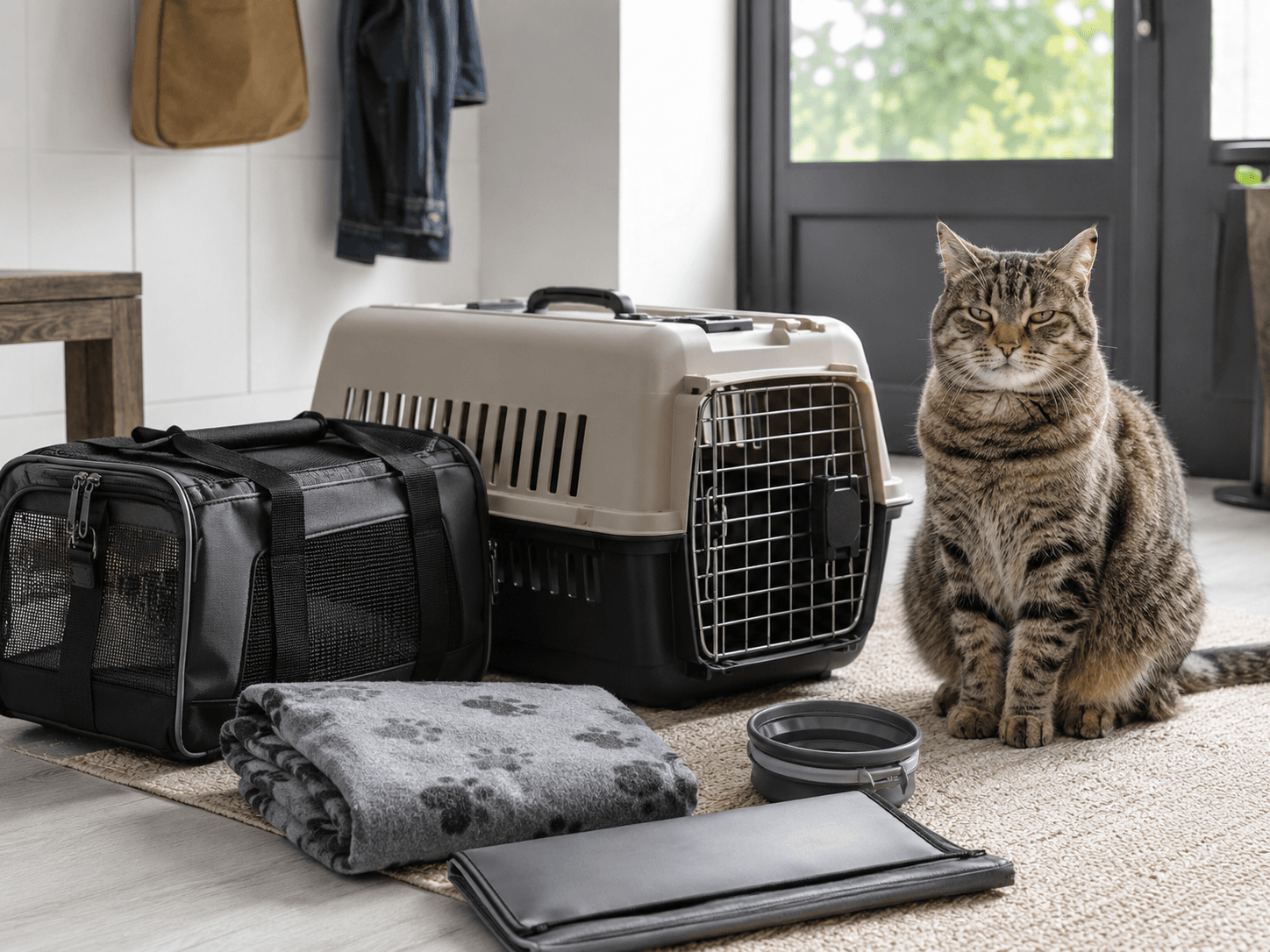
Most cats do not need a miniature travel department.
They need the correct carrier, secure transportation, familiar bedding and an owner who did not begin packing eleven minutes before departure.
The right cat travel essentials depend on the trip. A ten-minute drive to the veterinarian does not require a stroller, portable fan, GPS tracker and collapsible dining room. A flight, however, demands more planning than placing Gerald in the first bag described as “airline approved” and hoping aviation law respects the product title.
This guide matches the equipment to the journey—because buying everything is not the same as being prepared.
Quick Verdict
| Product | Best fit | Not for | PetTech AI verdict |
|---|---|---|---|
| Amazon Basics Two-Door Top-Load Carrier | Vet visits and simple car trips | Owners wanting a soft, collapsible carrier | Recommended |
| Sherpa Original Deluxe Medium | Many in-cabin flights and public transport | Large cats or airlines with incompatible limits | Recommended |
| PETKIT Breezy 2 | Tech-focused backpack travel and urban walks | Hot cars, long flights or cats needing visual shelter | Conditional |
| Sleepypod Mobile Pet Bed | Premium car travel for cats within its tested fit | Large cats and occasional budget travel | Recommended |
| Pet Gear No-Zip AT3 | Senior cats, limited mobility and controlled outdoor trips | Owners needing a compact everyday carrier | Conditional |
Best starting point for most households: the Amazon Basics carrier is simple, sturdy and easy to load from above. It does not need charging, pairing or an executive briefing before a veterinary appointment.
Best for flying: the Sherpa Original Deluxe Medium is flexible and designed around under-seat travel, but the airline—not the Amazon bullet list—has the final word.
Best car-safety upgrade: the Sleepypod Mobile Pet Bed is the only option here supported by current independent Center for Pet Safety certification.
PetTech AI may earn a commission from qualifying purchases. As an Amazon Associate I earn from qualifying purchases.
Need a straightforward carrier for vet visits and routine driving? Check the Amazon Basics Two-Door Top-Load Carrier on Amazon.
Research and Safety Note
This is a research-led buying guide based on current manufacturer documentation, independently published safety information and Amazon listings screened for availability, ratings and review volume.
PetTech AI has not crash-tested these products or taken every carrier onto every airline.
Travel rules can change by airline, route, aircraft and destination. The U.S. Department of Transportation advises passengers to check the airline’s current pet policy because carriers may impose their own size, weight, documentation, seating and kennel requirements.
For cats with significant anxiety, motion sickness, respiratory problems or other medical conditions, discuss the trip with your veterinarian before improvising a treatment plan beside the departure gate.
Choose for the Trip, Not the Gadget
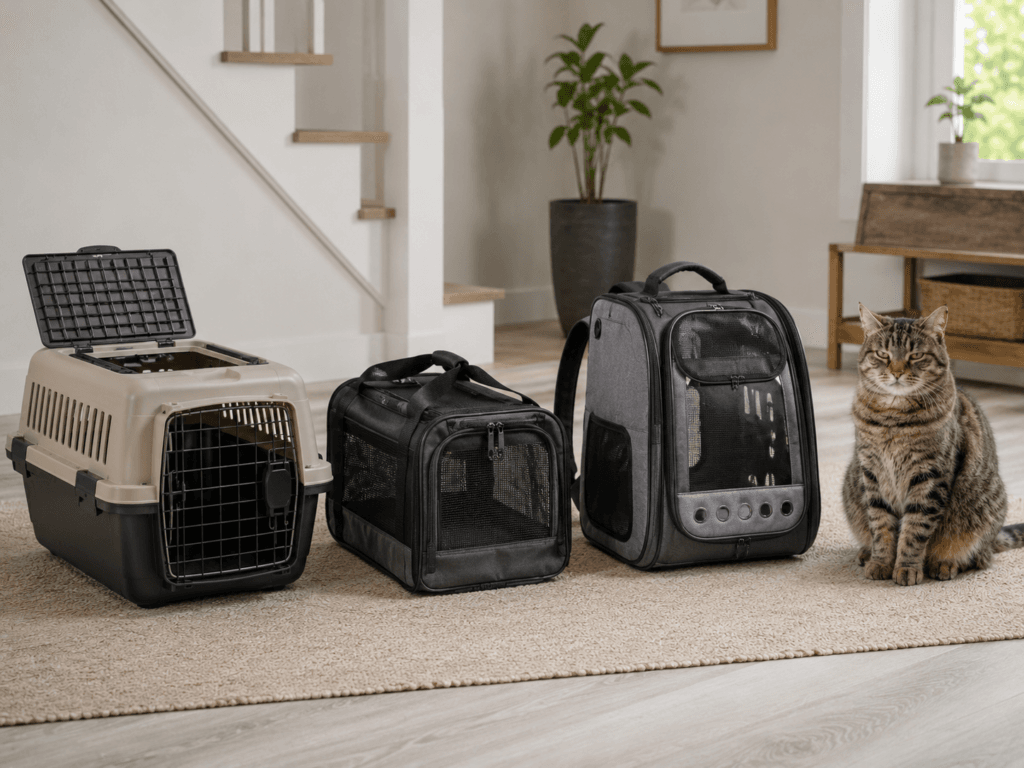
The useful question is not:
Which carrier has the most features?
It is:
What problem must this carrier solve?
For a veterinary visit, prioritize easy loading, stability and a design the veterinarian can access without extracting an already offended cat through a narrow front door.
For flying, prioritize confirmed airline dimensions, ventilation, leak resistance and enough flexibility to fit under the assigned seat.
For walking or public transportation, your own carrying comfort matters more. A backpack may be practical, but only if the interior dimensions suit the cat—not merely the manufacturer’s maximum weight.
For road travel, restraint and crash performance matter. A backpack with a fan does not become a crash-tested car carrier because it looks technological near a seat belt.
For senior cats or cats with reduced mobility, a stroller can provide controlled outdoor access without requiring sustained walking or shoulder-level transport.
One journey, one problem, one appropriate solution. The garage does not need to become a feline terminal building.
Best Simple Carrier: Amazon Basics Two-Door Top-Load
Verdict: Recommended
The Amazon Basics hard-sided carrier wins through aggressive normality.
Its front door handles routine entry, while the top opening makes it easier to lower in a reluctant cat without attempting a horizontal negotiation through a narrow gate. The rigid shell also provides more structure than a soft carrier during short trips and waiting-room transfers.
Where it wins
Choose it for:
- veterinary appointments;
- short and moderate car trips;
- cats that are easier to load from above;
- owners wanting a carrier that does not collapse in storage or use;
- households that need reliability more than features.
A top-opening carrier can also make veterinary handling easier because the cat may be examined while remaining in the lower portion of a suitable carrier. FelineVMA guidance recommends sturdy carriers with top and front access or removable tops for easier entry, exit and examination.
Where it disappoints
It is bulky, not comfortable to carry over long distances and not intended as the obvious choice for under-seat airline travel.
The rigid construction also does not mean it has independently demonstrated crash protection. Treat it as a practical transport enclosure—not a feline child seat with excellent public relations.
Choose Amazon Basics when: simplicity, easy loading and routine travel matter most.
Skip it when: you expect to walk through airports, train stations or city streets with the carrier on your shoulder.
Best Soft Carrier for Flights: Sherpa Original Deluxe Medium
Verdict: Recommended
The Sherpa Original Deluxe is the strongest flight candidate in this shortlist because its soft structure and spring-wire frame are designed to compress beneath many airline seats.
It includes mesh ventilation, locking zippers, top and side entry, a waterproof base and a removable machine-washable liner. Sherpa also tells buyers to select the size using the animal’s measurements before relying on weight alone—which should be obvious, yet the pet-carrier industry occasionally behaves as though cats are sold in standardized cubes.
Where it wins
The Sherpa makes sense for:
- many domestic in-cabin flights;
- train and bus travel;
- owners needing a lighter carrier;
- cats that fit comfortably within the Medium dimensions;
- travelers who value a washable liner and flexible frame.
Where it disappoints
“Airline friendly” is not universal permission to board.
Sherpa itself notes that airlines have different sizing requirements and that not every carrier size is guaranteed on every flight. Aircraft and seat configurations can also differ. Verify the exact airline policy and contact the carrier when the published limits are unclear.
A weight limit is also not a substitute for measuring the cat. A compact but dense cat and a long, tall cat may weigh the same while requiring very different interiors.
Need more options for large cats, backpack travel or routine vet visits? Our guide to the best cat carriers for travel compares the strongest designs by use case.
Need a flexible carrier for an upcoming flight? Check the Sherpa Original Deluxe Medium on Amazon—then check your airline before removing the tags.
Best Smart Backpack: PETKIT Breezy 2
Verdict: Conditional
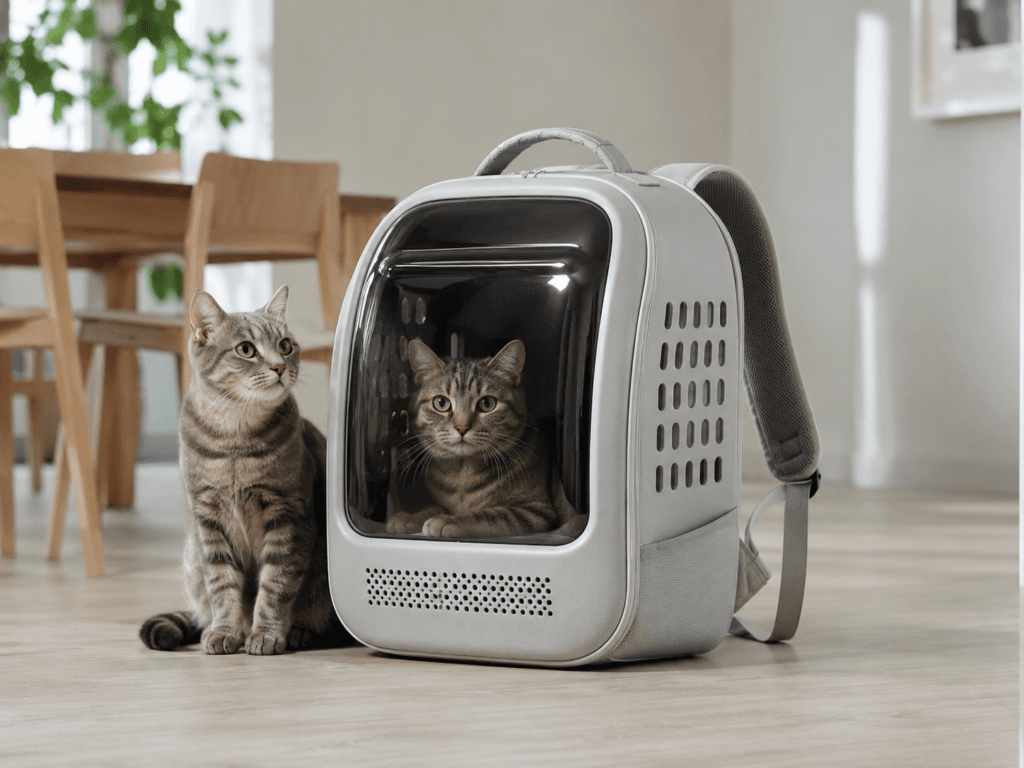
The PETKIT Breezy 2 is the genuine technology option—not a normal backpack promoted to “smart” after someone added a side pocket.
It combines a rigid backpack design with a built-in fan, interior lighting, ventilation openings and a wide tinted window. PETKIT lists dimensions of approximately 13 × 11.8 × 17.7 inches, a carrier weight of 3.3 pounds and a maximum cat weight of 18 pounds. The fan requires a separate power bank, which is not included.
Where it wins
Choose Breezy 2 for:
- walking through cities or stations;
- owners who prefer backpack straps;
- cats that tolerate visual exposure;
- short trips where active airflow adds practical comfort;
- buyers already comfortable with PETKIT hardware.
The current Amazon listing also has a much stronger review history than many novelty “space capsule” backpacks, which helps distinguish it from the large family of transparent bubbles designed primarily to photograph well.
Where it disappoints
The Breezy 2 is not a universal travel carrier.
Its rigid body may conflict with airline under-seat limits. The large viewing window can be stimulating for cats that settle better with reduced visual input. The fan also depends on a charged external power source.
Most importantly, airflow does not make an overheated vehicle safe. Never leave a cat unattended in a parked car, even with the windows cracked, a cooling mat installed or the Breezy fan performing its small mechanical heart out. The AVMA warns that vehicle interiors can quickly reach dangerous temperatures.
Choose Breezy 2 when: you want a ventilated backpack for walking and controlled urban travel.
Skip it when: you primarily need a flight carrier, crash-tested restraint or a darker retreat for an easily overstimulated cat.
Does PETKIT’s ventilated backpack fit your travel routine? Check the Breezy 2 on the PETKIT official store or Amazon.
Best Premium Car Carrier: Sleepypod Mobile Pet Bed
Verdict: Recommended
The Sleepypod Mobile Pet Bed costs more and has a smaller Amazon review base than the mainstream carriers. It also brings something more meaningful than another storage pocket: independent safety certification.
The Center for Pet Safety tested the current Mobile Pet Bed in August 2024 using a 15-pound test animal. The product passed and received a five-star result under the organization’s carrier test protocol.
Where it wins
The Sleepypod works as:
- a home pet bed;
- a portable carrier;
- a car-restraint system when installed as directed;
- a premium option for cats within its tested size range.
Using it as a bed at home may also reduce the dreaded carrier transformation: the moment a familiar object emerges from storage and Napoleon realizes someone has scheduled medicine.
Where it disappoints
The design is heavier, bulkier and more expensive than a conventional carrier. Its safety result also applies to the tested configuration and fit; it does not grant unlimited protection to cats of every size.
A large cat may simply not fit. An owner making two short veterinary trips per year may reasonably decide that the Amazon Basics carrier solves enough of the problem for much less friction.
Choose Sleepypod when: car travel is frequent enough to justify paying for independently evaluated restraint performance.
Skip it when: your cat exceeds the suitable dimensions or you mainly need lightweight public-transport mobility.
Prioritizing car travel and verified safety performance? Check the Sleepypod Mobile Pet Bed on Amazon.
Best Stroller for Senior Cats: Pet Gear No-Zip AT3
Verdict: Conditional
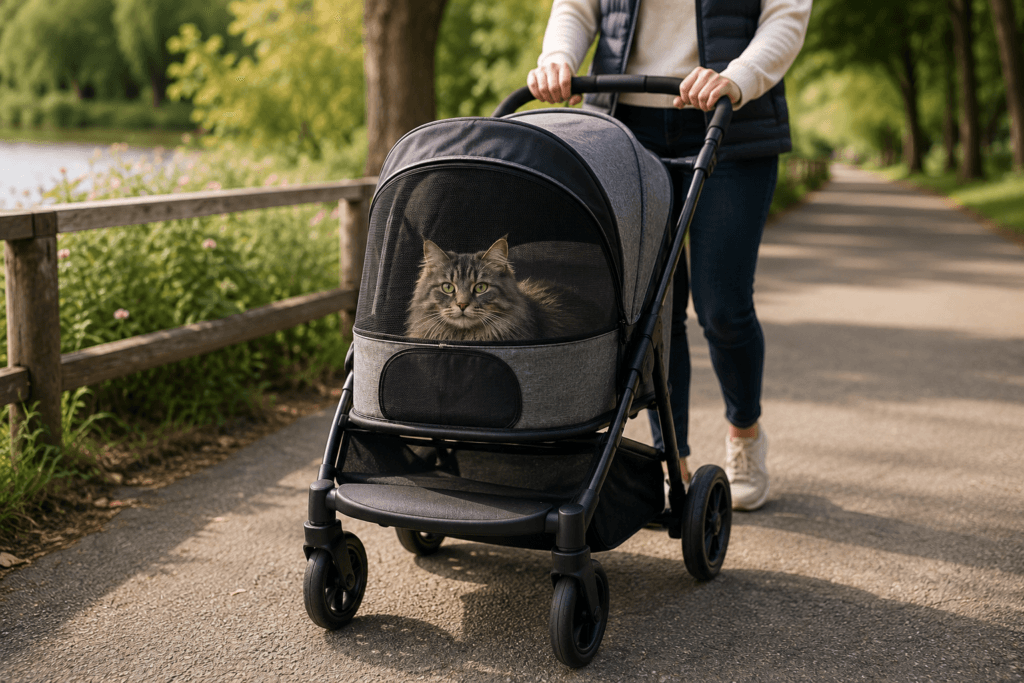
A stroller is not a cat travel essential for every household.
For the right household, however, it can solve a real mobility problem rather than merely giving the cat a suspiciously elaborate vehicle.
The Pet Gear No-Zip AT3 uses a push-button, zipperless closure, 12-inch EVA tires, a locking front wheel, an elevated paw rest, a removable liner and a one-hand folding mechanism. It measures 35 × 28.5 × 42 inches and weighs 27 pounds, so this is substantial equipment—not something that quietly disappears behind a coat rack.
Where it wins
It is best suited to:
- senior cats;
- cats with limited mobility;
- longer outdoor walks without ground contact;
- owners who cannot comfortably carry a backpack;
- controlled exposure to parks or quieter urban areas.
Where it disappoints
It does not replace an appropriate car carrier.
It is also large, relatively heavy and unnecessary for cats that dislike outdoor movement, crowds or visual stimulation. Buying one does not obligate Biscuit to develop an interest in farmers’ markets.
Introduce the stroller indoors before taking it outside. Secure the enclosure completely and follow the manufacturer’s instructions for internal restraints and loading.
Choose the AT3 when: reduced mobility or carrying difficulty makes an enclosed stroller genuinely useful.
Skip it when: the cat only leaves home for occasional veterinary appointments.
Transfers between the home, vehicle and stroller may also require a properly fitted harness. See our best cat harnesses for escape resistance, fit and training considerations.
Need enclosed mobility for a senior or mobility-limited cat? Check the Pet Gear No-Zip AT3 on Amazon.
Car Travel Safety: The Section That Matters More Than Cup Holders
A cat should never travel loose inside a moving vehicle.
An unsecured cat can be injured during sudden braking, interfere with the driver or escape when a door opens. AVMA policy favors transporting pets in an appropriate secured carrier or restraint rather than allowing them to move freely inside the vehicle.
Do not automatically place every carrier on the back seat and loop a belt around it. FelineVMA guidance says seat-belt installation should be reserved for carriers designed and crash-tested for that use; most conventional carriers are better placed on the floor behind a front seat. Follow the carrier manufacturer’s installation instructions.
Keep the vehicle ventilated and comfortably cool. Never leave the cat unattended in the car.
Stop the trip and seek veterinary guidance if the cat develops panting, breathing difficulty, repeated vomiting, marked weakness, collapse or other severe distress. Do not treat significant respiratory or heat-related signs as ordinary travel complaints.
Flying With a Cat Without Trusting the Product Title
Before booking, confirm:
- whether the airline accepts cats in the cabin;
- maximum carrier dimensions;
- combined pet-and-carrier weight limits;
- required ventilation and leak resistance;
- pet fees;
- seating restrictions;
- health certificates or other documents;
- destination and return-entry requirements.
The Department of Transportation notes that airline policies vary and that some carriers impose restrictions involving size, weight, age, behavior, weather, seating and health documentation. International destinations may add certificates, import rules or quarantine requirements.
Do this before buying the carrier. Discovering at check-in that the bag exceeds the limit is a very expensive way to learn that product copy is not aviation regulation.
The Packing List That Does Not Require a Trailer
Bring what the specific trip requires:
- secure carrier;
- updated ID tag and microchip details;
- recent photo of your cat;
- familiar liner or blanket;
- absorbent pad and spare liner;
- waste bags and pet-safe wipes;
- water and a compact bowl;
- necessary food;
- prescribed medications;
- veterinary and travel documents;
- harness and leash when safe transfers require them;
- paper towels, because optimism has limits.
For longer trips, plan food, water and litter access around the cat’s health and itinerary. Ask your veterinarian whether meal timing should change when motion sickness or a medical condition is involved.
A tracker can add location backup during outdoor trips, but it does not replace a secure carrier, harness or updated microchip. Our best cat trackers guide explains the trade-offs.
Carrier Training Without a 14-Day Military Campaign
Carrier training should follow the cat’s progress, not an invented calendar.
Leave the carrier open in a familiar room. Add bedding that smells like home. Place treats or meals near the entrance, then gradually farther inside. Once the cat enters comfortably, practice closing the door briefly, lifting the carrier and taking short car trips.
FelineVMA resources recommend making the carrier part of the home environment rather than revealing it only before veterinary visits. Familiar bedding, gradual exposure and patient handling can reduce fear associated with transport.
Some cats progress quickly. Others require weeks.
Gerald has reviewed the proposed schedule and rejected all deadlines.
When travel is necessary and training alone is not enough, ask your veterinarian about an individualized plan for anxiety or nausea. Do not give sedatives, supplements or human medications without professional guidance.
Buyer-Regret Risk
The most common travel-equipment mistakes are:
- choosing by weight limit without measuring the cat;
- assuming “airline approved” applies to every airline and aircraft;
- using a backpack as an unverified car restraint;
- buying a stroller for a cat that hates outdoor movement;
- relying on a fan or cooling mat in unsafe heat;
- testing the carrier for the first time on departure day;
- buying five accessories while ignoring carrier training;
- mistaking more features for better safety.
A boring carrier that fits, closes securely and gets used consistently is more valuable than an intelligent travel capsule currently sitting uncharged in the garage.
Final Verdict
Choose the Amazon Basics Two-Door Top-Load Carrier for routine veterinary visits and uncomplicated ground travel.
Choose the Sherpa Original Deluxe Medium when you need a flexible soft carrier for a flight—but verify the airline’s current requirements first.
Choose the PETKIT Breezy 2 when backpack comfort and active ventilation genuinely improve short walking or urban trips.
Choose the Sleepypod Mobile Pet Bed when frequent car travel makes independently evaluated restraint performance worth the premium.
Choose the Pet Gear No-Zip AT3 for senior cats, reduced mobility or owners who need enclosed transport without carrying the cat.
The best cat travel essentials do not make every journey luxurious.
They make the trip secure, manageable and repeatable—without requiring a luggage cart for an animal who plans to spend the entire vacation under the hotel bed.
Frequently Asked Questions
What is the best carrier for taking a cat to the veterinarian?
A sturdy carrier with both top and front access is usually the most practical. Top loading can make entry easier, while a removable or accessible upper section may allow parts of the examination to occur without completely removing the cat.
Can a cat backpack replace a car carrier?
Not automatically. Use a backpack in a vehicle only according to its manufacturer’s instructions and do not assume it provides crash protection. For routine carriers without verified seat-belt installation, feline travel guidance generally favors placement on the floor behind a front seat.
Is the PETKIT Breezy 2 suitable for flying?
Do not assume so. Its rigid dimensions may not fit every airline’s under-seat limits. Check the specific airline, route and aircraft requirements before purchasing it for a flight.
Should I cover my cat’s carrier?
Some cats settle better when part of the carrier is covered with a breathable towel or blanket that reduces visual stimulation. Do not block ventilation, and monitor the temperature inside the carrier.
Should I medicate my cat before traveling?
Only under veterinary guidance. A veterinarian may recommend an individualized plan for severe travel anxiety or motion sickness, but medication should not be improvised or used as a substitute for safe transport and gradual carrier conditioning.
References
- American Veterinary Medical Association — Traveling With Your Dog or Cat
- American Veterinary Medical Association — Pet Safety in Vehicles
- Center for Pet Safety — Sleepypod Mobile Pet Bed Certification
- Feline Veterinary Medical Association — Choosing the Perfect Cat Carrier
- Feline Veterinary Medical Association — Getting Your Cat to the Veterinarian
- U.S. Department of Transportation — Flying With a Pet
- PETKIT — Breezy 2 Product Documentation
- Sherpa — Original Deluxe Travel Bag Pet Carrier Documentation
- Pet Gear — No-Zip AT3 Product Documentation
Image Disclosure
Official manufacturer images are used when available and authorized.
AI-generated images may also be used as editorial illustrations. They should not be treated as exact representations of product dimensions, materials, controls or physical features. Always verify current official product information before purchasing.
Editorial Disclosure
PetTech AI may earn a commission from qualifying purchases. This does not influence our recommendations, comparisons or editorial judgments.