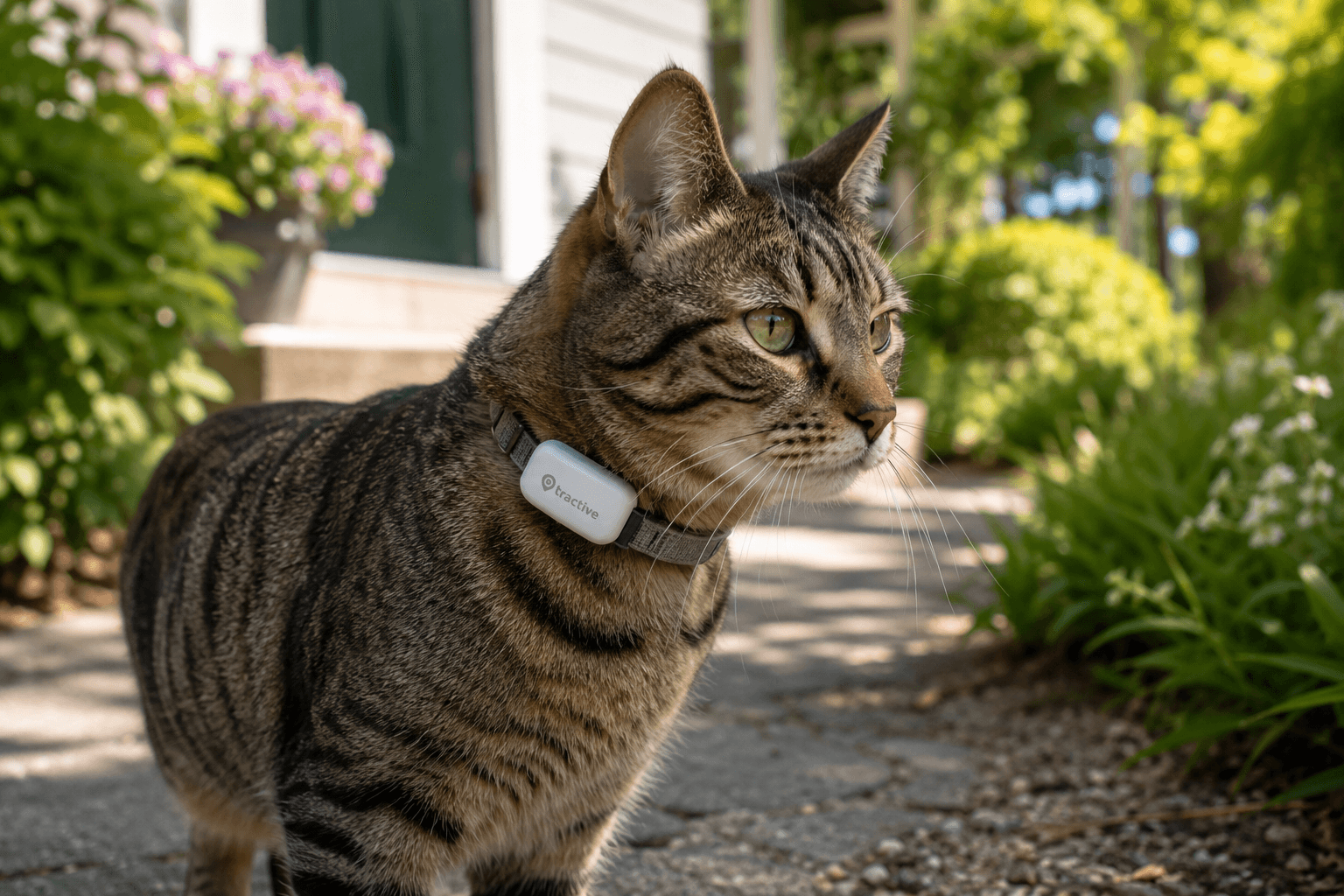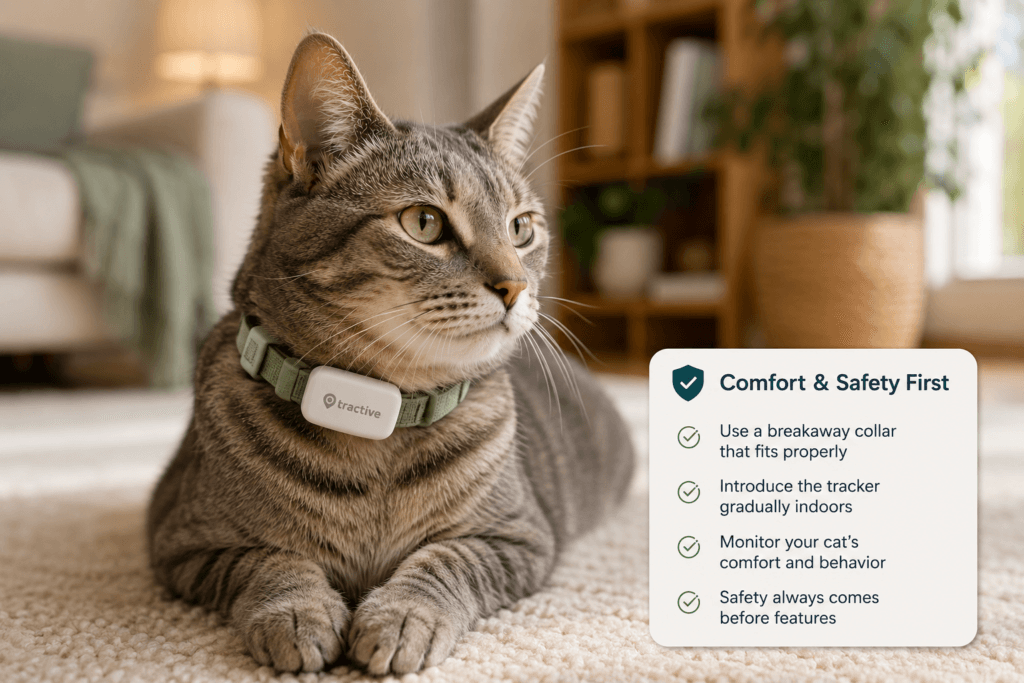
Category: Travel & Outdoor Safety

Keep your cat safe on every adventure. From GPS trackers to harnesses and carriers, explore outdoor tech that protects felines while giving them freedom.

  • Smart Catios 2025: Safe Outdoor Freedom for Modern Indoor Cats

    Smart Catios 2025: Safe Outdoor Freedom for Modern Indoor Cats

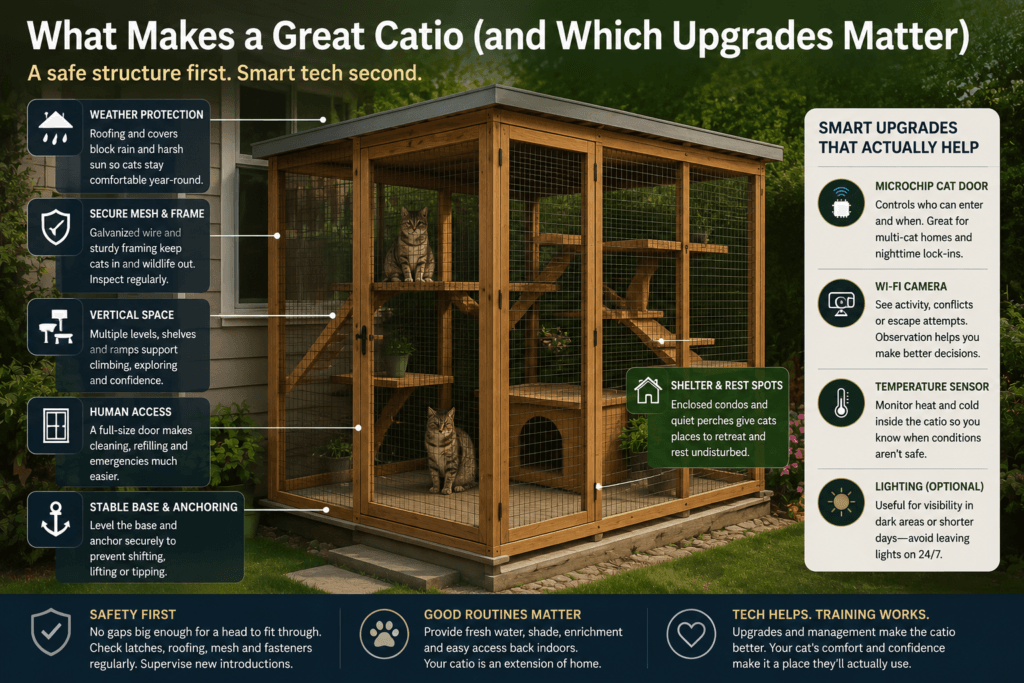
    Indoor cats deserve sunlight, breeze, and bird-TV—without risk. Smart catios 2025 brings that idea to life: modular outdoor enclosures you can connect to windows or microchip doors, monitor with cameras, and winterize with covers and insulated condos. In this guide, we shortlist three Amazon-available builds and show how to layer “smart” accessories so smart catios 2025 become a safer, healthier extension of your home.


    How we chose (so you don’t have to guess)

    To make our smart catios 2025 list, each pick needed:

    • Proven availability on Amazon US and reliable ratings.
    • Walk-in or easy-access design for cleaning and enrichment.
    • Weather-readiness (roofing, coatings, mesh) plus upgrade paths (doors/cameras).
    • Clear options to integrate with RFID/microchip doors and Wi-Fi cameras.

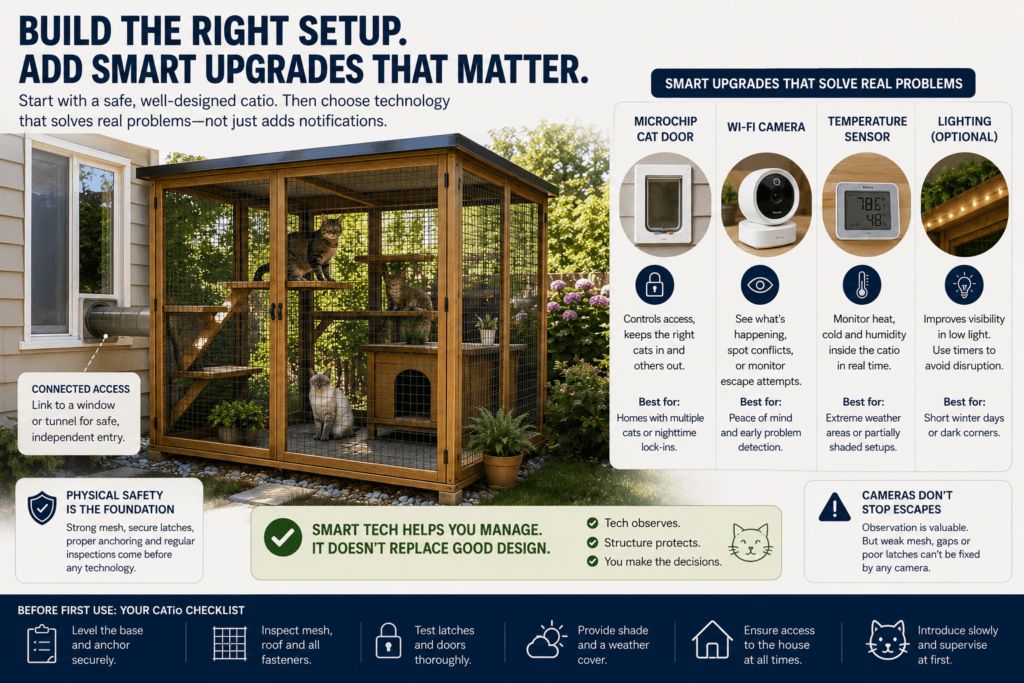
    This isn’t just lumber and mesh. The “smart” in smart catios 2025 is the system: structure + access + sensors that keep felines engaged and safe.


    Top Picks — Smart Catios 2025 (Amazon Verified)

    1) Aivituvin Catio Outdoor Cat Enclosure — Large Walk-In, Window-Connect

    Why it stands out for smart catios 2025: Aivituvin pairs practical carpentry with thoughtful cat ergonomics. The removable back panel lets you dock the structure to a window or microchip door, turning your wall into a controlled gateway. The 67″ walk-in door makes feeding and cleaning painless, while seven platforms plus two sleeping houses create vertical traffic that fights boredom.

    Quick specs (per listing)

    • Rating: 4.3/5 (834)
    • Size: 71.1″ L × 38″ W × 70.8″ H
    • Roof: Waterproof asphalt
    • Extras: Removable tray for quicker cleanouts

    Smart add-ons that fit

    • Window docking → pair with a microchip or RFID cat door for controlled access.
    • Petcube/Furbo camera inside roof corner for line-of-sight monitoring.

    👉 Check current deal on Amazon: https://amzn.to/4otDqPn

    Pros

    • True walk-in maintenance; human-friendly height.
    • Multiple rest zones reduce resource guarding in multi-cat homes.
    • Window-connect concept makes it “smart system”-ready.

    Cons

    • Footprint is deeper than window-boxes—measure balcony depth.
    • Wood needs periodic checks (usual for outdoor enclosures).

    2) COZIWOW Upgraded Extra Large Catio — Insulated Condo + 4-Way Pet Door

    Why it stands out for smart catios 2025: The included insulated sleeping condo (foam lining, wind-proof curtains) and 4-way door make this a four-season pick, especially if you add an RFID/microchip mechanism. Five platforms and a hideout box encourage roaming; the PVC cover + galvanized mesh handle rain and UV.

    Quick specs (per listing)

    • Rating: 4.2/5 (132)Amazon’s Choice
    • Size: 62.6″ L × 32.28″ W × 70″ H
    • Materials: Spruce, galvanized wire, sunlight roof, PVC weather cover

    Smart add-ons that fit

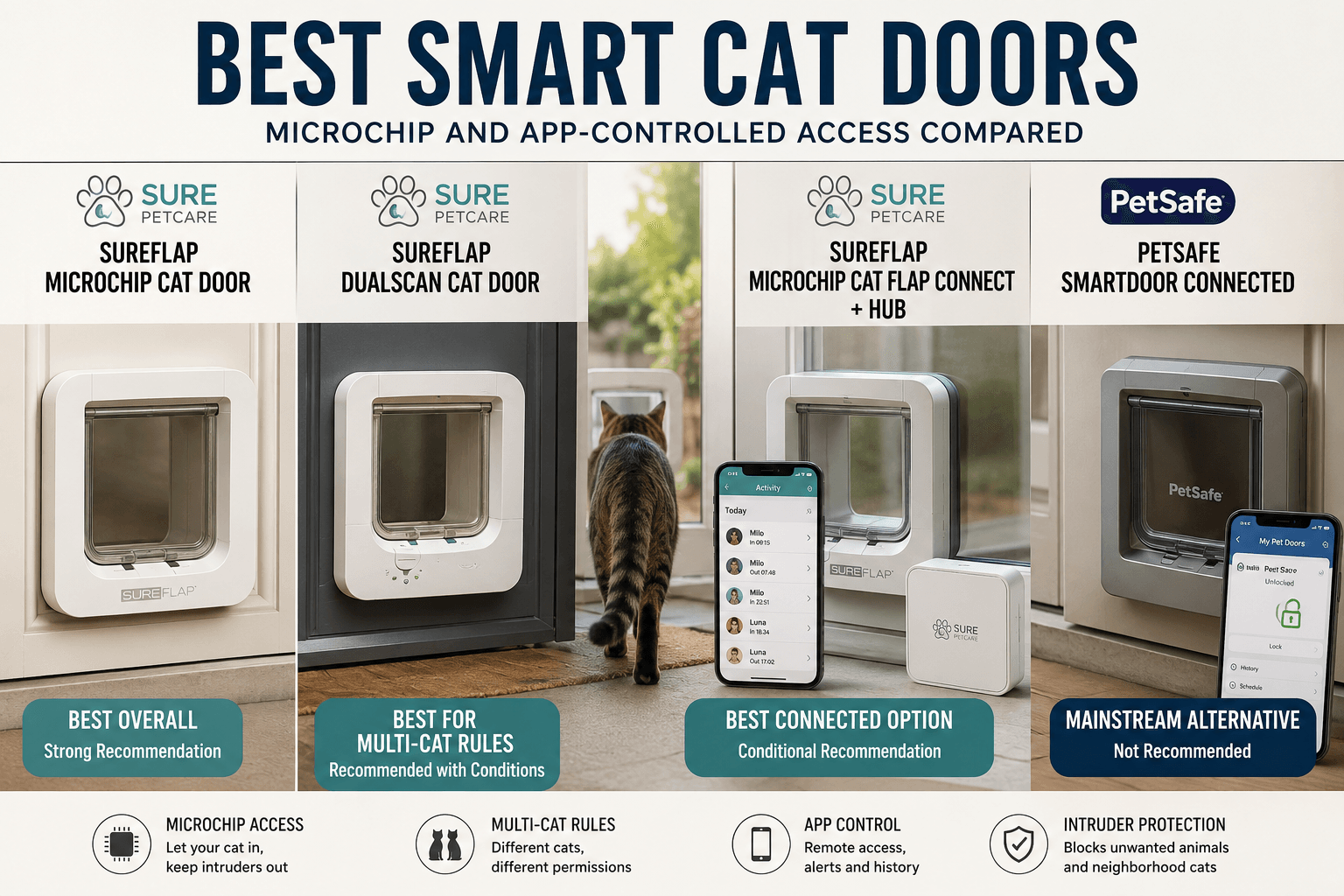
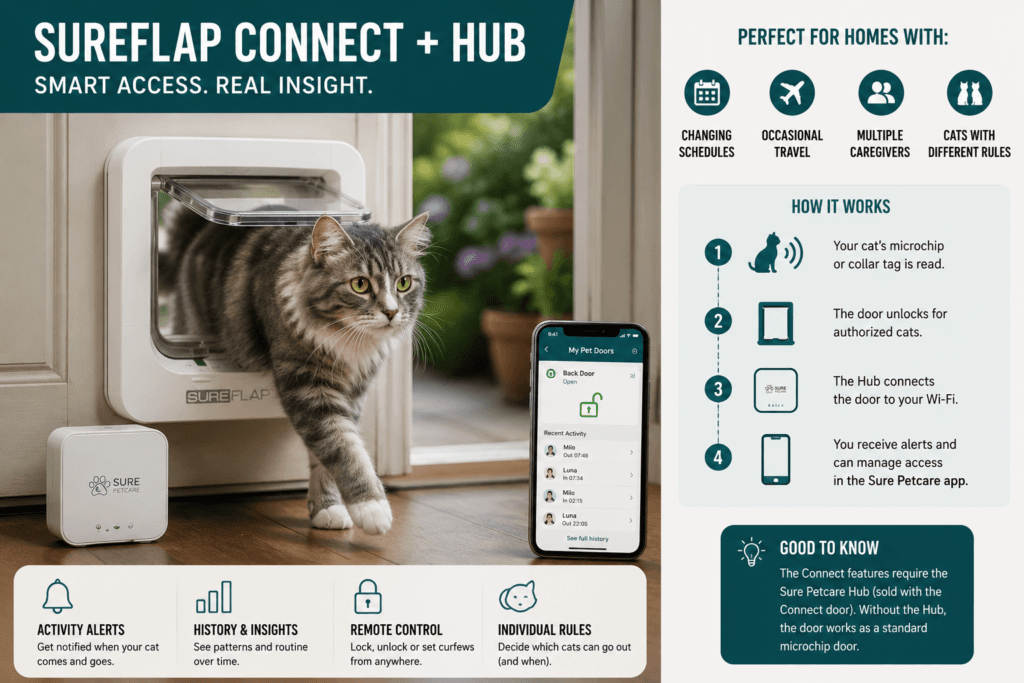
    • SureFlap Microchip Pet Door Connect for timed, ID-based entry.
    • Motion-triggered light or solar LED strip along the roof rib.

    👉 Check current deal on Amazon: https://amzn.to/3JGHAV0

    Pros

    • Built-in winterization features reduce DIY tinkering.
    • Good height for vertical play in limited footprints.
    • Easy walk-in access for humans; lockable latch.

    Cons

    • Narrower than some walk-ins; plan platform layout up front.
    • Add-ons (door/camera) are extra cost.

    3) PawHut 110″ Catio — 56 sq.ft Walk-In with Bridge, Ladders, Two Condos

    Why it stands out for smart catios 2025: Space—and lots of it. The 56 sq.ft layout, six platforms, and hanging bridge let 3–6 cats patrol, sun, and nap without crowding. The anti-UV waterproof cover stabilizes climate; the split-door makes human access fast. A small sliding door supports tunnel or window connections.

    Quick specs (per listing)

    • Rating: 4.4/5 (51)Amazon’s Choice
    • Size: 110.2″ L × 73″ W × 74″ H
    • Includes: 2 condos, 6 platforms, bridge, waterproof top cover

    Smart add-ons that fit

    • Ceiling-mounted camera (e.g., Petcube 360) aimed diagonally for full coverage.
    • RFID door tunnel to a window box or hallway.

    👉 Check current deal on Amazon: https://amzn.to/3JPgZoz

    Pros

    • Best for multi-cat households; reduces conflict via space.
    • Bridge/platforms create true “outdoor enrichment paths.”
    • Weather cover extends season usability.

    Cons

    • Requires yard space and leveling.
    • Assembly time is longer—plan for two people.

    What makes a catio “smart” in 2025?

    Insulated catio with weather cover for winter use.

    “Smart” is the sum of parts. In smart catios 2025, structure becomes a controlled zone:

    • Access control — microchip/RFID doors, schedules, one-way escape flaps.
    • Sensing & vision — Wi-Fi cameras, motion alerts, night IR, sound detection.
    • Comfort & climate — UV/anti-rain covers, insulated condos, shaded perches.
    • Layout intelligence — vertical levels, bridges, and sight lines that reduce stress.

    The goal of smart catios 2025 isn’t gadget overload; it’s low-risk outdoor time with data and convenience where it counts.


    Buyer’s Guide — Choose the right build

    1) Footprint & location

    • Balcony/terrace: favor slimmer units (COZIWOW).
    • Yard: walk-in boxes (Aivituvin, PawHut) scale better for smart catios 2025.
    • Always check HOA/lease rules.

    2) Materials & mesh

    • Weather-sealed wood + galvanized mesh are the baseline for smart catios 2025.
    • Inspect fasteners every few months; tighten where needed.

    3) Access hardware

    • Microchip/RFID doors prevent neighborhood visitors and schedule overnight lock-ins.
    • For smart catios 2025, prefer doors with app status and manual override.

    4) Camera placement

    Catio camera placement showing motion monitoring zones.
    • Mount under the roof lip, angled to door and high-traffic shelves.
    • Pick models with adjustable zones; disable audio if neighbors are close.

    5) Weather package

    • Waterproof/UV covers, insulated condos, and raised floors extend seasonality.
    • For colder regions, smart catios 2025 benefit from wind baffles on the north side.

    Setup & safety checklist

    1. Level the base; anchor corners to prevent sway.
    2. Pressure-test the mesh; no gaps > 1″ at edges or latch.
    3. Stagger platforms to avoid high-fall routes; add bridge hand-offs at 45–60 cm.
    4. Door test with power off (RFID/microchip) so cats learn the manual path first.
    5. Camera test at night; adjust IR glare and motion zones.
    6. Rotate perches monthly so smart catios 2025 keep novelty high.
    7. Health baseline: log weight/litter habits before outdoor time and compare 30 days later.

    Vet-aligned health notes (why outdoor time helps)

    Short, predictable outdoor sessions reduce stress behaviors (overgrooming, zoomies at 3 a.m.) and may improve appetite and sleep. Pair smart catios 2025 with stable routines: play → meal → rest. Keep vaccinations and parasite prevention current; check paws for splinters. Consult your veterinarian if your cat has chronic conditions before expanding outdoor time. (See Cornell Feline Health Center & AVMA resources in links.)


    Smart add-ons we actually recommend

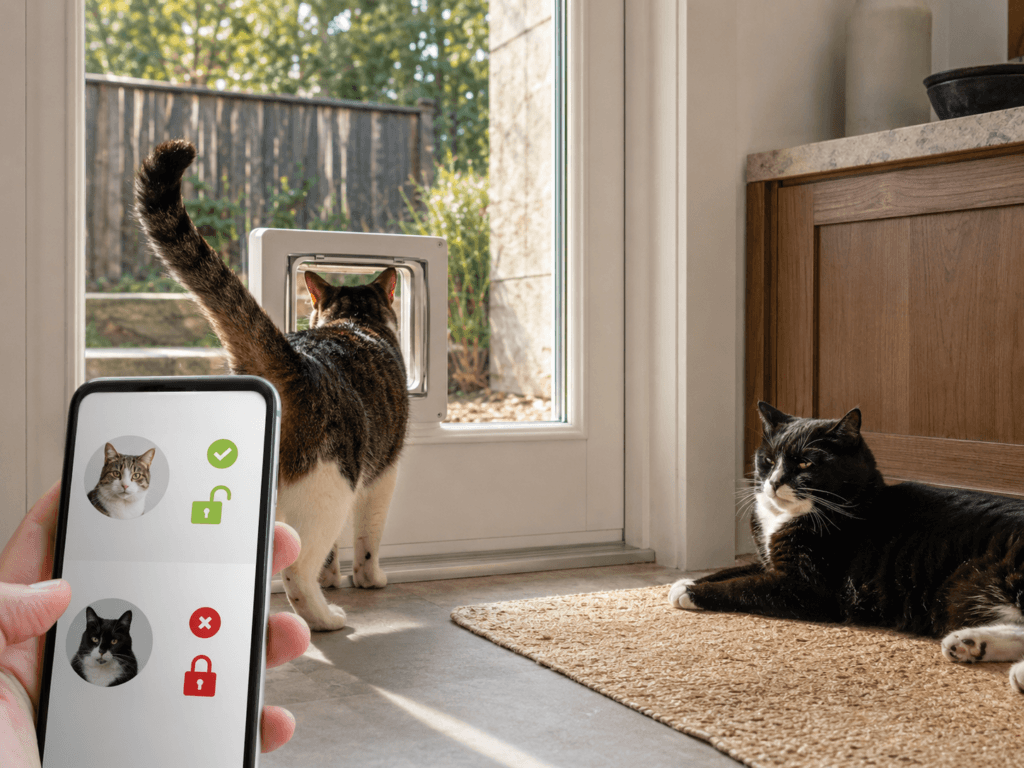
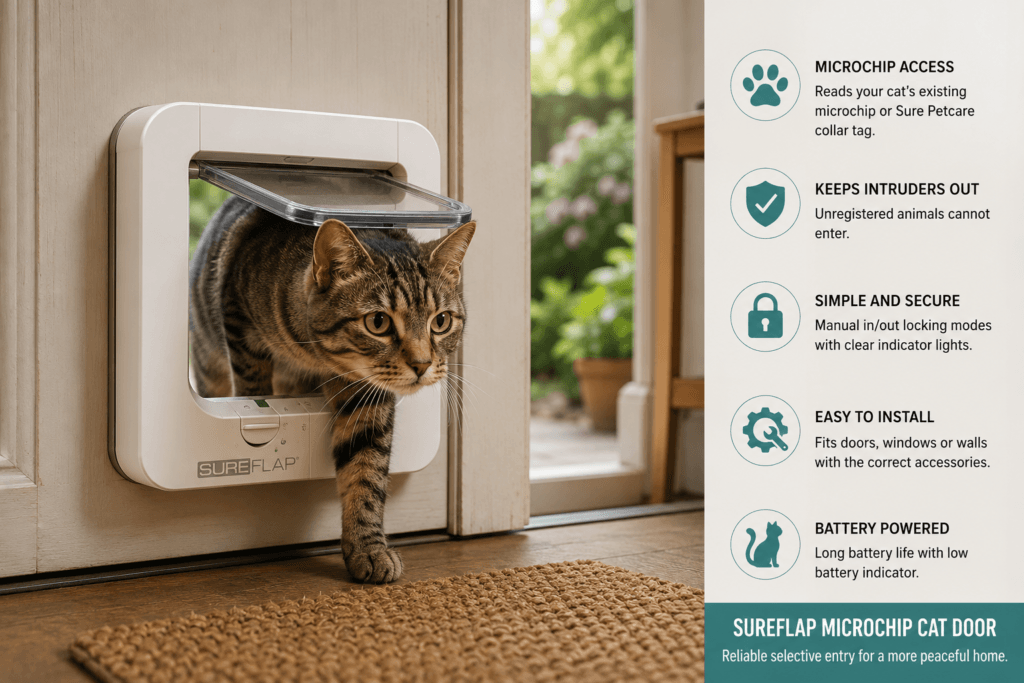
    Microchip pet door enabling controlled access to a catio.
    • Microchip/RFID cat door (timers + app): safer access than open windows.
    • Wi-Fi camera with activity zones: catch fence-tests and stray visitors.
    • Solar LED strip on roof rib: dusk light without cables.
    • Quiet white-noise fan under cover (summer): airflow without drafts.
    • Hydration station (covered): if you leave water outdoors, clean daily.

    Used sparingly, these make smart catios 2025 more predictable for you and more enriching for cats.


    Comparison snapshot

    ModelFootprintStandoutBest for
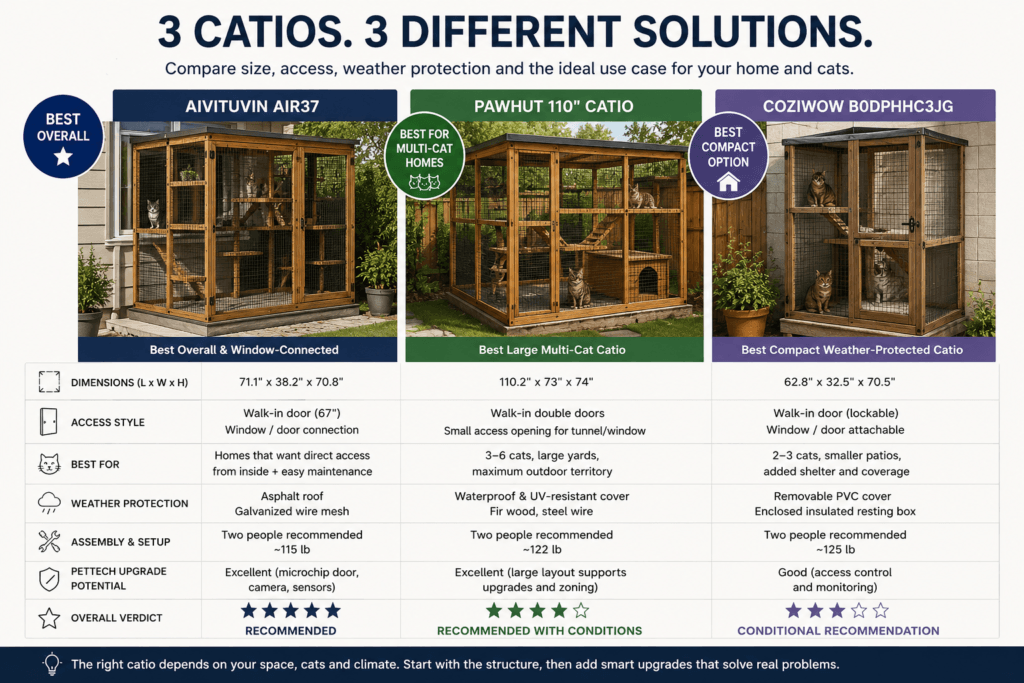
    Aivituvin71×38×70.8″Window-connect back panel, true walk-inApartments/yard edges needing window docking
    COZIWOW62.6×32.3×70″Insulated condo + 4-way door + PVC coverFour-season use in tighter spaces
    PawHut 110″110.2×73×74″56 sq.ft, bridge, two condosMulti-cat yards and enrichment paths

    Each integrates cleanly with door/camera kits that turn solid builds into smart catios 2025.


    Verdict

    If you want a compact, upgrade-ready build, COZIWOW is the budget-friendly on-ramp. For window-to-outside workflows with human-friendly maintenance, Aivituvin is the sweet spot. If you’ve got the yard and multiple cats, PawHut 110″ is a no-brainer for space and enrichment. Add a microchip door and a single, well-placed camera, and your smart catios 2025 setup will feel seamless day one.


    FAQs

    Do smart catios require supervision?
    Start supervised the first week. With cameras and a microchip door, smart catios 2025 can support short unsupervised windows once habits are stable.

    How do I handle winter?
    Use insulated condos, draft baffles, and weather covers. For smart catios 2025 in cold zones, keep sessions shorter and provide warm indoor retreats.

    Will my cat try to escape?
    Most enjoy the view and routine. Still, audit every seam monthly. Smart catios 2025 with RFID doors reduce “opportunistic” dashes.

    What about neighbors/wildlife?
    Cameras + motion zones help you respond. Avoid food outdoors at night; clean after meals to deter visitors.


    Internal links (PetTech AI)


    Authoritative outbound links

    • Cornell Feline Health Center — Outdoor Safety & Enrichment Basics (general guidance on safe exploration).
    • AVMA — Preventive Care & Parasite Control (vaccines, flea/tick/heartworm basics for outdoor exposure).

    Disclaimer

    PetTech AI provides educational information for cat guardians. This content is not veterinary advice and does not replace diagnosis or treatment. Always consult your veterinarian before changing your cat’s routine, especially for outdoor access or if your pet has chronic conditions. Outdoor setups require regular inspection for loose fasteners, sharp edges, or wear. Weather protection and parasite prevention are essential. This page includes affiliate links (e.g., Amazon). If you purchase through them, PetTech AI may earn a commission at no extra cost to you. Commissions support independent testing and ongoing updates to our guides.

  • Best Virtual Fences for Cats: GPS Escape Alerts Compared

    Best Virtual Fences for Cats: GPS Escape Alerts Compared

    A green circle on a phone is not a fence.

    Baron has not signed a treaty with Google Maps, and the app cannot stop him from crossing a road, climbing through a hedge or beginning an unscheduled inspection of the neighbor’s garage.

    A virtual fence for cats is an early-warning system. You draw a Safe Zone in a GPS tracker app, and the system attempts to notify you when the tracker leaves or enters that area.

    That can be useful.

    It is not containment.

    Quick Verdict

    Tractive is currently the most defensible virtual-fence option for cats, but it receives only a Conditional Recommendation.

    Its current cat tracker combines Virtual Fence alerts with live GPS and location history. However, GPS drift, mobile coverage, tracker fit and notification delays make it unsuitable as a precise backyard boundary.

    Weenect XS and Petcube GPS Tracker offer relevant escape-alert features, but current ownership evidence is too weak for PetTech AI to recommend them broadly.

    Tabcat V2 does not provide virtual fences at all. It earns a separate recommendation for owners whose cat is probably nearby but hidden.

    ProductBest fitPetTech AI verdictMain limitation
    Tractive Cat GPS TrackerCats that may travel beyond the immediate neighborhoodConditional RecommendationNot precise or immediate enough to function as containment
    Weenect XSBuyers seeking a cat-specific Tractive alternativeNot RecommendedRelevant design, weak current ownership evidence
    Petcube GPS TrackerLarger cats already using the Petcube ecosystemNot Recommended for Most CatsDog-oriented positioning and mixed ownership evidence
    Tabcat V2A cat probably hiding close to homeRecommended with ConditionsNo GPS, escape alerts or virtual fences

    Research Note

    This is a research-led comparison based on current manufacturer documentation, network requirements, tracker dimensions, subscription terms, product positioning and available ownership evidence.

    PetTech AI has not conducted long-term side-by-side testing of every tracker included.

    PetTech AI may earn a commission from qualifying purchases. As an Amazon Associate I earn from qualifying purchases.

    What a Virtual Fence Actually Does

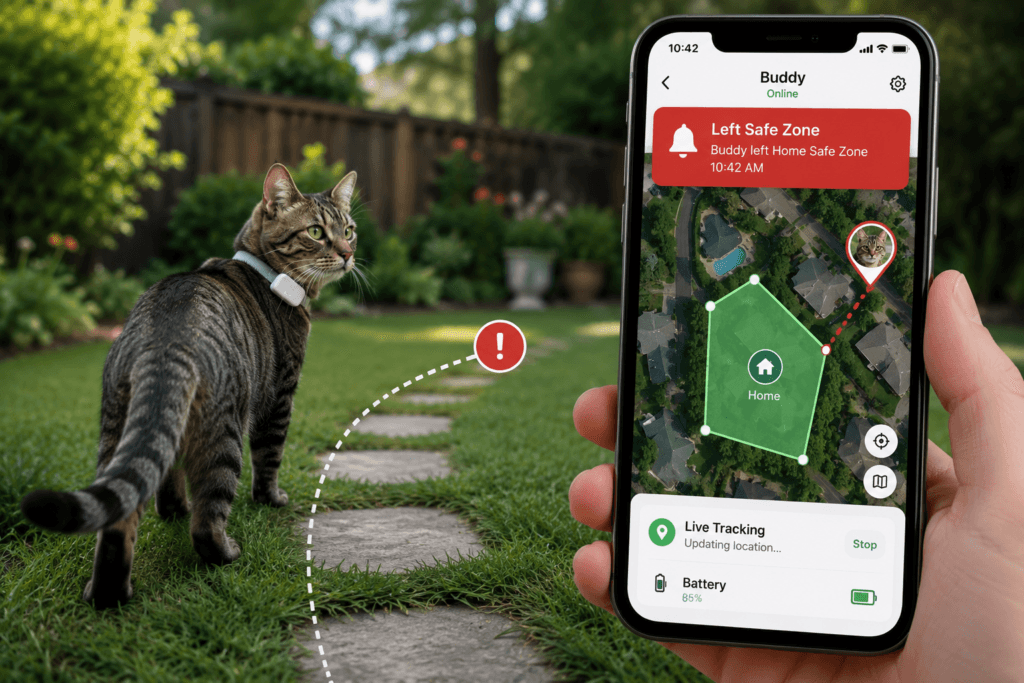
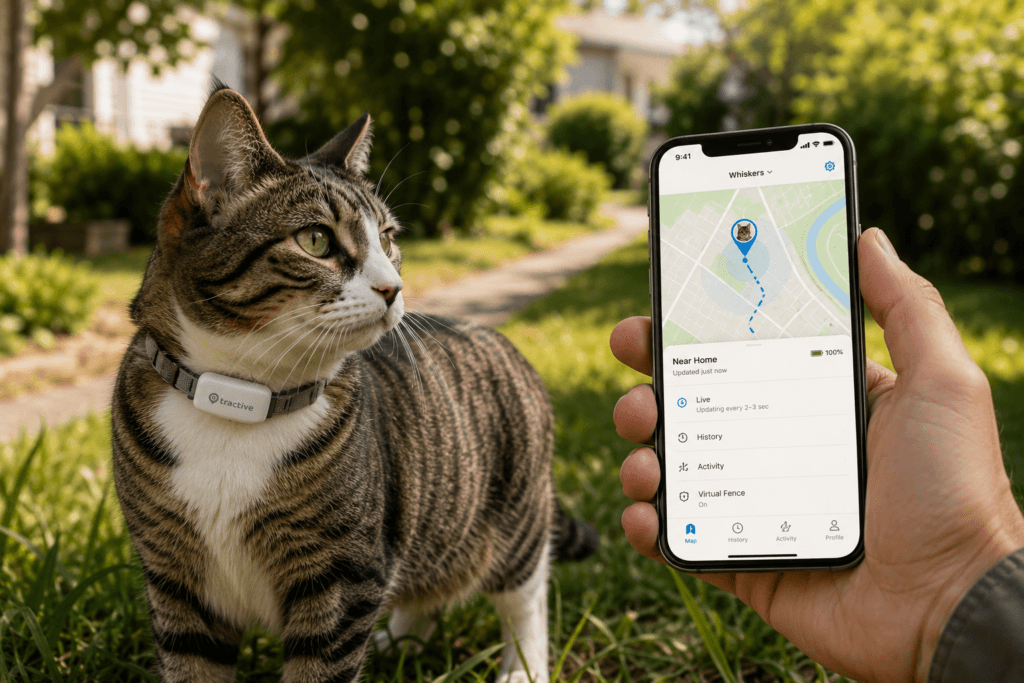
    A smartphone showing a digital safe zone alert while a cat wearing a GPS tracker moves beyond a home area
    A virtual fence is an alert system: it tells you when a cat may have left a chosen area, not whether the cat has been physically contained.

    A virtual fence is a digital zone created inside a GPS tracker app.

    The most common version is a Safe Zone around your home. When the tracker detects that your cat has crossed the boundary, the system sends a notification. Some platforms also let you create No-Go Zones around places such as roads or neighboring properties.

    The process usually involves several steps:

    1. The tracker estimates its position.
    2. The tracker compares that location with the digital boundary.
    3. The device sends data through a cellular network.
    4. The platform processes the event.
    5. Your phone receives a notification.

    Each step introduces a possible delay or failure point.

    The tracker may not have a clean GPS view. Cellular coverage may be weak. The device may be in a battery-saving mode. Your phone may be offline, silenced or restricting background notifications.

    The app can warn you.

    It cannot teleport you into the garden.

    Why Virtual Fences Cannot Contain a Cat

    Nothing happens physically when a cat crosses a GPS boundary.

    There is no wall, closed gate or supervised handler. The cat can continue moving while the tracker calculates its position and the alert travels through the network.

    That distinction matters most near immediate hazards.

    A virtual fence cannot reliably stop a cat from:

    • entering a road;
    • leaving through an open gate;
    • climbing over a physical fence;
    • following wildlife beyond the property;
    • approaching another animal;
    • disappearing through a narrow gap.

    For controlled outdoor access, feline-veterinary guidance points owners toward options such as secure outdoor enclosures and supervised harness-and-leash exploration. The AVMA also supports keeping owned cats indoors, in enclosures or under attended control rather than allowing unrestricted roaming.

    A virtual fence belongs behind those measures as a recovery layer.

    It should never be the reason you accept a risk you would reject without the tracker.

    Why Small Yards Are the Worst Use Case

    Virtual fences sound most appealing for small yards.

    Unfortunately, small boundaries are where normal GPS variation becomes hardest to tolerate.

    Tractive currently requires a circular Virtual Fence to have a radius of at least 50 meters. Its rectangular option starts at 100 by 100 meters. Custom shapes can be smaller, but the app may warn that the zone is too small for reliable notifications.

    That tells us something important.

    A virtual fence can monitor whether a cat has left the general home area. It is not designed to determine with perfect consistency whether the cat is two feet inside or two feet outside a garden boundary.

    Buildings, trees and narrow streets can also affect the quality of a GPS position. Even Tractive’s own support documentation acknowledges that displayed locations may occasionally jump or appear inaccurate.

    Treat claims of exact property-line protection accordingly.

    Satellite positioning is useful technology. It has not developed a personal vendetta against your hydrangeas.

    Best Available Escape-Alert System: Tractive Cat GPS Tracker

    Verdict: Conditional Recommendation

    Tractive remains the most defensible choice when a cat may travel beyond the immediate neighborhood and you want both an escape alert and a map-based recovery tool.

    The current CAT 6 Mini combines Virtual Fences, location history, Live Tracking and territory information in a collar-integrated design. The tracker itself weighs approximately 25 grams, or around 32 grams with its integrated collar, and Tractive recommends it for cats weighing at least 3 kilograms. The manufacturer states that Live Tracking can update every two to three seconds when active.

    The workflow is coherent:

    • set a broad Safe Zone around home;
    • receive an exit notification;
    • open the app;
    • activate Live Tracking;
    • follow the updated location;
    • share access with another household member when necessary.

    That makes Tractive more than a virtual-fence notification. It gives the owner something useful to do after the alert arrives.

    The problem is ownership friction.

    Current feedback is mixed enough that PetTech AI cannot give Tractive an unconditional recommendation. A tracker can have the most complete feature set in the category and still frustrate owners through charging, subscriptions, connectivity, attachment concerns or inconsistent real-world behavior.

    Choose Tractive when:

    • your cat has outdoor access;
    • your cat could travel beyond nearby houses;
    • you need genuine GPS rather than crowd-assisted Bluetooth;
    • you accept a subscription and charging routine;
    • your cat can comfortably wear the current hardware;
    • you understand that the Safe Zone is a broad alert area.

    Skip it when:

    • you expect exact property-line detection;
    • your cat is too small for the recommended fit;
    • mobile coverage is poor where the cat travels;
    • the cat is probably hiding within your home or garden;
    • you want a device that physically prevents escape.

    Could your cat travel beyond the immediate neighborhood? Check the current Tractive cat tracker on Amazon.

    Cat-Specific Alternative: Weenect XS

    Verdict: Not Recommended

    Weenect XS is technically one of the most relevant alternatives in this category.

    It is designed for cats weighing at least 3 kilograms, weighs approximately 27 grams and supports real-time GPS tracking, safety-zone alerts, sound, vibration and mobile-network connectivity. Weenect advertises up to seven days of battery life when power-saving zones are used, with substantially less during continuous tracking. Each tracker also requires its own subscription.

    On paper, that creates a convincing Tractive competitor.

    The physical format is cat-oriented. The tracker works in the United States. It offers the relevant escape-alert function rather than relying on nearby phones.

    Current ownership evidence does not support recommending it.

    This is where PetTech AI’s editorial line matters: a relevant design does not become a good purchase merely because the shortlist is short. Weenect fills a market gap. It has not currently earned the recommendation attached to that gap.

    Choose it only when:

    • you specifically prefer Weenect’s collar format;
    • you understand its subscription requirements;
    • you have reviewed recent customer feedback carefully;
    • the retailer offers a practical return route;
    • you accept being closer to an early adopter than a default buyer.

    Buyer-regret risk: the product solves the correct technical problem, but current evidence gives buyers too little confidence that everyday ownership will match the feature list.

    Still considering the cat-specific Weenect XS? Check current availability and customer feedback on Amazon.

    Petcube GPS Tracker: Relevant Features, Wrong Default Buyer

    Verdict: Not Recommended for Most Cats

    Petcube GPS Tracker supports live location, Safe Zones, No-Go Zones, location history, a buzzer and an LED light. It requires an active paid plan because it transmits position information through cellular networks.

    That makes it relevant to the keyword.

    It does not make it a natural recommendation for most cats.

    Petcube’s official product material remains strongly dog-oriented, including its language about live tracking, activity goals and collar use. The device may be physically manageable for some larger cats, but that is different from being designed around feline collar fit and daily wear.

    There is also an important update-frequency caveat. Petcube explains that ordinary tracking frequency depends on movement and may average roughly one update every ten minutes while the pet is active. When the tracker is inside a Wi-Fi power-saving zone, it may stop reporting regular GPS positions until conditions change.

    That does not make the device useless. It reinforces the central point of this article:

    A virtual fence is an alert layer, not a real-time force field.

    Petcube makes the most sense for someone who:

    • already uses the Petcube ecosystem;
    • has a sufficiently large, collar-tolerant cat;
    • values Safe and No-Go Zones;
    • accepts the subscription;
    • has studied the attachment and return policy carefully.

    Most cat owners should choose neither brand familiarity nor a low device price as the deciding factor. The recurring plan, fit and real-world alert behavior matter more.

    Buyer-regret risk: the feature list is relevant, but the product’s dog-first design logic makes it a questionable default for feline use.

    Still evaluating Petcube for a larger cat? Check current availability and customer feedback on Amazon.

    What About Fi Mini and Pawfit Lite?

    Both products provide GPS tracking and zone-based alerts, but neither currently improves the recommendation hierarchy.

    Fi Mini offers an appealing app-led ecosystem and a lightweight proposition. Current early ownership evidence is too weak for PetTech AI to recommend it over the more established Tractive platform.

    Pawfit Lite addresses a legitimate problem by prioritizing compact cat-oriented wearability and nearby Bluetooth assistance. Its current evidence is also too limited and mixed to support a recommendation.

    They remain products to watch—not missing winners we forgot to place on the podium.

    A glossy app screenshot is evidence that somebody hired a competent interface designer. It is not evidence that an escape alert will behave reliably at the exact moment Baron discovers freedom.

    When Tabcat V2 Is the Better Tool

    Verdict: Recommended with Conditions

    Tabcat V2 is not a virtual fence.

    It does not send escape alerts, show a map, use cellular GPS or record roaming history.

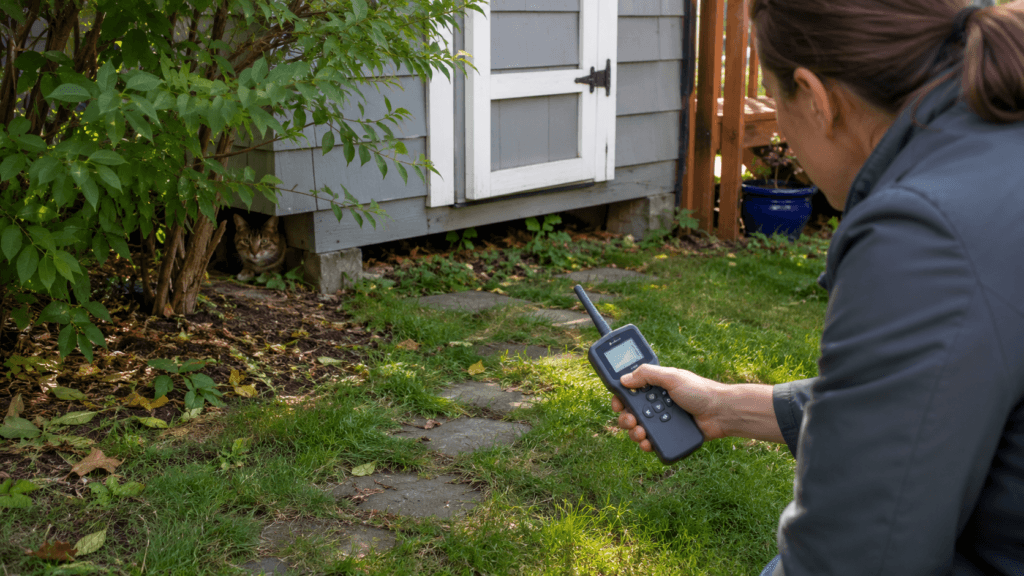
    It uses radio frequency and a handheld directional receiver to help locate a tagged cat that is already within range. Tabcat quotes a maximum range of approximately 500 feet in favorable conditions, while walls, doors and other obstructions can reduce it. Its tag weighs about 0.2 ounces and does not require a cellular subscription.

    That makes Tabcat better for a different problem:

    “My cat is probably nearby, but I cannot see them.”

    Possible locations include:

    • under a porch;
    • inside a shed;
    • behind dense bushes;
    • in a garage;
    • beneath furniture;
    • somewhere inside the house.

    Choose Tabcat when:

    • the cat is primarily indoors;
    • the likely search radius is local;
    • collar weight is a major concern;
    • you want no recurring plan;
    • directional close-range recovery matters more than a map.

    Skip it when:

    • the cat may travel several streets away;
    • you need an alert when the cat leaves home;
    • you want remote tracking from another location;
    • you need route history or GPS coordinates.

    Is your cat more likely to hide nearby than roam across town? Check Tabcat V2 on Amazon.

    For a broader decision between GPS, radio frequency and Bluetooth-based finding, read our Best Cat Trackers comparison.

    Virtual Fence vs Catio vs Harness

    These tools should not be presented as interchangeable.

    Virtual fence

    Purpose: alert and recovery.

    It may tell you that the cat has left a broad expected area and help you begin looking.

    Catio or secure enclosure

    Purpose: physical containment with outdoor enrichment.

    A properly secured enclosure reduces the cat’s ability to enter roads, neighboring properties or wildlife areas while still allowing access to outdoor sights, smells and movement.

    Harness and leash

    Purpose: supervised exploration.

    A correctly fitted harness gives the handler physical control while allowing the cat to explore at an appropriate pace. It requires gradual training and is not enjoyable for every cat.

    For fit and introduction guidance, read our Best Cat Harnesses guide.

    Radio-frequency tracker

    Purpose: precise nearby recovery.

    It helps locate a hidden cat once you are already within the general search area.

    A robust safety setup may combine several layers:

    • microchip and current registration;
    • visible identification;
    • secure physical access;
    • supervised outdoor time;
    • a wearable tracker;
    • a prepared escape-response routine.

    The tracker is one layer—not the constitutional foundation of the household.

    How to Set Up a Virtual Fence Realistically

    1. Draw a broad zone

    Do not trace the exact edge of a small backyard and expect boundary-level precision.

    Create a zone large enough to absorb ordinary GPS variation while still warning you when the cat has moved beyond the normal home area.

    2. Test it before relying on it

    Walk the tracker across the boundary yourself.

    Record:

    • where the alert actually appears;
    • how long the notification takes;
    • whether the phone receives it with the app closed;
    • whether other household members receive shared alerts;
    • what happens when mobile coverage weakens.

    3. Check phone permissions

    Allow the app to run in the background and send notifications. Disable settings that silently prevent urgent alerts from appearing.

    4. Maintain the battery

    Create a charging routine before the tracker reaches a critical level.

    A discharged GPS tracker offers roughly the same location intelligence as a decorative collar charm, only with a more ambitious subscription history.

    5. Prepare the response

    Decide in advance:

    • who checks the app;
    • who searches outside;
    • where the carrier is stored;
    • which garages, decks and bushes should be checked first;
    • which neighbors can be contacted;
    • which recall sound or treat may help.

    Information becomes safety only when it produces an organized response.

    Frequently Asked Questions

    Can a virtual fence keep my cat inside the yard?

    No. It can notify you when a GPS tracker appears to leave a digital zone, but it cannot physically stop the cat or guarantee an alert at the exact property line.

    What is the best virtual fence for cats?

    Tractive is currently the most defensible option because it combines Virtual Fence alerts with live GPS and a cat-specific wearable format. It receives a Conditional Recommendation because ownership friction and normal GPS limitations prevent a stronger endorsement.

    How quickly do virtual-fence alerts arrive?

    There is no universal guaranteed delay. Timing depends on tracker update frequency, GPS reception, mobile coverage, app processing and phone notification settings. Test the complete alert chain in your own environment.

    Are virtual fences useful in small yards?

    Not as precise boundaries. Small zones leave little room for ordinary GPS variation. They are more useful as broad alerts around the general home area.

    Is Weenect better than Tractive?

    Not based on current ownership evidence. Weenect is a relevant cat-specific alternative, but PetTech AI does not currently recommend it over Tractive.

    Can an AirTag replace a GPS virtual fence?

    No. An AirTag relies primarily on Bluetooth and Apple’s nearby-device network. It does not operate like an independent cellular GPS tracker with continuous live tracking and dedicated Safe Zone alerts.

    Is Tabcat a virtual fence?

    No. Tabcat is a radio-frequency finder for nearby recovery. It can be the better tool when the cat is probably close but hidden, but it cannot warn you when the cat leaves home.

    Final Verdict

    The virtual-fence market for cats is weaker than its marketing suggests.

    Tractive is the only product in this comparison that earns a direct, although conditional, recommendation for GPS escape alerts.

    Choose it when your cat may travel beyond the immediate neighborhood and you want a broad Safe Zone combined with map-based recovery.

    Do not choose it because you expect an invisible wall around a small yard.

    Weenect XS is not recommended. Its cat-specific hardware is relevant, but current ownership evidence is too weak to justify selecting it over Tractive.

    Petcube GPS Tracker is not recommended for most cats. It provides genuine virtual-zone features, but its dog-oriented design logic and mixed evidence make it a poor feline default.

    Tabcat V2 is recommended with conditions for nearby recovery. It is not a virtual fence, but it may be the more useful technology when the cat is probably hiding close to home.

    The honest conclusion is not that every household needs a smarter boundary.

    Some need a GPS alert.

    Some need an RF finder.

    Many need a secure enclosure, a harness or better control of doors and windows.

    A virtual fence can tell you that Baron may have left.

    It cannot persuade him that leaving was strategically unsound.

    References

    • Tractive — CAT 6 Mini, Virtual Fence, Live Tracking and connectivity documentation
    • Weenect — Weenect XS product and subscription documentation
    • Petcube — GPS Tracker, Virtual Fences and tracking-frequency documentation
    • Tabcat — Tabcat V2 product and range documentation
    • Feline Veterinary Medical Association — Safe Outdoor Access Options for Cats
    • American Veterinary Medical Association — Free-Roaming Owned Cats policy

    Image Disclosure

    Official manufacturer images are used when depicting the exact products discussed.

    Any AI-generated images are editorial illustrations only. They do not represent exact product size, fit, interface behavior or technical performance. Always check the current manufacturer documentation and product listing before purchasing.
    Editorial Disclosure

    PetTech AI may earn a commission from qualifying purchases. This does not influence our recommendations, comparisons or editorial judgments.

  • Cat Travel Essentials 2025: Smart Carriers, Strollers & Accessories for Stress-Free Trips 🧳🐾

    Cat Travel Essentials 2025: Smart Carriers, Strollers & Accessories for Stress-Free Trips 🧳🐾

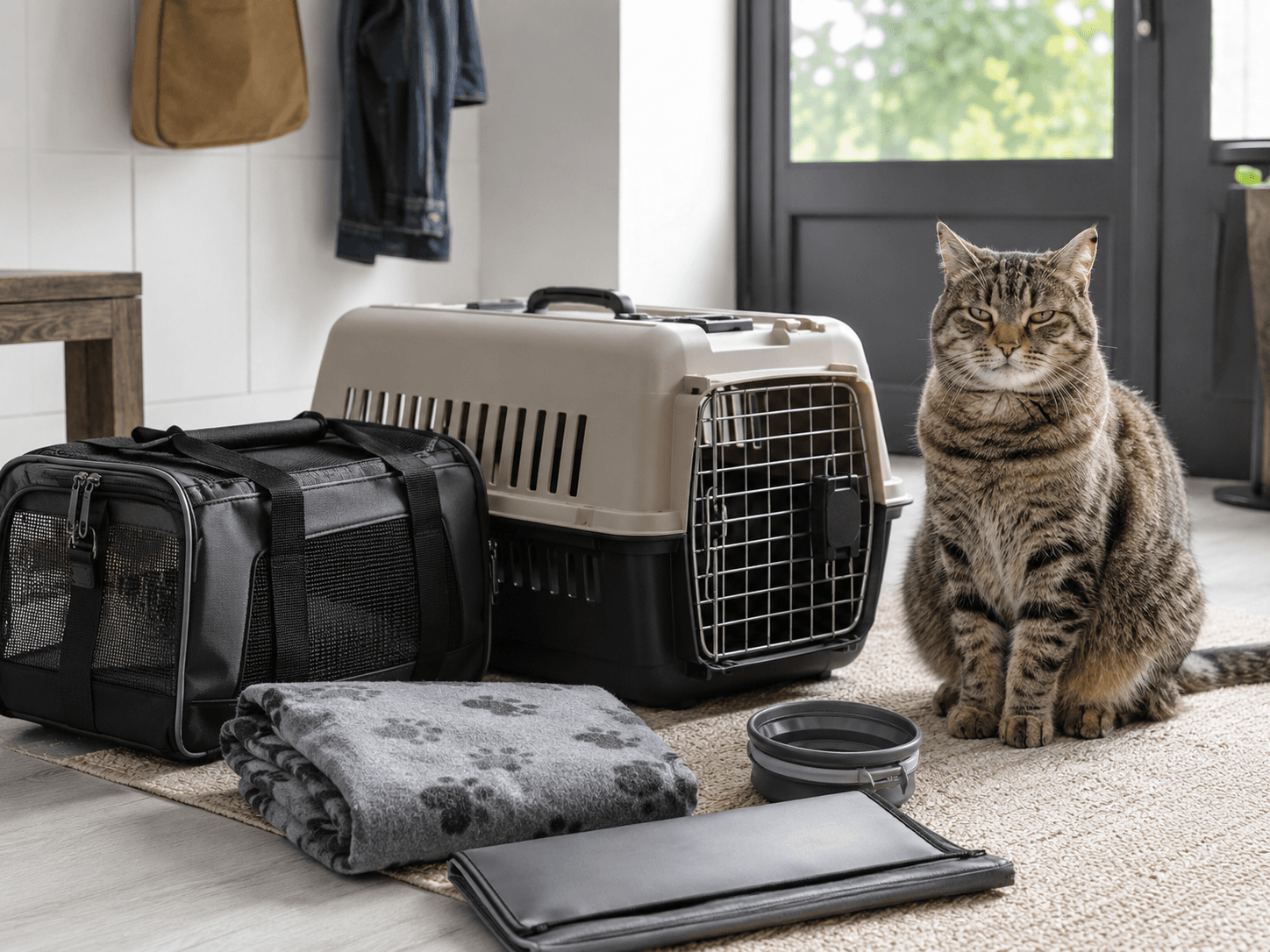
    Traveling with a cat used to mean white-knuckle car rides and apologizing to your vet’s receptionist. Not anymore. With the right plan—and the right gear—trips can be calm, predictable, and even enjoyable. In cat travel essentials 2025, the goal is simple: build a portable “comfort zone” so your cat experiences new places without new stress. Think stable airflow, ergonomic motion, and familiar scents, all wrapped in hardware that’s easy for humans to use daily. That’s the promise of cat travel essentials 2025: fewer surprises, more confidence, and a routine you’ll actually repeat.


    Why cat travel essentials 2025 matter for real cats (and real humans)

    Cats aren’t anti-travel; they’re pro-routine. They want the air to feel right, the surfaces to feel steady, and the world to make sense. Veterinary guidance from the Cornell Feline Health Center and the AVMA is consistent: reduce noise and motion, maintain ventilation, and rely on positive conditioning rather than force. That’s exactly what cat travel essentials 2025 optimize—environmental stability plus humane training—so your cat’s nervous system can downshift from alarm to curiosity.


    Build your foundation: carriers in cat travel essentials 2025

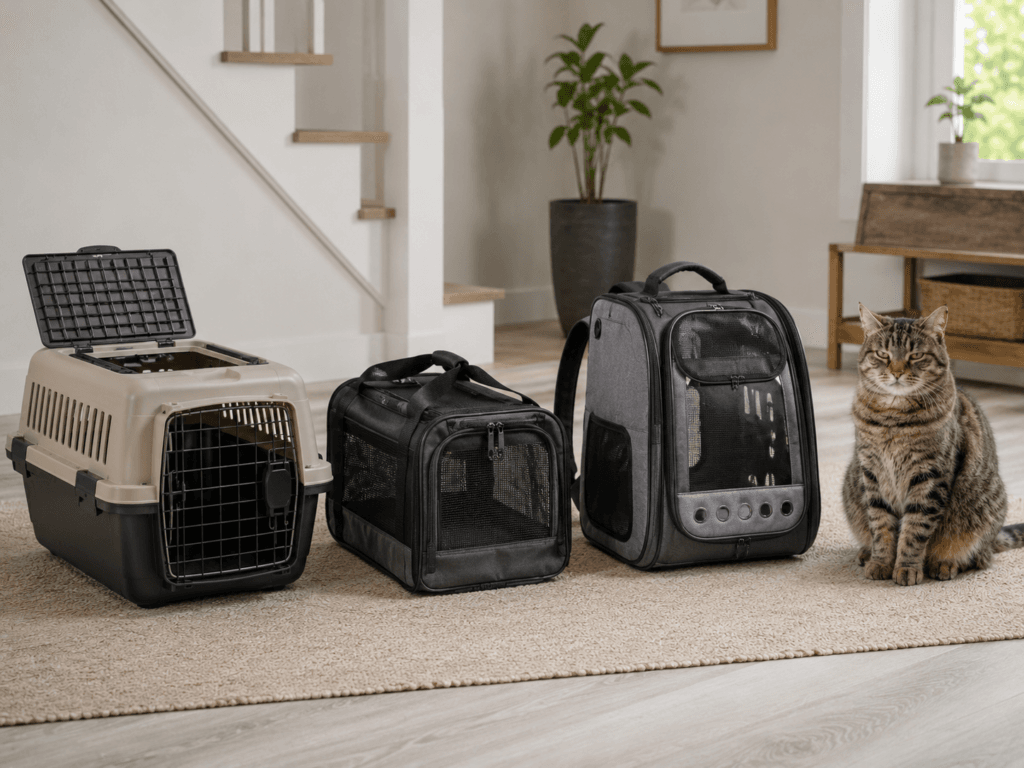
    Carriers are the core of any kit. They’re not just containers; they’re mobile bedrooms. In cat travel essentials 2025, pick carriers that stabilize temperature, allow you to check in easily, and keep your cat’s body from sliding with every bump.

    🌀 PETKIT Breezy Dome 2 (smart ventilated carrier)

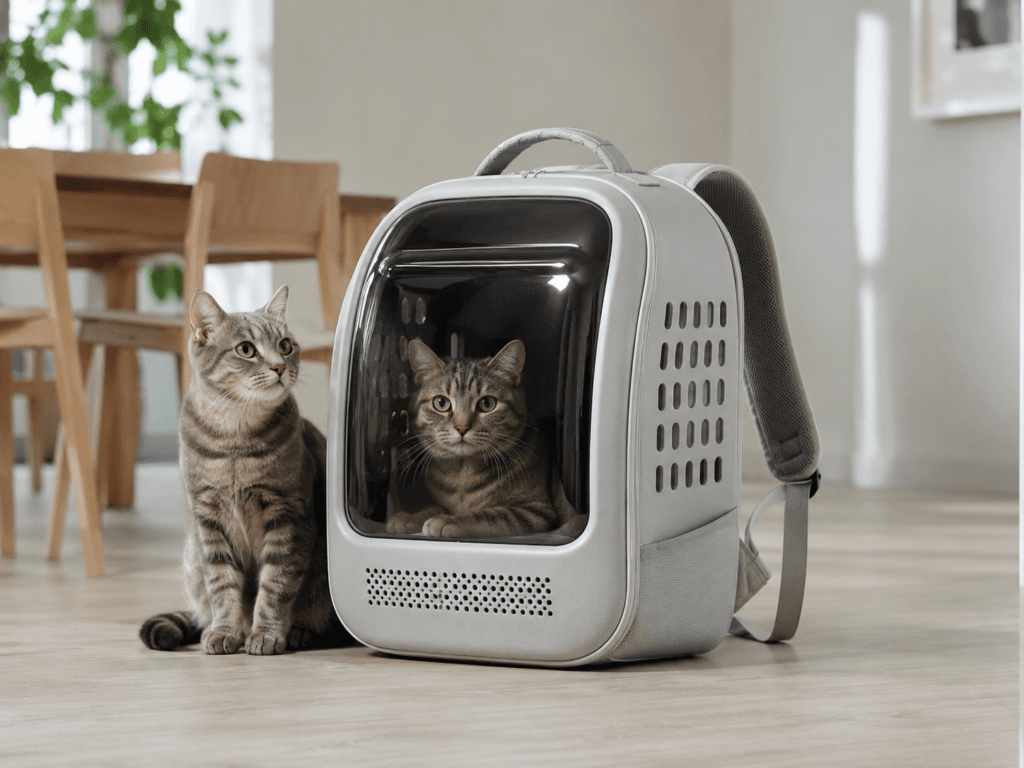
    The PETKIT Breezy Dome 2 combines panoramic visibility with active airflow. A USB-powered fan helps keep the micro-climate comfortable, while the curved interior reduces that “cornered” feeling. For summer drives or busy trains, this is the carrier that makes acclimation easier because it removes the most common trigger—stale, warm air. If you’re prioritizing outcomes in cat travel essentials 2025, this is a high-leverage upgrade with daily payoff.
    Best for: road trips, in-cabin flights, city walks.
    CTA: Compare PETKIT Breezy Dome 2 on the PETKIT Store or Amazon.

    💨 Amazon Basics Soft-Sided Mesh Carrier (lightweight value)

    Airline-friendly soft carrier under a plane seat. Cat travel essentials 2025

    When you need something light, simple, and airline-friendly, this soft-sided classic delivers. Full-mesh panels improve airflow, the shoulder strap keeps your hands free, and the fold-flat design stores easily. For quick vet visits or short train rides, it’s hard to beat. As a baseline option inside cat travel essentials 2025, it pairs well with pheromone wipes and a small fleece to “home-ify” the interior.
    Best for: errands, quick appointments, budget builds.
    CTA: Find the Amazon Basics soft-sided carrier on Amazon.

    🎒 PetAmi Premium Backpack Carrier (ergonomic walking/travel)

    Backpack carriers solve a human problem—fatigue—without compromising feline comfort. Multiple entry points let you treat or reassure without opening the main door, and padded straps prevent shoulder strain on long walks. For urban explorers, this is the convenient link between training walks and bus or subway rides in cat travel essentials 2025.
    Best for: public transport, walking commutes, hands-free travel.
    CTA: See the PetAmi Premium Backpack Carrier on Amazon.


    Smart strollers: freedom without fear in cat travel essentials 2025

    Some cats want to see the world from a moving window—but leashed sidewalks feel too risky. A stroller converts chaotic streets into a smooth, enclosed “viewing deck.”

    🛞 PETKIT Bon Voyage Pet Stroller

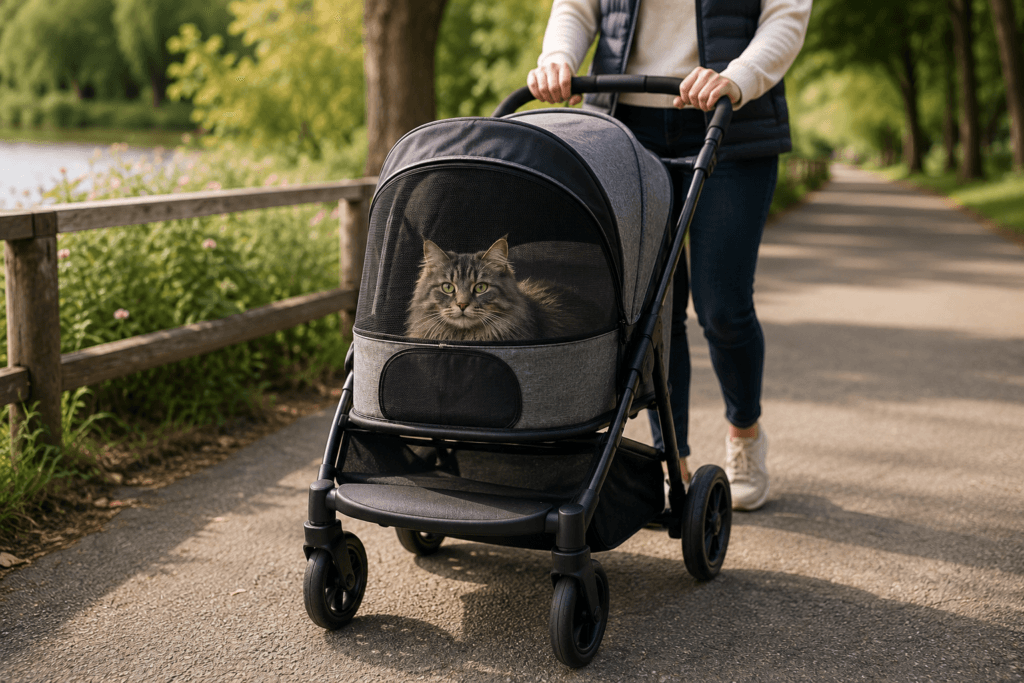
    Cat enjoying a calm outdoor ride in a PETKIT stroller.

    The Bon Voyage focuses on stability and airflow: multi-layer shock absorption, breathable canopy, and a foldable frame that pops open with minimal fuss. It’s a gentler way to scale novelty—park paths, farmers’ markets, and outdoor cafés—without asking your cat to process unpredictable dogs and bikes at nose level. For senior cats or anxious travelers, it’s one of the most impactful picks in cat travel essentials 2025.
    Best for: city strolls, senior comfort, controlled exposure.
    CTA: Discover PETKIT Bon Voyage on the PETKIT Store.


    Hydration, comfort, and climate: small add-ons with big results

    If carriers are bedrooms, accessories are the thermostat and pantry. The right little things prevent 90% of mid-trip stress.

    💧 PETKIT Go-Shine Portable Water Bottle

    Portable water bottle hydrating a cat during travel.

    One-hand water control, a spill-safe lock, and a cup shaped for feline muzzles—hydration without wrestling with bowls. It’s the sort of detail that transforms “we should stop” into “we already did,” which is the rhythm you want in cat travel essentials 2025.
    Best for: hikes, rest-area stops, hot days.
    CTA: Shop PETKIT Go-Shine on PETKIT Store or Amazon.

    🧊 Cooling mats & travel blankets (Amazon)

    Temperature swings trigger panting and restlessness. A thin cooling mat (non-toxic gel) or a breathable throw evens out the micro-climate. Place it under your cat’s chest and elbows to reduce heat load, and keep a spare blanket that smells like home. These tiny comforts are quiet heroes of cat travel essentials 2025.
    CTA: Browse cooling mats and travel throws for cats on Amazon.


    Training that sticks: a humane plan for cat travel essentials 2025

    Great gear accelerates progress—but only when paired with short, repeatable training. Use micro-sessions (30–60 seconds) and stop while your cat still wants more. That’s how confidence compounds in cat travel essentials 2025.

    Phase 1: Familiarization (Days 1–3)
    Leave the carrier open with a fleece and scatter treats inside. Reward any investigation. No doors, no pressure.

    Phase 2: Positive association (Days 4–7)
    Feed a teaspoon of wet food at the carrier threshold; then move the dish deeper. Mark calm standing with a tiny treat. Short, sweet, done.

    Phase 3: Motion introduction (Days 8–10)
    Close the door for 5–10 seconds, release, treat. Pick up the carrier, take 10 steps, set down, treat. Add a soft soundtrack that will also play in the car—consistency shrinks novelty.

    Phase 4: Short drives (Days 11–14)
    Engine on, one loop around the block. Treat on re-entry to the house, then decompression play. Each lap is a success rep, not a test.

    Phase 5: Stroller acclimation
    Start indoors on smooth flooring, then hallway, then quiet sidewalk. Canopy partially closed, then fully closed, then open again—vary to prevent fixations. This is the behavior backbone of cat travel essentials 2025.


    Safety checklist: non-negotiables in cat travel essentials 2025

    • ID & microchip: collar ID + updated microchip registry.
    • Harness + tether: attach a short tether to the carrier frame while loading/unloading.
    • Ventilation first: never wrap a carrier in blankets that block airflow.
    • No loose cats in cars: secure carriers with seat belts or stroller anchors.
    • Heat awareness: park shade, AC pre-cool, and a cooling mat on hot days.
    • Quiet routes: plan timing to avoid dog-rush hours and construction.

    These are simple habits, but they’re the difference between “we made it” and “we’ll do this again.”


    Troubleshooting: when things wobble (and how to recover)

    Meowing escalates in the first minute.
    Cover part of the window with a breathable cloth to lower visual load; switch to a familiar playlist; shorten the route tomorrow. In cat travel essentials 2025, less novelty more often beats more novelty less often.

    Panting despite airflow.
    Stop, shade, water. Use the PETKIT fan, crack a window, move the carrier off sun-baked seats. If panting persists, go home and try again a cooler day.

    Refusing to enter the carrier.
    Back up one phase: treat the approach, not the entry. Tap the fleece with a target stick, mark a nose touch, reward. Split the behavior into tiny, winnable steps.

    Motion sickness.
    Lower the carrier so your cat’s head stays level; skip meals 2–3 hours pre-trip; try shorter sessions. Ask your vet about anti-nausea plans if needed.


    The ultimate packing list for cat travel essentials 2025

    CategoryItemWhy it matters
    CarrierPETKIT Breezy Dome 2 / Amazon Soft-SidedVentilation + predictable enclosure
    MobilityPETKIT Bon Voyage StrollerSmooth exposure to new environments
    HydrationPETKIT Go-Shine BottleClean water, zero-spill control
    ComfortCooling mat + fleeceTemperature regulation + scent of home
    SafetyHarness, ID tag, microchipEscape-proof handling
    HygieneWipes, spare liner, trash bagsQuick resets on the road
    CalmPheromone wipes, familiar blanketLower arousal in new spaces
    Tech (optional)GPS trackerBackup location confidence

    Print this, tape it inside your closet, and you’ve just automated half the planning.


    How cat travel essentials 2025 connect to your bigger routine

    Travel is just outdoor enrichment with wheels. The more you repeat a calm, ventilated, treat-positive loop, the faster your cat generalizes that “moving environments are safe.” Complement this article with three related pillars to build your cat’s whole safety net:


    FAQs (fast answers for common worries)

    Do I need an “airline-approved” carrier for road trips?
    No; “airline-approved” just means it fits under seats. For driving, stability, airflow, and secure anchoring matter most in cat travel essentials 2025.

    Backpack vs hard carrier?
    Backpacks are human-friendly; hard carriers resist clawing and protect better during sudden stops. Many households keep both.

    Should I sedate my cat?
    Sedation can impair balance and increase confusion. Most vets recommend behavior-first strategies, pheromones, and, if needed, anti-nausea—not heavy sedatives—unless your veterinarian advises otherwise.


    Final thoughts—and your next best step

    Great travel isn’t about forcing bravery; it’s about engineering comfort. Start with a ventilated carrier, add hydration and climate control, and layer short, positive training. That’s the heart of cat travel essentials 2025: a system you can repeat, anywhere.

    Ready to pack smart?

    • 🌀 PETKIT Breezy Dome 2 — Smart airflow + panoramic view (PETKIT Store / Amazon)
    • 🛞 PETKIT Bon Voyage Stroller — Smooth, safe mobility (PETKIT Store)
    • 💧 PETKIT Go-Shine Bottle — One-hand hydration (PETKIT Store / Amazon)
    • 🎒 PetAmi Premium Backpack — Ergonomic comfort (Amazon)
    • 💨 Amazon Soft-Sided Carrier — Lightweight essential (Amazon)

    Affiliate Disclaimer
    This article contains affiliate links. As an Amazon Associate—and partner of PETKIT—PetTech AI may earn commissions from qualifying purchases, at no extra cost to you. We only recommend products that support feline welfare, safety, and human usability.

  • Smart Outdoor Safety for Cats: How Tech Makes Every Adventure Safer 🧭

    Smart Outdoor Safety for Cats: How Tech Makes Every Adventure Safer 🧭

    Letting your cat explore the world beyond your front door is exciting, but it also introduces unfamiliar variables: cars, predators, toxic plants, heat, and noise. The good news is that modern pet technology turns uncertainty into control. With GPS trackers, AI-enhanced harnesses, smart carriers, and real-time monitoring, you can design outdoor time that is genuinely safe, enriching, and predictable for your cat. In this guide, we lay out a complete blueprint — smart outdoor cat safety.

    Why a Tech-First Approach Works

    Outdoor enrichment supports mental health and reduces boredom, but unmanaged risk can erase those benefits. A tech-first approach gives you objective signals: location, temperature, hydration, and activity trends. With that information, you can intervene before a problem escalates—cutting short a walk if the heat index spikes, finding a cat that slipped a fence, or recognizing early fatigue after a long hike. Authoritative resources like the AVMA and the Cornell Feline Health Center emphasize supervised exploration, identification, and preparation. Outdoor enrichment, done thoughtfully, can be part of a healthy routine when paired with the right tools and training. Outdoor enrichment supports mental health — smart outdoor cat safety.

    GPS Trackers: Non-Negotiable for Outdoor Time

    Live pet-tracking app showing location and geofence alert.

    A lightweight GPS tracker is the foundation of any safe outing. The best devices deliver minute-by-minute location updates, escape-zone alerts, and route history. Crucially, they also reveal context—how fast your cat is moving, where they tend to stop, and whether their activity aligns with their baseline. Look for:

    • Real-time precision with reliable cellular coverage and fallback locating.
    • Virtual fences that ping you the second a boundary is crossed.
    • Activity & wellness data (rest, calories, steps) to spot overexertion.
    • Battery life measured in days, not hours, and water resistance for rain or dew.

    If you already own a tracker for indoor monitoring, verify outdoor accuracy in your neighborhood before heading to trails. Test recall: place your cat with a safe handler, step out of sight, and confirm the app’s live location and alert timings. A lightweight GPS tracker is the foundation — smart outdoor cat safety.

    Smart Harnesses: Fit, Feedback, and Visibility

    Smart cat harness with reflective elements and secure buckles.

    A good harness prevents escapes; a smart harness adds information. Newer models distribute pressure across the chest to avoid choking, integrate reflective materials for dusk walks, and pair with apps to flag stress-related movement (rapid head turns, crouching, tail tucking). What to prioritize:

    • Escape-resistant design (Y-shaped front, secure belly strap, double buckles).
    • Adjustability at neck and girth to accommodate seasonal weight changes.
    • High-visibility elements or clip-on beacons for night routes.
    • Sensor integration, from inertial units to BLE modules, when available.

    Practice indoors first: three 5-minute sessions a day for a week. Reward calm standing, then short steps, then longer corridors. Do not attach a leash until your cat reliably accepts the harness without bunny-kicking or freezing. A good harness prevents escapes — smart outdoor cat safety.

    Smart Carriers and Travel Systems

    Smart pet carrier with climate readouts secured on a car seat.

    For car or public transport, a well-ventilated, crash-tested carrier is essential. Smart carriers go further with temperature, humidity, and air-quality sensors you can check from your phone. Many include adjustable fans, UV-blocking panels, and interior lights for low-stress checks in dim parking garages.

    Checklist:

    • Rigid frame or verified crash protection.
    • Sensor readouts for internal climate.
    • Secure seat-belt anchors and zipper locks.
    • USB pass-through to power trackers or fans on long trips.

    Pair the carrier with a non-spill water bowl and a cooling mat in warm months. In winter, use an insulating pad and pre-warm the car to avoid cold shock. For car or public transport — smart outdoor cat safety.

    Portable Cameras and Live Monitoring

    Pocket-sized action cams can clip to a harness or mount on a chest plate, while compact Wi-Fi cameras can ride inside the carrier. They are not about “surveillance” so much as behavior translation: reviewing footage reveals what startled your cat, where they felt most comfortable, and how they signaled fatigue. Over time, you’ll build a route library—quiet streets at noon, shaded paths at 5 p.m.—that minimizes triggers. Pocket-sized action cams — smart outdoor cat safety.

    Heat, Hydration, and Environmental Sensors

    Heatstroke and dehydration are the most common preventable outdoor emergencies. Wearables that flag elevated body temperature or sudden lethargy give you minutes of head start. Combine that with a collapsible bottle-and-bowl system and scheduled water breaks every 15–20 minutes in warm weather. If your route lacks shade, plan micro-stops under trees and avoid dark pavement that radiates stored heat. Heatstroke and dehydration — smart outdoor cat safety.

    Add an air-quality and pollen check to your pre-walk routine. High particulate loads or grass surges can irritate airways, especially in brachycephalic cats. Consider paw balm for hot sidewalks and rinse paws after winter salt exposure.

    Training for Calm, Confident Exploration

    Technology is a support, not a substitute, for training. Use a shaping plan:

    1. Harness neutrality indoors (no treats needed to tolerate it).
    2. Leash introduction with gentle, slack handling—never drag.
    3. Door thresholds: pause, look, treat; teach patience at exits.
    4. Short yard sessions (<5 minutes), building to sidewalk loops.
    5. Recovery rituals: water, grooming, and a calm hideaway on return.

    Mark progress in your tracking app. If a session yields more startle events than the previous week, shorten the next outing and add decompression play at home. Technology is a support — smart outdoor cat safety.

    Route and Risk Planning

    Before each session, do a 60-second check:

    • Forecast and UV index; skip mid-day heat.
    • Traffic and construction noise on your intended route.
    • Dog walking hours in your park (ask regulars or rangers).
    • Wildlife reports (raccoons, coyotes) and local leash rules.

    Create two route templates: “confidence walks” (predictable, quiet) and “novelty walks” (new sights with low risk). Before each session — smart outdoor cat safety.

    Turn Device Data into Safer Habits

    Your apps are collecting gold: peaks in activity, typical rest points, the minute of the day your cat tends to spook. Translate those patterns into decisions.

    • If heat alerts cluster after 20 minutes, cap sessions at 15 and add shade breaks.
    • If escapes happen at gates, build a “sit and watch” routine at every threshold.
    • If night walks produce fewer startles, shift your schedule and add reflective gear.

    Periodic reviews also surface gear tweaks: a different harness cut, a lighter camera, or a battery pack for trips that run long. Your apps are collecting gold — smart outdoor cat safety.

    Recommended Gear Framework (Build Your Kit)

    • GPS tracker with live tracking and safe zones.
    • Smart harness with reflective elements and secure buckles.
    • Leash (4–6 ft) with a bit of shock absorption.
    • Smart carrier with climate sensors for car rides.
    • Hydration kit (collapsible bottle + bowl).
    • Clip-on light for twilight visibility.

    Buy once, cry never: prioritize reliability, service support, and replaceable parts over cosmetic features. Buy once, cry never — smart outdoor cat safety.

    Affiliate Picks

    Choose vendors you trust and keep firmware updated; new releases routinely improve accuracy and battery life. Choose vendors you trust — smart outdoor cat safety.

    Pre-Adventure Checklist (Save This)

    • Battery levels: tracker, phone, beacons, fans.
    • Fit check: two-finger rule at neck and girth, buckles locked.
    • Weather logic: shade plan, water schedule, paw-pad safety.
    • ID and microchip registered with current contact info.
    • Route options A/B if noise or dogs appear.
    • Post-walk recovery: cool water, wipe paws, quiet space.

    Battery levels — smart outdoor cat safety.

    FAQ

    Is outdoor time safe for every cat?
    Not always. Very anxious cats, those with cardiac or respiratory disease, or cats in extreme climates may be better served by enclosed patios (catios) and stroller exploration. Speak with your veterinarian before starting. Not always. Very anxious cats — smart outdoor cat safety.

    Do I still need ID if I have a tracker?
    Yes. Collars with tags and a registered microchip backstop technology failures and help neighbors return your cat quickly if they find them.

    Conclusion: Freedom, But Make It Planned

    You do not need to choose between enrichment and safety. With deliberate training, thoughtful routes, and trustworthy devices, outdoor exploration becomes a predictable, restorative routine. Start small, log your data, and keep iterating—your cat will tell you, in posture and pace, when the plan is working. You do not need to choose — smart outdoor cat safety.

    As you iterate, keep a simple note in your app: smart outdoor cat safety is a habit, not a one-time setup.


    Authoritative Resources (Outbound)

    • Cornell Feline Health Center — enrichment, stress reduction, environmental risks.
    • AVMA — travel checklists, restraint advice, heat safety for pets.
    • ASPCA — toxic plants database for yards and walking routes.
      Use these alongside your veterinarian’s advice, especially for medical conditions or extreme climates.

    Internal Links to Explore Next (Build Topic Authority)

    Ready to Gear Up?

    Start with one reliable tracker and a harness your cat actually enjoys wearing. Add a climate-aware carrier if you travel by car or transit. When you’re ready, review our curated picks and compare prices across Amazon, PETKIT, and Whisker to support your preferred vendor.

    Affiliate Disclaimer
    This article contains affiliate links. PetTech AI may earn a commission from Amazon, Whisker, and PETKIT at no extra cost to you. We only recommend products we would use with our own cats. Our selections support smart outdoor cat safety across devices and scenarios.

  • Best Cat Travel Tech 2025: Car Seats and Strollers for Safe and Comfortable Trips 🐾

    Best Cat Travel Tech 2025: Car Seats and Strollers for Safe and Comfortable Trips 🐾

    Why Cat Travel Tech Matters in 2025

    For many cat owners, travel has long been a challenge. Cats are sensitive to new environments, easily stressed by noise and motion, and notoriously reluctant passengers. In the past, most trips meant locking your cat into a standard carrier and hoping for the best.

    But 2025 has changed the way we travel with pets. Today’s cat travel tech 2025—from advanced car seats to luxury strollers—offers a combination of safety, comfort, and convenience. These products are not just about transport; they’re about reducing feline stress, keeping cats secure, and giving owners peace of mind.

    As more families include cats in vacations, park outings, and even urban walks, having the right gear is essential. Modern travel solutions feature crash-tested safety, breathable fabrics, foldable frames, and even 3-in-1 versatility (stroller, carrier, car seat). With the right setup, your cat’s journey can be just as comfortable as yours.


    How to Choose Cat Travel Gear

    When selecting a car seat or stroller for your cat, here are the main aspects to consider:

    Safety First

    Look for crash-tested seats or strollers with sturdy frames. Secure buckles, reinforced zippers, and locking wheels are must-haves.

    Comfort and Space

    Cats dislike feeling trapped. Choose products with breathable mesh, padded interiors, and enough room to stretch.

    Versatility

    Many modern strollers double as carriers and car seats. A 3-in-1 system saves money and space while offering flexibility.

    Portability and Storage

    Lightweight, foldable designs are easier to handle in small apartments or cars. Compact storage is especially helpful for frequent travelers.

    Smart Features

    From reflective materials to no-zip canopies, small design upgrades make a big difference. Some high-end models even feature shock-absorbing wheels for smooth rides.


    Best Cat Travel Tech 2025 (Amazon Confirmed Models)

    Here are five of the best travel solutions for cats in 2025—all available on Amazon.com, ensuring easy access for cat parents across the U.S.


    1. HPZ Pet Rover Prime 3-in-1 Luxury Pet Stroller

    The HPZ Pet Rover Prime is a 3-in-1 system that functions as a stroller, car seat, and carrier. It’s the ultimate solution for owners who want flexibility.

    • Why it stands out:
      Made with an aluminum frame, puncture-free rubber wheels, and a reversible handlebar. Its detachable carrier can be buckled into your car seat for travel.
    • Best for: Multi-purpose use, long trips, and families with both cats and small dogs.
    • Comfort level: Spacious compartment with breathable mesh windows and padded lining.
    • Pros: 3-in-1 versatility, premium build quality, reversible handle.
    • Cons: Heavier than basic models, premium price point.

    👉 Check HPZ Pet Rover Prime on Amazon


    2. HPZ Pet Rover Premium Heavy Duty Pet Stroller

    If durability is your priority, the HPZ Pet Rover Premium is designed for heavy-duty use.

    • Why it stands out:
      Convertible compartment allows customization of space, suitable for one large cat or two smaller ones. Rugged wheels handle sidewalks, parks, and uneven ground.
    • Best for: Owners who want a long-lasting, everyday stroller.
    • Comfort level: Extra padding, expandable compartment, zip-free canopy for quick access.
    • Pros: Heavy-duty, versatile space, robust build.
    • Cons: Bulkier and less portable compared to lightweight models.

    👉 Check HPZ Pet Rover Premium on Amazon


    3. HPZ Pet Rover Lite Premium Lightweight Stroller (2nd-Gen.)

    Cat being pushed in lightweight HPZ Rover Lite stroller.

    For those who prefer travel-friendly solutions, the HPZ Pet Rover Lite offers a more compact design.

    • Why it stands out:
      Foldable with one hand, weighing less than its heavy-duty siblings. Still retains the comfort and safety features of the premium line.
    • Best for: City dwellers, apartment living, and short trips.
    • Comfort level: Mesh ventilation, padded interior, and easy maneuverability.
    • Pros: Lightweight, quick-fold, portable.
    • Cons: Smaller compartment; not ideal for very large cats.

    👉 Check HPZ Pet Rover Lite on Amazon


    4. BICYSTAR 3-in-1 Pet Stroller (Car Seat + Carrier + Stroller)

    Cat inside BICYSTAR 3-in-1 stroller, canopy open. Essential cat travel tech 2025.

    The BICYSTAR 3-in-1 is a budget-friendly yet versatile option.

    • Why it stands out:
      Functions as stroller, detachable carrier, and car seat. Designed with foldable frame and breathable windows.
    • Best for: Cat parents looking for affordability without sacrificing utility.
    • Comfort level: Soft interior lining, multiple entry points for easy access.
    • Pros: Affordable, multifunctional, foldable.
    • Cons: Materials less premium than HPZ models.

    👉 Check BICYSTAR 3-in-1 Stroller on Amazon


    5. Pawsincar Crash-Tested 3-in-1 Car Seat / Carrier

    Cat in crash-tested Pawsincar car seat during car ride.

    Safety-conscious owners will appreciate the Pawsincar Car Seat, which has undergone crash testing for peace of mind.

    • Why it stands out:
      Rated for safety, designed to protect pets during car accidents. Also converts into a carrier or travel bed.
    • Best for: Car travel and road trips.
    • Comfort level: Soft padded interior with ventilation panels.
    • Pros: Crash-tested, versatile, high safety rating.
    • Cons: Smaller size may limit large cats.

    👉 Check Pawsincar Car Seat on Amazon


    Comparison Table: Best Cat Travel Tech 2025

    ProductBest ForProsCons
    HPZ Rover Prime 3-in-1All-in-one travelPremium build, versatileHeavy, pricey
    HPZ Rover PremiumHeavy-duty useRugged, expandableBulkier
    HPZ Rover LiteCity travelLightweight, portableSmaller capacity
    BICYSTAR 3-in-1Budget optionAffordable, multifunctionLower material quality
    Pawsincar Car SeatRoad tripsCrash-tested, safeSmall for large cats

    Tips for Traveling With Your Cat

    Even the best gear won’t help if your cat is stressed. Here’s how to make trips smoother:

    1. Familiarize at home: Let your cat explore the stroller or car seat indoors before the first trip.
    2. Short practice rides: Begin with brief drives or short strolls to build confidence.
    3. Comfort items: Add a favorite blanket or toy to reduce anxiety.
    4. Proper placement: In cars, secure the seat with belts or ISOFIX clips.
    5. Hydration & breaks: For long trips, bring water and schedule breaks.

    For health and safety insights, see the Cornell Feline Health Center.


    The Pet Travel Tech Trend in 2025

    The U.S. pet travel market is booming. More owners are taking cats on road trips, vacations, and even daily walks in strollers. This shift reflects a broader trend: treating pets as family members who share in our lifestyles.

    Innovations like crash-tested seats, foldable strollers, and breathable carriers are driving the growth of this niche. Cat parents now have more options than ever to keep their companions safe while enjoying the world together.


    Conclusion & CTA

    Traveling with cats used to be stressful—for both pets and owners. But with today’s cat travel tech, you can ensure every journey is safe and comfortable.

    • Choose HPZ Rover Prime for a versatile 3-in-1.
    • Pick HPZ Rover Premium for rugged durability.
    • Select HPZ Rover Lite for city convenience.
    • Go with BICYSTAR if you want budget-friendly versatility.
    • Opt for Pawsincar Car Seat for crash-tested car safety.

    👉 Ready to hit the road? Explore the best smart cat carriers on Amazon and make your feline’s journey as safe and enjoyable as yours.

    ⚠️ Affiliate Disclaimer

    As an Amazon Associate, PetTech AI earns from qualifying purchases.

  • Best Cat Harnesses for Safe Outdoor Walks in 2026

    Best Cat Harnesses for Safe Outdoor Walks in 2026

    A cat harness should not make outdoor time feel like a test of bravery.

    The right one gives your cat a secure, comfortable way to explore at their own pace—whether that means sitting quietly on a patio, sniffing around a garden, traveling in an RV, or taking short leash walks near home.

    The wrong one can create the opposite experience: rubbing at the armpits, pressure around the neck, an easy escape route, or a cat that freezes the moment it is fastened.

    Baron may then collapse sideways as though the harness has temporarily disabled his operating system.

    That reaction does not necessarily mean the fit is wrong. It means harness acceptance must be trained—not assumed because the product page included a cat standing heroically on a mountain.

    That is why the best cat harness is not simply the most padded, most expensive, or most “escape-proof” looking model. It is the harness shape that fits your cat’s body, temperament, and outdoor routine.

    This guide compares four strong options for different needs:

    • RC Pets Adventure Kitty Harness for balanced outdoor comfort and adjustability.
    • Kitty Holster for cats that benefit from wider vest coverage and soft cotton contact.
    • PetSafe Come With Me Kitty for low-bulk training and gentle leash introduction.
    • Rabbitgoo Cat Harness for a practical lower-cost vest option.

    Quick Verdict: Which Cat Harness Fits Your Cat?

    Best forHarnessWhy it stands outMain trade-off
    Best overall outdoor harnessRC Pets Adventure KittyAdjustable neck and waist, breathable mesh, reflective trim, included leashMore structured than minimal strap harnesses
    Best comfort vest for cautious or sensitive catsKitty HolsterBroad vest coverage, soft cotton lining, wide adjustable closure areaWarmer and bulkier than an H-style harness
    Best for early leash trainingPetSafe Come With Me KittyLightweight nylon, quick-snap fit, included bungee leashLess body coverage than a vest
    Best budget vestRabbitgoo Cat HarnessMesh vest design, dual buckle closure, reflective detailsFit must be checked carefully; sizing is not one-size-fits-all

    Research Note

    This is a research-led roundup based on current manufacturer information, fit guidance, training recommendations and product positioning.

    PetTech AI has not conducted long-term hands-on testing of every harness included.

    PetTech AI may earn a commission from qualifying purchases. As an Amazon Associate I earn from qualifying purchases.

    What “Smart” Actually Means in a Cat Harness

    A cat harness does not need electronics to be smart.

    For outdoor safety, smart design means:

    • A cat-specific fit rather than a scaled-down dog harness.
    • A leash attachment positioned on the back, not at the neck.
    • Enough adjustment to create a secure fit without restricting movement.
    • Materials that avoid rubbing around the chest and front legs.
    • A shape that makes backing out more difficult without promising the impossible.
    • A design your cat can tolerate long enough to build positive associations.

    No harness is guaranteed escape-proof. A frightened cat can move in unexpected ways, and even an excellent harness can fail if it is too loose, too large, damaged, or used without supervision.

    The goal is not to find a magical product that removes all risk.

    The goal is to choose a structure that gives you the best possible control for your cat’s body and behavior.

    Start With Harness Shape, Not Brand

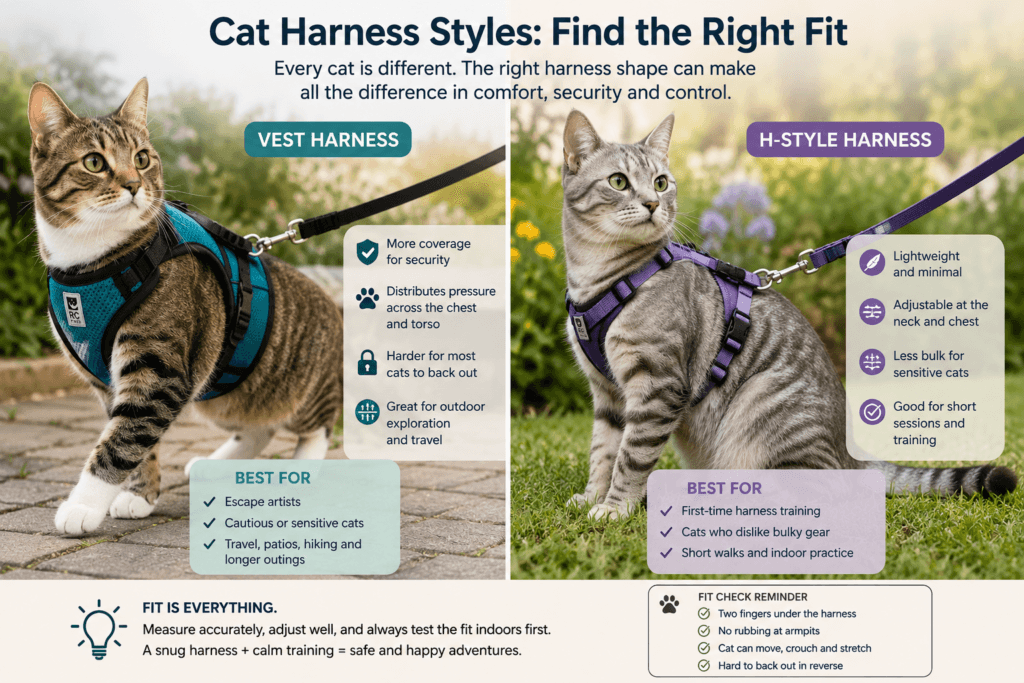
    cat-harness-vest-vs-h-style-fit-comparison.webp
    Vest harnesses offer broader coverage, while H-style designs can feel lighter—fit determines whether either option works safely.

    Before choosing a product, decide which style is most likely to suit your cat.

    Vest harnesses: more coverage, but not automatic security

    Vest-style harnesses distribute contact across a wider part of the chest and torso. They may feel more stable and can make backing out more difficult when fitted correctly.

    More fabric does not automatically mean a safer fit. A loose vest can create just as much escape space as loose straps.

    They can also work well for cats who need more physical reassurance from the harness itself.

    The trade-off is warmth and bulk. A heavily padded vest may feel restrictive for a cat who is heat-sensitive, especially during summer walks.

    H-style harnesses: lighter and less restrictive

    An H-style harness uses thinner straps around the neck and chest. It can feel lighter for some cats and may be easier to introduce during early training.

    The trade-off is that fit becomes even more important. A loose H-style harness can give an agile cat room to reverse out of it.

    Step-in designs: useful for head-shy cats

    Some cats dislike anything passing over their head. A step-in harness can reduce that stress because the cat steps into the front openings before the harness closes over the back.

    This can be helpful, but it is not automatically safer. The harness still needs to fit securely around the chest and torso.

    Best Overall: RC Pets Adventure Kitty Harness

    The RC Pets Adventure Kitty Harness is the strongest all-around option for owners who want one harness that can support regular supervised outdoor time.

    It uses breathable air mesh, reflective binding, adjustable neck and waist webbing, and buckles at both adjustment points. It also includes a 6-foot leash, which makes it a convenient all-in-one starting option.

    Its biggest advantage is balance.

    Some harnesses are very light but offer limited adjustment. Others are extremely structured but can feel bulky. The Adventure Kitty sits between those two extremes: enough structure for controlled outdoor use, enough adjustment to improve fit, and enough breathability for routine walks.

    This is a good match for a cat who is already curious about the outdoors and needs a harness that can grow with their confidence.

    Choose RC Pets Adventure Kitty if:

    • You want a cat-specific harness for regular outdoor exploration.
    • Your cat benefits from both neck and waist adjustment.
    • You want breathable mesh without a full heavy vest.
    • You value reflective trim for lower-light visibility.
    • You prefer a harness and leash bundle.

    It may not be the best fit if:

    • Your cat is highly sensitive to mesh or more comfortable in soft cotton.
    • You need the widest possible torso coverage.
    • Your cat is extremely small and falls between listed sizes.

    Verdict: Recommended — the strongest all-round choice for regular supervised exploration when adjustability, breathable structure and a complete harness-and-leash setup matter.

    It is not automatically the safest harness for every cat. It is the most balanced starting point in this roundup.

    Need a balanced harness for regular supervised outdoor use? Check RC Pets Adventure Kitty on Amazon.

    Best Comfort Vest: Kitty Holster

    The Kitty Holster is the best choice for cats who respond better to broad, soft coverage than narrow straps.

    Its vest-style design uses a breathable cotton lining and wide hook-and-loop closure areas. That can make it especially appealing for cats with sensitive skin, tactile sensitivity, or a history of trying to back out of lightweight harnesses.

    The important distinction is not that it is “escape-proof.” No responsible harness should be marketed as a guarantee.

    Its advantage is the way it spreads contact across the torso. For some cats, that can feel more stable and less irritating than an H-style design with thin straps near the legs.

    It is also a strong option for travel. Cats visiting a veterinarian, staying in an RV, moving through a hotel, or spending time on a balcony may benefit from a harness that feels secure and easy to handle without needing the cat to walk long distances.

    Choose Kitty Holster if:

    • Your cat is sensitive to thin straps or rubbing.
    • You want broader body coverage.
    • Your cat has a strong tendency to reverse out of loose harnesses.
    • You need a harness for travel, balconies, supervised patio time, or short walks.
    • You prefer cotton contact over synthetic mesh.

    It may not be the best fit if:

    • Your cat overheats easily.
    • You want the lightest possible harness for active walking.
    • Your cat strongly dislikes vest-style clothing.

    Verdict: Strong Recommendation with Conditions — one of the most convincing broad-coverage harnesses for cats that tolerate vest-style contact, but potentially too warm or restrictive for active and heat-sensitive cats.

    The wide coverage can make the fit feel more stable.

    It cannot prevent an incorrectly sized cat from reversing out through a gap large enough to accommodate several optimistic marketing claims.

    Does your cat tolerate broad, soft torso coverage? Check Kitty Holster availability on Amazon.

    Best for Early Leash Training: PetSafe Come With Me Kitty

    The PetSafe Come With Me Kitty Harness and Bungee Leash is a strong choice for cats who are new to harness training and may find a full vest overwhelming.

    It uses lightweight nylon straps, quick-snap buckles, a color-coded belly strap for easier fitting, and an included bungee leash designed to soften sudden pulls.

    The bungee leash is particularly useful during early training because cats do not walk like dogs. They may stop suddenly, turn, crouch, investigate, or move in an unexpected direction. A little flexibility can reduce abrupt tension during those first indoor and outdoor sessions.

    This harness is not about maximum vest coverage. It is about creating a lighter, lower-bulk experience for cats that need time to accept leash equipment.

    Choose PetSafe Come With Me Kitty if:

    • Your cat is new to harnesses.
    • You want a lightweight, adjustable strap-based design.
    • You value a bungee leash for gentler leash feedback.
    • Your cat is hesitant around bulky vest harnesses.
    • You want a recognizable, established pet brand.

    It may not be the best fit if:

    • Your cat has repeatedly backed out of narrow-strap harnesses.
    • You need more torso coverage for a particularly agile cat.
    • Your cat is extremely sensitive to any neck-area handling.

    Verdict: Recommended — the strongest lightweight starting point for indoor harness training and cats that reject bulky vests.

    Need a lightweight starting point for indoor harness training? Check PetSafe Come With Me Kitty on Amazon.

    Best Budget Vest: Rabbitgoo Cat Harness

    The Rabbitgoo Cat Harness is the practical budget pick for owners who want a vest-style harness without moving into premium pricing.

    It combines breathable mesh, reflective details, adjustable straps, hook-and-loop closure, and dual quick-release buckles. The result is a familiar vest format that can work well for cats learning to walk outdoors or for owners who want a backup harness for travel.

    Its strength is accessibility.

    For many households, the first harness is partly an experiment. You may not yet know whether your cat will enjoy outdoor walks, tolerate a vest, or prefer a different shape. Rabbitgoo gives owners a lower-cost way to learn what their cat accepts.

    The caution is fit. Budget harnesses are not automatically unsafe, but sizing must be taken seriously. Do not use the label alone. Measure chest girth, check head size against the product guidance, and test the fit indoors before using it outside.

    Choose Rabbitgoo if:

    • You want a vest-style harness at a lower price.
    • Your cat is still in the early learning phase.
    • You want reflective details and dual-buckle closure.
    • You are willing to measure carefully and exchange sizes if needed.
    • You need a backup harness for travel or occasional outings.

    It may not be the best fit if:

    • You want premium materials or highly specialized cat fit.
    • Your cat is between sizes.
    • Your cat has a strong history of escaping harnesses.
    • You want a long-term, high-frequency adventure harness.

    Verdict: Recommended — the most widely validated vest-style option in this roundup, provided the buyer measures carefully and does not interpret “escape-proof” as a literal guarantee.

    Rabbitgoo is useful as a lower-commitment fit experiment.

    It should not be confused with a cheaper route to guaranteed security. “Escape-proof” is a marketing category, not a recognized law of feline physics.

    Still considering Rabbitgoo? Check the current model, sizing and customer feedback on Amazon.

    How to Measure Your Cat Before You Buy

    The most important measurement is usually chest girth: the circumference just behind your cat’s front legs.

    Also check:

    • Neck circumference, when the harness adjusts at the neck.
    • Head size, especially for designs where backing out is a concern.
    • The brand’s actual sizing chart, not only a generic weight range.
    • Whether your cat sits near the top or bottom of a size range.

    A practical fit check:

    • The harness should sit snugly without compressing the chest.
    • Your cat should be able to walk, crouch, stretch, and turn naturally.
    • Front-leg openings should not rub the armpit area.
    • You should be able to slide fingers beneath the harness without leaving obvious slack.
    • When you apply gentle backward pressure to the leash indoors, the cat should not be able to reverse out.

    Do this test before the first outdoor session.

    Never leave a cat unattended in a harness, even indoors.

    A Better Training Plan: Follow Your Cat’s Signals, Not a Calendar

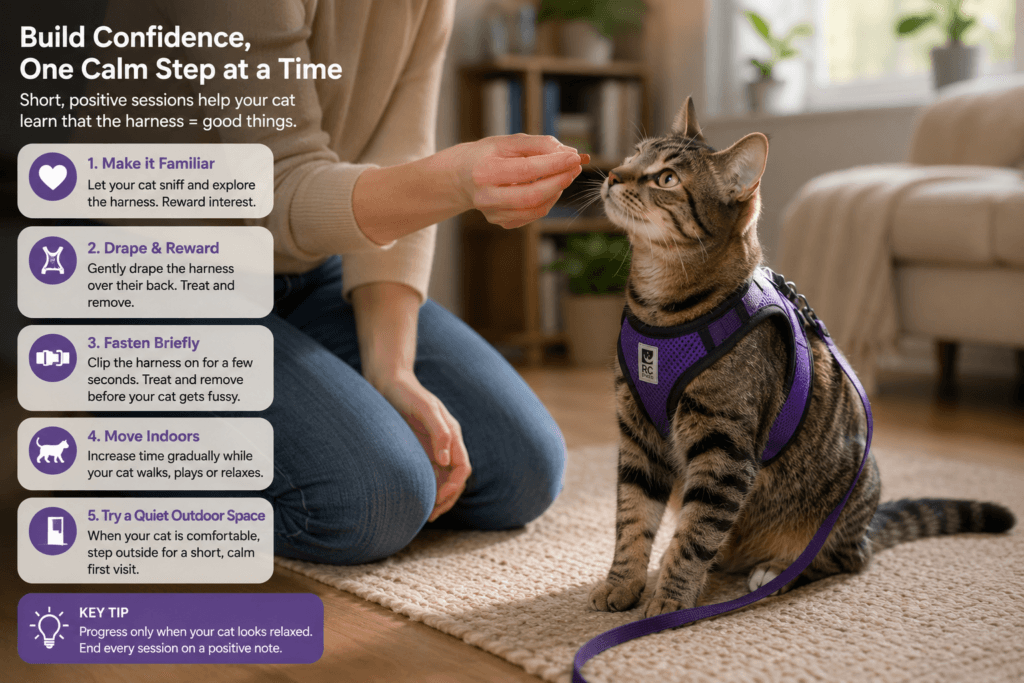
    cat-harness-training-positive-indoor-introduction.webp
    Harness confidence is built gradually: short, positive indoor sessions matter more than rushing outdoors.

    A fixed five-day plan is tempting, but cats do not all adapt on the same timeline.

    Some will accept a harness in a few sessions. Others will need weeks.

    The better approach is to progress only when your cat looks relaxed at the current step.

    Step 1: Make the harness familiar

    Leave the harness near a favorite sleeping area or feeding location. Let your cat sniff it. Reward interest with treats, play, or praise.

    Step 2: Introduce touch without fastening

    Gently lay the harness across your cat’s back or chest for a moment, then remove it before your cat becomes uncomfortable.

    Step 3: Fasten briefly indoors

    Once your cat accepts contact, fasten the harness for a short period indoors. Offer a high-value treat, then remove it calmly.

    Step 4: Build comfortable movement

    Increase the wearing time only while your cat remains relaxed. Encourage a few natural steps toward a treat or toy.

    Step 5: Add the leash indoors

    Attach the leash, but do not immediately direct your cat. Follow their movement with slack in the leash. Let them learn that the harness does not mean pressure or restraint.

    Step 6: Try a quiet outdoor threshold

    Only move outdoors once your cat is comfortable indoors. Start in a calm, enclosed or low-stimulation area. Let the cat observe, sniff, and decide the pace.

    Outdoor walking is not right for every cat. Freezing, frantic pulling, repeated attempts to escape, flattened ears, or clear distress are signals to pause—not signs that the cat needs to “get used to it.”

    Harness + Tracker: Safety Layer, Not a Reason to Take More Risk

    A harness controls the walk. A tracker helps with recovery if something goes wrong.

    They should not be treated as the same tool.

    A GPS tracker can be useful for outdoor-access cats, travel, or cats with a serious escape risk. A radio-frequency finder can be more useful for a cat likely to hide close to home.

    Do not attach a tracker in a way that obstructs the leash connection, changes the harness position or concentrates additional weight on the D-ring unless both manufacturers explicitly support that setup.

    The leash connection must remain secure and move freely.

    Only mount a tracker where the tracker manufacturer explicitly says it is safe to attach, and check that it does not pull the harness out of position or interfere with movement.

    For the technology decision, read our Best Cat Trackers guide. For Safe Zones, escape alerts, and the limits of geofencing, read our Virtual Fence Alerts for Cats guide.

    Common Harness Mistakes

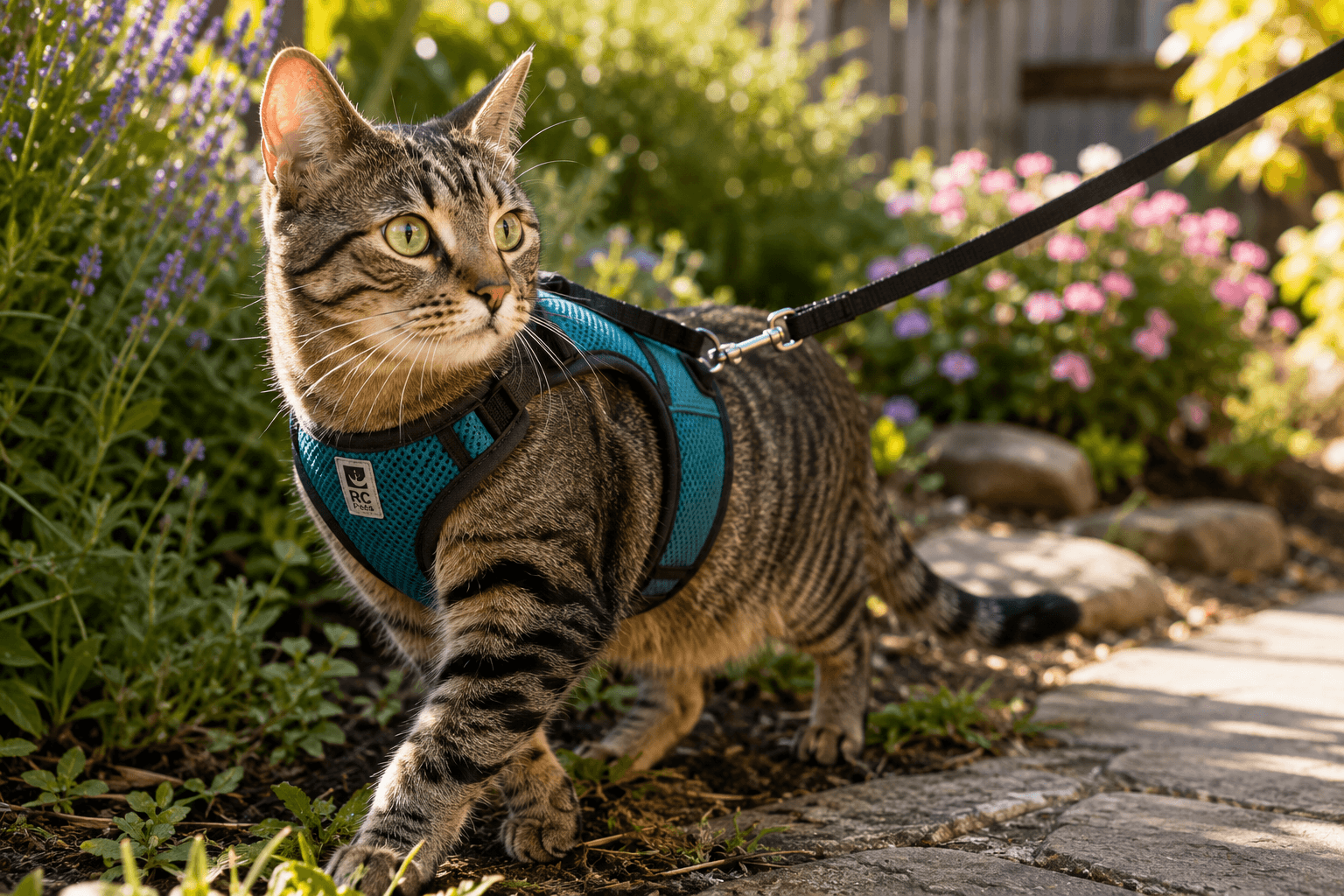
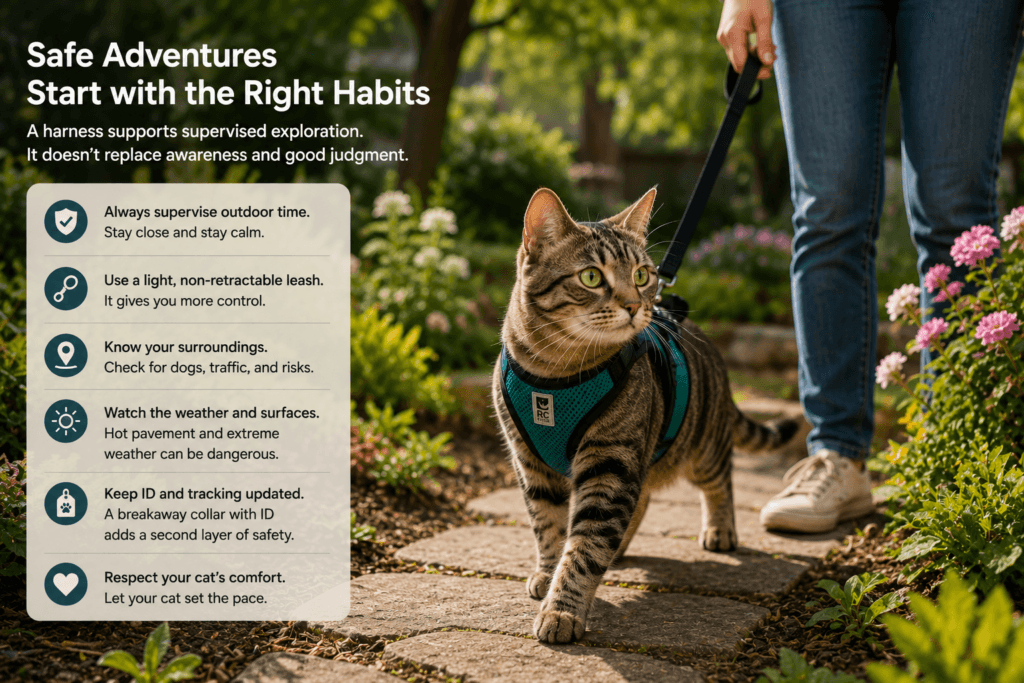
    A cat in a harness exploring a quiet garden while its owner holds a relaxed leash nearby
    A harness supports supervised exploration—it does not replace a calm environment, careful handling, or close attention to your cat’s signals.

    Treating “escape-proof” as a guarantee

    No harness removes the need for supervision, fit checks, and gradual training.

    Pulling your cat forward

    Cats usually do better when they choose the direction. Use treats, toys, and patience rather than leash pressure.

    Starting outdoors too early

    A cat that freezes indoors is not ready for a busy sidewalk, a dog park, or a new hiking trail.

    Using a retractable leash too soon

    A standard lightweight leash gives you more predictable control during early training.

    Ignoring heat and stimulation

    Warm pavement, loud traffic, dogs, bicycles, and leaf blowers can turn a calm first outing into a frightening experience.

    Frequently Asked Questions

    Are cat harnesses safe?

    Yes, when they fit correctly, are introduced gradually, and are used under supervision. A cat-specific harness with a back-mounted leash attachment is safer than walking a cat from a collar.

    What style is best for escape artists?

    A well-fitted vest with wider torso coverage is often the better starting point, but the correct fit matters more than style alone.

    Should I use a collar or harness for outdoor walks?

    Use a harness for leash walking. A breakaway collar can still carry identification, but it should not be the point where leash pressure is applied.

    Can kittens wear harnesses?

    Yes, as long as the harness is lightweight, correctly sized, and introduced slowly. Kittens may adapt more easily, but they still need short, positive sessions.

    Does every cat enjoy leash walks?

    No. Some cats enjoy safe outdoor exploration; others find it stressful. The cat’s behavior should decide whether harness walking becomes part of the routine.

    Final Verdict

    RC Pets Adventure Kitty is the strongest all-round recommendation. Kitty Holster is the better specialist choice for cats that tolerate broad vest coverage. PetSafe offers the most convincing low-bulk introduction, while Rabbitgoo is the most widely validated structured vest in the roundup.

    None is universally escape-proof. The safest harness remains the one that fits the individual cat correctly, survives an indoor backward-pressure test and is used by an owner willing to stop when the cat is uncomfortable.

    References

    • RC Pets — Adventure Kitty Harness product information
    • Kitty Holster — product, fit, and sizing guidance
    • PetSafe — Come With Me Kitty Harness and Bungee Leash information
    • San Francisco SPCA — harness and leash training guidance for cats
    • Cat Friendly Homes — gradual harness and leash introduction guidance

    Image Disclosure

    Some images in this article may be created with AI for illustrative purposes. They do not show the exact products reviewed and should not be used to evaluate product size, fit, design, or features. Always check the current official product listing before purchasing.
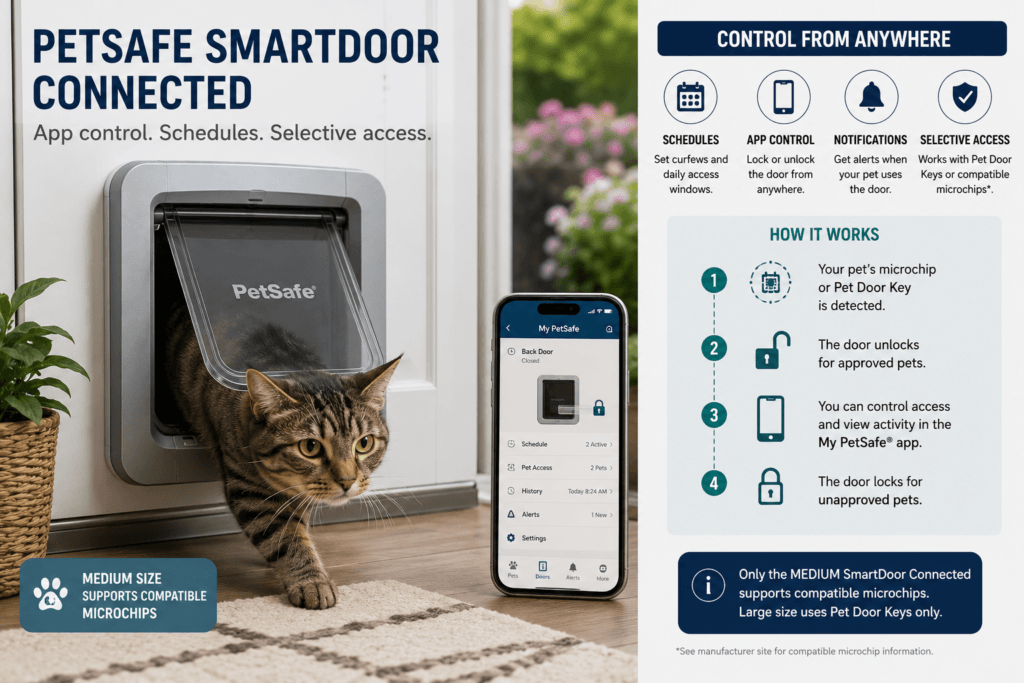
    Disclosure

    PetTech AI may earn a commission when readers purchase through affiliate links. That does not change how products are framed or compared. No harness is guaranteed escape-proof, and no product can replace supervision, careful fitting, gradual training, or a safe outdoor environment. Always check current sizing guidance, materials, return policies, and product specifications before purchasing.

  • Best Cat Trackers: GPS, RF and Nearby Finding Compared

    Best Cat Trackers: GPS, RF and Nearby Finding Compared

    Baron disappears.

    The app shows a beautiful activity graph, three wellness badges and yesterday’s preferred nap location.

    None of those tells you whether he is under the neighbor’s deck or two streets away.

    That is why the best cat tracker is determined first by distance, not by the number of features occupying the app dashboard.

    Before choosing a tracker, ask one question:

    How far away could your cat realistically be when you need to find them?

    This guide compares four relevant trackers—but current ownership evidence does not support recommending all four.

    Tabcat V2 earns the clearest recommendation for nearby recovery.

    Tractive remains a conditional GPS choice when long-distance tracking is necessary.

    Fi Mini and Pawfit Lite are included because their designs are relevant, not because they currently pass the PetTech AI recommendation threshold.

    Quick Answer: Which Type of Cat Tracker Do You Need?

    Your real problemBest technologyProduct evaluatedPetTech AI verdict
    My cat may travel beyond the neighborhoodGPS + cellularTractive CAT MiniConditional Recommendation
    My cat is probably hiding close to homeRadio frequencyTabcat V2Recommended with Conditions
    I want a premium app-led GPS platformGPS + cellularFi MiniNot Recommended for Now
    Tracker weight is my biggest concernLightweight GPS + nearby BluetoothPawfit LiteNot Recommended for Now
    I only need occasional nearby assistanceBluetooth crowd-finding tagNot a primary recommendationBackup only

    Research Note

    This is a research-led comparison based on current manufacturer documentation, network requirements, subscription terms and product positioning.

    PetTech AI has not conducted long-term side-by-side testing of every tracker included.

    PetTech AI may earn a commission from qualifying purchases. As an Amazon Associate I earn from qualifying purchases.

    Start Here: Range or Precision?

    The central trade-off is simple.

    GPS gives you range.
    Radio frequency gives you close-range precision.
    Bluetooth gives you limited nearby convenience.

    Everything else—apps, activity insights, escape alerts, subscriptions, battery life—comes after that decision.

    Choose GPS when distance is the real risk

    An outdoor cat wearing a small tracker while an owner checks a live location map on a smartphone
    GPS tracking is most useful when a cat could move beyond the immediate neighborhood.

    GPS trackers are built for situations where your cat could be far from you.

    They use satellite positioning and a mobile network to send location information to an app. That means they can be useful when a cat has outdoor access, travels, escapes through an open door, or may move beyond the surrounding streets.

    GPS is the right choice when you need to answer:

    “Where is my cat now, even if I am not nearby?”

    The trade-offs are clear:

    • A GPS tracker needs charging.
    • It depends on mobile coverage.
    • It usually requires a subscription.
    • It is heavier than a simple finder tag.

    For many outdoor-access cats, those trade-offs are worth accepting because no nearby-only solution can replace map-based tracking once a cat has gone farther away.

    Choose radio frequency when your cat is probably close

    A person using a handheld radio-frequency finder near a garden shed while a cat hides nearby
    Radio-frequency tracking is designed for close-range recovery when a cat is nearby but difficult to see.

    Radio-frequency trackers do not show a map.

    Instead, they use a handheld receiver that guides you toward the tag. The signal becomes more useful as you get closer, making RF especially effective for a cat that is nearby but hidden.

    This is the right choice when you need to answer:

    “My cat must be close—but where exactly are they hiding?”

    It is useful for cats under decks, inside sheds, behind bushes, in garages, or somewhere inside the house.

    RF has a much shorter range than GPS, but it is lighter, more direct at close distance, and does not need a subscription.

    Treat Bluetooth as a backup, not a primary safety plan

    Bluetooth trackers can be useful for a limited scenario: locating a collar around the home, checking a nearby garden, or finding a cat that is hiding indoors.

    They are not a replacement for GPS for a cat that may roam.

    A Bluetooth tracker does not independently provide continuous live location across a broad area. It relies on nearby devices, nearby phones, or a crowd-finding network. That can be helpful, but it is too uncertain to be your main recovery plan for an outdoor cat.

    Tractive CAT Mini — Conditional Recommendation

    The Tractive CAT Mini remains the most established long-range GPS option in this comparison.

    That does not make it an unconditional recommendation.

    Its value appears when a cat could travel beyond the immediate neighborhood and map-based recovery is genuinely necessary.

    Tractive gives you a broader view of how your cat moves: live location when needed, location history, activity information, and territory patterns over time. That makes it useful both in an urgent situation and in ordinary daily care.

    For example, a cat that usually remains near home but suddenly travels farther than usual may be worth checking on. A cat that does not return at the usual time can be located more quickly. A household with multiple people can share location access rather than relying on one person to monitor the cat.

    Tractive is also the most natural fit for owners who want safety and monitoring to work together. It is not just “find my cat.” It is “understand where my cat usually goes, then respond faster when that pattern changes.”

    Choose Tractive CAT Mini when:

    • Your cat has outdoor access.
    • Your cat may travel beyond nearby houses.
    • You want live GPS during a real recovery situation.
    • You care about territory history and activity patterns.
    • You accept charging and a subscription as part of ownership.

    Skip it when:

    • Your cat is indoor-only with a very low escape risk.
    • Your main concern is a cat hiding close to home.
    • Your cat cannot safely tolerate a GPS device on a collar.
    • You want no recurring cost.

    Verdict: Conditional Recommendation — still the most established long-range GPS option in this guide, but the mixed ownership signal prevents an unconditional recommendation. Choose it because your cat may travel far, not because the app offers more lifestyle data.

    Could your cat travel beyond the immediate neighborhood? Check the current Tractive cat tracker on Amazon.

    Tabcat V2 — Recommended with Conditions

    The Tabcat V2 is the most important alternative to GPS because it solves a completely different problem.

    It is not designed to follow your cat across town.

    It is designed to help you find a cat who is already nearby but impossible to spot.

    Tabcat uses radio-frequency tags and a handheld directional finder. You choose the correct tag, walk through the likely search area, and follow the receiver toward the signal.

    This can be far more practical than GPS when a cat is:

    • Under a deck or porch.
    • Hiding in dense bushes.
    • Locked inside a nearby garage or shed.
    • Lost inside your own home.
    • Frightened and too quiet to respond to food or recall cues.

    The major advantages are simplicity and weight. There is no mobile network, no app dependency, no subscription and no need to charge a GPS battery every few days.

    Its limitation is equally simple: it cannot locate a cat that has travelled far beyond its signal range.

    Choose Tabcat V2 when:

    • Your cat is mainly indoors or stays close to home.
    • Your biggest fear is a nearby escape and hiding scenario.
    • Your cat is small or collar-sensitive.
    • You want no monthly subscription.
    • You value directional close-range finding over map tracking.

    Skip it when:

    • Your cat may roam several streets away.
    • You need live location on a phone map.
    • You want location history or activity monitoring.
    • You travel often with your cat.

    Verdict: Recommended with Conditions — the strongest current choice for precise nearby recovery, provided you understand that radio frequency cannot replace GPS once the cat has travelled beyond the local search area.

    Is your cat most likely hiding nearby? Check Tabcat V2 on Amazon.

    Fi Mini — Not Recommended for Now

    Once you know that GPS is the right technology, the next question is not “Which app looks better?”

    It is:

    “Which GPS tracker can my cat realistically wear every day?”

    This is where Fi Mini and Pawfit Lite become relevant.

    Both are GPS/cellular trackers. Both support app-based location tracking and safety alerts. Both add activity data. Neither should be purchased solely because it has more features than Tractive.

    Their value is more specific.

    Fi Mini: for a premium app-led tracking experience

    The Fi Mini is a newer cat-compatible tracker built around a connected tracking ecosystem. It supports Live GPS, Safe Zone exit alerts, Lost Mode, activity tracking and app notifications.

    Its main appeal is the software layer.

    Fi makes sense for owners who want tracking to feel like part of a broader smart-pet setup: notifications, routine data, charging alerts, activity trends and a more polished app experience.

    That can be valuable, especially for people who already use smart litter, feeding or hydration products and genuinely pay attention to the information they receive.

    But it is not automatically the right cat tracker simply because it is premium.

    The physical fit matters first. A cat that is sensitive to collars, very small, or likely to reject the device will not benefit from a sophisticated app.

    Choose Fi Mini when:

    • You want GPS plus a more app-led monitoring experience.
    • You value activity tracking and safety notifications.
    • Your cat can comfortably wear the device.
    • You want a premium challenger to the more cat-specialist Tractive approach.
    • You accept a connected-device subscription model.

    Verdict: Not Recommended for Now — Fi Mini has an appealing lightweight design and app ecosystem, but current ownership feedback is too weak to recommend it over more established alternatives. Early adopters may still consider it; most buyers should wait.

    Still considering Fi Mini? Check current availability and customer feedback on Amazon.

    Pawfit Lite — Not Recommended for Now

    The Pawfit Lite for Cats is the more practical choice when you want GPS but are especially concerned about size and everyday wearability.

    It combines GPS location tracking, Safety Zones, location history and a live FIND mode. It also includes Bluetooth-assisted nearby finding, which can become useful after GPS has brought you close to the likely location.

    That makes Pawfit’s logic straightforward:

    • GPS helps you get to the area.
    • Nearby finding can help during the final search.
    • A lighter cat-focused format can make daily use more realistic.

    Pawfit is not a dramatically different technology from Tractive or Fi. It is a different balance of fit, features and cat-specific practicality.

    Choose Pawfit Lite when:

    • You want GPS but device size is a major concern.
    • You want Safety Zones and live location without prioritizing a premium ecosystem.
    • You value nearby Bluetooth assistance after GPS gets you close.
    • Your cat is suitable for a lightweight tracker but you want the smallest practical option.
    • You are comfortable with a subscription and charging routine.

    Verdict: Not Recommended for Now — Pawfit Lite solves a legitimate wearability problem, but current ownership evidence is neither broad nor positive enough to make it the recommended lightweight GPS option.

    Still prioritizing Pawfit’s lightweight format? Check current availability and customer feedback on Amazon.

    What About Virtual Fences?

    Virtual fences are useful, but they are not the reason to choose a tracker.

    They are one feature inside a GPS tracking system.

    A Safe Zone can alert you when your cat appears to leave an expected area. It cannot physically contain your cat, guarantee instant updates, or protect a small yard with exact boundary-level precision.

    That topic deserves its own decision process.

    Read our guide to virtual fence alerts for cats before relying on geofence notifications as part of an outdoor-safety plan.

    Collar Safety Is More Important Than Any App

    A relaxed cat indoors wearing a lightweight tracker on a properly fitted breakaway collar
    Tracker fit, comfort and collar safety matter more than app features—especially for smaller cats.

    Every tracker in this guide depends on a cat wearing it.

    That is the first practical limitation.

    A tracker should never become a new safety risk. For most cats, a properly fitted breakaway collar is the safest starting point because it can release if caught on a branch, fence or object.

    The trade-off is obvious: a breakaway collar may come off during an escape.

    But your cat’s safety matters more than keeping the tracker attached.

    For supervised outdoor control, fit guidance and gradual equipment training, read our Best Cat Harnesses guide.

    Introduce any device gradually indoors. Begin with short, supervised sessions. Watch for scratching, changes in movement, refusal to walk normally, excessive grooming or signs of distress.

    Do not judge comfort from product weight alone.

    A tracker can be technically light and still be a poor fit for a particular cat.

    Before You Buy: The Honest Checklist

    How far could my cat actually be?

    Buy GPS for distance.
    Buy RF for nearby recovery.

    Will my cat wear it safely?

    Check device dimensions, attachment method, collar compatibility and your cat’s tolerance for wearable gear.

    Will I charge it and maintain the subscription?

    GPS trackers only work when they are charged, connected and active.

    Do I know what I will do if my cat goes missing?

    Prepare before an emergency.

    Keep carrier access easy. Know the nearby garages, decks, sheds and bushes your cat might hide in. Have high-value treats ready. Make sure more than one household member can access the tracker app when relevant.

    A tracker gives you information.

    Your response is what turns that information into safety.

    Frequently Asked Questions

    What is the best tracker for an outdoor cat?

    For a cat that may travel beyond the immediate neighborhood, Tractive remains the most established GPS option in this comparison.

    It receives a Conditional Recommendation rather than an unconditional endorsement because current ownership feedback is mixed and GPS usefulness still depends on fit, battery, mobile coverage and an active subscription.

    What is the best tracker for an indoor cat that escapes?

    Tabcat V2 is often the better fit when the cat is likely nearby but hidden. Its radio-frequency system is designed for close-range directional recovery without a subscription.

    Is Fi Mini better than Tractive for cats?

    Not based on the current evidence. Fi Mini has an attractive lightweight design and app-led ecosystem, but its early ownership feedback is too weak to recommend it over Tractive. Most buyers should wait for the product to establish a stronger track record.

    Is Pawfit Lite worth considering?

    Only for early adopters who place exceptional importance on its lightweight design and nearby Bluetooth assistance. Current ownership evidence is not strong enough for PetTech AI to recommend Pawfit Lite to most buyers.

    Can Bluetooth replace GPS for a cat?

    No. Bluetooth can be useful nearby, but it is not dependable as a primary solution for an outdoor cat or a genuine long-distance escape scenario.

    Final Verdict

    Tabcat V2 earns the strongest recommendation in this comparison—but only for nearby recovery.

    Its radio-frequency system solves a narrow problem well: finding a cat that is probably close but hidden. It does not become GPS through enthusiasm, and it should not be chosen for a cat likely to roam beyond the local search area.

    Tractive CAT Mini remains the conditional choice for long-distance GPS.

    Its established ecosystem and map-based tracking make it more useful when distance is the real risk. Current ownership feedback is too mixed for an unconditional recommendation, but none of the newer GPS alternatives in this guide has earned the right to replace it.

    Fi Mini is not recommended for now.

    Its app-led proposition is attractive, but a polished interface does not compensate for weak early ownership feedback. Most buyers should let someone else complete the public beta.

    Pawfit Lite is also not recommended for now.

    Its lightweight design and nearby Bluetooth assistance address legitimate cat-wearability concerns, but the current evidence is not strong enough to promote it as the answer.

    The decision therefore becomes simpler:

    • Choose Tabcat V2 when the cat is probably nearby.
    • Consider Tractive when the cat could be far away.
    • Wait for stronger evidence before choosing Fi Mini or Pawfit Lite.

    The best tracker is not the one with the most complete app.

    It is the one that covers the real search distance, stays on the cat and still works when Baron decides that today is the day to inspect somebody else’s garage.

    References

    • Tractive — CAT Mini, Live Tracking, territory history and tracker guidance
    • Fi — Fi Mini for Cats, Safe Zones, Live Map and Lost Mode documentation
    • Pawfit — Pawfit Lite for Cats, GPS tracking, FIND mode and Safety Zone documentation
    • Tabcat — Tabcat V2 radio-frequency tracking and directional finder documentation

    Image Disclosure

    Some images in this article may be created with AI for illustrative purposes. They do not show the exact products reviewed and should not be used to evaluate product size, fit, design or features. Always check the current official product listing before purchasing.

    Disclosure

    PetTech AI may earn a commission when readers purchase through affiliate links. That does not change how products are framed or compared. Trackers can improve the speed of a recovery response, but no device guarantees continuous signal, immediate updates, physical containment or a successful recovery. Check current specifications, subscription terms, mobile-network coverage, battery requirements and collar safety before purchasing.

  • Best Smart Cat Carriers 2025: Stress-Free Travel with Tech

    Best Smart Cat Carriers 2025: Stress-Free Travel with Tech

    Traveling with your cat can be stressful — for both you and your feline. Traditional carriers may feel cramped, poorly ventilated, or uncomfortable, which can add to your cat’s anxiety during vet visits or long trips.

    That’s where smart cat carriers come in. Designed with modern features like airflow systems, panoramic windows, and even LED lighting, these carriers make travel safer and more comfortable for your cat, while giving you peace of mind.

    In this guide, we review the best smart cat carriers of 2025 that balance style, technology, and practicality.


    Why a Smart Cat Carrier?

    Smart carriers go beyond basic transport boxes. They provide:

    • Enhanced ventilation: built-in fans, mesh panels, or 360° airflow.
    • Comfort upgrades: padded cushions, ergonomic designs, lightweight frames.
    • Stress reduction: panoramic windows and calming environments for your cat.
    • Smart features: LED lights for visibility, sometimes app integration.

    For cats that dislike travel, these features can make a big difference.


    Top Smart Cat Carriers 2025

    🐾 PETKIT Breezy Dome Cat Carrier Backpack

    • 🟢 360° ventilation system with automatic and manual modes
    • 🟢 Panoramic transparent window for your cat to observe surroundings
    • 🟢 Built-in fan and LED lights (battery-operated)
    • 🔴 Slightly heavier due to electronic components

    Check Price on Amazon


    🐾 EVERMOW Expandable Bubble Cat Carrier Backpack

    Expandable cat backpack carrier with transparent bubble window and mesh extension by EVERMOW.

    A stylish and functional carrier that combines comfort, breathability, and extra space for your cat on the go.

    Key Features:

    • 🟢 Transparent bubble window: panoramic view reduces anxiety and keeps your pet engaged.
    • 🟢 Optimal ventilation: 10 air holes + mesh panels for airflow, keeping your cat cool.
    • 🟢 Safety built-in: locking zipper, reinforced structure, anti-slip bottom.
    • 🔴 Slightly bulkier when expanded, but folds flat for storage.

    Best for: cats up to 15 lbs, perfect for travel, hiking, or vet visits.

    Check Price on Amazon


    🐾 Texsens Innovative Cat Carrier Backpack

    Texsens innovative cat carrier backpack with mesh ventilation
    • 🟢 Strong, foldable structure for durability
    • 🟢 Large mesh panels for airflow and comfort
    • 🟢 Budget-friendly compared to high-tech models
    • 🔴 No electronic features, simpler design

    Check Price on Amazon


    Tips for Using a Smart Cat Carrier

    • Introduce gradually: let your cat explore the carrier at home before travel.
    • Create positive associations: add treats, toys, or a blanket with your scent.
    • Use beyond vet visits: occasional short trips to reduce negative associations.
    • Check weight limits: ensure the carrier fits your cat’s size and weight.

    Further Resources

    🔗 [The Special Needs of the Senior Cat – Cornell Feline Health Center]
    This article highlights environmental and comfort needs for cats with mobility or stress-related challenges

    Final Thoughts

    Smart cat carriers are more than just travel bags — they’re designed to protect your cat’s safety, reduce stress, and give you confidence during every trip.

    👉 Looking for more smart solutions? Don’t miss our Best GPS Trackers for Cats 2025 guide for complete peace of mind.


    Affiliate Disclaimer

    This article contains affiliate links. If you purchase through these links, we may earn a commission at no extra cost to you.

  • Best Smart Cat Doors: Microchip and App-Controlled Access Compared

    Best Smart Cat Doors: Microchip and App-Controlled Access Compared

    A smart cat door should solve an access problem—not simply add another app to your home.

    Maybe neighborhood cats are entering through a standard flap. Maybe one cat can go outside while another must remain indoors. Maybe you want confirmation that your cat returned before bedtime.

    Or perhaps you are already building a connected cat-care setup and want the same visibility at the door.

    The important question is not:

    Which smart cat door has the most technology?

    It is:

    What access rule does your household actually need?

    For most cat homes, reliable microchip recognition matters more than remote control. App features become worthwhile only when schedules, individual permissions or entry history solve a recurring problem.

    Baron does not need a notification to enter the kitchen. He needs the neighborhood raccoon to remain on the wrong side of the flap.

    Quick Verdict: Which Smart Cat Door Is Best?

    Best fitProductPetTech AI verdictMain limitation
    Most cat homesSureFlap Microchip Cat DoorStrong RecommendationSelective entry only; no app or individual exit permissions
    Cats with different outdoor rulesSureFlap DualScan Microchip Cat DoorRecommended with ConditionsNo app monitoring or remote control
    Connected access and activity historySureFlap Microchip Cat Flap Connect + HubConditional RecommendationMore setup, more hardware and more potential friction
    Mainstream app-controlled alternativePetSafe SmartDoor Connected Pet DoorNot RecommendedWeak ownership evidence and invasive installation risk

    The SureFlap Microchip Cat Door is the best overall choice for most households.

    It solves the most common problem—letting registered cats enter while keeping unwanted animals outside—without requiring an app, a Hub or a more complicated connected ecosystem.

    DualScan is the stronger specialist option for multi-cat homes. SureFlap Connect is worth considering only when remote permissions and activity history genuinely matter. PetSafe offers an attractive feature list, but current ownership evidence is too weak for PetTech AI to recommend it.

    Research Note

    This is a research-led comparison based on current manufacturer documentation, access-control features, installation requirements, product positioning and available ownership evidence.

    PetTech AI has not conducted long-term side-by-side testing of every smart cat door included.

    PetTech AI may earn a commission from qualifying purchases. As an Amazon Associate I earn from qualifying purchases.

    What Makes a Cat Door “Smart”?

    A cat door does not need Wi-Fi to make an intelligent decision.

    The useful forms of smart access are:

    • recognizing an implanted microchip;
    • refusing entry to unregistered animals;
    • controlling which individual cats may leave;
    • applying schedules or curfews;
    • showing when a cat enters or exits;
    • allowing remote changes when the household routine changes.

    Those functions solve different problems.

    A standard microchip cat door is often enough when your only concern is stopping neighborhood cats, wildlife or another household pet from entering a protected room.

    Dual-direction identification matters when several cats have different outdoor permissions.

    App control matters when access rules change frequently or when knowing whether a cat is currently inside would affect what you do next.

    More technology is valuable only when it changes the decision.

    Otherwise, it is another dashboard waiting to announce that the batteries are low.

    Best Overall: SureFlap Microchip Cat Door

    SureFlap Microchip Cat Door installed for selective cat entry

    Verdict: Strong Recommendation

    The SureFlap Microchip Cat Door earns the strongest recommendation because it solves the most common access problem with the least unnecessary complexity.

    It reads a compatible implanted microchip or SureFlap collar tag, unlocks for registered pets and helps keep neighborhood cats and wildlife outside.

    There is no Hub, no account dependency and no remote dashboard to maintain.

    That sounds less dramatic than checking Baron’s entrance history from another continent.

    It is also exactly what many households need.

    The standard SureFlap controls selective entry. Registered cats can enter, while unregistered animals are kept outside. Exit is normally open to any animal unless you use the manual locking modes.

    That distinction is important.

    This model is ideal when you need to answer:

    “How do I let my cat come home without giving every animal in the neighborhood the same invitation?”

    It can also work as an interior access door. A microchip cat door can protect a feeding room, litter area or quiet retreat from another pet without requiring collars or daily manual supervision.

    Choose the SureFlap Microchip Cat Door if:

    • your main problem is unwanted animals entering;
    • your cat already has a compatible microchip;
    • your access routine is stable;
    • you prefer simple hardware over app control;
    • you want controlled access to an indoor cat-only room;
    • you value lower long-term ownership friction.

    Skip it if:

    • one registered cat must stay indoors while another can leave;
    • you need remote lock control;
    • you want entry and exit notifications;
    • you need activity history;
    • your cat is too large for the flap opening.

    The strongest reason to buy it is not that it does everything.

    It is that it performs one valuable rule without asking the household to maintain an ecosystem around it.

    Need dependable microchip access without another app? Check the SureFlap Microchip Cat Door on Amazon.

    Best for Multi-Cat Rules: SureFlap DualScan Microchip Cat Door

    SureFlap DualScan Microchip Cat Door for cats with different outdoor permissions

    Verdict: Recommended with Conditions

    The SureFlap DualScan Microchip Cat Door solves a more specialized problem:

    “How do I let one cat outside while keeping another indoors?”

    A standard microchip door usually controls who can enter. DualScan reads identification in both directions, allowing the household to decide which registered cats may go outside.

    That can be useful when:

    • one cat is recovering from surgery;
    • one cat has a medical or mobility concern;
    • a younger cat has outdoor access but an older cat does not;
    • a recently adopted cat must remain inside;
    • one cat is prone to wandering;
    • household cats follow different access routines.

    The door can enforce different permissions.

    It cannot explain to the indoor-only cat why Gerald has apparently received diplomatic immunity.

    DualScan also keeps unregistered animals from entering, so it handles both sides of the multi-cat problem: intruders outside and individual rules inside.

    The condition is that most households do not need this level of control.

    For one cat—or several cats following the same routine—the standard SureFlap is simpler and supported by stronger ownership evidence.

    DualScan also lacks the remote monitoring and activity history of the connected version. Permissions are managed at the door rather than through an app.

    Choose DualScan if:

    • your cats need different outdoor permissions;
    • one registered cat must remain indoors;
    • selective exit is essential;
    • you want microchip access without app dependence;
    • you are prepared to program each cat carefully.

    Skip it if:

    • all cats follow the same routine;
    • you only need to keep intruder animals out;
    • you want remote access changes;
    • you want entry and exit notifications;
    • the standard SureFlap already solves your problem.

    DualScan is not the best smart cat door for everyone.

    It is the best specialist door for a household that genuinely needs individual exit rules.

    Do your cats need different outdoor permissions? Check the SureFlap DualScan Microchip Cat Door on Amazon.

    Best Connected Option: SureFlap Microchip Cat Flap Connect + Hub

    Verdict: Conditional Recommendation

    The SureFlap Microchip Cat Flap Connect is the most capable connected door in this comparison.

    It is not the best default purchase.

    When paired with the Sure Petcare Hub, it can send entry and exit notifications, show whether registered cats are likely inside or outside, maintain activity history, apply curfews and change individual permissions through the app.

    That creates a more complete access-monitoring system.

    It can be useful when:

    • your work schedule changes frequently;
    • several people share responsibility for the cats;
    • you want confirmation that a cat returned;
    • individual permissions need to change remotely;
    • you travel and want visibility into normal access routines;
    • entry and exit patterns form part of a broader monitoring setup.

    This is where connected access can add real value.

    A smart litter box may show changes in bathroom use. A feeder may show changes in meal patterns. A connected cat door adds information about outdoor routine and movement between environments.

    For a broader look at when data actually improves care, read our Smart Cat Monitoring vs Automation guide.

    The problem is added ownership complexity.

    The connected functions require the Hub, which links the door to the internet through your home router. You are therefore managing the door, batteries, Hub, network connection, account and app rather than a single access device.

    That may be completely justified.

    It may also be an elaborate way to learn that Baron went outside at 4:12 a.m. and returned at 4:19 with no explanation.

    Choose SureFlap Connect if:

    • remote permissions would change how you manage access;
    • entry and exit history is genuinely useful;
    • you need individual exit rules;
    • several caregivers need shared visibility;
    • you accept the Hub and app setup;
    • you are buying the correct door-and-Hub bundle.

    Skip it if:

    • your access routine rarely changes;
    • the standard SureFlap already solves the problem;
    • you do not want another connected device;
    • you will stop checking the activity history after the first week;
    • you expect the door to track the cat after they leave.

    Entry history can show that your cat used the door. It cannot show where the cat went afterward.

    For map-based recovery and nearby-finding tools, read our Best Cat Trackers comparison.

    Buyer-regret risk: paying for the connected version when selective microchip entry was the only function the household truly needed.

    Would remote permissions and entry history change how you manage access? Check the SureFlap Connect + Hub bundle on Amazon.

    PetSafe SmartDoor Connected: Not Recommended

    PetSafe SmartDoor Connected Medium pet door with app controls

    Verdict: Not Recommended

    The PetSafe SmartDoor Connected offers a relevant feature set.

    Through the My PetSafe app, owners can manage access schedules, receive notifications and remotely lock or unlock the flap. The door uses Pet Door Keys, while the Medium version can also pair with compatible implanted microchips.

    The Large version does not provide the same direct microchip option, so cat owners must verify the exact size and identification method before purchasing.

    On features alone, PetSafe appears competitive.

    PetTech AI does not currently recommend it.

    The ownership signal is too weak for a product that requires permanent installation, careful sizing and confidence in both its physical locking system and connected controls.

    A disappointing feeder can be unplugged and returned to a box.

    A disappointing pet door may leave you explaining to the exterior door why it now has a large rectangular memory.

    The recognizable brand does not cancel that installation risk.

    Nor should buyers assume that a broader opening or more mainstream app experience automatically makes it a better cat product. SureFlap offers more convincing alternatives for straightforward microchip entry, individual exit permissions and connected monitoring.

    Consider PetSafe only if:

    • you specifically need its larger Medium opening;
    • your cat’s microchip is confirmed compatible;
    • you prefer the My PetSafe ecosystem;
    • you have reviewed recent ownership feedback carefully;
    • you have a realistic return and installation plan;
    • you accept the risk of choosing a weakly reviewed connected door.

    Avoid it if:

    • you want the safest default recommendation;
    • you are installing into expensive glass, metal or exterior construction;
    • you expect the Large model to read the cat’s microchip;
    • you want a cat-first access ecosystem;
    • weak current ownership feedback is a deal-breaker.

    The product is technically relevant.

    That is not the same as being editorially recommendable.

    Still considering the PetSafe SmartDoor? Check the exact size, current availability and customer feedback on Amazon.

    SureFlap vs PetSafe: The Recommendation Is Not Close

    SureFlap currently offers the more convincing smart cat door lineup.

    Choose the standard SureFlap Microchip Cat Door when your main goal is keeping unregistered animals out.

    Choose DualScan when different cats need different exit permissions.

    Consider SureFlap Connect when remote changes, curfews and activity history solve a recurring household problem.

    PetSafe offers app schedules, notifications, remote locking and a larger opening in its Medium model. Those advantages do not overcome the weak ownership signal.

    The comparison is not:

    specialized brand versus trustworthy mainstream brand.

    It is:

    three SureFlap products with distinct, defensible use cases versus one connected PetSafe door that currently fails the recommendation threshold.

    Brand familiarity is useful when it reduces uncertainty.

    It should not be used to decorate uncertainty.

    Is App Control Worth Paying For?

    Sometimes.

    App control is valuable when it changes a recurring decision.

    It may be worth paying for when you:

    • change outdoor permissions during the day;
    • apply different curfews in different seasons;
    • share care with another person;
    • want confirmation that a cat returned;
    • need to lock the door while away from home;
    • use activity history as one part of a broader monitoring routine.

    It is less valuable when your rule is stable:

    registered cats may enter, unregistered animals may not.

    In that situation, the standard SureFlap is likely the better purchase.

    The most expensive ownership mistake is not buying a bad product.

    It is buying a capable product whose extra capabilities solve nothing.

    What to Check Before Installation

    A smart cat door is not a low-consequence experiment.

    Before cutting anything, confirm the product, opening, access direction and installation surface.

    Measure the clear opening

    Do not judge fit from the outer frame.

    Measure the actual opening your cat must pass through and compare it with the cat’s shoulder width and height.

    Large breeds, overweight cats, senior cats and households shared with small dogs may need a larger pet door rather than a standard cat flap.

    A cat should not need to twist, compress the shoulders or approach at an uncomfortable angle.

    Confirm the access logic

    “Microchip controlled” does not always mean entry and exit are controlled identically.

    The standard SureFlap offers selective entry.

    DualScan and SureFlap Connect can apply individual exit permissions.

    PetSafe uses Pet Door Keys and supports compatible microchips only in the Medium SmartDoor.

    Buy the door that enforces the rule you need—not the rule you assumed from the product title.

    Check microchip compatibility

    Use the manufacturer’s compatibility checker before installation.

    Do not discover after cutting the door that the microchip format or reading position creates a problem.

    Evaluate the installation surface

    Wood, metal, glass and walls require different preparation.

    Metal can interfere with electronic reading and may require an adaptor. Glass usually requires professional cutting or fitting. Wall installations may require tunnel extensions and more extensive sealing.

    Check the entire installation path before purchasing accessories.

    Test before making the installation permanent

    Program the microchip and allow the cat to approach the unit before final installation when practical.

    Confirm that the reader identifies the cat reliably.

    Permanent carpentry is an expensive stage at which to begin product discovery.

    How to Train a Cat to Use a Smart Door

    A confident cat may adapt quickly.

    A cautious cat may treat a newly installed flap as a mechanical betrayal.

    Start with the flap secured open. Let the cat investigate the opening without pressure. Use treats, play or familiar cues on the other side.

    Once the cat moves through comfortably, introduce the flap gradually. Allow them to experience its movement before adding the sound of the locking mechanism.

    Keep training sessions short.

    Do not push the cat through the opening or trap them near it. The goal is to build voluntary movement, not win a negotiation against an animal whose preferred response is to become boneless.

    Some cats will need days or weeks.

    That does not mean the door is unsuitable. It means adaptation should move at the cat’s pace.

    Common Smart Cat Door Mistakes

    Buying app control without a use case

    Notifications are not inherently useful.

    Decide what action you will take when one arrives.

    Confusing selective entry with selective exit

    This is the difference between the standard SureFlap and DualScan.

    It can determine whether your access plan works at all.

    Installing before checking the opening

    Frame dimensions are not passage dimensions.

    Measure the cat and the clear flap opening.

    Ignoring weather sealing

    A smart lock does not automatically make a pet door energy efficient.

    Consider door location, drafts, rain exposure and the quality of the seal.

    Expecting the door to replace outdoor safety

    A smart cat door manages access.

    It does not supervise the cat, contain them after exit or locate them outdoors.

    For supervised outdoor exploration, read our Best Cat Harnesses guide.

    Frequently Asked Questions

    What is the best smart cat door?

    The SureFlap Microchip Cat Door is the strongest overall choice for most households. It provides selective microchip entry without requiring an app, Hub or connected account.

    Is SureFlap Connect worth the upgrade?

    Only when remote access changes, individual exit permissions or activity history will be used regularly. For a stable routine, the standard SureFlap offers a simpler and more convincing ownership proposition.

    What is the best smart cat door for multiple cats?

    SureFlap DualScan is the better specialist option when some cats may go outside while others must remain indoors.

    Can a smart cat door keep neighborhood cats out?

    A microchip-controlled door can remain locked for unregistered animals while opening for programmed pets. Correct installation, programming and fit are still essential.

    Does the PetSafe SmartDoor read cat microchips?

    The Medium SmartDoor supports specified compatible microchip formats. The Large version relies on Pet Door Keys rather than direct microchip pairing.

    Can a smart cat door be used indoors?

    Yes. An interior microchip door can protect food, litter boxes or quiet spaces from another cat or dog.

    Do smart cat doors require subscriptions?

    The SureFlap products discussed here do not require a recurring subscription for their core functions. The connected model requires the Sure Petcare Hub and app setup.

    Can a smart cat door tell me where my cat went?

    No. A connected door can record that the cat entered or exited, but it cannot track movement after the cat leaves. A GPS or radio-frequency tracker solves a different problem.

    Final Verdict

    The SureFlap Microchip Cat Door is the best smart cat door for most households.

    It delivers the most useful access rule—registered cats may enter, unwanted animals may not—with the least unnecessary complexity.

    SureFlap DualScan is Recommended with Conditions.

    It is the better specialist option when several cats need different outdoor permissions. Most single-cat homes do not need it.

    SureFlap Microchip Cat Flap Connect receives a Conditional Recommendation.

    Its remote controls, curfews, activity history and individual permissions can be useful. They are not automatically worth the added hardware and connected ownership.

    PetSafe SmartDoor Connected is Not Recommended.

    The feature set is relevant, but weak current ownership evidence makes it difficult to justify over the SureFlap alternatives—especially when installation involves cutting a permanent opening into a door, wall or glass panel.

    The right smart cat door is not the model with the largest dashboard.

    It is the one that applies the correct access rule every day without turning Baron’s return from the garden into a software integration project.

    References

    • Sure Petcare — Microchip Cat Door product and compatibility information
    • Sure Petcare — DualScan Microchip Cat Door product information
    • Sure Petcare — Microchip Cat Flap Connect and Hub documentation
    • PetSafe — SmartDoor Connected Pet Door product and compatibility information

    Image Disclosure

    Official manufacturer images are used when depicting the exact products discussed.

    Any AI-generated images are editorial illustrations only. They do not represent exact opening dimensions, installation requirements, locking mechanisms or app behavior. Always check the current manufacturer documentation before cutting a door, wall or glass panel.

    Editorial Disclosure

    PetTech AI may earn a commission from qualifying purchases. This does not influence our recommendations, comparisons or editorial judgments.

  • GPS Trackers for Cats in 2026: Keep Your Cat Safe and Easy to Find

    GPS Trackers for Cats in 2026: Keep Your Cat Safe and Easy to Find

    Cats are natural explorers. Whether they live in a suburban neighborhood, on a farm, or in a busy city, their curiosity often leads them beyond the safety of home. While this adventurous spirit is one of the things we love most about cats, it also comes with risks: losing sight of them, worrying when they don’t come back on time, or worse, the fear they could get lost for good.

    That’s where modern GPS trackers for cats in 2026 come in. Thanks to cutting-edge technology, pet parents can now follow their cat’s movements in real time, set safe zones, and even analyze their activity patterns. In this article, we’ll explore why these devices are a must-have this year, review the three best GPS trackers for cats available on Amazon, and share practical tips for training and fitting your cat with one.


    Why Choose a GPS Tracker for Your Cat in 2026?

    The year 2025 has brought huge improvements to cat tracking technology. What once felt like bulky, unreliable gadgets has evolved into lightweight, highly accurate devices that can be attached comfortably to any cat collar.

    Here’s why more cat parents are investing in GPS trackers today:

    • Peace of mind – know where your cat is, anytime.
    • Real-time tracking – most models now update location every 2–10 seconds.
    • Safe zones – create “virtual fences” that notify you when your cat leaves the area.
    • Health and activity monitoring – some trackers double as fitness trackers.
    • Lost-cat mode – a powerful tool to find cats quickly if they wander too far.

    With more cats enjoying supervised outdoor time and leash training, GPS trackers have become as essential as microchips. Unlike a microchip, which only helps after your cat is found, GPS lets you prevent loss in the first place.


    What to Consider Before Buying a Cat GPS Tracker in 2026

    Before clicking “buy now,” it’s important to evaluate which tracker really suits your cat’s lifestyle. Here are the key factors to consider:

    • Weight and size – most modern trackers weigh between 20–35 grams. For cats under 8 lbs, choose the lightest option possible.
    • Battery life – some models last only 2 days, others up to 7. If you’re busy or travel often, longer battery life is a must.
    • Coverage and network – GPS trackers require cellular coverage. If you live in rural areas, make sure the tracker works in your region.
    • Subscription fees – Tractive and other GPS-based devices require monthly plans, while Tabcat RF does not. Factor this into the real cost.
    • Durability – waterproofing and shock resistance are essential for active outdoor cats.
    • Ease of use – the companion app should be intuitive, since you’ll rely on it in stressful moments.

    By carefully balancing these aspects, you’ll avoid wasting money and ensure your cat is truly protected.


    Best GPS Trackers for Cats in 2026

    After reviewing the options currently available on Amazon US, we’ve selected the three most reliable choices for 2026. Each device brings unique strengths, so you can choose based on your cat’s needs and your budget.


    Tractive GPS Cat Tracker Mini

    Domestic cat outdoors wearing the Tractive GPS Cat Tracker Mini collar, lightweight and designed for safe exploration, one of the best GPS Trackers for Cats in 2025.

    The Tractive GPS Cat Tracker Mini is one of the most popular devices worldwide, trusted by thousands of pet parents. Its lightweight design and comprehensive app make it ideal for everyday use.

    Key features:

    • Real-time tracking with updates every 2–3 seconds.
    • Virtual fences and escape alerts.
    • Activity and sleep monitoring.
    • Waterproof and shock-resistant.
    • Works in over 175 countries.

    Why we like it:
    Tractive has consistently improved its hardware and software, and the Mini version is smaller, more comfortable, and has better battery life (up to 5 days). The subscription model ensures global coverage, making it perfect if you travel or live in rural areas.

    👉 Check the Tractive GPS Cat Tracker Mini on Amazon

    Looking for a complete setup? Explore our guide to smart cat cameras 2025 to monitor your feline indoors too.


    Tabcat V2 Cat Tracker

    Hand holding the Tabcat V2 RF tracker while a cat in the background wears the small Tabcat tag on its collar.

    Not all cat trackers rely on GPS. The Tabcat V2 uses radio frequency technology to locate your cat within a 500-meter range. This makes it a great alternative if you don’t want monthly subscriptions or if you live in areas with poor cellular coverage.

    Key features:

    • Lightweight tag fits easily on any collar.
    • Handheld locator beeps and guides you to your cat.
    • Range up to 500 meters (line of sight).
    • No monthly subscription fees.
    • Long battery life compared to GPS devices.

    Why we like it:
    While it doesn’t offer real-time mapping, Tabcat is incredibly accurate in short-range scenarios. It’s particularly useful for indoor/outdoor cats who like to hide in sheds, bushes, or neighbors’ garages. Many cat parents use it alongside microchipping for added security.

    👉 Check the Tabcat V2 Cat Tracker on Amazon

    If your cat is new to outdoor adventures, consider pairing the Tabcat with one of the best cat harnesses 2025.


    Aoikoy Cat Tracker GPS Collar

    Fluffy cat walking in a garden while wearing the Aoikoy GPS reflective collar, waterproof and visible under sunlight.

    If you’re looking for an affordable entry-level option, the Aoikoy Cat Tracker GPS Collar is a solid choice. It combines basic GPS functionality with a reflective collar for added nighttime safety.

    Key features:

    • Real-time GPS tracking.
    • Reflective, waterproof collar design.
    • Alerts for leaving safe zones.
    • Lightweight enough for cats over 8 lbs.
    • Budget-friendly price point.

    Why we like it:
    While it may not have the advanced features of Tractive, Aoikoy provides solid performance at a fraction of the cost. It’s a great way to start if you’re new to cat GPS trackers and want to test the concept before investing in a premium device.

    👉 Check the Aoikoy Cat Tracker GPS Collar on Amazon

    Want to keep your cat active at home too? Check out the latest interactive cat toys 2025.


    Comparison Table: Best Cat GPS Trackers 2025

    FeatureTractive GPS MiniTabcat V2 TrackerAoikoy GPS Collar
    TypeGPS + LTERadio Frequency (RF)GPS
    Weight~1 oz (30 g)<0.2 oz tag~1.1 oz (32 g)
    Battery Life3–5 daysWeeks (replaceable)2–3 days
    SubscriptionYes (monthly/annual)NoSometimes required
    RangeUnlimited (cell coverage)500 m line-of-sightUnlimited (cell coverage)
    WaterproofYesSplash-resistantYes
    Best ForGlobal coverage, active catsShort-range, indoor/outdoor hidersBudget-friendly first tracker

    This quick view makes it easier to decide which model best fits your cat’s habits and your budget.


    Future Trends in Cat Tracking Technology

    The pet tech industry is booming, and 2026 is just the beginning of smarter, safer cat tracking. Here’s what experts expect in the next few years:

    • Smaller and lighter devices – trackers may soon be as small as a button, making them suitable even for kittens.
    • AI predictive routes – algorithms could analyze your cat’s habits and alert you if they deviate from normal patterns.
    • Integrated health monitoring – GPS collars that track heart rate, calories burned, and sleep cycles.
    • Mesh network tracking – cats could be located via networks of nearby devices, even outside traditional cell coverage.
    • Eco-friendly charging – solar-assisted trackers may reduce the need for frequent recharging.

    Staying updated on these trends ensures that your investment today remains relevant tomorrow.


    How to Train and Fit Your Cat with a GPS Tracker

    Introducing a tracker to your cat isn’t always straightforward. Cats can be sensitive to changes, especially when it involves wearing something new on their collar.

    Tips for success:

    • Start slowly – let your cat sniff and inspect the tracker before attaching it.
    • Short sessions – attach it for a few minutes at first, then gradually increase.
    • Positive reinforcement – reward your cat with treats and affection when they wear it.
    • Check the fit – make sure the collar is snug but not tight (you should fit two fingers under it).
    • Test at home first – use the tracker indoors or in your yard before letting your cat roam further.

    With patience, most cats adapt quickly. The lightweight design of 2025 models makes the process much easier than it used to be.


    Cat Safety and Outdoor Exploration

    Allowing cats some outdoor freedom can enrich their lives, but it comes with risks. Beyond the benefits of GPS tracking, it’s important to keep in mind broader safety guidelines:

    • Ensure your cat is spayed/neutered before roaming outdoors.
    • Use a breakaway collar to prevent accidents.
    • Keep vaccinations and parasite treatments up to date.
    • Provide supervised outdoor time if you live near busy roads.

    For further guidance, you can explore expert resources such as the Cornell Feline Health Center, which offers evidence-based advice on feline well-being.


    Frequently Asked Questions (FAQ)

    1. Do cat GPS trackers work without a subscription?
    Some do. Tabcat V2, for example, uses RF and requires no subscription. GPS-based trackers usually need a SIM plan to send location data to your phone.

    2. Are GPS trackers safe for kittens?
    Most trackers are designed for cats over 8 lbs. For younger or smaller cats, choose the lightest option and wait until they are big enough to wear it safely.

    3. How accurate are GPS trackers for cats?
    High-quality devices like Tractive can be accurate within a few meters. RF trackers like Tabcat are even more precise at short distances.

    4. What if my cat goes out of coverage?
    If the tracker relies on cellular networks and your cat leaves coverage, updates will stop. In that case, devices with RF technology or dual modes are more reliable.

    5. How do I know if my cat will tolerate wearing a tracker?
    Start gradually, using treats and short sessions. Most cats adapt quickly, especially with today’s lightweight designs.

    6. Can I track multiple cats with one app?
    Yes. Most apps, including Tractive’s, allow multiple pets under one account.

    7. What’s the average cost of using a GPS tracker?
    Besides the device itself ($30–100), expect $5–15 per month for GPS subscriptions. RF trackers have no ongoing fees.

    8. Do GPS trackers replace microchips?
    No. A microchip is still essential for identification if your cat is found by a stranger or vet. A tracker is a complementary tool that prevents loss in the first place. For daily wellbeing, many owners also rely on automatic cat feeders.


    Final Thoughts

    GPS trackers for cats have become more accessible, accurate, and cat-friendly than ever before. Whether you choose the feature-packed Tractive Mini, the short-range precision of Tabcat V2, or the budget-friendly Aoikoy GPS Collar, the peace of mind these devices offer is priceless.

    Your cat deserves the freedom to explore safely, and you deserve the comfort of always knowing where they are. Investing in one of these trackers is a small step that makes a big difference.

    👉 Give your cat the gift of safe adventures in 2026 — start tracking today! 🐾


    Disclaimer

    This article is for informational and educational purposes only. Always consult with your veterinarian before choosing accessories for your cat, especially if your pet has health conditions or is underweight.

    Some of the links in this article are affiliate links, meaning we may earn a small commission if you purchase through them, at no extra cost to you. This supports our work in creating high-quality pet content.

    Remember: no GPS tracker is 100% foolproof. They are tools to increase safety, but supervision, microchipping, and proper cat care remain essential.