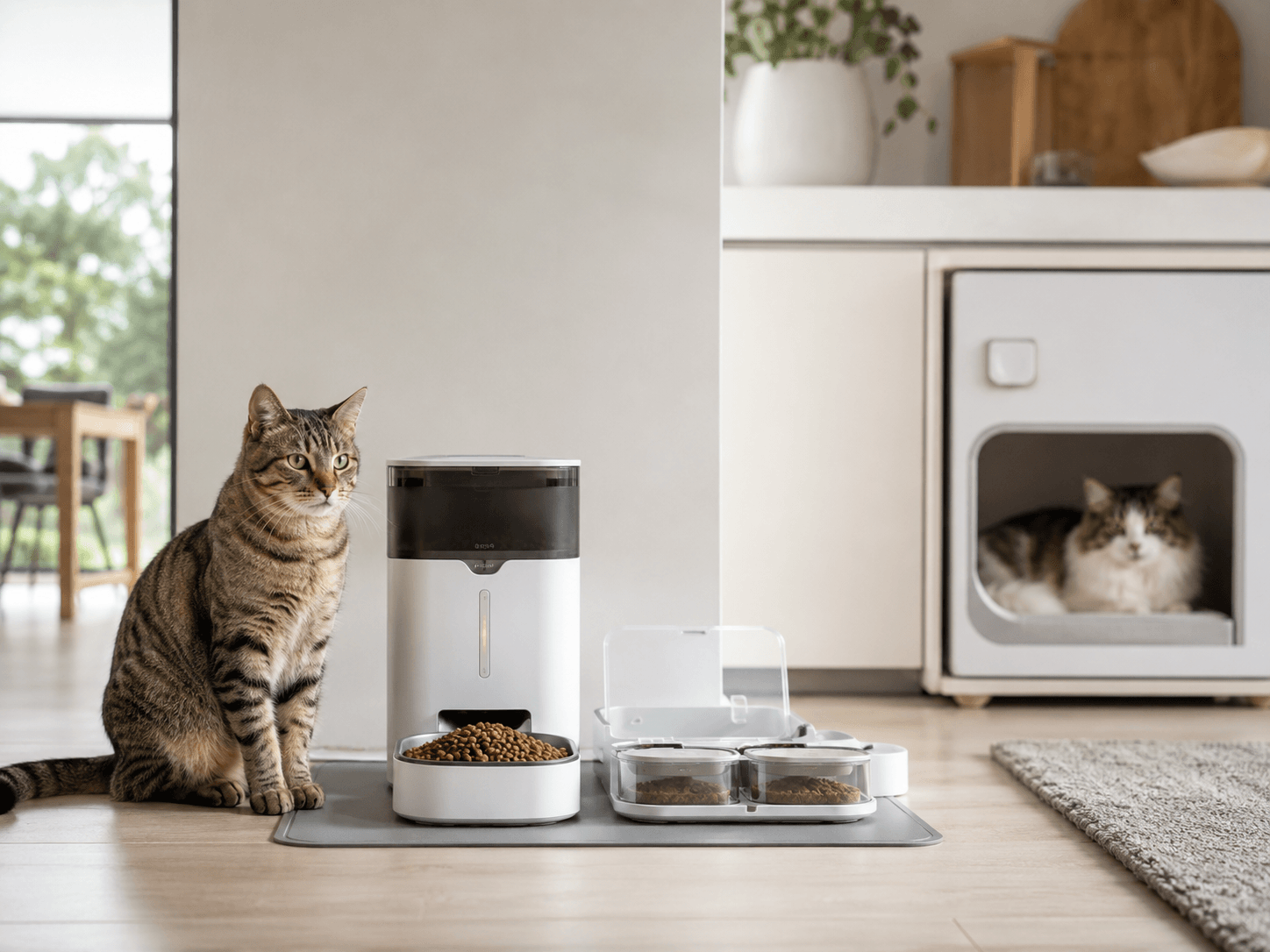
Amazon contains enough automatic cat feeders to suggest that feeding a cat has become an aerospace discipline.
It has not.
Most owners need to solve one of four problems:
- serve dry food on schedule and see what happened;
- keep wet food chilled until mealtime;
- stop one cat from treating every bowl as a public buffet;
- protect wet or prescription food using the cat’s actual microchip.
Those problems require different machines.
A camera does not refrigerate pâté. Refrigeration does not identify the food thief. An RFID tag is not an implanted microchip. And a feeder that films the crime in 1080p has not necessarily prevented it.
This guide compares four products with genuinely different jobs:
- PETKIT YumShare Solo 2;
- PETLIBRO Polar;
- PETLIBRO One RFID;
- SureFeed Microchip Pet Feeder Connect.
Research note: This is a research-led guide based on official documentation, current product information, public ownership evidence, and PetTech AI’s product-level trust checks. PetTech AI has not conducted long-term hands-on testing of every feeder included.
Quick Verdict
| Your real problem | Best feeder | Recommendation |
|---|---|---|
| You want scheduled kibble plus camera visibility | PETKIT YumShare Solo 2 | Promising newer product |
| You need refrigerated wet meals | PETLIBRO Polar | Strong niche recommendation |
| One cat steals another cat’s dry food | PETLIBRO One RFID | Established but conditional |
| You need true microchip access for wet or dry food | SureFeed Microchip Pet Feeder Connect | Strong specialist recommendation |
The short version
Choose YumShare Solo 2 when seeing the feeding area will actually change what you do.
Choose Polar when your cat eats wet food and your schedule refuses to cooperate.
Choose One RFID when you need timed dry-food dispensing plus tag-controlled access—but do not assume the door is a maximum-security facility.
Choose SureFeed Connect when food protection matters more than automatic dispensing and you want to use the cat’s implanted microchip.
Affiliate disclosure: This page contains affiliate links. PetTech AI may earn a commission if you purchase through them, at no additional cost to you. As an Amazon Associate I earn from qualifying purchases.
Compare the Recommended Feeders
- Check PETKIT YumShare Solo 2 availability
- Check PETLIBRO Polar availability
- Check PETLIBRO One RFID availability
- Check SureFeed Microchip Pet Feeder Connect availability
First Decide What the Feeder Must Physically Do
Before comparing hopper capacity, camera resolution, or how enthusiastically the app uses the word “AI,” answer one question:
What must physically happen at mealtime?
Dispense dry food and show you the bowl
Choose a camera feeder.
Keep wet food chilled and serve it later
Choose a refrigerated feeder.
Dispense dry food but restrict access using a collar tag
Choose an RFID feeder.
Keep prepared food available only to one microchipped cat
Choose a microchip-access feeder.
These categories overlap less than marketing pages suggest.
A sophisticated product can still be completely wrong for the household.
For a clearer breakdown of when smart pet technology should automate a task—and when it merely creates more information to check—read our Smart Cat Monitoring vs Automation guide.
PETKIT YumShare Solo 2: Best for Camera-Based Dry Feeding
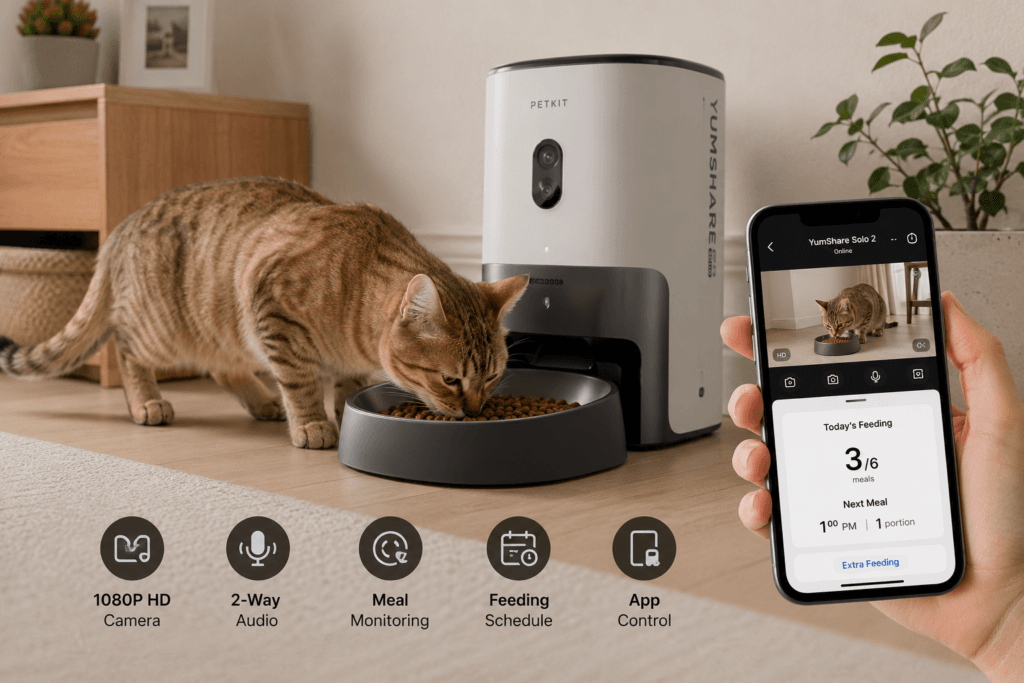
YumShare Solo 2 combines scheduled dry-food dispensing with a camera, live monitoring, meal records, two-way audio, and PETKIT’s individual-pet recognition system.
Its 3 L hopper holds dry kibble or compatible freeze-dried pieces. Schedules continue even when Wi-Fi is unavailable, and backup batteries can preserve feeding during a power interruption, although the camera is disabled while operating on battery power.
That makes it a real feeder first and a camera second—which is the correct order.
Buy it if
- your cat eats dry food;
- you want to see whether the cat approached the bowl;
- you spend significant time away from home;
- changes in mealtime behavior are worth reviewing;
- you already use PETKIT products;
- one feeding station serves the household.
Skip it if
- you only need timed portions;
- you will stop watching the clips after three days;
- your main diet is wet food;
- one cat must be physically prevented from eating another cat’s meal.
The main limitation
YumShare Solo 2 is still new.
Its early market signal is encouraging, but there is not yet a deep ownership history showing how consistently recognition, notifications, app behavior, and camera functions perform after years of daily use.
There is also a conceptual limit:
Recognition is not restriction.
The feeder may identify Baron Fluffington as he approaches the bowl. It does not issue a restraining order.
If one cat steals another cat’s food, a camera gives you evidence. You may still need physical access control.
Verdict: A promising camera feeder for owners who will genuinely use visual meal context—not the default choice for simple scheduling or food theft.
For a direct comparison between camera-led feeding, routine-first automation, dual-hopper flexibility, and identity-based systems, read PETKIT vs Feeder-Robot vs CATLINK.
PETLIBRO Polar: Best for Refrigerated Wet Meals
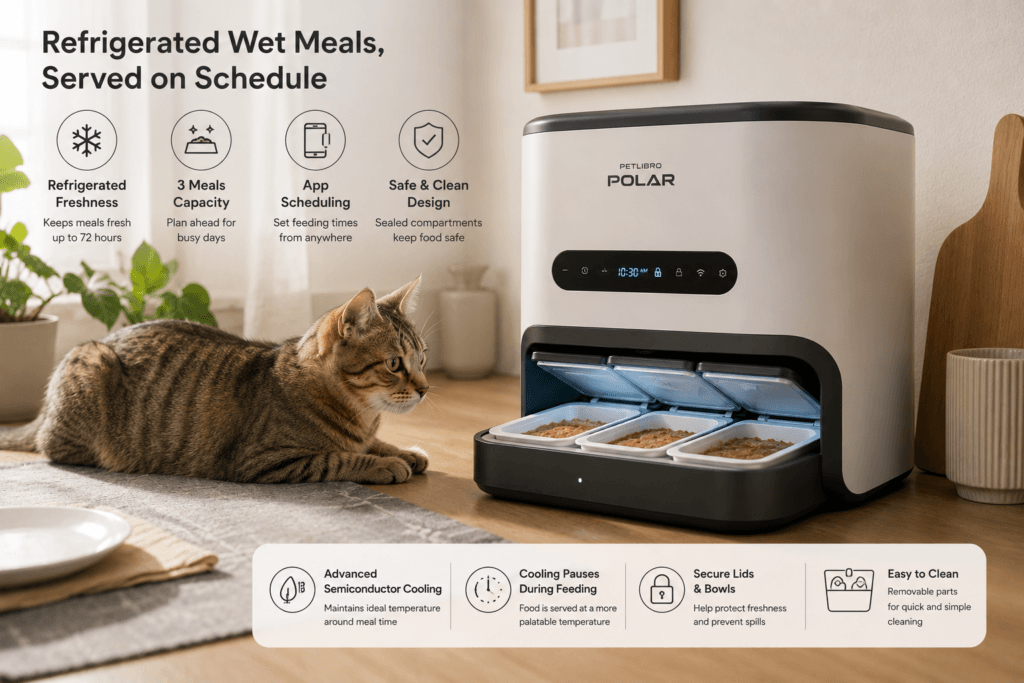
Polar solves the problem most automatic feeders quietly avoid:
Wet food is perishable.
It uses thermoelectric cooling, three meal compartments, app scheduling, and a removable stainless-steel tray. PETLIBRO says the feeder can keep three meals chilled for up to three days under its intended conditions and pauses cooling before serving so food is not presented at its coldest temperature.
That does not make it a miniature restaurant.
It makes it a refrigerated scheduling tool.
Buy it if
- wet food is already part of the daily routine;
- work or other commitments interrupt meal times;
- you want to avoid switching to kibble simply because nobody is home;
- three prepared portions are enough;
- you are willing to clean the tray and cooling area consistently.
Skip it if
- you mainly use dry food;
- you need access control between cats;
- your cat is very small or uncomfortable with a raised feeding area;
- you want a long-trip feeding solution;
- you expect refrigeration to eliminate food-safety judgment.
The main limitation
Polar removes timing friction.
It does not remove:
- leftovers;
- condensation;
- cleaning;
- wall-power dependence;
- the need to verify that the cat actually ate.
Three chilled meals can make a workday much easier.
They do not allow you to disappear for a long weekend while the feeder applies for temporary guardianship.
Verdict: The strongest choice here for scheduled wet food and a genuinely useful niche product for the right household.
For the deeper analysis, read our PETLIBRO Polar Review.
Refrigerated feeders differ substantially in temperature targets and meal capacity. Our Polar vs FreshFeed comparison explains why three chilled meals and six meals held closer to conventional refrigeration are not the same proposition.
PETLIBRO One RFID: Best for Scheduled Dry Food with Tag Access
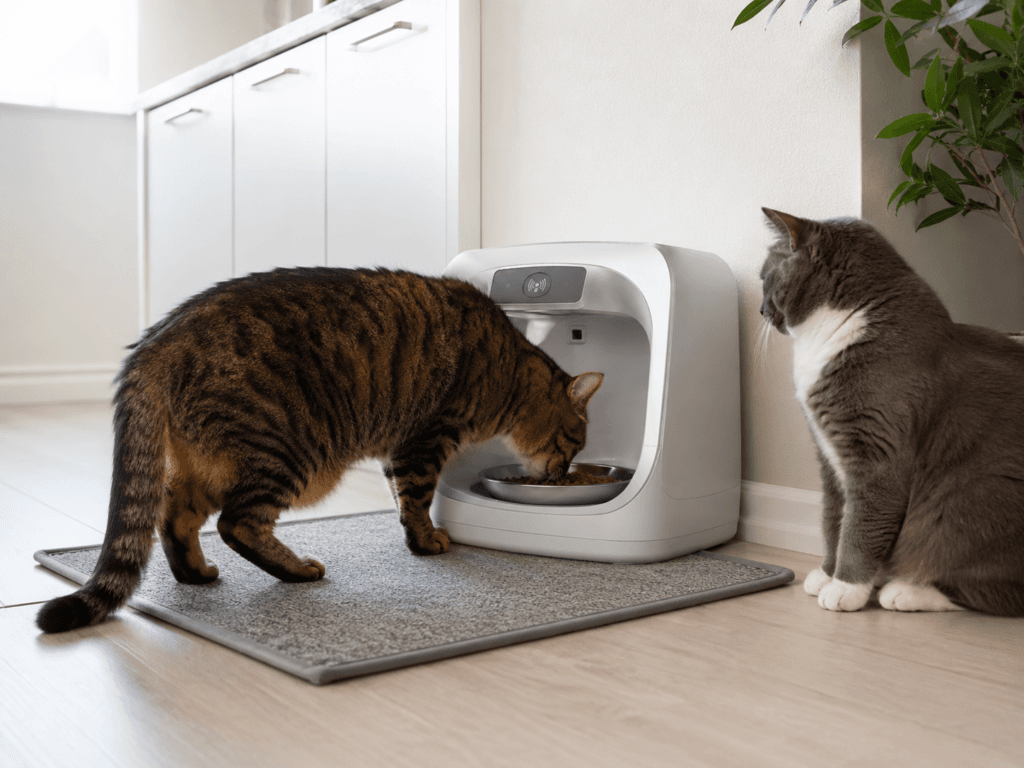
One RFID combines two functions:
- automatic dry-food dispensing;
- access controlled through PETLIBRO’s dedicated RFID collar tag.
This makes it more relevant than a normal hopper when one cat steals dry food from another or when separate portions need to be maintained.
The product has a substantial public ownership history, and the overall market signal supports keeping it in the guide.
But it requires careful framing.
Buy it if
- your cats eat dry food;
- one cat regularly invades another cat’s feeding station;
- you want both meal scheduling and controlled access;
- the authorized cat tolerates a collar tag;
- you can position the feeder away from interference;
- the consequences of occasional access failure are manageable.
Skip it if
- you need implanted-microchip recognition;
- your cat refuses collars;
- you feed wet food;
- unauthorized access would create a serious medical risk;
- you expect the door to defeat every determined cat in existence.
The main limitation
One RFID uses a proprietary collar tag.
Its performance depends on:
- tag position;
- reader placement;
- lid speed;
- nearby interference;
- feeder spacing;
- the determination and engineering qualifications of the unauthorized cat.
PETLIBRO provides troubleshooting guidance for slow closure, incomplete opening, RFID interference, and rotor errors. Some owners also report that another cat can exploit the lid before it closes fully.
This does not make the feeder useless.
It means “designed to reduce food theft” should not be translated as “physically impossible to defeat.”
For ordinary dry-food separation, it can be a practical solution.
For a prescription diet where unauthorized access carries meaningful health consequences, SureFeed’s microchip approach or a more enclosed physical setup may be the safer direction.
Verdict: A credible and established dry-food access feeder, but a conditional recommendation rather than a prison-grade guarantee.
Not every selective-access feeder automates the same part of the meal. Our PETLIBRO One RFID vs SureFeed Connect comparison explains the difference between scheduled dry-food dispensing and true microchip-controlled access.
SureFeed Microchip Pet Feeder Connect: Best for True Microchip Access
SureFeed Connect is fundamentally different from the other three products.
It does not contain a large hopper.
It does not release a fresh portion at a scheduled time.
Instead, you place wet or dry food in its 400 ml bowl, and the lid opens only when the registered cat’s implanted microchip or compatible RFID tag approaches.
That makes it the strongest specialist option when the food itself needs protection.
Buy it if
- one cat needs prescription or therapeutic food;
- one pet steals wet or dry meals;
- you prefer implanted-microchip access over a collar tag;
- food can remain available for grazing;
- accurate portion monitoring is useful;
- automatic dispensing is not required.
Skip it if
- you want meals dispensed at specific times;
- you need a large dry-food hopper;
- you want one device to combine automatic portions and microchip access;
- you do not want the additional Hub required for Connect app features.
The main limitation
The Connect version requires the Sure Petcare Hub to communicate with the app.
The feeder is also relatively open at the rear. Sure Petcare sells an optional rear cover specifically for persistent thieves capable of approaching from behind.
This is useful honesty from the manufacturer.
Apparently some cats respond to access-control technology by conducting a structural vulnerability assessment.
The rear cover, feeder placement, and training process may therefore matter in particularly competitive homes.
Even with those caveats, SureFeed’s mature microchip-access model gives it the strongest argument when food protection—not timed dispensing—is the priority.
Verdict: The best specialist choice for true microchip-controlled access to prepared wet or dry food.
The Food-Thief Test
Suppose Clara has prescription food.
Her brother, Caesar, believes prescriptions are merely serving suggestions.
YumShare Solo 2
Records Caesar approaching Clara’s food.
You receive a clear image of the suspect.
Polar
Keeps Clara’s wet food chilled until serving time.
Caesar appreciates the improved catering.
PETLIBRO One RFID
Uses Clara’s collar tag to open the feeding area and attempts to close it after she leaves.
Caesar may be stopped—or may begin studying lid timing.
SureFeed Connect
Opens for Clara’s implanted microchip and closes when she leaves.
Add the rear cover if Caesar has developed flanking tactics.
That is why “best automatic feeder” is the wrong question.
The better question is:
Which physical mechanism solves the problem in your home?
Buyer Regret in One Table
| Product | Most likely regret |
|---|---|
| YumShare Solo 2 | Paying for camera functions you stop using |
| Polar | Expecting wet-food automation without cleaning |
| One RFID | Assuming a collar-tag door is impossible to bypass |
| SureFeed Connect | Discovering it protects food but does not dispense timed portions |
Final Verdict
There is no single best automatic cat feeder because these four products do not perform the same job.
PETKIT YumShare Solo 2 is the best fit for dry-food scheduling with visual context. It is promising, useful, and still too new to call a proven long-term default.
PETLIBRO Polar is the strongest refrigerated wet-food option for owners whose main problem is serving meals while away from home.
PETLIBRO One RFID is a credible choice for scheduled dry-food access control, provided buyers understand the limits of a collar-tag system and moving lid.
SureFeed Microchip Pet Feeder Connect is the best specialist solution when implanted-microchip access and food protection matter more than timed dispensing.
The correct feeder is not the product with the longest feature list.
It is the machine that physically solves the recurring problem without creating three new ones.
Frequently Asked Questions
Which automatic feeder is best for wet food?
PETLIBRO Polar is the better option for scheduled refrigerated wet meals. SureFeed Connect is better when wet food must remain accessible only to one authorized cat.
Can YumShare Solo 2 stop food stealing?
No. Its camera and recognition features provide visual context, but they do not physically prevent another cat from reaching dispensed food.
Does PETLIBRO One RFID read implanted microchips?
No. It uses PETLIBRO’s dedicated RFID collar tag.
Is PETLIBRO One RFID impossible for another cat to defeat?
No access system should be treated as impossible to defeat. Lid timing, feeder placement, interference, and the behavior of the unauthorized cat all affect real-world performance.
Does SureFeed Connect dispense scheduled meals?
No. It protects food already placed in the bowl. Its main job is access control, not timed portion dispensing.
Does SureFeed Connect require a Hub?
Yes. The Connect model requires the Sure Petcare Hub for app connectivity. Buyers who do not need app monitoring can also consider the non-Connect Microchip Pet Feeder.
References
- PETKIT YumShare Solo 2 official product and support documentation
- PETLIBRO Polar official product, feeding, cooling, and cleaning guidance
- PETLIBRO One RFID official product and troubleshooting documentation
- Sure Petcare Microchip Pet Feeder Connect official product and accessory documentation
- Public ownership reports reviewed for recurring reliability and access-control patterns
Image Disclosure
Some images in this article may be AI-generated for illustrative purposes. They do not depict the exact products and should not be used to evaluate dimensions, controls, fit, or physical features.
Disclosure
PetTech AI may earn a commission when readers purchase through affiliate links. Products are recommended according to the feeding problem they can realistically solve, not according to how enthusiastically their product pages use the word “smart.”