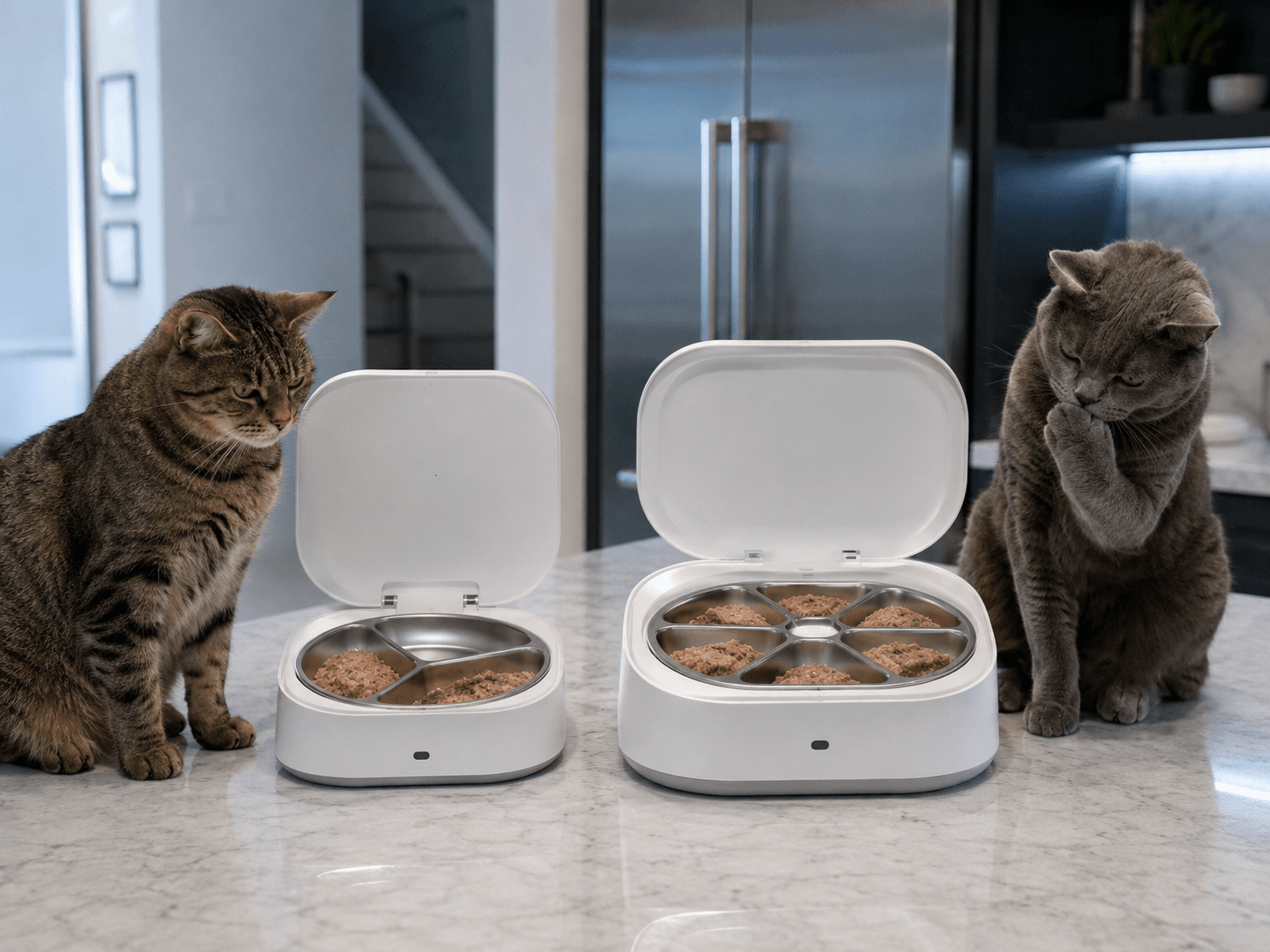
Tag: Smart cat feeders

  • PETKIT vs CATLINK (2026): Which Smart Cat Ecosystem Is Actually Worth Living With?

    PETKIT vs CATLINK (2026): Which Smart Cat Ecosystem Is Actually Worth Living With?

    Your cat does not know that he belongs to a smart ecosystem.

    He believes the litter box cleans itself because civilization has finally reached an acceptable standard. Food appears because that is the natural order of the universe. The water fountain is merely another monument erected in his honor.

    You, unfortunately, have to buy, clean, connect, update, and occasionally restart all of it.

    That is why PETKIT vs CATLINK is not really a contest over which brand can fit more “AI-powered health insights” into a product page.

    The real question is:

    Which ecosystem remains useful after the novelty disappears and the app starts sending notifications during dinner?

    PETKIT currently offers the broader connected-care ecosystem, with strong options across litter boxes, feeders, fountains, cameras, and newer AI-led products.

    CATLINK remains most interesting when litter-box monitoring and multi-cat routine data are the reason to buy—but its ecosystem is not equally convincing in every category.

    Research note: This is a research-led ecosystem comparison based on official product documentation, current product availability, public ownership evidence, and PetTech AI’s individual product audits. PetTech AI has not conducted a long-term hands-on test of every device discussed.

    Quick Verdict

    CategoryBetter fit
    Best overall smart cat ecosystemPETKIT
    Broadest product choicePETKIT
    Camera-led feeding and hydrationPETKIT
    Litter-box-first multi-cat monitoringCATLINK
    Simpler ecosystem expansionPETKIT
    Strongest reason to choose CATLINKA specific CATLINK litter box fits your home better
    Biggest PETKIT riskPaying for cameras and AI features you stop using
    Biggest CATLINK riskLetting a strong litter-box concept pull you into weaker product categories

    The short version

    Choose PETKIT if you want to build across litter care, feeding, and hydration without changing brand every time you add a device.

    Choose CATLINK when a particular CATLINK litter box is already your preferred product and cat-by-cat litter data genuinely matters.

    Choose neither brand purely because the word “ecosystem” makes three appliances sound as though they have formed an elite medical team.

    They have not.

    Affiliate disclosure: This page contains affiliate links. PetTech AI may earn a commission if you purchase through them, at no additional cost to you. As an Amazon Associate I earn from qualifying purchases.

    Start with the Core Product

    Rule One: Choose the Product Before the Ecosystem

    The biggest ecosystem mistake happens before the second device is even purchased.

    A buyer chooses a brand philosophy, downloads the app, and then starts buying everything carrying the same logo—even when another brand makes the better feeder, fountain, or litter box.

    That is backwards.

    The first device should earn your trust on its own.

    Only then should ecosystem convenience influence the second purchase.

    A PETKIT feeder does not become better because you own a PETKIT litter box. It becomes more convenient because both devices share an app.

    A CATLINK fountain does not become the right fountain because CATLINK’s litter analytics impressed you.

    The ecosystem is a useful tie-breaker.

    It is not diplomatic immunity for mediocre hardware.

    PETKIT: The Better Ecosystem for Most Buyers

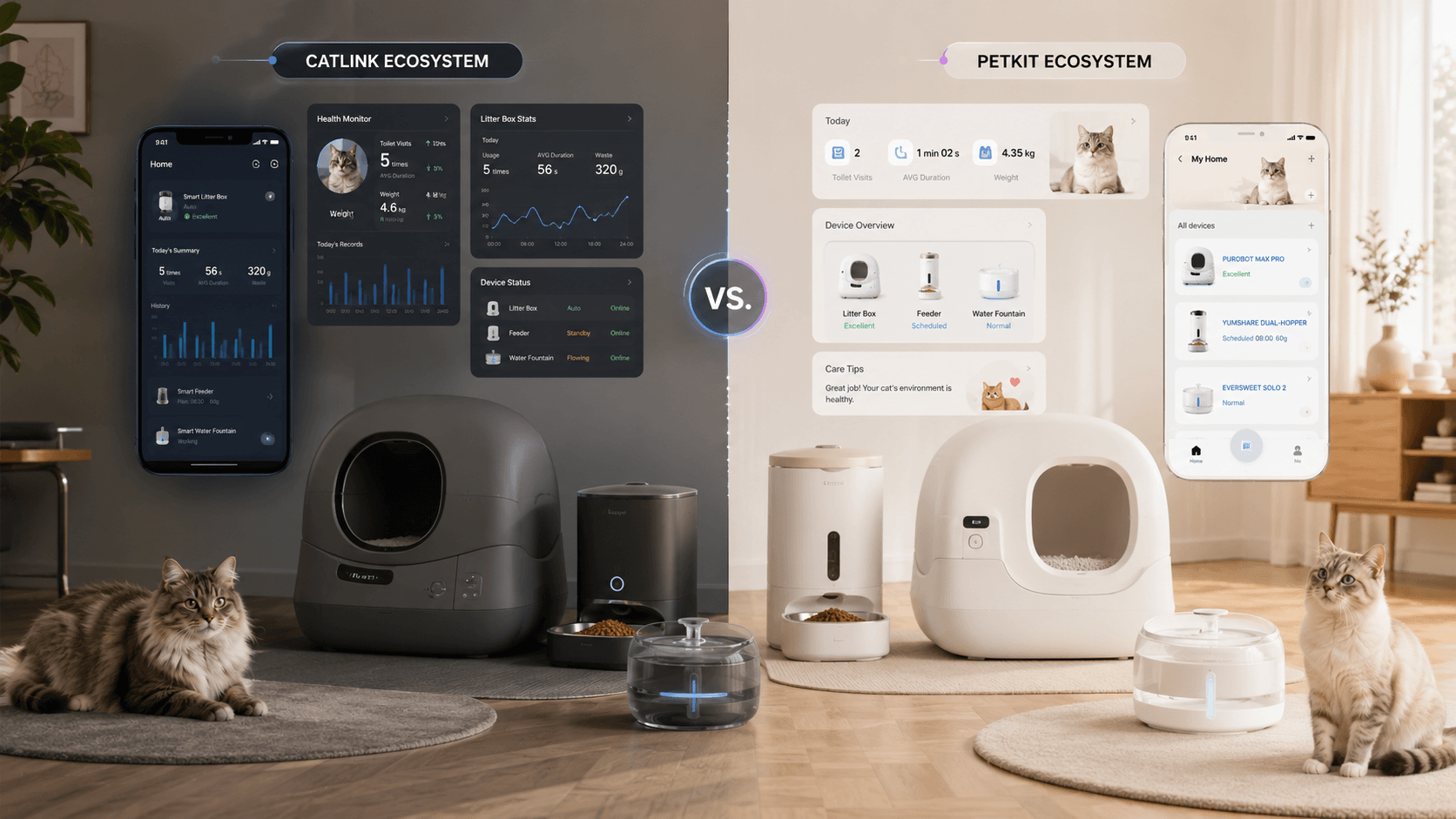
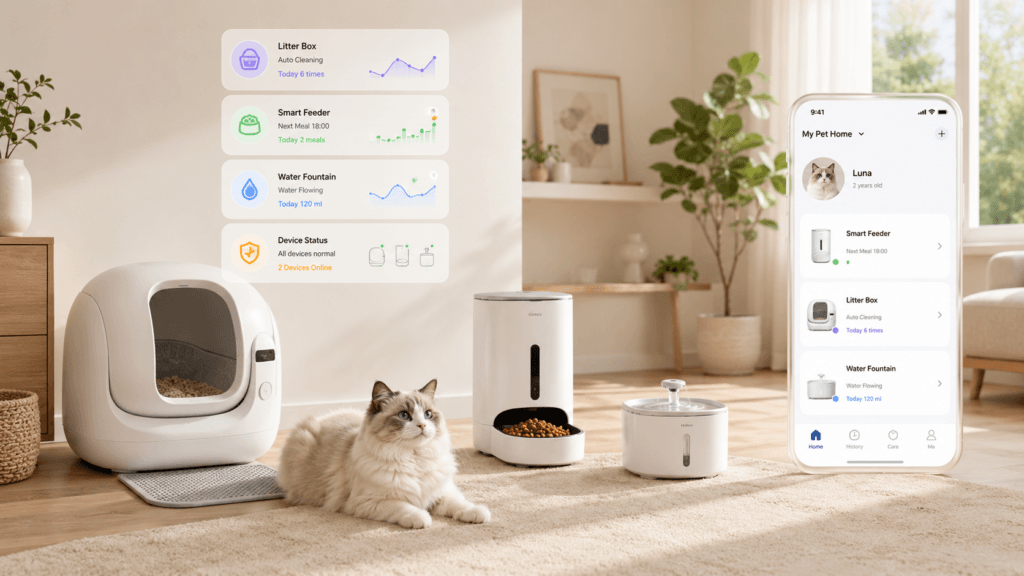
    PETKIT-style smart cat setup with feeder, fountain, litter box, app dashboard, and a cat in a bright modern home
    PETKIT makes the strongest case for owners who want litter, feeding, hydration, and camera-led reassurance inside a broader but relatively lighter smart-care setup.

    PETKIT currently makes the stronger argument as a complete smart cat ecosystem.

    Its range covers:

    • self-cleaning litter boxes;
    • camera-equipped litter boxes;
    • automatic dry-food feeders;
    • camera feeders;
    • wet-food automation;
    • smart and cordless fountains;
    • camera-based hydration monitoring;
    • connected accessories and consumables.

    The advantage is not simply quantity.

    PETKIT offers several levels of complexity inside the same categories. You can choose a relatively straightforward PuraMax 2, a more monitoring-focused Purobot, a normal fountain, or an EverSweet model apparently determined to turn drinking water into a data science project.

    That flexibility makes PETKIT easier to expand.

    You do not have to decide on day one that your kitchen needs more sensors than a small airport.

    PETKIT makes sense when:

    • you plan to own devices across multiple categories;
    • camera monitoring matters;
    • you want more product choice;
    • feeding and hydration are as important as litter care;
    • you prefer one app but do not want your first product choice dictated entirely by it;
    • you are comfortable with newer products having less long-term evidence.

    Where PETKIT can disappoint

    PETKIT’s newer direction is increasingly AI-heavy.

    That means more cameras, more recorded events, more recognition features, and potentially more paid cloud functions depending on the device.

    For some buyers, this is useful monitoring.

    For others, it is an impressive technological system dedicated to confirming that the cat drank water at 2:43 p.m.

    Before paying for the smarter version, ask:

    Will this information change anything I do?

    If the answer is no, choose the simpler PETKIT product.

    Verdict: PETKIT is the stronger ecosystem recommendation, but individual products still have to pass the product-level trust gate.

    CATLINK: Strongest When the Litter Box Is the Center

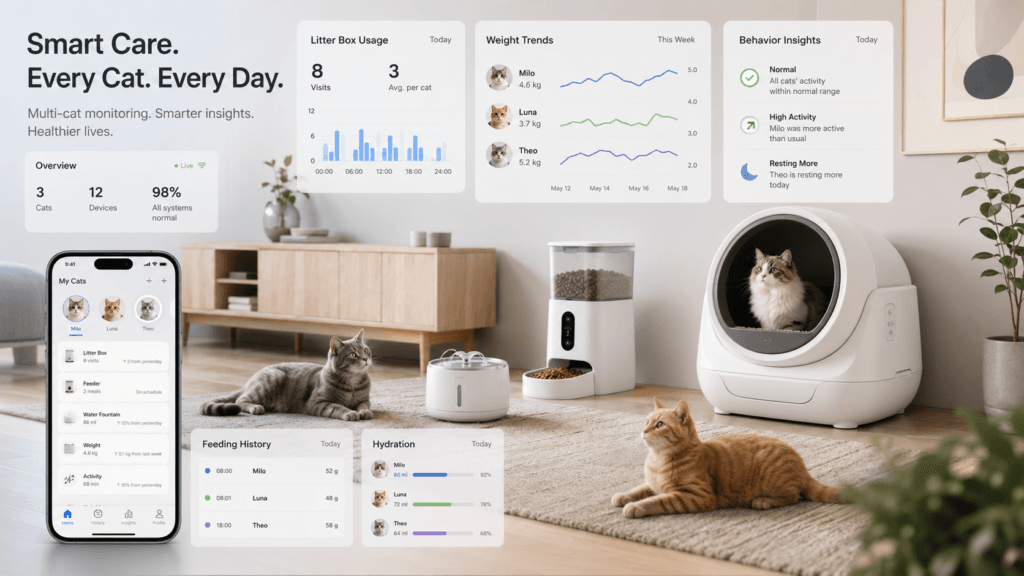
    CATLINK-style smart cat monitoring system showing multi-cat litter, feeding, hydration, app reports, weight trends, and behavior data
    CATLINK becomes more compelling when a home needs stronger multi-cat visibility, usage tracking, and a more control-heavy app experience.

    CATLINK’s clearest strength remains smart litter care.

    Its app and litter-box marketing emphasize:

    • cat recognition through weight data;
    • toileting frequency;
    • weight trends;
    • multi-cat profiles;
    • remote cleaning control;
    • consumable reminders;
    • alerts around changes in routine.

    This can be useful in a multi-cat home where a shared litter box hides which cat used it.

    CATLINK also sells feeders and fountains that connect to the same app, creating a broader input-and-output monitoring idea:

    • what went into the cat;
    • what came out of the cat;
    • whether the app can turn both events into a graph.

    That is a coherent concept.

    The problem is that ecosystem coherence does not guarantee equal product quality.

    Our current feeder analysis found CATLINK’s feeding options less convincing than its litter-box proposition. Fresh 2 RFID is interesting as a tracking product, but it is not a strong default recommendation for strict food separation. Facelink remains an immature specialist concept rather than a proven mainstream choice.

    This creates CATLINK’s central trade-off:

    The litter-box ecosystem may be compelling before the rest of the hardware is.

    CATLINK makes sense when:

    • a specific CATLINK litter box already wins your product comparison;
    • you have multiple cats;
    • weight-based litter-box recognition is useful;
    • toileting trends are the main data you care about;
    • you are comfortable checking current evidence separately for every additional CATLINK device.

    Where CATLINK can disappoint

    CATLINK’s marketing often presents the ecosystem as a unified health guardian.

    That language sounds reassuring.

    It does not mean the app has completed veterinary school.

    Weight changes, unusual litter-box frequency, missed meals, and drinking changes can all be useful signals. Their value is that they tell you to observe the cat more closely or contact a veterinarian—not that the consumer device has diagnosed the problem.

    CATLINK is most credible when it reports what happened.

    It becomes less credible when marketing language encourages buyers to imagine that the graph knows why.

    Verdict: CATLINK remains a legitimate litter-box-led ecosystem, but not a blanket recommendation across every product category.

    Litter Boxes: The Closest Contest

    This is where CATLINK can compete most seriously.

    Both brands offer self-cleaning litter boxes with app control, multi-cat features, weight tracking, alerts, and different levels of health-oriented monitoring.

    PETKIT’s advantage

    PETKIT gives buyers more distinct choices:

    • automation-first models;
    • camera-equipped monitoring models;
    • different sizes and entry designs;
    • a broader path into feeders and hydration.

    This makes it easier to choose how much technology you actually want.

    CATLINK’s advantage

    CATLINK has built more of its identity around litter-box data and multi-cat recognition.

    A buyer mainly interested in toileting patterns may prefer the CATLINK philosophy—provided the specific litter box performs well, fits the cats physically, and has reassuring current ownership evidence.

    Verdict

    PETKIT wins on ecosystem breadth.

    CATLINK can still win the individual litter-box decision.

    That is why the brand should not be dismissed—but also why one strong CATLINK litter box should not automatically lead to a CATLINK feeder, fountain, and commemorative smart toaster.

    For individual models, see our Best Smart Litter Boxes guide.

    Feeders: PETKIT Wins Clearly

    PETKIT has the stronger current feeder lineup.

    Its YumShare models combine scheduled feeding with cameras, facial-recognition context, food monitoring, and one- or two-hopper configurations.

    CATLINK’s Fresh 2 RFID and Facelink aim at identity-led feeding, but neither currently deserves the same recommendation strength.

    This distinction matters.

    PETKIT helps you see what happened around a feeding station.

    CATLINK tries to associate feeding with a specific cat.

    Neither approach automatically creates reliable physical access control, but PETKIT’s mainstream feeder proposition is currently easier to recommend.

    For the detailed feeding decision, read PETKIT vs Feeder-Robot vs CATLINK.

    Fountains: PETKIT Has the Stronger Range

    PETKIT has a wider and more developed fountain portfolio, ranging from simpler connected fountains to cordless, UVC, and camera-equipped models.

    EverSweet Ultra pushes the category furthest by combining camera monitoring with separated clean and wastewater tanks.

    Whether anyone truly needs a fountain capable of recognizing the cat’s face is a separate philosophical question.

    CATLINK fountains fit coherently into its broader monitoring system, but the brand currently gives buyers fewer compelling reasons to select the entire ecosystem around hydration.

    Verdict

    Choose the fountain on cleaning, pump design, materials, noise, and reliability first.

    Choose the ecosystem second.

    Water remains water even after the app produces a chart.

    The Health-Monitoring Reality

    Both brands now use health-oriented language.

    Both can collect useful routine signals:

    • litter-box visits;
    • weight changes;
    • feeding events;
    • drinking activity;
    • camera footage;
    • changes over time.

    This information can be valuable because cats often hide discomfort and routine changes may be noticed before obvious symptoms appear.

    But there is an important line:

    Monitoring records a pattern. It does not explain the pattern.

    If Napoleon visits the litter box fourteen times in one evening, the app may help you notice.

    It should not respond by awarding itself a degree in feline medicine.

    The correct value of smart monitoring is:

    1. notice a meaningful change;
    2. verify that the data appears plausible;
    3. observe the cat directly;
    4. contact a veterinarian when appropriate.

    Buy these systems for visibility and routine support—not diagnosis.

    For the broader trade-off, read Smart Cat Monitoring vs Automation.

    Where Ecosystem Buyer Regret Comes From

    EcosystemMost likely regret
    PETKITPaying for camera and AI layers that become ignored
    CATLINKAssuming every connected device is as convincing as the litter box
    Either brandBuying a bundle before validating the first product
    Either brandConfusing health data with medical certainty
    Either brandAccepting more maintenance because the app looks impressive

    The most dangerous phrase in smart-pet marketing may be:

    “Everything works together.”

    Three average products can also work together.

    That does not make them excellent. It makes them coordinated.

    Which Ecosystem Fits Your Home?

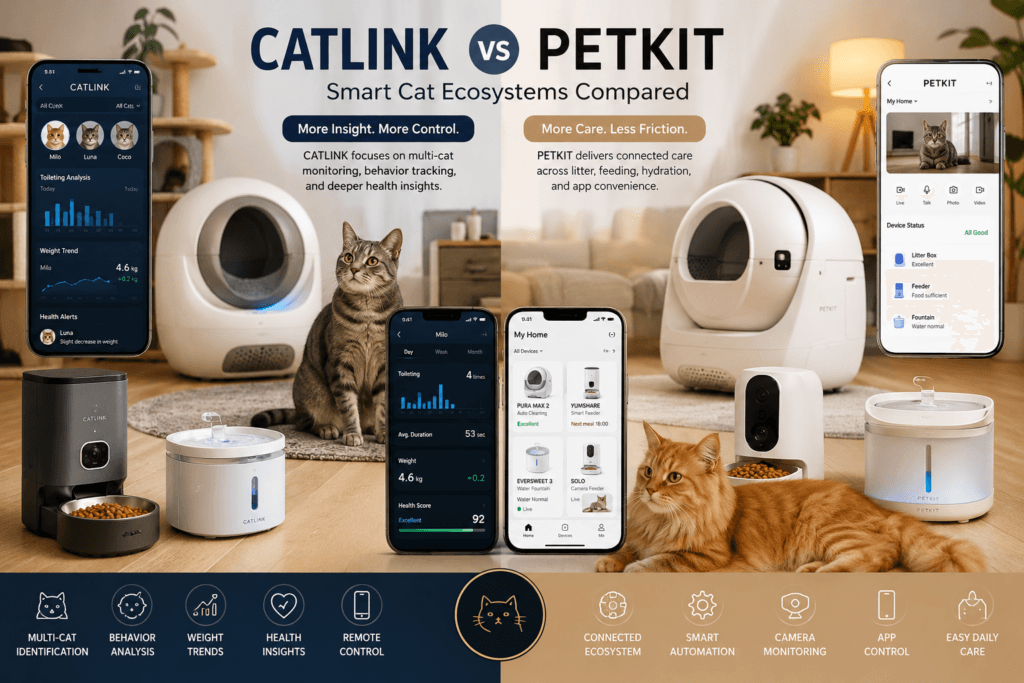
    Cat owner comparing PETKIT and CATLINK smart cat ecosystem options at home with app dashboards and connected pet devices
    The better smart cat ecosystem is not the one with the most features, but the one whose complexity still feels useful after the first week.

    Choose PETKIT for a broad connected home

    PETKIT is the better fit when:

    • you intend to add products gradually;
    • litter, feeding, and hydration all matter;
    • camera-led monitoring appeals to you;
    • you want more choice inside each category;
    • the ecosystem itself is part of the buying decision.

    For most households building beyond one device, this is the safer direction.

    Choose CATLINK for a litter-box-led multi-cat setup

    CATLINK is worth considering when:

    • its litter box wins your model-level comparison;
    • multiple cats share the box;
    • weight and toileting patterns matter;
    • you value cat-by-cat litter data;
    • you are willing to judge feeders and fountains separately.

    CATLINK should follow a strong product choice.

    It should not precede one.

    Choose neither ecosystem when one device is enough

    Owning one smart litter box does not create an urgent need for a matching feeder and fountain.

    Your cat will survive the emotional trauma of using appliances made by different companies.

    A mixed setup is often better when:

    • one brand makes the best litter box for your home;
    • another makes the better feeder;
    • a simple offline fountain already works;
    • you do not care about a single dashboard.

    One app is convenient.

    Better hardware is usually more convenient.

    The Six-Month Test

    After six months, which part of the ecosystem will still matter?

    Probably not:

    • the launch animation;
    • the first week of camera clips;
    • the novelty of receiving a notification when your cat urinates;
    • the satisfaction of seeing three matching icons in one app.

    What may still matter:

    • fewer litter chores;
    • reliable meals;
    • cleaner water;
    • useful multi-cat identification;
    • alerts that occasionally reveal a real change;
    • replacement parts and support that still exist.

    Build the ecosystem around those outcomes.

    Not the logo.

    Final Verdict

    PETKIT is the better smart cat ecosystem for most buyers.

    It has the broader and more convincing spread across litter boxes, feeders, fountains, cameras, and different levels of automation. It gives buyers more room to start simple and add monitoring only where it provides real value.

    CATLINK remains most credible as a litter-box-led ecosystem.

    Its multi-cat and toileting-data philosophy can be useful, and individual CATLINK litter boxes may beat PETKIT for a particular home. But the ecosystem becomes less convincing when buyers assume that every feeder and fountain deserves the same confidence.

    The best strategy is therefore not blind brand loyalty.

    Start with the strongest individual product.

    Let that product earn the second purchase.

    And remember: your cat did not request a unified AI care platform. He requested dinner, clean litter, and unrestricted access to whatever object you just placed on the table.

    Frequently Asked Questions

    Is PETKIT better than CATLINK?

    PETKIT is the better overall ecosystem for most buyers because it offers a broader and more convincing range across litter care, feeding, hydration, and camera monitoring. CATLINK may still be better when a specific litter box and multi-cat toileting data are the main priorities.

    Is CATLINK better for multiple cats?

    CATLINK’s litter-box ecosystem places strong emphasis on weight-based recognition and separate cat profiles. That can make it useful in multi-cat homes, but accuracy and value still depend on the specific device and how distinct the cats’ weights and routines are.

    Which brand has better feeders?

    PETKIT currently has the stronger feeder lineup. YumShare Solo 2 and Dual-Hopper 2 offer clearer mainstream use cases, while CATLINK’s identity-led feeders require more cautious product-level evaluation.

    Which brand has better fountains?

    PETKIT offers the broader fountain range, including cordless, UVC, app-connected, and camera-equipped options. The best fountain should still be selected primarily on cleaning, materials, pump reliability, and the cat’s acceptance.

    Can PETKIT or CATLINK diagnose health problems?

    No. Their products can identify changes in routine and provide useful data, but they cannot determine the medical cause of those changes or replace veterinary assessment.

    Should all my smart cat devices use the same app?

    Not necessarily. One app is convenient, but it should not outweigh meaningful differences in reliability, cleaning, cat fit, safety, or the quality of the product’s main function.

    References

    • PETKIT official Smart Home and product ecosystem documentation
    • PETKIT official 2026 AI ecosystem announcements
    • PETKIT official litter-box, feeder, and fountain product information
    • CATLINK official app and multi-cat monitoring documentation
    • CATLINK official ecosystem bundle information
    • PetTech AI individual product and category audits

    Image Disclosure

    Some images in this article may be AI-generated for illustrative purposes. They do not depict the exact products and should not be used to evaluate product dimensions, controls, fit, or physical features.

    Disclosure

    PetTech AI may earn a commission when readers purchase through affiliate links. This comparison does not assume that every product deserves a recommendation simply because it belongs to a connected ecosystem. The app is convenient; the product still has to work.

  • How to Stop a Cat From Overeating in 2025: Vet-Backed Strategies & Smart Feeding Tech

    How to Stop a Cat From Overeating in 2025: Vet-Backed Strategies & Smart Feeding Tech

    Indoor cats in 2025 have a strange problem: they’re safer than ever, but surrounded by constant calories. Bottomless bowls, high-calorie dry food, and boredom all work together until you’re asking the same question as thousands of other owners: how do I actually stop a cat from overeating without making them miserable?

    The short answer: you don’t “fix” it with one gadget or a smaller scoop. To stop a cat from overeating in a sustainable way, you have to work on three fronts at once:

    • Calories and portions (how much they eat)
    • Feeding structure (when and how they eat)
    • Environment and boredom (why they’re so focused on food)

    This guide walks through all three, with practical steps and smart-home tools you can plug into your existing setup.


    Why Overeating Is a Bigger Deal Than “A Few Extra Pounds”

    A lot of owners only try to stop a cat from overeating when the belly is already obvious. That’s late.

    Excess weight in cats is strongly linked to:

    • diabetes mellitus
    • arthritis and joint pain
    • heart and respiratory strain
    • lower activity and more frustration
    • shorter overall lifespan

    The brutal part: cats are small. An extra 1–2 pounds on a 10-pound cat is the equivalent of a human gaining dozens of pounds. Letting overeating slide for “just a bit” can quietly turn into chronic disease.

    If your cat:

    • finishes food instantly
    • begs between meals
    • raids other bowls
    • or vomits from eating too fast

    …you’re beyond a “quirk” and firmly in behavior + management problem territory. That’s exactly where you can still turn it around.


    Step One: Is Your Cat Overeating or Just Underfed?

    You can’t stop a cat from overeating if you’re misreading hunger signals. Some cats are genuinely underfed; others are just opportunists.

    Check three things first:

    1. Body condition score (BCS)
      • Can you feel ribs with a light touch but not see them?
      • Is there a defined waist from above?
      • If your cat is rounded with no waist and a belly pouch that swings, that’s excess fat, not just “fluff.”
    2. Daily calories vs. ideal weight
      • Many indoor adults do well around 180–220 kcal/day, but it depends on size, age, and activity.
      • If you’re free-pouring kibble or “eyeballing” portions, you have no idea where you are.
    3. Feeding pattern
      • Free access to dry food?
      • Extra snacks “whenever they ask”?
      • Multiple family members feeding without coordination?

    If BCS is high and calories are unmeasured, you’re not dealing with true hunger. You’re dealing with a system that silently taught your cat that food is always available if they push hard enough.


    Why Cats Obsess Over Food: Root Causes You Can Actually Fix

    To stop a cat from overeating, you have to hit the upstream causes, not just clamp down on portions and hope for the best.

    Common drivers:

    • Free-feeding habits – the bowl is always full, so eating becomes a hobby.
    • Boredom and lack of enrichment – nothing to do, nowhere to climb, no predictable play → food becomes the main event.
    • Stress and resource competition – in multi-cat homes, anxious cats may eat fast or guard food because they’re afraid it will be taken.
    • Highly palatable food – energy-dense dry diets with lots of fat and flavor can push cats to eat past satiety.

    The good news: every one of these can be modified with a combination of routine, environment, and smart tools.


    How to Stop a Cat From Overeating: Core Feeding Strategy

    Slow feeder, puzzle feeder and treat ball used to stop a cat from overeating

    Here’s the spine of the system you want to build.

    1. Ditch Bottomless Bowls

    You cannot stop a cat from overeating if the food is literally never “over.”

    • Move to meal feeding: 2–4 small meals per day, depending on your cat’s age and health.
    • Measure food with a real measuring cup or gram scale. “Half a scoop” is not a unit.

    If you’re worried about your schedule, this is where smart feeders start to earn their place.

    If you want a practical, low-effort way to manage portions and feeding schedules, check out our PETKIT Fresh Element Infinity Review 2025 or explore our Best Smart Cat Feeders 2025 guide.


    2. Set a Realistic Calorie Target

    To stop a cat from overeating safely, you need a target — not guesswork.

    • Ask your vet for an ideal weight and calorie plan, especially if your cat is already overweight.
    • As a rough orientation:
      • many indoor neutered cats land around 20 kcal per pound of ideal weight per day, then adjusted up or down based on response
    • Divide that daily total into 2–4 meals.

    If weight is dropping too fast (more than ~1–2% of body weight per week), increase calories and talk to your vet. Too rapid loss can be dangerous for cats.


    3. Use Slow Feeding to Break the “Inhale and Panic” Cycle

    If you want to stop a cat from overeating and curb vomiting, how they eat is as important as how much.

    Tools that help:

    • Slow-feed bowls with ridges that force smaller mouthfuls
    • Puzzle feeders that require batting, nudging or hunting for kibble
    • Treat balls or tracks that reward movement with food

    Behaviorally, this:

    • stretches meal time
    • adds mental and physical effort
    • reduces the “I must inhale everything in 30 seconds” reflex

    If you want toys that support weight control and reduce food-obsessed behavior, take a look at our Best Interactive Cat Toys 2025 guide — and browse our recommended puzzle and foraging feeders for extra enrichment.


    4. Anchor Meals to a Predictable Schedule

    Cats thrive on routine. An underrated way to stop a cat from overeating is to make feeding times boringly predictable.

    • Feed at the same times each day, as much as your life allows.
    • Ignore begging outside those windows — no eye contact, no talking, no “just a little snack.”
    • Use a smart feeder for early-morning or late-night slots so you’re not being trained by 4 a.m. meowing.

    Within 1–2 weeks, most cats adapt: they shift from constant lobbying to anticipating the real meal times.


    5. Replace “Food Attention” With “Play Attention”

    Many owners subconsciously reward food obsession with engagement: every meow gets a comment, every trip to the kitchen gets a follower.

    If your cat learns that:

    “Any time I scream about food, I get interaction,”

    …food becomes their primary communication tool.

    To stop a cat from overeating long-term, you have to break that link:

    • Keep food interactions neutral and brief.
    • Schedule play sessions (5–10 minutes) at predictable times, especially before meals and in the evening.
    • Reward calm resting near you with petting or quiet praise, not just food.

    You’re teaching your cat that attention is abundant, but food is structured.


    Using Smart Pet Tech Without Letting It Backfire

    Smart cat feeder dispensing a scheduled meal for portion control

    Smart feeders and ecosystems are powerful, but they can also silently sabotage your attempt to stop a cat from overeating if used badly.

    Smart Feeders: When They Help

    They’re genuinely useful when you:

    • need consistent portion sizes and timing
    • are away for long hours or shifts
    • are prone to “just one extra scoop” decisions

    A well-set-up device like the PETKIT Fresh Element Infinity or similar smart feeders can:

    • split daily calories into multiple small meals
    • log exactly how much was dispensed and when
    • prevent one cat from bullying another away from the bowl (paired with microchip/RFID feeders)

    Used correctly, smart feeders make it easier, not harder, to stop a cat from overeating because they take your mood and guilt out of the equation.

    Smart Feeders: When They Hurt

    They’re a problem when you:

    • constantly trigger extra “snack” portions from the app
    • ignore the logs and keep adding “just in case”
    • combine auto-feeding with a second open bowl “for backup”

    Tech doesn’t fix discipline. It just makes your decision more visible — or more consistently wrong.


    Multi-Cat Homes: Stopping One Cat From Overeating Without Starving the Others

    If you live with more than one cat, it’s almost impossible to stop a cat from overeating without some version of controlled access.

    Options:

    • Feed in separate rooms and pick up bowls after 20–30 minutes.
    • Use microchip or RFID feeders so only the intended cat can access a specific bowl.
    • Elevate food for agile cats only when you have one overweight cat and one older or mobility-impaired cat who needs more calories.

    The goal is simple:

    Every cat gets their calories, and no one gets the chance to mop up everyone else’s leftovers.


    14-Day Transition Plan to Stop a Cat From Overeating

    Illustration of overweight vs healthy body condition in a cat

    Here’s a realistic timeline to change the system without blowing up your relationship.

    Days 1–3: Audit and Adjust

    • Measure what you’re actually feeding now.
    • Start measuring with a cup or scale, even if portions stay the same.
    • Introduce one slow feeder or puzzle for part of one meal.

    Days 4–7: Structure & Slow

    • Move from free-feeding to set meal times (start with 3–4 per day).
    • Replace at least half of each meal with a slow or puzzle feeder.
    • Start ignoring begging outside meal windows (this is the hardest part).

    Days 8–14: Calorie Correction

    • If your vet has given you a calorie target, gradually taper portions down to that level over this week.
    • Maintain consistent schedules — no “cheat snacks.”
    • Add one short play session before an evening meal; this burns energy and helps your cat settle after eating.

    By the end of two weeks, most owners see:

    • slower eating
    • fewer vomit episodes from bolting food
    • slightly calmer behavior around the bowl

    You’re not finished, but you’ve finally created a system that can stop a cat from overeating over the long haul.


    When Overeating Is a Symptom, Not a Behavior Problem

    There’s a hard line here: even the best system to stop a cat from overeating won’t work if overeating is driven by disease.

    Red flags to call your vet now, not “after we try a new feeder”:

    • Rapid increase in appetite with weight loss instead of gain
    • Drinking and urinating much more than before
    • Sudden food obsession in a senior cat
    • Panting, weakness, or obvious discomfort

    Conditions like hyperthyroidism, diabetes, intestinal disease, or certain medications can make cats genuinely hungrier. In those cases, trying to stop a cat from overeating purely with portion control is like trying to fix a fever by turning down the thermostat. You need a medical diagnosis first.


    Internal Links

    For readers who want to dive deeper into structured feeding, enrichment, and smart-home solutions for cats, PetTech AI offers several in-depth guides:

    These resources provide practical support for building a healthier feeding routine and reducing overeating long-term.


    References

    Cornell Feline Health Center — scientific guidance on feline weight management, calorie requirements, portion control and indoor nutrition.

    American Veterinary Medical Association (AVMA) — evidence-based recommendations on obesity prevention, feeding practices, and healthy behavior patterns in cats.

    AAHA / AAFP Feline Life Stage Guidelines — veterinary standards on diet, weight monitoring and structured feeding across all feline life stages.

    VCA Animal Hospitals — clinical resources on safe weight loss, feeding schedules, and identifying medical conditions that cause increased appetite.


    Disclaimer

    The information in this article is for educational purposes only and does not replace professional veterinary advice, diagnosis or treatment. Always consult your veterinarian before changing your cat’s diet, feeding schedule or weight-loss plan, especially if your cat has existing medical conditions or is a senior. Sudden changes in appetite, weight, thirst or litter box habits should be evaluated by a vet as soon as possible.

    PetTech AI participates in affiliate programs, including Amazon Associates and CJ. We may earn a small commission if you purchase products through links on this page, at no extra cost to you. Our recommendations are based on independent research and expert sources, not paid placement.

  • Black Friday Pet Tech Deals 2025 — Smart Feeders, Litter Boxes & Cameras (Live Picks + Setup Tips)

    Black Friday Pet Tech Deals 2025 — Smart Feeders, Litter Boxes & Cameras (Live Picks + Setup Tips)

    Black Friday is the best week of the year to upgrade your cat’s tech without draining your wallet. This live guide curates Black Friday pet tech deals 2025 across smart feeders, self-cleaning litter boxes, cameras/treat dispensers, fountains, GPS trackers, and smart cat doors—with direct Amazon links, quick specs that matter, and fast setup tips to avoid buyer’s remorse.

    Bookmark this page: we structured it to maximize retention + affiliate CTR with skimmable tables and “why it matters” bullets for each pick.


    How to use this guide (30s)

    • Scan the category you care about.
    • Tap “Check current deal” to verify today’s price (Amazon changes fast).
    • Use the setup tips to avoid common install mistakes during the busy weekend.
    • Keep treats/fountains/feeders within a calorie/hydration plan (vet-aligned pointers below).

    Top Live Picks (by category)

    Smart treat cameras (bonding + remote rewards)

    Furbo 360 Cat Camera Black Friday deal.
    • Petcube Bites 2 Lite — 1080p cam, 110° view, night vision, 2-way audio, scheduled or manual treat toss.
      👉 Check current deal on Amazon (USA).
      Why buy on BF: solid entry price + app polish; great for engagement sessions when you’re out.
    • Furbo 360° Cat Camera360° rotating view, 1080p, 2-way audio, meowing alerts, treat toss via app.
      👉 Check current deal on Amazon (USA).
      Why buy on BF: rare cat-specific alerts + full-room coverage; often discounted during event windows.

    Setup tip: place 1–2 m from a “calm mat” and only toss when your cat is quiet—reduces learned meowing.


    Smart automatic feeders (portion control + schedules)

    PETLIBRO smart feeder Black Friday sale.

    Setup tip: test with your actual kibble size (8–12 mm works best); run 10 toss/dispense tests and vacuum crumbs to avoid jams.


    Self-cleaning litter boxes (odors + daily hygiene)

    PETKIT PuraMax 2 Black Friday Pet Tech Deals 2025.

    Setup tip: place on level floor, enable child/pet lock, and keep a manual tray nearby during the first week as your cat adapts.


    Smart water fountains (hydration compliance)

    Setup tip: swap filters per schedule, clean pump impeller monthly; hydration jumps when the spout is at nose level.


    GPS & health trackers (outdoor safety + activity)

    Setup tip: create a “home” virtual fence first, then enable alerts for leaving/entering; snug fit = one finger under collar.


    Smart doors (microchip entry, selective access)

    Setup tip: measure shoulder height + width carefully; add tunnel/adapter for glass or wall installs and seal edges to prevent drafts.


    Smart Cleaning & Air Care Gadgets (home freshness + odor control)

    As cat owners upgrade feeders and litter boxes, smart air purifiers and deodorizers are seeing major Black Friday markdowns. These tools extend hygiene beyond the litter area, automatically neutralizing smells and tracking air quality — essential if you live in apartments or multi-cat homes.

    • PETKIT Smart Spray Odor Remover — releases negative ions; connects via PETKIT app, remote control.
      👉 Check current deal on Amazon
      Why buy now: sensors trigger only when motion or odor spikes occur, saving cartridge life.
    • Levoit Core 300S Smart Air Purifier (for cat dander & litter odors) — Alexa/Google Assistant compatible, PM2.5 detection, 3-stage HEPA filtration.
      👉 Check current deal on Amazon
      Why it’s worth it: strong CADR for medium rooms, quiet night mode (24 dB), real-time app graphs.
    • Petkit AirSalon Max Grooming & Purifying Dryer — doubles as dryer and fur deodorizer; gentle airflow, filter captures dander.
      👉 Check current deal on PetKit
      Tip: ideal for long-haired breeds; pair with the Pura Air for a full fresh-air loop.

    Setup tip: position purifiers opposite the litter zone, ~1 m away, to ensure airflow covers the path from box to rest area. Replace filters every 3–6 months — most apps will notify you automatically.


    Tech Enrichment Toys (AI play & smart engagement)

    Beyond hygiene and feeding, this year’s Black Friday pet tech deals 2025 highlight interactive toys that keep cats active when owners are away. Movement-responsive toys reduce destructive boredom and provide much-needed enrichment.

    • MetaCat Smart Robot Cat – Fully interactive robotic cat with voice-recognition commands (20+ built-in), responsive touch sensors on head/chin/back, and USB-C rechargeable battery lasting up to several days. With motion + sound + expressive eyes, it offers premium “tech pet” feel that appeals during Black Friday because of novelty and high-end build.
      👉 Check current deal on Amazon
      Key specs at glance: Voice recognition (20+ commands), touch sensors, rechargeable via USB-C, realistic movements/expressions, premium materials.
    • Cheerble Wicked Ball SE (Cat Edition) — motion & touch sensors, random roll pattern, USB-rechargeable; app-free simplicity.
      👉 Check current deal on Amazon
      Why it fits Black Friday buyers: affordable, safe materials, usually discounted 15–20%.
    • Pawzone AI Laser Cat Toy (auto tracking) — tracks movement via IR sensor, 3 adjustable speeds, scheduled play cycles.
      👉 Check current deal on Amazon
      Why it’s a hit: simulates hunting, adjustable duration; connects via USB-C or battery pack.

    Setup tip: rotate toys daily to avoid novelty fatigue; record sessions with a camera like the Furbo 360° for cute shareable clips .


    Quick buyer’s checklist (don’t skip)

    • Return windows: Amazon’s BF period is forgiving—still unbox immediately and test motor noise & app pairing.
    • Wi-Fi: feeders/cameras often require 2.4 GHz (some support 5 GHz); check your router before drilling mounts.
    • Noise sensitivity: choose quieter motors for skittish cats (fountains and tossers vary).
    • Ecosystem: fewer apps = fewer missed schedules. If you already use Petcube or PETKIT, stick within the brand where it makes sense.

    Health & nutrition pointers (so deals don’t backfire)

    • Treats ≤10–15% of daily calories for healthy adult cats; if you train more during holidays, minus a bit from dinner to compensate.
    • Annual wellness exams (semiannual for seniors/at-risk): bring your app graphs from feeders/trackers for clearer conversations.

    (Based on standard guidance from Cornell Feline Health Center and AVMA; see outbound links below.)


    Fast setups (category playbooks)

    Treat cameras — Create a “calm mat” zone 1–2 m away, reward quiet sits only, pair the last toss with 3–5 min of wand play; end session with one treat → predicts bedtime calmly.

    Feeders — Start with current daily calories split into 2–3 meals; after a week, let the app suggest micro-adjustments (±5–8%). Keep kibble size small/round to avoid clogs.

    Litter boxes — Keep the old tray available for 3–7 days; sprinkle a cup of used litter inside the new unit; enable child/pet lock and soft start schedules.

    Fountains — Place at chin level, away from food bowls (cats prefer water “elsewhere”); choose spout mode for curious drinkers, gentle flow for anxious cats.

    GPS — Test indoors near windows; charge nightly for the first week while you tune update frequency vs. battery life.

    Smart doors — Program microchips first, then use the curfew timer to avoid night roaming. For multi-cat homes, DualScan rules prevent a “bully” from locking a timid cat outside.


    Pros & cons of shopping pet tech on Black Friday

    Pros

    • Largest price deltas of the year on mid/high-end devices.
    • Easy returns/exchanges if your cat dislikes a device.
    • Great moment to unify your app ecosystem.

    Cons

    • Some listings switch to “Other sellers” or bundles; always verify model + warranty.
    • Subscription features (e.g., some camera alerts) may be paywalled—read the feature grid before purchase.
    • Risk of over-buying: prioritize one upgrade per category you’ll actually use.

    Internal links (PetTech AI)


    Authoritative outbound links


    Disclaimer

    This guide is for educational purposes only and does not replace professional veterinary advice. Always introduce new devices gradually and monitor your cat’s behavior and weight. Treat tossers and fountains are tools for enrichment and hydration—not medical devices. If you notice appetite changes, vomiting, diarrhea, excessive thirst, urinary issues, lethargy, or behavior shifts, contact your veterinarian promptly. Some links in this article are affiliate links to Amazon. If you purchase through them, PetTech AI may earn a commission at no extra cost to you. This helps us maintain independent testing and publish evidence-based recommendations.

  • Building a Smart Home for Your Cat: The Ultimate 2025 Guide

    Building a Smart Home for Your Cat: The Ultimate 2025 Guide

    Affiliate Disclaimer: PetTech AI may earn a small commission if you buy through links on this page. We only recommend products that support feline safety, comfort, and wellbeing.

    Designing a smart home for cats isn’t about filling your apartment with gadgets. It’s about building a calm, predictable environment where your cat’s routines—eating, drinking, toileting, resting, and playing—are supported by tech that reduces stress for both of you. The right devices automate the boring parts, surface useful health insights, and free your time for the fun stuff: bonding and enrichment.

    This Ultimate 2025 Guide walks you through the essentials, from feeders and fountains to litter automation, air quality, cameras, enrichment, travel safety, and the data layer that ties everything together. By the end, you’ll know exactly how to assemble a smart home for cats that suits your space, budget, and feline personality.


    What “smart” means in feline living (and what it doesn’t)

    A smart home for cats uses connected devices that:

    • Lower friction in daily care (feeders, fountains, litter automation).
    • Increase consistency (timed meals, clean litter, stable climate).
    • Provide signals you can act on (weight, activity, sleep, bathroom trends).
    • Reduce stress through predictability and gentle automation.

    It does not replace you. Cats thrive on human interaction and environmental stability; tech should amplify that, not erase it.

    Authority note: The Cornell Feline Health Center emphasizes routine, enrichment, and clean litter as pillars of behavior health. The AVMA (American Veterinary Medical Association) similarly stresses low-stress handling and safe home environments. A smart home for cats leans into those evidence-based basics—then adds data and automation.


    Pillar 1: Smart feeding & hydration (calm routines, better data)

    Smart feeder dispensing food next to a quiet cat fountain. Smart home for cats.

    Why it matters: Meal timing and water intake are two of the biggest levers for feline wellbeing. Predictable feeding supports digestion and reduces food-related anxiety. Flowing, filtered water boosts hydration—vital for urinary health.

    Core devices for a smart home for cats

    • Automatic feeders (e.g., PETKIT or Feeder-Robot by Whisker on Amazon): schedule precise portions, manage multi-cat conflicts, and log intake.
      Shop top-rated smart feeders → PetKit or Amazon/ Whisker (REALSIMPLE50 for a 50$ discount)/ Others (Amazon)
    • Smart water fountains (e.g., PETKIT Eversweet on Amazon): quiet pumps, multi-layer filtration, low-water and filter alerts, and sometimes TDS sensors.
      See best-selling cat fountains → Petkit or Amazon/ Others (Amazon)

    Pro Tips

    • Start by mirroring your current schedule in the app, then nudge to the ideal routine over a week.
    • For multi-cat homes, create staggered micro-feeds to reduce crowding at the bowl.
    • Replace carbon/foam filters on schedule; it’s the simplest win in any smart home for cats.

    Internal interlinks:


    Pillar 2: Smart litter & hygiene (the peace-of-mind engine)

    A smart home for cats lives or dies by litter box quality. Dirty boxes create the fastest path to anxiety and house-soiling. Automation stabilizes cleanliness and gives you early-warning signals.

    Devices

    Why this belongs in a smart home for cats

    • Cleanliness → compliance. The cleaner and more accessible the box, the more reliably a cat uses it.
    • Data → detection. Subtle changes in box visits or clump size/weight may hint at UTI, constipation, or stress—flags you can discuss with your vet.

    Authority note: The AVMA highlights that sudden changes in litter habits warrant a health review. Automation helps you notice those changes earlier.

    Internal interlinks:


    Pillar 3: Air quality & odor control (your invisible comfort layer)

    Self-cleaning litter box with mat and HEPA purifier in a tidy corner.

    Even a well-maintained box releases dander and odors after scooping or cycling. An air purifier smooths that out and supports both human and feline respiratory comfort—a quiet win for any smart home for cats.

    Device to consider

    • HEPA air purifier with pet-focused carbon (e.g., LEVOIT Core P350 on Amazon): traps dander and neutralizes odors in small rooms or litter areas.
      View LEVOIT pet-care purifiers → Amazon

    Setup

    • Place near the litter zone or grooming corner; run Sleep Mode for quiet filtration.
    • Change filters on schedule; the filter is where the magic happens.

    Internal interlinks:


    Pillar 4: Cameras, activity & behavior (see what matters, skip what doesn’t)

    Cameras and sensors in a smart home for cats aren’t for surveillance—they’re for reassurance and pattern tracking. The best use-cases:

    • Check-ins during long workdays.
    • Separation stress support (watch wake/play cycles).
    • Night motion around the litter area after a food change.
    • Post-op monitoring (jumping, licking, appetite).

    Devices

    • Indoor cameras with two-way audio & night vision (e.g., Petcube on Amazon): smart motion alerts, set-and-forget Live View when you need it.
      See Petcube indoor cameras → Amazon

    Privacy, ethically: Place cams in common areas only; avoid bedrooms and bathrooms. A smart home for cats respects boundaries—for you and your pet.

    Internal interlinks:


    Pillar 5: Enrichment & play (where stress relief actually happens)

    Cat plays with interactive toy while an indoor camera monitors.

    No smart home for cats works without daily play. Interactive toys stimulate their prey sequence (stalk–chase–pounce–capture), which improves sleep and reduces “zoomies” and 3 a.m. yowls.

    Devices

    • Interactive toys & puzzle feeders (e.g., motion toys, auto-laser with safety protocols, smart puzzles that dispense kibble).
      Browse top interactive toys → Amazon

    Routine

    • 2 sessions/day × 10–15 minutes; end with a small food reward.
    • Swap toys weekly to avoid novelty burn-out.

    Internal interlinks:


    Pillar 6: Travel & outdoor safety (extending your smart home for cats beyond the door)

    When you leave home—or bring your cat along—carry the smart home for cats mindset with you.

    Devices

    • Smart carriers & strollers (e.g., PETKIT Breezy Dome on Amazon and PETKIT store; strollers on PETKIT store).
    • GPS trackers & virtual fences (e.g., Tractive Cat Mini on Amazon): geofencing and live tracking for adventure cats.
      See cat travel essentials & GPS trackers → Amazon

    Internal interlinks:


    The data layer: tying your ecosystem together

    A smart home for cats shines when devices talk to you clearly. What to track:

    • Feeding & water trends (missed meals, low intake spikes).
    • Litter visits & weight (constipation, UTI hints).
    • Activity & rest (post-surgery, senior cats, weight management).

    Use it like a journal: If something looks off for 48–72 hours, call your vet. Data should empower—not alarm—you.

    Authority note: Cornell recommends tracking behavior changes to catch health issues early. The right smart home for cats turns guesswork into patterns you can share with your clinic.


    Setups by budget (pick your path)

    Even the smallest kit can deliver a meaningful smart home for cats experience. Build in tiers:

    Starter (~$150–$250)

    • Smart fountain
    • Interactive toy or basic puzzle feeder
    • Compact HEPA purifier
    • (Optional) low-cost indoor cam
      → Predictable hydration, better air, daily enrichment.

    Core (~$400–$900)

    • Automatic feeder
    • Smart fountain
    • Self-cleaning litter box or high-quality manual + health-add-on
    • HEPA purifier
      → Real impact on routines, cleanliness, and data.

    Complete ($1,200+)

    • Self-cleaning litter box with app
    • Automatic feeder with robust scheduling
    • Smart fountain with filter alerts
    • HEPA purifier + indoor cam
    • GPS tracker for adventure cats
      → A fully featured smart home for cats with clear signals and minimal friction.

    Apartment vs. house: placement that actually works

    • Apartments: keep the litter and purifier away from the kitchen; use a low-profile cam that covers both feeding and litter zones.
    • Houses: distribute devices by “activity hubs” (sleeping area, feeding corridor, litter room). A smart home for cats should match your cat’s daily path.
    • Multi-cat homes: stagger feeders; offer multiple litter stations (1 box per cat + 1).

    Safety first (and always)

    A smart home for cats stays safe by design:

    • Never use excessive dryer heat; watch for panting (heat stress).
    • Keep fountain cables tidy and pumps submerged.
    • Avoid laser toys without auto-cutoff; eyes matter.
    • Replace filters and worn accessories on schedule—maintenance is the real “smart.”

    Authority note: The AVMA reminds that “new tech” isn’t a substitute for veterinary care. If data or behavior worries you, call your vet.


    Troubleshooting quick hits

    • My cat ignores the feeder. Start with small, frequent micro-feeds at usual times; add a pinch of their favorite topper.
    • Won’t drink from the fountain. Lower noise, move it away from food by ~1–2 meters, and keep water level high.
    • Scared of the litter robot. Disable auto-cycle for 48 hours; let them use it “as a dumb box,” then activate cycling after they’re comfortable.
    • Camera anxiety. Short check-ins only; cams are for reassurance, not surveillance marathons.

    A calm environment + gradual introductions = a reliable smart home for cats.


    The 7-step roadmap (save this)

    1. Map your cat’s routine (sleep–eat–drink–toilet–play).
    2. Add one device per week; never overhaul all at once.
    3. Keep everything predictable for 14 days.
    4. Use app data as a weekly checkpoint, not a panic button.
    5. Pair play sessions with meal endings.
    6. Maintain filters and parts on schedule.
    7. Reassess layout quarterly—your smart home for cats evolves with your cat.

    Internal Interlinks


    Authority Links

    AVMA — Low-stress handling, safe home care, and behavior red flags

    Cornell Feline Health Center — Grooming, stress, and home environment basics

  • Best Automatic Cat Feeders (2026): Four Feeders for Four Completely Different Problems

    Best Automatic Cat Feeders (2026): Four Feeders for Four Completely Different Problems

    Amazon contains enough automatic cat feeders to suggest that feeding a cat has become an aerospace discipline.

    It has not.

    Most owners need to solve one of four problems:

    • serve dry food on schedule and see what happened;
    • keep wet food chilled until mealtime;
    • stop one cat from treating every bowl as a public buffet;
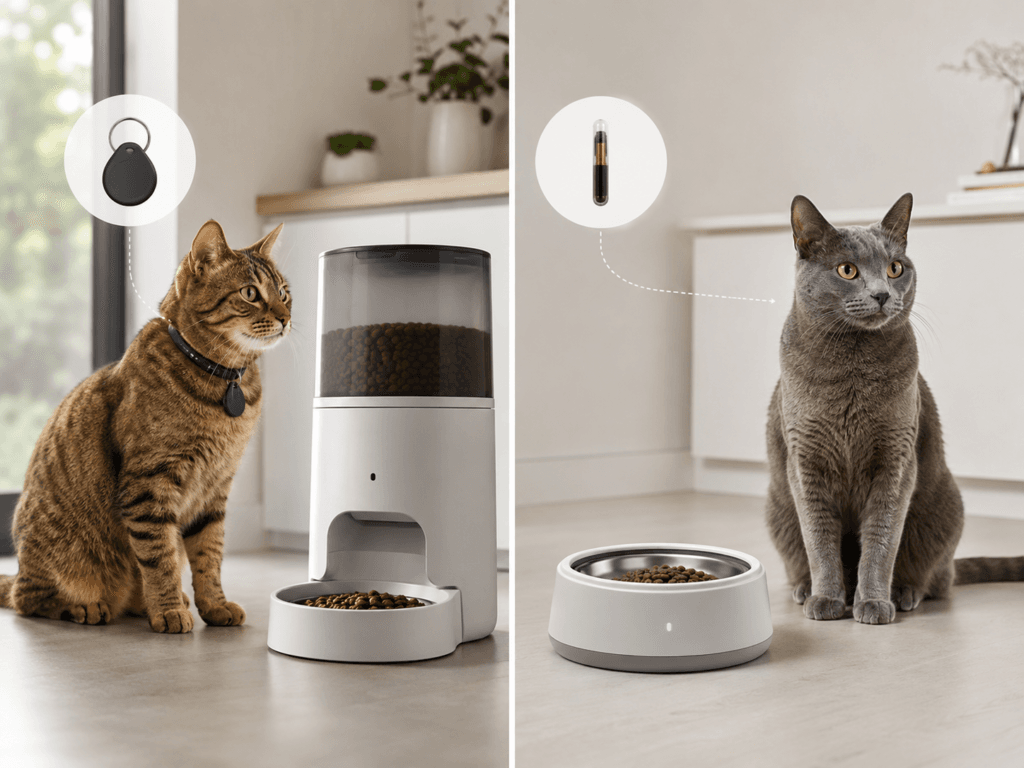
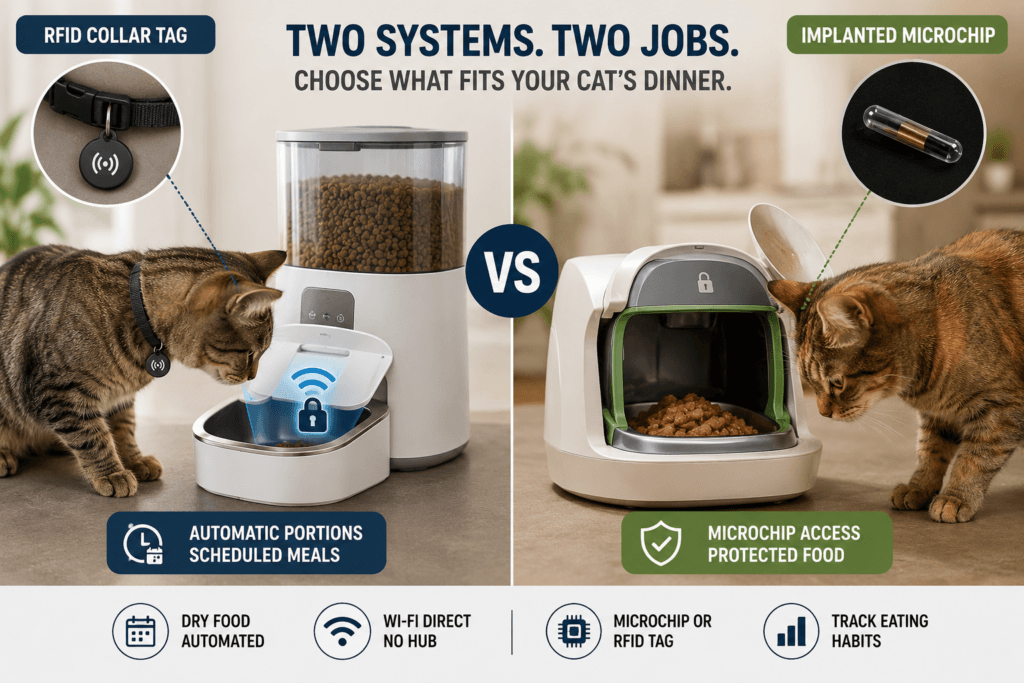
    • protect wet or prescription food using the cat’s actual microchip.

    Those problems require different machines.

    A camera does not refrigerate pâté. Refrigeration does not identify the food thief. An RFID tag is not an implanted microchip. And a feeder that films the crime in 1080p has not necessarily prevented it.

    This guide compares four products with genuinely different jobs:

    • PETKIT YumShare Solo 2;
    • PETLIBRO Polar;
    • PETLIBRO One RFID;
    • SureFeed Microchip Pet Feeder Connect.

    Research note: This is a research-led guide based on official documentation, current product information, public ownership evidence, and PetTech AI’s product-level trust checks. PetTech AI has not conducted long-term hands-on testing of every feeder included.

    Quick Verdict

    Your real problemBest feederRecommendation
    You want scheduled kibble plus camera visibilityPETKIT YumShare Solo 2Promising newer product
    You need refrigerated wet mealsPETLIBRO PolarStrong niche recommendation
    One cat steals another cat’s dry foodPETLIBRO One RFIDEstablished but conditional
    You need true microchip access for wet or dry foodSureFeed Microchip Pet Feeder ConnectStrong specialist recommendation

    The short version

    Choose YumShare Solo 2 when seeing the feeding area will actually change what you do.

    Choose Polar when your cat eats wet food and your schedule refuses to cooperate.

    Choose One RFID when you need timed dry-food dispensing plus tag-controlled access—but do not assume the door is a maximum-security facility.

    Choose SureFeed Connect when food protection matters more than automatic dispensing and you want to use the cat’s implanted microchip.

    Affiliate disclosure: This page contains affiliate links. PetTech AI may earn a commission if you purchase through them, at no additional cost to you. As an Amazon Associate I earn from qualifying purchases.

    Compare the Recommended Feeders

    First Decide What the Feeder Must Physically Do

    Before comparing hopper capacity, camera resolution, or how enthusiastically the app uses the word “AI,” answer one question:

    What must physically happen at mealtime?

    Dispense dry food and show you the bowl

    Choose a camera feeder.

    Keep wet food chilled and serve it later

    Choose a refrigerated feeder.

    Dispense dry food but restrict access using a collar tag

    Choose an RFID feeder.

    Keep prepared food available only to one microchipped cat

    Choose a microchip-access feeder.

    These categories overlap less than marketing pages suggest.

    A sophisticated product can still be completely wrong for the household.

    For a clearer breakdown of when smart pet technology should automate a task—and when it merely creates more information to check—read our Smart Cat Monitoring vs Automation guide.

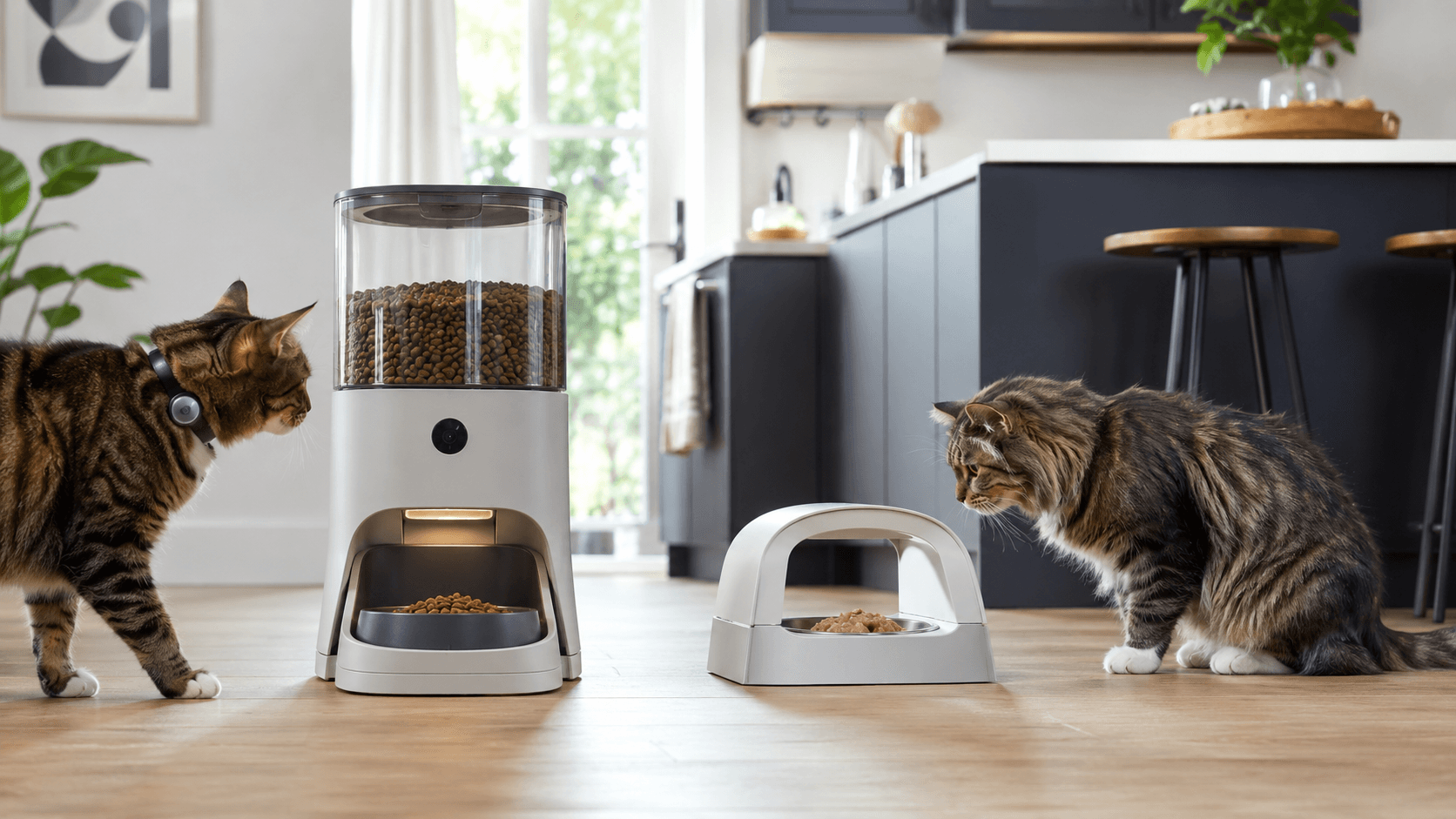
    PETKIT YumShare Solo 2: Best for Camera-Based Dry Feeding

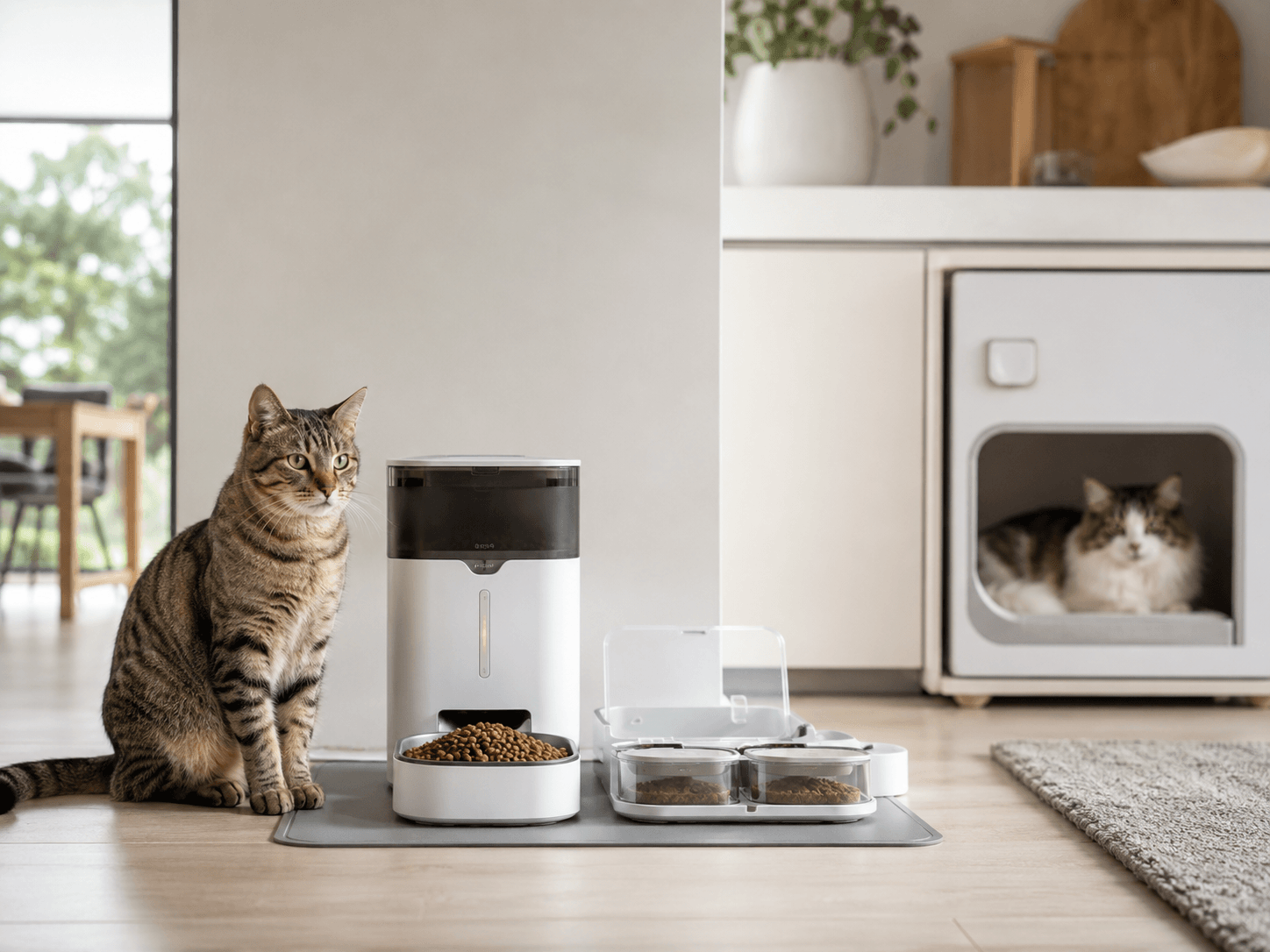
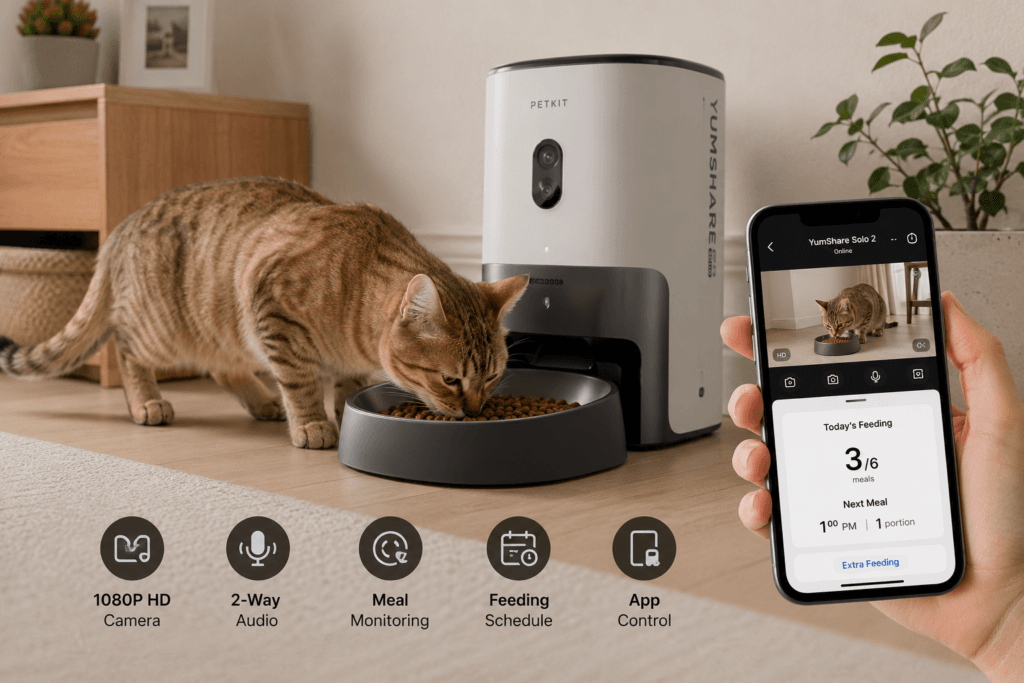
    A cat eating from an automatic dry-food feeder while a smartphone shows a simple meal-monitoring screen nearby
    Camera-based feeders are most useful when meal records and visual context change how you manage the feeding routine.

    YumShare Solo 2 combines scheduled dry-food dispensing with a camera, live monitoring, meal records, two-way audio, and PETKIT’s individual-pet recognition system.

    Its 3 L hopper holds dry kibble or compatible freeze-dried pieces. Schedules continue even when Wi-Fi is unavailable, and backup batteries can preserve feeding during a power interruption, although the camera is disabled while operating on battery power.

    That makes it a real feeder first and a camera second—which is the correct order.

    Buy it if

    • your cat eats dry food;
    • you want to see whether the cat approached the bowl;
    • you spend significant time away from home;
    • changes in mealtime behavior are worth reviewing;
    • you already use PETKIT products;
    • one feeding station serves the household.

    Skip it if

    • you only need timed portions;
    • you will stop watching the clips after three days;
    • your main diet is wet food;
    • one cat must be physically prevented from eating another cat’s meal.

    The main limitation

    YumShare Solo 2 is still new.

    Its early market signal is encouraging, but there is not yet a deep ownership history showing how consistently recognition, notifications, app behavior, and camera functions perform after years of daily use.

    There is also a conceptual limit:

    Recognition is not restriction.

    The feeder may identify Baron Fluffington as he approaches the bowl. It does not issue a restraining order.

    If one cat steals another cat’s food, a camera gives you evidence. You may still need physical access control.

    Verdict: A promising camera feeder for owners who will genuinely use visual meal context—not the default choice for simple scheduling or food theft.

    For a direct comparison between camera-led feeding, routine-first automation, dual-hopper flexibility, and identity-based systems, read PETKIT vs Feeder-Robot vs CATLINK.

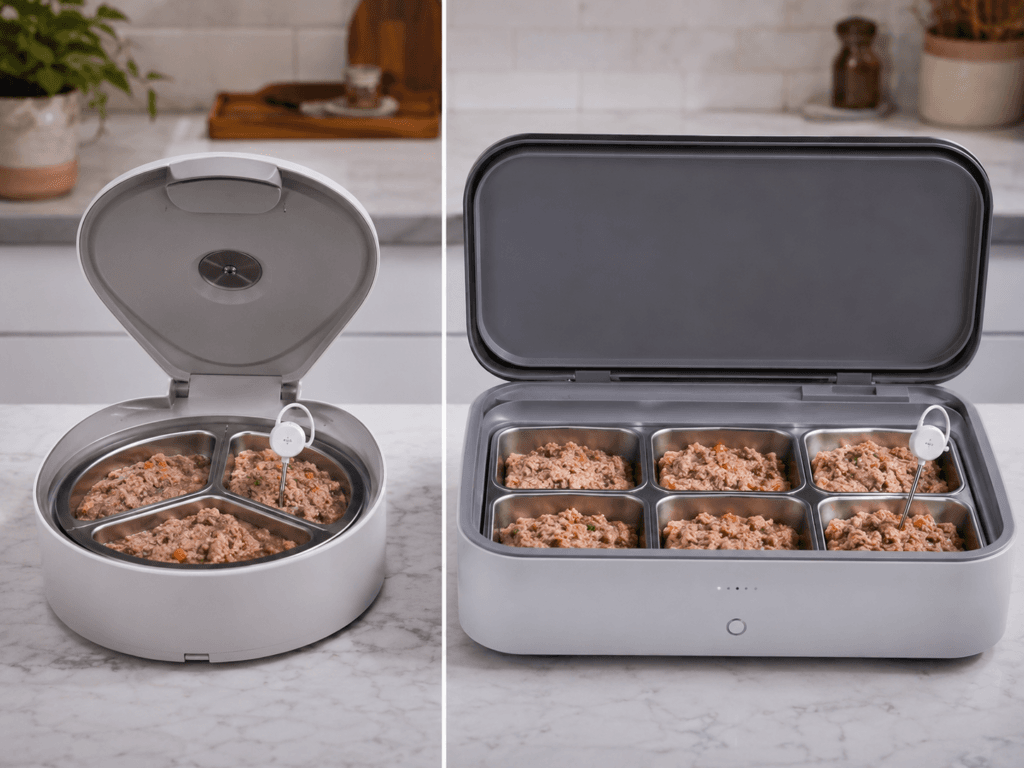
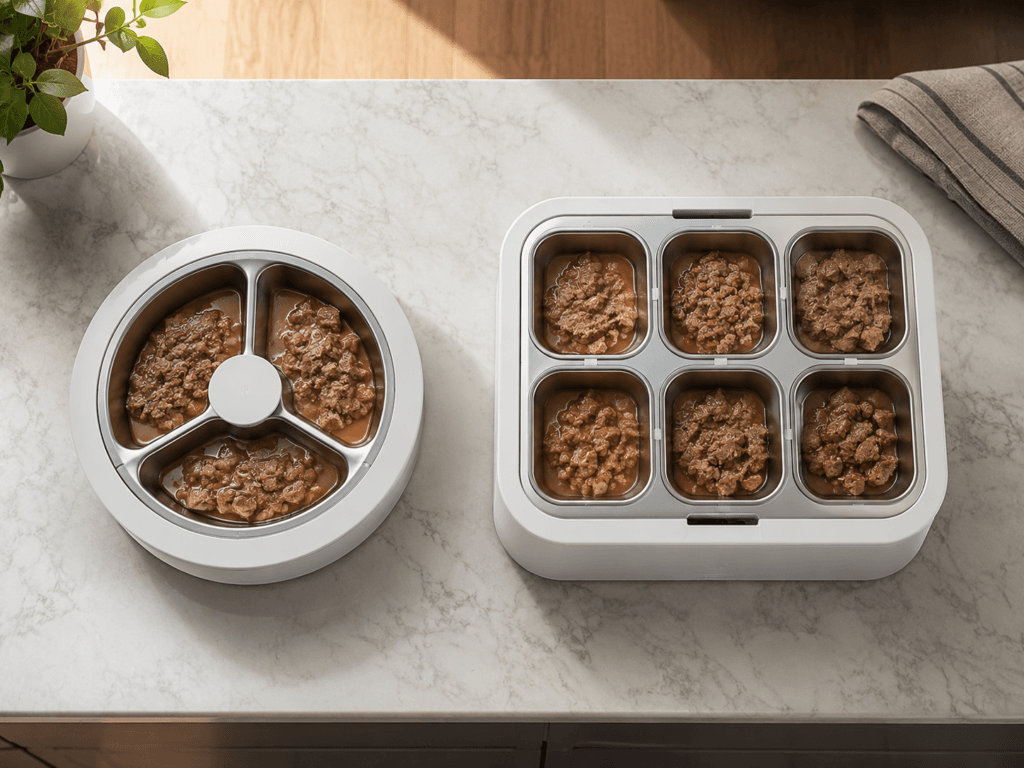
    PETLIBRO Polar: Best for Refrigerated Wet Meals

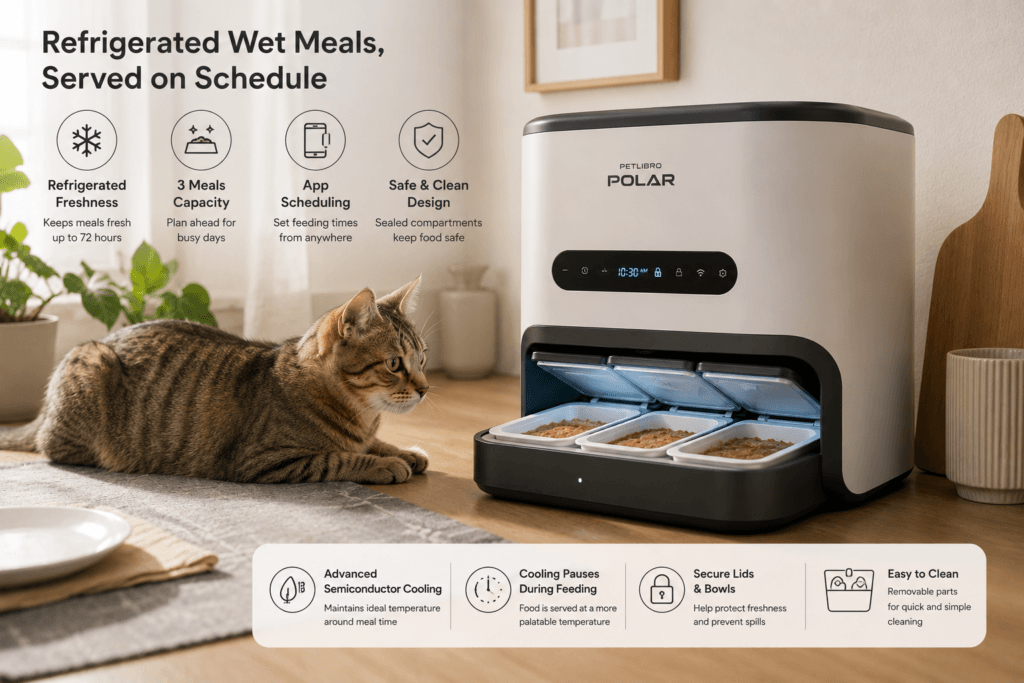
    A refrigerated automatic feeder with covered wet-food meal compartments in a clean cat feeding area
    Wet-food automation needs refrigeration and timed access—not a standard kibble hopper.

    Polar solves the problem most automatic feeders quietly avoid:

    Wet food is perishable.

    It uses thermoelectric cooling, three meal compartments, app scheduling, and a removable stainless-steel tray. PETLIBRO says the feeder can keep three meals chilled for up to three days under its intended conditions and pauses cooling before serving so food is not presented at its coldest temperature.

    That does not make it a miniature restaurant.

    It makes it a refrigerated scheduling tool.

    Buy it if

    • wet food is already part of the daily routine;
    • work or other commitments interrupt meal times;
    • you want to avoid switching to kibble simply because nobody is home;
    • three prepared portions are enough;
    • you are willing to clean the tray and cooling area consistently.

    Skip it if

    • you mainly use dry food;
    • you need access control between cats;
    • your cat is very small or uncomfortable with a raised feeding area;
    • you want a long-trip feeding solution;
    • you expect refrigeration to eliminate food-safety judgment.

    The main limitation

    Polar removes timing friction.

    It does not remove:

    • leftovers;
    • condensation;
    • cleaning;
    • wall-power dependence;
    • the need to verify that the cat actually ate.

    Three chilled meals can make a workday much easier.

    They do not allow you to disappear for a long weekend while the feeder applies for temporary guardianship.

    Verdict: The strongest choice here for scheduled wet food and a genuinely useful niche product for the right household.

    For the deeper analysis, read our PETLIBRO Polar Review.

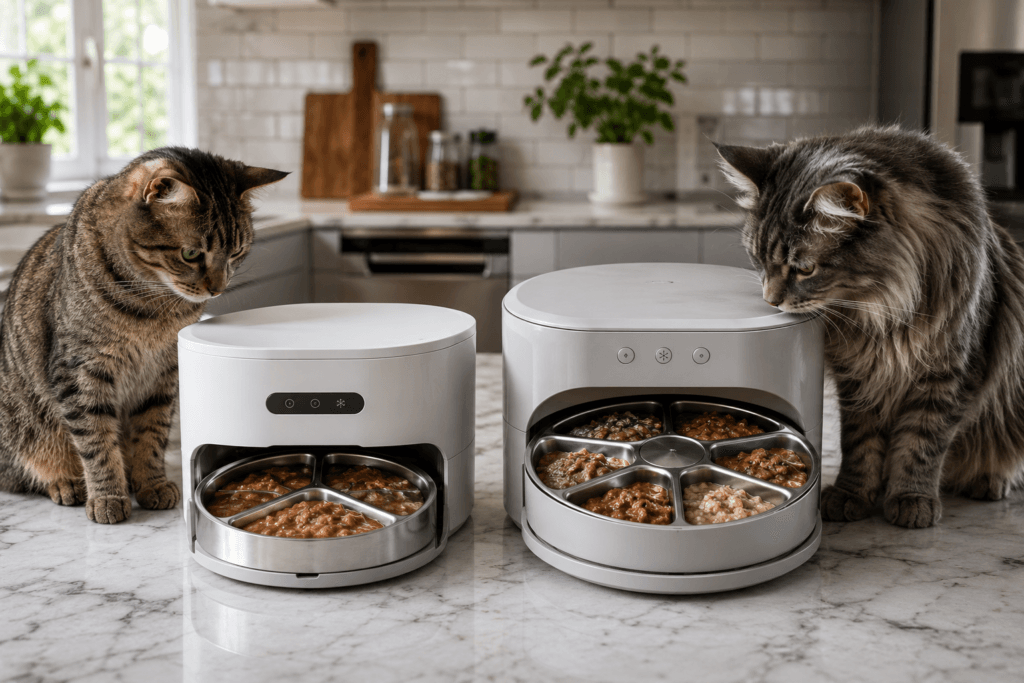
    PETLIBRO One RFID: Best for Scheduled Dry Food with Tag Access

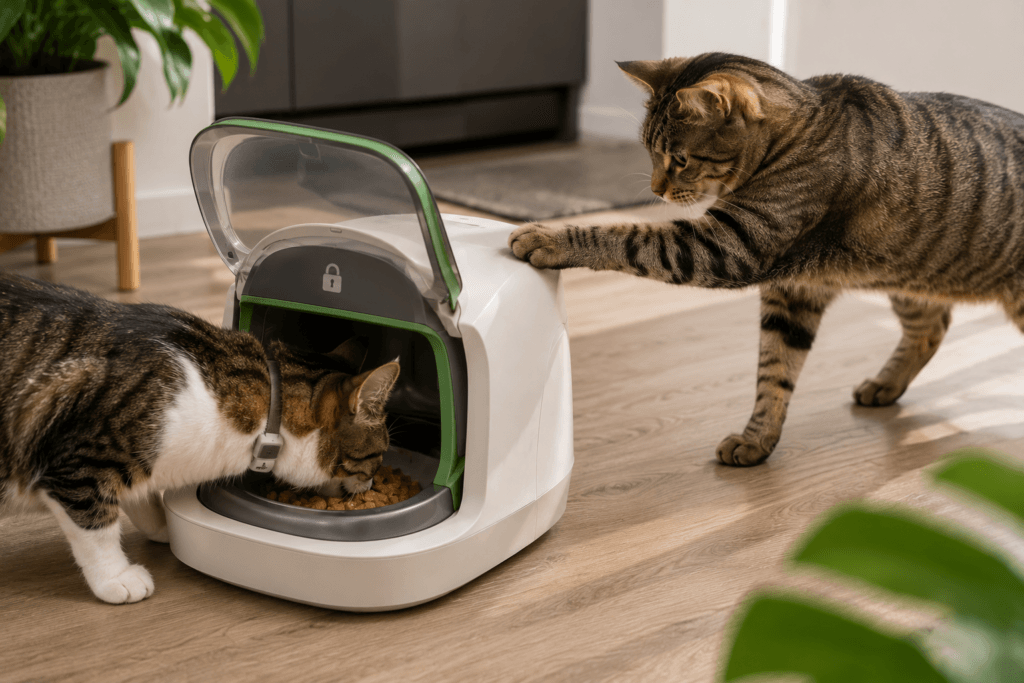
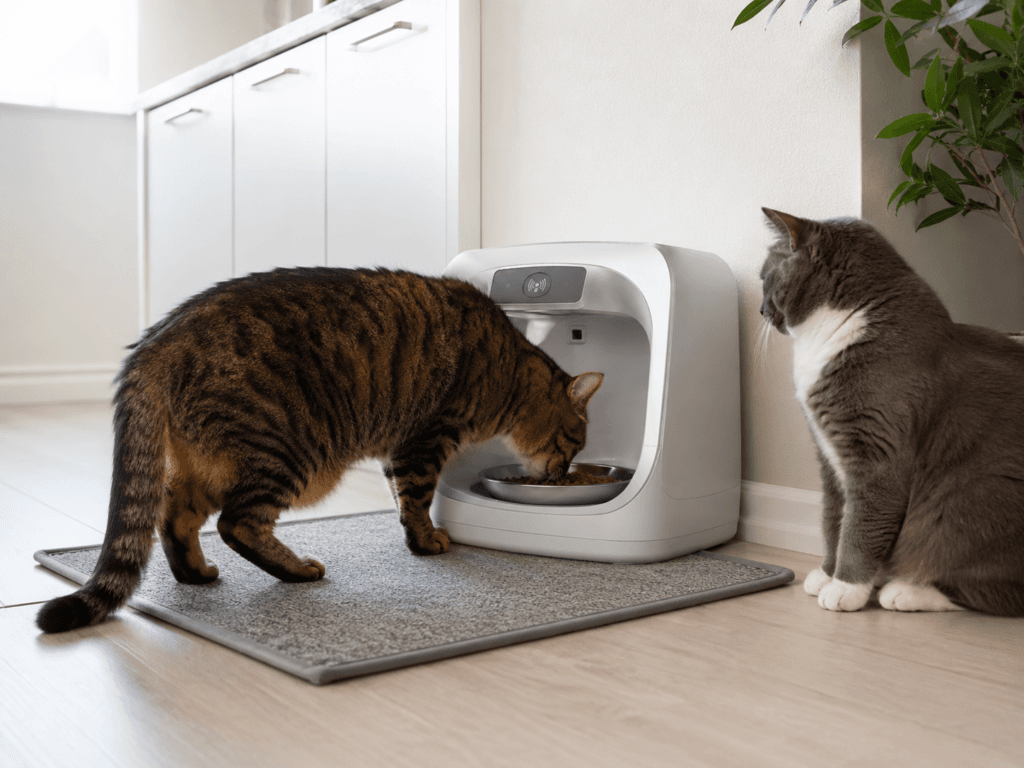
    Two cats near a covered automatic feeder designed to give one cat protected access to its food
    Access-controlled feeders solve a different problem from scheduled feeders: keeping the right food available to the right cat.

    One RFID combines two functions:

    • automatic dry-food dispensing;
    • access controlled through PETLIBRO’s dedicated RFID collar tag.

    This makes it more relevant than a normal hopper when one cat steals dry food from another or when separate portions need to be maintained.

    The product has a substantial public ownership history, and the overall market signal supports keeping it in the guide.

    But it requires careful framing.

    Buy it if

    • your cats eat dry food;
    • one cat regularly invades another cat’s feeding station;
    • you want both meal scheduling and controlled access;
    • the authorized cat tolerates a collar tag;
    • you can position the feeder away from interference;
    • the consequences of occasional access failure are manageable.

    Skip it if

    • you need implanted-microchip recognition;
    • your cat refuses collars;
    • you feed wet food;
    • unauthorized access would create a serious medical risk;
    • you expect the door to defeat every determined cat in existence.

    The main limitation

    One RFID uses a proprietary collar tag.

    Its performance depends on:

    • tag position;
    • reader placement;
    • lid speed;
    • nearby interference;
    • feeder spacing;
    • the determination and engineering qualifications of the unauthorized cat.

    PETLIBRO provides troubleshooting guidance for slow closure, incomplete opening, RFID interference, and rotor errors. Some owners also report that another cat can exploit the lid before it closes fully.

    This does not make the feeder useless.

    It means “designed to reduce food theft” should not be translated as “physically impossible to defeat.”

    For ordinary dry-food separation, it can be a practical solution.

    For a prescription diet where unauthorized access carries meaningful health consequences, SureFeed’s microchip approach or a more enclosed physical setup may be the safer direction.

    Verdict: A credible and established dry-food access feeder, but a conditional recommendation rather than a prison-grade guarantee.

    SureFeed Microchip Pet Feeder Connect: Best for True Microchip Access

    SureFeed Connect is fundamentally different from the other three products.

    It does not contain a large hopper.

    It does not release a fresh portion at a scheduled time.

    Instead, you place wet or dry food in its 400 ml bowl, and the lid opens only when the registered cat’s implanted microchip or compatible RFID tag approaches.

    That makes it the strongest specialist option when the food itself needs protection.

    Buy it if

    • one cat needs prescription or therapeutic food;
    • one pet steals wet or dry meals;
    • you prefer implanted-microchip access over a collar tag;
    • food can remain available for grazing;
    • accurate portion monitoring is useful;
    • automatic dispensing is not required.

    Skip it if

    • you want meals dispensed at specific times;
    • you need a large dry-food hopper;
    • you want one device to combine automatic portions and microchip access;
    • you do not want the additional Hub required for Connect app features.

    The main limitation

    The Connect version requires the Sure Petcare Hub to communicate with the app.

    The feeder is also relatively open at the rear. Sure Petcare sells an optional rear cover specifically for persistent thieves capable of approaching from behind.

    This is useful honesty from the manufacturer.

    Apparently some cats respond to access-control technology by conducting a structural vulnerability assessment.

    The rear cover, feeder placement, and training process may therefore matter in particularly competitive homes.

    Even with those caveats, SureFeed’s mature microchip-access model gives it the strongest argument when food protection—not timed dispensing—is the priority.

    Verdict: The best specialist choice for true microchip-controlled access to prepared wet or dry food.

    The Food-Thief Test

    Suppose Clara has prescription food.

    Her brother, Caesar, believes prescriptions are merely serving suggestions.

    YumShare Solo 2

    Records Caesar approaching Clara’s food.

    You receive a clear image of the suspect.

    Polar

    Keeps Clara’s wet food chilled until serving time.

    Caesar appreciates the improved catering.

    PETLIBRO One RFID

    Uses Clara’s collar tag to open the feeding area and attempts to close it after she leaves.

    Caesar may be stopped—or may begin studying lid timing.

    SureFeed Connect

    Opens for Clara’s implanted microchip and closes when she leaves.

    Add the rear cover if Caesar has developed flanking tactics.

    That is why “best automatic feeder” is the wrong question.

    The better question is:

    Which physical mechanism solves the problem in your home?

    Buyer Regret in One Table

    ProductMost likely regret
    YumShare Solo 2Paying for camera functions you stop using
    PolarExpecting wet-food automation without cleaning
    One RFIDAssuming a collar-tag door is impossible to bypass
    SureFeed ConnectDiscovering it protects food but does not dispense timed portions

    Final Verdict

    There is no single best automatic cat feeder because these four products do not perform the same job.

    PETKIT YumShare Solo 2 is the best fit for dry-food scheduling with visual context. It is promising, useful, and still too new to call a proven long-term default.

    PETLIBRO Polar is the strongest refrigerated wet-food option for owners whose main problem is serving meals while away from home.

    PETLIBRO One RFID is a credible choice for scheduled dry-food access control, provided buyers understand the limits of a collar-tag system and moving lid.

    SureFeed Microchip Pet Feeder Connect is the best specialist solution when implanted-microchip access and food protection matter more than timed dispensing.

    The correct feeder is not the product with the longest feature list.

    It is the machine that physically solves the recurring problem without creating three new ones.

    Frequently Asked Questions

    Which automatic feeder is best for wet food?

    PETLIBRO Polar is the better option for scheduled refrigerated wet meals. SureFeed Connect is better when wet food must remain accessible only to one authorized cat.

    Can YumShare Solo 2 stop food stealing?

    No. Its camera and recognition features provide visual context, but they do not physically prevent another cat from reaching dispensed food.

    Does PETLIBRO One RFID read implanted microchips?

    No. It uses PETLIBRO’s dedicated RFID collar tag.

    Is PETLIBRO One RFID impossible for another cat to defeat?

    No access system should be treated as impossible to defeat. Lid timing, feeder placement, interference, and the behavior of the unauthorized cat all affect real-world performance.

    Does SureFeed Connect dispense scheduled meals?

    No. It protects food already placed in the bowl. Its main job is access control, not timed portion dispensing.

    Does SureFeed Connect require a Hub?

    Yes. The Connect model requires the Sure Petcare Hub for app connectivity. Buyers who do not need app monitoring can also consider the non-Connect Microchip Pet Feeder.

    References

    • PETKIT YumShare Solo 2 official product and support documentation
    • PETLIBRO Polar official product, feeding, cooling, and cleaning guidance
    • PETLIBRO One RFID official product and troubleshooting documentation
    • Sure Petcare Microchip Pet Feeder Connect official product and accessory documentation
    • Public ownership reports reviewed for recurring reliability and access-control patterns

    Image Disclosure

    Some images in this article may be AI-generated for illustrative purposes. They do not depict the exact products and should not be used to evaluate dimensions, controls, fit, or physical features.

    Disclosure

    PetTech AI may earn a commission when readers purchase through affiliate links. Products are recommended according to the feeding problem they can realistically solve, not according to how enthusiastically their product pages use the word “smart.”