
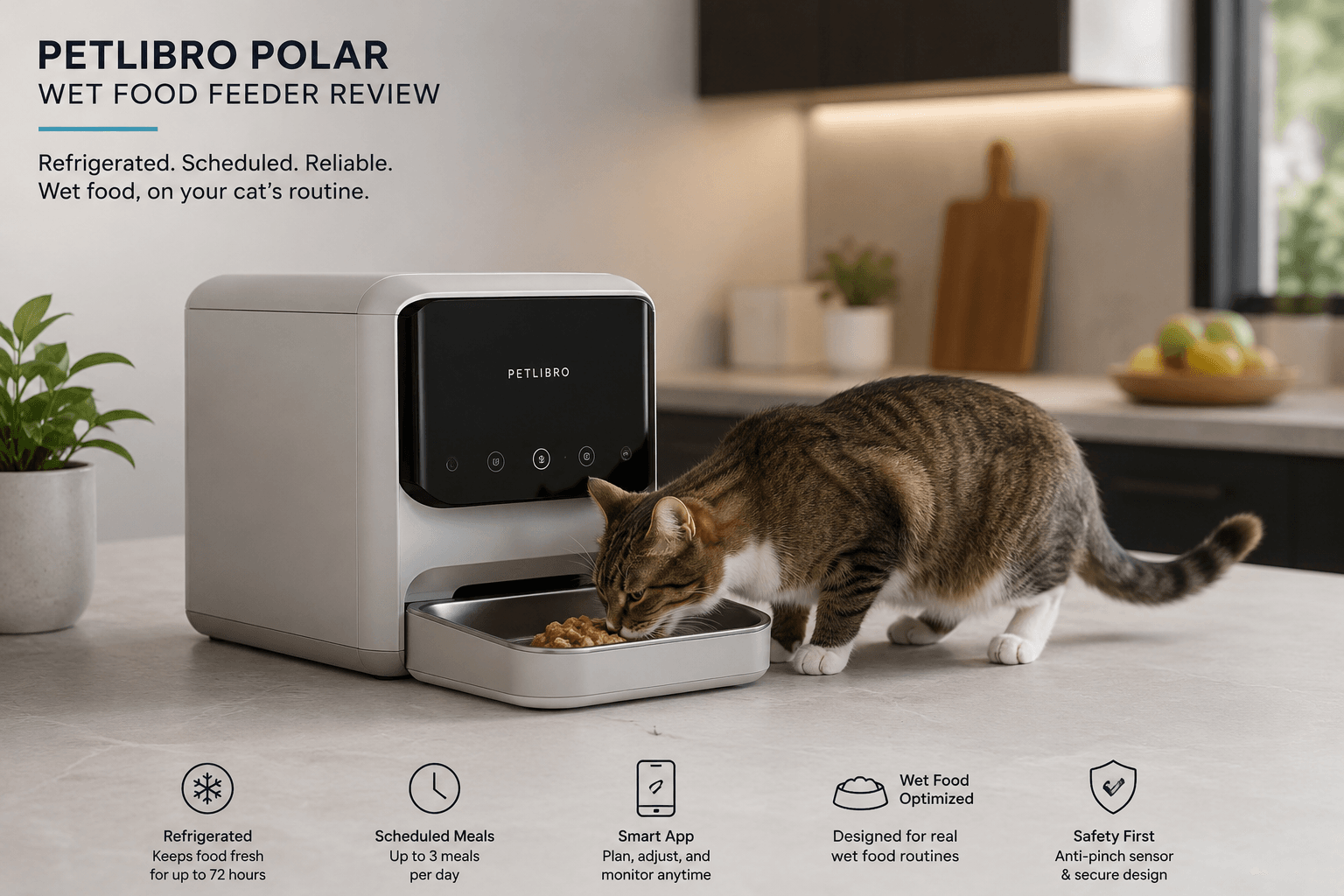
If your cat treats breakfast at 5:17 a.m. as a legally binding agreement, wet food can make life complicated.
Dry-food feeders are simple: fill the hopper, set a schedule, and let the machine handle the negotiations. Wet food is messier, more perishable, and generally expects a human employee to report for duty on time.
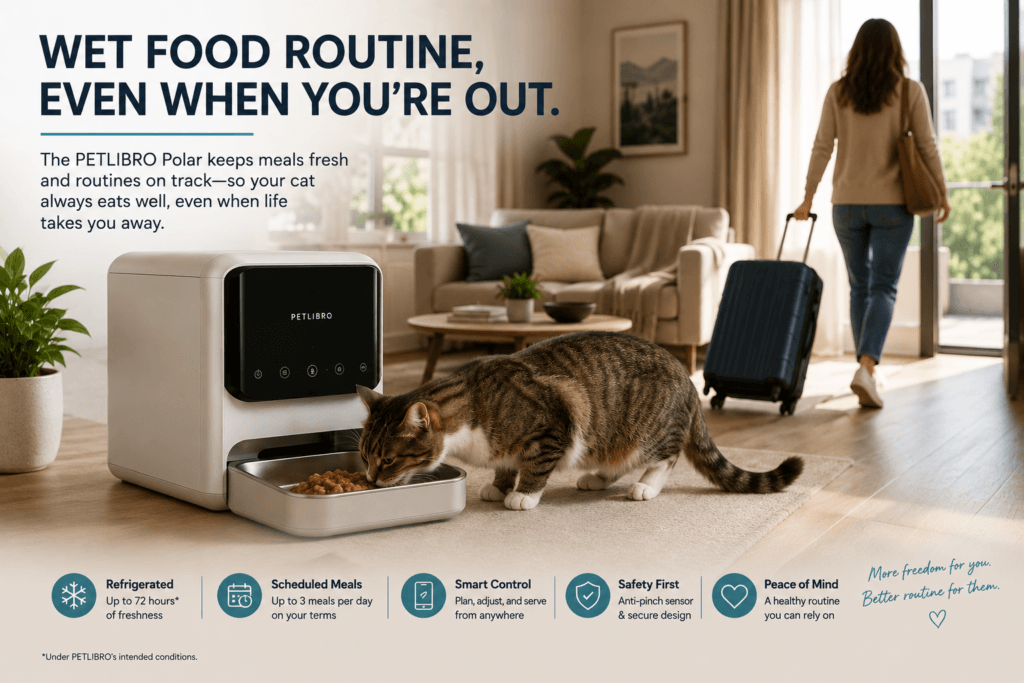
The PETLIBRO Polar tries to solve that problem with actual thermoelectric cooling, three scheduled meal compartments, and app control.
It is not a robotic cat butler.
It is essentially a small refrigerated tray with Wi-Fi—and for the right household, that may be exactly enough.
Research note: This is a research-led review based on official PETLIBRO documentation, independent testing, and available owner feedback. PetTech AI has not conducted a long-term hands-on test of the PETLIBRO Polar.
Version note: This review covers the refreshed PETLIBRO Polar associated with Amazon ASIN B0GRHQGDCB, featuring the removable stainless-steel tray, portion markings and revised three-prong power adapter.
Quick Verdict
| Category | Verdict |
|---|---|
| Best for | Cats already eating wet food on a predictable schedule |
| Main benefit | Refrigerated meals without ice packs |
| Meal capacity | Three scheduled portions |
| App control | Yes, through 2.4 GHz Wi-Fi |
| Main buyer-regret risk | It still requires cleaning, refilling, and food-safety judgment |
| Skip it if | You feed raw food, need vacation coverage, or only delay meals occasionally |
| Recommendation | Recommended with Conditions — one of the most convincing options for households that routinely feed wet food and need scheduling flexibility. |
The PETLIBRO Polar makes sense when wet food is already non-negotiable and your main problem is being physically present for every meal.
It makes much less sense when you only need one delayed dinner every few months. In that case, buying a refrigerated smart feeder is the pet-tech equivalent of purchasing a forklift to move a grocery bag.
Verdict: Buy it for routine flexibility, not for hands-off pet care.
PetTech AI may earn a commission from qualifying purchases. As an Amazon Associate I earn from qualifying purchases.
Check current Amazon availability and recent buyer feedback.
Who Should Buy the PETLIBRO Polar?
The Polar is a strong fit when:
- wet food is already part of your cat’s daily diet;
- work or other commitments regularly interrupt meal times;
- you want to prepare up to three meals in advance;
- you dislike dealing with ice packs;
- your cat is large enough to use the raised feeding area comfortably;
- you are willing to clean food-contact surfaces after each feeding plan.
Its best use case is not a dramatic emergency.
It is ordinary life: early shifts, late meetings, evenings out, or mornings when your cat has scheduled breakfast before your brain has scheduled consciousness.
Buyers who want a colder manufacturer-stated target and twice the meal capacity should read our PETLIBRO Polar vs PetSafe FreshFeed comparison before deciding.
Who Should Skip It?
Choose something simpler if:
- your cat mainly eats dry food;
- you need only an occasional delayed meal;
- you feed raw or homemade food with stricter storage requirements;
- you want visual confirmation that your cat actually ate;
- your cat is very small or has difficulty reaching raised bowls;
- you need more than three meal compartments;
- you expect to leave your cat unattended for several days.
Three compartments provide useful flexibility.
They do not constitute a tiny all-inclusive resort for your cat.
What Problem Does the Polar Actually Solve?
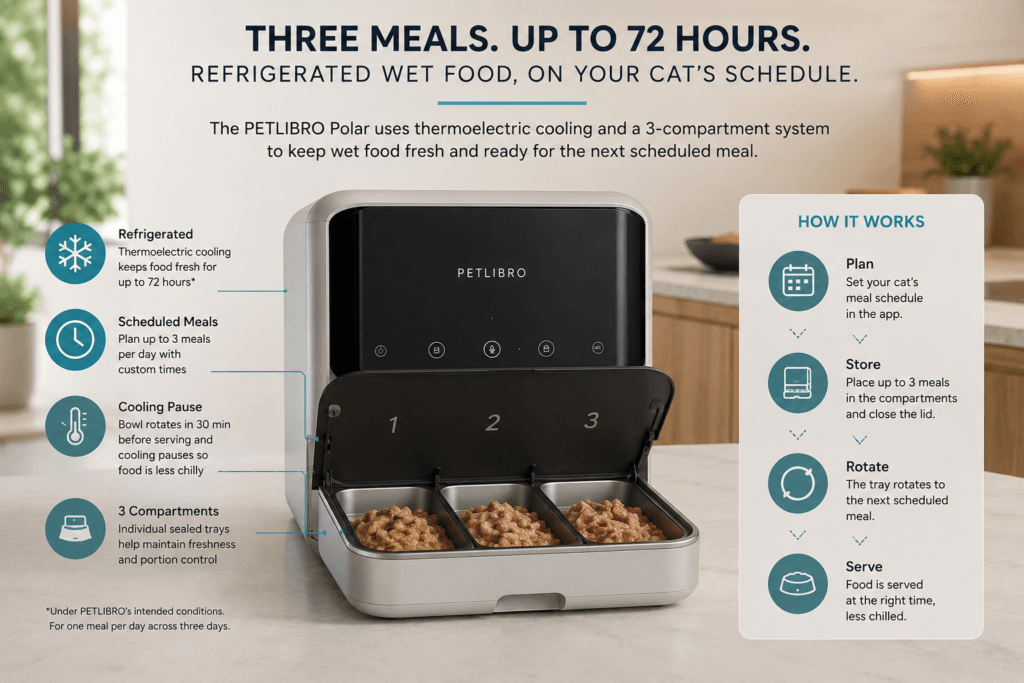
The Polar solves timing friction.
Traditional timed wet-food feeders usually rely on ice packs or short room-temperature windows. Those systems can work for one delayed meal, but they are less convincing when wet food is the normal diet rather than an occasional exception.
The Polar uses thermoelectric cooling to keep three prepared portions chilled. Before each scheduled meal, the selected compartment moves into position and cooling pauses so the food is not served directly at its coldest temperature.
PETLIBRO says food can remain chilled for up to 72 hours under its intended conditions. That claim should not be interpreted as permission to ignore food handling for three days.
The company reports that, in laboratory testing at a room temperature of 77°F, the Polar cooled food to around 54°F. It recommends operating the feeder in rooms between 54°F and 86°F.
In other words, this is controlled thermoelectric cooling—not a magical force field around yesterday’s pâté.
Placement, room temperature, cleanliness, food type, and the time a meal remains exposed still matter.
Three Reasons to Consider It
1. It removes the ice-pack compromise
The most important advantage is refrigeration without frozen inserts.
You can prepare meals, schedule them through the app, and let the feeder manage when each compartment becomes accessible.
That gives wet-food households more freedom without forcing them to use kibble whenever nobody is home at the correct time.
2. The app solves a real problem
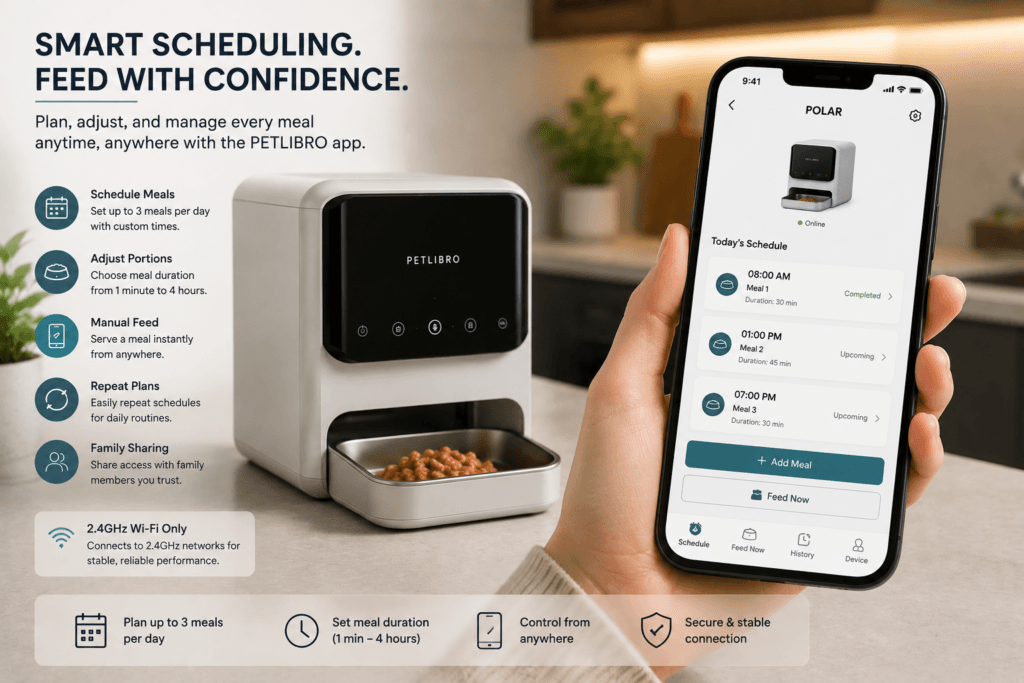
Some pet apps exist mainly to transform a simple appliance into another source of notifications.
The Polar app has a clearer purpose.
It lets you:
- schedule meals;
- repeat feeding plans;
- trigger a meal manually;
- adjust how long food remains accessible;
- manage the feeder remotely.
The Polar does not need a complex health dashboard. Its job is simply to put the correct compartment in front of the cat at the correct time.
3. The refreshed tray is easier to maintain
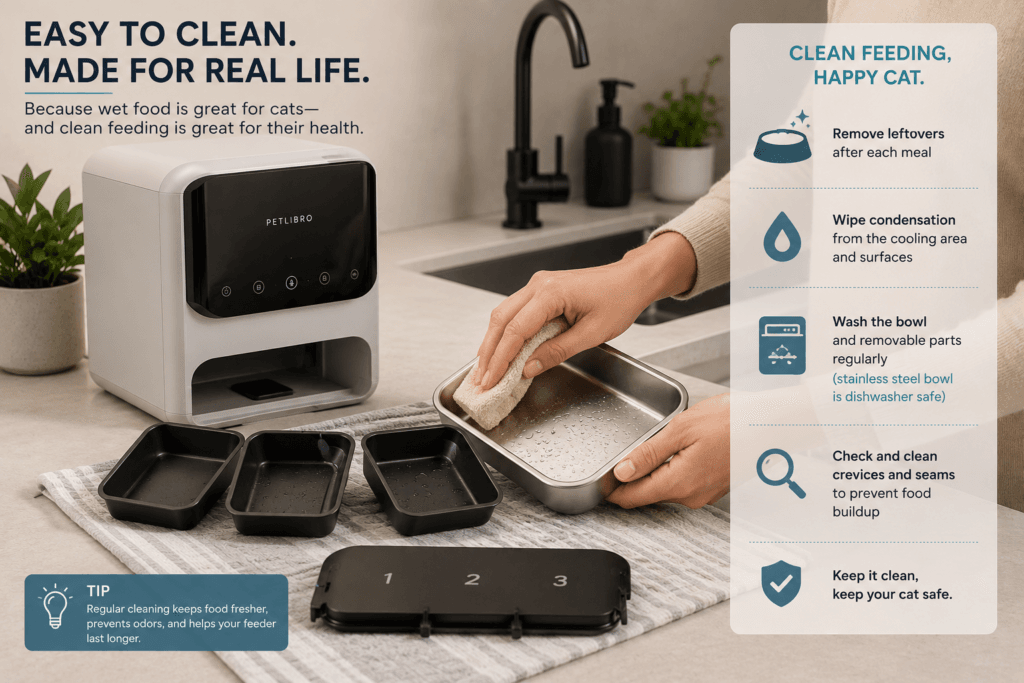
The refreshed 2026 model includes a removable stainless-steel food tray.
That provides a durable, dishwasher-safe food-contact surface and makes routine washing more straightforward than scrubbing food residue from a permanently installed compartment.
The feeder also uses an anti-pinch lid sensor designed to stop and retract the lid when a cat remains nearby.
Where the PETLIBRO Polar Can Disappoint
It does not eliminate wet-food cleaning
Polar reduces scheduling work.
It does not eliminate:
- uneaten food;
- condensation;
- tray washing;
- residue around the lid and compartment edges;
- regular refilling;
- insects attracted by wet-food smells.
PETLIBRO recommends removing leftovers after feeding plans, wiping condensation from the cooling area, and cleaning small gaps and connection points regularly.
Anyone expecting “load it on Monday and forget it exists” is buying the wrong product.
Three compartments are still only three compartments
The Polar can schedule three portions.
That may mean:
- one meal per day across three days;
- three meals during one day;
- another combination requiring regular refilling.
It is not a high-capacity vacation feeder, and it does not replace a responsible person checking on your cat during longer absences.
Physical fit can be a problem
The feeder is approximately 7.7 inches tall, with the opening positioned around 6.1 inches high.
PETLIBRO recommends a cat shoulder height of at least 6.1 inches for comfortable use.
That makes the Polar less suitable for:
- small kittens;
- unusually small adult cats;
- cats with mobility limitations;
- cats that dislike reaching into deeper feeding areas.
Measure the cat, not merely the empty space on the kitchen floor.
Cooling depends on wall power
The Polar needs continuous wall power for refrigeration.
Three AA backup batteries can keep the feeding schedule operating for up to 12 hours during an outage, but they do not provide normal refrigerated operation.
If power fails for an extended period—especially in a warm room—do not assume the food remains safe simply because the tray can still rotate.
It cannot confirm that your cat ate
The Polar has app scheduling, but no camera or individual-cat recognition.
It can tell you that a meal was presented.
It cannot prove:
- which cat ate;
- how much was consumed;
- whether another cat stole the meal;
- why food was left behind.
For those problems, you need a camera feeder, access-controlled feeding, or direct observation.
PETLIBRO Polar vs a Basic Timed Wet-Food Feeder
| Choose Polar when… | Choose a basic timed tray when… |
|---|---|
| Wet food is served every day | You only delay meals occasionally |
| Refrigeration changes your routine | Ice packs are sufficient |
| App scheduling is useful | You prefer offline simplicity |
| You need several prepared meals | You need one short delay |
| You accept regular cleaning | Lowest cost matters most |
The Polar’s premium is justified only when refrigeration solves a recurring problem.
A basic rotating tray is often the smarter purchase when you are normally home and only need occasional coverage.
For dry-food scheduling, refrigerated meals, RFID access, and microchip-controlled feeding, see our Best Automatic Cat Feeders guide.
The Six-Month Question
After the novelty wears off, what will still matter?
Not the app animation.
Not the fact that your feeder technically has Wi-Fi.
The lasting value is whether the Polar consistently allows you to maintain your cat’s normal wet-food routine without reorganizing your day around every meal.
If it does that several times per week, the device earns its space.
If it saves you from one mildly inconvenient dinner every three months, it probably does not.
Final Verdict
The PETLIBRO Polar is a strong solution to a narrow but genuine problem.
It gives wet-food households more control over meal timing without relying on dry food or melting ice packs. The refrigerated compartments, stainless-steel tray, app scheduling, and pre-meal warming period form a coherent product rather than a collection of decorative smart features.
Its limitations are equally clear.
It holds only three meals, requires wall power for cooling, needs consistent cleaning, may not suit smaller cats, and cannot confirm who actually ate. It is not a vacation-feeding solution and should not be treated as one.
Choose the Polar if wet food is already central to your cat’s routine and your schedule regularly gets in the way.
Skip it if you only need occasional timing support or want feeding to become completely hands-off.
Verdict: One of the most convincing refrigerated wet-food solutions for the household that genuinely needs it—and an expensive answer to a question everyone else was not asking.
Check current Amazon availability and recent buyer feedback.
Frequently Asked Questions
How long can the PETLIBRO Polar keep wet food chilled?
PETLIBRO claims up to 72 hours under its intended operating conditions. Food type, room temperature, placement, hygiene, and time exposed after serving still matter.
Does the Polar use ice packs?
No. It uses thermoelectric cooling and requires wall power for normal refrigerated operation.
Can it operate during a power outage?
Three AA backup batteries can keep scheduled feeding operating for up to 12 hours. They should not be treated as backup refrigeration.
Can I use raw food in the Polar?
PETLIBRO recommends against using raw food because storage requirements and safe holding times vary significantly.
Is it suitable for kittens?
Not always. The feeder is approximately 7.7 inches tall, and PETLIBRO recommends a shoulder height of around 6.1 inches for comfortable access.
References
- PETLIBRO — Polar Refrigerated Wet Food Feeder product specifications
- PETLIBRO — Polar setup, cleaning, compatibility, temperature, and safety guidance
- PETLIBRO — Polar user manual and app documentation
- Cats.com — Independent PETLIBRO Polar testing and ownership review
- TIME — PETLIBRO Polar product overview
Disclosure
PetTech AI may earn a commission from qualifying purchases. This does not influence our recommendations, comparisons or editorial judgments.