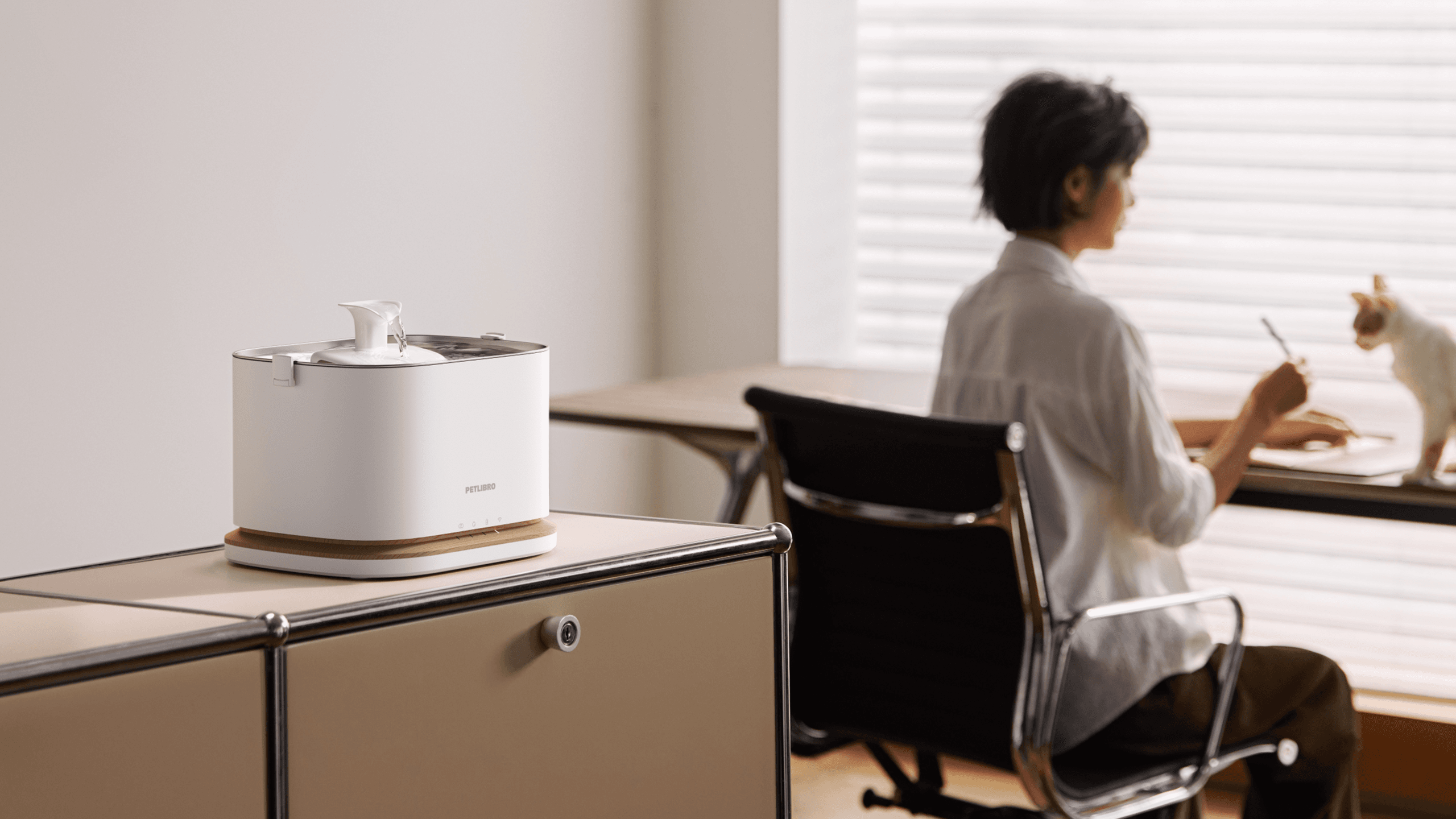
Tag: PETLIBRO

  • PETLIBRO Polar vs Rotating Wet Food Feeders: Is Refrigeration Worth It?

    PETLIBRO Polar vs Rotating Wet Food Feeders: Is Refrigeration Worth It?

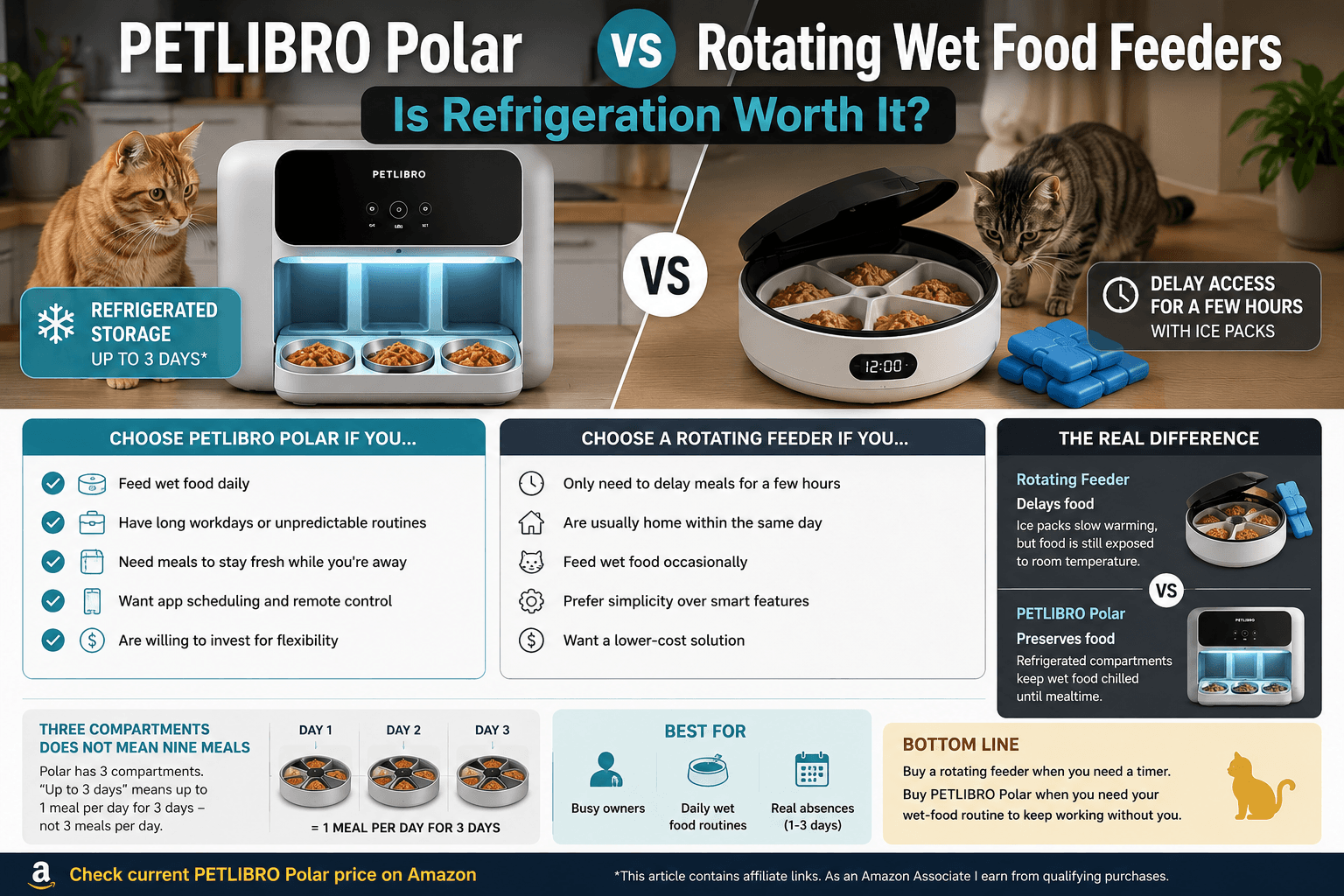
    A rotating feeder can reveal wet food later. A refrigerated feeder is designed to keep it usable until later.

    That difference sounds obvious, but it is where many buying decisions go wrong. People often look at a rotating wet food feeder with ice packs and assume they have solved wet-food feeding for days at a time. In reality, they have usually solved a much smaller problem: delaying one or two meals during the same day.

    PETLIBRO Polar sits in a different category. It is not simply a rotating feeder with more technology. Its value is tied to refrigeration, app scheduling, and the ability to keep wet food part of a routine when the owner cannot be home to serve it.

    The question is not whether refrigeration is more advanced. It is whether your cat’s feeding routine actually needs it.

    Quick Verdict

    Choose a rotating wet food feeder if:

    • You only need to delay wet-food meals by a few hours.
    • You are normally home within the same day.
    • You want a lower-cost solution for occasional use.
    • You are happy preparing meals manually and managing ice packs.
    • You do not need app scheduling or remote control.

    Choose PETLIBRO Polar if:

    • Wet food is a reliable part of your cat’s daily diet.
    • You have long workdays, commuting time, shifts, or unpredictable routines.
    • You need a meal to remain refrigerated until its scheduled time.
    • You want to schedule and manage feeding from an app.
    • You are paying for flexibility, not just automation.

    For a closer look at setup, cleaning, capacity, and daily ownership, read our PETLIBRO Polar Wet Food Feeder Review.

    Check the current PETLIBRO Polar price on Amazon

    This article contains affiliate links. As an Amazon Associate I earn from qualifying purchases.

    The Real Difference: Delaying Food vs Preserving Food

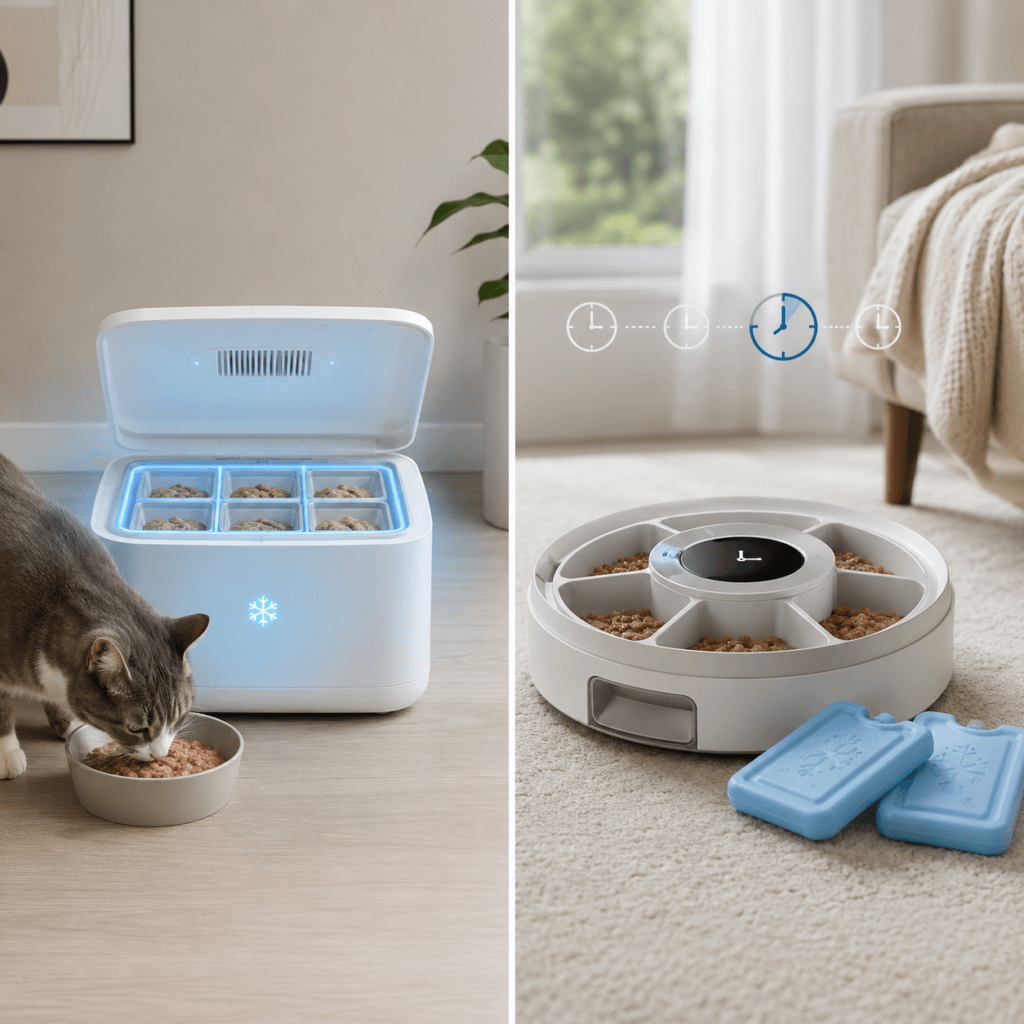
    Comparison between delaying wet food with ice packs and preserving it with refrigeration

    Traditional rotating wet food feeders work through a simple idea. You prepare meals in separate compartments, set a timer, and the tray rotates to reveal the next portion at the scheduled time.

    Some models include ice packs beneath the tray. That can be useful. It can slow down how quickly a prepared meal warms up, especially when the feeder is used for a limited part of the day.

    But an ice pack is not refrigeration.

    A rotating feeder is mainly a meal-timing device. It controls when your cat can access food. Its freshness support is limited and depends on room temperature, how long the meal sits out, the condition of the ice pack, and the food itself.

    PETLIBRO Polar is built around a different job. Its refrigerated compartments are meant to keep wet food chilled until a scheduled feeding window, making it possible to plan meals around a real absence rather than a short delay.

    That does not make a rotating feeder obsolete. It simply means the products solve different problems.

    A cheaper rotating feeder is not an inferior PETLIBRO Polar. It is a simpler answer to a smaller need.

    Rotating Feeders Are Still Useful — Just for a Narrower Routine

    A rotating wet food feeder can be the right choice when feeding automation is mostly about convenience.

    For example, imagine that you leave home at 8 a.m., return at 6 p.m., and want to give your cat a second wet-food meal in the afternoon. A rotating feeder may be enough. You can prepare the meal in advance, keep the unit away from heat and sunlight, and use an ice pack where appropriate.

    That setup makes sense when:

    • your absence is short;
    • the feeder is used occasionally rather than every day;
    • your cat eats wet food once or twice daily;
    • you can refill, clean, and freeze ice packs as part of your normal routine;
    • the lower upfront price matters more than advanced scheduling.

    This category works best for owners who need a timer.

    It works less well for owners who need their routine to keep functioning when they are unavailable for a longer stretch.

    PETLIBRO Polar Is About Routine Independence

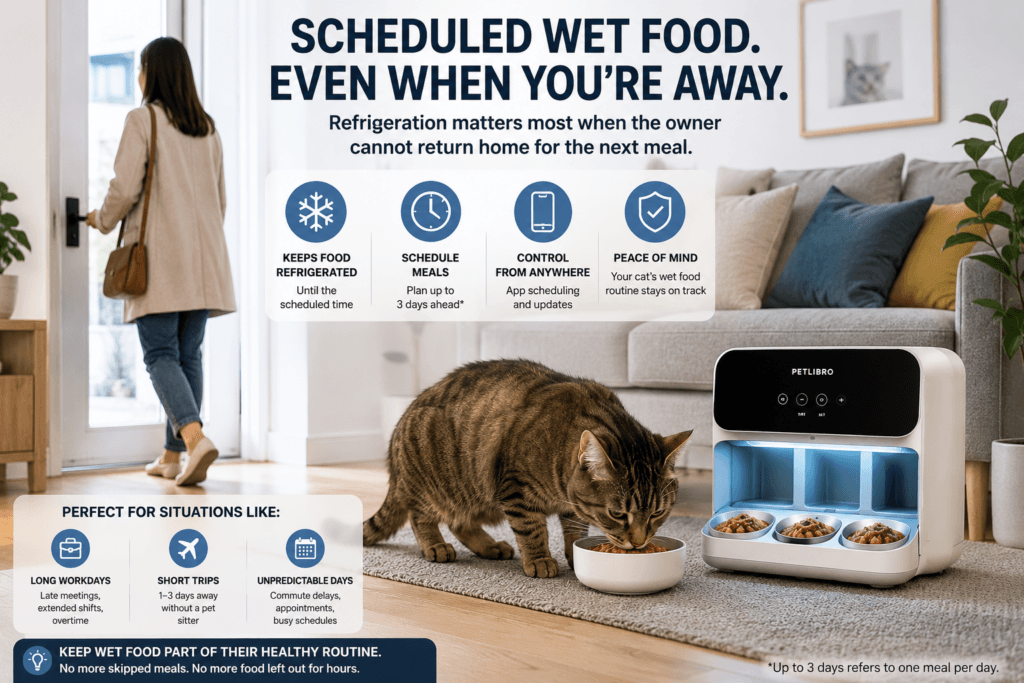
    Cat wet food scheduled in a refrigerated feeder while the owner is away

    The Polar’s premium is not really about dispensing food automatically. Many cheaper feeders can dispense or reveal a meal on a schedule.

    The premium is about reducing the dependency on the owner being physically present at the right moment.

    With PETLIBRO Polar, the logic becomes:

    Prepare refrigerated wet-food meals in advance, schedule them, and let the feeding routine continue even when your day does not go as planned.

    That is useful for people who:

    • commute long distances;
    • work extended or changing shifts;
    • regularly miss a midday feeding window;
    • want to leave home without worrying that wet food will sit out for too long;
    • rely on a predictable feeding schedule for one cat or a small household.

    The app matters here because it adds control rather than novelty. A schedule can be adjusted remotely, and the owner has a clearer system than a basic mechanical timer.

    That does not mean every cat owner needs app control. But for someone whose daily routine is frequently disrupted, it can be the difference between a feeding tool and a feeding system.

    Three Compartments Does Not Mean Nine Meals

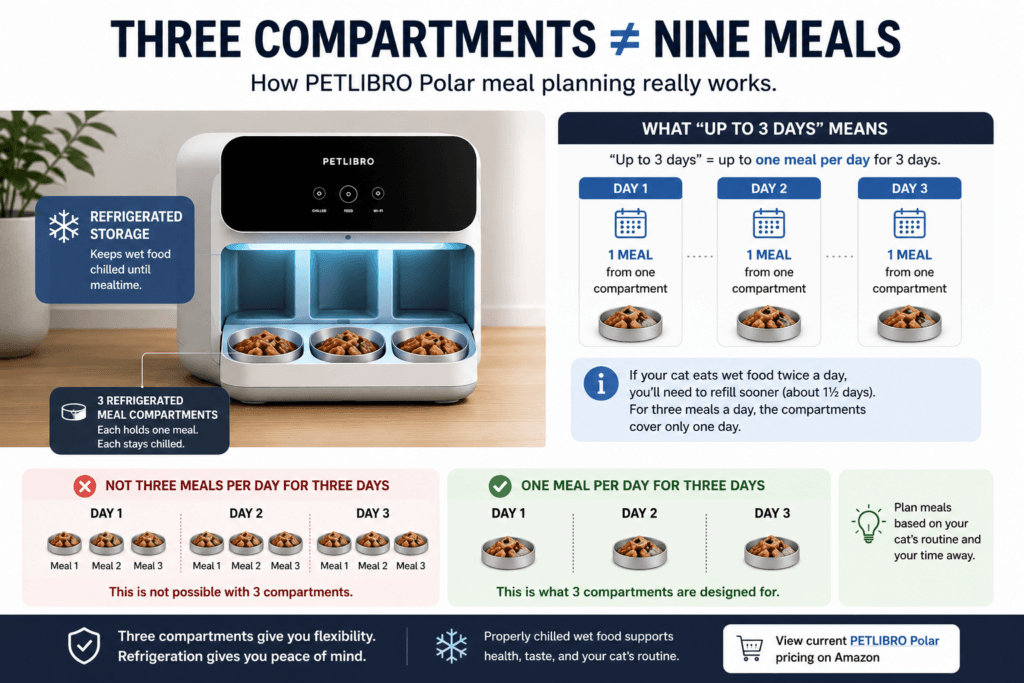
    Three refrigerated wet food compartments showing one meal per day for three days

    This is the most important clarification before buying PETLIBRO Polar.

    The feeder has three physical meal compartments. Its “up to three days” positioning should be understood as up to one refrigerated meal per day across three days.

    It does not mean you can leave three meals per day for three full days.

    If your cat eats wet food twice a day, you would need to refill the feeder much sooner. If your cat eats three wet meals a day, the three compartments can cover only one day of feeding.

    That is not a flaw. It is simply the practical limit of the design.

    Polar is best understood as a way to make a single daily wet-food meal more flexible, or to cover a short period when one meal per day needs to happen without the owner returning home.

    Buy it for that purpose and it makes sense.

    Buy it expecting a fully automated multi-meal wet-food system for several days and you may be disappointed.

    When a Rotating Feeder Is the Better Buy

    A rotating wet food feeder remains the smarter purchase in several situations.

    You only need help for a few hours

    Maybe you have a dinner plan, a late work meeting, or an occasional day out. A rotating feeder can handle that without requiring a premium refrigerated system.

    Wet food is not your cat’s main routine

    If wet food is only an occasional treat or one small meal in an otherwise dry-food diet, Polar may be more capability than you need.

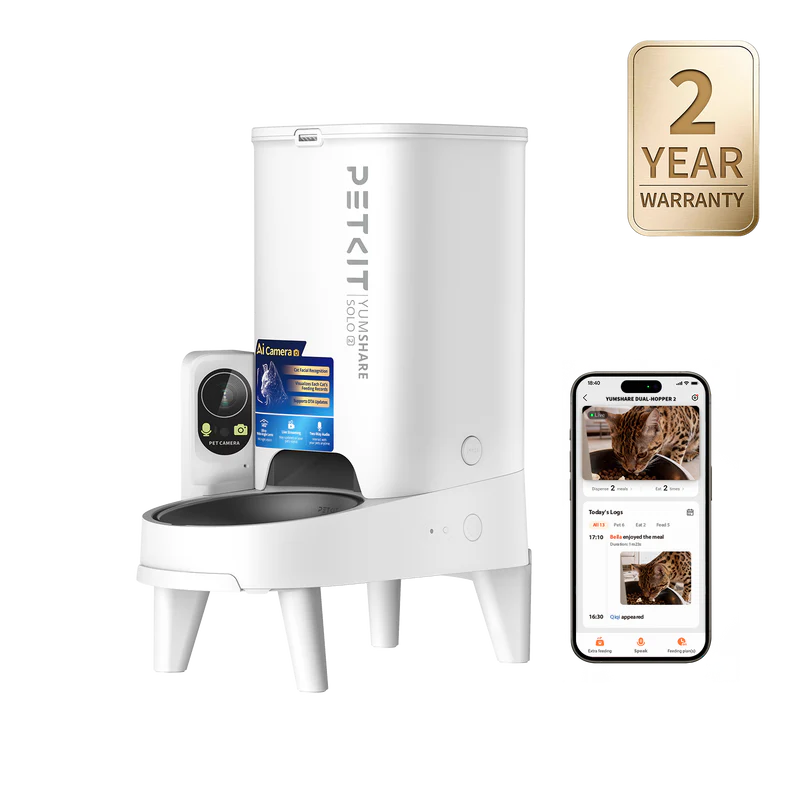
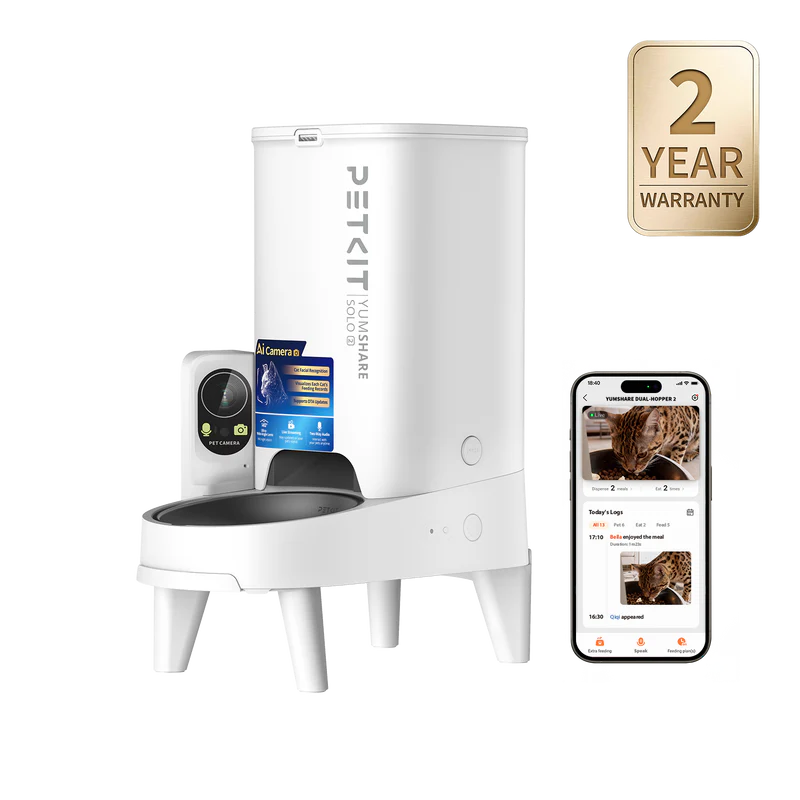
    In that case, a dry-food system with stronger scheduling or camera features may make more sense. Our PETKIT YumShare Solo 2 Camera Review is relevant for owners whose routine is built mainly around kibble, portion control, and remote meal visibility rather than refrigerated food.

    You value simplicity over remote control

    A rotating feeder has fewer components, fewer settings, and fewer moving parts. You prepare food, set the timer, and use it when needed.

    For some owners, that is exactly the appeal.

    Budget is the main constraint

    The price gap between a basic rotating feeder and a refrigerated smart feeder is significant. If the product only solves an occasional inconvenience, the cheaper category may deliver most of the value.

    When PETLIBRO Polar Is Worth the Premium

    Polar becomes easier to justify when wet food is a meaningful part of the cat’s routine and the owner’s schedule is the weak point.

    You regularly miss a feeding window

    This is the clearest case.

    A cat that expects a wet-food meal at noon does not care whether you are stuck in traffic, at work, on a train, or delayed by an appointment. Polar gives you a way to schedule the meal without leaving food exposed for the whole day.

    Your routine changes often

    The feeder makes more sense for people with irregular schedules than for people with a perfectly predictable lifestyle.

    A person who works from home most days may not gain much from it. A person whose hours change weekly may gain a lot.

    You want wet food to remain practical

    Many owners gradually rely more on dry food because wet-food feeding is harder to coordinate. It requires preparation, timing, cleaning, and physical presence.

    Polar does not remove every responsibility, but it reduces one of the biggest constraints: being home at the exact time a fresh meal needs to be served.

    You are buying convenience that affects every week

    The best reason to pay more is not that the machine looks impressive.

    It is that it removes a recurring friction point from your week.

    If you would use it once every few months, a rotating feeder is probably enough.

    If you would use it several times per week, refrigeration can become a practical quality-of-life feature rather than an expensive extra.

    Cleaning and Daily Ownership: More Technology Means More Responsibility

    Neither category is completely “set and forget.”

    A rotating feeder is usually straightforward to clean. You remove the tray, wash the food compartments, clean the ice packs, and prepare the next meals.

    Polar offers more convenience around food storage, but it also needs more thoughtful maintenance.

    Wet food can leave residue quickly. Condensation can occur. Compartments, bowls, and feeding surfaces still need regular cleaning. Refrigeration helps with storage, but it does not eliminate hygiene.

    You should also treat the feeder as a food-management tool, not as permission to ignore your cat’s eating habits for days.

    A smart feeder can schedule a meal. It cannot tell you whether your cat actually ate it, whether a portion was tolerated well, or whether a sudden change in appetite needs attention.

    For that reason, Polar works best as part of a routine that remains attentive, not one that becomes completely hands-off.

    The Real Cost Question: What Are You Paying For?

    With a rotating feeder, you are mostly paying for a timer, compartments, and limited freshness support.

    With PETLIBRO Polar, you are paying for:

    • refrigerated food storage;
    • app-based scheduling;
    • more flexibility around absence;
    • a more structured wet-food routine;
    • reduced pressure to be home for every meal.

    That is why comparing the products only by price misses the point.

    The right question is:

    How much is it worth to keep wet food practical when I cannot be there?

    For some owners, the answer is “not much.” They can prepare a meal, use an ice pack feeder, and return home later that day.

    For others, the answer is “a lot.” Their work pattern, commute, or lifestyle repeatedly turns wet-food feeding into a logistical problem.

    That is the audience Polar is designed for.

    PETLIBRO Polar vs Rotating Wet Food Feeders: Final Verdict

    Buy a rotating feeder when you need a timer.

    Buy PETLIBRO Polar when you need your wet-food routine to continue without you.

    A rotating feeder is the practical, lower-cost solution for delayed meals, short absences, and occasional convenience. It is especially sensible when you are usually home the same day and do not need remote control.

    PETLIBRO Polar is worth paying more for when refrigeration changes what your feeding routine can realistically do. Its value is not “smart technology” in the abstract. Its value is making wet food easier to manage when life does not follow a perfect schedule.

    Choose PETLIBRO Polar if refrigerated meal timing would genuinely make your day easier — not simply because the technology looks impressive.

    View the current PETLIBRO Polar price on Amazon

    This article contains affiliate links. As an Amazon Associate I earn from qualifying purchases.

    Frequently Asked Questions

    Can rotating wet food feeders keep food fresh?

    They can delay access to a prepared meal, and models with ice packs may provide short-term temperature support. They are not the same as a refrigerated storage system, especially for longer absences.

    Is PETLIBRO Polar worth it for one cat?

    It can be. The deciding factor is not the number of cats but whether one cat’s wet-food routine is difficult to maintain around your schedule.

    Can PETLIBRO Polar feed a cat for three days?

    It is designed around three refrigerated compartments and up to three days of storage. In practical terms, that means one meal per day across three days, not three meals per day for three days.

    Does PETLIBRO Polar replace regular meal preparation?

    No. You still need to portion food, refill the compartments, clean the feeder, and pay attention to your cat’s eating habits. It automates timing and refrigerated storage, not overall care.

    Should I choose a refrigerated wet-food feeder or a dry-food smart feeder?

    Choose a refrigerated wet-food feeder when wet food is central to your cat’s routine and timing is the problem. Choose a dry-food smart feeder when portion control, larger capacity, camera features, or multiple daily kibble meals matter more.

    References

    • PETLIBRO Polar product information and user guidance
    • PETLIBRO Polar Amazon listing
    • Rotating wet-food feeder manufacturer instructions and care guidance
  • PETLIBRO Polar Wet Food Feeder Review (2026): Is Refrigerated Feeding Worth It for Cats?

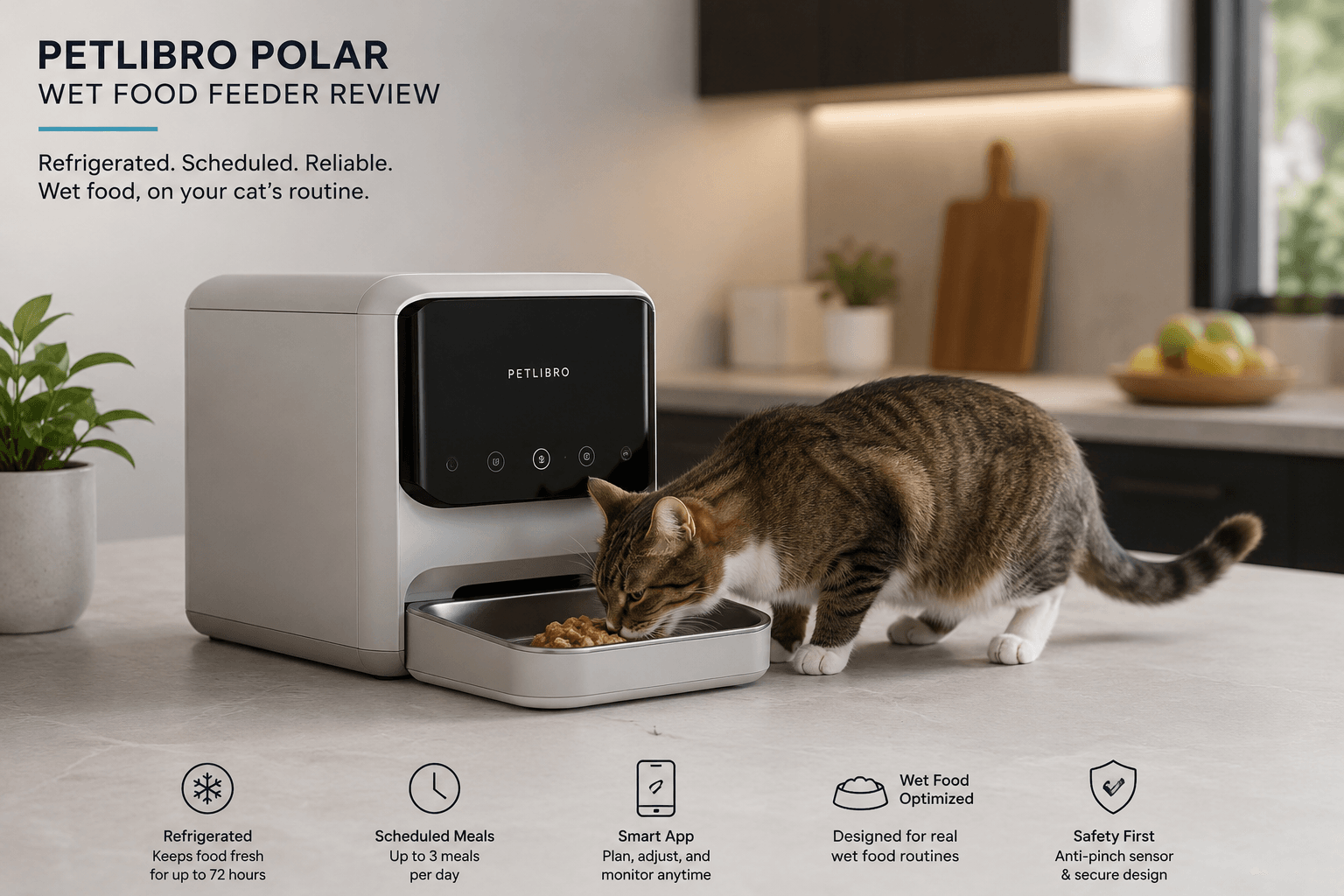
    PETLIBRO Polar Wet Food Feeder Review (2026): Is Refrigerated Feeding Worth It for Cats?

    Dry-food feeders are easy to understand.

    Fill the hopper, set the schedule, and let kibble dispense while you are asleep, at work, or away for the evening.

    Wet food is different.

    It is fresher, messier, more time-sensitive, and usually tied to the owner being physically present at exactly the right moment. That creates a frustrating trade-off for many cat owners: either maintain a wet-food routine manually, or fall back on dry food whenever life becomes inconvenient.

    The PETLIBRO Polar Wet Food Feeder exists to reduce that trade-off.

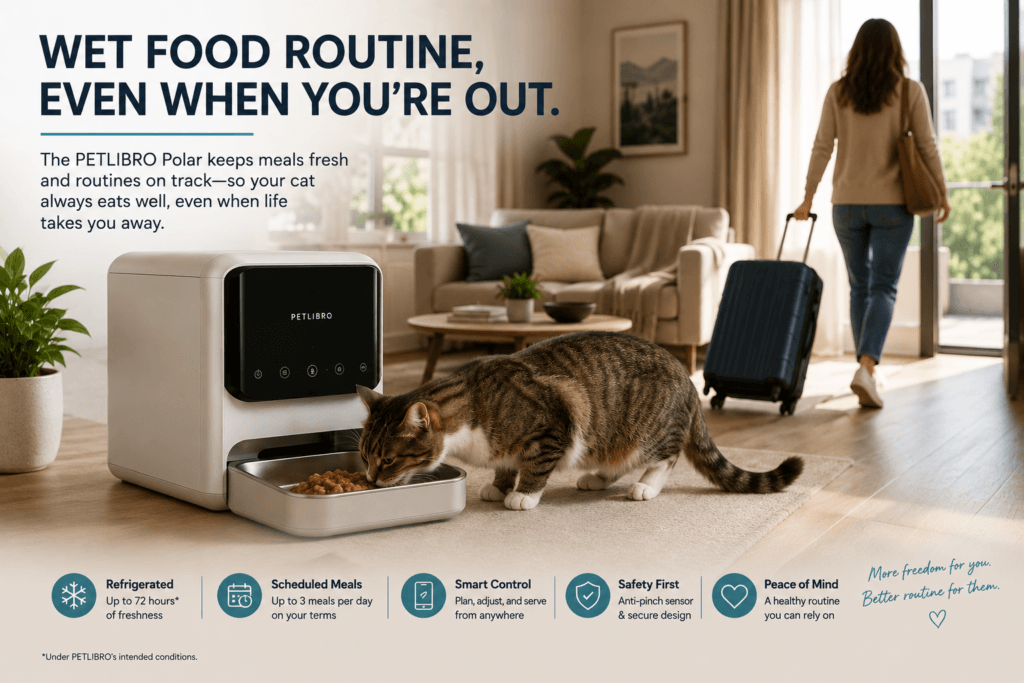
    It is not trying to automate feeding in general. It is trying to make a wet-food routine possible when the owner cannot be there.

    That distinction matters.

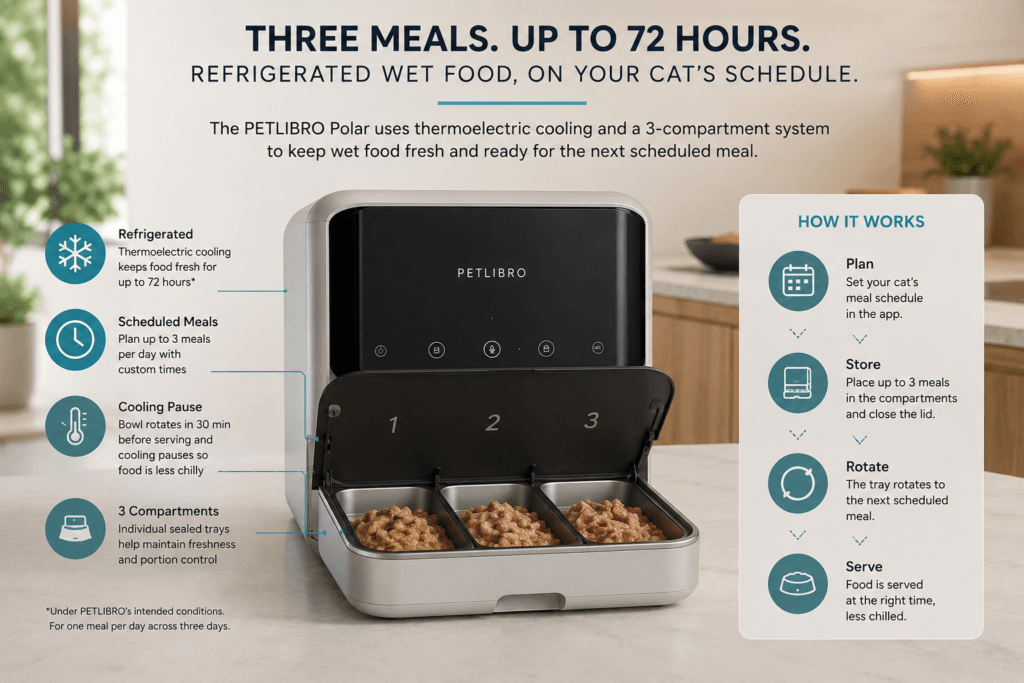
    The Polar is a refrigerated, app-connected feeder with three meal compartments. PETLIBRO says it can keep wet food chilled for up to 72 hours under its intended operating conditions, then rotate each meal into position at the scheduled time.

    On paper, that sounds like a major breakthrough for wet-food households.

    In reality, it is only valuable if it solves a problem you genuinely have: early workdays, missed lunch feeding windows, evenings away, or a cat that relies on wet meals and does not respond well to dry-food substitutes.

    This PETLIBRO Polar review looks at the real ownership trade-offs: refrigeration, cleaning, app control, food compatibility, safety, limitations, and whether the price makes sense for your cat’s routine.

    Quick Verdict

    CategoryVerdict
    Best forCats already eating wet food on a predictable daily routine
    Main advantageLets owners schedule up to three refrigerated wet-food meals
    Best use caseWorkdays, early mornings, evenings out, short absences
    Meals3
    App supportYes, through 2.4 GHz Wi-Fi
    Freshness claimUp to 72 hours under PETLIBRO’s stated conditions
    Main limitationIt still requires cleaning, leftover management, and food-safety judgment
    Not ideal forRaw food, very small cats, dry-food households, long unattended trips
    Overall verdictA genuinely useful niche device, but only for the right wet-food routine

    The short answer is simple:

    The PETLIBRO Polar is worth considering when wet food is already non-negotiable in your cat’s life and your real problem is schedule flexibility.

    It is not worth buying if you mostly feed dry food, only need occasional emergency feeding coverage, or expect refrigerated automation to eliminate the work involved in wet-food feeding.

    Check Current Availability

    Ready to make wet-food routines more flexible?

    👉 Check the current PETLIBRO Polar price on Amazon

    Affiliate disclosure: PetTechAI may earn a commission from qualifying purchases, at no extra cost to you.

    Who Is the PETLIBRO Polar Actually For?

    The Polar makes more sense when you start with the owner, not the product.

    It is not designed for everyone who owns a cat.

    It is designed for the owner who has already decided that wet food matters, but cannot always be physically present to serve it.

    The Ideal Polar Buyer

    The Polar is most compelling for:

    • office workers who feed wet food once, twice, or three times a day;
    • owners with early-morning feeding routines;
    • people who are regularly out during one important meal window;
    • cats that strongly prefer wet food over kibble;
    • households using scheduled wet meals as part of a consistent daily routine;
    • owners who want to avoid switching to dry food simply because they will be away for a few hours;
    • people who need a practical bridge between “I feed wet food manually” and “I need occasional flexibility.”

    This is especially relevant for cats that are picky about food texture, reluctant to eat dry food, or used to a stable wet-food schedule.

    Who It Is Not For

    The Polar is less suitable for:

    • owners who feed mostly dry food;
    • people looking for a true vacation-feeding solution;
    • raw-food households;
    • anyone unwilling to clean food-contact surfaces regularly;
    • owners who need more than three refrigerated meal slots;
    • households with very small kittens or cats that may not comfortably reach the bowl;
    • buyers who want a cheap feeder with occasional timing features.

    The core point is this:

    Polar is not a replacement for pet care during long absences. It is a way to stop one missed meal from forcing you to redesign your cat’s diet.

    The Real Problem Polar Solves

    For years, wet-food automation has been built around compromises.

    Traditional rotating feeders can delay a meal, but they usually rely on ice packs, short windows, or room-temperature storage. That may be enough for a one-off late dinner, but it does not create a reliable daily wet-food routine.

    The alternatives are often frustrating:

    • rush home for a meal;
    • ask someone else to feed your cat;
    • use dry food as the automatic fallback;
    • leave food out longer than you feel comfortable with;
    • accept that wet food only works when your schedule is perfectly predictable.

    The Polar tries to create a middle ground.

    Its value is not that it makes wet food effortless. Wet food will never be completely effortless.

    Its value is that it makes the timing of wet food less dependent on your physical presence.

    That is a meaningful difference.

    You can preload meals before work. You can schedule an afternoon serving while you are out. You can avoid waking up at an exact hour simply because your cat expects breakfast. You can leave for an evening without turning one delayed meal into a problem.

    For a household that feeds wet food every day, that flexibility can be worth much more than the product’s feature list suggests.

    How the Refrigerated System Works

    Three-compartment refrigerated wet food feeder system for scheduled cat meals.

    The PETLIBRO Polar uses thermoelectric cooling rather than ice packs.

    It has three individual food compartments, but the way you use them matters. PETLIBRO’s schedule guidance allows one meal per day across three days, while households scheduling two or three meals per day should refill the used compartments after that day’s feeding plan is complete.

    So the 72-hour claim should be understood as a maximum food-storage window under PETLIBRO’s intended conditions, not as three days of multiple daily meals without refilling.

    The feeder rotates each scheduled compartment into position and pauses cooling before mealtime so food is served less chilled. PETLIBRO says the bowl moves into the feeding area about 30 minutes before the scheduled meal, allowing food to warm slightly before serving.

    That is an important design choice.

    Many cats are sensitive to food temperature. Serving a refrigerated meal directly from a cold compartment could reduce its smell and make it less appealing. By rotating the bowl into position before feeding and pausing cooling, PETLIBRO is trying to make meals feel less like cold leftovers and more like normal food.

    However, buyers should keep expectations realistic.

    The Polar is not a mini refrigerator that makes every type of food safe in every room for three full days. Its performance depends on indoor temperature, placement, food type, cleanliness, and how long meals remain exposed after serving.

    PETLIBRO advises keeping it away from direct sunlight and hot conditions. Its product information also makes clear that owners should reset the feeding plan at least every three days and avoid storing food in the feeder longer than that.

    So the correct way to think about it is:

    The Polar creates a more controlled wet-food environment than an unrefrigerated timed feeder. It does not remove the need for common sense around food handling.

    Does It Actually Make Wet Food More Convenient?

    Yes, but only in one specific way.

    It reduces timing friction.

    That is the product’s central achievement.

    What Becomes Easier

    With the Polar, you can:

    • prepare up to three wet meals in advance;
    • keep a predictable feeding routine when you leave early;
    • serve lunch or dinner while you are still away;
    • avoid rushing home for one scheduled meal;
    • reduce reliance on dry food as a backup;
    • adjust feeding plans from the app;
    • choose how long a meal remains accessible.

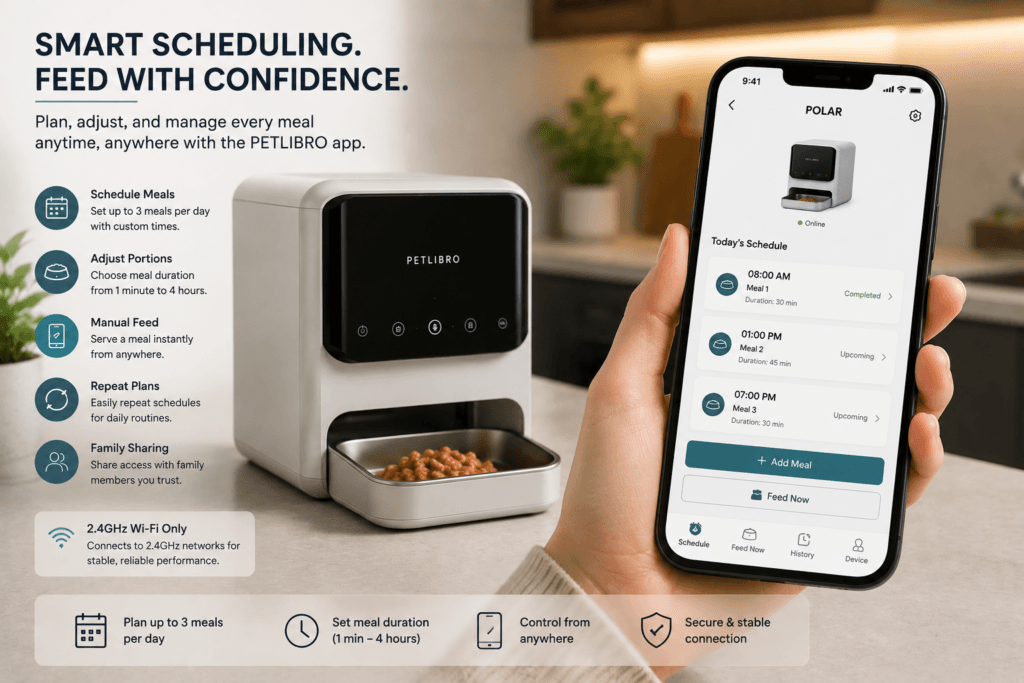
    The app allows owners to schedule meals, repeat plans, trigger a meal manually, and set feeding duration. PETLIBRO states that feeding windows can be set from one minute to four hours, though it recommends keeping the meal-access period under one hour for freshness.

    That is useful because not every cat eats at the same speed.

    Some cats eat immediately. Others graze, return after a few minutes, or need time to warm up to a new feeding routine.

    What Still Remains Your Responsibility

    The Polar does not remove the difficult parts of wet food.

    You still need to:

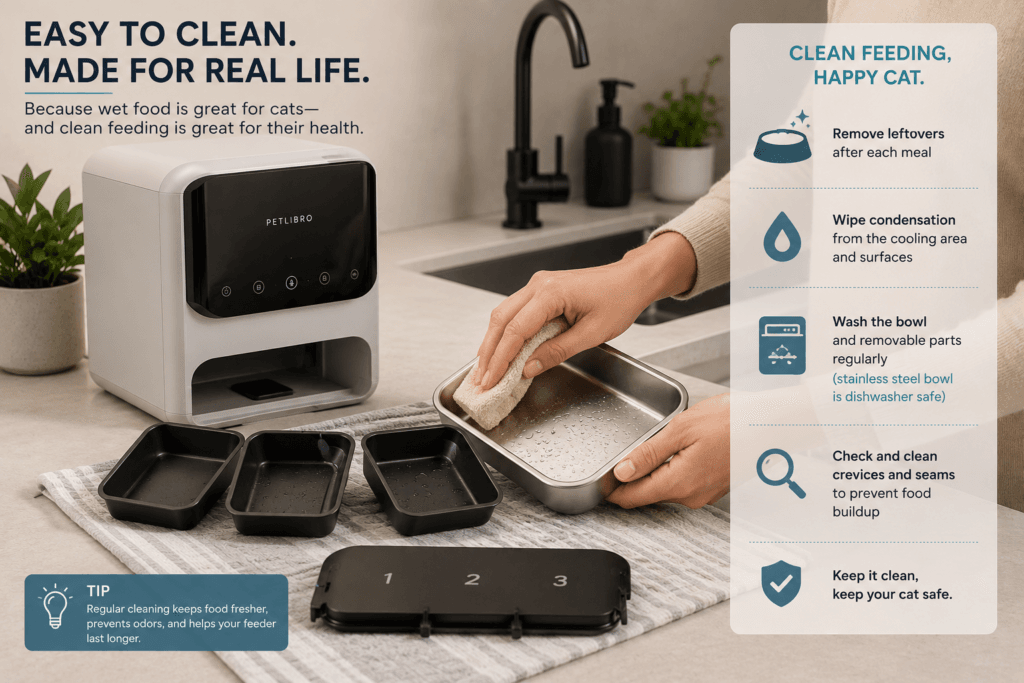
    • remove uneaten food promptly;
    • clean food-contact surfaces;
    • wipe condensation from the cooling area;
    • inspect corners and crevices for residue;
    • refill the unit between feeding cycles;
    • watch whether your cat actually accepts the tray;
    • make sure portions fit your cat’s needs.

    This is where some buyers may feel disappointed.

    They see “refrigerated wet-food feeder” and imagine something nearly hands-off.

    It is not.

    The Polar reduces timing friction. It does not remove wet-food ownership.

    For the right buyer, that is still a major win.

    App Features: Useful or Just Another Dashboard?

    Smartphone app scheduling refrigerated wet food meals for a cat feeder.

    The PETLIBRO app is useful here because it solves a scheduling problem.

    This is not a camera feeder. It does not tell you whether your cat finished every bite. It does not identify which cat ate from the bowl. It does not provide a health dashboard.

    That is not a weakness.

    It is simply not what the Polar is trying to be.

    The app gives you the functions that matter for a refrigerated wet-food routine:

    • schedule meals;
    • repeat feeding plans;
    • manually trigger a feeding;
    • adjust meal-access duration;
    • manage the device remotely;
    • keep the feeder connected to the rest of a PETLIBRO setup.

    The main limitation is that the Polar uses 2.4 GHz Wi-Fi. That is common for smart pet devices, but it can create setup friction in homes where the router combines 2.4 GHz and 5 GHz bands or uses restrictive network settings.

    Still, the app is not the reason to buy the Polar.

    The app is the tool that makes the core reason possible.

    The Polar is valuable because it makes wet-food timing flexible, not because it turns feeding into data.

    For a comparison between automation that removes a task and technology that adds deeper behavioral insight, read our guide to Monitoring vs Automation: What Smart Cat Owners Actually Need.

    Cleaning, Condensation, and the Part Buyers Should Not Ignore

    Cat wet food feeder bowl and removable feeding components being cleaned after use.

    This is the section that matters most after refrigeration.

    Wet food creates residue. Residue creates odor, bacteria concerns, and insects. A smart feeder that is difficult to clean eventually becomes a device people stop using.

    PETLIBRO has clearly tried to reduce that problem with removable components, minimal gaps, and dishwasher-safe bowl options. The stainless-steel-bowl version is especially appealing for owners who prefer a more durable, easier-to-clean food-contact surface.

    But the product still needs a routine.

    PETLIBRO notes that condensation can develop in the cooling area. That is a normal result of refrigeration meeting warm room air, but it still needs to be wiped dry after a feeding cycle.

    The company also advises removing leftovers after feeding and avoiding direct water contact with the refrigeration area.

    In practice, ownership should look something like this:

    After Each Feeding Plan

    • remove leftover food;
    • wipe visible residue;
    • check for condensation;
    • inspect the bowl edge and surrounding tray.

    Every Few Days

    • wash the bowl and food-contact components;
    • check the compartment seams;
    • clean any food caught around the tray connection.

    Weekly

    • do a deeper clean around the bowl connection and smaller crevices;
    • inspect the exterior and cooling area;
    • make sure food odors are not attracting insects.

    That may sound demanding, but it is not a flaw unique to the Polar.

    It is the price of automating wet food.

    The important distinction is whether the Polar makes that work manageable enough to justify the flexibility it gives you.

    For a wet-food household, it can.

    For someone hoping never to clean another feeding device, it cannot.

    Food Compatibility: What Can and Cannot Go Inside?

    PETLIBRO positions the Polar for common commercial wet-food routines.

    Suitable options include:

    • commercial canned wet food;
    • commercial wet-food pouches;
    • commercial semi-moist food;
    • prescription canned food;

    That is already enough for most cat owners.

    The important restriction is raw food.

    PETLIBRO advises against using raw food in the Polar because raw diets have variable storage requirements and a much narrower margin for error.

    That is the correct boundary.

    A refrigerated feeder is not a universal food-storage system. It is a controlled feeder built around mainstream wet-food routines.

    You should also avoid using foods that do not sit securely in the tray, meals with unclear storage directions, or portions your cat is unlikely to finish within the feeding window.

    The Polar is most useful when the diet is predictable.

    Safety and Cat Fit

    The Polar includes an anti-pinch infrared lid sensor. PETLIBRO says the lid stays open while a pet is eating or nearby, and retracts if a cat is detected while it is closing.

    That is useful, but it should not be the only reason you consider the device safe.

    The first question is more basic:

    Can your cat comfortably use it?

    The Polar is about 7.7 inches tall, and PETLIBRO recommends a minimum shoulder height of roughly 6.1 inches for comfortable access.

    That means it may not be ideal for:

    • tiny kittens;
    • very small adult cats;
    • cats with mobility limitations that make raised feeding awkward;
    • cats that dislike enclosed or mechanically moving feeding devices.

    The best approach is to think about the Polar as a physical feeding station first and a smart device second.

    If your cat cannot comfortably approach, reach, and eat from it, the app and refrigeration do not matter.

    Power Outages and Backup Planning

    The Polar is a corded device because refrigeration needs wall power.

    PETLIBRO also supports three AA backup batteries for up to 12 hours of scheduled feeding-plan continuity during a power outage.

    That is useful, but the distinction matters:

    The backup system protects the feeding schedule. It should not be treated as a guarantee of refrigerated food storage during an extended outage.

    For a brief interruption, the backup may help the tray continue to rotate according to the planned schedule.

    For a longer outage, hot home, or food-safety concern, use your judgment and do not assume refrigeration performance remains unchanged.

    This is another reason the Polar is not a vacation solution.

    It is a routine-flexibility tool.

    Where the PETLIBRO Polar Falls Short

    The Polar solves a real problem, but it is not a perfect product.

    Its main limitations are easy to identify.

    • It is expensive compared with traditional rotating wet-food feeders.
    • It needs wall power for normal refrigeration.
    • It only offers three meal compartments.
    • It does not remove cleaning.
    • It is not appropriate for raw-food routines.
    • It is not ideal for long trips without a sitter.
    • It does not use a camera, so you cannot confirm whether your cat ate.
    • It may not suit very small cats or kittens.
    • Condensation requires regular wiping.
    • Hot rooms and direct sunlight can undermine the cooling concept.

    None of these are deal-breakers for the right household.

    But together they reveal the truth about the product:

    Polar is a smart solution to a narrow problem, not a universal replacement for feeding your cat yourself.

    That is also why it can be excellent for one owner and pointless for another.

    PETLIBRO Polar vs Traditional Timed Wet Food Feeders

    The Polar’s premium only makes sense when refrigeration changes the routine.

    Choose the Polar if:

    • you feed wet food regularly;
    • you need reliable meal timing while away;
    • you want app scheduling;
    • you dislike using ice packs;
    • you are willing to maintain and clean the feeder properly;
    • missing one wet-food meal creates real inconvenience.

    Choose a basic rotating tray feeder if:

    • you only need one occasional delayed meal;
    • you are usually home;
    • budget matters more than temperature control;
    • you are comfortable using ice packs or shorter serving windows;
    • you do not need app control.

    The simplest way to frame it is this:

    Polar is not a premium timer. It is a refrigeration-based routine tool.

    Who Should Buy the PETLIBRO Polar?

    Buy the PETLIBRO Polar if:

    • wet food is already a genuine part of your cat’s daily diet;
    • work, commutes, or social plans make you miss regular meal windows;
    • you want to preserve a wet-food routine without being home for every meal;
    • you can clean it consistently;
    • your cat is physically large enough to use it comfortably;
    • you value schedule automation more than camera monitoring;
    • you understand that “up to 72 hours” is a controlled-use claim, not a license to ignore food hygiene.

    The Polar is particularly compelling for someone who says:

    “I do not want to switch my cat to dry food just because I have a normal life outside the house.”

    Who Should Skip It?

    Skip the Polar if:

    • dry food already works for your household;
    • you want a feeder for long holidays or unattended travel;
    • you feed raw food;
    • you expect zero cleanup;
    • your cat is too small to access it comfortably;
    • you need more than three scheduled wet meals;
    • you primarily want proof that your cat ate;
    • a basic timed tray feeder already solves your actual problem.

    For dry-food automation with camera-based feeding visibility, consider reading our PETKIT YumShare Solo 2 Camera Review.

    Final Verdict

    Cat wet food feeding routine maintained with a refrigerated automatic feeder while the owner is away.

    The PETLIBRO Polar is not a smarter version of a dry-food feeder.

    It is a different category of device built for a different feeding problem.

    Its value is not that it makes wet food effortless. Wet food will never be completely effortless.

    Its value is that it gives wet-food households more freedom around one of the most rigid parts of a cat’s routine: being home at exactly the right time.

    For the right cat and household, that is worth paying for.

    For everyone else, it is an expensive solution to a problem they may not actually have.

    Ready to Make Wet-Food Feeding More Flexible?

    👉 Check the current PETLIBRO Polar price on Amazon

    Affiliate disclosure: PetTechAI may earn a commission from qualifying purchases, at no extra cost to you.

    FAQ

    Is the PETLIBRO Polar worth it for cats?

    It is worth it when wet food is already part of your cat’s normal routine and the main issue is being unavailable for regular meals. It is less compelling for dry-food households or owners who only need occasional meal delays.

    How long can wet food stay in the PETLIBRO Polar?

    PETLIBRO states that the feeder can preserve food for up to 72 hours under its intended operating conditions. The company also recommends resetting feeding plans at least every three days and cleaning up leftovers promptly after serving.

    Can you use raw food in the PETLIBRO Polar?

    PETLIBRO recommends avoiding raw food in the Polar because raw diets have more variable shelf-life and food-safety requirements.

    Does the PETLIBRO Polar need ice packs?

    No. The Polar uses thermoelectric cooling rather than ice packs.

    Can it work during a power outage?

    With three AA backup batteries installed, PETLIBRO says the feeding plan can continue for up to 12 hours during a power outage. That should be treated as schedule backup, not guaranteed refrigeration during an extended outage.

    Is PETLIBRO Polar suitable for kittens?

    Not always. PETLIBRO recommends a minimum shoulder height of around 6.1 inches for comfortable access, so very small kittens or cats may not be an ideal fit.

    Does the app tell you whether my cat ate the meal?

    No. The app can schedule and control meals, but the Polar does not use a camera or provide verified meal-consumption tracking.

    References

    • PETLIBRO Polar Wet Food Feeder official product page
    • PETLIBRO Polar product FAQ and care guidance
    • PETLIBRO Polar app and Wi-Fi setup documentation
    • PETLIBRO Polar user manual

    Affiliate Disclosure

    PetTechAI participates in affiliate programs, including Amazon Associates and other partner networks. We may earn a commission when you purchase through links on our site, at no additional cost to you. Our recommendations are based on official product information, comparative research, and practical ownership trade-offs.