Tag: PETLIBRO Polar

  • PETLIBRO Polar vs Rotating Wet Food Feeders: Is Refrigeration Worth It?

    PETLIBRO Polar vs Rotating Wet Food Feeders: Is Refrigeration Worth It?

    A rotating feeder can reveal wet food later. A refrigerated feeder is designed to keep it usable until later.

    That difference sounds obvious, but it is where many buying decisions go wrong. People often look at a rotating wet food feeder with ice packs and assume they have solved wet-food feeding for days at a time. In reality, they have usually solved a much smaller problem: delaying one or two meals during the same day.

    PETLIBRO Polar sits in a different category. It is not simply a rotating feeder with more technology. Its value is tied to refrigeration, app scheduling, and the ability to keep wet food part of a routine when the owner cannot be home to serve it.

    The question is not whether refrigeration is more advanced. It is whether your cat’s feeding routine actually needs it.

    Quick Verdict

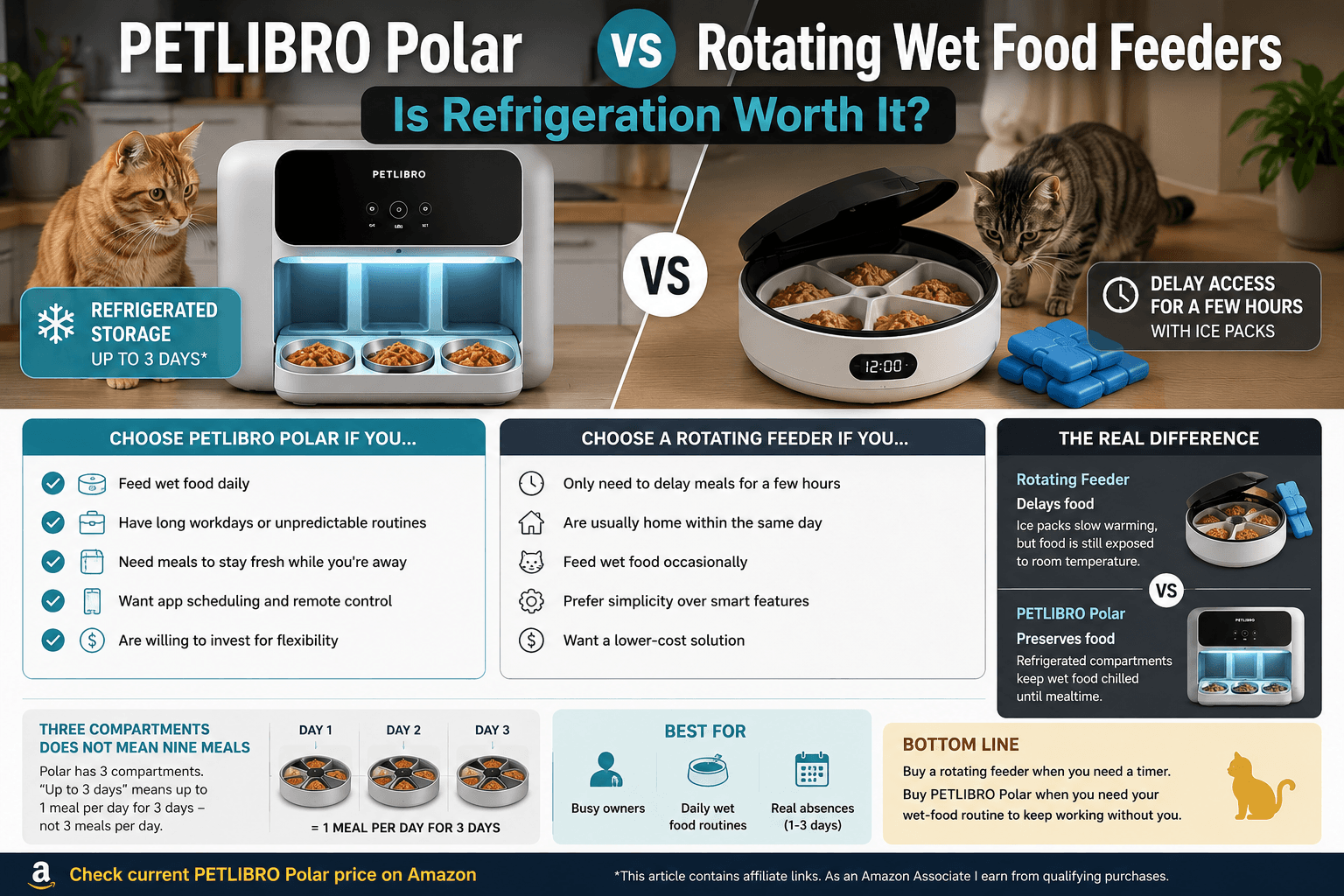
    Choose a rotating wet food feeder if:

    • You only need to delay wet-food meals by a few hours.
    • You are normally home within the same day.
    • You want a lower-cost solution for occasional use.
    • You are happy preparing meals manually and managing ice packs.
    • You do not need app scheduling or remote control.

    Choose PETLIBRO Polar if:

    • Wet food is a reliable part of your cat’s daily diet.
    • You have long workdays, commuting time, shifts, or unpredictable routines.
    • You need a meal to remain refrigerated until its scheduled time.
    • You want to schedule and manage feeding from an app.
    • You are paying for flexibility, not just automation.

    For a closer look at setup, cleaning, capacity, and daily ownership, read our PETLIBRO Polar Wet Food Feeder Review.

    Check the current PETLIBRO Polar price on Amazon

    This article contains affiliate links. As an Amazon Associate I earn from qualifying purchases.

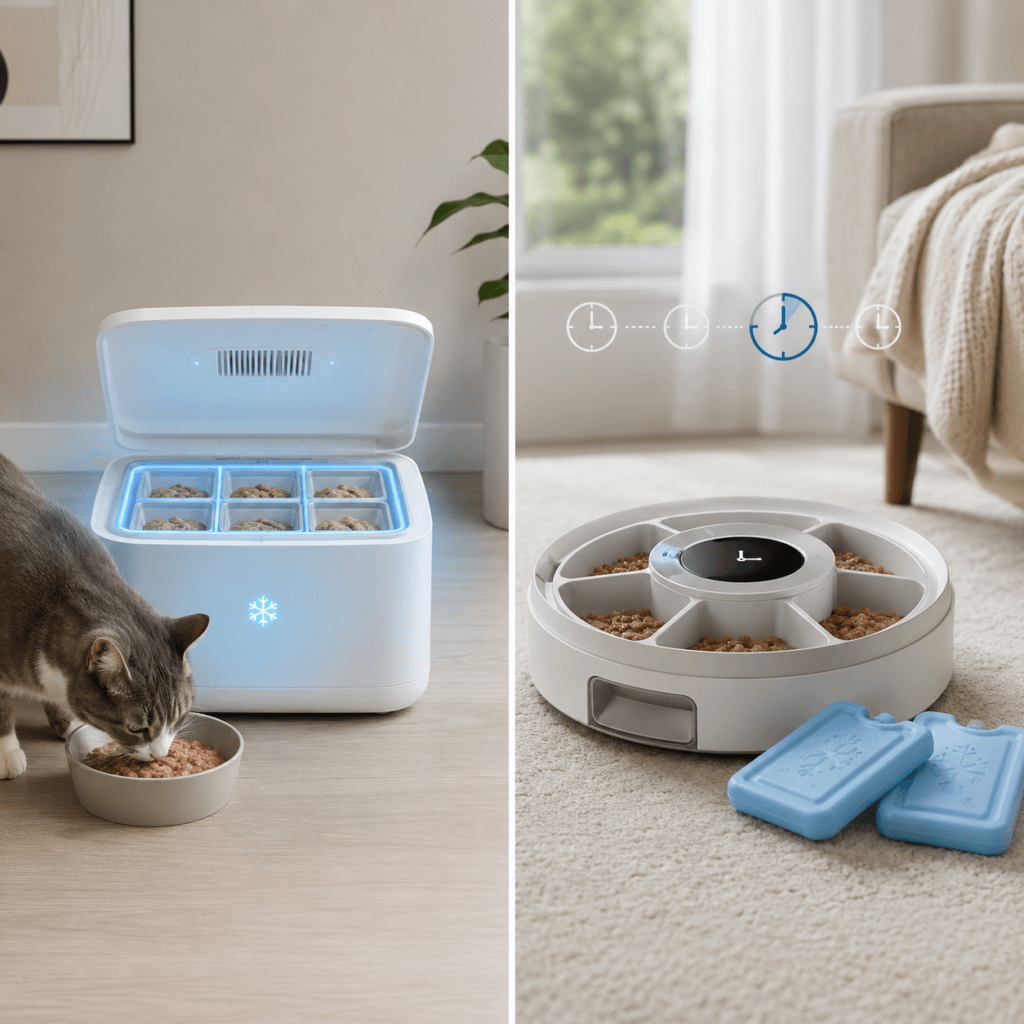
    The Real Difference: Delaying Food vs Preserving Food

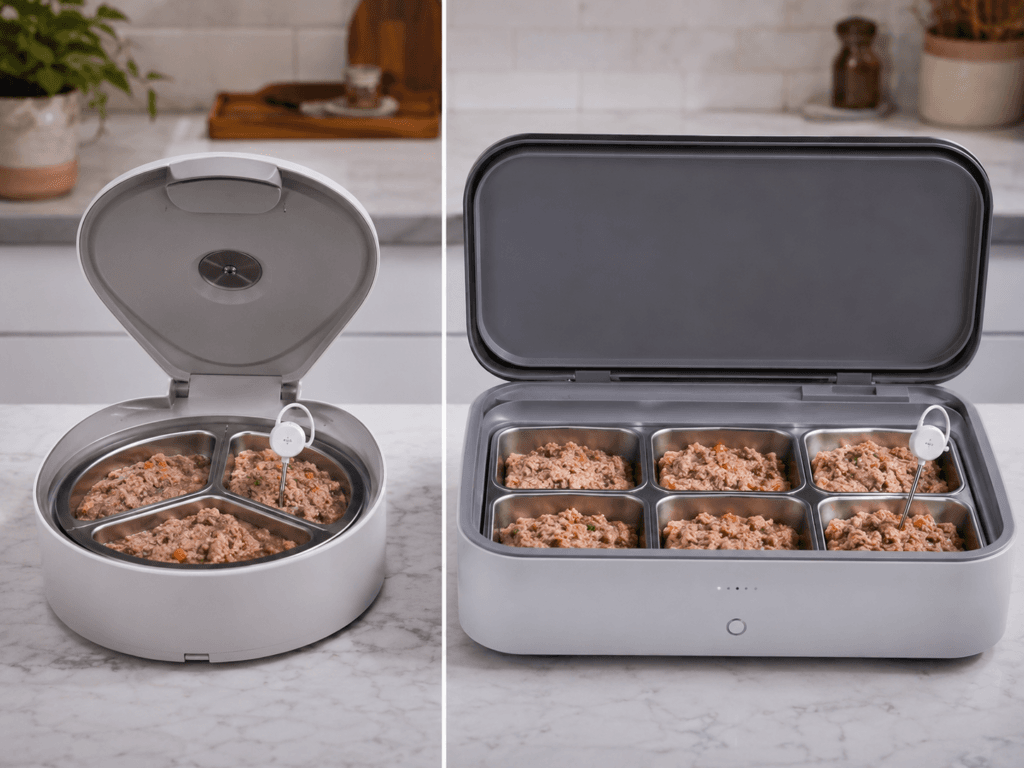
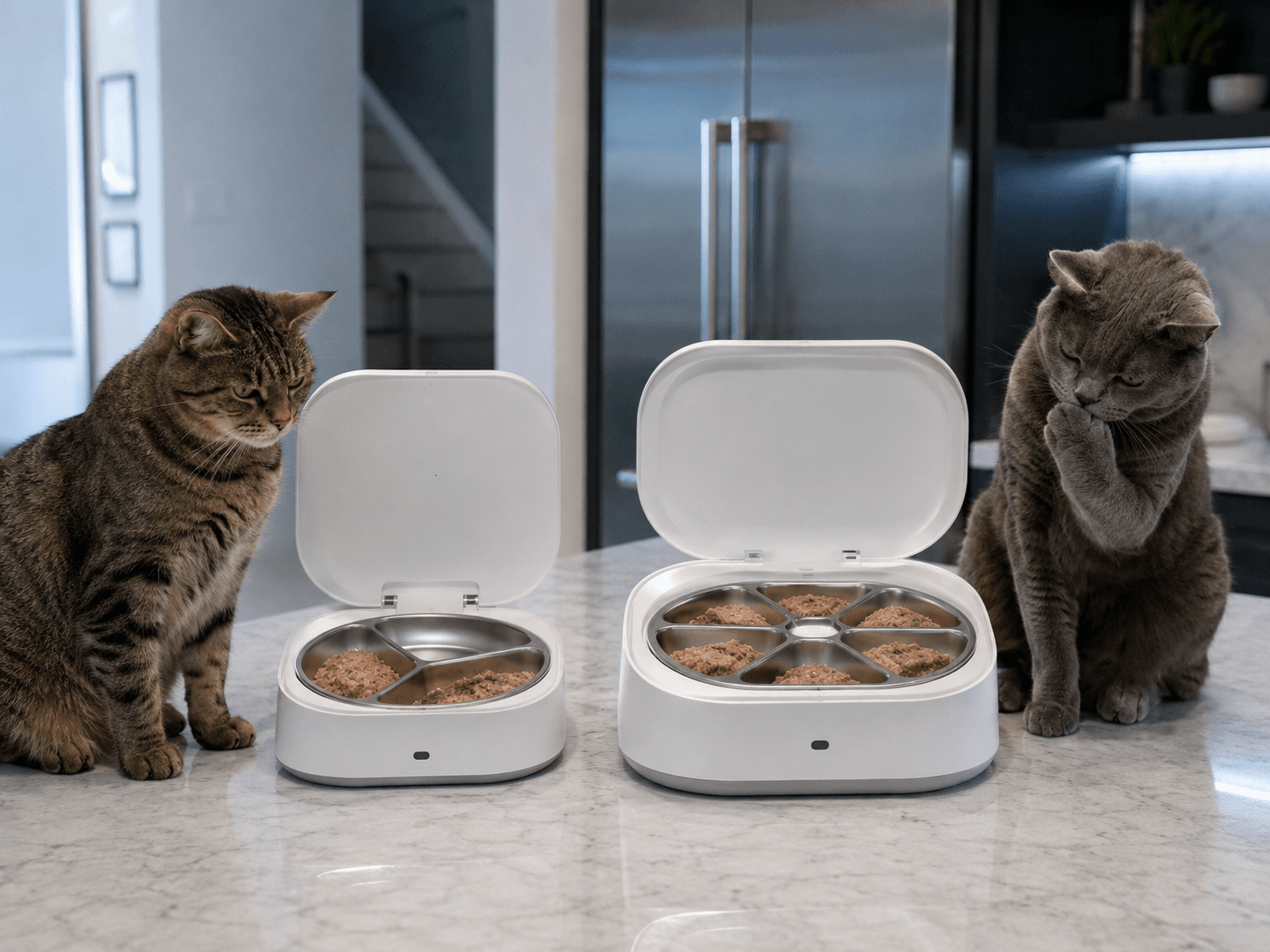
    Comparison between delaying wet food with ice packs and preserving it with refrigeration

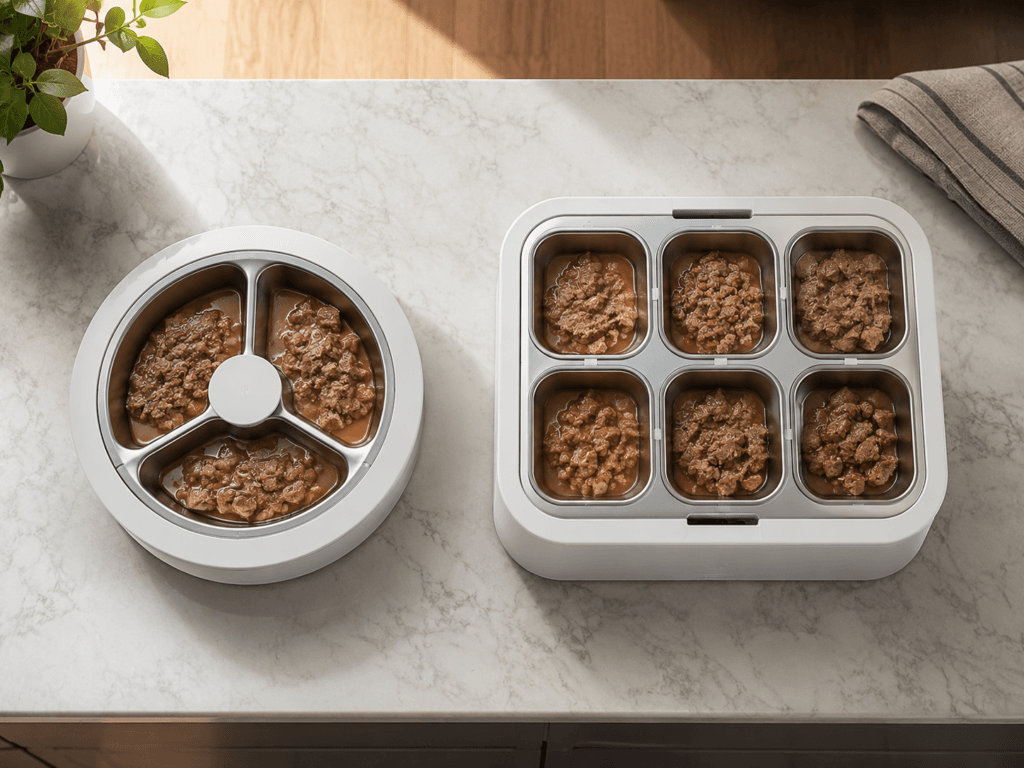
    Traditional rotating wet food feeders work through a simple idea. You prepare meals in separate compartments, set a timer, and the tray rotates to reveal the next portion at the scheduled time.

    Some models include ice packs beneath the tray. That can be useful. It can slow down how quickly a prepared meal warms up, especially when the feeder is used for a limited part of the day.

    But an ice pack is not refrigeration.

    A rotating feeder is mainly a meal-timing device. It controls when your cat can access food. Its freshness support is limited and depends on room temperature, how long the meal sits out, the condition of the ice pack, and the food itself.

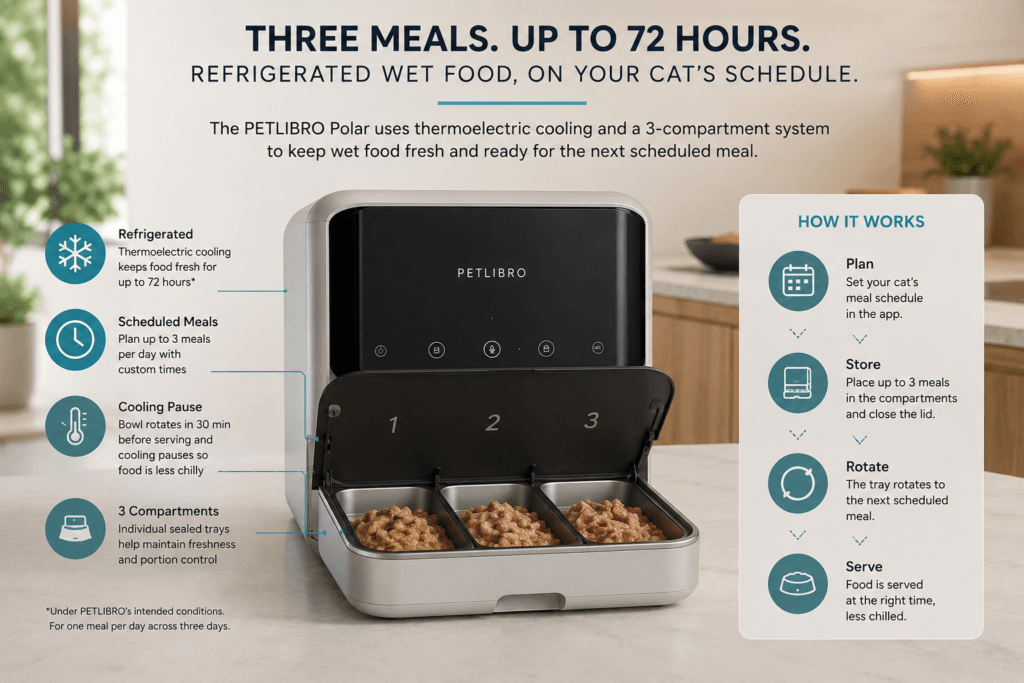
    PETLIBRO Polar is built around a different job. Its refrigerated compartments are meant to keep wet food chilled until a scheduled feeding window, making it possible to plan meals around a real absence rather than a short delay.

    That does not make a rotating feeder obsolete. It simply means the products solve different problems.

    A cheaper rotating feeder is not an inferior PETLIBRO Polar. It is a simpler answer to a smaller need.

    Rotating Feeders Are Still Useful — Just for a Narrower Routine

    A rotating wet food feeder can be the right choice when feeding automation is mostly about convenience.

    For example, imagine that you leave home at 8 a.m., return at 6 p.m., and want to give your cat a second wet-food meal in the afternoon. A rotating feeder may be enough. You can prepare the meal in advance, keep the unit away from heat and sunlight, and use an ice pack where appropriate.

    That setup makes sense when:

    • your absence is short;
    • the feeder is used occasionally rather than every day;
    • your cat eats wet food once or twice daily;
    • you can refill, clean, and freeze ice packs as part of your normal routine;
    • the lower upfront price matters more than advanced scheduling.

    This category works best for owners who need a timer.

    It works less well for owners who need their routine to keep functioning when they are unavailable for a longer stretch.

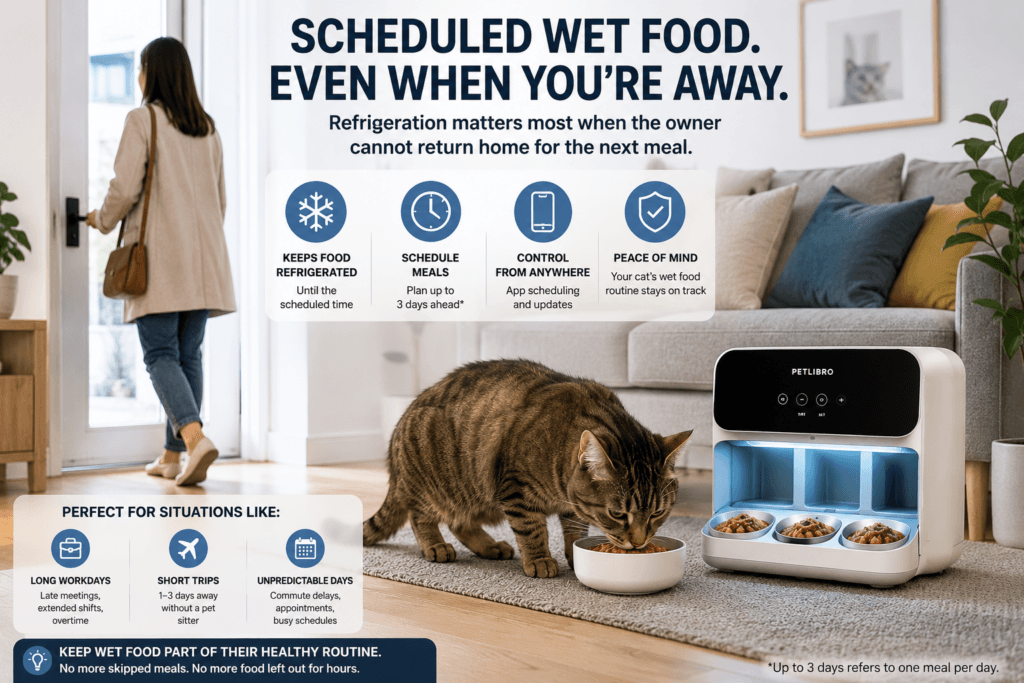
    PETLIBRO Polar Is About Routine Independence

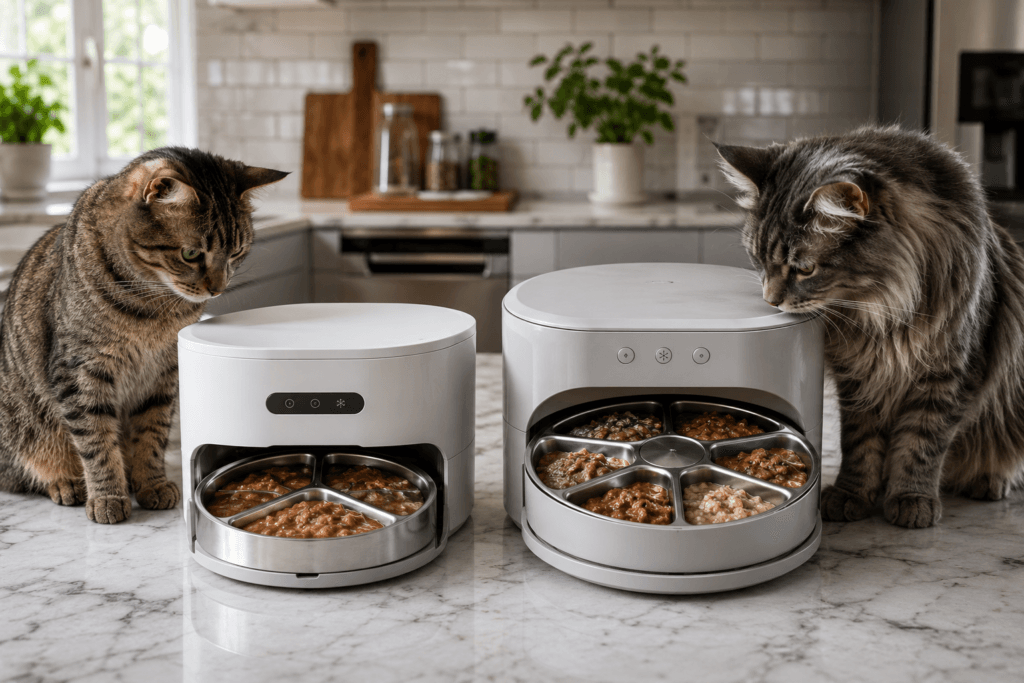
    Cat wet food scheduled in a refrigerated feeder while the owner is away

    The Polar’s premium is not really about dispensing food automatically. Many cheaper feeders can dispense or reveal a meal on a schedule.

    The premium is about reducing the dependency on the owner being physically present at the right moment.

    With PETLIBRO Polar, the logic becomes:

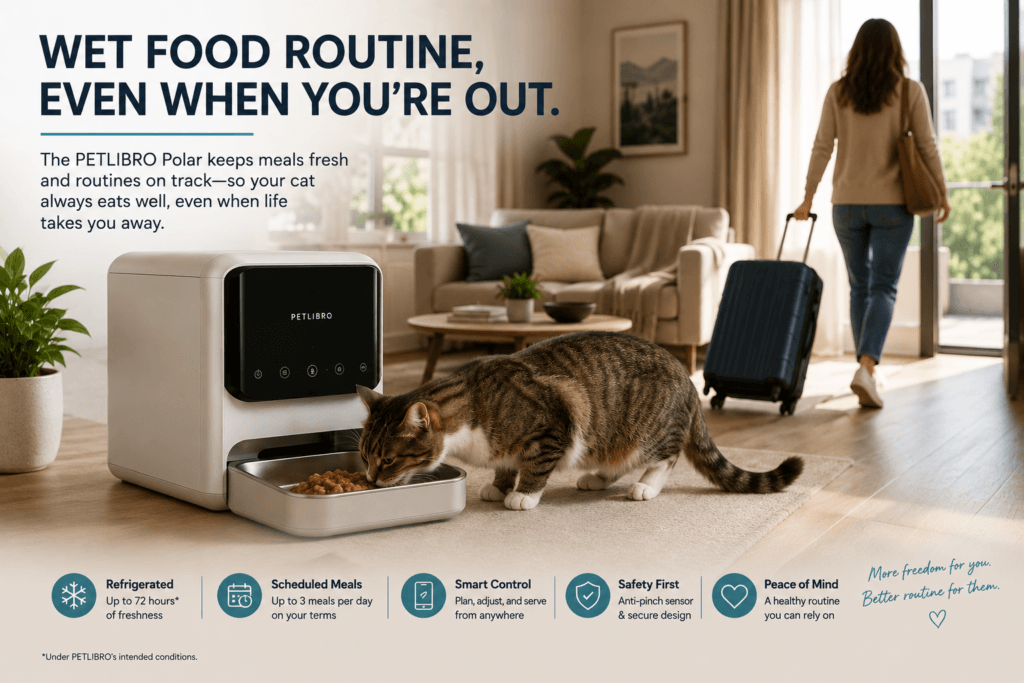
    Prepare refrigerated wet-food meals in advance, schedule them, and let the feeding routine continue even when your day does not go as planned.

    That is useful for people who:

    • commute long distances;
    • work extended or changing shifts;
    • regularly miss a midday feeding window;
    • want to leave home without worrying that wet food will sit out for too long;
    • rely on a predictable feeding schedule for one cat or a small household.

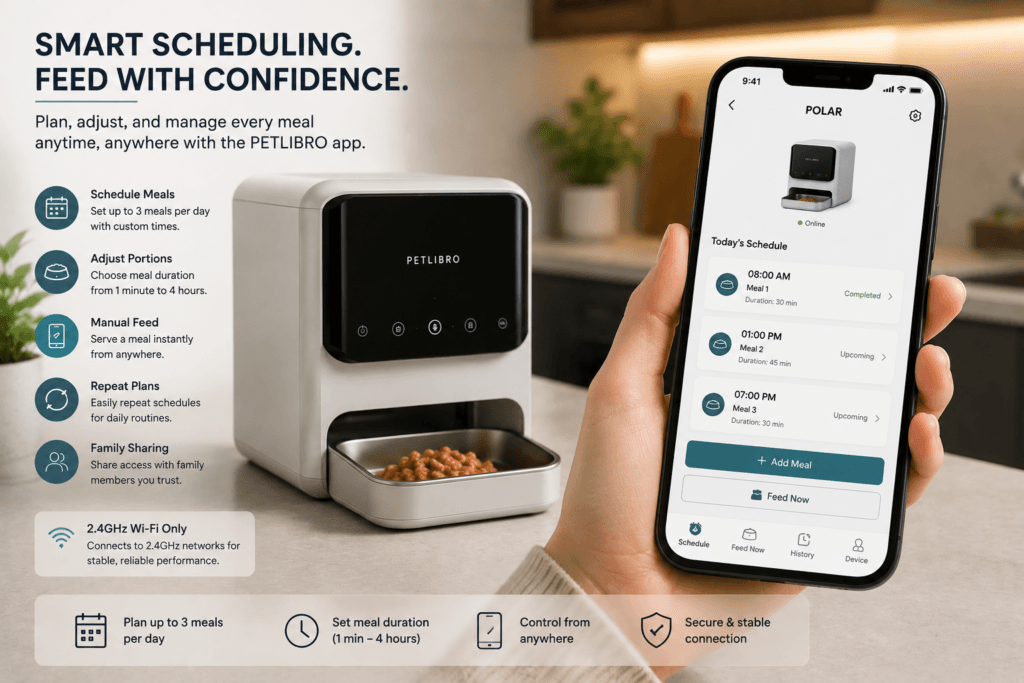
    The app matters here because it adds control rather than novelty. A schedule can be adjusted remotely, and the owner has a clearer system than a basic mechanical timer.

    That does not mean every cat owner needs app control. But for someone whose daily routine is frequently disrupted, it can be the difference between a feeding tool and a feeding system.

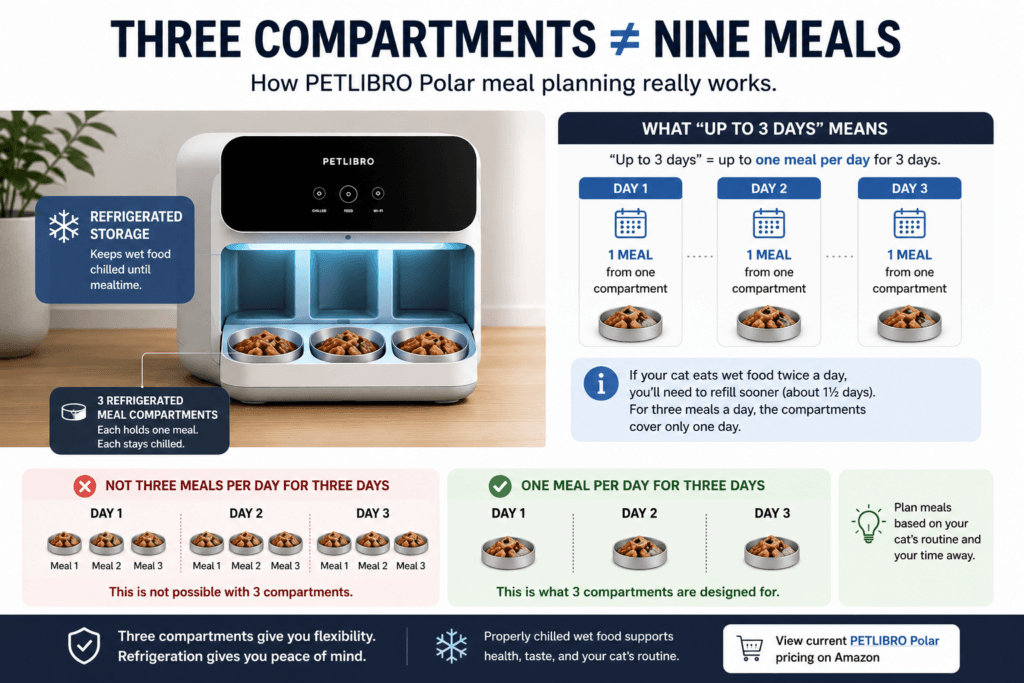
    Three Compartments Does Not Mean Nine Meals

    Three refrigerated wet food compartments showing one meal per day for three days

    This is the most important clarification before buying PETLIBRO Polar.

    The feeder has three physical meal compartments. Its “up to three days” positioning should be understood as up to one refrigerated meal per day across three days.

    It does not mean you can leave three meals per day for three full days.

    If your cat eats wet food twice a day, you would need to refill the feeder much sooner. If your cat eats three wet meals a day, the three compartments can cover only one day of feeding.

    That is not a flaw. It is simply the practical limit of the design.

    Polar is best understood as a way to make a single daily wet-food meal more flexible, or to cover a short period when one meal per day needs to happen without the owner returning home.

    Buy it for that purpose and it makes sense.

    Buy it expecting a fully automated multi-meal wet-food system for several days and you may be disappointed.

    When a Rotating Feeder Is the Better Buy

    A rotating wet food feeder remains the smarter purchase in several situations.

    You only need help for a few hours

    Maybe you have a dinner plan, a late work meeting, or an occasional day out. A rotating feeder can handle that without requiring a premium refrigerated system.

    Wet food is not your cat’s main routine

    If wet food is only an occasional treat or one small meal in an otherwise dry-food diet, Polar may be more capability than you need.

    In that case, a dry-food system with stronger scheduling or camera features may make more sense. Our PETKIT YumShare Solo 2 Camera Review is relevant for owners whose routine is built mainly around kibble, portion control, and remote meal visibility rather than refrigerated food.

    You value simplicity over remote control

    A rotating feeder has fewer components, fewer settings, and fewer moving parts. You prepare food, set the timer, and use it when needed.

    For some owners, that is exactly the appeal.

    Budget is the main constraint

    The price gap between a basic rotating feeder and a refrigerated smart feeder is significant. If the product only solves an occasional inconvenience, the cheaper category may deliver most of the value.

    When PETLIBRO Polar Is Worth the Premium

    Polar becomes easier to justify when wet food is a meaningful part of the cat’s routine and the owner’s schedule is the weak point.

    You regularly miss a feeding window

    This is the clearest case.

    A cat that expects a wet-food meal at noon does not care whether you are stuck in traffic, at work, on a train, or delayed by an appointment. Polar gives you a way to schedule the meal without leaving food exposed for the whole day.

    Your routine changes often

    The feeder makes more sense for people with irregular schedules than for people with a perfectly predictable lifestyle.

    A person who works from home most days may not gain much from it. A person whose hours change weekly may gain a lot.

    You want wet food to remain practical

    Many owners gradually rely more on dry food because wet-food feeding is harder to coordinate. It requires preparation, timing, cleaning, and physical presence.

    Polar does not remove every responsibility, but it reduces one of the biggest constraints: being home at the exact time a fresh meal needs to be served.

    You are buying convenience that affects every week

    The best reason to pay more is not that the machine looks impressive.

    It is that it removes a recurring friction point from your week.

    If you would use it once every few months, a rotating feeder is probably enough.

    If you would use it several times per week, refrigeration can become a practical quality-of-life feature rather than an expensive extra.

    Cleaning and Daily Ownership: More Technology Means More Responsibility

    Neither category is completely “set and forget.”

    A rotating feeder is usually straightforward to clean. You remove the tray, wash the food compartments, clean the ice packs, and prepare the next meals.

    Polar offers more convenience around food storage, but it also needs more thoughtful maintenance.

    Wet food can leave residue quickly. Condensation can occur. Compartments, bowls, and feeding surfaces still need regular cleaning. Refrigeration helps with storage, but it does not eliminate hygiene.

    You should also treat the feeder as a food-management tool, not as permission to ignore your cat’s eating habits for days.

    A smart feeder can schedule a meal. It cannot tell you whether your cat actually ate it, whether a portion was tolerated well, or whether a sudden change in appetite needs attention.

    For that reason, Polar works best as part of a routine that remains attentive, not one that becomes completely hands-off.

    The Real Cost Question: What Are You Paying For?

    With a rotating feeder, you are mostly paying for a timer, compartments, and limited freshness support.

    With PETLIBRO Polar, you are paying for:

    • refrigerated food storage;
    • app-based scheduling;
    • more flexibility around absence;
    • a more structured wet-food routine;
    • reduced pressure to be home for every meal.

    That is why comparing the products only by price misses the point.

    The right question is:

    How much is it worth to keep wet food practical when I cannot be there?

    For some owners, the answer is “not much.” They can prepare a meal, use an ice pack feeder, and return home later that day.

    For others, the answer is “a lot.” Their work pattern, commute, or lifestyle repeatedly turns wet-food feeding into a logistical problem.

    That is the audience Polar is designed for.

    PETLIBRO Polar vs Rotating Wet Food Feeders: Final Verdict

    Buy a rotating feeder when you need a timer.

    Buy PETLIBRO Polar when you need your wet-food routine to continue without you.

    A rotating feeder is the practical, lower-cost solution for delayed meals, short absences, and occasional convenience. It is especially sensible when you are usually home the same day and do not need remote control.

    PETLIBRO Polar is worth paying more for when refrigeration changes what your feeding routine can realistically do. Its value is not “smart technology” in the abstract. Its value is making wet food easier to manage when life does not follow a perfect schedule.

    Choose PETLIBRO Polar if refrigerated meal timing would genuinely make your day easier — not simply because the technology looks impressive.

    View the current PETLIBRO Polar price on Amazon

    This article contains affiliate links. As an Amazon Associate I earn from qualifying purchases.

    Frequently Asked Questions

    Can rotating wet food feeders keep food fresh?

    They can delay access to a prepared meal, and models with ice packs may provide short-term temperature support. They are not the same as a refrigerated storage system, especially for longer absences.

    Is PETLIBRO Polar worth it for one cat?

    It can be. The deciding factor is not the number of cats but whether one cat’s wet-food routine is difficult to maintain around your schedule.

    Can PETLIBRO Polar feed a cat for three days?

    It is designed around three refrigerated compartments and up to three days of storage. In practical terms, that means one meal per day across three days, not three meals per day for three days.

    Does PETLIBRO Polar replace regular meal preparation?

    No. You still need to portion food, refill the compartments, clean the feeder, and pay attention to your cat’s eating habits. It automates timing and refrigerated storage, not overall care.

    Should I choose a refrigerated wet-food feeder or a dry-food smart feeder?

    Choose a refrigerated wet-food feeder when wet food is central to your cat’s routine and timing is the problem. Choose a dry-food smart feeder when portion control, larger capacity, camera features, or multiple daily kibble meals matter more.

    References

    • PETLIBRO Polar product information and user guidance
    • PETLIBRO Polar Amazon listing
    • Rotating wet-food feeder manufacturer instructions and care guidance
  • PETLIBRO Polar Wet Food Feeder Review (2026): Is This Tiny Wi-Fi Fridge Worth It?

    PETLIBRO Polar Wet Food Feeder Review (2026): Is This Tiny Wi-Fi Fridge Worth It?

    If your cat treats breakfast at 5:17 a.m. as a legally binding agreement, wet food can make life complicated.

    Dry-food feeders are simple: fill the hopper, set a schedule, and let the machine handle the negotiations. Wet food is messier, more perishable, and generally expects a human employee to report for duty on time.

    The PETLIBRO Polar tries to solve that problem with actual thermoelectric cooling, three scheduled meal compartments, and app control.

    It is not a robotic cat butler.

    It is essentially a small refrigerated tray with Wi-Fi—and for the right household, that may be exactly enough.

    Research note: This is a research-led review based on official PETLIBRO documentation, independent testing, and available owner feedback. PetTech AI has not conducted a long-term hands-on test of the PETLIBRO Polar.

    Version note: This review covers the refreshed PETLIBRO Polar associated with Amazon ASIN B0GRHQGDCB, featuring the removable stainless-steel tray, portion markings and revised three-prong power adapter.

    Quick Verdict

    CategoryVerdict
    Best forCats already eating wet food on a predictable schedule
    Main benefitRefrigerated meals without ice packs
    Meal capacityThree scheduled portions
    App controlYes, through 2.4 GHz Wi-Fi
    Main buyer-regret riskIt still requires cleaning, refilling, and food-safety judgment
    Skip it ifYou feed raw food, need vacation coverage, or only delay meals occasionally
    RecommendationRecommended with Conditions — one of the most convincing options for households that routinely feed wet food and need scheduling flexibility.

    The PETLIBRO Polar makes sense when wet food is already non-negotiable and your main problem is being physically present for every meal.

    It makes much less sense when you only need one delayed dinner every few months. In that case, buying a refrigerated smart feeder is the pet-tech equivalent of purchasing a forklift to move a grocery bag.

    Verdict: Buy it for routine flexibility, not for hands-off pet care.

    PetTech AI may earn a commission from qualifying purchases. As an Amazon Associate I earn from qualifying purchases.

    Check current Amazon availability and recent buyer feedback.

    Who Should Buy the PETLIBRO Polar?

    The Polar is a strong fit when:

    • wet food is already part of your cat’s daily diet;
    • work or other commitments regularly interrupt meal times;
    • you want to prepare up to three meals in advance;
    • you dislike dealing with ice packs;
    • your cat is large enough to use the raised feeding area comfortably;
    • you are willing to clean food-contact surfaces after each feeding plan.

    Its best use case is not a dramatic emergency.

    It is ordinary life: early shifts, late meetings, evenings out, or mornings when your cat has scheduled breakfast before your brain has scheduled consciousness.

    Who Should Skip It?

    Choose something simpler if:

    • your cat mainly eats dry food;
    • you need only an occasional delayed meal;
    • you feed raw or homemade food with stricter storage requirements;
    • you want visual confirmation that your cat actually ate;
    • your cat is very small or has difficulty reaching raised bowls;
    • you need more than three meal compartments;
    • you expect to leave your cat unattended for several days.

    Three compartments provide useful flexibility.

    They do not constitute a tiny all-inclusive resort for your cat.

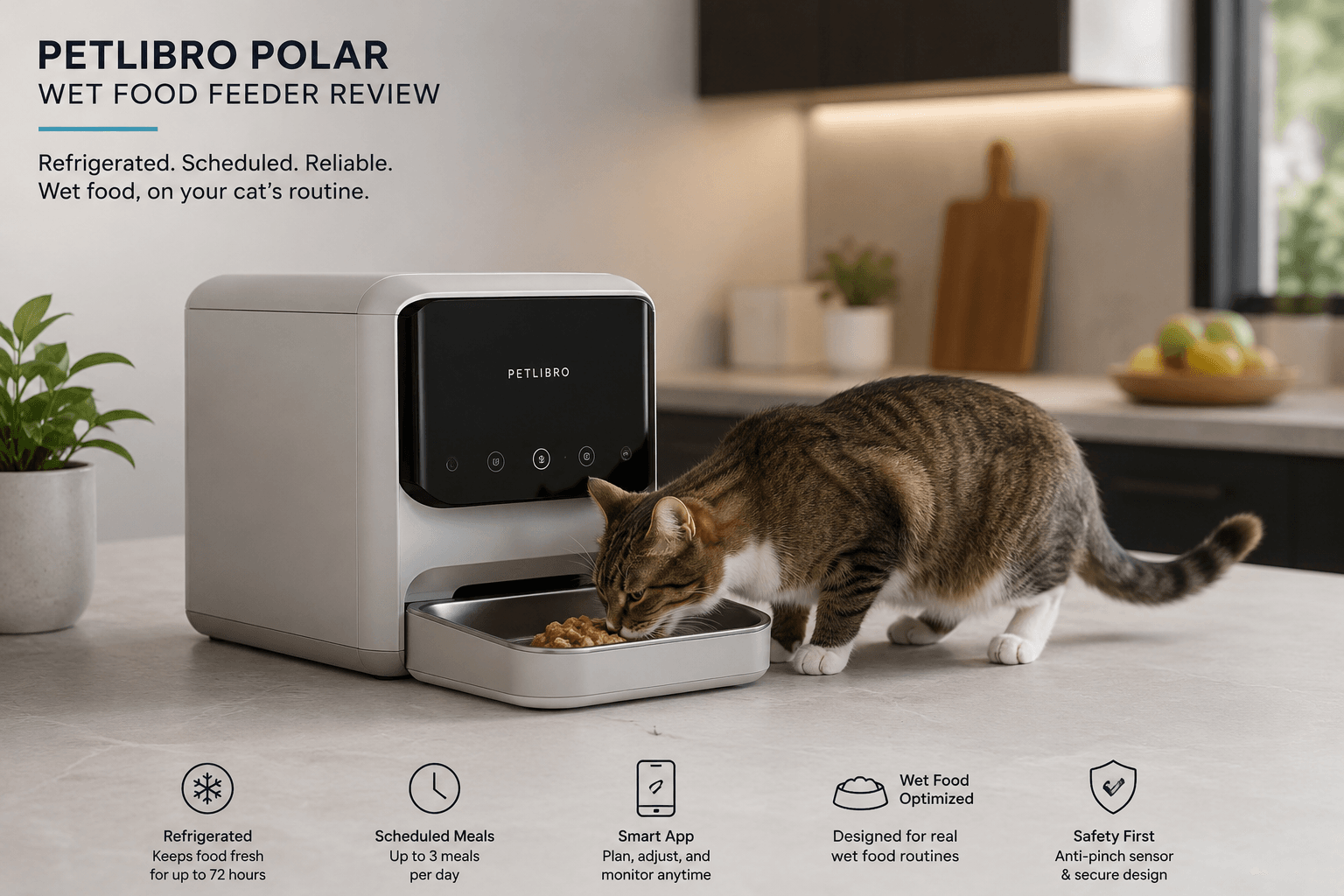
    What Problem Does the Polar Actually Solve?

    Three-compartment refrigerated wet food feeder system for scheduled cat meals.

    The Polar solves timing friction.

    Traditional timed wet-food feeders usually rely on ice packs or short room-temperature windows. Those systems can work for one delayed meal, but they are less convincing when wet food is the normal diet rather than an occasional exception.

    The Polar uses thermoelectric cooling to keep three prepared portions chilled. Before each scheduled meal, the selected compartment moves into position and cooling pauses so the food is not served directly at its coldest temperature.

    PETLIBRO says food can remain chilled for up to 72 hours under its intended conditions. That claim should not be interpreted as permission to ignore food handling for three days.

    The company reports that, in laboratory testing at a room temperature of 77°F, the Polar cooled food to around 54°F. It recommends operating the feeder in rooms between 54°F and 86°F.

    In other words, this is controlled thermoelectric cooling—not a magical force field around yesterday’s pâté.

    Placement, room temperature, cleanliness, food type, and the time a meal remains exposed still matter.

    Three Reasons to Consider It

    1. It removes the ice-pack compromise

    The most important advantage is refrigeration without frozen inserts.

    You can prepare meals, schedule them through the app, and let the feeder manage when each compartment becomes accessible.

    That gives wet-food households more freedom without forcing them to use kibble whenever nobody is home at the correct time.

    2. The app solves a real problem

    Smartphone app scheduling refrigerated wet food meals for a cat feeder.

    Some pet apps exist mainly to transform a simple appliance into another source of notifications.

    The Polar app has a clearer purpose.

    It lets you:

    • schedule meals;
    • repeat feeding plans;
    • trigger a meal manually;
    • adjust how long food remains accessible;
    • manage the feeder remotely.

    The Polar does not need a complex health dashboard. Its job is simply to put the correct compartment in front of the cat at the correct time.

    3. The refreshed tray is easier to maintain

    Cat wet food feeder bowl and removable feeding components being cleaned after use.

    The refreshed 2026 model includes a removable stainless-steel food tray.

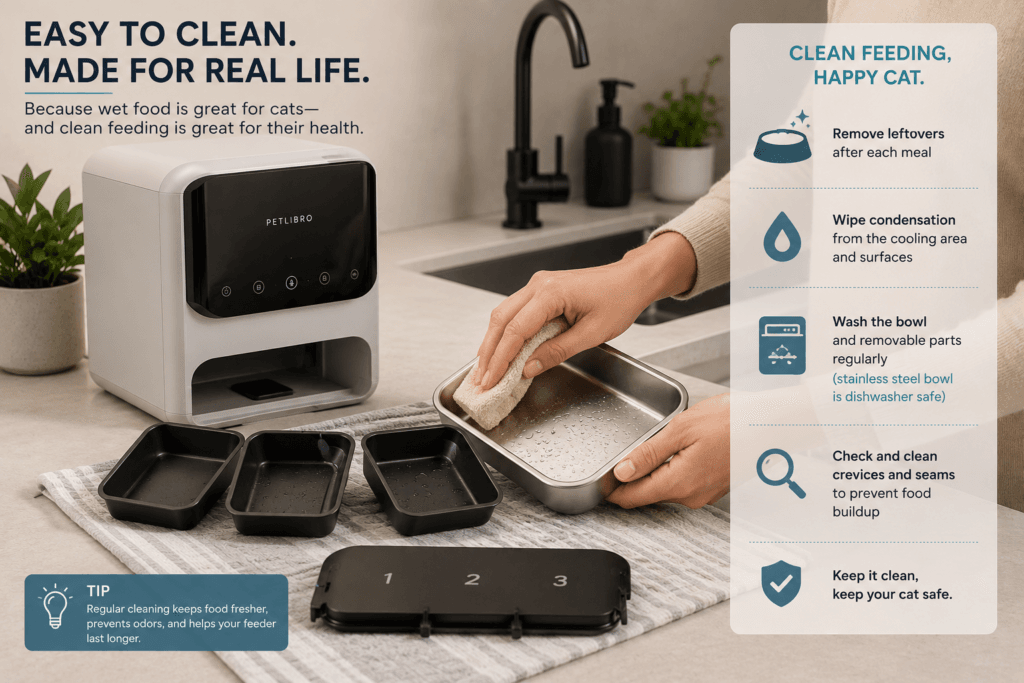
    That provides a durable, dishwasher-safe food-contact surface and makes routine washing more straightforward than scrubbing food residue from a permanently installed compartment.

    The feeder also uses an anti-pinch lid sensor designed to stop and retract the lid when a cat remains nearby.

    Where the PETLIBRO Polar Can Disappoint

    It does not eliminate wet-food cleaning

    Polar reduces scheduling work.

    It does not eliminate:

    • uneaten food;
    • condensation;
    • tray washing;
    • residue around the lid and compartment edges;
    • regular refilling;
    • insects attracted by wet-food smells.

    PETLIBRO recommends removing leftovers after feeding plans, wiping condensation from the cooling area, and cleaning small gaps and connection points regularly.

    Anyone expecting “load it on Monday and forget it exists” is buying the wrong product.

    Three compartments are still only three compartments

    The Polar can schedule three portions.

    That may mean:

    • one meal per day across three days;
    • three meals during one day;
    • another combination requiring regular refilling.

    It is not a high-capacity vacation feeder, and it does not replace a responsible person checking on your cat during longer absences.

    Physical fit can be a problem

    The feeder is approximately 7.7 inches tall, with the opening positioned around 6.1 inches high.

    PETLIBRO recommends a cat shoulder height of at least 6.1 inches for comfortable use.

    That makes the Polar less suitable for:

    • small kittens;
    • unusually small adult cats;
    • cats with mobility limitations;
    • cats that dislike reaching into deeper feeding areas.

    Measure the cat, not merely the empty space on the kitchen floor.

    Cooling depends on wall power

    The Polar needs continuous wall power for refrigeration.

    Three AA backup batteries can keep the feeding schedule operating for up to 12 hours during an outage, but they do not provide normal refrigerated operation.

    If power fails for an extended period—especially in a warm room—do not assume the food remains safe simply because the tray can still rotate.

    It cannot confirm that your cat ate

    The Polar has app scheduling, but no camera or individual-cat recognition.

    It can tell you that a meal was presented.

    It cannot prove:

    • which cat ate;
    • how much was consumed;
    • whether another cat stole the meal;
    • why food was left behind.

    For those problems, you need a camera feeder, access-controlled feeding, or direct observation.

    PETLIBRO Polar vs a Basic Timed Wet-Food Feeder

    Choose Polar when…Choose a basic timed tray when…
    Wet food is served every dayYou only delay meals occasionally
    Refrigeration changes your routineIce packs are sufficient
    App scheduling is usefulYou prefer offline simplicity
    You need several prepared mealsYou need one short delay
    You accept regular cleaningLowest cost matters most

    The Polar’s premium is justified only when refrigeration solves a recurring problem.

    A basic rotating tray is often the smarter purchase when you are normally home and only need occasional coverage.

    For dry-food scheduling, refrigerated meals, RFID access, and microchip-controlled feeding, see our Best Automatic Cat Feeders guide.

    The Six-Month Question

    After the novelty wears off, what will still matter?

    Not the app animation.

    Not the fact that your feeder technically has Wi-Fi.

    The lasting value is whether the Polar consistently allows you to maintain your cat’s normal wet-food routine without reorganizing your day around every meal.

    If it does that several times per week, the device earns its space.

    If it saves you from one mildly inconvenient dinner every three months, it probably does not.

    Final Verdict

    The PETLIBRO Polar is a strong solution to a narrow but genuine problem.

    It gives wet-food households more control over meal timing without relying on dry food or melting ice packs. The refrigerated compartments, stainless-steel tray, app scheduling, and pre-meal warming period form a coherent product rather than a collection of decorative smart features.

    Its limitations are equally clear.

    It holds only three meals, requires wall power for cooling, needs consistent cleaning, may not suit smaller cats, and cannot confirm who actually ate. It is not a vacation-feeding solution and should not be treated as one.

    Choose the Polar if wet food is already central to your cat’s routine and your schedule regularly gets in the way.

    Skip it if you only need occasional timing support or want feeding to become completely hands-off.

    Verdict: One of the most convincing refrigerated wet-food solutions for the household that genuinely needs it—and an expensive answer to a question everyone else was not asking.

    Check current Amazon availability and recent buyer feedback.

    Frequently Asked Questions

    How long can the PETLIBRO Polar keep wet food chilled?

    PETLIBRO claims up to 72 hours under its intended operating conditions. Food type, room temperature, placement, hygiene, and time exposed after serving still matter.

    Does the Polar use ice packs?

    No. It uses thermoelectric cooling and requires wall power for normal refrigerated operation.

    Can it operate during a power outage?

    Three AA backup batteries can keep scheduled feeding operating for up to 12 hours. They should not be treated as backup refrigeration.

    Can I use raw food in the Polar?

    PETLIBRO recommends against using raw food because storage requirements and safe holding times vary significantly.

    Is it suitable for kittens?

    Not always. The feeder is approximately 7.7 inches tall, and PETLIBRO recommends a shoulder height of around 6.1 inches for comfortable access.

    Cat wet food feeding routine maintained with a refrigerated automatic feeder while the owner is away.

    References

    • PETLIBRO — Polar Refrigerated Wet Food Feeder product specifications
    • PETLIBRO — Polar setup, cleaning, compatibility, temperature, and safety guidance
    • PETLIBRO — Polar user manual and app documentation
    • Cats.com — Independent PETLIBRO Polar testing and ownership review
    • TIME — PETLIBRO Polar product overview

    Disclosure

    PetTech AI may earn a commission from qualifying purchases. This does not influence our recommendations, comparisons or editorial judgments.