Your cat does not know that he belongs to a smart ecosystem.
He believes the litter box cleans itself because civilization has finally reached an acceptable standard. Food appears because that is the natural order of the universe. The water fountain is merely another monument erected in his honor.
You, unfortunately, have to buy, clean, connect, update, and occasionally restart all of it.
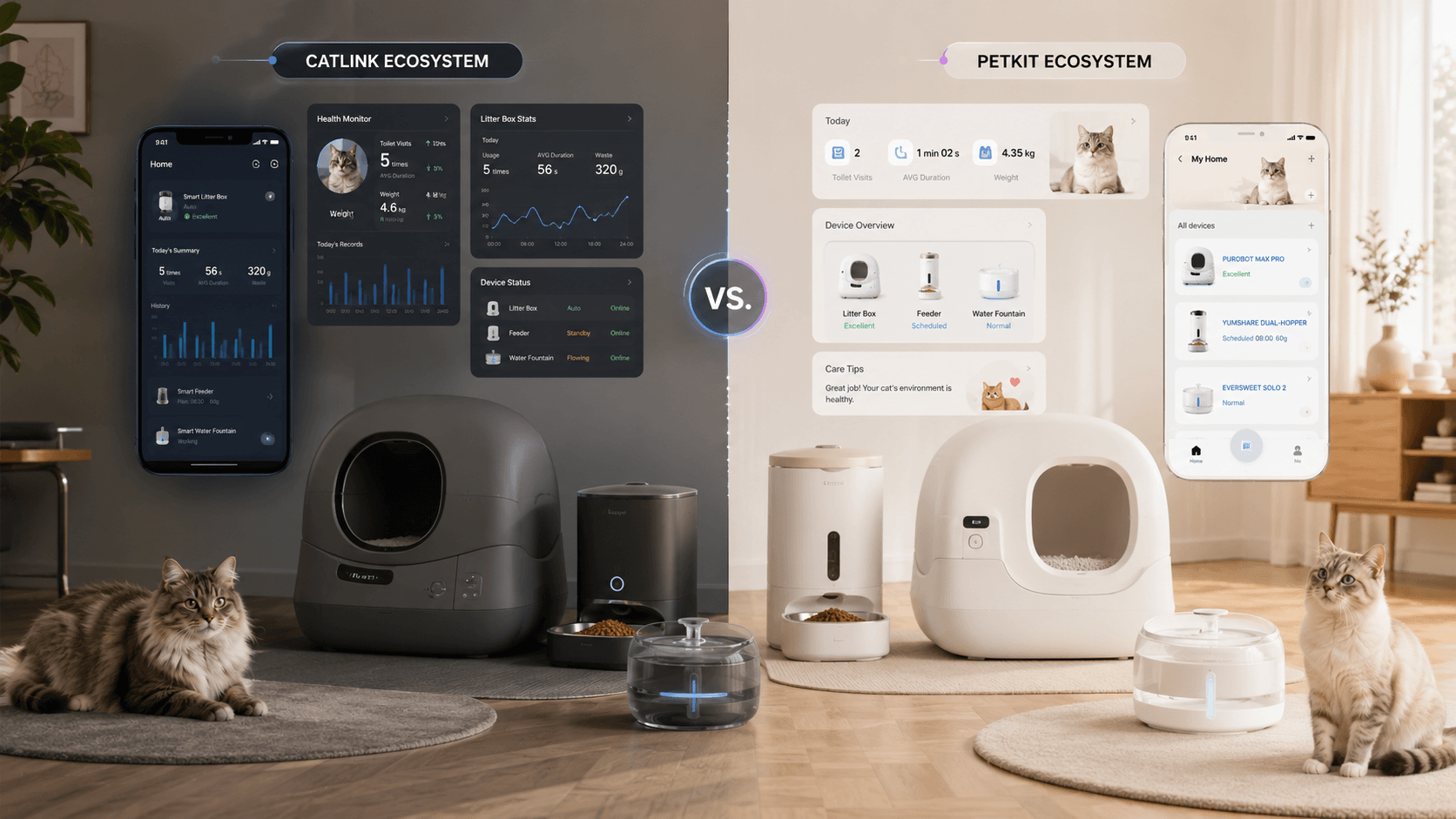
That is why PETKIT vs CATLINK is not really a contest over which brand can fit more “AI-powered health insights” into a product page.
The real question is:
Which ecosystem remains useful after the novelty disappears and the app starts sending notifications during dinner?
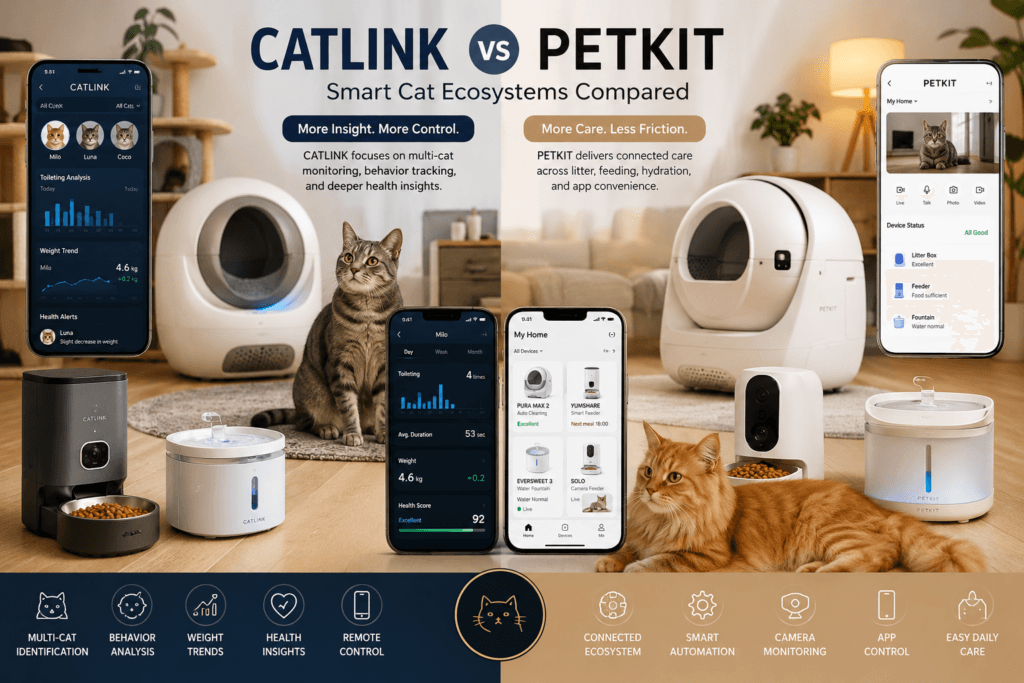
PETKIT currently offers the broader connected-care ecosystem, with strong options across litter boxes, feeders, fountains, cameras, and newer AI-led products.
CATLINK remains most interesting when litter-box monitoring and multi-cat routine data are the reason to buy—but its ecosystem is not equally convincing in every category.
Research note: This is a research-led ecosystem comparison based on official product documentation, current product availability, public ownership evidence, and PetTech AI’s individual product audits. PetTech AI has not conducted a long-term hands-on test of every device discussed.
Quick Verdict
| Category | Better fit |
|---|---|
| Best overall smart cat ecosystem | PETKIT |
| Broadest product choice | PETKIT |
| Camera-led feeding and hydration | PETKIT |
| Litter-box-first multi-cat monitoring | CATLINK |
| Simpler ecosystem expansion | PETKIT |
| Strongest reason to choose CATLINK | A specific CATLINK litter box fits your home better |
| Biggest PETKIT risk | Paying for cameras and AI features you stop using |
| Biggest CATLINK risk | Letting a strong litter-box concept pull you into weaker product categories |
The short version
Choose PETKIT if you want to build across litter care, feeding, and hydration without changing brand every time you add a device.
Choose CATLINK when a particular CATLINK litter box is already your preferred product and cat-by-cat litter data genuinely matters.
Choose neither brand purely because the word “ecosystem” makes three appliances sound as though they have formed an elite medical team.
They have not.
Affiliate disclosure: This page contains affiliate links. PetTech AI may earn a commission if you purchase through them, at no additional cost to you. As an Amazon Associate I earn from qualifying purchases.
Start with the Core Product
- Check current PETKIT PuraMax 2 pricing and availability
- Check current CATLINK Luxury Pro-X pricing and availability
Rule One: Choose the Product Before the Ecosystem
The biggest ecosystem mistake happens before the second device is even purchased.
A buyer chooses a brand philosophy, downloads the app, and then starts buying everything carrying the same logo—even when another brand makes the better feeder, fountain, or litter box.
That is backwards.
The first device should earn your trust on its own.
Only then should ecosystem convenience influence the second purchase.
A PETKIT feeder does not become better because you own a PETKIT litter box. It becomes more convenient because both devices share an app.
A CATLINK fountain does not become the right fountain because CATLINK’s litter analytics impressed you.
The ecosystem is a useful tie-breaker.
It is not diplomatic immunity for mediocre hardware.
PETKIT: The Better Ecosystem for Most Buyers
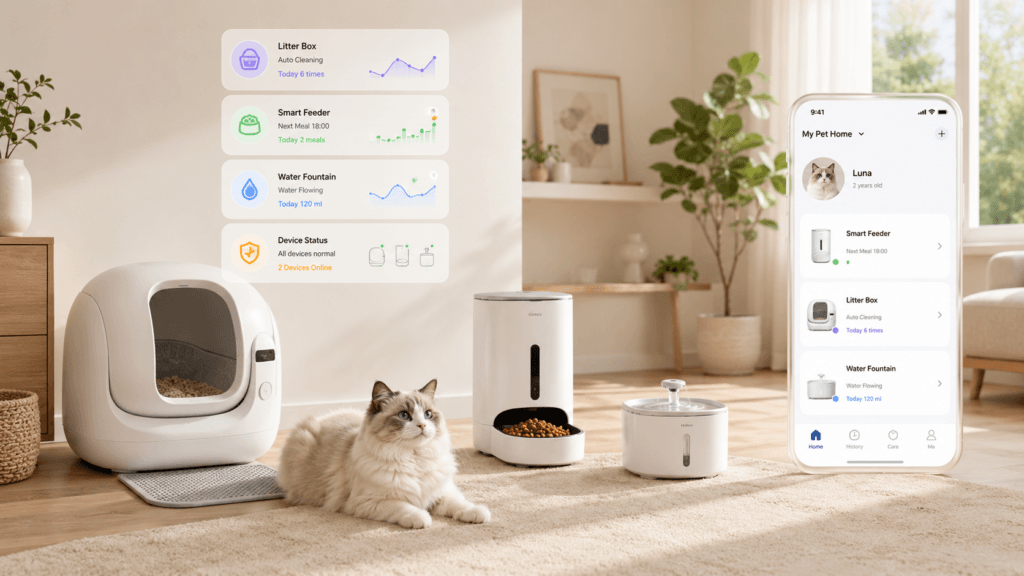
PETKIT currently makes the stronger argument as a complete smart cat ecosystem.
Its range covers:
- self-cleaning litter boxes;
- camera-equipped litter boxes;
- automatic dry-food feeders;
- camera feeders;
- wet-food automation;
- smart and cordless fountains;
- camera-based hydration monitoring;
- connected accessories and consumables.
The advantage is not simply quantity.
PETKIT offers several levels of complexity inside the same categories. You can choose a relatively straightforward PuraMax 2, a more monitoring-focused Purobot, a normal fountain, or an EverSweet model apparently determined to turn drinking water into a data science project.
That flexibility makes PETKIT easier to expand.
You do not have to decide on day one that your kitchen needs more sensors than a small airport.
PETKIT makes sense when:
- you plan to own devices across multiple categories;
- camera monitoring matters;
- you want more product choice;
- feeding and hydration are as important as litter care;
- you prefer one app but do not want your first product choice dictated entirely by it;
- you are comfortable with newer products having less long-term evidence.
Where PETKIT can disappoint
PETKIT’s newer direction is increasingly AI-heavy.
That means more cameras, more recorded events, more recognition features, and potentially more paid cloud functions depending on the device.
For some buyers, this is useful monitoring.
For others, it is an impressive technological system dedicated to confirming that the cat drank water at 2:43 p.m.
Before paying for the smarter version, ask:
Will this information change anything I do?
If the answer is no, choose the simpler PETKIT product.
Verdict: PETKIT is the stronger ecosystem recommendation, but individual products still have to pass the product-level trust gate.
CATLINK: Strongest When the Litter Box Is the Center
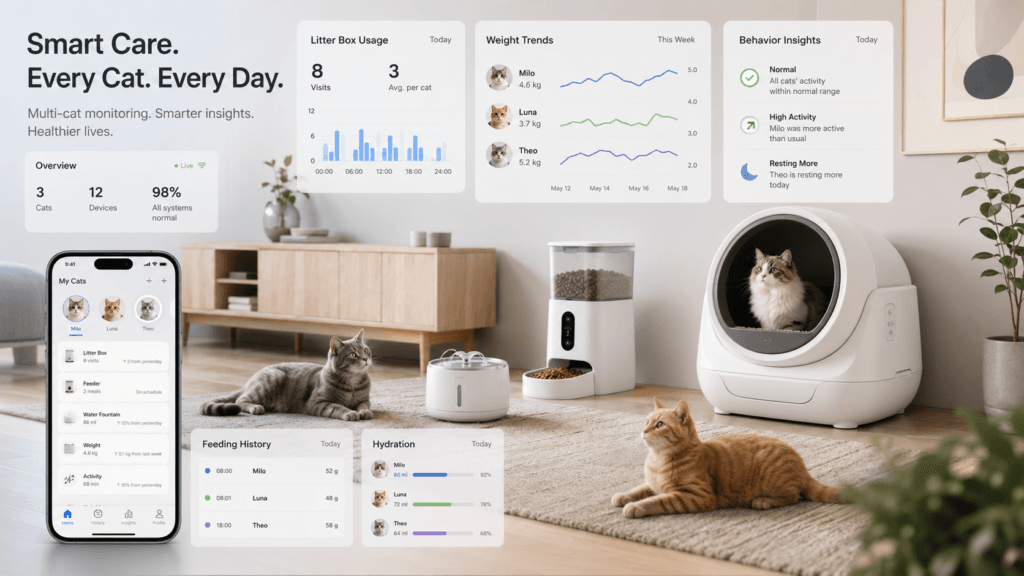
CATLINK’s clearest strength remains smart litter care.
Its app and litter-box marketing emphasize:
- cat recognition through weight data;
- toileting frequency;
- weight trends;
- multi-cat profiles;
- remote cleaning control;
- consumable reminders;
- alerts around changes in routine.
This can be useful in a multi-cat home where a shared litter box hides which cat used it.
CATLINK also sells feeders and fountains that connect to the same app, creating a broader input-and-output monitoring idea:
- what went into the cat;
- what came out of the cat;
- whether the app can turn both events into a graph.
That is a coherent concept.
The problem is that ecosystem coherence does not guarantee equal product quality.
Our current feeder analysis found CATLINK’s feeding options less convincing than its litter-box proposition. Fresh 2 RFID is interesting as a tracking product, but it is not a strong default recommendation for strict food separation. Facelink remains an immature specialist concept rather than a proven mainstream choice.
This creates CATLINK’s central trade-off:
The litter-box ecosystem may be compelling before the rest of the hardware is.
CATLINK makes sense when:
- a specific CATLINK litter box already wins your product comparison;
- you have multiple cats;
- weight-based litter-box recognition is useful;
- toileting trends are the main data you care about;
- you are comfortable checking current evidence separately for every additional CATLINK device.
Where CATLINK can disappoint
CATLINK’s marketing often presents the ecosystem as a unified health guardian.
That language sounds reassuring.
It does not mean the app has completed veterinary school.
Weight changes, unusual litter-box frequency, missed meals, and drinking changes can all be useful signals. Their value is that they tell you to observe the cat more closely or contact a veterinarian—not that the consumer device has diagnosed the problem.
CATLINK is most credible when it reports what happened.
It becomes less credible when marketing language encourages buyers to imagine that the graph knows why.
Verdict: CATLINK remains a legitimate litter-box-led ecosystem, but not a blanket recommendation across every product category.
Litter Boxes: The Closest Contest
This is where CATLINK can compete most seriously.
Both brands offer self-cleaning litter boxes with app control, multi-cat features, weight tracking, alerts, and different levels of health-oriented monitoring.
PETKIT’s advantage
PETKIT gives buyers more distinct choices:
- automation-first models;
- camera-equipped monitoring models;
- different sizes and entry designs;
- a broader path into feeders and hydration.
This makes it easier to choose how much technology you actually want.
CATLINK’s advantage
CATLINK has built more of its identity around litter-box data and multi-cat recognition.
A buyer mainly interested in toileting patterns may prefer the CATLINK philosophy—provided the specific litter box performs well, fits the cats physically, and has reassuring current ownership evidence.
Verdict
PETKIT wins on ecosystem breadth.
CATLINK can still win the individual litter-box decision.
That is why the brand should not be dismissed—but also why one strong CATLINK litter box should not automatically lead to a CATLINK feeder, fountain, and commemorative smart toaster.
For individual models, see our Best Smart Litter Boxes guide.
Feeders: PETKIT Wins Clearly
PETKIT has the stronger current feeder lineup.
Its YumShare models combine scheduled feeding with cameras, facial-recognition context, food monitoring, and one- or two-hopper configurations.
CATLINK’s Fresh 2 RFID and Facelink aim at identity-led feeding, but neither currently deserves the same recommendation strength.
This distinction matters.
PETKIT helps you see what happened around a feeding station.
CATLINK tries to associate feeding with a specific cat.
Neither approach automatically creates reliable physical access control, but PETKIT’s mainstream feeder proposition is currently easier to recommend.
For the detailed feeding decision, read PETKIT vs Feeder-Robot vs CATLINK.
Fountains: PETKIT Has the Stronger Range
PETKIT has a wider and more developed fountain portfolio, ranging from simpler connected fountains to cordless, UVC, and camera-equipped models.
EverSweet Ultra pushes the category furthest by combining camera monitoring with separated clean and wastewater tanks.
Whether anyone truly needs a fountain capable of recognizing the cat’s face is a separate philosophical question.
CATLINK fountains fit coherently into its broader monitoring system, but the brand currently gives buyers fewer compelling reasons to select the entire ecosystem around hydration.
Verdict
Choose the fountain on cleaning, pump design, materials, noise, and reliability first.
Choose the ecosystem second.
Water remains water even after the app produces a chart.
The Health-Monitoring Reality
Both brands now use health-oriented language.
Both can collect useful routine signals:
- litter-box visits;
- weight changes;
- feeding events;
- drinking activity;
- camera footage;
- changes over time.
This information can be valuable because cats often hide discomfort and routine changes may be noticed before obvious symptoms appear.
But there is an important line:
Monitoring records a pattern. It does not explain the pattern.
If Napoleon visits the litter box fourteen times in one evening, the app may help you notice.
It should not respond by awarding itself a degree in feline medicine.
The correct value of smart monitoring is:
- notice a meaningful change;
- verify that the data appears plausible;
- observe the cat directly;
- contact a veterinarian when appropriate.
Buy these systems for visibility and routine support—not diagnosis.
For the broader trade-off, read Smart Cat Monitoring vs Automation.
Where Ecosystem Buyer Regret Comes From
| Ecosystem | Most likely regret |
|---|---|
| PETKIT | Paying for camera and AI layers that become ignored |
| CATLINK | Assuming every connected device is as convincing as the litter box |
| Either brand | Buying a bundle before validating the first product |
| Either brand | Confusing health data with medical certainty |
| Either brand | Accepting more maintenance because the app looks impressive |
The most dangerous phrase in smart-pet marketing may be:
“Everything works together.”
Three average products can also work together.
That does not make them excellent. It makes them coordinated.
Which Ecosystem Fits Your Home?
Choose PETKIT for a broad connected home
PETKIT is the better fit when:
- you intend to add products gradually;
- litter, feeding, and hydration all matter;
- camera-led monitoring appeals to you;
- you want more choice inside each category;
- the ecosystem itself is part of the buying decision.
For most households building beyond one device, this is the safer direction.
Choose CATLINK for a litter-box-led multi-cat setup
CATLINK is worth considering when:
- its litter box wins your model-level comparison;
- multiple cats share the box;
- weight and toileting patterns matter;
- you value cat-by-cat litter data;
- you are willing to judge feeders and fountains separately.
CATLINK should follow a strong product choice.
It should not precede one.
Choose neither ecosystem when one device is enough
Owning one smart litter box does not create an urgent need for a matching feeder and fountain.
Your cat will survive the emotional trauma of using appliances made by different companies.
A mixed setup is often better when:
- one brand makes the best litter box for your home;
- another makes the better feeder;
- a simple offline fountain already works;
- you do not care about a single dashboard.
One app is convenient.
Better hardware is usually more convenient.
The Six-Month Test
After six months, which part of the ecosystem will still matter?
Probably not:
- the launch animation;
- the first week of camera clips;
- the novelty of receiving a notification when your cat urinates;
- the satisfaction of seeing three matching icons in one app.
What may still matter:
- fewer litter chores;
- reliable meals;
- cleaner water;
- useful multi-cat identification;
- alerts that occasionally reveal a real change;
- replacement parts and support that still exist.
Build the ecosystem around those outcomes.
Not the logo.
Final Verdict
PETKIT is the better smart cat ecosystem for most buyers.
It has the broader and more convincing spread across litter boxes, feeders, fountains, cameras, and different levels of automation. It gives buyers more room to start simple and add monitoring only where it provides real value.
CATLINK remains most credible as a litter-box-led ecosystem.
Its multi-cat and toileting-data philosophy can be useful, and individual CATLINK litter boxes may beat PETKIT for a particular home. But the ecosystem becomes less convincing when buyers assume that every feeder and fountain deserves the same confidence.
The best strategy is therefore not blind brand loyalty.
Start with the strongest individual product.
Let that product earn the second purchase.
And remember: your cat did not request a unified AI care platform. He requested dinner, clean litter, and unrestricted access to whatever object you just placed on the table.
Frequently Asked Questions
Is PETKIT better than CATLINK?
PETKIT is the better overall ecosystem for most buyers because it offers a broader and more convincing range across litter care, feeding, hydration, and camera monitoring. CATLINK may still be better when a specific litter box and multi-cat toileting data are the main priorities.
Is CATLINK better for multiple cats?
CATLINK’s litter-box ecosystem places strong emphasis on weight-based recognition and separate cat profiles. That can make it useful in multi-cat homes, but accuracy and value still depend on the specific device and how distinct the cats’ weights and routines are.
Which brand has better feeders?
PETKIT currently has the stronger feeder lineup. YumShare Solo 2 and Dual-Hopper 2 offer clearer mainstream use cases, while CATLINK’s identity-led feeders require more cautious product-level evaluation.
Which brand has better fountains?
PETKIT offers the broader fountain range, including cordless, UVC, app-connected, and camera-equipped options. The best fountain should still be selected primarily on cleaning, materials, pump reliability, and the cat’s acceptance.
Can PETKIT or CATLINK diagnose health problems?
No. Their products can identify changes in routine and provide useful data, but they cannot determine the medical cause of those changes or replace veterinary assessment.
Should all my smart cat devices use the same app?
Not necessarily. One app is convenient, but it should not outweigh meaningful differences in reliability, cleaning, cat fit, safety, or the quality of the product’s main function.
References
- PETKIT official Smart Home and product ecosystem documentation
- PETKIT official 2026 AI ecosystem announcements
- PETKIT official litter-box, feeder, and fountain product information
- CATLINK official app and multi-cat monitoring documentation
- CATLINK official ecosystem bundle information
- PetTech AI individual product and category audits
Image Disclosure
Some images in this article may be AI-generated for illustrative purposes. They do not depict the exact products and should not be used to evaluate product dimensions, controls, fit, or physical features.
Disclosure
PetTech AI may earn a commission when readers purchase through affiliate links. This comparison does not assume that every product deserves a recommendation simply because it belongs to a connected ecosystem. The app is convenient; the product still has to work.