Imagine two cats.
Jonathan eats slowly, respects boundaries, and believes dinner should be approached with dignity.
Napoleon has annexed Jonathan’s bowl, declared the kitchen part of his empire, and is now negotiating control of the snack cupboard.
A normal automatic feeder can serve both cats on time.
A camera feeder can record the invasion in excellent detail.
Neither necessarily stops Napoleon.
That is the central problem with smart-feeder comparisons: scheduled feeding, camera monitoring, dual-food storage, RFID tracking, and genuine access control are often treated as interchangeable features.
They are not.
This comparison looks at PETKIT YumShare Solo 2, YumShare Dual-Hopper 2, Whisker Feeder-Robot, CATLINK Fresh 2 RFID, and CATLINK Facelink to identify which feeding problem each one actually solves—and which expensive feature may become completely irrelevant after the first week.
Research note: This is a research-led comparison based on official documentation, independent testing, current availability, and public owner feedback. PetTech AI has not conducted a long-term hands-on test of every product included.
Quick Verdict
| Your real problem | Best fit | Why |
|---|---|---|
| Reliable scheduled dry-food meals | Feeder-Robot | Mature, large-capacity routine automation |
| Seeing whether your cat approached the bowl | PETKIT YumShare Solo 2 | Camera-led meal visibility without paying for two hoppers |
| Using two dry foods in one routine | PETKIT YumShare Dual-Hopper 2 | Two compartments plus camera monitoring |
| Tracking cats through RFID tags | CATLINK Fresh 2 RFID | Interesting specialist option, but not a strong default recommendation |
| Experimental facial-recognition feeding | CATLINK Facelink | Ambitious concept with insufficient current validation |
| Preventing the wrong cat from accessing food | A true microchip/access-controlled feeder | Physical access restriction matters more than another app dashboard |
The short version
Choose Feeder-Robot when you want food to arrive reliably and have no interest in producing a documentary about it.
Choose YumShare Solo 2 when seeing the bowl changes what you do.
Choose Dual-Hopper 2 when two different dry foods are genuinely part of the routine.
Do not buy Fresh 2 RFID or Facelink simply because “AI,” “RFID,” and “multi-cat” appear in the product description. Those words are features, not proof that Napoleon will respect Jonathan’s prescription diet.
Affiliate disclosure: This page contains affiliate links. PetTech AI may earn a commission if you purchase through them, at no additional cost to you. As an Amazon Associate I earn from qualifying purchases.
Compare the Recommended Options
- Check Feeder-Robot price and availability
- Check PETKIT YumShare Solo 2 price and availability
- Check PETKIT YumShare Dual-Hopper 2 price and availability
For refrigerated wet food, microchip feeders, budget models, and other categories, see our Best Automatic Cat Feeders guide.
First Decide What You Are Automating
Most households need one of four things.
Routine
Food should appear at the right time in a reasonably accurate portion.
This is Feeder-Robot territory.
Visibility
You want to know whether the cat appeared, how long it stayed, or whether food remained in the bowl.
This is where PETKIT earns its camera.
Food flexibility
You want two different dry foods available for transitions, mixtures, or different feeding plans.
This is the Dual-Hopper 2 use case.
Access control
Only one specific cat should be able to reach specific food.
This is where many “smart” feeders suddenly become less intelligent than their marketing department.
A camera can identify the thief.
An RFID tag can identify the intended diner.
Neither automatically creates a locked door around the bowl.
For a deeper explanation of this distinction, read Smart Cat Monitoring vs Automation.
Feeder-Robot: The Sensible Adult in the Room
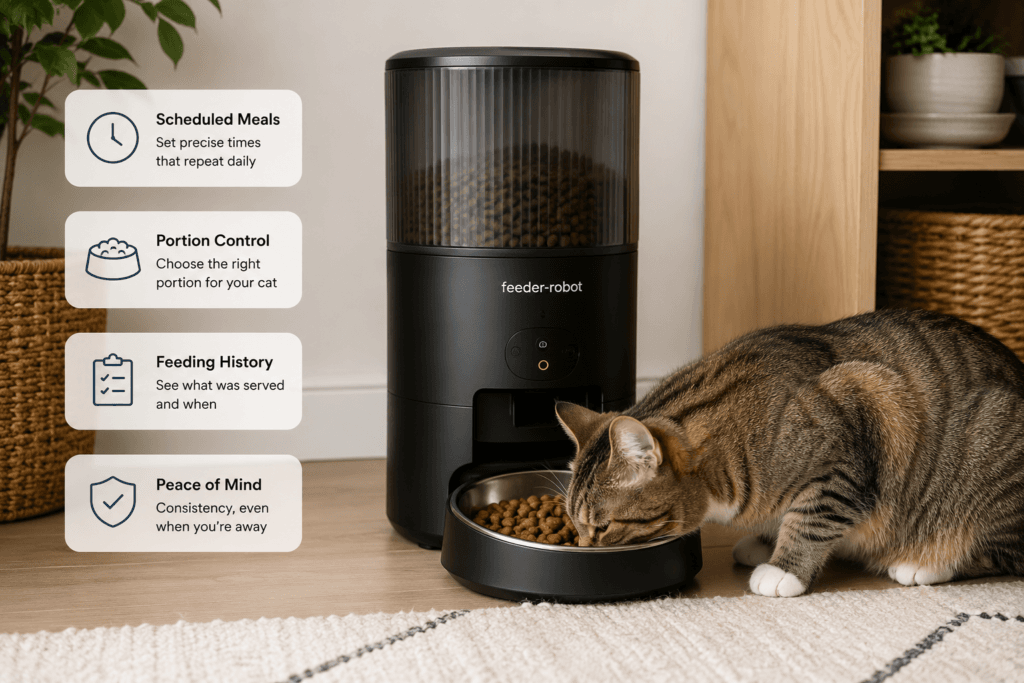
Feeder-Robot is the least theatrical product in this comparison.
There is no camera watching your cat chew. There is no facial-recognition layer trying to determine whether Mr. Whiskers has approached from a flattering angle.
It stores dry food, follows a schedule, measures portions, works offline, and tries not to jam.
That sounds almost disappointingly ordinary—which is precisely why it remains attractive.
Feeder-Robot offers:
- up to 32 cups of dry or semi-moist food;
- up to eight scheduled meals per day;
- portions dispensed in 1/8-cup increments;
- app and onboard controls;
- offline schedule storage;
- food-backup detection and anti-jam functions;
- an optional backup battery.
Buy it if
- one feeding routine serves the household;
- cats do not steal different diets from one another;
- reliability matters more than camera clips;
- you want a large hopper;
- you already use the Whisker app;
- you want the machine to become boring.
Boring is underrated.
A feeder that becomes invisible after setup has succeeded. A feeder that requires three notifications, two subscriptions, and a weekly diplomatic summit may technically be smarter, but it has also become a new hobby.
Where it can disappoint
Feeder-Robot is bulky and expensive.
Its removable components require hand washing, and the standard bowl is less premium than some stainless-steel or ceramic alternatives.
More importantly, it has no idea which cat eats the food.
If Napoleon waits beside the bowl while Jonathan’s portion drops, Feeder-Robot has completed its assignment perfectly. Jonathan may disagree.
Recommendation: The strongest routine-first option in this comparison.
PETKIT YumShare Solo 2: When Seeing the Meal Matters
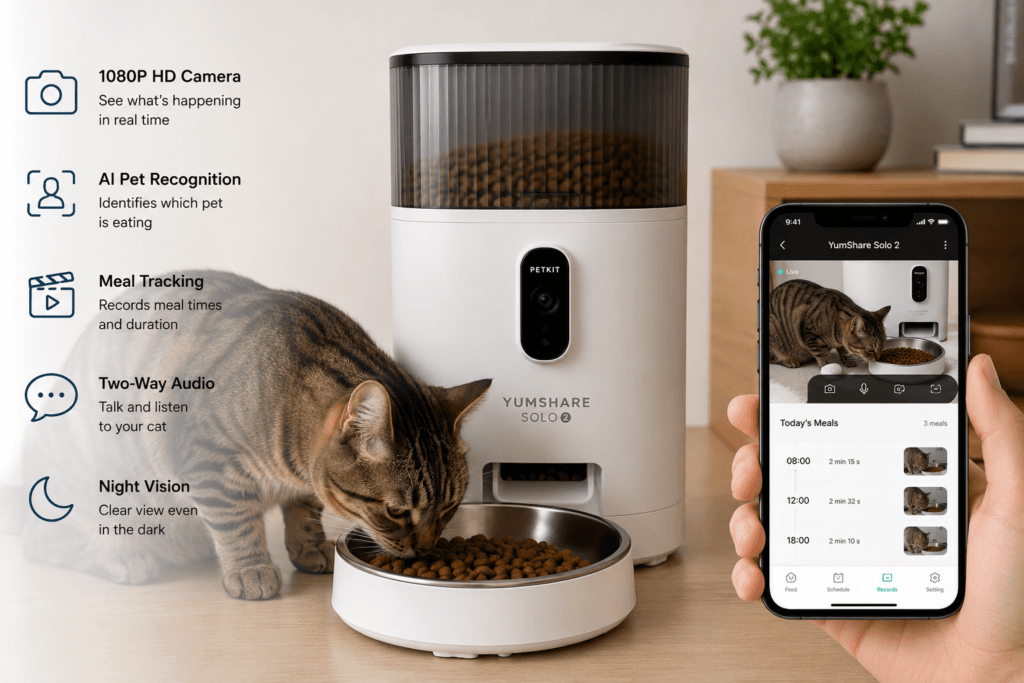
YumShare Solo 2 starts with the same basic job—dispensing dry food—but adds a camera and an AI monitoring layer.
The 3 L feeder can stream live video, record feeding activity, distinguish cats according to PETKIT’s recognition system, monitor whether food remains in the bowl, and build a visual meal history.
That is useful when the unanswered question is:
“Did my cat actually come to eat?”
A conventional smart feeder confirms that it operated.
Solo 2 adds visual context.
Buy it if
- you spend substantial time away from home;
- appetite changes are something you actively monitor;
- multiple cats use the same feeding area;
- seeing leftover food changes your decisions;
- you already use the PETKIT ecosystem;
- you will genuinely check the footage.
That final point matters.
A camera feeder is only valuable while somebody cares about the camera. After six months, many owners will either use meal visibility regularly or possess a very sophisticated device for filming an empty bowl.
Where it can disappoint
Solo 2 is still a newer product, so its long-term reliability record is developing.
Some cloud storage and playback functions may require paid services. Facial recognition can provide useful context, but it should not be confused with physical food protection.
The camera may show Napoleon eating Jonathan’s meal in high definition.
It remains a witness, not a security guard.
Recommendation: The best PETKIT choice when one hopper is enough and visual reassurance is the reason to upgrade.
PETKIT YumShare Dual-Hopper 2: Two Foods, Not Two Private Restaurants
Dual-Hopper 2 combines PETKIT’s camera system with two food compartments and a total capacity of 5 L.
The extra hopper can make sense for:
- mixing two compatible dry foods;
- transitioning gradually between diets;
- alternating food types;
- combining kibble and suitable freeze-dried pieces;
- keeping a more flexible routine without manually changing the hopper.
This is a legitimate benefit.
It is not automatically a multi-cat diet solution.
Both food sources ultimately dispense into the same feeding area. The feeder may recognize cats and produce individual records, but two hoppers do not create two private restaurants.
Buy it if
- two dry foods are already part of the plan;
- you want PETKIT’s camera and bowl monitoring;
- the larger 5 L capacity is useful;
- food transitions happen regularly;
- you will use both compartments beyond the first week.
Skip it if
- your cat eats one food;
- one hopper already solves the problem;
- you mainly want reliable scheduling;
- you are attracted to the phrase “dual-hopper” without knowing what will occupy the second half.
An unused hopper is not future-proofing.
It is an expensive cupboard.
Subscription caveat
Live monitoring and core feeder functions provide value without turning every interaction into a paid event, but some replay and extended cloud-video functions require a subscription.
Check which features are included before deciding that your cat needs a cinematic archive.
Recommendation: Choose it over Solo 2 only when the second food compartment solves a recurring problem.
CATLINK Fresh 2 RFID: Useful Tracking, Questionable Diet Protection
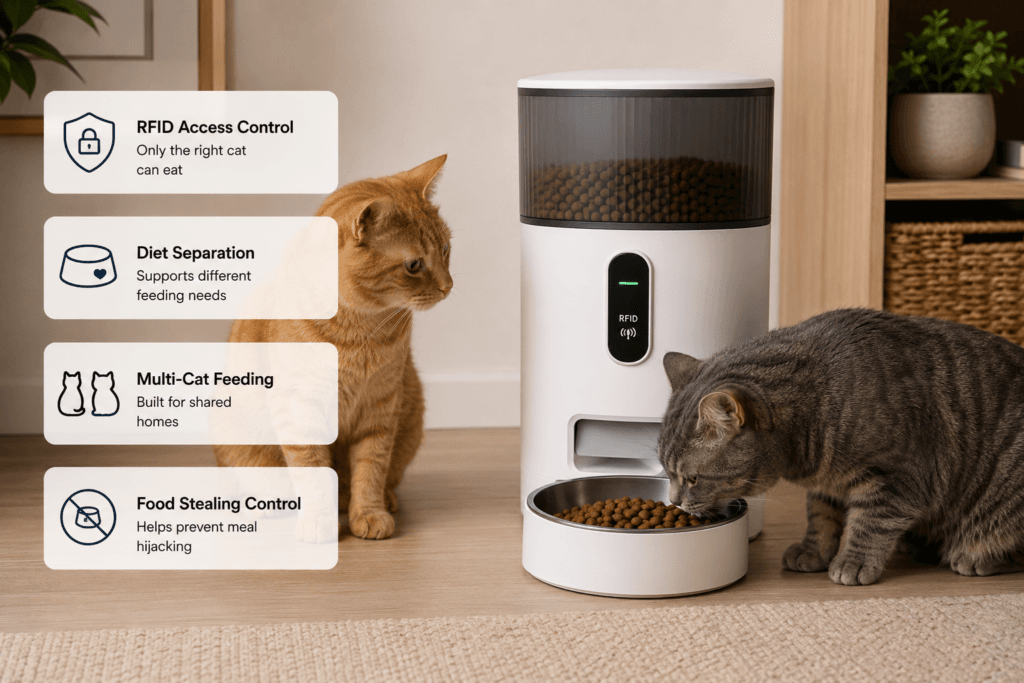
Fresh 2 RFID uses collar tags to associate feeding activity with individual cats.
It provides:
- a 4 L food hopper;
- scheduled portions;
- app control;
- RFID collar tags;
- cat-level feeding records;
- a ceramic bowl;
- battery backup.
The concept is attractive for multi-cat homes.
The recommendation is not.
Current ownership evidence remains too mixed and limited to treat Fresh 2 RFID as the safest answer to food stealing, weight-control conflict, or prescription-diet separation.
There is also a conceptual trap here.
RFID recognition tells the feeder which tagged cat approached. That does not necessarily prevent a second cat from eating food once it is accessible.
Fresh 2 may be worth exploring when:
- you specifically want CATLINK feeding records;
- your cats tolerate collars;
- the consequences of occasional food sharing are low;
- you are willing to test the setup carefully;
- current return terms are favorable.
It should not be the default when one cat becoming Jonathan’s unpaid food inspector would create a medical problem.
Recommendation: Mention cautiously. Do not push as a reliable access-control solution.
CATLINK Facelink: Impressive Idea, Insufficient Proof
Facelink is the most ambitious feeder here.
CATLINK says it can recognize individual cats, dispense personalized amounts, monitor the bowl through a camera, track eating behavior, and reduce food competition.
In concept, it is Minority Report for kibble.
In practice, current evidence is not strong enough for a mainstream recommendation.
At the time of this review, the U.S. product page listed Facelink as sold out and showed no published owner reviews. Availability and market maturity may change, but a complex identity-led feeder needs more than a compelling demonstration video before it should be trusted with strict diet management.
Facial recognition must work through:
- changing light;
- unusual approach angles;
- similar-looking cats;
- crowded feeding areas;
- cats moving at the exact moment technology would prefer them to pose for a passport photograph.
Facelink remains interesting.
Interesting is not the same as proven.
Recommendation: Watchlist product. No strong CTA until availability and independent ownership evidence improve.
The Napoleon Test: What Happens When One Cat Steals Food?
This is the simplest way to understand the entire comparison.
Feeder-Robot
Dispenses Jonathan’s food on time.
Napoleon eats it.
The app confirms that the feeder performed beautifully.
PETKIT YumShare Solo 2
Dispenses Jonathan’s food.
Records Napoleon eating it.
You now possess evidence for the trial.
PETKIT YumShare Dual-Hopper 2
Dispenses one of two foods.
Records Napoleon eating whichever one interested him most.
The empire has diversified.
CATLINK Fresh 2 RFID
May identify which tagged cat approached and associate feeding records with it.
Whether that consistently prevents theft is a separate question.
CATLINK Facelink
Claims individualized facial-recognition feeding and anti-competition logic.
The concept is stronger than the current validation.
True microchip or access-controlled feeder
Opens only for the authorized cat and closes when that cat leaves.
Less cinematic.
More useful when the diet actually matters.
Where Buyer Regret Comes From
| Product | Most likely regret |
|---|---|
| Feeder-Robot | Expecting it to identify or separate cats |
| YumShare Solo 2 | Paying for a camera you stop checking |
| Dual-Hopper 2 | Using one food in a two-hopper machine |
| Fresh 2 RFID | Assuming RFID tracking guarantees food protection |
| Facelink | Paying early-adopter money for an immature system |
The smartest specification is the one still solving a problem six months later.
Everything else is decoration with a power cable.
Decision Matrix
Choose Feeder-Robot when:
- scheduled feeding is the priority;
- one routine serves the household;
- hopper capacity matters;
- cats share food without conflict;
- you want the lowest daily friction.
Choose YumShare Solo 2 when:
- seeing the feeding area matters;
- appetite or attendance is worth monitoring;
- one food is enough;
- you travel or work away from home;
- PETKIT integration adds value.
Choose Dual-Hopper 2 when:
- two foods are genuinely required;
- camera monitoring also matters;
- food transitions are common;
- you want PETKIT’s larger feeder.
Consider CATLINK only when:
- identity-led experimentation is the point;
- you accept greater uncertainty;
- return protection is good;
- strict medical separation is not being entrusted to an unproven setup.
Choose a true access-controlled feeder when:
- one cat steals;
- diets must remain separated;
- one animal needs prescription food;
- physical denial matters more than monitoring.
Final Verdict
There is no universal winner because these feeders are solving different problems.
Feeder-Robot is the strongest choice for reliable, low-friction dry-food scheduling. It is large, expensive, and almost aggressively uninterested in filming your cat—but its routine-first design is exactly what many households need.
PETKIT YumShare Solo 2 is the better choice when visual confirmation changes how you manage feeding. It adds meaningful context without requiring you to pay for a second hopper.
YumShare Dual-Hopper 2 earns the upgrade only when two food sources are genuinely useful. Do not buy it because two containers look more technologically important than one.
CATLINK Fresh 2 RFID remains a cautious specialist option rather than a default recommendation, while Facelink is too immature and poorly validated for a confident push.
The final rule is simple:
Buy the feeder that solves the recurring problem—not the one that produces the longest feature table.
For Jonathan, that might be access control.
For Napoleon, all feeders are merely obstacles awaiting strategic analysis.
Frequently Asked Questions
Is PETKIT better than Feeder-Robot?
PETKIT is better when camera monitoring and visual meal records matter. Feeder-Robot is better when the priority is mature, large-capacity scheduling with less technological involvement.
Is Dual-Hopper 2 better than Solo 2?
Only when two food sources are genuinely useful. For one stable dry-food routine, Solo 2 is simpler and less likely to leave you paying for an unused compartment.
Can PETKIT stop one cat from stealing another cat’s food?
Not reliably through camera recognition alone. PETKIT can provide visual and individual feeding context, but it does not create the same physical access barrier as a dedicated microchip feeder.
Does Feeder-Robot work without Wi-Fi?
Yes. Once a schedule is stored locally, scheduled meals continue even if the feeder loses its network connection.
Is CATLINK Fresh 2 a true access-controlled feeder?
It uses RFID tags for identification and feeding records, but buyers should not assume this guarantees physical food separation. Strict diet protection requires careful validation or a feeder specifically designed to block unauthorized access.
Which feeder is best for one cat?
Feeder-Robot is the cleaner choice for straightforward scheduled feeding. YumShare Solo 2 is better when camera visibility is important enough to justify the additional technology.
References
- PETKIT YumShare Solo 2 official product documentation
- PETKIT YumShare Dual-Hopper 2 official product documentation
- Whisker Feeder-Robot official specifications and support documentation
- Independent long-term automatic-feeder testing
- CATLINK Fresh 2 RFID official documentation and public ownership reports
- CATLINK Facelink official product documentation and current availability
Image Disclosure
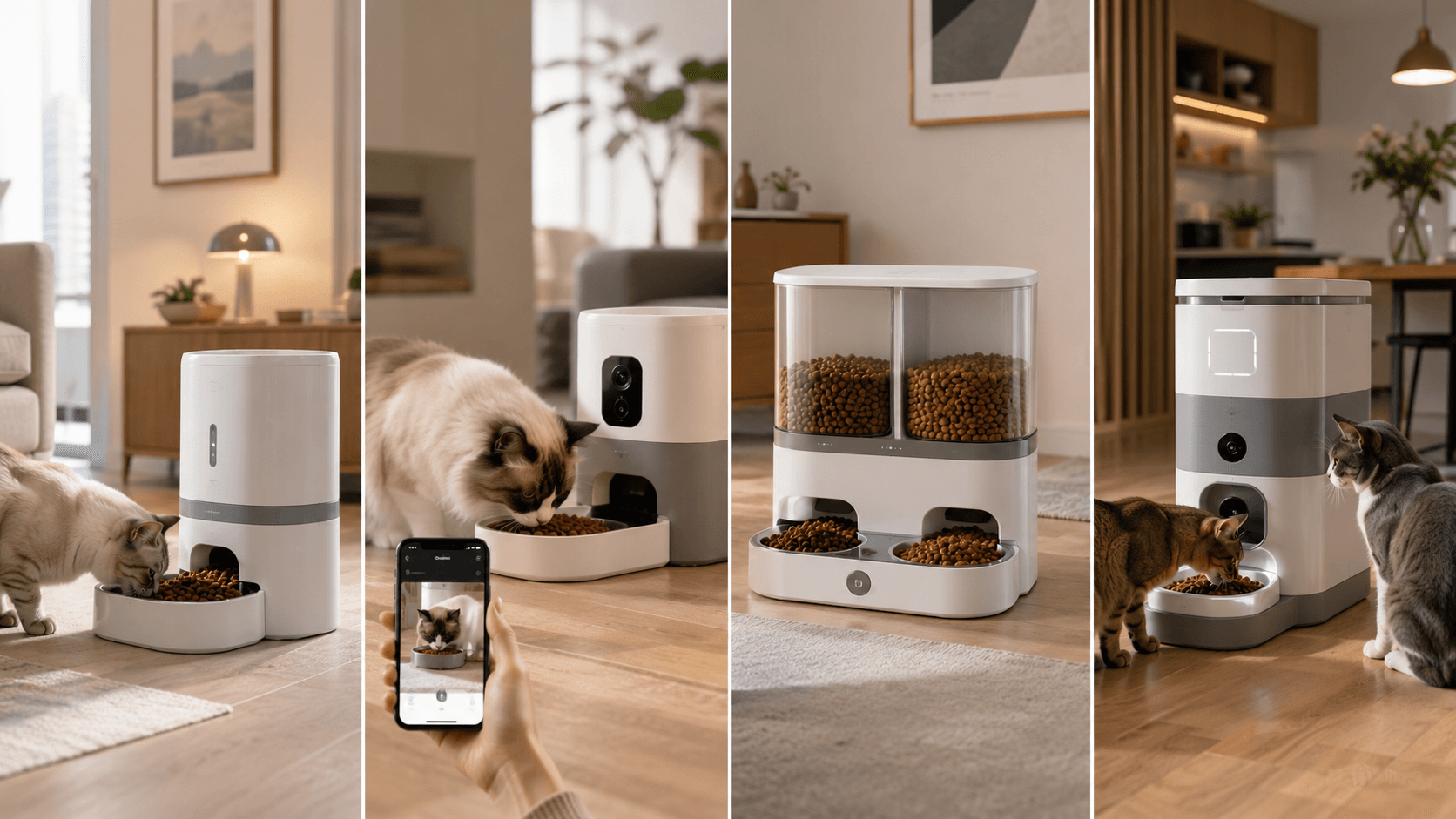
Some images in this article may be AI-generated for illustrative purposes. They do not depict the exact products and should not be used to evaluate dimensions, fit, controls, or physical features.
Disclosure
PetTech AI may earn a commission when readers purchase through affiliate links. This comparison prioritizes the feeding problem each product can realistically solve, rather than rewarding whichever manufacturer discovered the greatest number of adjectives for a food dispenser.