
Baron approaches the new automatic litter box.
It cleans itself, tracks visits and has enough sensors to supervise a minor airport.
Baron looks inside, looks at you and returns to the old plastic tray.
The machine has passed every technical test except the one involving the cat.
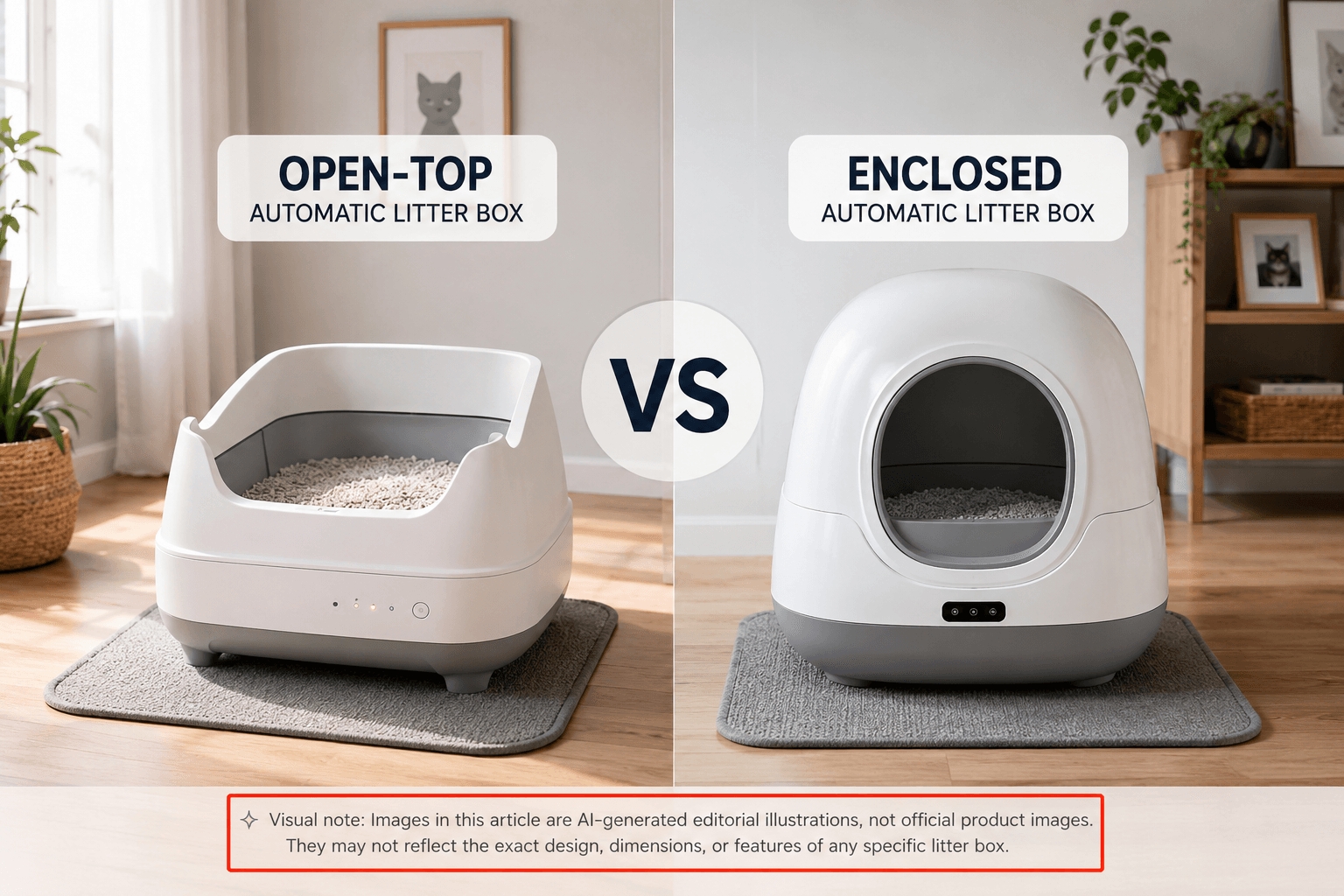
That is why open-top vs enclosed automatic litter boxes is not a cosmetic comparison. The shape affects visibility, entry, usable space, litter containment and how much change the cat must accept at once.
But the format is only half the decision.
A good open-top design does not magically rehabilitate a weak product. A sophisticated enclosed robot is equally useless when the cat treats its entrance like the gateway to an underground laboratory.
Open-top automation is the better starting point for cats that dislike covered trays, need visual awareness or are moving from a traditional box for the first time.
Enclosed automation is usually better for confident cats, aggressive litter kickers and households that prioritize containment.
The right format reduces resistance.
The right product still needs to earn the recommendation.
Research Note
This is a research-led guide based on feline litter-box guidance, current product documentation and available ownership evidence.
PetTech AI has not conducted a long-term hands-on test of every model mentioned.
Quick Verdict
| Cat or household situation | Better starting point | Why |
|---|---|---|
| Cat consistently rejects covered boxes | Open-top | Preserves visibility and a clearer exit |
| First move from a traditional tray to automation | Open-top | Requires a smaller behavioral adjustment |
| Large, cautious or mobility-sensitive cat | Open-top, if entry is genuinely accessible | Avoids a narrow enclosed chamber |
| Cat already uses covered boxes confidently | Enclosed | The form factor is unlikely to be the main obstacle |
| Cat kicks litter or urinates over low sides | Enclosed | Better containment |
| Dog or child needs to be kept away from the litter | Enclosed | More separation from the room |
| Owner prioritizes odor and litter containment | Enclosed | High walls and enclosed chambers usually contain more mess |
| Multi-cat home with possible resource guarding | Neither by default | Placement, exits and additional litter stations matter more |
Recommendation strength
Open-top format: Recommended for visibility-sensitive cats and easier transitions—but only when the machine itself is credible.
Enclosed format: Recommended for confident cats and containment-focused homes, provided the interior is spacious enough.
As an Amazon Associate I earn from qualifying purchases.
Want the most established current open-top option? Check Neakasa M1 Plus on Amazon.
Want simpler, lower-cost open-top automation? Check PetPivot availability on Amazon.
Open-Top Is a Form Factor, Not a Quality Certificate
An open-top automatic litter box preserves more of the visual logic of a traditional tray.
The litter is visible. The cat can inspect the surrounding room. There is no tunnel or enclosed globe to enter before reaching the litter.
That can reduce one source of uncertainty.
It does not guarantee:
- quiet operation;
- reliable sensors;
- safe cleaning cycles;
- good odor containment;
- easy deep cleaning;
- competent customer support;
- long-term mechanical reliability.
Some open-top products are well-established machines.
Others are anonymous plastic optimism with an app.
The design may help the cat approach the box. It does not tell you whether the owner will still trust it six months later.
Which Cats May Prefer Open-Top Automation?
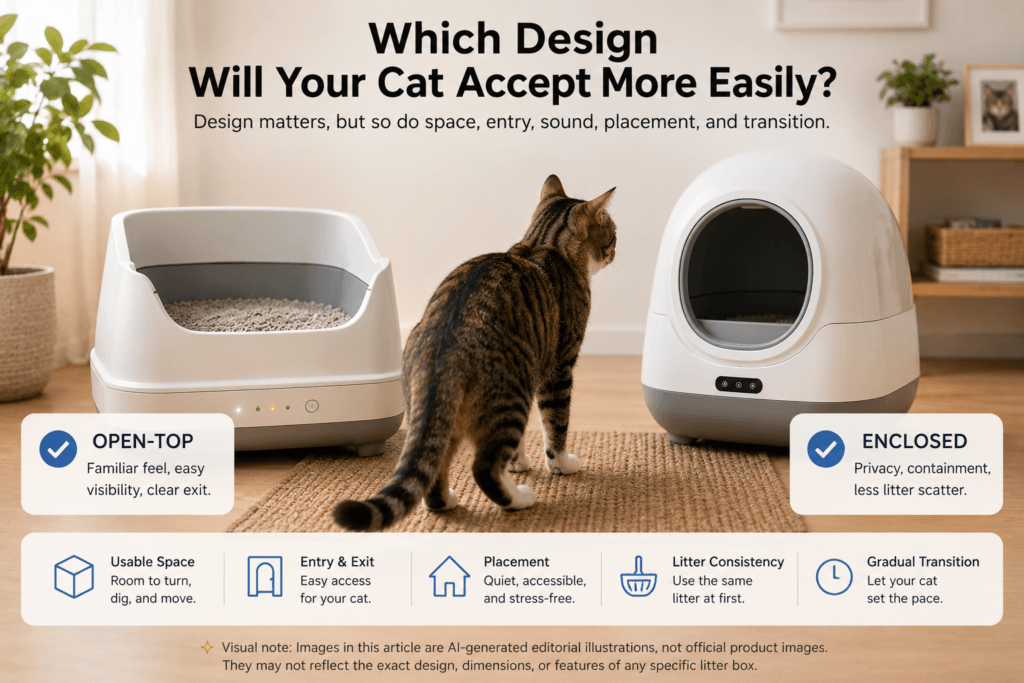
Cats that reject covered litter boxes
The clearest signal is existing behavior.
If a cat consistently avoids hooded trays but uses open boxes willingly, an enclosed robot adds a known source of resistance before the motor even moves.
An open-top machine preserves:
- visual awareness;
- overhead clearance;
- a more obvious exit;
- a layout closer to the cat’s existing routine.
This does not mean the cat will accept automation instantly.
It means the product is not beginning the relationship by ignoring an already documented preference.
Cautious cats that monitor the room
Some cats appear uncomfortable when they cannot see approaching people, animals or escape routes.
This matters in:
- busy homes;
- multi-cat households;
- homes with dogs;
- litter areas near hallways;
- rooms where another cat can block the entrance.
An open-top design may feel less defensible because the cat can observe the room while using it.
The better solution may still be improved placement or another litter station. Installing a more visible robot in the same ambush point is not behavioral innovation.
Cats transitioning from a traditional tray
The move from an open plastic tray to a rotating enclosed globe can change:
- shape;
- entry;
- sound;
- movement;
- litter depth;
- location;
- odor;
- exit route.
Open-top automation keeps at least part of the old visual experience intact.
That can make it a gentler first experiment for cats that have never used an enclosed box.
Large or mobility-sensitive cats
Open-top designs can offer more headroom and fewer enclosed surfaces.
However, “open” does not automatically mean “accessible.”
Check:
- step height;
- wall height;
- usable tray area;
- whether the cat can turn normally;
- whether entry requires awkward climbing;
- whether the mechanism reduces the space available inside.
A high-sided open tray may still be a poor choice for an arthritic cat. Marketing departments occasionally discover that removing the roof does not lower the entrance.
When Enclosed Automation Makes More Sense
Cats already comfortable with covered boxes
A cat that calmly uses a hooded tray has already answered part of the question.
For that cat, enclosure may not be a meaningful obstacle. Interior room, noise and transition speed become more important.
An enclosed robot can then provide stronger containment without asking the cat to accept a completely unfamiliar bathroom style.
Aggressive diggers and litter kickers
Some cats excavate as though a second litter box is buried beneath the first.
An enclosed design can keep more litter inside the unit and reduce the radius of daily destruction.
This advantage is practical, not glamorous.
Nobody purchases a premium litter robot because sweeping granules from the hallway has become an emotionally fulfilling ritual.
Homes where containment matters
Enclosed boxes can make more sense when:
- the litter area is near furniture;
- dogs investigate the waste;
- children have access to the room;
- urine occasionally escapes low-sided trays;
- the owner wants less visible litter and waste.
The trade-off is that containment for the household can feel like confinement to the cat.
The interior must provide enough room to enter, turn, squat, dig and leave without awkward positioning.
The Current Open-Top Shortlist
Neakasa M1 Plus — Recommended
Verdict: Recommended as the most established current open-top benchmark.
Neakasa M1 Plus has the strongest ownership history among the current open-top candidates and is designed around a large open tray, app controls and a substantial waste drawer.
Its main argument is not novelty.
It is that enough households have used it for the product to possess an actual track record rather than a launch campaign and several hopeful product samples.
Neakasa makes the most sense when:
- open visibility is important;
- the cat needs generous usable space;
- the buyer wants app-connected automation;
- paying more for the better-established option is acceptable.
That does not make it flawless. Deep cleaning, odor containment and the exposed tray format still require scrutiny.
It is simply the open-top product that currently has the strongest right to be taken seriously.
PetPivot AutoScooper — Recommended with Conditions
Verdict: Recommended with conditions for simple, lower-cost automation.
PetPivot has a simpler proposition.
It is designed for owners who want the box to clean itself without turning litter management into another connected ecosystem requiring profiles, dashboards and a long-term digital relationship.
That simplicity can be useful.
It can also mean fewer advanced controls, less detailed monitoring and a less mature support environment.
PetPivot makes sense when:
- price sensitivity matters;
- basic automatic cleaning is enough;
- the owner does not need extensive app features;
- expectations remain proportionate to the product tier.
It should not be purchased because a lower price has somehow suspended the need for safety, durability and customer support.
A budget robot remains a robot operating around an animal.
CATLINK Open-X — Conditional Recommendation
Verdict: Conditional recommendation for app-focused multi-cat households.
As an Amazon Associate I earn from qualifying purchases.
Need open-top access with app-based multi-cat tracking? Check CATLINK Open-X on Amazon.
CATLINK Open-X is the most strategically interesting option when open-top access and individual monitoring are both priorities.
Its app-connected approach and weight-based identification can be useful in multi-cat homes, especially when the cats occupy clearly different weight ranges.
The reservation is identification accuracy.
When cats weigh almost the same, a weight-based system can struggle to determine who entered. The machine may gather more data without resolving the exact ambiguity that motivated the purchase.
Choose CATLINK when:
- open-top access matters;
- app records matter;
- the cats have distinguishable weights;
- the owner will actively use the monitoring layer.
Do not choose it simply because “AI health monitoring” sounds more responsible than “the litter box cleans itself.”
A dashboard is not a diagnosis.
Weight-based identification can be useful when cats occupy clearly different ranges, but more tracking does not automatically create better decisions. For the broader distinction between useful monitoring and unnecessary data, read Smart Cat Monitoring vs Automation.
Oneisall Ease S1 — Not Recommended
Verdict: Not recommended as the first open-top choice.
Oneisall has an appealing concept: accessible open-top automation, app controls and a lower-friction transition from a traditional tray.
The current ownership evidence is not strong enough to recommend it over Neakasa, PetPivot or CATLINK.
The problem is not that every customer dislikes it.
The problem is that buyers now have alternatives with substantially stronger market validation.
Oneisall may still suit a buyer who:
- understands the weaker evidence;
- accepts the risk;
- prefers its specific design;
- finds a compelling offer;
- has reviewed current customer feedback directly.
That is not a recommendation.
It is informed permission to disagree.
As an Amazon Associate I earn from qualifying purchases.
Still considering Oneisall? Check current availability and customer feedback on Amazon.
For the complete evaluation, read our Oneisall Ease S1 Pro Review.
PetSafe OpenSky — Avoid for Now
Verdict: Avoid until ownership feedback improves materially.
PetSafe is an established brand.
The current evidence around OpenSky does not deserve extra generosity because the logo is familiar.
A recognizable manufacturer can still release a product that buyers receive with the enthusiasm normally reserved for an unexpected repair bill.
The current signal is negative enough that OpenSky should not appear among our recommended open-top choices.
PETKIT Purobot Crystal Duo — Too Early to Recommend
Verdict: Watchlist only.
Crystal Duo is interesting because it combines an open tray with PETKIT’s monitoring-first ecosystem.
It may eventually become relevant for owners who want:
- open access;
- visual monitoring;
- PETKIT integration;
- cat-specific behavioral data.
Current ownership evidence is too limited and too dependent on first-party feedback to support a recommendation.
PetTech AI should not turn a product launch into a verdict simply because the affiliate potential looks convenient.
Five Factors That Matter More Than the Label
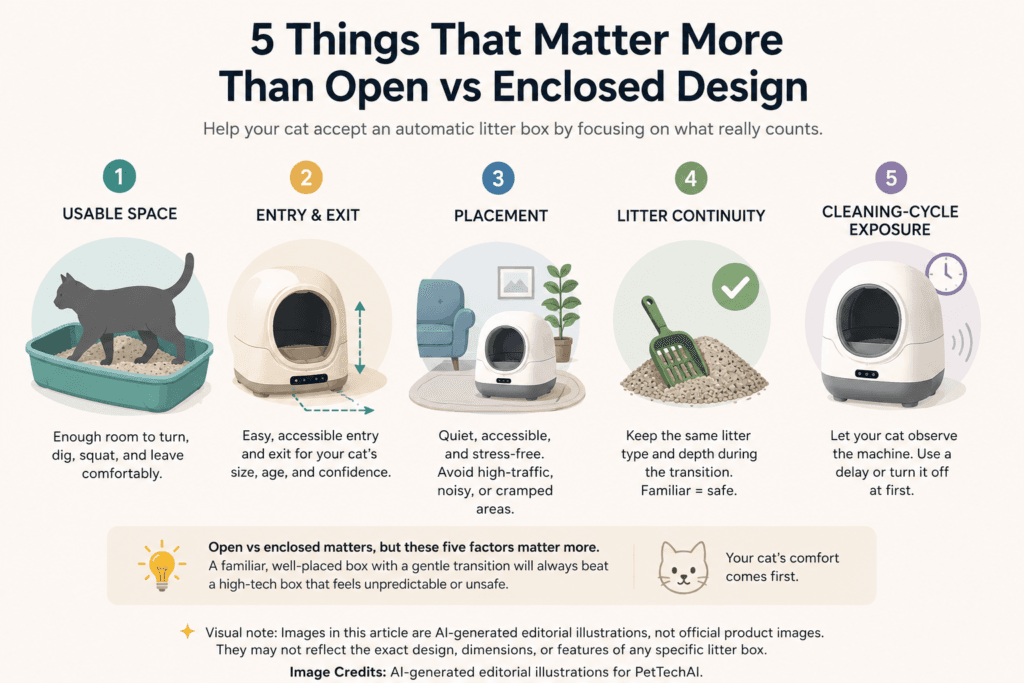
1. Usable space
External dimensions do not reveal how much room remains after the cleaning mechanism, walls and waste system are considered.
The cat must be able to:
- turn normally;
- dig without constant obstruction;
- squat without hanging over the edge;
- leave without awkward movement.
A generous-looking machine can still provide a surprisingly cramped bathroom.
2. Entry and exit
The cat should have a clear, comfortable route into and out of the box.
In enclosed models, check whether the opening feels narrow or tunnel-like.
In open-top models, check whether the sides create a difficult step.
Large, senior and mobility-sensitive cats need physical accessibility, not a product page that uses the word “inclusive.”
3. Placement
A good litter box in a bad location remains a bad litter setup.
Avoid areas where:
- another cat can guard the entrance;
- a dog can interrupt use;
- loud appliances start unexpectedly;
- the cat has no clear exit;
- people constantly pass nearby;
- food and water are positioned beside the box.
Multi-cat homes should preserve alternative litter stations during and after the transition when necessary.
One robot does not automatically replace every existing box because the receipt was emotionally significant.
4. Litter continuity
Do not introduce a new machine, new litter, new location and new cleaning sound on the same day.
Use familiar compatible litter when possible and maintain a similar depth.
The robot is already enough novelty.
There is no prize for completing the transition on maximum difficulty.
Open or enclosed, weak clumps create the same ugly paperwork. See our guide to compatible automatic litter box litter before blaming the machine.
5. Cleaning-cycle exposure
Let the cat explore the machine while it is inactive.
Once voluntary use begins, introduce the cleaning cycle from a safe distance. Delayed-cycle settings can help prevent the box from moving immediately after the cat exits.
The cat needs to learn two things separately:
- this is an acceptable place to eliminate;
- this strange object sometimes moves without becoming dangerous.
Baron may require several demonstrations.
Baron has not read the manual.
How to Introduce an Automatic Litter Box
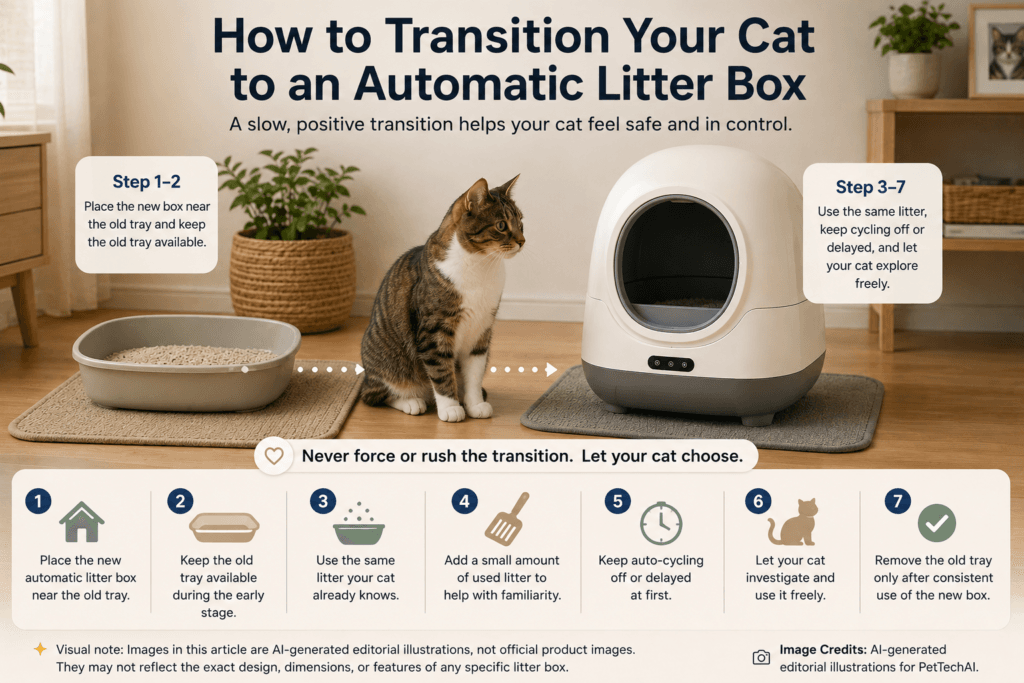
- Place the new unit near the existing tray.
- Keep the old tray available.
- Use familiar compatible litter.
- Add a small amount of used litter to the new box.
- Leave automatic cycling disabled initially.
- Allow voluntary exploration.
- Activate delayed cleaning after regular use begins.
- Remove the old tray only when the new routine is stable.
Never force the cat inside.
If the cat begins avoiding the litter area, eliminating elsewhere, straining or showing a persistent change in bathroom behavior, investigate the environment and contact a veterinarian when appropriate.
The machine may reveal the change.
It cannot explain the cause.
Buyer Regret in One Sentence
Open-top regret means buying a weak machine because the tray looked familiar; enclosed regret means buying a premium bunker your cat treats like a border crossing.
Final Verdict
Choose open-top automation when the cat values visibility, dislikes covered boxes or needs a transition that resembles a traditional tray.
Choose enclosed automation when the cat already accepts covered spaces and the household needs better litter, urine or waste containment.
But do not stop at the form factor.
Among current open-top models:
- Neakasa M1 Plus is recommended as the most established benchmark.
- PetPivot is recommended with conditions for simpler, lower-cost automation.
- CATLINK Open-X earns a conditional recommendation for app-focused multi-cat monitoring.
- Oneisall Ease S1 is not recommended as a first choice.
- PetSafe OpenSky should be avoided for now.
- PETKIT Crystal Duo remains too new to recommend.
The right shape can improve cat acceptance.
It cannot compensate for weak reliability, poor support or a product that appears to be using early customers as an unpaid quality-control department.
Choose the format that asks the least from the cat.
Then choose a machine that asks the least from your patience.
For a broader category comparison, read Best Smart Litter Boxes.
Frequently Asked Questions
Do cats prefer open or enclosed litter boxes?
There is no universal preference.
Existing habits are the strongest clue. A cat that consistently avoids covered trays is a poor candidate for an enclosed robot, while a cat already comfortable with hooded boxes may accept either format.
Are open-top automatic litter boxes better for anxious cats?
They may help cats that need visibility and a clear exit.
They do not treat anxiety or guarantee acceptance. Placement, noise, gradual exposure and household dynamics remain important.
Are enclosed automatic litter boxes bad for cats?
No.
They become problematic when the interior is cramped, the entrance is uncomfortable or the cat feels trapped or interrupted.
What is the best current open-top automatic litter box?
Neakasa M1 Plus currently has the strongest case as the established premium benchmark.
PetPivot may be more suitable for buyers who want simpler and less expensive automation.
Is Oneisall Ease S1 recommended?
Not as the first choice for most buyers.
Its open-top concept is appealing, but current ownership evidence is weaker than the evidence supporting Neakasa, PetPivot or CATLINK.
Should I remove the old litter box immediately?
No.
Keep it available until the cat uses the automatic box consistently and appears comfortable with its cleaning cycle.
Can an automatic litter box detect illness?
No.
Some models can reveal changes in weight, visits or behavior, but they cannot diagnose the cause or replace veterinary assessment.
References
Cornell Feline Health Center — Feline house-soiling and litter-box behavior guidance
Feline Veterinary Medical Association — Litter-box management guidance
Neakasa — M1 Plus product documentation
PetPivot — AutoScooper product documentation
CATLINK — Open-X product documentation
Oneisall — Ease S1 product documentation
PetSafe — OpenSky product documentation
PETKIT — Purobot Crystal Duo product documentation
Image Disclosure
Images may include AI-generated editorial illustrations. They do not depict exact product dimensions, mechanisms or physical features.
Editorial Disclosure
PetTech AI may earn a commission from qualifying purchases. This does not influence our recommendations, comparisons or editorial judgments.