Tag: automatic litter box

  • Automatic Litter Boxes for Large Cats: What Matters Beyond the Weight Limit?

    Automatic Litter Boxes for Large Cats: What Matters Beyond the Weight Limit?

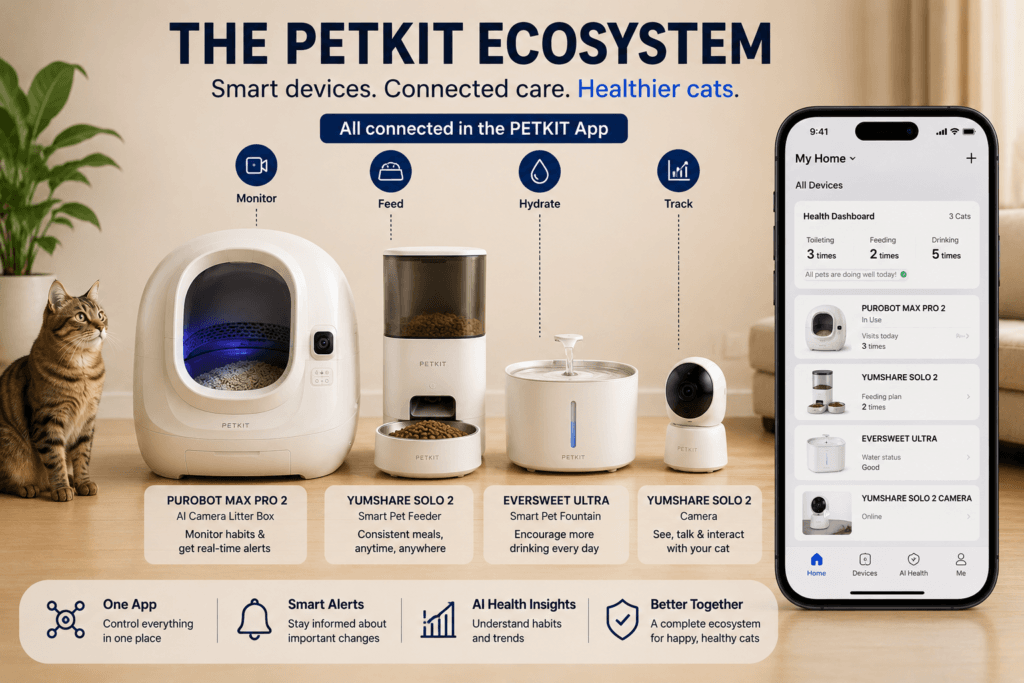
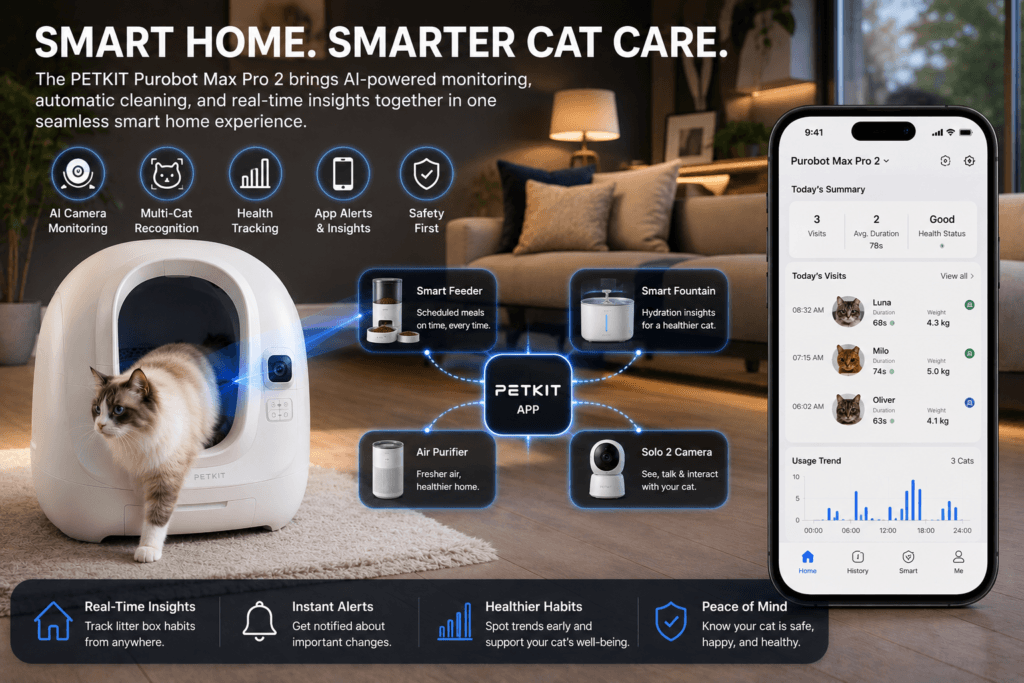
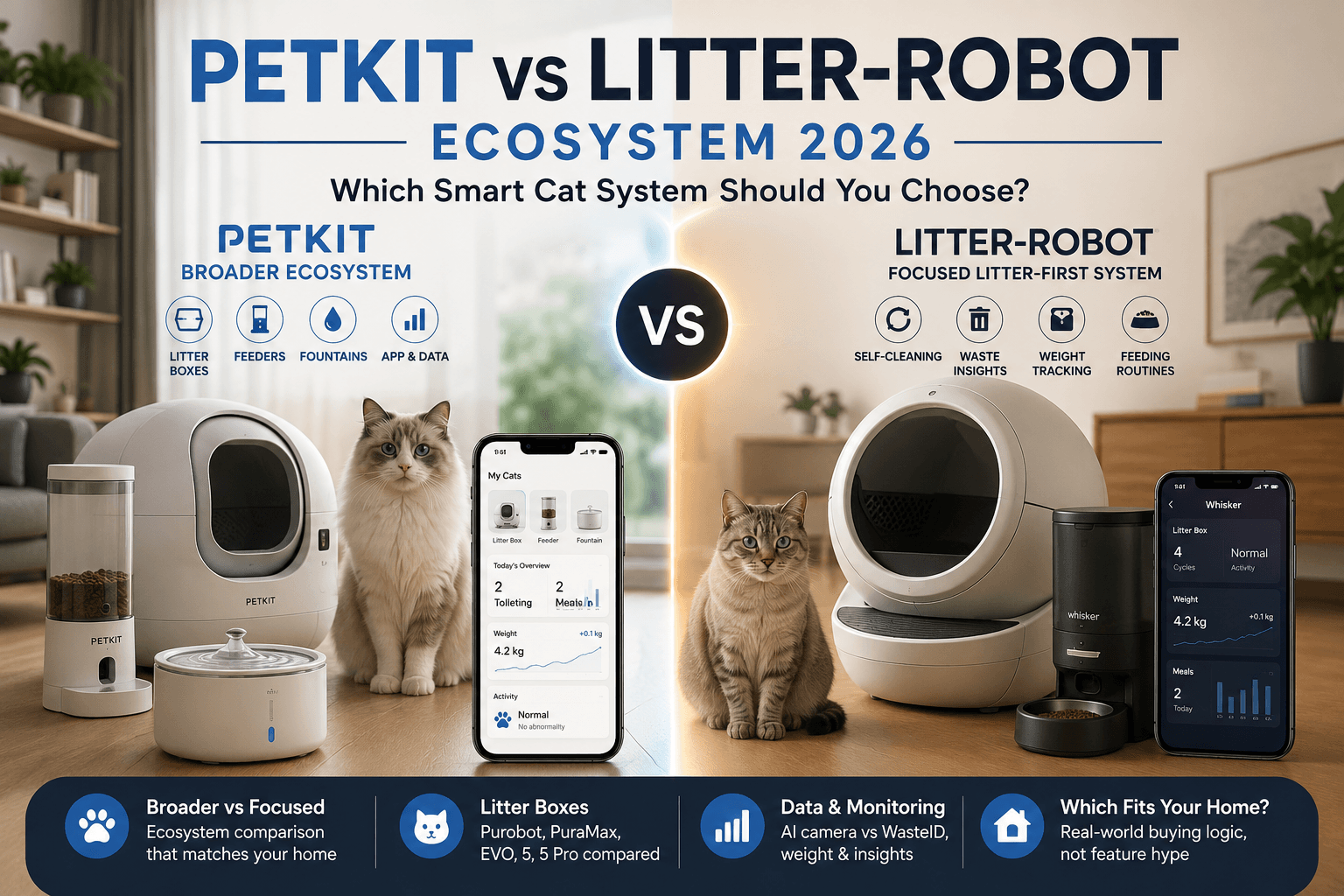
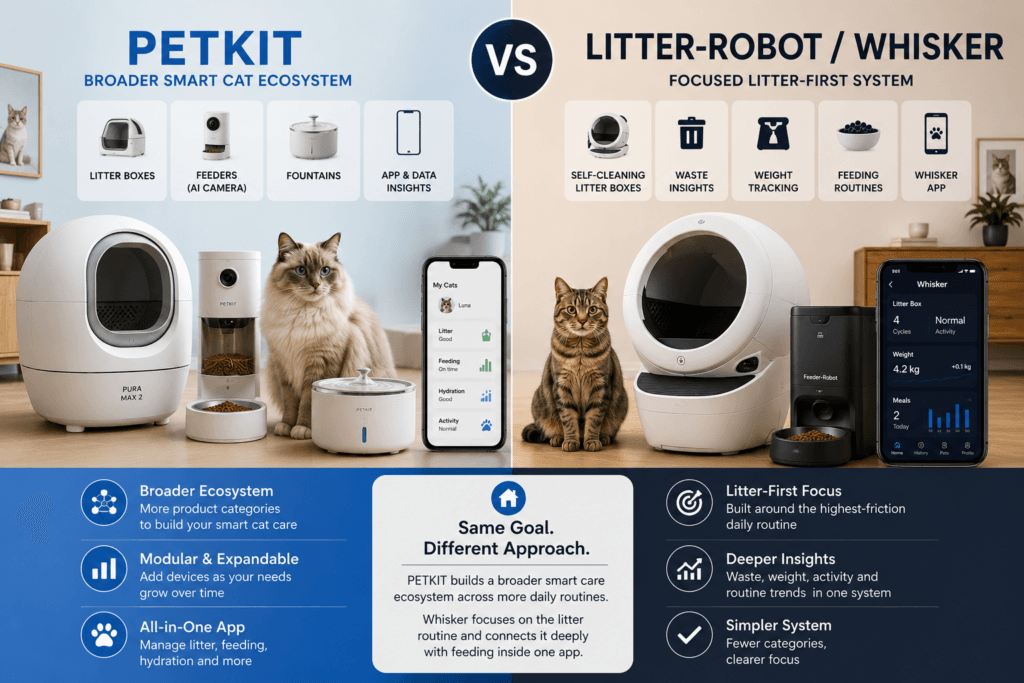
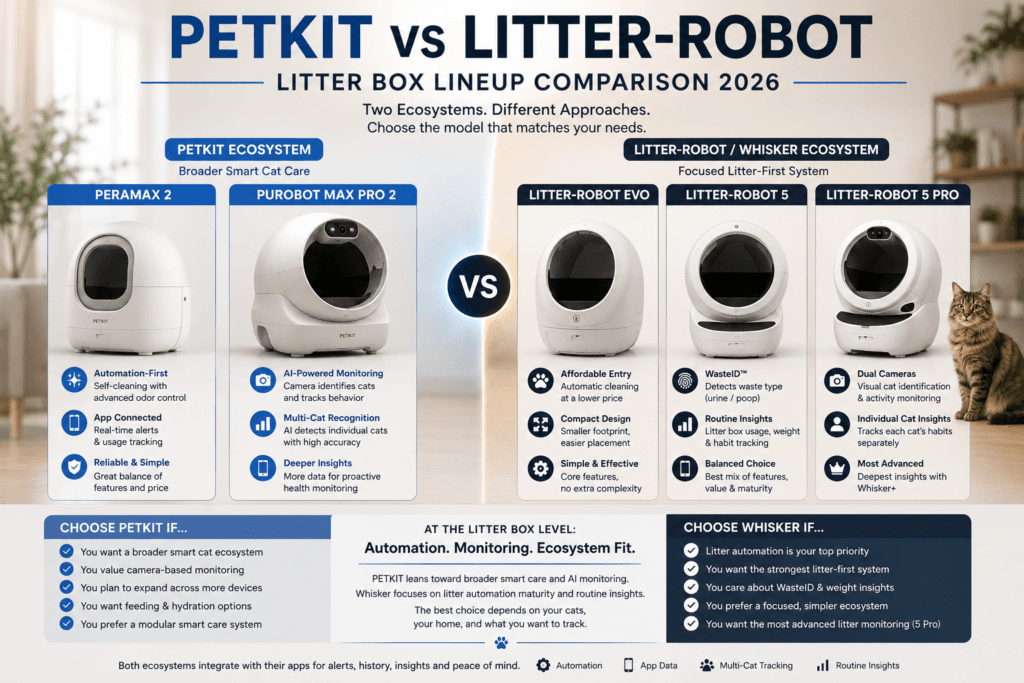
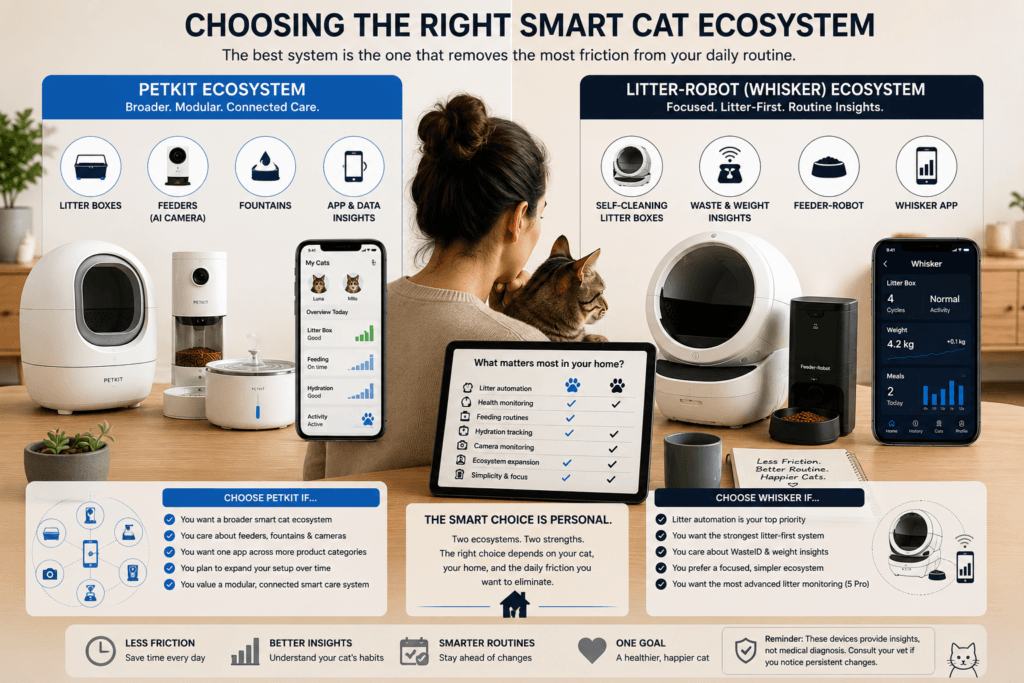
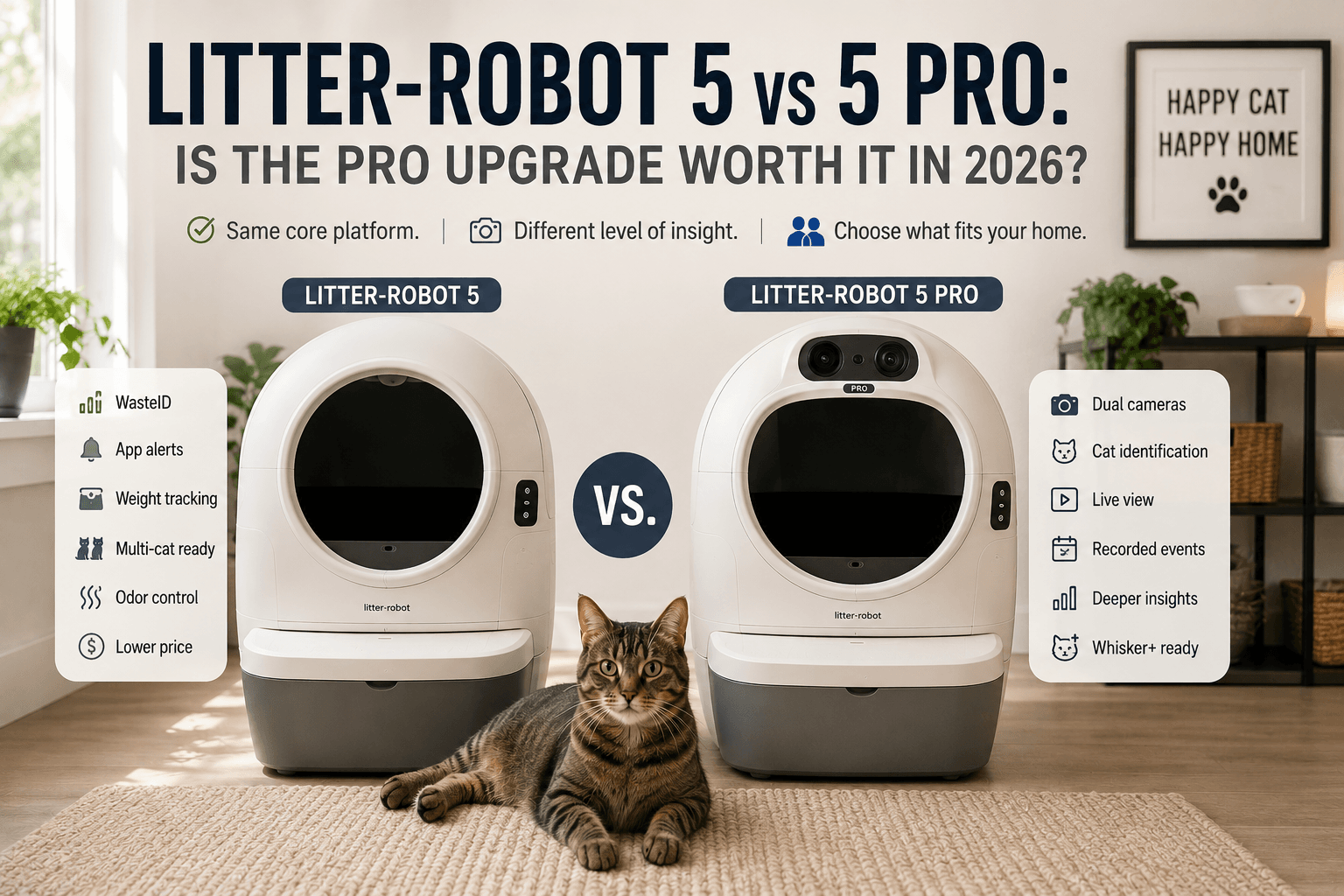
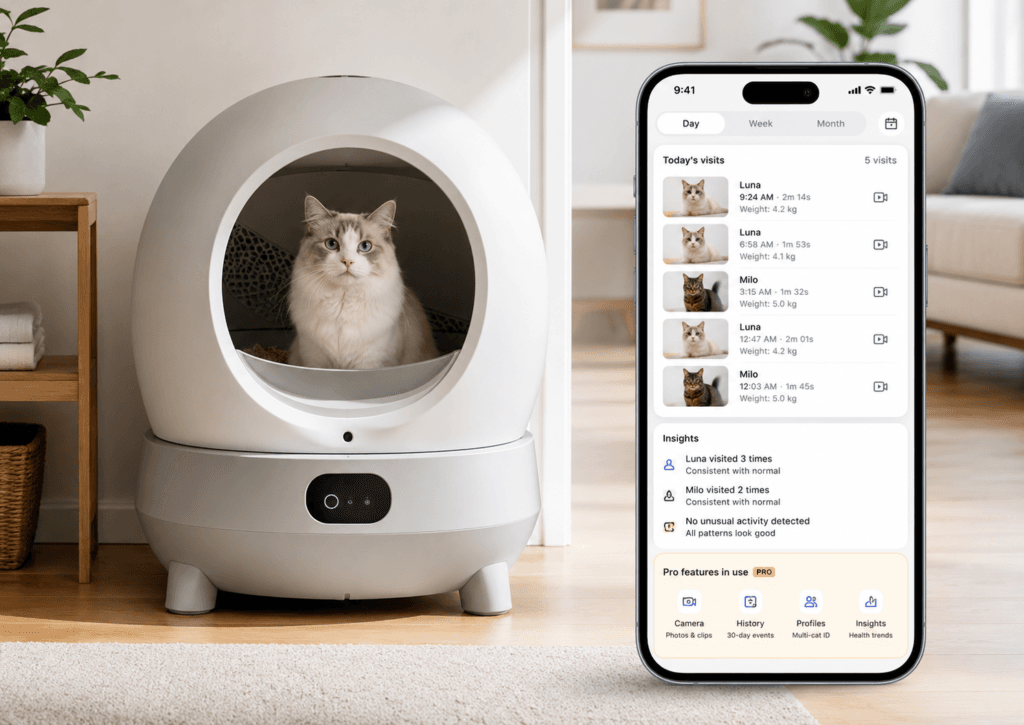
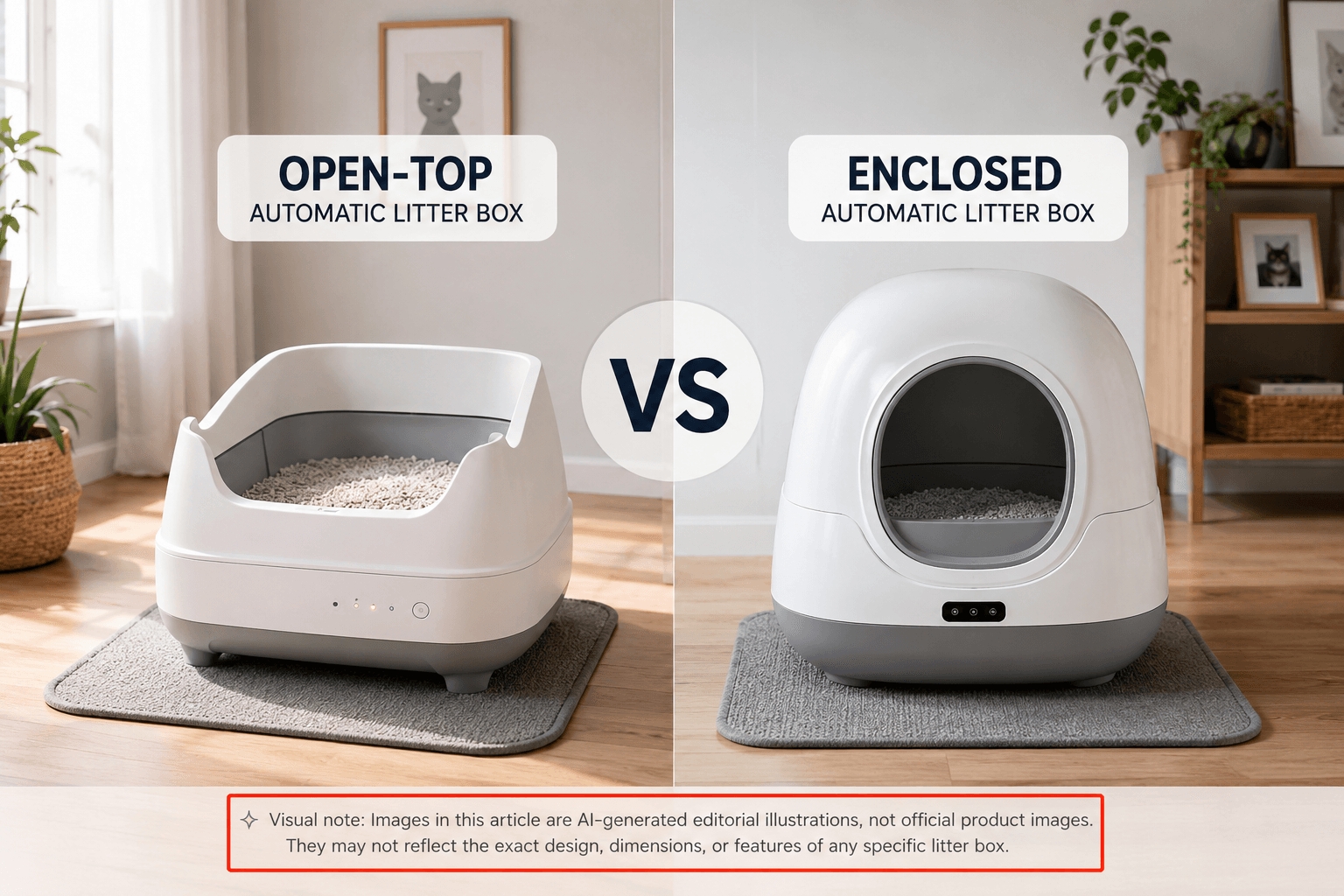
    Visual note: Images in this article are AI-generated editorial illustrations, not official product images. They may not reflect the exact design, dimensions, or features of any specific litter box.

    A large cat can fall below an automatic litter box’s published weight limit and still hate using it.

    That is the problem with shopping by one number alone.

    A listing may say “up to 25 lb” or “up to 30 lb,” but that only tells you the product is intended to support a cat within that range. It does not tell you whether your cat has enough room to turn, dig, squat, cover waste, reposition, and leave comfortably.

    For large cats, long-bodied cats, older cats, and cats with a strong digging routine, usable space matters more than a maximum-weight label.

    The real question is not:

    “Does my cat technically fit within the stated limit?”

    It is:

    “Can my cat use this litter box naturally and consistently without feeling cramped?”

    This guide explains what to check before choosing an automatic litter box for a large cat — beyond the marketing headline and published weight rating.

    Quick Verdict

    For a large cat, prioritize:

    • Enough usable litter area to turn, dig, squat, and cover normally.
    • An entrance that does not require awkward squeezing or ducking.
    • A clear, comfortable exit route.
    • An entry height that suits the cat’s mobility.
    • Stable placement on a level floor.
    • Enough space around the unit to avoid making the cat feel cornered.
    • A transition plan that keeps the old litter tray available at first.

    Do not choose an automatic litter box purely because it says “large cat friendly” or lists a high maximum weight.

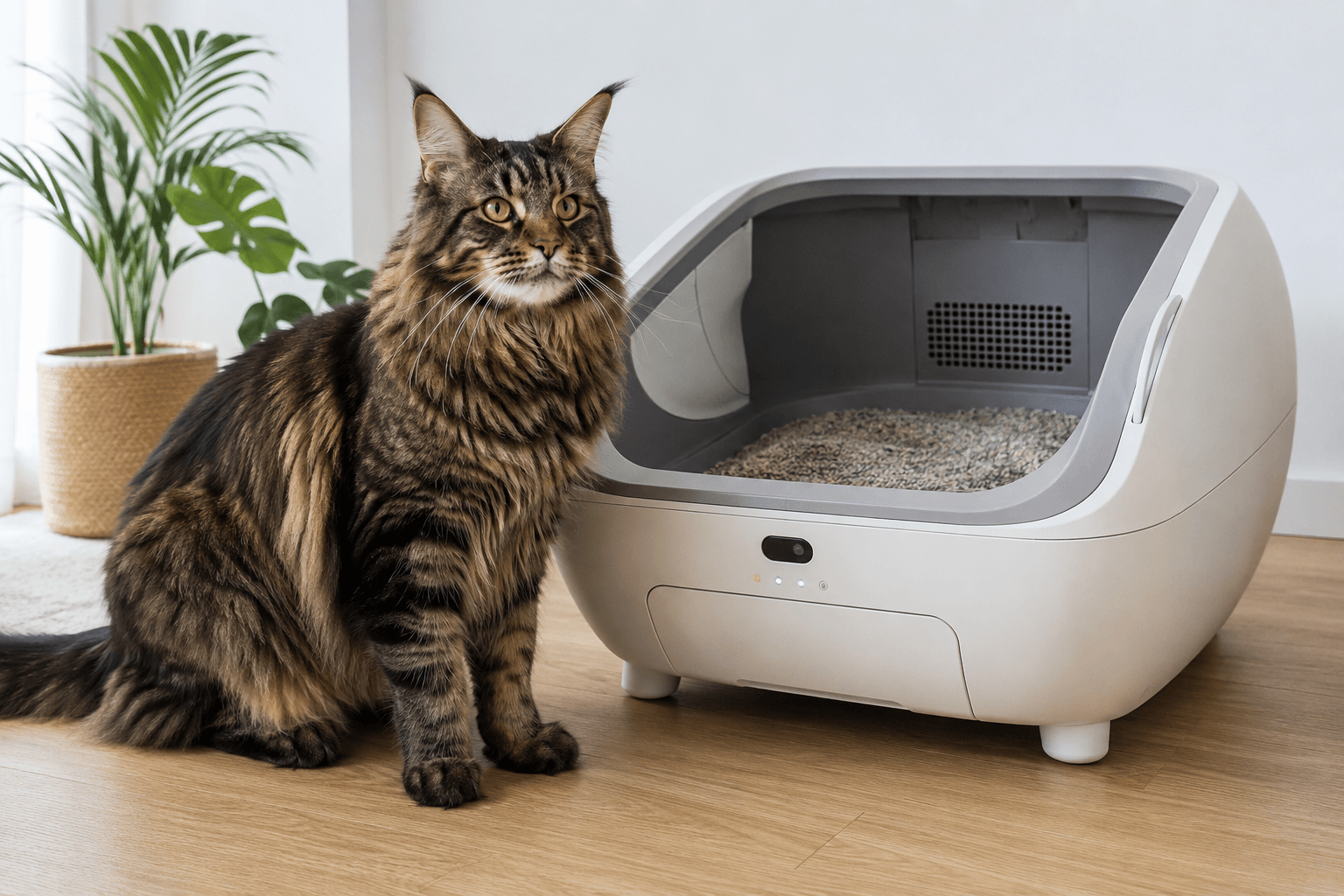
    A 19-pound Maine Coon and a 19-pound compact domestic shorthair may have very different body length, turning needs, tail position, mobility, and digging habits. The same applies to large Ragdolls, Norwegian Forest Cats, Siberians, and long-bodied mixed-breed cats.

    Weight limits are useful as an initial filter.

    They are not proof of a comfortable fit.

    This article contains affiliate links. As an Amazon Associate I earn from qualifying purchases.

    Explore the Oneisall Ease S1 Pro on Amazon

    Why Weight Limits Can Be Misleading
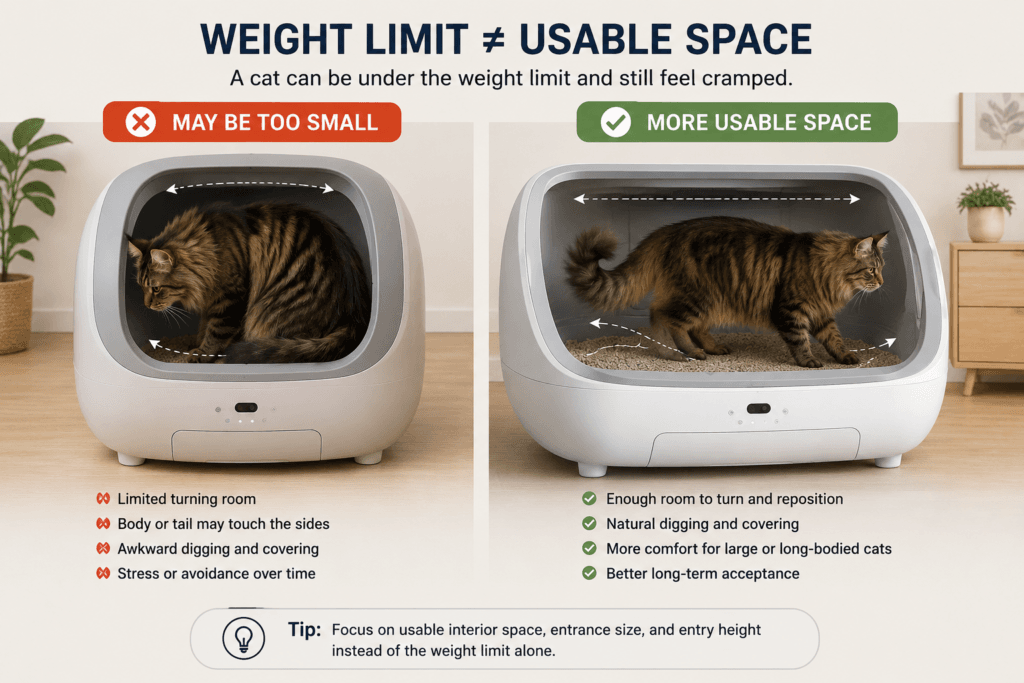
    Comparison of a large cat fitting awkwardly and comfortably in automatic litter boxes
    A published weight limit does not always show whether a cat can turn and position itself comfortably.

    A weight limit usually answers one narrow question:

    Can the product’s sensors and mechanics accommodate a cat of this weight?

    That matters, especially for automatic litter boxes that rely on weight detection, motion sensors, or cleaning-cycle safety systems.

    But a large cat’s daily experience inside the box depends on more than weight.

    Two cats can weigh the same while having very different needs:

    • One may be short and broad.
    • Another may be long-bodied with a large turning radius.
    • One may dig briefly and eliminate quickly.
    • Another may circle, dig deeply, change position several times, and spend longer covering waste.
    • One may be agile and confident.
    • Another may be older, heavier, less flexible, or cautious around narrow entrances.

    A product can technically support a 25-pound cat while still offering an uncomfortable litter area for that cat’s body shape.

    This is why exterior dimensions can also mislead.

    A large automatic litter box may look spacious from the outside but lose usable room because of curved walls, a rotating chamber, internal sensors, high litter walls, waste-routing components, or the shape of the cleaning mechanism.

    The space your cat actually uses is what matters.

    The Four Measurements That Matter More Than a Weight Rating
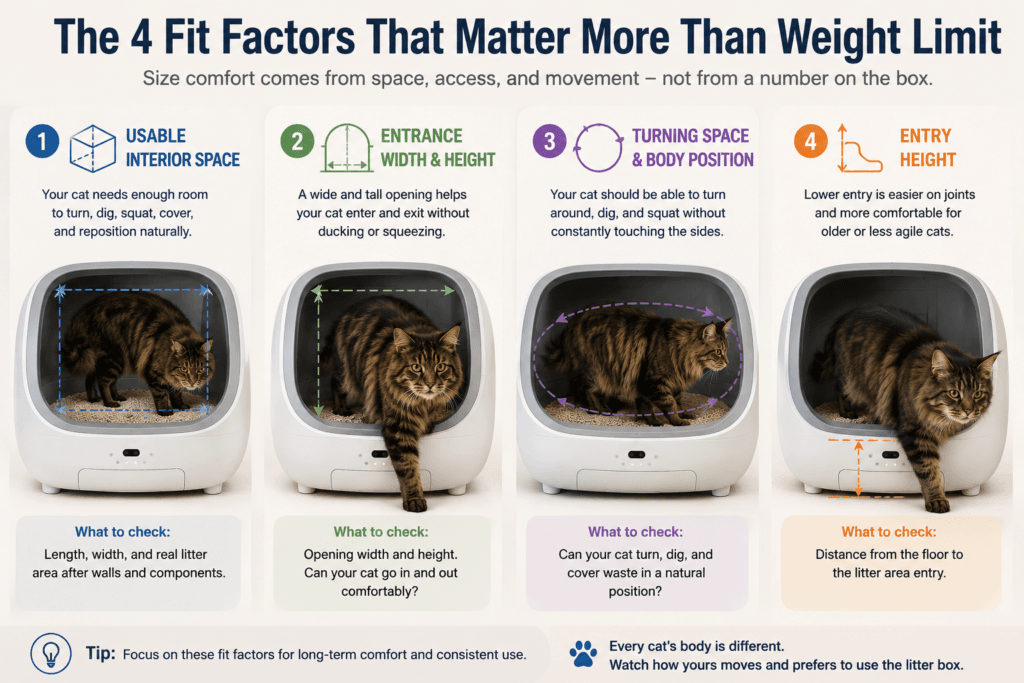
    Four fit factors for an automatic litter box for large cats
    Interior room, entrance size, entry height, and turning space shape daily comfort.

    Before buying, look beyond the maximum-weight specification and focus on these four practical measurements.

    1. Usable Interior Space

    The most important measurement is not the overall size of the machine.

    It is the usable area inside the litter section.

    Ask yourself:

    • Can your cat turn around without constantly touching the sides?
    • Is there enough room to dig and reposition?
    • Can the cat squat without its body hanging over the edge?
    • Can it cover waste naturally?
    • Does the cat have space for its tail and hindquarters?

    For large cats, a generous internal footprint is often more valuable than a premium app, a large waste drawer, or extra monitoring features.

    A cat may tolerate a smaller box temporarily. That does not mean it will use it comfortably every day.

    Look closely at product photos, owner images, demonstration videos, and internal diagrams. Marketing photos often show the exterior dimensions clearly while giving much less attention to the actual litter area.

    2. Entrance Width and Height

    A large cat should not have to squeeze through the entrance or lower its body awkwardly to get inside.

    For enclosed automatic litter boxes, check:

    • Opening width.
    • Opening height.
    • Whether the entrance is positioned in a way that makes turning difficult.
    • Whether the cat can leave comfortably after using the litter.
    • Whether the opening feels like a room entrance or a narrow tunnel.

    For open-top designs, the entrance may be visually simpler, but the side walls can still create a difficult step if they are high or heavily curved.

    A large cat may be physically capable of climbing into a box while still finding the entry annoying enough to avoid it over time.

    That becomes more important with age.

    Cats with reduced flexibility, joint discomfort, or lower confidence may need a more obvious and accessible route in and out.

    Our Purobot Max Pro 2 vs Litter-Robot 4 comparison shows how dramatically entrance geometry can differ even between premium machines.

    3. Turning Room and Natural Body Position

    A cat does not simply walk in, stand still, and leave.

    Most cats perform a sequence of movements: entering, checking the area, turning, digging, positioning, eliminating, covering, and exiting.

    Large cats need room for all of that.

    Pay particular attention to whether the box allows your cat to:

    • Turn without pressing against the walls.
    • Dig without constantly hitting the sides.
    • Shift its stance naturally.
    • Keep its hindquarters inside the litter area.
    • Leave without backing out awkwardly.

    A cat that cannot settle into its normal routine may still use the box, but you may see small signs of discomfort: hesitation, repeated repositioning, shallow digging, elimination near the entrance, or waste landing too close to the edge.

    These signs do not automatically prove that size is the problem.

    But they are worth taking seriously, especially when they appear after changing from a larger traditional tray.

    4. Entry Height

    Entry height is often overlooked because many large cats are strong and athletic.

    But size and agility are not the same thing.

    A young, healthy large cat may manage a taller step without difficulty. An older cat, a heavier cat, or a cat with reduced mobility may find the same entrance tiring or uncomfortable.

    High-sided litter boxes can also create problems for cats that prefer to enter gradually rather than jump directly into a deep tray.

    Before purchasing, think about your cat’s actual movement patterns.

    Does your cat leap confidently onto furniture? Does it hesitate on stairs? Does it avoid high-sided trays? Has it ever struggled with a carrier, covered box, or narrow doorway?

    The best automatic litter box for a large cat is not necessarily the lowest one. It is the one that gives your cat a comfortable, repeatable path in and out.

    Open-Top vs Enclosed Automatic Litter Boxes for Large Cats

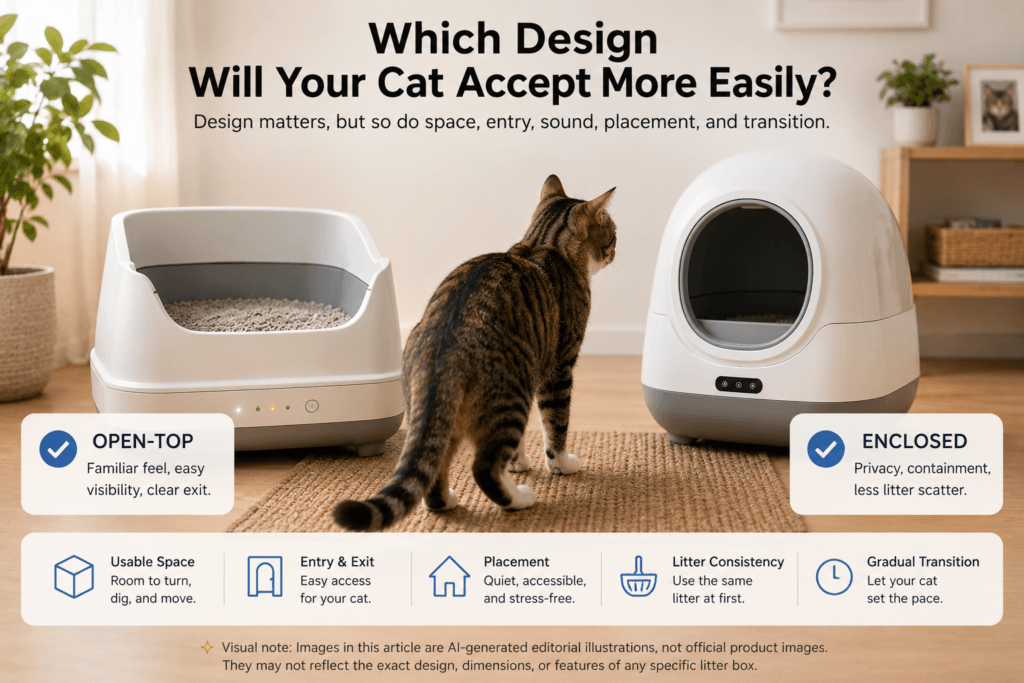
    Open-top and enclosed designs can both work for large cats.

    Neither format automatically guarantees more usable room.

    An open-top litter box may be easier for some large cats because the cat can see the surrounding room, assess the exit route, and position its body without feeling closed in. The design can also make it easier for owners to judge whether the litter area looks genuinely spacious.

    An enclosed model can work well too, provided the interior is truly large enough and the entrance does not create a cramped or tunnel-like experience.

    The key distinction is not simply whether there is a roof.

    It is whether the cat has enough usable space to move naturally.

    A spacious enclosed litter box may be more comfortable than a narrow open-top tray. A well-designed open-top box may be easier to enter and leave than an enclosed unit with a restrictive opening.

    Shape matters alongside size.

    Our guide to Open-Top vs Enclosed Automatic Litter Boxes: Which Cats May Adapt More Easily? explains why visibility, exit routes, familiar habits, and gradual introduction can matter just as much as the design category itself.

    Signs an Automatic Litter Box May Be Too Small

    You cannot always know whether a litter box will fit perfectly before it arrives.

    But once your cat starts using it, watch for these practical warning signs:

    • Your cat hesitates before entering.
    • Your cat keeps its front paws outside while using the box.
    • Your cat repeatedly turns or repositions before settling.
    • The tail, back, or hindquarters regularly press against the walls.
    • Your cat eliminates close to the entrance or over the edge.
    • Digging and covering behavior becomes noticeably shorter or more awkward.
    • Your cat uses another available tray whenever possible.
    • Your cat appears to need multiple attempts to find a comfortable position.

    A single awkward visit does not mean the product is unsuitable.

    Look for a pattern.

    A cat may need time to adjust to a new machine, different litter depth, unfamiliar placement, or cleaning-cycle sound. But persistent discomfort should not be dismissed simply because the cat falls under the published weight limit.

    Large Cats Need More Than a Large Interior

    Physical room is essential, but it is not the whole setup.

    A large cat also needs enough environmental room around the litter box.

    Stable placement

    Automatic litter boxes should sit on a flat, stable surface according to the manufacturer’s instructions.

    Avoid placing the unit where it rocks, shifts, or feels unstable under the cat’s weight. A large cat can be more sensitive to movement simply because it creates more force while stepping in, digging, and turning.

    Clear access

    Do not hide the box in a narrow corner where the cat feels trapped between the machine and a wall.

    A large cat needs enough room to approach, enter, and leave without squeezing between furniture or being forced to reverse out of a cramped space.

    A predictable exit route

    This matters especially in multi-cat homes.

    A box may be technically large enough, but the surrounding location can still make it feel unsafe if another cat can stare at, block, or ambush the entrance.

    The environment should support an easy approach and an easy departure.

    Familiar litter and depth

    A new automatic litter box is already a major change. Avoid changing the litter type, scent, texture, and depth at the same time unless there is a specific reason to do so.

    Use the familiar litter whenever possible during the transition.

    Calm exposure to cleaning cycles

    A large cat may need more time to trust a machine that moves after it leaves.

    Let the cat investigate the box while it is quiet. Allow it to observe the cleaning cycle from a distance. Keep the old tray available during the transition.

    A large cat may need more physical room, but it also needs more environmental room: clear access, a predictable exit, and enough space around the box to avoid feeling cornered.

    Is an Automatic Litter Box Safe for Big Cats?

    An automatic litter box should only be considered when the cat fits within the manufacturer’s published size and weight guidance.

    That includes any minimum-weight requirement, not only the maximum.

    Safety systems also need to be kept clean and used according to the product’s instructions. Sensors, moving parts, waste drawers, and litter levels should be checked regularly rather than treated as completely hands-off.

    The better question is not only whether the unit can detect your cat.

    It is whether your cat can use it comfortably.

    Do not choose a product that forces an awkward fit simply because the specification sheet says the cat falls within the supported range.

    Observe your cat during the transition. Watch how it enters, turns, digs, and exits. Keep another suitable litter option available until you are confident the new routine is working.

    A Practical Fit Test Before You Buy
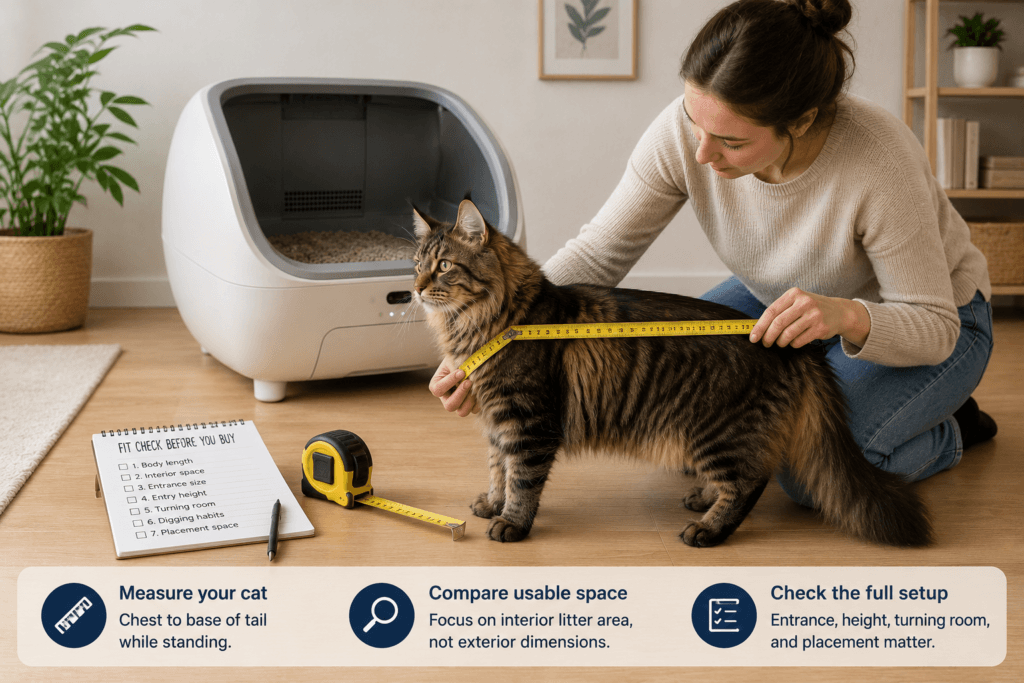
    Owner measuring a large cat near an automatic litter box before purchase
    Compare your cat’s body shape and movement habits with usable interior space, not exterior dimensions alone.

    Use this checklist before committing to an automatic litter box for a large cat.

    1. Measure your cat’s body length

    Measure roughly from the chest area to the hindquarters while your cat is standing naturally.

    This is not about finding a perfect mathematical match. It is about avoiding a situation where the usable litter area is obviously too short for the cat’s normal body position.

    2. Compare the measurement with usable interior room

    Do not compare it only with the product’s outside dimensions.

    Look for the actual litter-area dimensions, interior photos, and videos of cats entering and turning inside the unit.

    3. Check the opening

    Look at both width and height.

    Could your cat enter comfortably without brushing its sides or lowering its body awkwardly?

    4. Consider normal digging behavior

    A cat that digs deeply and turns several times before eliminating may need more room than a cat that uses the tray quickly.

    Your cat’s real habits matter more than generic breed assumptions.

    5. Think about age and mobility

    A large young cat may handle a taller entrance easily. A large senior cat may need something more accessible.

    Choose for the cat you have now, not only the cat you remember from two years ago.

    6. Check the surrounding room

    Measure the placement area too.

    There should be enough clearance for the cat to approach and leave without feeling blocked by furniture, walls, doors, or another pet.

    7. Review return, warranty, and setup guidance

    Fit is not always obvious from a listing page.

    Before buying, understand the return conditions, warranty coverage, and manufacturer recommendations. This gives you a practical fallback if the product turns out to be unsuitable for your cat’s real behavior.

    Where an Open-Top Design Can Make Sense

    For owners of a large cat who value a clear entrance and an open tray-like experience, the Oneisall Ease S1 Pro is one option to examine.

    Its published limit is up to 30 lb. But that is only the starting point.

    The more useful question is whether the open usable area, entry design, placement requirements, and cleaning routine suit your cat’s individual body shape and habits.

    An open-top approach may be especially worth considering when your cat:

    • Has always preferred traditional open trays.
    • Needs a clear visual exit route.
    • Dislikes enclosed litter furniture.
    • Is large, long-bodied, or cautious in tight spaces.
    • Has previously avoided covered boxes.

    For a closer look at its practical trade-offs, read our Oneisall Ease S1 Pro Review.

    Final Verdict

    For large cats, the best automatic litter box is not the one with the highest stated weight limit.

    It is the one that gives the cat enough usable space to move normally, enter comfortably, dig naturally, and leave without hesitation.

    Treat the published weight limit as a starting filter.

    Make the final decision based on interior room, entrance design, entry height, body position, placement, and your cat’s actual behavior.

    A feature-rich machine that feels cramped is not a good fit.

    A simpler design that your cat uses consistently is usually the better investment.

    Read our Oneisall Ease S1 Pro Review

    Frequently Asked Questions

    What size automatic litter box does a Maine Coon need?

    There is no single answer based on breed alone. Look for enough usable interior room for the cat to turn, dig, squat, and leave comfortably. Compare body length and normal movement habits with the actual litter area, not only the listed maximum weight.

    Is a 25 lb weight limit enough for a large cat?

    Possibly, but weight alone does not confirm comfort. A long-bodied or broad cat may still need more interior room, a wider entrance, or an easier exit route.

    Are open-top automatic litter boxes better for large cats?

    Not automatically. Open-top designs can make entry, exit, and body positioning easier for some cats, but an enclosed unit can also work well when the interior is generous and the opening is comfortable.

    Can a large cat use an enclosed automatic litter box?

    Yes, provided the box offers enough usable room and the cat can enter, turn, eliminate, and leave naturally. The enclosure itself is not the deciding factor.

    What are the signs that a litter box is too small for my cat?

    Repeated hesitation, awkward turning, poor digging, eliminating near the entrance, waste over the edge, or choosing another available tray can all be signs worth watching.

    Should I remove the old litter box immediately?

    No. Keep the old tray available while your cat adjusts to the automatic litter box. A gradual transition gives you time to observe whether the new unit is actually a comfortable fit.

    References

    • General feline litter-box guidance on size, entry access, litter depth, placement, and mobility considerations.
    • Oneisall Ease S1 Pro product information and setup guidance.

    Image Credits: AI-generated editorial illustrations for PetTechAI.
  • Open-Top vs Enclosed Automatic Litter Boxes: Which Will Your Cat Actually Use?

    Open-Top vs Enclosed Automatic Litter Boxes: Which Will Your Cat Actually Use?

    Baron approaches the new automatic litter box.
    It cleans itself, tracks visits and has enough sensors to supervise a minor airport.

    Baron looks inside, looks at you and returns to the old plastic tray.

    The machine has passed every technical test except the one involving the cat.

    That is why open-top vs enclosed automatic litter boxes is not a cosmetic comparison. The shape affects visibility, entry, usable space, litter containment and how much change the cat must accept at once.

    But the format is only half the decision.

    A good open-top design does not magically rehabilitate a weak product. A sophisticated enclosed robot is equally useless when the cat treats its entrance like the gateway to an underground laboratory.

    Open-top automation is the better starting point for cats that dislike covered trays, need visual awareness or are moving from a traditional box for the first time.

    Enclosed automation is usually better for confident cats, aggressive litter kickers and households that prioritize containment.

    The right format reduces resistance.

    The right product still needs to earn the recommendation.

    Research Note

    This is a research-led guide based on feline litter-box guidance, current product documentation and available ownership evidence.

    PetTech AI has not conducted a long-term hands-on test of every model mentioned.

    Quick Verdict

    Cat or household situationBetter starting pointWhy
    Cat consistently rejects covered boxesOpen-topPreserves visibility and a clearer exit
    First move from a traditional tray to automationOpen-topRequires a smaller behavioral adjustment
    Large, cautious or mobility-sensitive catOpen-top, if entry is genuinely accessibleAvoids a narrow enclosed chamber
    Cat already uses covered boxes confidentlyEnclosedThe form factor is unlikely to be the main obstacle
    Cat kicks litter or urinates over low sidesEnclosedBetter containment
    Dog or child needs to be kept away from the litterEnclosedMore separation from the room
    Owner prioritizes odor and litter containmentEnclosedHigh walls and enclosed chambers usually contain more mess
    Multi-cat home with possible resource guardingNeither by defaultPlacement, exits and additional litter stations matter more

    Recommendation strength

    Open-top format: Recommended for visibility-sensitive cats and easier transitions—but only when the machine itself is credible.

    Enclosed format: Recommended for confident cats and containment-focused homes, provided the interior is spacious enough.

    As an Amazon Associate I earn from qualifying purchases.

    Want the most established current open-top option? Check Neakasa M1 Plus on Amazon.

    Want simpler, lower-cost open-top automation? Check PetPivot availability on Amazon.

    Open-Top Is a Form Factor, Not a Quality Certificate

    An open-top automatic litter box preserves more of the visual logic of a traditional tray.

    The litter is visible. The cat can inspect the surrounding room. There is no tunnel or enclosed globe to enter before reaching the litter.

    That can reduce one source of uncertainty.

    It does not guarantee:

    • quiet operation;
    • reliable sensors;
    • safe cleaning cycles;
    • good odor containment;
    • easy deep cleaning;
    • competent customer support;
    • long-term mechanical reliability.

    Some open-top products are well-established machines.

    Others are anonymous plastic optimism with an app.

    The design may help the cat approach the box. It does not tell you whether the owner will still trust it six months later.

    Which Cats May Prefer Open-Top Automation?

    cat approaching open top and enclosed litter boxes
    Familiarity, visibility, sound, and exit routes can matter as much as the cleaning system.

    Cats that reject covered litter boxes

    The clearest signal is existing behavior.

    If a cat consistently avoids hooded trays but uses open boxes willingly, an enclosed robot adds a known source of resistance before the motor even moves.

    An open-top machine preserves:

    • visual awareness;
    • overhead clearance;
    • a more obvious exit;
    • a layout closer to the cat’s existing routine.

    This does not mean the cat will accept automation instantly.

    It means the product is not beginning the relationship by ignoring an already documented preference.

    Cautious cats that monitor the room

    Some cats appear uncomfortable when they cannot see approaching people, animals or escape routes.

    This matters in:

    • busy homes;
    • multi-cat households;
    • homes with dogs;
    • litter areas near hallways;
    • rooms where another cat can block the entrance.

    An open-top design may feel less defensible because the cat can observe the room while using it.

    The better solution may still be improved placement or another litter station. Installing a more visible robot in the same ambush point is not behavioral innovation.

    Cats transitioning from a traditional tray

    The move from an open plastic tray to a rotating enclosed globe can change:

    • shape;
    • entry;
    • sound;
    • movement;
    • litter depth;
    • location;
    • odor;
    • exit route.

    Open-top automation keeps at least part of the old visual experience intact.

    That can make it a gentler first experiment for cats that have never used an enclosed box.

    Large or mobility-sensitive cats

    Open-top designs can offer more headroom and fewer enclosed surfaces.

    However, “open” does not automatically mean “accessible.”

    Check:

    • step height;
    • wall height;
    • usable tray area;
    • whether the cat can turn normally;
    • whether entry requires awkward climbing;
    • whether the mechanism reduces the space available inside.

    A high-sided open tray may still be a poor choice for an arthritic cat. Marketing departments occasionally discover that removing the roof does not lower the entrance.

    When Enclosed Automation Makes More Sense

    Cats already comfortable with covered boxes

    A cat that calmly uses a hooded tray has already answered part of the question.

    For that cat, enclosure may not be a meaningful obstacle. Interior room, noise and transition speed become more important.

    An enclosed robot can then provide stronger containment without asking the cat to accept a completely unfamiliar bathroom style.

    Aggressive diggers and litter kickers

    Some cats excavate as though a second litter box is buried beneath the first.

    An enclosed design can keep more litter inside the unit and reduce the radius of daily destruction.

    This advantage is practical, not glamorous.

    Nobody purchases a premium litter robot because sweeping granules from the hallway has become an emotionally fulfilling ritual.

    Homes where containment matters

    Enclosed boxes can make more sense when:

    • the litter area is near furniture;
    • dogs investigate the waste;
    • children have access to the room;
    • urine occasionally escapes low-sided trays;
    • the owner wants less visible litter and waste.

    The trade-off is that containment for the household can feel like confinement to the cat.

    The interior must provide enough room to enter, turn, squat, dig and leave without awkward positioning.

    The Current Open-Top Shortlist

    Neakasa M1 Plus — Recommended

    Verdict: Recommended as the most established current open-top benchmark.

    Neakasa M1 Plus has the strongest ownership history among the current open-top candidates and is designed around a large open tray, app controls and a substantial waste drawer.

    Its main argument is not novelty.

    It is that enough households have used it for the product to possess an actual track record rather than a launch campaign and several hopeful product samples.

    Neakasa makes the most sense when:

    • open visibility is important;
    • the cat needs generous usable space;
    • the buyer wants app-connected automation;
    • paying more for the better-established option is acceptable.

    That does not make it flawless. Deep cleaning, odor containment and the exposed tray format still require scrutiny.

    It is simply the open-top product that currently has the strongest right to be taken seriously.

    PetPivot AutoScooper — Recommended with Conditions

    Verdict: Recommended with conditions for simple, lower-cost automation.

    PetPivot has a simpler proposition.

    It is designed for owners who want the box to clean itself without turning litter management into another connected ecosystem requiring profiles, dashboards and a long-term digital relationship.

    That simplicity can be useful.

    It can also mean fewer advanced controls, less detailed monitoring and a less mature support environment.

    PetPivot makes sense when:

    • price sensitivity matters;
    • basic automatic cleaning is enough;
    • the owner does not need extensive app features;
    • expectations remain proportionate to the product tier.

    It should not be purchased because a lower price has somehow suspended the need for safety, durability and customer support.

    A budget robot remains a robot operating around an animal.

    CATLINK Open-X — Conditional Recommendation

    Verdict: Conditional recommendation for app-focused multi-cat households.

    As an Amazon Associate I earn from qualifying purchases.

    Need open-top access with app-based multi-cat tracking? Check CATLINK Open-X on Amazon.

    CATLINK Open-X is the most strategically interesting option when open-top access and individual monitoring are both priorities.

    Its app-connected approach and weight-based identification can be useful in multi-cat homes, especially when the cats occupy clearly different weight ranges.

    The reservation is identification accuracy.

    When cats weigh almost the same, a weight-based system can struggle to determine who entered. The machine may gather more data without resolving the exact ambiguity that motivated the purchase.

    Choose CATLINK when:

    • open-top access matters;
    • app records matter;
    • the cats have distinguishable weights;
    • the owner will actively use the monitoring layer.

    Do not choose it simply because “AI health monitoring” sounds more responsible than “the litter box cleans itself.”

    A dashboard is not a diagnosis.

    Weight-based identification can be useful when cats occupy clearly different ranges, but more tracking does not automatically create better decisions. For the broader distinction between useful monitoring and unnecessary data, read Smart Cat Monitoring vs Automation.

    Oneisall Ease S1 — Not Recommended

    Verdict: Not recommended as the first open-top choice.

    Oneisall has an appealing concept: accessible open-top automation, app controls and a lower-friction transition from a traditional tray.

    The current ownership evidence is not strong enough to recommend it over Neakasa, PetPivot or CATLINK.

    The problem is not that every customer dislikes it.

    The problem is that buyers now have alternatives with substantially stronger market validation.

    Oneisall may still suit a buyer who:

    • understands the weaker evidence;
    • accepts the risk;
    • prefers its specific design;
    • finds a compelling offer;
    • has reviewed current customer feedback directly.

    That is not a recommendation.

    It is informed permission to disagree.

    As an Amazon Associate I earn from qualifying purchases.

    Still considering Oneisall? Check current availability and customer feedback on Amazon.

    For the complete evaluation, read our Oneisall Ease S1 Pro Review.

    PetSafe OpenSky — Avoid for Now

    Verdict: Avoid until ownership feedback improves materially.

    PetSafe is an established brand.

    The current evidence around OpenSky does not deserve extra generosity because the logo is familiar.

    A recognizable manufacturer can still release a product that buyers receive with the enthusiasm normally reserved for an unexpected repair bill.

    The current signal is negative enough that OpenSky should not appear among our recommended open-top choices.

    PETKIT Purobot Crystal Duo — Too Early to Recommend

    Verdict: Watchlist only.

    Crystal Duo is interesting because it combines an open tray with PETKIT’s monitoring-first ecosystem.

    It may eventually become relevant for owners who want:

    • open access;
    • visual monitoring;
    • PETKIT integration;
    • cat-specific behavioral data.

    Current ownership evidence is too limited and too dependent on first-party feedback to support a recommendation.

    PetTech AI should not turn a product launch into a verdict simply because the affiliate potential looks convenient.

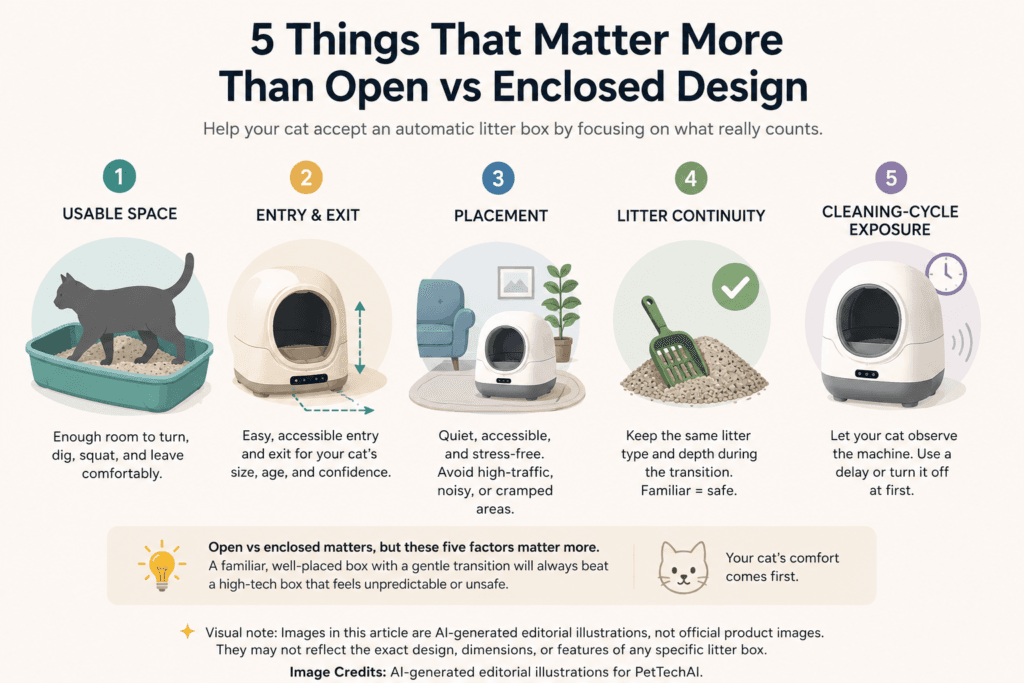
    Five Factors That Matter More Than the Label

    Five factors that affect cat adaptation to an automatic litter box
    Usable space, entry, placement, litter continuity, and gradual exposure matter more than design labels alone.

    1. Usable space

    External dimensions do not reveal how much room remains after the cleaning mechanism, walls and waste system are considered.

    The cat must be able to:

    • turn normally;
    • dig without constant obstruction;
    • squat without hanging over the edge;
    • leave without awkward movement.

    A generous-looking machine can still provide a surprisingly cramped bathroom.

    2. Entry and exit

    The cat should have a clear, comfortable route into and out of the box.

    In enclosed models, check whether the opening feels narrow or tunnel-like.

    In open-top models, check whether the sides create a difficult step.

    Large, senior and mobility-sensitive cats need physical accessibility, not a product page that uses the word “inclusive.”

    3. Placement

    A good litter box in a bad location remains a bad litter setup.

    Avoid areas where:

    • another cat can guard the entrance;
    • a dog can interrupt use;
    • loud appliances start unexpectedly;
    • the cat has no clear exit;
    • people constantly pass nearby;
    • food and water are positioned beside the box.

    Multi-cat homes should preserve alternative litter stations during and after the transition when necessary.

    One robot does not automatically replace every existing box because the receipt was emotionally significant.

    4. Litter continuity

    Do not introduce a new machine, new litter, new location and new cleaning sound on the same day.

    Use familiar compatible litter when possible and maintain a similar depth.

    The robot is already enough novelty.

    There is no prize for completing the transition on maximum difficulty.

    5. Cleaning-cycle exposure

    Let the cat explore the machine while it is inactive.

    Once voluntary use begins, introduce the cleaning cycle from a safe distance. Delayed-cycle settings can help prevent the box from moving immediately after the cat exits.

    The cat needs to learn two things separately:

    1. this is an acceptable place to eliminate;
    2. this strange object sometimes moves without becoming dangerous.

    Baron may require several demonstrations.

    Baron has not read the manual.

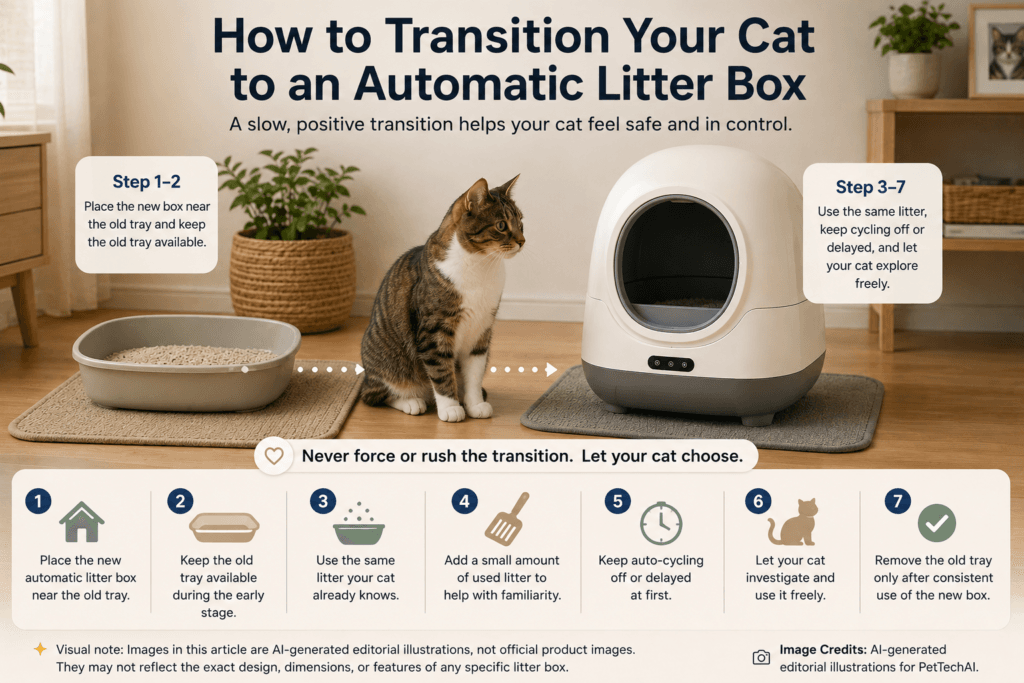
    How to Introduce an Automatic Litter Box

    Traditional litter tray placed next to an automatic litter box during a gradual transition
    A slow introduction gives cats time to accept a new litter routine voluntarily.
    1. Place the new unit near the existing tray.
    2. Keep the old tray available.
    3. Use familiar compatible litter.
    4. Add a small amount of used litter to the new box.
    5. Leave automatic cycling disabled initially.
    6. Allow voluntary exploration.
    7. Activate delayed cleaning after regular use begins.
    8. Remove the old tray only when the new routine is stable.

    Never force the cat inside.

    If the cat begins avoiding the litter area, eliminating elsewhere, straining or showing a persistent change in bathroom behavior, investigate the environment and contact a veterinarian when appropriate.

    The machine may reveal the change.

    It cannot explain the cause.

    Buyer Regret in One Sentence

    Open-top regret means buying a weak machine because the tray looked familiar; enclosed regret means buying a premium bunker your cat treats like a border crossing.

    Final Verdict

    Choose open-top automation when the cat values visibility, dislikes covered boxes or needs a transition that resembles a traditional tray.

    Choose enclosed automation when the cat already accepts covered spaces and the household needs better litter, urine or waste containment.

    But do not stop at the form factor.

    Among current open-top models:

    • Neakasa M1 Plus is recommended as the most established benchmark.
    • PetPivot is recommended with conditions for simpler, lower-cost automation.
    • CATLINK Open-X earns a conditional recommendation for app-focused multi-cat monitoring.
    • Oneisall Ease S1 is not recommended as a first choice.
    • PetSafe OpenSky should be avoided for now.
    • PETKIT Crystal Duo remains too new to recommend.

    The right shape can improve cat acceptance.

    It cannot compensate for weak reliability, poor support or a product that appears to be using early customers as an unpaid quality-control department.

    Choose the format that asks the least from the cat.

    Then choose a machine that asks the least from your patience.

    For a broader category comparison, read Best Smart Litter Boxes.

    Frequently Asked Questions

    Do cats prefer open or enclosed litter boxes?

    There is no universal preference.

    Existing habits are the strongest clue. A cat that consistently avoids covered trays is a poor candidate for an enclosed robot, while a cat already comfortable with hooded boxes may accept either format.

    Are open-top automatic litter boxes better for anxious cats?

    They may help cats that need visibility and a clear exit.

    They do not treat anxiety or guarantee acceptance. Placement, noise, gradual exposure and household dynamics remain important.

    Are enclosed automatic litter boxes bad for cats?

    No.

    They become problematic when the interior is cramped, the entrance is uncomfortable or the cat feels trapped or interrupted.

    What is the best current open-top automatic litter box?

    Neakasa M1 Plus currently has the strongest case as the established premium benchmark.

    PetPivot may be more suitable for buyers who want simpler and less expensive automation.

    Is Oneisall Ease S1 recommended?

    Not as the first choice for most buyers.

    Its open-top concept is appealing, but current ownership evidence is weaker than the evidence supporting Neakasa, PetPivot or CATLINK.

    Should I remove the old litter box immediately?

    No.

    Keep it available until the cat uses the automatic box consistently and appears comfortable with its cleaning cycle.

    Can an automatic litter box detect illness?

    No.

    Some models can reveal changes in weight, visits or behavior, but they cannot diagnose the cause or replace veterinary assessment.

    References

    Cornell Feline Health Center — Feline house-soiling and litter-box behavior guidance

    Feline Veterinary Medical Association — Litter-box management guidance

    Neakasa — M1 Plus product documentation

    PetPivot — AutoScooper product documentation

    CATLINK — Open-X product documentation

    Oneisall — Ease S1 product documentation

    PetSafe — OpenSky product documentation

    PETKIT — Purobot Crystal Duo product documentation

    Image Disclosure

    Images may include AI-generated editorial illustrations. They do not depict exact product dimensions, mechanisms or physical features.

    Editorial Disclosure

    PetTech AI may earn a commission from qualifying purchases. This does not influence our recommendations, comparisons or editorial judgments.

  • Litter-Robot 5 vs Purobot Max Pro 2: Which One Fits Your Cats?

    Litter-Robot 5 vs Purobot Max Pro 2: Which One Fits Your Cats?

    Litter-Robot 5 and PETKIT Purobot Max Pro 2 both clean automatically, track litter-box activity and promise to make cat ownership slightly less fragrant.

    They do not solve the same problem.

    Litter-Robot 5 is built to make litter management more dependable.

    It supports larger cats, works on carpet or hard flooring, uses WasteID to distinguish urine from solid waste and focuses on making the physical routine disappear into the background.

    Purobot Max Pro 2 is built to make litter-box behavior more visible.

    Its AI camera, facial recognition and individual histories are designed to answer the question a shared litter box usually hides:

    Which cat did this?

    For most households that mainly want less scooping, Litter-Robot 5 is the safer choice.

    Choose Purobot Max Pro 2 when individual identification is not merely interesting, but useful enough to change how you monitor one or more cats.

    The Purobot sees more.

    Litter-Robot 5 asks less of your attention.

    That is the decision.

    Research Note

    This is a research-led comparison based on current official product documentation, software terms and available ownership evidence.

    PetTech AI has not conducted a long-term side-by-side test of both models.

    Quick Verdict

    Your household or priorityBetter choiceWhy
    Large cat or mixed-size householdLitter-Robot 5Broader cat-size compatibility
    Up to five cats with straightforward automation needsLitter-Robot 5Larger automation-first platform
    Similar-weight cats that are difficult to identifyPurobot Max Pro 2Camera and weight data work together
    Camera-free ownershipLitter-Robot 5No integrated video monitoring
    Carpeted litter areaLitter-Robot 5More flexible floor placement
    Individual visit videos and separate timelinesPurobot Max Pro 2Visual identification and recorded context
    Owner unlikely to review app historiesLitter-Robot 5Less of its value depends on active monitoring
    Monitoring-focused PETKIT householdPurobot Max Pro 2Fits PETKIT’s broader connected-care ecosystem

    Recommendation strength

    Litter-Robot 5: Strong recommendation for automation-first households.

    Purobot Max Pro 2: Strong but conditional recommendation for owners who will genuinely use individual monitoring.

    PetTech AI may earn a commission from qualifying purchases.

    Purobot Max Pro 2 fits your household? Check current availability at PETKIT.

    As an Amazon Associate I earn from qualifying purchases.

    Prefer Amazon checkout? Check Purobot Max Pro 2 price and availability on Amazon.

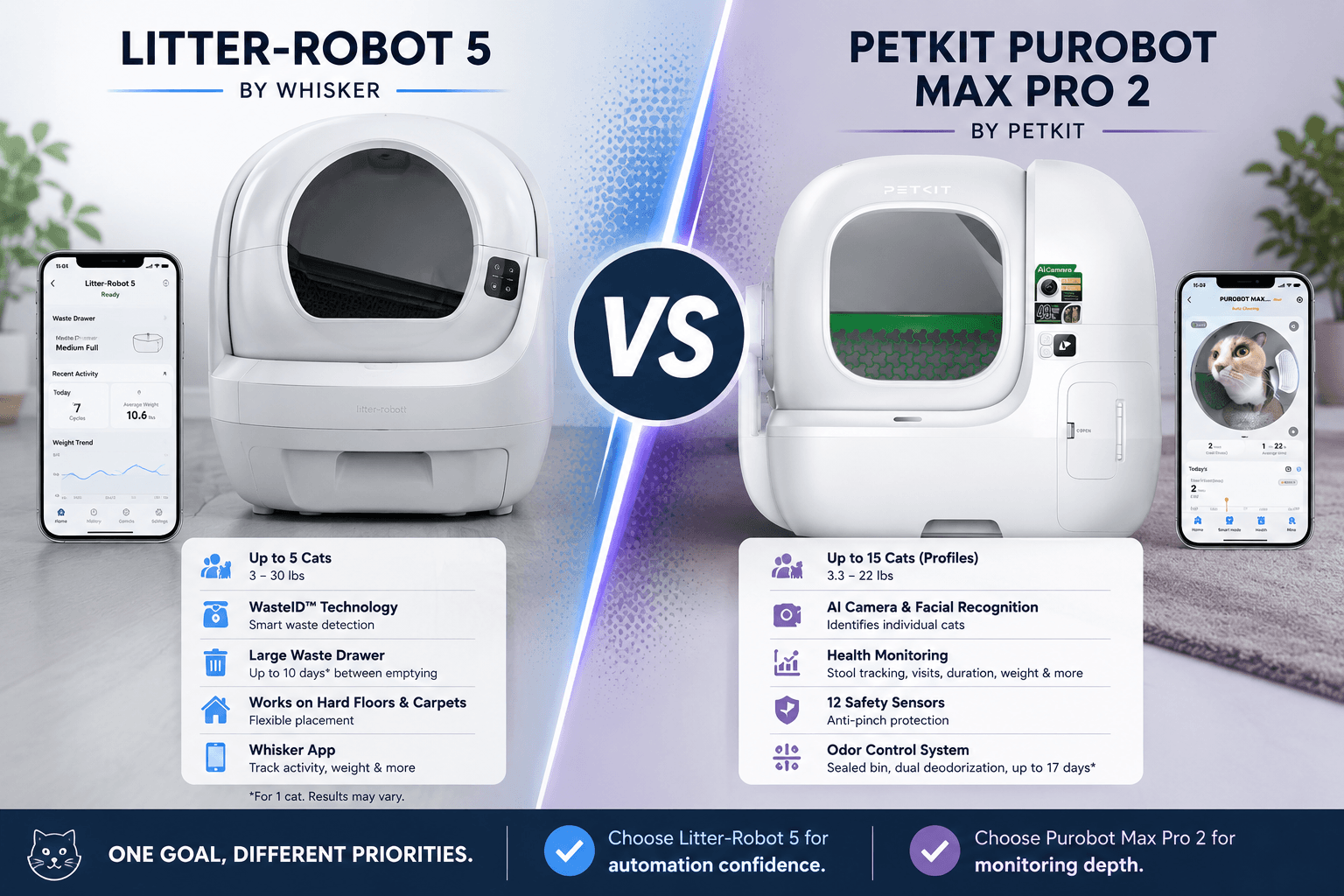
    The Real Difference: Less Work or More Context?

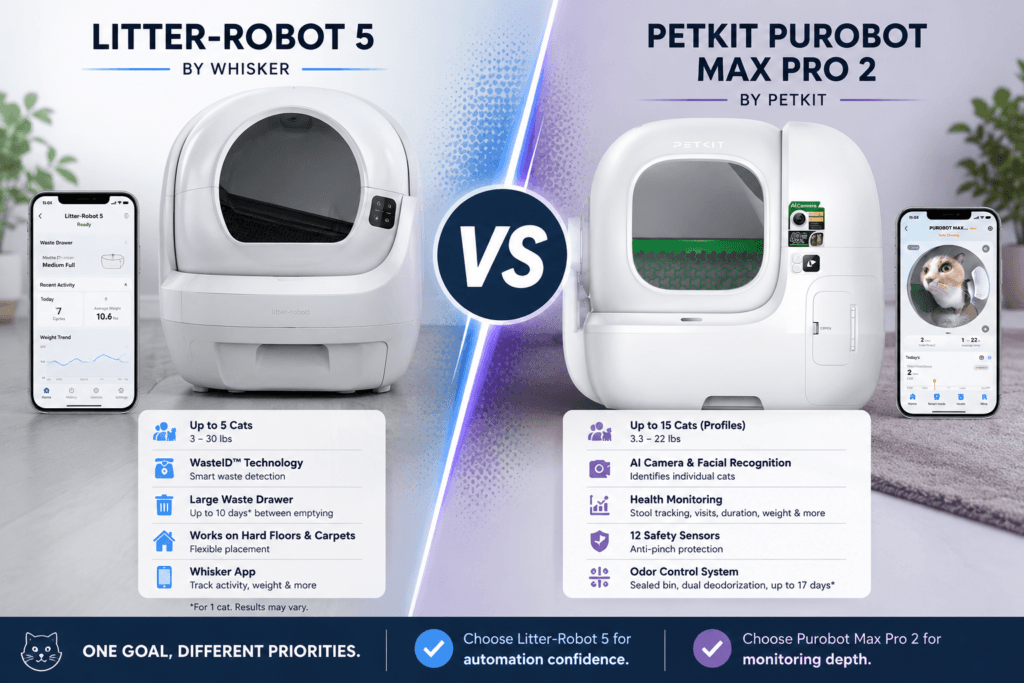
    Decision chart comparing Litter-Robot 5 automation features with PETKIT Purobot Max Pro 2 health monitoring features.

    Litter-Robot 5 uses technology primarily to improve the cleaning process.

    WasteID distinguishes urine from solid waste so the machine can apply more appropriate cycle timing. Its larger platform, waste drawer, app alerts and broad cat compatibility all support the same goal:

    Make litter management more predictable and less intrusive.

    Purobot Max Pro 2 uses technology to interpret each visit.

    Its camera and weight sensors can identify individual cats, separate their histories and record visual context around litter-box use. PETKIT also positions the system around observing changes in visit frequency, duration, stool appearance and vocalization.

    One product is trying to become a better appliance.

    The other is applying for an unpaid internship in feline behavioral observation.

    Neither approach is inherently better.

    The relevant question is what remains uncertain in your household.

    If the problem is waste management, choose the stronger appliance.

    If the problem is identifying which cat produced a change, the camera system has a clearer reason to exist.

    Who Should Choose Litter-Robot 5?

    Litter-Robot 5 is the stronger default because its value does not depend on how often you open the app.

    It supports cats across a broader size range and households with up to five cats. Its larger interior makes it the safer candidate for large or long-bodied animals, while its flexible placement is useful when the litter area includes carpet or rugs.

    Choose Litter-Robot 5 when:

    • one or more cats may be too large for the Purobot;
    • waste handling matters more than recorded video;
    • you want WasteID without cameras;
    • carpet placement is necessary;
    • your cats are easy enough to distinguish through weight data;
    • you want automation to work quietly in the background.

    This is the model for owners who want information, but do not want litter-box monitoring to become a hobby.

    The app can show weight, visits, waste type and machine status. For many households, that is enough to notice a meaningful change without reviewing footage of every ordinary event.

    Its main weakness is individual identification.

    Weight-based tracking works best when cats occupy clearly different weight ranges. When two animals weigh almost the same, the data can become less certain.

    That is where Purobot earns its place in the comparison.

    For the wider Whisker decision, read Litter-Robot 5 vs 5 Pro vs EVO.

    Who Should Choose Purobot Max Pro 2?

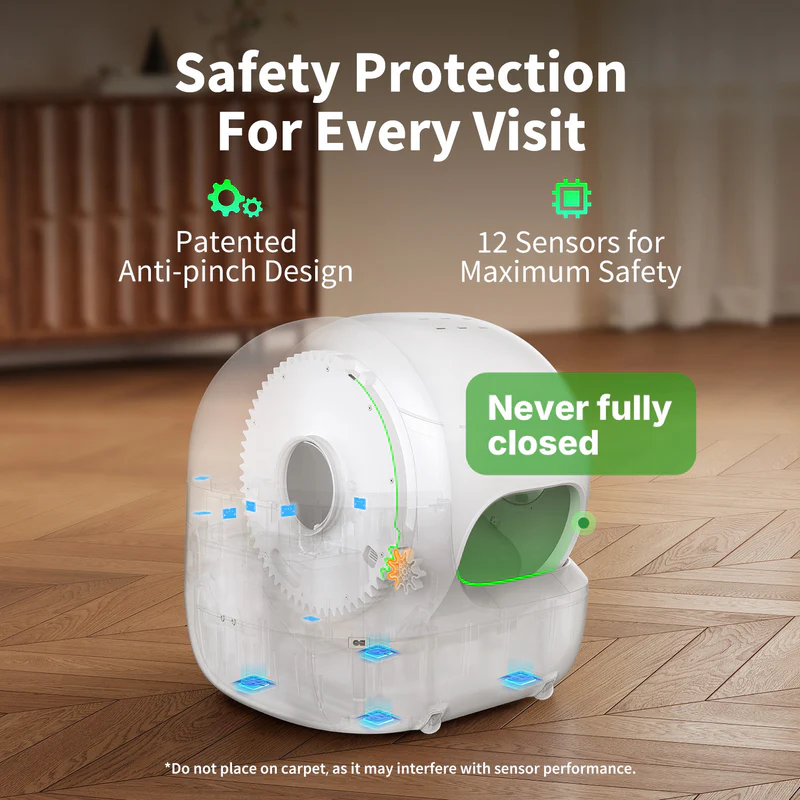
    PETKIT Purobot Max Pro 2 safety system with anti-pinch design and integrated sensors.

    Purobot Max Pro 2 is the stronger choice when a shared box is hiding information you actually need.

    Its AI camera combines visual recognition with weight data to maintain separate profiles and recorded histories.

    That can matter when:

    • two or more cats have similar weights;
    • one animal is older or requires closer observation;
    • you need to confirm which cat produced a repeated change;
    • visit videos would add useful context;
    • you already use PETKIT feeders, fountains or monitoring devices;
    • you will continue reviewing the information after the novelty disappears.

    The last point is the most important.

    Monitoring only creates value when it changes the next step.

    A useful recorded event might lead you to clean the box, adjust resource placement, watch one cat more closely or contact a veterinarian.

    An unused recorded event is simply cloud storage containing footage of a private moment nobody needed to preserve.

    Purobot is not the stronger choice because it collects more data.

    It is stronger when that data resolves ambiguity.

    For a closer analysis of PETKIT’s camera model, read Purobot Max Pro 2 Review.

    The Baron Test: Your Cat Still Gets a Vote

    Imagine Baron, a large tabby with the confidence of a minor European monarch.

    You install the Litter-Robot 5, complete the app setup and stand nearby admiring the machine you have researched for six hours.

    Baron approaches.

    He inspects the entrance.

    He looks at you.

    He turns around and uses the old plastic tray beside it.

    This is the part no comparison table can solve.

    Cat acceptance depends on:

    • entrance size and height;
    • interior room;
    • noise and movement;
    • box location;
    • litter familiarity;
    • whether the transition was gradual;
    • whether the cat considers your expensive purchase an obvious personal insult.

    Litter-Robot 5 has the advantage for exceptionally large cats because of its broader supported size range and roomier format.

    Purobot Max Pro 2 offers a relatively low-access design and an enlarged opening compared with its predecessor, which may suit some senior, short-legged or mobility-sensitive cats.

    Neither design guarantees acceptance.

    A specification can tell you that the cat should fit.

    Baron retains the constitutional right to disagree.

    Placement Matters More Than the Product Photography Suggests

    Purobot Max Pro 2 requires a firm, level surface.

    PETKIT advises against placing it directly on carpet because soft or unstable flooring can affect its weight sensors and individual tracking.

    That requirement is not a minor footnote when the only available litter area is carpeted.

    The camera system becomes considerably less impressive when the machine cannot be placed where you need it.

    Litter-Robot 5 is more flexible in this respect and can operate on carpet or hard floors.

    Choose according to the room that exists—not the immaculate laundry room used in promotional photography, where no human appears to store detergent, towels or evidence of ordinary life.

    Monitoring: Useful Insight or More Reasons to Worry?

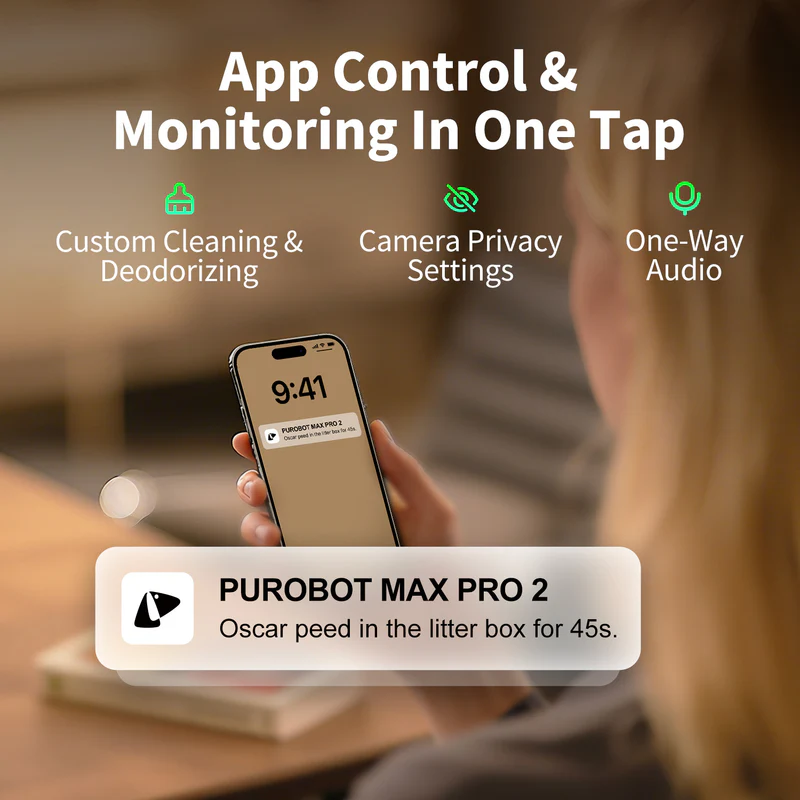
    PETKIT Purobot Max Pro 2 AI camera monitoring compared with Litter-Robot 5 app-based weight and visit tracking.

    Purobot Max Pro 2 can provide a richer record than the standard Litter-Robot 5.

    That record may include individual identification, visit video, duration, stool-related observations and unusual vocalization.

    These signals can help owners notice that something changed.

    They cannot determine why.

    A cat may visit repeatedly because of urinary discomfort, constipation, stress, litter preference, territorial tension or another cause entirely.

    The camera documents behavior.

    It does not receive a veterinary degree when connected to Wi-Fi.

    The correct response to a repeated or concerning change is:

    1. verify the pattern;
    2. observe the cat directly;
    3. consider the wider environment;
    4. seek veterinary guidance when appropriate.

    The incorrect response is interpreting every minor variation as a diagnostic event because the app supplied a graph and used the word “AI.”

    For the broader distinction between useful visibility and unnecessary data, read Smart Cat Monitoring vs Automation.

    The Whisker side of this comparison deserves a closer look because several of its most distinctive monitoring features depend on Whisker+. See our complete Litter-Robot 5 Pro review.

    Cameras, Privacy and the Premium Software Layer

    The camera is Purobot’s defining advantage and its clearest trade-off.

    PETKIT allows owners to schedule monitoring periods, pause recording or disable the camera. Buyers must still decide whether a connected camera in the litter area fits their privacy preferences.

    Turning the camera off permanently is possible.

    It also raises the reasonable question of why you purchased the camera litter box.

    Extended video history and some deeper features may depend on PETKIT’s premium service layer. That means buyers choosing Purobot for long-term visual records should consider software access as part of the ownership model—not as an optional detail discovered after checkout.

    Ask:

    • Do I need occasional visual confirmation?
    • Do I need retained histories?
    • Will I review individual timelines?
    • Would the information influence a real decision?
    • Am I comfortable with the ongoing software relationship?

    Five honest yes answers make the Purobot easier to justify.

    Five enthusiastic maybes usually mean the marketing has done more work than the household requirement.

    Odor Control and Daily Maintenance

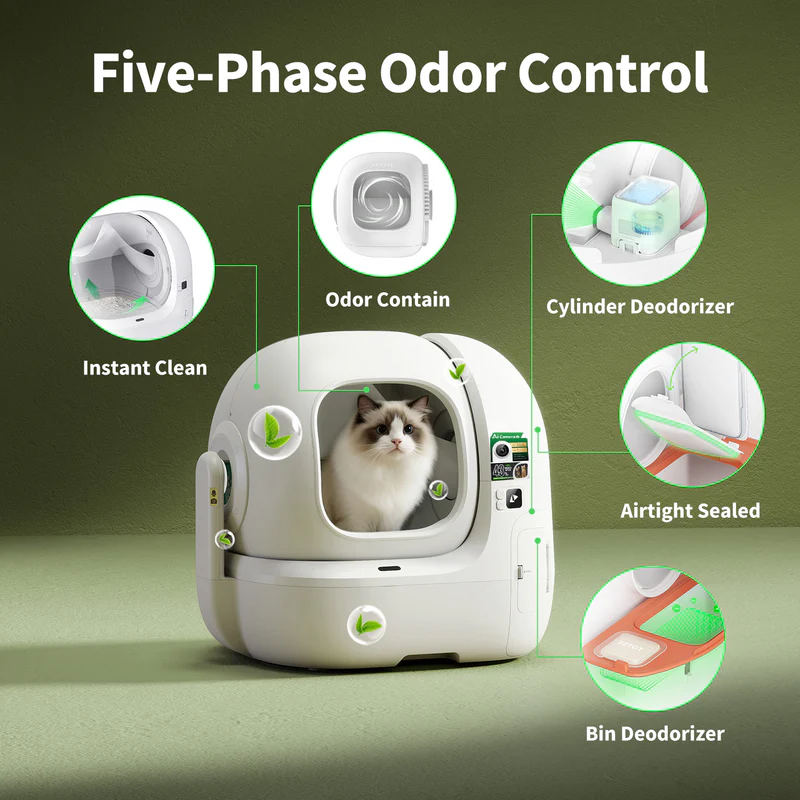
    PETKIT Purobot Max Pro 2 sealed waste bin and deodorization system for automatic litter box odor control.

    Both models remove waste from the exposed litter bed and store it in an enclosed compartment.

    Litter-Robot 5 uses WasteID, a sealed drawer, carbon filtration and optional odor-control accessories.

    Purobot Max Pro 2 combines an enclosed cylinder, sealed bin, deodorizing filters and contactless drawstring waste packing.

    Purobot offers more odor-focused hardware.

    Litter-Robot 5 offers a more familiar drawer workflow and uses WasteID to improve cycle timing.

    Neither product eliminates:

    • waste bags or liners;
    • deodorizing consumables;
    • residue inside the machine;
    • sensor cleaning;
    • periodic deeper maintenance;
    • the consequences of leaving a full drawer untouched.

    The machine can remove waste from sight.

    It cannot prevent an owner from ignoring three notifications and then blaming the carbon filter.

    Which Is Better for Multiple Cats?

    Litter-Robot 5 has the advantage when the main multi-cat problem is capacity.

    It supports up to five cats and provides a broad physical platform for mixed-size households.

    Purobot Max Pro 2 has the advantage when the main multi-cat problem is identity.

    It is particularly relevant when cats have overlapping weights or when one animal’s routine must be separated from the activity of the group.

    Three differently sized cats may be easy for weight-based tracking to distinguish.

    Two nearly identical cats may make visual recognition far more valuable.

    Cat count alone does not decide the purchase.

    The real variable is how difficult the household is to interpret.

    Neither model eliminates the possible need for additional litter stations. Automation reduces labor; it does not abolish territorial preferences because the machine has a polished app.

    Buyer Regret in One Sentence

    Litter-Robot 5 regret means discovering that weight data cannot reliably separate similar cats; Purobot regret means buying an AI monitoring system and gradually using it as a more elaborate full-drawer alert.

    Final Verdict

    Choose Litter-Robot 5 when you want broader cat compatibility, flexible floor placement, WasteID and dependable camera-free automation.

    It is the stronger recommendation for most households because its value remains clear even when nobody reviews the app every day.

    Choose PETKIT Purobot Max Pro 2 when individual identification is the unresolved problem.

    Its camera, facial recognition and event history can reveal what a shared litter box normally hides—especially when similar-weight cats make sensor-only data ambiguous.

    Litter-Robot 5 is the better appliance.

    Purobot Max Pro 2 is the better observer.

    The correct choice depends on whether you want the litter routine to become less visible or the cats using it to become more visible.

    Buy the system that resolves a real problem.

    Baron will provide enough unpredictability for free.

    For the broader brand-level decision, read PETKIT vs Litter-Robot Ecosystem.

    Frequently Asked Questions

    Is Litter-Robot 5 better than Purobot Max Pro 2?

    Litter-Robot 5 is better for larger cats, broader household capacity, carpet placement and camera-free automation.

    Purobot Max Pro 2 is better for visual multi-cat identification and recorded visit context.

    Which is better for similar-weight cats?

    Purobot Max Pro 2.

    Its camera and facial recognition add another identification layer when weight data alone is ambiguous.

    Which is better for large cats?

    Litter-Robot 5 has the broader supported cat-size range and is the safer choice for exceptionally large cats.

    Can Purobot Max Pro 2 sit on carpet?

    PETKIT recommends placing it on a firm, level surface rather than directly on carpet because unstable flooring can interfere with sensor accuracy.

    Does Litter-Robot 5 have a camera?

    No.

    Camera monitoring is available on Litter-Robot 5 Pro, not the standard Litter-Robot 5.

    Does Purobot Max Pro 2 require a subscription?

    Its core cleaning and connected features do not depend entirely on a subscription, but extended video history and deeper monitoring functions may involve PETKIT’s premium service layer.

    Can either model diagnose health problems?

    No.

    Both can reveal changes in activity, weight or litter-box behavior, but neither can diagnose the cause or replace veterinary assessment.

    References

    Whisker — Litter-Robot 5 product documentation

    Whisker — Current Litter-Robot comparison chart

    PETKIT — Purobot Max Pro 2 product documentation and FAQ

    PETKIT — PETKIT Care+ feature information

    Cornell Feline Health Center — Feline litter-box behavior and house-soiling guidance

    Image Credits

    Official PETKIT and Whisker product imagery used for editorial comparison.

    Editorial Disclosure

    PetTech AI may earn a commission from qualifying purchases. This does not influence our recommendations, comparisons or editorial judgments.

  • Purobot Max Pro 2 vs PuraMax 2: Which PETKIT Litter Box Should You Buy?

    Purobot Max Pro 2 vs PuraMax 2: Which PETKIT Litter Box Should You Buy?

    PETKIT would be delighted if you interpreted this comparison as good litter box versus better litter box.

    Your bank account deserves a more useful answer.

    PuraMax 2 and Purobot Max Pro 2 perform the same central job. Both clean automatically, contain waste, connect to the PETKIT app and reduce daily scooping.

    The difference is what happens around that job.

    PuraMax 2 is the practical automation-first choice.

    Purobot Max Pro 2 adds an AI camera, visual cat identification and recorded context around each visit.

    For most one- or two-cat homes, PuraMax 2 is enough.

    Choose Purobot Max Pro 2 when identifying individual cats is a real problem—especially when similar weights make sensor-only data ambiguous.

    The camera is not a decorative upgrade.

    It is either the reason to buy the Purobot or the reason you are about to overpay.

    Research Note

    This is a research-led comparison based on current official specifications, software information and product positioning.

    PetTech AI has not conducted a long-term side-by-side test of both models.

    Quick Verdict

    Your household or priorityBetter choiceWhy
    One cat with a predictable routinePuraMax 2Camera identification adds little
    Two cats with clearly different weightsPuraMax 2Weight-based profiles may already be sufficient
    Similar-weight catsPurobot Max Pro 2Facial recognition reduces identification ambiguity
    Individual video records matterPurobot Max Pro 2Camera adds visual context to each visit
    You dislike connected indoor camerasPuraMax 2No camera-related privacy trade-off
    You want the simpler feature setPuraMax 2Core cleaning and app functions without video monitoring
    You actively monitor an older or vulnerable catPurobot Max Pro 2Separate histories can make repeated changes easier to verify
    You rarely inspect app historiesPuraMax 2Less of its value depends on active data review

    Recommendation strength

    PuraMax 2: Strong recommendation for automation-first households.

    Purobot Max Pro 2: Strong but conditional recommendation when visual identification will change what the owner does.

    PetTech AI may earn a commission from qualifying purchases. As an Amazon Associate I earn from qualifying purchases.

    Automation is enough? Check PuraMax 2 availability at PETKIT.

    Need visual cat identification? Check Purobot Max Pro 2 availability at PETKIT.

    Prefer Amazon checkout? Check Purobot Max Pro 2 price and availability on Amazon.

    The Camera Is the Product Difference

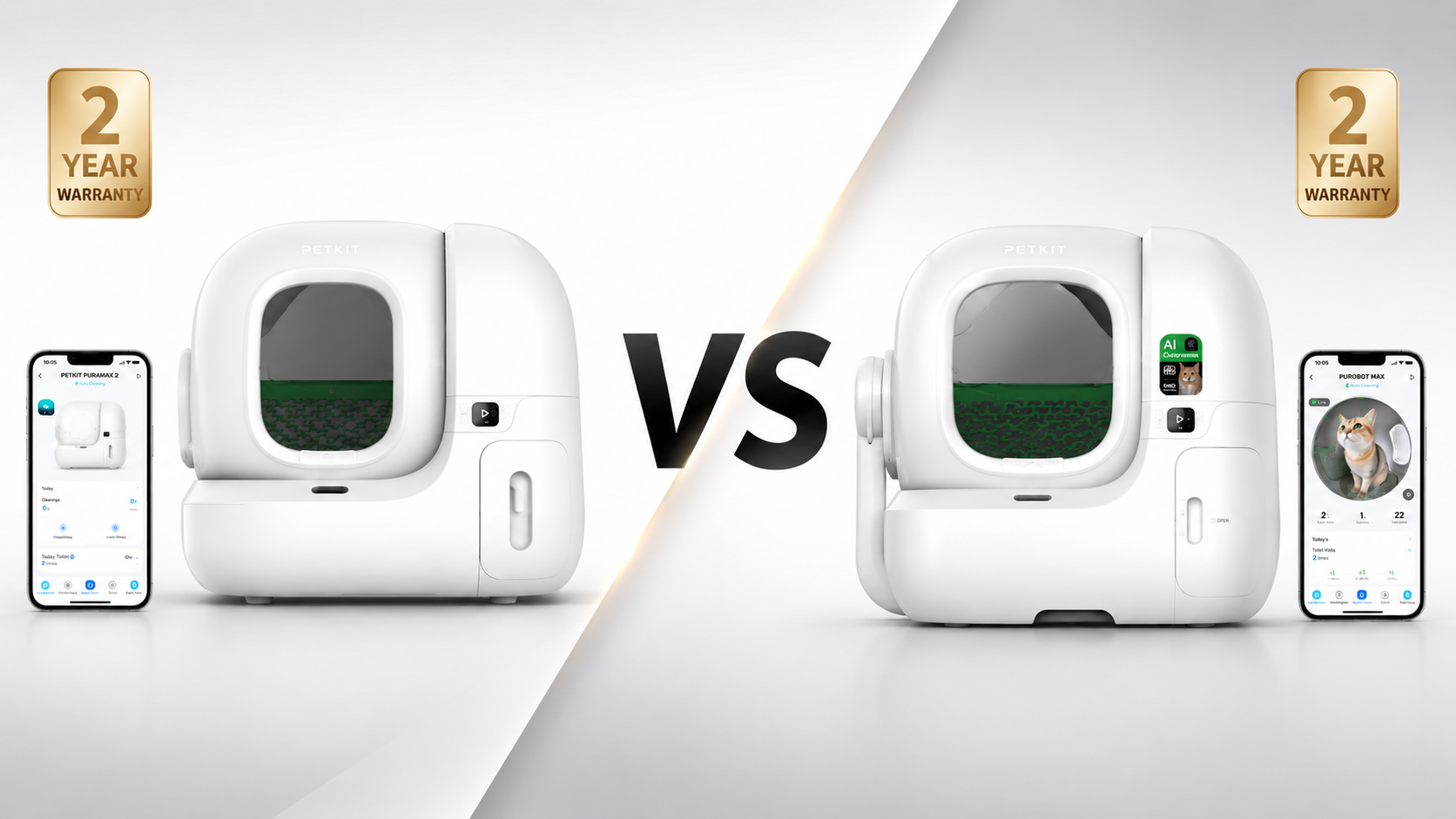
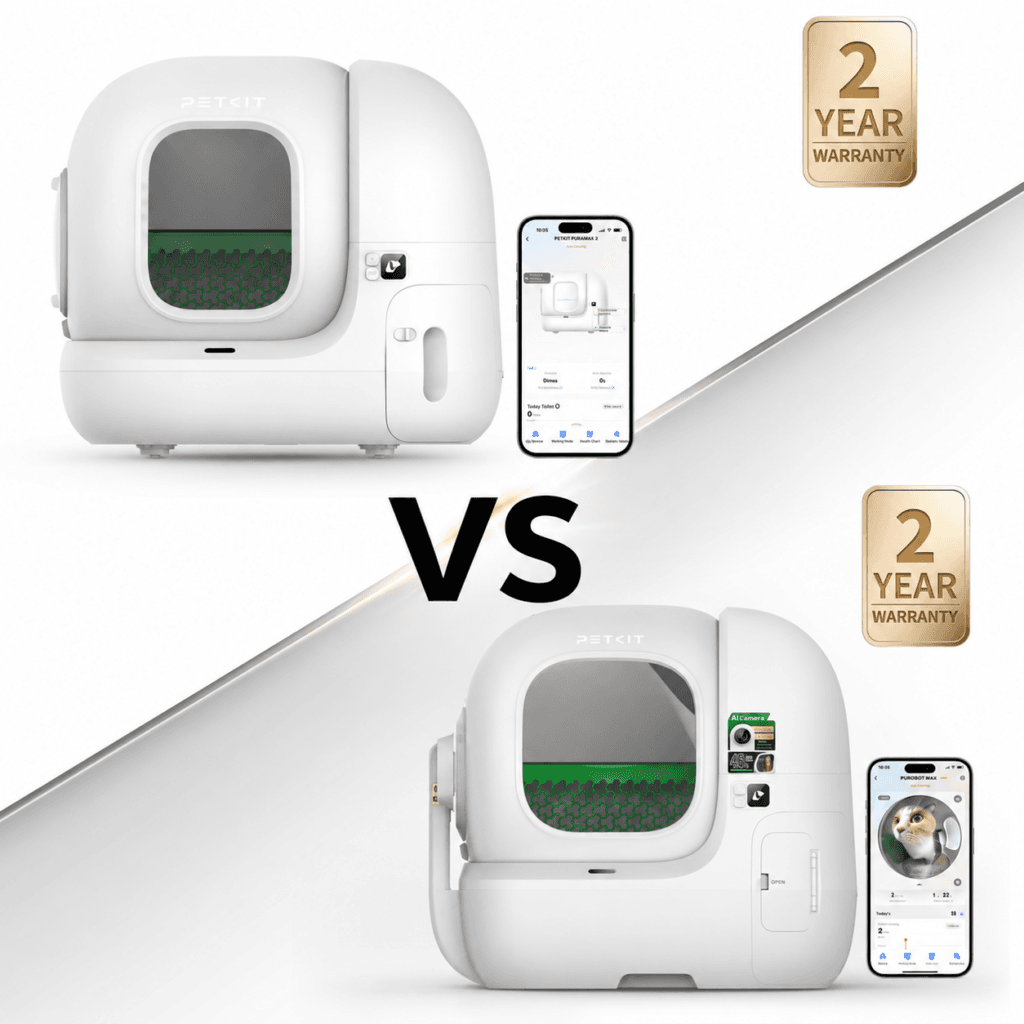
    PETKIT Purobot Max Pro 2 vs PuraMax 2 side-by-side comparison showing both self-cleaning litter boxes and their companion app interfaces.

    PuraMax 2 already handles the fundamental litter routine.

    After use, the cylinder rotates, separates clumped waste and moves it into a sealed bin. The PETKIT app provides device controls, cleaning schedules, alerts, weight information and visit records.

    Purobot Max Pro 2 starts with the same broad promise and adds a fixed AI camera.

    The camera works with weight sensing and facial recognition to create individual cat profiles, record visits and provide visual context around litter-box behavior. PETKIT also positions it around identifying changes in visit frequency, stool appearance and vocalization.

    That produces a simple distinction:

    PuraMax 2 tells you that the box was used.

    Purobot Max Pro 2 is better equipped to show which cat used it.

    In a one-cat home, this may be a brilliantly engineered answer to a question nobody asked.

    In a multi-cat home with overlapping weights, it can resolve the most important uncertainty in the room.

    Who Should Choose PuraMax 2?

    PuraMax 2 is the better fit when the owner wants cleaning automation without making video monitoring part of the routine.

    It still provides:

    • automatic cleaning;
    • sealed waste storage;
    • weight and visit information;
    • app alerts and remote controls;
    • odor-management features;
    • support for multiple cat profiles.

    The absence of a camera does not make it unintelligent.

    It means identification relies more heavily on weight data and household context.

    That works particularly well when there is one cat or when multiple cats occupy clearly different weight ranges.

    Choose PuraMax 2 when:

    • the main objective is reducing scooping;
    • weight-based profiles already distinguish the cats adequately;
    • video records would satisfy curiosity rather than guide action;
    • you prefer a camera-free litter area;
    • you want the stronger value proposition;
    • additional monitoring would create more checking than clarity.

    For a one-cat household, the Purobot can provide detailed proof that the only cat in the home was responsible.

    The investigation was not especially difficult.

    Who Should Choose Purobot Max Pro 2?

    Purobot Max Pro 2 becomes valuable when the litter box is shared and the owner needs cat-specific context.

    Its strongest use cases include:

    • similar-weight cats;
    • an older cat whose routine requires closer observation;
    • a cat with previous urinary or digestive concerns;
    • households where general box-level data cannot identify the animal involved;
    • owners who would use recorded events during a veterinary conversation;
    • existing PETKIT monitoring ecosystems.

    The important phrase is would use.

    A video matters when it helps verify a repeated change, identify the correct cat or decide what to observe next.

    It matters less when the owner opens three clips during the first week and then returns permanently to checking whether the waste bin is full.

    Purobot is not automatically the superior litter box because it gathers more information.

    It is superior when the household contains an information problem.

    For a full analysis of its camera and ownership trade-offs, read PETKIT Purobot Max Pro 2 Review.

    The Baron and Biscuit Problem

    Imagine two cats: Baron and Biscuit.

    They weigh almost the same, use the same litter box and share the unfortunate habit of conducting important business at 4:00 a.m.

    The app reports an unusually long visit.

    With PuraMax 2, weight information may help identify the cat—but overlapping measurements can leave some uncertainty.

    With Purobot Max Pro 2, facial recognition and recorded video may show that Baron entered, stayed longer than usual and returned shortly afterward.

    That is useful context.

    It does not tell you why Baron behaved differently, but it tells you which cat needs direct observation.

    Now change the household.

    There is only Baron.

    He uses the box once, looks directly into the camera with the disappointment of a landlord inspecting property damage and leaves.

    The Purobot has successfully identified him.

    The suspect pool contained one animal.

    This is why cat count alone does not justify the camera. Identification difficulty does.

    PuraMax 2 Is Smaller—but Not Dramatically Smaller

    PuraMax 2 is shorter and slightly narrower than Purobot Max Pro 2, while both have approximately the same depth.

    PuraMax 2 measures about 24.4 inches wide, 21.2 inches deep and 21.7 inches tall. Purobot Max Pro 2 measures approximately 25.9 inches wide, 21.2 inches deep and 23.7 inches tall.

    That can make PuraMax 2 easier to accommodate under shelves or in spaces with limited vertical clearance.

    It does not make the Purobot an enormous industrial installation by comparison.

    The Purobot also offers a substantially enlarged entrance compared with its predecessor. PETKIT positions the wider opening for large, senior and short-legged cats.

    Physical fit should therefore be judged using:

    • the cat’s weight and body length;
    • entrance comfort;
    • room around the machine;
    • access for bin removal;
    • space required for deep cleaning.

    Do not choose PuraMax 2 solely because an old comparison called it “compact.”

    Do not choose Purobot solely because a Maine Coon looked cooperative in the promotional photography.

    The cat has retained final approval authority.

    What Actually Stays the Same?

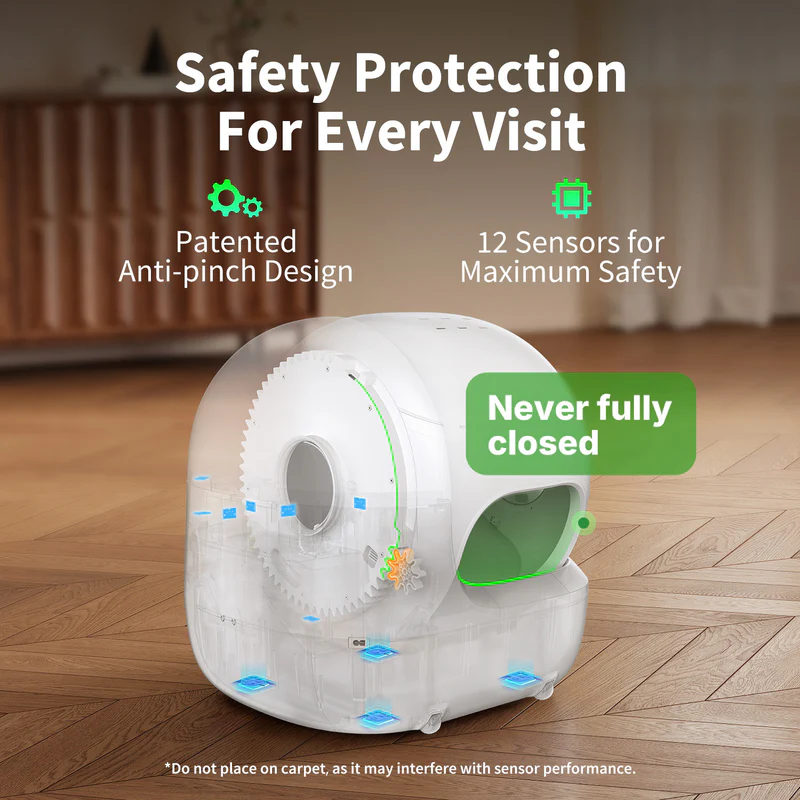
    PETKIT Purobot Max Pro 2 safety system featuring 12 sensors and anti-pinch protection.

    The camera receives most of the attention, but much of the ownership experience remains similar.

    Both machines still require:

    • compatible clumping litter;
    • waste bags;
    • bin emptying;
    • deodorizing consumables;
    • sensor cleaning;
    • periodic disassembly and deeper cleaning;
    • a gradual transition for the cat.

    Both also provide app-connected cleaning controls, alerts and routine information.

    The Purobot’s contactless drawstring waste system can make bin handling cleaner. Its camera and additional sensing also create more components and a more monitoring-heavy software experience.

    PuraMax 2 has the simpler feature set.

    That does not guarantee less physical maintenance.

    It means fewer decisions involve recorded video, facial recognition or premium monitoring features.

    Odor Control: Both Still Need Maintenance

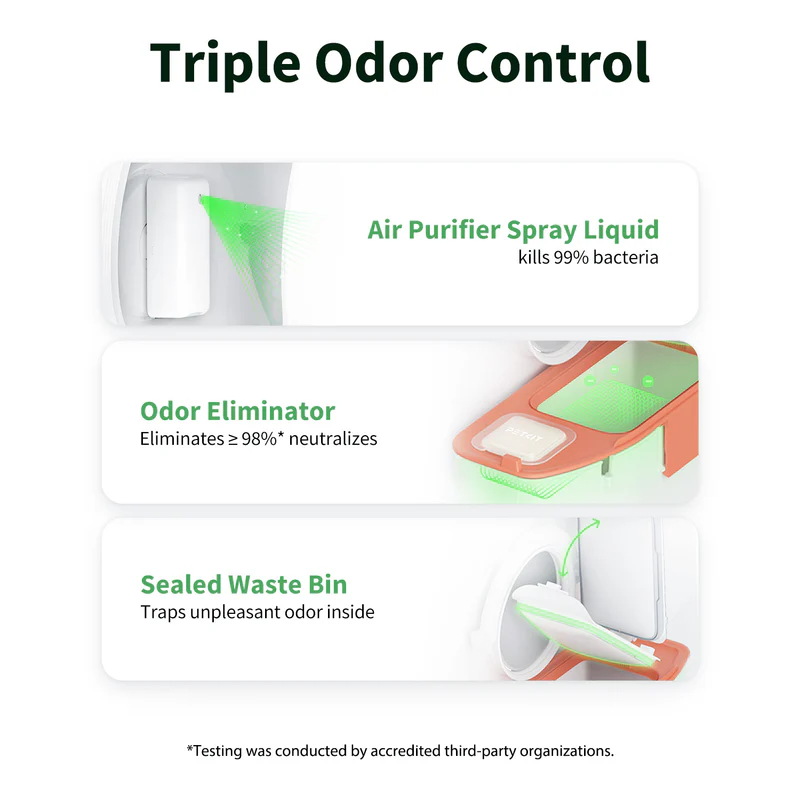
    PETKIT PuraMax 2 triple odor control system with deodorizer, air purifier spray, and sealed waste bin.

    PuraMax 2 uses an enclosed cylinder, sealed waste bin and PETKIT odor-control products.

    Purobot Max Pro 2 adds a layered deodorization system around its cylinder and waste bin, alongside its contactless bag-packing design.

    The Purobot has the more elaborate odor-control hardware.

    PuraMax 2 already contains the main source of improvement: waste is removed from the exposed litter bed and stored in a closed compartment.

    Neither machine can compensate indefinitely for:

    • weak-clumping litter;
    • a full waste bin;
    • exhausted deodorizing products;
    • residue inside the cylinder;
    • poor room ventilation;
    • an owner who has dismissed four alerts as suggestions.

    The more advanced odor system may help.

    It has not repealed cleaning.

    Camera Privacy and PETKIT Care+

    Purobot’s camera can add meaningful context, but it also changes the type of product entering the home.

    PETKIT provides controls for scheduling, pausing or disabling camera functions. Owners still need to decide whether they are comfortable with a cloud-connected camera in the litter area.

    Disabling it permanently solves the privacy concern.

    It also converts the Purobot into a particularly elaborate way to avoid buying PuraMax 2.

    Extended video storage and some deeper monitoring functions may depend on PETKIT Care+. Buyers interested in long-term video histories should therefore include the software layer in the real ownership decision.

    Ask:

    • Do I need visual identification?
    • Will I review recorded events?
    • Would longer histories change what I monitor?
    • Am I comfortable with the privacy trade-off?
    • Will the feature remain useful after the novelty disappears?

    A clear yes makes the Purobot easier to defend.

    A hopeful “possibly” is how premium features acquire new homes.

    What Monitoring Can—and Cannot—Tell You

    PETKIT Purobot Max Pro 2 AI litter box monitoring with live tracking, pet recognition, and health reports.

    Purobot Max Pro 2 can provide more detailed evidence than PuraMax 2.

    It may help show:

    • which cat entered;
    • how long the visit lasted;
    • whether the cat returned repeatedly;
    • whether stool appearance changed;
    • whether unusual vocalization occurred.

    It cannot diagnose the reason.

    A repeated visit may relate to urinary discomfort, constipation, stress, litter preference, territorial tension or another condition.

    The camera records the event.

    It does not complete veterinary school during the firmware update.

    Use the information to identify patterns, observe the cat directly and seek veterinary guidance when changes are sudden, significant or persistent.

    For the broader distinction between useful monitoring and unnecessary data, read Smart Cat Monitoring vs Automation.

    Buyer Regret in One Sentence

    PuraMax 2 regret means discovering that weight data cannot reliably distinguish your cats; Purobot regret means paying for facial recognition and eventually using it as an unusually sophisticated full-bin notification.

    Final Verdict

    Choose PETKIT PuraMax 2 when the real objective is automatic cleaning, odor containment and useful app controls without camera-based monitoring.

    It is the stronger recommendation for most one-cat homes and many uncomplicated two-cat households.

    Choose PETKIT Purobot Max Pro 2 when identifying individual cats is the unresolved problem.

    Its camera, facial recognition and recorded histories can reveal what a shared litter box normally hides—particularly when similar weights make standard profiles less dependable.

    PuraMax 2 is the better default.

    Purobot Max Pro 2 is the better specialist.

    The mistake is not choosing the cheaper or simpler model.

    The mistake is paying for a camera to solve an ambiguity your household never had—or saving money when individual identification was the reason you started researching smart litter boxes.

    For the wider ecosystem decision, read PETKIT vs Litter-Robot Ecosystem.

    Buyers who are also considering Whisker can compare Purobot Max Pro 2 vs Litter-Robot 4.

    Frequently Asked Questions

    Is Purobot Max Pro 2 worth choosing over PuraMax 2?

    Yes, when facial recognition, individual video records and similar-weight cat identification solve a real monitoring problem.

    PuraMax 2 is the better value when automatic cleaning and basic app data are already enough.

    Does PuraMax 2 identify individual cats?

    It uses weight data and individual profiles.

    Identification may become less dependable when cats weigh nearly the same.

    Does PuraMax 2 have a camera?

    No.

    Purobot Max Pro 2 is the camera-equipped model.

    Which model is better for multiple cats?

    Purobot Max Pro 2 is better when individual identification matters.

    PuraMax 2 can still suit multi-cat homes when the cats fit comfortably, share the box well and have sufficiently different weights.

    Which model is smaller?

    PuraMax 2 is slightly narrower and shorter. Both models have approximately the same depth.

    The difference is useful in some rooms but not large enough to determine the purchase alone.

    Does Purobot Max Pro 2 require a subscription?

    Core cleaning and app features remain available without relying entirely on a subscription.

    Extended video history and some deeper monitoring features may depend on PETKIT Care+.

    Can either litter box detect illness?

    No.

    They can surface changes in weight or litter-box behavior, but neither can diagnose their cause or replace veterinary assessment.

    References

    PETKIT — PuraMax 2 product documentation

    PETKIT — Purobot Max Pro 2 product documentation and FAQ

    PETKIT — PETKIT Care+ feature information

    Cornell Feline Health Center — Feline litter-box behavior and house-soiling guidance

    Feline Veterinary Medical Association — Feline house-soiling guidance

    Image Credits

    Official PETKIT product images used with permission.

    Editorial Disclosure

    PetTech AI may earn a commission from qualifying purchases. This does not influence our recommendations, comparisons or editorial judgments.

  • PETKIT Purobot Max Pro 2 Review: Useful AI or Cat Surveillance?

    PETKIT Purobot Max Pro 2 Review: Useful AI or Cat Surveillance?

    The PETKIT Purobot Max Pro 2 is not simply a PuraMax 2 with a camera attached.

    It is a more specialized litter box built around a specific problem: identifying which cat used the box and adding visual context when litter habits change.

    That can be genuinely useful in a multi-cat home.

    It can also become an expensive way to collect videos nobody checks.

    Quick Verdict

    CategoryVerdict
    PetTech AI ratingRecommended with Conditions
    Best fitMulti-cat homes that need visual identification
    Main advantageCamera, weight data and visit records linked to individual cats
    Main catchThe camera adds cost, complexity and a PETKIT Care+ consideration
    Not forBuyers who mainly want automatic scooping
    Better default for most homesPETKIT PuraMax 2

    The PETKIT Purobot Max Pro 2 is worth considering when video changes what you can understand about individual litter-box visits.

    For automatic cleaning alone, it is overkill.

    The PuraMax 2 remains the more sensible default for most PETKIT buyers. Choose the Purobot Max Pro 2 only when visual recognition solves an actual household problem—not because “AI camera” looks impressive above the Add to Cart button.

    Research Note

    This is a research-led review based on current official specifications, product documentation, software terms, product positioning and available ownership evidence.

    PetTech AI has not conducted a long-term hands-on test of the PETKIT Purobot Max Pro 2.

    PetTech AI may earn a commission from qualifying purchases. As an Amazon Associate I earn from qualifying purchases.

    Does visual multi-cat monitoring justify the upgrade in your home? Check the Purobot Max Pro 2 on PETKIT.

    Prefer Amazon’s purchase route? Check Purobot Max Pro 2 availability and customer feedback on Amazon.

    What the Camera Actually Changes

    Smart litter box using AI camera monitoring and app-connected pet tracking.

    A normal automatic litter box can record that a cat entered, measure weight and start a cleaning cycle.

    The Purobot Max Pro 2 adds a wide-angle camera intended to connect each visit with visual context.

    That may help answer questions such as:

    • Which cat used the box?
    • Did the visit look normal?
    • Was the cat repeatedly entering and leaving?
    • Was there visible straining or vocalization?
    • Did the waste look different from usual?
    • Was the record assigned to the correct cat?

    The camera works alongside weight sensing and individual profiles. This matters most when several cats share similar weights and a weight-only system may confuse their records.

    It does not make identification perfect.

    Lighting, positioning, similar-looking cats and incomplete camera views can still affect recognition. Owners should review unusual records rather than treating every app label as unquestionable fact.

    The system is best understood as an evidence-gathering tool.

    It can show you that something changed. It cannot determine why.

    Multi-Cat Homes Are the Real Use Case

    Multiple cats using an AI-powered litter box with recognition and activity tracking features.

    In a single-cat household, every recorded visit already has an obvious owner.

    In a multi-cat household, the problem becomes attribution.

    One cat may start visiting more often. Another may avoid the box. Two similarly sized cats may generate nearly identical weight records. Unless someone is watching constantly—which sounds less like pet ownership and more like an underfunded surveillance operation—it can be difficult to know which cat changed its routine.

    This is where the Purobot Max Pro 2 earns its premium positioning.

    Camera-assisted recognition can make litter-box data more useful by separating individual patterns. Video may also help an owner describe an unusual event more clearly to a veterinarian.

    But more cats also create more waste, more recorded visits and more footage.

    The value depends on whether someone will actually review the information when the app flags a change.

    A camera that generates forty ignored clips is not monitoring. It is content production for an audience of zero.

    PETKIT Care+ Is Part of the Decision

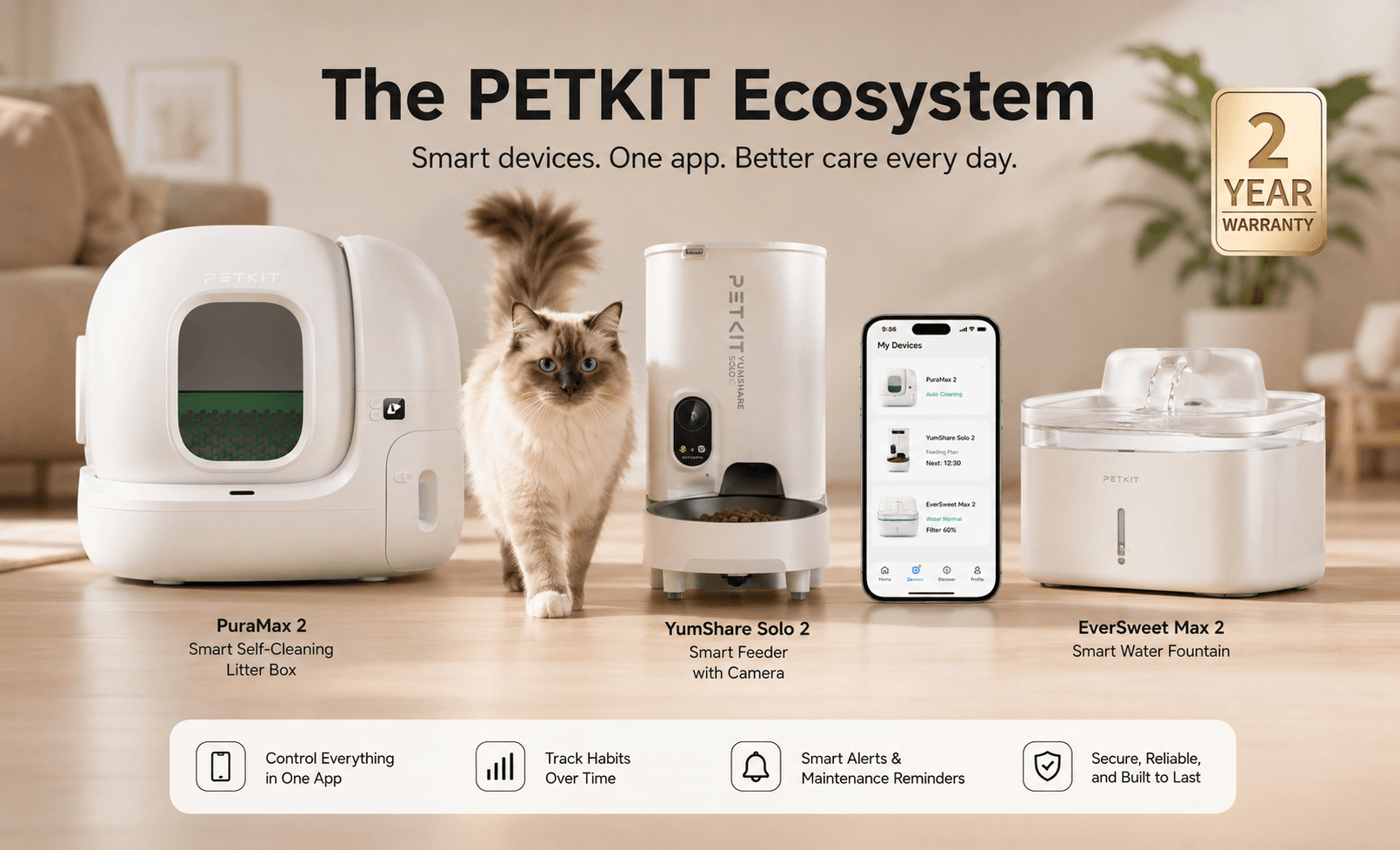
    Connected PETKIT ecosystem including litter box, feeder, fountain, and mobile app integration.

    PETKIT Care+ expands the video side of the product, including access to longer history and complete playback features.

    That makes the subscription question difficult to separate from the camera question.

    The litter box still cleans without Care+. Core automation does not disappear because the owner declines another recurring service.

    However, if your main reason for choosing the Purobot Max Pro 2 is reviewing past footage, the limits of the standard video experience matter.

    Before buying, ask:

    Would I still choose this model if preserving the video history I want required an additional recurring payment?

    If the answer is no, the PuraMax 2 is probably the better fit.

    A subscription can be reasonable when it supports a feature used consistently. It becomes less attractive when it charges rent for footage of Baron entering a litter box at 3:14 a.m. and conducting business as expected.

    Monitoring Does Not Mean Diagnosis

    The Purobot Max Pro 2 can record visit frequency, duration, weight, video and other observable details.

    Those records may help surface changes worth investigating.

    They cannot diagnose urinary disease, constipation, digestive problems, stress or pain.

    Frequent visits, straining, crying during urination, blood in the urine or producing little to no urine require veterinary attention. A urinary obstruction can be an emergency, particularly in male cats.

    The correct workflow is simple:

    1. Notice the change.
    2. Review the available context.
    3. Observe the cat directly.
    4. Contact a veterinarian when the signs are sudden, persistent or concerning.

    The camera can improve the information you bring to the appointment.

    It should never become a reason to postpone the appointment.

    For households that want monitoring without replacing their existing litter box, see our Petivity Smart Litter Box Monitor Review.

    Living With the Purobot Max Pro 2

    Modern smart home setup featuring automated cat care technology and monitoring tools.

    The Purobot Max Pro 2 is a large enclosed appliance, not a compact litter tray.

    PETKIT enlarged the entrance compared with the previous version, which should make access easier for senior, short-legged and larger cats.

    A bigger entrance does not guarantee comfortable internal space.

    Large-bodied cats still need enough room to turn, dig and position themselves inside the cylinder. Cats that dislike covered litter boxes may also reject the design regardless of the official weight range.

    Measure the available floor space and consider your cat’s body shape—not only the maximum weight printed in the specifications.

    The box automatically separates clumps and deposits waste into a sealed drawer. This reduces daily scooping and helps contain odor, but it does not eliminate routine work.

    Owners still need to:

    • empty the waste drawer;
    • refill litter;
    • wipe the entrance and camera;
    • clean the cylinder and sifter;
    • remove stuck residue;
    • check sensors;
    • replace bags and deodorizing components.

    Odor control will still depend on litter quality, drawer maintenance, ventilation and the number of cats using the box.

    Automatic means less repetitive work.

    It does not mean the waste drawer has achieved self-awareness and begun emptying itself.

    Comparing it with Whisker’s larger, camera-free platform? Our Purobot Max Pro 2 vs Litter-Robot 4 guide separates monitoring advantages from physical fit.

    Safety and Cat Acceptance

    PETKIT equips the Purobot Max Pro 2 with multiple sensors intended to detect weight, proximity and entry during operation.

    Those safeguards are necessary, but owners should still supervise the transition.

    Place the unit on a flat, firm surface. Keep the previous litter box available. Start with familiar litter and allow the cat to investigate without being pushed inside.

    During the transition:

    • delay automatic cleaning when necessary;
    • supervise early visits;
    • check that the correct cat is recognized;
    • watch for hesitation or avoidance;
    • keep the old box available until use is consistent.

    Cats below PETKIT’s minimum operating weight require additional precautions and should not rely on normal automatic cycling.

    The safest automatic litter box is one the cat accepts willingly and the owner continues to inspect.

    Purobot Max Pro 2 vs PuraMax 2

    The decision between these two models is easier than the feature lists make it appear.

    Choose PuraMax 2 when:

    • automatic cleaning is the main objective;
    • you do not need video identification;
    • your cats are easy to distinguish through existing records;
    • you want fewer connected layers;
    • you prefer the better-value PETKIT default.

    Choose Purobot Max Pro 2 when:

    • multiple cats share the same box;
    • similarly sized cats confuse weight-only records;
    • visual context would change your response;
    • you intend to review visit history;
    • the larger entrance better suits your cat.

    The Purobot Max Pro 2 is not universally better.

    It is more specialized.

    For the complete comparison, read our Purobot Max Pro 2 vs PuraMax 2 guide.

    Buyer-Regret Risk

    The main regret is paying for the camera and then using Purobot Max Pro 2 exactly like a normal automatic litter box.

    That risk is highest in one-cat homes, for owners who rarely review app histories or when PETKIT Care+ already feels irritating before purchase.

    Choose this model only when visual identification changes which cat you monitor, what pattern you notice or how quickly you respond.

    Otherwise, PuraMax 2 delivers the more rational version of the same core automation.

    Final Verdict

    The PETKIT Purobot Max Pro 2 earns a Recommended with Conditions verdict.

    It is one of the more convincing camera-equipped automatic litter boxes for multi-cat households. Visual identification, weight sensing and visit records can provide context that a conventional self-cleaning box cannot.

    For most buyers, however, the PuraMax 2 remains the better default.

    Choose the Purobot Max Pro 2 when camera-assisted identification solves a real problem and you expect to use the footage.

    Skip it when the camera is merely the most exciting item on the specification sheet.

    Baron does not care whether his litter box contains artificial intelligence.

    The purchase becomes intelligent only when the extra information changes what you do.

    For a broader comparison between PETKIT and Whisker, read our PETKIT vs Litter-Robot Ecosystem guide.

    Frequently Asked Questions

    Is the PETKIT Purobot Max Pro 2 worth it?

    It is worth considering for multi-cat households that need visual identification and will actively review visit records. It is poor value when automatic cleaning is the only goal.

    Does it require PETKIT Care+?

    The litter box can operate without PETKIT Care+. The subscription expands video-history and playback functions, which matters if recorded footage is central to your buying decision.

    Can it diagnose health problems?

    No. It can record observable changes, but a veterinarian must determine their medical meaning.

    Is it suitable for large cats?

    The larger entrance improves accessibility, but internal comfort still depends on the cat’s body shape, mobility and tolerance for enclosed litter boxes.

    Is it better than PuraMax 2?

    Only for buyers who need camera-assisted recognition and visual visit context. For automatic cleaning alone, PuraMax 2 remains the stronger default.

    References

    • PETKIT — Purobot Max Pro 2 product documentation
    • PETKIT — Purobot Max Pro 2 user manual and PETKIT Care+ information
    • PETKIT — PuraMax 2 product documentation
    • Cornell Feline Health Center — Feline Lower Urinary Tract Disease

    Image Disclosure

    Official PETKIT images are used when depicting the exact product.

    Any AI-generated images are editorial illustrations only. They do not represent exact dimensions, internal space, camera behavior or app performance. Always verify current specifications before purchasing.

    Editorial Disclosure

    PetTech AI may earn a commission from qualifying purchases. This does not influence our recommendations, comparisons or editorial judgments.

  • PETKIT vs Litter-Robot Ecosystem: Smart Home or Premium Litter Fortress?

    PETKIT vs Litter-Robot Ecosystem: Smart Home or Premium Litter Fortress?

    Your cat does not need an ecosystem.

    He needs:

    • a clean litter box;
    • food at roughly the expected time;
    • accessible water;
    • technology that does not frighten or inconvenience him.

    The ecosystem is for you.

    It determines how many devices share one app, which routines can be viewed together and how tempting it becomes to buy a matching fountain because the litter box behaved well for six months.

    PETKIT and Whisker—the company behind Litter-Robot—represent two different strategies.

    PETKIT builds outward.

    Its ecosystem spans litter boxes, feeders, fountains and cameras, with the PETKIT app connecting litter, meal and hydration records across supported products.

    Whisker builds deeper around litter.

    Its current platform centers on four Litter-Robot models, Feeder-Robot, the Whisker app and increasingly detailed litter-related monitoring.

    The decision is therefore not:

    “Which company makes smarter products?”

    It is:

    Do you want a broad smart-cat home—or a premium ecosystem built around the litter room?

    Quick Verdict

    Side-by-side comparison of PETKIT as a broader smart cat ecosystem and Litter-Robot as a focused litter-first system
    The ecosystem decision is not about which brand has more features, but whether your home needs broader connected care or a more focused litter-first workflow.
    CategoryPETKITWhisker
    PetTech AI verdictRecommended — Best Complete EcosystemStrong Recommendation for Litter-First Homes
    Best fitOwners expanding across litter, feeding and hydrationOwners making litter automation the main investment
    Main advantageMore credible product categories inside one appDeeper litter-box lineup and support environment
    FeedingWider selection, including camera-led optionsFeeder-Robot for routine dry-food scheduling
    HydrationEstablished connected-fountain rangeNo comparable fountain ecosystem
    Main riskBuying cameras and AI features you stop usingPaying premium prices inside a narrow product universe
    Choose it whenSeveral care routines create genuine frictionThe litter box is overwhelmingly the main problem

    Choose PETKIT when you already expect to buy across multiple care categories.

    Choose Whisker when you want the strongest focused path through premium litter automation and do not need a complete smart-home catalogue.

    Choose neither ecosystem automatically when you only need one device.

    Three matching app icons do not improve mediocre hardware.

    Research Note

    This is a research-led ecosystem comparison based on current official product catalogues, app services, software terms and PetTech AI’s individual product audits.

    It is not a blanket endorsement of every product sold by either company.

    PetTech AI may earn a commission from qualifying purchases.

    Want the broader connected-care platform? Check PETKIT PuraMax 2 through PETKIT.

    What You Are Actually Choosing

    PETKIT Purobot and PuraMax style litter boxes compared with Litter-Robot EVO, Litter-Robot 5 and Litter-Robot 5 Pro style devices
    At the litter-box level, PETKIT splits between automation-first and AI-camera monitoring, while Whisker separates EVO, Litter-Robot 5 and 5 Pro by monitoring depth.

    An ecosystem changes more than the number of apps on your phone.

    It influences:

    • which records appear together;
    • which subscription services become relevant;
    • which replacement parts and consumables you buy;
    • which support team handles several devices;
    • which brand receives the benefit of the doubt next time.

    That final point creates the greatest risk.

    A strong litter box can make the company’s feeder feel pre-approved.

    A useful feeder can make an unnecessarily advanced fountain appear to be the logical next stage of civilization.

    It is not.

    The correct ecosystem strategy is:

    1. buy the first product because it solves a real problem;
    2. let it earn your trust;
    3. evaluate the second product independently;
    4. treat the shared app as a bonus—not evidence of quality.

    For the broader distinction between removing work and collecting information, read our Smart Cat Monitoring vs Automation guide.

    PETKIT Wins Through Breadth

    PETKIT’s main advantage is not that it sells more objects.

    It is that those objects address several genuinely different routines.

    The current platform includes:

    • automatic litter boxes;
    • camera-equipped litter boxes;
    • scheduled dry-food feeders;
    • camera feeders with individual recognition;
    • dual-hopper feeding systems;
    • connected water fountains;
    • camera-led hydration products.

    The PETKIT app can combine supported litter-box use, feeding activity, hydration and device controls inside one account. The company’s recent product strategy has also extended AI cameras across litter, feeding and water rather than confining monitoring to a single category.

    That creates a credible expansion path.

    A household could begin with PuraMax 2, add a YumShare feeder and later introduce an EverSweet fountain without leaving the same software environment.

    Each device still addresses a different task.

    This is why PETKIT offers more than a matching-logo collection.

    Where PETKIT is strongest

    PETKIT makes the most sense when:

    • litter, feeding and hydration all create friction;
    • camera monitoring is useful in more than one category;
    • you expect to expand gradually;
    • one app genuinely reduces management effort;
    • mixing several separate product platforms sounds exhausting.

    Its feeding and hydration range is the clearest advantage over Whisker.

    Whisker can connect a litter box and dry-food feeder.

    PETKIT can extend farther into meal monitoring, alternative feeder formats and water management.

    Where PETKIT becomes dangerous

    Breadth makes unnecessary expansion easier.

    You may start with a sensible automatic litter box and end up with:

    • a feeder camera you stopped checking after Tuesday;
    • a fountain dashboard you open twice per year;
    • several filter and deodorizer schedules;
    • enough notifications to suggest Napoleon operates a regional logistics depot.

    PETKIT also releases ambitious camera and AI products rapidly. Some have compelling specifications before they accumulate a mature long-term ownership record.

    The ecosystem may be strong.

    A new individual product may still deserve a Conditional Recommendation.

    PETKIT wins the breadth contest.

    It does not receive diplomatic immunity from product-level scrutiny.

    For the choice between its mainstream and camera-led litter boxes, read our Purobot Max Pro 2 vs PuraMax 2 comparison.

    Whisker Wins Through Litter Depth

    Whisker’s ecosystem is narrower and easier to understand.

    Its current model ladder includes:

    • Litter-Robot EVO;
    • Litter-Robot 4;
    • Litter-Robot 5;
    • Litter-Robot 5 Pro;
    • Feeder-Robot;
    • litter, odor and refill accessories;
    • the Whisker app and Whisker+.

    The company positions EVO as the compact option, Litter-Robot 4 as its established bestseller, Litter-Robot 5 as the WasteID-equipped platform and 5 Pro as the dual-camera flagship.

    That progression lets buyers decide how far they want to move from automatic cleaning toward detailed monitoring without leaving the product family.

    Where Whisker is strongest

    Whisker makes the most sense when:

    • daily scooping is the main problem;
    • cat size or household load requires a clear model ladder;
    • litter-related accessories and replacement support matter;
    • you prefer a mature, focused ownership ecosystem;
    • Feeder-Robot provides enough additional expansion.

    The current Whisker app connects litter-box activity, weight trends and Feeder-Robot meal information across compatible products.

    Its expertise remains concentrated around the litter room.

    That is not glamorous breadth.

    It is useful specialization.

    For the internal lineup decision, read our Litter-Robot 5 vs 5 Pro vs EVO comparison.

    Where Whisker becomes a premium litter fortress

    The ecosystem loses momentum once you move beyond litter and scheduled dry-food feeding.

    Whisker does not currently offer PETKIT’s fountain catalogue, refrigerated feeding options or wider camera-feeder range.

    A household may build:

    • an excellent litter setup;
    • detailed weight and visit histories;
    • automatic litter refilling;
    • scheduled dry-food feeding;

    and still need other brands for water or wet food.

    That is perfectly acceptable when litter was the central objective.

    It becomes disappointing only when the buyer expected Whisker to become a complete smart-cat home.

    The newest monitoring features also introduce Whisker+.

    Core product functions and app access remain available without membership, but Litter-Robot 5 Pro’s facial identification and deeper video and history functions sit inside the premium software layer.

    Apparently, remembering who used the litter box can now become a recurring expense.

    The subscription is not automatically poor value.

    It simply belongs in the real ownership calculation when it provides the reason for buying the Pro.

    Feeding and Hydration Decide the Overall Winner

    Cat owner comparing smart cat ecosystem choices on a tablet with litter, feeding, hydration and monitoring options
    Smart cat ecosystems only make sense when they reduce real household friction. The best choice is the system whose trade-offs still fit after the novelty wears off.

    Whisker’s Feeder-Robot is a capable routine-first feeder.

    It offers scheduled dry-food meals and integrates with the same app as Litter-Robot.

    PETKIT provides more ways to approach feeding:

    • simple scheduled feeding;
    • dual-hopper configurations;
    • camera monitoring;
    • facial recognition;
    • visual meal records.

    PETKIT also has the decisive hydration advantage through its connected EverSweet fountain range.

    This is why PETKIT wins the complete ecosystem comparison.

    Not because every PETKIT product is better.

    Because the platform remains relevant after the litter box.

    For a feeder-level comparison between routine automation, camera monitoring and identity-led products, read our PETKIT vs Feeder-Robot vs CATLINK guide.

    The Ecosystem Lock-In Test

    Imagine that both companies announce tomorrow that their devices will no longer appear together inside one app.

    Would you still independently buy:

    • the litter box;
    • the feeder;
    • the fountain;
    • the camera upgrade?

    If yes, the ecosystem provides useful convenience.

    If no, the shared app may be encouraging weaker purchases.

    The first device is usually researched carefully.

    The second is often purchased with:

    “The first one was good, and this uses the same app.”

    That sentence has funded a remarkable amount of unnecessary consumer electronics.

    Is Mixing PETKIT and Whisker a Mistake?

    No.

    A mixed setup may be the rational winner:

    • Whisker for litter automation;
    • PETKIT for a camera feeder;
    • PETLIBRO for refrigerated wet food;
    • a conventional stainless-steel fountain requiring no account at all.

    The disadvantages are real:

    • multiple apps;
    • fragmented records;
    • separate accessories;
    • different customer-support systems.

    The advantage matters more:

    You can choose the strongest product for each routine.

    Your cat will not experience an identity crisis because his feeder and litter box have different logos.

    For the broader three-brand decision, read our CATLINK vs PETKIT vs Whisker comparison.

    Buyer-Regret Risk

    PETKIT regret usually means buying advanced cameras or AI insights that become ignored.

    Whisker regret usually means spending heavily inside a litter-focused ecosystem and later wanting broader feeding or hydration options.

    Mixed-brand regret means managing several apps—but potentially owning better individual products.

    The safest rule remains simple:

    Buy the product first and the ecosystem second.

    Still choosing the litter box before the ecosystem? Read our Best Smart Litter Boxes guide for the strongest models organized by household fit and monitoring needs.

    Final Verdict

    PETKIT is the better complete smart-cat ecosystem.

    It provides the stronger path across litter, feeding, hydration and camera-led monitoring. It is the right choice when several care routines create genuine friction and you expect to expand beyond one device.

    Whisker is the better litter-first ecosystem.

    Its narrower focus produces a clearer premium litter-box ladder, deeper litter-related software and a stronger support environment around the category.

    The decision is therefore:

    • PETKIT for breadth;
    • Whisker for litter depth;
    • mixed brands when individual product quality matters more than one app.

    Do not ask which logo deserves custody of your smart home.

    Ask which first product deserves your money.

    Then make the company earn everything that follows.

    Frequently Asked Questions

    Is PETKIT better than Litter-Robot?

    PETKIT is better as a broad ecosystem. Litter-Robot is better when premium litter automation is the primary objective.

    Which ecosystem has better automatic litter boxes?

    Whisker offers the clearer internal model ladder and stronger litter-first specialization. PETKIT remains competitive and offers more direct expansion into feeding and hydration.

    Which ecosystem is better for feeders?

    PETKIT offers more feeder formats and camera-led options. Whisker offers Feeder-Robot as a focused companion to Litter-Robot.

    Does either ecosystem require a subscription?

    Core functions do not require PETKIT Care+ or Whisker+. Certain extended camera, video-history and premium insight features may require the relevant paid service.

    Is it bad to mix PETKIT and Whisker?

    No. Mixing brands sacrifices one-app convenience but may produce a better product-by-product setup.

    References

    • PETKIT — Product catalogue and PETKIT app documentation
    • PETKIT — Care+ and 2026 connected-care announcements
    • Whisker — Current Litter-Robot lineup
    • Whisker — Feeder-Robot and Whisker app documentation
    • Whisker — Whisker+ membership information

    Image Disclosure

    Official manufacturer images are used when depicting exact products.

    Any AI-generated images are editorial illustrations only. They do not represent exact dimensions, controls, monitoring accuracy or app performance. Always verify current specifications before purchasing.

    Editorial Disclosure

    PetTech AI may earn a commission from qualifying purchases. This does not influence our recommendations, comparisons or editorial judgments.

  • Litter-Robot 5 vs 5 Pro (2026): Are the Cameras Actually Worth It?

    Litter-Robot 5 vs 5 Pro (2026): Are the Cameras Actually Worth It?

    Litter-Robot 5 Pro is not the version that cleans better.

    It is the version that watches.

    Both models automate the same central chore. They separate waste after use, track litter-box activity, estimate cat weights, connect to the Whisker app, and use WasteID to distinguish urine from solid waste.

    The Pro adds two cameras and a more advanced monitoring path.

    That means the decision is not:

    Which Litter-Robot is better?

    It is:

    Will visual identification and recorded litter-box events change anything you do?

    For most buyers, Litter-Robot 5 is the better choice.

    It delivers the core premium automation without making indoor bathroom surveillance part of the purchase.

    Choose Litter-Robot 5 Pro only when the camera system solves a real multi-cat or monitoring problem—and when you accept that its most advanced capabilities depend on Whisker+.

    Research note: This is a research-led comparison based on current official documentation, product positioning, software terms, and available ownership evidence. PetTech AI has not conducted a long-term hands-on test of either model.

    Quick Verdict

    Buyer priorityBetter choiceWhy
    Best for most buyersLitter-Robot 5Same core cleaning platform without paying for cameras
    Best for one predictable catLitter-Robot 5Weight and visit tracking are usually sufficient
    Best value inside the premium lineupLitter-Robot 5Pays for automation rather than deeper surveillance
    Best for similar-weight catsLitter-Robot 5 ProVisual recognition can resolve weight-based ambiguity
    Best for remote visual checksLitter-Robot 5 ProTwo integrated cameras provide visit context
    Best without an ongoing membershipLitter-Robot 5Less of its value depends on premium monitoring
    Best for monitoring-focused homesLitter-Robot 5 ProCameras and Whisker+ create the deepest insight layer

    Recommendation strength

    Litter-Robot 5: Recommended within the current Whisker lineup.

    Litter-Robot 5 Pro: Conditional recommendation for monitoring-first households.

    Buyer regret in one sentence

    Litter-Robot 5: You later discover that weight-based identification cannot reliably separate two very similar cats.

    Litter-Robot 5 Pro: You spend more on cameras, watch three litter-box videos, and quietly return to checking only the drawer notification.

    Who Should Buy Litter-Robot 5?

    Buy Litter-Robot 5 when the real objective is:

    • reducing scooping;
    • containing waste;
    • tracking visits and weights;
    • receiving drawer and maintenance alerts;
    • distinguishing urine from solid waste;
    • managing several cats whose weights are sufficiently different;
    • avoiding camera-related cost and complexity.

    This is the model that solves the physical problem.

    It cleans after use and provides enough app data for many households to notice broad changes in litter habits.

    The important phrase is enough data.

    More information is not automatically more useful.

    With one cat, weight-based identification is often adequate because there is only one animal available to generate the event. With several cats at clearly different weights, SmartScale can still help associate visits with individual profiles.

    In those homes, the cameras add context rather than solving an unresolved problem.

    And context is expensive when nothing depends on it.

    Who Should Buy Litter-Robot 5 Pro?

    A premium automatic litter box beside a phone showing cat visit history and camera-based monitoring data
    The Pro upgrade is not about a different cleaning routine. It is about cameras, recorded events and deeper cat-level visibility.

    Buy Litter-Robot 5 Pro when visual monitoring is central to the purchase.

    The Pro adds:

    • a front-facing camera;
    • a second camera directed toward the litter bed;
    • live viewing;
    • recorded events;
    • visual identification through the premium software layer;
    • deeper context around individual visits.

    This can matter when:

    • several cats have similar weights;
    • weight-based identification is unreliable;
    • you need to confirm which animal entered;
    • you want to see what happened during a visit;
    • you regularly spend time away from home;
    • visual evidence would improve how you respond to a repeated change;
    • you already know that you will use the app actively.

    The Pro is not overkill in those situations.

    It is solving the one problem the standard model cannot fully solve:

    A weight sensor can estimate who entered. A camera can look at the cat.

    That difference becomes more valuable as the household becomes harder to interpret.

    For a deeper look at cameras, visual identification, privacy and Whisker+, read our full Litter-Robot 5 Pro review.

    Who Should Skip the Pro?

    Skip Litter-Robot 5 Pro when:

    • you mainly want less scooping;
    • your cats are easy to distinguish by weight;
    • you dislike indoor cameras;
    • you rarely inspect app histories;
    • recorded events would satisfy curiosity rather than guide action;
    • you do not want another subscription decision;
    • the extra monitoring would increase anxiety rather than clarity.

    The Pro is the classic premium trap when buyers select it because it is the highest model.

    “Pro” is a product tier.

    It is not a diagnosis of your household’s technological requirements.

    What Actually Stays the Same?

    This is the part that should prevent most unnecessary upgrades.

    Both models provide the same fundamental ownership experience:

    • automatic waste separation;
    • the same general cleaning platform;
    • app-connected status and controls;
    • WasteID;
    • SmartScale weight tracking;
    • weight-based cat profiles;
    • drawer notifications;
    • cycle histories;
    • multi-cat support;
    • compatibility with Whisker’s current accessories and software environment.

    The Pro does not create cleaner clumps.

    It does not make the waste drawer substantially more enthusiastic.

    It does not teach the cat to cover what he has done.

    The premium primarily purchases cameras and the monitoring system built around them.

    If cameras are not important, the standard model already contains the reason most people entered the category.

    The Camera Difference

    Litter-Robot 5 Pro uses two integrated cameras.

    The front-facing camera

    The external camera captures the approaching cat and supports visual identification through Whisker’s advanced software.

    This can help when:

    • two cats weigh almost the same;
    • weight measurements overlap;
    • one cat’s visit needs visual confirmation;
    • the app assigns an event incorrectly;
    • several animals enter in quick succession.

    The litter-bed camera

    The internal-facing camera adds context around what happens during the visit.

    That may help owners observe:

    • positioning;
    • visit duration;
    • repeated entry and exit;
    • whether a cat appears uncomfortable;
    • whether the cleaning area contains an obvious issue.

    The footage can provide evidence.

    It cannot explain the cause.

    A video may show that a cat entered repeatedly. It cannot determine whether the reason involves litter preference, stress, constipation, urinary discomfort, social conflict, or something else.

    The camera tells you what happened.

    It does not graduate from veterinary school during installation.

    What Works Without Whisker+?

    This is where the buying decision needs precision.

    Litter-Robot 5 Pro does not become camera-free without a membership.

    Basic camera functionality remains available through the standard Whisker app, including limited live viewing and recorded events under the current service structure.

    Whisker+ unlocks the features that make the Pro a deeper individual-monitoring system, including:

    • unlimited live streaming;
    • visual cat identification;
    • a longer video history;
    • longer activity histories;
    • daily summaries;
    • more advanced pattern and behavior insights.

    Therefore, the correct question is not:

    Does Pro require a subscription?

    It is:

    How much of the reason I am choosing Pro depends on the subscription?

    If you only want occasional visual confirmation, the free camera layer may be enough.

    If you are buying the Pro for long-term individual tracking and richer cat-level histories, Whisker+ becomes part of the real ownership cost.

    A camera you own and an insight system you rent are not the same purchase.

    Litter-Robot 5 for One Cat

    A cat owner comparing one-cat and multi-cat litter box monitoring needs on a laptop while two cats sit nearby
    Litter-Robot 5 is usually enough for simple one-cat homes, while 5 Pro becomes easier to justify when multi-cat identification matters.

    For most one-cat households, choose Litter-Robot 5.

    The standard model can already associate weight and activity with the only cat in the home.

    You receive:

    • automatic cleaning;
    • weight trends;
    • visit histories;
    • waste-type information;
    • app alerts;
    • drawer status.

    The Pro becomes reasonable for one cat only when the owner specifically wants:

    • remote video;
    • visual confirmation of behavior;
    • recorded litter-box events;
    • more detailed monitoring after a previous concern;
    • the reassurance of seeing what happened while away.

    Those can be legitimate needs.

    They are not automatic requirements simply because the cat possesses a urinary system.

    Litter-Robot 5 Pro for Multiple Cats

    Multi-cat households give the Pro its strongest argument.

    Weight-based identification works best when cats occupy clearly different weight ranges.

    It becomes less dependable when:

    • two cats weigh nearly the same;
    • weights fluctuate;
    • cats enter close together;
    • one animal leans into the globe without fully entering;
    • the system receives an ambiguous measurement.

    Visual identification can help resolve those events.

    But the value still depends on what happens next.

    If you identify the cat and then change resource placement, monitor a repeated pattern, clean the box, add another litter station, or seek appropriate veterinary advice, the information has served a purpose.

    If you merely collect increasingly sophisticated evidence that Napoleon uses the box at 3:14 a.m., the monitoring system has become a very expensive biographer.

    For the broader decision between work-saving automation and behavioral visibility, read Smart Cat Monitoring vs Automation.

    The Whisker+ Question

    A membership is not inherently bad.

    It becomes bad when the product’s headline advantage feels incomplete without it and the buyer failed to include the recurring cost in the original decision.

    Before choosing Pro, ask:

    1. Will I review recorded events?
    2. Do I need visual identification?
    3. Do I care about histories extending beyond the free period?
    4. Would summaries change how I manage several cats?
    5. Am I willing to continue paying after the novelty disappears?

    Five honest “yes” answers make the Pro easier to defend.

    Five optimistic “probably” answers usually mean Litter-Robot 5 is the safer purchase.

    Where Litter-Robot 5 Can Disappoint

    Weight-based identification has limits

    SmartScale cannot always distinguish cats with similar weights.

    The system can also encounter ambiguous measurements when visits are incomplete or several animals interact around the unit.

    This is the main reason a complex multi-cat home may outgrow the standard model.

    It is still a premium litter box

    Choosing the non-Pro model does not make the purchase inexpensive.

    The standard model still asks the buyer to pay for:

    • the newest Whisker platform;
    • WasteID;
    • app functions;
    • weight histories;
    • accessory compatibility;
    • the broader Whisker ownership system.

    Buy it because those features matter—not merely because it costs less than an even more expensive sibling.

    Where Litter-Robot 5 Pro Can Disappoint

    Its best feature creates the main privacy trade-off

    The cameras observe the front of the machine and the litter bed.

    Some owners will consider that useful.

    Others will reasonably conclude that the home already contains enough internet-connected lenses.

    Privacy controls can reduce exposure.

    They do not make the cameras cease to exist.

    The software matters almost as much as the hardware

    Visual identification and advanced histories depend on software, account access, recognition accuracy, and the current Whisker+ service.

    The physical cameras may last for years.

    The precise service terms can change.

    More monitoring can create more worry

    A detailed timeline can help owners notice repeated changes.

    It can also encourage constant interpretation of normal variation.

    The correct use is:

    • observe the pattern;
    • verify it directly;
    • consider the wider context;
    • respond when the change is meaningful.

    The incorrect use is refreshing the app every time the cat spends eleven seconds longer considering his life choices.

    What About Litter-Robot EVO?

    EVO is the relevant alternative when your hesitation is not cameras but price, size, or platform depth.

    The current lineup can be understood as:

    • EVO: compact, automation-first entry;
    • Litter-Robot 5: balanced premium choice;
    • Litter-Robot 5 Pro: camera-led monitoring choice.

    Choose EVO when the main goal is Whisker self-cleaning with fewer premium layers.

    Choose Litter-Robot 5 when you want the newer platform and useful data without cameras.

    Choose 5 Pro when cameras and individual monitoring are the reason for paying more.

    For the full three-model decision, read Litter-Robot 5 vs 5 Pro vs EVO. For a closer look at the compact option, read our Litter-Robot EVO Review.

    Buyer Regret

    A cat owner deciding between Litter-Robot 5 and 5 Pro while reviewing camera monitoring features and price differences
    Buyer regret usually comes from overestimating how much monitoring you will actually use.
    PurchaseMost likely regret
    Litter-Robot 5Similar-weight cats make identification less dependable
    Litter-Robot 5 ProCameras and histories go mostly unused
    Pro without Whisker+The free camera layer feels shallower than expected
    Pro with Whisker+The recurring cost outlives the initial enthusiasm
    Either modelThe cat refuses the machine
    Either modelThe owner expects monitoring to replace proper litter-box care

    Final Verdict

    Litter-Robot 5 is the right model for most buyers.

    It provides the core benefits that justify entering Whisker’s premium lineup:

    • automatic cleaning;
    • WasteID;
    • weight and visit tracking;
    • app alerts;
    • multi-cat profiles;
    • modern accessory support.

    Its value does not depend on watching footage or maintaining a premium monitoring membership.

    Litter-Robot 5 Pro is the right model for a narrower household.

    Choose it when:

    • cats are difficult to distinguish by weight;
    • visual identification matters;
    • recorded visits would change your response;
    • remote viewing is genuinely useful;
    • you will pay for Whisker+ when its advanced features are part of the reason for buying.

    The Pro has more technology.

    Litter-Robot 5 has the better default argument.

    The mistake is not buying the cheaper model.

    The mistake is paying more to solve an uncertainty your household never had.

    For alternatives outside Whisker, read our Best Smart Litter Boxes guide.

    Frequently Asked Questions

    Does Litter-Robot 5 Pro clean better than Litter-Robot 5?

    No meaningful cleaning advantage defines the Pro upgrade. The principal difference is its dual-camera monitoring system.

    Does Litter-Robot 5 identify individual cats?

    It uses weight-based identification. This can work well when cats have different weights but may be less reliable when their weight ranges overlap.

    Does Litter-Robot 5 Pro require Whisker+?

    Basic camera functions are available without the membership. Visual identification, unlimited streaming, longer histories, and advanced insights depend on Whisker+ under the current service structure.

    Is Litter-Robot 5 Pro worth it for one cat?

    Usually only when video monitoring or recorded litter-box behavior has a specific purpose. Most predictable one-cat households receive better value from Litter-Robot 5.

    Is Litter-Robot 5 Pro better for multiple cats?

    It can be, especially when cats have similar weights or individual visual confirmation matters. Simple multi-cat homes may still be well served by the standard model.

    Can either model detect health problems?

    They can highlight changes in weight, visits, duration, and waste patterns. They cannot diagnose the cause or replace veterinary assessment.

    Is EVO a better value than Litter-Robot 5?

    EVO can be the better value when compact size and core self-cleaning matter more than the full premium platform. Litter-Robot 5 offers the more balanced feature set.

    References

    • Whisker Litter-Robot 5 product documentation
    • Whisker Litter-Robot 5 Pro product documentation
    • Whisker app and Whisker+ documentation
    • Whisker current model comparison
    • PetTech AI editorial trust and decision framework

    Image Disclosure

    Images in this article may be AI-generated editorial illustrations. They do not depict the exact products and should not be used to evaluate dimensions, controls, camera placement, entrance size, or physical features.

    Editorial Disclosure

    At the time of publication, PetTech AI does not earn a commission from Whisker purchases. This article contains no direct retailer or manufacturer purchase links. Product recommendations are based on buyer fit, feature value, and current available evidence.

  • Litter-Robot EVO Review: Smart Restraint or Expensive Compromise?

    Litter-Robot EVO Review: Smart Restraint or Expensive Compromise?

    Litter-Robot EVO is Whisker’s entry model.

    Your bank account may use a less charitable definition of “entry.”

    EVO supports fewer cats than Litter-Robot 5, has a smaller interior and skips WasteID, detailed litter-level sensing and camera-based identification.

    That does not make it the weak Litter-Robot.

    It makes it the focused one.

    For one appropriately sized cat—or two smaller cats with a predictable routine—EVO can deliver the central benefit most buyers actually want:

    Less scooping without paying for capacity and monitoring they may never use.

    The danger is buying EVO because it costs less while already suspecting that its physical or monitoring limits will become annoying.

    That is not saving money.

    It is financing the first stage of a future upgrade.

    Quick Verdict

    CategoryVerdict
    PetTech AI verdictRecommended with Conditions
    Best fitOne cat or two smaller cats in a space-conscious home
    Main advantageCompact Whisker automation without paying for the full LR5 platform
    Cat weight range3–19 lb in automatic mode
    Official household fitUp to two cats
    Main limitationSmaller interior, medium drawer and no WasteID
    Skip it whenCat size, multi-cat traffic or deeper monitoring already matters
    Best reason to buyEVO solves the whole problem—not merely the cheapest part of it

    Choose EVO when:

    • one or two cats fit comfortably;
    • space genuinely limits the purchase;
    • automatic cleaning is the main objective;
    • weight and basic visit tracking are enough;
    • the lower tier removes nothing important.

    Skip EVO when:

    • your cat is large or long-bodied;
    • more than two cats will share the unit;
    • similar-weight cats create identification problems;
    • WasteID or litter-level sensing matters;
    • Litter-Robot 5 already feels like the machine you actually want.

    Research Note

    This is a research-led review based on current official specifications, app documentation, product positioning and available ownership evidence.

    PetTech AI has not conducted a long-term hands-on test of Litter-Robot EVO.

    PetTech AI may earn a commission from qualifying purchases. As an Amazon Associate I earn from qualifying purchases.

    Prefer Amazon’s purchase route? Check Litter-Robot EVO availability and customer feedback on Amazon.

    What Are You Actually Buying?

    EVO automatically rotates after the cat exits, separates clumped waste from clean litter and deposits it into a sealed, carbon-filtered drawer.

    Through the Whisker app, owners can monitor device status, receive maintenance alerts, start cycles remotely and review weight and activity information.

    Its official specifications include:

    • support for cats weighing 3–19 lb;
    • suitability for up to two cats;
    • a 20.6-by-24.3-inch footprint;
    • 27.6-inch exterior height;
    • 14.85-inch entrance width;
    • SmartScale weight identification;
    • standard seven-day activity history;
    • notification when the waste drawer is full.

    That is enough technology to reduce daily litter work without turning the bathroom into a domestic intelligence agency.

    EVO still requires compatible litter, drawer liners, filter maintenance, periodic washing and a human willing to empty the drawer.

    “Self-cleaning” means the machine handles most scooping.

    It does not mean Whisker has accepted full legal responsibility for the bathroom.

    When EVO Is the Smart Purchase

    EVO works when its missing features are genuinely unnecessary.

    A one-cat home may not need support for five cats.

    A smaller room may benefit more from a reduced footprint than from Litter-Robot 5’s additional capacity.

    An owner who mainly wants to know whether the box is operating and whether the cat is using it may not need WasteID, long-term behavioral histories or cameras recording every visit from two angles.

    EVO is therefore strongest for:

    • one average-sized cat;
    • two smaller cats with manageable litter traffic;
    • apartments and compact utility rooms;
    • first-time automatic-litter-box buyers;
    • owners prioritizing labor reduction over detailed monitoring.

    This is sensible restraint when the household already fits.

    It becomes technological poverty only when the buyer pretends obvious limitations will somehow develop new features after delivery.

    Cat Size Matters More Than the Published Weight Limit

    Whisker supports cats between 3 and 19 lb in automatic mode, but body shape matters as much as weight.

    EVO has approximately 14.5 inches of interior headroom, compared with 17.5 inches on Litter-Robot 5. Its entrance is also narrower, although its 5.6-inch step is lower than the step on the larger models.

    A tall, broad or long-bodied cat may feel restricted before reaching 19 lb.

    The product page can confirm whether Archibald falls inside the published range.

    It cannot persuade him that the accommodation is spacious.

    Choose Litter-Robot 5 instead when:

    • the cat already looks large relative to enclosed boxes;
    • extra interior room reduces acceptance risk;
    • future weight gain could push the cat near EVO’s ceiling;
    • you would spend the first month wondering whether the cat appears cramped.

    For a rejected product, the lower purchase tier provides extremely poor value.

    Two Cats Can Work—But “Up to Two” Is Not a Magic Spell

    Whisker positions EVO for as many as two cats.

    That does not mean every two-cat household will experience the same ownership routine.

    Two cats create:

    • more frequent cycles;
    • faster drawer filling;
    • greater pressure on one shared resource;
    • more weight-identification ambiguity;
    • more opportunities for one cat to discourage the other.

    EVO works best when both cats:

    • fit comfortably;
    • have distinguishable weights;
    • already share litter resources without tension;
    • do not overwhelm the medium drawer;
    • have access to another box when needed.

    Whisker estimates that one-cat households may empty EVO’s drawer about once every seven days. Actual frequency will vary with cat size, litter and individual use. Litter-Robot 5 has a larger drawer and is positioned for up to five cats.

    An automatic box reduces scooping.

    It does not repeal the social politics of a multi-cat household.

    Monitoring: Enough for Routine, Not Enough for Forensics

    A compact apartment litter area with a Litter-Robot EVO style automatic litter box placed neatly in a small room
    EVO makes the most sense when space matters and the household does not need the most advanced monitoring package.

    EVO includes SmartScale weight identification and a standard seven-day activity history.

    That can help answer basic questions:

    • Is the cat using the box?
    • Has the recorded weight changed?
    • Did the normal routine shift?
    • Is the drawer full?

    What EVO does not provide is WasteID, which distinguishes urine from solid waste on Litter-Robot 5 and 5 Pro.

    Its drawer sensing is also simpler: EVO notifies when the drawer is full, while the more advanced models monitor changing waste levels.

    SmartScale identification can also become less reliable when two cats have similar weights or produce incomplete measurements.

    EVO therefore offers useful routine visibility.

    It is not the right model for owners who already know they need more detailed individual interpretation.

    For the broader distinction between removing work and collecting behavioral evidence, read our Smart Cat Monitoring vs Automation guide.

    Does EVO Need Whisker+?

    No.

    Automatic cleaning, standard app controls, SmartScale information and the basic recent history remain available without membership.

    Whisker+ adds:

    • daily activity summaries;
    • historical visit frequency and duration;
    • access to as much as two years of activity history;
    • enhanced reporting across compatible Whisker devices.

    The subscription currently costs $7.99 monthly or $79.90 annually after the trial, although service terms can change.

    The correct question is not whether longer histories sound responsible.

    It is:

    Will reviewing them change anything you do?

    If persistent patterns would guide environmental changes or an appropriate veterinary conversation, the history can be useful.

    If the subscription mainly preserves two years of Napoleon conducting routine business, the free layer will probably survive the loss.

    Odor Control and Daily Ownership

    A clean litter box maintenance area with drawer liners, carbon filters, litter mat and cleaning supplies arranged neatly
    EVO reduces daily scooping, but odor control still depends on liners, filters, litter quality, drawer emptying and regular cleaning.

    EVO removes waste from the exposed litter bed and stores it in a sealed drawer with a carbon filter.

    That can reduce odor compared with a manual box that is not scooped promptly.

    It cannot overpower:

    • a full drawer;
    • poor clumping litter;
    • residue inside the globe;
    • neglected liners;
    • exhausted filters;
    • weak room ventilation.

    Whisker recommends replacing carbon filters and optional OdorTrap packs approximately every two to four weeks for stronger odor absorption, although real frequency depends on household use.

    The carbon filter supports the maintenance routine.

    It does not absolve the household from participating in it.

    EVO changes frequent scooping into more structured work:

    • empty the drawer;
    • inspect the liner;
    • add litter;
    • wipe contact areas;
    • deep-clean the removable components periodically.

    For many owners, that is a worthwhile improvement.

    It is still ownership—not emancipation.

    EVO vs Litter-Robot 5

    A cat owner comparing Litter-Robot EVO and Litter-Robot 5 options on a laptop while a cat sits nearby
    EVO is the simpler entry model; Litter-Robot 5 is the stronger long-term balance if you want more monitoring and future-proofing.

    This is the comparison that should decide the purchase.

    PriorityEVOLitter-Robot 5
    Smaller footprintBetterLarger
    Cat capacityUp to 2Up to 5
    Cat weight3–19 lb3–30 lb
    Interior headroom14.5 in17.5 in
    Waste drawerMediumExtra large
    WasteIDNoYes
    Litter-level sensingNoYes
    Standard activity history7 days7 days
    Whisker+ compatibleYesYes

    Choose EVO when the smaller platform completely solves the household problem.

    Choose Litter-Robot 5 when:

    • the cat is larger;
    • more than two cats will use it;
    • the larger drawer matters;
    • WasteID adds useful context;
    • litter-level sensing reduces maintenance uncertainty;
    • future flexibility has a credible use—not an imaginary one.

    Litter-Robot 5 is the more capable machine.

    EVO can still be the more intelligent purchase.

    Buying unused capacity is not future-proofing merely because a product page used an arrow pointing upward.

    For the complete lineup decision, read our Litter-Robot 5 vs 5 Pro vs EVO comparison.

    Still comparing the wider market rather than only Whisker models? Read our Best Smart Litter Boxes guide for alternatives organized by cat size, household load and monitoring needs.

    Considering a lower-cost PETKIT platform against Whisker’s established hardware? Read our PETKIT PuraMax 2 vs Litter-Robot 4 comparison.

    Buyer-Regret Risk

    EVO regret has one dominant cause:

    Buying the lower tier while already knowing the household needs the higher one.

    Warning signs include:

    • the cat is close to the weight ceiling;
    • the entrance already looks restrictive;
    • the home has two heavy users;
    • you care about waste type;
    • similar weights make identification important;
    • Litter-Robot 5 keeps returning to the shortlist.

    EVO is not a bargain when every decision point ends with:

    “It should probably be fine.”

    “Probably fine” is how Emperor Maximilian acquires a very expensive object he refuses to enter.

    Final Verdict

    Litter-Robot EVO earns a Recommended with Conditions verdict.

    It is a strong fit for one cat—or two smaller, compatible cats—when space matters and automatic cleaning is the main objective.

    Its lower tier is justified because it removes capacity and monitoring features that many simpler households do not need.

    Its limitations are also real:

    • 19-lb automatic-mode ceiling;
    • smaller interior;
    • medium drawer;
    • maximum two-cat positioning;
    • no WasteID;
    • simpler waste monitoring.

    Choose EVO when those limits already fit comfortably.

    Skip it when they look like compromises before checkout.

    The smartest purchase is not automatically the most advanced Litter-Robot.

    It is the least expensive model that solves the entire problem without quietly creating the next one.

    Frequently Asked Questions

    Is Litter-Robot EVO worth it?

    Yes, for one or two appropriately sized cats when compact placement and automatic cleaning matter more than WasteID, larger capacity or cameras.

    How many cats can use Litter-Robot EVO?

    Whisker positions EVO for up to two cats. Two-cat households should expect more frequent drawer emptying and should still provide enough litter resources.

    What cat weights does EVO support?

    Automatic mode supports cats weighing between 3 and 19 lb. Long or large-bodied cats may still prefer the larger interior of Litter-Robot 5.

    Does EVO require Whisker+?

    No. Core operation, standard app controls, alerts and recent activity information remain available without membership.

    Does EVO have WasteID?

    No. WasteID is available on Litter-Robot 5 and 5 Pro.

    References

    • Whisker — Litter-Robot EVO product documentation
    • Whisker — Current Litter-Robot comparison chart
    • Whisker — Whisker app documentation
    • Whisker — Whisker+ membership information

    Image Disclosure

    Any AI-generated images are editorial illustrations only. They do not represent exact dimensions, entrance size, internal space or app performance. Always verify current specifications before purchasing.

    Editorial Disclosure

    PetTech AI may earn a commission from qualifying purchases. This does not influence our recommendations, comparisons or editorial judgments.

  • PETKIT Ecosystem Review (2026): Where Should You Start—and Stop?

    PETKIT Ecosystem Review (2026): Where Should You Start—and Stop?

    PETKIT can automate the litter box, schedule dry food, circulate water and place cameras beside several routines cats have managed privately for thousands of years.

    The ecosystem is real.

    The PETKIT app supports litter boxes, feeders and fountains while combining device controls with records related to litter-box visits, meals and hydration.

    But one app is not a recommendation.

    A strong litter box does not automatically make every matching feeder necessary. A useful fountain does not mean Napoleon requires a camera crew whenever he drinks.

    The correct PETKIT strategy is:

    Start with the device that removes the most household friction. Add another only when it solves a different problem.

    For most cat households, that starting device is PuraMax 2.

    Purobot Max Pro 2 makes sense when visual multi-cat identification matters. YumShare Solo 2 is for owners who will genuinely use mealtime footage. EverSweet Max 2 is the most defensible hydration expansion when cordless placement changes where water can be offered.

    PETKIT has built the strongest complete smart-cat ecosystem.

    You still do not need to complete it.

    Quick Verdict

    NeedBest PETKIT entry pointPetTech AI verdictMain regret risk
    Reduce daily scoopingPuraMax 2Strong Recommendation for ValueCat dislikes the enclosed interior
    Identify similar-weight cats at the litter boxPurobot Max Pro 2Recommended with ConditionsCamera footage goes largely unused
    Monitor who visits the feederYumShare Solo 2Conditional RecommendationPaying for breakfast surveillance when a timer was enough
    Schedule two dry-food typesYumShare Dual-Hopper 2Evaluate by use caseTwo hoppers do not provide individual food access
    Add cordless hydrationEverSweet Max 2RecommendedFountain remains beside an outlet anyway
    Add camera-led hydrationEverSweet UltraConditional RecommendationBecoming an early tester for a complex new system
    Build the full ecosystemOne device at a timeRecommended overallBrand loyalty replaces product research

    Start with PuraMax 2 when litter labor is the largest problem.

    Start with Purobot Max Pro 2 only when camera-assisted identification produces information you will use.

    Add feeding or hydration later, after the first product has proved that PETKIT’s app, maintenance model and consumables fit your household.

    Stop when the next purchase is mainly justified by the sentence:

    “It would look nice beside the other PETKIT devices.”

    Matching icons are not a feline environmental need.

    Research Note

    This is a research-led ecosystem review based on current official products, app documentation, software terms and PetTech AI’s individual product audits.

    PetTech AI has not conducted long-term hands-on testing of every device discussed.

    PetTech AI may earn a commission from qualifying purchases.

    Want the strongest general PETKIT starting point? Check PuraMax 2 through PETKIT.

    Need visual multi-cat litter monitoring instead? Check Purobot Max Pro 2 through PETKIT.

    Prefer Amazon? Check Purobot Max Pro 2 on Amazon

    The PETKIT Ecosystem Is More Than a Catalogue

    PETKIT’s advantage is not simply that it sells many devices.

    Its products cover three genuinely different household routines:

    • litter-box cleaning;
    • scheduled feeding;
    • water access and fountain maintenance.

    The app can manage compatible devices and display records across those categories. Current PETKIT development also extends cameras and individual recognition beyond litter boxes into feeding and hydration products.

    That creates a credible expansion path.

    A household could use:

    • PuraMax 2 for routine litter automation;
    • YumShare Solo 2 for visual feeding context;
    • EverSweet Max 2 for cordless hydration;
    • one PETKIT account for controls and maintenance alerts.

    Each device still needs to justify itself independently.

    The ecosystem becomes useful when it reduces software friction around products you would have chosen anyway.

    It becomes a trap when a successful first purchase gives the rest of the catalogue automatic diplomatic immunity.

    Start With PuraMax 2 for Core Automation

    PETKIT PuraMax 2 automatic self-cleaning litter box shown with PETKIT app monitoring
    PuraMax 2 is the strongest general PETKIT starting point for households prioritizing automatic litter cleaning over camera monitoring. Official PETKIT image.

    PuraMax 2 is the most sensible PETKIT entry point for many one- or two-cat homes.

    It automatically separates clumped waste, stores it in a sealed 7-liter bin and connects to the PETKIT app for controls, visit records and maintenance alerts. It does not add a camera or make video history central to the purchase.

    That narrower role is an advantage.

    PuraMax 2 solves a repetitive chore without demanding that the owner review footage, consider cloud-video storage or interpret every litter-box event as a developing medical documentary.

    Choose it when:

    • daily scooping is the main pain point;
    • one or two appropriately sized cats use the box;
    • weight-based records provide enough context;
    • you want PETKIT integration without cameras;
    • the enclosed design fits the cats and room.

    The litter box still requires drawer emptying, litter refilling, consumables and periodic cleaning.

    PETKIT has automated the scoop.

    It has not assigned a small maintenance technician to live behind the waste bin.

    Read our PETKIT PuraMax 2 Review for physical fit, litter compatibility and buyer-regret risks.

    Upgrade to Purobot Only When the Camera Solves Something

    Purobot Max Pro 2 adds camera-supported tracking and multi-cat recognition to automatic litter cleaning. PETKIT also enlarged its entrance compared with the previous version.

    Its strongest use case is attribution.

    Weight-based profiles can struggle when several cats have similar weights. A camera can provide additional evidence about which cat entered and what happened during the visit.

    That matters when:

    • several cats share the unit;
    • their weights overlap;
    • one cat’s routine requires closer observation;
    • video would help verify an unusual event;
    • the owner will actually inspect flagged records.

    It matters much less when one cat uses the box and automatic cleaning is the real objective.

    Purobot Max Pro 2 is not a universally superior PuraMax 2.

    It is a more specialized machine.

    The camera can help identify a pattern. It cannot diagnose the cause of altered litter-box behavior or replace veterinary assessment.

    FelineVMA encourages owners to learn their cat’s normal eating, drinking and toileting routines and contact a veterinarian when meaningful changes appear.

    Would visual identification change what you do? Check Purobot Max Pro 2 through PETKIT.

    Prefer Amazon? Check Purobot Max Pro 2 on Amazon

    For the complete product-level analysis, read our PETKIT Purobot Max Pro 2 Review

    PETKIT Feeding: Choose the Problem Before the Feeder

    PETKIT YumShare Solo 2 automatic feeder with camera shown beside the PETKIT app
    YumShare Solo 2 adds visual meal records and camera-supported pet recognition to scheduled dry-food feeding. Official PETKIT image.

    PETKIT’s current feeder range creates a logical ladder.

    Fresh Element Solo handles app-controlled scheduled dry-food feeding with a 12-cup hopper and backup-power support. It is the simpler option when the requirement is mainly consistent portions.

    YumShare Solo 2 adds a camera, facial recognition, meal records and bowl monitoring. PETKIT positions it for multi-pet recognition and visual feeding context.

    YumShare Dual-Hopper 2 adds separate food storage while retaining camera-led monitoring. Its value comes from alternating or combining two dry foods—not from physically stopping one cat from eating another cat’s serving.

    The decision is therefore:

    • choose Fresh Element Solo for straightforward scheduling;
    • choose YumShare Solo 2 when visual context changes feeding management;
    • choose Dual-Hopper 2 when two-food flexibility matters.

    Do not buy facial recognition when all you need is breakfast at seven.

    The camera may identify Emperor Maximilian stealing another cat’s food with impressive accuracy. It will not arrest him.

    Would visual meal records improve your routine? Check YumShare Solo 2 through PETKIT.

    Read our PETKIT YumShare Solo 2 Review for its monitoring benefits and lack of individual access control.

    Hydration: Max 2 Is the Sensible Expansion

    PETKIT EverSweet Ultra smart water fountain shown with camera monitoring and PETKIT app controls
    EverSweet Ultra combines camera-supported hydration monitoring, app controls and separated water management. Official PETKIT image.

    PETKIT’s fountain range is one of the clearest reasons to choose its ecosystem over a litter-focused brand.

    EverSweet Solo 2 offers a smaller connected fountain with a wireless pump and app controls. EverSweet Max 2 increases capacity to 3 liters and adds cordless operation, hydration records and different operating modes.

    EverSweet Max 2 is the most defensible ecosystem addition when placement is the problem.

    A cordless fountain can be positioned where the cat prefers to drink rather than beside the outlet selected years earlier by an electrician who had not consulted Biscuit.

    Choose it when:

    • the best water location lacks a convenient outlet;
    • a second hydration station would improve access;
    • PETKIT maintenance alerts are useful;
    • camera monitoring is unnecessary.

    EverSweet Ultra goes much further.

    It separates clean and previously dispensed water, adds a camera and tracks individual pets through the PETKIT app. It is genuinely different—and considerably more complex and less mature.

    Ultra should be bought because its water architecture or visual identification solves a specific problem, not because AI hydration sounds like a responsible life milestone.

    Would cable-free placement improve water access? Check EverSweet Max 2 through PETKIT.

    Perfer Amazon? Check EverSweet Max 2 on Amazon.

    For the wider category decision, read our Best Smart Cat Water Fountains guide.

    What the PETKIT App Actually Adds

    The PETKIT app can consolidate compatible device controls, alerts and routine histories. PETKIT describes support for records related to litter-box use, feeding and hydration.

    This is useful for:

    • checking whether devices are operating;
    • receiving low-water or full-bin alerts;
    • reviewing scheduled feeding;
    • seeing visit or activity patterns;
    • managing several devices without separate accounts.

    It does not automatically produce a complete or medically interpretable picture of the cat.

    A feeder can record dispensing without proving exact consumption.

    A fountain can record activity without explaining why drinking changed.

    A litter box can record visits without determining whether stress, pain, urinary disease or simple variation caused the pattern.

    The ecosystem supplies observations.

    It does not get to diagnose Gerald because three graphs happen to share the same font.

    For the broader framework, read our Smart Cat Monitoring vs Automation guide.

    PETKIT Care+ and the Real Cost of Camera Products

    Core device operation does not require PETKIT Care+.

    The optional service becomes more relevant for camera products because it can add extended histories, cloud video storage and fuller playback functions. PETKIT’s current app documentation and service agreement describe those additional cloud-based features.

    Before buying a camera-equipped device, ask:

    How much of the reason I want this product depends on paid video history?

    When live viewing and recent snapshots are enough, the premium service may be unnecessary.

    When reviewing historical footage is the entire reason for the camera, Care+ becomes part of the ownership cost.

    A physical product and the software service that makes its most advanced feature useful are related purchases.

    The checkout page may introduce them separately. Your budget should not.

    One Ecosystem Does Not Mean One Resource

    A unified app should not be confused with a unified physical environment.

    FelineVMA recommends providing multiple and separated resources—including food, water and toileting areas—so cats can access them without being blocked or challenged by another animal.

    That means:

    • one smart fountain may not replace several water locations;
    • one automatic litter box may not replace enough separated boxes;
    • one shared feeder may not suit cats with conflicting diets;
    • one dashboard cannot solve resource guarding.

    This is especially important in multi-cat households.

    PETKIT can connect the records.

    It cannot negotiate a peace treaty beside the only water fountain.

    The Ecosystem Lock-In Test

    Before buying a second PETKIT product, imagine that it requires a completely separate app.

    Would you still choose it over every competing product?

    If yes, the ecosystem adds useful convenience.

    If no, the matching dashboard may be influencing the decision more than the hardware.

    The first PETKIT device is usually researched carefully.

    The second risks being purchased with:

    “The litter box works, and this feeder uses the same app.”

    That sentence has financed a respectable quantity of unnecessary consumer electronics.

    For the direct brand comparison, read our PETKIT vs Litter-Robot Ecosystem guide.

    Buyer-Regret Risk

    PETKIT ecosystem regret usually takes one of four forms:

    • paying for cameras that stop being checked;
    • subscribing to histories that rarely influence a decision;
    • buying several devices before the first one proves reliable;
    • choosing one-app convenience over better individual hardware.

    The safest expansion path is gradual:

    1. identify the routine creating the most work or uncertainty;
    2. choose the PETKIT product only if it wins independently;
    3. live with its app, maintenance and consumables;
    4. add another category only when it solves a different problem.

    Do not build the entire ecosystem over one weekend.

    Your cat is not opening a technology campus.

    Final Verdict

    The PETKIT ecosystem earns a Recommended verdict and remains the strongest complete smart-cat ecosystem currently available.

    Its advantage is breadth with a credible purpose:

    • PuraMax 2 for straightforward litter automation;
    • Purobot models for camera-supported litter monitoring;
    • Fresh Element and YumShare feeders for several levels of feeding automation;
    • EverSweet fountains for connected and cordless hydration;
    • one app connecting compatible devices and records.

    The best starting point for most households is PuraMax 2.

    The best specialist upgrade is Purobot Max Pro 2 when visual identification matters.

    YumShare Solo 2 and EverSweet Max 2 make sense when meal visibility or water placement solves an additional problem.

    Stop expanding when the next product mainly offers:

    • another camera;
    • another graph;
    • another notification;
    • another matching icon.

    PETKIT has built a legitimate smart-cat ecosystem.

    The intelligent way to buy it is one product at a time.

    Frequently Asked Questions

    Is the PETKIT ecosystem worth it?

    Yes, when several PETKIT products independently fit your household. Its main advantage is managing litter, feeding and hydration devices through one app.

    What is the best first PETKIT product?

    PuraMax 2 is the strongest default for many households because it removes frequent scooping without requiring camera monitoring or a video subscription decision.

    Does PETKIT require Care+?

    No. Core device functions work without Care+. Certain extended camera histories, cloud storage and advanced playback features may require the optional service.

    Can PETKIT devices diagnose health problems?

    No. They can reveal changes in observable routines, but a veterinarian must determine their medical meaning.

    Should every smart cat device use the same ecosystem?

    No. One app is convenient, but product safety, physical fit, cleaning, reliability and household suitability matter more than brand consistency.

    References

    • PETKIT — Current smart-home product catalogue
    • PETKIT — PETKIT app and App Service documentation
    • PETKIT — PuraMax 2 product documentation
    • PETKIT — Purobot Max Pro 2 product documentation
    • PETKIT — YumShare Solo 2 and Dual-Hopper 2 documentation
    • PETKIT — EverSweet Max 2 and EverSweet Ultra documentation
    • PETKIT — Care+ service agreement
    • Feline Veterinary Medical Association — Environmental Needs
    • Cornell Feline Health Center — Hydration and litter-box guidance

    Image Disclosure

    Official manufacturer images are used when available and authorized.

    AI-generated images may also be used as editorial illustrations. They should not be treated as exact representations of product dimensions, controls or physical features. Always verify current official specifications before purchasing.

    Editorial Disclosure

    PetTech AI may earn a commission from qualifying purchases. This does not influence our recommendations, comparisons or editorial judgments.

  • CATLINK vs PETKIT vs Whisker: Smart Ecosystem or Brand Trap?

    CATLINK vs PETKIT vs Whisker: Smart Ecosystem or Brand Trap?

    Your cat does not admire your unified dashboard.

    He has never looked at three matching app icons and thought:

    “At last. A coherent digital-care architecture.”

    That part is for humans.

    CATLINK, PETKIT and Whisker sell three different versions of the smart cat home:

    • PETKIT wants to connect litter care, feeding, hydration and camera monitoring.
    • Whisker wants to dominate the litter room and handle scheduled dry-food feeding.
    • CATLINK wants to connect what goes into the cat with what eventually comes out.

    Kibble enters. Clumps leave. Somewhere, a graph feels important.

    The real question is not which company offers the largest catalogue.

    It is:

    Which ecosystem contains enough strong products to deserve your second purchase after the first device has earned your trust?

    Our answer is PETKIT overall, Whisker for litter-first households and CATLINK only when a specific product wins independently.

    Quick Verdict

    EcosystemBest fitPetTech AI verdictMain risk
    PETKITHomes expanding across litter, feeding, hydration and camerasRecommended — Best Overall EcosystemBuying advanced monitoring features you stop using
    WhiskerBuyers making litter automation the main priorityStrong Recommendation for Litter-First HomesLimited expansion outside litter and dry feeding
    CATLINKBuyers choosing a particular CATLINK litter boxConditional RecommendationAssuming every matching device is equally proven

    Choose PETKIT when you genuinely expect to use several smart-care categories.

    Choose Whisker when the litter box is the expensive problem you actually need to solve.

    Choose CATLINK when one of its litter boxes defeats the alternatives on its own merits.

    Do not choose any ecosystem simply because completing a branded set produces emotional closure.

    Research Note

    This is a research-led comparison based on current official product documentation, app capabilities, product availability and PetTech AI’s individual product audits.

    PetTech AI has not conducted long-term hands-on testing of every device discussed.

    PetTech AI may earn a commission from qualifying purchases. As an Amazon Associate I earn from qualifying purchases.

    Want the broadest connected-care platform? Check PETKIT PuraMax 2 through PETKIT.

    Does a CATLINK litter box better fit your household? Check CATLINK Luxury Pro-X on Amazon.

    The Three-Device Test

    CATLINK, PETKIT and Whisker smart cat ecosystems shown side by side with litter boxes, feeders, fountains and app dashboards
    CATLINK leans into multi-cat data, PETKIT builds the broadest smart cat ecosystem, and Whisker focuses on a tighter litter-first workflow.

    Before committing to an ecosystem, imagine that every product requires a separate app.

    Would you still independently choose:

    • the litter box;
    • the feeder;
    • the fountain?

    If the answer is yes three times, the shared app creates genuine convenience.

    If the answer is:

    “I only wanted the other two because their icons matched,”

    you are not building a smart home.

    You are collecting branded appliances.

    The strongest ecosystem is made from products you would buy even without the ecosystem.

    PETKIT: The Best Complete Ecosystem

    PETKIT currently covers the widest credible range of smart-cat routines.

    Its platform includes automatic litter boxes, dry-food feeders, connected fountains and increasingly camera-led products that monitor feeding, drinking and litter-box activity through the PETKIT app. The company’s current direction extends cameras and individual recognition across all three categories rather than keeping them confined to one flagship device.

    That breadth gives owners several possible entry points:

    • begin with a PuraMax litter box;
    • add a camera feeder such as YumShare;
    • introduce connected hydration;
    • choose monitoring-heavy products only where the data has a purpose.

    This flexibility is PETKIT’s strongest advantage.

    A household can expand gradually without every product solving the same problem or carrying the same level of complexity.

    Why PETKIT wins

    PETKIT offers the best current balance of:

    • category breadth;
    • credible hardware across several routines;
    • camera and non-camera choices;
    • multi-cat monitoring;
    • one-app expansion;
    • feeding and hydration options Whisker does not match.

    Its ecosystem makes sense for someone who expects to automate more than litter.

    For a direct comparison against Whisker’s narrower approach, read our PETKIT vs Litter-Robot Ecosystem guide.

    Where PETKIT can disappoint

    PETKIT launches ambitious products quickly.

    New cameras, facial recognition and behavioral insights may appear before a device has accumulated years of public ownership history.

    That means the ecosystem can be strong while a specific new product still deserves caution.

    The company is also moving aggressively toward AI-generated insights. Some information can reveal useful patterns. Some can become an expensive way to learn that Archibald drank water while you were at the supermarket.

    Before buying the advanced version, ask:

    What will I do differently because this camera or insight exists?

    When the answer is nothing, choose the simpler model.

    PETKIT wins the ecosystem comparison.

    It does not receive diplomatic immunity from product-level scrutiny.

    Whisker: The Best Litter-First Ecosystem

    Whisker is much narrower.

    Its current ecosystem centers on Litter-Robot models, Feeder-Robot, the Whisker app and the software, accessories and consumables surrounding them. The app combines litter-box activity, weight information and feeding statistics, while newer Litter-Robot models add WasteID and camera-based monitoring.

    That focus is not automatically a weakness.

    Most owners do not wake up determined to build a technological civilization around the cat.

    They want to stop scooping litter.

    Whisker starts with that problem and builds outward only modestly.

    Why Whisker remains compelling

    Its litter-box lineup has a clear structure:

    • EVO for compact automation;
    • Litter-Robot 5 as the strongest overall platform;
    • Litter-Robot 5 Pro for camera-supported identification and monitoring.

    Whisker’s deepest expertise, app development and accessory environment remain concentrated around litter automation.

    For households where the litter box matters more than fountains, wet-food feeders or a broad device catalogue, that specialization is valuable.

    Read our Litter-Robot 5 vs 5 Pro vs EVO comparison for the model-level decision.

    Where Whisker can disappoint

    The ecosystem becomes thin once the buyer moves beyond litter care and scheduled dry feeding.

    Whisker does not offer PETKIT’s range of fountains, refrigerated feeding concepts or camera feeders.

    Litter-Robot 5 Pro also introduces a software-cost decision. Its cameras offer basic functionality without Whisker+, but individual visual identification and deeper histories depend on the membership layer.

    Apparently, even remembering who used the litter box can now become a subscription service.

    That does not make Whisker+ worthless.

    It means the hardware and the long-term software plan must be evaluated together.

    Choose Whisker when litter automation is the center of the home.

    Do not choose it because you expect a complete smart-cat catalogue to materialize around the litter box.

    CATLINK: Buy the Product, Not the Diagram

    CATLINK has the most explicit “input-output” ecosystem concept.

    The CATLINK app connects litter boxes, feeders and fountains while combining toilet activity, eating behavior, drinking patterns and weight-based multi-cat records. CATLINK also sells complete ecosystem bundles containing a scooper, Fresh 2 feeder and water fountain.

    The theory is coherent:

    1. track what the cat eats;
    2. track what the cat drinks;
    3. track what happens in the litter box;
    4. look for meaningful changes.

    As an ecosystem diagram, it is excellent.

    As a shopping strategy, it needs more restraint.

    CATLINK’s strongest argument

    CATLINK remains most convincing in automatic litter boxes.

    A product such as Luxury Pro-X can deserve consideration for:

    • multi-cat homes;
    • weight-based visit identification;
    • litter-box histories;
    • households where its dimensions or design fit better;
    • buyers who prefer CATLINK’s app approach.

    This gives CATLINK a legitimate place in the comparison.

    For the direct two-brand decision, read our CATLINK vs PETKIT comparison.

    Where the CATLINK argument weakens

    A credible CATLINK litter box does not automatically validate every feeder and fountain sharing the app.

    Our product-level audits have found the wider catalogue less consistently convincing than PETKIT’s. Some devices offer interesting ideas, but ecosystem coherence is not evidence of equal maturity, reliability or household fit.

    A shared app is convenient.

    It is not a quality-control department.

    The correct CATLINK strategy is:

    • choose the litter box only if it wins independently;
    • validate whether its data helps;
    • evaluate every additional device from zero;
    • ignore the emotional pressure to complete the bundle.

    CATLINK is a valid smart-litter brand with a wider ecosystem ambition.

    It is not currently an equal all-category alternative to PETKIT.

    Still comparing individual litter boxes rather than entire ecosystems? Read our Best Smart Litter Boxes guide for the strongest options organized by household fit, monitoring needs and buyer-regret risk.

    Monitoring Is Not Automation

    Cat owner comparing smart cat ecosystem options at home with litter boxes, feeders, fountains and monitoring devices in the background
    The best smart cat ecosystem is not the one with the most devices, but the one that fits your home, your cats and the level of data you are willing to manage.

    The three ecosystems also differ in what they are trying to improve.

    Automation removes repetitive labor.

    Examples include:

    • sifting litter;
    • dispensing scheduled meals;
    • circulating water;
    • sending maintenance alerts.

    Monitoring adds context.

    Examples include:

    • which cat used a device;
    • whether a routine changed;
    • how weight moved over time;
    • whether food or water activity declined.

    PETKIT leans most heavily into monitoring across categories.

    Whisker combines strong litter automation with increasingly deep litter-related data.

    CATLINK emphasizes linking multiple routine records inside one dashboard.

    Monitoring is valuable only when the information changes a decision.

    A graph that leads you to verify a persistent change or contact a veterinarian has served a purpose.

    A graph you admire briefly before closing the app is interface decoration.

    For the broader distinction, read our Smart Cat Monitoring vs Automation guide.

    Where Buyer Regret Comes From

    PETKIT regret usually means paying for cameras or AI features that become ignored.

    Whisker regret means investing heavily in a focused ecosystem and later wanting broader feeding or hydration options.

    CATLINK regret means buying the bundle before each product has earned independent confidence.

    The universal regret is choosing matching software over better hardware.

    Mixing brands may be the correct answer:

    • a Whisker litter box;
    • a PETKIT feeder;
    • a simple fountain that is easy to clean;
    • no dashboard pretending this arrangement constitutes institutional failure.

    Your cat will recover from the trauma of using appliances made by different corporations.

    Final Verdict

    Smart cat ecosystem with a cat, automatic feeder, water fountain and pet camera in a modern living room.
    A smart cat ecosystem can connect feeding, hydration and camera monitoring, but the best choice depends on whether you value data, breadth or litter-first simplicity.

    PETKIT is the best overall smart cat ecosystem.

    It offers the widest credible combination of litter automation, feeding, hydration and camera-led monitoring. It is the strongest choice for households that genuinely intend to expand across several categories.

    Whisker is the best litter-first ecosystem.

    Its range is narrower, but its focus is valuable. When the main objective is buying the strongest premium automatic litter box and perhaps adding scheduled dry feeding, Whisker may be the better decision.

    CATLINK earns a Conditional Recommendation.

    Its litter boxes and multi-cat data can be compelling. Its wider ecosystem should be approached one device at a time rather than purchased as a pre-approved bundle.

    The ranking is therefore:

    1. PETKIT — best complete ecosystem
    2. Whisker — best litter-first ecosystem
    3. CATLINK — best evaluated product by product

    Choose the first device because it solves a real problem.

    Let it earn the second purchase.

    Do not give a corporation custody of your entire smart cat home because its app has an attractive dark mode.

    Frequently Asked Questions

    Is PETKIT better than Whisker?

    PETKIT is better for a complete ecosystem covering litter, feeding and hydration. Whisker is better when premium litter automation is the main priority.

    Is CATLINK better than PETKIT?

    CATLINK can be better when a specific litter-box design or multi-cat feature suits the household. PETKIT remains the stronger overall ecosystem across categories.

    Which ecosystem has the best automatic litter boxes?

    Whisker has the strongest litter-first positioning. PETKIT offers more variety between automation-led and camera-led systems. CATLINK remains relevant for specific multi-cat designs.

    Which ecosystem is best for feeders and fountains?

    PETKIT currently offers the broadest combination of camera feeders, alternative feeding formats and connected fountains. Whisker offers Feeder-Robot but no comparable fountain range.

    Do all smart cat products need to use the same app?

    No. A shared app reduces digital clutter, but it should not outweigh reliability, cleaning, physical fit or the quality of each device’s core function.

    References

    • PETKIT — Smart Home product and app documentation
    • PETKIT — 2026 connected-care product announcements
    • Whisker — Litter-Robot, Feeder-Robot and Whisker app documentation
    • Whisker — Litter-Robot 5 Pro and Whisker+ documentation
    • CATLINK — Ecosystem bundles and CATLINK app documentation

    Image Disclosure

    Official manufacturer images are used when depicting exact products.

    Any AI-generated images are editorial illustrations only. They do not represent exact dimensions, controls, monitoring accuracy or app performance. Always verify current specifications before purchasing.

    Editorial Disclosure

    PetTech AI may earn a commission from qualifying purchases. This does not influence our recommendations, comparisons or editorial judgments.