Tag: petkit

  • PETKIT YumShare Solo 2 Camera Review 2026: Is This the Smart Feeder Worth Buying?

    PETKIT YumShare Solo 2 Camera Review 2026: Is This the Smart Feeder Worth Buying?

    The PETKIT YumShare Solo 2 Camera is not just an automatic feeder. It is a camera-equipped, app-connected feeding station designed for cat owners who want more than scheduled meals. With live monitoring, AI-based pet recognition, meal history, portion control, two-way audio, and integration into the PETKIT ecosystem, it sits somewhere between a smart feeder and a lightweight pet monitoring device.

    For the right household, that makes it genuinely useful. For the wrong household, it may be more technology than you actually need.

    This PETKIT YumShare Solo 2 Camera review looks at the feeder from a practical 2026 perspective: what it does well, where it may frustrate users, and whether it is worth buying over a simpler automatic feeder.

    Affiliate disclaimer: PetTechAI may earn a commission when you purchase through links on our site, at no additional cost to you. Our recommendations are based on independent research, product analysis, and user needs—not paid placement.

    Quick Verdict

    CategoryVerdict
    Best forBusy cat owners
    Food typeDry food
    Camera✅ Yes
    App control✅ Yes
    Battery backup✅ Yes
    Wet food❌ No
    Overall⭐ 8.2/10

    👉 Check the latest price and availability on Amazon.

    What Is the PETKIT YumShare Solo 2 Camera?

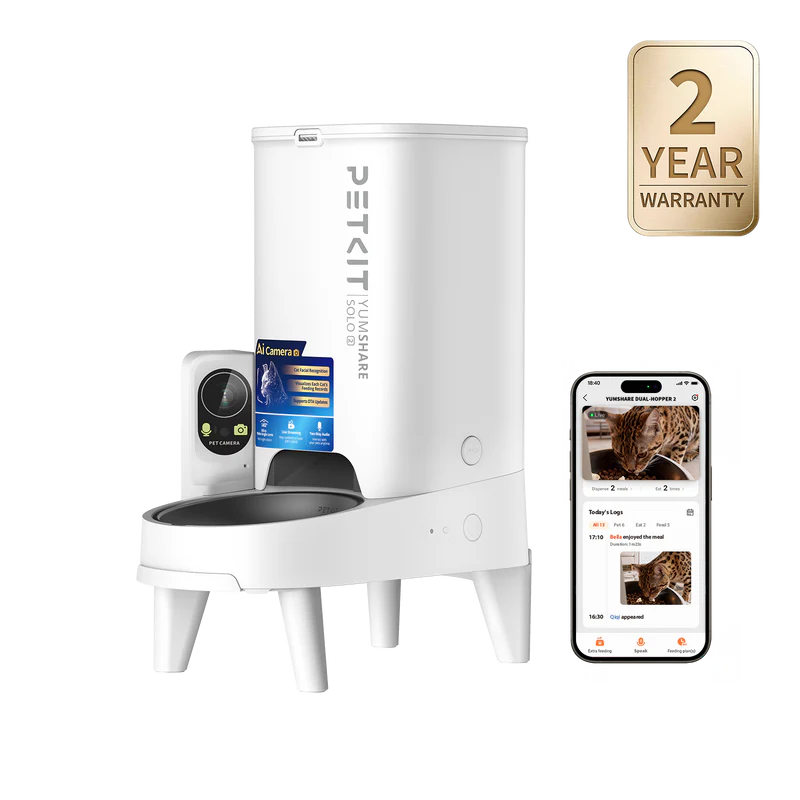
    The PETKIT YumShare Solo 2 Camera is an automatic dry-food feeder with a built-in AI camera. It lets you schedule meals, control portions, monitor feeding activity, check the bowl remotely, and view your pet through the PETKIT app.

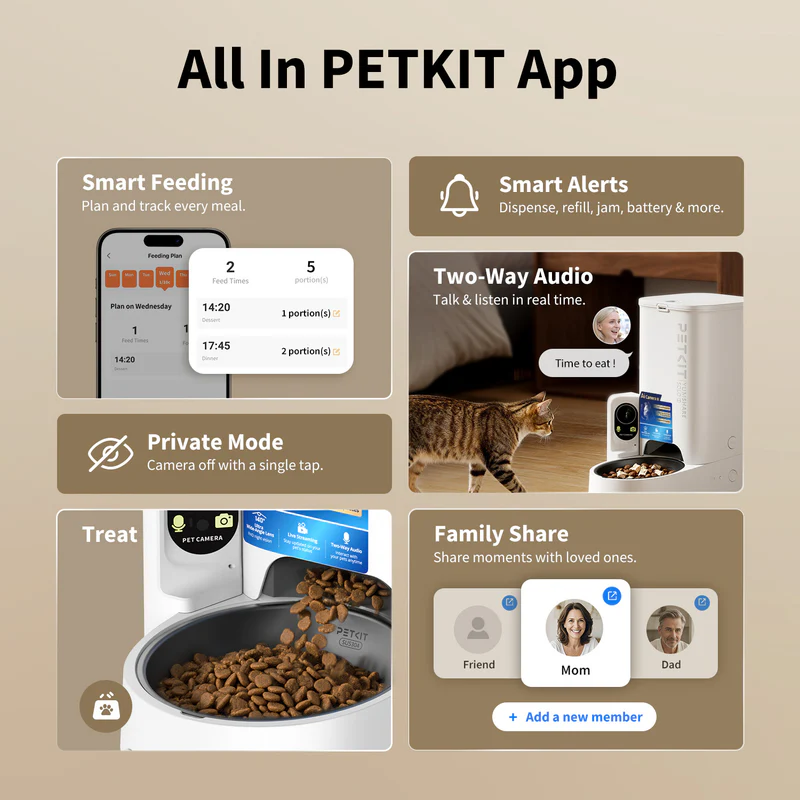
    According to PETKIT, the Solo 2 has a 3L capacity, supports 1–10 meals per day, and allows portion control depending on your feeding plan. It connects through 2.4GHz and 5GHz Wi-Fi and includes features such as live view, meal history, low-food alerts, two-way audio, and personalized meal calls.

    The core idea is simple: instead of wondering whether your cat ate, you can check.

    That is the real value of the product. Many automatic feeders can dispense kibble. Fewer can help you understand what happened around mealtime.

    Want to explore the official specifications and app features? View the YumShare Solo 2 Camera on the PETKIT website.

    Design and Build Quality

    PETKIT YumShare Solo 2 Camera design and stainless steel bowl

    The YumShare Solo 2 Camera has a compact vertical design that should fit in most kitchens, laundry rooms, or feeding corners. Its 3L capacity is enough for many single-cat households, especially if you are feeding measured portions rather than free-feeding.

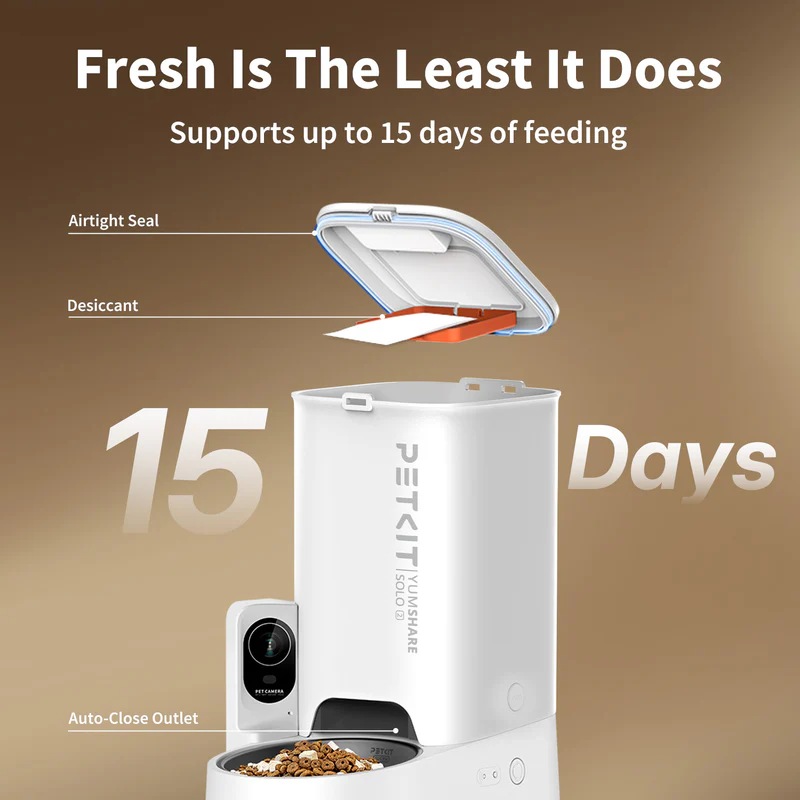
    The feeder uses a detachable design for cleaning, with a stainless steel bowl and sealed storage system intended to help preserve dry food freshness. PETKIT also emphasizes anti-blockage design, which matters because feeder jams are one of the most common fears with any automatic feeding system.

    This is not a giant multi-pet feeding station. It is better understood as a premium single-feeder unit for households that want monitoring and scheduling in a relatively compact footprint.

    If you need more capacity or separate food types, PETKIT’s dual-hopper models may be more relevant. But for one cat, or possibly multiple cats sharing the same dry food, the Solo 2 is the cleaner and simpler option.

    Camera Features and Remote Monitoring

    PETKIT YumShare Solo 2 Camera remote monitoring through the mobile app

    The camera is the main reason to consider this model instead of a cheaper automatic feeder.

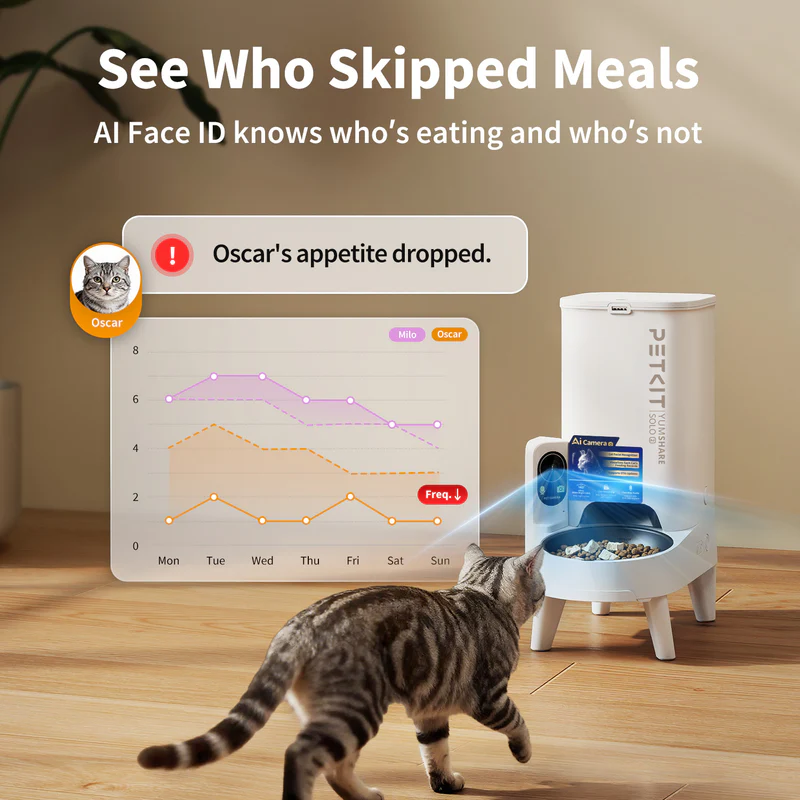
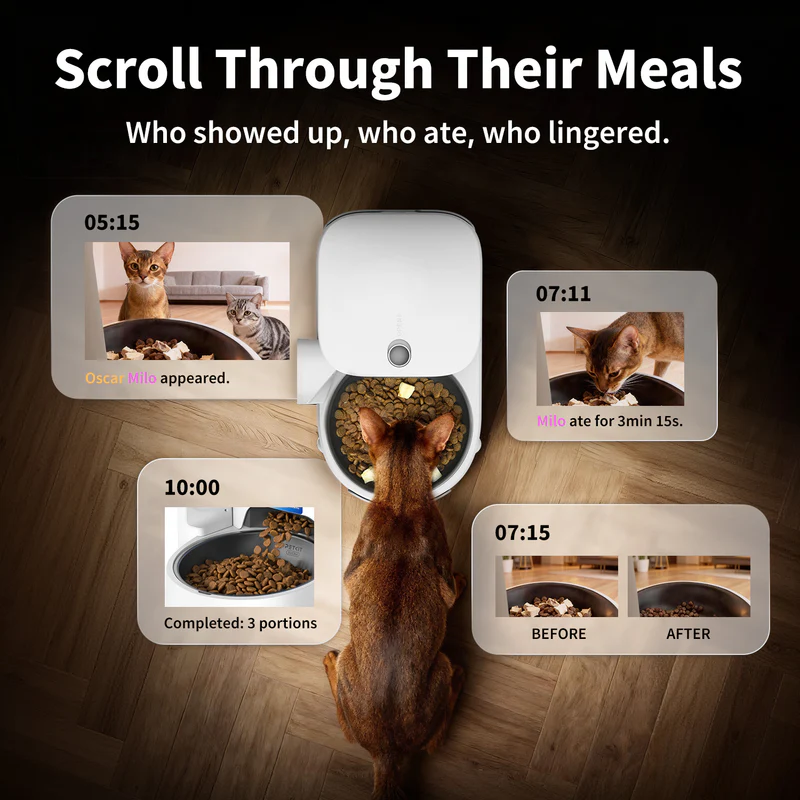
    The YumShare Solo 2 Camera supports real-time monitoring, meal and activity video records, and AI-based recognition. PETKIT markets this as a way to track individual eating behavior, especially in homes with more than one pet.

    This is important because feeding automation alone only tells you that food was dispensed. It does not tell you:

    • which cat ate;
    • whether the food remained untouched;
    • whether one cat bullied another away;
    • whether your cat is skipping meals;
    • whether the bowl was already full.

    The camera helps close that information gap.

    This is especially useful if you have a cat with appetite changes, weight concerns, or a household where feeding routines are hard to observe directly.

    That said, camera-based monitoring is not the same as veterinary-grade health tracking. It can help you notice patterns, but it does not diagnose anything. If your cat suddenly stops eating, loses weight, vomits frequently, or changes behavior, the correct next step is still a veterinarian.

    Feeding Automation and Scheduling

    As an automatic feeder, the YumShare Solo 2 covers the basics well.

    You can schedule multiple meals per day and adjust portions through the PETKIT app. This is useful for cats that need predictable routines, smaller meals throughout the day, or better portion control.

    The strongest use cases are:

    • preventing overfeeding;
    • keeping breakfast consistent;
    • feeding during work hours;
    • reducing early-morning begging;
    • supporting cats on structured diets.

    However, there is an important distinction.

    A smart feeder is not automatically enrichment.

    If the device simply drops food into the same bowl every day, it provides convenience and consistency, but not much cognitive challenge. For better indoor cat enrichment, the feeder should be part of a broader routine that may include puzzle feeders, interactive play, and environmental stimulation.

    You can learn more about evidence-based stimulation strategies in our guide to Indoor Cat Enrichment Science (2026).

    In other words, the YumShare Solo 2 is good at automation. It should not be treated as a full replacement for active feeding enrichment.

    PETKIT App Experience

    PETKIT app used to manage feeding schedules and monitor pets

    The PETKIT app is one of the main reasons to buy into this product.

    Through the app, you can manage feeding schedules, check alerts, view feeding history, monitor the camera, use two-way audio, and adjust settings remotely.

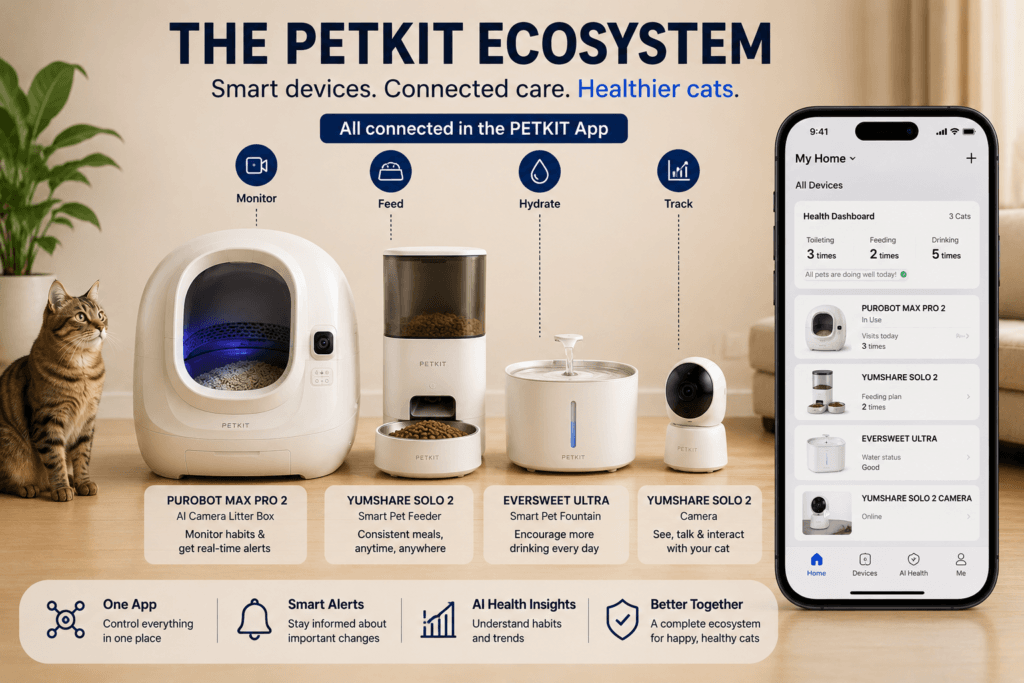
    This is where the YumShare Solo 2 becomes more than a standalone feeder. If you already own PETKIT devices—such as a smart litter box or fountain—the feeder fits naturally into a broader connected pet ecosystem.

    For a broader overview of how these devices work together, see our guide to the PETKIT Ecosystem (2026).

    That ecosystem perspective matters.

    A feeder tells you when food was dispensed.
    A smart litter box can show changes in elimination patterns.

    Our PETKIT PuraMax 2 Review (2026) explains how litter monitoring complements feeding data.

    A smart water fountain can support hydration routines and complement scheduled feeding, especially in multi-device households.
    A camera feeder can confirm who actually came to eat.

    Individually, each device solves a narrow problem. Together, they can create a more complete picture of your cat’s daily routine.

    That is the strategic value of PETKIT: not just one device, but multiple connected touchpoints around feeding, hydration, litter, and monitoring.

    Reliability and Practical Concerns

    This is the section where it is important to be honest.

    Cloud-connected feeders are convenient, but they also introduce failure points that basic feeders do not have. Wi-Fi, app stability, firmware, power adapters, and server availability all matter.

    User reports online include occasional complaints about PETKIT feeders showing offline status, power issues, or app-related confusion. These reports should not be treated as proof that the product is broadly unreliable, but they are worth considering because feeding is not a low-stakes function.

    A smart feeder should make life easier, not create anxiety about whether your cat will eat.

    The YumShare Solo 2 includes battery backup, which is a major advantage. PETKIT states that the device can continue feeding during power outages, although camera functionality is disabled in battery mode.

    That is a reasonable trade-off. Feeding continuity matters more than live video during an outage.

    Still, I would not recommend relying on any smart feeder without:

    • testing it for several days before travel;
    • keeping batteries installed if supported;
    • checking portion accuracy;
    • confirming your cat actually uses it;
    • having a backup feeding plan for longer absences.

    Pros and Cons

    ProsCons
    Built-in camera for remote monitoringMore expensive than basic feeders
    App scheduling and portion controlCloud/app dependence may frustrate some users
    AI-based pet recognitionNot for wet food
    Meal history and activity recordsCamera features may be unnecessary for simple use cases
    Two-way audio and personalized meal callsRequires Wi-Fi for full functionality
    Battery backup for feeding continuityCamera disabled in battery mode
    Fits into the PETKIT ecosystemMulti-pet recognition may not be perfect in every home

    If the YumShare Solo 2 Camera matches your needs, you can check current pricing and customer reviews on Amazon.

    Who Should Buy the PETKIT YumShare Solo 2 Camera?

    Buy it if you work away from home

    If you are out for long hours, the camera and feeding history can provide peace of mind. You can confirm that food was dispensed and that your cat actually approached the bowl.

    Buy it if your cat has routine or appetite concerns

    For cats with inconsistent eating habits, the visual history can be more useful than a basic feeder. It gives you more context around mealtime behavior.

    Buy it if you already use PETKIT devices

    If you already own a PETKIT litter box or fountain, the YumShare Solo 2 fits naturally into the same app-driven ecosystem.

    Consider it for multi-cat homes, but with caution

    The AI recognition features are interesting, but multi-cat feeding can be complicated. If one cat steals food or blocks another cat from eating, a camera feeder may help you detect the problem, but it may not solve it by itself.

    Skip it if you only need basic scheduled feeding

    If all you want is kibble at 7 a.m. and 6 p.m., a simpler automatic feeder may offer better value.

    PETKIT YumShare Solo 2 Camera vs Basic Automatic Feeders

    A basic feeder answers one question:

    “Was food dispensed?”

    The YumShare Solo 2 tries to answer more:

    • Did the cat show up?
    • How long did they stay?
    • Is food still in the bowl?
    • Did the right pet eat?
    • Is feeding happening consistently?

    That extra visibility is the main reason to pay more.

    If you do not care about those questions, you probably do not need this feeder.

    But if you are the kind of owner who checks pet cameras, tracks litter box patterns, or worries about missed meals, the YumShare Solo 2 is much more aligned with how you already think.

    Is It Worth Buying in 2026?

    Yes, but only for the right buyer.

    The PETKIT YumShare Solo 2 Camera is worth buying if you want a smart feeder that combines automation with monitoring. It is not just about convenience. It is about visibility.

    That makes it especially useful for:

    • indoor cats with structured routines;
    • owners who work away from home;
    • households already using PETKIT devices;
    • people who want feeding data, not just scheduled kibble.

    It is less compelling if you want a cheap feeder, dislike app-connected devices, or do not plan to use the camera features.

    The best way to think about it is this:

    The YumShare Solo 2 is not the best value if you only want feeding automation.
    It becomes much more interesting if you want feeding automation plus behavioral visibility.

    Final Verdict

    The PETKIT YumShare Solo 2 Camera is a strong smart feeder for cat owners who want to see what happens around mealtime, not just automate it.

    Its biggest strengths are the built-in camera, app scheduling, meal history, portion control, and ecosystem integration. Its main weaknesses are the usual smart-device concerns: app dependence, Wi-Fi reliance, and the fact that more technology means more possible points of friction.

    For basic feeding, it may be overkill.

    In my view, the biggest advantage of the YumShare Solo 2 Camera is not the automatic feeding itself. It’s the ability to verify that your cat actually showed up and ate. For owners who spend long hours away from home, that extra peace of mind can be more valuable than another scheduling feature.

    If you already use PETKIT products, the YumShare Solo 2 Camera is one of the more natural additions to the ecosystem. If you are new to smart pet tech, it is a good entry point—but only if you genuinely value camera monitoring.

    For owners building a connected PETKIT ecosystem, the YumShare Solo 2 Camera is one of the most compelling smart feeders currently available. You can compare prices on Amazon or explore the full feature set on PETKIT’s official website before making a decision.

    FAQ

    Is the PETKIT YumShare Solo 2 Camera good for cats?

    Yes, especially for cats that eat dry food on a schedule. It can help with portion control, routine consistency, and remote monitoring.

    Does the camera work all the time?

    The camera supports real-time monitoring when the feeder is powered and connected. PETKIT notes that camera functionality is disabled in battery mode.

    Does it work without Wi-Fi?

    The feeder can continue dispensing with backup power, but full app and camera features require Wi-Fi.

    Can it feed wet food?

    No. This type of feeder is intended for dry kibble and compatible dry treats, not wet food.

    Is it good for multiple cats?

    It can be useful in multi-cat homes because of AI recognition and meal tracking. However, if cats compete for food, you may still need separate feeding stations.

    Is the PETKIT app free?

    Core app controls are part of the PETKIT ecosystem, but PETKIT notes that certain services may require in-app purchases. Always check the current app terms before buying.

    Is it better than a basic automatic feeder?

    Only if you use the camera, app, and monitoring features. If you only want scheduled feeding, a simpler feeder may be better value.

    References

    • PETKIT official product documentation
    • PETKIT mobile app documentation
    • Veterinary resources on feline feeding behavior and enrichment
    • Public user reports and community discussions reviewed for context

    Affiliate Disclaimer

    PetTechAI participates in affiliate programs, including Amazon Associates and other partner networks. We may earn a commission when you purchase through links on our site, at no additional cost to you. Our content is based on independent research, product analysis, and user-focused evaluation.

  • Monitoring vs Automation: What Smart Cat Owners Actually Need in 2026

    Monitoring vs Automation: What Smart Cat Owners Actually Need in 2026

    Smart cat tech is changing faster than most buying guides admit.

    For years, the promise was simple: automate the annoying parts of cat care. Scoop less. Feed on schedule. Keep water moving. Get an app notification when something needs attention.

    That was automation.

    In 2026, the category is moving somewhere else.

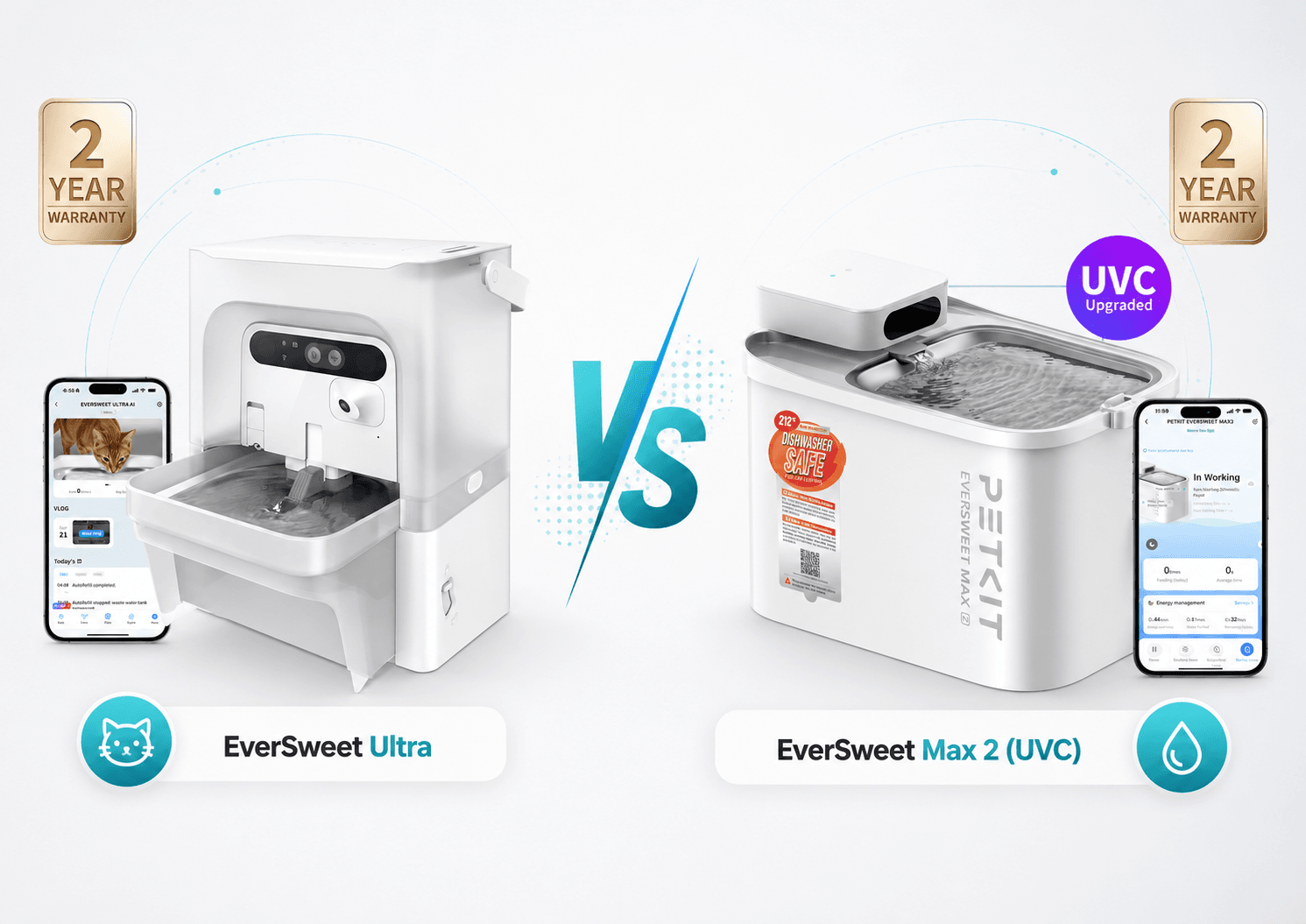
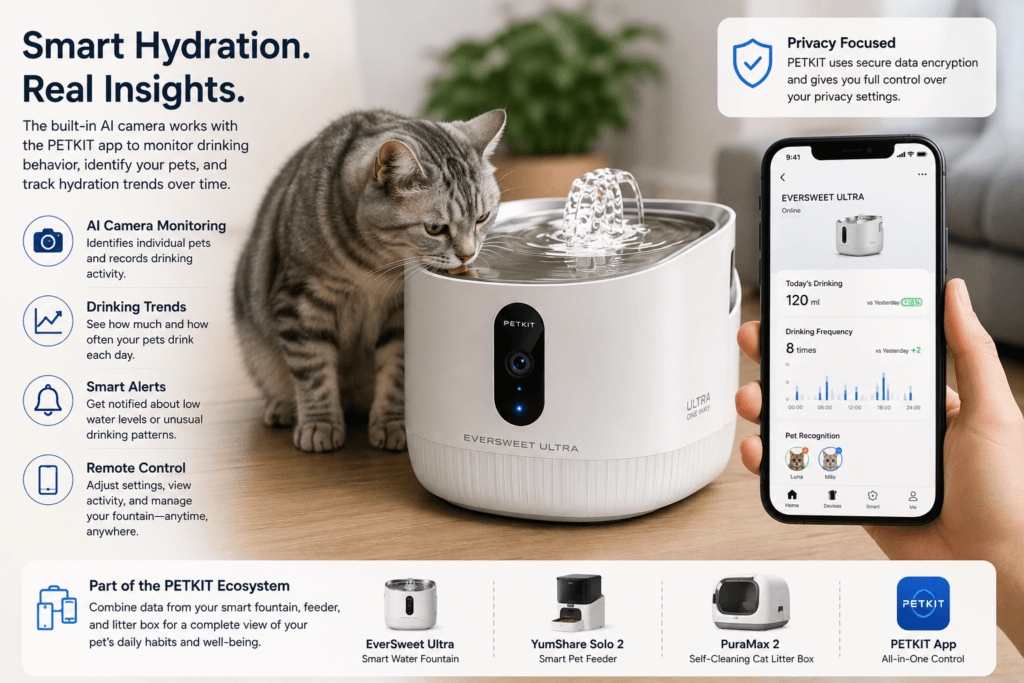
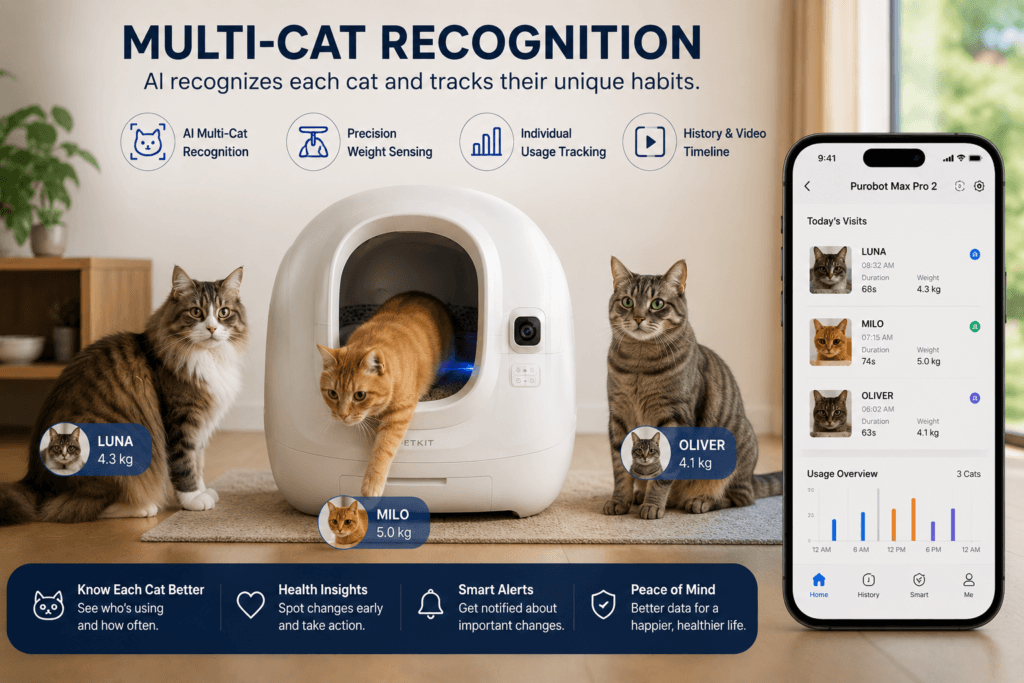
    PETKIT, Whisker, and CATLINK are no longer just selling machines that perform tasks. They are selling visibility: cameras, behavior tracking, feeding trends, weight data, litter activity, hydration monitoring, and multi-cat identification. PETKIT’s new EverSweet Ultra with Camera and YumShare Solo 2 with Camera are clear examples of this shift, moving hydration and feeding from basic automation into camera-based monitoring.

    That sounds exciting. It also creates a new problem.

    Most cat owners do not need the smartest possible system. They need the system that removes the most friction without turning daily pet care into another dashboard to manage.

    The old question was automation

    Automation-first cat care setup with self-cleaning litter box and automatic feeder

    The first wave of smart cat products solved obvious problems.

    A self-cleaning litter box reduced scooping.
    An automatic feeder reduced schedule stress.
    A water fountain encouraged drinking and reduced stagnant bowls.

    Those were easy value propositions. The product either removed a chore or it did not.

    That is still why many buyers should choose a product. If the real pain point is litter maintenance, a stronger self-cleaning litter box matters more than camera features. If the real pain point is irregular feeding, a stable feeder schedule matters more than AI recognition. If the real pain point is hydration, clean water flow matters more than video.

    Automation works best when the problem is repetitive and obvious.

    The mistake starts when buyers confuse “more data” with “more help.”

    The new question is monitoring

    Cat owner reviewing smart pet monitoring data from feeder, fountain, and litter box

    Monitoring changes the promise.

    Instead of asking, “Can this product do the task for me?” the question becomes, “Can this product tell me something useful about my cat?”

    That is where the category is moving.

    Whisker’s app now emphasizes litter box usage, weight, alerts, daily cat insights, and feeding trends across Litter-Robot and Feeder-Robot. The company frames the app as a way to track routines and spot unusual behavior, not just control devices remotely.

    CATLINK leans even harder into this direction. Its app positioning highlights multi-cat recognition, separate habit and health data tracking, consumables reminders, and one-app control across litter box, feeder, and fountain.

    PETKIT’s newest products push the same idea through cameras. The EverSweet Ultra with Camera uses AI camera tracking around drinking behavior, while the YumShare Solo 2 feeder uses facial recognition, live video, and eating habit tracking.

    The pattern is clear: the category is moving from task automation to behavior visibility.

    That is not automatically better. It is just a different purchase logic.

    Automation solves chores. Monitoring solves uncertainty.

    This is the simplest way to separate the two.

    Automation is valuable when the problem is physical:

    • scooping litter,
    • feeding at consistent times,
    • keeping water available,
    • reducing repetitive maintenance.

    Monitoring is valuable when the problem is uncertainty:

    • which cat is eating,
    • whether one cat is drinking less,
    • whether litter box visits have changed,
    • whether multi-cat routines are becoming uneven,
    • whether an owner needs reassurance while away.

    A single-cat household with a predictable routine usually needs less monitoring than marketing suggests.

    A multi-cat household with different diets, behavior changes, or health concerns can benefit much more from monitoring.

    This is why the same camera feeder can be either useful or unnecessary depending on the home.

    PETKIT is betting on camera-led smart care

    PETKIT’s current direction is clear: add visual context to everyday care.

    The YumShare Solo 2 Automatic Feeder with Camera is positioned around scheduled meals, facial recognition, live video, and eating habit tracking. PETKIT says it can handle scheduled meals for up to 15 pets and help owners stay connected through real-time monitoring.

    The EverSweet Ultra with Camera applies similar thinking to hydration. PETKIT describes it as a water fountain with camera-based pet tracking and alerts, combining water freshness with behavior insight.

    This is not just “a feeder with a camera” or “a fountain with a camera.”

    It is PETKIT trying to own the idea that smart cat care should be visual, continuous, and connected across categories.

    That is a smart positioning move because it avoids fighting Whisker only on litter boxes. Instead, PETKIT can argue that the future is broader: feeding, hydration, monitoring, and interaction in one ecosystem.

    The weakness is obvious too.

    Camera-led care only matters if the owner actually uses the camera layer.

    If the buyer checks the app twice during the first week and then ignores it, the product becomes expensive automation with unused features.

    Whisker is betting on routine insight

    Whisker’s approach is narrower but more focused.

    The Whisker app is built around Litter-Robot and Feeder-Robot. It tracks litter box usage, weight, alerts, feeding schedules, snacks, and feeding trends. It is not trying to look like a broad smart-home pet universe. It is trying to make litter and feeding routines easier to understand.

    That makes Whisker strong when the buyer’s main problem is litter.

    Buyers trying to decide between Whisker’s newest litter systems should start with the full Litter-Robot 5 vs 5 Pro vs EVO breakdown, especially if the confusion is more about monitoring features than core cleaning performance.

    Its ecosystem does not need to cover every category to make sense. If the daily pain point is litter maintenance and routine visibility, Whisker’s narrower focus can be an advantage.

    Litter-Robot 5 Pro takes this further with camera-based cat identification and monitoring, but the broader Whisker value proposition is still routine-first rather than camera-first. Its app language is about habit tracking, usage trends, and making daily care easier.

    That is a different philosophy from PETKIT.

    PETKIT says: see more of the care environment.
    Whisker says: understand the core routines better.

    CATLINK is betting on multi-cat control

    Multi-cat smart monitoring setup with feeder and litter box activity tracking

    CATLINK’s strongest positioning is multi-cat differentiation.

    Its app page explicitly highlights multi-cat recognition, separate habit and health data tracking, and control across litter, feeder, and fountain.

    That makes CATLINK especially relevant when the problem is not just automation, but separation:

    • one cat eats too much,
    • one cat avoids the litter box,
    • one cat drinks less,
    • one cat’s weight trend matters more than the others.

    In that context, monitoring is not a luxury. It becomes the point.

    The trade-off is complexity.

    CATLINK’s system makes the most sense when the household has enough complexity to justify the data layer. In simpler homes, it can become more system than the owner needs.

    That is why CATLINK should not be framed as “better” or “worse” than PETKIT or Whisker. It is better for a narrower, more demanding use case.

    The buyer mistake: paying for monitoring when automation was enough

    This is going to become the most common mistake in smart cat tech.

    A buyer sees:

    • AI camera,
    • behavior tracking,
    • live video,
    • facial recognition,
    • multi-cat reports,
    • health insights.

    The product feels more advanced, so the purchase feels more rational.

    But the real question is colder:

    Will this data change what you do?

    If the answer is no, monitoring is probably not worth paying for.

    A camera feeder is valuable if it helps you manage remote feeding, multi-pet routines, or anxiety while away. It is less valuable if your cat eats normally and you only need consistent portions.

    A smart fountain with drinking behavior tracking is valuable if hydration monitoring matters in your home. It is less valuable if the real need is simply cleaner water and lower maintenance.

    A camera-enabled litter box is valuable if cat identification and behavior changes matter. It is less valuable if the household just wants less scooping.

    Monitoring should change decisions. If it only creates curiosity, it may not justify the premium.

    This becomes especially obvious in comparisons like PETKIT PuraMax 2 vs Litter-Robot 4, where buyers often assume the more expensive system automatically fits their home better.

    The opposite mistake: avoiding monitoring when the household needs it

    There is also a second mistake.

    Some owners avoid monitoring because it feels excessive. Sometimes they are right. Sometimes they are not.

    Multi-cat homes are the clearest exception.

    When several cats share products, basic automation can hide the problem. A feeder may work perfectly while one cat eats more than the others. A litter box may cycle properly while one cat’s usage pattern changes. A fountain may run well while one cat stops drinking as much.

    That is where monitoring becomes useful.

    The point is not to replace veterinary care or diagnose illness from an app. The point is to notice routine changes earlier and understand which cat is involved.

    That is why monitoring-first products make more sense in:

    • multi-cat homes,
    • homes with senior cats,
    • cats on different diets,
    • owners who travel frequently,
    • households where one cat’s behavior needs closer observation.

    In those cases, paying for better visibility is not overbuying. It is buying the real feature.

    Decision matrix: automation or monitoring?

    Choose automation-first products if your main problem is:

    • scooping,
    • feeding on schedule,
    • maintaining clean water,
    • reducing repetitive daily chores,
    • keeping the setup simple.

    Choose monitoring-first products if your main problem is:

    • identifying which cat did what,
    • tracking feeding or drinking behavior,
    • spotting routine changes,
    • managing multi-cat complexity,
    • staying connected while away.

    Choose PETKIT if you want camera-led care across feeding and hydration. Its newest launches make the most sense for owners who value live visibility, interaction, and behavior context across daily routines.

    Choose Whisker if litter and feeding routines are the center of your smart-care setup. Its app is more focused on usage, weight, alerts, and daily cat insights inside a tighter ecosystem.

    Choose CATLINK if the real issue is multi-cat control and separated tracking. Its ecosystem is strongest when individual cat behavior matters more than simple convenience.

    Where this category is going next

    The direction is obvious now.

    The ecosystem differences become much clearer when comparing PETKIT, CATLINK, and Whisker side by side instead of looking at single devices in isolation.

    Smart cat tech is moving toward systems that combine:

    • automation,
    • identity recognition,
    • camera monitoring,
    • app-based behavior trends,
    • and ecosystem-level decision making.

    PETKIT’s camera feeder and camera fountain show where broad smart-care ecosystems are heading. Whisker’s newer app and Litter-Robot direction show how litter-first platforms are becoming more insight-driven. CATLINK’s app positioning shows that multi-cat data and household-level monitoring are becoming a core competitive angle.

    The winners will not simply be the brands with the most features.

    The winners will be the brands that make the data feel useful instead of exhausting.

    That distinction matters.

    A product that gives you ten alerts and no clear action is not smarter. It is just noisier.

    A product that quietly removes a chore and gives you one meaningful signal at the right time is much more valuable.

    Verdict: what smart cat owners actually need

    Most smart cat owners still need automation first.

    That is the foundation.

    A product that does not reliably feed, clean, or hydrate is not saved by better monitoring.

    But once the automation layer works, monitoring becomes the next real differentiator — especially in multi-cat homes, remote-care situations, and households where routine changes matter.

    Choose automation when the problem is labor.
    Choose monitoring when the problem is uncertainty.

    That is the decision framework that matters in 2026.

    If you are comparing ecosystems, the next practical reads are PETKIT vs Litter-Robot Ecosystem, CATLINK vs PETKIT, and PETKIT vs Feeder-Robot vs CATLINK. If your decision is specifically inside litter boxes, start with Litter-Robot 5 vs 5 Pro or Litter-Robot 5 vs EVO.

    References

    Disclosure

    PetTech AI may earn a commission when readers buy through affiliate links. That does not change how products are framed or compared. This article is written as an editorial decision framework, not a brand endorsement. Smart cat products can be useful, but feature-heavy devices are easy to overbuy when the household problem is simple. The goal is to separate automation that removes real chores from monitoring that creates useful visibility. Product features, pricing, subscriptions, app functions, and availability can change over time, so always verify current details with the manufacturer before buying.

  • PETKIT vs Litter-Robot Ecosystem (2026): What Actually Saves More Time?

    PETKIT vs Litter-Robot Ecosystem (2026): What Actually Saves More Time?

    Most people comparing PETKIT vs Litter-Robot think they are deciding between two litter boxes.

    That is already the wrong frame.

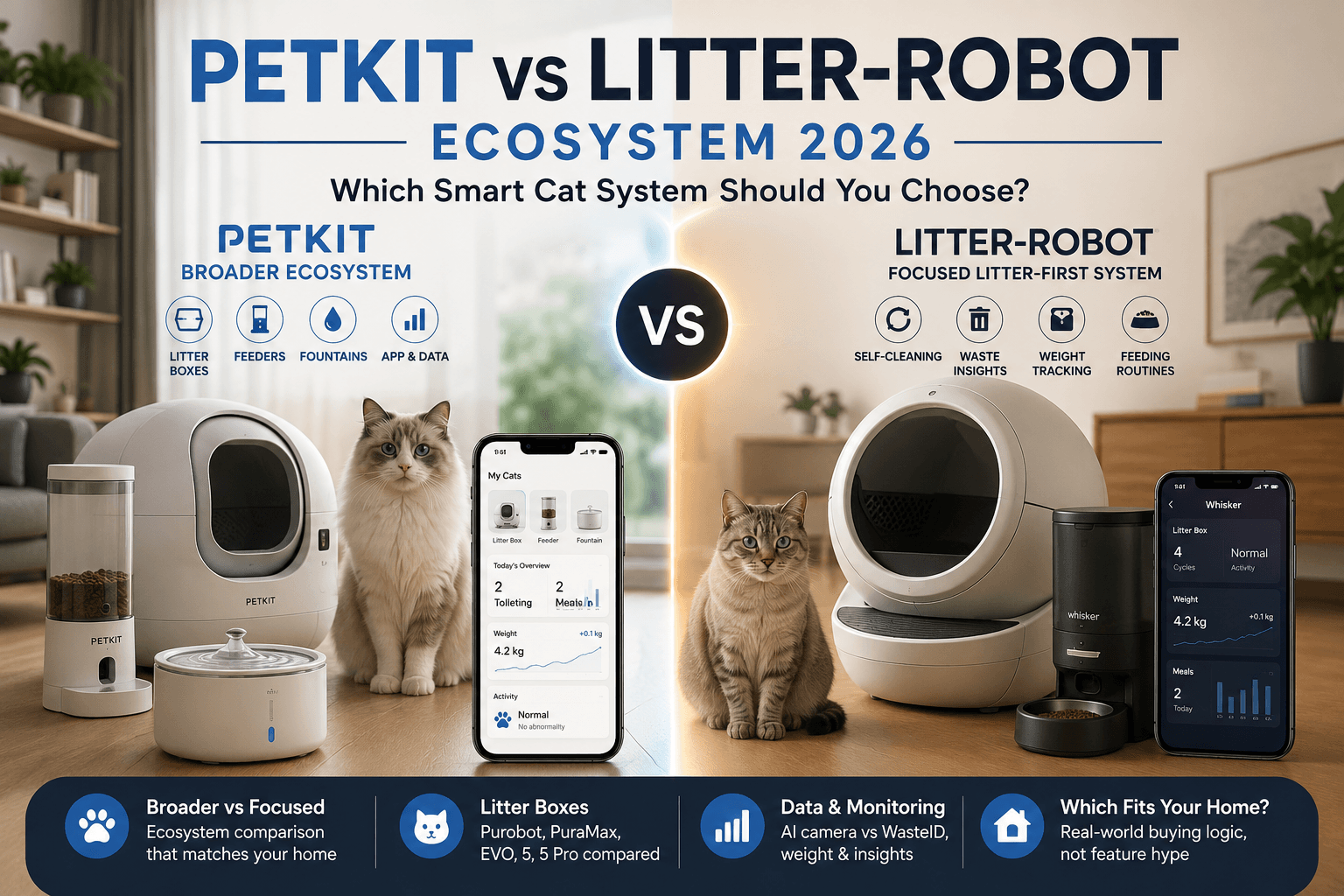
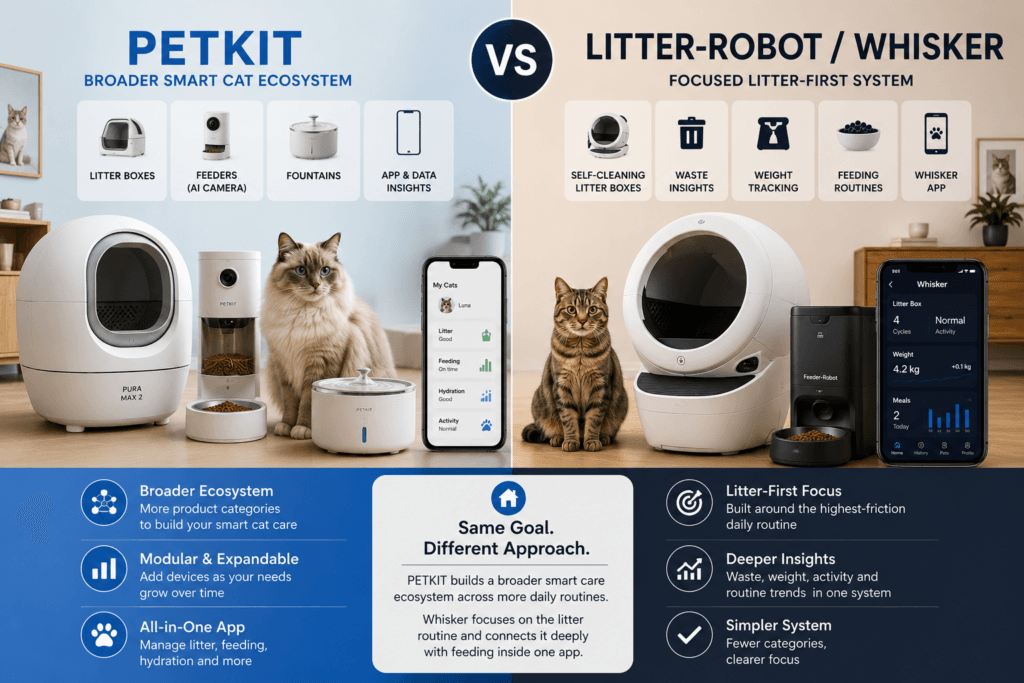
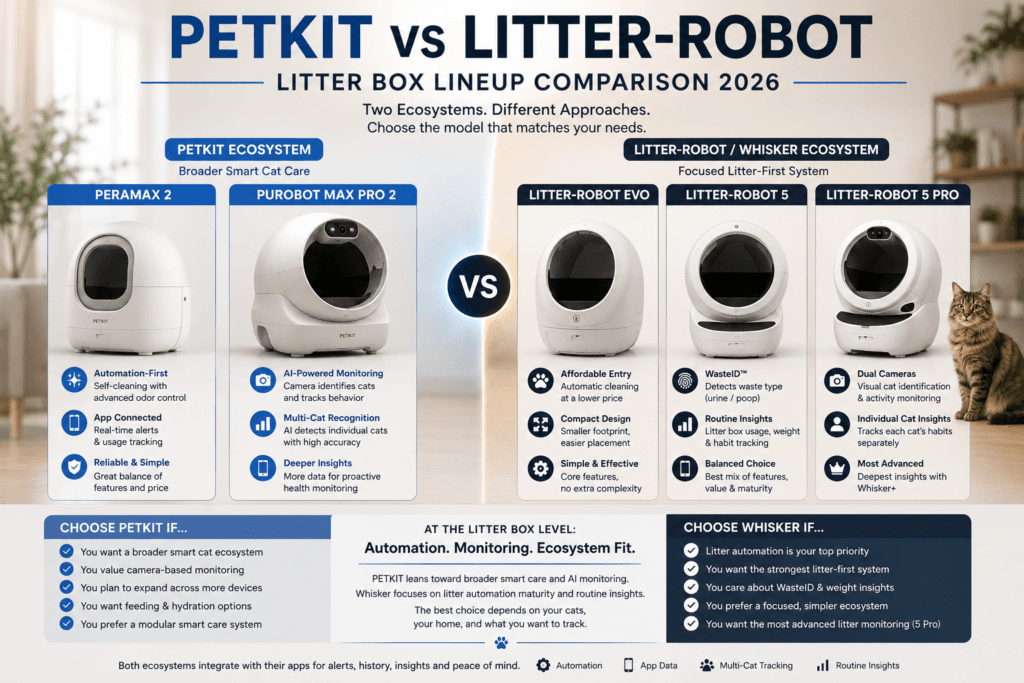
    At this point, both brands are bigger than one product. PETKIT is now a broad smart pet-care ecosystem built across litter boxes, feeders, fountains, and app-based pet data. Whisker is narrower, but also more disciplined: it revolves around Litter-Robot, Feeder-Robot, and one app designed to track litter activity, feeding behavior, weight trends, and daily cat insights.

    So this is not just a product comparison.

    It is a decision about which ecosystem creates less daily friction after setup, after novelty, and after the product stops feeling new.

    If your priority is breadth and modular smart care, PETKIT makes a strong case.
    If your priority is focused routine automation with stronger litter-side maturity, Litter-Robot makes a stronger one.

    What you’re actually choosing

    PETKIT and Whisker do not win in the same way.

    PETKIT wins by giving you more ways to build a connected home around your cat. Its current lineup spans automatic litter boxes, camera-enabled feeders, standard smart feeders, and fountains, all positioned inside one app with device management and pet data tracking. PETKIT’s current catalog also shows clear momentum around camera-led feeding and broader ecosystem coverage.

    Whisker wins by doing fewer things with more coherence. The Whisker app is built around two core product categories—litter and feeding—and frames its value around litter box usage, weight, alerts, daily insights, and mealtime trends. On the litter side, Whisker’s newer platform goes even deeper, especially with Litter-Robot 5 Pro and its camera-driven identification layer.

    That means the decision is cleaner than most comparison pages suggest:

    • PETKIT = broader ecosystem, more modular smart-care stack
    • Litter-Robot / Whisker = tighter ecosystem, more mature litter-first routine automation

    Neither is “better” in the abstract. One simply matches your home better than the other.

    PETKIT: better when you want a broader smart-care system

    Broad smart cat care setup with litter box, feeder, and fountain in one ecosystem

    PETKIT today looks like the more expansive ecosystem.

    Its official app messaging is simple: manage all PETKIT devices in one place and stay connected to what matters most to your pets. The ecosystem now clearly spans litter, feeding, and hydration, and PETKIT’s newer feeder family pushes camera-enabled monitoring, remote interaction, and facial-recognition-led multi-pet visibility harder than before.

    That matters because not every buyer wants a “litter company.” Some want a home pet-tech system.

    PETKIT is usually better for buyers who want:

    • a wider range of connected products,
    • one app across more daily-care categories,
    • more flexibility in how they expand the system over time,
    • and a setup that feels like smart pet care rather than just litter automation.

    This is also where PETKIT creates its own type of buyer regret.

    The broader the ecosystem gets, the easier it becomes to buy products because they fit the brand story, not because they solve the right problem. PETKIT is very easy to like if you are building a full connected setup. It is less convincing if what you really need is the strongest litter routine with the least ambiguity.

    Litter-Robot / Whisker: better when litter automation is the center of the decision

    Focused litter-first smart cat ecosystem with premium litter box and feeder

    Whisker’s ecosystem is narrower, but that is part of its strength.

    The Whisker app is explicitly built around monitoring litter box and feeder behavior together. It emphasizes:

    • litter box usage,
    • weight,
    • drawer alerts,
    • feeding schedules,
    • feeding trends,
    • and daily cat insights.

    This feels less like a “pet tech marketplace” and more like a focused routine system.

    If your core problem is still the litter box—and for many cat owners it is—Whisker feels more coherent. The ecosystem is not as broad as PETKIT’s, but it is tightly built around two of the highest-friction daily chores: litter and feeding. The newer Litter-Robot pages also show the brand pushing hard into cat-level insight with WasteID and, at the top end, camera-based identification on Litter-Robot 5 Pro.

    That does not make Whisker automatically better.

    It makes it better when your buying logic is:

    I want the strongest litter-first system and I care less about having a wider device universe.

    That is a narrower but very real use case.

    Where the ecosystems really diverge

    The superficial answer is “PETKIT has more categories.”

    The real answer is more useful.

    PETKIT saves more time when:

    • you want one app across more product types,
    • you want the option to build out feeding and hydration more aggressively,
    • you value broader connected care over depth in one category,
    • and you like the idea of a more modular pet-tech home.

    Litter-Robot saves more time when:

    • litter automation is the real bottleneck,
    • you want the strongest litter-first routine,
    • you prefer a narrower but more focused system,
    • and you do not need a large ecosystem catalog to feel “complete.”

    That is why generic comparisons fail.

    They try to answer:

    Which ecosystem is more advanced?

    That is not the right question.

    The right question is:

    Which ecosystem removes more friction from the part of cat care that annoys you most?

    Buyer regret: where most people get this wrong

    PETKIT regret usually comes from overestimating how much breadth they actually need.

    The ecosystem is attractive precisely because it spans more categories. But if your household problem is still overwhelmingly about litter reliability and routine management, breadth does not automatically help. In that situation, PETKIT can become a broader system than you needed.

    Whisker regret usually comes from the opposite assumption.

    Buyers choose Litter-Robot because the litter side is strong, then later realize they wanted a broader smart-care environment with more product categories and more ecosystem expansion options. Whisker’s ecosystem is coherent, but it is not wide. If you want litter, feeder, fountain, camera-style monitoring, and a more visibly modular smart-pet stack, PETKIT has the broader catalog.

    So the mistake is not choosing the wrong brand.

    The mistake is choosing based on the wrong center of gravity:

    • breadth vs
    • litter-first focus

    Which one makes more sense in real homes

    In smaller homes where the litter box dominates the daily pain point, Litter-Robot usually makes more sense. Whisker’s ecosystem is narrower, but it is more directly built around reducing litter routine friction and pairing that with a feeder inside the same app logic.

    In homes where the owner wants to build a more complete smart-pet stack over time, PETKIT usually makes more sense. Its official ecosystem coverage across litter, feeding, and hydration makes that path much more natural.

    For buyers who travel more and want camera-driven reassurance around feeding, PETKIT becomes even more compelling because its feeder lineup now leans into AI camera monitoring, event review, and remote interaction.

    For buyers who care most about litter activity summaries, weight trends, and tightly integrated litter-plus-feeding data, Whisker has the stronger ecosystem logic.

    Decision matrix

    Cat owner comparing two smart pet ecosystems through a mobile app

    Choose PETKIT if:

    • you want a broader smart pet ecosystem,
    • you care about feeders and fountains as much as litter,
    • you want one app across more device categories,
    • and you value modular expansion over a narrower, litter-first system.

    Choose Litter-Robot / Whisker if:

    • litter automation is the core purchase driver,
    • you want a more focused routine system,
    • you care about litter habits, daily insights, and feeding trends in one narrower app environment,
    • and you do not need a bigger device universe to justify the ecosystem.

    Choose PETKIT if your smart-pet setup is expanding sideways.
    Choose Litter-Robot if your smart-pet setup is deepening around litter first.

    Final verdict

    Choose PETKIT if what you really want is a broader connected-care ecosystem. It is the better choice for buyers who want litter, feeding, and hydration products living under one app with room to expand into more categories over time. That is the part of the market PETKIT clearly owns more convincingly right now.

    Choose Litter-Robot / Whisker if what you really want is the ecosystem that treats litter automation as the center of the home workflow. It is narrower, but more focused, and that focus matters if litter routine is the biggest daily source of friction.

    Most people make this harder than it needs to be.

    If you are deciding between PETKIT and Litter-Robot, you are not choosing between two brands with the same strategy. You are choosing between:

    • a wider smart-pet ecosystem,
    • and a tighter litter-first ecosystem.

    If your real split is model-level rather than ecosystem-level, the sharper next reads are PETKIT PuraMax 2 vs Litter-Robot 4 and Litter-Robot 5 vs EVO. If feeding is the real battleground, the cleaner next read is PETKIT vs Feeder-Robot vs CATLINK.

    References

    • PETKIT official app and ecosystem pages.
    • Whisker official app and Feeder-Robot pages.
    • Whisker official Litter-Robot product / feature pages.

    Disclosure

    PetTech AI may earn a commission when readers buy through affiliate links. That does not change how products are framed or compared. Comparisons here are built around household fit, long-term friction, and real purchase logic rather than feature inflation or generic “best of” language. Smart pet products are easy to overbuy because ecosystems create the illusion that more connected devices automatically save more time. In practice, the right ecosystem is the one that removes the most friction from the part of cat care that matters most in your home. Features, app behavior, memberships, pricing, and lineup availability can change, so always verify current details before buying.

  • CATLINK vs PETKIT (2026): Which Smart Ecosystem Actually Works Better?

    CATLINK vs PETKIT (2026): Which Smart Ecosystem Actually Works Better?

    Most people searching CATLINK vs PETKIT are not really asking which brand has more products.

    They are asking which ecosystem becomes less annoying after the first week.

    That is the real decision. Not app screenshots. Not spec inflation. Not whichever product page sounds more “AI-powered.”

    Both brands now operate as full smart pet ecosystems, not single-product brands. PETKIT runs a connected lineup across litter boxes, feeders, fountains, and app-based monitoring, while CATLINK does the same but leans harder into health-tracking language, multi-cat identification, and higher-control automation logic.

    That means this is not a brand-loyalty decision. It is a friction decision.

    Choose the system that matches how you actually live with cat tech, and both brands can make sense. Choose the wrong one, and the “smarter” ecosystem becomes the one you resent faster.

    What you’re actually choosing

    At a distance, CATLINK and PETKIT look like direct substitutes.

    They are not.

    PETKIT’s ecosystem is built around connected daily care. Its app messaging emphasizes unified device management, and its current product family clearly spans self-cleaning litter boxes, feeders, and fountains under one management layer. PETKIT’s newer feeder products also lean heavily into camera-led monitoring and remote interaction.

    CATLINK’s ecosystem feels more control-heavy. Its app explicitly promotes remote management for litter box, feeder, and fountain, while also framing itself around toileting behavior analysis, weight trends, frequency tracking, and multi-cat insight. CATLINK’s current lineup also shows stronger emphasis on identity-aware and camera-enabled litter box variants.

    So the choice is cleaner than it looks:

    PETKIT is usually the better fit when you want a broader smart-care system that feels more lifestyle-oriented and modular.
    CATLINK is usually the better fit when you want a more control-heavy system that behaves like a monitoring layer as much as a convenience layer.

    PETKIT: better when you want the ecosystem to feel lighter

    Minimal connected cat tech setup representing a lower-friction smart ecosystem

    PETKIT’s biggest strength is that its ecosystem reads like a connected pet-care environment rather than a single-purpose hardware stack.

    Its official app language is simple: manage all PETKIT devices in one place. The broader storefront reinforces that positioning by spanning litter boxes, feeders, and fountains, while the feeder lineup in particular shows PETKIT pushing camera-based interaction and remote oversight more aggressively than before.

    That matters because many buyers do not actually want a “health analytics platform.” They want:

    • easier feeding,
    • easier cleaning,
    • fewer routine interruptions,
    • and one app that does not feel like work.

    PETKIT is often stronger when the goal is exactly that. The brand’s ecosystem is broad enough to feel complete, but it does not market itself with the same heavy diagnostic tone CATLINK increasingly uses.

    That is also PETKIT’s weakness.

    If your real problem is multi-cat differentiation, behavior monitoring, or tighter cat-by-cat insight, PETKIT can start to feel less decisive. It has plenty of smart capability, but the brand reads more like “connected care convenience” than “precision household control.” That distinction matters much more in real life than most comparison pages admit.

    CATLINK: better when you want the system to tell you more

    Advanced multi-cat smart pet setup representing a control-heavy ecosystem

    CATLINK’s ecosystem is more explicit about what it wants to be.

    Its app page does not just sell remote control. It sells analysis: toileting behavior, weight trends, frequency, manual control, schedules, and health-oriented alerts. The product lineup backs that up with litter box messaging focused on multi-cat identify, odor guard, and camera-enabled monitoring on certain models.

    That gives CATLINK a real advantage in specific homes:

    • multi-cat households,
    • owners who want more individualized insight,
    • people who care about usage patterns, not just automation,
    • buyers who are willing to tolerate more system “presence” in exchange for more visibility.

    This is where CATLINK becomes easier to buy for the right reason.

    But it also becomes easier to overbuy.

    A lot of homes do not need a pet ecosystem that feels like a lightweight analytics platform. They need fewer chores and a stable routine. In those homes, CATLINK’s strengths can become extra cognitive load rather than genuine value.

    The real difference is not features. It is tolerance.

    This is the part most affiliate articles miss because it is harder to reduce to bullets.

    PETKIT and CATLINK do not just compete on hardware. They compete on how much system-awareness you want in your home.

    PETKIT generally makes more sense if your tolerance for smart pet tech is moderate. You want the benefits, but you do not want the ecosystem to dominate the experience. One app, connected products, remote control, some monitoring, cleaner routines. That is the pitch.

    CATLINK makes more sense if your tolerance is higher. You are more willing to manage a system that does more, tells you more, and sometimes demands more attention in return. That trade-off is worth it only if the household complexity is real.

    This is why the same buyer can love one ecosystem and regret the other without either brand being “bad.”

    Where buyer regret actually comes from

    Buyer regret with PETKIT usually comes from expecting more precision than the ecosystem is really built around.

    The brand is good at making connected care feel attractive. But if the household problem is truly about differentiation between cats, tighter monitoring, or higher-control workflows, PETKIT can end up feeling softer than expected. The system is smart, but not always pointed in the most control-heavy direction.

    Buyer regret with CATLINK usually comes from the opposite error.

    People buy it because it sounds more advanced, more diagnostic, more complete. Then they realize their actual household did not need that much system logic in the first place. If your real goal was just cleaner routines and app-based control, the extra ecosystem intensity can feel like complexity you never asked for.

    That is the whole comparison in one sentence:

    PETKIT is easier to underbuy for control. CATLINK is easier to overbuy for complexity.

    Which one makes more sense by use case

    In smaller homes or simpler routines, PETKIT usually makes more sense. The ecosystem is broad, app-connected, and modern without leaning as hard into “health guardian” positioning. That tends to create less friction for buyers who just want the home to run more smoothly.

    In multi-cat homes, CATLINK becomes more compelling. Its own product and app messaging are much more explicit about multi-cat identify, behavior tracking, weight trends, and health-oriented monitoring. That is not branding fluff. It is a different ecosystem philosophy.

    For owners who travel often and want remote reassurance, PETKIT has become more interesting because its feeder line now leans hard into camera-led remote interaction. That can be more emotionally useful than raw analytics for some buyers.

    For owners who want the system to tell them more about what is happening rather than simply automate chores, CATLINK is the stronger fit.

    Decision matrix

    Cat owner comparing smart ecosystem control and monitoring through a mobile app

    Choose PETKIT if the priority is a connected but lower-friction smart-care ecosystem. It is usually the better fit for buyers who want litter, feeding, and hydration products living inside one app without the whole system feeling excessively clinical or control-heavy.

    Choose CATLINK if the priority is monitoring depth, multi-cat handling, and stronger cat-by-cat behavioral visibility. It is often the more rational choice when the household complexity is real enough to justify that extra system intensity.

    Choose PETKIT if you value convenience and modularity more than tight control.
    Choose CATLINK if you value insight and differentiation more than simplicity.

    Final verdict

    Choose PETKIT if you want the ecosystem that is easier to live with for most homes.

    That is the safer recommendation because most buyers are not actually trying to build a higher-control pet-monitoring stack. They want a smart litter box, a smart feeder, a smart fountain, and one app that makes those things easier to manage. PETKIT fits that use case well.

    Choose CATLINK if your household is complex enough that added control is the point.

    That means multi-cat dynamics, higher sensitivity to health-pattern tracking, or a genuine need for more individualized system behavior. In that use case, CATLINK’s ecosystem philosophy is more coherent and more useful.

    Most comparison articles frame this as “which smart ecosystem is better.”

    That is the wrong question.

    The right question is which ecosystem becomes less irritating once you stop being impressed by the features.

    For readers comparing PETKIT and Whisker directly at ecosystem level, the sharper next internal read is PETKIT vs Litter-Robot Ecosystem (2026): What Actually Works Better.
    If your real decision is inside feeding rather than litter tech, the cleaner next read is PETKIT vs Feeder-Robot vs CATLINK: Which Smart Feeding System Actually Works?

    References

    • PETKIT app page and official ecosystem pages.
    • CATLINK app page and official ecosystem pages.

    Disclosure

    PetTech AI may earn a commission when readers buy through affiliate links. That does not change how products are framed or compared. Comparisons are built around real purchase logic, long-term friction, and ecosystem fit rather than feature inflation or brand loyalty. Smart pet products are easy to overbuy because brands make every workflow sound essential. In practice, the right ecosystem is usually the one that solves your actual household problem with the least complexity. Product lineups, app features, pricing, and availability can change over time, so always verify current details directly with the manufacturer before buying.

  • PETKIT vs Feeder-Robot vs CATLINK: Which Smart Feeding System Actually Works?

    PETKIT vs Feeder-Robot vs CATLINK: Which Smart Feeding System Actually Works?

    Most smart feeder comparisons obsess over portions, hopper size, and app screenshots. That misses the real decision.

    These three systems are not competing on the same axis. PETKIT is pushing camera-led feeding with remote visibility and a stronger “connected care” feel. Feeder-Robot is built around routine, reliability, food-level awareness, and low-friction scheduling. CATLINK is the most aggressive about identity-based feeding, with RFID and facial-recognition models designed for multi-cat control rather than simple automation.

    That is why spec-sheet comparisons usually fail. The real question is not which feeder looks smartest. The real question is which feeding problem you actually need solved once the novelty wears off.

    What you’re actually choosing here

    At system level, the choice is cleaner than most buyers think.

    Choose PETKIT if feeding is part of a wider smart-care setup and you genuinely value live monitoring, app interaction, and camera-based reassurance. Current PETKIT feeder models lean heavily into AI camera visibility, two-way audio, scheduled feeding, anti-blockage design, and app control, including single- and dual-hopper variants.

    Choose Feeder-Robot if you want the least daily friction. Whisker positions it around anti-jam reliability, offline schedule continuity, hopper-level visibility, remote snack dispensing, feeding-history tracking, and a large dry-food capacity. That is a very different proposition from “smart camera feeding” or “identity-gated feeding.”

    Choose CATLINK if one cat stealing another cat’s food is the actual problem. CATLINK’s feeder line is explicitly built around app scheduling plus either RFID access control or facial recognition, which makes the most sense in multi-cat homes with diet separation, food guarding, or monitoring needs.

    PETKIT: best when feeding is part of a wider smart-care stack

    Cat using a camera-enabled smart feeder while the owner checks feeding data on a phone

    PETKIT’s advantage is not simple automation. It is visibility.

    The YumShare Solo with Camera combines scheduled feeding with a 1080p camera, a 140° lens, night vision, two-way audio, AI motion capture, app control, and anti-blockage design. PETKIT’s newer dual-hopper camera feeder goes even further, adding leftover-food detection, multi-cat recognition, and broader monitoring behavior around mealtime. In other words, PETKIT is strongest when you want feeding to be part of a more connected daily pet-care workflow, not just a machine that drops kibble on time.

    That also creates PETKIT’s biggest weakness. If you do not actually care about remote viewing, mealtime clips, camera-based alerts, or two-way interaction, the system starts to feel like extra sophistication rather than useful automation. PETKIT makes the most sense when the owner will consistently use the “watch, track, and intervene” layer that the brand is clearly investing in.

    Feeder-Robot: best when you want the least friction

    Minimalist automatic cat feeder shown as a low-friction daily feeding appliance

    Feeder-Robot is the least flashy option here, but that is exactly why it will make sense for many buyers.

    Whisker emphasizes anti-jam technology, offline schedule retention, large dry-food capacity, hopper-level visibility, manual snack dispensing, app scheduling, and feeding insights rather than camera novelty or biometric gating. That makes Feeder-Robot feel less like an experimental smart-home gadget and more like a mature appliance that is supposed to disappear into routine.

    This is also where Feeder-Robot can disappoint the wrong buyer. If you expect multi-cat identity control or camera-led reassurance, Whisker’s feeder will feel simpler than PETKIT or CATLINK. But if your goal is consistent scheduled feeding with fewer behavioral surprises, simpler is an advantage, not a limitation.

    For readers already deciding inside the Whisker ecosystem, the more relevant internal read is Litter-Robot 5 vs 5 Pro vs EVO, where the same “stability over gimmicks” philosophy shows up in a different product category.

    CATLINK: best when feeding has to be controlled, not just automated

    Multi-cat feeding scene illustrating individualized access control in a smart feeder setup

    CATLINK is the most specialized system in this comparison.

    Its Fresh 2 RFID feeder focuses on app-controlled scheduled feeding and real-time feeding status, while its Facelink models go further into facial-recognition-based individualized feeding. CATLINK is not just trying to automate mealtimes; it is trying to separate cats, personalize portions, and reduce food competition in households where one-size-fits-all feeding stops working.

    That specialization is powerful in the right home and pointless in the wrong one. A single-cat apartment usually does not need gated feeding logic. A household with multiple cats on different diets might absolutely need it. This is why CATLINK can look either brilliantly overbuilt or exactly right, depending on the problem you are trying to solve.

    For readers comparing the same brands beyond feeding, the broader internal ecosystem read is CATLINK vs PETKIT vs Whisker, where the litter-side trade-offs become much clearer.

    Where buyer regret actually comes from

    Buyer regret in smart feeders usually has less to do with missed meals than with mismatch.

    PETKIT regret tends to happen when buyers pay for camera-led features they do not use consistently. The hardware may be good, but the core promise only pays off if monitoring and remote interaction matter in daily life.

    Feeder-Robot regret tends to come from expecting more specialization than the system is designed to provide. It is optimized for dependable feeding behavior, not for facial recognition or strict cat-by-cat access control. If you need identity management, Whisker’s feeder is the wrong tool.

    CATLINK regret usually comes from solving a problem that was never really there. RFID and facial recognition are meaningful in multi-cat diet management, but they add complexity that simpler homes may never justify.

    The mistake is not buying the wrong smart feeder. The mistake is solving the wrong feeding problem.

    Decision matrix

    If you want the lowest-friction routine, choose Feeder-Robot. Its advantage is predictability.

    If you want the best remote monitoring and mealtime visibility, choose PETKIT. That is where its product family is strongest.

    If you need the best multi-cat access control, choose CATLINK. That is the only system here built so explicitly around identity-based feeding.

    If you live in an apartment and just want reliable scheduled meals, Feeder-Robot is usually the cleanest choice, with PETKIT as the better fit only if the camera layer matters enough to use regularly.

    If you do not have a real multi-cat conflict problem, CATLINK is the easiest system here to overbuy.

    If you want biometric-style feeding separation, Feeder-Robot is not the right system.

    If you know you will ignore camera feeds and mealtime clips after the first week, PETKIT is probably the wrong value proposition.

    Which one makes sense in apartments, multi-cat homes, and travel-heavy routines

    In smaller apartments, low-friction routine matters more than advanced feeding theory. Feeder-Robot makes the strongest case here because its core promise is simple scheduled reliability, while PETKIT only overtakes it if live viewing and remote reassurance are part of how you manage your cat when you are away.

    In multi-cat homes, the answer changes fast. PETKIT’s camera and multi-pet visibility help, but CATLINK is the system that most directly attacks food stealing and individualized access through RFID or facial recognition. That is a different class of solution.

    In travel-heavy routines, PETKIT becomes more compelling than usual because remote monitoring, live video, night vision, and two-way audio add reassurance that a schedule-only system does not provide. Feeder-Robot still wins on simplicity, but PETKIT wins on “I want to see what is happening.”

    Portion control also matters more than many buyers admit. Cornell’s Feline Health Center notes that feeding choices should support healthy nutrition and weight management over time, which is one reason smart feeders are most useful when they improve consistency rather than simply adding novelty.

    Verdict: which smart feeding system actually makes sense?

    Choose Feeder-Robot if your priority is a stable, low-friction feeding routine inside a mature app ecosystem. It is the cleanest fit for straightforward schedules, single-cat homes, and buyers who care more about reliability than gadget complexity.

    Choose PETKIT if feeding is part of a wider smart-care stack and you genuinely want camera-led monitoring. Its feeder family is strongest when the owner values live visibility, remote interaction, and a more connected style of daily pet care.

    Choose CATLINK if your real problem is multi-cat control rather than simple scheduled feeding. RFID and facial-recognition options make the most sense when one cat steals food, diets need to stay separate, or identity-based access is the actual bottleneck.

    If all three look “smart,” that is exactly why generic feature comparisons fail. You are not choosing the feeder that does the most. You are choosing the system that creates the least daily friction after the novelty is gone.

    For readers already split between PETKIT and Whisker hardware more broadly, the sharper internal product-level decision is PETKIT PuraMax 2 vs Litter-Robot 4.

    References

    Disclosure

    PetTech AI may earn a commission when readers buy through affiliate links. That does not change the way products are framed or compared here. Comparisons are built around fit, trade-offs, and likely sources of long-term friction rather than feature inflation or brand loyalty. No feeder should be chosen only because it looks “smarter” on paper. The right purchase is the one that matches the feeding problem in your home, your cat count, your tolerance for complexity, and the level of monitoring you will realistically use after the first week. Prices, bundles, and feature availability can change over time, so always verify current details before buying.

  • Smart Feeders vs Manual Feeding 2026: What Actually Changes a Cat’s Behavior (Not What You Think)

    Smart Feeders vs Manual Feeding 2026: What Actually Changes a Cat’s Behavior (Not What You Think)

    If we’re talking without filters, the “smart feeders are lazy” vs “manual feeding is love” debate is mostly human projection. Cats don’t evaluate your intentions. They respond to predictability, resource control, and environmental stability—and feeding is one of the strongest daily signals a cat gets.

    This smart feeders vs manual feeding 2026 analysis focuses on what changes in real homes: begging, anticipatory pacing, food obsession, multi-cat tension, and stress behaviors that owners mislabel as “attitude.” The goal isn’t to crown a winner. It’s to identify which system produces behavioral stability and which one quietly creates the mess.


    The uncomfortable baseline of smart feeders vs manual feeding 2026

    A cat’s relationship with food is rarely “just food.” It’s a structured ritual that touches:

    • circadian timing (when the day “starts”)
    • territory and safety (where the resource lives)
    • social dynamics (who controls access)
    • arousal cycles (anticipation → outcome → recovery)

    The AAFP/ISFM environmental needs guidelines are blunt: a cat’s comfort with its environment is linked to physical health, emotional wellbeing, and behavior—and meeting those environmental needs is essential. PubMed

    So in smart feeders vs manual feeding 2026, the real question is:

    Which system makes the environment more predictable and controllable—for the cat?


    Manual feeding: what it gets right (and where it typically fails)

    Measuring cat food portions during manual feeding for consistency

    Manual feeding can be excellent. It’s flexible, responsive, and it can be used for training. The problem is: most humans don’t execute it like a disciplined protocol. They execute it like a mood.

    Manual feeding tends to work when:

    • meals happen at consistent times
    • portions are measured
    • all household members follow the same rulebook
    • food isn’t used to “fix feelings” (yours or the cat’s)

    Manual feeding fails in predictable ways:

    • timing drift (weekends, late nights, travel)
    • double-feeding (multiple people “just topping it off”)
    • demand feeding (cat begs → human rewards → begging escalates)

    A major veterinary behavior insight here: once you reinforce begging, removing that reinforcement can cause a temporary spike (“extinction burst”) where the behavior gets louder before it fades. That’s not a “worse cat.” That’s learning. PMC

    So in smart feeders vs manual feeding 2026, manual feeding isn’t “bad.” It’s simply high variance.


    Smart feeders: what actually changes (when configured correctly)

    A smart feeder isn’t magic. It’s a consistency machine. The behavioral effect comes from one thing:

    it removes human variability from the feeding loop.

    When smart feeding is done correctly, the cat experiences:

    • reliable timing (less vigilance)
    • consistent portions (less food uncertainty)
    • less dependence on human presence for resource access

    That predictability matters because cats show anticipatory behaviors as feeding time approaches—activity rises, arousal ramps, and the cat becomes more reactive. Scheduled feeding can reduce begging, but it can also concentrate anticipation around predictable mealtimes. PMC

    This is why smart feeders vs manual feeding 2026 is not “automation vs love.” It’s structure vs noise.


    The “predictability paradox”: why some cats pace more on schedules

    Here’s the nuance most blogs miss.

    Scheduled feeding can reduce all-day begging, but it can increase short-window anticipation near the scheduled time. PMC

    That doesn’t mean schedules are wrong. It means you need to manage anticipation:

    • break daily intake into predictable, spaced meals
    • pair feeding with calm pre-meal routines (quiet, not hype)
    • avoid cues that artificially spike arousal (shouting “dinner!” + running to the bowl)

    There’s even a welfare literature on quantifying anticipatory response in cats using conditioned cues, showing cats can develop measurable anticipatory patterns when food becomes predictable. Cambridge University Press & Assessment

    So in smart feeders vs manual feeding 2026, “predictability” is good—but predictability plus overstimulation is not.


    Where smart feeders make behavior worse

    Smart feeders fail when humans turn them into slot machines.

    Common sabotage patterns:

    • random “bonus snacks” via app
    • inconsistent overrides (“I’ll just feed early today”)
    • using food as entertainment
    • portions set wrong, repeated perfectly every day (automation of a mistake)

    Automation without discipline doesn’t reduce uncertainty—it industrializes it.

    That’s the real split in smart feeders vs manual feeding 2026:
    Are you using the feeder to enforce structure, or to express impulses?


    Multi-cat homes: the part nobody wants to admit

    Separate feeding stations to reduce competition in multi-cat homes

    A large chunk of “behavior problems” in multi-cat homes are resource problems disguised as personality.

    AAFP/ISFM guidelines explicitly recommend thoughtful resource distribution, including feeding locations that reduce competition and stress. CVMA

    Manual feeding in multi-cat homes often creates:

    • guarding
    • rushed eating
    • “I didn’t eat” deception (one cat steals, the other complains)
    • conflict spikes when the human isn’t supervising

    Smart feeders can help if they support separation (multiple stations, controlled access). If they become a single contested hotspot, they can worsen tension.

    That’s why smart feeders vs manual feeding 2026 is partly a household design question, not just a feeding preference.


    Weight, overeating, and the myth of “self-regulation”

    If your cat is free-fed dry food and gaining weight, you don’t have a “weak will” cat. You have a system that makes overeating easy.

    Cornell’s Feline Health Center explicitly calls out “free feeding” as a major contributor to feline obesity. vet.cornell.edu
    Cornell also emphasizes weight management as a core part of feeding decisions. vet.cornell.edu

    Research on meal frequency and metabolic outcomes in cats suggests feeding patterns can affect activity and physiological markers; in one controlled study, feeding once daily showed differences relevant to satiety and lean mass outcomes compared with multiple meals (context matters, but the takeaway is: feeding structure changes physiology, not just behavior). PLOS

    So in smart feeders vs manual feeding 2026, automation can be a behavioral tool because it can enforce measured intake—but only if you set it correctly.


    Amazon-verified products that fit this debate

    PETKIT has an official Amazon store page for feeding products, including automatic feeders (some with camera features). amazon.com

    • PETKIT automatic feeders (Amazon US official store page) — good for consistent scheduling and portion control when configured correctly. amazon.com

    If your biggest problem is inconsistent portions or mealtimes, start with our PETKIT Fresh Element Infinity Review 2025 to see how automated scheduling can reduce food-related chaos—then compare alternatives in Best Smart Cat Feeders 2025 to find the best fit for your setup.


    The real conclusion of smart feeders vs manual feeding 2026

    Food puzzle enrichment that reduces boredom-driven food obsession

    Most people who claim manual feeding is “better for bonding” are actually defending inconsistency.
    And most people who buy a smart feeder hoping it will “fix behavior” are trying to outsource discipline.

    Cats don’t care about the story. They care about outcomes.

    In smart feeders vs manual feeding 2026, behavior improves when:

    • timing is stable
    • portions are measured
    • the environment is predictable
    • enrichment replaces boredom-driven food obsession

    Behavior worsens when:

    • feeding becomes emotional
    • rules change daily
    • food is used as a remote-control device for guilt

    Practical decision point

    Choose manual feeding if you can honestly commit to:

    • consistent meal times
    • measured portions
    • one household rulebook
    • no demand-feeding

    Choose a smart feeder if:

    • your schedule is irregular
    • multiple people feed the cat
    • you’re managing overeating / food obsession
    • you need structure you can’t reliably maintain manually

    That’s the real smart feeders vs manual feeding 2026 verdict:
    structure wins—whatever tool delivers it.


    FAQ: smart feeders vs manual feeding 2026

    Do smart feeders reduce begging?
    Often, yes—because scheduled feeding reduces reinforcement for “ask and receive,” though you may see anticipation near mealtimes. PMC

    Can scheduled feeding increase pacing?
    It can concentrate anticipation into predictable windows; this is a known welfare/behavior phenomenon in cats. Cambridge University Press & Assessment

    Is free-feeding actually harmful?
    In many cats it contributes to excess intake and weight gain; Cornell specifically flags free feeding as a major factor in feline obesity. vet.cornell.edu

    What matters more: number of meals or consistency?
    Consistency is the backbone; meal frequency should be chosen based on the cat’s health, behavior, and the household’s ability to maintain routine. Evidence shows feeding patterns can influence activity and metabolic markers. PLOS

    What if my cat seems anxious when I leave?
    Food predictability can reduce baseline vigilance, but separation-related stress is often environmental; the AAFP/ISFM framework emphasizes environment as essential for wellbeing. PubMed


    Internal Links

    Want a structured, real-world example of automated feeding done right? Read our PETKIT Fresh Element Infinity Review 2025 and see how scheduling and portion control can reduce daily feeding chaos. If you’re still comparing options, use Best Smart Cat Feeders 2025 to pick the right model for your home and your cat’s eating style.

    If overeating is already the main symptom, don’t guess—jump to our Stop a Cat From Overeating guide for behavior-first tactics that pair diet with environment. And if the root issue is boredom-driven food fixation, Indoor Cat Enrichment 2025 plus Best Interactive Cat Toys 2025 show how to redirect arousal away from the bowl.


    References

    • AAFP/ISFM Feline Environmental Needs Guidelines (2013) — environment as essential for wellbeing; guidance on resources including feeding distribution and competition reduction. PubMed
    • Delgado (2020) Feeding Cats for Optimal Mental and Behavioral Well-Being — scheduled feeding, begging, anticipatory behavior, reinforcement dynamics. PMC
    • Camara et al. (2020) PLOS ONE — meal frequency and effects on activity/metabolic markers in cats (feeding pattern matters). PLOS
    • Cornell Feline Health Center — obesity and feeding guidance; free-feeding as a major contributor; feeding and weight management basics. vet.cornell.edu
    • Tomi et al. (2011) — protocol to quantify anticipatory response in cats (predictable food cues shape behavior). Cambridge University Press & Assessment

    Disclaimer

    PetTech AI publishes educational content to help cat owners understand feline behavior, health, and pet technology. Some pages include affiliate links, including Amazon Associate links and other affiliate partnerships. If you click a link and make a qualifying purchase, PetTech AI may earn a commission at no extra cost to you. These commissions support research time, product testing, and site maintenance. Product availability and features can change, so always confirm current details on the retailer’s listing before purchasing. This article is not a substitute for veterinary diagnosis, treatment, or individualized nutrition planning—especially for cats with medical conditions.
  • Cat Separation Anxiety 2026: How to Reduce Stress Without Making It Worse

    Cat Separation Anxiety 2026: How to Reduce Stress Without Making It Worse

    “Cat separation anxiety” is one of those labels people throw at any distress behavior that happens when they leave the house. In 2026, that’s a mistake. Most cats aren’t panicking because they “miss you” like a dog might. They’re stressed because their environment stops feeling predictable—and in a cat’s brain, unpredictability inside their territory equals risk.

    This guide on cat separation anxiety 2026 is built around what actually changes outcomes: stable routines, environmental control, and enrichment that supports feline agency. We’ll cover the real signs, the most common “fixes” that backfire, and the specific kinds of smart tech that can help—without turning your home into a chaos machine.


    Cat Separation Anxiety 2026: What It Really Is (and What It Isn’t)

    In cat separation anxiety 2026, the most useful model isn’t “attachment” first—it’s stress physiology + territorial control. Cats are wired to scan their environment for predictability: food access, safe resting spots, escape routes, social friction, noise, smells, and resource stability.

    Separation-related stress tends to show up when:

    • your schedule changes (remote work → travel → remote again)
    • resources feel “owned” by the human (food appears only when you’re present)
    • the environment suddenly flips from active to silent, then back again
    • the cat has limited agency (boring indoor life, no hunting/foraging outlets)

    The AAFP / ISFM environmental needs guidelines are blunt about it: a cat’s comfort with its environment is linked to physical health, emotional wellbeing, and behavior, and meeting environmental needs isn’t optional. CVMA

    That’s the framework for cat separation anxiety 2026: reduce uncertainty, increase agency.


    Signs of Cat Separation Anxiety 2026 You Should Take Seriously

    Not every “weird behavior” is separation anxiety. But these patterns—especially if they cluster—deserve attention:

    • Vocalization that’s time-linked to departure (not random chatting)
    • Pacing / restlessness / inability to settle
    • Overgrooming or sudden “licking too much” patterns
    • Appetite swings (skipping meals or frantic eating)
    • House soiling (after medical causes are ruled out)
    • Destruction near doors/windows (escape attempts or barrier frustration)

    VCA’s anxiety overview aligns with the body-language side of this: pacing, fidgeting, freezing, hiding, and other fear signals are common when animals feel unsafe or aroused. Vca

    Important: sudden behavior changes can be medical. If the change is abrupt, your first stop is a vet, not a shopping cart.


    Interpreting Separation-Related Stress Behaviors in Cats

    To make these patterns easier to interpret, the table below links common separation-related behaviors to their most likely underlying drivers and the most effective interventions.

    Observed BehaviorMost Likely Underlying DriverWhat’s Actually HappeningWhat Helps (and What Doesn’t)
    Persistent vocalization after you leaveLoss of routine predictabilityThe cat is scanning for environmental confirmation that “normal time” is still happening✔ Fixed feeding times and consistent daily cues
    ✘ Talking randomly through cameras
    Pacing or inability to settleExcess arousal + lack of agencyEnergy has no structured outlet, leading to vigilance loops✔ Scheduled play + independent enrichment
    ✘ Leaving noisy toys running all day
    Overgrooming or sudden hair thinningChronic low-grade stressSelf-soothing behavior triggered by prolonged uncertainty✔ Stable routines + environmental simplification
    ✘ Increasing stimulation
    Sudden changes in appetiteAnticipatory anxiety around food accessFood has become a variable resource tied to human presence✔ Automated feeding with fixed timing
    ✘ Hand-feeding before leaving
    Scratching or destructive behavior near doors/windowsBarrier frustrationThe cat is focused on the exit as a perceived “solution”✔ Redirected enrichment + vertical territory
    ✘ Punishment or deterrent sprays
    Litter box avoidance with no medical causeStress-related elimination behaviorThe litter box is no longer perceived as a safe, neutral resource✔ Environmental stability + location review
    ✘ Changing litter type repeatedly
    Hyper-attachment when you returnRebound arousal, not affectionStress accumulates during absence and discharges on reunion✔ Calm, low-key arrivals
    ✘ Overexcited greetings
    Increased tension in multi-cat homesSocial instability when supervision disappearsHuman presence was masking unresolved social stress✔ Resource duplication + space separation
    ✘ Forcing shared spaces

    The #1 Mistake in Cat Separation Anxiety 2026: “Remote Reassurance”

    People buy a camera, then talk to their cat all day. It feels caring. For many cats, it’s not.
    Why it can backfire in cat separation anxiety 2026:

    • A disembodied voice is an unpredictable stimulus
    • The cat hears “you,” but can’t complete the social loop
    • Random interaction spikes arousal (alert → search → frustration → stress)

    If you use a camera, treat it like a diagnostic tool, not a relationship simulator. Use it to observe patterns (pacing, door fixation, conflict with other pets), not to inject noise into the environment.


    The Core Fix for Cat Separation Anxiety 2026: Predictable Routines

    Cats don’t need constant attention. They need repeatable outcomes.

    In cat separation anxiety 2026, routines matter most in four areas:

    1. Feeding schedule (time + portion consistency)
    2. Play schedule (short, predatory-style sessions)
    3. Resource layout (multiple key resources, separated)
    4. Quiet safety zones (resting spots, hideouts, vertical space)

    The AVMA has explicitly emphasized that indoor cats need more than physical safety—without adequate enrichment, distress can develop and contribute to behavioral disorders. AVMA

    Translation: your cat can be “safe” and still be psychologically unstable.


    Smart Tech That Actually Helps Cat Separation Anxiety 2026

    This is where most articles become product spam. We’re not doing that. The only tech that belongs in cat separation anxiety 2026 is tech that improves predictability or agency.

    1) Smart Feeders: Routine Anchors (High ROI)

    Smart feeder delivering consistent portions to support a predictable routine

    A smart feeder is one of the cleanest behavioral tools because it removes human variability. If breakfast appears at random times, your cat learns to stay on alert. If meals are predictable, vigilance drops.

    PETKIT feeders
    PETKIT’s feeder lineup is available on Amazon via its official store pages, including automatic feeders with camera options. Amazon

    Pros

    • Strong routine support (consistent timing reduces anticipatory stress)
    • Portioning reduces “panic eating” patterns in some cats

    Cons

    • Doesn’t fix boredom on its own
    • If portions are wrong, automation just repeats the mistake

    If feeding chaos is part of the problem, start with PETKIT Fresh Element Infinity Review 2025 (portion logic + routine setup), then compare models in Best Smart Cat Feeders 2025.

    2) 360 Cameras: Pattern Detection, Not Noise

    Pet camera used to observe a cat’s behavior patterns while home alone

    A camera can help you spot triggers you miss: door fixation, conflict with another pet, or pacing loops.

    Petcube Cam 360
    Petcube’s Cam 360 is actively listed on Amazon US, with 1080p video and pan/tilt coverage. Amazon+1

    Pros

    • Great for full-room coverage and behavior monitoring
    • Helps you confirm whether “anxiety” is actually boredom + restless energy

    Cons

    • Two-way audio is easy to misuse (don’t create random stimuli)
    • Many “smart” features may require a plan (check the listing)

    3) Interactive Cameras (Treat Toss): Use Like a Training Tool

    Treat-toss cameras can be useful if you use them predictably, not randomly.

    Furbo 360° Cat Camera
    Furbo’s 360° Cat Camera is listed on Amazon US. Amazon

    Pros

    • Can reinforce calm alone-time routines (when scheduled)
    • Useful for controlled enrichment

    Cons

    • Random treat tossing can worsen food obsession
    • Some models may require a paid setup plan—verify the exact model before buying Amazon

    Enrichment That Reduces Cat Separation Anxiety 2026 (Without Overstimulation)

    Foraging enrichment activity that supports independent engagement

    A huge chunk of cat separation anxiety 2026 is “I have nothing to do, so I scan the door and spiral.”

    The stress-in-owned-cats literature supports environmental enrichment as a major strategy to reduce stress-related behavior problems. PMC
    The AAFP also has position statements on environmental enrichment emphasizing its role in physical and mental health. catvets.com

    Practical enrichment that works:

    • Foraging / puzzle feeding (hunting substitute)
    • Toy rotation (not “more toys,” better novelty cycles)
    • Vertical territory (perches, shelves, window views)
    • Predictable play windows (10–15 minutes, 1–2x/day)

    Avoid: leaving a cat in constant stimulation mode (noisy toys all day). That’s not enrichment—it’s fatigue.

    For curated solo-play options, see the Best Interactive Cat Toys 2025. For the behavioral “why,” Indoor Cat Enrichment 2025.


    Multi-Cat Homes: The Hidden Driver of “Separation Anxiety”

    A lot of “my cat panics when I leave” is really “my cat feels unsafe when supervision disappears.”

    When humans are home, cats often keep distance or rely on human presence as a buffer. When humans leave, tension can surface.

    AAHA guidance on tension among cats highlights how unresolved conflict can escalate and affect household peace. AAHA

    If you suspect this:

    • add duplicate resources (multiple food/water/litter stations)
    • increase vertical separation
    • monitor camera footage for blocking/guarding behaviors

    When Cat Separation Anxiety 2026 Is Not the Right Label

    Even strong routines won’t fix:

    • pain
    • GI discomfort
    • urinary issues
    • cognitive dysfunction in seniors

    If the anxiety appears abruptly, or if you see house soiling or appetite changes, rule out medical causes first. This is non-negotiable.


    Verdict: A Practical Plan for Cat Separation Anxiety 2026

    If you want the simplest plan that actually works:

    1. Lock a feeding routine (same times daily; smart feeder if needed)
    2. Schedule predictable play before departure (short, prey-style)
    3. Build agency (foraging + vertical territory + safe hideouts)
    4. Use cameras to observe, not to “talk”
    5. If multi-cat, assume tension exists until proven otherwise

    That’s cat separation anxiety 2026 handled like a systems problem, not a feelings problem.


    FAQ: Cat Separation Anxiety 2026

    1) Do cats really get separation anxiety?

    Yes, some cats develop separation-related distress, but in cat separation anxiety 2026 the more accurate lens is environmental stress: unpredictability, low agency, and unstable cues. PubMed

    2) Should I talk to my cat through a pet camera?

    Usually: no, or at least not randomly. If you use audio, keep it consistent and rare. Random voice events can increase vigilance and frustration. Vca

    3) What’s the best smart tech to start with?

    A smart feeder—because it stabilizes the strongest daily cue: food timing and portion predictability. PETKIT’s feeder lineup is available on Amazon US. Amazon

    4) Can boredom look like separation anxiety?

    Absolutely. Under-enrichment is a major driver of stress behaviors in indoor cats, and enrichment is consistently recommended as prevention/management. AVMA

    5) When should I see a vet?

    If signs appear suddenly, intensify rapidly, include house soiling, vomiting, appetite changes, or if your cat seems physically uncomfortable.


    Internal Links

    If unpredictable meals are fueling stress or frantic behavior, read our “PETKIT Fresh Element Infinity Review 2025 to see how structured feeding can stabilize routines and reduce “anticipation spirals.” If you’re still comparing models, open “Best Smart Cat Feeders 2025 to pick the right feeder for your home and your cat’s eating style.

    If your cat’s anxiety looks like restless energy or destructive boredom, check “Best Interactive Cat Toys 2025 for independent-play options that don’t overstimulate. For the deeper, science-based framework that connects environment to stress and behavior, visit “Indoor Cat Enrichment 2025.


    References

    AAFP / ISFM Feline Environmental Needs Guidelines — foundational framework linking environmental comfort to physical health, emotional wellbeing, and behavior; emphasizes environmental needs as essential. CVMA

    AVMA — Indoor cats require more than physical safety; without adequate enrichment, distress may develop and contribute to behavioral disorders. AVMA

    Amat et al. (2015) — review on stress in owned cats; highlights environmental enrichment and management strategies as key to preventing/reducing stress-related behavioral problems. PMC

    VCA Hospitals — overview of fear/anxiety signals (pacing, freezing, hiding, subtle stress body language) useful for interpreting feline distress behaviors. Vca

    AAHA — guidance on addressing tension among cats; relevant when separation-related distress is actually conflict triggered by unsupervised social dynamics. AAHA


    Disclaimer

    PetTech AI publishes educational content to help cat owners make informed decisions about feline care, behavior, and pet technology. Some articles include affiliate links, including Amazon Associate links and other affiliate partnerships. If you click a link and make a qualifying purchase, PetTech AI may earn a small commission at no extra cost to you. These commissions help support research, testing time, and ongoing site maintenance. Product availability and features can change, so always confirm current details on the retailer’s listing before buying. Nothing on this website replaces veterinary diagnosis or treatment for medical or behavioral conditions.
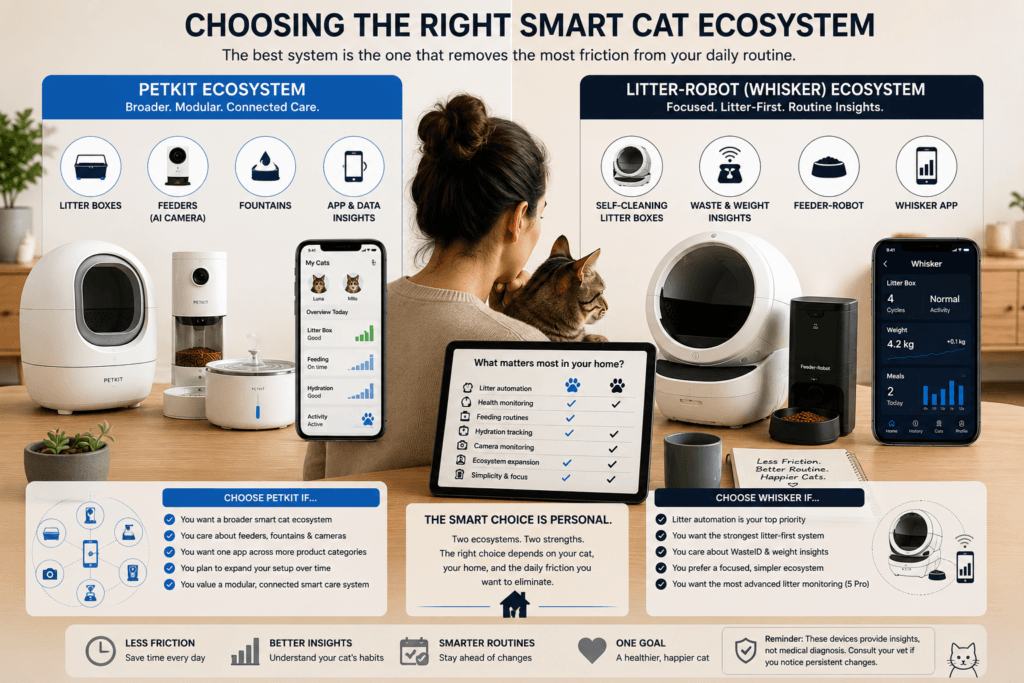
  • Best Smart Cat Tech 2026: What’s Actually Worth Buying (and What Isn’t)

    Best Smart Cat Tech 2026: What’s Actually Worth Buying (and What Isn’t)

    Smart gadgets don’t automatically equal a better life for a cat. In 2026, the best products are the ones that reduce friction for humans without breaking a cat’s routine, safety, or sense of control. That means fewer “cute” features, more boring (but meaningful) ones: reliable portioning, safer litter cycles, cleaner water, better monitoring, and enrichment that doesn’t overstimulate.

    This guide to best smart cat tech 2026 focuses on real, buyable gear on Amazon US, with a simple filter: does it measurably improve daily care—or just add noise to your home? If you want one page to plan a smart setup that actually makes sense, start here. Best smart cat tech 2026 is about building a system, not stacking gadgets.


    What “Best” Means in Best Smart Cat Tech 2026 (My Non-Negotiables)

    Before products, standards. Best smart cat tech 2026 should hit at least three of these:

    • Safety-first design (sensors, lockouts, stable materials, predictable behavior)
    • Routine support (consistent meal timing, cleaner litter, quieter operation)
    • Low-maintenance hygiene (stainless where it matters, easy disassembly, washable parts)
    • Useful data (not “AI” fluff—actual behavior insights you can act on)
    • No forced subscription for basic functionality (alerts and advanced features can be paid, but core use should stand)

    Feeding: The Smart Upgrade That Actually Changes Outcomes

    Overfeeding is one of the most common, most expensive mistakes in cat care long-term. A solid feeder is core best smart cat tech 2026 because it controls the thing humans routinely mess up: portions and consistency.

    PETKIT Fresh Element Infinity (Smart Feeder)
    Amazon (Solo)/ Amazon (Dual Hopper) / Amazon (Camera) / PetKit Store

    A strong pick if you want a feeder that’s built like a real appliance, not a toy. It’s designed for scheduled meals and controlled portions, which is where most “my cat is always hungry” problems begin.

    Why it belongs in best smart cat tech 2026

    • Scheduled feeding helps reduce chaotic begging loops.
    • Better portion control beats willpower every time.

    Quick pros

    • Great for routine feeding and portion discipline
    • Feels like a premium build in day-to-day use

    Quick cons

    • Still requires you to choose sensible portions (no device fixes math you won’t do)

    Want a deeper, hands-on breakdown before you buy? Read PETKIT Fresh Element Infinity Review 2025 | Smart Feeder Tested by PetTech AI.
    If you’re comparing brands first, use Best Smart Cat Feeders 2025 to shortlist models by use-case.

    (And yes: best smart cat tech 2026 for feeding is mostly about consistency, not “features.”)


    Litter Boxes: Where “Smart” Is Worth Paying For (If You Choose Carefully)

    Self-cleaning litter box setup designed for cleanliness and safety

    Self-cleaning litter is the most expensive category—and also where the difference between “smart” and “dangerous” matters. For best smart cat tech 2026, the bar is: redundant safety sensors, stable cycling behavior, and reasonable maintenance.

    PETKIT PuraMax 2 (Self-Cleaning Litter Box)

    This model is popular because it blends hands-off cleaning with the kind of sensor safety modern boxes need. It’s not “set and forget”—it’s “set and maintain.”

    Why it belongs in best smart cat tech 2026

    • More consistent cleanliness typically reduces litter avoidance.
    • App control is useful only if the hardware is safe and stable.

    Quick pros

    • Self-cleaning reduces human lag time (the #1 reason boxes get gross)
    • Designed around safety sensors (a baseline requirement)

    Quick cons

    • You still have to manage litter choice, waste bags, and cleaning cycles
    • Not every cat tolerates automated motion—slow introductions matter

    PETKIT N50 Odor Eliminator 2.0 (Accessory)

    Not a magic wand, but a practical add-on if odor is the limiting factor for where the box can live.

    Why it belongs in best smart cat tech 2026

    • Odor control affects box placement. Box placement affects usage. Usage affects everything.
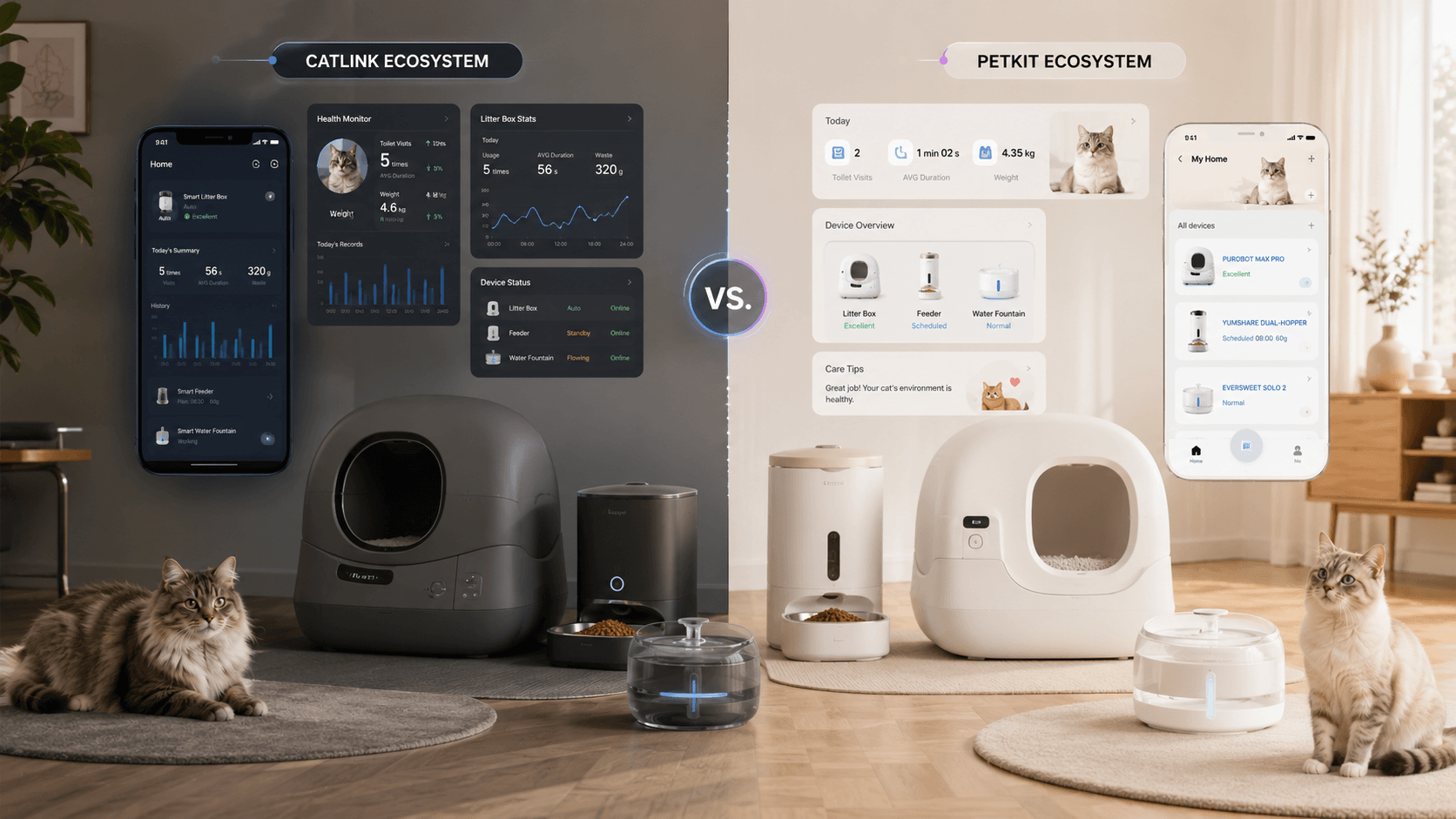
    Quick pros

    • Straightforward, targeted odor support for compatible PETKIT units
      Quick cons
    • Doesn’t replace basic hygiene (regular bin changes still win)

    See also PuraMax vs Litter-Robot

    If you only buy one “big” product from this entire best smart cat tech 2026 list, it’s usually either a feeder or a litter box—because those are the two friction points that destroy consistency.
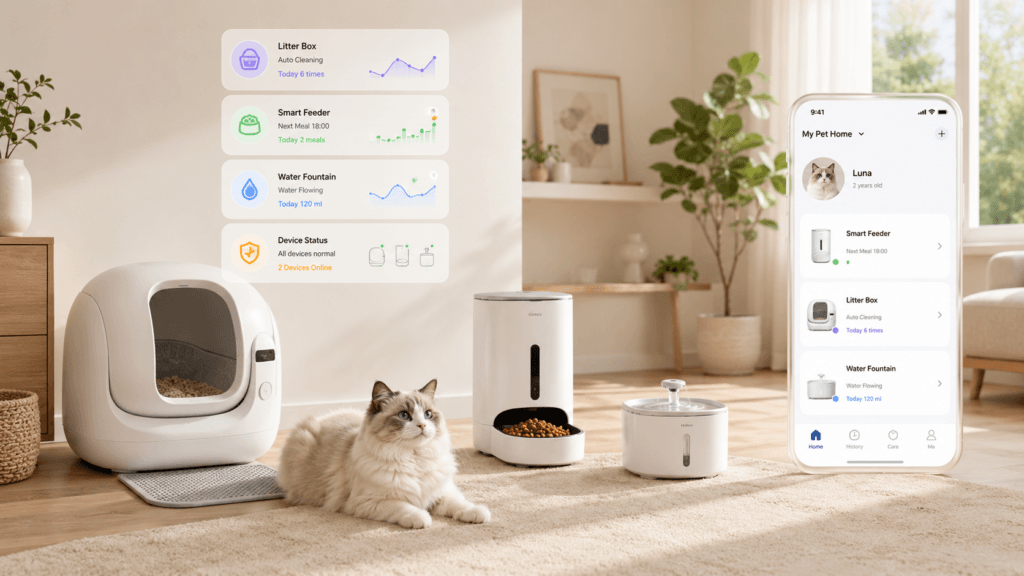

    Hydration: The Quiet Health Lever Most People Ignore

    Cats are famously under-hydrated. A fountain can help, but only if it’s clean, stable, and easy to maintain. In best smart cat tech 2026, a fountain’s “smart” value is mostly: reminders, modes, and build choices that make cleaning more likely.

    PETKIT EVERSWEET (Solo 2 / MAX variants)

    PETKIT’s fountain line is popular for a reason: these are designed as real home devices with usability in mind.

    Why it belongs in best smart cat tech 2026

    • Better hydration habits can support urinary health and overall well-being.
    • Easier cleaning = higher chance you’ll actually maintain it.

    Quick pros

    • Multiple operating modes (helpful for night + noise control)
    • Practical for multi-cat homes if you stay on cleaning schedule

    Quick cons

    • Any fountain becomes a bacteria project if you “forget” maintenance
    • Filters and parts are ongoing costs (that’s normal)

    Cameras: Not for Spying—For Behavior Signals You’d Otherwise Miss

    360-degree pet camera monitoring a cat’s behavior at home

    A camera is only part of best smart cat tech 2026 if it does one thing well: gives you actionable visibility (activity changes, stress behaviors, conflicts in multi-cat homes). The rest is entertainment.

    Petcube Cam 360 (Pan/Tilt Pet Camera)

    A strong option if you want full-room coverage and simple check-ins. The 360-style coverage is practical in real spaces where cats move vertically and hide.

    Why it belongs in best smart cat tech 2026

    • Helps you see patterns: when they eat, where they rest, what triggers stress.
    • Useful for separation anxiety monitoring without disrupting the cat.

    Quick pros

    • 360° coverage reduces blind spots
    • Helpful for multi-room “spot checking” behaviors

    Quick cons

    • A camera doesn’t fix behavior; it only shows it
    • Over-monitoring can make owners anxious and reactive (don’t do that)

    Furbo 360° Cat Camera (Treat + Interaction)

    This category can be useful if treats are part of your training/enrichment. But the value depends on whether the camera works well without forcing a subscription for basic use (models vary—check the exact listing).

    Why it belongs in best smart cat tech 2026

    • Treat interaction can support remote enrichment in small doses.

    Quick pros

    • Interactive engagement when used sparingly
      Quick cons
    • Treat tossing can encourage overeating if you’re not disciplined

    GPS Tracking: Real Safety, Real Tradeoffs

    GPS trackers are part of best smart cat tech 2026 if your cat goes outdoors or has any escape risk. The tradeoffs are subscription and collar tolerance. Still, if your cat disappears, you will not care about subscription fees.

    Tractive GPS Cat Tracker

    A well-known option for real-time tracking and location history—useful for escape alerts and “where do they actually go?” reality checks.

    Why it belongs in best smart cat tech 2026

    • Escape alerts + location history are practical, not gimmicky.
    • Helps you make smarter decisions about outdoor time.

    Quick pros

    • Real-time tracking + history features are genuinely useful
      Quick cons
    • Subscription is part of the model
    • Collar acceptance varies—some cats hate it

    Enrichment: Smart Toys That Don’t Turn Your House Into a Casino

    Cat playing with an interactive toy for indoor enrichment and exercise

    Cats need play and problem-solving. Cornell’s feline health resources point out that safe toys and enrichment help support natural behaviors and can reduce boredom-related issues. Cornell Vet Med In best smart cat tech 2026, “smart enrichment” should be simple: movement, novelty rotation, and predator-style play—not constant stimulation.

    Cheerble Interactive Cat Ball (Automatic Moving Toy)

    Great for many indoor cats—especially if you use it like a tool, not a babysitter.

    Why it belongs in best smart cat tech 2026

    • Gets cats moving when owners are busy.
    • Works best in short, controlled sessions.

    Quick pros

    • Automatic motion can trigger chase behavior
      Quick cons
    • Some cats get overstimulated—limit session length

    Catit Senses 2.0 Super Circuit (Track Toy)

    Not “smart” in the Wi-Fi sense, but it’s one of the most reliable boredom tools because it’s modular, predictable, and easy to rotate.

    Why it belongs in best smart cat tech 2026

    • Rotation matters more than novelty. A simple toy that’s easy to reconfigure stays useful longer.

    Quick pros

    • Great for multi-cat and kitten energy
      Quick cons
    • Not every cat is a track-toy cat (some prefer wand play)

    Want to pick enrichment that matches your cat’s play style (not your taste)? Read Best Interactive Cat Toys 2025: Vet-Informed Picks to Bust Boredom & Boost Play.
    For the “why this works” science, see Indoor Cat Enrichment 2025: Science-Based Guide to Stress, Play & Smart Living.


    The Ecosystem Reality Check: The Best Smart Cat Tech 2026 Isn’t One Brand

    People want one app to control everything. Reality: you’ll probably mix brands. That’s fine—just choose a “spine” for the setup:

    • Feeding spine: PETKIT feeder (routine + portions)
    • Hygiene spine: PETKIT litter box (cleanliness + safety)
    • Visibility spine: Petcube (behavior insight)
    • Safety spine: Tractive (escape protection)
    • Enrichment spine: rotate Cheerble + Catit + human-led play

    That stack is what best smart cat tech 2026 looks like in real homes: a few high-impact anchors, not a drawer full of gadgets.


    What’s Overhyped in 2026 (Spend Less, Win More)

    If you’re trying to buy “future” vibes, here are common mistakes:

    • Buying a camera instead of fixing routines (feeding/litter first)
    • Over-automating play and accidentally creating frustration or overstimulation
    • Chasing “AI health claims” without clear, validated, actionable outputs
    • Ignoring maintenance reality (fountains and litter boxes don’t stay clean by optimism)

    The best best smart cat tech 2026 purchase is the one you’ll actually maintain.


    Verdict: My Shortlist for Best Smart Cat Tech 2026

    If you want a clean, defensible setup:

    • Start with feeding: PETKIT Fresh Element Infinity (portion control + routine)
    • Then litter: PETKIT PuraMax 2 (cleanliness + safety sensor approach)
    • Add hydration: PETKIT EVERSWEET (if you’ll clean it consistently)
    • Add visibility: Petcube Cam 360 (behavior patterns, multi-cat dynamics)
    • Add safety: Tractive GPS Cat Tracker (if outdoors/escape risk exists)
    • Add enrichment: Cheerble ball + Catit Super Circuit (rotate, don’t spam)

    That’s best smart cat tech 2026 in one sentence: control the basics, reduce friction, and use data only when it changes decisions.


    FAQ: Best Smart Cat Tech 2026

    1) What’s the single best smart cat tech 2026 upgrade for most homes?

    A smart feeder with reliable portion control—because consistent feeding routines directly reduce overeating patterns and begging spirals. For many households, that’s the highest ROI “smart” purchase in best smart cat tech 2026.

    2) Are self-cleaning litter boxes safe?

    Some are, some aren’t. For best smart cat tech 2026, choose models with multiple safety sensors and predictable cycling behavior, and introduce them slowly. Automated motion can stress certain cats, even when hardware is safe.

    3) Do fountains actually help cats drink more?

    They can, especially for cats attracted to moving water—but only if the fountain is kept clean. Maintenance is the difference between “health support” and “biofilm machine.” Vca

    4) Is a pet camera worth it if I’m home most of the time?

    Sometimes yes—because it shows behavior you don’t notice (night activity, multi-cat conflict, changes in routine). But it’s not a substitute for enrichment and consistent care.

    5) Do GPS trackers work for cats?

    Yes, with tradeoffs: subscription, collar tolerance, and battery management. If your cat can escape or goes outdoors, GPS can be one of the most practical safety buys inside best smart cat tech 2026.


    Internal Links


    References

    • Cornell Feline Health Center — “Safe Toys and Gifts” (why structured play and safe toys matter for natural behaviors and preventing boredom-related issues). Cornell Vet Med
    • AAFP (via AVMA news) — consensus framing on feeding cats, including the need to consider play/predation needs as part of feeding programs. AVMA
    • AAFP/ISFM Feline Environmental Needs Guidelines — core framework (“pillars”) connecting environment to feline wellbeing and behavior. SAGE Journals

    Disclaimer

    PetTech AI publishes educational content to help cat owners make safer, more informed decisions about everyday care, behavior, and pet technology. Some articles contain affiliate links, including Amazon Associate links and other affiliate partnerships. If you click a link and make a qualifying purchase, PetTech AI may earn a small commission at no extra cost to you. These commissions help support testing time, research, and ongoing site maintenance. Product availability and features can change over time, so always confirm the latest details on the retailer’s page. Nothing on this site replaces veterinary advice for medical concerns.

  • Remote Health Monitoring for Cats in 2025: What Smart Litter Boxes, Feeders & Fountains Really Tell You

    Remote Health Monitoring for Cats in 2025: What Smart Litter Boxes, Feeders & Fountains Really Tell You


    Why remote health monitoring for cats is suddenly everywhere

    Open any pet tech page in 2025 and you’ll see the same promise: health reports, wellness insights, AI monitoring for your cat. Remote health monitoring for cats sounds amazing—your devices quietly collect data while you’re at work and warn you when something’s off.

    But what do these “health reports” actually track? How much can smart litter boxes, feeders, fountains and GPS trackers really tell you—and where do they hit a hard limit compared with a real vet exam?

    In this guide, we break down how remote health monitoring for cats works in practice, which metrics matter, where the tech is genuinely useful, and where it’s mostly marketing. We’ll use real examples from PETKIT, Whisker (Litter-Robot, Feeder-Robot), CATLINK and Tractive so you can decide if this ecosystem is worth the investment.


    What “remote health monitoring for cats” really means

    When brands talk about remote health monitoring for cats, they’re not diagnosing disease. They’re tracking patterns:

    • Litter box data – visits per day, duration, weight trends, sometimes even waste characteristics. PETKIT PuraMax 2, CATLINK Scooper Pro and Whisker’s Litter-Robot 5 all log usage and cat weight through their apps.
    • Feeding data – how much, how often, and which cat is eating. CATLINK RFID feeders and Whisker’s Feeder-Robot can generate daily health reports about eating patterns.
    • Hydration data – drinking frequency, volume and duration from smart fountains like PETKIT Eversweet 3 Pro and CATLINK Pure 2 / W03 AI fountains with health report features.
    • Activity & sleep – GPS trackers such as Tractive Cat Mini and newer devices like the Fi Mini log activity, rest and sometimes behavior trends.

    Put together, this is remote health monitoring for cats in 2025: continuous tracking of input (food, water), output (urine, feces), weight, and activity, viewed through a single or multi-app dashboard.

    It’s powerful—but only if you know what you’re looking at.


    The litter box: still the strongest health signal

    Smart litter box and app dashboard showing remote health monitoring data for a cat

    If you want remote health monitoring for cats that actually matters, the litter box is still the MVP. Changes in urination and defecation are early red flags for urinary disease, kidney issues, diabetes, constipation, diarrhea and pain.

    Key devices to know:

    PETKIT PuraMax 2 – data-driven urinary tracking

    PETKIT’s PuraMax 2 combines automatic cleaning with granular tracking of litter box visits and cat weight via the PETKIT app. It logs frequency, duration and weight trends for each cat in multi-cat homes, and flags abnormal patterns that may suggest urinary blockage or other problems.

    Pros

    • Strong app with visual trends for weight and box usage
    • Good fit with the wider PETKIT ecosystem (feeders, fountains)
    • Triple odor control and quiet operation make it easy to live with

    Cons

    • Requires consistent app use to get real value from the data
    • Still can’t tell you why your cat is peeing more—only that the pattern changed

    If you want remote health monitoring for cats without going full “AI camera in the litter box” yet, PuraMax 2 is one of the most balanced choices to start with.

    Whisker Litter-Robot 5 Pro – deeper AI insights

    Whisker’s new Litter-Robot 5 Pro leans heavily into health analytics. Pair it with the Whisker app and you get detailed usage statistics, weight charts and daily summaries per cat. The Pro model uses AI to identify individual cats and alert you to abnormal patterns that might signal disease.

    Pros

    • Best-in-class insights for multi-cat homes
    • Tight integration with Feeder-Robot inside the same app
    • Whisker+ subscription adds more detailed health trends

    Cons

    • Expensive upfront, especially if you add feeder + subscription
    • Data is very rich—easy to get anxious if you don’t know how to interpret it

    CATLINK Scooper series – holistic “input + output” vision

    CATLINK’s self-cleaning litter boxes track visits, weight changes and usage patterns across multiple cats, matching them with data from CATLINK feeders and fountains through a “holistic health monitoring system.”

    Pros

    • Designed from the start as part of a full health-tracking ecosystem
    • Multi-cat recognition and long-term pattern tracking
    • Strong value if you plan to commit to several CATLINK devices

    Cons

    • App and hardware occasionally get mixed feedback on stability
    • Best results require going “all in” on the brand

    Bottom line: If you care about remote health monitoring for cats, a smart litter box with decent app analytics is the first device that actually moves the needle.


    Smart fountains with health reports: hydration finally quantified

    Cat drinking from a smart water fountain with hydration tracking overlay

    Chronic kidney disease and urinary problems are common in cats, and early signs include increased drinking, more frequent urination and subtle weight changes.

    Smart fountains with health reports aim to make hydration quantifiable instead of guesswork.

    PETKIT Eversweet 3 Pro – smarter tracking, better hygiene

    The Eversweet 3 Pro is a stainless-steel smart fountain with a wireless pump and app connectivity. You can monitor drinking frequency and tweak modes (standard, smart, night) from the PETKIT app.

    Pros

    • Stainless steel bowl and wireless pump reduce biofilm risk and cleaning hassle
    • Integration with the PETKIT ecosystem if you already use their feeders or litter box
    • Ultra-quiet operation fits well in bedrooms and studios

    Cons

    • “Health monitoring” here is still basic—mostly usage trends, not medical analysis
    • App value depends on how often you actually check the stats

    CATLINK Pure 2 / W03 AI Water Fountain – full hydration health report

    CATLINK’s Pure 2 and W03 AI water fountains go harder on the “health report” promise: they log drinking frequency, duration and volume, and the app can generate hydration logs and health reports that tie into broader CATLINK ecosystem data.

    Pros

    • Detailed water-intake logs with alerts for abnormal patterns
    • Ultrafiltration and multi-stage filtration improve water quality
    • Wireless pump + battery options support flexible placement

    Cons

    • Still no direct medical interpretation—you get data, not diagnoses
    • Filter maintenance is non-optional if you want safe water

    If you already invested in a smart litter box, pairing it with a health-report fountain is one of the cleanest ways to level up remote health monitoring for cats without stressing your cat (no collars, no cameras).


    Smart feeders with health reports: catching silent weight creep

    Obesity is one of the biggest, and most underrated, health threats for indoor cats. AVMA-linked research shows that obesity increases the risk of diabetes, orthopedic disease, skin issues and more. Regular weight tracking and portion control are strongly recommended in the veterinary literature.

    Smart feeders with health reports give you three layers of control:

    • Who ate (via RFID or facial recognition)
    • How much they ate (portion logs)
    • How patterns change over weeks and months

    CATLINK Fresh 2 / F04 Pro RFID Feeder

    CATLINK’s smart feeders are built around multi-cat recognition and daily health reports. They log eating time, amount and which cat ate, and can generate customized daily reports to help spot early drops or spikes in appetite.

    Pros

    • True per-cat logging in multi-cat homes
    • App-based schedules plus manual “snack” control
    • Great combo with CATLINK litter boxes and fountains for full input/output tracking

    Cons

    • Works best if each cat reliably wears a compatible tag
    • Some cats will test the lid or try to steal each other’s food anyway

    Whisker Feeder-Robot

    Feeder-Robot integrates tightly with the Whisker app, which already tracks litter box activity and weight. You get feeding trends, portion histories and the ability to sync patterns across robots.

    Pros

    • Unified app with Litter-Robot 5 data
    • Very useful if you’re already “in” the Whisker ecosystem
    • Great for cats on strict calorie or therapeutic diets

    Cons

    • Overkill if you only have one healthy, easy-keeper cat
    • Health value collapses if you leave food in “free-for-all” mode with no rules

    If your cat is edging into the “maybe a bit chubby” zone, combining smart feeding with remote health monitoring for cats is one of the few tech moves that can realistically add healthy years to their life.


    GPS & wellness trackers: behavior data you’d never see otherwise

    Cat wearing a GPS tracker while owner checks health and activity stats on a phone

    Litter, food and water cover what goes in and out. GPS and wellness trackers cover how your cat actually lives in between.

    Devices like Tractive’s cat tracker monitor:

    • Real-time location and escape alerts
    • Activity levels and calorie burn
    • Sleep duration and patterns
    • Health alerts when behavior deviates from normal

    Newer devices such as the Fi Mini push even further, adding AI-powered behavior detection (scratching, licking, etc.) and extended battery life in a clip-on form factor sized for cats.

    Pros

    • The only way to get real outdoor data for roaming cats
    • Useful for weight management: calories and activity aren’t guesses anymore
    • Strong fit for anxious owners of escape-artist cats

    Cons

    • Subscription fees add up over years
    • Collars can be lost; some cats hate wearing anything at all

    Where they fit:
    If your cat is strictly indoors and already monitored via smart litter and feeder, trackers are “nice to have.” For outdoor or door-darting cats, they become the backbone of remote health monitoring for cats, because you finally see what actually happens outside.


    How to read all this data without losing your mind

    Here’s the unfiltered truth:

    Remote health monitoring for cats is amazing at spotting patterns, terrible at explaining causes.

    Vets and feline health centers are very clear on this: weight changes, litter box changes, appetite shifts and hydration changes are among the most important red-flag signs in cats—but they’re non-specific.

    Use the data like this:

    • Weight trend steadily down over weeks (with normal or increased appetite) → flag for hyperthyroidism, diabetes, cancer or kidney disease; schedule a vet check.
    • Sharp spike in litter box visits or straining, blood, vocalizing → emergency risk for urinary obstruction, especially in males; this is a same-day vet visit, not an app problem.
    • Gradual drop in activity + increased sleep + weight gain → strong signal to discuss obesity and joint pain with your vet; remote health monitoring for cats just makes this harder to ignore.

    What the devices can’t do:

    • Diagnose specific diseases
    • Replace physical exams, blood work, or urinalysis
    • Tell the difference between stress, bullying, pain and “just getting older”

    Treat remote health monitoring for cats as an early-warning radar. When your devices start drawing weird graphs, your next click shouldn’t be “buy more tech”—it should be “book a vet appointment.”


    Who actually benefits from a full health-monitoring ecosystem?

    Remote health monitoring for cats isn’t equally useful for everyone. It’s high-leverage for:

    • Senior cats (10+ years) – where small weight or litter changes can signal major disease.
    • Multi-cat homes – where it’s almost impossible to know who ate or peed what without tech help.
    • Cats with known urinary, kidney or diabetic issues – hydration and litter data can catch relapses earlier.
    • Owners who travel or work long hours – remote dashboards are far better than guessing via the sniff test.

    If you’re living with one young, healthy indoor cat and a normal work schedule, a full ecosystem may be overkill. In that case, start small: a solid smart litter box or feeder is often enough for meaningful remote health monitoring for cats.


    Internal links


    References


    Disclaimer

    The information in this article is for educational purposes only and is not a substitute for professional veterinary advice, diagnosis or treatment. Always consult your veterinarian if you notice changes in your cat’s behavior, appetite, weight, litter box habits or activity level, or before making significant changes to their care.

    PetTech AI participates in affiliate programs, including Amazon Associates and CJ. This means we may earn a small commission if you purchase products through links on this page, at no extra cost to you. Our reviews and recommendations are based on independent research, testing when possible, and analysis of verified user feedback.

  • CATLINK vs PETKIT vs Whisker (2026): Which Smart Cat Ecosystem Actually Works Best?

    CATLINK vs PETKIT vs Whisker (2026): Which Smart Cat Ecosystem Actually Works Best?

    Most ecosystem comparisons treat CATLINK, PETKIT, and Whisker as interchangeable “smart pet brands.”
    They aren’t.

    What separates these ecosystems isn’t feature count or app polish on day one. It’s how each system behaves over time—how much maintenance it quietly demands, how predictable automation remains, and how well the ecosystem adapts as usage scales.

    This comparison isn’t about picking the most advanced platform.
    It’s about choosing the ecosystem whose compromises align with how you actually live with your cat tech.


    Why Ecosystems Matter for Cat Health (Not Just Convenience)

    Veterinary sources are very clear about one thing: a cat’s basic needs are food, water, and litter – plus safe rest and enrichment. The AAFP/ISFM Feline Environmental Needs Guidelines and similar documents define these as core “environmental resources” that must be well managed for indoor cats to thrive. SAGE Journals

    Cornell Feline Health Center and other feline health resources repeatedly stress:

    • Many cats don’t drink enough, especially on dry food
    • Hydration is critical in preventing and managing kidney disease
    • Changes in eating, drinking, and litter box habits are often the first visible signs of illness

    A good ecosystem doesn’t replace a vet, but it does help you:

    • See when your cat ate, drank, and used the box
    • Spot trends (drinking less, skipping meals, visiting the box more often)
    • React earlier and bring hard data to your vet

    That’s the lens we’ll use to compare CATLINK vs PETKIT vs Whisker – not just “which robot is prettier,” but which ecosystem genuinely supports healthier routines.


    Quick Snapshot: CATLINK vs PETKIT vs Whisker

    CATLINK

    • Devices: self-cleaning litter boxes, automatic feeders, smart water fountains Amazon
    • App: CATLINK App – toilet, feeding, and drinking logs + health monitoring App Store
    • Ecosystem style: “Input & output” health tracking across devices
    • Best for: data-driven guardians who want the full triad (litter + feeder + fountain)

    PETKIT

    • Devices: Pura/Purobot litter boxes, Fresh Element feeders, multiple smart fountains PetKit Store / Amazon
    • App: PETKIT App – all devices managed in one place, millions of users PETKIT App
    • Ecosystem style: polished UX, automation first, health insights mostly via litter box
    • Best for: people who want a smooth app experience and reliable hardware more than explicit “health reports”

    Whisker (Litter-Robot + Feeder-Robot)

    • Devices: Litter-Robot (3/4/5/Evo) + Feeder-Robot; water products are in development but not mainstream yet Amazon
    • App: Whisker App – central hub for all robots, with growing AI analytics Whisker App
    • Ecosystem style: premium litter automation + high-end feeding, moving toward “input & output” insights
    • Best for: people who care most about rock-solid litter automation and long-term durability

    CATLINK: Most Complete “Input & Output” Ecosystem

    CATLINK smart cat ecosystem with litter box, feeder, and fountain connected to a mobile app

    If you want the closest thing to a true smart cat ecosystem in 2025, CATLINK is the one leaning hardest into the concept.

    Hardware & Ecosystem

    CATLINK’s EcoSystem Set bundles a self-cleaning litter box, automatic feeder, and smart water fountain. The official product pages state:

    “Connect scooper, feeder, and water fountain to the CATLINK App to monitor your pet’s toilet, eating, and drinking habits.”

    That’s not marketing fluff – it’s exactly the combo you want: litter + food + water in a single app.

    The CATLINK App adds:

    • Litter usage tracking and waste drawer level
    • Cat toilet behavior monitoring and health insights
    • Logs for feeding and – depending on model – drinking habits

    Data & Health Perspective

    CATLINK frames its ecosystem as “better pet care” via input/output monitoring, and that framing is actually aligned with what vets care about: how much is going in (food/water) and what’s coming out (urine/feces).

    Used properly, it can help you:

    • Notice if your cat is drinking less across several days
    • Pick up on more frequent or longer litter box visits
    • See feeding consistency when you’re away

    It’s still behavioral data, not lab data, but it’s the most complete integration currently on the market.

    Pros (CATLINK)

    • True triad: litter box + feeder + fountain within one app
    • Health-oriented messaging and features (toilet behavior + health monitoring)
    • Clear “ecosystem” product bundles for one-shot setup
    • Strong fit for multi-cat homes that want hard numbers

    Cons (CATLINK)

    • High upfront cost if you buy the full set
    • App still evolving; UX isn’t as polished as some competitors
    • You’re locked into CATLINK hardware if you want the full functionality

    PETKIT: Best All-Rounder for UX and Everyday Reliability

    PETKIT app managing smart cat feeder, fountain, and litter box in one dashboard

    PETKIT doesn’t shout “ecosystem” quite as loudly as CATLINK, but in practice it delivers one of the smoothest litter + feeder + fountain setups available.

    Hardware & Ecosystem

    PETKIT sells:

    • Fresh Element smart feeders and newer successors
    • Multiple smart fountains, some battery-powered with app-controlled modes and water monitoring PETKIT
    • Pura/Purobot self-cleaning litter boxes with weight and usage sensors PETKIT

    The PETKIT App is advertised as:

    “All-in-one Management. Manage all of your PETKIT devices in one app, and stay connected to what matters most to your pets.” PETKIT

    It’s not a vague claim: the app really does act as a central control panel for feeder, fountain, and litter box.

    Data & Health Perspective

    PETKIT focuses slightly more on automation and convenience:

    • Scheduling and remote feeding
    • Fountain modes and filter/water level monitoring
    • Litter box weight-based waste monitoring and usage notifications App Store

    You can still read the data in a health-focused way (eating/drinking trends + box usage), but the app doesn’t package it as an explicit “health report” the way CATLINK is starting to do.

    Pros (PETKIT)

    • One of the most mature apps in pet tech, with millions of users
    • Good hardware coverage across all three categories
    • Strong everyday reliability; less “beta” feeling than some new ecosystems
    • Good balance of automation, notifications, and manual control

    Cons (PETKIT)

    • Health data is there, but more implicit than explicit
    • Not as aggressively integrated around “input/output” as CATLINK or Whisker’s future roadmap
    • As always, you’re committing to one vendor’s hardware and cloud

    Whisker: Premium Litter + Feeder, Health Analytics Catching Up

    Whisker Litter-Robot and Feeder-Robot connected through the Whisker app for automated litter and feeding

    Whisker (Litter-Robot + Feeder-Robot) is known for premium litter automation. Ecosystem-wise, it’s a strong contender even if it doesn’t yet include a mainstream fountain.

    Hardware & Ecosystem

    Today, Whisker sells:

    The Whisker App connects to multiple robots and provides a dashboard for both litter boxes and feeders. Litter-Robot – Self-Cleaning Litter Box

    The latest Litter-Robot 5 Pro introduces:

    • Facial recognition for individual cats
    • Dual cameras and AI-based waste tracking
    • Optional Whisker Plus subscription for detailed bathroom behavior analytics

    A recent report on Whisker’s roadmap notes that the company is explicitly aiming at “input and output” monitoring – food, water, and waste – to tell a more complete health story. Axios

    The Catch: No Mainstream Fountain Yet

    Whisker is clearly moving toward a full ecosystem, but as of late 2025 the water piece is still emerging rather than established.

    So in a strict CATLINK vs PETKIT vs Whisker comparison:

    • Whisker nails litter + feeding
    • Full litter + feeding + fountain integration is still behind CATLINK and PETKIT

    Pros (Whisker)

    • Arguably the strongest litter automation on the market
    • Feeder-Robot is robust, with app-based scheduling and large capacity Litter-Robot – Self-Cleaning Litter Box
    • New AI features (Litter-Robot 5 Pro + Whisker Plus) push health analytics further than most competitors The Verge
    • Built with durability and long-term support in mind

    Cons (Whisker)

    • No fully integrated smart fountain in the mainstream lineup yet
    • High price point across the board
    • Health analytics partly locked behind a subscription (Whisker Plus)

    CATLINK vs PETKIT vs Whisker: Which Ecosystem Fits Which Cat Household?

    Think of this less as “who wins overall” and more as “who fits your situation.”

    Choose CATLINK If…

    • You want all three pillars (litter, feeder, fountain) under one brand from day one CATLINK
    • You like the idea of health-oriented behavior tracking in the app (toilet behavior, monitoring, activity overview)
    • You’re okay betting on a relatively newer ecosystem in exchange for deeper integration

    Choose PETKIT If…

    • You care about app polish, stability, and everyday UX
    • You want a straightforward ecosystem where everything “just works” across litter box, feeder, and fountain PETKIT
    • You like having multiple fountain and feeder form factors to choose from

    Choose Whisker If…

    • Litter automation is your number one priority
    • You’re ready to pay more for very refined hardware and AI-assisted litter analytics Whisker
    • You can live (for now) without a tightly integrated fountain, or you’re willing to add a separate brand just for water

    Which ecosystem causes the most long-term friction?

    Regret at the ecosystem level rarely comes from missing features. It comes from choosing a philosophy that doesn’t match daily life.

    PETKIT friction typically appears when households grow. Its modular, compact design works extremely well in controlled environments, but buyers who later scale to multiple cats sometimes realize they optimized for flexibility rather than maximum throughput.

    CATLINK friction tends to show up in maintenance sensitivity. Its automation depth is appealing, especially for data-oriented users, but setups that aren’t dialed in precisely can feel more demanding over time.

    Whisker (Litter-Robot ecosystem) creates the least uncertainty but the least flexibility. It’s predictable, but that predictability comes with ecosystem rigidity. Buyers who regret it often expected adaptability rather than consistency.

    The mistake isn’t choosing the “wrong brand.”
    It’s assuming smart litter boxes behave the same once installed. At ecosystem level, the question isn’t which platform is more advanced — it’s which automation philosophy integrates most naturally into your space and tolerance level.


    Verdict: choosing the right ecosystem, not the flashiest one

    Choose PETKIT if you value compact design, modular products, and flexibility in smaller homes. It works best when you want smart features without committing to a single, rigid automation path.

    Choose CATLINK if your priority is aggressive automation and data-driven control, especially in multi-cat setups. The trade-off is higher sensitivity to maintenance and setup precision.

    Choose Whisker if long-term consistency and ecosystem depth matter more than adaptability. It’s less flexible, but more stable once dialed in.

    If you’re stuck because all three feel “premium,” that’s the point.
    The decision isn’t about which ecosystem is smarter—it’s about which one you’re willing to manage over time.ether you act on them with your vet.

    Within the Whisker ecosystem itself, model choice still plays a major role. The Litter-Robot 5 vs 5 Pro vs EVO analysis explains how those differences translate into real-world friction.

    For readers deciding specifically between PETKIT and Whisker hardware rather than ecosystems, the more focused breakdown is the PETKIT PuraMax 2 vs Litter-Robot 4 comparison, especially in smaller homes.

    The same ecosystem differences appear again in automated feeding systems, where each brand solves a different problem around routine, monitoring, or multi-cat control. That contrast becomes clearer in the PETKIT vs Feeder-Robot vs CATLINK smart feeder comparison.


    FAQ

    1. Does any ecosystem replace regular vet checkups?

    No. All three systems in this CATLINK vs PETKIT vs Whisker comparison provide behavioral data only. They can highlight unusual trends (like more litter visits or less drinking), but only a vet can interpret those changes with exams and lab work.

    2. Is it a bad idea to mix brands?

    Technically, you can mix anything you want: CATLINK litter + PETKIT fountain + Whisker Feeder-Robot. You’ll just lose the benefit of having a single app that combines data. If your goal is hard numbers you’ll actually look at, sticking to one ecosystem makes life easier.

    3. Which ecosystem is better for multi-cat households?

    All three support multi-cat use at the hardware level. CATLINK and Whisker push harder on individual cat tracking (weight, behavior, AI recognition), while PETKIT offers a more general multi-cat dashboard. The right choice depends on how much you care about per-cat analytics vs overall convenience.

    4. If I only buy one device now, where should I start?

    From a health perspective, vets often prioritize litter boxes and water:

    • self-cleaning litter boxes improve hygiene and make changes easier to spot
    • fountains can encourage more drinking, especially in cats on dry diets

    Start with the device that solves your biggest pain point, then expand.

    5. Are AI features (like facial recognition) worth paying for?

    AI features in systems like the Litter-Robot 5 Pro are promising, especially for multi-cat homes, but they’re not essential for everyone. Today, the practical gain is better per-cat behavior logs. If you’re budget-constrained, a “non-AI” robot plus a good ecosystem app is still a huge upgrade.


    Internal Links (PetTech AI)


    Authoritative Outbound Links


    Disclaimer

    This article is for educational purposes only and is not a substitute for professional veterinary diagnosis or treatment. Always consult your veterinarian if you notice changes in your cat’s drinking, eating, or litter box habits, or before making health decisions based on data from connected devices. Smart feeders, fountains, and litter boxes can help you track trends but cannot replace physical exams, diagnostic tests, or prescribed therapies. PetTech AI participates in affiliate programs such as Amazon Associates and CJ. We may earn a commission if you purchase products through links on our site, at no extra cost to you.