Tag: automatic cat feeders

  • PETLIBRO Polar vs PetSafe FreshFeed (2026): 54°F or 40°F?

    PETLIBRO Polar vs PetSafe FreshFeed (2026): 54°F or 40°F?

    PETLIBRO Polar and PetSafe FreshFeed both rotate wet-food meals on schedule. Only one currently claims a conventional 40°F refrigeration target.

    That matters more than tray aesthetics, app icons or how aggressively the marketing team photographed a snowflake.

    Polar holds three meals, has a longer warranty and has been around long enough for its ownership quirks to become visible. FreshFeed holds six meals and promises colder storage, but it is still new enough that long-term reliability remains an unanswered question.

    Choose FreshFeed when temperature and capacity come first. Choose Polar for shorter three-meal routines, a longer warranty and lower early-adopter uncertainty.

    Overall verdict: Conditional. FreshFeed wins the comparison.

    Quick Verdict

    PETLIBRO PolarPetSafe FreshFeed
    Best forOne to three scheduled wet mealsUp to six meals and colder storage
    Cooling claimAbout 54°F in a 77°F roomHelps maintain 40°F when used as directed
    Compartments36
    Food supportCommercial wet, semi-moist and prescription canned foodWet, fresh and raw food
    Warranty24 months1 year
    Main concernPublished temperature is above standard refrigeration guidanceNew product with limited long-term ownership evidence
    VerdictConditionalConditional — comparison winner

    PetTech AI may earn a commission from qualifying purchases. As an Amazon Associate I earn from qualifying purchases.

    Prefer three meals and the longer warranty? Check PETLIBRO Polar on Amazon.

    Need six meals and a manufacturer-stated 40°F target? Check PetSafe FreshFeed on Amazon.

    Still comparing feeding systems? Our best automatic cat feeders guide includes refrigerated, RFID, camera-equipped and standard dry-food models.

    Research Note

    This is a research-led comparison based on current manufacturer documentation, support information, warranty policies and early ownership signals. PetTech AI has not independently temperature-tested both feeders.

    Cooling numbers below are manufacturer claims, not measurements produced in the PetTech AI underground refrigeration laboratory.

    The Temperature Difference Decides the Comparison
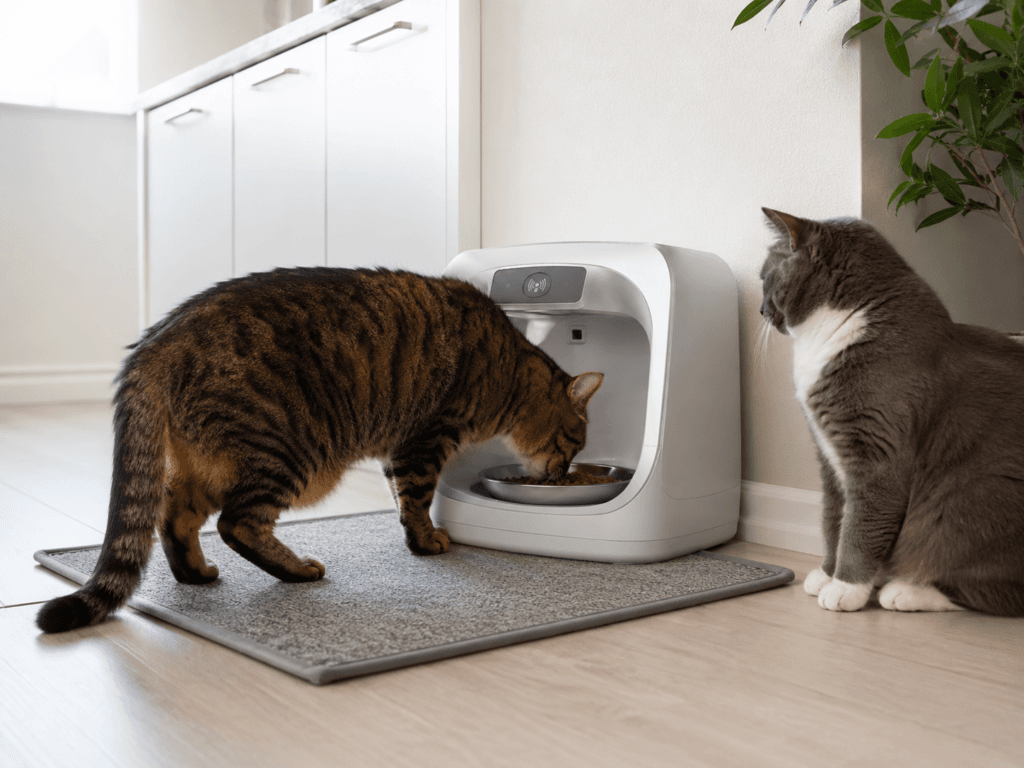
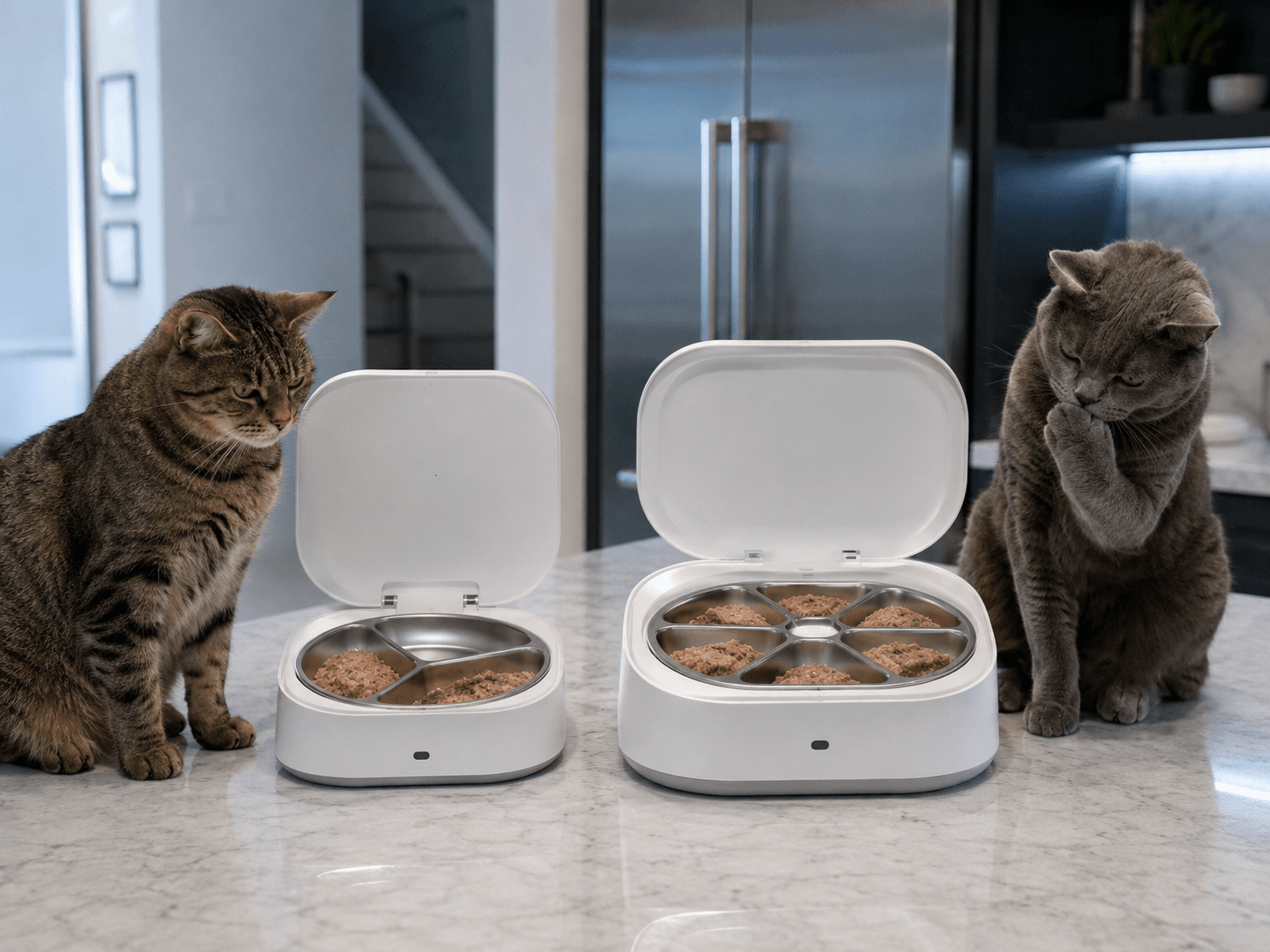
    Wet cat food cooling compared at different refrigerated feeder temperature targets.
    Both feeders cool wet food. Only FreshFeed currently claims a conventional 40°F target.

    PETLIBRO reports that Polar cools food to approximately 54°F when the room temperature is 77°F. The company says this slows bacterial growth and can preserve wet food for up to three days under its intended operating conditions. Cooling pauses about 30 minutes before a scheduled meal.

    PetSafe says FreshFeed uses semiconductor cooling and insulation to help maintain 40°F when used as directed. Its six-meal tray remains refrigerated between scheduled feedings.

    Those figures should not be treated as cosmetic differences.

    FDA guidance says unused or leftover canned and pouched pet food should be refrigerated promptly, with the refrigerator set to 40°F or below. Polar’s published 54°F result sits above that benchmark.

    That does not prove Polar makes every meal unsafe. Actual food temperature depends on room conditions, starting temperature, meal composition and operating time. It does mean Polar should not be described as equivalent to a conventional refrigerator simply because both devices make food colder than the kitchen.

    FreshFeed has the more convincing refrigeration specification.

    Polar is better understood as a chilled meal scheduler. FreshFeed is trying to behave more like a compact refrigerator with a rotating dinner calendar.

    The thermometer, for once, is less emotionally invested than the marketing department.

    Three Meals or Six?
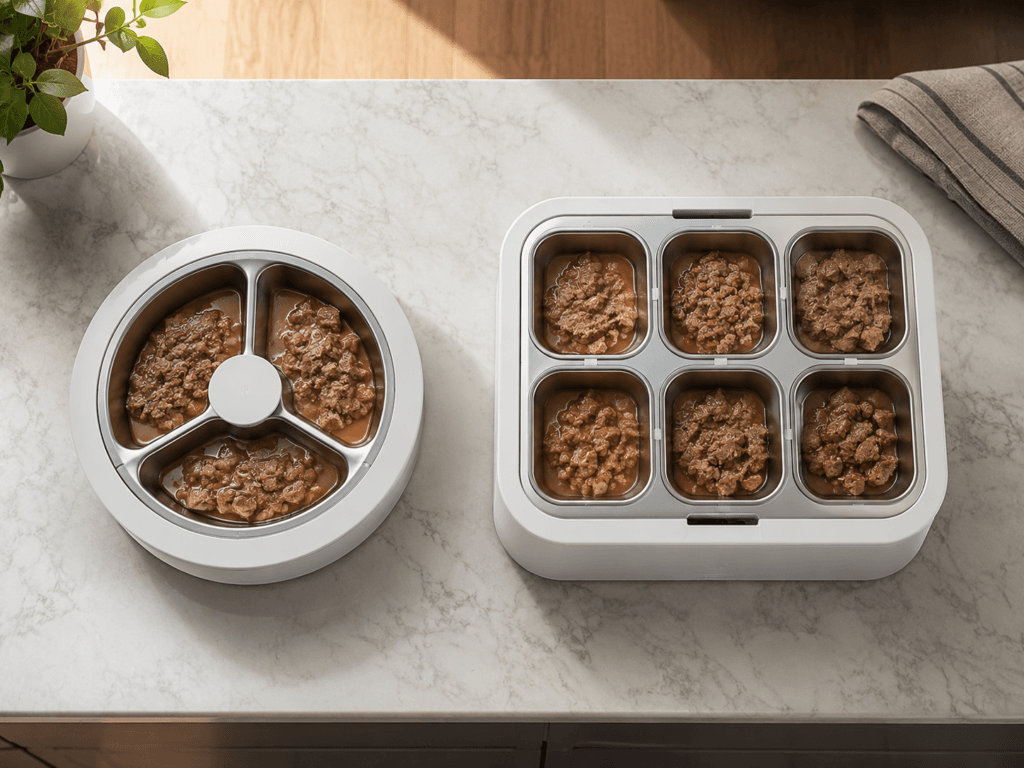
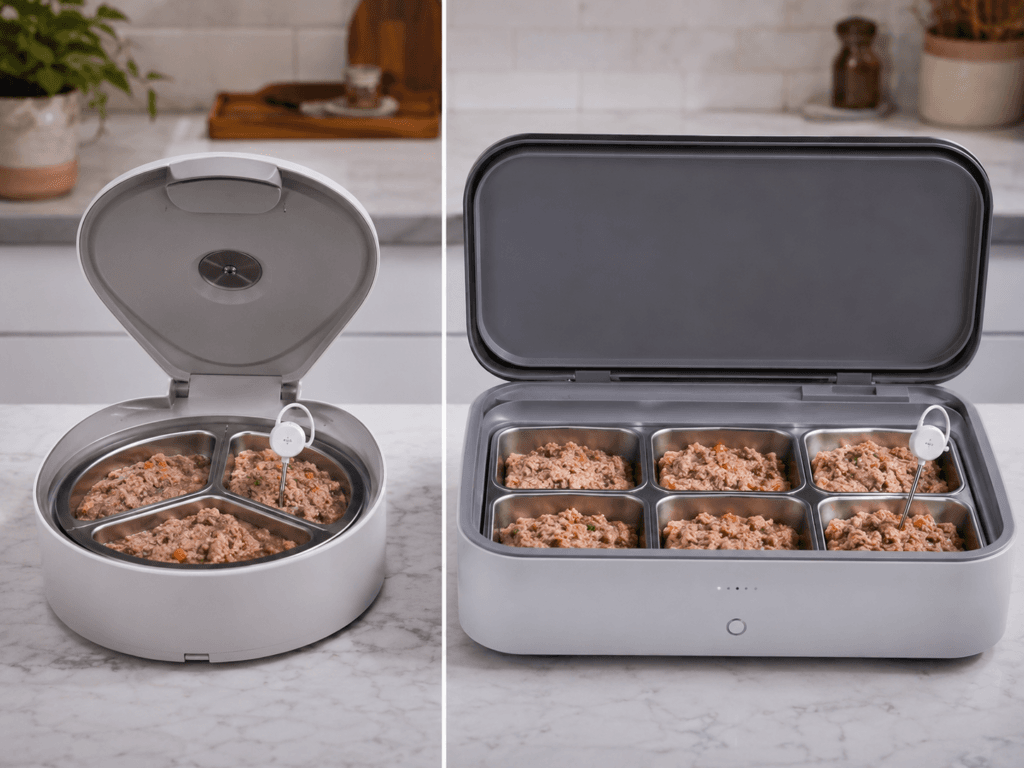
    Three-compartment and six-compartment refrigerated cat feeders compared.
    Three meals cover a normal day. Six meals give the schedule considerably more room to misbehave.

    Polar stores three prepared portions. That is enough for breakfast, dinner and the following morning—or three smaller meals during one day.

    FreshFeed doubles the count with six compartments and a total listed capacity of 4.5 cups. Its removable stainless-steel inserts are designed for preparation, serving and dishwasher cleaning.

    FreshFeed is the clearer fit for:

    • cats eating several small wet meals;
    • households preparing more than one day of portions;
    • meals containing toppers or supplements;
    • owners who do not want to refill after the third serving.

    Polar remains sufficient when the real problem is covering a normal day rather than establishing a refrigerated tasting menu.

    Capacity winner: FreshFeed.

    More compartments are not automatically better, but needing five meals and owning a three-meal feeder is a difficult disagreement to solve through firmware.

    Food Compatibility: FreshFeed Is Broader

    PETLIBRO positions Polar for commercial wet food, semi-moist food, prescription canned diets and rehydrated freeze-dried meals. It does not recommend raw food.

    PetSafe markets FreshFeed for wet, fresh and raw diets. That broader compatibility follows logically from its colder stated target, although compatibility is not the same as a guarantee of safe storage in every household.

    Raw food deserves particular caution. FDA testing has found raw pet food more likely than processed food to contain disease-causing bacteria. A feeder can provide cooling; it cannot negotiate a ceasefire with Salmonella.

    For ordinary canned wet food, both products are relevant. For fresh or raw feeding, FreshFeed has the stronger official case—but owners should still follow the food producer’s storage instructions and veterinary guidance.

    Polar Is Older. FreshFeed Is More Promising.

    FreshFeed is a recent product. Its early owner feedback is encouraging, but the available history is not yet large or old enough to answer the questions that matter after sustained use:

    • Does cooling remain stable?
    • Does the tray continue aligning correctly?
    • Do fans become louder?
    • Does condensation create recurring maintenance?
    • Does the app behave after several firmware updates?

    Calling it unreliable would be unfair. Calling it proven would be creative writing.

    Polar has been available longer and has accumulated more troubleshooting information around condensation, ice buildup, rotation and cooling performance. That makes its ownership friction easier to understand before purchase.

    It also carries a 24-month warranty, while PetSafe’s standard warranty is one year. PETLIBRO offers a 30-day direct return window; PetSafe allows direct returns within 45 days.

    The split is clean:

    • FreshFeed gives buyers the better specifications and longer direct trial period.
    • Polar gives buyers twice the warranty coverage and a more established support history.

    For an appliance containing cooling hardware, sensors, fans and a rotating tray, warranty length is not decorative typography.

    App, Cleaning and Power: No Clear Winner
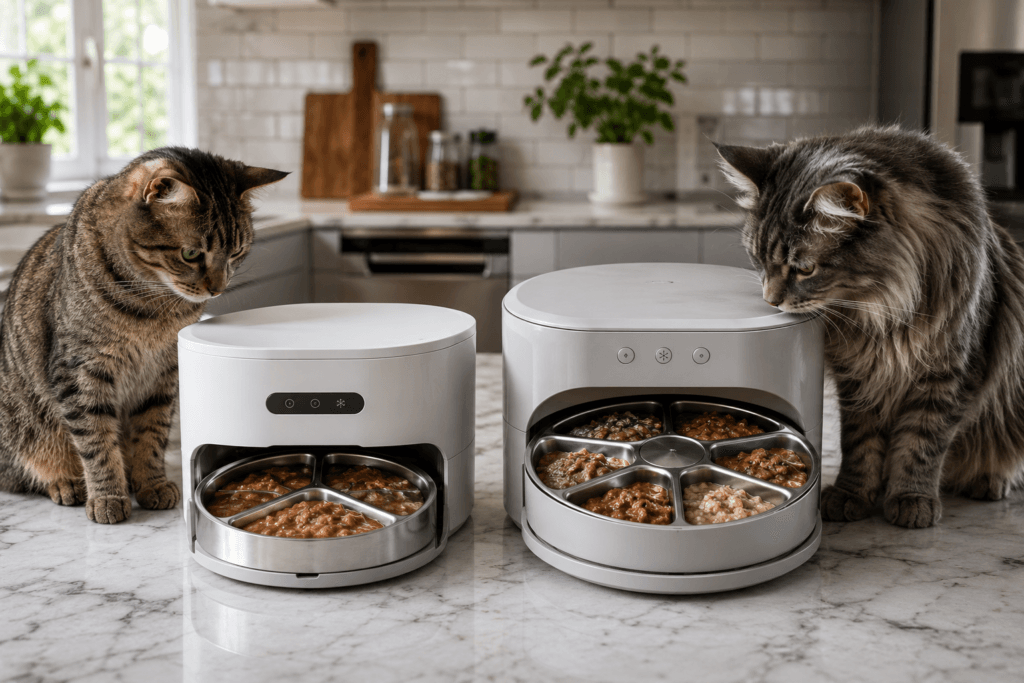
    Stainless-steel cat feeder trays being cleaned beside a refrigerated feeding base.
    Refrigeration reduces scheduling friction. It does not volunteer for dish duty.

    Both feeders use app-based scheduling and require wall power for normal refrigeration.

    Polar’s backup batteries can preserve scheduled tray movement for up to 12 hours during an outage, but they do not provide normal cooling performance. A meal rotating successfully is not proof that it remained refrigerated.

    FreshFeed does not advertise battery-backed refrigeration. After a meaningful outage, owners should evaluate the food rather than trusting the schedule notification.

    Both systems also require real cleaning. Polar’s cooling area can collect condensation, while FreshFeed adds six individual inserts and ventilation components. FreshFeed’s steel inserts are dishwasher-safe; the powered bases of both machines must be wiped rather than submerged.

    Neither product identifies which cat approaches the open meal. In a multi-cat home, dinner belongs to whoever arrives first with sufficient confidence.

    For individual access control, see our PETLIBRO One RFID vs SureFeed Connect comparison.

    Who Should Buy PETLIBRO Polar?

    Choose Polar when:

    • three scheduled meals are enough;
    • you serve ordinary canned or prescription wet food;
    • the 24-month warranty matters;
    • you prefer the product with the longer ownership history;
    • you are using it for shorter feeding windows;
    • you understand that 54°F is not equivalent to standard refrigerator storage.

    Polar remains useful. It is simply easier to recommend as a convenience tool than as a three-day food-safety argument.

    Verdict: Conditional.

    Check PETLIBRO Polar on Amazon.

    For a closer look at setup, app control and everyday ownership, read our PETLIBRO Polar review.

    Who Should Buy PetSafe FreshFeed?

    Choose FreshFeed when:

    • you need more than three prepared meals;
    • the 40°F manufacturer target matters;
    • you serve wet, fresh or raw food;
    • individual stainless-steel inserts appeal;
    • you accept a one-year warranty;
    • you are comfortable buying a newer product.

    FreshFeed offers the better answer to the central question: which machine makes the stronger refrigeration case?

    Our caution concerns maturity, not purpose. It is the more capable design on paper; it just has not yet completed the long and deeply glamorous process of aging in thousands of kitchens.

    Verdict: Conditional — comparison winner.

    Check PetSafe FreshFeed on Amazon.

    Final Verdict

    PetSafe FreshFeed wins.

    Its six-meal capacity and claimed 40°F target better match the reason most people consider a refrigerated feeder in the first place: keeping prepared wet food closer to standard refrigeration conditions until serving time.

    It remains Conditional because:

    • the temperature claim has not been independently verified by PetTech AI;
    • the product is still new;
    • long-term durability remains unclear;
    • the warranty lasts only one year.

    PETLIBRO Polar remains the lower-uncertainty option for three scheduled meals and offers stronger warranty coverage. Its published 54°F result, however, prevents it from winning a refrigeration-first comparison.

    Choose FreshFeed for colder storage and more meals.

    Choose Polar for shorter routines, fewer compartments and the longer warranty.

    One is the more familiar machine. The other brought the better thermometer.

    Frequently Asked Questions

    Is PETLIBRO Polar a real refrigerator?

    Polar uses thermoelectric cooling, but PETLIBRO reports approximately 54°F in a 77°F room. That is colder than room temperature but warmer than the FDA’s 40°F-or-below refrigerator guidance.

    Does FreshFeed always stay at exactly 40°F?

    PetSafe says it helps maintain 40°F when used as directed. Actual performance can depend on room temperature, ventilation, maintenance and food placement. PetTech AI has not independently verified the claim.

    Can either feeder stop another cat from eating the meal?

    No. Neither uses microchip or RFID identification. They schedule access by time, not by cat.

    What happens during a power outage?

    Normal refrigeration depends on wall power. Polar can continue rotating meals temporarily through backup batteries, but cooling stops. FreshFeed does not advertise refrigerated battery backup.

    References

    PETLIBRO — Polar Smart Wet Food Feeder Product Documentation
    PETLIBRO — Polar Cooling and Support Documentation
    PETLIBRO — Return and Warranty Policy
    PetSafe — FreshFeed Refrigerated Pet Feeder Product Documentation
    PetSafe — FreshFeed User Guide
    PetSafe — Return and Warranty Information
    FDA — Proper Storage of Pet Food and Treats
    FDA — Raw Pet Food Diet Safety Guidance

    Editorial Disclosure

    PetTech AI may earn a commission from qualifying purchases. This does not influence our recommendations, comparisons or editorial judgments.

    Image Disclosure

    Official manufacturer images are used when available and authorized.

    AI-generated images may also be used as editorial illustrations. They should not be treated as exact representations of product dimensions, materials, controls, temperatures or physical features. Always verify current official product information before purchasing.
  • PETLIBRO One RFID vs SureFeed Connect (2026): Collar Tag or True Microchip Access?

    PETLIBRO One RFID vs SureFeed Connect (2026): Collar Tag or True Microchip Access?

    PETLIBRO One RFID and SureFeed Connect are often treated as rival smart feeders. They are not.

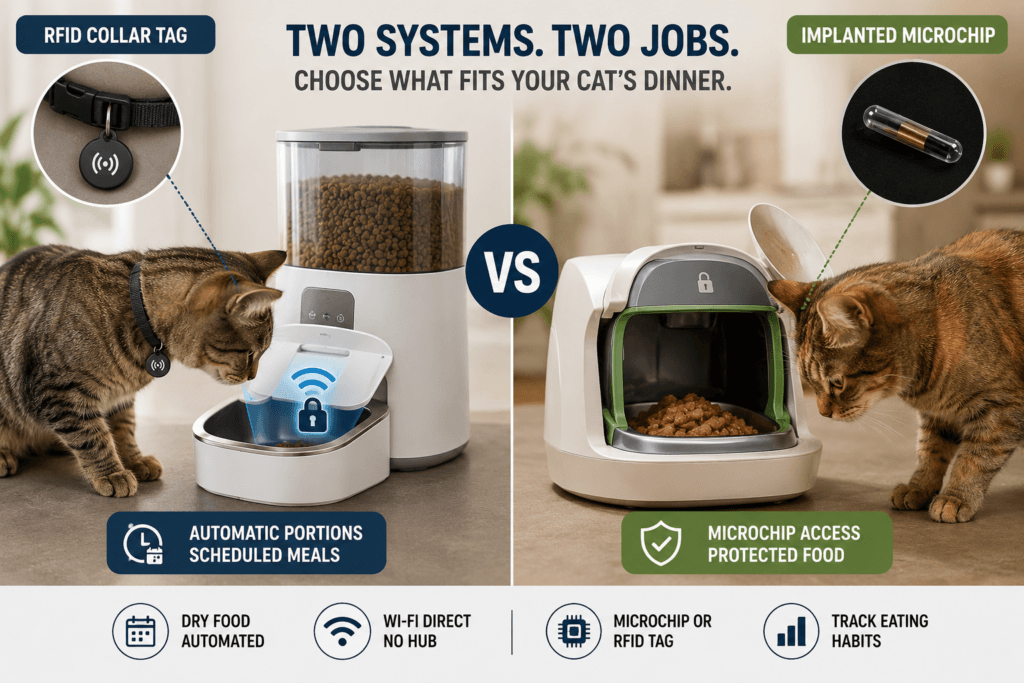
    PETLIBRO is an automatic dry-food dispenser with a selective-access lid. SureFeed is a protected bowl with microchip recognition, portion scales and connected feeding records. One serves meals. The other guards food you already served.

    That distinction settles the purchase faster than twenty minutes comparing app screenshots.

    Choose PETLIBRO One RFID for scheduled dry-food portions and collar-tag access. Choose SureFeed Connect for implanted-microchip recognition, wet-food compatibility and tighter diet separation.

    Overall verdict: Conditional.

    Quick Verdict

    PETLIBRO One RFIDSureFeed Microchip Pet Feeder Connect
    Best forScheduled dry meals protected from food thievesWet or dry food reserved for the correct microchipped cat
    Food deliveryAutomatically dispenses kibbleOwner fills the bowl manually
    IdentificationPETLIBRO collar tag onlyImplanted microchip or Sure Petcare RFID tag
    Food typeDry food onlyWet, dry or both
    Connected setupDirect Wi-FiSure Petcare Hub required for app features
    Main regret riskCat rejects the collar or another cat exploits the moving lidHub sold separately and no automatic dispensing
    VerdictRecommendedRecommended

    PetTech AI may earn a commission from qualifying purchases. As an Amazon Associate I earn from qualifying purchases.

    Need scheduled dry-food automation? Check PETLIBRO One RFID on Amazon.

    Need true microchip access for wet or dry food? Check SureFeed Connect on Amazon.

    Our best automatic cat feeders guide compares these access systems with camera feeders and refrigerated wet-food options. “Smart feeder” has become a broad category containing several machines that barely perform the same job.

    Research Note

    This is a research-led comparison based on current manufacturer documentation, support materials, manuals and warranty information. PetTech AI has not conducted a long-term side-by-side household test of both feeders.

    The conclusions focus on what each mechanism can physically do—not on pretending that two products become equivalent because both have discovered mobile notifications.

    Automation vs Selective Access

    PETLIBRO One RFID has a 3-liter hopper, accepts kibble between 2 and 15 millimeters and can schedule up to ten meals or snacks per day.

    It normally uses wall power. Three alkaline D batteries can preserve scheduled feeding during an outage, but Wi-Fi functions are disabled while the feeder operates only on backup power.

    SureFeed Connect has no hopper and does not dispense scheduled meals. You place food into its 400-milliliter bowl, and the lid opens when an authorized pet approaches. Integrated scales and LED guidance help the owner serve the intended portion, while the app records how much, how often and when the cat eats.

    The real split is simple:

    • PETLIBRO automates when and how much dry food appears.
    • SureFeed controls who may eat food already in the bowl.

    Calling SureFeed an automatic feeder is technically defensible because the lid moves automatically. It is also how someone ends up expecting a robot waiter and receiving a highly disciplined food safe.

    Collar Tag vs Implanted Microchip

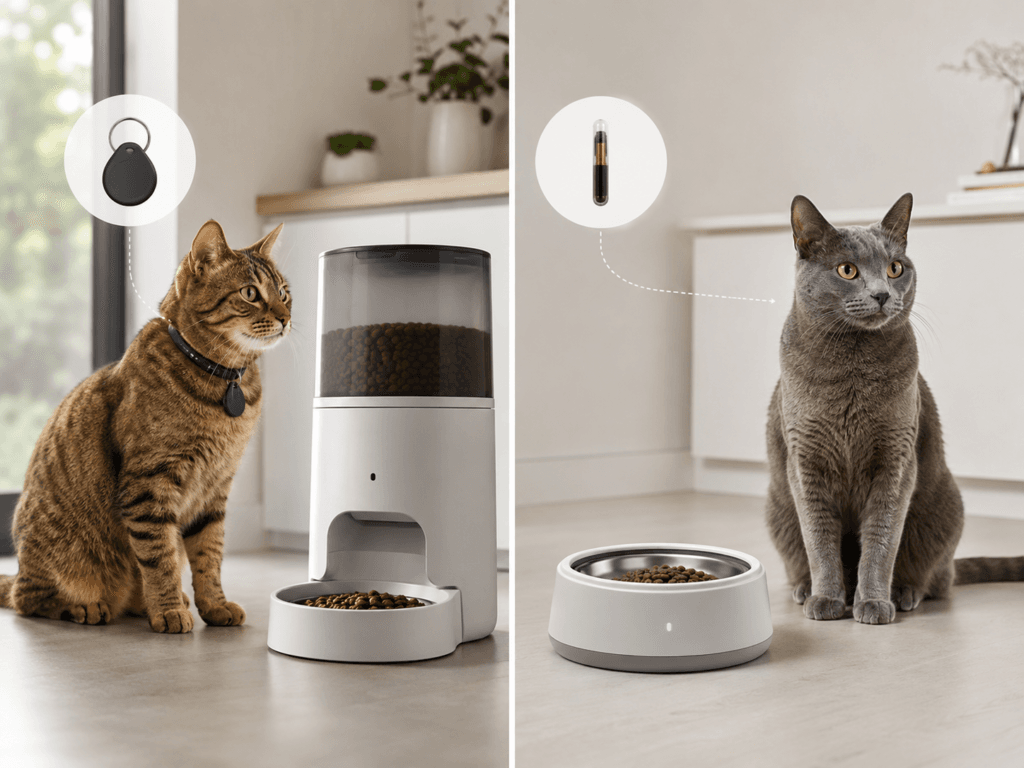
    Cat collar RFID tag compared with implanted microchip feeder access.
    One system recognizes an accessory. The other recognizes the cat.

    PETLIBRO One RFID does not read an implanted microchip or third-party RFID tag. Its reader mat recognizes the dedicated PETLIBRO tag worn on a collar, and PETLIBRO designs each One RFID feeder around one recognized pet wearing its dedicated collar tag. The tag does not require charging and can be removed from the supplied breakaway collar.

    That is practical when the authorized cat accepts a collar. When the cat does not, there is no secret microchip mode waiting beneath an advanced-settings menu.

    SureFeed reads common implanted identification microchips and can alternatively use a compatible Sure Petcare collar tag. The identifier can therefore remain inside the cat rather than beneath a sofa after Biscuit’s latest disagreement with wearable technology.

    For prescription diets or strict food separation, implanted-microchip recognition has the cleaner logic.

    Identification winner: SureFeed Connect.

    Dry-Food Automation vs Wet-Food Flexibility

    Scheduled dry-food dispensing compared with protected wet-food access.
    PETLIBRO handles timing and portions. SureFeed assumes the kitchen staff has already arrived.

    PETLIBRO is dry-food only. Wet food, semi-moist food and kibble larger than the supported range do not belong in its dispensing path.

    SureFeed accepts wet food, dry food or a divided bowl containing both. Its closing lid seals against the bowl to help limit flies and moisture loss, but it does not refrigerate the meal. Wet food still requires normal food-safety judgment and regular replacement.

    SureFeed is therefore the more natural fit for:

    • prescription wet diets;
    • cats that graze slowly;
    • mixed wet-and-dry routines;
    • food that must remain available but protected.

    PETLIBRO makes more sense for:

    • scheduled kibble portions;
    • owners absent at serving time;
    • several small dry meals per day;
    • households needing timing and access control together.

    A standard feeder may schedule the theft. A camera feeder may film it. These two products at least attempt to change who reaches the bowl.

    App Experience: Direct Wi-Fi or Hub Tax?

    PETLIBRO connects directly through 2.4 GHz or 5 GHz Wi-Fi. Its app manages feeding schedules, quantities, remote dispensing and lid behavior. PETLIBRO Care is optional. Core scheduling, dispensing, access control and device operation do not require a subscription; paid Care plans add broader wellness tracking, trend tools and planning features.

    When another pet obstructs the lid, PETLIBRO says the feeder briefly reopens for safety and tries again. After repeated failure, it enters a failed-to-close state and sends a notification. Sensible engineering—but also confirmation that the lid is a moving barrier, not a bank vault.

    SureFeed Connect reaches the app through the Sure Petcare Hub, which connects to the home router. One Hub can support up to ten compatible Sure Petcare products. The Amazon listing selected for this comparison sells the Hub separately, so first-time buyers need another purchase for notifications, histories and app controls.

    The feeder can still perform its basic microchip-access function without the Hub, but it cannot connect to the Sure Petcare app. Owners already using a SureFlap Connect door may have the required bridge; everyone else gains another small white tenant beside the router.

    SureFeed’s records can help owners notice changes in meal quantity or frequency. They can flag a pattern worth investigating; they cannot diagnose illness or replace veterinary assessment.

    For the wider software trade-offs, see our best pet tech apps for cats guide.

    Multi-Cat Failure Modes Matter More Than the Apps

    Authorized cat eating while another cat tests a selective-access feeder.
    Every access-control system eventually meets a cat willing to perform unpaid security testing.

    Both feeders are designed to reduce food theft. Neither should be described as impossible to defeat.

    PETLIBRO access depends on collar position, reader placement, lid timing and whether another cat approaches before the cover closes. The closing speed can be adjusted, but a determined thief may still study the mechanism with the concentration normally reserved for safecracking.

    Each PETLIBRO feeder supports one tag. If three cats need three protected dry-food portions, the practical setup may require three feeders positioned far enough apart to reduce interference. Effective, perhaps—but not exactly minimalist interior design.

    SureFeed closes after the authorized cat leaves, but its standard body remains relatively open at the rear. Sure Petcare sells an optional cover specifically for persistent food thieves approaching from behind. Apparently some cats interpret access-control technology as an invitation to conduct penetration testing.

    Training also matters. SureFeed uses a staged mode that gradually introduces lid movement, and cautious cats may need several days or longer. PETLIBRO requires the authorized cat to stand correctly on the reader mat while wearing the tag.

    The most secure feeder in the house remains useless when its intended customer refuses to put a head near it.

    Our best multi-cat tech solutions guide covers the wider difference between preventing conflict and merely collecting excellent data about it.

    PETLIBRO One RFID: Who Should Buy It?

    Choose PETLIBRO One RFID when:

    • the authorized cat eats dry food;
    • scheduled dispensing matters;
    • the cat accepts a collar tag;
    • one feeder per protected cat is practical;
    • occasional access failure would be inconvenient rather than dangerous.

    Its advantage is combination. Most products either dispense food or restrict access. PETLIBRO does both, using a 3-liter hopper, direct Wi-Fi and battery-backed schedules.

    Its main weakness is equally clear: identification lives on the collar. Remove the tag, lose the collar or present a cat philosophically opposed to accessories, and the headline feature disappears.

    PETLIBRO currently lists a 24-month warranty for the feeder.

    Verdict: Recommended for scheduled dry-food separation.

    Check PETLIBRO One RFID on Amazon.

    SureFeed Connect: Who Should Buy It?

    Choose SureFeed Connect when:

    • implanted-microchip recognition is the priority;
    • the cat eats wet food, dry food or both;
    • meals can be filled manually;
    • portion and visit histories would be useful;
    • the separate Hub is acceptable or already owned.

    SureFeed is the stronger design when unauthorized access has more serious consequences, particularly with prescription food or sharply different diets. It recognizes the cat rather than an accessory the cat must continue wearing.

    The trade-off is that it does not serve meals. You still buy, portion and place the food. The connected setup also becomes less attractive when the Hub must be purchased separately, while particularly ambitious thieves may justify the rear cover.

    Sure Petcare lists a three-year warranty from the date of purchase and requires proof of purchase to validate a claim.

    Verdict: Recommended.
    SureFeed is recommended for true microchip-controlled access, not for automatic meal dispensing.

    Check SureFeed Connect on Amazon.

    Final Verdict

    PETLIBRO One RFID wins on automation. It schedules and dispenses dry food, then uses a proprietary collar tag to restrict access.

    SureFeed Connect wins on identification and food flexibility. It reads implanted microchips, supports wet or dry meals and records how the authorized cat uses the bowl—but requires manual filling and a separate Hub for app connectivity.

    Choose PETLIBRO when the recurring problem is:

    “I need the correct dry portion served at the correct time to the correct collar-wearing cat.”

    Choose SureFeed when the problem is:

    “I need this prepared food protected from every cat except the one whose microchip authorizes access.”

    Neither is universally better because they automate different parts of dinner.

    One is a dispenser with a bouncer. The other is a private dining room without kitchen staff.

    Frequently Asked Questions

    Does PETLIBRO One RFID read an implanted microchip?

    No. It recognizes PETLIBRO’s dedicated RFID collar tag and pairs with one tag per feeder.

    Does SureFeed Connect dispense meals automatically?

    No. The owner fills the bowl manually. The feeder automatically controls access and records feeding behavior.

    Can SureFeed Connect hold wet food?

    Yes. Its 400-milliliter bowl supports wet food, dry food or both. The lid helps preserve freshness but does not refrigerate the meal.

    Does SureFeed Connect require the Hub?

    The Hub is required for app connectivity, notifications and feeding histories. The Amazon feeder listing reviewed here sells it separately.

    Can another cat steal food from either feeder?

    Possibly. PETLIBRO’s moving lid can be challenged while closing, while SureFeed may need the optional rear cover against persistent thieves. Placement, training and observation remain important.

    Which feeder is better for prescription food?

    SureFeed Connect is generally the stronger fit when the food can be placed manually and implanted-microchip access is valuable. No consumer feeder should be treated as an absolute medical-security guarantee.

    References

    PETLIBRO — One RFID Pet Feeder Product Documentation
    PETLIBRO — One RFID PLAF301 Support and Pre-Sale Guidance
    PETLIBRO — Feeding Portion and Power Documentation
    Sure Petcare — Microchip Pet Feeder Connect Product Documentation
    Sure Petcare — Microchip Pet Feeder Connect Manual
    Sure Petcare — Hub and Rear Cover Documentation

    Editorial Disclosure

    PetTech AI may earn a commission from qualifying purchases. This does not influence our recommendations, comparisons or editorial judgments.

    Image Disclosure

    Official manufacturer images are used when available and authorized.

    AI-generated images may also be used as editorial illustrations. They should not be treated as exact representations of product dimensions, materials, controls or physical features. Always verify current official product information before purchasing.
  • Best Automatic Cat Feeders (2026): Four Feeders for Four Completely Different Problems

    Best Automatic Cat Feeders (2026): Four Feeders for Four Completely Different Problems

    Amazon contains enough automatic cat feeders to suggest that feeding a cat has become an aerospace discipline.

    It has not.

    Most owners need to solve one of four problems:

    • serve dry food on schedule and see what happened;
    • keep wet food chilled until mealtime;
    • stop one cat from treating every bowl as a public buffet;
    • protect wet or prescription food using the cat’s actual microchip.

    Those problems require different machines.

    A camera does not refrigerate pâté. Refrigeration does not identify the food thief. An RFID tag is not an implanted microchip. And a feeder that films the crime in 1080p has not necessarily prevented it.

    This guide compares four products with genuinely different jobs:

    • PETKIT YumShare Solo 2;
    • PETLIBRO Polar;
    • PETLIBRO One RFID;
    • SureFeed Microchip Pet Feeder Connect.

    Research note: This is a research-led guide based on official documentation, current product information, public ownership evidence, and PetTech AI’s product-level trust checks. PetTech AI has not conducted long-term hands-on testing of every feeder included.

    Quick Verdict

    Your real problemBest feederRecommendation
    You want scheduled kibble plus camera visibilityPETKIT YumShare Solo 2Promising newer product
    You need refrigerated wet mealsPETLIBRO PolarStrong niche recommendation
    One cat steals another cat’s dry foodPETLIBRO One RFIDEstablished but conditional
    You need true microchip access for wet or dry foodSureFeed Microchip Pet Feeder ConnectStrong specialist recommendation

    The short version

    Choose YumShare Solo 2 when seeing the feeding area will actually change what you do.

    Choose Polar when your cat eats wet food and your schedule refuses to cooperate.

    Choose One RFID when you need timed dry-food dispensing plus tag-controlled access—but do not assume the door is a maximum-security facility.

    Choose SureFeed Connect when food protection matters more than automatic dispensing and you want to use the cat’s implanted microchip.

    Affiliate disclosure: This page contains affiliate links. PetTech AI may earn a commission if you purchase through them, at no additional cost to you. As an Amazon Associate I earn from qualifying purchases.

    Compare the Recommended Feeders

    First Decide What the Feeder Must Physically Do

    Before comparing hopper capacity, camera resolution, or how enthusiastically the app uses the word “AI,” answer one question:

    What must physically happen at mealtime?

    Dispense dry food and show you the bowl

    Choose a camera feeder.

    Keep wet food chilled and serve it later

    Choose a refrigerated feeder.

    Dispense dry food but restrict access using a collar tag

    Choose an RFID feeder.

    Keep prepared food available only to one microchipped cat

    Choose a microchip-access feeder.

    These categories overlap less than marketing pages suggest.

    A sophisticated product can still be completely wrong for the household.

    For a clearer breakdown of when smart pet technology should automate a task—and when it merely creates more information to check—read our Smart Cat Monitoring vs Automation guide.

    PETKIT YumShare Solo 2: Best for Camera-Based Dry Feeding

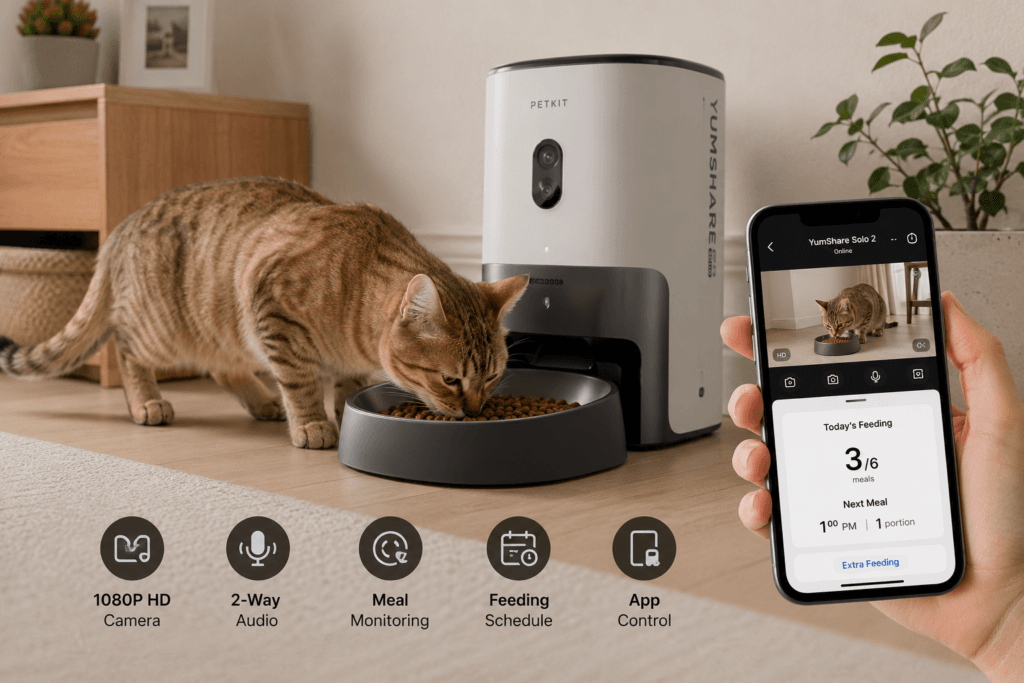
    A cat eating from an automatic dry-food feeder while a smartphone shows a simple meal-monitoring screen nearby
    Camera-based feeders are most useful when meal records and visual context change how you manage the feeding routine.

    YumShare Solo 2 combines scheduled dry-food dispensing with a camera, live monitoring, meal records, two-way audio, and PETKIT’s individual-pet recognition system.

    Its 3 L hopper holds dry kibble or compatible freeze-dried pieces. Schedules continue even when Wi-Fi is unavailable, and backup batteries can preserve feeding during a power interruption, although the camera is disabled while operating on battery power.

    That makes it a real feeder first and a camera second—which is the correct order.

    Buy it if

    • your cat eats dry food;
    • you want to see whether the cat approached the bowl;
    • you spend significant time away from home;
    • changes in mealtime behavior are worth reviewing;
    • you already use PETKIT products;
    • one feeding station serves the household.

    Skip it if

    • you only need timed portions;
    • you will stop watching the clips after three days;
    • your main diet is wet food;
    • one cat must be physically prevented from eating another cat’s meal.

    The main limitation

    YumShare Solo 2 is still new.

    Its early market signal is encouraging, but there is not yet a deep ownership history showing how consistently recognition, notifications, app behavior, and camera functions perform after years of daily use.

    There is also a conceptual limit:

    Recognition is not restriction.

    The feeder may identify Baron Fluffington as he approaches the bowl. It does not issue a restraining order.

    If one cat steals another cat’s food, a camera gives you evidence. You may still need physical access control.

    Verdict: A promising camera feeder for owners who will genuinely use visual meal context—not the default choice for simple scheduling or food theft.

    For a direct comparison between camera-led feeding, routine-first automation, dual-hopper flexibility, and identity-based systems, read PETKIT vs Feeder-Robot vs CATLINK.

    PETLIBRO Polar: Best for Refrigerated Wet Meals

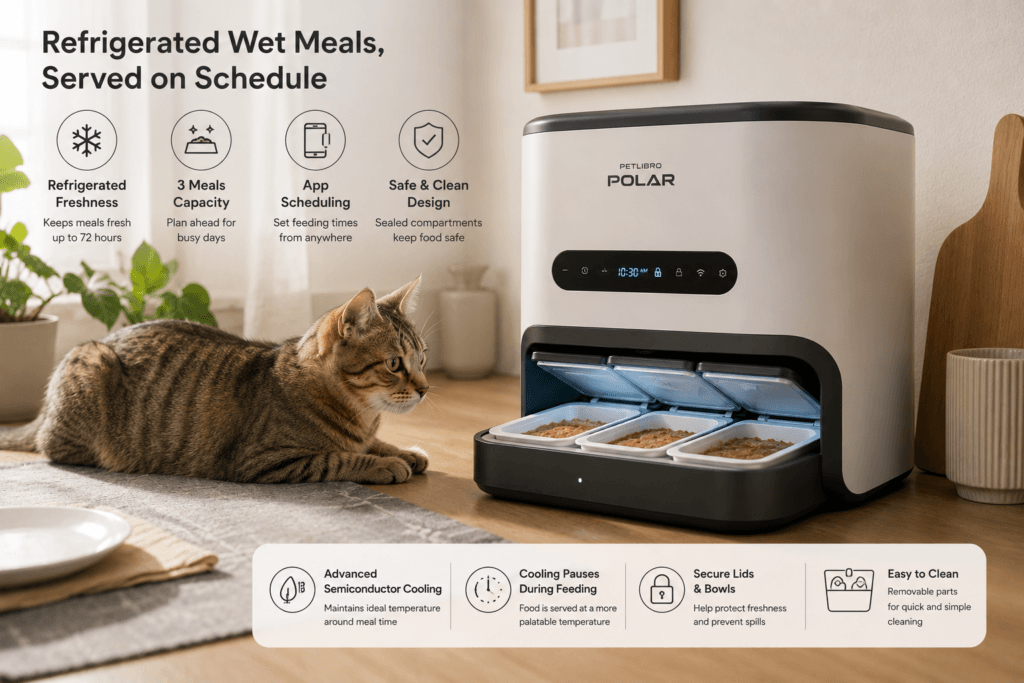
    A refrigerated automatic feeder with covered wet-food meal compartments in a clean cat feeding area
    Wet-food automation needs refrigeration and timed access—not a standard kibble hopper.

    Polar solves the problem most automatic feeders quietly avoid:

    Wet food is perishable.

    It uses thermoelectric cooling, three meal compartments, app scheduling, and a removable stainless-steel tray. PETLIBRO says the feeder can keep three meals chilled for up to three days under its intended conditions and pauses cooling before serving so food is not presented at its coldest temperature.

    That does not make it a miniature restaurant.

    It makes it a refrigerated scheduling tool.

    Buy it if

    • wet food is already part of the daily routine;
    • work or other commitments interrupt meal times;
    • you want to avoid switching to kibble simply because nobody is home;
    • three prepared portions are enough;
    • you are willing to clean the tray and cooling area consistently.

    Skip it if

    • you mainly use dry food;
    • you need access control between cats;
    • your cat is very small or uncomfortable with a raised feeding area;
    • you want a long-trip feeding solution;
    • you expect refrigeration to eliminate food-safety judgment.

    The main limitation

    Polar removes timing friction.

    It does not remove:

    • leftovers;
    • condensation;
    • cleaning;
    • wall-power dependence;
    • the need to verify that the cat actually ate.

    Three chilled meals can make a workday much easier.

    They do not allow you to disappear for a long weekend while the feeder applies for temporary guardianship.

    Verdict: The strongest choice here for scheduled wet food and a genuinely useful niche product for the right household.

    For the deeper analysis, read our PETLIBRO Polar Review.

    Refrigerated feeders differ substantially in temperature targets and meal capacity. Our Polar vs FreshFeed comparison explains why three chilled meals and six meals held closer to conventional refrigeration are not the same proposition.

    PETLIBRO One RFID: Best for Scheduled Dry Food with Tag Access

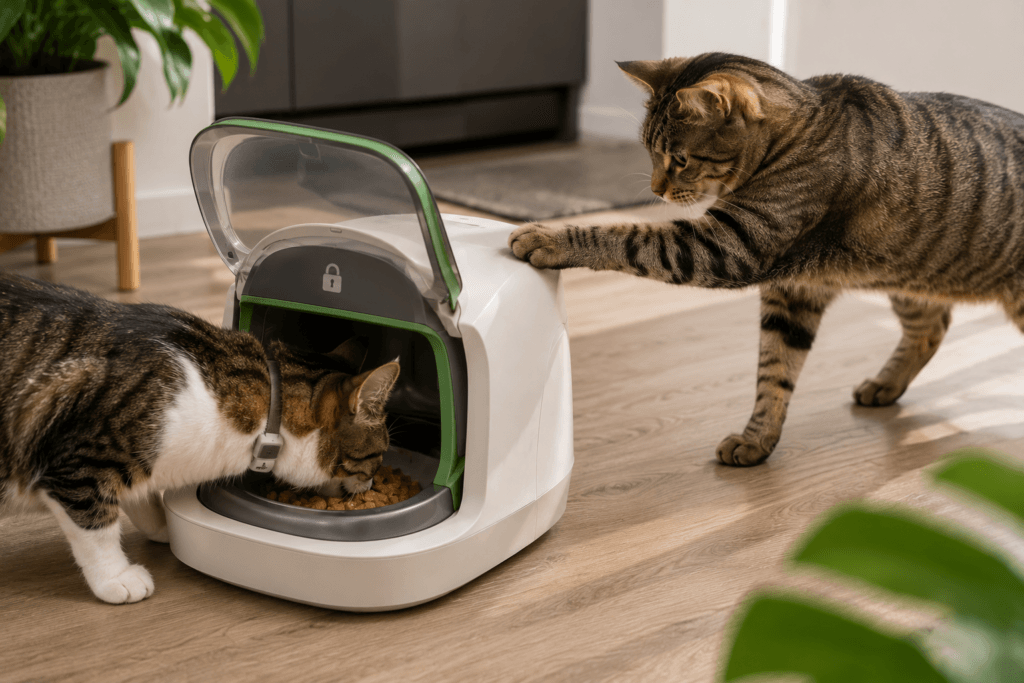
    Two cats near a covered automatic feeder designed to give one cat protected access to its food
    Access-controlled feeders solve a different problem from scheduled feeders: keeping the right food available to the right cat.

    One RFID combines two functions:

    • automatic dry-food dispensing;
    • access controlled through PETLIBRO’s dedicated RFID collar tag.

    This makes it more relevant than a normal hopper when one cat steals dry food from another or when separate portions need to be maintained.

    The product has a substantial public ownership history, and the overall market signal supports keeping it in the guide.

    But it requires careful framing.

    Buy it if

    • your cats eat dry food;
    • one cat regularly invades another cat’s feeding station;
    • you want both meal scheduling and controlled access;
    • the authorized cat tolerates a collar tag;
    • you can position the feeder away from interference;
    • the consequences of occasional access failure are manageable.

    Skip it if

    • you need implanted-microchip recognition;
    • your cat refuses collars;
    • you feed wet food;
    • unauthorized access would create a serious medical risk;
    • you expect the door to defeat every determined cat in existence.

    The main limitation

    One RFID uses a proprietary collar tag.

    Its performance depends on:

    • tag position;
    • reader placement;
    • lid speed;
    • nearby interference;
    • feeder spacing;
    • the determination and engineering qualifications of the unauthorized cat.

    PETLIBRO provides troubleshooting guidance for slow closure, incomplete opening, RFID interference, and rotor errors. Some owners also report that another cat can exploit the lid before it closes fully.

    This does not make the feeder useless.

    It means “designed to reduce food theft” should not be translated as “physically impossible to defeat.”

    For ordinary dry-food separation, it can be a practical solution.

    For a prescription diet where unauthorized access carries meaningful health consequences, SureFeed’s microchip approach or a more enclosed physical setup may be the safer direction.

    Verdict: A credible and established dry-food access feeder, but a conditional recommendation rather than a prison-grade guarantee.

    Not every selective-access feeder automates the same part of the meal. Our PETLIBRO One RFID vs SureFeed Connect comparison explains the difference between scheduled dry-food dispensing and true microchip-controlled access.

    SureFeed Microchip Pet Feeder Connect: Best for True Microchip Access

    SureFeed Connect is fundamentally different from the other three products.

    It does not contain a large hopper.

    It does not release a fresh portion at a scheduled time.

    Instead, you place wet or dry food in its 400 ml bowl, and the lid opens only when the registered cat’s implanted microchip or compatible RFID tag approaches.

    That makes it the strongest specialist option when the food itself needs protection.

    Buy it if

    • one cat needs prescription or therapeutic food;
    • one pet steals wet or dry meals;
    • you prefer implanted-microchip access over a collar tag;
    • food can remain available for grazing;
    • accurate portion monitoring is useful;
    • automatic dispensing is not required.

    Skip it if

    • you want meals dispensed at specific times;
    • you need a large dry-food hopper;
    • you want one device to combine automatic portions and microchip access;
    • you do not want the additional Hub required for Connect app features.

    The main limitation

    The Connect version requires the Sure Petcare Hub to communicate with the app.

    The feeder is also relatively open at the rear. Sure Petcare sells an optional rear cover specifically for persistent thieves capable of approaching from behind.

    This is useful honesty from the manufacturer.

    Apparently some cats respond to access-control technology by conducting a structural vulnerability assessment.

    The rear cover, feeder placement, and training process may therefore matter in particularly competitive homes.

    Even with those caveats, SureFeed’s mature microchip-access model gives it the strongest argument when food protection—not timed dispensing—is the priority.

    Verdict: The best specialist choice for true microchip-controlled access to prepared wet or dry food.

    The Food-Thief Test

    Suppose Clara has prescription food.

    Her brother, Caesar, believes prescriptions are merely serving suggestions.

    YumShare Solo 2

    Records Caesar approaching Clara’s food.

    You receive a clear image of the suspect.

    Polar

    Keeps Clara’s wet food chilled until serving time.

    Caesar appreciates the improved catering.

    PETLIBRO One RFID

    Uses Clara’s collar tag to open the feeding area and attempts to close it after she leaves.

    Caesar may be stopped—or may begin studying lid timing.

    SureFeed Connect

    Opens for Clara’s implanted microchip and closes when she leaves.

    Add the rear cover if Caesar has developed flanking tactics.

    That is why “best automatic feeder” is the wrong question.

    The better question is:

    Which physical mechanism solves the problem in your home?

    Buyer Regret in One Table

    ProductMost likely regret
    YumShare Solo 2Paying for camera functions you stop using
    PolarExpecting wet-food automation without cleaning
    One RFIDAssuming a collar-tag door is impossible to bypass
    SureFeed ConnectDiscovering it protects food but does not dispense timed portions

    Final Verdict

    There is no single best automatic cat feeder because these four products do not perform the same job.

    PETKIT YumShare Solo 2 is the best fit for dry-food scheduling with visual context. It is promising, useful, and still too new to call a proven long-term default.

    PETLIBRO Polar is the strongest refrigerated wet-food option for owners whose main problem is serving meals while away from home.

    PETLIBRO One RFID is a credible choice for scheduled dry-food access control, provided buyers understand the limits of a collar-tag system and moving lid.

    SureFeed Microchip Pet Feeder Connect is the best specialist solution when implanted-microchip access and food protection matter more than timed dispensing.

    The correct feeder is not the product with the longest feature list.

    It is the machine that physically solves the recurring problem without creating three new ones.

    Frequently Asked Questions

    Which automatic feeder is best for wet food?

    PETLIBRO Polar is the better option for scheduled refrigerated wet meals. SureFeed Connect is better when wet food must remain accessible only to one authorized cat.

    Can YumShare Solo 2 stop food stealing?

    No. Its camera and recognition features provide visual context, but they do not physically prevent another cat from reaching dispensed food.

    Does PETLIBRO One RFID read implanted microchips?

    No. It uses PETLIBRO’s dedicated RFID collar tag.

    Is PETLIBRO One RFID impossible for another cat to defeat?

    No access system should be treated as impossible to defeat. Lid timing, feeder placement, interference, and the behavior of the unauthorized cat all affect real-world performance.

    Does SureFeed Connect dispense scheduled meals?

    No. It protects food already placed in the bowl. Its main job is access control, not timed portion dispensing.

    Does SureFeed Connect require a Hub?

    Yes. The Connect model requires the Sure Petcare Hub for app connectivity. Buyers who do not need app monitoring can also consider the non-Connect Microchip Pet Feeder.

    References

    • PETKIT YumShare Solo 2 official product and support documentation
    • PETLIBRO Polar official product, feeding, cooling, and cleaning guidance
    • PETLIBRO One RFID official product and troubleshooting documentation
    • Sure Petcare Microchip Pet Feeder Connect official product and accessory documentation
    • Public ownership reports reviewed for recurring reliability and access-control patterns

    Image Disclosure

    Some images in this article may be AI-generated for illustrative purposes. They do not depict the exact products and should not be used to evaluate dimensions, controls, fit, or physical features.

    Disclosure

    PetTech AI may earn a commission when readers purchase through affiliate links. Products are recommended according to the feeding problem they can realistically solve, not according to how enthusiastically their product pages use the word “smart.”