
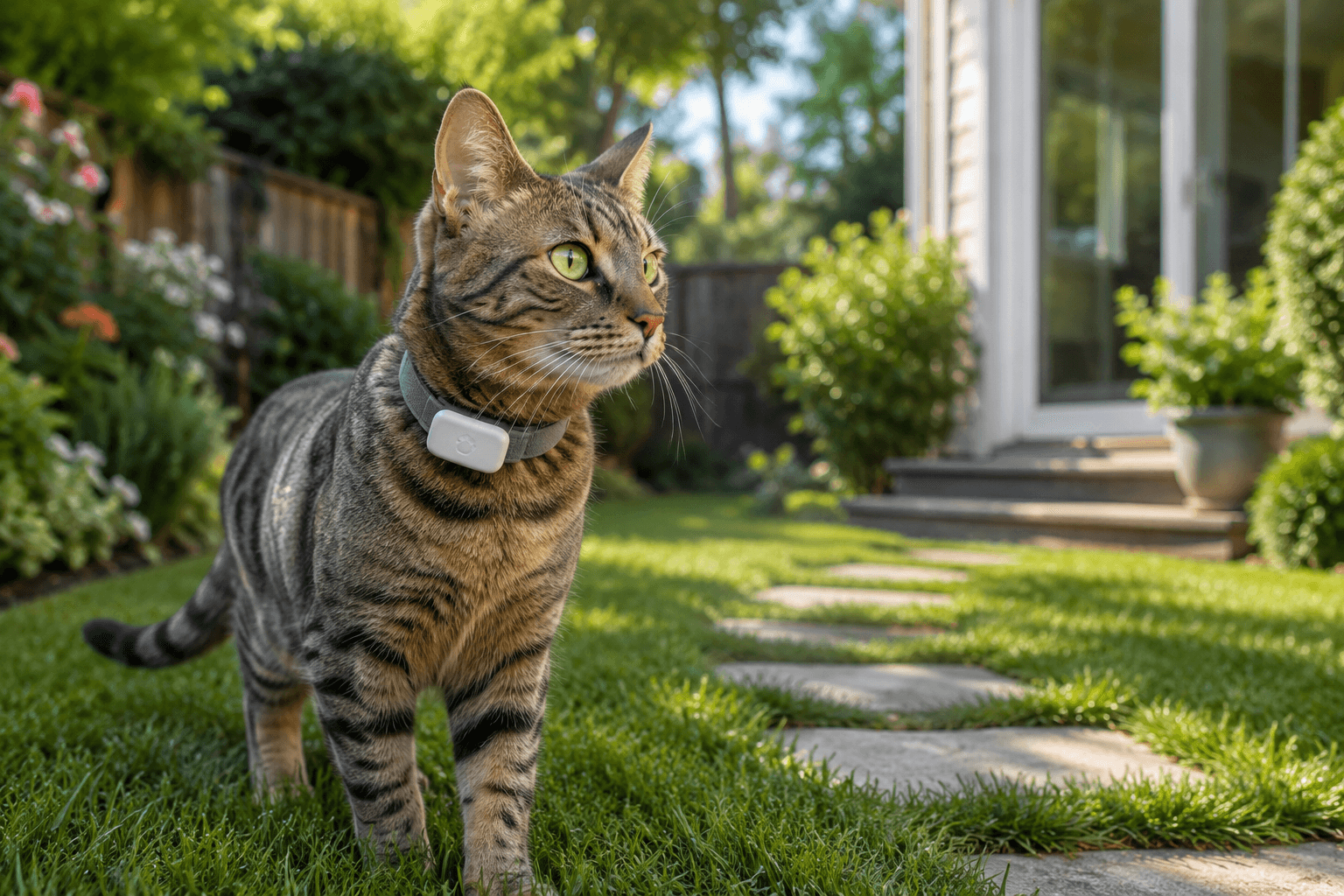
A green circle on a phone is not a fence.
Baron has not signed a treaty with Google Maps, and the app cannot stop him from crossing a road, climbing through a hedge or beginning an unscheduled inspection of the neighbor’s garage.
A virtual fence for cats is an early-warning system. You draw a Safe Zone in a GPS tracker app, and the system attempts to notify you when the tracker leaves or enters that area.
That can be useful.
It is not containment.
Quick Verdict
Tractive is currently the most defensible virtual-fence option for cats, but it receives only a Conditional Recommendation.
Its current cat tracker combines Virtual Fence alerts with live GPS and location history. However, GPS drift, mobile coverage, tracker fit and notification delays make it unsuitable as a precise backyard boundary.
Weenect XS and Petcube GPS Tracker offer relevant escape-alert features, but current ownership evidence is too weak for PetTech AI to recommend them broadly.
Tabcat V2 does not provide virtual fences at all. It earns a separate recommendation for owners whose cat is probably nearby but hidden.
| Product | Best fit | PetTech AI verdict | Main limitation |
|---|---|---|---|
| Tractive Cat GPS Tracker | Cats that may travel beyond the immediate neighborhood | Conditional Recommendation | Not precise or immediate enough to function as containment |
| Weenect XS | Buyers seeking a cat-specific Tractive alternative | Not Recommended | Relevant design, weak current ownership evidence |
| Petcube GPS Tracker | Larger cats already using the Petcube ecosystem | Not Recommended for Most Cats | Dog-oriented positioning and mixed ownership evidence |
| Tabcat V2 | A cat probably hiding close to home | Recommended with Conditions | No GPS, escape alerts or virtual fences |
Research Note
This is a research-led comparison based on current manufacturer documentation, network requirements, tracker dimensions, subscription terms, product positioning and available ownership evidence.
PetTech AI has not conducted long-term side-by-side testing of every tracker included.
PetTech AI may earn a commission from qualifying purchases. As an Amazon Associate I earn from qualifying purchases.
What a Virtual Fence Actually Does
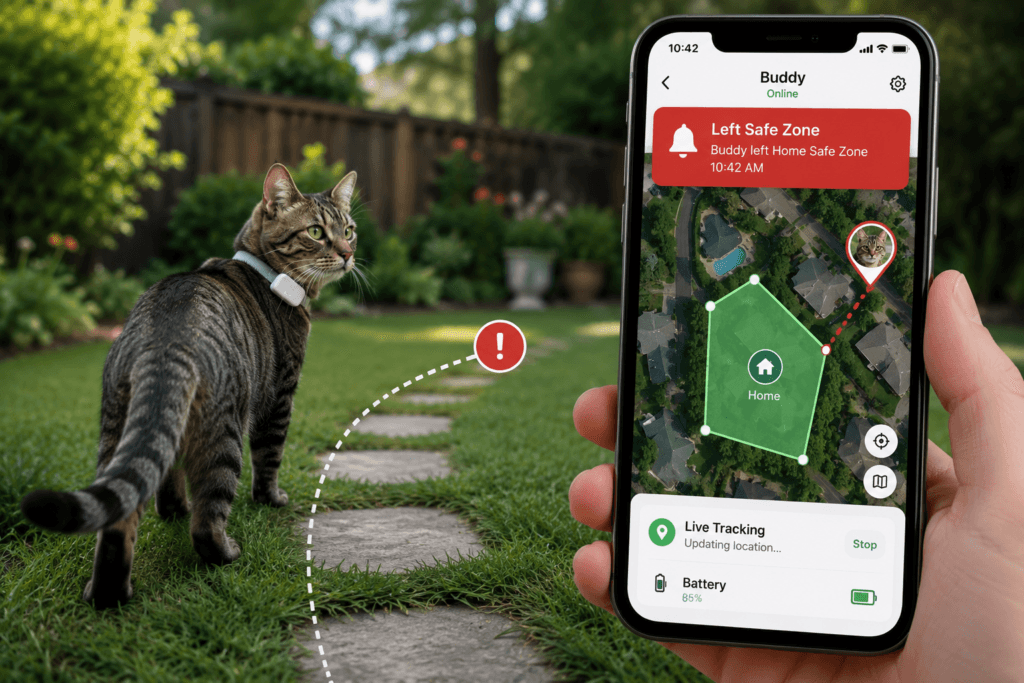
A virtual fence is a digital zone created inside a GPS tracker app.
The most common version is a Safe Zone around your home. When the tracker detects that your cat has crossed the boundary, the system sends a notification. Some platforms also let you create No-Go Zones around places such as roads or neighboring properties.
The process usually involves several steps:
- The tracker estimates its position.
- The tracker compares that location with the digital boundary.
- The device sends data through a cellular network.
- The platform processes the event.
- Your phone receives a notification.
Each step introduces a possible delay or failure point.
The tracker may not have a clean GPS view. Cellular coverage may be weak. The device may be in a battery-saving mode. Your phone may be offline, silenced or restricting background notifications.
The app can warn you.
It cannot teleport you into the garden.
Why Virtual Fences Cannot Contain a Cat
Nothing happens physically when a cat crosses a GPS boundary.
There is no wall, closed gate or supervised handler. The cat can continue moving while the tracker calculates its position and the alert travels through the network.
That distinction matters most near immediate hazards.
A virtual fence cannot reliably stop a cat from:
- entering a road;
- leaving through an open gate;
- climbing over a physical fence;
- following wildlife beyond the property;
- approaching another animal;
- disappearing through a narrow gap.
For controlled outdoor access, feline-veterinary guidance points owners toward options such as secure outdoor enclosures and supervised harness-and-leash exploration. The AVMA also supports keeping owned cats indoors, in enclosures or under attended control rather than allowing unrestricted roaming.
A virtual fence belongs behind those measures as a recovery layer.
It should never be the reason you accept a risk you would reject without the tracker.
Why Small Yards Are the Worst Use Case
Virtual fences sound most appealing for small yards.
Unfortunately, small boundaries are where normal GPS variation becomes hardest to tolerate.
Tractive currently requires a circular Virtual Fence to have a radius of at least 50 meters. Its rectangular option starts at 100 by 100 meters. Custom shapes can be smaller, but the app may warn that the zone is too small for reliable notifications.
That tells us something important.
A virtual fence can monitor whether a cat has left the general home area. It is not designed to determine with perfect consistency whether the cat is two feet inside or two feet outside a garden boundary.
Buildings, trees and narrow streets can also affect the quality of a GPS position. Even Tractive’s own support documentation acknowledges that displayed locations may occasionally jump or appear inaccurate.
Treat claims of exact property-line protection accordingly.
Satellite positioning is useful technology. It has not developed a personal vendetta against your hydrangeas.
Best Available Escape-Alert System: Tractive Cat GPS Tracker
Verdict: Conditional Recommendation
Tractive remains the most defensible choice when a cat may travel beyond the immediate neighborhood and you want both an escape alert and a map-based recovery tool.
The current CAT 6 Mini combines Virtual Fences, location history, Live Tracking and territory information in a collar-integrated design. The tracker itself weighs approximately 25 grams, or around 32 grams with its integrated collar, and Tractive recommends it for cats weighing at least 3 kilograms. The manufacturer states that Live Tracking can update every two to three seconds when active.
The workflow is coherent:
- set a broad Safe Zone around home;
- receive an exit notification;
- open the app;
- activate Live Tracking;
- follow the updated location;
- share access with another household member when necessary.
That makes Tractive more than a virtual-fence notification. It gives the owner something useful to do after the alert arrives.
The problem is ownership friction.
Current feedback is mixed enough that PetTech AI cannot give Tractive an unconditional recommendation. A tracker can have the most complete feature set in the category and still frustrate owners through charging, subscriptions, connectivity, attachment concerns or inconsistent real-world behavior.
Choose Tractive when:
- your cat has outdoor access;
- your cat could travel beyond nearby houses;
- you need genuine GPS rather than crowd-assisted Bluetooth;
- you accept a subscription and charging routine;
- your cat can comfortably wear the current hardware;
- you understand that the Safe Zone is a broad alert area.
Skip it when:
- you expect exact property-line detection;
- your cat is too small for the recommended fit;
- mobile coverage is poor where the cat travels;
- the cat is probably hiding within your home or garden;
- you want a device that physically prevents escape.
Could your cat travel beyond the immediate neighborhood? Check the current Tractive cat tracker on Amazon.
Cat-Specific Alternative: Weenect XS
Verdict: Not Recommended
Weenect XS is technically one of the most relevant alternatives in this category.
It is designed for cats weighing at least 3 kilograms, weighs approximately 27 grams and supports real-time GPS tracking, safety-zone alerts, sound, vibration and mobile-network connectivity. Weenect advertises up to seven days of battery life when power-saving zones are used, with substantially less during continuous tracking. Each tracker also requires its own subscription.
On paper, that creates a convincing Tractive competitor.
The physical format is cat-oriented. The tracker works in the United States. It offers the relevant escape-alert function rather than relying on nearby phones.
Current ownership evidence does not support recommending it.
This is where PetTech AI’s editorial line matters: a relevant design does not become a good purchase merely because the shortlist is short. Weenect fills a market gap. It has not currently earned the recommendation attached to that gap.
Choose it only when:
- you specifically prefer Weenect’s collar format;
- you understand its subscription requirements;
- you have reviewed recent customer feedback carefully;
- the retailer offers a practical return route;
- you accept being closer to an early adopter than a default buyer.
Buyer-regret risk: the product solves the correct technical problem, but current evidence gives buyers too little confidence that everyday ownership will match the feature list.
Still considering the cat-specific Weenect XS? Check current availability and customer feedback on Amazon.
Petcube GPS Tracker: Relevant Features, Wrong Default Buyer
Verdict: Not Recommended for Most Cats
Petcube GPS Tracker supports live location, Safe Zones, No-Go Zones, location history, a buzzer and an LED light. It requires an active paid plan because it transmits position information through cellular networks.
That makes it relevant to the keyword.
It does not make it a natural recommendation for most cats.
Petcube’s official product material remains strongly dog-oriented, including its language about live tracking, activity goals and collar use. The device may be physically manageable for some larger cats, but that is different from being designed around feline collar fit and daily wear.
There is also an important update-frequency caveat. Petcube explains that ordinary tracking frequency depends on movement and may average roughly one update every ten minutes while the pet is active. When the tracker is inside a Wi-Fi power-saving zone, it may stop reporting regular GPS positions until conditions change.
That does not make the device useless. It reinforces the central point of this article:
A virtual fence is an alert layer, not a real-time force field.
Petcube makes the most sense for someone who:
- already uses the Petcube ecosystem;
- has a sufficiently large, collar-tolerant cat;
- values Safe and No-Go Zones;
- accepts the subscription;
- has studied the attachment and return policy carefully.
Most cat owners should choose neither brand familiarity nor a low device price as the deciding factor. The recurring plan, fit and real-world alert behavior matter more.
Buyer-regret risk: the feature list is relevant, but the product’s dog-first design logic makes it a questionable default for feline use.
Still evaluating Petcube for a larger cat? Check current availability and customer feedback on Amazon.
What About Fi Mini and Pawfit Lite?
Both products provide GPS tracking and zone-based alerts, but neither currently improves the recommendation hierarchy.
Fi Mini offers an appealing app-led ecosystem and a lightweight proposition. Current early ownership evidence is too weak for PetTech AI to recommend it over the more established Tractive platform.
Pawfit Lite addresses a legitimate problem by prioritizing compact cat-oriented wearability and nearby Bluetooth assistance. Its current evidence is also too limited and mixed to support a recommendation.
They remain products to watch—not missing winners we forgot to place on the podium.
A glossy app screenshot is evidence that somebody hired a competent interface designer. It is not evidence that an escape alert will behave reliably at the exact moment Baron discovers freedom.
When Tabcat V2 Is the Better Tool
Verdict: Recommended with Conditions
Tabcat V2 is not a virtual fence.
It does not send escape alerts, show a map, use cellular GPS or record roaming history.
It uses radio frequency and a handheld directional receiver to help locate a tagged cat that is already within range. Tabcat quotes a maximum range of approximately 500 feet in favorable conditions, while walls, doors and other obstructions can reduce it. Its tag weighs about 0.2 ounces and does not require a cellular subscription.
That makes Tabcat better for a different problem:
“My cat is probably nearby, but I cannot see them.”
Possible locations include:
- under a porch;
- inside a shed;
- behind dense bushes;
- in a garage;
- beneath furniture;
- somewhere inside the house.
Choose Tabcat when:
- the cat is primarily indoors;
- the likely search radius is local;
- collar weight is a major concern;
- you want no recurring plan;
- directional close-range recovery matters more than a map.
Skip it when:
- the cat may travel several streets away;
- you need an alert when the cat leaves home;
- you want remote tracking from another location;
- you need route history or GPS coordinates.
Is your cat more likely to hide nearby than roam across town? Check Tabcat V2 on Amazon.
For a broader decision between GPS, radio frequency and Bluetooth-based finding, read our Best Cat Trackers comparison.
Virtual Fence vs Catio vs Harness
These tools should not be presented as interchangeable.
Virtual fence
Purpose: alert and recovery.
It may tell you that the cat has left a broad expected area and help you begin looking.
Catio or secure enclosure
Purpose: physical containment with outdoor enrichment.
A properly secured enclosure reduces the cat’s ability to enter roads, neighboring properties or wildlife areas while still allowing access to outdoor sights, smells and movement.
Harness and leash
Purpose: supervised exploration.
A correctly fitted harness gives the handler physical control while allowing the cat to explore at an appropriate pace. It requires gradual training and is not enjoyable for every cat.
For fit and introduction guidance, read our Best Cat Harnesses guide.
Radio-frequency tracker
Purpose: precise nearby recovery.
It helps locate a hidden cat once you are already within the general search area.
A robust safety setup may combine several layers:
- microchip and current registration;
- visible identification;
- secure physical access;
- supervised outdoor time;
- a wearable tracker;
- a prepared escape-response routine.
The tracker is one layer—not the constitutional foundation of the household.
How to Set Up a Virtual Fence Realistically
1. Draw a broad zone
Do not trace the exact edge of a small backyard and expect boundary-level precision.
Create a zone large enough to absorb ordinary GPS variation while still warning you when the cat has moved beyond the normal home area.
2. Test it before relying on it
Walk the tracker across the boundary yourself.
Record:
- where the alert actually appears;
- how long the notification takes;
- whether the phone receives it with the app closed;
- whether other household members receive shared alerts;
- what happens when mobile coverage weakens.
3. Check phone permissions
Allow the app to run in the background and send notifications. Disable settings that silently prevent urgent alerts from appearing.
4. Maintain the battery
Create a charging routine before the tracker reaches a critical level.
A discharged GPS tracker offers roughly the same location intelligence as a decorative collar charm, only with a more ambitious subscription history.
5. Prepare the response
Decide in advance:
- who checks the app;
- who searches outside;
- where the carrier is stored;
- which garages, decks and bushes should be checked first;
- which neighbors can be contacted;
- which recall sound or treat may help.
Information becomes safety only when it produces an organized response.
Frequently Asked Questions
Can a virtual fence keep my cat inside the yard?
No. It can notify you when a GPS tracker appears to leave a digital zone, but it cannot physically stop the cat or guarantee an alert at the exact property line.
What is the best virtual fence for cats?
Tractive is currently the most defensible option because it combines Virtual Fence alerts with live GPS and a cat-specific wearable format. It receives a Conditional Recommendation because ownership friction and normal GPS limitations prevent a stronger endorsement.
How quickly do virtual-fence alerts arrive?
There is no universal guaranteed delay. Timing depends on tracker update frequency, GPS reception, mobile coverage, app processing and phone notification settings. Test the complete alert chain in your own environment.
Are virtual fences useful in small yards?
Not as precise boundaries. Small zones leave little room for ordinary GPS variation. They are more useful as broad alerts around the general home area.
Is Weenect better than Tractive?
Not based on current ownership evidence. Weenect is a relevant cat-specific alternative, but PetTech AI does not currently recommend it over Tractive.
Can an AirTag replace a GPS virtual fence?
No. An AirTag relies primarily on Bluetooth and Apple’s nearby-device network. It does not operate like an independent cellular GPS tracker with continuous live tracking and dedicated Safe Zone alerts.
Is Tabcat a virtual fence?
No. Tabcat is a radio-frequency finder for nearby recovery. It can be the better tool when the cat is probably close but hidden, but it cannot warn you when the cat leaves home.
Final Verdict
The virtual-fence market for cats is weaker than its marketing suggests.
Tractive is the only product in this comparison that earns a direct, although conditional, recommendation for GPS escape alerts.
Choose it when your cat may travel beyond the immediate neighborhood and you want a broad Safe Zone combined with map-based recovery.
Do not choose it because you expect an invisible wall around a small yard.
Weenect XS is not recommended. Its cat-specific hardware is relevant, but current ownership evidence is too weak to justify selecting it over Tractive.
Petcube GPS Tracker is not recommended for most cats. It provides genuine virtual-zone features, but its dog-oriented design logic and mixed evidence make it a poor feline default.
Tabcat V2 is recommended with conditions for nearby recovery. It is not a virtual fence, but it may be the more useful technology when the cat is probably hiding close to home.
The honest conclusion is not that every household needs a smarter boundary.
Some need a GPS alert.
Some need an RF finder.
Many need a secure enclosure, a harness or better control of doors and windows.
A virtual fence can tell you that Baron may have left.
It cannot persuade him that leaving was strategically unsound.
References
- Tractive — CAT 6 Mini, Virtual Fence, Live Tracking and connectivity documentation
- Weenect — Weenect XS product and subscription documentation
- Petcube — GPS Tracker, Virtual Fences and tracking-frequency documentation
- Tabcat — Tabcat V2 product and range documentation
- Feline Veterinary Medical Association — Safe Outdoor Access Options for Cats
- American Veterinary Medical Association — Free-Roaming Owned Cats policy
Image Disclosure
Official manufacturer images are used when depicting the exact products discussed.
Any AI-generated images are editorial illustrations only. They do not represent exact product size, fit, interface behavior or technical performance. Always check the current manufacturer documentation and product listing before purchasing.
Editorial Disclosure
PetTech AI may earn a commission from qualifying purchases. This does not influence our recommendations, comparisons or editorial judgments.