
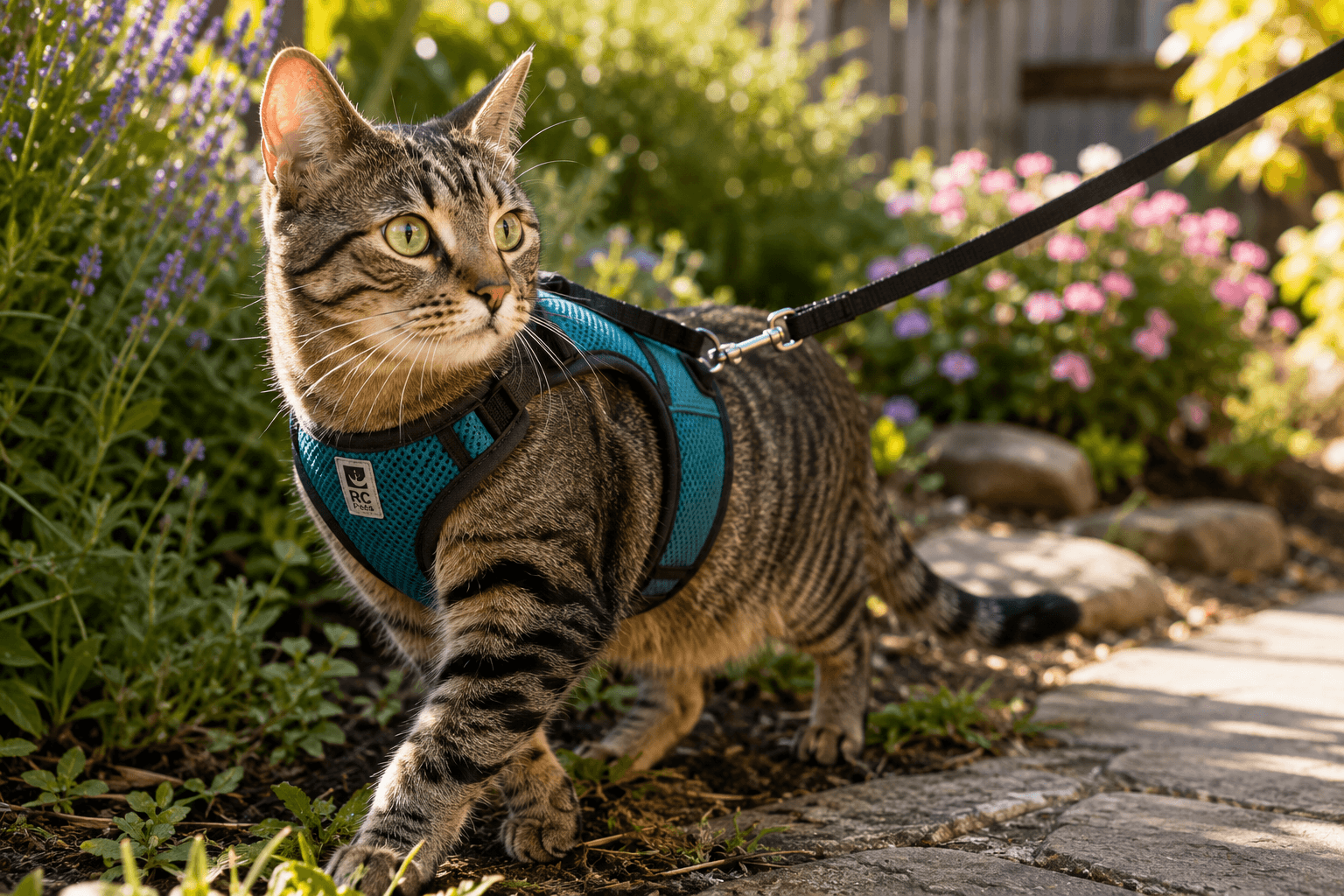
A cat harness should not make outdoor time feel like a test of bravery.
The right one gives your cat a secure, comfortable way to explore at their own pace—whether that means sitting quietly on a patio, sniffing around a garden, traveling in an RV, or taking short leash walks near home.
The wrong one can create the opposite experience: rubbing at the armpits, pressure around the neck, an easy escape route, or a cat that freezes the moment it is fastened.
Baron may then collapse sideways as though the harness has temporarily disabled his operating system.
That reaction does not necessarily mean the fit is wrong. It means harness acceptance must be trained—not assumed because the product page included a cat standing heroically on a mountain.
That is why the best cat harness is not simply the most padded, most expensive, or most “escape-proof” looking model. It is the harness shape that fits your cat’s body, temperament, and outdoor routine.
This guide compares four strong options for different needs:
- RC Pets Adventure Kitty Harness for balanced outdoor comfort and adjustability.
- Kitty Holster for cats that benefit from wider vest coverage and soft cotton contact.
- PetSafe Come With Me Kitty for low-bulk training and gentle leash introduction.
- Rabbitgoo Cat Harness for a practical lower-cost vest option.
Quick Verdict: Which Cat Harness Fits Your Cat?
| Best for | Harness | Why it stands out | Main trade-off |
|---|---|---|---|
| Best overall outdoor harness | RC Pets Adventure Kitty | Adjustable neck and waist, breathable mesh, reflective trim, included leash | More structured than minimal strap harnesses |
| Best comfort vest for cautious or sensitive cats | Kitty Holster | Broad vest coverage, soft cotton lining, wide adjustable closure area | Warmer and bulkier than an H-style harness |
| Best for early leash training | PetSafe Come With Me Kitty | Lightweight nylon, quick-snap fit, included bungee leash | Less body coverage than a vest |
| Best budget vest | Rabbitgoo Cat Harness | Mesh vest design, dual buckle closure, reflective details | Fit must be checked carefully; sizing is not one-size-fits-all |
Research Note
This is a research-led roundup based on current manufacturer information, fit guidance, training recommendations and product positioning.
PetTech AI has not conducted long-term hands-on testing of every harness included.
PetTech AI may earn a commission from qualifying purchases. As an Amazon Associate I earn from qualifying purchases.
What “Smart” Actually Means in a Cat Harness
A cat harness does not need electronics to be smart.
For outdoor safety, smart design means:
- A cat-specific fit rather than a scaled-down dog harness.
- A leash attachment positioned on the back, not at the neck.
- Enough adjustment to create a secure fit without restricting movement.
- Materials that avoid rubbing around the chest and front legs.
- A shape that makes backing out more difficult without promising the impossible.
- A design your cat can tolerate long enough to build positive associations.
No harness is guaranteed escape-proof. A frightened cat can move in unexpected ways, and even an excellent harness can fail if it is too loose, too large, damaged, or used without supervision.
The goal is not to find a magical product that removes all risk.
The goal is to choose a structure that gives you the best possible control for your cat’s body and behavior.
Start With Harness Shape, Not Brand
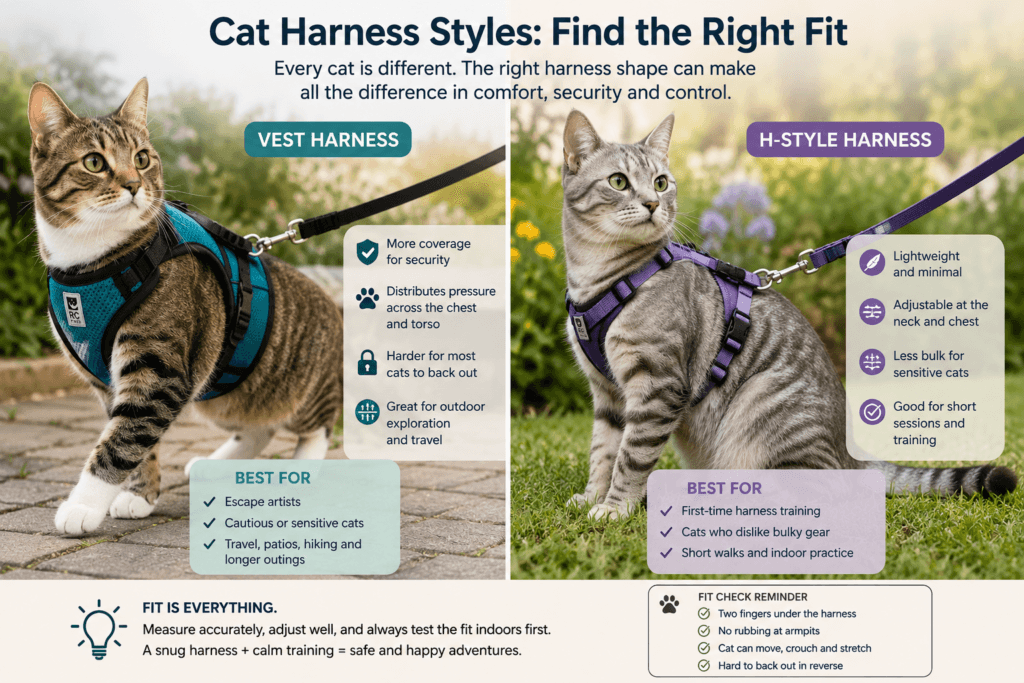
Before choosing a product, decide which style is most likely to suit your cat.
Vest harnesses: more coverage, but not automatic security
Vest-style harnesses distribute contact across a wider part of the chest and torso. They may feel more stable and can make backing out more difficult when fitted correctly.
More fabric does not automatically mean a safer fit. A loose vest can create just as much escape space as loose straps.
They can also work well for cats who need more physical reassurance from the harness itself.
The trade-off is warmth and bulk. A heavily padded vest may feel restrictive for a cat who is heat-sensitive, especially during summer walks.
H-style harnesses: lighter and less restrictive
An H-style harness uses thinner straps around the neck and chest. It can feel lighter for some cats and may be easier to introduce during early training.
The trade-off is that fit becomes even more important. A loose H-style harness can give an agile cat room to reverse out of it.
Step-in designs: useful for head-shy cats
Some cats dislike anything passing over their head. A step-in harness can reduce that stress because the cat steps into the front openings before the harness closes over the back.
This can be helpful, but it is not automatically safer. The harness still needs to fit securely around the chest and torso.
Best Overall: RC Pets Adventure Kitty Harness
The RC Pets Adventure Kitty Harness is the strongest all-around option for owners who want one harness that can support regular supervised outdoor time.
It uses breathable air mesh, reflective binding, adjustable neck and waist webbing, and buckles at both adjustment points. It also includes a 6-foot leash, which makes it a convenient all-in-one starting option.
Its biggest advantage is balance.
Some harnesses are very light but offer limited adjustment. Others are extremely structured but can feel bulky. The Adventure Kitty sits between those two extremes: enough structure for controlled outdoor use, enough adjustment to improve fit, and enough breathability for routine walks.
This is a good match for a cat who is already curious about the outdoors and needs a harness that can grow with their confidence.
Choose RC Pets Adventure Kitty if:
- You want a cat-specific harness for regular outdoor exploration.
- Your cat benefits from both neck and waist adjustment.
- You want breathable mesh without a full heavy vest.
- You value reflective trim for lower-light visibility.
- You prefer a harness and leash bundle.
It may not be the best fit if:
- Your cat is highly sensitive to mesh or more comfortable in soft cotton.
- You need the widest possible torso coverage.
- Your cat is extremely small and falls between listed sizes.
Verdict: Recommended — the strongest all-round choice for regular supervised exploration when adjustability, breathable structure and a complete harness-and-leash setup matter.
It is not automatically the safest harness for every cat. It is the most balanced starting point in this roundup.
Need a balanced harness for regular supervised outdoor use? Check RC Pets Adventure Kitty on Amazon.
Best Comfort Vest: Kitty Holster
The Kitty Holster is the best choice for cats who respond better to broad, soft coverage than narrow straps.
Its vest-style design uses a breathable cotton lining and wide hook-and-loop closure areas. That can make it especially appealing for cats with sensitive skin, tactile sensitivity, or a history of trying to back out of lightweight harnesses.
The important distinction is not that it is “escape-proof.” No responsible harness should be marketed as a guarantee.
Its advantage is the way it spreads contact across the torso. For some cats, that can feel more stable and less irritating than an H-style design with thin straps near the legs.
It is also a strong option for travel. Cats visiting a veterinarian, staying in an RV, moving through a hotel, or spending time on a balcony may benefit from a harness that feels secure and easy to handle without needing the cat to walk long distances.
Choose Kitty Holster if:
- Your cat is sensitive to thin straps or rubbing.
- You want broader body coverage.
- Your cat has a strong tendency to reverse out of loose harnesses.
- You need a harness for travel, balconies, supervised patio time, or short walks.
- You prefer cotton contact over synthetic mesh.
It may not be the best fit if:
- Your cat overheats easily.
- You want the lightest possible harness for active walking.
- Your cat strongly dislikes vest-style clothing.
Verdict: Strong Recommendation with Conditions — one of the most convincing broad-coverage harnesses for cats that tolerate vest-style contact, but potentially too warm or restrictive for active and heat-sensitive cats.
The wide coverage can make the fit feel more stable.
It cannot prevent an incorrectly sized cat from reversing out through a gap large enough to accommodate several optimistic marketing claims.
Does your cat tolerate broad, soft torso coverage? Check Kitty Holster availability on Amazon.
Best for Early Leash Training: PetSafe Come With Me Kitty
The PetSafe Come With Me Kitty Harness and Bungee Leash is a strong choice for cats who are new to harness training and may find a full vest overwhelming.
It uses lightweight nylon straps, quick-snap buckles, a color-coded belly strap for easier fitting, and an included bungee leash designed to soften sudden pulls.
The bungee leash is particularly useful during early training because cats do not walk like dogs. They may stop suddenly, turn, crouch, investigate, or move in an unexpected direction. A little flexibility can reduce abrupt tension during those first indoor and outdoor sessions.
This harness is not about maximum vest coverage. It is about creating a lighter, lower-bulk experience for cats that need time to accept leash equipment.
Choose PetSafe Come With Me Kitty if:
- Your cat is new to harnesses.
- You want a lightweight, adjustable strap-based design.
- You value a bungee leash for gentler leash feedback.
- Your cat is hesitant around bulky vest harnesses.
- You want a recognizable, established pet brand.
It may not be the best fit if:
- Your cat has repeatedly backed out of narrow-strap harnesses.
- You need more torso coverage for a particularly agile cat.
- Your cat is extremely sensitive to any neck-area handling.
Verdict: Recommended — the strongest lightweight starting point for indoor harness training and cats that reject bulky vests.
Need a lightweight starting point for indoor harness training? Check PetSafe Come With Me Kitty on Amazon.
Best Budget Vest: Rabbitgoo Cat Harness
The Rabbitgoo Cat Harness is the practical budget pick for owners who want a vest-style harness without moving into premium pricing.
It combines breathable mesh, reflective details, adjustable straps, hook-and-loop closure, and dual quick-release buckles. The result is a familiar vest format that can work well for cats learning to walk outdoors or for owners who want a backup harness for travel.
Its strength is accessibility.
For many households, the first harness is partly an experiment. You may not yet know whether your cat will enjoy outdoor walks, tolerate a vest, or prefer a different shape. Rabbitgoo gives owners a lower-cost way to learn what their cat accepts.
The caution is fit. Budget harnesses are not automatically unsafe, but sizing must be taken seriously. Do not use the label alone. Measure chest girth, check head size against the product guidance, and test the fit indoors before using it outside.
Choose Rabbitgoo if:
- You want a vest-style harness at a lower price.
- Your cat is still in the early learning phase.
- You want reflective details and dual-buckle closure.
- You are willing to measure carefully and exchange sizes if needed.
- You need a backup harness for travel or occasional outings.
It may not be the best fit if:
- You want premium materials or highly specialized cat fit.
- Your cat is between sizes.
- Your cat has a strong history of escaping harnesses.
- You want a long-term, high-frequency adventure harness.
Verdict: Recommended — the most widely validated vest-style option in this roundup, provided the buyer measures carefully and does not interpret “escape-proof” as a literal guarantee.
Rabbitgoo is useful as a lower-commitment fit experiment.
It should not be confused with a cheaper route to guaranteed security. “Escape-proof” is a marketing category, not a recognized law of feline physics.
Still considering Rabbitgoo? Check the current model, sizing and customer feedback on Amazon.
How to Measure Your Cat Before You Buy
The most important measurement is usually chest girth: the circumference just behind your cat’s front legs.
Also check:
- Neck circumference, when the harness adjusts at the neck.
- Head size, especially for designs where backing out is a concern.
- The brand’s actual sizing chart, not only a generic weight range.
- Whether your cat sits near the top or bottom of a size range.
A practical fit check:
- The harness should sit snugly without compressing the chest.
- Your cat should be able to walk, crouch, stretch, and turn naturally.
- Front-leg openings should not rub the armpit area.
- You should be able to slide fingers beneath the harness without leaving obvious slack.
- When you apply gentle backward pressure to the leash indoors, the cat should not be able to reverse out.
Do this test before the first outdoor session.
Never leave a cat unattended in a harness, even indoors.
A Better Training Plan: Follow Your Cat’s Signals, Not a Calendar
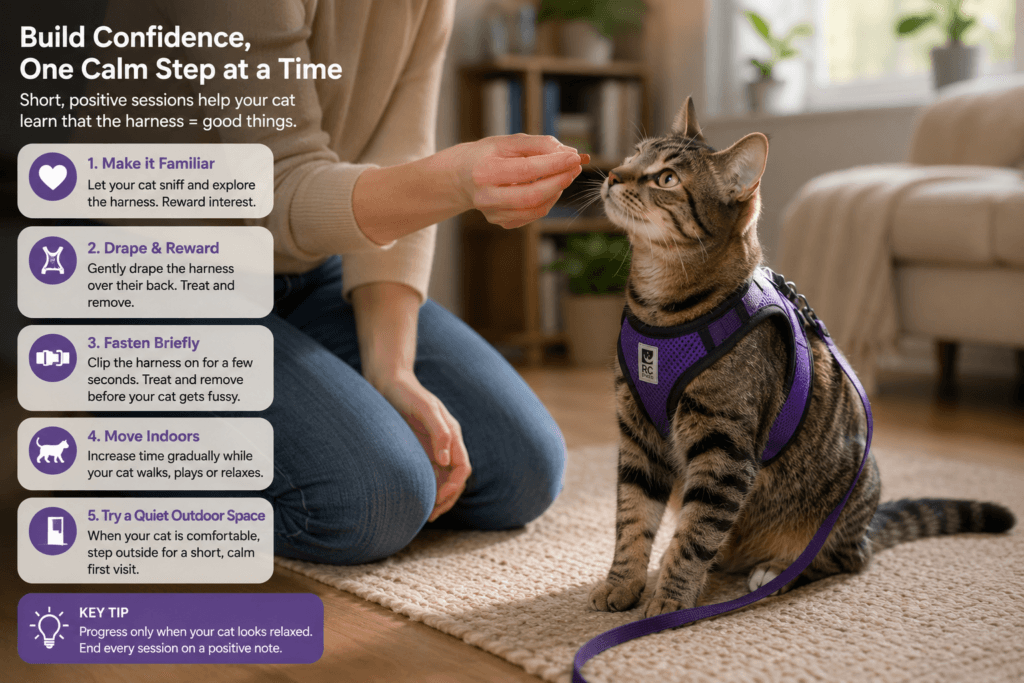
A fixed five-day plan is tempting, but cats do not all adapt on the same timeline.
Some will accept a harness in a few sessions. Others will need weeks.
The better approach is to progress only when your cat looks relaxed at the current step.
Step 1: Make the harness familiar
Leave the harness near a favorite sleeping area or feeding location. Let your cat sniff it. Reward interest with treats, play, or praise.
Step 2: Introduce touch without fastening
Gently lay the harness across your cat’s back or chest for a moment, then remove it before your cat becomes uncomfortable.
Step 3: Fasten briefly indoors
Once your cat accepts contact, fasten the harness for a short period indoors. Offer a high-value treat, then remove it calmly.
Step 4: Build comfortable movement
Increase the wearing time only while your cat remains relaxed. Encourage a few natural steps toward a treat or toy.
Step 5: Add the leash indoors
Attach the leash, but do not immediately direct your cat. Follow their movement with slack in the leash. Let them learn that the harness does not mean pressure or restraint.
Step 6: Try a quiet outdoor threshold
Only move outdoors once your cat is comfortable indoors. Start in a calm, enclosed or low-stimulation area. Let the cat observe, sniff, and decide the pace.
Outdoor walking is not right for every cat. Freezing, frantic pulling, repeated attempts to escape, flattened ears, or clear distress are signals to pause—not signs that the cat needs to “get used to it.”
Harness + Tracker: Safety Layer, Not a Reason to Take More Risk
A harness controls the walk. A tracker helps with recovery if something goes wrong.
They should not be treated as the same tool.
A GPS tracker can be useful for outdoor-access cats, travel, or cats with a serious escape risk. A radio-frequency finder can be more useful for a cat likely to hide close to home.
Do not attach a tracker in a way that obstructs the leash connection, changes the harness position or concentrates additional weight on the D-ring unless both manufacturers explicitly support that setup.
The leash connection must remain secure and move freely.
Only mount a tracker where the tracker manufacturer explicitly says it is safe to attach, and check that it does not pull the harness out of position or interfere with movement.
For the technology decision, read our Best Cat Trackers guide. For Safe Zones, escape alerts, and the limits of geofencing, read our Virtual Fence Alerts for Cats guide.
Common Harness Mistakes
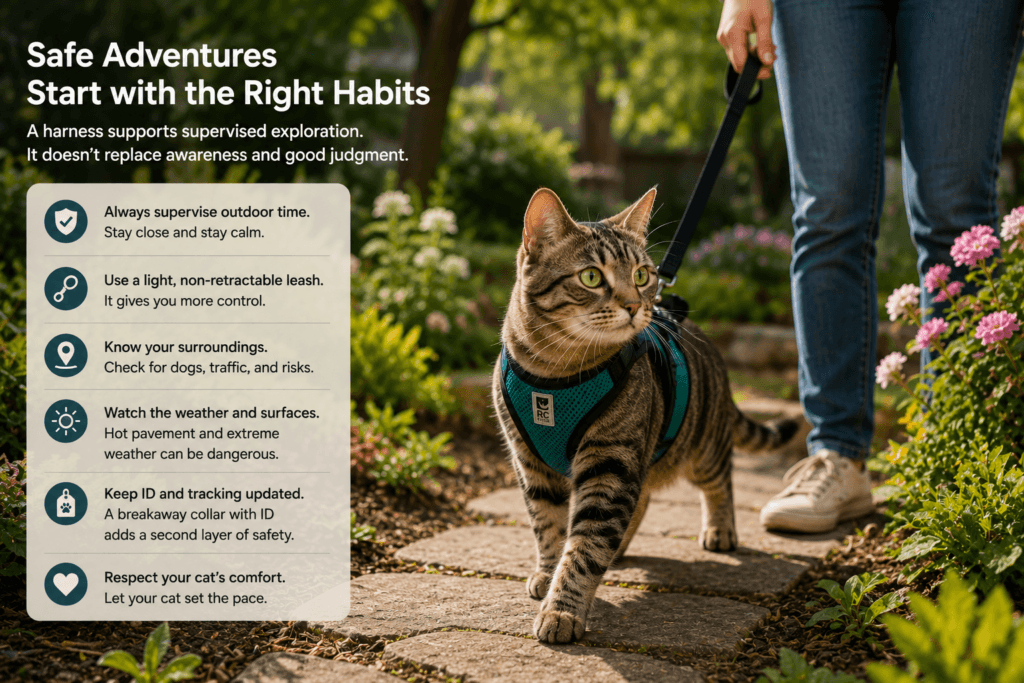
Treating “escape-proof” as a guarantee
No harness removes the need for supervision, fit checks, and gradual training.
Pulling your cat forward
Cats usually do better when they choose the direction. Use treats, toys, and patience rather than leash pressure.
Starting outdoors too early
A cat that freezes indoors is not ready for a busy sidewalk, a dog park, or a new hiking trail.
Using a retractable leash too soon
A standard lightweight leash gives you more predictable control during early training.
Ignoring heat and stimulation
Warm pavement, loud traffic, dogs, bicycles, and leaf blowers can turn a calm first outing into a frightening experience.
Frequently Asked Questions
Are cat harnesses safe?
Yes, when they fit correctly, are introduced gradually, and are used under supervision. A cat-specific harness with a back-mounted leash attachment is safer than walking a cat from a collar.
What style is best for escape artists?
A well-fitted vest with wider torso coverage is often the better starting point, but the correct fit matters more than style alone.
Should I use a collar or harness for outdoor walks?
Use a harness for leash walking. A breakaway collar can still carry identification, but it should not be the point where leash pressure is applied.
Can kittens wear harnesses?
Yes, as long as the harness is lightweight, correctly sized, and introduced slowly. Kittens may adapt more easily, but they still need short, positive sessions.
Does every cat enjoy leash walks?
No. Some cats enjoy safe outdoor exploration; others find it stressful. The cat’s behavior should decide whether harness walking becomes part of the routine.
Final Verdict
RC Pets Adventure Kitty is the strongest all-round recommendation. Kitty Holster is the better specialist choice for cats that tolerate broad vest coverage. PetSafe offers the most convincing low-bulk introduction, while Rabbitgoo is the most widely validated structured vest in the roundup.
None is universally escape-proof. The safest harness remains the one that fits the individual cat correctly, survives an indoor backward-pressure test and is used by an owner willing to stop when the cat is uncomfortable.
References
- RC Pets — Adventure Kitty Harness product information
- Kitty Holster — product, fit, and sizing guidance
- PetSafe — Come With Me Kitty Harness and Bungee Leash information
- San Francisco SPCA — harness and leash training guidance for cats
- Cat Friendly Homes — gradual harness and leash introduction guidance
Image Disclosure
Some images in this article may be created with AI for illustrative purposes. They do not show the exact products reviewed and should not be used to evaluate product size, fit, design, or features. Always check the current official product listing before purchasing.
Disclosure
PetTech AI may earn a commission when readers purchase through affiliate links. That does not change how products are framed or compared. No harness is guaranteed escape-proof, and no product can replace supervision, careful fitting, gradual training, or a safe outdoor environment. Always check current sizing guidance, materials, return policies, and product specifications before purchasing.