Tag: Cat Home Cleaning

  • Best Cat Cleaning Tools for Litter, Fur and Odor in 2026

    Best Cat Cleaning Tools for Litter, Fur and Odor in 2026

    Cat mess is rarely one problem.

    Litter travels beyond the box. Fur builds up on sofas and cat trees. Dust and dander settle into corners. Odors become noticeable when cleaning routines fall behind—not because a home has cats.

    The useful question is not: “What is the smartest cleaning gadget?”

    It is:

    Which part of cat-home cleaning is taking the most effort right now?

    Buying a robot vacuum because the sofa is covered in fur is not a cleaning strategy. It is an expensive way to automate the wrong surface.

    A touchless vacuum can make litter-zone cleanup almost frictionless. A robot vacuum can keep daily fur and tracked debris from accumulating. A handheld pet vacuum handles upholstery and cat trees. An air purifier can support particle and odor control, but it cannot replace litter cleaning, vacuuming, ventilation, or a well-maintained litter box.

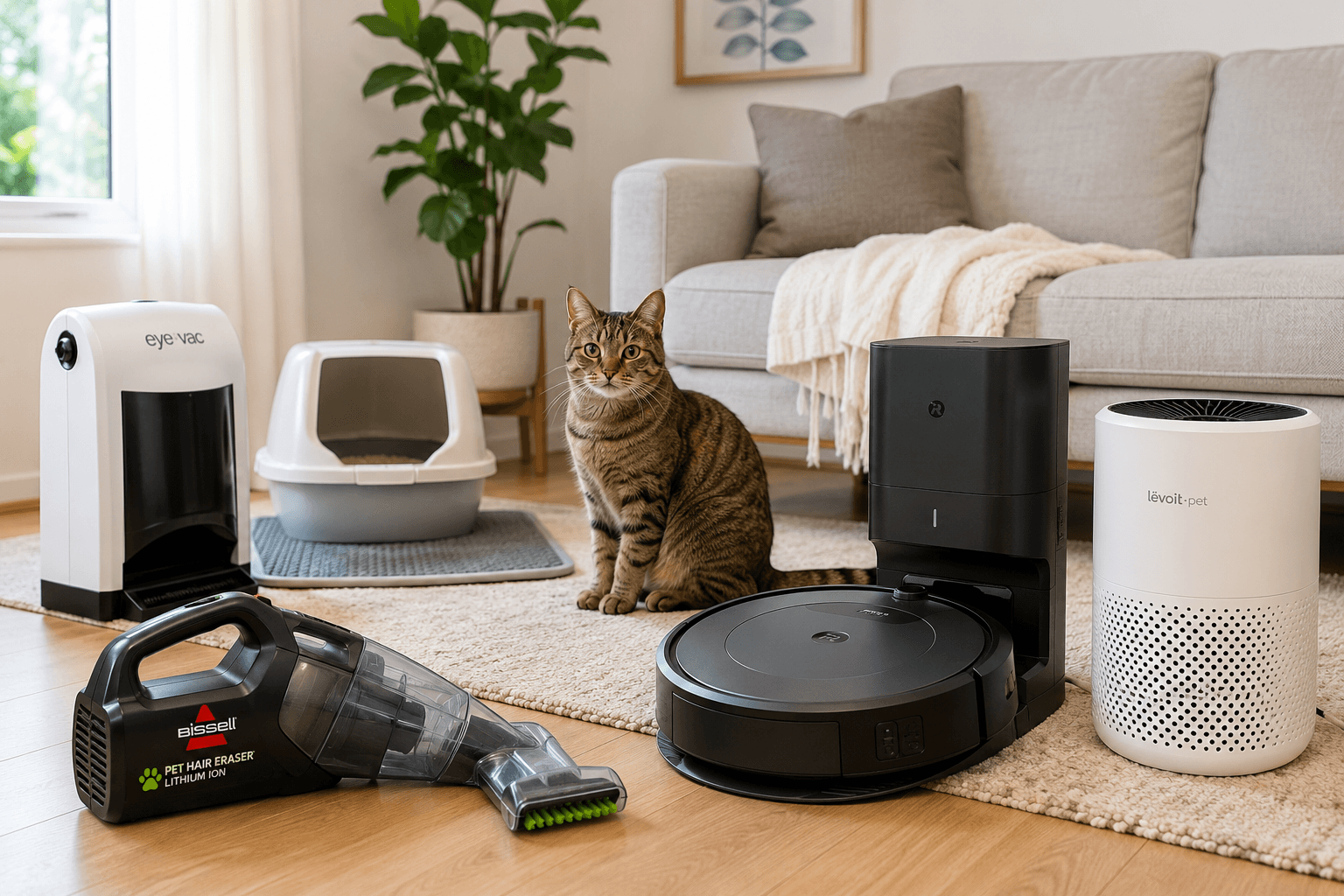
    This guide compares four practical tools for four different mess zones:

    • EyeVac Home Touchless Vacuum for litter tracking and hard-floor debris.
    • iRobot Roomba 105 Vac + AutoEmpty Dock for recurring floor maintenance.
    • BISSELL Pet Hair Eraser Hand Vacuum for upholstery, cat trees, and fast spot cleaning.
    • LEVOIT Core P350-P Pet Care Air Purifier for dander and odor support without ozone.

    Quick Verdict: Which Cat Cleaning Tool Do You Need?

    Your main problemBest toolWhy it helpsWhat it does not replace
    Litter granules and fur around the boxEyeVac HomeFast touchless pickup after sweepingRegular litter-box cleaning
    Daily fur and debris across floorsRoomba 105 Vac + AutoEmptyRecurring autonomous floor cleaningSpot cleaning and obstacle checks
    Hair on sofas, bedding, cat trees, and car seatsBISSELL Pet Hair EraserPortable upholstery and crevice cleaningWhole-home floor maintenance
    Dander and lingering household odorsLEVOIT Core P350-PParticle filtration plus activated-carbon odor supportSource control, ventilation, and cleaning

    Research Note

    This is a research-led roundup based on current manufacturer documentation, product positioning and available ownership evidence.

    PetTech AI has not conducted long-term hands-on testing of every product included.

    PetTech AI may earn a commission from qualifying purchases. As an Amazon Associate I earn from qualifying purchases.

    The Four Mess Zones in a Cat Home

    A cleaner cat home usually comes from assigning the right tool to the right zone.

    1. The litter zone

    This is where litter tracking, loose fur, dust, and small spills build up fastest. A self-cleaning litter box can reduce scooping, but it does not remove granules outside the box or clean the surrounding floor.

    2. The floor zone

    Cats shed everywhere. In multi-cat homes, hair and dust can build up quickly along walls, under furniture, and in high-traffic areas. This is where automation saves the most time.

    3. The fabric zone

    Sofas, blankets, beds, car seats, scratching posts, and cat trees collect hair differently from hard floors. A robot vacuum cannot reliably solve this category.

    4. The air zone

    Dander and odors are not the same thing. Filtration can help reduce airborne particles, while activated carbon can support odor reduction. But neither replaces cleaning the source of the odor or maintaining the litter box properly.

    Best for Litter Tracking: EyeVac Home Touchless Vacuum
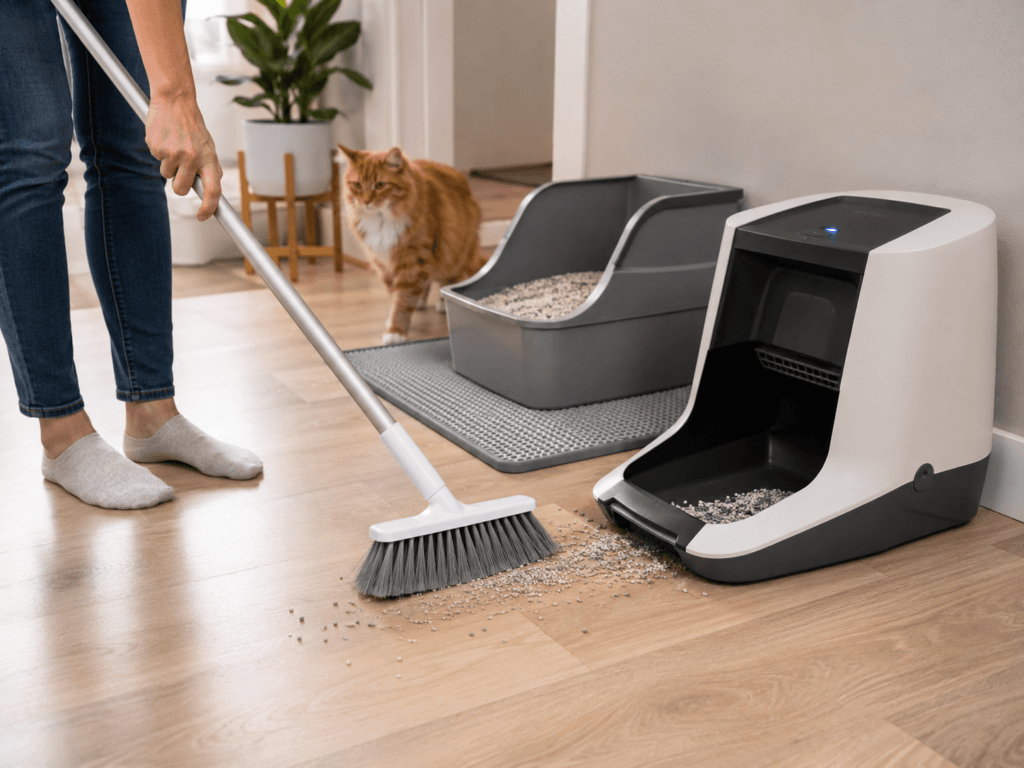
    A person sweeping small litter granules near a cat litter box into a touchless floor vacuum on hard flooring
    The litter zone needs fast cleanup tools that make it easier to remove tracked granules before they spread.

    The EyeVac Home Touchless Vacuum is the most targeted tool in this guide because it solves a small but repetitive problem extremely well.

    Place it near the litter area, sweep loose granules, fur, or dust toward the base, and its infrared sensors activate suction automatically. Instead of bending down with a dustpan every time the floor looks messy, you can clear the debris in seconds.

    That makes EyeVac especially useful for homes with hard floors around the litter box, feeding area, or entryway.

    It is not a replacement for a normal vacuum. It is a friction-reduction tool: the kind of product that makes you more likely to clean immediately because the cleanup takes almost no effort.

    It does not automate cleaning. It removes the two-minute task people somehow postpone until the litter has established diplomatic relations with the hallway.

    The EyeVac Home uses infrared sensors for automatic activation and has a bagless canister with washable filters.

    Choose EyeVac Home if:

    • Litter tracking is your most annoying daily cleaning problem.
    • You have hard flooring near the litter box.
    • You already sweep but dislike using a dustpan.
    • You want a dedicated cleanup station near a predictable mess zone.
    • You prefer a simple, non-app-based tool.

    Skip it if:

    • Your main issue is hair on furniture or cat trees.
    • You need whole-home cleaning automation.
    • Your litter area is carpeted.
    • You do not have a good place for a plugged-in stationary unit.

    Verdict: Recommended with Conditions — excellent for repetitive litter cleanup on hard floors, pointless when the mess is spread across carpet or several rooms.

    Is tracked litter your main daily annoyance? Check EyeVac Home on Amazon.

    Best for Daily Floor Maintenance: iRobot Roomba 105 Vac + AutoEmpty Dock
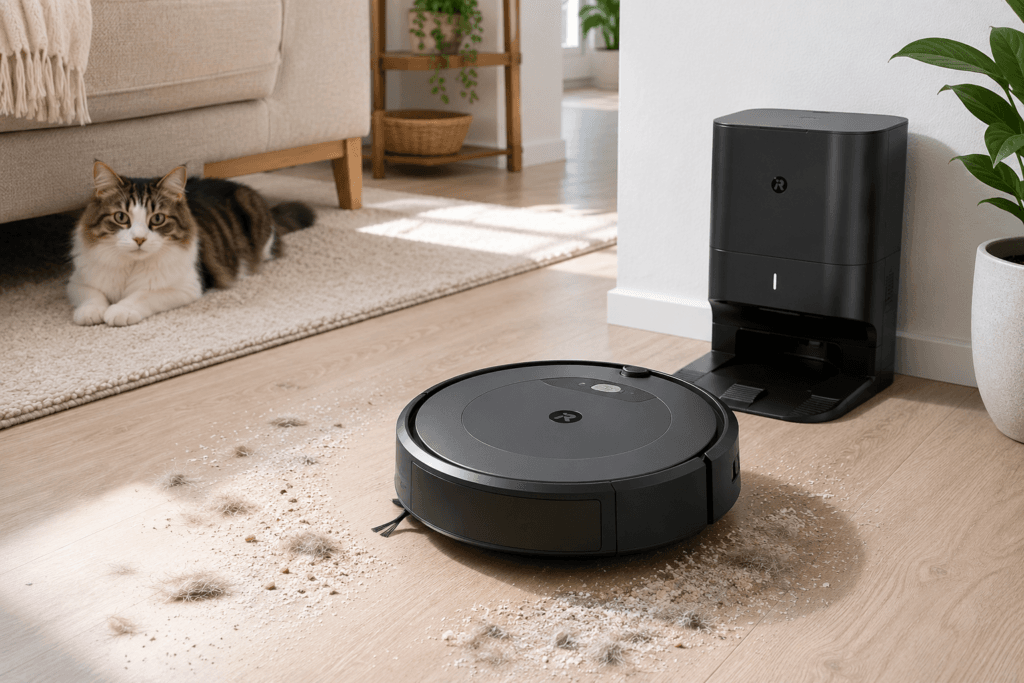
    A robot vacuum cleaning cat fur and light debris from a hard floor while a cat rests nearby
    Robot vacuums work best as recurring maintenance for fur and dry debris—not as a substitute for litter-box care.

    The iRobot Roomba 105 Vac + AutoEmpty Dock is the strongest choice for owners who are tired of seeing fur, tracked litter, and ordinary floor debris return every day.

    Unlike EyeVac, this is not about one cleanup moment. It is about reducing background mess before it becomes visible.

    A robot vacuum can run on a routine while you work, sleep, or focus on other chores. That is especially valuable in multi-cat households, homes with long-haired cats, or apartments where pet hair becomes noticeable quickly.

    The important distinction is that a robot vacuum is a maintenance tool, not a miracle worker.

    It can help prevent buildup, but it still needs a reasonably prepared environment. You need to remove cords, small objects, and obvious hazards from the floor. You also need to be realistic around litter boxes: do not assume any robot should be allowed to run unsupervised near fresh accidents or wet messes.

    A robot that finds a hairball before you do is automation. A robot that distributes it across three rooms is performance art.

    The Roomba 105 Vac uses LiDAR mapping and can empty into its dock for up to 75 days, according to iRobot.

    Choose Roomba 105 Vac + AutoEmpty if:

    • You want less daily sweeping and vacuuming.
    • Your home has fur buildup across several rooms.
    • You live with multiple cats or a heavy shedder.
    • You want scheduled cleaning rather than manual spot cleanup.
    • You value a self-emptying dock.

    Skip it if:

    • Your cat regularly leaves wet messes or hairballs where the robot will travel.
    • Your floors are usually cluttered with cables, toys, or loose items.
    • You only need upholstery cleaning.
    • You want the cheapest possible cleaning option.

    Verdict: Recommended with Conditions — the strongest time-saving tool in the guide for routine dry debris, but not a robot to run blindly in a home with frequent hairballs or pet accidents.

    Need recurring floor maintenance across several rooms? Check Roomba 105 Vac + AutoEmpty on Amazon.

    Best for Upholstery and Cat Trees: BISSELL Pet Hair Eraser Hand Vacuum

    The BISSELL Pet Hair Eraser Lithium Ion Hand Vacuum solves the cleaning problem robot vacuums usually leave behind: fabric.

    Cat hair embeds itself in sofa cushions, beds, blankets, car seats, cat trees, and tight corners around furniture. A standard floor vacuum may help, but a cordless handheld is often more useful because you can grab it when you see the mess.

    This is not a whole-home replacement. It is the opposite: a fast-response tool.

    Use it for the sofa before guests arrive, the cat bed after shedding season, the car after a vet visit, or the cat tree when fur starts clumping in corners.

    BISSELL’s model 2390 includes a motorized brush tool, upholstery tool, crevice tool, triple-level filtration, and about 17 minutes of cordless runtime.

    Choose BISSELL Pet Hair Eraser if:

    • Your main problem is fur on fabrics.
    • You need quick cleanup on sofas, beds, cat trees, or car seats.
    • You want a handheld vacuum rather than a full-size machine.
    • You need a dedicated pet-hair brush attachment.
    • You want a recognized pet-cleaning brand.

    Skip it if:

    • Your biggest problem is daily floor coverage.
    • You want an automatic cleaning routine.
    • You need long cleaning sessions without recharging.
    • You are looking for air filtration or odor support.

    Verdict: Recommended — the clearest purchase in this roundup when fur embedded in upholstery is the problem you actually need to solve.

    Is the sofa collecting more fur than the floor? Check BISSELL Pet Hair Eraser on Amazon.

    Best for Dander and Odor Support: LEVOIT Core P350-P Pet Care Air Purifier

    The LEVOIT Core P350-P Pet Care Air Purifier is the best fit when the issue is not visible mess but airborne particles, dander, and lingering household odor.

    It should not be treated as a substitute for vacuuming, litter maintenance, or ventilation. No air purifier can make an unclean litter box harmless or solve an underlying moisture, mold, or sanitation problem.

    But as part of a complete routine, an air purifier can support cleaner air in the room where your cat spends the most time.

    The key difference from the old ozone-based recommendation is important:

    Do not use ozone generators in cat homes.

    EPA and California air-quality guidance warn that ozone-generating air cleaners can be ineffective for normal indoor pollutant control at health-based concentrations, while higher ozone concentrations may be harmful. EPA also advises avoiding air cleaners that intentionally produce ozone.

    The Core P350-P uses particle filtration plus an activated-carbon odor filter designed for pet households.

    For a deeper comparison of pet-focused filtration, room coverage, filter costs, and odor-support trade-offs, see our Smart Air Purifiers for Cat Owners guide.

    Choose LEVOIT Core P350-P if:

    • Your cat’s room feels dusty or stale between cleanings.
    • You want dander support in a bedroom, office, or living room.
    • You need an odor-support layer without using ozone.
    • You already clean consistently and want to improve the air environment.
    • You prefer a pet-oriented purifier with activated carbon.

    Skip it if:

    • You are trying to fix poor litter-box maintenance with a device.
    • You need a whole-home cleaning solution.
    • You are unwilling to replace filters on schedule.
    • You want to eliminate every odor without cleaning its source.

    Verdict: Conditional Recommendation — useful as a compact filtration layer after source cleaning is already under control, but not the strongest current purifier for large or heavily used cat rooms.

    Need compact dander and odor support after cleaning the source? Check LEVOIT Core P350-P on Amazon.

    What “Smart Cleaning” Should Actually Mean

    A tool is not smart because it has an app.

    It is smart when it reduces a recurring friction point.

    For most cat homes, that means one of four things:

    • You clean small litter spills immediately instead of postponing them.
    • Floors stay reasonably clear between deeper cleaning sessions.
    • Fabric surfaces become easier to maintain.
    • Air quality support runs quietly in the background.

    The best setup is often not one expensive all-in-one device.

    It is a small system where each tool handles a task it is actually good at.

    Build Your Cleaning Setup by Home Type
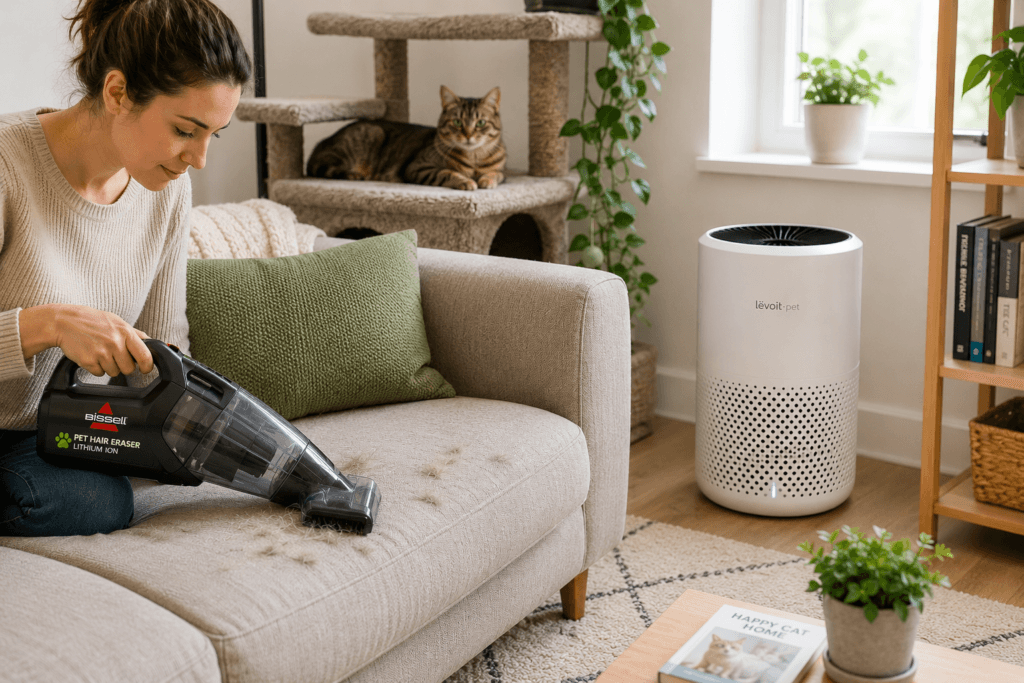
    A handheld vacuum cleaning cat hair from a sofa beside a quiet air purifier in a bright living room
    Fabric cleanup and air filtration solve different parts of the cat-home cleaning routine.

    Apartment with one cat

    Start with EyeVac near the litter box and a BISSELL Pet Hair Eraser for furniture.

    This is usually enough to manage the two most visible messes: tracked litter and fur on fabrics.

    Add the LEVOIT if dander or lingering odor is noticeable in a small bedroom or living room.

    Multi-cat home

    Prioritize the Roomba 105 Vac + AutoEmpty Dock.

    More cats mean more fur, more tracked litter, and more frequent floor maintenance. A robot vacuum will not replace deeper cleaning, but it can prevent the daily buildup that makes a home feel constantly messy.

    Pair it with EyeVac near the main litter area for faster spot cleanup.

    Allergy-conscious household

    Use a combined approach:

    • Roomba for recurring floor debris.
    • BISSELL for upholstered surfaces.
    • LEVOIT for airborne particle and odor support.
    • Regular ventilation and source cleaning.

    EPA guidance is clear that filtration can support indoor air quality, but reducing pollutant sources and ventilating with clean outdoor air remain central.

    Home with a self-cleaning litter box

    A self-cleaning litter box can reduce scooping, but it does not eliminate:

    • Litter tracking.
    • Loose fur around the area.
    • Dust on floors.
    • Odors from full waste drawers or poor ventilation.

    Use EyeVac as the practical companion product for the floor outside the litter box. For a broader look at automated litter systems, see our Best Smart Litter Boxes guide.

    What Cleaning Tools Cannot Solve

    No device can compensate for a litter box that is too small, poorly placed, overcrowded, or rarely maintained.

    No air purifier replaces removing waste, washing litter mats, cleaning box surfaces, or ventilating a room.

    No robot vacuum should be allowed to spread wet pet messes across the floor.

    And no “odor eliminator” should produce ozone in a space where cats or people live.

    The goal is not a home that smells artificially scented.

    It is a home where the sources of mess are handled consistently enough that heavy fragrance or risky chemical shortcuts are unnecessary.

    A Simple Weekly Cat-Home Cleaning Routine

    Daily

    • Sweep around the litter box.
    • Use EyeVac for loose litter and fur.
    • Run the robot vacuum in high-traffic areas, when appropriate.
    • Check litter-box waste and surrounding floor conditions.

    Two to three times per week

    • Vacuum sofas, cat trees, beds, and blankets with the BISSELL.
    • Wash food and water mats.
    • Check robot brushes, wheels, and bin capacity.

    Weekly

    • Clean litter mats and the exterior of the litter box.
    • Empty and wipe EyeVac or handheld-vacuum bins.
    • Check purifier filter indicators and airflow.
    • Vacuum corners the robot may miss.

    Consistency matters more than buying every device at once.

    Frequently Asked Questions

    What is the best tool for litter tracking?

    EyeVac is the most targeted option for hard-floor litter cleanup because it makes sweeping debris into a touchless vacuum quick and low effort.

    Can a robot vacuum handle cat litter?

    It can handle some dry tracked litter on hard floors, but it should not be treated as a solution for fresh wet messes, loose cords, or heavily cluttered floors.

    Do air purifiers remove cat odor?

    They can support odor reduction when they include activated carbon, but they do not replace cleaning the litter box, removing waste, ventilating the room, or addressing the odor source.

    Are ozone generators safe around cats?

    Avoid them. Ozone-producing air cleaners can create indoor-air risks and are not an appropriate cat-home odor solution.

    What should I buy first for a cat home?

    Start with the tool that solves your biggest recurring friction point:

    • EyeVac for litter tracking.
    • Roomba for daily floor maintenance.
    • BISSELL for furniture and cat trees.
    • LEVOIT for air support after cleaning basics are already in place.

    Final Verdict

    BISSELL is the safest product recommendation because it solves a common problem with very little complexity. EyeVac is excellent but highly situational. Roomba creates the largest time saving, but only in a home prepared for autonomous cleaning. LEVOIT comes last because filtration should support a cleaning routine—not distract from the source of the mess.

    References

    • EyeVac — Home Touchless Vacuum and automatic-sensor information
    • iRobot — Roomba 105 Vac + AutoEmpty Dock product information
    • BISSELL — Pet Hair Eraser Lithium Ion Hand Vacuum product information
    • LEVOIT — Core P350-P Pet Care Air Purifier and replacement-filter information
    • U.S. Environmental Protection Agency — Home air-cleaning and ozone guidance
    • California Air Resources Board — Ozone-generator guidance

    Image Disclosure

    Some images in this article may be created with AI for illustrative purposes. They do not show the exact products reviewed and should not be used to evaluate product size, fit, design, or features. Always check the current official product listing before purchasing.

    Disclosure

    PetTech AI may earn a commission from qualifying purchases. This does not influence our recommendations, comparisons or editorial judgments.
  • Best Smart Air Purifiers for Cat Owners in 2026

    Best Smart Air Purifiers for Cat Owners in 2026

    An air purifier can capture airborne dander, fine litter dust, pollen, and some particles carrying household odors.

    It cannot scoop Baron’s litter box, vacuum his preferred armchair, or negotiate with a waste drawer that should have been emptied yesterday.

    That distinction matters.

    The best smart air purifier for a cat home is not the model with the longest list of app features. It is the one with enough airflow for the actual room, filters you will replace, and controls that reduce friction instead of creating another dashboard to ignore.

    This guide compares four distinct options:

    • LEVOIT Vital 200S-P for the best overall fit in a cat household;
    • LEVOIT Core 400S-P for balanced smart filtration in shared rooms;
    • Blueair Blue Pure 211i Max for large open-plan spaces;
    • Coway Airmega MightyS for compact app-connected filtration.

    Research Note

    This is a research-led roundup based on current manufacturer documentation, official room-coverage data, indoor-air guidance, and product positioning.

    PetTech AI has not conducted long-term hands-on testing of every purifier included.

    Quick Verdict

    Best forModelEditorial judgmentMain trade-off
    Best overall for cat homesLEVOIT Vital 200S-PRecommendedLarger rectangular footprint
    Best balanced smart generalistLEVOIT Core 400S-PRecommendedLess specifically designed around pet fur
    Best for large open-plan roomsBlueair Blue Pure 211i MaxRecommendedLarger unit and potentially higher filter ownership cost
    Best compact app-connected optionCoway Airmega MightySRecommended with ConditionsSmart premium matters only if you will use the app

    PetTech AI may earn a commission from qualifying purchases. As an Amazon Associate I earn from qualifying purchases.

    What an Air Purifier Can—and Cannot—Do in a Cat Home

    A purifier is most useful for the air zone of a cat home.

    That includes airborne dust, dander, fine particles, and some odor-support through activated-carbon filtration. It is not a replacement for source control: removing litter waste, cleaning box surfaces, vacuuming soft furnishings, grooming when appropriate, and improving ventilation remain the foundation of indoor-air management. EPA guidance is clear that source control and ventilation come first, with filtration acting as a useful supplement.

    A smart purifier becomes more valuable when it helps you maintain that support consistently:

    • Auto mode can increase fan speed when particle levels rise.
    • App control can let you schedule quiet operation overnight.
    • Filter tracking prevents you from forgetting replacement intervals.
    • Air-quality history can show when a room gets dustier or more active.

    But smart features should not become another dashboard you ignore after a week.

    The best system is one you will actually leave running, maintain properly, and place in the room where your cat spends the most time.

    How to Choose a Smart Air Purifier for Cats

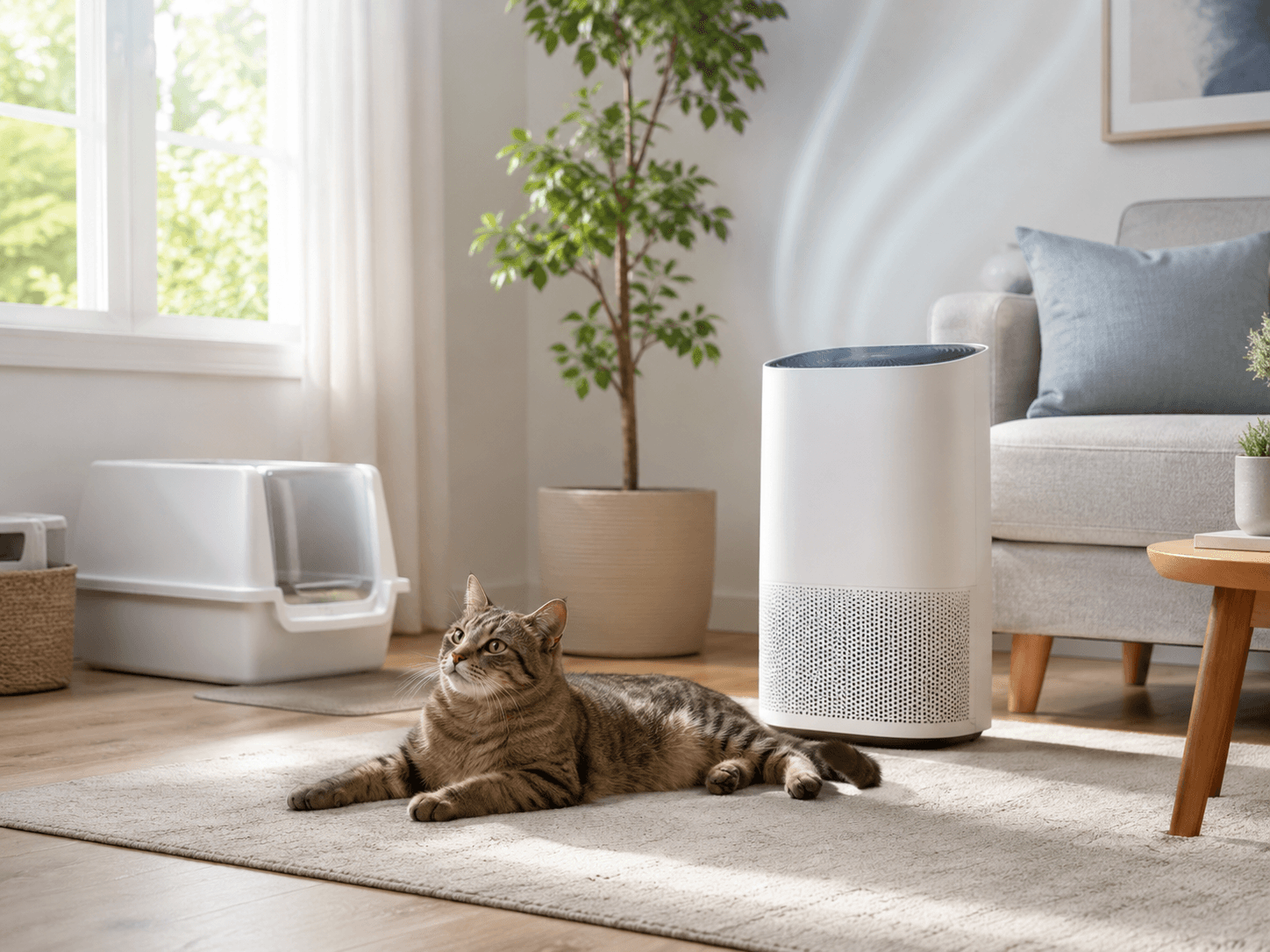
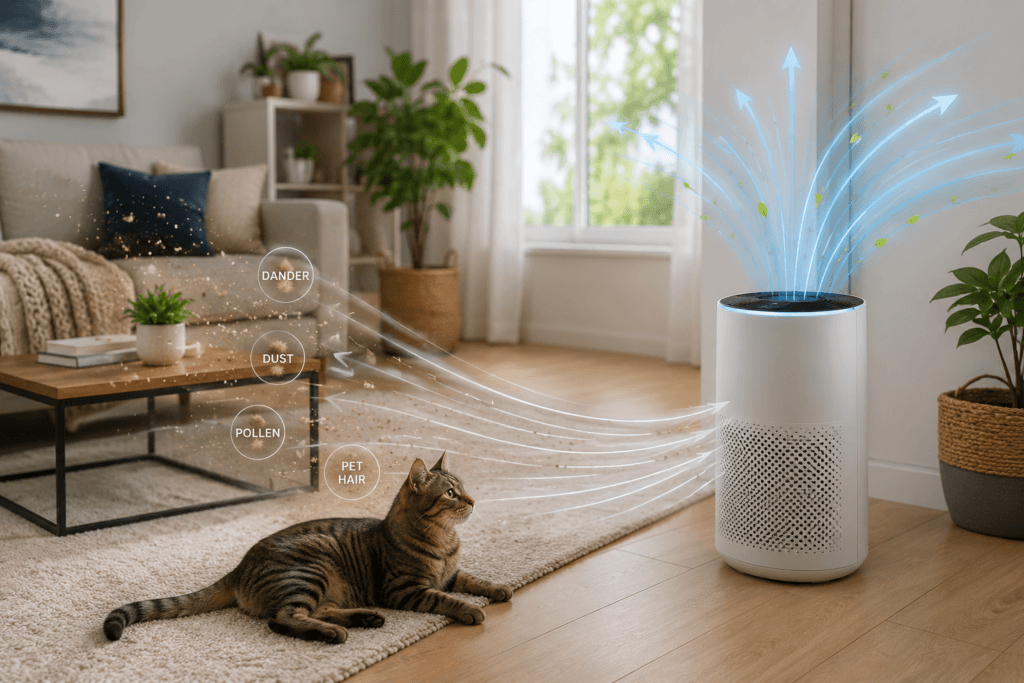
    A smart air purifier filtering airborne dust and cat dander in a bright living room while a tabby cat rests nearby
    Room coverage and airflow matter more than a long smart-feature list when dander is the real problem.

    1. Match coverage to the room at a realistic air-change rate

    Manufacturers often show one-air-change-per-hour coverage, which can sound impressive but is not the same as fast, recurring filtration. For a cat home, compare the room-size figure associated with a higher air-change rate when it is available, along with CADR. CADR describes how much clean air a purifier can deliver per minute; higher CADR generally supports effective cleaning in larger rooms.

    A purifier that “covers” the entire home once per hour may technically be telling the truth. It is also filtering with the urgency of a municipal permit office.

    That does not necessarily make it the right choice for a fur-heavy living room with a litter box nearby.

    2. Separate particles from odor

    Particle filtration helps with airborne dander, dust, pollen, and fine debris.

    Odor support depends more on activated carbon and on whether you actually clean the odor source. A purifier may reduce the stale background smell in a room, but it cannot compensate for a waste drawer that needs emptying or a litter box that needs washing.

    3. Decide whether app control will change your routine

    Smart functions are worth paying for when they reduce friction:

    • You want the purifier to run harder while you are out.
    • You want a schedule for quiet nighttime operation.
    • You want filter reminders in an app.
    • You have more than one purifier and want to control them together.
    • You care about reviewing air-quality patterns over time.

    They are less important when you plan to turn the purifier on once, leave it in Auto Mode, and rarely think about it again.

    4. Treat replacement filters as part of the purchase

    Before buying, check that genuine replacement filters are easy to find, understand how often they are expected to be replaced, and factor that recurring cost into the decision.

    The app can remind you that the filter needs replacing. It cannot stop you from pressing “remind me later” until the purifier is breathing through a gray sweater.

    A cheaper device with difficult or expensive filter ownership can still become the worse long-term value.

    Best Overall for Cat Homes: LEVOIT Vital 200S-P

    The LEVOIT Vital 200S-P earns the overall recommendation because this guide is about cat households—not generic smart-home filtration.

    Its U-shaped inlet is designed to capture larger airborne particles such as fur and lint more effectively, while Pet Mode, app scheduling, filter tracking, Auto Mode, and a 250 CFM CADR give it a stronger cat-specific argument than the more neutral Core 400S-P.

    LEVOIT rates the Vital 200S-P for 388 square feet at 4.8 air changes per hour, with a CADR of 250 CFM.

    That makes it slightly stronger than the Core 400S-P on high-frequency room coverage, while giving it a more pet-specific physical design.

    The important limitation: airborne fur is not the same as fur on your couch, bed, cat tree, or floor. The Vital 200S-P can support a cleaner air environment, but it does not remove the need for a handheld vacuum, robot vacuum, or fabric-cleaning routine.

    Choose the Vital 200S-P if:

    • You want a pet-focused purifier rather than a general smart model.
    • Airborne fur and dander are a visible concern.
    • You want app control, Auto Mode, schedules, and filter tracking.
    • Your target room is a medium-to-large living room, bedroom, or cat-heavy shared space.
    • You want a purifier that fits naturally into a broader pet-cleaning system.

    It may not be the best fit if:

    • You need coverage for a very large open-plan room.
    • Your main concern is litter odor alone.
    • You want the smallest purifier possible.
    • You expect a purifier to replace vacuuming or upholstery cleaning.

    Verdict: Recommended — the best default choice when airborne fur, dander, room coverage, and smart automation all matter.

    Need the strongest all-round fit for a cat-heavy room? Check LEVOIT Vital 200S-P on Amazon.

    Best Balanced Smart Generalist: LEVOIT Core 400S-P

    The Core 400S-P remains an excellent smart purifier for bedrooms, offices, and shared rooms where particulate monitoring, Auto Mode, scheduling, and a relatively compact cylindrical design matter more than a pet-specific intake.

    It is easier to recommend as the balanced smart-home choice than as the categorical winner for cat households.

    It is not built specifically around pet hair in the way the Vital 200S-P is. Instead, it is the stronger all-rounder for a bedroom, home office, medium living room, or shared main room where you want air-quality monitoring without committing to a very large purifier.

    LEVOIT rates the Core 400S-P for 358 square feet at 4.8 air changes per hour, with a CADR of 231 CFM. It also includes a laser dust sensor, Auto Mode, an activated-carbon filter for household and pet smells, VeSync app control, schedules, filter tracking, and voice-assistant support.

    That combination makes it the most balanced choice for the average cat home.

    You can leave it in Auto Mode during the day, use Sleep Mode overnight, check filter life in the app, and keep it running as a background support system rather than another appliance demanding attention.

    Choose the Core 400S-P if:

    • You need one purifier for a medium or moderately large room.
    • You want real smart features without buying an oversized unit.
    • Your cat spends most of their time in a bedroom, office, or main living room.
    • You care about app schedules, filter tracking, and Auto Mode.
    • You want a strong all-purpose option rather than a pet-hair-specific design.

    It may not be the best fit if:

    • You have a very large open-plan floor plan.
    • Airborne pet fur is your main concern.
    • You want the smallest possible footprint.
    • You do not need or care about app functionality.

    Verdict: Recommended — a strong general-purpose purifier, but Vital 200S-P is the more convincing default when pets are the reason you are shopping.

    Want a balanced smart purifier with a smaller visual footprint? Check LEVOIT Core 400S-P on Amazon.

    Best for Large Open-Plan Rooms: Blueair Blue Pure 211i Max

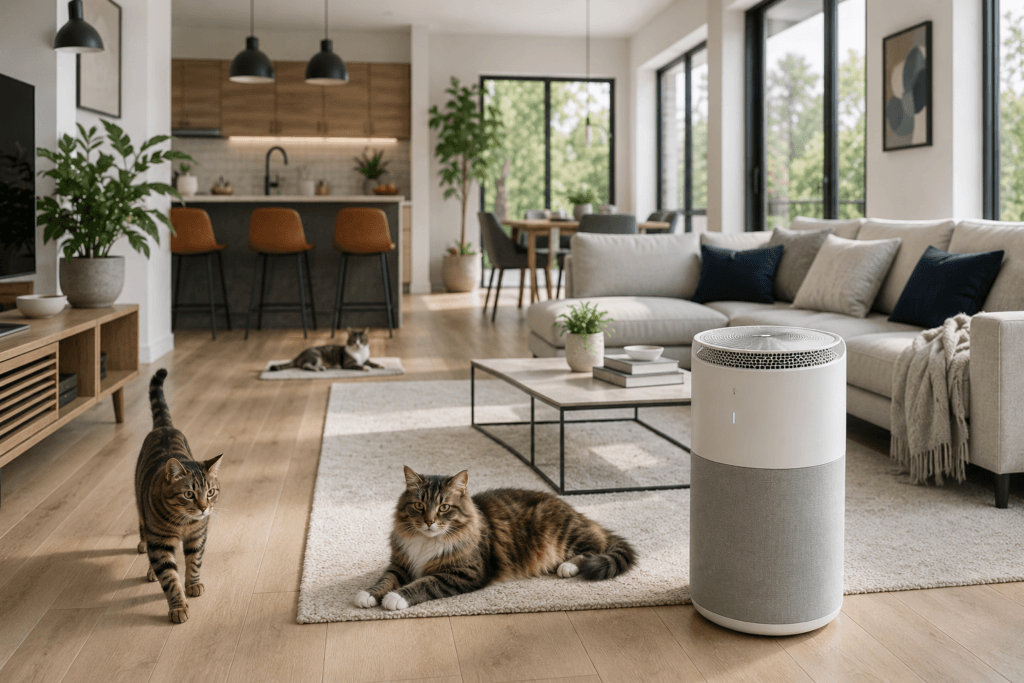
    A large smart air purifier operating in an open-plan living room with two cats resting nearby
    Large shared rooms need airflow first; an undersized purifier will spend too much time working at maximum speed.

    The Blueair Blue Pure 211i Max is the right choice when the room itself is the problem.

    Open-plan living rooms, large family spaces, lofts, and multi-cat homes often need more airflow than a typical bedroom purifier can provide. This is where the Blueair stands apart.

    Blueair recommends the 211i Max for rooms around 674 square feet at its AHAM-rated performance level. The company states that it can clean 1,618 square feet in 30 minutes and 3,235 square feet in one hour under its stated conditions. It also includes three air-quality sensors, Auto Mode, Wi-Fi, Blueair app controls, filter tracking, and Alexa or Google Home integration.

    The practical benefit is not simply “bigger is better.”

    It is that a large purifier can clean a shared space without needing to run at maximum speed constantly. That matters when several cats share the same living area, when litter tracking and dander are spread across an open floor plan, or when the purifier needs to handle a room where people and pets spend most of the day.

    Its particle-and-carbon filter is designed for airborne particles and light household odors from pets, cooking, and smoke. That wording matters: it is support for the room, not a substitute for cleaning a litter box.

    Choose the Blue Pure 211i Max if:

    • You have a large living room, loft, basement, or open-plan space.
    • You live with multiple cats.
    • You want high airflow without turning several small purifiers into a management project.
    • You value detailed particulate monitoring and app control.
    • You prefer one central purifier for the main shared room.

    It may not be the best fit if:

    • Your main target is a small bedroom.
    • You have limited floor space.
    • You need a low-cost purifier.
    • Your primary issue is fur on sofas and cat trees rather than airborne particles.

    Verdict: Recommended — the correct choice when airflow and room size are the primary constraints, not simply an excuse to buy the physically largest machine.

    Is the main shared room too large for the other models? Check Blueair Blue Pure 211i Max on Amazon.

    Best Compact App-Connected Option: Coway Airmega MightyS

    The Coway Airmega MightyS AP-1512HHS is the best smart value choice for cat owners who want a compact, established purifier with app control but do not need the physical scale of Blueair’s largest model.

    The important detail is the “S.”

    The regular Coway Mighty AP-1512HH is widely respected, but it is not the right fit for a guide focused on smart purifiers because it lacks the Wi-Fi/app layer. The MightyS version adds Coway IoCare+ connectivity, remote control, schedules, filter information, indoor air-quality updates, and voice-control support.

    Coway lists the MightyS at 326 square feet for 4.8 air changes per hour, with a pre-filter, honeycomb activated-carbon filter, HEPA filter, and CADR ratings of 210 smoke, 246 dust, and 221 pollen.

    This makes it a compelling fit for a bedroom, office, nursery, smaller living room, or a room near—but not directly inside—the litter area.

    Choose the Coway MightyS if:

    • You want a smarter version of a well-known purifier platform.
    • Your target room is medium-sized rather than open-plan.
    • You value carbon filtration and a compact footprint.
    • You want app-based scheduling and remote controls.
    • You prefer a purifier that can blend into daily use without dominating the room.

    It may not be the best fit if:

    • You need coverage for a large open-plan living area.
    • You want a pet-hair-focused intake design.
    • You need the strongest possible airflow for a multi-cat shared space.
    • You do not care about app features and would rather save money with a non-smart model.

    Verdict: Recommended with Conditions — a credible compact smart purifier, but the additional connectivity is difficult to justify if the app will never be opened after setup.

    Need smart control in a bedroom or medium-sized room? Check Coway Airmega MightyS on Amazon.

    Core 400S-P vs Vital 200S-P: Which LEVOIT Is Better for Cats?

    This is the most useful direct comparison in the guide.

    Choose the Core 400S-P when you want a balanced smart purifier for a shared room and care most about app features, particulate monitoring, scheduling, and a versatile all-purpose design.

    Choose the Vital 200S-P when your cat household makes the pet angle more relevant: airborne fur, dander, Pet Mode, and a dedicated intake design matter more to you than a smaller cylindrical footprint.

    Neither replaces cleaning.

    The Core is the more neutral smart-home pick.
    The Vital is the more cat-specific smart-home pick.

    Build Your Purifier Setup by Home Type

    One cat in an apartment

    Start with the Coway MightyS or LEVOIT Core 400S-P.

    Choose Coway for a smaller bedroom or office. Choose Core 400S-P for a slightly larger shared room where app features and broader coverage matter.

    Multi-cat home with an open-plan living space

    Choose the Blueair Blue Pure 211i Max.

    A larger room needs airflow first. You can always add a smaller bedroom purifier later, but an undersized model in the main shared space will struggle to keep up.

    Cat hair, dander, and a busy main room

    Choose the LEVOIT Vital 200S-P.

    Its pet-specific intake and Pet Mode make the most sense in the room where cats sleep, play, climb, and spend most of the day.

    Litter-room-adjacent bedroom or office

    Choose the Coway MightyS or Core 400S-P depending on room size.

    Keep the purifier in the same general room zone with adequate clearance for airflow, but do not treat it as permission to neglect litter-box maintenance.

    Smart Setup Tips for Cat Homes

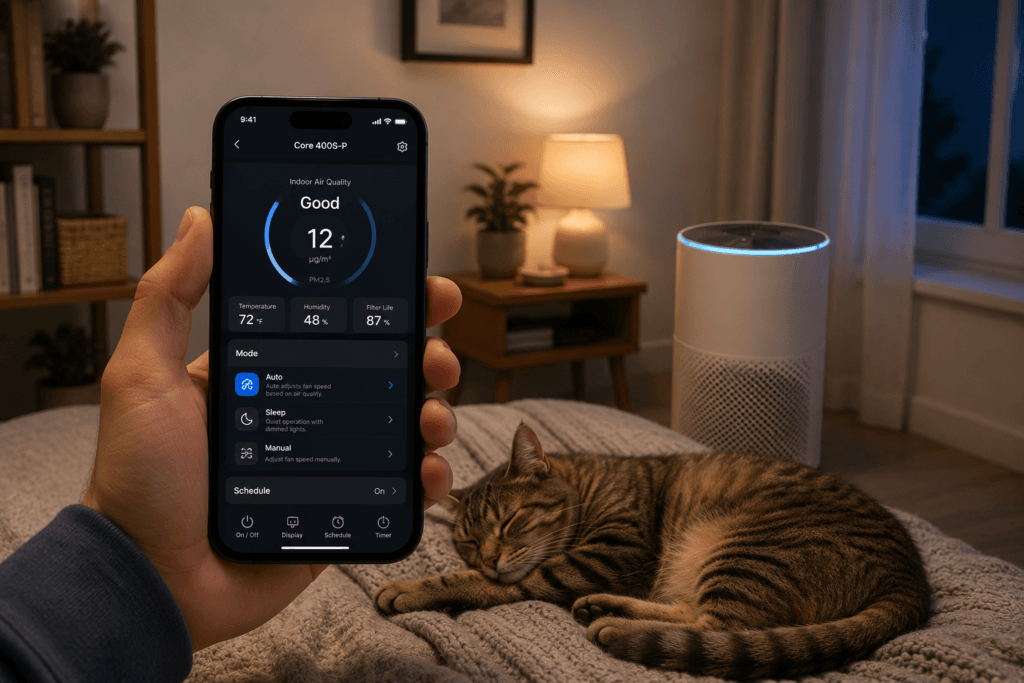
    A smartphone displaying air purifier controls beside a quiet purifier while a cat sleeps in a bedroom
    Smart features earn their place when Auto Mode, schedules, and filter reminders remove routine friction.

    Run Auto Mode as the baseline.

    That is usually the easiest way to let a purifier react to ordinary particle changes from dust, vacuuming, grooming, HVAC cycles, or daily household movement.

    Use schedules only when they solve a real routine problem.

    For example:

    • Quiet Sleep Mode overnight in a bedroom.
    • Higher fan speed before guests arrive.
    • A recurring daytime routine while you are out.
    • A higher setting after vacuuming or cleaning around the litter area.

    Keep the intake and outlet clear.

    Do not hide a purifier behind a sofa, inside a cabinet, or directly against heavy curtains. Follow the placement guidance in the specific product manual and give the unit room to circulate air.

    Replace filters on time.

    A smart app reminder is helpful, but it does not mean the filter is optional maintenance. Filter condition, airflow, and room conditions still matter.

    For the wider home-cleaning routine around litter tracking, upholstery fur, robot vacuums, and odor-source control, see our Best Cat Cleaning Tools for Litter, Fur and Odor guide.

    What Air Purifiers Cannot Solve

    An air purifier cannot fix:

    • A litter box that needs scooping.
    • A waste drawer that needs emptying.
    • Dirty litter mats.
    • Fur embedded in upholstery.
    • A room with poor cleaning habits.
    • Ventilation problems caused by an ongoing source.

    It also should not be replaced with risky shortcuts.

    Do not use ozone generators in occupied cat homes. EPA states that ozone generators have little ability to control indoor contaminants at concentrations that meet public-health standards, while higher ozone levels can create additional indoor-air concerns.

    The better approach is simple:

    1. Remove the source.
    2. Clean the surfaces.
    3. Ventilate when appropriate.
    4. Use filtration as support.

    For litter-box automation and source reduction, see our Best Smart Litter Boxes guide.

    Frequently Asked Questions

    Do air purifiers remove cat odor?

    They can support odor reduction when the filter includes activated carbon, but they do not replace litter maintenance, waste removal, cleaning, or ventilation.

    Do air purifiers remove cat hair?

    They can capture some airborne fur and fine particles, especially pet dander. They do not remove hair already sitting on floors, sofas, cat trees, or bedding.

    Is a smart purifier worth it for cat owners?

    It is worth it when app control, Auto Mode, scheduling, and filter tracking make your routine easier. It is not worth paying extra for features you will never use.

    What size purifier should I buy?

    Choose based on the room where your cat spends the most time, not your entire home’s square footage. Compare high-frequency room coverage and CADR rather than relying only on a one-air-change-per-hour claim.

    Should I place a purifier beside the litter box?

    Keep it in the same room or general area when possible, but do not block airflow or place it where loose litter, moisture, or accidental spills can interfere with the unit. Follow the manufacturer’s clearance guidance.

    Final Verdict

    The best smart air purifier for cat owners depends on the room first, then the feature set.

    Choose the LEVOIT Core 400S-P for the best overall balance of smart controls, room coverage, sensors, and daily usability.

    Choose the Coway Airmega MightyS for compact smart value in bedrooms, offices, and medium rooms.

    Choose the Blueair Blue Pure 211i Max for large open-plan rooms, multi-cat households, and high-airflow needs.

    Choose the LEVOIT Vital 200S-P when you want a smart purifier designed more directly around airborne pet fur, dander, and pet-home routines.

    A purifier should make your cleaning routine more effective—not encourage you to skip it.

    References

    • LEVOIT — Core 400S-P product specifications and VeSync smart-control information
    • Coway — Airmega MightyS AP-1512HHS product specifications and IoCare+ app information
    • Blueair — Blue Pure 211i Max room-coverage, sensor, app, and filter information
    • LEVOIT — Vital 200S-P pet-focused intake, Pet Mode, and room-coverage information
    • U.S. Environmental Protection Agency — indoor-air source control, ventilation, filtration, and ozone guidance

    Image Disclosure

    Some images in this article may be created with AI for illustrative purposes. They do not show the exact products reviewed and should not be used to evaluate product size, fit, design, or features. Always check the current official product listing before purchasing.

    Disclosure

    PetTech AI may earn a commission from qualifying purchases. This does not influence our recommendations, comparisons or editorial judgments.