Tag: Cat Travel

  • Cat Travel Essentials 2026: Pack Smarter, Panic Less

    Cat Travel Essentials 2026: Pack Smarter, Panic Less

    Most cats do not need a miniature travel department.

    They need the correct carrier, secure transportation, familiar bedding and an owner who did not begin packing eleven minutes before departure.

    The right cat travel essentials depend on the trip. A ten-minute drive to the veterinarian does not require a stroller, portable fan, GPS tracker and collapsible dining room. A flight, however, demands more planning than placing Gerald in the first bag described as “airline approved” and hoping aviation law respects the product title.

    This guide matches the equipment to the journey—because buying everything is not the same as being prepared.

    Quick Verdict

    ProductBest fitNot forPetTech AI verdict
    Amazon Basics Two-Door Top-Load CarrierVet visits and simple car tripsOwners wanting a soft, collapsible carrierRecommended
    Sherpa Original Deluxe MediumMany in-cabin flights and public transportLarge cats or airlines with incompatible limitsRecommended
    PETKIT Breezy 2Tech-focused backpack travel and urban walksHot cars, long flights or cats needing visual shelterConditional
    Sleepypod Mobile Pet BedPremium car travel for cats within its tested fitLarge cats and occasional budget travelRecommended
    Pet Gear No-Zip AT3Senior cats, limited mobility and controlled outdoor tripsOwners needing a compact everyday carrierConditional

    Best starting point for most households: the Amazon Basics carrier is simple, sturdy and easy to load from above. It does not need charging, pairing or an executive briefing before a veterinary appointment.

    Best for flying: the Sherpa Original Deluxe Medium is flexible and designed around under-seat travel, but the airline—not the Amazon bullet list—has the final word.

    Best car-safety upgrade: the Sleepypod Mobile Pet Bed is the only option here supported by current independent Center for Pet Safety certification.

    PetTech AI may earn a commission from qualifying purchases. As an Amazon Associate I earn from qualifying purchases.

    Need a straightforward carrier for vet visits and routine driving? Check the Amazon Basics Two-Door Top-Load Carrier on Amazon.

    Research and Safety Note

    This is a research-led buying guide based on current manufacturer documentation, independently published safety information and Amazon listings screened for availability, ratings and review volume.

    PetTech AI has not crash-tested these products or taken every carrier onto every airline.

    Travel rules can change by airline, route, aircraft and destination. The U.S. Department of Transportation advises passengers to check the airline’s current pet policy because carriers may impose their own size, weight, documentation, seating and kennel requirements.

    For cats with significant anxiety, motion sickness, respiratory problems or other medical conditions, discuss the trip with your veterinarian before improvising a treatment plan beside the departure gate.

    Choose for the Trip, Not the Gadget
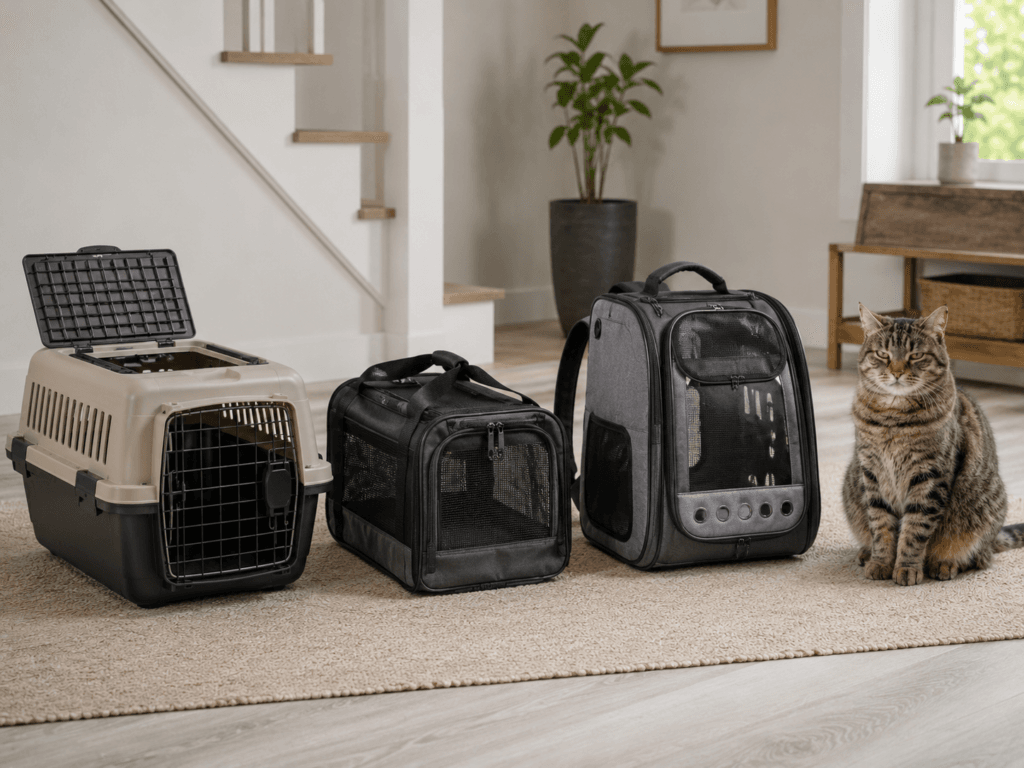
    Hard-sided cat carrier, soft airline carrier and backpack carrier arranged for different types of travel.
    Hard carrier, soft carrier or backpack: the correct answer depends on the journey, not the number of zippers.

    The useful question is not:

    Which carrier has the most features?

    It is:

    What problem must this carrier solve?

    For a veterinary visit, prioritize easy loading, stability and a design the veterinarian can access without extracting an already offended cat through a narrow front door.

    For flying, prioritize confirmed airline dimensions, ventilation, leak resistance and enough flexibility to fit under the assigned seat.

    For walking or public transportation, your own carrying comfort matters more. A backpack may be practical, but only if the interior dimensions suit the cat—not merely the manufacturer’s maximum weight.

    For road travel, restraint and crash performance matter. A backpack with a fan does not become a crash-tested car carrier because it looks technological near a seat belt.

    For senior cats or cats with reduced mobility, a stroller can provide controlled outdoor access without requiring sustained walking or shoulder-level transport.

    One journey, one problem, one appropriate solution. The garage does not need to become a feline terminal building.

    Best Simple Carrier: Amazon Basics Two-Door Top-Load

    Verdict: Recommended

    The Amazon Basics hard-sided carrier wins through aggressive normality.

    Its front door handles routine entry, while the top opening makes it easier to lower in a reluctant cat without attempting a horizontal negotiation through a narrow gate. The rigid shell also provides more structure than a soft carrier during short trips and waiting-room transfers.

    Where it wins

    Choose it for:

    • veterinary appointments;
    • short and moderate car trips;
    • cats that are easier to load from above;
    • owners wanting a carrier that does not collapse in storage or use;
    • households that need reliability more than features.

    A top-opening carrier can also make veterinary handling easier because the cat may be examined while remaining in the lower portion of a suitable carrier. FelineVMA guidance recommends sturdy carriers with top and front access or removable tops for easier entry, exit and examination.

    Where it disappoints

    It is bulky, not comfortable to carry over long distances and not intended as the obvious choice for under-seat airline travel.

    The rigid construction also does not mean it has independently demonstrated crash protection. Treat it as a practical transport enclosure—not a feline child seat with excellent public relations.

    Choose Amazon Basics when: simplicity, easy loading and routine travel matter most.

    Skip it when: you expect to walk through airports, train stations or city streets with the carrier on your shoulder.

    Best Soft Carrier for Flights: Sherpa Original Deluxe Medium

    Verdict: Recommended

    The Sherpa Original Deluxe is the strongest flight candidate in this shortlist because its soft structure and spring-wire frame are designed to compress beneath many airline seats.

    It includes mesh ventilation, locking zippers, top and side entry, a waterproof base and a removable machine-washable liner. Sherpa also tells buyers to select the size using the animal’s measurements before relying on weight alone—which should be obvious, yet the pet-carrier industry occasionally behaves as though cats are sold in standardized cubes.

    Where it wins

    The Sherpa makes sense for:

    • many domestic in-cabin flights;
    • train and bus travel;
    • owners needing a lighter carrier;
    • cats that fit comfortably within the Medium dimensions;
    • travelers who value a washable liner and flexible frame.

    Where it disappoints

    “Airline friendly” is not universal permission to board.

    Sherpa itself notes that airlines have different sizing requirements and that not every carrier size is guaranteed on every flight. Aircraft and seat configurations can also differ. Verify the exact airline policy and contact the carrier when the published limits are unclear.

    A weight limit is also not a substitute for measuring the cat. A compact but dense cat and a long, tall cat may weigh the same while requiring very different interiors.

    Need more options for large cats, backpack travel or routine vet visits? Our guide to the best cat carriers for travel compares the strongest designs by use case.

    Need a flexible carrier for an upcoming flight? Check the Sherpa Original Deluxe Medium on Amazon—then check your airline before removing the tags.

    Best Smart Backpack: PETKIT Breezy 2
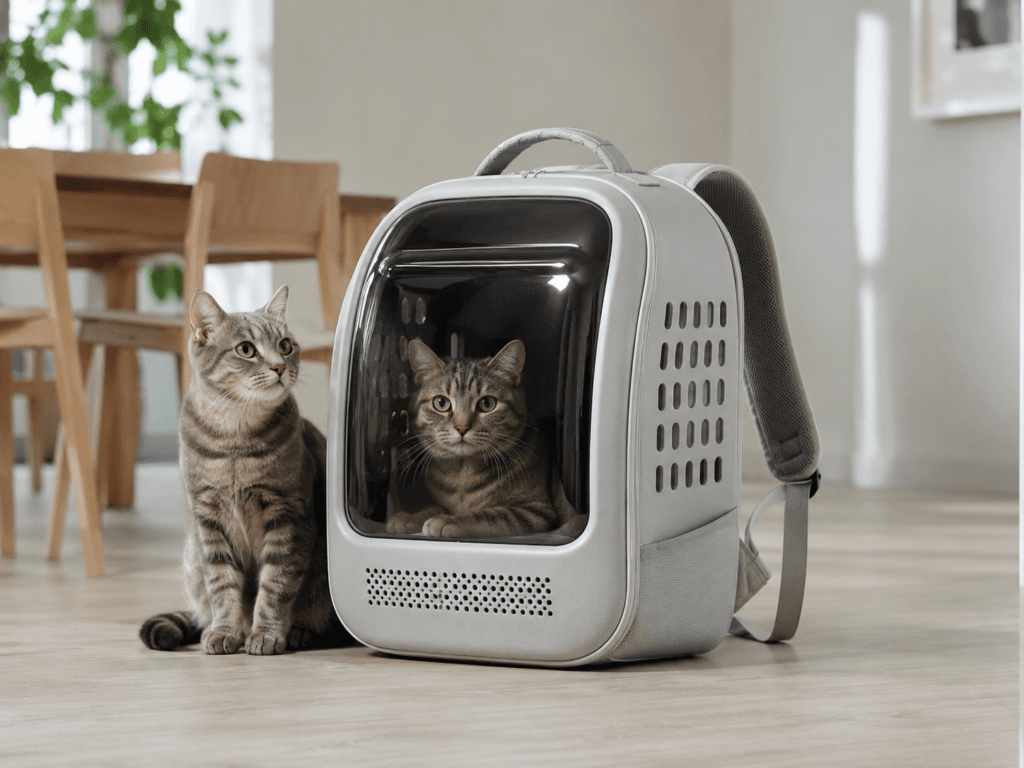
    PETKIT Breezy 2 ventilated backpack carrier designed for short walks and urban cat travel.
    The PETKIT Breezy 2 adds active airflow and backpack convenience, but it is not automatically the right carrier for every cat, car or airline seat.

    Verdict: Conditional

    The PETKIT Breezy 2 is the genuine technology option—not a normal backpack promoted to “smart” after someone added a side pocket.

    It combines a rigid backpack design with a built-in fan, interior lighting, ventilation openings and a wide tinted window. PETKIT lists dimensions of approximately 13 × 11.8 × 17.7 inches, a carrier weight of 3.3 pounds and a maximum cat weight of 18 pounds. The fan requires a separate power bank, which is not included.

    Where it wins

    Choose Breezy 2 for:

    • walking through cities or stations;
    • owners who prefer backpack straps;
    • cats that tolerate visual exposure;
    • short trips where active airflow adds practical comfort;
    • buyers already comfortable with PETKIT hardware.

    The current Amazon listing also has a much stronger review history than many novelty “space capsule” backpacks, which helps distinguish it from the large family of transparent bubbles designed primarily to photograph well.

    Where it disappoints

    The Breezy 2 is not a universal travel carrier.

    Its rigid body may conflict with airline under-seat limits. The large viewing window can be stimulating for cats that settle better with reduced visual input. The fan also depends on a charged external power source.

    Most importantly, airflow does not make an overheated vehicle safe. Never leave a cat unattended in a parked car, even with the windows cracked, a cooling mat installed or the Breezy fan performing its small mechanical heart out. The AVMA warns that vehicle interiors can quickly reach dangerous temperatures.

    Choose Breezy 2 when: you want a ventilated backpack for walking and controlled urban travel.

    Skip it when: you primarily need a flight carrier, crash-tested restraint or a darker retreat for an easily overstimulated cat.

    Does PETKIT’s ventilated backpack fit your travel routine? Check the Breezy 2 on the PETKIT official store or Amazon.

    Best Premium Car Carrier: Sleepypod Mobile Pet Bed

    Verdict: Recommended

    The Sleepypod Mobile Pet Bed costs more and has a smaller Amazon review base than the mainstream carriers. It also brings something more meaningful than another storage pocket: independent safety certification.

    The Center for Pet Safety tested the current Mobile Pet Bed in August 2024 using a 15-pound test animal. The product passed and received a five-star result under the organization’s carrier test protocol.

    Where it wins

    The Sleepypod works as:

    • a home pet bed;
    • a portable carrier;
    • a car-restraint system when installed as directed;
    • a premium option for cats within its tested size range.

    Using it as a bed at home may also reduce the dreaded carrier transformation: the moment a familiar object emerges from storage and Napoleon realizes someone has scheduled medicine.

    Where it disappoints

    The design is heavier, bulkier and more expensive than a conventional carrier. Its safety result also applies to the tested configuration and fit; it does not grant unlimited protection to cats of every size.

    A large cat may simply not fit. An owner making two short veterinary trips per year may reasonably decide that the Amazon Basics carrier solves enough of the problem for much less friction.

    Choose Sleepypod when: car travel is frequent enough to justify paying for independently evaluated restraint performance.

    Skip it when: your cat exceeds the suitable dimensions or you mainly need lightweight public-transport mobility.

    Prioritizing car travel and verified safety performance? Check the Sleepypod Mobile Pet Bed on Amazon.

    Best Stroller for Senior Cats: Pet Gear No-Zip AT3
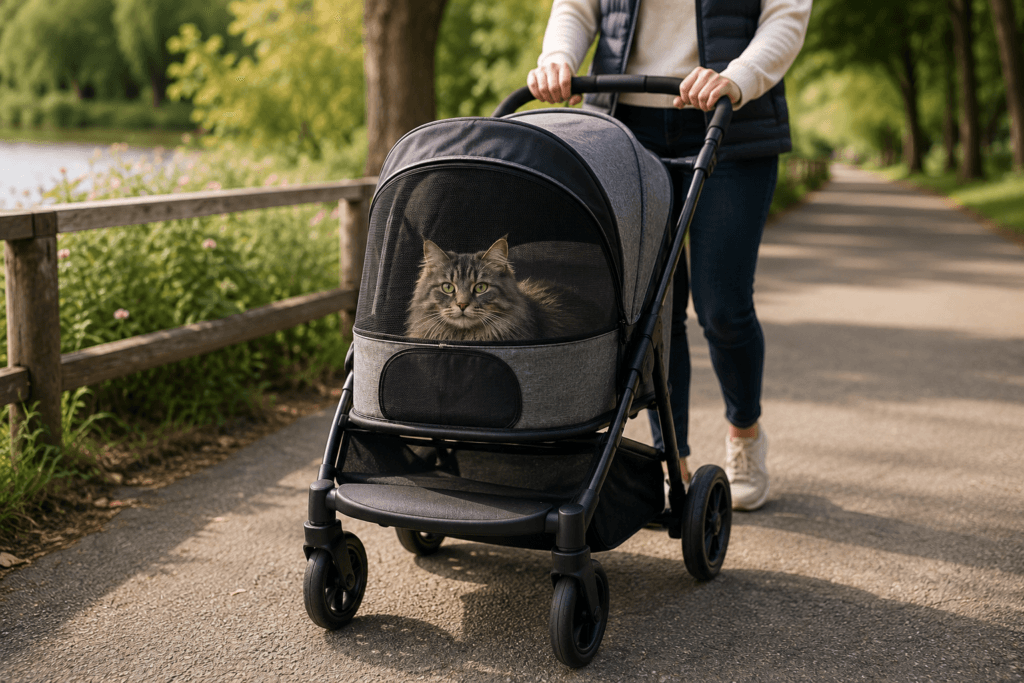
    Senior cat riding in an enclosed pet stroller during a quiet outdoor walk.
    A stroller can restore controlled outdoor access for some senior cats. For others, it is simply a very expensive refusal on wheels.

    Verdict: Conditional

    A stroller is not a cat travel essential for every household.

    For the right household, however, it can solve a real mobility problem rather than merely giving the cat a suspiciously elaborate vehicle.

    The Pet Gear No-Zip AT3 uses a push-button, zipperless closure, 12-inch EVA tires, a locking front wheel, an elevated paw rest, a removable liner and a one-hand folding mechanism. It measures 35 × 28.5 × 42 inches and weighs 27 pounds, so this is substantial equipment—not something that quietly disappears behind a coat rack.

    Where it wins

    It is best suited to:

    • senior cats;
    • cats with limited mobility;
    • longer outdoor walks without ground contact;
    • owners who cannot comfortably carry a backpack;
    • controlled exposure to parks or quieter urban areas.

    Where it disappoints

    It does not replace an appropriate car carrier.

    It is also large, relatively heavy and unnecessary for cats that dislike outdoor movement, crowds or visual stimulation. Buying one does not obligate Biscuit to develop an interest in farmers’ markets.

    Introduce the stroller indoors before taking it outside. Secure the enclosure completely and follow the manufacturer’s instructions for internal restraints and loading.

    Choose the AT3 when: reduced mobility or carrying difficulty makes an enclosed stroller genuinely useful.

    Skip it when: the cat only leaves home for occasional veterinary appointments.

    Transfers between the home, vehicle and stroller may also require a properly fitted harness. See our best cat harnesses for escape resistance, fit and training considerations.

    Need enclosed mobility for a senior or mobility-limited cat? Check the Pet Gear No-Zip AT3 on Amazon.

    Car Travel Safety: The Section That Matters More Than Cup Holders

    A cat should never travel loose inside a moving vehicle.

    An unsecured cat can be injured during sudden braking, interfere with the driver or escape when a door opens. AVMA policy favors transporting pets in an appropriate secured carrier or restraint rather than allowing them to move freely inside the vehicle.

    Do not automatically place every carrier on the back seat and loop a belt around it. FelineVMA guidance says seat-belt installation should be reserved for carriers designed and crash-tested for that use; most conventional carriers are better placed on the floor behind a front seat. Follow the carrier manufacturer’s installation instructions.

    Keep the vehicle ventilated and comfortably cool. Never leave the cat unattended in the car.

    Stop the trip and seek veterinary guidance if the cat develops panting, breathing difficulty, repeated vomiting, marked weakness, collapse or other severe distress. Do not treat significant respiratory or heat-related signs as ordinary travel complaints.

    Flying With a Cat Without Trusting the Product Title

    Before booking, confirm:

    • whether the airline accepts cats in the cabin;
    • maximum carrier dimensions;
    • combined pet-and-carrier weight limits;
    • required ventilation and leak resistance;
    • pet fees;
    • seating restrictions;
    • health certificates or other documents;
    • destination and return-entry requirements.

    The Department of Transportation notes that airline policies vary and that some carriers impose restrictions involving size, weight, age, behavior, weather, seating and health documentation. International destinations may add certificates, import rules or quarantine requirements.

    Do this before buying the carrier. Discovering at check-in that the bag exceeds the limit is a very expensive way to learn that product copy is not aviation regulation.

    The Packing List That Does Not Require a Trailer

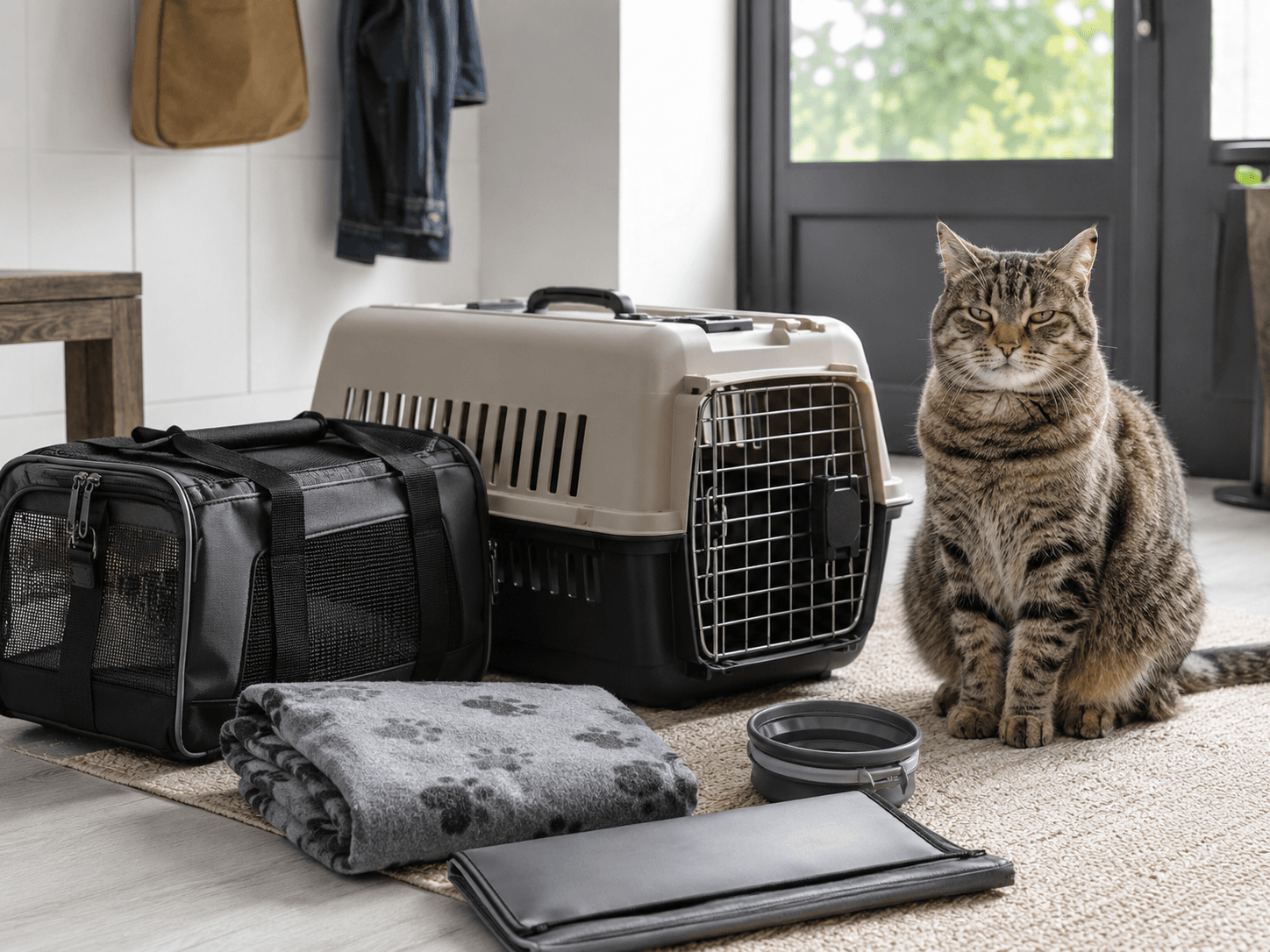
    Bring what the specific trip requires:

    • secure carrier;
    • updated ID tag and microchip details;
    • recent photo of your cat;
    • familiar liner or blanket;
    • absorbent pad and spare liner;
    • waste bags and pet-safe wipes;
    • water and a compact bowl;
    • necessary food;
    • prescribed medications;
    • veterinary and travel documents;
    • harness and leash when safe transfers require them;
    • paper towels, because optimism has limits.

    For longer trips, plan food, water and litter access around the cat’s health and itinerary. Ask your veterinarian whether meal timing should change when motion sickness or a medical condition is involved.

    A tracker can add location backup during outdoor trips, but it does not replace a secure carrier, harness or updated microchip. Our best cat trackers guide explains the trade-offs.

    Carrier Training Without a 14-Day Military Campaign

    Carrier training should follow the cat’s progress, not an invented calendar.

    Leave the carrier open in a familiar room. Add bedding that smells like home. Place treats or meals near the entrance, then gradually farther inside. Once the cat enters comfortably, practice closing the door briefly, lifting the carrier and taking short car trips.

    FelineVMA resources recommend making the carrier part of the home environment rather than revealing it only before veterinary visits. Familiar bedding, gradual exposure and patient handling can reduce fear associated with transport.

    Some cats progress quickly. Others require weeks.

    Gerald has reviewed the proposed schedule and rejected all deadlines.

    When travel is necessary and training alone is not enough, ask your veterinarian about an individualized plan for anxiety or nausea. Do not give sedatives, supplements or human medications without professional guidance.

    Buyer-Regret Risk

    The most common travel-equipment mistakes are:

    • choosing by weight limit without measuring the cat;
    • assuming “airline approved” applies to every airline and aircraft;
    • using a backpack as an unverified car restraint;
    • buying a stroller for a cat that hates outdoor movement;
    • relying on a fan or cooling mat in unsafe heat;
    • testing the carrier for the first time on departure day;
    • buying five accessories while ignoring carrier training;
    • mistaking more features for better safety.

    A boring carrier that fits, closes securely and gets used consistently is more valuable than an intelligent travel capsule currently sitting uncharged in the garage.

    Final Verdict

    Choose the Amazon Basics Two-Door Top-Load Carrier for routine veterinary visits and uncomplicated ground travel.

    Choose the Sherpa Original Deluxe Medium when you need a flexible soft carrier for a flight—but verify the airline’s current requirements first.

    Choose the PETKIT Breezy 2 when backpack comfort and active ventilation genuinely improve short walking or urban trips.

    Choose the Sleepypod Mobile Pet Bed when frequent car travel makes independently evaluated restraint performance worth the premium.

    Choose the Pet Gear No-Zip AT3 for senior cats, reduced mobility or owners who need enclosed transport without carrying the cat.

    The best cat travel essentials do not make every journey luxurious.

    They make the trip secure, manageable and repeatable—without requiring a luggage cart for an animal who plans to spend the entire vacation under the hotel bed.

    Frequently Asked Questions

    What is the best carrier for taking a cat to the veterinarian?

    A sturdy carrier with both top and front access is usually the most practical. Top loading can make entry easier, while a removable or accessible upper section may allow parts of the examination to occur without completely removing the cat.

    Can a cat backpack replace a car carrier?

    Not automatically. Use a backpack in a vehicle only according to its manufacturer’s instructions and do not assume it provides crash protection. For routine carriers without verified seat-belt installation, feline travel guidance generally favors placement on the floor behind a front seat.

    Is the PETKIT Breezy 2 suitable for flying?

    Do not assume so. Its rigid dimensions may not fit every airline’s under-seat limits. Check the specific airline, route and aircraft requirements before purchasing it for a flight.

    Should I cover my cat’s carrier?

    Some cats settle better when part of the carrier is covered with a breathable towel or blanket that reduces visual stimulation. Do not block ventilation, and monitor the temperature inside the carrier.

    Should I medicate my cat before traveling?

    Only under veterinary guidance. A veterinarian may recommend an individualized plan for severe travel anxiety or motion sickness, but medication should not be improvised or used as a substitute for safe transport and gradual carrier conditioning.

    References

    • American Veterinary Medical Association — Traveling With Your Dog or Cat
    • American Veterinary Medical Association — Pet Safety in Vehicles
    • Center for Pet Safety — Sleepypod Mobile Pet Bed Certification
    • Feline Veterinary Medical Association — Choosing the Perfect Cat Carrier
    • Feline Veterinary Medical Association — Getting Your Cat to the Veterinarian
    • U.S. Department of Transportation — Flying With a Pet
    • PETKIT — Breezy 2 Product Documentation
    • Sherpa — Original Deluxe Travel Bag Pet Carrier Documentation
    • Pet Gear — No-Zip AT3 Product Documentation

    Image Disclosure

    Official manufacturer images are used when available and authorized.

    AI-generated images may also be used as editorial illustrations. They should not be treated as exact representations of product dimensions, materials, controls or physical features. Always verify current official product information before purchasing.

    Editorial Disclosure

    PetTech AI may earn a commission from qualifying purchases. This does not influence our recommendations, comparisons or editorial judgments.
  • Best Cat Harnesses for Safe Outdoor Walks in 2026

    Best Cat Harnesses for Safe Outdoor Walks in 2026

    A cat harness should not make outdoor time feel like a test of bravery.

    The right one gives your cat a secure, comfortable way to explore at their own pace—whether that means sitting quietly on a patio, sniffing around a garden, traveling in an RV, or taking short leash walks near home.

    The wrong one can create the opposite experience: rubbing at the armpits, pressure around the neck, an easy escape route, or a cat that freezes the moment it is fastened.

    Baron may then collapse sideways as though the harness has temporarily disabled his operating system.

    That reaction does not necessarily mean the fit is wrong. It means harness acceptance must be trained—not assumed because the product page included a cat standing heroically on a mountain.

    That is why the best cat harness is not simply the most padded, most expensive, or most “escape-proof” looking model. It is the harness shape that fits your cat’s body, temperament, and outdoor routine.

    This guide compares four strong options for different needs:

    • RC Pets Adventure Kitty Harness for balanced outdoor comfort and adjustability.
    • Kitty Holster for cats that benefit from wider vest coverage and soft cotton contact.
    • PetSafe Come With Me Kitty for low-bulk training and gentle leash introduction.
    • Rabbitgoo Cat Harness for a practical lower-cost vest option.

    Quick Verdict: Which Cat Harness Fits Your Cat?

    Best forHarnessWhy it stands outMain trade-off
    Best overall outdoor harnessRC Pets Adventure KittyAdjustable neck and waist, breathable mesh, reflective trim, included leashMore structured than minimal strap harnesses
    Best comfort vest for cautious or sensitive catsKitty HolsterBroad vest coverage, soft cotton lining, wide adjustable closure areaWarmer and bulkier than an H-style harness
    Best for early leash trainingPetSafe Come With Me KittyLightweight nylon, quick-snap fit, included bungee leashLess body coverage than a vest
    Best budget vestRabbitgoo Cat HarnessMesh vest design, dual buckle closure, reflective detailsFit must be checked carefully; sizing is not one-size-fits-all

    Research Note

    This is a research-led roundup based on current manufacturer information, fit guidance, training recommendations and product positioning.

    PetTech AI has not conducted long-term hands-on testing of every harness included.

    PetTech AI may earn a commission from qualifying purchases. As an Amazon Associate I earn from qualifying purchases.

    What “Smart” Actually Means in a Cat Harness

    A cat harness does not need electronics to be smart.

    For outdoor safety, smart design means:

    • A cat-specific fit rather than a scaled-down dog harness.
    • A leash attachment positioned on the back, not at the neck.
    • Enough adjustment to create a secure fit without restricting movement.
    • Materials that avoid rubbing around the chest and front legs.
    • A shape that makes backing out more difficult without promising the impossible.
    • A design your cat can tolerate long enough to build positive associations.

    No harness is guaranteed escape-proof. A frightened cat can move in unexpected ways, and even an excellent harness can fail if it is too loose, too large, damaged, or used without supervision.

    The goal is not to find a magical product that removes all risk.

    The goal is to choose a structure that gives you the best possible control for your cat’s body and behavior.

    Start With Harness Shape, Not Brand

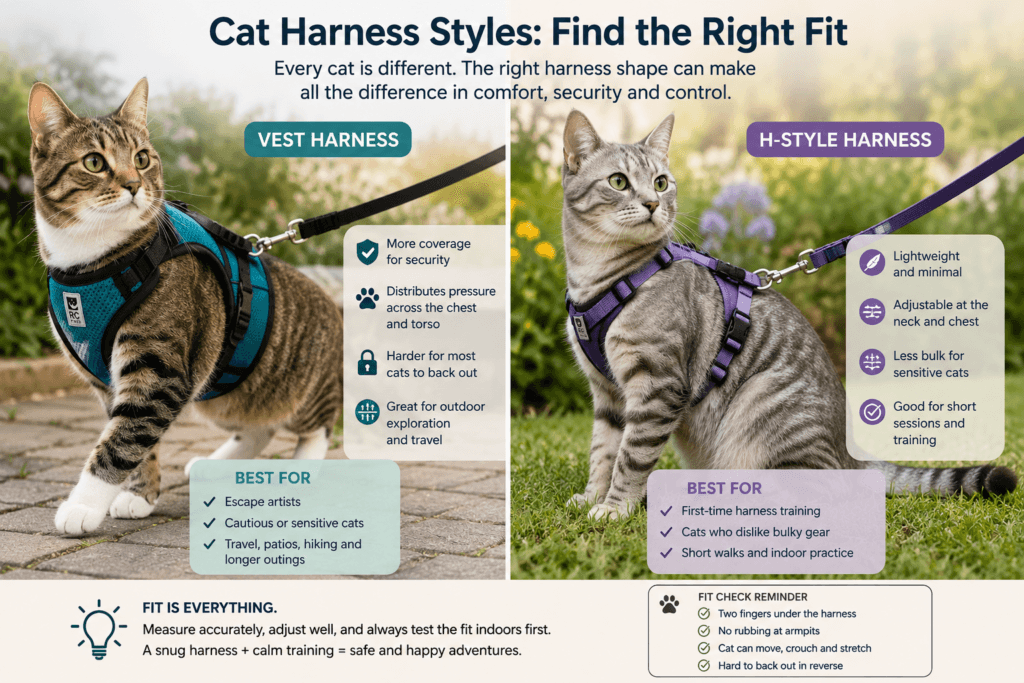
    cat-harness-vest-vs-h-style-fit-comparison.webp
    Vest harnesses offer broader coverage, while H-style designs can feel lighter—fit determines whether either option works safely.

    Before choosing a product, decide which style is most likely to suit your cat.

    Vest harnesses: more coverage, but not automatic security

    Vest-style harnesses distribute contact across a wider part of the chest and torso. They may feel more stable and can make backing out more difficult when fitted correctly.

    More fabric does not automatically mean a safer fit. A loose vest can create just as much escape space as loose straps.

    They can also work well for cats who need more physical reassurance from the harness itself.

    The trade-off is warmth and bulk. A heavily padded vest may feel restrictive for a cat who is heat-sensitive, especially during summer walks.

    H-style harnesses: lighter and less restrictive

    An H-style harness uses thinner straps around the neck and chest. It can feel lighter for some cats and may be easier to introduce during early training.

    The trade-off is that fit becomes even more important. A loose H-style harness can give an agile cat room to reverse out of it.

    Step-in designs: useful for head-shy cats

    Some cats dislike anything passing over their head. A step-in harness can reduce that stress because the cat steps into the front openings before the harness closes over the back.

    This can be helpful, but it is not automatically safer. The harness still needs to fit securely around the chest and torso.

    Best Overall: RC Pets Adventure Kitty Harness

    The RC Pets Adventure Kitty Harness is the strongest all-around option for owners who want one harness that can support regular supervised outdoor time.

    It uses breathable air mesh, reflective binding, adjustable neck and waist webbing, and buckles at both adjustment points. It also includes a 6-foot leash, which makes it a convenient all-in-one starting option.

    Its biggest advantage is balance.

    Some harnesses are very light but offer limited adjustment. Others are extremely structured but can feel bulky. The Adventure Kitty sits between those two extremes: enough structure for controlled outdoor use, enough adjustment to improve fit, and enough breathability for routine walks.

    This is a good match for a cat who is already curious about the outdoors and needs a harness that can grow with their confidence.

    Choose RC Pets Adventure Kitty if:

    • You want a cat-specific harness for regular outdoor exploration.
    • Your cat benefits from both neck and waist adjustment.
    • You want breathable mesh without a full heavy vest.
    • You value reflective trim for lower-light visibility.
    • You prefer a harness and leash bundle.

    It may not be the best fit if:

    • Your cat is highly sensitive to mesh or more comfortable in soft cotton.
    • You need the widest possible torso coverage.
    • Your cat is extremely small and falls between listed sizes.

    Verdict: Recommended — the strongest all-round choice for regular supervised exploration when adjustability, breathable structure and a complete harness-and-leash setup matter.

    It is not automatically the safest harness for every cat. It is the most balanced starting point in this roundup.

    Need a balanced harness for regular supervised outdoor use? Check RC Pets Adventure Kitty on Amazon.

    Best Comfort Vest: Kitty Holster

    The Kitty Holster is the best choice for cats who respond better to broad, soft coverage than narrow straps.

    Its vest-style design uses a breathable cotton lining and wide hook-and-loop closure areas. That can make it especially appealing for cats with sensitive skin, tactile sensitivity, or a history of trying to back out of lightweight harnesses.

    The important distinction is not that it is “escape-proof.” No responsible harness should be marketed as a guarantee.

    Its advantage is the way it spreads contact across the torso. For some cats, that can feel more stable and less irritating than an H-style design with thin straps near the legs.

    It is also a strong option for travel. Cats visiting a veterinarian, staying in an RV, moving through a hotel, or spending time on a balcony may benefit from a harness that feels secure and easy to handle without needing the cat to walk long distances.

    Choose Kitty Holster if:

    • Your cat is sensitive to thin straps or rubbing.
    • You want broader body coverage.
    • Your cat has a strong tendency to reverse out of loose harnesses.
    • You need a harness for travel, balconies, supervised patio time, or short walks.
    • You prefer cotton contact over synthetic mesh.

    It may not be the best fit if:

    • Your cat overheats easily.
    • You want the lightest possible harness for active walking.
    • Your cat strongly dislikes vest-style clothing.

    Verdict: Strong Recommendation with Conditions — one of the most convincing broad-coverage harnesses for cats that tolerate vest-style contact, but potentially too warm or restrictive for active and heat-sensitive cats.

    The wide coverage can make the fit feel more stable.

    It cannot prevent an incorrectly sized cat from reversing out through a gap large enough to accommodate several optimistic marketing claims.

    Does your cat tolerate broad, soft torso coverage? Check Kitty Holster availability on Amazon.

    Best for Early Leash Training: PetSafe Come With Me Kitty

    The PetSafe Come With Me Kitty Harness and Bungee Leash is a strong choice for cats who are new to harness training and may find a full vest overwhelming.

    It uses lightweight nylon straps, quick-snap buckles, a color-coded belly strap for easier fitting, and an included bungee leash designed to soften sudden pulls.

    The bungee leash is particularly useful during early training because cats do not walk like dogs. They may stop suddenly, turn, crouch, investigate, or move in an unexpected direction. A little flexibility can reduce abrupt tension during those first indoor and outdoor sessions.

    This harness is not about maximum vest coverage. It is about creating a lighter, lower-bulk experience for cats that need time to accept leash equipment.

    Choose PetSafe Come With Me Kitty if:

    • Your cat is new to harnesses.
    • You want a lightweight, adjustable strap-based design.
    • You value a bungee leash for gentler leash feedback.
    • Your cat is hesitant around bulky vest harnesses.
    • You want a recognizable, established pet brand.

    It may not be the best fit if:

    • Your cat has repeatedly backed out of narrow-strap harnesses.
    • You need more torso coverage for a particularly agile cat.
    • Your cat is extremely sensitive to any neck-area handling.

    Verdict: Recommended — the strongest lightweight starting point for indoor harness training and cats that reject bulky vests.

    Need a lightweight starting point for indoor harness training? Check PetSafe Come With Me Kitty on Amazon.

    Best Budget Vest: Rabbitgoo Cat Harness

    The Rabbitgoo Cat Harness is the practical budget pick for owners who want a vest-style harness without moving into premium pricing.

    It combines breathable mesh, reflective details, adjustable straps, hook-and-loop closure, and dual quick-release buckles. The result is a familiar vest format that can work well for cats learning to walk outdoors or for owners who want a backup harness for travel.

    Its strength is accessibility.

    For many households, the first harness is partly an experiment. You may not yet know whether your cat will enjoy outdoor walks, tolerate a vest, or prefer a different shape. Rabbitgoo gives owners a lower-cost way to learn what their cat accepts.

    The caution is fit. Budget harnesses are not automatically unsafe, but sizing must be taken seriously. Do not use the label alone. Measure chest girth, check head size against the product guidance, and test the fit indoors before using it outside.

    Choose Rabbitgoo if:

    • You want a vest-style harness at a lower price.
    • Your cat is still in the early learning phase.
    • You want reflective details and dual-buckle closure.
    • You are willing to measure carefully and exchange sizes if needed.
    • You need a backup harness for travel or occasional outings.

    It may not be the best fit if:

    • You want premium materials or highly specialized cat fit.
    • Your cat is between sizes.
    • Your cat has a strong history of escaping harnesses.
    • You want a long-term, high-frequency adventure harness.

    Verdict: Recommended — the most widely validated vest-style option in this roundup, provided the buyer measures carefully and does not interpret “escape-proof” as a literal guarantee.

    Rabbitgoo is useful as a lower-commitment fit experiment.

    It should not be confused with a cheaper route to guaranteed security. “Escape-proof” is a marketing category, not a recognized law of feline physics.

    Still considering Rabbitgoo? Check the current model, sizing and customer feedback on Amazon.

    How to Measure Your Cat Before You Buy

    The most important measurement is usually chest girth: the circumference just behind your cat’s front legs.

    Also check:

    • Neck circumference, when the harness adjusts at the neck.
    • Head size, especially for designs where backing out is a concern.
    • The brand’s actual sizing chart, not only a generic weight range.
    • Whether your cat sits near the top or bottom of a size range.

    A practical fit check:

    • The harness should sit snugly without compressing the chest.
    • Your cat should be able to walk, crouch, stretch, and turn naturally.
    • Front-leg openings should not rub the armpit area.
    • You should be able to slide fingers beneath the harness without leaving obvious slack.
    • When you apply gentle backward pressure to the leash indoors, the cat should not be able to reverse out.

    Do this test before the first outdoor session.

    Never leave a cat unattended in a harness, even indoors.

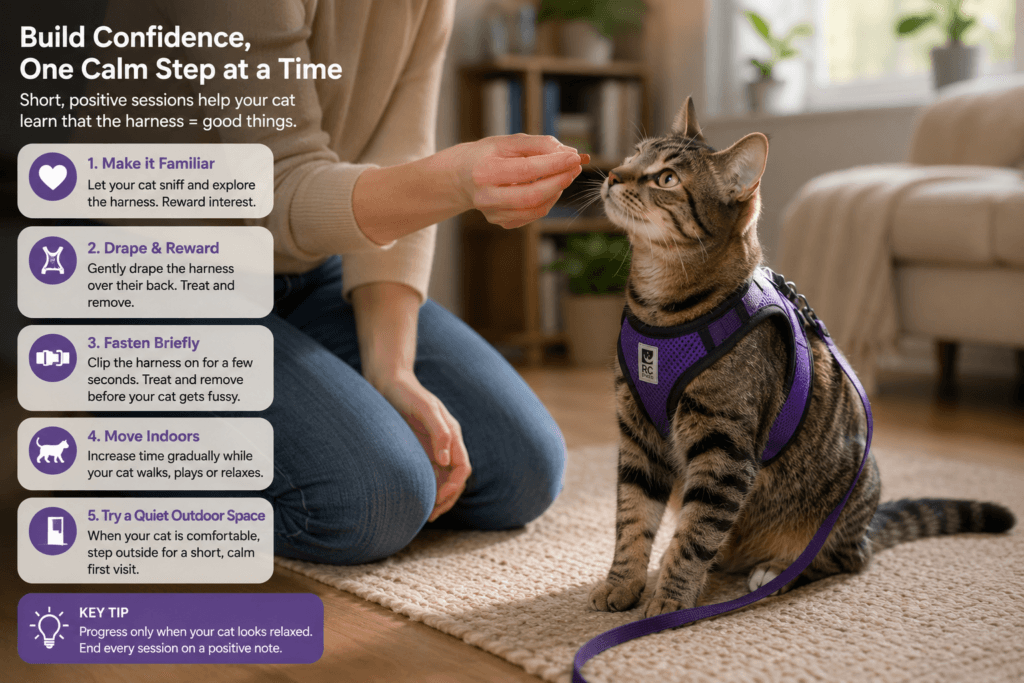
    A Better Training Plan: Follow Your Cat’s Signals, Not a Calendar

    cat-harness-training-positive-indoor-introduction.webp
    Harness confidence is built gradually: short, positive indoor sessions matter more than rushing outdoors.

    A fixed five-day plan is tempting, but cats do not all adapt on the same timeline.

    Some will accept a harness in a few sessions. Others will need weeks.

    The better approach is to progress only when your cat looks relaxed at the current step.

    Step 1: Make the harness familiar

    Leave the harness near a favorite sleeping area or feeding location. Let your cat sniff it. Reward interest with treats, play, or praise.

    Step 2: Introduce touch without fastening

    Gently lay the harness across your cat’s back or chest for a moment, then remove it before your cat becomes uncomfortable.

    Step 3: Fasten briefly indoors

    Once your cat accepts contact, fasten the harness for a short period indoors. Offer a high-value treat, then remove it calmly.

    Step 4: Build comfortable movement

    Increase the wearing time only while your cat remains relaxed. Encourage a few natural steps toward a treat or toy.

    Step 5: Add the leash indoors

    Attach the leash, but do not immediately direct your cat. Follow their movement with slack in the leash. Let them learn that the harness does not mean pressure or restraint.

    Step 6: Try a quiet outdoor threshold

    Only move outdoors once your cat is comfortable indoors. Start in a calm, enclosed or low-stimulation area. Let the cat observe, sniff, and decide the pace.

    Outdoor walking is not right for every cat. Freezing, frantic pulling, repeated attempts to escape, flattened ears, or clear distress are signals to pause—not signs that the cat needs to “get used to it.”

    Harness + Tracker: Safety Layer, Not a Reason to Take More Risk

    A harness controls the walk. A tracker helps with recovery if something goes wrong.

    They should not be treated as the same tool.

    A GPS tracker can be useful for outdoor-access cats, travel, or cats with a serious escape risk. A radio-frequency finder can be more useful for a cat likely to hide close to home.

    Do not attach a tracker in a way that obstructs the leash connection, changes the harness position or concentrates additional weight on the D-ring unless both manufacturers explicitly support that setup.

    The leash connection must remain secure and move freely.

    Only mount a tracker where the tracker manufacturer explicitly says it is safe to attach, and check that it does not pull the harness out of position or interfere with movement.

    For the technology decision, read our Best Cat Trackers guide. For Safe Zones, escape alerts, and the limits of geofencing, read our Virtual Fence Alerts for Cats guide.

    Common Harness Mistakes

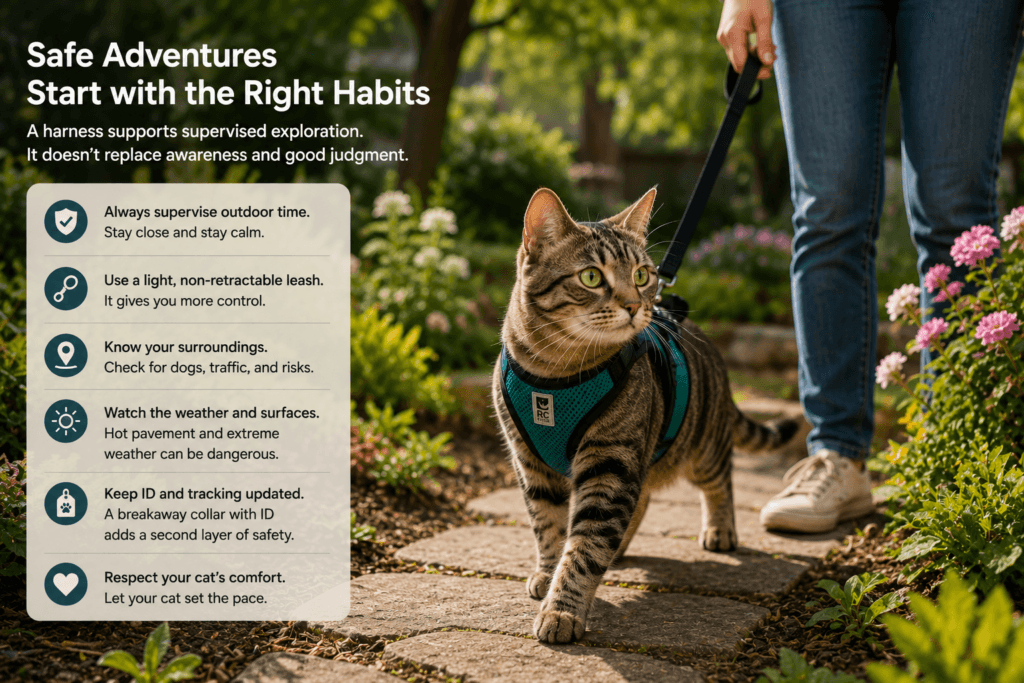
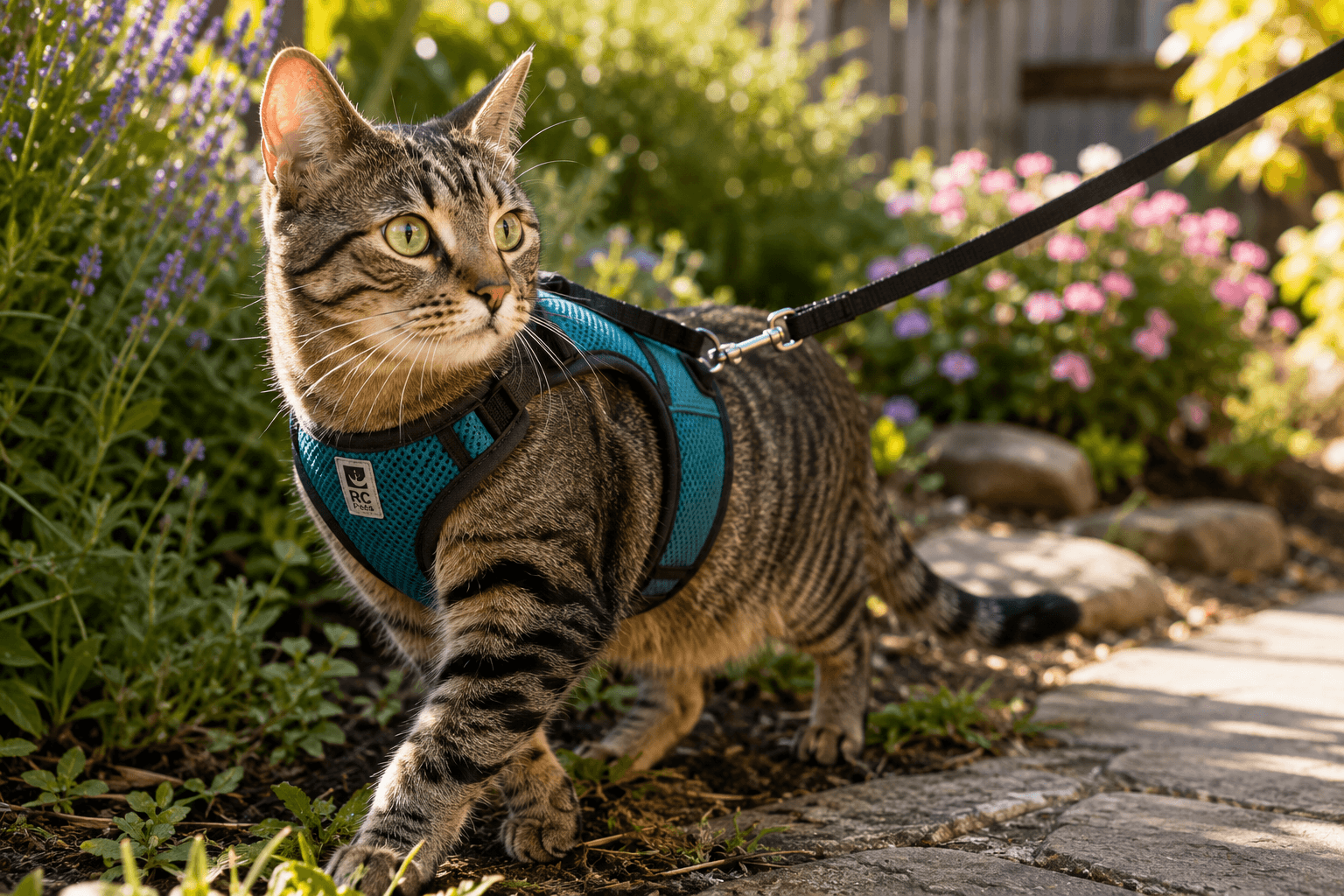
    A cat in a harness exploring a quiet garden while its owner holds a relaxed leash nearby
    A harness supports supervised exploration—it does not replace a calm environment, careful handling, or close attention to your cat’s signals.

    Treating “escape-proof” as a guarantee

    No harness removes the need for supervision, fit checks, and gradual training.

    Pulling your cat forward

    Cats usually do better when they choose the direction. Use treats, toys, and patience rather than leash pressure.

    Starting outdoors too early

    A cat that freezes indoors is not ready for a busy sidewalk, a dog park, or a new hiking trail.

    Using a retractable leash too soon

    A standard lightweight leash gives you more predictable control during early training.

    Ignoring heat and stimulation

    Warm pavement, loud traffic, dogs, bicycles, and leaf blowers can turn a calm first outing into a frightening experience.

    Frequently Asked Questions

    Are cat harnesses safe?

    Yes, when they fit correctly, are introduced gradually, and are used under supervision. A cat-specific harness with a back-mounted leash attachment is safer than walking a cat from a collar.

    What style is best for escape artists?

    A well-fitted vest with wider torso coverage is often the better starting point, but the correct fit matters more than style alone.

    Should I use a collar or harness for outdoor walks?

    Use a harness for leash walking. A breakaway collar can still carry identification, but it should not be the point where leash pressure is applied.

    Can kittens wear harnesses?

    Yes, as long as the harness is lightweight, correctly sized, and introduced slowly. Kittens may adapt more easily, but they still need short, positive sessions.

    Does every cat enjoy leash walks?

    No. Some cats enjoy safe outdoor exploration; others find it stressful. The cat’s behavior should decide whether harness walking becomes part of the routine.

    Final Verdict

    RC Pets Adventure Kitty is the strongest all-round recommendation. Kitty Holster is the better specialist choice for cats that tolerate broad vest coverage. PetSafe offers the most convincing low-bulk introduction, while Rabbitgoo is the most widely validated structured vest in the roundup.

    None is universally escape-proof. The safest harness remains the one that fits the individual cat correctly, survives an indoor backward-pressure test and is used by an owner willing to stop when the cat is uncomfortable.

    References

    • RC Pets — Adventure Kitty Harness product information
    • Kitty Holster — product, fit, and sizing guidance
    • PetSafe — Come With Me Kitty Harness and Bungee Leash information
    • San Francisco SPCA — harness and leash training guidance for cats
    • Cat Friendly Homes — gradual harness and leash introduction guidance

    Image Disclosure

    Some images in this article may be created with AI for illustrative purposes. They do not show the exact products reviewed and should not be used to evaluate product size, fit, design, or features. Always check the current official product listing before purchasing.

    Disclosure

    PetTech AI may earn a commission when readers purchase through affiliate links. That does not change how products are framed or compared. No harness is guaranteed escape-proof, and no product can replace supervision, careful fitting, gradual training, or a safe outdoor environment. Always check current sizing guidance, materials, return policies, and product specifications before purchasing.