Tag: Multi-Cat Litter Box

  • Litter-Robot 5 vs Purobot Max Pro 2: Which One Fits Your Cats?

    Litter-Robot 5 vs Purobot Max Pro 2: Which One Fits Your Cats?

    Litter-Robot 5 and PETKIT Purobot Max Pro 2 both clean automatically, track litter-box activity and promise to make cat ownership slightly less fragrant.

    They do not solve the same problem.

    Litter-Robot 5 is built to make litter management more dependable.

    It supports larger cats, works on carpet or hard flooring, uses WasteID to distinguish urine from solid waste and focuses on making the physical routine disappear into the background.

    Purobot Max Pro 2 is built to make litter-box behavior more visible.

    Its AI camera, facial recognition and individual histories are designed to answer the question a shared litter box usually hides:

    Which cat did this?

    For most households that mainly want less scooping, Litter-Robot 5 is the safer choice.

    Choose Purobot Max Pro 2 when individual identification is not merely interesting, but useful enough to change how you monitor one or more cats.

    The Purobot sees more.

    Litter-Robot 5 asks less of your attention.

    That is the decision.

    Research Note

    This is a research-led comparison based on current official product documentation, software terms and available ownership evidence.

    PetTech AI has not conducted a long-term side-by-side test of both models.

    Quick Verdict

    Your household or priorityBetter choiceWhy
    Large cat or mixed-size householdLitter-Robot 5Broader cat-size compatibility
    Up to five cats with straightforward automation needsLitter-Robot 5Larger automation-first platform
    Similar-weight cats that are difficult to identifyPurobot Max Pro 2Camera and weight data work together
    Camera-free ownershipLitter-Robot 5No integrated video monitoring
    Carpeted litter areaLitter-Robot 5More flexible floor placement
    Individual visit videos and separate timelinesPurobot Max Pro 2Visual identification and recorded context
    Owner unlikely to review app historiesLitter-Robot 5Less of its value depends on active monitoring
    Monitoring-focused PETKIT householdPurobot Max Pro 2Fits PETKIT’s broader connected-care ecosystem

    Recommendation strength

    Litter-Robot 5: Strong recommendation for automation-first households.

    Purobot Max Pro 2: Strong but conditional recommendation for owners who will genuinely use individual monitoring.

    PetTech AI may earn a commission from qualifying purchases.

    Purobot Max Pro 2 fits your household? Check current availability at PETKIT.

    As an Amazon Associate I earn from qualifying purchases.

    Prefer Amazon checkout? Check Purobot Max Pro 2 price and availability on Amazon.

    The Real Difference: Less Work or More Context?
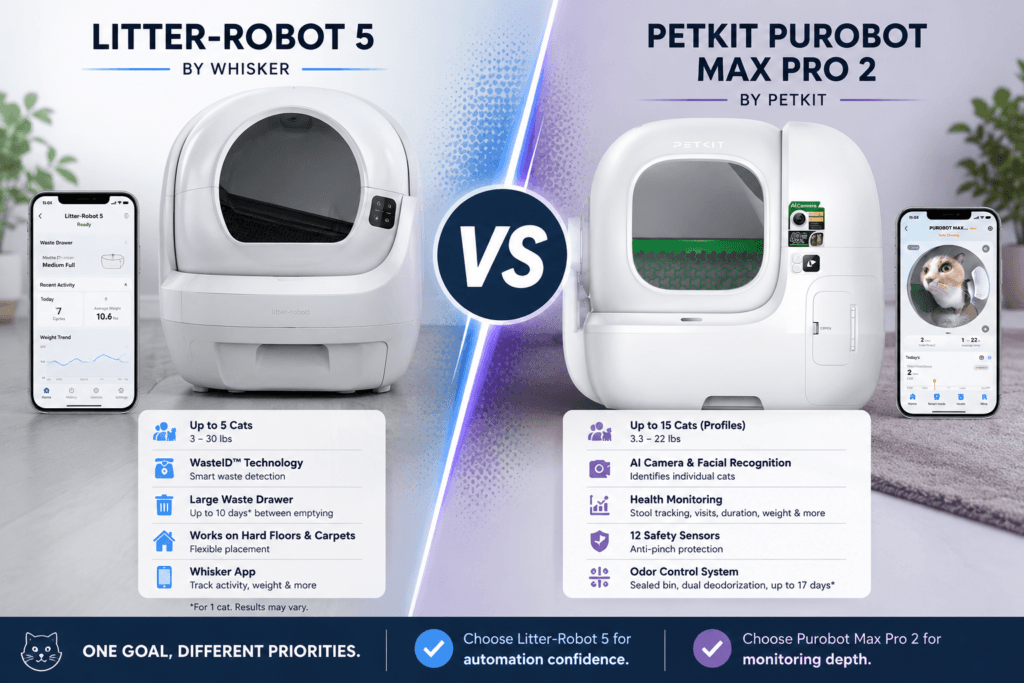
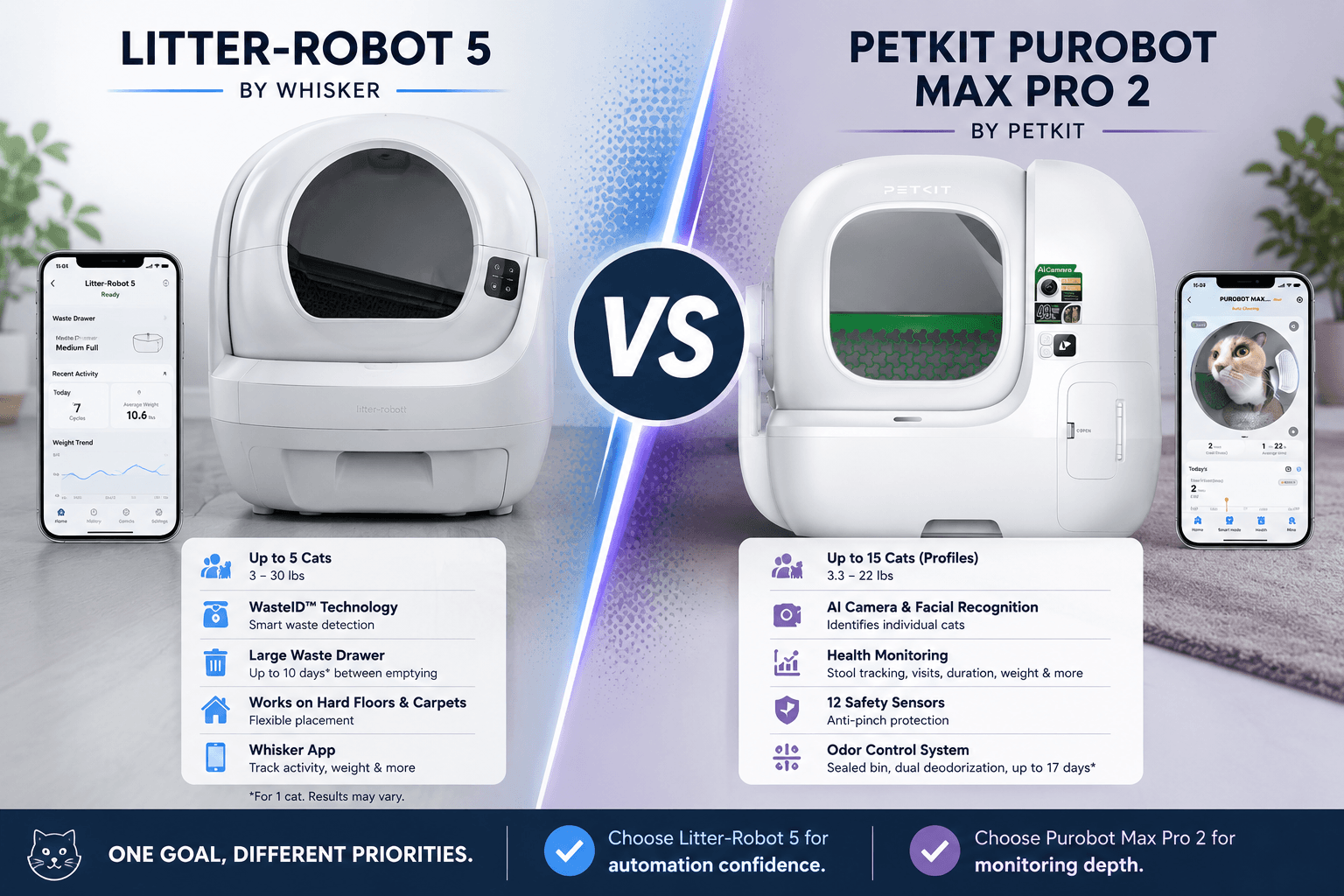
    Decision chart comparing Litter-Robot 5 automation features with PETKIT Purobot Max Pro 2 health monitoring features.

    Litter-Robot 5 uses technology primarily to improve the cleaning process.

    WasteID distinguishes urine from solid waste so the machine can apply more appropriate cycle timing. Its larger platform, waste drawer, app alerts and broad cat compatibility all support the same goal:

    Make litter management more predictable and less intrusive.

    Purobot Max Pro 2 uses technology to interpret each visit.

    Its camera and weight sensors can identify individual cats, separate their histories and record visual context around litter-box use. PETKIT also positions the system around observing changes in visit frequency, duration, stool appearance and vocalization.

    One product is trying to become a better appliance.

    The other is applying for an unpaid internship in feline behavioral observation.

    Neither approach is inherently better.

    The relevant question is what remains uncertain in your household.

    If the problem is waste management, choose the stronger appliance.

    If the problem is identifying which cat produced a change, the camera system has a clearer reason to exist.

    Who Should Choose Litter-Robot 5?

    Litter-Robot 5 is the stronger default because its value does not depend on how often you open the app.

    It supports cats across a broader size range and households with up to five cats. Its larger interior makes it the safer candidate for large or long-bodied animals, while its flexible placement is useful when the litter area includes carpet or rugs.

    Choose Litter-Robot 5 when:

    • one or more cats may be too large for the Purobot;
    • waste handling matters more than recorded video;
    • you want WasteID without cameras;
    • carpet placement is necessary;
    • your cats are easy enough to distinguish through weight data;
    • you want automation to work quietly in the background.

    This is the model for owners who want information, but do not want litter-box monitoring to become a hobby.

    The app can show weight, visits, waste type and machine status. For many households, that is enough to notice a meaningful change without reviewing footage of every ordinary event.

    Its main weakness is individual identification.

    Weight-based tracking works best when cats occupy clearly different weight ranges. When two animals weigh almost the same, the data can become less certain.

    That is where Purobot earns its place in the comparison.

    For the wider Whisker decision, read Litter-Robot 5 vs 5 Pro vs EVO.

    Who Should Choose Purobot Max Pro 2?
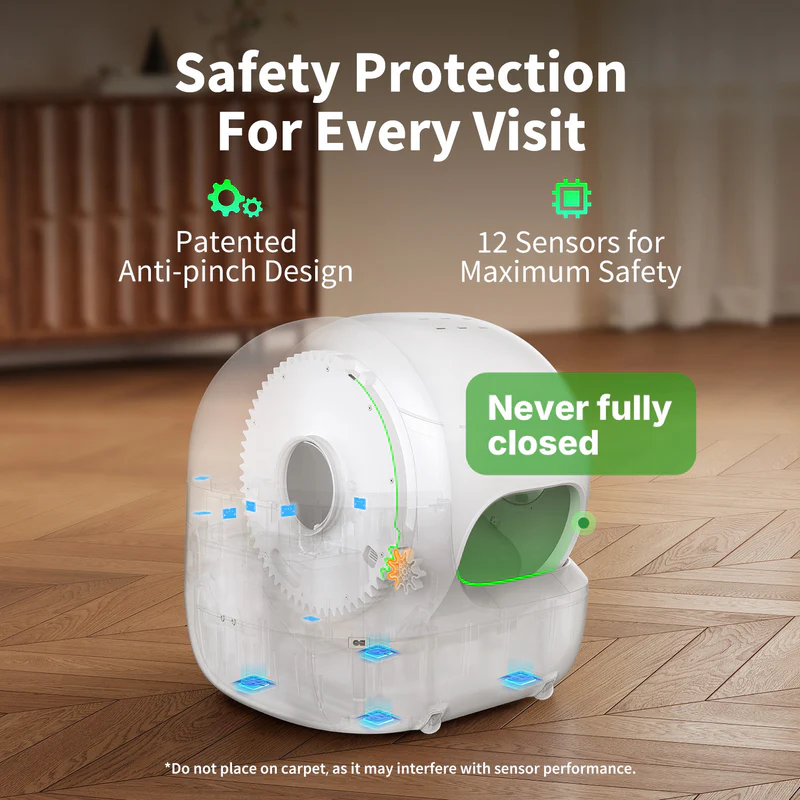
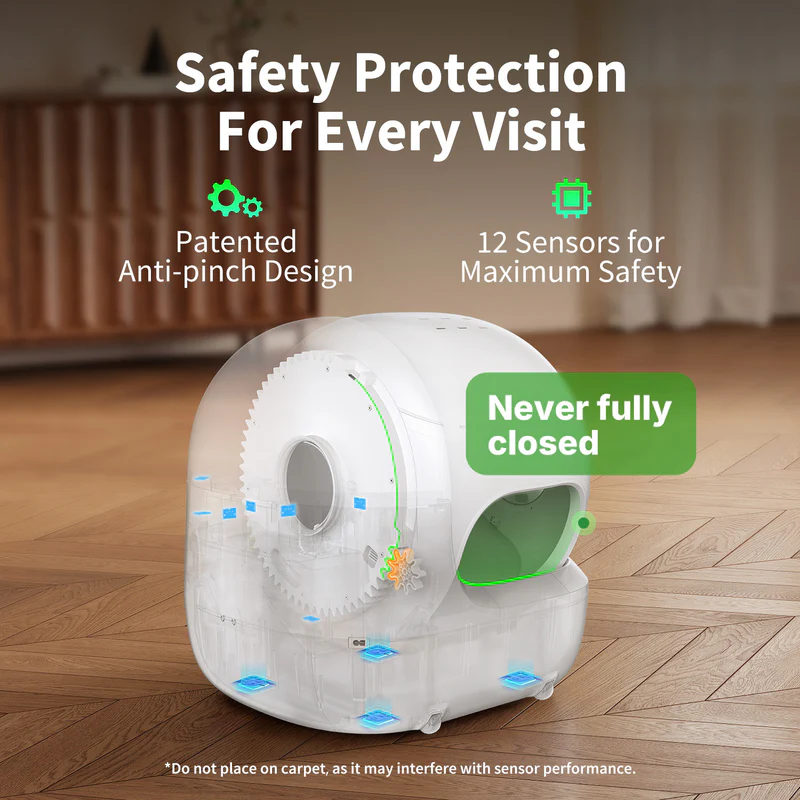
    PETKIT Purobot Max Pro 2 safety system with anti-pinch design and integrated sensors.

    Purobot Max Pro 2 is the stronger choice when a shared box is hiding information you actually need.

    Its AI camera combines visual recognition with weight data to maintain separate profiles and recorded histories.

    That can matter when:

    • two or more cats have similar weights;
    • one animal is older or requires closer observation;
    • you need to confirm which cat produced a repeated change;
    • visit videos would add useful context;
    • you already use PETKIT feeders, fountains or monitoring devices;
    • you will continue reviewing the information after the novelty disappears.

    The last point is the most important.

    Monitoring only creates value when it changes the next step.

    A useful recorded event might lead you to clean the box, adjust resource placement, watch one cat more closely or contact a veterinarian.

    An unused recorded event is simply cloud storage containing footage of a private moment nobody needed to preserve.

    Purobot is not the stronger choice because it collects more data.

    It is stronger when that data resolves ambiguity.

    For a closer analysis of PETKIT’s camera model, read Purobot Max Pro 2 Review.

    The Baron Test: Your Cat Still Gets a Vote

    Imagine Baron, a large tabby with the confidence of a minor European monarch.

    You install the Litter-Robot 5, complete the app setup and stand nearby admiring the machine you have researched for six hours.

    Baron approaches.

    He inspects the entrance.

    He looks at you.

    He turns around and uses the old plastic tray beside it.

    This is the part no comparison table can solve.

    Cat acceptance depends on:

    • entrance size and height;
    • interior room;
    • noise and movement;
    • box location;
    • litter familiarity;
    • whether the transition was gradual;
    • whether the cat considers your expensive purchase an obvious personal insult.

    Litter-Robot 5 has the advantage for exceptionally large cats because of its broader supported size range and roomier format.

    Purobot Max Pro 2 offers a relatively low-access design and an enlarged opening compared with its predecessor, which may suit some senior, short-legged or mobility-sensitive cats.

    Neither design guarantees acceptance.

    A specification can tell you that the cat should fit.

    Baron retains the constitutional right to disagree.

    Placement Matters More Than the Product Photography Suggests

    Purobot Max Pro 2 requires a firm, level surface.

    PETKIT advises against placing it directly on carpet because soft or unstable flooring can affect its weight sensors and individual tracking.

    That requirement is not a minor footnote when the only available litter area is carpeted.

    The camera system becomes considerably less impressive when the machine cannot be placed where you need it.

    Litter-Robot 5 is more flexible in this respect and can operate on carpet or hard floors.

    Choose according to the room that exists—not the immaculate laundry room used in promotional photography, where no human appears to store detergent, towels or evidence of ordinary life.

    Monitoring: Useful Insight or More Reasons to Worry?
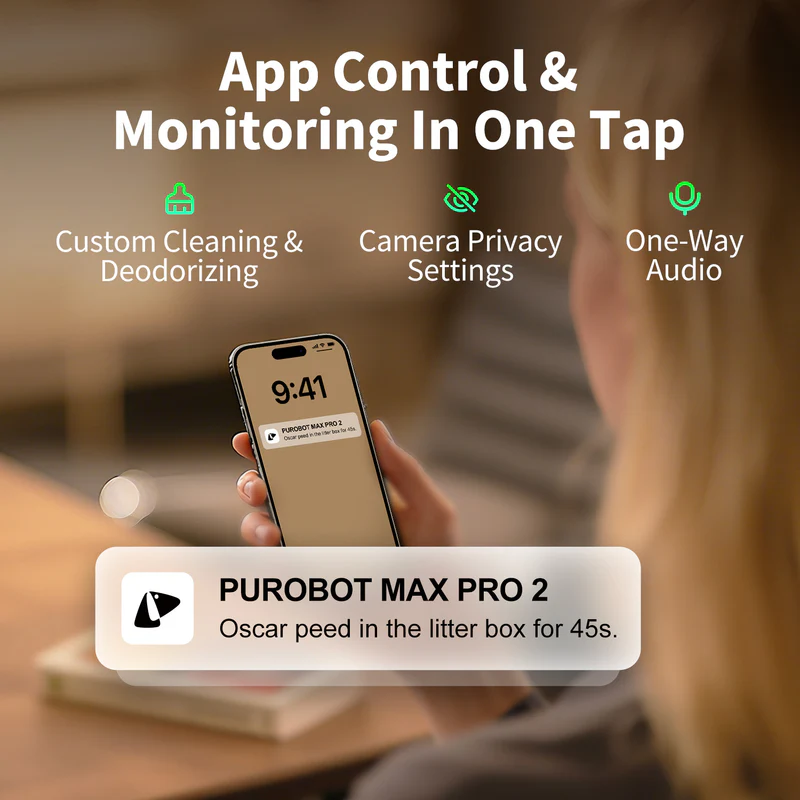
    PETKIT Purobot Max Pro 2 AI camera monitoring compared with Litter-Robot 5 app-based weight and visit tracking.

    Purobot Max Pro 2 can provide a richer record than the standard Litter-Robot 5.

    That record may include individual identification, visit video, duration, stool-related observations and unusual vocalization.

    These signals can help owners notice that something changed.

    They cannot determine why.

    A cat may visit repeatedly because of urinary discomfort, constipation, stress, litter preference, territorial tension or another cause entirely.

    The camera documents behavior.

    It does not receive a veterinary degree when connected to Wi-Fi.

    The correct response to a repeated or concerning change is:

    1. verify the pattern;
    2. observe the cat directly;
    3. consider the wider environment;
    4. seek veterinary guidance when appropriate.

    The incorrect response is interpreting every minor variation as a diagnostic event because the app supplied a graph and used the word “AI.”

    For the broader distinction between useful visibility and unnecessary data, read Smart Cat Monitoring vs Automation.

    The Whisker side of this comparison deserves a closer look because several of its most distinctive monitoring features depend on Whisker+. See our complete Litter-Robot 5 Pro review.

    Cameras, Privacy and the Premium Software Layer

    The camera is Purobot’s defining advantage and its clearest trade-off.

    PETKIT allows owners to schedule monitoring periods, pause recording or disable the camera. Buyers must still decide whether a connected camera in the litter area fits their privacy preferences.

    Turning the camera off permanently is possible.

    It also raises the reasonable question of why you purchased the camera litter box.

    Extended video history and some deeper features may depend on PETKIT’s premium service layer. That means buyers choosing Purobot for long-term visual records should consider software access as part of the ownership model—not as an optional detail discovered after checkout.

    Ask:

    • Do I need occasional visual confirmation?
    • Do I need retained histories?
    • Will I review individual timelines?
    • Would the information influence a real decision?
    • Am I comfortable with the ongoing software relationship?

    Five honest yes answers make the Purobot easier to justify.

    Five enthusiastic maybes usually mean the marketing has done more work than the household requirement.

    Odor Control and Daily Maintenance
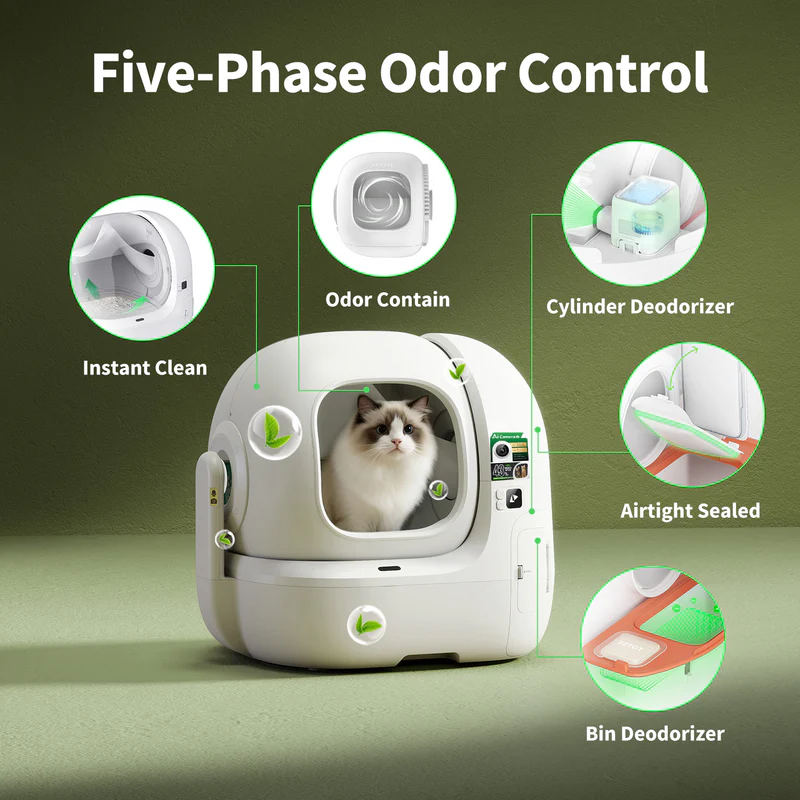
    PETKIT Purobot Max Pro 2 sealed waste bin and deodorization system for automatic litter box odor control.

    Both models remove waste from the exposed litter bed and store it in an enclosed compartment.

    Litter-Robot 5 uses WasteID, a sealed drawer, carbon filtration and optional odor-control accessories.

    Purobot Max Pro 2 combines an enclosed cylinder, sealed bin, deodorizing filters and contactless drawstring waste packing.

    Purobot offers more odor-focused hardware.

    Litter-Robot 5 offers a more familiar drawer workflow and uses WasteID to improve cycle timing.

    Neither product eliminates:

    • waste bags or liners;
    • deodorizing consumables;
    • residue inside the machine;
    • sensor cleaning;
    • periodic deeper maintenance;
    • the consequences of leaving a full drawer untouched.

    The machine can remove waste from sight.

    It cannot prevent an owner from ignoring three notifications and then blaming the carbon filter.

    Which Is Better for Multiple Cats?

    Litter-Robot 5 has the advantage when the main multi-cat problem is capacity.

    It supports up to five cats and provides a broad physical platform for mixed-size households.

    Purobot Max Pro 2 has the advantage when the main multi-cat problem is identity.

    It is particularly relevant when cats have overlapping weights or when one animal’s routine must be separated from the activity of the group.

    Three differently sized cats may be easy for weight-based tracking to distinguish.

    Two nearly identical cats may make visual recognition far more valuable.

    Cat count alone does not decide the purchase.

    The real variable is how difficult the household is to interpret.

    Neither model eliminates the possible need for additional litter stations. Automation reduces labor; it does not abolish territorial preferences because the machine has a polished app.

    Buyer Regret in One Sentence

    Litter-Robot 5 regret means discovering that weight data cannot reliably separate similar cats; Purobot regret means buying an AI monitoring system and gradually using it as a more elaborate full-drawer alert.

    Final Verdict

    Choose Litter-Robot 5 when you want broader cat compatibility, flexible floor placement, WasteID and dependable camera-free automation.

    It is the stronger recommendation for most households because its value remains clear even when nobody reviews the app every day.

    Choose PETKIT Purobot Max Pro 2 when individual identification is the unresolved problem.

    Its camera, facial recognition and event history can reveal what a shared litter box normally hides—especially when similar-weight cats make sensor-only data ambiguous.

    Litter-Robot 5 is the better appliance.

    Purobot Max Pro 2 is the better observer.

    The correct choice depends on whether you want the litter routine to become less visible or the cats using it to become more visible.

    Buy the system that resolves a real problem.

    Baron will provide enough unpredictability for free.

    For the broader brand-level decision, read PETKIT vs Litter-Robot Ecosystem.

    Frequently Asked Questions

    Is Litter-Robot 5 better than Purobot Max Pro 2?

    Litter-Robot 5 is better for larger cats, broader household capacity, carpet placement and camera-free automation.

    Purobot Max Pro 2 is better for visual multi-cat identification and recorded visit context.

    Which is better for similar-weight cats?

    Purobot Max Pro 2.

    Its camera and facial recognition add another identification layer when weight data alone is ambiguous.

    Which is better for large cats?

    Litter-Robot 5 has the broader supported cat-size range and is the safer choice for exceptionally large cats.

    Can Purobot Max Pro 2 sit on carpet?

    PETKIT recommends placing it on a firm, level surface rather than directly on carpet because unstable flooring can interfere with sensor accuracy.

    Does Litter-Robot 5 have a camera?

    No.

    Camera monitoring is available on Litter-Robot 5 Pro, not the standard Litter-Robot 5.

    Does Purobot Max Pro 2 require a subscription?

    Its core cleaning and connected features do not depend entirely on a subscription, but extended video history and deeper monitoring functions may involve PETKIT’s premium service layer.

    Can either model diagnose health problems?

    No.

    Both can reveal changes in activity, weight or litter-box behavior, but neither can diagnose the cause or replace veterinary assessment.

    References

    Whisker — Litter-Robot 5 product documentation

    Whisker — Current Litter-Robot comparison chart

    PETKIT — Purobot Max Pro 2 product documentation and FAQ

    PETKIT — PETKIT Care+ feature information

    Cornell Feline Health Center — Feline litter-box behavior and house-soiling guidance

    Image Credits

    Official PETKIT and Whisker product imagery used for editorial comparison.

    Editorial Disclosure

    PetTech AI may earn a commission from qualifying purchases. This does not influence our recommendations, comparisons or editorial judgments.
  • Purobot Max Pro 2 vs PuraMax 2: Which PETKIT Litter Box Should You Buy?

    Purobot Max Pro 2 vs PuraMax 2: Which PETKIT Litter Box Should You Buy?

    PETKIT would be delighted if you interpreted this comparison as good litter box versus better litter box.

    Your bank account deserves a more useful answer.

    PuraMax 2 and Purobot Max Pro 2 perform the same central job. Both clean automatically, contain waste, connect to the PETKIT app and reduce daily scooping.

    The difference is what happens around that job.

    PuraMax 2 is the practical automation-first choice.

    Purobot Max Pro 2 adds an AI camera, visual cat identification and recorded context around each visit.

    For most one- or two-cat homes, PuraMax 2 is enough.

    Choose Purobot Max Pro 2 when identifying individual cats is a real problem—especially when similar weights make sensor-only data ambiguous.

    The camera is not a decorative upgrade.

    It is either the reason to buy the Purobot or the reason you are about to overpay.

    Research Note

    This is a research-led comparison based on current official specifications, software information and product positioning.

    PetTech AI has not conducted a long-term side-by-side test of both models.

    Quick Verdict

    Your household or priorityBetter choiceWhy
    One cat with a predictable routinePuraMax 2Camera identification adds little
    Two cats with clearly different weightsPuraMax 2Weight-based profiles may already be sufficient
    Similar-weight catsPurobot Max Pro 2Facial recognition reduces identification ambiguity
    Individual video records matterPurobot Max Pro 2Camera adds visual context to each visit
    You dislike connected indoor camerasPuraMax 2No camera-related privacy trade-off
    You want the simpler feature setPuraMax 2Core cleaning and app functions without video monitoring
    You actively monitor an older or vulnerable catPurobot Max Pro 2Separate histories can make repeated changes easier to verify
    You rarely inspect app historiesPuraMax 2Less of its value depends on active data review

    Recommendation strength

    PuraMax 2: Strong recommendation for automation-first households.

    Purobot Max Pro 2: Strong but conditional recommendation when visual identification will change what the owner does.

    PetTech AI may earn a commission from qualifying purchases. As an Amazon Associate I earn from qualifying purchases.

    Automation is enough? Check PuraMax 2 availability at PETKIT.

    Need visual cat identification? Check Purobot Max Pro 2 availability at PETKIT.

    Prefer Amazon checkout? Check Purobot Max Pro 2 price and availability on Amazon.

    The Camera Is the Product Difference

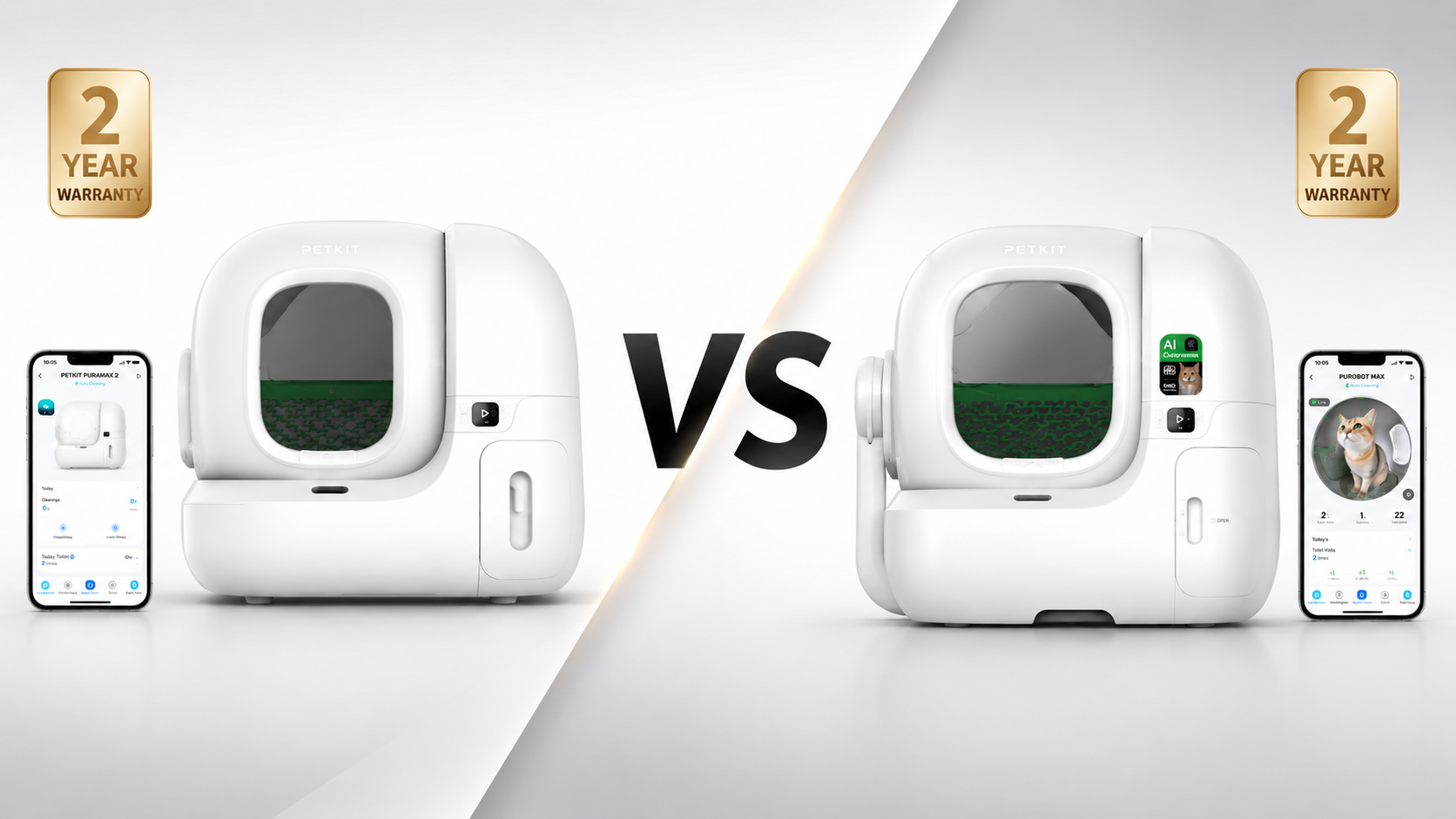
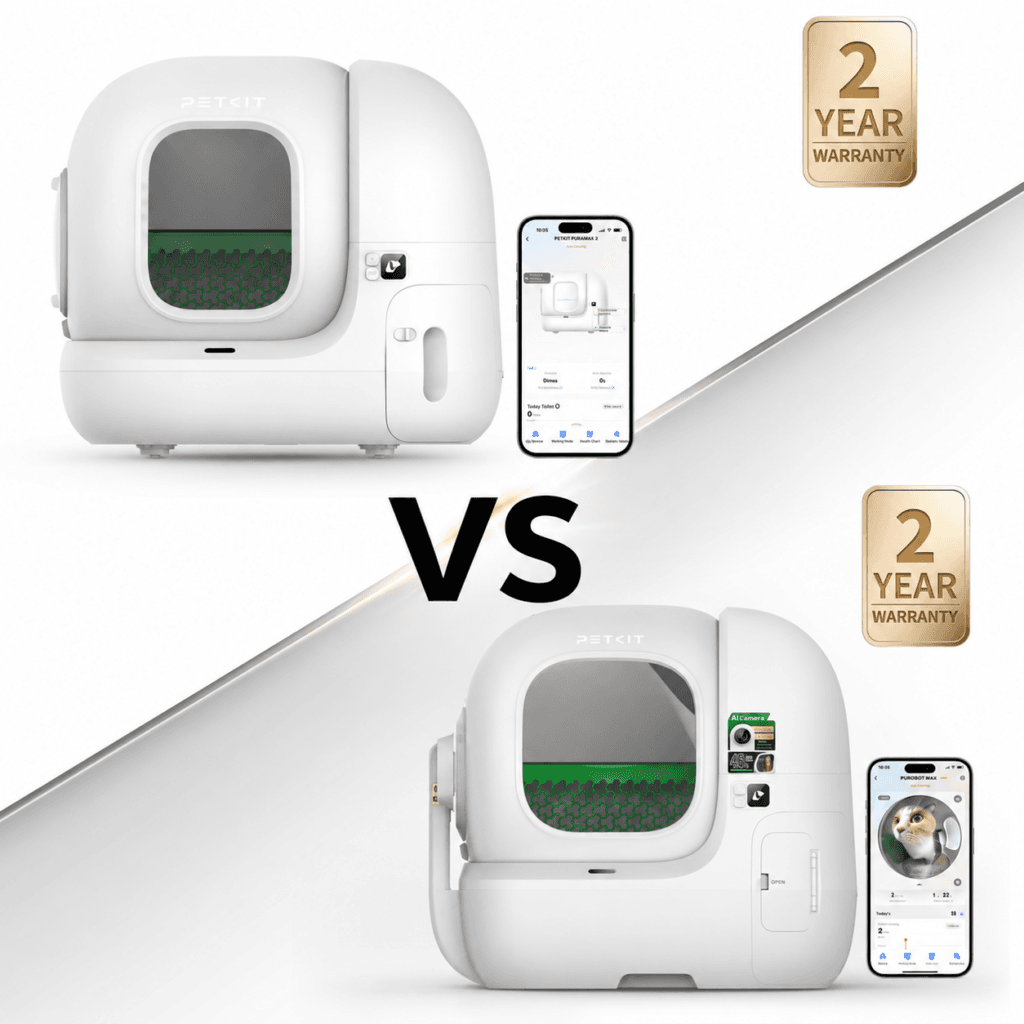
    PETKIT Purobot Max Pro 2 vs PuraMax 2 side-by-side comparison showing both self-cleaning litter boxes and their companion app interfaces.

    PuraMax 2 already handles the fundamental litter routine.

    After use, the cylinder rotates, separates clumped waste and moves it into a sealed bin. The PETKIT app provides device controls, cleaning schedules, alerts, weight information and visit records.

    Purobot Max Pro 2 starts with the same broad promise and adds a fixed AI camera.

    The camera works with weight sensing and facial recognition to create individual cat profiles, record visits and provide visual context around litter-box behavior. PETKIT also positions it around identifying changes in visit frequency, stool appearance and vocalization.

    That produces a simple distinction:

    PuraMax 2 tells you that the box was used.

    Purobot Max Pro 2 is better equipped to show which cat used it.

    In a one-cat home, this may be a brilliantly engineered answer to a question nobody asked.

    In a multi-cat home with overlapping weights, it can resolve the most important uncertainty in the room.

    Who Should Choose PuraMax 2?

    PuraMax 2 is the better fit when the owner wants cleaning automation without making video monitoring part of the routine.

    It still provides:

    • automatic cleaning;
    • sealed waste storage;
    • weight and visit information;
    • app alerts and remote controls;
    • odor-management features;
    • support for multiple cat profiles.

    The absence of a camera does not make it unintelligent.

    It means identification relies more heavily on weight data and household context.

    That works particularly well when there is one cat or when multiple cats occupy clearly different weight ranges.

    Choose PuraMax 2 when:

    • the main objective is reducing scooping;
    • weight-based profiles already distinguish the cats adequately;
    • video records would satisfy curiosity rather than guide action;
    • you prefer a camera-free litter area;
    • you want the stronger value proposition;
    • additional monitoring would create more checking than clarity.

    For a one-cat household, the Purobot can provide detailed proof that the only cat in the home was responsible.

    The investigation was not especially difficult.

    Who Should Choose Purobot Max Pro 2?

    Purobot Max Pro 2 becomes valuable when the litter box is shared and the owner needs cat-specific context.

    Its strongest use cases include:

    • similar-weight cats;
    • an older cat whose routine requires closer observation;
    • a cat with previous urinary or digestive concerns;
    • households where general box-level data cannot identify the animal involved;
    • owners who would use recorded events during a veterinary conversation;
    • existing PETKIT monitoring ecosystems.

    The important phrase is would use.

    A video matters when it helps verify a repeated change, identify the correct cat or decide what to observe next.

    It matters less when the owner opens three clips during the first week and then returns permanently to checking whether the waste bin is full.

    Purobot is not automatically the superior litter box because it gathers more information.

    It is superior when the household contains an information problem.

    For a full analysis of its camera and ownership trade-offs, read PETKIT Purobot Max Pro 2 Review.

    PETKIT’s Ultra adds automatic waste-bag sealing but also more depth and proprietary consumables. Our Purobot Ultra vs Max Pro 2 guide explains whether that upgrade is worth it.

    The Baron and Biscuit Problem

    Imagine two cats: Baron and Biscuit.

    They weigh almost the same, use the same litter box and share the unfortunate habit of conducting important business at 4:00 a.m.

    The app reports an unusually long visit.

    With PuraMax 2, weight information may help identify the cat—but overlapping measurements can leave some uncertainty.

    With Purobot Max Pro 2, facial recognition and recorded video may show that Baron entered, stayed longer than usual and returned shortly afterward.

    That is useful context.

    It does not tell you why Baron behaved differently, but it tells you which cat needs direct observation.

    Now change the household.

    There is only Baron.

    He uses the box once, looks directly into the camera with the disappointment of a landlord inspecting property damage and leaves.

    The Purobot has successfully identified him.

    The suspect pool contained one animal.

    This is why cat count alone does not justify the camera. Identification difficulty does.

    PuraMax 2 Is Smaller—but Not Dramatically Smaller

    PuraMax 2 is shorter and slightly narrower than Purobot Max Pro 2, while both have approximately the same depth.

    PuraMax 2 measures about 24.4 inches wide, 21.2 inches deep and 21.7 inches tall. Purobot Max Pro 2 measures approximately 25.9 inches wide, 21.2 inches deep and 23.7 inches tall.

    That can make PuraMax 2 easier to accommodate under shelves or in spaces with limited vertical clearance.

    It does not make the Purobot an enormous industrial installation by comparison.

    The Purobot also offers a substantially enlarged entrance compared with its predecessor. PETKIT positions the wider opening for large, senior and short-legged cats.

    Physical fit should therefore be judged using:

    • the cat’s weight and body length;
    • entrance comfort;
    • room around the machine;
    • access for bin removal;
    • space required for deep cleaning.

    Do not choose PuraMax 2 solely because an old comparison called it “compact.”

    Do not choose Purobot solely because a Maine Coon looked cooperative in the promotional photography.

    The cat has retained final approval authority.

    What Actually Stays the Same?

    PETKIT Purobot Max Pro 2 safety system featuring 12 sensors and anti-pinch protection.

    The camera receives most of the attention, but much of the ownership experience remains similar.

    Both machines still require:

    • compatible clumping litter;
    • waste bags;
    • bin emptying;
    • deodorizing consumables;
    • sensor cleaning;
    • periodic disassembly and deeper cleaning;
    • a gradual transition for the cat.

    Both also provide app-connected cleaning controls, alerts and routine information.

    The Purobot’s contactless drawstring waste system can make bin handling cleaner. Its camera and additional sensing also create more components and a more monitoring-heavy software experience.

    PuraMax 2 has the simpler feature set.

    That does not guarantee less physical maintenance.

    It means fewer decisions involve recorded video, facial recognition or premium monitoring features.

    Odor Control: Both Still Need Maintenance

    PETKIT PuraMax 2 triple odor control system with deodorizer, air purifier spray, and sealed waste bin.

    PuraMax 2 uses an enclosed cylinder, sealed waste bin and PETKIT odor-control products.

    Purobot Max Pro 2 adds a layered deodorization system around its cylinder and waste bin, alongside its contactless bag-packing design.

    The Purobot has the more elaborate odor-control hardware.

    PuraMax 2 already contains the main source of improvement: waste is removed from the exposed litter bed and stored in a closed compartment.

    Neither machine can compensate indefinitely for:

    • weak-clumping litter;
    • a full waste bin;
    • exhausted deodorizing products;
    • residue inside the cylinder;
    • poor room ventilation;
    • an owner who has dismissed four alerts as suggestions.

    The more advanced odor system may help.

    It has not repealed cleaning.

    Camera Privacy and PETKIT Care+

    Purobot’s camera can add meaningful context, but it also changes the type of product entering the home.

    PETKIT provides controls for scheduling, pausing or disabling camera functions. Owners still need to decide whether they are comfortable with a cloud-connected camera in the litter area.

    Disabling it permanently solves the privacy concern.

    It also converts the Purobot into a particularly elaborate way to avoid buying PuraMax 2.

    Extended video storage and some deeper monitoring functions may depend on PETKIT Care+. Buyers interested in long-term video histories should therefore include the software layer in the real ownership decision.

    Ask:

    • Do I need visual identification?
    • Will I review recorded events?
    • Would longer histories change what I monitor?
    • Am I comfortable with the privacy trade-off?
    • Will the feature remain useful after the novelty disappears?

    A clear yes makes the Purobot easier to defend.

    A hopeful “possibly” is how premium features acquire new homes.

    What Monitoring Can—and Cannot—Tell You

    PETKIT Purobot Max Pro 2 AI litter box monitoring with live tracking, pet recognition, and health reports.

    Purobot Max Pro 2 can provide more detailed evidence than PuraMax 2.

    It may help show:

    • which cat entered;
    • how long the visit lasted;
    • whether the cat returned repeatedly;
    • whether stool appearance changed;
    • whether unusual vocalization occurred.

    It cannot diagnose the reason.

    A repeated visit may relate to urinary discomfort, constipation, stress, litter preference, territorial tension or another condition.

    The camera records the event.

    It does not complete veterinary school during the firmware update.

    Use the information to identify patterns, observe the cat directly and seek veterinary guidance when changes are sudden, significant or persistent.

    For the broader distinction between useful monitoring and unnecessary data, read Smart Cat Monitoring vs Automation.

    Buyer Regret in One Sentence

    PuraMax 2 regret means discovering that weight data cannot reliably distinguish your cats; Purobot regret means paying for facial recognition and eventually using it as an unusually sophisticated full-bin notification.

    Final Verdict

    Choose PETKIT PuraMax 2 when the real objective is automatic cleaning, odor containment and useful app controls without camera-based monitoring.

    It is the stronger recommendation for most one-cat homes and many uncomplicated two-cat households.

    Choose PETKIT Purobot Max Pro 2 when identifying individual cats is the unresolved problem.

    Its camera, facial recognition and recorded histories can reveal what a shared litter box normally hides—particularly when similar weights make standard profiles less dependable.

    PuraMax 2 is the better default.

    Purobot Max Pro 2 is the better specialist.

    The mistake is not choosing the cheaper or simpler model.

    The mistake is paying for a camera to solve an ambiguity your household never had—or saving money when individual identification was the reason you started researching smart litter boxes.

    For the wider ecosystem decision, read PETKIT vs Litter-Robot Ecosystem.

    Buyers who are also considering Whisker can compare Purobot Max Pro 2 vs Litter-Robot 4.

    Frequently Asked Questions

    Is Purobot Max Pro 2 worth choosing over PuraMax 2?

    Yes, when facial recognition, individual video records and similar-weight cat identification solve a real monitoring problem.

    PuraMax 2 is the better value when automatic cleaning and basic app data are already enough.

    Does PuraMax 2 identify individual cats?

    It uses weight data and individual profiles.

    Identification may become less dependable when cats weigh nearly the same.

    Does PuraMax 2 have a camera?

    No.

    Purobot Max Pro 2 is the camera-equipped model.

    Which model is better for multiple cats?

    Purobot Max Pro 2 is better when individual identification matters.

    PuraMax 2 can still suit multi-cat homes when the cats fit comfortably, share the box well and have sufficiently different weights.

    Which model is smaller?

    PuraMax 2 is slightly narrower and shorter. Both models have approximately the same depth.

    The difference is useful in some rooms but not large enough to determine the purchase alone.

    Does Purobot Max Pro 2 require a subscription?

    Core cleaning and app features remain available without relying entirely on a subscription.

    Extended video history and some deeper monitoring features may depend on PETKIT Care+.

    Can either litter box detect illness?

    No.

    They can surface changes in weight or litter-box behavior, but neither can diagnose their cause or replace veterinary assessment.

    References

    PETKIT — PuraMax 2 product documentation

    PETKIT — Purobot Max Pro 2 product documentation and FAQ

    PETKIT — PETKIT Care+ feature information

    Cornell Feline Health Center — Feline litter-box behavior and house-soiling guidance

    Feline Veterinary Medical Association — Feline house-soiling guidance

    Image Credits

    Official PETKIT product images used with permission.

    Editorial Disclosure

    PetTech AI may earn a commission from qualifying purchases. This does not influence our recommendations, comparisons or editorial judgments.
  • Litter-Robot EVO Review: Smart Restraint or Expensive Compromise?

    Litter-Robot EVO Review: Smart Restraint or Expensive Compromise?

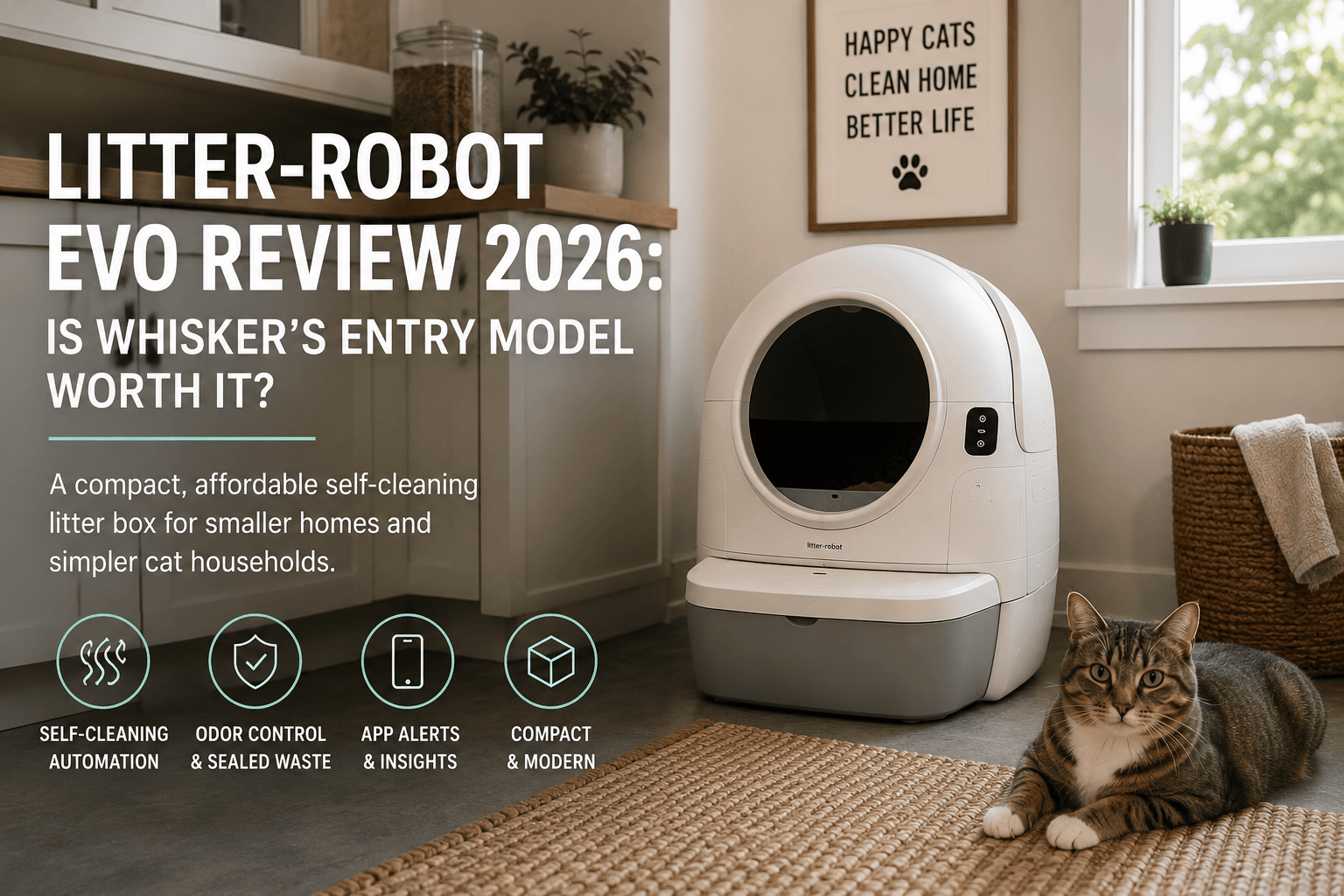
    Litter-Robot EVO is Whisker’s entry model.

    Your bank account may use a less charitable definition of “entry.”

    EVO supports fewer cats than Litter-Robot 5, has a smaller interior and skips WasteID, detailed litter-level sensing and camera-based identification.

    That does not make it the weak Litter-Robot.

    It makes it the focused one.

    For one appropriately sized cat—or two smaller cats with a predictable routine—EVO can deliver the central benefit most buyers actually want:

    Less scooping without paying for capacity and monitoring they may never use.

    The danger is buying EVO because it costs less while already suspecting that its physical or monitoring limits will become annoying.

    That is not saving money.

    It is financing the first stage of a future upgrade.

    Quick Verdict

    CategoryVerdict
    PetTech AI verdictRecommended with Conditions
    Best fitOne cat or two smaller cats in a space-conscious home
    Main advantageCompact Whisker automation without paying for the full LR5 platform
    Cat weight range3–19 lb in automatic mode
    Official household fitUp to two cats
    Main limitationSmaller interior, medium drawer and no WasteID
    Skip it whenCat size, multi-cat traffic or deeper monitoring already matters
    Best reason to buyEVO solves the whole problem—not merely the cheapest part of it

    Choose EVO when:

    • one or two cats fit comfortably;
    • space genuinely limits the purchase;
    • automatic cleaning is the main objective;
    • weight and basic visit tracking are enough;
    • the lower tier removes nothing important.

    Skip EVO when:

    • your cat is large or long-bodied;
    • more than two cats will share the unit;
    • similar-weight cats create identification problems;
    • WasteID or litter-level sensing matters;
    • Litter-Robot 5 already feels like the machine you actually want.

    Research Note

    This is a research-led review based on current official specifications, app documentation, product positioning and available ownership evidence.

    PetTech AI has not conducted a long-term hands-on test of Litter-Robot EVO.

    PetTech AI may earn a commission from qualifying purchases. As an Amazon Associate I earn from qualifying purchases.

    Prefer Amazon’s purchase route? Check Litter-Robot EVO availability and customer feedback on Amazon.

    What Are You Actually Buying?

    EVO automatically rotates after the cat exits, separates clumped waste from clean litter and deposits it into a sealed, carbon-filtered drawer.

    Through the Whisker app, owners can monitor device status, receive maintenance alerts, start cycles remotely and review weight and activity information.

    Its official specifications include:

    • support for cats weighing 3–19 lb;
    • suitability for up to two cats;
    • a 20.6-by-24.3-inch footprint;
    • 27.6-inch exterior height;
    • 14.85-inch entrance width;
    • SmartScale weight identification;
    • standard seven-day activity history;
    • notification when the waste drawer is full.

    That is enough technology to reduce daily litter work without turning the bathroom into a domestic intelligence agency.

    EVO still requires compatible litter, drawer liners, filter maintenance, periodic washing and a human willing to empty the drawer.

    “Self-cleaning” means the machine handles most scooping.

    It does not mean Whisker has accepted full legal responsibility for the bathroom.

    When EVO Is the Smart Purchase

    EVO works when its missing features are genuinely unnecessary.

    A one-cat home may not need support for five cats.

    A smaller room may benefit more from a reduced footprint than from Litter-Robot 5’s additional capacity.

    An owner who mainly wants to know whether the box is operating and whether the cat is using it may not need WasteID, long-term behavioral histories or cameras recording every visit from two angles.

    EVO is therefore strongest for:

    • one average-sized cat;
    • two smaller cats with manageable litter traffic;
    • apartments and compact utility rooms;
    • first-time automatic-litter-box buyers;
    • owners prioritizing labor reduction over detailed monitoring.

    This is sensible restraint when the household already fits.

    It becomes technological poverty only when the buyer pretends obvious limitations will somehow develop new features after delivery.

    Cat Size Matters More Than the Published Weight Limit

    Whisker supports cats between 3 and 19 lb in automatic mode, but body shape matters as much as weight.

    EVO has approximately 14.5 inches of interior headroom, compared with 17.5 inches on Litter-Robot 5. Its entrance is also narrower, although its 5.6-inch step is lower than the step on the larger models.

    A tall, broad or long-bodied cat may feel restricted before reaching 19 lb.

    The product page can confirm whether Archibald falls inside the published range.

    It cannot persuade him that the accommodation is spacious.

    Choose Litter-Robot 5 instead when:

    • the cat already looks large relative to enclosed boxes;
    • extra interior room reduces acceptance risk;
    • future weight gain could push the cat near EVO’s ceiling;
    • you would spend the first month wondering whether the cat appears cramped.

    For a rejected product, the lower purchase tier provides extremely poor value.

    Two Cats Can Work—But “Up to Two” Is Not a Magic Spell

    Whisker positions EVO for as many as two cats.

    That does not mean every two-cat household will experience the same ownership routine.

    Two cats create:

    • more frequent cycles;
    • faster drawer filling;
    • greater pressure on one shared resource;
    • more weight-identification ambiguity;
    • more opportunities for one cat to discourage the other.

    EVO works best when both cats:

    • fit comfortably;
    • have distinguishable weights;
    • already share litter resources without tension;
    • do not overwhelm the medium drawer;
    • have access to another box when needed.

    Whisker estimates that one-cat households may empty EVO’s drawer about once every seven days. Actual frequency will vary with cat size, litter and individual use. Litter-Robot 5 has a larger drawer and is positioned for up to five cats.

    An automatic box reduces scooping.

    It does not repeal the social politics of a multi-cat household.

    Monitoring: Enough for Routine, Not Enough for Forensics

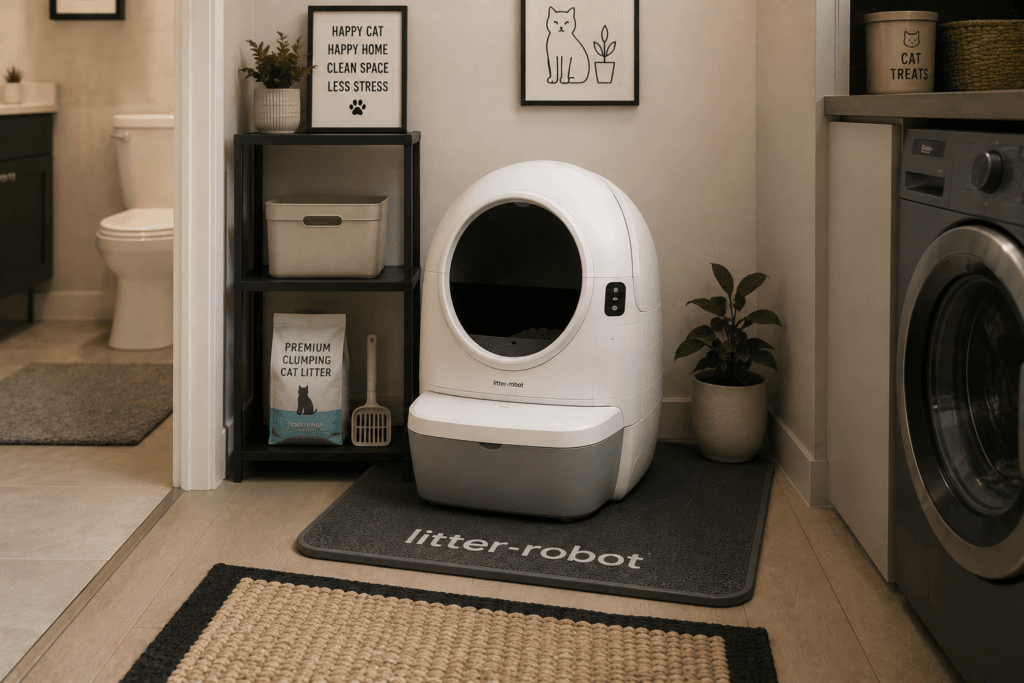
    A compact apartment litter area with a Litter-Robot EVO style automatic litter box placed neatly in a small room
    EVO makes the most sense when space matters and the household does not need the most advanced monitoring package.

    EVO includes SmartScale weight identification and a standard seven-day activity history.

    That can help answer basic questions:

    • Is the cat using the box?
    • Has the recorded weight changed?
    • Did the normal routine shift?
    • Is the drawer full?

    What EVO does not provide is WasteID, which distinguishes urine from solid waste on Litter-Robot 5 and 5 Pro.

    Its drawer sensing is also simpler: EVO notifies when the drawer is full, while the more advanced models monitor changing waste levels.

    SmartScale identification can also become less reliable when two cats have similar weights or produce incomplete measurements.

    EVO therefore offers useful routine visibility.

    It is not the right model for owners who already know they need more detailed individual interpretation.

    For the broader distinction between removing work and collecting behavioral evidence, read our Smart Cat Monitoring vs Automation guide.

    Does EVO Need Whisker+?

    No.

    Automatic cleaning, standard app controls, SmartScale information and the basic recent history remain available without membership.

    Whisker+ adds:

    • daily activity summaries;
    • historical visit frequency and duration;
    • access to as much as two years of activity history;
    • enhanced reporting across compatible Whisker devices.

    The subscription currently costs $7.99 monthly or $79.90 annually after the trial, although service terms can change.

    The correct question is not whether longer histories sound responsible.

    It is:

    Will reviewing them change anything you do?

    If persistent patterns would guide environmental changes or an appropriate veterinary conversation, the history can be useful.

    If the subscription mainly preserves two years of Napoleon conducting routine business, the free layer will probably survive the loss.

    Odor Control and Daily Ownership

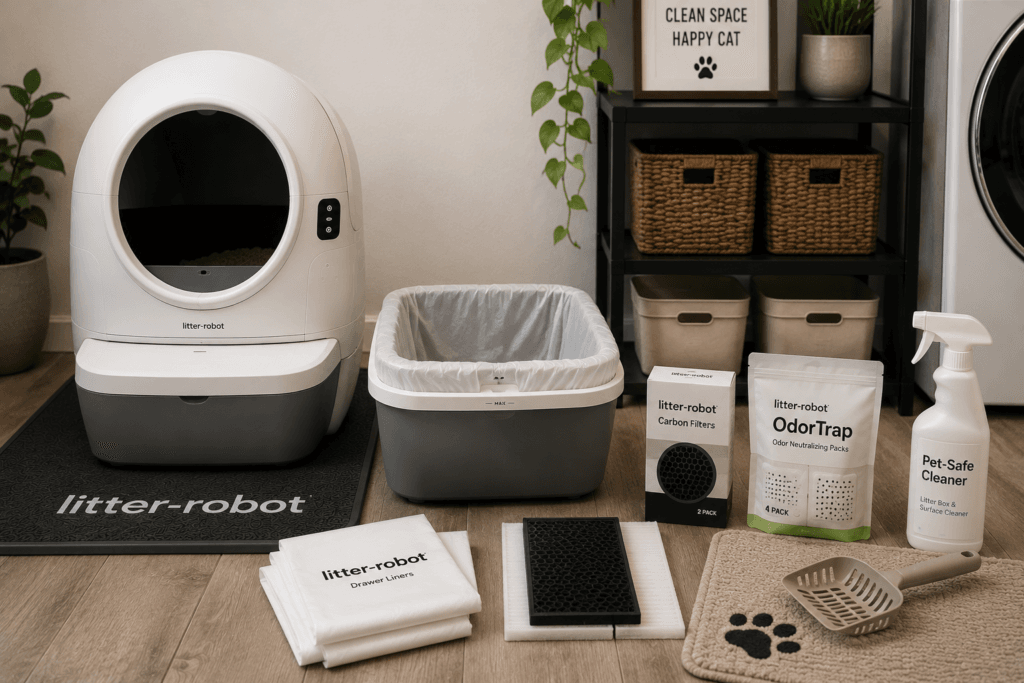
    A clean litter box maintenance area with drawer liners, carbon filters, litter mat and cleaning supplies arranged neatly
    EVO reduces daily scooping, but odor control still depends on liners, filters, litter quality, drawer emptying and regular cleaning.

    EVO removes waste from the exposed litter bed and stores it in a sealed drawer with a carbon filter.

    That can reduce odor compared with a manual box that is not scooped promptly.

    It cannot overpower:

    • a full drawer;
    • poor clumping litter;
    • residue inside the globe;
    • neglected liners;
    • exhausted filters;
    • weak room ventilation.

    Whisker recommends replacing carbon filters and optional OdorTrap packs approximately every two to four weeks for stronger odor absorption, although real frequency depends on household use.

    The carbon filter supports the maintenance routine.

    It does not absolve the household from participating in it.

    EVO changes frequent scooping into more structured work:

    • empty the drawer;
    • inspect the liner;
    • add litter;
    • wipe contact areas;
    • deep-clean the removable components periodically.

    For many owners, that is a worthwhile improvement.

    It is still ownership—not emancipation.

    EVO vs Litter-Robot 5

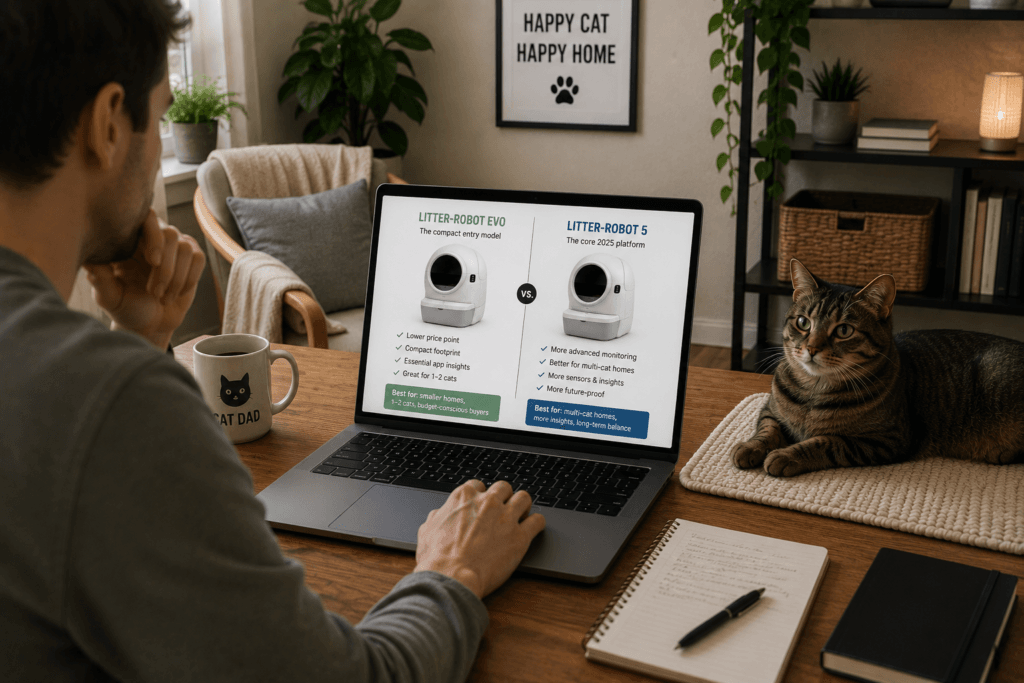
    A cat owner comparing Litter-Robot EVO and Litter-Robot 5 options on a laptop while a cat sits nearby
    EVO is the simpler entry model; Litter-Robot 5 is the stronger long-term balance if you want more monitoring and future-proofing.

    This is the comparison that should decide the purchase.

    PriorityEVOLitter-Robot 5
    Smaller footprintBetterLarger
    Cat capacityUp to 2Up to 5
    Cat weight3–19 lb3–30 lb
    Interior headroom14.5 in17.5 in
    Waste drawerMediumExtra large
    WasteIDNoYes
    Litter-level sensingNoYes
    Standard activity history7 days7 days
    Whisker+ compatibleYesYes

    Choose EVO when the smaller platform completely solves the household problem.

    Choose Litter-Robot 5 when:

    • the cat is larger;
    • more than two cats will use it;
    • the larger drawer matters;
    • WasteID adds useful context;
    • litter-level sensing reduces maintenance uncertainty;
    • future flexibility has a credible use—not an imaginary one.

    Litter-Robot 5 is the more capable machine.

    EVO can still be the more intelligent purchase.

    Buying unused capacity is not future-proofing merely because a product page used an arrow pointing upward.

    For the complete lineup decision, read our Litter-Robot 5 vs 5 Pro vs EVO comparison.

    Still comparing the wider market rather than only Whisker models? Read our Best Smart Litter Boxes guide for alternatives organized by cat size, household load and monitoring needs.

    Considering a lower-cost PETKIT platform against Whisker’s established hardware? Read our PETKIT PuraMax 2 vs Litter-Robot 4 comparison.

    Buyer-Regret Risk

    EVO regret has one dominant cause:

    Buying the lower tier while already knowing the household needs the higher one.

    Warning signs include:

    • the cat is close to the weight ceiling;
    • the entrance already looks restrictive;
    • the home has two heavy users;
    • you care about waste type;
    • similar weights make identification important;
    • Litter-Robot 5 keeps returning to the shortlist.

    EVO is not a bargain when every decision point ends with:

    “It should probably be fine.”

    “Probably fine” is how Emperor Maximilian acquires a very expensive object he refuses to enter.

    Final Verdict

    Litter-Robot EVO earns a Recommended with Conditions verdict.

    It is a strong fit for one cat—or two smaller, compatible cats—when space matters and automatic cleaning is the main objective.

    Its lower tier is justified because it removes capacity and monitoring features that many simpler households do not need.

    Its limitations are also real:

    • 19-lb automatic-mode ceiling;
    • smaller interior;
    • medium drawer;
    • maximum two-cat positioning;
    • no WasteID;
    • simpler waste monitoring.

    Choose EVO when those limits already fit comfortably.

    Skip it when they look like compromises before checkout.

    The smartest purchase is not automatically the most advanced Litter-Robot.

    It is the least expensive model that solves the entire problem without quietly creating the next one.

    Frequently Asked Questions

    Is Litter-Robot EVO worth it?

    Yes, for one or two appropriately sized cats when compact placement and automatic cleaning matter more than WasteID, larger capacity or cameras.

    How many cats can use Litter-Robot EVO?

    Whisker positions EVO for up to two cats. Two-cat households should expect more frequent drawer emptying and should still provide enough litter resources.

    What cat weights does EVO support?

    Automatic mode supports cats weighing between 3 and 19 lb. Long or large-bodied cats may still prefer the larger interior of Litter-Robot 5.

    Does EVO require Whisker+?

    No. Core operation, standard app controls, alerts and recent activity information remain available without membership.

    Does EVO have WasteID?

    No. WasteID is available on Litter-Robot 5 and 5 Pro.

    References

    • Whisker — Litter-Robot EVO product documentation
    • Whisker — Current Litter-Robot comparison chart
    • Whisker — Whisker app documentation
    • Whisker — Whisker+ membership information

    Image Disclosure

    Any AI-generated images are editorial illustrations only. They do not represent exact dimensions, entrance size, internal space or app performance. Always verify current specifications before purchasing.

    Editorial Disclosure

    PetTech AI may earn a commission from qualifying purchases. This does not influence our recommendations, comparisons or editorial judgments.
  • PETKIT PuraMax 2 vs Litter-Robot 4: Is Whisker Worth the Premium?

    PETKIT PuraMax 2 vs Litter-Robot 4: Is Whisker Worth the Premium?

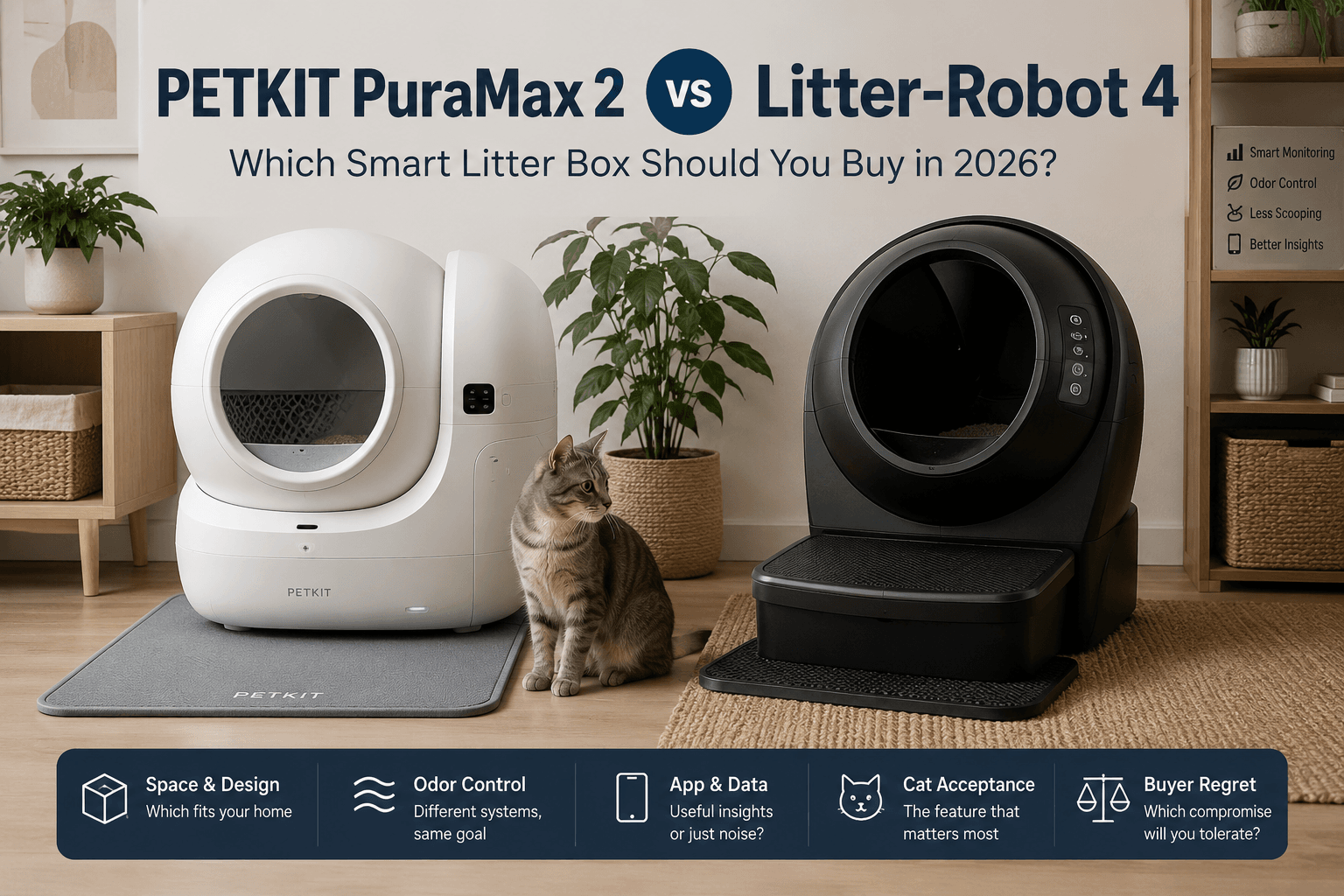
    PETKIT PuraMax 2 vs Litter-Robot 4 looks like a contest between the value challenger and the established premium choice.

    That framing is convenient for Whisker—and potentially expensive for everyone else.

    Both machines automate the same unpleasant transaction: your cat creates a problem, the globe rotates and you deal with the consequences later.

    The differences are physical and financial.

    PuraMax 2 offers the stronger value for many one- or two-cat homes.

    Litter-Robot 4 becomes the better purchase when its larger entrance, higher cat-weight limit, four-cat capacity and established support platform solve a problem PETKIT does not.

    The question is not which company has won more internet arguments.

    It is:

    Will your household actually use enough of Litter-Robot 4’s advantages to justify paying the Whisker premium?

    Quick Verdict

    CategoryPETKIT PuraMax 2Litter-Robot 4
    PetTech AI verdictStrong Recommendation for ValueRecommended with Conditions
    Best fitOne or two average-sized catsLarger cats and heavier multi-cat households
    Main advantageStrong automation at a substantially lower typical costLarger opening, broader physical capacity and mature platform
    Cat weight range3.3–22 lb3–25 lb
    Best space advantageShorter and shallowerNarrower body and larger entrance
    Main limitationSmaller opening and less established ownership ecosystemPremium is difficult to justify for simpler households
    Choose it whenPrice-to-function matters mostPhysical fit and platform confidence matter most

    Choose PuraMax 2 when your cats fit comfortably, the household is not unusually demanding and you would rather pay for automation than brand reassurance.

    Choose Litter-Robot 4 when a larger cat, three- or four-cat traffic, a much wider opening or Whisker’s trial and support system materially reduces buyer risk.

    Litter-Robot 4 is not a bad value because it costs more.

    It becomes a bad value when you pay for advantages your home never uses.

    Research Note

    This is a research-led comparison based on current official specifications, app documentation, product positioning and available ownership evidence.

    PetTech AI has not conducted a long-term side-by-side hands-on test of both machines.

    PetTech AI may earn a commission from qualifying purchases. As an Amazon Associate I earn from qualifying purchases.

    Does PuraMax 2 fit your cats and room? Check PuraMax 2 through PETKIT.

    Does the larger Whisker platform solve a real constraint? Check Litter-Robot 4 availability on Amazon.

    The Real Difference: Value vs Physical Headroom

    PuraMax 2 and Litter-Robot 4 both separate clumped waste from clean litter, store it in an enclosed drawer and connect to an app for remote controls, maintenance alerts and routine tracking.

    The buying decision begins after those shared functions.

    PuraMax 2 prioritizes:

    • compact vertical dimensions;
    • broad litter compatibility;
    • sealed waste storage;
    • PETKIT app integration;
    • automated deodorization;
    • a lower typical purchase threshold.

    Litter-Robot 4 prioritizes:

    • a substantially larger entrance;
    • support for heavier cats;
    • official use for up to four cats;
    • detailed waste and litter-level sensing;
    • a mature accessory and support environment;
    • a 90-day in-home trial.

    Whisker is not charging more for identical plastic wearing a bow tie.

    Its advantages are real.

    They are simply unnecessary for a large portion of ordinary households.

    Why PuraMax 2 Is the Better Value for Most Smaller Homes

    PETKIT PuraMax 2 self-cleaning litter box in a modern home setup
    PuraMax 2 is the stronger fit for buyers who want compact premium litter automation inside the PETKIT ecosystem.

    PuraMax 2 supports cats from 3.3 to 22 lb and provides a 76-liter cylinder with a 7-liter waste bin. PETKIT says the bin can last up to approximately 15 days for one cat, although real frequency depends on litter-box traffic and environmental conditions.

    Its exterior measures approximately:

    • 24.4 inches wide;
    • 21.2 inches deep;
    • 21.7 inches tall.

    That makes it considerably shorter and shallower than Litter-Robot 4, although it is slightly wider.

    PuraMax 2 is the stronger decision when:

    • one or two cats use the box;
    • every cat remains comfortably below 22 lb;
    • room depth or vertical presence is limited;
    • PETKIT feeding or hydration products already use the app;
    • purchase value matters more than maximum physical flexibility;
    • a wider Whisker support ecosystem adds little practical benefit.

    The PETKIT app can also manage compatible feeders, fountains and litter boxes, making PuraMax 2 more attractive inside a broader connected-care setup.

    For a closer evaluation of the machine itself, read our PETKIT PuraMax 2 Review.

    PuraMax 2 does not win merely because it is cheaper.

    It wins when Litter-Robot 4 would charge the household more for capacity, opening size and institutional confidence it does not need.

    Whisker’s reputation has value.

    It has not yet been classified as a second cat.

    When Litter-Robot 4 Is Worth Paying More For

    Litter-Robot 4 supports cats from 3 to 25 lb and is officially positioned for households with as many as four cats. Its entrance measures 15.75 inches across, while its exterior footprint is 22 by 27 inches with a height of 29.5 inches.

    Those numbers create a meaningful advantage for:

    • large or long-bodied cats;
    • cats uncomfortable with narrower enclosed entrances;
    • three- or four-cat households;
    • heavier litter-box traffic;
    • buyers who value Whisker’s established troubleshooting history;
    • households likely to use accessories such as LitterHopper.

    Whisker also backs its automatic litter boxes with a 90-day in-home trial and a standard one-year warranty. Returns under the trial require the buyer to cover return shipping, but the trial still lowers the risk of discovering that Emperor Maximilian rejects the machine after a lengthy internal review process.

    Litter-Robot 4 therefore becomes easier to justify when the premium purchases fit, capacity or reduced adoption risk.

    It becomes harder to justify when one average-sized cat uses the box and PuraMax 2 already fits the room.

    For buyers considering Whisker’s newer lineup, read our Litter-Robot 5 vs 5 Pro vs EVO comparison before assuming LR4 remains the automatic choice.

    Space and Entry: Neither Machine Is Simply “Smaller”

    PuraMax 2 is shorter and shallower.

    Litter-Robot 4 is narrower.

    PuraMax 2 measures roughly 24.4 by 21.2 by 21.7 inches. Litter-Robot 4 measures 22 by 27 by 29.5 inches.

    That creates two different placement advantages:

    • choose PuraMax 2 when room depth or overall height is the problem;
    • choose Litter-Robot 4 when horizontal width is tighter.

    Entry access also favors Whisker.

    PuraMax 2 has an entrance around 7.87 by 10.03 inches with a 7.87-inch threshold. Litter-Robot 4 provides a 15.75-inch opening and an included step approximately 6.9 inches high.

    PuraMax 2 should therefore not be recommended automatically for mobility-limited cats simply because the entire machine looks lower.

    Cats with joint pain, impaired mobility or strong enclosure aversion may still prefer a genuinely low-sided conventional box.

    The app can document rejection with impressive precision.

    It cannot negotiate acceptance.

    Odor Control and Ongoing Consumables

    A clean litter room setup with a sealed waste drawer, litter mat, cleaning tools and air purifier nearby
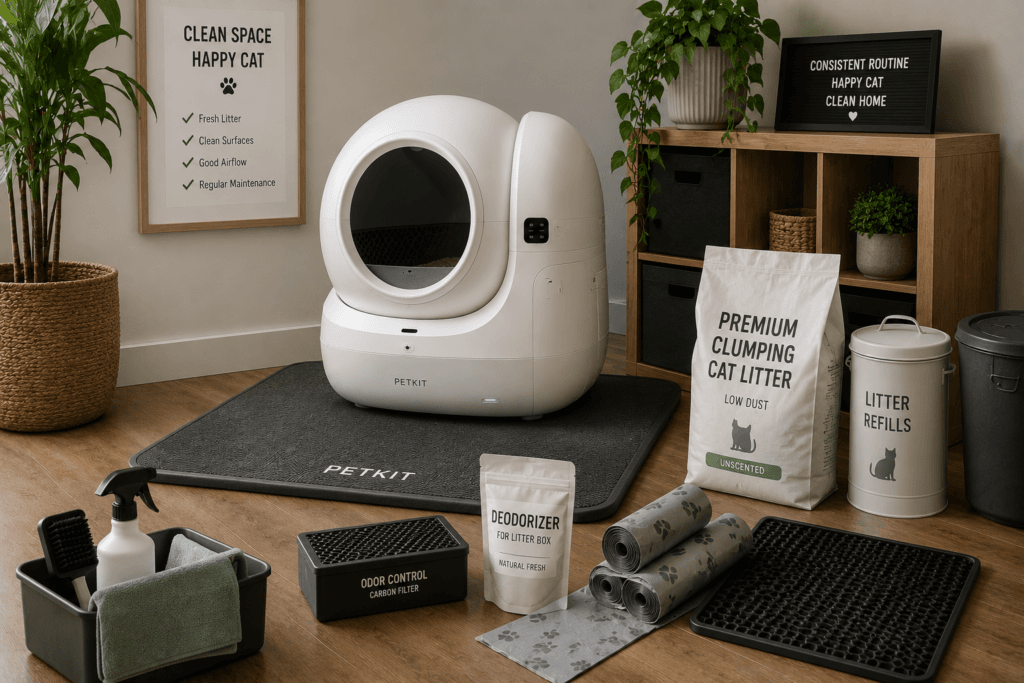
    Odor control depends on the whole litter routine: waste storage, liners, litter quality, cleaning and airflow all matter.

    Both products remove waste from the exposed litter bed and contain it in an enclosed compartment.

    PuraMax 2 uses a sealed waste bin alongside PETKIT’s N50 2.0 odor eliminator and a smart deodorizing spray. PETKIT states that the N50 unit lasts up to approximately one month, while the liquid spray typically lasts 40–60 days depending on use.

    Litter-Robot 4 uses a sealed, carbon-filtered waste drawer and supports optional OdorTrap packs.

    Neither model is consumable-free.

    The systems simply sell different objects that eventually need replacing.

    Real odor control still depends heavily on:

    • litter quality;
    • drawer-emptying frequency;
    • clump formation;
    • residue inside the globe;
    • periodic cleaning;
    • room ventilation.

    The sealed drawer performs most of the unglamorous work.

    The branded deodorizer then arrives to collect partial credit and future orders.

    App Data: Useful, but Not a Diagnosis

    PuraMax 2 records visits, duration and weight through the PETKIT app. Litter-Robot 4 uses SmartScale and the Whisker app to track weight, activity, waste status and maintenance information.

    PETKIT has the stronger ecosystem argument when the home already contains connected feeders or fountains.

    Whisker offers the more focused litter-first environment and a larger established Litter-Robot ownership base.

    Neither app can determine why a cat’s behavior changed.

    The devices may help reveal:

    • more frequent visits;
    • weight movement;
    • reduced box use;
    • changes between cats;
    • unusual activity timing.

    Those are signals, not diagnoses.

    A meaningful or persistent change should lead to direct observation and veterinary assessment when appropriate—not a ceremonial refreshing of the dashboard.

    For the wider distinction, read our Smart Cat Monitoring vs Automation guide.

    Buyer-Regret Risk

    A cat owner comparing two smart litter box options on a laptop while a cat sits nearby in a modern home
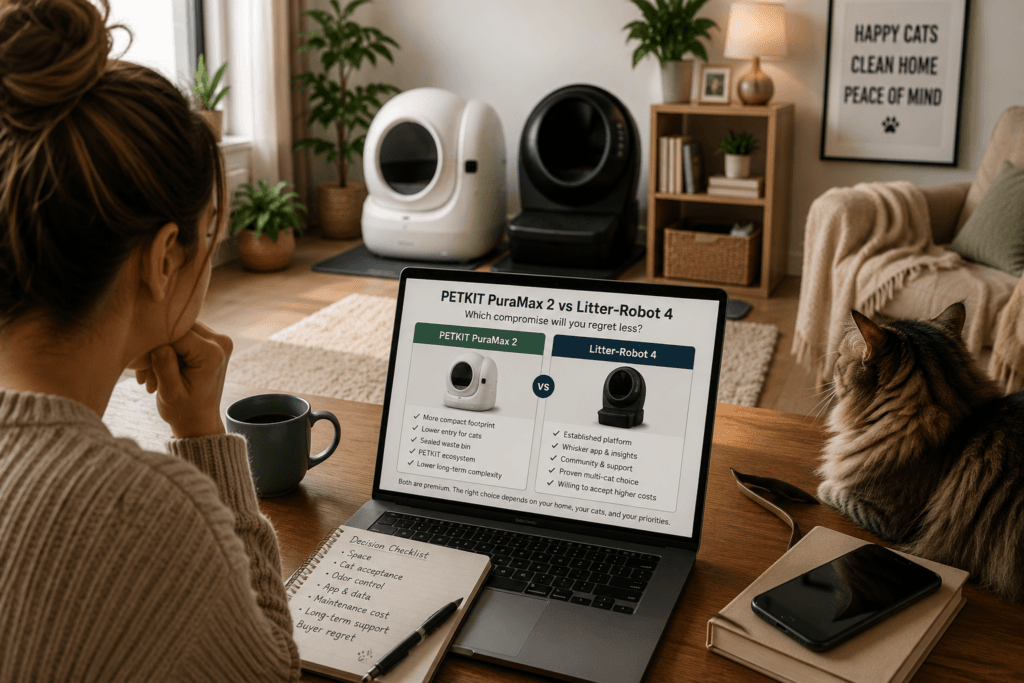
    Buyer regret usually comes from choosing the wrong compromise—not from either litter box being objectively bad.

    PuraMax 2 regret usually means discovering that the cat needed a larger opening or the household needed more physical capacity.

    Litter-Robot 4 regret usually means paying a substantial premium for platform confidence, extra room and support benefits that remained mostly theoretical.

    The safest decision follows one rule:

    Pay for the constraint your household actually has.

    Choose LR4 because Archibald is large, the home has four cats or the trial meaningfully reduces risk.

    Do not choose it merely because the established brand feels emotionally safer.

    That is not product selection.

    It is premium anxiety management with a waste drawer.

    Final Verdict

    PETKIT PuraMax 2 earns a Strong Recommendation for Value.

    It is the more rational purchase for many one- or two-cat homes whose cats fit comfortably inside its physical limits. It provides strong core automation, a shorter and shallower design, app monitoring and effective waste containment without demanding the full Whisker premium.

    Litter-Robot 4 earns a Recommended with Conditions verdict.

    It is the better machine for larger cats, heavier multi-cat use, entrance-sensitive cats and buyers who place genuine value on Whisker’s mature platform and 90-day trial.

    Litter-Robot 4 is more established.

    PuraMax 2 is frequently the better deal.

    The correct purchase depends less on which brand inspires the most confidence and more on whether your cats will use the additional capacity you are buying.

    For the wider brand decision, read our PETKIT vs Litter-Robot Ecosystem comparison.

    Still deciding among the wider market rather than these two machines? Read our Best Smart Litter Boxes guide.

    Frequently Asked Questions

    Is PuraMax 2 better than Litter-Robot 4?

    PuraMax 2 offers better value for many one- or two-cat households. Litter-Robot 4 is the stronger fit for larger cats, up to four cats and buyers who value Whisker’s mature platform.

    Which model takes up less space?

    PuraMax 2 is shorter and shallower but slightly wider. Litter-Robot 4 is narrower but significantly deeper and taller.

    Which model has the larger entrance?

    Litter-Robot 4. Its 15.75-inch opening is substantially larger than the PuraMax 2 entrance.

    Which is better for multiple cats?

    Litter-Robot 4 is the safer choice for three- or four-cat homes. PuraMax 2 can work well for smaller multi-cat households when every cat fits comfortably and waste traffic remains manageable.

    Can either litter box detect health problems?

    No. Both can highlight changes in weight or litter-box activity, but neither can diagnose their cause.

    References

    • PETKIT — PuraMax 2 product specifications
    • PETKIT — PuraMax 2 app and support documentation
    • Whisker — Litter-Robot 4 product specifications
    • Whisker — Current Litter-Robot comparison chart
    • Whisker — Whisker app and in-home trial documentation

    Image Disclosure

    Official manufacturer images are used when depicting the exact products.

    Any AI-generated images are editorial illustrations only. They do not represent exact dimensions, entrance size, controls or app performance. Always verify current specifications before purchasing.

    Editorial Disclosure

    PetTech AI may earn a commission from qualifying purchases. This does not influence our recommendations, comparisons or editorial judgments.
  • PETKIT PuraMax 2 Review: Premium Automation or Expensive Bathroom Appliance?

    PETKIT PuraMax 2 Review: Premium Automation or Expensive Bathroom Appliance?

    The PETKIT PuraMax 2 does not diagnose diseases, film your cat or automatically seal its own trash bags.

    It cleans the litter after most visits, contains waste and tells you when something requires attention.

    In the current pet-tech market, this almost qualifies as admirable restraint.

    PuraMax 2 is PETKIT’s strongest default automatic litter box for buyers who want solid core automation without paying for the cameras and deeper monitoring found in the Purobot lineup.

    Its main appeal is simple:

    It removes daily scooping without requiring the litter box to become a surveillance platform.

    That makes it an excellent fit for many one- or two-cat households.

    It becomes a weaker choice for very large cats, cats uncomfortable with enclosed interiors, monitoring-first owners or anyone expecting “self-cleaning” to mean “I never touch this object again.”

    Quick Verdict

    CategoryVerdict
    PetTech AI verdictStrong Recommendation for Value
    Best fitOne or two average-sized cats needing dependable litter automation
    Main advantageStrong core cleaning, sealed waste storage and useful app control
    Cat weight range3.3–22 lb
    Main limitationEnclosed interior and no camera-based identification
    Not forLarge-bodied cats, kittens under the supported limit or monitoring-first households
    Best reason to buyYou want PETKIT automation without paying for footage you may never watch

    Choose PuraMax 2 when automatic cleaning is the main problem.

    Choose a Purobot model when visual identification changes what you can understand about individual cats.

    Choose something larger or more open when physical acceptance is uncertain.

    PuraMax 2 is not PETKIT’s most technically ambitious litter box.

    For most buyers, that is part of the recommendation.

    Research Note

    This is a research-led review based on current official specifications, product documentation, software information and available ownership evidence.

    PetTech AI has not conducted a long-term hands-on test of PuraMax 2.

    PetTech AI may earn a commission from qualifying purchases. As an Amazon Associate I earn from qualifying purchases.

    Does PuraMax 2 fit your cats and household? Check PuraMax 2 through PETKIT.

    Prefer Amazon’s purchase route? Check PuraMax 2 availability and customer feedback on Amazon.

    What PuraMax 2 Actually Does

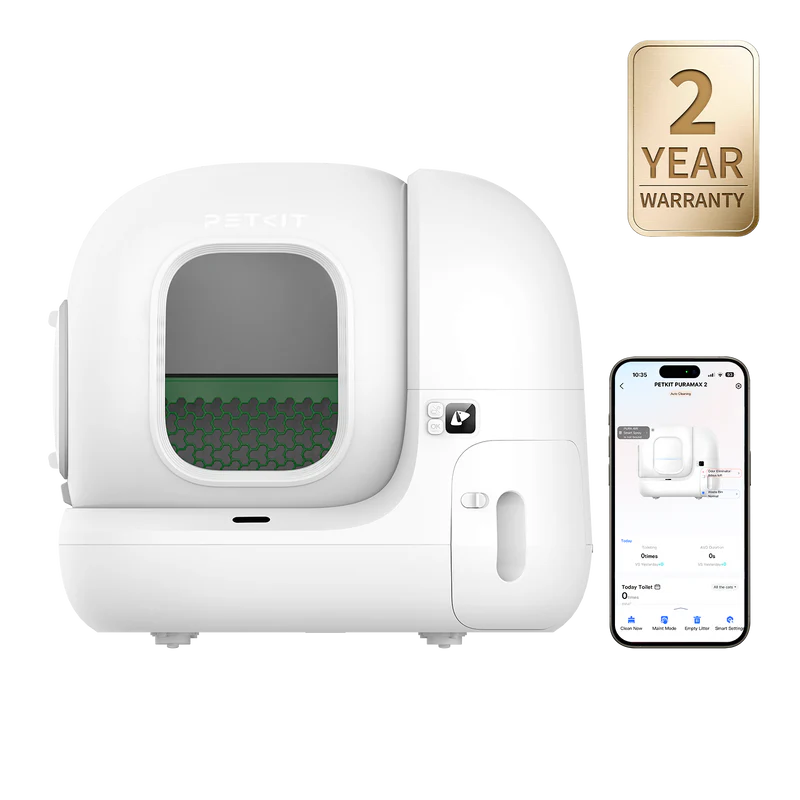
    After the cat exits, PuraMax 2 rotates its cylinder, separates clumped waste from clean litter and deposits the waste into a sealed 7-liter bin.

    PETKIT states that the bin can provide up to approximately 15 days of waste capacity in a one-cat household under its test conditions. Real frequency depends on the cat, litter, environment and how optimistic the owner becomes after reading “15 days.”

    The machine also provides:

    • automatic and scheduled cleaning;
    • manual cycling;
    • waste-bin alerts;
    • visit and weight records;
    • deodorization controls;
    • offline operation using saved settings;
    • app management through 2.4 GHz Wi-Fi.

    The app does not transform the litter box into a medical instrument.

    It gives owners a more organized view of routine use and machine status.

    That is enough when the main objective is reducing labor.

    Why It Is the Best Default PETKIT Litter Box

    PETKIT now offers several camera-led Purobot models.

    Those products make sense when the unresolved question is:

    “Which cat used the box, and what happened during the visit?”

    PuraMax 2 answers a different question:

    “Can the machine clean reliably enough that I stop scooping several times per day?”

    Its simpler role creates several advantages:

    • fewer connected layers;
    • no indoor camera;
    • no video subscription decision;
    • less footage to review;
    • a lower-complexity ownership proposition;
    • integration with the wider PETKIT app.

    This is why it remains the better default for most PETKIT buyers.

    A camera can be useful.

    It can also produce forty clips of Napoleon completing routine business while the owner develops an unpaid second career in litter-box cinematography.

    For the direct decision, read our Purobot Max Pro 2 vs PuraMax 2 comparison.

    Physical Fit: Shorter Does Not Mean Tiny

    PETKIT PuraMax 2 diagram showing 76-liter interior and 7.87-inch entrance threshold
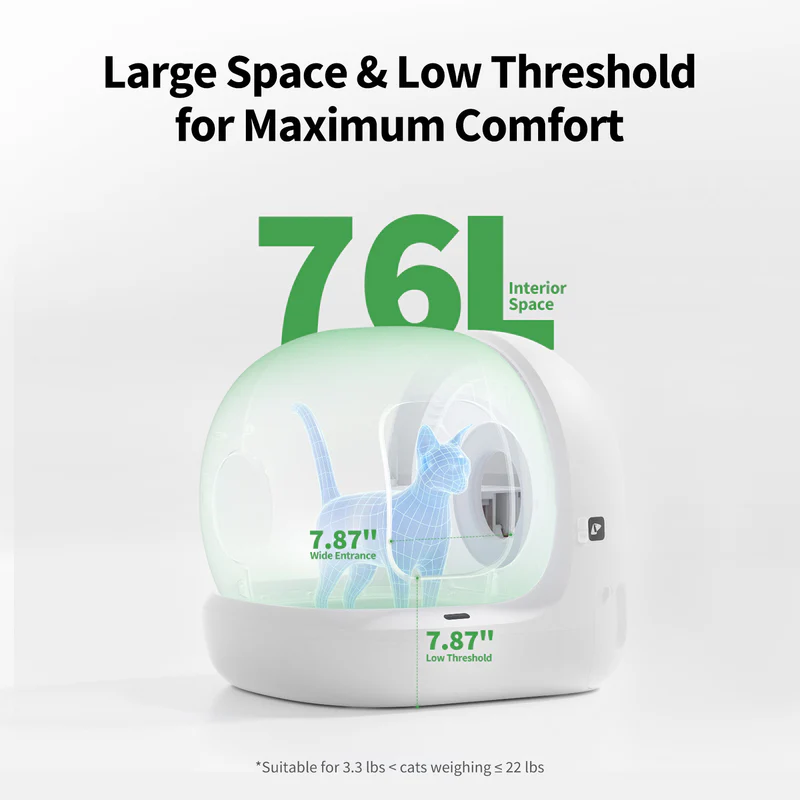
    PETKIT lists a 76-liter interior and a 7.87-inch entrance threshold, supporting cats from 3.3 to 22 pounds. Official PETKIT image.

    PuraMax 2 measures approximately 24.41 inches wide, 21.18 inches deep and 21.73 inches tall. It weighs about 22 lb and has an entrance threshold around 7.87 inches high. PETKIT supports cats from 3.3 to 22 lb.

    Its shape is shorter and shallower than several competing globe-style litter boxes, but it remains a large appliance.

    Measure enough space for:

    • comfortable entry;
    • waste-drawer removal;
    • litter refilling;
    • side-panel access;
    • cylinder removal during cleaning;
    • separation from the wall.

    PETKIT requires a hard, level surface and recommends leaving approximately two inches between the unit and surrounding walls. Soft carpet or uneven flooring can interfere with the weight sensors.

    This matters because the app relies partly on the scale beneath the machine.

    Putting the litter box on a soft rug and then complaining that the weight records are inconsistent is the pet-tech equivalent of installing bathroom scales on a trampoline.

    Is It Suitable for Large Cats?

    Cat exiting the PETKIT PuraMax 2 automatic self-cleaning litter box
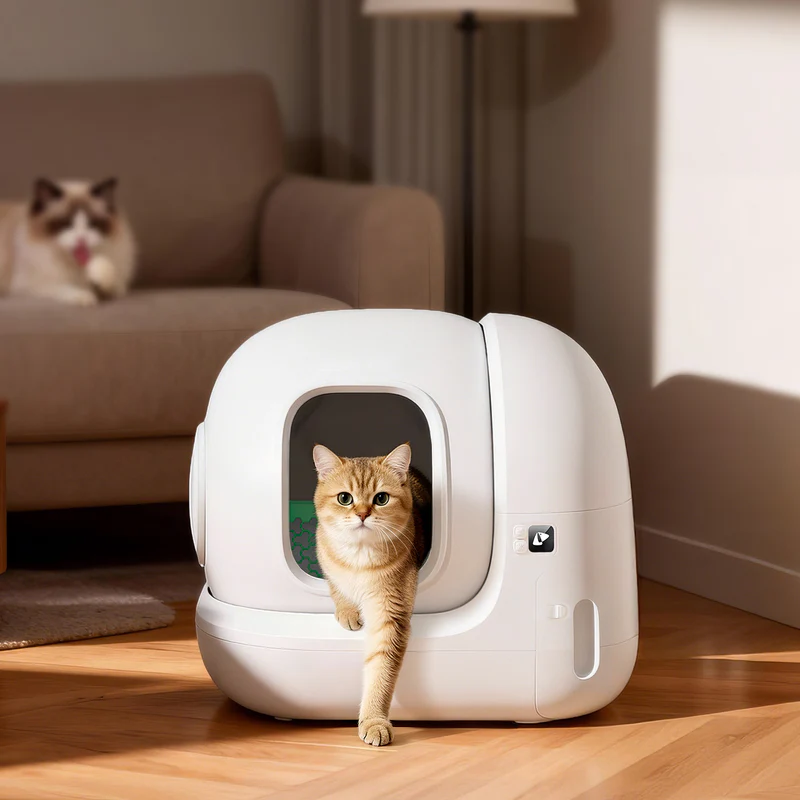
    The enclosed PETKIT PuraMax 2 is designed for cats that comfortably accept covered litter boxes and its raised entrance. Official PETKIT image.

    PETKIT lists a 76-liter interior and a supported weight range up to 22 lb.

    That does not guarantee comfort for every cat near the upper limit.

    Body length, height, preferred posture and tolerance for enclosed boxes matter as much as weight.

    PuraMax 2 is a better fit when:

    • the cat already accepts covered litter boxes;
    • the cat can turn and position comfortably;
    • the 7.87-inch threshold is manageable;
    • the interior does not appear restrictive.

    Consider a larger-opening alternative when:

    • the cat is particularly tall or long-bodied;
    • enclosed boxes are routinely rejected;
    • mobility is limited;
    • the cat approaches the 22-lb ceiling;
    • you already suspect that physical fit will be marginal.

    A premium return caused by predictable geometry is still a premium return.

    For a comparison against a larger Whisker design, read our PETKIT PuraMax 2 vs Litter-Robot 4 guide.

    Safety and Kitten Restrictions

    PuraMax 2 uses an entrance designed to remain open during rotation and includes 11 safety sensors, including proximity and weight detection. PETKIT says the machine pauses when a cat is nearby or inside.

    PETKIT does not recommend normal use for cats younger than six months or weighing less than 3.3 lb.

    The app includes a Kitten Protection Mode that disables automatic and periodic cleaning, but very small cats should still be supervised and the machine should not be trusted to detect weight below its stated operating range.

    Safety features reduce risk.

    They do not eliminate the need to:

    • place the machine correctly;
    • inspect sensors;
    • supervise the transition;
    • keep automatic cycling disabled for unsupported kittens;
    • confirm that the unit pauses as expected;
    • keep cables away from chewing.

    “Eleven sensors” is reassuring.

    It is not permission to stop looking at the machine forever.

    Litter Compatibility

    PuraMax 2 includes two interchangeable sifters.

    PETKIT says the standard sifter supports larger particles such as tofu and mixed litter, while the honeycomb version is intended for finer bentonite, mineral or clay litter. Both require clumping litter, and PETKIT advises against particles longer than approximately 12 millimeters.

    The important word is clumping.

    Non-clumping litter cannot form the solid waste masses the machine needs to separate effectively.

    Actual performance also depends on:

    • clump speed;
    • clump firmness;
    • dust levels;
    • particle size;
    • whether waste sticks to the liner;
    • whether the cat covers what it produces.

    PETKIT includes a Waste Covering Mode intended to reduce streaking by redistributing litter before the cleaning cycle. It may help, but softer stool and poor covering can still produce residue.

    Artificial intelligence has not yet solved wet feces.

    PuraMax 2 wisely does not pretend otherwise.

    PuraMax 2 supports different litter types through its interchangeable sifters; our litter for PETKIT and other automatic boxes guide explains when clay, tofu and mixed formulas make sense.

    Odor Control: Strong Containment, Ongoing Consumables

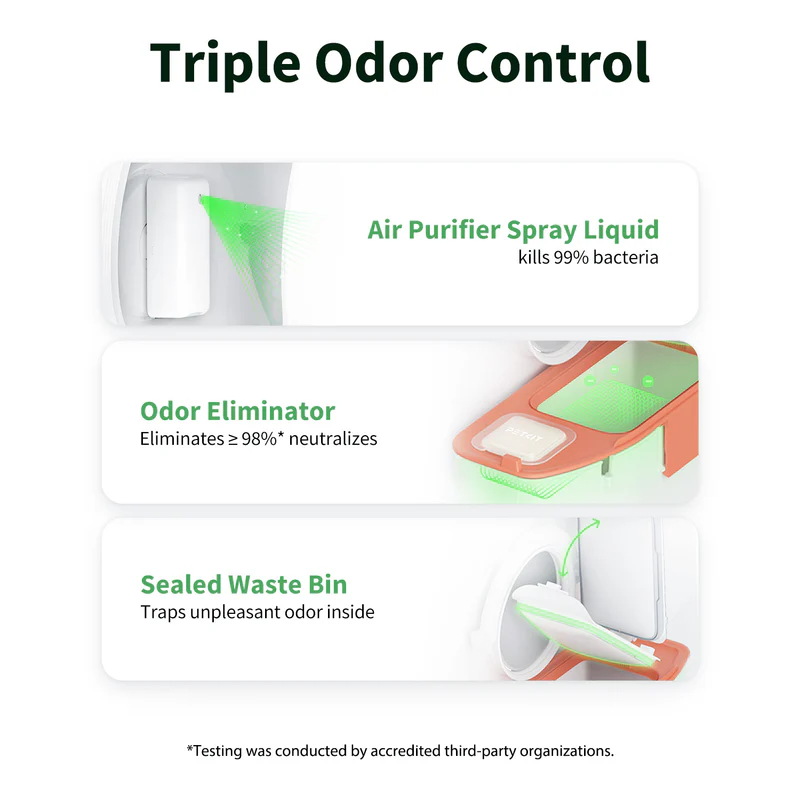
    PETKIT PuraMax 2 triple odor-control system with purifier spray, odor eliminator and sealed waste bin
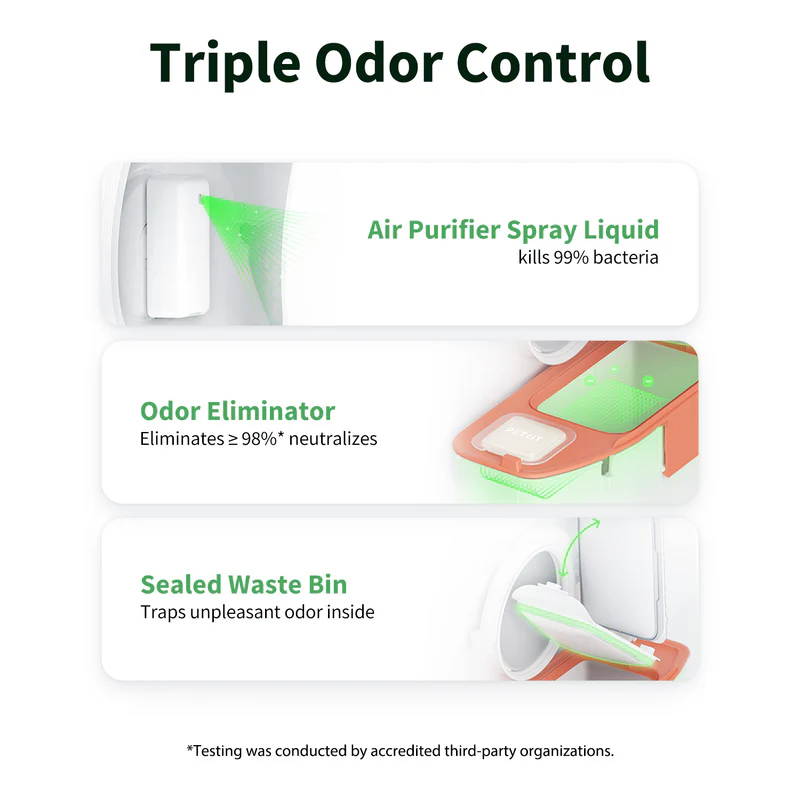
    PETKIT’s odor-control system combines purifier spray, a replaceable odor eliminator and a sealed waste bin. Performance claims shown are provided by the manufacturer.

    PuraMax 2 combines three odor-control elements:

    • a sealed waste bin;
    • the replaceable N50 2.0 odor eliminator;
    • compatibility with PETKIT’s app-controlled Air Purifier Smart Spray.

    PETKIT states that N50 2.0 lasts up to approximately one month, while a bottle of purifying liquid typically lasts 40–60 days depending on use.

    The sealed bin is the most important part of this system.

    The consumables support it.

    Real odor performance will still depend on:

    • litter quality;
    • how quickly clumps form;
    • drawer-emptying frequency;
    • residue inside the cylinder;
    • liner condition;
    • ventilation;
    • the number of cats using the box.

    The deodorizer cannot compensate indefinitely for a full drawer.

    It is odor control, not diplomatic immunity for neglected waste.

    App Monitoring: Useful, Not Medical

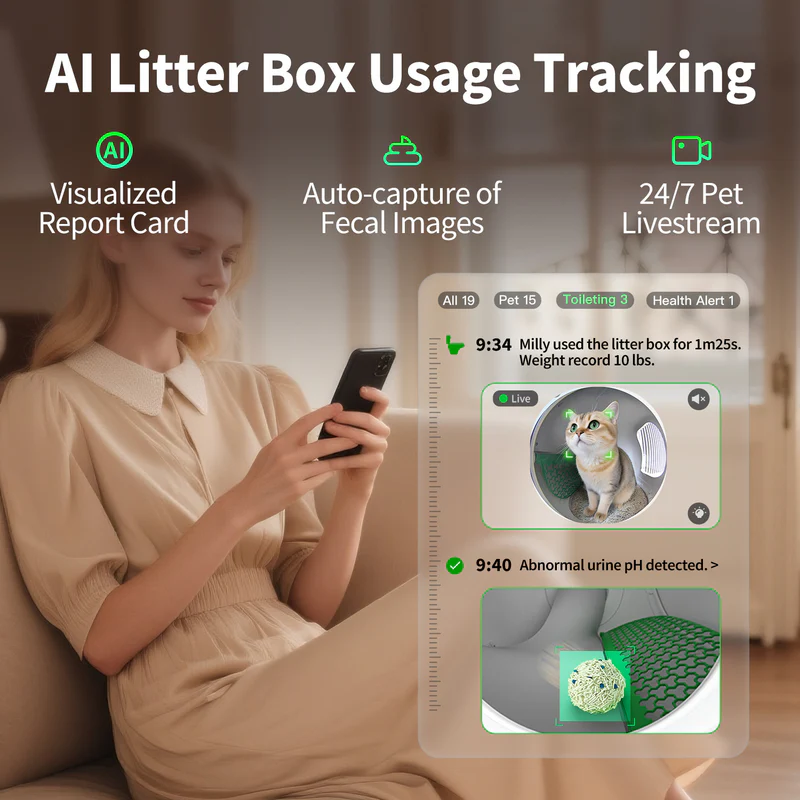
    The PETKIT app records litter-box visits, duration and weight changes for supported cats. It also sends operating and waste-bin notifications and allows owners to adjust cleaning and deodorization settings.

    This information can help reveal:

    • an apparent change in visit frequency;
    • altered timing;
    • a weight trend;
    • reduced use;
    • machine or drawer status.

    The data cannot establish why the change occurred.

    PuraMax 2 has no camera, so multi-cat identification depends largely on weight records and profiles. Cats with similar weights may be harder to distinguish reliably.

    The app should be treated as an early signal system—not a digital veterinarian with a tasteful interface.

    Frequent visits, straining, crying, blood, little or no urine, sudden avoidance or persistent behavior changes require direct observation and appropriate veterinary assessment.

    For the broader distinction, read our Smart Cat Monitoring vs Automation guide.

    Cleaning and Daily Ownership

    PuraMax 2 reduces daily scooping.

    It does not abolish litter-box maintenance.

    Owners still need to:

    • empty and reline the waste bin;
    • replenish litter;
    • wipe the entrance;
    • clean the cylinder and sifter;
    • remove residue;
    • inspect sensors;
    • replace odor-control consumables;
    • clean beneath and around the unit.

    PETKIT includes a magnetic litter remover intended to help empty remaining clean litter before deeper maintenance. The cylinder components can then be accessed for cleaning according to the manual.

    This is the ownership trade:

    frequent manual scooping becomes less frequent but more structured cleaning.

    For many households, that is an excellent exchange.

    Anyone expecting the machine to empty its drawer, wash its cylinder and order its own consumables should wait for the model that has achieved legal personhood.

    Multi-Cat Use

    PETKIT markets PuraMax 2 for multi-cat households, and the 7-liter drawer can support more than one cat when usage remains manageable.

    But “multi-cat friendly” does not mean unlimited cats or guaranteed resource acceptance.

    More cats create:

    • faster drawer filling;
    • more cycles;
    • more residue;
    • greater identification ambiguity;
    • more competition around one litter station.

    PuraMax 2 is most convincing for one or two cats.

    A third cat may still be workable depending on size, habits and the presence of additional boxes, but the household should not treat one automatic machine as the only litter resource merely because the product removes clumps.

    Automation reduces labor.

    It does not repeal feline social behavior.

    Buyer-Regret Risk

    The main regret is purchasing PuraMax 2 for a cat that does not fit or a household that wanted deeper monitoring.

    Warning signs include:

    • a large or enclosure-averse cat;
    • expectations of zero maintenance;
    • several cats with similar weights;
    • a need for visual identification;
    • unwillingness to use clumping litter;
    • placement only available on soft or uneven flooring;
    • reluctance to maintain odor-control consumables.

    The other risk is buying a Purobot unnecessarily.

    If the camera would mostly document normal visits nobody intends to review, PuraMax 2 is the more intelligent purchase.

    Not every litter box needs eyes.

    Some should simply clean the evidence and remain professionally discreet.

    Final Verdict

    PETKIT PuraMax 2 earns a Strong Recommendation for Value.

    It is the strongest default PETKIT litter box for households that want:

    • automatic cleaning;
    • sealed waste storage;
    • useful app alerts;
    • broad clumping-litter compatibility;
    • a relatively compact vertical design;
    • no camera or video subscription decision.

    It is best suited to one or two average-sized cats that already tolerate enclosed litter boxes.

    Skip it when the cat needs a larger interior, mobility creates entry concerns or visual multi-cat identification is central to the purchase.

    PuraMax 2 is not PETKIT’s most advanced litter box.

    It is the model that solves the main problem without asking every buyer to fund an artificial-intelligence department in the bathroom.

    For most households, that is not a compromise.

    It is the correct amount of machine.

    For the wider market, read our Best Smart Litter Boxes guide.

    For the brand-level decision, see PETKIT vs Litter-Robot Ecosystem.

    Frequently Asked Questions

    Is PETKIT PuraMax 2 worth it?

    Yes, for one or two appropriately sized cats when reducing daily scooping matters more than camera-based monitoring.

    What cat weights does PuraMax 2 support?

    PETKIT supports cats weighing between 3.3 and 22 lb. Cats younger than six months or below the minimum weight should not use normal automatic cycling.

    What litter can PuraMax 2 use?

    It supports most clumping tofu, mixed, bentonite, mineral and clay litters using the appropriate included sifter. PETKIT advises against particles longer than approximately 12 millimeters.

    Does PuraMax 2 work without Wi-Fi?

    Yes. Saved settings continue operating without a network connection, but app records and remote updates are unavailable until connectivity returns.

    Is PuraMax 2 better than Purobot Max Pro 2?

    PuraMax 2 is the better default for automatic cleaning. Purobot Max Pro 2 is more useful when camera-assisted individual identification solves a real multi-cat monitoring problem.

    References

    • PETKIT — PuraMax 2 product specifications
    • PETKIT — PuraMax 2 user manual
    • PETKIT — PETKIT automatic litter-box buying guide
    • PETKIT — Limited warranty policy

    Image Disclosure

    Official manufacturer images are used when available and authorized.

    AI-generated images may also be used as editorial illustrations. They should not be treated as exact representations of dimensions, controls or physical features. Always verify current official specifications before purchasing.

    Editorial Disclosure

    PetTech AI may earn a commission from qualifying purchases. This does not influence our recommendations, comparisons or editorial judgments.