Tag: outdoor cat safety

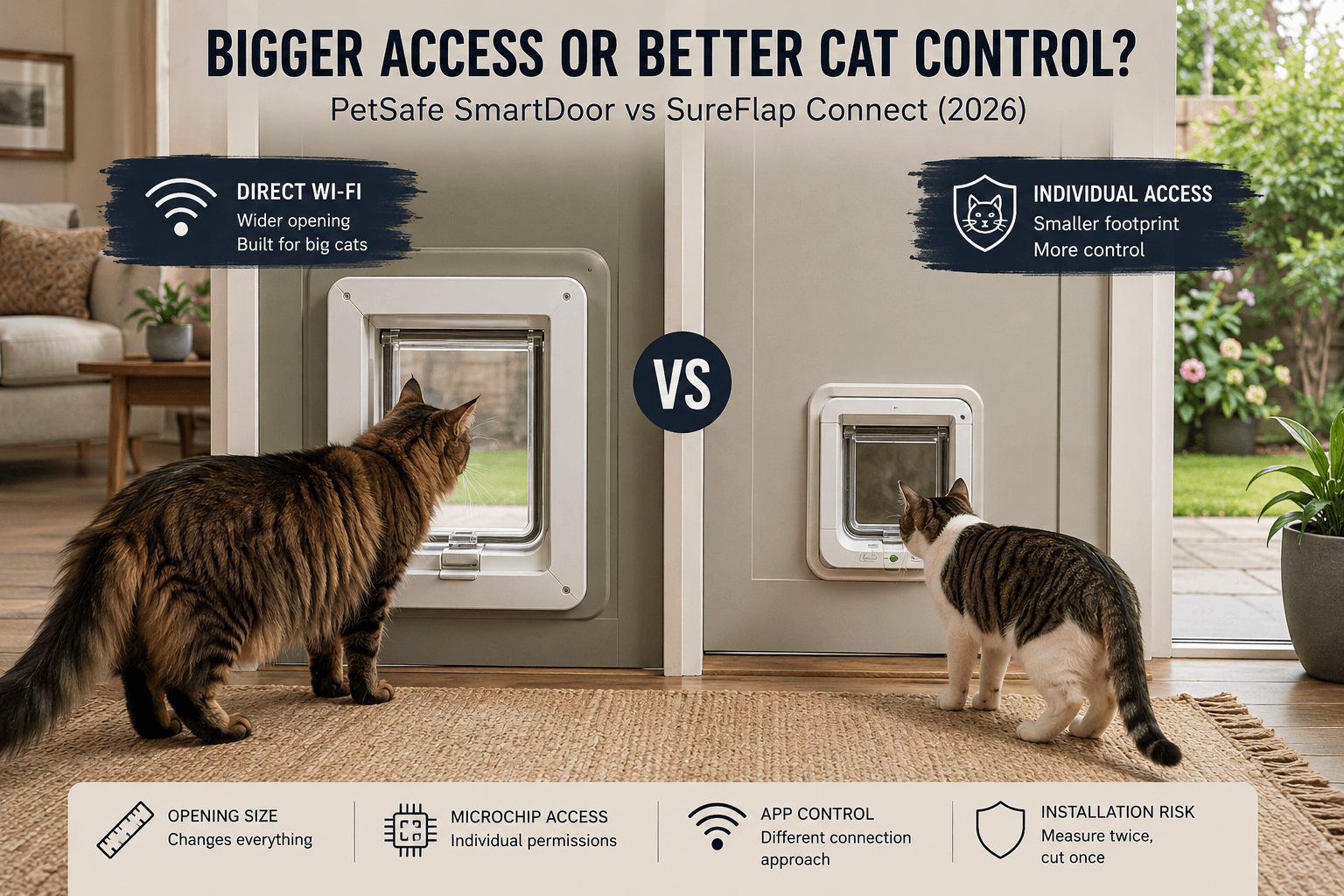
  • PetSafe SmartDoor vs SureFlap Connect (2026): Bigger Access or Better Cat Control?

    PetSafe SmartDoor vs SureFlap Connect (2026): Bigger Access or Better Cat Control?

    PetSafe SmartDoor Connected and SureFlap Connect both promise to manage outdoor access without requiring you to work the night shift as your cat’s unpaid concierge.

    The products take different routes. PetSafe offers a larger opening, direct Wi-Fi and more substantial weather protection. SureFlap uses a smaller, cat-specific design with granular microchip permissions—but demands that another small white box move permanently beside your router.

    SureFlap Connect is the lower-regret choice for most average-size cats. PetSafe only makes sense when its wider passage solves a problem the smaller flap physically cannot.

    Overall verdict: Conditional.

    Quick Verdict

    PetSafe SmartDoor Connected MediumSureFlap Microchip Cat Door Connect
    Best forLarge cats, wider passage and direct Wi-FiAverage-size cats and individual access control
    IdentificationCompatible microchip or collar keyCompatible microchip or RFID collar tag
    Opening7.1 × 7.8 inchesAbout 5.6 × 4.7 inches
    ConnectionDirect 2.4 GHz Wi-FiSeparate Hub connected to router
    PowerFour C batteries or optional adapterFour AA batteries
    Main concernLarge permanent installation and weaker owner-feedback signalsSmaller opening and required Hub
    VerdictNot Recommended for most cat homesConditional

    PetTech AI may earn a commission from qualifying purchases. As an Amazon Associate I earn from qualifying purchases.

    Need the wider opening? Check the PetSafe SmartDoor Connected Medium on Amazon.

    Prefer the more cat-specific system? Check the SureFlap Connect bundle on Amazon.

    Before cutting anything, compare the wider category in our best smart cat doors guide. The product can be returned. The rectangle missing from your door is usually less cooperative.

    Research Note

    This is a research-led comparison based on current manufacturer documentation, installation requirements, warranty policies and owner-feedback patterns. PetTech AI has not physically installed either door.

    The Opening Size Changes the Entire Decision
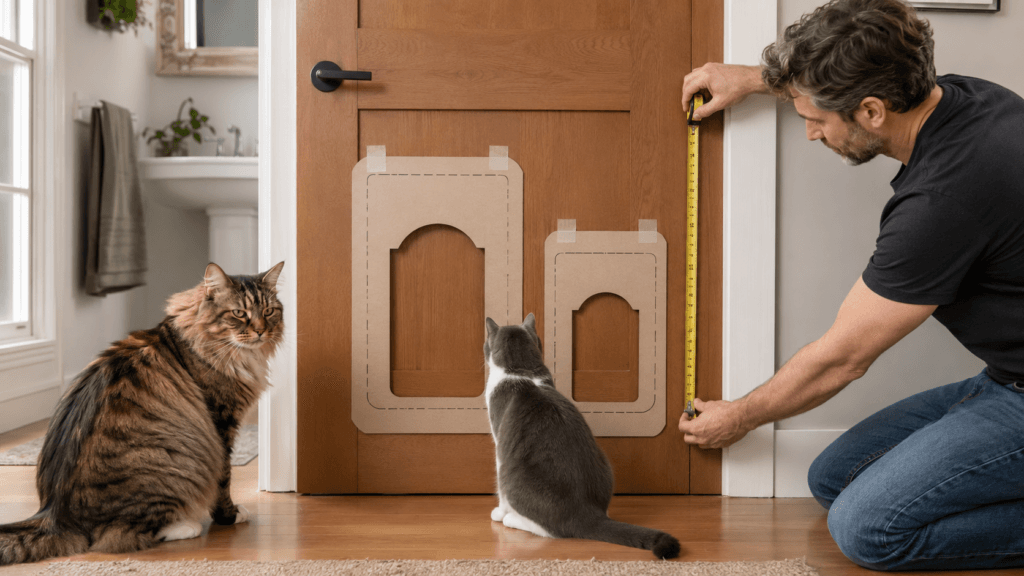
    Large cat comparing wide and compact smart cat door openings before installation.
    The product can be returned. The missing rectangle in the door usually has a stricter policy.

    PetSafe SmartDoor Connected Medium provides a 7.1-by-7.8-inch passage and is intended for pets weighing up to 25 pounds. SureFlap Connect uses a much smaller opening of roughly 5.6 by 4.7 inches.

    That makes PetSafe the more realistic option for:

    • large or long-bodied cats;
    • cats reluctant to squeeze through narrow flaps;
    • homes where differently sized pets share one door;
    • owners who measured the actual cat rather than trusting that “Medium” corresponds to a universal feline standard.

    SureFlap is appropriate for many ordinary domestic cats, but not every Bengal, Maine Coon or generously engineered rescue will approve. Weight limits help; shoulder width and body depth still exist despite marketing’s repeated attempts to ignore them.

    The installation footprint also differs sharply. SureFlap asks for a smaller opening and therefore a smaller leap of faith. PetSafe arrives with the architectural confidence of a product that assumes you already own a jigsaw.

    Microchip Access and Individual Permissions
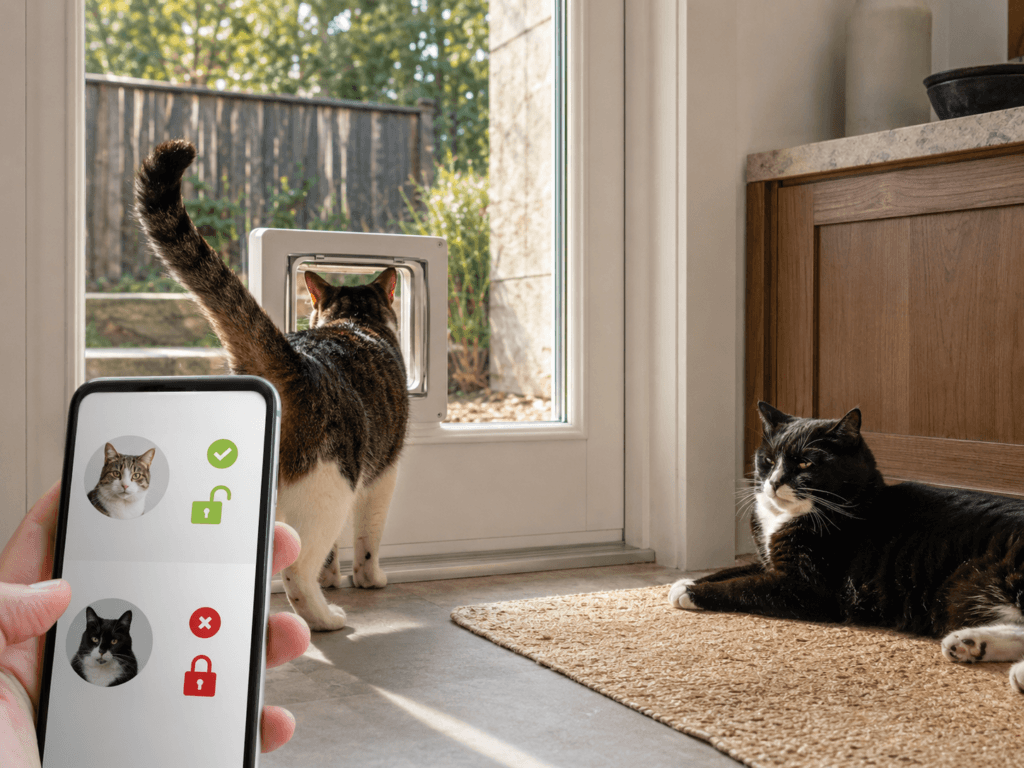
    Two cats receiving different outdoor access permissions through a microchip cat door app.
    Individual permissions matter when one cat may explore and another is temporarily under house arrest.

    Both systems can block unfamiliar animals and assign rules to individual pets.

    The Medium PetSafe SmartDoor supports selected microchip formats and can also use a Pet Door Key attached to the collar. Through the app, owners can create individual schedules, control entry and exit, lock the door remotely and receive activity notifications.

    The important limitation is compatibility: not every microchip works directly. Cats with unsupported chips need the collar key, which introduces another object capable of being lost beneath a sofa, buried in the garden or removed during Gerald’s private expedition.

    SureFlap reads common microchips and can register multiple pets. Its DualScan system reads cats moving both inward and outward, allowing different exit permissions for different animals.

    That is useful when:

    • one cat may go outside while another must remain indoors;
    • a recovering cat needs temporary restrictions;
    • a newly adopted cat is still acclimating;
    • one household member has lost neighborhood privileges following a diplomatic incident.

    Both systems are capable. SureFlap simply feels more deliberately designed around cat-specific access control, while PetSafe combines microchip recognition with a broader key-based pet-door platform.

    Direct Wi-Fi vs Another Dependent Near the Router
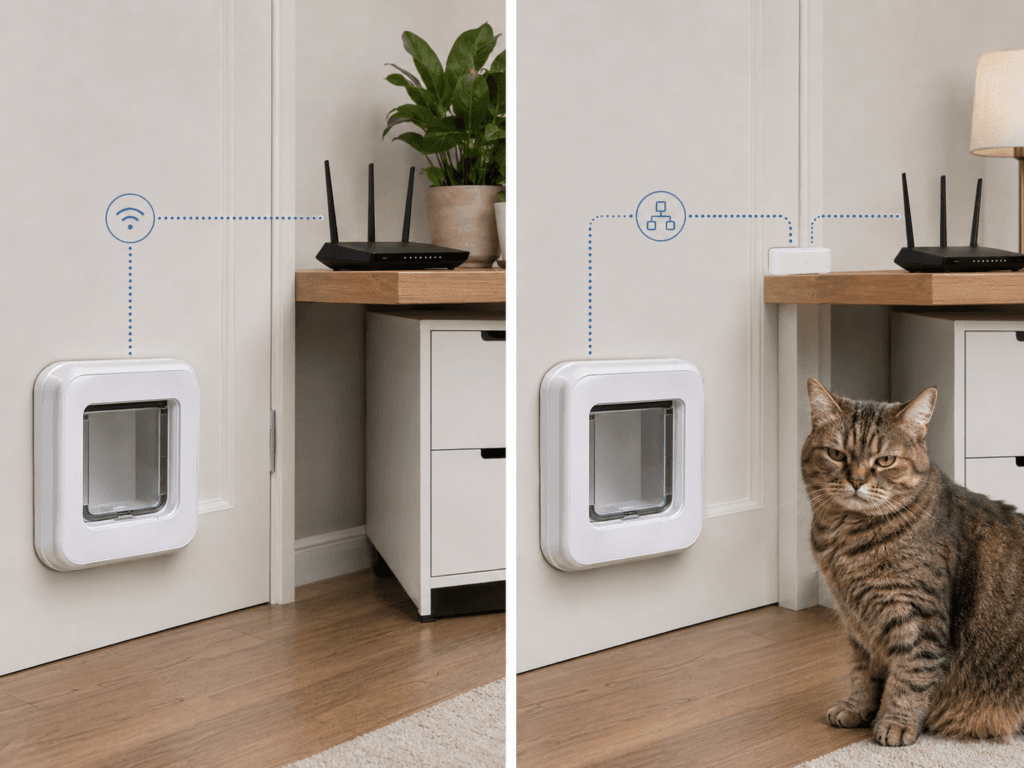
    Smart cat door connected directly to Wi-Fi compared with another system using a router Hub.
    PetSafe connects directly to Wi-Fi. SureFlap introduces another small plastic citizen beside the router.

    PetSafe connects directly to a 2.4 GHz Wi-Fi network. The My PetSafe app handles access rules, remote locking, schedules, notifications and battery alerts.

    SureFlap Connect requires the Sure Petcare Hub. The bundle identified for this comparison includes it, but the Hub still needs power, an Ethernet connection to the router and sufficient range to communicate with the flap.

    PetSafe therefore wins on network simplicity.

    The SureFlap Hub is not a disaster. It is simply another white plastic dependent moving permanently beside your router, contributing nothing to household expenses and blinking occasionally to confirm that it remains your responsibility.

    For homes with limited Ethernet ports, awkward router placement or an existing collection of smart-home bridges, that extra component may be more irritating than the product page suggests.

    Power and Daily Ownership

    PetSafe Medium uses four C-cell batteries. It can also run through an optional wall adapter, with batteries retained as backup during an outage.

    SureFlap uses four AA batteries and claims months of normal operation, although actual battery life will depend on usage, signal quality and how often the cat treats the door as revolving entertainment.

    PetSafe offers the more flexible power arrangement. SureFlap uses cheaper, more familiar batteries.

    Neither option is maintenance-free. Batteries still need replacement, sensors need cleaning and access rules occasionally need adjustment. A smart cat door with dead batteries is just a normal flap that has developed administrative problems.

    Weather Protection and Physical Security

    PetSafe uses a rigid flap, dynamic weather sealing, magnetic closure and a multi-point locking mechanism. Its larger, heavier design is more convincing for exposed exterior doors or homes where drafts matter.

    SureFlap’s smaller footprint reduces the amount of interrupted door surface and prevents unauthorized entry through microchip recognition, but it is not positioned as a heavy-duty extreme-weather barrier.

    PetSafe therefore has a legitimate advantage in colder, windier or more exposed locations. Still, no pet door becomes thermally invisible through confidence alone. Installation quality, wall thickness, sealing and placement remain important.

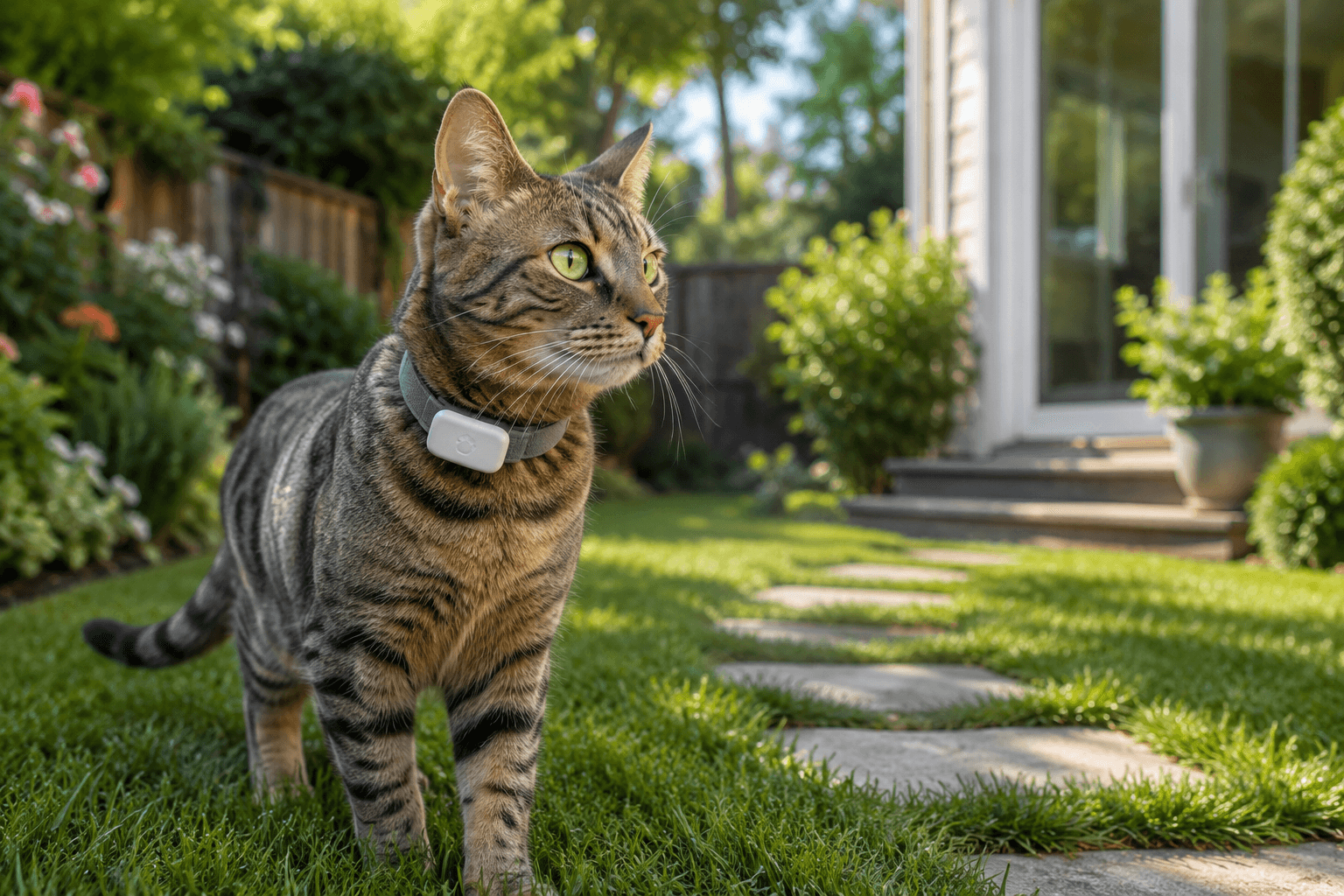
    For outdoor safety beyond the doorway, remember that selective access does not tell you where the cat goes afterward. Our best cat trackers guide covers that separate problem before Napoleon interprets “authorized exit” as permission to cross state lines.

    A smart door controls who crosses the threshold; it does not create a boundary once the cat is outside. Our best virtual fences for cats guide explains how GPS safe zones and escape alerts handle that separate problem.

    Installation Is the Real Buyer-Regret Zone

    Both doors can be installed in doors and walls. Certain glass, metal or masonry installations may require adapters, tunnel extensions or professional work.

    PetSafe requires the larger cutout. SureFlap’s smaller dimensions make it less invasive and more compatible with typical cat-door placements.

    Before installation:

    1. verify the microchip format;
    2. measure the cat’s shoulders and body height;
    3. create a cardboard test opening;
    4. identify the door or wall material;
    5. power and configure the device;
    6. register every cat;
    7. test the locking behavior;
    8. only then create the permanent opening.

    This sequence is not cinematic, but it is considerably cheaper than discovering afterward that Biscuit considers the flap an architectural insult.

    A return policy protects the electronic product. It does not restore timber, glass, insulation or domestic harmony.

    Returns and Warranties

    PetSafe offers a direct-purchase return window and a standard limited warranty of one year. Installation, removal and restoration costs are not covered.

    Sure Petcare provides a three-year warranty on its microchip doors and the associated Hub.

    That longer protection matters. These products contain readers, locks, motors, wireless components and battery systems, yet they are installed as semi-permanent fixtures. One year of coverage is not especially comforting for a product whose hole may outlive your router, your phone and your current enthusiasm for home automation.

    SureFlap therefore has the stronger long-term ownership case.

    Why PetSafe Is Not Recommended for Most Cat Homes

    PetSafe’s wider entrance, direct Wi-Fi and weather-oriented hardware are genuine advantages. The problem is that those advantages come with a much larger installation commitment and weaker owner-feedback signals than we would want from a device that permanently alters the property.

    PetSafe remains worth considering when:

    • the cat cannot comfortably use SureFlap’s opening;
    • direct Wi-Fi is essential;
    • the door is exposed to difficult weather;
    • the owner accepts the larger cutout;
    • the system can be fully tested before final installation.

    For everyone else, the risk-to-benefit ratio is uncomfortable.

    Verdict: Not Recommended for most cat households.

    Large cats deserve access. Their owners do not need to suspend skepticism in the name of flap width.

    If the larger passage is genuinely necessary, check the PetSafe SmartDoor Connected Medium on Amazon and verify the current listing, dimensions and return terms before installing it.

    Why SureFlap Is Better—but Still Conditional

    SureFlap Connect offers the more coherent feline package:

    • smaller installation footprint;
    • direct microchip recognition;
    • individual exit permissions;
    • app-controlled curfews;
    • longer warranty;
    • a Hub included in the identified bundle.

    Its limitations prevent a stronger recommendation:

    • the opening may be too small for large cats;
    • app connectivity requires the Hub;
    • power is battery-only;
    • installation remains permanent;
    • the connected model adds complexity that some households do not need.

    Verdict: Conditional.

    SureFlap is the better choice for an average-size cat when selective access genuinely matters and the household accepts the Hub. Owners who only need to block unfamiliar animals may be better served by a simpler non-connected microchip flap.

    For individual access control with the smaller cutout, check the SureFlap Connect bundle on Amazon.

    Final Verdict

    SureFlap Connect wins this comparison, but not by enough to earn a universal recommendation.

    It offers more focused cat management, a smaller installation footprint and stronger warranty coverage. PetSafe counters with direct Wi-Fi, better weather-oriented hardware and a much wider passage—but also carries the greater installation risk.

    Choose SureFlap Connect for compact, cat-specific control. Consider PetSafe only when the larger opening solves a problem SureFlap cannot.

    For some households, the smartest decision remains a non-connected microchip flap. The cat gains selective access, unfamiliar animals remain outside and the router avoids adopting another dependent.

    Frequently Asked Questions

    Can PetSafe SmartDoor use a cat’s existing microchip?

    The Medium version supports selected microchip formats. Cats with incompatible chips must use the supplied collar key. Compatibility should be checked before installation.

    Does SureFlap Connect require the Hub?

    Yes. The Hub connects the flap to the Sure Petcare app and enables remote locking, notifications, curfews and activity records. The Amazon bundle evaluated for this comparison includes the Hub.

    Which door is better for a large cat?

    PetSafe SmartDoor Connected Medium has the larger opening and is the more plausible fit for large cats. Measure shoulder width and body height rather than relying only on weight.

    Can either door stop one cat from going outside?

    Yes. Both systems support individual access rules. SureFlap’s DualScan design is particularly focused on assigning different exit permissions to different cats.

    References

    PetSafe — SmartDoor Connected Product Documentation
    PetSafe — SmartDoor Microchip Compatibility Guide
    PetSafe — Return and Warranty Information
    Sure Petcare — Microchip Cat Door Connect Documentation
    Sure Petcare — Hub and App Documentation
    Sure Petcare — Warranty Policy

    Editorial Disclosure

    PetTech AI may earn a commission from qualifying purchases. This does not influence our recommendations, comparisons or editorial judgments.

    Image Disclosure

    Official manufacturer images are used when available and authorized.

    AI-generated images may also be used as editorial illustrations. They should not be treated as exact representations of product dimensions, materials, controls or physical features. Always verify current official product information before purchasing.
  • Best Virtual Fences for Cats: GPS Escape Alerts Compared

    Best Virtual Fences for Cats: GPS Escape Alerts Compared

    A green circle on a phone is not a fence.

    Baron has not signed a treaty with Google Maps, and the app cannot stop him from crossing a road, climbing through a hedge or beginning an unscheduled inspection of the neighbor’s garage.

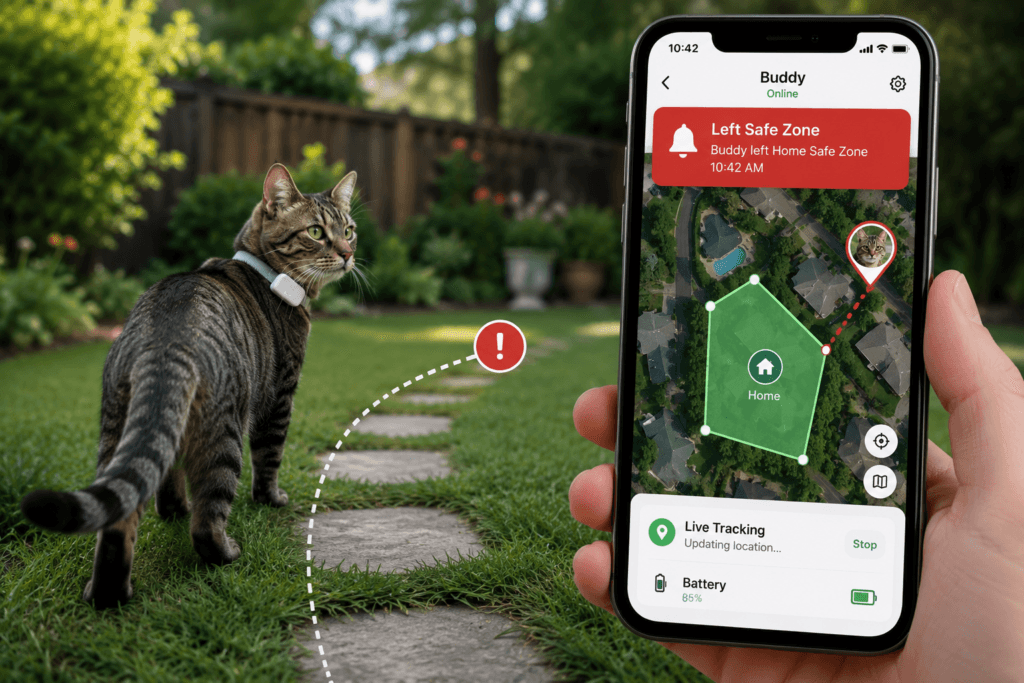
    A virtual fence for cats is an early-warning system. You draw a Safe Zone in a GPS tracker app, and the system attempts to notify you when the tracker leaves or enters that area.

    That can be useful.

    It is not containment.

    Quick Verdict

    Tractive is currently the most defensible virtual-fence option for cats, but it receives only a Conditional Recommendation.

    Its current cat tracker combines Virtual Fence alerts with live GPS and location history. However, GPS drift, mobile coverage, tracker fit and notification delays make it unsuitable as a precise backyard boundary.

    Weenect XS and Petcube GPS Tracker offer relevant escape-alert features, but current ownership evidence is too weak for PetTech AI to recommend them broadly.

    Tabcat V2 does not provide virtual fences at all. It earns a separate recommendation for owners whose cat is probably nearby but hidden.

    ProductBest fitPetTech AI verdictMain limitation
    Tractive Cat GPS TrackerCats that may travel beyond the immediate neighborhoodConditional RecommendationNot precise or immediate enough to function as containment
    Weenect XSBuyers seeking a cat-specific Tractive alternativeNot RecommendedRelevant design, weak current ownership evidence
    Petcube GPS TrackerLarger cats already using the Petcube ecosystemNot Recommended for Most CatsDog-oriented positioning and mixed ownership evidence
    Tabcat V2A cat probably hiding close to homeRecommended with ConditionsNo GPS, escape alerts or virtual fences

    Research Note

    This is a research-led comparison based on current manufacturer documentation, network requirements, tracker dimensions, subscription terms, product positioning and available ownership evidence.

    PetTech AI has not conducted long-term side-by-side testing of every tracker included.

    PetTech AI may earn a commission from qualifying purchases. As an Amazon Associate I earn from qualifying purchases.

    What a Virtual Fence Actually Does

    A smartphone showing a digital safe zone alert while a cat wearing a GPS tracker moves beyond a home area
    A virtual fence is an alert system: it tells you when a cat may have left a chosen area, not whether the cat has been physically contained.

    A virtual fence is a digital zone created inside a GPS tracker app.

    The most common version is a Safe Zone around your home. When the tracker detects that your cat has crossed the boundary, the system sends a notification. Some platforms also let you create No-Go Zones around places such as roads or neighboring properties.

    The process usually involves several steps:

    1. The tracker estimates its position.
    2. The tracker compares that location with the digital boundary.
    3. The device sends data through a cellular network.
    4. The platform processes the event.
    5. Your phone receives a notification.

    Each step introduces a possible delay or failure point.

    The tracker may not have a clean GPS view. Cellular coverage may be weak. The device may be in a battery-saving mode. Your phone may be offline, silenced or restricting background notifications.

    The app can warn you.

    It cannot teleport you into the garden.

    Why Virtual Fences Cannot Contain a Cat

    Nothing happens physically when a cat crosses a GPS boundary.

    There is no wall, closed gate or supervised handler. The cat can continue moving while the tracker calculates its position and the alert travels through the network.

    That distinction matters most near immediate hazards.

    A virtual fence cannot reliably stop a cat from:

    • entering a road;
    • leaving through an open gate;
    • climbing over a physical fence;
    • following wildlife beyond the property;
    • approaching another animal;
    • disappearing through a narrow gap.

    For controlled outdoor access, feline-veterinary guidance points owners toward options such as secure outdoor enclosures and supervised harness-and-leash exploration. The AVMA also supports keeping owned cats indoors, in enclosures or under attended control rather than allowing unrestricted roaming.

    A virtual fence belongs behind those measures as a recovery layer.

    It should never be the reason you accept a risk you would reject without the tracker.

    Why Small Yards Are the Worst Use Case

    Virtual fences sound most appealing for small yards.

    Unfortunately, small boundaries are where normal GPS variation becomes hardest to tolerate.

    Tractive currently requires a circular Virtual Fence to have a radius of at least 50 meters. Its rectangular option starts at 100 by 100 meters. Custom shapes can be smaller, but the app may warn that the zone is too small for reliable notifications.

    That tells us something important.

    A virtual fence can monitor whether a cat has left the general home area. It is not designed to determine with perfect consistency whether the cat is two feet inside or two feet outside a garden boundary.

    Buildings, trees and narrow streets can also affect the quality of a GPS position. Even Tractive’s own support documentation acknowledges that displayed locations may occasionally jump or appear inaccurate.

    Treat claims of exact property-line protection accordingly.

    Satellite positioning is useful technology. It has not developed a personal vendetta against your hydrangeas.

    Best Available Escape-Alert System: Tractive Cat GPS Tracker

    Verdict: Conditional Recommendation

    Tractive remains the most defensible choice when a cat may travel beyond the immediate neighborhood and you want both an escape alert and a map-based recovery tool.

    The current CAT 6 Mini combines Virtual Fences, location history, Live Tracking and territory information in a collar-integrated design. The tracker itself weighs approximately 25 grams, or around 32 grams with its integrated collar, and Tractive recommends it for cats weighing at least 3 kilograms. The manufacturer states that Live Tracking can update every two to three seconds when active.

    The workflow is coherent:

    • set a broad Safe Zone around home;
    • receive an exit notification;
    • open the app;
    • activate Live Tracking;
    • follow the updated location;
    • share access with another household member when necessary.

    That makes Tractive more than a virtual-fence notification. It gives the owner something useful to do after the alert arrives.

    The problem is ownership friction.

    Current feedback is mixed enough that PetTech AI cannot give Tractive an unconditional recommendation. A tracker can have the most complete feature set in the category and still frustrate owners through charging, subscriptions, connectivity, attachment concerns or inconsistent real-world behavior.

    Choose Tractive when:

    • your cat has outdoor access;
    • your cat could travel beyond nearby houses;
    • you need genuine GPS rather than crowd-assisted Bluetooth;
    • you accept a subscription and charging routine;
    • your cat can comfortably wear the current hardware;
    • you understand that the Safe Zone is a broad alert area.

    Skip it when:

    • you expect exact property-line detection;
    • your cat is too small for the recommended fit;
    • mobile coverage is poor where the cat travels;
    • the cat is probably hiding within your home or garden;
    • you want a device that physically prevents escape.

    Could your cat travel beyond the immediate neighborhood? Check the current Tractive cat tracker on Amazon.

    Cat-Specific Alternative: Weenect XS

    Verdict: Not Recommended

    Weenect XS is technically one of the most relevant alternatives in this category.

    It is designed for cats weighing at least 3 kilograms, weighs approximately 27 grams and supports real-time GPS tracking, safety-zone alerts, sound, vibration and mobile-network connectivity. Weenect advertises up to seven days of battery life when power-saving zones are used, with substantially less during continuous tracking. Each tracker also requires its own subscription.

    On paper, that creates a convincing Tractive competitor.

    The physical format is cat-oriented. The tracker works in the United States. It offers the relevant escape-alert function rather than relying on nearby phones.

    Current ownership evidence does not support recommending it.

    This is where PetTech AI’s editorial line matters: a relevant design does not become a good purchase merely because the shortlist is short. Weenect fills a market gap. It has not currently earned the recommendation attached to that gap.

    Choose it only when:

    • you specifically prefer Weenect’s collar format;
    • you understand its subscription requirements;
    • you have reviewed recent customer feedback carefully;
    • the retailer offers a practical return route;
    • you accept being closer to an early adopter than a default buyer.

    Buyer-regret risk: the product solves the correct technical problem, but current evidence gives buyers too little confidence that everyday ownership will match the feature list.

    Still considering the cat-specific Weenect XS? Check current availability and customer feedback on Amazon.

    Petcube GPS Tracker: Relevant Features, Wrong Default Buyer

    Verdict: Not Recommended for Most Cats

    Petcube GPS Tracker supports live location, Safe Zones, No-Go Zones, location history, a buzzer and an LED light. It requires an active paid plan because it transmits position information through cellular networks.

    That makes it relevant to the keyword.

    It does not make it a natural recommendation for most cats.

    Petcube’s official product material remains strongly dog-oriented, including its language about live tracking, activity goals and collar use. The device may be physically manageable for some larger cats, but that is different from being designed around feline collar fit and daily wear.

    There is also an important update-frequency caveat. Petcube explains that ordinary tracking frequency depends on movement and may average roughly one update every ten minutes while the pet is active. When the tracker is inside a Wi-Fi power-saving zone, it may stop reporting regular GPS positions until conditions change.

    That does not make the device useless. It reinforces the central point of this article:

    A virtual fence is an alert layer, not a real-time force field.

    Petcube makes the most sense for someone who:

    • already uses the Petcube ecosystem;
    • has a sufficiently large, collar-tolerant cat;
    • values Safe and No-Go Zones;
    • accepts the subscription;
    • has studied the attachment and return policy carefully.

    Most cat owners should choose neither brand familiarity nor a low device price as the deciding factor. The recurring plan, fit and real-world alert behavior matter more.

    Buyer-regret risk: the feature list is relevant, but the product’s dog-first design logic makes it a questionable default for feline use.

    Still evaluating Petcube for a larger cat? Check current availability and customer feedback on Amazon.

    What About Fi Mini and Pawfit Lite?

    Both products provide GPS tracking and zone-based alerts, but neither currently improves the recommendation hierarchy.

    Fi Mini offers an appealing app-led ecosystem and a lightweight proposition. Current early ownership evidence is too weak for PetTech AI to recommend it over the more established Tractive platform.

    Pawfit Lite addresses a legitimate problem by prioritizing compact cat-oriented wearability and nearby Bluetooth assistance. Its current evidence is also too limited and mixed to support a recommendation.

    They remain products to watch—not missing winners we forgot to place on the podium.

    A glossy app screenshot is evidence that somebody hired a competent interface designer. It is not evidence that an escape alert will behave reliably at the exact moment Baron discovers freedom.

    When Tabcat V2 Is the Better Tool

    Verdict: Recommended with Conditions

    Tabcat V2 is not a virtual fence.

    It does not send escape alerts, show a map, use cellular GPS or record roaming history.

    It uses radio frequency and a handheld directional receiver to help locate a tagged cat that is already within range. Tabcat quotes a maximum range of approximately 500 feet in favorable conditions, while walls, doors and other obstructions can reduce it. Its tag weighs about 0.2 ounces and does not require a cellular subscription.

    That makes Tabcat better for a different problem:

    “My cat is probably nearby, but I cannot see them.”

    Possible locations include:

    • under a porch;
    • inside a shed;
    • behind dense bushes;
    • in a garage;
    • beneath furniture;
    • somewhere inside the house.

    Choose Tabcat when:

    • the cat is primarily indoors;
    • the likely search radius is local;
    • collar weight is a major concern;
    • you want no recurring plan;
    • directional close-range recovery matters more than a map.

    Skip it when:

    • the cat may travel several streets away;
    • you need an alert when the cat leaves home;
    • you want remote tracking from another location;
    • you need route history or GPS coordinates.

    Is your cat more likely to hide nearby than roam across town? Check Tabcat V2 on Amazon.

    For a broader decision between GPS, radio frequency and Bluetooth-based finding, read our Best Cat Trackers comparison.

    Virtual Fence vs Catio vs Harness

    These tools should not be presented as interchangeable.

    Virtual fence

    Purpose: alert and recovery.

    It may tell you that the cat has left a broad expected area and help you begin looking.

    Catio or secure enclosure

    Purpose: physical containment with outdoor enrichment.

    A properly secured enclosure reduces the cat’s ability to enter roads, neighboring properties or wildlife areas while still allowing access to outdoor sights, smells and movement.

    Harness and leash

    Purpose: supervised exploration.

    A correctly fitted harness gives the handler physical control while allowing the cat to explore at an appropriate pace. It requires gradual training and is not enjoyable for every cat.

    For fit and introduction guidance, read our Best Cat Harnesses guide.

    Radio-frequency tracker

    Purpose: precise nearby recovery.

    It helps locate a hidden cat once you are already within the general search area.

    A robust safety setup may combine several layers:

    • microchip and current registration;
    • visible identification;
    • secure physical access;
    • supervised outdoor time;
    • a wearable tracker;
    • a prepared escape-response routine.

    The tracker is one layer—not the constitutional foundation of the household.

    How to Set Up a Virtual Fence Realistically

    1. Draw a broad zone

    Do not trace the exact edge of a small backyard and expect boundary-level precision.

    Create a zone large enough to absorb ordinary GPS variation while still warning you when the cat has moved beyond the normal home area.

    2. Test it before relying on it

    Walk the tracker across the boundary yourself.

    Record:

    • where the alert actually appears;
    • how long the notification takes;
    • whether the phone receives it with the app closed;
    • whether other household members receive shared alerts;
    • what happens when mobile coverage weakens.

    3. Check phone permissions

    Allow the app to run in the background and send notifications. Disable settings that silently prevent urgent alerts from appearing.

    4. Maintain the battery

    Create a charging routine before the tracker reaches a critical level.

    A discharged GPS tracker offers roughly the same location intelligence as a decorative collar charm, only with a more ambitious subscription history.

    5. Prepare the response

    Decide in advance:

    • who checks the app;
    • who searches outside;
    • where the carrier is stored;
    • which garages, decks and bushes should be checked first;
    • which neighbors can be contacted;
    • which recall sound or treat may help.

    Information becomes safety only when it produces an organized response.

    Frequently Asked Questions

    Can a virtual fence keep my cat inside the yard?

    No. It can notify you when a GPS tracker appears to leave a digital zone, but it cannot physically stop the cat or guarantee an alert at the exact property line.

    What is the best virtual fence for cats?

    Tractive is currently the most defensible option because it combines Virtual Fence alerts with live GPS and a cat-specific wearable format. It receives a Conditional Recommendation because ownership friction and normal GPS limitations prevent a stronger endorsement.

    How quickly do virtual-fence alerts arrive?

    There is no universal guaranteed delay. Timing depends on tracker update frequency, GPS reception, mobile coverage, app processing and phone notification settings. Test the complete alert chain in your own environment.

    Are virtual fences useful in small yards?

    Not as precise boundaries. Small zones leave little room for ordinary GPS variation. They are more useful as broad alerts around the general home area.

    Is Weenect better than Tractive?

    Not based on current ownership evidence. Weenect is a relevant cat-specific alternative, but PetTech AI does not currently recommend it over Tractive.

    Can an AirTag replace a GPS virtual fence?

    No. An AirTag relies primarily on Bluetooth and Apple’s nearby-device network. It does not operate like an independent cellular GPS tracker with continuous live tracking and dedicated Safe Zone alerts.

    Is Tabcat a virtual fence?

    No. Tabcat is a radio-frequency finder for nearby recovery. It can be the better tool when the cat is probably close but hidden, but it cannot warn you when the cat leaves home.

    Final Verdict

    The virtual-fence market for cats is weaker than its marketing suggests.

    Tractive is the only product in this comparison that earns a direct, although conditional, recommendation for GPS escape alerts.

    Choose it when your cat may travel beyond the immediate neighborhood and you want a broad Safe Zone combined with map-based recovery.

    Do not choose it because you expect an invisible wall around a small yard.

    Weenect XS is not recommended. Its cat-specific hardware is relevant, but current ownership evidence is too weak to justify selecting it over Tractive.

    Petcube GPS Tracker is not recommended for most cats. It provides genuine virtual-zone features, but its dog-oriented design logic and mixed evidence make it a poor feline default.

    Tabcat V2 is recommended with conditions for nearby recovery. It is not a virtual fence, but it may be the more useful technology when the cat is probably hiding close to home.

    The honest conclusion is not that every household needs a smarter boundary.

    Some need a GPS alert.

    Some need an RF finder.

    Many need a secure enclosure, a harness or better control of doors and windows.

    A virtual fence can tell you that Baron may have left.

    It cannot persuade him that leaving was strategically unsound.

    References

    • Tractive — CAT 6 Mini, Virtual Fence, Live Tracking and connectivity documentation
    • Weenect — Weenect XS product and subscription documentation
    • Petcube — GPS Tracker, Virtual Fences and tracking-frequency documentation
    • Tabcat — Tabcat V2 product and range documentation
    • Feline Veterinary Medical Association — Safe Outdoor Access Options for Cats
    • American Veterinary Medical Association — Free-Roaming Owned Cats policy

    Image Disclosure

    Official manufacturer images are used when depicting the exact products discussed.

    Any AI-generated images are editorial illustrations only. They do not represent exact product size, fit, interface behavior or technical performance. Always check the current manufacturer documentation and product listing before purchasing.

    Editorial Disclosure

    PetTech AI may earn a commission from qualifying purchases. This does not influence our recommendations, comparisons or editorial judgments.

  • Best Smart Cat Doors: Microchip and App-Controlled Access Compared

    Best Smart Cat Doors: Microchip and App-Controlled Access Compared

    A smart cat door should solve an access problem—not simply add another app to your home.

    Maybe neighborhood cats are entering through a standard flap. Maybe one cat can go outside while another must remain indoors. Maybe you want confirmation that your cat returned before bedtime.

    Or perhaps you are already building a connected cat-care setup and want the same visibility at the door.

    The important question is not:

    Which smart cat door has the most technology?

    It is:

    What access rule does your household actually need?

    For most cat homes, reliable microchip recognition matters more than remote control. App features become worthwhile only when schedules, individual permissions or entry history solve a recurring problem.

    Baron does not need a notification to enter the kitchen. He needs the neighborhood raccoon to remain on the wrong side of the flap.

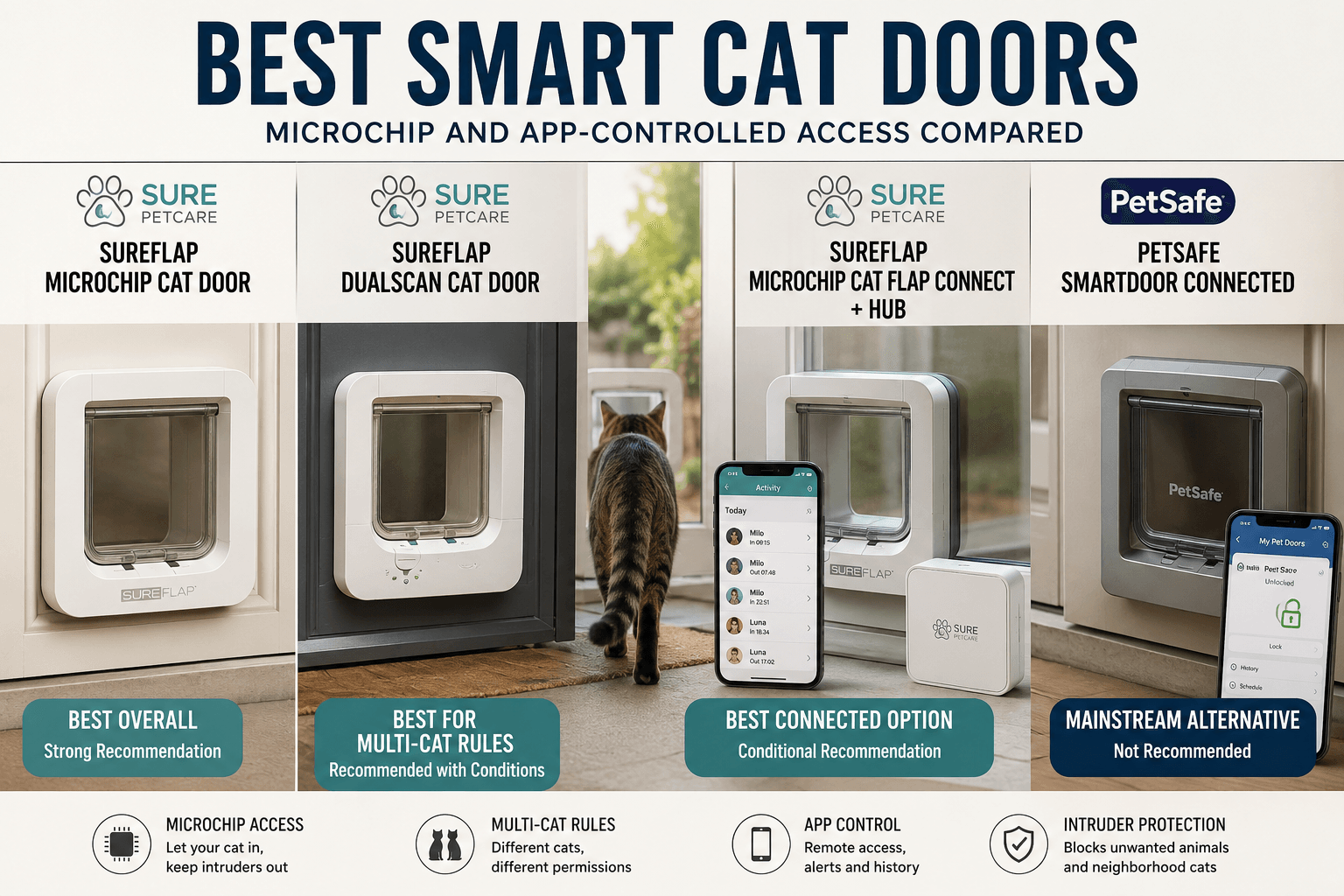
    Quick Verdict: Which Smart Cat Door Is Best?

    Best fitProductPetTech AI verdictMain limitation
    Most cat homesSureFlap Microchip Cat DoorStrong RecommendationSelective entry only; no app or individual exit permissions
    Cats with different outdoor rulesSureFlap DualScan Microchip Cat DoorRecommended with ConditionsNo app monitoring or remote control
    Connected access and activity historySureFlap Microchip Cat Flap Connect + HubConditional RecommendationMore setup, more hardware and more potential friction
    Mainstream app-controlled alternativePetSafe SmartDoor Connected Pet DoorNot RecommendedWeak ownership evidence and invasive installation risk

    The SureFlap Microchip Cat Door is the best overall choice for most households.

    It solves the most common problem—letting registered cats enter while keeping unwanted animals outside—without requiring an app, a Hub or a more complicated connected ecosystem.

    DualScan is the stronger specialist option for multi-cat homes. SureFlap Connect is worth considering only when remote permissions and activity history genuinely matter. PetSafe offers an attractive feature list, but current ownership evidence is too weak for PetTech AI to recommend it.

    Research Note

    This is a research-led comparison based on current manufacturer documentation, access-control features, installation requirements, product positioning and available ownership evidence.

    PetTech AI has not conducted long-term side-by-side testing of every smart cat door included.

    PetTech AI may earn a commission from qualifying purchases. As an Amazon Associate I earn from qualifying purchases.

    What Makes a Cat Door “Smart”?

    A cat door does not need Wi-Fi to make an intelligent decision.

    The useful forms of smart access are:

    • recognizing an implanted microchip;
    • refusing entry to unregistered animals;
    • controlling which individual cats may leave;
    • applying schedules or curfews;
    • showing when a cat enters or exits;
    • allowing remote changes when the household routine changes.

    Those functions solve different problems.

    A standard microchip cat door is often enough when your only concern is stopping neighborhood cats, wildlife or another household pet from entering a protected room.

    Dual-direction identification matters when several cats have different outdoor permissions.

    App control matters when access rules change frequently or when knowing whether a cat is currently inside would affect what you do next.

    More technology is valuable only when it changes the decision.

    Otherwise, it is another dashboard waiting to announce that the batteries are low.

    Best Overall: SureFlap Microchip Cat Door

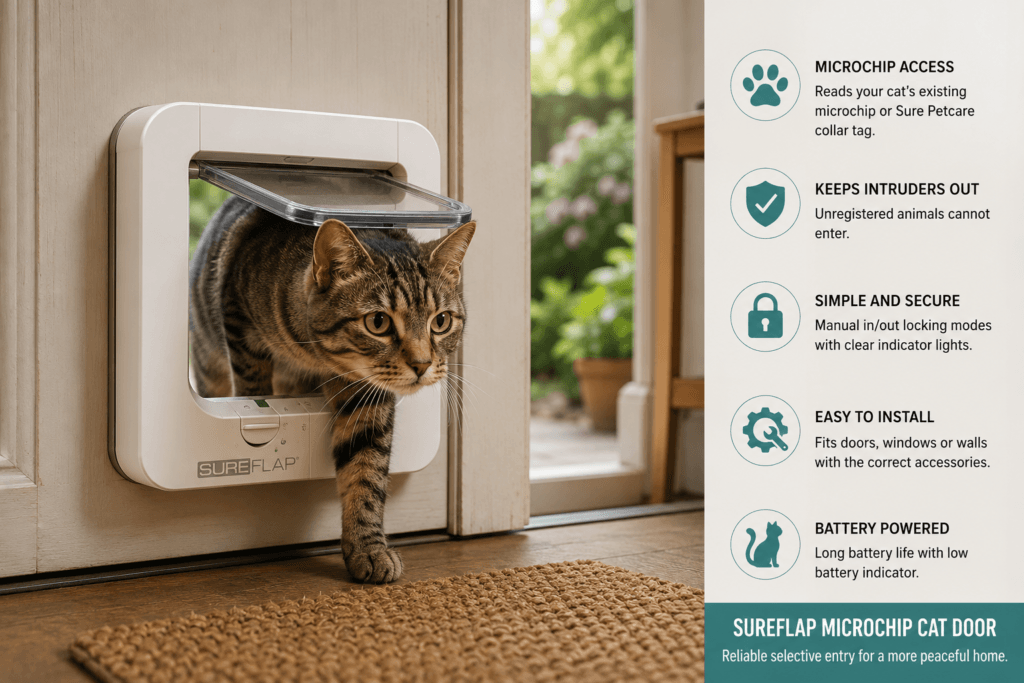
    SureFlap Microchip Cat Door installed for selective cat entry

    Verdict: Strong Recommendation

    The SureFlap Microchip Cat Door earns the strongest recommendation because it solves the most common access problem with the least unnecessary complexity.

    It reads a compatible implanted microchip or SureFlap collar tag, unlocks for registered pets and helps keep neighborhood cats and wildlife outside.

    There is no Hub, no account dependency and no remote dashboard to maintain.

    That sounds less dramatic than checking Baron’s entrance history from another continent.

    It is also exactly what many households need.

    The standard SureFlap controls selective entry. Registered cats can enter, while unregistered animals are kept outside. Exit is normally open to any animal unless you use the manual locking modes.

    That distinction is important.

    This model is ideal when you need to answer:

    “How do I let my cat come home without giving every animal in the neighborhood the same invitation?”

    It can also work as an interior access door. A microchip cat door can protect a feeding room, litter area or quiet retreat from another pet without requiring collars or daily manual supervision.

    Choose the SureFlap Microchip Cat Door if:

    • your main problem is unwanted animals entering;
    • your cat already has a compatible microchip;
    • your access routine is stable;
    • you prefer simple hardware over app control;
    • you want controlled access to an indoor cat-only room;
    • you value lower long-term ownership friction.

    Skip it if:

    • one registered cat must stay indoors while another can leave;
    • you need remote lock control;
    • you want entry and exit notifications;
    • you need activity history;
    • your cat is too large for the flap opening.

    The strongest reason to buy it is not that it does everything.

    It is that it performs one valuable rule without asking the household to maintain an ecosystem around it.

    Need dependable microchip access without another app? Check the SureFlap Microchip Cat Door on Amazon.

    Best for Multi-Cat Rules: SureFlap DualScan Microchip Cat Door

    SureFlap DualScan Microchip Cat Door for cats with different outdoor permissions

    Verdict: Recommended with Conditions

    The SureFlap DualScan Microchip Cat Door solves a more specialized problem:

    “How do I let one cat outside while keeping another indoors?”

    A standard microchip door usually controls who can enter. DualScan reads identification in both directions, allowing the household to decide which registered cats may go outside.

    That can be useful when:

    • one cat is recovering from surgery;
    • one cat has a medical or mobility concern;
    • a younger cat has outdoor access but an older cat does not;
    • a recently adopted cat must remain inside;
    • one cat is prone to wandering;
    • household cats follow different access routines.

    The door can enforce different permissions.

    It cannot explain to the indoor-only cat why Gerald has apparently received diplomatic immunity.

    DualScan also keeps unregistered animals from entering, so it handles both sides of the multi-cat problem: intruders outside and individual rules inside.

    The condition is that most households do not need this level of control.

    For one cat—or several cats following the same routine—the standard SureFlap is simpler and supported by stronger ownership evidence.

    DualScan also lacks the remote monitoring and activity history of the connected version. Permissions are managed at the door rather than through an app.

    Choose DualScan if:

    • your cats need different outdoor permissions;
    • one registered cat must remain indoors;
    • selective exit is essential;
    • you want microchip access without app dependence;
    • you are prepared to program each cat carefully.

    Skip it if:

    • all cats follow the same routine;
    • you only need to keep intruder animals out;
    • you want remote access changes;
    • you want entry and exit notifications;
    • the standard SureFlap already solves your problem.

    DualScan is not the best smart cat door for everyone.

    It is the best specialist door for a household that genuinely needs individual exit rules.

    Do your cats need different outdoor permissions? Check the SureFlap DualScan Microchip Cat Door on Amazon.

    Best Connected Option: SureFlap Microchip Cat Flap Connect + Hub

    Verdict: Conditional Recommendation

    The SureFlap Microchip Cat Flap Connect is the most capable connected door in this comparison.

    It is not the best default purchase.

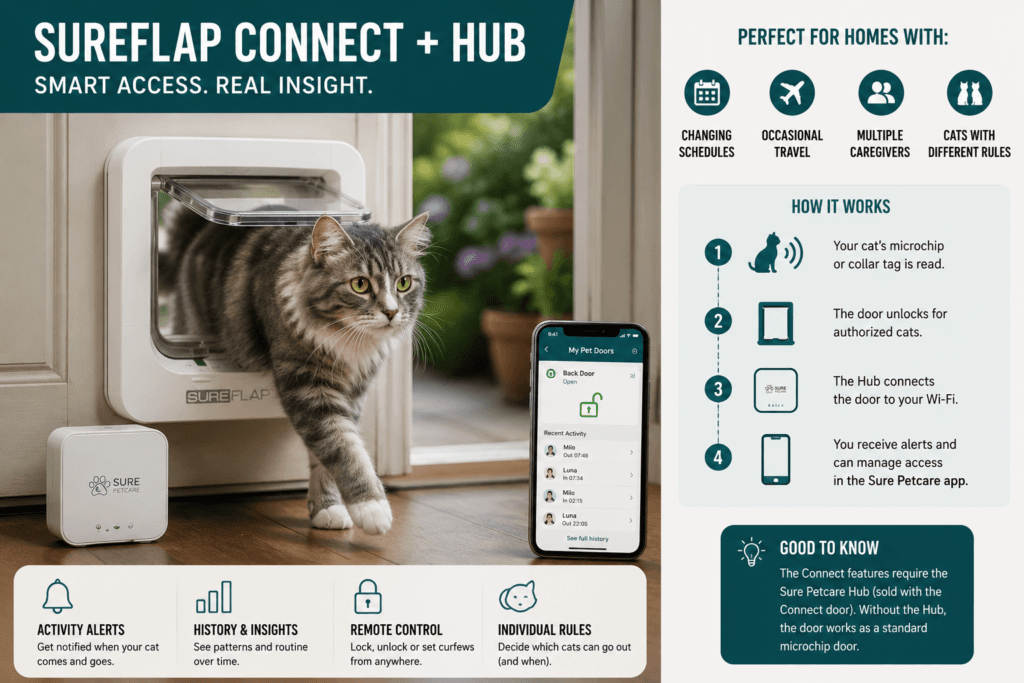
    When paired with the Sure Petcare Hub, it can send entry and exit notifications, show whether registered cats are likely inside or outside, maintain activity history, apply curfews and change individual permissions through the app.

    That creates a more complete access-monitoring system.

    It can be useful when:

    • your work schedule changes frequently;
    • several people share responsibility for the cats;
    • you want confirmation that a cat returned;
    • individual permissions need to change remotely;
    • you travel and want visibility into normal access routines;
    • entry and exit patterns form part of a broader monitoring setup.

    This is where connected access can add real value.

    A smart litter box may show changes in bathroom use. A feeder may show changes in meal patterns. A connected cat door adds information about outdoor routine and movement between environments.

    For a broader look at when data actually improves care, read our Smart Cat Monitoring vs Automation guide.

    The problem is added ownership complexity.

    The connected functions require the Hub, which links the door to the internet through your home router. You are therefore managing the door, batteries, Hub, network connection, account and app rather than a single access device.

    That may be completely justified.

    It may also be an elaborate way to learn that Baron went outside at 4:12 a.m. and returned at 4:19 with no explanation.

    Choose SureFlap Connect if:

    • remote permissions would change how you manage access;
    • entry and exit history is genuinely useful;
    • you need individual exit rules;
    • several caregivers need shared visibility;
    • you accept the Hub and app setup;
    • you are buying the correct door-and-Hub bundle.

    Skip it if:

    • your access routine rarely changes;
    • the standard SureFlap already solves the problem;
    • you do not want another connected device;
    • you will stop checking the activity history after the first week;
    • you expect the door to track the cat after they leave.

    Entry history can show that your cat used the door. It cannot show where the cat went afterward.

    For map-based recovery and nearby-finding tools, read our Best Cat Trackers comparison.

    Buyer-regret risk: paying for the connected version when selective microchip entry was the only function the household truly needed.

    Would remote permissions and entry history change how you manage access? Check the SureFlap Connect + Hub bundle on Amazon.

    PetSafe SmartDoor Connected: Not Recommended

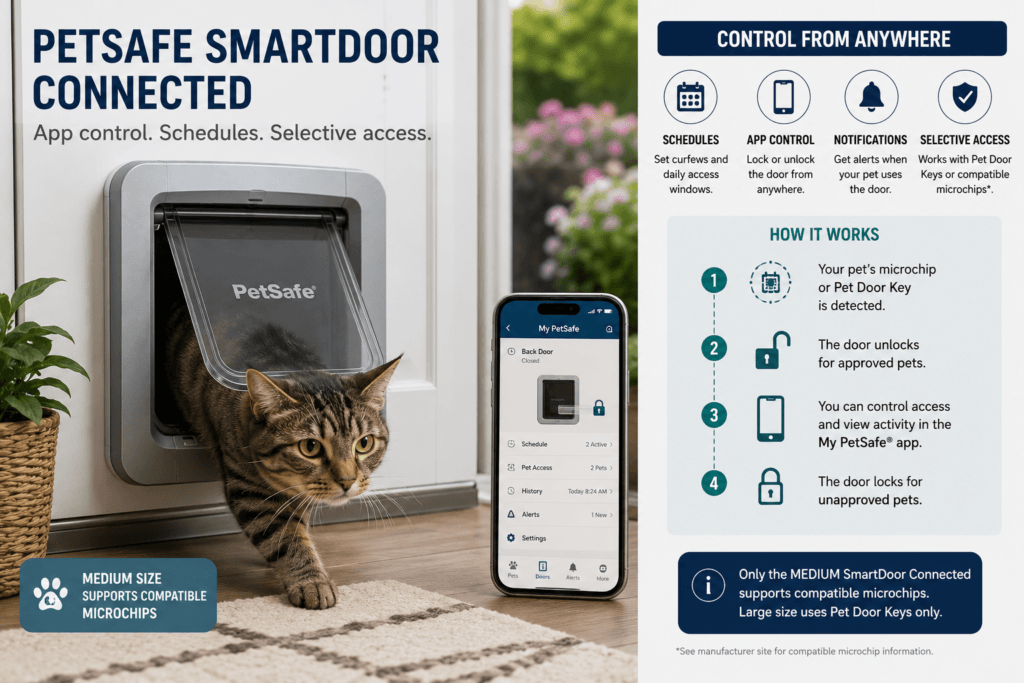
    PetSafe SmartDoor Connected Medium pet door with app controls

    Verdict: Not Recommended

    The PetSafe SmartDoor Connected offers a relevant feature set.

    Through the My PetSafe app, owners can manage access schedules, receive notifications and remotely lock or unlock the flap. The door uses Pet Door Keys, while the Medium version can also pair with compatible implanted microchips.

    The Large version does not provide the same direct microchip option, so cat owners must verify the exact size and identification method before purchasing.

    On features alone, PetSafe appears competitive.

    PetTech AI does not currently recommend it.

    The ownership signal is too weak for a product that requires permanent installation, careful sizing and confidence in both its physical locking system and connected controls.

    A disappointing feeder can be unplugged and returned to a box.

    A disappointing pet door may leave you explaining to the exterior door why it now has a large rectangular memory.

    The recognizable brand does not cancel that installation risk.

    Nor should buyers assume that a broader opening or more mainstream app experience automatically makes it a better cat product. SureFlap offers more convincing alternatives for straightforward microchip entry, individual exit permissions and connected monitoring.

    Consider PetSafe only if:

    • you specifically need its larger Medium opening;
    • your cat’s microchip is confirmed compatible;
    • you prefer the My PetSafe ecosystem;
    • you have reviewed recent ownership feedback carefully;
    • you have a realistic return and installation plan;
    • you accept the risk of choosing a weakly reviewed connected door.

    Avoid it if:

    • you want the safest default recommendation;
    • you are installing into expensive glass, metal or exterior construction;
    • you expect the Large model to read the cat’s microchip;
    • you want a cat-first access ecosystem;
    • weak current ownership feedback is a deal-breaker.

    The product is technically relevant.

    That is not the same as being editorially recommendable.

    Still considering the PetSafe SmartDoor? Check the exact size, current availability and customer feedback on Amazon.

    SureFlap vs PetSafe: The Recommendation Is Not Close

    SureFlap currently offers the more convincing smart cat door lineup.

    Choose the standard SureFlap Microchip Cat Door when your main goal is keeping unregistered animals out.

    Choose DualScan when different cats need different exit permissions.

    Consider SureFlap Connect when remote changes, curfews and activity history solve a recurring household problem.

    PetSafe offers app schedules, notifications, remote locking and a larger opening in its Medium model. Those advantages do not overcome the weak ownership signal.

    The comparison is not:

    specialized brand versus trustworthy mainstream brand.

    It is:

    three SureFlap products with distinct, defensible use cases versus one connected PetSafe door that currently fails the recommendation threshold.

    Brand familiarity is useful when it reduces uncertainty.

    It should not be used to decorate uncertainty.

    Is App Control Worth Paying For?

    Sometimes.

    App control is valuable when it changes a recurring decision.

    It may be worth paying for when you:

    • change outdoor permissions during the day;
    • apply different curfews in different seasons;
    • share care with another person;
    • want confirmation that a cat returned;
    • need to lock the door while away from home;
    • use activity history as one part of a broader monitoring routine.

    It is less valuable when your rule is stable:

    registered cats may enter, unregistered animals may not.

    In that situation, the standard SureFlap is likely the better purchase.

    The most expensive ownership mistake is not buying a bad product.

    It is buying a capable product whose extra capabilities solve nothing.

    What to Check Before Installation

    A smart cat door is not a low-consequence experiment.

    Before cutting anything, confirm the product, opening, access direction and installation surface.

    Measure the clear opening

    Do not judge fit from the outer frame.

    Measure the actual opening your cat must pass through and compare it with the cat’s shoulder width and height.

    Large breeds, overweight cats, senior cats and households shared with small dogs may need a larger pet door rather than a standard cat flap.

    A cat should not need to twist, compress the shoulders or approach at an uncomfortable angle.

    Confirm the access logic

    “Microchip controlled” does not always mean entry and exit are controlled identically.

    The standard SureFlap offers selective entry.

    DualScan and SureFlap Connect can apply individual exit permissions.

    PetSafe uses Pet Door Keys and supports compatible microchips only in the Medium SmartDoor.

    Buy the door that enforces the rule you need—not the rule you assumed from the product title.

    Check microchip compatibility

    Use the manufacturer’s compatibility checker before installation.

    Do not discover after cutting the door that the microchip format or reading position creates a problem.

    Evaluate the installation surface

    Wood, metal, glass and walls require different preparation.

    Metal can interfere with electronic reading and may require an adaptor. Glass usually requires professional cutting or fitting. Wall installations may require tunnel extensions and more extensive sealing.

    Check the entire installation path before purchasing accessories.

    Test before making the installation permanent

    Program the microchip and allow the cat to approach the unit before final installation when practical.

    Confirm that the reader identifies the cat reliably.

    Permanent carpentry is an expensive stage at which to begin product discovery.

    For the direct installation and access-control trade-off, read our PetSafe SmartDoor vs SureFlap Connect comparison.

    How to Train a Cat to Use a Smart Door

    A confident cat may adapt quickly.

    A cautious cat may treat a newly installed flap as a mechanical betrayal.

    Start with the flap secured open. Let the cat investigate the opening without pressure. Use treats, play or familiar cues on the other side.

    Once the cat moves through comfortably, introduce the flap gradually. Allow them to experience its movement before adding the sound of the locking mechanism.

    Keep training sessions short.

    Do not push the cat through the opening or trap them near it. The goal is to build voluntary movement, not win a negotiation against an animal whose preferred response is to become boneless.

    Some cats will need days or weeks.

    That does not mean the door is unsuitable. It means adaptation should move at the cat’s pace.

    Common Smart Cat Door Mistakes

    Buying app control without a use case

    Notifications are not inherently useful.

    Decide what action you will take when one arrives.

    Confusing selective entry with selective exit

    This is the difference between the standard SureFlap and DualScan.

    It can determine whether your access plan works at all.

    Installing before checking the opening

    Frame dimensions are not passage dimensions.

    Measure the cat and the clear flap opening.

    Ignoring weather sealing

    A smart lock does not automatically make a pet door energy efficient.

    Consider door location, drafts, rain exposure and the quality of the seal.

    Expecting the door to replace outdoor safety

    A smart cat door manages access.

    It does not supervise the cat, contain them after exit or locate them outdoors.

    For supervised outdoor exploration, read our Best Cat Harnesses guide.

    Frequently Asked Questions

    What is the best smart cat door?

    The SureFlap Microchip Cat Door is the strongest overall choice for most households. It provides selective microchip entry without requiring an app, Hub or connected account.

    Is SureFlap Connect worth the upgrade?

    Only when remote access changes, individual exit permissions or activity history will be used regularly. For a stable routine, the standard SureFlap offers a simpler and more convincing ownership proposition.

    What is the best smart cat door for multiple cats?

    SureFlap DualScan is the better specialist option when some cats may go outside while others must remain indoors.

    Can a smart cat door keep neighborhood cats out?

    A microchip-controlled door can remain locked for unregistered animals while opening for programmed pets. Correct installation, programming and fit are still essential.

    Does the PetSafe SmartDoor read cat microchips?

    The Medium SmartDoor supports specified compatible microchip formats. The Large version relies on Pet Door Keys rather than direct microchip pairing.

    Can a smart cat door be used indoors?

    Yes. An interior microchip door can protect food, litter boxes or quiet spaces from another cat or dog.

    Do smart cat doors require subscriptions?

    The SureFlap products discussed here do not require a recurring subscription for their core functions. The connected model requires the Sure Petcare Hub and app setup.

    Can a smart cat door tell me where my cat went?

    No. A connected door can record that the cat entered or exited, but it cannot track movement after the cat leaves. A GPS or radio-frequency tracker solves a different problem.

    Final Verdict

    The SureFlap Microchip Cat Door is the best smart cat door for most households.

    It delivers the most useful access rule—registered cats may enter, unwanted animals may not—with the least unnecessary complexity.

    SureFlap DualScan is Recommended with Conditions.

    It is the better specialist option when several cats need different outdoor permissions. Most single-cat homes do not need it.

    SureFlap Microchip Cat Flap Connect receives a Conditional Recommendation.

    Its remote controls, curfews, activity history and individual permissions can be useful. They are not automatically worth the added hardware and connected ownership.

    PetSafe SmartDoor Connected is Not Recommended.

    The feature set is relevant, but weak current ownership evidence makes it difficult to justify over the SureFlap alternatives—especially when installation involves cutting a permanent opening into a door, wall or glass panel.

    The right smart cat door is not the model with the largest dashboard.

    It is the one that applies the correct access rule every day without turning Baron’s return from the garden into a software integration project.

    References

    • Sure Petcare — Microchip Cat Door product and compatibility information
    • Sure Petcare — DualScan Microchip Cat Door product information
    • Sure Petcare — Microchip Cat Flap Connect and Hub documentation
    • PetSafe — SmartDoor Connected Pet Door product and compatibility information

    Image Disclosure

    Official manufacturer images are used when depicting the exact products discussed.

    Any AI-generated images are editorial illustrations only. They do not represent exact opening dimensions, installation requirements, locking mechanisms or app behavior. Always check the current manufacturer documentation before cutting a door, wall or glass panel.

    Editorial Disclosure

    PetTech AI may earn a commission from qualifying purchases. This does not influence our recommendations, comparisons or editorial judgments.