
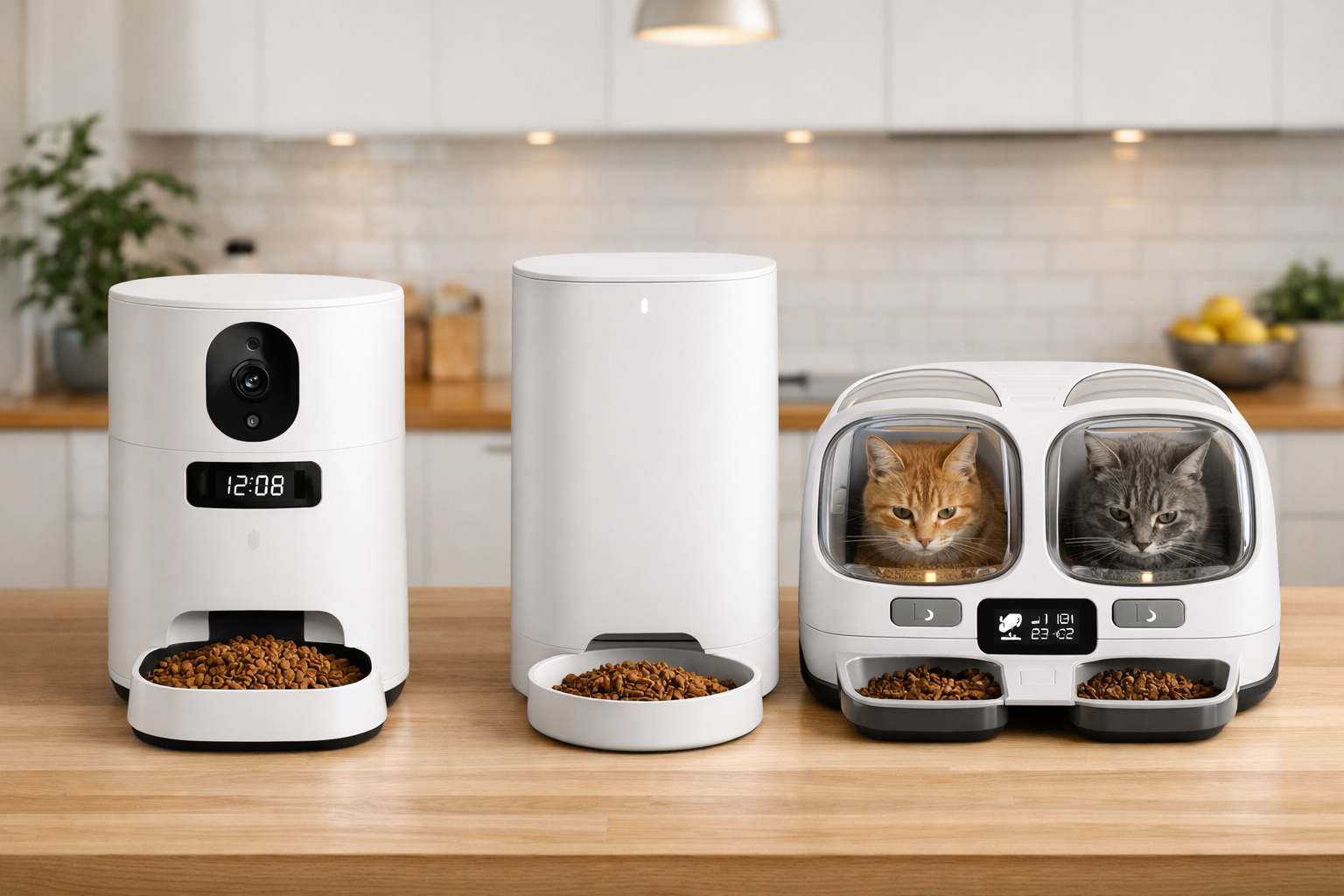
Most smart feeder comparisons obsess over portions, hopper size, and app screenshots. That misses the real decision.
These three systems are not competing on the same axis. PETKIT is pushing camera-led feeding with remote visibility and a stronger “connected care” feel. Feeder-Robot is built around routine, reliability, food-level awareness, and low-friction scheduling. CATLINK is the most aggressive about identity-based feeding, with RFID and facial-recognition models designed for multi-cat control rather than simple automation.
That is why spec-sheet comparisons usually fail. The real question is not which feeder looks smartest. The real question is which feeding problem you actually need solved once the novelty wears off.
What you’re actually choosing here
At system level, the choice is cleaner than most buyers think.
Choose PETKIT if feeding is part of a wider smart-care setup and you genuinely value live monitoring, app interaction, and camera-based reassurance. Current PETKIT feeder models lean heavily into AI camera visibility, two-way audio, scheduled feeding, anti-blockage design, and app control, including single- and dual-hopper variants.
Choose Feeder-Robot if you want the least daily friction. Whisker positions it around anti-jam reliability, offline schedule continuity, hopper-level visibility, remote snack dispensing, feeding-history tracking, and a large dry-food capacity. That is a very different proposition from “smart camera feeding” or “identity-gated feeding.”
Choose CATLINK if one cat stealing another cat’s food is the actual problem. CATLINK’s feeder line is explicitly built around app scheduling plus either RFID access control or facial recognition, which makes the most sense in multi-cat homes with diet separation, food guarding, or monitoring needs.
PETKIT: best when feeding is part of a wider smart-care stack
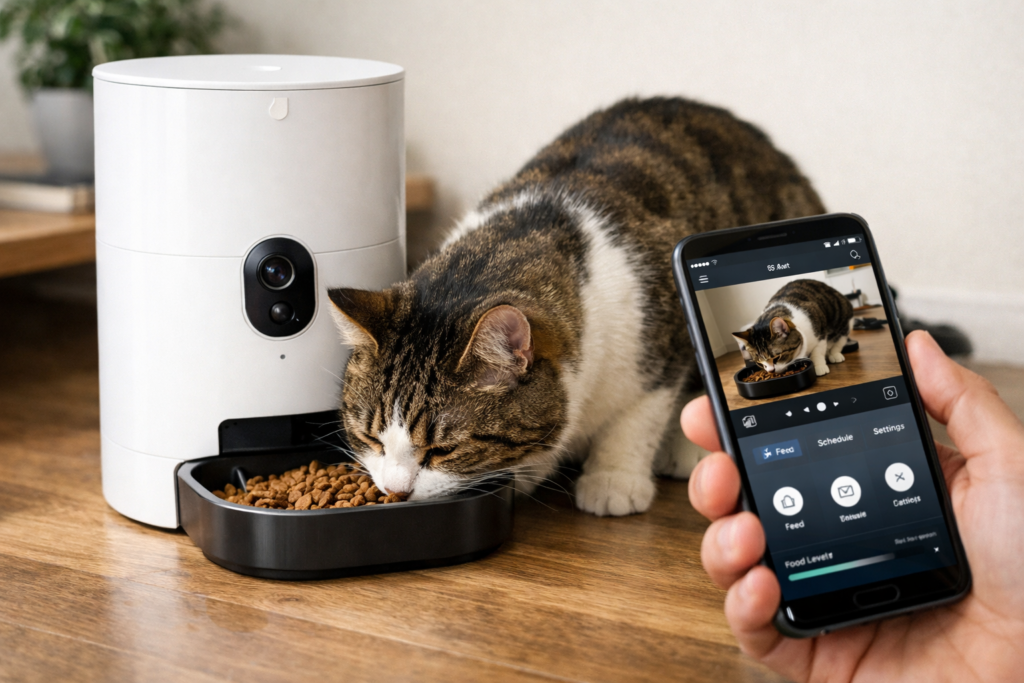
PETKIT’s advantage is not simple automation. It is visibility.
The YumShare Solo with Camera combines scheduled feeding with a 1080p camera, a 140° lens, night vision, two-way audio, AI motion capture, app control, and anti-blockage design. PETKIT’s newer dual-hopper camera feeder goes even further, adding leftover-food detection, multi-cat recognition, and broader monitoring behavior around mealtime. In other words, PETKIT is strongest when you want feeding to be part of a more connected daily pet-care workflow, not just a machine that drops kibble on time.
That also creates PETKIT’s biggest weakness. If you do not actually care about remote viewing, mealtime clips, camera-based alerts, or two-way interaction, the system starts to feel like extra sophistication rather than useful automation. PETKIT makes the most sense when the owner will consistently use the “watch, track, and intervene” layer that the brand is clearly investing in.
Feeder-Robot: best when you want the least friction
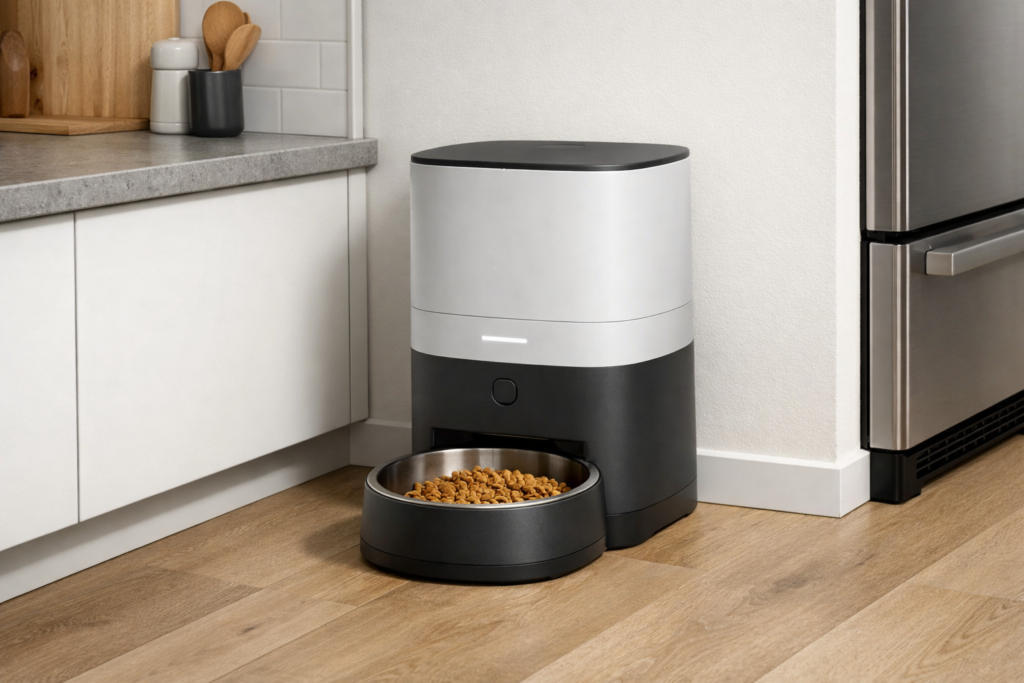
Feeder-Robot is the least flashy option here, but that is exactly why it will make sense for many buyers.
Whisker emphasizes anti-jam technology, offline schedule retention, large dry-food capacity, hopper-level visibility, manual snack dispensing, app scheduling, and feeding insights rather than camera novelty or biometric gating. That makes Feeder-Robot feel less like an experimental smart-home gadget and more like a mature appliance that is supposed to disappear into routine.
This is also where Feeder-Robot can disappoint the wrong buyer. If you expect multi-cat identity control or camera-led reassurance, Whisker’s feeder will feel simpler than PETKIT or CATLINK. But if your goal is consistent scheduled feeding with fewer behavioral surprises, simpler is an advantage, not a limitation.
For readers already deciding inside the Whisker ecosystem, the more relevant internal read is Litter-Robot 5 vs 5 Pro vs EVO, where the same “stability over gimmicks” philosophy shows up in a different product category.
CATLINK: best when feeding has to be controlled, not just automated
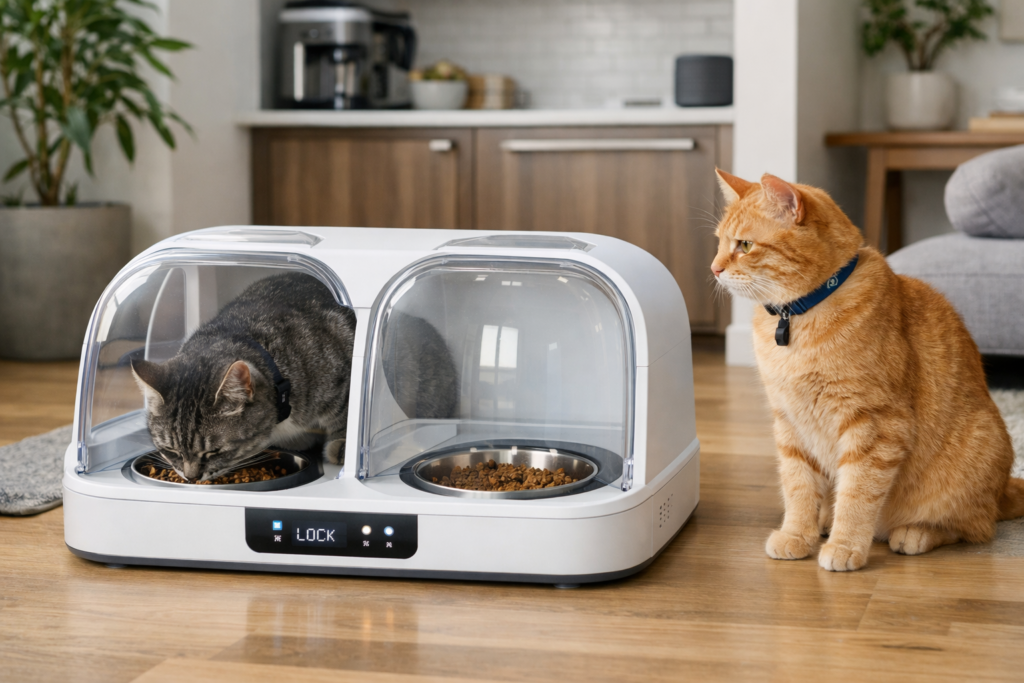
CATLINK is the most specialized system in this comparison.
Its Fresh 2 RFID feeder focuses on app-controlled scheduled feeding and real-time feeding status, while its Facelink models go further into facial-recognition-based individualized feeding. CATLINK is not just trying to automate mealtimes; it is trying to separate cats, personalize portions, and reduce food competition in households where one-size-fits-all feeding stops working.
That specialization is powerful in the right home and pointless in the wrong one. A single-cat apartment usually does not need gated feeding logic. A household with multiple cats on different diets might absolutely need it. This is why CATLINK can look either brilliantly overbuilt or exactly right, depending on the problem you are trying to solve.
For readers comparing the same brands beyond feeding, the broader internal ecosystem read is CATLINK vs PETKIT vs Whisker, where the litter-side trade-offs become much clearer.
Where buyer regret actually comes from
Buyer regret in smart feeders usually has less to do with missed meals than with mismatch.
PETKIT regret tends to happen when buyers pay for camera-led features they do not use consistently. The hardware may be good, but the core promise only pays off if monitoring and remote interaction matter in daily life.
Feeder-Robot regret tends to come from expecting more specialization than the system is designed to provide. It is optimized for dependable feeding behavior, not for facial recognition or strict cat-by-cat access control. If you need identity management, Whisker’s feeder is the wrong tool.
CATLINK regret usually comes from solving a problem that was never really there. RFID and facial recognition are meaningful in multi-cat diet management, but they add complexity that simpler homes may never justify.
The mistake is not buying the wrong smart feeder. The mistake is solving the wrong feeding problem.
Decision matrix
If you want the lowest-friction routine, choose Feeder-Robot. Its advantage is predictability.
If you want the best remote monitoring and mealtime visibility, choose PETKIT. That is where its product family is strongest.
If you need the best multi-cat access control, choose CATLINK. That is the only system here built so explicitly around identity-based feeding.
If you live in an apartment and just want reliable scheduled meals, Feeder-Robot is usually the cleanest choice, with PETKIT as the better fit only if the camera layer matters enough to use regularly.
If you do not have a real multi-cat conflict problem, CATLINK is the easiest system here to overbuy.
If you want biometric-style feeding separation, Feeder-Robot is not the right system.
If you know you will ignore camera feeds and mealtime clips after the first week, PETKIT is probably the wrong value proposition.
Which one makes sense in apartments, multi-cat homes, and travel-heavy routines
In smaller apartments, low-friction routine matters more than advanced feeding theory. Feeder-Robot makes the strongest case here because its core promise is simple scheduled reliability, while PETKIT only overtakes it if live viewing and remote reassurance are part of how you manage your cat when you are away.
In multi-cat homes, the answer changes fast. PETKIT’s camera and multi-pet visibility help, but CATLINK is the system that most directly attacks food stealing and individualized access through RFID or facial recognition. That is a different class of solution.
In travel-heavy routines, PETKIT becomes more compelling than usual because remote monitoring, live video, night vision, and two-way audio add reassurance that a schedule-only system does not provide. Feeder-Robot still wins on simplicity, but PETKIT wins on “I want to see what is happening.”
Portion control also matters more than many buyers admit. Cornell’s Feline Health Center notes that feeding choices should support healthy nutrition and weight management over time, which is one reason smart feeders are most useful when they improve consistency rather than simply adding novelty.
Verdict: which smart feeding system actually makes sense?
Choose Feeder-Robot if your priority is a stable, low-friction feeding routine inside a mature app ecosystem. It is the cleanest fit for straightforward schedules, single-cat homes, and buyers who care more about reliability than gadget complexity.
Choose PETKIT if feeding is part of a wider smart-care stack and you genuinely want camera-led monitoring. Its feeder family is strongest when the owner values live visibility, remote interaction, and a more connected style of daily pet care.
Choose CATLINK if your real problem is multi-cat control rather than simple scheduled feeding. RFID and facial-recognition options make the most sense when one cat steals food, diets need to stay separate, or identity-based access is the actual bottleneck.
If all three look “smart,” that is exactly why generic feature comparisons fail. You are not choosing the feeder that does the most. You are choosing the system that creates the least daily friction after the novelty is gone.
For readers already split between PETKIT and Whisker hardware more broadly, the sharper internal product-level decision is PETKIT PuraMax 2 vs Litter-Robot 4.
References
- PETKIT official feeder pages and lineup: YumShare Solo with Camera, YumShare Dual-Hopper 2, PETKIT feeder collection.
- Whisker official Feeder-Robot product pages, manual, and app-feature pages.
- CATLINK official feeder pages, app page, and feeder collection pages.
- Cornell Feline Health Center nutrition guidance.
Disclosure
PetTech AI may earn a commission when readers buy through affiliate links. That does not change the way products are framed or compared here. Comparisons are built around fit, trade-offs, and likely sources of long-term friction rather than feature inflation or brand loyalty. No feeder should be chosen only because it looks “smarter” on paper. The right purchase is the one that matches the feeding problem in your home, your cat count, your tolerance for complexity, and the level of monitoring you will realistically use after the first week. Prices, bundles, and feature availability can change over time, so always verify current details before buying.