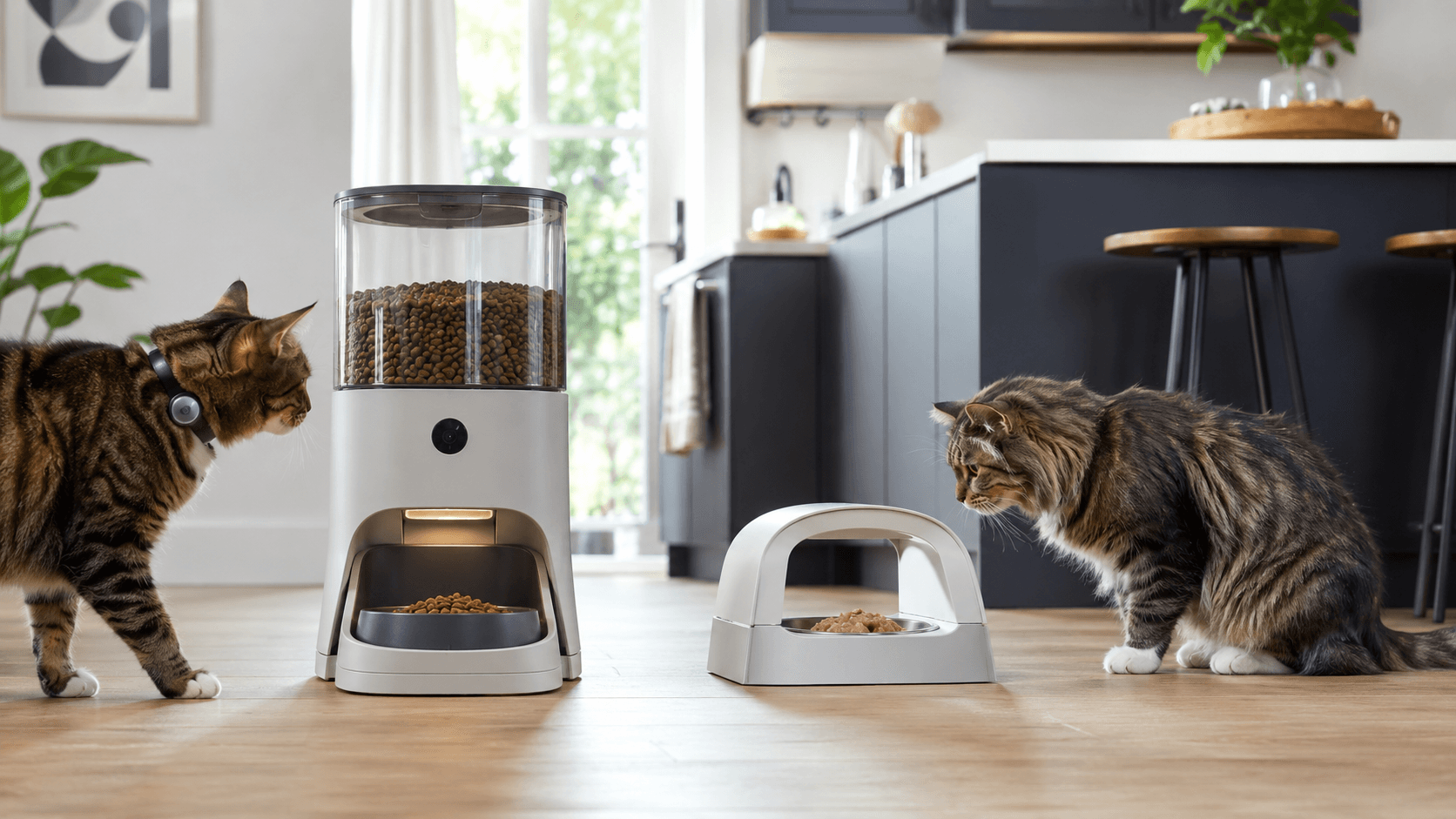
PETLIBRO One RFID and SureFeed Connect are often treated as rival smart feeders. They are not.
PETLIBRO is an automatic dry-food dispenser with a selective-access lid. SureFeed is a protected bowl with microchip recognition, portion scales and connected feeding records. One serves meals. The other guards food you already served.
That distinction settles the purchase faster than twenty minutes comparing app screenshots.
Choose PETLIBRO One RFID for scheduled dry-food portions and collar-tag access. Choose SureFeed Connect for implanted-microchip recognition, wet-food compatibility and tighter diet separation.
Overall verdict: Conditional.
Quick Verdict
| PETLIBRO One RFID | SureFeed Microchip Pet Feeder Connect | |
|---|---|---|
| Best for | Scheduled dry meals protected from food thieves | Wet or dry food reserved for the correct microchipped cat |
| Food delivery | Automatically dispenses kibble | Owner fills the bowl manually |
| Identification | PETLIBRO collar tag only | Implanted microchip or Sure Petcare RFID tag |
| Food type | Dry food only | Wet, dry or both |
| Connected setup | Direct Wi-Fi | Sure Petcare Hub required for app features |
| Main regret risk | Cat rejects the collar or another cat exploits the moving lid | Hub sold separately and no automatic dispensing |
| Verdict | Recommended | Recommended |
PetTech AI may earn a commission from qualifying purchases. As an Amazon Associate I earn from qualifying purchases.
Need scheduled dry-food automation? Check PETLIBRO One RFID on Amazon.
Need true microchip access for wet or dry food? Check SureFeed Connect on Amazon.
Our best automatic cat feeders guide compares these access systems with camera feeders and refrigerated wet-food options. “Smart feeder” has become a broad category containing several machines that barely perform the same job.
Research Note
This is a research-led comparison based on current manufacturer documentation, support materials, manuals and warranty information. PetTech AI has not conducted a long-term side-by-side household test of both feeders.
The conclusions focus on what each mechanism can physically do—not on pretending that two products become equivalent because both have discovered mobile notifications.
Automation vs Selective Access
PETLIBRO One RFID has a 3-liter hopper, accepts kibble between 2 and 15 millimeters and can schedule up to ten meals or snacks per day.
It normally uses wall power. Three alkaline D batteries can preserve scheduled feeding during an outage, but Wi-Fi functions are disabled while the feeder operates only on backup power.
SureFeed Connect has no hopper and does not dispense scheduled meals. You place food into its 400-milliliter bowl, and the lid opens when an authorized pet approaches. Integrated scales and LED guidance help the owner serve the intended portion, while the app records how much, how often and when the cat eats.
The real split is simple:
- PETLIBRO automates when and how much dry food appears.
- SureFeed controls who may eat food already in the bowl.
Calling SureFeed an automatic feeder is technically defensible because the lid moves automatically. It is also how someone ends up expecting a robot waiter and receiving a highly disciplined food safe.
Collar Tag vs Implanted Microchip
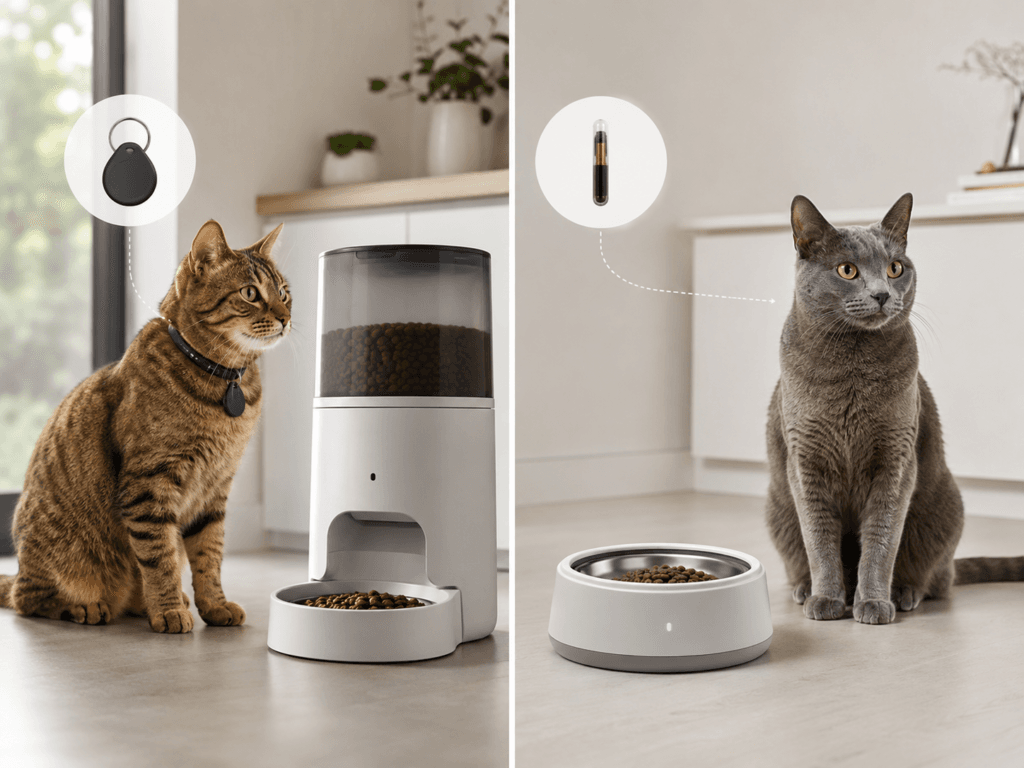
PETLIBRO One RFID does not read an implanted microchip or third-party RFID tag. Its reader mat recognizes the dedicated PETLIBRO tag worn on a collar, and PETLIBRO designs each One RFID feeder around one recognized pet wearing its dedicated collar tag. The tag does not require charging and can be removed from the supplied breakaway collar.
That is practical when the authorized cat accepts a collar. When the cat does not, there is no secret microchip mode waiting beneath an advanced-settings menu.
SureFeed reads common implanted identification microchips and can alternatively use a compatible Sure Petcare collar tag. The identifier can therefore remain inside the cat rather than beneath a sofa after Biscuit’s latest disagreement with wearable technology.
For prescription diets or strict food separation, implanted-microchip recognition has the cleaner logic.
Identification winner: SureFeed Connect.
Dry-Food Automation vs Wet-Food Flexibility
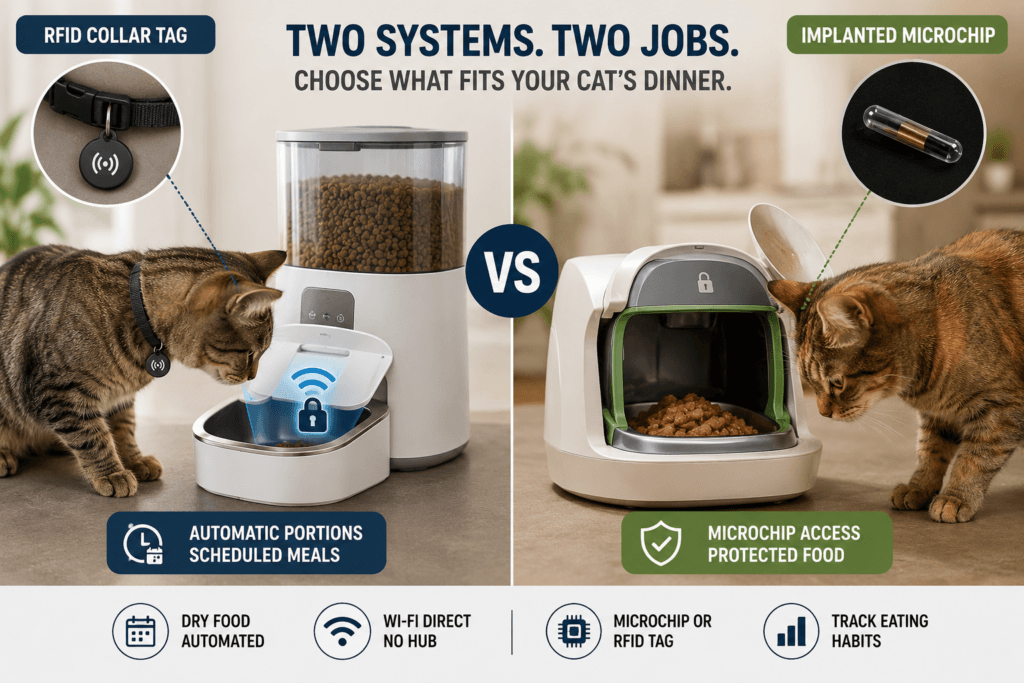
PETLIBRO is dry-food only. Wet food, semi-moist food and kibble larger than the supported range do not belong in its dispensing path.
SureFeed accepts wet food, dry food or a divided bowl containing both. Its closing lid seals against the bowl to help limit flies and moisture loss, but it does not refrigerate the meal. Wet food still requires normal food-safety judgment and regular replacement.
SureFeed is therefore the more natural fit for:
- prescription wet diets;
- cats that graze slowly;
- mixed wet-and-dry routines;
- food that must remain available but protected.
PETLIBRO makes more sense for:
- scheduled kibble portions;
- owners absent at serving time;
- several small dry meals per day;
- households needing timing and access control together.
A standard feeder may schedule the theft. A camera feeder may film it. These two products at least attempt to change who reaches the bowl.
App Experience: Direct Wi-Fi or Hub Tax?
PETLIBRO connects directly through 2.4 GHz or 5 GHz Wi-Fi. Its app manages feeding schedules, quantities, remote dispensing and lid behavior. PETLIBRO Care is optional. Core scheduling, dispensing, access control and device operation do not require a subscription; paid Care plans add broader wellness tracking, trend tools and planning features.
When another pet obstructs the lid, PETLIBRO says the feeder briefly reopens for safety and tries again. After repeated failure, it enters a failed-to-close state and sends a notification. Sensible engineering—but also confirmation that the lid is a moving barrier, not a bank vault.
SureFeed Connect reaches the app through the Sure Petcare Hub, which connects to the home router. One Hub can support up to ten compatible Sure Petcare products. The Amazon listing selected for this comparison sells the Hub separately, so first-time buyers need another purchase for notifications, histories and app controls.
The feeder can still perform its basic microchip-access function without the Hub, but it cannot connect to the Sure Petcare app. Owners already using a SureFlap Connect door may have the required bridge; everyone else gains another small white tenant beside the router.
SureFeed’s records can help owners notice changes in meal quantity or frequency. They can flag a pattern worth investigating; they cannot diagnose illness or replace veterinary assessment.
For the wider software trade-offs, see our best pet tech apps for cats guide.
Multi-Cat Failure Modes Matter More Than the Apps
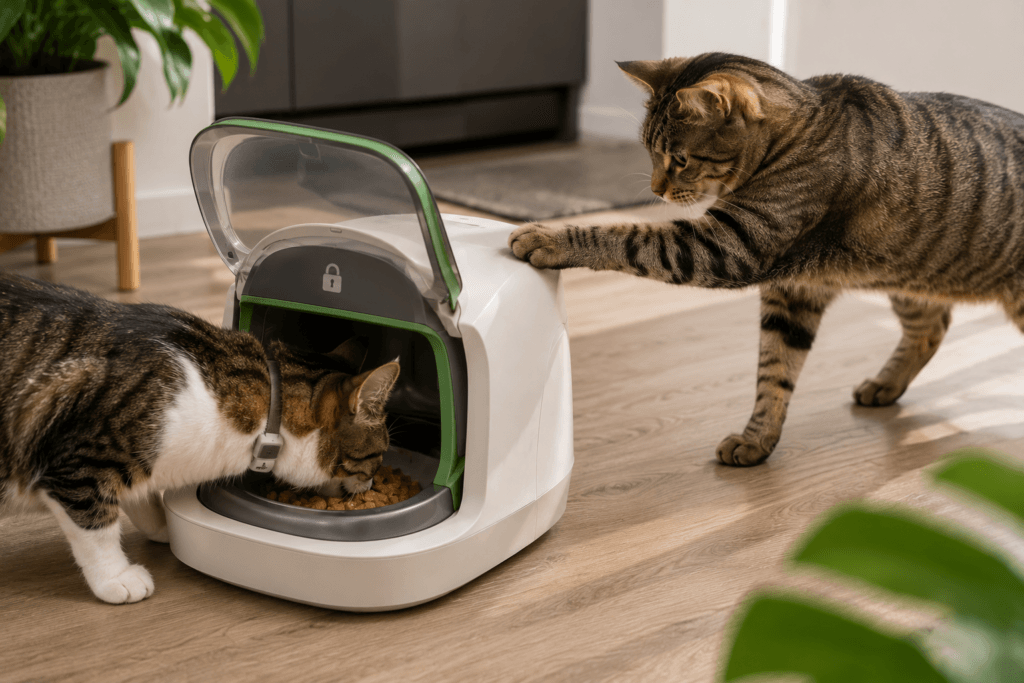
Both feeders are designed to reduce food theft. Neither should be described as impossible to defeat.
PETLIBRO access depends on collar position, reader placement, lid timing and whether another cat approaches before the cover closes. The closing speed can be adjusted, but a determined thief may still study the mechanism with the concentration normally reserved for safecracking.
Each PETLIBRO feeder supports one tag. If three cats need three protected dry-food portions, the practical setup may require three feeders positioned far enough apart to reduce interference. Effective, perhaps—but not exactly minimalist interior design.
SureFeed closes after the authorized cat leaves, but its standard body remains relatively open at the rear. Sure Petcare sells an optional cover specifically for persistent food thieves approaching from behind. Apparently some cats interpret access-control technology as an invitation to conduct penetration testing.
Training also matters. SureFeed uses a staged mode that gradually introduces lid movement, and cautious cats may need several days or longer. PETLIBRO requires the authorized cat to stand correctly on the reader mat while wearing the tag.
The most secure feeder in the house remains useless when its intended customer refuses to put a head near it.
Our best multi-cat tech solutions guide covers the wider difference between preventing conflict and merely collecting excellent data about it.
PETLIBRO One RFID: Who Should Buy It?
Choose PETLIBRO One RFID when:
- the authorized cat eats dry food;
- scheduled dispensing matters;
- the cat accepts a collar tag;
- one feeder per protected cat is practical;
- occasional access failure would be inconvenient rather than dangerous.
Its advantage is combination. Most products either dispense food or restrict access. PETLIBRO does both, using a 3-liter hopper, direct Wi-Fi and battery-backed schedules.
Its main weakness is equally clear: identification lives on the collar. Remove the tag, lose the collar or present a cat philosophically opposed to accessories, and the headline feature disappears.
PETLIBRO currently lists a 24-month warranty for the feeder.
Verdict: Recommended for scheduled dry-food separation.
Check PETLIBRO One RFID on Amazon.
SureFeed Connect: Who Should Buy It?
Choose SureFeed Connect when:
- implanted-microchip recognition is the priority;
- the cat eats wet food, dry food or both;
- meals can be filled manually;
- portion and visit histories would be useful;
- the separate Hub is acceptable or already owned.
SureFeed is the stronger design when unauthorized access has more serious consequences, particularly with prescription food or sharply different diets. It recognizes the cat rather than an accessory the cat must continue wearing.
The trade-off is that it does not serve meals. You still buy, portion and place the food. The connected setup also becomes less attractive when the Hub must be purchased separately, while particularly ambitious thieves may justify the rear cover.
Sure Petcare lists a three-year warranty from the date of purchase and requires proof of purchase to validate a claim.
Verdict: Recommended.
SureFeed is recommended for true microchip-controlled access, not for automatic meal dispensing.
Check SureFeed Connect on Amazon.
Final Verdict
PETLIBRO One RFID wins on automation. It schedules and dispenses dry food, then uses a proprietary collar tag to restrict access.
SureFeed Connect wins on identification and food flexibility. It reads implanted microchips, supports wet or dry meals and records how the authorized cat uses the bowl—but requires manual filling and a separate Hub for app connectivity.
Choose PETLIBRO when the recurring problem is:
“I need the correct dry portion served at the correct time to the correct collar-wearing cat.”
Choose SureFeed when the problem is:
“I need this prepared food protected from every cat except the one whose microchip authorizes access.”
Neither is universally better because they automate different parts of dinner.
One is a dispenser with a bouncer. The other is a private dining room without kitchen staff.
Frequently Asked Questions
Does PETLIBRO One RFID read an implanted microchip?
No. It recognizes PETLIBRO’s dedicated RFID collar tag and pairs with one tag per feeder.
Does SureFeed Connect dispense meals automatically?
No. The owner fills the bowl manually. The feeder automatically controls access and records feeding behavior.
Can SureFeed Connect hold wet food?
Yes. Its 400-milliliter bowl supports wet food, dry food or both. The lid helps preserve freshness but does not refrigerate the meal.
Does SureFeed Connect require the Hub?
The Hub is required for app connectivity, notifications and feeding histories. The Amazon feeder listing reviewed here sells it separately.
Can another cat steal food from either feeder?
Possibly. PETLIBRO’s moving lid can be challenged while closing, while SureFeed may need the optional rear cover against persistent thieves. Placement, training and observation remain important.
Which feeder is better for prescription food?
SureFeed Connect is generally the stronger fit when the food can be placed manually and implanted-microchip access is valuable. No consumer feeder should be treated as an absolute medical-security guarantee.
References
PETLIBRO — One RFID Pet Feeder Product Documentation
PETLIBRO — One RFID PLAF301 Support and Pre-Sale Guidance
PETLIBRO — Feeding Portion and Power Documentation
Sure Petcare — Microchip Pet Feeder Connect Product Documentation
Sure Petcare — Microchip Pet Feeder Connect Manual
Sure Petcare — Hub and Rear Cover Documentation
Editorial Disclosure
PetTech AI may earn a commission from qualifying purchases. This does not influence our recommendations, comparisons or editorial judgments.
Image Disclosure
Official manufacturer images are used when available and authorized.
AI-generated images may also be used as editorial illustrations. They should not be treated as exact representations of product dimensions, materials, controls or physical features. Always verify current official product information before purchasing.