Tag: Smart Cat Doors

  • PetSafe SmartDoor vs SureFlap Connect (2026): Bigger Access or Better Cat Control?

    PetSafe SmartDoor vs SureFlap Connect (2026): Bigger Access or Better Cat Control?

    PetSafe SmartDoor Connected and SureFlap Connect both promise to manage outdoor access without requiring you to work the night shift as your cat’s unpaid concierge.

    The products take different routes. PetSafe offers a larger opening, direct Wi-Fi and more substantial weather protection. SureFlap uses a smaller, cat-specific design with granular microchip permissions—but demands that another small white box move permanently beside your router.

    SureFlap Connect is the lower-regret choice for most average-size cats. PetSafe only makes sense when its wider passage solves a problem the smaller flap physically cannot.

    Overall verdict: Conditional.

    Quick Verdict

    PetSafe SmartDoor Connected MediumSureFlap Microchip Cat Door Connect
    Best forLarge cats, wider passage and direct Wi-FiAverage-size cats and individual access control
    IdentificationCompatible microchip or collar keyCompatible microchip or RFID collar tag
    Opening7.1 × 7.8 inchesAbout 5.6 × 4.7 inches
    ConnectionDirect 2.4 GHz Wi-FiSeparate Hub connected to router
    PowerFour C batteries or optional adapterFour AA batteries
    Main concernLarge permanent installation and weaker owner-feedback signalsSmaller opening and required Hub
    VerdictNot Recommended for most cat homesConditional

    PetTech AI may earn a commission from qualifying purchases. As an Amazon Associate I earn from qualifying purchases.

    Need the wider opening? Check the PetSafe SmartDoor Connected Medium on Amazon.

    Prefer the more cat-specific system? Check the SureFlap Connect bundle on Amazon.

    Before cutting anything, compare the wider category in our best smart cat doors guide. The product can be returned. The rectangle missing from your door is usually less cooperative.

    Research Note

    This is a research-led comparison based on current manufacturer documentation, installation requirements, warranty policies and owner-feedback patterns. PetTech AI has not physically installed either door.

    The Opening Size Changes the Entire Decision
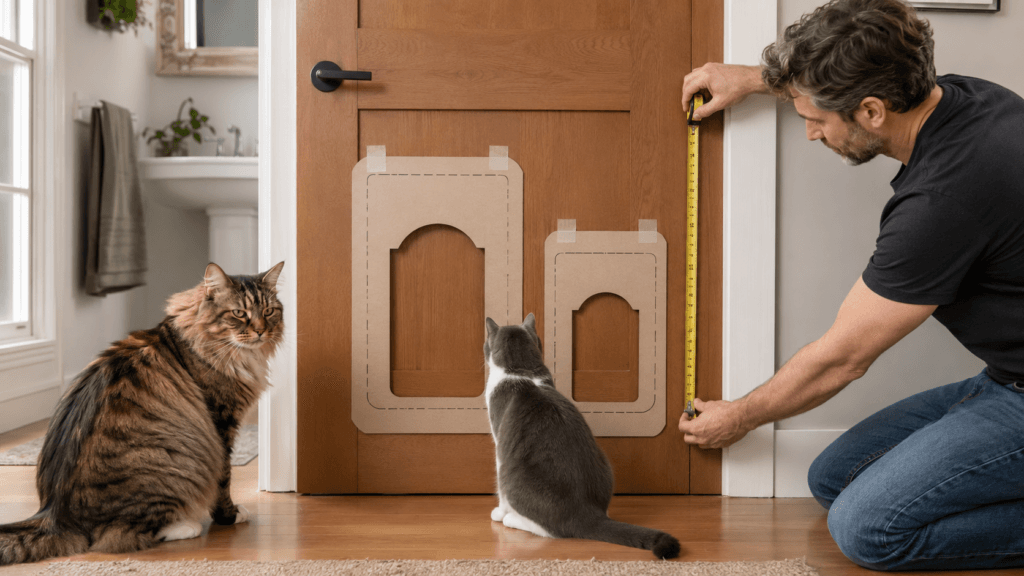
    Large cat comparing wide and compact smart cat door openings before installation.
    The product can be returned. The missing rectangle in the door usually has a stricter policy.

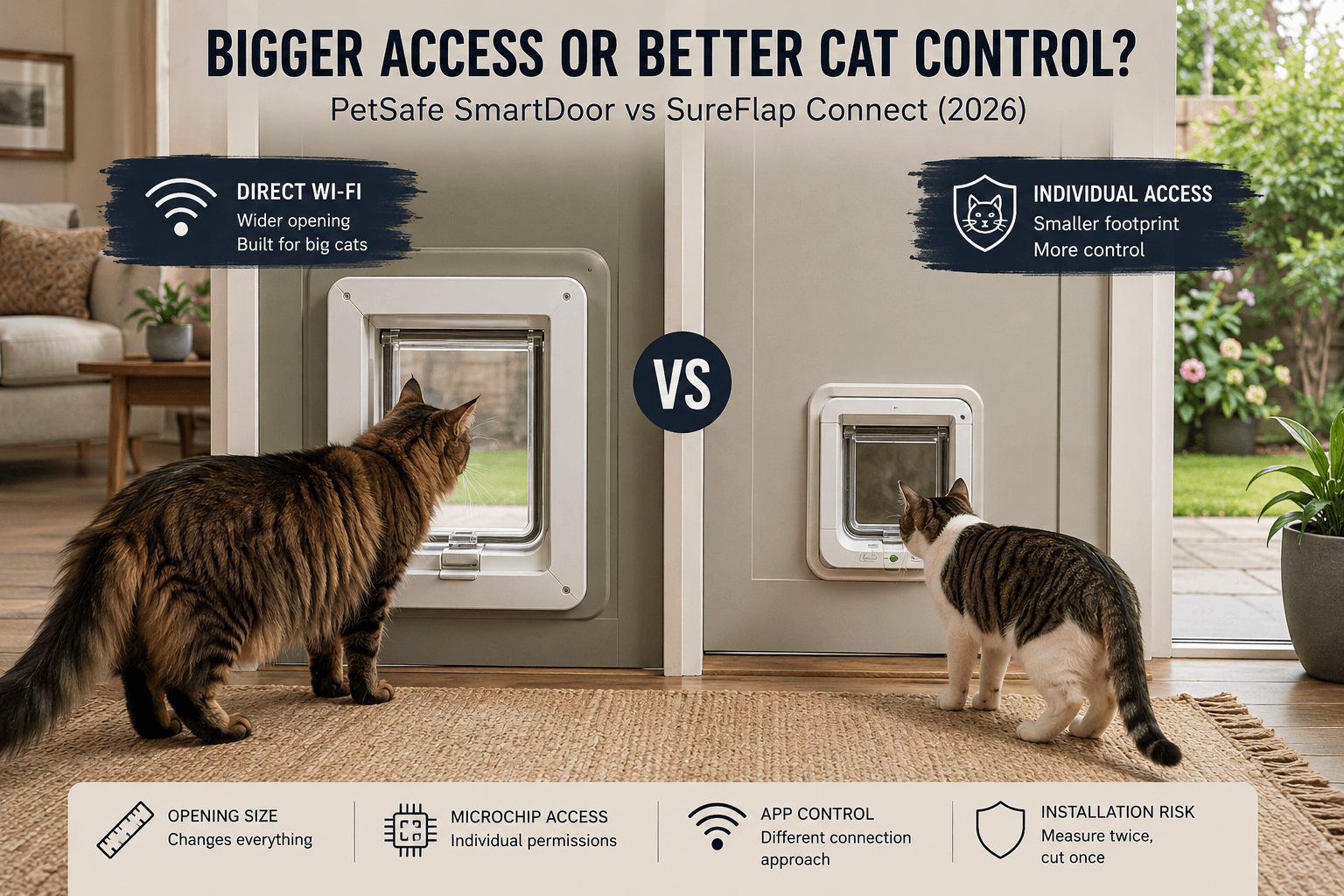
    PetSafe SmartDoor Connected Medium provides a 7.1-by-7.8-inch passage and is intended for pets weighing up to 25 pounds. SureFlap Connect uses a much smaller opening of roughly 5.6 by 4.7 inches.

    That makes PetSafe the more realistic option for:

    • large or long-bodied cats;
    • cats reluctant to squeeze through narrow flaps;
    • homes where differently sized pets share one door;
    • owners who measured the actual cat rather than trusting that “Medium” corresponds to a universal feline standard.

    SureFlap is appropriate for many ordinary domestic cats, but not every Bengal, Maine Coon or generously engineered rescue will approve. Weight limits help; shoulder width and body depth still exist despite marketing’s repeated attempts to ignore them.

    The installation footprint also differs sharply. SureFlap asks for a smaller opening and therefore a smaller leap of faith. PetSafe arrives with the architectural confidence of a product that assumes you already own a jigsaw.

    Microchip Access and Individual Permissions
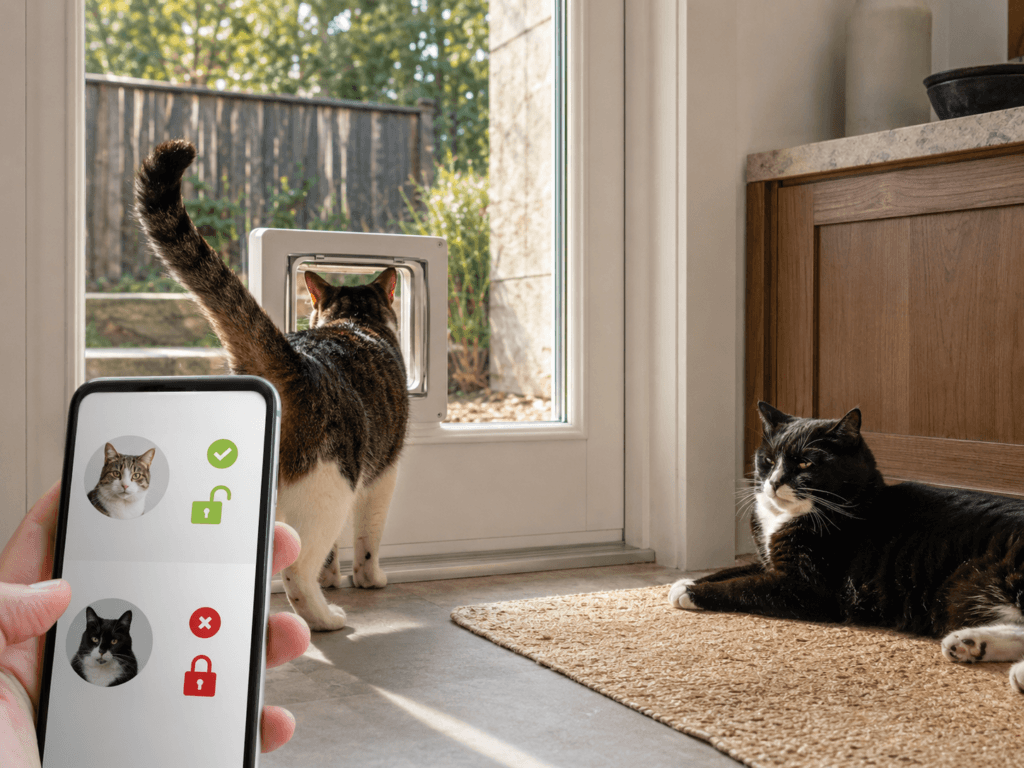
    Two cats receiving different outdoor access permissions through a microchip cat door app.
    Individual permissions matter when one cat may explore and another is temporarily under house arrest.

    Both systems can block unfamiliar animals and assign rules to individual pets.

    The Medium PetSafe SmartDoor supports selected microchip formats and can also use a Pet Door Key attached to the collar. Through the app, owners can create individual schedules, control entry and exit, lock the door remotely and receive activity notifications.

    The important limitation is compatibility: not every microchip works directly. Cats with unsupported chips need the collar key, which introduces another object capable of being lost beneath a sofa, buried in the garden or removed during Gerald’s private expedition.

    SureFlap reads common microchips and can register multiple pets. Its DualScan system reads cats moving both inward and outward, allowing different exit permissions for different animals.

    That is useful when:

    • one cat may go outside while another must remain indoors;
    • a recovering cat needs temporary restrictions;
    • a newly adopted cat is still acclimating;
    • one household member has lost neighborhood privileges following a diplomatic incident.

    Both systems are capable. SureFlap simply feels more deliberately designed around cat-specific access control, while PetSafe combines microchip recognition with a broader key-based pet-door platform.

    Direct Wi-Fi vs Another Dependent Near the Router
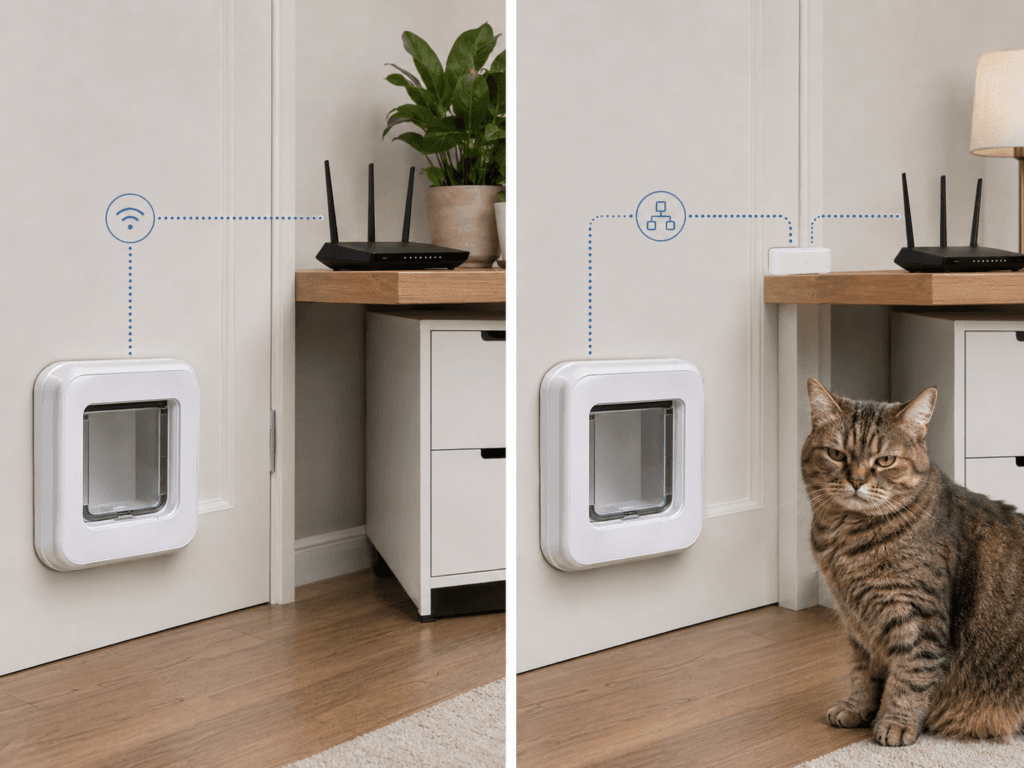
    Smart cat door connected directly to Wi-Fi compared with another system using a router Hub.
    PetSafe connects directly to Wi-Fi. SureFlap introduces another small plastic citizen beside the router.

    PetSafe connects directly to a 2.4 GHz Wi-Fi network. The My PetSafe app handles access rules, remote locking, schedules, notifications and battery alerts.

    SureFlap Connect requires the Sure Petcare Hub. The bundle identified for this comparison includes it, but the Hub still needs power, an Ethernet connection to the router and sufficient range to communicate with the flap.

    PetSafe therefore wins on network simplicity.

    The SureFlap Hub is not a disaster. It is simply another white plastic dependent moving permanently beside your router, contributing nothing to household expenses and blinking occasionally to confirm that it remains your responsibility.

    For homes with limited Ethernet ports, awkward router placement or an existing collection of smart-home bridges, that extra component may be more irritating than the product page suggests.

    Power and Daily Ownership

    PetSafe Medium uses four C-cell batteries. It can also run through an optional wall adapter, with batteries retained as backup during an outage.

    SureFlap uses four AA batteries and claims months of normal operation, although actual battery life will depend on usage, signal quality and how often the cat treats the door as revolving entertainment.

    PetSafe offers the more flexible power arrangement. SureFlap uses cheaper, more familiar batteries.

    Neither option is maintenance-free. Batteries still need replacement, sensors need cleaning and access rules occasionally need adjustment. A smart cat door with dead batteries is just a normal flap that has developed administrative problems.

    Weather Protection and Physical Security

    PetSafe uses a rigid flap, dynamic weather sealing, magnetic closure and a multi-point locking mechanism. Its larger, heavier design is more convincing for exposed exterior doors or homes where drafts matter.

    SureFlap’s smaller footprint reduces the amount of interrupted door surface and prevents unauthorized entry through microchip recognition, but it is not positioned as a heavy-duty extreme-weather barrier.

    PetSafe therefore has a legitimate advantage in colder, windier or more exposed locations. Still, no pet door becomes thermally invisible through confidence alone. Installation quality, wall thickness, sealing and placement remain important.

    For outdoor safety beyond the doorway, remember that selective access does not tell you where the cat goes afterward. Our best cat trackers guide covers that separate problem before Napoleon interprets “authorized exit” as permission to cross state lines.

    A smart door controls who crosses the threshold; it does not create a boundary once the cat is outside. Our best virtual fences for cats guide explains how GPS safe zones and escape alerts handle that separate problem.

    Installation Is the Real Buyer-Regret Zone

    Both doors can be installed in doors and walls. Certain glass, metal or masonry installations may require adapters, tunnel extensions or professional work.

    PetSafe requires the larger cutout. SureFlap’s smaller dimensions make it less invasive and more compatible with typical cat-door placements.

    Before installation:

    1. verify the microchip format;
    2. measure the cat’s shoulders and body height;
    3. create a cardboard test opening;
    4. identify the door or wall material;
    5. power and configure the device;
    6. register every cat;
    7. test the locking behavior;
    8. only then create the permanent opening.

    This sequence is not cinematic, but it is considerably cheaper than discovering afterward that Biscuit considers the flap an architectural insult.

    A return policy protects the electronic product. It does not restore timber, glass, insulation or domestic harmony.

    Returns and Warranties

    PetSafe offers a direct-purchase return window and a standard limited warranty of one year. Installation, removal and restoration costs are not covered.

    Sure Petcare provides a three-year warranty on its microchip doors and the associated Hub.

    That longer protection matters. These products contain readers, locks, motors, wireless components and battery systems, yet they are installed as semi-permanent fixtures. One year of coverage is not especially comforting for a product whose hole may outlive your router, your phone and your current enthusiasm for home automation.

    SureFlap therefore has the stronger long-term ownership case.

    Why PetSafe Is Not Recommended for Most Cat Homes

    PetSafe’s wider entrance, direct Wi-Fi and weather-oriented hardware are genuine advantages. The problem is that those advantages come with a much larger installation commitment and weaker owner-feedback signals than we would want from a device that permanently alters the property.

    PetSafe remains worth considering when:

    • the cat cannot comfortably use SureFlap’s opening;
    • direct Wi-Fi is essential;
    • the door is exposed to difficult weather;
    • the owner accepts the larger cutout;
    • the system can be fully tested before final installation.

    For everyone else, the risk-to-benefit ratio is uncomfortable.

    Verdict: Not Recommended for most cat households.

    Large cats deserve access. Their owners do not need to suspend skepticism in the name of flap width.

    If the larger passage is genuinely necessary, check the PetSafe SmartDoor Connected Medium on Amazon and verify the current listing, dimensions and return terms before installing it.

    Why SureFlap Is Better—but Still Conditional

    SureFlap Connect offers the more coherent feline package:

    • smaller installation footprint;
    • direct microchip recognition;
    • individual exit permissions;
    • app-controlled curfews;
    • longer warranty;
    • a Hub included in the identified bundle.

    Its limitations prevent a stronger recommendation:

    • the opening may be too small for large cats;
    • app connectivity requires the Hub;
    • power is battery-only;
    • installation remains permanent;
    • the connected model adds complexity that some households do not need.

    Verdict: Conditional.

    SureFlap is the better choice for an average-size cat when selective access genuinely matters and the household accepts the Hub. Owners who only need to block unfamiliar animals may be better served by a simpler non-connected microchip flap.

    For individual access control with the smaller cutout, check the SureFlap Connect bundle on Amazon.

    Final Verdict

    SureFlap Connect wins this comparison, but not by enough to earn a universal recommendation.

    It offers more focused cat management, a smaller installation footprint and stronger warranty coverage. PetSafe counters with direct Wi-Fi, better weather-oriented hardware and a much wider passage—but also carries the greater installation risk.

    Choose SureFlap Connect for compact, cat-specific control. Consider PetSafe only when the larger opening solves a problem SureFlap cannot.

    For some households, the smartest decision remains a non-connected microchip flap. The cat gains selective access, unfamiliar animals remain outside and the router avoids adopting another dependent.

    Frequently Asked Questions

    Can PetSafe SmartDoor use a cat’s existing microchip?

    The Medium version supports selected microchip formats. Cats with incompatible chips must use the supplied collar key. Compatibility should be checked before installation.

    Does SureFlap Connect require the Hub?

    Yes. The Hub connects the flap to the Sure Petcare app and enables remote locking, notifications, curfews and activity records. The Amazon bundle evaluated for this comparison includes the Hub.

    Which door is better for a large cat?

    PetSafe SmartDoor Connected Medium has the larger opening and is the more plausible fit for large cats. Measure shoulder width and body height rather than relying only on weight.

    Can either door stop one cat from going outside?

    Yes. Both systems support individual access rules. SureFlap’s DualScan design is particularly focused on assigning different exit permissions to different cats.

    References

    PetSafe — SmartDoor Connected Product Documentation
    PetSafe — SmartDoor Microchip Compatibility Guide
    PetSafe — Return and Warranty Information
    Sure Petcare — Microchip Cat Door Connect Documentation
    Sure Petcare — Hub and App Documentation
    Sure Petcare — Warranty Policy

    Editorial Disclosure

    PetTech AI may earn a commission from qualifying purchases. This does not influence our recommendations, comparisons or editorial judgments.

    Image Disclosure

    Official manufacturer images are used when available and authorized.

    AI-generated images may also be used as editorial illustrations. They should not be treated as exact representations of product dimensions, materials, controls or physical features. Always verify current official product information before purchasing.
  • Best Catios for Indoor Cats (2026): Safer Freedom or Expensive Backyard Cage?

    Best Catios for Indoor Cats (2026): Safer Freedom or Expensive Backyard Cage?

    A catio gives indoor cats fresh air, sunlight and bird watching without handing them unrestricted access to traffic, predators and the regional bird population.

    That is the theory.

    In practice, catios range from compact window-connected enclosures to wooden structures large enough to require yard measurements, assembly help and a brief conversation with whoever controls your property rules.

    The best catio is not automatically the largest or most elaborate. It is the one that fits the available space, provides secure access and can be cleaned, inspected and used safely in real weather.

    This guide compares three distinct builds—then explains which “smart” upgrades genuinely improve them and which merely add another notification to your phone.

    Quick Verdict

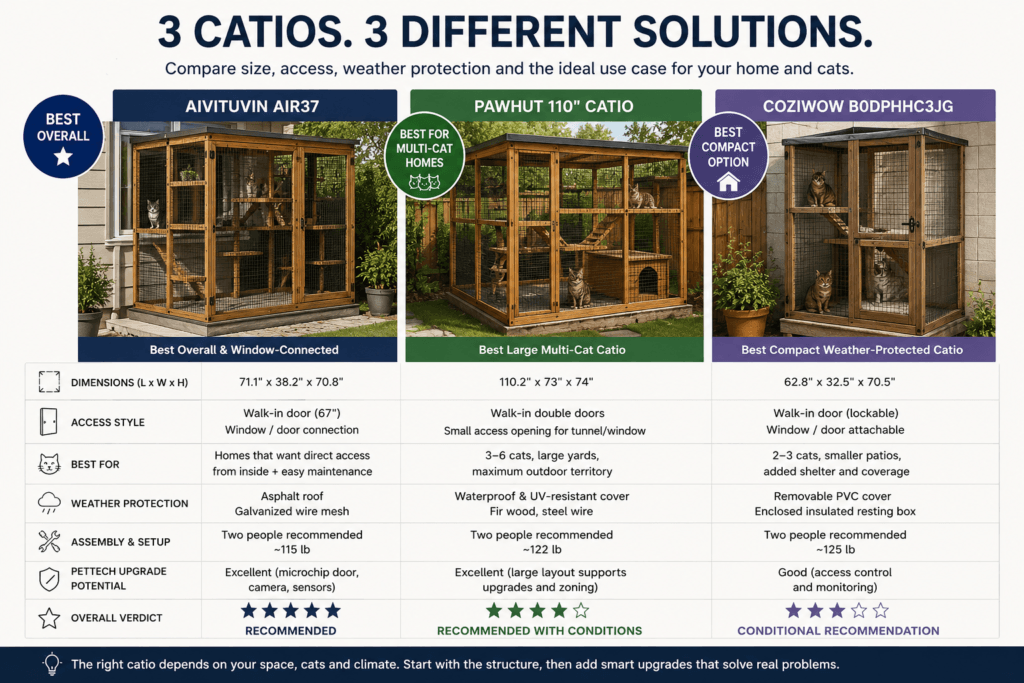
    Comparison of Aivituvin AIR37, PawHut 110-inch and COZIWOW outdoor cat enclosures
    Aivituvin prioritizes balanced access, PawHut maximizes multi-cat territory, and COZIWOW offers a narrower weather-protected configuration. AI-generated editorial comparison; verify current dimensions and specifications before purchasing.
    CatioBest forPetTech AI verdictMain trade-off
    Aivituvin AIR37Best overall and window-connected setupRecommendedHeavy structure requiring careful placement and assembly
    PawHut 110″ CatioLarge yards and multi-cat householdsRecommended with ConditionsEnormous footprint and more demanding installation
    COZIWOW B0DPHHC3JGSmaller patios and added weather protectionConditional RecommendationVery limited current review history
    Microchip door upgradeControlled access between home and catioUseful when neededCompatibility and installation complexity
    Camera upgradeChecking use, conflict or escape attemptsOptionalObservation does not improve structural safety

    Best overall: Aivituvin AIR37 offers the most balanced combination of human access, vertical space and connection to the home.

    Best for several cats: PawHut provides dramatically more usable territory, assuming your yard and patience are equally spacious.

    Best compact alternative: COZIWOW offers a narrower footprint and enclosed resting area, but buyers have much less long-term customer evidence to rely on.

    Research and Safety Note

    This is a research-led comparison based on current manufacturer documentation, retailer listings and feline welfare guidance.

    PetTech AI has not assembled or conducted long-term outdoor testing of all three enclosures.

    Manufacturer phrases such as “weatherproof,” “all season” and “predator resistant” should not be interpreted as guarantees under every climate, surface or installation condition. Inspect the structure regularly and follow the instructions supplied with the exact model.

    PetTech AI may earn a commission from qualifying purchases. As an Amazon Associate I earn from qualifying purchases.

    What a Catio Can—and Cannot—Do

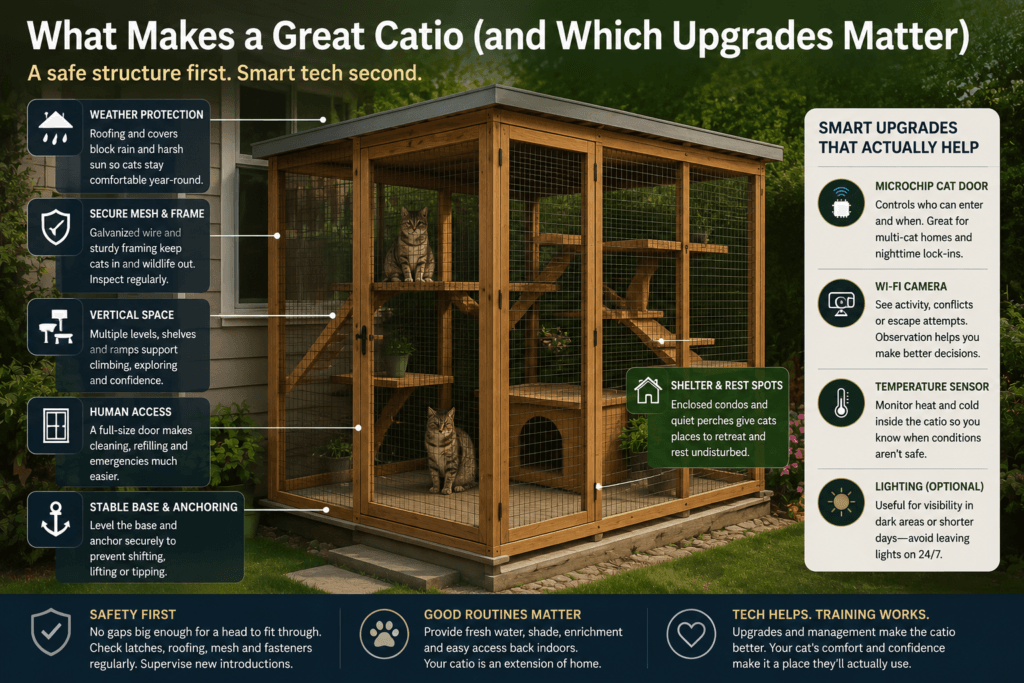
    Wooden outdoor cat enclosure showing secure mesh, covered roof, vertical platforms, human access and sheltered resting areas
    A useful catio starts with secure mesh, stable anchoring, weather protection, human access and usable vertical territory. Technology comes after the physical structure is safe. AI-generated editorial illustration.

    A secure outdoor enclosure can add:

    • fresh air and changing scents;
    • elevated observation;
    • climbing and scratching opportunities;
    • protected outdoor access;
    • additional usable territory;
    • distance from indoor activity.

    FelineVMA materials identify catios and outdoor enclosures as ways to provide safer outdoor experiences and opportunities for natural behaviors such as exploration, sniffing and scent marking. The AVMA also supports keeping owned cats indoors, within an outdoor enclosure or on an attended leash rather than allowing unrestricted roaming.

    A catio cannot:

    • guarantee escape prevention without correct assembly;
    • make extreme temperatures safe;
    • replace parasite prevention or veterinary care;
    • resolve every form of multi-cat conflict;
    • supervise the cat by itself;
    • transform weak mesh into advanced aerospace containment.

    It is an environmental structure first.

    The smart layer comes later.

    A catio adds outdoor territory, but it does not replace the rest of the indoor environment. Our Indoor Cat Enrichment Science guide explains how safe retreats, play, scratching, feeding enrichment and separated resources fit around it.

    Best Overall: Aivituvin AIR37

    Verdict: Recommended

    Aivituvin AIR37 is the most balanced option in this roundup because it behaves like a usable extension of the home rather than a detached outdoor cage.

    Its removable connection design can work with a window, sliding door or cat-door route. The official specifications list an overall size of approximately 71.1 by 38.2 by 70.8 inches, a 67-inch human door, galvanized wire mesh and an asphalt roof. It also includes elevated platforms and a sheltered resting area.

    Where it wins

    The walk-in design matters.

    Human access makes it easier to:

    • clean the floor;
    • inspect mesh and fasteners;
    • retrieve the cat;
    • adjust furniture;
    • reach bowls or litter;
    • intervene during a problem.

    The connection options are equally important. Cats can potentially enter from the house rather than being carried outdoors and placed inside manually.

    This produces a more natural daily routine and makes a compatible cat door a genuinely useful upgrade rather than decorative technology.

    Main trade-offs

    AIR37 weighs approximately 115 pounds and requires a substantial permanent location. Aivituvin recommends two people for assembly, and the base still needs to sit securely on a suitable surface.

    Product photos have a remarkable ability to make a six-foot wooden enclosure look compatible with every patio in America.

    A tape measure is less optimistic.

    Choose Aivituvin AIR37 when:

    • you want regular house-to-catio access;
    • human-friendly maintenance matters;
    • you have a stable patio, yard or suitable balcony;
    • one enclosure needs to support several forms of enrichment;
    • you prefer a balanced structure over maximum size.

    Skip it when:

    • space is very narrow;
    • you cannot assemble or anchor a large wooden unit;
    • your lease or association rules prohibit it;
    • you need a genuinely portable enclosure.

    Does the AIR37 fit your available space and access route? Check Aivituvin AIR37 on Amazon.

    Best Large Multi-Cat Catio: PawHut 110″

    Verdict: Recommended with Conditions

    The PawHut 110-inch catio is not subtle.

    Its official dimensions are approximately 110.2 by 73 by 74 inches. The design includes two sheltered condos, six platforms, ladders, a covered roof area and split doors for access. PawHut describes it as suitable for three to six cats, although household harmony depends on far more than the manufacturer’s occupancy estimate.

    Where it wins

    Space is the main advantage.

    Several cats can have:

    • separate elevated positions;
    • multiple resting destinations;
    • longer movement paths;
    • more opportunities to avoid one another;
    • room for additional scratchers or furniture.

    That makes it more appropriate than a narrow enclosure when the objective is genuine multi-cat territory rather than placing several animals inside one vertical column and hoping diplomacy develops.

    Space can reduce pressure, but it does not automatically resolve food theft, blocked resources or litter conflict. Our Best Multi-Cat Tech Solutions guide separates problems that need more territory from those that require controlled access, automation or individual monitoring.

    The small access opening may also support a planned tunnel or house connection, depending on the final installation.

    Main trade-offs

    This structure requires:

    • substantial yard space;
    • level placement;
    • serious assembly;
    • regular inspection over a much larger frame;
    • confidence that you actually want a permanent feline annex.

    The manufacturer lists fir wood, steel, waterproof paint and a removable waterproof, UV-resistant cover. Those features add protection, but a partial cover does not create complete climate control.

    Choose PawHut when:

    • you have several cats;
    • usable territory is more important than compactness;
    • the yard can support its footprint;
    • you want several platforms and sheltered resting zones;
    • maintenance access remains practical.

    Skip it when:

    • you have a small patio;
    • installation assistance is unavailable;
    • the enclosure would dominate the entire outdoor area;
    • one or two cats need a simpler route connected to a window.

    Have enough yard for the small feline municipality? Check the PawHut 110-inch catio on Amazon.

    Best Compact Weather-Protected Option: COZIWOW B0DPHHC3JG

    Verdict: Conditional Recommendation

    COZIWOW occupies the middle ground between a compact enclosure and a full backyard complex.

    The current Amazon listing describes a structure measuring approximately 62.8 by 32.5 by 70.5 inches, with three tiers of platforms, an enclosed resting box, metal mesh, a lockable access door and a removable PVC cover. The manufacturer presents it as suitable for two to three cats.

    Where it wins

    Its narrower footprint makes it easier to place beside a house or on a moderately sized patio.

    The enclosed resting compartment and removable cover also provide more shelter than a completely exposed wire structure. For owners who cannot accommodate the enormous PawHut but want more than a small window box, the configuration is appealing.

    Why the recommendation is conditional

    The current Amazon listing has only a handful of customer ratings.

    That does not prove the product is poor. It means buyers have relatively little long-term evidence about:

    • wood durability;
    • hardware quality;
    • resistance to repeated weather exposure;
    • assembly consistency;
    • replacement support.

    A perfect average based on five ratings is less a scientific consensus and more a promising dinner table.

    The listing also calls the structure suitable for year-round use. Treat that as a manufacturer claim—not permission to leave a cat outside during severe heat, freezing temperatures, storms or snow.

    Best Friends advises providing shade in hot weather and access to a heated indoor room or garage in very cold conditions rather than leaving cats in a standalone structure.

    Choose COZIWOW when:

    • patio width is limited;
    • an enclosed resting zone is useful;
    • two or three cats need moderate vertical space;
    • you accept greater uncertainty about long-term ownership;
    • the exact configuration fits the access plan.

    Skip it when:

    • you want the most established option;
    • heavy weather exposure is unavoidable;
    • you need extensive multi-cat territory;
    • the resting box is being mistaken for climate-controlled housing.

    Does the smaller footprint justify the limited ownership history? Check COZIWOW B0DPHHC3JG on Amazon.

    Window-Connected vs Freestanding Catios

    A window-connected catio can provide independent access from the home.

    That is convenient, but the transition must be:

    • securely enclosed;
    • compatible with the window or door direction;
    • accessible for emergency retrieval;
    • protected against gaps;
    • usable without trapping the cat outside.

    Best Friends specifically recommends an exterior human-access door when cats enter through a window, so the enclosure can still be cleaned and accessed during an emergency.

    A freestanding catio is easier to place away from the house and may avoid modifying a window. The trade-off is that cats usually need to be carried into it or connected through a separate tunnel.

    Neither format is universally safer.

    Installation quality matters more than whether the product touches the building.

    If a permanent enclosure is not practical, our Virtual Fences for Cats guide compares GPS trackers and boundary alerts for supervised outdoor freedom. A virtual fence can warn you when a cat crosses a boundary, but it cannot physically prevent the crossing.

    Which Smart Upgrades Actually Help?

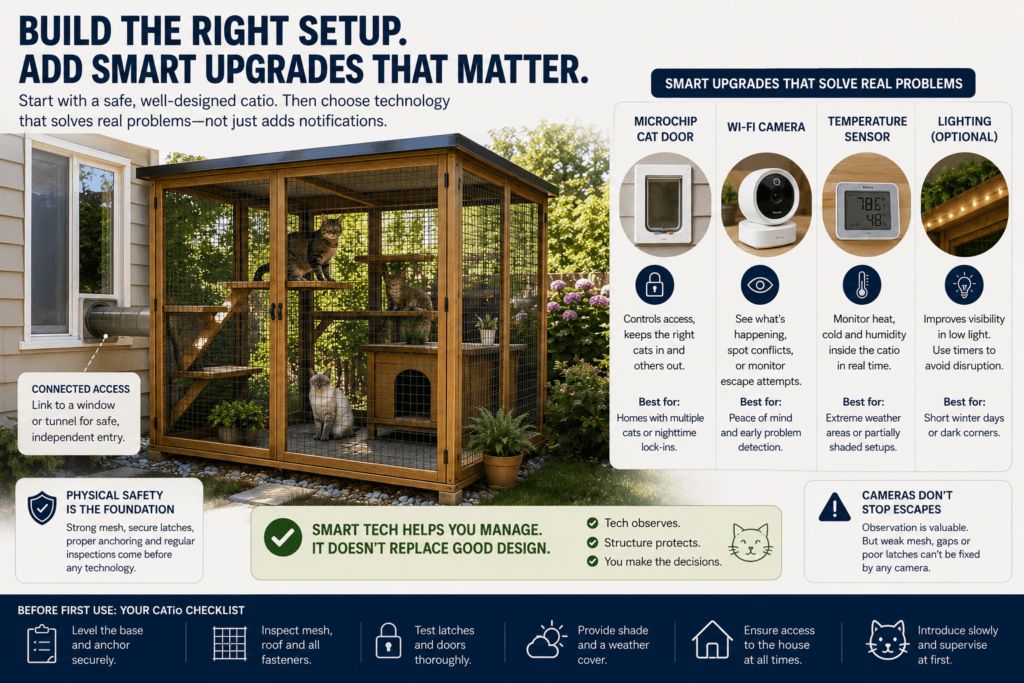
    Window-connected catio with a microchip door, security camera, temperature sensor and optional lighting
    Microchip access, cameras and temperature sensors can improve control and visibility, but they cannot compensate for weak mesh, poor anchoring or unsafe weather. AI-generated editorial illustration.

    Microchip or connected cat door

    Useful when:

    • cats should enter independently;
    • only selected pets need access;
    • overnight access must be restricted;
    • neighborhood animals could reach the entrance.

    Check the exact model carefully. A standard microchip door may control identity without offering app status or remote scheduling.

    For the full distinction, read Best Smart Cat Doors.

    Camera

    A camera can help confirm:

    • whether cats use the enclosure;
    • whether one cat blocks another;
    • where escape testing occurs;
    • whether wildlife approaches;
    • what happened before an unusual event.

    It cannot strengthen joints, close a door or lower the temperature.

    Adding a camera to weak mesh does not make the mesh intelligent. It makes the escape footage available in high definition.

    See Best Smart Cat Cameras for indoor and covered-placement options.

    Temperature sensor

    A simple remote thermometer can be more useful than elaborate AI claims.

    It provides actual environmental information, especially in partially covered enclosures where sunlight, wind and humidity may differ from conditions inside the house.

    The number should support a decision—not excuse leaving the cat outside in unsafe weather.

    Weather, Anchoring and Escape Risk

    Before first use:

    • confirm that the base is stable and level;
    • follow the supplied anchoring instructions;
    • inspect every connection and latch;
    • check roof and mesh attachment;
    • remove sharp edges and loose hardware;
    • verify that platforms support the intended cats;
    • provide shade and an indoor retreat;
    • supervise the introduction.

    Best Friends recommends a secure top, a firm base and routine structural checks. It also emphasizes access to shade and warm indoor areas during temperature extremes.

    Introduce the cat gradually.

    A confident explorer may enter quickly. A cautious cat may need the enclosure left open and quiet while treats, familiar bedding or play create positive associations.

    Do not place the cat inside, close the door and expect immediate gratitude for the real-estate expansion.

    Buyer-Regret Risk

    Catio regret usually begins before assembly.

    Common causes include:

    • measuring the product but not the opening required to reach the yard;
    • discovering the window opens in the wrong direction;
    • ignoring lease or homeowners-association restrictions;
    • placing wood directly against prolonged moisture;
    • assuming “weatherproof” means maintenance-free;
    • underestimating assembly time;
    • buying one narrow route for several cats;
    • adding electronics before the physical structure is secure.

    The most expensive catio is not necessarily the largest one.

    It is the one delivered in fourteen panels before you discover that the intended window cannot connect to it.

    Final Verdict

    Choose Aivituvin AIR37 for the best overall balance of house connection, human access and manageable size.

    Choose PawHut 110″ when several cats need substantial outdoor territory and the yard can support a permanent large structure.

    Choose COZIWOW B0DPHHC3JG when space is tighter and the covered resting area matters—but accept that long-term customer evidence remains limited.

    A catio becomes “smart” only after the physical setup is safe.

    Start with:

    1. the right footprint;
    2. secure construction;
    3. practical human access;
    4. shade and weather planning;
    5. routes that fit the cats.

    Then add a microchip door, camera or temperature sensor when each one solves a specific problem.

    Fresh air is the feature.

    The app is optional.

    Frequently Asked Questions

    Can a cat use a catio without supervision?

    That depends on construction quality, weather, wildlife exposure, the individual cat and the access arrangement. Begin with supervised sessions and never treat a camera as a substitute for a secure structure.

    Are wooden catios weatherproof?

    Wooden catios may include treated surfaces, asphalt roofs or protective covers, but they still require inspection and maintenance. “Weatherproof” does not mean immune to moisture, wind, heat or aging.

    Does a catio replace indoor enrichment?

    No. Cats still need indoor resting areas, play, scratching, litter access and social interaction. A catio adds territory and sensory variety.

    Should a catio connect directly to the house?

    A direct connection can be convenient, but it must be secure and accessible to humans. A freestanding enclosure may be better when modifying a window or wall is impractical.

    Do I need a smart camera or microchip door?

    Only when it solves an existing problem. A camera adds visual context; a microchip door controls access. Neither is required for every safe catio.

    References

    • Feline Veterinary Medical Association — Positive Reinforcement Techniques and Safe Outdoor Experiences
    • American Veterinary Medical Association — Policy on Owned and Free-Roaming Cats
    • Best Friends Animal Society — Outdoor Catio Ideas and Safety
    • Aivituvin — AIR37 Official Product Documentation
    • Aosom/PawHut — 110-Inch Catio Official Product Documentation
    • COZIWOW — B0DPHHC3JG Current Product Listing

    Image Disclosure

    Official manufacturer images are used when available and authorized.

    AI-generated images may also be used as editorial illustrations. They should not be treated as exact representations of product dimensions, materials, controls or physical features. Always verify current official product information before purchasing.
    Editorial Disclosure

    PetTech AI may earn a commission from qualifying purchases. This does not influence our recommendations, comparisons or editorial judgments.