Tag: AI Cat Monitoring

  • PETKIT Purobot Ultra vs Max Pro 2 (2026): Auto-Packing or Better Fit?

    PETKIT Purobot Ultra vs Max Pro 2 (2026): Auto-Packing or Better Fit?

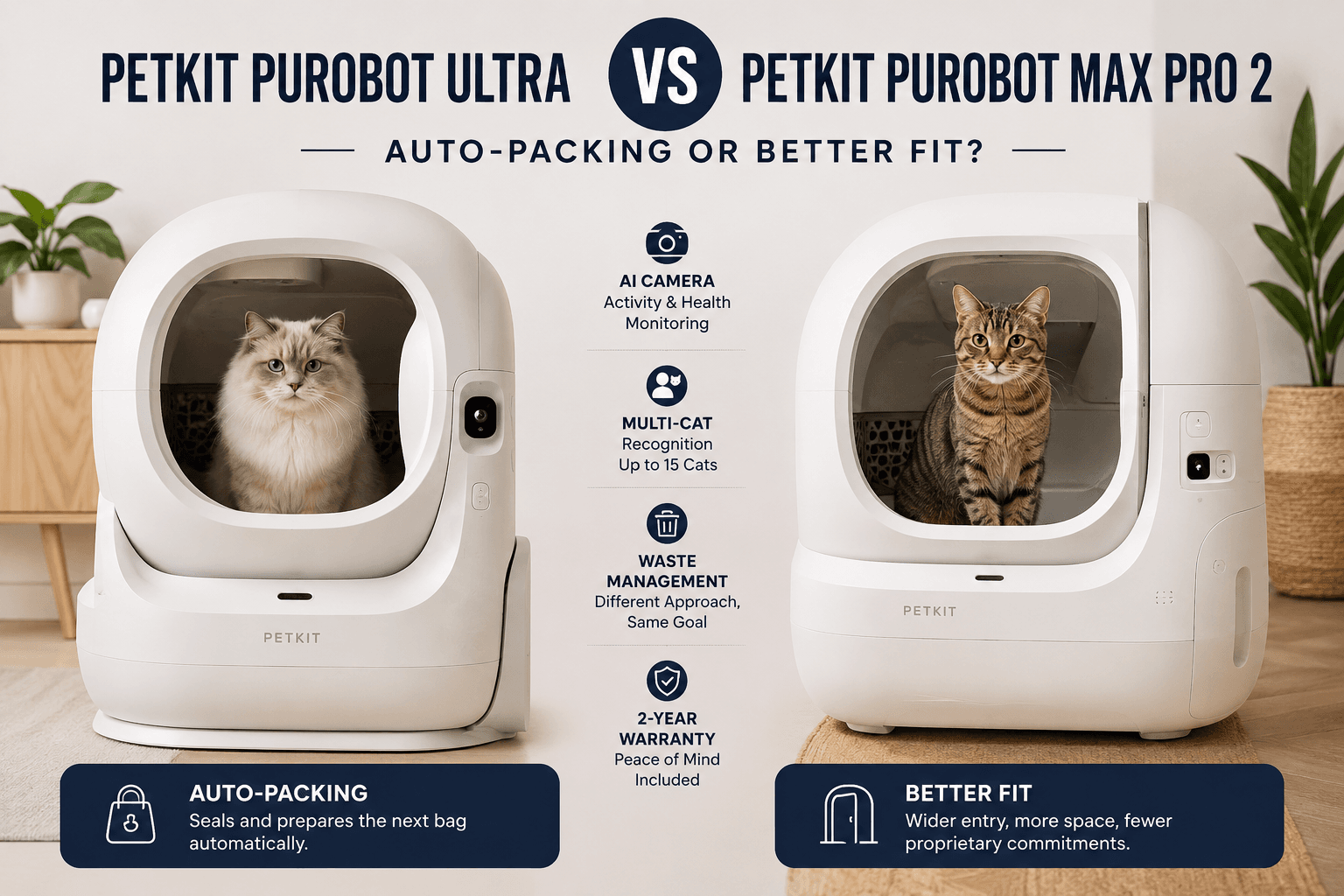
    PETKIT Purobot Ultra and Max Pro 2 share far more than their names suggest.

    Both use an AI camera, facial recognition and weight sensing to separate multi-cat activity. Both record litter-box visits, stool observations and unusual vocalizations. Both can turn your cat’s bathroom habits into a timeline detailed enough to make Napoleon question the household privacy policy.

    The real upgrade is not “more health AI.” It is Ultra’s automatic bag sealing, rotating home-monitor camera and larger waste compartment.

    For most households, Purobot Max Pro 2 is the better buy. It preserves PETKIT’s useful monitoring system while offering a wider entrance, more internal space and a simpler waste setup. Ultra is worth considering when automatic bag sealing genuinely matters—not merely because it performs well during the first demonstration.

    Overall verdict: Recommended — choose Max Pro 2 unless automatic bag sealing is a priority.

    Quick Verdict

    Purobot Max Pro 2Purobot Ultra
    Best forMost cats, larger entry and lower ownership frictionBuyers prioritizing automatic waste-bag sealing
    Entry size10.51 × 10.74 inches9.84 × 8.54 inches
    Internal capacity76 liters70 liters
    Waste bin8 liters; drawstring closure10 liters; automatic sealing
    CameraFixed inward-facing camera; one-way audioRotating indoor/home view; two-way audio
    Waste bagsPETKIT bags recommended; simpler drawstring systemProprietary PETKIT refill rings required
    Main regret riskStill a large connected applianceDeeper body, exclusive consumables and more moving parts
    VerdictRecommended — comparison winnerConditional

    PetTech AI may earn a commission from qualifying purchases.

    Want the more practical PETKIT flagship? Check Purobot Max Pro 2 at PETKIT.

    Want automatic bag sealing and the rotating camera? Check Purobot Ultra at PETKIT.

    Still comparing the wider category? Our best automatic litter boxes guide covers PETKIT, Whisker, CATLINK and open-top alternatives.

    Research Note

    This is a research-led comparison based on current PETKIT documentation, manuals, support policies and available ownership signals. PetTech AI has not conducted an identical long-term household test of both machines.

    Manufacturer health features are treated as monitoring tools, not diagnostic instruments. A camera may document a change. It does not graduate from veterinary school because it successfully photographed a clump.

    Most of the Useful AI Is Already in Max Pro 2
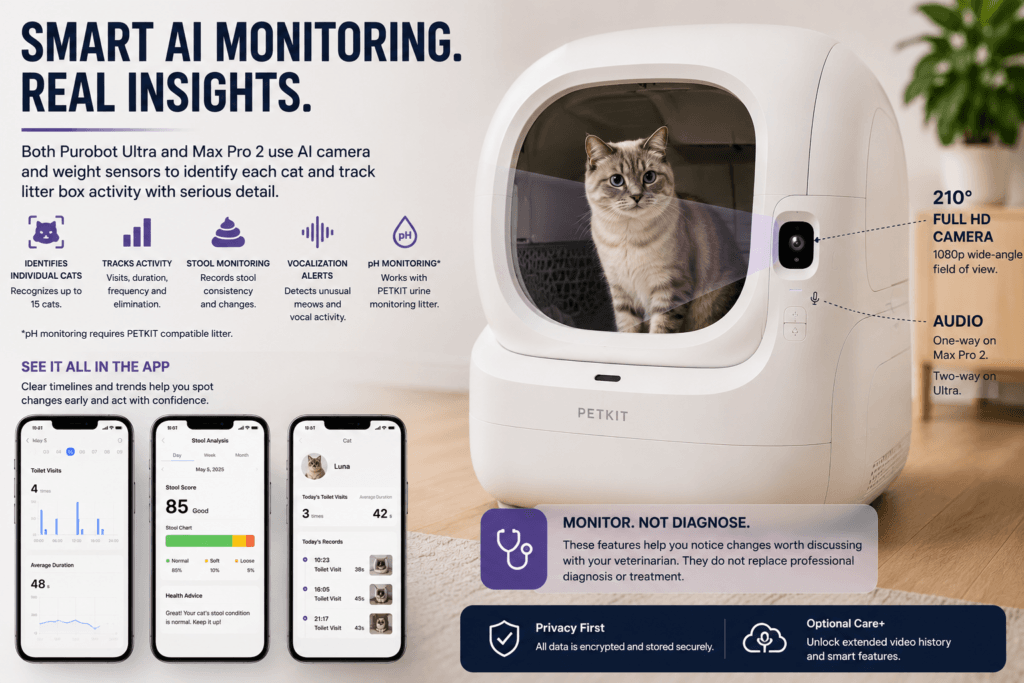
    PETKIT automatic litter box camera monitoring a cat’s litter box visit.
    Both models already provide serious activity monitoring. Ultra’s main upgrade is elsewhere.

    Both machines use 1080p cameras with a stated 210-degree field of view. They combine facial recognition with weight sensors, create individual profiles for as many as 15 cats and record visit frequency, duration and waste observations. Both can also flag yowling, loose stool patterns and color changes when used with PETKIT’s compatible urine-monitoring litter.

    Those features can help owners notice:

    • changes in litter-box frequency;
    • prolonged or repeated visits;
    • visible differences in stool;
    • unusual vocalization;
    • which cat used the box in a multi-cat home.

    They cannot determine why a change happened. Urinary obstruction, constipation and digestive illness still require veterinary evaluation rather than an app notification followed by twelve minutes of increasingly creative self-diagnosis.

    Ultra does add a genuinely different camera arrangement. Its camera can rotate between the litter-box entrance and the wider room, and it includes a speaker for two-way audio. Max Pro 2 keeps its camera focused on litter-box activity and provides microphone-based one-way audio.

    That makes Ultra more useful as a secondary pet monitor. It does not make Max Pro 2 a lesser health tracker.

    Ultra’s Auto-Packing Is Useful—but Not Magical
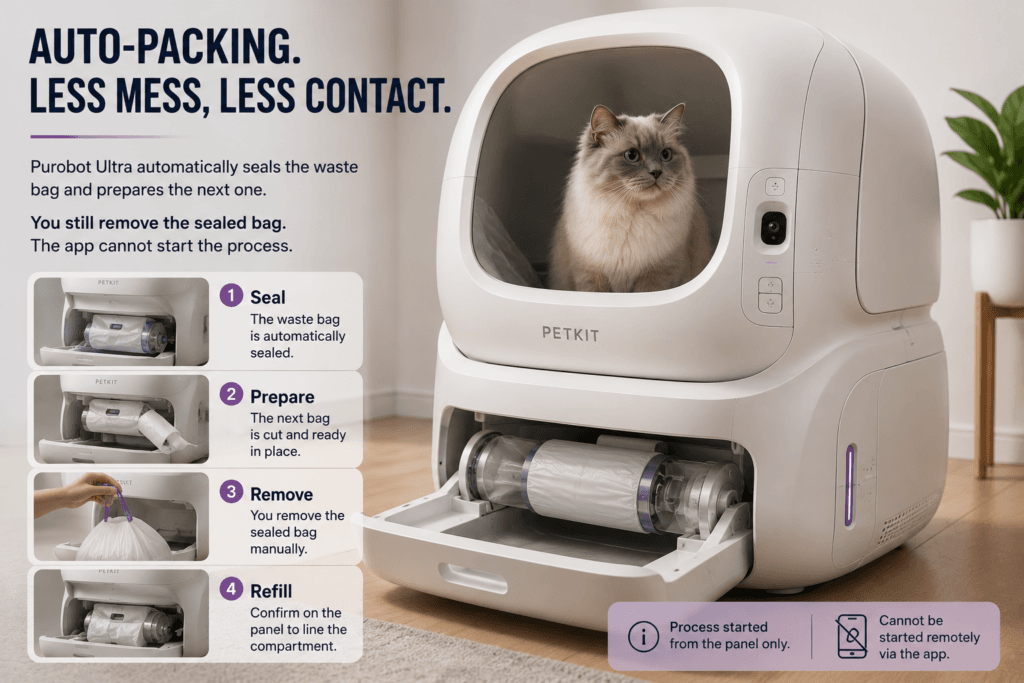
    PETKIT Purobot Ultra automatic waste bag sealing system.
    Ultra seals and prepares the bag automatically. The sealed package still has not learned to take itself outside.

    Ultra automatically seals the waste bag and can prepare a fresh section from its refill ring. This reduces direct contact with the open bag and is the clearest reason to choose it.

    But “automatic” needs translation.

    The packing process must be started from the machine’s control panel, not remotely through the app. PETKIT instructs the user to remain beside the device, remove the sealed bag manually and then double-press the panel control to begin automatic refilling.

    Ultra therefore automates:

    • sealing the existing bag;
    • cutting or preparing the next section;
    • lining the waste compartment again.

    It does not automate:

    • noticing that you have finally walked into the room;
    • carrying the sealed bag outside;
    • replacing the refill ring when it runs out;
    • apologizing to the environment for adding another proprietary consumable.

    Max Pro 2 uses a drawstring bag. You pull the closure, remove the bag and install the replacement yourself. PETKIT describes it as contactless packing and claims up to 17 days between changes for one cat, compared with up to 20 days for Ultra’s 10-liter bin. Real intervals will vary with cat count, litter use and digestive enthusiasm.

    Waste-handling winner: Ultra.
    Complexity winner: Max Pro 2.

    The Refill Ring Is Ultra’s Main Buyer-Regret Risk

    Ultra’s automatic packing system requires PETKIT’s exclusive refill rings. Generic bags are not compatible, and PETKIT says one ring provides approximately ten packing cycles under its test conditions.

    That creates a permanent ownership dependency. The feature works because the bag material is integrated into the machine’s sealing system; substituting a supermarket liner is not part of the arrangement.

    Max Pro 2 still works most neatly with its intended drawstring bags, but its waste system is mechanically simpler. There is no heat-sealing module, automated refill process or proprietary ring responsible for continuing the ceremony.

    Ultra reduces effort at each successful bag change. Max Pro 2 reduces the number of things that can interrupt the bag change.

    That is the central ownership trade-off—not whether one product page contains three more illustrations of artificial intelligence.

    Max Pro 2 Is Friendlier to More Cats
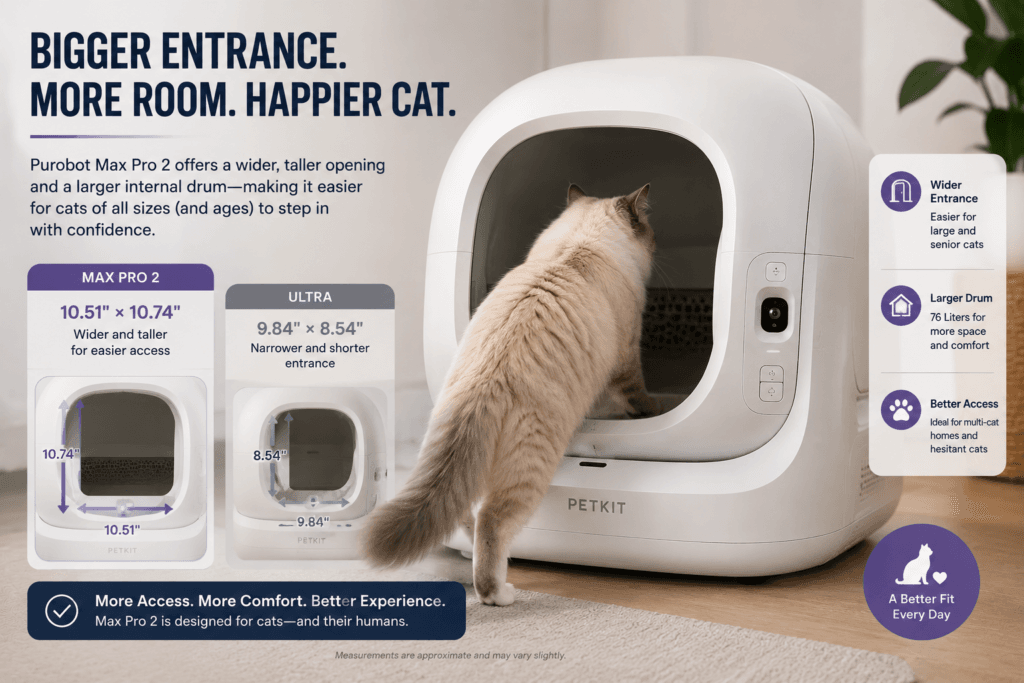
    PETKIT Purobot Max Pro 2 showing its larger entrance and internal litter space.
    Max Pro 2 gives broad, senior and hesitant cats the more forgiving entrance.

    Max Pro 2 has a 10.51-by-10.74-inch entrance and a 76-liter cylinder. Ultra’s entrance measures 9.84 by 8.54 inches, while its cylinder provides 70 liters. Both are officially intended for cats weighing between 3.3 and 22 pounds.

    The shared weight range does not erase the physical difference.

    Max Pro 2 is the stronger fit for:

    • broad or long-bodied cats;
    • seniors with reduced mobility;
    • short-legged cats;
    • cats already suspicious of enclosed litter boxes;
    • owners who want easier access during cleaning.

    Ultra is slightly narrower, but it is dramatically deeper: about 32.2 inches versus 21.18 inches for Max Pro 2. It also weighs roughly 32.2 pounds compared with 24.25 pounds. Max Pro 2 is wider, so neither should be ordered before the floor receives the dignity of a tape measure.

    A litter box can possess award-winning AI, automated sealing and a rotating camera. If Biscuit refuses to enter, it has become an unusually well-connected side table.

    Cat-access winner: Max Pro 2.

    Cleaning and Daily Ownership

    Both models use a rotating cylinder, replaceable sifters and a sealed waste area. Max Pro 2’s larger opening also gives the owner more room to reach the interior, while PETKIT describes its cylinder as detachable for deeper cleaning.

    Ultra adds an auto-packing module that must be wiped rather than rinsed or submerged. Its camera and powered base require the same caution. More automation does not remove maintenance; it introduces a component that becomes offended by water.

    Litter choice still matters with either machine. Compatible clumping clay, tofu and mixed formulas must fit the installed sifter and form stable clumps before the cleaning cycle. Our best litter for automatic litter boxes guide covers particle size, smearing and clean-litter waste.

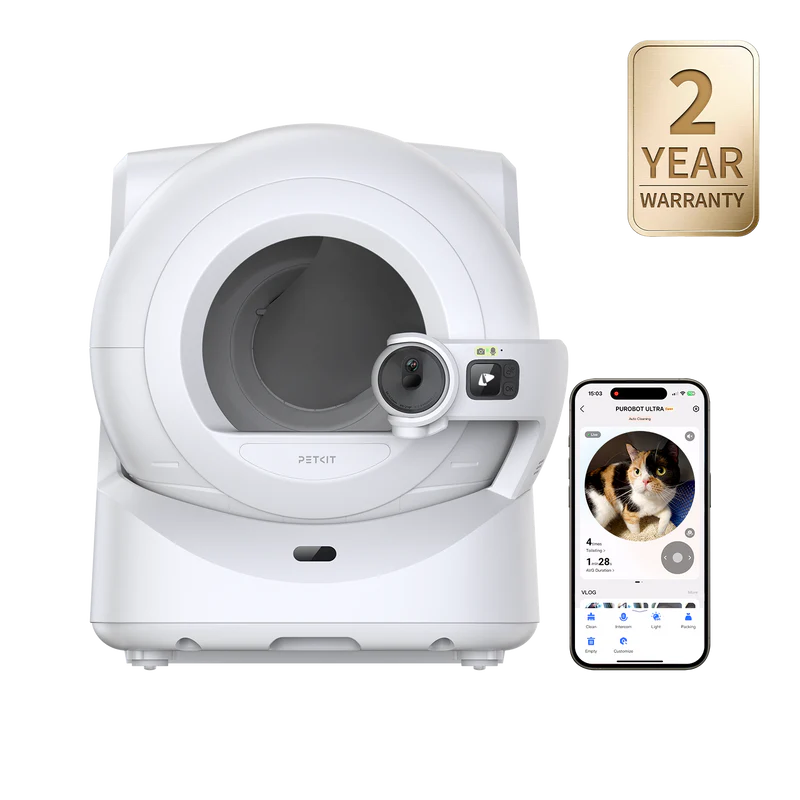
    Neither model receives an advantage for Wi-Fi, app scheduling or warranty. Both support 2.4 and 5 GHz networks, and PETKIT currently provides eligible US purchases with a two-year limited warranty. Direct purchases may qualify for return within 30 days, subject to authorization and return conditions.

    Who Should Buy Purobot Max Pro 2?

    Choose Max Pro 2 when:

    • your cat benefits from the larger entrance;
    • AI identification and waste monitoring are the main reasons for upgrading;
    • you prefer fewer proprietary consumables;
    • a shallower footprint fits the room better;
    • manually closing a drawstring bag is not considered a humanitarian crisis.

    Max Pro 2 gives up automatic sealing, outward camera monitoring and two-way audio. For most buyers, those are reasonable sacrifices for better accessibility and less ownership friction.

    Verdict: Recommended — comparison winner.

    For a deeper look at its camera, app and everyday trade-offs, read our Purobot Max Pro 2 review.

    Check Purobot Max Pro 2 at Petkit.

    Who Should Buy Purobot Ultra?

    Choose Ultra when:

    • automatic bag sealing is a high-priority feature;
    • reducing exposure to an open waste bag matters;
    • the larger 10-liter compartment is useful;
    • you want a camera that can also face the room;
    • two-way audio has practical value;
    • proprietary refill rings are acceptable.

    Do not choose Ultra because “Ultra” sounds like the legally mandated final stage of product ownership.

    Its strongest feature is real, but narrow: it makes waste changes cleaner and more automated. Buyers who do not deeply dislike closing bags are paying for an impressive solution to a task that Max Pro 2 already makes fairly brief.

    Verdict: Conditional.

    Our full Purobot Ultra review examines the auto-packing system and Care+ trade-offs in greater detail.

    Check Purobot Ultra at Petkit.

    Final Verdict

    Purobot Max Pro 2 is the better choice for most households.

    It retains PETKIT’s important AI features while offering:

    • the larger entrance;
    • more internal room;
    • a shallower and lighter body;
    • simpler waste handling;
    • less dependence on proprietary refills.

    Purobot Ultra is the better waste-management machine. Its automatic sealing system, larger bin and rotating camera are meaningful upgrades for the right owner.

    They are not universal upgrades.

    Choose Max Pro 2 when the cat’s fit and long-term ownership simplicity come first.

    Choose Ultra when automatic bag sealing is important enough to justify the refill ecosystem, greater depth and added mechanical complexity.

    One gives PETKIT’s AI more room for the cat. The other gives the waste bag a small automated legal department.

    Frequently Asked Questions

    Does Purobot Ultra pack waste remotely through the app?

    No. The packing sequence must be started at the control panel, and PETKIT instructs the owner to remain beside the machine, remove the sealed bag and confirm the automatic refill process.

    Can Purobot Ultra use ordinary trash bags?

    No. Its automatic sealing system requires PETKIT refill rings. Generic bags may interfere with the packing mechanism.

    Which model is better for a large or senior cat?

    Max Pro 2 has the wider and taller entrance, plus a larger internal cylinder. That makes it the more accommodating design despite both models sharing the same stated weight range.

    Do the AI health features diagnose medical problems?

    No. They can record behavior, vocalization and visible waste changes that may justify veterinary attention. They cannot diagnose urinary or digestive disease.

    References

    PETKIT — Purobot Max Pro 2 Product Documentation
    PETKIT — Purobot Ultra Product Documentation
    PETKIT — Purobot Ultra User Manual
    PETKIT — Purobot Ultra Refill Ring Documentation
    PETKIT — Limited Warranty Policy
    PETKIT — Return and Refund Policy

    Editorial Disclosure

    PetTech AI may earn a commission from qualifying purchases. This does not influence our recommendations, comparisons or editorial judgments.

    Image Disclosure

    Official manufacturer images are used when available and authorized.

    AI-generated images may also be used as editorial illustrations. They should not be treated as exact representations of product dimensions, materials, controls or physical features. Always verify current official product information before purchasing.
  • PETKIT Purobot Ultra Review 2026: Maximum Automation, Maximum Commitment

    PETKIT Purobot Ultra Review 2026: Maximum Automation, Maximum Commitment

    The PETKIT Purobot Ultra is what happens when a self-cleaning litter box decides that scooping waste is no longer ambitious enough.

    It cleans the litter, photographs the evidence, attempts to identify the responsible cat, seals the waste bag and prepares a new section of liner for the next round.

    That is genuinely impressive.

    It is also large, expensive, dependent on proprietary refill rings and equipped with a camera aimed at one of the few household activities your cat probably assumed would remain private.

    The Purobot Ultra is not the best automatic litter box for everyone. It is the most compelling PETKIT model for owners who want camera-assisted multi-cat monitoring and automatic waste packing in the same machine.

    Quick Verdict

    PetTech AI verdictBest fitNot forThe real reason to buy
    ConditionalMulti-cat homes wanting facial recognition, video context and minimal contact with wasteLarge or hesitant cats, tight spaces, privacy-conscious owners and buyers avoiding proprietary consumablesThe auto-packing system—not the AI health marketing

    Buy it when: you want PETKIT’s deepest monitoring package and consider manually tying litter bags an unacceptable use of your remaining time on Earth.

    Skip it when: basic self-cleaning, weight trends and app notifications already solve the problem. The Purobot Max Pro 2 or PuraMax 2 will cost less and occupy less conceptual space in your life.

    PetTech AI may earn a commission from qualifying purchases. As an Amazon Associate I earn from qualifying purchases.

    Does automatic packing and camera-assisted monitoring justify the premium in your home? Check the PETKIT Purobot Ultra on Amazon or compare it on the official PETKIT store.

    Research and Health Note

    This is a research-led review based on current PETKIT documentation, the product manual, retail listings and independent hands-on reports. PetTech AI has not conducted identical long-term testing across every premium automatic litter box discussed here.

    The Purobot Ultra can record litter-box visits, capture images and flag changes in behavior or waste appearance. It cannot diagnose constipation, urinary disease, infection or obstruction.

    Cornell lists painful or difficult urination, frequent attempts, crying during urination and blood in the urine among common lower urinary tract signs. A cat producing little or no urine may have a urethral obstruction, which is an immediate veterinary emergency—not a notification to review after dinner.

    What Makes the Purobot Ultra Different?

    Many premium litter robots already:

    • clean after the cat exits;
    • separate clumps from clean litter;
    • record visits;
    • measure weight;
    • send app notifications;
    • monitor waste-drawer levels.

    The Purobot Ultra adds three meaningful differences:

    1. A rotating AI camera that watches the litter-box entrance, interior and surrounding room.
    2. Facial recognition intended to separate records in multi-cat homes, including cats with similar weights.
    3. Automatic waste packing that seals the full bag and prepares fresh liner after you remove it.

    The camera records 1080p video with a 210-degree field of view. PETKIT says the system can recognize up to 15 cats and create separate timelines containing visit frequency, duration and waste observations. The unit also supports both 2.4 and 5GHz Wi-Fi.

    Those are real functional differences.

    Whether they justify the price depends on how much you value identification and waste handling, not how many times the product page uses the word “health.”

    Auto-Packing Is Excellent—But Not Fully Autonomous

    The waste-packing system is the Purobot Ultra’s strongest reason to exist.

    Once the waste bin is ready to be emptied, the machine can:

    • gather the liner;
    • heat-seal the waste inside;
    • present a closed bag for removal;
    • deploy a fresh section of liner.

    This reduces direct contact with loose waste and can improve odor containment compared with opening a conventional drawer and manually tying the bag.

    But “fully automatic” needs an asterisk large enough to receive its own litter mat.

    You cannot start packing remotely through the app. PETKIT requires you to stand beside the machine and begin the process through its OLED control. You must then remove the sealed bag and press the device again before it deploys the new liner.

    So the Ultra does not quietly take the trash outside while you sleep.

    It automates the unpleasant middle of the job: gathering, sealing and replacing the liner. That remains valuable, especially for owners sensitive to odor or reluctant to handle an open waste bag.

    It is simply not human-free.

    Buyers deciding whether auto-packing justifies the smaller entrance and proprietary refill system should read our Purobot Ultra vs Max Pro 2 comparison.

    The Proprietary Refill Ring Is the Convenience Tax

    The auto-packing system requires PETKIT’s dedicated refill rings. Generic drawer liners cannot reproduce the same packing and sealing process.

    Each retail pack contains three rings. PETKIT estimates approximately ten packing cycles per ring, although real usage depends on:

    • number of cats;
    • visit frequency;
    • how often you trigger packing;
    • climate;
    • how full you allow the bin to become.

    The company estimates that the 10-liter bin may hold up to 20 days of waste for one cat. PETKIT also recommends packing more frequently in hot or humid environments.

    This creates a straightforward trade-off:

    • Purobot Ultra: less unpleasant bag handling, but locked into refill rings;
    • Purobot Max Pro 2 or PuraMax 2: more manual waste disposal, but simpler consumables;
    • Litter-Robot 4: conventional drawer liners and a broader accessory ecosystem.

    Do not buy the Ultra while quietly resenting proprietary supplies. That relationship rarely improves after the honeymoon period.

    AI Camera Monitoring: Useful Context, Not a Digital Veterinarian

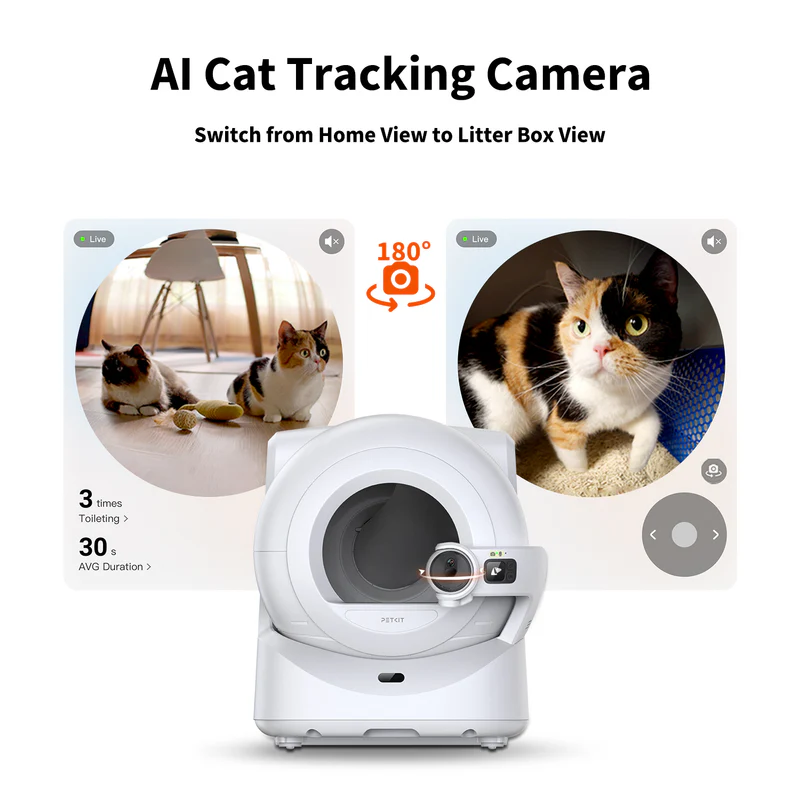
    PETKIT Purobot Ultra rotating AI camera switching between room monitoring and litter box views.
    The rotating camera can monitor both the litter-box interior and the surrounding room, adding useful context in multi-cat homes—and a privacy decision owners should make deliberately.

    The camera can associate visits with individual cats, record activity and capture stool or litter-clump images after cleaning.

    PETKIT also promotes:

    • yowling detection;
    • stool consistency observations;
    • unusual visit patterns;
    • urine-clump monitoring;
    • urine pH alerts when paired with PETKIT’s color-changing Urine Monitor Cat Litter.

    This can provide useful context.

    A video may help distinguish between:

    • a normal visit;
    • repeated entering and exiting;
    • vocalization;
    • straining;
    • a cat being interrupted by another animal;
    • the wrong cat receiving the app record.

    But the system is interpreting camera images, sounds and behavioral patterns. It is not performing a urinalysis, physical examination or diagnostic imaging.

    PETKIT describes some functions as disease “pre-screening.” We would use the less theatrical description: it can flag a pattern or image worth checking.

    If the app reports something unusual, verify the cat’s behavior and contact your veterinarian when appropriate. Do not wait for the algorithm to assemble a unanimous committee.

    Multi-Cat Recognition Is the Best AI Use Case

    Weight-based identification becomes unreliable when two cats are close in size.

    The Purobot Ultra attempts to solve that problem with facial recognition. You create profiles and upload clear images of each cat, allowing the camera to associate visits with individual faces rather than relying only on weight.

    This is especially useful when:

    • two cats weigh nearly the same;
    • one cat is gaining or losing weight;
    • urinary or digestive patterns need to be followed separately;
    • several cats share the same automatic box.

    The technology still deserves verification.

    An independent Wired test reported that facial identification was imperfect and that camera footage was not always detailed enough to evaluate waste confidently. The tester also found that a large 20-pound cat declined to use the machine, while the smaller cat adopted it readily.

    Treat the timeline as an organized record, not sworn testimony. Before sharing graphs with a veterinarian, confirm that Napoleon has not spent three weeks receiving Biscuit’s bathroom history.

    Size and Cat Fit: Measure the Cat and the Room

    The Purobot Ultra measures approximately:

    • 20.94 inches wide;
    • 32.20 inches deep;
    • 24.09 inches high;
    • 32.18 pounds empty.

    PETKIT recommends it for cats between 3.3 and 22 pounds. The entrance is about 10.43 inches high, and the unit must sit on a hard, level floor with roughly two inches of clearance from surrounding walls. Carpet or unstable flooring can interfere with sensor operation.

    The 32-inch depth is the number most likely to ruin your placement plan.

    This machine is lower than a Litter-Robot 4 but substantially deeper. You also need space behind and above it to access the waste-packing compartment and refill litter.

    Large cats deserve particular caution. A cat may remain below the 22-pound limit while still finding the entrance, camera arm or interior restrictive.

    For larger, senior or mobility-limited cats, the Purobot Max Pro 2 offers a larger entrance without the Ultra’s rotating external camera and automatic bagging system.

    Cleaning, Odor and Litter Compatibility

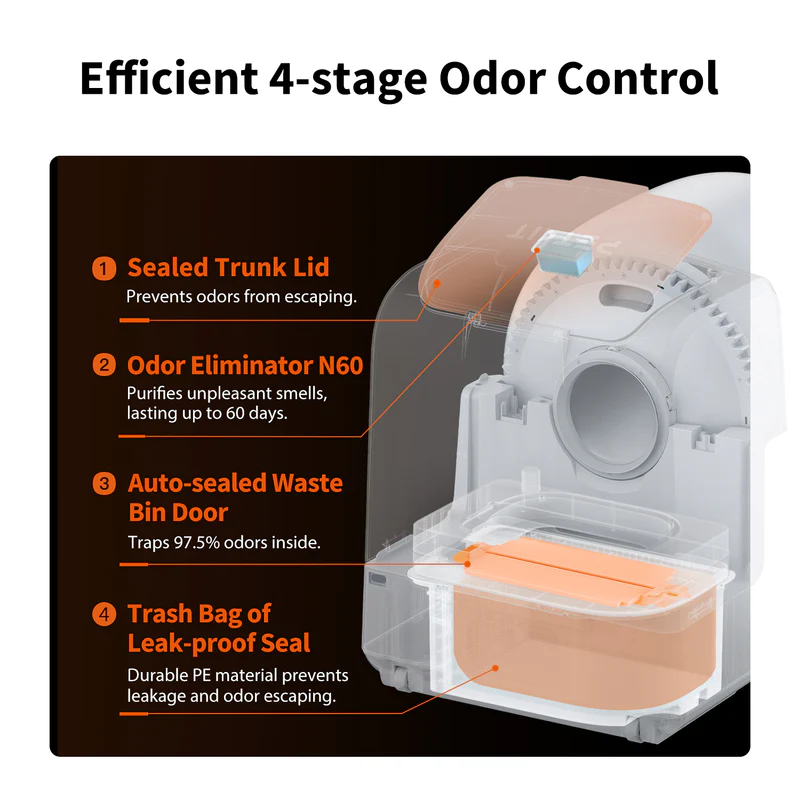
    Diagram of the PETKIT Purobot Ultra four-stage odor-control system with sealed waste bin and leak-resistant bag.
    PETKIT combines a sealed lid, odor-control insert, closed waste-bin door and leak-resistant liner to reduce escaping smells between disposal cycles.

    The core cleaning process is familiar: after the cat leaves and the selected delay expires, the cylinder rotates, clean litter passes through the sifter and clumps fall into the sealed waste area.

    PETKIT includes separate sifters for different clumping litter types. The company recommends avoiding particles longer than 12 mm or wider than 3 mm and favors fast, firm clumping litter to reduce smearing during rotation.

    The sealed compartment, waste-bin door, refill liner and odor-control insert create a strong odor-management system. Independent reviewers have generally rated cleaning and odor containment more positively than price, construction or ease of refilling.

    The weak point is adding clean litter.

    The camera arm and front opening make refilling more awkward than pouring litter through the top of a simpler PETKIT model. Deep cleaning also remains manual. The robot bags waste; it has not yet developed an interest in washing its own cylinder.

    PETKIT claims operating noise around 36 dB. Actual perception will depend on flooring, room acoustics and whether the machine shares a wall with your bedroom.

    Safety and Kittens

    The Ultra uses an entrance that remains open during rotation and a system of 20 proximity and weight sensors designed to stop movement when a cat approaches or enters.

    That is reassuring engineering, but we would not repeat PETKIT’s “100% safe” language. No motorized appliance should receive a universal risk-free certificate from its own product page.

    PETKIT does not recommend normal automatic operation for kittens:

    • younger than six months;
    • below 3.3 pounds.

    Kitten Protection Mode disables automatic and scheduled cleaning, but the kitten must still meet the minimum sensor-triggering weight.

    Keep a conventional litter box available during acclimation and confirm that every cat uses the Ultra comfortably before removing alternatives.

    App, Care+ and Privacy

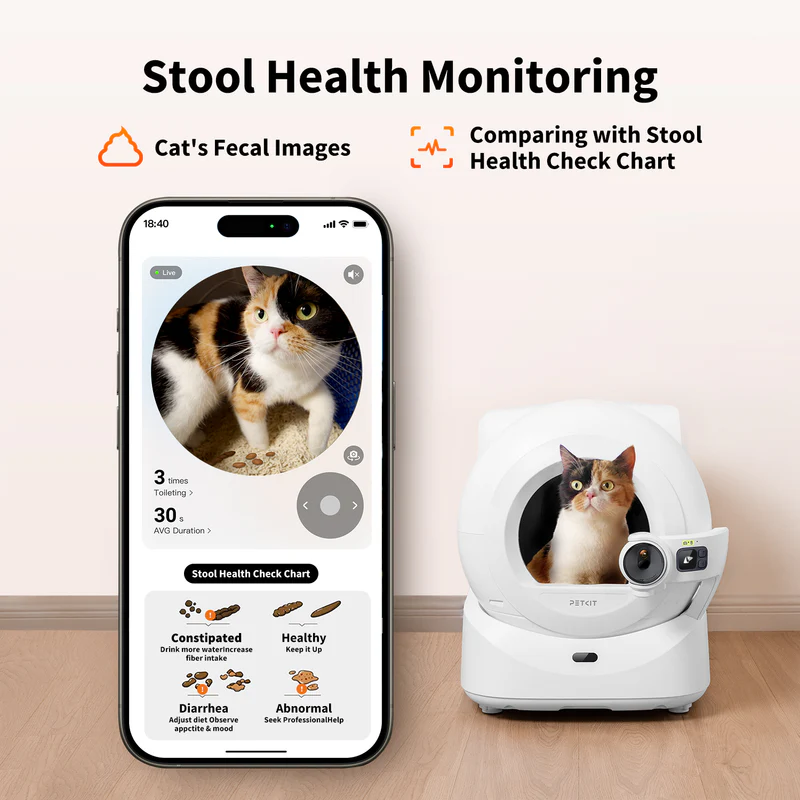
    PETKIT Purobot Ultra app showing stool health monitoring and litter box activity for an individual cat.
    Purobot Ultra can capture litter-box images and compare visible stool patterns, but app classifications should be treated as prompts to investigate—not veterinary diagnoses.

    Core cleaning and device control do not require a monthly subscription.

    PETKIT Care+ adds extended cloud-video history and enhanced playback features. Current plan details and pricing should be checked inside the PETKIT app because subscription tiers can change.

    Without extended history, the box remains functional. The subscription matters most to owners who want to review complete footage rather than basic event records and images.

    The larger decision is privacy.

    The camera can rotate between the litter box and the surrounding room, includes a microphone and speaker, and can function as a broader indoor monitor. PETKIT provides camera controls, but the owner still needs to be comfortable placing a cloud-connected camera wherever the litter box lives.

    That may be useful in a dedicated pet room.

    It may be less charming when the only available location points the camera toward your bathroom.

    Purobot Ultra vs the Alternatives

    Choose Purobot Max Pro 2 instead when:

    You want facial recognition, camera monitoring and individual health timelines but can manually close a waste bag. It offers the stronger balance of monitoring, cat access and price within PETKIT’s current premium range.

    Choose PuraMax 2 instead when:

    You primarily want reliable self-cleaning, odor control, app records and weight-based monitoring. Read our complete review before deciding PETKIT PuraMax 2 Review

    Choose Litter-Robot 4 instead when:

    You prefer a much larger entrance, a mature support and accessories ecosystem, conventional waste liners and weight-based SmartScale tracking without an integrated camera.

    Our detailed comparison explains the broader PETKIT-versus-Whisker trade-off PuraMax 2 vs Litter-Robot 4

    Choose a separate scale instead when:

    You want deliberate, controlled weight measurements rather than buying an entire litter robot for passive trends. See our home-monitoring guide best cat weight scales

    Buyer-Regret Risk

    The Purobot Ultra creates regret when buyers:

    • underestimate its 32-inch depth;
    • assume a 22-pound cat will automatically fit comfortably;
    • expect facial recognition to be perfect;
    • believe health alerts constitute diagnosis;
    • dislike cloud-connected cameras after installing one;
    • resent buying proprietary refill rings;
    • expect auto-packing to work remotely without intervention;
    • pay for Care+ before deciding whether video history is genuinely useful;
    • buy maximum automation when basic self-cleaning was already enough.

    The Ultra is not overpriced because it contains useless technology.

    It becomes overpriced when you do not use the technology that makes it different.

    Final Verdict

    PetTech AI verdict: Conditional.

    The PETKIT Purobot Ultra delivers the most complete waste-handling system in PETKIT’s lineup. Automatic sealing and liner replacement meaningfully reduce contact with waste, while facial recognition can solve a genuine data problem in multi-cat homes where weight alone cannot separate users.

    The compromises are equally real:

    • enormous depth;
    • proprietary refill rings;
    • imperfect identification;
    • awkward litter refilling;
    • optional subscription pressure;
    • a camera some households will not want;
    • a premium that only makes sense when auto-packing matters.

    Choose the Purobot Ultra when you want the closest thing PETKIT currently offers to a low-contact litter-box system and will actively use its per-cat video records.

    Choose the Purobot Max Pro 2 when monitoring matters more than automatic bag sealing.

    Choose the PuraMax 2 when cleaning automation matters more than watching Gerald produce a timestamped documentary.

    The Purobot Ultra is not the automatic litter box everyone should buy.

    It is the automatic litter box for people who looked at normal waste disposal and decided the bag should close itself.

    Still want the waste bag to seal itself? Check the PETKIT Purobot Ultra on Amazon or the official PETKIT store.

    Frequently Asked Questions

    Does the Purobot Ultra work without PETKIT Care+?

    Yes. Core cleaning, app control and basic event tracking remain available. Care+ primarily adds extended cloud-video history and playback features.

    Can the Purobot Ultra use normal trash bags?

    Not for automatic packing. The sealing and liner-deployment system requires PETKIT refill rings.

    Can it identify cats with similar weights?

    That is one of its main advantages. It combines camera-based facial recognition with sensor data, although owners should verify that visits are assigned correctly.

    Is it suitable for large cats?

    PETKIT lists a maximum weight of 22 pounds, but physical fit also depends on height, length and willingness to enter around the camera arm. Large cats may prefer the wider Purobot Max Pro 2 or Litter-Robot 4.

    Does it diagnose urinary problems?

    No. It may flag vocalization, repeated visits, unusual clumps or changes in recorded behavior. Only a veterinarian can determine the cause.

    How often do the refill rings need replacing?

    PETKIT estimates around ten packing cycles per ring. A pack contains three rings, but actual duration depends on the number of cats and how frequently waste is packed.

    Can kittens use it?

    PETKIT does not recommend normal automatic operation for kittens under six months or below 3.3 pounds. Kitten Protection Mode disables automatic cleaning for qualifying small cats.

    References

    PETKIT — Purobot Ultra Product Documentation
    PETKIT — Purobot Ultra User Manual
    PETKIT — Purobot Ultra Refill Ring Documentation
    PETKIT — 2026 Automatic Litter Box Comparison
    Cornell Feline Health Center — Feline Lower Urinary Tract Disease
    American Veterinary Medical Association — Feline Lower Urinary Tract Disease
    Feline Veterinary Medical Association — Lower Urinary Tract Disease
    Whisker — Litter-Robot 4 Product Documentation
    Wired — PETKIT Purobot Ultra Review
    Cats.com — PETKIT Purobot Ultra Automatic Litter Box Review

    Image Disclosure

    Official manufacturer images are used when available and authorized.

    AI-generated images may also be used as editorial illustrations. They should not be treated as exact representations of product dimensions, materials, controls or physical features. Always verify current official product information before purchasing.
    Editorial Disclosure

    PetTech AI may earn a commission from qualifying purchases. This does not influence our recommendations, comparisons or editorial judgments.