
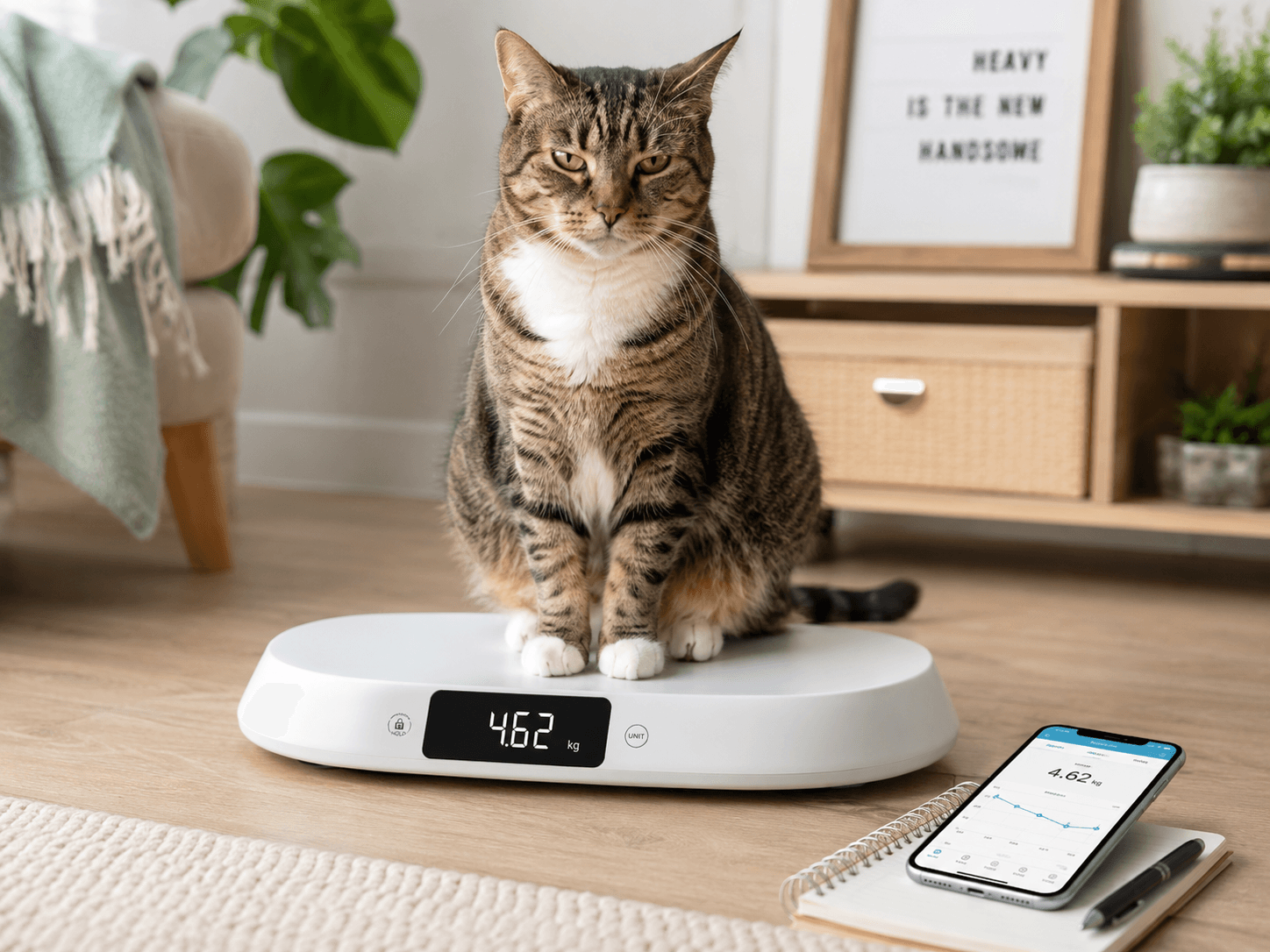
A cat can gain or lose weight slowly enough that the change hides in plain sight.
You see the same animal every day. The coat remains fluffy. Gerald still occupies the same unreasonable percentage of the sofa. Then the veterinary scale reveals that something has changed.
A home cat scale can make those changes easier to notice—but only when the readings are collected consistently and interpreted with restraint.
The best cat weight scales do not diagnose kidney disease, diabetes or poor nutrition. They answer a smaller and more useful question:
Has my cat’s weight changed enough to verify and discuss?
That sounds less impressive than “AI-powered preventive health intelligence,” but it also happens to be true.
Quick Verdict
| Product | Best fit | Not for | PetTech AI verdict |
|---|---|---|---|
| Greater Goods Digital Pet Scale | Simple, controlled home weigh-ins | Owners who require automatic app logging | Recommended |
| Beurer BY90 Bluetooth Scale | Manual weigh-ins with app-based records | Anyone expecting a cat-specific health platform | Recommended with Conditions |
| Purina Petivity Monitor | Passive weight and litter-use trends with an existing box | Homes wanting automatic scooping | Recommended with Conditions |
| PETKIT PuraMax 2 | Litter automation plus contextual weight trends | Buying an entire robot only to weigh a cat | Conditional Recommendation |
| Litter-Robot 4 | Premium automation with Whisker SmartScale | Owners who only need a platform scale | Conditional Recommendation |
Best starting point for most households: Greater Goods provides deliberate weigh-ins without requiring Wi-Fi, a subscription or a new litter routine.
Best connected platform: Beurer BY90 stores readings through an app, although its software was designed around babies rather than feline health.
Best passive monitor: Petivity collects weight and litter-box behavior without replacing your existing tray.
PetTech AI may earn a commission from qualifying purchases. As an Amazon Associate I earn from qualifying purchases.
Need a controlled weekly or monthly reading without buying a litter robot? Check the Greater Goods Digital Pet Scale on Amazon.
Research and Health Note
This is a research-led comparison based on current manufacturer documentation, Amazon listings and veterinary guidance. PetTech AI has not performed identical long-term accuracy testing across every device in this guide.
Body weight is only one part of feline assessment. AAHA guidance combines weight with body condition and muscle condition because the same number can conceal different proportions of fat and muscle. Unintended weight loss can accompany many medical conditions, particularly in senior cats, and should not be explained by an app without veterinary evaluation.
A scale can reveal change.
It cannot tell you why the change occurred.
Controlled Measurement vs Passive Monitoring
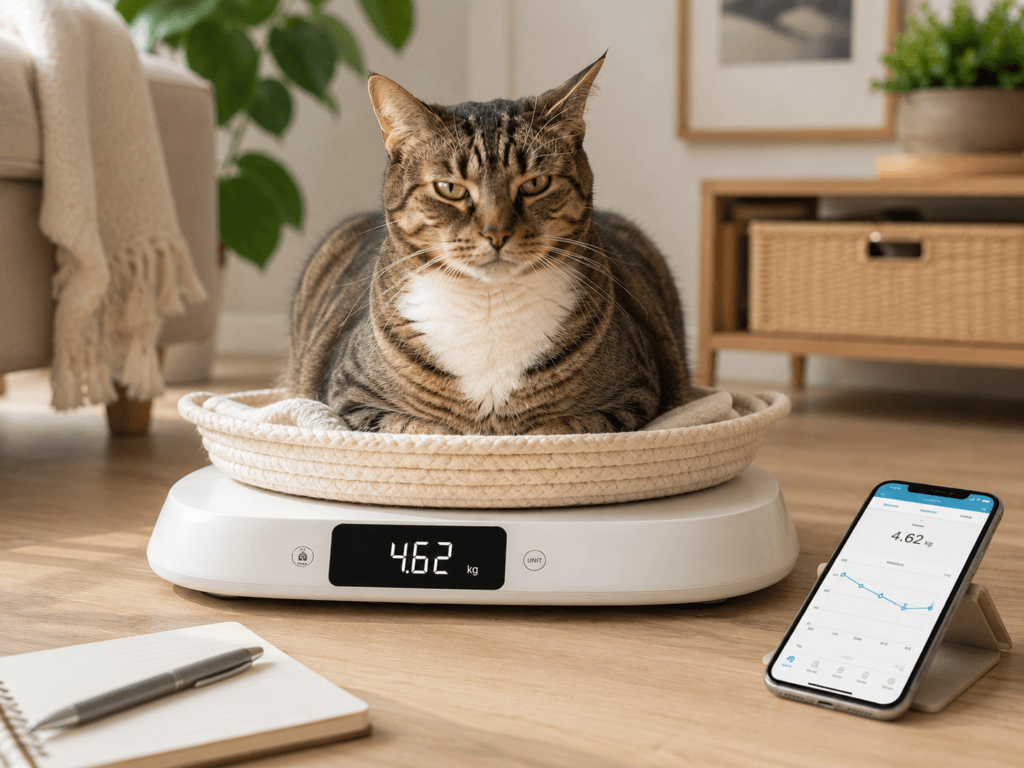
There are two fundamentally different ways to weigh a cat at home.
Controlled measurement
You intentionally place the cat on a platform scale under reasonably similar conditions.
This gives you more control over:
- the surface;
- the cat’s position;
- the time of measurement;
- blankets or carriers placed on the platform;
- whether an unexpected result is repeated.
The disadvantage is obvious: the cat must cooperate.
Some cats sit politely. Others respond as though the platform has been installed by federal authorities.
Passive monitoring
A sensor collects weight while the cat performs another activity, usually entering a litter box.
This creates more readings with less handling. It can also connect weight with:
- visit frequency;
- visit duration;
- time of day;
- elimination patterns;
- the identity assigned to the cat.
The trade-off is reduced control. Posture, movement, installation, floor surface and multi-cat identification may influence what the system records.
More data does not automatically mean better data.
It means you have more readings to evaluate.
Best Simple Cat Scale: Greater Goods Digital Pet Scale
Verdict: Recommended
The Greater Goods scale is the most sensible choice for owners who primarily want repeatable home weigh-ins.
Its removable platform measures approximately 24 by 11.5 inches, supports animals up to 44 pounds and displays weight in 0.1-pound increments. Greater Goods also includes a movement-stabilization function, tare control and multiple units.
Where it wins
It avoids most forms of technological friction:
- no app pairing;
- no account;
- no Wi-Fi dependency;
- no litter-box compatibility issue;
- no automatic profile assignment.
Place it on a hard, level surface, use the same blanket when needed and repeat a surprising result before treating it as meaningful.
The tare function is especially useful for cats that prefer sitting inside a shallow basket or on a familiar mat. Zero the scale after adding the object, then invite the emperor onto his prepared throne.
Where it disappoints
The 0.1-pound display interval is adequate for general household trend tracking, but it should not be confused with laboratory precision.
The platform also requires active participation. A cat who immediately walks off can transform a ten-second measurement into a quarterly administrative project.
Choose Greater Goods when you want a simple reference point you can reproduce.
Skip it when you know the manual routine will quietly disappear after the first three measurements.
Best App-Connected Platform: Beurer BY90
Verdict: Recommended with Conditions
The Beurer BY90 replaces the non-monetizable Healthy Pet Connect scale from the old guide.
It is marketed as a Bluetooth baby and pet scale for infants, cats and dogs. The current Amazon listing gives it a 44-pound capacity, hold and tare functions, a curved platform, onboard memory and synchronization with the Beurer BabyCare app.
Where it wins
The BY90 fits owners who want:
- controlled platform measurements;
- automatic digital records;
- charts instead of handwritten notes;
- separate weigh-ins without changing the litter box;
- a curved surface that may feel more secure than a flat bathroom scale.
The hold function can help capture a stable result while the subject moves, although the cat still needs to remain reasonably contained on the platform.
Where it disappoints
This is not a cat-specific health ecosystem.
The app was designed primarily for tracking infant growth. It stores weight effectively, but it should not be expected to interpret feline body condition, recognize veterinary risk or integrate naturally with feeder and litter-box records.
In other words, the hardware can weigh Biscuit. The software may continue to believe Biscuit is a strangely hairy newborn.
Want app-based weight records without replacing the litter box? Check the Beurer BY90 Bluetooth Scale on Amazon.
Best Add-On for an Existing Litter Box: Purina Petivity
Verdict: Recommended with Conditions
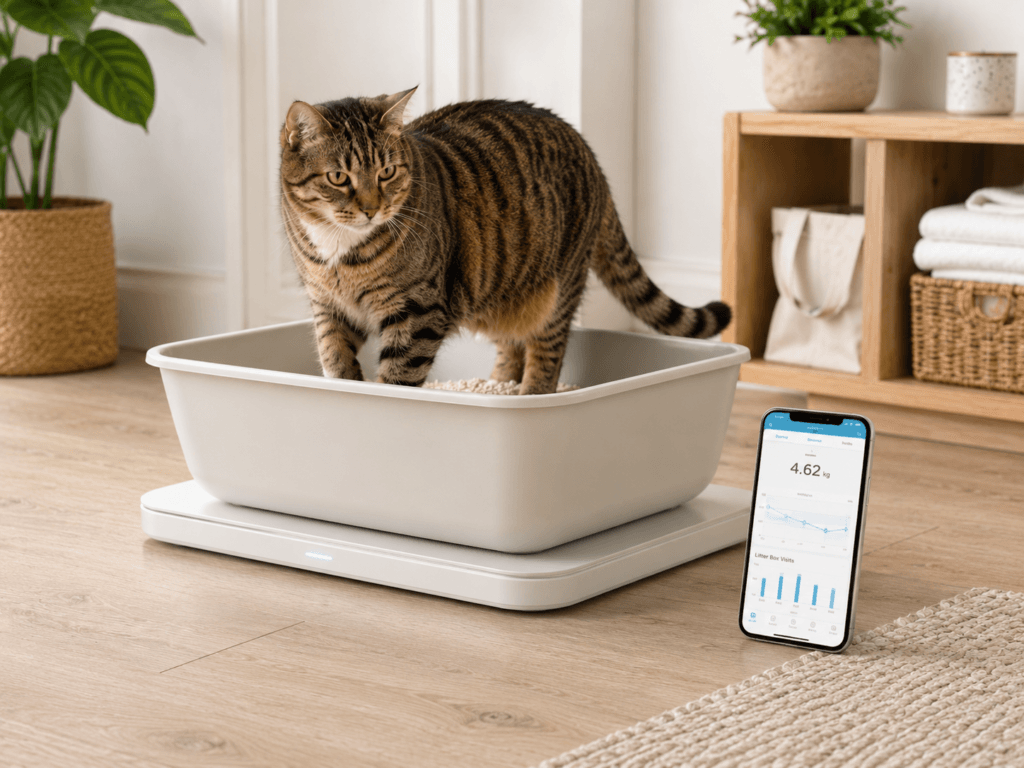
Petivity sits beneath a conventional litter box rather than replacing it.
Its system records weight and classifies litter-box events such as urination and defecation. The Petivity app displays charts, produces periodic reports and alerts users when patterns differ from the established baseline. The manufacturer correctly frames those changes as information that may warrant veterinary diagnosis—not as a diagnosis produced by the device itself.
Where it wins
Petivity offers a useful middle ground:
- passive measurements;
- no automatic rotating drum;
- continued use of a familiar litter box;
- weight combined with elimination context;
- profiles for individual cats;
- fewer changes to the cat’s established bathroom routine.
That makes it especially appealing when the monitoring matters more than automatic scooping.
Our full Petivity Smart Litter Box Monitor Review examines its setup, reports, identification limits and practical value in greater detail.
Where it disappoints
Petivity still depends on:
- correct installation;
- a compatible box;
- stable flooring;
- successful cat identification;
- continued manual litter maintenance.
Its event classification should also be treated as a data aid, not an infallible witness. An app can misclassify a visit. Gerald has already declined to testify.
Want passive weight and litter-use records without changing to a self-cleaning box? Check Purina Petivity on Amazon.
When an Automatic Litter Box Makes Sense
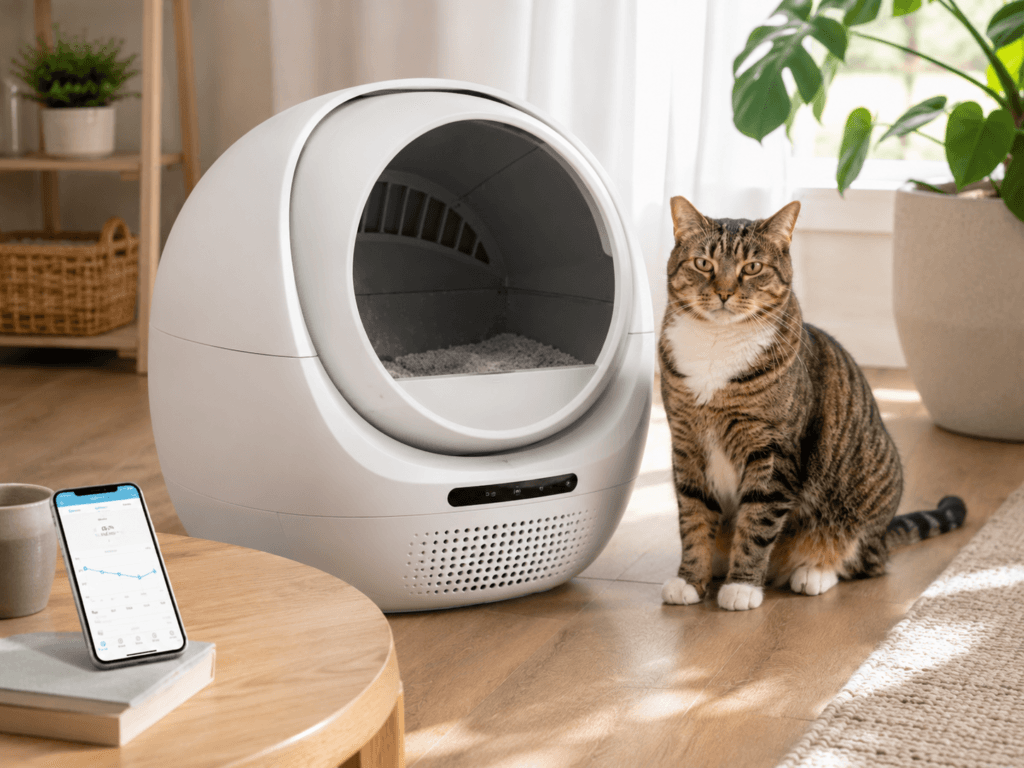
A self-cleaning litter box can add weight tracking, but weight should rarely be the main reason to buy one.
These machines make sense primarily when you also value:
- automatic waste removal;
- odor containment;
- app notifications;
- waste-drawer monitoring;
- reduced daily scooping.
Buying an entire premium robot merely to avoid entering one number into a phone is innovative financial planning, but not necessarily good financial planning.
PETKIT PuraMax 2
Verdict: Conditional Recommendation
PuraMax 2 records litter-box usage and weight changes through the PETKIT app, including separate profiles intended for multi-cat households. PETKIT’s marketing sometimes uses stronger health language than we would, so interpret app warnings as pattern changes requiring attention—not confirmation of a urinary obstruction or disease.
Choose it when you want the combination of:
- self-cleaning operation;
- PETKIT ecosystem integration;
- usage records;
- weight trends;
- a comparatively compact rotating design.
Read our PETKIT PuraMax 2 Review for the complete fit, leakage, cleaning and cat-size trade-offs.
Does PETKIT’s automation and monitoring package fit your home? Check PuraMax 2 on Amazon.
Check PuraMax 2 on the PETKIT official store as well.
Litter-Robot 4
Verdict: Conditional Recommendation
Whisker’s SmartScale records weight during Litter-Robot 4 use and associates the data with pet profiles. Whisker notes that the system needs accurate profile information and time to learn weight patterns, particularly in multi-cat households. Hard, level flooring matters; carpet or uneven flooring can reduce scale accuracy unless the appropriate base support is used.
Choose it when you value:
- Whisker’s mature app;
- automatic cleaning;
- daily weight trends;
- waste-level information;
- a broad accessory and support ecosystem.
Our PuraMax 2 vs Litter-Robot 4 comparison explains which automation philosophy better fits different households.
Prefer Whisker’s automation and SmartScale ecosystem? Check Litter-Robot 4 through Amazon.
Why Multi-Cat Identification Can Fail
Weight-based identification works best when cats have clearly different weights and use the system consistently.
Problems appear when:
- two cats weigh nearly the same;
- one cat is actively gaining or losing weight;
- the device receives incomplete readings;
- profiles contain outdated weights;
- the machine has not gathered enough events;
- a cat places only part of its body on the sensing area.
Whisker advises allowing SmartScale time to learn each cat’s patterns. Systems such as PETKIT’s Purobot Max Pro 2 attempt to reduce ambiguity by combining facial recognition with weight sensing, but that requires a camera-equipped premium litter box rather than a simple scale.
Before trusting per-cat graphs, verify that the system is consistently assigning visits to the correct animal.
A beautifully rendered chart for the wrong cat remains beautifully wrong.
How to Get More Consistent Home Readings
Use the same scale whenever possible. AAHA’s current diabetes-management guidance specifically emphasizes using the same scale for consistency when monitoring weight during treatment.
For controlled platform measurements:
- place the scale on a hard, level surface;
- use similar conditions each time;
- tare the same basket, blanket or carrier;
- center the cat on the platform;
- repeat unexpected results;
- record the date and relevant context.
For litter-box systems:
- follow the installation instructions;
- avoid moving the unit unnecessarily;
- keep pet profiles current;
- check whether flooring affects the sensors;
- verify multi-cat assignments;
- view trends rather than reacting to every notification.
The ideal measurement schedule depends on the purpose. A healthy adult being observed routinely does not require the same cadence as a senior cat, a kitten or an animal following a veterinary weight-management plan.
Follow the schedule recommended for the individual cat rather than allowing the dashboard to invent one.
What Weight Data Can—and Cannot—Tell You
Weight data can tell you:
- whether readings appear broadly stable;
- whether a possible upward or downward trend deserves confirmation;
- whether a veterinary nutrition plan is producing measurable change;
- whether passive and controlled readings broadly agree;
- whether records may be useful at an appointment.
Weight data cannot independently tell you:
- whether the cat is losing fat or muscle;
- whether a change comes from food intake, hydration or disease;
- whether the cat has diabetes, kidney disease or hyperthyroidism;
- what calorie adjustment should be made;
- whether an app alert represents an emergency.
AAHA recommends evaluating body weight alongside body and muscle condition. Cornell also notes that weight loss may accompany several conditions in older cats, while weight loss despite a good appetite can occur with feline diabetes.
Three connected devices do not become a diagnosis by majority vote.
What to Share With Your Veterinarian
A useful record includes more than a screenshot of one low number.
Bring:
- the weight trend and dates;
- the scale or device used;
- whether the reading was controlled or passive;
- appetite changes;
- food and treat amounts;
- vomiting or diarrhea;
- drinking and urination changes;
- activity or behavior changes;
- current medications;
- recent diet changes.
Our Best Pet Tech Apps for Cats guide explains which platforms make useful records accessible and which mainly produce a decorative waterfall of notifications.
Contact your veterinarian when weight changes persist, appear rapid or occur alongside appetite loss, increased thirst, vomiting, diarrhea, weakness, altered urination or other meaningful changes from baseline.
Buyer-Regret Risk
The most common mistakes are:
- buying a connected scale when a notebook would work;
- buying a litter robot primarily for its scale;
- assuming more decimal places guarantee accuracy;
- trusting one unexpected reading;
- confusing weight with body condition;
- expecting equal-weight cats to be identified perfectly;
- modifying food based only on an app graph;
- collecting data without ever reviewing it.
The simplest useful setup is often:
one consistent platform scale, one repeatable routine and one record you can actually find.
Upgrade to passive monitoring when automatic collection solves a real problem—not because the app dashboard has achieved consciousness.
Final Verdict
Choose Greater Goods for the simplest controlled home measurements and the least technological friction.
Choose Beurer BY90 when app logging matters enough to justify baby-oriented software and a less pet-specific experience.
Choose Petivity when passive weight and litter-use monitoring matter, but you want to retain a conventional litter box.
Choose PuraMax 2 when PETKIT automation is already the priority and weight trends are a secondary benefit.
Choose Litter-Robot 4 when Whisker’s self-cleaning ecosystem and SmartScale records fit the household better.
The best cat weight scale is not the one producing the largest number of graphs.
It is the one producing readings consistent enough to notice a real change—and simple enough that you continue using it after Napoleon’s third refusal to cooperate.
Frequently Asked Questions
How accurate are home cat scales?
Accuracy varies by design, surface, movement and positioning. Consistent readings under comparable conditions are often more useful for trend monitoring than impressive resolution claims.
Can I weigh my cat on a human bathroom scale?
You can weigh yourself holding the cat and subtract your own weight, but the method may not detect smaller changes reliably. A pet or baby platform offers a more controlled surface.
Is a smart litter box better than a platform scale?
Not automatically. A litter box provides frequent passive readings; a platform provides deliberate, repeatable measurements. They solve different problems.
Can a cat scale detect illness?
No. It can reveal a weight change worth confirming. Veterinary assessment is needed to determine the cause.
References
- AAHA — Nutrition and Weight Management Guidelines for Dogs and Cats
- AAHA — 2026 Diabetes Management Guidelines for Cats
- Cornell Feline Health Center — The Special Needs of the Senior Cat
- Cornell Feline Health Center — Feline Diabetes
- Greater Goods — Digital Pet Scale Documentation
- Beurer — BY90 Product Documentation
- Purina Petivity — Smart Litter Box Monitor Documentation
- PETKIT — PuraMax 2 Documentation
- Whisker — SmartScale and Litter-Robot 4 Documentation
Image Disclosure
Official manufacturer images are used when available and authorized.
AI-generated images may also be used as editorial illustrations. They should not be treated as exact representations of product dimensions, materials, controls or physical features. Always verify current official product information before purchasing.
Editorial Disclosure
PetTech AI may earn a commission from qualifying purchases. This does not influence our recommendations, comparisons or editorial judgments.