Tag: Litter-Robot 4

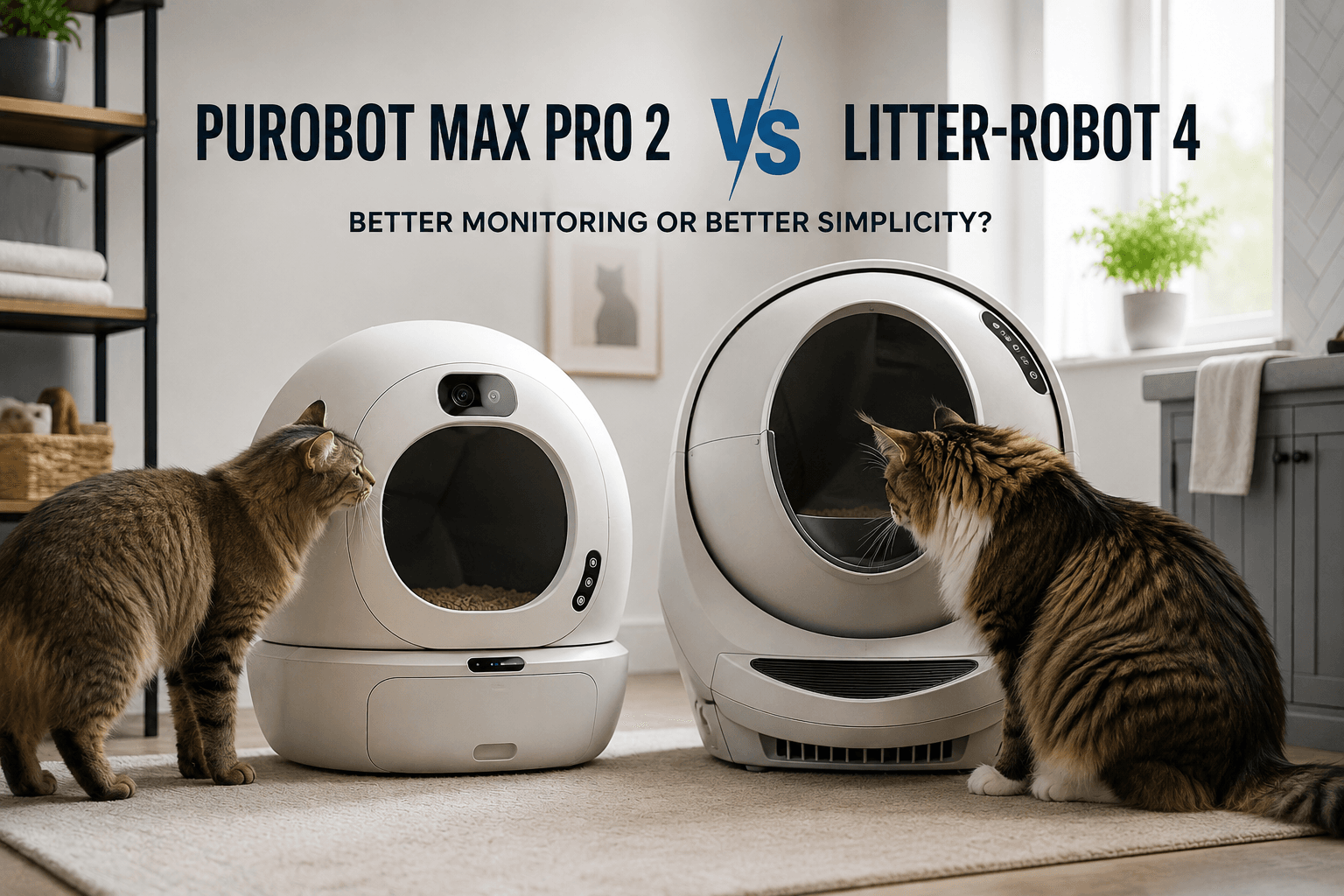
  • Purobot Max Pro 2 vs Litter-Robot 4 (2026): Better Monitoring or Better Simplicity?

    Purobot Max Pro 2 vs Litter-Robot 4 (2026): Better Monitoring or Better Simplicity?

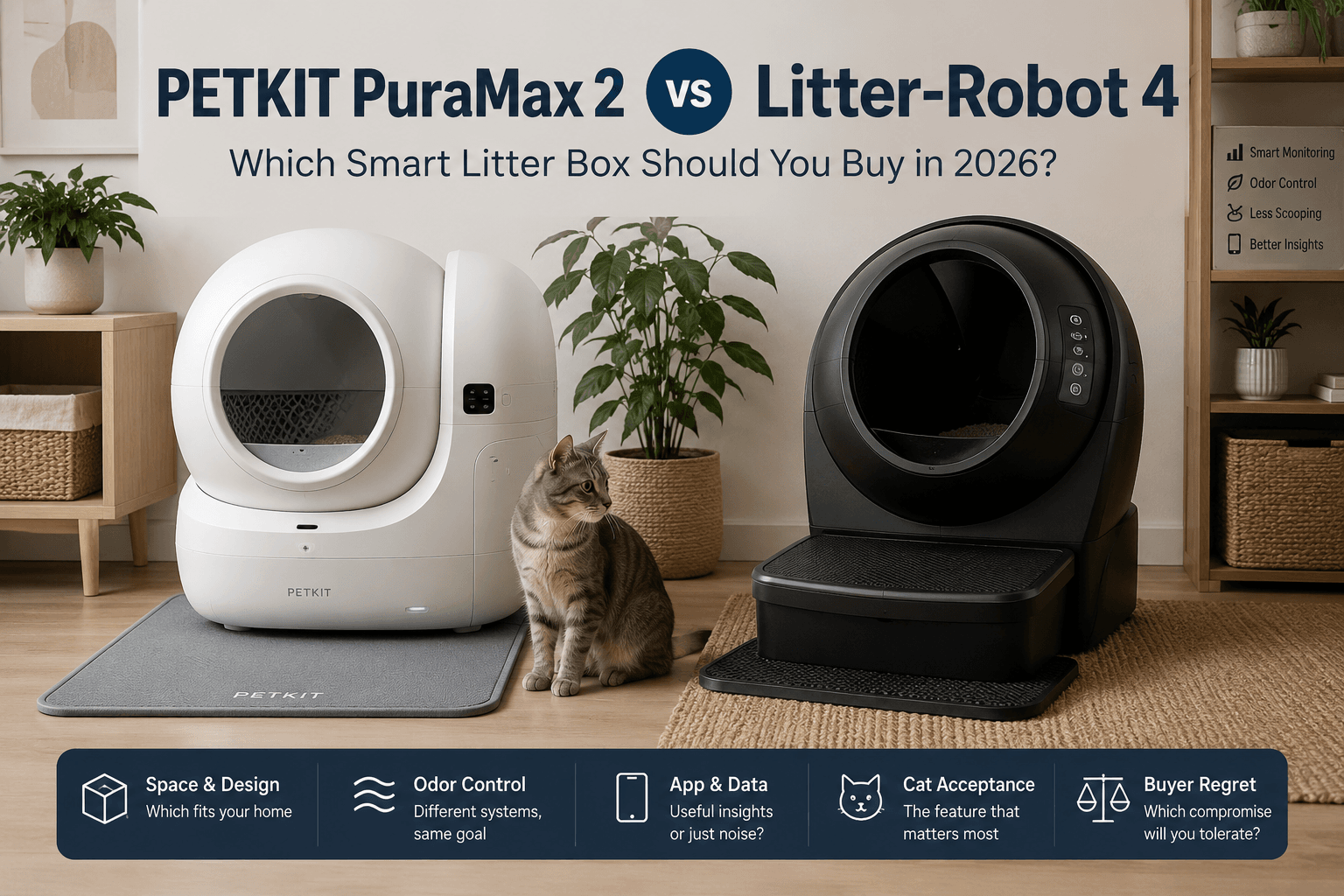
    The Purobot Max Pro 2 and Litter-Robot 4 solve the same unpleasant job with two very different personalities.

    PETKIT builds around a camera, individual cat profiles and deeper behavioral context. Whisker gives you a larger entrance, a mature cleaning platform and no integrated lens observing Napoleon’s bathroom negotiations.

    The winner depends less on which machine looks more advanced and more on what could actually go wrong in your home.

    Purobot Max Pro 2 wins the data war. Litter-Robot 4 is the lower-regret appliance.

    Quick Verdict

    Purobot Max Pro 2Litter-Robot 4
    Best forSimilar-weight cats and owners who want visual monitoringLarger cats and owners who mainly want dependable automation
    IdentificationCamera plus weightWeight-based SmartScale
    EntranceApproximately 10.5 × 10.7 inches15.75 × 15.75 inches
    Cat weight range3.3–22 lb3–25 lb
    Litter flexibilityClay, tofu and compatible mixed clumping litterPrimarily standard-weight clumping clay
    Main drawbackSmaller opening and greater dependence on video featuresNo visual identification
    VerdictBest monitoring choiceBest simplicity and fit choice

    Choose the Purobot Max Pro 2 when identifying individual cats is difficult and you will genuinely review the camera history.

    Choose the Litter-Robot 4 when cat fit, a generous trial period and straightforward automatic cleaning matter more than collecting another stream of household data.

    PetTech AI may earn a commission from qualifying purchases. This does not influence our recommendations, comparisons or editorial judgments.

    Does visual multi-cat monitoring solve a real problem in your home? Check the Purobot Max Pro 2 on PETKIT.

    Prefer Amazon? Check Purobot Max Pro 2 on Amazon.

    Check the Litter-Robot 4 on Amazon.

    Research Note

    This is a research-led comparison based on current manufacturer documentation, specifications, app features, warranty policies and ownership requirements. PetTech AI has not physically tested these units, and we will not convert two specification pages into imaginary weeks of hands-on experience.

    The Physical Fit Is More Important Than the Feature List
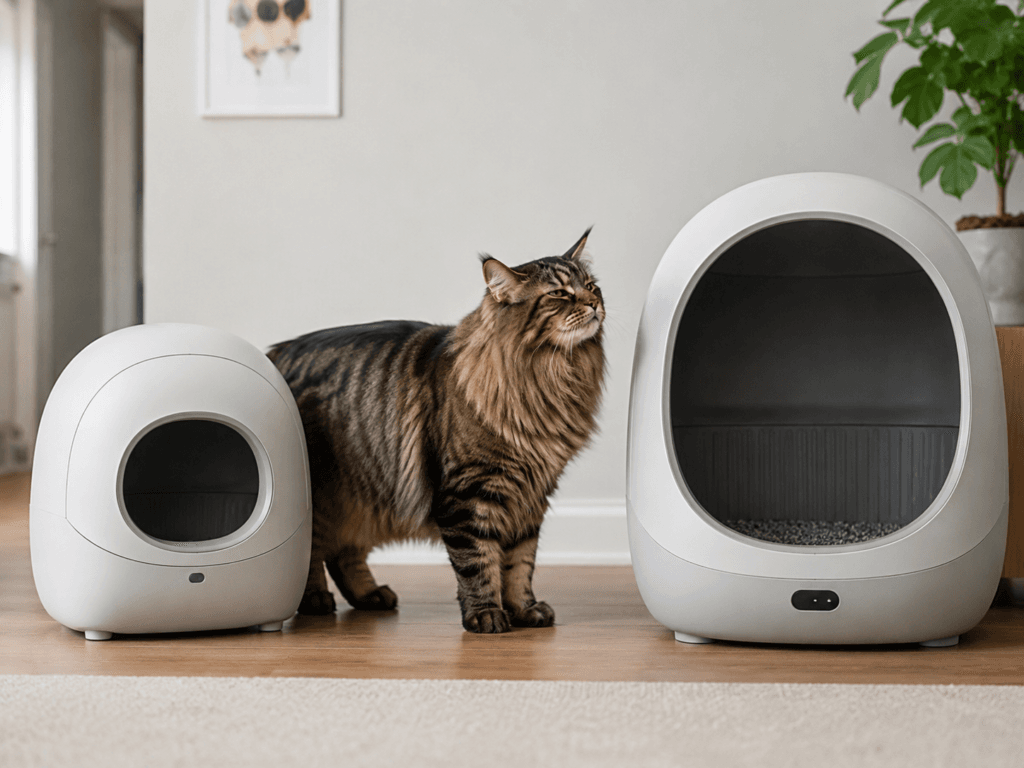
    Large cat comparing a narrow automatic litter box entrance with a wider opening.
    The smaller appliance does not necessarily provide the larger usable entrance. Cats remain annoyingly three-dimensional.

    PETKIT promotes the Purobot Max Pro 2 as having a 43% larger entrance. That improvement is relative to the previous Max Pro—not to the Litter-Robot 4.

    The PETKIT opening measures approximately 10.51 inches wide and 10.74 inches high. The complete unit measures roughly 25.86 × 21.18 × 23.74 inches and supports cats between 3.3 and 22 pounds. It is shorter than the LR4 and may look less dominant in a room, but the cat still has to pass through a comparatively compact entrance.

    The Litter-Robot 4 has a much larger 15.75-inch-square entrance, 16.5 inches of internal headroom and a supported range of 3–25 pounds. Its 22 × 27-inch footprint and 29.5-inch height make it the larger appliance overall, but the space available to the cat is more generous.

    That makes LR4 the safer recommendation for:

    • large or long-bodied cats;
    • cats that dislike narrow enclosed openings;
    • senior cats that need a visually open entrance;
    • households uncertain whether their cat will accept a globe-style box.

    An advertised weight limit is useful. It is not a magical compression field for Maine Coons. Our guide to automatic litter boxes for large cats explains why entrance geometry and internal posture matter more than one heroic number on a product page.

    Cleaning and Odor Control

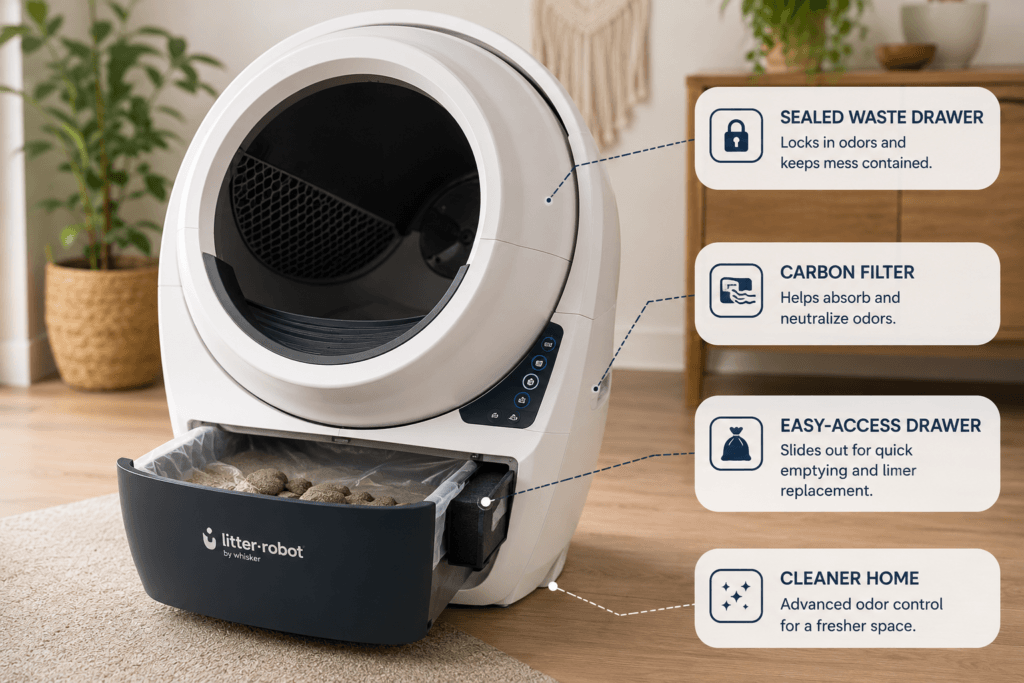
    Both machines automatically rotate after use, sift clean litter away from clumped waste and deposit the waste into a sealed drawer.

    The Purobot Max Pro 2 uses an 8-liter bin, a drawstring bag system, a sealed compartment and two deodorizing components. PETKIT estimates up to 17 days between waste changes for one cat, although actual intervals will shrink with larger cats, multiple cats and enthusiastic digestive schedules. It also uses 12 integrated sensors and an anti-pinch design intended to keep the entrance unobstructed during operation.

    Litter-Robot 4 places waste into a tightly sealed, carbon-filtered drawer and claims up to eight days between emptying in a single-cat household. Its SafeCat system combines lasers, weight sensors and obstruction detection, while QuietSift is designed to keep the rotation relatively unobtrusive.

    Neither machine eliminates maintenance. You still need to:

    • add fresh litter;
    • empty and replace waste bags;
    • clean the globe or cylinder;
    • inspect seals and sensors;
    • remove the occasional smear created when biology declines to respect the user manual.

    The Purobot offers more odor-control layers on paper. LR4 offers a simpler drawer-and-filter arrangement with a longer ownership history. Neither has yet learned to carry itself outside and request a pressure wash.

    This comparison is also a litter decision: PETKIT offers broader sifter flexibility, while Litter-Robot remains most predictable with standard clumping clay. Our best litter for automatic litter boxes guide covers both approaches.

    Camera Monitoring vs SmartScale
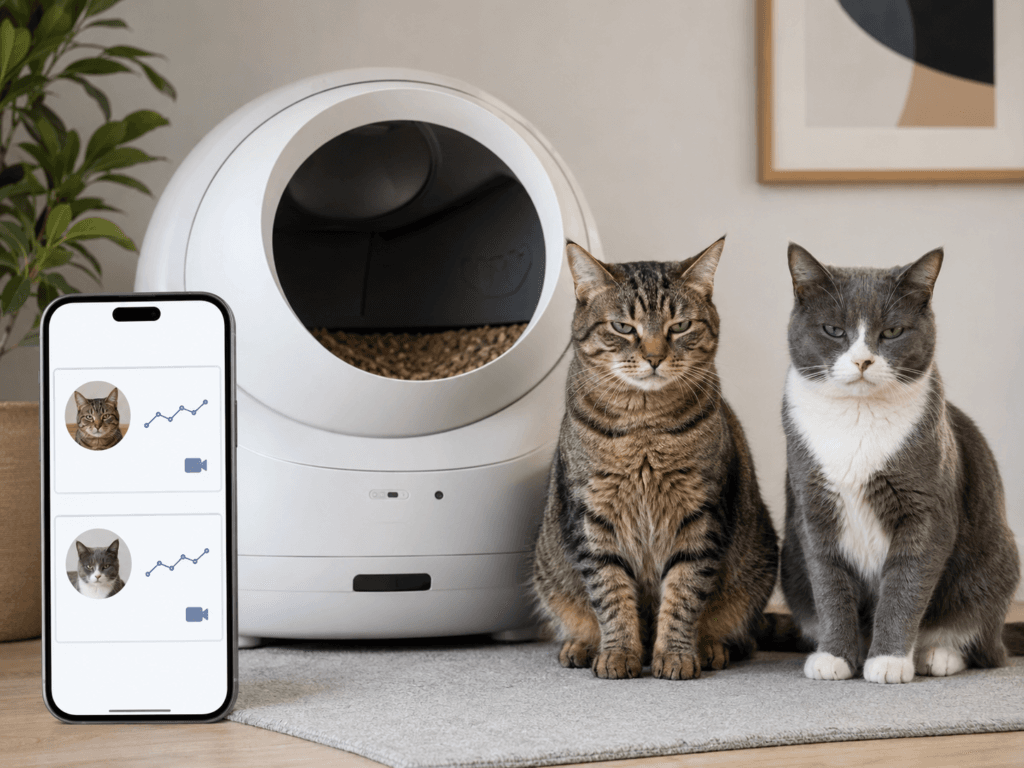
    Two similar-weight cats beside an automatic litter box with camera and weight-monitoring options.
    Weight data may be enough when cats are clearly different. Visual identification matters more when Biscuit and Napoleon occupy the same gravitational category.

    This is where the comparison separates.

    The Purobot Max Pro 2 uses a fixed AI camera and weight sensors to associate litter-box events with individual cats. PETKIT says the system can create separate profiles even when cats have similar weights, record each visit on a visual timeline and detect events such as yowling or loose stool for later review. The camera can be scheduled, paused or switched off through the app.

    The camera is especially useful when:

    • two cats have similar weights;
    • weight changes make scale-based identification ambiguous;
    • one cat enters repeatedly without obvious elimination;
    • you need visual context to show a veterinarian;
    • several cats share the same machine.

    The data can flag a change. It cannot diagnose its cause. A video may confirm that Biscuit entered five times overnight; it cannot determine whether the reason was urinary discomfort, stress, curiosity or a private campaign against your sleep schedule.

    Litter-Robot 4 has no camera. SmartScale instead records weight and uses weight differences to assign visits to individual cats. The free Whisker app includes weight-based identification, visit and cycle trends, device updates and limited recent history.

    SmartScale may be entirely sufficient when one cat weighs 8 pounds and another weighs 16. It becomes less decisive when two cats occupy roughly the same gravitational category.

    For a deeper look at the difference between collecting information and removing chores, read smart cat monitoring vs automation.

    PETKIT Care+ vs Whisker+

    Neither company has resisted the gravitational pull of subscription revenue.

    The Purobot works without PETKIT Care+. Basic cleaning, app control, event logging and camera operation do not disappear. Care+ expands the video-focused side of ownership, including access to up to 30 days of video history and enhanced monitoring features.

    Whisker+ also remains optional. LR4 owners receive recent visit and weight information without paying, while the membership extends historical activity to as much as two years and adds longer-term weight, visit-frequency and duration trends, plus daily reports.

    The distinction is practical:

    • Care+ supports a camera-led monitoring experience.
    • Whisker+ deepens statistical trends without adding visual evidence.

    Someone who dislikes subscriptions should not automatically reject either machine. But buyers should judge the free experience, not mentally include premium features they intend to stop paying for after the trial.

    Litter Compatibility

    The Purobot Max Pro 2 is the more flexible machine.

    PETKIT includes two interchangeable sifters: one for larger particles such as tofu or mixed litter, and another for finer bentonite, mineral or clay litter. The company recommends clumping formulas and advises against pieces longer than 0.5 inches.

    Litter-Robot 4 works best with standard-weight clumping clay. Some silica products can work when their particles pass through the screen, but pale or translucent litter may affect the litter-level and drawer sensors. Whisker discourages many plant-based, pellet, newspaper and loose-clumping formulations because they may not sift correctly.

    Therefore:

    • choose PETKIT when tofu or mixed clumping litter is important;
    • choose LR4 when you already use conventional clumping clay and have no desire to turn litter selection into materials engineering.

    PETKIT’s drawstring mechanism works most reliably with its own bags, although the company says some standard bags can fit. Third-party bags may interfere when the material is too thick or the dimensions are wrong.

    Floor Placement, Wi-Fi and Privacy

    The Purobot must sit on a firm, level surface. PETKIT warns against placing it directly on carpet or unstable flooring because this may affect its sensors. It supports both 2.4 and 5 GHz Wi-Fi.

    LR4 can operate on carpet, but SmartScale is more accurate on a hard surface. Whisker sells a separate carpet tray for thicker or uneven floors. Connectivity is limited to 2.4 GHz Wi-Fi.

    Privacy is primarily a PETKIT consideration because only the Purobot contains a camera and microphone. The app allows owners to disable monitoring or restrict active hours, and PETKIT states that stored information is encrypted. Even so, placement matters. Aim the camera toward the litter-box approach, not a shower, toilet or hallway where people routinely appear.

    The device needs to identify the cat. It does not require cinematography rights to the entire bathroom.

    Warranty and Buyer-Regret Protection

    Purobot Max Pro 2 purchases made through PETKIT or authorized US distributors on or after January 1, 2025 qualify for a two-year limited warranty.

    Litter-Robot 4 includes one year of WhiskerCare coverage, with an optional extension. More importantly, direct Whisker purchases include a 90-day in-home trial. The unit can be returned if the owner or cat is dissatisfied, although the customer pays return shipping and the machine must be clean.

    PETKIT offers the longer standard warranty.

    Whisker offers the stronger acceptance safety net.

    That distinction matters because a defective motor is a warranty problem. A cat staring at the machine for 89 days as if it insulted the family lineage is a return-policy problem.

    Who Should Choose the Purobot Max Pro 2?

    Choose PETKIT when:

    • several cats have similar weights;
    • individual visual identification matters;
    • you want recorded context for litter-box events;
    • tofu or mixed clumping litter is non-negotiable;
    • 5 GHz Wi-Fi support is useful;
    • your cats comfortably fit its smaller entrance;
    • you already use or want the wider PETKIT ecosystem.

    Read our complete PETKIT Purobot Max Pro 2 review before buying it as a general-purpose upgrade. Its strongest value comes from monitoring, not merely automatic scooping.

    Verdict: Recommended for monitoring-focused multi-cat homes.

    Check the Purobot Max Pro 2 on PETKIT.

    Check the Purobox Max Pro 2 on Amazon.

    Who Should Choose the Litter-Robot 4?

    Choose LR4 when:

    • your cat is large or hesitant around smaller openings;
    • you want automatic cleaning without a camera;
    • the cats have clearly different weights;
    • you use conventional clumping clay;
    • a 90-day acceptance window reduces purchase anxiety;
    • you prefer an established machine over the denser monitoring package.

    Our Litter-Robot 4 review examines whether the older Whisker platform still makes sense now that newer models exist.

    Verdict: Recommended for lower-regret automation and broader physical fit.

    Check the Litter-Robot 4 on Amazon.

    Final Verdict
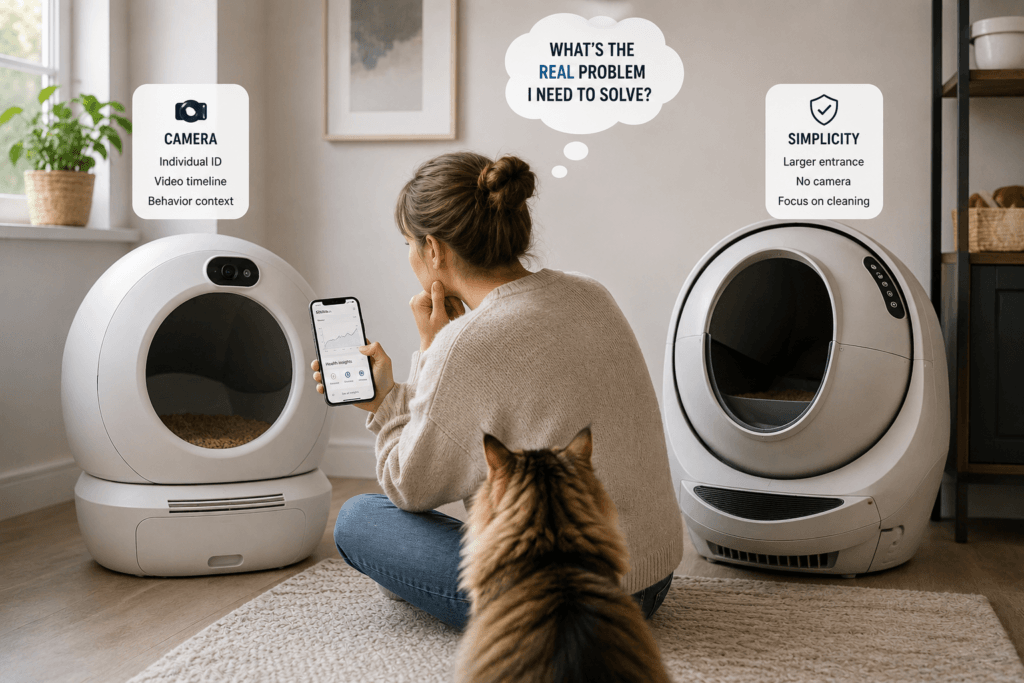
    Owner comparing a camera-equipped litter box with a simpler camera-free automatic model.
    The better machine is the one that solves your actual problem—not the one with the longer feature list and more opportunities to send notifications.

    The Purobot Max Pro 2 is the more capable monitoring system. Its camera, individual profiles and broader litter compatibility give it a real advantage in complicated multi-cat homes.

    The Litter-Robot 4 is the easier recommendation for everyone else. Its larger entrance, generous in-home trial and camera-free operation remove several common sources of buyer regret.

    Choose Purobot Max Pro 2 for better attribution. Choose Litter-Robot 4 for better accommodation.

    Neither wins universally, because cats have once again refused to standardize their bodies, habits or opinions for the convenience of consumer electronics.

    Still comparing the wider market? See our best smart litter boxes guide before committing to either ecosystem.

    Frequently Asked Questions

    Is Purobot Max Pro 2 better than Litter-Robot 4?

    It is better for visual multi-cat monitoring, similar-weight cats and owners who use tofu or mixed litter. LR4 is better for larger cats, camera-free ownership and buyers who value a 90-day trial.

    Which one is better for large cats?

    Litter-Robot 4 has the clear physical advantage. Its entrance is substantially wider, its internal headroom is greater and its supported weight range extends to 25 pounds, compared with 22 pounds for the Purobot.

    Does Purobot Max Pro 2 require PETKIT Care+?

    No. The machine still cleans automatically and retains core app and camera functions without the subscription. Care+ adds extended video history and deeper monitoring features.

    Can Litter-Robot 4 identify multiple cats?

    Yes, through SmartScale weight-based identification. It is most effective when the cats have meaningfully different weights; the Purobot’s camera provides an additional identification signal when weights overlap.

    References

    PETKIT — Purobot Max Pro 2 Product Documentation
    PETKIT — Purobot Max Pro 2 User Manual
    PETKIT — Limited Warranty Policy
    Whisker — Litter-Robot 4 Product Documentation
    Whisker — Litter-Robot Comparison Chart
    Whisker — Whisker+ Membership Documentation
    Whisker — 90-Day In-Home Trial and Warranty Terms

    Editorial Disclosure

    PetTech AI may earn a commission from qualifying purchases. This does not influence our recommendations, comparisons or editorial judgments.

    Image Disclosure

    Official manufacturer images are used when available and authorized.

    AI-generated images may also be used as editorial illustrations. They should not be treated as exact representations of product dimensions, materials, controls or physical features. Always verify current official product information before purchasing.
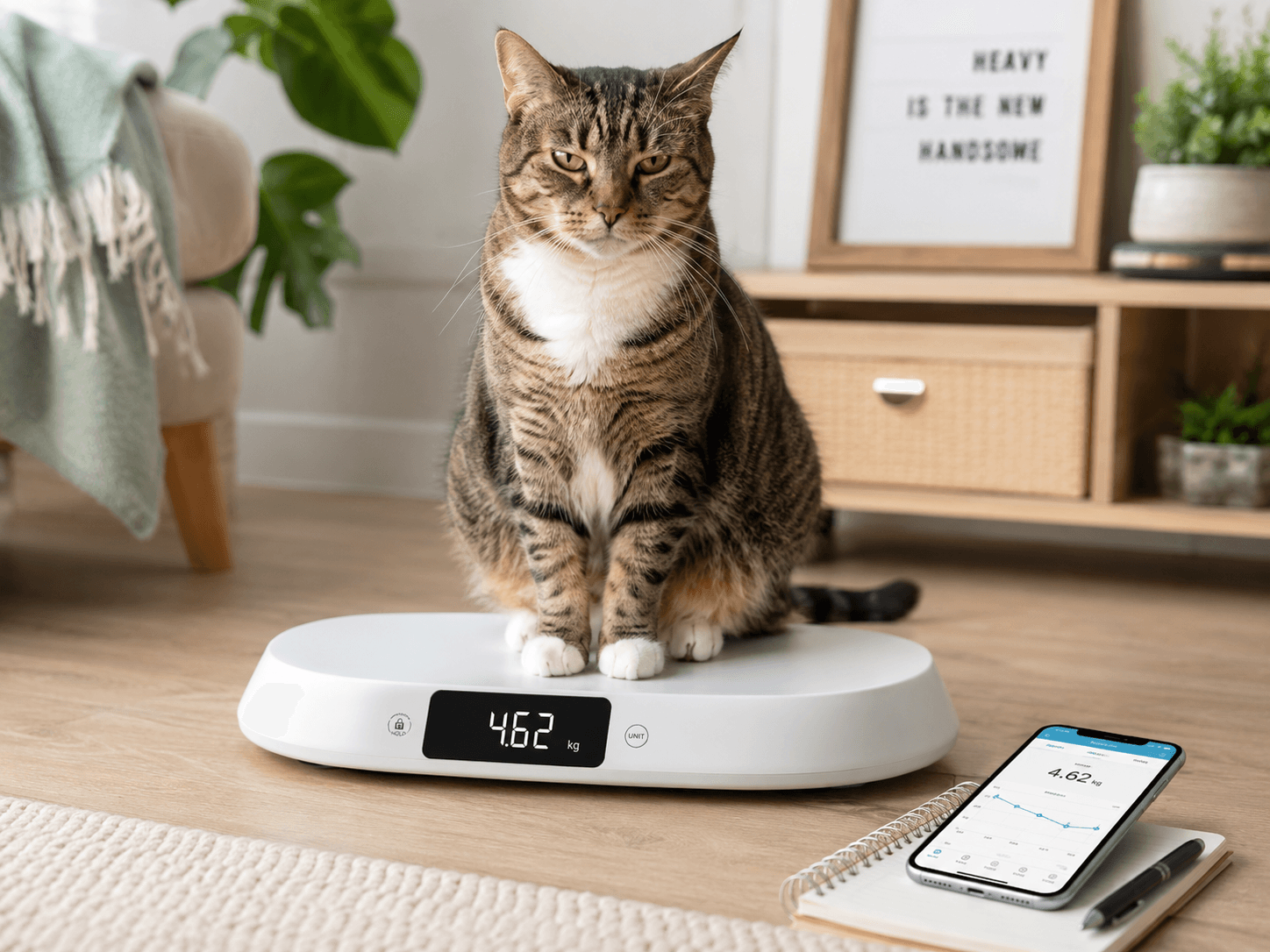
  • Best Cat Weight Scales (2026): Useful Trends or False Precision?

    Best Cat Weight Scales (2026): Useful Trends or False Precision?

    A cat can gain or lose weight slowly enough that the change hides in plain sight.

    You see the same animal every day. The coat remains fluffy. Gerald still occupies the same unreasonable percentage of the sofa. Then the veterinary scale reveals that something has changed.

    A home cat scale can make those changes easier to notice—but only when the readings are collected consistently and interpreted with restraint.

    The best cat weight scales do not diagnose kidney disease, diabetes or poor nutrition. They answer a smaller and more useful question:

    Has my cat’s weight changed enough to verify and discuss?

    That sounds less impressive than “AI-powered preventive health intelligence,” but it also happens to be true.

    Quick Verdict

    ProductBest fitNot forPetTech AI verdict
    Greater Goods Digital Pet ScaleSimple, controlled home weigh-insOwners who require automatic app loggingRecommended
    Beurer BY90 Bluetooth ScaleManual weigh-ins with app-based recordsAnyone expecting a cat-specific health platformRecommended with Conditions
    Purina Petivity MonitorPassive weight and litter-use trends with an existing boxHomes wanting automatic scoopingRecommended with Conditions
    PETKIT PuraMax 2Litter automation plus contextual weight trendsBuying an entire robot only to weigh a catConditional Recommendation
    Litter-Robot 4Premium automation with Whisker SmartScaleOwners who only need a platform scaleConditional Recommendation

    Best starting point for most households: Greater Goods provides deliberate weigh-ins without requiring Wi-Fi, a subscription or a new litter routine.

    Best connected platform: Beurer BY90 stores readings through an app, although its software was designed around babies rather than feline health.

    Best passive monitor: Petivity collects weight and litter-box behavior without replacing your existing tray.

    PetTech AI may earn a commission from qualifying purchases. As an Amazon Associate I earn from qualifying purchases.

    Need a controlled weekly or monthly reading without buying a litter robot? Check the Greater Goods Digital Pet Scale on Amazon.

    Research and Health Note

    This is a research-led comparison based on current manufacturer documentation, Amazon listings and veterinary guidance. PetTech AI has not performed identical long-term accuracy testing across every device in this guide.

    Body weight is only one part of feline assessment. AAHA guidance combines weight with body condition and muscle condition because the same number can conceal different proportions of fat and muscle. Unintended weight loss can accompany many medical conditions, particularly in senior cats, and should not be explained by an app without veterinary evaluation.

    A scale can reveal change.

    It cannot tell you why the change occurred.

    Controlled Measurement vs Passive Monitoring

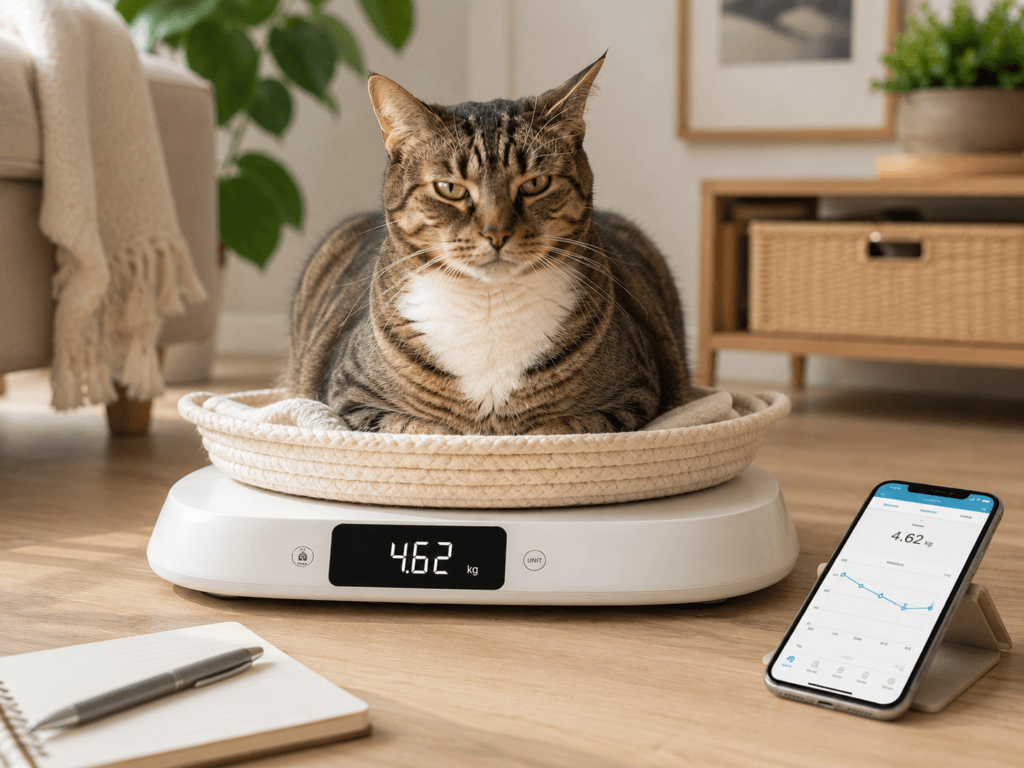
    Cat resting in a basket on a digital pet scale during a controlled home weigh-in.
    Controlled weigh-ins are often the easiest way to get repeatable readings—assuming your cat cooperates for longer than seven seconds.

    There are two fundamentally different ways to weigh a cat at home.

    Controlled measurement

    You intentionally place the cat on a platform scale under reasonably similar conditions.

    This gives you more control over:

    • the surface;
    • the cat’s position;
    • the time of measurement;
    • blankets or carriers placed on the platform;
    • whether an unexpected result is repeated.

    The disadvantage is obvious: the cat must cooperate.

    Some cats sit politely. Others respond as though the platform has been installed by federal authorities.

    Passive monitoring

    A sensor collects weight while the cat performs another activity, usually entering a litter box.

    This creates more readings with less handling. It can also connect weight with:

    • visit frequency;
    • visit duration;
    • time of day;
    • elimination patterns;
    • the identity assigned to the cat.

    The trade-off is reduced control. Posture, movement, installation, floor surface and multi-cat identification may influence what the system records.

    More data does not automatically mean better data.

    It means you have more readings to evaluate.

    Best Simple Cat Scale: Greater Goods Digital Pet Scale

    Verdict: Recommended

    The Greater Goods scale is the most sensible choice for owners who primarily want repeatable home weigh-ins.

    Its removable platform measures approximately 24 by 11.5 inches, supports animals up to 44 pounds and displays weight in 0.1-pound increments. Greater Goods also includes a movement-stabilization function, tare control and multiple units.

    Where it wins

    It avoids most forms of technological friction:

    • no app pairing;
    • no account;
    • no Wi-Fi dependency;
    • no litter-box compatibility issue;
    • no automatic profile assignment.

    Place it on a hard, level surface, use the same blanket when needed and repeat a surprising result before treating it as meaningful.

    The tare function is especially useful for cats that prefer sitting inside a shallow basket or on a familiar mat. Zero the scale after adding the object, then invite the emperor onto his prepared throne.

    Where it disappoints

    The 0.1-pound display interval is adequate for general household trend tracking, but it should not be confused with laboratory precision.

    The platform also requires active participation. A cat who immediately walks off can transform a ten-second measurement into a quarterly administrative project.

    Choose Greater Goods when you want a simple reference point you can reproduce.

    Skip it when you know the manual routine will quietly disappear after the first three measurements.

    Best App-Connected Platform: Beurer BY90

    Verdict: Recommended with Conditions

    The Beurer BY90 replaces the non-monetizable Healthy Pet Connect scale from the old guide.

    It is marketed as a Bluetooth baby and pet scale for infants, cats and dogs. The current Amazon listing gives it a 44-pound capacity, hold and tare functions, a curved platform, onboard memory and synchronization with the Beurer BabyCare app.

    Where it wins

    The BY90 fits owners who want:

    • controlled platform measurements;
    • automatic digital records;
    • charts instead of handwritten notes;
    • separate weigh-ins without changing the litter box;
    • a curved surface that may feel more secure than a flat bathroom scale.

    The hold function can help capture a stable result while the subject moves, although the cat still needs to remain reasonably contained on the platform.

    Where it disappoints

    This is not a cat-specific health ecosystem.

    The app was designed primarily for tracking infant growth. It stores weight effectively, but it should not be expected to interpret feline body condition, recognize veterinary risk or integrate naturally with feeder and litter-box records.

    In other words, the hardware can weigh Biscuit. The software may continue to believe Biscuit is a strangely hairy newborn.

    Want app-based weight records without replacing the litter box? Check the Beurer BY90 Bluetooth Scale on Amazon.

    Best Add-On for an Existing Litter Box: Purina Petivity

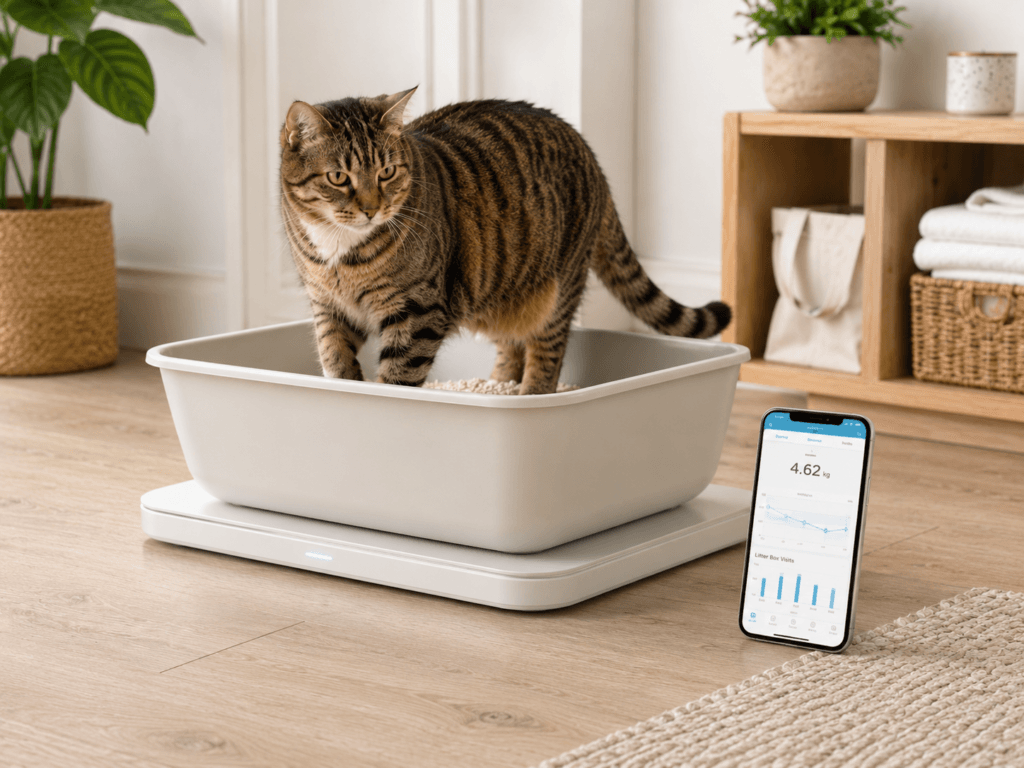
    Cat standing in a litter box placed on a smart monitoring platform with weight and litter-use tracking on a phone app.
    Passive monitoring adds convenience, but more readings do not automatically mean better readings.

    Verdict: Recommended with Conditions

    Petivity sits beneath a conventional litter box rather than replacing it.

    Its system records weight and classifies litter-box events such as urination and defecation. The Petivity app displays charts, produces periodic reports and alerts users when patterns differ from the established baseline. The manufacturer correctly frames those changes as information that may warrant veterinary diagnosis—not as a diagnosis produced by the device itself.

    Where it wins

    Petivity offers a useful middle ground:

    • passive measurements;
    • no automatic rotating drum;
    • continued use of a familiar litter box;
    • weight combined with elimination context;
    • profiles for individual cats;
    • fewer changes to the cat’s established bathroom routine.

    That makes it especially appealing when the monitoring matters more than automatic scooping.

    Our full Petivity Smart Litter Box Monitor Review examines its setup, reports, identification limits and practical value in greater detail.

    Where it disappoints

    Petivity still depends on:

    • correct installation;
    • a compatible box;
    • stable flooring;
    • successful cat identification;
    • continued manual litter maintenance.

    Its event classification should also be treated as a data aid, not an infallible witness. An app can misclassify a visit. Gerald has already declined to testify.

    Want passive weight and litter-use records without changing to a self-cleaning box? Check Purina Petivity on Amazon.

    When an Automatic Litter Box Makes Sense

    Cat beside a self-cleaning litter box with app-based weight tracking and monitoring features.
    A smart litter box can track weight trends too—but buying a whole robot just to weigh a cat is a very committed financial decision.

    A self-cleaning litter box can add weight tracking, but weight should rarely be the main reason to buy one.

    These machines make sense primarily when you also value:

    • automatic waste removal;
    • odor containment;
    • app notifications;
    • waste-drawer monitoring;
    • reduced daily scooping.

    Buying an entire premium robot merely to avoid entering one number into a phone is innovative financial planning, but not necessarily good financial planning.

    PETKIT PuraMax 2

    Verdict: Conditional Recommendation

    PuraMax 2 records litter-box usage and weight changes through the PETKIT app, including separate profiles intended for multi-cat households. PETKIT’s marketing sometimes uses stronger health language than we would, so interpret app warnings as pattern changes requiring attention—not confirmation of a urinary obstruction or disease.

    Choose it when you want the combination of:

    • self-cleaning operation;
    • PETKIT ecosystem integration;
    • usage records;
    • weight trends;
    • a comparatively compact rotating design.

    Read our PETKIT PuraMax 2 Review for the complete fit, leakage, cleaning and cat-size trade-offs.

    Does PETKIT’s automation and monitoring package fit your home? Check PuraMax 2 on Amazon.

    Check PuraMax 2 on the PETKIT official store as well.

    Litter-Robot 4

    Verdict: Conditional Recommendation

    Whisker’s SmartScale records weight during Litter-Robot 4 use and associates the data with pet profiles. Whisker notes that the system needs accurate profile information and time to learn weight patterns, particularly in multi-cat households. Hard, level flooring matters; carpet or uneven flooring can reduce scale accuracy unless the appropriate base support is used.

    Choose it when you value:

    • Whisker’s mature app;
    • automatic cleaning;
    • daily weight trends;
    • waste-level information;
    • a broad accessory and support ecosystem.

    Our PuraMax 2 vs Litter-Robot 4 comparison explains which automation philosophy better fits different households.

    Prefer Whisker’s automation and SmartScale ecosystem? Check Litter-Robot 4 through Amazon.

    Why Multi-Cat Identification Can Fail

    Weight-based identification works best when cats have clearly different weights and use the system consistently.

    Problems appear when:

    • two cats weigh nearly the same;
    • one cat is actively gaining or losing weight;
    • the device receives incomplete readings;
    • profiles contain outdated weights;
    • the machine has not gathered enough events;
    • a cat places only part of its body on the sensing area.

    Whisker advises allowing SmartScale time to learn each cat’s patterns. Systems such as PETKIT’s Purobot Max Pro 2 attempt to reduce ambiguity by combining facial recognition with weight sensing, but that requires a camera-equipped premium litter box rather than a simple scale.

    Before trusting per-cat graphs, verify that the system is consistently assigning visits to the correct animal.

    A beautifully rendered chart for the wrong cat remains beautifully wrong.

    How to Get More Consistent Home Readings

    Use the same scale whenever possible. AAHA’s current diabetes-management guidance specifically emphasizes using the same scale for consistency when monitoring weight during treatment.

    For controlled platform measurements:

    • place the scale on a hard, level surface;
    • use similar conditions each time;
    • tare the same basket, blanket or carrier;
    • center the cat on the platform;
    • repeat unexpected results;
    • record the date and relevant context.

    For litter-box systems:

    • follow the installation instructions;
    • avoid moving the unit unnecessarily;
    • keep pet profiles current;
    • check whether flooring affects the sensors;
    • verify multi-cat assignments;
    • view trends rather than reacting to every notification.

    The ideal measurement schedule depends on the purpose. A healthy adult being observed routinely does not require the same cadence as a senior cat, a kitten or an animal following a veterinary weight-management plan.

    Follow the schedule recommended for the individual cat rather than allowing the dashboard to invent one.

    What Weight Data Can—and Cannot—Tell You

    Weight data can tell you:

    • whether readings appear broadly stable;
    • whether a possible upward or downward trend deserves confirmation;
    • whether a veterinary nutrition plan is producing measurable change;
    • whether passive and controlled readings broadly agree;
    • whether records may be useful at an appointment.

    Weight data cannot independently tell you:

    • whether the cat is losing fat or muscle;
    • whether a change comes from food intake, hydration or disease;
    • whether the cat has diabetes, kidney disease or hyperthyroidism;
    • what calorie adjustment should be made;
    • whether an app alert represents an emergency.

    AAHA recommends evaluating body weight alongside body and muscle condition. Cornell also notes that weight loss may accompany several conditions in older cats, while weight loss despite a good appetite can occur with feline diabetes.

    Three connected devices do not become a diagnosis by majority vote.

    What to Share With Your Veterinarian

    A useful record includes more than a screenshot of one low number.

    Bring:

    • the weight trend and dates;
    • the scale or device used;
    • whether the reading was controlled or passive;
    • appetite changes;
    • food and treat amounts;
    • vomiting or diarrhea;
    • drinking and urination changes;
    • activity or behavior changes;
    • current medications;
    • recent diet changes.

    Our Best Pet Tech Apps for Cats guide explains which platforms make useful records accessible and which mainly produce a decorative waterfall of notifications.

    Contact your veterinarian when weight changes persist, appear rapid or occur alongside appetite loss, increased thirst, vomiting, diarrhea, weakness, altered urination or other meaningful changes from baseline.

    Buyer-Regret Risk

    The most common mistakes are:

    • buying a connected scale when a notebook would work;
    • buying a litter robot primarily for its scale;
    • assuming more decimal places guarantee accuracy;
    • trusting one unexpected reading;
    • confusing weight with body condition;
    • expecting equal-weight cats to be identified perfectly;
    • modifying food based only on an app graph;
    • collecting data without ever reviewing it.

    The simplest useful setup is often:

    one consistent platform scale, one repeatable routine and one record you can actually find.

    Upgrade to passive monitoring when automatic collection solves a real problem—not because the app dashboard has achieved consciousness.

    Final Verdict

    Choose Greater Goods for the simplest controlled home measurements and the least technological friction.

    Choose Beurer BY90 when app logging matters enough to justify baby-oriented software and a less pet-specific experience.

    Choose Petivity when passive weight and litter-use monitoring matter, but you want to retain a conventional litter box.

    Choose PuraMax 2 when PETKIT automation is already the priority and weight trends are a secondary benefit.

    Choose Litter-Robot 4 when Whisker’s self-cleaning ecosystem and SmartScale records fit the household better.

    The best cat weight scale is not the one producing the largest number of graphs.

    It is the one producing readings consistent enough to notice a real change—and simple enough that you continue using it after Napoleon’s third refusal to cooperate.

    Frequently Asked Questions

    How accurate are home cat scales?

    Accuracy varies by design, surface, movement and positioning. Consistent readings under comparable conditions are often more useful for trend monitoring than impressive resolution claims.

    Can I weigh my cat on a human bathroom scale?

    You can weigh yourself holding the cat and subtract your own weight, but the method may not detect smaller changes reliably. A pet or baby platform offers a more controlled surface.

    Is a smart litter box better than a platform scale?

    Not automatically. A litter box provides frequent passive readings; a platform provides deliberate, repeatable measurements. They solve different problems.

    Can a cat scale detect illness?

    No. It can reveal a weight change worth confirming. Veterinary assessment is needed to determine the cause.

    References

    • AAHA — Nutrition and Weight Management Guidelines for Dogs and Cats
    • AAHA — 2026 Diabetes Management Guidelines for Cats
    • Cornell Feline Health Center — The Special Needs of the Senior Cat
    • Cornell Feline Health Center — Feline Diabetes
    • Greater Goods — Digital Pet Scale Documentation
    • Beurer — BY90 Product Documentation
    • Purina Petivity — Smart Litter Box Monitor Documentation
    • PETKIT — PuraMax 2 Documentation
    • Whisker — SmartScale and Litter-Robot 4 Documentation

    Image Disclosure

    Official manufacturer images are used when available and authorized.

    AI-generated images may also be used as editorial illustrations. They should not be treated as exact representations of product dimensions, materials, controls or physical features. Always verify current official product information before purchasing.
    Editorial Disclosure

    PetTech AI may earn a commission from qualifying purchases. This does not influence our recommendations, comparisons or editorial judgments.

  • PETKIT PuraMax 2 vs Litter-Robot 4: Is Whisker Worth the Premium?

    PETKIT PuraMax 2 vs Litter-Robot 4: Is Whisker Worth the Premium?

    PETKIT PuraMax 2 vs Litter-Robot 4 looks like a contest between the value challenger and the established premium choice.

    That framing is convenient for Whisker—and potentially expensive for everyone else.

    Both machines automate the same unpleasant transaction: your cat creates a problem, the globe rotates and you deal with the consequences later.

    The differences are physical and financial.

    PuraMax 2 offers the stronger value for many one- or two-cat homes.

    Litter-Robot 4 becomes the better purchase when its larger entrance, higher cat-weight limit, four-cat capacity and established support platform solve a problem PETKIT does not.

    The question is not which company has won more internet arguments.

    It is:

    Will your household actually use enough of Litter-Robot 4’s advantages to justify paying the Whisker premium?

    Quick Verdict

    CategoryPETKIT PuraMax 2Litter-Robot 4
    PetTech AI verdictStrong Recommendation for ValueRecommended with Conditions
    Best fitOne or two average-sized catsLarger cats and heavier multi-cat households
    Main advantageStrong automation at a substantially lower typical costLarger opening, broader physical capacity and mature platform
    Cat weight range3.3–22 lb3–25 lb
    Best space advantageShorter and shallowerNarrower body and larger entrance
    Main limitationSmaller opening and less established ownership ecosystemPremium is difficult to justify for simpler households
    Choose it whenPrice-to-function matters mostPhysical fit and platform confidence matter most

    Choose PuraMax 2 when your cats fit comfortably, the household is not unusually demanding and you would rather pay for automation than brand reassurance.

    Choose Litter-Robot 4 when a larger cat, three- or four-cat traffic, a much wider opening or Whisker’s trial and support system materially reduces buyer risk.

    Litter-Robot 4 is not a bad value because it costs more.

    It becomes a bad value when you pay for advantages your home never uses.

    Research Note

    This is a research-led comparison based on current official specifications, app documentation, product positioning and available ownership evidence.

    PetTech AI has not conducted a long-term side-by-side hands-on test of both machines.

    PetTech AI may earn a commission from qualifying purchases. As an Amazon Associate I earn from qualifying purchases.

    Does PuraMax 2 fit your cats and room? Check PuraMax 2 through PETKIT.

    Does the larger Whisker platform solve a real constraint? Check Litter-Robot 4 availability on Amazon.

    The Real Difference: Value vs Physical Headroom

    PuraMax 2 and Litter-Robot 4 both separate clumped waste from clean litter, store it in an enclosed drawer and connect to an app for remote controls, maintenance alerts and routine tracking.

    The buying decision begins after those shared functions.

    PuraMax 2 prioritizes:

    • compact vertical dimensions;
    • broad litter compatibility;
    • sealed waste storage;
    • PETKIT app integration;
    • automated deodorization;
    • a lower typical purchase threshold.

    Litter-Robot 4 prioritizes:

    • a substantially larger entrance;
    • support for heavier cats;
    • official use for up to four cats;
    • detailed waste and litter-level sensing;
    • a mature accessory and support environment;
    • a 90-day in-home trial.

    Whisker is not charging more for identical plastic wearing a bow tie.

    Its advantages are real.

    They are simply unnecessary for a large portion of ordinary households.

    Why PuraMax 2 Is the Better Value for Most Smaller Homes

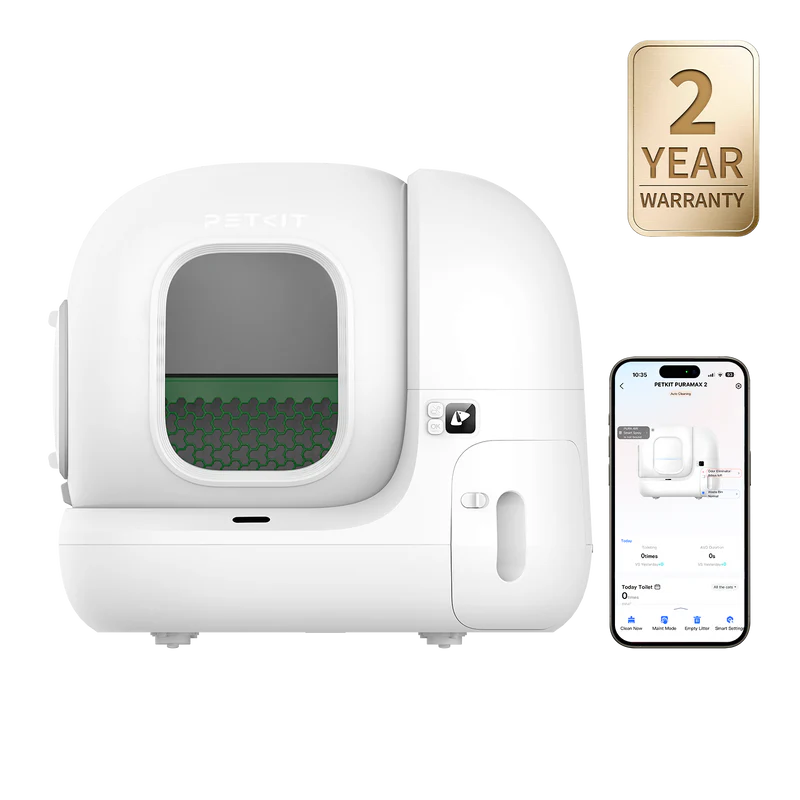
    PETKIT PuraMax 2 self-cleaning litter box in a modern home setup
    PuraMax 2 is the stronger fit for buyers who want compact premium litter automation inside the PETKIT ecosystem.

    PuraMax 2 supports cats from 3.3 to 22 lb and provides a 76-liter cylinder with a 7-liter waste bin. PETKIT says the bin can last up to approximately 15 days for one cat, although real frequency depends on litter-box traffic and environmental conditions.

    Its exterior measures approximately:

    • 24.4 inches wide;
    • 21.2 inches deep;
    • 21.7 inches tall.

    That makes it considerably shorter and shallower than Litter-Robot 4, although it is slightly wider.

    PuraMax 2 is the stronger decision when:

    • one or two cats use the box;
    • every cat remains comfortably below 22 lb;
    • room depth or vertical presence is limited;
    • PETKIT feeding or hydration products already use the app;
    • purchase value matters more than maximum physical flexibility;
    • a wider Whisker support ecosystem adds little practical benefit.

    The PETKIT app can also manage compatible feeders, fountains and litter boxes, making PuraMax 2 more attractive inside a broader connected-care setup.

    For a closer evaluation of the machine itself, read our PETKIT PuraMax 2 Review.

    PuraMax 2 does not win merely because it is cheaper.

    It wins when Litter-Robot 4 would charge the household more for capacity, opening size and institutional confidence it does not need.

    Whisker’s reputation has value.

    It has not yet been classified as a second cat.

    When Litter-Robot 4 Is Worth Paying More For

    Litter-Robot 4 supports cats from 3 to 25 lb and is officially positioned for households with as many as four cats. Its entrance measures 15.75 inches across, while its exterior footprint is 22 by 27 inches with a height of 29.5 inches.

    Those numbers create a meaningful advantage for:

    • large or long-bodied cats;
    • cats uncomfortable with narrower enclosed entrances;
    • three- or four-cat households;
    • heavier litter-box traffic;
    • buyers who value Whisker’s established troubleshooting history;
    • households likely to use accessories such as LitterHopper.

    Whisker also backs its automatic litter boxes with a 90-day in-home trial and a standard one-year warranty. Returns under the trial require the buyer to cover return shipping, but the trial still lowers the risk of discovering that Emperor Maximilian rejects the machine after a lengthy internal review process.

    Litter-Robot 4 therefore becomes easier to justify when the premium purchases fit, capacity or reduced adoption risk.

    It becomes harder to justify when one average-sized cat uses the box and PuraMax 2 already fits the room.

    For buyers considering Whisker’s newer lineup, read our Litter-Robot 5 vs 5 Pro vs EVO comparison before assuming LR4 remains the automatic choice.

    Space and Entry: Neither Machine Is Simply “Smaller”

    PuraMax 2 is shorter and shallower.

    Litter-Robot 4 is narrower.

    PuraMax 2 measures roughly 24.4 by 21.2 by 21.7 inches. Litter-Robot 4 measures 22 by 27 by 29.5 inches.

    That creates two different placement advantages:

    • choose PuraMax 2 when room depth or overall height is the problem;
    • choose Litter-Robot 4 when horizontal width is tighter.

    Entry access also favors Whisker.

    PuraMax 2 has an entrance around 7.87 by 10.03 inches with a 7.87-inch threshold. Litter-Robot 4 provides a 15.75-inch opening and an included step approximately 6.9 inches high.

    PuraMax 2 should therefore not be recommended automatically for mobility-limited cats simply because the entire machine looks lower.

    Cats with joint pain, impaired mobility or strong enclosure aversion may still prefer a genuinely low-sided conventional box.

    The app can document rejection with impressive precision.

    It cannot negotiate acceptance.

    Odor Control and Ongoing Consumables

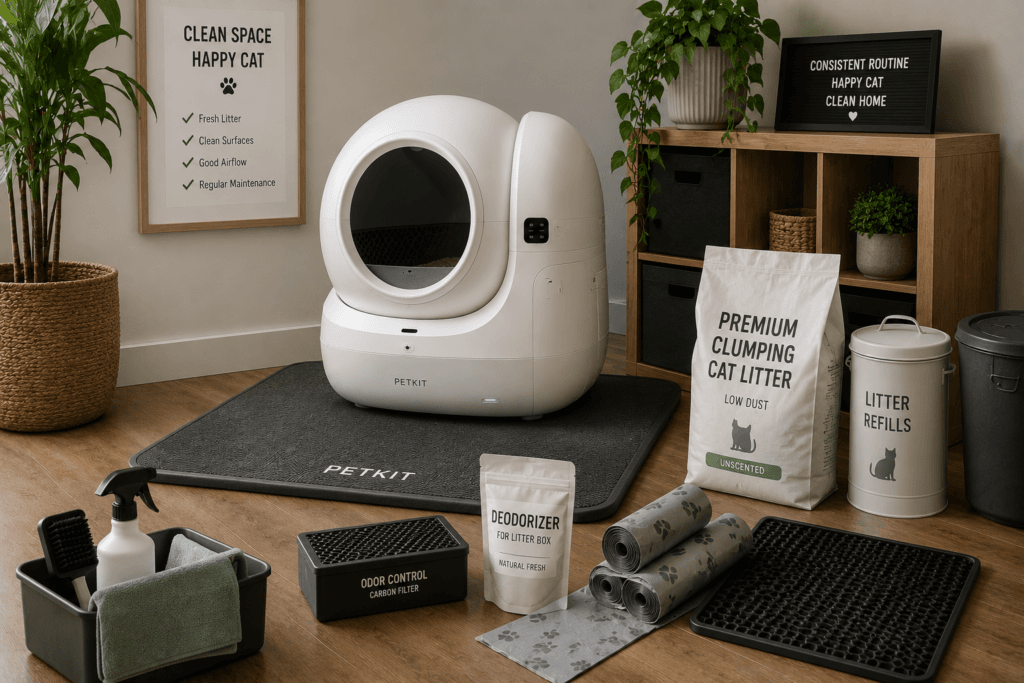
    A clean litter room setup with a sealed waste drawer, litter mat, cleaning tools and air purifier nearby
    Odor control depends on the whole litter routine: waste storage, liners, litter quality, cleaning and airflow all matter.

    Both products remove waste from the exposed litter bed and contain it in an enclosed compartment.

    PuraMax 2 uses a sealed waste bin alongside PETKIT’s N50 2.0 odor eliminator and a smart deodorizing spray. PETKIT states that the N50 unit lasts up to approximately one month, while the liquid spray typically lasts 40–60 days depending on use.

    Litter-Robot 4 uses a sealed, carbon-filtered waste drawer and supports optional OdorTrap packs.

    Neither model is consumable-free.

    The systems simply sell different objects that eventually need replacing.

    Real odor control still depends heavily on:

    • litter quality;
    • drawer-emptying frequency;
    • clump formation;
    • residue inside the globe;
    • periodic cleaning;
    • room ventilation.

    The sealed drawer performs most of the unglamorous work.

    The branded deodorizer then arrives to collect partial credit and future orders.

    App Data: Useful, but Not a Diagnosis

    PuraMax 2 records visits, duration and weight through the PETKIT app. Litter-Robot 4 uses SmartScale and the Whisker app to track weight, activity, waste status and maintenance information.

    PETKIT has the stronger ecosystem argument when the home already contains connected feeders or fountains.

    Whisker offers the more focused litter-first environment and a larger established Litter-Robot ownership base.

    Neither app can determine why a cat’s behavior changed.

    The devices may help reveal:

    • more frequent visits;
    • weight movement;
    • reduced box use;
    • changes between cats;
    • unusual activity timing.

    Those are signals, not diagnoses.

    A meaningful or persistent change should lead to direct observation and veterinary assessment when appropriate—not a ceremonial refreshing of the dashboard.

    For the wider distinction, read our Smart Cat Monitoring vs Automation guide.

    Buyer-Regret Risk

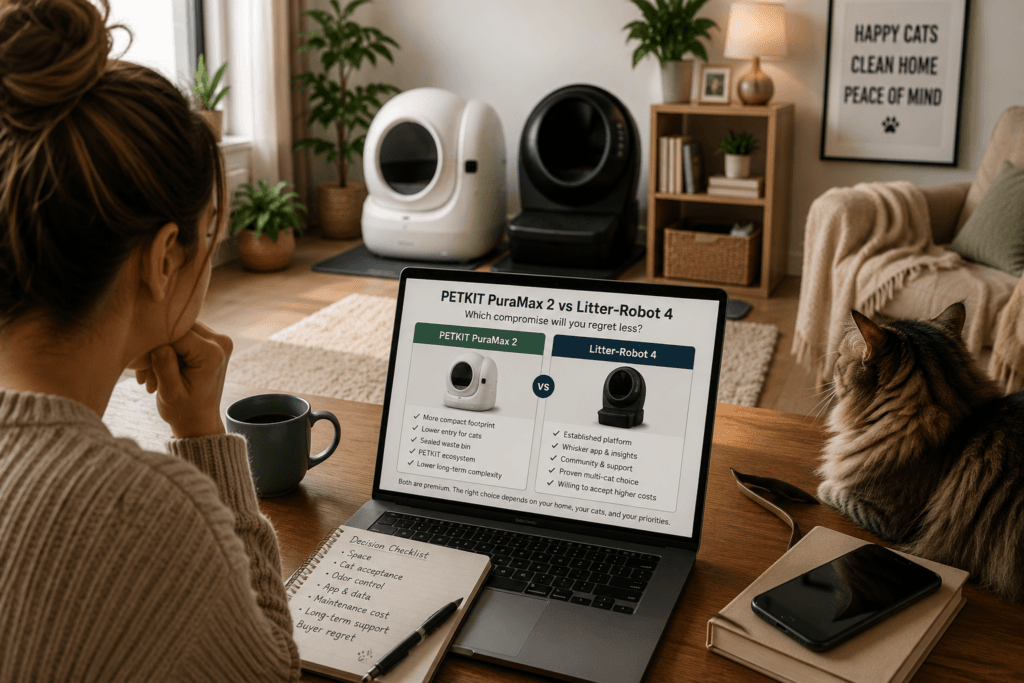
    A cat owner comparing two smart litter box options on a laptop while a cat sits nearby in a modern home
    Buyer regret usually comes from choosing the wrong compromise—not from either litter box being objectively bad.

    PuraMax 2 regret usually means discovering that the cat needed a larger opening or the household needed more physical capacity.

    Litter-Robot 4 regret usually means paying a substantial premium for platform confidence, extra room and support benefits that remained mostly theoretical.

    The safest decision follows one rule:

    Pay for the constraint your household actually has.

    Choose LR4 because Archibald is large, the home has four cats or the trial meaningfully reduces risk.

    Do not choose it merely because the established brand feels emotionally safer.

    That is not product selection.

    It is premium anxiety management with a waste drawer.

    Final Verdict

    PETKIT PuraMax 2 earns a Strong Recommendation for Value.

    It is the more rational purchase for many one- or two-cat homes whose cats fit comfortably inside its physical limits. It provides strong core automation, a shorter and shallower design, app monitoring and effective waste containment without demanding the full Whisker premium.

    Litter-Robot 4 earns a Recommended with Conditions verdict.

    It is the better machine for larger cats, heavier multi-cat use, entrance-sensitive cats and buyers who place genuine value on Whisker’s mature platform and 90-day trial.

    Litter-Robot 4 is more established.

    PuraMax 2 is frequently the better deal.

    The correct purchase depends less on which brand inspires the most confidence and more on whether your cats will use the additional capacity you are buying.

    For the wider brand decision, read our PETKIT vs Litter-Robot Ecosystem comparison.

    Still deciding among the wider market rather than these two machines? Read our Best Smart Litter Boxes guide.

    Frequently Asked Questions

    Is PuraMax 2 better than Litter-Robot 4?

    PuraMax 2 offers better value for many one- or two-cat households. Litter-Robot 4 is the stronger fit for larger cats, up to four cats and buyers who value Whisker’s mature platform.

    Which model takes up less space?

    PuraMax 2 is shorter and shallower but slightly wider. Litter-Robot 4 is narrower but significantly deeper and taller.

    Which model has the larger entrance?

    Litter-Robot 4. Its 15.75-inch opening is substantially larger than the PuraMax 2 entrance.

    Which is better for multiple cats?

    Litter-Robot 4 is the safer choice for three- or four-cat homes. PuraMax 2 can work well for smaller multi-cat households when every cat fits comfortably and waste traffic remains manageable.

    Can either litter box detect health problems?

    No. Both can highlight changes in weight or litter-box activity, but neither can diagnose their cause.

    References

    • PETKIT — PuraMax 2 product specifications
    • PETKIT — PuraMax 2 app and support documentation
    • Whisker — Litter-Robot 4 product specifications
    • Whisker — Current Litter-Robot comparison chart
    • Whisker — Whisker app and in-home trial documentation

    Image Disclosure

    Official manufacturer images are used when depicting the exact products.

    Any AI-generated images are editorial illustrations only. They do not represent exact dimensions, entrance size, controls or app performance. Always verify current specifications before purchasing.

    Editorial Disclosure

    PetTech AI may earn a commission from qualifying purchases. This does not influence our recommendations, comparisons or editorial judgments.

  • Litter-Robot 4 Review 2026: Still Worth It After Litter-Robot 5?

    Litter-Robot 4 Review 2026: Still Worth It After Litter-Robot 5?

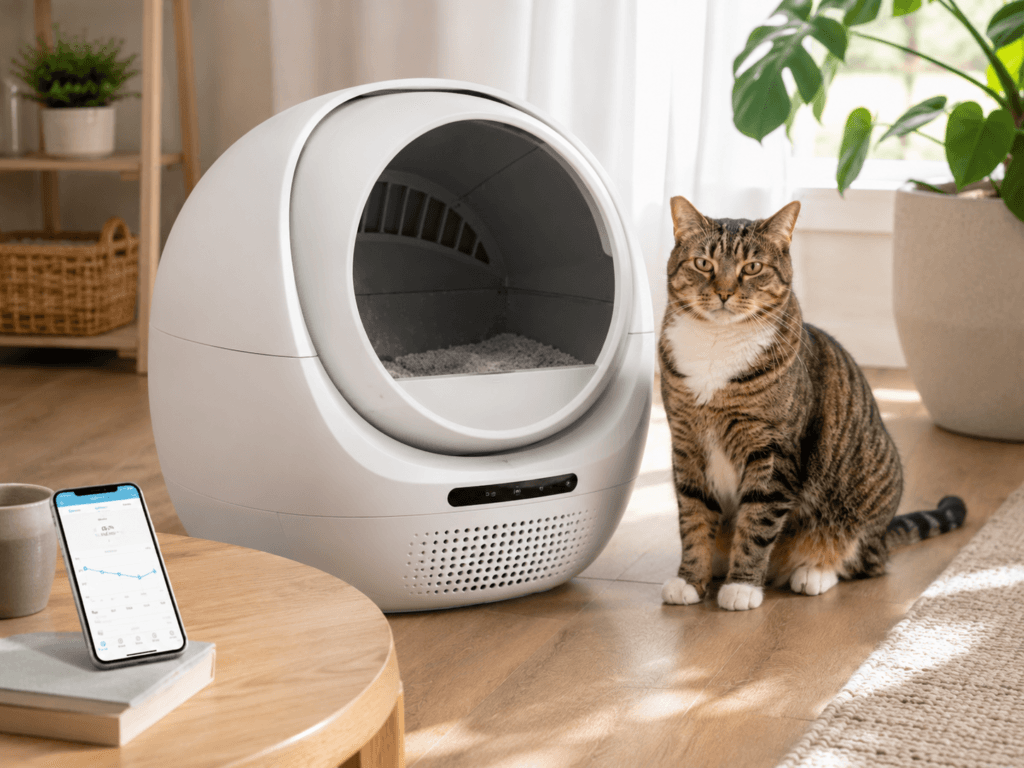
    Litter-Robot 4 is no longer Whisker’s newest, smartest or most expensive automatic litter box.

    That may be its strongest argument.

    It sits between the smaller Litter-Robot EVO and the newer Litter-Robot 5, retaining the wide entrance, quiet cleaning, strong odor control and mature Whisker ecosystem that made it popular—without charging for cameras or waste analysis you may never use.

    The awkward part is price. At Whisker’s current official MSRP, Litter-Robot 4 costs only $100 less than Litter-Robot 5 and $100 more than EVO. It is the middle child of the lineup, and middle children must work harder for attention.

    Quick Verdict

    PetTech AI verdictBest fitNot forThe real reason to buy
    RecommendedHomes with one to four cats wanting proven automation, a large entrance and mature supportSmall spaces, cats above 25 lb, buyers wanting cameras or waste-type recognitionReliable self-cleaning without paying for every new Whisker feature

    Buy it when: you want the established Whisker experience, have a medium or large cat, and consider Litter-Robot 5’s newer insights optional.

    Skip it when: EVO already fits your one- or two-cat household, or the extra capacity and WasteID features of Litter-Robot 5 are worth another $100.

    PetTech AI may earn a commission from qualifying purchases. As an Amazon Associate I earn from qualifying purchases.

    Does Whisker’s proven middle option fit your household? Check Litter-Robot 4 on Amazon.

    Research and Health Note

    This is a research-led review based on current Whisker documentation, official model comparisons and independent long-term testing. PetTech AI has not performed identical controlled testing across every automatic litter box discussed here.

    Litter-Robot 4 records visits and weight trends. Those records may reveal a change worth investigating, but they cannot diagnose urinary disease, constipation, diabetes or weight-related illness.

    Repeated visits, straining, vocalization, blood in the urine or producing little to no urine require veterinary attention. A dashboard can organize evidence. It cannot examine the cat.

    Where Litter-Robot 4 Fits in 2026

    Whisker now positions Litter-Robot 4 as its tried-and-true model.

    It supports up to four cats weighing 3–25 lb, offers a 15.75-inch entrance and provides 16.5 inches of interior headroom. Litter-Robot 5 expands support to five cats and 30 lb while adding WasteID, a larger drawer and an LCD interface. EVO is smaller, supports up to two cats and tops out at 19 lb.

    That gives LR4 a clear but narrower role:

    • more spacious and capable than EVO;
    • less expensive than LR5;
    • compatible now with the LitterHopper automatic litter-refill accessory;
    • established long enough to have a large user base, accessory catalog and repair ecosystem.

    Choose it because those differences suit your home—not because it used to be the flagship.

    Cleaning and Odor Control Remain the Main Event

    Litter-Robot 4 waste drawer with liner and carbon-filter odor-control system.
    The sealed drawer and carbon filter contain odor effectively between disposal cycles. Opening the drawer remains, regrettably, a human responsibility.

    After the cat exits, the globe rotates and passes clean litter through its sifting screen. Clumps drop into a sealed waste drawer, while usable litter returns to the globe.

    The process is quiet enough that independent reviewers frequently identify noise as one of LR4’s strengths. The sealed drawer and carbon filter also perform well at containing odor until the drawer is opened—the moment at which the machine hands responsibility back to civilization.

    Whisker estimates that a one-cat household may go up to eight days between drawer changes. Real intervals depend on the cat’s size, diet, litter and preferred level of productivity. Multi-cat homes will empty it considerably more often.

    Odor control is strong, not supernatural. You still need to:

    • empty the drawer;
    • wipe the entrance and globe;
    • top up litter;
    • inspect the liner;
    • perform periodic deeper cleaning.

    Litter-Robot eliminates routine scooping. It does not eliminate ownership.

    Litter-Robot 4 works best with standard-weight clumping litter; our automatic litter box litter guide explains which clay, tofu and crystal formulas are worth considering—and which ones belong nowhere near the globe.

    The Whisker App Is Good—But History Now Has a Paywall

    Whisker app displaying Litter-Robot 4 visit history, cat weight records and waste drawer information.
    The Whisker app tracks visits, weight and drawer levels, although longer historical records now sit behind Whisker+.

    The Whisker app shows:

    • cleaning-cycle activity;
    • waste-drawer level;
    • litter level;
    • individual visit records;
    • SmartScale weight readings;
    • device alerts and controls.

    Its interface and ecosystem remain major advantages over less established automatic litter boxes. Independent testing has praised its real-time drawer and litter-level information, although occasional incorrect alerts and sensor glitches have also been reported.

    The important 2026 caveat is data history.

    Standard LR4 access includes seven days of cat visits and individual weight records. Whisker+ expands this to as much as two years and adds longer-term weight, visit and duration trends, daily reports and extended notifications.

    The machine remains fully useful without the subscription. But owners buying it primarily for longitudinal health records should account for Whisker+ before declaring the app free forever.

    SmartScale also depends on installation. Weight readings are most accurate on a firm, level surface. Carpet thicker than approximately 3 mm or uneven flooring may require Whisker’s Carpet Tray for better measurements.

    For a broader look at controlled versus passive measurements, see our best cat weight scales.

    Cat Fit Is Better Than the Exterior Suggests

    Large adult cat entering the wide opening of a Litter-Robot 4 automatic litter box.
    LR4 offers more usable cat space than many enclosed competitors, but weight limits still do not replace measuring the actual cat.

    Litter-Robot 4 measures approximately 22 × 27 inches at the base and stands 29.5 inches high. The exterior remains substantial, but its large circular entrance and 16.5-inch interior headroom make it more accommodating than many enclosed competitors.

    It is a strong fit for:

    • medium and large cats;
    • multi-cat homes with clearly different weights;
    • cats already comfortable with covered litter boxes;
    • owners who can dedicate permanent floor space.

    The 25-pound limit is not permission to skip measuring. A long Maine Coon and a compact 20-pound cat do not occupy space in the same way.

    Cats with mobility problems may also dislike the elevated entrance. Whisker sells steps and ramps, but an open-top design such as Neakasa M1 may still feel less restrictive.

    Litter Compatibility Is Broad—but Not Universal

    Litter-Robot 4 works best with standard-weight, fast-clumping clay litter.

    Some silica crystals can pass through the screen, but translucent or white litter may interfere with the litter-level and drawer sensors. Plant-based, newspaper, loose-clumping and absorbent wood-pellet litters are generally poor matches for the sifting system.

    This matters more than marketing photographs suggest.

    Weak clumps may break during rotation, leaving residue inside the globe and sending fragments back into the clean litter. Very lightweight litter can also produce inaccurate level readings or escape the machine with enthusiastic paws.

    Do not buy LR4 while remaining emotionally committed to a litter it cannot sift properly. One of them will have to leave.

    Safety and Acclimation

    Litter-Robot 4 combines weight sensors with laser detection around the entrance and interior. A cleaning cycle pauses when the system detects a cat approaching or re-entering the globe.

    Automatic mode is intended for cats weighing at least 3 lb. Whisker recommends leaving the unit powered off and cycling it manually for smaller kittens until they can reliably trigger the sensors.

    Introduce the machine gradually:

    • place it near the existing litter box;
    • leave it switched off initially;
    • add a small amount of familiar used litter;
    • wait until the cat uses it consistently;
    • activate automatic cycles only after acclimation.

    Keep the original packaging during the transition. Direct purchases currently include a 90-day in-home trial, although return shipping remains the buyer’s responsibility. Purchases through Amazon or another retailer follow that retailer’s return policy.

    Maintenance Costs Without the Accessory Avalanche

    LR4 does not require proprietary waste bags. Appropriately sized generic liners can work, reducing one source of ecosystem lock-in. Independent testers have also reported using ordinary small garbage bags successfully.

    Recurring items may include:

    • drawer liners;
    • carbon filters;
    • OdorTrap packs;
    • replacement litter;
    • Whisker+;
    • optional accessories such as the Carpet Tray, ramp or LitterHopper.

    Whisker recommends replacing carbon filters and OdorTrap packs approximately every two to four weeks for optimal performance, but the machine continues operating without a monthly ceremony at the accessory store.

    The standard WhiskerCare warranty covers one year. A three-year plan is included with many bundles or can be purchased separately. The official direct-purchase trial lasts 90 days.

    Litter-Robot 4 vs EVO, LR5 and PETKIT

    Choose Litter-Robot EVO when:

    You have one or two cats under 19 lb, need the smallest current Whisker model and do not require litter-level sensing, LitterHopper compatibility or LR4’s larger interior.

    See the full lineup decision in our Litter-Robot 5 vs 5 Pro vs EVO comparison.

    Choose Litter-Robot 5 when:

    You have up to five cats, a cat above 25 lb or want WasteID, a larger waste drawer and improved onboard controls. The $100 official MSRP difference is small enough that buyers wanting those features should upgrade rather than regret saving it.

    Choose PETKIT PuraMax 2 when:

    You prefer PETKIT’s more compact rotating design, sealed waste approach and ecosystem—or simply want a different balance between footprint, app experience and price.

    Our PuraMax 2 vs Litter-Robot 4 comparison explains the household trade-offs.

    Choose Litter-Robot 4 when:

    You want the wide opening, established hardware, current LitterHopper support and mature Whisker ecosystem, but do not need cameras, WasteID or support for a fifth cat.

    Owners considering camera-based multi-cat identification should read our Purobot Max Pro 2 vs Litter-Robot 4 comparison before choosing the simpler Whisker platform.

    Buyer-Regret Risk

    Litter-Robot 4 disappoints when buyers:

    • discover EVO would have handled their single small cat;
    • save $100 despite genuinely wanting LR5’s larger capacity;
    • expect accurate SmartScale records on thick carpet;
    • insist on incompatible plant-based litter;
    • assume four cats automatically means one box is enough;
    • remove the original box before the cat adapts;
    • expect health data to explain its own cause;
    • underestimate the permanent footprint;
    • interpret “self-cleaning” as “self-maintaining.”

    It is a mature appliance, not a household employee with veterinary training.

    Final Verdict

    PetTech AI verdict: Recommended.

    Litter-Robot 4 remains one of the safest premium recommendations in automatic litter boxes because its strongest qualities have already survived years of real-world use:

    • quiet and reliable cleaning;
    • excellent odor containment;
    • generous cat access;
    • useful app controls;
    • established support;
    • broad accessory and replacement-part availability.

    It is no longer the automatic choice within Whisker’s own lineup.

    EVO is better for smaller households and tighter spaces. Litter-Robot 5 is better for five cats, larger cats and buyers who value WasteID enough to spend another $100.

    LR4 wins in the middle: proven, spacious and connected, without charging you to film Gerald’s every bathroom decision.

    Still the right Whisker for your household? Check Litter-Robot 4 on Amazon or through the official Whisker store.

    Still the right Whisker for your household? Compare Litter-Robot 4 on Amazon.

    Frequently Asked Questions

    Is Litter-Robot 4 still worth buying in 2026?

    Yes, particularly for homes with one to four cats that want a large entrance, mature app and LitterHopper compatibility without paying for LR5’s newer features.

    Does Litter-Robot 4 require Whisker+?

    No. Cleaning, app controls and seven days of visit and weight records work without Whisker+. The subscription adds longer historical trends and reports.

    What litter works best?

    Standard-weight clumping clay litter is the safest choice. Avoid non-clumping litter, absorbent pellets and most lightweight plant-based formulas.

    Can large cats use it?

    Whisker supports cats between 3 and 25 lb. Physical comfort still depends on the cat’s length, height and mobility.

    How often must the drawer be emptied?

    Whisker estimates up to eight days for one cat. Multi-cat households and larger cats will usually require more frequent disposal.

    Does Litter-Robot 4 detect illness?

    No. It records weight and litter-box activity that may reveal a change worth discussing with a veterinarian.

    References

    Whisker — Litter-Robot 4 Product Documentation
    Whisker — Litter-Robot Comparison Chart
    Whisker — Litter-Robot 4 vs Litter-Robot 5
    Whisker — Whisker App and Whisker+ Documentation
    WIRED — Whisker Litter-Robot 4 Review
    The Spruce Pets — Litter-Robot 4 Review
    Cornell Feline Health Center — Feline Lower Urinary Tract Disease

    Image Disclosure

    Official manufacturer images are used when available and authorized.

    AI-generated images may also be used as editorial illustrations. They should not be treated as exact representations of product dimensions, materials, controls or physical features. Always verify current official product information before purchasing.
    Editorial Disclosure

    PetTech AI may earn a commission from qualifying purchases. This does not influence our recommendations, comparisons or editorial judgments.