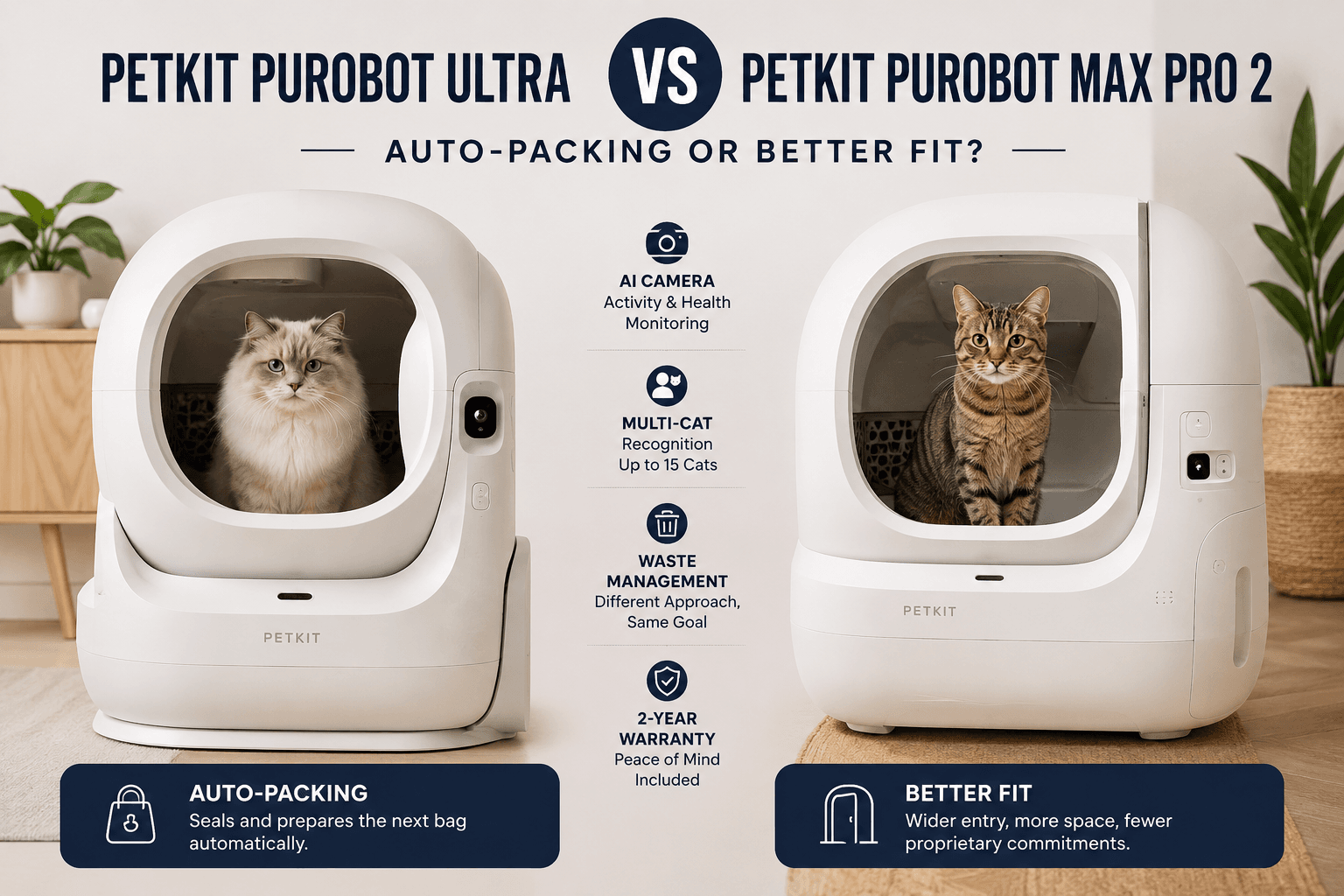
Tag: smart litter boxes

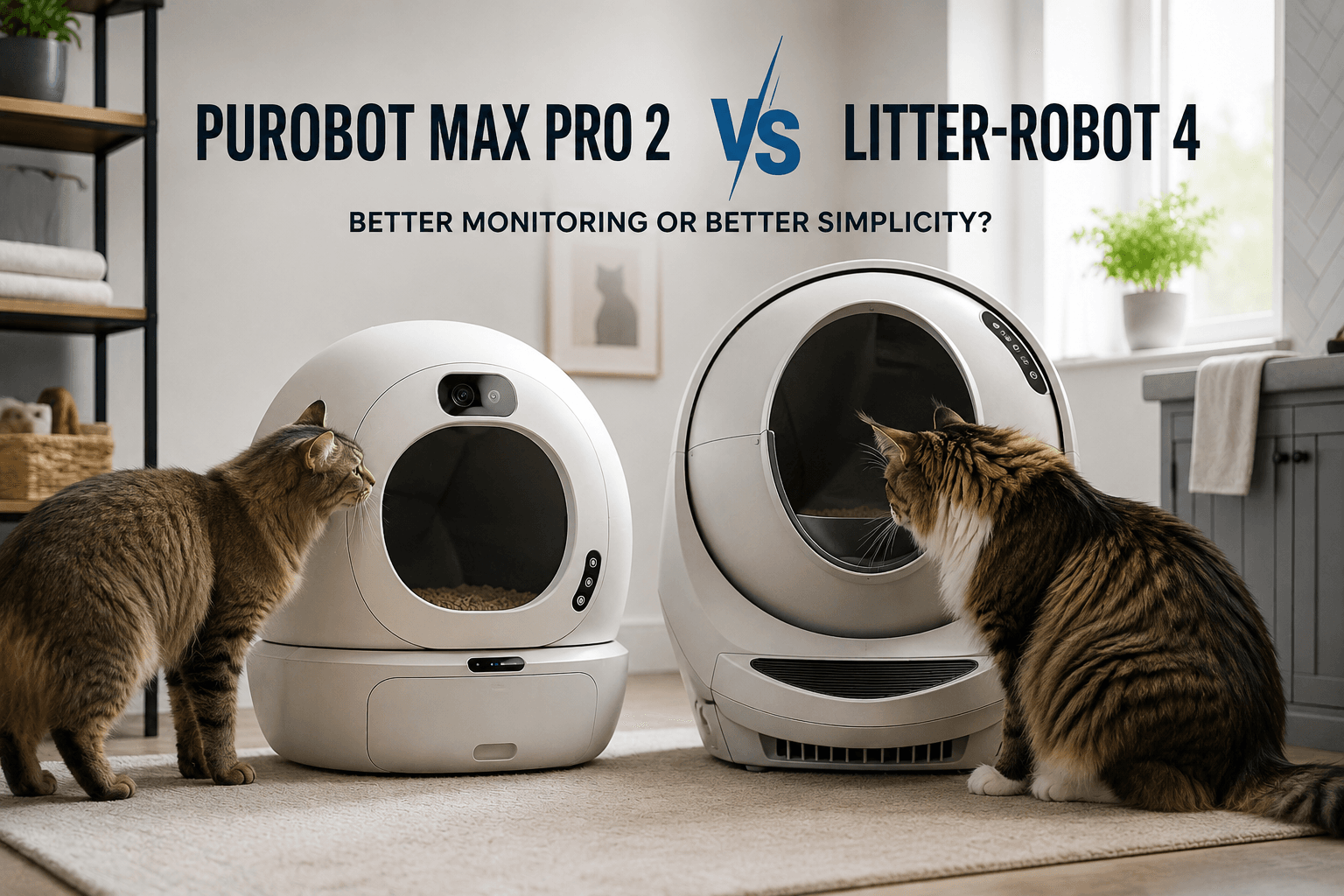
  • Purobot Max Pro 2 vs Litter-Robot 4 (2026): Better Monitoring or Better Simplicity?

    Purobot Max Pro 2 vs Litter-Robot 4 (2026): Better Monitoring or Better Simplicity?

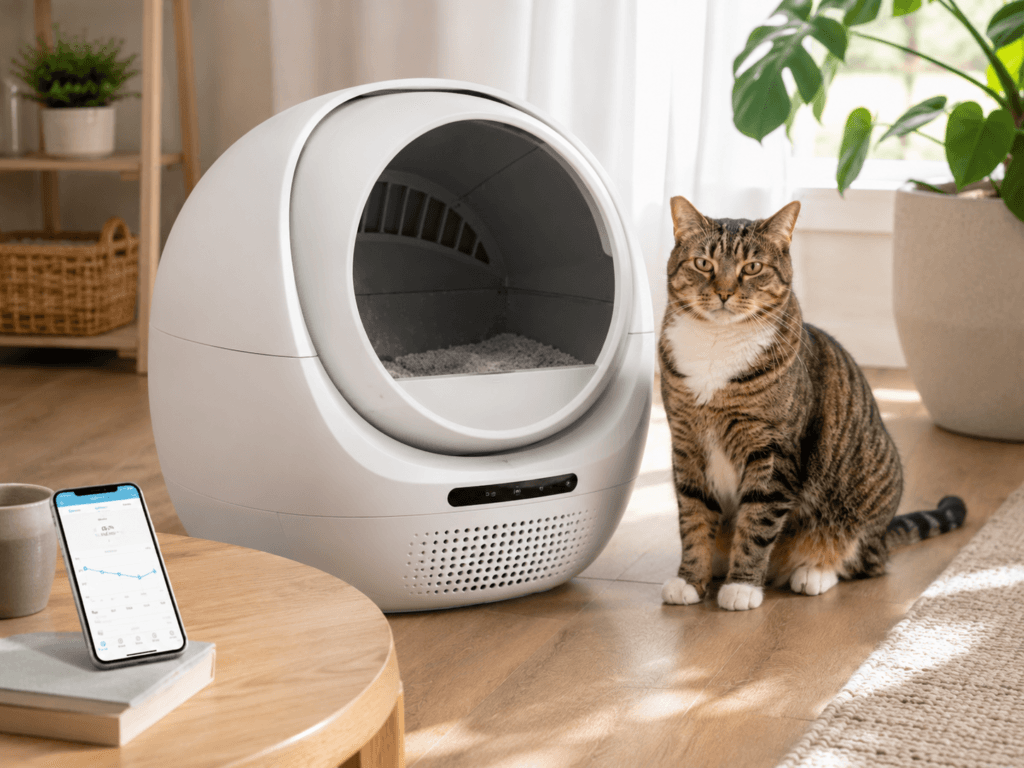
    The Purobot Max Pro 2 and Litter-Robot 4 solve the same unpleasant job with two very different personalities.

    PETKIT builds around a camera, individual cat profiles and deeper behavioral context. Whisker gives you a larger entrance, a mature cleaning platform and no integrated lens observing Napoleon’s bathroom negotiations.

    The winner depends less on which machine looks more advanced and more on what could actually go wrong in your home.

    Purobot Max Pro 2 wins the data war. Litter-Robot 4 is the lower-regret appliance.

    Quick Verdict

    Purobot Max Pro 2Litter-Robot 4
    Best forSimilar-weight cats and owners who want visual monitoringLarger cats and owners who mainly want dependable automation
    IdentificationCamera plus weightWeight-based SmartScale
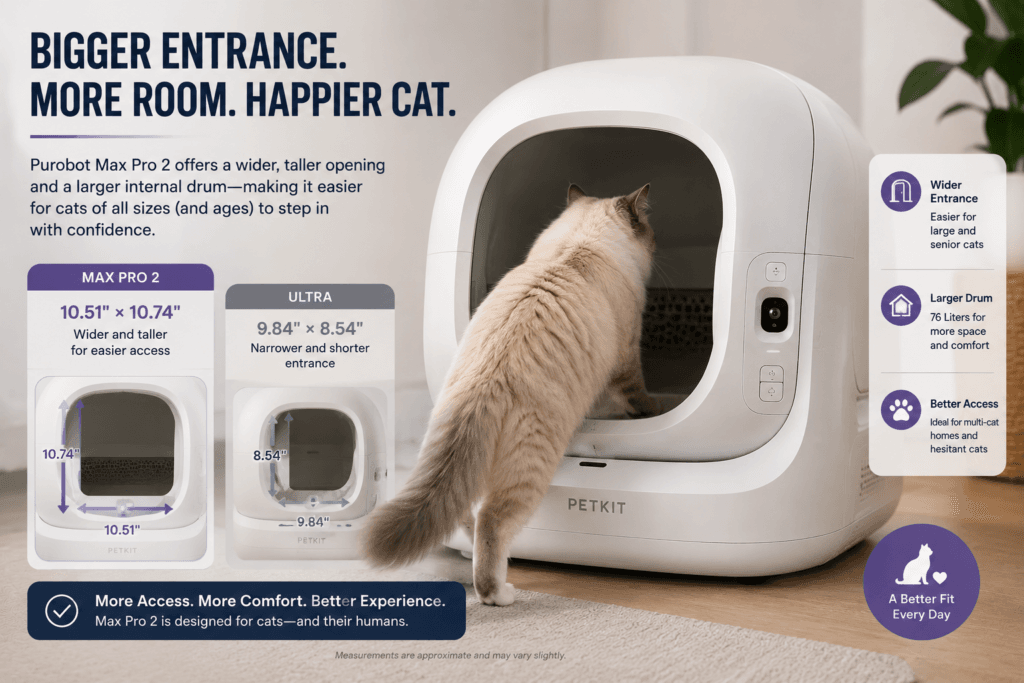
    EntranceApproximately 10.5 × 10.7 inches15.75 × 15.75 inches
    Cat weight range3.3–22 lb3–25 lb
    Litter flexibilityClay, tofu and compatible mixed clumping litterPrimarily standard-weight clumping clay
    Main drawbackSmaller opening and greater dependence on video featuresNo visual identification
    VerdictBest monitoring choiceBest simplicity and fit choice

    Choose the Purobot Max Pro 2 when identifying individual cats is difficult and you will genuinely review the camera history.

    Choose the Litter-Robot 4 when cat fit, a generous trial period and straightforward automatic cleaning matter more than collecting another stream of household data.

    PetTech AI may earn a commission from qualifying purchases. This does not influence our recommendations, comparisons or editorial judgments.

    Does visual multi-cat monitoring solve a real problem in your home? Check the Purobot Max Pro 2 on PETKIT.

    Prefer Amazon? Check Purobot Max Pro 2 on Amazon.

    Check the Litter-Robot 4 on Amazon.

    Research Note

    This is a research-led comparison based on current manufacturer documentation, specifications, app features, warranty policies and ownership requirements. PetTech AI has not physically tested these units, and we will not convert two specification pages into imaginary weeks of hands-on experience.

    The Physical Fit Is More Important Than the Feature List

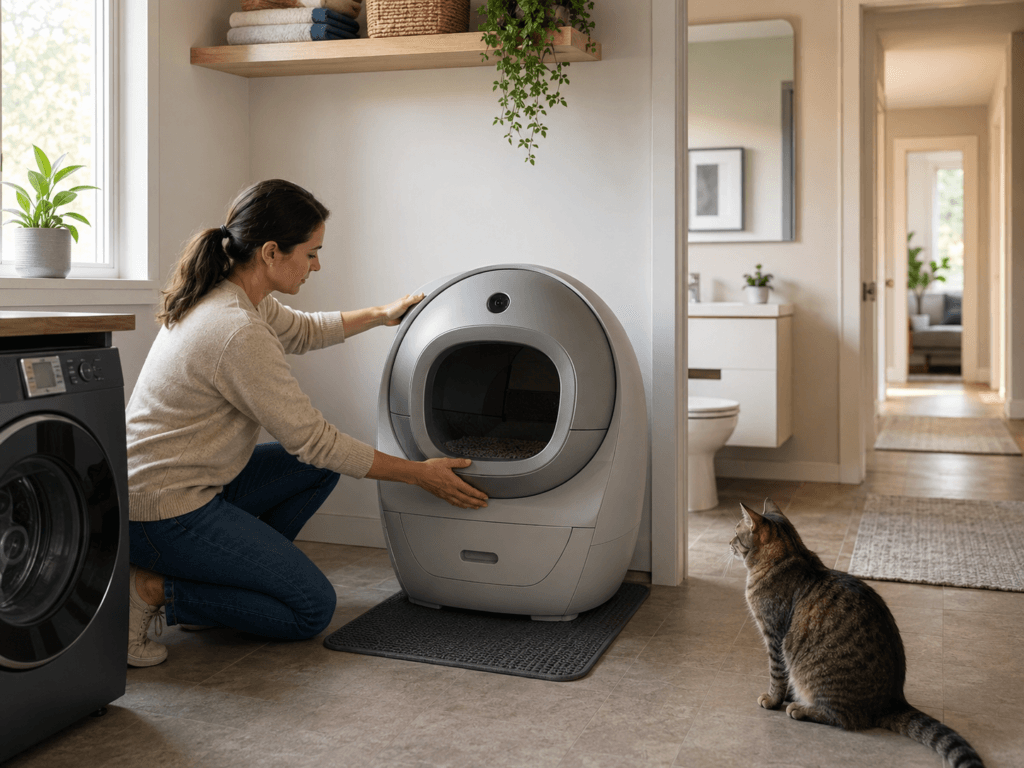
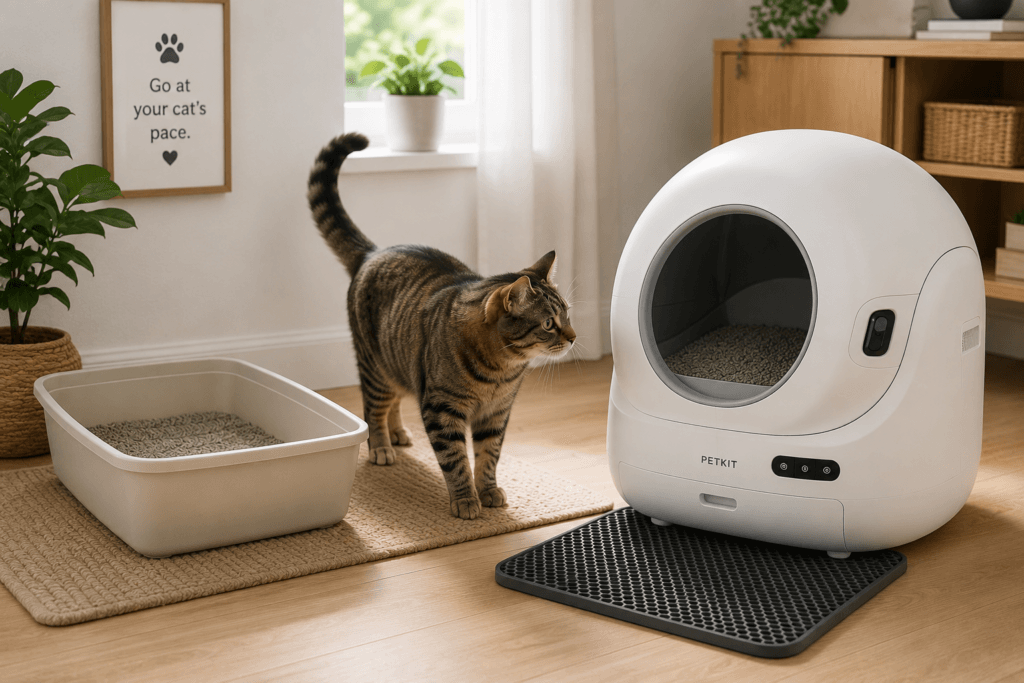
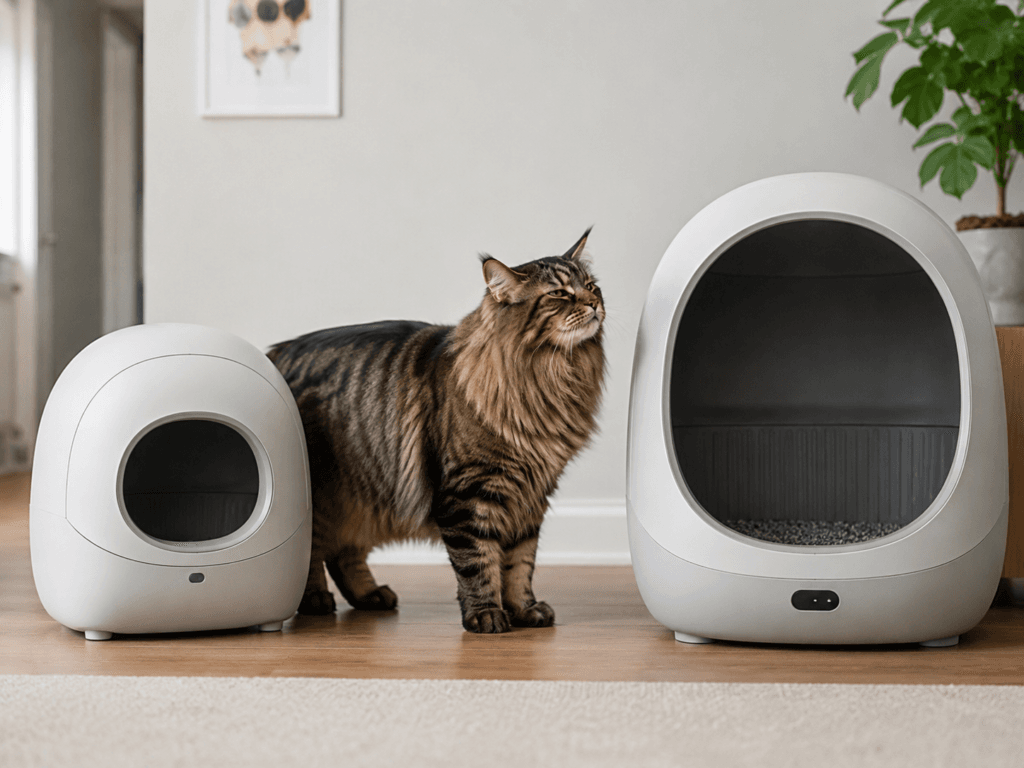
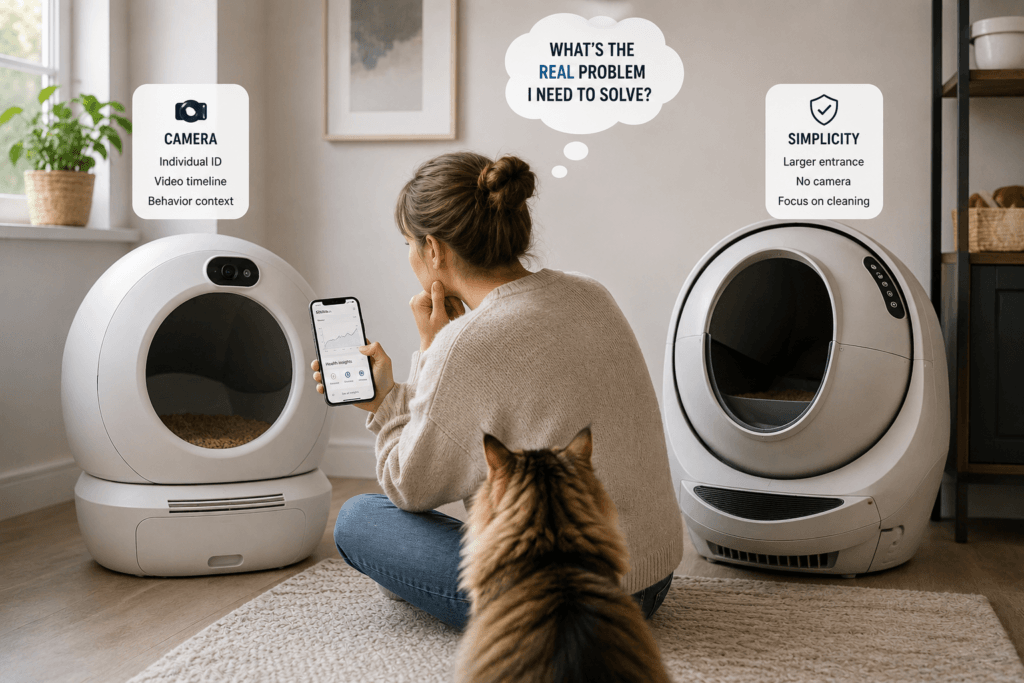
    Large cat comparing a narrow automatic litter box entrance with a wider opening.
    The smaller appliance does not necessarily provide the larger usable entrance. Cats remain annoyingly three-dimensional.

    PETKIT promotes the Purobot Max Pro 2 as having a 43% larger entrance. That improvement is relative to the previous Max Pro—not to the Litter-Robot 4.

    The PETKIT opening measures approximately 10.51 inches wide and 10.74 inches high. The complete unit measures roughly 25.86 × 21.18 × 23.74 inches and supports cats between 3.3 and 22 pounds. It is shorter than the LR4 and may look less dominant in a room, but the cat still has to pass through a comparatively compact entrance.

    The Litter-Robot 4 has a much larger 15.75-inch-square entrance, 16.5 inches of internal headroom and a supported range of 3–25 pounds. Its 22 × 27-inch footprint and 29.5-inch height make it the larger appliance overall, but the space available to the cat is more generous.

    That makes LR4 the safer recommendation for:

    • large or long-bodied cats;
    • cats that dislike narrow enclosed openings;
    • senior cats that need a visually open entrance;
    • households uncertain whether their cat will accept a globe-style box.

    An advertised weight limit is useful. It is not a magical compression field for Maine Coons. Our guide to automatic litter boxes for large cats explains why entrance geometry and internal posture matter more than one heroic number on a product page.

    Cleaning and Odor Control

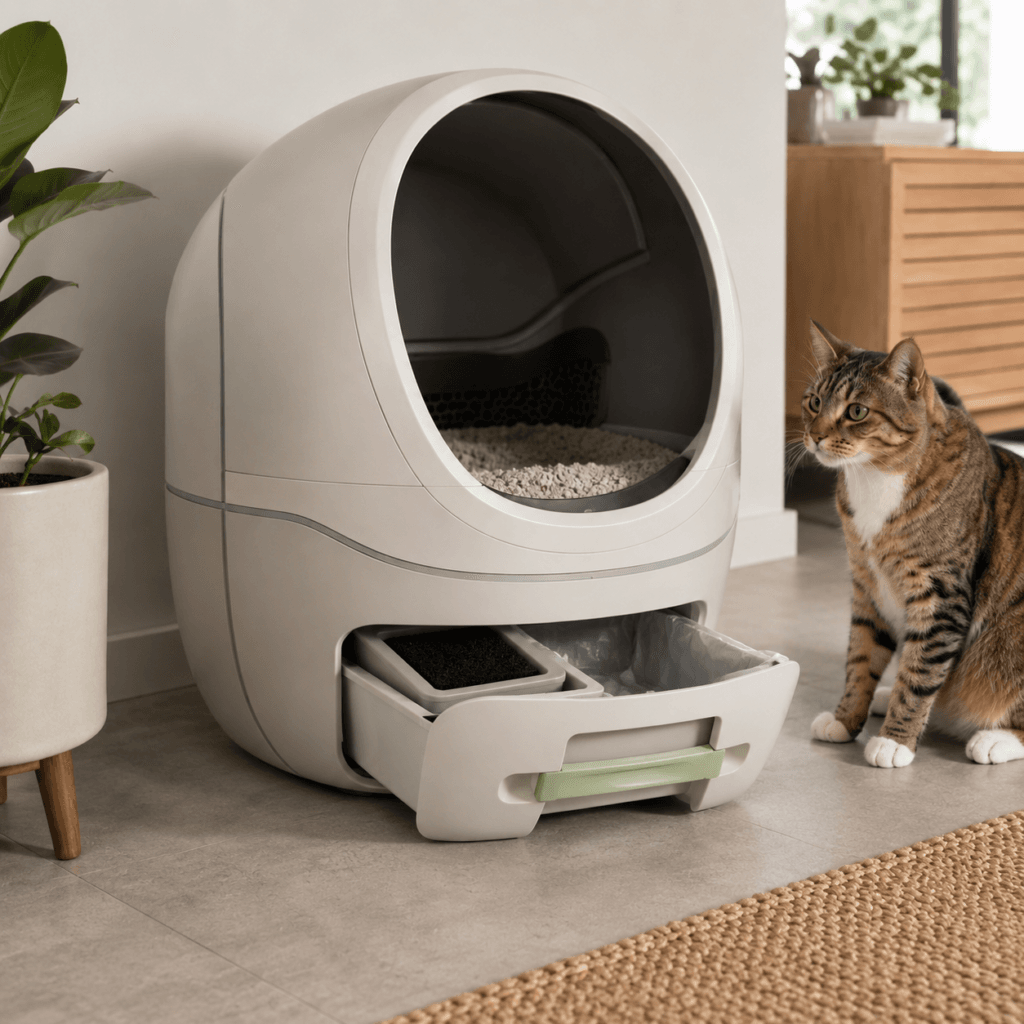
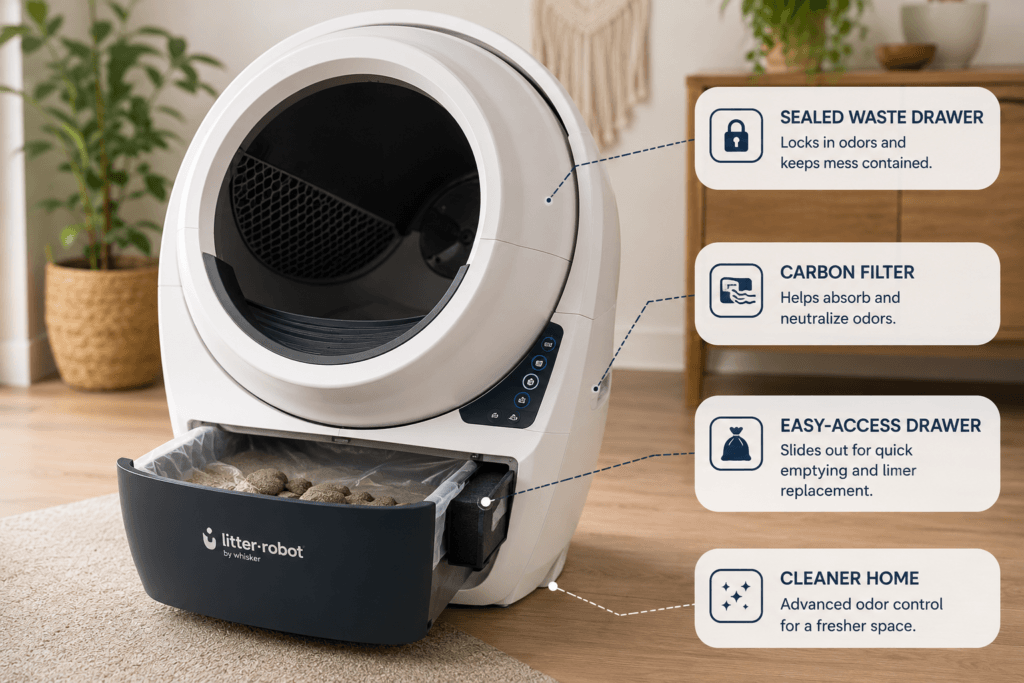
    Both machines automatically rotate after use, sift clean litter away from clumped waste and deposit the waste into a sealed drawer.

    The Purobot Max Pro 2 uses an 8-liter bin, a drawstring bag system, a sealed compartment and two deodorizing components. PETKIT estimates up to 17 days between waste changes for one cat, although actual intervals will shrink with larger cats, multiple cats and enthusiastic digestive schedules. It also uses 12 integrated sensors and an anti-pinch design intended to keep the entrance unobstructed during operation.

    Litter-Robot 4 places waste into a tightly sealed, carbon-filtered drawer and claims up to eight days between emptying in a single-cat household. Its SafeCat system combines lasers, weight sensors and obstruction detection, while QuietSift is designed to keep the rotation relatively unobtrusive.

    Neither machine eliminates maintenance. You still need to:

    • add fresh litter;
    • empty and replace waste bags;
    • clean the globe or cylinder;
    • inspect seals and sensors;
    • remove the occasional smear created when biology declines to respect the user manual.

    The Purobot offers more odor-control layers on paper. LR4 offers a simpler drawer-and-filter arrangement with a longer ownership history. Neither has yet learned to carry itself outside and request a pressure wash.

    Camera Monitoring vs SmartScale

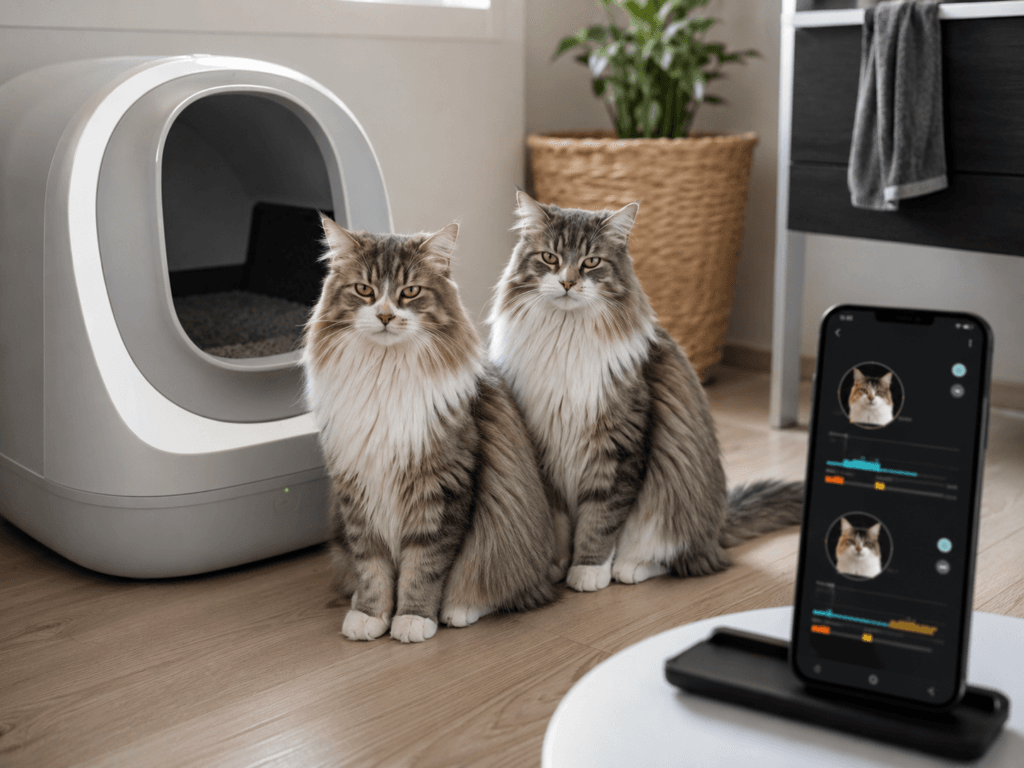
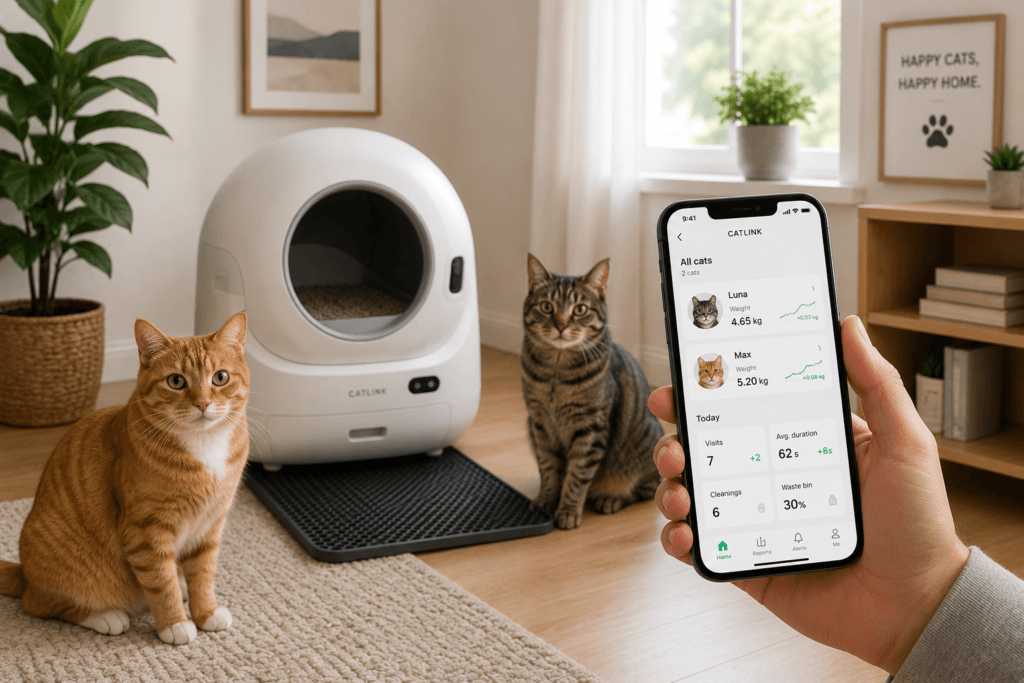
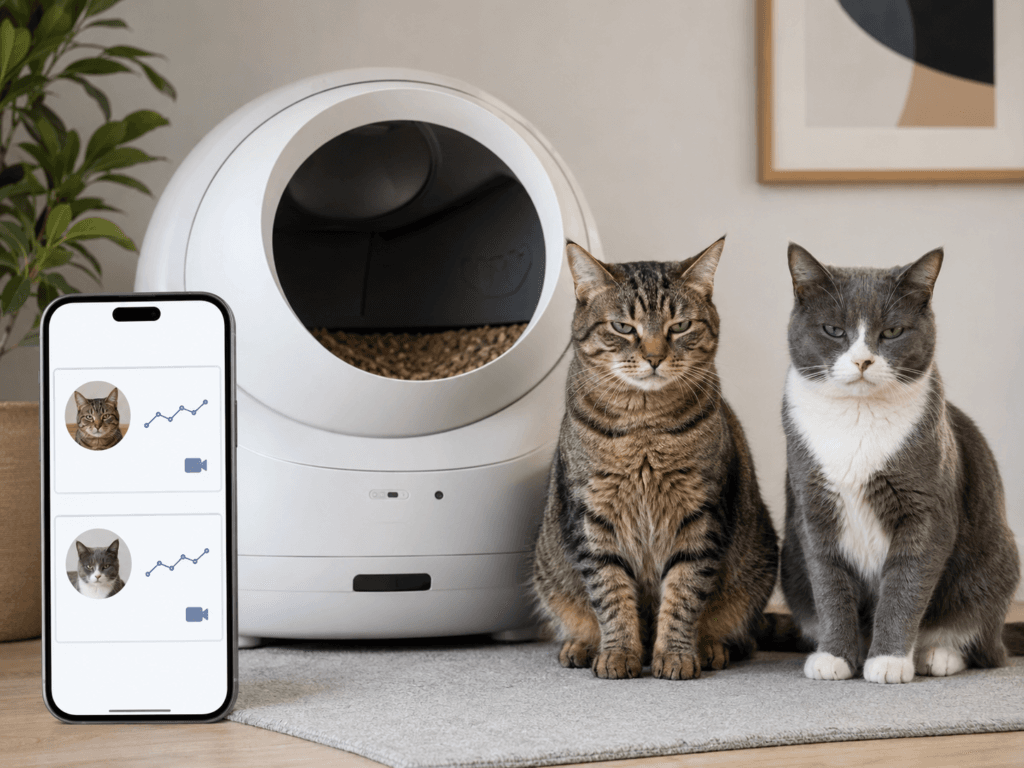
    Two similar-weight cats beside an automatic litter box with camera and weight-monitoring options.
    Weight data may be enough when cats are clearly different. Visual identification matters more when Biscuit and Napoleon occupy the same gravitational category.

    This is where the comparison separates.

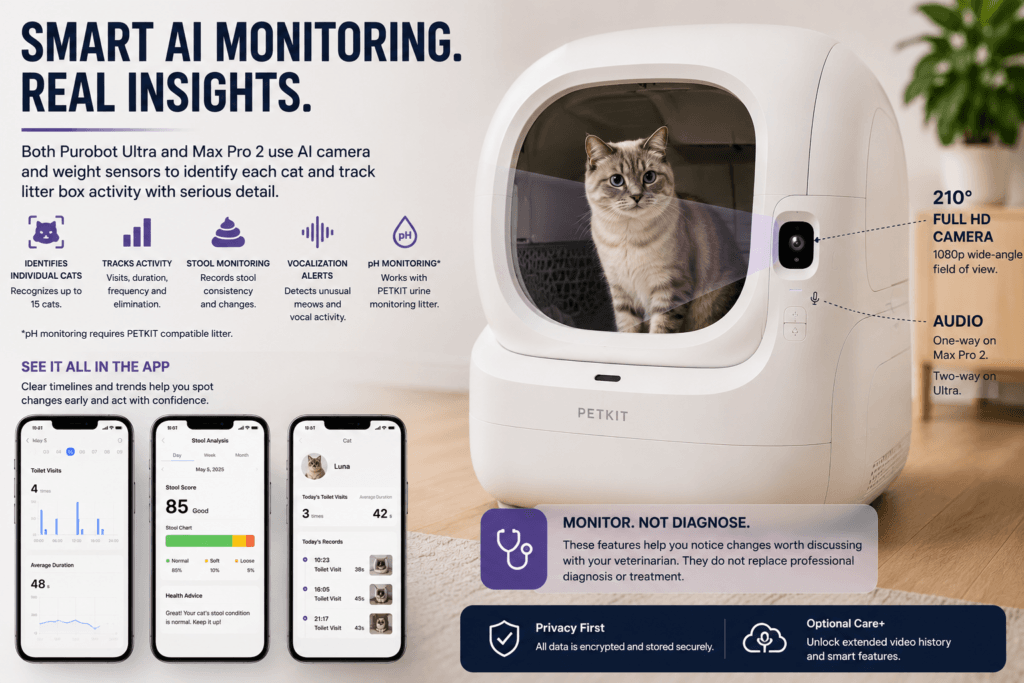
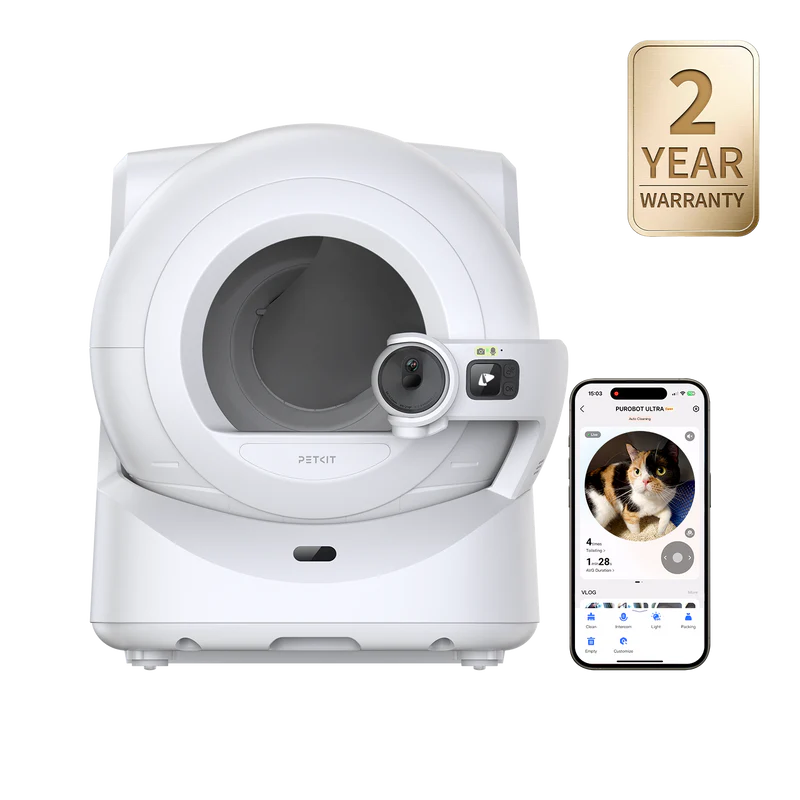
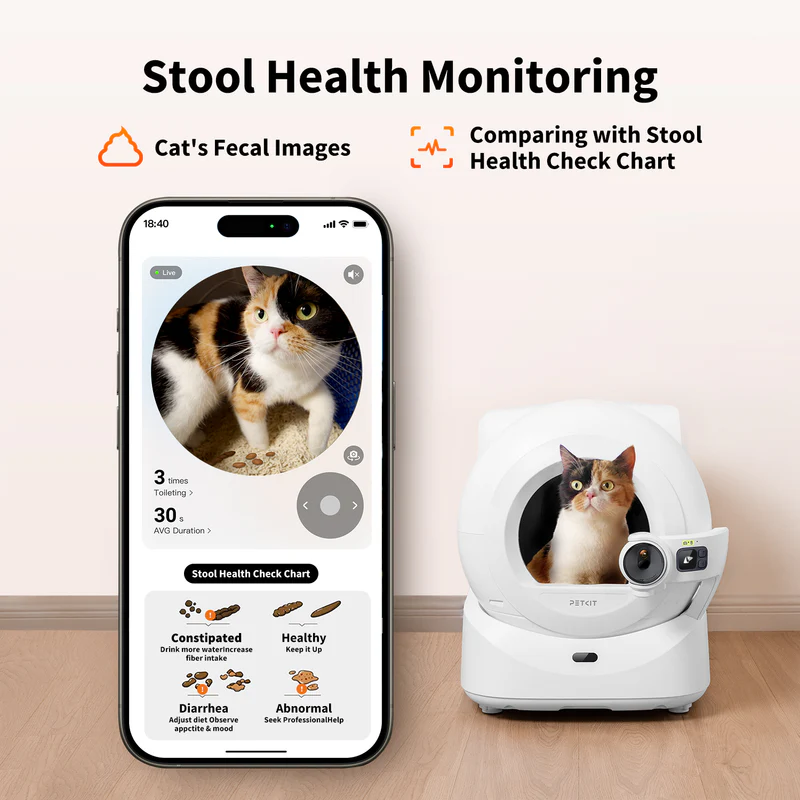
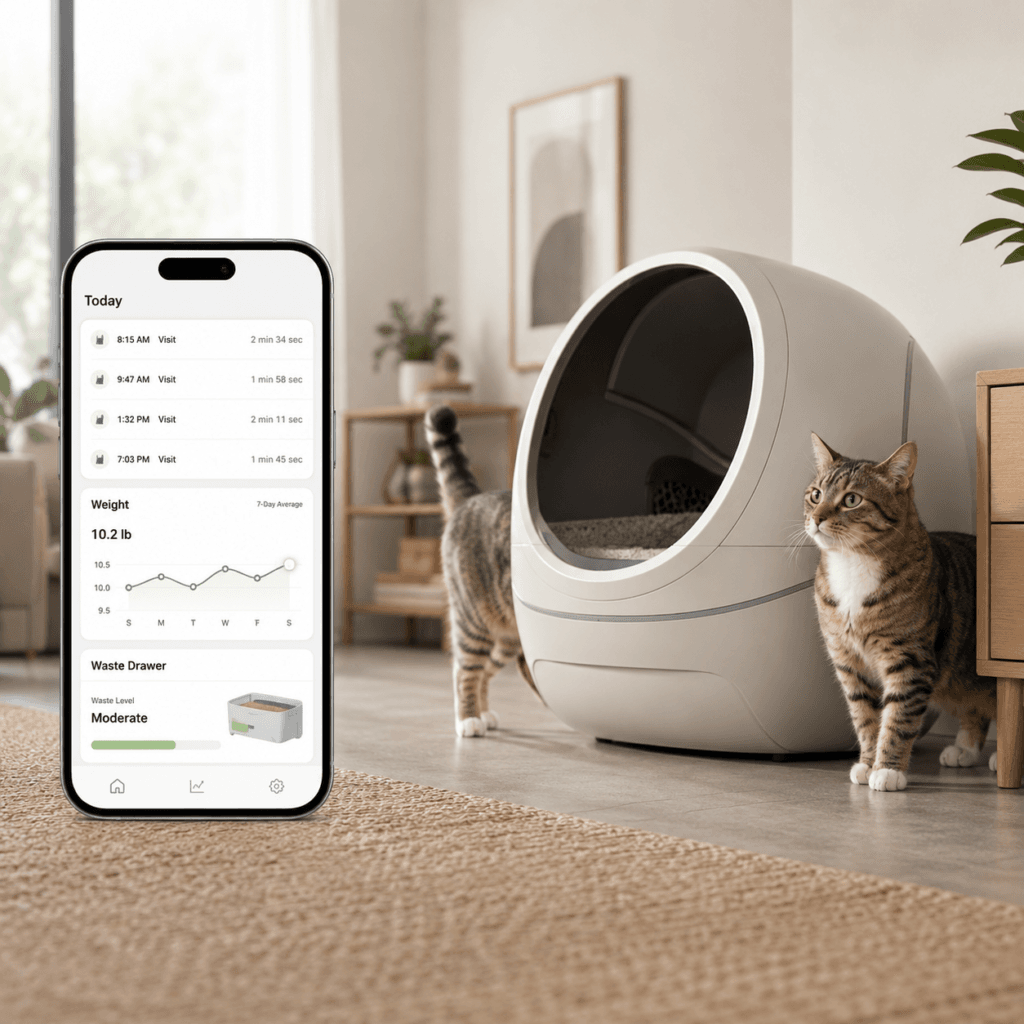
    The Purobot Max Pro 2 uses a fixed AI camera and weight sensors to associate litter-box events with individual cats. PETKIT says the system can create separate profiles even when cats have similar weights, record each visit on a visual timeline and detect events such as yowling or loose stool for later review. The camera can be scheduled, paused or switched off through the app.

    The camera is especially useful when:

    • two cats have similar weights;
    • weight changes make scale-based identification ambiguous;
    • one cat enters repeatedly without obvious elimination;
    • you need visual context to show a veterinarian;
    • several cats share the same machine.

    The data can flag a change. It cannot diagnose its cause. A video may confirm that Biscuit entered five times overnight; it cannot determine whether the reason was urinary discomfort, stress, curiosity or a private campaign against your sleep schedule.

    Litter-Robot 4 has no camera. SmartScale instead records weight and uses weight differences to assign visits to individual cats. The free Whisker app includes weight-based identification, visit and cycle trends, device updates and limited recent history.

    SmartScale may be entirely sufficient when one cat weighs 8 pounds and another weighs 16. It becomes less decisive when two cats occupy roughly the same gravitational category.

    For a deeper look at the difference between collecting information and removing chores, read smart cat monitoring vs automation.

    PETKIT Care+ vs Whisker+

    Neither company has resisted the gravitational pull of subscription revenue.

    The Purobot works without PETKIT Care+. Basic cleaning, app control, event logging and camera operation do not disappear. Care+ expands the video-focused side of ownership, including access to up to 30 days of video history and enhanced monitoring features.

    Whisker+ also remains optional. LR4 owners receive recent visit and weight information without paying, while the membership extends historical activity to as much as two years and adds longer-term weight, visit-frequency and duration trends, plus daily reports.

    The distinction is practical:

    • Care+ supports a camera-led monitoring experience.
    • Whisker+ deepens statistical trends without adding visual evidence.

    Someone who dislikes subscriptions should not automatically reject either machine. But buyers should judge the free experience, not mentally include premium features they intend to stop paying for after the trial.

    Litter Compatibility

    The Purobot Max Pro 2 is the more flexible machine.

    PETKIT includes two interchangeable sifters: one for larger particles such as tofu or mixed litter, and another for finer bentonite, mineral or clay litter. The company recommends clumping formulas and advises against pieces longer than 0.5 inches.

    Litter-Robot 4 works best with standard-weight clumping clay. Some silica products can work when their particles pass through the screen, but pale or translucent litter may affect the litter-level and drawer sensors. Whisker discourages many plant-based, pellet, newspaper and loose-clumping formulations because they may not sift correctly.

    Therefore:

    • choose PETKIT when tofu or mixed clumping litter is important;
    • choose LR4 when you already use conventional clumping clay and have no desire to turn litter selection into materials engineering.

    PETKIT’s drawstring mechanism works most reliably with its own bags, although the company says some standard bags can fit. Third-party bags may interfere when the material is too thick or the dimensions are wrong.

    Floor Placement, Wi-Fi and Privacy

    The Purobot must sit on a firm, level surface. PETKIT warns against placing it directly on carpet or unstable flooring because this may affect its sensors. It supports both 2.4 and 5 GHz Wi-Fi.

    LR4 can operate on carpet, but SmartScale is more accurate on a hard surface. Whisker sells a separate carpet tray for thicker or uneven floors. Connectivity is limited to 2.4 GHz Wi-Fi.

    Privacy is primarily a PETKIT consideration because only the Purobot contains a camera and microphone. The app allows owners to disable monitoring or restrict active hours, and PETKIT states that stored information is encrypted. Even so, placement matters. Aim the camera toward the litter-box approach, not a shower, toilet or hallway where people routinely appear.

    The device needs to identify the cat. It does not require cinematography rights to the entire bathroom.

    Warranty and Buyer-Regret Protection

    Purobot Max Pro 2 purchases made through PETKIT or authorized US distributors on or after January 1, 2025 qualify for a two-year limited warranty.

    Litter-Robot 4 includes one year of WhiskerCare coverage, with an optional extension. More importantly, direct Whisker purchases include a 90-day in-home trial. The unit can be returned if the owner or cat is dissatisfied, although the customer pays return shipping and the machine must be clean.

    PETKIT offers the longer standard warranty.

    Whisker offers the stronger acceptance safety net.

    That distinction matters because a defective motor is a warranty problem. A cat staring at the machine for 89 days as if it insulted the family lineage is a return-policy problem.

    Who Should Choose the Purobot Max Pro 2?

    Choose PETKIT when:

    • several cats have similar weights;
    • individual visual identification matters;
    • you want recorded context for litter-box events;
    • tofu or mixed clumping litter is non-negotiable;
    • 5 GHz Wi-Fi support is useful;
    • your cats comfortably fit its smaller entrance;
    • you already use or want the wider PETKIT ecosystem.

    Read our complete PETKIT Purobot Max Pro 2 review before buying it as a general-purpose upgrade. Its strongest value comes from monitoring, not merely automatic scooping.

    Verdict: Recommended for monitoring-focused multi-cat homes.

    Check the Purobot Max Pro 2 on PETKIT.

    Check the Purobox Max Pro 2 on Amazon.

    Who Should Choose the Litter-Robot 4?

    Choose LR4 when:

    • your cat is large or hesitant around smaller openings;
    • you want automatic cleaning without a camera;
    • the cats have clearly different weights;
    • you use conventional clumping clay;
    • a 90-day acceptance window reduces purchase anxiety;
    • you prefer an established machine over the denser monitoring package.

    Our Litter-Robot 4 review examines whether the older Whisker platform still makes sense now that newer models exist.

    Verdict: Recommended for lower-regret automation and broader physical fit.

    Check the Litter-Robot 4 on Amazon.

    Final Verdict

    Owner comparing a camera-equipped litter box with a simpler camera-free automatic model.
    The better machine is the one that solves your actual problem—not the one with the longer feature list and more opportunities to send notifications.

    The Purobot Max Pro 2 is the more capable monitoring system. Its camera, individual profiles and broader litter compatibility give it a real advantage in complicated multi-cat homes.

    The Litter-Robot 4 is the easier recommendation for everyone else. Its larger entrance, generous in-home trial and camera-free operation remove several common sources of buyer regret.

    Choose Purobot Max Pro 2 for better attribution. Choose Litter-Robot 4 for better accommodation.

    Neither wins universally, because cats have once again refused to standardize their bodies, habits or opinions for the convenience of consumer electronics.

    Still comparing the wider market? See our best smart litter boxes guide before committing to either ecosystem.

    Frequently Asked Questions

    Is Purobot Max Pro 2 better than Litter-Robot 4?

    It is better for visual multi-cat monitoring, similar-weight cats and owners who use tofu or mixed litter. LR4 is better for larger cats, camera-free ownership and buyers who value a 90-day trial.

    Which one is better for large cats?

    Litter-Robot 4 has the clear physical advantage. Its entrance is substantially wider, its internal headroom is greater and its supported weight range extends to 25 pounds, compared with 22 pounds for the Purobot.

    Does Purobot Max Pro 2 require PETKIT Care+?

    No. The machine still cleans automatically and retains core app and camera functions without the subscription. Care+ adds extended video history and deeper monitoring features.

    Can Litter-Robot 4 identify multiple cats?

    Yes, through SmartScale weight-based identification. It is most effective when the cats have meaningfully different weights; the Purobot’s camera provides an additional identification signal when weights overlap.

    References

    PETKIT — Purobot Max Pro 2 Product Documentation
    PETKIT — Purobot Max Pro 2 User Manual
    PETKIT — Limited Warranty Policy
    Whisker — Litter-Robot 4 Product Documentation
    Whisker — Litter-Robot Comparison Chart
    Whisker — Whisker+ Membership Documentation
    Whisker — 90-Day In-Home Trial and Warranty Terms

    Editorial Disclosure

    PetTech AI may earn a commission from qualifying purchases. This does not influence our recommendations, comparisons or editorial judgments.

    Image Disclosure

    Official manufacturer images are used when available and authorized.

    AI-generated images may also be used as editorial illustrations. They should not be treated as exact representations of product dimensions, materials, controls or physical features. Always verify current official product information before purchasing.
  • Litter-Robot 5 Pro Review 2026: Are Two Cameras Worth the Premium?

    Litter-Robot 5 Pro Review 2026: Are Two Cameras Worth the Premium?

    The Litter-Robot 5 Pro is what happens when a self-cleaning litter box develops an interest in surveillance.

    It takes the core automation of the regular Litter-Robot 5, adds two 1080p night-vision cameras, and promises better identification in multi-cat homes. That can be genuinely useful when cats have similar weights or when you need visual context—not merely another notification announcing that something happened somewhere near the litter.

    But the cameras are not automatically worth the premium. The feature that most clearly separates the Pro—visual identification of individual cats—requires a Whisker+ subscription. For many households, the regular Litter-Robot 5 will clean just as effectively while creating fewer recurring expenses and fewer videos of Gerald staring directly into the lens.

    Editorial verdict: Conditional.

    Quick Verdict

    Best fitNot forMain advantageMain drawbackVerdict
    Multi-cat homes where cats have similar weights and individual identification mattersOwners who mainly want automatic scooping or dislike subscriptionsTwo built-in cameras add visual identification and litter-bed contextThe most valuable camera features require Whisker+Conditional

    Still deciding whether the cameras solve a real problem in your home? Read our Litter-Robot 5 vs 5 Pro comparison before paying for the more elaborate bathroom intelligence operation.

    Research Note

    This is a research-led review based on current manufacturer documentation, specifications, app features, privacy terms and ownership policies. PetTech AI has not physically tested this unit and will not pretend otherwise because adding “we found” before a spec sheet does not magically create a laboratory.

    What the Litter-Robot 5 Pro Actually Adds

    The standard Litter-Robot 5 and the Pro share the same essential cleaning system, physical dimensions, WasteID technology, SmartScale weight monitoring and support for cats weighing from 3 to 30 pounds. Both are designed for homes with up to five cats.

    The Pro adds two integrated 1080p HD cameras with night vision:

    • a front-facing camera intended to recognize individual cats;
    • an interior-facing camera aimed at the litter bed.

    The second camera provides context around what happens inside the globe, while the front camera helps associate activity with a particular cat. This makes the Pro less about better cleaning and more about better attribution: not merely “someone visited,” but potentially “Biscuit visited, stayed longer than usual and left behind a type-two diplomatic incident.”

    That distinction matters. The Litter-Robot 5 Pro does not produce cleaner litter than the standard model because it owns cameras. Its value depends on whether visual information improves how you manage a multi-cat household.

    The Two Cameras: Useful Context or Expensive Curiosity?

    The interior camera is the easier feature to understand. Instead of relying entirely on weight, timing and waste classification, you can view recorded activity around the litter bed.

    This may help when:

    • one cat repeatedly enters without eliminating;
    • you need to confirm which cat produced an event;
    • several cats use the same machine;
    • weight-based identification becomes ambiguous;
    • a change in litter-box behavior needs more context.

    That context can be useful, but it remains observational. A video may show that a cat visited frequently or stayed longer than normal; it cannot tell you why. Changes involving elimination, appetite, weight or behavior should be discussed with a veterinarian rather than diagnosed by an appliance with excellent Wi-Fi.

    The front camera is intended to improve individual identification through facial recognition. Whisker says the system learns over time and is especially relevant when cats are difficult to distinguish through weight alone. The manufacturer also acknowledges that neither SmartScale nor visual recognition is guaranteed to distinguish every similar cat reliably.

    In practical terms, the Pro is most persuasive when two or more cats have similar weights. If Napoleon weighs 16 pounds and Biscuit weighs 8, the standard scale already has a fairly uncomplicated detective case.

    Whisker+ Is the Real Buying Decision

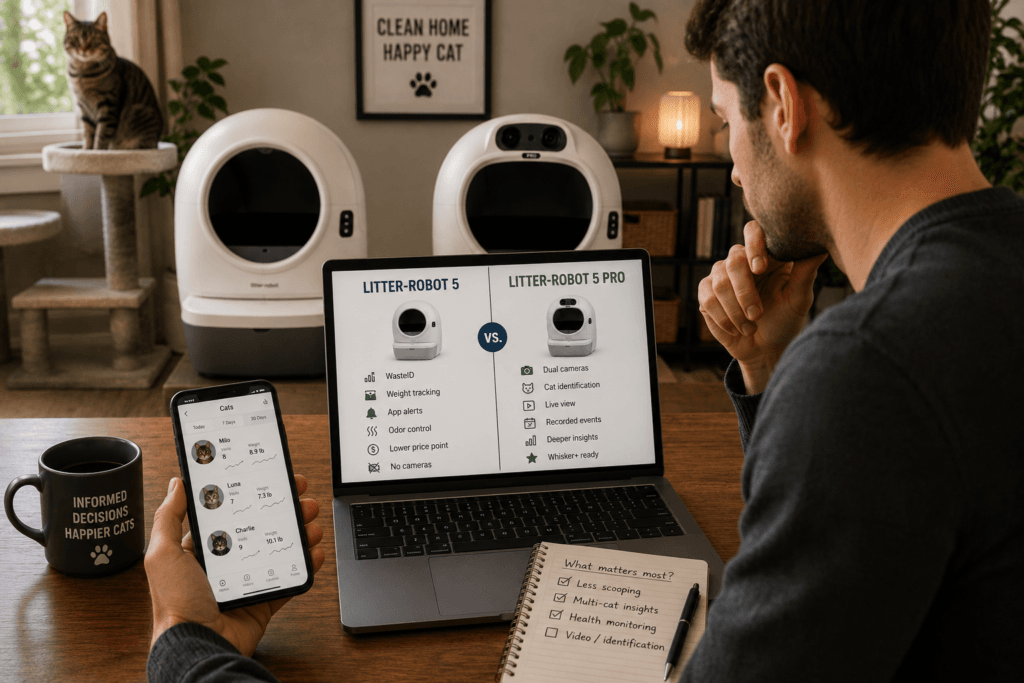
    Smartphone showing basic and premium monitoring features beside an automatic litter box.
    The central buying decision is not camera resolution. It is whether visual identification and longer history justify another subscription.

    The most important part of this Litter-Robot 5 Pro review is not the camera resolution. It is the subscription structure.

    Without Whisker+, owners still receive:

    • seven days of visit and weight history;
    • recorded camera events;
    • access to two days of video history;
    • up to five minutes of live streaming per day;
    • SmartScale identification and weight tracking.

    Whisker+ adds:

    • visual identification of individual cats;
    • unlimited live streaming;
    • 30 days of video history;
    • up to two years of activity history;
    • daily summaries;
    • duration and frequency trends;
    • deeper bathroom-habit tracking;
    • enhanced device insights.

    The membership currently costs $7.99 per month or $79.90 annually after a 30-day trial. One membership can enhance multiple compatible Whisker devices under the same account.

    This creates the central buyer-regret risk: purchasing the Pro specifically for facial recognition, then deciding that another subscription is one recurring charge too many.

    The unit still functions without Whisker+. Automatic cleaning does not stop, SmartScale remains available and basic camera access continues. But the feature most likely to justify choosing the Pro over the standard Litter-Robot 5 sits behind the membership.

    That does not make the subscription inherently unreasonable. A multi-cat owner who actively uses long-term trends, visual identification and video history may find it worthwhile. Someone who checks the app twice during the first week and then forgets the password has purchased an unusually well-equipped monument to optimism.

    Cleaning and Odor Control

    The core cleaning system remains the main reason to buy any Litter-Robot.

    After a cat exits, the machine waits for a selected period and rotates the globe, separating clean litter from clumped waste. The waste falls into a sealed drawer below. Its safety system uses lasers, weight sensors and obstruction detection to prevent cycling while a cat is present.

    WasteID distinguishes between urine and solid waste. The system can allow more time for urine clumps to form while cycling sooner after solid waste to contain odor. Whisker notes that these learning-based features may require around 30 days of regular use to optimize for a household.

    This is useful automation, but it still requires ownership work:

    • refill litter;
    • empty the drawer;
    • replace liners;
    • clean the globe and components;
    • inspect sensors;
    • deal with occasional tracking around the entrance.

    “Self-cleaning” means you stop scooping every clump manually. It does not mean the robot quietly leaves once a month to wash itself at a discreet service station.

    Multi-Cat Monitoring: When the Pro Makes Sense

    Two similar-looking cats beside an automatic litter box while a phone displays separate activity profiles.
    Visual identification becomes more useful when two cats look similar, weigh nearly the same and refuse to simplify the database.

    The strongest case for the Litter-Robot 5 Pro is a household with several cats sharing one machine.

    The regular Litter-Robot 5 already monitors weight and visits. The Pro adds visual context and, with Whisker+, facial identification. This becomes more useful when:

    • two cats weigh nearly the same;
    • one cat’s weight changes and overlaps another’s;
    • you need to attribute altered visit patterns;
    • multiple cats create noisy, ambiguous data;
    • you actually review trends rather than collect them decoratively.

    Whisker markets the unit for up to five cats, but that does not eliminate every practical concern. More cats mean more frequent drawer emptying, greater litter use and a more consequential single point of failure. Some households may still need a second litter box for access, transition, conflict reduction or backup.

    For broader context on whether additional data meaningfully improves ownership, see smart cat monitoring vs automation.

    Privacy: The Camera Is Still Inside Your Home

    Owner positioning a camera-equipped automatic litter box away from private areas of the home.
    A camera-equipped litter box should face the cat’s entrance—not the toilet, shower or accidental family documentary.

    Whisker states that its AI is trained to detect pets rather than people. However, the company also says people may still be recorded when they enter the field of view or when activity is classified incorrectly.

    Audio is recorded alongside video unless the microphone is disabled. Standard recordings are stored for 48 hours, while Whisker+ extends accessible video history to 30 days. Owners can disable cameras and delete videos through the app.

    That is not a reason for panic, but it is a reason to think before placement.

    Avoid aiming the front camera toward:

    • a toilet;
    • a shower;
    • a frequently used hallway;
    • a bedroom;
    • any area where household members or guests reasonably expect privacy.

    The machine needs a good view of the cat, not an unauthorized supporting role in the family documentary.

    Size, Cat Fit and Litter Compatibility

    The Litter-Robot 5 Pro measures 29.9 inches high with a 22-by-27-inch footprint. The entry is 15.75 inches square, internal headroom is listed at 17.5 inches and the empty unit weighs 29.6 pounds. It supports automatic operation for cats weighing at least 3 pounds.

    Those numbers make it suitable for many larger cats, but advertised weight limits do not replace measuring your cat or the available floor space. Body length, posture, mobility and willingness to enter an enclosed globe also matter.

    Whisker recommends standard-weight, clay-based clumping litter. Some crystals may pass through the screen, but white or translucent litter can interfere with litter-level and drawer sensors. Non-clumping litter, loose-clumping formulas, newspaper products, wood pellets and many plant-based options may not sift correctly.

    This is another reason litter compatibility deserves more attention than it usually receives beneath camera specifications.

    The Biggest Buyer-Regret Risks

    You only wanted automatic scooping

    Then the regular Litter-Robot 5 is probably the better fit. It offers the same central cleaning platform, WasteID, weight tracking and physical capacity without charging extra for hardware you may barely use.

    You expect facial recognition without a subscription

    Basic video remains free, but enhanced visual identification requires Whisker+. That distinction belongs near the top of the buying decision, not hidden behind a celebratory unboxing montage.

    Your cats already have clearly different weights

    SmartScale may identify them adequately. Cameras add confirmation and context, but not necessarily enough value to justify the premium.

    Your cat dislikes enclosed boxes

    No amount of artificial intelligence can negotiate with a cat that refuses the architecture. Keep the previous litter box during acclimation and avoid forcing the transition.

    You have not measured the room

    At almost 30 inches tall, this is not a small appliance. It can dominate a narrow bathroom with the confidence of a refrigerator that recently received venture funding.

    Alternatives

    Choose the standard Litter-Robot 5 when you want current-generation automation, WasteID and multi-cat capacity without integrated cameras.

    Choose Litter-Robot EVO when floor space and lower entry cost matter more than advanced monitoring.

    Consider the older model after reading our Litter-Robot 4 review if you value an established platform and do not need the newer waste-classification features.

    Compare other manufacturers in our best smart litter boxes guide when you are not already committed to Whisker’s ecosystem.

    Still choosing among the new models? Our Litter-Robot 5 vs 5 Pro vs EVO comparison separates camera monitoring, space requirements and actual household fit.

    Final Verdict

    The Litter-Robot 5 Pro is not a ridiculous product. It is a specialized one.

    Its dual cameras can solve a legitimate monitoring problem in multi-cat homes, especially when weight-based identification is unreliable. The interior view adds context, while facial identification can make individual trends more useful.

    But the Pro does not clean better than the regular Litter-Robot 5 simply because it can watch the process. Its most distinctive feature requires Whisker+, the machine occupies substantial space, and useful data still depends on someone paying attention to it.

    Buy it when visual identification fills a real gap in your household. Skip it when you mainly want the litter scooped automatically.

    Final rating: Conditional.

    Frequently Asked Questions

    Does Litter-Robot 5 Pro work without Whisker+?

    Yes. Automatic cleaning, SmartScale weight tracking, seven-day activity history, recorded events and limited live streaming remain available without the subscription. Whisker+ unlocks facial identification, unlimited streaming, longer video storage and deeper historical insights.

    Can Litter-Robot 5 Pro identify similar-looking cats?

    It uses facial recognition and improves over time, but Whisker does not guarantee perfect identification. Similar appearance, lighting, camera angle and other conditions may affect accuracy.

    Is Litter-Robot 5 Pro suitable for large cats?

    Whisker lists compatibility for cats between 3 and 30 pounds, with a 15.75-inch entry and 17.5 inches of internal headroom. Fit still depends on body shape, mobility and tolerance for an enclosed globe.

    Can the cameras be turned off?

    Yes. Whisker states that owners can disable the cameras and delete stored videos through the app. The microphone can also be disabled separately.

    References

    Whisker — Litter-Robot 5 Pro Product Documentation
    Whisker — Litter-Robot Comparison Chart
    Whisker — Whisker+ Membership Documentation
    Whisker — Litter-Robot 4 vs 5 Product Guide
    Whisker — Camera Features and Privacy Terms

    Editorial Disclosure

    PetTech AI may earn a commission from qualifying purchases. This does not influence our recommendations, comparisons or editorial judgments.

    Image Disclosure

    Official manufacturer images are used when available and authorized.

    AI-generated images may also be used as editorial illustrations. They should not be treated as exact representations of product dimensions, materials, controls or physical features. Always verify current official product information before purchasing.
  • Litter-Robot 5 vs 5 Pro (2026): Are the Cameras Actually Worth It?

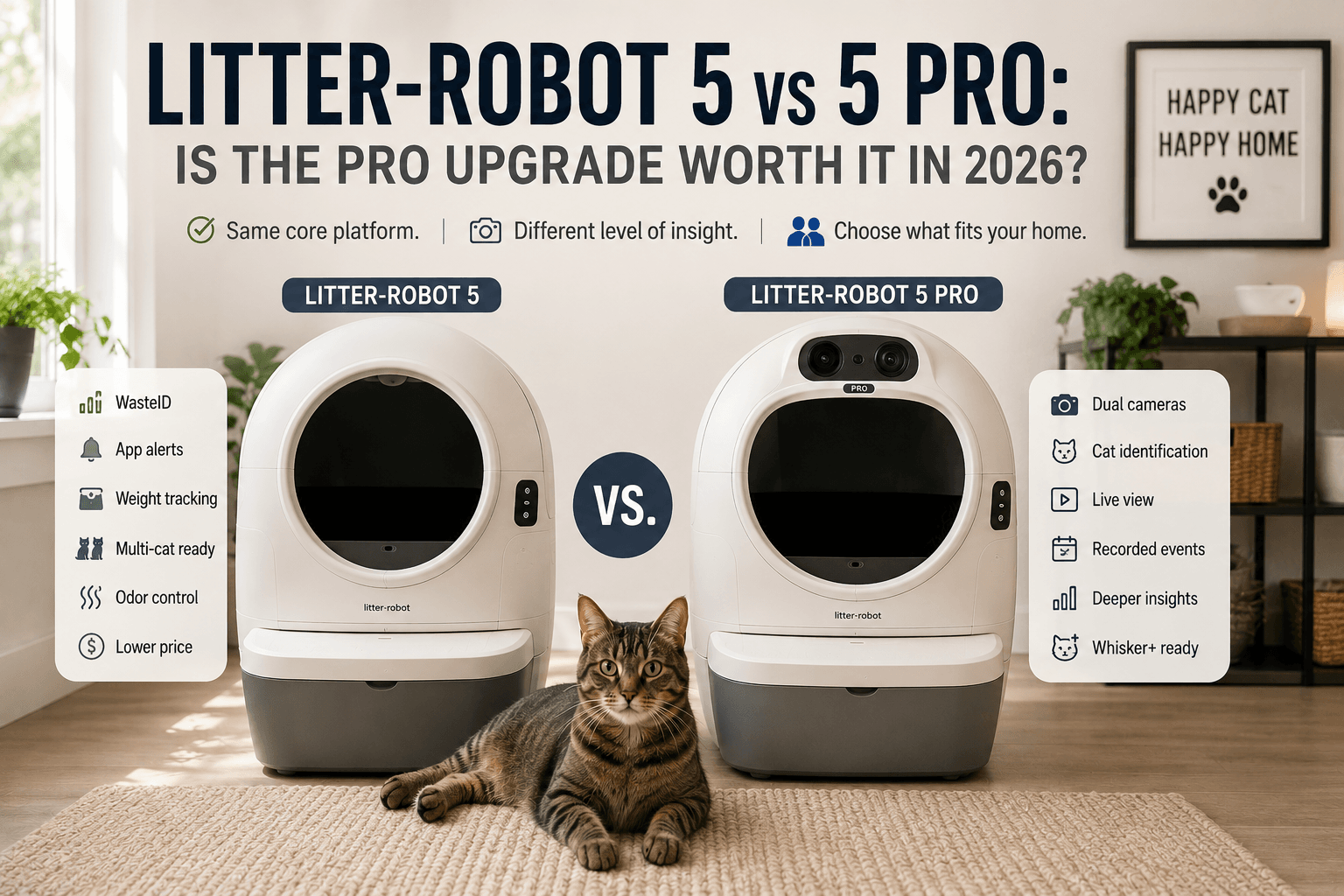
    Litter-Robot 5 vs 5 Pro (2026): Are the Cameras Actually Worth It?

    Litter-Robot 5 Pro is not the version that cleans better.

    It is the version that watches.

    Both models automate the same central chore. They separate waste after use, track litter-box activity, estimate cat weights, connect to the Whisker app, and use WasteID to distinguish urine from solid waste.

    The Pro adds two cameras and a more advanced monitoring path.

    That means the decision is not:

    Which Litter-Robot is better?

    It is:

    Will visual identification and recorded litter-box events change anything you do?

    For most buyers, Litter-Robot 5 is the better choice.

    It delivers the core premium automation without making indoor bathroom surveillance part of the purchase.

    Choose Litter-Robot 5 Pro only when the camera system solves a real multi-cat or monitoring problem—and when you accept that its most advanced capabilities depend on Whisker+.

    Research note: This is a research-led comparison based on current official documentation, product positioning, software terms, and available ownership evidence. PetTech AI has not conducted a long-term hands-on test of either model.

    Quick Verdict

    Buyer priorityBetter choiceWhy
    Best for most buyersLitter-Robot 5Same core cleaning platform without paying for cameras
    Best for one predictable catLitter-Robot 5Weight and visit tracking are usually sufficient
    Best value inside the premium lineupLitter-Robot 5Pays for automation rather than deeper surveillance
    Best for similar-weight catsLitter-Robot 5 ProVisual recognition can resolve weight-based ambiguity
    Best for remote visual checksLitter-Robot 5 ProTwo integrated cameras provide visit context
    Best without an ongoing membershipLitter-Robot 5Less of its value depends on premium monitoring
    Best for monitoring-focused homesLitter-Robot 5 ProCameras and Whisker+ create the deepest insight layer

    Recommendation strength

    Litter-Robot 5: Recommended within the current Whisker lineup.

    Litter-Robot 5 Pro: Conditional recommendation for monitoring-first households.

    Buyer regret in one sentence

    Litter-Robot 5: You later discover that weight-based identification cannot reliably separate two very similar cats.

    Litter-Robot 5 Pro: You spend more on cameras, watch three litter-box videos, and quietly return to checking only the drawer notification.

    Who Should Buy Litter-Robot 5?

    Buy Litter-Robot 5 when the real objective is:

    • reducing scooping;
    • containing waste;
    • tracking visits and weights;
    • receiving drawer and maintenance alerts;
    • distinguishing urine from solid waste;
    • managing several cats whose weights are sufficiently different;
    • avoiding camera-related cost and complexity.

    This is the model that solves the physical problem.

    It cleans after use and provides enough app data for many households to notice broad changes in litter habits.

    The important phrase is enough data.

    More information is not automatically more useful.

    With one cat, weight-based identification is often adequate because there is only one animal available to generate the event. With several cats at clearly different weights, SmartScale can still help associate visits with individual profiles.

    In those homes, the cameras add context rather than solving an unresolved problem.

    And context is expensive when nothing depends on it.

    Who Should Buy Litter-Robot 5 Pro?

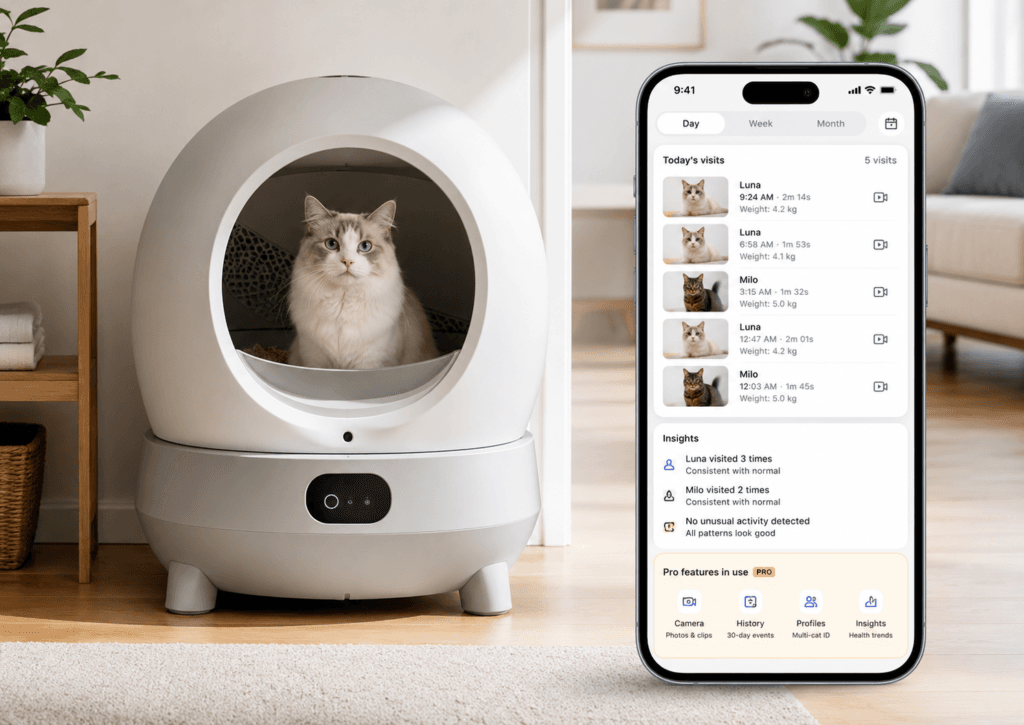
    A premium automatic litter box beside a phone showing cat visit history and camera-based monitoring data
    The Pro upgrade is not about a different cleaning routine. It is about cameras, recorded events and deeper cat-level visibility.

    Buy Litter-Robot 5 Pro when visual monitoring is central to the purchase.

    The Pro adds:

    • a front-facing camera;
    • a second camera directed toward the litter bed;
    • live viewing;
    • recorded events;
    • visual identification through the premium software layer;
    • deeper context around individual visits.

    This can matter when:

    • several cats have similar weights;
    • weight-based identification is unreliable;
    • you need to confirm which animal entered;
    • you want to see what happened during a visit;
    • you regularly spend time away from home;
    • visual evidence would improve how you respond to a repeated change;
    • you already know that you will use the app actively.

    The Pro is not overkill in those situations.

    It is solving the one problem the standard model cannot fully solve:

    A weight sensor can estimate who entered. A camera can look at the cat.

    That difference becomes more valuable as the household becomes harder to interpret.

    For a deeper look at cameras, visual identification, privacy and Whisker+, read our full Litter-Robot 5 Pro review.

    Who Should Skip the Pro?

    Skip Litter-Robot 5 Pro when:

    • you mainly want less scooping;
    • your cats are easy to distinguish by weight;
    • you dislike indoor cameras;
    • you rarely inspect app histories;
    • recorded events would satisfy curiosity rather than guide action;
    • you do not want another subscription decision;
    • the extra monitoring would increase anxiety rather than clarity.

    The Pro is the classic premium trap when buyers select it because it is the highest model.

    “Pro” is a product tier.

    It is not a diagnosis of your household’s technological requirements.

    What Actually Stays the Same?

    This is the part that should prevent most unnecessary upgrades.

    Both models provide the same fundamental ownership experience:

    • automatic waste separation;
    • the same general cleaning platform;
    • app-connected status and controls;
    • WasteID;
    • SmartScale weight tracking;
    • weight-based cat profiles;
    • drawer notifications;
    • cycle histories;
    • multi-cat support;
    • compatibility with Whisker’s current accessories and software environment.

    The Pro does not create cleaner clumps.

    It does not make the waste drawer substantially more enthusiastic.

    It does not teach the cat to cover what he has done.

    The premium primarily purchases cameras and the monitoring system built around them.

    If cameras are not important, the standard model already contains the reason most people entered the category.

    The Camera Difference

    Litter-Robot 5 Pro uses two integrated cameras.

    The front-facing camera

    The external camera captures the approaching cat and supports visual identification through Whisker’s advanced software.

    This can help when:

    • two cats weigh almost the same;
    • weight measurements overlap;
    • one cat’s visit needs visual confirmation;
    • the app assigns an event incorrectly;
    • several animals enter in quick succession.

    The litter-bed camera

    The internal-facing camera adds context around what happens during the visit.

    That may help owners observe:

    • positioning;
    • visit duration;
    • repeated entry and exit;
    • whether a cat appears uncomfortable;
    • whether the cleaning area contains an obvious issue.

    The footage can provide evidence.

    It cannot explain the cause.

    A video may show that a cat entered repeatedly. It cannot determine whether the reason involves litter preference, stress, constipation, urinary discomfort, social conflict, or something else.

    The camera tells you what happened.

    It does not graduate from veterinary school during installation.

    What Works Without Whisker+?

    This is where the buying decision needs precision.

    Litter-Robot 5 Pro does not become camera-free without a membership.

    Basic camera functionality remains available through the standard Whisker app, including limited live viewing and recorded events under the current service structure.

    Whisker+ unlocks the features that make the Pro a deeper individual-monitoring system, including:

    • unlimited live streaming;
    • visual cat identification;
    • a longer video history;
    • longer activity histories;
    • daily summaries;
    • more advanced pattern and behavior insights.

    Therefore, the correct question is not:

    Does Pro require a subscription?

    It is:

    How much of the reason I am choosing Pro depends on the subscription?

    If you only want occasional visual confirmation, the free camera layer may be enough.

    If you are buying the Pro for long-term individual tracking and richer cat-level histories, Whisker+ becomes part of the real ownership cost.

    A camera you own and an insight system you rent are not the same purchase.

    Litter-Robot 5 for One Cat

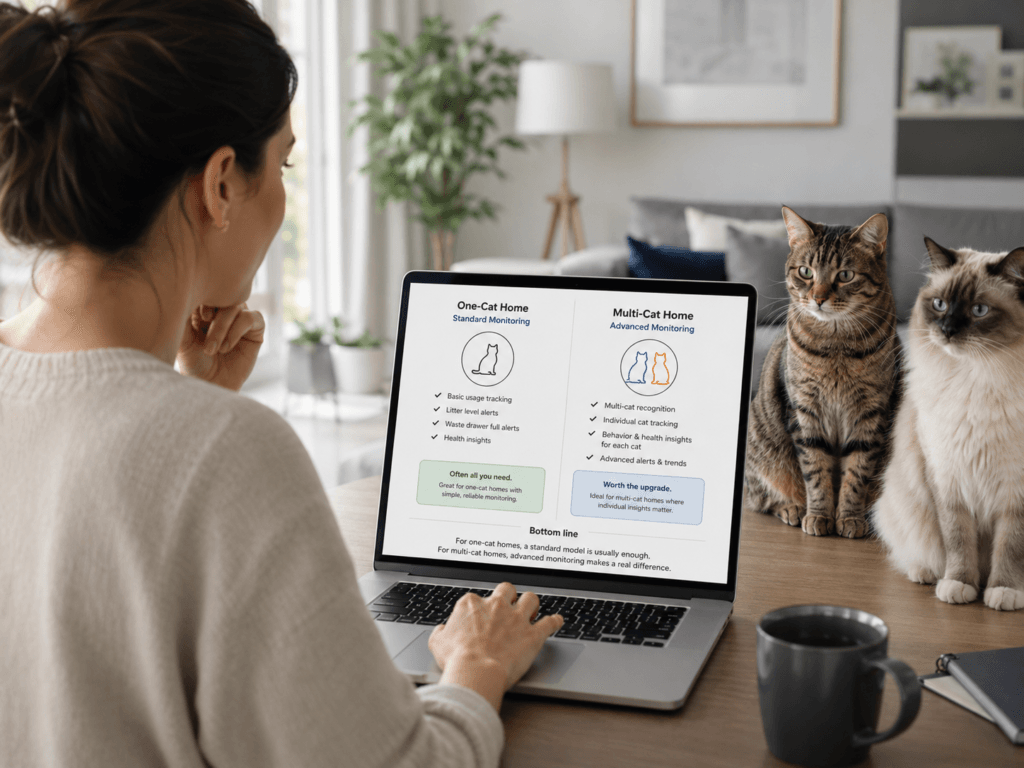
    A cat owner comparing one-cat and multi-cat litter box monitoring needs on a laptop while two cats sit nearby
    Litter-Robot 5 is usually enough for simple one-cat homes, while 5 Pro becomes easier to justify when multi-cat identification matters.

    For most one-cat households, choose Litter-Robot 5.

    The standard model can already associate weight and activity with the only cat in the home.

    You receive:

    • automatic cleaning;
    • weight trends;
    • visit histories;
    • waste-type information;
    • app alerts;
    • drawer status.

    The Pro becomes reasonable for one cat only when the owner specifically wants:

    • remote video;
    • visual confirmation of behavior;
    • recorded litter-box events;
    • more detailed monitoring after a previous concern;
    • the reassurance of seeing what happened while away.

    Those can be legitimate needs.

    They are not automatic requirements simply because the cat possesses a urinary system.

    Litter-Robot 5 Pro for Multiple Cats

    Multi-cat households give the Pro its strongest argument.

    Weight-based identification works best when cats occupy clearly different weight ranges.

    It becomes less dependable when:

    • two cats weigh nearly the same;
    • weights fluctuate;
    • cats enter close together;
    • one animal leans into the globe without fully entering;
    • the system receives an ambiguous measurement.

    Visual identification can help resolve those events.

    But the value still depends on what happens next.

    If you identify the cat and then change resource placement, monitor a repeated pattern, clean the box, add another litter station, or seek appropriate veterinary advice, the information has served a purpose.

    If you merely collect increasingly sophisticated evidence that Napoleon uses the box at 3:14 a.m., the monitoring system has become a very expensive biographer.

    For the broader decision between work-saving automation and behavioral visibility, read Smart Cat Monitoring vs Automation.

    The Whisker+ Question

    A membership is not inherently bad.

    It becomes bad when the product’s headline advantage feels incomplete without it and the buyer failed to include the recurring cost in the original decision.

    Before choosing Pro, ask:

    1. Will I review recorded events?
    2. Do I need visual identification?
    3. Do I care about histories extending beyond the free period?
    4. Would summaries change how I manage several cats?
    5. Am I willing to continue paying after the novelty disappears?

    Five honest “yes” answers make the Pro easier to defend.

    Five optimistic “probably” answers usually mean Litter-Robot 5 is the safer purchase.

    Where Litter-Robot 5 Can Disappoint

    Weight-based identification has limits

    SmartScale cannot always distinguish cats with similar weights.

    The system can also encounter ambiguous measurements when visits are incomplete or several animals interact around the unit.

    This is the main reason a complex multi-cat home may outgrow the standard model.

    It is still a premium litter box

    Choosing the non-Pro model does not make the purchase inexpensive.

    The standard model still asks the buyer to pay for:

    • the newest Whisker platform;
    • WasteID;
    • app functions;
    • weight histories;
    • accessory compatibility;
    • the broader Whisker ownership system.

    Buy it because those features matter—not merely because it costs less than an even more expensive sibling.

    Where Litter-Robot 5 Pro Can Disappoint

    Its best feature creates the main privacy trade-off

    The cameras observe the front of the machine and the litter bed.

    Some owners will consider that useful.

    Others will reasonably conclude that the home already contains enough internet-connected lenses.

    Privacy controls can reduce exposure.

    They do not make the cameras cease to exist.

    The software matters almost as much as the hardware

    Visual identification and advanced histories depend on software, account access, recognition accuracy, and the current Whisker+ service.

    The physical cameras may last for years.

    The precise service terms can change.

    More monitoring can create more worry

    A detailed timeline can help owners notice repeated changes.

    It can also encourage constant interpretation of normal variation.

    The correct use is:

    • observe the pattern;
    • verify it directly;
    • consider the wider context;
    • respond when the change is meaningful.

    The incorrect use is refreshing the app every time the cat spends eleven seconds longer considering his life choices.

    What About Litter-Robot EVO?

    EVO is the relevant alternative when your hesitation is not cameras but price, size, or platform depth.

    The current lineup can be understood as:

    • EVO: compact, automation-first entry;
    • Litter-Robot 5: balanced premium choice;
    • Litter-Robot 5 Pro: camera-led monitoring choice.

    Choose EVO when the main goal is Whisker self-cleaning with fewer premium layers.

    Choose Litter-Robot 5 when you want the newer platform and useful data without cameras.

    Choose 5 Pro when cameras and individual monitoring are the reason for paying more.

    For the full three-model decision, read Litter-Robot 5 vs 5 Pro vs EVO. For a closer look at the compact option, read our Litter-Robot EVO Review.

    Buyer Regret

    A cat owner deciding between Litter-Robot 5 and 5 Pro while reviewing camera monitoring features and price differences
    Buyer regret usually comes from overestimating how much monitoring you will actually use.
    PurchaseMost likely regret
    Litter-Robot 5Similar-weight cats make identification less dependable
    Litter-Robot 5 ProCameras and histories go mostly unused
    Pro without Whisker+The free camera layer feels shallower than expected
    Pro with Whisker+The recurring cost outlives the initial enthusiasm
    Either modelThe cat refuses the machine
    Either modelThe owner expects monitoring to replace proper litter-box care

    Final Verdict

    Litter-Robot 5 is the right model for most buyers.

    It provides the core benefits that justify entering Whisker’s premium lineup:

    • automatic cleaning;
    • WasteID;
    • weight and visit tracking;
    • app alerts;
    • multi-cat profiles;
    • modern accessory support.

    Its value does not depend on watching footage or maintaining a premium monitoring membership.

    Litter-Robot 5 Pro is the right model for a narrower household.

    Choose it when:

    • cats are difficult to distinguish by weight;
    • visual identification matters;
    • recorded visits would change your response;
    • remote viewing is genuinely useful;
    • you will pay for Whisker+ when its advanced features are part of the reason for buying.

    The Pro has more technology.

    Litter-Robot 5 has the better default argument.

    The mistake is not buying the cheaper model.

    The mistake is paying more to solve an uncertainty your household never had.

    For alternatives outside Whisker, read our Best Smart Litter Boxes guide.

    Frequently Asked Questions

    Does Litter-Robot 5 Pro clean better than Litter-Robot 5?

    No meaningful cleaning advantage defines the Pro upgrade. The principal difference is its dual-camera monitoring system.

    Does Litter-Robot 5 identify individual cats?

    It uses weight-based identification. This can work well when cats have different weights but may be less reliable when their weight ranges overlap.

    Does Litter-Robot 5 Pro require Whisker+?

    Basic camera functions are available without the membership. Visual identification, unlimited streaming, longer histories, and advanced insights depend on Whisker+ under the current service structure.

    Is Litter-Robot 5 Pro worth it for one cat?

    Usually only when video monitoring or recorded litter-box behavior has a specific purpose. Most predictable one-cat households receive better value from Litter-Robot 5.

    Is Litter-Robot 5 Pro better for multiple cats?

    It can be, especially when cats have similar weights or individual visual confirmation matters. Simple multi-cat homes may still be well served by the standard model.

    Can either model detect health problems?

    They can highlight changes in weight, visits, duration, and waste patterns. They cannot diagnose the cause or replace veterinary assessment.

    Is EVO a better value than Litter-Robot 5?

    EVO can be the better value when compact size and core self-cleaning matter more than the full premium platform. Litter-Robot 5 offers the more balanced feature set.

    References

    • Whisker Litter-Robot 5 product documentation
    • Whisker Litter-Robot 5 Pro product documentation
    • Whisker app and Whisker+ documentation
    • Whisker current model comparison
    • PetTech AI editorial trust and decision framework

    Image Disclosure

    Images in this article may be AI-generated editorial illustrations. They do not depict the exact products and should not be used to evaluate dimensions, controls, camera placement, entrance size, or physical features.

    Editorial Disclosure

    At the time of publication, PetTech AI does not earn a commission from Whisker purchases. This article contains no direct retailer or manufacturer purchase links. Product recommendations are based on buyer fit, feature value, and current available evidence.

  • PETKIT Purobot Ultra Review 2026: Maximum Automation, Maximum Commitment

    PETKIT Purobot Ultra Review 2026: Maximum Automation, Maximum Commitment

    The PETKIT Purobot Ultra is what happens when a self-cleaning litter box decides that scooping waste is no longer ambitious enough.

    It cleans the litter, photographs the evidence, attempts to identify the responsible cat, seals the waste bag and prepares a new section of liner for the next round.

    That is genuinely impressive.

    It is also large, expensive, dependent on proprietary refill rings and equipped with a camera aimed at one of the few household activities your cat probably assumed would remain private.

    The Purobot Ultra is not the best automatic litter box for everyone. It is the most compelling PETKIT model for owners who want camera-assisted multi-cat monitoring and automatic waste packing in the same machine.

    Quick Verdict

    PetTech AI verdictBest fitNot forThe real reason to buy
    ConditionalMulti-cat homes wanting facial recognition, video context and minimal contact with wasteLarge or hesitant cats, tight spaces, privacy-conscious owners and buyers avoiding proprietary consumablesThe auto-packing system—not the AI health marketing

    Buy it when: you want PETKIT’s deepest monitoring package and consider manually tying litter bags an unacceptable use of your remaining time on Earth.

    Skip it when: basic self-cleaning, weight trends and app notifications already solve the problem. The Purobot Max Pro 2 or PuraMax 2 will cost less and occupy less conceptual space in your life.

    PetTech AI may earn a commission from qualifying purchases. As an Amazon Associate I earn from qualifying purchases.

    Does automatic packing and camera-assisted monitoring justify the premium in your home? Check the PETKIT Purobot Ultra on Amazon or compare it on the official PETKIT store.

    Research and Health Note

    This is a research-led review based on current PETKIT documentation, the product manual, retail listings and independent hands-on reports. PetTech AI has not conducted identical long-term testing across every premium automatic litter box discussed here.

    The Purobot Ultra can record litter-box visits, capture images and flag changes in behavior or waste appearance. It cannot diagnose constipation, urinary disease, infection or obstruction.

    Cornell lists painful or difficult urination, frequent attempts, crying during urination and blood in the urine among common lower urinary tract signs. A cat producing little or no urine may have a urethral obstruction, which is an immediate veterinary emergency—not a notification to review after dinner.

    What Makes the Purobot Ultra Different?

    Many premium litter robots already:

    • clean after the cat exits;
    • separate clumps from clean litter;
    • record visits;
    • measure weight;
    • send app notifications;
    • monitor waste-drawer levels.

    The Purobot Ultra adds three meaningful differences:

    1. A rotating AI camera that watches the litter-box entrance, interior and surrounding room.
    2. Facial recognition intended to separate records in multi-cat homes, including cats with similar weights.
    3. Automatic waste packing that seals the full bag and prepares fresh liner after you remove it.

    The camera records 1080p video with a 210-degree field of view. PETKIT says the system can recognize up to 15 cats and create separate timelines containing visit frequency, duration and waste observations. The unit also supports both 2.4 and 5GHz Wi-Fi.

    Those are real functional differences.

    Whether they justify the price depends on how much you value identification and waste handling, not how many times the product page uses the word “health.”

    Auto-Packing Is Excellent—But Not Fully Autonomous

    The waste-packing system is the Purobot Ultra’s strongest reason to exist.

    Once the waste bin is ready to be emptied, the machine can:

    • gather the liner;
    • heat-seal the waste inside;
    • present a closed bag for removal;
    • deploy a fresh section of liner.

    This reduces direct contact with loose waste and can improve odor containment compared with opening a conventional drawer and manually tying the bag.

    But “fully automatic” needs an asterisk large enough to receive its own litter mat.

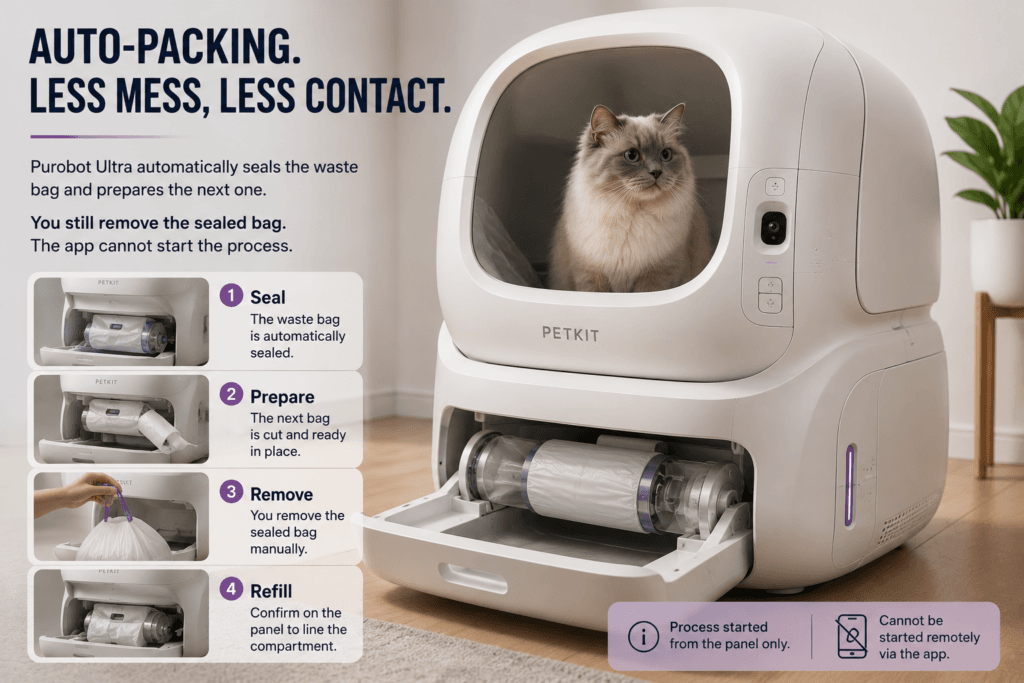
    You cannot start packing remotely through the app. PETKIT requires you to stand beside the machine and begin the process through its OLED control. You must then remove the sealed bag and press the device again before it deploys the new liner.

    So the Ultra does not quietly take the trash outside while you sleep.

    It automates the unpleasant middle of the job: gathering, sealing and replacing the liner. That remains valuable, especially for owners sensitive to odor or reluctant to handle an open waste bag.

    It is simply not human-free.

    The Proprietary Refill Ring Is the Convenience Tax

    The auto-packing system requires PETKIT’s dedicated refill rings. Generic drawer liners cannot reproduce the same packing and sealing process.

    Each retail pack contains three rings. PETKIT estimates approximately ten packing cycles per ring, although real usage depends on:

    • number of cats;
    • visit frequency;
    • how often you trigger packing;
    • climate;
    • how full you allow the bin to become.

    The company estimates that the 10-liter bin may hold up to 20 days of waste for one cat. PETKIT also recommends packing more frequently in hot or humid environments.

    This creates a straightforward trade-off:

    • Purobot Ultra: less unpleasant bag handling, but locked into refill rings;
    • Purobot Max Pro 2 or PuraMax 2: more manual waste disposal, but simpler consumables;
    • Litter-Robot 4: conventional drawer liners and a broader accessory ecosystem.

    Do not buy the Ultra while quietly resenting proprietary supplies. That relationship rarely improves after the honeymoon period.

    AI Camera Monitoring: Useful Context, Not a Digital Veterinarian

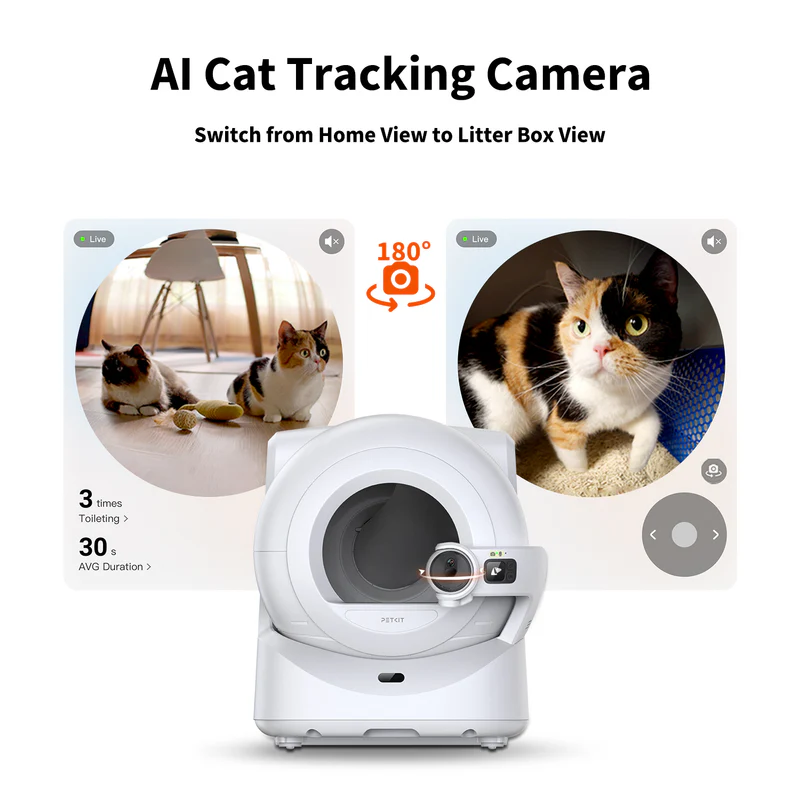
    PETKIT Purobot Ultra rotating AI camera switching between room monitoring and litter box views.
    The rotating camera can monitor both the litter-box interior and the surrounding room, adding useful context in multi-cat homes—and a privacy decision owners should make deliberately.

    The camera can associate visits with individual cats, record activity and capture stool or litter-clump images after cleaning.

    PETKIT also promotes:

    • yowling detection;
    • stool consistency observations;
    • unusual visit patterns;
    • urine-clump monitoring;
    • urine pH alerts when paired with PETKIT’s color-changing Urine Monitor Cat Litter.

    This can provide useful context.

    A video may help distinguish between:

    • a normal visit;
    • repeated entering and exiting;
    • vocalization;
    • straining;
    • a cat being interrupted by another animal;
    • the wrong cat receiving the app record.

    But the system is interpreting camera images, sounds and behavioral patterns. It is not performing a urinalysis, physical examination or diagnostic imaging.

    PETKIT describes some functions as disease “pre-screening.” We would use the less theatrical description: it can flag a pattern or image worth checking.

    If the app reports something unusual, verify the cat’s behavior and contact your veterinarian when appropriate. Do not wait for the algorithm to assemble a unanimous committee.

    Multi-Cat Recognition Is the Best AI Use Case

    Weight-based identification becomes unreliable when two cats are close in size.

    The Purobot Ultra attempts to solve that problem with facial recognition. You create profiles and upload clear images of each cat, allowing the camera to associate visits with individual faces rather than relying only on weight.

    This is especially useful when:

    • two cats weigh nearly the same;
    • one cat is gaining or losing weight;
    • urinary or digestive patterns need to be followed separately;
    • several cats share the same automatic box.

    The technology still deserves verification.

    An independent Wired test reported that facial identification was imperfect and that camera footage was not always detailed enough to evaluate waste confidently. The tester also found that a large 20-pound cat declined to use the machine, while the smaller cat adopted it readily.

    Treat the timeline as an organized record, not sworn testimony. Before sharing graphs with a veterinarian, confirm that Napoleon has not spent three weeks receiving Biscuit’s bathroom history.

    Size and Cat Fit: Measure the Cat and the Room

    The Purobot Ultra measures approximately:

    • 20.94 inches wide;
    • 32.20 inches deep;
    • 24.09 inches high;
    • 32.18 pounds empty.

    PETKIT recommends it for cats between 3.3 and 22 pounds. The entrance is about 10.43 inches high, and the unit must sit on a hard, level floor with roughly two inches of clearance from surrounding walls. Carpet or unstable flooring can interfere with sensor operation.

    The 32-inch depth is the number most likely to ruin your placement plan.

    This machine is lower than a Litter-Robot 4 but substantially deeper. You also need space behind and above it to access the waste-packing compartment and refill litter.

    Large cats deserve particular caution. A cat may remain below the 22-pound limit while still finding the entrance, camera arm or interior restrictive.

    For larger, senior or mobility-limited cats, the Purobot Max Pro 2 offers a larger entrance without the Ultra’s rotating external camera and automatic bagging system.

    Cleaning, Odor and Litter Compatibility

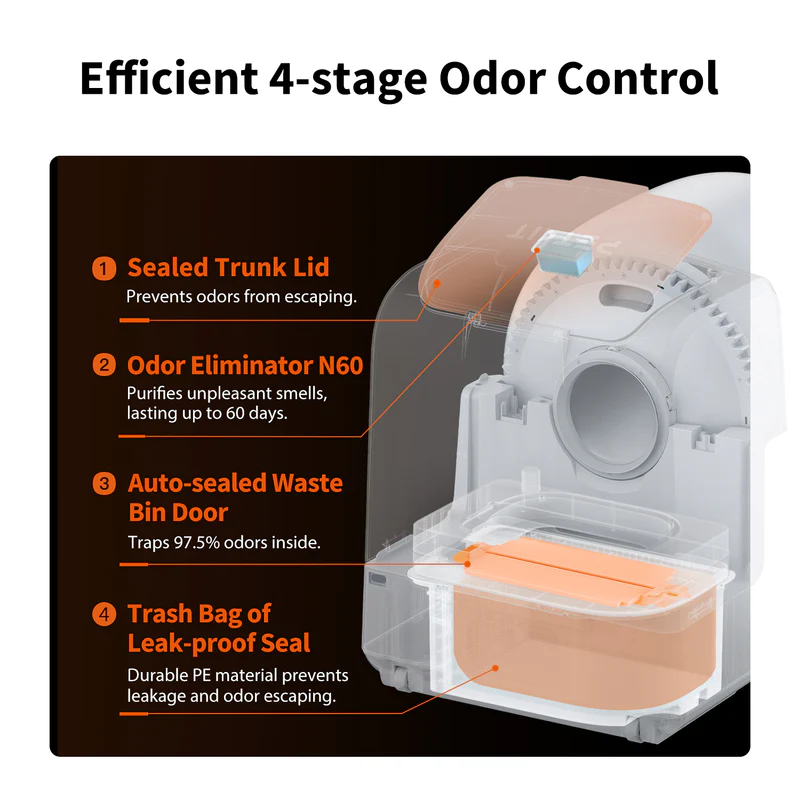
    Diagram of the PETKIT Purobot Ultra four-stage odor-control system with sealed waste bin and leak-resistant bag.
    PETKIT combines a sealed lid, odor-control insert, closed waste-bin door and leak-resistant liner to reduce escaping smells between disposal cycles.

    The core cleaning process is familiar: after the cat leaves and the selected delay expires, the cylinder rotates, clean litter passes through the sifter and clumps fall into the sealed waste area.

    PETKIT includes separate sifters for different clumping litter types. The company recommends avoiding particles longer than 12 mm or wider than 3 mm and favors fast, firm clumping litter to reduce smearing during rotation.

    The sealed compartment, waste-bin door, refill liner and odor-control insert create a strong odor-management system. Independent reviewers have generally rated cleaning and odor containment more positively than price, construction or ease of refilling.

    The weak point is adding clean litter.

    The camera arm and front opening make refilling more awkward than pouring litter through the top of a simpler PETKIT model. Deep cleaning also remains manual. The robot bags waste; it has not yet developed an interest in washing its own cylinder.

    PETKIT claims operating noise around 36 dB. Actual perception will depend on flooring, room acoustics and whether the machine shares a wall with your bedroom.

    Safety and Kittens

    The Ultra uses an entrance that remains open during rotation and a system of 20 proximity and weight sensors designed to stop movement when a cat approaches or enters.

    That is reassuring engineering, but we would not repeat PETKIT’s “100% safe” language. No motorized appliance should receive a universal risk-free certificate from its own product page.

    PETKIT does not recommend normal automatic operation for kittens:

    • younger than six months;
    • below 3.3 pounds.

    Kitten Protection Mode disables automatic and scheduled cleaning, but the kitten must still meet the minimum sensor-triggering weight.

    Keep a conventional litter box available during acclimation and confirm that every cat uses the Ultra comfortably before removing alternatives.

    App, Care+ and Privacy

    PETKIT Purobot Ultra app showing stool health monitoring and litter box activity for an individual cat.
    Purobot Ultra can capture litter-box images and compare visible stool patterns, but app classifications should be treated as prompts to investigate—not veterinary diagnoses.

    Core cleaning and device control do not require a monthly subscription.

    PETKIT Care+ adds extended cloud-video history and enhanced playback features. Current plan details and pricing should be checked inside the PETKIT app because subscription tiers can change.

    Without extended history, the box remains functional. The subscription matters most to owners who want to review complete footage rather than basic event records and images.

    The larger decision is privacy.

    The camera can rotate between the litter box and the surrounding room, includes a microphone and speaker, and can function as a broader indoor monitor. PETKIT provides camera controls, but the owner still needs to be comfortable placing a cloud-connected camera wherever the litter box lives.

    That may be useful in a dedicated pet room.

    It may be less charming when the only available location points the camera toward your bathroom.

    Purobot Ultra vs the Alternatives

    Choose Purobot Max Pro 2 instead when:

    You want facial recognition, camera monitoring and individual health timelines but can manually close a waste bag. It offers the stronger balance of monitoring, cat access and price within PETKIT’s current premium range.

    Choose PuraMax 2 instead when:

    You primarily want reliable self-cleaning, odor control, app records and weight-based monitoring. Read our complete review before deciding PETKIT PuraMax 2 Review

    Choose Litter-Robot 4 instead when:

    You prefer a much larger entrance, a mature support and accessories ecosystem, conventional waste liners and weight-based SmartScale tracking without an integrated camera.

    Our detailed comparison explains the broader PETKIT-versus-Whisker trade-off PuraMax 2 vs Litter-Robot 4

    Choose a separate scale instead when:

    You want deliberate, controlled weight measurements rather than buying an entire litter robot for passive trends. See our home-monitoring guide best cat weight scales

    Buyer-Regret Risk

    The Purobot Ultra creates regret when buyers:

    • underestimate its 32-inch depth;
    • assume a 22-pound cat will automatically fit comfortably;
    • expect facial recognition to be perfect;
    • believe health alerts constitute diagnosis;
    • dislike cloud-connected cameras after installing one;
    • resent buying proprietary refill rings;
    • expect auto-packing to work remotely without intervention;
    • pay for Care+ before deciding whether video history is genuinely useful;
    • buy maximum automation when basic self-cleaning was already enough.

    The Ultra is not overpriced because it contains useless technology.

    It becomes overpriced when you do not use the technology that makes it different.

    Final Verdict

    PetTech AI verdict: Conditional.

    The PETKIT Purobot Ultra delivers the most complete waste-handling system in PETKIT’s lineup. Automatic sealing and liner replacement meaningfully reduce contact with waste, while facial recognition can solve a genuine data problem in multi-cat homes where weight alone cannot separate users.

    The compromises are equally real:

    • enormous depth;
    • proprietary refill rings;
    • imperfect identification;
    • awkward litter refilling;
    • optional subscription pressure;
    • a camera some households will not want;
    • a premium that only makes sense when auto-packing matters.

    Choose the Purobot Ultra when you want the closest thing PETKIT currently offers to a low-contact litter-box system and will actively use its per-cat video records.

    Choose the Purobot Max Pro 2 when monitoring matters more than automatic bag sealing.

    Choose the PuraMax 2 when cleaning automation matters more than watching Gerald produce a timestamped documentary.

    The Purobot Ultra is not the automatic litter box everyone should buy.

    It is the automatic litter box for people who looked at normal waste disposal and decided the bag should close itself.

    Still want the waste bag to seal itself? Check the PETKIT Purobot Ultra on Amazon or the official PETKIT store.

    Frequently Asked Questions

    Does the Purobot Ultra work without PETKIT Care+?

    Yes. Core cleaning, app control and basic event tracking remain available. Care+ primarily adds extended cloud-video history and playback features.

    Can the Purobot Ultra use normal trash bags?

    Not for automatic packing. The sealing and liner-deployment system requires PETKIT refill rings.

    Can it identify cats with similar weights?

    That is one of its main advantages. It combines camera-based facial recognition with sensor data, although owners should verify that visits are assigned correctly.

    Is it suitable for large cats?

    PETKIT lists a maximum weight of 22 pounds, but physical fit also depends on height, length and willingness to enter around the camera arm. Large cats may prefer the wider Purobot Max Pro 2 or Litter-Robot 4.

    Does it diagnose urinary problems?

    No. It may flag vocalization, repeated visits, unusual clumps or changes in recorded behavior. Only a veterinarian can determine the cause.

    How often do the refill rings need replacing?

    PETKIT estimates around ten packing cycles per ring. A pack contains three rings, but actual duration depends on the number of cats and how frequently waste is packed.

    Can kittens use it?

    PETKIT does not recommend normal automatic operation for kittens under six months or below 3.3 pounds. Kitten Protection Mode disables automatic cleaning for qualifying small cats.

    References

    PETKIT — Purobot Ultra Product Documentation
    PETKIT — Purobot Ultra User Manual
    PETKIT — Purobot Ultra Refill Ring Documentation
    PETKIT — 2026 Automatic Litter Box Comparison
    Cornell Feline Health Center — Feline Lower Urinary Tract Disease
    American Veterinary Medical Association — Feline Lower Urinary Tract Disease
    Feline Veterinary Medical Association — Lower Urinary Tract Disease
    Whisker — Litter-Robot 4 Product Documentation
    Wired — PETKIT Purobot Ultra Review
    Cats.com — PETKIT Purobot Ultra Automatic Litter Box Review

    Image Disclosure

    Official manufacturer images are used when available and authorized.

    AI-generated images may also be used as editorial illustrations. They should not be treated as exact representations of product dimensions, materials, controls or physical features. Always verify current official product information before purchasing.
    Editorial Disclosure

    PetTech AI may earn a commission from qualifying purchases. This does not influence our recommendations, comparisons or editorial judgments.

  • Best Cat Weight Scales (2026): Useful Trends or False Precision?

    Best Cat Weight Scales (2026): Useful Trends or False Precision?

    A cat can gain or lose weight slowly enough that the change hides in plain sight.

    You see the same animal every day. The coat remains fluffy. Gerald still occupies the same unreasonable percentage of the sofa. Then the veterinary scale reveals that something has changed.

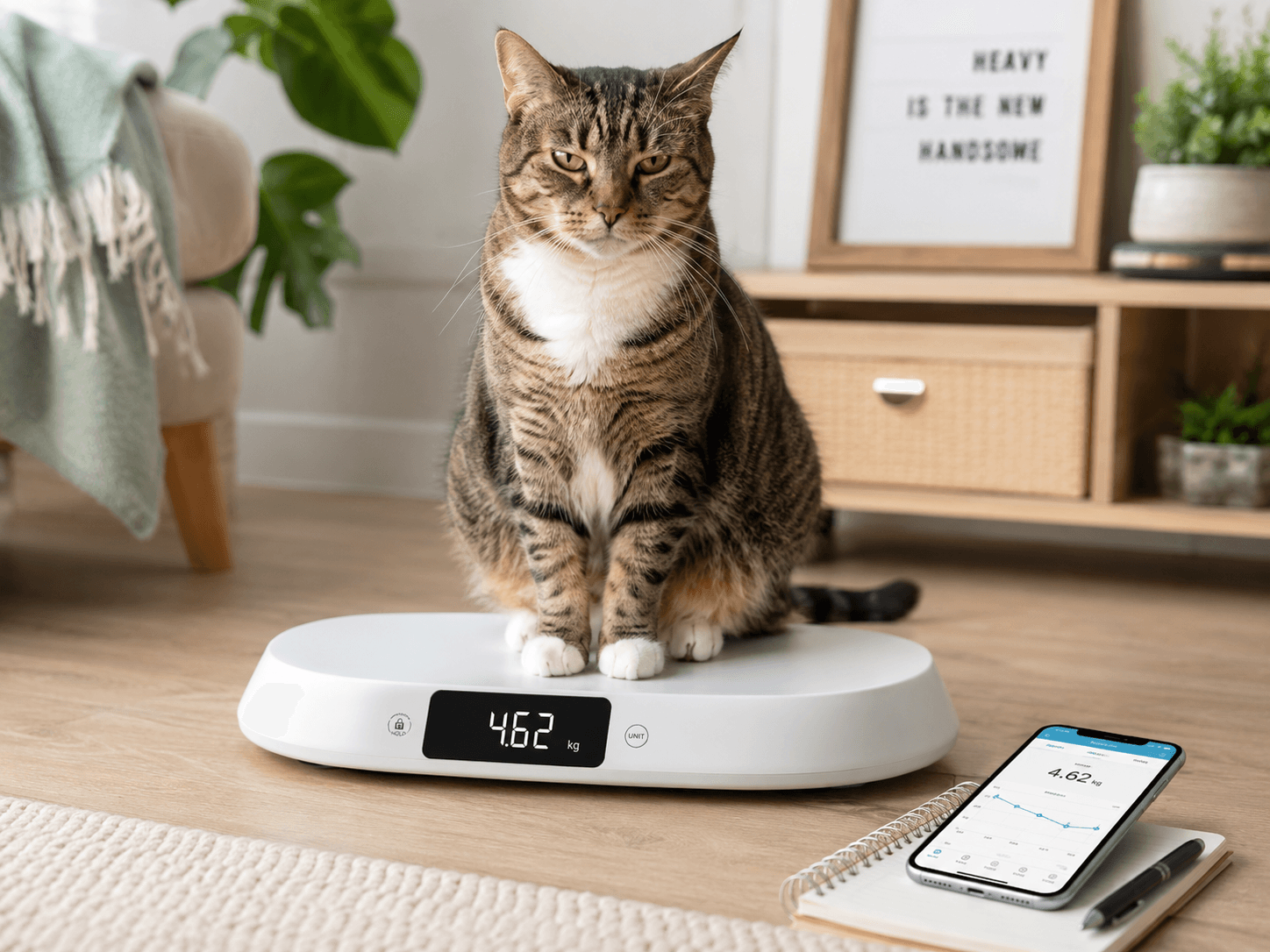
    A home cat scale can make those changes easier to notice—but only when the readings are collected consistently and interpreted with restraint.

    The best cat weight scales do not diagnose kidney disease, diabetes or poor nutrition. They answer a smaller and more useful question:

    Has my cat’s weight changed enough to verify and discuss?

    That sounds less impressive than “AI-powered preventive health intelligence,” but it also happens to be true.

    Quick Verdict

    ProductBest fitNot forPetTech AI verdict
    Greater Goods Digital Pet ScaleSimple, controlled home weigh-insOwners who require automatic app loggingRecommended
    Beurer BY90 Bluetooth ScaleManual weigh-ins with app-based recordsAnyone expecting a cat-specific health platformRecommended with Conditions
    Purina Petivity MonitorPassive weight and litter-use trends with an existing boxHomes wanting automatic scoopingRecommended with Conditions
    PETKIT PuraMax 2Litter automation plus contextual weight trendsBuying an entire robot only to weigh a catConditional Recommendation
    Litter-Robot 4Premium automation with Whisker SmartScaleOwners who only need a platform scaleConditional Recommendation

    Best starting point for most households: Greater Goods provides deliberate weigh-ins without requiring Wi-Fi, a subscription or a new litter routine.

    Best connected platform: Beurer BY90 stores readings through an app, although its software was designed around babies rather than feline health.

    Best passive monitor: Petivity collects weight and litter-box behavior without replacing your existing tray.

    PetTech AI may earn a commission from qualifying purchases. As an Amazon Associate I earn from qualifying purchases.

    Need a controlled weekly or monthly reading without buying a litter robot? Check the Greater Goods Digital Pet Scale on Amazon.

    Research and Health Note

    This is a research-led comparison based on current manufacturer documentation, Amazon listings and veterinary guidance. PetTech AI has not performed identical long-term accuracy testing across every device in this guide.

    Body weight is only one part of feline assessment. AAHA guidance combines weight with body condition and muscle condition because the same number can conceal different proportions of fat and muscle. Unintended weight loss can accompany many medical conditions, particularly in senior cats, and should not be explained by an app without veterinary evaluation.

    A scale can reveal change.

    It cannot tell you why the change occurred.

    Controlled Measurement vs Passive Monitoring

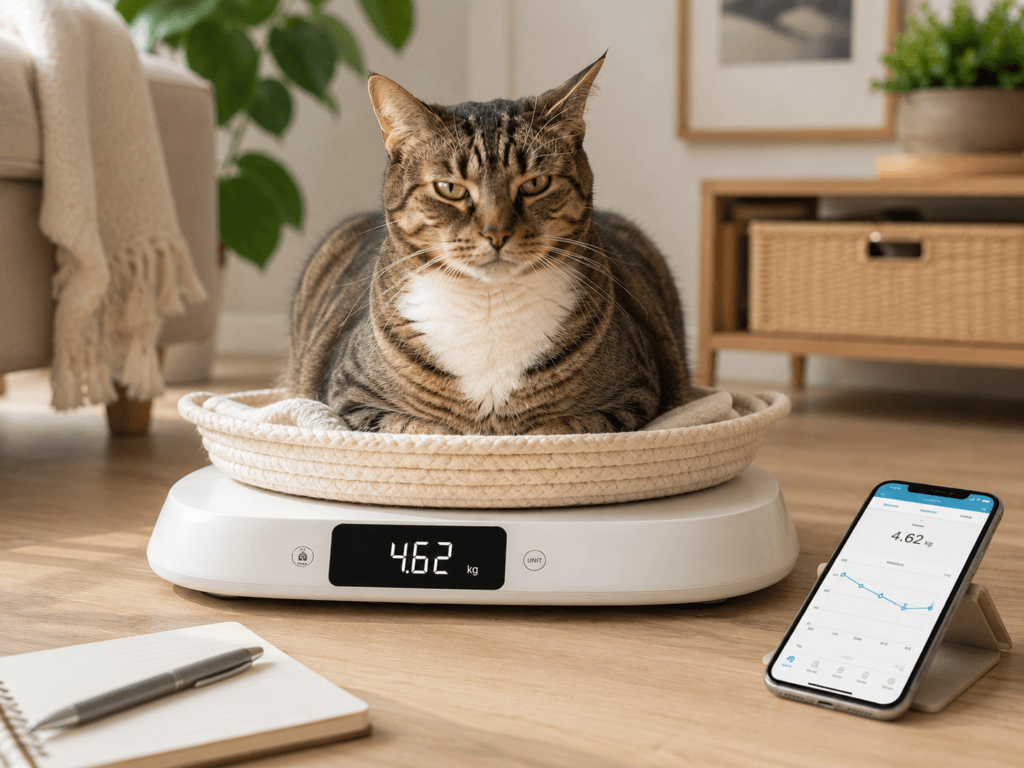
    Cat resting in a basket on a digital pet scale during a controlled home weigh-in.
    Controlled weigh-ins are often the easiest way to get repeatable readings—assuming your cat cooperates for longer than seven seconds.

    There are two fundamentally different ways to weigh a cat at home.

    Controlled measurement

    You intentionally place the cat on a platform scale under reasonably similar conditions.

    This gives you more control over:

    • the surface;
    • the cat’s position;
    • the time of measurement;
    • blankets or carriers placed on the platform;
    • whether an unexpected result is repeated.

    The disadvantage is obvious: the cat must cooperate.

    Some cats sit politely. Others respond as though the platform has been installed by federal authorities.

    Passive monitoring

    A sensor collects weight while the cat performs another activity, usually entering a litter box.

    This creates more readings with less handling. It can also connect weight with:

    • visit frequency;
    • visit duration;
    • time of day;
    • elimination patterns;
    • the identity assigned to the cat.

    The trade-off is reduced control. Posture, movement, installation, floor surface and multi-cat identification may influence what the system records.

    More data does not automatically mean better data.

    It means you have more readings to evaluate.

    Best Simple Cat Scale: Greater Goods Digital Pet Scale

    Verdict: Recommended

    The Greater Goods scale is the most sensible choice for owners who primarily want repeatable home weigh-ins.

    Its removable platform measures approximately 24 by 11.5 inches, supports animals up to 44 pounds and displays weight in 0.1-pound increments. Greater Goods also includes a movement-stabilization function, tare control and multiple units.

    Where it wins

    It avoids most forms of technological friction:

    • no app pairing;
    • no account;
    • no Wi-Fi dependency;
    • no litter-box compatibility issue;
    • no automatic profile assignment.

    Place it on a hard, level surface, use the same blanket when needed and repeat a surprising result before treating it as meaningful.

    The tare function is especially useful for cats that prefer sitting inside a shallow basket or on a familiar mat. Zero the scale after adding the object, then invite the emperor onto his prepared throne.

    Where it disappoints

    The 0.1-pound display interval is adequate for general household trend tracking, but it should not be confused with laboratory precision.

    The platform also requires active participation. A cat who immediately walks off can transform a ten-second measurement into a quarterly administrative project.

    Choose Greater Goods when you want a simple reference point you can reproduce.

    Skip it when you know the manual routine will quietly disappear after the first three measurements.

    Best App-Connected Platform: Beurer BY90

    Verdict: Recommended with Conditions

    The Beurer BY90 replaces the non-monetizable Healthy Pet Connect scale from the old guide.

    It is marketed as a Bluetooth baby and pet scale for infants, cats and dogs. The current Amazon listing gives it a 44-pound capacity, hold and tare functions, a curved platform, onboard memory and synchronization with the Beurer BabyCare app.

    Where it wins

    The BY90 fits owners who want:

    • controlled platform measurements;
    • automatic digital records;
    • charts instead of handwritten notes;
    • separate weigh-ins without changing the litter box;
    • a curved surface that may feel more secure than a flat bathroom scale.

    The hold function can help capture a stable result while the subject moves, although the cat still needs to remain reasonably contained on the platform.

    Where it disappoints

    This is not a cat-specific health ecosystem.

    The app was designed primarily for tracking infant growth. It stores weight effectively, but it should not be expected to interpret feline body condition, recognize veterinary risk or integrate naturally with feeder and litter-box records.

    In other words, the hardware can weigh Biscuit. The software may continue to believe Biscuit is a strangely hairy newborn.

    Want app-based weight records without replacing the litter box? Check the Beurer BY90 Bluetooth Scale on Amazon.

    Best Add-On for an Existing Litter Box: Purina Petivity

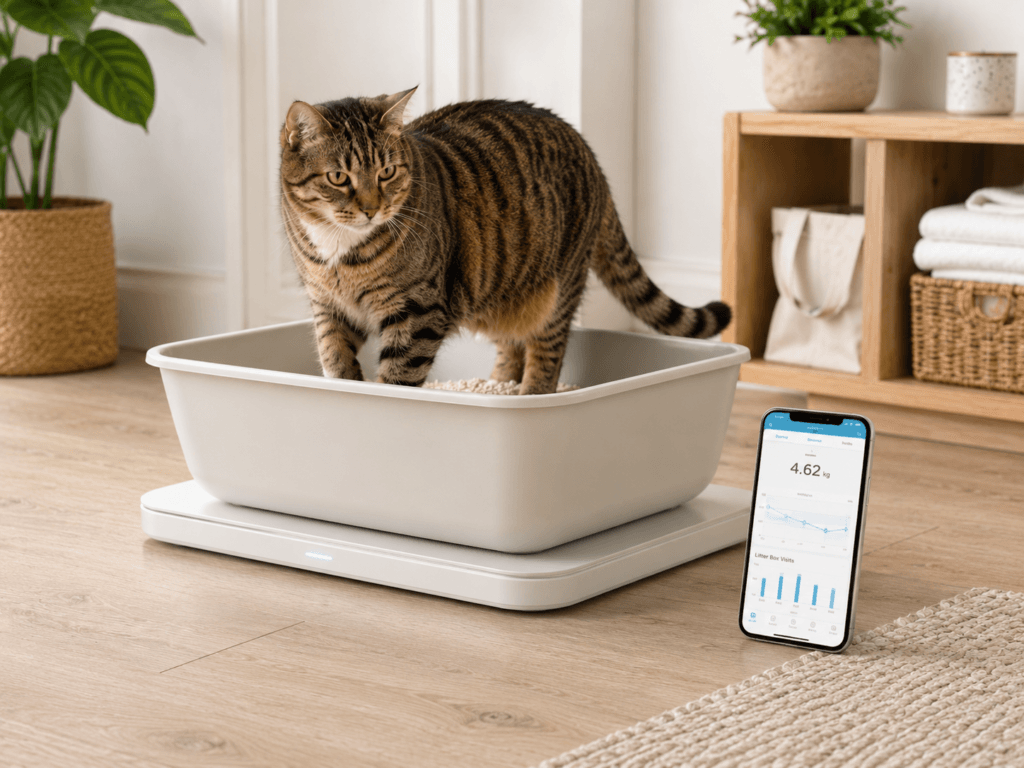
    Cat standing in a litter box placed on a smart monitoring platform with weight and litter-use tracking on a phone app.
    Passive monitoring adds convenience, but more readings do not automatically mean better readings.

    Verdict: Recommended with Conditions

    Petivity sits beneath a conventional litter box rather than replacing it.

    Its system records weight and classifies litter-box events such as urination and defecation. The Petivity app displays charts, produces periodic reports and alerts users when patterns differ from the established baseline. The manufacturer correctly frames those changes as information that may warrant veterinary diagnosis—not as a diagnosis produced by the device itself.

    Where it wins

    Petivity offers a useful middle ground:

    • passive measurements;
    • no automatic rotating drum;
    • continued use of a familiar litter box;
    • weight combined with elimination context;
    • profiles for individual cats;
    • fewer changes to the cat’s established bathroom routine.

    That makes it especially appealing when the monitoring matters more than automatic scooping.

    Our full Petivity Smart Litter Box Monitor Review examines its setup, reports, identification limits and practical value in greater detail.

    Where it disappoints

    Petivity still depends on:

    • correct installation;
    • a compatible box;
    • stable flooring;
    • successful cat identification;
    • continued manual litter maintenance.

    Its event classification should also be treated as a data aid, not an infallible witness. An app can misclassify a visit. Gerald has already declined to testify.

    Want passive weight and litter-use records without changing to a self-cleaning box? Check Purina Petivity on Amazon.

    When an Automatic Litter Box Makes Sense

    Cat beside a self-cleaning litter box with app-based weight tracking and monitoring features.
    A smart litter box can track weight trends too—but buying a whole robot just to weigh a cat is a very committed financial decision.

    A self-cleaning litter box can add weight tracking, but weight should rarely be the main reason to buy one.

    These machines make sense primarily when you also value:

    • automatic waste removal;
    • odor containment;
    • app notifications;
    • waste-drawer monitoring;
    • reduced daily scooping.

    Buying an entire premium robot merely to avoid entering one number into a phone is innovative financial planning, but not necessarily good financial planning.

    PETKIT PuraMax 2

    Verdict: Conditional Recommendation

    PuraMax 2 records litter-box usage and weight changes through the PETKIT app, including separate profiles intended for multi-cat households. PETKIT’s marketing sometimes uses stronger health language than we would, so interpret app warnings as pattern changes requiring attention—not confirmation of a urinary obstruction or disease.

    Choose it when you want the combination of:

    • self-cleaning operation;
    • PETKIT ecosystem integration;
    • usage records;
    • weight trends;
    • a comparatively compact rotating design.

    Read our PETKIT PuraMax 2 Review for the complete fit, leakage, cleaning and cat-size trade-offs.

    Does PETKIT’s automation and monitoring package fit your home? Check PuraMax 2 on Amazon.

    Check PuraMax 2 on the PETKIT official store as well.

    Litter-Robot 4

    Verdict: Conditional Recommendation

    Whisker’s SmartScale records weight during Litter-Robot 4 use and associates the data with pet profiles. Whisker notes that the system needs accurate profile information and time to learn weight patterns, particularly in multi-cat households. Hard, level flooring matters; carpet or uneven flooring can reduce scale accuracy unless the appropriate base support is used.

    Choose it when you value:

    • Whisker’s mature app;
    • automatic cleaning;
    • daily weight trends;
    • waste-level information;
    • a broad accessory and support ecosystem.

    Our PuraMax 2 vs Litter-Robot 4 comparison explains which automation philosophy better fits different households.

    Prefer Whisker’s automation and SmartScale ecosystem? Check Litter-Robot 4 through Amazon.

    Why Multi-Cat Identification Can Fail

    Weight-based identification works best when cats have clearly different weights and use the system consistently.

    Problems appear when:

    • two cats weigh nearly the same;
    • one cat is actively gaining or losing weight;
    • the device receives incomplete readings;
    • profiles contain outdated weights;
    • the machine has not gathered enough events;
    • a cat places only part of its body on the sensing area.

    Whisker advises allowing SmartScale time to learn each cat’s patterns. Systems such as PETKIT’s Purobot Max Pro 2 attempt to reduce ambiguity by combining facial recognition with weight sensing, but that requires a camera-equipped premium litter box rather than a simple scale.

    Before trusting per-cat graphs, verify that the system is consistently assigning visits to the correct animal.

    A beautifully rendered chart for the wrong cat remains beautifully wrong.

    How to Get More Consistent Home Readings

    Use the same scale whenever possible. AAHA’s current diabetes-management guidance specifically emphasizes using the same scale for consistency when monitoring weight during treatment.

    For controlled platform measurements:

    • place the scale on a hard, level surface;
    • use similar conditions each time;
    • tare the same basket, blanket or carrier;
    • center the cat on the platform;
    • repeat unexpected results;
    • record the date and relevant context.

    For litter-box systems:

    • follow the installation instructions;
    • avoid moving the unit unnecessarily;
    • keep pet profiles current;
    • check whether flooring affects the sensors;
    • verify multi-cat assignments;
    • view trends rather than reacting to every notification.

    The ideal measurement schedule depends on the purpose. A healthy adult being observed routinely does not require the same cadence as a senior cat, a kitten or an animal following a veterinary weight-management plan.

    Follow the schedule recommended for the individual cat rather than allowing the dashboard to invent one.

    What Weight Data Can—and Cannot—Tell You

    Weight data can tell you:

    • whether readings appear broadly stable;
    • whether a possible upward or downward trend deserves confirmation;
    • whether a veterinary nutrition plan is producing measurable change;
    • whether passive and controlled readings broadly agree;
    • whether records may be useful at an appointment.

    Weight data cannot independently tell you:

    • whether the cat is losing fat or muscle;
    • whether a change comes from food intake, hydration or disease;
    • whether the cat has diabetes, kidney disease or hyperthyroidism;
    • what calorie adjustment should be made;
    • whether an app alert represents an emergency.

    AAHA recommends evaluating body weight alongside body and muscle condition. Cornell also notes that weight loss may accompany several conditions in older cats, while weight loss despite a good appetite can occur with feline diabetes.

    Three connected devices do not become a diagnosis by majority vote.

    What to Share With Your Veterinarian

    A useful record includes more than a screenshot of one low number.

    Bring:

    • the weight trend and dates;
    • the scale or device used;
    • whether the reading was controlled or passive;
    • appetite changes;
    • food and treat amounts;
    • vomiting or diarrhea;
    • drinking and urination changes;
    • activity or behavior changes;
    • current medications;
    • recent diet changes.

    Our Best Pet Tech Apps for Cats guide explains which platforms make useful records accessible and which mainly produce a decorative waterfall of notifications.

    Contact your veterinarian when weight changes persist, appear rapid or occur alongside appetite loss, increased thirst, vomiting, diarrhea, weakness, altered urination or other meaningful changes from baseline.

    Buyer-Regret Risk

    The most common mistakes are:

    • buying a connected scale when a notebook would work;
    • buying a litter robot primarily for its scale;
    • assuming more decimal places guarantee accuracy;
    • trusting one unexpected reading;
    • confusing weight with body condition;
    • expecting equal-weight cats to be identified perfectly;
    • modifying food based only on an app graph;
    • collecting data without ever reviewing it.

    The simplest useful setup is often:

    one consistent platform scale, one repeatable routine and one record you can actually find.

    Upgrade to passive monitoring when automatic collection solves a real problem—not because the app dashboard has achieved consciousness.

    Final Verdict

    Choose Greater Goods for the simplest controlled home measurements and the least technological friction.

    Choose Beurer BY90 when app logging matters enough to justify baby-oriented software and a less pet-specific experience.

    Choose Petivity when passive weight and litter-use monitoring matter, but you want to retain a conventional litter box.

    Choose PuraMax 2 when PETKIT automation is already the priority and weight trends are a secondary benefit.

    Choose Litter-Robot 4 when Whisker’s self-cleaning ecosystem and SmartScale records fit the household better.

    The best cat weight scale is not the one producing the largest number of graphs.

    It is the one producing readings consistent enough to notice a real change—and simple enough that you continue using it after Napoleon’s third refusal to cooperate.

    Frequently Asked Questions

    How accurate are home cat scales?

    Accuracy varies by design, surface, movement and positioning. Consistent readings under comparable conditions are often more useful for trend monitoring than impressive resolution claims.

    Can I weigh my cat on a human bathroom scale?

    You can weigh yourself holding the cat and subtract your own weight, but the method may not detect smaller changes reliably. A pet or baby platform offers a more controlled surface.

    Is a smart litter box better than a platform scale?

    Not automatically. A litter box provides frequent passive readings; a platform provides deliberate, repeatable measurements. They solve different problems.

    Can a cat scale detect illness?

    No. It can reveal a weight change worth confirming. Veterinary assessment is needed to determine the cause.

    References

    • AAHA — Nutrition and Weight Management Guidelines for Dogs and Cats
    • AAHA — 2026 Diabetes Management Guidelines for Cats
    • Cornell Feline Health Center — The Special Needs of the Senior Cat
    • Cornell Feline Health Center — Feline Diabetes
    • Greater Goods — Digital Pet Scale Documentation
    • Beurer — BY90 Product Documentation
    • Purina Petivity — Smart Litter Box Monitor Documentation
    • PETKIT — PuraMax 2 Documentation
    • Whisker — SmartScale and Litter-Robot 4 Documentation

    Image Disclosure

    Official manufacturer images are used when available and authorized.

    AI-generated images may also be used as editorial illustrations. They should not be treated as exact representations of product dimensions, materials, controls or physical features. Always verify current official product information before purchasing.
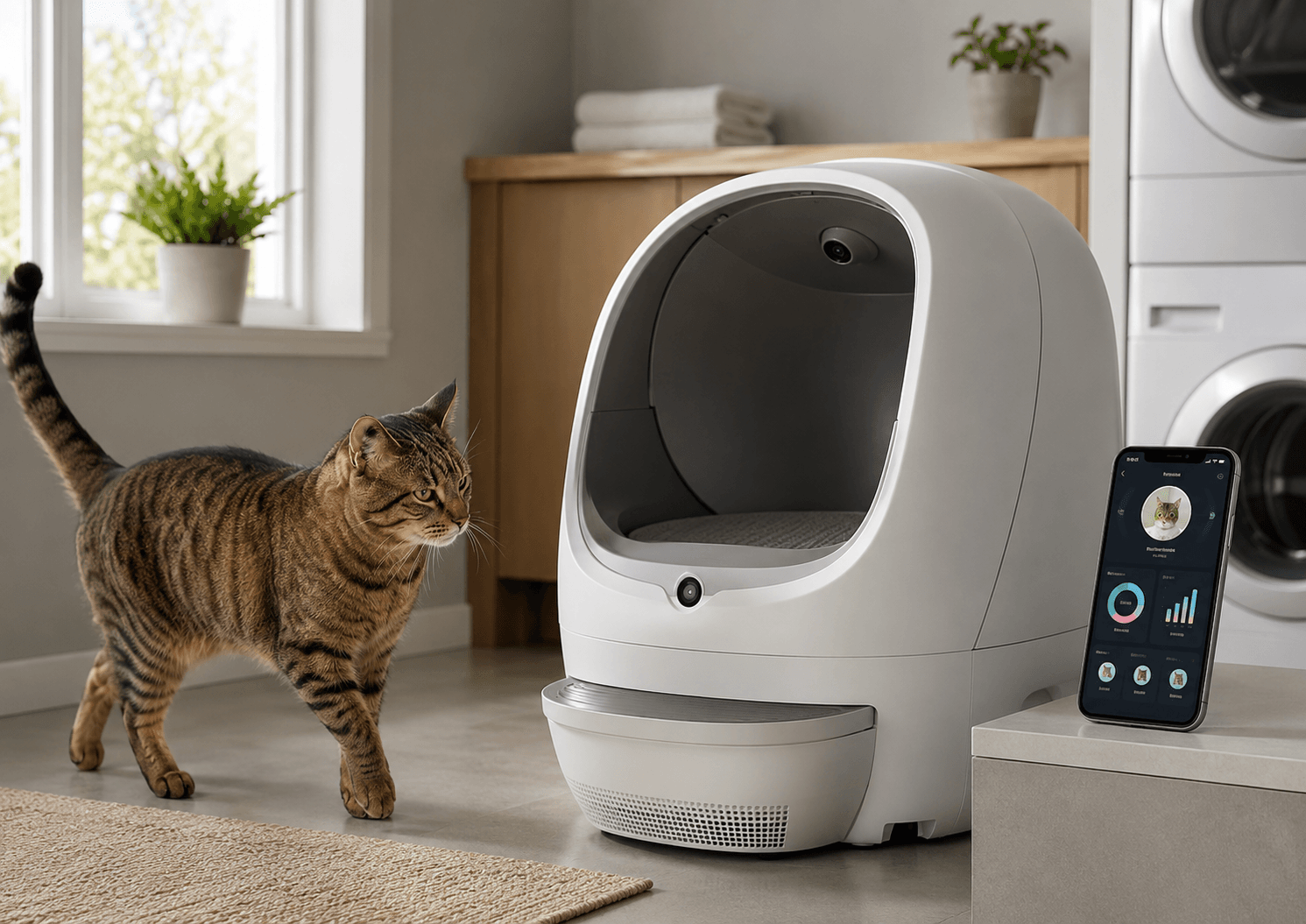
    Editorial Disclosure

    PetTech AI may earn a commission from qualifying purchases. This does not influence our recommendations, comparisons or editorial judgments.

  • Litter-Robot 4 Review 2026: Still Worth It After Litter-Robot 5?

    Litter-Robot 4 Review 2026: Still Worth It After Litter-Robot 5?

    Litter-Robot 4 is no longer Whisker’s newest, smartest or most expensive automatic litter box.

    That may be its strongest argument.

    It sits between the smaller Litter-Robot EVO and the newer Litter-Robot 5, retaining the wide entrance, quiet cleaning, strong odor control and mature Whisker ecosystem that made it popular—without charging for cameras or waste analysis you may never use.

    The awkward part is price. At Whisker’s current official MSRP, Litter-Robot 4 costs only $100 less than Litter-Robot 5 and $100 more than EVO. It is the middle child of the lineup, and middle children must work harder for attention.

    Quick Verdict

    PetTech AI verdictBest fitNot forThe real reason to buy
    RecommendedHomes with one to four cats wanting proven automation, a large entrance and mature supportSmall spaces, cats above 25 lb, buyers wanting cameras or waste-type recognitionReliable self-cleaning without paying for every new Whisker feature

    Buy it when: you want the established Whisker experience, have a medium or large cat, and consider Litter-Robot 5’s newer insights optional.

    Skip it when: EVO already fits your one- or two-cat household, or the extra capacity and WasteID features of Litter-Robot 5 are worth another $100.

    PetTech AI may earn a commission from qualifying purchases. As an Amazon Associate I earn from qualifying purchases.

    Does Whisker’s proven middle option fit your household? Check Litter-Robot 4 on Amazon.

    Research and Health Note

    This is a research-led review based on current Whisker documentation, official model comparisons and independent long-term testing. PetTech AI has not performed identical controlled testing across every automatic litter box discussed here.

    Litter-Robot 4 records visits and weight trends. Those records may reveal a change worth investigating, but they cannot diagnose urinary disease, constipation, diabetes or weight-related illness.

    Repeated visits, straining, vocalization, blood in the urine or producing little to no urine require veterinary attention. A dashboard can organize evidence. It cannot examine the cat.

    Where Litter-Robot 4 Fits in 2026

    Whisker now positions Litter-Robot 4 as its tried-and-true model.

    It supports up to four cats weighing 3–25 lb, offers a 15.75-inch entrance and provides 16.5 inches of interior headroom. Litter-Robot 5 expands support to five cats and 30 lb while adding WasteID, a larger drawer and an LCD interface. EVO is smaller, supports up to two cats and tops out at 19 lb.

    That gives LR4 a clear but narrower role:

    • more spacious and capable than EVO;
    • less expensive than LR5;
    • compatible now with the LitterHopper automatic litter-refill accessory;
    • established long enough to have a large user base, accessory catalog and repair ecosystem.

    Choose it because those differences suit your home—not because it used to be the flagship.

    Cleaning and Odor Control Remain the Main Event

    Litter-Robot 4 waste drawer with liner and carbon-filter odor-control system.
    The sealed drawer and carbon filter contain odor effectively between disposal cycles. Opening the drawer remains, regrettably, a human responsibility.

    After the cat exits, the globe rotates and passes clean litter through its sifting screen. Clumps drop into a sealed waste drawer, while usable litter returns to the globe.

    The process is quiet enough that independent reviewers frequently identify noise as one of LR4’s strengths. The sealed drawer and carbon filter also perform well at containing odor until the drawer is opened—the moment at which the machine hands responsibility back to civilization.

    Whisker estimates that a one-cat household may go up to eight days between drawer changes. Real intervals depend on the cat’s size, diet, litter and preferred level of productivity. Multi-cat homes will empty it considerably more often.

    Odor control is strong, not supernatural. You still need to:

    • empty the drawer;
    • wipe the entrance and globe;
    • top up litter;
    • inspect the liner;
    • perform periodic deeper cleaning.

    Litter-Robot eliminates routine scooping. It does not eliminate ownership.

    The Whisker App Is Good—But History Now Has a Paywall

    Whisker app displaying Litter-Robot 4 visit history, cat weight records and waste drawer information.
    The Whisker app tracks visits, weight and drawer levels, although longer historical records now sit behind Whisker+.

    The Whisker app shows:

    • cleaning-cycle activity;
    • waste-drawer level;
    • litter level;
    • individual visit records;
    • SmartScale weight readings;
    • device alerts and controls.

    Its interface and ecosystem remain major advantages over less established automatic litter boxes. Independent testing has praised its real-time drawer and litter-level information, although occasional incorrect alerts and sensor glitches have also been reported.

    The important 2026 caveat is data history.

    Standard LR4 access includes seven days of cat visits and individual weight records. Whisker+ expands this to as much as two years and adds longer-term weight, visit and duration trends, daily reports and extended notifications.

    The machine remains fully useful without the subscription. But owners buying it primarily for longitudinal health records should account for Whisker+ before declaring the app free forever.

    SmartScale also depends on installation. Weight readings are most accurate on a firm, level surface. Carpet thicker than approximately 3 mm or uneven flooring may require Whisker’s Carpet Tray for better measurements.

    For a broader look at controlled versus passive measurements, see our best cat weight scales.

    Cat Fit Is Better Than the Exterior Suggests

    Large adult cat entering the wide opening of a Litter-Robot 4 automatic litter box.
    LR4 offers more usable cat space than many enclosed competitors, but weight limits still do not replace measuring the actual cat.

    Litter-Robot 4 measures approximately 22 × 27 inches at the base and stands 29.5 inches high. The exterior remains substantial, but its large circular entrance and 16.5-inch interior headroom make it more accommodating than many enclosed competitors.

    It is a strong fit for:

    • medium and large cats;
    • multi-cat homes with clearly different weights;
    • cats already comfortable with covered litter boxes;
    • owners who can dedicate permanent floor space.

    The 25-pound limit is not permission to skip measuring. A long Maine Coon and a compact 20-pound cat do not occupy space in the same way.

    Cats with mobility problems may also dislike the elevated entrance. Whisker sells steps and ramps, but an open-top design such as Neakasa M1 may still feel less restrictive.

    Litter Compatibility Is Broad—but Not Universal

    Litter-Robot 4 works best with standard-weight, fast-clumping clay litter.

    Some silica crystals can pass through the screen, but translucent or white litter may interfere with the litter-level and drawer sensors. Plant-based, newspaper, loose-clumping and absorbent wood-pellet litters are generally poor matches for the sifting system.

    This matters more than marketing photographs suggest.

    Weak clumps may break during rotation, leaving residue inside the globe and sending fragments back into the clean litter. Very lightweight litter can also produce inaccurate level readings or escape the machine with enthusiastic paws.

    Do not buy LR4 while remaining emotionally committed to a litter it cannot sift properly. One of them will have to leave.

    Safety and Acclimation

    Litter-Robot 4 combines weight sensors with laser detection around the entrance and interior. A cleaning cycle pauses when the system detects a cat approaching or re-entering the globe.

    Automatic mode is intended for cats weighing at least 3 lb. Whisker recommends leaving the unit powered off and cycling it manually for smaller kittens until they can reliably trigger the sensors.

    Introduce the machine gradually:

    • place it near the existing litter box;
    • leave it switched off initially;
    • add a small amount of familiar used litter;
    • wait until the cat uses it consistently;
    • activate automatic cycles only after acclimation.

    Keep the original packaging during the transition. Direct purchases currently include a 90-day in-home trial, although return shipping remains the buyer’s responsibility. Purchases through Amazon or another retailer follow that retailer’s return policy.

    Maintenance Costs Without the Accessory Avalanche

    LR4 does not require proprietary waste bags. Appropriately sized generic liners can work, reducing one source of ecosystem lock-in. Independent testers have also reported using ordinary small garbage bags successfully.

    Recurring items may include:

    • drawer liners;
    • carbon filters;
    • OdorTrap packs;
    • replacement litter;
    • Whisker+;
    • optional accessories such as the Carpet Tray, ramp or LitterHopper.

    Whisker recommends replacing carbon filters and OdorTrap packs approximately every two to four weeks for optimal performance, but the machine continues operating without a monthly ceremony at the accessory store.

    The standard WhiskerCare warranty covers one year. A three-year plan is included with many bundles or can be purchased separately. The official direct-purchase trial lasts 90 days.

    Litter-Robot 4 vs EVO, LR5 and PETKIT

    Choose Litter-Robot EVO when:

    You have one or two cats under 19 lb, need the smallest current Whisker model and do not require litter-level sensing, LitterHopper compatibility or LR4’s larger interior.

    See the full lineup decision in our Litter-Robot 5 vs 5 Pro vs EVO comparison.

    Choose Litter-Robot 5 when:

    You have up to five cats, a cat above 25 lb or want WasteID, a larger waste drawer and improved onboard controls. The $100 official MSRP difference is small enough that buyers wanting those features should upgrade rather than regret saving it.

    Choose PETKIT PuraMax 2 when:

    You prefer PETKIT’s more compact rotating design, sealed waste approach and ecosystem—or simply want a different balance between footprint, app experience and price.

    Our PuraMax 2 vs Litter-Robot 4 comparison explains the household trade-offs.

    Choose Litter-Robot 4 when:

    You want the wide opening, established hardware, current LitterHopper support and mature Whisker ecosystem, but do not need cameras, WasteID or support for a fifth cat.

    Owners considering camera-based multi-cat identification should read our Purobot Max Pro 2 vs Litter-Robot 4 comparison before choosing the simpler Whisker platform.

    Buyer-Regret Risk

    Litter-Robot 4 disappoints when buyers:

    • discover EVO would have handled their single small cat;
    • save $100 despite genuinely wanting LR5’s larger capacity;
    • expect accurate SmartScale records on thick carpet;
    • insist on incompatible plant-based litter;
    • assume four cats automatically means one box is enough;
    • remove the original box before the cat adapts;
    • expect health data to explain its own cause;
    • underestimate the permanent footprint;
    • interpret “self-cleaning” as “self-maintaining.”

    It is a mature appliance, not a household employee with veterinary training.

    Final Verdict

    PetTech AI verdict: Recommended.

    Litter-Robot 4 remains one of the safest premium recommendations in automatic litter boxes because its strongest qualities have already survived years of real-world use:

    • quiet and reliable cleaning;
    • excellent odor containment;
    • generous cat access;
    • useful app controls;
    • established support;
    • broad accessory and replacement-part availability.

    It is no longer the automatic choice within Whisker’s own lineup.

    EVO is better for smaller households and tighter spaces. Litter-Robot 5 is better for five cats, larger cats and buyers who value WasteID enough to spend another $100.

    LR4 wins in the middle: proven, spacious and connected, without charging you to film Gerald’s every bathroom decision.

    Still the right Whisker for your household? Check Litter-Robot 4 on Amazon or through the official Whisker store.

    Still the right Whisker for your household? Compare Litter-Robot 4 on Amazon.

    Frequently Asked Questions

    Is Litter-Robot 4 still worth buying in 2026?

    Yes, particularly for homes with one to four cats that want a large entrance, mature app and LitterHopper compatibility without paying for LR5’s newer features.

    Does Litter-Robot 4 require Whisker+?

    No. Cleaning, app controls and seven days of visit and weight records work without Whisker+. The subscription adds longer historical trends and reports.

    What litter works best?

    Standard-weight clumping clay litter is the safest choice. Avoid non-clumping litter, absorbent pellets and most lightweight plant-based formulas.

    Can large cats use it?

    Whisker supports cats between 3 and 25 lb. Physical comfort still depends on the cat’s length, height and mobility.

    How often must the drawer be emptied?

    Whisker estimates up to eight days for one cat. Multi-cat households and larger cats will usually require more frequent disposal.

    Does Litter-Robot 4 detect illness?

    No. It records weight and litter-box activity that may reveal a change worth discussing with a veterinarian.

    References

    Whisker — Litter-Robot 4 Product Documentation
    Whisker — Litter-Robot Comparison Chart
    Whisker — Litter-Robot 4 vs Litter-Robot 5
    Whisker — Whisker App and Whisker+ Documentation
    WIRED — Whisker Litter-Robot 4 Review
    The Spruce Pets — Litter-Robot 4 Review
    Cornell Feline Health Center — Feline Lower Urinary Tract Disease

    Image Disclosure

    Official manufacturer images are used when available and authorized.

    AI-generated images may also be used as editorial illustrations. They should not be treated as exact representations of product dimensions, materials, controls or physical features. Always verify current official product information before purchasing.
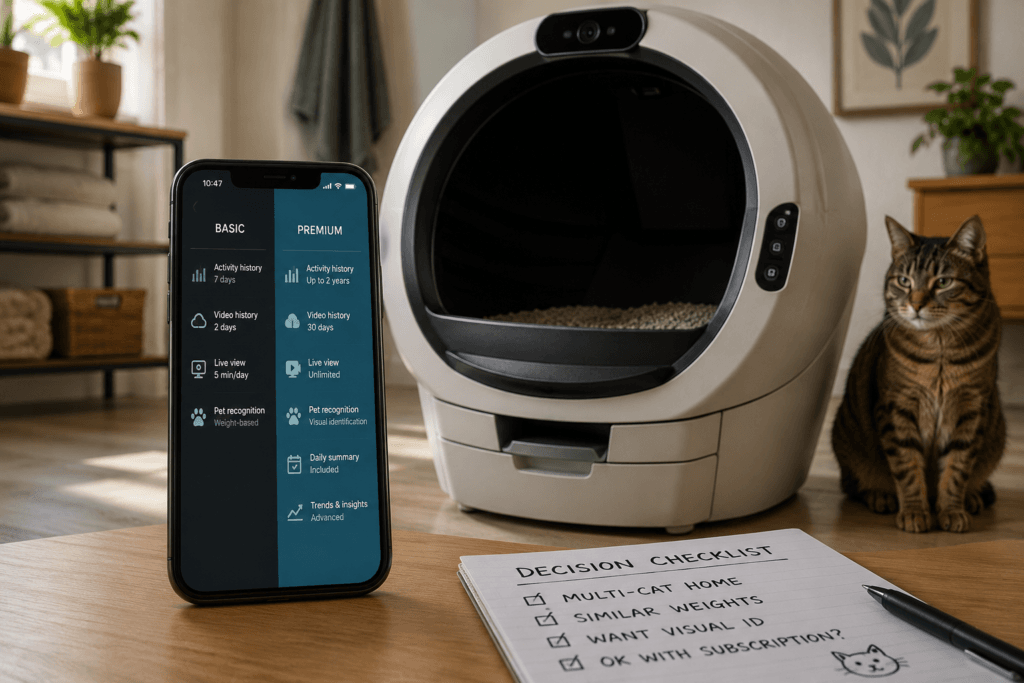
    Editorial Disclosure

    PetTech AI may earn a commission from qualifying purchases. This does not influence our recommendations, comparisons or editorial judgments.

  • Best Smart Litter Boxes (2026): Which One Actually Deserves Your Floor Space?

    Best Smart Litter Boxes (2026): Which One Actually Deserves Your Floor Space?

    A smart litter box promises to eliminate scooping.

    This is technically true in the same way a dishwasher eliminates washing dishes: the machine does the repetitive part, while you remain responsible for emptying, cleaning, refilling, troubleshooting, and wondering how something so expensive became covered in cat litter.

    Still, a good automatic litter box can meaningfully improve daily life.

    The important question is not which machine has the most sensors, the longest app dashboard, or the greatest number of synonyms for “odor control.”

    It is:

    Which box will your cat actually use—and which one reduces more work than it creates?

    This guide compares three models with different strengths:

    • PETKIT PuraMax 2 for the best overall balance;
    • CATLINK Luxury Pro-X for multi-cat usage data;
    • PetSafe ScoopFree SmartSpin as a simpler mainstream alternative with a more conditional reliability case.

    Research note: This is a research-led guide based on official documentation, current product information, public ownership evidence, and PetTech AI’s product-level trust checks. PetTech AI has not conducted long-term hands-on testing of every litter box included.

    Quick Verdict

    Your priorityBest fitRecommendation
    Best overall smart litter boxPETKIT PuraMax 2Strong recommendation
    Multi-cat usage and weight trendsCATLINK Luxury Pro-XStrong specialist recommendation
    Simpler mainstream smart alternativePetSafe ScoopFree SmartSpinConditional recommendation
    Very large, elderly, or mobility-limited catMeasure carefully—or keep a conventional boxPhysical fit matters more than the app
    Cat strongly prefers open boxesDo not force the upgradeA rejected smart box is expensive furniture

    The short version

    Choose PuraMax 2 when you want the strongest all-round combination of automation, odor management, app control, and everyday usability.

    Choose Luxury Pro-X when several cats share the litter area and individual usage records are worth checking.

    Choose SmartSpin when you want a recognizable mainstream option with simpler app monitoring—but only after reviewing current reliability feedback and return terms.

    And remember:

    A $500 litter box that the cat refuses to enter is not smart.

    The cardboard box it arrived in has won.

    Affiliate disclosure: This page contains affiliate links. PetTech AI may earn a commission if you purchase through them, at no additional cost to you. As an Amazon Associate I earn from qualifying purchases.

    Compare the Recommended Models

    First Pass the Cat Acceptance Test

    A cat calmly exploring a new self-cleaning litter box placed beside a familiar traditional litter box
    A gradual transition gives cats time to accept a smart litter box without unnecessary stress.

    Before comparing apps, sensors, or deodorization cartridges, look at the animal expected to climb inside the machine.

    Ask:

    • Does the cat normally prefer open or covered boxes?
    • Is the entrance low enough?
    • Can the cat turn comfortably?
    • Is the cat unusually large?
    • Does arthritis or limited mobility make climbing difficult?
    • Is the litter area quiet enough for a motorized cleaning cycle?
    • Can the old box remain available during the transition?

    Many cats prefer larger, uncovered boxes with easy access. Older cats, kittens, and cats with mobility limitations may need lower sides, while large cats need enough room to enter, turn, dig, and exit comfortably.

    No app update can negotiate around a cat that has declared the new machine haunted.

    A gradual transition is essential:

    1. Place the smart box near the existing box.
    2. Leave automatic cycles disabled initially.
    3. Add familiar litter.
    4. Let the cat investigate without pressure.
    5. Keep the old box available until use is consistent.

    For homes deciding whether monitoring adds anything beyond automation, read Smart Cat Monitoring vs Automation.

    PETKIT PuraMax 2: Best Overall

    PuraMax 2 is the strongest default recommendation because it does not depend on one specialist feature to justify itself.

    It combines:

    • automatic waste separation;
    • a relatively low entrance;
    • app-based usage and weight records;
    • proximity and weight-based safety systems;
    • a sealed waste area;
    • multiple odor-management options;
    • support for common clumping litter types;
    • a large enough interior for many adult cats.

    This is the machine for the owner who wants the entire litter routine to become easier—not merely more measurable.

    Buy it if

    • reducing daily scooping is the main goal;
    • odor containment matters;
    • you want useful alerts without making analytics the entire hobby;
    • one or more cats will share the machine;
    • you are willing to perform periodic deep cleaning;
    • you may later add other PETKIT products.

    Skip it if

    • your cat strongly prefers an open box;
    • floor space is limited;
    • the cat is exceptionally large or mobility-limited;
    • you expect the machine to eliminate all cleaning;
    • you dislike proprietary deodorizing accessories and app-connected care.

    Where it can disappoint

    PuraMax 2 is still a rotating plastic chamber containing litter, urine, and ambition.

    The automatic cycle removes clumps.

    It does not automatically clean:

    • the internal walls;
    • seams and edges;
    • the waste chute;
    • residue from high-urinating cats;
    • litter tracked onto the floor;
    • the machine’s exterior.

    PETKIT has improved the cylinder and leak-control design, but buyers should still consider their cat’s posture. A cat that consistently urinates high against internal surfaces can create more manual cleaning than the product photography suggests.

    The box also occupies meaningful floor space. Measure the room before discovering that your new litter robot has become the dominant architectural feature of the bathroom.

    Verdict: The best overall smart litter box in this guide because its automation, usability, odor management, and app features form a coherent everyday product.

    For a direct model-level comparison with Whisker, read PETKIT PuraMax 2 vs Litter-Robot 4.

    Multi-cat households considering camera-based identification should also read our Litter-Robot 5 Pro review before paying for the flagship model.

    For a direct monitoring-versus-simplicity decision, see Purobot Max Pro 2 vs Litter-Robot 4.

    CATLINK Luxury Pro-X: Best for Multi-Cat Usage Data

    Two cats near a smart litter box in a bright home while a smartphone shows simple usage tracking
    Usage data can be most useful in multi-cat homes, where changes are otherwise harder to notice.

    Luxury Pro-X makes its strongest case in a home where several cats share the litter area.

    A single-cat household already knows who used the box.

    A five-cat household may know only that somebody has been extremely productive.

    CATLINK adds:

    • automatic cleaning;
    • app control;
    • weight-based cat identification;
    • usage histories;
    • waste-drawer alerts;
    • odor-management features;
    • individual profiles and routine trends.

    This makes the data layer more useful than it would be in a simple household.

    Buy it if

    • multiple cats use the same litter box;
    • individual weight and visit trends matter;
    • you will actually review the app;
    • a particular CATLINK design fits the room and cats;
    • litter-box monitoring is the main reason you are considering the CATLINK ecosystem.

    Skip it if

    • you mostly want the easiest default recommendation;
    • cats have very similar weights;
    • nobody will check the records;
    • you are choosing it because “health monitoring” sounds reassuring;
    • you intend to buy the entire CATLINK ecosystem before evaluating the first product.

    Where it can disappoint

    Weight-based identification has practical limits.

    When cats differ clearly in size, the system has a better chance of associating visits correctly. When two cats weigh almost the same, the app may be less certain than the marketing department.

    Usage data can still be valuable, but it must remain evidence rather than diagnosis.

    The box may show:

    • a change in visit frequency;
    • a weight trend;
    • shorter or longer visits;
    • a change in routine.

    It cannot reliably explain why that change occurred.

    The app records the event.

    It has not completed veterinary school.

    Luxury Pro-X also requires the same unglamorous ownership work as its competitors: waste removal, interior cleaning, litter management, sensor care, and occasional troubleshooting.

    Verdict: A credible specialist choice for multi-cat households that will genuinely use individual litter-box records—not simply admire the dashboard during setup.

    For the broader brand decision, read CATLINK vs PETKIT.

    PetSafe ScoopFree SmartSpin: Best Mainstream Alternative—with Caveats

    SmartSpin offers a simpler proposition:

    • the cat exits;
    • the drum rotates;
    • waste moves into a sealed drawer;
    • the app records usage and weight;
    • the owner empties the drawer later.

    PetSafe gives it a relatively low-profile entrance, a smooth interior designed to simplify wipe-down cleaning, a 6 L sealed waste drawer, app alerts, and compatibility with clumping litter.

    This makes SmartSpin attractive to first-time automatic-litter-box buyers who want something more connected than an old rake system but less ecosystem-heavy than PETKIT or CATLINK.

    Buy it if

    • you want a mainstream pet-care brand;
    • basic app tracking is enough;
    • the lower entrance suits your cat;
    • a sealed drawer is a major part of the appeal;
    • you have verified favorable return terms;
    • current reliability feedback is reassuring enough for your risk tolerance.

    Skip it if

    • you want the strongest proven recommendation in the guide;
    • detailed individual multi-cat identification matters;
    • you want the broadest ecosystem;
    • mechanical reliability is more important than a lower entry price;
    • mixed ownership experiences make you uncomfortable.

    Where it can disappoint

    SmartSpin has a less reassuring and more polarized market record than PuraMax 2 and Luxury Pro-X.

    The recurring areas worth checking before purchase include:

    • interrupted cleaning cycles;
    • sensor behavior;
    • litter or waste adhering to internal surfaces;
    • odor containment;
    • operating noise;
    • litter tracking;
    • longer-term mechanical consistency.

    That does not mean every SmartSpin is waiting to betray its owner.

    It means the product deserves a conditional recommendation rather than being presented beside the stronger picks as though all three have identical evidence.

    PetSafe’s smooth interior and simpler cleaning design are meaningful advantages. They matter only while the machine continues performing its main job reliably.

    Verdict: A legitimate mainstream alternative for buyers who want app-connected automation and sealed waste handling, but not the safest default pick.

    The 3 A.M. Test

    A useful smart litter box should remain tolerable when it rotates at 3 a.m.

    PuraMax 2

    You receive a clean litter bed, an app record, and perhaps a reminder that the waste drawer will eventually require human participation.

    Luxury Pro-X

    You receive a clean litter bed and a better idea of which cat conducted the overnight operation.

    SmartSpin

    You receive a clean litter bed—provided the cycle and sensors behave consistently.

    A conventional litter box

    Nothing rotates.

    Nothing sends a notification.

    The cat uses it anyway.

    This is why the smartest choice is not always the model with the longest specification table.

    It is the machine whose extra complexity continues to earn its place.

    Buyer Regret in One Table

    ProductMost likely regret
    PuraMax 2Expecting automatic scooping to mean automatic deep cleaning
    Luxury Pro-XPaying for data that nobody checks—or cannot cleanly distinguish similar cats
    SmartSpinChoosing the simpler alternative and later encountering reliability friction
    Any smart litter boxDiscovering the cat prefers the old plastic tray
    Any enclosed modelIgnoring physical size, mobility, or open-box preference

    Odor Control: What the Marketing Usually Leaves Out

    A clean litter area with a self-cleaning litter box, litter mat, and fresh airflow in a modern home
    Automatic cleaning helps with odor only when waste removal, litter maintenance, and airflow work together.

    A sealed waste drawer helps.

    Automatic removal helps.

    Deodorizing cartridges may help.

    None of them permanently defeats the chemical reality of stored cat waste.

    Odor control still depends on:

    • emptying the drawer before it becomes a biological research project;
    • cleaning internal surfaces;
    • using compatible litter;
    • preventing damp buildup;
    • cleaning mats and surrounding floors;
    • maintaining reasonable room ventilation.

    The best odor-control system is still removal plus cleaning.

    The app cannot push-notify ammonia into another dimension.

    One Smart Box May Still Not Be Enough

    In multi-cat homes, a single automatic litter box should not automatically replace every other box.

    Cats may have:

    • different location preferences;
    • territorial conflicts;
    • different tolerance for enclosed spaces;
    • mobility differences;
    • preferences for different litter types.

    General feline guidance commonly recommends providing as many litter boxes as cats, plus one, distributed in accessible areas.

    Real homes may not always follow that formula perfectly, but the principle matters: one premium machine does not guarantee that several cats suddenly want to share one bathroom.

    Keep an additional box when:

    • introducing the smart model;
    • cats have a history of conflict;
    • the home has several floors;
    • one cat avoids the machine;
    • reliable access matters during power or mechanical problems.

    Which Smart Litter Box Should You Buy?

    Choose PuraMax 2 when:

    • you want the strongest all-round recommendation;
    • automation and odor management matter most;
    • you want useful app monitoring without making data the sole purpose;
    • the cats fit comfortably.

    Choose Luxury Pro-X when:

    • multiple cats share the litter area;
    • individual usage trends justify the extra monitoring;
    • CATLINK’s litter-box system wins your product-level comparison;
    • you will evaluate other CATLINK products separately.

    Choose SmartSpin when:

    • you want the simpler mainstream alternative;
    • lower entry and smooth cleaning surfaces are appealing;
    • recent buyer feedback and return protection reduce the risk enough;
    • you accept a less confident recommendation.

    Choose none of them when:

    • your cat strongly rejects enclosed boxes;
    • mobility makes entry difficult;
    • you cannot keep a backup box;
    • you expect zero maintenance;
    • the budget would create more stress than daily scooping.

    Final Verdict

    PETKIT PuraMax 2 is the best smart litter box in this guide for most households.

    It offers the most convincing balance of cleaning automation, odor management, app features, safety systems, and everyday usability. It is not maintenance-free, but its main strengths remain useful after the novelty disappears.

    CATLINK Luxury Pro-X is the better specialist choice for data-conscious multi-cat homes.

    Its usage records and weight-based identification can provide valuable context when several cats share the box. Buy it because that information solves a real uncertainty—not because CATLINK has given the litter drawer a health dashboard.

    PetSafe ScoopFree SmartSpin remains a conditional mainstream alternative.

    Its sealed drawer, lower profile, app monitoring, and smooth interior are appealing. Its more mixed ownership history means buyers should examine current reliability feedback and return protection before choosing it over the stronger recommendations.

    The winner is therefore:

    1. PuraMax 2 — best overall
    2. Luxury Pro-X — best for multi-cat data
    3. SmartSpin — acceptable mainstream alternative with caveats

    A smart litter box should reduce the amount of time you spend thinking about cat waste.

    When the machine itself becomes the main thing you think about, the automation has lost the argument.

    Frequently Asked Questions

    Which smart litter box is best overall?

    PETKIT PuraMax 2 offers the strongest overall balance for most buyers. Luxury Pro-X becomes more compelling when multi-cat usage data is a central requirement.

    Which model is best for multiple cats?

    CATLINK Luxury Pro-X is the stronger data-focused option. However, multiple cats may still need additional litter boxes in separate locations.

    Is PetSafe SmartSpin worth considering?

    Yes, as a conditional alternative. Its design and app features are useful, but buyers should inspect current reliability feedback and return terms before purchasing.
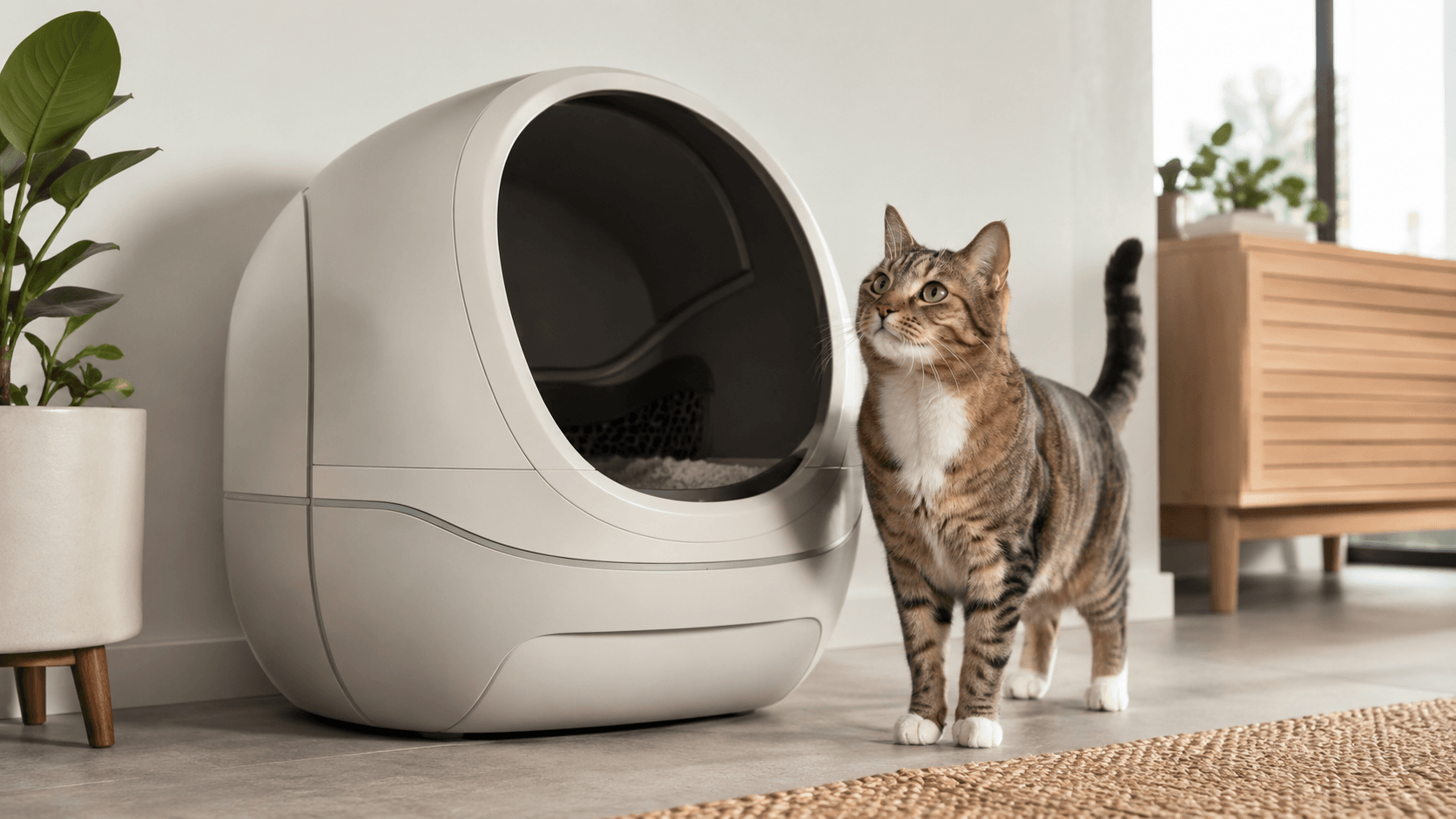
    Do automatic litter boxes eliminate cleaning?

    No. They reduce daily scooping but still require drawer emptying, litter refilling, interior cleaning, sensor care, and surrounding-floor maintenance.

    Can smart litter boxes detect illness?

    They may reveal changes in weight or litter-box routine. They cannot diagnose the cause. Meaningful or persistent changes require direct observation and, when appropriate, veterinary evaluation.

    What if my cat refuses the smart litter box?

    Keep the previous box available, disable automatic movement initially, use familiar litter, and introduce the machine gradually. Do not force the transition by removing every alternative immediately.

    References

    • PETKIT PuraMax 2 official product and support documentation
    • CATLINK Luxury Pro-X official product and app documentation
    • PetSafe ScoopFree SmartSpin official product and support documentation
    • Cornell Feline Health Center litter-box behavior and accessibility guidance
    • Public ownership evidence reviewed during PetTech AI’s product-level trust checks

    Image Disclosure

    Some images in this article may be AI-generated for illustrative purposes. They do not depict the exact products and should not be used to evaluate dimensions, entrances, controls, or physical fit.

    Disclosure

    PetTech AI may earn a commission when readers purchase through affiliate links. Every litter box is evaluated at product level; belonging to a smart ecosystem does not automatically earn a recommendation.