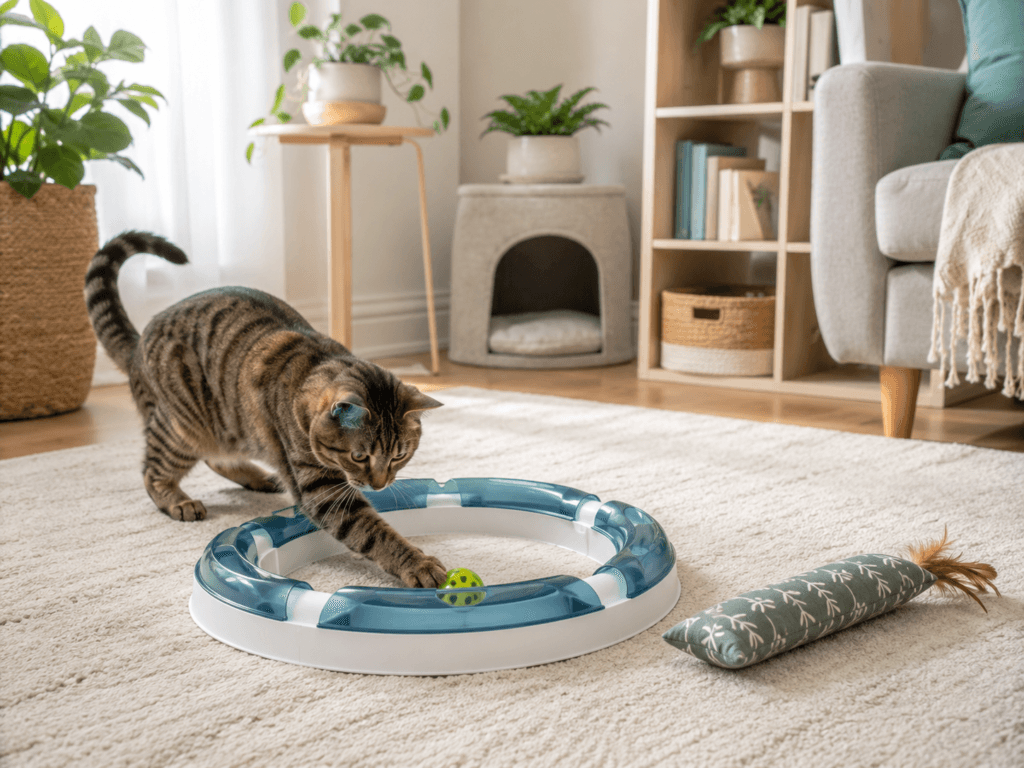
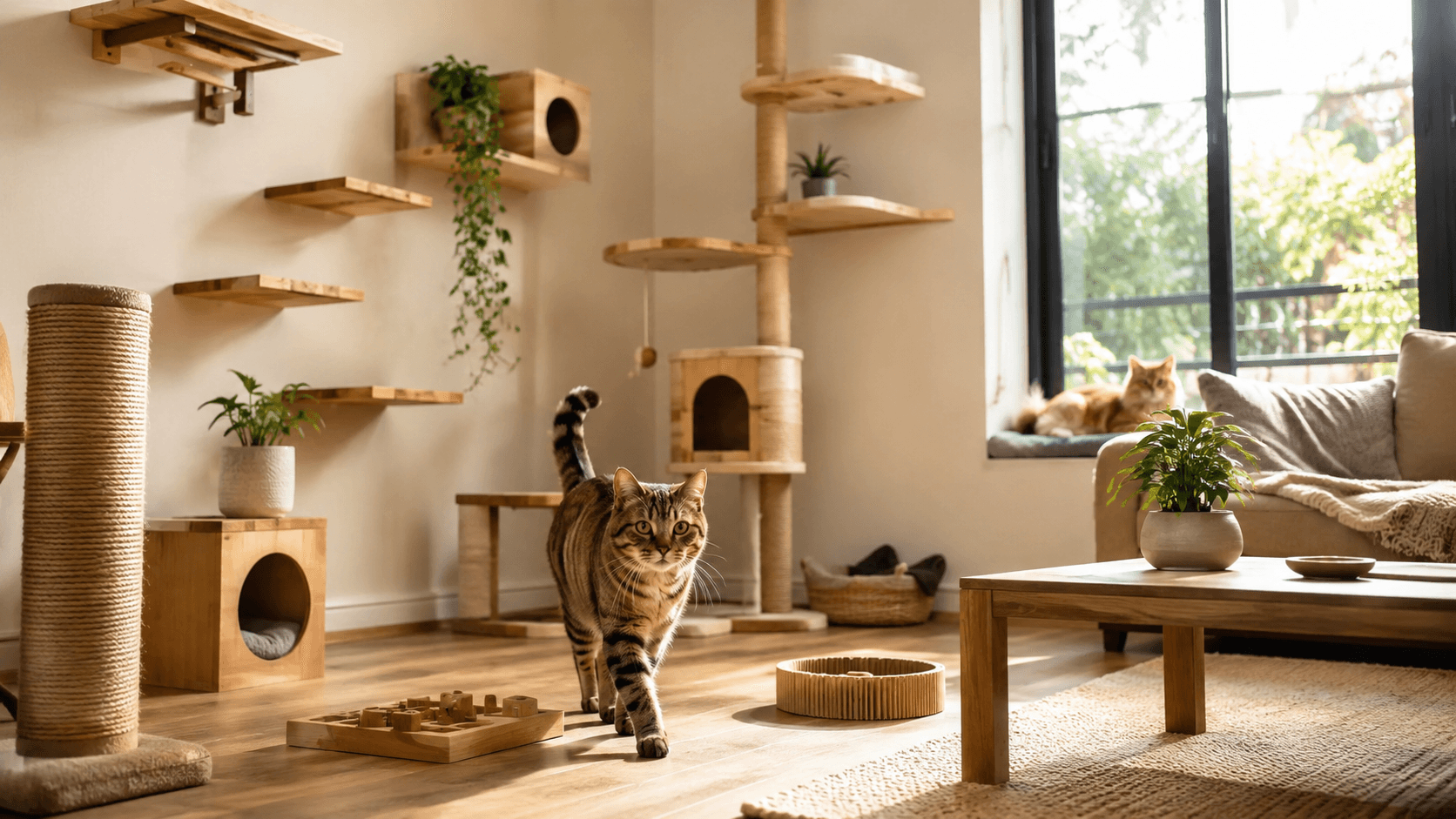
Tag: Cat Play

  • Indoor Cat Enrichment Science (2026): What Cats Need Before Another Gadget

    Indoor Cat Enrichment Science (2026): What Cats Need Before Another Gadget

    Keeping a cat indoors removes many outdoor risks.

    It does not automatically create a good indoor life.

    A clean apartment, a full bowl and one decorative scratching post abandoned behind the sofa do not constitute environmental enrichment. They constitute housing.

    Indoor cat enrichment means giving cats meaningful opportunities to hide, climb, scratch, hunt, explore, eat, rest and control social contact. Technology can support some of those needs—but only after the home itself stops behaving like a furnished waiting room.

    Quick Verdict

    Feline needStart hereWhere technology can helpWhere it becomes clutter
    Safety and restHiding places and elevated territoryCamera to observe which spaces are actually usedBuying surveillance instead of creating safe retreats
    Resource accessSeparated food, water, litter and resting areasRFID feeder when one cat steals another’s foodMaking every resource app-dependent
    Play and predationWand toys, chase games and toy rotationAutomatic toy for short independent sessionsExpecting a motorized ball to replace human play
    Feeding enrichmentPuzzle feeders and simple foragingSmart feeder for portions and schedulesConfusing food delivery with enrichment
    EliminationAccessible, clean and acceptable litter boxesAutomatic cleaning and usage trendsUsing one smart box as the household’s only toilet
    MonitoringDirect observation and a normal baselineWeight, feeding or litter records when they inform a decisionCollecting five dashboards nobody reviews

    PetTech AI verdict: Recommended framework

    Fix the environment first.

    Then add technology only where it solves an identifiable problem.

    A $250 device is not automatically more enriching than a cardboard box. The cardboard box is understandably smug about this.

    Research Note

    This guide is based on current feline environmental guidance from the Feline Veterinary Medical Association, Cornell Feline Health Center and veterinary behavior resources.

    Environmental changes should be adapted to the cat’s age, health, mobility, temperament and household. Enrichment can support welfare, but it cannot diagnose or treat medical or behavioral disorders.

    What Indoor Cats Actually Need

    The Feline Veterinary Medical Association organizes a healthy feline environment around five broad needs:

    1. a safe place;
    2. multiple and separated key resources;
    3. opportunities for play and predatory behavior;
    4. positive, predictable human interaction;
    5. an environment that respects feline smell and other senses.

    These are not luxury upgrades.

    They are the foundations that allow a cat to choose where to rest, eat, eliminate, observe and retreat.

    The important word is choice.

    A cat may enjoy sleeping beside you and still need somewhere private. It may share a water fountain peacefully while refusing to eat beside another cat. It may climb high when confident and prefer low, enclosed spaces when frightened or arthritic.

    Good enrichment does not force one approved lifestyle on every cat. It creates several acceptable options and lets Florence conduct her own inspection.

    1. Safe Places and Vertical Territory
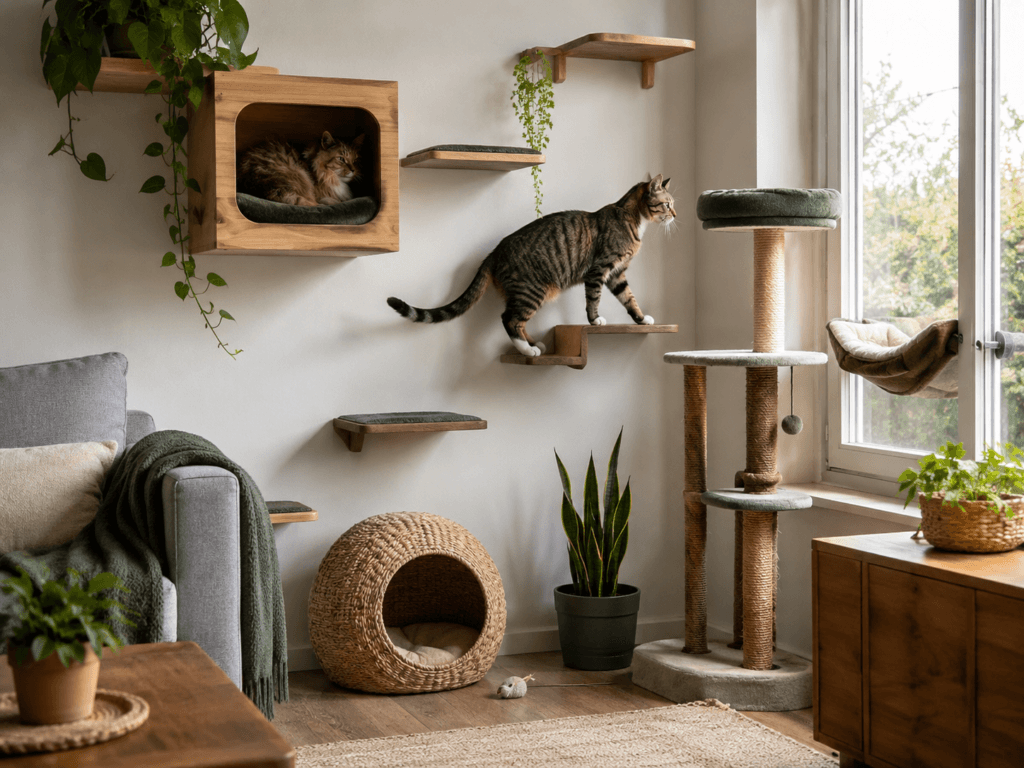
    Two cats using wall-mounted shelves, an enclosed wooden hideaway and a cat tree near a window
    Elevated routes and enclosed resting spaces give cats more control over where they observe, climb and retreat. AI-generated editorial illustration.

    Cats need places where they can rest without being approached, trapped or unexpectedly handled.

    Useful options include:

    • open carriers;
    • covered beds;
    • cardboard boxes;
    • shelves;
    • window perches;
    • stable cat trees;
    • cleared furniture at different heights.

    Vertical space can increase usable territory without requiring a larger home. It is especially valuable in multi-cat households because one floor plan can become several partially separated routes.

    But height is not automatically better.

    Senior cats and cats with limited mobility may need lower platforms, ramps or intermediate steps. A magnificent six-foot cat tree that Biscuit cannot comfortably climb is furniture for humans with ambitious taste.

    Place safe areas where the cat already tries to rest. Do not hide every bed in a remote room and then wonder why the cat continues occupying your keyboard.

    Technology has a limited role here. A camera may reveal which perch, doorway or room is being used while you are away. It cannot compensate for the absence of a safe retreat.

    2. Separate Resources Before Buying Smarter Ones
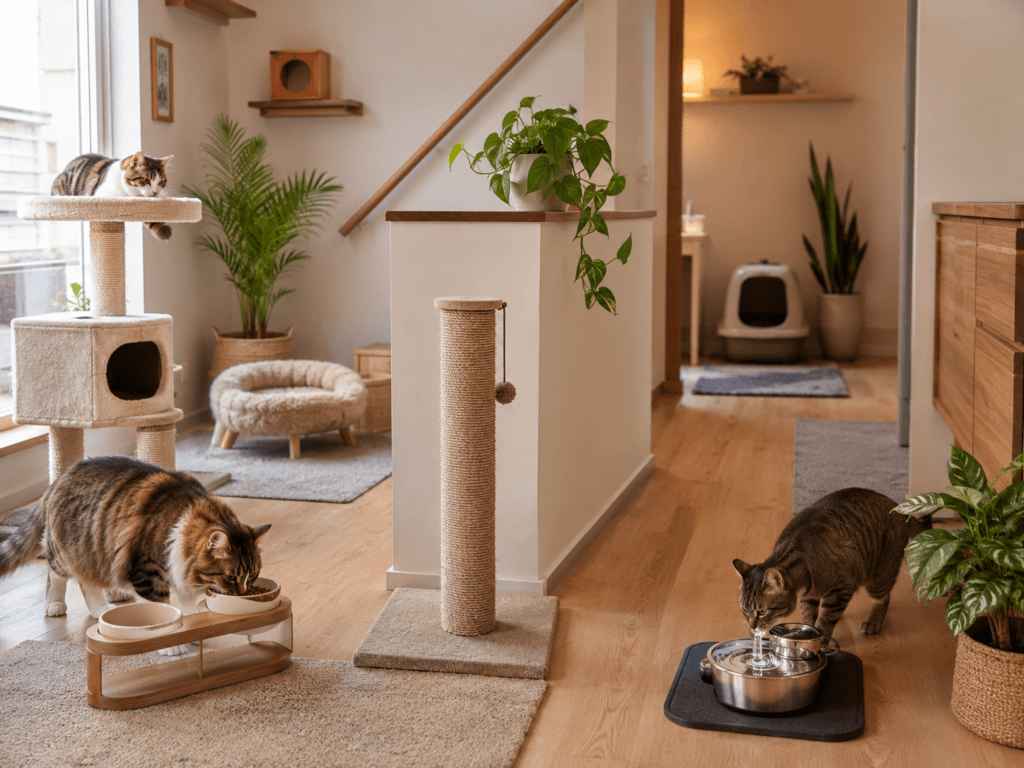
    Three cats using separate feeding, drinking and litter areas in a multi-cat home
    Separating food, water, resting and litter resources can reduce bottlenecks and give each cat more control over access. AI-generated editorial illustration.

    In multi-cat homes, apparent sharing does not always mean comfortable sharing.

    One cat may quietly control:

    • access to a feeder;
    • the route to the litter box;
    • a preferred resting area;
    • the only useful window;
    • the human at particular times.

    FelineVMA guidance emphasizes distributing important resources rather than concentrating everything in one attractive but socially complicated corner. Current intercat-tension guidance likewise recommends dispersed resources and visual separation where needed.

    Start by separating:

    • food from litter;
    • water from high-conflict areas;
    • feeding stations from one another;
    • litter boxes across accessible locations;
    • resting spaces and escape routes.

    This does not mean duplicating every object according to a rigid household equation.

    It means watching how the cats use the home and removing bottlenecks.

    Technology earns its place when access itself is the problem. An RFID feeder, for example, may help when one cat needs a different diet or Napoleon has appointed himself Minister of Everyone Else’s Breakfast.

    For broader solutions, read our Best Multi-Cat Tech Solutions guide.

    3. Play Should Look Like Hunting, Not Random Exercise

    Cats are more likely to engage when play resembles part of a predatory sequence:

    • watching;
    • stalking;
    • chasing;
    • pouncing;
    • catching.

    Cornell recommends toys that encourage movement and problem solving, while VCA highlights chase-based play and puzzle feeding as outlets for natural behavior.

    The best toy depends on the cat.

    Some prefer:

    • feather or fabric wand attachments;
    • small ground-level prey;
    • objects moving beneath cover;
    • kickers;
    • lightweight balls;
    • food puzzles.

    Short, successful sessions are usually more useful than leaving every toy permanently available. Rotate a small selection and retire objects that receive the emotional response normally reserved for tax documents.

    Automatic toys can supplement play when humans are working, but they should offer:

    • predictable movement;
    • supervision during initial use;
    • an easy way for the cat to disengage;
    • no loose strings or swallowable parts.

    They are backups, not outsourced parenting.

    See our Best Interactive Cat Toys and Smart Puzzle Toys for Cats guides for different play styles.

    4. Food Enrichment: Make One Meal Less Boring
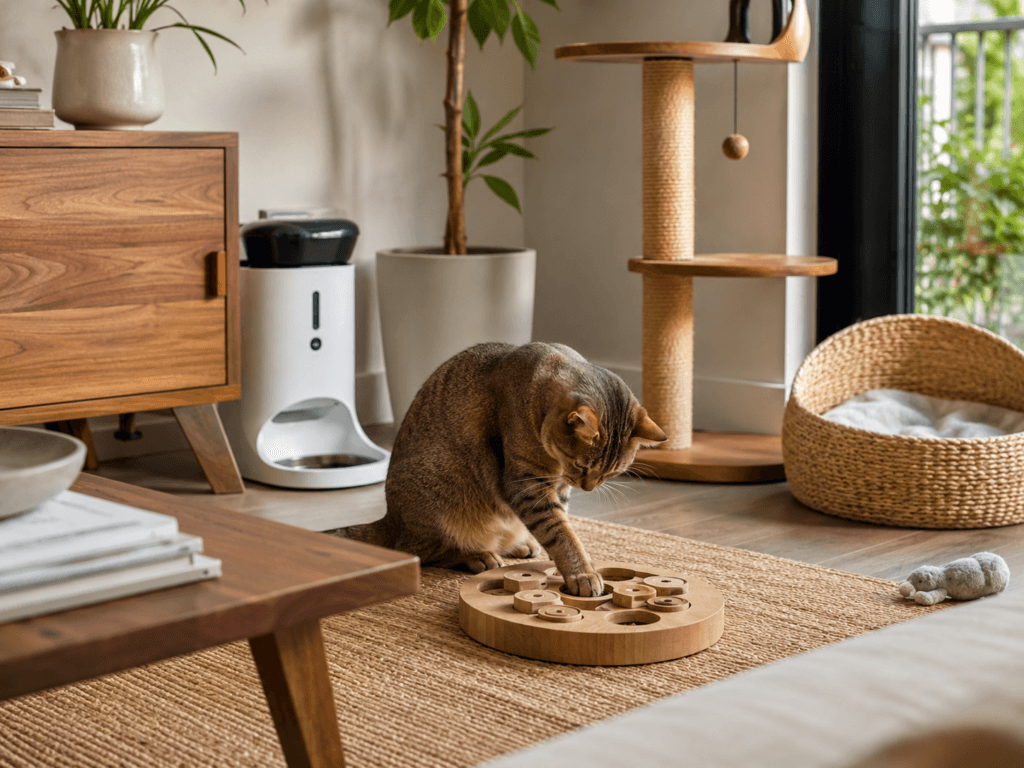
    Cat using a wooden puzzle feeder beside an automatic feeder, cat tree and resting bed
    Puzzle feeding adds searching and problem solving to mealtime, while automation mainly handles portions and schedules. AI-generated editorial illustration.

    A bowl is efficient.

    It is not particularly demanding.

    Food puzzles and simple foraging can encourage manipulation, searching and problem solving. VCA recommends starting with options the cat can successfully operate and ensuring that the full daily food requirement is still consumed.

    Simple options include:

    • an easy puzzle feeder;
    • kibble placed in several small dishes;
    • treats hidden in safe, accessible locations;
    • food moved through a cardboard tube or tray;
    • a slow feeder for cats that eat too rapidly.

    Introduce difficulty gradually. Enrichment should create engagement, not an escape-room franchise between Gerald and his dinner.

    Smart feeders are useful for:

    • portion consistency;
    • scheduled meals;
    • early-morning feeding;
    • separating diets with compatible access control.

    But a feeder dispensing food into the same bowl at the same location remains primarily automation.

    A practical combination is:

    • use automation for schedule and total portions;
    • reserve part of the daily allowance for play, puzzles or foraging.

    Cats that eat poorly, lose weight or have medical dietary needs should not be forced to “work harder” without veterinary guidance.

    Our Best Automatic Cat Feeders guide explains the difference between scheduling, camera monitoring and individual access.

    5. Litter Boxes Are Resources, Not Appliances

    The litter system should be:

    • easy to reach;
    • large enough for comfortable movement;
    • kept acceptably clean;
    • placed away from food and noisy machinery;
    • available without another cat controlling the route.

    A litter box is also a source of behavioral and medical information. Sudden house-soiling, repeated visits, straining or altered elimination should not be dismissed as revenge, stubbornness or artistic criticism of your flooring.

    Smart litter boxes may help by providing:

    • automatic waste separation;
    • visit records;
    • body-weight trends;
    • individual-cat identification on compatible models;
    • additional elimination estimates depending on the system.

    They may harm the setup when:

    • the operating cycle frightens the cat;
    • the entrance is difficult to use;
    • litter compatibility is poor;
    • the unit becomes the only available box;
    • the owner trusts the app more than visible symptoms.

    A smart box should improve an acceptable litter system—not excuse a bad one.

    For model-level decisions, read our Best Smart Litter Boxes guide.

    6. Where Smart Technology Earns Its Place

    Technology is useful when it performs at least one of three jobs:

    It removes repetitive work

    Examples include automatic litter cleaning, scheduled feeding and fountain-maintenance reminders.

    This can indirectly support welfare when reduced workload results in cleaner resources and more consistent routines.

    It controls access

    RFID feeders and selective-entry devices can reduce food theft or protect individual diets.

    This solves a specific household problem rather than merely producing another graph.

    It adds evidence

    Litter visits, body weight, feeding records, location or activity trends can reveal repeated change that might otherwise be difficult to notice.

    The data becomes valuable only when someone reviews it and knows what action it might support.

    Our Smart Cat Monitoring vs Automation guide explains why collecting information and reducing labor are different purchase decisions.

    7. Where Technology Becomes Expensive Clutter

    A device probably does not belong in the home when:

    • it solves no defined problem;
    • the cat avoids it;
    • essential functions depend on unreliable connectivity;
    • maintenance exceeds the work it was meant to remove;
    • several apps duplicate the same vague information;
    • alerts are ignored;
    • the owner expects it to replace observation or interaction.

    The test is simple:

    What will I do differently because this device exists?

    A clear answer may justify the product.

    “No idea, but it has AI” is not a care plan.

    A Seven-Day Indoor Cat Reset

    Day 1: Map the resources

    Locate food, water, litter, scratching, sleeping and hiding areas. Look for narrow routes and heavily contested zones.

    Day 2: Add one safe place

    Use a box, carrier, covered bed or quiet elevated perch where the cat can remain undisturbed.

    Day 3: Separate one bottleneck

    Move one food station, water source or resting space away from a competing resource.

    Day 4: Test one prey-style game

    Try a short wand, ground chase or covered-motion session. Stop while the cat remains interested.

    Day 5: Make part of one meal interactive

    Use an easy puzzle or several small food locations. Confirm that the cat consumes the intended amount.

    Day 6: Observe instead of purchasing

    Watch where the cat rests, hesitates, scratches and changes direction. A household problem often becomes obvious before an app becomes necessary.

    Day 7: Choose one improvement

    Keep the change the cat used. Remove the object everyone ignored. Add technology only when a remaining problem has become specific.

    Warning Signs That Need More Than Enrichment

    Environmental improvement may help with boredom, conflict and routine.

    It should not be used to explain away:

    • sudden litter-box changes;
    • repeated straining or attempts to urinate;
    • appetite loss;
    • unexplained weight change;
    • persistent vomiting or diarrhea;
    • overgrooming or skin injury;
    • new aggression;
    • severe withdrawal;
    • reduced mobility;
    • obvious pain.

    Urinary straining or producing little to no urine can be an emergency, particularly in male cats. Cornell advises prompt veterinary attention for concerning lower urinary tract signs.

    The app may provide useful records.

    It does not get the final vote.

    Final Verdict

    Indoor cat enrichment does not require a fully automated home.

    It requires:

    • safe places;
    • usable territory;
    • separated resources;
    • opportunities to hunt and play;
    • predictable social contact;
    • an acceptable litter setup;
    • observation of the individual cat.

    Technology becomes valuable when it makes one of those systems cleaner, more accessible, more consistent or easier to understand.

    Start with the environment.

    Then buy the device that solves the remaining problem—not the one with the most dramatic product animation.

    Your cat does not need a smart home.

    Your cat needs a home that makes sense.

    Frequently Asked Questions

    How much play does an indoor cat need?

    There is no universal duration. Age, health and play style matter. Several short, successful sessions may work better than one long session the cat abandons.

    Are automatic toys good enrichment?

    They can supplement human-led play, especially during work hours. Choose safe, predictable toys and introduce them gradually.

    Is a smart feeder enrichment?

    Usually it is automation. It becomes more enriching when combined with puzzle feeding, foraging or individual access that solves a genuine problem.

    Does every multi-cat home need duplicate resources?

    Cats should have multiple accessible options, but the exact number and placement depend on household behavior. Focus on reducing competition and blocked access.

    Can enrichment fix inappropriate elimination or aggression?

    Environmental problems can contribute, but sudden or persistent behavior changes may also have medical causes. Veterinary assessment should come before assuming the cat is merely bored.

    References

    • Feline Veterinary Medical Association — Meeting the Physical and Emotional Needs of Indoor Cats
    • AAFP/ISFM — Feline Environmental Needs Guidelines
    • FelineVMA — Intercat Tension Guidelines
    • Cornell Feline Health Center — Safe Toys and Gifts
    • Cornell Feline Health Center — Feline Lower Urinary Tract Disease
    • VCA Animal Hospitals — Enrichment for Indoor Cats
    • VCA Animal Hospitals — Play and Play Toys
    • VCA Animal Hospitals — Working for Food

    Image Disclosure

    Official manufacturer images are used when available and authorized.

    AI-generated images may also be used as editorial illustrations. They should not be treated as exact representations of product dimensions, materials, controls or physical features.

    Editorial Disclosure

    PetTech AI may earn a commission from qualifying purchases. This does not influence our recommendations, comparisons or editorial judgments.
  • Best Cat Toys for Indoor Cats: What to Buy First and What to Skip

    Best Cat Toys for Indoor Cats: What to Buy First and What to Skip

    Baron ignores the motorized toy, attacks the cardboard insert it arrived in, and then falls asleep beside the charger.

    This is normal.

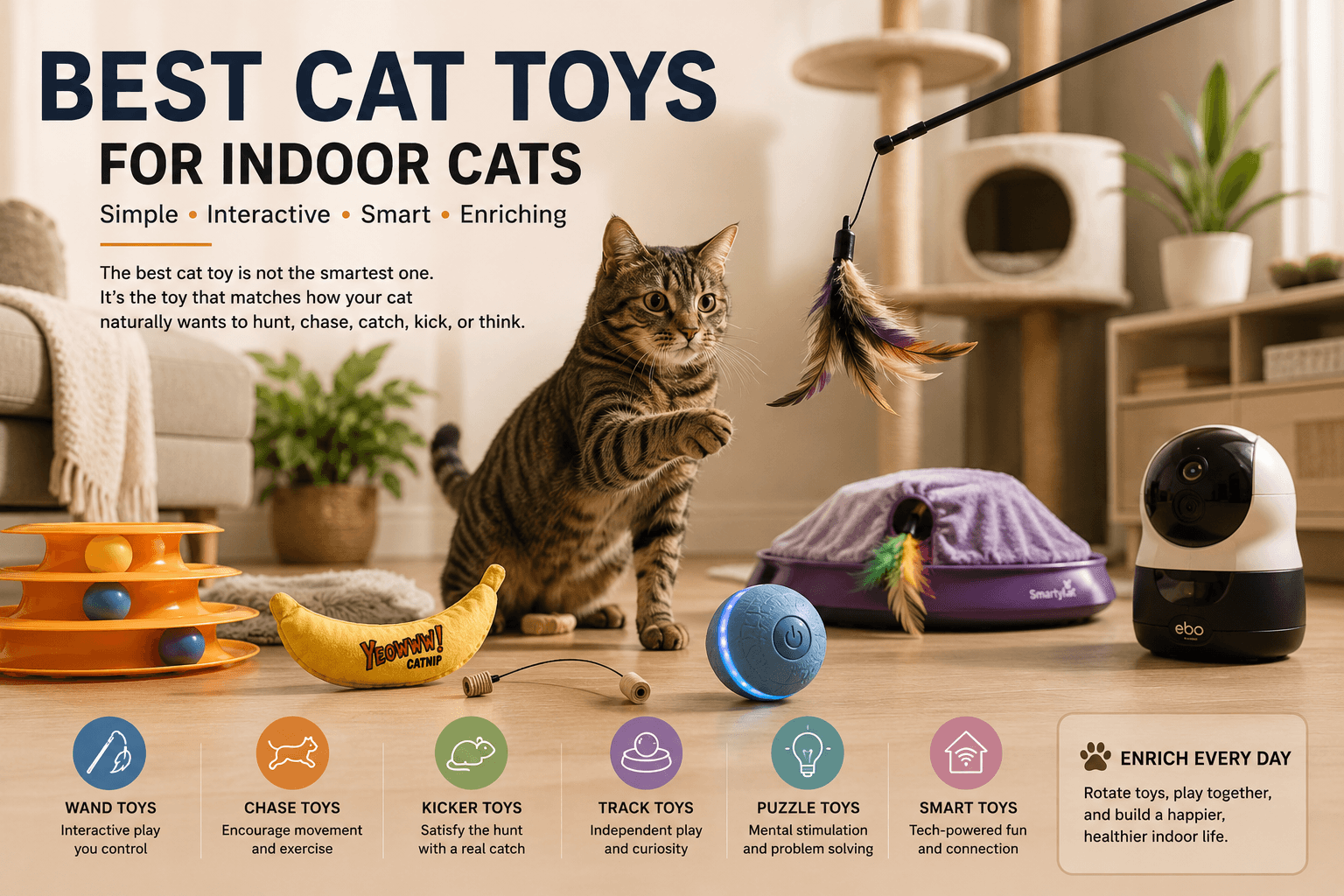
    Cats do not choose toys by feature count. Some want to chase something flying through the air. Some prefer movement hidden under fabric. Others want to bat a ball around a track, grab a soft kicker, or follow something unpredictable across the floor.

    That is why buying cat toys by popularity alone often fails.

    The better question is:

    What kind of play does your cat naturally choose?

    This guide covers simple toys, wand toys, concealed-motion toys, autonomous chase toys, track toys, kicker toys, and one smart-home upgrade for owners who already have the basics covered.

    If you only want motorized or autonomous options, read Best Interactive Cat Toys. This guide is broader: it is about building a toy setup that fits your cat’s instincts, your space, and your daily routine.

    Research Note

    This is a research-led roundup based on current manufacturer information, feline enrichment guidance and product positioning.

    PetTech AI has not conducted long-term hands-on testing of every toy included.

    Quick Verdict

    Best forToyWhy it fitsMain trade-off
    Simple first toyCat Dancer Interactive Cat ToyCheap, light, unpredictable movementSupervision only
    Flying-prey playGoCat Da BirdStrong wand option for jumping and chasingNeeds active play with you
    Stalking and pouncingSmartyKat Hot PursuitHidden movement under fabricNot ideal for heavy fabric chewers
    Autonomous chase playCheerble Wicked Ball M3Short self-directed chase sessionsBetter on open floors
    Passive track playCatstages Chase MeowtainMulti-level ball track for batting and swattingSome cats ignore track toys
    Grabbing and bunny-kickingYeowww! Catnip BananaPhysical catch toy with catnip appealCatnip does not work for every cat
    Smart-home upgradeEnabot EBO SERemote movement, camera, and light interactionNot a foundation toy

    Short verdict:

    • Start with one toy you control.
    • Add one toy your cat can physically catch.
    • Add one self-directed toy for quiet independent play.
    • Add smart toys only after the basics are covered.

    The goal is not to cover the floor with toys.

    The goal is to give your cat better ways to hunt, chase, catch, kick, and think.

    PetTech AI may earn a commission from qualifying purchases. As an Amazon Associate I earn from qualifying purchases.

    What Cat Toys Are Actually For

    Cat toys are not just cute accessories.

    For indoor cats, toys can support movement, cognitive enrichment, and normal predatory-style behavior. A good toy setup gives a cat chances to stalk, chase, pounce, bat, grab, kick, and problem-solve.

    But toys work best as part of a routine.

    A toy cannot fix a stressful multi-cat home by itself. It cannot replace human-led play. It cannot compensate for no climbing space, no scratching options, no hiding places, or sudden changes in behavior that may need veterinary attention.

    Think of toys as one layer of enrichment.

    A stronger indoor setup usually includes:

    • interactive play with you;
    • self-directed toys for short bursts;
    • something the cat can physically catch;
    • scratching surfaces;
    • climbing or hiding options;
    • food puzzles or treat-based enrichment;
    • rotation so toys do not become permanent background clutter.

    For vertical enrichment, see Best Cat Shelves and Climbing Systems.
    For food-motivated cats, see Smart Puzzle Toys for Cats.

    The Best Starter Setup: Three Toy Types Before Anything Else

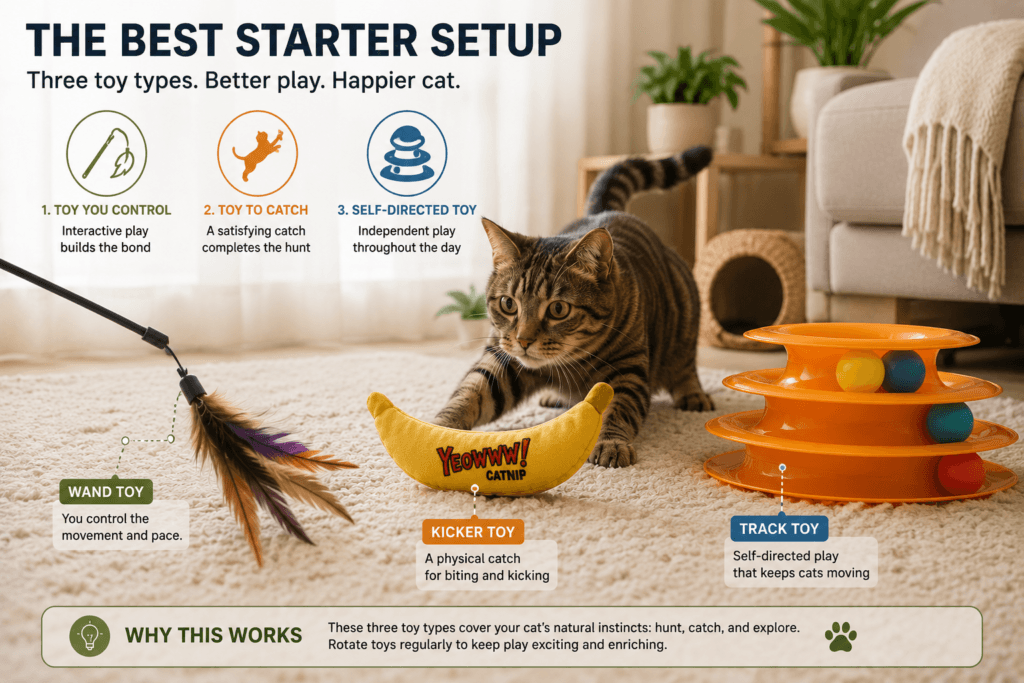
    Indoor cat playing with a starter toy setup including a wand toy, a kicker toy and a passive track toy
    A strong cat toy setup usually starts with three roles: one toy you control, one toy your cat can catch, and one self-directed toy for daily play.

    If you are rebuilding your cat’s toy setup from zero, do not start with ten gadgets.

    Start with three toy roles.

    1. A toy you control

    This can be a wand, wire toy, or feather teaser. The point is that you control the pace.

    You can make the toy fly, pause, hide, escape, slow down, or become catchable. That is difficult for fully automatic toys to do well.

    Best options:

    • Cat Dancer Interactive Cat Toy
    • GoCat Da Bird

    2. A toy your cat can catch

    Cats need a satisfying ending to the play sequence.

    A toy your cat can grab, bite, hold, or bunny-kick helps turn chasing into a complete hunting-style routine.

    Best option:

    • Yeowww! Catnip Banana

    3. A self-directed toy

    This is the toy your cat can return to without needing a full play session from you.

    It should not replace interaction, but it can add low-pressure activity during the day.

    Best options:

    • Catstages Chase Meowtain
    • Cheerble Wicked Ball M3
    • SmartyKat Hot Pursuit

    That basic setup is more useful than a pile of random toys that all solve the same problem.

    Best Simple First Toy: Cat Dancer Interactive Cat Toy

    The Cat Dancer Interactive Cat Toy is almost aggressively simple.

    That is the point.

    It does not need an app, a charger, a motor, lights, or replacement batteries. Its value comes from quick, irregular movement that can make a cat watch, stalk, and strike.

    This is the toy to try when you do not yet know what your cat likes.

    It is especially useful because it tests something basic: does your cat respond to light, prey-like movement when you control the rhythm?

    Choose Cat Dancer if:

    • your cat reacts to quick, jerky movement;
    • you want a low-cost first toy;
    • your cat ignores bulky gadgets;
    • you want short human-led sessions;
    • you need something easy to store.

    Skip it if:

    • your cat chews wire or cardboard aggressively;
    • you need an unsupervised toy;
    • your cat only likes soft plush toys;
    • you want autonomous play while you are away.

    Verdict: Best simple first toy for testing whether your cat responds to unpredictable prey-like movement.

    Check Cat Dancer Interactive Cat Toy on Amazon.

    Best Wand Toy for Flying-Prey Play: GoCat Da Bird

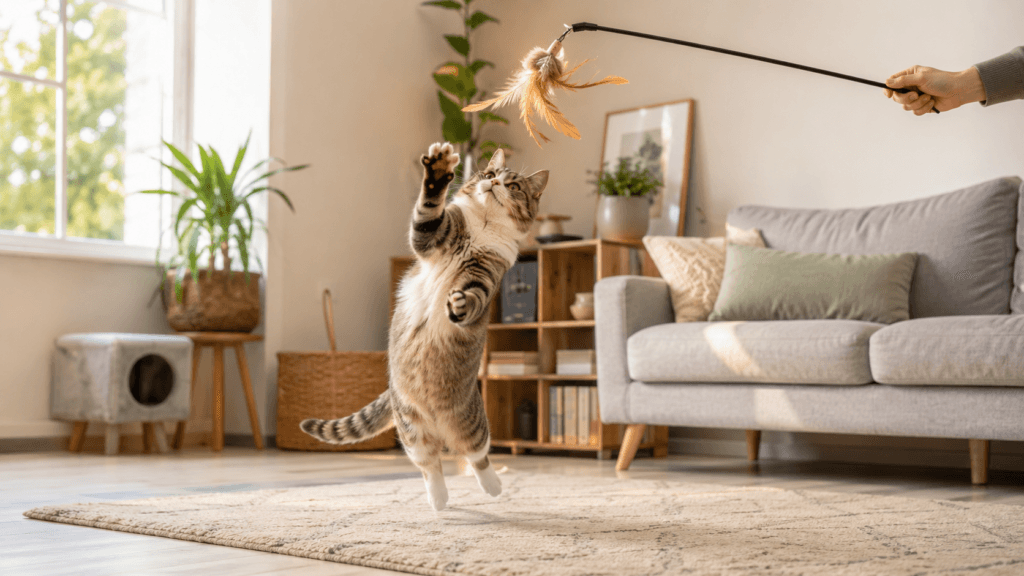
    Indoor cat jumping after a feather wand toy during a flying-prey play session in a living room
    Wand toys work best when they move like prey: flying away, pausing, hiding, reappearing, and finally becoming catchable.

    Some cats are aerial hunters.

    They want to jump, twist, chase, and grab something that behaves more like a bird than a mouse.

    That is where GoCat Da Bird makes more sense than a generic feather toy. Its role is not to sit on the floor. Its role is to create flying-prey movement that you control.

    The key is not to wave it randomly in your cat’s face.

    Move it like prey:

    • fly away;
    • land briefly;
    • pause;
    • disappear behind furniture;
    • reappear;
    • let your cat catch it.

    That final catch matters. The best wand sessions do not leave the cat endlessly chasing something impossible.

    Choose GoCat Da Bird if:

    • your cat watches birds or flying insects;
    • your cat jumps for toys;
    • you want a high-energy play session;
    • your cat needs a better pre-bedtime routine;
    • you want bonding play rather than another autonomous gadget.

    Skip it if:

    • your cat has mobility limitations;
    • you do not have enough clear space;
    • your cat chews feathers aggressively;
    • you need a toy for unsupervised access.

    Verdict: Best wand toy for cats that need flying-prey play, jumping, chasing, and a real catch.

    Check GoCat Da Bird on Amazon.

    Best for Stalking and Pouncing: SmartyKat Hot Pursuit

    Not every cat wants to sprint after a ball.

    Some cats want to wait.

    The SmartyKat Hot Pursuit works because the movement is partially hidden. A wand moves under a fabric cover, creating the feeling that something is moving just out of reach.

    That makes it useful for cats that crouch, stare, stalk, and then pounce.

    This is a different play rhythm from a rolling ball. It is less about running across the room and more about tension, timing, and ambush.

    Choose SmartyKat Hot Pursuit if:

    • your cat likes movement under blankets or rugs;
    • your cat stalks before pouncing;
    • you want a more prey-like motorized toy;
    • you have open floor space;
    • your cat responds to rustling or concealed motion.

    Skip it if:

    • your cat chews fabric or feather pieces;
    • your cat is very noise-sensitive;
    • you want a toy to leave out all day;
    • your cat prefers visible chase play.

    Verdict: Best for cats that enjoy hidden prey, ambush behavior, and pouncing rather than pure floor chase.

    Check SmartyKat Hot Pursuit on Amazon.

    Best Autonomous Chase Toy: Cheerble Wicked Ball M3

    Autonomous toys are useful, but they are easy to overestimate.

    The Cheerble Wicked Ball M3 is best understood as a short-burst chase toy. It is not a replacement for active play with you.

    Its value is simple: it gives your cat something moving to react to when you are working, cooking, or unable to start a play session immediately.

    That makes it useful for cats that already chase moving objects across the floor.

    It is not the right fit for every cat. Some cats prefer stalking. Some dislike motor noise. Some lose interest if the toy moves too predictably. But for movement-driven cats, this can be a useful rotation piece.

    Choose Cheerble Wicked Ball M3 if:

    • your cat chases moving objects;
    • you want brief solo activity;
    • your home has enough open floor space;
    • your cat is not easily frightened by motorized toys;
    • you will rotate it rather than leave it out permanently.

    Skip it if:

    • your cat prefers ambush play;
    • your cat is anxious around moving gadgets;
    • your floors make rolling toys frustrating;
    • you expect it to replace human-led play.

    Verdict: Best autonomous chase toy for cats that respond to rolling movement and short self-directed activity bursts.

    Check Cheerble Wicked Ball M3 on Amazon.

    Best Passive Track Toy: Catstages Chase Meowtain

    The Catstages Chase Meowtain is a better fit for the broad “best cat toys” page than a fragile or unavailable track listing.

    Its role is simple: give cats a multi-level ball track they can bat, swat, and return to without needing you to reset the toy every few minutes.

    This is not the most intense toy in the list. It will not replace a wand session. But it can work well as background enrichment, especially for cats that enjoy pawing at moving objects.

    It can also be useful in multi-cat homes because more than one cat may investigate it without needing to chase the same loose toy around the room.

    Choose Catstages Chase Meowtain if:

    • your cat likes batting balls;
    • you want a passive toy that can stay available;
    • you have more than one cat;
    • you want low-maintenance enrichment;
    • your cat enjoys repeated pawing and tracking.

    Skip it if:

    • your cat ignores ball tracks;
    • your cat needs high-intensity exercise;
    • you already own similar track toys;
    • your cat is only motivated by feathers, food, or catnip.

    Verdict: Best passive track toy for curious cats, kittens, and multi-cat homes that need a simple self-directed play option.

    Check Catstages Chase Meowtain on Amazon.

    Best Catnip Kicker: Yeowww! Catnip Banana

    Some cats do not want to chase.

    They want to grab.

    The Yeowww! Catnip Banana works because it gives cats a physical object to bite, hold, hug, and bunny-kick.

    That matters because a good play routine should include a catch. After a chase, wand, or stalking session, a kicker toy can give the cat a clear physical ending.

    The catnip is part of the appeal, but the shape matters too. A long, curved soft toy is easier for many cats to grab with the front paws and kick with the back legs.

    Choose Yeowww! Catnip Banana if:

    • your cat responds to catnip;
    • your cat grabs and kicks soft toys;
    • you want a simple catch toy;
    • your cat needs a low-tech option;
    • you want something easy to rotate.

    Skip it if:

    • your cat does not react to catnip;
    • your cat destroys fabric quickly;
    • you want motion-based play;
    • your cat prefers food puzzles.

    Verdict: Best low-tech kicker for cats that like grabbing, biting, and bunny-kicking.

    Check Yeowww! Catnip Banana on Amazon.

    Best Smart Upgrade: Enabot EBO SE

    The Enabot EBO SE is not a classic cat toy.

    That is important.

    It should not be treated like a wand, kicker, or track toy. It is better understood as a smart-home upgrade: part mobile pet camera, part remote presence device, part occasional moving object your cat may choose to follow or stalk.

    That makes it more relevant to tech-friendly homes than to owners simply looking for the best first cat toy.

    If your cat already has a healthy play routine, Enabot can add remote observation and light engagement. If your cat does not have the basics covered, start with a wand, kicker, and passive toy first.

    Choose Enabot EBO SE if:

    • you already have the basic toys covered;
    • you travel or work long hours;
    • you want remote pet monitoring;
    • your cat is curious about moving gadgets;
    • you are building a broader smart pet setup.

    Skip it if:

    • you need a first toy;
    • your cat is nervous around robots;
    • you expect it to replace play with you;
    • your budget is better spent on basic enrichment.

    Verdict: Best smart upgrade for owners who want remote movement and pet monitoring after the core toy routine is already in place.

    Check Enabot EBO SE on Amazon.

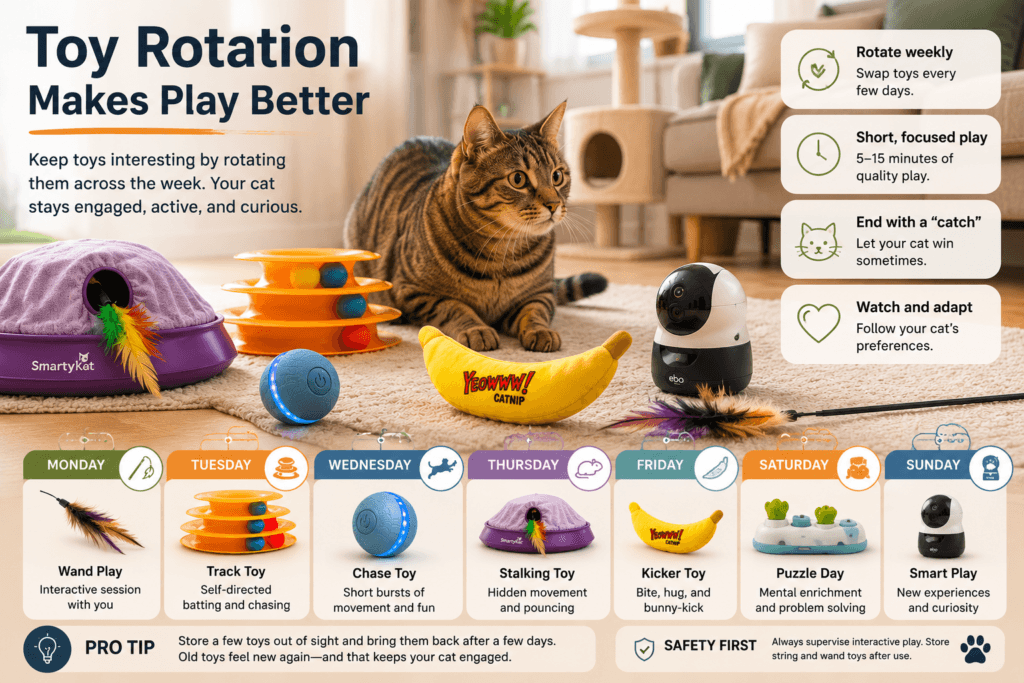
    How to Build a Better Toy Rotation

    Indoor cat enrichment routine with different toys rotated across the week including a ball track, kicker toy, wand toy and smart pet robot
    Toy rotation often matters more than buying more toys. A toy that disappears for a few days can become interesting again when it returns in a new context.

    Toy rotation usually works better than leaving every toy out permanently.

    Cats notice novelty. A toy that sits in the same corner for weeks often becomes furniture. The same toy can become interesting again if it disappears for several days and comes back in a different room or context.

    A simple rotation might look like this:

    For a high-energy indoor cat

    Morning:

    • Cat Dancer or GoCat Da Bird for 5–10 minutes.

    Daytime:

    • Cheerble Wicked Ball M3 for a short autonomous chase session.

    Evening:

    • SmartyKat Hot Pursuit or another supervised play session.

    End:

    • Yeowww! Catnip Banana as the final catch.

    For a quieter cat

    Morning or evening:

    • Short Cat Dancer session.

    During the day:

    • Catstages Chase Meowtain left available.

    Alternate days:

    • Food puzzle or treat-based enrichment.

    End of play:

    • Kicker toy or soft catch toy.

    For a multi-cat home

    Do not assume one toy will satisfy every cat.

    Use more than one play zone. Let timid cats play away from more intense cats. Avoid turning every play session into a competition. Give each cat a chance to catch something.

    For feeding routines that pair well with enrichment, see Best Automatic Cat Feeders.

    Safety: What to Check Before and After Play

    A good toy is not useful if it becomes a hazard.

    Inspect toys regularly, especially if your cat chews, shreds, or swallows pieces.

    Remove or replace toys with:

    • loose string;
    • broken plastic;
    • detached feathers;
    • exposed wire;
    • damaged fabric;
    • open seams;
    • accessible batteries;
    • small pieces your cat may swallow.

    Use extra caution with wand toys, string toys, feather toys, motorized toys, and plush toys that your cat can rip open.

    Store risky toys after supervised play.

    Leave out only toys you are comfortable having available when you are not watching.

    Also pay attention to your cat’s reaction. If a toy causes hiding, fear, aggression, obsessive fixation, or frustration, pause and change the setup.

    A toy should create healthy engagement, not stress.

    When a Toy Is Not the Right Answer

    Sometimes a cat is not simply bored.

    They may be stressed, under-stimulated, in pain, frustrated by another cat, or uninterested in the type of play you are offering.

    Slow down if your cat:

    • suddenly stops playing;
    • hides when toys start moving;
    • becomes tense or aggressive;
    • fixates without settling;
    • guards toys from other cats;
    • shows changes in appetite, litter-box use, grooming, or mobility.

    A new toy is not a behavioral diagnosis.

    If behavior changes suddenly or persists, especially alongside eating, drinking, litter-box, grooming, or movement changes, contact a veterinarian.

    Final Verdict: What Should You Buy First?

    If you want the simplest useful starter kit, buy:

    • one toy you control;
    • one toy your cat can physically catch;
    • one self-directed toy.

    For most cats, that is more useful than buying a pile of similar gadgets.

    Choose Cat Dancer Interactive Cat Toy if you want the cheapest high-impact first toy.

    Choose GoCat Da Bird if your cat loves flying-prey play and jumping.

    Choose SmartyKat Hot Pursuit if your cat likes stalking hidden movement.

    Choose Cheerble Wicked Ball M3 if your cat chases moving objects across the floor.

    Choose Catstages Chase Meowtain if you want passive track play for one or more cats.

    Choose Yeowww! Catnip Banana if your cat likes grabbing and bunny-kicking.

    Choose Enabot EBO SE only as a smart upgrade after the basics are already covered.

    The best cat toy is not the fanciest one.

    It is the one that makes your cat move, think, catch, and come back again tomorrow.

    Frequently Asked Questions

    What is the best cat toy overall?

    For most cats, the best first toy is a simple toy that lets you control prey-like movement. Cat Dancer is a strong low-cost starting point, while GoCat Da Bird is better for cats that like jumping and flying-prey play.

    How many cat toys does an indoor cat need?

    Most cats do not need dozens of toys. A better starting point is one controlled toy, one catch or kicker toy, and one self-directed toy such as a track, ball, or puzzle feeder.

    Are smart cat toys better than normal toys?

    Not usually. Smart toys can help, but they should not replace human-led play. Many cats still respond best to simple toys that move like prey and allow them to catch something.

    Should I leave cat toys out all day?

    Leave out only safe, durable toys that do not include strings, loose pieces, accessible batteries, or parts your cat may swallow. Store wand toys, string toys, feather toys, and fragile motorized toys after supervised sessions.

    What if my cat ignores every toy?

    Try a different play category before assuming your cat does not like toys. Some cats prefer flying prey, others prefer floor movement, hidden motion, soft kickers, food puzzles, or very quiet toys.

    Are laser toys necessary?

    No. Laser toys are optional and can frustrate some cats if there is never anything physical to catch. This guide focuses on toys that give the cat more direct physical engagement.

    Is Enabot EBO SE really a cat toy?

    Not exactly. It is better described as a smart pet camera robot that may also create light movement-based engagement. It is an upgrade for tech-friendly homes, not a foundation toy.

    References

    Cornell Feline Health Center — safe toys, exercise, cognitive enrichment, and toy safety.

    AAFP / ISFM Feline Environmental Needs Guidelines — environmental needs, play, predatory behavior, and multi-cat resource distribution.

    VCA Animal Hospitals — cat play, prey-like movement, and enrichment for indoor cats.

    Cat Dancer — Interactive Cat Toy product information.

    GoCat — Da Bird Rod and Feather Cat Toy product information.

    SmartyKat — Hot Pursuit concealed-motion toy information.

    Cheerble — Wicked Ball M3 product information.

    Catstages — Chase Meowtain product information.

    Yeowww! — Chi-CAT-a Banana product information.

    Enabot — EBO SE product information.

    Image Disclosure

    Some images in this article may be created with AI for illustrative purposes. They do not show the exact products reviewed and should not be used to evaluate product size, fit, design, or features. Always check the current official product listing before purchasing.

    Editorial Disclosure

    PetTech AI may earn a commission from qualifying purchases. This does not influence our recommendations, comparisons or editorial judgments.
  • Best Interactive Cat Toys (2026): 4 That Won’t Become Floor Clutter

    Best Interactive Cat Toys (2026): 4 That Won’t Become Floor Clutter

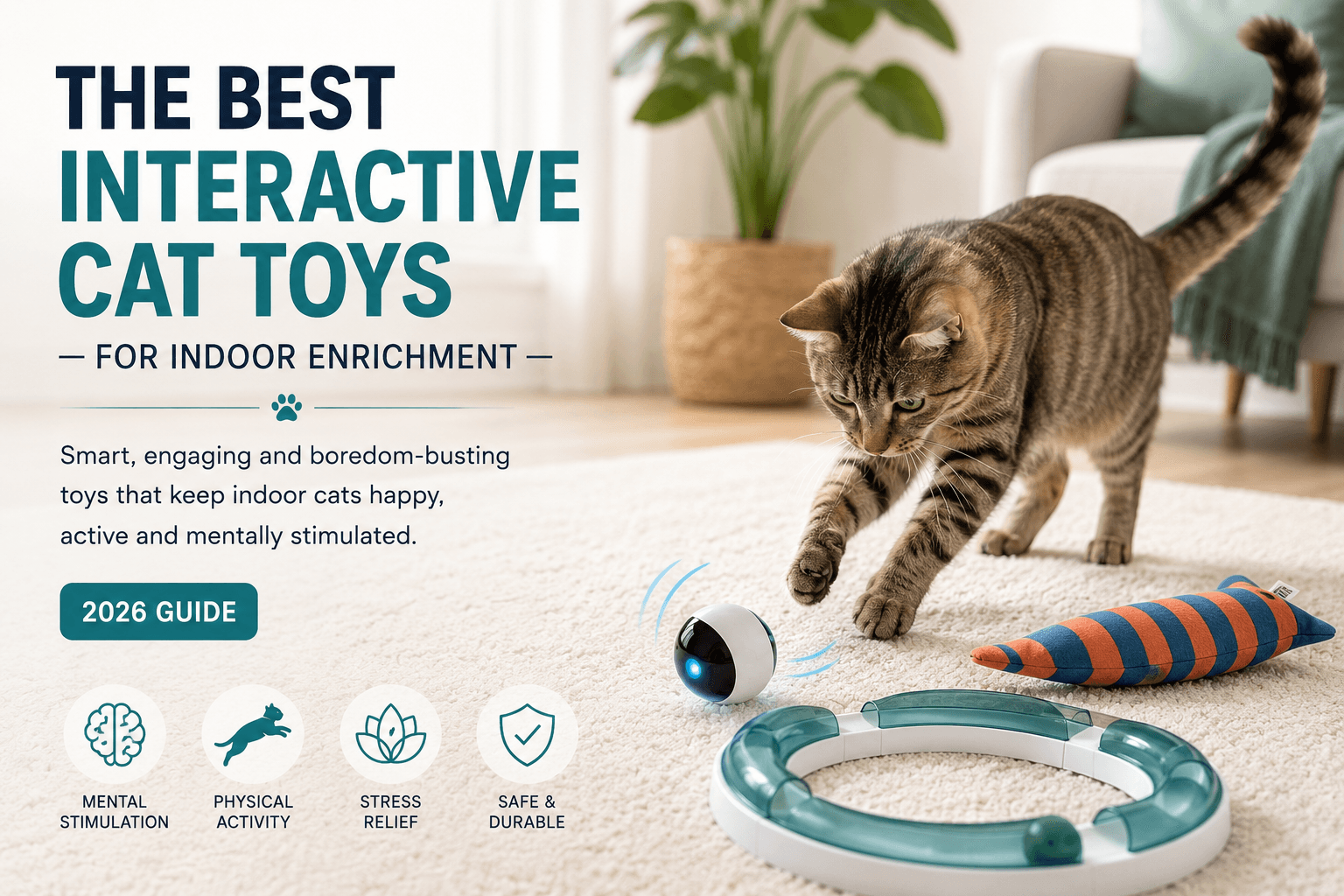
    The best interactive cat toy is not necessarily the one with the most lights, modes, or moving parts.

    Baron may ignore the rechargeable smart ball, attack the cardboard insert it arrived in, and then fall asleep beside the charger.

    That is not proof that cats hate technology.

    It is proof that buying toys by feature count is a reliable way to misunderstand the customer.

    It is the toy that matches how your cat actually wants to play.

    Some cats want to stalk and pounce on hidden “prey.” Others prefer to chase something rolling across the floor, grab and kick a soft toy, or bat at a quieter enclosed track. The goal is not to leave one gadget running all day. It is to create short, varied opportunities for movement, hunting-style play, and novelty.

    If you are still building the basics, start with our broader guide to the best cat toys for indoor cats. This article focuses specifically on interactive, motion-based, and self-directed toys.

    That matters especially for indoor cats. Toys can support exercise and cognitive enrichment by encouraging stalking, pouncing, chasing, and problem-solving—but they work best as part of a routine, not as a substitute for human interaction or a cat-friendly environment.

    This guide focuses on four distinct types of interactive play:

    • Cheerble Wicked Ball M3 for short autonomous chase sessions.
    • SmartyKat Hot Pursuit for ambush-and-pounce play.
    • Catit Senses 2.0 Play Circuit for quiet enclosed-track batting.
    • Potaroma Flopping Fish for cats that enjoy grabbing and kicking their “prey.”

    Research Note

    This is a research-led roundup based on current manufacturer information, feline enrichment guidance and product positioning.

    PetTech AI has not conducted long-term hands-on testing of every toy included.

    Quick Verdict: Which Interactive Cat Toy Fits Your Cat?

    Best forToyWhat it does bestMain trade-off
    Autonomous chase playCheerble Wicked Ball M3Moving ball with multiple play modes and built-in play/rest cyclesWorks best as a short activity, not all-day enrichment
    Stalking and pouncingSmartyKat Hot PursuitHidden wand movement under fabric that imitates concealed preyNeeds floor space and occasional inspection of the cover and wand
    Quiet batting and chaseCatit Senses 2.0 Play CircuitEnclosed ball track for lower-noise, self-directed playNot every cat finds track toys exciting
    Grabbing and bunny-kickingPotaroma Flopping FishMotion-activated soft “prey” for cats that like wrestling toysSome timid cats may dislike the motor noise at first

    What Interactive Toys Can—and Cannot—Do

    Interactive toys can help create opportunities for movement and predatory-style behavior. But they do not replace everything a cat needs.

    A motorized toy cannot replace daily interaction with you. It cannot fix a stressful multi-cat environment by itself. And it should not be left available indefinitely if it contains moving parts, fabric, strings, feathers, or components your cat may chew.

    The strongest setup is usually a rotation:

    • one autonomous toy for brief solo activity;
    • one toy that supports stalking or pouncing;
    • one physical “catch” or kicker toy;
    • regular human-led play sessions;
    • puzzle feeding or climbing enrichment when the cat needs more than movement.

    Feline behavior guidance emphasizes that cats need opportunities to play and express predatory behavior, while also being able to “catch” prey intermittently rather than being left in endless frustration.

    PetTech AI may earn a commission from qualifying purchases. As an Amazon Associate I earn from qualifying purchases.

    How to Choose an Interactive Cat Toy

    1. Match the toy to your cat’s play style

    Watch what your cat already does.

    Do they stare at moving objects and wait to ambush? Do they chase things down hallways? Do they grab soft toys and kick with their back legs? Do they bat at objects but avoid noisy movement?

    That gives you a better starting point than buying the most popular toy on Amazon.

    Your cat’s usual play styleBest starting category
    Chases movement across the floorAutonomous rolling toy
    Hides, stalks, then pouncesConcealed-prey toy
    Bats and pokes without intense runningEnclosed track toy
    Grabs, wrestles, and bunny-kicksSoft motion-activated kicker
    Solves food puzzles more than chasingPuzzle feeder, not another motion toy

    For food-motivated cats, see our Smart Puzzle Toys for Cats guide.

    2. Use autonomous toys as support—not a babysitter

    A self-moving ball can fill a short gap when you are working, cooking, or unable to start a play session immediately.

    But it is not a replacement for interaction.

    The useful question is not “Will my cat play alone for an hour?” It is “Will this create a few good bursts of movement that I can rotate with other forms of play?”

    3. Keep novelty alive with rotation

    Leave every toy on the floor permanently and most cats will eventually stop noticing it.

    Try a simple rotation:

    • keep one or two toys accessible;
    • store the rest for several days;
    • bring back a toy after a short break;
    • change the room or surface where you use it;
    • end active sessions with something your cat can physically catch.

    Small changes often matter more than buying a large pile of similar toys.

    4. Choose safety and supervision over features

    Inspect toys regularly.

    Remove damaged fabric, loose feathers, exposed wires, frayed strings, cracked plastic, or any component your cat might swallow. Store wand-style and string toys after supervised sessions. Cornell specifically recommends choosing toys carefully and checking for potential hazards.

    Best for Autonomous Chase Play: Cheerble Wicked Ball M3

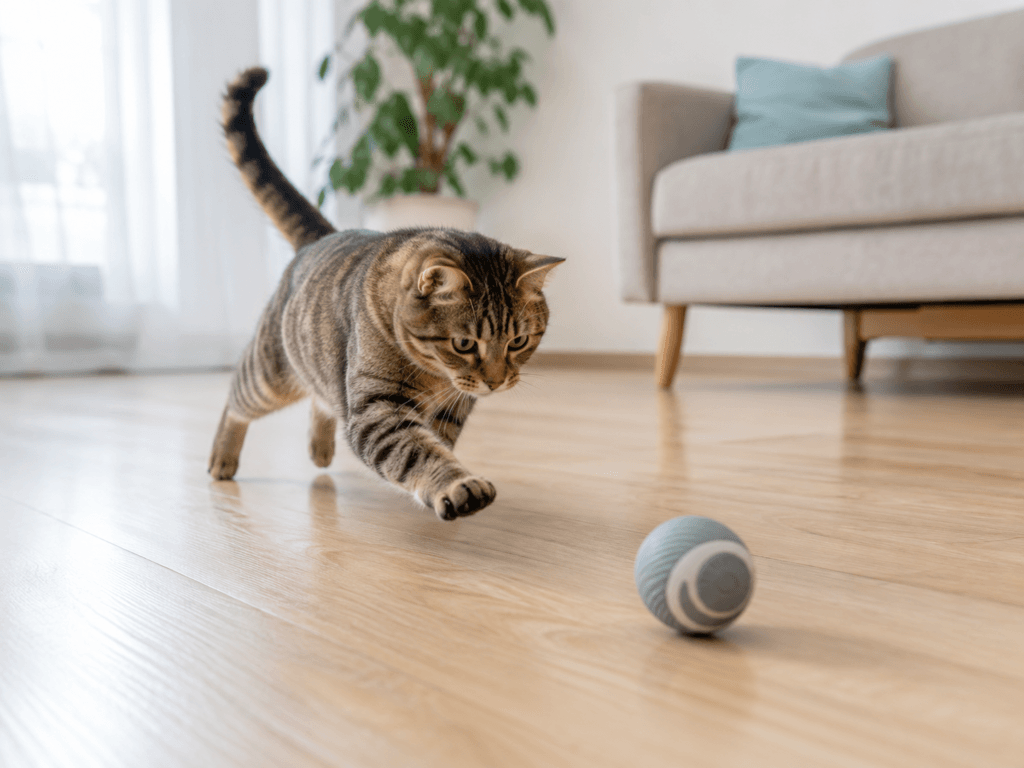
    A cat chasing a small moving rolling toy across a light wood floor in a bright living room
    Autonomous rolling toys work best as short bursts of chase play—not as an all-day replacement for interaction.

    The Cheerble Wicked Ball M3 is the best option for cats that enjoy chasing unpredictable movement across the floor.

    It is not a wand toy and it is not a puzzle feeder. Its role is simple: create short bursts of rolling, bouncing, and moving “prey” behavior that can encourage a cat to chase, paw, and re-engage.

    Cheerble describes the M3 as a cat-focused interactive ball with three play modes and a built-in play/rest cycle. After 10 minutes of activity, it enters a 30-minute rest period unless the cat reactivates it with a nudge.

    Why it stands out

    The M3 has a clear use case:

    It gives an energetic indoor cat something to chase when you cannot immediately initiate a play session.

    That makes it useful for homes where a cat becomes active at predictable times—before work, during a busy afternoon, or in the early evening.

    The play/rest cycle is also more sensible than a toy designed to keep moving without interruption. A good autonomous toy should create activity, then allow the cat to disengage.

    Choose Wicked Ball M3 if:

    • Your cat already chases balls, bugs, or moving objects.
    • You want short autonomous bursts of activity.
    • Your home has mostly hard floors or low-pile rugs.
    • You want a rechargeable interactive toy.
    • You plan to rotate it with other toys and human-led play.

    It may not be the best fit if:

    • Your cat is very noise-sensitive.
    • Your cat prefers ambush play over chasing.
    • Your floors are thick carpet or highly uneven.
    • You want a toy that replaces active play with you.

    Verdict: Conditional Recommendation — a useful short-burst chase toy for cats already attracted to floor movement, but not a substitute for active play or a sensible purchase for noise-sensitive cats.

    Check Cheerble Wicked Ball M3 on Amazon

    Best for Stalking and Pouncing: SmartyKat Hot Pursuit

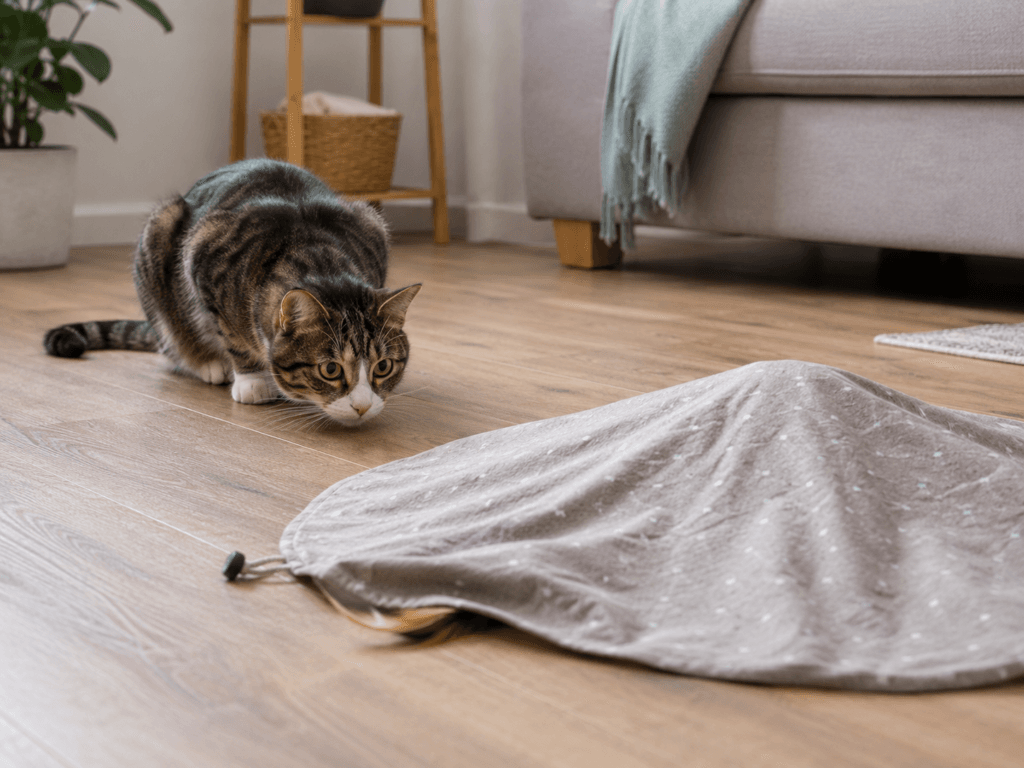
    A cat crouching and watching concealed movement beneath a fabric interactive toy in a quiet room
    Concealed-prey toys give cats time to watch, stalk, and choose when to pounce.

    The SmartyKat Hot Pursuit is the best choice for cats that prefer hidden prey over visible toys.

    A wand moves unpredictably beneath a fabric cover, creating the feeling that something is moving just out of reach. That makes it better suited to cats that crouch, watch, stalk, and then pounce rather than cats that only want to chase a rolling ball.

    SmartyKat describes Hot Pursuit as an electronic concealed-motion toy with a feathered wand moving beneath crinkly fabric, two speed controls, lights, and a teasing feather tail.

    Why it stands out

    This toy creates a different emotional rhythm from an autonomous ball.

    The cat can watch, wait, listen, and choose when to strike. That makes Hot Pursuit a strong option for cats with a noticeable ambush instinct.

    It also works well as a short supervised play ritual before dinner or bedtime.

    Choose Hot Pursuit if:

    • Your cat likes hiding, stalking, and pouncing.
    • They respond to rustling fabric or concealed movement.
    • You have enough open floor space for the toy.
    • You want a more prey-like alternative to a simple ball.
    • You are willing to inspect the cover and wand periodically.

    It may not be the best fit if:

    • Your cat gets overstimulated easily.
    • Your cat chews fabric or feathered components.
    • You need a quiet toy for late-night use.
    • You want an option for unsupervised all-day access.

    Verdict: Recommended with Conditions — one of the stronger options for ambush-driven cats, provided fabric chewing, motor noise, and supervised inspection are not problems.

    Check SmartyKat Hot Pursuit on Amazon

    Best Quiet Enclosed-Track Toy: Catit Senses 2.0 Play Circuit

    The Catit Senses 2.0 Play Circuit is the best choice for cats that enjoy batting, poking, and following movement without a loud motorized toy.

    Instead of exposing the ball fully, the circuit keeps it partially enclosed. Your cat can hear it, see it through openings, and reach in with a paw—but cannot simply carry it away under the sofa.

    Catit lists the Play Circuit as part of its Senses Circuits range, designed for modular layouts and compatible with other circuit components. The system is intended to stimulate cats through chasing and pawing at a moving ball inside the track.

    Why it stands out

    This is not an “automatic” toy in the same sense as Wicked Ball M3.

    It is quieter, simpler, and more self-paced.

    That makes it useful for:

    • cats that bat rather than sprint;
    • apartments where loud motorized toys are irritating;
    • quieter evening play;
    • cats that prefer controlled movement;
    • homes where a toy needs to be easy to wipe down and reset.

    Choose the Catit Play Circuit if:

    • Your cat likes pawing at objects through openings.
    • You want a lower-noise alternative to motorized toys.
    • You prefer a toy without charging or frequent batteries.
    • Your cat enjoys predictable but still partially hidden movement.
    • You may later expand into compatible Catit circuit components.

    It may not be the best fit if:

    • Your cat ignores balls or track toys.
    • You want intense running and jumping.
    • Your cat is only motivated by feathers, scents, or food.
    • You want fully autonomous movement without needing to start the ball.

    Verdict: Recommended — the safest low-complexity choice in this roundup for cats that enjoy batting and partially hidden movement. Cats that ignore tracks will regard it as decorative plumbing.

    Check Catit Senses 2.0 Play Circuit on Amazon

    Best for Kicking and Wrestling: Potaroma Flopping Fish

    The Potaroma Flopping Fish is for cats whose version of play is not “chase it across the floor” but “grab it, bite it, and kick it with both back legs.”

    That is a different play pattern, and it deserves a different kind of toy.

    Potaroma’s flopping fish combines a soft plush body with motion-activated movement and catnip or silvervine enrichment. The toy is designed to react when touched, creating a physical object for a cat to wrestle instead of only watching something move.

    Why it stands out

    The Flopping Fish works best as a “catch” toy.

    After a short chase or stalking session, a cat can grab and kick it, which gives the play sequence a physical ending. This is particularly useful for cats that enjoy kicker toys, soft plush prey, or catnip/silvervine stimulation.

    Choose Potaroma Flopping Fish if:

    • Your cat grabs and bunny-kicks plush toys.
    • Your cat responds to catnip or silvervine.
    • You want a soft, physical toy to use after chase play.
    • Your cat prefers wrestling over chasing a small ball.
    • You want a rechargeable motion toy with a simpler role than a smart app-controlled device.

    It may not be the best fit if:

    • Your cat is frightened by vibration or motor noise.
    • Your cat is not interested in soft toys.
    • Your cat chews or destroys plush fabric quickly.
    • You are looking for a solo puzzle or food-enrichment toy.

    Verdict: Conditional Recommendation — worth considering for cats that already wrestle soft kickers, but easy to overestimate when the cat dislikes vibration, motor noise, or plush prey.

    Check Potaroma Flopping Fish on Amazon

    Build a Better Toy Rotation

    A cat batting at an enclosed track toy while a soft kicker toy rests nearby in a tidy indoor play area
    Toy rotation works better than leaving every toy out permanently: vary chase, batting, and physical catch play across the week.

    A good toy rotation is more useful than six toys left permanently on the floor.

    Try this basic setup:

    For a high-energy indoor cat

    • Cheerble Wicked Ball M3 for brief autonomous movement.
    • SmartyKat Hot Pursuit for a supervised stalk-and-pounce session.
    • Potaroma Flopping Fish as a final physical “catch.”

    For a quieter cat or apartment setup

    • Catit Play Circuit for calm batting and chasing.
    • A short wand session with you.
    • A puzzle feeder or treat toy on alternate days.

    For food routines that can complement treat-based enrichment without turning every activity into free feeding, see our Best Automatic Cat Feeders guide.

    For a multi-cat home

    Do not assume one toy will keep every cat happy.

    Use more than one play zone, avoid forcing timid cats to compete with highly energetic cats, and give cats room to disengage. Feline environmental guidance recommends dispersing key resources and play opportunities throughout the home, particularly in multi-cat environments.

    For broader enrichment beyond floor-level toys, see our Best Cat Shelves and Climbing Systems guide.

    When a Toy Is Not the Right Answer

    Sometimes a cat is not “bored.”

    They may be under-stimulated, stressed, frightened, frustrated by another cat, in pain, or simply uninterested in the type of play you are offering.

    Slow down if your cat:

    • hides when the toy starts;
    • becomes tense, vocal, or aggressive;
    • fixates on a laser or moving toy without settling;
    • starts guarding toys from other cats;
    • suddenly loses interest in play despite normally enjoying it.

    A new toy is not a behavioral diagnosis.

    If there is a persistent or sudden behavior change, especially alongside appetite, litter-box, mobility, or grooming changes, speak with a veterinarian.

    For food-motivated enrichment and slower, quieter mental work, see our Smart Puzzle Toys for Cats guide. For camera-based observation and remote check-ins, see our Smart Cat Cameras guide.

    Frequently Asked Questions

    Are interactive toys good for indoor cats?

    They can be useful because they create opportunities for movement, hunting-style play, and cognitive enrichment. The best result usually comes from short, varied play sessions and toy rotation rather than leaving one toy available all the time.

    How long should a cat play each day?

    Short, repeated play sessions are often more realistic than one long session. Adjust their frequency and duration to your cat’s age, mobility, interest, and tolerance.

    Should I leave motorized toys out all day?

    Usually, no. Rotate them, inspect them for wear, and store toys with parts your cat might chew or pull apart. Autonomous toys work best as occasional activity, not permanent furniture.

    Can interactive toys replace playing with my cat?

    No.

    They can support your routine, but human-led play gives you more control over pace, intensity, and whether your cat gets a satisfying “catch.”

    What if my cat ignores a new toy?

    Try a different play style rather than buying more of the same category. A cat that ignores a rolling ball may love hidden prey, a kicker, a track toy, or food-based enrichment instead.

    Final Verdict

    The best interactive cat toy is the one that matches your cat’s natural play style.

    Choose the Cheerble Wicked Ball M3 for short autonomous chase sessions.

    Choose SmartyKat Hot Pursuit for stalking, watching, and pouncing on concealed prey.

    Choose the Catit Senses 2.0 Play Circuit for quieter enclosed-track batting and chase play.

    Choose the Potaroma Flopping Fish for cats that prefer to grab, bite, and bunny-kick their toy.

    PetTech AI’s default recommendation is Catit for quieter batting play and SmartyKat for stalking-driven cats. Choose Cheerble only when your cat already chases floor movement, and choose Potaroma only when grabbing and wrestling are established preferences.

    None of these is the universal “best” interactive toy. The safest purchase is the one based on behavior your cat already shows—not behavior the product page promises to unlock.

    The real goal is not to automate play.

    It is to make your cat’s everyday environment more varied, more active, and more rewarding.

    References

    • Cornell Feline Health Center — safe toys, exercise, cognitive enrichment, and toy safety
    • Feline Veterinary Medical Association — environmental needs, play, predatory behavior, and multi-cat resource distribution
    • Cheerble — Wicked Ball M3 play modes and play/rest balance
    • SmartyKat — Hot Pursuit concealed-motion toy specifications
    • Catit — Senses Play Circuit system and circuit compatibility
    • Potaroma — Flopping Fish interactive plush toy specifications

    Image Disclosure

    Some images in this article may be created with AI for illustrative purposes. They do not show the exact products reviewed and should not be used to evaluate product size, fit, design, or features. Always check the current official product listing before purchasing.

    Disclosure

    PetTech AI may earn a commission from qualifying purchases. This does not influence our recommendations, comparisons or editorial judgments.