

Smart feeders are marketed as a fix for feline obesity: measurable portions, scheduled meals, fewer “accidental” refills. In theory, automation removes the human from the equation—and therefore removes the problem.
In real homes, smart feeders don’t reduce obesity by default. They either enforce discipline or quietly automate the same overfeeding habits that caused weight gain in the first place. The device doesn’t decide anything. The setup does.
Cornell’s Feline Health Center is blunt about the basics: obesity is common, weight-loss should be gradual, and crash dieting can be dangerous (including risk of hepatic lipidosis). Cornell Vet College That matters because “tech fixes” often encourage people to move fast, restrict hard, and assume the feeder can do the thinking.
It can’t.
Cat obesity isn’t a “willpower” issue — it’s an environment issue
If you zoom out, obesity usually happens when food becomes:
- always available (free feeding)
- emotionally deployed (“he seems sad, I’ll give him something”)
- the main daily stimulation in an under-enriched indoor life
The AAFP/ISFM Feline Environmental Needs Guidelines make a foundational point: a cat’s comfort with its environment is intrinsically linked to physical health, emotional wellbeing, and behavior—and addressing environmental needs is essential, not optional. PubMed Feeding is not just nutrition; it’s a core resource within that environment.
If the environment pushes a cat toward food-seeking, a feeder won’t “fix” it—unless it changes the environment’s rules.
Understanding Body Condition Score (BCS) in Cats
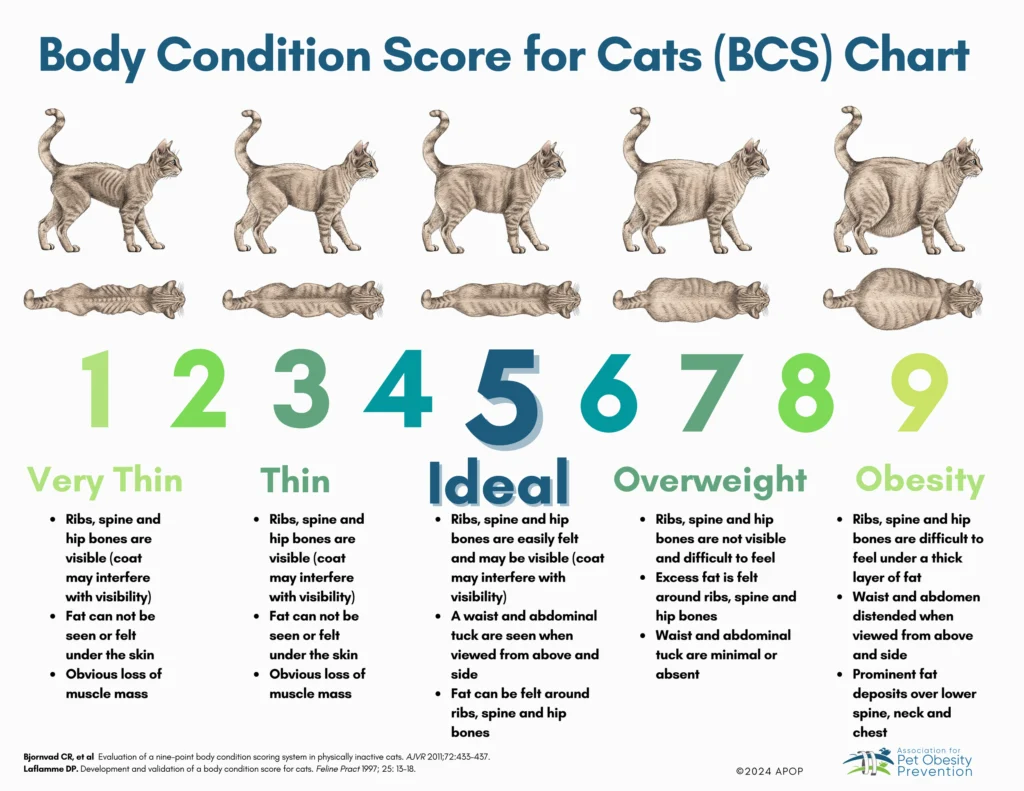
Before changing feeding methods or cutting calories, it’s essential to establish whether a cat is actually overweight. The most widely used clinical tool for this is the Body Condition Score (BCS), a visual and hands-on scale that evaluates body fat rather than relying on weight alone.
Veterinary guidelines typically use a 9-point BCS scale, where:
- BCS 4–5 is considered ideal
- BCS 6–7 indicates overweight
- BCS 8–9 reflects obesity
A cat at an ideal BCS has a visible waist when viewed from above, minimal abdominal fat, and ribs that can be felt easily under a light fat layer. As BCS increases, the waist disappears, fat pads become more pronounced, and mobility often declines—even before weight gain looks “dramatic.”
According to guidance from the Cornell Feline Health Center, BCS is a more reliable indicator of health risk than body weight alone, especially in indoor cats with low activity levels. While BCS is not a medical diagnosis, it provides a practical reference point for deciding whether feeding routines and portion sizes need adjustment—and how urgently.
The only mechanism by which smart feeders help: predictability + portion control
Smart feeders reduce obesity only when they do two things consistently:
- Lock in portions
- Lock in timing
That’s it. Everything else (app controls, cameras, voice prompts) is secondary.
Why this works:
- Portions reduce silent calorie creep.
- Predictable timing reduces constant grazing and can reduce “learned begging” in many households.
Cornell’s feeding guidance emphasizes the risks tied to overweight and obesity, and frames weight management as a practical, measured process—not a quick reset. Cornell Vet College A feeder that delivers consistent portions can support that process if the numbers are correct.
But “consistent” isn’t the same as “correct.”
A perfectly consistent wrong setting is how obesity gets automated.
The quiet failure mode: smart feeders make it easier to overfeed without noticing
This is the part the industry doesn’t like to talk about.
Smart feeders can hide overfeeding because they:
- remove the physical act of scooping (your brain stops tracking quantity)
- make “just a little more” a button press
- encourage micro-feeding that feels harmless but adds up
When obesity persists in a smart-feeder home, it’s usually one of these:
1) Portion math is wrong
People program by “cups” or “scoops” instead of calories. Then they wonder why nothing changes.
2) The app becomes a treat dispenser
Random “bonus” feeds train food obsession and inflate intake.
3) Household discipline collapses
One person uses the feeder schedule. Another overrides it “sometimes.” The cat learns the system is negotiable.
Automation doesn’t stop inconsistency. It makes it easier to be inconsistent more often.
Free feeding vs scheduled feeding: the obesity hinge point

Free feeding is one of the most common patterns linked to weight gain in cats—especially when dry food is available all day. Cornell’s obesity guidance discusses free-feeding as a major factor behind feline obesity and pushes measured, veterinarian-guided plans. Cornell Vet College
Scheduled feeding changes the control surface:
- you can measure intake
- you can notice changes earlier
- you can actually implement a weight plan
A feeder supports scheduled feeding well—if you don’t sabotage it.
“But my cat acts starving”: hunger vs food arousal
This is where most owners get played.
Many cats show intense pre-meal behaviors:
- vocalizing
- pacing
- hovering near the feeder
- increased reactivity
That behavior isn’t proof the cat needs more calories. It’s proof the cat has learned a high-reward pattern.
If you respond to that arousal by dispensing extra food, you train:
- more arousal
- more persistence
- more food obsession
The AAFP/ISFM framework and resource-based environmental models emphasize predictable, separated key resources and the importance of giving cats control and stability. SAGE Journals Food becomes a problem when it’s the only consistent “event” in the home.
Multi-cat homes: obesity often comes from competition, not appetite
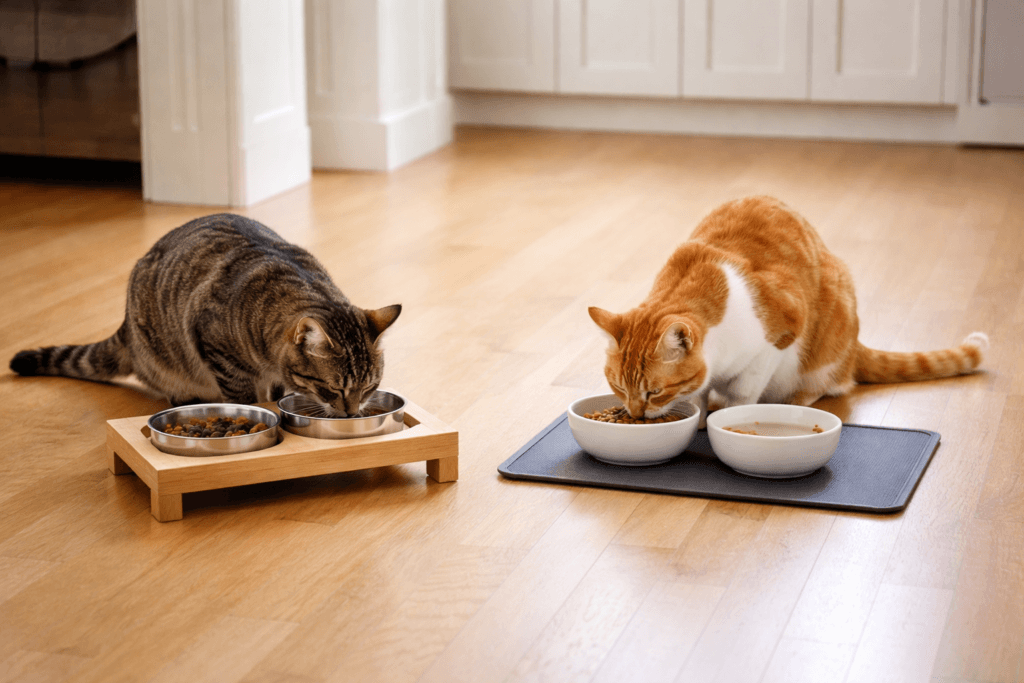
In multi-cat households, “one cat got fat” often means:
- one cat guards the resource
- one cat rushes eating (then returns for leftovers)
- one cat under-eats, then compensates later
- stress increases overall food fixation
AAFP/ISFM-aligned guidance recommends multiple and separated key resources, including feeding stations, to reduce stress and competition. SAGE Journals
Smart feeders can help here in a practical way:
- multiple feeders
- separated placement
- consistent timing
One feeder in one location can worsen competition. Two feeders in two territories can reduce it.
The risk people ignore: aggressive calorie cuts can be dangerous
This is non-negotiable.
Cornell warns that sudden starvation diets can put cats at risk for hepatic lipidosis and recommends gradual weight loss (often framed around roughly 1–2% per week) under veterinary guidance. Cornell Vet College
A feeder makes restriction easy. Too easy.
If you use automation to slash intake without a plan, you can create a medical risk.
If your cat is obese, the correct move is:
- vet-guided calorie target
- slow reductions
- monitoring (weight + body condition score)
- adjustments over time
Automation helps execution, not diagnosis.
The honest verdict
Smart feeders reduce obesity when:
- portions are set correctly and measured
- schedule is consistent
- overrides are rare
- enrichment replaces boredom-driven eating
- multi-cat resources are separated
Smart feeders make obesity easier when:
- “bonus” feeding becomes normal
- portion settings are guessed
- household members override unpredictably
- the feeder becomes the cat’s main stimulation
If you want the blunt version:
smart feeders don’t prevent obesity. They prevent humans from noticing they’re overfeeding—unless they use the feeder as a discipline tool.
What to do if you’re considering automation
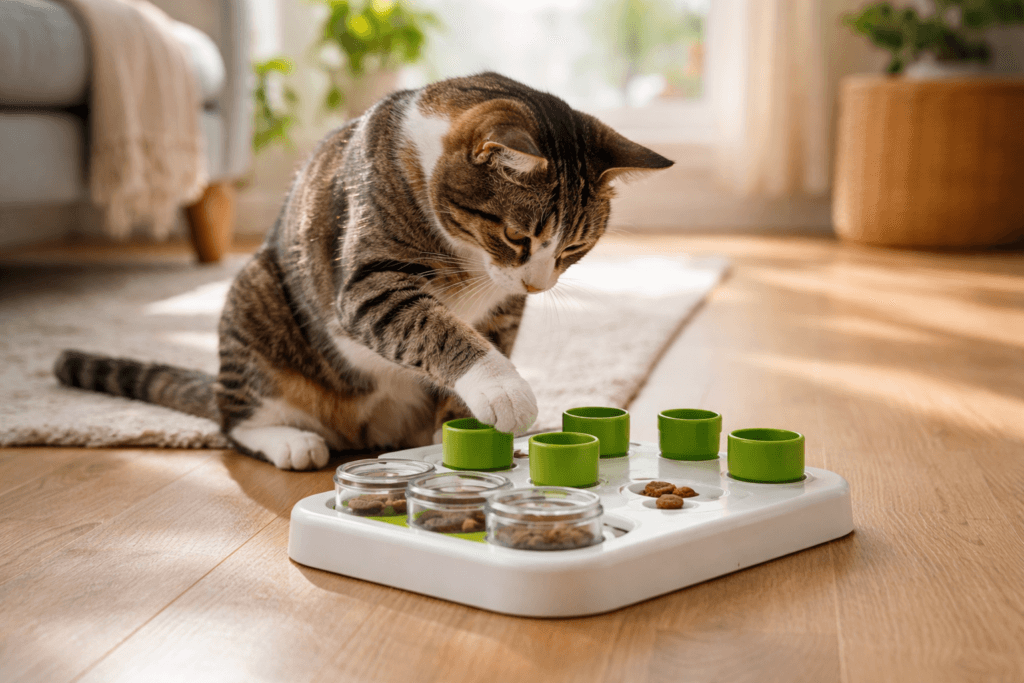
If your problem is portion creep, inconsistent schedules, or double-feeding, smart feeding can help—but only if you treat setup like a protocol, not a toy.
Ready to tighten portions and timing without guesswork?
Start with our PETKIT Fresh Element Infinity Review 2025 (practical scheduling + routine control), then compare models and use-cases in Best Smart Cat Feeders 2025 to find the right fit.
And if your cat’s overeating looks behavioral—not nutritional—use Stop a Cat From Overeating as your first-line playbook before you change hardware.
FAQ
Do smart feeders automatically help cats lose weight?
No. They help only if the programmed portions match an appropriate calorie target and overrides are controlled. Cornell Vet College
Is free feeding bad for cats?
For many indoor cats, it increases the risk of overeating and weight gain. Weight control is harder without measured meals. Cornell Vet College
Can a feeder reduce stress-related eating?
Sometimes. Predictability can help, but environmental needs still matter. The AAFP/ISFM guidelines treat environment as essential to wellbeing and behavior. PubMed
What about multi-cat homes?
Separate resources and feeding stations reduce competition. AAFP/ISFM-aligned guidance emphasizes multiple, separated resources including feeding areas. SAGE Journals
Is rapid weight loss dangerous in cats?
Yes. Cornell warns against sudden starvation diets due to hepatic lipidosis risk and recommends gradual, monitored loss. Cornell Vet College
Internal Links
If consistent portions and fixed feeding times are the main priority, PETKIT Fresh Element Infinity Review 2025 shows how a properly configured smart feeder can remove daily variability and enforce routine without guesswork. For owners who want to compare different feeder designs, control methods, and real-world use cases, Best Smart Cat Feeders 2025 offers a broader, side-by-side evaluation.
When overeating is already established—especially in cases of persistent begging, food obsession, or constant “I’m hungry” behavior—Stop a Cat From Overeating focuses on behavioral and environmental drivers that feeding hardware alone can’t solve. And when excessive eating overlaps with restlessness or boredom, Indoor Cat Enrichment 2025 and Best Interactive Cat Toys 2025 explore how diet and enrichment work together as a single system, rather than isolated fixes.
References
- Cornell Feline Health Center — Obesity (risk, safe weight loss, hepatic lipidosis warning, gradual loss guidance). Cornell Vet College
- Cornell Feline Health Center — How often should you feed your cat? (health risks tied to overweight/obesity and feeding guidance). Cornell Vet College
- Ellis et al. (2013) — AAFP and ISFM Feline Environmental Needs Guidelines (key resources and the link between environment, health, and behavior). SAGE Journals
- VCA Hospitals — Feline Environmental Needs Guidelines (overview) (multiple/separated resources including feeding stations). Vca
- AVMA — Your pet’s healthy weight (owner guidance and obesity/healthy weight framing). avma.org
Disclaimer
PetTech AI publishes educational content to help cat owners make informed decisions about feline health, behavior, and pet technology. Some links on this page may be affiliate links, including Amazon Associate links and other affiliate partnerships. If you click a link and make a qualifying purchase, PetTech AI may earn a small commission at no additional cost to you. These commissions help support research, content production, and site maintenance. This article is not a substitute for veterinary diagnosis or treatment. For obese cats, weight-loss plans should be discussed with a veterinarian to avoid unsafe calorie restriction and related risks.