Tag: Indoor Cat Toys

  • Best Cat Toys for Indoor Cats: What to Buy First and What to Skip

    Best Cat Toys for Indoor Cats: What to Buy First and What to Skip

    Baron ignores the motorized toy, attacks the cardboard insert it arrived in, and then falls asleep beside the charger.

    This is normal.

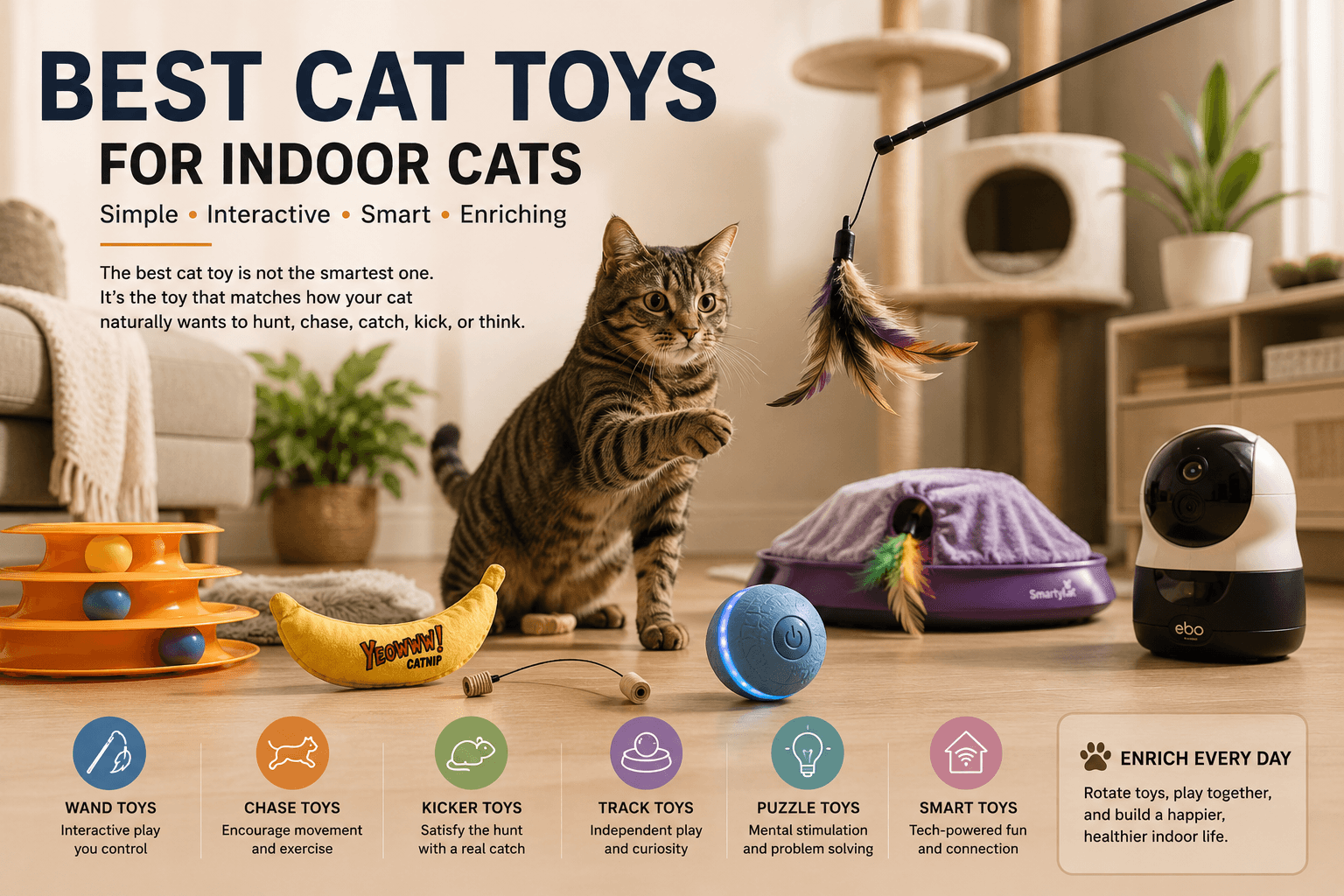
    Cats do not choose toys by feature count. Some want to chase something flying through the air. Some prefer movement hidden under fabric. Others want to bat a ball around a track, grab a soft kicker, or follow something unpredictable across the floor.

    That is why buying cat toys by popularity alone often fails.

    The better question is:

    What kind of play does your cat naturally choose?

    This guide covers simple toys, wand toys, concealed-motion toys, autonomous chase toys, track toys, kicker toys, and one smart-home upgrade for owners who already have the basics covered.

    If you only want motorized or autonomous options, read Best Interactive Cat Toys. This guide is broader: it is about building a toy setup that fits your cat’s instincts, your space, and your daily routine.

    Research Note

    This is a research-led roundup based on current manufacturer information, feline enrichment guidance and product positioning.

    PetTech AI has not conducted long-term hands-on testing of every toy included.

    Quick Verdict

    Best forToyWhy it fitsMain trade-off
    Simple first toyCat Dancer Interactive Cat ToyCheap, light, unpredictable movementSupervision only
    Flying-prey playGoCat Da BirdStrong wand option for jumping and chasingNeeds active play with you
    Stalking and pouncingSmartyKat Hot PursuitHidden movement under fabricNot ideal for heavy fabric chewers
    Autonomous chase playCheerble Wicked Ball M3Short self-directed chase sessionsBetter on open floors
    Passive track playCatstages Chase MeowtainMulti-level ball track for batting and swattingSome cats ignore track toys
    Grabbing and bunny-kickingYeowww! Catnip BananaPhysical catch toy with catnip appealCatnip does not work for every cat
    Smart-home upgradeEnabot EBO SERemote movement, camera, and light interactionNot a foundation toy

    Short verdict:

    • Start with one toy you control.
    • Add one toy your cat can physically catch.
    • Add one self-directed toy for quiet independent play.
    • Add smart toys only after the basics are covered.

    The goal is not to cover the floor with toys.

    The goal is to give your cat better ways to hunt, chase, catch, kick, and think.

    PetTech AI may earn a commission from qualifying purchases. As an Amazon Associate I earn from qualifying purchases.

    What Cat Toys Are Actually For

    Cat toys are not just cute accessories.

    For indoor cats, toys can support movement, cognitive enrichment, and normal predatory-style behavior. A good toy setup gives a cat chances to stalk, chase, pounce, bat, grab, kick, and problem-solve.

    But toys work best as part of a routine.

    A toy cannot fix a stressful multi-cat home by itself. It cannot replace human-led play. It cannot compensate for no climbing space, no scratching options, no hiding places, or sudden changes in behavior that may need veterinary attention.

    Think of toys as one layer of enrichment.

    A stronger indoor setup usually includes:

    • interactive play with you;
    • self-directed toys for short bursts;
    • something the cat can physically catch;
    • scratching surfaces;
    • climbing or hiding options;
    • food puzzles or treat-based enrichment;
    • rotation so toys do not become permanent background clutter.

    For vertical enrichment, see Best Cat Shelves and Climbing Systems.
    For food-motivated cats, see Smart Puzzle Toys for Cats.

    The Best Starter Setup: Three Toy Types Before Anything Else
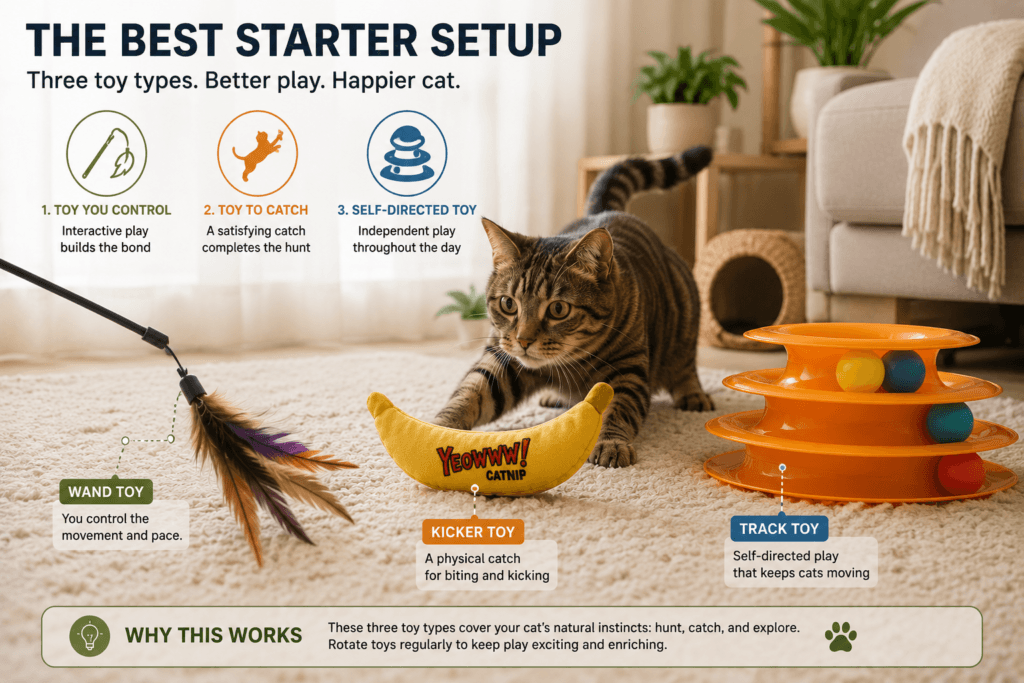
    Indoor cat playing with a starter toy setup including a wand toy, a kicker toy and a passive track toy
    A strong cat toy setup usually starts with three roles: one toy you control, one toy your cat can catch, and one self-directed toy for daily play.

    If you are rebuilding your cat’s toy setup from zero, do not start with ten gadgets.

    Start with three toy roles.

    1. A toy you control

    This can be a wand, wire toy, or feather teaser. The point is that you control the pace.

    You can make the toy fly, pause, hide, escape, slow down, or become catchable. That is difficult for fully automatic toys to do well.

    Best options:

    • Cat Dancer Interactive Cat Toy
    • GoCat Da Bird

    2. A toy your cat can catch

    Cats need a satisfying ending to the play sequence.

    A toy your cat can grab, bite, hold, or bunny-kick helps turn chasing into a complete hunting-style routine.

    Best option:

    • Yeowww! Catnip Banana

    3. A self-directed toy

    This is the toy your cat can return to without needing a full play session from you.

    It should not replace interaction, but it can add low-pressure activity during the day.

    Best options:

    • Catstages Chase Meowtain
    • Cheerble Wicked Ball M3
    • SmartyKat Hot Pursuit

    That basic setup is more useful than a pile of random toys that all solve the same problem.

    Best Simple First Toy: Cat Dancer Interactive Cat Toy

    The Cat Dancer Interactive Cat Toy is almost aggressively simple.

    That is the point.

    It does not need an app, a charger, a motor, lights, or replacement batteries. Its value comes from quick, irregular movement that can make a cat watch, stalk, and strike.

    This is the toy to try when you do not yet know what your cat likes.

    It is especially useful because it tests something basic: does your cat respond to light, prey-like movement when you control the rhythm?

    Choose Cat Dancer if:

    • your cat reacts to quick, jerky movement;
    • you want a low-cost first toy;
    • your cat ignores bulky gadgets;
    • you want short human-led sessions;
    • you need something easy to store.

    Skip it if:

    • your cat chews wire or cardboard aggressively;
    • you need an unsupervised toy;
    • your cat only likes soft plush toys;
    • you want autonomous play while you are away.

    Verdict: Best simple first toy for testing whether your cat responds to unpredictable prey-like movement.

    Check Cat Dancer Interactive Cat Toy on Amazon.

    Best Wand Toy for Flying-Prey Play: GoCat Da Bird
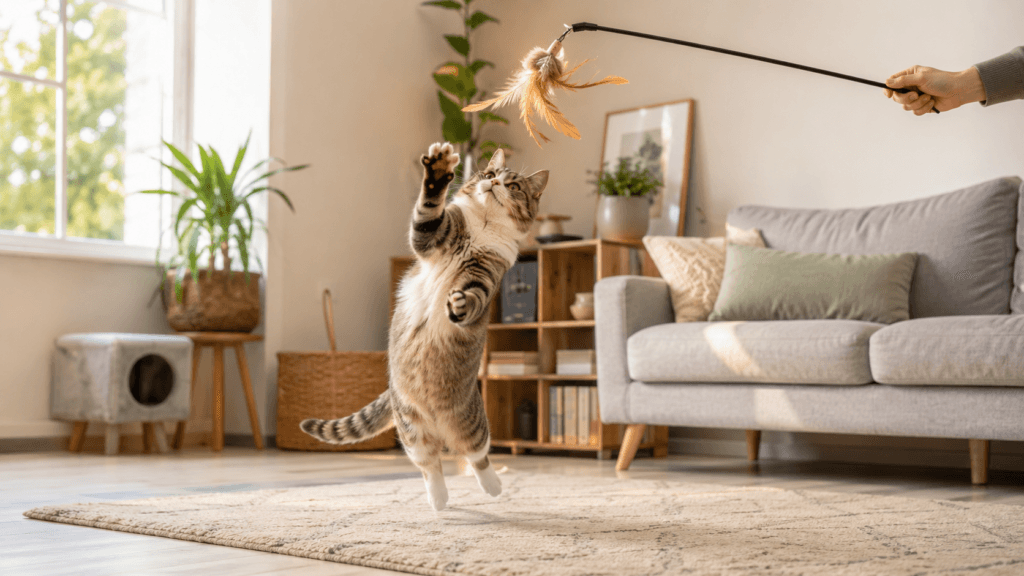
    Indoor cat jumping after a feather wand toy during a flying-prey play session in a living room
    Wand toys work best when they move like prey: flying away, pausing, hiding, reappearing, and finally becoming catchable.

    Some cats are aerial hunters.

    They want to jump, twist, chase, and grab something that behaves more like a bird than a mouse.

    That is where GoCat Da Bird makes more sense than a generic feather toy. Its role is not to sit on the floor. Its role is to create flying-prey movement that you control.

    The key is not to wave it randomly in your cat’s face.

    Move it like prey:

    • fly away;
    • land briefly;
    • pause;
    • disappear behind furniture;
    • reappear;
    • let your cat catch it.

    That final catch matters. The best wand sessions do not leave the cat endlessly chasing something impossible.

    Choose GoCat Da Bird if:

    • your cat watches birds or flying insects;
    • your cat jumps for toys;
    • you want a high-energy play session;
    • your cat needs a better pre-bedtime routine;
    • you want bonding play rather than another autonomous gadget.

    Skip it if:

    • your cat has mobility limitations;
    • you do not have enough clear space;
    • your cat chews feathers aggressively;
    • you need a toy for unsupervised access.

    Verdict: Best wand toy for cats that need flying-prey play, jumping, chasing, and a real catch.

    Check GoCat Da Bird on Amazon.

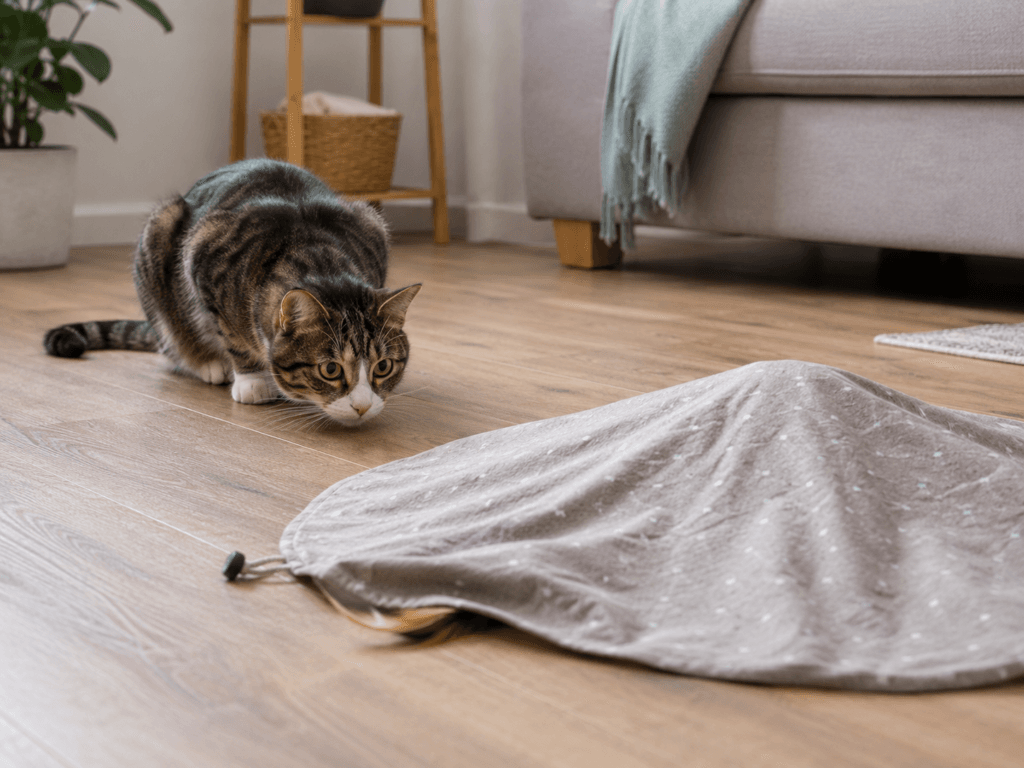
    Best for Stalking and Pouncing: SmartyKat Hot Pursuit

    Not every cat wants to sprint after a ball.

    Some cats want to wait.

    The SmartyKat Hot Pursuit works because the movement is partially hidden. A wand moves under a fabric cover, creating the feeling that something is moving just out of reach.

    That makes it useful for cats that crouch, stare, stalk, and then pounce.

    This is a different play rhythm from a rolling ball. It is less about running across the room and more about tension, timing, and ambush.

    Choose SmartyKat Hot Pursuit if:

    • your cat likes movement under blankets or rugs;
    • your cat stalks before pouncing;
    • you want a more prey-like motorized toy;
    • you have open floor space;
    • your cat responds to rustling or concealed motion.

    Skip it if:

    • your cat chews fabric or feather pieces;
    • your cat is very noise-sensitive;
    • you want a toy to leave out all day;
    • your cat prefers visible chase play.

    Verdict: Best for cats that enjoy hidden prey, ambush behavior, and pouncing rather than pure floor chase.

    Check SmartyKat Hot Pursuit on Amazon.

    Best Autonomous Chase Toy: Cheerble Wicked Ball M3

    Autonomous toys are useful, but they are easy to overestimate.

    The Cheerble Wicked Ball M3 is best understood as a short-burst chase toy. It is not a replacement for active play with you.

    Its value is simple: it gives your cat something moving to react to when you are working, cooking, or unable to start a play session immediately.

    That makes it useful for cats that already chase moving objects across the floor.

    It is not the right fit for every cat. Some cats prefer stalking. Some dislike motor noise. Some lose interest if the toy moves too predictably. But for movement-driven cats, this can be a useful rotation piece.

    Choose Cheerble Wicked Ball M3 if:

    • your cat chases moving objects;
    • you want brief solo activity;
    • your home has enough open floor space;
    • your cat is not easily frightened by motorized toys;
    • you will rotate it rather than leave it out permanently.

    Skip it if:

    • your cat prefers ambush play;
    • your cat is anxious around moving gadgets;
    • your floors make rolling toys frustrating;
    • you expect it to replace human-led play.

    Verdict: Best autonomous chase toy for cats that respond to rolling movement and short self-directed activity bursts.

    Check Cheerble Wicked Ball M3 on Amazon.

    Best Passive Track Toy: Catstages Chase Meowtain

    The Catstages Chase Meowtain is a better fit for the broad “best cat toys” page than a fragile or unavailable track listing.

    Its role is simple: give cats a multi-level ball track they can bat, swat, and return to without needing you to reset the toy every few minutes.

    This is not the most intense toy in the list. It will not replace a wand session. But it can work well as background enrichment, especially for cats that enjoy pawing at moving objects.

    It can also be useful in multi-cat homes because more than one cat may investigate it without needing to chase the same loose toy around the room.

    Choose Catstages Chase Meowtain if:

    • your cat likes batting balls;
    • you want a passive toy that can stay available;
    • you have more than one cat;
    • you want low-maintenance enrichment;
    • your cat enjoys repeated pawing and tracking.

    Skip it if:

    • your cat ignores ball tracks;
    • your cat needs high-intensity exercise;
    • you already own similar track toys;
    • your cat is only motivated by feathers, food, or catnip.

    Verdict: Best passive track toy for curious cats, kittens, and multi-cat homes that need a simple self-directed play option.

    Check Catstages Chase Meowtain on Amazon.

    Best Catnip Kicker: Yeowww! Catnip Banana

    Some cats do not want to chase.

    They want to grab.

    The Yeowww! Catnip Banana works because it gives cats a physical object to bite, hold, hug, and bunny-kick.

    That matters because a good play routine should include a catch. After a chase, wand, or stalking session, a kicker toy can give the cat a clear physical ending.

    The catnip is part of the appeal, but the shape matters too. A long, curved soft toy is easier for many cats to grab with the front paws and kick with the back legs.

    Choose Yeowww! Catnip Banana if:

    • your cat responds to catnip;
    • your cat grabs and kicks soft toys;
    • you want a simple catch toy;
    • your cat needs a low-tech option;
    • you want something easy to rotate.

    Skip it if:

    • your cat does not react to catnip;
    • your cat destroys fabric quickly;
    • you want motion-based play;
    • your cat prefers food puzzles.

    Verdict: Best low-tech kicker for cats that like grabbing, biting, and bunny-kicking.

    Check Yeowww! Catnip Banana on Amazon.

    Best Smart Upgrade: Enabot EBO SE

    The Enabot EBO SE is not a classic cat toy.

    That is important.

    It should not be treated like a wand, kicker, or track toy. It is better understood as a smart-home upgrade: part mobile pet camera, part remote presence device, part occasional moving object your cat may choose to follow or stalk.

    That makes it more relevant to tech-friendly homes than to owners simply looking for the best first cat toy.

    If your cat already has a healthy play routine, Enabot can add remote observation and light engagement. If your cat does not have the basics covered, start with a wand, kicker, and passive toy first.

    Choose Enabot EBO SE if:

    • you already have the basic toys covered;
    • you travel or work long hours;
    • you want remote pet monitoring;
    • your cat is curious about moving gadgets;
    • you are building a broader smart pet setup.

    Skip it if:

    • you need a first toy;
    • your cat is nervous around robots;
    • you expect it to replace play with you;
    • your budget is better spent on basic enrichment.

    Verdict: Best smart upgrade for owners who want remote movement and pet monitoring after the core toy routine is already in place.

    Check Enabot EBO SE on Amazon.

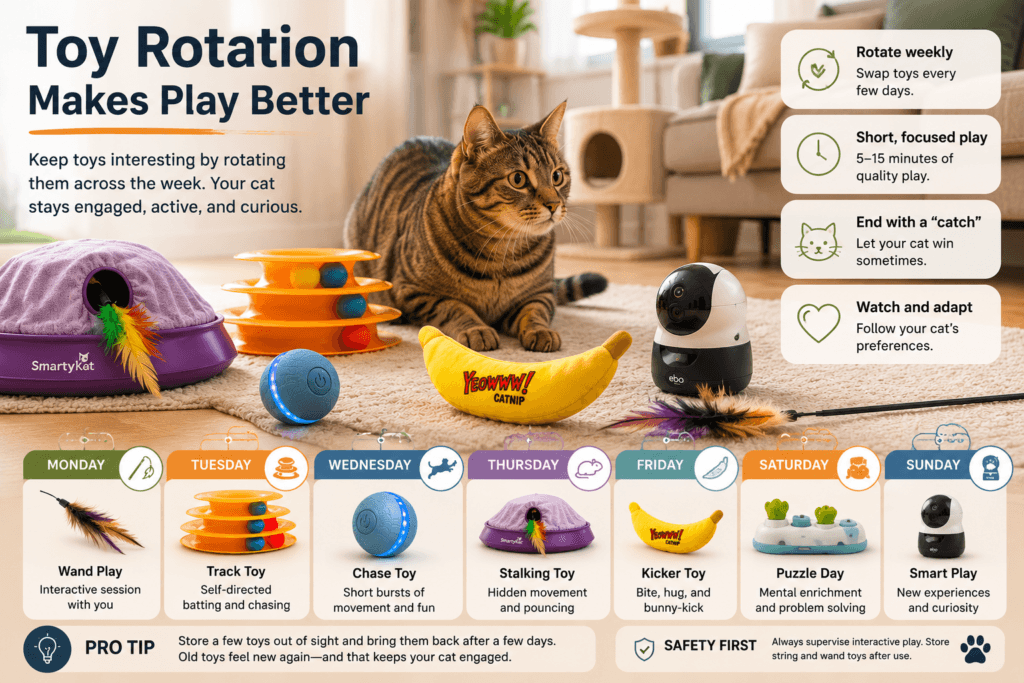
    How to Build a Better Toy Rotation

    Indoor cat enrichment routine with different toys rotated across the week including a ball track, kicker toy, wand toy and smart pet robot
    Toy rotation often matters more than buying more toys. A toy that disappears for a few days can become interesting again when it returns in a new context.

    Toy rotation usually works better than leaving every toy out permanently.

    Cats notice novelty. A toy that sits in the same corner for weeks often becomes furniture. The same toy can become interesting again if it disappears for several days and comes back in a different room or context.

    A simple rotation might look like this:

    For a high-energy indoor cat

    Morning:

    • Cat Dancer or GoCat Da Bird for 5–10 minutes.

    Daytime:

    • Cheerble Wicked Ball M3 for a short autonomous chase session.

    Evening:

    • SmartyKat Hot Pursuit or another supervised play session.

    End:

    • Yeowww! Catnip Banana as the final catch.

    For a quieter cat

    Morning or evening:

    • Short Cat Dancer session.

    During the day:

    • Catstages Chase Meowtain left available.

    Alternate days:

    • Food puzzle or treat-based enrichment.

    End of play:

    • Kicker toy or soft catch toy.

    For a multi-cat home

    Do not assume one toy will satisfy every cat.

    Use more than one play zone. Let timid cats play away from more intense cats. Avoid turning every play session into a competition. Give each cat a chance to catch something.

    For feeding routines that pair well with enrichment, see Best Automatic Cat Feeders.

    Safety: What to Check Before and After Play

    A good toy is not useful if it becomes a hazard.

    Inspect toys regularly, especially if your cat chews, shreds, or swallows pieces.

    Remove or replace toys with:

    • loose string;
    • broken plastic;
    • detached feathers;
    • exposed wire;
    • damaged fabric;
    • open seams;
    • accessible batteries;
    • small pieces your cat may swallow.

    Use extra caution with wand toys, string toys, feather toys, motorized toys, and plush toys that your cat can rip open.

    Store risky toys after supervised play.

    Leave out only toys you are comfortable having available when you are not watching.

    Also pay attention to your cat’s reaction. If a toy causes hiding, fear, aggression, obsessive fixation, or frustration, pause and change the setup.

    A toy should create healthy engagement, not stress.

    When a Toy Is Not the Right Answer

    Sometimes a cat is not simply bored.

    They may be stressed, under-stimulated, in pain, frustrated by another cat, or uninterested in the type of play you are offering.

    Slow down if your cat:

    • suddenly stops playing;
    • hides when toys start moving;
    • becomes tense or aggressive;
    • fixates without settling;
    • guards toys from other cats;
    • shows changes in appetite, litter-box use, grooming, or mobility.

    A new toy is not a behavioral diagnosis.

    If behavior changes suddenly or persists, especially alongside eating, drinking, litter-box, grooming, or movement changes, contact a veterinarian.

    Final Verdict: What Should You Buy First?

    If you want the simplest useful starter kit, buy:

    • one toy you control;
    • one toy your cat can physically catch;
    • one self-directed toy.

    For most cats, that is more useful than buying a pile of similar gadgets.

    Choose Cat Dancer Interactive Cat Toy if you want the cheapest high-impact first toy.

    Choose GoCat Da Bird if your cat loves flying-prey play and jumping.

    Choose SmartyKat Hot Pursuit if your cat likes stalking hidden movement.

    Choose Cheerble Wicked Ball M3 if your cat chases moving objects across the floor.

    Choose Catstages Chase Meowtain if you want passive track play for one or more cats.

    Choose Yeowww! Catnip Banana if your cat likes grabbing and bunny-kicking.

    Choose Enabot EBO SE only as a smart upgrade after the basics are already covered.

    The best cat toy is not the fanciest one.

    It is the one that makes your cat move, think, catch, and come back again tomorrow.

    Frequently Asked Questions

    What is the best cat toy overall?

    For most cats, the best first toy is a simple toy that lets you control prey-like movement. Cat Dancer is a strong low-cost starting point, while GoCat Da Bird is better for cats that like jumping and flying-prey play.

    How many cat toys does an indoor cat need?

    Most cats do not need dozens of toys. A better starting point is one controlled toy, one catch or kicker toy, and one self-directed toy such as a track, ball, or puzzle feeder.

    Are smart cat toys better than normal toys?

    Not usually. Smart toys can help, but they should not replace human-led play. Many cats still respond best to simple toys that move like prey and allow them to catch something.

    Should I leave cat toys out all day?

    Leave out only safe, durable toys that do not include strings, loose pieces, accessible batteries, or parts your cat may swallow. Store wand toys, string toys, feather toys, and fragile motorized toys after supervised sessions.

    What if my cat ignores every toy?

    Try a different play category before assuming your cat does not like toys. Some cats prefer flying prey, others prefer floor movement, hidden motion, soft kickers, food puzzles, or very quiet toys.

    Are laser toys necessary?

    No. Laser toys are optional and can frustrate some cats if there is never anything physical to catch. This guide focuses on toys that give the cat more direct physical engagement.

    Is Enabot EBO SE really a cat toy?

    Not exactly. It is better described as a smart pet camera robot that may also create light movement-based engagement. It is an upgrade for tech-friendly homes, not a foundation toy.

    References

    Cornell Feline Health Center — safe toys, exercise, cognitive enrichment, and toy safety.

    AAFP / ISFM Feline Environmental Needs Guidelines — environmental needs, play, predatory behavior, and multi-cat resource distribution.

    VCA Animal Hospitals — cat play, prey-like movement, and enrichment for indoor cats.

    Cat Dancer — Interactive Cat Toy product information.

    GoCat — Da Bird Rod and Feather Cat Toy product information.

    SmartyKat — Hot Pursuit concealed-motion toy information.

    Cheerble — Wicked Ball M3 product information.

    Catstages — Chase Meowtain product information.

    Yeowww! — Chi-CAT-a Banana product information.

    Enabot — EBO SE product information.

    Image Disclosure

    Some images in this article may be created with AI for illustrative purposes. They do not show the exact products reviewed and should not be used to evaluate product size, fit, design, or features. Always check the current official product listing before purchasing.

    Editorial Disclosure

    PetTech AI may earn a commission from qualifying purchases. This does not influence our recommendations, comparisons or editorial judgments.
  • Smart Puzzle Toys for Cats: Enrichment or Treat Bureaucracy?

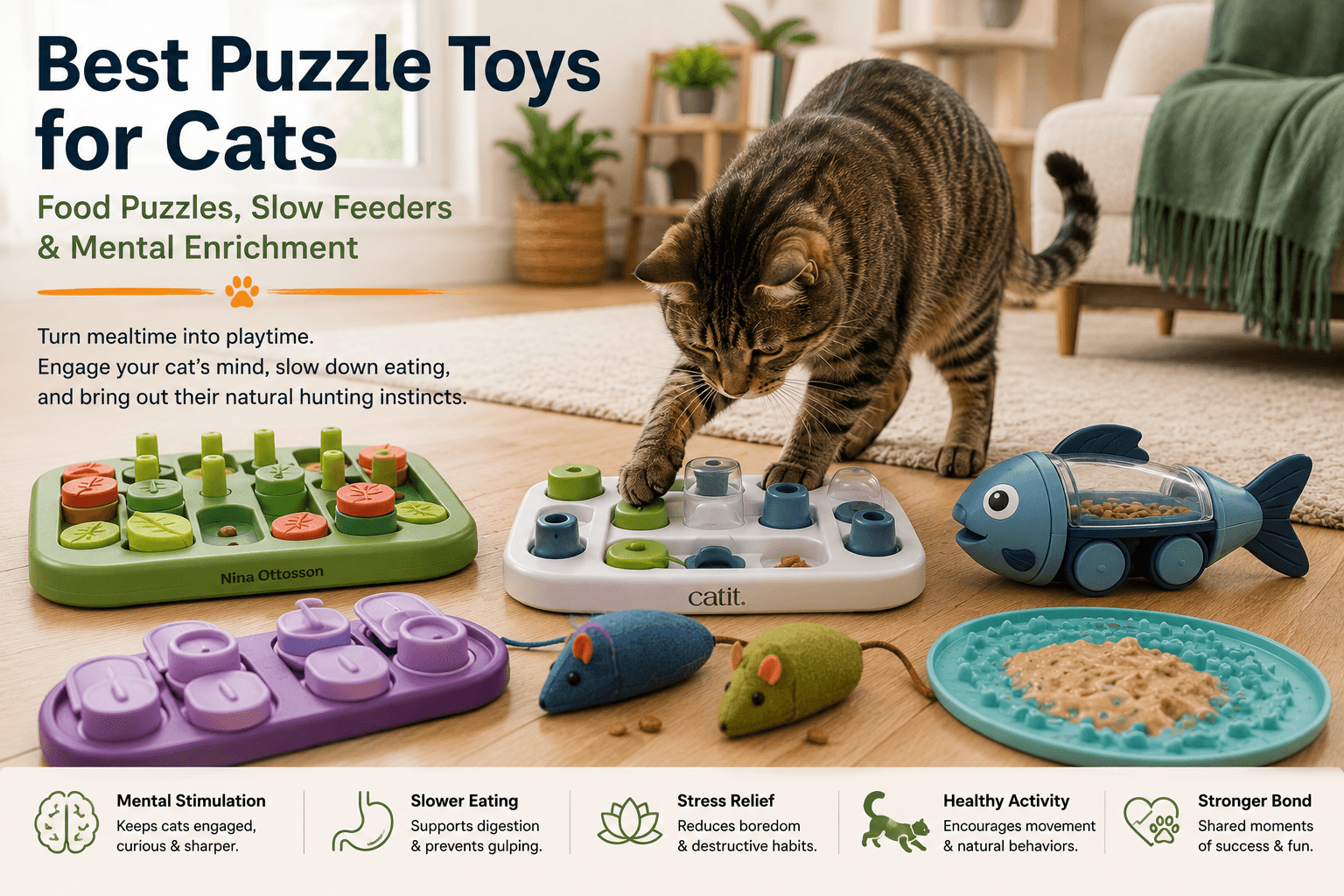
    Smart Puzzle Toys for Cats: Enrichment or Treat Bureaucracy?

    Most smart puzzle toys for cats do not contain cameras, batteries or artificial intelligence.

    This is encouraging.

    They are “smart” because they make your cat paw, sniff, slide, search or lick before receiving food.

    A normal bowl completes the transaction immediately. A puzzle feeder turns dinner into a small hunting problem.

    The challenge must remain reasonable.

    A puzzle that is too easy becomes decorative plastic. A puzzle that is too difficult turns one piece of kibble into an administrative procedure requiring three forms and proof of residency.

    The best puzzle is not the hardest one.

    It is the one your cat can understand, enjoy and willingly use again tomorrow.

    Quick Verdict

    ProductBest fitPetTech AI verdictMain regret risk
    Buggin’ Out Puzzle & PlayBest all-around puzzle feederRecommended — Best OverallExperienced cats may solve it quickly
    TRIXIE Flip BoardCats new to food puzzlesRecommended for BeginnersMay become too easy
    Catit Play Treat PuzzleFast eaters needing several activitiesRecommendedLarge footprint and dry-food focus
    Catstages Spinning FishCats motivated by movement and treatsConditional RecommendationSome cats ignore the spinning mechanism
    Doc & Phoebe’s Hunting FeederSearching and forage-style dry feedingRecommended with ConditionsRequires hiding, retrieving and refilling three mice
    LickiMat Casper or FelixWet food and low-pressure enrichmentRecommended for Wet FoodSlow feeder rather than a true puzzle

    Buggin’ Out is the best starting point for most food-motivated cats.

    Choose TRIXIE for a gentler introduction, Catit for slower dry-food meals, Doc & Phoebe’s for distributed hunting and LickiMat when wet food or low frustration matters more than mechanical problem-solving.

    Catstages is the specialist choice for cats that already enjoy batting moving objects.

    Research Note

    This is a research-led roundup based on current manufacturer documentation, feline enrichment guidance and product positioning.

    PetTech AI has not conducted long-term hands-on testing of every product included.

    PetTech AI may earn a commission from qualifying purchases. As an Amazon Associate I earn from qualifying purchases.

    What Puzzle Feeders Actually Add

    Puzzle feeders can make cats work for part of their food through searching, pawing, licking or manipulating an object.

    FelineVMA feeding guidance recommends puzzle feeders and forage-style feeding as ways to support natural hunting and searching behavior. Cornell and VCA also describe food puzzles as useful forms of cognitive enrichment and more active feeding.

    They do not replace:

    • active play with you;
    • climbing and environmental variety;
    • separate resources in a tense multi-cat home;
    • measured food portions;
    • veterinary attention when appetite or behavior changes.

    Use part of the normal daily food allowance rather than adding a ceremonial mountain of treats in the name of enrichment.

    The objective is mental work.

    Accidental bulking season is not a cognitive-development program.

    For movement-led play rather than food puzzles, read our Best Interactive Cat Toys guide.

    Choose the Easiest Puzzle That Still Creates Useful Work

    Start with what your cat already does.

    Existing behaviorBest starting format
    Paws and slides objectsSliding puzzle board
    Eats dry food too quicklyMulti-zone slow feeder
    Enjoys searching around roomsHunting-style feeder
    Bats moving objectsActive treat dispenser
    Eats mainly wet foodLick mat
    Gives up easilyBeginner board with visible rewards

    Make the first session easy.

    Leave sliders partly open, place food where it can be smelled and demonstrate one mechanism when necessary. VCA recommends beginning with simple puzzles and increasing complexity gradually to avoid frustration.

    The goal is not to establish Gerald’s eligibility for Mensa.

    The goal is to create a repeatable feeding routine.

    Best Overall: Buggin’ Out Puzzle & Play

    Verdict: Recommended — Best Overall

    Buggin’ Out offers the clearest balance between accessibility and real problem-solving.

    Cats move pegs and rotate leaf-shaped covers to reveal food hidden across 16 compartments. The manufacturer says the difficulty can be adjusted and that the board holds up to one-quarter cup of food.

    It works best for cats that:

    • are visibly food motivated;
    • enjoy pawing and sliding;
    • need more challenge than a slow bowl;
    • have little or moderate puzzle experience.

    The adjustable layout matters because owners can leave sections easier during the introduction and increase the challenge later.

    Its main limitation is longevity for highly experienced cats. Once Napoleon memorizes the mechanism, your elaborate cognitive-enrichment device may become a mildly inconvenient dinner plate.

    That does not make it useless. A familiar puzzle can still slow access and add activity.

    It simply stops being an unsolved intellectual frontier.

    Does your cat already paw and manipulate objects for food? Check Buggin’ Out Puzzle & Play on Amazon.

    Best for Beginners: TRIXIE Cat Activity Flip Board

    Verdict: Recommended for Beginners

    TRIXIE Flip Board combines several simple mechanisms rather than forcing the cat to understand one complicated sequence.

    Food can be hidden beneath sliding covers, hinged lids and removable cones. The cat can use its paws or nose to access different sections.

    That variety gives beginners several opportunities to succeed.

    Choose it when:

    • your cat has never used a puzzle feeder;
    • frustration tolerance is uncertain;
    • visible, accessible rewards help maintain interest;
    • you want to introduce more than one puzzle action.

    The main risk is buying it for a cat that already opens cabinets, dismantles toys and appears to have retained private legal counsel.

    Experienced cats may solve the easier modules quickly.

    For beginners, that is not a flaw. Early success is more useful than purchasing an advanced puzzle that spends its first week being stared at with quiet contempt.

    Would several simple puzzle actions make the first attempt easier? Check the TRIXIE Flip Board on Amazon.

    Best Slow-Feeding Board: Catit Play Treat Puzzle

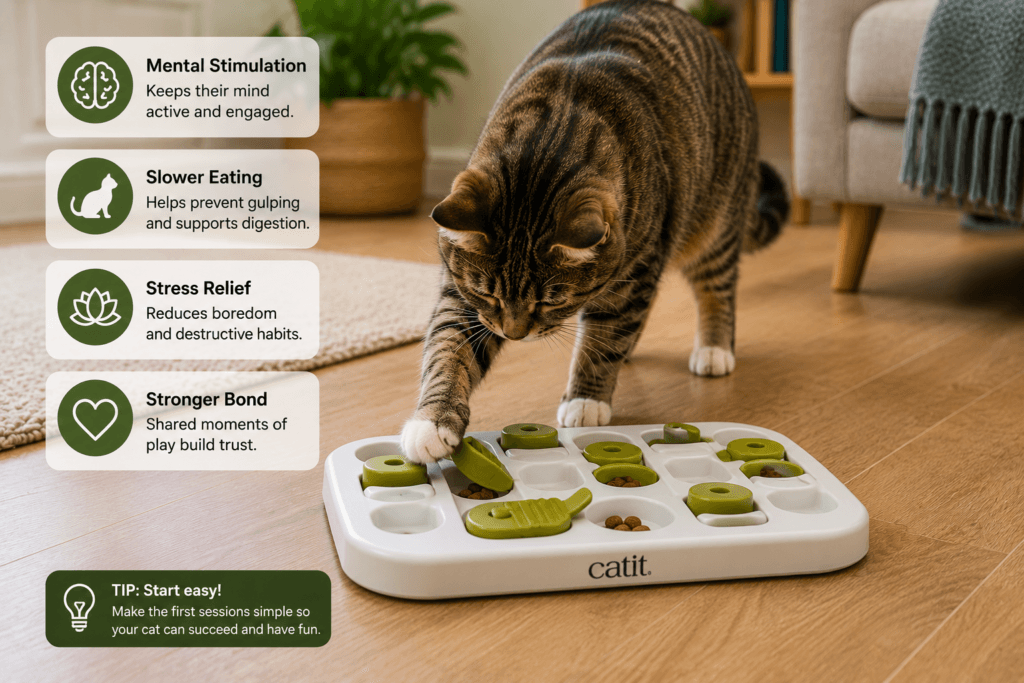
    Indoor cat pawing at a beginner treat puzzle board with hidden food compartments
    Beginner puzzle boards work best when the first session is easy enough for the cat to win, then gradually becomes more challenging.

    Verdict: Recommended

    Catit Play Treat Puzzle is closer to a feeding station than a compact treat toy.

    It uses six different activity layouts, including tubes, tunnels, a food spiral and slow-feeder surfaces. Catit describes it as a BPA-free slow feeder that can be disassembled for cleaning.

    The varied zones make it the strongest option for cats that:

    • eat dry food quickly;
    • remain engaged by different textures and access methods;
    • need a larger surface rather than one hidden compartment;
    • benefit from slower, more active meals.

    It requires more floor and storage space than the smaller boards.

    It also works primarily with dry kibble or suitable treats. Wet-food households should usually move toward a lick mat rather than attempt to convert every plastic tunnel into a pâté-delivery system.

    Catit is a good choice when the primary problem is meal speed, with enrichment as an additional benefit.

    Would several feeding zones slow down an enthusiastic kibble inhaler? Check the Catit Play Treat Puzzle on Amazon.

    Best Active Dispenser: Catstages Spinning Fish

    Verdict: Conditional Recommendation

    Catstages Spinning Fish pairs movement with food release.

    The fish-shaped dispenser can hold up to one-half cup of dry food or treats. Cats bat and spin it to release pieces into the bowl below, and the unit can also attach to compatible Catstages tracks.

    This is less about solving covers and more about understanding cause and effect:

    Hit fish. Food appears. Civilization advances.

    It suits cats that already:

    • bat objects repeatedly;
    • enjoy visible movement;
    • prefer active feeding over stationary boards;
    • use dry kibble or firm treats.

    The Conditional Recommendation reflects the narrow fit.

    A cat that dislikes moving toys may simply wait beside it, confident that management will eventually intervene. Some cats understand delegation long before puzzle solving.

    Choose it because the play style already exists—not because the product page promises to uncover a previously hidden athlete.

    Does your cat already bat moving objects for fun? Check Catstages Spinning Fish on Amazon.

    Best Hunting-Style Feeder: Doc & Phoebe’s Indoor Hunting Feeder

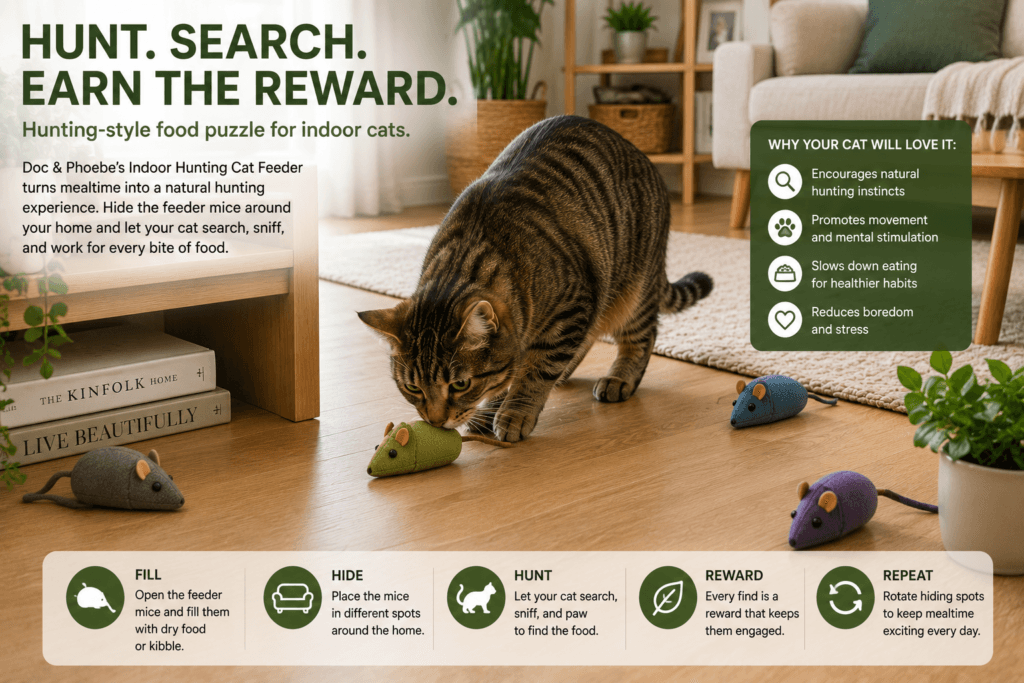
    Indoor cat searching for small hidden food puzzle feeders around a living room
    Hunting-style food puzzles spread dry food around the home, encouraging the cat to search, sniff, paw and work for smaller portions.

    Verdict: Recommended with Conditions

    Doc & Phoebe’s replaces one stationary feeding location with three small feeder mice hidden around the home.

    The system is designed to be filled and hidden twice daily, encouraging the cat to search, catch and manipulate several smaller food sources instead of eating everything from one bowl.

    This is the most behaviorally distinct product in the roundup.

    It can work well when:

    • the cat eats dry food;
    • searching and sniffing are motivating;
    • movement around the home is desirable;
    • one stationary puzzle loses attention quickly;
    • the owner will consistently hide and retrieve the feeders.

    That last condition matters.

    The mice do not refill themselves, return to the kitchen or file a location report after disappearing beneath the sofa.

    You must keep track of them and remove old food.

    In multi-cat homes, hiding food also requires care. One confident cat may locate every feeder before a quieter cat has completed the introductory briefing.

    Use separate sessions or locations when competition is possible.

    Would searching around the home improve the feeding routine? Check Doc & Phoebe’s Indoor Hunting Feeder on Amazon.

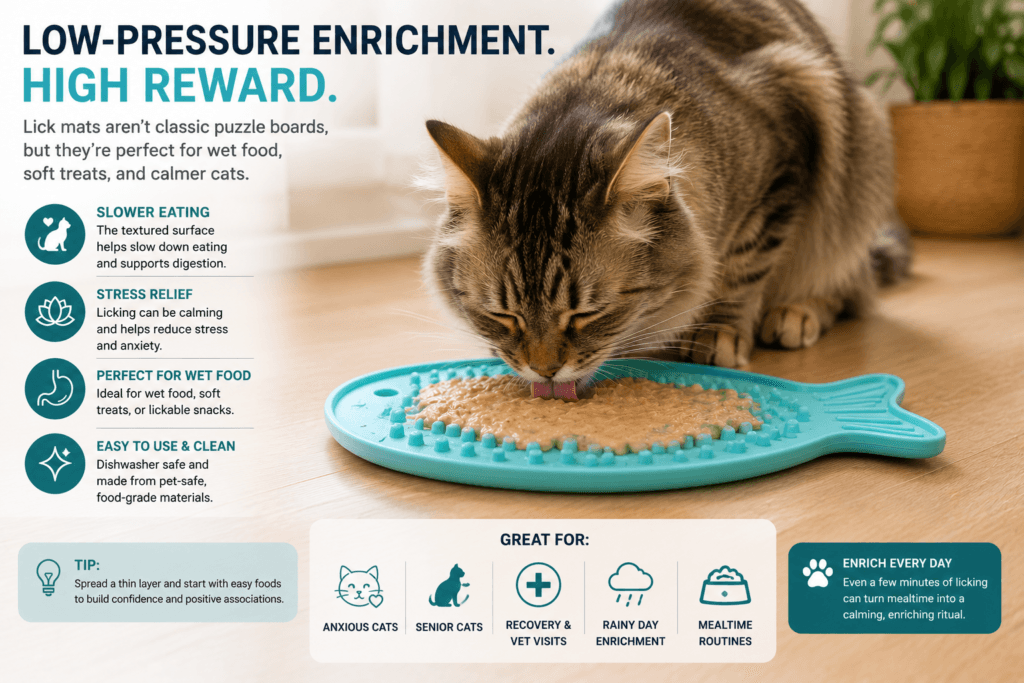
    Best for Wet Food: LickiMat Casper or Felix

    Indoor cat licking wet food from a textured lick mat used as a slow feeder
    Lick mats are not classic puzzle boards, but they can be useful for wet-food enrichment, slower eating and low-pressure feeding routines.

    Verdict: Recommended for Wet-Food Enrichment

    LickiMat is not a mechanical puzzle board.

    It is a textured feeding surface that spreads wet food, soft treats or soaked kibble across grooves and pockets, requiring repeated licking rather than immediate access from a bowl. The manufacturer positions Casper and Felix as slow-feeding surfaces for several soft-food formats.

    That lower-pressure design is valuable for:

    • wet-food households;
    • cautious cats;
    • cats new to enrichment feeding;
    • senior cats requiring minimal force;
    • owners wanting an inexpensive starting point.

    It does not provide the same problem-solving challenge as sliding or lifting compartments.

    That is the point.

    Not every meal needs to become an escape room.

    Supervise initial use, particularly when the cat chews flexible materials. Remove the mat if edges become damaged and clean it thoroughly after wet-food meals.

    Would slower licking be more appropriate than a mechanical puzzle? Check LickiMat Casper or Felix on Amazon.

    Build a Small Rotation, Not a Puzzle Museum

    One or two formats are enough to begin.

    A useful rotation could include:

    • one board puzzle;
    • one wet-food or slow-feeding surface;
    • one movement-led toy;
    • occasional forage feeding around the home.

    Store puzzles between some sessions and reintroduce them later. FelineVMA guidance also recommends toy rotation to help preserve novelty.

    For broader floor-level play, see our Best Cat Toys for Indoor Cats guide.

    For vertical enrichment, read our Best Cat Shelves and Climbing Systems comparison.

    Safety, Cleaning and Calories

    Food-contact toys need regular cleaning.

    Remove leftover food, inspect sliding pieces and check for:

    • cracks;
    • chewed edges;
    • loose components;
    • damaged silicone;
    • food trapped inside mechanisms;
    • pieces small enough to swallow.

    Supervise the first sessions and avoid forcing a cat to continue when the puzzle produces tension rather than curiosity.

    Puzzle feeders can slow access to food, but they do not automatically reduce calorie intake. Use measured portions from the normal daily allowance, especially when weight management is part of the goal.

    For scheduled portion control rather than enrichment feeding, read our Best Automatic Cat Feeders guide.

    A sudden loss of appetite, repeated vomiting, food guarding or a persistent behavioral change should not be explained away as boredom with the puzzle. Observe the cat directly and seek veterinary advice when appropriate.

    Buyer-Regret Risk

    The most common mistake is buying difficulty instead of fit.

    Regret usually looks like this:

    • the beginner puzzle is too advanced;
    • the expert puzzle creates frustration;
    • the hunting feeders disappear beneath furniture;
    • the lick mat is purchased for a cat that only eats kibble;
    • the owner adds extra treats instead of measuring food;
    • the toy remains permanently available until it becomes invisible.

    Start with a behavior the cat already shows.

    Then add the smallest useful challenge.

    Your cat does not need to defeat a Level 4 puzzle to justify your opinion of his intelligence.

    Final Verdict

    Buggin’ Out Puzzle & Play is the best overall puzzle feeder for most food-motivated cats because it offers adjustable difficulty and genuine paw-based problem-solving.

    TRIXIE Flip Board is the best beginner option for cats learning several simple mechanisms.

    Catit Play Treat Puzzle is the strongest slow-feeding board for dry-food cats needing more variety and a longer meal.

    Catstages Spinning Fish earns a Conditional Recommendation for cats already motivated by batting and movement.

    Doc & Phoebe’s is the best hunting-style system, provided the owner accepts the daily setup and retrieval work.

    LickiMat Casper or Felix is the best wet-food option and the gentlest starting point for cautious or easily frustrated cats.

    The smartest puzzle is not the one that makes dinner hardest.

    It is the one that creates enough useful work without convincing Gerald that the bowl was a better institution all along.

    Frequently Asked Questions

    Are puzzle feeders good for cats?

    They can support active feeding, problem-solving and more natural searching behavior. They work best as part of a broader enrichment routine rather than as a replacement for play or environmental variety.

    Which puzzle should a beginner cat use?

    Start with a simple board such as TRIXIE Flip Board or an easy configuration of Buggin’ Out. Make rewards visible and increase difficulty only after the cat understands the mechanism.

    Can puzzle feeders help with fast eating?

    They can slow access to food, particularly multi-zone boards, hunting feeders and lick mats. Portion size still needs to be measured.

    Can wet food be used in puzzle toys?

    Use products specifically suited to wet food, such as LickiMat. Most enclosed plastic puzzles and moving dispensers work better with dry kibble or firm treats.

    Should puzzle toys remain available all day?

    Usually not. Short sessions make cleaning, supervision and rotation easier while helping preserve novelty.

    References

    • Cornell Feline Health Center — Safe Toys and Gifts
    • Feline Veterinary Medical Association — How to Feed a Cat
    • Feline Veterinary Medical Association — Your Cat’s Environmental Needs
    • VCA Animal Hospitals — Enrichment for Indoor Cats
    • Outward Hound / Nina Ottosson — Buggin’ Out Puzzle & Play
    • TRIXIE — Cat Activity Flip Board
    • Catit — Play Treat Puzzle
    • Catstages — Spinning Fish Treat Dispenser
    • Doc & Phoebe’s — Indoor Hunting Feeder
    • LickiMat — Casper and Felix

    Image Disclosure

    Official manufacturer images are used when available and authorized.

    AI-generated images may also be used as editorial illustrations. They should not be treated as exact representations of product dimensions, materials or physical features. Always verify the current official product listing before purchasing.

    Editorial Disclosure

    PetTech AI may earn a commission from qualifying purchases. This does not influence our recommendations, comparisons or editorial judgments.
  • Best Interactive Cat Toys (2026): 4 That Won’t Become Floor Clutter

    Best Interactive Cat Toys (2026): 4 That Won’t Become Floor Clutter

    The best interactive cat toy is not necessarily the one with the most lights, modes, or moving parts.

    Baron may ignore the rechargeable smart ball, attack the cardboard insert it arrived in, and then fall asleep beside the charger.

    That is not proof that cats hate technology.

    It is proof that buying toys by feature count is a reliable way to misunderstand the customer.

    It is the toy that matches how your cat actually wants to play.

    Some cats want to stalk and pounce on hidden “prey.” Others prefer to chase something rolling across the floor, grab and kick a soft toy, or bat at a quieter enclosed track. The goal is not to leave one gadget running all day. It is to create short, varied opportunities for movement, hunting-style play, and novelty.

    If you are still building the basics, start with our broader guide to the best cat toys for indoor cats. This article focuses specifically on interactive, motion-based, and self-directed toys.

    That matters especially for indoor cats. Toys can support exercise and cognitive enrichment by encouraging stalking, pouncing, chasing, and problem-solving—but they work best as part of a routine, not as a substitute for human interaction or a cat-friendly environment.

    This guide focuses on four distinct types of interactive play:

    • Cheerble Wicked Ball M3 for short autonomous chase sessions.
    • SmartyKat Hot Pursuit for ambush-and-pounce play.
    • Catit Senses 2.0 Play Circuit for quiet enclosed-track batting.
    • Potaroma Flopping Fish for cats that enjoy grabbing and kicking their “prey.”

    Research Note

    This is a research-led roundup based on current manufacturer information, feline enrichment guidance and product positioning.

    PetTech AI has not conducted long-term hands-on testing of every toy included.

    Quick Verdict: Which Interactive Cat Toy Fits Your Cat?

    Best forToyWhat it does bestMain trade-off
    Autonomous chase playCheerble Wicked Ball M3Moving ball with multiple play modes and built-in play/rest cyclesWorks best as a short activity, not all-day enrichment
    Stalking and pouncingSmartyKat Hot PursuitHidden wand movement under fabric that imitates concealed preyNeeds floor space and occasional inspection of the cover and wand
    Quiet batting and chaseCatit Senses 2.0 Play CircuitEnclosed ball track for lower-noise, self-directed playNot every cat finds track toys exciting
    Grabbing and bunny-kickingPotaroma Flopping FishMotion-activated soft “prey” for cats that like wrestling toysSome timid cats may dislike the motor noise at first

    What Interactive Toys Can—and Cannot—Do

    Interactive toys can help create opportunities for movement and predatory-style behavior. But they do not replace everything a cat needs.

    A motorized toy cannot replace daily interaction with you. It cannot fix a stressful multi-cat environment by itself. And it should not be left available indefinitely if it contains moving parts, fabric, strings, feathers, or components your cat may chew.

    The strongest setup is usually a rotation:

    • one autonomous toy for brief solo activity;
    • one toy that supports stalking or pouncing;
    • one physical “catch” or kicker toy;
    • regular human-led play sessions;
    • puzzle feeding or climbing enrichment when the cat needs more than movement.

    Feline behavior guidance emphasizes that cats need opportunities to play and express predatory behavior, while also being able to “catch” prey intermittently rather than being left in endless frustration.

    PetTech AI may earn a commission from qualifying purchases. As an Amazon Associate I earn from qualifying purchases.

    How to Choose an Interactive Cat Toy

    1. Match the toy to your cat’s play style

    Watch what your cat already does.

    Do they stare at moving objects and wait to ambush? Do they chase things down hallways? Do they grab soft toys and kick with their back legs? Do they bat at objects but avoid noisy movement?

    That gives you a better starting point than buying the most popular toy on Amazon.

    Your cat’s usual play styleBest starting category
    Chases movement across the floorAutonomous rolling toy
    Hides, stalks, then pouncesConcealed-prey toy
    Bats and pokes without intense runningEnclosed track toy
    Grabs, wrestles, and bunny-kicksSoft motion-activated kicker
    Solves food puzzles more than chasingPuzzle feeder, not another motion toy

    For food-motivated cats, see our Smart Puzzle Toys for Cats guide.

    2. Use autonomous toys as support—not a babysitter

    A self-moving ball can fill a short gap when you are working, cooking, or unable to start a play session immediately.

    But it is not a replacement for interaction.

    The useful question is not “Will my cat play alone for an hour?” It is “Will this create a few good bursts of movement that I can rotate with other forms of play?”

    3. Keep novelty alive with rotation

    Leave every toy on the floor permanently and most cats will eventually stop noticing it.

    Try a simple rotation:

    • keep one or two toys accessible;
    • store the rest for several days;
    • bring back a toy after a short break;
    • change the room or surface where you use it;
    • end active sessions with something your cat can physically catch.

    Small changes often matter more than buying a large pile of similar toys.

    4. Choose safety and supervision over features

    Inspect toys regularly.

    Remove damaged fabric, loose feathers, exposed wires, frayed strings, cracked plastic, or any component your cat might swallow. Store wand-style and string toys after supervised sessions. Cornell specifically recommends choosing toys carefully and checking for potential hazards.

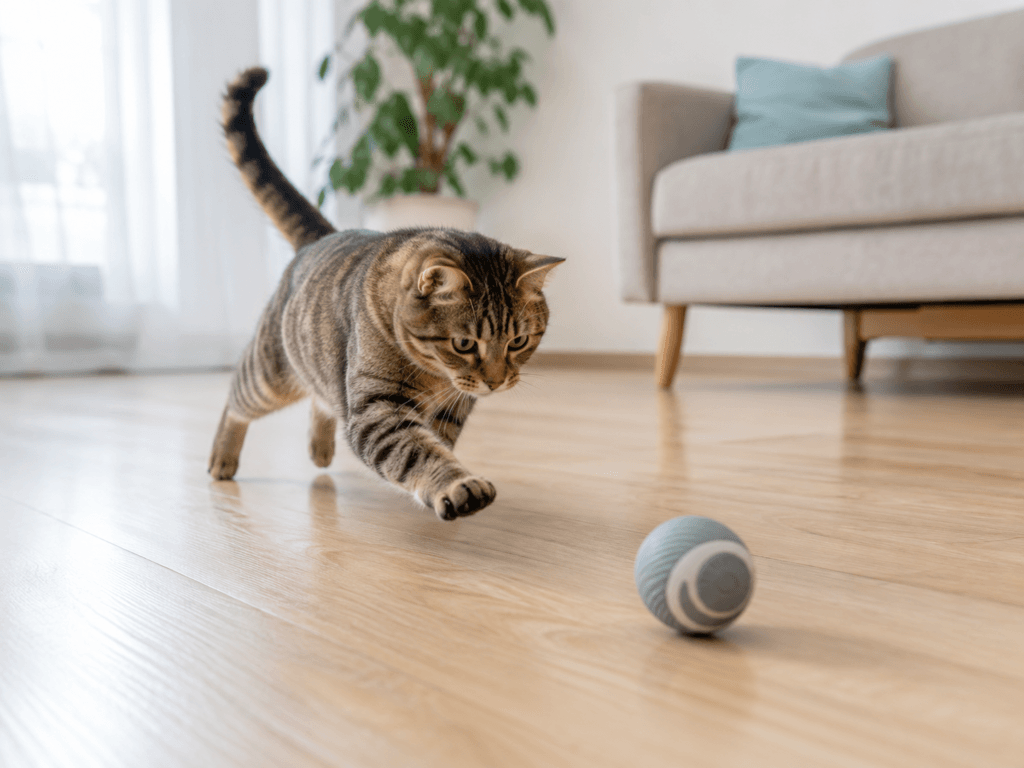
    Best for Autonomous Chase Play: Cheerble Wicked Ball M3

    A cat chasing a small moving rolling toy across a light wood floor in a bright living room
    Autonomous rolling toys work best as short bursts of chase play—not as an all-day replacement for interaction.

    The Cheerble Wicked Ball M3 is the best option for cats that enjoy chasing unpredictable movement across the floor.

    It is not a wand toy and it is not a puzzle feeder. Its role is simple: create short bursts of rolling, bouncing, and moving “prey” behavior that can encourage a cat to chase, paw, and re-engage.

    Cheerble describes the M3 as a cat-focused interactive ball with three play modes and a built-in play/rest cycle. After 10 minutes of activity, it enters a 30-minute rest period unless the cat reactivates it with a nudge.

    Why it stands out

    The M3 has a clear use case:

    It gives an energetic indoor cat something to chase when you cannot immediately initiate a play session.

    That makes it useful for homes where a cat becomes active at predictable times—before work, during a busy afternoon, or in the early evening.

    The play/rest cycle is also more sensible than a toy designed to keep moving without interruption. A good autonomous toy should create activity, then allow the cat to disengage.

    Choose Wicked Ball M3 if:

    • Your cat already chases balls, bugs, or moving objects.
    • You want short autonomous bursts of activity.
    • Your home has mostly hard floors or low-pile rugs.
    • You want a rechargeable interactive toy.
    • You plan to rotate it with other toys and human-led play.

    It may not be the best fit if:

    • Your cat is very noise-sensitive.
    • Your cat prefers ambush play over chasing.
    • Your floors are thick carpet or highly uneven.
    • You want a toy that replaces active play with you.

    Verdict: Conditional Recommendation — a useful short-burst chase toy for cats already attracted to floor movement, but not a substitute for active play or a sensible purchase for noise-sensitive cats.

    Check Cheerble Wicked Ball M3 on Amazon

    Best for Stalking and Pouncing: SmartyKat Hot Pursuit

    A cat crouching and watching concealed movement beneath a fabric interactive toy in a quiet room
    Concealed-prey toys give cats time to watch, stalk, and choose when to pounce.

    The SmartyKat Hot Pursuit is the best choice for cats that prefer hidden prey over visible toys.

    A wand moves unpredictably beneath a fabric cover, creating the feeling that something is moving just out of reach. That makes it better suited to cats that crouch, watch, stalk, and then pounce rather than cats that only want to chase a rolling ball.

    SmartyKat describes Hot Pursuit as an electronic concealed-motion toy with a feathered wand moving beneath crinkly fabric, two speed controls, lights, and a teasing feather tail.

    Why it stands out

    This toy creates a different emotional rhythm from an autonomous ball.

    The cat can watch, wait, listen, and choose when to strike. That makes Hot Pursuit a strong option for cats with a noticeable ambush instinct.

    It also works well as a short supervised play ritual before dinner or bedtime.

    Choose Hot Pursuit if:

    • Your cat likes hiding, stalking, and pouncing.
    • They respond to rustling fabric or concealed movement.
    • You have enough open floor space for the toy.
    • You want a more prey-like alternative to a simple ball.
    • You are willing to inspect the cover and wand periodically.

    It may not be the best fit if:

    • Your cat gets overstimulated easily.
    • Your cat chews fabric or feathered components.
    • You need a quiet toy for late-night use.
    • You want an option for unsupervised all-day access.

    Verdict: Recommended with Conditions — one of the stronger options for ambush-driven cats, provided fabric chewing, motor noise, and supervised inspection are not problems.

    Check SmartyKat Hot Pursuit on Amazon

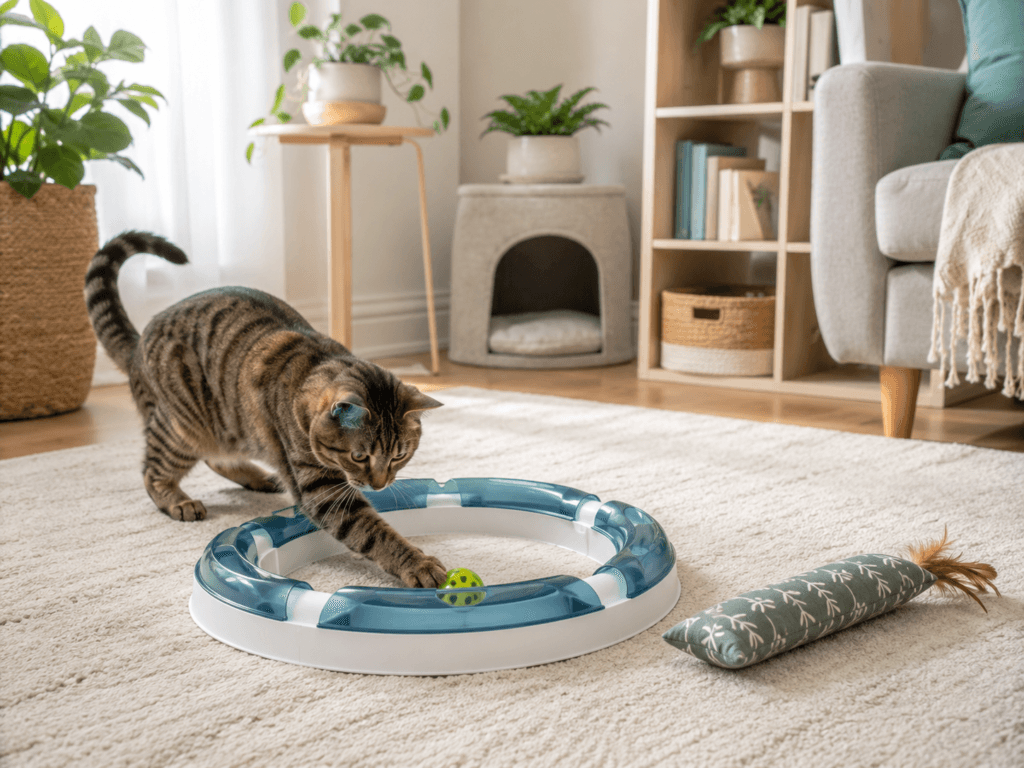
    Best Quiet Enclosed-Track Toy: Catit Senses 2.0 Play Circuit

    The Catit Senses 2.0 Play Circuit is the best choice for cats that enjoy batting, poking, and following movement without a loud motorized toy.

    Instead of exposing the ball fully, the circuit keeps it partially enclosed. Your cat can hear it, see it through openings, and reach in with a paw—but cannot simply carry it away under the sofa.

    Catit lists the Play Circuit as part of its Senses Circuits range, designed for modular layouts and compatible with other circuit components. The system is intended to stimulate cats through chasing and pawing at a moving ball inside the track.

    Why it stands out

    This is not an “automatic” toy in the same sense as Wicked Ball M3.

    It is quieter, simpler, and more self-paced.

    That makes it useful for:

    • cats that bat rather than sprint;
    • apartments where loud motorized toys are irritating;
    • quieter evening play;
    • cats that prefer controlled movement;
    • homes where a toy needs to be easy to wipe down and reset.

    Choose the Catit Play Circuit if:

    • Your cat likes pawing at objects through openings.
    • You want a lower-noise alternative to motorized toys.
    • You prefer a toy without charging or frequent batteries.
    • Your cat enjoys predictable but still partially hidden movement.
    • You may later expand into compatible Catit circuit components.

    It may not be the best fit if:

    • Your cat ignores balls or track toys.
    • You want intense running and jumping.
    • Your cat is only motivated by feathers, scents, or food.
    • You want fully autonomous movement without needing to start the ball.

    Verdict: Recommended — the safest low-complexity choice in this roundup for cats that enjoy batting and partially hidden movement. Cats that ignore tracks will regard it as decorative plumbing.

    Check Catit Senses 2.0 Play Circuit on Amazon

    Best for Kicking and Wrestling: Potaroma Flopping Fish

    The Potaroma Flopping Fish is for cats whose version of play is not “chase it across the floor” but “grab it, bite it, and kick it with both back legs.”

    That is a different play pattern, and it deserves a different kind of toy.

    Potaroma’s flopping fish combines a soft plush body with motion-activated movement and catnip or silvervine enrichment. The toy is designed to react when touched, creating a physical object for a cat to wrestle instead of only watching something move.

    Why it stands out

    The Flopping Fish works best as a “catch” toy.

    After a short chase or stalking session, a cat can grab and kick it, which gives the play sequence a physical ending. This is particularly useful for cats that enjoy kicker toys, soft plush prey, or catnip/silvervine stimulation.

    Choose Potaroma Flopping Fish if:

    • Your cat grabs and bunny-kicks plush toys.
    • Your cat responds to catnip or silvervine.
    • You want a soft, physical toy to use after chase play.
    • Your cat prefers wrestling over chasing a small ball.
    • You want a rechargeable motion toy with a simpler role than a smart app-controlled device.

    It may not be the best fit if:

    • Your cat is frightened by vibration or motor noise.
    • Your cat is not interested in soft toys.
    • Your cat chews or destroys plush fabric quickly.
    • You are looking for a solo puzzle or food-enrichment toy.

    Verdict: Conditional Recommendation — worth considering for cats that already wrestle soft kickers, but easy to overestimate when the cat dislikes vibration, motor noise, or plush prey.

    Check Potaroma Flopping Fish on Amazon

    Build a Better Toy Rotation

    A cat batting at an enclosed track toy while a soft kicker toy rests nearby in a tidy indoor play area
    Toy rotation works better than leaving every toy out permanently: vary chase, batting, and physical catch play across the week.

    A good toy rotation is more useful than six toys left permanently on the floor.

    Try this basic setup:

    For a high-energy indoor cat

    • Cheerble Wicked Ball M3 for brief autonomous movement.
    • SmartyKat Hot Pursuit for a supervised stalk-and-pounce session.
    • Potaroma Flopping Fish as a final physical “catch.”

    For a quieter cat or apartment setup

    • Catit Play Circuit for calm batting and chasing.
    • A short wand session with you.
    • A puzzle feeder or treat toy on alternate days.

    For food routines that can complement treat-based enrichment without turning every activity into free feeding, see our Best Automatic Cat Feeders guide.

    For a multi-cat home

    Do not assume one toy will keep every cat happy.

    Use more than one play zone, avoid forcing timid cats to compete with highly energetic cats, and give cats room to disengage. Feline environmental guidance recommends dispersing key resources and play opportunities throughout the home, particularly in multi-cat environments.

    For broader enrichment beyond floor-level toys, see our Best Cat Shelves and Climbing Systems guide.

    When a Toy Is Not the Right Answer

    Sometimes a cat is not “bored.”

    They may be under-stimulated, stressed, frightened, frustrated by another cat, in pain, or simply uninterested in the type of play you are offering.

    Slow down if your cat:

    • hides when the toy starts;
    • becomes tense, vocal, or aggressive;
    • fixates on a laser or moving toy without settling;
    • starts guarding toys from other cats;
    • suddenly loses interest in play despite normally enjoying it.

    A new toy is not a behavioral diagnosis.

    If there is a persistent or sudden behavior change, especially alongside appetite, litter-box, mobility, or grooming changes, speak with a veterinarian.

    For food-motivated enrichment and slower, quieter mental work, see our Smart Puzzle Toys for Cats guide. For camera-based observation and remote check-ins, see our Smart Cat Cameras guide.

    Frequently Asked Questions

    Are interactive toys good for indoor cats?

    They can be useful because they create opportunities for movement, hunting-style play, and cognitive enrichment. The best result usually comes from short, varied play sessions and toy rotation rather than leaving one toy available all the time.

    How long should a cat play each day?

    Short, repeated play sessions are often more realistic than one long session. Adjust their frequency and duration to your cat’s age, mobility, interest, and tolerance.

    Should I leave motorized toys out all day?

    Usually, no. Rotate them, inspect them for wear, and store toys with parts your cat might chew or pull apart. Autonomous toys work best as occasional activity, not permanent furniture.

    Can interactive toys replace playing with my cat?

    No.

    They can support your routine, but human-led play gives you more control over pace, intensity, and whether your cat gets a satisfying “catch.”

    What if my cat ignores a new toy?

    Try a different play style rather than buying more of the same category. A cat that ignores a rolling ball may love hidden prey, a kicker, a track toy, or food-based enrichment instead.

    Final Verdict

    The best interactive cat toy is the one that matches your cat’s natural play style.

    Choose the Cheerble Wicked Ball M3 for short autonomous chase sessions.

    Choose SmartyKat Hot Pursuit for stalking, watching, and pouncing on concealed prey.

    Choose the Catit Senses 2.0 Play Circuit for quieter enclosed-track batting and chase play.

    Choose the Potaroma Flopping Fish for cats that prefer to grab, bite, and bunny-kick their toy.

    PetTech AI’s default recommendation is Catit for quieter batting play and SmartyKat for stalking-driven cats. Choose Cheerble only when your cat already chases floor movement, and choose Potaroma only when grabbing and wrestling are established preferences.

    None of these is the universal “best” interactive toy. The safest purchase is the one based on behavior your cat already shows—not behavior the product page promises to unlock.

    The real goal is not to automate play.

    It is to make your cat’s everyday environment more varied, more active, and more rewarding.

    References

    • Cornell Feline Health Center — safe toys, exercise, cognitive enrichment, and toy safety
    • Feline Veterinary Medical Association — environmental needs, play, predatory behavior, and multi-cat resource distribution
    • Cheerble — Wicked Ball M3 play modes and play/rest balance
    • SmartyKat — Hot Pursuit concealed-motion toy specifications
    • Catit — Senses Play Circuit system and circuit compatibility
    • Potaroma — Flopping Fish interactive plush toy specifications

    Image Disclosure

    Some images in this article may be created with AI for illustrative purposes. They do not show the exact products reviewed and should not be used to evaluate product size, fit, design, or features. Always check the current official product listing before purchasing.

    Disclosure

    PetTech AI may earn a commission from qualifying purchases. This does not influence our recommendations, comparisons or editorial judgments.