
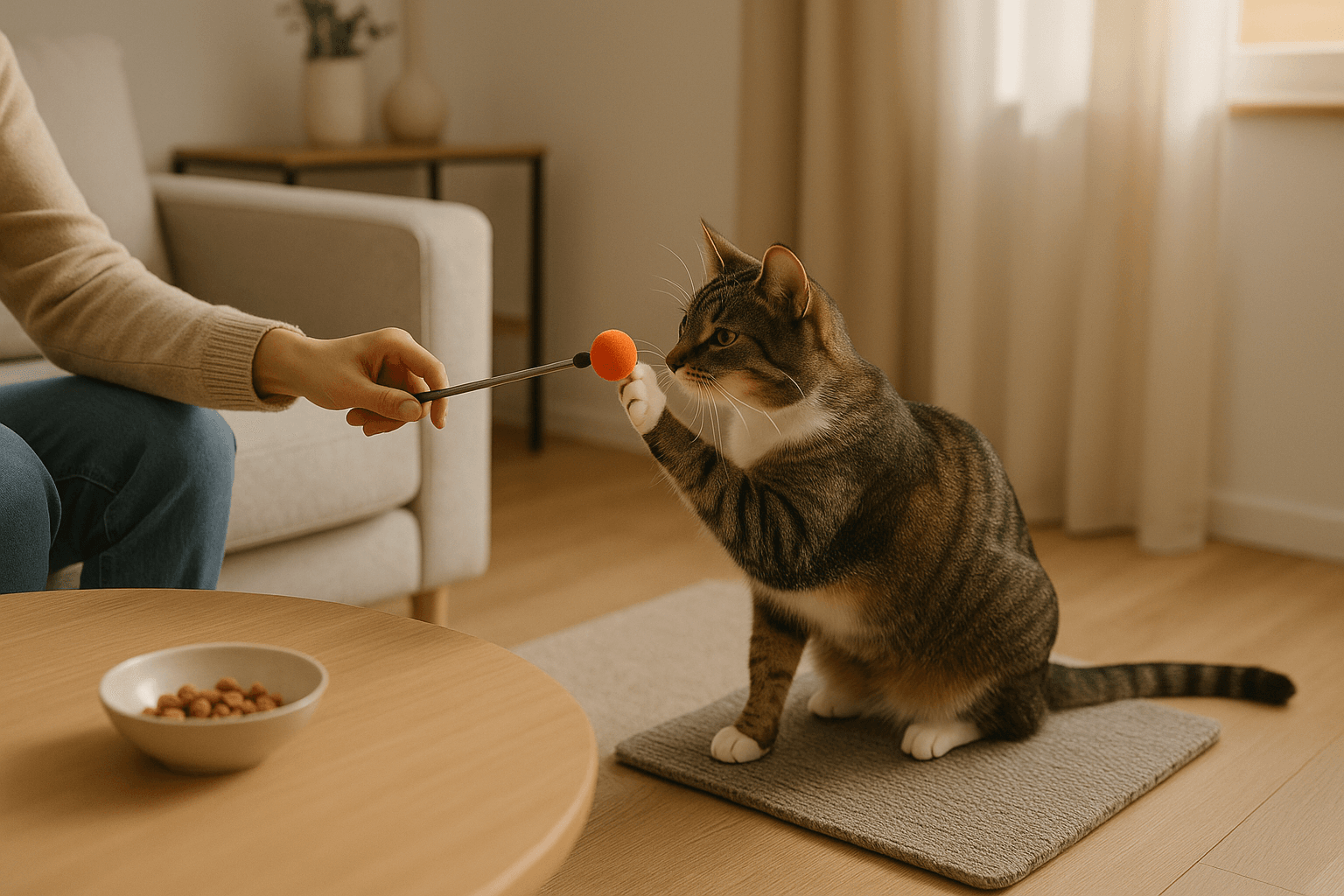
If you live with a cat in 2025, you’re not just sharing a couch with a “small indoor tiger.” You’re managing a predator, a routine-driven creature, and an animal that learns faster than most people think.
Searches for cat training tips 2025 are exploding because people are finally realizing two things:
- untrained cats are more stressed, not more “free”
- most behavior problems are learned, reinforced and totally reversible with the right approach
In this guide, we’ll strip via all the vague advice and give you cat training tips 2025 that are short, realistic and grounded in what feline behavior research actually supports. You’ll also get a dedicated kitty training tips 2025 section if you’re starting from zero with a new cat or kitten.
How Cats Really Learn (And Why Punishment Fails)
Before we dive into specific cat training tips 2025, you need a 30-second crash course in how cats learn:
- Positive reinforcement – behavior → reward → behavior increases
- Negative punishment – behavior → reward disappears → behavior fades
- Punishment (yelling, spraying, hitting) – behavior → fear → new problems
Cats don’t understand “good” and “bad” in the moral sense. They understand what works:
- “When I scratch the sofa, I get attention.”
- “When I meow at 4 a.m., the human stands up and feeds me.”
- “When I jump on the counter, sometimes food appears.”
Most modern guidelines (Cornell, AVMA, behaviorists) converge on the same line:
👉 Reward what you want. Make what you don’t want useless. Never punish.
All the cat training tips 2025 that follow are based exactly on this principle.
10 Cat Training Tips 2025 That Actually Work
1. Train in Micro-Sessions (3–5 Minutes, Max)
One of the most underrated cat training tips 2025 is also the simplest: keep sessions short.
Cats learn best when:
- they’re a bit hungry (before a meal, not after)
- you stop while they’re still interested
- you don’t push them past the “I’m done” point
Set a timer for 3–5 minutes. Pick one behavior (come, target touch, sit on a mat). End on a small win, reward, and walk away.
Keep a small jar of high-value treats near your training spot so you can launch a 3-minute session whenever your cat is naturally alert and curious.
2. Pick One Clear Goal Per Week
A brutal but honest truth: most “training fails” happen because humans try to fix 6 things at once.
For effective cat training tips 2025, keep it to:
- Week 1: “Teach my cat to come when called.”
- Week 2: “Train a calm cue for nail trims.”
- Week 3: “Redirect scratching from sofa to post.”
Write the goal down. Every day, ask: Did I give my cat at least one chance to earn a reward for this specific behavior?
3. Build Routines With Food: Let the Schedule Train for You
One of the smartest cat training tips 2025 is to let your feeding schedule do half the work. Cats are routine-driven. If you anchor training to meals, you don’t have to “remember”—the cat will remind you.
- Call your cat by name before placing the bowl down → recall training.
- Ask for a simple behavior (sit on mat, touch target) before the bowl appears.
- For night zoomies, move some calories into interactive food puzzles in the evening.
Smart feeders can support this by delivering small, predictable meals, while you reserve some of the daily ration for manual training and puzzle toys.
If you already use a smart feeder, set one feeding to “manual” and use that portion exclusively for training rewards.
4. Reward Calm, Not Just “Tricks”
Another underrated cat training tips 2025 principle: calm is a trainable behavior.
If your cat only gets attention when they’re:
- meowing
- pawing at you
- walking on your keyboard
…you’re teaching them that chaos = connection.
Invert it:
- Quietly drop a treat next to your cat when they’re resting near you.
- Stroke or talk softly only when they’re calm, not when they’re clawing.
- Reward them for sitting on an approved perch while you work.
You’ll be surprised how fast they start offering calm behaviors if calm gets paid.
5. Make “No” Useless by Redirecting, Not Fighting
Punishing a cat for scratching the wrong thing or jumping on counters almost always backfires.
A core of cat training tips 2025 is:
“Don’t just say no. Say: ‘Not here, do it there and get paid.’”
Practical examples:
- Scratching: place a sturdy scratching post right next to the sofa corner they like. Every time they stretch there, gently move them to the post, reward when claws hit the right surface.
- Counter surfing: create a high, legal perch nearby (cat tree, shelf). Whenever they jump up, lure them to the perch, reward, and sometimes toss treats there before they jump, so the perch becomes the default.
6. Use Play as Currency, Not Just Treats
Food is powerful, but some cats are more play-driven. Modern cat training tips 2025 leverage that:
- Use a wand toy as “salary” for coming when called.
- Reward a successful carrier entry with a 2-minute intense play burst.
- End training sessions with a quick prey-style game: stalk → chase → pounce → catch.
This aligns with the natural predatory sequence and burns off the extra energy that often shows up later as “bad behavior.”
Not sure which toys will actually work for your cat? Our ‘Best Interactive Cat Toys 2025’ guide breaks down the options that keep indoor cats active and focused during training.
7. Respect Overstimulation Limits
One of the most important cat training tips 2025 has nothing to do with commands — it’s about recognizing your cat’s body language.
Common overstimulation signs:
- tail flicking sharply
- skin twitching
- ears starting to angle back
- sudden head turns toward your hand
If you push past that, you teach your cat: “petting becomes biting unpredictably.” Instead, stop before the threshold and give a treat or a break. Over time, most cats tolerate longer, calmer contact because they trust you to stop on time.
8. Turn “Scary” Into “Predictable” With Gradual Exposure
Carrier, nail trims, vet visits—this is where cat training tips 2025 really pay off.
Break scary events into micro-steps:
- Carrier always open in the living room, lined with soft bedding.
- Toss treats or feed occasional meals inside the carrier.
- Touch paw → treat. Hold paw → treat. Brief nail touch → treat. Clip one nail → jackpot, stop.
If your cat freaks out during handling, you haven’t failed—they simply need smaller steps.
Store a special “only for scary training” treat that never appears elsewhere. The contrast makes stressful training 10x easier.
9. Use Environment Design as a Silent Trainer
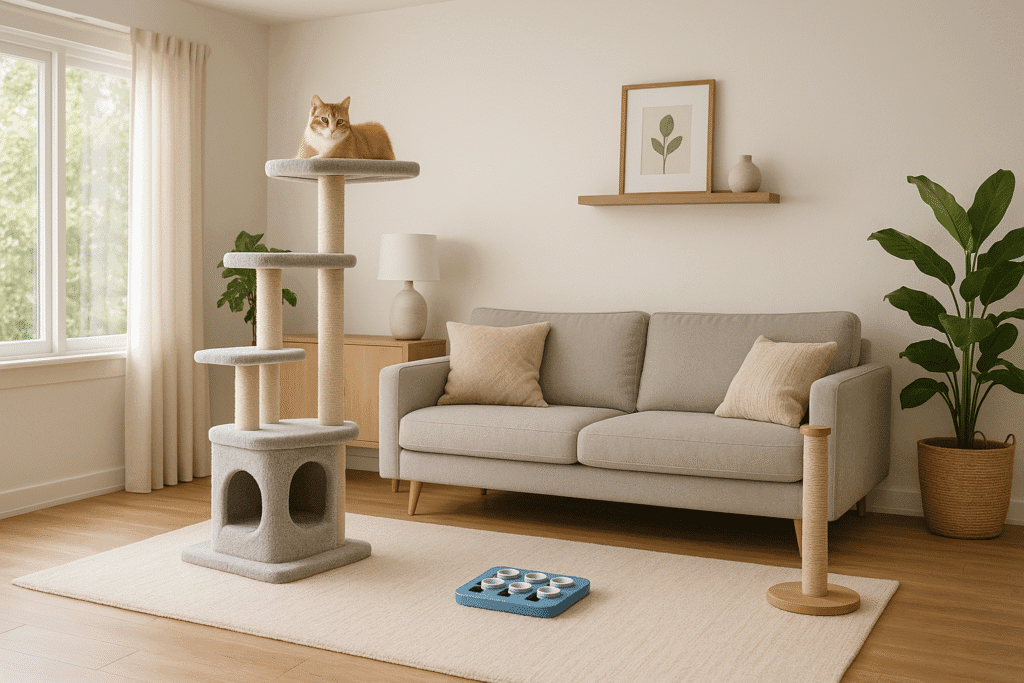
Some of the best cat training tips 2025 are actually environment hacks:
- Put the cat tree next to the window they already love → you’ve “trained” them to use it.
- Place a soft mat or blanket in the exact spot they already nap on your desk → they’ll choose it because it’s familiar and comfy.
- Use motion-activated deterrents (air puff, harmless beeps) only for safety zones (stove, delicate plants), never as a general discipline tool.
Smart home tech can help here: indoor cameras show you where your cat spends time when you’re away, so you can move resources there instead of guessing.
10. Track Progress Weekly, Not Daily
Last core block: don’t evaluate training day by day.
Cats have off days. You do too. What matters is:
- Does the unwanted behavior happen less often over 2–3 weeks?
- Does your cat recover faster from stress?
- Are training sessions calmer, even if the behavior isn’t “perfect” yet?
Keeping a simple note on your phone with dates and quick observations (“3/10: came when called 4/5 times”) makes the impact of these cat training tips 2025 brutally obvious.
Kitty Training Tips 2025: Fast-Track Basics for New Cat Parents
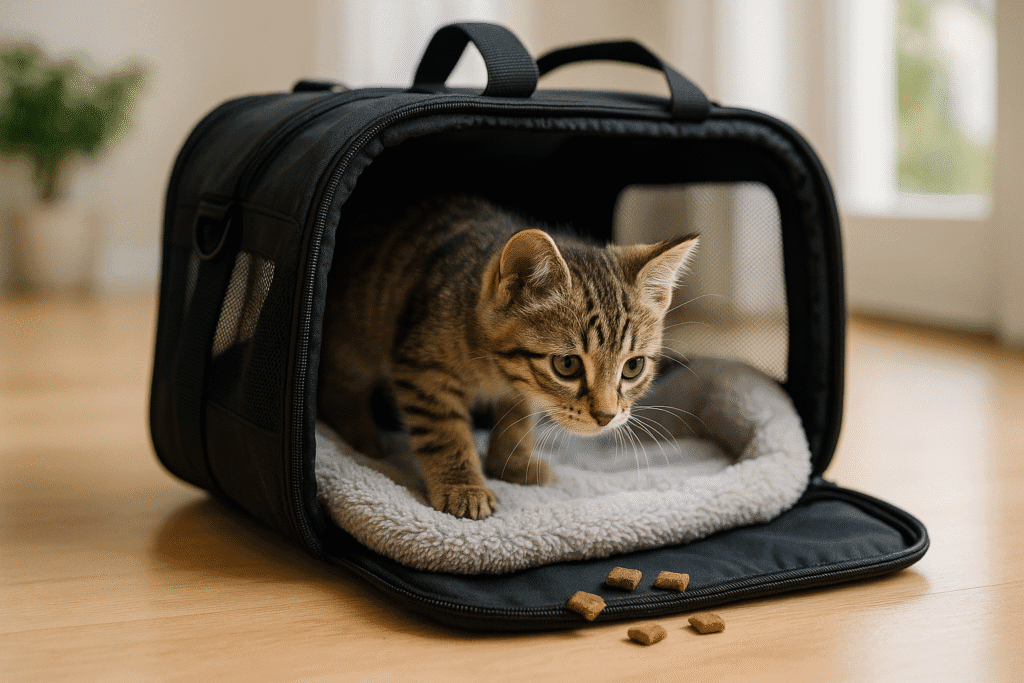
If you’re just starting out and looking for kitty training tips 2025, focus on four core pillars: litter habits, handling, carrier comfort, and daily routine.
Litter Training
- Keep the box simple: open, unscented, large.
- Show the kitten the box after eating, playing, and waking up.
- If an accident happens, move the soiled material into the box and clean the spot thoroughly—don’t punish.
Handling & Nail Trim Foundations
- Touch paws briefly during calm moments, then treat.
- Lift for 1–2 seconds, place down, treat.
- Short, predictable handling sessions build trust faster than long wrestling matches.
Carrier Training
- Make the carrier part of the furniture: leave it open, add a blanket, toss treats inside.
- Feed near or inside it once a day.
- Practice closing the door for 1–2 seconds, then open and reward.
Routine & Sleep
Most kitty training tips 2025 overlook this:
- Feed kittens multiple small meals at consistent times.
- Schedule a play session before bed to reduce night zoomies.
- Avoid responding to 4 a.m. meows with food, or you’ll teach them “scream = breakfast.”
Tech & Tools That Make Training Easier
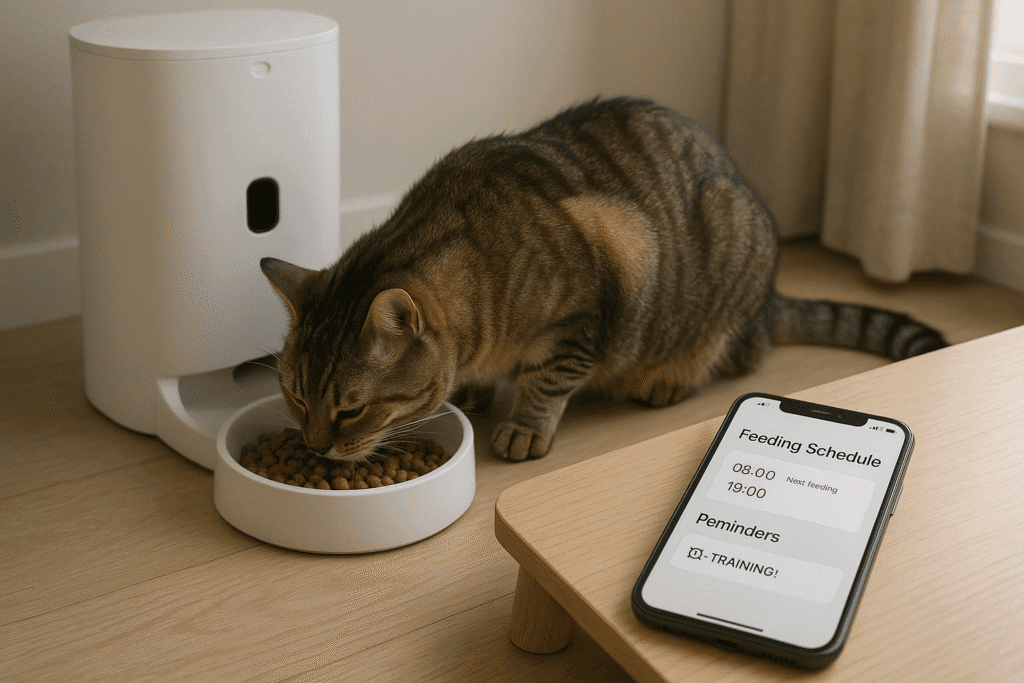
Training isn’t just voice and treats. Smart gear can make many cat training tips 2025 easier to apply consistently:
- Smart feeders help lock in predictable routines, especially for recall and pre-meal training.
- Interactive toys and motion toys handle the “energy burn” part when you’re busy, so your sessions can focus on skills, not just zoomie management.
- Cameras let you see what actually triggers problem behaviors when you’re not home.
- Smart litter boxes give early data on stress-related issues (more frequent peeing, constipation) that might explain sudden behavior changes.
If you’re implementing these cat training tips 2025 and still feel like your cat is bouncing off the walls, upgrading to a combination of smart feeder, interactive toys and a good scratching setup can make the whole system much easier to manage.
When Training Isn’t Enough: Red Flags
Even the best cat training tips 2025 can’t solve the following issues:
- sudden aggression in a cat that was previously calm
- new litter box issues in a well-trained cat
- rapid weight loss or gain + behavior changes
- constant hiding, overgrooming, or vocalization
These are medical or high-stress red flags, not simple “disobedience.” In those cases:
- call your veterinarian first
- ask if a pain source, urinary issue, thyroid disease or other condition might be involved
- if the vet rules out medical problems, ask for a referral to a veterinary behaviorist
Good training amplifies welfare. It can’t compensate for pain, fear, or illness.
References
- Cornell Feline Health Center – resources on behavior, enrichment, and stress in indoor cats
- AVMA – guidelines and articles on feline welfare, obesity, and humane training
Disclaimer
The information in this article is for educational purposes only and is not a substitute for professional veterinary advice, diagnosis or treatment. Always consult your veterinarian if your cat shows sudden behavior changes, signs of pain, or persistent litter box, grooming or aggression issues. Training tips and tools should be adapted to your individual cat’s health, age and temperament.
PetTech AI participates in affiliate programs, including Amazon Associates and CJ. This means we may earn a small commission if you purchase products through links on this page, at no extra cost to you. Our recommendations are based on independent research and expert sources, not paid placement.