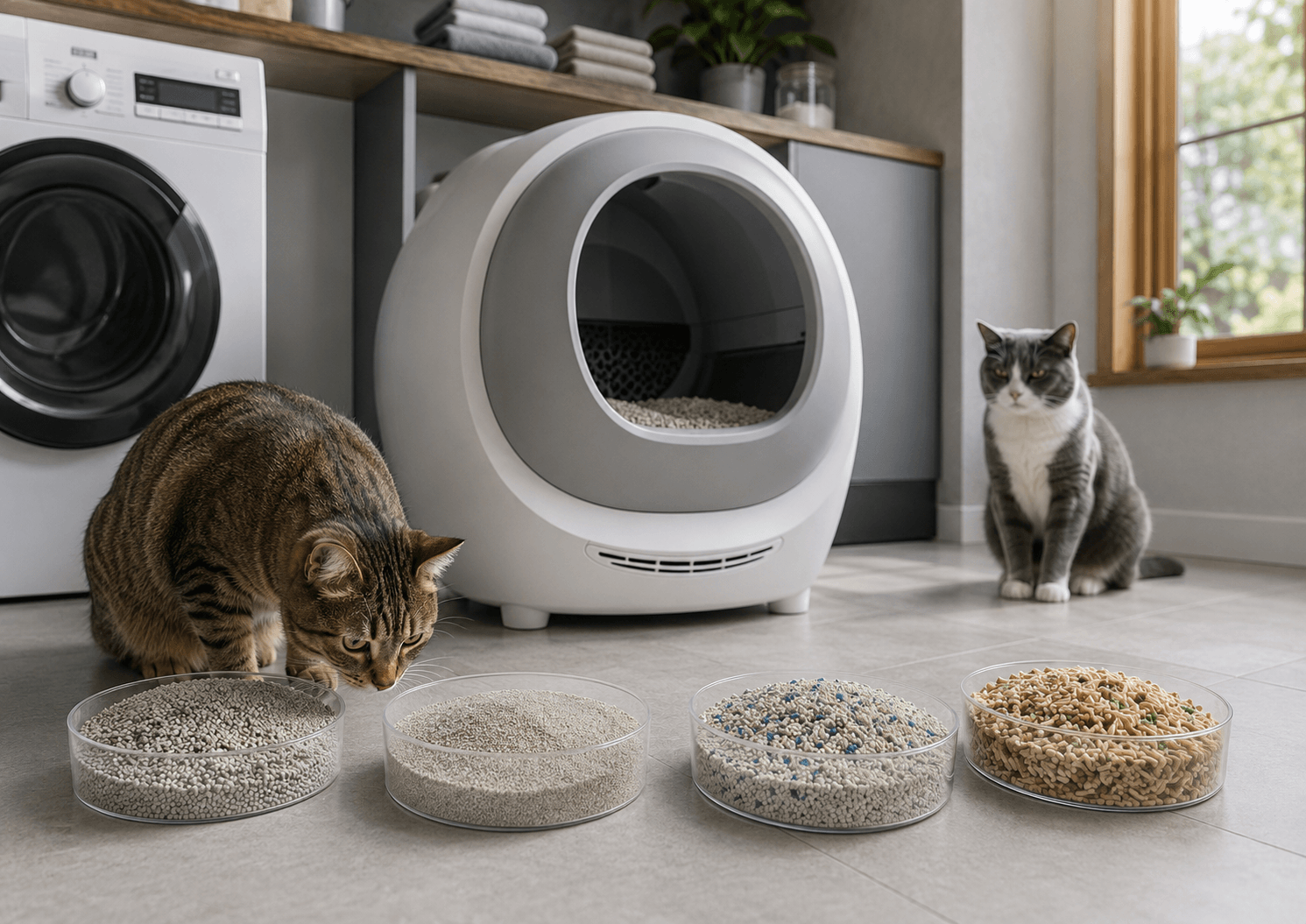
Automatic litter boxes remove the scoop. They do not remove physics.
The wrong litter can break apart during rotation, stick to the liner, confuse level sensors or send clean granules into the waste drawer. The app may still report a successful cycle. The evidence inside the globe may file a dissenting opinion.
For most rotating and sifting machines, standard-weight, unscented clumping clay remains the safest starting point. Tofu, mixed and crystal litter can work, but only when the machine and its sifter explicitly support them.
Our most defensible general recommendation is Dr. Elsey’s Ultra Unscented. BoxiePro Deep Clean is the premium clay alternative, ARM & HAMMER Slide targets sticking, and PETKIT Clump+ makes sense mainly inside compatible PETKIT systems.
Overall verdict: Recommended—with compatibility checked before purchase.
Quick Verdict
| Product | Best fit | Main limitation | Verdict |
|---|---|---|---|
| Dr. Elsey’s Ultra Unscented | Safest general starting point | Heavy; tracking and some dust remain possible | Recommended |
| BoxiePro Deep Clean | Premium unscented clay and odor control | Higher ongoing cost | Recommended |
| ARM & HAMMER Slide | Existing sticking or smearing problems | Scented formula may not suit every cat | Conditional |
| PETKIT Clump+ Tofu Mixed | Compatible PETKIT machines and sifters | Not a universal cross-brand choice | Conditional |
PetTech AI may earn a commission from qualifying purchases. As an Amazon Associate I earn from qualifying purchases.
Want the safest general starting point? Check Dr. Elsey’s Ultra Unscented on Amazon.
Prefer a premium unscented clay formula? Check BoxiePro Deep Clean on Amazon.
Research Note
This is a research-led shortlist based on manufacturer documentation, litter-box compatibility guidance and the mechanical requirements of rotating and sifting systems.
PetTech AI has not tested all four formulas under identical laboratory conditions. The rankings therefore describe the most sensible use case for each product, not measured victories in clumping speed, dust production or litter consumption.
A bag saying “hard clumping” is evidence of the manufacturer’s position. It is not a notarized statement from the laws of chemistry.
What Your Robot Actually Needs
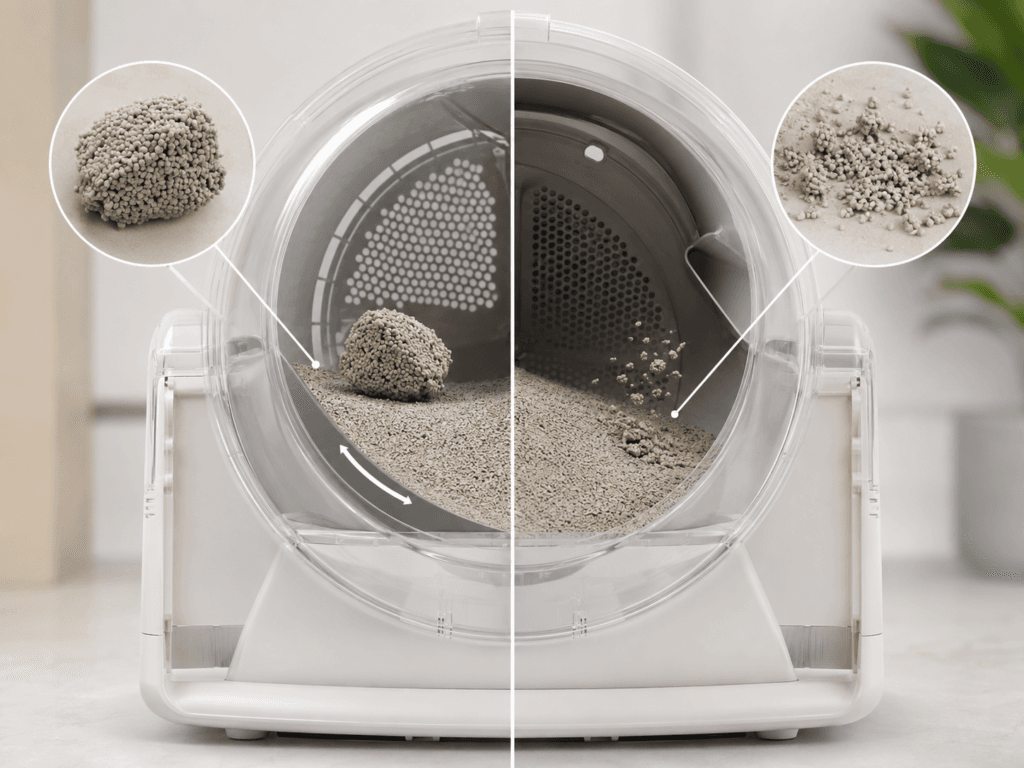
A litter can work perfectly in a manual box and fail impressively once machinery becomes involved.
Automatic systems need four things:
- Firm clumps: waste must survive movement without breaking apart.
- Suitable particles: clean litter must pass through the sifter instead of joining the waste.
- Enough drying time: soft urine clumps tend to smear or fragment.
- Predictable density: very light or unusual materials may affect separation and sensor readings.
Whisker currently recommends high-quality, standard-weight clumping clay for its newer Litter-Robot models. It warns that translucent crystal litter can affect level sensing and that many pellet-shaped or non-clumping alternatives will not sift correctly. PETKIT uses a broader system: models such as the PuraMax 2 include different sifters for fine clay and larger tofu or mixed particles.
That distinction matters. “Compatible with automatic litter boxes” is not a universal passport. Your robot’s screen still controls the border.
Best General Starting Point: Dr. Elsey’s Ultra Unscented
Dr. Elsey’s Ultra is not the most exciting product here. That is part of its charm.
It is an unscented, hard-clumping clay litter designed for multi-cat homes and specifically positioned for sifting or mechanical litter boxes. Dr. Elsey’s says its clumps resist breaking apart and help prevent moisture from reaching the bottom of the box.
Why it is the safest default
- conventional clay granules;
- hard-clumping formulation;
- no added fragrance;
- no long tofu sticks;
- no translucent crystals;
- no unusual material requiring a specialized sifter.
This does not prove that it outperforms every competing clay litter. It makes it the easiest recommendation to defend across different machines.
The trade-offs
Ultra is heavy. It can track, and “low dust” never means “the laws of gravity have been suspended.” Pouring any clay litter aggressively can produce a small indoor weather event.
Verdict: Recommended.
Start here when your machine requires ordinary clumping clay and you do not have a specific sticking, scent or particle-size problem to solve.
Check Dr. Elsey’s Ultra Unscented on Amazon.
Premium Clay Alternative: BoxiePro Deep Clean
BoxiePro Deep Clean is the more premium choice for owners prioritizing unscented odor control and tight clay clumps.
Its formula uses bentonite clay and probiotics. Boxie says the probiotics address odor-causing bacteria rather than masking odor with added fragrance, while the clay forms hard clumps suitable for regular, sifting and automatic litter boxes.
That positioning fits automatic systems well. Stronger clump integrity can reduce dirty fragments returning to the clean bed, although we do not have a controlled comparison proving that BoxiePro beats Dr. Elsey’s inside every robot.
Buy it for
- an unscented premium clay formula;
- multi-cat odor management;
- compact clumps;
- use in conventional automatic sifters.
Skip it when
- the main priority is minimizing ongoing cost;
- your current clay already cycles cleanly;
- you expect the word “premium” to personally clean the globe.
Verdict: Recommended.
BoxiePro Deep Clean is a credible upgrade candidate, not a mandatory tax on owning an expensive robot.
Check BoxiePro Deep Clean on Amazon.
Targeted Anti-Stick Option: ARM & HAMMER Slide
ARM & HAMMER Slide belongs here for one specific reason: some automatic boxes develop stuck-on urine clumps that require more manual scraping than the automation brochure mentioned.
The manufacturer positions Slide around reducing adhesion and allowing clumps to release from litter-box surfaces more easily. That makes it relevant when waste regularly sticks to a globe or liner. It does not independently prove superior performance in every robot.
Before changing litter, increase the machine’s cycle delay. A clump given more time to harden may release cleanly without introducing a new formula.
Buy it when
- sticking is already a recurring problem;
- soft clumps smear during rotation;
- longer cycle delays have not solved it;
- your cat accepts scented litter.
Why the verdict is Conditional
Slide’s scent may be unacceptable to sensitive cats. A perfectly clean globe is not a victory when Baron has moved his operations behind the sofa.
Verdict: Conditional.
Treat Slide as a troubleshooting product, not the universal default.
Check ARM & HAMMER Slide on Amazon.
PETKIT-Specific Alternative: PETKIT Clump+ Tofu Mixed
PETKIT Clump+ mixes tofu and bentonite in a larger-particle formula. PETKIT markets it for manual and self-cleaning litter boxes and says the particle dimensions are designed to sift while limiting clean-litter waste. Those remain manufacturer claims rather than independent measurements.
The strongest case for Clump+ is inside PETKIT machines configured with the correct sifter. The PuraMax 2, for example, includes one screen for larger tofu and mixed particles and another for finer bentonite or mineral litter.
Buy it for
- a compatible PETKIT automatic box;
- the tofu or mixed-litter sifter;
- owners deliberately seeking an alternative to all-clay litter.
Do not assume
A PETKIT-compatible mixture is not automatically appropriate for Litter-Robot, CATLINK or Neakasa. Pellet length and diameter vary between formulas, and a sifter cannot be persuaded by brand enthusiasm.
Verdict: Conditional.
Use Clump+ when the exact machine and installed screen support it. Otherwise, conventional clay remains the lower-regret choice.
Check PETKIT Clump+ Tofu Mixed on Amazon.
Litter compatibility is similar, but ownership friction is not; see our PETKIT Purobot Ultra vs Max Pro 2 comparison.
Clay, Tofu or Crystal?
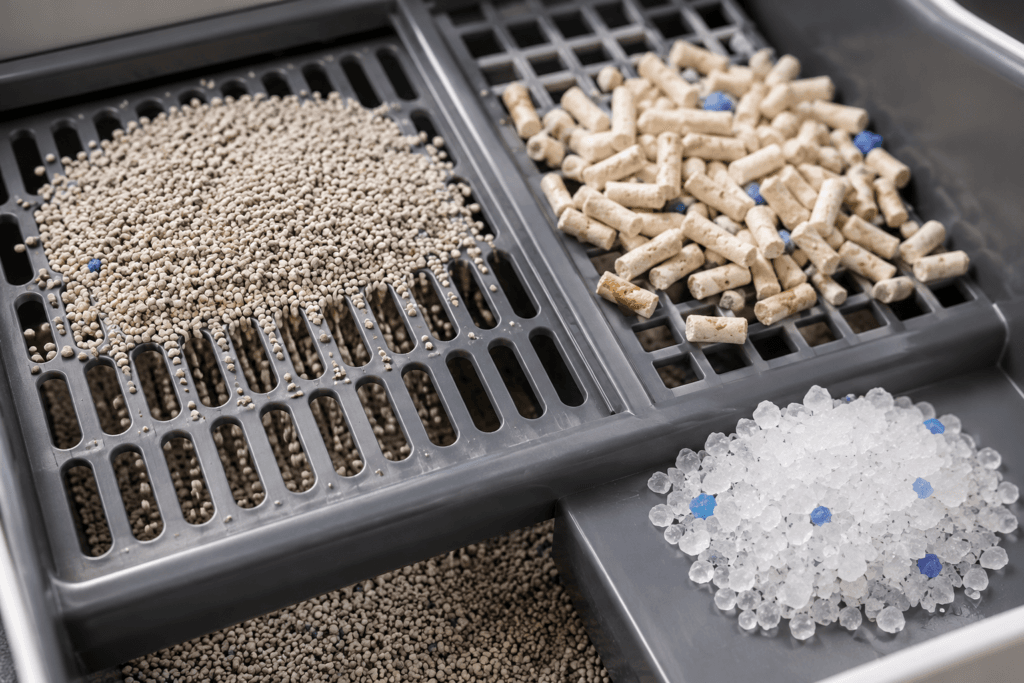
Choose clumping clay for broad compatibility
Standard-weight clay remains the easiest cross-brand recommendation. It generally offers the density, particle size and clump structure expected by rotating sifters.
It is heavier and can create dust or tracking, but robots understand it. Sometimes compatibility is less glamorous than innovation and considerably cheaper.
Choose tofu or mixed litter only with the correct sifter
PETKIT supports tofu and mixed litter on selected machines using dedicated screens. Other brands vary substantially.
“Tofu” describes the material, not one standardized shape. One product may use fine granules; another may resemble tiny beige construction timber.
Treat crystal litter as system-specific
Some older or purpose-built machines support crystals. Newer Litter-Robot models warn that translucent or pale litter may interfere with litter-level and drawer sensors. A crystal system designed around disposable trays is therefore a different proposition from pouring crystals into a clay-oriented globe.
Match the Litter to the Machine
For Litter-Robot, begin with standard-weight clumping clay. Our Litter-Robot 4 review covers the machine’s broader ownership trade-offs.
For PETKIT PuraMax 2 and Purobot models, confirm which sifter is installed before choosing clay, tofu or mixed litter. See our PETKIT PuraMax 2 review and PETKIT Purobot Max Pro 2 review.
For CATLINK and Neakasa, check the current manual for the exact model. Generic statements such as “most clumping litter” are less useful than the screen dimensions and exclusions hidden three pages later.
A logo on the machine cannot negotiate with an oversized pellet.
Three Problems to Fix Before Switching Brands
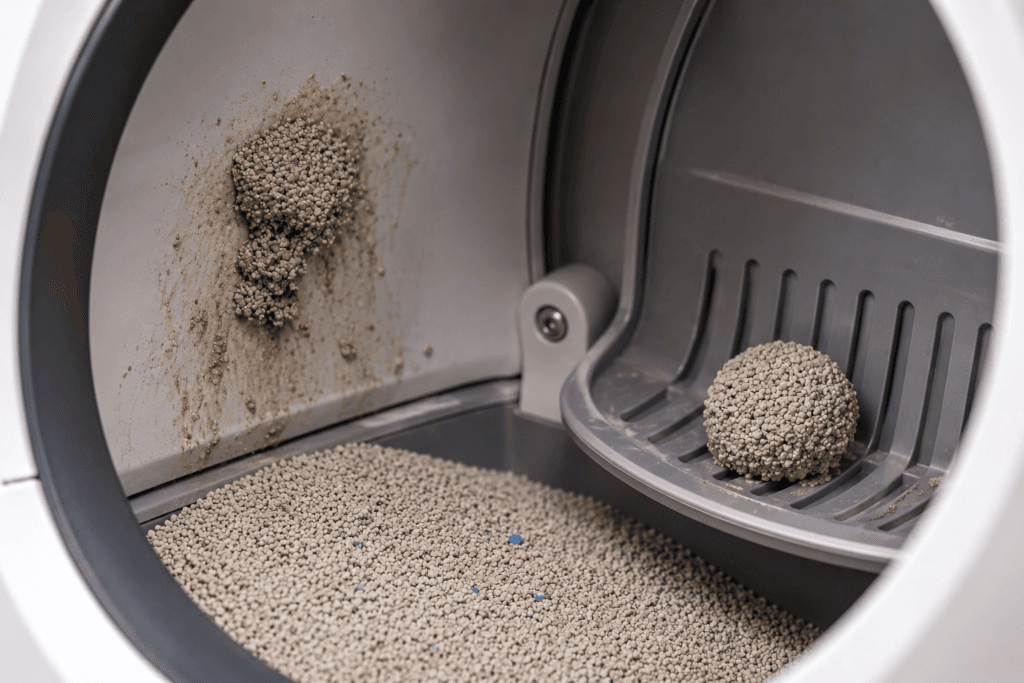
Broken clumps
Increase the cleaning delay. If fragments still return to the clean bed, use a firmer clumping formula.
Smearing on the liner
Check litter depth, cycle timing and whether urine is reaching the liner before absorption. ARM & HAMMER Slide becomes relevant only after those variables have been addressed.
Clean litter entering the drawer
Verify the fill line and particle size. Too much litter or granules too large for the sifter will be discarded alongside waste. The robot is not wasteful out of malice. It simply lacks a committee for edge cases.
What to Avoid
Unless the manufacturer explicitly approves them, avoid:
- non-clumping litter;
- paper and wood pellets;
- long tofu sticks;
- fragile plant-based clumps;
- oversized crystals;
- strongly scented formulas when the cat already hesitates;
- any material that cannot pass through the installed sifter.
The cat remains the final quality-control department. A technically perfect litter that the cat refuses to use has failed the only test that matters.
Final Verdict
Dr. Elsey’s Ultra Unscented is the safest general recommendation. It combines conventional particle size, hard clumping and direct suitability for mechanical litter boxes without adding fragrance or unusual materials.
BoxiePro Deep Clean is the premium clay alternative, particularly for owners prioritizing unscented odor control.
ARM & HAMMER Slide is a targeted fix for sticking, not the default for every household.
PETKIT Clump+ is the specialist option for compatible PETKIT systems, where the correct tofu or mixed-litter sifter is installed.
The practical rule is simple:
Start with standard-weight clumping clay. Change only when the alternative is explicitly compatible and solves a real problem.
Your automatic litter box already contains motors, sensors, firmware and a mobile app. The material poured inside it does not also need a leap of faith.
Still choosing the machine? Compare the leading systems in our best smart litter boxes guide.
Frequently Asked Questions
Can any clumping litter work in an automatic litter box?
No. Clumping is only the first requirement. Particle size, density, clump strength and sifter design also affect compatibility.
How long should I delay the cleaning cycle?
Use the machine’s default setting first. Increase the delay when urine clumps break apart or smear before they have fully hardened.
Is tofu litter safe for Litter-Robot?
Some formulas may physically work, but Whisker still recommends standard-weight clumping clay for its current models. Tofu litter should not be treated as universally compatible.
Does low-dust litter eliminate sensor cleaning?
No. Lower dust may reduce buildup, but sensors and internal surfaces still need periodic cleaning.
References
Dr. Elsey’s — Ultra Litter Product Documentation
Boxie — BoxiePro Deep Clean Product Documentation
ARM & HAMMER — Slide Easy Clean-Up Product Documentation
PETKIT — Clump+ Tofu Mixed Litter Documentation
Whisker — Litter-Robot Litter Compatibility Guide
PETKIT — PuraMax 2 Sifter and Litter Compatibility Documentation
Editorial Disclosure
PetTech AI may earn a commission from qualifying purchases. This does not influence our recommendations, comparisons or editorial judgments.
Image Disclosure
Official manufacturer images are used when available and authorized.
AI-generated images may also be used as editorial illustrations. They should not be treated as exact representations of product dimensions, materials, controls or physical features. Always verify current official product information before purchasing.