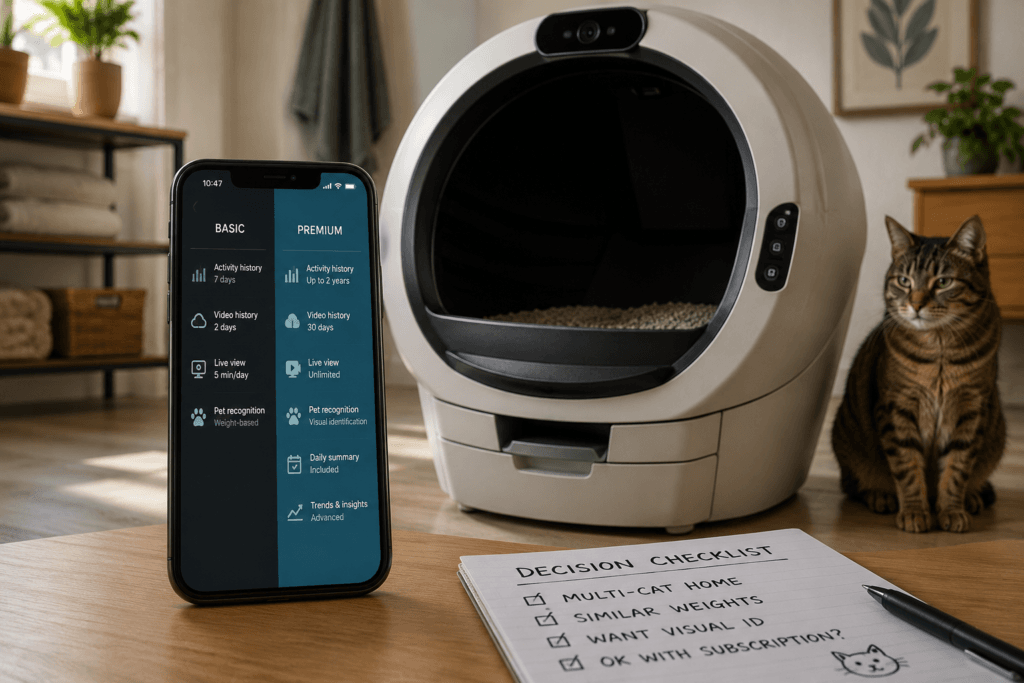
Tag: Multi-Cat Monitoring

  • Petivity Smart Litter Box Monitor Review (2026): Useful Data Without the Robot?

    Petivity Smart Litter Box Monitor Review (2026): Useful Data Without the Robot?

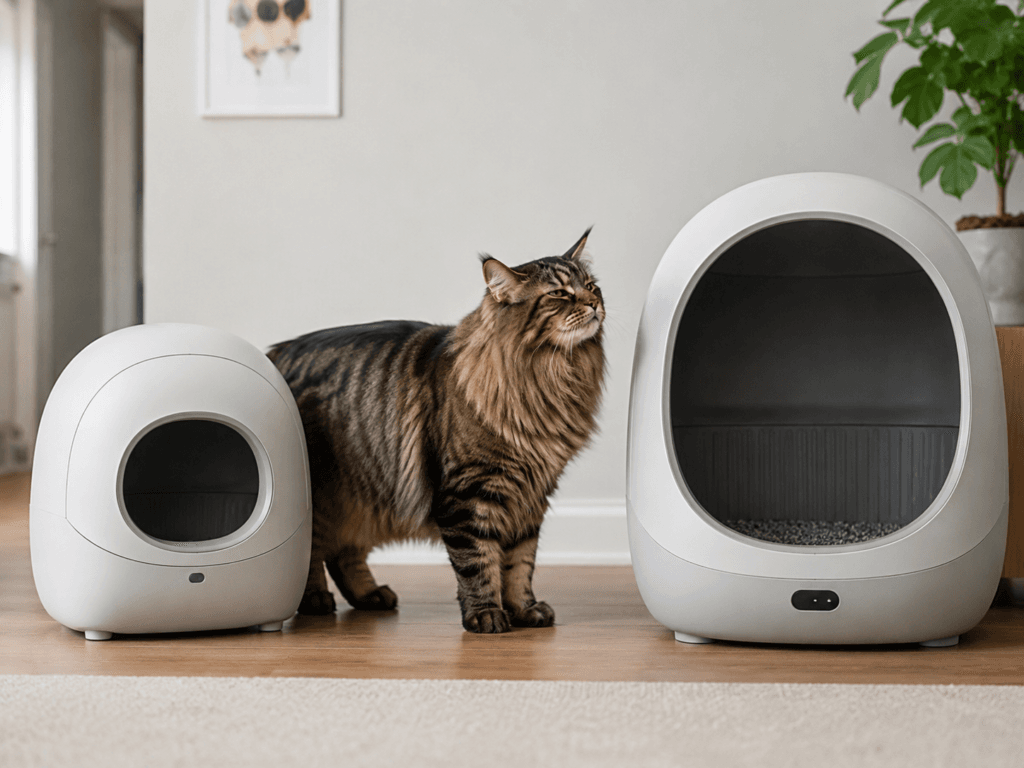
    Petivity does not scoop litter.

    It does not rotate, seal waste, spray deodorizer, or transform your laundry room into a small automated sanitation facility.

    It sits underneath the litter box you already own and watches what happens.

    That may sound underwhelming until you consider the alternative: spending hundreds more on a self-cleaning machine that your cat examines once, declares suspicious, and never enters again.

    The Petivity Smart Litter Box Monitor tracks weight and litter-box activity without asking the cat to learn a new toilet. For cautious cats, senior cats, and owners who want information more than automation, that is the entire appeal.

    The trade-off is equally simple:

    Petivity monitors the chore. You still perform it.

    Research note: This is a research-led review based on official Petivity documentation, independent testing, current product information, and public ownership evidence. PetTech AI has not conducted a long-term hands-on test of Petivity.

    Quick Verdict

    CategoryVerdict
    Best forMonitoring weight and litter habits without replacing the existing box
    Main advantageMinimal disruption to the cat’s normal routine
    What it tracksWeight, visits, urination, defecation, timing, duration, and pattern changes
    Multi-cat supportUp to five cats, with initial owner-assisted training
    Main limitationIt does not clean anything
    Hidden costMultiple regularly used boxes may need multiple monitors
    RecommendationEstablished recommendation

    The short version

    Buy Petivity if your cat already likes the current litter box and you want a clearer record of weight and bathroom habits.

    Skip it if your real problem is scooping.

    Petivity can tell you that the litter box requires attention with impressive technological confidence. It will not pick up the scoop.

    Affiliate disclosure: This page contains affiliate links. PetTech AI may earn a commission if you purchase through them, at no additional cost to you. As an Amazon Associate I earn from qualifying purchases.

    Check Petivity Smart Litter Box Monitor availability on Amazon.

    What Petivity Actually Solves

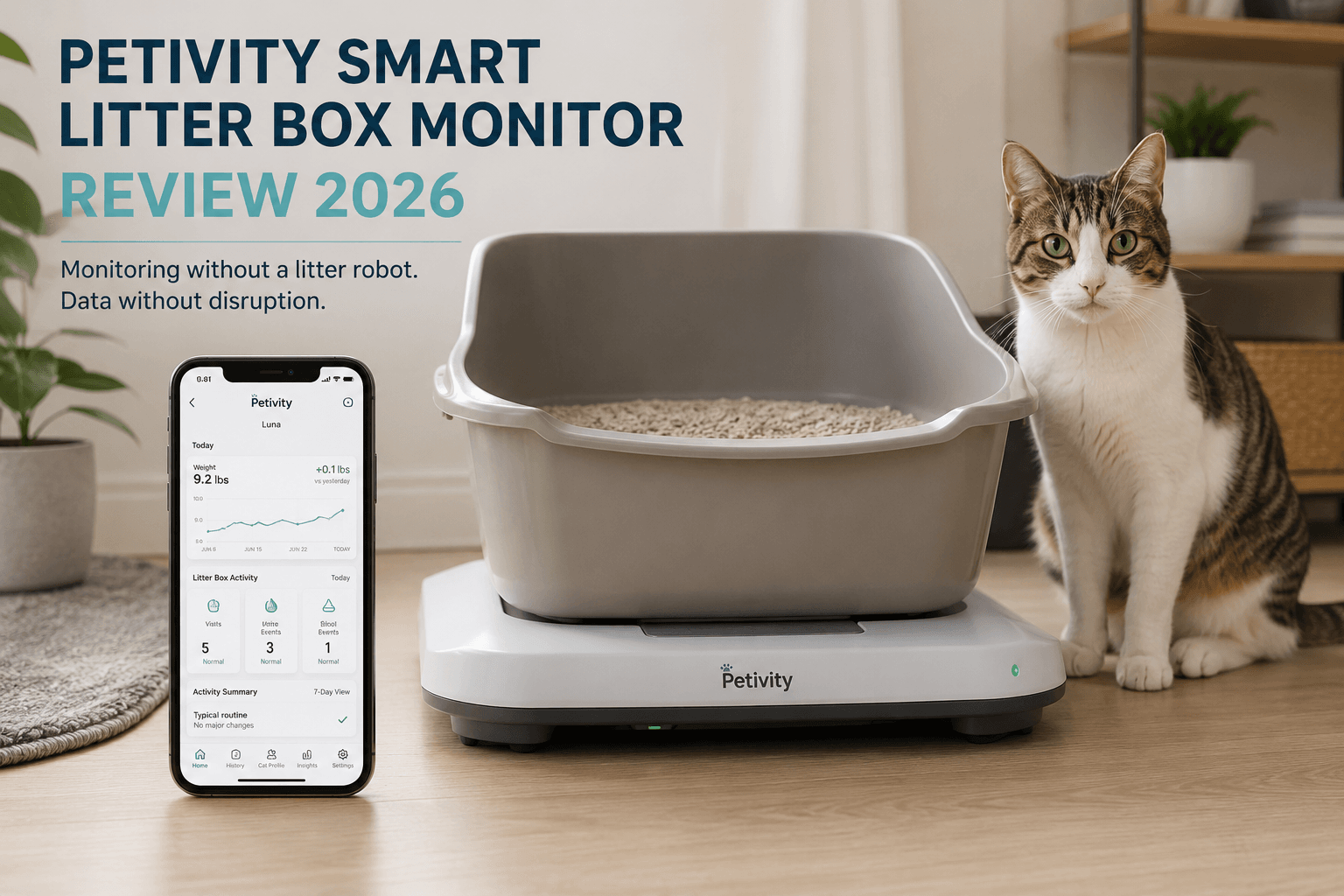
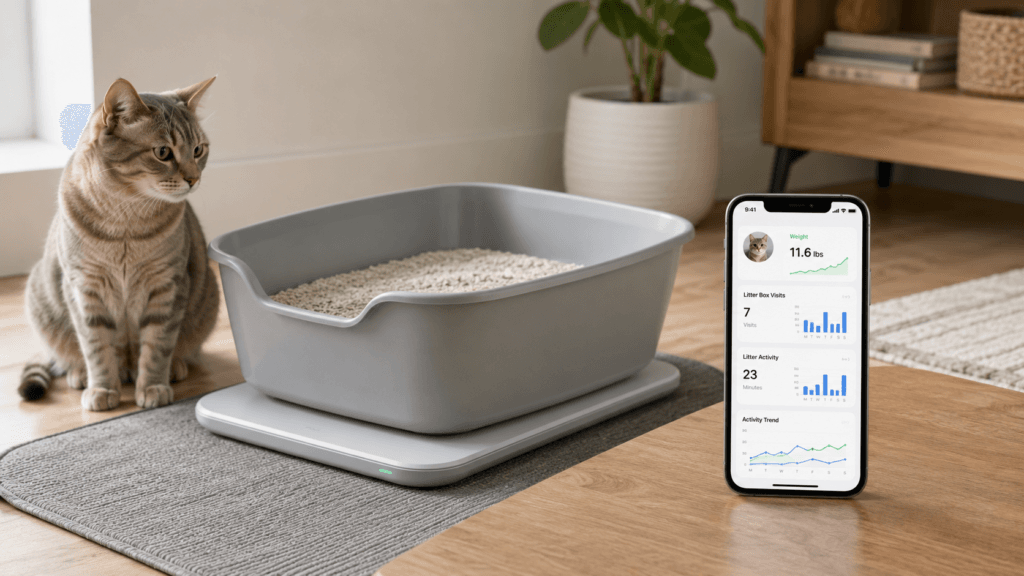
    A regular cat litter box on a smart monitoring platform with an app showing weight and litter box activity data
    Petivity is a monitoring-first product: it tracks litter behavior and weight trends, but you still scoop and maintain the box yourself.

    Petivity solves uncertainty without disruption.

    The monitor sits underneath a compatible conventional litter box. Sensors collect weight and movement data, while Petivity’s software classifies visits and displays information through the app.

    The official system tracks:

    • body weight;
    • litter-box visits;
    • urination events;
    • defecation events;
    • visit duration;
    • time of day;
    • changes from the cat’s usual pattern.

    It can also provide alerts and monthly reports intended to help owners document meaningful changes and communicate a clearer timeline to a veterinarian. Petivity explicitly states that the information is not intended to diagnose, treat, cure, or prevent disease.

    This is why Petivity occupies a useful middle ground.

    A normal litter box gives you no automatic record.

    A self-cleaning litter box changes the cat’s entire setup.

    Petivity adds information while leaving the familiar box, litter, entrance, and scooping routine mostly untouched.

    For a broader comparison of information versus labor reduction, read Smart Cat Monitoring vs Automation.

    Who Should Buy Petivity?

    Petivity is a strong fit when:

    • your cat reliably uses a conventional litter box;
    • changing the box could create unnecessary stress;
    • weight trends would be difficult to track manually;
    • litter frequency or elimination patterns are the main signals you care about;
    • you want data without cameras;
    • you accept that scooping and cleaning remain your responsibility.

    Cautious or routine-sensitive cats

    Some cats treat a new litter box as a modest household change.

    Others treat it as evidence that the property has fallen under hostile occupation.

    Petivity is useful because the cat does not need to enter a globe, tolerate motor sounds, or adapt to an unfamiliar opening. The box remains the same; the monitor simply sits underneath it.

    Senior cats

    A familiar box can be especially valuable when mobility, routine, or established preferences make a large enclosed automatic unit less attractive.

    Petivity is not officially recommended for kittens, whose rapidly changing weight and behavior can reduce data accuracy and create false alerts.

    Owners who care about weight trends

    Petivity weighs the cat during ordinary litter-box use. That can provide a more consistent trend than occasionally attempting to balance yourself and an unwilling cat on a bathroom scale.

    The useful word is trend.

    One strange reading is not a conclusion. Repeated movement over time is the information worth checking.

    Who Should Skip It?

    Skip it if you hate scooping

    Petivity does not automate waste removal.

    If your primary problem is:

    • daily scooping;
    • waste storage;
    • odor containment;
    • keeping the litter bed clean after each visit;

    compare the models in our Best Smart Litter Boxes guide instead.

    Buying Petivity to reduce manual cleaning is like buying a weather station because you dislike the rain. The information may be excellent. You are still getting wet.

    Skip it if the litter box is incompatible

    The platform measures 19 × 14 × 2 inches. Petivity recommends litter boxes no larger than 21 × 16 inches and excludes triangular and self-cleaning boxes. The box must sit completely and securely on the monitor.

    That may rule out:

    • oversized pans;
    • unusually shaped corner boxes;
    • large senior boxes;
    • automatic litter boxes;
    • setups that press against walls or furniture.

    Measure before buying.

    The cat will not be impressed that the monitor fits beautifully under a litter box you can no longer use.

    Skip it if several boxes matter equally

    One monitor records activity from one litter box.

    Petivity recommends using a monitor beneath each regularly used box to obtain a complete household record. In a multi-box home, the total cost can therefore multiply quickly.

    Monitoring one of four boxes may still provide useful information.

    It does not provide a complete picture merely because the app looks complete.

    Skip it outside supported regions

    Petivity officially lists availability only in the 48 contiguous United States. International buyers should verify product support, app access, warranty, and replacement options before purchasing through an unofficial route.

    Multi-Cat Monitoring: Useful, but Not Instant

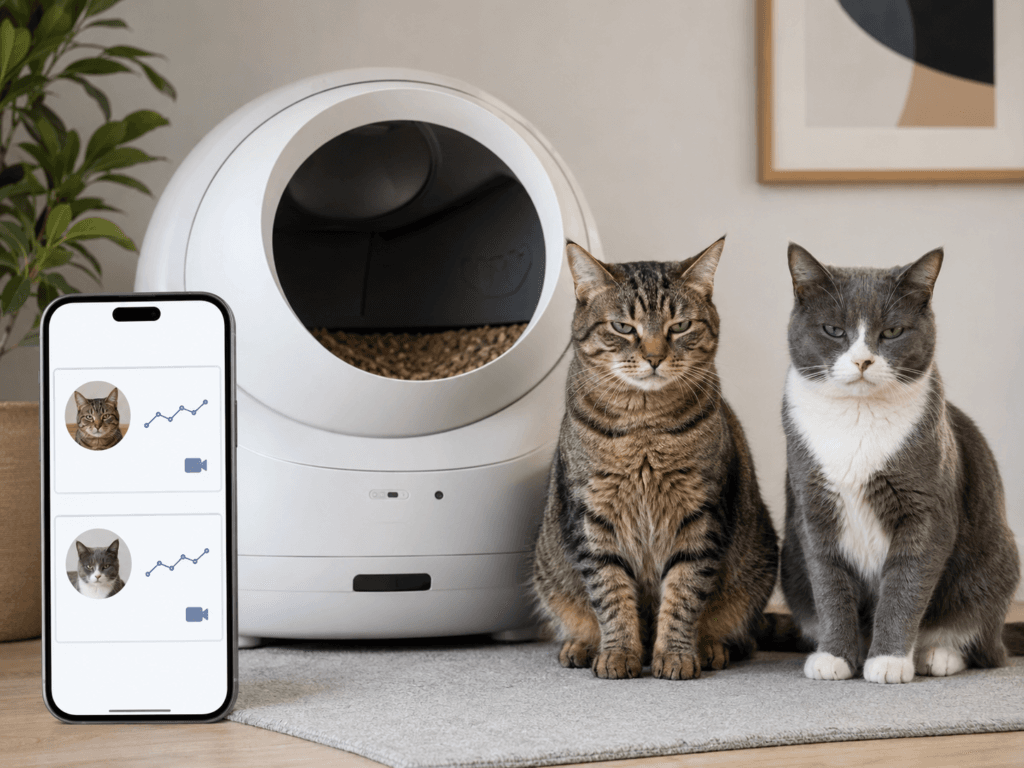
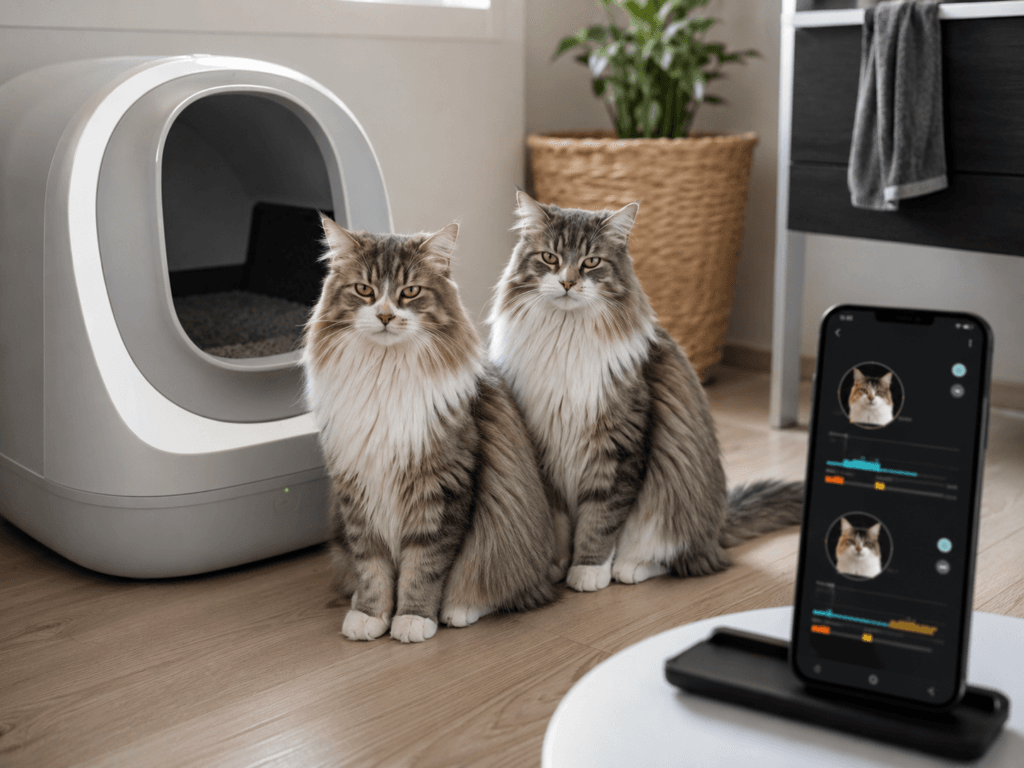
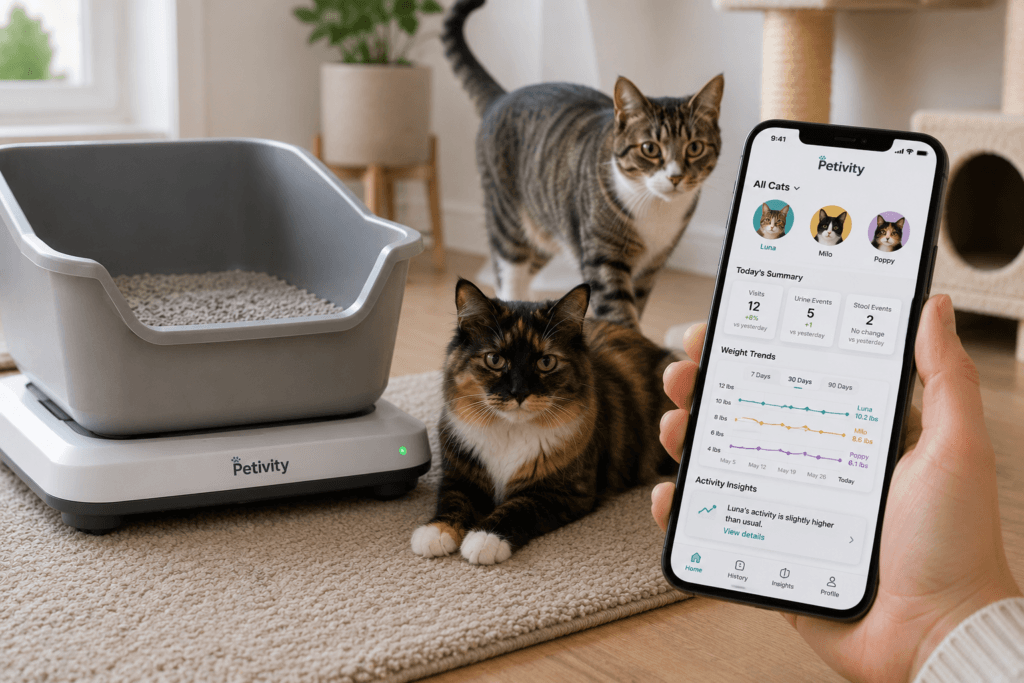
    Two cats near a regular litter box while a phone displays cat weight and litter routine trends
    Petivity can be useful in multi-cat homes, but owners should treat the data as trends to interpret calmly, not as a diagnosis.

    Petivity can monitor up to five cats without collars or implanted microchips.

    It distinguishes animals using weight and behavioral information, but the owner must help train the system during the first few weeks.

    Petivity says users should confirm at least eight events for each cat before identification prompts begin to decrease. Cats with similar weights may require more confirmations and occasional corrections.

    This is not a flaw so much as a boundary.

    The system is learning from imperfect household data:

    • cats may enter briefly;
    • two cats may weigh almost the same;
    • someone may dig without eliminating;
    • scooping creates a non-cat event;
    • the box may shift slightly after cleaning.

    Petivity can reduce uncertainty.

    It cannot perform forensic identification from one paw print.

    Best multi-cat use case

    Petivity makes the most sense when:

    • cats differ enough in weight or behavior to create recognizable profiles;
    • the owner is willing to label early events;
    • one or more monitored boxes capture most household activity;
    • trends matter more than perfect classification of every visit.

    Older independent testing documented occasional missed or misclassified events, supporting the view that Petivity is strongest as a pattern monitor rather than an unquestionable transcript of every bathroom visit.

    Setup: Simple Concept, Sensitive Scale

    Installation is straightforward:

    1. place the monitor on a hard, flat, stable surface;
    2. extend its feet;
    3. center a compatible litter box on top;
    4. connect it to the app;
    5. create profiles for the cats;
    6. help classify early events.

    Accurate data depends on the physical setup remaining stable. The platform should not touch walls, furniture, soft flooring, or objects that interfere with weight readings. Petivity recommends at least one inch of clearance around the setup.

    After cleaning:

    • return the monitor to the same location;
    • recenter the litter box;
    • make sure nothing presses against it;
    • confirm that the floor remains level.

    Petivity is easy to install.

    It is not immune to physics.

    Power, Wi-Fi, and the Cord-Chewing Department

    Petivity can use either:

    • six AA batteries; or
    • the included wall charger.

    The two power sources should not be used simultaneously. Petivity recommends battery power when a cat may chew the electrical cord. The monitor also requires Wi-Fi and should remain within reasonable range of the router; official support specifies roughly 15 meters with limited obstructions.

    The system uses the mobile app for charts, alerts, profiles, and reports. Current official requirements list iOS 14 or higher and Android 11 or higher.

    This means Petivity’s useful life depends partly on:

    • app support;
    • account access;
    • Wi-Fi stability;
    • continued software maintenance.

    The hardware underneath the box is only half the product.

    Petivity vs a Self-Cleaning Litter Box

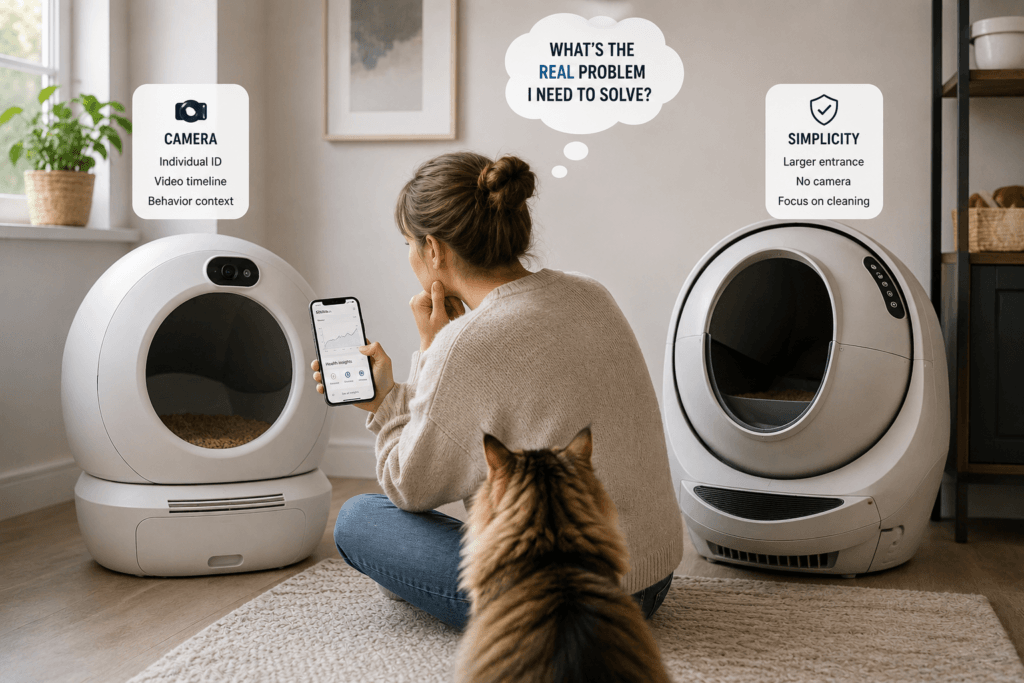
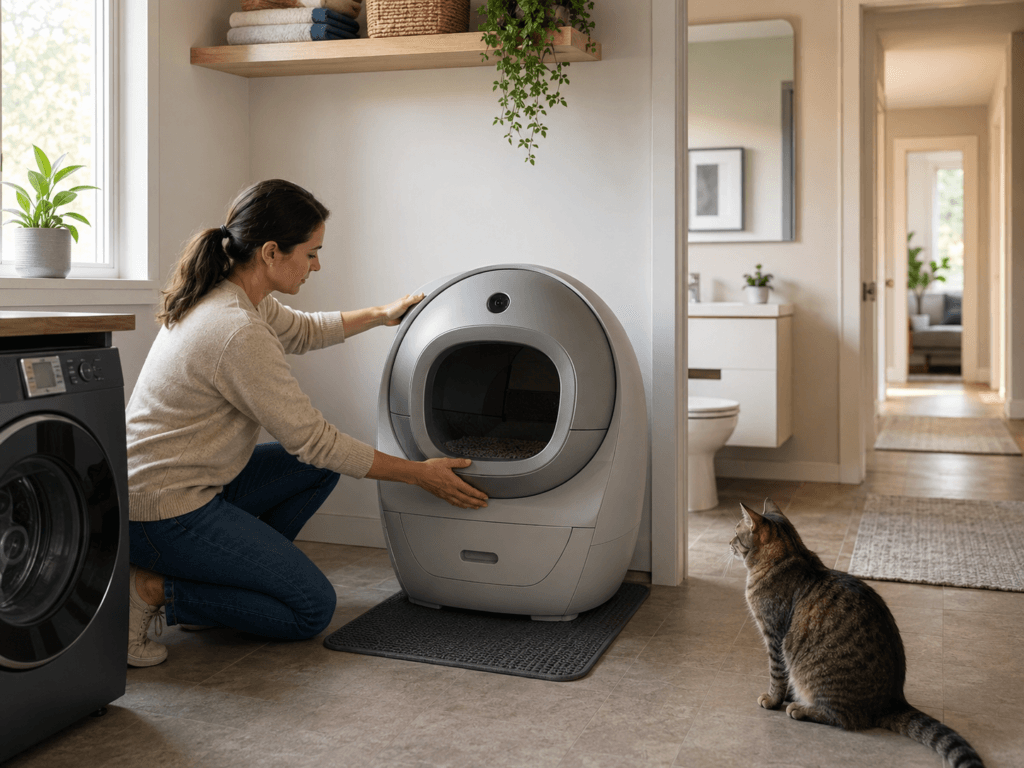
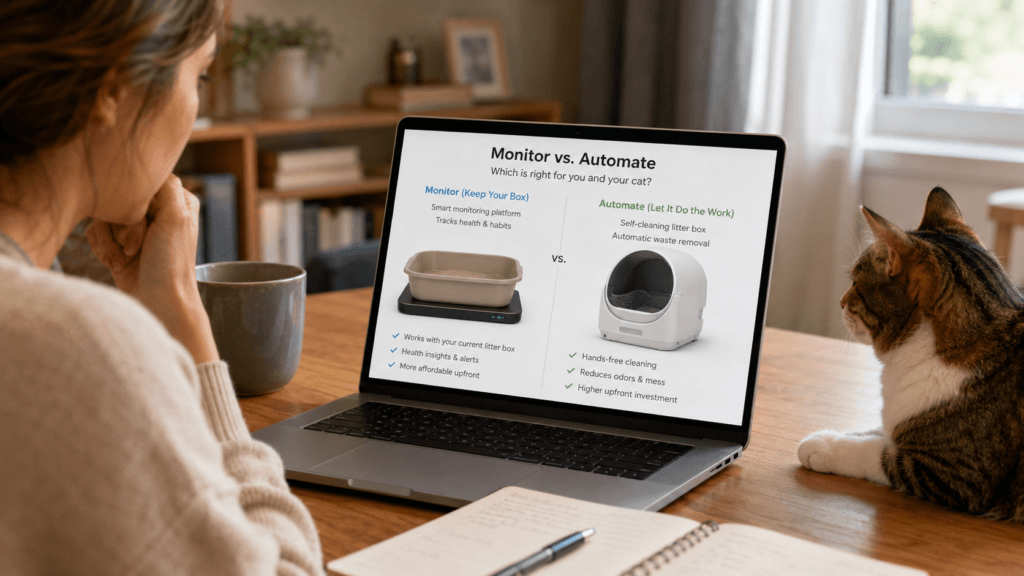
    A cat owner comparing a regular litter box monitor and a self-cleaning litter robot on a laptop
    Petivity and Litter-Robot solve different problems: Petivity preserves the existing box and adds data, while Litter-Robot changes the setup to reduce scooping.
    FeaturePetivitySelf-cleaning smart box
    Uses the existing litter boxYesNo
    Automatically removes wasteNoYes
    Tracks weight and visitsYesUsually, depending on model
    Distinguishes elimination typeDesigned toNot always
    Requires cat to learn a new boxMinimal changeUsually
    Includes camera contextNoOnly selected premium models
    Daily scooping remainsYesReduced
    Mechanical complexityLowHigh

    Choose Petivity when the current box works and information is the missing piece.

    Choose an automatic litter box when the labor itself is the main problem.

    Petivity is not the cheaper version of Litter-Robot or PETKIT Purobot.

    It is a different answer to a different question.

    For the broader monitoring landscape, see our Best Smart Cat Health Monitors guide.

    Where Petivity Can Disappoint

    It can generate incomplete data

    One monitor cannot see visits to another box.

    A shifted platform, incompatible pan, unstable surface, or inconsistent Wi-Fi can also reduce the usefulness of the record.

    Multi-cat identification needs participation

    The initial learning period is not fully automatic, particularly when cats have similar weights.

    Individual classifications are not infallible

    Occasional incorrect event labels matter less when you use the system for trends. They matter more if you expect every visit to be classified perfectly.

    The app can encourage over-monitoring

    Petivity should help you notice meaningful changes.

    It should not persuade you that every ordinary fluctuation requires an emergency meeting.

    Decide in advance what would make you act:

    • a repeated weight trend;
    • a persistent change in visit frequency;
    • a sustained change from the cat’s baseline;
    • behavior observed directly alongside the data.

    Then ignore the normal noise.

    The Six-Week Test

    After six weeks, what should still be useful?

    • passive weight tracking;
    • a record of litter-box patterns;
    • fewer arguments with yourself about whether something actually changed;
    • clearer information to share when professional advice is needed.

    What may no longer feel exciting?

    • opening the app after every visit;
    • identifying the precise time of every bowel movement;
    • the novelty of receiving bathroom analytics on your phone.

    That is fine.

    Petivity succeeds when it quietly records useful trends—not when it becomes your favorite social network.

    Final Verdict

    The Petivity Smart Litter Box Monitor is one of the clearest monitoring-first products in cat technology.

    It preserves the litter box your cat already accepts while adding weight, visit, urination, defecation, and routine data through the app. That makes it especially attractive for cautious cats, senior cats, multi-cat households willing to train the system, and owners who want evidence without adopting a large automatic box.

    Its limitations are equally clear.

    It does not scoop. One monitor covers one box. Multi-cat identification can require correction, physical setup affects accuracy, and individual events should not be treated as infallible.

    Choose Petivity when your main question is:

    “Has my cat’s litter or weight routine changed?”

    Skip it when your main question is:

    “Who is going to scoop this?”

    Petivity knows the answer.

    Unfortunately, it is still you.

    Check Petivity Smart Litter Box Monitor availability on Amazon.

    Frequently Asked Questions

    Is Petivity a litter box?

    No. It is a monitoring platform that sits underneath a compatible conventional litter box.

    Does Petivity clean the box?

    No. Owners must continue scooping, replacing litter, cleaning the pan, and maintaining the surrounding area.

    How many cats can Petivity monitor?

    Petivity supports up to five cats per monitor. Initial event confirmation is required, and cats with similar weights may need additional training.

    Does every litter box need its own monitor?

    For complete household coverage, yes. One unit records only the box sitting on top of it.

    Which litter boxes are compatible?

    Most conventional open or covered pans up to 21 × 16 inches are supported. Triangular, oversized, and self-cleaning boxes are not.

    Can Petivity diagnose illness?

    No. It can highlight changes and provide useful records, but diagnosis and treatment require a licensed veterinarian.

    References

    • Petivity Smart Litter Box Monitor official product documentation
    • Petivity setup, compatibility, power, and multi-cat support guidance
    • Purina Petivity Smart Litter Box Monitor information
    • Independent Petivity testing and ownership reviews
    • PetTech AI product-level trust check

    Image Disclosure

    Some images in this article may be AI-generated for illustrative purposes. They do not depict the exact product and should not be used to evaluate dimensions, compatibility, controls, or physical setup.

    Disclosure

    PetTech AI may earn a commission when readers purchase through affiliate links. Petivity is recommended as a monitoring tool, not a cleaning machine or a substitute for professional veterinary care.

  • PETKIT Purobot Max Pro 2 Review: Useful AI or Cat Surveillance?

    PETKIT Purobot Max Pro 2 Review: Useful AI or Cat Surveillance?

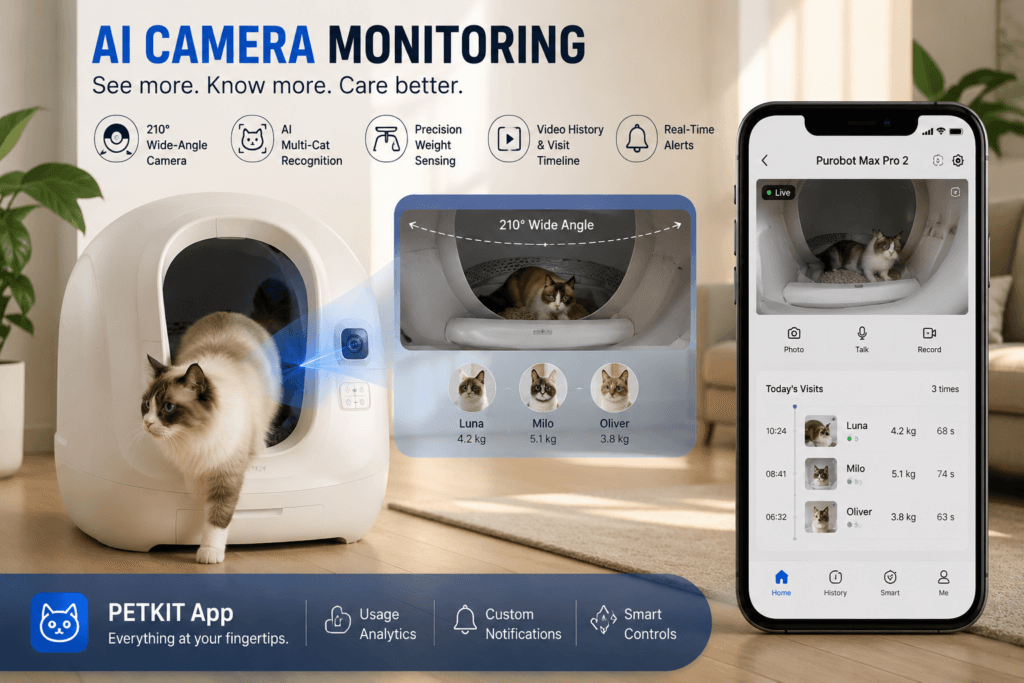
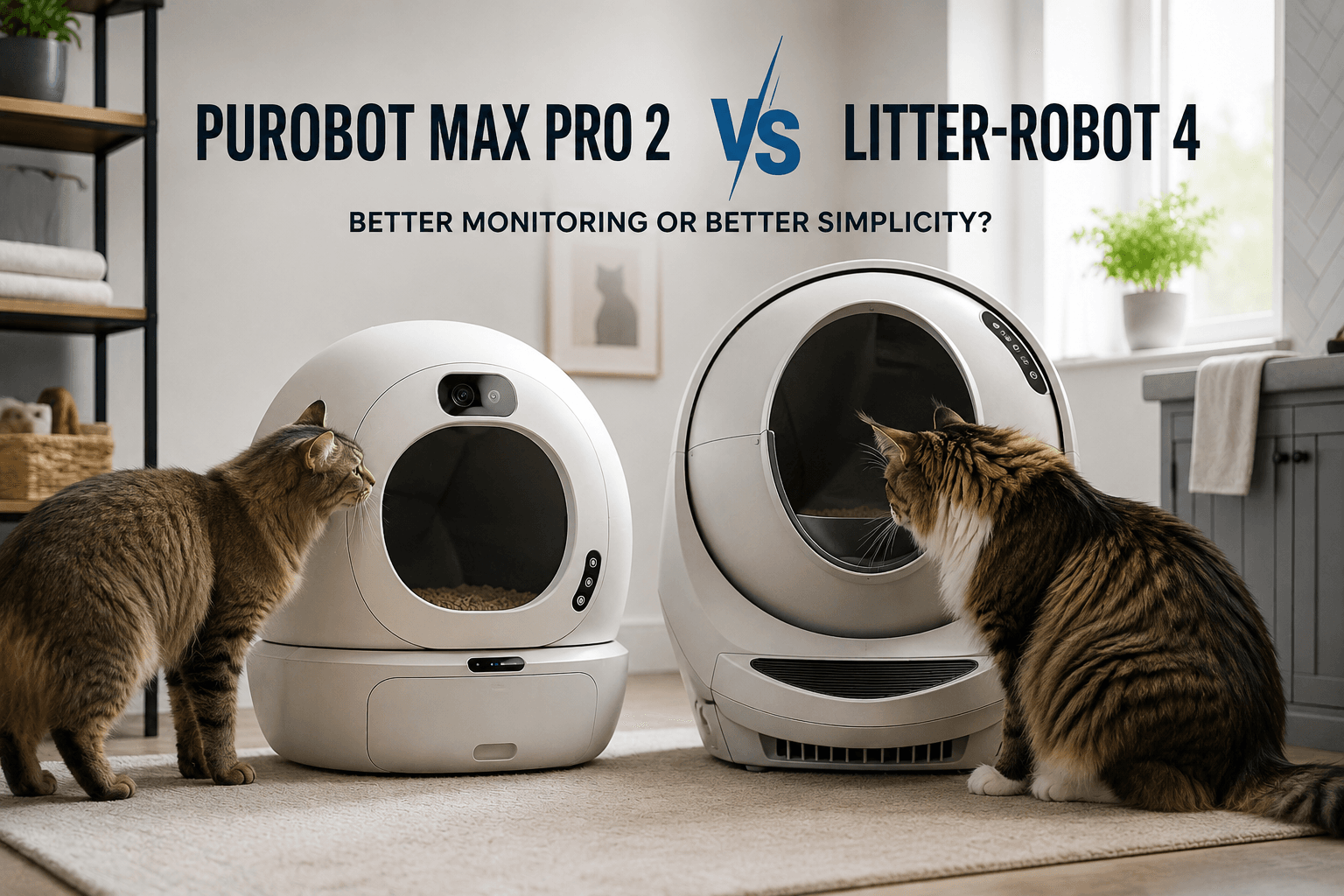
    The PETKIT Purobot Max Pro 2 is not simply a PuraMax 2 with a camera attached.

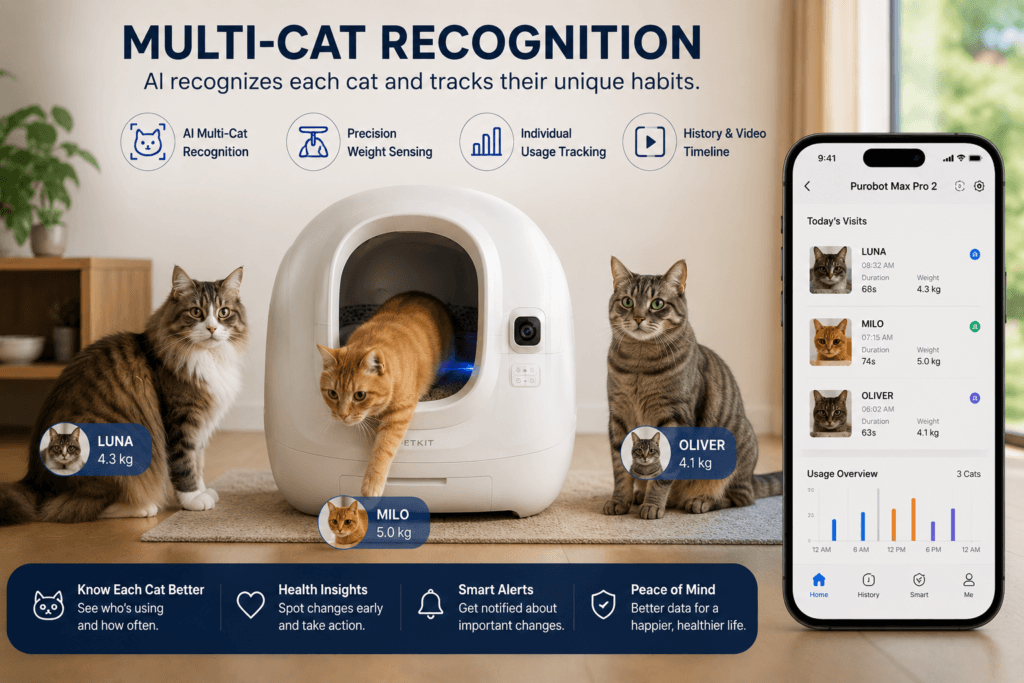
    It is a more specialized litter box built around a specific problem: identifying which cat used the box and adding visual context when litter habits change.

    That can be genuinely useful in a multi-cat home.

    It can also become an expensive way to collect videos nobody checks.

    Quick Verdict

    CategoryVerdict
    PetTech AI ratingRecommended with Conditions
    Best fitMulti-cat homes that need visual identification
    Main advantageCamera, weight data and visit records linked to individual cats
    Main catchThe camera adds cost, complexity and a PETKIT Care+ consideration
    Not forBuyers who mainly want automatic scooping
    Better default for most homesPETKIT PuraMax 2

    The PETKIT Purobot Max Pro 2 is worth considering when video changes what you can understand about individual litter-box visits.

    For automatic cleaning alone, it is overkill.

    The PuraMax 2 remains the more sensible default for most PETKIT buyers. Choose the Purobot Max Pro 2 only when visual recognition solves an actual household problem—not because “AI camera” looks impressive above the Add to Cart button.

    Research Note

    This is a research-led review based on current official specifications, product documentation, software terms, product positioning and available ownership evidence.

    PetTech AI has not conducted a long-term hands-on test of the PETKIT Purobot Max Pro 2.

    PetTech AI may earn a commission from qualifying purchases. As an Amazon Associate I earn from qualifying purchases.

    Does visual multi-cat monitoring justify the upgrade in your home? Check the Purobot Max Pro 2 on PETKIT.

    Prefer Amazon’s purchase route? Check Purobot Max Pro 2 availability and customer feedback on Amazon.

    What the Camera Actually Changes

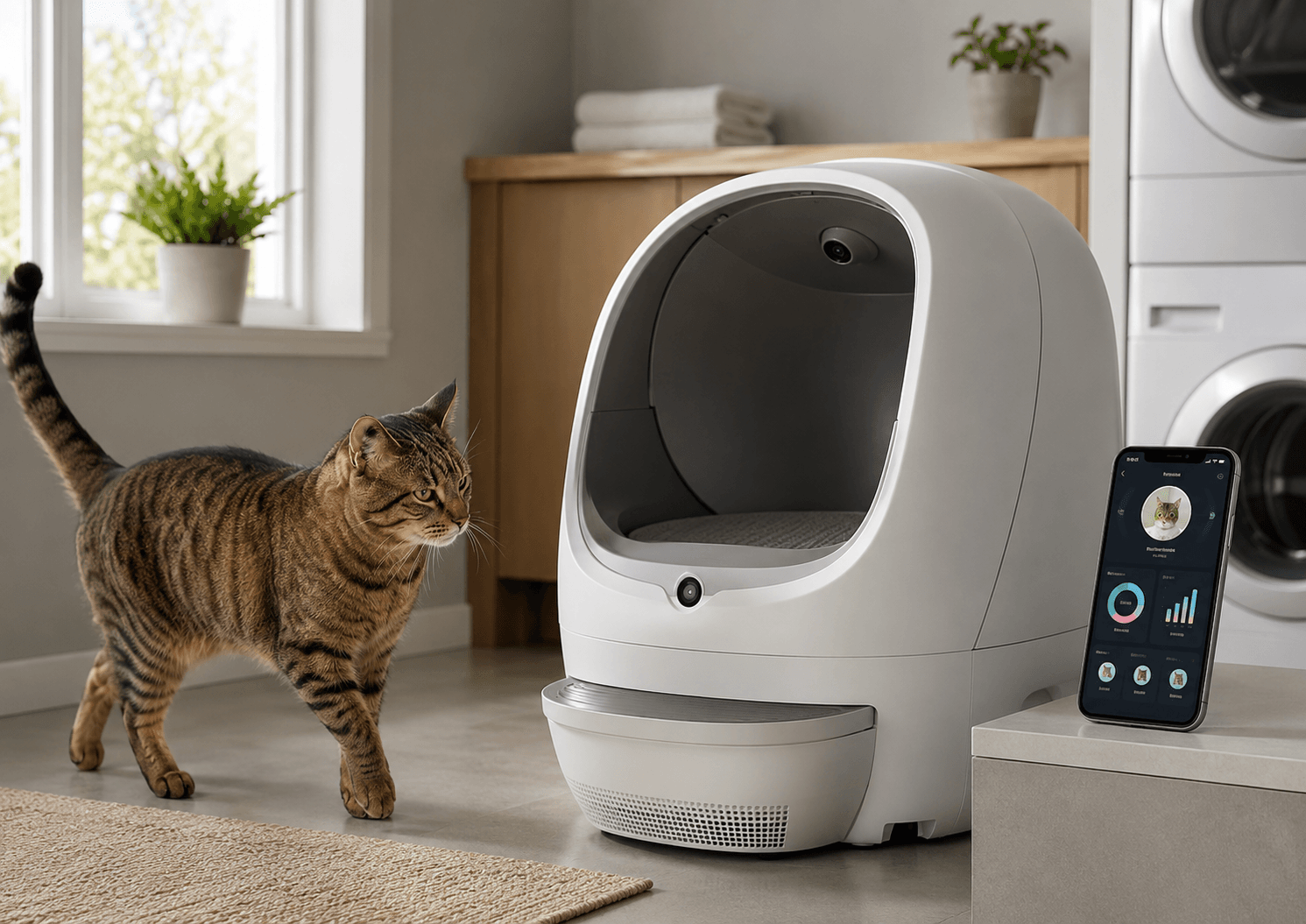
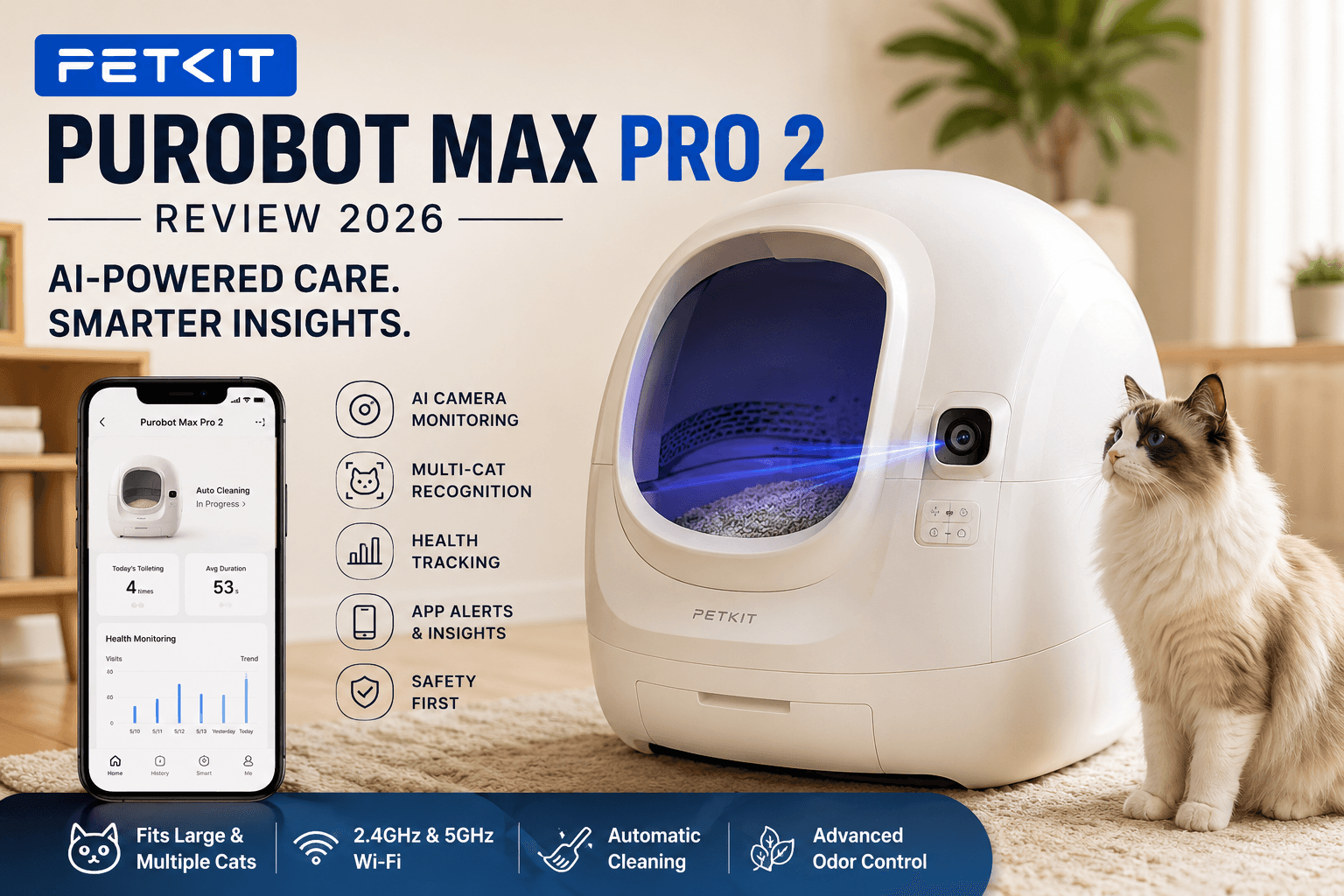
    Smart litter box using AI camera monitoring and app-connected pet tracking.

    A normal automatic litter box can record that a cat entered, measure weight and start a cleaning cycle.

    The Purobot Max Pro 2 adds a wide-angle camera intended to connect each visit with visual context.

    That may help answer questions such as:

    • Which cat used the box?
    • Did the visit look normal?
    • Was the cat repeatedly entering and leaving?
    • Was there visible straining or vocalization?
    • Did the waste look different from usual?
    • Was the record assigned to the correct cat?

    The camera works alongside weight sensing and individual profiles. This matters most when several cats share similar weights and a weight-only system may confuse their records.

    It does not make identification perfect.

    Lighting, positioning, similar-looking cats and incomplete camera views can still affect recognition. Owners should review unusual records rather than treating every app label as unquestionable fact.

    The system is best understood as an evidence-gathering tool.

    It can show you that something changed. It cannot determine why.

    Multi-Cat Homes Are the Real Use Case

    Multiple cats using an AI-powered litter box with recognition and activity tracking features.

    In a single-cat household, every recorded visit already has an obvious owner.

    In a multi-cat household, the problem becomes attribution.

    One cat may start visiting more often. Another may avoid the box. Two similarly sized cats may generate nearly identical weight records. Unless someone is watching constantly—which sounds less like pet ownership and more like an underfunded surveillance operation—it can be difficult to know which cat changed its routine.

    This is where the Purobot Max Pro 2 earns its premium positioning.

    Camera-assisted recognition can make litter-box data more useful by separating individual patterns. Video may also help an owner describe an unusual event more clearly to a veterinarian.

    But more cats also create more waste, more recorded visits and more footage.

    The value depends on whether someone will actually review the information when the app flags a change.

    A camera that generates forty ignored clips is not monitoring. It is content production for an audience of zero.

    PETKIT Care+ Is Part of the Decision

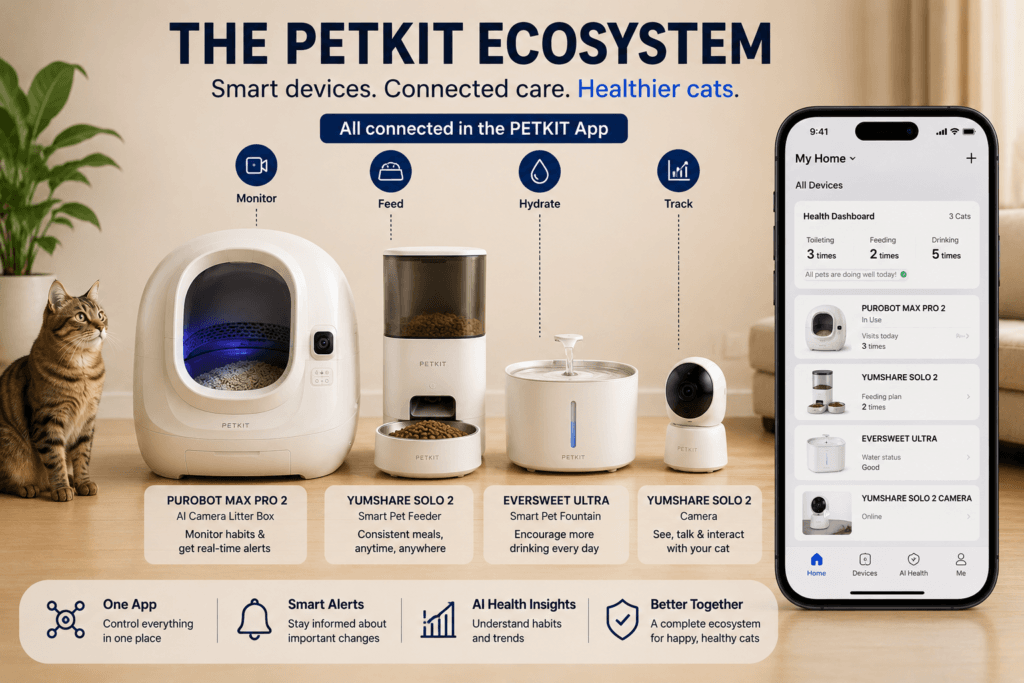
    Connected PETKIT ecosystem including litter box, feeder, fountain, and mobile app integration.

    PETKIT Care+ expands the video side of the product, including access to longer history and complete playback features.

    That makes the subscription question difficult to separate from the camera question.

    The litter box still cleans without Care+. Core automation does not disappear because the owner declines another recurring service.

    However, if your main reason for choosing the Purobot Max Pro 2 is reviewing past footage, the limits of the standard video experience matter.

    Before buying, ask:

    Would I still choose this model if preserving the video history I want required an additional recurring payment?

    If the answer is no, the PuraMax 2 is probably the better fit.

    A subscription can be reasonable when it supports a feature used consistently. It becomes less attractive when it charges rent for footage of Baron entering a litter box at 3:14 a.m. and conducting business as expected.

    Monitoring Does Not Mean Diagnosis

    The Purobot Max Pro 2 can record visit frequency, duration, weight, video and other observable details.

    Those records may help surface changes worth investigating.

    They cannot diagnose urinary disease, constipation, digestive problems, stress or pain.

    Frequent visits, straining, crying during urination, blood in the urine or producing little to no urine require veterinary attention. A urinary obstruction can be an emergency, particularly in male cats.

    The correct workflow is simple:

    1. Notice the change.
    2. Review the available context.
    3. Observe the cat directly.
    4. Contact a veterinarian when the signs are sudden, persistent or concerning.

    The camera can improve the information you bring to the appointment.

    It should never become a reason to postpone the appointment.

    For households that want monitoring without replacing their existing litter box, see our Petivity Smart Litter Box Monitor Review.

    Living With the Purobot Max Pro 2

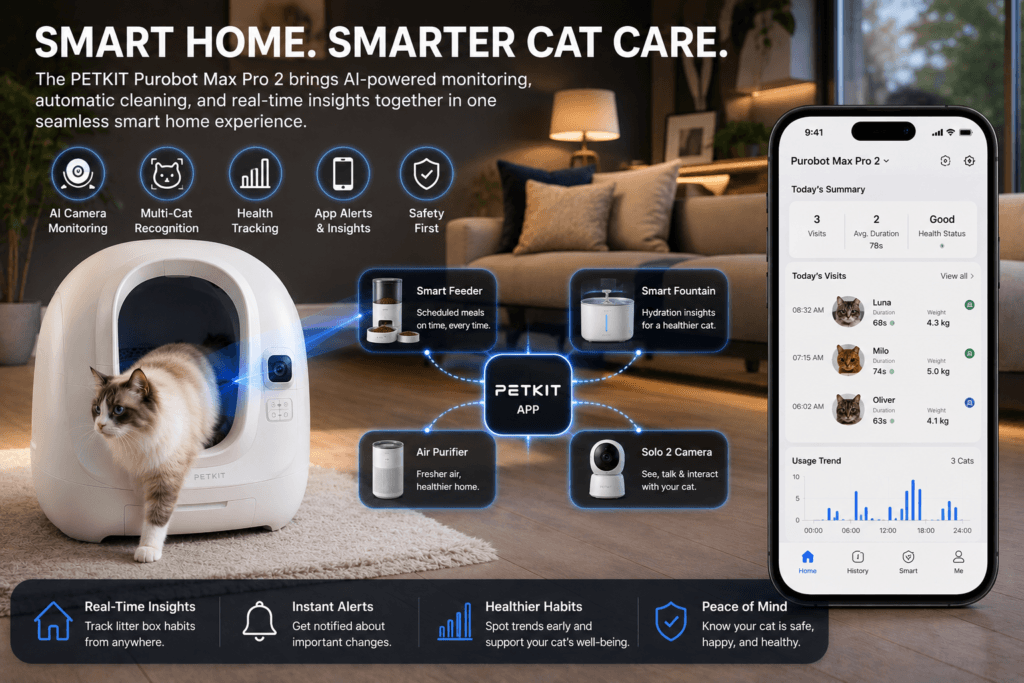
    Modern smart home setup featuring automated cat care technology and monitoring tools.

    The Purobot Max Pro 2 is a large enclosed appliance, not a compact litter tray.

    PETKIT enlarged the entrance compared with the previous version, which should make access easier for senior, short-legged and larger cats.

    A bigger entrance does not guarantee comfortable internal space.

    Large-bodied cats still need enough room to turn, dig and position themselves inside the cylinder. Cats that dislike covered litter boxes may also reject the design regardless of the official weight range.

    Measure the available floor space and consider your cat’s body shape—not only the maximum weight printed in the specifications.

    The box automatically separates clumps and deposits waste into a sealed drawer. This reduces daily scooping and helps contain odor, but it does not eliminate routine work.

    Owners still need to:

    • empty the waste drawer;
    • refill litter;
    • wipe the entrance and camera;
    • clean the cylinder and sifter;
    • remove stuck residue;
    • check sensors;
    • replace bags and deodorizing components.

    Odor control will still depend on litter quality, drawer maintenance, ventilation and the number of cats using the box.

    Automatic means less repetitive work.

    It does not mean the waste drawer has achieved self-awareness and begun emptying itself.

    Safety and Cat Acceptance

    PETKIT equips the Purobot Max Pro 2 with multiple sensors intended to detect weight, proximity and entry during operation.

    Those safeguards are necessary, but owners should still supervise the transition.

    Place the unit on a flat, firm surface. Keep the previous litter box available. Start with familiar litter and allow the cat to investigate without being pushed inside.

    During the transition:

    • delay automatic cleaning when necessary;
    • supervise early visits;
    • check that the correct cat is recognized;
    • watch for hesitation or avoidance;
    • keep the old box available until use is consistent.

    Cats below PETKIT’s minimum operating weight require additional precautions and should not rely on normal automatic cycling.

    The safest automatic litter box is one the cat accepts willingly and the owner continues to inspect.

    Purobot Max Pro 2 vs PuraMax 2

    The decision between these two models is easier than the feature lists make it appear.

    Choose PuraMax 2 when:

    • automatic cleaning is the main objective;
    • you do not need video identification;
    • your cats are easy to distinguish through existing records;
    • you want fewer connected layers;
    • you prefer the better-value PETKIT default.

    Choose Purobot Max Pro 2 when:

    • multiple cats share the same box;
    • similarly sized cats confuse weight-only records;
    • visual context would change your response;
    • you intend to review visit history;
    • the larger entrance better suits your cat.

    The Purobot Max Pro 2 is not universally better.

    It is more specialized.

    For the complete comparison, read our Purobot Max Pro 2 vs PuraMax 2 guide.

    Buyer-Regret Risk

    The main regret is paying for the camera and then using Purobot Max Pro 2 exactly like a normal automatic litter box.

    That risk is highest in one-cat homes, for owners who rarely review app histories or when PETKIT Care+ already feels irritating before purchase.

    Choose this model only when visual identification changes which cat you monitor, what pattern you notice or how quickly you respond.

    Otherwise, PuraMax 2 delivers the more rational version of the same core automation.

    Final Verdict

    The PETKIT Purobot Max Pro 2 earns a Recommended with Conditions verdict.

    It is one of the more convincing camera-equipped automatic litter boxes for multi-cat households. Visual identification, weight sensing and visit records can provide context that a conventional self-cleaning box cannot.

    For most buyers, however, the PuraMax 2 remains the better default.

    Choose the Purobot Max Pro 2 when camera-assisted identification solves a real problem and you expect to use the footage.

    Skip it when the camera is merely the most exciting item on the specification sheet.

    Baron does not care whether his litter box contains artificial intelligence.

    The purchase becomes intelligent only when the extra information changes what you do.

    For a broader comparison between PETKIT and Whisker, read our PETKIT vs Litter-Robot Ecosystem guide.

    Frequently Asked Questions

    Is the PETKIT Purobot Max Pro 2 worth it?

    It is worth considering for multi-cat households that need visual identification and will actively review visit records. It is poor value when automatic cleaning is the only goal.

    Does it require PETKIT Care+?

    The litter box can operate without PETKIT Care+. The subscription expands video-history and playback functions, which matters if recorded footage is central to your buying decision.

    Can it diagnose health problems?

    No. It can record observable changes, but a veterinarian must determine their medical meaning.

    Is it suitable for large cats?

    The larger entrance improves accessibility, but internal comfort still depends on the cat’s body shape, mobility and tolerance for enclosed litter boxes.

    Is it better than PuraMax 2?

    Only for buyers who need camera-assisted recognition and visual visit context. For automatic cleaning alone, PuraMax 2 remains the stronger default.

    References

    • PETKIT — Purobot Max Pro 2 product documentation
    • PETKIT — Purobot Max Pro 2 user manual and PETKIT Care+ information
    • PETKIT — PuraMax 2 product documentation
    • Cornell Feline Health Center — Feline Lower Urinary Tract Disease

    Image Disclosure

    Official PETKIT images are used when depicting the exact product.

    Any AI-generated images are editorial illustrations only. They do not represent exact dimensions, internal space, camera behavior or app performance. Always verify current specifications before purchasing.
    Editorial Disclosure

    PetTech AI may earn a commission from qualifying purchases. This does not influence our recommendations, comparisons or editorial judgments.

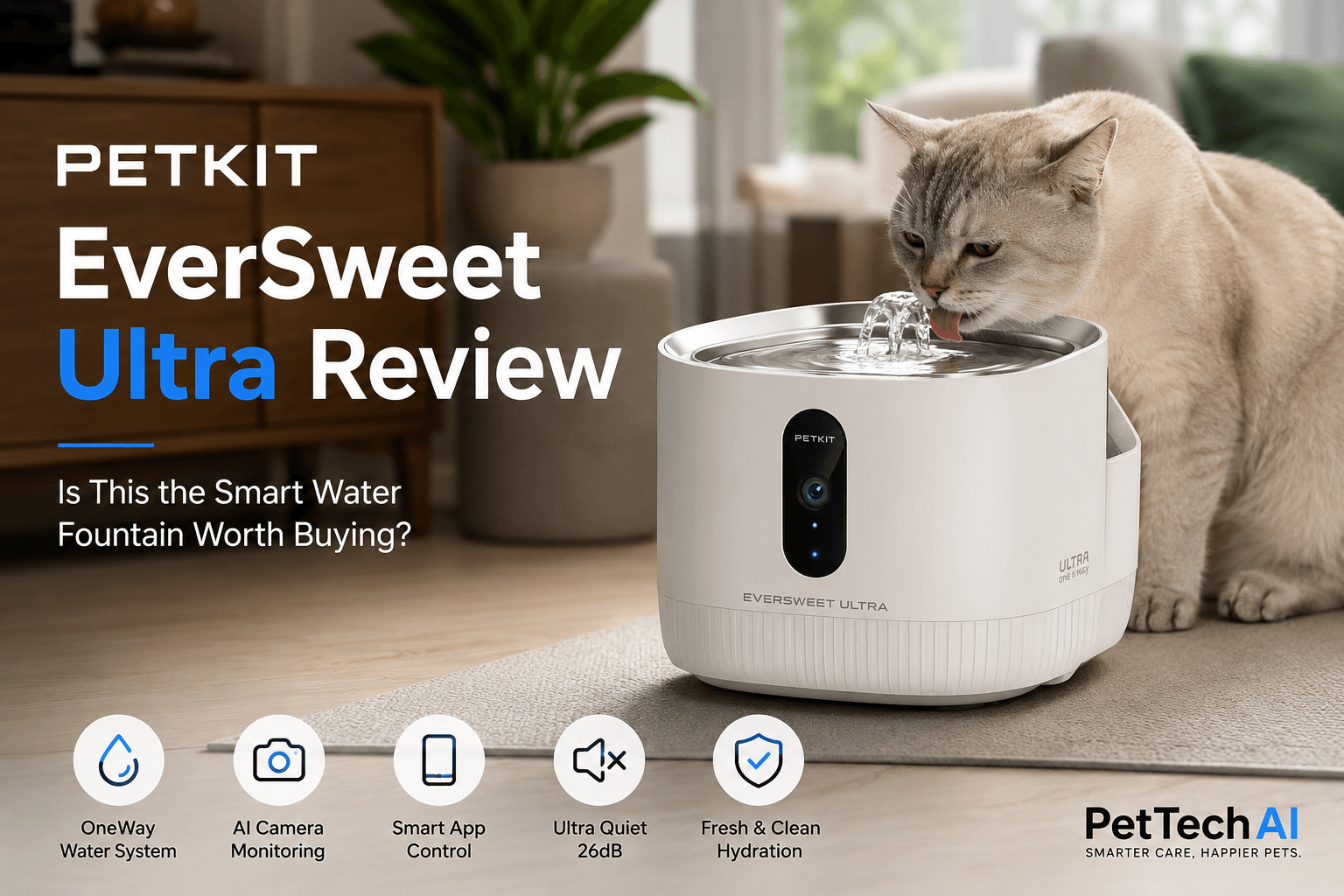
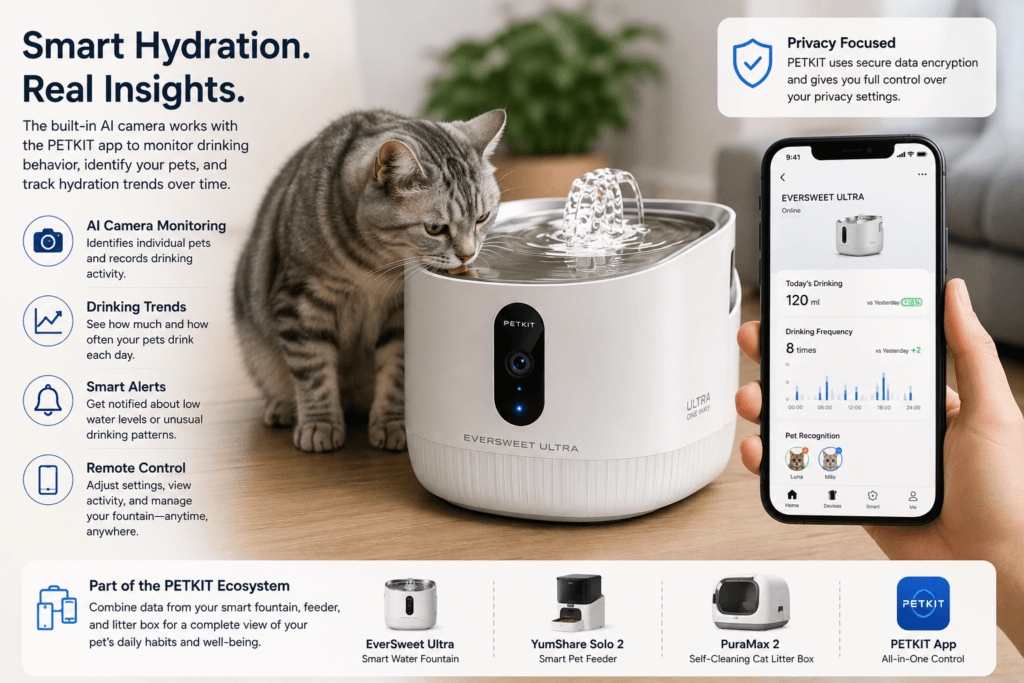
  • PETKIT EverSweet Ultra Review (2026): Fresh-Water Upgrade or $250 Hydration Command Center?

    PETKIT EverSweet Ultra Review (2026): Fresh-Water Upgrade or $250 Hydration Command Center?

    Most cat fountains circulate the same water through a pump and filter.

    PETKIT EverSweet Ultra takes a more complicated approach:

    • fresh water begins in one tank;
    • used water drains into another;
    • a camera watches the drinking area;
    • the app identifies pets and records their visits;
    • the tray can flush and refill automatically.

    This is either a genuinely better hydration system or an unusually elaborate way to give a cat a drink.

    The answer depends on what you need.

    EverSweet Ultra makes its strongest case when both of these problems exist:

    1. you dislike traditional recirculating fountain architecture;
    2. you genuinely need individual drinking context in a multi-pet home.

    When you only need quiet, accessible moving water, this is probably more fountain than necessary.

    Research note: This is a research-led review based on current PETKIT documentation, public ownership evidence, and PetTech AI’s product-level trust check. PetTech AI has not conducted a long-term hands-on test of EverSweet Ultra.

    Quick Verdict

    Illustrative cat using a modern smart water fountain in a home environment
    CategoryVerdict
    Best forMulti-pet homes that need individual hydration visibility
    Main advantageSeparate clean- and used-water tanks
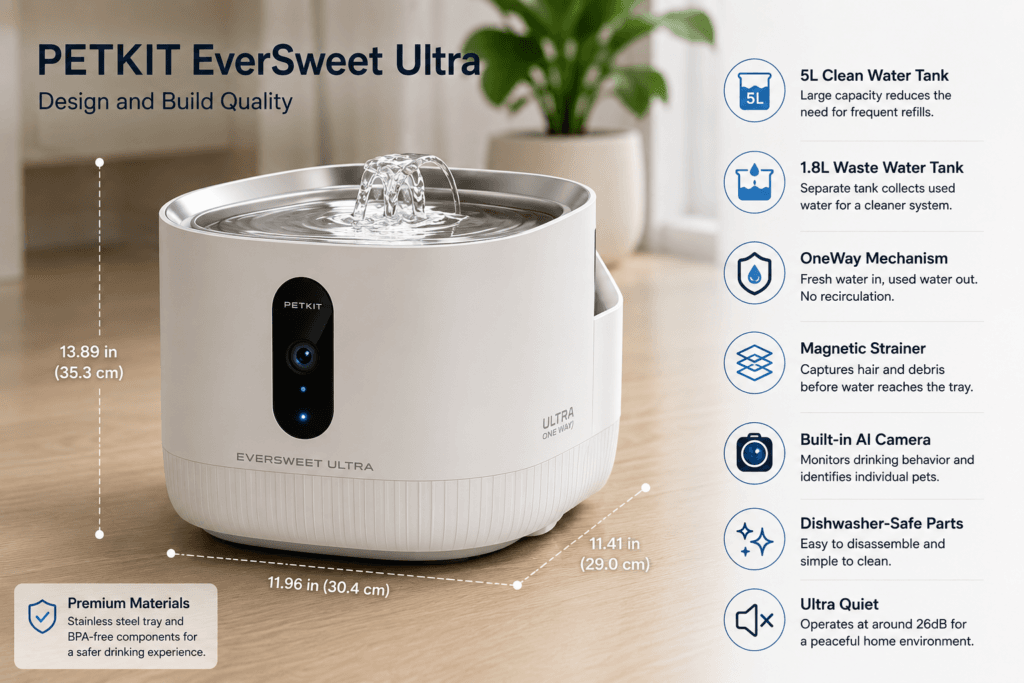
    Clean-water capacity5 L
    Wastewater capacity1.8 L
    Camera140-degree AI camera
    Pet identificationUp to 15 profiles claimed
    Traditional circulation filterNo
    Replaceable componentCube C remains installed; monthly replacement recommended
    Main concernVery limited long-term ownership history
    RecommendationPromising newer product

    The short version

    Buy EverSweet Ultra when:

    • you want fresh and used water kept physically separate;
    • several pets share the drinking area;
    • knowing who drank would change what you do;
    • you already use PETKIT;
    • the premium price and larger footprint are acceptable.

    Skip it when:

    • one cat already drinks reliably;
    • you only need a quiet stainless-steel fountain;
    • cameras around pet resources make you uncomfortable;
    • you want a mature product with years of reliability evidence;
    • monthly consumable reminders are exactly what you hoped to escape.

    Verdict: One of the most distinctive smart fountains available in 2026, but still too new to become the default recommendation.

    Affiliate disclosure: This page contains affiliate links. PetTech AI may earn a commission if you purchase through them, at no additional cost to you.

    Who Should Buy EverSweet Ultra?

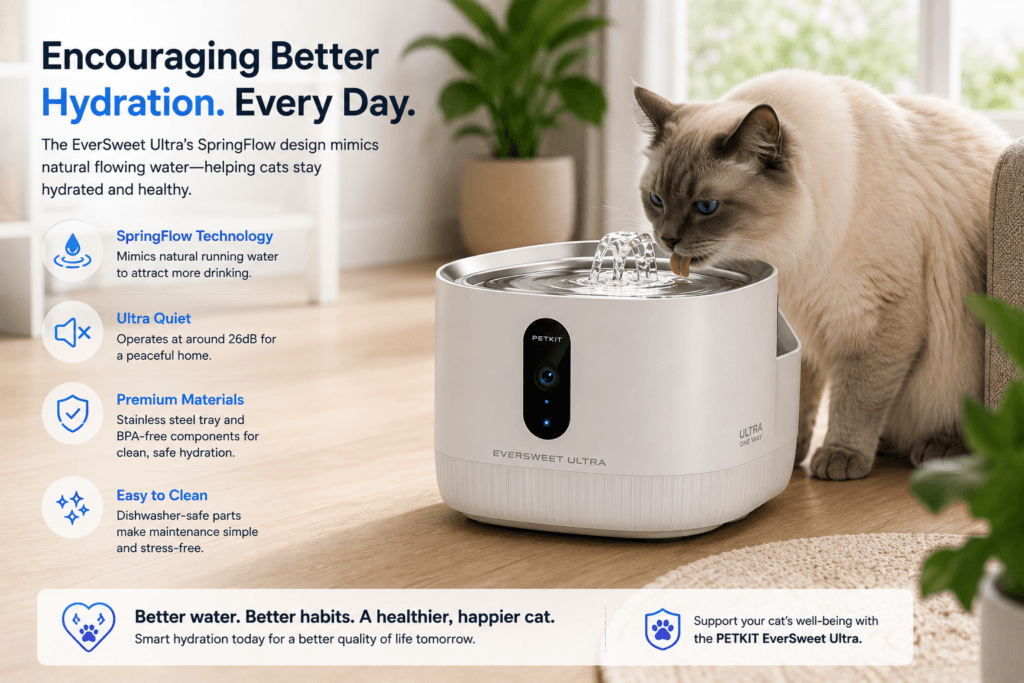
    Illustrative smart cat water fountain showing premium design and stainless steel drinking tray

    Multi-pet homes where total water use is not enough

    A conventional smart fountain may show that water was consumed.

    In a multi-cat household, that does not tell you who drank it.

    Napoleon may spend the afternoon emptying the tray while Jonathan quietly stops visiting. The household total remains impressive. Jonathan remains dehydrated and diplomatically ignored.

    EverSweet Ultra uses a 140-degree camera and PETKIT’s recognition system to create separate visit records. PETKIT says the system can identify up to 15 pets and record when they approached, how long they stayed, and how much they drank.

    That can be useful when the question is:

    “Which cat’s drinking routine changed?”

    It is much less useful when the household has one cat whose normal water habits are already easy to observe.

    Owners frustrated by recirculating fountains

    Most fountains repeatedly move water through the same reservoir and rely on a filter to manage debris, hair, and buildup.

    EverSweet Ultra changes that architecture.

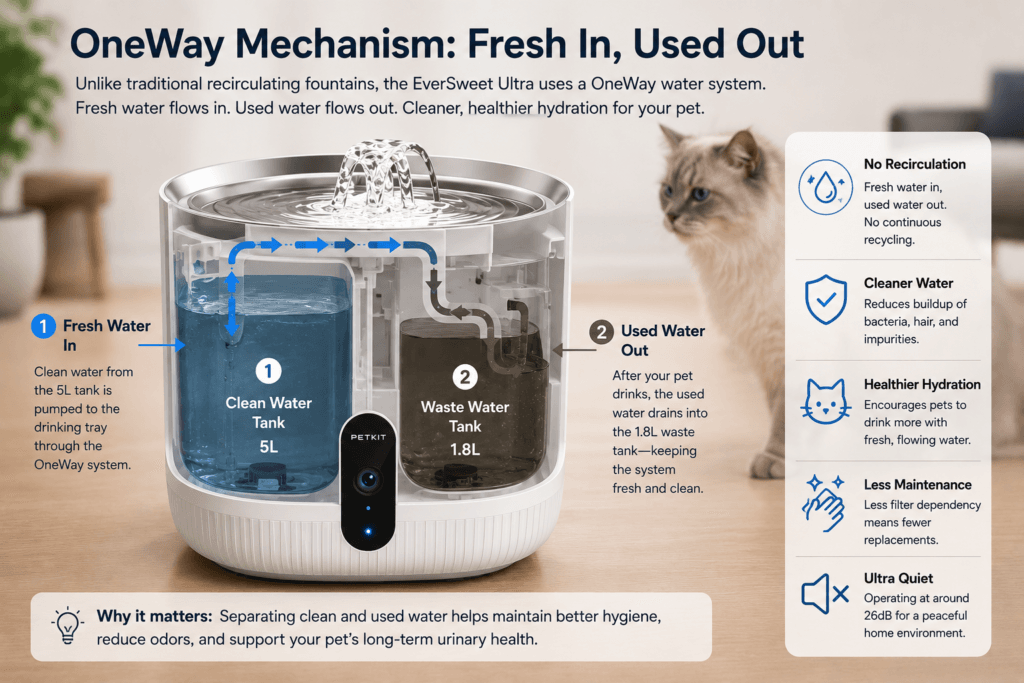
    Its 5 L clean-water tank supplies the drinking tray. Used tray water can then drain into a separate 1.8 L waste tank instead of returning to the clean reservoir. PETKIT calls this the OneWay Mechanism.

    That is the product’s strongest hardware argument.

    It does not merely add Wi-Fi to an ordinary fountain.

    It changes where used water goes.

    PETKIT ecosystem users

    EverSweet Ultra joins PETKIT litter boxes and feeders inside the same app environment.

    That can reduce app clutter and place hydration beside feeding and litter records. The benefit is real when several PETKIT devices have independently earned their place.

    The fountain should not be purchased merely because its icon would complete the dashboard.

    For the broader ecosystem decision, read PETKIT vs Litter-Robot Ecosystem.

    Who Should Skip It?

    Buyers who only need flowing water

    EverSweet Ultra is expensive because it combines:

    • separated water tanks;
    • drainage and refill systems;
    • a camera;
    • recognition;
    • app histories;
    • smart alerts;
    • automated flushing.

    A basic fountain can still provide clean moving water when regularly washed and maintained.

    When no one needs individual drinking records, much of the Ultra’s premium goes toward answering a question the household was not asking.

    For simpler and more established options, read our Best Smart Cat Water Fountains guide.

    Small homes with limited floor space

    EverSweet Ultra measures approximately 12 × 11.4 × 13.9 inches and weighs about 7.7 pounds before adding water. It is substantially more architectural than a small countertop-style fountain.

    Add five liters of clean water and a wastewater tank, and it becomes a fixed hydration station rather than something casually moved around the kitchen.

    Measure first.

    The transparent tanks may look elegant in product photography. They remain large transparent tanks in a studio apartment.

    Owners seeking proven long-term reliability

    EverSweet Ultra is new and technically ambitious.

    Its normal operation depends on:

    • clean-water delivery;
    • drainage;
    • automatic refilling;
    • tray-level detection;
    • camera recognition;
    • app connectivity;
    • firmware;
    • alerts;
    • several water-contact components remaining clean.

    The current trust signal supports a recommendation, but the ownership record is still too small to establish how these systems perform after years of water exposure, mineral buildup, hair, cleaning cycles, and software updates.

    The OneWay Mechanism: The Real Reason to Buy It

    Illustrative diagram of a smart pet fountain with separated clean and waste water flow

    The clean- and used-water separation is more important than the camera.

    Fresh water moves from the clean tank into the tray. When the tray is drained, that water moves into the separate wastewater tank rather than returning to the clean supply. The fountain can also flush the tray and automatically refill it when the water level drops below its configured threshold.

    This has several potential benefits:

    • debris removed from the tray does not return to the clean tank;
    • used water can be discarded separately;
    • the main water reserve remains isolated;
    • tray water can be refreshed automatically;
    • fewer components sit continuously inside a large recirculating reservoir.

    It does not mean every drop reaching the tray is immediately discarded.

    In SpringFlow mode, water already in the drinking tray can circulate locally to keep the surface moving. The owner can then drain and replace it manually, automatically, or according to a schedule.

    That distinction matters.

    EverSweet Ultra is not a constantly running tap connected to the plumbing.

    It is a controlled clean-tank, tray, and wastewater system.

    Is It Really Filterless?

    PETKIT describes EverSweet Ultra as filterless because its main water architecture does not rely on a traditional recirculating fountain filter.

    That is broadly fair—but requires a footnote.

    The fountain includes Cube C, a small component positioned at the water outlet. PETKIT says it helps inhibit biofilm buildup and uses coconut-shell activated carbon. Cube C must remain installed because it is also part of the fountain’s physical structure.

    PETKIT recommends replacing it every 30 days for optimal performance, although replacement is optional and the fountain can continue operating with the existing cube installed.

    Therefore, the honest description is:

    EverSweet Ultra does not require a traditional circulation filter, but it still includes a replaceable water-quality component.

    This is better than pretending the consumable does not exist because the marketing department has assigned it a geometric name.

    Camera and Hydration Monitoring

    Illustration of app-connected smart pet hydration monitoring with camera features

    The camera provides:

    • live viewing;
    • individual pet recognition;
    • drinking histories;
    • visit duration;
    • estimated water intake;
    • unusual-pattern alerts;
    • scheduled privacy hours;
    • manual camera shutdown.

    PETKIT also says footage is end-to-end encrypted and that recognition begins after users create profiles with pet photos.

    The camera is useful when visual identification resolves a real ambiguity.

    It may show:

    • one cat visiting less often;
    • another cat dominating the station;
    • a pet approaching but not drinking;
    • a repeated change from the usual routine.

    It cannot explain the medical cause of that change.

    Increased or reduced drinking can have many causes, and water intake also varies with food type. Cornell notes that wet-food diets contribute substantial water, while changes in drinking can accompany health problems that require veterinary assessment.

    Use the camera to notice and document.

    Do not appoint it Chief Medical Officer.

    For the broader distinction between useful monitoring and app-generated noise, read Smart Cat Monitoring vs Automation.

    Cleaning and Maintenance

    PETKIT highlights three regularly cleaned removable parts:

    • the water outlet;
    • the magnetic strainer;
    • the stainless-steel tray.

    The company lists these parts as dishwasher-safe and provides an app-triggered flush function intended to clear hair and residue between proper washes. PETKIT explicitly describes that flush as an interim measure, not a replacement for full cleaning.

    Owners still need to:

    • refill the 5 L clean tank;
    • empty the wastewater tank;
    • wash the tray;
    • inspect the outlet and drainage path;
    • remove hair and residue;
    • clean mineral deposits;
    • keep the camera area clear;
    • decide whether to replace Cube C monthly.

    The OneWay design may improve water separation.

    It does not eliminate biofilm, scale, cat hair, or physics.

    Waste-tank frequency

    PETKIT estimates that many single-cat homes may empty the wastewater tank every three to five days, although the actual interval depends on drinking speed and how frequently the tray is flushed.

    A cat that drinks quickly may leave relatively little tray water to discard.

    A cat that delicately contemplates each sip may generate a more active wastewater-management career.

    Noise and Cat Acceptance

    PETKIT rates normal operation at approximately 26 dB, with louder noise during flushing and refilling. The company recommends keeping it away from the bedroom when the owner is sensitive to nighttime noise.

    That last caveat matters because the refill cycle is not merely a gentle fountain trickle.

    A sudden overnight flush can startle a cautious cat.

    Introduce the fountain gradually:

    1. position it in a quiet, accessible area;
    2. initially keep a familiar water bowl nearby;
    3. let the cat investigate without forcing interaction;
    4. use the least disruptive flow mode;
    5. avoid scheduling loud flushes during quiet periods;
    6. confirm that every cat can approach without social conflict.

    The best water architecture in the industry remains useless when the cat believes the machine is plotting something.

    Where EverSweet Ultra Can Disappoint

    Automatic systems create automatic failure points

    Early owner feedback on PETKIT’s own product page includes reports involving pairing, app behavior, repeated refilling, and cats becoming wary after an unexpected nighttime cycle. These reports do not establish a widespread defect, but they illustrate why a technically complex new product deserves a maturity caveat.

    Recognition may not be perfect

    Lighting, angle, similar-looking animals, crowding, and partial facial visibility can affect camera recognition.

    Treat individual records as useful context, not indisputable evidence.

    Water intake is still an estimate

    A camera and tray-level system may estimate how much water disappeared during a visit.

    It cannot always know whether water was:

    • consumed;
    • splashed;
    • carried away on fur;
    • spilled;
    • shared during a crowded visit.

    Use trends, not milliliter-level courtroom testimony.

    The consumable-free story is imperfect

    There is no traditional fountain filter.

    There is still Cube C, an app reminder, and a recommended 30-day replacement schedule.

    The filter has not vanished.

    It has become modern art.

    Main Alternative: PETLIBRO Dockstream 2

    PETLIBRO Dockstream 2 is the more sensible alternative when you want:

    • app-based hydration tracking;
    • a stainless-steel drinking surface;
    • cordless placement;
    • easier cleaning;
    • a more established ownership signal;
    • a substantially simpler system.

    Choose Dockstream 2 when one cat’s total hydration trend is enough.

    Choose EverSweet Ultra when:

    • fresh and used water separation matters;
    • several pets need individual identification;
    • camera context is worth paying for;
    • you accept the risk of newer, more complex hardware.

    Dockstream 2 is a smart fountain.

    EverSweet Ultra is a hydration monitoring station that happens to contain water.

    Buyer Regret in One Sentence

    You bought a camera-equipped wastewater-management system, then discovered that your cat only wanted a clean bowl in the hallway.

    Avoid that regret by identifying the unresolved question before purchase.

    Final Verdict

    PETKIT EverSweet Ultra is not merely a standard fountain with a camera attached.

    Its OneWay architecture, separate clean and wastewater tanks, automatic tray handling, and multi-pet camera recognition give it a legitimate reason to exist. PETKIT’s current specifications support a clear distinction from conventional recirculating fountains.

    Its main limitation is not the concept.

    It is maturity.

    The product’s current market signal is encouraging, but the ownership history remains too limited to prove long-term consistency across drainage, sensors, recognition, app behavior, firmware, and repeated daily water cycles.

    Choose EverSweet Ultra when:

    • several pets share the fountain;
    • individual hydration visibility changes your decisions;
    • clean and used water separation is worth the premium;
    • PETKIT ecosystem integration matters;
    • you accept the uncertainty attached to a new product.

    Skip it when:

    • a simple fountain already works;
    • one cat’s drinking is easy to observe;
    • you want minimal maintenance;
    • camera monitoring would create more anxiety than clarity;
    • long-term maturity matters more than technical ambition.

    Final rating: Promising newer product.

    This is not the fountain most cat owners need.

    It may be the first fountain that genuinely solves the problem a data-conscious multi-pet household actually has.

    Frequently Asked Questions

    Does EverSweet Ultra recirculate water?

    Fresh and used water are kept in separate tanks. In SpringFlow mode, water inside the tray can circulate locally before being drained and replaced.

    Does it use a filter?

    It does not use a traditional recirculating fountain filter. It does require Cube C to remain installed, and PETKIT recommends replacing the cube every 30 days for optimal water quality.

    Can EverSweet Ultra identify several cats?

    PETKIT says its camera can recognize up to 15 pet profiles. Real-world performance may vary with lighting, angle, appearance, and how several pets approach the tray.

    Does it require the app?

    Basic drain and refill controls are available on the device. The app is needed for recognition, hydration records, alerts, remote viewing, and advanced controls.

    Is it maintenance-free?

    No. Owners must refill the clean tank, empty the waste tank, wash the tray and water path, remove residue, and maintain Cube C.

    Can it detect health problems?

    No. It can highlight changes in drinking behavior. It cannot diagnose the cause or replace veterinary assessment.

    Is it worth buying for one cat?

    Possibly, when clean-water separation and detailed hydration records are genuinely valuable. Most predictable single-cat homes can obtain better value from a simpler fountain.

    References

    • PETKIT EverSweet Ultra official product documentation
    • PETKIT Fountain Cube C specifications and replacement guidance
    • PETKIT CES 2026 announcement
    • Cornell Feline Health Center hydration resources
    • PetTech AI product-level trust check

    Image Credits

    Official product images provided by PETKIT.

    Disclosure

    PetTech AI may earn a commission when readers purchase through affiliate links. EverSweet Ultra is recommended for the hydration problem it can realistically solve—not because every sip requires facial recognition.

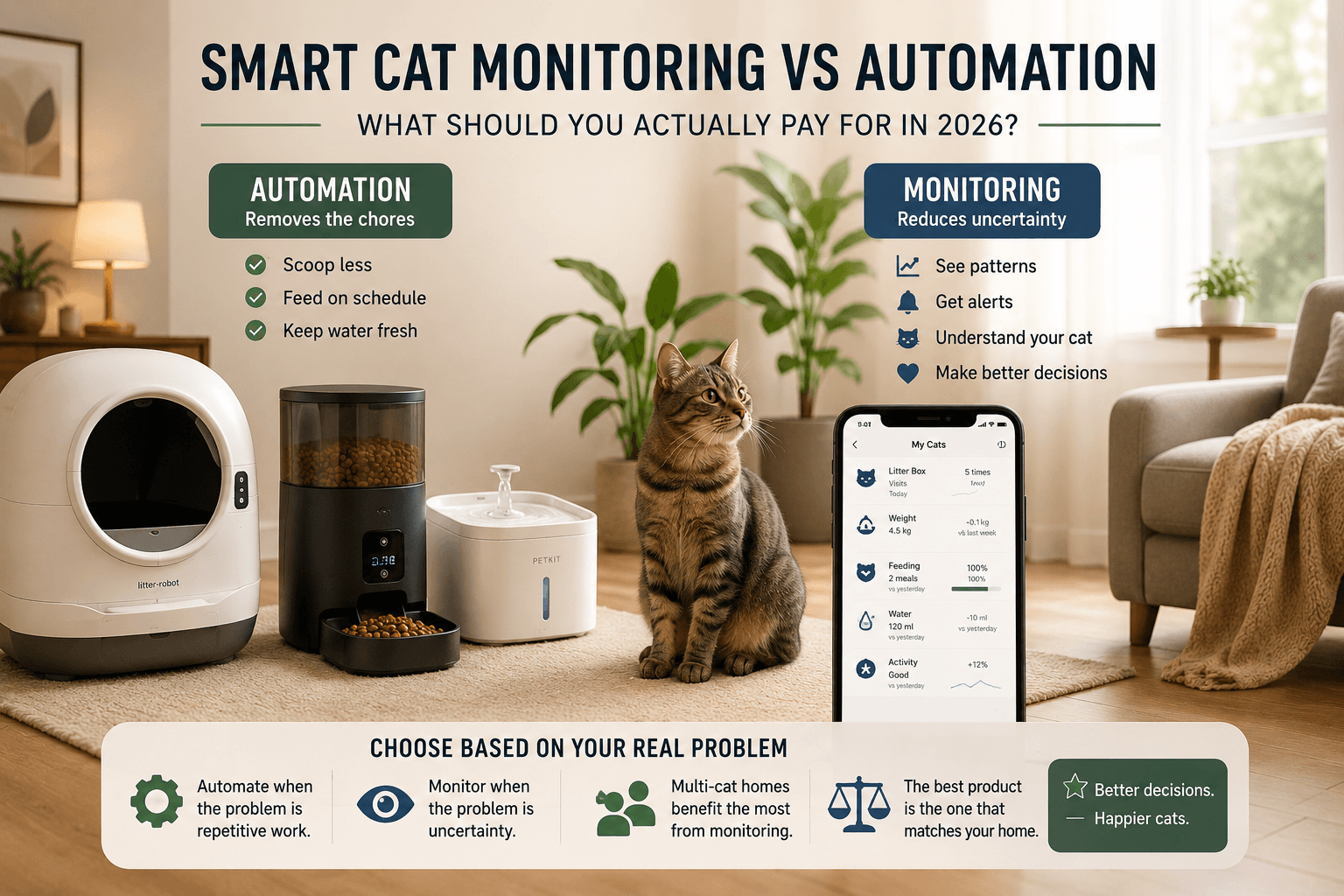
  • Smart Cat Monitoring vs Automation (2026): What Are You Actually Paying For?

    Smart Cat Monitoring vs Automation (2026): What Are You Actually Paying For?

    The first generation of smart cat products promised to do chores.

    The litter box cleaned itself.

    The feeder served breakfast.

    The fountain circulated water.

    The app occasionally reminded you that the machine still required human involvement.

    Now the industry wants to sell something more ambitious:

    • facial recognition;
    • camera footage;
    • weight histories;
    • litter-box records;
    • drinking data;
    • feeding identities;
    • activity scores;
    • location tracking;
    • AI-generated insights.

    Some of that information is genuinely useful.

    Some of it is an expensive way to learn that your cat ate breakfast, used the litter box, and then slept for eleven hours.

    The decision comes down to one distinction:

    Automation removes work. Monitoring reduces uncertainty.

    Most buyers should solve the work problem first.

    Monitoring deserves the additional cost only when the information would change what they do next.

    Quick Verdict

    Your main problemStart withWhy
    “I am tired of scooping.”AutomationYou need waste removal, not a bathroom dashboard
    “Meals need to happen on schedule.”AutomationReliable dispensing matters more than video
    “I do not know which cat ate.”Monitoring or access controlIdentity is the missing information
    “I want to track weight or litter habits.”MonitoringThe value comes from repeated trends
    “One cat may be drinking less.”Identity-aware monitoringHousehold totals may hide the individual change
    “My outdoor cat disappears for hours.”MonitoringLocation and activity are the actual signals
    “I want every available feature.”Stop and identify the problemFeature collecting is not a care strategy

    The short version

    Choose automation when the problem is labor.

    Choose monitoring when the problem is uncertainty.

    Choose both only when both problems genuinely exist.

    A camera does not improve an unreliable feeder.

    An AI dashboard does not make an uncomfortable litter box acceptable.

    And no number of health-style alerts can rescue a product that fails at its basic job.

    The Product Must Solve the Chore Before It Explains the Chore

    Every smart product has a core physical task.

    A litter box must separate waste safely and reliably.

    A feeder must dispense the correct food at the correct time.

    A fountain must provide clean, accessible water.

    A cat door must control entry and exit.

    Only after that task works does the monitoring layer become relevant.

    This creates a simple buying hierarchy:

    1. Cat acceptance
    2. Core function
    3. Reliability
    4. Maintenance
    5. Monitoring
    6. Interesting app decorations

    Manufacturers frequently present this list in reverse.

    The product page begins with artificial intelligence and ends somewhere near the bottom with the dimensions of the opening your cat must physically enter.

    Do not follow that order.

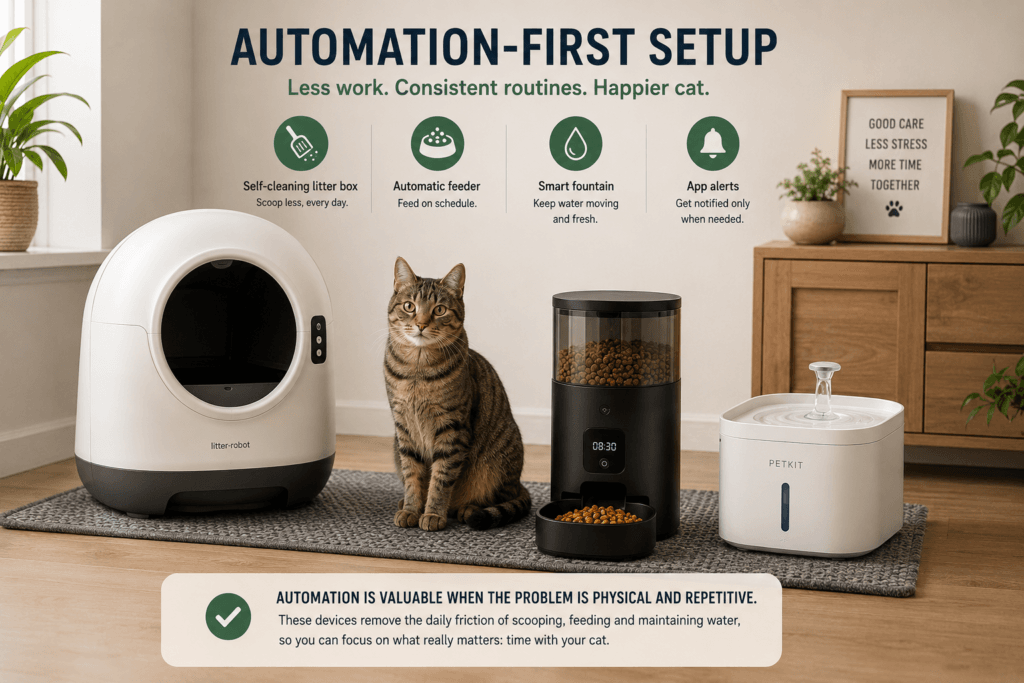
    What Automation Actually Solves

    A clean smart cat care setup with an automatic feeder, smart fountain and self-cleaning litter box focused on reducing daily chores
    Automation-first products are worth paying for when they reduce scooping, feeding stress, water maintenance or other repetitive daily chores.

    Automation is useful when the problem is repetitive, predictable, and physical.

    Litter automation

    A self-cleaning litter box can reduce daily scooping and move waste into a drawer after use.

    It does not eliminate:

    • drawer emptying;
    • litter refilling;
    • deep cleaning;
    • odor-source maintenance;
    • the need for an additional box in some homes.

    But the main benefit remains clear even if you never open the app.

    For the current product choices, read our Best Smart Litter Boxes guide.

    Feeding automation

    A scheduled feeder can deliver measured dry-food portions when nobody is standing beside the bowl.

    A refrigerated feeder can support scheduled wet meals.

    These products create value through timing and consistency.

    A camera may add useful context, but dinner must still arrive.

    For dry, wet, RFID, and microchip systems, read our Best Automatic Cat Feeders guide.

    Water automation

    A fountain circulates water and may provide level, filter, or maintenance reminders.

    It still requires:

    • cleaning;
    • fresh water;
    • filter replacement;
    • pump or tank maintenance.

    The useful automation is easier water access and a more structured maintenance routine—not permanent freedom from washing slime out of a reservoir.

    What Monitoring Actually Solves

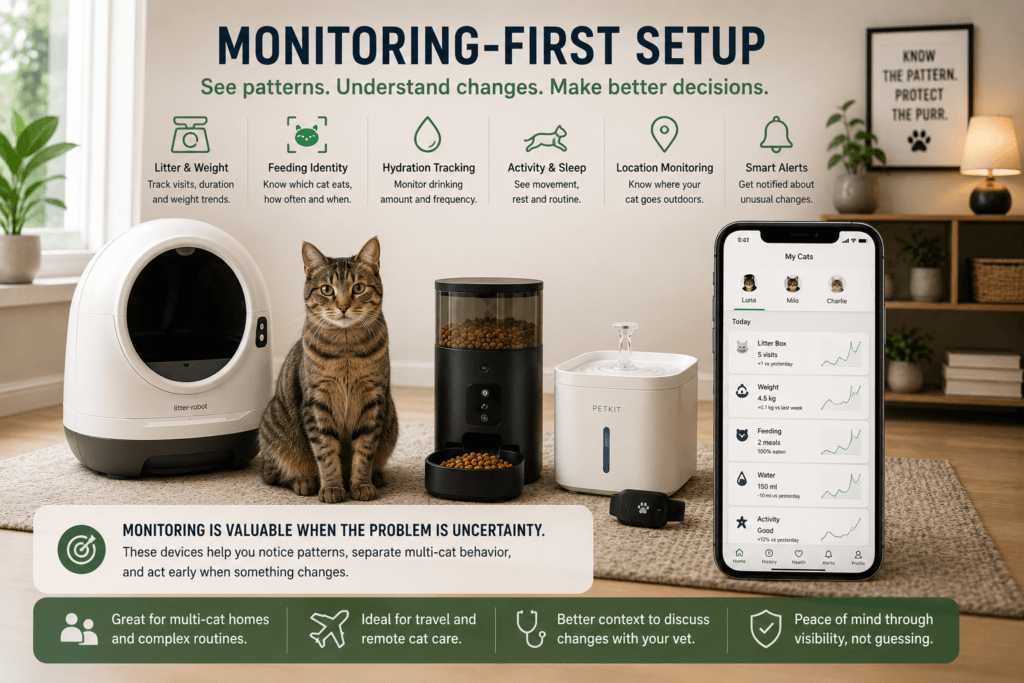
    A phone showing cat routine data beside smart cat products for litter, feeding, hydration and activity monitoring
    Monitoring-first products are useful when the data changes what you do next — especially in multi-cat homes or remote-care situations.

    Monitoring becomes valuable when a household cannot confidently answer a relevant question.

    Examples include:

    • Which cat used the litter box?
    • Has weight changed over several weeks?
    • Did one cat stop appearing at meals?
    • Is one cat drinking less than the others?
    • Has an outdoor cat’s activity pattern changed?
    • What happened around the feeder while nobody was home?

    The device is not valuable merely because it collects the answer.

    The answer must lead to a decision.

    That decision might be:

    • change feeder placement;
    • separate feeding stations;
    • inspect the litter-box setup;
    • confirm a weight trend;
    • adjust notifications;
    • contact a veterinarian about a persistent change;
    • discover that nothing meaningful happened and return to normal life.

    For product-level monitoring options across litter, meals, hydration, activity, and location, read our Best Smart Cat Health Monitors guide.

    The Decision Test: What Would You Do Differently?

    Before paying extra for a monitoring feature, complete this sentence:

    “If the device showed me __________, I would __________.”

    Useful answers include:

    “If one cat repeatedly missed meals, I would change the feeding setup.”

    “If weight declined over several weeks, I would verify the trend and discuss it with my veterinarian.”

    “If one cat stopped using the shared litter box, I would inspect access, cleanliness, conflict, and alternative boxes.”

    “If the outdoor cat left its usual area, I would begin searching immediately.”

    Weak answers include:

    “If the camera showed my cat eating, I would watch my cat eat.”

    That may be enjoyable.

    It is not necessarily worth a $200 feature premium.

    The Multi-Cat Exception

    Monitoring becomes more valuable as the number of cats increases.

    In a one-cat home:

    • the cat near the feeder is probably the cat who ate;
    • the litter-box visit belongs to the only available suspect;
    • the fountain records household drinking that belongs to one animal.

    In a multi-cat home, shared totals can hide individual changes.

    The feeder may dispense correctly while Napoleon eats Jonathan’s portion.

    The litter box may record normal household activity while one cat stops using it.

    The fountain may show stable total consumption while one cat drinks more and another drinks less.

    This is where identity systems can justify their cost:

    • facial recognition;
    • weight-based profiles;
    • RFID collar tags;
    • implanted-microchip access;
    • individual cameras or feeding stations.

    But identity still needs a purpose.

    Knowing which cat committed the food theft is useful.

    Filming the theft every morning without changing the setup is a documentary project.

    PETKIT: Monitoring Across More Routines

    PETKIT currently makes the broadest move from basic automation toward camera-led connected care.

    Its ecosystem includes automatic litter boxes, camera litter boxes, camera feeders, fountains, and other devices managed through the PETKIT app. Its 2026 product direction explicitly emphasizes camera-equipped devices and connected signals across stool, urine, food, and hydration routines.

    That makes PETKIT compelling when visual context matters across several categories.

    Examples include:

    • identifying which cat approached a feeder;
    • reviewing litter-box footage;
    • adding context to hydration activity;
    • keeping several device histories in one app.

    The danger is paying for cameras everywhere merely because PETKIT can put them everywhere.

    A camera fountain is useful when individual drinking behavior is genuinely difficult to understand.

    It is less useful when one healthy cat drinks normally and the owner simply enjoys receiving push notifications from the kitchen.

    PETKIT’s buying rule

    Choose the camera-equipped version only when the footage or identity layer changes the decision.

    Otherwise, choose the simpler automation-first model.

    Whisker: Automation First, Insights on Top

    Whisker remains more focused.

    Its ecosystem centers on Litter-Robot, Feeder-Robot, and the Whisker app. The app tracks litter activity, weight trends, drawer status, feeding schedules, and high-level mealtime behavior across compatible products.

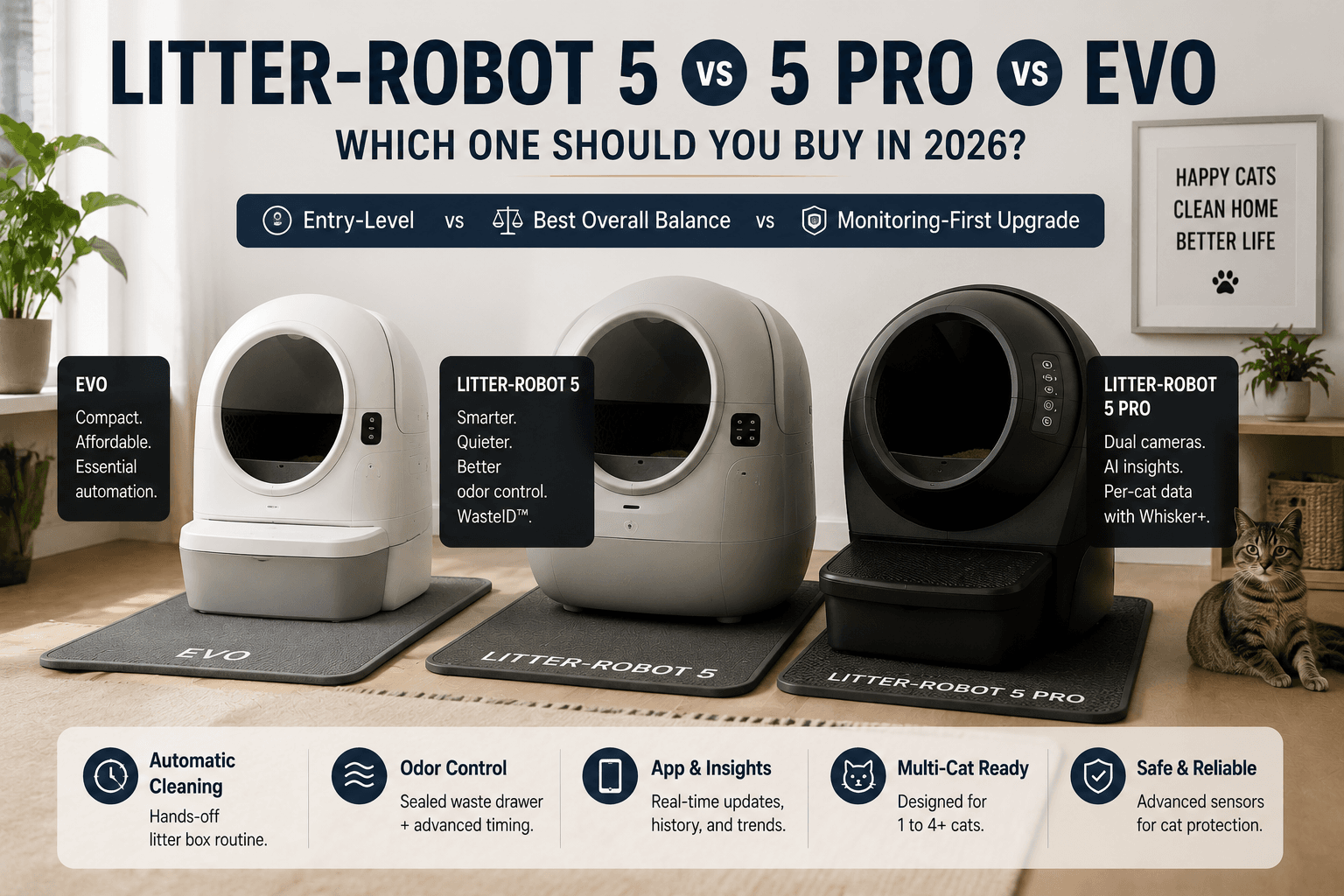
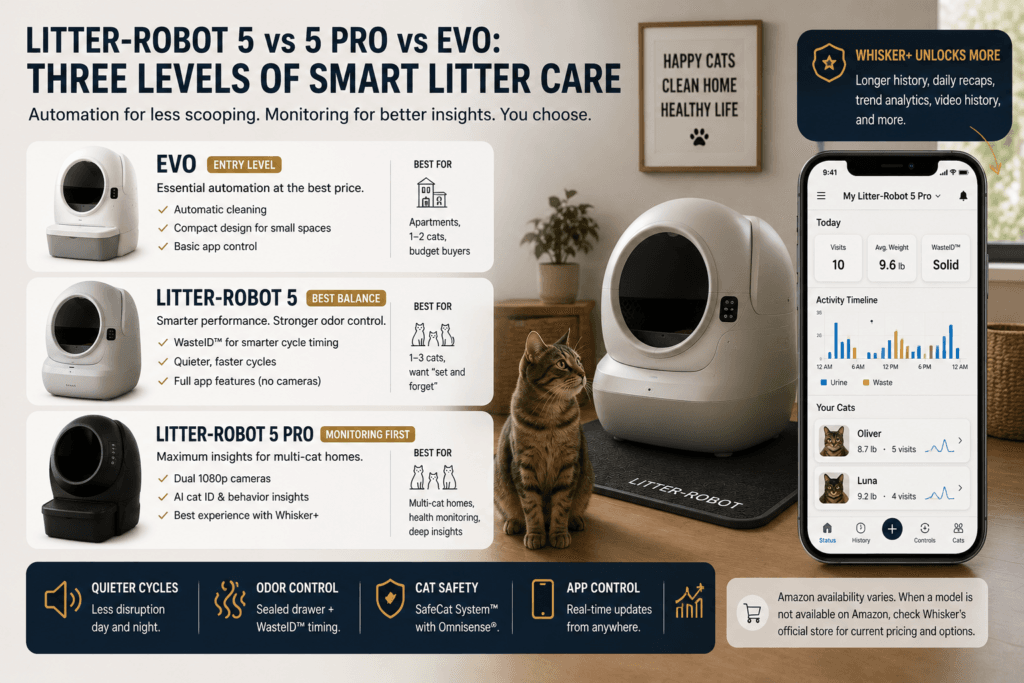
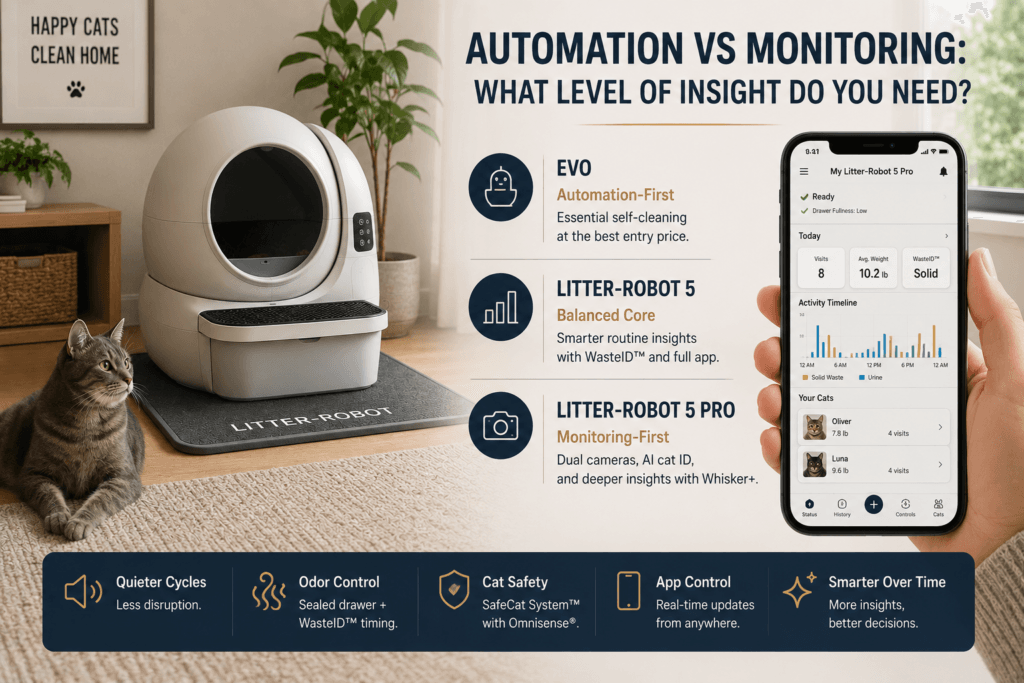
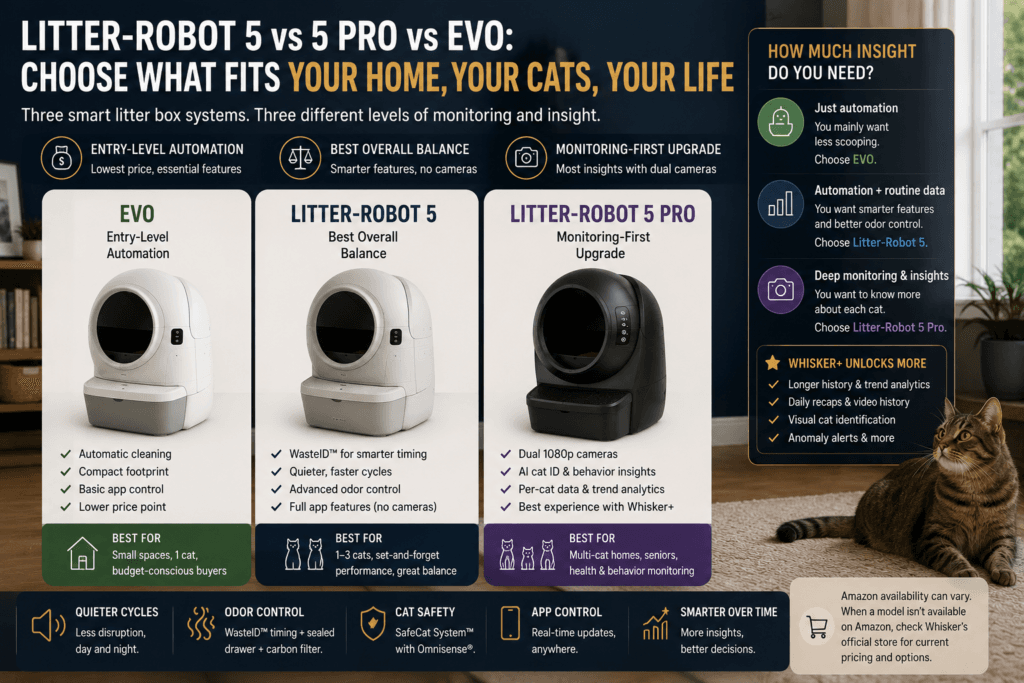
    The current litter-box lineup illustrates the automation-versus-monitoring ladder clearly:

    • Litter-Robot EVO: lower-cost, automation-first entry;
    • Litter-Robot 5: premium core automation with additional routine data;
    • Litter-Robot 5 Pro: dual cameras and deeper individual monitoring.

    Litter-Robot 5 Pro provides two cameras and visual identification, while some extended histories, unlimited live viewing, recorded events, and advanced insights depend on Whisker+. Basic SmartScale identification and weight tracking remain available without the membership on supported models.

    Whisker therefore asks a cleaner question than PETKIT:

    How much insight do you need around the litter routine you are already automating?

    That narrower focus can be an advantage.

    You are less likely to buy a smart fountain merely because its app icon matches the litter box.

    CATLINK: Monitoring Makes the Most Sense in the Litter Room

    CATLINK explicitly sells an ecosystem connecting litter boxes, feeders, and fountains through one app. Its strongest concept is the ability to place toilet, feeding, and drinking activity inside one multi-cat record.

    The logic is attractive:

    • track what goes in;
    • track what comes out;
    • separate records by cat;
    • identify routine changes.

    But an ecosystem concept is not a substitute for product-level quality.

    CATLINK currently makes its strongest case around automatic litter boxes and multi-cat litter data. Its feeders and fountains should still be evaluated independently rather than treated as automatic purchases after the litter box.

    CATLINK’s buying rule

    Choose CATLINK when a specific CATLINK product solves the problem and its multi-cat records add useful visibility.

    Do not buy three devices merely to complete the input-output diagram.

    For the full brand comparison, read CATLINK vs PETKIT vs Whisker.

    Petivity: Monitoring Without Automation

    Petivity is the purest example of the distinction.

    It sits underneath a conventional litter box and tracks weight, urination events, defecation events, and litter-box patterns through its app. It does not clean or replace the box.

    That makes Petivity useful when:

    • the existing litter box already works;
    • changing it could create unnecessary disruption;
    • weight and elimination trends are the missing information;
    • scooping is not the problem.

    Petivity would be a terrible purchase for someone who hates cleaning the litter box.

    It would be a sensible purchase for someone who likes the existing setup but wants a clearer record of changes.

    The product does not fail because it lacks automation.

    It succeeds or fails according to whether monitoring was the actual need.

    For the full analysis, read our Petivity Smart Litter Box Monitor Review.

    What Monitoring Cannot Fix

    Monitoring cannot fix:

    • an uncomfortable litter box;
    • resource conflict between cats;
    • poor feeder placement;
    • a bowl accessible to the wrong animal;
    • dirty water;
    • inadequate litter-box numbers;
    • a cat that rejects the device;
    • unreliable dispensing;
    • bad maintenance habits.

    A camera feeder may prove that one cat steals food.

    The solution may still be a microchip feeder, separate room, different schedule, or human intervention.

    A litter monitor may show reduced visits.

    The solution may involve cleaning, access, conflict, litter preference, observation, or veterinary care.

    The dashboard identifies the question.

    It does not automatically perform the answer.

    Buyer Regret in One Table

    A cat owner comparing smart cat product data on a laptop while deciding whether monitoring features are actually useful
    The biggest mistake is paying for more data when the data does not change any real decision.
    PurchaseMost likely regret
    Automation without checking cat fitThe machine works; the cat refuses it
    Monitoring without a decision ruleYou collect data and change nothing
    Camera upgradeYou stop watching after one week
    Multi-cat recognitionSimilar cats or shared access make the records less definitive
    Subscription featuresThe useful history costs more than expected
    Full ecosystemYou buy weaker products to keep one app
    No monitoring in a complex homeShared totals hide the individual problem

    The Six-Month Test

    After six months, ask what still creates value.

    Good automation

    • the litter bed is cleaned;
    • meals arrive on schedule;
    • water remains accessible;
    • routine maintenance is easier;
    • the app can be ignored most days.

    Good monitoring

    • trends are clear;
    • unusual changes are easier to verify;
    • individual cats are easier to distinguish;
    • the information occasionally changes a decision;
    • notifications remain selective and useful.

    Bad smart technology

    • the device generates alerts;
    • nobody knows what to do with them;
    • the owner checks compulsively;
    • the cat’s actual routine is no better;
    • the subscription renews successfully.

    Final Verdict

    Most cat owners should start with automation.

    If the problem is scooping, buy a product that reduces scooping.

    If the problem is meal timing, buy a feeder that dispenses reliably.

    If the problem is water access, choose a fountain that is easy to clean and maintain.

    Add monitoring when the missing information has a clear purpose.

    That is especially relevant in:

    • multi-cat homes;
    • senior-cat households;
    • homes managing different diets;
    • outdoor-cat routines;
    • situations involving repeated behavioral changes;
    • households where nobody is present during important routines.

    The framework is simple:

    1. Identify the physical problem.
    2. Solve it with the simplest reliable mechanism.
    3. Identify the remaining uncertainty.
    4. Pay for monitoring only if the answer changes an action.

    Automation saves time.

    Monitoring provides evidence.

    The smartest product is not the one that does both.

    It is the one that does exactly what your household needs—and leaves the rest of the app mercifully quiet.

    Frequently Asked Questions

    What is the difference between automation and monitoring?

    Automation performs or simplifies a task. Monitoring collects information about what happened.

    Should most cat owners choose automation first?

    Usually, yes. Automation creates immediate value when the main problem is repetitive labor. Monitoring should come first when uncertainty—not labor—is the actual problem.

    Is monitoring more useful in multi-cat homes?

    Often. Shared feeders, fountains, and litter boxes can hide individual behavior, making identity and separate records more valuable.

    Are cameras necessary for smart cat care?

    No. Cameras are useful when visual context changes a decision. They are unnecessary when scheduling, access control, weight sensing, or simple alerts already solve the problem.

    Can monitoring detect illness?

    Monitoring can reveal changes in routine. It cannot diagnose the cause. Significant or persistent changes require direct observation and, when appropriate, veterinary assessment.

    Is Petivity automation or monitoring?

    Monitoring. It adds weight and litter-box records underneath an existing box but does not clean it.

    Is Litter-Robot automation or monitoring?

    All current Litter-Robot models automate cleaning. The amount of monitoring increases across the lineup, with Litter-Robot 5 Pro offering the deepest camera-led layer.

    References

    • PETKIT official ecosystem and 2026 product information
    • Whisker app, Litter-Robot, and Whisker+ documentation
    • CATLINK ecosystem and app documentation
    • Petivity Smart Litter Box Monitor documentation
    • PetTech AI product-level trust checks and comparison framework

    Image Disclosure

    Some images in this article may be AI-generated for illustrative purposes. They do not depict exact products and should not be used to evaluate dimensions, fit, controls, or features.

    Disclosure

    PetTech AI may earn a commission when readers purchase through affiliate links. This article is a decision framework rather than a blanket endorsement of any ecosystem. Every product must still earn its recommendation at product level.

  • CATLINK vs PETKIT vs Whisker: Smart Ecosystem or Brand Trap?

    CATLINK vs PETKIT vs Whisker: Smart Ecosystem or Brand Trap?

    Your cat does not admire your unified dashboard.

    He has never looked at three matching app icons and thought:

    “At last. A coherent digital-care architecture.”

    That part is for humans.

    CATLINK, PETKIT and Whisker sell three different versions of the smart cat home:

    • PETKIT wants to connect litter care, feeding, hydration and camera monitoring.
    • Whisker wants to dominate the litter room and handle scheduled dry-food feeding.
    • CATLINK wants to connect what goes into the cat with what eventually comes out.

    Kibble enters. Clumps leave. Somewhere, a graph feels important.

    The real question is not which company offers the largest catalogue.

    It is:

    Which ecosystem contains enough strong products to deserve your second purchase after the first device has earned your trust?

    Our answer is PETKIT overall, Whisker for litter-first households and CATLINK only when a specific product wins independently.

    Quick Verdict

    EcosystemBest fitPetTech AI verdictMain risk
    PETKITHomes expanding across litter, feeding, hydration and camerasRecommended — Best Overall EcosystemBuying advanced monitoring features you stop using
    WhiskerBuyers making litter automation the main priorityStrong Recommendation for Litter-First HomesLimited expansion outside litter and dry feeding
    CATLINKBuyers choosing a particular CATLINK litter boxConditional RecommendationAssuming every matching device is equally proven

    Choose PETKIT when you genuinely expect to use several smart-care categories.

    Choose Whisker when the litter box is the expensive problem you actually need to solve.

    Choose CATLINK when one of its litter boxes defeats the alternatives on its own merits.

    Do not choose any ecosystem simply because completing a branded set produces emotional closure.

    Research Note

    This is a research-led comparison based on current official product documentation, app capabilities, product availability and PetTech AI’s individual product audits.

    PetTech AI has not conducted long-term hands-on testing of every device discussed.

    PetTech AI may earn a commission from qualifying purchases. As an Amazon Associate I earn from qualifying purchases.

    Want the broadest connected-care platform? Check PETKIT PuraMax 2 through PETKIT.

    Does a CATLINK litter box better fit your household? Check CATLINK Luxury Pro-X on Amazon.

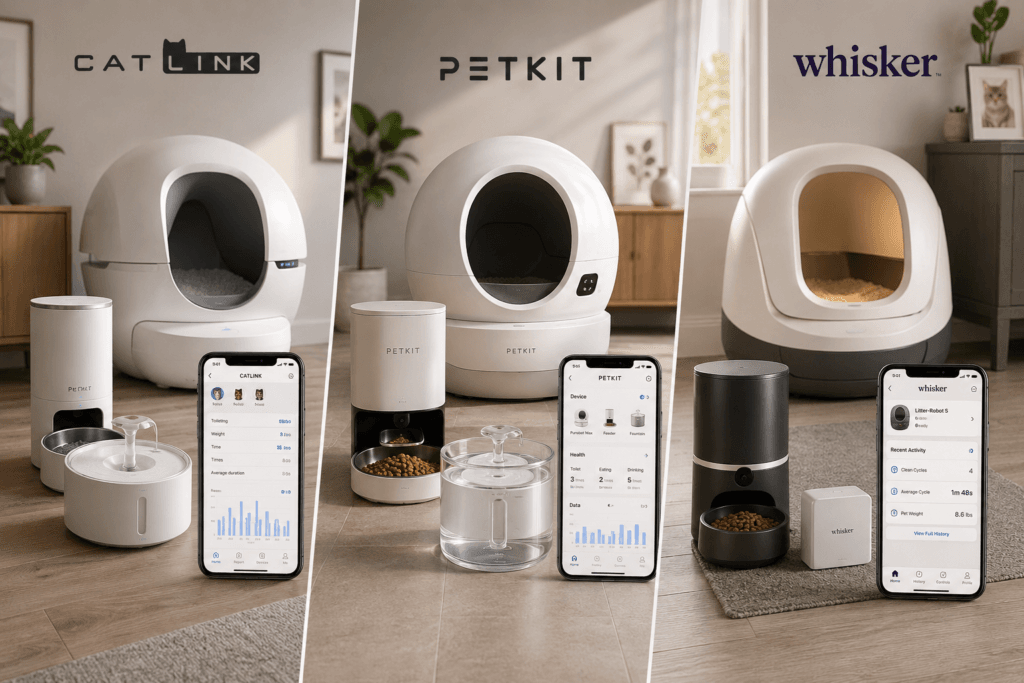
    The Three-Device Test

    CATLINK, PETKIT and Whisker smart cat ecosystems shown side by side with litter boxes, feeders, fountains and app dashboards
    CATLINK leans into multi-cat data, PETKIT builds the broadest smart cat ecosystem, and Whisker focuses on a tighter litter-first workflow.

    Before committing to an ecosystem, imagine that every product requires a separate app.

    Would you still independently choose:

    • the litter box;
    • the feeder;
    • the fountain?

    If the answer is yes three times, the shared app creates genuine convenience.

    If the answer is:

    “I only wanted the other two because their icons matched,”

    you are not building a smart home.

    You are collecting branded appliances.

    The strongest ecosystem is made from products you would buy even without the ecosystem.

    PETKIT: The Best Complete Ecosystem

    PETKIT currently covers the widest credible range of smart-cat routines.

    Its platform includes automatic litter boxes, dry-food feeders, connected fountains and increasingly camera-led products that monitor feeding, drinking and litter-box activity through the PETKIT app. The company’s current direction extends cameras and individual recognition across all three categories rather than keeping them confined to one flagship device.

    That breadth gives owners several possible entry points:

    • begin with a PuraMax litter box;
    • add a camera feeder such as YumShare;
    • introduce connected hydration;
    • choose monitoring-heavy products only where the data has a purpose.

    This flexibility is PETKIT’s strongest advantage.

    A household can expand gradually without every product solving the same problem or carrying the same level of complexity.

    Why PETKIT wins

    PETKIT offers the best current balance of:

    • category breadth;
    • credible hardware across several routines;
    • camera and non-camera choices;
    • multi-cat monitoring;
    • one-app expansion;
    • feeding and hydration options Whisker does not match.

    Its ecosystem makes sense for someone who expects to automate more than litter.

    For a direct comparison against Whisker’s narrower approach, read our PETKIT vs Litter-Robot Ecosystem guide.

    Where PETKIT can disappoint

    PETKIT launches ambitious products quickly.

    New cameras, facial recognition and behavioral insights may appear before a device has accumulated years of public ownership history.

    That means the ecosystem can be strong while a specific new product still deserves caution.

    The company is also moving aggressively toward AI-generated insights. Some information can reveal useful patterns. Some can become an expensive way to learn that Archibald drank water while you were at the supermarket.

    Before buying the advanced version, ask:

    What will I do differently because this camera or insight exists?

    When the answer is nothing, choose the simpler model.

    PETKIT wins the ecosystem comparison.

    It does not receive diplomatic immunity from product-level scrutiny.

    Whisker: The Best Litter-First Ecosystem

    Whisker is much narrower.

    Its current ecosystem centers on Litter-Robot models, Feeder-Robot, the Whisker app and the software, accessories and consumables surrounding them. The app combines litter-box activity, weight information and feeding statistics, while newer Litter-Robot models add WasteID and camera-based monitoring.

    That focus is not automatically a weakness.

    Most owners do not wake up determined to build a technological civilization around the cat.

    They want to stop scooping litter.

    Whisker starts with that problem and builds outward only modestly.

    Why Whisker remains compelling

    Its litter-box lineup has a clear structure:

    • EVO for compact automation;
    • Litter-Robot 5 as the strongest overall platform;
    • Litter-Robot 5 Pro for camera-supported identification and monitoring.

    Whisker’s deepest expertise, app development and accessory environment remain concentrated around litter automation.

    For households where the litter box matters more than fountains, wet-food feeders or a broad device catalogue, that specialization is valuable.

    Read our Litter-Robot 5 vs 5 Pro vs EVO comparison for the model-level decision.

    Where Whisker can disappoint

    The ecosystem becomes thin once the buyer moves beyond litter care and scheduled dry feeding.

    Whisker does not offer PETKIT’s range of fountains, refrigerated feeding concepts or camera feeders.

    Litter-Robot 5 Pro also introduces a software-cost decision. Its cameras offer basic functionality without Whisker+, but individual visual identification and deeper histories depend on the membership layer.

    Apparently, even remembering who used the litter box can now become a subscription service.

    That does not make Whisker+ worthless.

    It means the hardware and the long-term software plan must be evaluated together.

    Choose Whisker when litter automation is the center of the home.

    Do not choose it because you expect a complete smart-cat catalogue to materialize around the litter box.

    CATLINK: Buy the Product, Not the Diagram

    CATLINK has the most explicit “input-output” ecosystem concept.

    The CATLINK app connects litter boxes, feeders and fountains while combining toilet activity, eating behavior, drinking patterns and weight-based multi-cat records. CATLINK also sells complete ecosystem bundles containing a scooper, Fresh 2 feeder and water fountain.

    The theory is coherent:

    1. track what the cat eats;
    2. track what the cat drinks;
    3. track what happens in the litter box;
    4. look for meaningful changes.

    As an ecosystem diagram, it is excellent.

    As a shopping strategy, it needs more restraint.

    CATLINK’s strongest argument

    CATLINK remains most convincing in automatic litter boxes.

    A product such as Luxury Pro-X can deserve consideration for:

    • multi-cat homes;
    • weight-based visit identification;
    • litter-box histories;
    • households where its dimensions or design fit better;
    • buyers who prefer CATLINK’s app approach.

    This gives CATLINK a legitimate place in the comparison.

    For the direct two-brand decision, read our CATLINK vs PETKIT comparison.

    Where the CATLINK argument weakens

    A credible CATLINK litter box does not automatically validate every feeder and fountain sharing the app.

    Our product-level audits have found the wider catalogue less consistently convincing than PETKIT’s. Some devices offer interesting ideas, but ecosystem coherence is not evidence of equal maturity, reliability or household fit.

    A shared app is convenient.

    It is not a quality-control department.

    The correct CATLINK strategy is:

    • choose the litter box only if it wins independently;
    • validate whether its data helps;
    • evaluate every additional device from zero;
    • ignore the emotional pressure to complete the bundle.

    CATLINK is a valid smart-litter brand with a wider ecosystem ambition.

    It is not currently an equal all-category alternative to PETKIT.

    Still comparing individual litter boxes rather than entire ecosystems? Read our Best Smart Litter Boxes guide for the strongest options organized by household fit, monitoring needs and buyer-regret risk.

    Monitoring Is Not Automation

    Cat owner comparing smart cat ecosystem options at home with litter boxes, feeders, fountains and monitoring devices in the background
    The best smart cat ecosystem is not the one with the most devices, but the one that fits your home, your cats and the level of data you are willing to manage.

    The three ecosystems also differ in what they are trying to improve.

    Automation removes repetitive labor.

    Examples include:

    • sifting litter;
    • dispensing scheduled meals;
    • circulating water;
    • sending maintenance alerts.

    Monitoring adds context.

    Examples include:

    • which cat used a device;
    • whether a routine changed;
    • how weight moved over time;
    • whether food or water activity declined.

    PETKIT leans most heavily into monitoring across categories.

    Whisker combines strong litter automation with increasingly deep litter-related data.

    CATLINK emphasizes linking multiple routine records inside one dashboard.

    Monitoring is valuable only when the information changes a decision.

    A graph that leads you to verify a persistent change or contact a veterinarian has served a purpose.

    A graph you admire briefly before closing the app is interface decoration.

    For the broader distinction, read our Smart Cat Monitoring vs Automation guide.

    Where Buyer Regret Comes From

    PETKIT regret usually means paying for cameras or AI features that become ignored.

    Whisker regret means investing heavily in a focused ecosystem and later wanting broader feeding or hydration options.

    CATLINK regret means buying the bundle before each product has earned independent confidence.

    The universal regret is choosing matching software over better hardware.

    Mixing brands may be the correct answer:

    • a Whisker litter box;
    • a PETKIT feeder;
    • a simple fountain that is easy to clean;
    • no dashboard pretending this arrangement constitutes institutional failure.

    Your cat will recover from the trauma of using appliances made by different corporations.

    Final Verdict

    Smart cat ecosystem with a cat, automatic feeder, water fountain and pet camera in a modern living room.
    A smart cat ecosystem can connect feeding, hydration and camera monitoring, but the best choice depends on whether you value data, breadth or litter-first simplicity.

    PETKIT is the best overall smart cat ecosystem.

    It offers the widest credible combination of litter automation, feeding, hydration and camera-led monitoring. It is the strongest choice for households that genuinely intend to expand across several categories.

    Whisker is the best litter-first ecosystem.

    Its range is narrower, but its focus is valuable. When the main objective is buying the strongest premium automatic litter box and perhaps adding scheduled dry feeding, Whisker may be the better decision.

    CATLINK earns a Conditional Recommendation.

    Its litter boxes and multi-cat data can be compelling. Its wider ecosystem should be approached one device at a time rather than purchased as a pre-approved bundle.

    The ranking is therefore:

    1. PETKIT — best complete ecosystem
    2. Whisker — best litter-first ecosystem
    3. CATLINK — best evaluated product by product

    Choose the first device because it solves a real problem.

    Let it earn the second purchase.

    Do not give a corporation custody of your entire smart cat home because its app has an attractive dark mode.

    Frequently Asked Questions

    Is PETKIT better than Whisker?

    PETKIT is better for a complete ecosystem covering litter, feeding and hydration. Whisker is better when premium litter automation is the main priority.

    Is CATLINK better than PETKIT?

    CATLINK can be better when a specific litter-box design or multi-cat feature suits the household. PETKIT remains the stronger overall ecosystem across categories.

    Which ecosystem has the best automatic litter boxes?

    Whisker has the strongest litter-first positioning. PETKIT offers more variety between automation-led and camera-led systems. CATLINK remains relevant for specific multi-cat designs.

    Which ecosystem is best for feeders and fountains?

    PETKIT currently offers the broadest combination of camera feeders, alternative feeding formats and connected fountains. Whisker offers Feeder-Robot but no comparable fountain range.

    Do all smart cat products need to use the same app?

    No. A shared app reduces digital clutter, but it should not outweigh reliability, cleaning, physical fit or the quality of each device’s core function.

    References

    • PETKIT — Smart Home product and app documentation
    • PETKIT — 2026 connected-care product announcements
    • Whisker — Litter-Robot, Feeder-Robot and Whisker app documentation
    • Whisker — Litter-Robot 5 Pro and Whisker+ documentation
    • CATLINK — Ecosystem bundles and CATLINK app documentation

    Image Disclosure

    Official manufacturer images are used when depicting exact products.

    Any AI-generated images are editorial illustrations only. They do not represent exact dimensions, controls, monitoring accuracy or app performance. Always verify current specifications before purchasing.
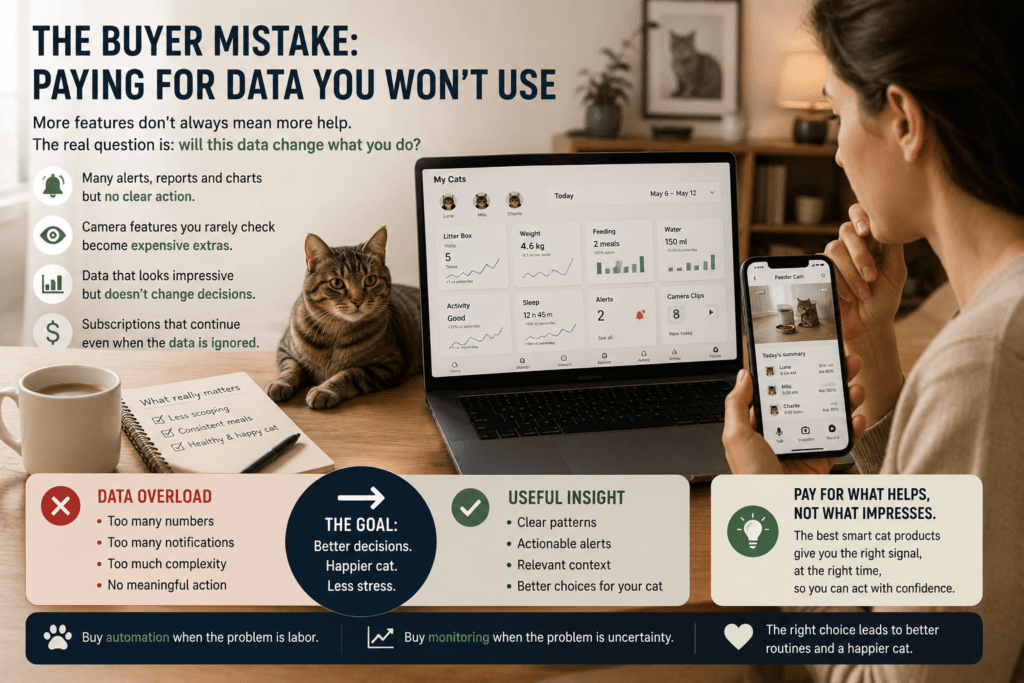
    Editorial Disclosure

    PetTech AI may earn a commission from qualifying purchases. This does not influence our recommendations, comparisons or editorial judgments.

  • Litter-Robot 5 vs 5 Pro vs EVO: Which Upgrade Is Actually Worth Paying For?

    Litter-Robot 5 vs 5 Pro vs EVO: Which Upgrade Is Actually Worth Paying For?

    EVO costs less.

    Litter-Robot 5 sits in the middle.

    Litter-Robot 5 Pro adds a reassuringly expensive word to the name.

    Unfortunately for the pricing ladder, Napoleon does not care which model sounds most important.

    All three automate the same central chore: they separate waste after use, connect to the Whisker app and reduce daily scooping.

    The real differences are simpler:

    • EVO gives you compact automation.
    • Litter-Robot 5 gives you the strongest overall litter-box platform.
    • Litter-Robot 5 Pro gives you cameras and deeper individual monitoring.

    For most buyers, Litter-Robot 5 is the correct choice.

    Choose EVO when space and lower entry cost matter more than WasteID, extra capacity and support for larger households.

    Choose the Pro only when visual identification solves an existing monitoring problem.

    The Pro does not clean better.

    It watches better.

    Quick Verdict

    A phone showing litter box visit history and cat routine trends beside a premium automatic litter box in a clean home
    Whisker+ matters most when you choose Litter-Robot 5 Pro for visual identification, longer history and richer trend data.
    ModelBest fitPetTech AI verdictMain limitation
    Litter-Robot EVOOne or two smaller cats, limited space and simpler monitoring needsRecommendedSmaller interior, lower weight ceiling and no WasteID
    Litter-Robot 5Most households, larger cats and heavier multi-cat useStrong RecommendationSimilar-weight cats may still be difficult to identify
    Litter-Robot 5 ProMonitoring-first homes that need visual cat identificationConditional RecommendationCamera value depends heavily on actual use and Whisker+

    Litter-Robot 5 offers the best balance.

    Its upgrade over EVO improves the physical machine: more interior space, broader cat support, a larger waste system and WasteID.

    The Pro upgrade is different. It keeps the same core litter-box platform and adds two cameras.

    That is valuable when you genuinely need to know which cat visited and what happened.

    It is expensive bathroom cinema when you do not.

    Research Note

    This is a research-led comparison based on current official documentation, software terms, product positioning and available ownership evidence.

    PetTech AI has not conducted a long-term side-by-side hands-on test of all three models.

    PetTech AI may earn a commission from qualifying purchases. As an Amazon Associate I earn from qualifying purchases.

    Need the compact, lower-complexity option? Check Litter-Robot EVO on Amazon.

    The Price Ladder Is Really Two Different Upgrades

    A clean litter area showing an automatic litter box beside a phone with simple routine monitoring data
    The real decision is how much monitoring you want: basic automation, useful routine data or camera-supported insights.

    Whisker presents EVO, Litter-Robot 5 and 5 Pro as a natural progression.

    But you are not buying increasingly better versions of the same thing.

    You are making two different upgrades.

    EVO to Litter-Robot 5: more machine

    Litter-Robot 5 is physically larger than EVO and supports cats from 3 to 30 lb, compared with EVO’s 3-to-19-lb range.

    It also supports larger multi-cat households, provides more interior headroom and adds WasteID, which distinguishes urine from solid waste to adjust cycle timing and improve routine data.

    These differences affect daily ownership.

    They matter when:

    • the cat is too large for EVO;
    • more than two cats will share the unit;
    • the waste drawer will see heavier use;
    • urine-versus-solid information is useful;
    • you want more room for future household changes.

    This is why Litter-Robot 5 is the best default.

    Its premium buys a more capable litter box rather than a specialist feature.

    Litter-Robot 5 to 5 Pro: more visibility

    Litter-Robot 5 and 5 Pro share the same overall dimensions, entryway, interior headroom, WasteID system and core cleaning platform.

    The Pro adds:

    • a front-facing camera;
    • a second camera aimed toward the litter bed;
    • recorded events;
    • live visual checks;
    • visual cat identification through Whisker+.

    The cameras can solve a real problem when SmartScale struggles to distinguish similar-weight cats.

    They do not create a larger drawer, cleaner clumps or more enthusiastic burying behavior.

    You are paying to understand the visit—not improve the mechanical cleanup.

    When EVO Is the Smart Purchase

    EVO is not a stripped-down box with nothing useful inside.

    It still provides automatic cleaning, app controls, visit history, drawer alerts and SmartScale weight tracking. It is also the smallest model in the current lineup, with a footprint of approximately 20.6 by 24.3 inches.

    That makes it the sensible option for:

    • apartments and smaller rooms;
    • one or two cats;
    • cats comfortably below its 19-lb limit;
    • buyers who primarily want to stop scooping;
    • households that do not need WasteID or cameras.

    EVO becomes a poor decision when the household already sits near its limits.

    A large cat may technically fit through the entrance while still preferring the additional interior space of Litter-Robot 5. Two cats may also fill the smaller drawer faster than the buyer expects.

    Do not choose EVO as a temporary compromise while privately wanting the LR5 platform.

    A product that predictably forces an upgrade is not a bargain.

    It is full price with an unnecessary rehearsal.

    For dimensions, household fit and its specific compromises, read our Litter-Robot EVO Review.

    Why Litter-Robot 5 Is the Best Overall Choice

    Litter-Robot 5 is the strongest recommendation because it improves the parts of the machine most households interact with every day.

    It provides:

    • more interior space than EVO;
    • support for larger cats;
    • capacity for up to five cats;
    • a larger and better-distributed waste drawer;
    • WasteID;
    • detailed waste and litter-level monitoring;
    • compatibility with Whisker’s current accessory ecosystem.

    WasteID is the defining upgrade.

    Urine clumps benefit from enough time to form before the unit cycles. Solid waste benefits from being contained sooner. Distinguishing between them allows the machine to apply more appropriate timing rather than treating every visit identically.

    WasteID can also add useful context to the activity history.

    It cannot diagnose urinary or digestive disease.

    The machine may tell you that Giuseppe visited more frequently or that the event pattern changed. It cannot determine why he did so after completing veterinary school during a firmware update.

    For most buyers, Litter-Robot 5 provides enough useful information without introducing cameras into the decision.

    That is not a boring compromise.

    It is the model where the additional cost still improves the core job.

    When the Pro Is Actually Worth It

    The Pro becomes relevant when weight-based identification is not enough.

    SmartScale can associate visits with individual profiles when cats occupy clearly different weight ranges. Identification becomes harder when:

    • two cats weigh almost the same;
    • weight fluctuates;
    • a cat only partially enters;
    • several cats approach together;
    • a visit produces an ambiguous measurement.

    Visual identification can resolve some of that uncertainty.

    The front camera helps identify the approaching cat, while the litter-bed camera adds context around the visit. With Whisker+, the system can connect video with individual records and provide longer histories.

    That is genuinely useful when:

    • similar-weight cats share the box;
    • one cat’s habits require closer observation;
    • recorded visits would affect your response;
    • you spend significant time away from home;
    • video would help explain an unusual pattern to a veterinarian.

    The information needs to lead somewhere.

    If it helps you verify a repeated change, add another litter station or seek veterinary advice, the cameras have earned their place.

    If it merely confirms that Napoleon entered at 3:14 a.m., you have purchased an extremely expensive feline biographer.

    For the deeper two-model decision, read our Litter-Robot 5 vs 5 Pro comparison.

    The Whisker+ Question

    Litter-Robot 5 Pro can still provide limited live viewing and recent recorded events without Whisker+.

    The subscription unlocks the features that turn the cameras into a deeper individual-monitoring system:

    • visual cat identification;
    • unlimited live streaming;
    • 30 days of video history;
    • extended activity history;
    • richer cat-level insights.

    Whisker+ also adds longer histories and summaries to compatible non-camera models, including EVO and Litter-Robot 5.

    The correct question is not:

    “Does the Pro work without a subscription?”

    It does.

    The correct question is:

    “How much of the reason I am buying the Pro depends on Whisker+?”

    If you only want occasional visual confirmation, the free camera functions may be enough.

    If individual visual identification is the reason for the upgrade, Whisker+ becomes part of the real ownership cost.

    A camera you own and an insight system you rent are related purchases—not identical ones.

    Which Model Fits Your Household?

    A cat owner comparing Litter-Robot models on a laptop while a cat sits nearby in a modern home
    Buyer regret usually comes from buying the wrong level of complexity: underbuying EVO, overbuying Pro, or misunderstanding what Litter-Robot 5 balances.

    One predictable cat

    Choose EVO when the cat fits comfortably and compactness matters.

    Choose Litter-Robot 5 when the cat is larger, WasteID matters or you want a platform with more long-term flexibility.

    The Pro is difficult to justify unless video serves a specific purpose.

    One cat does not automatically require dual-camera monitoring merely because it possesses a urinary system.

    Several cats with different weights

    Choose Litter-Robot 5.

    Its capacity and SmartScale records should be enough for many households when the cats are easy to distinguish by weight.

    Several cats with similar weights

    Consider Litter-Robot 5 Pro.

    This is its strongest use case because visual identification addresses uncertainty that the standard model may not resolve.

    The deciding variable is not simply cat count.

    It is how difficult the cats are to tell apart.

    For the broader difference between labor-saving automation and behavioral visibility, read our Smart Cat Monitoring vs Automation guide.

    Buyer-Regret Risk

    Each model creates a different form of regret.

    EVO regret: discovering that the cats or household routine exceed its physical limits.

    Litter-Robot 5 regret: realizing later that similar-weight cats required visual identification.

    Litter-Robot 5 Pro regret: paying for two cameras and then never opening the video history after the first week.

    The safest default is Litter-Robot 5 because it solves the widest set of physical ownership problems without requiring the buyer to justify a monitoring subscription.

    Choose EVO deliberately.

    Choose the Pro for evidence, not status.

    “Pro” is a product tier.

    It is not an evaluation of your competence as a cat owner.

    What About PETKIT, CATLINK or Litter-Robot 4?

    This comparison assumes you already want the current Whisker lineup.

    That may not be the correct starting assumption.

    Litter-Robot 4 can remain relevant when its established ownership history and current purchase conditions matter more than WasteID.

    PETKIT becomes more attractive when feeding, hydration and camera monitoring are part of a broader connected ecosystem.

    CATLINK deserves consideration when individual multi-cat data and alternative hardware design are central to the decision.

    For the wider market, read our PETKIT vs Litter-Robot Ecosystem comparison and Best Smart Litter Boxes guide.

    Final Verdict

    Choose Litter-Robot EVO when you have one or two smaller cats, limited space and no need for WasteID or visual monitoring.

    Choose Litter-Robot 5 when you want the strongest overall balance of capacity, waste information and everyday usefulness.

    Choose Litter-Robot 5 Pro when visual identification solves a genuine multi-cat monitoring problem.

    For most households, Litter-Robot 5 is the correct purchase.

    Its premium over EVO improves the litter box itself.

    The Pro’s premium improves visibility around the litter box.

    EVO is not too basic when its limits fit the household.

    The Pro is not automatically better because it can record Napoleon ignoring the expensive machine purchased in his honor.

    The mistake is not choosing the cheaper model.

    It is paying more to solve an uncertainty your household never had.

    Frequently Asked Questions

    Is Litter-Robot 5 worth upgrading to from EVO?

    Yes, when you need support for larger or more cats, additional interior space, WasteID or more detailed waste monitoring. EVO remains the better fit when its limits already match the household.

    Does EVO identify individual cats?

    EVO uses SmartScale weight tracking to associate visits with cat profiles. Identification may become less reliable when cats have very similar weights.

    Does Litter-Robot 5 Pro clean better than Litter-Robot 5?

    No. The models share the same core litter-box platform. The main Pro upgrade is its dual-camera monitoring system.

    Does Litter-Robot 5 Pro require Whisker+?

    Basic camera features remain available without Whisker+. Visual cat identification, unlimited streaming and longer video history require the subscription under the current service structure.

    Which model is best for multiple cats?

    Litter-Robot 5 is the best default for larger multi-cat households. Choose the Pro when similar weights or ambiguous visits make visual identification useful.

    References

    • Whisker — Litter-Robot EVO product documentation
    • Whisker — Litter-Robot 5 product documentation
    • Whisker — Litter-Robot 5 Pro product documentation
    • Whisker — Current Litter-Robot comparison chart
    • Whisker — Whisker+ membership documentation

    Image Disclosure

    Official Whisker images are used when depicting the exact products.

    Any AI-generated images are editorial illustrations only. They do not represent exact dimensions, camera placement, controls or monitoring accuracy. Always verify current specifications before purchasing.
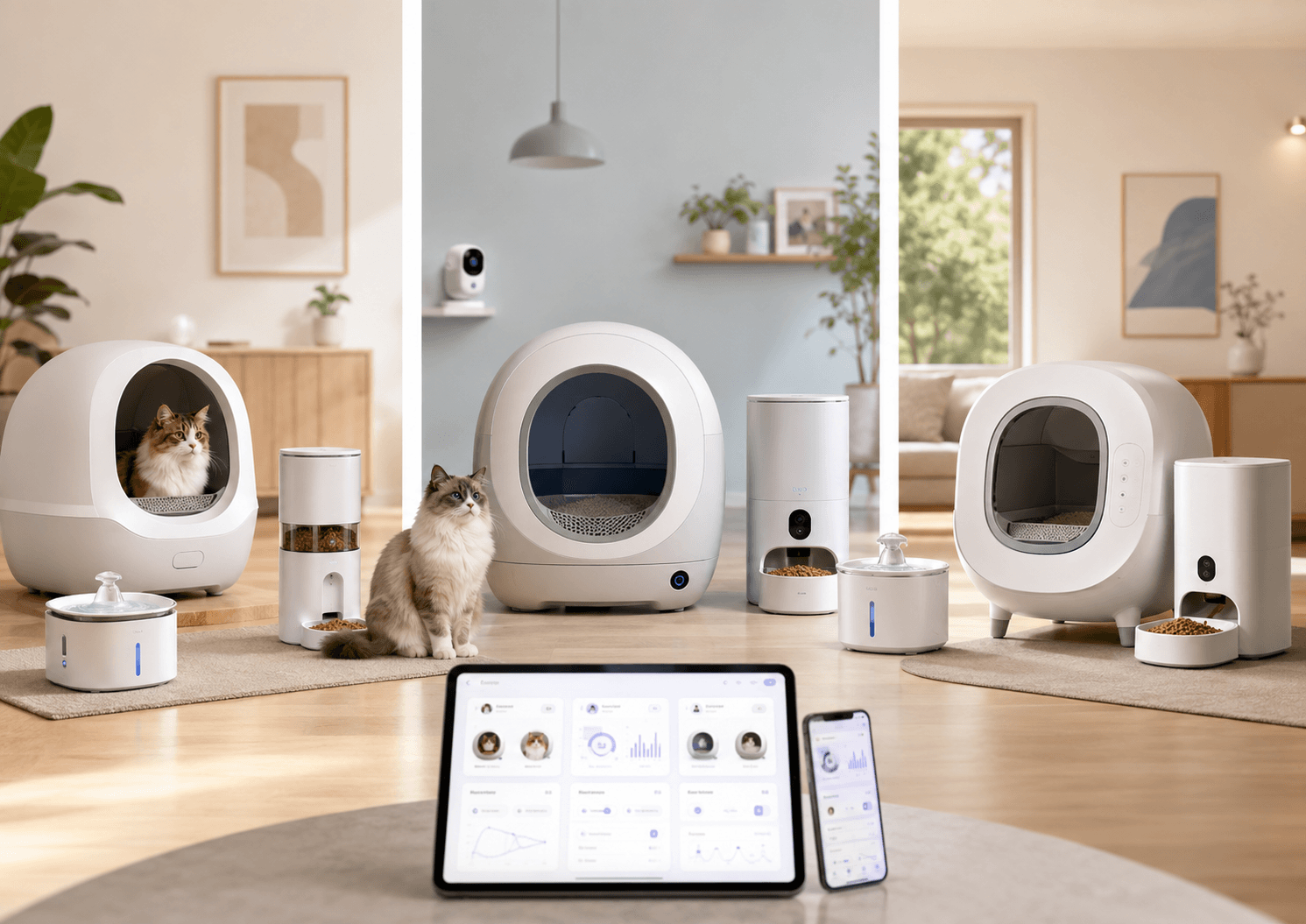
    Editorial Disclosure

    PetTech AI may earn a commission from qualifying purchases. This does not influence our recommendations, comparisons or editorial judgments.