Tag: petkit ecosystem

  • Petkit vs Litter-Robot ecosystem (2026): What Actually Works Better in Real Homes

    Petkit vs Litter-Robot ecosystem (2026): What Actually Works Better in Real Homes

    Most comparisons obsess over feature lists. This one doesn’t.

    If you’re choosing between Petkit and Litter-Robot in 2026, the real question isn’t “Which device is smarter?” It’s which ecosystem creates less daily friction—and which one fails more gracefully when life happens (travel, multi-cat chaos, missed cleanings, Wi-Fi hiccups, weird cat behavior).

    This Petkit vs Litter-Robot ecosystem breakdown focuses on what matters after the honeymoon period: reliability, maintenance load, data quality, and the human behaviors that automation either fixes—or quietly amplifies.


    What “ecosystem” actually means in pet tech

    An ecosystem isn’t “same brand” or “same app.” A real ecosystem is four things:

    1. Unified control: one place to manage devices without workarounds
    2. Data continuity: feeding + litter habits + weight trends that don’t live in silos
    3. Failure tolerance: when a device glitches, the household doesn’t collapse
    4. Maintenance realism: how often you must intervene, clean, refill, and troubleshoot

    That’s why this Petkit vs Litter-Robot ecosystem comparison is less about specs and more about systems.


    Ecosystem architecture in 2026: modular vs vertical
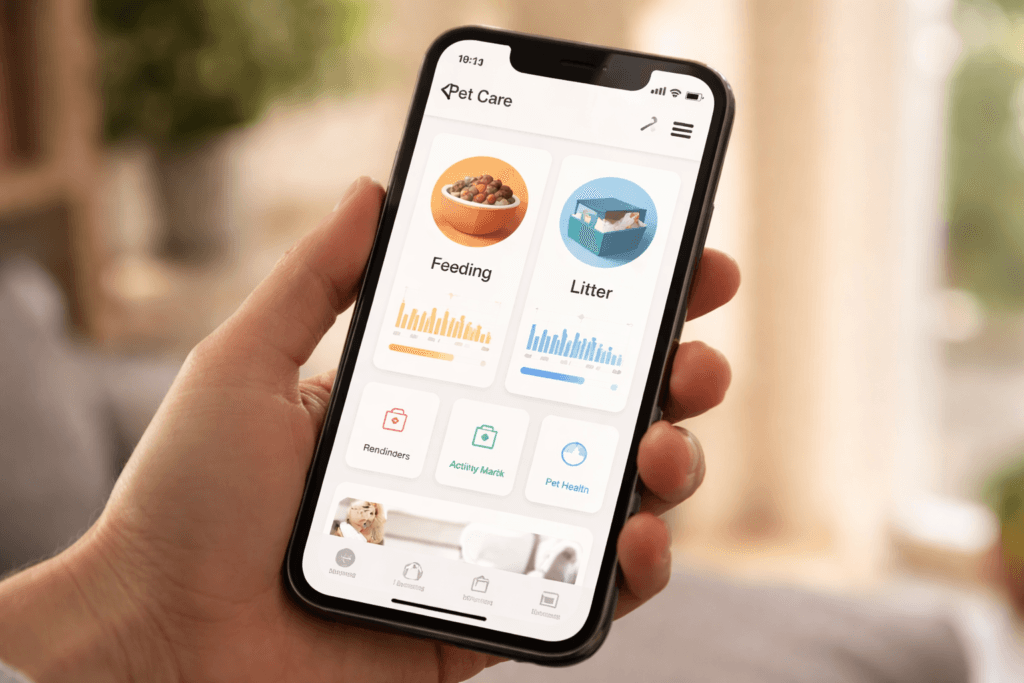
    One app dashboard concept for managing smart cat devices

    Petkit: modular ecosystem built around one app

    Petkit’s pitch is “one app, many devices.” The PETKIT app describes itself as a hub that can track litter box use, meals, hydration, and activity—essentially trying to centralize routine data for day-to-day care.

    In practice, Petkit’s ecosystem tends to look like:

    • automatic litter box (e.g., PuraMax line)
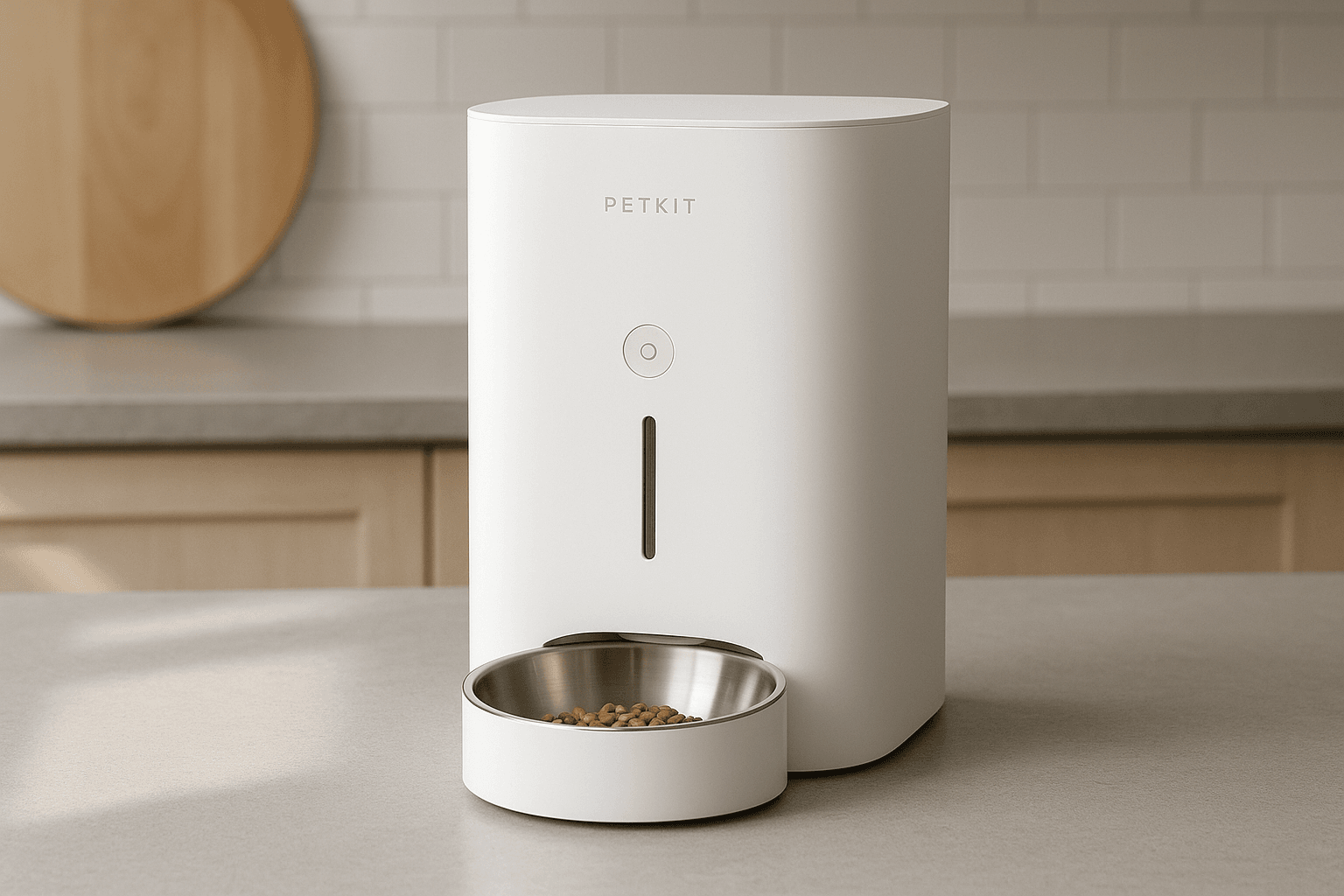
    • smart feeder (Fresh Element line, including Infinity)
    • smart fountain / hydration tracking devices
    • optional add-ons for odor control and maintenance

    It’s a broad system: you can build a full “Petkit stack,” or just use one device and stay light.

    Litter-Robot: vertical ecosystem anchored in litter (and identity)

    Whisker’s Litter-Robot ecosystem is anchored in the litter box first. In late 2025, Whisker launched the Litter-Robot 5 series, including a Pro model with dual cameras and a feature called WasteID for differentiating urine vs feces and generating richer individual insights.

    They also introduced Litter-Robot Evo as a more budget-oriented option, positioned for fewer cats and fewer advanced features.

    In other words:

    • Petkit builds a wide ecosystem (many device categories)
    • Litter-Robot builds a deep ecosystem around waste tracking and identification

    That difference shapes everything downstream in a Petkit vs Litter-Robot ecosystem decision.


    Daily use reality check: where ecosystems win or break

    Setup friction: onboarding vs calibration

    Petkit is often easier to expand incrementally (add a feeder later, then a litter box). But it also means more devices to onboard and maintain across time.

    Litter-Robot is typically one “big install” with fewer moving parts in the ecosystem—unless you add accessories and subscriptions. The upside is simpler architecture. The downside is higher dependency on one core device doing everything well.

    App experience: control is easy; noise is the problem

    Petkit leans into “habit tracking” across categories. The PETKIT app marketing emphasizes ongoing monitoring (meals, hydration, litter habits) and “spotting subtle behavior changes.”

    Whisker leans into identity + analytics. Litter-Robot 5 Pro’s core differentiator is not just “self-cleaning,” but identification and richer insights tied to the Whisker app experience.

    The practical difference:

    • Petkit tends to create more streams of data across devices
    • Whisker tends to create deeper data around litter events

    If you hate notifications and “dashboard life,” both can become annoying—just in different ways.

    Maintenance cadence: the unglamorous truth

    Maintenance is the true cost of any ecosystem.

    • Petkit’s ecosystem spreads maintenance across devices (clean feeder parts, wash fountain components, manage litter box consumables).
    • Litter-Robot concentrates maintenance into the litter system (drawer emptying, filters, cleaning cycles, occasional troubleshooting).

    Neither is “maintenance-free.” The best Petkit vs Litter-Robot ecosystem choice is the one whose maintenance matches your tolerance.


    Failure modes: what happens when things go wrong

    This is where the Petkit vs Litter-Robot ecosystem decision becomes real.

    When Wi-Fi drops

    Petkit’s Fresh Element Infinity FAQ states you need Wi-Fi + app to set the feeding plan, but once the plan is configured, the feeder can continue dispensing even if the device is offline.

    That’s good design: offline shouldn’t equal starvation.

    When data becomes unreliable

    All ecosystems struggle when the input is distorted:

    • multi-cat sharing (who used it?)
    • bullying/guarding (who got access?)
    • cats that do “fake visits” or rapid in/out behavior

    Whisker tries to solve identity more directly with cameras and identification features in the 5 Pro line.
    Petkit tends to rely more on device-side tracking and the pattern you can infer across devices.

    If individualized tracking is the main reason you’re buying, the identity question should be front and center in any Petkit vs Litter-Robot ecosystem evaluation.


    Feeding logic vs waste logic: two systems, two failure points

    A lot of owners treat feeding and litter as separate problems. They’re not.

    Feeding logic: predictability beats “more tech”

    A smart feeder can enforce routine, but it can also automate your worst habits. If you use manual feeds as emotional reinforcement (“snack button behavior”), you train food obsession fast.

    And if weight is already trending up, “just reduce portions” can be dangerous when done aggressively. Cornell’s obesity guidance warns that sudden starvation dieting can risk serious complications like hepatic lipidosis and recommends gradual weight loss (often 1–2% per week) under veterinary direction.

    So the real feeding-system win isn’t automation. It’s controlled consistency with safe adjustment.

    Waste logic: data is only useful if it changes action

    Litter tracking matters only if it becomes actionable:

    • reduced missed events
    • faster detection of abnormal patterns
    • fewer “I didn’t notice for a week” moments

    Whisker’s pitch (especially with the 5 Pro) is “richer insights” through identification + analytics.
    Petkit’s pitch is broader: “monitor everything in one app,” including litter and feeding signals.

    Neither matters if you ignore it. Ecosystems don’t create care; they reduce friction for care.


    Multi-cat homes: where ecosystems break first
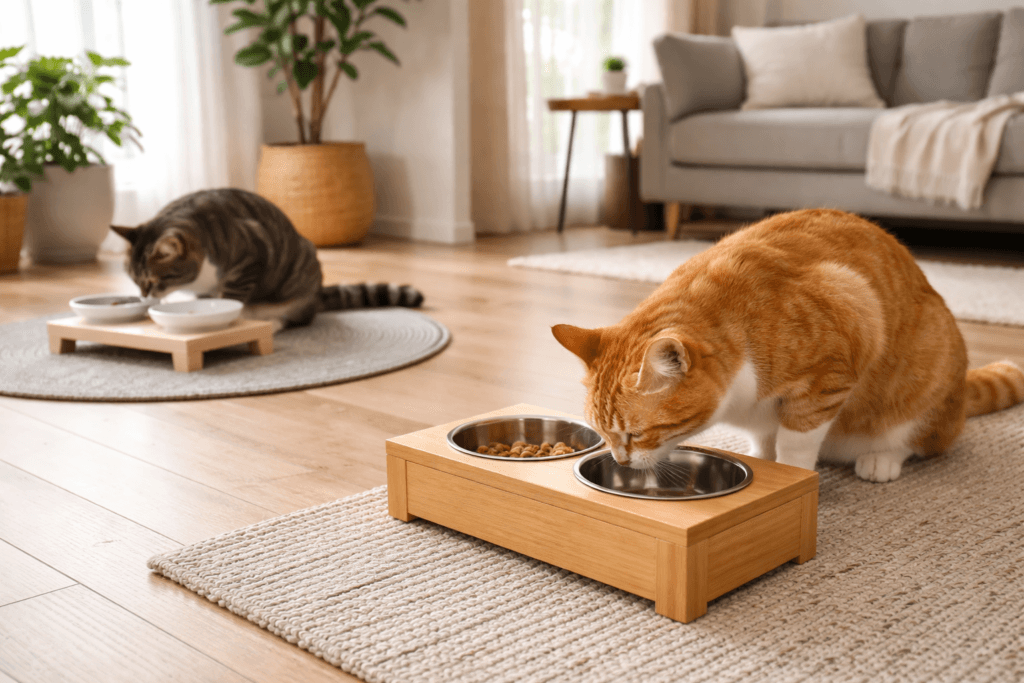
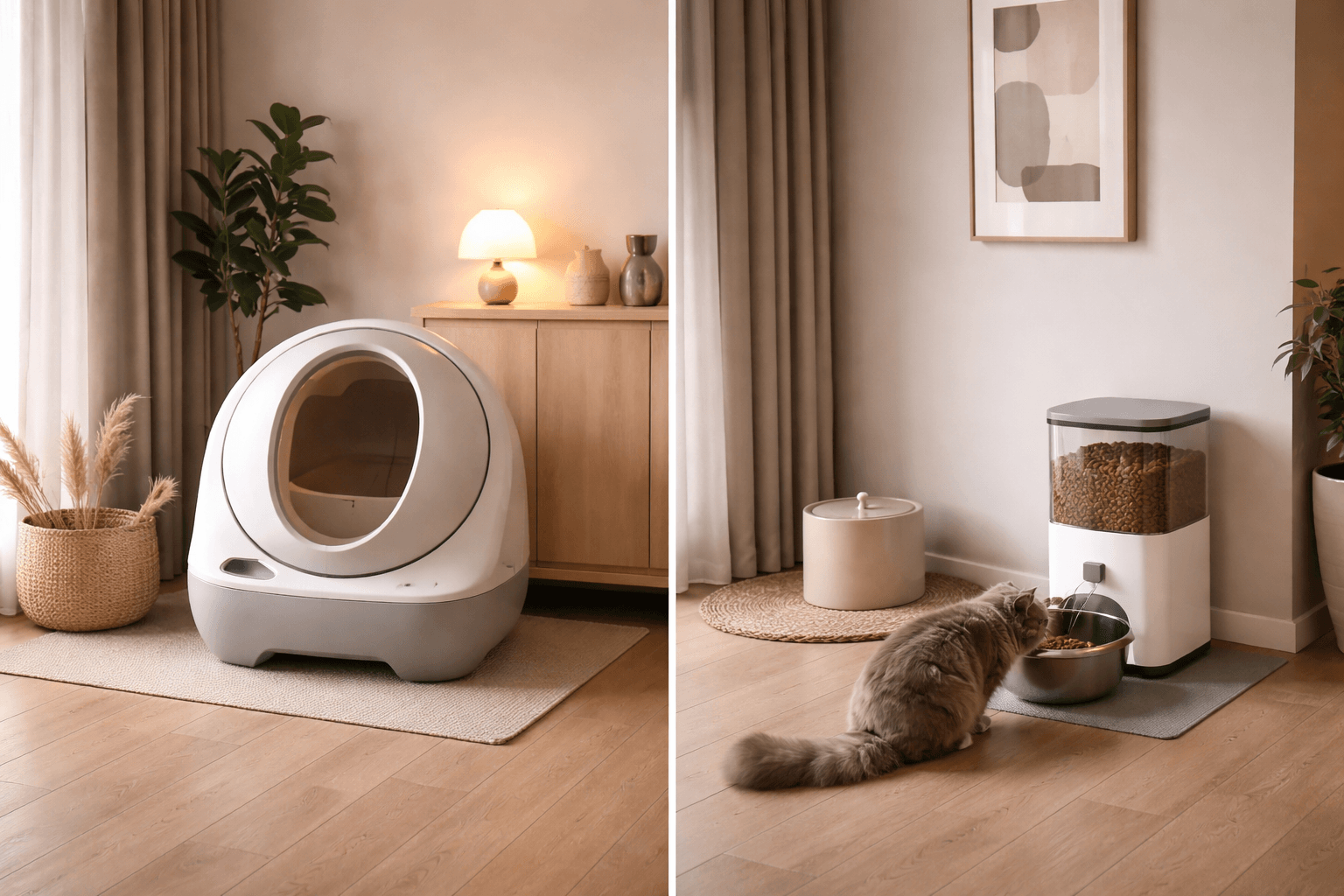
    Separate feeding stations support harmony in multi-cat households

    If you have two or more cats, assume your ecosystem will be stress-tested.

    The AAFP/ISFM environmental needs guidelines explicitly recommend separate feeding stations for every cat and adequate resource separation to reduce conflict and stress.

    That matters because:

    • a single shared feeder can produce distorted intake (one cat eats twice, another eats fast)
    • a shared litter device can become contested territory
    • “data” becomes a story the dominant cat writes

    In multi-cat homes:

    • Petkit’s modularity can help (separate devices per cat, or at least separated resources)
    • Whisker’s identification focus can help (if it’s accurate for your cats)

    The best Petkit vs Litter-Robot ecosystem setup for multi-cat households is often not “one flagship device.” It’s resource design.


    Long-term cost isn’t just money. It’s time.
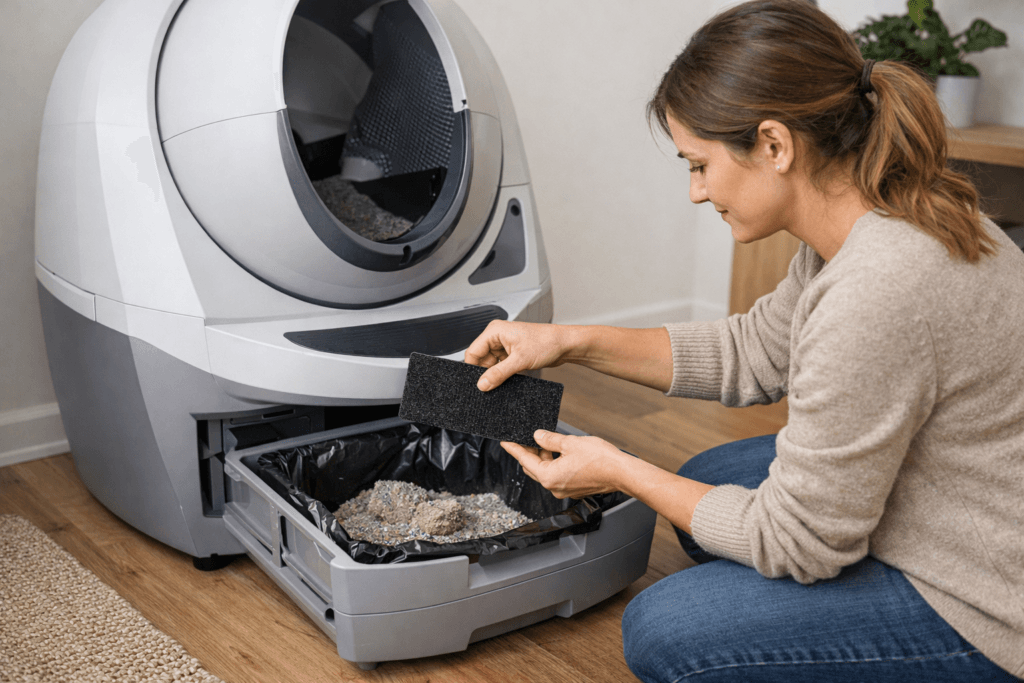
    Maintenance routine is a major long-term cost in smart litter box ecosystems

    Two things are always underestimated:

    1. Maintenance time
    2. Mental load (alerts, checks, refills, troubleshooting)

    AVMA’s healthy weight guidance makes a blunt point: food isn’t love, and there are better reward systems than treats—play, attention, activity.

    That’s a cost framework too. If your system makes you “manage with food,” it creates downstream problems—more feeding, more begging, more stress.

    Time is part of the cost in any Petkit vs Litter-Robot ecosystem decision.


    Decision matrix: who should choose what

    Household typeBetter fitWhy
    You want one app managing multiple device categoriesPetkitBroader ecosystem approach; app positioned as multi-device hub
    You care most about deep litter analytics and identityLitter-Robot (5 Pro)Identification + richer litter insights via cameras/features
    1–2 cats, want a simpler, lower-feature entryLitter-Robot EvoPositioned as more compact / beginner-friendly for fewer cats
    You want to build gradually: feeder now, litter laterPetkitModular expansion across categories
    Multi-cat home with conflict issuesEither—if you design resources correctlySeparate feeding stations and resource separation matter more than brand
    You’re trying to manage weight safely with automationPetkit + disciplined setupFeeder scheduling + gradual adjustments; avoid aggressive cuts

    Verdict: the honest Petkit vs Litter-Robot ecosystem call

    Choose Petkit if you want a modular system that can cover feeding + litter + hydration under one app umbrella, and you’re willing to manage multiple device maintenance rhythms. The ecosystem advantage is breadth and incremental expansion.

    Choose Litter-Robot if your top priority is a deep, identity-forward litter system with stronger emphasis on advanced tracking and insights (especially in the 5 Pro line). The ecosystem advantage is depth and focus.

    Choose neither (yet) if your household problem is actually environment and routine. If boredom, stress, or multi-cat conflict drives overeating or avoidance, tech will amplify whatever system you’ve built—good or bad.

    That’s the real takeaway from any Petkit vs Litter-Robot ecosystem comparison: the best ecosystem is the one that makes your household rules easier to execute—not easier to avoid.


    FAQ

    Is the Petkit vs Litter-Robot ecosystem choice mostly about the app?

    Partly—but the bigger factor is what the app is supporting. Petkit pushes a broader “one app for many devices” model. Whisker pushes deeper litter insights and identity-driven tracking.

    Which ecosystem is better for multi-cat homes?

    Neither automatically. Multi-cat success depends on separating resources and reducing conflict. AAFP/ISFM guidelines explicitly recommend separate feeding stations for each cat.

    Can smart feeding cause weight problems?

    Yes—if you use manual feeds as reinforcement or adjust portions aggressively. Cornell recommends gradual weight loss under veterinary guidance and warns against sudden starvation diets because of hepatic lipidosis risk.

    Does “more data” mean better care?

    Only if it changes behavior. Data without action becomes background noise. If alerts don’t translate into adjustments, you’re paying attention without outcomes.

    Should I prioritize feeding automation or litter automation first?

    If you’re fighting daily routine chaos (missed meals, double-feeding), start with feeding. If odor, hygiene, or litter avoidance is the core pain point, start with litter. If you’re unsure, choose the system that reduces the most frequent daily friction first.


    Internal Links

    If you want a deep look at Petkit’s feeding side—scheduling, portion control, and real-world app behavior—see PETKIT Fresh Element Infinity Review 2025 | Smart Feeder Tested by PetTech AI.

    For a broader feeder comparison (use cases, designs, what matters beyond marketing), see Best Smart Cat Feeders 2025.

    If your problem is already active overeating—begging, food obsession, or “always hungry” behavior—read Stop a Cat From Overeating for a behavior-first approach.

    And if overeating is paired with restlessness or stress, treat diet and environment as one system in Indoor Cat Enrichment 2025 and Best Interactive Cat Toys 2025.


    References

    • Cornell Feline Health CenterObesity (gradual weight loss; starvation diet warning; suggested monitoring).
    • Cornell Feline Health CenterHepatic Lipidosis (obesity as a common underlying condition; serious risk context).
    • AAFP/ISFMFeline Environmental Needs Guidelines (2013) (resource separation; separate feeding stations in multi-cat homes).
    • AVMAYour pet’s healthy weight (non-food rewards; healthy-weight framing).
    • PETKIT — PETKIT app ecosystem overview and device management claims.
    • Whisker / The Verge — Litter-Robot 5 series and Evo positioning details.

    Disclaimer

    PetTech AI publishes educational content to help cat owners make informed decisions about feline health, behavior, and pet technology. Some links on this page may be affiliate links, including Amazon Associate links and other affiliate partnerships. If you click a link and make a qualifying purchase, PetTech AI may earn a commission at no additional cost to you. These commissions support research, testing, and site maintenance. This article is not a substitute for veterinary diagnosis or treatment. If your cat is overweight, losing weight should be done gradually and under veterinary guidance to reduce health risks.
  • PETKIT Fresh Element Infinity Review 2025: Is This the Smart Feeder You Can Trust?

    PETKIT Fresh Element Infinity Review 2025: Is This the Smart Feeder You Can Trust?

    If you’ve ever had a feeder jam on you at 6 a.m. (and paid the price in yowls), you know the bar for “smart” is higher than an app and a timer. The PETKIT Fresh Element Infinity aims to clear that bar with a genuinely pet-centric design: an anti-jam dispenser, sealed storage with desiccant, stainless steel hardware where it matters, emergency power, and—on select versions—a built-in camera with AI clips and two-way audio. In this deep dive, I’ll walk you through real usability, what stands out (and what doesn’t), and who should buy it.

    Note: PETKIT sells Infinity in 5L (a clever 2L + 3L modular layout) and 3L variants; select trims add Camera/AI Capturing and two-way audio. Specs referenced here come from PETKIT’s official product matrix.

    TL;DR (for scrollers)

    • Reliable dispensing thanks to an anti-jam mechanism designed for typical kibble sizes.
    • Better hygiene with a 304 stainless steel bowl and sealed bin + desiccant.
    • Camera/AI option (on select variants) for clips, motion capture, and talk-back; great for separation-anxiety cats.
    • Emergency power so schedules keep running if the outlet goes out.
    • 5L (2L+3L) modular capacity is excellent for multi-cat homes; 3L is solid for 1 cat or weight-management feeding.

    Why the PETKIT Fresh Element Infinity is different

    Most feeders are plastic funnels wrapped in an app. The PETKIT Fresh Element Infinity is engineered around failure points owners actually experience: stale food, humidity, clogs, spillage, and schedule drift during outages. The stainless bowl wipes clean, the sealed hopper plus desiccant reduces moisture, and the feed path is designed to minimize bridging. Those are unsexy upgrades—but they’re exactly what makes a feeder trustworthy on day 100, not just day one.

    Add to that the camera/AI trim (if you choose it), and you get “what happened while I was gone?” clips without setting up a second device. Live View and two-way audio let you see and reassure a food-motivated cat who’s pacing the feeder 20 minutes early.

    Set-up & build quality

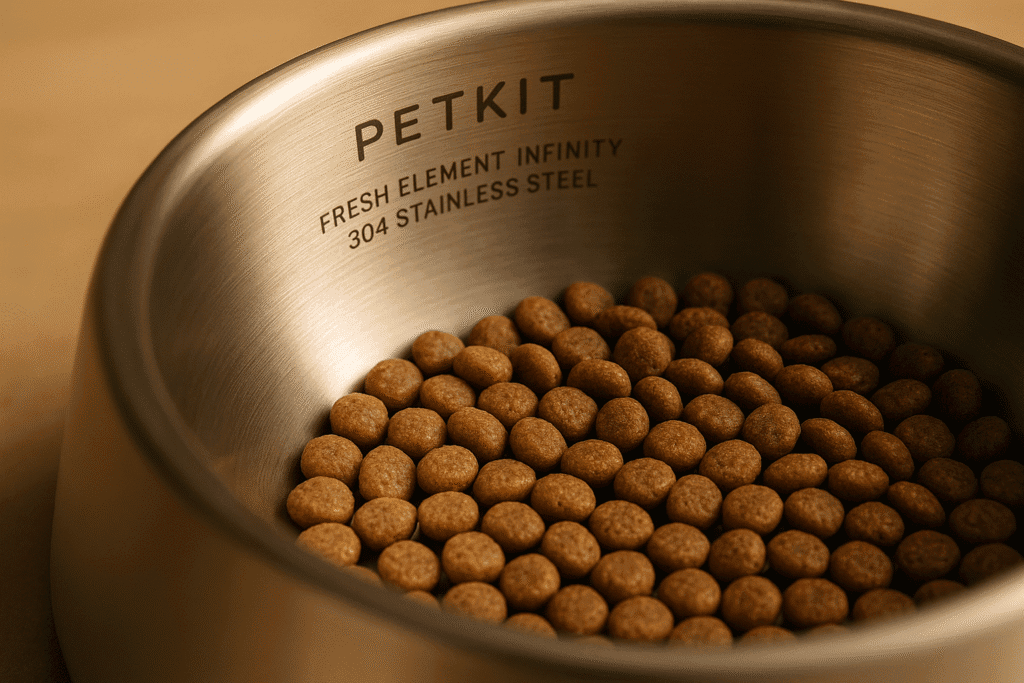
    Close-up of PETKIT Fresh Element Infinity stainless bowl filled with cat kibble.

    Out of the box, assembly is straightforward: position the base, drop in the 304 stainless steel food bowl and support, seat the storage, and add the desiccant. PETKIT’s app pairing is routine: power on, hold the Wi-Fi/reset per the quick-start, and join your home network. The design keeps touch points obvious (manual dispense button, bowl reset, indicator lights), and the lid release feels secure—important if you live with a furry food engineer.

    The PETKIT Fresh Element Infinity earns points for serviceability: you can access and clean the food-contact parts without feeling like you’re disassembling a watch. Stainless is a plus for smell-sensitive cats; it resists oil build-up and cleans fast.

    Capacity & feeding precision

    The 5L Infinity’s 2L + 3L modular arrangement is smarter than a single bin: you can run one compartment during a short trip or both for longer intervals or multiple cats. The 3L version is a tidy fit for studio/apartment kitchens—and, frankly, better if you’re doing strict portion control since you’ll refill more often (which keeps kibble fresher). Either way, schedule feeds by portion and time in the app; you can layer multiple small drops to slow gulpers.

    In testing scenarios like “late-evening refills” and “early-morning feeds,” the PETKIT Fresh Element Infinity maintains portion consistency and avoids the dramatic “kibble dump” some augers do after a stall. Anti-jam geometry makes the difference here—especially with medium-round kibbles that love to bridge.

    Camera, AI clips & two-way audio (select trims)

    If you choose the camera model, you’re effectively combining a feeder and an indoor cam. The upside is fewer cables/outlets and a single app view. PETKIT’s matrix calls out Camera/AI Capturing and two-way audio for the camera trims, letting you see arrivals, get motion-based clips, and speak to your cat. That’s particularly useful for food guarding, multi-cat squabbles at the bowl, or simply confirming that the intended cat is the one who eats at 1 p.m.

    The PETKIT Fresh Element Infinity with camera is also a stealth solution if your landlord hates “more devices” on the counter. Downsides? Cam models cost more, and if you already have a whole-home camera ecosystem, duplication may not be worth it.

    Power continuity & alerts

    A feeder that dies with the power isn’t “smart”—it’s a box. Infinity supports emergency power so schedules keep firing during an outage (duration varies by model and conditions). In day-to-day use, the app delivers food-level status and “low food” alerts, and the unit’s indicator lights provide at-a-glance confidence (or “go check the app” prompts).

    As with any lithium-backed product, periodic charging when unused protects battery longevity; PETKIT documents simple steps for resets and bowl zeroing if needed.

    Daily usability & cleanliness

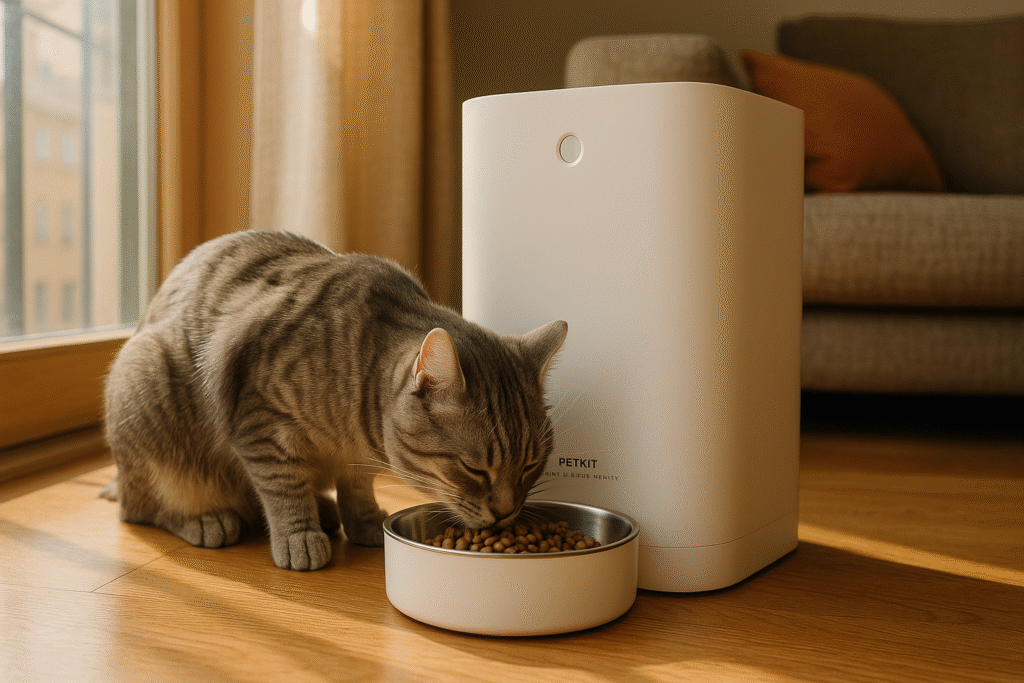
    Tabby cat eating from PETKIT Fresh Element Infinity smart feeder.

    Small, lived-in details matter. The PETKIT Fresh Element Infinity keeps oil films at bay thanks to its stainless bowl, and the sealed hopper plus desiccant helps preserve aroma and crunch—two things cats notice immediately. When you do a full clean, the food path is reachable and the bowl support pops off and on without wrestling. For multi-cat homes, the 5L configuration reduces refill frequency; for one cat on calorie control, the 3L is ideal.

    If your cat is a certified cable biter, route the power cord behind furniture. The unit’s footprint feels “appliance,” not “gadget,” and the neutral aesthetic blends well with modern kitchens.

    App experience

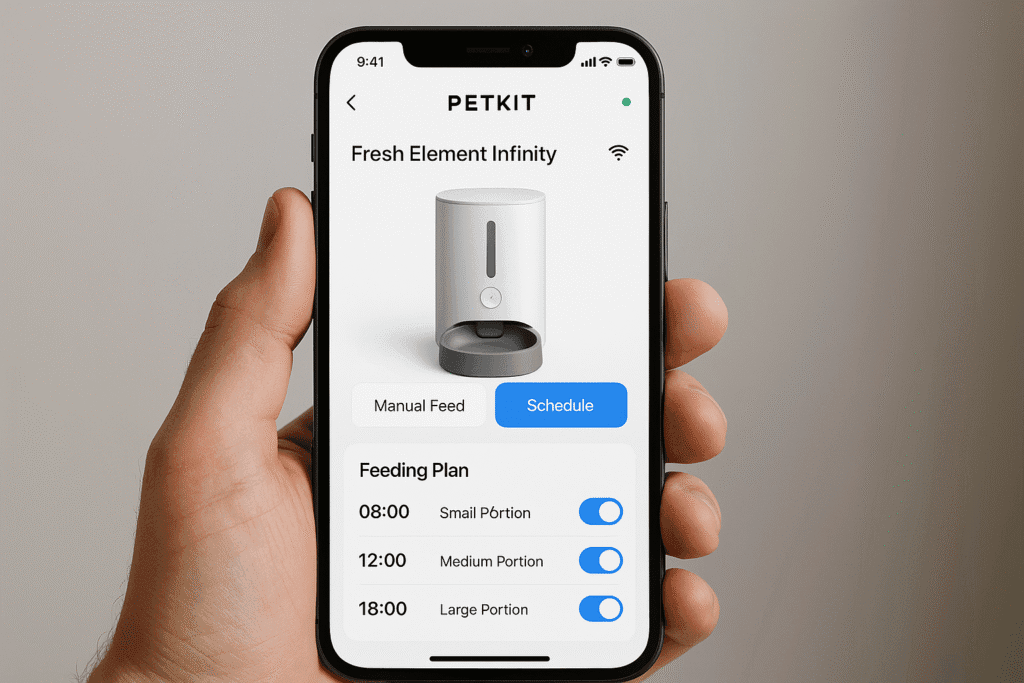
    Smartphone screen displaying PETKIT app controls for the Fresh Element Infinity smart feeder.

    The PETKIT app handles the core job well: create schedules, adjust portions, and do manual drops. Expect push notifications for feeding events and low food. Families can share device access, which makes the PETKIT Fresh Element Infinity more “household-ready” (no texting your partner to hit the button). If you choose the camera version, you’ll live in the same interface for Live View and motion clips.

    A pro tip for grazers: program small, frequent meals to match natural feline patterns. For scarf-and-barf types, split breakfast into 2–3 tiny portions spaced a few minutes apart.

    Who should (and shouldn’t) buy it

    Buy the PETKIT Fresh Element Infinity if…

    • You want a feeder that prioritizes reliability (anti-jam) and food quality (sealed bin + desiccant + stainless bowl).
    • You have one or more cats and want flexible capacity (3L or 2L+3L 5L).
    • You prefer an integrated experience (optional camera/AI clips and talk-back in the feeder itself).

    Skip or consider alternatives if…

    • You already have a robust indoor-cam ecosystem and don’t need a second camera in the feeder.
    • You require wet-food automation (this is for dry kibble).
    • Your budget is tight and you don’t need the camera—consider the non-camera Infinity trim or PETKIT’s simpler feeders.

    Pros & Cons

    Pros

    • Anti-jam feed path = dependable portions
    • Hygienic 304 stainless bowl; sealed storage + desiccant
    • Emergency power keeps schedules alive during outages
    • Camera/AI trim rolls feeder + cam into one device
    • Flexible sizes: 5L (2L+3L) or 3L depending on household PETKIT

    Cons

    • Camera trims cost more; duplication if you already run cams
    • Dry-food only
    • As with any smart feeder, initial setup and Wi-Fi placement matter

    Real-world scenarios the PETKIT Fresh Element Infinity actually fixes

    • “My cat bridges kibble by day 10.” Anti-jam helps keep portions consistent across bag changes.
    • “Everything’s soggy in summer.” Sealed bin + desiccant preserves freshness longer between refills.
    • “Power blink = missed meals.” Emergency power keeps timed feeds going.
    • “I need eyes on the bowl at noon.” Camera + AI clips (on select trims) answer “who ate?” without a second device. PETKIT

    Comparisons you’re probably considering

    • Versus basic timed feeders: The PETKIT Fresh Element Infinity is pricier, but the anti-jam feed path, sealed storage, and stainless bowl make it a safer daily driver.
    • Versus camera + separate feeder: Two devices mean two plugs, two apps (often), and more counter clutter. Infinity’s cam trim simplifies the setup—if you want everything in one.
    • Versus “bargain” imports: Short-term savings can vanish with the first jam, broken lid, or warped bowl. Infinity’s spec sheet reads like a long-term owner’s wish list.

    The verdict

    If you’re upgrading from a budget timer or an older auger that sometimes “burps” kibble, the PETKIT Fresh Element Infinity is one of the few feeders that genuinely improves reliability and food hygiene while adding meaningful smarts. The 5L dual-compartment option is excellent for multi-cat homes; the 3L is ideal for tight spaces or strict weight management. Choose the camera trim if you value integrated Live View, AI clips, and two-way audio; stick to non-camera if you’re already covered.

    The PETKIT Fresh Element Infinity isn’t a gimmick. It’s an everyday appliance that treats feeding like a system—storage, dispensing, hygiene, continuity—so you don’t get 6 a.m. surprises.


    🔗 Additional Resources & Expert References

    Smart feeders like the PETKIT Fresh Element Infinity can make feeding routines smoother, but they should always complement—not replace—good nutritional practices and regular veterinary checkups.
    If you’re introducing an automatic feeder for the first time, make sure your cat’s caloric intake stays consistent and that the kibble you use is compatible with the device’s dispensing mechanism.

    For a deeper look at feline feeding and nutrition, explore these trusted sources:

    These resources ensure your cat’s diet remains healthy while leveraging automation responsibly. The PETKIT Fresh Element Infinity works best when paired with sound feeding schedules, periodic bowl cleaning, and attentive observation of your cat’s weight and behavior.


    FAQ (quick hits)

    Does it work in a power outage?
    Yes—Infinity supports emergency power so schedules continue. Duration will vary by trim and conditions.

    Can it handle different kibble shapes?
    That’s the goal of the anti-jam path, but extremely large/irregular kibble can challenge any auger. When in doubt, test a small bag first. PETKIT

    Is the bowl dishwasher safe?
    It’s 304 stainless steel—easy to hand-wash and quick to dry. Always follow PETKIT’s care guidance.

    Do I need the camera model?
    If you want bowl-side Live View, motion clips, and talk-back in one device, the camera trim is worth it. Otherwise, the non-camera Infinity gives you the core reliability for less.


    Bottom line & where to buy

    If you value reliability, cleanliness, and a seamless app experience—with the option to add camera/AI—PETKIT Fresh Element Infinity is an easy recommendation for 2025. Check availability for the 5L (2L+3L) camera trim if you have multiple cats, or the 3L if you’re optimizing for space and portion precision. Specs confirmed from PETKIT’s official product comparison. Amazon (Solo)/ Amazon (Dual Hopper) / Amazon (Camera) / PetKit Store


    Affiliate disclosure: This review is informational and not medical or nutritional advice. If you purchase through affiliate links on our site, we may earn a commission at no extra cost to you. Always consult your veterinarian for personalized feeding guidance.