
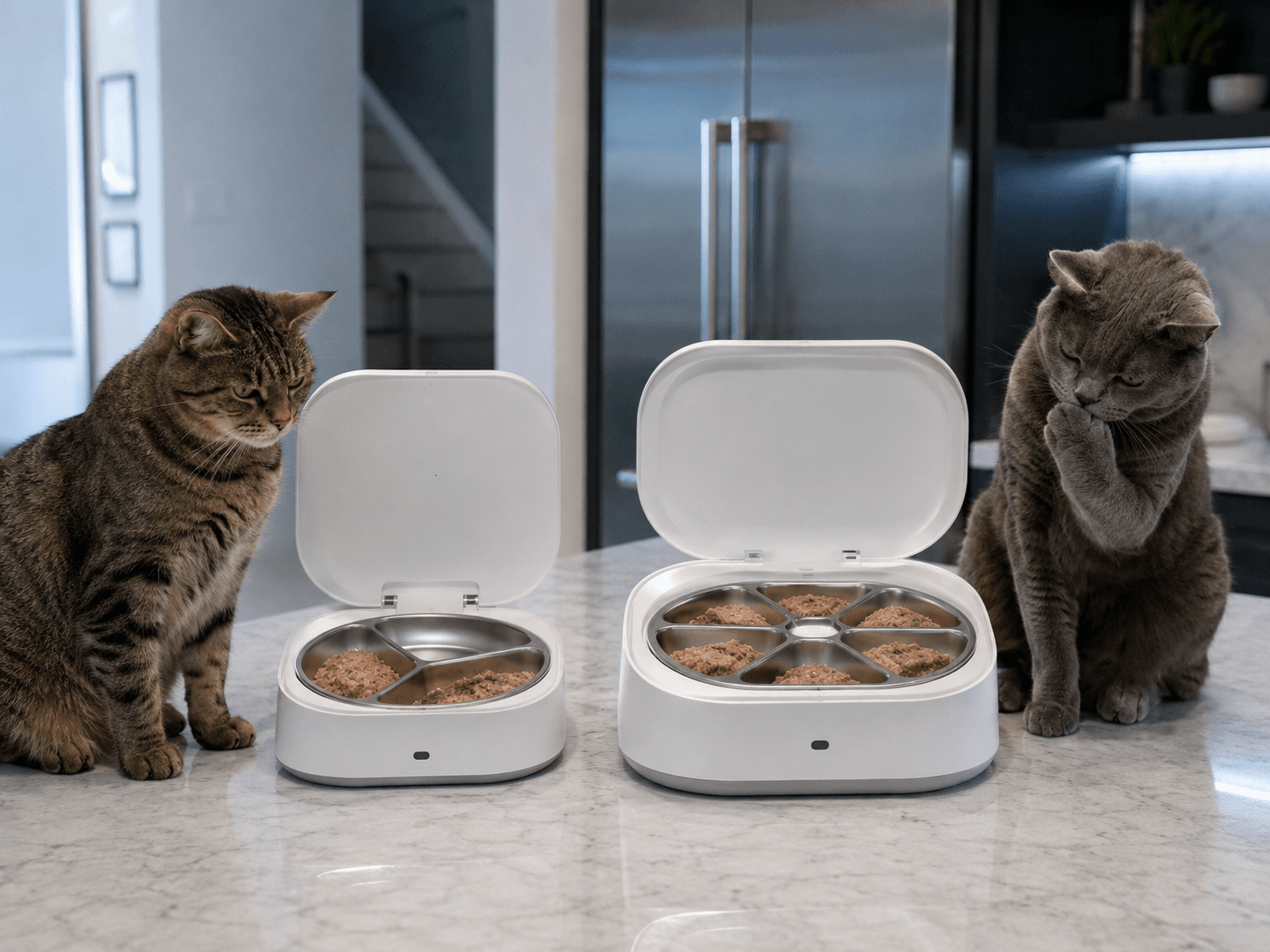
PETLIBRO Polar and PetSafe FreshFeed both rotate wet-food meals on schedule. Only one currently claims a conventional 40°F refrigeration target.
That matters more than tray aesthetics, app icons or how aggressively the marketing team photographed a snowflake.
Polar holds three meals, has a longer warranty and has been around long enough for its ownership quirks to become visible. FreshFeed holds six meals and promises colder storage, but it is still new enough that long-term reliability remains an unanswered question.
Choose FreshFeed when temperature and capacity come first. Choose Polar for shorter three-meal routines, a longer warranty and lower early-adopter uncertainty.
Overall verdict: Conditional. FreshFeed wins the comparison.
Quick Verdict
| PETLIBRO Polar | PetSafe FreshFeed | |
|---|---|---|
| Best for | One to three scheduled wet meals | Up to six meals and colder storage |
| Cooling claim | About 54°F in a 77°F room | Helps maintain 40°F when used as directed |
| Compartments | 3 | 6 |
| Food support | Commercial wet, semi-moist and prescription canned food | Wet, fresh and raw food |
| Warranty | 24 months | 1 year |
| Main concern | Published temperature is above standard refrigeration guidance | New product with limited long-term ownership evidence |
| Verdict | Conditional | Conditional — comparison winner |
PetTech AI may earn a commission from qualifying purchases. As an Amazon Associate I earn from qualifying purchases.
Prefer three meals and the longer warranty? Check PETLIBRO Polar on Amazon.
Need six meals and a manufacturer-stated 40°F target? Check PetSafe FreshFeed on Amazon.
Still comparing feeding systems? Our best automatic cat feeders guide includes refrigerated, RFID, camera-equipped and standard dry-food models.
Research Note
This is a research-led comparison based on current manufacturer documentation, support information, warranty policies and early ownership signals. PetTech AI has not independently temperature-tested both feeders.
Cooling numbers below are manufacturer claims, not measurements produced in the PetTech AI underground refrigeration laboratory.
The Temperature Difference Decides the Comparison
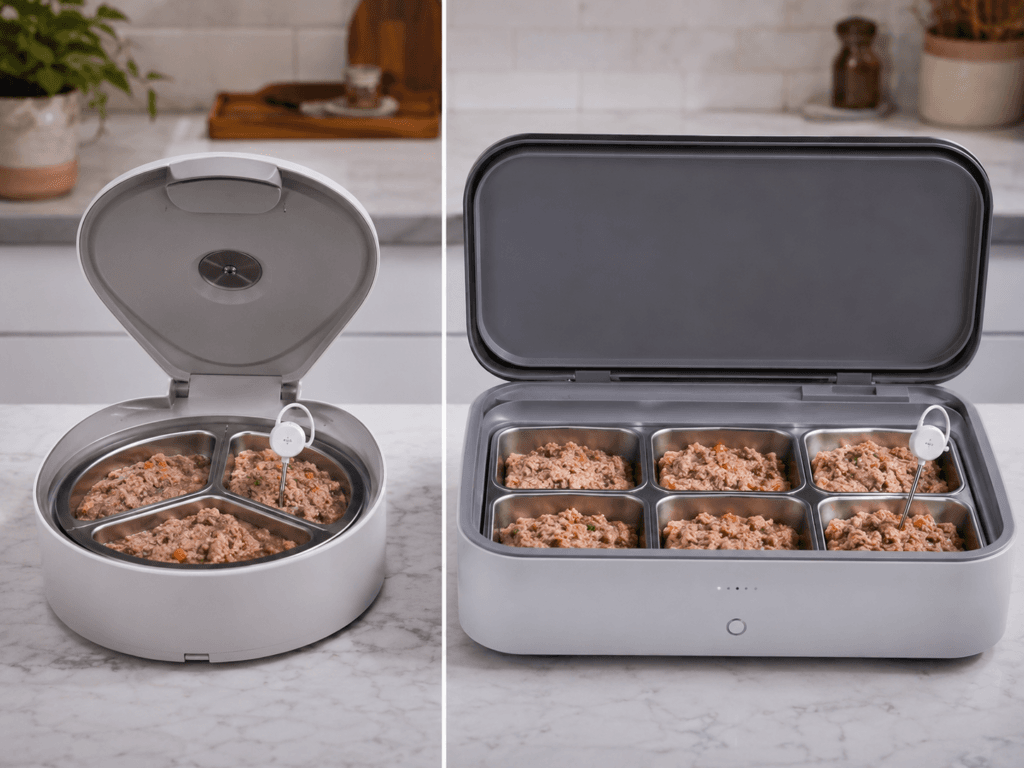
PETLIBRO reports that Polar cools food to approximately 54°F when the room temperature is 77°F. The company says this slows bacterial growth and can preserve wet food for up to three days under its intended operating conditions. Cooling pauses about 30 minutes before a scheduled meal.
PetSafe says FreshFeed uses semiconductor cooling and insulation to help maintain 40°F when used as directed. Its six-meal tray remains refrigerated between scheduled feedings.
Those figures should not be treated as cosmetic differences.
FDA guidance says unused or leftover canned and pouched pet food should be refrigerated promptly, with the refrigerator set to 40°F or below. Polar’s published 54°F result sits above that benchmark.
That does not prove Polar makes every meal unsafe. Actual food temperature depends on room conditions, starting temperature, meal composition and operating time. It does mean Polar should not be described as equivalent to a conventional refrigerator simply because both devices make food colder than the kitchen.
FreshFeed has the more convincing refrigeration specification.
Polar is better understood as a chilled meal scheduler. FreshFeed is trying to behave more like a compact refrigerator with a rotating dinner calendar.
The thermometer, for once, is less emotionally invested than the marketing department.
Three Meals or Six?
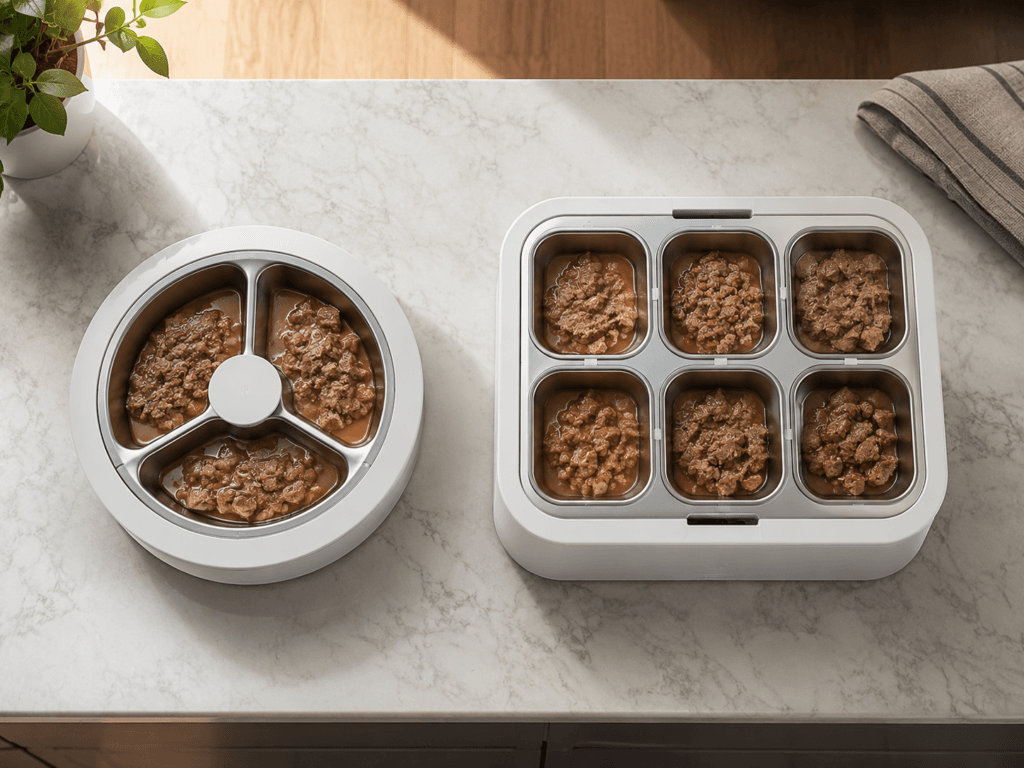
Polar stores three prepared portions. That is enough for breakfast, dinner and the following morning—or three smaller meals during one day.
FreshFeed doubles the count with six compartments and a total listed capacity of 4.5 cups. Its removable stainless-steel inserts are designed for preparation, serving and dishwasher cleaning.
FreshFeed is the clearer fit for:
- cats eating several small wet meals;
- households preparing more than one day of portions;
- meals containing toppers or supplements;
- owners who do not want to refill after the third serving.
Polar remains sufficient when the real problem is covering a normal day rather than establishing a refrigerated tasting menu.
Capacity winner: FreshFeed.
More compartments are not automatically better, but needing five meals and owning a three-meal feeder is a difficult disagreement to solve through firmware.
Food Compatibility: FreshFeed Is Broader
PETLIBRO positions Polar for commercial wet food, semi-moist food, prescription canned diets and rehydrated freeze-dried meals. It does not recommend raw food.
PetSafe markets FreshFeed for wet, fresh and raw diets. That broader compatibility follows logically from its colder stated target, although compatibility is not the same as a guarantee of safe storage in every household.
Raw food deserves particular caution. FDA testing has found raw pet food more likely than processed food to contain disease-causing bacteria. A feeder can provide cooling; it cannot negotiate a ceasefire with Salmonella.
For ordinary canned wet food, both products are relevant. For fresh or raw feeding, FreshFeed has the stronger official case—but owners should still follow the food producer’s storage instructions and veterinary guidance.
Polar Is Older. FreshFeed Is More Promising.
FreshFeed is a recent product. Its early owner feedback is encouraging, but the available history is not yet large or old enough to answer the questions that matter after sustained use:
- Does cooling remain stable?
- Does the tray continue aligning correctly?
- Do fans become louder?
- Does condensation create recurring maintenance?
- Does the app behave after several firmware updates?
Calling it unreliable would be unfair. Calling it proven would be creative writing.
Polar has been available longer and has accumulated more troubleshooting information around condensation, ice buildup, rotation and cooling performance. That makes its ownership friction easier to understand before purchase.
It also carries a 24-month warranty, while PetSafe’s standard warranty is one year. PETLIBRO offers a 30-day direct return window; PetSafe allows direct returns within 45 days.
The split is clean:
- FreshFeed gives buyers the better specifications and longer direct trial period.
- Polar gives buyers twice the warranty coverage and a more established support history.
For an appliance containing cooling hardware, sensors, fans and a rotating tray, warranty length is not decorative typography.
App, Cleaning and Power: No Clear Winner
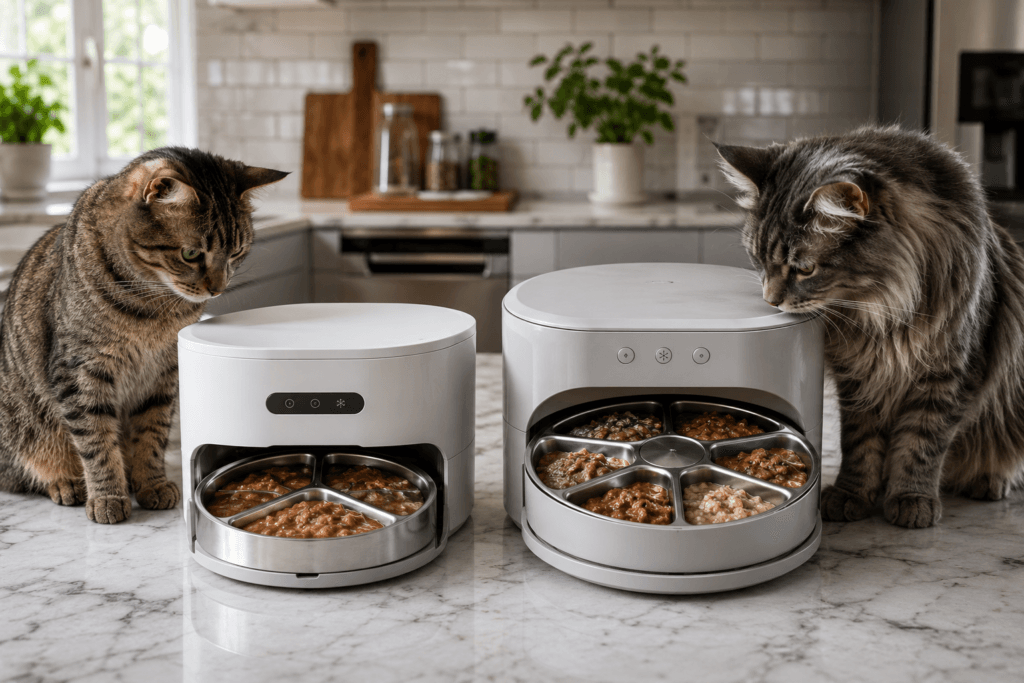
Both feeders use app-based scheduling and require wall power for normal refrigeration.
Polar’s backup batteries can preserve scheduled tray movement for up to 12 hours during an outage, but they do not provide normal cooling performance. A meal rotating successfully is not proof that it remained refrigerated.
FreshFeed does not advertise battery-backed refrigeration. After a meaningful outage, owners should evaluate the food rather than trusting the schedule notification.
Both systems also require real cleaning. Polar’s cooling area can collect condensation, while FreshFeed adds six individual inserts and ventilation components. FreshFeed’s steel inserts are dishwasher-safe; the powered bases of both machines must be wiped rather than submerged.
Neither product identifies which cat approaches the open meal. In a multi-cat home, dinner belongs to whoever arrives first with sufficient confidence.
For individual access control, see our PETLIBRO One RFID vs SureFeed Connect comparison.
Who Should Buy PETLIBRO Polar?
Choose Polar when:
- three scheduled meals are enough;
- you serve ordinary canned or prescription wet food;
- the 24-month warranty matters;
- you prefer the product with the longer ownership history;
- you are using it for shorter feeding windows;
- you understand that 54°F is not equivalent to standard refrigerator storage.
Polar remains useful. It is simply easier to recommend as a convenience tool than as a three-day food-safety argument.
Verdict: Conditional.
Check PETLIBRO Polar on Amazon.
For a closer look at setup, app control and everyday ownership, read our PETLIBRO Polar review.
Who Should Buy PetSafe FreshFeed?
Choose FreshFeed when:
- you need more than three prepared meals;
- the 40°F manufacturer target matters;
- you serve wet, fresh or raw food;
- individual stainless-steel inserts appeal;
- you accept a one-year warranty;
- you are comfortable buying a newer product.
FreshFeed offers the better answer to the central question: which machine makes the stronger refrigeration case?
Our caution concerns maturity, not purpose. It is the more capable design on paper; it just has not yet completed the long and deeply glamorous process of aging in thousands of kitchens.
Verdict: Conditional — comparison winner.
Check PetSafe FreshFeed on Amazon.
Final Verdict
PetSafe FreshFeed wins.
Its six-meal capacity and claimed 40°F target better match the reason most people consider a refrigerated feeder in the first place: keeping prepared wet food closer to standard refrigeration conditions until serving time.
It remains Conditional because:
- the temperature claim has not been independently verified by PetTech AI;
- the product is still new;
- long-term durability remains unclear;
- the warranty lasts only one year.
PETLIBRO Polar remains the lower-uncertainty option for three scheduled meals and offers stronger warranty coverage. Its published 54°F result, however, prevents it from winning a refrigeration-first comparison.
Choose FreshFeed for colder storage and more meals.
Choose Polar for shorter routines, fewer compartments and the longer warranty.
One is the more familiar machine. The other brought the better thermometer.
Frequently Asked Questions
Is PETLIBRO Polar a real refrigerator?
Polar uses thermoelectric cooling, but PETLIBRO reports approximately 54°F in a 77°F room. That is colder than room temperature but warmer than the FDA’s 40°F-or-below refrigerator guidance.
Does FreshFeed always stay at exactly 40°F?
PetSafe says it helps maintain 40°F when used as directed. Actual performance can depend on room temperature, ventilation, maintenance and food placement. PetTech AI has not independently verified the claim.
Can either feeder stop another cat from eating the meal?
No. Neither uses microchip or RFID identification. They schedule access by time, not by cat.
What happens during a power outage?
Normal refrigeration depends on wall power. Polar can continue rotating meals temporarily through backup batteries, but cooling stops. FreshFeed does not advertise refrigerated battery backup.
References
PETLIBRO — Polar Smart Wet Food Feeder Product Documentation
PETLIBRO — Polar Cooling and Support Documentation
PETLIBRO — Return and Warranty Policy
PetSafe — FreshFeed Refrigerated Pet Feeder Product Documentation
PetSafe — FreshFeed User Guide
PetSafe — Return and Warranty Information
FDA — Proper Storage of Pet Food and Treats
FDA — Raw Pet Food Diet Safety Guidance
Editorial Disclosure
PetTech AI may earn a commission from qualifying purchases. This does not influence our recommendations, comparisons or editorial judgments.
Image Disclosure
Official manufacturer images are used when available and authorized.
AI-generated images may also be used as editorial illustrations. They should not be treated as exact representations of product dimensions, materials, controls, temperatures or physical features. Always verify current official product information before purchasing.