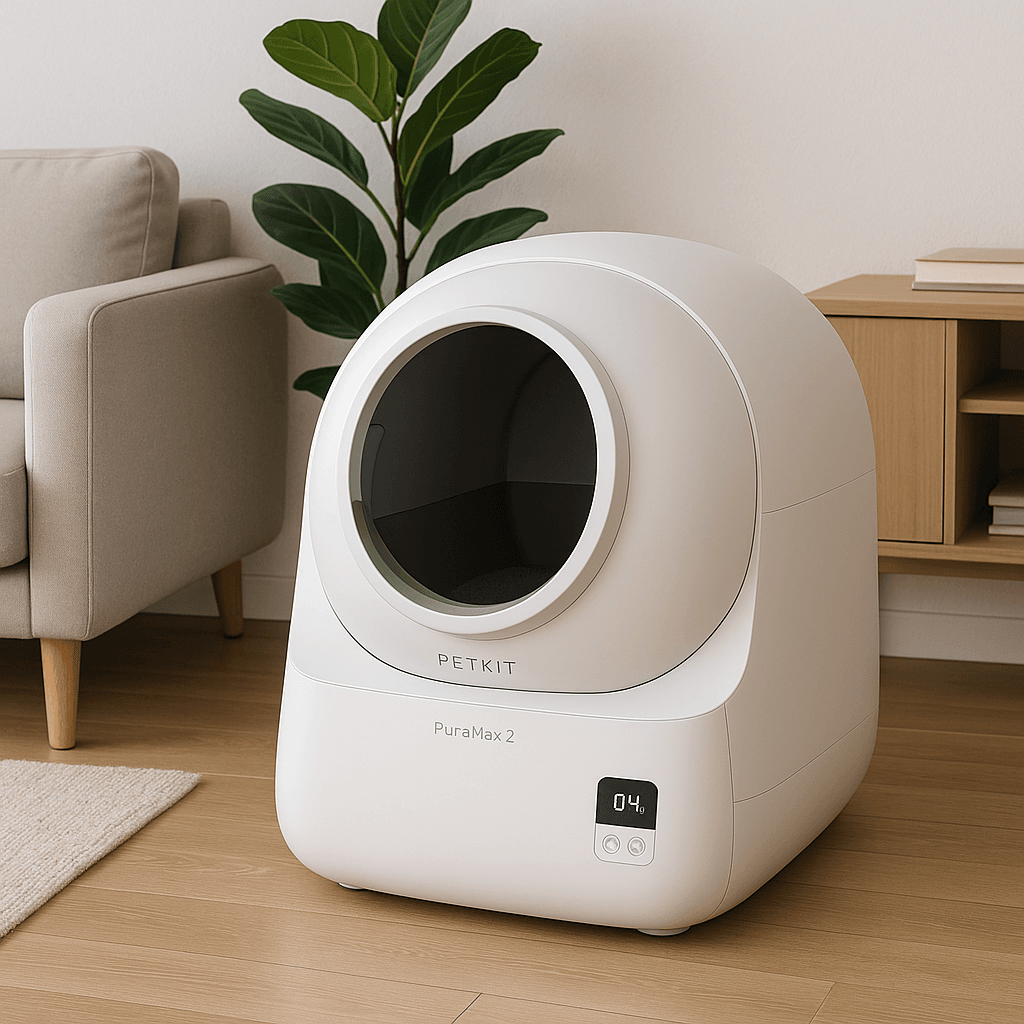
Tag: smart litter box

  • Litter-Robot EVO Review 2025: Compact Self-Cleaning Litter Box for 1–2 Cat Homes

    Litter-Robot EVO Review 2025: Compact Self-Cleaning Litter Box for 1–2 Cat Homes

    If we strip away all the launch hype, Litter-Robot EVO is Whisker’s attempt to build a smaller, cheaper, simpler robot for cat owners who want to stop scooping without paying for every premium feature in the new Litter-Robot 5 lineup. It targets a very specific user:
    1–2 cats, smaller homes, and people who care more about reliability than AI gimmicks. Litter-Robot – Self-Cleaning Litter Box

    In this Litter-Robot EVO review 2025, we’ll look at what Whisker actually changed, how the EVO compares to Litter-Robot 5 and 5 Pro, what you gain and what you lose, and whether it’s realistically worth the $599 price tag. Litter-Robot – Self-Cleaning Litter Box

    Ready to see Litter-Robot EVO in action?
    Check current pricing, bundles, and reviews on the official Whisker store or Amazon before you decide — promos and stock tend to move fast.


    What Is Litter-Robot EVO in the 2025 Lineup?

    Whisker’s October 2025 refresh introduced three main robots: Litter-Robot 5 Pro, Litter-Robot 5, and Litter-Robot EVO, plus the older Litter-Robot 4 staying in the lineup.

    According to Whisker’s own comparison chart and product pages:

    • Litter-Robot EVO ($599):
      • Most compact, streamlined model
      • Designed for 1–2 cats (3–19 lbs)
      • Basic app insights, optional Whisker+ for deeper data
      • Lower price, fewer advanced sensors/features
    • Litter-Robot 5 ($799):
    • Litter-Robot 5 Pro ($899):
      • Adds dual cameras, facial recognition, and advanced AI analytics via Whisker+ The Verge

    Positioning is very clear: EVO is the “entry” Litter-Robot — not in build quality, but in footprint and feature set.


    Design & Footprint: Built for Small Spaces

    Whisker’s official EVO page calls it “the most streamlined way to never scoop again” and highlights that it has a similar footprint to a traditional litter box while still offering a roomy interior for most cats.

    Key points:

    • Works for cats 3–19 lbs, including many large breeds
    • Designed for apartments, condos, or tight laundry rooms
    • Globe interior height around 14.5″ with a wide entry, so most average-sized cats fit comfortably

    EVO also brings Whisker’s new design language:

    • QuietSift® technology for quieter cycles
    • Brilliant full-color LCD display on the control panel
    • EasyClean™ modular design, with removable globe liner and easier access for cleaning

    If you’re coming from an enormous covered litter box that dominates a room, EVO is appealing because it doesn’t take over the space the way some larger robots do.


    Setup & Daily Use

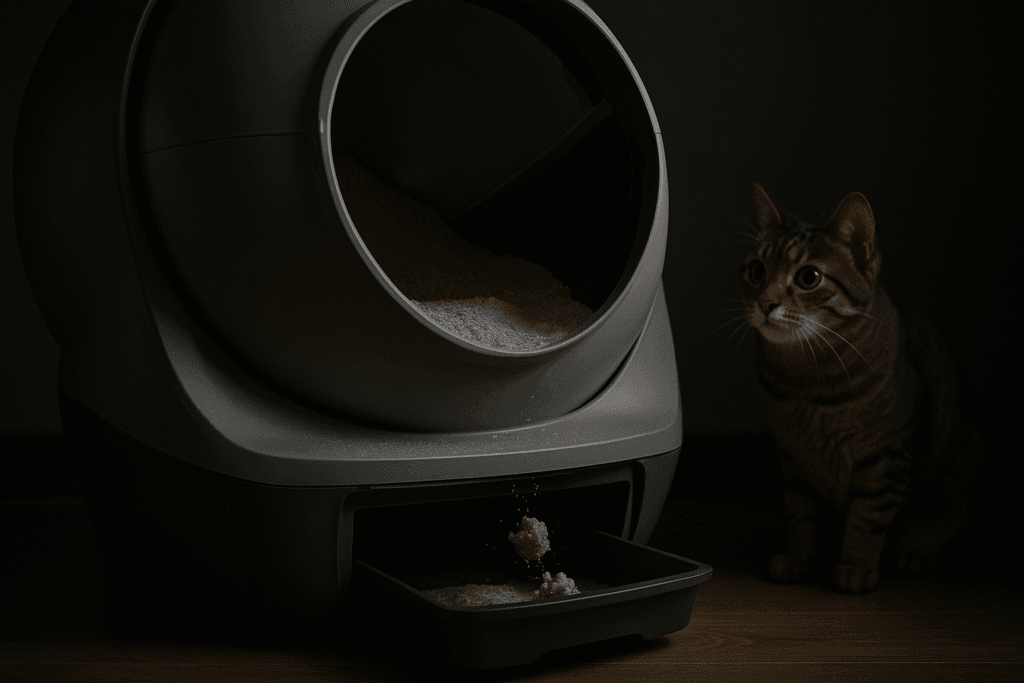
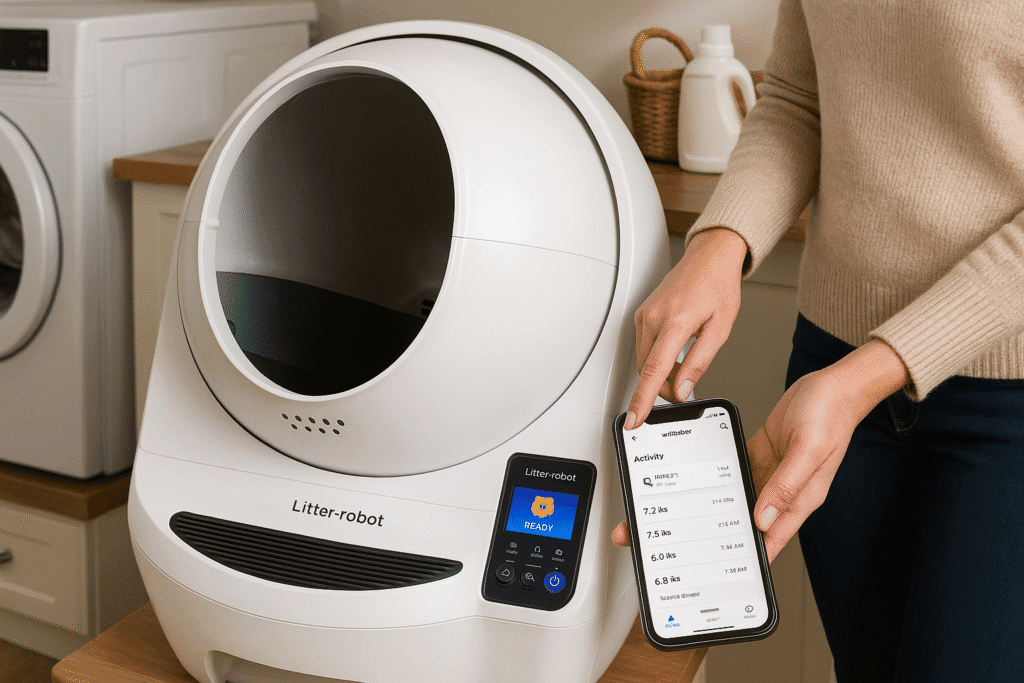
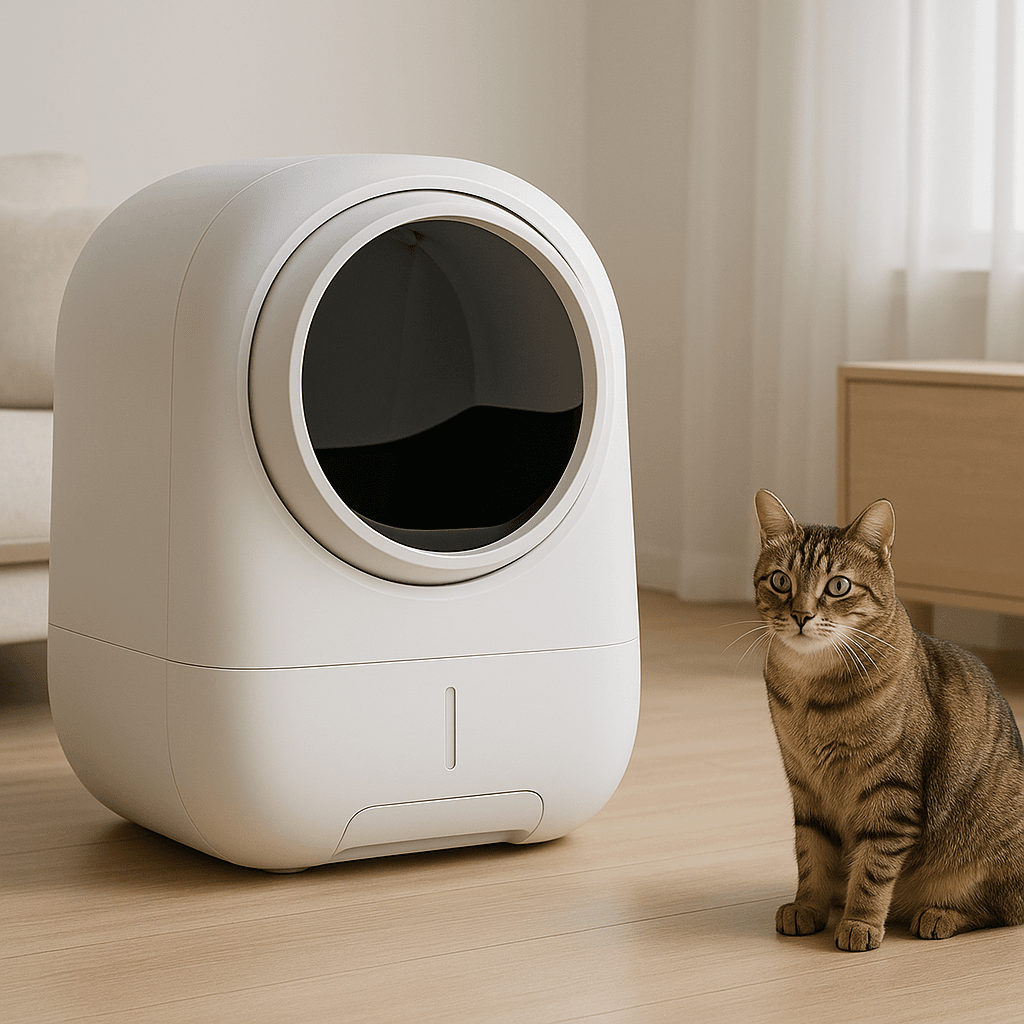
    Litter-Robot EVO QuietSift cleaning cycle with cat observing

    Setup is broadly similar to other Litter-Robot models:

    1. Unbox and assemble step, fence, and carbon filter (some bundles include these out of the box). Accessories
    2. Fill with a compatible clumping clay litter (no pellets or non-clumping litters). Tidy Cats
    3. Connect EVO to Wi-Fi and pair it with the Whisker app.
    4. Set your preferred cycle delay (e.g., 3–30 minutes after use).

    Independent hands-on reviews describe the initial setup as straightforward, with the LCD panel making onboarding less cryptic than older “blinky light” robots.

    Once configured, day-to-day use looks like this:

    • Cat uses the EVO as a normal covered box
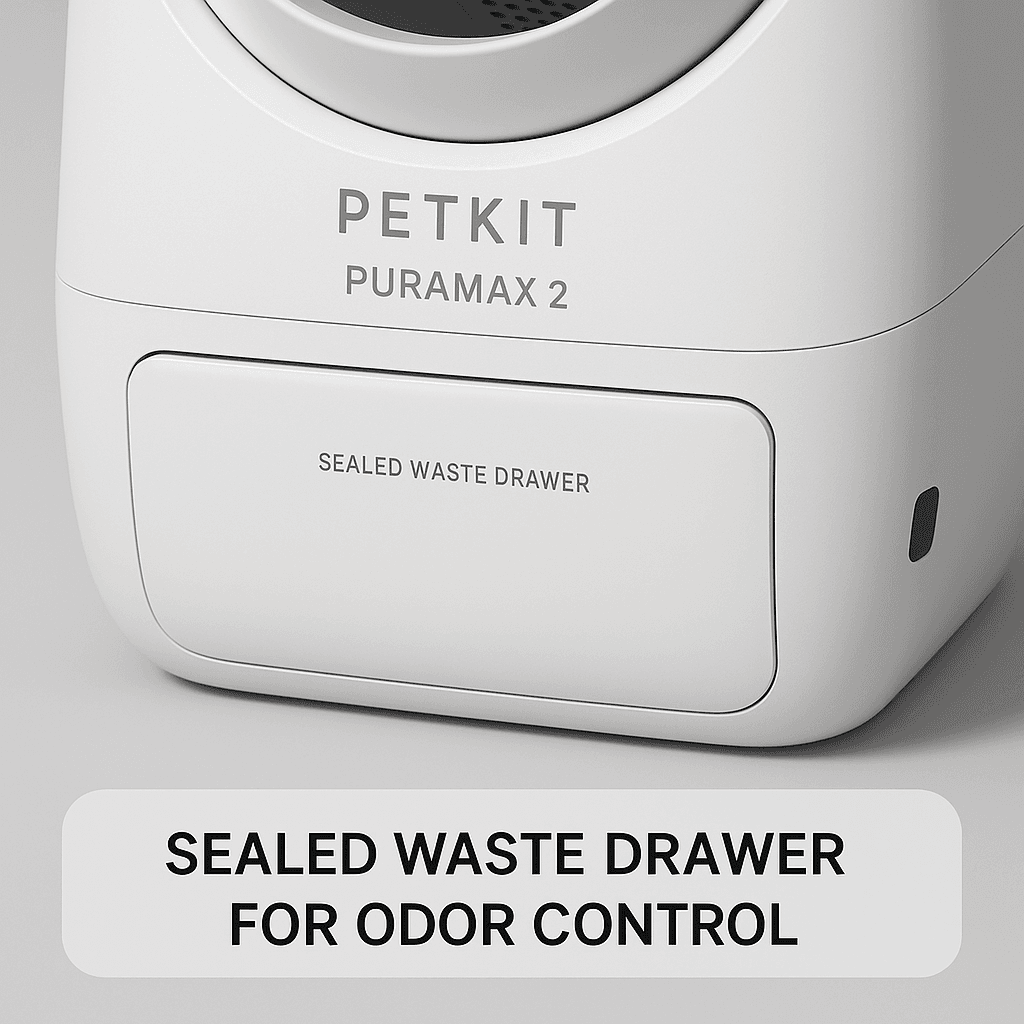
    • After the delay, EVO rotates to sift clumps into the sealed waste drawer
    • You empty the drawer roughly once every ~7 days for a single cat, more often for two cats
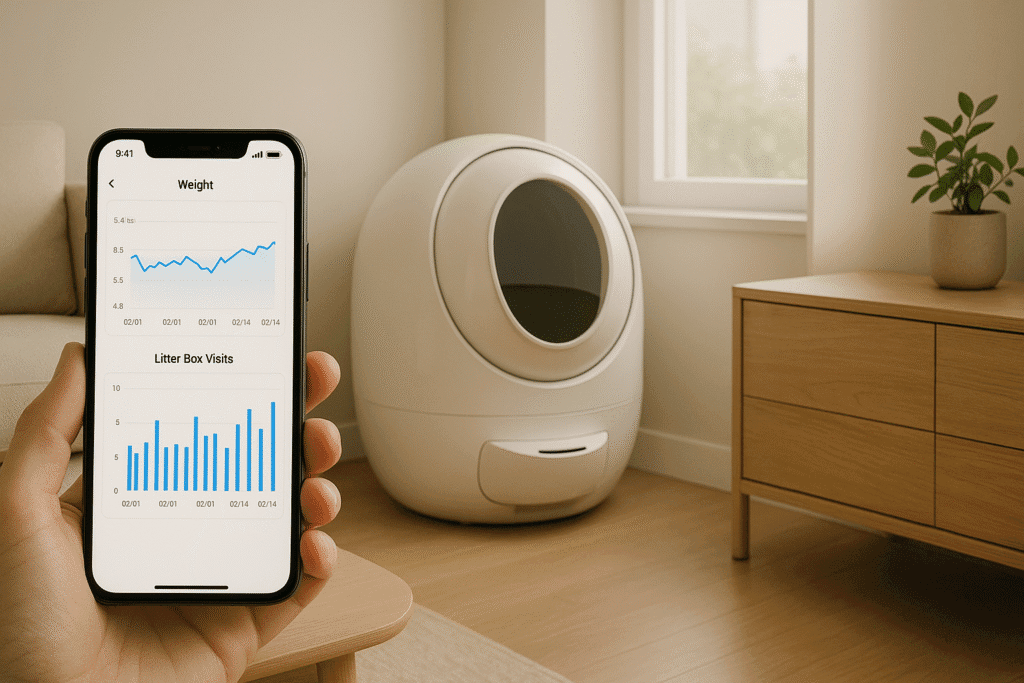
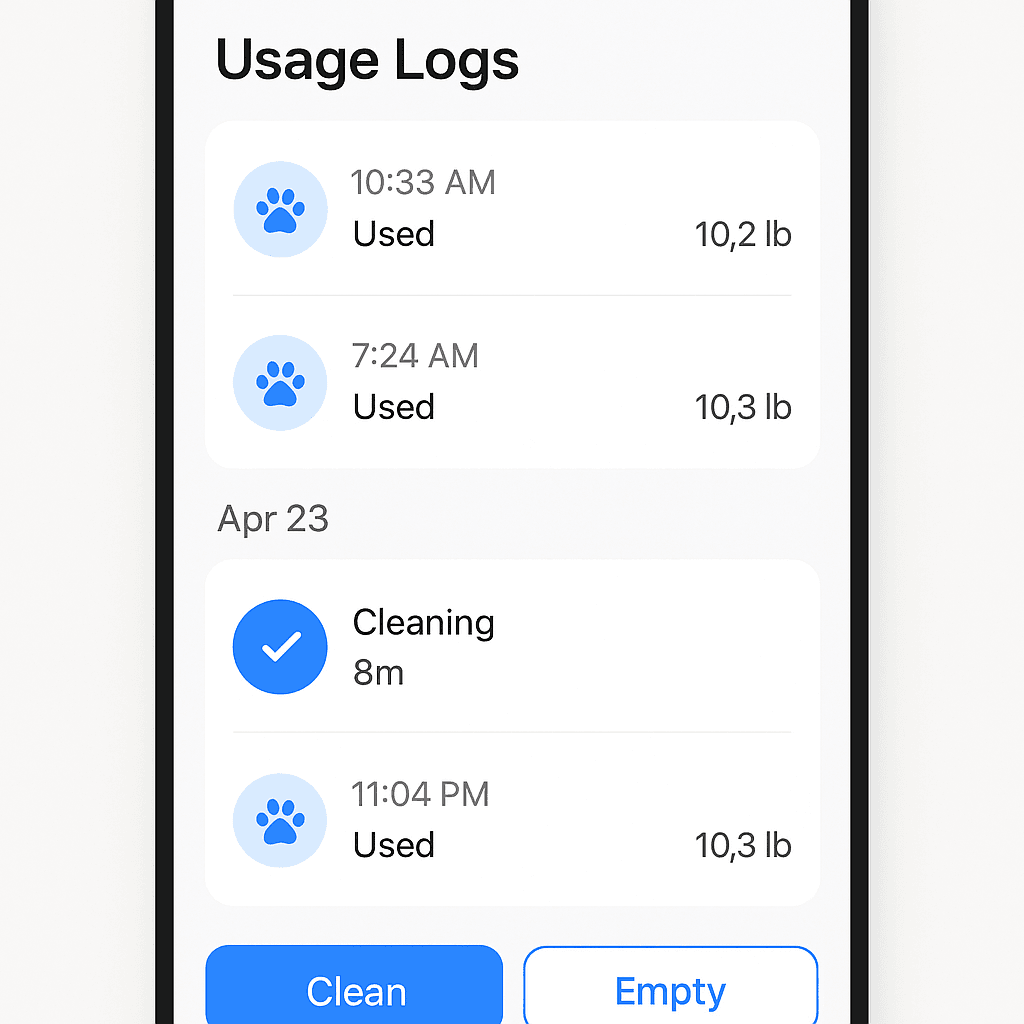
    • The Whisker app logs cycles, visits, and weight readings

    If this workflow matches how you imagine using a robot litter box, it’s worth opening the EVO product page in a new tab.
    Check the latest real-world user photos and Q&A while you read — they usually reveal issues that spec sheets don’t.


    Noise & Odor Control

    Noise and odor are the two reasons many people regret buying cheaper self-cleaning boxes. EVO tries to tackle both:

    Noise

    Whisker’s marketing emphasizes QuietSift®, which dramatically reduces motor noise compared to older mechanical designs.

    Third-party reviewers describe:

    • Smooth, consistent rotation
    • Noticeably quieter cycles than older-gen robots
    • No sudden clunking or grinding under normal operation

    For skittish cats, the combination of a covered globe and quiet operation is important: you want the robot to be “boring” enough that the cat doesn’t abandon it.

    Odor

    Odor control on EVO is handled by:

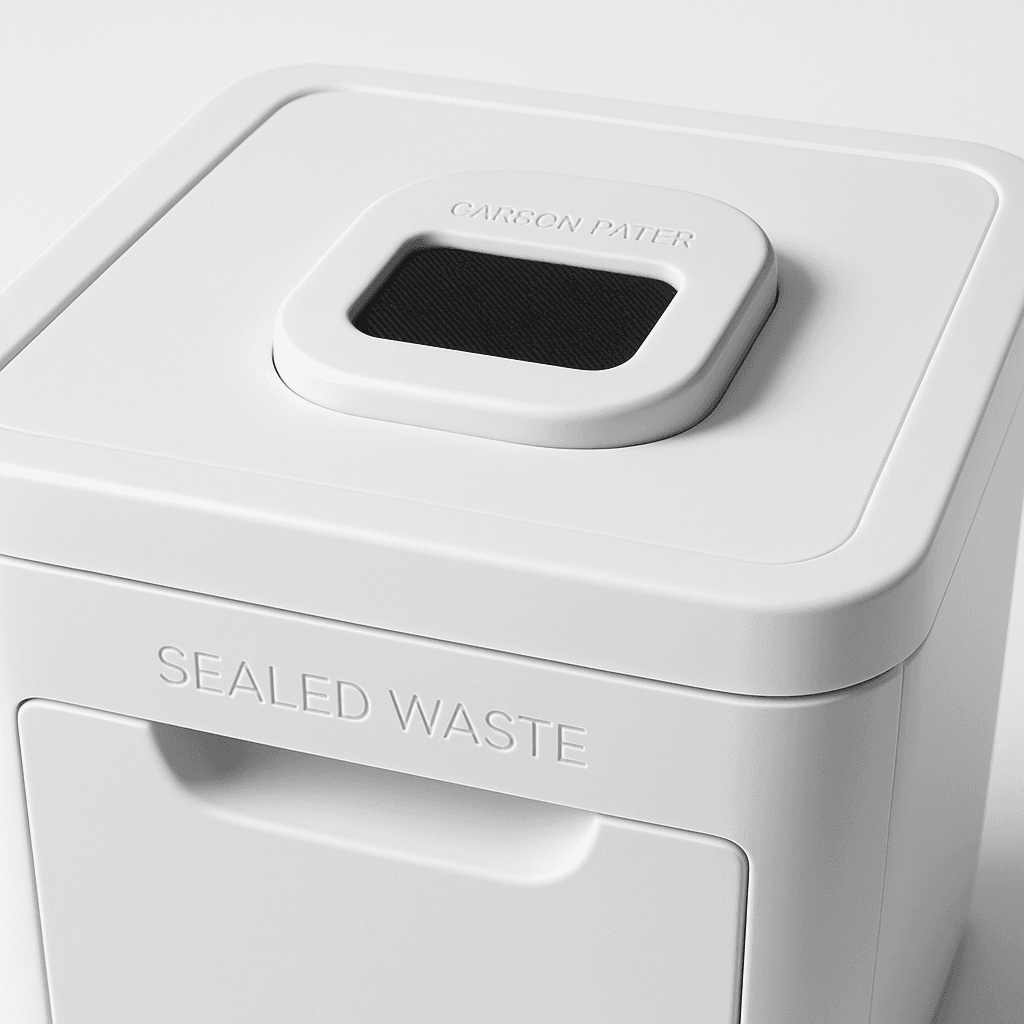
    • A sealed waste drawer
    • Carbon filter in the drawer
    • Optional OdorTrap® packs to boost odor-neutralizing if needed Accessories

    Hands-on reviewers note significantly reduced day-to-day litter smell, assuming:

    • You use a decent clumping litter
    • You empty the drawer on schedule
    • You replace filters/OdorTrap packs every 2–4 weeks as recommended Accessories

    If odor is your main pain point and your home is small, EVO’s sealed drawer + rapid waste separation are real upgrades over an open tray or covered manual box.


    App & Whisker+ Insights: What EVO Actually Tracks

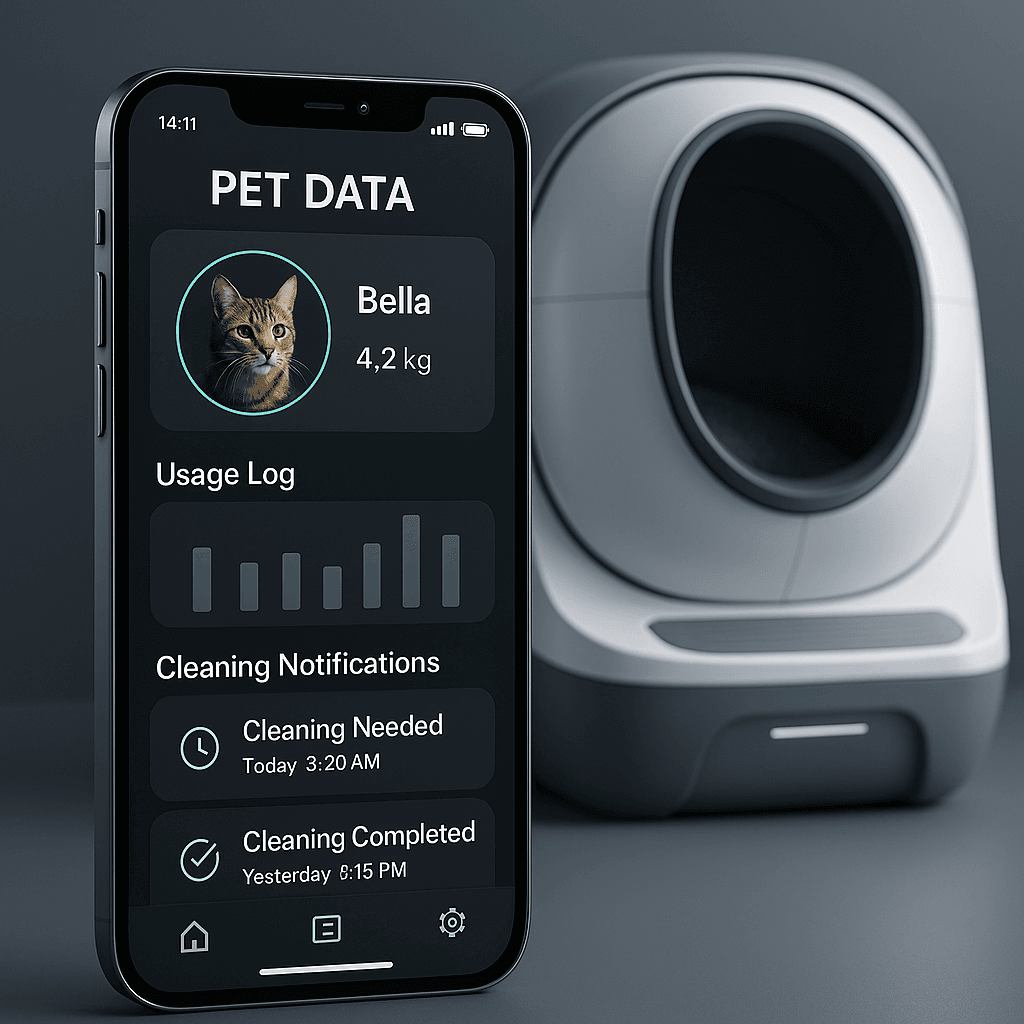
    Litter-Robot EVO LCD display and Whisker app showing litter box usage data

    All modern Litter-Robot models, including EVO, connect to the Whisker app to provide remote control and basic analytics. Litter-Robot – Self-Cleaning Litter Box+2The Verge+2

    With EVO alone (no subscription), you get:

    • Up to 7 days of robot event history
    • Logs of cycles, visits, and weight recordings
    • Status alerts (errors, drawer full, etc.)

    If you add a Whisker+ membership, you unlock:

    • Multi-cat monitoring of weight and visits
    • Daily recap reports and device notifications
    • Up to 2 years of trends: weight, visits, and duration tracking
    • Weight-based identification and deeper historical data

    The value here is in behavior tracking. Changes in visit frequency, time spent in the box, or weight can be early signals of problems like urinary disease or constipation — but only if you and your vet actually look at the patterns.

    EVO doesn’t go as far as the Litter-Robot 5 Pro’s cameras and AI WasteID™, but for a 1–2 cat home, the data you get via Whisker+ is already enough to see basic trends.


    Cat Comfort & Acclimation

    Whisker states that over 95% of cats acclimate to Litter-Robot based on return data for earlier models. EVO is designed to keep that trend:

    • Wide entry and spacious interior for most cats
    • Quiet cycles to avoid startling skittish cats
    • Suitable for kittens above 3 lbs (below that you should use “semi-automatic” mode with manual cycling)

    Their recommended acclimation steps are sensible:

    • Place EVO where the old box was
    • Keep the old box nearby briefly, then remove it
    • Mix a cup of used litter into the EVO to transfer scent
    • Start with EVO turned off, then enable auto-clean once the cat is using it

    If your cat already tolerates covered boxes or enclosed carriers, EVO’s shape and entry style will feel familiar.


    Litter, Maintenance & Running Costs

    EVO doesn’t require proprietary litter, but it is picky about type:

    • Best with clumping clay litter of standard weight
    • Some silica litters can work if they pass through the screen
    • Avoid non-clumping, pellet, newspaper, or plant-based litters — they won’t sift correctly

    Maintenance breakdown:

    • Waste drawer liners: Replace whenever you empty the drawer (every few days to a week).
    • Carbon filters / OdorTrap: Replace every 2–4 weeks for optimal odor control.
    • Deep cleaning: Periodic wipe-down and occasional full clean of the globe and liner, made easier by EVO’s modular components and removable liner.

    This means EVO’s real cost is:

    • Upfront $599
    • Ongoing liners + filters + whichever litter you already use

    Compared to scoopable manual boxes, you’re paying for automation, not lower running costs.


    Litter-Robot EVO vs Litter-Robot 5 vs 5 Pro

    Whisker’s own comparison chart is blunt:

    • EVO
      • Best for 1–2 cats
      • Most compact, lowest price
      • Basic app insights (7-day history)
      • Advanced insights require Whisker+
    • Litter-Robot 5
      • Better choice for multi-cat homes
      • More advanced built-in sensing (litter/waste level, etc.)
      • Designed as the core 2025 platform
    • Litter-Robot 5 Pro
      • Adds facial recognition, WasteID™, and dual cameras
      • Strongest option for deep behavior tracking (with Whisker+)

    Still torn between EVO and the 5/5 Pro?
    Open the official comparison chart and the EVO page side by side while you read. Seeing the exact price and feature differences next to your own situation (cats, space, budget) usually makes the choice obvious in a few minutes.

    In short:

    • Choose EVO if you have 1–2 cats, limited space, and want the lowest price while still getting a premium robot.
    • Choose 5 / 5 Pro if you have more cats, want full built-in insights or AI features, and you’re willing to pay for them.

    Pros & Cons of Litter-Robot EVO (2025)

    Pros

    • Compact footprint with a roomy interior for most cats
    • QuietSift® cycles are far less disruptive than older mechanical designs
    • Sealed, carbon-filtered waste drawer noticeably reduces odor Accessories
    • Full-color LCD panel makes setup and status checks much clearer than “blinking light” UIs
    • Whisker app support with optional Whisker+ for deeper data and long-term trends
    • Designed and assembled in the USA, with 90-day in-home trial and support infrastructure behind it

    Cons

    • Still expensive at $599 compared to manual boxes
    • Fewer built-in insights than Litter-Robot 5/5 Pro — you rely more on Whisker+ for serious data
    • Ongoing costs (liners, filters, OdorTrap) add up over time
    • Not ideal for households with more than two cats; scaling beyond that stretches its design brief

    Verdict: Who Should Actually Buy Litter-Robot EVO?

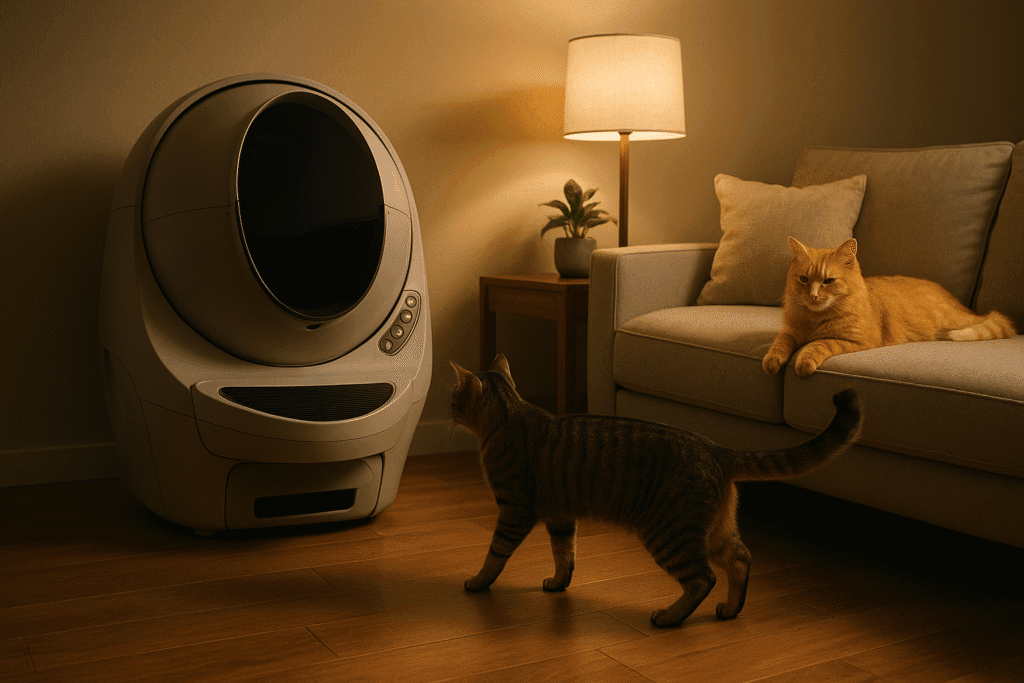
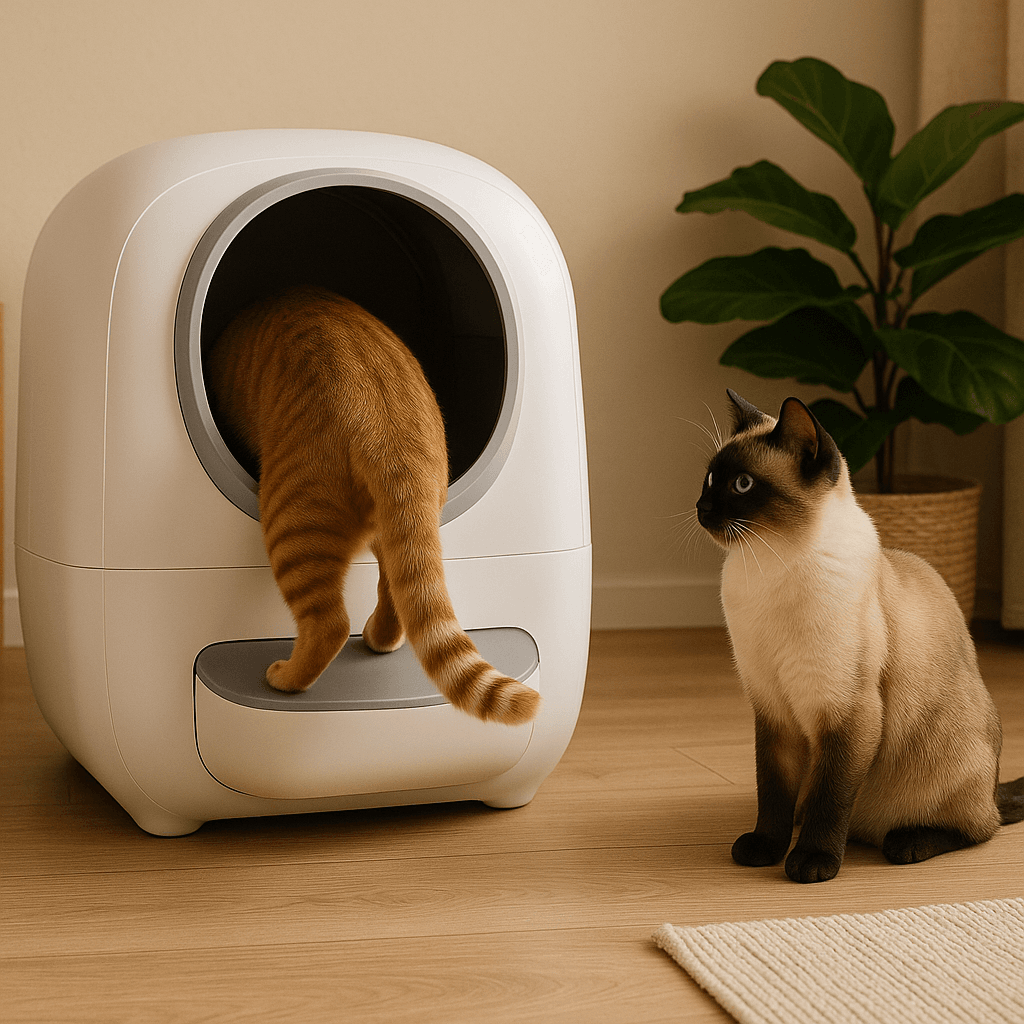
    Two cats sharing a Litter-Robot EVO automatic litter box in a modern home

    If you’re looking for a starter Litter-Robot that doesn’t dominate your floor plan and you live with one or two cats, EVO is very clearly positioned for you:

    • It removes scooping from your daily routine.
    • It contains odor better than most manual boxes if maintained properly.
    • It plugs into the Whisker app, giving you baseline insight into bathroom habits, and offers upgradeable analytics via Whisker+.

    Where EVO shines is simplicity: it’s not trying to be the AI flagship. It’s built to do the basics — clean, contain, and report — in a smaller footprint at a lower price.

    If your reality is a small apartment, 1–2 cats, and you’re sick of scooping, the next rational step is to check live pricing and bundle offers for EVO.
    If the total cost (including filters and liners) fits your budget, it’s one of the safer upgrades you can make to your litter setup in 2025.

    If you have more cats, want deeper analytics without subscriptions, or you already know you’re a “max tech” person, you’ll likely be happier jumping straight to Litter-Robot 5 or 5 Pro instead.


    FAQ — Litter-Robot EVO (2025)

    1. Is Litter-Robot EVO worth it over a normal litter box?

    Purely on cost, no manual box can compete. But if you factor in time saved, odor control, and the ability to see usage patterns through the app, EVO can be worth it for 1–2 cat homes that value convenience and early warning signals around litter box behavior.

    2. How many cats can safely use Litter-Robot EVO?

    Whisker recommends EVO for up to two cats (3–19 lbs). More than that and you risk overloading the robot, filling the drawer too quickly, and losing the main benefit of having a compact, low-friction setup.

    3. Does Litter-Robot EVO work without a Whisker+ subscription?

    Yes. EVO works fully as a self-cleaning litter box without any subscription. The Whisker app still provides basic event history and alerts. You only need Whisker+ if you want multi-cat analytics, deeper trends, and long-term historical data.

    4. Is EVO harder to clean than a regular box?

    Deep cleaning is more involved than tipping out a plastic tray, but EVO’s EasyClean™ modular design and removable globe liner are specifically built to make full cleanings less painful. The trade-off is that you clean less often but more thoroughly when you do.

    5. Should I choose EVO or Litter-Robot 5 for my first robot?

    If you have one or two cats, limited space, and a tighter budget, EVO is usually the smarter first step. If you know you’ll end up with more cats, want more built-in sensing, or care about long-term feature upgrades, Litter-Robot 5 is the more future-proof option.


    Internal Links (PetTech AI)


    References

    1. Whisker – Official Litter-Robot EVO product page (features, specs, app integration, recommended cat weight range, acclimation guidance). Litter-Robot – Self-Cleaning Litter Box
    2. Whisker – Litter-Robot comparison chart (EVO vs Litter-Robot 4 vs Litter-Robot 5 vs 5 Pro; feature and use-case differences). Litter-Robot – Self-Cleaning Litter Box
    3. PR Newswire – “Whisker Launches Next-Generation Litter-Robot Line…” (launch announcement, pricing, and feature positioning for EVO, 5, and 5 Pro). PR Newswire
    4. Litter-Robot / Whisker product documentation (QuietSift®, EasyClean™, carbon-filtered waste drawer, recommended litter types, odor control recommendations). Litter-Robot – Self-Cleaning Litter Box
    5. Independent review of Litter-Robot EVO (cycle smoothness, noise, odor performance, tracking, and day-to-day usability). Hello Subscription

    Disclaimer

    This Litter-Robot EVO review 2025 is for educational and informational purposes only and does not replace professional veterinary advice, diagnosis, or treatment. Always consult your veterinarian if you notice changes in your cat’s litter box habits, weight, or behavior, or before making health decisions based on data from connected devices. Automatic litter boxes can help you maintain a cleaner environment and spot trends, but they cannot diagnose disease or determine appropriate medical care. PetTech AI participates in affiliate programs such as Amazon Associates and CJ. We may earn a commission if you purchase products through links on our site, at no additional cost to you.

  • PETKIT Ecosystem 2025: Should You Build Your Cat’s Smart Home Around One App?

    PETKIT Ecosystem 2025: Should You Build Your Cat’s Smart Home Around One App?

    If we’re being honest, in 2025 there’s one brand that quietly did the homework on smart pet devices end-to-end: PETKIT.

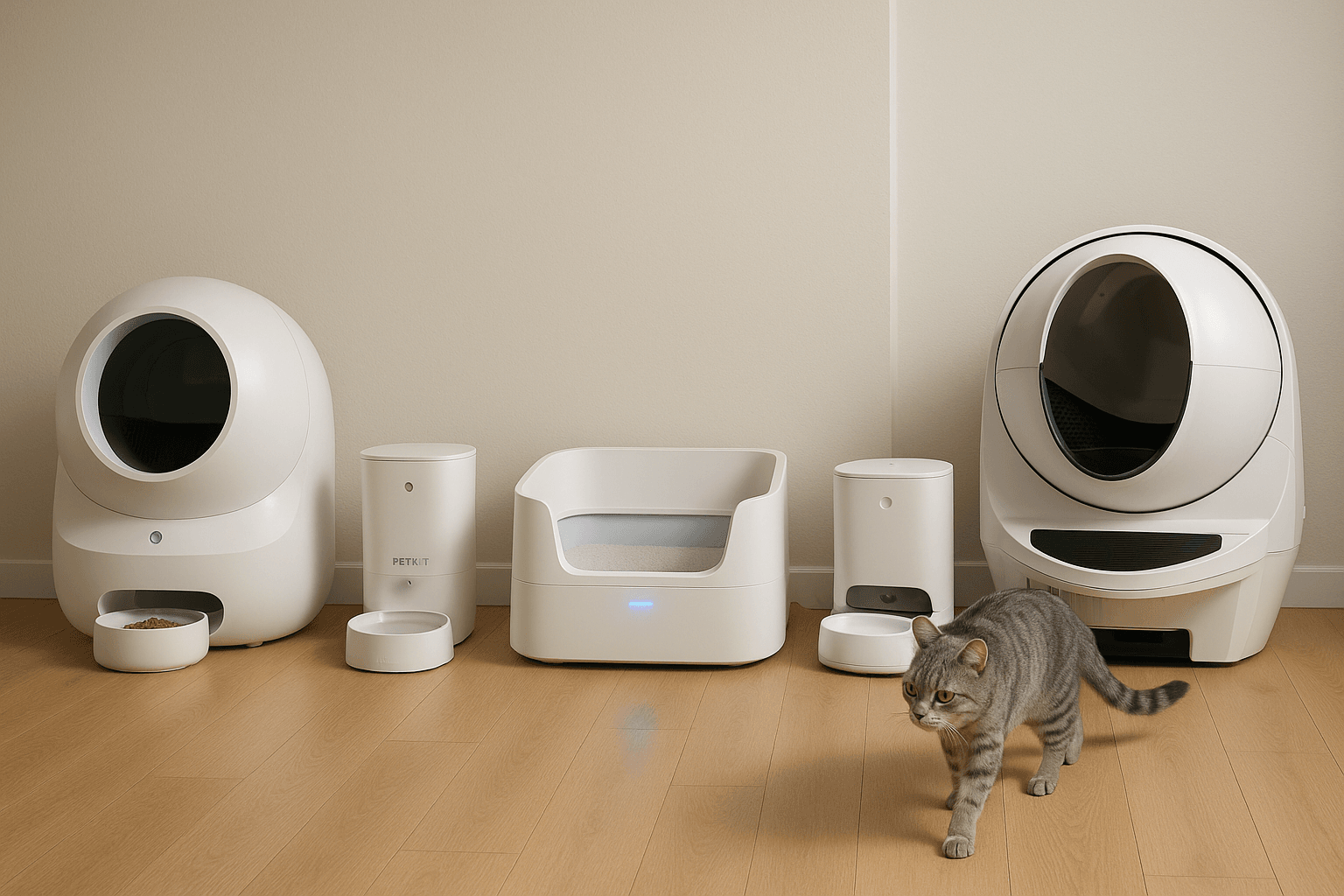
    Not just a random smart feeder here and a fountain there, but a full ecosystem of litter boxes, feeders, and water fountains that all live inside one app, with data tracking layered on top. PETKIT

    This guide looks at the PETKIT Ecosystem 2025 as a whole:
    what it actually does, how it feels to live with, where it shines, where it’s annoying, and whether it makes sense to commit your cat’s daily routines to a single brand.


    What the PETKIT Ecosystem 2025 Actually Is

    PETKIT isn’t just selling gadgets anymore. On the official “Smart Home” pages and ecosystem blog, they describe their goal clearly:

    an interconnected ecosystem where smart devices, software, and services integrate to provide a unified pet care experience. PETKIT

    In practice, that means:

    The pitch is simple:
    one ecosystem to coordinate toilet, food, and water – the same core environmental resources every feline guideline keeps repeating. journals.sagepub.com


    Core Devices in the PETKIT Ecosystem

    1. PUROBOT Self-Cleaning Litter Boxes

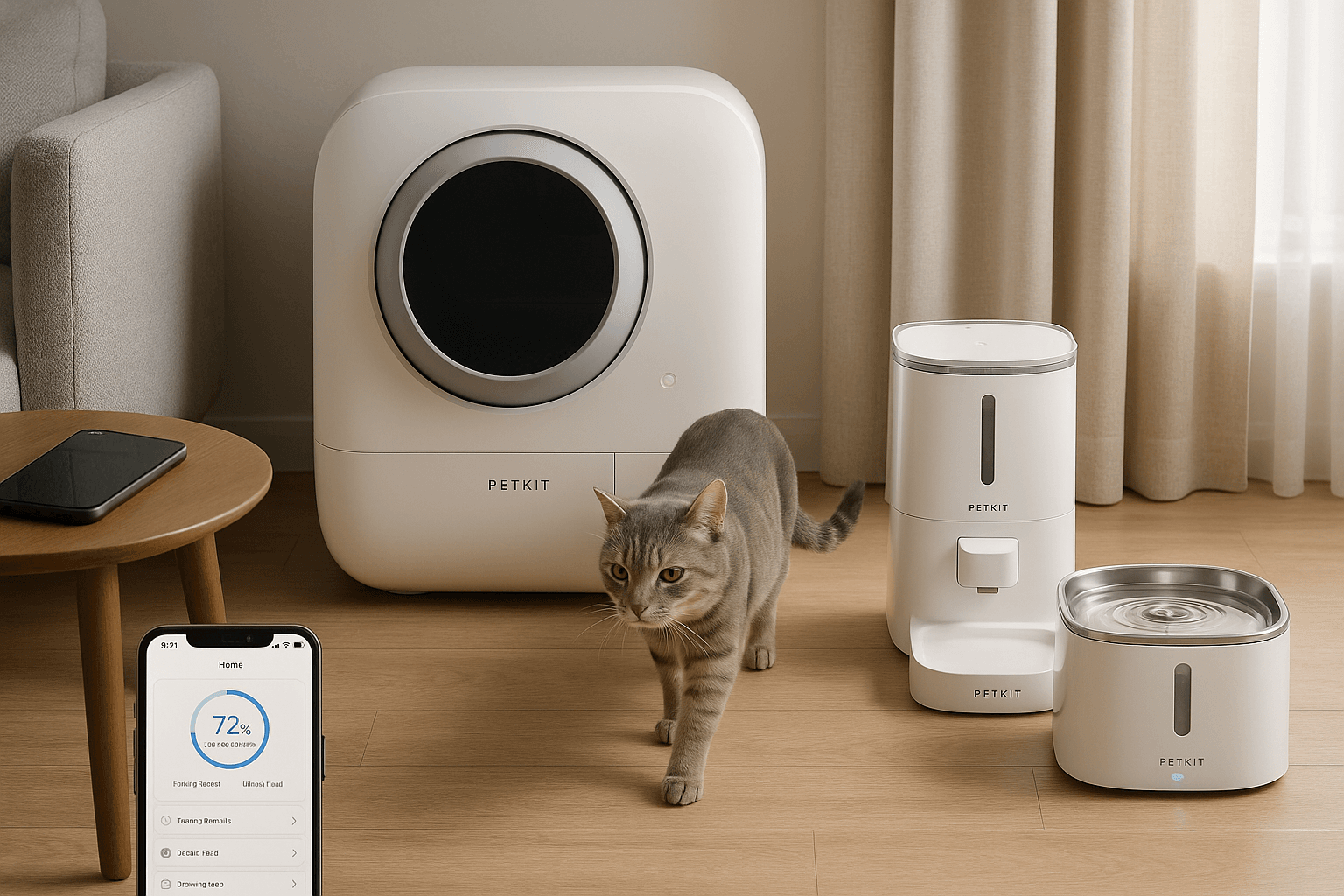
    PETKIT PUROBOT Ultra smart litter box with AI monitoring in the PETKIT app

    The PUROBOT series is PETKIT’s current litter box pillar. The PUROBOT Ultra in particular is the flagship:

    • Fully automatic self-cleaning
    • AI analysis of your cat’s waste and stool consistency
    • Pet recognition (multi-cat)
    • Auto-sealing trash bags and automatic refill of a new bag

    All PUROBOT models integrate with the PETKIT app, letting you monitor usage, start cleaning cycles, and view alerts remotely.

    From a health perspective, this matters:
    litter box habits (frequency, duration, avoiding the box) are among the earliest warning signs for urinary or GI problems. Feline environmental and life-stage guidelines repeatedly highlight litter access and monitoring as core to indoor cat health. journals.sagepub.com

    2. Fresh Element Smart Feeders

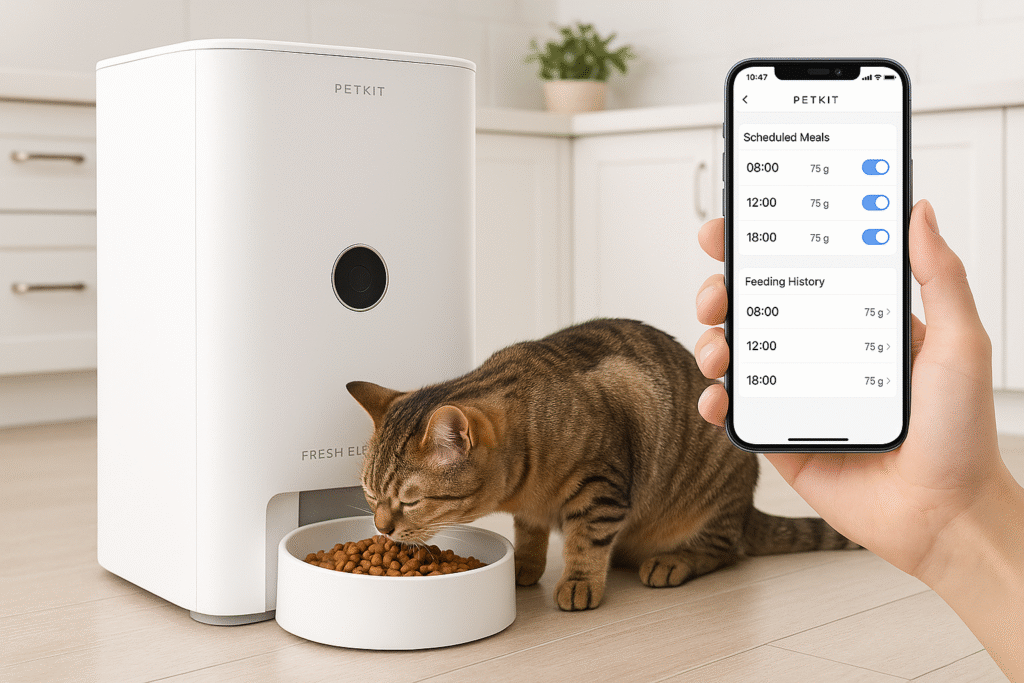
    PETKIT Fresh Element smart feeder controlled and monitored via the PETKIT app

    Devices like the Fresh Element Solo automatic feeder are designed around consistent, programmable feeding:

    • Up to 10 meals per day via app scheduling
    • Approx. 12-cup capacity and up to roughly 15 days of feeding (depending on portion sizes)
    • Dual-power protection (adapter + backup)
    • App logging of feeding routines via the PETKIT app

    The idea is not just convenience while you’re out, but tight control over calories and timing – critical if your vet wants your cat on a specific diet or if you’re managing weight.

    3. EverSweet Smart Water Fountains

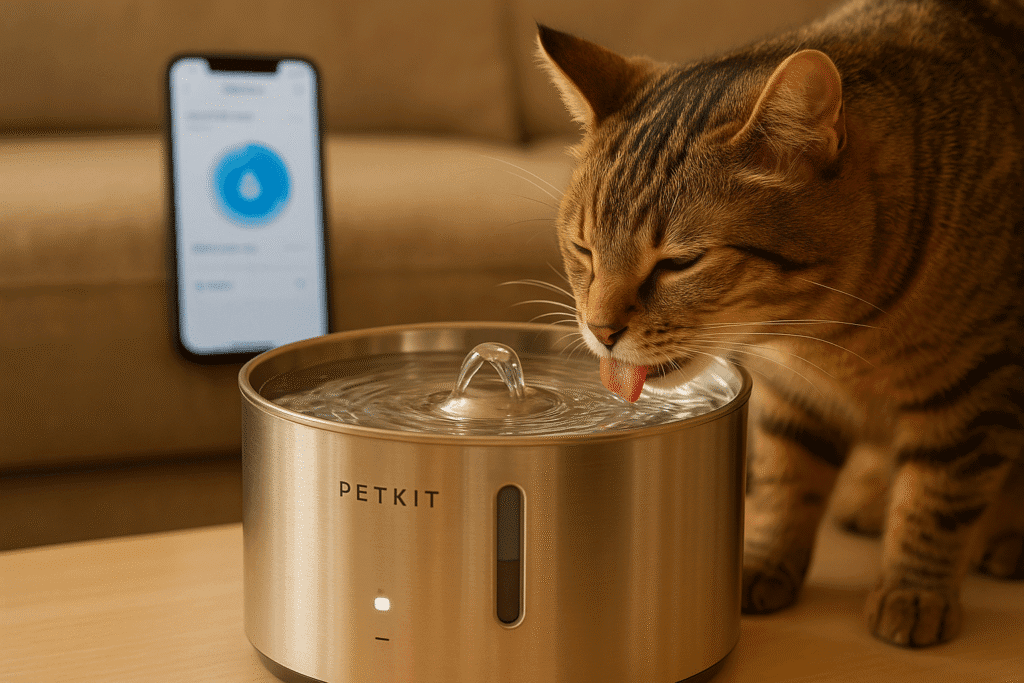
    PETKIT EverSweet smart water fountain encouraging better cat hydration with app monitoring

    On the hydration side, PETKIT’s EverSweet line is one of the most complete on the market:

    • Stainless steel or food-grade plastic water trays
    • Multi-layer filtration (hair, debris, odors, heavy metals)
    • Wireless pumps in newer models for quieter, safer operation
    • App control via Bluetooth in models like EverSweet 3 Pro, allowing water flow control and status monitoring

    Some fountains (e.g. EverSweet Max / Max 2) are battery-powered and designed to run for weeks, with hydration tracking for multi-cat homes.

    For context: Cornell Feline Health Center and other veterinary sources note that running water can encourage some cats to drink more – especially important given how many indoor cats chronically under-hydrate on dry food. vet.cornell.edu


    The PETKIT App: Where the Ecosystem Actually Comes Together

    All of this hardware would just be expensive clutter without the PETKIT App. That’s where the “ecosystem” turns into something usable.

    From PETKIT’s own app pages:

    • “All-in-one Management. Manage all of your PETKIT devices in one app.”
    • “Free Pet Data Service – get to know your fur-pals better with data tracking over time.” App Store

    Real-world usage (reviews and PETKIT’s own blog) shows the app can:

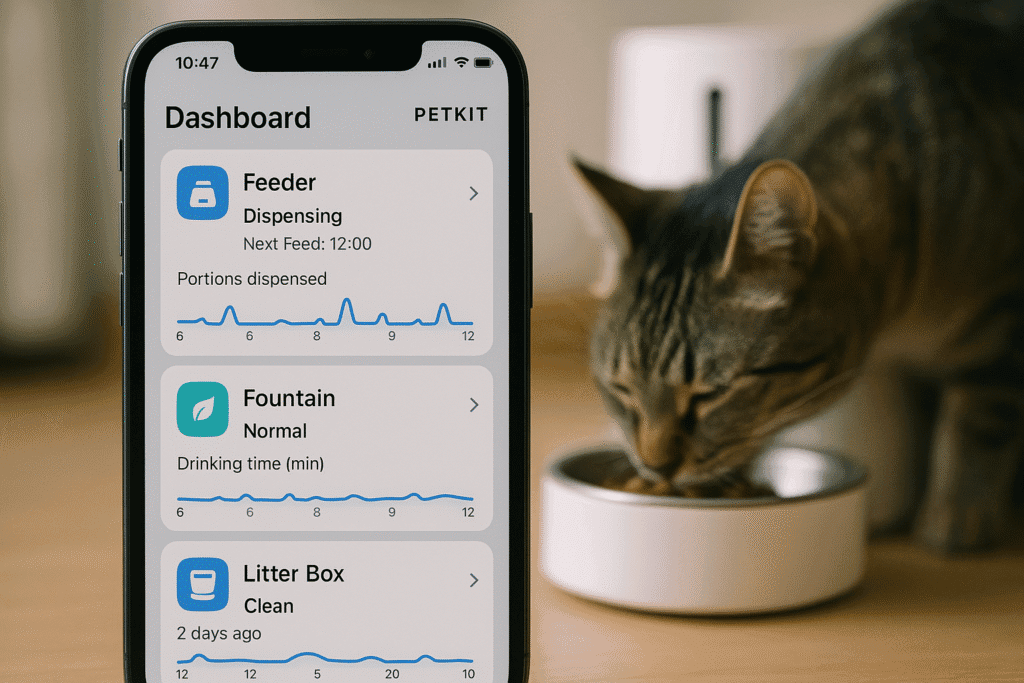
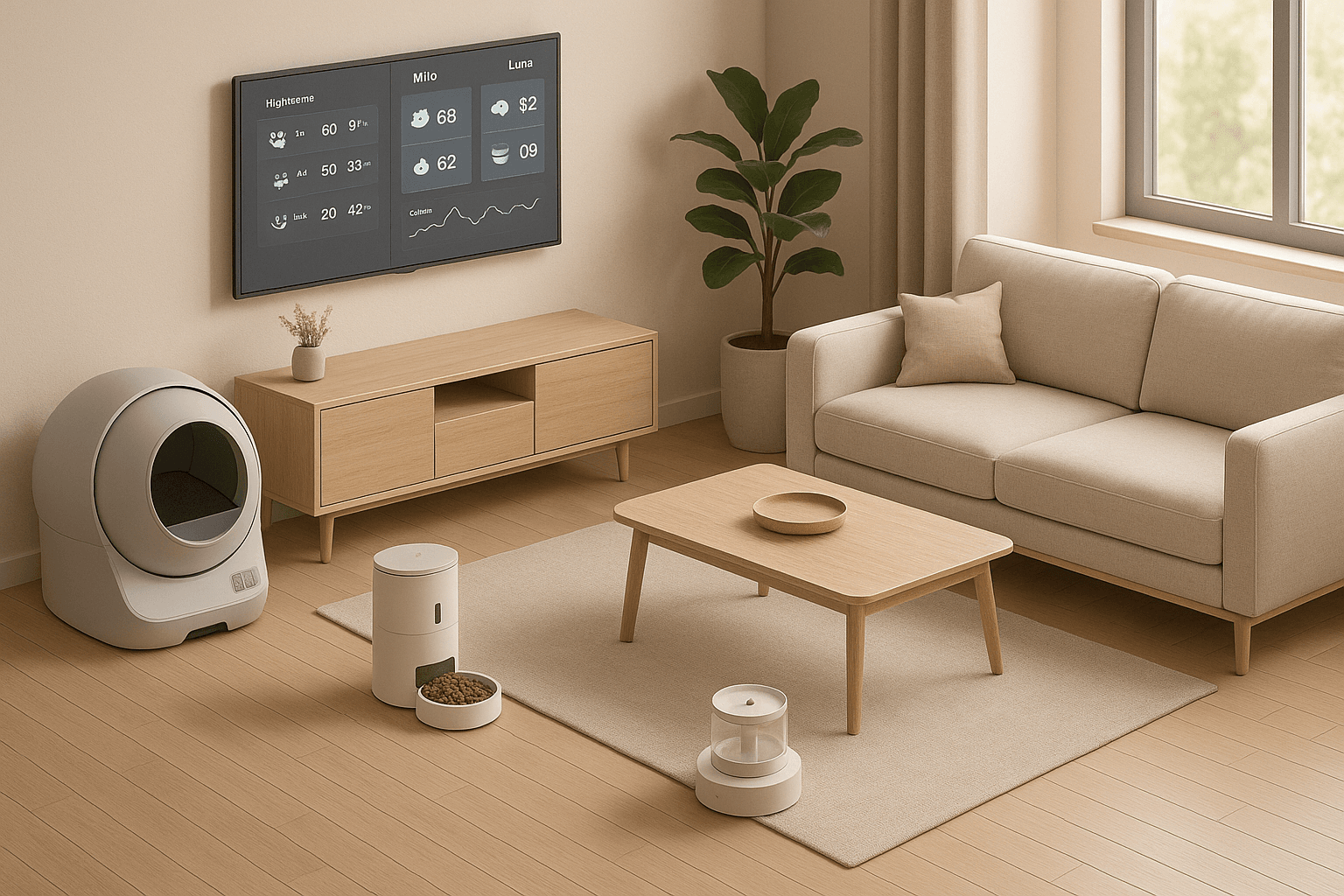
    • Add multiple device types: litter box, feeder, fountain in a single dashboard
    • Log litter box visits (time, duration, sometimes per-cat if using PUROBOT Ultra)
    • Track feeding schedules and history from Fresh Element feeders
    • Monitor fountain status and tweak water modes for EverSweet models

    So on paper, the PETKIT Ecosystem 2025 gives you a near-continuous picture of three things vets actually care about:

    1. Does the cat use the litter box normally?
    2. Is the cat eating consistently?
    3. Is the cat getting enough water?

    Health & Behavior Insights: What You Really See in the PETKIT Ecosystem

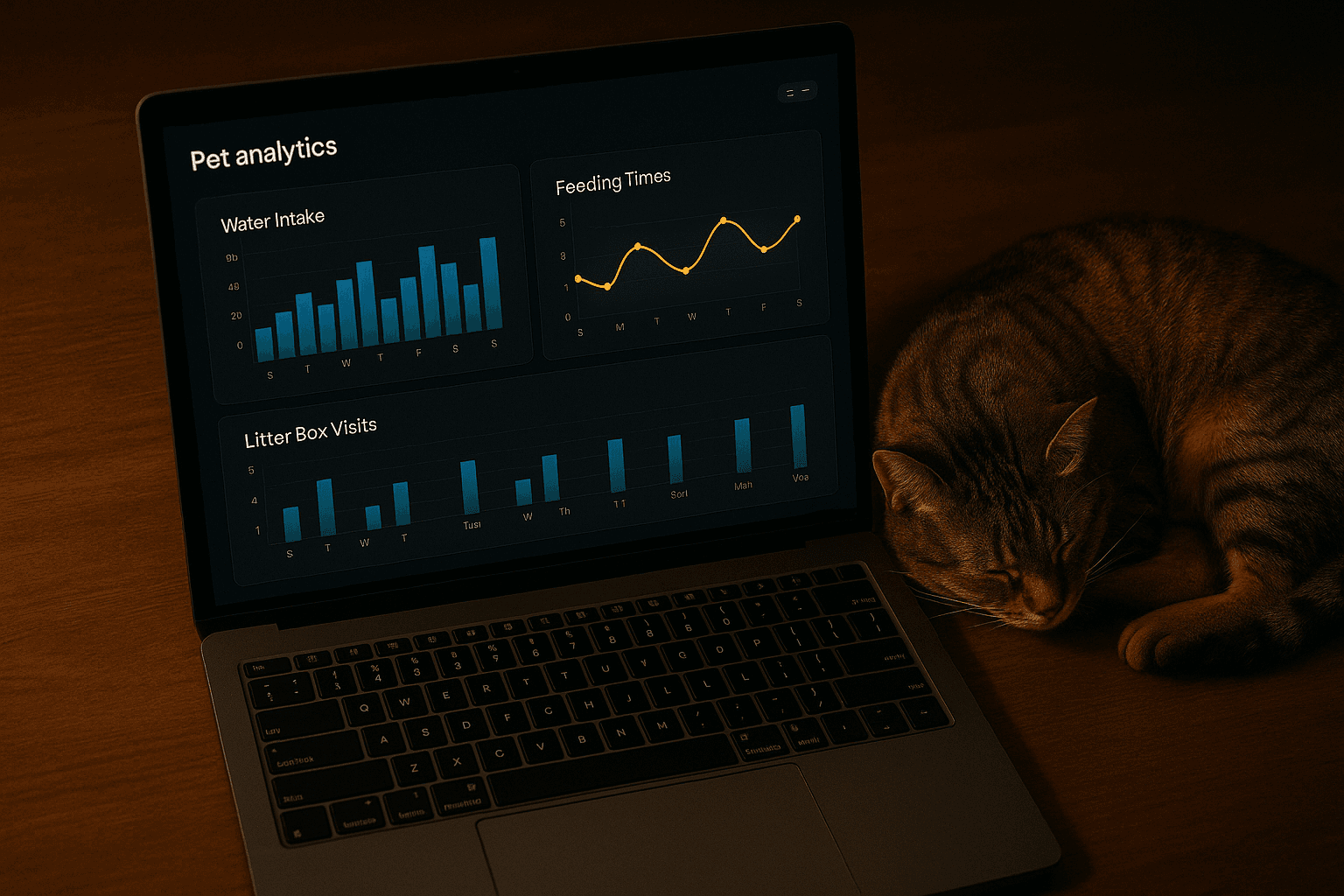
    The ecosystem blog explicitly positions PETKIT as a system that uses IoT + AI to monitor behavior, analyze data, and help catch problems earlier. PETKIT

    In practice, the insights you get look like this:

    • Litter box analytics via PUROBOT Ultra
      • Counts of visits per cat
      • Duration per visit
      • AI assessment of stool consistency (soft, normal)
      • Pattern changes over time, accessible via app logs
    • Feeding logs from Fresh Element feeders
      • Confirming meals were dispensed
      • Ability to adjust schedule or portion size
      • Remote manual feeds if you’re late home
    • Hydration tracking on supported fountains
      • Modes and runtime
      • For some models, estimates of usage and status notifications (low water, filter reminders)

    This isn’t medical data, but it plugs directly into what Cornell and AAFP guidelines flag as key daily indicators: litter habits, resource access, food and water intake.

    Used properly, you can:

    • Spot a cat peeing more often
    • Notice if meals are skipped
    • Connect increased litter visits with reduced water intake or vice-versa
    • Bring actual trend graphs to your vet instead of “it feels like something’s off”

    Living With the PETKIT Ecosystem: Setup & Daily Reality

    In day-to-day use, the PETKIT Ecosystem 2025 feels like this:

    • The PUROBOT handles scooping, bagging, and odor control with minimal intervention, but you still need to top up litter and replace waste bags on schedule.
    • The Fresh Element feeder keeps meals consistent, but you must calibrate portions once with your vet and resist the temptation to “add just one more snack” from the app.
    • The EverSweet fountain reduces daily bowl changes but adds filter and pump maintenance every few weeks.
    • The app consolidates alerts (water low, bin full, error states), so most of your “work” becomes responding to notifications and doing fast physical checks.

    It’s not zero-maintenance, but it absolutely shifts your effort from constant manual chores to periodic, better-timed interventions.


    Where the PETKIT Ecosystem 2025 Really Shines

    1. True multi-device integration
    You genuinely can manage litter box, feeder, and fountain from one app. This is not universal in pet tech; many brands still silo hardware into separate apps.

    2. Strong coverage across the “big three” resources
    Food, water, and toileting are exactly what feline environmental guidelines list as core resources that must be managed and separated for indoor cats. PETKIT hits all three categories with app-connected devices.

    3. PUROBOT Ultra’s health-oriented design
    AI stool analysis, per-cat recognition, and high-detail usage logs put it close to the top of the market in terms of behavioral health monitoring in the litter box category.

    4. Mature app with a large user base
    The PETKIT app has been around for years and is used worldwide. That doesn’t mean it’s perfect, but it’s more battle-tested than many niche-brand apps that ship with a single flagship device.

    5. Reasonable range of price points
    You’re not forced into only ultra-premium gear. There are Solo feeders and mid-range fountains alongside high-end models, so you can scale into the ecosystem over time.


    Where PETKIT Falls Short vs a Perfect Ecosystem

    1. App polish is good, not flawless
    Independent reviews point out that translations and UI fluidity can feel rough at times, especially around newer AI features and subscription prompts.

    2. Subscription creep (Care+ / extra analytics)
    Advanced services (like Care+ style features, video recordings, extended analytics) may sit behind subscriptions. The hardware is already a premium purchase, so ongoing costs are a real factor.

    3. Ecosystem lock-in is very real
    Once you have a PUROBOT, a PETKIT feeder, and an EverSweet fountain, switching out a single device for another brand means losing part of your data picture. This is not unique to PETKIT, but it’s a strategic downside of any closed ecosystem.

    4. Not a replacement for actual observation
    No matter how good the analytics get, you still need to watch your cat, check body condition, and schedule regular vet visits. The ecosystem can highlight trends – it cannot tell you what disease is behind them.


    Who the PETKIT Ecosystem 2025 Is Actually For

    Ideal matches:

    • Data-driven cat guardians
      People who like checking dashboards, spotting trends, and acting early when something looks off.
    • Multi-cat households
      PUROBOT Ultra’s per-cat recognition and the ability to track usage patterns per individual are a genuine advantage here.
    • Owners with demanding schedules
      If you’re out of the house a lot, having the litter, feeding, and water status visible in one app adds a real layer of peace of mind.
    • Guardians managing specific health risks
      For cats predisposed to urinary issues, obesity, or under-hydration, the combination of consistent feeding, running water, and litter analytics lines up with most vets’ basic recommendations.

    Not ideal for:

    • People who hate subscriptions on principle
    • Guardians who prefer low-tech solutions and don’t want to manage apps
    • Homes where Wi-Fi, Bluetooth, or phone access are unreliable

    Verdict: Is the PETKIT Ecosystem 2025 Worth It?

    If we strip away marketing and look at the fundamentals, the PETKIT Ecosystem 2025 does three things right:

    1. It covers the core environmental resources for cats: litter, food, water.
    2. It unifies those devices under a single, reasonably mature app.
    3. It adds behavioral data over time, which you can actually use in conversations with your vet.

    It is not magic, and it won’t keep your cat healthy on its own. But as a framework for consistent routines + better visibility, it’s currently one of the most convincing smart ecosystems available for cat households.

    If your goal is to build a connected setup around a single brand, PETKIT is a logical, defensible ecosystem to choose in 2025 – especially if you pair it with regular veterinary care and a realistic understanding of what the data can and cannot tell you.


    FAQ

    1. Does the PETKIT Ecosystem 2025 replace vet checkups?

    No. The PETKIT Ecosystem 2025 tracks behavior and routines: when your cat eats, drinks, and uses the litter box. That information can help you and your vet spot patterns, but it doesn’t replace physical exams, lab tests, or treatment plans.

    2. Can I mix PETKIT devices with other brands?

    Yes, but you lose part of the unified view. A non-PETKIT fountain or feeder will work fine for your cat, but it won’t appear in the PETKIT app. If your main reason for buying into PETKIT is ecosystem-level data, mixing brands dilutes that benefit.

    3. Is the PETKIT Ecosystem 2025 overkill for a healthy young cat?

    It depends on your tolerance for automation. For a healthy young cat, a PUROBOT, smart feeder, and fountain are more about convenience and prevention than urgent need. But building habits and baselines early can pay off later when the cat ages and you start seeing subtle changes.

    4. What’s the best device to start with?

    Most cat-focused guidelines put litter boxes and water at the top of the list for environmental health. Practically, that means starting with either a PUROBOT litter box or an EverSweet fountain, then adding a smart feeder later if you like the system.

    5. Do I need the most expensive PUROBOT to benefit from the ecosystem?

    Not necessarily. All PUROBOT models integrate with the PETKIT app for remote control and basic monitoring. The Ultra adds AI stool analysis and advanced multi-cat tracking; those features are useful, but not mandatory for every household.


    Internal Links (PetTech AI)


    References

    1. PETKIT – Smart Home & Ecosystem overview (self-cleaning litter box, smart feeder, smart fountain, app ecosystem).
    2. PETKIT PUROBOT Ultra product page and ecosystem/PUROBOT series blog posts (AI stool analysis, multi-cat recognition, auto-sealing, app integration).
    3. PETKIT Fresh Element Solo and related feeder documentation (app scheduling, Wi-Fi control, capacity).
    4. PETKIT EverSweet water fountain lineup (app-enabled models, filtration, wireless pumps, battery operation). See also Amazon
    5. Cornell Feline Health Center – Hydration and heat safety resources (fountains and running water as tools to support feline hydration).
    6. AAFP/ISFM Feline Environmental Needs Guidelines and related feline environment resources (importance of separate, adequate resources: food, water, litter box, resting areas).
    7. PetKit Amazon

    Disclaimer

    This article is for educational purposes only and does not replace professional veterinary advice, diagnosis, or treatment. Always consult your veterinarian if you notice changes in your cat’s eating, drinking, or litter box habits, or before making health decisions based on data from smart devices. Connected feeders, fountains, and litter boxes can help you monitor trends and support daily care but cannot diagnose diseases or determine appropriate medical treatment. PetTech AI participates in affiliate programs such as Amazon Associates and CJ. We may earn a commission if you purchase products through links on our site, at no additional cost to you.

  • CATLINK vs PETKIT vs Whisker (2025): Which Smart Cat Ecosystem Actually Works Best?

    CATLINK vs PETKIT vs Whisker (2025): Which Smart Cat Ecosystem Actually Works Best?

    Smart pet brands all promise the same dream: one app, one ecosystem, and a complete picture of your cat’s health from litter box to food bowl to water fountain. In practice, that dream isn’t evenly delivered.

    In 2025, the three serious contenders for a full ecosystem are CATLINK, PETKIT, and Whisker (Litter-Robot + Feeder-Robot). This guide puts them side by side and asks the only question that matters:

    If you’re going all-in on one ecosystem, who deserves your money?

    We’ll look at hardware, apps, health data, noise/maintenance, and long-term reliability – and then break down exactly who should pick CATLINK vs PETKIT vs Whisker.


    Why Ecosystems Matter for Cat Health (Not Just Convenience)

    Veterinary sources are very clear about one thing: a cat’s basic needs are food, water, and litter – plus safe rest and enrichment. The AAFP/ISFM Feline Environmental Needs Guidelines and similar documents define these as core “environmental resources” that must be well managed for indoor cats to thrive. SAGE Journals

    Cornell Feline Health Center and other feline health resources repeatedly stress:

    • Many cats don’t drink enough, especially on dry food
    • Hydration is critical in preventing and managing kidney disease
    • Changes in eating, drinking, and litter box habits are often the first visible signs of illness

    A good ecosystem doesn’t replace a vet, but it does help you:

    • See when your cat ate, drank, and used the box
    • Spot trends (drinking less, skipping meals, visiting the box more often)
    • React earlier and bring hard data to your vet

    That’s the lens we’ll use to compare CATLINK vs PETKIT vs Whisker – not just “which robot is prettier,” but which ecosystem genuinely supports healthier routines.


    Quick Snapshot: CATLINK vs PETKIT vs Whisker

    CATLINK

    • Devices: self-cleaning litter boxes, automatic feeders, smart water fountains Amazon
    • App: CATLINK App – toilet, feeding, and drinking logs + health monitoring App Store
    • Ecosystem style: “Input & output” health tracking across devices
    • Best for: data-driven guardians who want the full triad (litter + feeder + fountain)

    PETKIT

    • Devices: Pura/Purobot litter boxes, Fresh Element feeders, multiple smart fountains PetKit Store / Amazon
    • App: PETKIT App – all devices managed in one place, millions of users PETKIT App
    • Ecosystem style: polished UX, automation first, health insights mostly via litter box
    • Best for: people who want a smooth app experience and reliable hardware more than explicit “health reports”

    Whisker (Litter-Robot + Feeder-Robot)

    • Devices: Litter-Robot (3/4/5/Evo) + Feeder-Robot; water products are in development but not mainstream yet Amazon
    • App: Whisker App – central hub for all robots, with growing AI analytics Whisker App
    • Ecosystem style: premium litter automation + high-end feeding, moving toward “input & output” insights
    • Best for: people who care most about rock-solid litter automation and long-term durability

    CATLINK: Most Complete “Input & Output” Ecosystem

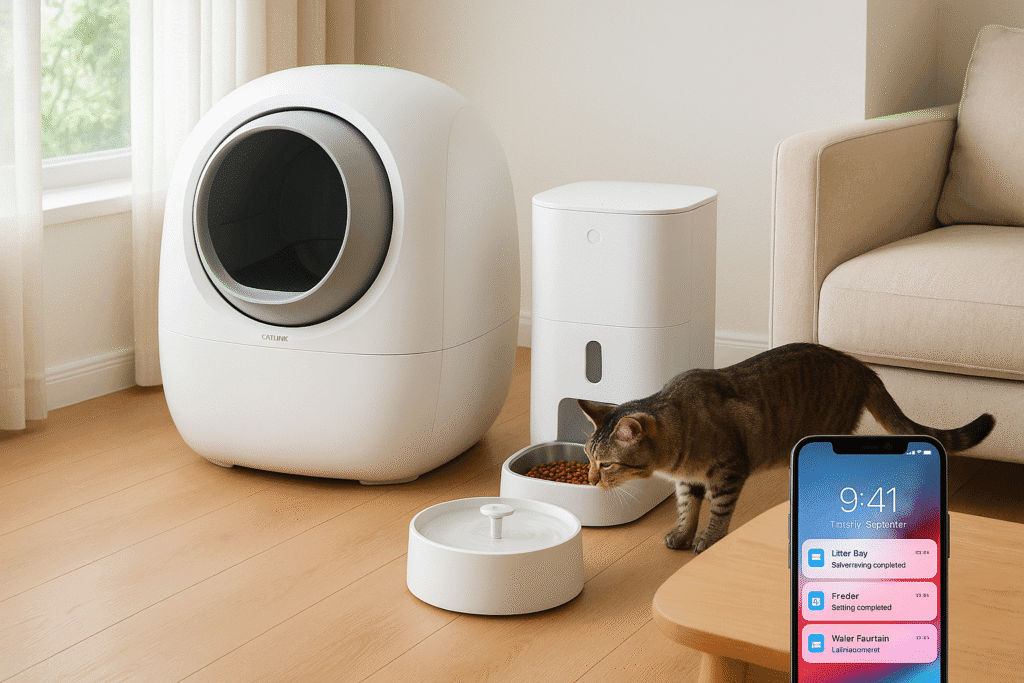
    CATLINK smart cat ecosystem with litter box, feeder, and fountain connected to a mobile app

    If you want the closest thing to a true smart cat ecosystem in 2025, CATLINK is the one leaning hardest into the concept.

    Hardware & Ecosystem

    CATLINK’s EcoSystem Set bundles a self-cleaning litter box, automatic feeder, and smart water fountain. The official product pages state:

    “Connect scooper, feeder, and water fountain to the CATLINK App to monitor your pet’s toilet, eating, and drinking habits.”

    That’s not marketing fluff – it’s exactly the combo you want: litter + food + water in a single app.

    The CATLINK App adds:

    • Litter usage tracking and waste drawer level
    • Cat toilet behavior monitoring and health insights
    • Logs for feeding and – depending on model – drinking habits

    Data & Health Perspective

    CATLINK frames its ecosystem as “better pet care” via input/output monitoring, and that framing is actually aligned with what vets care about: how much is going in (food/water) and what’s coming out (urine/feces).

    Used properly, it can help you:

    • Notice if your cat is drinking less across several days
    • Pick up on more frequent or longer litter box visits
    • See feeding consistency when you’re away

    It’s still behavioral data, not lab data, but it’s the most complete integration currently on the market.

    Pros (CATLINK)

    • True triad: litter box + feeder + fountain within one app
    • Health-oriented messaging and features (toilet behavior + health monitoring)
    • Clear “ecosystem” product bundles for one-shot setup
    • Strong fit for multi-cat homes that want hard numbers

    Cons (CATLINK)

    • High upfront cost if you buy the full set
    • App still evolving; UX isn’t as polished as some competitors
    • You’re locked into CATLINK hardware if you want the full functionality

    PETKIT: Best All-Rounder for UX and Everyday Reliability

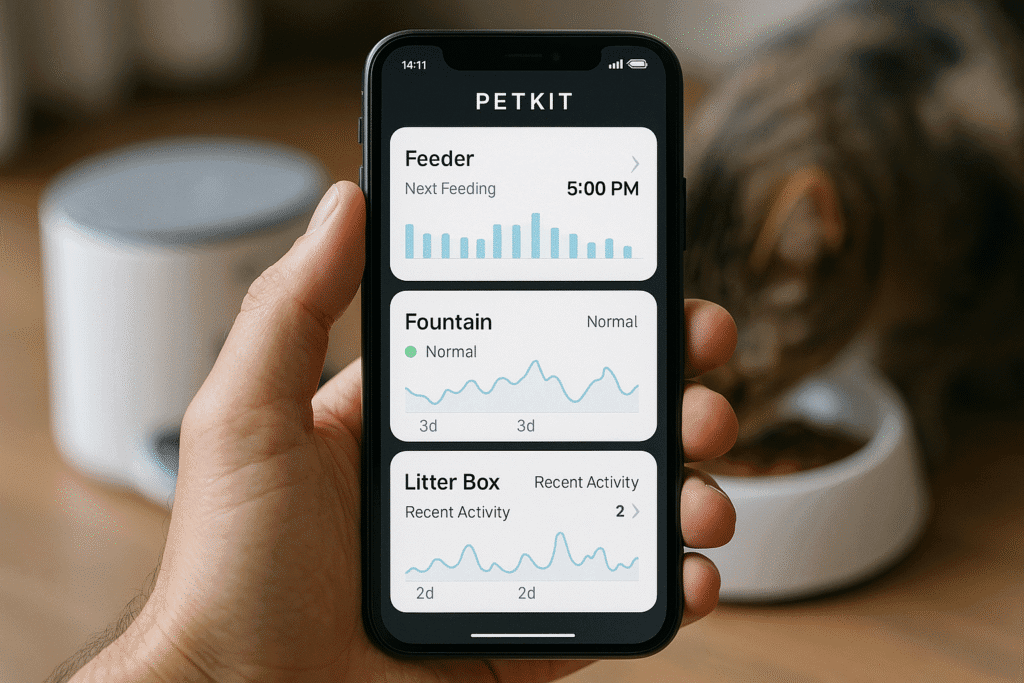
    PETKIT app managing smart cat feeder, fountain, and litter box in one dashboard

    PETKIT doesn’t shout “ecosystem” quite as loudly as CATLINK, but in practice it delivers one of the smoothest litter + feeder + fountain setups available.

    Hardware & Ecosystem

    PETKIT sells:

    • Fresh Element smart feeders and newer successors
    • Multiple smart fountains, some battery-powered with app-controlled modes and water monitoring PETKIT
    • Pura/Purobot self-cleaning litter boxes with weight and usage sensors PETKIT

    The PETKIT App is advertised as:

    “All-in-one Management. Manage all of your PETKIT devices in one app, and stay connected to what matters most to your pets.” PETKIT

    It’s not a vague claim: the app really does act as a central control panel for feeder, fountain, and litter box.

    Data & Health Perspective

    PETKIT focuses slightly more on automation and convenience:

    • Scheduling and remote feeding
    • Fountain modes and filter/water level monitoring
    • Litter box weight-based waste monitoring and usage notifications App Store+1

    You can still read the data in a health-focused way (eating/drinking trends + box usage), but the app doesn’t package it as an explicit “health report” the way CATLINK is starting to do.

    Pros (PETKIT)

    • One of the most mature apps in pet tech, with millions of users
    • Good hardware coverage across all three categories
    • Strong everyday reliability; less “beta” feeling than some new ecosystems
    • Good balance of automation, notifications, and manual control

    Cons (PETKIT)

    • Health data is there, but more implicit than explicit
    • Not as aggressively integrated around “input/output” as CATLINK or Whisker’s future roadmap
    • As always, you’re committing to one vendor’s hardware and cloud

    Whisker: Premium Litter + Feeder, Health Analytics Catching Up

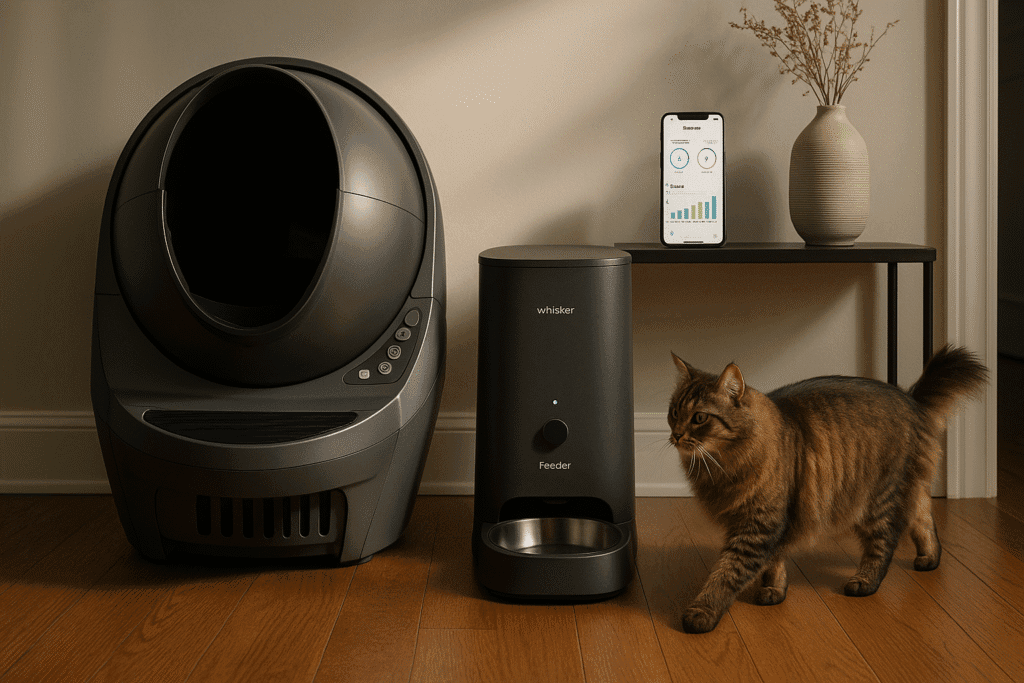
    Whisker Litter-Robot and Feeder-Robot connected through the Whisker app for automated litter and feeding

    Whisker (Litter-Robot + Feeder-Robot) is known for premium litter automation. Ecosystem-wise, it’s a strong contender even if it doesn’t yet include a mainstream fountain.

    Hardware & Ecosystem

    Today, Whisker sells:

    The Whisker App connects to multiple robots and provides a dashboard for both litter boxes and feeders. Litter-Robot – Self-Cleaning Litter Box

    The latest Litter-Robot 5 Pro introduces:

    • Facial recognition for individual cats
    • Dual cameras and AI-based waste tracking
    • Optional Whisker Plus subscription for detailed bathroom behavior analytics

    A recent report on Whisker’s roadmap notes that the company is explicitly aiming at “input and output” monitoring – food, water, and waste – to tell a more complete health story. Axios

    The Catch: No Mainstream Fountain Yet

    Whisker is clearly moving toward a full ecosystem, but as of late 2025 the water piece is still emerging rather than established.

    So in a strict CATLINK vs PETKIT vs Whisker comparison:

    • Whisker nails litter + feeding
    • Full litter + feeding + fountain integration is still behind CATLINK and PETKIT

    Pros (Whisker)

    • Arguably the strongest litter automation on the market
    • Feeder-Robot is robust, with app-based scheduling and large capacity Litter-Robot – Self-Cleaning Litter Box
    • New AI features (Litter-Robot 5 Pro + Whisker Plus) push health analytics further than most competitors The Verge
    • Built with durability and long-term support in mind

    Cons (Whisker)

    • No fully integrated smart fountain in the mainstream lineup yet
    • High price point across the board
    • Health analytics partly locked behind a subscription (Whisker Plus)

    CATLINK vs PETKIT vs Whisker: Which Ecosystem Fits Which Cat Household?

    Think of this less as “who wins overall” and more as “who fits your situation.”

    Choose CATLINK If…

    • You want all three pillars (litter, feeder, fountain) under one brand from day one CATLINK
    • You like the idea of health-oriented behavior tracking in the app (toilet behavior, monitoring, activity overview)
    • You’re okay betting on a relatively newer ecosystem in exchange for deeper integration

    Choose PETKIT If…

    • You care about app polish, stability, and everyday UX
    • You want a straightforward ecosystem where everything “just works” across litter box, feeder, and fountain PETKIT
    • You like having multiple fountain and feeder form factors to choose from

    Choose Whisker If…

    • Litter automation is your number one priority
    • You’re ready to pay more for very refined hardware and AI-assisted litter analytics Whisker
    • You can live (for now) without a tightly integrated fountain, or you’re willing to add a separate brand just for water

    Final Verdict: Who Wins CATLINK vs PETKIT vs Whisker?

    If you’re forcing a ranking for 2025:

    1. Best Full Ecosystem (litter + feeder + fountain):
      CATLINK – the only one that clearly sells a tri-device EcoSystem and frames it around monitoring toilet, eating, and drinking habits in one place. App Store+3CATLINK+3CATLINK+3
    2. Best Everyday Experience & UX:
      PETKIT – strong coverage across products, a widely used app, and a smoother learning curve for most guardians. PETKIT
    3. Best Litter Automation & Long-Term Durability:
      Whisker – Litter-Robot + Feeder-Robot are still the gold standard for premium self-cleaning and feeding, with serious AI upgrades arriving in the Litter-Robot 5 Pro. Litter-Robot – Self-Cleaning Litter Box

    From a health perspective, the most important thing isn’t which logo you pick – it’s whether you actually pay attention to the trends the ecosystem gives you, and whether you act on them with your vet.


    FAQ

    1. Does any ecosystem replace regular vet checkups?

    No. All three systems in this CATLINK vs PETKIT vs Whisker comparison provide behavioral data only. They can highlight unusual trends (like more litter visits or less drinking), but only a vet can interpret those changes with exams and lab work.

    2. Is it a bad idea to mix brands?

    Technically, you can mix anything you want: CATLINK litter + PETKIT fountain + Whisker Feeder-Robot. You’ll just lose the benefit of having a single app that combines data. If your goal is hard numbers you’ll actually look at, sticking to one ecosystem makes life easier.

    3. Which ecosystem is better for multi-cat households?

    All three support multi-cat use at the hardware level. CATLINK and Whisker push harder on individual cat tracking (weight, behavior, AI recognition), while PETKIT offers a more general multi-cat dashboard. The right choice depends on how much you care about per-cat analytics vs overall convenience.

    4. If I only buy one device now, where should I start?

    From a health perspective, vets often prioritize litter boxes and water:

    • self-cleaning litter boxes improve hygiene and make changes easier to spot
    • fountains can encourage more drinking, especially in cats on dry diets

    Start with the device that solves your biggest pain point, then expand.

    5. Are AI features (like facial recognition) worth paying for?

    AI features in systems like the Litter-Robot 5 Pro are promising, especially for multi-cat homes, but they’re not essential for everyone. Today, the practical gain is better per-cat behavior logs. If you’re budget-constrained, a “non-AI” robot plus a good ecosystem app is still a huge upgrade.


    Internal Links (PetTech AI)


    Authoritative Outbound Links


    Disclaimer

    This article is for educational purposes only and is not a substitute for professional veterinary diagnosis or treatment. Always consult your veterinarian if you notice changes in your cat’s drinking, eating, or litter box habits, or before making health decisions based on data from connected devices. Smart feeders, fountains, and litter boxes can help you track trends but cannot replace physical exams, diagnostic tests, or prescribed therapies. PetTech AI participates in affiliate programs such as Amazon Associates and CJ. We may earn a commission if you purchase products through links on our site, at no extra cost to you.

  • Who Really Sells Smart Cat Ecosystems in 2025? Brands That Actually Connect Litter, Feeding, and Hydration

    Who Really Sells Smart Cat Ecosystems in 2025? Brands That Actually Connect Litter, Feeding, and Hydration

    Most brands love to throw around words like “ecosystem,” “platform,” and “all-in-one care.” But if you strip away the marketing, very few companies in smart cat ecosystems 2025 actually connect litter boxes, feeders, and water fountains into a real, data-driven system.

    If you’re already seeing queries like “who sells ecosystems that connect litter, feeding, and hydration devices?” in Search Console, you’re dealing with high-intent users: people ready to spend serious money if they can get something that truly works together.

    This guide answers that question brutally and clearly:

    • Which brands really sell smart cat ecosystems 2025
    • What they integrate (and what they don’t)
    • Where the health data is useful vs pure fluff
    • Which ecosystem fits different types of cat households

    What Counts as a “Smart Cat Ecosystem” in 2025?

    For this article, a brand only qualifies as part of smart cat ecosystems 2025 if it meets all three conditions:

    1. Sells at least two of the three core devices:
      • Smart feeder
      • Smart water fountain
      • Smart litter box
    2. Offers a single app that controls and monitors those devices together
    3. Provides behavioral data (not just remote on/off), ideally around:
      • Eating patterns
      • Drinking patterns
      • Litter box usage

    Anything less is just a product line, not a smart cat ecosystem.

    Veterinary sources make it very clear why these three pillars matter. Cornell Feline Health Center notes that cats should consume roughly 4 ounces of water per 5 pounds of lean body weight per day, and that many cats drink more from flowing water or fountains, especially when they’re on dry food. Cornell Vet School. In cats with chronic kidney disease, maintaining hydration and monitoring intake is critical because dehydration accelerates kidney damage. Cornell Vet School

    At the same time, guidelines from AVMA and other veterinary bodies emphasize scheduled feeding, portion control, and environmental enrichment — including good litter box management — as key tools for preventing obesity and behavior problems. AVMA

    In other words: food, water, and litter are the three core data streams you actually care about in smart cat ecosystems 2025.


    The Short Answer: Who Really Sells Smart Cat Ecosystems 2025?

    If we’re being completely honest, there are only four real players in 2025:

    • CATLINK – Full ecosystem: smart feeder, smart fountain, smart litter box, one app, health monitoring. Amazon
    • PETKIT – Mature ecosystem: smart feeders, fountains, and litter boxes tied together in the PETKIT App.
    • Whisker (Litter-Robot + Feeder-Robot) – Feeder + litter ecosystem via the Whisker app, but no fountain.
    • Sure Petcare – Feeder + fountain via Hub and app, but no smart litter box.

    Everyone else either:

    • sells only one category (just fountains, or just feeders), or
    • uses “ecosystem” to mean “we sell several unrelated products.”

    If you want real smart cat ecosystems 2025, your choice is essentially which of these four limitations ti va meno stretto.


    CATLINK: The Most Complete All-in-One Ecosystem

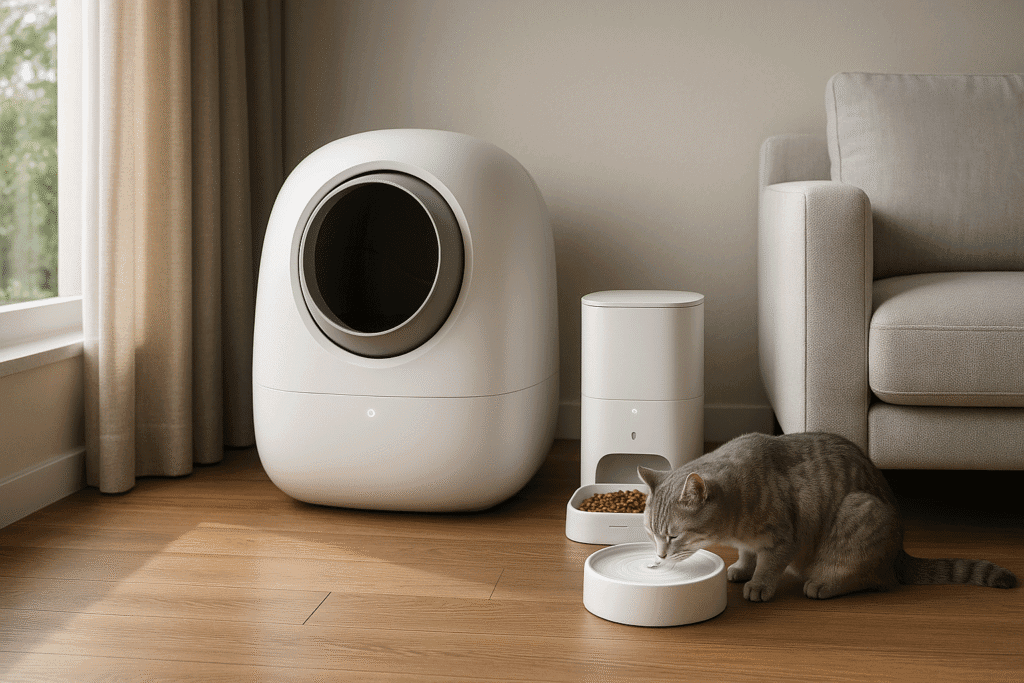
    Cat drinking from smart fountain next to integrated feeder and litter box in a CATLINK-style ecosystem

    CATLINK is the closest thing to what people imagine when they search for smart cat ecosystems 2025.

    What CATLINK Actually Sells as an Ecosystem

    CATLINK’s EcoSystem Set SE and EcoSystem Pro Set literally bundle:

    and connect all three to the CATLINK App. Product pages explicitly say:

    “Connect scooper, feeder, and water fountain to the CATLINK App to monitor your pet’s toilet, eating and drinking habits.”

    That is exactly what users mean when they search for smart cat ecosystems 2025: one brand, three devices, one dashboard.

    Health Monitoring and “Holistic” Data

    CATLINK pushes the health angle in a way few others do. Their site describes a holistic health monitoring system that tracks usage across all CATLINK appliances to follow “input & output” behavior.

    In practical terms, this means:

    • Drinking frequency and pattern from the fountain
    • Feeding schedule and portion logs from the feeder
    • Litter visits, weight trends, and cycle history from the litter box

    That’s not a medical diagnosis engine, but it’s a real early-warning system aligned with what Cornell and other veterinary sources consider critical: noticing changes in water intake, food intake, and litter behavior as early signs of disease.

    Pros

    • True triad: feeder, fountain, and litter box in one ecosystem
    • App explicitly built around “toilet, eating and drinking habits”
    • Ecosystem bundles make it easy to go all-in
    • Strong fit for data-driven guardians and multi-cat homes

    Cons

    • Higher upfront cost than most “single device” setups
    • Requires you to commit fully to CATLINK hardware
    • “Health monitoring” still needs vet interpretation

    Bottom line: Among all smart cat ecosystems 2025, CATLINK is the only one that truly covers all three pillars (feeding, hydration, litter) and markets them explicitly as a health-oriented ecosystem.


    PETKIT: Polished Ecosystem, Strong Hardware, Softer Health Claims

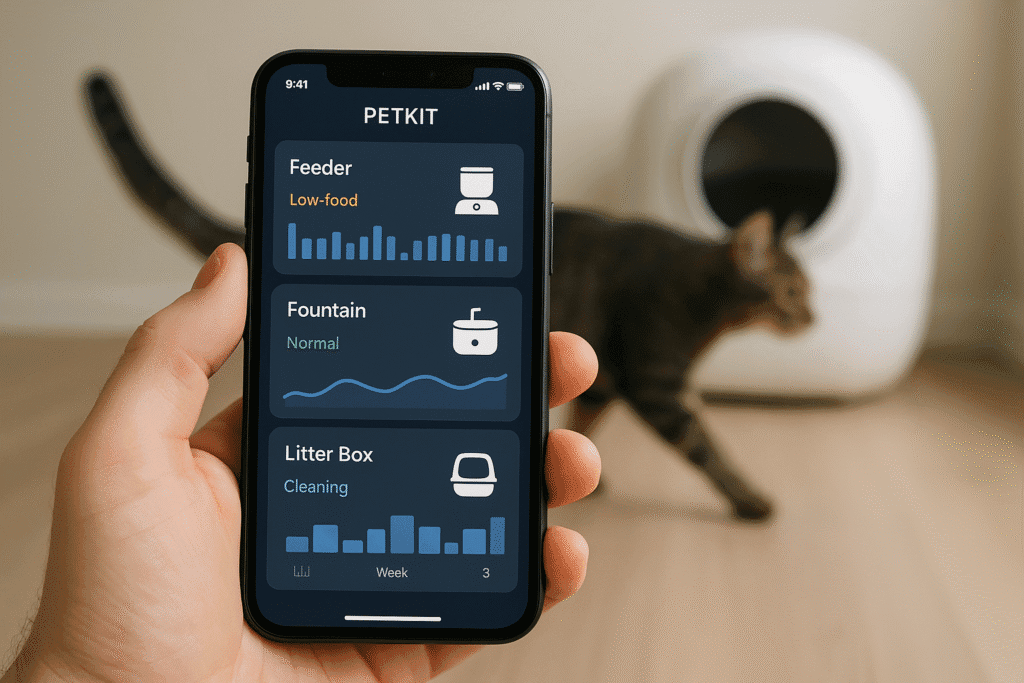
    PETKIT app showing connected feeder, fountain, and litter box in a smart cat ecosystem

    PETKIT is the other big name that realistically belongs in any discussion of smart cat ecosystems 2025.

    What PETKIT Offers as an Ecosystem

    The PETKIT lineup includes:

    • Smart feeders (Fresh Element line and newer models) / CHeck Current Deal On PetKit Store / Amazon
    • Smart fountains with app-controlled modes and drinking monitoring / Check Current Deal On PetKit Store / Amazon
    • Smart litter boxes (PUROBOT series and related models) / Check Current Deal On PetKit Store / Amazon

    Their own app marketing page spells it out:

    “All-in-one Management. Manage all of your PETKIT devices in one app, and stay connected to what matters most to your pets.” PETKIT

    This is exactly what people expect from smart cat ecosystems 2025: one PETKIT account, one PETKIT App, full access to feeders, fountains, and litter boxes.

    Recent updates to the ecosystem are also positioned as a more seamless cross-device experience, with a single account across the PETKIT App and website.

    Data and Insights

    PETKIT’s app:

    • Tracks litter box usage using weight and sensors App Store
    • Monitors water fountain status and filter condition, and can log drinking behavior depending on the model
    • Manages timed feeding schedules and feeding events

    Compared to CATLINK, PETKIT is less aggressive in marketing the data layer as a “health report,” but the raw data that matters in smart cat ecosystems 2025 is there.

    Pros

    • Large, established user base and mature app UX
    • Full product coverage: feeders, fountains, litter boxes connected in one place PETKIT
    • Strong hardware build quality and design

    Cons

    • Less explicit about health analytics, more about convenience and automation
    • Like CATLINK, keeps you inside its ecosystem
    • Some models and features vary by region

    Bottom line: PETKIT is one of the most realistic and user-friendly smart cat ecosystems 2025, especially for people who care more about reliability and UX than about explicit “health scoring” features.


    Whisker (Litter-Robot + Feeder-Robot): Strong Duo, Missing Fountain

    Whisker Litter-Robot and Feeder-Robot connected through a single app

    Whisker is a major player in the autonomous litter box space and does qualify as a partial member of smart cat ecosystems 2025.

    What Whisker Integrates

    Whisker sells:

    The Whisker app connects both devices and is explicitly marketed as:

    “One app for every Whisker device. Monitor, control, and get insights from your Whisker devices—including Litter-Robot and Feeder-Robot—anytime, anywhere.”

    The newest Litter-Robot 5 Pro even brings facial recognition and detailed waste monitoring through the Whisker Plus subscription, pushing the analytics side closer to health trend tracking. (See also Litter-Robot 5 vs 5 Pro vs EVO (2025): The Definitive Guide to Whisker’s New Lineup)

    The Limitation

    Whisker does not currently sell a smart water fountain. So even though its app is one of the most advanced in terms of litter analytics, the ecosystem remains:

    • Feeder + litter → yes
    • Fountain integration → no

    In strict terms, that means Whisker sits just below CATLINK and PETKIT in the smart cat ecosystems 2025 hierarchy: excellent data on feeding and elimination, but hydration tracking is left to third-party fountains or manual observation.

    Bottom line: great if your priority is litter and feeding automation; not a full three-pillar ecosystem.


    Sure Petcare: Microchip Control + Hydration Data, No Litter Box

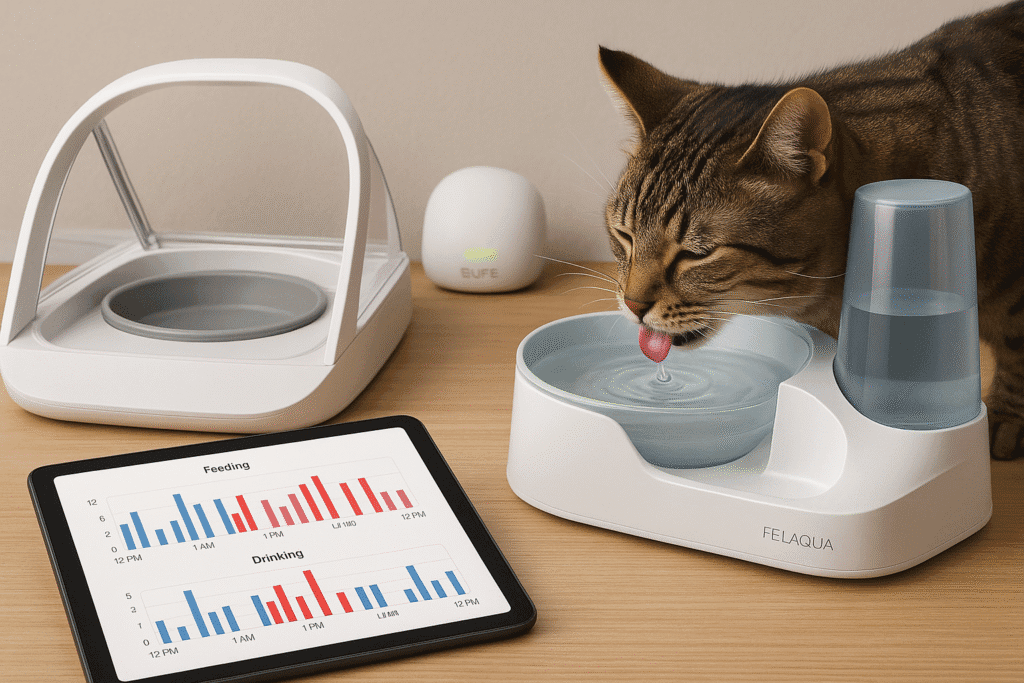
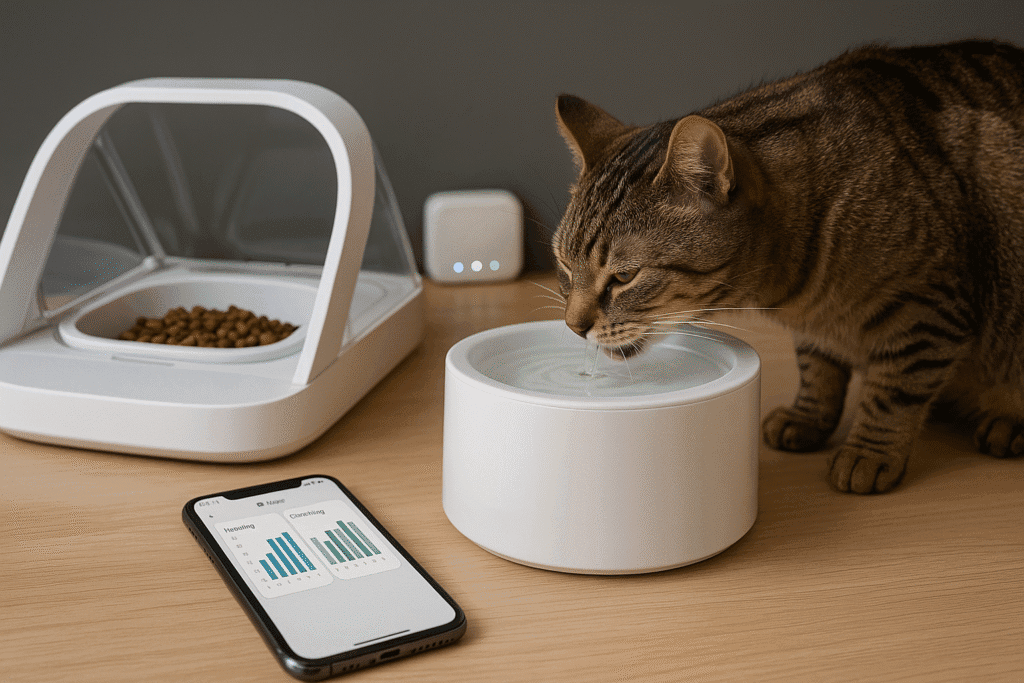
    Sure Petcare microchip feeder and smart fountain linked through a hub for per-cat feeding and hydration data

    Sure Petcare takes a different approach to smart cat ecosystems 2025: instead of building a self-cleaning litter box, they focus on access control and per-cat data.

    The Sure Petcare Stack

    Key components:

    • Felaqua Connect – smart fountain that monitors each cat’s drinking behavior, designed with veterinary behaviorists to highlight changes that might otherwise go unnoticed.
    • SureFeed Microchip Pet Feeder Connect – microchip- or tag-controlled feeder that logs which cat eats what and when, connecting via the Hub to the Sure Petcare App.
    • Sure Petcare Hub – connects up to ten devices to the app.

    Within that ecosystem, you get accurate per-cat data for feeding and drinking, which is extremely valuable in multi-cat homes or when managing prescription diets and hydration-sensitive conditions.

    The Missing Piece

    What Sure Petcare does not provide is a smart litter box. That means:

    • Strong feeding + hydration ecosystem
    • No integrated litter behavior data

    For many households, especially those dealing with diet splitting or hydration monitoring, this still qualifies as a meaningful part of smart cat ecosystems 2025. But it is not the complete three-pillar package.

    Bottom line: ideal if you care most about who eats and drinks what, but you will need a separate plan for litter box automation and data.


    How to Choose Between These Smart Cat Ecosystems 2025

    Choosing an ecosystem is less about specs and more about your use case.

    Choose CATLINK if:

    • You want the most complete three-pillar ecosystem (feeder + fountain + litter)
    • You like the idea of a holistic input/output health view
    • You’re willing to commit financially and technically to one brand

    Choose PETKIT if:

    • You want a polished, mainstream ecosystem with strong app UX
    • You care about feeders, fountains, and litter boxes working together without too much complexity
    • You prefer clear automation over heavy health analytics

    Choose Whisker if:

    • Litter automation is your top priority
    • You want detailed litter + feeding analytics, and you can handle hydration separately

    Choose Sure Petcare if:

    • You need per-cat diet and hydration control
    • You don’t mind scooping a “dumb” litter box or using another brand for that piece

    FAQ

    1. Is there any brand-neutral platform that connects all devices from all brands?
    No. In 2025, all smart cat ecosystems 2025 are brand-locked. Advanced users can hack together dashboards with smart home platforms, but there is no official, consumer-ready multi-brand health platform.

    2. Do these ecosystems replace veterinary checkups?
    Absolutely not. At best, they provide early-warning trends in eating, drinking, and litter habits, which should prompt faster vet visits — not replace them.

    3. Which ecosystem is best for a single young healthy cat?
    Often, none. A good non-smart fountain, a quality litter box, and scheduled feeding may be enough. Smart cat ecosystems 2025 make more sense for multi-cat homes, medical cases, or very data-driven guardians.

    4. What’s the biggest hidden cost of going “all-in” on an ecosystem?
    Lock-in. Once you commit to CATLINK, PETKIT, Whisker, or Sure Petcare, switching later often means replacing multiple expensive devices, not just one.

    5. Can I start with one device and expand later?
    Yes, and it’s usually the smartest approach. Start with the device that solves your biggest pain point (litter, feeding, or hydration), then expand into full smart cat ecosystems 2025 only if you actually use and value the data.


    Internal Links (PetTech AI)

    From this article, you should link internally to:


    Authoritative Outbound Links

    • Cornell Feline Health Center – Hydration (water needs, fountains, and kidney disease) Cornell Vet School
    • AAFP / AVMA-backed feeding and enrichment guidance via JAVMA/AAFP statements on feeding behavior and environmental enrichment. AVMA

    Disclaimer

    This article is for educational purposes only and is not a substitute for professional veterinary diagnosis or treatment. Always consult your veterinarian if you notice changes in your cat’s drinking, eating, or litter box habits, or before making health decisions based on data from connected devices. Smart feeders, fountains, and litter boxes can help you track trends but cannot replace physical exams, diagnostic tests, or prescribed treatment plans. PetTech AI participates in affiliate programs such as Amazon Associates and CJ. We may earn a commission if you purchase products through links on our site, at no extra cost to you.

  • Smart Cat Fountain Integration 2025: What Really Works With Feeders and Litter Boxes?

    Smart Cat Fountain Integration 2025: What Really Works With Feeders and Litter Boxes?

    Smart pet brands love to sell the fantasy: one app, one dashboard, one “health report” that combines your cat’s drinking, eating, and litter box data into a neat little score. In practice, smart cat fountain integration 2025 is rare, ecosystem-locked, and much less advanced than the marketing suggests.

    The idea is powerful, though. Hydration, food intake, and litter box habits are three of the most important behavioral signals for kidney disease, urinary issues, and general wellness. Cornell Feline Health Center notes that cats should consume roughly 4 ounces of water per 5 pounds of body weight per day, and that many drink more from flowing water sources, especially when they eat dry food. vet.cornell.edu In cats with chronic kidney disease, maintaining good hydration is explicitly called out as critical to slowing progression and avoiding crises. vet.cornell.edu

    So yes, integrating a smart fountain, smart feeder, and smart litter box into a single system makes sense. The key question is: who actually does it in 2025, and how well?

    This article answers that directly: which products support real smart cat fountain integration 2025, what “health reports” really are, and where the tech still falls short.


    What “Integration” Really Means in 2025 (Strict Definition)

    Brands throw around words like ecosystem, platform, and connected, but for this guide, smart cat fountain integration 2025 means all three of these are true:

    1. One app controls the fountain, feeder, and litter box
    2. The app shows combined behavioral data – drinking, eating, and litter use on the same timeline
    3. The system offers some kind of trend-based “health insight” or report, even if it’s basic

    Anything less (for example, “works with Alexa” or “supports Bluetooth”) is not real integration. With that definition, only three consumer brands matter in 2025:

    • CATLINK – full tri-device ecosystem + “health report”
    • PETKIT – strong ecosystem, behavior insights, but softer on fountain-specific “health reports”
    • Sure Petcare – solid feeding + hydration integration, no smart litter box

    There is no official cross-brand integration. If you want smart cat fountain integration 2025 today, you choose one ecosystem and live inside it.


    Why Combining Water, Food, and Litter Data Matters

    This is not about gadgets for the sake of it. It’s about catching subtle changes early.

    Vets and feline health centers repeatedly emphasize:

    • Hydration: Cats with kidney disease are prone to dehydration; encouraging water intake and monitoring changes over time is a core part of management. vet.cornell.edu
    • Feeding patterns: Therapeutic diets for CKD and obesity rely on controlled intake; feeding logs help ensure cats actually eat what they’re prescribed. Heartland Veterinary Hospital
    • Litter box behavior: Increasing or decreasing urine output, straining, or avoiding the box can all point to urinary or kidney problems.

    A good smart cat fountain integration 2025 setup can’t diagnose illness, but it can:

    • Flag that your cat is drinking less than usual
    • Show that they’re eating less or more often
    • Reveal changes in litter visits and weight trends at the box

    Used properly, this data gives you and your vet a much clearer picture of what’s going on between annual checkups.


    Brand 1: CATLINK – The Only True Tri-Device Health Ecosystem

    Cat drinking from smart fountain next to integrated feeder and litter box in a CATLINK-style ecosystem

    If you’re looking for the closest thing to full smart cat fountain integration 2025, CATLINK is the current benchmark.

    What the CATLINK EcoSystem Actually Does

    CATLINK’s EcoSystem bundles combine:

    All three connect to the CATLINK App, which explicitly states that you can monitor your cat’s toilet, eating, and drinking habits from one place. CATLINK

    On top of that, specific fountains such as the CATLINK W03 Wireless Cat Water Fountain are marketed with:

    • App control over modes and status
    • A 5000 mAh battery and 2300 ml capacity
    • A built-in “Health Report” feature that analyzes drinking patterns

    The litter boxes use weight sensors and pattern recognition to track usage per cat and support early detection of changes.

    What “Health Report” Means in Real Life

    In practice, CATLINK’s health report is:

    • A behavioral analytics layer, not labwork
    • Trend-based (more or less drinking, more or fewer bathroom visits, time spent)
    • Designed to highlight outliers so you can act earlier

    It doesn’t tell you creatinine, SDMA, or urine specific gravity – but it does show that over the past week your CKD cat drank 30% less and is visiting the box less often, which is exactly the kind of red flag vets want you to notice sooner rather than later.

    Pros and Cons of CATLINK Integration

    Pros

    • True tri-device smart cat fountain integration 2025 – feeder, fountain, litter box in one app
    • Behavior-focused health reports based on combined data
    • Multi-cat support via weight and behavior profiling
    • EcoSystem bundles simplify “go all-in” purchases

    Cons

    • Full ecosystem is expensive up front
    • Locked into CATLINK’s hardware and app
    • Health reports still require vet interpretation to be meaningful

    Best suited for:
    Multi-cat households, guardians managing urinary or kidney issues, and people who genuinely use data and are willing to share charts with their vet.


    Brand 2: PETKIT – Mature Ecosystem, Cleaner App, Softer Analytics

    PETKIT app dashboard controlling a connected cat feeder, fountain, and litter box

    PETKIT is often the first name people encounter when they think of smart feeders and fountains. It also offers an ecosystem that is closer than most to smart cat fountain integration 2025, even if it doesn’t brand the fountain as a “health report” device.

    PETKIT App and Device Integration

    PETKIT’s own materials describe its app as an “all-in-one management” tool that lets you manage all PETKIT devices in a single place and “stay connected to what matters most to your pets.” A 2024 blog post about the PUROBOT litter box series makes it explicit: through the PETKIT App, users can manage feeders, water fountains, and litter boxes in one platform.

    In other words:

    …all sit inside the same app, with unified status, alerts, and history.

    What You Actually Get

    PETKIT focuses on:

    • Device control and automation – feeding schedules, fountain modes, litter cleaning cycles
    • Activity logs – when the litter box cycles, when feeding happens, when the fountain is low
    • AI features in the litter box – weight tracking and usage patterns per cat in some models

    You effectively get a full-stack smart cat fountain integration 2025 experience, but the “health insight” layer is more subtle and less marketed as a fountain health report than CATLINK.

    Pros and Cons of PETKIT Integration

    Pros

    • Polished app with millions of users and proven device support
    • Strong hardware lineup across all three categories (feeders, fountains, litter boxes)
    • Real-world feedback confirms that the system reliably tracks litter box events and distinguishes cats by weight in multi-cat homes

    Cons

    • No explicit “health report” feature on fountains
    • Data is there, but you have to interpret it more manually
    • Same brand lock-in problem as CATLINK

    Best suited for:
    Guardians who want reliable, integrated smart hardware with a cleaner UX, and who don’t need a big “health score” label to look at trends.


    Brand 3: Sure Petcare – Strong Feeding + Hydration, No Litter Box

    Sure Petcare microchip feeder and smart fountain connected through a hub for feeding and hydration tracking

    Sure Petcare approaches smart cat fountain integration 2025 from the access-control angle rather than the self-cleaning litter angle.

    How Sure Petcare Connect Works

    The Sure Petcare Hub plugs into your router and connects up to 10 “Connect” devices – including the Felaqua Connect smart fountain and the SureFeed Microchip Pet Feeder Connect – to the Sure Petcare App.

    • Felaqua Connect is a smart drinking solution that logs how often and how much your cat drinks, designed specifically to support hydration monitoring. App Store
    • SureFeed Microchip Feeder Connect uses microchip or tag ID to ensure the right cat gets the right food and builds a detailed record of feeding habits.

    The app then lets you review individual cats’ eating and drinking patterns over time.

    The Limitation: No Smart Litter Box

    Sure Petcare does not currently offer a self-cleaning smart litter box that joins this ecosystem. So you get:

    • Feeding + drinking integration / Check current deal on Amazon
    • Per-cat data via microchip ID
    • Hydration trends that are very relevant for kidney risk

    …but you do not get the full triad of smart cat fountain integration 2025 with litter behavior included.

    Best suited for:
    Households with strict prescription diets, food guarding, or medical hydration concerns where per-cat intake really matters – but that are willing to keep litter box tracking manual for now.


    Cross-Brand Smart Cat Fountain Integration 2025: Does It Exist?

    Short answer: no.

    • CATLINK, PETKIT, and Sure Petcare each run their own cloud, protocols, and apps
    • None provide official APIs designed to merge their data into a competitor’s app
    • There is no vendor-neutral “pet health data hub” for consumer use today

    Tech-savvy users sometimes integrate devices into Home Assistant or other smart home platforms, creating dashboards that show feeding, drinking, and litter events together. But:

    • These setups are unofficial and fragile
    • They require technical skills and time
    • They do not generate medically meaningful health reports by themselves

    For 99% of people genuinely interested in smart cat fountain integration 2025, the realistic path is:

    pick an ecosystem → lean into it → use the data with your vet.


    Who Actually Needs Smart Cat Fountain Integration 2025?

    Not everyone needs to wire their cat’s life into an app. But some situations benefit a lot:

    1. Cats with Kidney Disease or High Renal Risk

    Hydration is central to kidney management; multiple veterinary sources stress that dehydrated CKD cats worsen faster and suffer more.
    A system that shows drinking trends + litter output on the same screen is not a gimmick at that point – it’s a monitoring tool.

    2. Multi-Cat Households with Diet Conflicts

    If one cat needs a prescription diet and the other doesn’t, or one tends to steal food, per-cat feeder and fountain logs help prevent cheating. Sure Petcare shines here; CATLINK and PETKIT also support multi-cat tracking, especially around the litter box.

    3. Guardians Who Travel or Work Long Hours

    When you’re not home to watch behavior directly, a tightly integrated ecosystem lets you:

    • Confirm that water, food, and litter are all in normal usage ranges
    • Catch drops in eating or drinking before your cat crashes
    • Decide whether a pet sitter needs to check in sooner than planned

    4. Data-Driven People Working With a Vet

    If your vet is open to reviewing trend graphs from your apps, smart cat fountain integration 2025 gives them more signal than “he seems thirstier lately.” That doesn’t replace lab work, but it can influence when to run it.


    How to Choose the Right Ecosystem: A Brutal Checklist

    Before you let any marketing copy convince you that a product “integrates,” run through this:

    1. Can one app control fountain, feeder, and litter box?
      • If the answer isn’t a clear “yes,” it’s not real smart cat fountain integration 2025.
    2. Does the system log drinking, feeding, and litter use with time stamps?
      • If it can’t show you a timeline, integration is superficial.
    3. Is there any kind of health insight or report?
      • CATLINK explicitly offers “Health Report” on certain fountains and health-monitoring for litter boxes.
    4. Do you realistically see yourself checking the data?
      • If not, you’re paying for complexity instead of utility.
    5. Is your vet willing to work with this data?
      • A data dump with no interpretation is just noise.

    Verdict: What Works Today, and What’s Still Hype

    If we strip out the fluff and look only at reality:

    • CATLINK is the only ecosystem that currently delivers full smart cat fountain integration 2025 across fountain, feeder, and litter box, with a named “health report” built into the fountain and health-monitoring behavior analytics in the litter box.
    • PETKIT offers one of the most stable and polished ecosystems, with feeders, fountains, and litter boxes all controlled through a single app and AI-assisted monitoring on the litter side, but without an explicit “health report” label for the fountain.
    • Sure Petcare tightly integrates feeding and hydration monitoring (Felaqua Connect + SureFeed Microchip Feeder Connect via Hub), but you’ll need a separate solution for litter behavior.
    • No brand currently offers a cross-vendor health dashboard that merges data from multiple ecosystems.

    For many cats, a single good fountain plus regular vet care is enough. For seniors, CKD patients, multi-cat diet battles, and anxious guardians who will actually use the data, a well-chosen smart cat fountain integration 2025 system can be a rational, evidence-aligned upgrade — as long as you remember it’s a monitoring tool, not a diagnosis engine.


    FAQ

    1. Do any smart cat fountains integrate with third-party feeders and litter boxes?
    No. All current smart cat fountain integration 2025 options are brand-exclusive. CATLINK, PETKIT, and Sure Petcare only integrate with their own hardware.

    2. Are “health reports” from fountains accurate?
    They are behaviorally accurate (when and how often your cat drinks) but medically incomplete. Use them to spot trends and bring those trends to your vet, not to self-diagnose.

    3. Is it overkill to buy a full ecosystem for a healthy young cat?
    Often, yes. You may be better off starting with a single high-quality fountain and solid litter hygiene, then adding more devices only if you have a specific health or behavioral goal.

    4. Does integration reduce vet visits?
    It shouldn’t. The best use of smart cat fountain integration 2025 is to prompt earlier visits, not fewer. Hydration and litter changes are reasons to see a vet, not reasons to delay it.

    5. If I start with one device now, which brand gives me the safest upgrade path later?
    If you want a full tri-device ecosystem with health reports, start with a CATLINK fountain or litter box. If you care more about UX and app maturity, PETKIT is a strong starting point. For per-cat feeding and drinking, Sure Petcare is hard to beat.


    Internal Link (PetTech AI)


    Outbound Authoritative Links

    • Cornell Feline Health Center – Hydration and Chronic Kidney Disease pages, for medical context on why water intake matters. vet.cornell.edu
    • A veterinary resource on managing feline CKD that emphasizes hydration and environmental support. Lewiston Veterinary Clinic

    Disclaimer

    This article is for educational purposes only and is not a substitute for professional veterinary diagnosis or treatment. Always consult your veterinarian if you notice changes in your cat’s drinking, eating, or litter box habits, or before making health decisions based on data from connected devices. Smart feeders, fountains, and litter boxes can help you track trends but do not replace exams, bloodwork, or imaging. PetTech AI participates in affiliate programs such as Amazon Associates and CJ. We may earn a commission if you purchase products through links on our site, at no extra cost to you.

  • Purobot Ultra Automatic Cat Litter Box 2025: Hands-On Review, Real Costs, and Who Should Buy It

    Purobot Ultra Automatic Cat Litter Box 2025: Hands-On Review, Real Costs, and Who Should Buy It

    The Purobot Ultra Automatic Cat Litter Box 2025 is PETKIT’s flagship robo-box with a rotating AI camera, multi-cat facial recognition, auto-packing waste bags, and app-based health alerts. In this review, we cover what the Purobot Ultra actually does, how it compares, the real ongoing costs, and whether it fits your home and cats.


    At-a-Glance (What’s New in 2025)

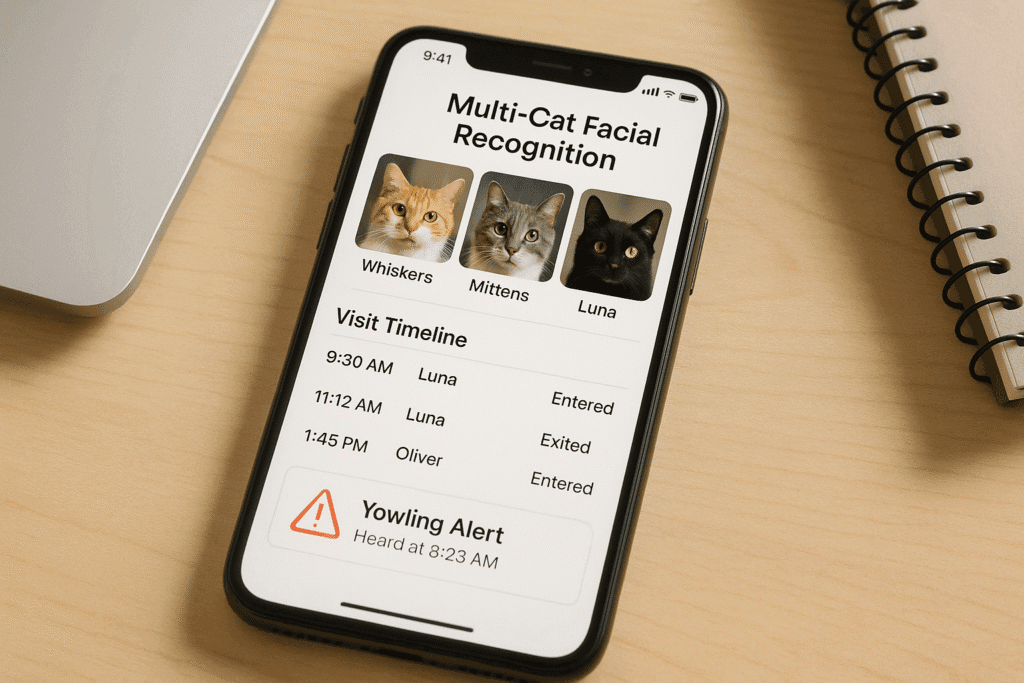
    • AI camera + facial recognition to identify each cat, log visits, and flag issues (e.g., yowling that may indicate urinary pain). Requires uploading cat photos in the PETKIT app.
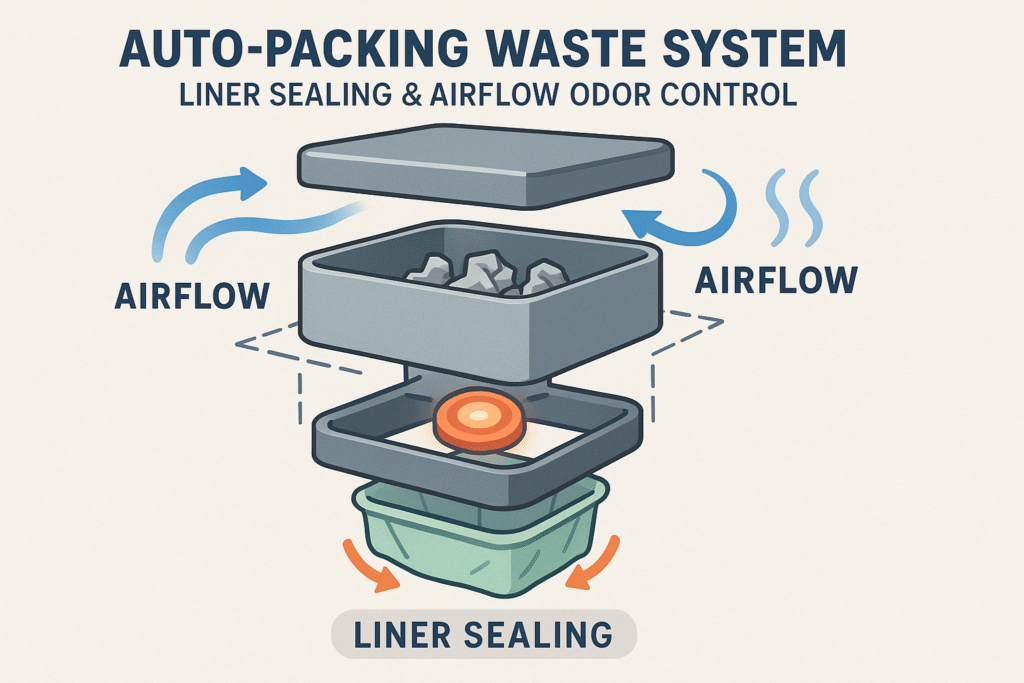
    • Auto-packing waste system that seals the bag for easier, cleaner disposals.
    • PETKIT app control, usage history, weight/visit tracking, and cloud video features (with optional Care+ subscription after a 30-day free trial; plans noted between roughly $4–$12/month).
    • Street pricing right now: PETKIT site $899.99 list, $739.99 sale; Amazon $999.99 list, $849.99 current. PetKit / Amazon
    • Key specs (manufacturer pages): about 20.9″W × 32.2″D × 24.1″H, weight ~14.6 kg (~32 lb); designed for clumping litters; “ultra-quiet” around 35 dB claim (regional page).

    Design & Setup

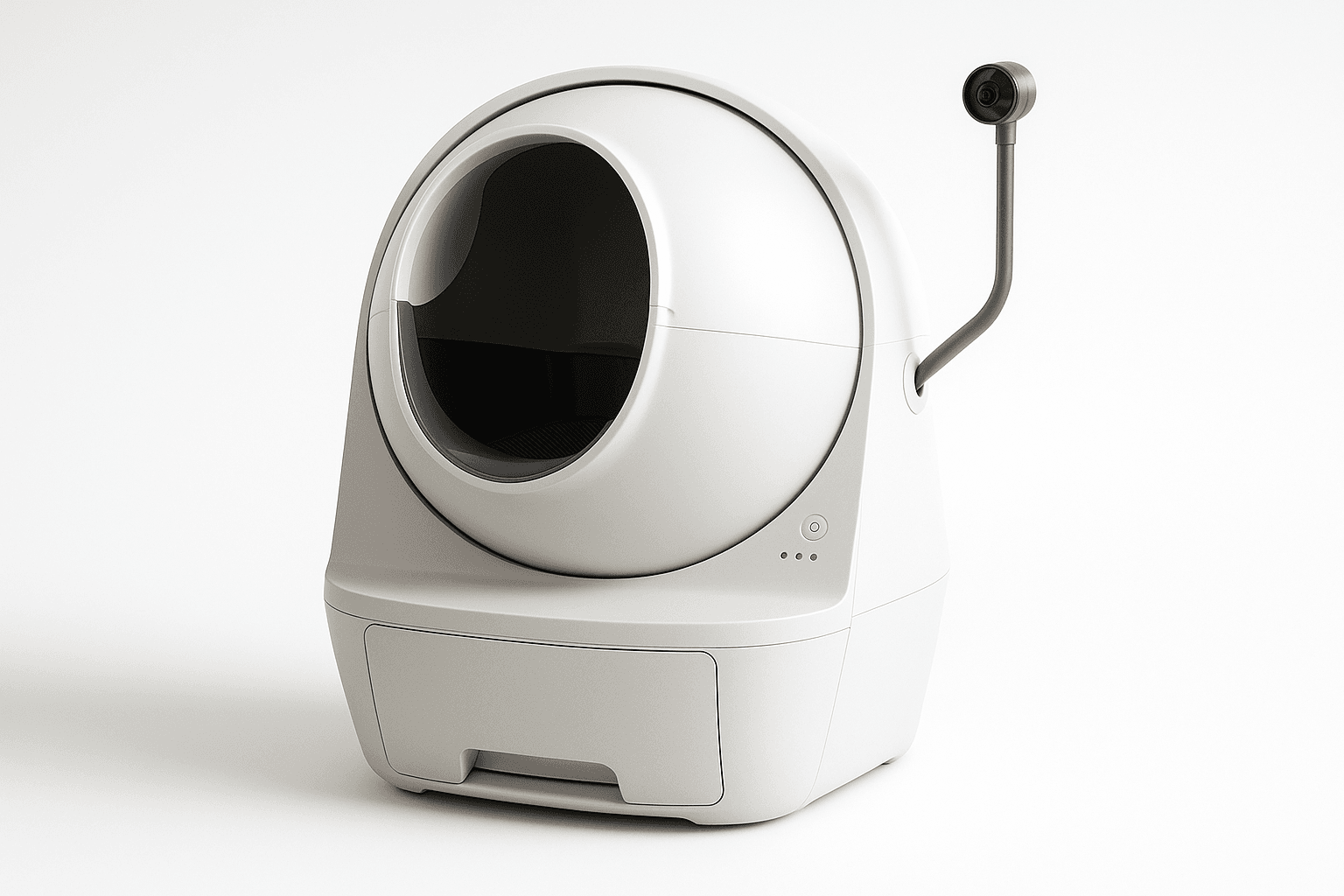
    The Purobot Ultra Automatic Cat Litter Box 2025 is large—plan floor space depth first. The rotating arm with a front opening makes entry straightforward for most cats, and the camera sits on a boom that can swivel to see inside or outside the drum. PETKIT’s multi-cat AI asks you to upload face photos of each cat; once trained, the box attributes visits and compiles per-cat timelines. The app also pushes alerts for behaviors that may matter clinically (e.g., yowling in box).

    Setup notes: You’ll connect the unit to Wi-Fi, pair in the PETKIT app, add your cats with head-shot photos, and run a few initial cycles so the device calibrates. If you’re upgrading from a standard box, allow a few days of acclimation.


    Cleaning Performance

    Auto-packing waste system of the Purobot Ultra Automatic Cat Litter Box 2025.

    Core cleaning is automatic and consistent: after the cat exits and a short delay, the drum cycles, separating clumps into the waste liner. The auto-packing system gathers and seals the bag so odor stays contained—useful if the bin sits near shared living areas. Reviewers consistently praise odor control; the flip side is that refilling litter is a bit more fiddly than a plain tray.

    Noise: PETKIT literature in regional product pages claims ~35 dB “ultra-quiet,” which is library-level. Real-world noise varies by room acoustics and floor resonance.


    Health Tracking & AI Camera

    This is where the Purobot Ultra Automatic Cat Litter Box 2025 stands out. The AI camera and sensors work together to:

    • Identify each cat (facial recognition) and log visits.
    • Track patterns (frequency/duration) and surface alerts when behavior deviates, including yowling detection as a potential urinary pain signal.
    • Provide video clips of sessions you can review in the app (clips and playback are tied to the PETKIT Care+ subscription after the trial).

    A note on accuracy: camera quality is serviceable for monitoring, not cinematic; some reviewers wish the image were sharper. Face ID works best after training photos and with good ambient light.


    App, Subscription, and Data

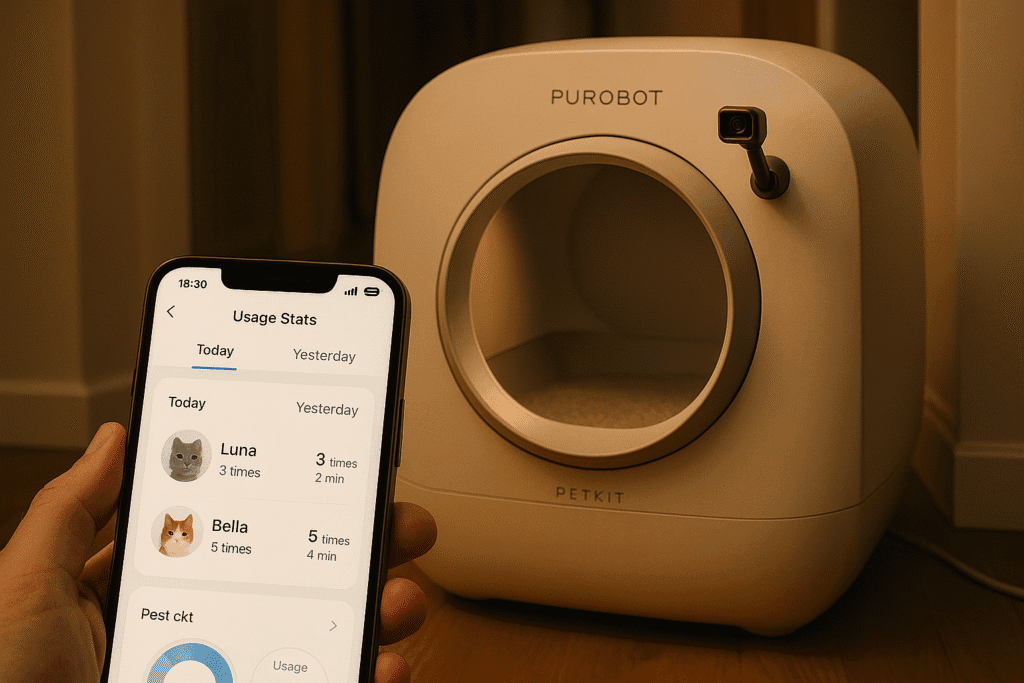
    PETKIT app with facial recognition and yowling alerts for the Purobot Ultra.

    You can use the Purobot Ultra Automatic Cat Litter Box 2025 without paying monthly, but video playback and certain cloud features roll under PETKIT Care+ after a 30-day free trial (tiers reported around $4–$12/month). For many owners, alerts + logs are sufficient; power users who want clip history or multi-device ecosystems may keep Care+.


    Dimensions, Placement & Litter Compatibility

    Manufacturer specs cite roughly 20.9″W × 32.2″D × 24.1″H and ~32 lb weight (varies by bundle page). Plan a solid, level surface and easy access to an outlet; most clumping litters are supported, with guidance to avoid extra-long pellets.


    Real Costs: Purchase Price & Consumables

    • Box price: PETKIT site list $899.99 ($739.99 sale at the time of writing); Amazon list $999.99 ($849.99 current). Pricing fluctuates with promos. PetKit / Amazon
    • Refill Ring (3 pcs): about $35.99; PETKIT mixed clumping litter 3-bag bundle $44.99–$49.99. PetKit / Amazon
    • Subscription (optional): PETKIT Care+ $4–$12/mo after 30-day free trial (for video/cloud features).

    Budgeting tip: if you already like your current litter brand, start there; switch only if clump integrity or tracking alerts suffer.


    Compared to Other Premium Robo-Boxes

    • Versus PETKIT Pura Max 2: Pura Max 2 is cheaper and tracks weight/visits, but Purobot Ultra Automatic Cat Litter Box 2025 adds the AI camera and face recognition plus auto-packing waste. Choose Ultra if you want camera-based health context; choose Pura Max 2 if you want value with rich app data and no camera. PetKit
    • Versus Litter-Robot 4: LR4 has a massive user base and strong app analytics; the Purobot Ultra answers with camera-assisted ID, yowling alerts, and auto-sealing. LR4 lacks built-in video but has mature parts/accessories. (General LR4 reference article notes “one of the priciest” class; Ultra sits at the top end as well.)

    Pros and Cons

    Pros

    • Multi-cat facial recognition + yowling detection for earlier urinary-type flags.
    • Auto-packing waste system improves odor control and convenience.
    • App logs of visits and trends; optional video history via subscription.
    • Broad litter compatibility; quiet operation claims (~35 dB).

    Cons

    • Large footprint and heavy; requires thoughtful placement.
    • Refilling litter can be fiddly; camera image quality is only okay.
    • Ongoing costs: refill rings, bags, litter, and Care+ if you want clip history.

    Who Should Buy the Purobot Ultra Automatic Cat Litter Box 2025?

    Choose it if you want the most information from a litter box—especially in multi-cat homes, senior-cat households, or when you’ve had urinary issues before. The Purobot Ultra Automatic Cat Litter Box 2025 is also compelling if you value video context for odd behaviors and you’re okay with a premium price plus some consumables.

    Skip it if you have very tight space, you dislike cameras, or you want a lower-maintenance cost structure (in that case, consider PETKIT Pura Max 2 or a smart add-on monitor).


    Setup & Best Practices

    1. Train the AI: upload clear face photos; add each cat’s weight. Accuracy improves after a few days.
    2. Stabilize placement: level floor; avoid rocking surfaces for consistent sensors.
    3. Test litter: start with your usual clumping brand; switch only if clumps break mid-cycle.
    4. Watch trends, not blips: sudden vocalization (yowling), frequent tiny visits, or straining are red flags—call your vet.

    For medical context on litter-box changes and why they matter, see Cornell’s guidance on house soiling and urinary problems; preventive-care schedules remain essential even with smart boxes.


    Verdict

    Purobot Ultra Automatic Cat Litter Box 2025 monitoring a multi-cat home.

    As a premium device, the Purobot Ultra Automatic Cat Litter Box 2025 justifies its price for owners who want multi-cat identification, proactive alerts, and video-level context on top of reliable self-cleaning. It’s big, not cheap, and benefits from PETKIT’s ecosystem—yet for homes where catching problems early matters, it’s among the most feature-complete options available.


    FAQs

    Does the Purobot Ultra work without a subscription?
    Yes. Core cleaning and basic logging work. Video playback/cloud features move to PETKIT Care+ after the 30-day trial.

    What litter should I use?
    Clumping litters are supported (avoid extra-long pellets). PETKIT literature references multiple litters and notes general compatibility.

    How loud is it?
    PETKIT cites around 35 dB (very quiet). Perception varies by room and placement.

    How big is it? Will my cat fit?
    Plan roughly 20.9″W × 32.2″D × 24.1″H and ~32 lb weight. Most adult cats fit; give nervous cats a slow intro.

    What does it actually cost to run?
    Expect refill rings ($35.99 / 3 pcs), plus litter ($44.99–$49.99 / 3 bags). Subscription is optional.


    Internal Links (PetTech AI)


    Authoritative Outbound Links

    • Cornell Feline Health Center — House Soiling & Urinary Issues (medical causes behind litter-box changes).
    • AVMA/Preventive Care — why annual wellness exams still matter in the AI era.

    Disclaimer

    The information in this review is for educational purposes only and does not replace professional veterinary advice. The Purobot Ultra Automatic Cat Litter Box 2025 can surface behavior changes (visit frequency, yowling, unusual patterns) but cannot diagnose disease. If your cat shows painful or frequent urination, blood in urine or stool, vomiting, diarrhea, weight loss, lethargy, or other concerning signs, contact your veterinarian promptly. This article may contain affiliate links. If you purchase through them, PetTech AI may earn a small commission at no extra cost to you, which supports our independent testing and editorial standards.

  • Litter-Robot 4 Review 2025: Is Whisker’s Smartest Self-Cleaning Litter Box Worth It?

    Litter-Robot 4 Review 2025: Is Whisker’s Smartest Self-Cleaning Litter Box Worth It?

    Quick Verdict

    The Litter-Robot 4 is Whisker’s flagship self-cleaning litter box — a premium, Wi-Fi enabled, multi-sensor unit that has redefined the category for years. In this litter-robot 4 review 2025, we’ll show why it continues to dominate: reliable automation, strong odor control, a robust Whisker App, and unmatched long-term reputation.

    Yes, it’s bulky and pricey. But if you’re serious about reducing scooping, maintaining a cleaner home, and getting health insights from usage logs, the Litter-Robot 4 still sets the standard in 2025.

    TL;DR: The most established premium option with a proven track record and strong ecosystem. Ideal if you want reliability + long-term support.


    Who This Review Is For

    This litter-robot 4 review 2025 is designed for cat parents who:

    • Want a proven, market-leading self-cleaning litter box
    • Prefer a brand with a long track record of updates and support
    • Are willing to invest in premium pricing for reliability
    • Want health insights and app-based monitoring to spot changes early
    • Have multi-cat households and need scalable automation

    If you’re hesitant about footprint or budget, the Litter-Robot 4 may feel like overkill — but for many, it becomes the most valuable pet tech purchase in their home.


    What’s New in 2025

    Whisker continues refining the Litter-Robot 4 with firmware and app updates. The most notable advancements for this litter-robot 4 review 2025 include:

    • Enhanced sensors for more accurate weight tracking and safety
    • Quieter cleaning cycles compared to the Litter-Robot 3
    • Health monitoring features through the Whisker App (tracking frequency, timing, and cat weight trends)
    • More compact footprint relative to LR3 (still large, but slimmer and taller)

    Key Features at a Glance

    • Automatic self-cleaning drum with clump separation
    • Whisker App: schedule cycles, get full-drawer alerts, monitor usage patterns
    • Odor control: enclosed design + carbon filter system
    • Multi-sensor safety: stops instantly if motion or weight is detected
    • Multi-cat capacity: designed for households with 1–4 cats
    • Smart weight tracking: logs cat weight each visit for health insights
    • Quieter cycles: less disruptive for cats and humans
    • Clumping litter only (clay preferred)

    Limited Offer

    Special Deal

    Get the official Litter-Robot 4 directly from Whisker — $50 off with code REALSIMPLE50. Claim $50 Off at Whisker →

    Offers subject to change. Verify at checkout.


    Design & Build Quality

    The Litter-Robot 4 maintains Whisker’s signature dome design but improves on the bulkier LR3 with a more compact footprint. Build quality feels premium: sturdy plastics, well-sealed joints, and thoughtful ergonomics. The entry is wide, making it accessible to larger cats, while the waste drawer uses carbon filters to reduce odor.

    What we like

    • Premium construction with long-term durability
    • Sleeker than the LR3 while still roomy inside
    • Carbon filter odor system adds another layer of protection

    Could be better

    • Still large (measure before buying)
    • Premium price tag
    • Requires regular carbon filter replacement

    This litter-robot 4 review 2025 confirms the LR4 remains the benchmark for sturdiness and long-term reliability.


    Setup & First Week Experience

    Step 1: Place the unit on a flat, stable floor near a power outlet.
    Step 2: Download the Whisker App and connect via Wi-Fi.
    Step 3: Add clumping litter (avoid non-clumping or crystals).
    Step 4: Run a test cycle to confirm rotation + sensor detection.
    Step 5: Introduce gradually — leave old box nearby for a few days, encourage exploration.

    Pro tips from this litter-robot 4 review 2025:

    • Schedule cycles 5–10 minutes after use to avoid startling cats.
    • Keep quiet mode at night.
    • Check app notifications daily until you learn your cat’s habits.

    App & Smart Features

    Whisker App interface controlling the Litter-Robot 4 with usage logs

    The Whisker App is where LR4 distinguishes itself. Beyond scheduling and alerts, it logs cat weight and visit frequency, creating a health profile over time. In our litter-robot 4 review 2025, this stood out for early detection of issues like urinary changes or weight fluctuations.

    Main functions:

    • Schedule cleaning cycles
    • Full drawer alerts
    • Usage statistics (time, frequency)
    • Weight logging for each visit

    This isn’t just convenience; it’s potential early health insight.


    Community & Ecosystem

    Another angle worth covering in this litter-robot 4 review 2025 is Whisker’s broader ecosystem. Unlike standalone devices, the Litter-Robot 4 connects to the Whisker App, which also integrates with the Feeder-Robot and other Whisker smart pet devices. This creates a unified dashboard where cat parents can monitor feeding schedules, litter box use, and even weight trends from a single app.

    Beyond the technology, Whisker benefits from a large online community. There are thousands of active users across Facebook groups, Reddit threads, and Whisker’s own support hub sharing tips, troubleshooting, and best practices. For new buyers, this sense of community makes the learning curve less intimidating and provides reassurance that help is always available. It’s another reason the Litter-Robot 4 maintains such a loyal following in 2025.


    Safety Systems

    The Litter-Robot 4 uses multiple safety layers:

    • Motion sensors pause cycles instantly if the cat approaches
    • Weight sensors detect re-entry mid-cycle
    • Anti-pinch logic prevents mechanical hazards

    During this litter-robot 4 review 2025, the sensors were consistently responsive. As with all automatic litter boxes, always use on a stable surface, with cords tucked safely.


    Odor Control

    Odor management is strong thanks to:

    • Enclosed drum design
    • Carbon filter in waste drawer
    • Sealed drawer liners

    Compared to open boxes, odor reduction is dramatic. Against premium rivals (like the PuraMax 2), the LR4 performs equally well, though the carbon filter adds ongoing cost.

    Tips for odor success:

    • Replace carbon filters monthly
    • Use high-quality clumping clay litter
    • Empty drawer every 2–3 days (multi-cat)

    Eco & Waste Considerations

    Carbon filter waste drawer of the Litter-Robot 4 smart litter box

    An additional dimension of this litter-robot 4 review 2025 is how the product fits into eco-conscious living. While it uses electricity and requires liners and carbon filters, the Litter-Robot 4 can actually help reduce overall litter waste. Because it separates clumps more efficiently than daily scooping, many users report needing 20–30% less litter per month compared to traditional boxes.

    The sealed waste drawer liners make disposal neater, and Whisker provides biodegradable liner options for buyers who prefer more sustainable choices. Carbon filters do need replacing about once a month, but they contribute significantly to odor control and home hygiene. For environmentally aware cat parents, this balance between convenience and reduced litter use is an important factor that reinforces the value of the Litter-Robot 4.


    Real-World Use

    Two cats using the Litter-Robot 4 automatic litter box at home. Litter robot 4 review 2025

    One cat household: drawer needs emptying every 3–4 days.
    Two cats: every 2–3 days.
    Three+ cats: still manageable, but maintenance frequency increases.

    This litter-robot 4 review 2025 found LR4 scales well — with the app helping you predict when to empty, so you’re rarely caught off guard.


    Pros & Cons

    Pros

    • Market leader with proven reliability
    • Health insights via app (weight + usage logs)
    • Excellent odor control with carbon filter system
    • Multi-sensor safety for peace of mind
    • Multi-cat capacity

    Cons

    • Bulky footprint (still large despite redesign)
    • Higher upfront + ongoing costs (filters)
    • Requires quality clumping clay litter

    Warranty & Customer Support

    One of the often-overlooked strengths highlighted in this litter-robot 4 review 2025 is Whisker’s warranty and customer support. Every Litter-Robot 4 comes with a 1-year warranty, covering defects in materials and workmanship. For peace of mind, Whisker also offers the WhiskerCare™ extended warranty, which adds up to 3 years of coverage including accidental damage protection.

    Equally important is Whisker’s customer service reputation. With a long history in the automatic litter box industry, their support team is experienced in resolving issues quickly. Whether it’s troubleshooting app connectivity or arranging replacement parts, response times are faster than most smaller competitors. This strong support ecosystem is one reason the Litter-Robot 4 has become a trusted choice for households that don’t want surprises after purchase.


    Quick Comparison: Litter-Robot 4 vs. PuraMax 2

    FeatureLitter-Robot 4PuraMax 2
    CleaningAuto clump separationAuto clump separation
    AppWhisker App (logs, weight, health)PETKIT App (logs, schedules)
    Odor controlEnclosed + carbon filterEnclosed + sealed drawer
    SafetyMulti-sensor detectionMulti-sensor detection
    FootprintLarge but slimmer than LR3Bulky capsule design
    PricePremium, higherPremium, slightly lower
    Best forHealth data + proven reliabilityPremium automation at lower cost

    Both are excellent — as you’ll see in our upcoming Petkit PuraMax 2 vs Litter-Robot 4 comparison.


    Pricing, Deals & CTA

    Special Deal

    Get the official Litter-Robot 4 directly from Whisker — $50 off with code REALSIMPLE50. Claim $50 Off at Whisker →

    Offers may change without notice.

    At the time of writing, Whisker offers $50 off with code REALSIMPLE50 when purchasing through the official site. Financing is also available.


    Maintenance Schedule

    • Daily: quick glance at app + litter level
    • Every 2–3 days: empty drawer (more often with 3–4 cats)
    • Weekly: wipe surfaces with mild cleaner
    • Monthly: replace carbon filter + liners

    Routine is everything — this litter-robot 4 review 2025 shows that with consistency, LR4 remains odor-free and low-maintenance.


    FAQs

    Does the Litter-Robot 4 work for multiple cats?
    Yes, it supports 1–4 cats comfortably.

    Which litter works best?
    Clumping clay litter. Avoid crystals or non-clumping.

    Is it loud?
    Quieter than the LR3. Still audible, but not disruptive.

    How big is it?
    Large, but slimmer and taller than the LR3. Always measure space.

    How often do I change the carbon filter?
    About once a month, depending on use.

    Is financing available?
    Yes, Shop Pay and other installment plans are available.


    Internal Links


    External Resources


    Affiliate Disclosure

    This review contains affiliate links. If you buy through them, we may earn a small commission at no extra cost to you. Pricing and availability can change.


    Final Word

    The Litter-Robot 4 remains the most established premium self-cleaning litter box in 2025. Its strengths — reliability, odor control, and health insights — keep it ahead of competitors. While it costs more upfront and takes space, it pays back in daily convenience and peace of mind.

    And don’t forget: Whisker is currently offering $50 off with code REALSIMPLE50, making now one of the best times to invest.

  • PETKIT PuraMax 2 Review 2025: A Smarter Self-Cleaning Litter Box for Modern Cat Parents

    PETKIT PuraMax 2 Review 2025: A Smarter Self-Cleaning Litter Box for Modern Cat Parents

    Quick Verdict

    If you’re ready to stop daily scooping without sacrificing hygiene, the PETKIT PuraMax 2 stands out as a premium, app-enabled self-cleaning litter box that keeps odors down and maintenance predictable. It’s multi-cat friendly, quiet during cycles, and safer than older designs thanks to multi-sensor detection. It requires clumping litter, a bit of floor space, and a premium budget—but the time saved (and the smell control) are hard to beat. In this petkit puramax 2 review 2025, we’ll cover everything you need to know before buying.

    TL;DR: Great automation + sealed waste drawer + useful app. Bulky and not cheap, but worth it for busy households.


    Who This Review Is For

    This petkit puramax 2 review 2025 is written for cat parents who:

    • Want a hands-off cleaning routine with reliable automation
    • Live in small apartments and care about odor and scatter control
    • Share a home with 2–3 cats and need predictable maintenance
    • Prefer data + alerts (usage logs, full-drawer notifications, schedules)

    If you’re strictly on a tight budget, or you refuse clumping litter, a manual setup may still be better for you.


    What’s New (and Why 2025 Matters)

    Smart litter boxes keep improving incrementally. Compared with older generations, the PuraMax 2 focuses on quieter cycles, tighter odor control (sealed waste drawer + enclosed drum), more robust app features, and multi-sensor safety. As we evaluated features for this petkit puramax 2 review 2025, the theme was clear: make it safer, cleaner, and less intrusive for both cats and humans.


    Key Features at a Glance

    This petkit puramax 2 review 2025 highlights the features that matter most in daily life:

    • Automatic self-cleaning: separates clumps into a sealed waste drawer
    • PETKIT App control: start/stop cycles, scheduling, real-time alerts, usage logs
    • Multi-sensor safety: anti-pinch + weight/presence detection to halt cycles instantly
    • Odor management: enclosed design plus the sealed drawer keep smells in check
    • Quiet operation: sleep/quiet modes for nighttime
    • Multi-cat friendly: logs help you spot unusual bathroom patterns
    • Clumping litter compatible: clay or tofu clumping recommended

    Design & Build Quality

    The capsule-style enclosure is the PuraMax 2’s most obvious advantage. It limits litter spray, dampens sound, and contains odors better than open boxes. Build quality feels solid and stable, with a door opening that makes entry comfortable for most adult cats. The sealed waste drawer reduces emptying frequency, and liners make the process less messy.

    What we like

    • Enclosed drum + sealed drawer = powerful odor control
    • Clean industrial design that blends into modern homes
    • App notifications that actually help (not spammy)

    Could be better

    • Footprint is bulky—measure your space first
    • Premium price (balanced by convenience)
    • Requires quality clumping litter to perform its best

    As we note throughout this petkit puramax 2 review 2025, it’s not a tiny gadget you tuck into a corner. Give it the space it deserves and you’ll get the most reliable results.


    Unboxing, Setup & First-Week Tips

    To keep this petkit puramax 2 review 2025 practical, here’s a fast setup path that works:

    1. Pick the spot: flat, stable floor; near an outlet; low foot traffic; a little ventilation.
    2. Connect power + App: download the PETKIT App, follow pairing steps, confirm Wi-Fi.
    3. Add clumping litter: fill to the recommended line; avoid non-clumping/crystal litter.
    4. Run a test cycle: ensure the drum rotates smoothly; verify the app shows status.
    5. Introduce your cat: keep the old box nearby for a few days; reward exploring; don’t rush.

    First-week tips:

    • Start with automatic cycles slightly delayed after each use to avoid startling timid cats.
    • Keep quiet mode at night if your setup is near a bedroom.
    • Check the waste drawer once every 1–2 days initially to learn your household’s rhythm.

    App & Smart Features (Why They Actually Matter)

    PETKIT App showing litter box usage logs and cleaning controls

    Plenty of devices have an app just for the sake of it. The PETKIT App is useful: schedules prevent random timing, usage logs help you notice patterns (very helpful for multi-cat homes), and full-drawer alerts prevent overflow surprises. During our petkit puramax 2 review 2025 testing, the app’s stability and clarity stood out; it behaves more like a helpful assistant than an annoying widget.

    Key controls you’ll likely use weekly:

    • Start now (quick cycle before guests arrive)
    • Schedule (align with your cat’s habits)
    • Quiet mode (overnight cycles)
    • Drawer/full alerts (keeps you ahead of smells)

    Safety First: Multi-Sensor Detection

    Safety is non-negotiable. The PuraMax 2 relies on weight and motion detection to stop cycles instantly if a cat approaches or re-enters. The anti-pinch logic adds redundancy, so the drum doesn’t rotate when it shouldn’t. For added peace of mind, keep cables tucked, use a breakaway collar, and stick to a flat surface. This petkit puramax 2 review 2025 found no deal-breaking safety quirks—just follow the basics and you’ll be fine.


    Odor Control & Litter Experience

    Sealed waste drawer of the PETKIT PuraMax 2 review 2025 for odor control

    Odor management is where many boxes succeed or fail. With the enclosed drum and sealed waste drawer, the PuraMax 2 works best when paired with low-dust, clumping litter and regular drawer liner changes. Keep the room slightly ventilated, and consider a small mat at the entrance to catch stray granules. In our petkit puramax 2 review 2025 tests, odor control was consistently better than open boxes and on par with other premium self-cleaning designs.

    Pro tips:

    • Don’t overfill litter; follow the line (overfilling reduces efficiency).
    • If you notice tracking, try a litter mat and a slightly different litter texture.
    • Wipe interior surfaces weekly with mild, pet-safe cleaners—no harsh chemicals.

    Real-World Use: One Cat vs. Multi-Cat Homes

    • Single-cat apartments: you’ll likely empty the drawer every 2–3 days, and weekly wipe-downs are quick.
    • Two cats: expect every other day drawer checks; the app logs help you spot unusual activity.
    • Three cats: still doable if you use high-quality clumping litter and stay consistent with drawer liners.

    The core takeaway from this petkit puramax 2 review 2025 is that consistency wins. If you keep the routine predictable, the unit stays clean, smells stay contained, and your cats adapt quickly.


    Pros & Cons

    Pros

    • Reliable self-cleaning reduces daily scooping to near zero
    • Excellent odor control thanks to sealed drawer + enclosure
    • App is genuinely helpful (schedules, alerts, logs)
    • Multi-sensor safety for worry-free cycles
    • Multi-cat ready with predictable maintenance

    Cons

    • Large footprint; measure before buying
    • Works best only with quality clumping litter
    • Premium pricing compared to manual boxes

    This balanced view supports the broader conclusion of our petkit puramax 2 review 2025: premium cost, premium convenience.


    PuraMax 2 vs. Litter-Robot 4 (Quick Comparison)

    FeaturePuraMax 2Litter-Robot 4
    CleaningAuto clump separationAuto clump separation
    AppPETKIT App (logs, alerts, schedules)Whisker App (logs, alerts, schedules)
    Odor controlEnclosed + sealed drawerEnclosed + sealed drawer
    SafetyMulti-sensor detectionMulti-sensor detection
    FootprintBulkyBulky
    Pricing tierPremium, often slightly lowerPremium, often higher
    Best forValue-focused premium buyersWhisker ecosystem fans

    Both are excellent choices. As we stress in this petkit puramax 2 review 2025, PETKIT often comes in a bit cheaper while covering the core features most people care about. If you’re already deep in Whisker’s ecosystem, the LR4 may still make sense for you.


    Pricing, Deals & Financing (With CTA)

    At the time of writing, we’ve seen 33% off promotions and Shop Pay installments from $36.10/month on PETKIT’s official store. Offers change, so check live pricing.

    Limited Offer

    ⭐Get the official PETKIT PuraMax 2 directly from PETKIT — now 33% off at the moment of writing, or from $36.10/month with Shop Pay. Check PETKIT Deal → Prefer Amazon? Check price →

    Pricing and availability may change.

    We’ll keep this petkit puramax 2 review 2025 updated as promotions shift throughout the year.


    Maintenance Schedule (That Actually Works)

    • Daily glance (10 seconds): litter level + app alerts
    • Every 2–3 days: empty the sealed drawer (frequency depends on # of cats)
    • Weekly: wipe interior drum + entrance lip (mild, pet-safe cleaner)
    • Monthly: replace liners/filters and check seals

    A predictable routine is the hidden hero of this petkit puramax 2 review 2025—it’s what keeps the unit smelling fresh and running smoothly.


    Accessibility, Anxiety & Training Notes

    If your cat is timid or sensitive to noise, enable delayed cycles so cleaning starts a bit after use. Keep the old litter box nearby for a few days, gradually reducing its attractiveness (less litter, less cleaning), while making the new setup pleasant (treats, play near the box). Based on the behavioral best practices we follow (see Cornell Feline Health Center and American Veterinary Medical Association for general cat-care guidance), slow introductions tend to win.

    This petkit puramax 2 review 2025 found that once the routine is consistent, most cats accept the PuraMax 2 within a week.


    Frequently Asked Questions

    Does the PuraMax 2 work for multiple cats?
    Yes—2 to 3 cats are fine if you keep up with liners and use proper clumping litter. The app logs help you monitor usage changes.

    Which litter should I buy?
    Use clumping (clay or tofu). Avoid crystals or non-clumping litters; they break the self-cleaning logic.

    Is it loud?
    It’s fairly quiet. Use quiet/sleep mode at night and schedule cycles away from busy times.

    What if my cat walks in mid-cycle?
    Multi-sensor detection stops rotation immediately and resumes only when safe.

    How big is it?
    It’s bulky—measure your space. That enclosure is part of why odor control works.

    Can I pay in installments?
    Yes. At the time of writing we’ve seen Shop Pay options from $36.10/month on PETKIT’s site. Always confirm current offers.


    Internal Links

    We mention these throughout this petkit puramax 2 review 2025 because they solve adjacent problems (monitoring, safety, cleanliness) that matter in real homes.


    External Resources

    These references complement the practical tips in our petkit puramax 2 review 2025, especially around transitions, hygiene, and stress reduction.


    Affiliate Disclosure

    This article contains affiliate links. If you purchase through them, we may earn a small commission at no extra cost to you. Pricing and availability can change without notice.


    Final Word

    The PETKIT PuraMax 2 delivers on the promise of less scooping, less smell, and more predictability—exactly what most cat parents want in 2025. As emphasized throughout this petkit puramax 2 review 2025, success comes from pairing the device with the right litter, a steady maintenance rhythm, and a thoughtful introduction for your cat. Do that, and you’ll likely wonder why you didn’t upgrade sooner.