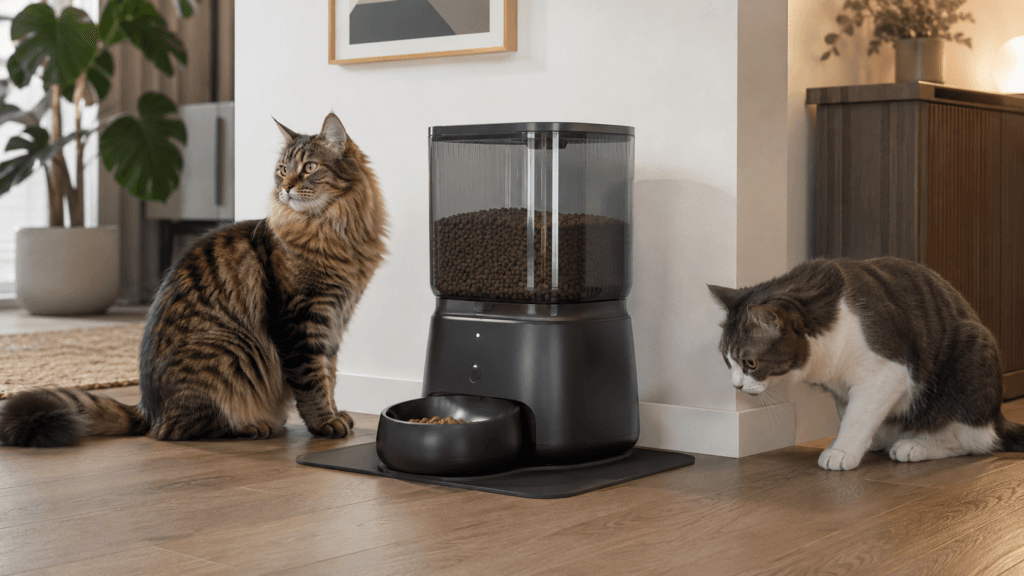
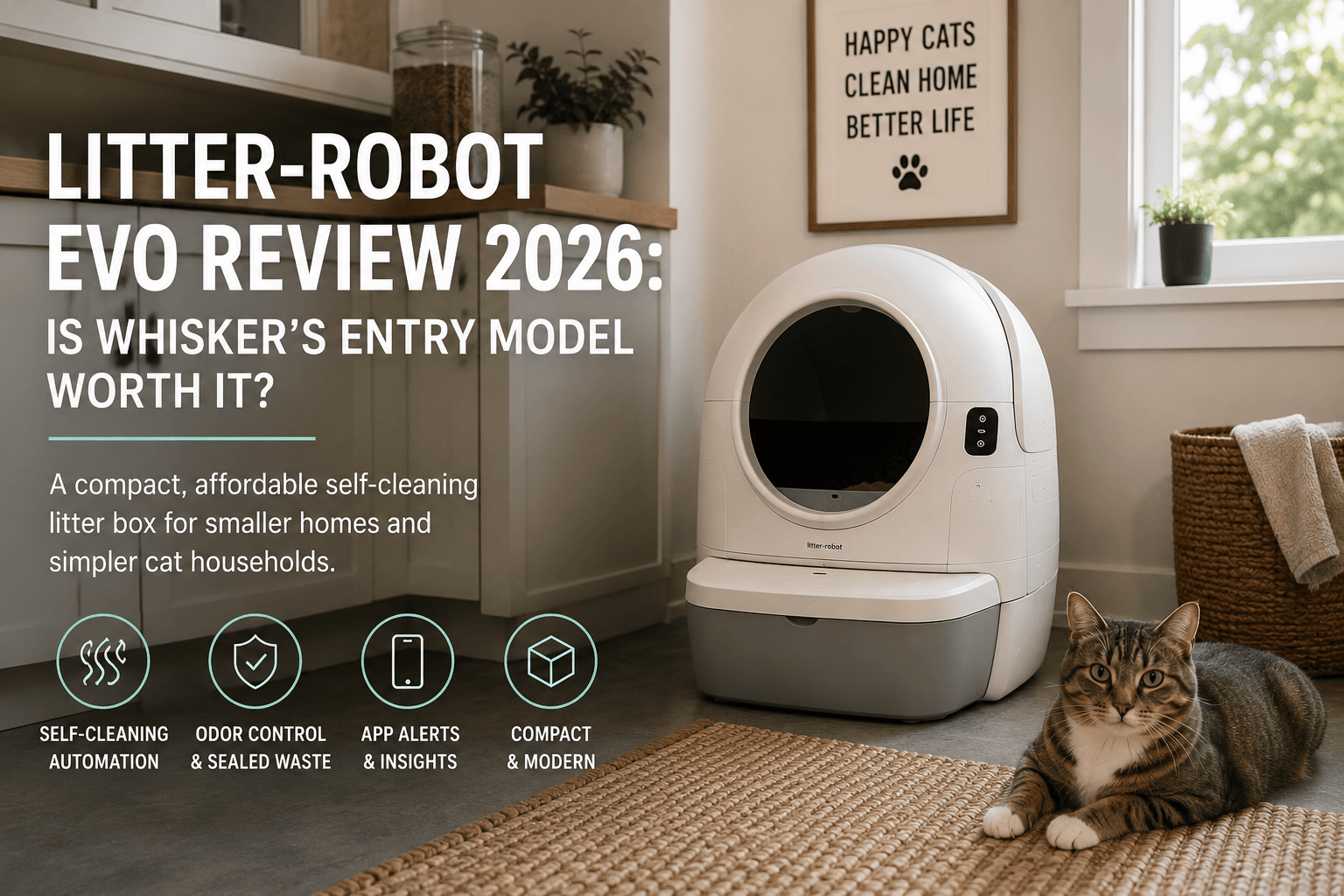
Tag: Whisker app

  • Litter-Robot EVO Review: Smart Restraint or Expensive Compromise?

    Litter-Robot EVO Review: Smart Restraint or Expensive Compromise?

    Litter-Robot EVO is Whisker’s entry model.

    Your bank account may use a less charitable definition of “entry.”

    EVO supports fewer cats than Litter-Robot 5, has a smaller interior and skips WasteID, detailed litter-level sensing and camera-based identification.

    That does not make it the weak Litter-Robot.

    It makes it the focused one.

    For one appropriately sized cat—or two smaller cats with a predictable routine—EVO can deliver the central benefit most buyers actually want:

    Less scooping without paying for capacity and monitoring they may never use.

    The danger is buying EVO because it costs less while already suspecting that its physical or monitoring limits will become annoying.

    That is not saving money.

    It is financing the first stage of a future upgrade.

    Quick Verdict

    CategoryVerdict
    PetTech AI verdictRecommended with Conditions
    Best fitOne cat or two smaller cats in a space-conscious home
    Main advantageCompact Whisker automation without paying for the full LR5 platform
    Cat weight range3–19 lb in automatic mode
    Official household fitUp to two cats
    Main limitationSmaller interior, medium drawer and no WasteID
    Skip it whenCat size, multi-cat traffic or deeper monitoring already matters
    Best reason to buyEVO solves the whole problem—not merely the cheapest part of it

    Choose EVO when:

    • one or two cats fit comfortably;
    • space genuinely limits the purchase;
    • automatic cleaning is the main objective;
    • weight and basic visit tracking are enough;
    • the lower tier removes nothing important.

    Skip EVO when:

    • your cat is large or long-bodied;
    • more than two cats will share the unit;
    • similar-weight cats create identification problems;
    • WasteID or litter-level sensing matters;
    • Litter-Robot 5 already feels like the machine you actually want.

    Research Note

    This is a research-led review based on current official specifications, app documentation, product positioning and available ownership evidence.

    PetTech AI has not conducted a long-term hands-on test of Litter-Robot EVO.

    PetTech AI may earn a commission from qualifying purchases. As an Amazon Associate I earn from qualifying purchases.

    Prefer Amazon’s purchase route? Check Litter-Robot EVO availability and customer feedback on Amazon.

    What Are You Actually Buying?

    EVO automatically rotates after the cat exits, separates clumped waste from clean litter and deposits it into a sealed, carbon-filtered drawer.

    Through the Whisker app, owners can monitor device status, receive maintenance alerts, start cycles remotely and review weight and activity information.

    Its official specifications include:

    • support for cats weighing 3–19 lb;
    • suitability for up to two cats;
    • a 20.6-by-24.3-inch footprint;
    • 27.6-inch exterior height;
    • 14.85-inch entrance width;
    • SmartScale weight identification;
    • standard seven-day activity history;
    • notification when the waste drawer is full.

    That is enough technology to reduce daily litter work without turning the bathroom into a domestic intelligence agency.

    EVO still requires compatible litter, drawer liners, filter maintenance, periodic washing and a human willing to empty the drawer.

    “Self-cleaning” means the machine handles most scooping.

    It does not mean Whisker has accepted full legal responsibility for the bathroom.

    When EVO Is the Smart Purchase

    EVO works when its missing features are genuinely unnecessary.

    A one-cat home may not need support for five cats.

    A smaller room may benefit more from a reduced footprint than from Litter-Robot 5’s additional capacity.

    An owner who mainly wants to know whether the box is operating and whether the cat is using it may not need WasteID, long-term behavioral histories or cameras recording every visit from two angles.

    EVO is therefore strongest for:

    • one average-sized cat;
    • two smaller cats with manageable litter traffic;
    • apartments and compact utility rooms;
    • first-time automatic-litter-box buyers;
    • owners prioritizing labor reduction over detailed monitoring.

    This is sensible restraint when the household already fits.

    It becomes technological poverty only when the buyer pretends obvious limitations will somehow develop new features after delivery.

    Cat Size Matters More Than the Published Weight Limit

    Whisker supports cats between 3 and 19 lb in automatic mode, but body shape matters as much as weight.

    EVO has approximately 14.5 inches of interior headroom, compared with 17.5 inches on Litter-Robot 5. Its entrance is also narrower, although its 5.6-inch step is lower than the step on the larger models.

    A tall, broad or long-bodied cat may feel restricted before reaching 19 lb.

    The product page can confirm whether Archibald falls inside the published range.

    It cannot persuade him that the accommodation is spacious.

    Choose Litter-Robot 5 instead when:

    • the cat already looks large relative to enclosed boxes;
    • extra interior room reduces acceptance risk;
    • future weight gain could push the cat near EVO’s ceiling;
    • you would spend the first month wondering whether the cat appears cramped.

    For a rejected product, the lower purchase tier provides extremely poor value.

    Two Cats Can Work—But “Up to Two” Is Not a Magic Spell

    Whisker positions EVO for as many as two cats.

    That does not mean every two-cat household will experience the same ownership routine.

    Two cats create:

    • more frequent cycles;
    • faster drawer filling;
    • greater pressure on one shared resource;
    • more weight-identification ambiguity;
    • more opportunities for one cat to discourage the other.

    EVO works best when both cats:

    • fit comfortably;
    • have distinguishable weights;
    • already share litter resources without tension;
    • do not overwhelm the medium drawer;
    • have access to another box when needed.

    Whisker estimates that one-cat households may empty EVO’s drawer about once every seven days. Actual frequency will vary with cat size, litter and individual use. Litter-Robot 5 has a larger drawer and is positioned for up to five cats.

    An automatic box reduces scooping.

    It does not repeal the social politics of a multi-cat household.

    Monitoring: Enough for Routine, Not Enough for Forensics
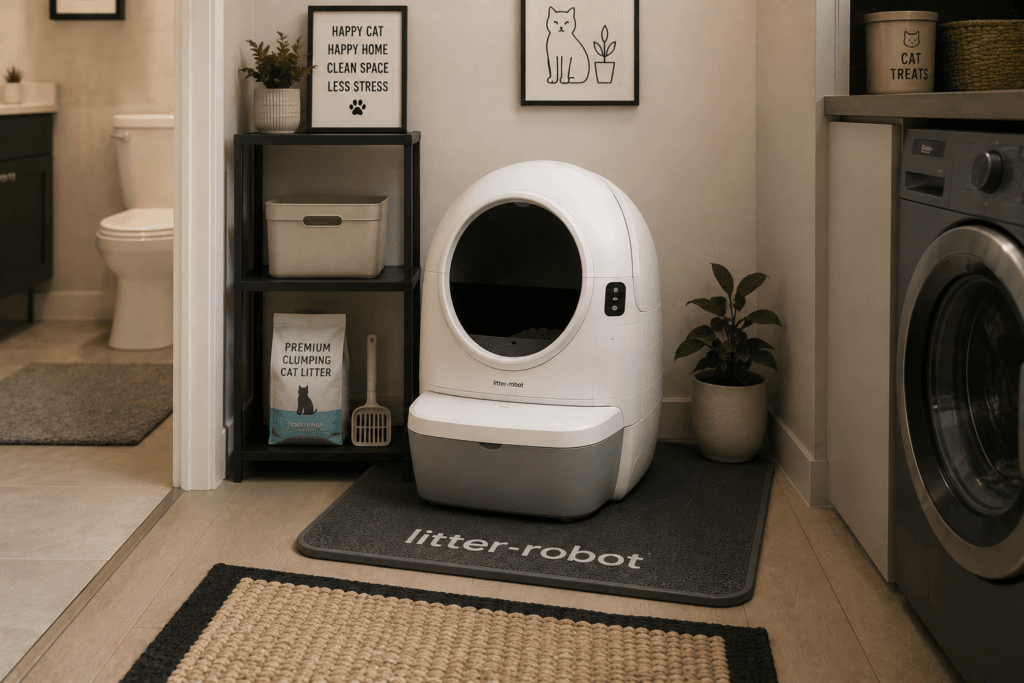
    A compact apartment litter area with a Litter-Robot EVO style automatic litter box placed neatly in a small room
    EVO makes the most sense when space matters and the household does not need the most advanced monitoring package.

    EVO includes SmartScale weight identification and a standard seven-day activity history.

    That can help answer basic questions:

    • Is the cat using the box?
    • Has the recorded weight changed?
    • Did the normal routine shift?
    • Is the drawer full?

    What EVO does not provide is WasteID, which distinguishes urine from solid waste on Litter-Robot 5 and 5 Pro.

    Its drawer sensing is also simpler: EVO notifies when the drawer is full, while the more advanced models monitor changing waste levels.

    SmartScale identification can also become less reliable when two cats have similar weights or produce incomplete measurements.

    EVO therefore offers useful routine visibility.

    It is not the right model for owners who already know they need more detailed individual interpretation.

    For the broader distinction between removing work and collecting behavioral evidence, read our Smart Cat Monitoring vs Automation guide.

    Does EVO Need Whisker+?

    No.

    Automatic cleaning, standard app controls, SmartScale information and the basic recent history remain available without membership.

    Whisker+ adds:

    • daily activity summaries;
    • historical visit frequency and duration;
    • access to as much as two years of activity history;
    • enhanced reporting across compatible Whisker devices.

    The subscription currently costs $7.99 monthly or $79.90 annually after the trial, although service terms can change.

    The correct question is not whether longer histories sound responsible.

    It is:

    Will reviewing them change anything you do?

    If persistent patterns would guide environmental changes or an appropriate veterinary conversation, the history can be useful.

    If the subscription mainly preserves two years of Napoleon conducting routine business, the free layer will probably survive the loss.

    Odor Control and Daily Ownership
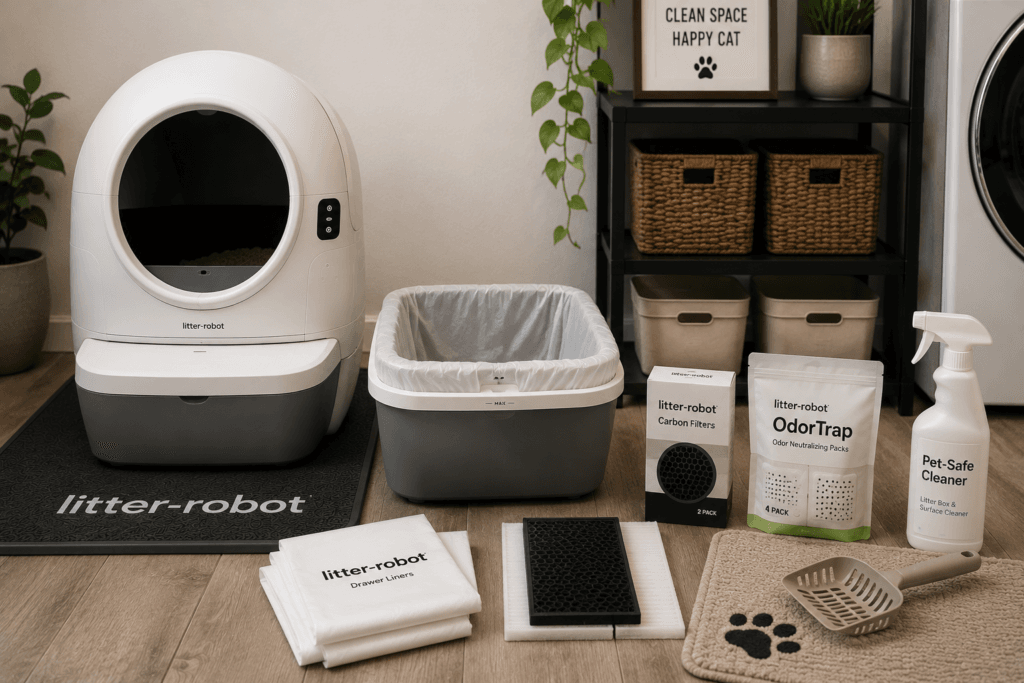
    A clean litter box maintenance area with drawer liners, carbon filters, litter mat and cleaning supplies arranged neatly
    EVO reduces daily scooping, but odor control still depends on liners, filters, litter quality, drawer emptying and regular cleaning.

    EVO removes waste from the exposed litter bed and stores it in a sealed drawer with a carbon filter.

    That can reduce odor compared with a manual box that is not scooped promptly.

    It cannot overpower:

    • a full drawer;
    • poor clumping litter;
    • residue inside the globe;
    • neglected liners;
    • exhausted filters;
    • weak room ventilation.

    Whisker recommends replacing carbon filters and optional OdorTrap packs approximately every two to four weeks for stronger odor absorption, although real frequency depends on household use.

    The carbon filter supports the maintenance routine.

    It does not absolve the household from participating in it.

    EVO changes frequent scooping into more structured work:

    • empty the drawer;
    • inspect the liner;
    • add litter;
    • wipe contact areas;
    • deep-clean the removable components periodically.

    For many owners, that is a worthwhile improvement.

    It is still ownership—not emancipation.

    EVO vs Litter-Robot 5
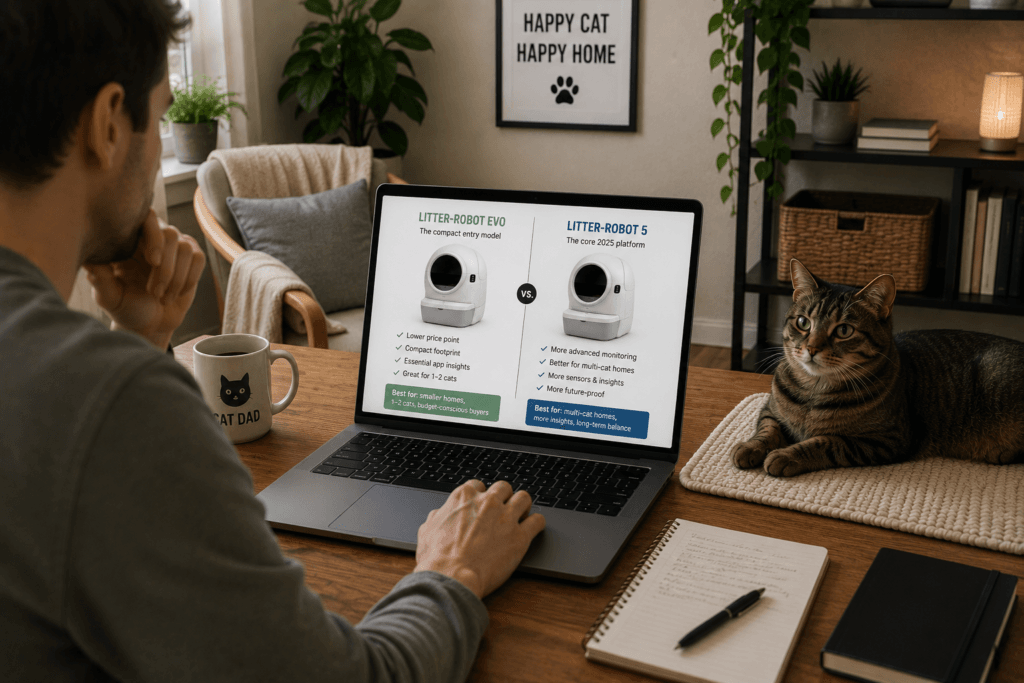
    A cat owner comparing Litter-Robot EVO and Litter-Robot 5 options on a laptop while a cat sits nearby
    EVO is the simpler entry model; Litter-Robot 5 is the stronger long-term balance if you want more monitoring and future-proofing.

    This is the comparison that should decide the purchase.

    PriorityEVOLitter-Robot 5
    Smaller footprintBetterLarger
    Cat capacityUp to 2Up to 5
    Cat weight3–19 lb3–30 lb
    Interior headroom14.5 in17.5 in
    Waste drawerMediumExtra large
    WasteIDNoYes
    Litter-level sensingNoYes
    Standard activity history7 days7 days
    Whisker+ compatibleYesYes

    Choose EVO when the smaller platform completely solves the household problem.

    Choose Litter-Robot 5 when:

    • the cat is larger;
    • more than two cats will use it;
    • the larger drawer matters;
    • WasteID adds useful context;
    • litter-level sensing reduces maintenance uncertainty;
    • future flexibility has a credible use—not an imaginary one.

    Litter-Robot 5 is the more capable machine.

    EVO can still be the more intelligent purchase.

    Buying unused capacity is not future-proofing merely because a product page used an arrow pointing upward.

    For the complete lineup decision, read our Litter-Robot 5 vs 5 Pro vs EVO comparison.

    Still comparing the wider market rather than only Whisker models? Read our Best Smart Litter Boxes guide for alternatives organized by cat size, household load and monitoring needs.

    Considering a lower-cost PETKIT platform against Whisker’s established hardware? Read our PETKIT PuraMax 2 vs Litter-Robot 4 comparison.

    Buyer-Regret Risk

    EVO regret has one dominant cause:

    Buying the lower tier while already knowing the household needs the higher one.

    Warning signs include:

    • the cat is close to the weight ceiling;
    • the entrance already looks restrictive;
    • the home has two heavy users;
    • you care about waste type;
    • similar weights make identification important;
    • Litter-Robot 5 keeps returning to the shortlist.

    EVO is not a bargain when every decision point ends with:

    “It should probably be fine.”

    “Probably fine” is how Emperor Maximilian acquires a very expensive object he refuses to enter.

    Final Verdict

    Litter-Robot EVO earns a Recommended with Conditions verdict.

    It is a strong fit for one cat—or two smaller, compatible cats—when space matters and automatic cleaning is the main objective.

    Its lower tier is justified because it removes capacity and monitoring features that many simpler households do not need.

    Its limitations are also real:

    • 19-lb automatic-mode ceiling;
    • smaller interior;
    • medium drawer;
    • maximum two-cat positioning;
    • no WasteID;
    • simpler waste monitoring.

    Choose EVO when those limits already fit comfortably.

    Skip it when they look like compromises before checkout.

    The smartest purchase is not automatically the most advanced Litter-Robot.

    It is the least expensive model that solves the entire problem without quietly creating the next one.

    Frequently Asked Questions

    Is Litter-Robot EVO worth it?

    Yes, for one or two appropriately sized cats when compact placement and automatic cleaning matter more than WasteID, larger capacity or cameras.

    How many cats can use Litter-Robot EVO?

    Whisker positions EVO for up to two cats. Two-cat households should expect more frequent drawer emptying and should still provide enough litter resources.

    What cat weights does EVO support?

    Automatic mode supports cats weighing between 3 and 19 lb. Long or large-bodied cats may still prefer the larger interior of Litter-Robot 5.

    Does EVO require Whisker+?

    No. Core operation, standard app controls, alerts and recent activity information remain available without membership.

    Does EVO have WasteID?

    No. WasteID is available on Litter-Robot 5 and 5 Pro.

    References

    • Whisker — Litter-Robot EVO product documentation
    • Whisker — Current Litter-Robot comparison chart
    • Whisker — Whisker app documentation
    • Whisker — Whisker+ membership information

    Image Disclosure

    Any AI-generated images are editorial illustrations only. They do not represent exact dimensions, entrance size, internal space or app performance. Always verify current specifications before purchasing.

    Editorial Disclosure

    PetTech AI may earn a commission from qualifying purchases. This does not influence our recommendations, comparisons or editorial judgments.
  • Best Pet Tech Apps for Cats (2026): Useful Control or Notification Hell?

    Best Pet Tech Apps for Cats (2026): Useful Control or Notification Hell?

    Smart-pet apps promise one calm dashboard for feeding, litter care, cameras and safety.

    In practice, many homes end up with five accounts, three subscriptions and fourteen notifications confirming that Gerald has approached a bowl.

    The best pet tech app is not the one with the most graphs. It is the one that makes compatible hardware easier to control, presents useful information clearly and tells you something you can actually act on.

    This guide compares six major cat-focused platforms by software experience—not by how aggressively each brand has inserted the word “AI” into its marketing.

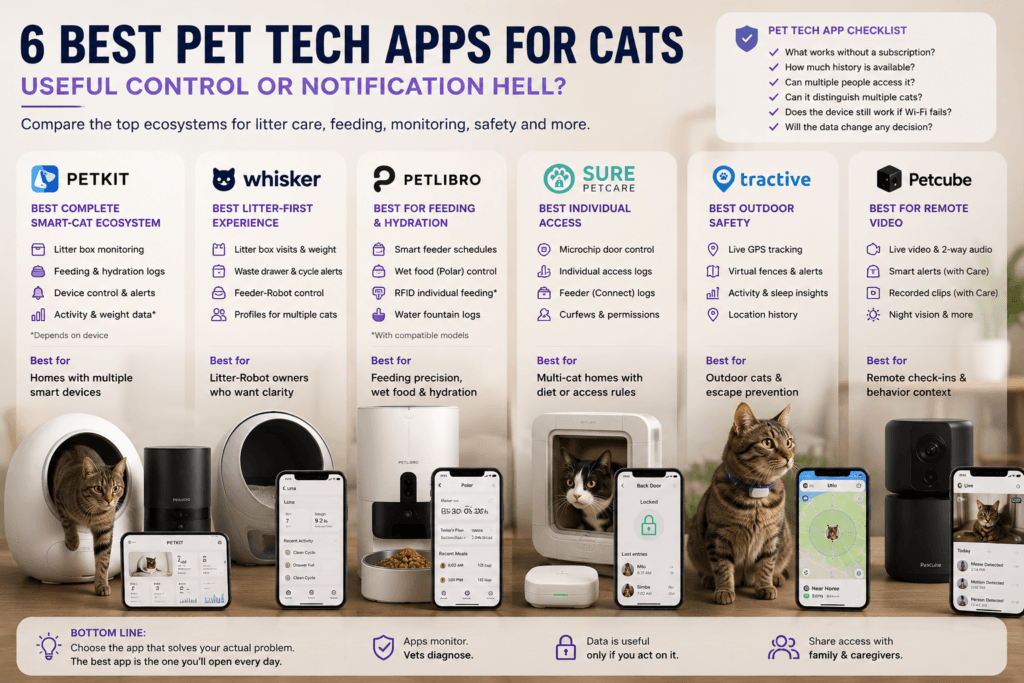
    Quick Verdict

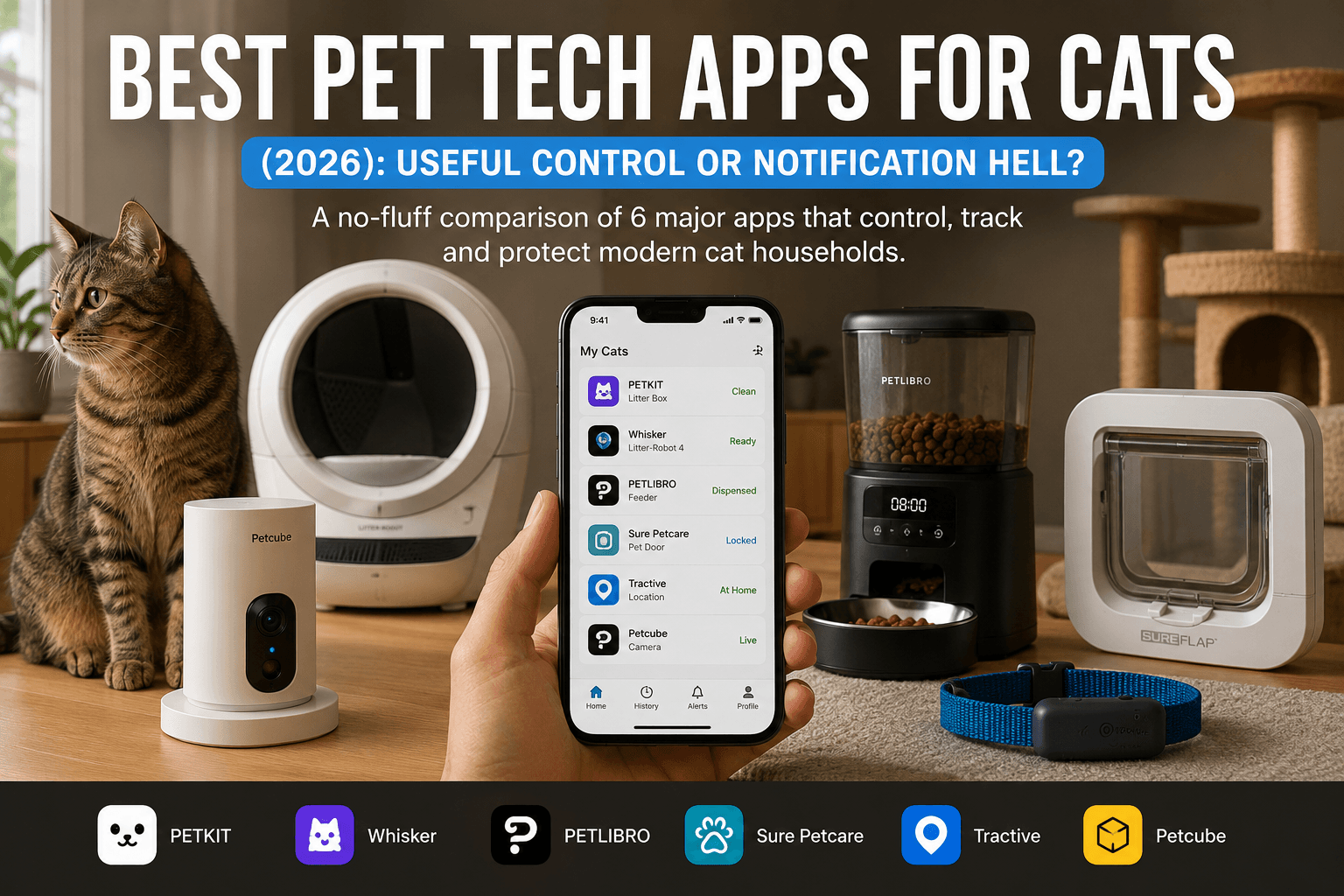
    Comparison of PETKIT, Whisker, PETLIBRO, Sure Petcare, Tractive and Petcube app ecosystems
    The leading pet tech apps solve different problems—from litter automation and feeding to access control, GPS tracking and remote video. AI-generated editorial comparison; verify current app features and compatibility.
    AppBest forPetTech AI verdictMain limitation
    PETKITBroadest smart-cat ecosystemRecommendedStrong ecosystem lock-in
    WhiskerAutomatic litter care and feedingRecommendedNarrower device range
    PETLIBROFeeding and hydrationRecommended with ConditionsCompatibility varies by model and app
    Sure PetcareIndividual access in multi-cat homesRecommended with ConditionsRequires compatible Connect hardware and usually a Hub
    TractiveOutdoor GPS and activity trackingStrong Recommendation with ConditionsMandatory subscription and collar dependence
    PetcubeRemote video monitoringConditional RecommendationSmart alerts and useful history depend heavily on Petcube Care

    Best overall: PETKIT offers the widest cat-specific hardware ecosystem inside one app.

    Best focused experience: Whisker is easier to understand because it concentrates on litter care and scheduled feeding.

    Best app for outdoor cats: Tractive, provided your cat accepts the collar and the recurring subscription makes sense.

    Research Note

    This is a research-led comparison based on current official app listings, manufacturer documentation and PetTech AI’s individual product audits.

    PetTech AI has not conducted identical long-term hands-on testing across every app, device and subscription tier.

    Features can vary by hardware generation, operating system, country and paid membership. Always verify that the exact product you are buying works with the app and functions discussed here.

    PetTech AI may earn a commission from qualifying purchases. As an Amazon Associate I earn from qualifying purchases.

    What Makes a Pet Tech App Actually Useful?

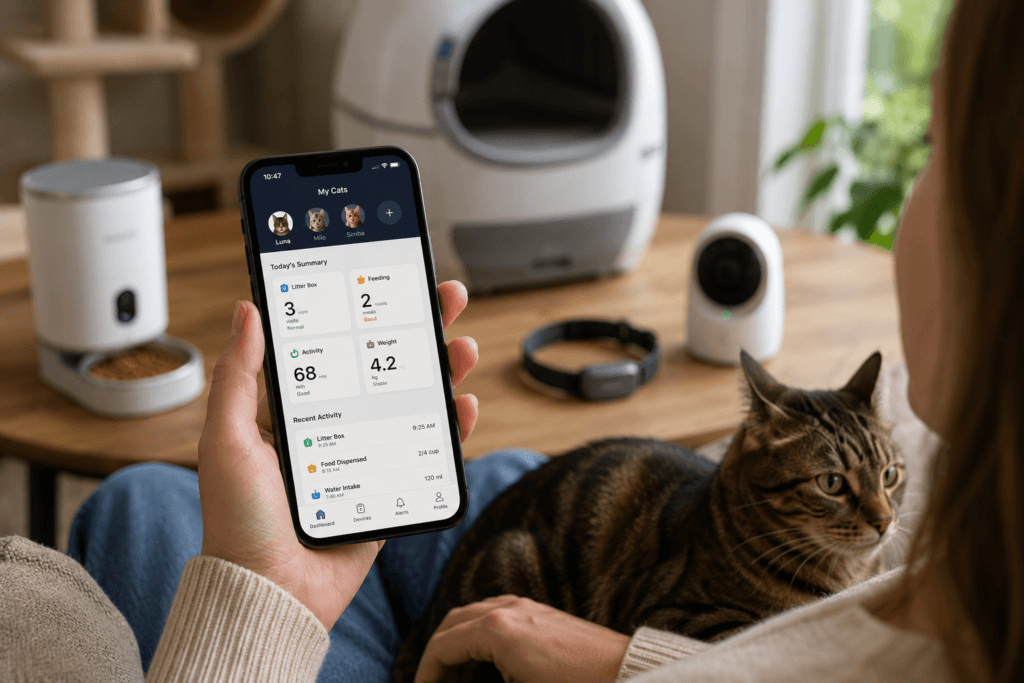
    Cat owner reviewing feeding, litter, activity and weight records on a smartphone while holding a cat
    App records become useful only when owners review meaningful trends and combine them with direct observation—not when notifications simply accumulate. AI-generated editorial illustration.

    A pet app earns its place when it performs at least one of four jobs well:

    • controls a device reliably;
    • presents trends more clearly than raw event logs;
    • sends alerts that deserve attention;
    • reduces routine work without creating a second administrative job.

    It should also make clear what happened.

    “Device event detected” is technically a notification. It is not necessarily information.

    Before choosing an ecosystem, ask:

    1. Which features work without a subscription?
    2. How much history remains available?
    3. Can several people access the household?
    4. Can the app distinguish individual cats?
    5. Does the device continue its core job if Wi-Fi fails?
    6. Will the collected data change any decision?

    No app should diagnose a medical condition. Persistent or concerning changes in appetite, activity, weight or litter-box behavior still need direct observation and veterinary interpretation. Cornell advises veterinary assessment when cats show meaningful acute or gradual behavioral or health changes.

    PETKIT App: Best Complete Smart-Cat Ecosystem

    Verdict: Recommended

    PETKIT has the broadest cat-focused software environment in this comparison.

    Depending on the connected hardware, the app can manage:

    • automatic litter boxes;
    • camera feeders;
    • conventional smart feeders;
    • water fountains;
    • environmental products;
    • feeding, drinking, weight and litter-use records.

    PETKIT’s current app listing presents litter activity, meals, hydration and general activity in one account, although the actual data available depends entirely on the connected device.

    Where PETKIT wins

    PETKIT makes the most sense when you want several categories under one login.

    A household can begin with a PuraMax 2, add a YumShare feeder and later connect an EverSweet fountain without creating an entirely separate software relationship for every appliance.

    That does not mean the devices automatically collaborate.

    The app aggregates several product categories, but it should not be mistaken for a clinical intelligence system that safely converts litter, feeding and hydration records into one medical conclusion.

    Where it disappoints

    Its usefulness creates pressure to remain inside the PETKIT catalog.

    Once several products share profiles, alerts and maintenance records, replacing one category with another brand becomes slightly more annoying. The app is free; the expanding collection of hardware required to make it fascinating is where the economic subplot begins.

    Choose PETKIT when:

    • you expect to own devices in several categories;
    • litter care is the likely starting point;
    • one account matters more than complete brand flexibility;
    • you will review trends without treating them as diagnoses.

    Skip it when you only need one simple device and do not care about ecosystem expansion.

    Does a broad PETKIT setup fit your home? Explore current PETKIT devices.

    Prefer Amazon?

    Read our PETKIT Ecosystem Review before transforming the utility room into a regional branch office.

    Whisker App: Best Litter-First Experience

    Verdict: Recommended

    The Whisker app controls the current Litter-Robot line and Feeder-Robot.

    Depending on the model and membership, it can show:

    • litter-box visits;
    • weight trends;
    • waste-drawer status;
    • cleaning-cycle alerts;
    • remote controls and settings;
    • feeding schedules;
    • high-level feeding trends;
    • personalized cat profiles.

    Whisker states that all its robots can be managed in the same app. It also explicitly notes that the devices do not interact with one another; they simply coexist under the same account and profiles. That is an important distinction between unified control and actual automation.

    Where Whisker wins

    The narrower ecosystem makes the app easier to understand.

    Whisker is not trying to control fountains, doors, trackers, climate pods and whatever Archibald may request during the next fiscal quarter. It focuses on two repetitive jobs:

    • cleaning litter;
    • dispensing dry food.

    That produces a cleaner software proposition for homes already centered on Litter-Robot.

    Where it disappoints

    Some deeper history and individualized insights vary by Litter-Robot model and Whisker+ membership. The most advanced experience therefore belongs to owners who have already purchased premium hardware and may accept another software layer.

    Choose Whisker when:

    • automatic litter care is the main priority;
    • you already own or plan to buy Litter-Robot;
    • weight and bathroom trends matter;
    • a focused app is preferable to a sprawling ecosystem.

    Skip it when you want feeding, hydration, doors and GPS inside one platform.

    For the hardware decision, read Litter-Robot 5 vs 5 Pro vs EVO.

    PETLIBRO App: Best for Feeding and Hydration

    Verdict: Recommended with Conditions

    PETLIBRO’s app focuses primarily on food and water.

    The current app connects with compatible products from lines including Granary, Polar, Dockstream, Space and Air. Depending on the model, owners can manage schedules, review feeding or drinking activity, receive maintenance alerts and remotely control supported functions.

    Where PETLIBRO wins

    The ecosystem remains easier to understand than PETKIT’s.

    It is strongest when the household wants:

    • scheduled dry food;
    • refrigerated wet-food scheduling;
    • individual feeding access;
    • connected water fountains;
    • camera-assisted meal checks.

    PETLIBRO also offers several genuinely different feeding solutions rather than five cosmetic variations of the same hopper.

    Where it disappoints

    Compatibility is fragmented.

    Not every PETLIBRO product is smart, not every connected product offers the same data, and PETLIBRO and PETLIBRO Lite are separate apps for different hardware generations. Check the listing before buying rather than assuming the logo guarantees one software experience.

    Choose PETLIBRO when:

    • feeding is the primary problem;
    • you want wet-food, RFID or camera options;
    • hydration may become a second category;
    • you are willing to verify app compatibility carefully.

    Skip it when litter automation is central or you want one broad whole-home ecosystem.

    Need app-controlled wet-food scheduling? Check PETLIBRO Polar on Amazon.

    Our PETLIBRO Polar Review explains why refrigeration claims still require more nuance than “tiny cat refrigerator.”

    Sure Petcare App: Best for Individual Access

    Verdict: Recommended with Conditions

    Sure Petcare is less about general automation and more about controlling who gets access.

    With compatible Connect products, its app can manage and record functions such as:

    • pet-door locking and curfews;
    • entry and exit events;
    • individual access permissions;
    • food-consumption records on compatible feeders;
    • household sharing.

    The critical word is Connect.

    Standard microchip products may recognize a cat without offering app control. Compatible Connect devices communicate through the Sure Petcare Hub, which links them to the internet and app. The Hub can support multiple connected products in one household.

    Where Sure Petcare wins

    It solves concrete multi-cat problems:

    • one cat steals another’s food;
    • an indoor cat must not use the door;
    • curfews need to change remotely;
    • owners want individual entry or feeding records.

    This is more useful than collecting vague “wellness” scores while Biscuit continues eating everyone’s prescription diet.

    Where it disappoints

    The product naming and additional Hub requirement create friction.

    A buyer can easily purchase a microchip feeder and later discover that the device performs access control perfectly well—but has no intention of reporting lunch to a smartphone.

    Choose Sure Petcare when individual access is the actual problem.

    Skip it when you simply want scheduled feeding or generic activity monitoring.

    Would microchip-controlled access solve food theft or door conflict? Check Sure Petcare Connect products on Amazon.

    Tractive App: Best for Outdoor Safety

    Verdict: Strong Recommendation with Conditions

    Tractive has the clearest app purpose in this roundup:

    find the cat.

    Its current cat trackers support live GPS, virtual fences, location history, activity and sleep monitoring. Some current hardware and plans add further wellness information, but the central value remains location and escape alerts.

    Where Tractive wins

    For an outdoor, traveling or escape-prone cat, location data can answer an urgent question rather than create another lifestyle graph.

    The app can:

    • show live location;
    • alert when the cat crosses a virtual boundary;
    • display previous routes and territory;
    • track activity and sleep;
    • share access with family members on supported plans.

    Where it disappoints

    A subscription is mandatory because the tracker uses cellular networks. Each tracker requires its own plan, and longer commitments reduce the effective monthly cost at the expense of flexibility.

    The cat must also tolerate:

    • a collar;
    • the tracker’s weight;
    • regular charging;
    • a safety-release setup appropriate for outdoor use.

    The most sophisticated GPS app remains useless when Napoleon removes the collar beneath the first available hedge.

    Choose Tractive when location is genuinely important.

    Skip it for a fully indoor cat when activity data alone would not change care.

    Need live location and virtual-fence alerts? Check the current Tractive cat tracker on Amazon.

    See Virtual Fences for Cats for the full outdoor-safety comparison.

    Petcube App: Best for Remote Video

    Verdict: Conditional Recommendation

    Petcube’s app connects supported cameras for live viewing, two-way audio and model-specific interactive functions.

    Its real differentiator is Petcube Care, which adds features such as:

    • smart sound and motion alerts;
    • recognition of pets, people, barking and meowing;
    • automatically recorded clips;
    • cloud history;
    • longer event review.

    Those smarter alerts and extended history are subscription features rather than a universal free layer.

    Where Petcube wins

    A camera can answer questions that feeder and litter logs cannot:

    • Did the cat approach the meal?
    • Is one cat guarding a doorway?
    • Was the nighttime sound a distressed cat or Gerald attacking packaging?
    • Is movement visibly different?

    Where it disappoints

    Without useful event history, a camera depends heavily on someone opening the live feed at the correct moment.

    Petcube Care solves that problem, but turns a hardware purchase into an ongoing software decision. Without the subscription, the camera still sees the cat. It simply becomes considerably less interested in explaining what happened while you were gone.

    Choose Petcube when recorded visual context is worth paying for.

    Skip it when a basic live camera already answers the question.

    Would recorded alerts add useful context while you are away? Check Petcube Cam 360 on Amazon.

    Free Features vs Subscription Creep

    The app itself is usually free.

    The useful experience may not be.

    Usually tied to hardware rather than a mandatory plan

    • basic PETKIT controls and logs;
    • core Whisker controls;
    • PETLIBRO device scheduling;
    • Sure Petcare controls after buying compatible hardware and Hub.

    Requires or strongly benefits from a subscription

    • Tractive: subscription required for cellular tracking;
    • Petcube: Care unlocks smart alerts and useful video history;
    • Whisker: some deeper reports and history depend on model and Whisker+;
    • PETKIT: certain camera histories or premium services may vary by product.

    Never evaluate the device price alone.

    Ask what the app becomes after the introductory period ends. A cheap camera with permanent cloud fees may cost more over time than a better camera with local storage.

    App Lock-In: When Your Phone Becomes a Brand Embassy

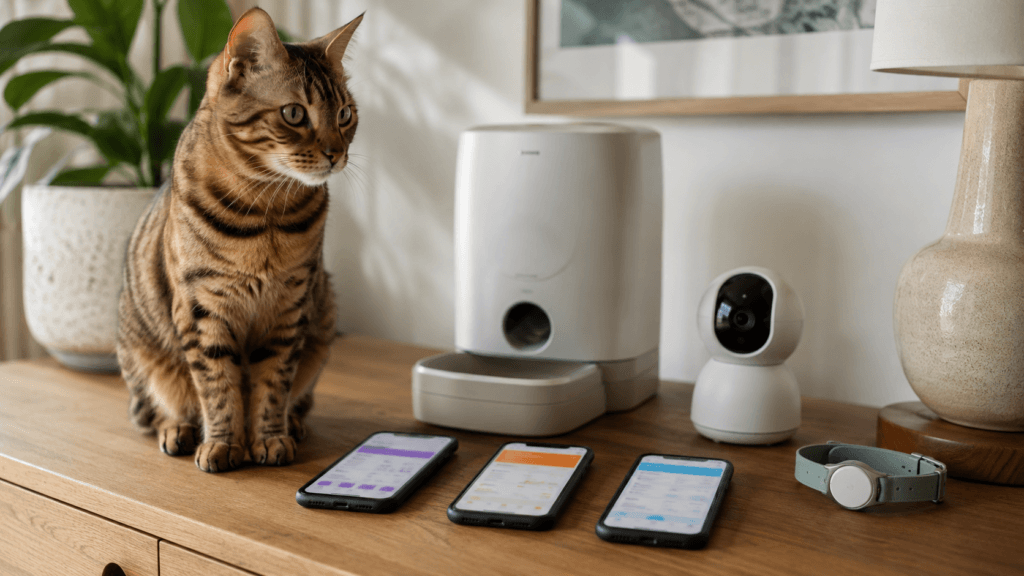
    Cat beside three smartphones, an automatic feeder, pet camera and wearable tracker
    Multiple apps can add useful specialist functions, but every extra ecosystem also brings another account, interface and compatibility decision. AI-generated editorial illustration.

    A unified app reduces friction.

    It also makes switching brands harder.

    The lock-in usually develops in three stages:

    1. one useful device;
    2. shared profiles and familiar controls;
    3. mild resentment at installing another app for a better competing product.

    Do not buy weaker hardware solely to preserve dashboard purity.

    Choose one ecosystem when several of its devices independently fit the household. Mix brands when a specialist product solves the problem better.

    One account is convenient.

    Owning the wrong feeder for six years because it matches the litter-box login is dedication to administrative tidiness, not pet care.

    Buyer-Regret Risk

    Pet-app regret usually comes from expecting software to create intelligence that the hardware never measured.

    Common failures include:

    • assuming every product from a brand supports the same app;
    • buying a non-Connect version by mistake;
    • overlooking subscription costs;
    • confusing a dispensing event with confirmed eating;
    • confusing a litter visit with a medical conclusion;
    • enabling so many alerts that all alerts become wallpaper;
    • collecting records without reviewing them;
    • expecting different brands to exchange data automatically.

    Before buying, define one app outcome:

    “I need to know whether Cat A ate.”

    “I need to control the door remotely.”

    “I need to find the cat outdoors.”

    “I need recorded video when nobody is home.”

    That is a purchase criterion.

    “I want a smart ecosystem” is how Emperor Maximilian acquires four incompatible accounts and a folder named Pet Apps.

    Final Verdict

    PETKIT is the best overall pet tech app for cats when you want litter, feeding and hydration devices inside one broad ecosystem.

    Whisker is the best litter-first app, with clear controls and useful routine data across Litter-Robot and Feeder-Robot.

    PETLIBRO is the best feeding-focused option, especially for wet food, RFID access and connected fountains—but compatibility must be checked model by model.

    Sure Petcare is the best access-control platform for multi-cat diets and connected doors.

    Tractive is the strongest outdoor-safety app, provided the subscription and collar requirements fit the cat.

    Petcube is best for recorded visual context, but much of its real value lives inside Petcube Care.

    Choose the app attached to the problem you need to solve.

    Do not choose the problem that best justifies downloading another app.

    Frequently Asked Questions

    Can pet tech apps diagnose illness?

    No. They can record changes in feeding, weight, activity or litter-box behavior. Those records may help a veterinarian understand a pattern, but they cannot identify the medical cause.

    Which app is best for several types of cat technology?

    PETKIT currently covers the broadest range of cat-focused product categories, including litter boxes, feeders and fountains.

    Which cat app works best without a subscription?

    Core PETKIT, Whisker and PETLIBRO controls generally depend on owning compatible hardware rather than maintaining a mandatory cellular plan. Advanced histories and services can still vary.

    Does Tractive work without a subscription?

    No. Its GPS tracker uses cellular connectivity, so an active plan is required.

    Can different pet tech apps share their data?

    Usually not in a meaningful, automatic way. Some may support voice assistants or limited external integrations, but owners should expect separate ecosystems rather than one universal cat-care dashboard.

    References

    • PETKIT — App Service and official app documentation
    • Whisker — Whisker App and Whisker+ documentation
    • PETLIBRO — Official app listings and compatibility documentation
    • Sure Petcare — Connect product and Hub documentation
    • Tractive — Cat tracker and subscription documentation
    • Petcube — Petcube App, Smart Alerts and Petcube Care documentation
    • Cornell Feline Health Center — Feline health and behavioral guidance

    Image Disclosure

    Official manufacturer images are used when available and authorized.

    AI-generated images may also be used as editorial illustrations. They should not be treated as exact representations of product dimensions, materials, controls or physical features. Always verify current official product information before purchasing.

    Editorial Disclosure

    PetTech AI may earn a commission from qualifying purchases. This does not influence our recommendations, comparisons or editorial judgments.
  • Feeder-Robot Review: Premium Reliability or Ecosystem Tax?

    Feeder-Robot Review: Premium Reliability or Ecosystem Tax?

    The Whisker Feeder-Robot handles the boring part of feeding unusually well.

    It stores a large amount of dry food, follows scheduled routines and lives inside the same app as Litter-Robot.

    What it does not do is decide which cat receives the food.

    That distinction matters.

    If Napoleon and Biscuit eat the same kibble without attempting a hostile takeover at breakfast, Feeder-Robot can be a convincing premium convenience tool.

    If one cat needs prescription food while the other approaches every unattended bowl like a small warlord, scheduling alone will not solve the problem.

    Quick Verdict

    CategoryVerdict
    PetTech AI verdictRecommended with Conditions
    Best fitWhisker households feeding one cat or multiple cats sharing the same food
    Main advantageLarge capacity, flexible scheduling and one-app Whisker integration
    Main limitationNo RFID or individual-cat access control
    Food typeDry food
    Not forDifferent diets, food stealing or tightly controlled individual portions
    Best reason to buyYou value low-friction feeding and already use the Whisker ecosystem

    Feeder-Robot is a sensible premium purchase when your problem is:

    “How do I make dry-food schedules easier to manage?”

    It is a weak solution when the real problem is:

    “How do I stop one cat from eating both meals?”

    Cheaper feeders can follow basic schedules. RFID feeders can protect individual diets.

    Feeder-Robot earns its premium through capacity, local schedule storage, Whisker app integration and access to an established support and replacement-parts ecosystem.

    Research Note

    This is a research-led review based on current official specifications, app documentation, product positioning and available ownership evidence.

    PetTech AI has not conducted a long-term hands-on test of the Whisker Feeder-Robot.

    PetTech AI may earn a commission from qualifying purchases. As an Amazon Associate I earn from qualifying purchases.

    Prefer Amazon’s purchase route? Check Feeder-Robot availability and customer feedback on Amazon.

    What Feeder-Robot Does Well

    Whisker states that Feeder-Robot holds up to 32 cups of food and supports as many as eight scheduled meals per day, plus manually triggered snacks.

    The standard dispenser releases food in one-eighth-cup increments, making the feeder better suited to several controlled meals than to one large daily serving.

    Its strongest use cases include:

    • cats eating the same dry food;
    • owners with irregular schedules;
    • households that prefer several smaller meals;
    • people who want fewer hopper refills;
    • existing Litter-Robot owners who value one-app management.

    The product does not introduce a radically new feeding method.

    Its proposition is simpler: perform a repetitive task with less daily supervision.

    There is something refreshing about a premium pet device whose primary promise is essentially:

    “We put the kibble in the bowl when we said we would.”

    The industry occasionally deserves credit for completing the original assignment.

    The Whisker App Is the Main Ecosystem Advantage

    Cat sitting between an automatic feeder and a self-cleaning litter box
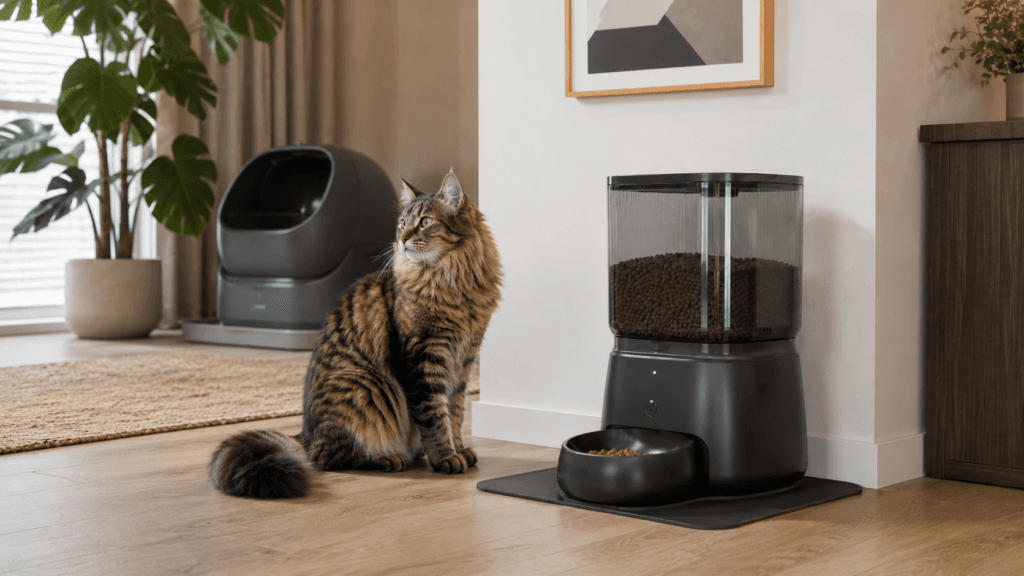
    Feeder-Robot becomes easier to justify when feeding and litter automation are already managed inside the Whisker ecosystem. AI-generated editorial illustration.

    Feeder-Robot connects to the same Whisker app used for Litter-Robot.

    Owners can manage schedules, trigger snacks, review dispensing activity and receive device notifications without maintaining another pet-tech account.

    This becomes genuinely useful when Whisker products are already part of the home.

    The advantage is operational:

    • one account;
    • one familiar app;
    • consolidated device notifications;
    • fewer disconnected platforms;
    • one manufacturer handling support.

    The app does not transform Feeder-Robot into an individual-cat monitoring system.

    Feeder-Robot is primarily an automation tool: it reduces routine work but does not verify which cat ate or interpret behavioral changes. For the broader distinction between useful data and useful automation, read our Smart Cat Monitoring vs Automation guide.

    It cannot identify who approached the bowl, confirm which cat ate the serving or compare food consumption directly with litter-box records.

    Whisker integration therefore reduces management friction. It does not create a clinically meaningful unified profile of Biscuit’s entire day.

    Without another Whisker product, Feeder-Robot competes mainly on capacity, scheduling and build quality rather than ecosystem convenience.

    For the broader trade-off between Whisker and PETKIT, read our PETKIT vs Litter-Robot Ecosystem comparison.

    Offline Schedules and the Optional Battery

    Automatic dry-food feeder beside a smartphone displaying scheduled meals
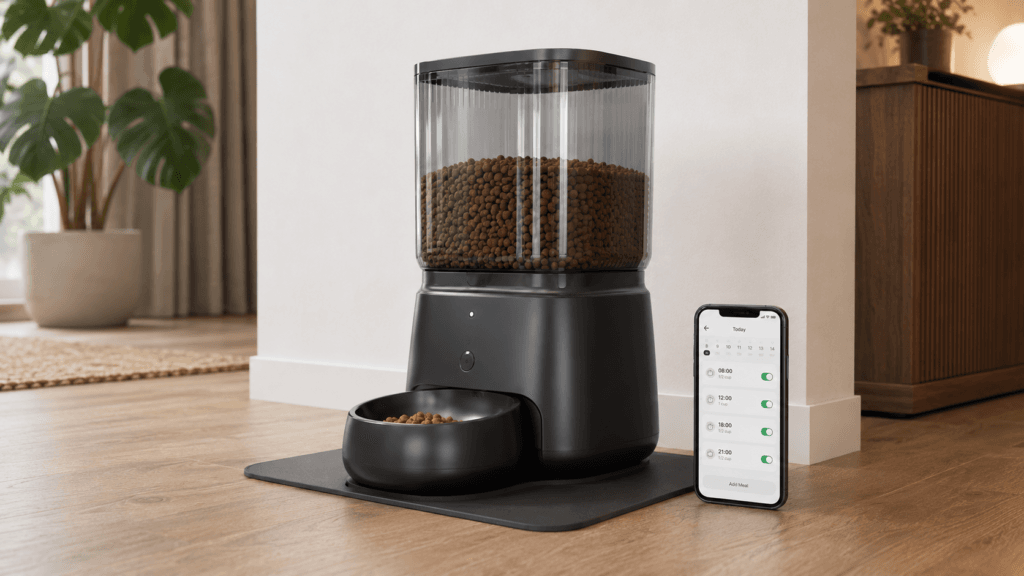
    App scheduling reduces routine feeding work, while locally saved schedules can continue during a temporary Wi-Fi outage. AI-generated editorial illustration.

    A smart feeder should not forget breakfast because the router restarted.

    Once saved, Feeder-Robot’s schedule remains stored locally and can continue during a temporary internet outage. Remote controls and schedule changes may be unavailable until the connection returns, but the existing routine does not depend entirely on the cloud.

    That is an important reliability feature.

    A feeder that loses its memory with the Wi-Fi is not smart. It is a decorative grain silo with abandonment issues.

    A power outage is different.

    Feeder-Robot does not include battery backup as standard. Whisker sells an optional battery that provides up to 24 hours of operation in power-saving mode.

    The option is useful for homes with unstable power.

    Having to purchase it separately on a premium feeder is less delightful.

    Buyers who consider backup power essential should include the battery in the real ownership cost rather than discovering it after Napoleon’s breakfast becomes a constitutional crisis.

    The Multi-Cat Limitation

    One cat eating from an automatic feeder while another reaches toward the bowl
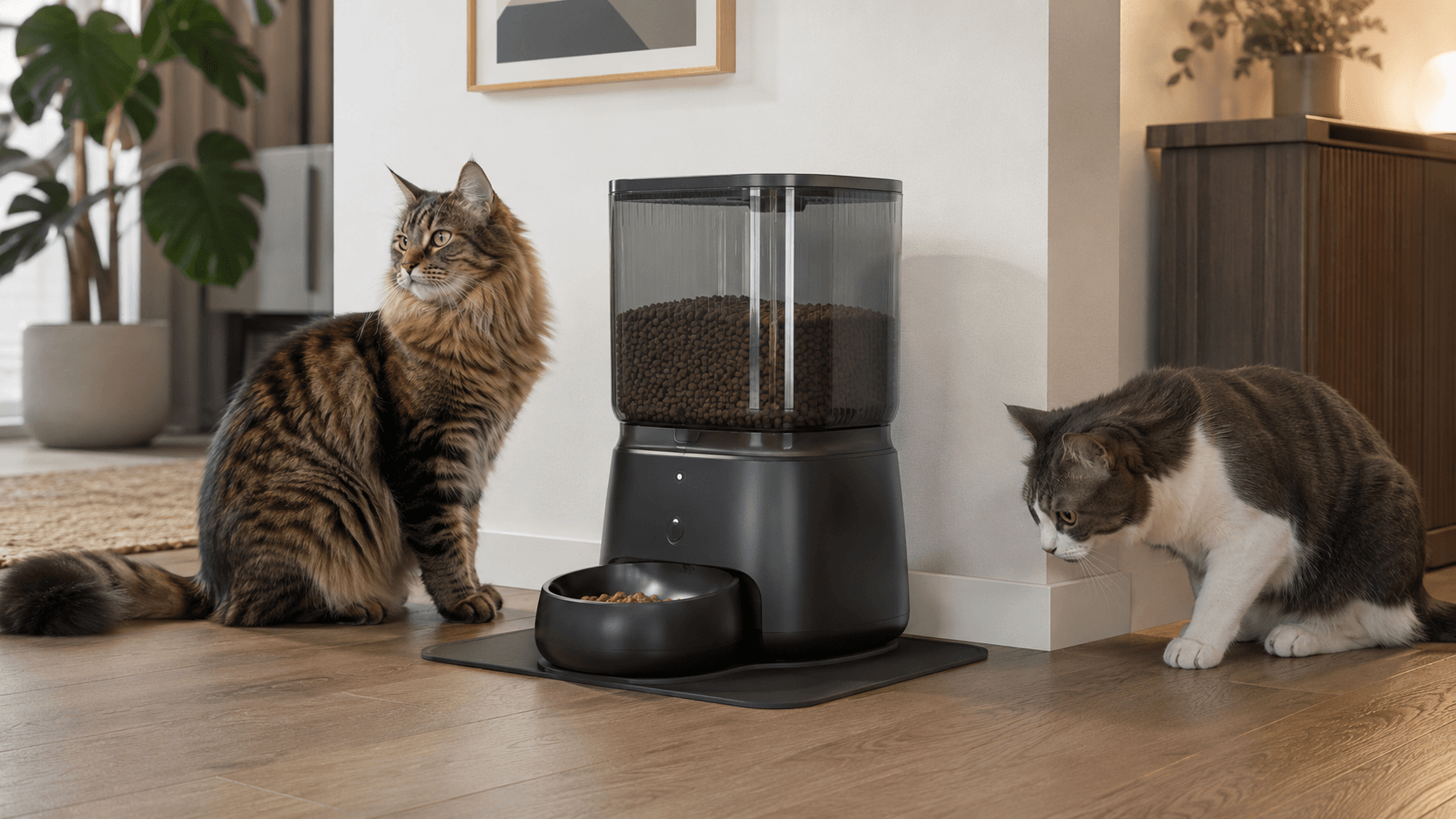
    A feeding schedule controls when food appears—not which cat eats it. RFID access is the better solution for food stealing or different diets. AI-generated editorial illustration.

    The 32-cup hopper makes Feeder-Robot suitable for homes that consume a lot of dry food.

    That does not make it an individual-access feeder.

    Food is dispensed into an open bowl. There is no RFID reader, microchip recognition or physical barrier stopping one cat from eating another cat’s portion.

    Feeder-Robot works best when multiple cats:

    • eat the same food;
    • have similar feeding requirements;
    • do not guard the bowl;
    • can be separated when necessary;
    • are not managing conflicting medical diets.

    It becomes a poor fit when:

    • one cat needs prescription food;
    • calorie targets differ significantly;
    • one cat steals food;
    • a slow eater is displaced;
    • medication is mixed into one serving.

    A schedule controls when food appears.

    It does not appoint security.

    If Napoleon finishes his meal and moves directly into Biscuit’s bowl, the Whisker app will document the dispensing event without deploying a tactical response unit.

    For households requiring individual access, RFID technology is usually the more relevant solution, even when the competing feeder has a smaller hopper or less polished app.

    See our Best Automatic Cat Feeders guide for alternatives organized by household problem.

    Capacity, Cleaning and Daily Ownership

    The large hopper reduces refill frequency, particularly in shared-food households.

    It should not be treated as permission to leave the same kibble inside indefinitely. Dry food contains oils that can leave residue and lose freshness over time.

    Routine ownership still includes:

    • washing the bowl;
    • wiping the dispensing area;
    • checking for crumbs around the chute;
    • refreshing the hopper rather than endlessly topping it up;
    • confirming that scheduled portions still look reasonable.

    Whisker also sells replacement components for Feeder-Robot, including dispenser and motor assemblies.

    Availability of individual parts does not prove that the feeder will last forever. It does make repair and maintenance more credible than with generic feeders whose manufacturer disappears once the listing has collected enough photographs of jammed kibble.

    The ownership proposition is therefore less about “zero maintenance” and more about predictable maintenance backed by an identifiable company.

    Feeder-Robot vs Modern Alternatives

    Feeder-Robot is strongest at scheduled shared feeding.

    Other feeder categories now solve different problems.

    Choose Feeder-Robot when:

    • you already use Whisker;
    • large capacity matters;
    • all cats eat the same food;
    • you want several scheduled dry-food meals;
    • local schedule storage matters;
    • replacement parts and manufacturer support affect the decision.

    Choose an RFID feeder when:

    • individual access matters;
    • one cat steals food;
    • diets or portions differ;
    • prescription food must remain protected.

    Choose a dual-hopper feeder when:

    • alternating or mixing two dry foods matters;
    • food variety is more useful than ecosystem integration.

    Choose a camera feeder when:

    • visual confirmation changes your decision;
    • you genuinely plan to review the footage;
    • remote reassurance matters more than hopper size.

    Feeder-Robot does not become outdated because other feeders offer more features.

    It becomes the wrong choice only when another feature solves a more important household problem.

    For buyers comparing Whisker with PETKIT’s large-capacity approach, read our PETKIT Fresh Element Infinity Review.

    Buyer-Regret Risk

    The most likely regret is paying for the Whisker ecosystem without needing the Whisker ecosystem.

    That risk is higher when:

    • you own no other Whisker products;
    • one inexpensive daily schedule would be sufficient;
    • your cats need individual food access;
    • you expect the feeder to record actual consumption;
    • you assume battery backup is included;
    • wet food is a major part of the diet.

    Feeder-Robot records what it dispenses.

    It does not prove that the intended cat ate it.

    The product is easiest to justify when capacity, scheduling and app consolidation all matter at the same time. Remove two of those three factors and the premium becomes harder to defend.

    Final Verdict

    The Whisker Feeder-Robot earns a Recommended with Conditions verdict.

    It is a credible premium feeder for dry-food households that value large capacity, flexible schedules and integration with Litter-Robot through the Whisker app.

    Local schedule storage strengthens the practical case, while the optional battery can provide an additional layer of protection during power outages.

    Its central limitation is individual access.

    Feeder-Robot cannot identify cats or prevent food theft. Households managing different diets, prescription food or aggressive bowl competition should choose a feeder designed around those problems.

    Buy Feeder-Robot when you want the Whisker ecosystem to handle another repetitive task with less supervision.

    Skip it when ecosystem integration is the only persuasive argument—or when your cats need less of a schedule and more of a border-control policy.

    Feeder-Robot does not reinvent feeding.

    It makes ordinary dry-food automation easier to manage.

    Sometimes that is worth paying for.

    Sometimes it is an ecosystem tax with an unusually elegant hopper.

    Frequently Asked Questions

    Does Feeder-Robot work without Wi-Fi?

    Saved feeding schedules can continue during a temporary Wi-Fi outage. Internet access is still needed for remote app controls and schedule changes.

    How many meals can Feeder-Robot schedule?

    Whisker supports up to eight scheduled meals per day, plus manually triggered snacks.

    Does Feeder-Robot include battery backup?

    No. Whisker sells an optional battery that can provide up to 24 hours of operation in power-saving mode.

    Can Feeder-Robot stop one cat from stealing food?

    No. It does not use RFID or microchip identification. Cats with different diets may require separate feeding spaces or an individual-access feeder.

    Can Feeder-Robot dispense wet food?

    No. Feeder-Robot is intended for compatible dry or semi-moist food, not canned or refrigerated wet meals.

    References

    • Whisker — Feeder-Robot product specifications
    • Whisker — Feeder-Robot support documentation
    • Whisker — Feeder-Robot battery and replacement components
    • Whisker — Whisker app documentation

    Image Disclosure

    Official Whisker images are used when depicting the exact product.

    Any AI-generated images are editorial illustrations only. They do not represent exact dimensions, dispensing behavior, portion accuracy or app performance. Always verify current specifications before purchasing.

    Editorial Disclosure

    PetTech AI may earn a commission from qualifying purchases. This does not influence our recommendations, comparisons or editorial judgments.