
The first generation of smart cat products promised to do chores.
The litter box cleaned itself.
The feeder served breakfast.
The fountain circulated water.
The app occasionally reminded you that the machine still required human involvement.
Now the industry wants to sell something more ambitious:
- facial recognition;
- camera footage;
- weight histories;
- litter-box records;
- drinking data;
- feeding identities;
- activity scores;
- location tracking;
- AI-generated insights.
Some of that information is genuinely useful.
Some of it is an expensive way to learn that your cat ate breakfast, used the litter box, and then slept for eleven hours.
The decision comes down to one distinction:
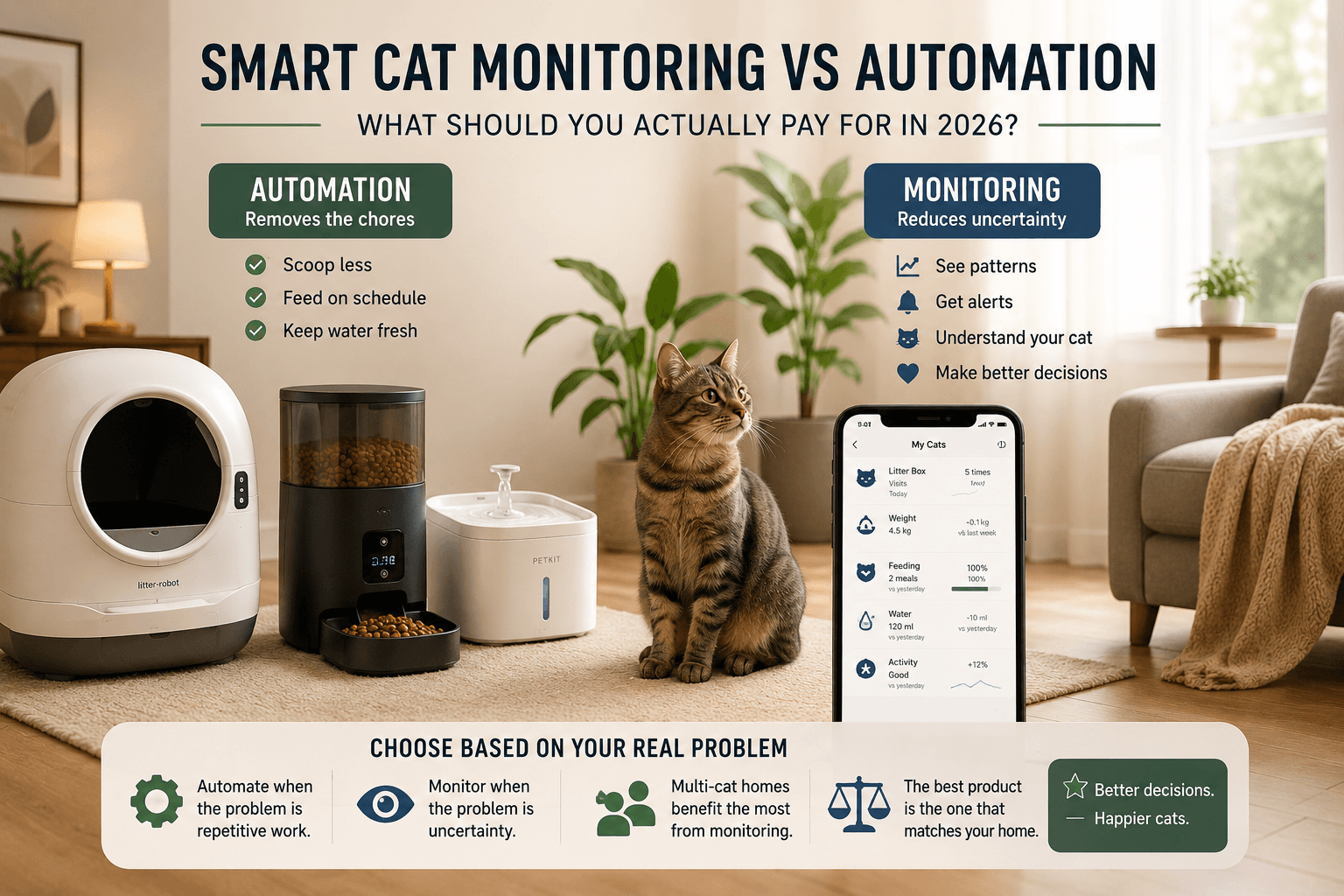
Automation removes work. Monitoring reduces uncertainty.
Most buyers should solve the work problem first.
Monitoring deserves the additional cost only when the information would change what they do next.
Quick Verdict
| Your main problem | Start with | Why |
|---|---|---|
| “I am tired of scooping.” | Automation | You need waste removal, not a bathroom dashboard |
| “Meals need to happen on schedule.” | Automation | Reliable dispensing matters more than video |
| “I do not know which cat ate.” | Monitoring or access control | Identity is the missing information |
| “I want to track weight or litter habits.” | Monitoring | The value comes from repeated trends |
| “One cat may be drinking less.” | Identity-aware monitoring | Household totals may hide the individual change |
| “My outdoor cat disappears for hours.” | Monitoring | Location and activity are the actual signals |
| “I want every available feature.” | Stop and identify the problem | Feature collecting is not a care strategy |
The short version
Choose automation when the problem is labor.
Choose monitoring when the problem is uncertainty.
Choose both only when both problems genuinely exist.
A camera does not improve an unreliable feeder.
An AI dashboard does not make an uncomfortable litter box acceptable.
And no number of health-style alerts can rescue a product that fails at its basic job.
The Product Must Solve the Chore Before It Explains the Chore
Every smart product has a core physical task.
A litter box must separate waste safely and reliably.
A feeder must dispense the correct food at the correct time.
A fountain must provide clean, accessible water.
A cat door must control entry and exit.
Only after that task works does the monitoring layer become relevant.
This creates a simple buying hierarchy:
- Cat acceptance
- Core function
- Reliability
- Maintenance
- Monitoring
- Interesting app decorations
Manufacturers frequently present this list in reverse.
The product page begins with artificial intelligence and ends somewhere near the bottom with the dimensions of the opening your cat must physically enter.
Do not follow that order.
What Automation Actually Solves
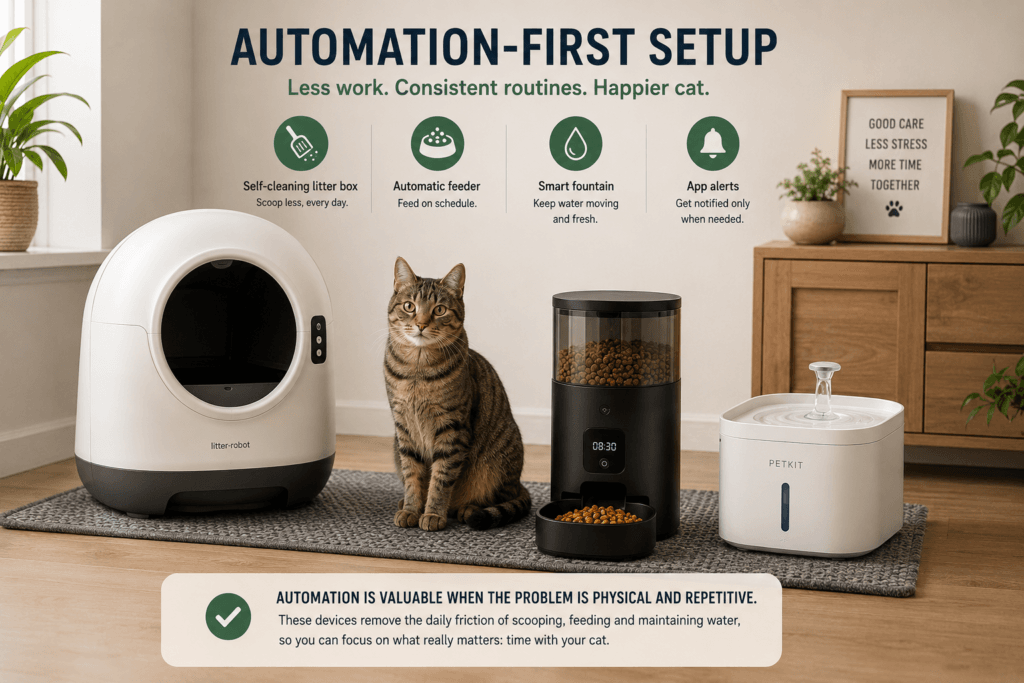
Automation is useful when the problem is repetitive, predictable, and physical.
Litter automation
A self-cleaning litter box can reduce daily scooping and move waste into a drawer after use.
It does not eliminate:
- drawer emptying;
- litter refilling;
- deep cleaning;
- odor-source maintenance;
- the need for an additional box in some homes.
But the main benefit remains clear even if you never open the app.
For the current product choices, read our Best Smart Litter Boxes guide.
Feeding automation
A scheduled feeder can deliver measured dry-food portions when nobody is standing beside the bowl.
A refrigerated feeder can support scheduled wet meals.
These products create value through timing and consistency.
A camera may add useful context, but dinner must still arrive.
For dry, wet, RFID, and microchip systems, read our Best Automatic Cat Feeders guide.
Water automation
A fountain circulates water and may provide level, filter, or maintenance reminders.
It still requires:
- cleaning;
- fresh water;
- filter replacement;
- pump or tank maintenance.
The useful automation is easier water access and a more structured maintenance routine—not permanent freedom from washing slime out of a reservoir.
What Monitoring Actually Solves
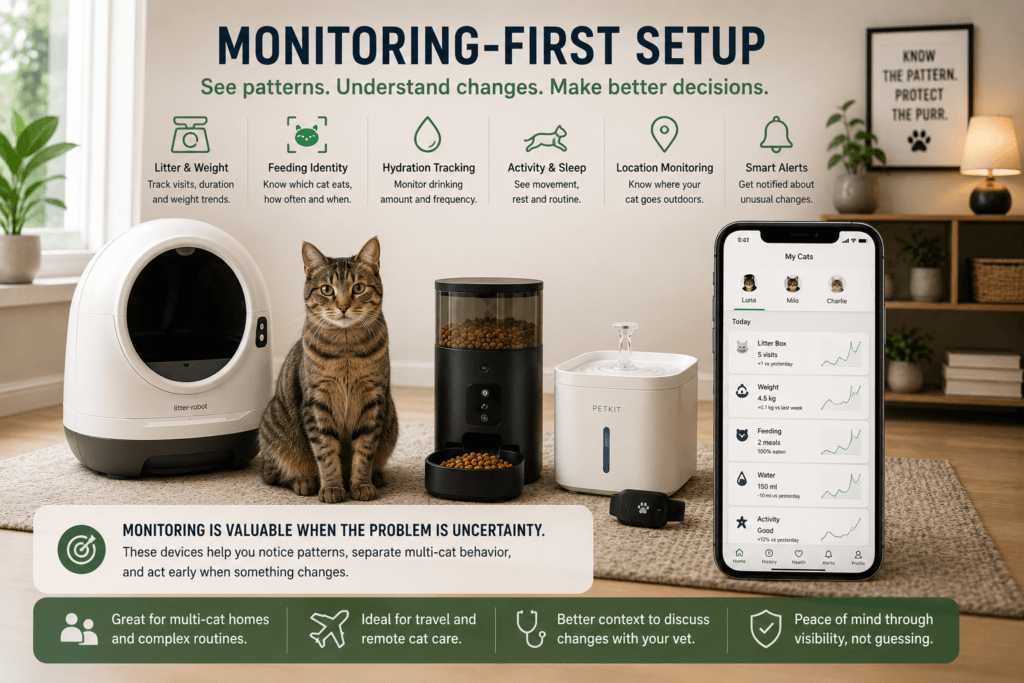
Monitoring becomes valuable when a household cannot confidently answer a relevant question.
Examples include:
- Which cat used the litter box?
- Has weight changed over several weeks?
- Did one cat stop appearing at meals?
- Is one cat drinking less than the others?
- Has an outdoor cat’s activity pattern changed?
- What happened around the feeder while nobody was home?
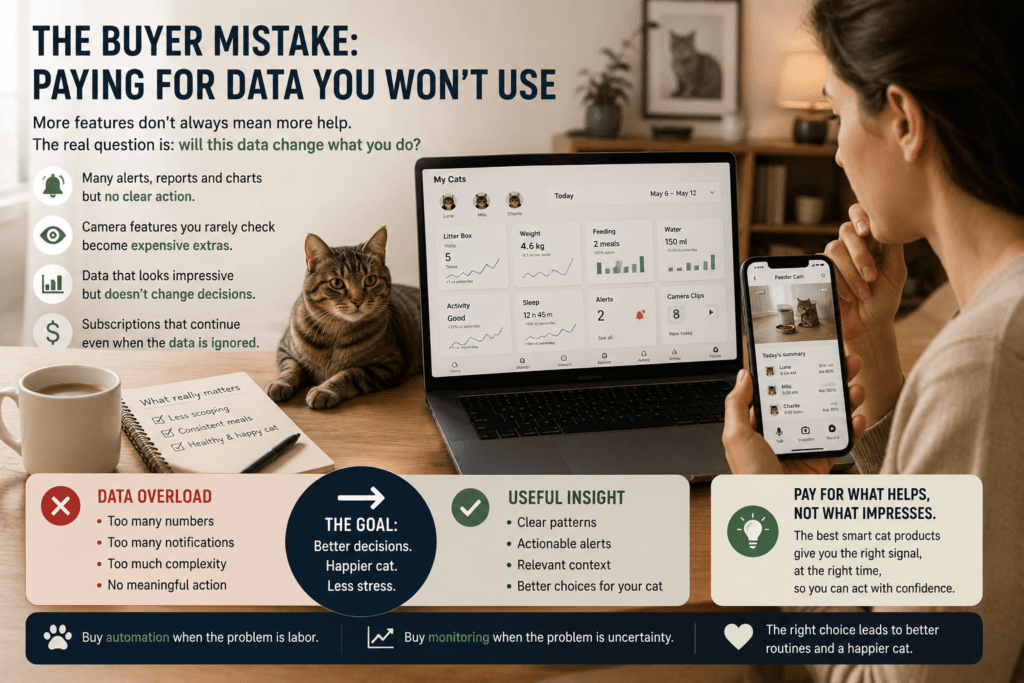
The device is not valuable merely because it collects the answer.
The answer must lead to a decision.
That decision might be:
- change feeder placement;
- separate feeding stations;
- inspect the litter-box setup;
- confirm a weight trend;
- adjust notifications;
- contact a veterinarian about a persistent change;
- discover that nothing meaningful happened and return to normal life.
For product-level monitoring options across litter, meals, hydration, activity, and location, read our Best Smart Cat Health Monitors guide.
The Decision Test: What Would You Do Differently?
Before paying extra for a monitoring feature, complete this sentence:
“If the device showed me __________, I would __________.”
Useful answers include:
“If one cat repeatedly missed meals, I would change the feeding setup.”
“If weight declined over several weeks, I would verify the trend and discuss it with my veterinarian.”
“If one cat stopped using the shared litter box, I would inspect access, cleanliness, conflict, and alternative boxes.”
“If the outdoor cat left its usual area, I would begin searching immediately.”
Weak answers include:
“If the camera showed my cat eating, I would watch my cat eat.”
That may be enjoyable.
It is not necessarily worth a $200 feature premium.
The Multi-Cat Exception
Monitoring becomes more valuable as the number of cats increases.
In a one-cat home:
- the cat near the feeder is probably the cat who ate;
- the litter-box visit belongs to the only available suspect;
- the fountain records household drinking that belongs to one animal.
In a multi-cat home, shared totals can hide individual changes.
The feeder may dispense correctly while Napoleon eats Jonathan’s portion.
The litter box may record normal household activity while one cat stops using it.
The fountain may show stable total consumption while one cat drinks more and another drinks less.
This is where identity systems can justify their cost:
- facial recognition;
- weight-based profiles;
- RFID collar tags;
- implanted-microchip access;
- individual cameras or feeding stations.
But identity still needs a purpose.
Knowing which cat committed the food theft is useful.
Filming the theft every morning without changing the setup is a documentary project.
PETKIT: Monitoring Across More Routines
PETKIT currently makes the broadest move from basic automation toward camera-led connected care.
Its ecosystem includes automatic litter boxes, camera litter boxes, camera feeders, fountains, and other devices managed through the PETKIT app. Its 2026 product direction explicitly emphasizes camera-equipped devices and connected signals across stool, urine, food, and hydration routines.
That makes PETKIT compelling when visual context matters across several categories.
Examples include:
- identifying which cat approached a feeder;
- reviewing litter-box footage;
- adding context to hydration activity;
- keeping several device histories in one app.
The danger is paying for cameras everywhere merely because PETKIT can put them everywhere.
A camera fountain is useful when individual drinking behavior is genuinely difficult to understand.
It is less useful when one healthy cat drinks normally and the owner simply enjoys receiving push notifications from the kitchen.
PETKIT’s buying rule
Choose the camera-equipped version only when the footage or identity layer changes the decision.
Otherwise, choose the simpler automation-first model.
Whisker: Automation First, Insights on Top
Whisker remains more focused.
Its ecosystem centers on Litter-Robot, Feeder-Robot, and the Whisker app. The app tracks litter activity, weight trends, drawer status, feeding schedules, and high-level mealtime behavior across compatible products.
The current litter-box lineup illustrates the automation-versus-monitoring ladder clearly:
- Litter-Robot EVO: lower-cost, automation-first entry;
- Litter-Robot 5: premium core automation with additional routine data;
- Litter-Robot 5 Pro: dual cameras and deeper individual monitoring.
Litter-Robot 5 Pro provides two cameras and visual identification, while some extended histories, unlimited live viewing, recorded events, and advanced insights depend on Whisker+. Basic SmartScale identification and weight tracking remain available without the membership on supported models.
Whisker therefore asks a cleaner question than PETKIT:
How much insight do you need around the litter routine you are already automating?
That narrower focus can be an advantage.
You are less likely to buy a smart fountain merely because its app icon matches the litter box.
The Litter-Robot 5 Pro review is a useful example of this distinction: the cameras add monitoring context, but they do not improve the underlying cleaning cycle.
CATLINK: Monitoring Makes the Most Sense in the Litter Room
CATLINK explicitly sells an ecosystem connecting litter boxes, feeders, and fountains through one app. Its strongest concept is the ability to place toilet, feeding, and drinking activity inside one multi-cat record.
The logic is attractive:
- track what goes in;
- track what comes out;
- separate records by cat;
- identify routine changes.
But an ecosystem concept is not a substitute for product-level quality.
CATLINK currently makes its strongest case around automatic litter boxes and multi-cat litter data. Its feeders and fountains should still be evaluated independently rather than treated as automatic purchases after the litter box.
CATLINK’s buying rule
Choose CATLINK when a specific CATLINK product solves the problem and its multi-cat records add useful visibility.
Do not buy three devices merely to complete the input-output diagram.
For the full brand comparison, read CATLINK vs PETKIT vs Whisker.
Petivity: Monitoring Without Automation
Petivity is the purest example of the distinction.
It sits underneath a conventional litter box and tracks weight, urination events, defecation events, and litter-box patterns through its app. It does not clean or replace the box.
That makes Petivity useful when:
- the existing litter box already works;
- changing it could create unnecessary disruption;
- weight and elimination trends are the missing information;
- scooping is not the problem.
Petivity would be a terrible purchase for someone who hates cleaning the litter box.
It would be a sensible purchase for someone who likes the existing setup but wants a clearer record of changes.
The product does not fail because it lacks automation.
It succeeds or fails according to whether monitoring was the actual need.
For the full analysis, read our Petivity Smart Litter Box Monitor Review.
What Monitoring Cannot Fix
Monitoring cannot fix:
- an uncomfortable litter box;
- resource conflict between cats;
- poor feeder placement;
- a bowl accessible to the wrong animal;
- dirty water;
- inadequate litter-box numbers;
- a cat that rejects the device;
- unreliable dispensing;
- bad maintenance habits.
A camera feeder may prove that one cat steals food.
The solution may still be a microchip feeder, separate room, different schedule, or human intervention.
A litter monitor may show reduced visits.
The solution may involve cleaning, access, conflict, litter preference, observation, or veterinary care.
The dashboard identifies the question.
It does not automatically perform the answer.
Buyer Regret in One Table
| Purchase | Most likely regret |
|---|---|
| Automation without checking cat fit | The machine works; the cat refuses it |
| Monitoring without a decision rule | You collect data and change nothing |
| Camera upgrade | You stop watching after one week |
| Multi-cat recognition | Similar cats or shared access make the records less definitive |
| Subscription features | The useful history costs more than expected |
| Full ecosystem | You buy weaker products to keep one app |
| No monitoring in a complex home | Shared totals hide the individual problem |
The Six-Month Test
After six months, ask what still creates value.
Good automation
- the litter bed is cleaned;
- meals arrive on schedule;
- water remains accessible;
- routine maintenance is easier;
- the app can be ignored most days.
Good monitoring
- trends are clear;
- unusual changes are easier to verify;
- individual cats are easier to distinguish;
- the information occasionally changes a decision;
- notifications remain selective and useful.
Bad smart technology
- the device generates alerts;
- nobody knows what to do with them;
- the owner checks compulsively;
- the cat’s actual routine is no better;
- the subscription renews successfully.
Final Verdict
Most cat owners should start with automation.
If the problem is scooping, buy a product that reduces scooping.
If the problem is meal timing, buy a feeder that dispenses reliably.
If the problem is water access, choose a fountain that is easy to clean and maintain.
Add monitoring when the missing information has a clear purpose.
That is especially relevant in:
- multi-cat homes;
- senior-cat households;
- homes managing different diets;
- outdoor-cat routines;
- situations involving repeated behavioral changes;
- households where nobody is present during important routines.
The framework is simple:
- Identify the physical problem.
- Solve it with the simplest reliable mechanism.
- Identify the remaining uncertainty.
- Pay for monitoring only if the answer changes an action.
Automation saves time.
Monitoring provides evidence.
The smartest product is not the one that does both.
It is the one that does exactly what your household needs—and leaves the rest of the app mercifully quiet.
Frequently Asked Questions
What is the difference between automation and monitoring?
Automation performs or simplifies a task. Monitoring collects information about what happened.
Should most cat owners choose automation first?
Usually, yes. Automation creates immediate value when the main problem is repetitive labor. Monitoring should come first when uncertainty—not labor—is the actual problem.
Is monitoring more useful in multi-cat homes?
Often. Shared feeders, fountains, and litter boxes can hide individual behavior, making identity and separate records more valuable.
Are cameras necessary for smart cat care?
No. Cameras are useful when visual context changes a decision. They are unnecessary when scheduling, access control, weight sensing, or simple alerts already solve the problem.
Can monitoring detect illness?
Monitoring can reveal changes in routine. It cannot diagnose the cause. Significant or persistent changes require direct observation and, when appropriate, veterinary assessment.
Is Petivity automation or monitoring?
Monitoring. It adds weight and litter-box records underneath an existing box but does not clean it.
Is Litter-Robot automation or monitoring?
All current Litter-Robot models automate cleaning. The amount of monitoring increases across the lineup, with Litter-Robot 5 Pro offering the deepest camera-led layer.
References
- PETKIT official ecosystem and 2026 product information
- Whisker app, Litter-Robot, and Whisker+ documentation
- CATLINK ecosystem and app documentation
- Petivity Smart Litter Box Monitor documentation
- PetTech AI product-level trust checks and comparison framework
Image Disclosure
Some images in this article may be AI-generated for illustrative purposes. They do not depict exact products and should not be used to evaluate dimensions, fit, controls, or features.
Disclosure
PetTech AI may earn a commission when readers purchase through affiliate links. This article is a decision framework rather than a blanket endorsement of any ecosystem. Every product must still earn its recommendation at product level.