Your cat does not need an ecosystem.
He needs:
- a clean litter box;
- food at roughly the expected time;
- accessible water;
- technology that does not frighten or inconvenience him.
The ecosystem is for you.
It determines how many devices share one app, which routines can be viewed together and how tempting it becomes to buy a matching fountain because the litter box behaved well for six months.
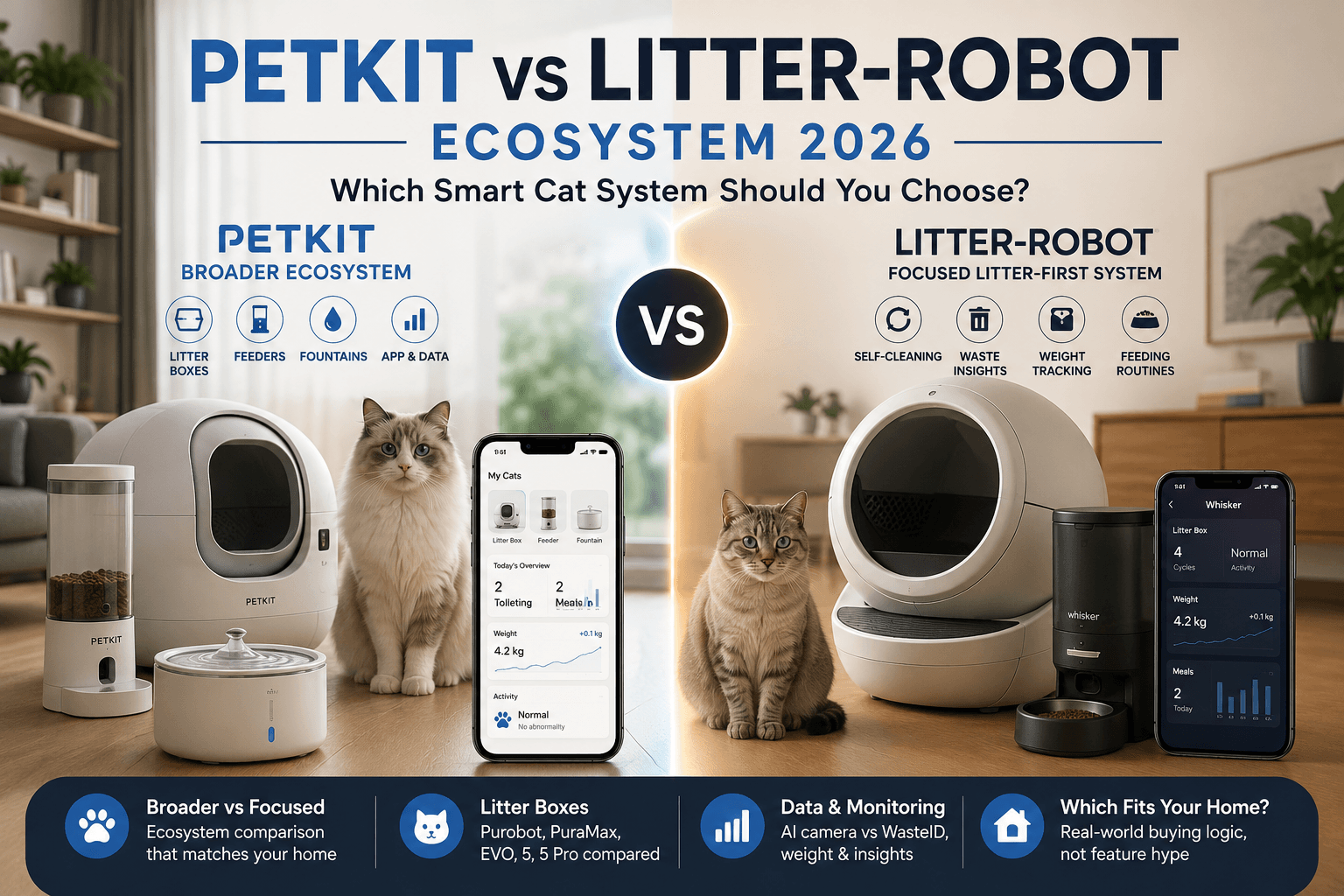
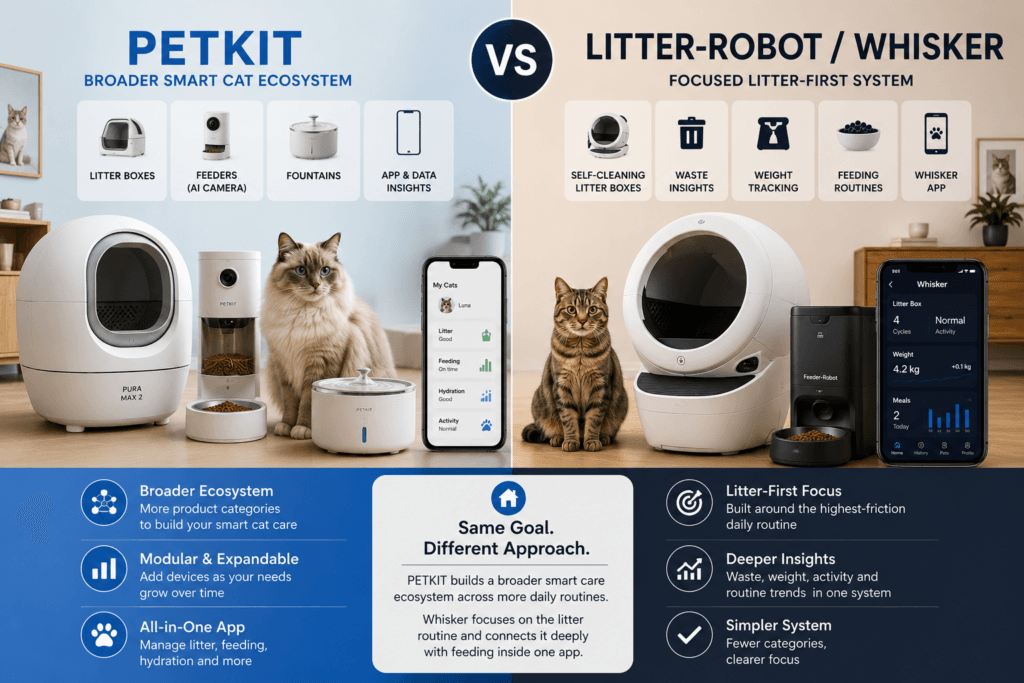
PETKIT and Whisker—the company behind Litter-Robot—represent two different strategies.
PETKIT builds outward.
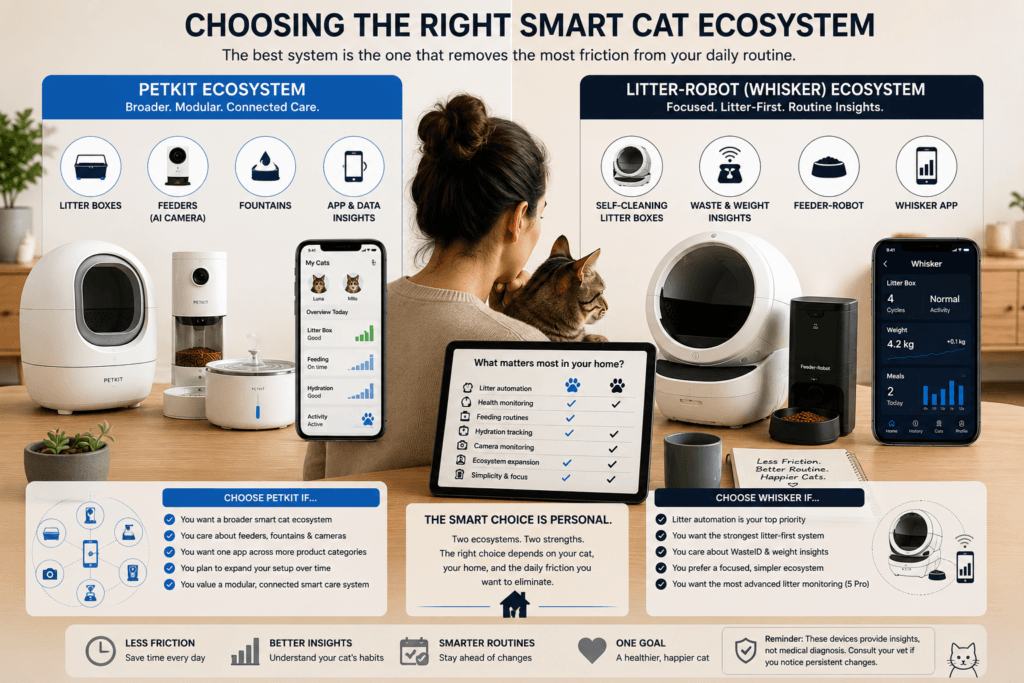
Its ecosystem spans litter boxes, feeders, fountains and cameras, with the PETKIT app connecting litter, meal and hydration records across supported products.
Whisker builds deeper around litter.
Its current platform centers on four Litter-Robot models, Feeder-Robot, the Whisker app and increasingly detailed litter-related monitoring.
The decision is therefore not:
“Which company makes smarter products?”
It is:
Do you want a broad smart-cat home—or a premium ecosystem built around the litter room?
Quick Verdict
| Category | PETKIT | Whisker |
|---|---|---|
| PetTech AI verdict | Recommended — Best Complete Ecosystem | Strong Recommendation for Litter-First Homes |
| Best fit | Owners expanding across litter, feeding and hydration | Owners making litter automation the main investment |
| Main advantage | More credible product categories inside one app | Deeper litter-box lineup and support environment |
| Feeding | Wider selection, including camera-led options | Feeder-Robot for routine dry-food scheduling |
| Hydration | Established connected-fountain range | No comparable fountain ecosystem |
| Main risk | Buying cameras and AI features you stop using | Paying premium prices inside a narrow product universe |
| Choose it when | Several care routines create genuine friction | The litter box is overwhelmingly the main problem |
Choose PETKIT when you already expect to buy across multiple care categories.
Choose Whisker when you want the strongest focused path through premium litter automation and do not need a complete smart-home catalogue.
Choose neither ecosystem automatically when you only need one device.
Three matching app icons do not improve mediocre hardware.
Research Note
This is a research-led ecosystem comparison based on current official product catalogues, app services, software terms and PetTech AI’s individual product audits.
It is not a blanket endorsement of every product sold by either company.
PetTech AI may earn a commission from qualifying purchases.
Want the broader connected-care platform? Check PETKIT PuraMax 2 through PETKIT.
What You Are Actually Choosing
An ecosystem changes more than the number of apps on your phone.
It influences:
- which records appear together;
- which subscription services become relevant;
- which replacement parts and consumables you buy;
- which support team handles several devices;
- which brand receives the benefit of the doubt next time.
That final point creates the greatest risk.
A strong litter box can make the company’s feeder feel pre-approved.
A useful feeder can make an unnecessarily advanced fountain appear to be the logical next stage of civilization.
It is not.
The correct ecosystem strategy is:
- buy the first product because it solves a real problem;
- let it earn your trust;
- evaluate the second product independently;
- treat the shared app as a bonus—not evidence of quality.
For the broader distinction between removing work and collecting information, read our Smart Cat Monitoring vs Automation guide.
PETKIT Wins Through Breadth
PETKIT’s main advantage is not that it sells more objects.
It is that those objects address several genuinely different routines.
The current platform includes:
- automatic litter boxes;
- camera-equipped litter boxes;
- scheduled dry-food feeders;
- camera feeders with individual recognition;
- dual-hopper feeding systems;
- connected water fountains;
- camera-led hydration products.
The PETKIT app can combine supported litter-box use, feeding activity, hydration and device controls inside one account. The company’s recent product strategy has also extended AI cameras across litter, feeding and water rather than confining monitoring to a single category.
That creates a credible expansion path.
A household could begin with PuraMax 2, add a YumShare feeder and later introduce an EverSweet fountain without leaving the same software environment.
Each device still addresses a different task.
This is why PETKIT offers more than a matching-logo collection.
Where PETKIT is strongest
PETKIT makes the most sense when:
- litter, feeding and hydration all create friction;
- camera monitoring is useful in more than one category;
- you expect to expand gradually;
- one app genuinely reduces management effort;
- mixing several separate product platforms sounds exhausting.
Its feeding and hydration range is the clearest advantage over Whisker.
Whisker can connect a litter box and dry-food feeder.
PETKIT can extend farther into meal monitoring, alternative feeder formats and water management.
Where PETKIT becomes dangerous
Breadth makes unnecessary expansion easier.
You may start with a sensible automatic litter box and end up with:
- a feeder camera you stopped checking after Tuesday;
- a fountain dashboard you open twice per year;
- several filter and deodorizer schedules;
- enough notifications to suggest Napoleon operates a regional logistics depot.
PETKIT also releases ambitious camera and AI products rapidly. Some have compelling specifications before they accumulate a mature long-term ownership record.
The ecosystem may be strong.
A new individual product may still deserve a Conditional Recommendation.
PETKIT wins the breadth contest.
It does not receive diplomatic immunity from product-level scrutiny.
For the choice between its mainstream and camera-led litter boxes, read our Purobot Max Pro 2 vs PuraMax 2 comparison.
Whisker Wins Through Litter Depth
Whisker’s ecosystem is narrower and easier to understand.
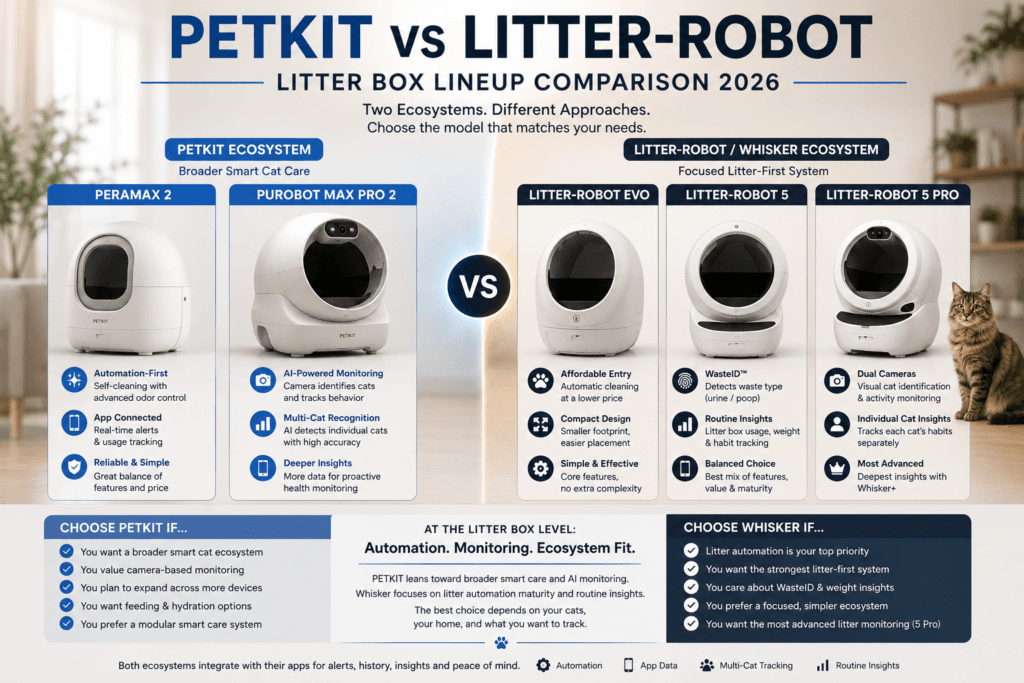
Its current model ladder includes:
- Litter-Robot EVO;
- Litter-Robot 4;
- Litter-Robot 5;
- Litter-Robot 5 Pro;
- Feeder-Robot;
- litter, odor and refill accessories;
- the Whisker app and Whisker+.
The company positions EVO as the compact option, Litter-Robot 4 as its established bestseller, Litter-Robot 5 as the WasteID-equipped platform and 5 Pro as the dual-camera flagship.
That progression lets buyers decide how far they want to move from automatic cleaning toward detailed monitoring without leaving the product family.
Where Whisker is strongest
Whisker makes the most sense when:
- daily scooping is the main problem;
- cat size or household load requires a clear model ladder;
- litter-related accessories and replacement support matter;
- you prefer a mature, focused ownership ecosystem;
- Feeder-Robot provides enough additional expansion.
The current Whisker app connects litter-box activity, weight trends and Feeder-Robot meal information across compatible products.
Its expertise remains concentrated around the litter room.
That is not glamorous breadth.
It is useful specialization.
For the internal lineup decision, read our Litter-Robot 5 vs 5 Pro vs EVO comparison.
Where Whisker becomes a premium litter fortress
The ecosystem loses momentum once you move beyond litter and scheduled dry-food feeding.
Whisker does not currently offer PETKIT’s fountain catalogue, refrigerated feeding options or wider camera-feeder range.
A household may build:
- an excellent litter setup;
- detailed weight and visit histories;
- automatic litter refilling;
- scheduled dry-food feeding;
and still need other brands for water or wet food.
That is perfectly acceptable when litter was the central objective.
It becomes disappointing only when the buyer expected Whisker to become a complete smart-cat home.
The newest monitoring features also introduce Whisker+.
Core product functions and app access remain available without membership, but Litter-Robot 5 Pro’s facial identification and deeper video and history functions sit inside the premium software layer.
Apparently, remembering who used the litter box can now become a recurring expense.
The subscription is not automatically poor value.
It simply belongs in the real ownership calculation when it provides the reason for buying the Pro.
Feeding and Hydration Decide the Overall Winner
Whisker’s Feeder-Robot is a capable routine-first feeder.
It offers scheduled dry-food meals and integrates with the same app as Litter-Robot.
PETKIT provides more ways to approach feeding:
- simple scheduled feeding;
- dual-hopper configurations;
- camera monitoring;
- facial recognition;
- visual meal records.
PETKIT also has the decisive hydration advantage through its connected EverSweet fountain range.
This is why PETKIT wins the complete ecosystem comparison.
Not because every PETKIT product is better.
Because the platform remains relevant after the litter box.
For a feeder-level comparison between routine automation, camera monitoring and identity-led products, read our PETKIT vs Feeder-Robot vs CATLINK guide.
The Ecosystem Lock-In Test
Imagine that both companies announce tomorrow that their devices will no longer appear together inside one app.
Would you still independently buy:
- the litter box;
- the feeder;
- the fountain;
- the camera upgrade?
If yes, the ecosystem provides useful convenience.
If no, the shared app may be encouraging weaker purchases.
The first device is usually researched carefully.
The second is often purchased with:
“The first one was good, and this uses the same app.”
That sentence has funded a remarkable amount of unnecessary consumer electronics.
Is Mixing PETKIT and Whisker a Mistake?
No.
A mixed setup may be the rational winner:
- Whisker for litter automation;
- PETKIT for a camera feeder;
- PETLIBRO for refrigerated wet food;
- a conventional stainless-steel fountain requiring no account at all.
The disadvantages are real:
- multiple apps;
- fragmented records;
- separate accessories;
- different customer-support systems.
The advantage matters more:
You can choose the strongest product for each routine.
Your cat will not experience an identity crisis because his feeder and litter box have different logos.
For the broader three-brand decision, read our CATLINK vs PETKIT vs Whisker comparison.
Buyer-Regret Risk
PETKIT regret usually means buying advanced cameras or AI insights that become ignored.
Whisker regret usually means spending heavily inside a litter-focused ecosystem and later wanting broader feeding or hydration options.
Mixed-brand regret means managing several apps—but potentially owning better individual products.
The safest rule remains simple:
Buy the product first and the ecosystem second.
Still choosing the litter box before the ecosystem? Read our Best Smart Litter Boxes guide for the strongest models organized by household fit and monitoring needs.
Final Verdict
PETKIT is the better complete smart-cat ecosystem.
It provides the stronger path across litter, feeding, hydration and camera-led monitoring. It is the right choice when several care routines create genuine friction and you expect to expand beyond one device.
Whisker is the better litter-first ecosystem.
Its narrower focus produces a clearer premium litter-box ladder, deeper litter-related software and a stronger support environment around the category.
The decision is therefore:
- PETKIT for breadth;
- Whisker for litter depth;
- mixed brands when individual product quality matters more than one app.
Do not ask which logo deserves custody of your smart home.
Ask which first product deserves your money.
Then make the company earn everything that follows.
Frequently Asked Questions
Is PETKIT better than Litter-Robot?
PETKIT is better as a broad ecosystem. Litter-Robot is better when premium litter automation is the primary objective.
Which ecosystem has better automatic litter boxes?
Whisker offers the clearer internal model ladder and stronger litter-first specialization. PETKIT remains competitive and offers more direct expansion into feeding and hydration.
Which ecosystem is better for feeders?
PETKIT offers more feeder formats and camera-led options. Whisker offers Feeder-Robot as a focused companion to Litter-Robot.
Does either ecosystem require a subscription?
Core functions do not require PETKIT Care+ or Whisker+. Certain extended camera, video-history and premium insight features may require the relevant paid service.
Is it bad to mix PETKIT and Whisker?
No. Mixing brands sacrifices one-app convenience but may produce a better product-by-product setup.
References
- PETKIT — Product catalogue and PETKIT app documentation
- PETKIT — Care+ and 2026 connected-care announcements
- Whisker — Current Litter-Robot lineup
- Whisker — Feeder-Robot and Whisker app documentation
- Whisker — Whisker+ membership information
Image Disclosure
Official manufacturer images are used when depicting exact products.
Any AI-generated images are editorial illustrations only. They do not represent exact dimensions, controls, monitoring accuracy or app performance. Always verify current specifications before purchasing.
Editorial Disclosure
PetTech AI may earn a commission from qualifying purchases. This does not influence our recommendations, comparisons or editorial judgments.