Tag: smart water fountain

  • PETKIT vs Litter-Robot Ecosystem: Smart Home or Premium Litter Fortress?

    PETKIT vs Litter-Robot Ecosystem: Smart Home or Premium Litter Fortress?

    Your cat does not need an ecosystem.

    He needs:

    • a clean litter box;
    • food at roughly the expected time;
    • accessible water;
    • technology that does not frighten or inconvenience him.

    The ecosystem is for you.

    It determines how many devices share one app, which routines can be viewed together and how tempting it becomes to buy a matching fountain because the litter box behaved well for six months.

    PETKIT and Whisker—the company behind Litter-Robot—represent two different strategies.

    PETKIT builds outward.

    Its ecosystem spans litter boxes, feeders, fountains and cameras, with the PETKIT app connecting litter, meal and hydration records across supported products.

    Whisker builds deeper around litter.

    Its current platform centers on four Litter-Robot models, Feeder-Robot, the Whisker app and increasingly detailed litter-related monitoring.

    The decision is therefore not:

    “Which company makes smarter products?”

    It is:

    Do you want a broad smart-cat home—or a premium ecosystem built around the litter room?

    Quick Verdict
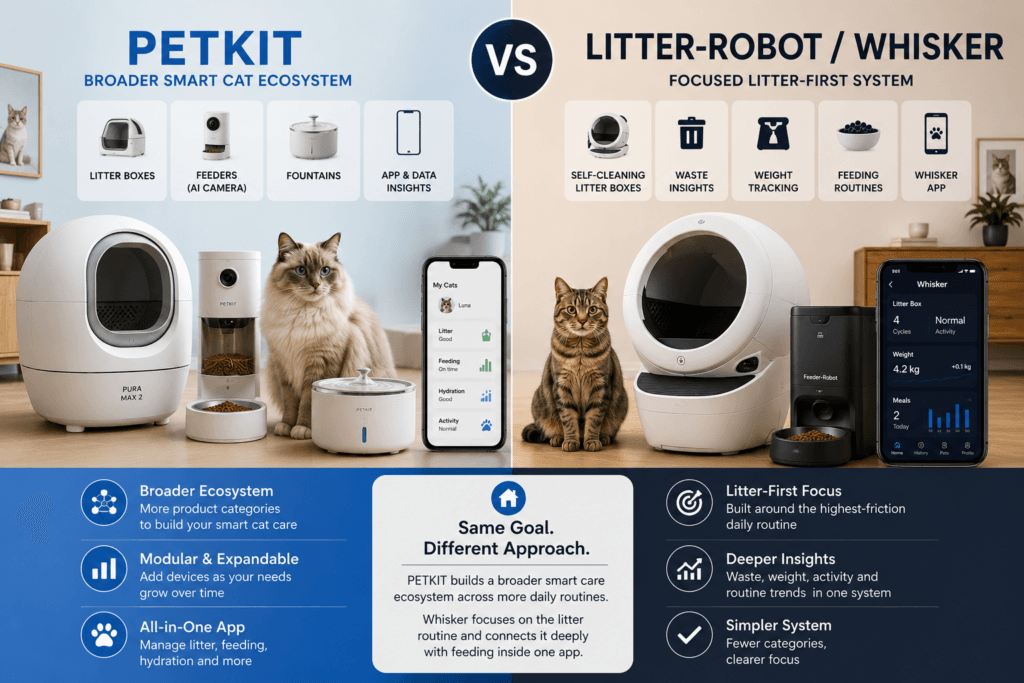
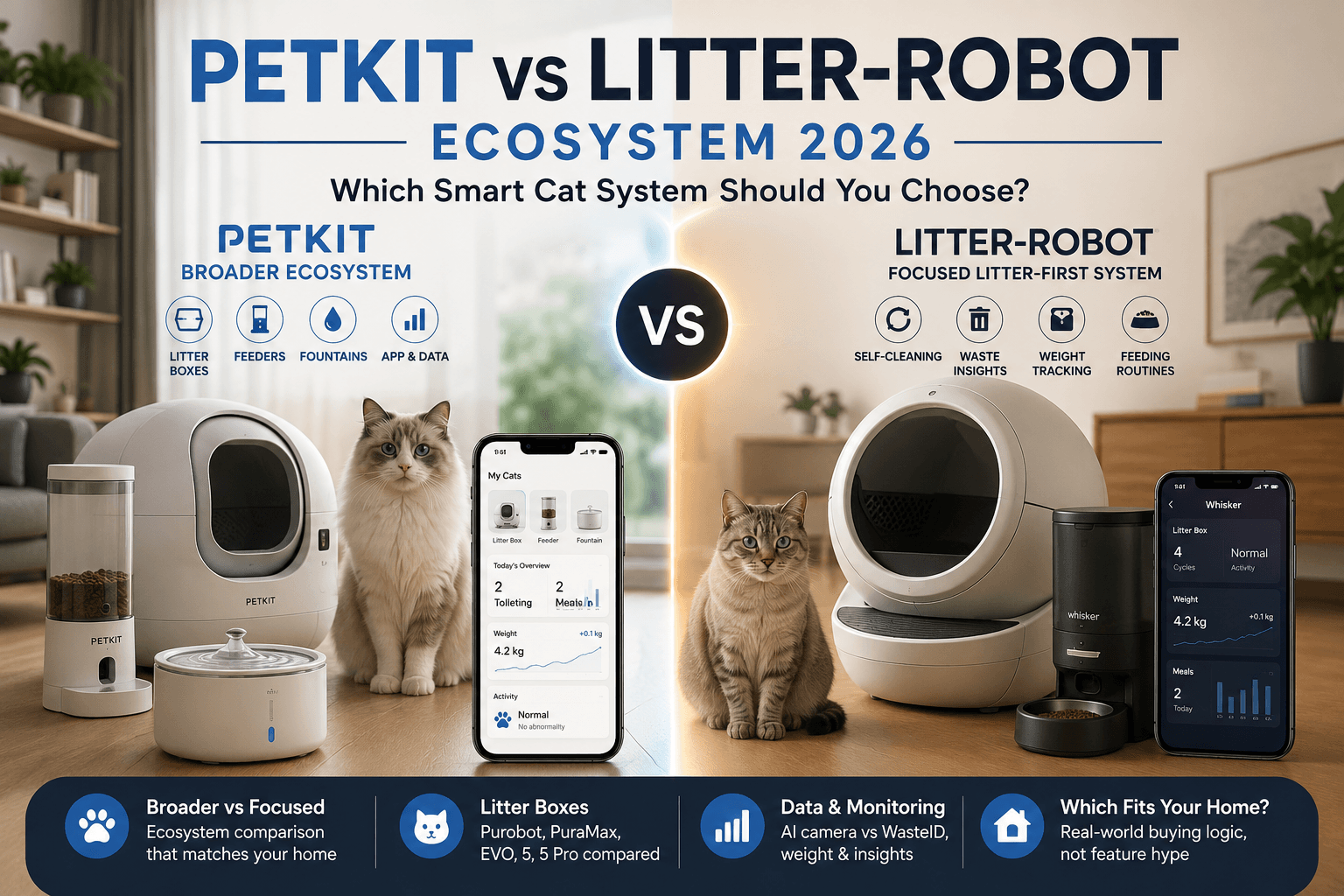
    Side-by-side comparison of PETKIT as a broader smart cat ecosystem and Litter-Robot as a focused litter-first system
    The ecosystem decision is not about which brand has more features, but whether your home needs broader connected care or a more focused litter-first workflow.
    CategoryPETKITWhisker
    PetTech AI verdictRecommended — Best Complete EcosystemStrong Recommendation for Litter-First Homes
    Best fitOwners expanding across litter, feeding and hydrationOwners making litter automation the main investment
    Main advantageMore credible product categories inside one appDeeper litter-box lineup and support environment
    FeedingWider selection, including camera-led optionsFeeder-Robot for routine dry-food scheduling
    HydrationEstablished connected-fountain rangeNo comparable fountain ecosystem
    Main riskBuying cameras and AI features you stop usingPaying premium prices inside a narrow product universe
    Choose it whenSeveral care routines create genuine frictionThe litter box is overwhelmingly the main problem

    Choose PETKIT when you already expect to buy across multiple care categories.

    Choose Whisker when you want the strongest focused path through premium litter automation and do not need a complete smart-home catalogue.

    Choose neither ecosystem automatically when you only need one device.

    Three matching app icons do not improve mediocre hardware.

    Research Note

    This is a research-led ecosystem comparison based on current official product catalogues, app services, software terms and PetTech AI’s individual product audits.

    It is not a blanket endorsement of every product sold by either company.

    PetTech AI may earn a commission from qualifying purchases.

    Want the broader connected-care platform? Check PETKIT PuraMax 2 through PETKIT.

    What You Are Actually Choosing
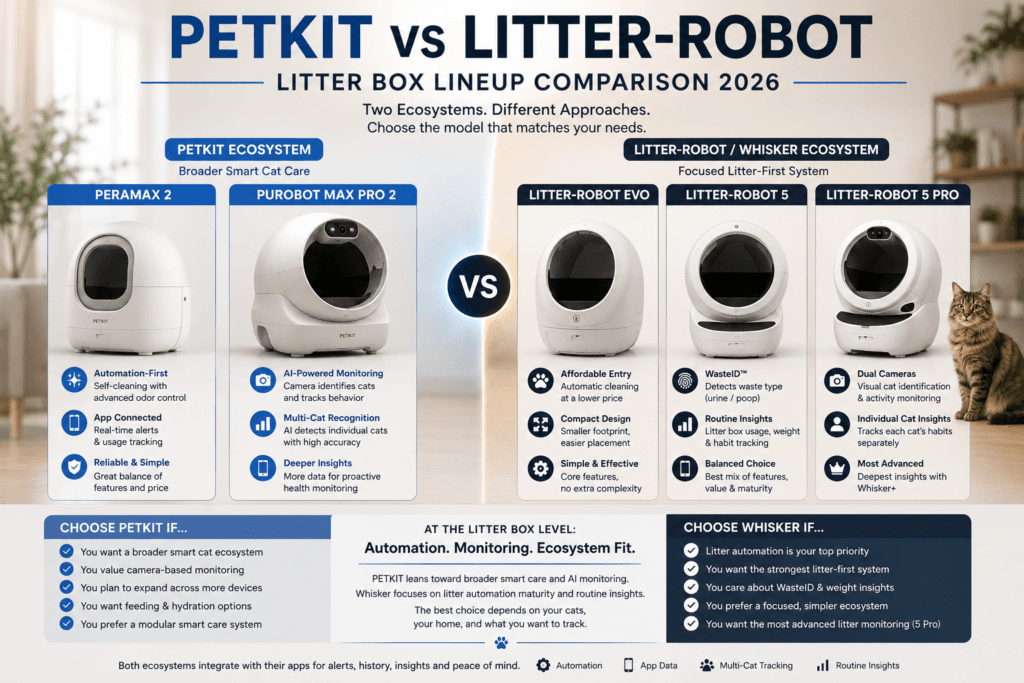
    PETKIT Purobot and PuraMax style litter boxes compared with Litter-Robot EVO, Litter-Robot 5 and Litter-Robot 5 Pro style devices
    At the litter-box level, PETKIT splits between automation-first and AI-camera monitoring, while Whisker separates EVO, Litter-Robot 5 and 5 Pro by monitoring depth.

    An ecosystem changes more than the number of apps on your phone.

    It influences:

    • which records appear together;
    • which subscription services become relevant;
    • which replacement parts and consumables you buy;
    • which support team handles several devices;
    • which brand receives the benefit of the doubt next time.

    That final point creates the greatest risk.

    A strong litter box can make the company’s feeder feel pre-approved.

    A useful feeder can make an unnecessarily advanced fountain appear to be the logical next stage of civilization.

    It is not.

    The correct ecosystem strategy is:

    1. buy the first product because it solves a real problem;
    2. let it earn your trust;
    3. evaluate the second product independently;
    4. treat the shared app as a bonus—not evidence of quality.

    For the broader distinction between removing work and collecting information, read our Smart Cat Monitoring vs Automation guide.

    PETKIT Wins Through Breadth

    PETKIT’s main advantage is not that it sells more objects.

    It is that those objects address several genuinely different routines.

    The current platform includes:

    • automatic litter boxes;
    • camera-equipped litter boxes;
    • scheduled dry-food feeders;
    • camera feeders with individual recognition;
    • dual-hopper feeding systems;
    • connected water fountains;
    • camera-led hydration products.

    The PETKIT app can combine supported litter-box use, feeding activity, hydration and device controls inside one account. The company’s recent product strategy has also extended AI cameras across litter, feeding and water rather than confining monitoring to a single category.

    That creates a credible expansion path.

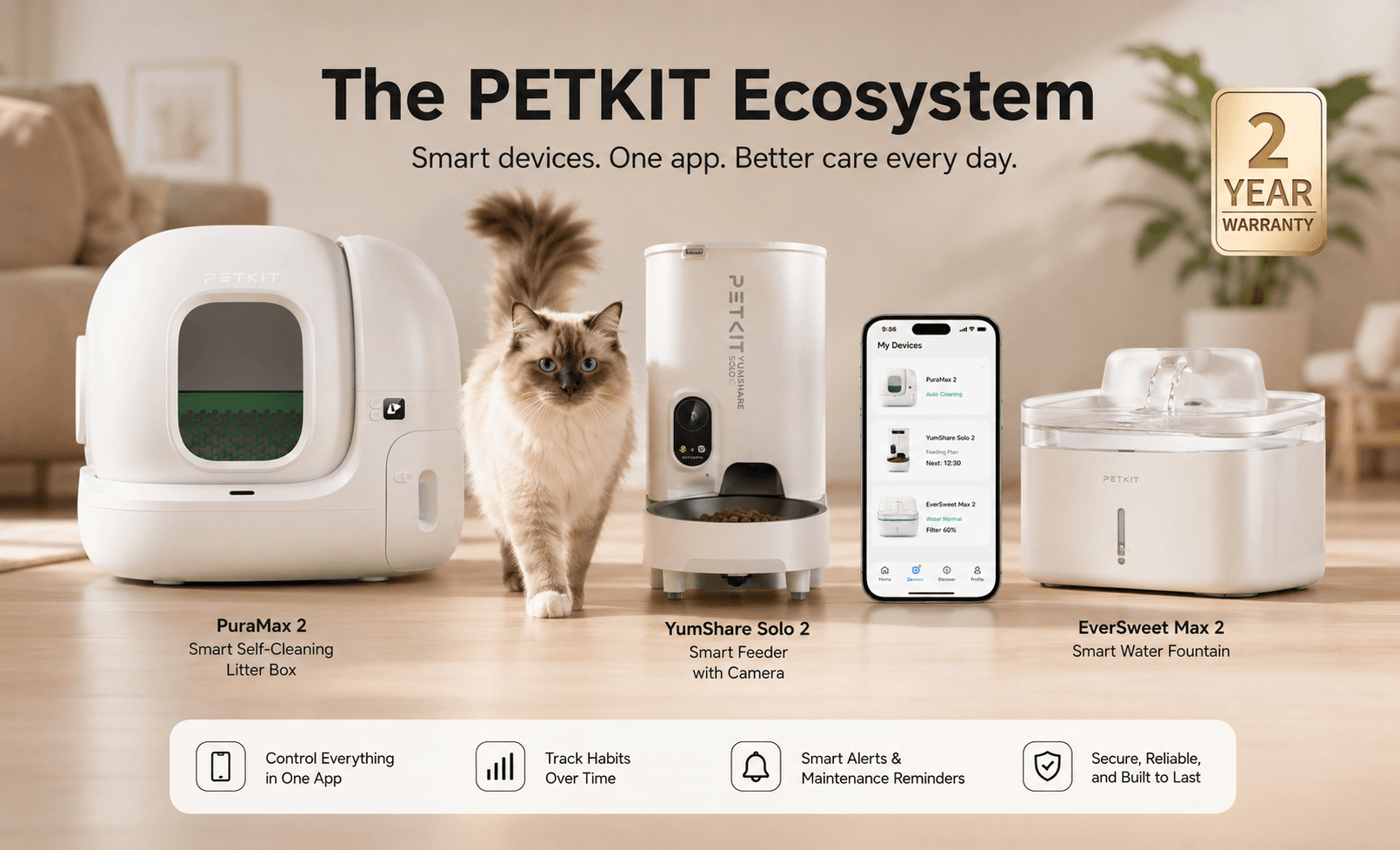
    A household could begin with PuraMax 2, add a YumShare feeder and later introduce an EverSweet fountain without leaving the same software environment.

    Each device still addresses a different task.

    This is why PETKIT offers more than a matching-logo collection.

    Where PETKIT is strongest

    PETKIT makes the most sense when:

    • litter, feeding and hydration all create friction;
    • camera monitoring is useful in more than one category;
    • you expect to expand gradually;
    • one app genuinely reduces management effort;
    • mixing several separate product platforms sounds exhausting.

    Its feeding and hydration range is the clearest advantage over Whisker.

    Whisker can connect a litter box and dry-food feeder.

    PETKIT can extend farther into meal monitoring, alternative feeder formats and water management.

    Where PETKIT becomes dangerous

    Breadth makes unnecessary expansion easier.

    You may start with a sensible automatic litter box and end up with:

    • a feeder camera you stopped checking after Tuesday;
    • a fountain dashboard you open twice per year;
    • several filter and deodorizer schedules;
    • enough notifications to suggest Napoleon operates a regional logistics depot.

    PETKIT also releases ambitious camera and AI products rapidly. Some have compelling specifications before they accumulate a mature long-term ownership record.

    The ecosystem may be strong.

    A new individual product may still deserve a Conditional Recommendation.

    PETKIT wins the breadth contest.

    It does not receive diplomatic immunity from product-level scrutiny.

    For the choice between its mainstream and camera-led litter boxes, read our Purobot Max Pro 2 vs PuraMax 2 comparison.

    Whisker Wins Through Litter Depth

    Whisker’s ecosystem is narrower and easier to understand.

    Its current model ladder includes:

    • Litter-Robot EVO;
    • Litter-Robot 4;
    • Litter-Robot 5;
    • Litter-Robot 5 Pro;
    • Feeder-Robot;
    • litter, odor and refill accessories;
    • the Whisker app and Whisker+.

    The company positions EVO as the compact option, Litter-Robot 4 as its established bestseller, Litter-Robot 5 as the WasteID-equipped platform and 5 Pro as the dual-camera flagship.

    That progression lets buyers decide how far they want to move from automatic cleaning toward detailed monitoring without leaving the product family.

    Where Whisker is strongest

    Whisker makes the most sense when:

    • daily scooping is the main problem;
    • cat size or household load requires a clear model ladder;
    • litter-related accessories and replacement support matter;
    • you prefer a mature, focused ownership ecosystem;
    • Feeder-Robot provides enough additional expansion.

    The current Whisker app connects litter-box activity, weight trends and Feeder-Robot meal information across compatible products.

    Its expertise remains concentrated around the litter room.

    That is not glamorous breadth.

    It is useful specialization.

    For the internal lineup decision, read our Litter-Robot 5 vs 5 Pro vs EVO comparison.

    Where Whisker becomes a premium litter fortress

    The ecosystem loses momentum once you move beyond litter and scheduled dry-food feeding.

    Whisker does not currently offer PETKIT’s fountain catalogue, refrigerated feeding options or wider camera-feeder range.

    A household may build:

    • an excellent litter setup;
    • detailed weight and visit histories;
    • automatic litter refilling;
    • scheduled dry-food feeding;

    and still need other brands for water or wet food.

    That is perfectly acceptable when litter was the central objective.

    It becomes disappointing only when the buyer expected Whisker to become a complete smart-cat home.

    The newest monitoring features also introduce Whisker+.

    Core product functions and app access remain available without membership, but Litter-Robot 5 Pro’s facial identification and deeper video and history functions sit inside the premium software layer.

    Apparently, remembering who used the litter box can now become a recurring expense.

    The subscription is not automatically poor value.

    It simply belongs in the real ownership calculation when it provides the reason for buying the Pro.

    Feeding and Hydration Decide the Overall Winner
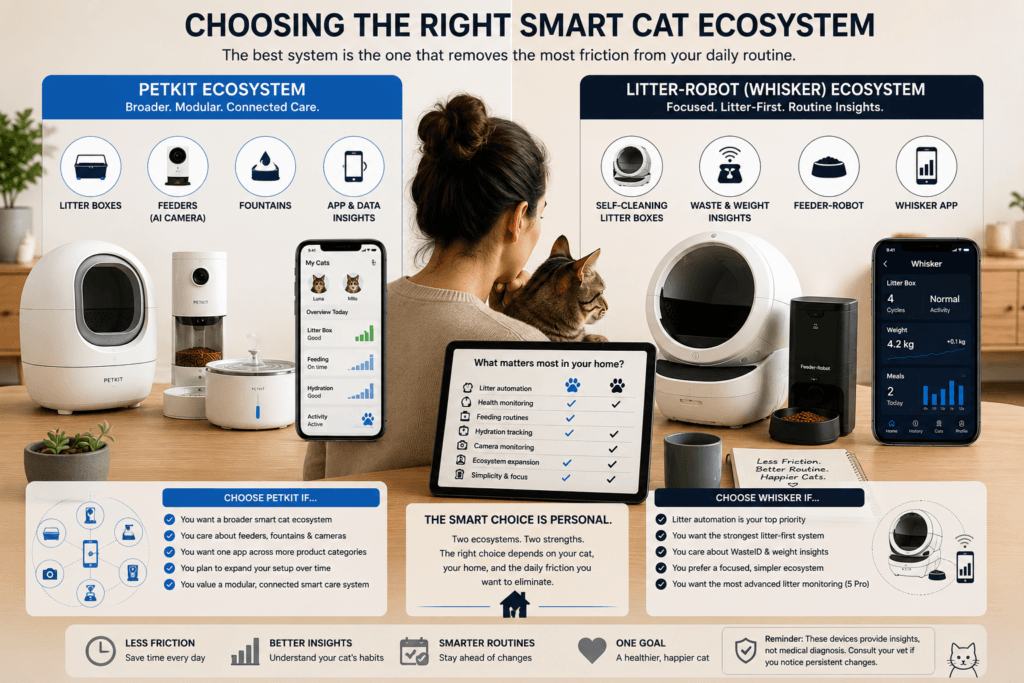
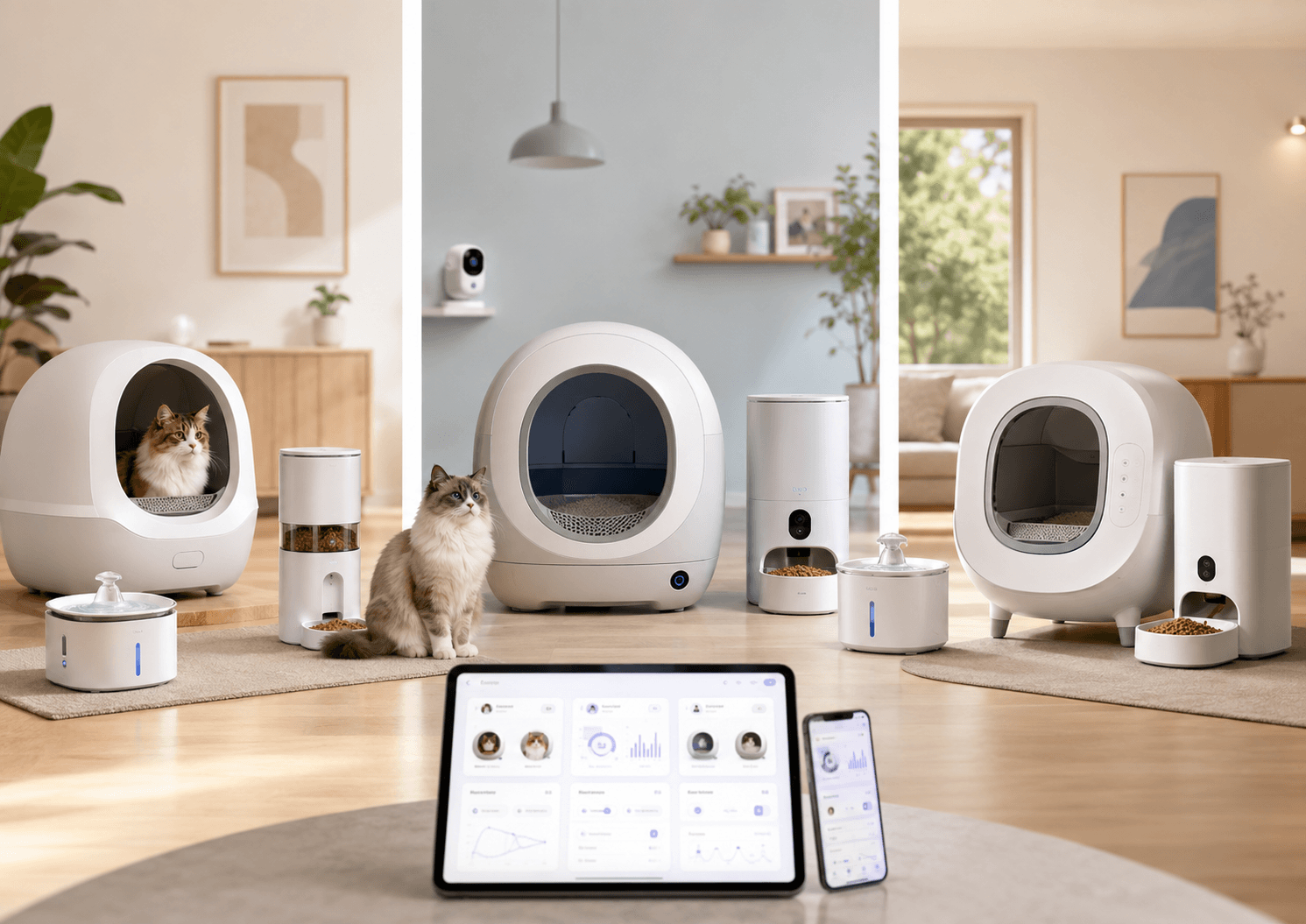
    Cat owner comparing smart cat ecosystem choices on a tablet with litter, feeding, hydration and monitoring options
    Smart cat ecosystems only make sense when they reduce real household friction. The best choice is the system whose trade-offs still fit after the novelty wears off.

    Whisker’s Feeder-Robot is a capable routine-first feeder.

    It offers scheduled dry-food meals and integrates with the same app as Litter-Robot.

    PETKIT provides more ways to approach feeding:

    • simple scheduled feeding;
    • dual-hopper configurations;
    • camera monitoring;
    • facial recognition;
    • visual meal records.

    PETKIT also has the decisive hydration advantage through its connected EverSweet fountain range.

    This is why PETKIT wins the complete ecosystem comparison.

    Not because every PETKIT product is better.

    Because the platform remains relevant after the litter box.

    For a feeder-level comparison between routine automation, camera monitoring and identity-led products, read our PETKIT vs Feeder-Robot vs CATLINK guide.

    The Ecosystem Lock-In Test

    Imagine that both companies announce tomorrow that their devices will no longer appear together inside one app.

    Would you still independently buy:

    • the litter box;
    • the feeder;
    • the fountain;
    • the camera upgrade?

    If yes, the ecosystem provides useful convenience.

    If no, the shared app may be encouraging weaker purchases.

    The first device is usually researched carefully.

    The second is often purchased with:

    “The first one was good, and this uses the same app.”

    That sentence has funded a remarkable amount of unnecessary consumer electronics.

    Is Mixing PETKIT and Whisker a Mistake?

    No.

    A mixed setup may be the rational winner:

    • Whisker for litter automation;
    • PETKIT for a camera feeder;
    • PETLIBRO for refrigerated wet food;
    • a conventional stainless-steel fountain requiring no account at all.

    The disadvantages are real:

    • multiple apps;
    • fragmented records;
    • separate accessories;
    • different customer-support systems.

    The advantage matters more:

    You can choose the strongest product for each routine.

    Your cat will not experience an identity crisis because his feeder and litter box have different logos.

    For the broader three-brand decision, read our CATLINK vs PETKIT vs Whisker comparison.

    Buyer-Regret Risk

    PETKIT regret usually means buying advanced cameras or AI insights that become ignored.

    Whisker regret usually means spending heavily inside a litter-focused ecosystem and later wanting broader feeding or hydration options.

    Mixed-brand regret means managing several apps—but potentially owning better individual products.

    The safest rule remains simple:

    Buy the product first and the ecosystem second.

    Still choosing the litter box before the ecosystem? Read our Best Smart Litter Boxes guide for the strongest models organized by household fit and monitoring needs.

    Final Verdict

    PETKIT is the better complete smart-cat ecosystem.

    It provides the stronger path across litter, feeding, hydration and camera-led monitoring. It is the right choice when several care routines create genuine friction and you expect to expand beyond one device.

    Whisker is the better litter-first ecosystem.

    Its narrower focus produces a clearer premium litter-box ladder, deeper litter-related software and a stronger support environment around the category.

    The decision is therefore:

    • PETKIT for breadth;
    • Whisker for litter depth;
    • mixed brands when individual product quality matters more than one app.

    Do not ask which logo deserves custody of your smart home.

    Ask which first product deserves your money.

    Then make the company earn everything that follows.

    Frequently Asked Questions

    Is PETKIT better than Litter-Robot?

    PETKIT is better as a broad ecosystem. Litter-Robot is better when premium litter automation is the primary objective.

    Which ecosystem has better automatic litter boxes?

    Whisker offers the clearer internal model ladder and stronger litter-first specialization. PETKIT remains competitive and offers more direct expansion into feeding and hydration.

    Which ecosystem is better for feeders?

    PETKIT offers more feeder formats and camera-led options. Whisker offers Feeder-Robot as a focused companion to Litter-Robot.

    Does either ecosystem require a subscription?

    Core functions do not require PETKIT Care+ or Whisker+. Certain extended camera, video-history and premium insight features may require the relevant paid service.

    Is it bad to mix PETKIT and Whisker?

    No. Mixing brands sacrifices one-app convenience but may produce a better product-by-product setup.

    References

    • PETKIT — Product catalogue and PETKIT app documentation
    • PETKIT — Care+ and 2026 connected-care announcements
    • Whisker — Current Litter-Robot lineup
    • Whisker — Feeder-Robot and Whisker app documentation
    • Whisker — Whisker+ membership information

    Image Disclosure

    Official manufacturer images are used when depicting exact products.

    Any AI-generated images are editorial illustrations only. They do not represent exact dimensions, controls, monitoring accuracy or app performance. Always verify current specifications before purchasing.

    Editorial Disclosure

    PetTech AI may earn a commission from qualifying purchases. This does not influence our recommendations, comparisons or editorial judgments.
  • PETKIT Ecosystem Review (2026): Where Should You Start—and Stop?

    PETKIT Ecosystem Review (2026): Where Should You Start—and Stop?

    PETKIT can automate the litter box, schedule dry food, circulate water and place cameras beside several routines cats have managed privately for thousands of years.

    The ecosystem is real.

    The PETKIT app supports litter boxes, feeders and fountains while combining device controls with records related to litter-box visits, meals and hydration.

    But one app is not a recommendation.

    A strong litter box does not automatically make every matching feeder necessary. A useful fountain does not mean Napoleon requires a camera crew whenever he drinks.

    The correct PETKIT strategy is:

    Start with the device that removes the most household friction. Add another only when it solves a different problem.

    For most cat households, that starting device is PuraMax 2.

    Purobot Max Pro 2 makes sense when visual multi-cat identification matters. YumShare Solo 2 is for owners who will genuinely use mealtime footage. EverSweet Max 2 is the most defensible hydration expansion when cordless placement changes where water can be offered.

    PETKIT has built the strongest complete smart-cat ecosystem.

    You still do not need to complete it.

    Quick Verdict

    NeedBest PETKIT entry pointPetTech AI verdictMain regret risk
    Reduce daily scoopingPuraMax 2Strong Recommendation for ValueCat dislikes the enclosed interior
    Identify similar-weight cats at the litter boxPurobot Max Pro 2Recommended with ConditionsCamera footage goes largely unused
    Monitor who visits the feederYumShare Solo 2Conditional RecommendationPaying for breakfast surveillance when a timer was enough
    Schedule two dry-food typesYumShare Dual-Hopper 2Evaluate by use caseTwo hoppers do not provide individual food access
    Add cordless hydrationEverSweet Max 2RecommendedFountain remains beside an outlet anyway
    Add camera-led hydrationEverSweet UltraConditional RecommendationBecoming an early tester for a complex new system
    Build the full ecosystemOne device at a timeRecommended overallBrand loyalty replaces product research

    Start with PuraMax 2 when litter labor is the largest problem.

    Start with Purobot Max Pro 2 only when camera-assisted identification produces information you will use.

    Add feeding or hydration later, after the first product has proved that PETKIT’s app, maintenance model and consumables fit your household.

    Stop when the next purchase is mainly justified by the sentence:

    “It would look nice beside the other PETKIT devices.”

    Matching icons are not a feline environmental need.

    Research Note

    This is a research-led ecosystem review based on current official products, app documentation, software terms and PetTech AI’s individual product audits.

    PetTech AI has not conducted long-term hands-on testing of every device discussed.

    PetTech AI may earn a commission from qualifying purchases.

    Want the strongest general PETKIT starting point? Check PuraMax 2 through PETKIT.

    Need visual multi-cat litter monitoring instead? Check Purobot Max Pro 2 through PETKIT.

    Prefer Amazon? Check Purobot Max Pro 2 on Amazon

    The PETKIT Ecosystem Is More Than a Catalogue

    PETKIT’s advantage is not simply that it sells many devices.

    Its products cover three genuinely different household routines:

    • litter-box cleaning;
    • scheduled feeding;
    • water access and fountain maintenance.

    The app can manage compatible devices and display records across those categories. Current PETKIT development also extends cameras and individual recognition beyond litter boxes into feeding and hydration products.

    That creates a credible expansion path.

    A household could use:

    • PuraMax 2 for routine litter automation;
    • YumShare Solo 2 for visual feeding context;
    • EverSweet Max 2 for cordless hydration;
    • one PETKIT account for controls and maintenance alerts.

    Each device still needs to justify itself independently.

    The ecosystem becomes useful when it reduces software friction around products you would have chosen anyway.

    It becomes a trap when a successful first purchase gives the rest of the catalogue automatic diplomatic immunity.

    Start With PuraMax 2 for Core Automation

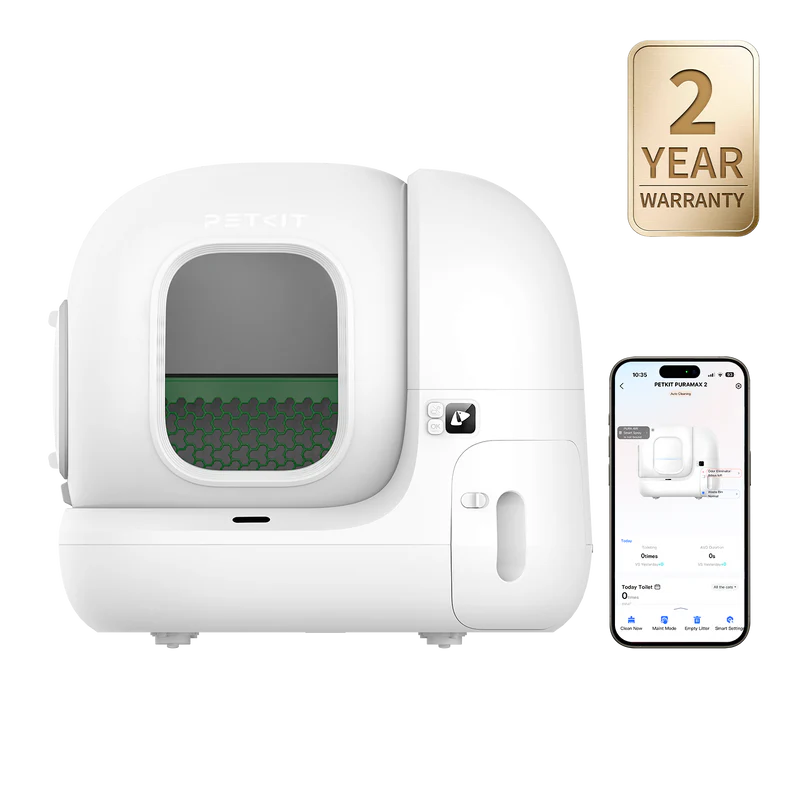
    PETKIT PuraMax 2 automatic self-cleaning litter box shown with PETKIT app monitoring
    PuraMax 2 is the strongest general PETKIT starting point for households prioritizing automatic litter cleaning over camera monitoring. Official PETKIT image.

    PuraMax 2 is the most sensible PETKIT entry point for many one- or two-cat homes.

    It automatically separates clumped waste, stores it in a sealed 7-liter bin and connects to the PETKIT app for controls, visit records and maintenance alerts. It does not add a camera or make video history central to the purchase.

    That narrower role is an advantage.

    PuraMax 2 solves a repetitive chore without demanding that the owner review footage, consider cloud-video storage or interpret every litter-box event as a developing medical documentary.

    Choose it when:

    • daily scooping is the main pain point;
    • one or two appropriately sized cats use the box;
    • weight-based records provide enough context;
    • you want PETKIT integration without cameras;
    • the enclosed design fits the cats and room.

    The litter box still requires drawer emptying, litter refilling, consumables and periodic cleaning.

    PETKIT has automated the scoop.

    It has not assigned a small maintenance technician to live behind the waste bin.

    Read our PETKIT PuraMax 2 Review for physical fit, litter compatibility and buyer-regret risks.

    Upgrade to Purobot Only When the Camera Solves Something

    Purobot Max Pro 2 adds camera-supported tracking and multi-cat recognition to automatic litter cleaning. PETKIT also enlarged its entrance compared with the previous version.

    Its strongest use case is attribution.

    Weight-based profiles can struggle when several cats have similar weights. A camera can provide additional evidence about which cat entered and what happened during the visit.

    That matters when:

    • several cats share the unit;
    • their weights overlap;
    • one cat’s routine requires closer observation;
    • video would help verify an unusual event;
    • the owner will actually inspect flagged records.

    It matters much less when one cat uses the box and automatic cleaning is the real objective.

    Purobot Max Pro 2 is not a universally superior PuraMax 2.

    It is a more specialized machine.

    The camera can help identify a pattern. It cannot diagnose the cause of altered litter-box behavior or replace veterinary assessment.

    FelineVMA encourages owners to learn their cat’s normal eating, drinking and toileting routines and contact a veterinarian when meaningful changes appear.

    Would visual identification change what you do? Check Purobot Max Pro 2 through PETKIT.

    Prefer Amazon? Check Purobot Max Pro 2 on Amazon

    For the complete product-level analysis, read our PETKIT Purobot Max Pro 2 Review

    PETKIT Feeding: Choose the Problem Before the Feeder

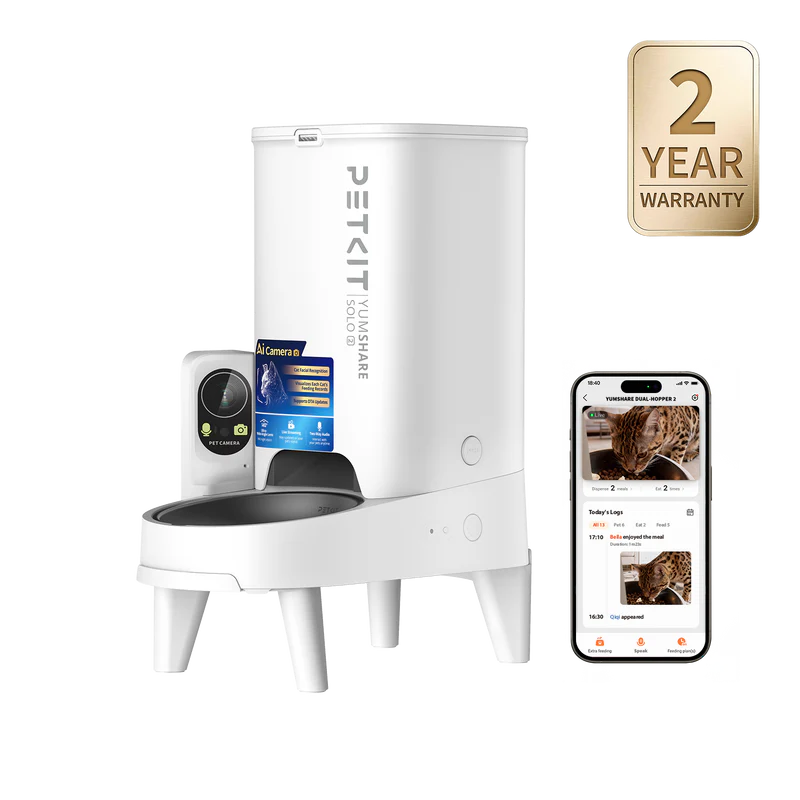
    PETKIT YumShare Solo 2 automatic feeder with camera shown beside the PETKIT app
    YumShare Solo 2 adds visual meal records and camera-supported pet recognition to scheduled dry-food feeding. Official PETKIT image.

    PETKIT’s current feeder range creates a logical ladder.

    Fresh Element Solo handles app-controlled scheduled dry-food feeding with a 12-cup hopper and backup-power support. It is the simpler option when the requirement is mainly consistent portions.

    YumShare Solo 2 adds a camera, facial recognition, meal records and bowl monitoring. PETKIT positions it for multi-pet recognition and visual feeding context.

    YumShare Dual-Hopper 2 adds separate food storage while retaining camera-led monitoring. Its value comes from alternating or combining two dry foods—not from physically stopping one cat from eating another cat’s serving.

    The decision is therefore:

    • choose Fresh Element Solo for straightforward scheduling;
    • choose YumShare Solo 2 when visual context changes feeding management;
    • choose Dual-Hopper 2 when two-food flexibility matters.

    Do not buy facial recognition when all you need is breakfast at seven.

    The camera may identify Emperor Maximilian stealing another cat’s food with impressive accuracy. It will not arrest him.

    Would visual meal records improve your routine? Check YumShare Solo 2 through PETKIT.

    Read our PETKIT YumShare Solo 2 Review for its monitoring benefits and lack of individual access control.

    Hydration: Max 2 Is the Sensible Expansion

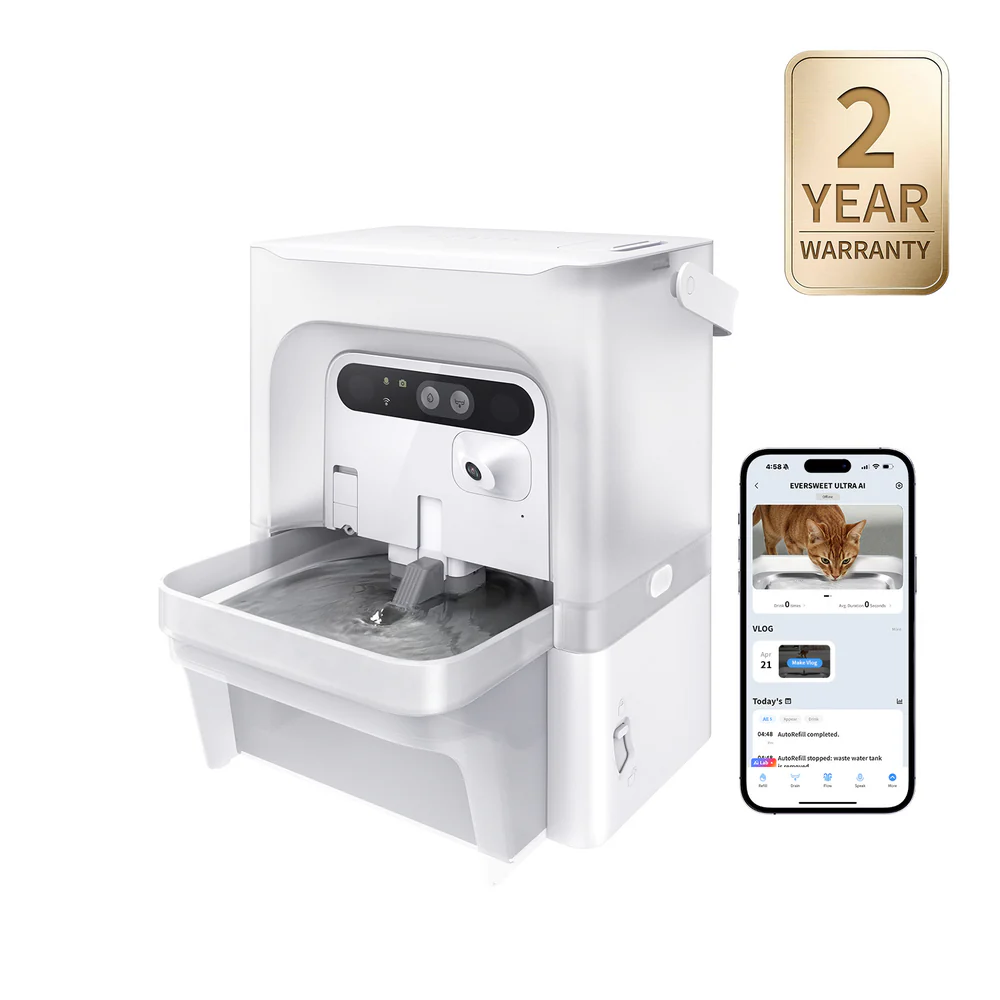
    PETKIT EverSweet Ultra smart water fountain shown with camera monitoring and PETKIT app controls
    EverSweet Ultra combines camera-supported hydration monitoring, app controls and separated water management. Official PETKIT image.

    PETKIT’s fountain range is one of the clearest reasons to choose its ecosystem over a litter-focused brand.

    EverSweet Solo 2 offers a smaller connected fountain with a wireless pump and app controls. EverSweet Max 2 increases capacity to 3 liters and adds cordless operation, hydration records and different operating modes.

    EverSweet Max 2 is the most defensible ecosystem addition when placement is the problem.

    A cordless fountain can be positioned where the cat prefers to drink rather than beside the outlet selected years earlier by an electrician who had not consulted Biscuit.

    Choose it when:

    • the best water location lacks a convenient outlet;
    • a second hydration station would improve access;
    • PETKIT maintenance alerts are useful;
    • camera monitoring is unnecessary.

    EverSweet Ultra goes much further.

    It separates clean and previously dispensed water, adds a camera and tracks individual pets through the PETKIT app. It is genuinely different—and considerably more complex and less mature.

    Ultra should be bought because its water architecture or visual identification solves a specific problem, not because AI hydration sounds like a responsible life milestone.

    Would cable-free placement improve water access? Check EverSweet Max 2 through PETKIT.

    Perfer Amazon? Check EverSweet Max 2 on Amazon.

    For the wider category decision, read our Best Smart Cat Water Fountains guide.

    What the PETKIT App Actually Adds

    The PETKIT app can consolidate compatible device controls, alerts and routine histories. PETKIT describes support for records related to litter-box use, feeding and hydration.

    This is useful for:

    • checking whether devices are operating;
    • receiving low-water or full-bin alerts;
    • reviewing scheduled feeding;
    • seeing visit or activity patterns;
    • managing several devices without separate accounts.

    It does not automatically produce a complete or medically interpretable picture of the cat.

    A feeder can record dispensing without proving exact consumption.

    A fountain can record activity without explaining why drinking changed.

    A litter box can record visits without determining whether stress, pain, urinary disease or simple variation caused the pattern.

    The ecosystem supplies observations.

    It does not get to diagnose Gerald because three graphs happen to share the same font.

    For the broader framework, read our Smart Cat Monitoring vs Automation guide.

    PETKIT Care+ and the Real Cost of Camera Products

    Core device operation does not require PETKIT Care+.

    The optional service becomes more relevant for camera products because it can add extended histories, cloud video storage and fuller playback functions. PETKIT’s current app documentation and service agreement describe those additional cloud-based features.

    Before buying a camera-equipped device, ask:

    How much of the reason I want this product depends on paid video history?

    When live viewing and recent snapshots are enough, the premium service may be unnecessary.

    When reviewing historical footage is the entire reason for the camera, Care+ becomes part of the ownership cost.

    A physical product and the software service that makes its most advanced feature useful are related purchases.

    The checkout page may introduce them separately. Your budget should not.

    One Ecosystem Does Not Mean One Resource

    A unified app should not be confused with a unified physical environment.

    FelineVMA recommends providing multiple and separated resources—including food, water and toileting areas—so cats can access them without being blocked or challenged by another animal.

    That means:

    • one smart fountain may not replace several water locations;
    • one automatic litter box may not replace enough separated boxes;
    • one shared feeder may not suit cats with conflicting diets;
    • one dashboard cannot solve resource guarding.

    This is especially important in multi-cat households.

    PETKIT can connect the records.

    It cannot negotiate a peace treaty beside the only water fountain.

    The Ecosystem Lock-In Test

    Before buying a second PETKIT product, imagine that it requires a completely separate app.

    Would you still choose it over every competing product?

    If yes, the ecosystem adds useful convenience.

    If no, the matching dashboard may be influencing the decision more than the hardware.

    The first PETKIT device is usually researched carefully.

    The second risks being purchased with:

    “The litter box works, and this feeder uses the same app.”

    That sentence has financed a respectable quantity of unnecessary consumer electronics.

    For the direct brand comparison, read our PETKIT vs Litter-Robot Ecosystem guide.

    Buyer-Regret Risk

    PETKIT ecosystem regret usually takes one of four forms:

    • paying for cameras that stop being checked;
    • subscribing to histories that rarely influence a decision;
    • buying several devices before the first one proves reliable;
    • choosing one-app convenience over better individual hardware.

    The safest expansion path is gradual:

    1. identify the routine creating the most work or uncertainty;
    2. choose the PETKIT product only if it wins independently;
    3. live with its app, maintenance and consumables;
    4. add another category only when it solves a different problem.

    Do not build the entire ecosystem over one weekend.

    Your cat is not opening a technology campus.

    Final Verdict

    The PETKIT ecosystem earns a Recommended verdict and remains the strongest complete smart-cat ecosystem currently available.

    Its advantage is breadth with a credible purpose:

    • PuraMax 2 for straightforward litter automation;
    • Purobot models for camera-supported litter monitoring;
    • Fresh Element and YumShare feeders for several levels of feeding automation;
    • EverSweet fountains for connected and cordless hydration;
    • one app connecting compatible devices and records.

    The best starting point for most households is PuraMax 2.

    The best specialist upgrade is Purobot Max Pro 2 when visual identification matters.

    YumShare Solo 2 and EverSweet Max 2 make sense when meal visibility or water placement solves an additional problem.

    Stop expanding when the next product mainly offers:

    • another camera;
    • another graph;
    • another notification;
    • another matching icon.

    PETKIT has built a legitimate smart-cat ecosystem.

    The intelligent way to buy it is one product at a time.

    Frequently Asked Questions

    Is the PETKIT ecosystem worth it?

    Yes, when several PETKIT products independently fit your household. Its main advantage is managing litter, feeding and hydration devices through one app.

    What is the best first PETKIT product?

    PuraMax 2 is the strongest default for many households because it removes frequent scooping without requiring camera monitoring or a video subscription decision.

    Does PETKIT require Care+?

    No. Core device functions work without Care+. Certain extended camera histories, cloud storage and advanced playback features may require the optional service.

    Can PETKIT devices diagnose health problems?

    No. They can reveal changes in observable routines, but a veterinarian must determine their medical meaning.

    Should every smart cat device use the same ecosystem?

    No. One app is convenient, but product safety, physical fit, cleaning, reliability and household suitability matter more than brand consistency.

    References

    • PETKIT — Current smart-home product catalogue
    • PETKIT — PETKIT app and App Service documentation
    • PETKIT — PuraMax 2 product documentation
    • PETKIT — Purobot Max Pro 2 product documentation
    • PETKIT — YumShare Solo 2 and Dual-Hopper 2 documentation
    • PETKIT — EverSweet Max 2 and EverSweet Ultra documentation
    • PETKIT — Care+ service agreement
    • Feline Veterinary Medical Association — Environmental Needs
    • Cornell Feline Health Center — Hydration and litter-box guidance

    Image Disclosure

    Official manufacturer images are used when available and authorized.

    AI-generated images may also be used as editorial illustrations. They should not be treated as exact representations of product dimensions, controls or physical features. Always verify current official specifications before purchasing.

    Editorial Disclosure

    PetTech AI may earn a commission from qualifying purchases. This does not influence our recommendations, comparisons or editorial judgments.
  • CATLINK vs PETKIT vs Whisker: Smart Ecosystem or Brand Trap?

    CATLINK vs PETKIT vs Whisker: Smart Ecosystem or Brand Trap?

    Your cat does not admire your unified dashboard.

    He has never looked at three matching app icons and thought:

    “At last. A coherent digital-care architecture.”

    That part is for humans.

    CATLINK, PETKIT and Whisker sell three different versions of the smart cat home:

    • PETKIT wants to connect litter care, feeding, hydration and camera monitoring.
    • Whisker wants to dominate the litter room and handle scheduled dry-food feeding.
    • CATLINK wants to connect what goes into the cat with what eventually comes out.

    Kibble enters. Clumps leave. Somewhere, a graph feels important.

    The real question is not which company offers the largest catalogue.

    It is:

    Which ecosystem contains enough strong products to deserve your second purchase after the first device has earned your trust?

    Our answer is PETKIT overall, Whisker for litter-first households and CATLINK only when a specific product wins independently.

    Quick Verdict

    EcosystemBest fitPetTech AI verdictMain risk
    PETKITHomes expanding across litter, feeding, hydration and camerasRecommended — Best Overall EcosystemBuying advanced monitoring features you stop using
    WhiskerBuyers making litter automation the main priorityStrong Recommendation for Litter-First HomesLimited expansion outside litter and dry feeding
    CATLINKBuyers choosing a particular CATLINK litter boxConditional RecommendationAssuming every matching device is equally proven

    Choose PETKIT when you genuinely expect to use several smart-care categories.

    Choose Whisker when the litter box is the expensive problem you actually need to solve.

    Choose CATLINK when one of its litter boxes defeats the alternatives on its own merits.

    Do not choose any ecosystem simply because completing a branded set produces emotional closure.

    Research Note

    This is a research-led comparison based on current official product documentation, app capabilities, product availability and PetTech AI’s individual product audits.

    PetTech AI has not conducted long-term hands-on testing of every device discussed.

    PetTech AI may earn a commission from qualifying purchases. As an Amazon Associate I earn from qualifying purchases.

    Want the broadest connected-care platform? Check PETKIT PuraMax 2 through PETKIT.

    Does a CATLINK litter box better fit your household? Check CATLINK Luxury Pro-X on Amazon.

    The Three-Device Test

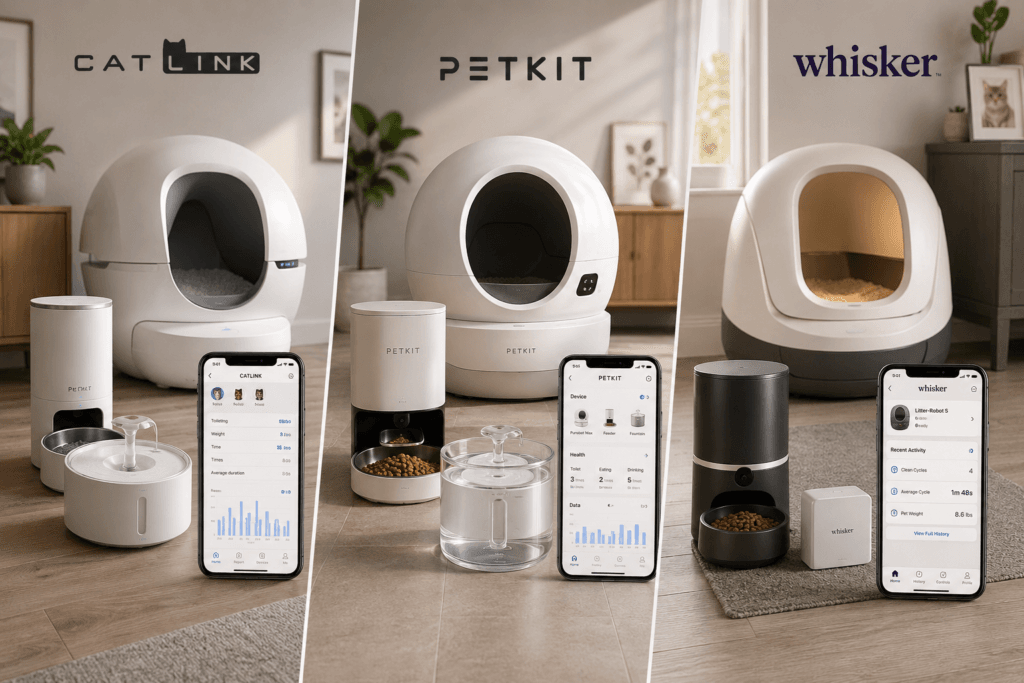
    CATLINK, PETKIT and Whisker smart cat ecosystems shown side by side with litter boxes, feeders, fountains and app dashboards
    CATLINK leans into multi-cat data, PETKIT builds the broadest smart cat ecosystem, and Whisker focuses on a tighter litter-first workflow.

    Before committing to an ecosystem, imagine that every product requires a separate app.

    Would you still independently choose:

    • the litter box;
    • the feeder;
    • the fountain?

    If the answer is yes three times, the shared app creates genuine convenience.

    If the answer is:

    “I only wanted the other two because their icons matched,”

    you are not building a smart home.

    You are collecting branded appliances.

    The strongest ecosystem is made from products you would buy even without the ecosystem.

    PETKIT: The Best Complete Ecosystem

    PETKIT currently covers the widest credible range of smart-cat routines.

    Its platform includes automatic litter boxes, dry-food feeders, connected fountains and increasingly camera-led products that monitor feeding, drinking and litter-box activity through the PETKIT app. The company’s current direction extends cameras and individual recognition across all three categories rather than keeping them confined to one flagship device.

    That breadth gives owners several possible entry points:

    • begin with a PuraMax litter box;
    • add a camera feeder such as YumShare;
    • introduce connected hydration;
    • choose monitoring-heavy products only where the data has a purpose.

    This flexibility is PETKIT’s strongest advantage.

    A household can expand gradually without every product solving the same problem or carrying the same level of complexity.

    Why PETKIT wins

    PETKIT offers the best current balance of:

    • category breadth;
    • credible hardware across several routines;
    • camera and non-camera choices;
    • multi-cat monitoring;
    • one-app expansion;
    • feeding and hydration options Whisker does not match.

    Its ecosystem makes sense for someone who expects to automate more than litter.

    For a direct comparison against Whisker’s narrower approach, read our PETKIT vs Litter-Robot Ecosystem guide.

    Where PETKIT can disappoint

    PETKIT launches ambitious products quickly.

    New cameras, facial recognition and behavioral insights may appear before a device has accumulated years of public ownership history.

    That means the ecosystem can be strong while a specific new product still deserves caution.

    The company is also moving aggressively toward AI-generated insights. Some information can reveal useful patterns. Some can become an expensive way to learn that Archibald drank water while you were at the supermarket.

    Before buying the advanced version, ask:

    What will I do differently because this camera or insight exists?

    When the answer is nothing, choose the simpler model.

    PETKIT wins the ecosystem comparison.

    It does not receive diplomatic immunity from product-level scrutiny.

    Whisker: The Best Litter-First Ecosystem

    Whisker is much narrower.

    Its current ecosystem centers on Litter-Robot models, Feeder-Robot, the Whisker app and the software, accessories and consumables surrounding them. The app combines litter-box activity, weight information and feeding statistics, while newer Litter-Robot models add WasteID and camera-based monitoring.

    That focus is not automatically a weakness.

    Most owners do not wake up determined to build a technological civilization around the cat.

    They want to stop scooping litter.

    Whisker starts with that problem and builds outward only modestly.

    Why Whisker remains compelling

    Its litter-box lineup has a clear structure:

    • EVO for compact automation;
    • Litter-Robot 5 as the strongest overall platform;
    • Litter-Robot 5 Pro for camera-supported identification and monitoring.

    Whisker’s deepest expertise, app development and accessory environment remain concentrated around litter automation.

    For households where the litter box matters more than fountains, wet-food feeders or a broad device catalogue, that specialization is valuable.

    Read our Litter-Robot 5 vs 5 Pro vs EVO comparison for the model-level decision.

    Where Whisker can disappoint

    The ecosystem becomes thin once the buyer moves beyond litter care and scheduled dry feeding.

    Whisker does not offer PETKIT’s range of fountains, refrigerated feeding concepts or camera feeders.

    Litter-Robot 5 Pro also introduces a software-cost decision. Its cameras offer basic functionality without Whisker+, but individual visual identification and deeper histories depend on the membership layer.

    Apparently, even remembering who used the litter box can now become a subscription service.

    That does not make Whisker+ worthless.

    It means the hardware and the long-term software plan must be evaluated together.

    Choose Whisker when litter automation is the center of the home.

    Do not choose it because you expect a complete smart-cat catalogue to materialize around the litter box.

    CATLINK: Buy the Product, Not the Diagram

    CATLINK has the most explicit “input-output” ecosystem concept.

    The CATLINK app connects litter boxes, feeders and fountains while combining toilet activity, eating behavior, drinking patterns and weight-based multi-cat records. CATLINK also sells complete ecosystem bundles containing a scooper, Fresh 2 feeder and water fountain.

    The theory is coherent:

    1. track what the cat eats;
    2. track what the cat drinks;
    3. track what happens in the litter box;
    4. look for meaningful changes.

    As an ecosystem diagram, it is excellent.

    As a shopping strategy, it needs more restraint.

    CATLINK’s strongest argument

    CATLINK remains most convincing in automatic litter boxes.

    A product such as Luxury Pro-X can deserve consideration for:

    • multi-cat homes;
    • weight-based visit identification;
    • litter-box histories;
    • households where its dimensions or design fit better;
    • buyers who prefer CATLINK’s app approach.

    This gives CATLINK a legitimate place in the comparison.

    For the direct two-brand decision, read our CATLINK vs PETKIT comparison.

    Where the CATLINK argument weakens

    A credible CATLINK litter box does not automatically validate every feeder and fountain sharing the app.

    Our product-level audits have found the wider catalogue less consistently convincing than PETKIT’s. Some devices offer interesting ideas, but ecosystem coherence is not evidence of equal maturity, reliability or household fit.

    A shared app is convenient.

    It is not a quality-control department.

    The correct CATLINK strategy is:

    • choose the litter box only if it wins independently;
    • validate whether its data helps;
    • evaluate every additional device from zero;
    • ignore the emotional pressure to complete the bundle.

    CATLINK is a valid smart-litter brand with a wider ecosystem ambition.

    It is not currently an equal all-category alternative to PETKIT.

    Still comparing individual litter boxes rather than entire ecosystems? Read our Best Smart Litter Boxes guide for the strongest options organized by household fit, monitoring needs and buyer-regret risk.

    Monitoring Is Not Automation

    Cat owner comparing smart cat ecosystem options at home with litter boxes, feeders, fountains and monitoring devices in the background
    The best smart cat ecosystem is not the one with the most devices, but the one that fits your home, your cats and the level of data you are willing to manage.

    The three ecosystems also differ in what they are trying to improve.

    Automation removes repetitive labor.

    Examples include:

    • sifting litter;
    • dispensing scheduled meals;
    • circulating water;
    • sending maintenance alerts.

    Monitoring adds context.

    Examples include:

    • which cat used a device;
    • whether a routine changed;
    • how weight moved over time;
    • whether food or water activity declined.

    PETKIT leans most heavily into monitoring across categories.

    Whisker combines strong litter automation with increasingly deep litter-related data.

    CATLINK emphasizes linking multiple routine records inside one dashboard.

    Monitoring is valuable only when the information changes a decision.

    A graph that leads you to verify a persistent change or contact a veterinarian has served a purpose.

    A graph you admire briefly before closing the app is interface decoration.

    For the broader distinction, read our Smart Cat Monitoring vs Automation guide.

    Where Buyer Regret Comes From

    PETKIT regret usually means paying for cameras or AI features that become ignored.

    Whisker regret means investing heavily in a focused ecosystem and later wanting broader feeding or hydration options.

    CATLINK regret means buying the bundle before each product has earned independent confidence.

    The universal regret is choosing matching software over better hardware.

    Mixing brands may be the correct answer:

    • a Whisker litter box;
    • a PETKIT feeder;
    • a simple fountain that is easy to clean;
    • no dashboard pretending this arrangement constitutes institutional failure.

    Your cat will recover from the trauma of using appliances made by different corporations.

    Final Verdict

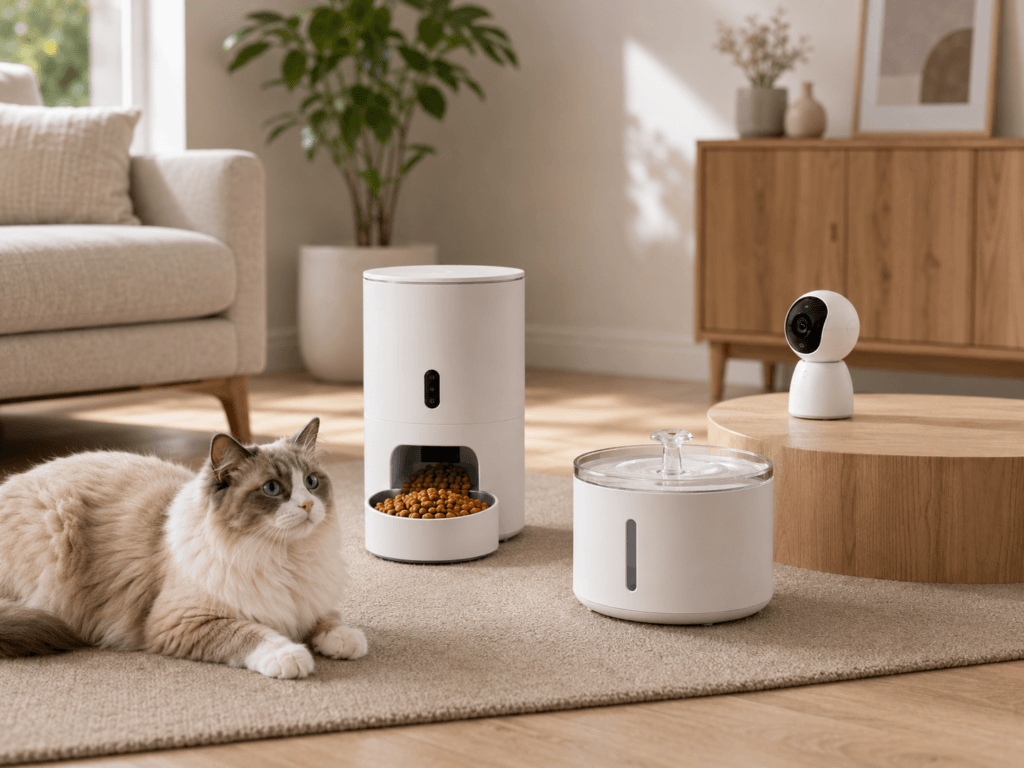
    Smart cat ecosystem with a cat, automatic feeder, water fountain and pet camera in a modern living room.
    A smart cat ecosystem can connect feeding, hydration and camera monitoring, but the best choice depends on whether you value data, breadth or litter-first simplicity.

    PETKIT is the best overall smart cat ecosystem.

    It offers the widest credible combination of litter automation, feeding, hydration and camera-led monitoring. It is the strongest choice for households that genuinely intend to expand across several categories.

    Whisker is the best litter-first ecosystem.

    Its range is narrower, but its focus is valuable. When the main objective is buying the strongest premium automatic litter box and perhaps adding scheduled dry feeding, Whisker may be the better decision.

    CATLINK earns a Conditional Recommendation.

    Its litter boxes and multi-cat data can be compelling. Its wider ecosystem should be approached one device at a time rather than purchased as a pre-approved bundle.

    The ranking is therefore:

    1. PETKIT — best complete ecosystem
    2. Whisker — best litter-first ecosystem
    3. CATLINK — best evaluated product by product

    Choose the first device because it solves a real problem.

    Let it earn the second purchase.

    Do not give a corporation custody of your entire smart cat home because its app has an attractive dark mode.

    Frequently Asked Questions

    Is PETKIT better than Whisker?

    PETKIT is better for a complete ecosystem covering litter, feeding and hydration. Whisker is better when premium litter automation is the main priority.

    Is CATLINK better than PETKIT?

    CATLINK can be better when a specific litter-box design or multi-cat feature suits the household. PETKIT remains the stronger overall ecosystem across categories.

    Which ecosystem has the best automatic litter boxes?

    Whisker has the strongest litter-first positioning. PETKIT offers more variety between automation-led and camera-led systems. CATLINK remains relevant for specific multi-cat designs.

    Which ecosystem is best for feeders and fountains?

    PETKIT currently offers the broadest combination of camera feeders, alternative feeding formats and connected fountains. Whisker offers Feeder-Robot but no comparable fountain range.

    Do all smart cat products need to use the same app?

    No. A shared app reduces digital clutter, but it should not outweigh reliability, cleaning, physical fit or the quality of each device’s core function.

    References

    • PETKIT — Smart Home product and app documentation
    • PETKIT — 2026 connected-care product announcements
    • Whisker — Litter-Robot, Feeder-Robot and Whisker app documentation
    • Whisker — Litter-Robot 5 Pro and Whisker+ documentation
    • CATLINK — Ecosystem bundles and CATLINK app documentation

    Image Disclosure

    Official manufacturer images are used when depicting exact products.

    Any AI-generated images are editorial illustrations only. They do not represent exact dimensions, controls, monitoring accuracy or app performance. Always verify current specifications before purchasing.

    Editorial Disclosure

    PetTech AI may earn a commission from qualifying purchases. This does not influence our recommendations, comparisons or editorial judgments.