Author: PetTech

  • Best Multi-Cat Tech Solutions: Less Conflict or More Expensive Clutter?

    Best Multi-Cat Tech Solutions: Less Conflict or More Expensive Clutter?

    A multi-cat home does not usually fail because it lacks enough apps.

    It fails because Napoleon eats Florence’s prescription food, Archibald blocks the only water station and three cats have quietly agreed that one litter box is now contested territory.

    Technology can help.

    But only when it solves the actual problem.

    An RFID feeder can protect an individual diet. A large automatic litter box can reduce scooping. A camera can help identify which cat’s routine changed.

    None of those devices can make cats share resources politely because the product page used the phrase “multi-pet friendly.”

    The best multi-cat tech is therefore not the most advanced equipment.

    It is the equipment that removes a specific source of friction without replacing basic resource planning with expensive optimism.

    Quick Verdict

    Household problemBest solutionPetTech AI verdictMain limitation
    Food theft or different dietsPETLIBRO One RFID FeederStrong Recommendation with ConditionsOne feeder recognizes one dedicated tag
    Shared dry-food schedulingWhisker Feeder-RobotRecommended with ConditionsOpen bowl provides no individual access control
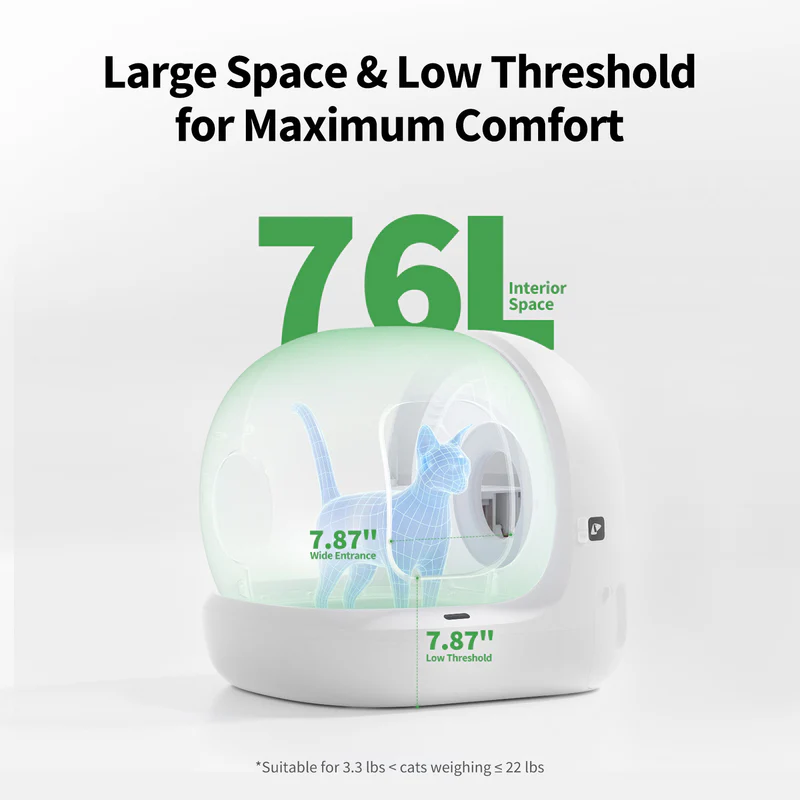
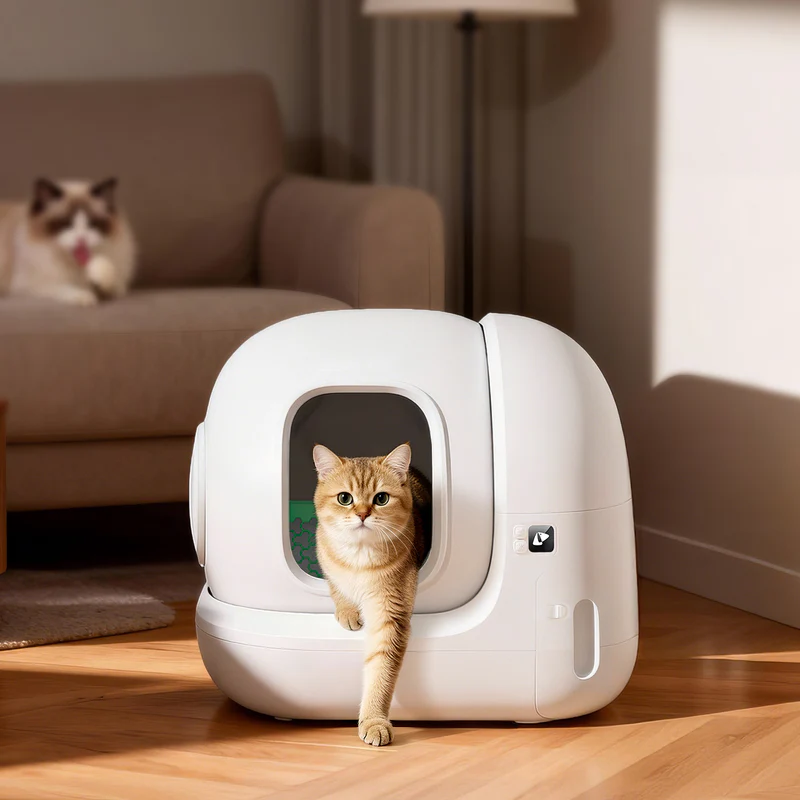
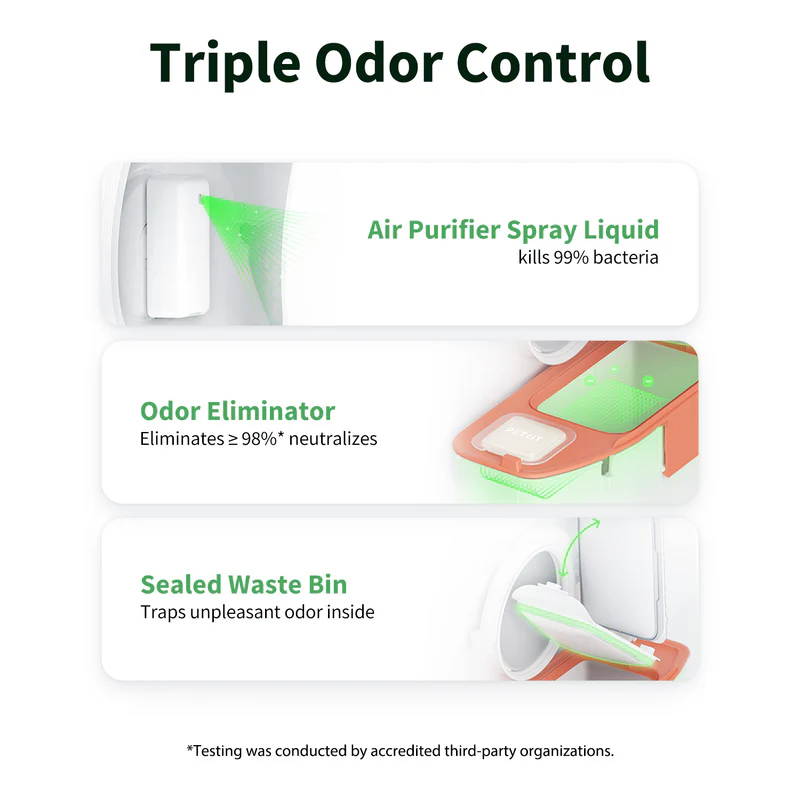
    Heavy litter-box workloadLitter-Robot 5Strong Recommendation for AutomationOne robot may not replace multiple separated boxes
    Similar-weight cats need identificationPETKIT Purobot Max Pro 2Recommended with ConditionsCameras add cost, complexity and software dependence
    Several pets need shared water accessPetSafe Drinkwell 360 StainlessRecommendedNo individual hydration tracking
    General multi-cat tensionMore separated resourcesNon-negotiableAnnoyingly resistant to affiliate monetization

    Start with PETLIBRO One RFID when the problem is food theft or protected diets.

    Choose Litter-Robot 5 when waste volume and daily scooping create the greatest burden.

    Choose Purobot Max Pro 2 only when identifying the individual cat changes what you can do.

    Choose Feeder-Robot when the cats already share the same food peacefully.

    And sometimes the correct “tech solution” is purchasing a second ordinary water bowl and placing it somewhere Napoleon cannot govern.

    Research Note

    This is a research-led roundup based on current official product documentation, feline environmental guidance and PetTech AI’s product-level audits.

    PetTech AI has not conducted long-term hands-on testing of every product included.

    PetTech AI may earn a commission from qualifying purchases. As an Amazon Associate I earn from qualifying purchases.

    First Decide Whether You Need Access, Automation or Evidence

    Most poor multi-cat purchases begin by solving the wrong problem.

    Access control

    Access control answers:

    “How do I stop one cat from using another cat’s resource?”

    RFID feeders belong here.

    They physically unlock for the recognized tag and remain closed to other animals.

    Automation

    Automation answers:

    “How do I reduce repetitive work?”

    Automatic litter boxes and scheduled feeders belong here.

    They perform a task but may not control which cat benefits from it.

    Monitoring

    Monitoring answers:

    “Which cat did this, and did the pattern change?”

    Cameras, facial recognition and weight histories belong here.

    They add evidence.

    They do not necessarily prevent the behavior.

    A camera can identify Baron stealing lunch.

    It cannot restore the lunch or issue disciplinary sanctions.

    For the broader distinction, read our Smart Cat Monitoring vs Automation guide.

    Best for Food Theft: PETLIBRO One RFID Feeder

    Two cats beside PETLIBRO One RFID feeders with collar-controlled bowl access
    PETLIBRO One RFID uses a dedicated collar tag and covered bowl to protect individual dry-food access in multi-cat homes. Official PETLIBRO image.

    Verdict: Strong Recommendation with Conditions

    PETLIBRO One RFID is the strongest product in this roundup when cats need separate dry-food access.

    The feeder uses a dedicated collar tag to unlock the covered bowl for one recognized pet. PETLIBRO states that it supports up to ten scheduled meals or snacks per day, includes a 3-liter hopper and works through the PETLIBRO app. It does not read implanted microchips or third-party tags.

    That makes it useful when:

    • one cat steals food;
    • calorie requirements differ;
    • one cat eats prescription dry food;
    • a slow eater is repeatedly displaced;
    • free feeding creates uncontrolled intake.

    The most important limitation is easy to miss:

    Each feeder synchronizes with one collar tag.

    In a three-cat household where every cat needs a protected bowl, you may need three feeders—not one machine with three personal profiles. PETLIBRO also recommends separating multiple units physically to reduce RFID interference.

    This can make the total setup expensive and physically demanding.

    But unlike a camera feeder, it addresses the problem directly.

    The camera tells you that Gerald stole the meal.

    The RFID lid prevents Gerald from accessing it.

    Does one cat need protected dry-food access? Check PETLIBRO One RFID Feeder on Amazon.

    For other feeding formats, read our Best Automatic Cat Feeders guide.

    Selective feeders can reduce food stealing, but collar-tag and implanted-microchip systems create different failure modes. See our selective-access cat feeder comparison.

    Best for Shared Dry Food: Whisker Feeder-Robot

    Verdict: Recommended with Conditions

    Feeder-Robot is the better choice when several cats already eat the same food and the real problem is scheduling, capacity and refill frequency.

    Whisker states that it holds up to 32 cups of dry food, supports as many as eight scheduled meals per day and retains saved schedules if the device temporarily goes offline.

    That is useful for:

    • cats sharing the same kibble;
    • households serving several small meals;
    • owners already using the Whisker app;
    • high food consumption;
    • routines that must continue through temporary internet loss.

    What it does not provide is RFID access.

    Food drops into an open bowl. If Biscuit finishes his portion and moves directly into Napoleon’s serving, the app will record successful dispensing with admirable professionalism.

    Feeder-Robot works when sharing is already peaceful.

    It does not create peace.

    Choose an RFID system when individual diets or theft are the problem. Choose Feeder-Robot when all cats eat the same food and you simply want a large, structured feeding routine.

    Do your cats already share the same dry food?Check Feeder-Robot availability on Amazon.

    Read our Feeder-Robot Review for the full ecosystem and buyer-regret analysis.

    Best for Heavy Litter Work: Litter-Robot 5

    Verdict: Strong Recommendation for Automation

    Litter-Robot 5 is the best default automatic litter box in this roundup for households with several cats and substantial litter traffic.

    Whisker positions it for up to five cats weighing between 3 and 30 lb. It adds WasteID, which distinguishes urine from solid waste, alongside an enlarged waste system and detailed app monitoring.

    It makes sense when:

    • several cats generate constant scooping;
    • larger cats need more internal space;
    • waste volume fills smaller drawers too quickly;
    • urine-versus-solid records add useful context;
    • Whisker support and accessories matter.

    The automation can dramatically reduce manual labor.

    It does not abolish the need for enough litter locations.

    FelineVMA guidance recommends one litter box per cat plus one extra, placed in different locations rather than grouped together. Resource placement should also prevent one cat from blocking another’s access or escape route.

    That does not mean every three-cat household must buy four automatic robots and apply for commercial financing.

    It means one premium robot should not automatically become the only toilet in the home.

    A second or third conventional box in another location may provide more behavioral value than another app-enabled machine sitting beside the first one.

    For model selection, read our Litter-Robot 5 vs 5 Pro vs EVO comparison.

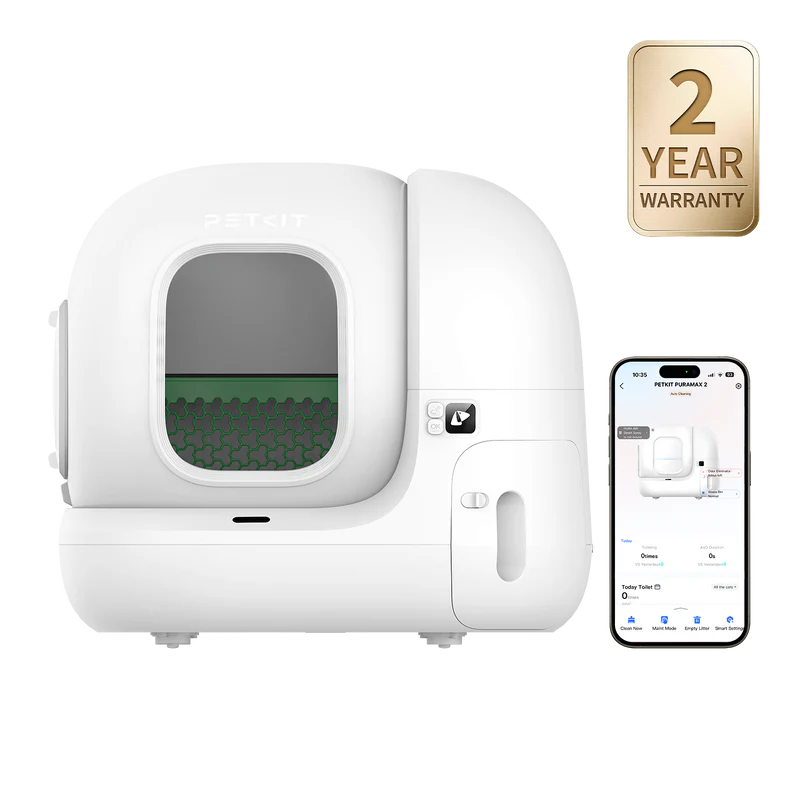
    Best for Individual Litter Identification: PETKIT Purobot Max Pro 2

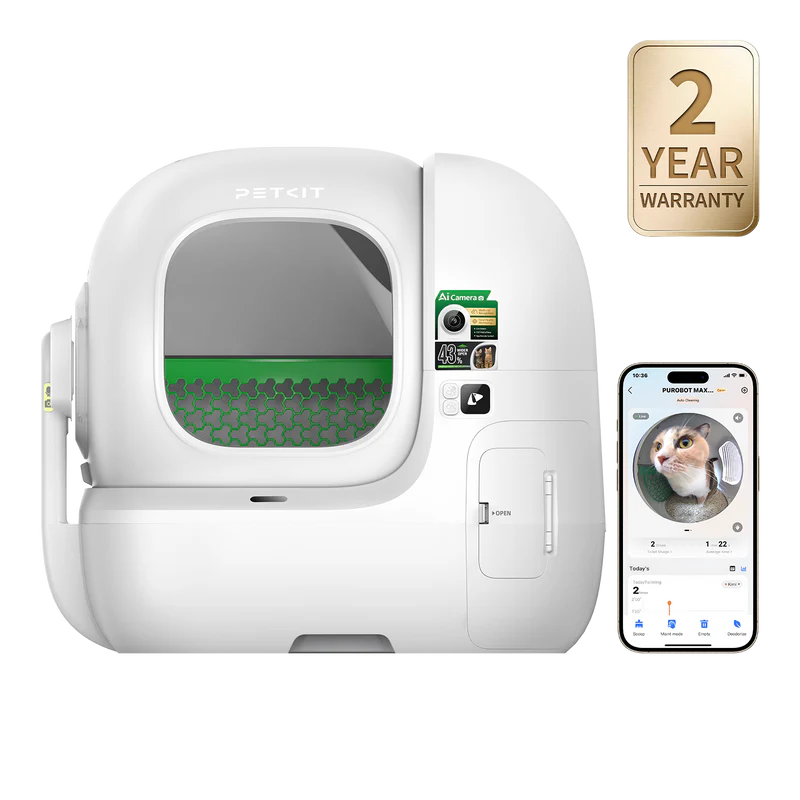
    PETKIT Purobot Max Pro 2 automatic litter box shown with camera monitoring and PETKIT app
    Purobot Max Pro 2 combines automatic litter cleaning with camera-assisted cat identification and app-based visit records. Official PETKIT image.

    Verdict: Recommended with Conditions

    Purobot Max Pro 2 is the specialist choice when the litter box already cleans automatically but the household still cannot confidently identify which cat generated each record.

    PETKIT combines facial recognition with weight sensing and positions the model for multi-cat identification. The current version also has a larger entrance than its predecessor.

    Its strongest use cases include:

    • cats with similar weights;
    • one cat requiring closer litter monitoring;
    • ambiguous weight-only records;
    • owners who spend substantial time away;
    • situations where visual evidence would improve a veterinary conversation.

    This is monitoring, not access control.

    The camera cannot stop one cat from guarding the unit or another from avoiding it.

    It can help reveal that the problem is happening.

    The Recommendation with Conditions reflects three risks:

    • video features may depend partly on PETKIT Care+;
    • recognition is not infallible;
    • footage has no value when nobody reviews it.

    A camera that produces forty ignored litter clips is not preventive health technology.

    It is an unusually specific streaming platform with no subscribers.

    Would visual identification solve an existing uncertainty? Check Purobot Max Pro 2 through PETKIT.

    Prefer Amazon checkout? Check Purobot Max Pro 2 availability on Amazon.

    Read our PETKIT Purobot Max Pro 2 Review for the full camera and subscription decision.

    Best for Shared Water Access: PetSafe Drinkwell 360 Stainless

    Verdict: Recommended

    PetSafe Drinkwell 360 is the least “smart” product here and perhaps the most honest.

    It holds 128 ounces of water and uses interchangeable attachments to create as many as five drinking streams around its circular body. That allows several pets to approach from different sides.

    It provides:

    • high shared capacity;
    • multiple drinking positions;
    • stainless-steel construction;
    • replaceable parts;
    • no app, account or subscription.

    It does not identify which cat drank.

    That can be a worthwhile trade when the real problem is access rather than data.

    A single RFID fountain may produce beautiful individual charts while remaining the only water station in a location one confident cat can control.

    FelineVMA guidance recommends separate food and water resources for individual cats, with additional resources and visual separation in multi-cat homes.

    So Drinkwell 360 should not automatically be the only water source either.

    Use additional bowls or fountains in different areas when cats avoid one another or guard pathways.

    The best hydration dashboard remains useless to the cat who cannot reach the fountain.

    Would several shared drinking positions solve more than individual data? Check PetSafe Drinkwell 360 on Amazon.

    For tracking-led alternatives, read our Best Smart Cat Water Fountains guide.

    Technology Cannot Replace Resource Distribution

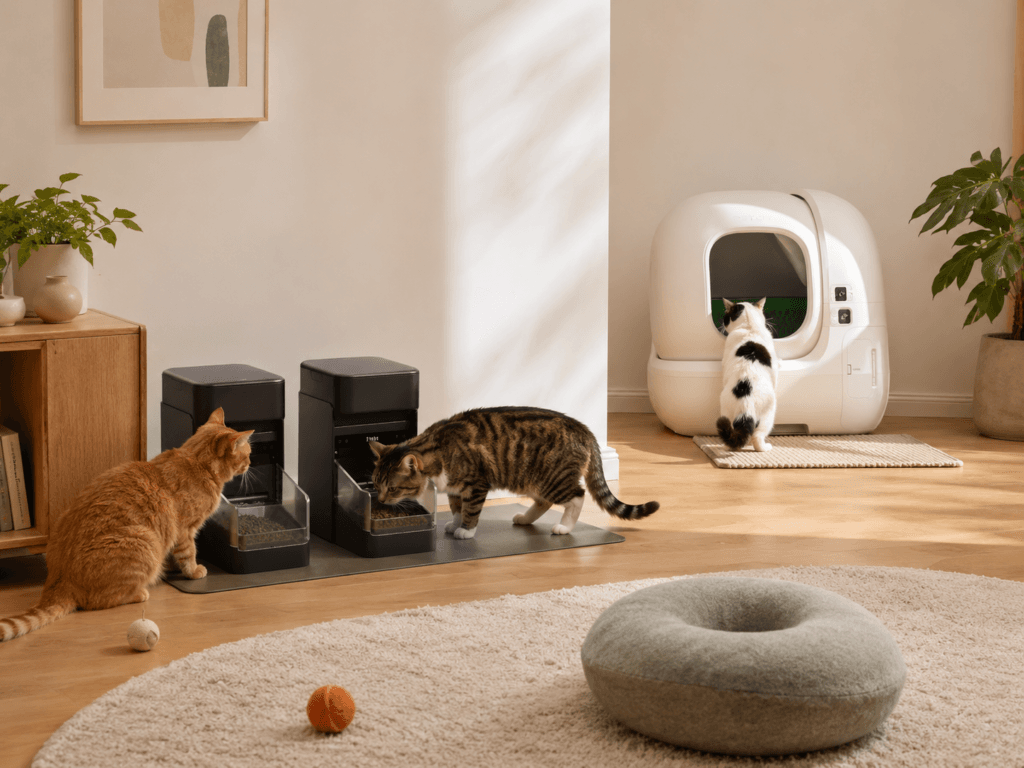
    Three cats using separate feeding stations and an automatic litter box in different areas of a home
    Separate feeding and litter areas can reduce competition more effectively than relying on one heavily monitored shared resource. AI-generated editorial illustration.

    The most important multi-cat intervention is also the least exciting one:

    • several litter boxes;
    • several water locations;
    • separated feeding areas;
    • more than one resting and climbing zone;
    • escape routes that cannot be blocked.

    FelineVMA specifically advises providing adequate, separated resources because multiple social groups can exist inside the same home even when the cats appear broadly tolerant of one another.

    Technology works best after that foundation exists.

    Use RFID to protect a diet.

    Use automation to reduce labor.

    Use cameras to clarify uncertainty.

    Do not ask one premium appliance to replace every physical resource because its brochure says multi-cat.

    The product may support four cats mechanically.

    The cats have not necessarily approved the merger.

    Buyer-Regret Risk

    Multi-cat technology creates predictable forms of regret.

    RFID regret: the cats dislike collars, or several protected feeders are required.

    Shared-feeder regret: one dominant cat continues stealing from the open bowl.

    Automatic-litter regret: the machine handles waste but not resource guarding.

    Camera regret: footage accumulates without changing a decision.

    Fountain regret: one large fountain becomes the only contested water location.

    The safest buying question is:

    Does this product prevent the problem, automate the work or merely document it?

    All three functions can be valuable.

    Confusing them is expensive.

    Final Verdict

    The best multi-cat tech solution depends on the conflict you are trying to remove.

    Choose PETLIBRO One RFID Feeder when food theft or protected dry-food diets are the main problem.

    Choose Feeder-Robot when all cats share the same food and scheduling is the only missing layer.

    Choose Litter-Robot 5 when litter volume and daily scooping create the greatest burden.

    Choose Purobot Max Pro 2 when identifying individual litter-box users changes how you respond.

    Choose PetSafe Drinkwell 360 when several drinking positions and capacity matter more than individual hydration analytics.

    Then add enough ordinary, separated resources around the technology.

    The ideal multi-cat home is not the one with the most impressive dashboard.

    It is the one where Florence can eat, drink and use a litter box without filing a territorial-access request through Napoleon’s office.

    Frequently Asked Questions

    Do RFID feeders stop food stealing?

    They can prevent unauthorized access when the intended cat consistently wears the compatible tag. PETLIBRO One RFID recognizes one dedicated collar tag per feeder and does not read implanted microchips.

    How many litter boxes should a multi-cat home have?

    FelineVMA’s general rule is one box per cat plus one extra, distributed across different locations. Household relationships, space and cat preferences can affect the practical setup.

    Can one automatic litter box serve several cats?

    Mechanically, some models can handle several cats. Behaviorally, additional separated boxes may still be necessary to prevent blocking, avoidance and competition.

    Is a camera feeder the same as an RFID feeder?

    No. A camera can show which cat approached. An RFID feeder physically controls access to the bowl.

    What is the best technology for a three-cat home?

    Start with the biggest source of friction. Use RFID for diet theft, litter automation for workload and additional separated resources for territorial access. No single product solves all three.

    References

    • PETLIBRO — One RFID Smart Feeder product documentation
    • Whisker — Feeder-Robot product documentation
    • Whisker — Litter-Robot 5 comparison and product documentation
    • PETKIT — Purobot Max Pro 2 product documentation
    • PetSafe — Drinkwell 360 Stainless Multi-Pet Fountain
    • Feline Veterinary Medical Association — Feline House-Soiling
    • Feline Veterinary Medical Association — Getting Another Cat
    • Cornell Feline Health Center — Feline aggression and resource separation

    Image Disclosure

    Official manufacturer images are used when available and authorized.

    AI-generated images may also be used as editorial illustrations. They should not be treated as exact representations of product dimensions, controls or physical features. Always verify current official specifications before purchasing.

    Editorial Disclosure

    PetTech AI may earn a commission from qualifying purchases. This does not influence our recommendations, comparisons or editorial judgments.
  • Best Cat Harnesses for Safe Outdoor Walks in 2026

    Best Cat Harnesses for Safe Outdoor Walks in 2026

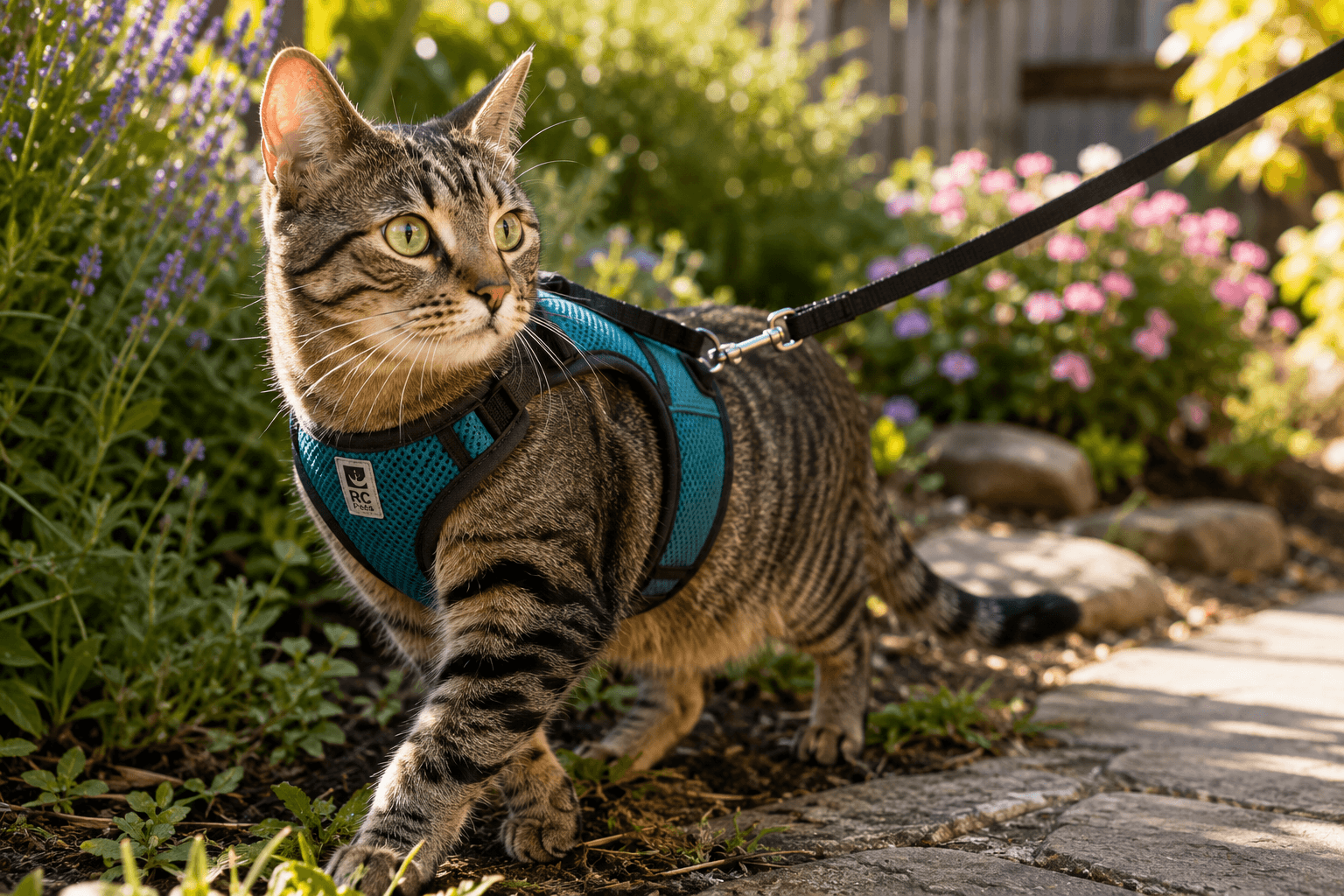
    A cat harness should not make outdoor time feel like a test of bravery.

    The right one gives your cat a secure, comfortable way to explore at their own pace—whether that means sitting quietly on a patio, sniffing around a garden, traveling in an RV, or taking short leash walks near home.

    The wrong one can create the opposite experience: rubbing at the armpits, pressure around the neck, an easy escape route, or a cat that freezes the moment it is fastened.

    Baron may then collapse sideways as though the harness has temporarily disabled his operating system.

    That reaction does not necessarily mean the fit is wrong. It means harness acceptance must be trained—not assumed because the product page included a cat standing heroically on a mountain.

    That is why the best cat harness is not simply the most padded, most expensive, or most “escape-proof” looking model. It is the harness shape that fits your cat’s body, temperament, and outdoor routine.

    This guide compares four strong options for different needs:

    • RC Pets Adventure Kitty Harness for balanced outdoor comfort and adjustability.
    • Kitty Holster for cats that benefit from wider vest coverage and soft cotton contact.
    • PetSafe Come With Me Kitty for low-bulk training and gentle leash introduction.
    • Rabbitgoo Cat Harness for a practical lower-cost vest option.

    Quick Verdict: Which Cat Harness Fits Your Cat?

    Best forHarnessWhy it stands outMain trade-off
    Best overall outdoor harnessRC Pets Adventure KittyAdjustable neck and waist, breathable mesh, reflective trim, included leashMore structured than minimal strap harnesses
    Best comfort vest for cautious or sensitive catsKitty HolsterBroad vest coverage, soft cotton lining, wide adjustable closure areaWarmer and bulkier than an H-style harness
    Best for early leash trainingPetSafe Come With Me KittyLightweight nylon, quick-snap fit, included bungee leashLess body coverage than a vest
    Best budget vestRabbitgoo Cat HarnessMesh vest design, dual buckle closure, reflective detailsFit must be checked carefully; sizing is not one-size-fits-all

    Research Note

    This is a research-led roundup based on current manufacturer information, fit guidance, training recommendations and product positioning.

    PetTech AI has not conducted long-term hands-on testing of every harness included.

    PetTech AI may earn a commission from qualifying purchases. As an Amazon Associate I earn from qualifying purchases.

    What “Smart” Actually Means in a Cat Harness

    A cat harness does not need electronics to be smart.

    For outdoor safety, smart design means:

    • A cat-specific fit rather than a scaled-down dog harness.
    • A leash attachment positioned on the back, not at the neck.
    • Enough adjustment to create a secure fit without restricting movement.
    • Materials that avoid rubbing around the chest and front legs.
    • A shape that makes backing out more difficult without promising the impossible.
    • A design your cat can tolerate long enough to build positive associations.

    No harness is guaranteed escape-proof. A frightened cat can move in unexpected ways, and even an excellent harness can fail if it is too loose, too large, damaged, or used without supervision.

    The goal is not to find a magical product that removes all risk.

    The goal is to choose a structure that gives you the best possible control for your cat’s body and behavior.

    Start With Harness Shape, Not Brand

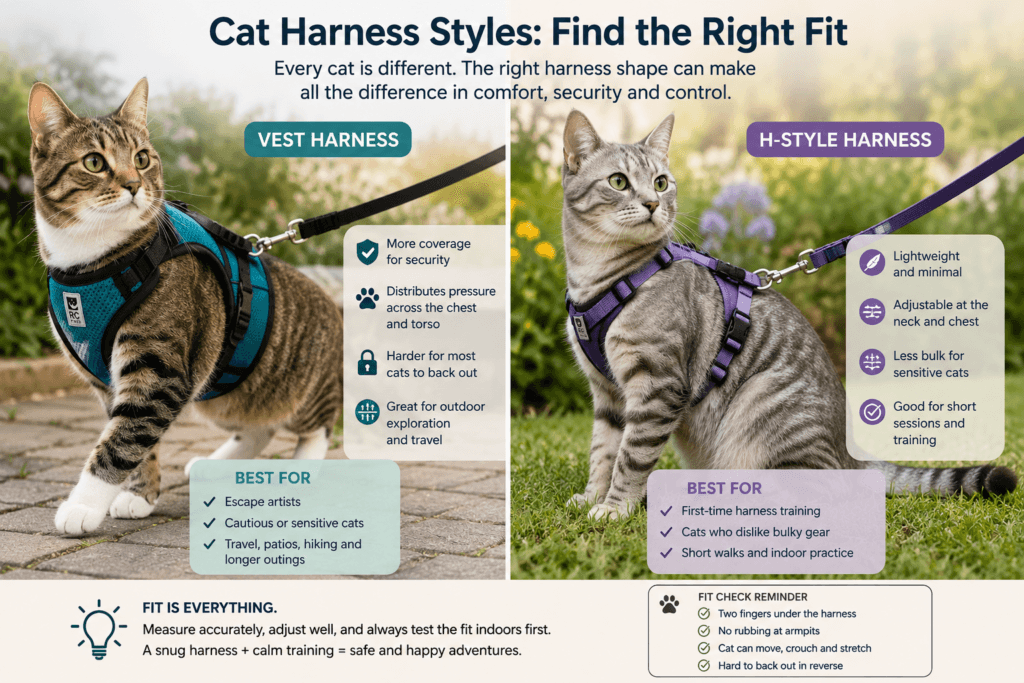
    cat-harness-vest-vs-h-style-fit-comparison.webp
    Vest harnesses offer broader coverage, while H-style designs can feel lighter—fit determines whether either option works safely.

    Before choosing a product, decide which style is most likely to suit your cat.

    Vest harnesses: more coverage, but not automatic security

    Vest-style harnesses distribute contact across a wider part of the chest and torso. They may feel more stable and can make backing out more difficult when fitted correctly.

    More fabric does not automatically mean a safer fit. A loose vest can create just as much escape space as loose straps.

    They can also work well for cats who need more physical reassurance from the harness itself.

    The trade-off is warmth and bulk. A heavily padded vest may feel restrictive for a cat who is heat-sensitive, especially during summer walks.

    H-style harnesses: lighter and less restrictive

    An H-style harness uses thinner straps around the neck and chest. It can feel lighter for some cats and may be easier to introduce during early training.

    The trade-off is that fit becomes even more important. A loose H-style harness can give an agile cat room to reverse out of it.

    Step-in designs: useful for head-shy cats

    Some cats dislike anything passing over their head. A step-in harness can reduce that stress because the cat steps into the front openings before the harness closes over the back.

    This can be helpful, but it is not automatically safer. The harness still needs to fit securely around the chest and torso.

    Best Overall: RC Pets Adventure Kitty Harness

    The RC Pets Adventure Kitty Harness is the strongest all-around option for owners who want one harness that can support regular supervised outdoor time.

    It uses breathable air mesh, reflective binding, adjustable neck and waist webbing, and buckles at both adjustment points. It also includes a 6-foot leash, which makes it a convenient all-in-one starting option.

    Its biggest advantage is balance.

    Some harnesses are very light but offer limited adjustment. Others are extremely structured but can feel bulky. The Adventure Kitty sits between those two extremes: enough structure for controlled outdoor use, enough adjustment to improve fit, and enough breathability for routine walks.

    This is a good match for a cat who is already curious about the outdoors and needs a harness that can grow with their confidence.

    Choose RC Pets Adventure Kitty if:

    • You want a cat-specific harness for regular outdoor exploration.
    • Your cat benefits from both neck and waist adjustment.
    • You want breathable mesh without a full heavy vest.
    • You value reflective trim for lower-light visibility.
    • You prefer a harness and leash bundle.

    It may not be the best fit if:

    • Your cat is highly sensitive to mesh or more comfortable in soft cotton.
    • You need the widest possible torso coverage.
    • Your cat is extremely small and falls between listed sizes.

    Verdict: Recommended — the strongest all-round choice for regular supervised exploration when adjustability, breathable structure and a complete harness-and-leash setup matter.

    It is not automatically the safest harness for every cat. It is the most balanced starting point in this roundup.

    Need a balanced harness for regular supervised outdoor use? Check RC Pets Adventure Kitty on Amazon.

    Best Comfort Vest: Kitty Holster

    The Kitty Holster is the best choice for cats who respond better to broad, soft coverage than narrow straps.

    Its vest-style design uses a breathable cotton lining and wide hook-and-loop closure areas. That can make it especially appealing for cats with sensitive skin, tactile sensitivity, or a history of trying to back out of lightweight harnesses.

    The important distinction is not that it is “escape-proof.” No responsible harness should be marketed as a guarantee.

    Its advantage is the way it spreads contact across the torso. For some cats, that can feel more stable and less irritating than an H-style design with thin straps near the legs.

    It is also a strong option for travel. Cats visiting a veterinarian, staying in an RV, moving through a hotel, or spending time on a balcony may benefit from a harness that feels secure and easy to handle without needing the cat to walk long distances.

    Choose Kitty Holster if:

    • Your cat is sensitive to thin straps or rubbing.
    • You want broader body coverage.
    • Your cat has a strong tendency to reverse out of loose harnesses.
    • You need a harness for travel, balconies, supervised patio time, or short walks.
    • You prefer cotton contact over synthetic mesh.

    It may not be the best fit if:

    • Your cat overheats easily.
    • You want the lightest possible harness for active walking.
    • Your cat strongly dislikes vest-style clothing.

    Verdict: Strong Recommendation with Conditions — one of the most convincing broad-coverage harnesses for cats that tolerate vest-style contact, but potentially too warm or restrictive for active and heat-sensitive cats.

    The wide coverage can make the fit feel more stable.

    It cannot prevent an incorrectly sized cat from reversing out through a gap large enough to accommodate several optimistic marketing claims.

    Does your cat tolerate broad, soft torso coverage? Check Kitty Holster availability on Amazon.

    Best for Early Leash Training: PetSafe Come With Me Kitty

    The PetSafe Come With Me Kitty Harness and Bungee Leash is a strong choice for cats who are new to harness training and may find a full vest overwhelming.

    It uses lightweight nylon straps, quick-snap buckles, a color-coded belly strap for easier fitting, and an included bungee leash designed to soften sudden pulls.

    The bungee leash is particularly useful during early training because cats do not walk like dogs. They may stop suddenly, turn, crouch, investigate, or move in an unexpected direction. A little flexibility can reduce abrupt tension during those first indoor and outdoor sessions.

    This harness is not about maximum vest coverage. It is about creating a lighter, lower-bulk experience for cats that need time to accept leash equipment.

    Choose PetSafe Come With Me Kitty if:

    • Your cat is new to harnesses.
    • You want a lightweight, adjustable strap-based design.
    • You value a bungee leash for gentler leash feedback.
    • Your cat is hesitant around bulky vest harnesses.
    • You want a recognizable, established pet brand.

    It may not be the best fit if:

    • Your cat has repeatedly backed out of narrow-strap harnesses.
    • You need more torso coverage for a particularly agile cat.
    • Your cat is extremely sensitive to any neck-area handling.

    Verdict: Recommended — the strongest lightweight starting point for indoor harness training and cats that reject bulky vests.

    Need a lightweight starting point for indoor harness training? Check PetSafe Come With Me Kitty on Amazon.

    Best Budget Vest: Rabbitgoo Cat Harness

    The Rabbitgoo Cat Harness is the practical budget pick for owners who want a vest-style harness without moving into premium pricing.

    It combines breathable mesh, reflective details, adjustable straps, hook-and-loop closure, and dual quick-release buckles. The result is a familiar vest format that can work well for cats learning to walk outdoors or for owners who want a backup harness for travel.

    Its strength is accessibility.

    For many households, the first harness is partly an experiment. You may not yet know whether your cat will enjoy outdoor walks, tolerate a vest, or prefer a different shape. Rabbitgoo gives owners a lower-cost way to learn what their cat accepts.

    The caution is fit. Budget harnesses are not automatically unsafe, but sizing must be taken seriously. Do not use the label alone. Measure chest girth, check head size against the product guidance, and test the fit indoors before using it outside.

    Choose Rabbitgoo if:

    • You want a vest-style harness at a lower price.
    • Your cat is still in the early learning phase.
    • You want reflective details and dual-buckle closure.
    • You are willing to measure carefully and exchange sizes if needed.
    • You need a backup harness for travel or occasional outings.

    It may not be the best fit if:

    • You want premium materials or highly specialized cat fit.
    • Your cat is between sizes.
    • Your cat has a strong history of escaping harnesses.
    • You want a long-term, high-frequency adventure harness.

    Verdict: Recommended — the most widely validated vest-style option in this roundup, provided the buyer measures carefully and does not interpret “escape-proof” as a literal guarantee.

    Rabbitgoo is useful as a lower-commitment fit experiment.

    It should not be confused with a cheaper route to guaranteed security. “Escape-proof” is a marketing category, not a recognized law of feline physics.

    Still considering Rabbitgoo? Check the current model, sizing and customer feedback on Amazon.

    How to Measure Your Cat Before You Buy

    The most important measurement is usually chest girth: the circumference just behind your cat’s front legs.

    Also check:

    • Neck circumference, when the harness adjusts at the neck.
    • Head size, especially for designs where backing out is a concern.
    • The brand’s actual sizing chart, not only a generic weight range.
    • Whether your cat sits near the top or bottom of a size range.

    A practical fit check:

    • The harness should sit snugly without compressing the chest.
    • Your cat should be able to walk, crouch, stretch, and turn naturally.
    • Front-leg openings should not rub the armpit area.
    • You should be able to slide fingers beneath the harness without leaving obvious slack.
    • When you apply gentle backward pressure to the leash indoors, the cat should not be able to reverse out.

    Do this test before the first outdoor session.

    Never leave a cat unattended in a harness, even indoors.

    A Better Training Plan: Follow Your Cat’s Signals, Not a Calendar

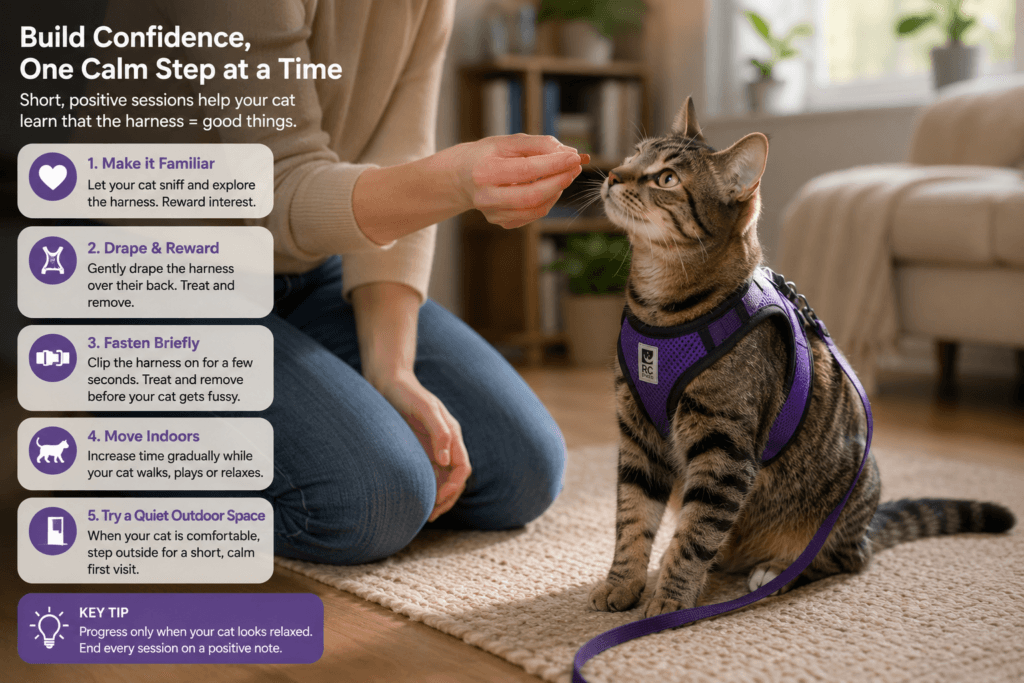
    cat-harness-training-positive-indoor-introduction.webp
    Harness confidence is built gradually: short, positive indoor sessions matter more than rushing outdoors.

    A fixed five-day plan is tempting, but cats do not all adapt on the same timeline.

    Some will accept a harness in a few sessions. Others will need weeks.

    The better approach is to progress only when your cat looks relaxed at the current step.

    Step 1: Make the harness familiar

    Leave the harness near a favorite sleeping area or feeding location. Let your cat sniff it. Reward interest with treats, play, or praise.

    Step 2: Introduce touch without fastening

    Gently lay the harness across your cat’s back or chest for a moment, then remove it before your cat becomes uncomfortable.

    Step 3: Fasten briefly indoors

    Once your cat accepts contact, fasten the harness for a short period indoors. Offer a high-value treat, then remove it calmly.

    Step 4: Build comfortable movement

    Increase the wearing time only while your cat remains relaxed. Encourage a few natural steps toward a treat or toy.

    Step 5: Add the leash indoors

    Attach the leash, but do not immediately direct your cat. Follow their movement with slack in the leash. Let them learn that the harness does not mean pressure or restraint.

    Step 6: Try a quiet outdoor threshold

    Only move outdoors once your cat is comfortable indoors. Start in a calm, enclosed or low-stimulation area. Let the cat observe, sniff, and decide the pace.

    Outdoor walking is not right for every cat. Freezing, frantic pulling, repeated attempts to escape, flattened ears, or clear distress are signals to pause—not signs that the cat needs to “get used to it.”

    Harness + Tracker: Safety Layer, Not a Reason to Take More Risk

    A harness controls the walk. A tracker helps with recovery if something goes wrong.

    They should not be treated as the same tool.

    A GPS tracker can be useful for outdoor-access cats, travel, or cats with a serious escape risk. A radio-frequency finder can be more useful for a cat likely to hide close to home.

    Do not attach a tracker in a way that obstructs the leash connection, changes the harness position or concentrates additional weight on the D-ring unless both manufacturers explicitly support that setup.

    The leash connection must remain secure and move freely.

    Only mount a tracker where the tracker manufacturer explicitly says it is safe to attach, and check that it does not pull the harness out of position or interfere with movement.

    For the technology decision, read our Best Cat Trackers guide. For Safe Zones, escape alerts, and the limits of geofencing, read our Virtual Fence Alerts for Cats guide.

    Common Harness Mistakes

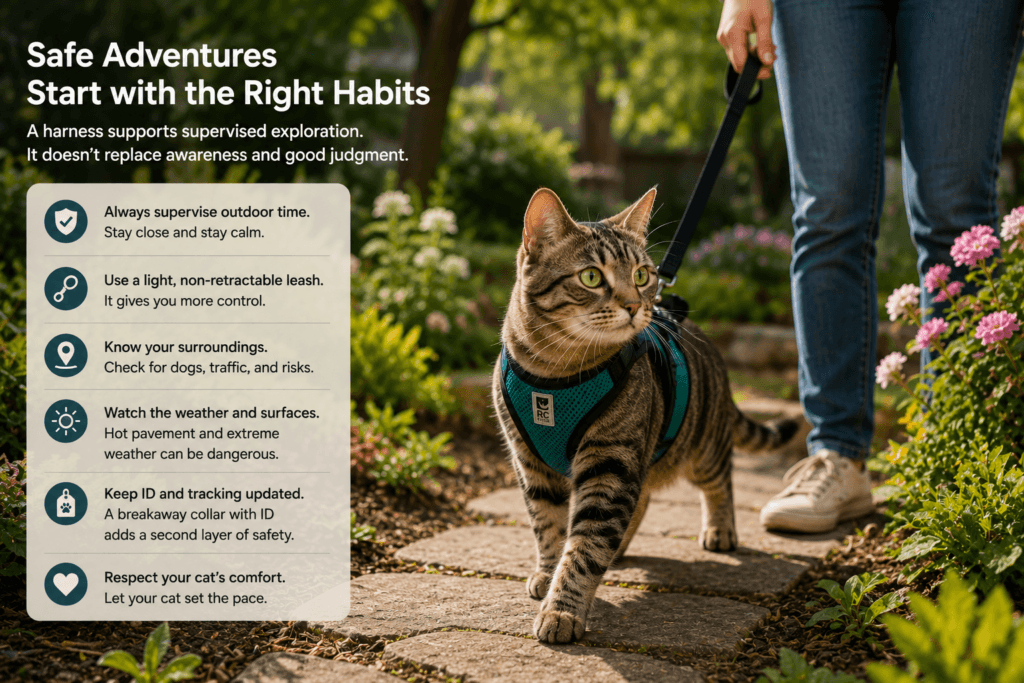
    A cat in a harness exploring a quiet garden while its owner holds a relaxed leash nearby
    A harness supports supervised exploration—it does not replace a calm environment, careful handling, or close attention to your cat’s signals.

    Treating “escape-proof” as a guarantee

    No harness removes the need for supervision, fit checks, and gradual training.

    Pulling your cat forward

    Cats usually do better when they choose the direction. Use treats, toys, and patience rather than leash pressure.

    Starting outdoors too early

    A cat that freezes indoors is not ready for a busy sidewalk, a dog park, or a new hiking trail.

    Using a retractable leash too soon

    A standard lightweight leash gives you more predictable control during early training.

    Ignoring heat and stimulation

    Warm pavement, loud traffic, dogs, bicycles, and leaf blowers can turn a calm first outing into a frightening experience.

    Frequently Asked Questions

    Are cat harnesses safe?

    Yes, when they fit correctly, are introduced gradually, and are used under supervision. A cat-specific harness with a back-mounted leash attachment is safer than walking a cat from a collar.

    What style is best for escape artists?

    A well-fitted vest with wider torso coverage is often the better starting point, but the correct fit matters more than style alone.

    Should I use a collar or harness for outdoor walks?

    Use a harness for leash walking. A breakaway collar can still carry identification, but it should not be the point where leash pressure is applied.

    Can kittens wear harnesses?

    Yes, as long as the harness is lightweight, correctly sized, and introduced slowly. Kittens may adapt more easily, but they still need short, positive sessions.

    Does every cat enjoy leash walks?

    No. Some cats enjoy safe outdoor exploration; others find it stressful. The cat’s behavior should decide whether harness walking becomes part of the routine.

    Final Verdict

    RC Pets Adventure Kitty is the strongest all-round recommendation. Kitty Holster is the better specialist choice for cats that tolerate broad vest coverage. PetSafe offers the most convincing low-bulk introduction, while Rabbitgoo is the most widely validated structured vest in the roundup.

    None is universally escape-proof. The safest harness remains the one that fits the individual cat correctly, survives an indoor backward-pressure test and is used by an owner willing to stop when the cat is uncomfortable.

    References

    • RC Pets — Adventure Kitty Harness product information
    • Kitty Holster — product, fit, and sizing guidance
    • PetSafe — Come With Me Kitty Harness and Bungee Leash information
    • San Francisco SPCA — harness and leash training guidance for cats
    • Cat Friendly Homes — gradual harness and leash introduction guidance

    Image Disclosure

    Some images in this article may be created with AI for illustrative purposes. They do not show the exact products reviewed and should not be used to evaluate product size, fit, design, or features. Always check the current official product listing before purchasing.

    Disclosure

    PetTech AI may earn a commission when readers purchase through affiliate links. That does not change how products are framed or compared. No harness is guaranteed escape-proof, and no product can replace supervision, careful fitting, gradual training, or a safe outdoor environment. Always check current sizing guidance, materials, return policies, and product specifications before purchasing.

  • Best Cat Trackers: GPS, RF and Nearby Finding Compared

    Best Cat Trackers: GPS, RF and Nearby Finding Compared

    Baron disappears.

    The app shows a beautiful activity graph, three wellness badges and yesterday’s preferred nap location.

    None of those tells you whether he is under the neighbor’s deck or two streets away.

    That is why the best cat tracker is determined first by distance, not by the number of features occupying the app dashboard.

    Before choosing a tracker, ask one question:

    How far away could your cat realistically be when you need to find them?

    This guide compares four relevant trackers—but current ownership evidence does not support recommending all four.

    Tabcat V2 earns the clearest recommendation for nearby recovery.

    Tractive remains a conditional GPS choice when long-distance tracking is necessary.

    Fi Mini and Pawfit Lite are included because their designs are relevant, not because they currently pass the PetTech AI recommendation threshold.

    Quick Answer: Which Type of Cat Tracker Do You Need?

    Your real problemBest technologyProduct evaluatedPetTech AI verdict
    My cat may travel beyond the neighborhoodGPS + cellularTractive CAT MiniConditional Recommendation
    My cat is probably hiding close to homeRadio frequencyTabcat V2Recommended with Conditions
    I want a premium app-led GPS platformGPS + cellularFi MiniNot Recommended for Now
    Tracker weight is my biggest concernLightweight GPS + nearby BluetoothPawfit LiteNot Recommended for Now
    I only need occasional nearby assistanceBluetooth crowd-finding tagNot a primary recommendationBackup only

    Research Note

    This is a research-led comparison based on current manufacturer documentation, network requirements, subscription terms and product positioning.

    PetTech AI has not conducted long-term side-by-side testing of every tracker included.

    PetTech AI may earn a commission from qualifying purchases. As an Amazon Associate I earn from qualifying purchases.

    Start Here: Range or Precision?

    The central trade-off is simple.

    GPS gives you range.
    Radio frequency gives you close-range precision.
    Bluetooth gives you limited nearby convenience.

    Everything else—apps, activity insights, escape alerts, subscriptions, battery life—comes after that decision.

    Choose GPS when distance is the real risk

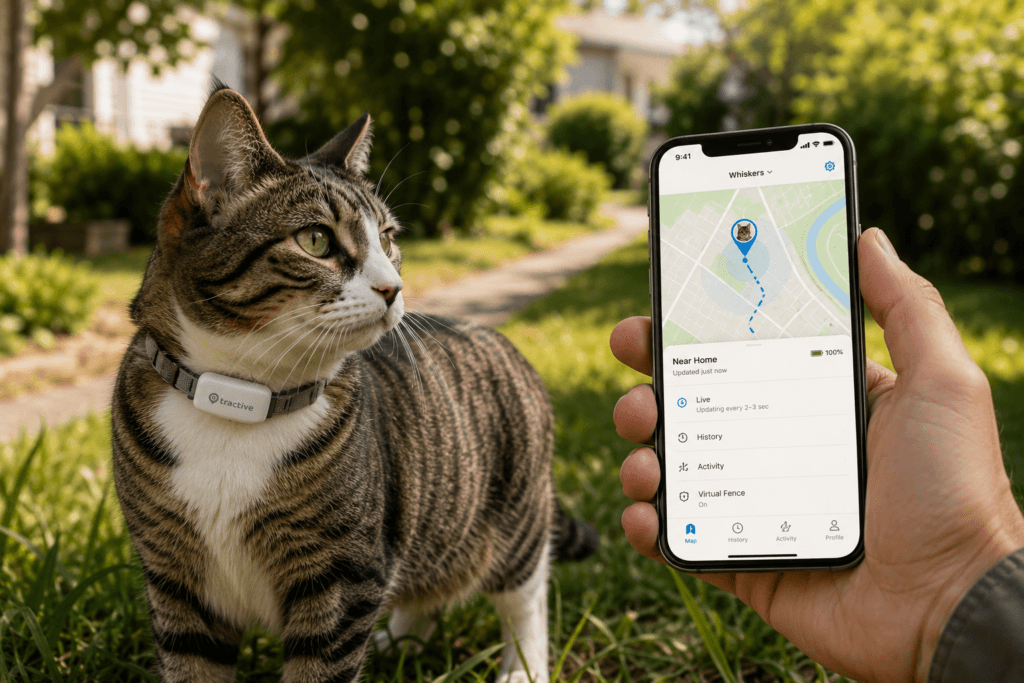
    An outdoor cat wearing a small tracker while an owner checks a live location map on a smartphone
    GPS tracking is most useful when a cat could move beyond the immediate neighborhood.

    GPS trackers are built for situations where your cat could be far from you.

    They use satellite positioning and a mobile network to send location information to an app. That means they can be useful when a cat has outdoor access, travels, escapes through an open door, or may move beyond the surrounding streets.

    GPS is the right choice when you need to answer:

    “Where is my cat now, even if I am not nearby?”

    The trade-offs are clear:

    • A GPS tracker needs charging.
    • It depends on mobile coverage.
    • It usually requires a subscription.
    • It is heavier than a simple finder tag.

    For many outdoor-access cats, those trade-offs are worth accepting because no nearby-only solution can replace map-based tracking once a cat has gone farther away.

    Choose radio frequency when your cat is probably close

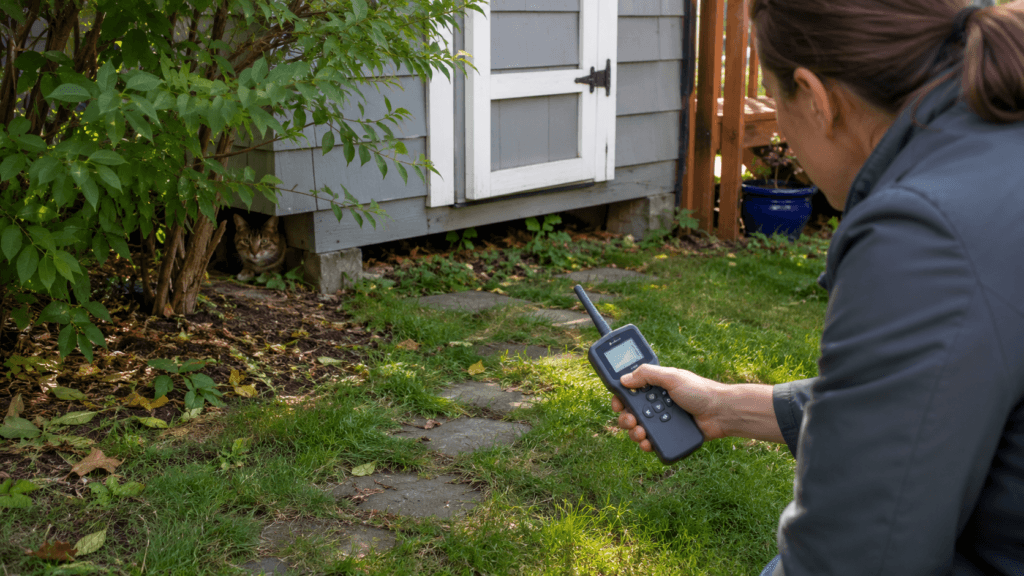
    A person using a handheld radio-frequency finder near a garden shed while a cat hides nearby
    Radio-frequency tracking is designed for close-range recovery when a cat is nearby but difficult to see.

    Radio-frequency trackers do not show a map.

    Instead, they use a handheld receiver that guides you toward the tag. The signal becomes more useful as you get closer, making RF especially effective for a cat that is nearby but hidden.

    This is the right choice when you need to answer:

    “My cat must be close—but where exactly are they hiding?”

    It is useful for cats under decks, inside sheds, behind bushes, in garages, or somewhere inside the house.

    RF has a much shorter range than GPS, but it is lighter, more direct at close distance, and does not need a subscription.

    Treat Bluetooth as a backup, not a primary safety plan

    Bluetooth trackers can be useful for a limited scenario: locating a collar around the home, checking a nearby garden, or finding a cat that is hiding indoors.

    They are not a replacement for GPS for a cat that may roam.

    A Bluetooth tracker does not independently provide continuous live location across a broad area. It relies on nearby devices, nearby phones, or a crowd-finding network. That can be helpful, but it is too uncertain to be your main recovery plan for an outdoor cat.

    Tractive CAT Mini — Conditional Recommendation

    The Tractive CAT Mini remains the most established long-range GPS option in this comparison.

    That does not make it an unconditional recommendation.

    Its value appears when a cat could travel beyond the immediate neighborhood and map-based recovery is genuinely necessary.

    Tractive gives you a broader view of how your cat moves: live location when needed, location history, activity information, and territory patterns over time. That makes it useful both in an urgent situation and in ordinary daily care.

    For example, a cat that usually remains near home but suddenly travels farther than usual may be worth checking on. A cat that does not return at the usual time can be located more quickly. A household with multiple people can share location access rather than relying on one person to monitor the cat.

    Tractive is also the most natural fit for owners who want safety and monitoring to work together. It is not just “find my cat.” It is “understand where my cat usually goes, then respond faster when that pattern changes.”

    Choose Tractive CAT Mini when:

    • Your cat has outdoor access.
    • Your cat may travel beyond nearby houses.
    • You want live GPS during a real recovery situation.
    • You care about territory history and activity patterns.
    • You accept charging and a subscription as part of ownership.

    Skip it when:

    • Your cat is indoor-only with a very low escape risk.
    • Your main concern is a cat hiding close to home.
    • Your cat cannot safely tolerate a GPS device on a collar.
    • You want no recurring cost.

    Verdict: Conditional Recommendation — still the most established long-range GPS option in this guide, but the mixed ownership signal prevents an unconditional recommendation. Choose it because your cat may travel far, not because the app offers more lifestyle data.

    Could your cat travel beyond the immediate neighborhood? Check the current Tractive cat tracker on Amazon.

    Tabcat V2 — Recommended with Conditions

    The Tabcat V2 is the most important alternative to GPS because it solves a completely different problem.

    It is not designed to follow your cat across town.

    It is designed to help you find a cat who is already nearby but impossible to spot.

    Tabcat uses radio-frequency tags and a handheld directional finder. You choose the correct tag, walk through the likely search area, and follow the receiver toward the signal.

    This can be far more practical than GPS when a cat is:

    • Under a deck or porch.
    • Hiding in dense bushes.
    • Locked inside a nearby garage or shed.
    • Lost inside your own home.
    • Frightened and too quiet to respond to food or recall cues.

    The major advantages are simplicity and weight. There is no mobile network, no app dependency, no subscription and no need to charge a GPS battery every few days.

    Its limitation is equally simple: it cannot locate a cat that has travelled far beyond its signal range.

    Choose Tabcat V2 when:

    • Your cat is mainly indoors or stays close to home.
    • Your biggest fear is a nearby escape and hiding scenario.
    • Your cat is small or collar-sensitive.
    • You want no monthly subscription.
    • You value directional close-range finding over map tracking.

    Skip it when:

    • Your cat may roam several streets away.
    • You need live location on a phone map.
    • You want location history or activity monitoring.
    • You travel often with your cat.

    Verdict: Recommended with Conditions — the strongest current choice for precise nearby recovery, provided you understand that radio frequency cannot replace GPS once the cat has travelled beyond the local search area.

    Is your cat most likely hiding nearby? Check Tabcat V2 on Amazon.

    Fi Mini — Not Recommended for Now

    Once you know that GPS is the right technology, the next question is not “Which app looks better?”

    It is:

    “Which GPS tracker can my cat realistically wear every day?”

    This is where Fi Mini and Pawfit Lite become relevant.

    Both are GPS/cellular trackers. Both support app-based location tracking and safety alerts. Both add activity data. Neither should be purchased solely because it has more features than Tractive.

    Their value is more specific.

    Fi Mini: for a premium app-led tracking experience

    The Fi Mini is a newer cat-compatible tracker built around a connected tracking ecosystem. It supports Live GPS, Safe Zone exit alerts, Lost Mode, activity tracking and app notifications.

    Its main appeal is the software layer.

    Fi makes sense for owners who want tracking to feel like part of a broader smart-pet setup: notifications, routine data, charging alerts, activity trends and a more polished app experience.

    That can be valuable, especially for people who already use smart litter, feeding or hydration products and genuinely pay attention to the information they receive.

    But it is not automatically the right cat tracker simply because it is premium.

    The physical fit matters first. A cat that is sensitive to collars, very small, or likely to reject the device will not benefit from a sophisticated app.

    Choose Fi Mini when:

    • You want GPS plus a more app-led monitoring experience.
    • You value activity tracking and safety notifications.
    • Your cat can comfortably wear the device.
    • You want a premium challenger to the more cat-specialist Tractive approach.
    • You accept a connected-device subscription model.

    Verdict: Not Recommended for Now — Fi Mini has an appealing lightweight design and app ecosystem, but current ownership feedback is too weak to recommend it over more established alternatives. Early adopters may still consider it; most buyers should wait.

    Still considering Fi Mini? Check current availability and customer feedback on Amazon.

    Pawfit Lite — Not Recommended for Now

    The Pawfit Lite for Cats is the more practical choice when you want GPS but are especially concerned about size and everyday wearability.

    It combines GPS location tracking, Safety Zones, location history and a live FIND mode. It also includes Bluetooth-assisted nearby finding, which can become useful after GPS has brought you close to the likely location.

    That makes Pawfit’s logic straightforward:

    • GPS helps you get to the area.
    • Nearby finding can help during the final search.
    • A lighter cat-focused format can make daily use more realistic.

    Pawfit is not a dramatically different technology from Tractive or Fi. It is a different balance of fit, features and cat-specific practicality.

    Choose Pawfit Lite when:

    • You want GPS but device size is a major concern.
    • You want Safety Zones and live location without prioritizing a premium ecosystem.
    • You value nearby Bluetooth assistance after GPS gets you close.
    • Your cat is suitable for a lightweight tracker but you want the smallest practical option.
    • You are comfortable with a subscription and charging routine.

    Verdict: Not Recommended for Now — Pawfit Lite solves a legitimate wearability problem, but current ownership evidence is neither broad nor positive enough to make it the recommended lightweight GPS option.

    Still prioritizing Pawfit’s lightweight format? Check current availability and customer feedback on Amazon.

    What About Virtual Fences?

    Virtual fences are useful, but they are not the reason to choose a tracker.

    They are one feature inside a GPS tracking system.

    A Safe Zone can alert you when your cat appears to leave an expected area. It cannot physically contain your cat, guarantee instant updates, or protect a small yard with exact boundary-level precision.

    That topic deserves its own decision process.

    Read our guide to virtual fence alerts for cats before relying on geofence notifications as part of an outdoor-safety plan.

    Smart doors control the threshold but cannot locate a cat outdoors. Our PetSafe SmartDoor vs SureFlap Connect guide explains where domestic access control stops.

    Collar Safety Is More Important Than Any App

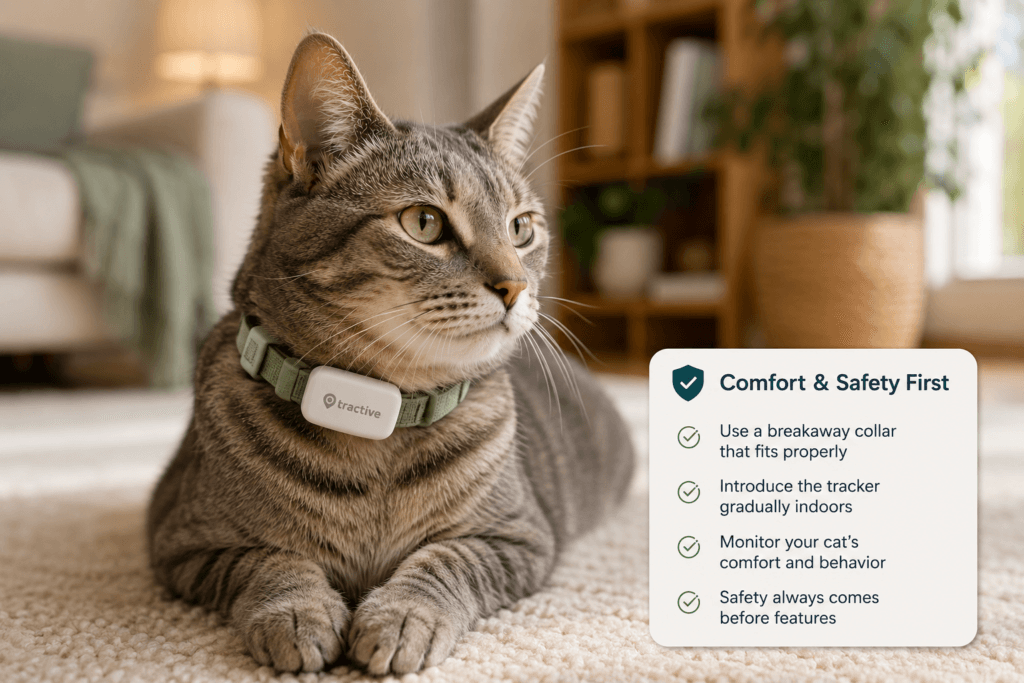
    A relaxed cat indoors wearing a lightweight tracker on a properly fitted breakaway collar
    Tracker fit, comfort and collar safety matter more than app features—especially for smaller cats.

    Every tracker in this guide depends on a cat wearing it.

    That is the first practical limitation.

    A tracker should never become a new safety risk. For most cats, a properly fitted breakaway collar is the safest starting point because it can release if caught on a branch, fence or object.

    The trade-off is obvious: a breakaway collar may come off during an escape.

    But your cat’s safety matters more than keeping the tracker attached.

    For supervised outdoor control, fit guidance and gradual equipment training, read our Best Cat Harnesses guide.

    Introduce any device gradually indoors. Begin with short, supervised sessions. Watch for scratching, changes in movement, refusal to walk normally, excessive grooming or signs of distress.

    Do not judge comfort from product weight alone.

    A tracker can be technically light and still be a poor fit for a particular cat.

    Before You Buy: The Honest Checklist

    How far could my cat actually be?

    Buy GPS for distance.
    Buy RF for nearby recovery.

    Will my cat wear it safely?

    Check device dimensions, attachment method, collar compatibility and your cat’s tolerance for wearable gear.

    Will I charge it and maintain the subscription?

    GPS trackers only work when they are charged, connected and active.

    Do I know what I will do if my cat goes missing?

    Prepare before an emergency.

    Keep carrier access easy. Know the nearby garages, decks, sheds and bushes your cat might hide in. Have high-value treats ready. Make sure more than one household member can access the tracker app when relevant.

    A tracker gives you information.

    Your response is what turns that information into safety.

    Frequently Asked Questions

    What is the best tracker for an outdoor cat?

    For a cat that may travel beyond the immediate neighborhood, Tractive remains the most established GPS option in this comparison.

    It receives a Conditional Recommendation rather than an unconditional endorsement because current ownership feedback is mixed and GPS usefulness still depends on fit, battery, mobile coverage and an active subscription.

    What is the best tracker for an indoor cat that escapes?

    Tabcat V2 is often the better fit when the cat is likely nearby but hidden. Its radio-frequency system is designed for close-range directional recovery without a subscription.

    Is Fi Mini better than Tractive for cats?

    Not based on the current evidence. Fi Mini has an attractive lightweight design and app-led ecosystem, but its early ownership feedback is too weak to recommend it over Tractive. Most buyers should wait for the product to establish a stronger track record.

    Is Pawfit Lite worth considering?

    Only for early adopters who place exceptional importance on its lightweight design and nearby Bluetooth assistance. Current ownership evidence is not strong enough for PetTech AI to recommend Pawfit Lite to most buyers.

    Can Bluetooth replace GPS for a cat?

    No. Bluetooth can be useful nearby, but it is not dependable as a primary solution for an outdoor cat or a genuine long-distance escape scenario.

    Final Verdict

    Tabcat V2 earns the strongest recommendation in this comparison—but only for nearby recovery.

    Its radio-frequency system solves a narrow problem well: finding a cat that is probably close but hidden. It does not become GPS through enthusiasm, and it should not be chosen for a cat likely to roam beyond the local search area.

    Tractive CAT Mini remains the conditional choice for long-distance GPS.

    Its established ecosystem and map-based tracking make it more useful when distance is the real risk. Current ownership feedback is too mixed for an unconditional recommendation, but none of the newer GPS alternatives in this guide has earned the right to replace it.

    Fi Mini is not recommended for now.

    Its app-led proposition is attractive, but a polished interface does not compensate for weak early ownership feedback. Most buyers should let someone else complete the public beta.

    Pawfit Lite is also not recommended for now.

    Its lightweight design and nearby Bluetooth assistance address legitimate cat-wearability concerns, but the current evidence is not strong enough to promote it as the answer.

    The decision therefore becomes simpler:

    • Choose Tabcat V2 when the cat is probably nearby.
    • Consider Tractive when the cat could be far away.
    • Wait for stronger evidence before choosing Fi Mini or Pawfit Lite.

    The best tracker is not the one with the most complete app.

    It is the one that covers the real search distance, stays on the cat and still works when Baron decides that today is the day to inspect somebody else’s garage.

    References

    • Tractive — CAT Mini, Live Tracking, territory history and tracker guidance
    • Fi — Fi Mini for Cats, Safe Zones, Live Map and Lost Mode documentation
    • Pawfit — Pawfit Lite for Cats, GPS tracking, FIND mode and Safety Zone documentation
    • Tabcat — Tabcat V2 radio-frequency tracking and directional finder documentation

    Image Disclosure

    Some images in this article may be created with AI for illustrative purposes. They do not show the exact products reviewed and should not be used to evaluate product size, fit, design or features. Always check the current official product listing before purchasing.

    Disclosure

    PetTech AI may earn a commission when readers purchase through affiliate links. That does not change how products are framed or compared. Trackers can improve the speed of a recovery response, but no device guarantees continuous signal, immediate updates, physical containment or a successful recovery. Check current specifications, subscription terms, mobile-network coverage, battery requirements and collar safety before purchasing.

  • Best Smart Cat Health Monitors (2026): Track the Signal That Actually Matters

    Best Smart Cat Health Monitors (2026): Track the Signal That Actually Matters

    Your cat does not need a command center.

    He does not need five apps, three cameras, a hydration spreadsheet, and a weekly performance review.

    He may, however, benefit from one useful signal.

    A litter monitor can reveal a change in weight or bathroom routine. A camera feeder can show that breakfast was ignored. A GPS tracker can tell you that an outdoor cat has stopped visiting its usual territory. A smart fountain can show that drinking patterns changed.

    None of these devices diagnoses illness.

    They record what happened so you can notice when normal stops looking normal.

    This guide compares five different monitoring tools:

    • Petivity Smart Litter Box Monitor for an existing litter box;
    • PETKIT Purobot Max Pro 2 for premium camera-led litter monitoring;
    • Tractive CAT Mini for location, activity, and sleep context;
    • PETKIT YumShare Solo 2 for visual feeding records;
    • PETLIBRO Dockstream 2 for single-cat hydration tracking.

    The goal is not to monitor everything.

    It is to identify the uncertainty that matters in your home—and purchase one device capable of reducing it.

    Research note: This is a research-led guide based on official documentation, current product information, public ownership evidence, and PetTech AI’s product-level trust checks. PetTech AI has not conducted long-term hands-on testing of every device included.

    Quick Verdict

    What you need to understandBest fitRecommendation
    Weight and litter habits without replacing the boxPetivity Smart Litter Box MonitorEstablished recommendation
    Litter habits with camera context and automatic cleaningPETKIT Purobot Max Pro 2Strong premium recommendation
    Outdoor location, activity, and sleepTractive CAT MiniConditional recommendation
    Which cat approached a dry-food feederPETKIT YumShare Solo 2Promising newer product
    One cat’s drinking amount and frequencyPETLIBRO Dockstream 2Strong single-cat recommendation

    The short version

    Choose Petivity when the cat already likes the litter box and you would prefer not to replace it with a rotating plastic observatory.

    Choose Purobot Max Pro 2 when you want automatic cleaning, individual litter records, and camera context in one expensive machine.

    Choose Tractive CAT Mini when the missing information exists outside the home.

    Choose YumShare Solo 2 when mealtime visibility would change how you manage feeding.

    Choose Dockstream 2 when one cat’s hydration pattern matters. Do not buy it expecting multi-cat identification; the fountain is clever, but it has not learned to ask for identification before serving water.

    Affiliate disclosure: This page contains affiliate links. PetTech AI may earn a commission if you purchase through them, at no additional cost to you. As an Amazon Associate I earn from qualifying purchases.

    Compare the Recommended Monitors

    First Choose the Signal, Not the Gadget

    Every monitoring product watches one small part of the cat’s life.

    Litter and weight

    Useful when bathroom routine or gradual weight change is the main uncertainty.

    Camera-supported litter behavior

    Useful when you need more context than a visit count can provide.

    Location and movement

    Useful for outdoor cats, escape risks, territory changes, and activity patterns.

    Feeding behavior

    Useful when dispensing food is not enough and you need to see who appeared.

    Hydration

    Useful when changes in drinking would otherwise be difficult to notice.

    The wrong monitor can generate perfectly accurate information that has no practical value.

    A camera feeder showing the same cat eating normally every day is reassuring at first. By week six, it may simply be producing the world’s least eventful television series.

    Petivity: Best for Monitoring an Existing Litter Box

    A cat stepping near a regular litter box with a discreet smart monitoring pad underneath in a clean home setting
    Litter and weight data are useful because they turn repeated daily routines into clearer long-term patterns.

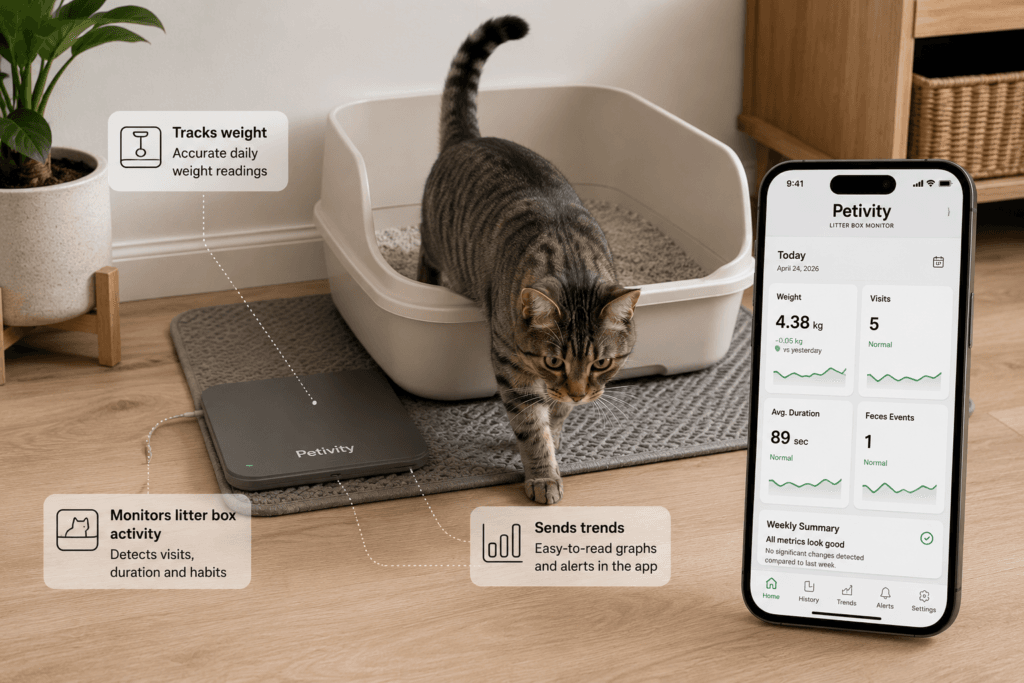
    Petivity sits underneath a conventional litter box and tracks weight, urination events, defecation events, visit patterns, and changes over time.

    Its greatest advantage is what it does not change.

    The cat keeps:

    • the familiar box;
    • the familiar entrance;
    • the familiar litter;
    • the familiar absence of mechanical rotation.

    That makes Petivity a sensible first monitor for cautious cats, older cats, and owners who want data without replacing a setup that already works.

    Buy it if

    • your cat reliably uses a standard litter box;
    • gradual weight trends would be useful;
    • litter-box activity is the main signal you want;
    • you do not need automatic scooping;
    • a lower-friction monitoring layer appeals to you.

    Skip it if

    • you want the machine to clean;
    • the box is frequently moved or sits unevenly;
    • you use several litter boxes but intend to monitor only one;
    • you want visual context;
    • the cats have very similar weights and individual identification is essential.

    Where it can disappoint

    Petivity depends on a stable physical setup.

    The platform needs to sit correctly, the litter box must fit, and multi-box homes require broader coverage if you want a complete picture. Monitoring one bathroom while the cat regularly uses another is a very sophisticated way to collect incomplete data.

    Multi-cat learning may also require time and clean baseline information.

    Verdict: The best starting point for litter and weight monitoring when the existing box already works and automation is not the goal.

    For setup, compatibility, and its real limitations, read our Petivity Smart Litter Box Monitor Review.

    PETKIT Purobot Max Pro 2: Best Premium Litter Monitor

    PETKIT Purobot Max Pro 2 automatic cat litter box with AI camera and app-based monitoring features
    PETKIT Purobot Max Pro 2 combines self-cleaning litter automation with camera-supported routine monitoring.

    Purobot Max Pro 2 combines:

    • automatic litter cleaning;
    • an AI camera inside the litter area;
    • weight sensing;
    • facial recognition;
    • individual cat profiles;
    • visit records;
    • stool and clump imagery;
    • app alerts;
    • a larger, lower entrance than the previous model.

    It is less a litter monitor than a small automated surveillance department assigned to cat waste.

    For the right multi-cat household, that is not entirely ridiculous.

    Weight-only systems can struggle when cats are similar in size. PETKIT combines facial recognition and weight data to keep individual records separate, while the camera adds context that a number alone cannot provide. PETKIT also markets yowling, stool, and urinary-pattern monitoring as awareness tools. Those records may be useful for observation or veterinary discussion; they remain consumer-device interpretations, not diagnoses.

    Buy it if

    • you want automatic cleaning and monitoring together;
    • multiple cats have similar weights;
    • visual litter-box context genuinely matters;
    • you are comfortable with a camera in the litter area;
    • you will review significant changes rather than every ordinary event;
    • the premium price fits the household.

    Skip it if

    • your cat dislikes enclosed or moving litter boxes;
    • a conventional box plus Petivity already solves the problem;
    • you do not want camera footage involving the litter box;
    • the app data will become an anxiety ritual;
    • you expect artificial intelligence to explain every suspicious clump.

    Where it can disappoint

    Purobot requires more ownership effort than the phrase “AI-powered health ecosystem” suggests.

    You still need to:

    • empty the waste drawer;
    • deep-clean the cylinder;
    • maintain the camera area;
    • manage litter levels;
    • inspect residue;
    • verify that the app interpreted events sensibly.

    Some cloud-video and extended playback functions within PETKIT’s camera ecosystem may also depend on optional paid services, so buyers should confirm which features are included before purchase.

    Verdict: The strongest premium option for owners who want automatic litter care and individual camera-supported records in the same device.

    For the cheaper automation-first alternative, read Purobot Max Pro 2 vs PuraMax 2.

    Tractive CAT Mini: Best for Location Context—with Conditions

    The Amazon product assessed here is the established Tractive CAT Mini bundle, not the newer CAT 6 Mini sold directly by Tractive.

    It provides:

    • live GPS tracking;
    • virtual fences;
    • location history;
    • territory maps;
    • activity tracking;
    • sleep data;
    • health-style routine alerts;
    • a six-month subscription in the evaluated Amazon bundle.

    The subscription is not an optional decorative extra.

    Tractive uses cellular networks to provide unlimited-range GPS, so an active plan is required after the included period ends. The CAT Mini generally offers up to about five days of battery life, depending on signal, Live Tracking use, and Power Saving Zones.

    Buy it if

    • your cat goes outdoors;
    • escape risk is real;
    • territory and location history matter;
    • changes in activity or sleep provide useful context;
    • regular charging and an ongoing plan are acceptable.

    Skip it if

    • your cat refuses collars;
    • you want a one-time purchase without subscription costs;
    • cellular or GPS coverage is poor where the cat roams;
    • the cat is too small for the tracker;
    • litter, food, or water data is the actual concern.

    Why the recommendation is conditional

    Tractive has a large ownership history, but the feedback is more mixed than for the strongest products in this guide.

    GPS performance depends on cellular coverage, satellite visibility, settings, and environment. Battery life also changes substantially when Live Tracking is used frequently or the tracker spends time outside Power Saving Zones.

    That does not make Tractive a poor product.

    It means the device is valuable when outdoor location is a real problem—not because every indoor cat secretly needs a cellular subscription.

    Verdict: A credible and established tracker for outdoor location and activity context, with meaningful subscription, charging, fit, and coverage caveats.

    PETKIT YumShare Solo 2: Best for Feeding Context

    PETKIT YumShare Solo 2 automatic cat feeder with built-in camera and app-based feeding records
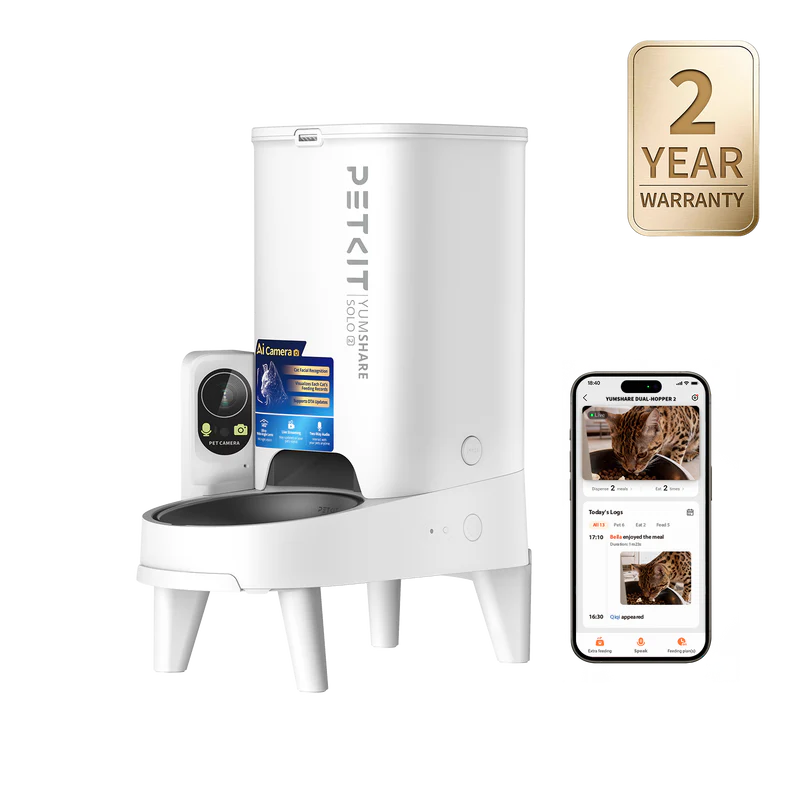
    YumShare Solo 2 adds feeding context by connecting scheduled meals, live video and pet recognition.

    YumShare Solo 2 is a dry-food feeder with:

    • scheduled portions;
    • live video;
    • two-way audio;
    • individual-pet recognition;
    • feeding histories;
    • food-bowl monitoring;
    • app alerts.

    A normal feeder can confirm that food was dispensed.

    YumShare can help show what happened next.

    That matters in homes where:

    • one cat may skip meals;
    • several animals approach the same feeder;
    • the owner is away frequently;
    • appetite changes are worth documenting;
    • a camera would replace guesswork.

    Buy it if

    • your cats eat dry food;
    • visual mealtime context changes your decisions;
    • you already use PETKIT;
    • one main feeding station serves the home;
    • you understand that this is monitoring, not access control.

    Skip it if

    • you only need scheduled portions;
    • you feed mainly wet food;
    • one cat must be physically blocked from another’s food;
    • you will ignore the camera after the novelty fades;
    • you want a mature, long-established model.

    The main limitation

    YumShare Solo 2 remains new.

    Its early ownership signal is encouraging, but the public record is not yet deep enough to prove years of consistent recognition, app stability, notifications, and camera performance.

    It also cannot physically stop food theft.

    The camera may identify Napoleon approaching Jonathan’s meal.

    It cannot enforce international borders.

    Verdict: A promising newer feeder for owners who genuinely need visual meal context—not a full health monitor or food-security device.

    For camera feeders, wet food, RFID, and microchip access, read our Best Automatic Cat Feeders guide.

    PETLIBRO Dockstream 2: Best for Single-Cat Hydration Tracking

    Dockstream 2 is a 3 L smart fountain available in plug-in and cordless configurations.

    The cordless version associated with ASIN B0GYDY8YKY offers:

    • a rechargeable battery;
    • sensor-activated or continuous flow depending on power mode;
    • app-based hydration records;
    • drinking-session frequency;
    • average drinking duration;
    • daily intake totals;
    • water-level and maintenance alerts;
    • a stainless-steel drinking tray;
    • a pumpless, detachable tank design.

    Its current ownership signal is strong enough to support a clear recommendation.

    But the use case must be accurate:

    Dockstream 2 tracks one pet at a time.

    It does not use RFID and cannot distinguish Jonathan’s elegant hydration session from Napoleon drinking half the fountain after conducting military exercises. PETLIBRO directs multi-cat buyers who need individual identification toward its separate Dockstream RFID model.

    Buy it if

    • one cat uses the fountain;
    • individual hydration trends matter;
    • cordless placement is valuable;
    • you want a stainless-steel tray and removable tank;
    • app reminders would improve maintenance.

    Skip it if

    • several cats share the fountain and you need individual records;
    • you want implanted-microchip or RFID identification;
    • your cat already drinks reliably and tracking would change nothing;
    • you dislike charging or filter replacement;
    • a basic easy-to-clean fountain already solves the problem.

    Where it can disappoint

    Hydration tracking becomes less interpretable when several animals drink from the same source.

    The app can measure activity around the fountain.

    It cannot politely ask each cat to log in first.

    Battery life also depends on operating mode and household use. PETLIBRO’s “up to 30 days” claim applies under specific sensor-mode conditions, not continuous flow at maximum enthusiasm.

    Verdict: A strong smart fountain for single-cat hydration trends, flexible placement, and easier maintenance—not the correct choice for individual multi-cat tracking.

    For broader hydration options, read our Best Smart Cat Water Fountains guide.

    The Anxiety Dashboard Test

    Smart monitoring becomes useful when it leads to a sensible action.

    Useful

    “The litter monitor shows a repeated weight decline. I will verify it and discuss it with the vet.”

    Less useful

    “The cat used the litter box four minutes later than usual. Society may be collapsing.”

    Useful

    “The GPS tracker shows that the outdoor cat has stopped visiting its normal territory.”

    Less useful

    “The activity score is 3% lower today. I have cancelled all appointments.”

    Useful

    “The fountain shows a sustained reduction in drinking.”

    Less useful

    “The cat drank at 2:13 rather than 1:58. I have prepared a spreadsheet.”

    The correct monitor should reduce uncertainty.

    If it transforms ordinary variation into daily alarm, change the notifications—or stop monitoring that signal.

    Buyer Regret in One Table

    ProductMost likely regret
    PetivityMonitoring one box while the cat uses several
    Purobot Max Pro 2Paying for camera analytics that become anxiety or background noise
    Tractive CAT MiniUnderestimating subscription, charging, or coverage requirements
    YumShare Solo 2Paying for feeding footage you stop watching
    Dockstream 2Expecting individual multi-cat hydration records

    Privacy, Subscriptions, and Data Ownership

    These devices may collect:

    • video;
    • GPS location;
    • household routines;
    • feeding activity;
    • drinking patterns;
    • litter-box records;
    • pet profiles.

    Before buying, check:

    • which functions work without a plan;
    • how long video or history is retained;
    • whether data can be exported;
    • who can access the account;
    • whether cloud storage is optional;
    • whether the device remains useful if you stop paying.

    A product does not become medically valuable because the manufacturer found a recurring-revenue model.

    Final Verdict

    There is no universal best smart cat health monitor because each product watches a different routine.

    Petivity is the best low-friction starting point for litter and weight trends when the existing box already works.

    PETKIT Purobot Max Pro 2 is the strongest premium option for automatic cleaning, individual litter monitoring, and camera context.

    Tractive CAT Mini is useful when location, outdoor activity, and escape risk justify the subscription and charging requirements.

    YumShare Solo 2 is a promising feeding monitor for owners who will actually use video and meal histories.

    PETLIBRO Dockstream 2 is a strong single-cat hydration monitor, but it should not be confused with PETLIBRO’s RFID fountain for multi-cat identification.

    The right strategy is simple:

    1. identify the uncertainty;
    2. choose the device that measures it;
    3. decide in advance what change would make you act;
    4. ignore the rest of the dashboard.

    Your cat does not need more data.

    You need one piece of information capable of changing a decision.

    Frequently Asked Questions

    Which monitor should most cat owners start with?

    Litter and weight patterns are often the most repeatable home signals. Petivity is the lower-friction starting point; Purobot Max Pro 2 adds automatic cleaning and visual context at a much higher cost.

    Can these monitors diagnose health problems?

    No. They can identify changes and create useful records. The cause of a meaningful change requires direct observation and, when appropriate, veterinary assessment.

    Is Purobot Max Pro 2 better than Petivity?

    Only when automatic cleaning and camera context justify the extra cost and complexity. Petivity is better when the existing litter box already works.

    Does Tractive work without a subscription?

    No. Its GPS and connected monitoring functions require an active Tractive plan. The assessed Amazon bundle includes an initial subscription period.

    Can YumShare Solo 2 prevent food theft?

    No. It can show which pet approached the feeder, but it does not physically restrict access.

    Can Dockstream 2 identify multiple cats?

    No. Dockstream 2 tracks one pet at a time. PETLIBRO’s separate Dockstream RFID model is designed for individual multi-cat tracking through collar tags.

    References

    • Petivity Smart Litter Box Monitor official product and support documentation
    • PETKIT Purobot Max Pro 2 official product, app, and warranty documentation
    • Tractive CAT Mini official tracking, battery, and subscription documentation
    • PETKIT YumShare Solo 2 official product documentation
    • PETLIBRO Dockstream 2 official product and support documentation
    • PetTech AI product-level trust checks and public ownership evidence

    Image Disclosure

    Some images in this article may be AI-generated for illustrative purposes. They do not depict the exact products and should not be used to evaluate fit, dimensions, controls, or physical features.

    Disclosure

    PetTech AI may earn a commission when readers purchase through affiliate links. Monitoring products are recommended according to the useful signal they can provide—not according to how many health-related words appear on the box.

  • Best Cat Cleaning Tools for Litter, Fur and Odor in 2026

    Best Cat Cleaning Tools for Litter, Fur and Odor in 2026

    Cat mess is rarely one problem.

    Litter travels beyond the box. Fur builds up on sofas and cat trees. Dust and dander settle into corners. Odors become noticeable when cleaning routines fall behind—not because a home has cats.

    The useful question is not: “What is the smartest cleaning gadget?”

    It is:

    Which part of cat-home cleaning is taking the most effort right now?

    Buying a robot vacuum because the sofa is covered in fur is not a cleaning strategy. It is an expensive way to automate the wrong surface.

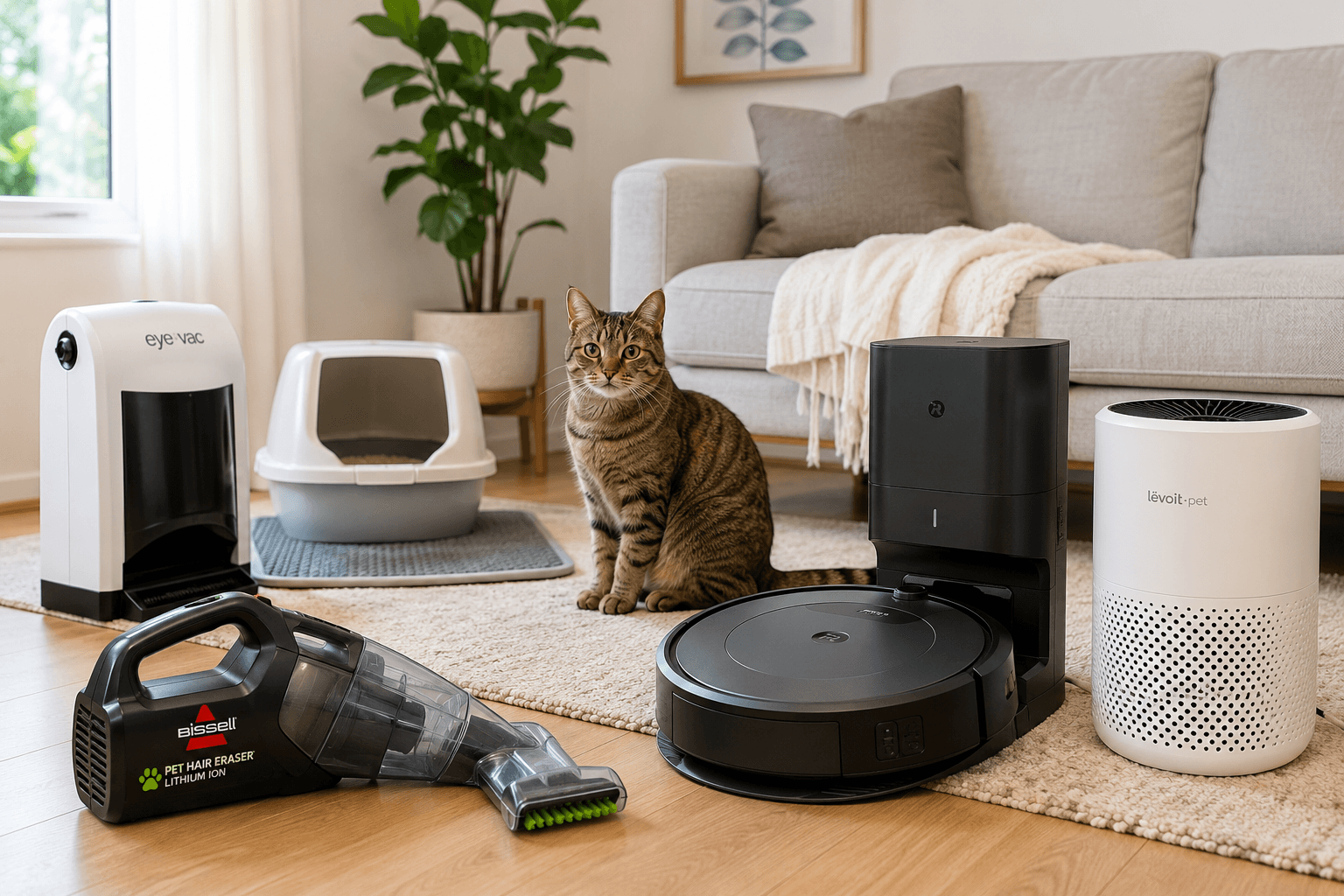
    A touchless vacuum can make litter-zone cleanup almost frictionless. A robot vacuum can keep daily fur and tracked debris from accumulating. A handheld pet vacuum handles upholstery and cat trees. An air purifier can support particle and odor control, but it cannot replace litter cleaning, vacuuming, ventilation, or a well-maintained litter box.

    This guide compares four practical tools for four different mess zones:

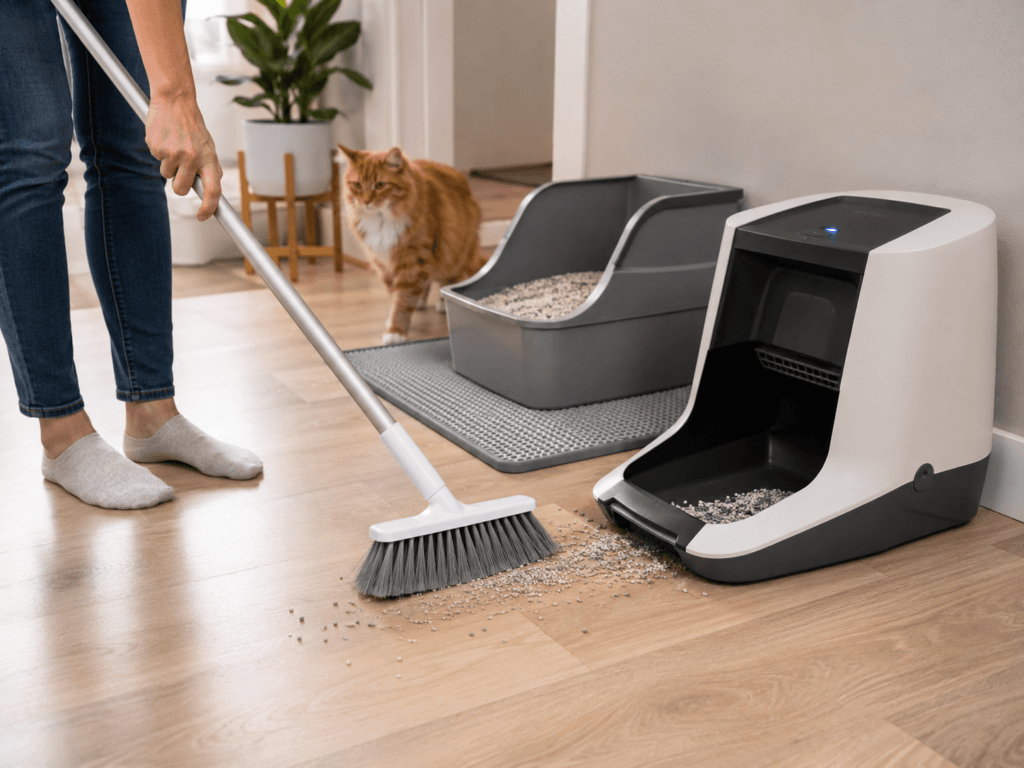
    • EyeVac Home Touchless Vacuum for litter tracking and hard-floor debris.
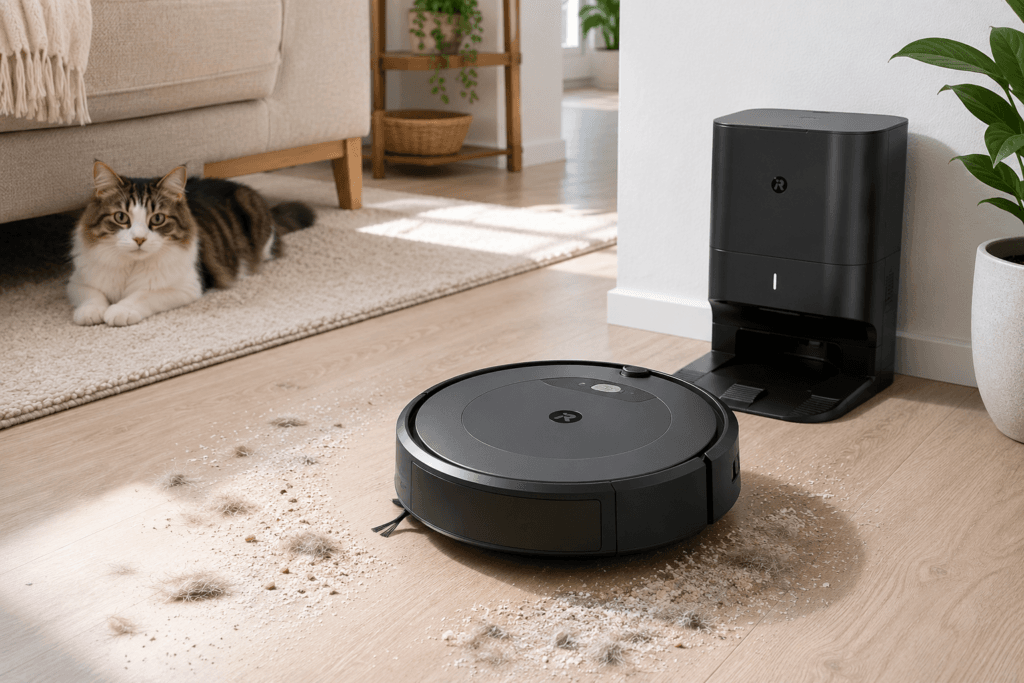
    • iRobot Roomba 105 Vac + AutoEmpty Dock for recurring floor maintenance.
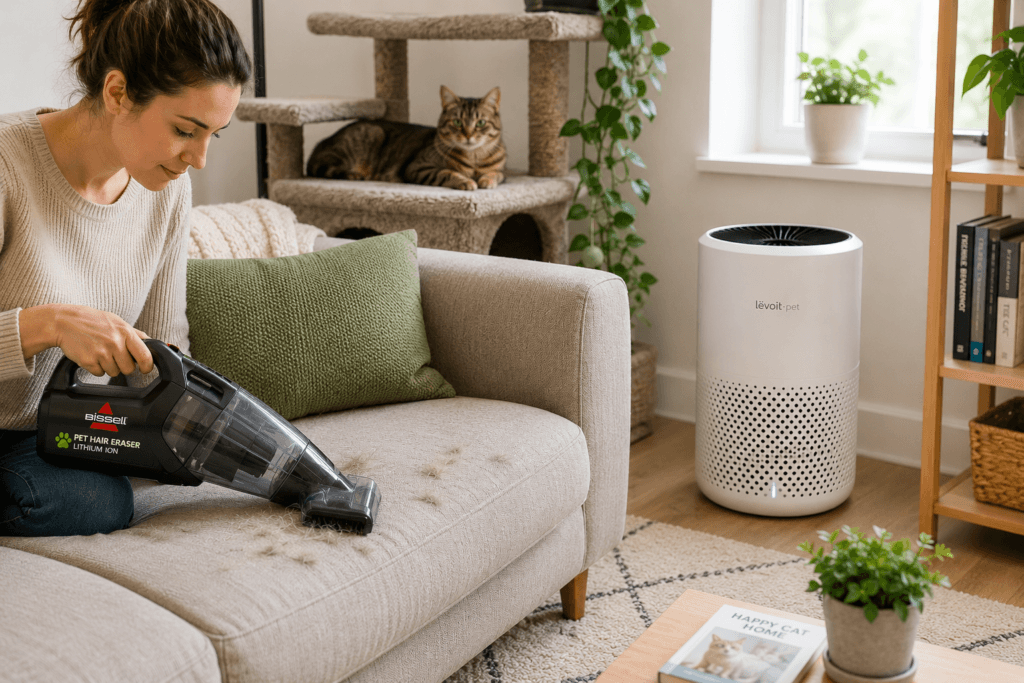
    • BISSELL Pet Hair Eraser Hand Vacuum for upholstery, cat trees, and fast spot cleaning.
    • LEVOIT Core P350-P Pet Care Air Purifier for dander and odor support without ozone.

    Quick Verdict: Which Cat Cleaning Tool Do You Need?

    Your main problemBest toolWhy it helpsWhat it does not replace
    Litter granules and fur around the boxEyeVac HomeFast touchless pickup after sweepingRegular litter-box cleaning
    Daily fur and debris across floorsRoomba 105 Vac + AutoEmptyRecurring autonomous floor cleaningSpot cleaning and obstacle checks
    Hair on sofas, bedding, cat trees, and car seatsBISSELL Pet Hair EraserPortable upholstery and crevice cleaningWhole-home floor maintenance
    Dander and lingering household odorsLEVOIT Core P350-PParticle filtration plus activated-carbon odor supportSource control, ventilation, and cleaning

    Research Note

    This is a research-led roundup based on current manufacturer documentation, product positioning and available ownership evidence.

    PetTech AI has not conducted long-term hands-on testing of every product included.

    PetTech AI may earn a commission from qualifying purchases. As an Amazon Associate I earn from qualifying purchases.

    The Four Mess Zones in a Cat Home

    A cleaner cat home usually comes from assigning the right tool to the right zone.

    1. The litter zone

    This is where litter tracking, loose fur, dust, and small spills build up fastest. A self-cleaning litter box can reduce scooping, but it does not remove granules outside the box or clean the surrounding floor.

    2. The floor zone

    Cats shed everywhere. In multi-cat homes, hair and dust can build up quickly along walls, under furniture, and in high-traffic areas. This is where automation saves the most time.

    3. The fabric zone

    Sofas, blankets, beds, car seats, scratching posts, and cat trees collect hair differently from hard floors. A robot vacuum cannot reliably solve this category.

    4. The air zone

    Dander and odors are not the same thing. Filtration can help reduce airborne particles, while activated carbon can support odor reduction. But neither replaces cleaning the source of the odor or maintaining the litter box properly.

    Best for Litter Tracking: EyeVac Home Touchless Vacuum

    A person sweeping small litter granules near a cat litter box into a touchless floor vacuum on hard flooring
    The litter zone needs fast cleanup tools that make it easier to remove tracked granules before they spread.

    The EyeVac Home Touchless Vacuum is the most targeted tool in this guide because it solves a small but repetitive problem extremely well.

    Place it near the litter area, sweep loose granules, fur, or dust toward the base, and its infrared sensors activate suction automatically. Instead of bending down with a dustpan every time the floor looks messy, you can clear the debris in seconds.

    That makes EyeVac especially useful for homes with hard floors around the litter box, feeding area, or entryway.

    It is not a replacement for a normal vacuum. It is a friction-reduction tool: the kind of product that makes you more likely to clean immediately because the cleanup takes almost no effort.

    It does not automate cleaning. It removes the two-minute task people somehow postpone until the litter has established diplomatic relations with the hallway.

    The EyeVac Home uses infrared sensors for automatic activation and has a bagless canister with washable filters.

    Choose EyeVac Home if:

    • Litter tracking is your most annoying daily cleaning problem.
    • You have hard flooring near the litter box.
    • You already sweep but dislike using a dustpan.
    • You want a dedicated cleanup station near a predictable mess zone.
    • You prefer a simple, non-app-based tool.

    Skip it if:

    • Your main issue is hair on furniture or cat trees.
    • You need whole-home cleaning automation.
    • Your litter area is carpeted.
    • You do not have a good place for a plugged-in stationary unit.

    Verdict: Recommended with Conditions — excellent for repetitive litter cleanup on hard floors, pointless when the mess is spread across carpet or several rooms.

    Is tracked litter your main daily annoyance? Check EyeVac Home on Amazon.

    Best for Daily Floor Maintenance: iRobot Roomba 105 Vac + AutoEmpty Dock

    A robot vacuum cleaning cat fur and light debris from a hard floor while a cat rests nearby
    Robot vacuums work best as recurring maintenance for fur and dry debris—not as a substitute for litter-box care.

    The iRobot Roomba 105 Vac + AutoEmpty Dock is the strongest choice for owners who are tired of seeing fur, tracked litter, and ordinary floor debris return every day.

    Unlike EyeVac, this is not about one cleanup moment. It is about reducing background mess before it becomes visible.

    A robot vacuum can run on a routine while you work, sleep, or focus on other chores. That is especially valuable in multi-cat households, homes with long-haired cats, or apartments where pet hair becomes noticeable quickly.

    The important distinction is that a robot vacuum is a maintenance tool, not a miracle worker.

    It can help prevent buildup, but it still needs a reasonably prepared environment. You need to remove cords, small objects, and obvious hazards from the floor. You also need to be realistic around litter boxes: do not assume any robot should be allowed to run unsupervised near fresh accidents or wet messes.

    A robot that finds a hairball before you do is automation. A robot that distributes it across three rooms is performance art.

    The Roomba 105 Vac uses LiDAR mapping and can empty into its dock for up to 75 days, according to iRobot.

    Choose Roomba 105 Vac + AutoEmpty if:

    • You want less daily sweeping and vacuuming.
    • Your home has fur buildup across several rooms.
    • You live with multiple cats or a heavy shedder.
    • You want scheduled cleaning rather than manual spot cleanup.
    • You value a self-emptying dock.

    Skip it if:

    • Your cat regularly leaves wet messes or hairballs where the robot will travel.
    • Your floors are usually cluttered with cables, toys, or loose items.
    • You only need upholstery cleaning.
    • You want the cheapest possible cleaning option.

    Verdict: Recommended with Conditions — the strongest time-saving tool in the guide for routine dry debris, but not a robot to run blindly in a home with frequent hairballs or pet accidents.

    Need recurring floor maintenance across several rooms? Check Roomba 105 Vac + AutoEmpty on Amazon.

    Best for Upholstery and Cat Trees: BISSELL Pet Hair Eraser Hand Vacuum

    The BISSELL Pet Hair Eraser Lithium Ion Hand Vacuum solves the cleaning problem robot vacuums usually leave behind: fabric.

    Cat hair embeds itself in sofa cushions, beds, blankets, car seats, cat trees, and tight corners around furniture. A standard floor vacuum may help, but a cordless handheld is often more useful because you can grab it when you see the mess.

    This is not a whole-home replacement. It is the opposite: a fast-response tool.

    Use it for the sofa before guests arrive, the cat bed after shedding season, the car after a vet visit, or the cat tree when fur starts clumping in corners.

    BISSELL’s model 2390 includes a motorized brush tool, upholstery tool, crevice tool, triple-level filtration, and about 17 minutes of cordless runtime.

    Choose BISSELL Pet Hair Eraser if:

    • Your main problem is fur on fabrics.
    • You need quick cleanup on sofas, beds, cat trees, or car seats.
    • You want a handheld vacuum rather than a full-size machine.
    • You need a dedicated pet-hair brush attachment.
    • You want a recognized pet-cleaning brand.

    Skip it if:

    • Your biggest problem is daily floor coverage.
    • You want an automatic cleaning routine.
    • You need long cleaning sessions without recharging.
    • You are looking for air filtration or odor support.

    Verdict: Recommended — the clearest purchase in this roundup when fur embedded in upholstery is the problem you actually need to solve.

    Is the sofa collecting more fur than the floor? Check BISSELL Pet Hair Eraser on Amazon.

    Best for Dander and Odor Support: LEVOIT Core P350-P Pet Care Air Purifier

    The LEVOIT Core P350-P Pet Care Air Purifier is the best fit when the issue is not visible mess but airborne particles, dander, and lingering household odor.

    It should not be treated as a substitute for vacuuming, litter maintenance, or ventilation. No air purifier can make an unclean litter box harmless or solve an underlying moisture, mold, or sanitation problem.

    But as part of a complete routine, an air purifier can support cleaner air in the room where your cat spends the most time.

    The key difference from the old ozone-based recommendation is important:

    Do not use ozone generators in cat homes.

    EPA and California air-quality guidance warn that ozone-generating air cleaners can be ineffective for normal indoor pollutant control at health-based concentrations, while higher ozone concentrations may be harmful. EPA also advises avoiding air cleaners that intentionally produce ozone.

    The Core P350-P uses particle filtration plus an activated-carbon odor filter designed for pet households.

    For a deeper comparison of pet-focused filtration, room coverage, filter costs, and odor-support trade-offs, see our Smart Air Purifiers for Cat Owners guide.

    Choose LEVOIT Core P350-P if:

    • Your cat’s room feels dusty or stale between cleanings.
    • You want dander support in a bedroom, office, or living room.
    • You need an odor-support layer without using ozone.
    • You already clean consistently and want to improve the air environment.
    • You prefer a pet-oriented purifier with activated carbon.

    Skip it if:

    • You are trying to fix poor litter-box maintenance with a device.
    • You need a whole-home cleaning solution.
    • You are unwilling to replace filters on schedule.
    • You want to eliminate every odor without cleaning its source.

    Verdict: Conditional Recommendation — useful as a compact filtration layer after source cleaning is already under control, but not the strongest current purifier for large or heavily used cat rooms.

    Need compact dander and odor support after cleaning the source? Check LEVOIT Core P350-P on Amazon.

    What “Smart Cleaning” Should Actually Mean

    A tool is not smart because it has an app.

    It is smart when it reduces a recurring friction point.

    For most cat homes, that means one of four things:

    • You clean small litter spills immediately instead of postponing them.
    • Floors stay reasonably clear between deeper cleaning sessions.
    • Fabric surfaces become easier to maintain.
    • Air quality support runs quietly in the background.

    The best setup is often not one expensive all-in-one device.

    It is a small system where each tool handles a task it is actually good at.

    Build Your Cleaning Setup by Home Type

    A handheld vacuum cleaning cat hair from a sofa beside a quiet air purifier in a bright living room
    Fabric cleanup and air filtration solve different parts of the cat-home cleaning routine.

    Apartment with one cat

    Start with EyeVac near the litter box and a BISSELL Pet Hair Eraser for furniture.

    This is usually enough to manage the two most visible messes: tracked litter and fur on fabrics.

    Add the LEVOIT if dander or lingering odor is noticeable in a small bedroom or living room.

    Multi-cat home

    Prioritize the Roomba 105 Vac + AutoEmpty Dock.

    More cats mean more fur, more tracked litter, and more frequent floor maintenance. A robot vacuum will not replace deeper cleaning, but it can prevent the daily buildup that makes a home feel constantly messy.

    Pair it with EyeVac near the main litter area for faster spot cleanup.

    Allergy-conscious household

    Use a combined approach:

    • Roomba for recurring floor debris.
    • BISSELL for upholstered surfaces.
    • LEVOIT for airborne particle and odor support.
    • Regular ventilation and source cleaning.

    EPA guidance is clear that filtration can support indoor air quality, but reducing pollutant sources and ventilating with clean outdoor air remain central.

    Home with a self-cleaning litter box

    A self-cleaning litter box can reduce scooping, but it does not eliminate:

    • Litter tracking.
    • Loose fur around the area.
    • Dust on floors.
    • Odors from full waste drawers or poor ventilation.

    Use EyeVac as the practical companion product for the floor outside the litter box. For a broader look at automated litter systems, see our Best Smart Litter Boxes guide.

    What Cleaning Tools Cannot Solve

    No device can compensate for a litter box that is too small, poorly placed, overcrowded, or rarely maintained.

    No air purifier replaces removing waste, washing litter mats, cleaning box surfaces, or ventilating a room.

    No robot vacuum should be allowed to spread wet pet messes across the floor.

    And no “odor eliminator” should produce ozone in a space where cats or people live.

    The goal is not a home that smells artificially scented.

    It is a home where the sources of mess are handled consistently enough that heavy fragrance or risky chemical shortcuts are unnecessary.

    A Simple Weekly Cat-Home Cleaning Routine

    Daily

    • Sweep around the litter box.
    • Use EyeVac for loose litter and fur.
    • Run the robot vacuum in high-traffic areas, when appropriate.
    • Check litter-box waste and surrounding floor conditions.

    Two to three times per week

    • Vacuum sofas, cat trees, beds, and blankets with the BISSELL.
    • Wash food and water mats.
    • Check robot brushes, wheels, and bin capacity.

    Weekly

    • Clean litter mats and the exterior of the litter box.
    • Empty and wipe EyeVac or handheld-vacuum bins.
    • Check purifier filter indicators and airflow.
    • Vacuum corners the robot may miss.

    Consistency matters more than buying every device at once.

    Frequently Asked Questions

    What is the best tool for litter tracking?

    EyeVac is the most targeted option for hard-floor litter cleanup because it makes sweeping debris into a touchless vacuum quick and low effort.

    Can a robot vacuum handle cat litter?

    It can handle some dry tracked litter on hard floors, but it should not be treated as a solution for fresh wet messes, loose cords, or heavily cluttered floors.

    Do air purifiers remove cat odor?

    They can support odor reduction when they include activated carbon, but they do not replace cleaning the litter box, removing waste, ventilating the room, or addressing the odor source.

    Are ozone generators safe around cats?

    Avoid them. Ozone-producing air cleaners can create indoor-air risks and are not an appropriate cat-home odor solution.

    What should I buy first for a cat home?

    Start with the tool that solves your biggest recurring friction point:

    • EyeVac for litter tracking.
    • Roomba for daily floor maintenance.
    • BISSELL for furniture and cat trees.
    • LEVOIT for air support after cleaning basics are already in place.

    Final Verdict

    BISSELL is the safest product recommendation because it solves a common problem with very little complexity. EyeVac is excellent but highly situational. Roomba creates the largest time saving, but only in a home prepared for autonomous cleaning. LEVOIT comes last because filtration should support a cleaning routine—not distract from the source of the mess.

    References

    • EyeVac — Home Touchless Vacuum and automatic-sensor information
    • iRobot — Roomba 105 Vac + AutoEmpty Dock product information
    • BISSELL — Pet Hair Eraser Lithium Ion Hand Vacuum product information
    • LEVOIT — Core P350-P Pet Care Air Purifier and replacement-filter information
    • U.S. Environmental Protection Agency — Home air-cleaning and ozone guidance
    • California Air Resources Board — Ozone-generator guidance

    Image Disclosure

    Some images in this article may be created with AI for illustrative purposes. They do not show the exact products reviewed and should not be used to evaluate product size, fit, design, or features. Always check the current official product listing before purchasing.

    Disclosure

    PetTech AI may earn a commission from qualifying purchases. This does not influence our recommendations, comparisons or editorial judgments.
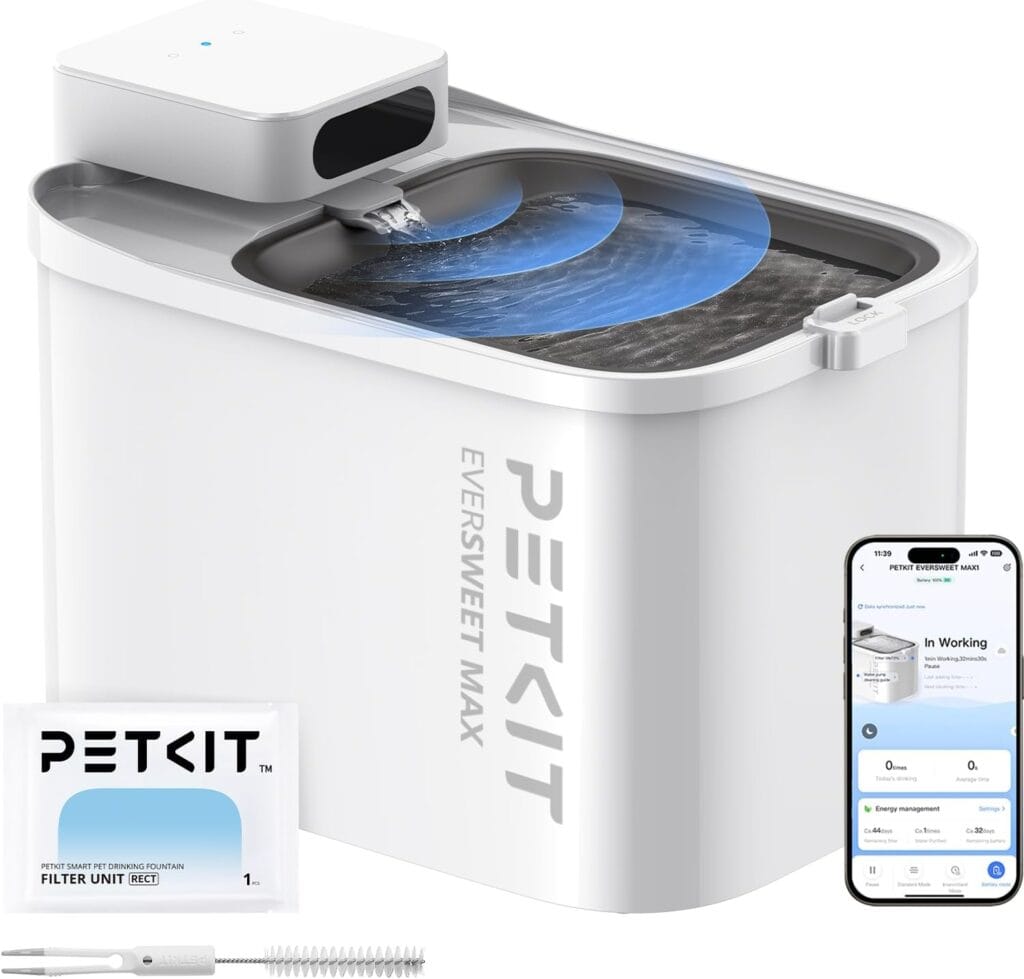
  • Best Smart Air Purifiers for Cat Owners in 2026

    Best Smart Air Purifiers for Cat Owners in 2026

    An air purifier can capture airborne dander, fine litter dust, pollen, and some particles carrying household odors.

    It cannot scoop Baron’s litter box, vacuum his preferred armchair, or negotiate with a waste drawer that should have been emptied yesterday.

    That distinction matters.

    The best smart air purifier for a cat home is not the model with the longest list of app features. It is the one with enough airflow for the actual room, filters you will replace, and controls that reduce friction instead of creating another dashboard to ignore.

    This guide compares four distinct options:

    • LEVOIT Vital 200S-P for the best overall fit in a cat household;
    • LEVOIT Core 400S-P for balanced smart filtration in shared rooms;
    • Blueair Blue Pure 211i Max for large open-plan spaces;
    • Coway Airmega MightyS for compact app-connected filtration.

    Research Note

    This is a research-led roundup based on current manufacturer documentation, official room-coverage data, indoor-air guidance, and product positioning.

    PetTech AI has not conducted long-term hands-on testing of every purifier included.

    Quick Verdict

    Best forModelEditorial judgmentMain trade-off
    Best overall for cat homesLEVOIT Vital 200S-PRecommendedLarger rectangular footprint
    Best balanced smart generalistLEVOIT Core 400S-PRecommendedLess specifically designed around pet fur
    Best for large open-plan roomsBlueair Blue Pure 211i MaxRecommendedLarger unit and potentially higher filter ownership cost
    Best compact app-connected optionCoway Airmega MightySRecommended with ConditionsSmart premium matters only if you will use the app

    PetTech AI may earn a commission from qualifying purchases. As an Amazon Associate I earn from qualifying purchases.

    What an Air Purifier Can—and Cannot—Do in a Cat Home

    A purifier is most useful for the air zone of a cat home.

    That includes airborne dust, dander, fine particles, and some odor-support through activated-carbon filtration. It is not a replacement for source control: removing litter waste, cleaning box surfaces, vacuuming soft furnishings, grooming when appropriate, and improving ventilation remain the foundation of indoor-air management. EPA guidance is clear that source control and ventilation come first, with filtration acting as a useful supplement.

    A smart purifier becomes more valuable when it helps you maintain that support consistently:

    • Auto mode can increase fan speed when particle levels rise.
    • App control can let you schedule quiet operation overnight.
    • Filter tracking prevents you from forgetting replacement intervals.
    • Air-quality history can show when a room gets dustier or more active.

    But smart features should not become another dashboard you ignore after a week.

    The best system is one you will actually leave running, maintain properly, and place in the room where your cat spends the most time.

    How to Choose a Smart Air Purifier for Cats

    A smart air purifier filtering airborne dust and cat dander in a bright living room while a tabby cat rests nearby
    Room coverage and airflow matter more than a long smart-feature list when dander is the real problem.

    1. Match coverage to the room at a realistic air-change rate

    Manufacturers often show one-air-change-per-hour coverage, which can sound impressive but is not the same as fast, recurring filtration. For a cat home, compare the room-size figure associated with a higher air-change rate when it is available, along with CADR. CADR describes how much clean air a purifier can deliver per minute; higher CADR generally supports effective cleaning in larger rooms.

    A purifier that “covers” the entire home once per hour may technically be telling the truth. It is also filtering with the urgency of a municipal permit office.

    That does not necessarily make it the right choice for a fur-heavy living room with a litter box nearby.

    2. Separate particles from odor

    Particle filtration helps with airborne dander, dust, pollen, and fine debris.

    Odor support depends more on activated carbon and on whether you actually clean the odor source. A purifier may reduce the stale background smell in a room, but it cannot compensate for a waste drawer that needs emptying or a litter box that needs washing.

    3. Decide whether app control will change your routine

    Smart functions are worth paying for when they reduce friction:

    • You want the purifier to run harder while you are out.
    • You want a schedule for quiet nighttime operation.
    • You want filter reminders in an app.
    • You have more than one purifier and want to control them together.
    • You care about reviewing air-quality patterns over time.

    They are less important when you plan to turn the purifier on once, leave it in Auto Mode, and rarely think about it again.

    4. Treat replacement filters as part of the purchase

    Before buying, check that genuine replacement filters are easy to find, understand how often they are expected to be replaced, and factor that recurring cost into the decision.

    The app can remind you that the filter needs replacing. It cannot stop you from pressing “remind me later” until the purifier is breathing through a gray sweater.

    A cheaper device with difficult or expensive filter ownership can still become the worse long-term value.

    Best Overall for Cat Homes: LEVOIT Vital 200S-P

    The LEVOIT Vital 200S-P earns the overall recommendation because this guide is about cat households—not generic smart-home filtration.

    Its U-shaped inlet is designed to capture larger airborne particles such as fur and lint more effectively, while Pet Mode, app scheduling, filter tracking, Auto Mode, and a 250 CFM CADR give it a stronger cat-specific argument than the more neutral Core 400S-P.

    LEVOIT rates the Vital 200S-P for 388 square feet at 4.8 air changes per hour, with a CADR of 250 CFM.

    That makes it slightly stronger than the Core 400S-P on high-frequency room coverage, while giving it a more pet-specific physical design.

    The important limitation: airborne fur is not the same as fur on your couch, bed, cat tree, or floor. The Vital 200S-P can support a cleaner air environment, but it does not remove the need for a handheld vacuum, robot vacuum, or fabric-cleaning routine.

    Choose the Vital 200S-P if:

    • You want a pet-focused purifier rather than a general smart model.
    • Airborne fur and dander are a visible concern.
    • You want app control, Auto Mode, schedules, and filter tracking.
    • Your target room is a medium-to-large living room, bedroom, or cat-heavy shared space.
    • You want a purifier that fits naturally into a broader pet-cleaning system.

    It may not be the best fit if:

    • You need coverage for a very large open-plan room.
    • Your main concern is litter odor alone.
    • You want the smallest purifier possible.
    • You expect a purifier to replace vacuuming or upholstery cleaning.

    Verdict: Recommended — the best default choice when airborne fur, dander, room coverage, and smart automation all matter.

    Need the strongest all-round fit for a cat-heavy room? Check LEVOIT Vital 200S-P on Amazon.

    Best Balanced Smart Generalist: LEVOIT Core 400S-P

    The Core 400S-P remains an excellent smart purifier for bedrooms, offices, and shared rooms where particulate monitoring, Auto Mode, scheduling, and a relatively compact cylindrical design matter more than a pet-specific intake.

    It is easier to recommend as the balanced smart-home choice than as the categorical winner for cat households.

    It is not built specifically around pet hair in the way the Vital 200S-P is. Instead, it is the stronger all-rounder for a bedroom, home office, medium living room, or shared main room where you want air-quality monitoring without committing to a very large purifier.

    LEVOIT rates the Core 400S-P for 358 square feet at 4.8 air changes per hour, with a CADR of 231 CFM. It also includes a laser dust sensor, Auto Mode, an activated-carbon filter for household and pet smells, VeSync app control, schedules, filter tracking, and voice-assistant support.

    That combination makes it the most balanced choice for the average cat home.

    You can leave it in Auto Mode during the day, use Sleep Mode overnight, check filter life in the app, and keep it running as a background support system rather than another appliance demanding attention.

    Choose the Core 400S-P if:

    • You need one purifier for a medium or moderately large room.
    • You want real smart features without buying an oversized unit.
    • Your cat spends most of their time in a bedroom, office, or main living room.
    • You care about app schedules, filter tracking, and Auto Mode.
    • You want a strong all-purpose option rather than a pet-hair-specific design.

    It may not be the best fit if:

    • You have a very large open-plan floor plan.
    • Airborne pet fur is your main concern.
    • You want the smallest possible footprint.
    • You do not need or care about app functionality.

    Verdict: Recommended — a strong general-purpose purifier, but Vital 200S-P is the more convincing default when pets are the reason you are shopping.

    Want a balanced smart purifier with a smaller visual footprint? Check LEVOIT Core 400S-P on Amazon.

    Best for Large Open-Plan Rooms: Blueair Blue Pure 211i Max

    A large smart air purifier operating in an open-plan living room with two cats resting nearby
    Large shared rooms need airflow first; an undersized purifier will spend too much time working at maximum speed.

    The Blueair Blue Pure 211i Max is the right choice when the room itself is the problem.

    Open-plan living rooms, large family spaces, lofts, and multi-cat homes often need more airflow than a typical bedroom purifier can provide. This is where the Blueair stands apart.

    Blueair recommends the 211i Max for rooms around 674 square feet at its AHAM-rated performance level. The company states that it can clean 1,618 square feet in 30 minutes and 3,235 square feet in one hour under its stated conditions. It also includes three air-quality sensors, Auto Mode, Wi-Fi, Blueair app controls, filter tracking, and Alexa or Google Home integration.

    The practical benefit is not simply “bigger is better.”

    It is that a large purifier can clean a shared space without needing to run at maximum speed constantly. That matters when several cats share the same living area, when litter tracking and dander are spread across an open floor plan, or when the purifier needs to handle a room where people and pets spend most of the day.

    Its particle-and-carbon filter is designed for airborne particles and light household odors from pets, cooking, and smoke. That wording matters: it is support for the room, not a substitute for cleaning a litter box.

    Choose the Blue Pure 211i Max if:

    • You have a large living room, loft, basement, or open-plan space.
    • You live with multiple cats.
    • You want high airflow without turning several small purifiers into a management project.
    • You value detailed particulate monitoring and app control.
    • You prefer one central purifier for the main shared room.

    It may not be the best fit if:

    • Your main target is a small bedroom.
    • You have limited floor space.
    • You need a low-cost purifier.
    • Your primary issue is fur on sofas and cat trees rather than airborne particles.

    Verdict: Recommended — the correct choice when airflow and room size are the primary constraints, not simply an excuse to buy the physically largest machine.

    Is the main shared room too large for the other models? Check Blueair Blue Pure 211i Max on Amazon.

    Best Compact App-Connected Option: Coway Airmega MightyS

    The Coway Airmega MightyS AP-1512HHS is the best smart value choice for cat owners who want a compact, established purifier with app control but do not need the physical scale of Blueair’s largest model.

    The important detail is the “S.”

    The regular Coway Mighty AP-1512HH is widely respected, but it is not the right fit for a guide focused on smart purifiers because it lacks the Wi-Fi/app layer. The MightyS version adds Coway IoCare+ connectivity, remote control, schedules, filter information, indoor air-quality updates, and voice-control support.

    Coway lists the MightyS at 326 square feet for 4.8 air changes per hour, with a pre-filter, honeycomb activated-carbon filter, HEPA filter, and CADR ratings of 210 smoke, 246 dust, and 221 pollen.

    This makes it a compelling fit for a bedroom, office, nursery, smaller living room, or a room near—but not directly inside—the litter area.

    Choose the Coway MightyS if:

    • You want a smarter version of a well-known purifier platform.
    • Your target room is medium-sized rather than open-plan.
    • You value carbon filtration and a compact footprint.
    • You want app-based scheduling and remote controls.
    • You prefer a purifier that can blend into daily use without dominating the room.

    It may not be the best fit if:

    • You need coverage for a large open-plan living area.
    • You want a pet-hair-focused intake design.
    • You need the strongest possible airflow for a multi-cat shared space.
    • You do not care about app features and would rather save money with a non-smart model.

    Verdict: Recommended with Conditions — a credible compact smart purifier, but the additional connectivity is difficult to justify if the app will never be opened after setup.

    Need smart control in a bedroom or medium-sized room? Check Coway Airmega MightyS on Amazon.

    Core 400S-P vs Vital 200S-P: Which LEVOIT Is Better for Cats?

    This is the most useful direct comparison in the guide.

    Choose the Core 400S-P when you want a balanced smart purifier for a shared room and care most about app features, particulate monitoring, scheduling, and a versatile all-purpose design.

    Choose the Vital 200S-P when your cat household makes the pet angle more relevant: airborne fur, dander, Pet Mode, and a dedicated intake design matter more to you than a smaller cylindrical footprint.

    Neither replaces cleaning.

    The Core is the more neutral smart-home pick.
    The Vital is the more cat-specific smart-home pick.

    Build Your Purifier Setup by Home Type

    One cat in an apartment

    Start with the Coway MightyS or LEVOIT Core 400S-P.

    Choose Coway for a smaller bedroom or office. Choose Core 400S-P for a slightly larger shared room where app features and broader coverage matter.

    Multi-cat home with an open-plan living space

    Choose the Blueair Blue Pure 211i Max.

    A larger room needs airflow first. You can always add a smaller bedroom purifier later, but an undersized model in the main shared space will struggle to keep up.

    Cat hair, dander, and a busy main room

    Choose the LEVOIT Vital 200S-P.

    Its pet-specific intake and Pet Mode make the most sense in the room where cats sleep, play, climb, and spend most of the day.

    Litter-room-adjacent bedroom or office

    Choose the Coway MightyS or Core 400S-P depending on room size.

    Keep the purifier in the same general room zone with adequate clearance for airflow, but do not treat it as permission to neglect litter-box maintenance.

    Smart Setup Tips for Cat Homes

    A smartphone displaying air purifier controls beside a quiet purifier while a cat sleeps in a bedroom
    Smart features earn their place when Auto Mode, schedules, and filter reminders remove routine friction.

    Run Auto Mode as the baseline.

    That is usually the easiest way to let a purifier react to ordinary particle changes from dust, vacuuming, grooming, HVAC cycles, or daily household movement.

    Use schedules only when they solve a real routine problem.

    For example:

    • Quiet Sleep Mode overnight in a bedroom.
    • Higher fan speed before guests arrive.
    • A recurring daytime routine while you are out.
    • A higher setting after vacuuming or cleaning around the litter area.

    Keep the intake and outlet clear.

    Do not hide a purifier behind a sofa, inside a cabinet, or directly against heavy curtains. Follow the placement guidance in the specific product manual and give the unit room to circulate air.

    Replace filters on time.

    A smart app reminder is helpful, but it does not mean the filter is optional maintenance. Filter condition, airflow, and room conditions still matter.

    For the wider home-cleaning routine around litter tracking, upholstery fur, robot vacuums, and odor-source control, see our Best Cat Cleaning Tools for Litter, Fur and Odor guide.

    What Air Purifiers Cannot Solve

    An air purifier cannot fix:

    • A litter box that needs scooping.
    • A waste drawer that needs emptying.
    • Dirty litter mats.
    • Fur embedded in upholstery.
    • A room with poor cleaning habits.
    • Ventilation problems caused by an ongoing source.

    It also should not be replaced with risky shortcuts.

    Do not use ozone generators in occupied cat homes. EPA states that ozone generators have little ability to control indoor contaminants at concentrations that meet public-health standards, while higher ozone levels can create additional indoor-air concerns.

    The better approach is simple:

    1. Remove the source.
    2. Clean the surfaces.
    3. Ventilate when appropriate.
    4. Use filtration as support.

    For litter-box automation and source reduction, see our Best Smart Litter Boxes guide.

    Frequently Asked Questions

    Do air purifiers remove cat odor?

    They can support odor reduction when the filter includes activated carbon, but they do not replace litter maintenance, waste removal, cleaning, or ventilation.

    Do air purifiers remove cat hair?

    They can capture some airborne fur and fine particles, especially pet dander. They do not remove hair already sitting on floors, sofas, cat trees, or bedding.

    Is a smart purifier worth it for cat owners?

    It is worth it when app control, Auto Mode, scheduling, and filter tracking make your routine easier. It is not worth paying extra for features you will never use.

    What size purifier should I buy?

    Choose based on the room where your cat spends the most time, not your entire home’s square footage. Compare high-frequency room coverage and CADR rather than relying only on a one-air-change-per-hour claim.

    Should I place a purifier beside the litter box?

    Keep it in the same room or general area when possible, but do not block airflow or place it where loose litter, moisture, or accidental spills can interfere with the unit. Follow the manufacturer’s clearance guidance.

    Final Verdict

    The best smart air purifier for cat owners depends on the room first, then the feature set.

    Choose the LEVOIT Core 400S-P for the best overall balance of smart controls, room coverage, sensors, and daily usability.

    Choose the Coway Airmega MightyS for compact smart value in bedrooms, offices, and medium rooms.

    Choose the Blueair Blue Pure 211i Max for large open-plan rooms, multi-cat households, and high-airflow needs.

    Choose the LEVOIT Vital 200S-P when you want a smart purifier designed more directly around airborne pet fur, dander, and pet-home routines.

    A purifier should make your cleaning routine more effective—not encourage you to skip it.

    References

    • LEVOIT — Core 400S-P product specifications and VeSync smart-control information
    • Coway — Airmega MightyS AP-1512HHS product specifications and IoCare+ app information
    • Blueair — Blue Pure 211i Max room-coverage, sensor, app, and filter information
    • LEVOIT — Vital 200S-P pet-focused intake, Pet Mode, and room-coverage information
    • U.S. Environmental Protection Agency — indoor-air source control, ventilation, filtration, and ozone guidance

    Image Disclosure

    Some images in this article may be created with AI for illustrative purposes. They do not show the exact products reviewed and should not be used to evaluate product size, fit, design, or features. Always check the current official product listing before purchasing.

    Disclosure

    PetTech AI may earn a commission from qualifying purchases. This does not influence our recommendations, comparisons or editorial judgments.
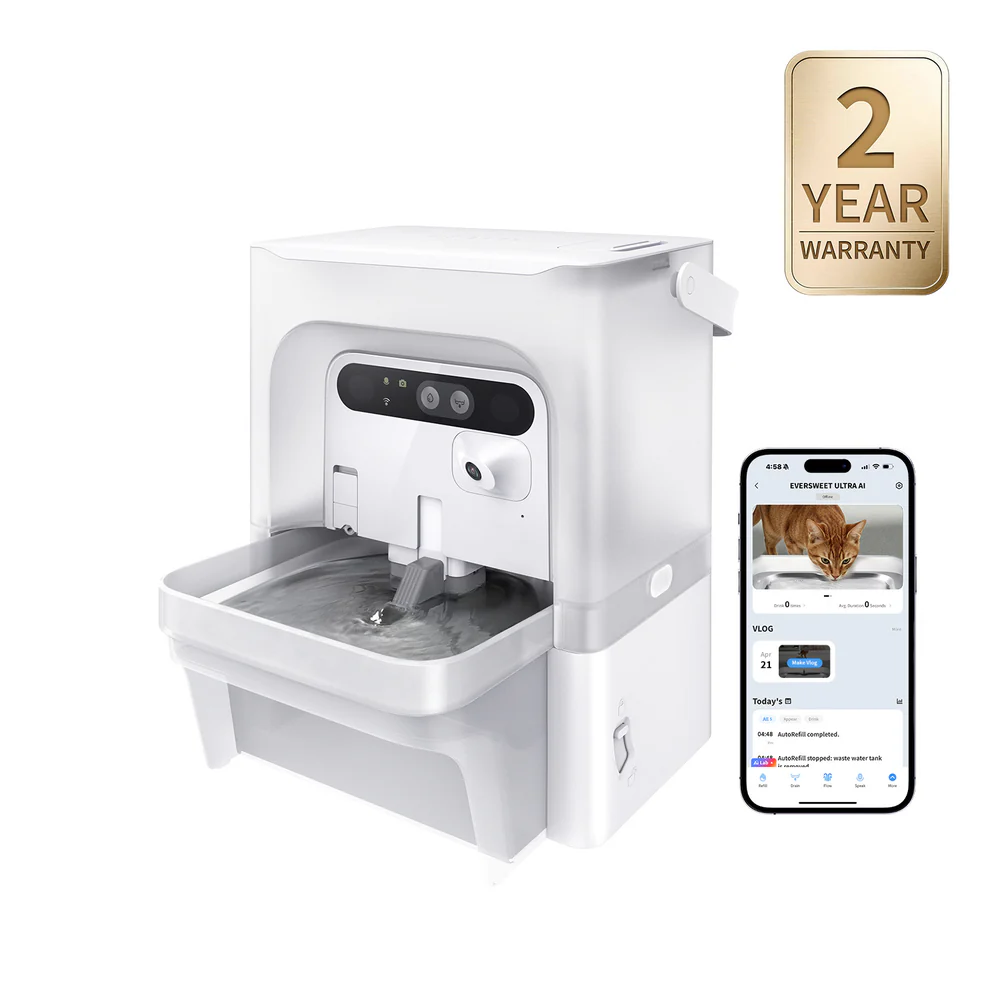
  • Best Cat Grooming Tools (2026): Less Fur or More Machinery?

    Best Cat Grooming Tools (2026): Less Fur or More Machinery?

    Cats already handle much of their own grooming.

    That does not mean every coat, claw and sofa can be left entirely to nature.

    Long-haired cats may need help controlling loose fur and tangles. Senior cats can become less effective at grooming themselves. Some claws need regular trimming. And certain cats distribute enough hair across the furniture to suggest that a second cat is slowly being assembled on the couch.

    The best cat grooming tool is not necessarily the most powerful one.

    It is the tool that matches the coat, solves the actual problem and can be introduced without turning maintenance into a hostage negotiation.

    Quick Verdict

    Comparison of cat brushes, deShedding tools, grooming vacuums, nail clippers and furniture hair removers
    Manual brushes, targeted deShedding tools, grooming vacuums, nail clippers and furniture rollers solve different problems. Product appearance and specifications should always be verified on the current official listing. AI-generated editorial comparison.
    ProductBest forPetTech AI verdictMain limitation
    Hertzko Self-Cleaning Slicker BrushEveryday brushing and easy fur releaseRecommendedLarge brush head may not suit kittens or delicate areas
    FURminator Small Cat Long HairTargeted undercoat removal for small long-haired catsRecommended with ConditionsWrong size or coat variant can be too aggressive
    Oneisall Grooming VacuumVacuum-assisted grooming and household mess controlRecommended with ConditionsStill produces noise and requires substantial equipment
    Neakasa P1 ProPremium vacuum-grooming alternativeConditional RecommendationExpensive for cats that reject powered tools
    Gonicc Small Pet Nail ClippersBasic cat nail maintenanceRecommendedRequires clear visibility of the quick and patient handling
    ChomChom RollerRemoving cat hair from furnitureRecommendedCleans the home, not the cat

    Best starting point for most cats: Hertzko offers normal brushing without motors, hoses or an unexpected industrial atmosphere.

    Best for heavy shedding: choose the correct FURminator variant for the cat’s size and coat length.

    Best powered option: Oneisall can collect loose hair during grooming, but only when the cat accepts the sound and hose.

    Research Note

    This is a research-led comparison based on current manufacturer documentation, Amazon listings and feline-care guidance.

    PetTech AI has not conducted identical long-term hands-on testing of every product in this guide.

    Tool acceptance varies dramatically between cats. A device described as quiet by its manufacturer may still be unacceptable to an animal that considers the toaster suspicious.

    Regular brushing can remove loose hair, help owners inspect the skin and reduce the amount of fur swallowed during self-grooming. Cornell also recommends routine nail checks and trimming where needed, particularly for senior cats.

    PetTech AI may earn a commission from qualifying purchases. As an Amazon Associate I earn from qualifying purchases.

    Best Overall for Everyday Brushing: Hertzko Self-Cleaning Slicker Brush

    Cat grooming tools arranged beside two cats with guidance for brushing, shedding, nail care and furniture cleanup
    Routine brushing, undercoat removal, nail maintenance and furniture cleanup require different tools. Grooming vacuums add convenience only when the cat accepts the sound and equipment. AI-generated editorial illustration.

    Verdict: Recommended

    The Hertzko Self-Cleaning Slicker Brush is the most sensible starting point because it solves an ordinary grooming problem without introducing a motor.

    Its fine angled bristles are designed to collect loose hair, debris and light tangles from short- and long-haired pets. Pressing the release button retracts the bristles so the collected fur can be removed more easily.

    Where it wins

    The Hertzko works well when the objective is:

    • regular loose-hair removal;
    • light detangling;
    • easier cleanup after brushing;
    • one brush for several pets;
    • avoiding vacuum noise.

    The retractable design is genuinely convenient. It is not artificial intelligence, but it does complete its assigned task without requesting a firmware update.

    Where it disappoints

    The brush head may feel oversized around:

    • the face;
    • legs;
    • armpits;
    • kittens;
    • very small cats.

    Slicker pins also require a light touch. Pressing harder does not create superior grooming. It creates a cat who remembers your address.

    Choose Hertzko for routine brushing and manageable tangles.

    Skip it for severe mats, sensitive skin or a cat that reacts painfully to gentle brushing.

    Need a practical everyday brush with easier cleanup? Check the Hertzko Self-Cleaning Slicker Brush on Amazon.

    Best Cat-Specific deShedding Tool: FURminator Small Cat Long Hair

    Verdict: Recommended with Conditions

    The selected FURminator, ASIN B07MZCY821, is designed specifically for long-haired cats under 10 pounds.

    Its stainless-steel edge reaches beneath the topcoat to remove loose undercoat, while the FURejector button releases collected hair from the tool.

    Where it wins

    This is the more targeted option for:

    • small long-haired cats;
    • seasonal shedding;
    • dense loose undercoat;
    • homes where ordinary brushes leave substantial fur behind.

    It is narrower in purpose than Hertzko but potentially more effective when the selected size and coat variant are correct.

    Where it disappoints

    This exact ASIN is not the correct version for:

    • cats over 10 pounds;
    • short-haired cats;
    • kittens with delicate coats;
    • everyday aggressive brushing.

    FURminator offers separate tools for small and medium/large cats, with different versions for short and long hair. Choosing the correct variant is part of using the product safely.

    Use light passes and follow the manufacturer’s directions. The objective is removing loose undercoat, not excavating Gerald until a smaller cat emerges.

    Have a small long-haired cat with serious shedding? Check FURminator B07MZCY821 on Amazon.

    Best Vacuum-Assisted Grooming Kit: Oneisall Pet Grooming Vacuum

    Verdict: Recommended with Conditions

    The Oneisall kit combines powered suction with several grooming and cleanup attachments.

    The current Amazon configuration includes grooming and de-shedding tools, clippers, a nail-grinder attachment, cleaning nozzles and a 1.5-liter collection bin. It is a corded multi-pet system rather than a product designed exclusively around feline grooming.

    Where it wins

    Its main advantage is mess control.

    Loose hair is pulled toward the collection bin instead of being redistributed among:

    • clothing;
    • flooring;
    • the air;
    • every upholstered surface Emperor Maximilian has inspected.

    It makes the most sense for:

    • multi-pet homes;
    • heavy seasonal shedding;
    • cats already comfortable around household appliances;
    • owners who also need trimming or furniture-cleaning attachments.

    In multi-pet homes, grooming is only one part of controlling shared resources, feeding access and household friction. Our Best Multi-Cat Tech Solutions guide explains which problems need automation, individual access or simply more space.

    Where it disappoints

    The complete unit weighs substantially more than a normal brush and requires storage, filters, a hose and access to power.

    Most importantly, it remains a vacuum connected to the grooming process.

    Begin with the machine several feet away, use the lowest practical setting and allow the cat to inspect the disconnected attachments first. A large review history demonstrates that many households use the product successfully; it does not prove that your individual cat will approve the acquisition.

    Need grooming and hair collection in one powered system? Check the Oneisall Grooming Vacuum on Amazon.

    Best Premium Vacuum Alternative: Neakasa P1 Pro

    Verdict: Conditional Recommendation

    Neakasa P1 Pro offers a more focused premium grooming-vacuum system.

    The manufacturer lists five main tools, suction up to 9,000 Pa, a one-liter dustbin and minimum operating noise of 52 dB. The toolkit covers brushing, de-shedding, clipping and cleanup.

    Where it wins

    The P1 Pro has a mature accessory system and a straightforward design built around collecting hair during grooming.

    It suits households that:

    • expect frequent powered grooming;
    • want replacement accessories;
    • have multiple shedding pets;
    • value a recognizable dedicated grooming system;
    • already know the cat tolerates vacuum noise.

    Where it disappoints

    A one-liter bin is smaller than the Oneisall configuration selected here, and the premium positioning is difficult to justify for occasional brushing.

    The manufacturer’s 52 dB claim describes measured operating noise. It does not describe Napoleon’s emotional interpretation of the noise.

    Choose Neakasa when the vacuum-grooming workflow itself is valuable.

    Skip it when a manual brush already controls shedding adequately.

    Would a premium vacuum system earn regular use in your home? Check Neakasa P1 Pro on Amazon.

    Best Cat Nail Clippers: Gonicc Small Pet Nail Clippers

    Verdict: Recommended

    The Gonicc clippers use small angled, semi-circular blades and are designed for cats, kittens and other small animals.

    For most cats, compact manual clippers are a more logical starting point than a powered grinder.

    They offer:

    • direct visibility;
    • no motor noise;
    • no vibration;
    • quick removal of the sharp tip;
    • a small tool that is easy to store.

    The real limitation

    The tool is simple.

    The handling is not always simple.

    ASPCA recommends gradually conditioning cats to paw handling and clipper sounds, trimming only the white tip and initially completing as few as one or two claws per session. Never attempt the trim when the cat or human is already agitated.

    A grinder may suit a cat already accustomed to vibration, but it can also prolong the process and generate heat if held against the nail for too long.

    Manual clippers usually win through speed.

    Archibald may object, but at least the diplomatic incident is brief.

    Need compact clippers designed for small pets? Check Gonicc Cat Nail Clippers on Amazon.

    Best for the Couch, Not the Cat: ChomChom Roller

    Verdict: Recommended

    ChomChom is not a grooming tool used on the animal.

    It belongs here because brushing does not eliminate household hair. It merely reorganizes the supply chain.

    The original B00BAGTNAQ uses repeated back-and-forth movement to collect hair from furniture, bedding, rugs and car interiors inside a reusable receptacle. It requires no adhesive sheets or batteries.

    Choose ChomChom for:

    • sofas;
    • blankets;
    • upholstered chairs;
    • pet beds;
    • vehicle seats.

    Do not roll it directly over the cat.

    It cleans the evidence after grooming. It does not prevent mats, inspect skin or trim claws.

    Has the sofa developed its own winter coat? Check the original ChomChom Roller on Amazon.

    How to Introduce Grooming Without Starting a Diplomatic Incident

    Long-haired cat being gently brushed beside grooming tools and vacuum-assisted grooming kits
    New grooming tools should be introduced gradually through short sessions, calm handling and positive rewards. Stop when fear, discomfort or resistance begins to escalate. AI-generated editorial illustration; depicted products are not exact replicas.

    Start with the least threatening version of the task.

    For brushes

    1. Leave the brush nearby without using it.
    2. Reward investigation.
    3. Touch the cat briefly with the back of the brush.
    4. Make one gentle pass.
    5. Stop before the cat becomes irritated.

    For powered systems

    1. Introduce attachments while the vacuum is off.
    2. Run the motor at a distance.
    3. Reward calm behavior.
    4. Move gradually closer over several sessions.
    5. Connect suction only after the cat accepts the sound.

    For nail trimming

    Handle one paw briefly, extend one claw and reward the cat before any cutting begins.

    Short sessions create familiarity. Long forced sessions create future scheduling difficulties.

    End successful grooming sessions with something the cat already enjoys, such as play or a familiar reward. Our Best Cat Toys for Indoor Cats guide can help match the activity to your cat’s preferred hunting and play style.

    For a broader home routine based on choice and predictability, read our Indoor Cat Enrichment Science guide.

    When to Stop and Call a Groomer or Veterinarian

    Stop home grooming when you find:

    • mats tightly attached to the skin;
    • bleeding, sores or unexplained bald areas;
    • swelling around a nail;
    • a claw growing toward or into the paw pad;
    • sudden pain during normal brushing;
    • abrupt grooming resistance in a previously tolerant cat;
    • excessive licking or self-trauma;
    • parasites or unusual skin changes.

    Cornell notes that brushing can help owners notice skin disease and parasites, while excessive grooming can also signal an underlying physical or behavioral problem.

    Do not cut severe mats with household scissors close to the skin. Cat skin can be pulled into the mat and injured surprisingly easily.

    Technology becomes substantially less impressive once Gerald requires stitches.

    Buyer-Regret Risk

    Grooming-tool regret usually comes from buying for the advertised feature rather than the cat.

    Common mistakes include:

    • buying a vacuum for a noise-sensitive cat;
    • selecting the wrong FURminator coat or size variant;
    • using a large slicker on delicate areas;
    • expecting one tool to remove severe mats;
    • assuming a grinder is automatically safer than clippers;
    • purchasing an entire grooming station for monthly use;
    • mistaking furniture cleanup for coat care.

    Begin with the simplest tool capable of solving the problem.

    Upgrade only when the remaining inconvenience is real.

    Final Verdict

    Choose Hertzko as the best everyday starting point for loose hair, light tangles and easy brush cleanup.

    Choose FURminator B07MZCY821 specifically for small long-haired cats that need targeted undercoat removal.

    Choose Oneisall when collecting loose hair during grooming would materially reduce household mess.

    Choose Neakasa P1 Pro when you want a more premium dedicated vacuum system and already know the cat tolerates powered grooming.

    Choose Gonicc for simple, controlled nail trimming.

    Choose ChomChom when the cat has been groomed but the furniture continues presenting contradictory evidence.

    The best grooming tool is not the machine with the largest accessory count.

    It is the one the cat permits you to use regularly.

    Frequently Asked Questions

    Do short-haired cats need brushing?

    Yes. Short-haired cats can still benefit from loose-hair removal and skin inspection, although they may need less frequent or intensive grooming than long-haired cats.

    Are grooming vacuums safe for cats?

    They can be used with cats that tolerate the sound, suction and attachments. Introduce them gradually and stop when the cat shows escalating fear or distress.

    Can FURminator be used on every cat?

    No. Choose the correct tool for the cat’s weight and coat length. The ASIN featured here is intended for small long-haired cats.

    Are nail grinders better than clippers?

    Not automatically. Grinders smooth the nail gradually but introduce vibration, noise and possible heat. Compact clippers are faster for many cats.

    Can I remove a severe mat at home?

    Dense or skin-level mats may require a professional groomer or veterinarian. Avoid pulling, aggressive brushing or cutting close to the skin.

    References

    • Cornell Feline Health Center — Choosing and Caring for Your New Cat
    • Cornell Feline Health Center — The Special Needs of the Senior Cat
    • Cornell Feline Health Center — Cats That Lick Too Much
    • ASPCA — Cat Grooming Tips
    • ASPCA — General Cat Care
    • Oneisall — Grooming Vacuum Documentation
    • Neakasa — P1 Pro Official Documentation
    • FURminator — Cat deShedding Tool Documentation
    • Hertzko — Self-Cleaning Slicker Brush Listing
    • Gonicc — Small Pet Nail Clipper Listing
    • ChomChom — Original Roller Documentation

    Image Disclosure

    Official manufacturer images are used when available and authorized.

    AI-generated images may also be used as editorial illustrations. They should not be treated as exact representations of product dimensions, materials, controls or physical features. Always verify current official product information before purchasing.

    Editorial Disclosure

    PetTech AI may earn a commission from qualifying purchases. This does not influence our recommendations, comparisons or editorial judgments.
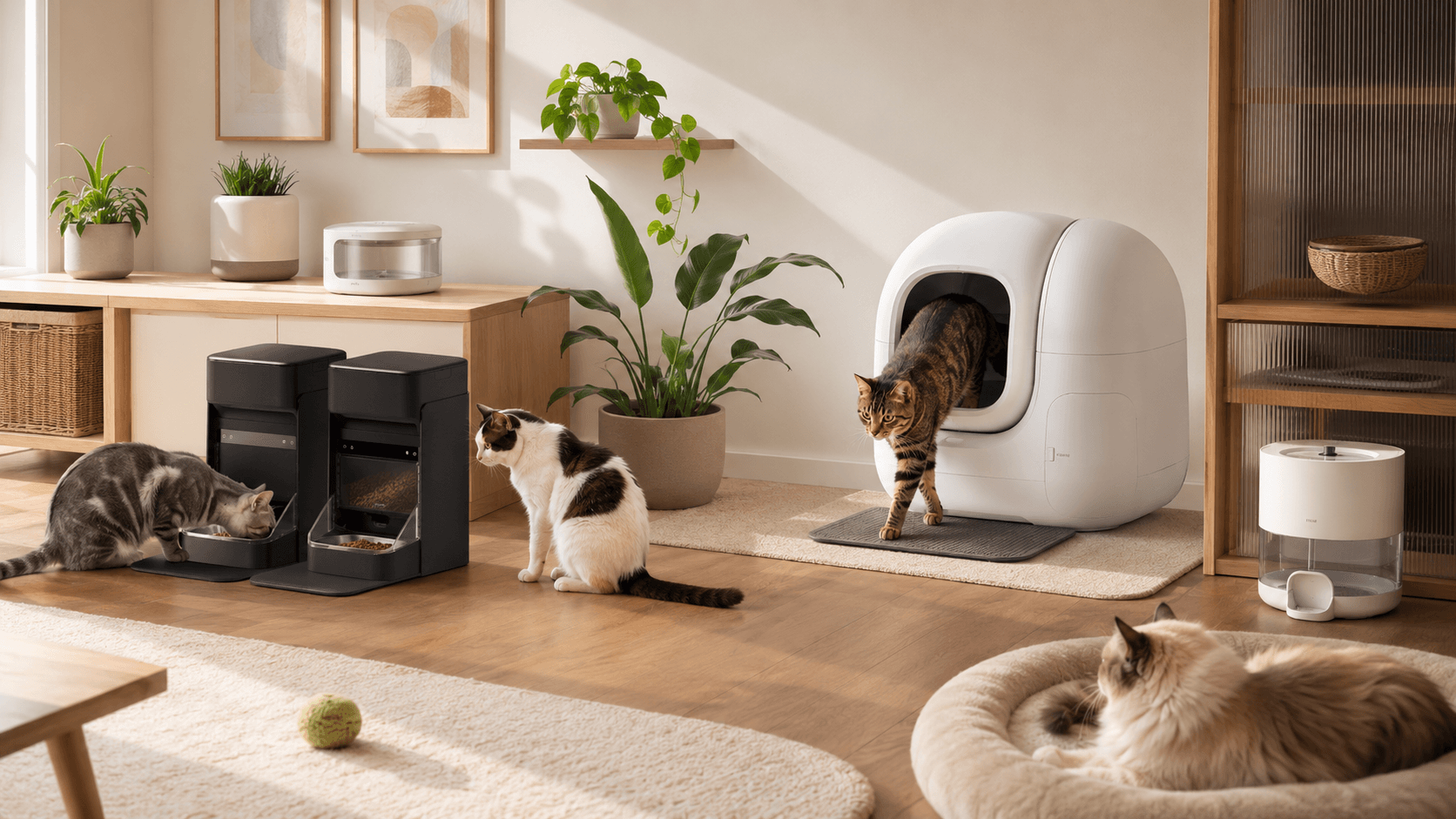
  • Best Heated Cat Beds 2026: Safe Warmth, Fewer Bad Ideas

    Best Heated Cat Beds 2026: Safe Warmth, Fewer Bad Ideas

    Cats already treat radiators, laptops and freshly dried laundry as public infrastructure.

    A heated bed can give them a predictable warm spot without surrendering your keyboard. The useful models provide gentle heat, documented safeguards and a shape the cat will actually use. The bad ones offer twelve settings, vague promises and a cable that turns you into a reluctant electrical inspector.

    The best heated cat beds do not need sleep analytics or an app. A reliable thermostat is enough. Gerald can handle the remaining eighteen hours of research personally.

    Quick Verdict

    ProductBest fitMain drawbackPetTech AI verdict
    K&H Thermo-Kitty BedMost cats wanting a complete heated nestRaised walls may hinder stiff catsRecommended
    K&H Thermo-Kitty MatSenior, large or bolster-averse catsLess cushioningRecommended
    K&H Thermo-Pet CaveCats that already seek covered bedsSome cats reject enclosureRecommended
    FurHaven ThermaNAPTravel and cord-free mild warmthDoes not produce active heatRecommended
    ZOMISIA Heating PadAdjustable heat and timed sessionsSafety certification is less transparentConditional

    Best overall: K&H Thermo-Kitty Bed combines a padded nest with a removable thermostatic heater.

    Best for senior cats: K&H Thermo-Kitty Mat offers flatter access and more space to stretch.

    Best without electricity: FurHaven ThermaNAP adds portable, self-warming insulation without plugs or controls.

    PetTech AI may earn a commission from qualifying purchases. As an Amazon Associate I earn from qualifying purchases.

    Want a complete heated bed with documented whole-product safety testing? Check the K&H Thermo-Kitty Bed on Amazon.

    Research and Safety Note

    This is a research-led comparison based on current manufacturer documentation and product listings. PetTech AI has not independently measured surface temperatures or performed electrical safety testing.

    K&H says its Thermo-Kitty products use low-wattage thermostatic heaters and that the complete products are tested by MET Laboratories—not merely assembled from individually listed components. The company also advises veterinary guidance before use with animals unable to leave the heated surface independently.

    Warmth may improve comfort. It does not treat arthritis, illness, poor circulation or postoperative problems.

    Heated vs Self-Warming: One Has a Plug

    Round heated cat bed, flat warming mat and covered cat cave arranged side by side.
    Beds, mats and caves solve different problems. The warmest option is useless when Gerald rejects its architecture.

    An electric heated bed creates warmth through a powered element. It may use an internal thermostat, adjustable controller or timer.

    A self-warming bed uses reflective insulation to return some of the cat’s own body heat. It has no cord and produces milder warmth than an electric model. FurHaven describes the ThermaNAP as a cord-free mat that reflects body heat toward the animal.

    Choose electricity for a genuinely cold indoor sleeping spot. Choose self-warming when portability and avoiding cords matter more.

    Best Overall: K&H Thermo-Kitty Bed

    Verdict: Recommended

    The Thermo-Kitty Bed is the easiest recommendation for cats that like curling inside a padded nest.

    The small model is a 16-inch round bed with six-inch foam walls and a removable 4-watt thermostatic heater. K&H also offers a larger size, and the cover can be removed for washing. The heater is designed to feel only mildly warm while empty and increase warmth when occupied.

    It works best for cats that seek bolsters, steal warm laundry and prefer sleeping curled rather than stretched.

    The weakness is access. High walls can be awkward for cats with stiffness or reduced mobility, and the smaller version deserves actual measuring. “Cat-sized” remains one of the pet industry’s more adventurous units.

    Choose it when: you want a complete heated nest with strong safety documentation.

    Skip it when: your cat prefers flat surfaces or needs step-free entry.

    Best Low-Profile Option: K&H Thermo-Kitty Mat

    Senior cat stepping easily onto a low-profile warming mat without raised sides.
    A low-profile mat can be easier for senior or stiff cats to access than a deep bed with high bolsters.

    Verdict: Recommended

    The Thermo-Kitty Mat removes the walls and provides a long, flat heated surface.

    It measures about 12.5 by 25 inches, uses thermostatic heat and includes a removable washable cover. K&H identifies the complete indoor product as MET listed and instructs owners to use it flat rather than folded or buried beneath unsuitable layers.

    It is the better fit for:

    • senior cats;
    • long-bodied cats;
    • animals with reduced mobility;
    • cats that reject deep beds;
    • owners warming an existing sleeping spot.

    It offers less cushioning and no surrounding support. Cats that demand a proper nest may regard it as a warmer floor with excellent credentials.

    Need warmth without a raised entry? Check the K&H Thermo-Kitty Mat on Amazon.

    Best Heated Cave: K&H Thermo-Pet Cave

    Verdict: Recommended

    The Thermo-Pet Cave is for cats whose preferred sleeping arrangement includes a roof and minimal contact with household management.

    Its fleece-lined structure measures approximately 17 by 15 by 13 inches. A rear zipper lets it work as a cave or tunnel, while the heated version includes a removable 4-watt warmer. K&H lists the complete product as MET certified and machine washable after removing the heater.

    Choose it when your cat already crawls beneath blankets, uses covered beds or seeks visual shelter.

    Do not buy it because caves are supposedly calming for every cat. Some will refuse to enter, flatten it or sleep directly beside it while maintaining eye contact.

    Does your cat already disappear into blankets? Check the K&H Thermo-Pet Cave on Amazon.

    Best Non-Electric Option: FurHaven ThermaNAP

    Verdict: Recommended

    The ThermaNAP earns its place by avoiding electricity entirely.

    Its insulating core reflects some of the cat’s body heat toward the sleeping surface. The mat is portable and washable, making it practical on furniture, inside carriers or during travel.

    It is ideal for:

    • cord-chewing cats;
    • carriers and travel;
    • rooms without a convenient outlet;
    • owners uncomfortable with powered bedding;
    • mild extra warmth.

    Our cat travel essentials guide covers the rest of the portable setup without requiring a feline luggage department.

    The limitation is simple: it cannot actively heat a cold room. “Self-warming” sounds like a tiny furnace has joined the household. In reality, the cat remains the entire power station.

    Prefer warmth without cords? Check the FurHaven ThermaNAP on Amazon.

    Best Adjustable Pad: ZOMISIA Heating Pad

    Verdict: Conditional

    The ZOMISIA pad is the option for buyers who value controls over simplicity.

    Its listing describes 11 temperature settings, timed operation, an 18-inch square surface, a washable cover, waterproof inner construction and chew-resistant cord protection. The advertised temperature range refers to the internal thermostat; the manufacturer says the surface should remain lower.

    The adjustable controller is useful for short warming sessions or owners who do not want a fixed thermostatic bed.

    The problem is documentation. We could not verify clearly disclosed independent whole-product certification comparable to K&H’s MET testing.

    That does not prove the pad is unsafe. It means the available evidence is less reassuring, while the wider adjustment range increases the importance of careful setup.

    Use the lowest effective setting, keep the pad flat and ensure the cat can leave freely. I would not make it the first choice for kittens, medically fragile cats or animals with severe mobility limitations.

    Choose it when: timers and adjustable heat are essential.

    Skip it when: transparent certification matters more than controller flexibility.

    Need adjustable heat and timers? Check the ZOMISIA Heating Pad on Amazon, keeping its less transparent certification documentation in mind.

    Safety Matters More Than the Number of Settings

    Owner inspecting the power cord and controller of a heated pet bed before use.
    Certification, intact cables and an easy escape from the warm surface matter more than the number of temperature settings.

    A heated bed should never trap the cat on the warm surface.

    Place it where the animal can move easily onto an unheated area. Inspect the cord, controller and heating surface regularly. Stop using the product if you notice exposed wiring, damaged insulation, unusual odors, liquid inside the heating core or uneven heat.

    Do not fold an electric pad unless the manufacturer explicitly permits it. Do not bury it beneath thick bedding that may trap heat or interfere with the thermostat.

    K&H says its certified thermostatic indoor beds are designed for continuous operation, while still recommending ordinary electrical precautions and unplugging appliances during extended absences.

    For kittens, postoperative cats, animals with reduced sensation or cats unable to leave independently, consult a veterinarian before use.

    When the actual problem is a wet coat rather than a cold sleeping spot, a bed is simply the wrong appliance. Our PETKIT AirSalon Max review covers that considerably larger commitment.

    Buyer-Regret Risk

    Heated beds disappoint when owners:

    • buy a cave for a cat that hates caves;
    • choose size by weight rather than sleeping position;
    • mistake self-warming for electric heat;
    • cover a pad with thick bedding;
    • ignore cable damage;
    • choose maximum temperature because more sounds premium;
    • expect heat to solve a medical problem;
    • position the bed somewhere the cat never sleeps.

    Start with the surface your cat already chooses. Warm Gerald’s existing throne before launching a relocation program across the living room.

    Final Verdict

    Choose the K&H Thermo-Kitty Bed for the best all-around combination of cushioning, thermostatic warmth and documented safety testing.

    Choose the K&H Thermo-Kitty Mat for senior cats, larger cats and low-profile access.

    Choose the K&H Thermo-Pet Cave only when your cat already likes enclosed sleeping spaces.

    Choose the FurHaven ThermaNAP for portable, cord-free comfort and understand that it reflects warmth rather than generating it.

    Choose the ZOMISIA Heating Pad when adjustable heat and timers are essential—and accept the less transparent certification picture.

    The best heated cat bed is not the one with the most buttons.

    It is the one the cat uses, can leave safely and does not turn bedtime into a nightly inspection of cables, controllers and personal regret.

    Frequently Asked Questions

    Are heated cat beds safe?

    Well-documented thermostatic products can be used safely when installed according to instructions. The cat must be able to move away, and cords and heating surfaces require regular inspection.

    Can a heated cat bed remain plugged in?

    Follow the individual manufacturer’s instructions. K&H says its MET-tested thermostatic indoor products are designed for continuous operation with normal electrical precautions.

    Are heated beds useful for senior cats?

    Many senior cats seek warmth, and a flat mat may be easier to access. Heat is comfort, not treatment, so pain, stiffness or mobility changes still require veterinary assessment.

    What is the difference between heated and self-warming?

    Heated beds use electricity. Self-warming beds reflect some of the cat’s existing body heat and provide gentler warmth.

    References

    K&H Pet Products — Thermo-Kitty Bed Documentation
    K&H Pet Products — Thermo-Kitty Mat Documentation
    K&H Pet Products — Thermo-Pet Cave Documentation
    K&H Pet Products — Heated Pet Bed Safety Guidance
    FurHaven — ThermaNAP Self-Warming Mat Documentation
    ZOMISIA — Current Product Documentation

    Image Disclosure

    Official manufacturer images are used when available and authorized.

    AI-generated images may also be used as editorial illustrations. They should not be treated as exact representations of product dimensions, materials, controls or physical features. Always verify current official product information before purchasing.

    Editorial Disclosure

    PetTech AI may earn a commission from qualifying purchases. This does not influence our recommendations, comparisons or editorial judgments.
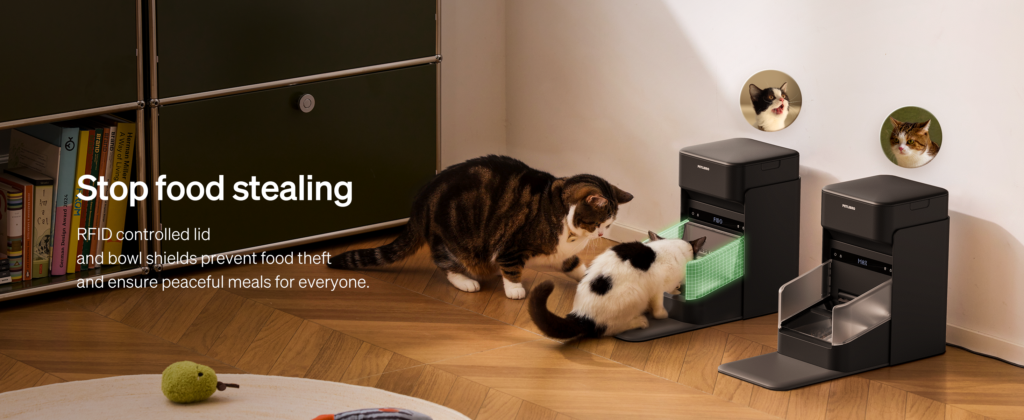
  • Best Cat Shelves for Indoor Cats (2026): Vertical Territory or Expensive Wall Decor?

    Best Cat Shelves for Indoor Cats (2026): Vertical Territory or Expensive Wall Decor?

    For an indoor cat, vertical space can make a small home feel considerably larger.

    The right shelf creates territory above floor level: somewhere to climb, observe, scratch, retreat and judge household decisions from a position of authority.

    The wrong shelf creates an expensive wooden platform that your cat ignores while continuing to sleep on the refrigerator.

    This guide compares five different approaches—from complete wall routes to freestanding climbers and vertical scratchers—based on the problem they actually solve. Because not every cat needs a feline climbing empire, and not every wall deserves to become one.

    The best cat shelf is not always the biggest wall system.

    It is the one your cat can actually reach, use safely, and return to every day.

    Some homes need a full wall-mounted climbing route. Some need one premium design shelf near a window. Some cats need a freestanding climber because drilling into the wall is not realistic. Others need a modern cat tree rather than wall furniture. And sometimes the real issue is vertical scratching, not climbing.

    This guide compares cat shelves and climbing systems by household fit, not just by looks.

    If you are still building the broader enrichment setup, start with Best Cat Toys for Indoor Cats. For food-based mental work, see Best Puzzle Toys for Cats. For motion-based play, see Best Interactive Cat Toys.

    Quick Verdict

    Best forProductWhat it solvesMain trade-off
    Complete wall routeFUKUMARU Cat Wall Shelves 5-Piece SetClimbing, perching, scratching, hiding, and hammock-style restingRequires careful wall mounting
    Premium design wall shelfThe Refined Feline Lotus Branch Cat ShelfLong, furniture-style perch for lounging and window watchingExpensive and still requires wall installation
    No-drill vertical climberPetFusion VersiClimb Cat ClimberFreestanding climbing, scratching, resting, and furniture-style useUses floor space and may have availability swings
    Modern cat tree alternativeCatit Vesper High BaseRecognizable freestanding vertical furniture with platforms, hideout, and scratching postsNot wall-mounted and takes floor space
    Vertical scratcher add-on7 Ruby Road Wall Mounted Cat ScratcherDedicated vertical scratching surface without building a full cat wallNot a true climbing system

    Short verdict:

    Best overall: FUKUMARU offers the most complete wall-mounted route.
    Best alternative: Choose a freestanding climber or modern cat tree when drilling, floor plan or feline mobility makes wall shelves a bad idea.

    PetTech AI may earn a commission from qualifying purchases. As an Amazon Associate I earn from qualifying purchases.

    Why Vertical Space Helps—and What Shelves Cannot Fix

    Indoor homes are designed around human movement.

    Cats often experience the same rooms vertically. Elevated territory gives them more ways to observe, rest, scratch, retreat and create distance from people, dogs or other cats.

    A useful vertical setup can provide:

    • a clear climbing route;
    • one or more stable resting points;
    • appropriate scratching surfaces;
    • a safe observation area;
    • an easy route back down;
    • additional distance in multi-cat homes.

    That final point matters more than product photography usually admits.

    A beautiful shelf with no comfortable entrance or exit is not enrichment. It is elevated administrative failure.

    Vertical territory can be especially useful in small homes because it expands usable space without occupying every remaining section of floor. In multi-cat households, several destinations and more than one route may also reduce the chance that one cat controls the entire system.

    But cat shelves solve only one part of the indoor environment.

    They do not replace:

    • hunting-style play;
    • food puzzles and foraging;
    • appropriate litter-box access;
    • hiding and resting spaces;
    • separated resources;
    • direct human interaction;
    • veterinary assessment when behavior changes suddenly.

    They also cannot automatically resolve conflict. A narrow route, dead end or single premium perch may simply give the most confident cat a more expensive place to block everyone else.

    Think of shelves as one layer of a complete enrichment setup—not as a vertical cure for every household problem.

    Our Indoor Cat Enrichment Science guide explains how climbing territory fits alongside safe retreats, resource separation, play, feeding enrichment and litter-box design.

    How to Choose a Cat Shelf or Climbing System

    Start with your cat, not the wall.

    A large athletic cat needs different spacing and support than a small kitten or senior cat. A cautious cat may need low starter steps. A bold jumper may need longer routes and more challenging perches. A multi-cat home needs more than one destination so one cat cannot block the whole system.

    Match the system to the problem

    Your situationBetter starting point
    Small apartment with usable wall spaceWall-mounted shelf route
    Stylish living roomPremium design wall shelf
    No drilling allowedFreestanding climber or cat tree
    Large athletic catWider platforms and stronger mounting
    Senior or cautious catLower shelves, ramps, closer spacing
    Multi-cat tensionMultiple perches and more than one route
    Sofa or wall scratchingVertical scratcher near the problem area
    Window watchingShelf or perch near a safe window view
    Bored indoor catClimbing route plus toy rotation

    Measure before buying

    Before choosing a shelf system, check:

    • wall type;
    • stud placement;
    • available width;
    • distance from furniture;
    • safe landing areas;
    • platform size;
    • your cat’s size and jumping ability;
    • whether the route has a safe way up and down.

    The best shelf is not the one that looks most dramatic online.

    It is the one that fits your wall, your cat, and your ability to install it securely.

    Best Complete Wall Route: FUKUMARU Cat Wall Shelves 5-Piece Set

    Indoor cat climbing a complete wall-mounted shelf route with perches, steps, scratching surfaces and a resting area
    A complete wall route works best when it gives the cat a clear way up, a place to pause and a safe way back down.

    A complete wall shelf set makes the most sense when you want to build a real vertical route rather than add one isolated perch.

    The FUKUMARU Cat Wall Shelves 5-Piece Set is the strongest pick for owners who want a fuller wall-mounted system with multiple functions in one setup.

    Its role is simple: create a climbing, perching, scratching, hiding, and resting zone on the wall.

    That makes it useful for apartments, small rooms, and homes where floor space is limited but wall space is available.

    It is a strong system, but it requires accurate measurements and competent installation. “I watched half a tutorial and broadly understand gravity” is not an installation method.

    Why it stands out

    A single shelf can help.

    A route is better.

    Cats often use vertical space more confidently when shelves are connected in a way that makes movement feel natural. A system with steps, perches, a hideaway, hammock-style rest zone, and scratching surface gives the cat more than one behavior to perform.

    That matters because cats do not only climb for exercise.

    They climb to pause, watch, hide, scratch, and settle.

    Choose FUKUMARU 5-Piece Wall Shelves if:

    • you want a complete wall-mounted setup;
    • your home has usable wall space;
    • your cat likes climbing or window watching;
    • you need to save floor space;
    • you want climbing, resting, scratching, and hiding in one layout.

    Skip it if:

    • you cannot mount into a suitable wall;
    • you rent and cannot drill;
    • your cat has mobility limitations;
    • you do not want to measure and plan shelf spacing;
    • you need a freestanding option.

    Verdict: Best complete wall shelf system for indoor cats that need a real vertical route instead of one isolated perch.

    Check FUKUMARU Cat Wall Shelves 5-Piece Set on Amazon.

    Best Premium Design Wall Shelf: The Refined Feline Lotus Branch Cat Shelf

    Modern living room with a premium cat wall shelf near a window and a cat resting on the elevated perch
    Premium design shelves are less about building a full cat playground and more about giving the cat one elevated place that still fits the room.

    Some cat shelves look like pet furniture.

    The Refined Feline Lotus Branch Cat Shelf looks more like a design object.

    That is its role in this guide.

    It is not the best pick if you want a full climbing route from the floor to the ceiling. It is better for owners who want a long, furniture-style perch that gives a cat an elevated resting and observation point without making the room look like a playroom.

    This makes it especially useful near a window, above a low cabinet, or in a living room where visual design matters.

    Part of the price pays for the perch. The rest pays for the privilege of not turning your living room into a feline daycare center.

    Why it stands out

    The Lotus Branch solves a different problem from a multi-piece wall kit.

    FUKUMARU is about building a route.

    The Refined Feline is about creating a premium perch.

    That difference matters. Some cats do not need a complicated cat wall. They need one strong elevated place where they can stretch out, watch the room, nap, and feel above the action.

    Choose The Refined Feline Lotus Branch if:

    • you want a premium design shelf;
    • your cat likes lounging more than complex climbing;
    • you want a long wall perch near a window;
    • your home aesthetic matters;
    • you prefer a furniture-style solution over a cat playground look.

    Skip it if:

    • you need several climbing steps;
    • your cat needs a route from the floor;
    • you want a budget wall system;
    • you cannot mount safely into the wall;
    • you want a freestanding option.

    Verdict: Best premium design wall shelf for owners who want an elevated cat perch that blends into a modern living space.

    Check The Refined Feline Lotus Branch Cat Shelf on Amazon.

    Best No-Drill Vertical Climber: PetFusion VersiClimb Cat Climber

    Indoor cat using a freestanding vertical climber and modern cat tree alternative in an apartment living room
    Freestanding climbers and modern cat trees make more sense when wall mounting is not realistic, especially for renters or flexible layouts.

    Wall shelves are not always realistic.

    Some renters cannot drill. Some walls are not suitable. Some owners want vertical enrichment but do not want to commit to hardware, anchors, and layout planning.

    That is where PetFusion VersiClimb makes more sense.

    Its role is not to replace a full cat wall. Its role is to offer a furniture-style vertical station with climbing, scratching, resting, and storage-like use in one piece.

    Why it stands out

    Its strongest advantage is commitment level.

    A wall system requires planning and installation. A freestanding or furniture-style climber is easier to move, adjust, or remove. That makes it more practical for renters, temporary spaces, or owners who want vertical enrichment before deciding whether a permanent wall setup is worth it.

    It also gives cats a vertical scratching and resting option without taking over an entire wall.

    The wall survives untouched. The floor, naturally, is asked to make the sacrifice instead.

    Choose PetFusion VersiClimb if:

    • you cannot or do not want to drill into the wall;
    • you want a freestanding vertical setup;
    • your cat needs scratching and climbing in one place;
    • you want something easier to move than wall shelves;
    • you prefer a modern furniture-style design.

    Skip it if:

    • you have very limited floor space;
    • you want a long wall route;
    • your cat needs multiple elevated destinations;
    • Amazon availability is unstable when you check;
    • you already have a large cat tree that serves the same role.

    Verdict: Best no-drill vertical climber for owners who want climbing and scratching without building a permanent wall route.

    Check PetFusion VersiClimb Cat Climber on Amazon.

    Best Modern Cat Tree Alternative: Catit Vesper High Base

    Not every vertical enrichment setup needs to be wall-mounted.

    For many homes, a modern cat tree is the more practical answer.

    Catit Vesper High Base is the best choice here because Catit is a recognizable pet brand, the design is cleaner than many traditional carpeted cat trees, and the setup combines platforms, a hideout, scratching posts, and lounging areas in one freestanding piece.

    It is not as space-saving as wall shelves, but it is much easier to place, move, and replace than a wall route.

    Why it stands out

    The Vesper High Base is the practical middle ground.

    It gives cats vertical access and resting zones without asking the owner to drill into walls. It also makes sense for renters, cautious buyers, and homes where the cat may not yet be ready for a wall-mounted route.

    For many cats, a well-placed modern cat tree near a window is more useful than a dramatic wall shelf installed in the wrong room.

    It lacks the architectural drama of a full cat wall, but many cats remain strangely indifferent to architectural drama.

    Choose Catit Vesper High Base if:

    • you want a recognizable brand;
    • you prefer freestanding furniture;
    • you rent or do not want wall mounting;
    • your cat likes hideouts, platforms, and scratching posts;
    • you want a cleaner design than a traditional carpeted cat tree.

    Skip it if:

    • you have very limited floor space;
    • you specifically want wall-mounted shelves;
    • your cat needs a long climbing route;
    • you already have a cat tree in the best location;
    • your cat is too large for the platforms or cubby layout.

    Verdict: Best recognizable modern cat tree alternative for owners who want vertical territory without a wall-mounted system.

    Check Catit Vesper High Base on Amazon.

    Best Vertical Scratcher Add-On: 7 Ruby Road Wall Mounted Cat Scratcher

    Indoor cat stretching on a wall-mounted vertical scratcher placed near a resting area
    Sometimes the issue is not climbing. A dedicated vertical scratcher can redirect stretching and scratching before you build a full cat wall.

    Sometimes the problem is not climbing.

    It is scratching.

    If your cat scratches sofas, door frames, rugs, or furniture edges, a full cat wall may be more than you need at first. A vertical scratcher placed near the right area can be a better starting point.

    The 7 Ruby Road Wall Mounted Cat Scratcher is useful as an add-on because it creates a dedicated vertical scratching surface without requiring a full climbing system.

    Why it stands out

    Scratching is not optional for cats.

    They scratch to stretch, maintain claws, mark territory, and release tension. A scratcher works better when it is placed where the cat already wants to scratch or near a preferred resting zone.

    That is why wall placement matters.

    A scratcher hidden in a corner rarely solves a sofa problem. A scratcher near the route your cat already uses has a better chance of becoming part of the routine.

    Choose 7 Ruby Road Wall Mounted Cat Scratcher if:

    • your main issue is scratching, not climbing;
    • your cat likes vertical scratching surfaces;
    • you want a space-saving wall option;
    • you need an add-on near a shelf, bed, or rest area;
    • you are not ready for a full wall system.

    Skip it if:

    • your cat needs elevated resting space;
    • you want a full climbing route;
    • your cat prefers horizontal scratching;
    • you cannot mount it safely;
    • your cat needs a broader vertical enrichment setup.

    Verdict: Best vertical scratcher add-on for cats that need a dedicated wall-mounted scratching surface before or alongside a fuller climbing setup.

    Check 7 Ruby Road Wall Mounted Cat Scratcher on Amazon.

    How to Build a Better Vertical Setup

    A good vertical setup is not just a row of shelves.

    It is a route.

    Cats need to know where to start, where to pause, where to land, and how to get down. If the path is too steep, too narrow, too slippery, or has no clear exit, the cat may avoid it even if the product itself is good.

    Start low

    Begin with lower platforms, especially for cautious cats, kittens, senior cats, or cats with heavier bodies.

    You can build higher only after your cat uses the first levels confidently.

    Create destinations

    A shelf should lead somewhere useful:

    • a window view;
    • a resting perch;
    • a scratcher;
    • a hammock;
    • a hiding box;
    • a quiet observation point.

    A floating shelf in a random place may look nice but fail as enrichment.

    Avoid dead ends in multi-cat homes

    In a multi-cat home, a shelf route should not allow one cat to trap another.

    Use multiple exits, wider landings, or separate routes when possible.

    Mix climbing with play

    A shelf system becomes more useful when it connects with daily play.

    Use wand toys, track toys, or treat puzzles around the base of the route to make the vertical space part of the cat’s routine.

    Installation and Safety Tips

    Installation matters more than aesthetics.

    A beautiful shelf that is poorly mounted is not enrichment. It is a fall risk.

    Before installation:

    • identify wall studs when possible;
    • use hardware appropriate for your wall type;
    • follow the manufacturer’s weight limits;
    • consider your cat’s landing force, not only body weight;
    • avoid slippery surfaces;
    • keep shelves away from fragile decor;
    • protect cables and cords;
    • test stability before allowing full access.

    After installation:

    • supervise the first sessions;
    • use treats or toys to encourage gradual exploration;
    • check screws and brackets regularly;
    • inspect fabric, sisal, carpet, and wood for wear;
    • adjust spacing if your cat hesitates or jumps awkwardly.

    For older cats, keep jumps shorter and surfaces more stable.

    For large cats, choose wider platforms and stronger mounting.

    For kittens, avoid routes that are too high before they have coordination and judgment.

    Where Cat Shelves Fit in a Full Enrichment Routine

    Cat shelves solve the vertical part of enrichment.

    They do not solve everything.

    A balanced indoor routine may include:

    • cat shelves or trees for vertical territory;
    • toys for hunting-style play;
    • puzzle feeders for mental work;
    • scratchers for claw maintenance and stretching;
    • cameras only when they help you understand actual use;
    • separate resources in multi-cat homes.

    If you want to see whether your cat actually uses a shelf, perch, or cat tree while you are away, Smart Cat Cameras can help you observe room use without guessing.

    If your cat ignores the wall route, the issue may not be the shelf itself. It may be location, spacing, surface grip, fear of another pet, or lack of a rewarding destination.

    Final Verdict

    Choose FUKUMARU Cat Wall Shelves 5-Piece Set if you want a complete wall-mounted climbing, perching, scratching, hiding, and resting route.

    Choose The Refined Feline Lotus Branch Cat Shelf if you want a premium design wall shelf that looks more like furniture than pet gear.

    Choose PetFusion VersiClimb Cat Climber if you want vertical enrichment without building a permanent cat wall.

    Choose Catit Vesper High Base if you want a recognizable modern cat tree alternative.

    Choose 7 Ruby Road Wall Mounted Cat Scratcher if your cat mainly needs a vertical scratching outlet.

    The best cat shelf is not the one that looks most impressive in a product photo.

    It is the one your cat can reach safely, use confidently, and return to every day.

    Frequently Asked Questions

    Are cat shelves good for indoor cats?

    Yes, cat shelves can be useful because they add vertical territory, climbing opportunities, resting places, scratching options, and observation points. They are especially helpful in small homes or multi-pet households where floor-level space is limited.

    Are cat wall shelves safe?

    They can be safe when installed correctly with appropriate hardware, weight limits, spacing, and surface grip. Poor installation, weak anchors, slippery shelves, or awkward spacing can make them unsafe.

    Do cats prefer shelves or cat trees?

    It depends on the cat and the home. Shelves save floor space and can create routes across a wall. Cat trees are easier for renters and do not require drilling. Some homes benefit from both.

    How high should cat shelves be?

    Start lower than you think, especially for cautious, senior, young, or heavy cats. Build a route your cat can climb and descend confidently rather than placing one high shelf with no easy path.

    Can cat shelves help in multi-cat homes?

    They can help by creating more resting and escape options, but only if the layout avoids dead ends and resource blocking. Multi-cat homes often need multiple routes or destinations, not one narrow path.

    What if my cat ignores wall shelves?

    Check location, spacing, surface texture, stability, and whether the shelf leads to a meaningful destination. Some cats need gradual introduction with treats, toys, or a lower starting point.

    Should I choose a wall shelf or a freestanding cat tree?

    Choose wall shelves when you have safe wall space and want to save floor space. Choose a freestanding cat tree or climber when you rent, cannot drill, need easier placement, or want something movable.

    References

    AAFP / ISFM Feline Environmental Needs Guidelines — elevated areas, vertical space, perching, hiding, and environmental control.

    Ellis, Environmental Enrichment: Practical Strategies for Improving Feline Welfare — shelves, ropes, cat trees, and climbing poles for vertical enrichment.

    Herron & Buffington, Environmental Enrichment for Indoor Cats — scratching placement, indoor enrichment, and welfare-focused home setup.

    Image Disclosure aggiornata

    Official manufacturer images are used when available and authorized.

    AI-generated images may also be used as editorial illustrations. They should not be treated as exact representations of product dimensions, materials, controls or physical features. Always verify the current official product listing before purchasing.

    Editorial Disclosure finale

    PetTech AI may earn a commission from qualifying purchases. This does not influence our recommendations, comparisons or editorial judgments.
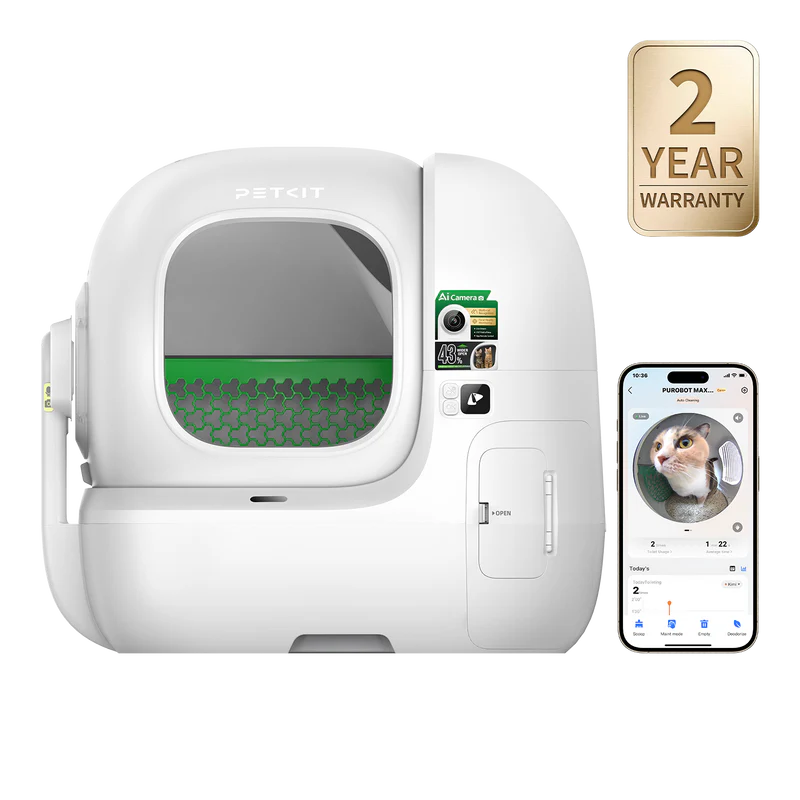
  • Best Smart Cat Doors: Microchip and App-Controlled Access Compared

    Best Smart Cat Doors: Microchip and App-Controlled Access Compared

    A smart cat door should solve an access problem—not simply add another app to your home.

    Maybe neighborhood cats are entering through a standard flap. Maybe one cat can go outside while another must remain indoors. Maybe you want confirmation that your cat returned before bedtime.

    Or perhaps you are already building a connected cat-care setup and want the same visibility at the door.

    The important question is not:

    Which smart cat door has the most technology?

    It is:

    What access rule does your household actually need?

    For most cat homes, reliable microchip recognition matters more than remote control. App features become worthwhile only when schedules, individual permissions or entry history solve a recurring problem.

    Baron does not need a notification to enter the kitchen. He needs the neighborhood raccoon to remain on the wrong side of the flap.

    Quick Verdict: Which Smart Cat Door Is Best?

    Best fitProductPetTech AI verdictMain limitation
    Most cat homesSureFlap Microchip Cat DoorStrong RecommendationSelective entry only; no app or individual exit permissions
    Cats with different outdoor rulesSureFlap DualScan Microchip Cat DoorRecommended with ConditionsNo app monitoring or remote control
    Connected access and activity historySureFlap Microchip Cat Flap Connect + HubConditional RecommendationMore setup, more hardware and more potential friction
    Mainstream app-controlled alternativePetSafe SmartDoor Connected Pet DoorNot RecommendedWeak ownership evidence and invasive installation risk

    The SureFlap Microchip Cat Door is the best overall choice for most households.

    It solves the most common problem—letting registered cats enter while keeping unwanted animals outside—without requiring an app, a Hub or a more complicated connected ecosystem.

    DualScan is the stronger specialist option for multi-cat homes. SureFlap Connect is worth considering only when remote permissions and activity history genuinely matter. PetSafe offers an attractive feature list, but current ownership evidence is too weak for PetTech AI to recommend it.

    Research Note

    This is a research-led comparison based on current manufacturer documentation, access-control features, installation requirements, product positioning and available ownership evidence.

    PetTech AI has not conducted long-term side-by-side testing of every smart cat door included.

    PetTech AI may earn a commission from qualifying purchases. As an Amazon Associate I earn from qualifying purchases.

    What Makes a Cat Door “Smart”?

    A cat door does not need Wi-Fi to make an intelligent decision.

    The useful forms of smart access are:

    • recognizing an implanted microchip;
    • refusing entry to unregistered animals;
    • controlling which individual cats may leave;
    • applying schedules or curfews;
    • showing when a cat enters or exits;
    • allowing remote changes when the household routine changes.

    Those functions solve different problems.

    A standard microchip cat door is often enough when your only concern is stopping neighborhood cats, wildlife or another household pet from entering a protected room.

    Dual-direction identification matters when several cats have different outdoor permissions.

    App control matters when access rules change frequently or when knowing whether a cat is currently inside would affect what you do next.

    More technology is valuable only when it changes the decision.

    Otherwise, it is another dashboard waiting to announce that the batteries are low.

    Best Overall: SureFlap Microchip Cat Door

    SureFlap Microchip Cat Door installed for selective cat entry

    Verdict: Strong Recommendation

    The SureFlap Microchip Cat Door earns the strongest recommendation because it solves the most common access problem with the least unnecessary complexity.

    It reads a compatible implanted microchip or SureFlap collar tag, unlocks for registered pets and helps keep neighborhood cats and wildlife outside.

    There is no Hub, no account dependency and no remote dashboard to maintain.

    That sounds less dramatic than checking Baron’s entrance history from another continent.

    It is also exactly what many households need.

    The standard SureFlap controls selective entry. Registered cats can enter, while unregistered animals are kept outside. Exit is normally open to any animal unless you use the manual locking modes.

    That distinction is important.

    This model is ideal when you need to answer:

    “How do I let my cat come home without giving every animal in the neighborhood the same invitation?”

    It can also work as an interior access door. A microchip cat door can protect a feeding room, litter area or quiet retreat from another pet without requiring collars or daily manual supervision.

    Choose the SureFlap Microchip Cat Door if:

    • your main problem is unwanted animals entering;
    • your cat already has a compatible microchip;
    • your access routine is stable;
    • you prefer simple hardware over app control;
    • you want controlled access to an indoor cat-only room;
    • you value lower long-term ownership friction.

    Skip it if:

    • one registered cat must stay indoors while another can leave;
    • you need remote lock control;
    • you want entry and exit notifications;
    • you need activity history;
    • your cat is too large for the flap opening.

    The strongest reason to buy it is not that it does everything.

    It is that it performs one valuable rule without asking the household to maintain an ecosystem around it.

    Need dependable microchip access without another app? Check the SureFlap Microchip Cat Door on Amazon.

    Best for Multi-Cat Rules: SureFlap DualScan Microchip Cat Door

    SureFlap DualScan Microchip Cat Door for cats with different outdoor permissions

    Verdict: Recommended with Conditions

    The SureFlap DualScan Microchip Cat Door solves a more specialized problem:

    “How do I let one cat outside while keeping another indoors?”

    A standard microchip door usually controls who can enter. DualScan reads identification in both directions, allowing the household to decide which registered cats may go outside.

    That can be useful when:

    • one cat is recovering from surgery;
    • one cat has a medical or mobility concern;
    • a younger cat has outdoor access but an older cat does not;
    • a recently adopted cat must remain inside;
    • one cat is prone to wandering;
    • household cats follow different access routines.

    The door can enforce different permissions.

    It cannot explain to the indoor-only cat why Gerald has apparently received diplomatic immunity.

    DualScan also keeps unregistered animals from entering, so it handles both sides of the multi-cat problem: intruders outside and individual rules inside.

    The condition is that most households do not need this level of control.

    For one cat—or several cats following the same routine—the standard SureFlap is simpler and supported by stronger ownership evidence.

    DualScan also lacks the remote monitoring and activity history of the connected version. Permissions are managed at the door rather than through an app.

    Choose DualScan if:

    • your cats need different outdoor permissions;
    • one registered cat must remain indoors;
    • selective exit is essential;
    • you want microchip access without app dependence;
    • you are prepared to program each cat carefully.

    Skip it if:

    • all cats follow the same routine;
    • you only need to keep intruder animals out;
    • you want remote access changes;
    • you want entry and exit notifications;
    • the standard SureFlap already solves your problem.

    DualScan is not the best smart cat door for everyone.

    It is the best specialist door for a household that genuinely needs individual exit rules.

    Do your cats need different outdoor permissions? Check the SureFlap DualScan Microchip Cat Door on Amazon.

    Best Connected Option: SureFlap Microchip Cat Flap Connect + Hub

    Verdict: Conditional Recommendation

    The SureFlap Microchip Cat Flap Connect is the most capable connected door in this comparison.

    It is not the best default purchase.

    When paired with the Sure Petcare Hub, it can send entry and exit notifications, show whether registered cats are likely inside or outside, maintain activity history, apply curfews and change individual permissions through the app.

    That creates a more complete access-monitoring system.

    It can be useful when:

    • your work schedule changes frequently;
    • several people share responsibility for the cats;
    • you want confirmation that a cat returned;
    • individual permissions need to change remotely;
    • you travel and want visibility into normal access routines;
    • entry and exit patterns form part of a broader monitoring setup.

    This is where connected access can add real value.

    A smart litter box may show changes in bathroom use. A feeder may show changes in meal patterns. A connected cat door adds information about outdoor routine and movement between environments.
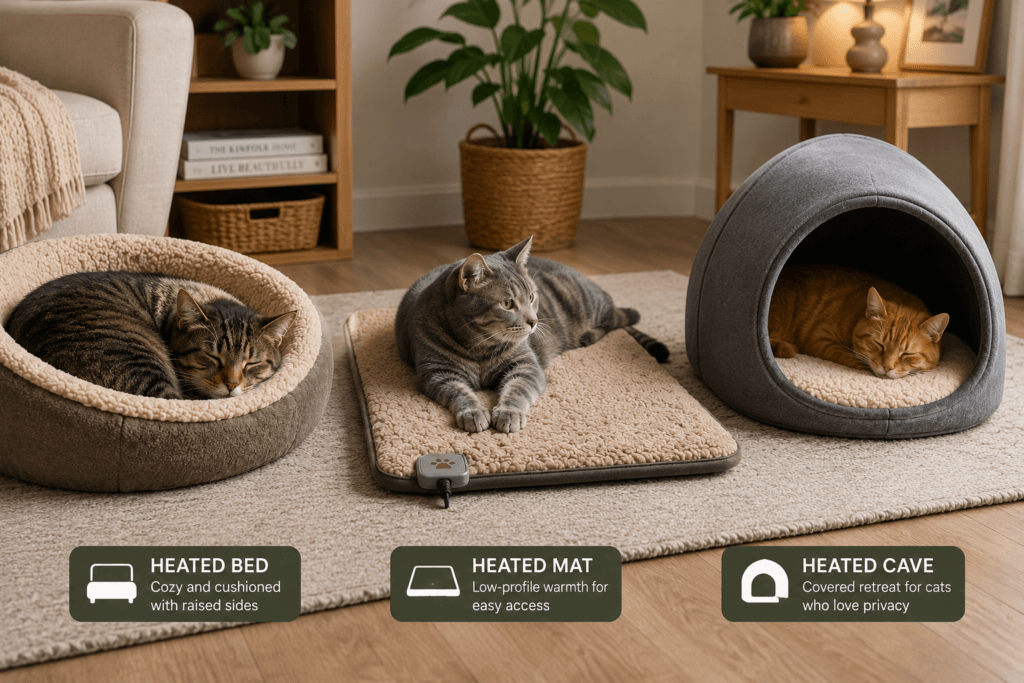
    For a broader look at when data actually improves care, read our Smart Cat Monitoring vs Automation guide.

    The problem is added ownership complexity.

    The connected functions require the Hub, which links the door to the internet through your home router. You are therefore managing the door, batteries, Hub, network connection, account and app rather than a single access device.

    That may be completely justified.

    It may also be an elaborate way to learn that Baron went outside at 4:12 a.m. and returned at 4:19 with no explanation.

    Choose SureFlap Connect if:

    • remote permissions would change how you manage access;
    • entry and exit history is genuinely useful;
    • you need individual exit rules;
    • several caregivers need shared visibility;
    • you accept the Hub and app setup;
    • you are buying the correct door-and-Hub bundle.

    Skip it if:

    • your access routine rarely changes;
    • the standard SureFlap already solves the problem;
    • you do not want another connected device;
    • you will stop checking the activity history after the first week;
    • you expect the door to track the cat after they leave.

    Entry history can show that your cat used the door. It cannot show where the cat went afterward.

    For map-based recovery and nearby-finding tools, read our Best Cat Trackers comparison.

    Buyer-regret risk: paying for the connected version when selective microchip entry was the only function the household truly needed.

    Would remote permissions and entry history change how you manage access? Check the SureFlap Connect + Hub bundle on Amazon.

    PetSafe SmartDoor Connected: Not Recommended

    PetSafe SmartDoor Connected Medium pet door with app controls

    Verdict: Not Recommended

    The PetSafe SmartDoor Connected offers a relevant feature set.

    Through the My PetSafe app, owners can manage access schedules, receive notifications and remotely lock or unlock the flap. The door uses Pet Door Keys, while the Medium version can also pair with compatible implanted microchips.

    The Large version does not provide the same direct microchip option, so cat owners must verify the exact size and identification method before purchasing.

    On features alone, PetSafe appears competitive.

    PetTech AI does not currently recommend it.

    The ownership signal is too weak for a product that requires permanent installation, careful sizing and confidence in both its physical locking system and connected controls.

    A disappointing feeder can be unplugged and returned to a box.

    A disappointing pet door may leave you explaining to the exterior door why it now has a large rectangular memory.

    The recognizable brand does not cancel that installation risk.

    Nor should buyers assume that a broader opening or more mainstream app experience automatically makes it a better cat product. SureFlap offers more convincing alternatives for straightforward microchip entry, individual exit permissions and connected monitoring.

    Consider PetSafe only if:

    • you specifically need its larger Medium opening;
    • your cat’s microchip is confirmed compatible;
    • you prefer the My PetSafe ecosystem;
    • you have reviewed recent ownership feedback carefully;
    • you have a realistic return and installation plan;
    • you accept the risk of choosing a weakly reviewed connected door.

    Avoid it if:

    • you want the safest default recommendation;
    • you are installing into expensive glass, metal or exterior construction;
    • you expect the Large model to read the cat’s microchip;
    • you want a cat-first access ecosystem;
    • weak current ownership feedback is a deal-breaker.

    The product is technically relevant.

    That is not the same as being editorially recommendable.

    Still considering the PetSafe SmartDoor? Check the exact size, current availability and customer feedback on Amazon.

    SureFlap vs PetSafe: The Recommendation Is Not Close

    SureFlap currently offers the more convincing smart cat door lineup.

    Choose the standard SureFlap Microchip Cat Door when your main goal is keeping unregistered animals out.

    Choose DualScan when different cats need different exit permissions.

    Consider SureFlap Connect when remote changes, curfews and activity history solve a recurring household problem.

    PetSafe offers app schedules, notifications, remote locking and a larger opening in its Medium model. Those advantages do not overcome the weak ownership signal.

    The comparison is not:

    specialized brand versus trustworthy mainstream brand.

    It is:

    three SureFlap products with distinct, defensible use cases versus one connected PetSafe door that currently fails the recommendation threshold.

    Brand familiarity is useful when it reduces uncertainty.

    It should not be used to decorate uncertainty.

    Is App Control Worth Paying For?

    Sometimes.

    App control is valuable when it changes a recurring decision.

    It may be worth paying for when you:

    • change outdoor permissions during the day;
    • apply different curfews in different seasons;
    • share care with another person;
    • want confirmation that a cat returned;
    • need to lock the door while away from home;
    • use activity history as one part of a broader monitoring routine.

    It is less valuable when your rule is stable:

    registered cats may enter, unregistered animals may not.

    In that situation, the standard SureFlap is likely the better purchase.

    The most expensive ownership mistake is not buying a bad product.

    It is buying a capable product whose extra capabilities solve nothing.

    What to Check Before Installation

    A smart cat door is not a low-consequence experiment.

    Before cutting anything, confirm the product, opening, access direction and installation surface.

    Measure the clear opening

    Do not judge fit from the outer frame.

    Measure the actual opening your cat must pass through and compare it with the cat’s shoulder width and height.

    Large breeds, overweight cats, senior cats and households shared with small dogs may need a larger pet door rather than a standard cat flap.

    A cat should not need to twist, compress the shoulders or approach at an uncomfortable angle.

    Confirm the access logic

    “Microchip controlled” does not always mean entry and exit are controlled identically.

    The standard SureFlap offers selective entry.

    DualScan and SureFlap Connect can apply individual exit permissions.

    PetSafe uses Pet Door Keys and supports compatible microchips only in the Medium SmartDoor.

    Buy the door that enforces the rule you need—not the rule you assumed from the product title.

    Check microchip compatibility

    Use the manufacturer’s compatibility checker before installation.

    Do not discover after cutting the door that the microchip format or reading position creates a problem.

    Evaluate the installation surface

    Wood, metal, glass and walls require different preparation.

    Metal can interfere with electronic reading and may require an adaptor. Glass usually requires professional cutting or fitting. Wall installations may require tunnel extensions and more extensive sealing.

    Check the entire installation path before purchasing accessories.

    Test before making the installation permanent

    Program the microchip and allow the cat to approach the unit before final installation when practical.

    Confirm that the reader identifies the cat reliably.

    Permanent carpentry is an expensive stage at which to begin product discovery.

    For the direct installation and access-control trade-off, read our PetSafe SmartDoor vs SureFlap Connect comparison.

    How to Train a Cat to Use a Smart Door

    A confident cat may adapt quickly.

    A cautious cat may treat a newly installed flap as a mechanical betrayal.

    Start with the flap secured open. Let the cat investigate the opening without pressure. Use treats, play or familiar cues on the other side.

    Once the cat moves through comfortably, introduce the flap gradually. Allow them to experience its movement before adding the sound of the locking mechanism.

    Keep training sessions short.

    Do not push the cat through the opening or trap them near it. The goal is to build voluntary movement, not win a negotiation against an animal whose preferred response is to become boneless.

    Some cats will need days or weeks.

    That does not mean the door is unsuitable. It means adaptation should move at the cat’s pace.

    Common Smart Cat Door Mistakes

    Buying app control without a use case

    Notifications are not inherently useful.

    Decide what action you will take when one arrives.

    Confusing selective entry with selective exit

    This is the difference between the standard SureFlap and DualScan.

    It can determine whether your access plan works at all.

    Installing before checking the opening

    Frame dimensions are not passage dimensions.

    Measure the cat and the clear flap opening.

    Ignoring weather sealing

    A smart lock does not automatically make a pet door energy efficient.

    Consider door location, drafts, rain exposure and the quality of the seal.

    Expecting the door to replace outdoor safety

    A smart cat door manages access.

    It does not supervise the cat, contain them after exit or locate them outdoors.

    For supervised outdoor exploration, read our Best Cat Harnesses guide.

    Frequently Asked Questions

    What is the best smart cat door?

    The SureFlap Microchip Cat Door is the strongest overall choice for most households. It provides selective microchip entry without requiring an app, Hub or connected account.

    Is SureFlap Connect worth the upgrade?

    Only when remote access changes, individual exit permissions or activity history will be used regularly. For a stable routine, the standard SureFlap offers a simpler and more convincing ownership proposition.

    What is the best smart cat door for multiple cats?

    SureFlap DualScan is the better specialist option when some cats may go outside while others must remain indoors.

    Can a smart cat door keep neighborhood cats out?

    A microchip-controlled door can remain locked for unregistered animals while opening for programmed pets. Correct installation, programming and fit are still essential.

    Does the PetSafe SmartDoor read cat microchips?

    The Medium SmartDoor supports specified compatible microchip formats. The Large version relies on Pet Door Keys rather than direct microchip pairing.

    Can a smart cat door be used indoors?

    Yes. An interior microchip door can protect food, litter boxes or quiet spaces from another cat or dog.

    Do smart cat doors require subscriptions?

    The SureFlap products discussed here do not require a recurring subscription for their core functions. The connected model requires the Sure Petcare Hub and app setup.

    Can a smart cat door tell me where my cat went?

    No. A connected door can record that the cat entered or exited, but it cannot track movement after the cat leaves. A GPS or radio-frequency tracker solves a different problem.

    Final Verdict

    The SureFlap Microchip Cat Door is the best smart cat door for most households.

    It delivers the most useful access rule—registered cats may enter, unwanted animals may not—with the least unnecessary complexity.

    SureFlap DualScan is Recommended with Conditions.

    It is the better specialist option when several cats need different outdoor permissions. Most single-cat homes do not need it.

    SureFlap Microchip Cat Flap Connect receives a Conditional Recommendation.

    Its remote controls, curfews, activity history and individual permissions can be useful. They are not automatically worth the added hardware and connected ownership.

    PetSafe SmartDoor Connected is Not Recommended.

    The feature set is relevant, but weak current ownership evidence makes it difficult to justify over the SureFlap alternatives—especially when installation involves cutting a permanent opening into a door, wall or glass panel.

    The right smart cat door is not the model with the largest dashboard.

    It is the one that applies the correct access rule every day without turning Baron’s return from the garden into a software integration project.

    References

    • Sure Petcare — Microchip Cat Door product and compatibility information
    • Sure Petcare — DualScan Microchip Cat Door product information
    • Sure Petcare — Microchip Cat Flap Connect and Hub documentation
    • PetSafe — SmartDoor Connected Pet Door product and compatibility information

    Image Disclosure

    Official manufacturer images are used when depicting the exact products discussed.

    Any AI-generated images are editorial illustrations only. They do not represent exact opening dimensions, installation requirements, locking mechanisms or app behavior. Always check the current manufacturer documentation before cutting a door, wall or glass panel.

    Editorial Disclosure

    PetTech AI may earn a commission from qualifying purchases. This does not influence our recommendations, comparisons or editorial judgments.