Author: PetTech

  • Best Smart Cat Cameras (2026): Watch the Room—or Catch the Kibble Thief?

    Best Smart Cat Cameras (2026): Watch the Room—or Catch the Kibble Thief?

    A cat camera can answer useful questions.

    Where does your cat sleep while you are away?

    Does anyone use the expensive climbing wall you installed?

    Did the feeder actually dispense breakfast?

    Which cat approached the bowl?

    It can also answer questions nobody needed to ask, such as:

    “At precisely what angle did Napoleon knock the plant from the shelf?”

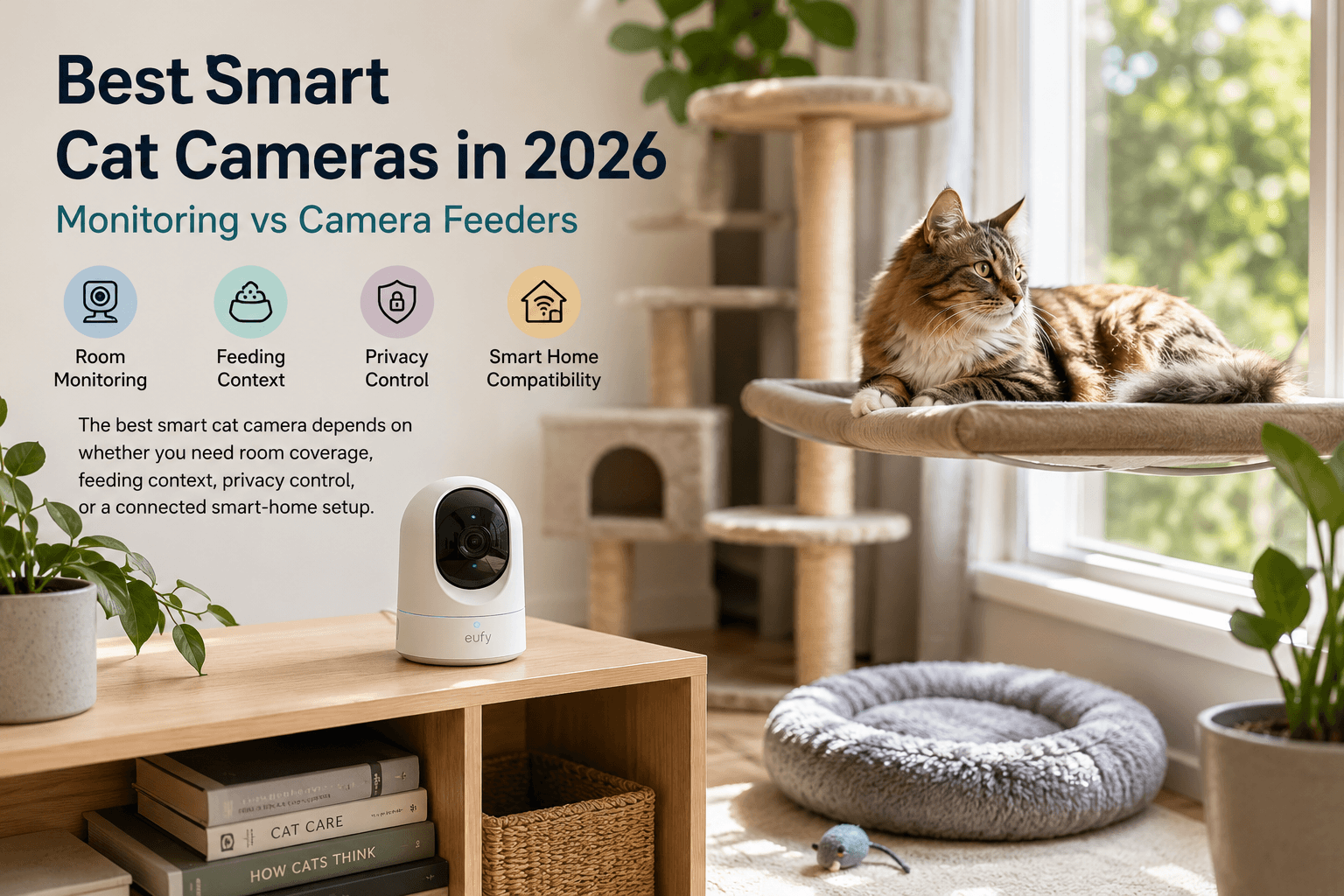
    The best smart cat camera is not necessarily the one with the highest resolution or the longest list of AI detections.

    It is the one pointed at the problem you actually need to understand.

    This guide compares two standalone room cameras and two camera feeders:

    • eufy Indoor Cam E30 for flexible full-room coverage;
    • Ring Indoor Cam 2nd Gen for fixed monitoring in an existing Ring or Alexa home;
    • PETKIT YumShare Solo 2 for individual feeding context;
    • PETLIBRO Granary Camera Feeder for simpler remote mealtime check-ins.

    Research note: This is a research-led guide based on official documentation, current product information, public ownership evidence, and PetTech AI’s product-level trust checks. PetTech AI has not conducted long-term hands-on testing of every camera included.

    Quick Verdict

    What you need to seeBest fitRecommendation
    Activity across an entire roomeufy Indoor Cam E30Strong recommendation
    One fixed area inside a Ring or Alexa homeRing Indoor Cam 2nd GenStrong ecosystem-specific recommendation
    Which pet approached a scheduled mealPETKIT YumShare Solo 2Promising newer product
    Straightforward camera feeding with a mature ownership recordPETLIBRO Granary Camera FeederEstablished recommendation

    The short version

    Choose eufy E30 if the cat moves around a room and you want the camera to make a reasonable effort to keep up.

    Choose Ring Indoor Cam if you already live inside the Ring ecosystem and need one fixed view with a physical privacy cover.

    Choose YumShare Solo 2 if the important question is not “Where is the cat?” but “Which cat appeared for dinner?”

    Choose Granary if you want a simpler camera feeder and accept a more mixed reliability record.

    A camera can document the crime.

    It cannot prevent Napoleon from committing it again tomorrow.

    Affiliate disclosure: This page contains affiliate links. PetTech AI may earn a commission if you purchase through them, at no additional cost to you. As an Amazon Associate I earn from qualifying purchases.

    Compare the Recommended Cameras

    First Decide: The Room or the Bowl?

    Standalone cameras and camera feeders look similar on a product page because both show video inside an app.

    They solve different problems.

    A room camera answers:

    • Where does the cat spend time?
    • Does the cat use shelves, windows, or resting areas?
    • How do several cats interact in a shared space?
    • What happens near an entrance or hallway?
    • Is a new enrichment setup actually being used?

    A camera feeder answers:

    • Did food dispense?
    • Did a cat approach?
    • Which cat appeared, when recognition is supported?
    • Is food still sitting in the bowl?
    • Is another cat interfering with the feeding area?

    A camera feeder aimed at one bowl is terrible at monitoring the living room.

    A room camera can show the kitchen beautifully while providing no reliable record of whether a scheduled portion actually left the feeder.

    Choose the decision before choosing the lens.

    For a broader framework on when connected information adds value, read Smart Cat Monitoring vs Automation.

    eufy Indoor Cam E30: Best Full-Room Cat Camera

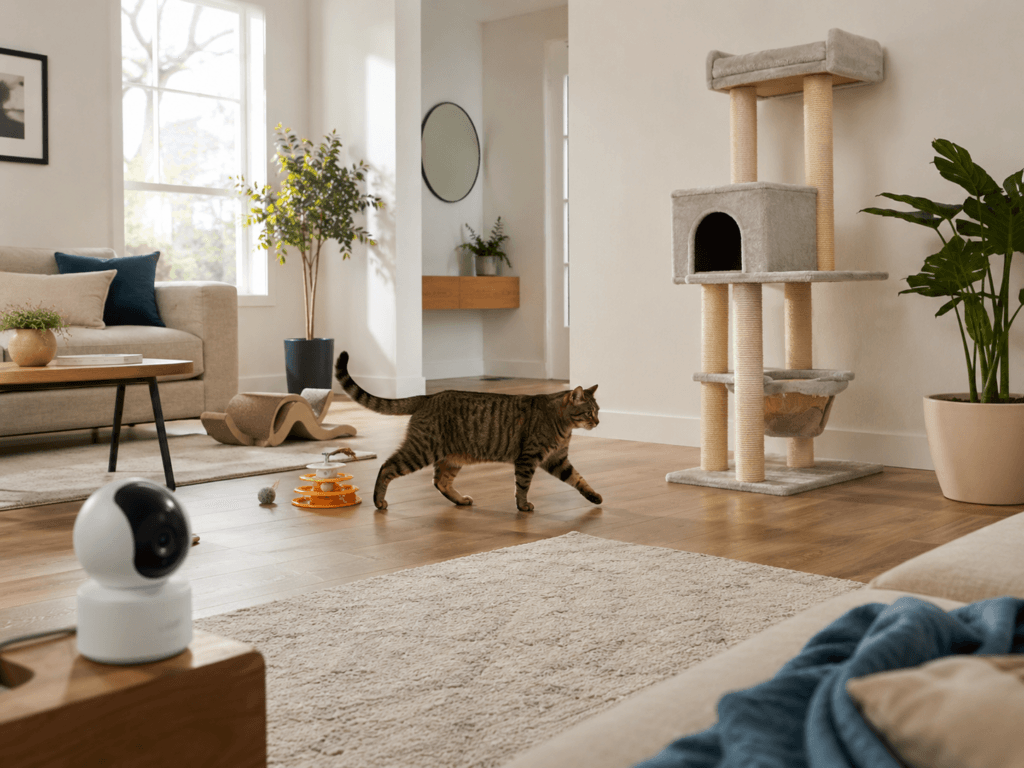
    A cat moving between a floor-level toy area and a tall cat tree while an indoor pan-and-tilt camera covers the room
    A standalone camera is most useful when you need to understand activity across a whole room—not only what happens at the food bowl.

    The eufy Indoor Cam E30 is the strongest general-purpose camera in this guide.

    It offers:

    • 4K video;
    • 360-degree pan-and-tilt coverage;
    • pet and human detection;
    • automatic subject tracking;
    • color night vision;
    • two-way audio;
    • privacy mode;
    • continuous or event recording;
    • local storage through a microSD card.

    The microSD card is sold separately, but local storage means the core recording function does not require a monthly subscription.

    Buy it if

    • your cat uses several parts of one room;
    • vertical spaces such as shelves and cat trees matter;
    • automatic tracking is more useful than one fixed angle;
    • local recording is important;
    • you want one camera to cover a larger indoor area;
    • you are willing to configure detection zones and notifications.

    Skip it if

    • feeding is the only routine you care about;
    • you want individual meal identification;
    • a fixed view is already enough;
    • you do not want an indoor security camera in a shared room;
    • configuring alerts sounds like unpaid employment.

    Where it can disappoint

    “360-degree coverage” does not mean the camera has achieved omniscience.

    A fast cat can leave the frame. Furniture can block the view. Tracking may follow the wrong animal in a multi-pet home. Too-sensitive notifications can make the app announce every tail movement as though the building has been breached.

    Placement matters more than 4K.

    A well-positioned 1080p camera aimed at the cat tree is more useful than a 4K camera enjoying an unobstructed view of the ceiling.

    Use activity zones, reduce unnecessary alerts, and test the night view before relying on it during travel.

    Verdict: The best standalone option for understanding activity across a room, particularly when cats move between floor level and elevated spaces.

    Ring Indoor Cam 2nd Gen: Best for Existing Ring Homes

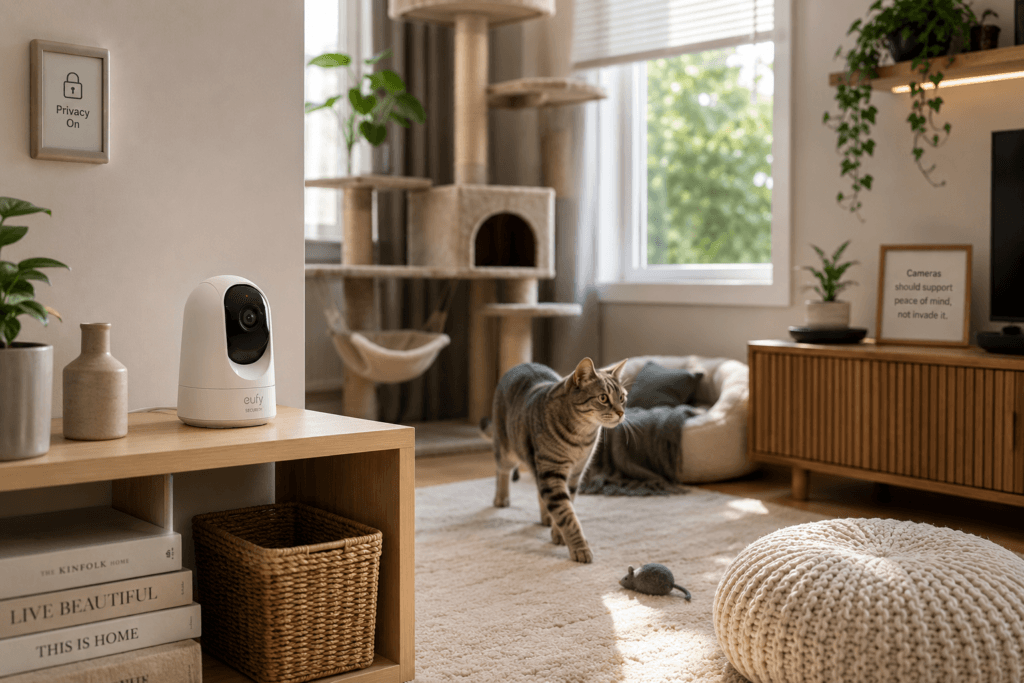
    A discreet indoor camera facing a cat tree and resting area in a modern home, with cables safely hidden and a privacy shutter visible
    Good placement and privacy controls matter more than filling a home with constant alerts.

    Ring Indoor Cam is the simpler option.

    It provides:

    • 1080p video;
    • color night vision;
    • motion alerts;
    • two-way talk;
    • a fixed field of view;
    • Alexa and Ring integration;
    • a manual privacy cover.

    Closing the privacy cover disables the camera and microphone, which is more reassuring than a tiny software icon claiming that privacy mode is probably active.

    Buy it if

    • you already use Ring or Alexa;
    • you need one stable view;
    • a hallway, doorway, feeding corner, or office is the target;
    • physical privacy control matters;
    • managing another app would cause unnecessary irritation.

    Skip it if

    • one camera must cover a large room;
    • your cat constantly moves between several zones;
    • you want pan-and-tilt tracking;
    • you expect recorded history without considering a subscription;
    • you prefer local storage.

    The subscription question

    Without a compatible Ring subscription, you can use Live View and respond to real-time alerts.

    Reviewing recorded video requires a subscription. Depending on the plan and device, Ring also offers longer video history and advanced recognition features.

    This creates a simple decision:

    If you already pay for Ring, the Indoor Cam can be an inexpensive extension of the system.

    If this would be your only Ring device, the camera’s modest purchase price should be evaluated together with the ongoing plan.

    A cheap camera with a permanent subscription can eventually become an expensive method of watching your cat ignore the sofa you bought for him.

    Verdict: The best fixed camera for households already committed to Ring or Alexa—not the strongest independent choice for full-room cat tracking.

    PETKIT YumShare Solo 2: Best for Individual Meal Context

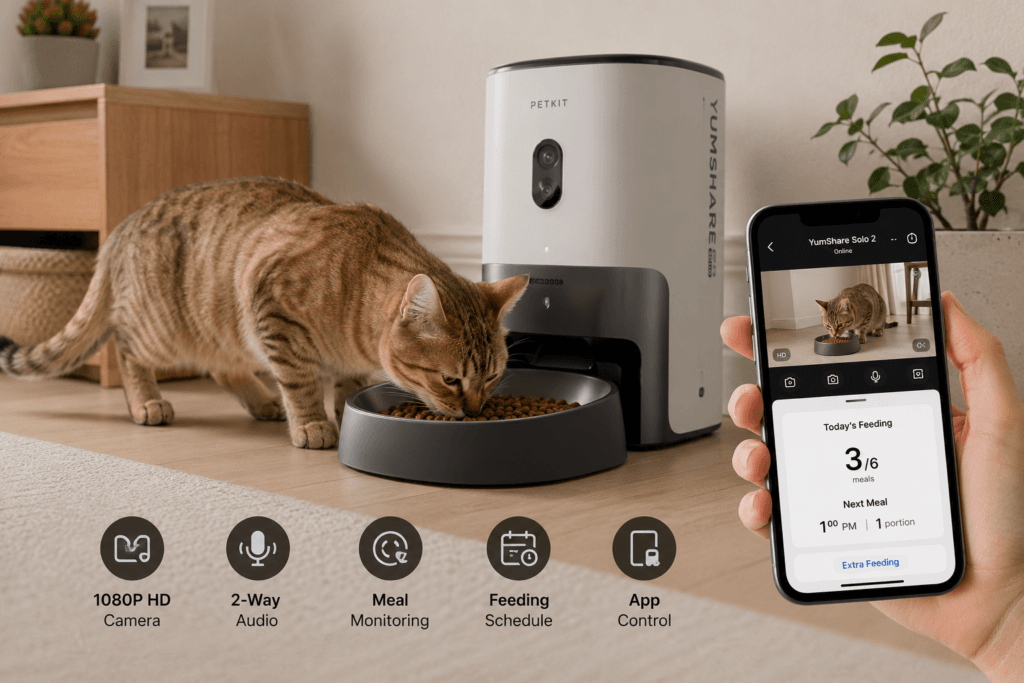
    PETKIT YumShare Solo 2 automatic cat feeder with built-in camera, app monitoring screen, and 2-year warranty badge
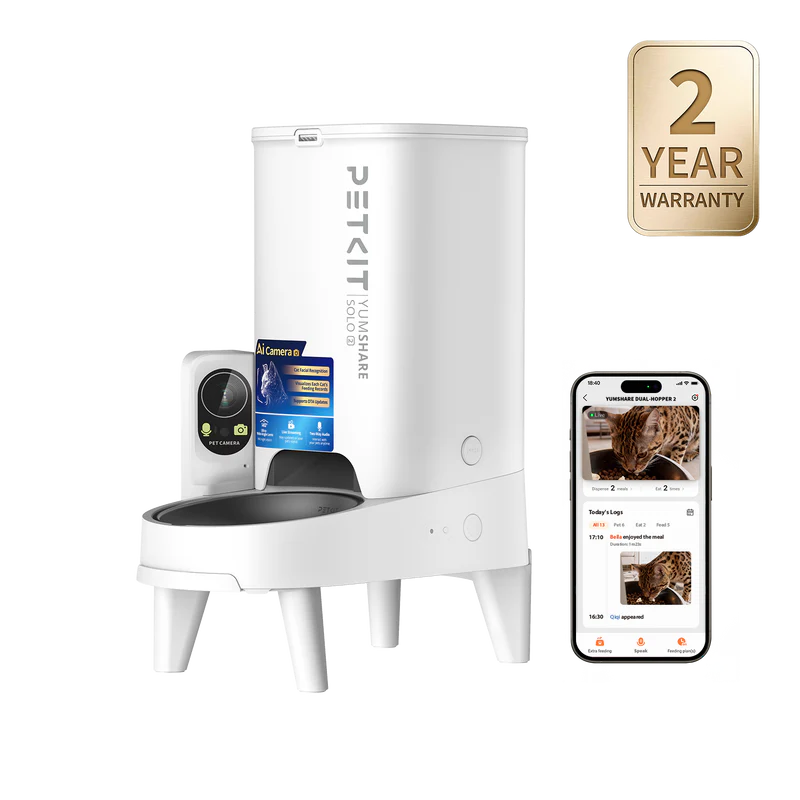
    PETKIT YumShare Solo 2 combines scheduled dry-food feeding with a built-in camera and app-based meal check-ins.

    YumShare Solo 2 is not a room camera with a food container attached.

    It is a scheduled dry-food feeder designed around visual mealtime context.

    PETKIT includes:

    • a 3 L hopper;
    • scheduled portions;
    • live video;
    • two-way audio;
    • night monitoring;
    • bowl and feeding records;
    • facial recognition designed for up to 15 animals;
    • individual eating histories;
    • offline feeding schedules and battery backup.

    PETKIT introduced Solo 2 in 2026, so it still lacks the deeper ownership history of eufy, Ring, or the older Granary feeder.

    Buy it if

    • your cats eat dry food;
    • you want video connected directly to scheduled meals;
    • knowing which animal approached would change your routine;
    • you spend substantial time away;
    • you already use PETKIT;
    • one feeding station serves the household.

    Skip it if

    • you need full-room coverage;
    • you feed mainly wet food;
    • one cat must be physically prevented from eating another cat’s meal;
    • you only need a basic timed feeder;
    • you will stop checking the camera after the opening weekend.

    Recognition is not access control

    Solo 2 can provide individual context.

    It cannot build a physical barrier around the bowl.

    If Jonathan’s meal dispenses and Napoleon arrives first, the camera may identify the occupying force with impressive accuracy.

    Jonathan remains hungry.

    For genuine food separation, compare RFID and microchip systems in our Best Automatic Cat Feeders guide.

    Where it can disappoint

    The main uncertainty is maturity.

    Its early market signal is encouraging, but app stability, recognition accuracy, alerts, camera performance, and dispensing consistency have not yet accumulated years of broad ownership evidence.

    Facial recognition may also become less reliable when:

    • cats look similar;
    • lighting changes;
    • several animals crowd the bowl;
    • faces are partially blocked;
    • the cat approaches at the exact angle least convenient for artificial intelligence.

    Verdict: A promising newer camera feeder for owners who will genuinely use individual mealtime context—not a proven default or a food-security system.

    PETLIBRO Granary Camera Feeder: Best Established Camera Feeder

    Granary has a more straightforward job:

    • store dry food;
    • dispense scheduled portions;
    • show the bowl;
    • send alerts;
    • let the owner check remotely.

    It offers:

    • a 5 L hopper;
    • 1080p video;
    • a 145-degree downward-facing view;
    • infrared night vision;
    • two-way audio;
    • motion and sound alerts;
    • low-food and jam notifications;
    • app scheduling;
    • local microSD recording;
    • optional cloud storage.

    PETLIBRO supports local event or continuous recording through a microSD card, while cloud history is sold separately.

    Buy it if

    • you want dry-food scheduling and a camera in one product;
    • a straightforward bowl view is enough;
    • individual recognition is unnecessary;
    • local recording appeals to you;
    • you prefer a larger hopper than YumShare Solo 2.

    Skip it if

    • you need to know which cat ate;
    • physical food separation matters;
    • room monitoring is the real goal;
    • you want the strongest reliability signal in this guide;
    • recurring app or dispensing friction would drive you insane.

    Where it can disappoint

    Granary has a long and broadly reassuring ownership record, but combining a feeder, camera, app, and Wi-Fi connection still creates more potential failure points than a basic scheduled dispenser.

    The recurring issues worth checking in recent feedback include:

    • temporary Wi-Fi or app disconnections;
    • camera or live-view interruptions;
    • food jams with incompatible kibble;
    • portion consistency;
    • notification reliability.

    These are legitimate ownership risks, but the overall evidence supports treating Granary as an established recommendation rather than a speculative or unusually risky purchase.

    Use compatible kibble, keep backup batteries installed, test several scheduled meals before relying on the feeder while away, and confirm that offline schedules continue working as expected.

    A camera failure temporarily leaves you with a feeder.

    A dispensing failure leaves you with beautifully recorded evidence that dinner never arrived.

    Verdict: The best established camera feeder for owners who want scheduled dry-food meals, remote bowl visibility, local recording, and a mature alternative to newer recognition-led products.

    The Napoleon Surveillance Test

    Suppose Napoleon has begun stealing Jonathan’s breakfast.

    eufy E30

    Tracks Napoleon crossing the kitchen, approaching the feeder, and leaving the scene.

    Excellent cinematography.

    Ring Indoor Cam

    Records the relevant corner, provided the crime occurs inside the fixed frame and you have recording history enabled.

    YumShare Solo 2

    Associates the approach with Napoleon and connects it directly to the meal record.

    Useful evidence.

    Granary

    Shows that a cat approached the bowl.

    Identity remains a matter for the investigating officer.

    An access-controlled feeder

    May actually prevent Napoleon from reaching Jonathan’s food.

    Less entertaining.

    More effective.

    Privacy Is Part of the Product

    Indoor cameras may capture:

    • family members;
    • conversations;
    • daily routines;
    • entrances and exits;
    • children;
    • sitters;
    • private living areas.

    Before installing one, decide:

    • who has account access;
    • whether recordings remain local or enter the cloud;
    • how long footage is retained;
    • whether alerts should be disabled while people are home;
    • where the camera should never point;
    • whether guests or sitters need to be informed.

    Use two-way audio sparingly.

    A familiar voice may help in some situations. Constantly speaking through a plastic device while physically absent can also confuse or stress the cat.

    The goal is useful context, not management-by-loudspeaker.

    Smart Camera Data Is Not Diagnosis

    A camera may reveal that a cat:

    • stopped approaching food;
    • sleeps in a different place;
    • moves less than usual;
    • hides more;
    • interacts differently with another cat.

    That information can be useful.

    The footage cannot determine the cause.

    Meaningful or persistent changes require direct observation and, when appropriate, professional veterinary or behavioral assessment.

    For litter, weight, feeding, hydration, activity, and location signals, read our Best Smart Cat Health Monitors guide.

    Buyer Regret in One Table

    ProductMost likely regret
    eufy E30Receiving too many alerts or expecting tracking to see through furniture
    Ring Indoor CamBuying one device and then resenting the subscription needed for recordings
    YumShare Solo 2Paying for recognition and meal footage you stop checking
    GranaryDiscovering that feeding and camera reliability create two separate failure points

    Final Verdict

    There is no universal best cat camera because watching a room and watching a meal are different jobs.

    eufy Indoor Cam E30 is the best overall standalone option. Its pan-and-tilt coverage, pet tracking, 4K video, and local recording make it the most flexible choice for understanding a larger indoor space.

    Ring Indoor Cam 2nd Gen is the better fit when the household already uses Ring or Alexa and needs a fixed view with clear physical privacy control.

    PETKIT YumShare Solo 2 is the strongest camera feeder when individual meal context is the reason to buy. It is promising, but still too new to treat as a fully mature default.

    PETLIBRO Granary Camera Feeder is the best established camera-feeder option. It lacks YumShare Solo 2’s individual facial recognition, but offers a much deeper ownership record, a larger hopper, local recording, and a straightforward view of the feeding station. It is the safer choice when maturity matters more than identity-led meal analytics.

    The right camera should answer one recurring question.

    It should not transform normal cat behavior into a 24-hour broadcast requiring executive review.

    Frequently Asked Questions

    What is the best standalone cat camera?

    eufy Indoor Cam E30 is the strongest option in this guide for full-room coverage, automatic tracking, and local recording.

    Is Ring Indoor Cam useful for cats?

    Yes, especially when the household already uses Ring or Alexa and needs a fixed view of one area. It is less flexible than a pan-and-tilt camera.

    Is a camera feeder better than a separate camera?

    Only when feeding is the main question. A feeder camera provides relevant bowl context but cannot replace full-room monitoring.

    Can YumShare Solo 2 stop another cat from stealing food?

    No. Recognition and video provide context; they do not physically restrict access.

    Does Granary require a cloud subscription?

    No. It supports local microSD recording. Optional cloud plans provide remote video history and additional storage features.

    Can a camera diagnose a health or behavioral problem?

    No. It can document a change, but it cannot establish its cause.

    References

    • eufy Indoor Cam E30 official product and storage documentation
    • Ring Indoor Cam 2nd Gen official product, privacy, and subscription documentation
    • PETKIT YumShare Solo 2 official product documentation
    • PETLIBRO Granary Camera Feeder official product, storage, and support documentation
    • PetTech AI product-level trust checks

    Image Disclosure

    Some images in this article may be AI-generated for illustrative purposes. They do not depict the exact products and should not be used to evaluate camera angle, controls, dimensions, or feeder fit.

    Disclosure

    PetTech AI may earn a commission when readers purchase through affiliate links. Cameras are recommended according to the question they can realistically answer—not according to how many notifications they can produce.

  • Smart Puzzle Toys for Cats: Enrichment or Treat Bureaucracy?

    Smart Puzzle Toys for Cats: Enrichment or Treat Bureaucracy?

    Most smart puzzle toys for cats do not contain cameras, batteries or artificial intelligence.

    This is encouraging.

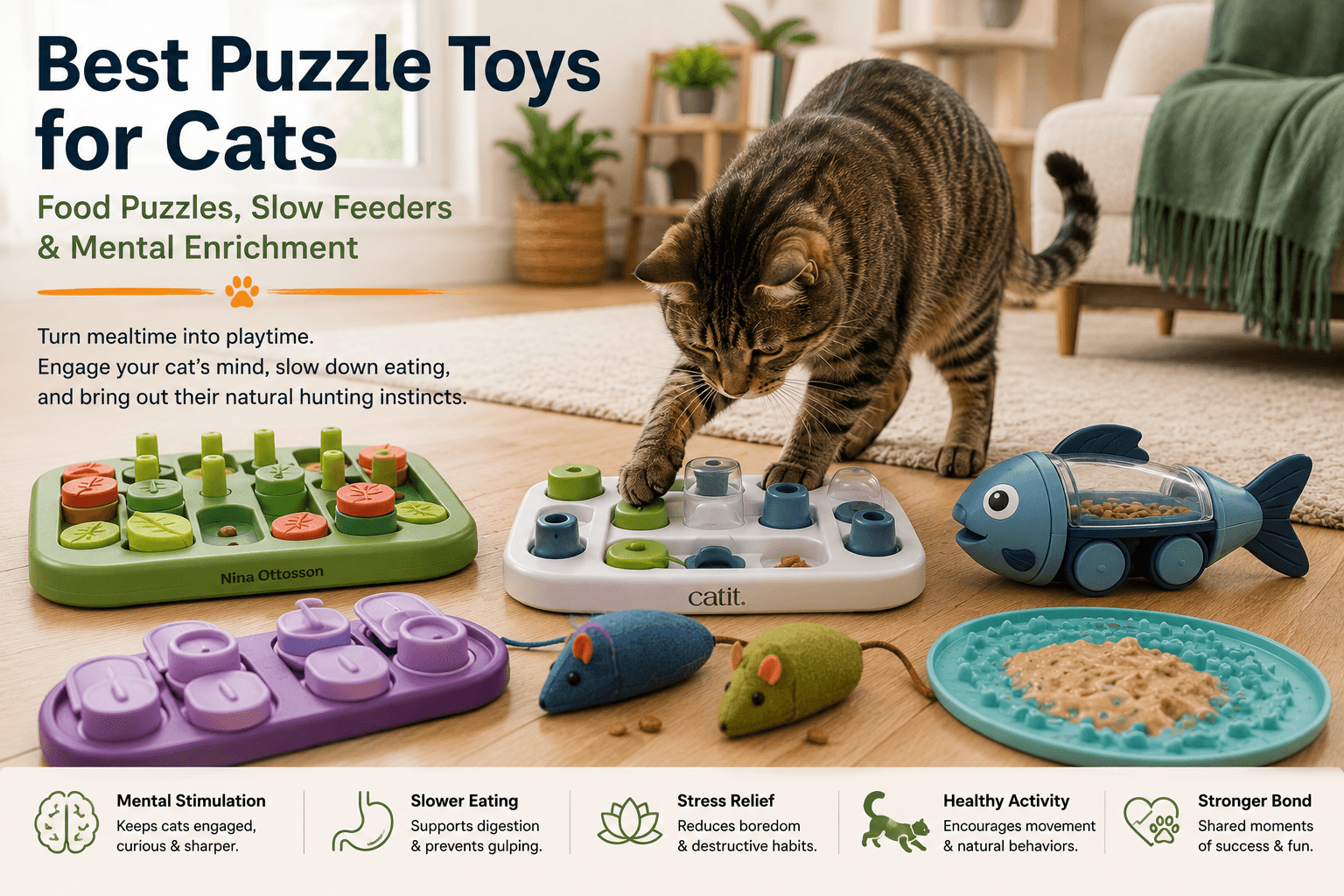
    They are “smart” because they make your cat paw, sniff, slide, search or lick before receiving food.

    A normal bowl completes the transaction immediately. A puzzle feeder turns dinner into a small hunting problem.

    The challenge must remain reasonable.

    A puzzle that is too easy becomes decorative plastic. A puzzle that is too difficult turns one piece of kibble into an administrative procedure requiring three forms and proof of residency.

    The best puzzle is not the hardest one.

    It is the one your cat can understand, enjoy and willingly use again tomorrow.

    Quick Verdict

    ProductBest fitPetTech AI verdictMain regret risk
    Buggin’ Out Puzzle & PlayBest all-around puzzle feederRecommended — Best OverallExperienced cats may solve it quickly
    TRIXIE Flip BoardCats new to food puzzlesRecommended for BeginnersMay become too easy
    Catit Play Treat PuzzleFast eaters needing several activitiesRecommendedLarge footprint and dry-food focus
    Catstages Spinning FishCats motivated by movement and treatsConditional RecommendationSome cats ignore the spinning mechanism
    Doc & Phoebe’s Hunting FeederSearching and forage-style dry feedingRecommended with ConditionsRequires hiding, retrieving and refilling three mice
    LickiMat Casper or FelixWet food and low-pressure enrichmentRecommended for Wet FoodSlow feeder rather than a true puzzle

    Buggin’ Out is the best starting point for most food-motivated cats.

    Choose TRIXIE for a gentler introduction, Catit for slower dry-food meals, Doc & Phoebe’s for distributed hunting and LickiMat when wet food or low frustration matters more than mechanical problem-solving.

    Catstages is the specialist choice for cats that already enjoy batting moving objects.

    Research Note

    This is a research-led roundup based on current manufacturer documentation, feline enrichment guidance and product positioning.

    PetTech AI has not conducted long-term hands-on testing of every product included.

    PetTech AI may earn a commission from qualifying purchases. As an Amazon Associate I earn from qualifying purchases.

    What Puzzle Feeders Actually Add

    Puzzle feeders can make cats work for part of their food through searching, pawing, licking or manipulating an object.

    FelineVMA feeding guidance recommends puzzle feeders and forage-style feeding as ways to support natural hunting and searching behavior. Cornell and VCA also describe food puzzles as useful forms of cognitive enrichment and more active feeding.

    They do not replace:

    • active play with you;
    • climbing and environmental variety;
    • separate resources in a tense multi-cat home;
    • measured food portions;
    • veterinary attention when appetite or behavior changes.

    Use part of the normal daily food allowance rather than adding a ceremonial mountain of treats in the name of enrichment.

    The objective is mental work.

    Accidental bulking season is not a cognitive-development program.

    For movement-led play rather than food puzzles, read our Best Interactive Cat Toys guide.

    Choose the Easiest Puzzle That Still Creates Useful Work

    Start with what your cat already does.

    Existing behaviorBest starting format
    Paws and slides objectsSliding puzzle board
    Eats dry food too quicklyMulti-zone slow feeder
    Enjoys searching around roomsHunting-style feeder
    Bats moving objectsActive treat dispenser
    Eats mainly wet foodLick mat
    Gives up easilyBeginner board with visible rewards

    Make the first session easy.

    Leave sliders partly open, place food where it can be smelled and demonstrate one mechanism when necessary. VCA recommends beginning with simple puzzles and increasing complexity gradually to avoid frustration.

    The goal is not to establish Gerald’s eligibility for Mensa.

    The goal is to create a repeatable feeding routine.

    Best Overall: Buggin’ Out Puzzle & Play

    Verdict: Recommended — Best Overall

    Buggin’ Out offers the clearest balance between accessibility and real problem-solving.

    Cats move pegs and rotate leaf-shaped covers to reveal food hidden across 16 compartments. The manufacturer says the difficulty can be adjusted and that the board holds up to one-quarter cup of food.

    It works best for cats that:

    • are visibly food motivated;
    • enjoy pawing and sliding;
    • need more challenge than a slow bowl;
    • have little or moderate puzzle experience.

    The adjustable layout matters because owners can leave sections easier during the introduction and increase the challenge later.

    Its main limitation is longevity for highly experienced cats. Once Napoleon memorizes the mechanism, your elaborate cognitive-enrichment device may become a mildly inconvenient dinner plate.

    That does not make it useless. A familiar puzzle can still slow access and add activity.

    It simply stops being an unsolved intellectual frontier.

    Does your cat already paw and manipulate objects for food? Check Buggin’ Out Puzzle & Play on Amazon.

    Best for Beginners: TRIXIE Cat Activity Flip Board

    Verdict: Recommended for Beginners

    TRIXIE Flip Board combines several simple mechanisms rather than forcing the cat to understand one complicated sequence.

    Food can be hidden beneath sliding covers, hinged lids and removable cones. The cat can use its paws or nose to access different sections.

    That variety gives beginners several opportunities to succeed.

    Choose it when:

    • your cat has never used a puzzle feeder;
    • frustration tolerance is uncertain;
    • visible, accessible rewards help maintain interest;
    • you want to introduce more than one puzzle action.

    The main risk is buying it for a cat that already opens cabinets, dismantles toys and appears to have retained private legal counsel.

    Experienced cats may solve the easier modules quickly.

    For beginners, that is not a flaw. Early success is more useful than purchasing an advanced puzzle that spends its first week being stared at with quiet contempt.

    Would several simple puzzle actions make the first attempt easier? Check the TRIXIE Flip Board on Amazon.

    Best Slow-Feeding Board: Catit Play Treat Puzzle

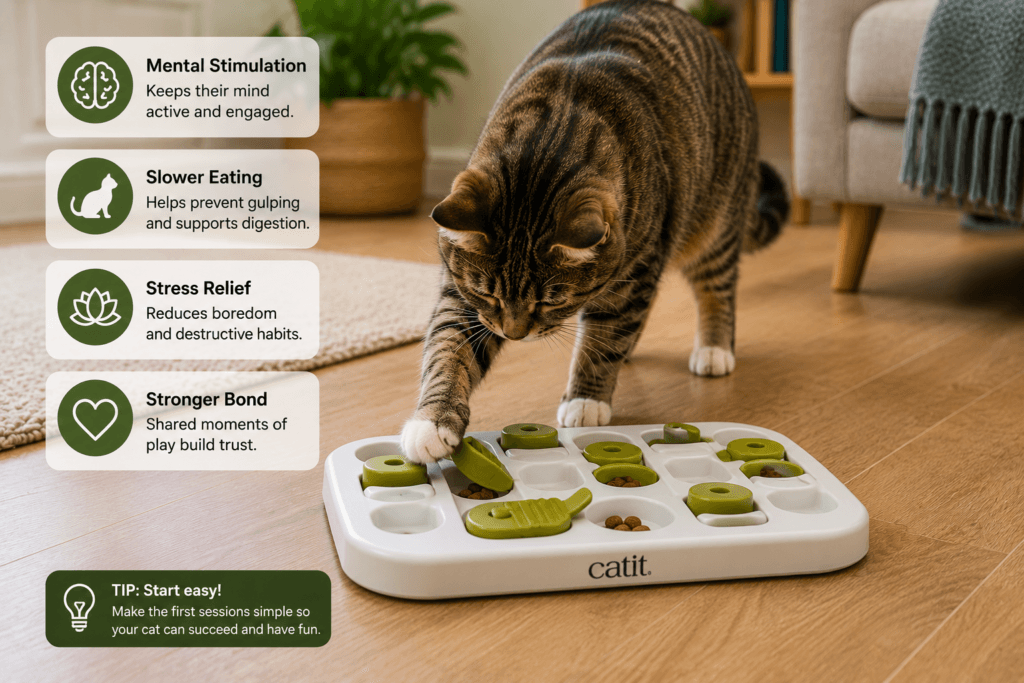
    Indoor cat pawing at a beginner treat puzzle board with hidden food compartments
    Beginner puzzle boards work best when the first session is easy enough for the cat to win, then gradually becomes more challenging.

    Verdict: Recommended

    Catit Play Treat Puzzle is closer to a feeding station than a compact treat toy.

    It uses six different activity layouts, including tubes, tunnels, a food spiral and slow-feeder surfaces. Catit describes it as a BPA-free slow feeder that can be disassembled for cleaning.

    The varied zones make it the strongest option for cats that:

    • eat dry food quickly;
    • remain engaged by different textures and access methods;
    • need a larger surface rather than one hidden compartment;
    • benefit from slower, more active meals.

    It requires more floor and storage space than the smaller boards.

    It also works primarily with dry kibble or suitable treats. Wet-food households should usually move toward a lick mat rather than attempt to convert every plastic tunnel into a pâté-delivery system.

    Catit is a good choice when the primary problem is meal speed, with enrichment as an additional benefit.

    Would several feeding zones slow down an enthusiastic kibble inhaler? Check the Catit Play Treat Puzzle on Amazon.

    Best Active Dispenser: Catstages Spinning Fish

    Verdict: Conditional Recommendation

    Catstages Spinning Fish pairs movement with food release.

    The fish-shaped dispenser can hold up to one-half cup of dry food or treats. Cats bat and spin it to release pieces into the bowl below, and the unit can also attach to compatible Catstages tracks.

    This is less about solving covers and more about understanding cause and effect:

    Hit fish. Food appears. Civilization advances.

    It suits cats that already:

    • bat objects repeatedly;
    • enjoy visible movement;
    • prefer active feeding over stationary boards;
    • use dry kibble or firm treats.

    The Conditional Recommendation reflects the narrow fit.

    A cat that dislikes moving toys may simply wait beside it, confident that management will eventually intervene. Some cats understand delegation long before puzzle solving.

    Choose it because the play style already exists—not because the product page promises to uncover a previously hidden athlete.

    Does your cat already bat moving objects for fun? Check Catstages Spinning Fish on Amazon.

    Best Hunting-Style Feeder: Doc & Phoebe’s Indoor Hunting Feeder

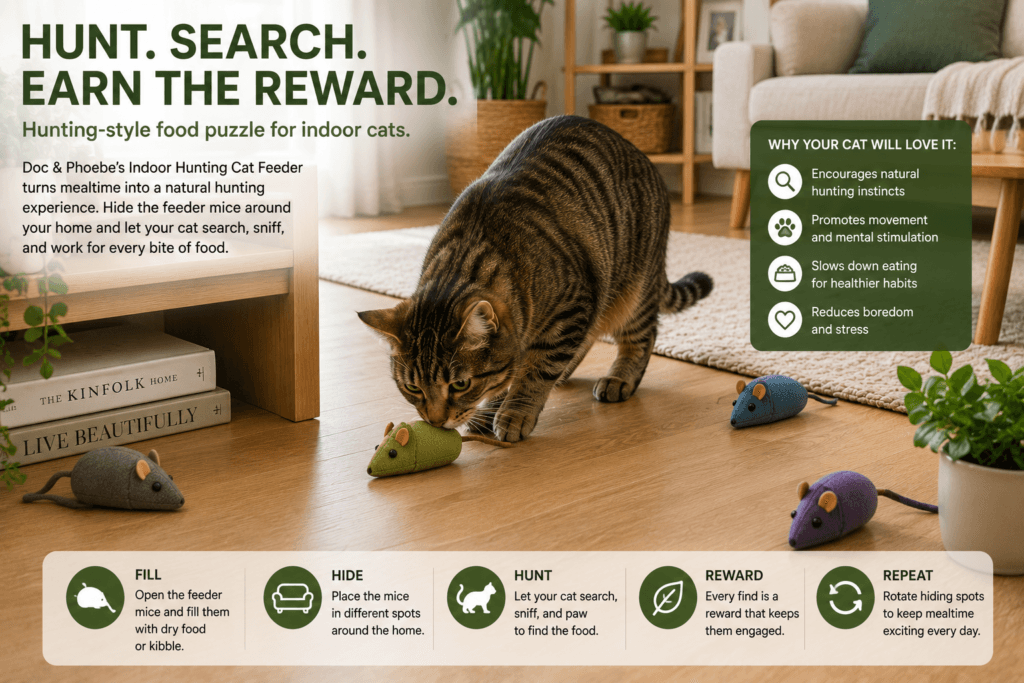
    Indoor cat searching for small hidden food puzzle feeders around a living room
    Hunting-style food puzzles spread dry food around the home, encouraging the cat to search, sniff, paw and work for smaller portions.

    Verdict: Recommended with Conditions

    Doc & Phoebe’s replaces one stationary feeding location with three small feeder mice hidden around the home.

    The system is designed to be filled and hidden twice daily, encouraging the cat to search, catch and manipulate several smaller food sources instead of eating everything from one bowl.

    This is the most behaviorally distinct product in the roundup.

    It can work well when:

    • the cat eats dry food;
    • searching and sniffing are motivating;
    • movement around the home is desirable;
    • one stationary puzzle loses attention quickly;
    • the owner will consistently hide and retrieve the feeders.

    That last condition matters.

    The mice do not refill themselves, return to the kitchen or file a location report after disappearing beneath the sofa.

    You must keep track of them and remove old food.

    In multi-cat homes, hiding food also requires care. One confident cat may locate every feeder before a quieter cat has completed the introductory briefing.

    Use separate sessions or locations when competition is possible.

    Would searching around the home improve the feeding routine? Check Doc & Phoebe’s Indoor Hunting Feeder on Amazon.

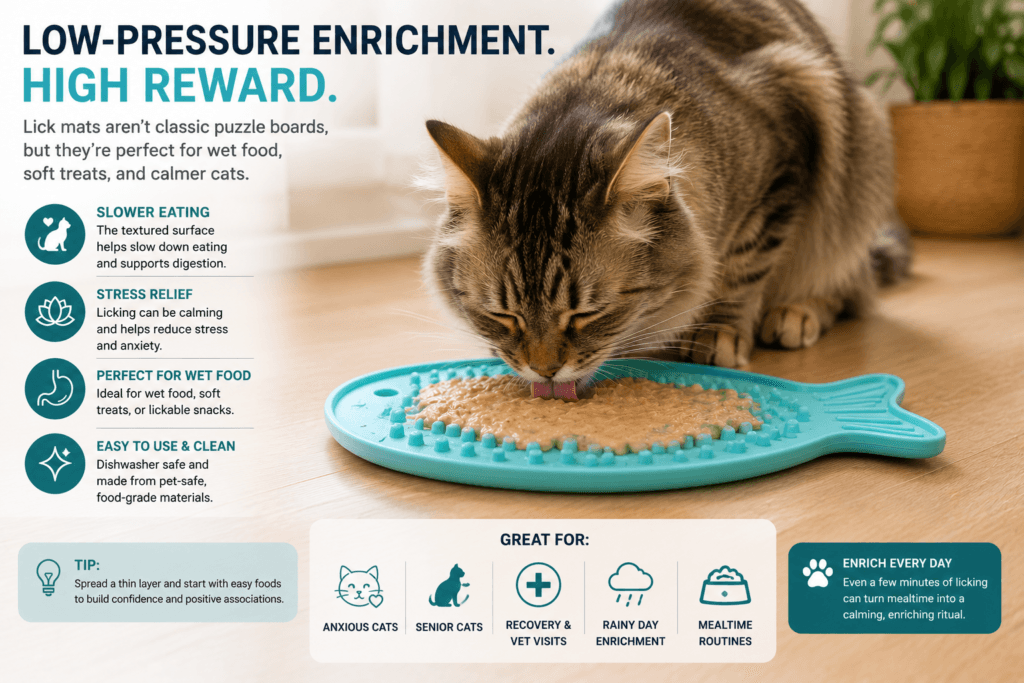
    Best for Wet Food: LickiMat Casper or Felix

    Indoor cat licking wet food from a textured lick mat used as a slow feeder
    Lick mats are not classic puzzle boards, but they can be useful for wet-food enrichment, slower eating and low-pressure feeding routines.

    Verdict: Recommended for Wet-Food Enrichment

    LickiMat is not a mechanical puzzle board.

    It is a textured feeding surface that spreads wet food, soft treats or soaked kibble across grooves and pockets, requiring repeated licking rather than immediate access from a bowl. The manufacturer positions Casper and Felix as slow-feeding surfaces for several soft-food formats.

    That lower-pressure design is valuable for:

    • wet-food households;
    • cautious cats;
    • cats new to enrichment feeding;
    • senior cats requiring minimal force;
    • owners wanting an inexpensive starting point.

    It does not provide the same problem-solving challenge as sliding or lifting compartments.

    That is the point.

    Not every meal needs to become an escape room.

    Supervise initial use, particularly when the cat chews flexible materials. Remove the mat if edges become damaged and clean it thoroughly after wet-food meals.

    Would slower licking be more appropriate than a mechanical puzzle? Check LickiMat Casper or Felix on Amazon.

    Build a Small Rotation, Not a Puzzle Museum

    One or two formats are enough to begin.

    A useful rotation could include:

    • one board puzzle;
    • one wet-food or slow-feeding surface;
    • one movement-led toy;
    • occasional forage feeding around the home.

    Store puzzles between some sessions and reintroduce them later. FelineVMA guidance also recommends toy rotation to help preserve novelty.

    For broader floor-level play, see our Best Cat Toys for Indoor Cats guide.

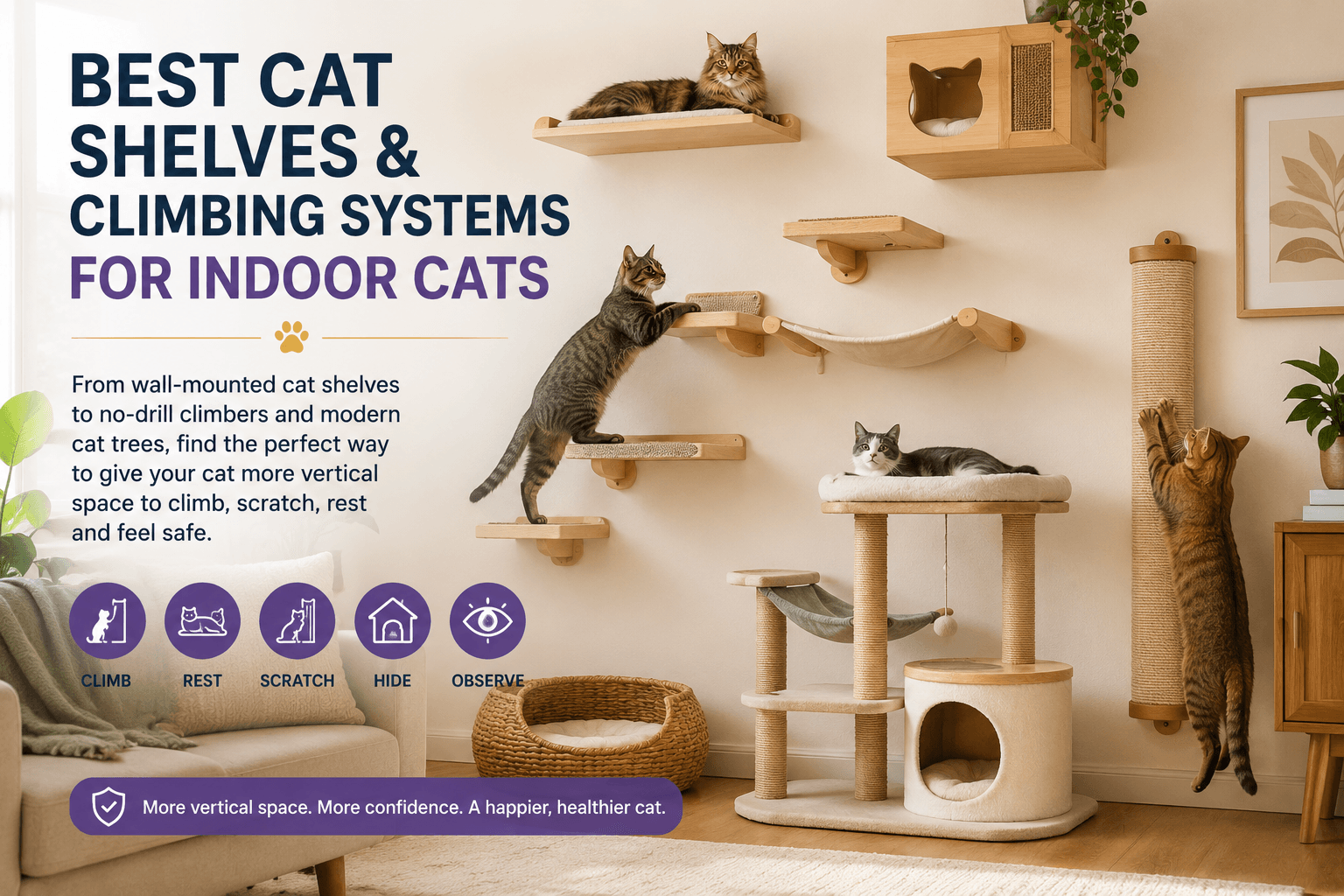
    For vertical enrichment, read our Best Cat Shelves and Climbing Systems comparison.

    Safety, Cleaning and Calories

    Food-contact toys need regular cleaning.

    Remove leftover food, inspect sliding pieces and check for:

    • cracks;
    • chewed edges;
    • loose components;
    • damaged silicone;
    • food trapped inside mechanisms;
    • pieces small enough to swallow.

    Supervise the first sessions and avoid forcing a cat to continue when the puzzle produces tension rather than curiosity.

    Puzzle feeders can slow access to food, but they do not automatically reduce calorie intake. Use measured portions from the normal daily allowance, especially when weight management is part of the goal.

    For scheduled portion control rather than enrichment feeding, read our Best Automatic Cat Feeders guide.

    A sudden loss of appetite, repeated vomiting, food guarding or a persistent behavioral change should not be explained away as boredom with the puzzle. Observe the cat directly and seek veterinary advice when appropriate.

    Buyer-Regret Risk

    The most common mistake is buying difficulty instead of fit.

    Regret usually looks like this:

    • the beginner puzzle is too advanced;
    • the expert puzzle creates frustration;
    • the hunting feeders disappear beneath furniture;
    • the lick mat is purchased for a cat that only eats kibble;
    • the owner adds extra treats instead of measuring food;
    • the toy remains permanently available until it becomes invisible.

    Start with a behavior the cat already shows.

    Then add the smallest useful challenge.

    Your cat does not need to defeat a Level 4 puzzle to justify your opinion of his intelligence.

    Final Verdict

    Buggin’ Out Puzzle & Play is the best overall puzzle feeder for most food-motivated cats because it offers adjustable difficulty and genuine paw-based problem-solving.

    TRIXIE Flip Board is the best beginner option for cats learning several simple mechanisms.

    Catit Play Treat Puzzle is the strongest slow-feeding board for dry-food cats needing more variety and a longer meal.

    Catstages Spinning Fish earns a Conditional Recommendation for cats already motivated by batting and movement.

    Doc & Phoebe’s is the best hunting-style system, provided the owner accepts the daily setup and retrieval work.

    LickiMat Casper or Felix is the best wet-food option and the gentlest starting point for cautious or easily frustrated cats.

    The smartest puzzle is not the one that makes dinner hardest.

    It is the one that creates enough useful work without convincing Gerald that the bowl was a better institution all along.

    Frequently Asked Questions

    Are puzzle feeders good for cats?

    They can support active feeding, problem-solving and more natural searching behavior. They work best as part of a broader enrichment routine rather than as a replacement for play or environmental variety.

    Which puzzle should a beginner cat use?

    Start with a simple board such as TRIXIE Flip Board or an easy configuration of Buggin’ Out. Make rewards visible and increase difficulty only after the cat understands the mechanism.

    Can puzzle feeders help with fast eating?

    They can slow access to food, particularly multi-zone boards, hunting feeders and lick mats. Portion size still needs to be measured.

    Can wet food be used in puzzle toys?

    Use products specifically suited to wet food, such as LickiMat. Most enclosed plastic puzzles and moving dispensers work better with dry kibble or firm treats.

    Should puzzle toys remain available all day?

    Usually not. Short sessions make cleaning, supervision and rotation easier while helping preserve novelty.

    References

    • Cornell Feline Health Center — Safe Toys and Gifts
    • Feline Veterinary Medical Association — How to Feed a Cat
    • Feline Veterinary Medical Association — Your Cat’s Environmental Needs
    • VCA Animal Hospitals — Enrichment for Indoor Cats
    • Outward Hound / Nina Ottosson — Buggin’ Out Puzzle & Play
    • TRIXIE — Cat Activity Flip Board
    • Catit — Play Treat Puzzle
    • Catstages — Spinning Fish Treat Dispenser
    • Doc & Phoebe’s — Indoor Hunting Feeder
    • LickiMat — Casper and Felix

    Image Disclosure

    Official manufacturer images are used when available and authorized.

    AI-generated images may also be used as editorial illustrations. They should not be treated as exact representations of product dimensions, materials or physical features. Always verify the current official product listing before purchasing.

    Editorial Disclosure

    PetTech AI may earn a commission from qualifying purchases. This does not influence our recommendations, comparisons or editorial judgments.
  • Best Smart Litter Boxes (2026): Which One Actually Deserves Your Floor Space?

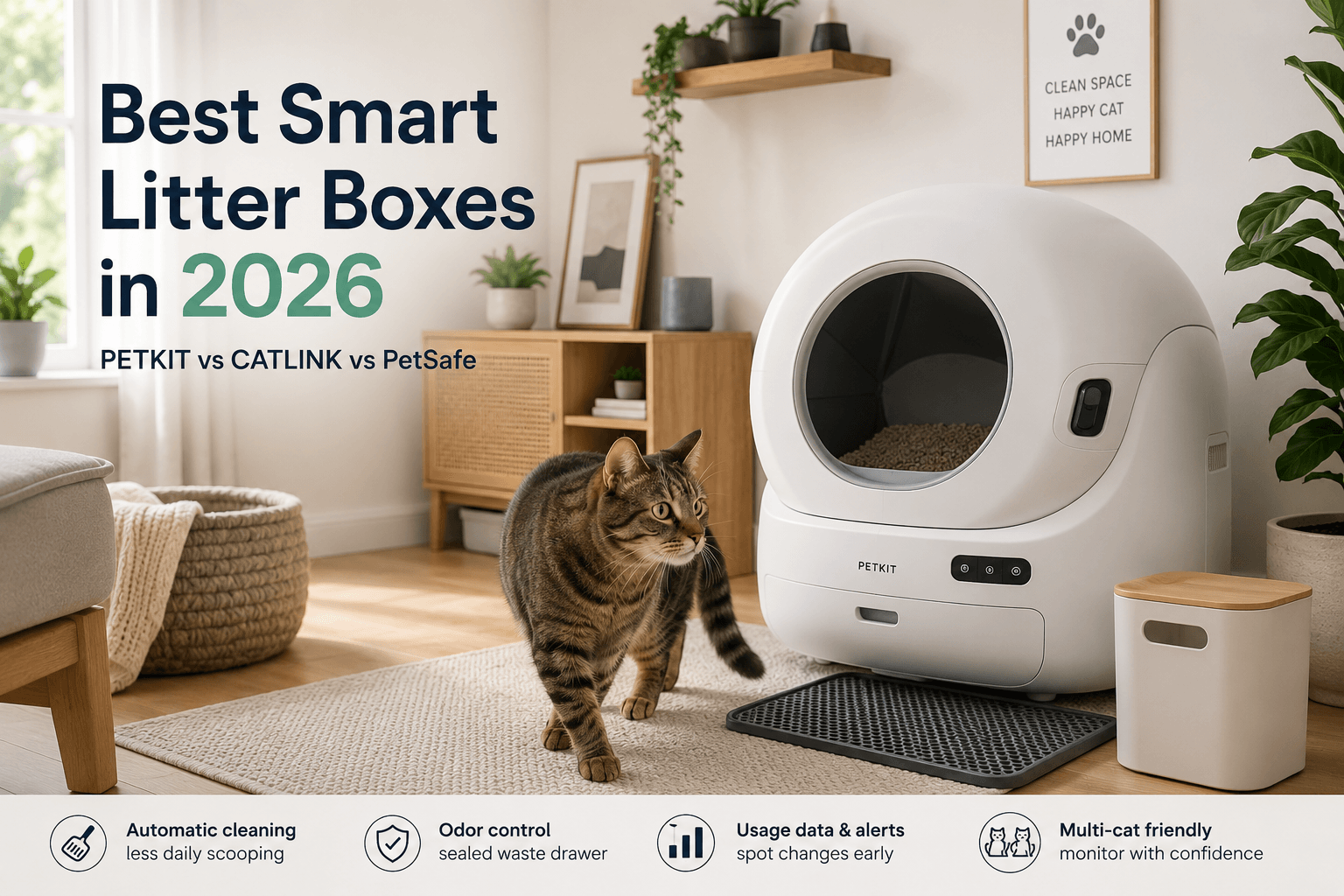
    Best Smart Litter Boxes (2026): Which One Actually Deserves Your Floor Space?

    A smart litter box promises to eliminate scooping.

    This is technically true in the same way a dishwasher eliminates washing dishes: the machine does the repetitive part, while you remain responsible for emptying, cleaning, refilling, troubleshooting, and wondering how something so expensive became covered in cat litter.

    Still, a good automatic litter box can meaningfully improve daily life.

    The important question is not which machine has the most sensors, the longest app dashboard, or the greatest number of synonyms for “odor control.”

    It is:

    Which box will your cat actually use—and which one reduces more work than it creates?

    This guide compares three models with different strengths:

    • PETKIT PuraMax 2 for the best overall balance;
    • CATLINK Luxury Pro-X for multi-cat usage data;
    • PetSafe ScoopFree SmartSpin as a simpler mainstream alternative with a more conditional reliability case.

    Research note: This is a research-led guide based on official documentation, current product information, public ownership evidence, and PetTech AI’s product-level trust checks. PetTech AI has not conducted long-term hands-on testing of every litter box included.

    Quick Verdict

    Your priorityBest fitRecommendation
    Best overall smart litter boxPETKIT PuraMax 2Strong recommendation
    Multi-cat usage and weight trendsCATLINK Luxury Pro-XStrong specialist recommendation
    Simpler mainstream smart alternativePetSafe ScoopFree SmartSpinConditional recommendation
    Very large, elderly, or mobility-limited catMeasure carefully—or keep a conventional boxPhysical fit matters more than the app
    Cat strongly prefers open boxesDo not force the upgradeA rejected smart box is expensive furniture

    The short version

    Choose PuraMax 2 when you want the strongest all-round combination of automation, odor management, app control, and everyday usability.

    Choose Luxury Pro-X when several cats share the litter area and individual usage records are worth checking.

    Choose SmartSpin when you want a recognizable mainstream option with simpler app monitoring—but only after reviewing current reliability feedback and return terms.

    And remember:

    A $500 litter box that the cat refuses to enter is not smart.

    The cardboard box it arrived in has won.

    Affiliate disclosure: This page contains affiliate links. PetTech AI may earn a commission if you purchase through them, at no additional cost to you. As an Amazon Associate I earn from qualifying purchases.

    Compare the Recommended Models

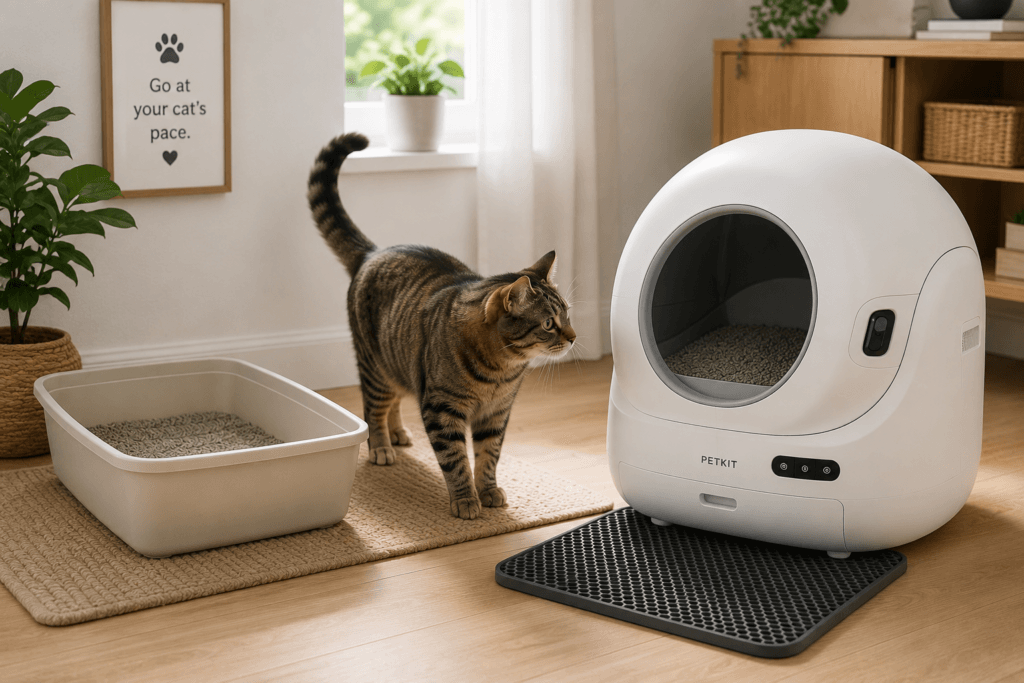
    First Pass the Cat Acceptance Test

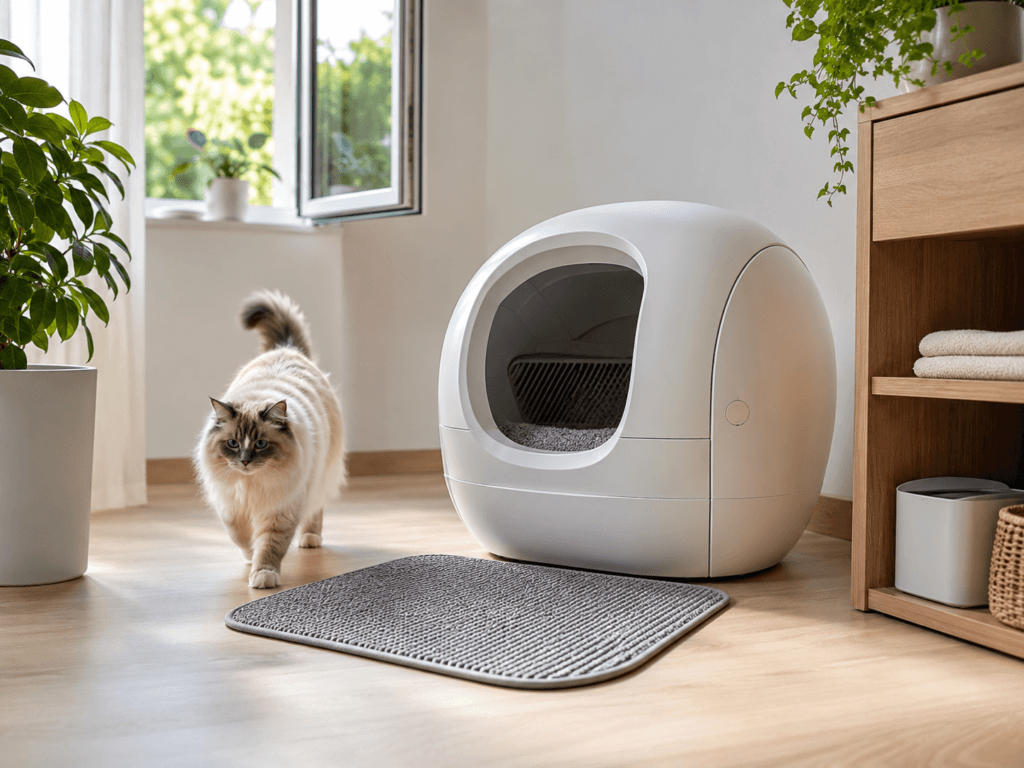
    A cat calmly exploring a new self-cleaning litter box placed beside a familiar traditional litter box
    A gradual transition gives cats time to accept a smart litter box without unnecessary stress.

    Before comparing apps, sensors, or deodorization cartridges, look at the animal expected to climb inside the machine.

    Ask:

    • Does the cat normally prefer open or covered boxes?
    • Is the entrance low enough?
    • Can the cat turn comfortably?
    • Is the cat unusually large?
    • Does arthritis or limited mobility make climbing difficult?
    • Is the litter area quiet enough for a motorized cleaning cycle?
    • Can the old box remain available during the transition?

    Many cats prefer larger, uncovered boxes with easy access. Older cats, kittens, and cats with mobility limitations may need lower sides, while large cats need enough room to enter, turn, dig, and exit comfortably.

    No app update can negotiate around a cat that has declared the new machine haunted.

    A gradual transition is essential:

    1. Place the smart box near the existing box.
    2. Leave automatic cycles disabled initially.
    3. Add familiar litter.
    4. Let the cat investigate without pressure.
    5. Keep the old box available until use is consistent.

    For homes deciding whether monitoring adds anything beyond automation, read Smart Cat Monitoring vs Automation.

    The machine is only half the system: our best litter for automatic litter boxes guide explains which formulas reduce broken clumps, smearing and clean-litter waste.

    PETKIT PuraMax 2: Best Overall

    PuraMax 2 is the strongest default recommendation because it does not depend on one specialist feature to justify itself.

    It combines:

    • automatic waste separation;
    • a relatively low entrance;
    • app-based usage and weight records;
    • proximity and weight-based safety systems;
    • a sealed waste area;
    • multiple odor-management options;
    • support for common clumping litter types;
    • a large enough interior for many adult cats.

    This is the machine for the owner who wants the entire litter routine to become easier—not merely more measurable.

    Buy it if

    • reducing daily scooping is the main goal;
    • odor containment matters;
    • you want useful alerts without making analytics the entire hobby;
    • one or more cats will share the machine;
    • you are willing to perform periodic deep cleaning;
    • you may later add other PETKIT products.

    Skip it if

    • your cat strongly prefers an open box;
    • floor space is limited;
    • the cat is exceptionally large or mobility-limited;
    • you expect the machine to eliminate all cleaning;
    • you dislike proprietary deodorizing accessories and app-connected care.

    Where it can disappoint

    PuraMax 2 is still a rotating plastic chamber containing litter, urine, and ambition.

    The automatic cycle removes clumps.

    It does not automatically clean:

    • the internal walls;
    • seams and edges;
    • the waste chute;
    • residue from high-urinating cats;
    • litter tracked onto the floor;
    • the machine’s exterior.

    PETKIT has improved the cylinder and leak-control design, but buyers should still consider their cat’s posture. A cat that consistently urinates high against internal surfaces can create more manual cleaning than the product photography suggests.

    The box also occupies meaningful floor space. Measure the room before discovering that your new litter robot has become the dominant architectural feature of the bathroom.

    Verdict: The best overall smart litter box in this guide because its automation, usability, odor management, and app features form a coherent everyday product.

    For a direct model-level comparison with Whisker, read PETKIT PuraMax 2 vs Litter-Robot 4.

    Multi-cat households considering camera-based identification should also read our Litter-Robot 5 Pro review before paying for the flagship model.

    For a direct monitoring-versus-simplicity decision, see Purobot Max Pro 2 vs Litter-Robot 4.

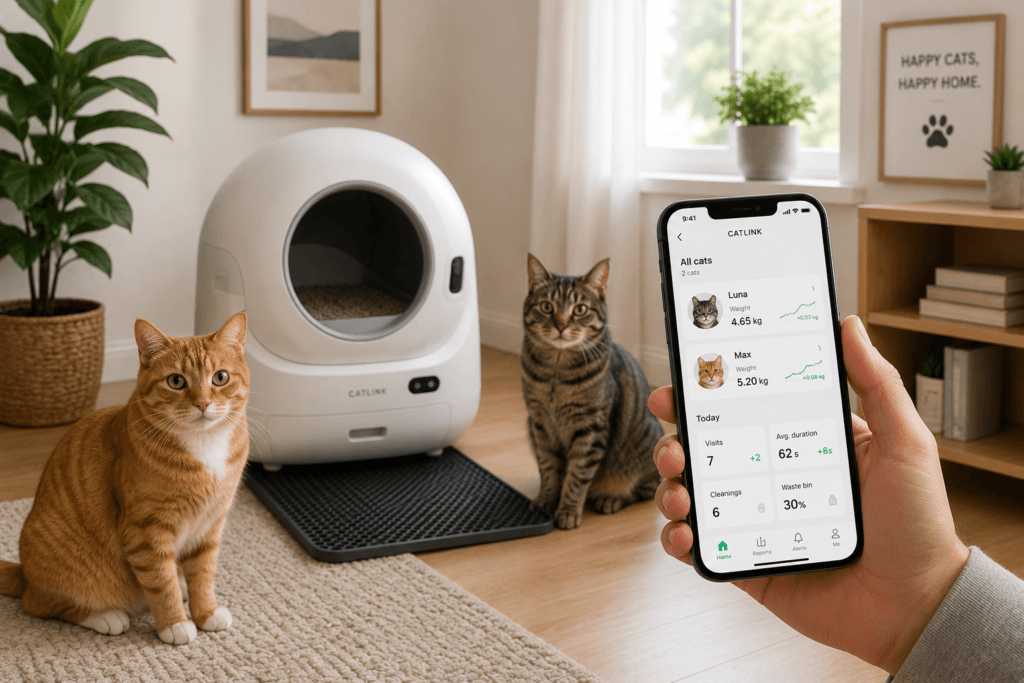
    CATLINK Luxury Pro-X: Best for Multi-Cat Usage Data

    Two cats near a smart litter box in a bright home while a smartphone shows simple usage tracking
    Usage data can be most useful in multi-cat homes, where changes are otherwise harder to notice.

    Luxury Pro-X makes its strongest case in a home where several cats share the litter area.

    A single-cat household already knows who used the box.

    A five-cat household may know only that somebody has been extremely productive.

    CATLINK adds:

    • automatic cleaning;
    • app control;
    • weight-based cat identification;
    • usage histories;
    • waste-drawer alerts;
    • odor-management features;
    • individual profiles and routine trends.

    This makes the data layer more useful than it would be in a simple household.

    Buy it if

    • multiple cats use the same litter box;
    • individual weight and visit trends matter;
    • you will actually review the app;
    • a particular CATLINK design fits the room and cats;
    • litter-box monitoring is the main reason you are considering the CATLINK ecosystem.

    Skip it if

    • you mostly want the easiest default recommendation;
    • cats have very similar weights;
    • nobody will check the records;
    • you are choosing it because “health monitoring” sounds reassuring;
    • you intend to buy the entire CATLINK ecosystem before evaluating the first product.

    Where it can disappoint

    Weight-based identification has practical limits.

    When cats differ clearly in size, the system has a better chance of associating visits correctly. When two cats weigh almost the same, the app may be less certain than the marketing department.

    Usage data can still be valuable, but it must remain evidence rather than diagnosis.

    The box may show:

    • a change in visit frequency;
    • a weight trend;
    • shorter or longer visits;
    • a change in routine.

    It cannot reliably explain why that change occurred.

    The app records the event.

    It has not completed veterinary school.

    Luxury Pro-X also requires the same unglamorous ownership work as its competitors: waste removal, interior cleaning, litter management, sensor care, and occasional troubleshooting.

    Verdict: A credible specialist choice for multi-cat households that will genuinely use individual litter-box records—not simply admire the dashboard during setup.

    For the broader brand decision, read CATLINK vs PETKIT.

    PetSafe ScoopFree SmartSpin: Best Mainstream Alternative—with Caveats

    SmartSpin offers a simpler proposition:

    • the cat exits;
    • the drum rotates;
    • waste moves into a sealed drawer;
    • the app records usage and weight;
    • the owner empties the drawer later.

    PetSafe gives it a relatively low-profile entrance, a smooth interior designed to simplify wipe-down cleaning, a 6 L sealed waste drawer, app alerts, and compatibility with clumping litter.

    This makes SmartSpin attractive to first-time automatic-litter-box buyers who want something more connected than an old rake system but less ecosystem-heavy than PETKIT or CATLINK.

    Buy it if

    • you want a mainstream pet-care brand;
    • basic app tracking is enough;
    • the lower entrance suits your cat;
    • a sealed drawer is a major part of the appeal;
    • you have verified favorable return terms;
    • current reliability feedback is reassuring enough for your risk tolerance.

    Skip it if

    • you want the strongest proven recommendation in the guide;
    • detailed individual multi-cat identification matters;
    • you want the broadest ecosystem;
    • mechanical reliability is more important than a lower entry price;
    • mixed ownership experiences make you uncomfortable.

    Where it can disappoint

    SmartSpin has a less reassuring and more polarized market record than PuraMax 2 and Luxury Pro-X.

    The recurring areas worth checking before purchase include:

    • interrupted cleaning cycles;
    • sensor behavior;
    • litter or waste adhering to internal surfaces;
    • odor containment;
    • operating noise;
    • litter tracking;
    • longer-term mechanical consistency.

    That does not mean every SmartSpin is waiting to betray its owner.

    It means the product deserves a conditional recommendation rather than being presented beside the stronger picks as though all three have identical evidence.

    PetSafe’s smooth interior and simpler cleaning design are meaningful advantages. They matter only while the machine continues performing its main job reliably.

    Verdict: A legitimate mainstream alternative for buyers who want app-connected automation and sealed waste handling, but not the safest default pick.

    The 3 A.M. Test

    A useful smart litter box should remain tolerable when it rotates at 3 a.m.

    PuraMax 2

    You receive a clean litter bed, an app record, and perhaps a reminder that the waste drawer will eventually require human participation.

    Luxury Pro-X

    You receive a clean litter bed and a better idea of which cat conducted the overnight operation.

    SmartSpin

    You receive a clean litter bed—provided the cycle and sensors behave consistently.

    A conventional litter box

    Nothing rotates.

    Nothing sends a notification.

    The cat uses it anyway.

    This is why the smartest choice is not always the model with the longest specification table.

    It is the machine whose extra complexity continues to earn its place.

    Buyer Regret in One Table

    ProductMost likely regret
    PuraMax 2Expecting automatic scooping to mean automatic deep cleaning
    Luxury Pro-XPaying for data that nobody checks—or cannot cleanly distinguish similar cats
    SmartSpinChoosing the simpler alternative and later encountering reliability friction
    Any smart litter boxDiscovering the cat prefers the old plastic tray
    Any enclosed modelIgnoring physical size, mobility, or open-box preference

    Odor Control: What the Marketing Usually Leaves Out

    A clean litter area with a self-cleaning litter box, litter mat, and fresh airflow in a modern home
    Automatic cleaning helps with odor only when waste removal, litter maintenance, and airflow work together.

    A sealed waste drawer helps.

    Automatic removal helps.

    Deodorizing cartridges may help.

    None of them permanently defeats the chemical reality of stored cat waste.

    Odor control still depends on:

    • emptying the drawer before it becomes a biological research project;
    • cleaning internal surfaces;
    • using compatible litter;
    • preventing damp buildup;
    • cleaning mats and surrounding floors;
    • maintaining reasonable room ventilation.

    The best odor-control system is still removal plus cleaning.

    The app cannot push-notify ammonia into another dimension.

    One Smart Box May Still Not Be Enough

    In multi-cat homes, a single automatic litter box should not automatically replace every other box.

    Cats may have:

    • different location preferences;
    • territorial conflicts;
    • different tolerance for enclosed spaces;
    • mobility differences;
    • preferences for different litter types.

    General feline guidance commonly recommends providing as many litter boxes as cats, plus one, distributed in accessible areas.

    Real homes may not always follow that formula perfectly, but the principle matters: one premium machine does not guarantee that several cats suddenly want to share one bathroom.

    Keep an additional box when:

    • introducing the smart model;
    • cats have a history of conflict;
    • the home has several floors;
    • one cat avoids the machine;
    • reliable access matters during power or mechanical problems.

    Which Smart Litter Box Should You Buy?

    Choose PuraMax 2 when:

    • you want the strongest all-round recommendation;
    • automation and odor management matter most;
    • you want useful app monitoring without making data the sole purpose;
    • the cats fit comfortably.

    Choose Luxury Pro-X when:

    • multiple cats share the litter area;
    • individual usage trends justify the extra monitoring;
    • CATLINK’s litter-box system wins your product-level comparison;
    • you will evaluate other CATLINK products separately.

    Choose SmartSpin when:

    • you want the simpler mainstream alternative;
    • lower entry and smooth cleaning surfaces are appealing;
    • recent buyer feedback and return protection reduce the risk enough;
    • you accept a less confident recommendation.

    Choose none of them when:

    • your cat strongly rejects enclosed boxes;
    • mobility makes entry difficult;
    • you cannot keep a backup box;
    • you expect zero maintenance;
    • the budget would create more stress than daily scooping.

    Final Verdict

    PETKIT PuraMax 2 is the best smart litter box in this guide for most households.

    It offers the most convincing balance of cleaning automation, odor management, app features, safety systems, and everyday usability. It is not maintenance-free, but its main strengths remain useful after the novelty disappears.

    CATLINK Luxury Pro-X is the better specialist choice for data-conscious multi-cat homes.

    Its usage records and weight-based identification can provide valuable context when several cats share the box. Buy it because that information solves a real uncertainty—not because CATLINK has given the litter drawer a health dashboard.

    PetSafe ScoopFree SmartSpin remains a conditional mainstream alternative.

    Its sealed drawer, lower profile, app monitoring, and smooth interior are appealing. Its more mixed ownership history means buyers should examine current reliability feedback and return protection before choosing it over the stronger recommendations.

    The winner is therefore:

    1. PuraMax 2 — best overall
    2. Luxury Pro-X — best for multi-cat data
    3. SmartSpin — acceptable mainstream alternative with caveats

    A smart litter box should reduce the amount of time you spend thinking about cat waste.

    When the machine itself becomes the main thing you think about, the automation has lost the argument.

    Frequently Asked Questions

    Which smart litter box is best overall?

    PETKIT PuraMax 2 offers the strongest overall balance for most buyers. Luxury Pro-X becomes more compelling when multi-cat usage data is a central requirement.

    Which model is best for multiple cats?

    CATLINK Luxury Pro-X is the stronger data-focused option. However, multiple cats may still need additional litter boxes in separate locations.

    Is PetSafe SmartSpin worth considering?

    Yes, as a conditional alternative. Its design and app features are useful, but buyers should inspect current reliability feedback and return terms before purchasing.

    Do automatic litter boxes eliminate cleaning?

    No. They reduce daily scooping but still require drawer emptying, litter refilling, interior cleaning, sensor care, and surrounding-floor maintenance.

    Can smart litter boxes detect illness?

    They may reveal changes in weight or litter-box routine. They cannot diagnose the cause. Meaningful or persistent changes require direct observation and, when appropriate, veterinary evaluation.

    What if my cat refuses the smart litter box?

    Keep the previous box available, disable automatic movement initially, use familiar litter, and introduce the machine gradually. Do not force the transition by removing every alternative immediately.

    References

    • PETKIT PuraMax 2 official product and support documentation
    • CATLINK Luxury Pro-X official product and app documentation
    • PetSafe ScoopFree SmartSpin official product and support documentation
    • Cornell Feline Health Center litter-box behavior and accessibility guidance
    • Public ownership evidence reviewed during PetTech AI’s product-level trust checks

    Image Disclosure

    Some images in this article may be AI-generated for illustrative purposes. They do not depict the exact products and should not be used to evaluate dimensions, entrances, controls, or physical fit.

    Disclosure

    PetTech AI may earn a commission when readers purchase through affiliate links. Every litter box is evaluated at product level; belonging to a smart ecosystem does not automatically earn a recommendation.

  • Best Interactive Cat Toys (2026): 4 That Won’t Become Floor Clutter

    Best Interactive Cat Toys (2026): 4 That Won’t Become Floor Clutter

    The best interactive cat toy is not necessarily the one with the most lights, modes, or moving parts.

    Baron may ignore the rechargeable smart ball, attack the cardboard insert it arrived in, and then fall asleep beside the charger.

    That is not proof that cats hate technology.

    It is proof that buying toys by feature count is a reliable way to misunderstand the customer.

    It is the toy that matches how your cat actually wants to play.

    Some cats want to stalk and pounce on hidden “prey.” Others prefer to chase something rolling across the floor, grab and kick a soft toy, or bat at a quieter enclosed track. The goal is not to leave one gadget running all day. It is to create short, varied opportunities for movement, hunting-style play, and novelty.

    If you are still building the basics, start with our broader guide to the best cat toys for indoor cats. This article focuses specifically on interactive, motion-based, and self-directed toys.

    That matters especially for indoor cats. Toys can support exercise and cognitive enrichment by encouraging stalking, pouncing, chasing, and problem-solving—but they work best as part of a routine, not as a substitute for human interaction or a cat-friendly environment.

    This guide focuses on four distinct types of interactive play:

    • Cheerble Wicked Ball M3 for short autonomous chase sessions.
    • SmartyKat Hot Pursuit for ambush-and-pounce play.
    • Catit Senses 2.0 Play Circuit for quiet enclosed-track batting.
    • Potaroma Flopping Fish for cats that enjoy grabbing and kicking their “prey.”

    Research Note

    This is a research-led roundup based on current manufacturer information, feline enrichment guidance and product positioning.

    PetTech AI has not conducted long-term hands-on testing of every toy included.

    Quick Verdict: Which Interactive Cat Toy Fits Your Cat?

    Best forToyWhat it does bestMain trade-off
    Autonomous chase playCheerble Wicked Ball M3Moving ball with multiple play modes and built-in play/rest cyclesWorks best as a short activity, not all-day enrichment
    Stalking and pouncingSmartyKat Hot PursuitHidden wand movement under fabric that imitates concealed preyNeeds floor space and occasional inspection of the cover and wand
    Quiet batting and chaseCatit Senses 2.0 Play CircuitEnclosed ball track for lower-noise, self-directed playNot every cat finds track toys exciting
    Grabbing and bunny-kickingPotaroma Flopping FishMotion-activated soft “prey” for cats that like wrestling toysSome timid cats may dislike the motor noise at first

    What Interactive Toys Can—and Cannot—Do

    Interactive toys can help create opportunities for movement and predatory-style behavior. But they do not replace everything a cat needs.

    A motorized toy cannot replace daily interaction with you. It cannot fix a stressful multi-cat environment by itself. And it should not be left available indefinitely if it contains moving parts, fabric, strings, feathers, or components your cat may chew.

    The strongest setup is usually a rotation:

    • one autonomous toy for brief solo activity;
    • one toy that supports stalking or pouncing;
    • one physical “catch” or kicker toy;
    • regular human-led play sessions;
    • puzzle feeding or climbing enrichment when the cat needs more than movement.

    Feline behavior guidance emphasizes that cats need opportunities to play and express predatory behavior, while also being able to “catch” prey intermittently rather than being left in endless frustration.

    PetTech AI may earn a commission from qualifying purchases. As an Amazon Associate I earn from qualifying purchases.

    How to Choose an Interactive Cat Toy

    1. Match the toy to your cat’s play style

    Watch what your cat already does.

    Do they stare at moving objects and wait to ambush? Do they chase things down hallways? Do they grab soft toys and kick with their back legs? Do they bat at objects but avoid noisy movement?

    That gives you a better starting point than buying the most popular toy on Amazon.

    Your cat’s usual play styleBest starting category
    Chases movement across the floorAutonomous rolling toy
    Hides, stalks, then pouncesConcealed-prey toy
    Bats and pokes without intense runningEnclosed track toy
    Grabs, wrestles, and bunny-kicksSoft motion-activated kicker
    Solves food puzzles more than chasingPuzzle feeder, not another motion toy

    For food-motivated cats, see our Smart Puzzle Toys for Cats guide.

    2. Use autonomous toys as support—not a babysitter

    A self-moving ball can fill a short gap when you are working, cooking, or unable to start a play session immediately.

    But it is not a replacement for interaction.

    The useful question is not “Will my cat play alone for an hour?” It is “Will this create a few good bursts of movement that I can rotate with other forms of play?”

    3. Keep novelty alive with rotation

    Leave every toy on the floor permanently and most cats will eventually stop noticing it.

    Try a simple rotation:

    • keep one or two toys accessible;
    • store the rest for several days;
    • bring back a toy after a short break;
    • change the room or surface where you use it;
    • end active sessions with something your cat can physically catch.

    Small changes often matter more than buying a large pile of similar toys.

    4. Choose safety and supervision over features

    Inspect toys regularly.

    Remove damaged fabric, loose feathers, exposed wires, frayed strings, cracked plastic, or any component your cat might swallow. Store wand-style and string toys after supervised sessions. Cornell specifically recommends choosing toys carefully and checking for potential hazards.

    Best for Autonomous Chase Play: Cheerble Wicked Ball M3

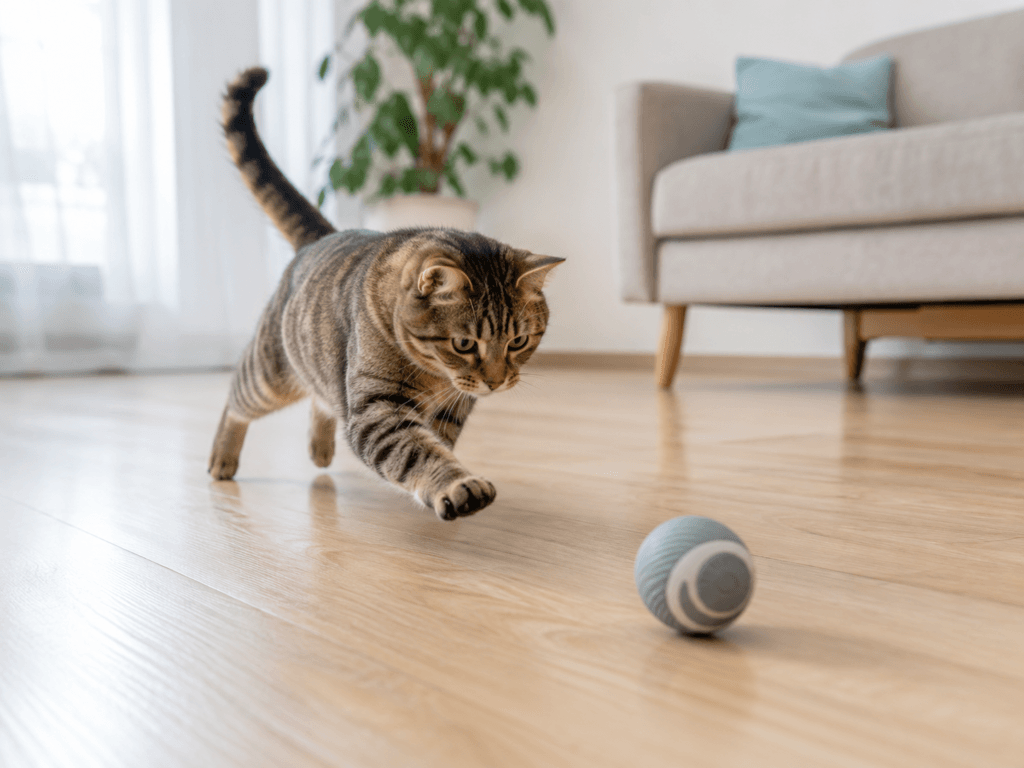
    A cat chasing a small moving rolling toy across a light wood floor in a bright living room
    Autonomous rolling toys work best as short bursts of chase play—not as an all-day replacement for interaction.

    The Cheerble Wicked Ball M3 is the best option for cats that enjoy chasing unpredictable movement across the floor.

    It is not a wand toy and it is not a puzzle feeder. Its role is simple: create short bursts of rolling, bouncing, and moving “prey” behavior that can encourage a cat to chase, paw, and re-engage.

    Cheerble describes the M3 as a cat-focused interactive ball with three play modes and a built-in play/rest cycle. After 10 minutes of activity, it enters a 30-minute rest period unless the cat reactivates it with a nudge.

    Why it stands out

    The M3 has a clear use case:

    It gives an energetic indoor cat something to chase when you cannot immediately initiate a play session.

    That makes it useful for homes where a cat becomes active at predictable times—before work, during a busy afternoon, or in the early evening.

    The play/rest cycle is also more sensible than a toy designed to keep moving without interruption. A good autonomous toy should create activity, then allow the cat to disengage.

    Choose Wicked Ball M3 if:

    • Your cat already chases balls, bugs, or moving objects.
    • You want short autonomous bursts of activity.
    • Your home has mostly hard floors or low-pile rugs.
    • You want a rechargeable interactive toy.
    • You plan to rotate it with other toys and human-led play.

    It may not be the best fit if:

    • Your cat is very noise-sensitive.
    • Your cat prefers ambush play over chasing.
    • Your floors are thick carpet or highly uneven.
    • You want a toy that replaces active play with you.

    Verdict: Conditional Recommendation — a useful short-burst chase toy for cats already attracted to floor movement, but not a substitute for active play or a sensible purchase for noise-sensitive cats.

    Check Cheerble Wicked Ball M3 on Amazon

    Best for Stalking and Pouncing: SmartyKat Hot Pursuit

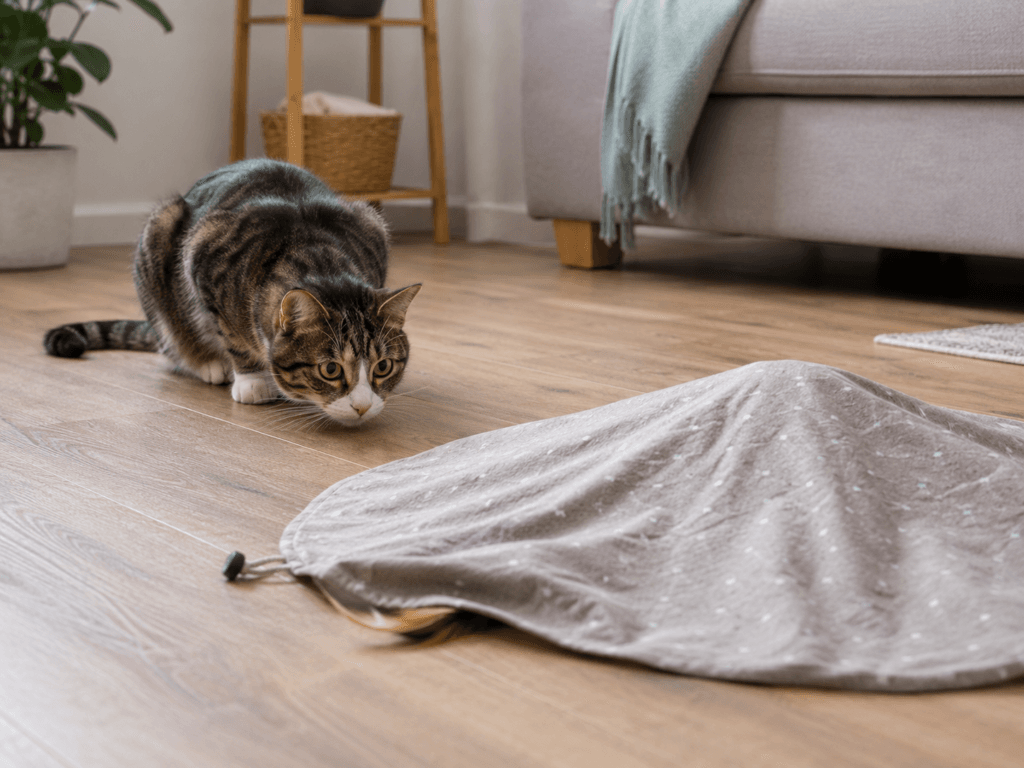
    A cat crouching and watching concealed movement beneath a fabric interactive toy in a quiet room
    Concealed-prey toys give cats time to watch, stalk, and choose when to pounce.

    The SmartyKat Hot Pursuit is the best choice for cats that prefer hidden prey over visible toys.

    A wand moves unpredictably beneath a fabric cover, creating the feeling that something is moving just out of reach. That makes it better suited to cats that crouch, watch, stalk, and then pounce rather than cats that only want to chase a rolling ball.

    SmartyKat describes Hot Pursuit as an electronic concealed-motion toy with a feathered wand moving beneath crinkly fabric, two speed controls, lights, and a teasing feather tail.

    Why it stands out

    This toy creates a different emotional rhythm from an autonomous ball.

    The cat can watch, wait, listen, and choose when to strike. That makes Hot Pursuit a strong option for cats with a noticeable ambush instinct.

    It also works well as a short supervised play ritual before dinner or bedtime.

    Choose Hot Pursuit if:

    • Your cat likes hiding, stalking, and pouncing.
    • They respond to rustling fabric or concealed movement.
    • You have enough open floor space for the toy.
    • You want a more prey-like alternative to a simple ball.
    • You are willing to inspect the cover and wand periodically.

    It may not be the best fit if:

    • Your cat gets overstimulated easily.
    • Your cat chews fabric or feathered components.
    • You need a quiet toy for late-night use.
    • You want an option for unsupervised all-day access.

    Verdict: Recommended with Conditions — one of the stronger options for ambush-driven cats, provided fabric chewing, motor noise, and supervised inspection are not problems.

    Check SmartyKat Hot Pursuit on Amazon

    Best Quiet Enclosed-Track Toy: Catit Senses 2.0 Play Circuit

    The Catit Senses 2.0 Play Circuit is the best choice for cats that enjoy batting, poking, and following movement without a loud motorized toy.

    Instead of exposing the ball fully, the circuit keeps it partially enclosed. Your cat can hear it, see it through openings, and reach in with a paw—but cannot simply carry it away under the sofa.

    Catit lists the Play Circuit as part of its Senses Circuits range, designed for modular layouts and compatible with other circuit components. The system is intended to stimulate cats through chasing and pawing at a moving ball inside the track.

    Why it stands out

    This is not an “automatic” toy in the same sense as Wicked Ball M3.

    It is quieter, simpler, and more self-paced.

    That makes it useful for:

    • cats that bat rather than sprint;
    • apartments where loud motorized toys are irritating;
    • quieter evening play;
    • cats that prefer controlled movement;
    • homes where a toy needs to be easy to wipe down and reset.

    Choose the Catit Play Circuit if:

    • Your cat likes pawing at objects through openings.
    • You want a lower-noise alternative to motorized toys.
    • You prefer a toy without charging or frequent batteries.
    • Your cat enjoys predictable but still partially hidden movement.
    • You may later expand into compatible Catit circuit components.

    It may not be the best fit if:

    • Your cat ignores balls or track toys.
    • You want intense running and jumping.
    • Your cat is only motivated by feathers, scents, or food.
    • You want fully autonomous movement without needing to start the ball.

    Verdict: Recommended — the safest low-complexity choice in this roundup for cats that enjoy batting and partially hidden movement. Cats that ignore tracks will regard it as decorative plumbing.

    Check Catit Senses 2.0 Play Circuit on Amazon

    Best for Kicking and Wrestling: Potaroma Flopping Fish

    The Potaroma Flopping Fish is for cats whose version of play is not “chase it across the floor” but “grab it, bite it, and kick it with both back legs.”

    That is a different play pattern, and it deserves a different kind of toy.

    Potaroma’s flopping fish combines a soft plush body with motion-activated movement and catnip or silvervine enrichment. The toy is designed to react when touched, creating a physical object for a cat to wrestle instead of only watching something move.

    Why it stands out

    The Flopping Fish works best as a “catch” toy.

    After a short chase or stalking session, a cat can grab and kick it, which gives the play sequence a physical ending. This is particularly useful for cats that enjoy kicker toys, soft plush prey, or catnip/silvervine stimulation.

    Choose Potaroma Flopping Fish if:

    • Your cat grabs and bunny-kicks plush toys.
    • Your cat responds to catnip or silvervine.
    • You want a soft, physical toy to use after chase play.
    • Your cat prefers wrestling over chasing a small ball.
    • You want a rechargeable motion toy with a simpler role than a smart app-controlled device.

    It may not be the best fit if:

    • Your cat is frightened by vibration or motor noise.
    • Your cat is not interested in soft toys.
    • Your cat chews or destroys plush fabric quickly.
    • You are looking for a solo puzzle or food-enrichment toy.

    Verdict: Conditional Recommendation — worth considering for cats that already wrestle soft kickers, but easy to overestimate when the cat dislikes vibration, motor noise, or plush prey.

    Check Potaroma Flopping Fish on Amazon

    Build a Better Toy Rotation

    A cat batting at an enclosed track toy while a soft kicker toy rests nearby in a tidy indoor play area
    Toy rotation works better than leaving every toy out permanently: vary chase, batting, and physical catch play across the week.

    A good toy rotation is more useful than six toys left permanently on the floor.

    Try this basic setup:

    For a high-energy indoor cat

    • Cheerble Wicked Ball M3 for brief autonomous movement.
    • SmartyKat Hot Pursuit for a supervised stalk-and-pounce session.
    • Potaroma Flopping Fish as a final physical “catch.”

    For a quieter cat or apartment setup

    • Catit Play Circuit for calm batting and chasing.
    • A short wand session with you.
    • A puzzle feeder or treat toy on alternate days.

    For food routines that can complement treat-based enrichment without turning every activity into free feeding, see our Best Automatic Cat Feeders guide.

    For a multi-cat home

    Do not assume one toy will keep every cat happy.

    Use more than one play zone, avoid forcing timid cats to compete with highly energetic cats, and give cats room to disengage. Feline environmental guidance recommends dispersing key resources and play opportunities throughout the home, particularly in multi-cat environments.

    For broader enrichment beyond floor-level toys, see our Best Cat Shelves and Climbing Systems guide.

    When a Toy Is Not the Right Answer

    Sometimes a cat is not “bored.”

    They may be under-stimulated, stressed, frightened, frustrated by another cat, in pain, or simply uninterested in the type of play you are offering.

    Slow down if your cat:

    • hides when the toy starts;
    • becomes tense, vocal, or aggressive;
    • fixates on a laser or moving toy without settling;
    • starts guarding toys from other cats;
    • suddenly loses interest in play despite normally enjoying it.

    A new toy is not a behavioral diagnosis.

    If there is a persistent or sudden behavior change, especially alongside appetite, litter-box, mobility, or grooming changes, speak with a veterinarian.

    For food-motivated enrichment and slower, quieter mental work, see our Smart Puzzle Toys for Cats guide. For camera-based observation and remote check-ins, see our Smart Cat Cameras guide.

    Frequently Asked Questions

    Are interactive toys good for indoor cats?

    They can be useful because they create opportunities for movement, hunting-style play, and cognitive enrichment. The best result usually comes from short, varied play sessions and toy rotation rather than leaving one toy available all the time.

    How long should a cat play each day?

    Short, repeated play sessions are often more realistic than one long session. Adjust their frequency and duration to your cat’s age, mobility, interest, and tolerance.

    Should I leave motorized toys out all day?

    Usually, no. Rotate them, inspect them for wear, and store toys with parts your cat might chew or pull apart. Autonomous toys work best as occasional activity, not permanent furniture.

    Can interactive toys replace playing with my cat?

    No.

    They can support your routine, but human-led play gives you more control over pace, intensity, and whether your cat gets a satisfying “catch.”

    What if my cat ignores a new toy?

    Try a different play style rather than buying more of the same category. A cat that ignores a rolling ball may love hidden prey, a kicker, a track toy, or food-based enrichment instead.

    Final Verdict

    The best interactive cat toy is the one that matches your cat’s natural play style.

    Choose the Cheerble Wicked Ball M3 for short autonomous chase sessions.

    Choose SmartyKat Hot Pursuit for stalking, watching, and pouncing on concealed prey.

    Choose the Catit Senses 2.0 Play Circuit for quieter enclosed-track batting and chase play.

    Choose the Potaroma Flopping Fish for cats that prefer to grab, bite, and bunny-kick their toy.

    PetTech AI’s default recommendation is Catit for quieter batting play and SmartyKat for stalking-driven cats. Choose Cheerble only when your cat already chases floor movement, and choose Potaroma only when grabbing and wrestling are established preferences.

    None of these is the universal “best” interactive toy. The safest purchase is the one based on behavior your cat already shows—not behavior the product page promises to unlock.

    The real goal is not to automate play.

    It is to make your cat’s everyday environment more varied, more active, and more rewarding.

    References

    • Cornell Feline Health Center — safe toys, exercise, cognitive enrichment, and toy safety
    • Feline Veterinary Medical Association — environmental needs, play, predatory behavior, and multi-cat resource distribution
    • Cheerble — Wicked Ball M3 play modes and play/rest balance
    • SmartyKat — Hot Pursuit concealed-motion toy specifications
    • Catit — Senses Play Circuit system and circuit compatibility
    • Potaroma — Flopping Fish interactive plush toy specifications

    Image Disclosure

    Some images in this article may be created with AI for illustrative purposes. They do not show the exact products reviewed and should not be used to evaluate product size, fit, design, or features. Always check the current official product listing before purchasing.

    Disclosure

    PetTech AI may earn a commission from qualifying purchases. This does not influence our recommendations, comparisons or editorial judgments.
  • Best Automatic Cat Feeders (2026): Four Feeders for Four Completely Different Problems

    Best Automatic Cat Feeders (2026): Four Feeders for Four Completely Different Problems

    Amazon contains enough automatic cat feeders to suggest that feeding a cat has become an aerospace discipline.

    It has not.

    Most owners need to solve one of four problems:

    • serve dry food on schedule and see what happened;
    • keep wet food chilled until mealtime;
    • stop one cat from treating every bowl as a public buffet;
    • protect wet or prescription food using the cat’s actual microchip.

    Those problems require different machines.

    A camera does not refrigerate pâté. Refrigeration does not identify the food thief. An RFID tag is not an implanted microchip. And a feeder that films the crime in 1080p has not necessarily prevented it.

    This guide compares four products with genuinely different jobs:

    • PETKIT YumShare Solo 2;
    • PETLIBRO Polar;
    • PETLIBRO One RFID;
    • SureFeed Microchip Pet Feeder Connect.

    Research note: This is a research-led guide based on official documentation, current product information, public ownership evidence, and PetTech AI’s product-level trust checks. PetTech AI has not conducted long-term hands-on testing of every feeder included.

    Quick Verdict

    Your real problemBest feederRecommendation
    You want scheduled kibble plus camera visibilityPETKIT YumShare Solo 2Promising newer product
    You need refrigerated wet mealsPETLIBRO PolarStrong niche recommendation
    One cat steals another cat’s dry foodPETLIBRO One RFIDEstablished but conditional
    You need true microchip access for wet or dry foodSureFeed Microchip Pet Feeder ConnectStrong specialist recommendation

    The short version

    Choose YumShare Solo 2 when seeing the feeding area will actually change what you do.

    Choose Polar when your cat eats wet food and your schedule refuses to cooperate.

    Choose One RFID when you need timed dry-food dispensing plus tag-controlled access—but do not assume the door is a maximum-security facility.

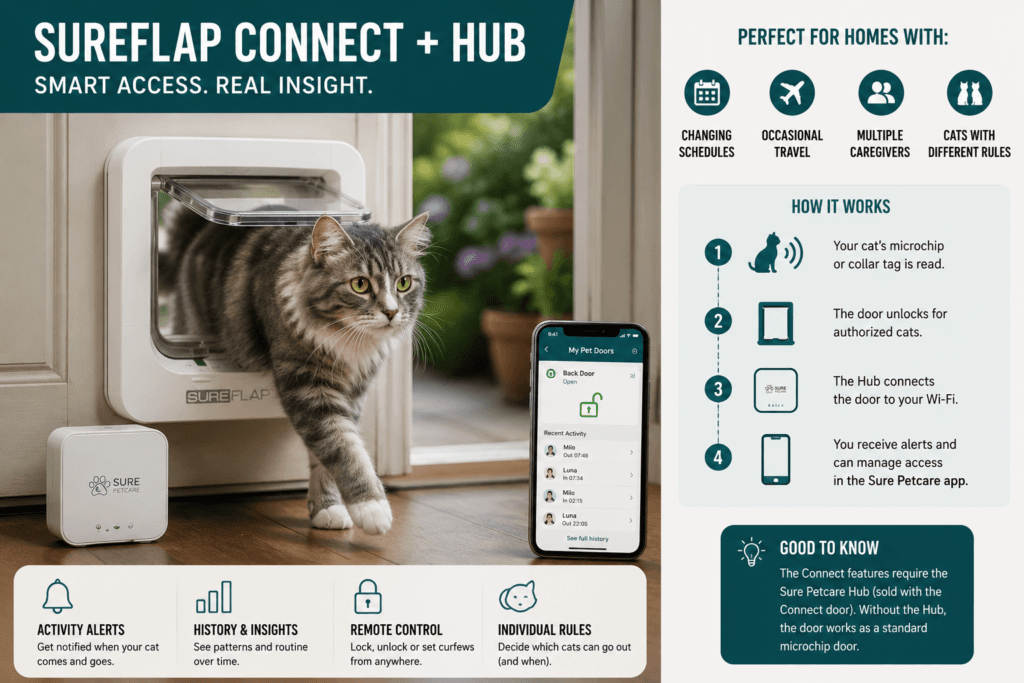
    Choose SureFeed Connect when food protection matters more than automatic dispensing and you want to use the cat’s implanted microchip.

    Affiliate disclosure: This page contains affiliate links. PetTech AI may earn a commission if you purchase through them, at no additional cost to you. As an Amazon Associate I earn from qualifying purchases.

    Compare the Recommended Feeders

    First Decide What the Feeder Must Physically Do

    Before comparing hopper capacity, camera resolution, or how enthusiastically the app uses the word “AI,” answer one question:

    What must physically happen at mealtime?

    Dispense dry food and show you the bowl

    Choose a camera feeder.

    Keep wet food chilled and serve it later

    Choose a refrigerated feeder.

    Dispense dry food but restrict access using a collar tag

    Choose an RFID feeder.

    Keep prepared food available only to one microchipped cat

    Choose a microchip-access feeder.

    These categories overlap less than marketing pages suggest.

    A sophisticated product can still be completely wrong for the household.

    For a clearer breakdown of when smart pet technology should automate a task—and when it merely creates more information to check—read our Smart Cat Monitoring vs Automation guide.

    PETKIT YumShare Solo 2: Best for Camera-Based Dry Feeding

    A cat eating from an automatic dry-food feeder while a smartphone shows a simple meal-monitoring screen nearby
    Camera-based feeders are most useful when meal records and visual context change how you manage the feeding routine.

    YumShare Solo 2 combines scheduled dry-food dispensing with a camera, live monitoring, meal records, two-way audio, and PETKIT’s individual-pet recognition system.

    Its 3 L hopper holds dry kibble or compatible freeze-dried pieces. Schedules continue even when Wi-Fi is unavailable, and backup batteries can preserve feeding during a power interruption, although the camera is disabled while operating on battery power.

    That makes it a real feeder first and a camera second—which is the correct order.

    Buy it if

    • your cat eats dry food;
    • you want to see whether the cat approached the bowl;
    • you spend significant time away from home;
    • changes in mealtime behavior are worth reviewing;
    • you already use PETKIT products;
    • one feeding station serves the household.

    Skip it if

    • you only need timed portions;
    • you will stop watching the clips after three days;
    • your main diet is wet food;
    • one cat must be physically prevented from eating another cat’s meal.

    The main limitation

    YumShare Solo 2 is still new.

    Its early market signal is encouraging, but there is not yet a deep ownership history showing how consistently recognition, notifications, app behavior, and camera functions perform after years of daily use.

    There is also a conceptual limit:

    Recognition is not restriction.

    The feeder may identify Baron Fluffington as he approaches the bowl. It does not issue a restraining order.

    If one cat steals another cat’s food, a camera gives you evidence. You may still need physical access control.

    Verdict: A promising camera feeder for owners who will genuinely use visual meal context—not the default choice for simple scheduling or food theft.

    For a direct comparison between camera-led feeding, routine-first automation, dual-hopper flexibility, and identity-based systems, read PETKIT vs Feeder-Robot vs CATLINK.

    PETLIBRO Polar: Best for Refrigerated Wet Meals

    A refrigerated automatic feeder with covered wet-food meal compartments in a clean cat feeding area
    Wet-food automation needs refrigeration and timed access—not a standard kibble hopper.

    Polar solves the problem most automatic feeders quietly avoid:

    Wet food is perishable.

    It uses thermoelectric cooling, three meal compartments, app scheduling, and a removable stainless-steel tray. PETLIBRO says the feeder can keep three meals chilled for up to three days under its intended conditions and pauses cooling before serving so food is not presented at its coldest temperature.

    That does not make it a miniature restaurant.

    It makes it a refrigerated scheduling tool.

    Buy it if

    • wet food is already part of the daily routine;
    • work or other commitments interrupt meal times;
    • you want to avoid switching to kibble simply because nobody is home;
    • three prepared portions are enough;
    • you are willing to clean the tray and cooling area consistently.

    Skip it if

    • you mainly use dry food;
    • you need access control between cats;
    • your cat is very small or uncomfortable with a raised feeding area;
    • you want a long-trip feeding solution;
    • you expect refrigeration to eliminate food-safety judgment.

    The main limitation

    Polar removes timing friction.

    It does not remove:

    • leftovers;
    • condensation;
    • cleaning;
    • wall-power dependence;
    • the need to verify that the cat actually ate.

    Three chilled meals can make a workday much easier.

    They do not allow you to disappear for a long weekend while the feeder applies for temporary guardianship.

    Verdict: The strongest choice here for scheduled wet food and a genuinely useful niche product for the right household.

    For the deeper analysis, read our PETLIBRO Polar Review.

    Refrigerated feeders differ substantially in temperature targets and meal capacity. Our Polar vs FreshFeed comparison explains why three chilled meals and six meals held closer to conventional refrigeration are not the same proposition.

    PETLIBRO One RFID: Best for Scheduled Dry Food with Tag Access

    Two cats near a covered automatic feeder designed to give one cat protected access to its food
    Access-controlled feeders solve a different problem from scheduled feeders: keeping the right food available to the right cat.

    One RFID combines two functions:

    • automatic dry-food dispensing;
    • access controlled through PETLIBRO’s dedicated RFID collar tag.

    This makes it more relevant than a normal hopper when one cat steals dry food from another or when separate portions need to be maintained.

    The product has a substantial public ownership history, and the overall market signal supports keeping it in the guide.

    But it requires careful framing.

    Buy it if

    • your cats eat dry food;
    • one cat regularly invades another cat’s feeding station;
    • you want both meal scheduling and controlled access;
    • the authorized cat tolerates a collar tag;
    • you can position the feeder away from interference;
    • the consequences of occasional access failure are manageable.

    Skip it if

    • you need implanted-microchip recognition;
    • your cat refuses collars;
    • you feed wet food;
    • unauthorized access would create a serious medical risk;
    • you expect the door to defeat every determined cat in existence.

    The main limitation

    One RFID uses a proprietary collar tag.

    Its performance depends on:

    • tag position;
    • reader placement;
    • lid speed;
    • nearby interference;
    • feeder spacing;
    • the determination and engineering qualifications of the unauthorized cat.

    PETLIBRO provides troubleshooting guidance for slow closure, incomplete opening, RFID interference, and rotor errors. Some owners also report that another cat can exploit the lid before it closes fully.

    This does not make the feeder useless.

    It means “designed to reduce food theft” should not be translated as “physically impossible to defeat.”

    For ordinary dry-food separation, it can be a practical solution.

    For a prescription diet where unauthorized access carries meaningful health consequences, SureFeed’s microchip approach or a more enclosed physical setup may be the safer direction.

    Verdict: A credible and established dry-food access feeder, but a conditional recommendation rather than a prison-grade guarantee.

    Not every selective-access feeder automates the same part of the meal. Our PETLIBRO One RFID vs SureFeed Connect comparison explains the difference between scheduled dry-food dispensing and true microchip-controlled access.

    SureFeed Microchip Pet Feeder Connect: Best for True Microchip Access

    SureFeed Connect is fundamentally different from the other three products.

    It does not contain a large hopper.

    It does not release a fresh portion at a scheduled time.

    Instead, you place wet or dry food in its 400 ml bowl, and the lid opens only when the registered cat’s implanted microchip or compatible RFID tag approaches.

    That makes it the strongest specialist option when the food itself needs protection.

    Buy it if

    • one cat needs prescription or therapeutic food;
    • one pet steals wet or dry meals;
    • you prefer implanted-microchip access over a collar tag;
    • food can remain available for grazing;
    • accurate portion monitoring is useful;
    • automatic dispensing is not required.

    Skip it if

    • you want meals dispensed at specific times;
    • you need a large dry-food hopper;
    • you want one device to combine automatic portions and microchip access;
    • you do not want the additional Hub required for Connect app features.

    The main limitation

    The Connect version requires the Sure Petcare Hub to communicate with the app.

    The feeder is also relatively open at the rear. Sure Petcare sells an optional rear cover specifically for persistent thieves capable of approaching from behind.

    This is useful honesty from the manufacturer.

    Apparently some cats respond to access-control technology by conducting a structural vulnerability assessment.

    The rear cover, feeder placement, and training process may therefore matter in particularly competitive homes.

    Even with those caveats, SureFeed’s mature microchip-access model gives it the strongest argument when food protection—not timed dispensing—is the priority.

    Verdict: The best specialist choice for true microchip-controlled access to prepared wet or dry food.

    The Food-Thief Test

    Suppose Clara has prescription food.

    Her brother, Caesar, believes prescriptions are merely serving suggestions.

    YumShare Solo 2

    Records Caesar approaching Clara’s food.

    You receive a clear image of the suspect.

    Polar

    Keeps Clara’s wet food chilled until serving time.

    Caesar appreciates the improved catering.

    PETLIBRO One RFID

    Uses Clara’s collar tag to open the feeding area and attempts to close it after she leaves.

    Caesar may be stopped—or may begin studying lid timing.

    SureFeed Connect

    Opens for Clara’s implanted microchip and closes when she leaves.

    Add the rear cover if Caesar has developed flanking tactics.

    That is why “best automatic feeder” is the wrong question.

    The better question is:

    Which physical mechanism solves the problem in your home?

    Buyer Regret in One Table

    ProductMost likely regret
    YumShare Solo 2Paying for camera functions you stop using
    PolarExpecting wet-food automation without cleaning
    One RFIDAssuming a collar-tag door is impossible to bypass
    SureFeed ConnectDiscovering it protects food but does not dispense timed portions

    Final Verdict

    There is no single best automatic cat feeder because these four products do not perform the same job.

    PETKIT YumShare Solo 2 is the best fit for dry-food scheduling with visual context. It is promising, useful, and still too new to call a proven long-term default.

    PETLIBRO Polar is the strongest refrigerated wet-food option for owners whose main problem is serving meals while away from home.

    PETLIBRO One RFID is a credible choice for scheduled dry-food access control, provided buyers understand the limits of a collar-tag system and moving lid.

    SureFeed Microchip Pet Feeder Connect is the best specialist solution when implanted-microchip access and food protection matter more than timed dispensing.

    The correct feeder is not the product with the longest feature list.

    It is the machine that physically solves the recurring problem without creating three new ones.

    Frequently Asked Questions

    Which automatic feeder is best for wet food?

    PETLIBRO Polar is the better option for scheduled refrigerated wet meals. SureFeed Connect is better when wet food must remain accessible only to one authorized cat.

    Can YumShare Solo 2 stop food stealing?

    No. Its camera and recognition features provide visual context, but they do not physically prevent another cat from reaching dispensed food.

    Does PETLIBRO One RFID read implanted microchips?

    No. It uses PETLIBRO’s dedicated RFID collar tag.

    Is PETLIBRO One RFID impossible for another cat to defeat?

    No access system should be treated as impossible to defeat. Lid timing, feeder placement, interference, and the behavior of the unauthorized cat all affect real-world performance.

    Does SureFeed Connect dispense scheduled meals?

    No. It protects food already placed in the bowl. Its main job is access control, not timed portion dispensing.

    Does SureFeed Connect require a Hub?

    Yes. The Connect model requires the Sure Petcare Hub for app connectivity. Buyers who do not need app monitoring can also consider the non-Connect Microchip Pet Feeder.

    References

    • PETKIT YumShare Solo 2 official product and support documentation
    • PETLIBRO Polar official product, feeding, cooling, and cleaning guidance
    • PETLIBRO One RFID official product and troubleshooting documentation
    • Sure Petcare Microchip Pet Feeder Connect official product and accessory documentation
    • Public ownership reports reviewed for recurring reliability and access-control patterns

    Image Disclosure

    Some images in this article may be AI-generated for illustrative purposes. They do not depict the exact products and should not be used to evaluate dimensions, controls, fit, or physical features.

    Disclosure

    PetTech AI may earn a commission when readers purchase through affiliate links. Products are recommended according to the feeding problem they can realistically solve, not according to how enthusiastically their product pages use the word “smart.”