Tag: PetSafe

  • PETLIBRO Polar vs PetSafe FreshFeed (2026): 54°F or 40°F?

    PETLIBRO Polar vs PetSafe FreshFeed (2026): 54°F or 40°F?

    PETLIBRO Polar and PetSafe FreshFeed both rotate wet-food meals on schedule. Only one currently claims a conventional 40°F refrigeration target.

    That matters more than tray aesthetics, app icons or how aggressively the marketing team photographed a snowflake.

    Polar holds three meals, has a longer warranty and has been around long enough for its ownership quirks to become visible. FreshFeed holds six meals and promises colder storage, but it is still new enough that long-term reliability remains an unanswered question.

    Choose FreshFeed when temperature and capacity come first. Choose Polar for shorter three-meal routines, a longer warranty and lower early-adopter uncertainty.

    Overall verdict: Conditional. FreshFeed wins the comparison.

    Quick Verdict

    PETLIBRO PolarPetSafe FreshFeed
    Best forOne to three scheduled wet mealsUp to six meals and colder storage
    Cooling claimAbout 54°F in a 77°F roomHelps maintain 40°F when used as directed
    Compartments36
    Food supportCommercial wet, semi-moist and prescription canned foodWet, fresh and raw food
    Warranty24 months1 year
    Main concernPublished temperature is above standard refrigeration guidanceNew product with limited long-term ownership evidence
    VerdictConditionalConditional — comparison winner

    PetTech AI may earn a commission from qualifying purchases. As an Amazon Associate I earn from qualifying purchases.

    Prefer three meals and the longer warranty? Check PETLIBRO Polar on Amazon.

    Need six meals and a manufacturer-stated 40°F target? Check PetSafe FreshFeed on Amazon.

    Still comparing feeding systems? Our best automatic cat feeders guide includes refrigerated, RFID, camera-equipped and standard dry-food models.

    Research Note

    This is a research-led comparison based on current manufacturer documentation, support information, warranty policies and early ownership signals. PetTech AI has not independently temperature-tested both feeders.

    Cooling numbers below are manufacturer claims, not measurements produced in the PetTech AI underground refrigeration laboratory.

    The Temperature Difference Decides the Comparison
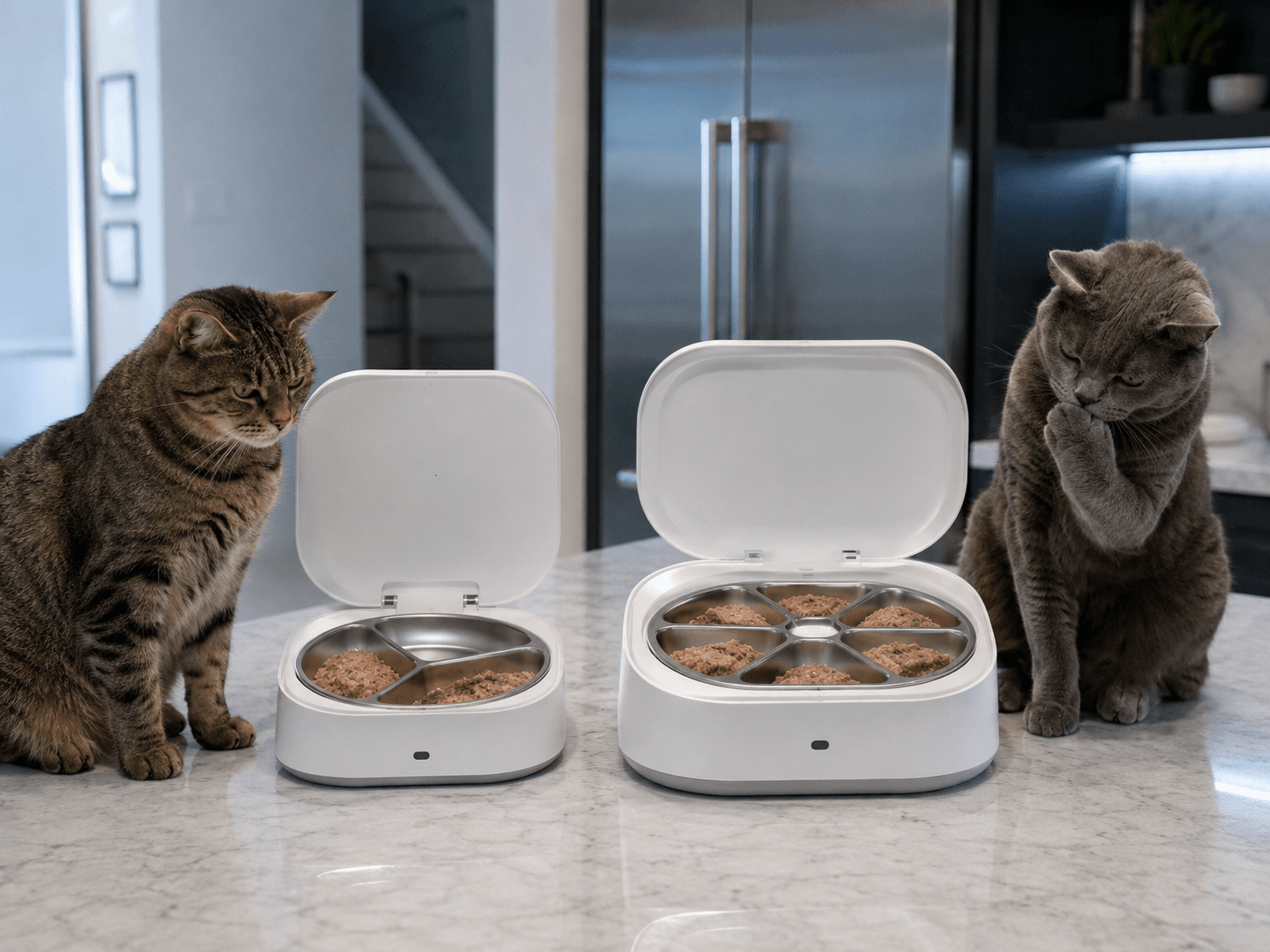
    Wet cat food cooling compared at different refrigerated feeder temperature targets.
    Both feeders cool wet food. Only FreshFeed currently claims a conventional 40°F target.

    PETLIBRO reports that Polar cools food to approximately 54°F when the room temperature is 77°F. The company says this slows bacterial growth and can preserve wet food for up to three days under its intended operating conditions. Cooling pauses about 30 minutes before a scheduled meal.

    PetSafe says FreshFeed uses semiconductor cooling and insulation to help maintain 40°F when used as directed. Its six-meal tray remains refrigerated between scheduled feedings.

    Those figures should not be treated as cosmetic differences.

    FDA guidance says unused or leftover canned and pouched pet food should be refrigerated promptly, with the refrigerator set to 40°F or below. Polar’s published 54°F result sits above that benchmark.

    That does not prove Polar makes every meal unsafe. Actual food temperature depends on room conditions, starting temperature, meal composition and operating time. It does mean Polar should not be described as equivalent to a conventional refrigerator simply because both devices make food colder than the kitchen.

    FreshFeed has the more convincing refrigeration specification.

    Polar is better understood as a chilled meal scheduler. FreshFeed is trying to behave more like a compact refrigerator with a rotating dinner calendar.

    The thermometer, for once, is less emotionally invested than the marketing department.

    Three Meals or Six?
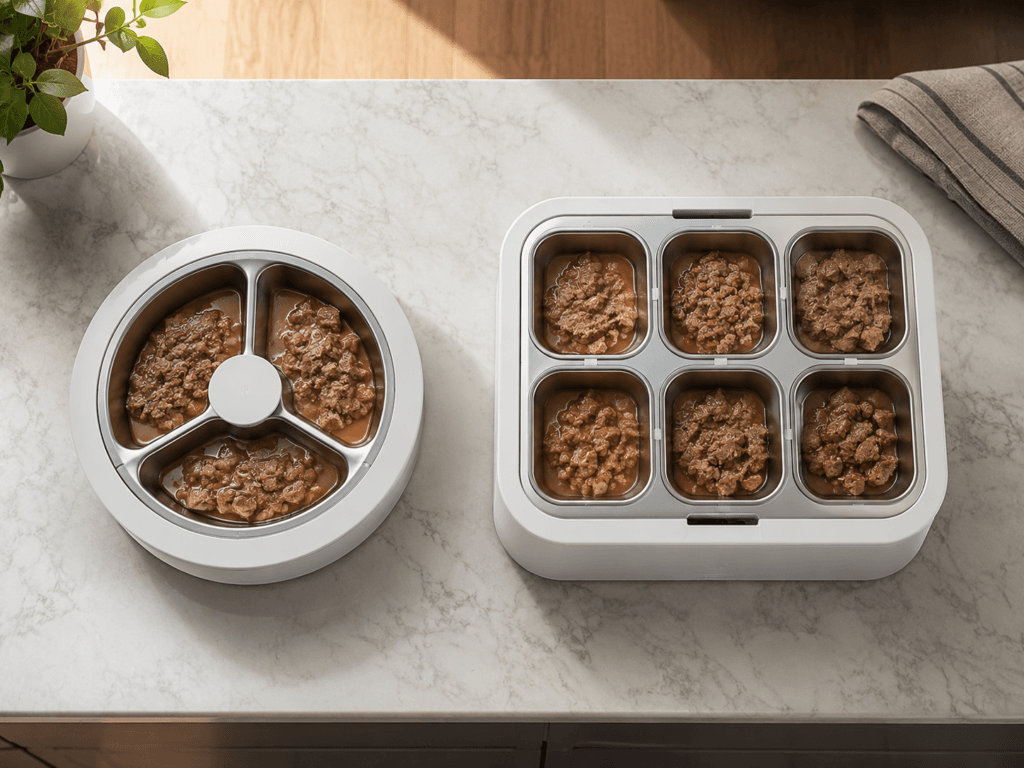
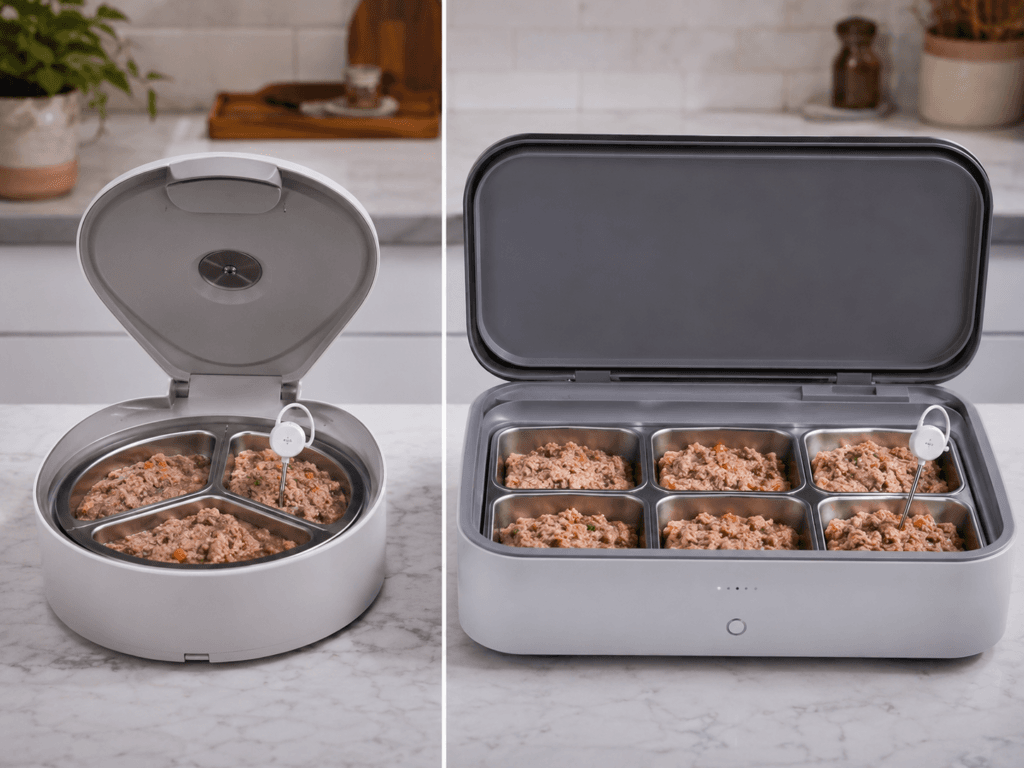
    Three-compartment and six-compartment refrigerated cat feeders compared.
    Three meals cover a normal day. Six meals give the schedule considerably more room to misbehave.

    Polar stores three prepared portions. That is enough for breakfast, dinner and the following morning—or three smaller meals during one day.

    FreshFeed doubles the count with six compartments and a total listed capacity of 4.5 cups. Its removable stainless-steel inserts are designed for preparation, serving and dishwasher cleaning.

    FreshFeed is the clearer fit for:

    • cats eating several small wet meals;
    • households preparing more than one day of portions;
    • meals containing toppers or supplements;
    • owners who do not want to refill after the third serving.

    Polar remains sufficient when the real problem is covering a normal day rather than establishing a refrigerated tasting menu.

    Capacity winner: FreshFeed.

    More compartments are not automatically better, but needing five meals and owning a three-meal feeder is a difficult disagreement to solve through firmware.

    Food Compatibility: FreshFeed Is Broader

    PETLIBRO positions Polar for commercial wet food, semi-moist food, prescription canned diets and rehydrated freeze-dried meals. It does not recommend raw food.

    PetSafe markets FreshFeed for wet, fresh and raw diets. That broader compatibility follows logically from its colder stated target, although compatibility is not the same as a guarantee of safe storage in every household.

    Raw food deserves particular caution. FDA testing has found raw pet food more likely than processed food to contain disease-causing bacteria. A feeder can provide cooling; it cannot negotiate a ceasefire with Salmonella.

    For ordinary canned wet food, both products are relevant. For fresh or raw feeding, FreshFeed has the stronger official case—but owners should still follow the food producer’s storage instructions and veterinary guidance.

    Polar Is Older. FreshFeed Is More Promising.

    FreshFeed is a recent product. Its early owner feedback is encouraging, but the available history is not yet large or old enough to answer the questions that matter after sustained use:

    • Does cooling remain stable?
    • Does the tray continue aligning correctly?
    • Do fans become louder?
    • Does condensation create recurring maintenance?
    • Does the app behave after several firmware updates?

    Calling it unreliable would be unfair. Calling it proven would be creative writing.

    Polar has been available longer and has accumulated more troubleshooting information around condensation, ice buildup, rotation and cooling performance. That makes its ownership friction easier to understand before purchase.

    It also carries a 24-month warranty, while PetSafe’s standard warranty is one year. PETLIBRO offers a 30-day direct return window; PetSafe allows direct returns within 45 days.

    The split is clean:

    • FreshFeed gives buyers the better specifications and longer direct trial period.
    • Polar gives buyers twice the warranty coverage and a more established support history.

    For an appliance containing cooling hardware, sensors, fans and a rotating tray, warranty length is not decorative typography.

    App, Cleaning and Power: No Clear Winner
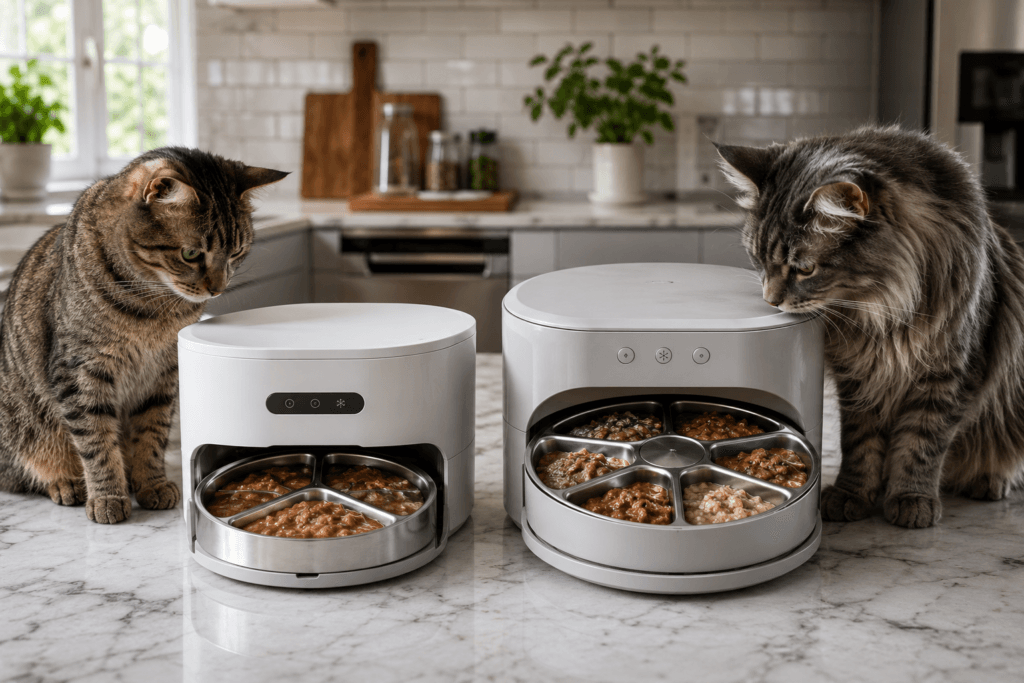
    Stainless-steel cat feeder trays being cleaned beside a refrigerated feeding base.
    Refrigeration reduces scheduling friction. It does not volunteer for dish duty.

    Both feeders use app-based scheduling and require wall power for normal refrigeration.

    Polar’s backup batteries can preserve scheduled tray movement for up to 12 hours during an outage, but they do not provide normal cooling performance. A meal rotating successfully is not proof that it remained refrigerated.

    FreshFeed does not advertise battery-backed refrigeration. After a meaningful outage, owners should evaluate the food rather than trusting the schedule notification.

    Both systems also require real cleaning. Polar’s cooling area can collect condensation, while FreshFeed adds six individual inserts and ventilation components. FreshFeed’s steel inserts are dishwasher-safe; the powered bases of both machines must be wiped rather than submerged.

    Neither product identifies which cat approaches the open meal. In a multi-cat home, dinner belongs to whoever arrives first with sufficient confidence.

    For individual access control, see our PETLIBRO One RFID vs SureFeed Connect comparison.

    Who Should Buy PETLIBRO Polar?

    Choose Polar when:

    • three scheduled meals are enough;
    • you serve ordinary canned or prescription wet food;
    • the 24-month warranty matters;
    • you prefer the product with the longer ownership history;
    • you are using it for shorter feeding windows;
    • you understand that 54°F is not equivalent to standard refrigerator storage.

    Polar remains useful. It is simply easier to recommend as a convenience tool than as a three-day food-safety argument.

    Verdict: Conditional.

    Check PETLIBRO Polar on Amazon.

    For a closer look at setup, app control and everyday ownership, read our PETLIBRO Polar review.

    Who Should Buy PetSafe FreshFeed?

    Choose FreshFeed when:

    • you need more than three prepared meals;
    • the 40°F manufacturer target matters;
    • you serve wet, fresh or raw food;
    • individual stainless-steel inserts appeal;
    • you accept a one-year warranty;
    • you are comfortable buying a newer product.

    FreshFeed offers the better answer to the central question: which machine makes the stronger refrigeration case?

    Our caution concerns maturity, not purpose. It is the more capable design on paper; it just has not yet completed the long and deeply glamorous process of aging in thousands of kitchens.

    Verdict: Conditional — comparison winner.

    Check PetSafe FreshFeed on Amazon.

    Final Verdict

    PetSafe FreshFeed wins.

    Its six-meal capacity and claimed 40°F target better match the reason most people consider a refrigerated feeder in the first place: keeping prepared wet food closer to standard refrigeration conditions until serving time.

    It remains Conditional because:

    • the temperature claim has not been independently verified by PetTech AI;
    • the product is still new;
    • long-term durability remains unclear;
    • the warranty lasts only one year.

    PETLIBRO Polar remains the lower-uncertainty option for three scheduled meals and offers stronger warranty coverage. Its published 54°F result, however, prevents it from winning a refrigeration-first comparison.

    Choose FreshFeed for colder storage and more meals.

    Choose Polar for shorter routines, fewer compartments and the longer warranty.

    One is the more familiar machine. The other brought the better thermometer.

    Frequently Asked Questions

    Is PETLIBRO Polar a real refrigerator?

    Polar uses thermoelectric cooling, but PETLIBRO reports approximately 54°F in a 77°F room. That is colder than room temperature but warmer than the FDA’s 40°F-or-below refrigerator guidance.

    Does FreshFeed always stay at exactly 40°F?

    PetSafe says it helps maintain 40°F when used as directed. Actual performance can depend on room temperature, ventilation, maintenance and food placement. PetTech AI has not independently verified the claim.

    Can either feeder stop another cat from eating the meal?

    No. Neither uses microchip or RFID identification. They schedule access by time, not by cat.

    What happens during a power outage?

    Normal refrigeration depends on wall power. Polar can continue rotating meals temporarily through backup batteries, but cooling stops. FreshFeed does not advertise refrigerated battery backup.

    References

    PETLIBRO — Polar Smart Wet Food Feeder Product Documentation
    PETLIBRO — Polar Cooling and Support Documentation
    PETLIBRO — Return and Warranty Policy
    PetSafe — FreshFeed Refrigerated Pet Feeder Product Documentation
    PetSafe — FreshFeed User Guide
    PetSafe — Return and Warranty Information
    FDA — Proper Storage of Pet Food and Treats
    FDA — Raw Pet Food Diet Safety Guidance

    Editorial Disclosure

    PetTech AI may earn a commission from qualifying purchases. This does not influence our recommendations, comparisons or editorial judgments.

    Image Disclosure

    Official manufacturer images are used when available and authorized.

    AI-generated images may also be used as editorial illustrations. They should not be treated as exact representations of product dimensions, materials, controls, temperatures or physical features. Always verify current official product information before purchasing.
  • Best Smart Litter Boxes (2026): Which One Actually Deserves Your Floor Space?

    Best Smart Litter Boxes (2026): Which One Actually Deserves Your Floor Space?

    A smart litter box promises to eliminate scooping.

    This is technically true in the same way a dishwasher eliminates washing dishes: the machine does the repetitive part, while you remain responsible for emptying, cleaning, refilling, troubleshooting, and wondering how something so expensive became covered in cat litter.

    Still, a good automatic litter box can meaningfully improve daily life.

    The important question is not which machine has the most sensors, the longest app dashboard, or the greatest number of synonyms for “odor control.”

    It is:

    Which box will your cat actually use—and which one reduces more work than it creates?

    This guide compares three models with different strengths:

    • PETKIT PuraMax 2 for the best overall balance;
    • CATLINK Luxury Pro-X for multi-cat usage data;
    • PetSafe ScoopFree SmartSpin as a simpler mainstream alternative with a more conditional reliability case.

    Research note: This is a research-led guide based on official documentation, current product information, public ownership evidence, and PetTech AI’s product-level trust checks. PetTech AI has not conducted long-term hands-on testing of every litter box included.

    Quick Verdict

    Your priorityBest fitRecommendation
    Best overall smart litter boxPETKIT PuraMax 2Strong recommendation
    Multi-cat usage and weight trendsCATLINK Luxury Pro-XStrong specialist recommendation
    Simpler mainstream smart alternativePetSafe ScoopFree SmartSpinConditional recommendation
    Very large, elderly, or mobility-limited catMeasure carefully—or keep a conventional boxPhysical fit matters more than the app
    Cat strongly prefers open boxesDo not force the upgradeA rejected smart box is expensive furniture

    The short version

    Choose PuraMax 2 when you want the strongest all-round combination of automation, odor management, app control, and everyday usability.

    Choose Luxury Pro-X when several cats share the litter area and individual usage records are worth checking.

    Choose SmartSpin when you want a recognizable mainstream option with simpler app monitoring—but only after reviewing current reliability feedback and return terms.

    And remember:

    A $500 litter box that the cat refuses to enter is not smart.

    The cardboard box it arrived in has won.

    Affiliate disclosure: This page contains affiliate links. PetTech AI may earn a commission if you purchase through them, at no additional cost to you. As an Amazon Associate I earn from qualifying purchases.

    Compare the Recommended Models

    First Pass the Cat Acceptance Test

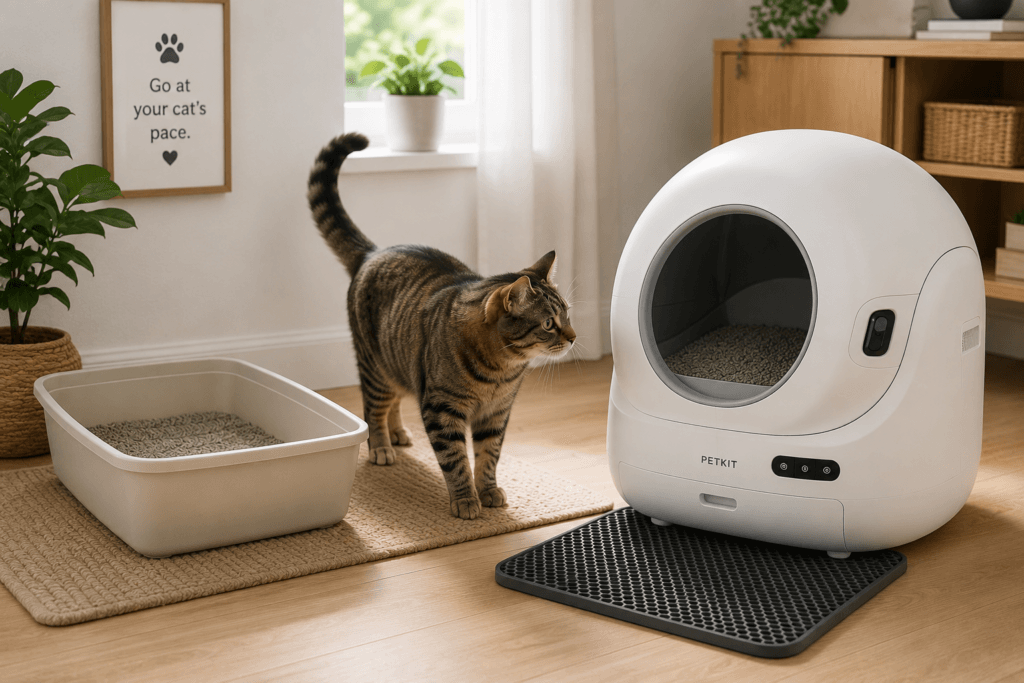
    A cat calmly exploring a new self-cleaning litter box placed beside a familiar traditional litter box
    A gradual transition gives cats time to accept a smart litter box without unnecessary stress.

    Before comparing apps, sensors, or deodorization cartridges, look at the animal expected to climb inside the machine.

    Ask:

    • Does the cat normally prefer open or covered boxes?
    • Is the entrance low enough?
    • Can the cat turn comfortably?
    • Is the cat unusually large?
    • Does arthritis or limited mobility make climbing difficult?
    • Is the litter area quiet enough for a motorized cleaning cycle?
    • Can the old box remain available during the transition?

    Many cats prefer larger, uncovered boxes with easy access. Older cats, kittens, and cats with mobility limitations may need lower sides, while large cats need enough room to enter, turn, dig, and exit comfortably.

    No app update can negotiate around a cat that has declared the new machine haunted.

    A gradual transition is essential:

    1. Place the smart box near the existing box.
    2. Leave automatic cycles disabled initially.
    3. Add familiar litter.
    4. Let the cat investigate without pressure.
    5. Keep the old box available until use is consistent.

    For homes deciding whether monitoring adds anything beyond automation, read Smart Cat Monitoring vs Automation.

    The machine is only half the system: our best litter for automatic litter boxes guide explains which formulas reduce broken clumps, smearing and clean-litter waste.

    PETKIT PuraMax 2: Best Overall

    PuraMax 2 is the strongest default recommendation because it does not depend on one specialist feature to justify itself.

    It combines:

    • automatic waste separation;
    • a relatively low entrance;
    • app-based usage and weight records;
    • proximity and weight-based safety systems;
    • a sealed waste area;
    • multiple odor-management options;
    • support for common clumping litter types;
    • a large enough interior for many adult cats.

    This is the machine for the owner who wants the entire litter routine to become easier—not merely more measurable.

    Buy it if

    • reducing daily scooping is the main goal;
    • odor containment matters;
    • you want useful alerts without making analytics the entire hobby;
    • one or more cats will share the machine;
    • you are willing to perform periodic deep cleaning;
    • you may later add other PETKIT products.

    Skip it if

    • your cat strongly prefers an open box;
    • floor space is limited;
    • the cat is exceptionally large or mobility-limited;
    • you expect the machine to eliminate all cleaning;
    • you dislike proprietary deodorizing accessories and app-connected care.

    Where it can disappoint

    PuraMax 2 is still a rotating plastic chamber containing litter, urine, and ambition.

    The automatic cycle removes clumps.

    It does not automatically clean:

    • the internal walls;
    • seams and edges;
    • the waste chute;
    • residue from high-urinating cats;
    • litter tracked onto the floor;
    • the machine’s exterior.

    PETKIT has improved the cylinder and leak-control design, but buyers should still consider their cat’s posture. A cat that consistently urinates high against internal surfaces can create more manual cleaning than the product photography suggests.

    The box also occupies meaningful floor space. Measure the room before discovering that your new litter robot has become the dominant architectural feature of the bathroom.

    Verdict: The best overall smart litter box in this guide because its automation, usability, odor management, and app features form a coherent everyday product.

    For a direct model-level comparison with Whisker, read PETKIT PuraMax 2 vs Litter-Robot 4.

    Multi-cat households considering camera-based identification should also read our Litter-Robot 5 Pro review before paying for the flagship model.

    For a direct monitoring-versus-simplicity decision, see Purobot Max Pro 2 vs Litter-Robot 4.

    PETKIT buyers choosing between AI monitoring and automated waste packing should compare Purobot Ultra and Max Pro 2.

    CATLINK Luxury Pro-X: Best for Multi-Cat Usage Data

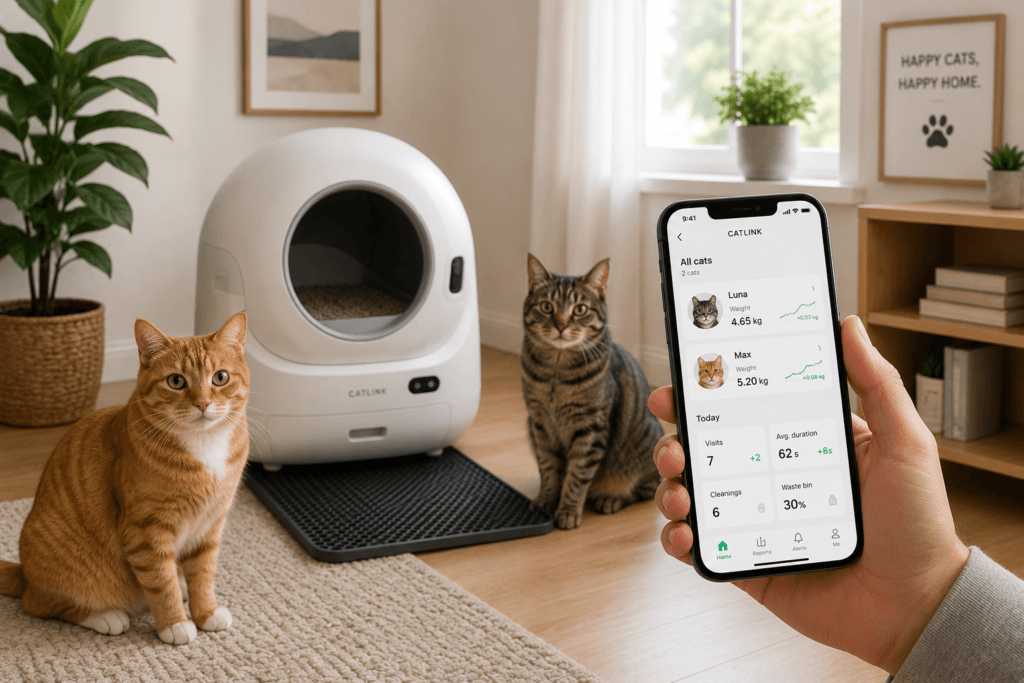
    Two cats near a smart litter box in a bright home while a smartphone shows simple usage tracking
    Usage data can be most useful in multi-cat homes, where changes are otherwise harder to notice.

    Luxury Pro-X makes its strongest case in a home where several cats share the litter area.

    A single-cat household already knows who used the box.

    A five-cat household may know only that somebody has been extremely productive.

    CATLINK adds:

    • automatic cleaning;
    • app control;
    • weight-based cat identification;
    • usage histories;
    • waste-drawer alerts;
    • odor-management features;
    • individual profiles and routine trends.

    This makes the data layer more useful than it would be in a simple household.

    Buy it if

    • multiple cats use the same litter box;
    • individual weight and visit trends matter;
    • you will actually review the app;
    • a particular CATLINK design fits the room and cats;
    • litter-box monitoring is the main reason you are considering the CATLINK ecosystem.

    Skip it if

    • you mostly want the easiest default recommendation;
    • cats have very similar weights;
    • nobody will check the records;
    • you are choosing it because “health monitoring” sounds reassuring;
    • you intend to buy the entire CATLINK ecosystem before evaluating the first product.

    Where it can disappoint

    Weight-based identification has practical limits.

    When cats differ clearly in size, the system has a better chance of associating visits correctly. When two cats weigh almost the same, the app may be less certain than the marketing department.

    Usage data can still be valuable, but it must remain evidence rather than diagnosis.

    The box may show:

    • a change in visit frequency;
    • a weight trend;
    • shorter or longer visits;
    • a change in routine.

    It cannot reliably explain why that change occurred.

    The app records the event.

    It has not completed veterinary school.

    Luxury Pro-X also requires the same unglamorous ownership work as its competitors: waste removal, interior cleaning, litter management, sensor care, and occasional troubleshooting.

    Verdict: A credible specialist choice for multi-cat households that will genuinely use individual litter-box records—not simply admire the dashboard during setup.

    For the broader brand decision, read CATLINK vs PETKIT.

    PetSafe ScoopFree SmartSpin: Best Mainstream Alternative—with Caveats

    SmartSpin offers a simpler proposition:

    • the cat exits;
    • the drum rotates;
    • waste moves into a sealed drawer;
    • the app records usage and weight;
    • the owner empties the drawer later.

    PetSafe gives it a relatively low-profile entrance, a smooth interior designed to simplify wipe-down cleaning, a 6 L sealed waste drawer, app alerts, and compatibility with clumping litter.

    This makes SmartSpin attractive to first-time automatic-litter-box buyers who want something more connected than an old rake system but less ecosystem-heavy than PETKIT or CATLINK.

    Buy it if

    • you want a mainstream pet-care brand;
    • basic app tracking is enough;
    • the lower entrance suits your cat;
    • a sealed drawer is a major part of the appeal;
    • you have verified favorable return terms;
    • current reliability feedback is reassuring enough for your risk tolerance.

    Skip it if

    • you want the strongest proven recommendation in the guide;
    • detailed individual multi-cat identification matters;
    • you want the broadest ecosystem;
    • mechanical reliability is more important than a lower entry price;
    • mixed ownership experiences make you uncomfortable.

    Where it can disappoint

    SmartSpin has a less reassuring and more polarized market record than PuraMax 2 and Luxury Pro-X.

    The recurring areas worth checking before purchase include:

    • interrupted cleaning cycles;
    • sensor behavior;
    • litter or waste adhering to internal surfaces;
    • odor containment;
    • operating noise;
    • litter tracking;
    • longer-term mechanical consistency.

    That does not mean every SmartSpin is waiting to betray its owner.

    It means the product deserves a conditional recommendation rather than being presented beside the stronger picks as though all three have identical evidence.

    PetSafe’s smooth interior and simpler cleaning design are meaningful advantages. They matter only while the machine continues performing its main job reliably.

    Verdict: A legitimate mainstream alternative for buyers who want app-connected automation and sealed waste handling, but not the safest default pick.

    The 3 A.M. Test

    A useful smart litter box should remain tolerable when it rotates at 3 a.m.

    PuraMax 2

    You receive a clean litter bed, an app record, and perhaps a reminder that the waste drawer will eventually require human participation.

    Luxury Pro-X

    You receive a clean litter bed and a better idea of which cat conducted the overnight operation.

    SmartSpin

    You receive a clean litter bed—provided the cycle and sensors behave consistently.

    A conventional litter box

    Nothing rotates.

    Nothing sends a notification.

    The cat uses it anyway.

    This is why the smartest choice is not always the model with the longest specification table.

    It is the machine whose extra complexity continues to earn its place.

    Buyer Regret in One Table

    ProductMost likely regret
    PuraMax 2Expecting automatic scooping to mean automatic deep cleaning
    Luxury Pro-XPaying for data that nobody checks—or cannot cleanly distinguish similar cats
    SmartSpinChoosing the simpler alternative and later encountering reliability friction
    Any smart litter boxDiscovering the cat prefers the old plastic tray
    Any enclosed modelIgnoring physical size, mobility, or open-box preference

    Odor Control: What the Marketing Usually Leaves Out

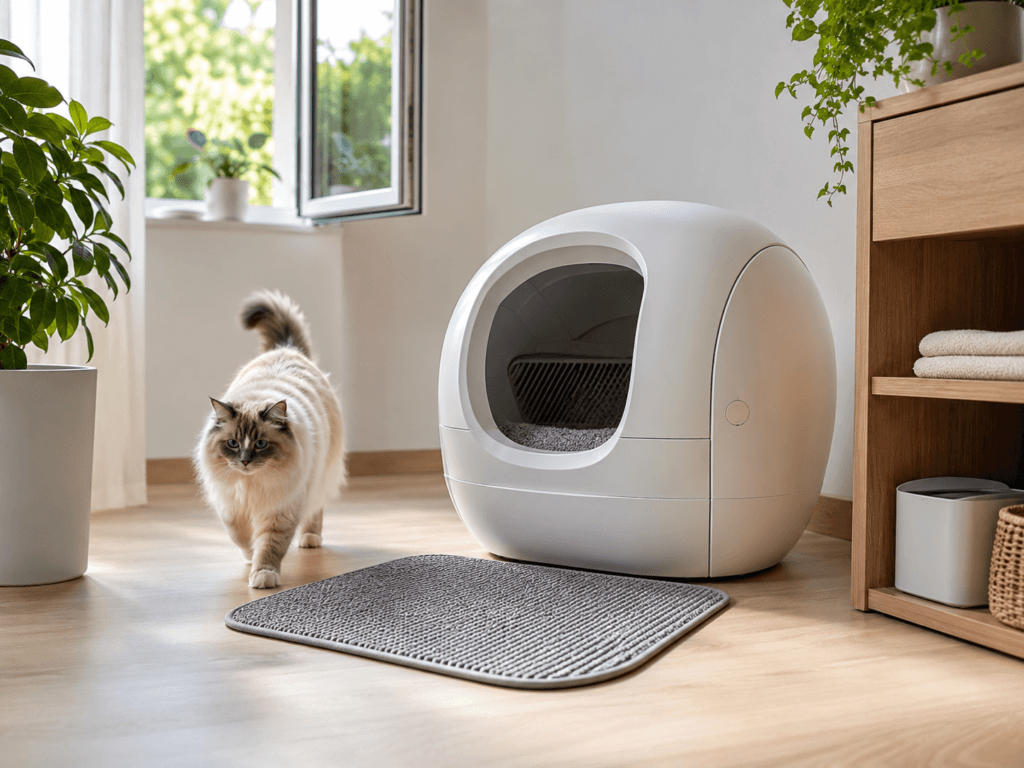
    A clean litter area with a self-cleaning litter box, litter mat, and fresh airflow in a modern home
    Automatic cleaning helps with odor only when waste removal, litter maintenance, and airflow work together.

    A sealed waste drawer helps.

    Automatic removal helps.

    Deodorizing cartridges may help.

    None of them permanently defeats the chemical reality of stored cat waste.

    Odor control still depends on:

    • emptying the drawer before it becomes a biological research project;
    • cleaning internal surfaces;
    • using compatible litter;
    • preventing damp buildup;
    • cleaning mats and surrounding floors;
    • maintaining reasonable room ventilation.

    The best odor-control system is still removal plus cleaning.

    The app cannot push-notify ammonia into another dimension.

    One Smart Box May Still Not Be Enough

    In multi-cat homes, a single automatic litter box should not automatically replace every other box.

    Cats may have:

    • different location preferences;
    • territorial conflicts;
    • different tolerance for enclosed spaces;
    • mobility differences;
    • preferences for different litter types.

    General feline guidance commonly recommends providing as many litter boxes as cats, plus one, distributed in accessible areas.

    Real homes may not always follow that formula perfectly, but the principle matters: one premium machine does not guarantee that several cats suddenly want to share one bathroom.

    Keep an additional box when:

    • introducing the smart model;
    • cats have a history of conflict;
    • the home has several floors;
    • one cat avoids the machine;
    • reliable access matters during power or mechanical problems.

    Which Smart Litter Box Should You Buy?

    Choose PuraMax 2 when:

    • you want the strongest all-round recommendation;
    • automation and odor management matter most;
    • you want useful app monitoring without making data the sole purpose;
    • the cats fit comfortably.

    Choose Luxury Pro-X when:

    • multiple cats share the litter area;
    • individual usage trends justify the extra monitoring;
    • CATLINK’s litter-box system wins your product-level comparison;
    • you will evaluate other CATLINK products separately.

    Choose SmartSpin when:

    • you want the simpler mainstream alternative;
    • lower entry and smooth cleaning surfaces are appealing;
    • recent buyer feedback and return protection reduce the risk enough;
    • you accept a less confident recommendation.

    Choose none of them when:

    • your cat strongly rejects enclosed boxes;
    • mobility makes entry difficult;
    • you cannot keep a backup box;
    • you expect zero maintenance;
    • the budget would create more stress than daily scooping.

    Final Verdict

    PETKIT PuraMax 2 is the best smart litter box in this guide for most households.

    It offers the most convincing balance of cleaning automation, odor management, app features, safety systems, and everyday usability. It is not maintenance-free, but its main strengths remain useful after the novelty disappears.

    CATLINK Luxury Pro-X is the better specialist choice for data-conscious multi-cat homes.

    Its usage records and weight-based identification can provide valuable context when several cats share the box. Buy it because that information solves a real uncertainty—not because CATLINK has given the litter drawer a health dashboard.

    PetSafe ScoopFree SmartSpin remains a conditional mainstream alternative.

    Its sealed drawer, lower profile, app monitoring, and smooth interior are appealing. Its more mixed ownership history means buyers should examine current reliability feedback and return protection before choosing it over the stronger recommendations.

    The winner is therefore:

    1. PuraMax 2 — best overall
    2. Luxury Pro-X — best for multi-cat data
    3. SmartSpin — acceptable mainstream alternative with caveats

    A smart litter box should reduce the amount of time you spend thinking about cat waste.

    When the machine itself becomes the main thing you think about, the automation has lost the argument.

    Frequently Asked Questions

    Which smart litter box is best overall?

    PETKIT PuraMax 2 offers the strongest overall balance for most buyers. Luxury Pro-X becomes more compelling when multi-cat usage data is a central requirement.

    Which model is best for multiple cats?

    CATLINK Luxury Pro-X is the stronger data-focused option. However, multiple cats may still need additional litter boxes in separate locations.

    Is PetSafe SmartSpin worth considering?

    Yes, as a conditional alternative. Its design and app features are useful, but buyers should inspect current reliability feedback and return terms before purchasing.

    Do automatic litter boxes eliminate cleaning?

    No. They reduce daily scooping but still require drawer emptying, litter refilling, interior cleaning, sensor care, and surrounding-floor maintenance.

    Can smart litter boxes detect illness?

    They may reveal changes in weight or litter-box routine. They cannot diagnose the cause. Meaningful or persistent changes require direct observation and, when appropriate, veterinary evaluation.

    What if my cat refuses the smart litter box?

    Keep the previous box available, disable automatic movement initially, use familiar litter, and introduce the machine gradually. Do not force the transition by removing every alternative immediately.

    References

    • PETKIT PuraMax 2 official product and support documentation
    • CATLINK Luxury Pro-X official product and app documentation
    • PetSafe ScoopFree SmartSpin official product and support documentation
    • Cornell Feline Health Center litter-box behavior and accessibility guidance
    • Public ownership evidence reviewed during PetTech AI’s product-level trust checks

    Image Disclosure

    Some images in this article may be AI-generated for illustrative purposes. They do not depict the exact products and should not be used to evaluate dimensions, entrances, controls, or physical fit.

    Disclosure

    PetTech AI may earn a commission when readers purchase through affiliate links. Every litter box is evaluated at product level; belonging to a smart ecosystem does not automatically earn a recommendation.