Category: Feeding & Nutrition

Smart solutions for your cat’s daily meals and hydration. Discover the best feeders, fountains, and treat dispensers to keep your feline healthy in 2025.

  • How to Stop a Cat From Overeating in 2025: Vet-Backed Strategies & Smart Feeding Tech

    How to Stop a Cat From Overeating in 2025: Vet-Backed Strategies & Smart Feeding Tech

    Indoor cats in 2025 have a strange problem: they’re safer than ever, but surrounded by constant calories. Bottomless bowls, high-calorie dry food, and boredom all work together until you’re asking the same question as thousands of other owners: how do I actually stop a cat from overeating without making them miserable?

    The short answer: you don’t “fix” it with one gadget or a smaller scoop. To stop a cat from overeating in a sustainable way, you have to work on three fronts at once:

    • Calories and portions (how much they eat)
    • Feeding structure (when and how they eat)
    • Environment and boredom (why they’re so focused on food)

    This guide walks through all three, with practical steps and smart-home tools you can plug into your existing setup.


    Why Overeating Is a Bigger Deal Than “A Few Extra Pounds”

    A lot of owners only try to stop a cat from overeating when the belly is already obvious. That’s late.

    Excess weight in cats is strongly linked to:

    • diabetes mellitus
    • arthritis and joint pain
    • heart and respiratory strain
    • lower activity and more frustration
    • shorter overall lifespan

    The brutal part: cats are small. An extra 1–2 pounds on a 10-pound cat is the equivalent of a human gaining dozens of pounds. Letting overeating slide for “just a bit” can quietly turn into chronic disease.

    If your cat:

    • finishes food instantly
    • begs between meals
    • raids other bowls
    • or vomits from eating too fast

    …you’re beyond a “quirk” and firmly in behavior + management problem territory. That’s exactly where you can still turn it around.


    Step One: Is Your Cat Overeating or Just Underfed?

    You can’t stop a cat from overeating if you’re misreading hunger signals. Some cats are genuinely underfed; others are just opportunists.

    Check three things first:

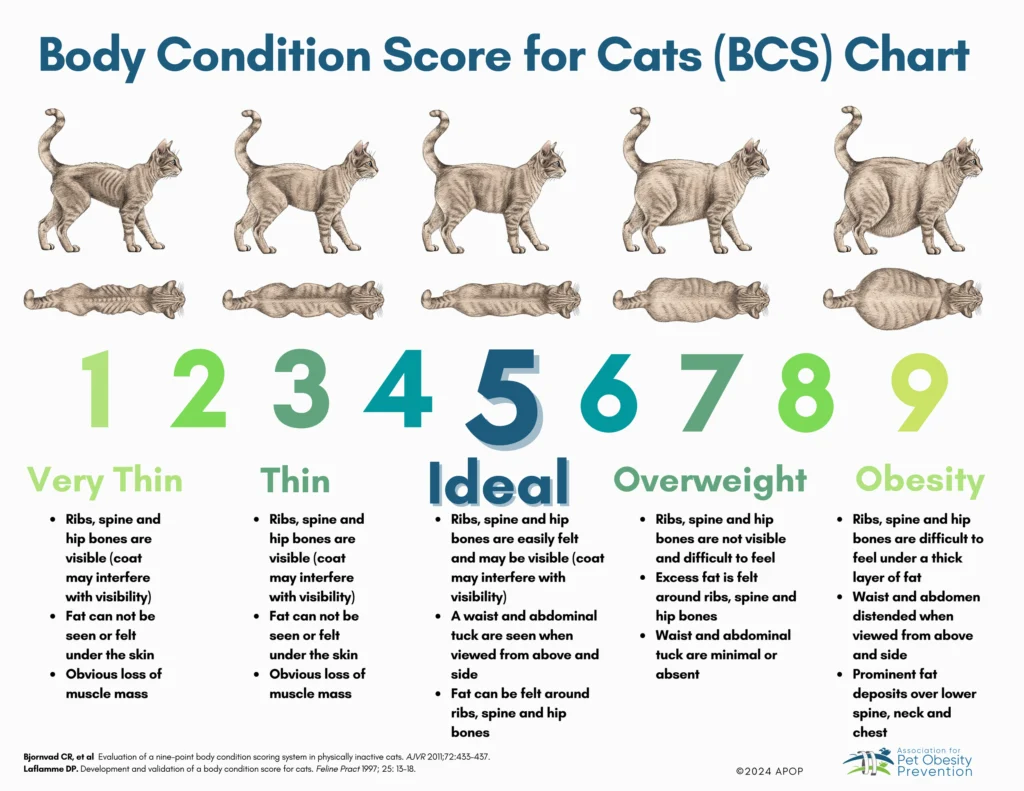
    1. Body condition score (BCS)
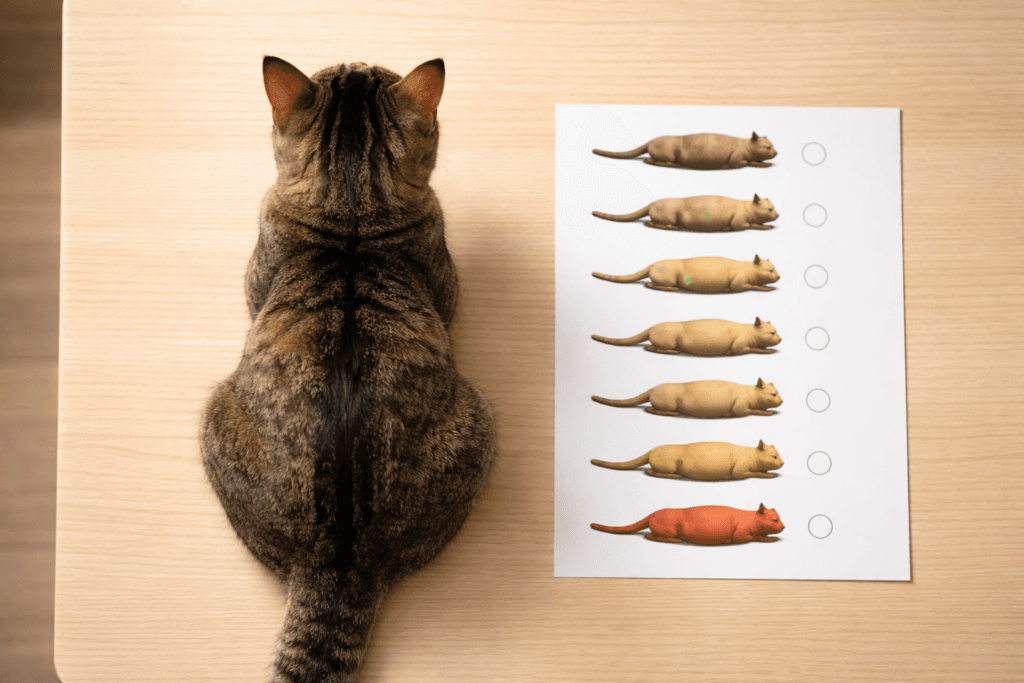
      • Can you feel ribs with a light touch but not see them?
      • Is there a defined waist from above?
      • If your cat is rounded with no waist and a belly pouch that swings, that’s excess fat, not just “fluff.”
    2. Daily calories vs. ideal weight
      • Many indoor adults do well around 180–220 kcal/day, but it depends on size, age, and activity.
      • If you’re free-pouring kibble or “eyeballing” portions, you have no idea where you are.
    3. Feeding pattern
      • Free access to dry food?
      • Extra snacks “whenever they ask”?
      • Multiple family members feeding without coordination?

    If BCS is high and calories are unmeasured, you’re not dealing with true hunger. You’re dealing with a system that silently taught your cat that food is always available if they push hard enough.


    Why Cats Obsess Over Food: Root Causes You Can Actually Fix

    To stop a cat from overeating, you have to hit the upstream causes, not just clamp down on portions and hope for the best.

    Common drivers:

    • Free-feeding habits – the bowl is always full, so eating becomes a hobby.
    • Boredom and lack of enrichment – nothing to do, nowhere to climb, no predictable play → food becomes the main event.
    • Stress and resource competition – in multi-cat homes, anxious cats may eat fast or guard food because they’re afraid it will be taken.
    • Highly palatable food – energy-dense dry diets with lots of fat and flavor can push cats to eat past satiety.

    The good news: every one of these can be modified with a combination of routine, environment, and smart tools.


    How to Stop a Cat From Overeating: Core Feeding Strategy

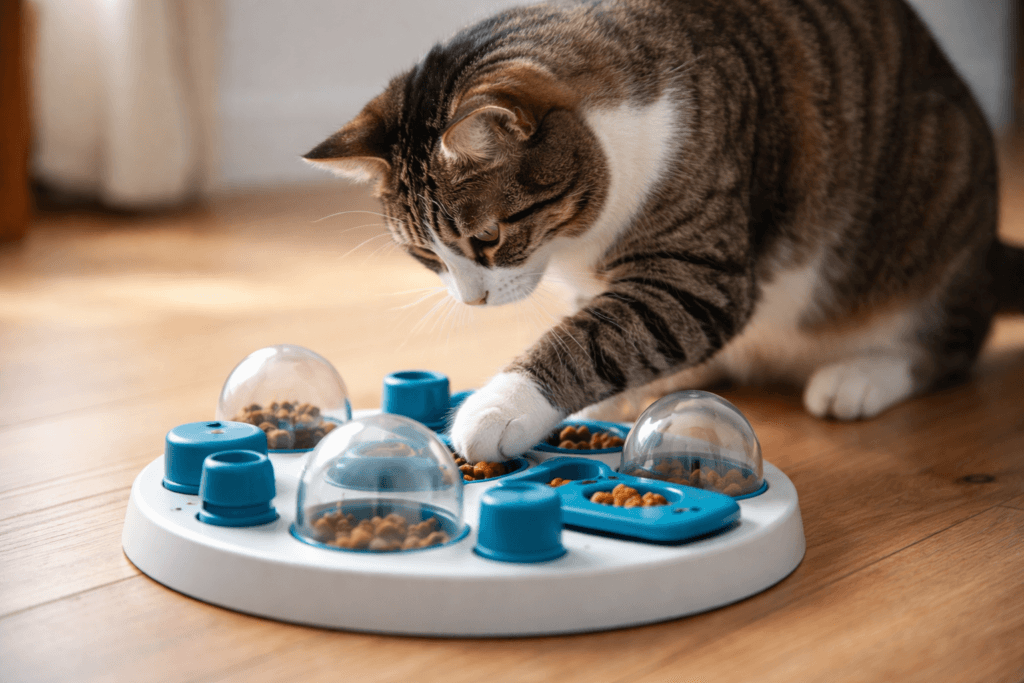
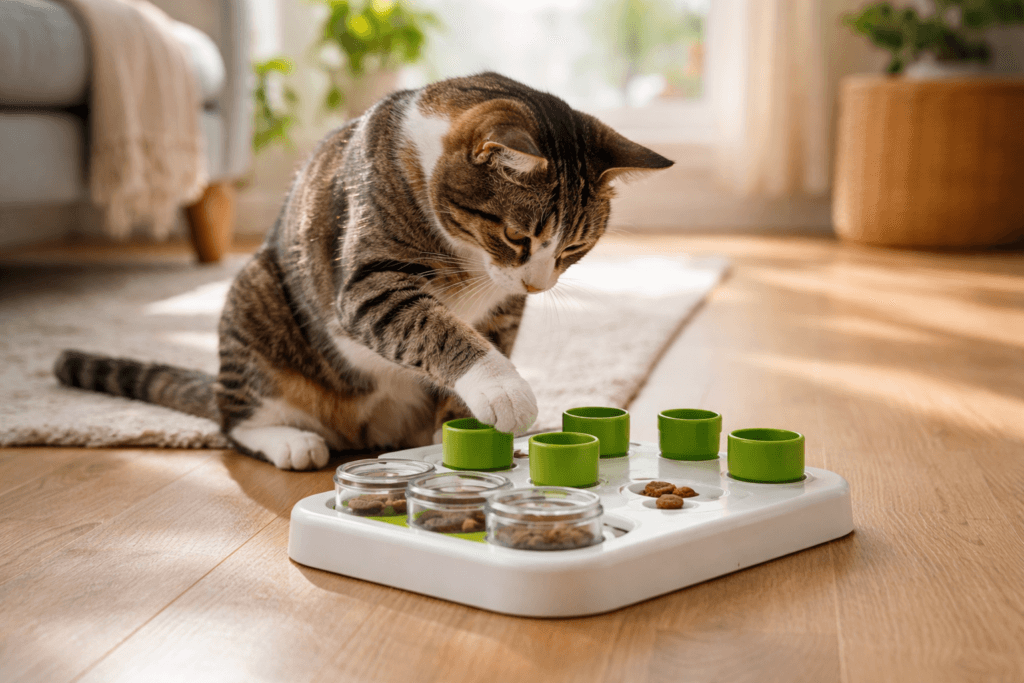
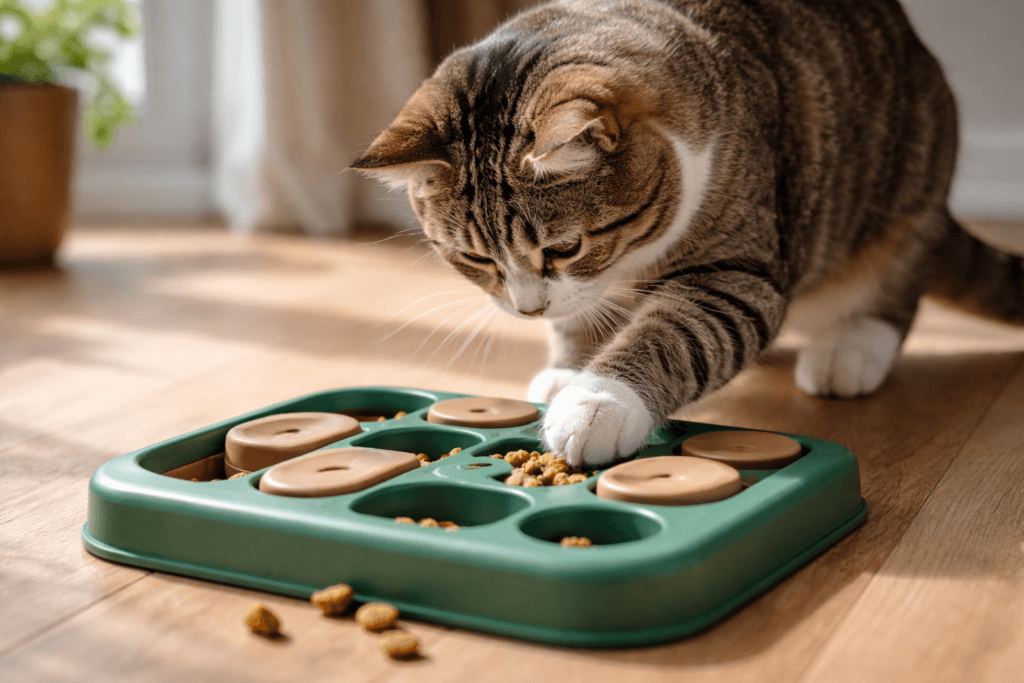
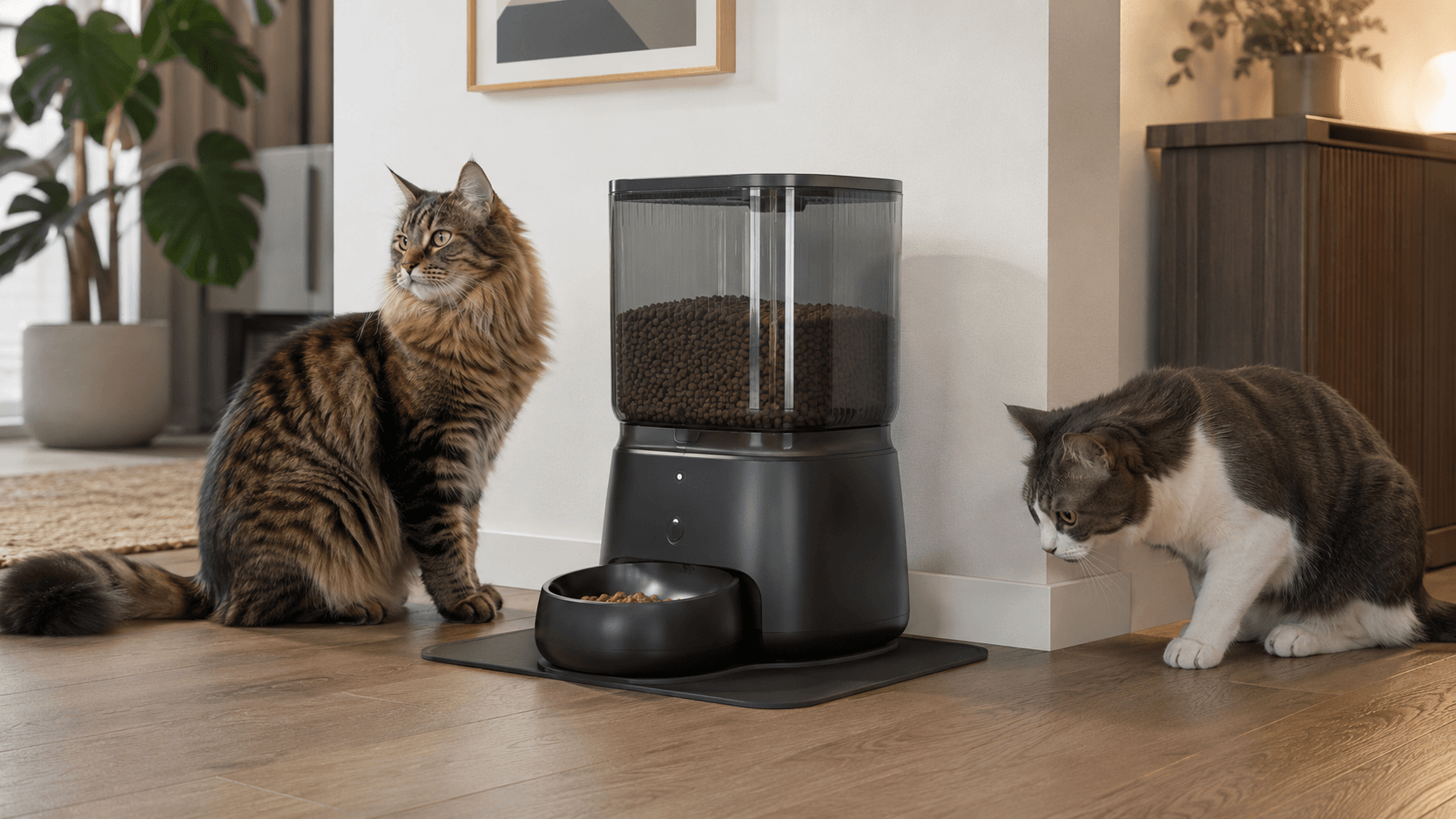
    Slow feeder, puzzle feeder and treat ball used to stop a cat from overeating

    Here’s the spine of the system you want to build.

    1. Ditch Bottomless Bowls

    You cannot stop a cat from overeating if the food is literally never “over.”

    • Move to meal feeding: 2–4 small meals per day, depending on your cat’s age and health.
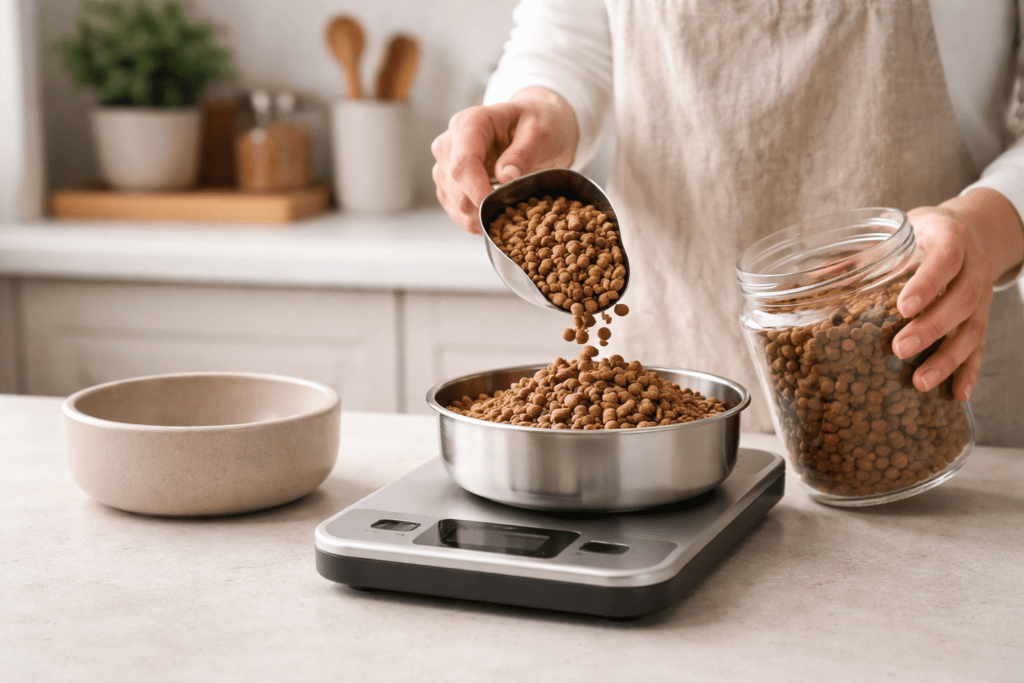
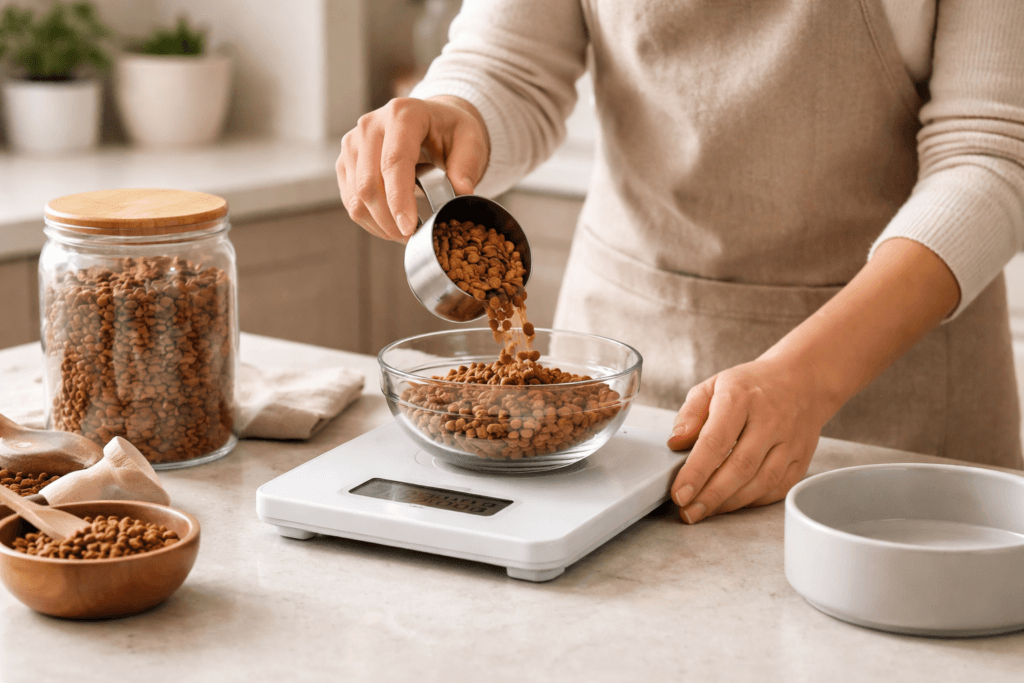
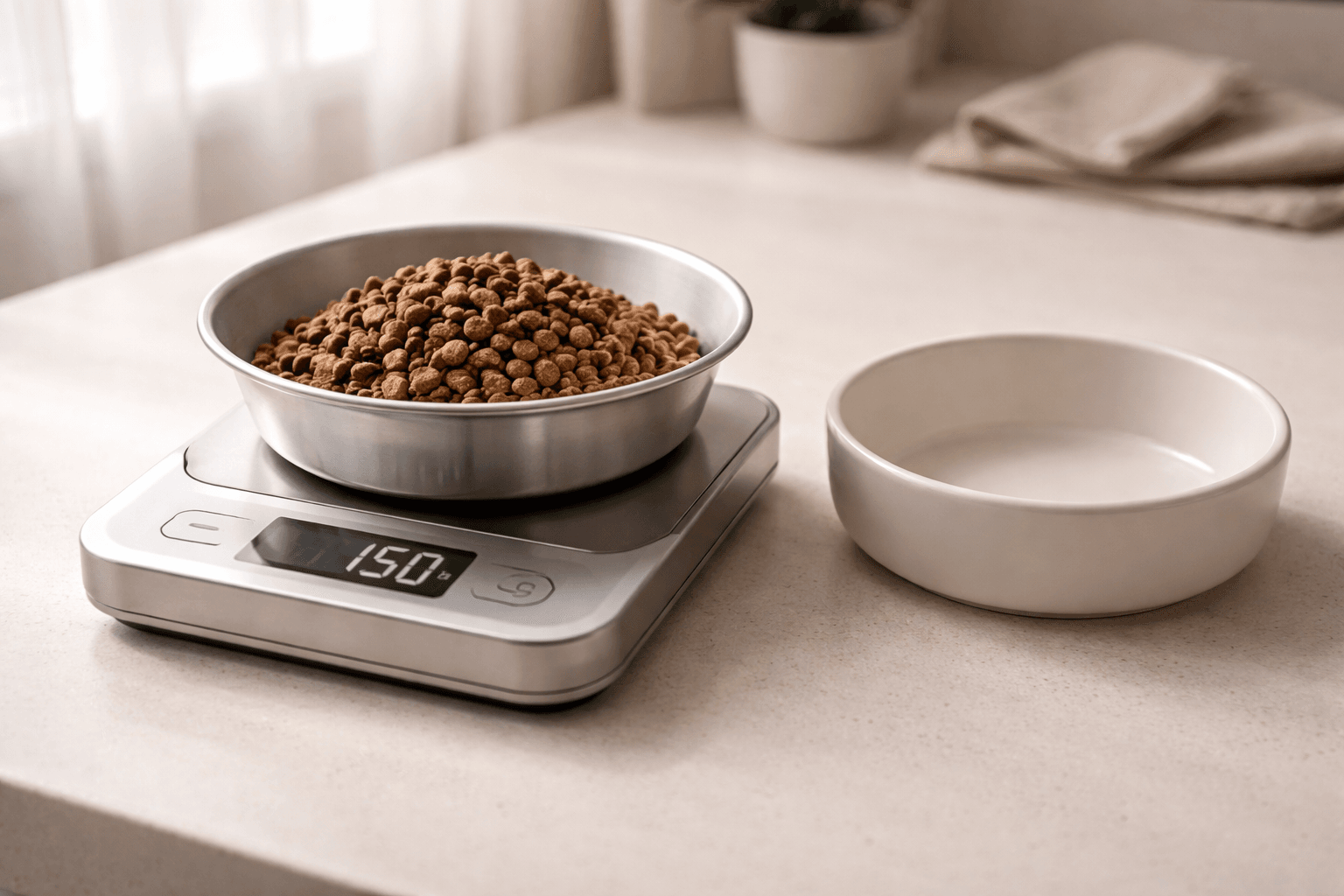
    • Measure food with a real measuring cup or gram scale. “Half a scoop” is not a unit.

    If you’re worried about your schedule, this is where smart feeders start to earn their place.

    If you want a practical, low-effort way to manage portions and feeding schedules, check out our PETKIT Fresh Element Infinity Review 2025 or explore our Best Smart Cat Feeders 2025 guide.


    2. Set a Realistic Calorie Target

    To stop a cat from overeating safely, you need a target — not guesswork.

    • Ask your vet for an ideal weight and calorie plan, especially if your cat is already overweight.
    • As a rough orientation:
      • many indoor neutered cats land around 20 kcal per pound of ideal weight per day, then adjusted up or down based on response
    • Divide that daily total into 2–4 meals.

    If weight is dropping too fast (more than ~1–2% of body weight per week), increase calories and talk to your vet. Too rapid loss can be dangerous for cats.


    3. Use Slow Feeding to Break the “Inhale and Panic” Cycle

    If you want to stop a cat from overeating and curb vomiting, how they eat is as important as how much.

    Tools that help:

    • Slow-feed bowls with ridges that force smaller mouthfuls
    • Puzzle feeders that require batting, nudging or hunting for kibble
    • Treat balls or tracks that reward movement with food

    Behaviorally, this:

    • stretches meal time
    • adds mental and physical effort
    • reduces the “I must inhale everything in 30 seconds” reflex

    If you want toys that support weight control and reduce food-obsessed behavior, take a look at our Best Interactive Cat Toys 2025 guide — and browse our recommended puzzle and foraging feeders for extra enrichment.


    4. Anchor Meals to a Predictable Schedule

    Cats thrive on routine. An underrated way to stop a cat from overeating is to make feeding times boringly predictable.

    • Feed at the same times each day, as much as your life allows.
    • Ignore begging outside those windows — no eye contact, no talking, no “just a little snack.”
    • Use a smart feeder for early-morning or late-night slots so you’re not being trained by 4 a.m. meowing.

    Within 1–2 weeks, most cats adapt: they shift from constant lobbying to anticipating the real meal times.


    5. Replace “Food Attention” With “Play Attention”

    Many owners subconsciously reward food obsession with engagement: every meow gets a comment, every trip to the kitchen gets a follower.

    If your cat learns that:

    “Any time I scream about food, I get interaction,”

    …food becomes their primary communication tool.

    To stop a cat from overeating long-term, you have to break that link:

    • Keep food interactions neutral and brief.
    • Schedule play sessions (5–10 minutes) at predictable times, especially before meals and in the evening.
    • Reward calm resting near you with petting or quiet praise, not just food.

    You’re teaching your cat that attention is abundant, but food is structured.


    Using Smart Pet Tech Without Letting It Backfire

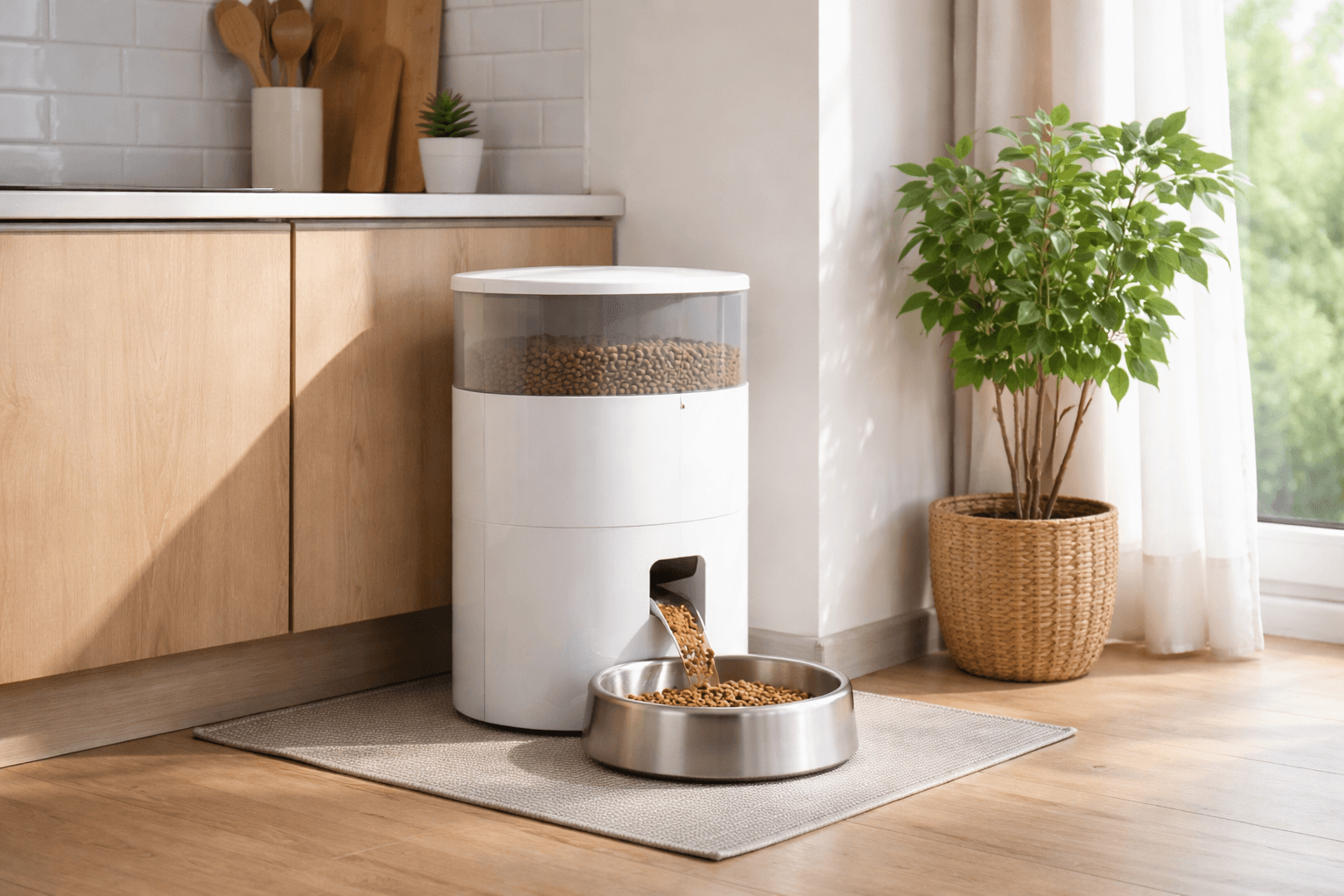
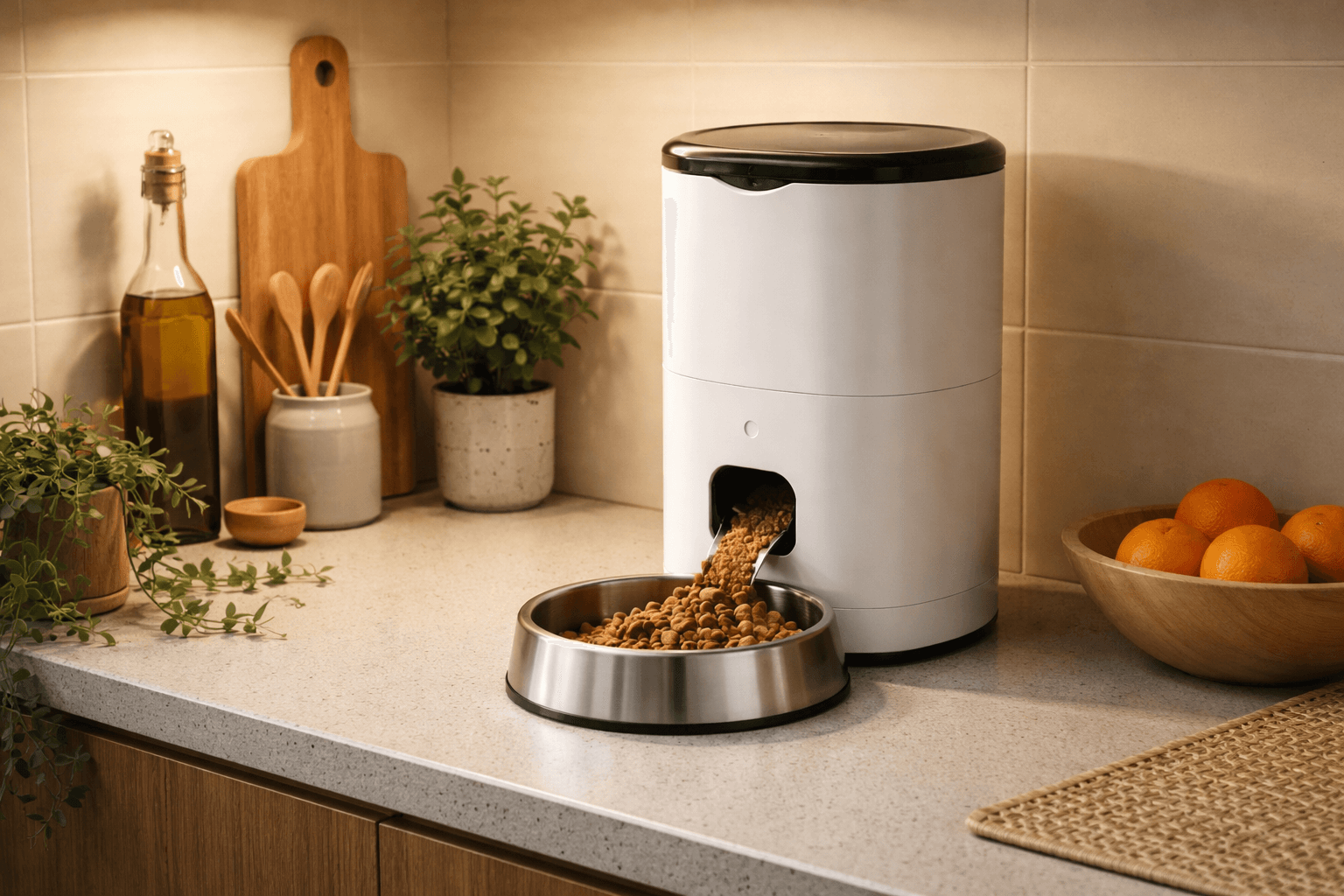
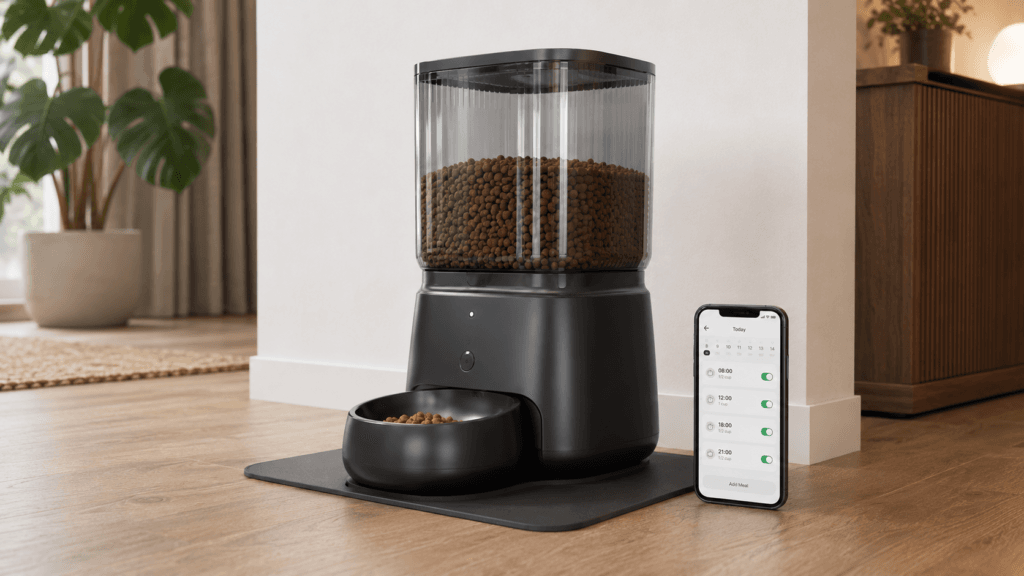
    Smart cat feeder dispensing a scheduled meal for portion control

    Smart feeders and ecosystems are powerful, but they can also silently sabotage your attempt to stop a cat from overeating if used badly.

    Smart Feeders: When They Help

    They’re genuinely useful when you:

    • need consistent portion sizes and timing
    • are away for long hours or shifts
    • are prone to “just one extra scoop” decisions

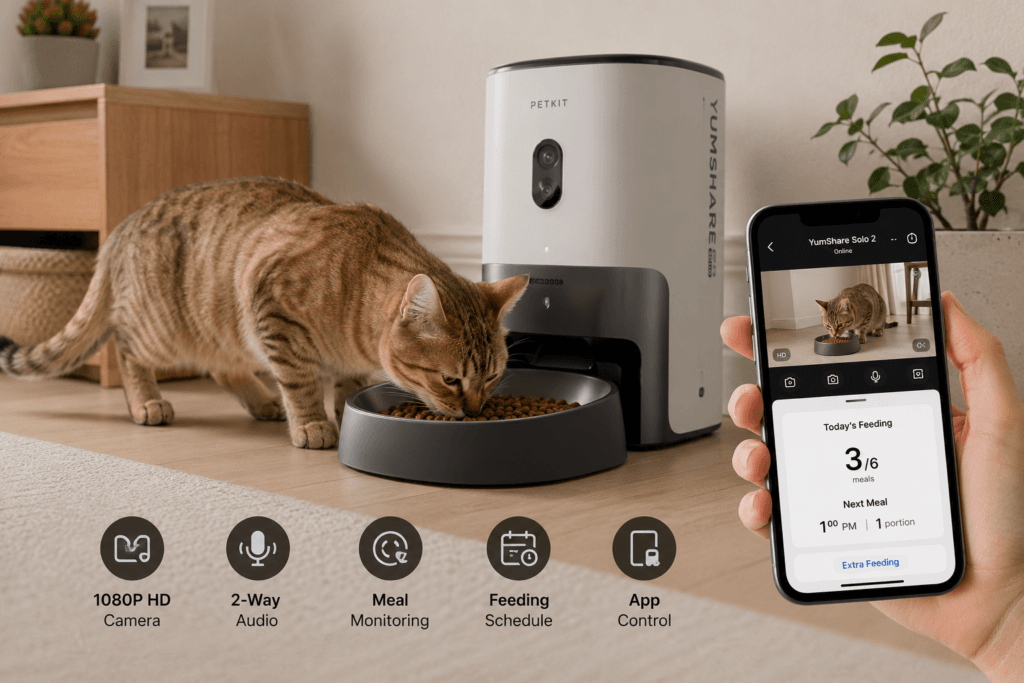
    A well-set-up device like the PETKIT Fresh Element Infinity or similar smart feeders can:

    • split daily calories into multiple small meals
    • log exactly how much was dispensed and when
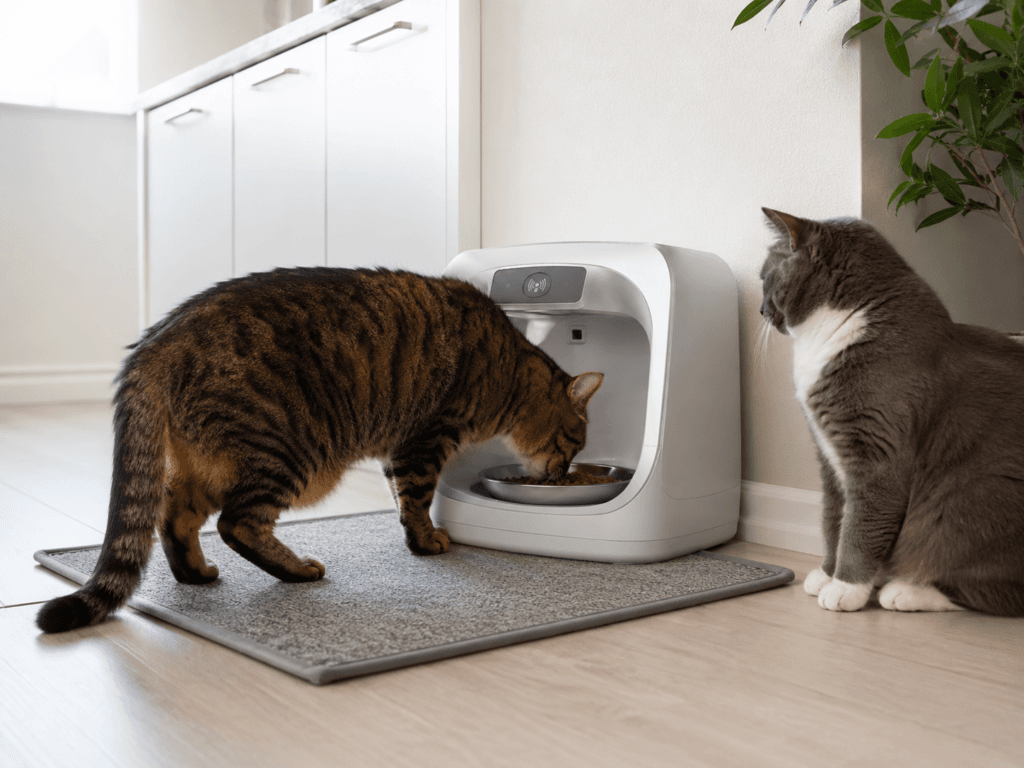
    • prevent one cat from bullying another away from the bowl (paired with microchip/RFID feeders)

    Used correctly, smart feeders make it easier, not harder, to stop a cat from overeating because they take your mood and guilt out of the equation.

    Smart Feeders: When They Hurt

    They’re a problem when you:

    • constantly trigger extra “snack” portions from the app
    • ignore the logs and keep adding “just in case”
    • combine auto-feeding with a second open bowl “for backup”

    Tech doesn’t fix discipline. It just makes your decision more visible — or more consistently wrong.


    Multi-Cat Homes: Stopping One Cat From Overeating Without Starving the Others

    If you live with more than one cat, it’s almost impossible to stop a cat from overeating without some version of controlled access.

    Options:

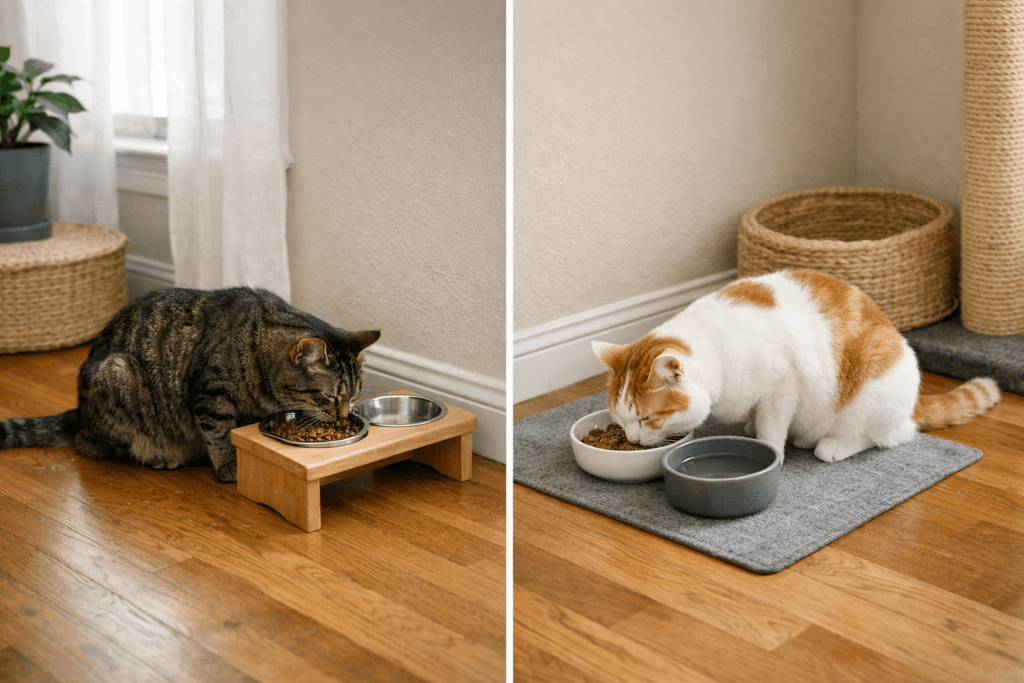
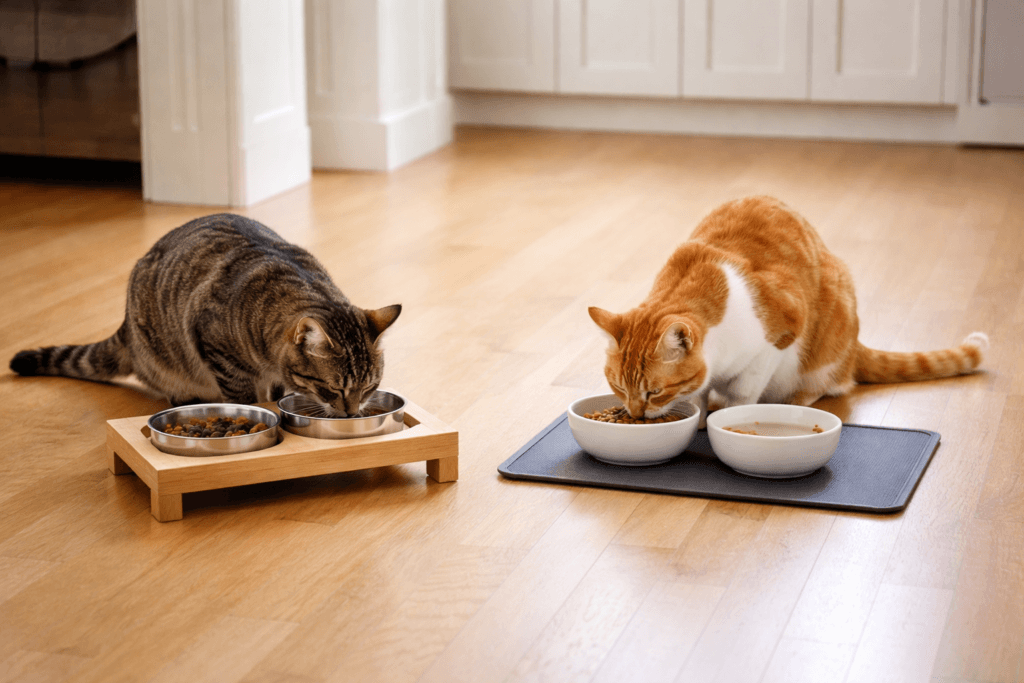
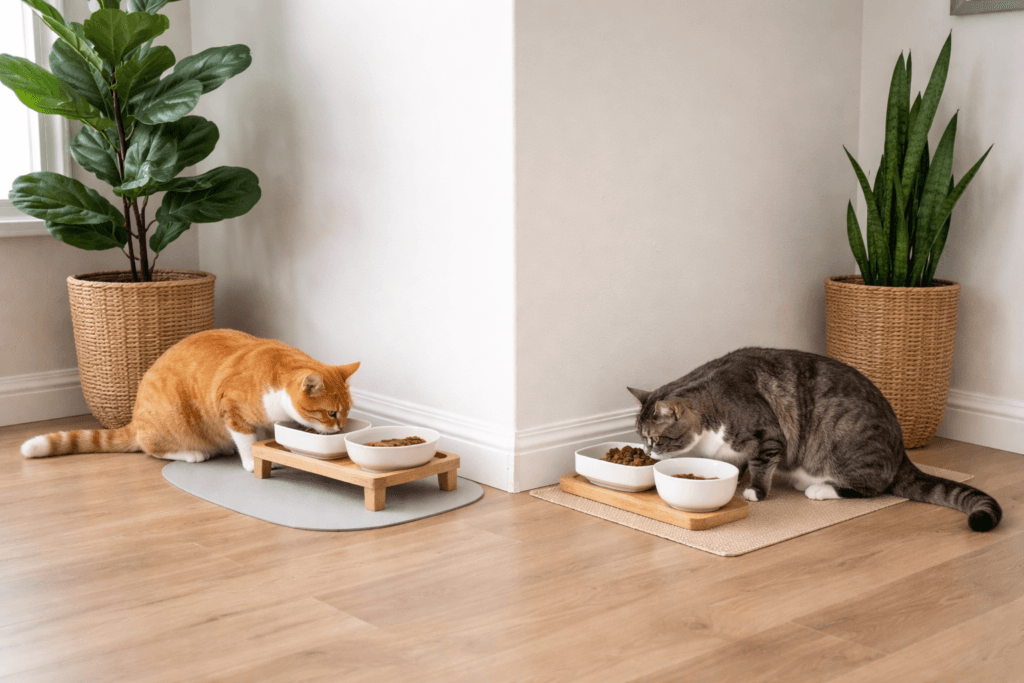
    • Feed in separate rooms and pick up bowls after 20–30 minutes.
    • Use microchip or RFID feeders so only the intended cat can access a specific bowl.
    • Elevate food for agile cats only when you have one overweight cat and one older or mobility-impaired cat who needs more calories.

    The goal is simple:

    Every cat gets their calories, and no one gets the chance to mop up everyone else’s leftovers.


    14-Day Transition Plan to Stop a Cat From Overeating

    Illustration of overweight vs healthy body condition in a cat

    Here’s a realistic timeline to change the system without blowing up your relationship.

    Days 1–3: Audit and Adjust

    • Measure what you’re actually feeding now.
    • Start measuring with a cup or scale, even if portions stay the same.
    • Introduce one slow feeder or puzzle for part of one meal.

    Days 4–7: Structure & Slow

    • Move from free-feeding to set meal times (start with 3–4 per day).
    • Replace at least half of each meal with a slow or puzzle feeder.
    • Start ignoring begging outside meal windows (this is the hardest part).

    Days 8–14: Calorie Correction

    • If your vet has given you a calorie target, gradually taper portions down to that level over this week.
    • Maintain consistent schedules — no “cheat snacks.”
    • Add one short play session before an evening meal; this burns energy and helps your cat settle after eating.

    By the end of two weeks, most owners see:

    • slower eating
    • fewer vomit episodes from bolting food
    • slightly calmer behavior around the bowl

    You’re not finished, but you’ve finally created a system that can stop a cat from overeating over the long haul.


    When Overeating Is a Symptom, Not a Behavior Problem

    There’s a hard line here: even the best system to stop a cat from overeating won’t work if overeating is driven by disease.

    Red flags to call your vet now, not “after we try a new feeder”:

    • Rapid increase in appetite with weight loss instead of gain
    • Drinking and urinating much more than before
    • Sudden food obsession in a senior cat
    • Panting, weakness, or obvious discomfort

    Conditions like hyperthyroidism, diabetes, intestinal disease, or certain medications can make cats genuinely hungrier. In those cases, trying to stop a cat from overeating purely with portion control is like trying to fix a fever by turning down the thermostat. You need a medical diagnosis first.


    Internal Links

    For readers who want to dive deeper into structured feeding, enrichment, and smart-home solutions for cats, PetTech AI offers several in-depth guides:

    These resources provide practical support for building a healthier feeding routine and reducing overeating long-term.


    References

    Cornell Feline Health Center — scientific guidance on feline weight management, calorie requirements, portion control and indoor nutrition.

    American Veterinary Medical Association (AVMA) — evidence-based recommendations on obesity prevention, feeding practices, and healthy behavior patterns in cats.

    AAHA / AAFP Feline Life Stage Guidelines — veterinary standards on diet, weight monitoring and structured feeding across all feline life stages.

    VCA Animal Hospitals — clinical resources on safe weight loss, feeding schedules, and identifying medical conditions that cause increased appetite.


    Disclaimer

    The information in this article is for educational purposes only and does not replace professional veterinary advice, diagnosis or treatment. Always consult your veterinarian before changing your cat’s diet, feeding schedule or weight-loss plan, especially if your cat has existing medical conditions or is a senior. Sudden changes in appetite, weight, thirst or litter box habits should be evaluated by a vet as soon as possible.

    PetTech AI participates in affiliate programs, including Amazon Associates and CJ. We may earn a small commission if you purchase products through links on this page, at no extra cost to you. Our recommendations are based on independent research and expert sources, not paid placement.

  • Why Do Cats Throw Up After Eating? Science-Backed Causes & How to Help

    Why Do Cats Throw Up After Eating? Science-Backed Causes & How to Help

    Watching your cat eat, walk away, and then immediately vomit is stressful as hell. It’s also confusing: is this “just hairballs,” eating too fast, or a sign of something serious? Cornell’s Feline Health Center is very clear: occasional vomiting can be normal, but frequent or persistent episodes are a clinical red flag, not just a quirky cat trait. vet.cornell.edu

    In this guide we’ll unpack why do cats throw up after eating, when you can monitor at home, when you should call your vet, and how smarter feeding setups and tech can actually reduce post-meal vomiting over time.


    Vomiting vs. Regurgitation: First, Know What You’re Looking At

    Before you answer why do cats throw up after eating, you need to be sure your cat is actually vomiting and not regurgitating.

    • Vomiting = active process
      • Nausea, licking lips, drooling
      • Retching, abdominal heaving
      • Contents may include partially digested food, bile, hair, foam Merck Veterinary Manual
    • Regurgitation = more passive
      • Often happens soon after eating
      • Food comes up in a tubular, undigested form
      • Less effort, minimal heaving

    Owners often describe both as “throwing up,” but the distinction matters. Regurgitation points more toward esophageal issues or eating too fast, while true vomiting can involve the stomach, intestines, or systemic disease. Merck Veterinary Manual


    Infographic comparing a cat hairball with typical vomit after eating

    When “Why Do Cats Throw Up After Eating” Might Be Mild

    Not every post-meal episode means an emergency. There are a few scenarios where why do cats throw up after eating may have a relatively benign explanation—provided it’s infrequent and your cat is otherwise normal.

    1. Hairballs

    Cornell notes that one of the most common benign causes of feline vomiting is expelling hairballs: damp, cylindrical masses of fur mixed with bile. vet.cornell.edu

    • Occasional hairball every week or two can be normal. vet.cornell.edu
    • If your cat otherwise eats, drinks, and plays normally, it’s likely low risk.

    However, newer AAFP guidance suggests that cats vomiting hairballs more than once per week likely have underlying nausea or GI issues, not just “normal grooming.” catvets.com

    2. Eating Too Fast (“Scarf and Barf”)

    Some cats inhale their food, then promptly bring it back up. Many clinics now explicitly link rapid eating and post-meal vomiting, and even mention that puzzle or slow-feeder bowls can reduce this behavior. Northeast Veterinary Referral Hospital

    Clues it’s speed-related:

    • Vomit appears quickly after eating (minutes)
    • Food is mostly undigested
    • Cat seems normal before and after

    3. Minor Diet Upset

    A sudden brand change, new treats, or access to rich human food can trigger temporary GI irritation. If your cat vomits once, then returns to normal appetite and energy, why do cats throw up after eating might be answered by “abrupt diet change” rather than disease.


    When Vomiting After Eating Is a Red Flag

    Cornell emphasizes that frequent vomiting—especially more than once per week or associated with other signs like lethargy, decreased appetite, increased thirst, or diarrhea—warrants veterinary attention. vet.cornell.edu

    You should stop asking why do cats throw up after eating and start calling your vet if you see:

    • Vomiting more than 2–3 times in 24 hours or more than three times overall per episode Best Friends Animal Society
    • Vomiting after meals persisting beyond a day or two Maddie’s Fund
    • Blood in the vomit, coffee-ground material, or dark brown fluid
    • Weight loss, weakness, hiding, or behavior change
    • Increased thirst and urination (possible kidney or endocrine disease) vet.cornell.edu
    • Painful abdomen, bloating, or straining to vomit with nothing coming up
    • Known or suspected toxin exposure (lilies, human meds, household chemicals) vet.cornell.edu

    Those scenarios are “call your vet now” territory, not “wait and see.”


    Main Science-Backed Causes of Post-Meal Vomiting in Cats

    There isn’t a single answer to why do cats throw up after eating. Vomiting is a symptom, not a diagnosis. Major categories include:

    1. Dietary Causes

    • Eating too fast – “scarf and barf” behavior
    • Sudden diet changes
    • Food intolerance or sensitivity to specific proteins or ingredients
    • Spoiled food or trash-raiding

    These often cause acute vomiting, sometimes right after meals, and may resolve once the trigger is removed.

    2. Hairballs & GI Motility Issues

    Hair ingestion during grooming is normal, but if GI motility is altered, hairballs may accumulate and trigger vomiting soon after eating. Cornell warns that if a hairball passes into the intestines and isn’t expelled, it can cause life-threatening obstruction. vet.cornell.edu

    AAFP material also notes that cats vomiting hairballs more than once weekly likely have an underlying nausea problem that needs investigation. catvets.com

    3. Gastrointestinal Disease

    Merck’s Veterinary Manual and AVMA-linked research list a broad range of GI disorders that cause vomiting—often chronic or recurrent and not limited to meals: Merck Veterinary Manual

    • Chronic small bowel disease / inflammatory bowel disease (IBD)
    • Intestinal lymphoma or other cancers
    • Constipation and megacolon
    • Ulcers or gastritis
    • GI parasites (roundworms, hookworms, etc.)

    In these cases, why do cats throw up after eating is often answered by “chronic intestinal disease” rather than simple dietary indiscretion.

    4. Systemic Disease

    Cornell lists multiple metabolic diseases that can present with vomiting: diabetes, chronic kidney disease (CKD), and hyperthyroidism among them. vet.cornell.edu

    Here, vomiting may not always be meal-linked, but owners often notice it shortly after eating because that’s when they’re watching the cat.

    5. Toxins and Foreign Bodies

    • Toxic plants, human medications, antifreeze, and certain foods (like onions or chocolate) are classic causes. vet.cornell.edu
    • Foreign objects (string, rubber bands, small toys) can lodge in the stomach or intestines, causing vomiting, often worsened after meals.

    These scenarios can escalate fast and often require emergency care.


    How Vets Work Up a Cat That Throws Up After Eating

    When you bring in a cat because “why do cats throw up after eating?”, your vet isn’t guessing—they’re running a structured workup.

    According to Cornell and major veterinary references, the process often includes: vet.cornell.edu

    1. Detailed history
      • When vomiting started
      • Relation to meals (immediately, 30 minutes, hours later)
      • Diet type, any recent changes, treats, access to toxins
      • Frequency, appearance of vomit (food, bile, hair, blood)
    2. Physical exam
      • Dehydration, weight, body condition
      • Abdominal pain or masses
      • Thyroid enlargement in older cats
      • Oral exam (foreign bodies, ulcers)
    3. Baseline tests
      • CBC, biochemistry, electrolytes
      • Urinalysis
      • Fecal exam for parasites
    4. Imaging
      • X-rays for foreign objects, obstruction, constipation
      • Ultrasound to evaluate intestinal wall, pancreas, liver
    5. Advanced diagnostics
      • Endoscopy for foreign bodies or biopsy
      • Surgical exploration and biopsy in chronic or severe cases

    Treatment is then targeted: dewormers for parasites, diet change for IBD, specific therapy for CKD, hyperthyroidism, diabetes, or surgery for obstructions. vet.cornell.edu


    Evidence-Based Ways to Help at Home (When It’s Appropriate)

    Tabby cat eating slowly from a modern slow-feeder bowl to reduce vomiting after meals

    If your cat has had a single mild episode of vomiting after eating, is bright, hydrated, and otherwise normal, you can often monitor at home. Veterinary guidelines and AAFP resources suggest: catvets.com

    • Pause food briefly (not water) for a few hours, then offer a small, bland meal if your vet agrees.
    • Switch to smaller, more frequent meals rather than one or two large ones.
    • Transition diets slowly over 7–10 days when changing food.
    • Brush regularly and consider hairball-control diets for long-haired cats.
    • Monitor hydration (skin turgor, gum moisture, urine output).

    If anything worsens or vomiting continues, you’re done with home care: it’s vet time.


    When to Call the Vet or Head to Emergency

    You shouldn’t stay in “Google mode” on why do cats throw up after eating if any of these apply:

    Call your regular vet ASAP if:

    • Vomiting happens more than once per week or more than 2–3 times in a day vet.cornell.edu
    • Your cat starts refusing food or water
    • You notice weight loss, chronic loose stools, or coat decline
    • Vomiting is chronic but your cat “seems ok” (this still needs workup)

    Seek emergency care if:

    • Repeated vomiting and nothing staying down
    • Vomit with blood or “coffee-grounds” material GSVS
    • Distended, painful belly, or straining without producing anything
    • Severe lethargy, pale gums, trouble breathing, collapse
    • Known ingestion of lily, rodenticide, or human medications

    AVMA-aligned first-aid guidance also stresses: never induce vomiting at home without direct veterinary or poison-control instructions, especially in cats. AVMA


    How PetTech Tools Can Reduce Vomiting After Meals

    Smart pet camera and automatic feeder monitoring a cat prone to vomiting after eating

    Here è where PetTech AI comes in. Tech won’t cure IBD or kidney disease, but it can help with some mechanical and behavioral causes of why do cats throw up after eating.

    1. Smart Feeders & Slow-Feed Bowls

    Studies and case reports in veterinary behavior literature show that food puzzles and foraging toys can slow rapid eating and reduce post-meal vomiting in some cats. AVMA Journals

    Practical picks you can link to:

    • Smart automatic feeders with:
      • Small, scheduled portions
      • Multiple small meals per day
      • App-controlled feeding logs
    • Slow-feeder bowls / puzzle feeders that:
      • Force the cat to work for each bite
      • Reduce “scarf and barf” events
      • Provide mental enrichment

    2. Smart Water Fountains

    Chronic vomiting can worsen dehydration. Smart fountains encourage drinking with:

    • Constantly circulated, filtered water
    • App alerts when the reservoir is low
    • Some models track usage trends

    3. Cat Cameras & Activity Trackers

    If you’re not home when it happens, you don’t really know how often your cat vomits or what happens right before.

    • Smart pet cameras let you replay episodes, see posture, and note timing relative to meals.
    • Wearable trackers can reveal subtle activity drops that match periods of nausea or GI flare-ups.

    These tools don’t replace your vet, but they give better data, which directly improves diagnosis and treatment decisions.


    Verdict: Vomiting After Eating Is a Symptom, Not a Personality Trait

    If you came to this article asking why do cats throw up after eating, the hard truth is:

    • Occasional, isolated episodes can be benign (hairballs, mild diet errors).
    • Recurrent or persistent vomiting is never “just normal” for cats. Mallard Creek Animal Hospital
    • The underlying cause can range from simple to life-threatening—and only a vet can sort that out.

    Your job as a cat guardian is to track patterns, intervene early, and use tools—like smart feeders, slow-feed bowls, and cameras—to reduce avoidable triggers and give your vet the best possible information.


    Disclosure

    This article is for educational purposes only and is not a substitute for professional veterinary diagnosis or treatment. Always consult your veterinarian if your cat is vomiting, seems unwell, or if you have any concerns about their health. Do not start, stop, or change medications or diets based solely on online content. PetTech AI participates in affiliate programs such as Amazon Associates and CJ; this means we may earn a commission if you purchase products through links on our site, at no additional cost to you. These commissions help us keep producing evidence-based content.

  • AI Nutrition Apps for Cats 2025: How They Personalize Feeding, Reduce Guesswork, and Keep Weight on Track

    AI Nutrition Apps for Cats 2025: How They Personalize Feeding, Reduce Guesswork, and Keep Weight on Track

    AI nutrition apps for cats 2025 are turning daily feeding into data-driven care. Instead of guessing portions or hoping a new diet works, these tools analyze weight trends, meal timing, and treat intake to recommend small, safe adjustments. Used well, AI nutrition apps for cats 2025 help you stabilize weight, prevent overfeeding, and bring clearer info to your veterinarian.


    Why This Matters Now

    Cats mask discomfort, and weight drift is often the first warning sign. AI nutrition apps for cats 2025 pair routine logs with device data (smart feeders, scales, and litter analytics) to highlight meaningful change—not just single “blip” readings. That means you can react earlier, adjust portions thoughtfully, and keep a clean record to share at wellness exams. In multi-cat homes, these apps also reduce confusion about who ate what and when.


    How AI Nutrition Apps Work

    AI nutrition app dashboard showing weight trend and daily calories.

    Most AI nutrition apps for cats 2025 blend three layers:

    1. Inputs: weight entries (manual or from a smart scale), meal sizes/times from connected feeders, treat counts, and notes (hairball day, meds, travel).
    2. Models: simple baselines + machine-learning signals trained on patterns like slow weight gain, “treat creep,” or irregular meal spacing.
    3. Outputs: gentle, reversible suggestions—e.g., “reduce dinner by 6–8 kCal,” “shift the PM meal 30 minutes earlier,” or “treats exceeded 10% today.”

    Because the best AI nutrition apps for cats 2025 focus on trends, you’ll see nudges over weeks, not whiplash changes overnight.


    What to Look For Before You Download

    • Evidence-based targets: daily kCal estimates by age/condition, and guidance that respects veterinary standards.
    • Device integrations: smart feeders (portion + schedule), scales (weekly “truth check”), and—optionally—litter/health trackers for context.
    • Clear levers you control: portion size, schedule windows, treat caps, hydration prompts.
    • Data exports: graphs you can email or show at the clinic.
    • Privacy basics: what’s stored locally vs. cloud; easy data deletion.
    • Fail-safe UX: if devices go offline, the app should still log and coach. The better AI nutrition apps for cats 2025 degrade gracefully when Wi-Fi doesn’t.

    The Daily Routine That Actually Works

    Start simple: weigh your cat weekly before breakfast, log the number, and let the app project a 4–6 week trend. Pair that with two predictable meals plus tiny, scheduled treat windows. The point isn’t to micromanage; it’s to make nutrition boring and repeatable. With AI nutrition apps for cats 2025, you’ll get small, data-based adjustments that keep weight steady without drama.


    App Snapshots (Capabilities You’ll See in the Wild)

    • Feeder-linked apps: Pair a connected feeder to enforce portions, set weekday/weekend schedules, and auto-log what was actually dispensed. Many AI nutrition apps for cats 2025 will then suggest fine-tuning (e.g., “move 10% of breakfast to lunch to reduce late-day begging”).
    • Scale-aware apps: A weekly weigh-in populates a rolling average; the app flags when a trend line crosses ±5% from baseline and reminds you to check treats/hydration.
    • Ecosystem dashboards: If you run an all-in-one brand, you’ll see feeding, weight, and sometimes litter patterns in one timeline. That’s where AI nutrition apps for cats 2025 shine—one place to read the whole story.

    Healthy Rules of Thumb (Vetted by Vets)

    • Treats ≤10–15% of daily calories for healthy adults; subtract a little from meals when you train.
    • Annual wellness exams at minimum (semiannual for seniors/at-risk). Bring your app graphs—trend lines make clinical conversations faster and clearer.
    • Act on patterns, not one-offs. If the app shows two to three weeks of loss or gain, or if appetite and litter habits change together, call your vet.

    These principles anchor the recommendations most AI nutrition apps for cats 2025 will generate—and keep the tech honest.


    Pros & Cons

    Pros

    • Turns vague routines into measurable plans you can adjust gradually.
    • Works with feeders/scales to reduce human error.
    • Exports help your veterinarian see the real-life picture, not a memory guess.

    Cons

    • Subscriptions and device ecosystems can add cost.
    • Over-nudging can cause alert fatigue—mute low-priority tips.
    • Not a diagnosis tool: even the smartest AI nutrition apps for cats 2025 can only flag trends, not tell you why they happen.

    Setup Checklist (5 Steps, 15 Minutes)

    1. Define a calorie target (per your vet or app’s calculator).
    2. Fix meal windows (AM/PM), then let treats live in tiny, scheduled micro-windows.
    3. Choose one metric to start (weight). Add hydration or treat caps later.
    4. Connect devices if you have them; if not, manual logs still work.
    5. Review weekly, not hourly. That’s how AI nutrition apps for cats 2025 add signal without stress.

    Privacy & Data: What’s Worth Asking

    • Can you export or delete everything with one tap?
    • Is video or exact location collected (usually not needed for nutrition)?
    • If the app uses AI, what’s trained locally vs. cloud?
      Good AI nutrition apps for cats 2025 are transparent: you own the data, and audits/logs are easy to find.

    Real-World Use Cases

    Owner sharing AI nutrition app charts with a veterinarian.
    • Weight plateau: the app suggests moving 5–8% of breakfast to a small mid-day snack to curb evening overeating.
    • Treat creep: you get a weekly digest: “Treats averaged 13% of calories; consider 2 g less at dinner.”
    • Senior cat: weight dips 4% across 3 weeks; the app flags yellow, and you schedule a checkup—with charts in hand.

    These small, boring moves—exactly what AI nutrition apps for cats 2025 are good at—prevent big swings later.


    Verdict: Should You Use One?

    Yes—if you’re willing to log weekly weight and follow small, consistent changes. AI nutrition apps for cats 2025 won’t replace your veterinarian or treat underlying disease. But they do remove guesswork, reinforce routine, and make it easier to keep calories honest—especially when paired with a smart feeder and a simple, weekly scale ritual.


    FAQs

    Do I need smart devices for the app to help?
    No. Manual weight + meal logs are enough to start; devices just automate the boring parts.

    What if my cat free-feeds?
    Transition to time-boxed, portioned meals. AI nutrition apps for cats 2025 work best when the schedule is predictable.

    Are these apps safe for cats with medical diets?
    Ask your vet for calorie targets and approved foods; the app can track and visualize, but your vet sets the medical plan.

    How soon will I see results?
    Expect gentle trends across 4–6 weeks. Fast drops or gains are a reason to call your vet, not a “win.”


    Internal Links (PetTech AI)


    Authoritative Outbound Links


    Disclaimer

    The content on PetTech AI is for educational purposes only and does not replace professional veterinary advice. AI nutrition apps for cats 2025 can help you track calories, weight, and schedules, but they cannot diagnose disease. If your cat shows weight loss or gain, appetite changes, vomiting, diarrhea, excessive thirst, painful or frequent urination, lethargy, or behavior shifts, contact your veterinarian promptly. Some links in this article may be affiliate links, meaning PetTech AI could earn a commission at no extra cost to you. This supports rigorous testing and allows us to maintain independent, evidence-based reviews.

  • Smart Portion Control for Cats 2025: How Tech Helps You Prevent Overfeeding

    Smart Portion Control for Cats 2025: How Tech Helps You Prevent Overfeeding

    Affiliate disclaimer: This guide contains affiliate links (Amazon, PetKit, Whisker). If you buy through our links, we may earn a small commission at no extra cost to you. We only recommend tools that support feline health and safety.

    Portion accuracy is the quiet superpower behind weight control, better energy, and long-term health. The problem? Eyeballing “a scoop” almost always leads to drift. Smart Portion Control for Cats 2025 brings precision and consistency to mealtimes with connected feeders, scale-enabled bowls, and apps that track exactly what your cat eats. In this guide, you’ll learn how to set the right portion, choose the best tech for your routine, and build a no-stress schedule that keeps your cat lean, satisfied, and healthy.


    Why portion control matters (and how tech fixes the hard parts)

    Vets consistently remind us that even small daily excesses add up. The AVMA notes that obesity increases risks for diabetes, arthritis, and lower quality of life. The Cornell Feline Health Center emphasizes measured feeding, predictable routines, and environmental enrichment to maintain a healthy weight. With Smart Portion Control for Cats 2025, you replace guesswork with data: exact grams per meal, consistent timing, and alerts when something’s off.

    Where humans struggle:

    • Inaccuracy: scoops vary; family members pour different amounts.
    • Timing drift: meals shift on busy days, leading to overeating later.
    • Multi-cat chaos: food theft, timid eaters, and portion mismatch.

    Where tech helps:

    • Grams, not guesses: smart feeders and bowls weigh or dispense precise portions.
    • Automated schedules: consistent timing reduces begging and gorging.
    • Data & alerts: portions, missed meals, and low-food warnings surface fast.

    This is the core value of Smart Portion Control for Cats 2025—fewer variables, better outcomes.


    How to set the right portion (quick vet-aligned framework)

    Always use your veterinarian’s guidance as the starting point. A practical framework:

    1. Calculate daily calories. Work with your vet or use the food label as a baseline; most healthy adult cats need roughly 180–250 kcal/day (varies widely by size and activity).
    2. Convert to grams. Use the brand’s kcal-per-gram. Log this in your app or bowl.
    3. Split into 2–4 meals. Smaller, predictable meals support satiety and metabolism.
    4. Audit monthly. Weigh your cat and adjust portions ±5–10% as needed, under veterinary guidance.

    With Smart Portion Control for Cats 2025, you’ll tie these numbers to devices that deliver the plan consistently.


    The best tech for precise, fuss-free portions (2025 picks)

    We selected four complementary tools that cover different budgets and scenarios—two smart feeders (with sensors), a feeder with dual bowls and camera, and a scale-enabled bowl that nails measuring accuracy.

    1) PETKIT Fresh Element Infinity Smart FeederBest for app-first precision & routines

    PETKIT Infinity dispensing precise grams for a scheduled meal. Smart portion control for cats 2025.
    • Why it’s great for portion control: The Infinity is engineered around precision. App controls let you set exact grams per meal, with dual sensors tracking food level and dispensed amounts. The PetKit app logs feeding history, schedules, and alerts—ideal for Smart Portion Control for Cats 2025 in busy homes.
    • Best uses: Single-cat households or multi-cat homes that can separate feeding zones.
    • Good to know: Keep the hopper clean and calibrate after food changes (shape and density affect flow).

      View PETKIT Fresh Element Infinity on PetKit

    2) Petlibro Granary Dual Automatic Feeder (with Camera)Best for multi-cat fairness

    Petlibro Granary Dual bowls with camera confirming fair portions.
    • Why it’s great for portion control: The Granary Dual adds two bowls plus a built-in camera. You can confirm each cat actually gets their portion, spot “food theft,” and refine placement. The app supports precise portion calibration, motion/sound alerts, and low-food notifications—a powerful combo for Smart Portion Control for Cats 2025 in multi-cat homes.
    • Best uses: Two-cat households where fairness and visibility matter.
    • Good to know: For timid cats, start with supervised sessions; angle the camera to see both bowls clearly.

      View Petlibro Granary Dual (Camera) on Amazon

    3) Whisker Feeder-RobotBest for set-and-forget reliability

    Feeder-Robot app showing precise increments and logs.
    • Why it’s great for portion control: Feeder-Robot dispenses in precise increments (as small as 1/8 cup) with Wi-Fi connectivity and app logging. It integrates nicely if you already use Litter-Robot, giving you a fuller health picture. For Smart Portion Control for Cats 2025, it excels at consistency: same portion, same time, without manual intervention.
    • Best uses: Owners who want robust hardware, strong scheduling, and an ecosystem that ties feeding to litter habits.
    • Good to know: Validate portion size in grams initially to match your cat’s plan.
    • CTA: View Whisker Feeder-Robot on Whisker (50$ off with code REALSIMPLE50)

    4) PETKIT SAB2BLA Fresh Metal Digital Pet BowlBest for precise weighing (budget-friendly)

    PETKIT digital pet bowl showing exact grams during serving.
    • Why it’s great for portion control: Built-in digital scale shows the exact grams you serve, so you hit your target even with wet food or varied kibbles. This is the simplest, most reliable first step into Smart Portion Control for Cats 2025.
    • Best uses: Cats on wet food, mixed diets, weight-loss plans, or households that prefer manual plating with perfect accuracy.
    • Good to know: Tare the bowl before serving; log the weight in your app or a feeding spreadsheet.

      View PETKIT Fresh Metal Digital Bowl on Amazon

    Choosing the right setup for your cat (decision guide)

    • Single cat, full automation: PETKIT Fresh Element Infinity or Whisker Feeder-Robot.
    • Two cats, fairness & proof: Petlibro Granary Dual with Camera.
    • Wet-food focus or tight calories: PETKIT Fresh Metal Digital Bowl + manual schedule in an app.
    • Travel or sitter plan: A smart feeder + printed schedule + app access for the sitter.
    • Training or medical needs: Start with the PETKIT digital bowl to dial in grams; add a feeder once stable.

    If you’re not sure, begin with the PETKIT SAB2BLA digital bowl for a week. Nail the correct grams first, then automate with a smart feeder for routine and consistency—this two-step approach defines Smart Portion Control for Cats 2025 done right.


    Set-it-and-keep-it plan (step-by-step)

    Day 1–3: Dial in the portion

    1. Weigh your cat.
    2. Confirm daily calories with your vet; convert to grams.
    3. Use the PETKIT digital bowl to serve exact grams per meal; observe satiety and stool quality.

    Day 4–7: Automate with a feeder

    1. Program the feeder (Infinity / Feeder-Robot / Granary) with the grams and times you tested.
    2. Enable meal logs, low-food alerts, and missed-meal notifications.
    3. For two cats: place bowls apart; with Granary Dual, angle the camera to confirm fairness.

    Week 2–3: Fine-tune

    1. Adjust ±5–10% if your vet advises.
    2. Add a slow-feed insert if your cat eats too fast.
    3. Pair mealtimes with a short play session to reduce begging and midnight zoomies.

    Monthly:

    • Re-weigh your cat and review feeding logs.
    • Clean hoppers, lids, and bowls (biofilm management matters!).
    • Audit treats; many cats get 10–20% of calories from snacks—log them.

    This procedure is the practical backbone of Smart Portion Control for Cats 2025—measure, automate, review.


    Real-world troubleshooting (quick fixes)

    • My cat begs between meals. Split the same daily grams into 3–4 smaller meals; consider a low-calorie topper (vet-approved) for perceived volume.
    • My feeder dispenses unevenly. Recalibrate after switching kibble; different shapes flow differently. Keep the hopper at least 1/3 full.
    • Two cats, one steals food. Use the Granary Dual with camera, separate feeding stations, or microchip bowls for identity-based access.
    • Wet food only. Use the PETKIT digital bowl to weigh exactly, then schedule times in your phone/app; consider ice packs or short window feeding.
    • Weight isn’t changing. Confirm grams and treats; introduce 5–10 minutes of daily play; consult your vet before altering calories.

    All of these are solvable within the framework of Smart Portion Control for Cats 2025—accuracy + consistency + review.


    Health & safety notes

    • Work with your vet. Rapid weight loss can be dangerous for cats; adjust gradually.
    • Hydration counts. Wet food or fountains help appetite regulation and urinary health.
    • Hygiene matters. Clean bowls daily and feeders weekly; replace filters per instructions.
    • Stress and enrichment. Feeding puzzles and short play sessions reduce anxiety-driven overeating.

    The AVMA and Cornell Feline Health Center offer reliable guidance on feline nutrition, obesity prevention, and behavior—excellent references to bookmark.


    FAQs — Smart Portion Control for Cats 2025

    Do I really need a smart feeder if I have a scale bowl?
    Not necessarily. Many owners start with the PETKIT digital bowl to learn exact grams, then add automation later for timing and convenience.

    Can smart feeders manage wet food?
    Most are optimized for dry kibble. For wet food, weigh with the PETKIT digital bowl and serve at scheduled times you can stick to (or consider short-window timed feeders).

    How many meals per day are best?
    Two to four, depending on your cat and vet guidance. Smaller, regular meals curb gorging and begging.

    What if my cat is on a weight-loss plan?
    Use grams-only accuracy, tighter logs, and weekly weigh-ins. Adjust slowly, under veterinary supervision.


    The bottom line

    Consistency beats willpower. With Smart Portion Control for Cats 2025, you’ll move from guesswork to measured feeding, from ad hoc schedules to reliable routines, and from vague trends to actionable data. Start by nailing grams with the PETKIT digital bowl, automate with a smart feeder that fits your home, and review monthly with your vet. Your cat’s waistline—and long-term health—will thank you.

    Quick shop:


    Internal interlinks

    Authoritative references

  • Feeder-Robot Review: Premium Reliability or Ecosystem Tax?

    Feeder-Robot Review: Premium Reliability or Ecosystem Tax?

    The Whisker Feeder-Robot handles the boring part of feeding unusually well.

    It stores a large amount of dry food, follows scheduled routines and lives inside the same app as Litter-Robot.

    What it does not do is decide which cat receives the food.

    That distinction matters.

    If Napoleon and Biscuit eat the same kibble without attempting a hostile takeover at breakfast, Feeder-Robot can be a convincing premium convenience tool.

    If one cat needs prescription food while the other approaches every unattended bowl like a small warlord, scheduling alone will not solve the problem.

    Quick Verdict

    CategoryVerdict
    PetTech AI verdictRecommended with Conditions
    Best fitWhisker households feeding one cat or multiple cats sharing the same food
    Main advantageLarge capacity, flexible scheduling and one-app Whisker integration
    Main limitationNo RFID or individual-cat access control
    Food typeDry food
    Not forDifferent diets, food stealing or tightly controlled individual portions
    Best reason to buyYou value low-friction feeding and already use the Whisker ecosystem

    Feeder-Robot is a sensible premium purchase when your problem is:

    “How do I make dry-food schedules easier to manage?”

    It is a weak solution when the real problem is:

    “How do I stop one cat from eating both meals?”

    Cheaper feeders can follow basic schedules. RFID feeders can protect individual diets.

    Feeder-Robot earns its premium through capacity, local schedule storage, Whisker app integration and access to an established support and replacement-parts ecosystem.

    Research Note

    This is a research-led review based on current official specifications, app documentation, product positioning and available ownership evidence.

    PetTech AI has not conducted a long-term hands-on test of the Whisker Feeder-Robot.

    PetTech AI may earn a commission from qualifying purchases. As an Amazon Associate I earn from qualifying purchases.

    Prefer Amazon’s purchase route? Check Feeder-Robot availability and customer feedback on Amazon.

    What Feeder-Robot Does Well

    Whisker states that Feeder-Robot holds up to 32 cups of food and supports as many as eight scheduled meals per day, plus manually triggered snacks.

    The standard dispenser releases food in one-eighth-cup increments, making the feeder better suited to several controlled meals than to one large daily serving.

    Its strongest use cases include:

    • cats eating the same dry food;
    • owners with irregular schedules;
    • households that prefer several smaller meals;
    • people who want fewer hopper refills;
    • existing Litter-Robot owners who value one-app management.

    The product does not introduce a radically new feeding method.

    Its proposition is simpler: perform a repetitive task with less daily supervision.

    There is something refreshing about a premium pet device whose primary promise is essentially:

    “We put the kibble in the bowl when we said we would.”

    The industry occasionally deserves credit for completing the original assignment.

    The Whisker App Is the Main Ecosystem Advantage

    Cat sitting between an automatic feeder and a self-cleaning litter box
    Feeder-Robot becomes easier to justify when feeding and litter automation are already managed inside the Whisker ecosystem. AI-generated editorial illustration.

    Feeder-Robot connects to the same Whisker app used for Litter-Robot.

    Owners can manage schedules, trigger snacks, review dispensing activity and receive device notifications without maintaining another pet-tech account.

    This becomes genuinely useful when Whisker products are already part of the home.

    The advantage is operational:

    • one account;
    • one familiar app;
    • consolidated device notifications;
    • fewer disconnected platforms;
    • one manufacturer handling support.

    The app does not transform Feeder-Robot into an individual-cat monitoring system.

    Feeder-Robot is primarily an automation tool: it reduces routine work but does not verify which cat ate or interpret behavioral changes. For the broader distinction between useful data and useful automation, read our Smart Cat Monitoring vs Automation guide.

    It cannot identify who approached the bowl, confirm which cat ate the serving or compare food consumption directly with litter-box records.

    Whisker integration therefore reduces management friction. It does not create a clinically meaningful unified profile of Biscuit’s entire day.

    Without another Whisker product, Feeder-Robot competes mainly on capacity, scheduling and build quality rather than ecosystem convenience.

    For the broader trade-off between Whisker and PETKIT, read our PETKIT vs Litter-Robot Ecosystem comparison.

    Offline Schedules and the Optional Battery

    Automatic dry-food feeder beside a smartphone displaying scheduled meals
    App scheduling reduces routine feeding work, while locally saved schedules can continue during a temporary Wi-Fi outage. AI-generated editorial illustration.

    A smart feeder should not forget breakfast because the router restarted.

    Once saved, Feeder-Robot’s schedule remains stored locally and can continue during a temporary internet outage. Remote controls and schedule changes may be unavailable until the connection returns, but the existing routine does not depend entirely on the cloud.

    That is an important reliability feature.

    A feeder that loses its memory with the Wi-Fi is not smart. It is a decorative grain silo with abandonment issues.

    A power outage is different.

    Feeder-Robot does not include battery backup as standard. Whisker sells an optional battery that provides up to 24 hours of operation in power-saving mode.

    The option is useful for homes with unstable power.

    Having to purchase it separately on a premium feeder is less delightful.

    Buyers who consider backup power essential should include the battery in the real ownership cost rather than discovering it after Napoleon’s breakfast becomes a constitutional crisis.

    The Multi-Cat Limitation

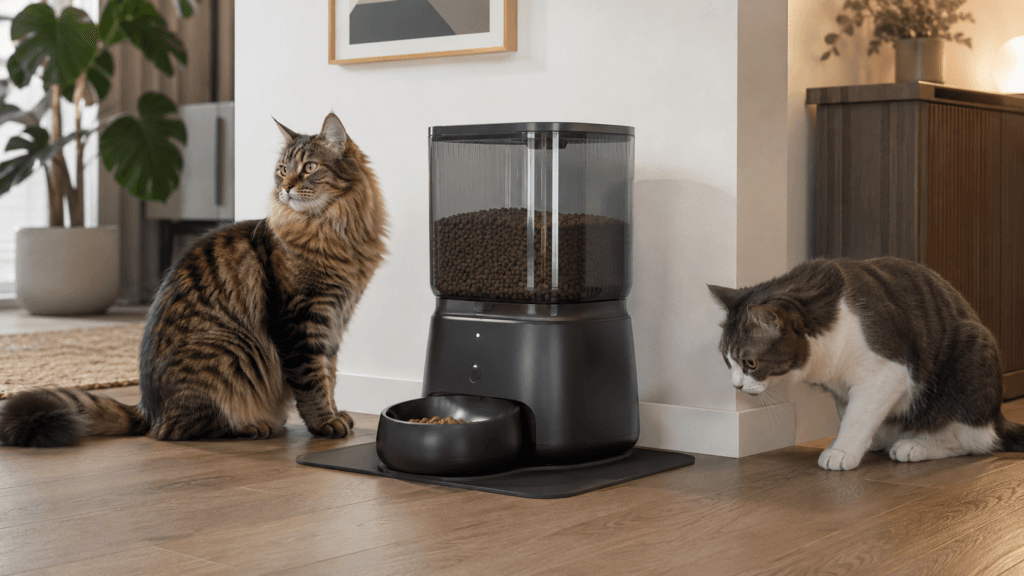
    One cat eating from an automatic feeder while another reaches toward the bowl
    A feeding schedule controls when food appears—not which cat eats it. RFID access is the better solution for food stealing or different diets. AI-generated editorial illustration.

    The 32-cup hopper makes Feeder-Robot suitable for homes that consume a lot of dry food.

    That does not make it an individual-access feeder.

    Food is dispensed into an open bowl. There is no RFID reader, microchip recognition or physical barrier stopping one cat from eating another cat’s portion.

    Feeder-Robot works best when multiple cats:

    • eat the same food;
    • have similar feeding requirements;
    • do not guard the bowl;
    • can be separated when necessary;
    • are not managing conflicting medical diets.

    It becomes a poor fit when:

    • one cat needs prescription food;
    • calorie targets differ significantly;
    • one cat steals food;
    • a slow eater is displaced;
    • medication is mixed into one serving.

    A schedule controls when food appears.

    It does not appoint security.

    If Napoleon finishes his meal and moves directly into Biscuit’s bowl, the Whisker app will document the dispensing event without deploying a tactical response unit.

    For households requiring individual access, RFID technology is usually the more relevant solution, even when the competing feeder has a smaller hopper or less polished app.

    See our Best Automatic Cat Feeders guide for alternatives organized by household problem.

    Capacity, Cleaning and Daily Ownership

    The large hopper reduces refill frequency, particularly in shared-food households.

    It should not be treated as permission to leave the same kibble inside indefinitely. Dry food contains oils that can leave residue and lose freshness over time.

    Routine ownership still includes:

    • washing the bowl;
    • wiping the dispensing area;
    • checking for crumbs around the chute;
    • refreshing the hopper rather than endlessly topping it up;
    • confirming that scheduled portions still look reasonable.

    Whisker also sells replacement components for Feeder-Robot, including dispenser and motor assemblies.

    Availability of individual parts does not prove that the feeder will last forever. It does make repair and maintenance more credible than with generic feeders whose manufacturer disappears once the listing has collected enough photographs of jammed kibble.

    The ownership proposition is therefore less about “zero maintenance” and more about predictable maintenance backed by an identifiable company.

    Feeder-Robot vs Modern Alternatives

    Feeder-Robot is strongest at scheduled shared feeding.

    Other feeder categories now solve different problems.

    Choose Feeder-Robot when:

    • you already use Whisker;
    • large capacity matters;
    • all cats eat the same food;
    • you want several scheduled dry-food meals;
    • local schedule storage matters;
    • replacement parts and manufacturer support affect the decision.

    Choose an RFID feeder when:

    • individual access matters;
    • one cat steals food;
    • diets or portions differ;
    • prescription food must remain protected.

    Choose a dual-hopper feeder when:

    • alternating or mixing two dry foods matters;
    • food variety is more useful than ecosystem integration.

    Choose a camera feeder when:

    • visual confirmation changes your decision;
    • you genuinely plan to review the footage;
    • remote reassurance matters more than hopper size.

    Feeder-Robot does not become outdated because other feeders offer more features.

    It becomes the wrong choice only when another feature solves a more important household problem.

    For buyers comparing Whisker with PETKIT’s large-capacity approach, read our PETKIT Fresh Element Infinity Review.

    Buyer-Regret Risk

    The most likely regret is paying for the Whisker ecosystem without needing the Whisker ecosystem.

    That risk is higher when:

    • you own no other Whisker products;
    • one inexpensive daily schedule would be sufficient;
    • your cats need individual food access;
    • you expect the feeder to record actual consumption;
    • you assume battery backup is included;
    • wet food is a major part of the diet.

    Feeder-Robot records what it dispenses.

    It does not prove that the intended cat ate it.

    The product is easiest to justify when capacity, scheduling and app consolidation all matter at the same time. Remove two of those three factors and the premium becomes harder to defend.

    Final Verdict

    The Whisker Feeder-Robot earns a Recommended with Conditions verdict.

    It is a credible premium feeder for dry-food households that value large capacity, flexible schedules and integration with Litter-Robot through the Whisker app.

    Local schedule storage strengthens the practical case, while the optional battery can provide an additional layer of protection during power outages.

    Its central limitation is individual access.

    Feeder-Robot cannot identify cats or prevent food theft. Households managing different diets, prescription food or aggressive bowl competition should choose a feeder designed around those problems.

    Buy Feeder-Robot when you want the Whisker ecosystem to handle another repetitive task with less supervision.

    Skip it when ecosystem integration is the only persuasive argument—or when your cats need less of a schedule and more of a border-control policy.

    Feeder-Robot does not reinvent feeding.

    It makes ordinary dry-food automation easier to manage.

    Sometimes that is worth paying for.

    Sometimes it is an ecosystem tax with an unusually elegant hopper.

    Frequently Asked Questions

    Does Feeder-Robot work without Wi-Fi?

    Saved feeding schedules can continue during a temporary Wi-Fi outage. Internet access is still needed for remote app controls and schedule changes.

    How many meals can Feeder-Robot schedule?

    Whisker supports up to eight scheduled meals per day, plus manually triggered snacks.

    Does Feeder-Robot include battery backup?

    No. Whisker sells an optional battery that can provide up to 24 hours of operation in power-saving mode.

    Can Feeder-Robot stop one cat from stealing food?

    No. It does not use RFID or microchip identification. Cats with different diets may require separate feeding spaces or an individual-access feeder.

    Can Feeder-Robot dispense wet food?

    No. Feeder-Robot is intended for compatible dry or semi-moist food, not canned or refrigerated wet meals.

    References

    • Whisker — Feeder-Robot product specifications
    • Whisker — Feeder-Robot support documentation
    • Whisker — Feeder-Robot battery and replacement components
    • Whisker — Whisker app documentation

    Image Disclosure

    Official Whisker images are used when depicting the exact product.

    Any AI-generated images are editorial illustrations only. They do not represent exact dimensions, dispensing behavior, portion accuracy or app performance. Always verify current specifications before purchasing.

    Editorial Disclosure

    PetTech AI may earn a commission from qualifying purchases. This does not influence our recommendations, comparisons or editorial judgments.

  • Best Smart Cat Water Fountains (2026): Useful Data or Expensive Plumbing?

    Best Smart Cat Water Fountains (2026): Useful Data or Expensive Plumbing?

    Baron does not care that his water fountain has AI recognition.

    He cares that the water is fresh, the tray does not smell strange and another cat is not blocking access.

    The app exists for you.

    That distinction matters because smart cat water fountains now solve very different problems. Some track general drinking activity. Some identify individual cats through RFID tags. Others remove the cable, separate clean water from used water or avoid smart features entirely in favor of capacity and multiple drinking positions.

    For most one-cat homes, PETLIBRO Dockstream 2 is the best overall smart fountain.

    For multi-cat households that genuinely need individual records, Dockstream RFID is the stronger specialist recommendation—provided the cats tolerate collar tags.

    Choose PETKIT EverSweet Max 2 when placement is the real problem.

    Choose PetSafe Drinkwell 360 when capacity and shared access matter more than another app.

    Treat PETKIT EverSweet Ultra as the ambitious early-adopter option. It is the most technically interesting fountain here and the least proven.

    A fountain should solve a hydration problem.

    It should not create a new relationship with filters, notifications and dashboards merely because the product page used the word “intelligent.”

    Research Note

    This is a research-led roundup based on current manufacturer documentation, veterinary hydration guidance, product positioning and available ownership evidence.

    PetTech AI has not conducted long-term hands-on testing of every fountain included.

    Quick Verdict

    Your actual priorityBest choiceEditorial judgment
    Best overall smart fountainPETLIBRO Dockstream 2Recommended
    Individual tracking for several catsPETLIBRO Dockstream RFIDStrong Recommendation with Conditions
    Flexible cable-free placementPETKIT EverSweet Max 2Recommended
    High-capacity shared access without an appPetSafe Drinkwell 360 StainlessRecommended
    Separate clean and used water with camera monitoringPETKIT EverSweet UltraConditional Recommendation
    You will never check hydration dataPetSafe Drinkwell 360 or a simpler fountainDo not pay for decorative analytics

    PetTech AI may earn a commission from qualifying purchases. As an Amazon Associate I earn from qualifying purchases.

    Need the best default smart fountain? Check PETLIBRO Dockstream 2 on Amazon.

    Need individual records for several cats? Check PETLIBRO Dockstream RFID on Amazon.

    What a Smart Fountain Can—and Cannot—Do

    A fountain can make moving water available, remind you when maintenance is due and help reveal changes in drinking routines.

    It cannot diagnose why those changes occurred.

    Cornell notes that some cats may drink more when offered a fountain, but preferences vary. More important than the machinery is keeping fresh water accessible and preventing conflicts that allow one animal to block another from drinking. FelineVMA guidance likewise recommends providing multiple, separated resources—including water—in multi-cat homes.

    Hydration tracking becomes useful when it changes your behavior:

    • you notice a repeated change;
    • you refill the reservoir before it runs dry;
    • you clean the system on schedule;
    • you identify which cat’s pattern changed;
    • you decide to observe the cat directly or contact a veterinarian.

    It is less valuable when the graph receives two enthusiastic inspections and then spends the rest of its life beneath notifications from the weather app.

    For the broader question of when pet data is genuinely useful, read Smart Cat Monitoring vs Automation.

    Best Overall: PETLIBRO Dockstream 2

    PETLIBRO Dockstream 2 smart cat water fountain in a modern home office while a cat drinks nearby
    The Dockstream 2 is designed for everyday hydration tracking, refill alerts, and low-maintenance use in a shared home space.

    Verdict: Recommended

    Dockstream 2 is the safest default recommendation because its smart features support ordinary fountain ownership rather than trying to reinvent it.

    It tracks drinking activity through the PETLIBRO app, provides water-level and maintenance alerts and uses a pump-free magnetic system instead of placing a traditional powered pump inside the water reservoir. PETLIBRO specifies that the standard tracking is intended for one pet at a time; buyers who need individual multi-cat records should choose the RFID model instead.

    The value proposition is clear:

    • useful app data;
    • refill and filter reminders;
    • a detachable tank;
    • fewer submerged mechanical components;
    • a current design without camera monitoring or collar tags.

    That makes it appropriate for a one-cat home where the owner wants to know whether the fountain is being used and maintained.

    Choose Dockstream 2 when:

    • you have one cat;
    • general hydration tracking is enough;
    • refill and filter alerts would be useful;
    • you want a practical smart upgrade;
    • you prefer a cleaner pump architecture;
    • you will occasionally review the data.

    Skip it when:

    • several cats share the fountain and individual identification matters;
    • you want camera footage;
    • app data is irrelevant to you;
    • a large-capacity shared fountain is the real requirement.

    Dockstream 2 does not have the deepest monitoring system in the roundup.

    That is partly why it wins.

    It provides useful information without turning every drink into a documentary.

    For a complete look at setup, tracking and maintenance, read PETLIBRO Dockstream 2 Review.

    Verdict in one line: the best smart fountain for most one-cat households—not the most theatrical one.

    Best Multi-Cat Tracking: PETLIBRO Dockstream RFID

    Verdict: Strong Recommendation with Conditions

    A standard smart fountain can show that water was consumed.

    It cannot necessarily tell you which cat consumed it.

    Dockstream RFID addresses that limitation by using collar-mounted RFID tags to identify individual cats and record their drinking activity separately. PETLIBRO states that the fountain can track up to five cats, but it does not read implanted microchips.

    That condition is not a footnote.

    It determines whether the main feature works in your home.

    If Baron and Biscuit both wear compatible breakaway collars, the fountain can help separate their records.

    If Baron believes collars are a constitutional violation, you have purchased an advanced individual-tracking system for whichever cat is more cooperative.

    Choose Dockstream RFID when:

    • two or more cats share the fountain;
    • individual hydration patterns matter;
    • the cats can safely and comfortably wear the RFID tags;
    • weight, age or previous concerns make cat-specific records useful;
    • you will review repeated changes rather than individual anomalies.

    Skip it when:

    • the cats do not wear collars;
    • you expected implanted-microchip recognition;
    • total household water use is sufficient;
    • you need multiple drinking locations more than a single monitored station.

    The fountain also uses PETLIBRO’s three-liter Dockstream platform and app-based maintenance alerts. Its real reason to exist, however, is identity—not capacity.

    Strong Recommendation with Conditions means exactly that: this is one of the clearest purchases in the category when collar-based identification solves a real problem. Without the tags, much of the reason to choose it disappears.

    Best Cordless Placement: PETKIT EverSweet Max 2

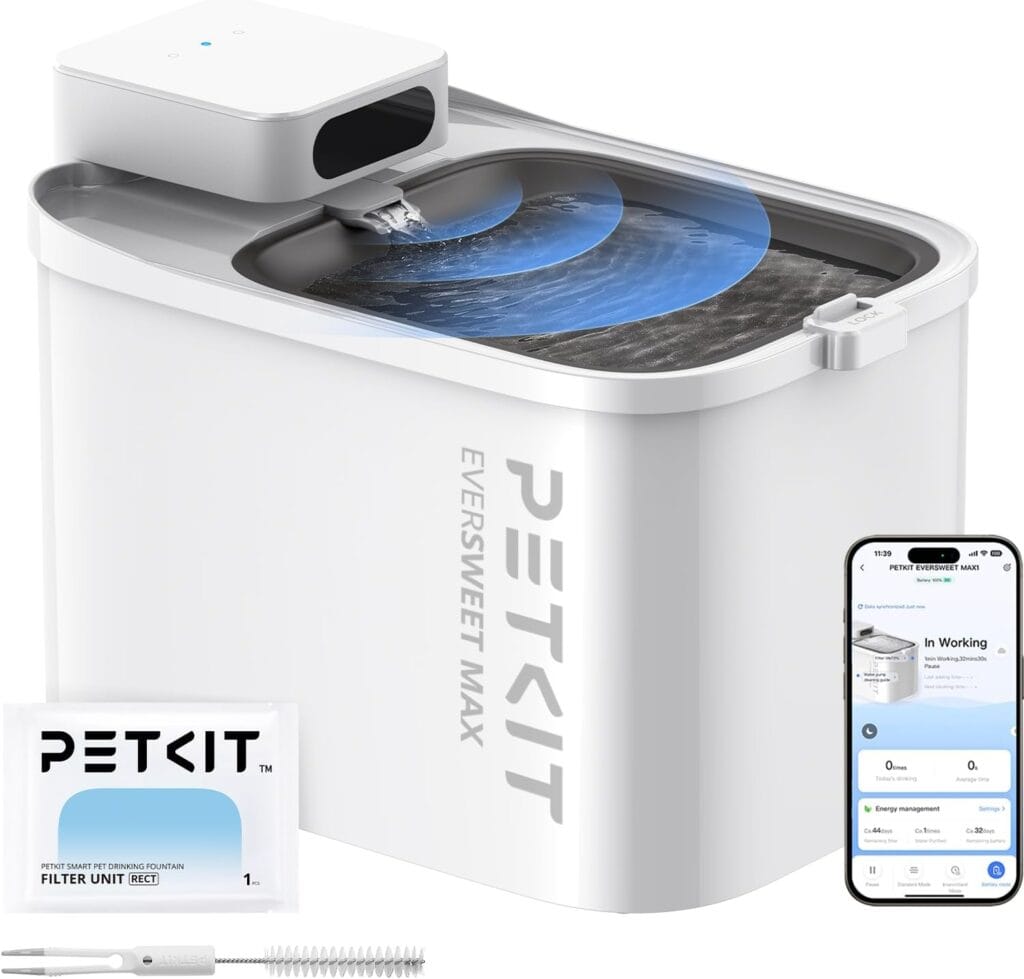
    PETKIT EverSweet Max Cordless smart cat water fountain with app display, replacement filter, and cleaning brush
    The cordless EverSweet Max combines flexible placement with app-based hydration tracking, water-level alerts, and routine filter maintenance.

    Verdict: Recommended

    A fountain beside the only available electrical outlet is not necessarily a fountain placed where the cat wants to drink.

    EverSweet Max 2 solves that practical problem.

    PETKIT’s current cordless model has a three-liter reservoir, app-based drinking records, low-water and battery notifications and a battery mode designed for flexible placement. PETKIT advertises up to 83 days of battery operation under its stated test conditions—not an unconditional promise that every household can forget the charger until the next season.

    PETKIT also states that the upgraded model uses heat-resistant, dishwasher-safe materials with a stainless steel drinking tray. That is a meaningful improvement over fountains whose product manuals begin to resemble instructions for cleaning laboratory equipment with a cotton swab.

    Choose EverSweet Max 2 when:

    • there is no convenient outlet near the best water location;
    • you want a second station in a quiet room;
    • cable access creates clutter or chewing concerns;
    • PETKIT app integration is useful;
    • you want a smart fountain without a camera.

    Skip it when:

    • the fountain will remain beside an outlet permanently;
    • individual multi-cat tracking is required;
    • you want fresh and used water physically separated;
    • charging another device already sounds irritating.

    Cordless operation is not a glamorous feature.

    It is valuable because it changes where the fountain can live.

    For some homes, that will improve access more than any hydration chart.

    PetTech AI may earn a commission from qualifying purchases.

    Would cable-free placement improve access? Check EverSweet Max 2 at PETKIT.

    Prefer Amazon checkout? Check EverSweet Max 2 price and availability on Amazon.

    Best Non-Smart Multi-Pet Fountain: PetSafe Drinkwell 360 Stainless

    Verdict: Recommended

    PetSafe Drinkwell 360 is here to make an unfashionable argument:

    Sometimes the correct hydration technology is a large stainless steel fountain with several places to drink.

    It holds 128 ounces, allows access around its circular body and includes interchangeable attachments that can create up to five streams. Most fountain components are top-rack dishwasher safe, while the pump must be cleaned separately.

    It does not provide:

    • hydration graphs;
    • app alerts;
    • RFID identification;
    • camera records;
    • cordless placement.

    It does provide capacity and simultaneous access.

    That can be more valuable in a multi-pet home than knowing that “a pet” consumed a measured amount of water from the only station available.

    Choose Drinkwell 360 when:

    • several cats or mixed pets need shared access;
    • capacity matters more than data;
    • stainless steel is preferred;
    • you want several drinking positions;
    • you would rather clean a pump than troubleshoot Wi-Fi.

    Skip it when:

    • individual cat records matter;
    • you want cordless placement;
    • the fountain must fit a small space;
    • app-based maintenance reminders would genuinely help.

    The Drinkwell is not less useful because it is not smart.

    It is less informative.

    Those are not the same thing.

    Need capacity rather than another dashboard? Check PetSafe Drinkwell 360 on Amazon.

    Most Advanced—and Least Proven: PETKIT EverSweet Ultra

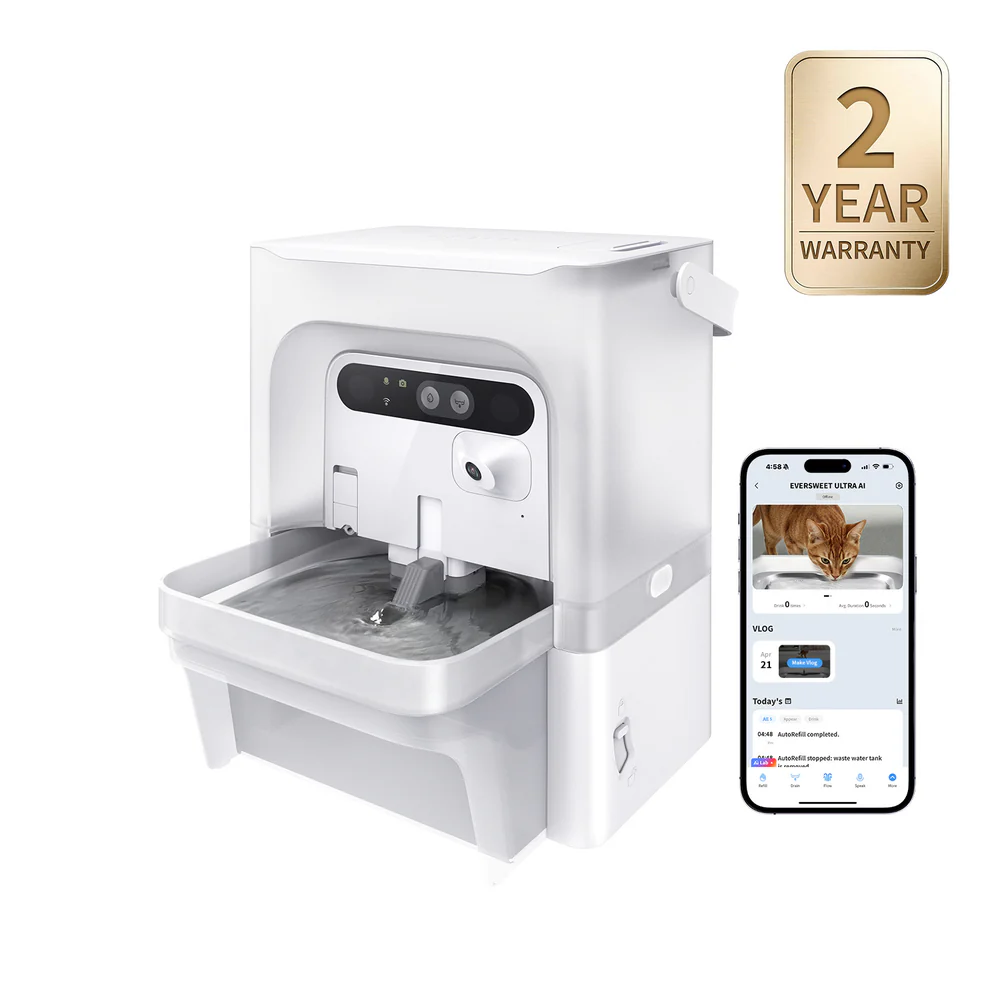
    PETKIT EverSweet Ultra with Camera smart cat water fountain showing its drinking tray, built-in camera, and PETKIT app monitoring screen
    EverSweet Ultra separates clean water from used drinking water while adding camera-supported monitoring through the PETKIT app.

    Verdict: Conditional Recommendation

    EverSweet Ultra is the product most likely to make every other fountain look conventional.

    Its OneWay system separates clean water from water that has already reached the drinking tray. Used water drains into a separate tank instead of continually rejoining the clean reservoir. PETKIT combines that architecture with an integrated AI camera, pet recognition and drinking-event monitoring.

    This is a genuine design difference—not a conventional fountain wearing an app as formal clothing.

    It is also a recent and comparatively unproven system.

    More tanks, drainage paths, camera functions and automatic controls create more opportunities for useful automation. They also create more parts whose long-term behavior must be demonstrated in homes containing hard water, fur, residue and owners who occasionally postpone cleaning.

    PETKIT has redesigned the fountain.

    The market has not yet had enough time to determine whether it has also redesigned the maintenance problem.

    Choose EverSweet Ultra when:

    • separating fresh and used water is a major priority;
    • camera-supported multi-pet monitoring has a clear purpose;
    • you already use PETKIT’s ecosystem;
    • you accept early-adopter uncertainty;
    • the larger, more complex system is compatible with your space and routine.

    Skip it when:

    • you want the safest proven choice;
    • general hydration tracking is sufficient;
    • a conventional filtered fountain already solves the problem;
    • you dislike cameras in the home;
    • complexity tends to become neglected maintenance.

    The camera may help show which pet approached, when drinking occurred and whether a pattern appears to change.

    It cannot explain the cause of that change.

    No matter how confidently the app displays a graph, the fountain has not completed veterinary school.

    For the full system analysis, read PETKIT EverSweet Ultra Review.

    PetTech AI may earn a commission from qualifying purchases.

    Want the most ambitious hydration system despite the early-adopter risk? Check EverSweet Ultra at PETKIT.

    Prefer Amazon checkout? Check EverSweet Ultra price and availability on Amazon.

    Smart Tracking or More Water Stations?

    This is the most important multi-cat decision in the article.

    An RFID fountain can separate records.

    It cannot prevent one cat from controlling access to the only water source.

    Cornell and FelineVMA guidance emphasize accessible water and separated resources in multi-cat households. In some homes, two ordinary fountains in different rooms will provide more practical value than one highly instrumented station placed in contested territory.

    Choose tracking when the unresolved question is:

    Which cat’s drinking routine changed?

    Choose multiple stations when the unresolved problem is:

    Can every cat reach water comfortably?

    The correct answer may be both.

    Technology can identify the visitor.

    It cannot negotiate a ceasefire between Baron and Biscuit.

    Hydration data becomes more useful when it can be interpreted alongside feeding routines. For households managing portions, schedules, or food competition between cats, read our Best Automatic Cat Feeders guide.

    Maintenance Is the Real Ownership Test

    Every fountain in this guide still requires regular work:

    • refill the reservoir;
    • clean the tray and internal channels;
    • remove hair and residue;
    • replace filters;
    • inspect pumps, rotors, seals and moving parts;
    • keep backup water available during cleaning or failure.

    Smart alerts can make maintenance harder to forget.

    They do not perform it.

    Before buying, check whether replacement filters are easy to obtain, whether the fountain fits comfortably in your sink or dishwasher and whether residue-prone areas are easy to reach.

    A fountain that is unpleasant to clean eventually becomes a fountain that is cleaned less often.

    The cat will not accept “advanced filtration architecture” as an explanation.

    Buyer Regret in One Sentence

    Dockstream 2 regret means discovering that one-pet data cannot separate a multi-cat household; RFID regret means learning the cats reject the tags; Max 2 regret means leaving a cordless fountain beside an outlet; Drinkwell regret means wanting data later; Ultra regret means becoming unpaid quality assurance for a very ambitious new system.

    Final Verdict

    PETLIBRO Dockstream 2 is the best overall smart cat water fountain for most one-cat homes.

    Its tracking, maintenance alerts and pump-free magnetic design add useful convenience without demanding collars, cameras or advanced monitoring.

    PETLIBRO Dockstream RFID earns a Strong Recommendation with Conditions.

    Choose it when individual multi-cat records matter and the cats will reliably tolerate the required RFID tags.

    PETKIT EverSweet Max 2 is the best option when placement is the real problem.

    Its cordless design can place water where the cat prefers to drink rather than where the nearest outlet happens to exist.

    PetSafe Drinkwell 360 remains the strongest non-smart multi-pet option.

    It prioritizes capacity and simultaneous access—advantages that remain useful after the novelty of every app has expired.

    PETKIT EverSweet Ultra earns a Conditional Recommendation.

    Its separate clean- and used-water system is genuinely interesting, but the hardware is newer, more complex and less proven. Buy it only when its architecture and camera monitoring solve a specific problem.

    The best fountain is not the one that records the most information.

    It is the one your cats use, you maintain and your household can trust after the launch campaign ends.

    For the wider view of feeding, litter, weight and hydration data, read our [Best Smart Cat Health Monitors] guide.

    Frequently Asked Questions

    What is the best smart cat water fountain overall?

    PETLIBRO Dockstream 2 is the best default for a one-cat household that wants general hydration tracking, maintenance alerts and a practical pump-free design.

    What is the best fountain for several cats?

    Choose Dockstream RFID when individual drinking records matter and the cats tolerate collar tags. When access or resource guarding is the real problem, several separated water stations may be more useful than one monitored fountain.

    Does Dockstream RFID read implanted microchips?

    No. It uses PETLIBRO RFID collar tags and does not recognize implanted identification microchips.

    Is PETKIT EverSweet Ultra worth buying?

    It can be worthwhile when separate clean and used water, camera identification and PETKIT ecosystem integration solve a clear need. It is not the safest default because the system is newer and more complex.

    Do cats drink more from fountains?

    Some cats may prefer moving water, but preferences vary. Freshness, cleanliness, accessibility, location and competition with other pets remain more important than the presence of an app.

    References

    Cornell Feline Health Center — Hydration guidance

    Feline Veterinary Medical Association — Environmental needs and separated resources

    PETLIBRO — Dockstream 2 product documentation and FAQ

    PETLIBRO — Dockstream RFID product documentation

    PETKIT — EverSweet Max 2 product documentation

    PETKIT — EverSweet Ultra product documentation

    PetSafe — Drinkwell Stainless Multi-Pet Fountain documentation

    Image Disclosure

    Official manufacturer images are used when available and authorized.

    AI-generated images may also be used as editorial illustrations. They should not be treated as exact representations of product dimensions, materials, controls or physical features. Always verify the current official product listing before purchasing.

    Editorial Disclosure

    PetTech AI may earn a commission from qualifying purchases. This does not influence our recommendations, comparisons or editorial judgments.

  • Best Smart Cat Bowls 2025: Innovative Feeding Solutions for Healthy Cats

    Best Smart Cat Bowls 2025: Innovative Feeding Solutions for Healthy Cats


    1. Introduction

    Does your cat eat too quickly, vomit after meals, or struggle with overeating? You’re not alone. Feline obesity and digestive issues are rising concerns for pet parents. While automatic feeders handle scheduling, smart cat bowls 2025take mealtime to the next level with portion control, ergonomic design, and even built-in weighing systems.

    In this guide, we review the best smart cat bowls of 2025—designed to keep your cat healthy, happy, and well-fed.


    2. Why Smart Cat Bowls Matter

    Smart bowls aren’t just trendy gadgets—they solve real problems:

    • Prevent obesity: built-in portion control discourages overeating.
    • Aid digestion: elevated or tilted designs reduce vomiting and indigestion.
    • Support multiple cats: some models prevent food stealing with microchip ID.
    • Track nutrition: bowls with digital scales let you measure exact amounts.

    For cats with weight or health issues, the right bowl can make all the difference.


    3. Features to Look For in 2025

    • Digital scale integration: precise feeding for calorie control.
    • Anti-vomiting design: elevated or tilted bowls for easy swallowing.
    • Non-slip base: prevents messes and spills.
    • Durability: stainless steel or BPA-free materials.
    • Compatibility: some pair with smart feeders for full automation.

    4. Top 3 Smart Cat Bowls 2025

    🐾 PETKIT SAB2ORA Fresh Metal Digital Pet Bowl

    PETKIT smart cat bowl with digital scale for portion control
    • 🟢 Built-in digital scale for portion control
    • 🟢 Made with antibacterial material for hygiene
    • 🟢 Sleek modern design, pairs with PETKIT app
    • 🔴 Requires batteries for scale function

    Check Price on Amazon


    🐾 Raised Tilted Ceramic Cat Food Bowl

    UPSKY elevated tilted cat bowl for anti-vomiting feeding
    • 🟢 Ergonomic 15° tilt reduces vomiting and indigestion
    • 🟢 Cute fish shape, easy to clean
    • 🟢 Affordable and widely available
    • 🔴 No digital features (purely ergonomic)

    Check Price on Amazon


    🐾 SureFeed Microchip Pet Bowl

    SureFeed microchip cat bowl with RFID lid opening. One of the best smart cat bowls 2025
    • 🟢 Opens only for the right cat (microchip/RFID recognition)
    • 🟢 Prevents food stealing in multi-cat homes
    • 🟢 Airtight lid keeps food fresh
    • 🔴 Higher price point compared to regular bowls

    Check Price on Amazon


    5. How to Introduce a Smart Bowl to Your Cat

    Cats may resist new feeding setups at first. Tips for success:

    • Place the new bowl next to the old one for a few days.
    • Start with small meals in the smart bowl.
    • Use favorite treats to create positive associations.
    • For microchip bowls, let your cat get used to the opening sound.

    6. Maintenance & Cleaning Tips

    • Wash bowls daily with warm, soapy water.
    • For digital bowls, avoid submerging the scale base.
    • Check batteries monthly.
    • Replace worn or scratched bowls to avoid bacteria buildup.

    7. Further Resources

    For more on feline nutrition and feeding guidelines, visit:
    🔗 Cornell Feline Health Center – Feline Nutrition


    8. Final Thoughts

    Smart cat bowls may seem like a small upgrade, but they can make a big impact on your cat’s health. From portion control to anti-vomiting designs, these bowls combine convenience for owners with wellness for cats.

    👉 Looking for more feeding solutions? Don’t miss our guide to Best Automatic Cat Feeders 2025.


    🔧 Section Extra 1 – Comparing Smart Bowls vs Traditional Bowls

    Traditional bowls are cheap and easy to use, but they often lack the health benefits of modern designs. Cats that eat from low, flat bowls are more likely to experience whisker fatigue, indigestion, or obesity due to overfeeding. Smart bowls solve these problems with portion control, raised angles, and sometimes app tracking. While the upfront cost is higher, pet parents often find the investment worthwhile thanks to fewer vet visits and healthier cats in the long run.


    🧪 Section Extra 2 – Which Cats Benefit Most from Smart Bowls?

    Not every cat has the same feeding needs. Smart bowls are particularly useful for:

    • Overweight cats: portion control prevents overeating.
    • Senior cats: elevated bowls reduce joint strain and improve comfort.
    • Multi-cat households: microchip bowls ensure each cat gets their share.
    • Cats with sensitive stomachs: tilted or anti-vomiting bowls promote smooth digestion.

    These categories cover the majority of indoor cats, making smart bowls a universal upgrade for feline wellness.


    Affiliate Disclaimer

    This article contains affiliate links. If you purchase through these links, we may earn a commission at no extra cost to you.

  • Smart Treat Dispensers for Cats 2025: Best Amazon Picks, Setup Tips, and Healthy Use

    Smart Treat Dispensers for Cats 2025: Best Amazon Picks, Setup Tips, and Healthy Use

    Smart treat dispensers for cats 2025 aren’t just “cute tossers.” When used well, they’re structured enrichment and micro-training tools that break up boredom, reward calm behavior, and help you bond remotely—without blowing your cat’s calorie budget. Below you’ll find the best Amazon-available models, clear setup guidance, and vet-aligned nutrition notes so you can use smart treat dispensers for cats 2025 like a pro.


    Why use smart treat dispensers for cats 2025?

    Indoor cats thrive on routine and short, predictable interactions. Timed or on-demand tosses create “micro-sessions” that reinforce calm sits, carrier desensitization, or recall to a mat. The right smart treat dispensers for cats 2025 also let you check in by video, talk to your cat, and log when dispensing happens—useful for multi-person households.

    Key idea: smart treat dispensers for cats 2025 are timers + clickers + (optional) cameras in one.


    The 3 best smart treat dispensers for cats 2025 (Amazon picks)

    Petcube Bites 2 Lite vs Bites 2 camera angles and features.

    All three links go straight to their Amazon product pages (US).

    1) Petcube Bites 2 Lite — best value pick

    Amazon link
    Why it stands out: true 1080p video with 110° wide angle, 30-ft night vision, 8× digital zoom, and two-way audio; a dishwasher-safe treat container (~1.5 lb) lets you toss treats short/medium/long or schedule auto-dispensing in the Petcube app. Motion/sound alerts are supported (advanced AI under optional Care plan). Amazon

    Good for: first smart dispenser, renters, and anyone who wants camera + dispenser in a single affordable unit.


    2) Petcube Bites 2 — best camera + connectivity

    Amazon link
    Why it stands out: 1080p video with an ultra-wide 160° view, two-way audio, night vision, and fast setup; supports both 2.4 GHz and 5 GHz Wi-Fi (handy if you’ve modernized your home network). Alexa Built-in rounds out voice control basics. Amazon

    Good for: folks who want a wider room view and robust Wi-Fi flexibility in their smart treat dispensers for cats 2025 short-list.


    3) Furbo 360° Cat Camera — best for meowing alerts + 360° pan

    Furbo 360 Cat Camera with 360° rotating view and meowing alerts.

    Amazon link
    Why it stands out: 1080p camera with 360° rotating view, two-way audio, treat toss via phone app, and meowing alerts designed for cat households. “Standard see/talk/toss” features are usable without a subscription; some advanced features (e.g., historical event clips) may sit behind Furbo plans. Amazon

    Good for: owners who want full-room coverage and audio-based alerts inside their smart treat dispensers for cats 2025 ecosystem.


    How to choose (features that truly matter)

    • Treat size tolerance & anti-clog design: Small, uniform, crunchy treats (≈8–12 mm) jam less. Look for a smooth, sloped chute.
    • Scheduling + manual toss: The best smart treat dispensers for cats 2025 let you run 1–3 micro-windows daily and still toss ad-hoc.
    • Video quality & night vision: 1080p + decent night vision helps with shy cats and nighttime check-ins (both Petcube models provide this). Amazon
    • Connectivity: If your router is 5 GHz-only in the install spot, note that Bites 2 supports 2.4/5 GHz; Bites 2 Lite works on 2.4 GHz. Amazon
    • App polish & alerts: Motion/sound alerts are common; “meowing alerts” are Furbo’s standout. Amazon

    Setup that actually works (and keeps cats calm)

    1. Station selection: waist-high shelf or wall mount in a quiet area—don’t aim toward doors where guarding or dashing can happen.
    2. Mat zone: place a small mat 1–2 m in front. Only toss when your cat is on the mat (prevents “begging at the machine”).
    3. Treat test: run 10–20 test tosses with your chosen treat and vacuum dust from the tray to reduce clogs.
    4. Short windows: schedule two micro-windows (AM and early evening, ≤90 seconds). You can still manually toss during training.
    5. Pair with play: after the evening toss, 3–5 minutes of wand play; end with one treat to signal “all done.”

    Health & nutrition: how many treats are okay?

    Treats are not balanced food. Cornell notes a good rule of thumb: treats shouldn’t exceed ~10–15% of daily calories for healthy adult cats. vet.cornell.edu The simplest plan is to log treat calories and shave a bit off dinner to keep weight stable. Routine veterinary exams remain essential (AAHA-AVMA guidelines advise at least annual wellness visits, more often for seniors/at-risk). avma.org

    Pro tip: if your cat suddenly eats less, vocalizes more, or changes litter-box habits, don’t assume it’s “behavior.” Medical causes are common drivers of house-soiling and box avoidance—call your vet. vet.cornell.edu


    Smart Treat Dispensers as Part of a Balanced Feeding Routine

    Used correctly, smart treat dispensers for cats 2025 can support—not disrupt—a healthy diet. The key is integration: schedule treat sessions around meal times to reinforce positive habits rather than create random snacking. Many owners find that offering a few measured treats before scheduled meals reduces anxiety and prevents “food guarding” behavior. When linked with smart feeders or weight scales, these devices can provide calorie insights over time, helping you fine-tune daily intake. The result is a routine where treats become training tools and data points instead of dietary risks.
    Cornell veterinarians emphasize that predictability reduces stress-related overeating and maintains stable digestion. Aligning smart treat schedules with consistent meal times is the simplest way to create a healthier, calmer feeding rhythm—especially in multi-cat households.


    Real-world playbooks (using smart treat dispensers for cats 2025)

    Calm mat training with a smart treat dispenser using smart treat dispensers for cats 2025.
    • Carrier confidence: dispenser by the carrier → toss for approach → paws in → close door briefly → quiet release → treat.
    • Nail-trim desensitization: treat for calm on the mat before/after one nail tip.
    • Night routine: 8–9 pm micro-window + short wand play + final treat; reduces 3 am zoomies.
    • Multi-cat fairness: two identical devices or two zones; synchronize drops to avoid crowding or guarding.

    The through-line: smart treat dispensers for cats 2025 should reward calm, quiet behavior—not meowing at the machine.


    Product snapshots (quick specs you’ll care about)

    • Petcube Bites 2 Lite — 1080p, 110° view, 30-ft night vision, 8× digital zoom, two-way audio, scheduled or remote toss; dishwasher-safe treat container (~1.5 lb); motion/sound alerts (advanced AI requires Petcube Care). Amazon
    • Petcube Bites 2 — 1080p, 160° ultra-wide view, two-way audio, night vision; 2.4 GHz + 5 GHz Wi-Fi support; Alexa Built-in. Amazon
    • Furbo 360° Cat Camera — 1080p, 360° rotating view, treat toss via app, two-way audio, meowing alerts; standard see/talk/toss features usable without a subscription (advanced features may require a plan). Amazon

    Pros & cons of smart treat dispensers for cats 2025

    Pros

    • Adds structure and enrichment during workdays.
    • Remote rewards for training and recall, plus check-ins by video.
    • App logs help you spot overuse or begging patterns.

    Cons

    • Over-treating → weight creep; stick to the 10% rule. vet.cornell.edu
    • Soft/crumbly treats can jam chutes; choose small, uniform kibbles.
    • Some cats fear loud tossers—pick quieter models and go slow.

    Buying advice (price, reliability, ecosystem)

    If you already run a home on Petcube or Furbo, staying within that app reduces friction. For pure value in smart treat dispensers for cats 2025, start with Petcube Bites 2 Lite; for top camera coverage + dual-band Wi-Fi, Petcube Bites 2; if you want 360° + meowing alerts, Furbo 360° Cat Camera is the most “cat-specific” option.


    Troubleshooting (fast fixes)

    • Treats don’t toss: switch to a smaller, rounder treat; clean dust; run 10 test tosses.
    • Drops cause crowding: in multi-cat homes, mirror-schedule two devices in opposite corners.
    • Connectivity weirdness: confirm 2.4 GHz availability (Bites 2 Lite) or use 5 GHz-capable hardware (Bites 2).
    • Anxious cat: turn down toss distance; pair with quiet verbal praise via two-way audio.

    Verdict: which smart treat dispensers for cats 2025 should you buy?

    If you want reliable tosses and a solid app at the best price, pick Petcube Bites 2 Lite. If you need the widest camera view and 5 GHz support, go Petcube Bites 2. If your priority is meowing alerts and full-room coverage, get Furbo 360° Cat Camera. All three are strong smart treat dispensers for cats 2025 when used with short schedules, the right treats, and a strict calorie cap.


    FAQs (quick answers)

    Do I need a camera?
    Not strictly. But camera + two-way audio improves training timing and peace of mind (Petcube/Furbo do this well).

    What size treats work best?
    Small, uniform, crunchy bits (≈8–12 mm). Avoid soft cubes and crumbly freeze-dried chunks unless the brand specifies support.

    How many treats per day?
    Keep treats to ≤10–15% of your cat’s daily calories and adjust meal portions to compensate. vet.cornell.edu

    Are sudden litter-box changes behavioral?
    Sometimes—but medical causes are common, so call your vet if habits change. vet.cornell.edu


    Internal links (PetTech AI)


    Authoritative outbound links

    • Cornell Feline Health Center — Feeding Your Cat (treats ≤10–15% of calories). vet.cornell.edu
    • AAHA-AVMA Feline Preventive Healthcare Guidelines (at least annual vet exams). avma.org

    Disclaimer

    This guide is for educational purposes only and does not replace professional veterinary advice. Smart treat dispensers for cats 2025 are tools for enrichment and training—not meal replacements. Keep total treats under 10–15% of daily calories, monitor weight weekly, and consult your veterinarian if you notice changes in appetite, thirst, litter-box habits, activity, or behavior. Some products mentioned include affiliate links to Amazon. If you purchase through these links, PetTech AI may earn a small commission at no extra cost to you. This helps fund independent testing and maintain evidence-based, unbiased reviews.

  • Best Automatic Cat Feeders (2026): Four Feeders for Four Completely Different Problems

    Best Automatic Cat Feeders (2026): Four Feeders for Four Completely Different Problems

    Amazon contains enough automatic cat feeders to suggest that feeding a cat has become an aerospace discipline.

    It has not.

    Most owners need to solve one of four problems:

    • serve dry food on schedule and see what happened;
    • keep wet food chilled until mealtime;
    • stop one cat from treating every bowl as a public buffet;
    • protect wet or prescription food using the cat’s actual microchip.

    Those problems require different machines.

    A camera does not refrigerate pâté. Refrigeration does not identify the food thief. An RFID tag is not an implanted microchip. And a feeder that films the crime in 1080p has not necessarily prevented it.

    This guide compares four products with genuinely different jobs:

    • PETKIT YumShare Solo 2;
    • PETLIBRO Polar;
    • PETLIBRO One RFID;
    • SureFeed Microchip Pet Feeder Connect.

    Research note: This is a research-led guide based on official documentation, current product information, public ownership evidence, and PetTech AI’s product-level trust checks. PetTech AI has not conducted long-term hands-on testing of every feeder included.

    Quick Verdict

    Your real problemBest feederRecommendation
    You want scheduled kibble plus camera visibilityPETKIT YumShare Solo 2Promising newer product
    You need refrigerated wet mealsPETLIBRO PolarStrong niche recommendation
    One cat steals another cat’s dry foodPETLIBRO One RFIDEstablished but conditional
    You need true microchip access for wet or dry foodSureFeed Microchip Pet Feeder ConnectStrong specialist recommendation

    The short version

    Choose YumShare Solo 2 when seeing the feeding area will actually change what you do.

    Choose Polar when your cat eats wet food and your schedule refuses to cooperate.

    Choose One RFID when you need timed dry-food dispensing plus tag-controlled access—but do not assume the door is a maximum-security facility.

    Choose SureFeed Connect when food protection matters more than automatic dispensing and you want to use the cat’s implanted microchip.

    Affiliate disclosure: This page contains affiliate links. PetTech AI may earn a commission if you purchase through them, at no additional cost to you. As an Amazon Associate I earn from qualifying purchases.

    Compare the Recommended Feeders

    First Decide What the Feeder Must Physically Do

    Before comparing hopper capacity, camera resolution, or how enthusiastically the app uses the word “AI,” answer one question:

    What must physically happen at mealtime?

    Dispense dry food and show you the bowl

    Choose a camera feeder.

    Keep wet food chilled and serve it later

    Choose a refrigerated feeder.

    Dispense dry food but restrict access using a collar tag

    Choose an RFID feeder.

    Keep prepared food available only to one microchipped cat

    Choose a microchip-access feeder.

    These categories overlap less than marketing pages suggest.

    A sophisticated product can still be completely wrong for the household.

    For a clearer breakdown of when smart pet technology should automate a task—and when it merely creates more information to check—read our Smart Cat Monitoring vs Automation guide.

    PETKIT YumShare Solo 2: Best for Camera-Based Dry Feeding

    A cat eating from an automatic dry-food feeder while a smartphone shows a simple meal-monitoring screen nearby
    Camera-based feeders are most useful when meal records and visual context change how you manage the feeding routine.

    YumShare Solo 2 combines scheduled dry-food dispensing with a camera, live monitoring, meal records, two-way audio, and PETKIT’s individual-pet recognition system.

    Its 3 L hopper holds dry kibble or compatible freeze-dried pieces. Schedules continue even when Wi-Fi is unavailable, and backup batteries can preserve feeding during a power interruption, although the camera is disabled while operating on battery power.

    That makes it a real feeder first and a camera second—which is the correct order.

    Buy it if

    • your cat eats dry food;
    • you want to see whether the cat approached the bowl;
    • you spend significant time away from home;
    • changes in mealtime behavior are worth reviewing;
    • you already use PETKIT products;
    • one feeding station serves the household.

    Skip it if

    • you only need timed portions;
    • you will stop watching the clips after three days;
    • your main diet is wet food;
    • one cat must be physically prevented from eating another cat’s meal.

    The main limitation

    YumShare Solo 2 is still new.

    Its early market signal is encouraging, but there is not yet a deep ownership history showing how consistently recognition, notifications, app behavior, and camera functions perform after years of daily use.

    There is also a conceptual limit:

    Recognition is not restriction.

    The feeder may identify Baron Fluffington as he approaches the bowl. It does not issue a restraining order.

    If one cat steals another cat’s food, a camera gives you evidence. You may still need physical access control.

    Verdict: A promising camera feeder for owners who will genuinely use visual meal context—not the default choice for simple scheduling or food theft.

    For a direct comparison between camera-led feeding, routine-first automation, dual-hopper flexibility, and identity-based systems, read PETKIT vs Feeder-Robot vs CATLINK.

    PETLIBRO Polar: Best for Refrigerated Wet Meals

    A refrigerated automatic feeder with covered wet-food meal compartments in a clean cat feeding area
    Wet-food automation needs refrigeration and timed access—not a standard kibble hopper.

    Polar solves the problem most automatic feeders quietly avoid:

    Wet food is perishable.

    It uses thermoelectric cooling, three meal compartments, app scheduling, and a removable stainless-steel tray. PETLIBRO says the feeder can keep three meals chilled for up to three days under its intended conditions and pauses cooling before serving so food is not presented at its coldest temperature.

    That does not make it a miniature restaurant.

    It makes it a refrigerated scheduling tool.

    Buy it if

    • wet food is already part of the daily routine;
    • work or other commitments interrupt meal times;
    • you want to avoid switching to kibble simply because nobody is home;
    • three prepared portions are enough;
    • you are willing to clean the tray and cooling area consistently.

    Skip it if

    • you mainly use dry food;
    • you need access control between cats;
    • your cat is very small or uncomfortable with a raised feeding area;
    • you want a long-trip feeding solution;
    • you expect refrigeration to eliminate food-safety judgment.

    The main limitation

    Polar removes timing friction.

    It does not remove:

    • leftovers;
    • condensation;
    • cleaning;
    • wall-power dependence;
    • the need to verify that the cat actually ate.

    Three chilled meals can make a workday much easier.

    They do not allow you to disappear for a long weekend while the feeder applies for temporary guardianship.

    Verdict: The strongest choice here for scheduled wet food and a genuinely useful niche product for the right household.

    For the deeper analysis, read our PETLIBRO Polar Review.

    PETLIBRO One RFID: Best for Scheduled Dry Food with Tag Access

    Two cats near a covered automatic feeder designed to give one cat protected access to its food
    Access-controlled feeders solve a different problem from scheduled feeders: keeping the right food available to the right cat.

    One RFID combines two functions:

    • automatic dry-food dispensing;
    • access controlled through PETLIBRO’s dedicated RFID collar tag.

    This makes it more relevant than a normal hopper when one cat steals dry food from another or when separate portions need to be maintained.

    The product has a substantial public ownership history, and the overall market signal supports keeping it in the guide.

    But it requires careful framing.

    Buy it if

    • your cats eat dry food;
    • one cat regularly invades another cat’s feeding station;
    • you want both meal scheduling and controlled access;
    • the authorized cat tolerates a collar tag;
    • you can position the feeder away from interference;
    • the consequences of occasional access failure are manageable.

    Skip it if

    • you need implanted-microchip recognition;
    • your cat refuses collars;
    • you feed wet food;
    • unauthorized access would create a serious medical risk;
    • you expect the door to defeat every determined cat in existence.

    The main limitation

    One RFID uses a proprietary collar tag.

    Its performance depends on:

    • tag position;
    • reader placement;
    • lid speed;
    • nearby interference;
    • feeder spacing;
    • the determination and engineering qualifications of the unauthorized cat.

    PETLIBRO provides troubleshooting guidance for slow closure, incomplete opening, RFID interference, and rotor errors. Some owners also report that another cat can exploit the lid before it closes fully.

    This does not make the feeder useless.

    It means “designed to reduce food theft” should not be translated as “physically impossible to defeat.”

    For ordinary dry-food separation, it can be a practical solution.

    For a prescription diet where unauthorized access carries meaningful health consequences, SureFeed’s microchip approach or a more enclosed physical setup may be the safer direction.

    Verdict: A credible and established dry-food access feeder, but a conditional recommendation rather than a prison-grade guarantee.

    SureFeed Microchip Pet Feeder Connect: Best for True Microchip Access

    SureFeed Connect is fundamentally different from the other three products.

    It does not contain a large hopper.

    It does not release a fresh portion at a scheduled time.

    Instead, you place wet or dry food in its 400 ml bowl, and the lid opens only when the registered cat’s implanted microchip or compatible RFID tag approaches.

    That makes it the strongest specialist option when the food itself needs protection.

    Buy it if

    • one cat needs prescription or therapeutic food;
    • one pet steals wet or dry meals;
    • you prefer implanted-microchip access over a collar tag;
    • food can remain available for grazing;
    • accurate portion monitoring is useful;
    • automatic dispensing is not required.

    Skip it if

    • you want meals dispensed at specific times;
    • you need a large dry-food hopper;
    • you want one device to combine automatic portions and microchip access;
    • you do not want the additional Hub required for Connect app features.

    The main limitation

    The Connect version requires the Sure Petcare Hub to communicate with the app.

    The feeder is also relatively open at the rear. Sure Petcare sells an optional rear cover specifically for persistent thieves capable of approaching from behind.

    This is useful honesty from the manufacturer.

    Apparently some cats respond to access-control technology by conducting a structural vulnerability assessment.

    The rear cover, feeder placement, and training process may therefore matter in particularly competitive homes.

    Even with those caveats, SureFeed’s mature microchip-access model gives it the strongest argument when food protection—not timed dispensing—is the priority.

    Verdict: The best specialist choice for true microchip-controlled access to prepared wet or dry food.

    The Food-Thief Test

    Suppose Clara has prescription food.

    Her brother, Caesar, believes prescriptions are merely serving suggestions.

    YumShare Solo 2

    Records Caesar approaching Clara’s food.

    You receive a clear image of the suspect.

    Polar

    Keeps Clara’s wet food chilled until serving time.

    Caesar appreciates the improved catering.

    PETLIBRO One RFID

    Uses Clara’s collar tag to open the feeding area and attempts to close it after she leaves.

    Caesar may be stopped—or may begin studying lid timing.

    SureFeed Connect

    Opens for Clara’s implanted microchip and closes when she leaves.

    Add the rear cover if Caesar has developed flanking tactics.

    That is why “best automatic feeder” is the wrong question.

    The better question is:

    Which physical mechanism solves the problem in your home?

    Buyer Regret in One Table

    ProductMost likely regret
    YumShare Solo 2Paying for camera functions you stop using
    PolarExpecting wet-food automation without cleaning
    One RFIDAssuming a collar-tag door is impossible to bypass
    SureFeed ConnectDiscovering it protects food but does not dispense timed portions

    Final Verdict

    There is no single best automatic cat feeder because these four products do not perform the same job.

    PETKIT YumShare Solo 2 is the best fit for dry-food scheduling with visual context. It is promising, useful, and still too new to call a proven long-term default.

    PETLIBRO Polar is the strongest refrigerated wet-food option for owners whose main problem is serving meals while away from home.

    PETLIBRO One RFID is a credible choice for scheduled dry-food access control, provided buyers understand the limits of a collar-tag system and moving lid.

    SureFeed Microchip Pet Feeder Connect is the best specialist solution when implanted-microchip access and food protection matter more than timed dispensing.

    The correct feeder is not the product with the longest feature list.

    It is the machine that physically solves the recurring problem without creating three new ones.

    Frequently Asked Questions

    Which automatic feeder is best for wet food?

    PETLIBRO Polar is the better option for scheduled refrigerated wet meals. SureFeed Connect is better when wet food must remain accessible only to one authorized cat.

    Can YumShare Solo 2 stop food stealing?

    No. Its camera and recognition features provide visual context, but they do not physically prevent another cat from reaching dispensed food.

    Does PETLIBRO One RFID read implanted microchips?

    No. It uses PETLIBRO’s dedicated RFID collar tag.

    Is PETLIBRO One RFID impossible for another cat to defeat?

    No access system should be treated as impossible to defeat. Lid timing, feeder placement, interference, and the behavior of the unauthorized cat all affect real-world performance.

    Does SureFeed Connect dispense scheduled meals?

    No. It protects food already placed in the bowl. Its main job is access control, not timed portion dispensing.

    Does SureFeed Connect require a Hub?

    Yes. The Connect model requires the Sure Petcare Hub for app connectivity. Buyers who do not need app monitoring can also consider the non-Connect Microchip Pet Feeder.

    References

    • PETKIT YumShare Solo 2 official product and support documentation
    • PETLIBRO Polar official product, feeding, cooling, and cleaning guidance
    • PETLIBRO One RFID official product and troubleshooting documentation
    • Sure Petcare Microchip Pet Feeder Connect official product and accessory documentation
    • Public ownership reports reviewed for recurring reliability and access-control patterns

    Image Disclosure

    Some images in this article may be AI-generated for illustrative purposes. They do not depict the exact products and should not be used to evaluate dimensions, controls, fit, or physical features.

    Disclosure

    PetTech AI may earn a commission when readers purchase through affiliate links. Products are recommended according to the feeding problem they can realistically solve, not according to how enthusiastically their product pages use the word “smart.”