Category: Hygiene & Home Safety

Smart litter boxes, cat doors, cameras, and health monitors: discover the top 2025 products to keep your cat safe, your home clean, and your life stress-free.

  • Litter-Robot vs Feeder-Robot (Whisker Ecosystem Comparison 2025)

    Litter-Robot vs Feeder-Robot (Whisker Ecosystem Comparison 2025)

    The year 2025 marks the full arrival of cat home automation. For many pet parents, technology is no longer about gadgets — it’s about freedom. Whisker, the company behind the famous Litter-Robot, has built an entire ecosystem around automation, expanding from litter care to feeding.

    In this in-depth review, we’ll explore the real differences in the Litter-Robot vs Feeder-Robot experience, how both devices work together, and whether owning the full Whisker ecosystem is worth the investment.


    Affiliate Disclosure:
    This article contains affiliate links. If you purchase through them, PetTech AI may earn a small commission at no extra cost to you. Our reviews are based on independent testing and transparent data.


    The Idea Behind Whisker’s Smart Ecosystem

    Whisker started as a one-product brand with the Litter-Robot but quickly evolved into a pioneer of fully automated cat care. The company’s vision is simple: create reliable products that handle daily cat chores without stress or manual work.

    The Litter-Robot vs Feeder-Robot pairing represents that vision perfectly — two devices built to work separately yet designed to synchronize seamlessly inside one ecosystem.

    In practice, this means less time spent cleaning, feeding, or worrying about whether your cat’s routine is on track. It also means a cleaner home, more predictable feeding schedules, and better hygiene.


    Litter-Robot 4 Overview

    litter-robot-4-automatic-cleaning, litter-robot vs feeder-robot

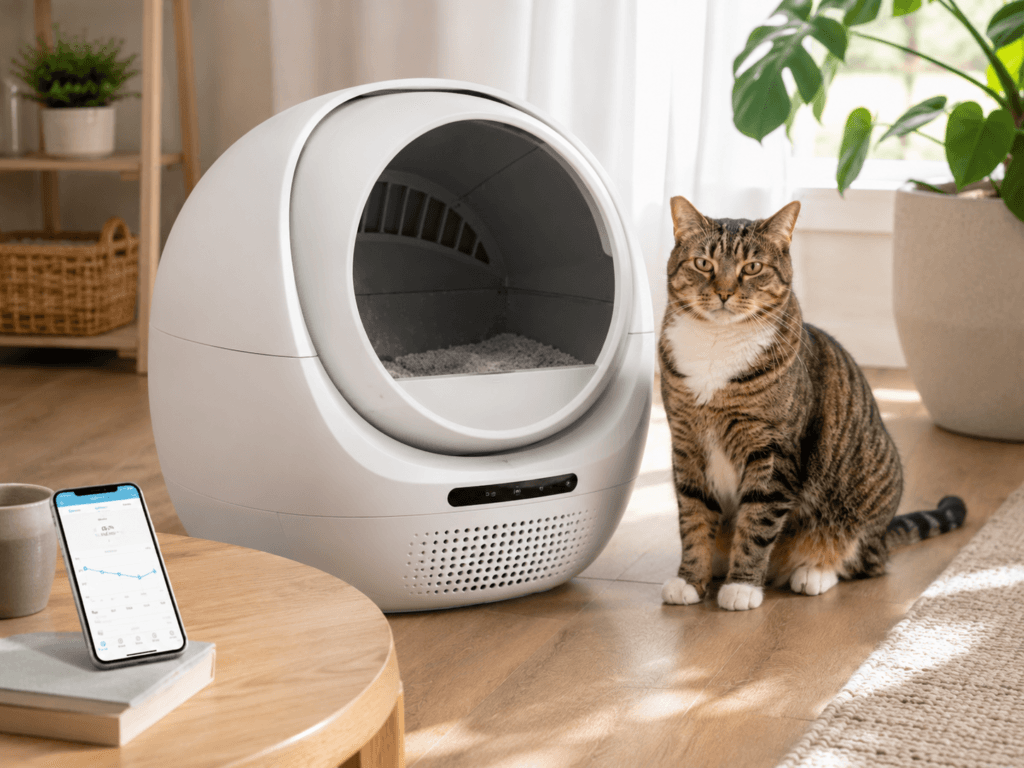
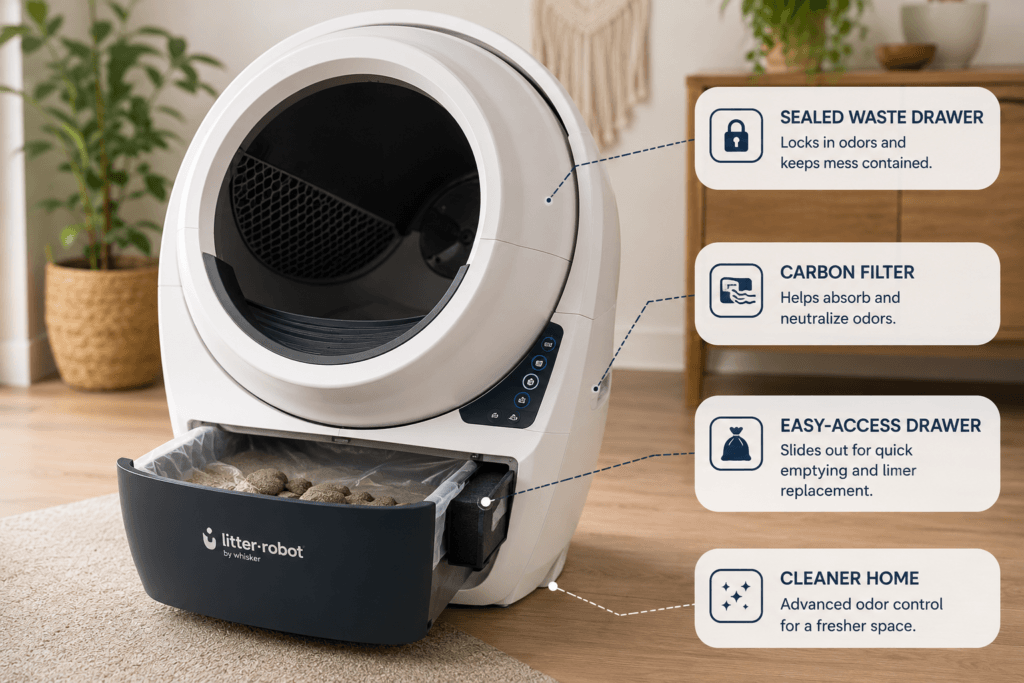
    The Litter-Robot 4 is the flagship of Whisker’s automation lineup and still the most advanced self-cleaning litter box on the market. It features motion sensors, odor filters, and quiet operation that keeps your home fresh and calm.

    Every cycle automatically removes waste after your cat leaves the box, depositing it into a sealed drawer lined with a bag. The carbon filter traps odors efficiently, and the Wi-Fi connection allows real-time notifications on the Whisker App.

    Main advantages:

    • Silent self-cleaning mechanism
    • Carbon odor control system
    • Safety sensors for cats of all sizes
    • Works with multiple cats
    • Wi-Fi connection for data tracking

    The Litter-Robot 4 costs around $699 to $799, depending on the bundle. It’s expensive, yes, but the value grows over time. After two months, you’ll notice that “scooping” disappears from your vocabulary.

    Whisker also designed the device for easy maintenance: you only change the liner and wipe the globe. That simplicity is why it remains a top-rated smart litter box in 2025.

    Read our full Litter-Robot 4 Review →


    Feeder-Robot Overview

    feeder-robot-dispensing-food

    The Feeder-Robot continues where the Litter-Robot leaves off — automating feeding. With precise portion control, scheduling, and food freshness management, it’s an equally impressive piece of technology.

    This device lets you schedule up to 12 meals a day, customize portion sizes, and even feed manually through the app. A large food hopper holds up to 32 cups, sealed with an airtight lid and desiccant.

    Main advantages:

    • Ultra-quiet operation
    • Portion accuracy down to a few grams
    • App notifications for refills and jams
    • Sleek and minimal design that fits any kitchen

    The Feeder-Robot retails for around $299 to $349, making it a mid-high tier feeder but one that eliminates constant measuring and cleaning. It connects to the same Whisker App as the litter box, providing one unified interface for your cat’s daily care.

    See our complete Feeder-Robot Review →


    App Experience: One Dashboard, Two Worlds

    Cat owner checking Whisker app dashboard for litter and feeding updates.

    What makes the Litter-Robot vs Feeder-Robot experience unique is not the hardware — it’s the software. The Whisker App serves as a unified command center.

    Inside the app, you can view feeding schedules, cleaning cycles, waste drawer status, and food levels at a glance. You can even sync the two devices to follow your cat’s natural rhythm: feed first, then clean ten minutes later.

    The app experience feels polished and reliable. Notifications are fast, the layout is intuitive, and updates are frequent. While occasional lag can occur after firmware updates, it rarely affects automation.

    This unified system is what defines Whisker’s advantage: true integration, not just coexistence.


    Everyday Life With Both Devices

    During our 14-day test, both devices were connected and scheduled through the same app. Here’s what a typical day looked like:

    • 7:30 AM: Feeder-Robot dispenses breakfast.
    • 7:45 AM: Litter-Robot 4 cycles automatically after use.
    • 1:00 PM: Snack time — portion controlled.
    • 6:30 PM: Dinner is served, followed by another clean cycle.

    By the end of the week, the two cats had adapted perfectly. The sound of the feeder became the signal for meals; the litter box cleaned itself minutes later. The experience felt closer to having a quiet assistant than a machine.

    When evaluating Litter-Robot vs Feeder-Robot, the biggest takeaway is that both do their jobs so well that they disappear into your routine. Automation feels natural, not intrusive.


    Strengths and Weaknesses

    Pros

    • Unified Whisker App for both devices
    • High reliability and build quality
    • Odor-free and hygienic environment
    • Time-saving for busy owners
    • Excellent customer support

    Cons

    • Combined cost above $1,000
    • Both require Wi-Fi for remote monitoring
    • Large devices may not suit small apartments

    Even with those drawbacks, the combination feels worth it. Together, Litter-Robot vs Feeder-Robot saves roughly an hour per week of manual work — over 50 hours per year.


    Litter-Robot vs Feeder-Robot: Feature Comparison

    Side-by-side comparison of Litter-Robot 4 and Feeder-Robot devices.
    FeatureLitter-Robot 4Feeder-Robot
    Primary FunctionAutomatic litter cleaningAutomated food dispensing
    Price Range$699–$799$299–$349
    ConnectivityWi-Fi via Whisker AppWi-Fi via Whisker App
    SensorsMotion, weight, safetyPortion, food level
    CapacityMulti-cat32-cup hopper
    Noise LevelVery quietUltra-quiet
    MaintenanceLowVery low
    Power OptionsAC + battery backupAC only
    App SupportFull integrationFull integration

    In short, the Litter-Robot vs Feeder-Robot pairing offers different functions but identical reliability. Each does one thing perfectly — and that’s exactly what makes the ecosystem shine.


    Cost vs Convenience: Is It Worth It?

    Owning both devices can cost close to a thousand dollars, but convenience has a measurable value.

    If you spend 10 minutes daily feeding and cleaning, that’s over an hour every week. In a year, you’ve saved days of repetitive chores. Add fewer odors, cleaner air, and better consistency — and the math starts making sense.

    Whisker’s devices are also durable. The Litter-Robot 4 can easily last a decade with maintenance. That long lifespan turns an expensive purchase into a stable, long-term investment.

    When you look at Litter-Robot vs Feeder-Robot, what you’re really buying is reliability and peace of mind — a home that takes care of itself while you’re at work or traveling.


    Alternatives to Whisker’s Duo

    For cat parents who want automation but prefer a lower price range, PETKIT provides a solid alternative.

    The PETKIT PuraMax automatic litter box and Fresh Element Infinity feeder both connect via the PETKIT app. They offer good automation, though not as smooth or unified as Whisker’s platform.

    FeatureWhisker EcosystemPETKIT Ecosystem
    App IntegrationSeamlessModerate
    Build QualityPremiumLightweight
    Price RangeHighMedium
    Noise LevelLowLow
    Update FrequencyFrequentOccasional

    If your budget allows, Whisker is still the better long-term choice. But if you need a taste of automation without premium pricing, PETKIT’s lineup is a strong entry point.

    Read our PETKIT Fresh Element Infinity Review →
    Read our PuraMax Review 2025 →


    The Future of Whisker Automation

    Whisker’s next step may involve health monitoring and AI-assisted analytics. The company has hinted at upcoming features like smart cameras and wellness reports that track eating and litter habits to detect early health issues.

    This evolution makes Litter-Robot vs Feeder-Robot feel like version 1.0 of a larger system — a stepping stone toward a completely intelligent home for cats. In the next few years, we expect more device sync, smarter sensors, and voice assistant integration.


    Expert Verdict

    The PetTech AI testing team concludes that Litter-Robot vs Feeder-Robot is not a rivalry but a partnership. Each product handles one side of your cat’s routine — and together they create the smoothest automation workflow available in 2025.

    The Litter-Robot 4 wins in hygiene and odor control. The Feeder-Robot dominates in accuracy and consistency. Combined, they redefine what “smart pet care” really means.

    If your goal is to spend less time maintaining your cat’s environment and more time actually enjoying their company, this is the duo that gets you there.


    Final Thoughts

    Whisker’s system is built around trust. You trust the devices to feed, clean, and notify you only when necessary. After a few days, you’ll notice something surprising — silence. No scooping sounds, no reminders, no manual chores. Just predictable routines.

    That’s the power of Litter-Robot vs Feeder-Robot: real automation that fades into the background.


    Official Whisker Store:
    👉 Get Feeder-Robot — $50 Off with Code REALSIMPLE50
    👉 Get Litter-Robot 4 — $50 Off with Code REALSIMPLE50
    👉Get Litter-Robot 4 – Amazon
    👉Get Feeder-Robot – Amazon
    Affiliate links. Pricing and availability may vary.


    FAQ

    Do I need both devices to use the Whisker App?
    No. Each works independently, but owning both unlocks the full automation experience.

    Are they noisy?
    Not at all. The Feeder-Robot makes a soft hum, and the Litter-Robot’s rotation is barely audible.

    What happens if Wi-Fi disconnects?
    Both devices continue their routines locally. The app syncs automatically once the connection returns.

    Is this setup suitable for multiple cats?
    Yes. Both devices were tested in multi-cat homes and adapted perfectly.

    Learn More About Cat Health and Behavior

    While automation simplifies daily care, understanding your cat’s natural habits remains essential. Trusted sources like the Cornell Feline Health Center, the American Veterinary Medical Association (AVMA), and the ASPCA Pet Care Library offer evidence-based guidance on nutrition, behavior, and wellness.
    Pairing these insights with technology like the Litter-Robot vs Feeder-Robot ecosystem helps you provide smarter, safer, and healthier routines for your cat.

  • PETKIT PuraMax 2 vs Litter-Robot 4: Is Whisker Worth the Premium?

    PETKIT PuraMax 2 vs Litter-Robot 4: Is Whisker Worth the Premium?

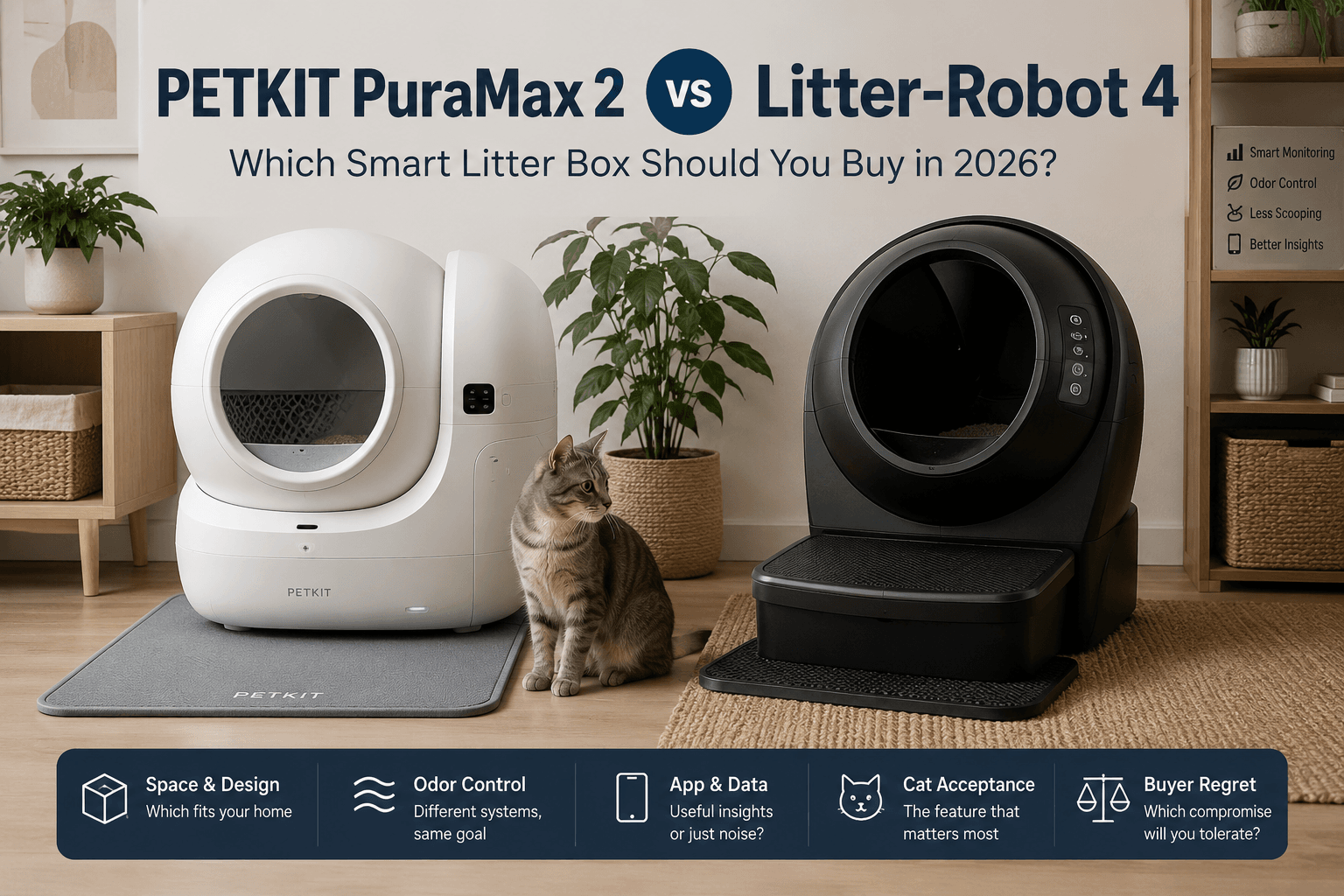
    PETKIT PuraMax 2 vs Litter-Robot 4 looks like a contest between the value challenger and the established premium choice.

    That framing is convenient for Whisker—and potentially expensive for everyone else.

    Both machines automate the same unpleasant transaction: your cat creates a problem, the globe rotates and you deal with the consequences later.

    The differences are physical and financial.

    PuraMax 2 offers the stronger value for many one- or two-cat homes.

    Litter-Robot 4 becomes the better purchase when its larger entrance, higher cat-weight limit, four-cat capacity and established support platform solve a problem PETKIT does not.

    The question is not which company has won more internet arguments.

    It is:

    Will your household actually use enough of Litter-Robot 4’s advantages to justify paying the Whisker premium?

    Quick Verdict

    CategoryPETKIT PuraMax 2Litter-Robot 4
    PetTech AI verdictStrong Recommendation for ValueRecommended with Conditions
    Best fitOne or two average-sized catsLarger cats and heavier multi-cat households
    Main advantageStrong automation at a substantially lower typical costLarger opening, broader physical capacity and mature platform
    Cat weight range3.3–22 lb3–25 lb
    Best space advantageShorter and shallowerNarrower body and larger entrance
    Main limitationSmaller opening and less established ownership ecosystemPremium is difficult to justify for simpler households
    Choose it whenPrice-to-function matters mostPhysical fit and platform confidence matter most

    Choose PuraMax 2 when your cats fit comfortably, the household is not unusually demanding and you would rather pay for automation than brand reassurance.

    Choose Litter-Robot 4 when a larger cat, three- or four-cat traffic, a much wider opening or Whisker’s trial and support system materially reduces buyer risk.

    Litter-Robot 4 is not a bad value because it costs more.

    It becomes a bad value when you pay for advantages your home never uses.

    Research Note

    This is a research-led comparison based on current official specifications, app documentation, product positioning and available ownership evidence.

    PetTech AI has not conducted a long-term side-by-side hands-on test of both machines.

    PetTech AI may earn a commission from qualifying purchases. As an Amazon Associate I earn from qualifying purchases.

    Does PuraMax 2 fit your cats and room? Check PuraMax 2 through PETKIT.

    Does the larger Whisker platform solve a real constraint? Check Litter-Robot 4 availability on Amazon.

    The Real Difference: Value vs Physical Headroom

    PuraMax 2 and Litter-Robot 4 both separate clumped waste from clean litter, store it in an enclosed drawer and connect to an app for remote controls, maintenance alerts and routine tracking.

    The buying decision begins after those shared functions.

    PuraMax 2 prioritizes:

    • compact vertical dimensions;
    • broad litter compatibility;
    • sealed waste storage;
    • PETKIT app integration;
    • automated deodorization;
    • a lower typical purchase threshold.

    Litter-Robot 4 prioritizes:

    • a substantially larger entrance;
    • support for heavier cats;
    • official use for up to four cats;
    • detailed waste and litter-level sensing;
    • a mature accessory and support environment;
    • a 90-day in-home trial.

    Whisker is not charging more for identical plastic wearing a bow tie.

    Its advantages are real.

    They are simply unnecessary for a large portion of ordinary households.

    Why PuraMax 2 Is the Better Value for Most Smaller Homes

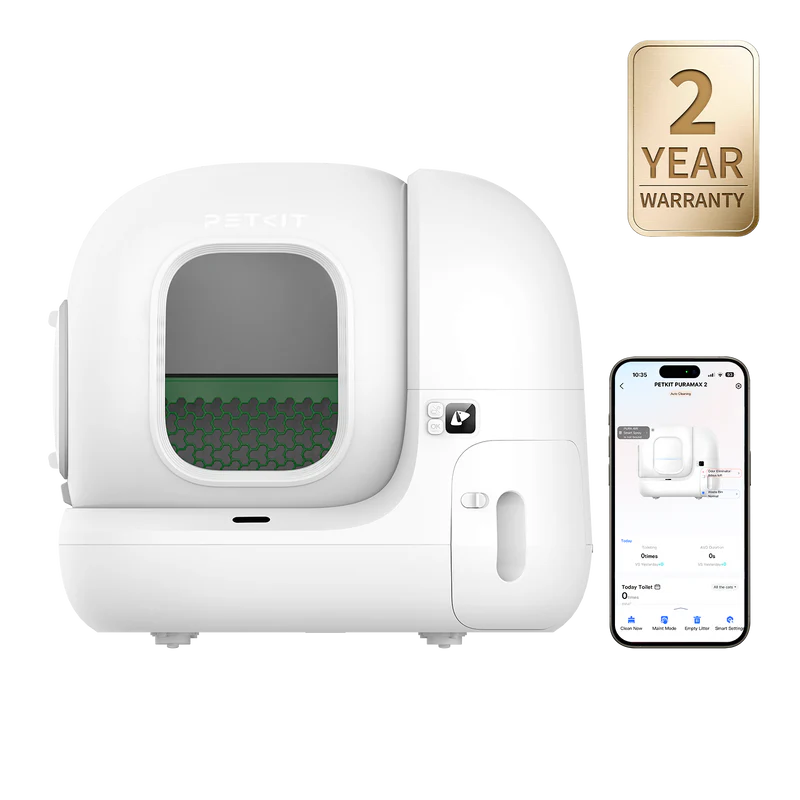
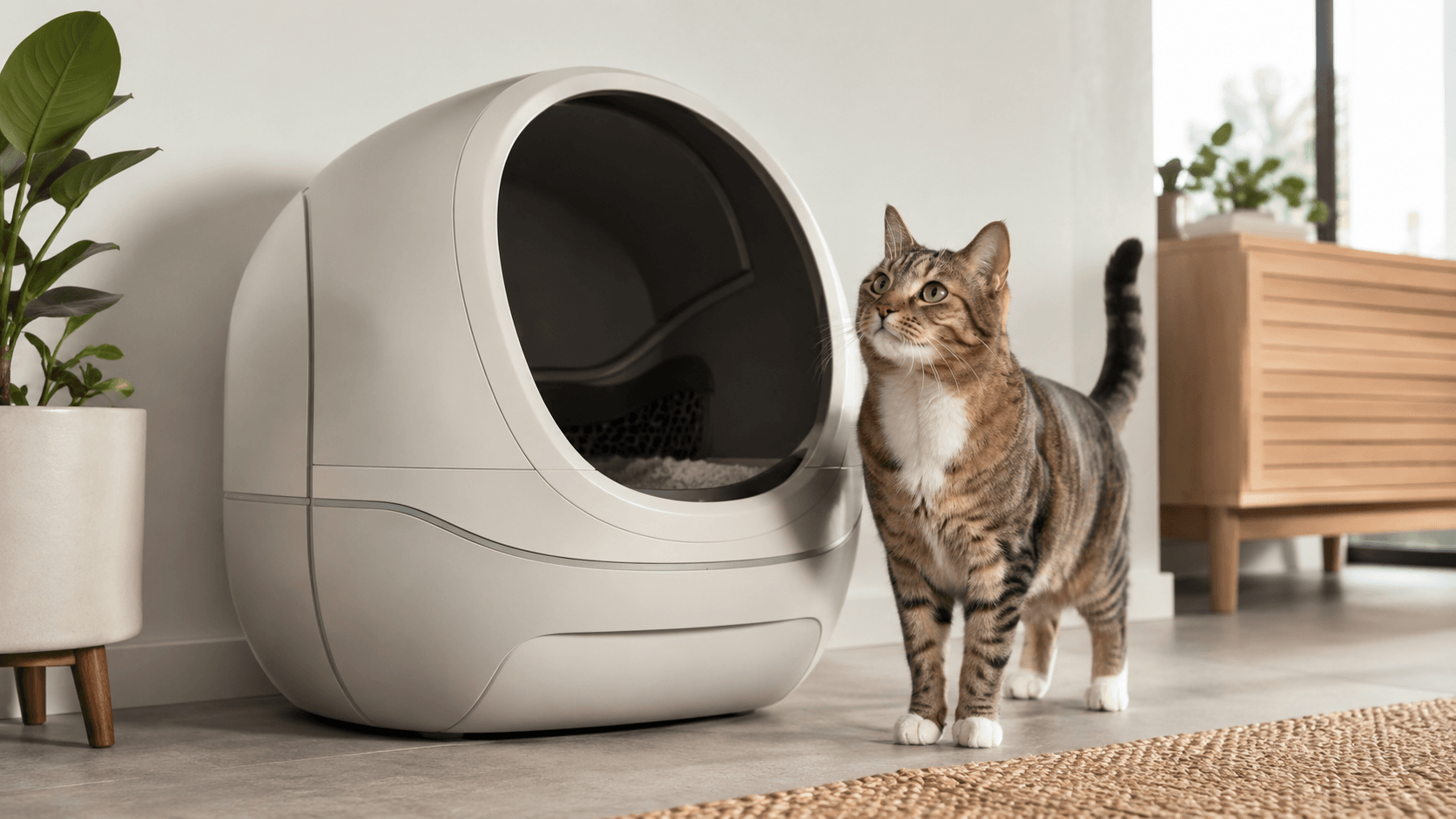
    PETKIT PuraMax 2 self-cleaning litter box in a modern home setup
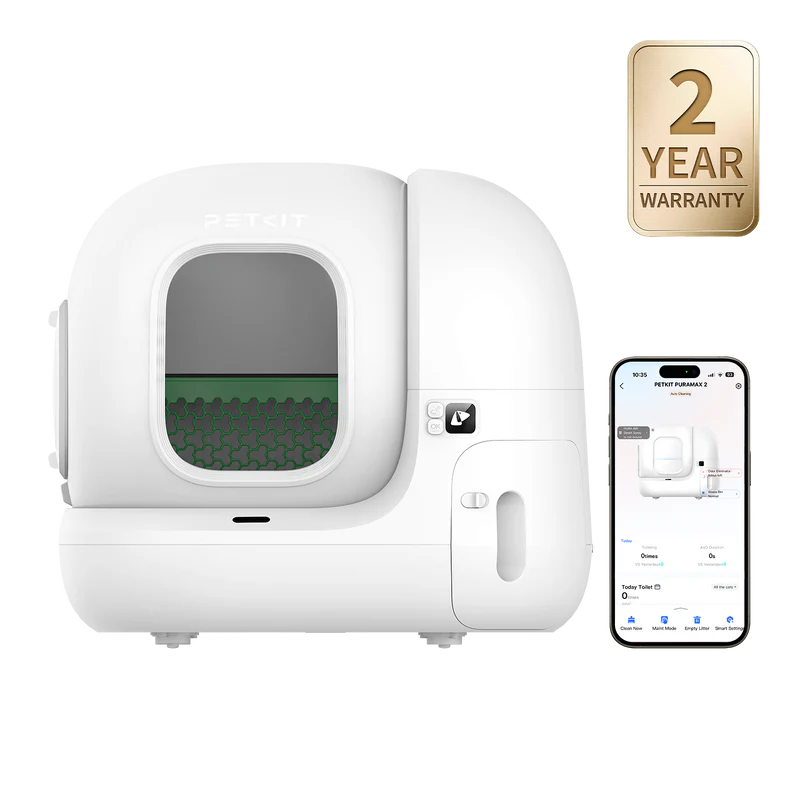
    PuraMax 2 is the stronger fit for buyers who want compact premium litter automation inside the PETKIT ecosystem.

    PuraMax 2 supports cats from 3.3 to 22 lb and provides a 76-liter cylinder with a 7-liter waste bin. PETKIT says the bin can last up to approximately 15 days for one cat, although real frequency depends on litter-box traffic and environmental conditions.

    Its exterior measures approximately:

    • 24.4 inches wide;
    • 21.2 inches deep;
    • 21.7 inches tall.

    That makes it considerably shorter and shallower than Litter-Robot 4, although it is slightly wider.

    PuraMax 2 is the stronger decision when:

    • one or two cats use the box;
    • every cat remains comfortably below 22 lb;
    • room depth or vertical presence is limited;
    • PETKIT feeding or hydration products already use the app;
    • purchase value matters more than maximum physical flexibility;
    • a wider Whisker support ecosystem adds little practical benefit.

    The PETKIT app can also manage compatible feeders, fountains and litter boxes, making PuraMax 2 more attractive inside a broader connected-care setup.

    For a closer evaluation of the machine itself, read our PETKIT PuraMax 2 Review.

    PuraMax 2 does not win merely because it is cheaper.

    It wins when Litter-Robot 4 would charge the household more for capacity, opening size and institutional confidence it does not need.

    Whisker’s reputation has value.

    It has not yet been classified as a second cat.

    When Litter-Robot 4 Is Worth Paying More For

    Litter-Robot 4 supports cats from 3 to 25 lb and is officially positioned for households with as many as four cats. Its entrance measures 15.75 inches across, while its exterior footprint is 22 by 27 inches with a height of 29.5 inches.

    Those numbers create a meaningful advantage for:

    • large or long-bodied cats;
    • cats uncomfortable with narrower enclosed entrances;
    • three- or four-cat households;
    • heavier litter-box traffic;
    • buyers who value Whisker’s established troubleshooting history;
    • households likely to use accessories such as LitterHopper.

    Whisker also backs its automatic litter boxes with a 90-day in-home trial and a standard one-year warranty. Returns under the trial require the buyer to cover return shipping, but the trial still lowers the risk of discovering that Emperor Maximilian rejects the machine after a lengthy internal review process.

    Litter-Robot 4 therefore becomes easier to justify when the premium purchases fit, capacity or reduced adoption risk.

    It becomes harder to justify when one average-sized cat uses the box and PuraMax 2 already fits the room.

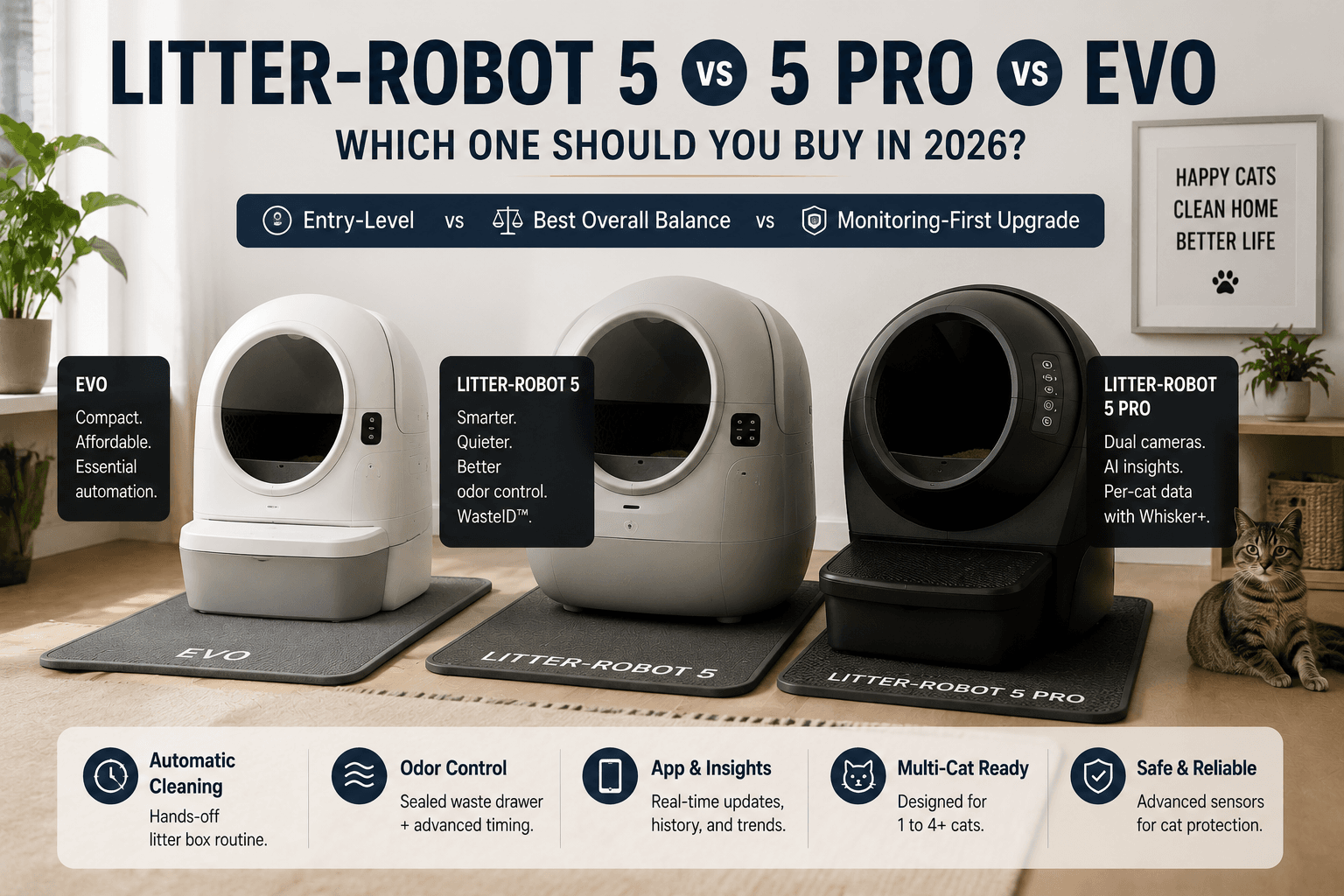
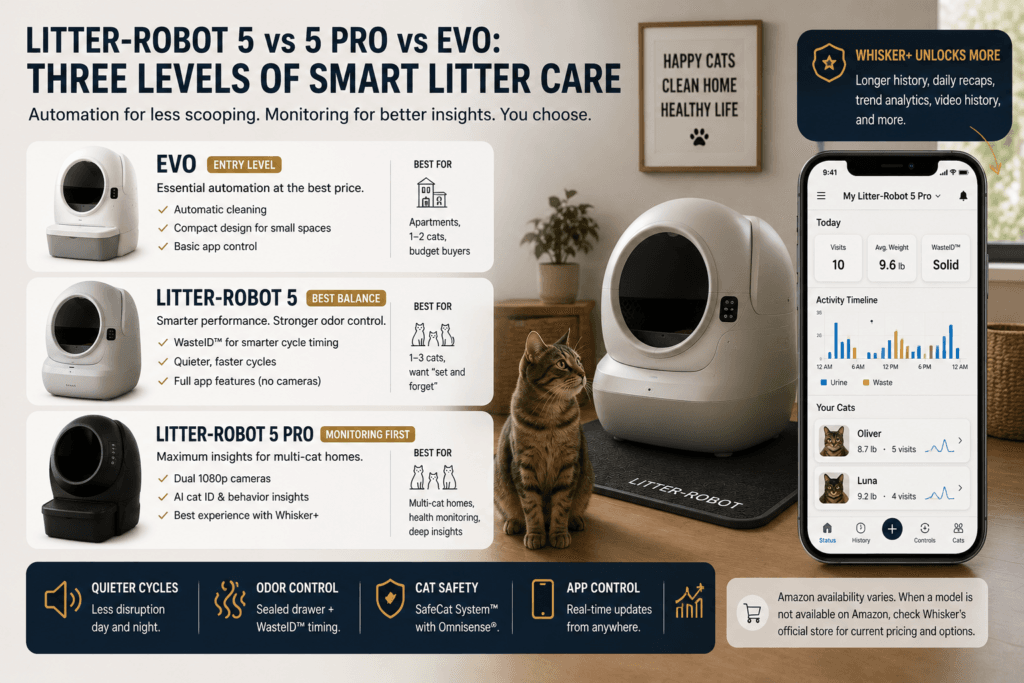
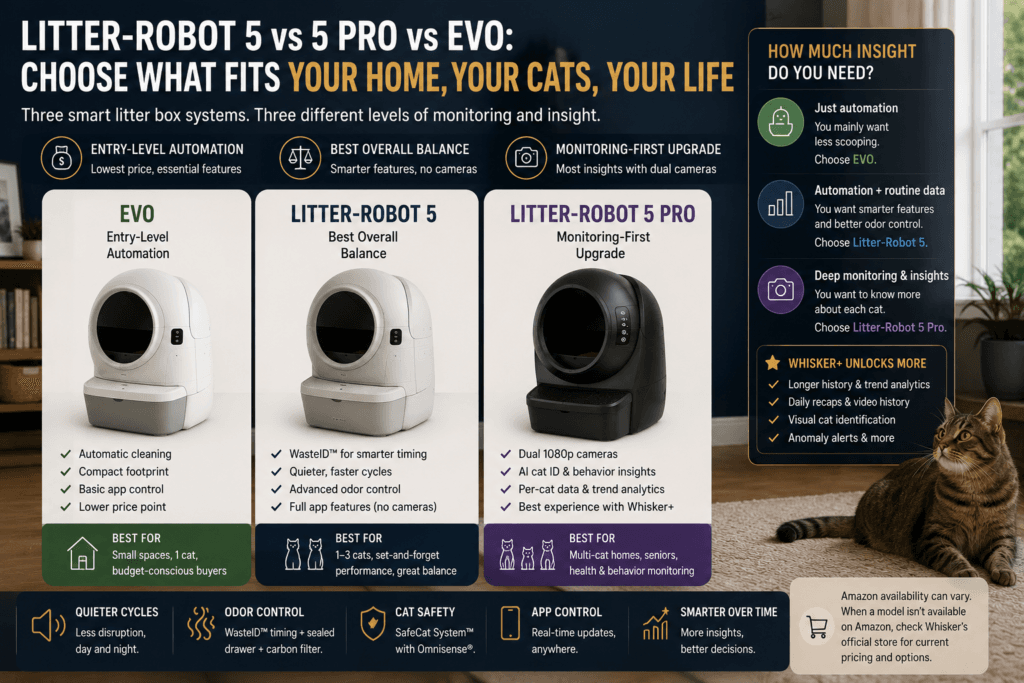
    For buyers considering Whisker’s newer lineup, read our Litter-Robot 5 vs 5 Pro vs EVO comparison before assuming LR4 remains the automatic choice.

    Space and Entry: Neither Machine Is Simply “Smaller”

    PuraMax 2 is shorter and shallower.

    Litter-Robot 4 is narrower.

    PuraMax 2 measures roughly 24.4 by 21.2 by 21.7 inches. Litter-Robot 4 measures 22 by 27 by 29.5 inches.

    That creates two different placement advantages:

    • choose PuraMax 2 when room depth or overall height is the problem;
    • choose Litter-Robot 4 when horizontal width is tighter.

    Entry access also favors Whisker.

    PuraMax 2 has an entrance around 7.87 by 10.03 inches with a 7.87-inch threshold. Litter-Robot 4 provides a 15.75-inch opening and an included step approximately 6.9 inches high.

    PuraMax 2 should therefore not be recommended automatically for mobility-limited cats simply because the entire machine looks lower.

    Cats with joint pain, impaired mobility or strong enclosure aversion may still prefer a genuinely low-sided conventional box.

    The app can document rejection with impressive precision.

    It cannot negotiate acceptance.

    Odor Control and Ongoing Consumables

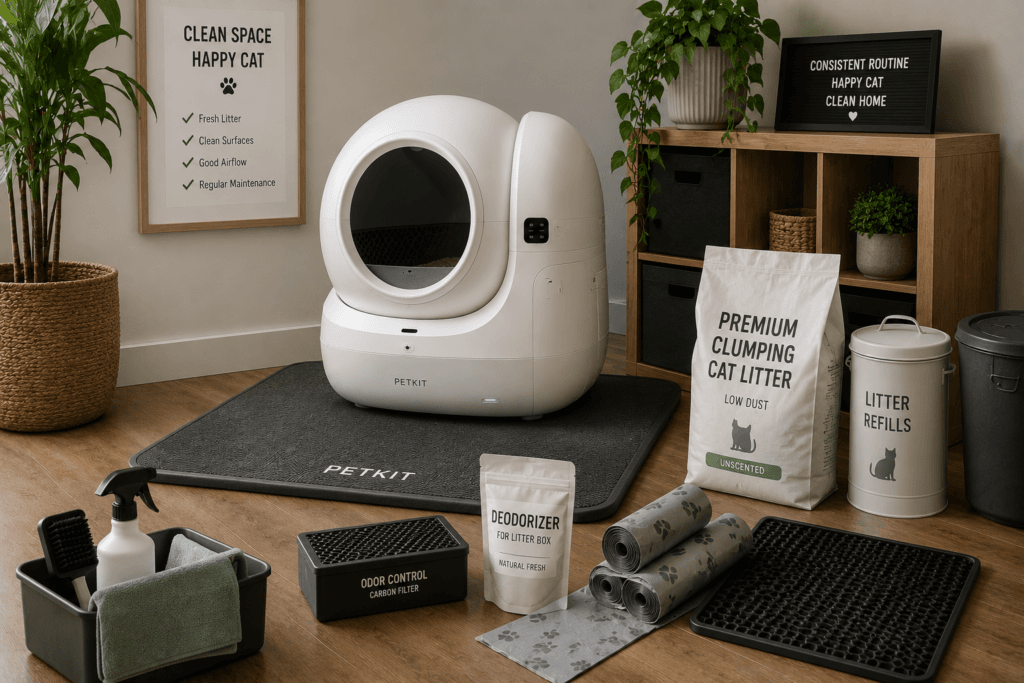
    A clean litter room setup with a sealed waste drawer, litter mat, cleaning tools and air purifier nearby
    Odor control depends on the whole litter routine: waste storage, liners, litter quality, cleaning and airflow all matter.

    Both products remove waste from the exposed litter bed and contain it in an enclosed compartment.

    PuraMax 2 uses a sealed waste bin alongside PETKIT’s N50 2.0 odor eliminator and a smart deodorizing spray. PETKIT states that the N50 unit lasts up to approximately one month, while the liquid spray typically lasts 40–60 days depending on use.

    Litter-Robot 4 uses a sealed, carbon-filtered waste drawer and supports optional OdorTrap packs.

    Neither model is consumable-free.

    The systems simply sell different objects that eventually need replacing.

    Real odor control still depends heavily on:

    • litter quality;
    • drawer-emptying frequency;
    • clump formation;
    • residue inside the globe;
    • periodic cleaning;
    • room ventilation.

    The sealed drawer performs most of the unglamorous work.

    The branded deodorizer then arrives to collect partial credit and future orders.

    App Data: Useful, but Not a Diagnosis

    PuraMax 2 records visits, duration and weight through the PETKIT app. Litter-Robot 4 uses SmartScale and the Whisker app to track weight, activity, waste status and maintenance information.

    PETKIT has the stronger ecosystem argument when the home already contains connected feeders or fountains.

    Whisker offers the more focused litter-first environment and a larger established Litter-Robot ownership base.

    Neither app can determine why a cat’s behavior changed.

    The devices may help reveal:

    • more frequent visits;
    • weight movement;
    • reduced box use;
    • changes between cats;
    • unusual activity timing.

    Those are signals, not diagnoses.

    A meaningful or persistent change should lead to direct observation and veterinary assessment when appropriate—not a ceremonial refreshing of the dashboard.

    For the wider distinction, read our Smart Cat Monitoring vs Automation guide.

    Buyer-Regret Risk

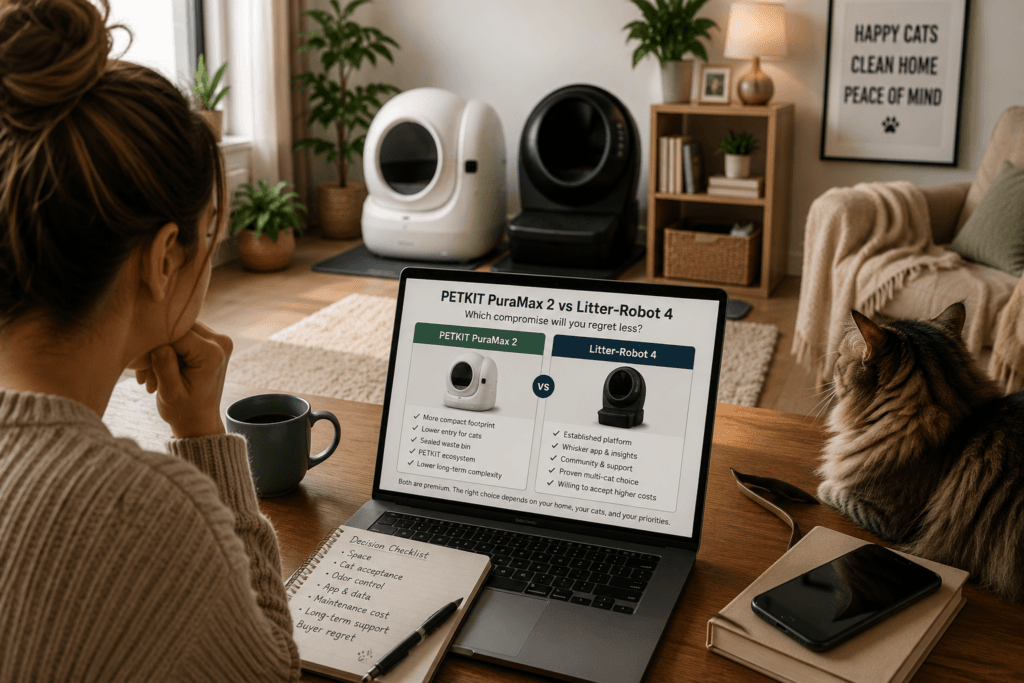
    A cat owner comparing two smart litter box options on a laptop while a cat sits nearby in a modern home
    Buyer regret usually comes from choosing the wrong compromise—not from either litter box being objectively bad.

    PuraMax 2 regret usually means discovering that the cat needed a larger opening or the household needed more physical capacity.

    Litter-Robot 4 regret usually means paying a substantial premium for platform confidence, extra room and support benefits that remained mostly theoretical.

    The safest decision follows one rule:

    Pay for the constraint your household actually has.

    Choose LR4 because Archibald is large, the home has four cats or the trial meaningfully reduces risk.

    Do not choose it merely because the established brand feels emotionally safer.

    That is not product selection.

    It is premium anxiety management with a waste drawer.

    Final Verdict

    PETKIT PuraMax 2 earns a Strong Recommendation for Value.

    It is the more rational purchase for many one- or two-cat homes whose cats fit comfortably inside its physical limits. It provides strong core automation, a shorter and shallower design, app monitoring and effective waste containment without demanding the full Whisker premium.

    Litter-Robot 4 earns a Recommended with Conditions verdict.

    It is the better machine for larger cats, heavier multi-cat use, entrance-sensitive cats and buyers who place genuine value on Whisker’s mature platform and 90-day trial.

    Litter-Robot 4 is more established.

    PuraMax 2 is frequently the better deal.

    The correct purchase depends less on which brand inspires the most confidence and more on whether your cats will use the additional capacity you are buying.

    For the wider brand decision, read our PETKIT vs Litter-Robot Ecosystem comparison.

    Still deciding among the wider market rather than these two machines? Read our Best Smart Litter Boxes guide.

    Frequently Asked Questions

    Is PuraMax 2 better than Litter-Robot 4?

    PuraMax 2 offers better value for many one- or two-cat households. Litter-Robot 4 is the stronger fit for larger cats, up to four cats and buyers who value Whisker’s mature platform.

    Which model takes up less space?

    PuraMax 2 is shorter and shallower but slightly wider. Litter-Robot 4 is narrower but significantly deeper and taller.

    Which model has the larger entrance?

    Litter-Robot 4. Its 15.75-inch opening is substantially larger than the PuraMax 2 entrance.

    Which is better for multiple cats?

    Litter-Robot 4 is the safer choice for three- or four-cat homes. PuraMax 2 can work well for smaller multi-cat households when every cat fits comfortably and waste traffic remains manageable.

    Can either litter box detect health problems?

    No. Both can highlight changes in weight or litter-box activity, but neither can diagnose their cause.

    References

    • PETKIT — PuraMax 2 product specifications
    • PETKIT — PuraMax 2 app and support documentation
    • Whisker — Litter-Robot 4 product specifications
    • Whisker — Current Litter-Robot comparison chart
    • Whisker — Whisker app and in-home trial documentation

    Image Disclosure

    Official manufacturer images are used when depicting the exact products.

    Any AI-generated images are editorial illustrations only. They do not represent exact dimensions, entrance size, controls or app performance. Always verify current specifications before purchasing.

    Editorial Disclosure

    PetTech AI may earn a commission from qualifying purchases. This does not influence our recommendations, comparisons or editorial judgments.
  • Litter-Robot 4 Review 2025: Is Whisker’s Smartest Self-Cleaning Litter Box Worth It?

    Litter-Robot 4 Review 2025: Is Whisker’s Smartest Self-Cleaning Litter Box Worth It?

    Quick Verdict

    The Litter-Robot 4 is Whisker’s flagship self-cleaning litter box — a premium, Wi-Fi enabled, multi-sensor unit that has redefined the category for years. In this litter-robot 4 review 2025, we’ll show why it continues to dominate: reliable automation, strong odor control, a robust Whisker App, and unmatched long-term reputation.

    Yes, it’s bulky and pricey. But if you’re serious about reducing scooping, maintaining a cleaner home, and getting health insights from usage logs, the Litter-Robot 4 still sets the standard in 2025.

    TL;DR: The most established premium option with a proven track record and strong ecosystem. Ideal if you want reliability + long-term support.


    Who This Review Is For

    This litter-robot 4 review 2025 is designed for cat parents who:

    • Want a proven, market-leading self-cleaning litter box
    • Prefer a brand with a long track record of updates and support
    • Are willing to invest in premium pricing for reliability
    • Want health insights and app-based monitoring to spot changes early
    • Have multi-cat households and need scalable automation

    If you’re hesitant about footprint or budget, the Litter-Robot 4 may feel like overkill — but for many, it becomes the most valuable pet tech purchase in their home.


    What’s New in 2025

    Whisker continues refining the Litter-Robot 4 with firmware and app updates. The most notable advancements for this litter-robot 4 review 2025 include:

    • Enhanced sensors for more accurate weight tracking and safety
    • Quieter cleaning cycles compared to the Litter-Robot 3
    • Health monitoring features through the Whisker App (tracking frequency, timing, and cat weight trends)
    • More compact footprint relative to LR3 (still large, but slimmer and taller)

    Key Features at a Glance

    • Automatic self-cleaning drum with clump separation
    • Whisker App: schedule cycles, get full-drawer alerts, monitor usage patterns
    • Odor control: enclosed design + carbon filter system
    • Multi-sensor safety: stops instantly if motion or weight is detected
    • Multi-cat capacity: designed for households with 1–4 cats
    • Smart weight tracking: logs cat weight each visit for health insights
    • Quieter cycles: less disruptive for cats and humans
    • Clumping litter only (clay preferred)

    Limited Offer

    Special Deal

    Get the official Litter-Robot 4 directly from Whisker — $50 off with code REALSIMPLE50. Claim $50 Off at Whisker →

    Offers subject to change. Verify at checkout.


    Design & Build Quality

    The Litter-Robot 4 maintains Whisker’s signature dome design but improves on the bulkier LR3 with a more compact footprint. Build quality feels premium: sturdy plastics, well-sealed joints, and thoughtful ergonomics. The entry is wide, making it accessible to larger cats, while the waste drawer uses carbon filters to reduce odor.

    What we like

    • Premium construction with long-term durability
    • Sleeker than the LR3 while still roomy inside
    • Carbon filter odor system adds another layer of protection

    Could be better

    • Still large (measure before buying)
    • Premium price tag
    • Requires regular carbon filter replacement

    This litter-robot 4 review 2025 confirms the LR4 remains the benchmark for sturdiness and long-term reliability.


    Setup & First Week Experience

    Step 1: Place the unit on a flat, stable floor near a power outlet.
    Step 2: Download the Whisker App and connect via Wi-Fi.
    Step 3: Add clumping litter (avoid non-clumping or crystals).
    Step 4: Run a test cycle to confirm rotation + sensor detection.
    Step 5: Introduce gradually — leave old box nearby for a few days, encourage exploration.

    Pro tips from this litter-robot 4 review 2025:

    • Schedule cycles 5–10 minutes after use to avoid startling cats.
    • Keep quiet mode at night.
    • Check app notifications daily until you learn your cat’s habits.

    App & Smart Features

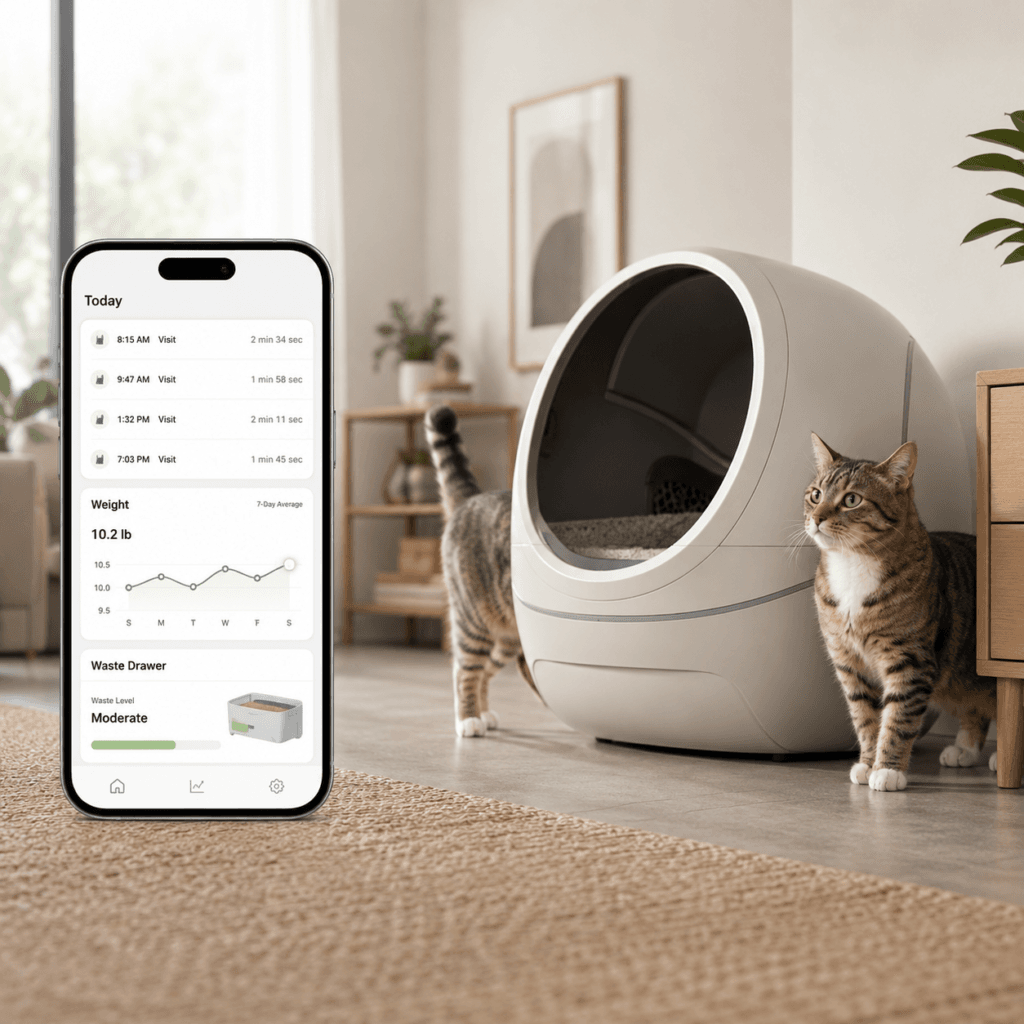
    Whisker App interface controlling the Litter-Robot 4 with usage logs

    The Whisker App is where LR4 distinguishes itself. Beyond scheduling and alerts, it logs cat weight and visit frequency, creating a health profile over time. In our litter-robot 4 review 2025, this stood out for early detection of issues like urinary changes or weight fluctuations.

    Main functions:

    • Schedule cleaning cycles
    • Full drawer alerts
    • Usage statistics (time, frequency)
    • Weight logging for each visit

    This isn’t just convenience; it’s potential early health insight.


    Community & Ecosystem

    Another angle worth covering in this litter-robot 4 review 2025 is Whisker’s broader ecosystem. Unlike standalone devices, the Litter-Robot 4 connects to the Whisker App, which also integrates with the Feeder-Robot and other Whisker smart pet devices. This creates a unified dashboard where cat parents can monitor feeding schedules, litter box use, and even weight trends from a single app.

    Beyond the technology, Whisker benefits from a large online community. There are thousands of active users across Facebook groups, Reddit threads, and Whisker’s own support hub sharing tips, troubleshooting, and best practices. For new buyers, this sense of community makes the learning curve less intimidating and provides reassurance that help is always available. It’s another reason the Litter-Robot 4 maintains such a loyal following in 2025.


    Safety Systems

    The Litter-Robot 4 uses multiple safety layers:

    • Motion sensors pause cycles instantly if the cat approaches
    • Weight sensors detect re-entry mid-cycle
    • Anti-pinch logic prevents mechanical hazards

    During this litter-robot 4 review 2025, the sensors were consistently responsive. As with all automatic litter boxes, always use on a stable surface, with cords tucked safely.


    Odor Control

    Odor management is strong thanks to:

    • Enclosed drum design
    • Carbon filter in waste drawer
    • Sealed drawer liners

    Compared to open boxes, odor reduction is dramatic. Against premium rivals (like the PuraMax 2), the LR4 performs equally well, though the carbon filter adds ongoing cost.

    Tips for odor success:

    • Replace carbon filters monthly
    • Use high-quality clumping clay litter
    • Empty drawer every 2–3 days (multi-cat)

    Eco & Waste Considerations

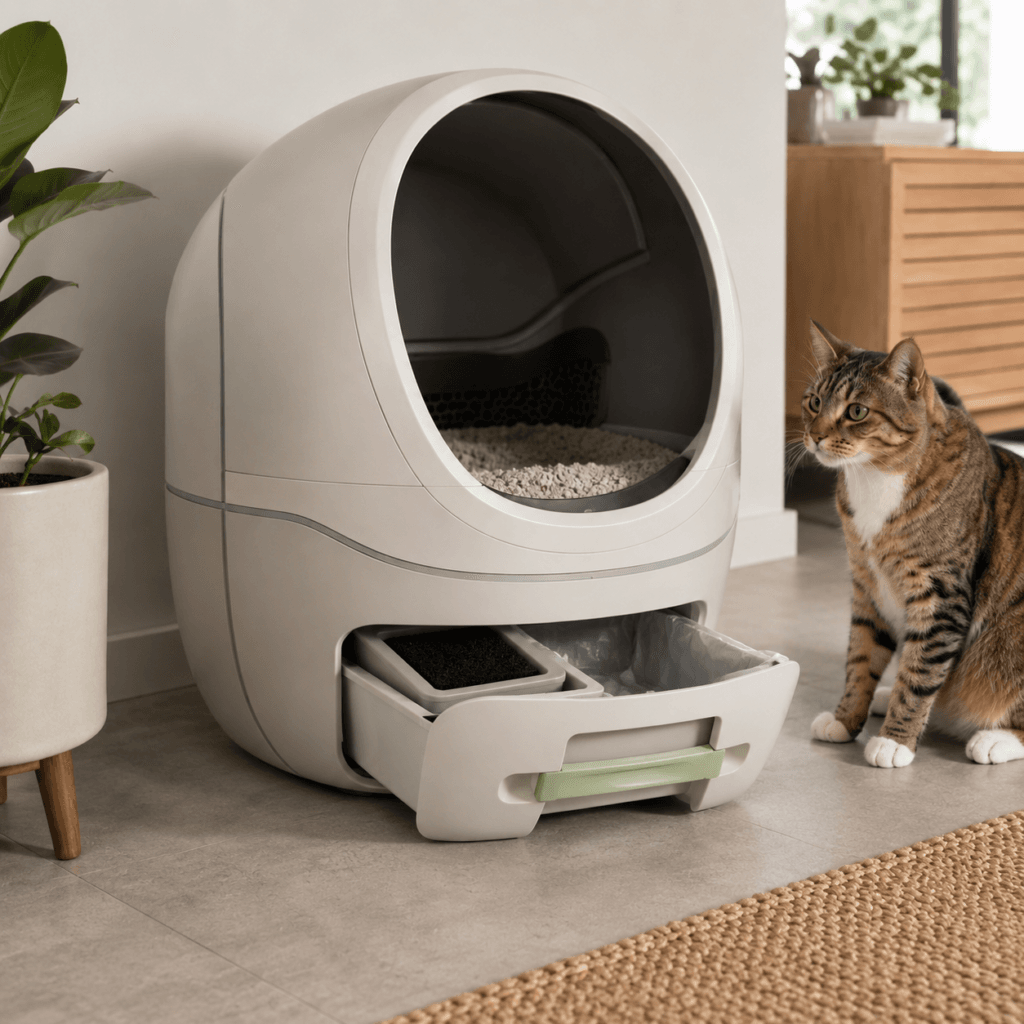
    Carbon filter waste drawer of the Litter-Robot 4 smart litter box

    An additional dimension of this litter-robot 4 review 2025 is how the product fits into eco-conscious living. While it uses electricity and requires liners and carbon filters, the Litter-Robot 4 can actually help reduce overall litter waste. Because it separates clumps more efficiently than daily scooping, many users report needing 20–30% less litter per month compared to traditional boxes.

    The sealed waste drawer liners make disposal neater, and Whisker provides biodegradable liner options for buyers who prefer more sustainable choices. Carbon filters do need replacing about once a month, but they contribute significantly to odor control and home hygiene. For environmentally aware cat parents, this balance between convenience and reduced litter use is an important factor that reinforces the value of the Litter-Robot 4.


    Real-World Use

    Two cats using the Litter-Robot 4 automatic litter box at home. Litter robot 4 review 2025

    One cat household: drawer needs emptying every 3–4 days.
    Two cats: every 2–3 days.
    Three+ cats: still manageable, but maintenance frequency increases.

    This litter-robot 4 review 2025 found LR4 scales well — with the app helping you predict when to empty, so you’re rarely caught off guard.


    Pros & Cons

    Pros

    • Market leader with proven reliability
    • Health insights via app (weight + usage logs)
    • Excellent odor control with carbon filter system
    • Multi-sensor safety for peace of mind
    • Multi-cat capacity

    Cons

    • Bulky footprint (still large despite redesign)
    • Higher upfront + ongoing costs (filters)
    • Requires quality clumping clay litter

    Warranty & Customer Support

    One of the often-overlooked strengths highlighted in this litter-robot 4 review 2025 is Whisker’s warranty and customer support. Every Litter-Robot 4 comes with a 1-year warranty, covering defects in materials and workmanship. For peace of mind, Whisker also offers the WhiskerCare™ extended warranty, which adds up to 3 years of coverage including accidental damage protection.

    Equally important is Whisker’s customer service reputation. With a long history in the automatic litter box industry, their support team is experienced in resolving issues quickly. Whether it’s troubleshooting app connectivity or arranging replacement parts, response times are faster than most smaller competitors. This strong support ecosystem is one reason the Litter-Robot 4 has become a trusted choice for households that don’t want surprises after purchase.


    Quick Comparison: Litter-Robot 4 vs. PuraMax 2

    FeatureLitter-Robot 4PuraMax 2
    CleaningAuto clump separationAuto clump separation
    AppWhisker App (logs, weight, health)PETKIT App (logs, schedules)
    Odor controlEnclosed + carbon filterEnclosed + sealed drawer
    SafetyMulti-sensor detectionMulti-sensor detection
    FootprintLarge but slimmer than LR3Bulky capsule design
    PricePremium, higherPremium, slightly lower
    Best forHealth data + proven reliabilityPremium automation at lower cost

    Both are excellent — as you’ll see in our upcoming Petkit PuraMax 2 vs Litter-Robot 4 comparison.


    Pricing, Deals & CTA

    Special Deal

    Get the official Litter-Robot 4 directly from Whisker — $50 off with code REALSIMPLE50. Claim $50 Off at Whisker →

    Offers may change without notice.

    At the time of writing, Whisker offers $50 off with code REALSIMPLE50 when purchasing through the official site. Financing is also available.


    Maintenance Schedule

    • Daily: quick glance at app + litter level
    • Every 2–3 days: empty drawer (more often with 3–4 cats)
    • Weekly: wipe surfaces with mild cleaner
    • Monthly: replace carbon filter + liners

    Routine is everything — this litter-robot 4 review 2025 shows that with consistency, LR4 remains odor-free and low-maintenance.


    FAQs

    Does the Litter-Robot 4 work for multiple cats?
    Yes, it supports 1–4 cats comfortably.

    Which litter works best?
    Clumping clay litter. Avoid crystals or non-clumping.

    Is it loud?
    Quieter than the LR3. Still audible, but not disruptive.

    How big is it?
    Large, but slimmer and taller than the LR3. Always measure space.

    How often do I change the carbon filter?
    About once a month, depending on use.

    Is financing available?
    Yes, Shop Pay and other installment plans are available.


    Internal Links


    External Resources


    Affiliate Disclosure

    This review contains affiliate links. If you buy through them, we may earn a small commission at no extra cost to you. Pricing and availability can change.


    Final Word

    The Litter-Robot 4 remains the most established premium self-cleaning litter box in 2025. Its strengths — reliability, odor control, and health insights — keep it ahead of competitors. While it costs more upfront and takes space, it pays back in daily convenience and peace of mind.

    And don’t forget: Whisker is currently offering $50 off with code REALSIMPLE50, making now one of the best times to invest.

  • PETKIT PuraMax 2 Review: Premium Automation or Expensive Bathroom Appliance?

    PETKIT PuraMax 2 Review: Premium Automation or Expensive Bathroom Appliance?

    The PETKIT PuraMax 2 does not diagnose diseases, film your cat or automatically seal its own trash bags.

    It cleans the litter after most visits, contains waste and tells you when something requires attention.

    In the current pet-tech market, this almost qualifies as admirable restraint.

    PuraMax 2 is PETKIT’s strongest default automatic litter box for buyers who want solid core automation without paying for the cameras and deeper monitoring found in the Purobot lineup.

    Its main appeal is simple:

    It removes daily scooping without requiring the litter box to become a surveillance platform.

    That makes it an excellent fit for many one- or two-cat households.

    It becomes a weaker choice for very large cats, cats uncomfortable with enclosed interiors, monitoring-first owners or anyone expecting “self-cleaning” to mean “I never touch this object again.”

    Quick Verdict

    CategoryVerdict
    PetTech AI verdictStrong Recommendation for Value
    Best fitOne or two average-sized cats needing dependable litter automation
    Main advantageStrong core cleaning, sealed waste storage and useful app control
    Cat weight range3.3–22 lb
    Main limitationEnclosed interior and no camera-based identification
    Not forLarge-bodied cats, kittens under the supported limit or monitoring-first households
    Best reason to buyYou want PETKIT automation without paying for footage you may never watch

    Choose PuraMax 2 when automatic cleaning is the main problem.

    Choose a Purobot model when visual identification changes what you can understand about individual cats.

    Choose something larger or more open when physical acceptance is uncertain.

    PuraMax 2 is not PETKIT’s most technically ambitious litter box.

    For most buyers, that is part of the recommendation.

    Research Note

    This is a research-led review based on current official specifications, product documentation, software information and available ownership evidence.

    PetTech AI has not conducted a long-term hands-on test of PuraMax 2.

    PetTech AI may earn a commission from qualifying purchases. As an Amazon Associate I earn from qualifying purchases.

    Does PuraMax 2 fit your cats and household? Check PuraMax 2 through PETKIT.

    Prefer Amazon’s purchase route? Check PuraMax 2 availability and customer feedback on Amazon.

    What PuraMax 2 Actually Does

    After the cat exits, PuraMax 2 rotates its cylinder, separates clumped waste from clean litter and deposits the waste into a sealed 7-liter bin.

    PETKIT states that the bin can provide up to approximately 15 days of waste capacity in a one-cat household under its test conditions. Real frequency depends on the cat, litter, environment and how optimistic the owner becomes after reading “15 days.”

    The machine also provides:

    • automatic and scheduled cleaning;
    • manual cycling;
    • waste-bin alerts;
    • visit and weight records;
    • deodorization controls;
    • offline operation using saved settings;
    • app management through 2.4 GHz Wi-Fi.

    The app does not transform the litter box into a medical instrument.

    It gives owners a more organized view of routine use and machine status.

    That is enough when the main objective is reducing labor.

    Why It Is the Best Default PETKIT Litter Box

    PETKIT now offers several camera-led Purobot models.

    Those products make sense when the unresolved question is:

    “Which cat used the box, and what happened during the visit?”

    PuraMax 2 answers a different question:

    “Can the machine clean reliably enough that I stop scooping several times per day?”

    Its simpler role creates several advantages:

    • fewer connected layers;
    • no indoor camera;
    • no video subscription decision;
    • less footage to review;
    • a lower-complexity ownership proposition;
    • integration with the wider PETKIT app.

    This is why it remains the better default for most PETKIT buyers.

    A camera can be useful.

    It can also produce forty clips of Napoleon completing routine business while the owner develops an unpaid second career in litter-box cinematography.

    For the direct decision, read our Purobot Max Pro 2 vs PuraMax 2 comparison.

    Physical Fit: Shorter Does Not Mean Tiny

    PETKIT PuraMax 2 diagram showing 76-liter interior and 7.87-inch entrance threshold
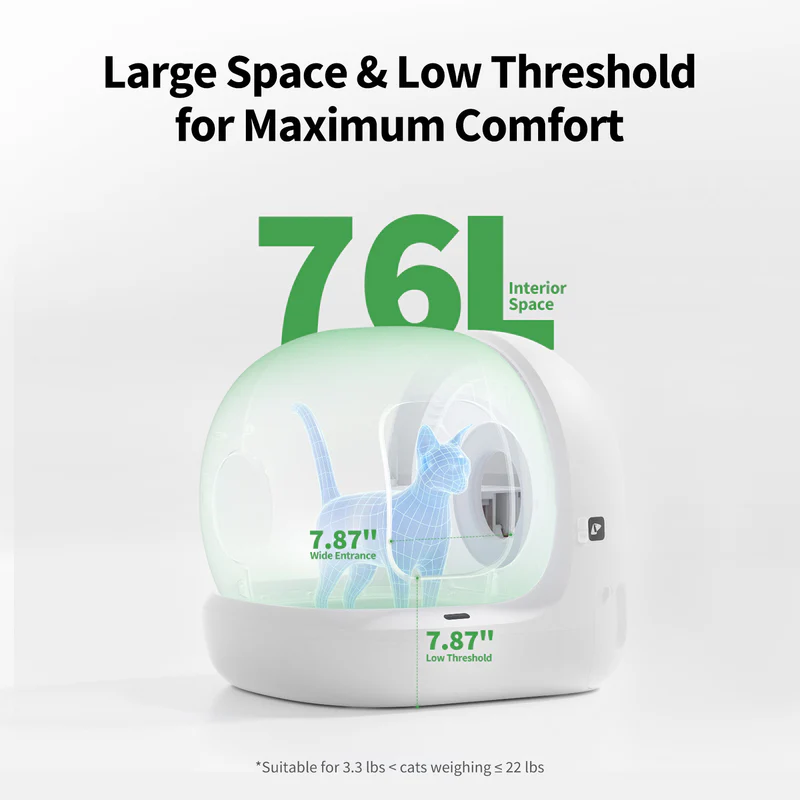
    PETKIT lists a 76-liter interior and a 7.87-inch entrance threshold, supporting cats from 3.3 to 22 pounds. Official PETKIT image.

    PuraMax 2 measures approximately 24.41 inches wide, 21.18 inches deep and 21.73 inches tall. It weighs about 22 lb and has an entrance threshold around 7.87 inches high. PETKIT supports cats from 3.3 to 22 lb.

    Its shape is shorter and shallower than several competing globe-style litter boxes, but it remains a large appliance.

    Measure enough space for:

    • comfortable entry;
    • waste-drawer removal;
    • litter refilling;
    • side-panel access;
    • cylinder removal during cleaning;
    • separation from the wall.

    PETKIT requires a hard, level surface and recommends leaving approximately two inches between the unit and surrounding walls. Soft carpet or uneven flooring can interfere with the weight sensors.

    This matters because the app relies partly on the scale beneath the machine.

    Putting the litter box on a soft rug and then complaining that the weight records are inconsistent is the pet-tech equivalent of installing bathroom scales on a trampoline.

    Is It Suitable for Large Cats?

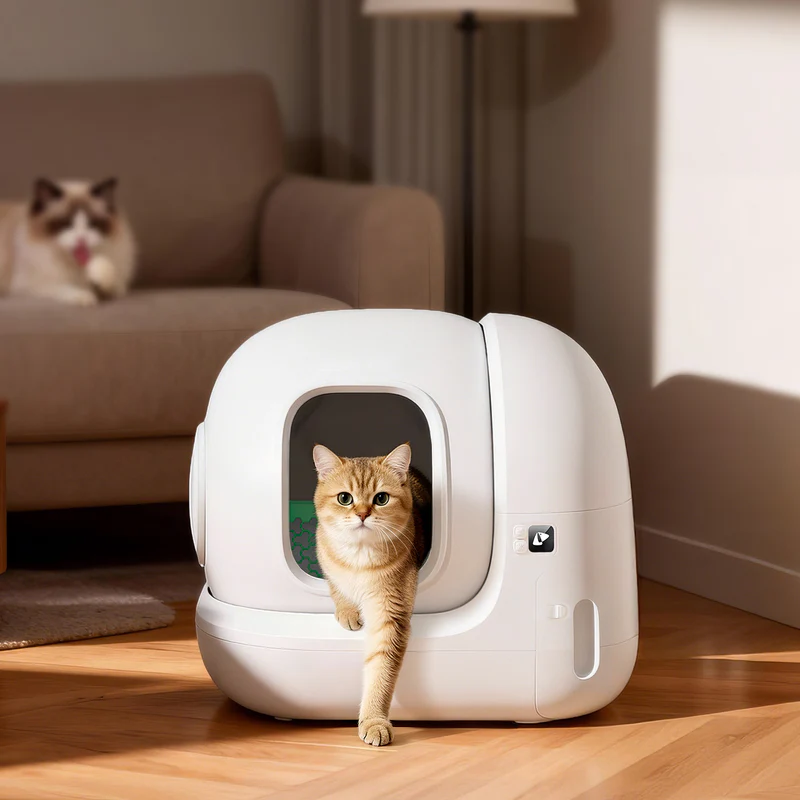
    Cat exiting the PETKIT PuraMax 2 automatic self-cleaning litter box
    The enclosed PETKIT PuraMax 2 is designed for cats that comfortably accept covered litter boxes and its raised entrance. Official PETKIT image.

    PETKIT lists a 76-liter interior and a supported weight range up to 22 lb.

    That does not guarantee comfort for every cat near the upper limit.

    Body length, height, preferred posture and tolerance for enclosed boxes matter as much as weight.

    PuraMax 2 is a better fit when:

    • the cat already accepts covered litter boxes;
    • the cat can turn and position comfortably;
    • the 7.87-inch threshold is manageable;
    • the interior does not appear restrictive.

    Consider a larger-opening alternative when:

    • the cat is particularly tall or long-bodied;
    • enclosed boxes are routinely rejected;
    • mobility is limited;
    • the cat approaches the 22-lb ceiling;
    • you already suspect that physical fit will be marginal.

    A premium return caused by predictable geometry is still a premium return.

    For a comparison against a larger Whisker design, read our PETKIT PuraMax 2 vs Litter-Robot 4 guide.

    Safety and Kitten Restrictions

    PuraMax 2 uses an entrance designed to remain open during rotation and includes 11 safety sensors, including proximity and weight detection. PETKIT says the machine pauses when a cat is nearby or inside.

    PETKIT does not recommend normal use for cats younger than six months or weighing less than 3.3 lb.

    The app includes a Kitten Protection Mode that disables automatic and periodic cleaning, but very small cats should still be supervised and the machine should not be trusted to detect weight below its stated operating range.

    Safety features reduce risk.

    They do not eliminate the need to:

    • place the machine correctly;
    • inspect sensors;
    • supervise the transition;
    • keep automatic cycling disabled for unsupported kittens;
    • confirm that the unit pauses as expected;
    • keep cables away from chewing.

    “Eleven sensors” is reassuring.

    It is not permission to stop looking at the machine forever.

    Litter Compatibility

    PuraMax 2 includes two interchangeable sifters.

    PETKIT says the standard sifter supports larger particles such as tofu and mixed litter, while the honeycomb version is intended for finer bentonite, mineral or clay litter. Both require clumping litter, and PETKIT advises against particles longer than approximately 12 millimeters.

    The important word is clumping.

    Non-clumping litter cannot form the solid waste masses the machine needs to separate effectively.

    Actual performance also depends on:

    • clump speed;
    • clump firmness;
    • dust levels;
    • particle size;
    • whether waste sticks to the liner;
    • whether the cat covers what it produces.

    PETKIT includes a Waste Covering Mode intended to reduce streaking by redistributing litter before the cleaning cycle. It may help, but softer stool and poor covering can still produce residue.

    Artificial intelligence has not yet solved wet feces.

    PuraMax 2 wisely does not pretend otherwise.

    Odor Control: Strong Containment, Ongoing Consumables

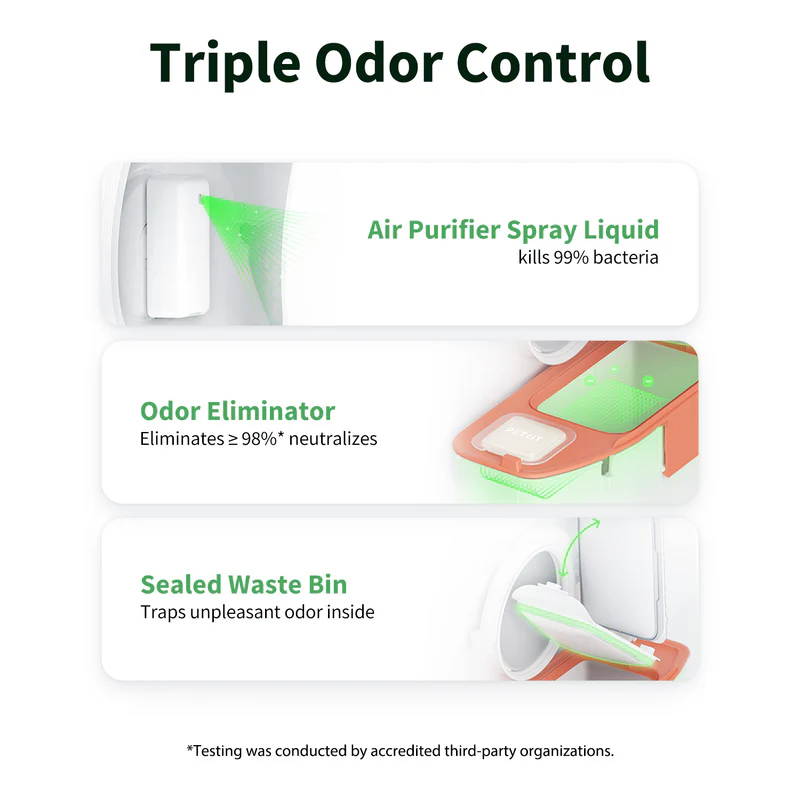
    PETKIT PuraMax 2 triple odor-control system with purifier spray, odor eliminator and sealed waste bin
    PETKIT’s odor-control system combines purifier spray, a replaceable odor eliminator and a sealed waste bin. Performance claims shown are provided by the manufacturer.

    PuraMax 2 combines three odor-control elements:

    • a sealed waste bin;
    • the replaceable N50 2.0 odor eliminator;
    • compatibility with PETKIT’s app-controlled Air Purifier Smart Spray.

    PETKIT states that N50 2.0 lasts up to approximately one month, while a bottle of purifying liquid typically lasts 40–60 days depending on use.

    The sealed bin is the most important part of this system.

    The consumables support it.

    Real odor performance will still depend on:

    • litter quality;
    • how quickly clumps form;
    • drawer-emptying frequency;
    • residue inside the cylinder;
    • liner condition;
    • ventilation;
    • the number of cats using the box.

    The deodorizer cannot compensate indefinitely for a full drawer.

    It is odor control, not diplomatic immunity for neglected waste.

    App Monitoring: Useful, Not Medical

    The PETKIT app records litter-box visits, duration and weight changes for supported cats. It also sends operating and waste-bin notifications and allows owners to adjust cleaning and deodorization settings.

    This information can help reveal:

    • an apparent change in visit frequency;
    • altered timing;
    • a weight trend;
    • reduced use;
    • machine or drawer status.

    The data cannot establish why the change occurred.

    PuraMax 2 has no camera, so multi-cat identification depends largely on weight records and profiles. Cats with similar weights may be harder to distinguish reliably.

    The app should be treated as an early signal system—not a digital veterinarian with a tasteful interface.

    Frequent visits, straining, crying, blood, little or no urine, sudden avoidance or persistent behavior changes require direct observation and appropriate veterinary assessment.

    For the broader distinction, read our Smart Cat Monitoring vs Automation guide.

    Cleaning and Daily Ownership

    PuraMax 2 reduces daily scooping.

    It does not abolish litter-box maintenance.

    Owners still need to:

    • empty and reline the waste bin;
    • replenish litter;
    • wipe the entrance;
    • clean the cylinder and sifter;
    • remove residue;
    • inspect sensors;
    • replace odor-control consumables;
    • clean beneath and around the unit.

    PETKIT includes a magnetic litter remover intended to help empty remaining clean litter before deeper maintenance. The cylinder components can then be accessed for cleaning according to the manual.

    This is the ownership trade:

    frequent manual scooping becomes less frequent but more structured cleaning.

    For many households, that is an excellent exchange.

    Anyone expecting the machine to empty its drawer, wash its cylinder and order its own consumables should wait for the model that has achieved legal personhood.

    Multi-Cat Use

    PETKIT markets PuraMax 2 for multi-cat households, and the 7-liter drawer can support more than one cat when usage remains manageable.

    But “multi-cat friendly” does not mean unlimited cats or guaranteed resource acceptance.

    More cats create:

    • faster drawer filling;
    • more cycles;
    • more residue;
    • greater identification ambiguity;
    • more competition around one litter station.

    PuraMax 2 is most convincing for one or two cats.

    A third cat may still be workable depending on size, habits and the presence of additional boxes, but the household should not treat one automatic machine as the only litter resource merely because the product removes clumps.

    Automation reduces labor.

    It does not repeal feline social behavior.

    Buyer-Regret Risk

    The main regret is purchasing PuraMax 2 for a cat that does not fit or a household that wanted deeper monitoring.

    Warning signs include:

    • a large or enclosure-averse cat;
    • expectations of zero maintenance;
    • several cats with similar weights;
    • a need for visual identification;
    • unwillingness to use clumping litter;
    • placement only available on soft or uneven flooring;
    • reluctance to maintain odor-control consumables.

    The other risk is buying a Purobot unnecessarily.

    If the camera would mostly document normal visits nobody intends to review, PuraMax 2 is the more intelligent purchase.

    Not every litter box needs eyes.

    Some should simply clean the evidence and remain professionally discreet.

    Final Verdict

    PETKIT PuraMax 2 earns a Strong Recommendation for Value.

    It is the strongest default PETKIT litter box for households that want:

    • automatic cleaning;
    • sealed waste storage;
    • useful app alerts;
    • broad clumping-litter compatibility;
    • a relatively compact vertical design;
    • no camera or video subscription decision.

    It is best suited to one or two average-sized cats that already tolerate enclosed litter boxes.

    Skip it when the cat needs a larger interior, mobility creates entry concerns or visual multi-cat identification is central to the purchase.

    PuraMax 2 is not PETKIT’s most advanced litter box.

    It is the model that solves the main problem without asking every buyer to fund an artificial-intelligence department in the bathroom.

    For most households, that is not a compromise.

    It is the correct amount of machine.

    For the wider market, read our Best Smart Litter Boxes guide.

    For the brand-level decision, see PETKIT vs Litter-Robot Ecosystem.

    Frequently Asked Questions

    Is PETKIT PuraMax 2 worth it?

    Yes, for one or two appropriately sized cats when reducing daily scooping matters more than camera-based monitoring.

    What cat weights does PuraMax 2 support?

    PETKIT supports cats weighing between 3.3 and 22 lb. Cats younger than six months or below the minimum weight should not use normal automatic cycling.

    What litter can PuraMax 2 use?

    It supports most clumping tofu, mixed, bentonite, mineral and clay litters using the appropriate included sifter. PETKIT advises against particles longer than approximately 12 millimeters.

    Does PuraMax 2 work without Wi-Fi?

    Yes. Saved settings continue operating without a network connection, but app records and remote updates are unavailable until connectivity returns.

    Is PuraMax 2 better than Purobot Max Pro 2?

    PuraMax 2 is the better default for automatic cleaning. Purobot Max Pro 2 is more useful when camera-assisted individual identification solves a real multi-cat monitoring problem.

    References

    • PETKIT — PuraMax 2 product specifications
    • PETKIT — PuraMax 2 user manual
    • PETKIT — PETKIT automatic litter-box buying guide
    • PETKIT — Limited warranty policy

    Image Disclosure

    Official manufacturer images are used when available and authorized.

    AI-generated images may also be used as editorial illustrations. They should not be treated as exact representations of dimensions, controls or physical features. Always verify current official specifications before purchasing.

    Editorial Disclosure

    PetTech AI may earn a commission from qualifying purchases. This does not influence our recommendations, comparisons or editorial judgments.
  • Best Multi-Cat Tech Solutions: Less Conflict or More Expensive Clutter?

    Best Multi-Cat Tech Solutions: Less Conflict or More Expensive Clutter?

    A multi-cat home does not usually fail because it lacks enough apps.

    It fails because Napoleon eats Florence’s prescription food, Archibald blocks the only water station and three cats have quietly agreed that one litter box is now contested territory.

    Technology can help.

    But only when it solves the actual problem.

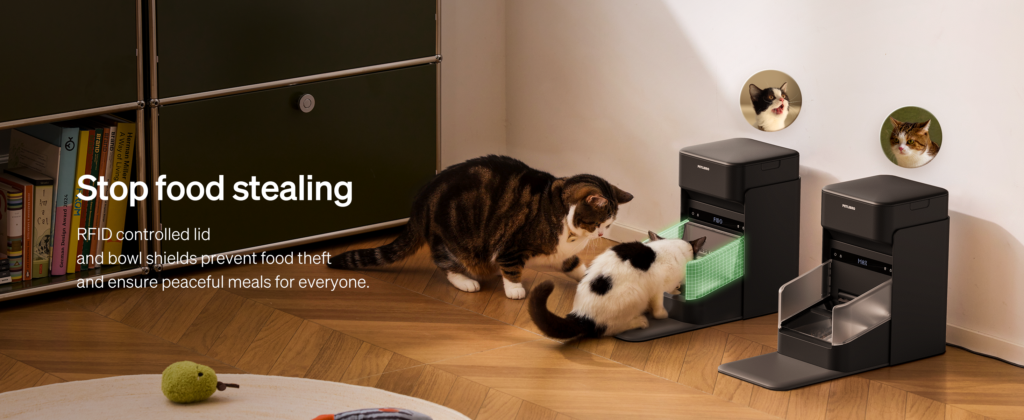
    An RFID feeder can protect an individual diet. A large automatic litter box can reduce scooping. A camera can help identify which cat’s routine changed.

    None of those devices can make cats share resources politely because the product page used the phrase “multi-pet friendly.”

    The best multi-cat tech is therefore not the most advanced equipment.

    It is the equipment that removes a specific source of friction without replacing basic resource planning with expensive optimism.

    Quick Verdict

    Household problemBest solutionPetTech AI verdictMain limitation
    Food theft or different dietsPETLIBRO One RFID FeederStrong Recommendation with ConditionsOne feeder recognizes one dedicated tag
    Shared dry-food schedulingWhisker Feeder-RobotRecommended with ConditionsOpen bowl provides no individual access control
    Heavy litter-box workloadLitter-Robot 5Strong Recommendation for AutomationOne robot may not replace multiple separated boxes
    Similar-weight cats need identificationPETKIT Purobot Max Pro 2Recommended with ConditionsCameras add cost, complexity and software dependence
    Several pets need shared water accessPetSafe Drinkwell 360 StainlessRecommendedNo individual hydration tracking
    General multi-cat tensionMore separated resourcesNon-negotiableAnnoyingly resistant to affiliate monetization

    Start with PETLIBRO One RFID when the problem is food theft or protected diets.

    Choose Litter-Robot 5 when waste volume and daily scooping create the greatest burden.

    Choose Purobot Max Pro 2 only when identifying the individual cat changes what you can do.

    Choose Feeder-Robot when the cats already share the same food peacefully.

    And sometimes the correct “tech solution” is purchasing a second ordinary water bowl and placing it somewhere Napoleon cannot govern.

    Research Note

    This is a research-led roundup based on current official product documentation, feline environmental guidance and PetTech AI’s product-level audits.

    PetTech AI has not conducted long-term hands-on testing of every product included.

    PetTech AI may earn a commission from qualifying purchases. As an Amazon Associate I earn from qualifying purchases.

    First Decide Whether You Need Access, Automation or Evidence

    Most poor multi-cat purchases begin by solving the wrong problem.

    Access control

    Access control answers:

    “How do I stop one cat from using another cat’s resource?”

    RFID feeders belong here.

    They physically unlock for the recognized tag and remain closed to other animals.

    Automation

    Automation answers:

    “How do I reduce repetitive work?”

    Automatic litter boxes and scheduled feeders belong here.

    They perform a task but may not control which cat benefits from it.

    Monitoring

    Monitoring answers:

    “Which cat did this, and did the pattern change?”

    Cameras, facial recognition and weight histories belong here.

    They add evidence.

    They do not necessarily prevent the behavior.

    A camera can identify Baron stealing lunch.

    It cannot restore the lunch or issue disciplinary sanctions.

    For the broader distinction, read our Smart Cat Monitoring vs Automation guide.

    Best for Food Theft: PETLIBRO One RFID Feeder

    Two cats beside PETLIBRO One RFID feeders with collar-controlled bowl access
    PETLIBRO One RFID uses a dedicated collar tag and covered bowl to protect individual dry-food access in multi-cat homes. Official PETLIBRO image.

    Verdict: Strong Recommendation with Conditions

    PETLIBRO One RFID is the strongest product in this roundup when cats need separate dry-food access.

    The feeder uses a dedicated collar tag to unlock the covered bowl for one recognized pet. PETLIBRO states that it supports up to ten scheduled meals or snacks per day, includes a 3-liter hopper and works through the PETLIBRO app. It does not read implanted microchips or third-party tags.

    That makes it useful when:

    • one cat steals food;
    • calorie requirements differ;
    • one cat eats prescription dry food;
    • a slow eater is repeatedly displaced;
    • free feeding creates uncontrolled intake.

    The most important limitation is easy to miss:

    Each feeder synchronizes with one collar tag.

    In a three-cat household where every cat needs a protected bowl, you may need three feeders—not one machine with three personal profiles. PETLIBRO also recommends separating multiple units physically to reduce RFID interference.

    This can make the total setup expensive and physically demanding.

    But unlike a camera feeder, it addresses the problem directly.

    The camera tells you that Gerald stole the meal.

    The RFID lid prevents Gerald from accessing it.

    Does one cat need protected dry-food access? Check PETLIBRO One RFID Feeder on Amazon.

    For other feeding formats, read our Best Automatic Cat Feeders guide.

    Best for Shared Dry Food: Whisker Feeder-Robot

    Verdict: Recommended with Conditions

    Feeder-Robot is the better choice when several cats already eat the same food and the real problem is scheduling, capacity and refill frequency.

    Whisker states that it holds up to 32 cups of dry food, supports as many as eight scheduled meals per day and retains saved schedules if the device temporarily goes offline.

    That is useful for:

    • cats sharing the same kibble;
    • households serving several small meals;
    • owners already using the Whisker app;
    • high food consumption;
    • routines that must continue through temporary internet loss.

    What it does not provide is RFID access.

    Food drops into an open bowl. If Biscuit finishes his portion and moves directly into Napoleon’s serving, the app will record successful dispensing with admirable professionalism.

    Feeder-Robot works when sharing is already peaceful.

    It does not create peace.

    Choose an RFID system when individual diets or theft are the problem. Choose Feeder-Robot when all cats eat the same food and you simply want a large, structured feeding routine.

    Do your cats already share the same dry food?Check Feeder-Robot availability on Amazon.

    Read our Feeder-Robot Review for the full ecosystem and buyer-regret analysis.

    Best for Heavy Litter Work: Litter-Robot 5

    Verdict: Strong Recommendation for Automation

    Litter-Robot 5 is the best default automatic litter box in this roundup for households with several cats and substantial litter traffic.

    Whisker positions it for up to five cats weighing between 3 and 30 lb. It adds WasteID, which distinguishes urine from solid waste, alongside an enlarged waste system and detailed app monitoring.

    It makes sense when:

    • several cats generate constant scooping;
    • larger cats need more internal space;
    • waste volume fills smaller drawers too quickly;
    • urine-versus-solid records add useful context;
    • Whisker support and accessories matter.

    The automation can dramatically reduce manual labor.

    It does not abolish the need for enough litter locations.

    FelineVMA guidance recommends one litter box per cat plus one extra, placed in different locations rather than grouped together. Resource placement should also prevent one cat from blocking another’s access or escape route.

    That does not mean every three-cat household must buy four automatic robots and apply for commercial financing.

    It means one premium robot should not automatically become the only toilet in the home.

    A second or third conventional box in another location may provide more behavioral value than another app-enabled machine sitting beside the first one.

    For model selection, read our Litter-Robot 5 vs 5 Pro vs EVO comparison.

    Best for Individual Litter Identification: PETKIT Purobot Max Pro 2

    PETKIT Purobot Max Pro 2 automatic litter box shown with camera monitoring and PETKIT app
    Purobot Max Pro 2 combines automatic litter cleaning with camera-assisted cat identification and app-based visit records. Official PETKIT image.

    Verdict: Recommended with Conditions

    Purobot Max Pro 2 is the specialist choice when the litter box already cleans automatically but the household still cannot confidently identify which cat generated each record.

    PETKIT combines facial recognition with weight sensing and positions the model for multi-cat identification. The current version also has a larger entrance than its predecessor.

    Its strongest use cases include:

    • cats with similar weights;
    • one cat requiring closer litter monitoring;
    • ambiguous weight-only records;
    • owners who spend substantial time away;
    • situations where visual evidence would improve a veterinary conversation.

    This is monitoring, not access control.

    The camera cannot stop one cat from guarding the unit or another from avoiding it.

    It can help reveal that the problem is happening.

    The Recommendation with Conditions reflects three risks:

    • video features may depend partly on PETKIT Care+;
    • recognition is not infallible;
    • footage has no value when nobody reviews it.

    A camera that produces forty ignored litter clips is not preventive health technology.

    It is an unusually specific streaming platform with no subscribers.

    Would visual identification solve an existing uncertainty? Check Purobot Max Pro 2 through PETKIT.

    Prefer Amazon checkout? Check Purobot Max Pro 2 availability on Amazon.

    Read our PETKIT Purobot Max Pro 2 Review for the full camera and subscription decision.

    Best for Shared Water Access: PetSafe Drinkwell 360 Stainless

    Verdict: Recommended

    PetSafe Drinkwell 360 is the least “smart” product here and perhaps the most honest.

    It holds 128 ounces of water and uses interchangeable attachments to create as many as five drinking streams around its circular body. That allows several pets to approach from different sides.

    It provides:

    • high shared capacity;
    • multiple drinking positions;
    • stainless-steel construction;
    • replaceable parts;
    • no app, account or subscription.

    It does not identify which cat drank.

    That can be a worthwhile trade when the real problem is access rather than data.

    A single RFID fountain may produce beautiful individual charts while remaining the only water station in a location one confident cat can control.

    FelineVMA guidance recommends separate food and water resources for individual cats, with additional resources and visual separation in multi-cat homes.

    So Drinkwell 360 should not automatically be the only water source either.

    Use additional bowls or fountains in different areas when cats avoid one another or guard pathways.

    The best hydration dashboard remains useless to the cat who cannot reach the fountain.

    Would several shared drinking positions solve more than individual data? Check PetSafe Drinkwell 360 on Amazon.

    For tracking-led alternatives, read our Best Smart Cat Water Fountains guide.

    Technology Cannot Replace Resource Distribution

    Three cats using separate feeding stations and an automatic litter box in different areas of a home
    Separate feeding and litter areas can reduce competition more effectively than relying on one heavily monitored shared resource. AI-generated editorial illustration.

    The most important multi-cat intervention is also the least exciting one:

    • several litter boxes;
    • several water locations;
    • separated feeding areas;
    • more than one resting and climbing zone;
    • escape routes that cannot be blocked.

    FelineVMA specifically advises providing adequate, separated resources because multiple social groups can exist inside the same home even when the cats appear broadly tolerant of one another.

    Technology works best after that foundation exists.

    Use RFID to protect a diet.

    Use automation to reduce labor.

    Use cameras to clarify uncertainty.

    Do not ask one premium appliance to replace every physical resource because its brochure says multi-cat.

    The product may support four cats mechanically.

    The cats have not necessarily approved the merger.

    Buyer-Regret Risk

    Multi-cat technology creates predictable forms of regret.

    RFID regret: the cats dislike collars, or several protected feeders are required.

    Shared-feeder regret: one dominant cat continues stealing from the open bowl.

    Automatic-litter regret: the machine handles waste but not resource guarding.

    Camera regret: footage accumulates without changing a decision.

    Fountain regret: one large fountain becomes the only contested water location.

    The safest buying question is:

    Does this product prevent the problem, automate the work or merely document it?

    All three functions can be valuable.

    Confusing them is expensive.

    Final Verdict

    The best multi-cat tech solution depends on the conflict you are trying to remove.

    Choose PETLIBRO One RFID Feeder when food theft or protected dry-food diets are the main problem.

    Choose Feeder-Robot when all cats share the same food and scheduling is the only missing layer.

    Choose Litter-Robot 5 when litter volume and daily scooping create the greatest burden.

    Choose Purobot Max Pro 2 when identifying individual litter-box users changes how you respond.

    Choose PetSafe Drinkwell 360 when several drinking positions and capacity matter more than individual hydration analytics.

    Then add enough ordinary, separated resources around the technology.

    The ideal multi-cat home is not the one with the most impressive dashboard.

    It is the one where Florence can eat, drink and use a litter box without filing a territorial-access request through Napoleon’s office.

    Frequently Asked Questions

    Do RFID feeders stop food stealing?

    They can prevent unauthorized access when the intended cat consistently wears the compatible tag. PETLIBRO One RFID recognizes one dedicated collar tag per feeder and does not read implanted microchips.

    How many litter boxes should a multi-cat home have?

    FelineVMA’s general rule is one box per cat plus one extra, distributed across different locations. Household relationships, space and cat preferences can affect the practical setup.

    Can one automatic litter box serve several cats?

    Mechanically, some models can handle several cats. Behaviorally, additional separated boxes may still be necessary to prevent blocking, avoidance and competition.

    Is a camera feeder the same as an RFID feeder?

    No. A camera can show which cat approached. An RFID feeder physically controls access to the bowl.

    What is the best technology for a three-cat home?

    Start with the biggest source of friction. Use RFID for diet theft, litter automation for workload and additional separated resources for territorial access. No single product solves all three.

    References

    • PETLIBRO — One RFID Smart Feeder product documentation
    • Whisker — Feeder-Robot product documentation
    • Whisker — Litter-Robot 5 comparison and product documentation
    • PETKIT — Purobot Max Pro 2 product documentation
    • PetSafe — Drinkwell 360 Stainless Multi-Pet Fountain
    • Feline Veterinary Medical Association — Feline House-Soiling
    • Feline Veterinary Medical Association — Getting Another Cat
    • Cornell Feline Health Center — Feline aggression and resource separation

    Image Disclosure

    Official manufacturer images are used when available and authorized.

    AI-generated images may also be used as editorial illustrations. They should not be treated as exact representations of product dimensions, controls or physical features. Always verify current official specifications before purchasing.

    Editorial Disclosure

    PetTech AI may earn a commission from qualifying purchases. This does not influence our recommendations, comparisons or editorial judgments.
  • Best Smart Cat Health Monitors (2026): Track the Signal That Actually Matters

    Best Smart Cat Health Monitors (2026): Track the Signal That Actually Matters

    Your cat does not need a command center.

    He does not need five apps, three cameras, a hydration spreadsheet, and a weekly performance review.

    He may, however, benefit from one useful signal.

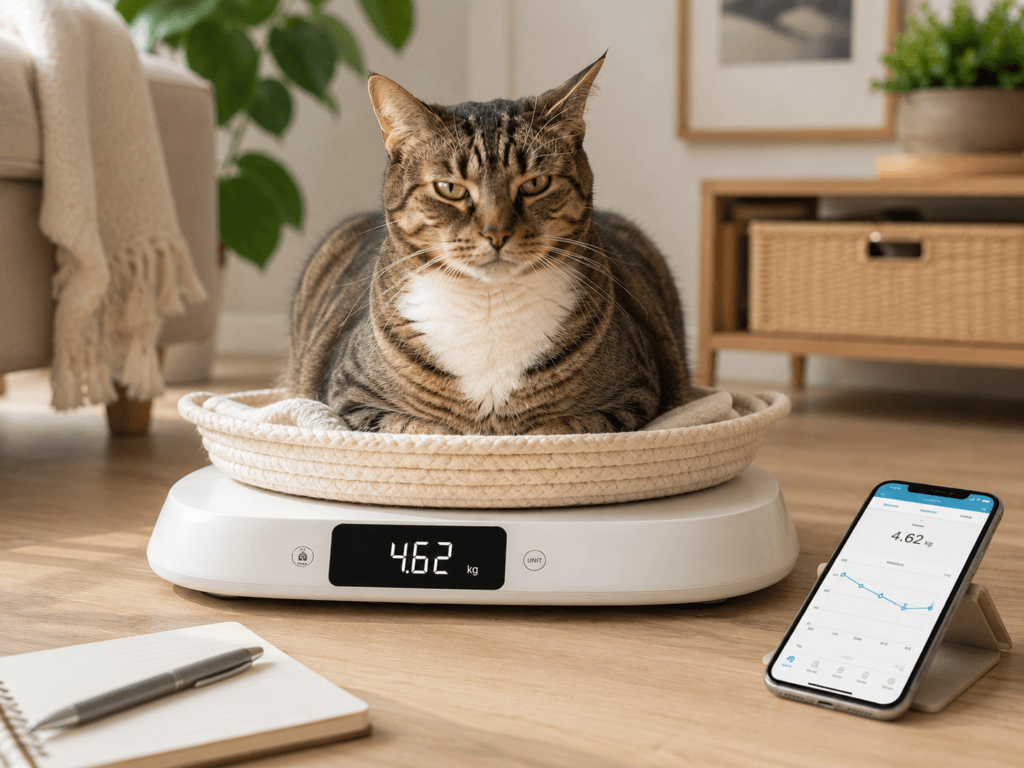
    A litter monitor can reveal a change in weight or bathroom routine. A camera feeder can show that breakfast was ignored. A GPS tracker can tell you that an outdoor cat has stopped visiting its usual territory. A smart fountain can show that drinking patterns changed.

    None of these devices diagnoses illness.

    They record what happened so you can notice when normal stops looking normal.

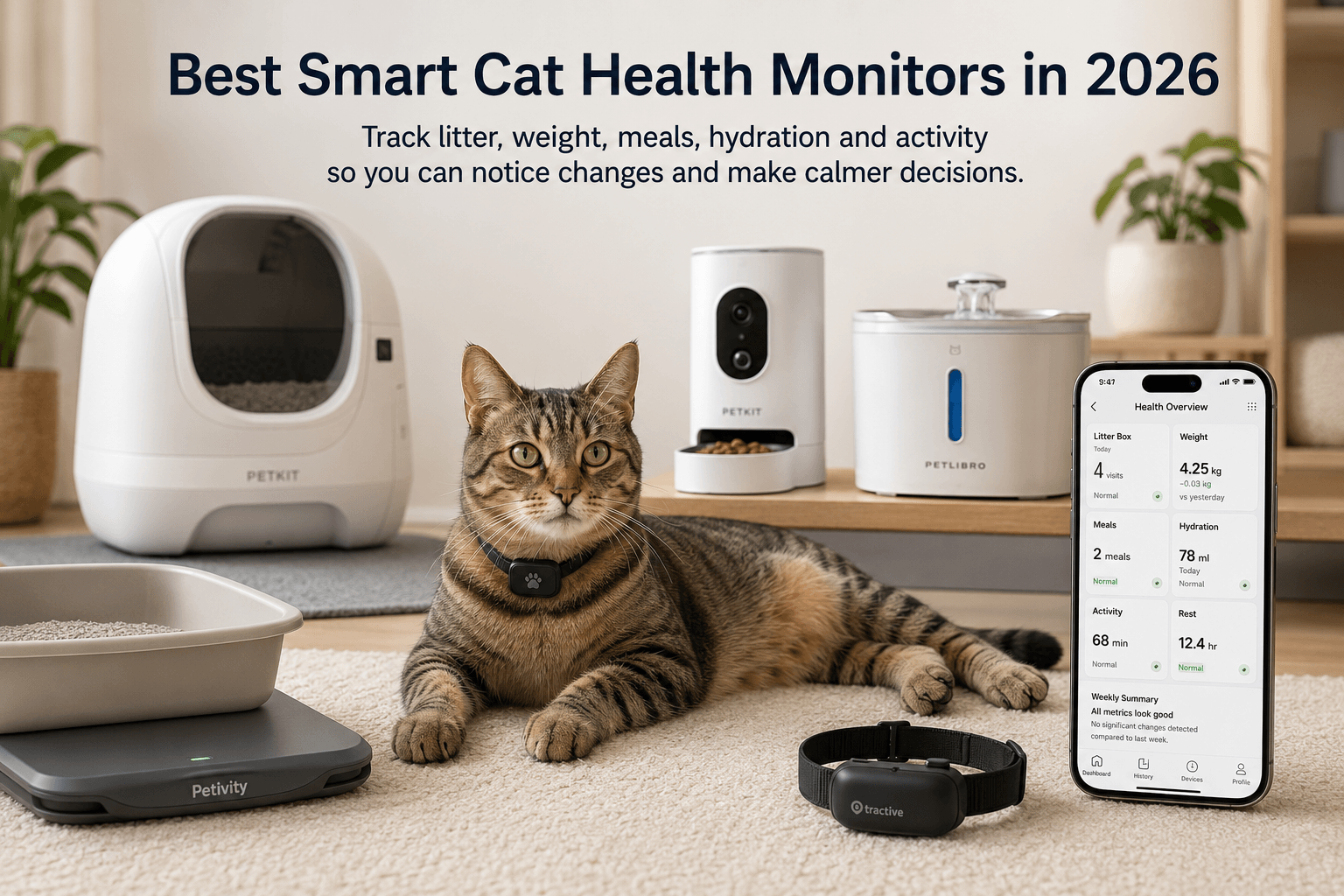
    This guide compares five different monitoring tools:

    • Petivity Smart Litter Box Monitor for an existing litter box;
    • PETKIT Purobot Max Pro 2 for premium camera-led litter monitoring;
    • Tractive CAT Mini for location, activity, and sleep context;
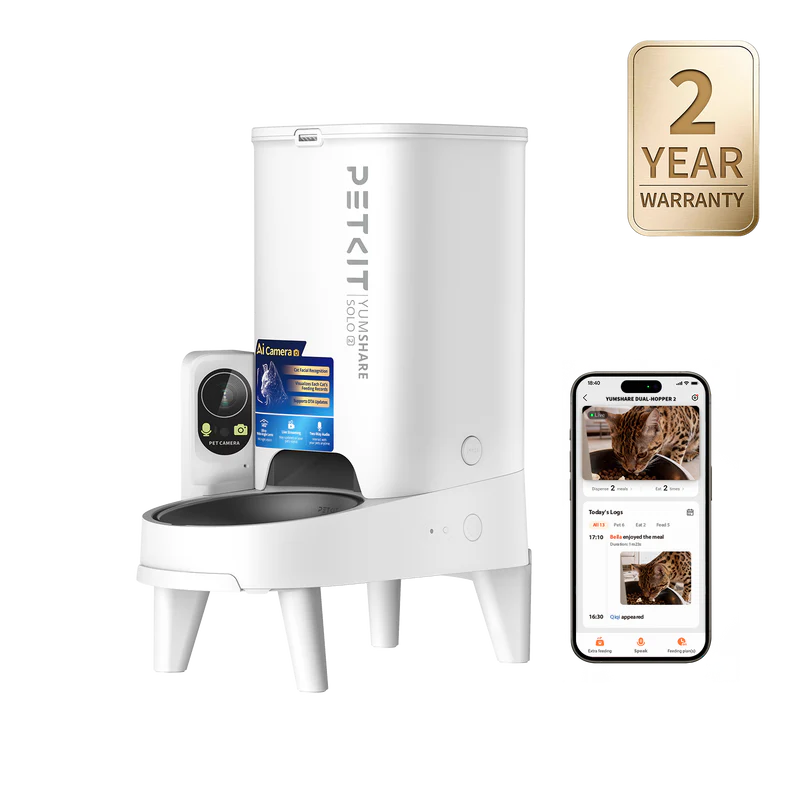
    • PETKIT YumShare Solo 2 for visual feeding records;
    • PETLIBRO Dockstream 2 for single-cat hydration tracking.

    The goal is not to monitor everything.

    It is to identify the uncertainty that matters in your home—and purchase one device capable of reducing it.

    Research note: This is a research-led guide based on official documentation, current product information, public ownership evidence, and PetTech AI’s product-level trust checks. PetTech AI has not conducted long-term hands-on testing of every device included.

    Quick Verdict

    What you need to understandBest fitRecommendation
    Weight and litter habits without replacing the boxPetivity Smart Litter Box MonitorEstablished recommendation
    Litter habits with camera context and automatic cleaningPETKIT Purobot Max Pro 2Strong premium recommendation
    Outdoor location, activity, and sleepTractive CAT MiniConditional recommendation
    Which cat approached a dry-food feederPETKIT YumShare Solo 2Promising newer product
    One cat’s drinking amount and frequencyPETLIBRO Dockstream 2Strong single-cat recommendation

    The short version

    Choose Petivity when the cat already likes the litter box and you would prefer not to replace it with a rotating plastic observatory.

    Choose Purobot Max Pro 2 when you want automatic cleaning, individual litter records, and camera context in one expensive machine.

    Choose Tractive CAT Mini when the missing information exists outside the home.

    Choose YumShare Solo 2 when mealtime visibility would change how you manage feeding.

    Choose Dockstream 2 when one cat’s hydration pattern matters. Do not buy it expecting multi-cat identification; the fountain is clever, but it has not learned to ask for identification before serving water.

    Affiliate disclosure: This page contains affiliate links. PetTech AI may earn a commission if you purchase through them, at no additional cost to you. As an Amazon Associate I earn from qualifying purchases.

    Compare the Recommended Monitors

    First Choose the Signal, Not the Gadget

    Every monitoring product watches one small part of the cat’s life.

    Litter and weight

    Useful when bathroom routine or gradual weight change is the main uncertainty.

    Camera-supported litter behavior

    Useful when you need more context than a visit count can provide.

    Location and movement

    Useful for outdoor cats, escape risks, territory changes, and activity patterns.

    Feeding behavior

    Useful when dispensing food is not enough and you need to see who appeared.

    Hydration

    Useful when changes in drinking would otherwise be difficult to notice.

    The wrong monitor can generate perfectly accurate information that has no practical value.

    A camera feeder showing the same cat eating normally every day is reassuring at first. By week six, it may simply be producing the world’s least eventful television series.

    Petivity: Best for Monitoring an Existing Litter Box

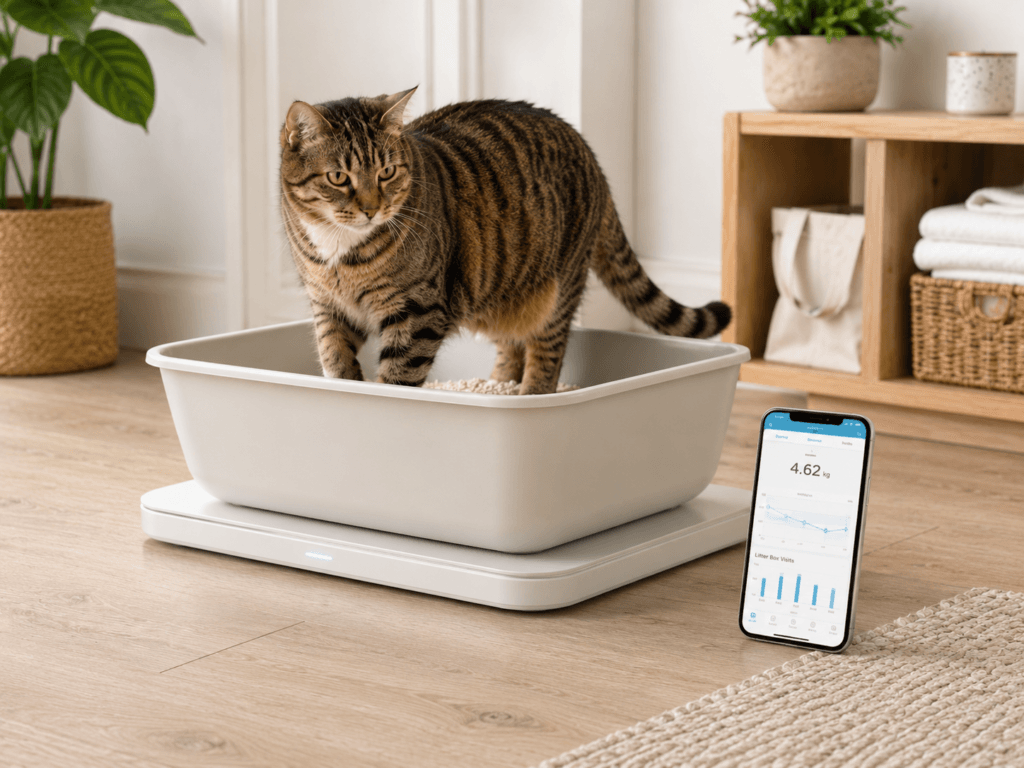
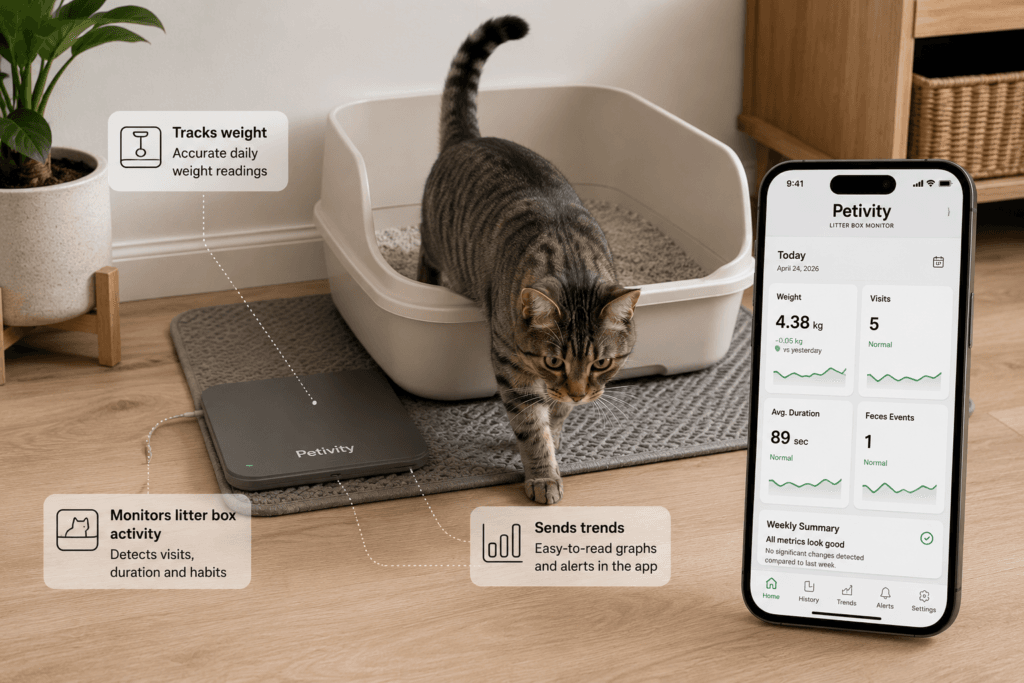
    A cat stepping near a regular litter box with a discreet smart monitoring pad underneath in a clean home setting
    Litter and weight data are useful because they turn repeated daily routines into clearer long-term patterns.

    Petivity sits underneath a conventional litter box and tracks weight, urination events, defecation events, visit patterns, and changes over time.

    Its greatest advantage is what it does not change.

    The cat keeps:

    • the familiar box;
    • the familiar entrance;
    • the familiar litter;
    • the familiar absence of mechanical rotation.

    That makes Petivity a sensible first monitor for cautious cats, older cats, and owners who want data without replacing a setup that already works.

    Buy it if

    • your cat reliably uses a standard litter box;
    • gradual weight trends would be useful;
    • litter-box activity is the main signal you want;
    • you do not need automatic scooping;
    • a lower-friction monitoring layer appeals to you.

    Skip it if

    • you want the machine to clean;
    • the box is frequently moved or sits unevenly;
    • you use several litter boxes but intend to monitor only one;
    • you want visual context;
    • the cats have very similar weights and individual identification is essential.

    Where it can disappoint

    Petivity depends on a stable physical setup.

    The platform needs to sit correctly, the litter box must fit, and multi-box homes require broader coverage if you want a complete picture. Monitoring one bathroom while the cat regularly uses another is a very sophisticated way to collect incomplete data.

    Multi-cat learning may also require time and clean baseline information.

    Verdict: The best starting point for litter and weight monitoring when the existing box already works and automation is not the goal.

    For setup, compatibility, and its real limitations, read our Petivity Smart Litter Box Monitor Review.

    PETKIT Purobot Max Pro 2: Best Premium Litter Monitor

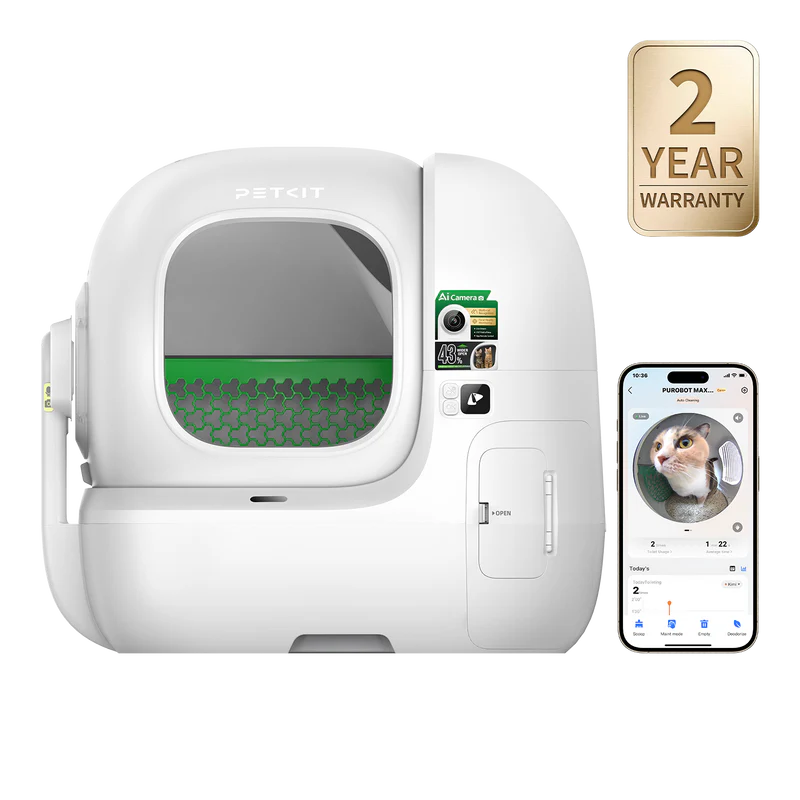
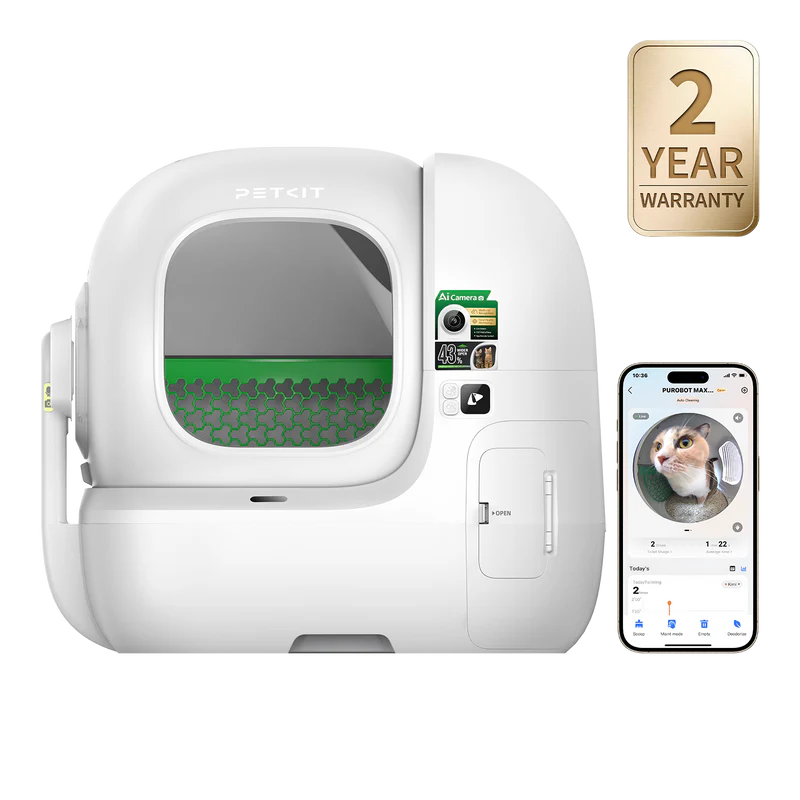
    PETKIT Purobot Max Pro 2 automatic cat litter box with AI camera and app-based monitoring features
    PETKIT Purobot Max Pro 2 combines self-cleaning litter automation with camera-supported routine monitoring.

    Purobot Max Pro 2 combines:

    • automatic litter cleaning;
    • an AI camera inside the litter area;
    • weight sensing;
    • facial recognition;
    • individual cat profiles;
    • visit records;
    • stool and clump imagery;
    • app alerts;
    • a larger, lower entrance than the previous model.

    It is less a litter monitor than a small automated surveillance department assigned to cat waste.

    For the right multi-cat household, that is not entirely ridiculous.

    Weight-only systems can struggle when cats are similar in size. PETKIT combines facial recognition and weight data to keep individual records separate, while the camera adds context that a number alone cannot provide. PETKIT also markets yowling, stool, and urinary-pattern monitoring as awareness tools. Those records may be useful for observation or veterinary discussion; they remain consumer-device interpretations, not diagnoses.

    Buy it if

    • you want automatic cleaning and monitoring together;
    • multiple cats have similar weights;
    • visual litter-box context genuinely matters;
    • you are comfortable with a camera in the litter area;
    • you will review significant changes rather than every ordinary event;
    • the premium price fits the household.

    Skip it if

    • your cat dislikes enclosed or moving litter boxes;
    • a conventional box plus Petivity already solves the problem;
    • you do not want camera footage involving the litter box;
    • the app data will become an anxiety ritual;
    • you expect artificial intelligence to explain every suspicious clump.

    Where it can disappoint

    Purobot requires more ownership effort than the phrase “AI-powered health ecosystem” suggests.

    You still need to:

    • empty the waste drawer;
    • deep-clean the cylinder;
    • maintain the camera area;
    • manage litter levels;
    • inspect residue;
    • verify that the app interpreted events sensibly.

    Some cloud-video and extended playback functions within PETKIT’s camera ecosystem may also depend on optional paid services, so buyers should confirm which features are included before purchase.

    Verdict: The strongest premium option for owners who want automatic litter care and individual camera-supported records in the same device.

    For the cheaper automation-first alternative, read Purobot Max Pro 2 vs PuraMax 2.

    Tractive CAT Mini: Best for Location Context—with Conditions

    The Amazon product assessed here is the established Tractive CAT Mini bundle, not the newer CAT 6 Mini sold directly by Tractive.

    It provides:

    • live GPS tracking;
    • virtual fences;
    • location history;
    • territory maps;
    • activity tracking;
    • sleep data;
    • health-style routine alerts;
    • a six-month subscription in the evaluated Amazon bundle.

    The subscription is not an optional decorative extra.

    Tractive uses cellular networks to provide unlimited-range GPS, so an active plan is required after the included period ends. The CAT Mini generally offers up to about five days of battery life, depending on signal, Live Tracking use, and Power Saving Zones.

    Buy it if

    • your cat goes outdoors;
    • escape risk is real;
    • territory and location history matter;
    • changes in activity or sleep provide useful context;
    • regular charging and an ongoing plan are acceptable.

    Skip it if

    • your cat refuses collars;
    • you want a one-time purchase without subscription costs;
    • cellular or GPS coverage is poor where the cat roams;
    • the cat is too small for the tracker;
    • litter, food, or water data is the actual concern.

    Why the recommendation is conditional

    Tractive has a large ownership history, but the feedback is more mixed than for the strongest products in this guide.

    GPS performance depends on cellular coverage, satellite visibility, settings, and environment. Battery life also changes substantially when Live Tracking is used frequently or the tracker spends time outside Power Saving Zones.

    That does not make Tractive a poor product.

    It means the device is valuable when outdoor location is a real problem—not because every indoor cat secretly needs a cellular subscription.

    Verdict: A credible and established tracker for outdoor location and activity context, with meaningful subscription, charging, fit, and coverage caveats.

    PETKIT YumShare Solo 2: Best for Feeding Context

    PETKIT YumShare Solo 2 automatic cat feeder with built-in camera and app-based feeding records
    YumShare Solo 2 adds feeding context by connecting scheduled meals, live video and pet recognition.

    YumShare Solo 2 is a dry-food feeder with:

    • scheduled portions;
    • live video;
    • two-way audio;
    • individual-pet recognition;
    • feeding histories;
    • food-bowl monitoring;
    • app alerts.

    A normal feeder can confirm that food was dispensed.

    YumShare can help show what happened next.

    That matters in homes where:

    • one cat may skip meals;
    • several animals approach the same feeder;
    • the owner is away frequently;
    • appetite changes are worth documenting;
    • a camera would replace guesswork.

    Buy it if

    • your cats eat dry food;
    • visual mealtime context changes your decisions;
    • you already use PETKIT;
    • one main feeding station serves the home;
    • you understand that this is monitoring, not access control.

    Skip it if

    • you only need scheduled portions;
    • you feed mainly wet food;
    • one cat must be physically blocked from another’s food;
    • you will ignore the camera after the novelty fades;
    • you want a mature, long-established model.

    The main limitation

    YumShare Solo 2 remains new.

    Its early ownership signal is encouraging, but the public record is not yet deep enough to prove years of consistent recognition, app stability, notifications, and camera performance.

    It also cannot physically stop food theft.

    The camera may identify Napoleon approaching Jonathan’s meal.

    It cannot enforce international borders.

    Verdict: A promising newer feeder for owners who genuinely need visual meal context—not a full health monitor or food-security device.

    For camera feeders, wet food, RFID, and microchip access, read our Best Automatic Cat Feeders guide.

    PETLIBRO Dockstream 2: Best for Single-Cat Hydration Tracking

    Dockstream 2 is a 3 L smart fountain available in plug-in and cordless configurations.

    The cordless version associated with ASIN B0GYDY8YKY offers:

    • a rechargeable battery;
    • sensor-activated or continuous flow depending on power mode;
    • app-based hydration records;
    • drinking-session frequency;
    • average drinking duration;
    • daily intake totals;
    • water-level and maintenance alerts;
    • a stainless-steel drinking tray;
    • a pumpless, detachable tank design.

    Its current ownership signal is strong enough to support a clear recommendation.

    But the use case must be accurate:

    Dockstream 2 tracks one pet at a time.

    It does not use RFID and cannot distinguish Jonathan’s elegant hydration session from Napoleon drinking half the fountain after conducting military exercises. PETLIBRO directs multi-cat buyers who need individual identification toward its separate Dockstream RFID model.

    Buy it if

    • one cat uses the fountain;
    • individual hydration trends matter;
    • cordless placement is valuable;
    • you want a stainless-steel tray and removable tank;
    • app reminders would improve maintenance.

    Skip it if

    • several cats share the fountain and you need individual records;
    • you want implanted-microchip or RFID identification;
    • your cat already drinks reliably and tracking would change nothing;
    • you dislike charging or filter replacement;
    • a basic easy-to-clean fountain already solves the problem.

    Where it can disappoint

    Hydration tracking becomes less interpretable when several animals drink from the same source.

    The app can measure activity around the fountain.

    It cannot politely ask each cat to log in first.

    Battery life also depends on operating mode and household use. PETLIBRO’s “up to 30 days” claim applies under specific sensor-mode conditions, not continuous flow at maximum enthusiasm.

    Verdict: A strong smart fountain for single-cat hydration trends, flexible placement, and easier maintenance—not the correct choice for individual multi-cat tracking.

    For broader hydration options, read our Best Smart Cat Water Fountains guide.

    The Anxiety Dashboard Test

    Smart monitoring becomes useful when it leads to a sensible action.

    Useful

    “The litter monitor shows a repeated weight decline. I will verify it and discuss it with the vet.”

    Less useful

    “The cat used the litter box four minutes later than usual. Society may be collapsing.”

    Useful

    “The GPS tracker shows that the outdoor cat has stopped visiting its normal territory.”

    Less useful

    “The activity score is 3% lower today. I have cancelled all appointments.”

    Useful

    “The fountain shows a sustained reduction in drinking.”

    Less useful

    “The cat drank at 2:13 rather than 1:58. I have prepared a spreadsheet.”

    The correct monitor should reduce uncertainty.

    If it transforms ordinary variation into daily alarm, change the notifications—or stop monitoring that signal.

    Buyer Regret in One Table

    ProductMost likely regret
    PetivityMonitoring one box while the cat uses several
    Purobot Max Pro 2Paying for camera analytics that become anxiety or background noise
    Tractive CAT MiniUnderestimating subscription, charging, or coverage requirements
    YumShare Solo 2Paying for feeding footage you stop watching
    Dockstream 2Expecting individual multi-cat hydration records

    Privacy, Subscriptions, and Data Ownership

    These devices may collect:

    • video;
    • GPS location;
    • household routines;
    • feeding activity;
    • drinking patterns;
    • litter-box records;
    • pet profiles.

    Before buying, check:

    • which functions work without a plan;
    • how long video or history is retained;
    • whether data can be exported;
    • who can access the account;
    • whether cloud storage is optional;
    • whether the device remains useful if you stop paying.

    A product does not become medically valuable because the manufacturer found a recurring-revenue model.

    Final Verdict

    There is no universal best smart cat health monitor because each product watches a different routine.

    Petivity is the best low-friction starting point for litter and weight trends when the existing box already works.

    PETKIT Purobot Max Pro 2 is the strongest premium option for automatic cleaning, individual litter monitoring, and camera context.

    Tractive CAT Mini is useful when location, outdoor activity, and escape risk justify the subscription and charging requirements.

    YumShare Solo 2 is a promising feeding monitor for owners who will actually use video and meal histories.

    PETLIBRO Dockstream 2 is a strong single-cat hydration monitor, but it should not be confused with PETLIBRO’s RFID fountain for multi-cat identification.

    The right strategy is simple:

    1. identify the uncertainty;
    2. choose the device that measures it;
    3. decide in advance what change would make you act;
    4. ignore the rest of the dashboard.

    Your cat does not need more data.

    You need one piece of information capable of changing a decision.

    Frequently Asked Questions

    Which monitor should most cat owners start with?

    Litter and weight patterns are often the most repeatable home signals. Petivity is the lower-friction starting point; Purobot Max Pro 2 adds automatic cleaning and visual context at a much higher cost.

    Can these monitors diagnose health problems?

    No. They can identify changes and create useful records. The cause of a meaningful change requires direct observation and, when appropriate, veterinary assessment.

    Is Purobot Max Pro 2 better than Petivity?

    Only when automatic cleaning and camera context justify the extra cost and complexity. Petivity is better when the existing litter box already works.

    Does Tractive work without a subscription?

    No. Its GPS and connected monitoring functions require an active Tractive plan. The assessed Amazon bundle includes an initial subscription period.

    Can YumShare Solo 2 prevent food theft?

    No. It can show which pet approached the feeder, but it does not physically restrict access.

    Can Dockstream 2 identify multiple cats?

    No. Dockstream 2 tracks one pet at a time. PETLIBRO’s separate Dockstream RFID model is designed for individual multi-cat tracking through collar tags.

    References

    • Petivity Smart Litter Box Monitor official product and support documentation
    • PETKIT Purobot Max Pro 2 official product, app, and warranty documentation
    • Tractive CAT Mini official tracking, battery, and subscription documentation
    • PETKIT YumShare Solo 2 official product documentation
    • PETLIBRO Dockstream 2 official product and support documentation
    • PetTech AI product-level trust checks and public ownership evidence

    Image Disclosure

    Some images in this article may be AI-generated for illustrative purposes. They do not depict the exact products and should not be used to evaluate fit, dimensions, controls, or physical features.

    Disclosure

    PetTech AI may earn a commission when readers purchase through affiliate links. Monitoring products are recommended according to the useful signal they can provide—not according to how many health-related words appear on the box.

  • Best Cat Cleaning Tools for Litter, Fur and Odor in 2026

    Best Cat Cleaning Tools for Litter, Fur and Odor in 2026

    Cat mess is rarely one problem.

    Litter travels beyond the box. Fur builds up on sofas and cat trees. Dust and dander settle into corners. Odors become noticeable when cleaning routines fall behind—not because a home has cats.

    The useful question is not: “What is the smartest cleaning gadget?”

    It is:

    Which part of cat-home cleaning is taking the most effort right now?

    Buying a robot vacuum because the sofa is covered in fur is not a cleaning strategy. It is an expensive way to automate the wrong surface.

    A touchless vacuum can make litter-zone cleanup almost frictionless. A robot vacuum can keep daily fur and tracked debris from accumulating. A handheld pet vacuum handles upholstery and cat trees. An air purifier can support particle and odor control, but it cannot replace litter cleaning, vacuuming, ventilation, or a well-maintained litter box.

    This guide compares four practical tools for four different mess zones:

    • EyeVac Home Touchless Vacuum for litter tracking and hard-floor debris.
    • iRobot Roomba 105 Vac + AutoEmpty Dock for recurring floor maintenance.
    • BISSELL Pet Hair Eraser Hand Vacuum for upholstery, cat trees, and fast spot cleaning.
    • LEVOIT Core P350-P Pet Care Air Purifier for dander and odor support without ozone.

    Quick Verdict: Which Cat Cleaning Tool Do You Need?

    Your main problemBest toolWhy it helpsWhat it does not replace
    Litter granules and fur around the boxEyeVac HomeFast touchless pickup after sweepingRegular litter-box cleaning
    Daily fur and debris across floorsRoomba 105 Vac + AutoEmptyRecurring autonomous floor cleaningSpot cleaning and obstacle checks
    Hair on sofas, bedding, cat trees, and car seatsBISSELL Pet Hair EraserPortable upholstery and crevice cleaningWhole-home floor maintenance
    Dander and lingering household odorsLEVOIT Core P350-PParticle filtration plus activated-carbon odor supportSource control, ventilation, and cleaning

    Research Note

    This is a research-led roundup based on current manufacturer documentation, product positioning and available ownership evidence.

    PetTech AI has not conducted long-term hands-on testing of every product included.

    PetTech AI may earn a commission from qualifying purchases. As an Amazon Associate I earn from qualifying purchases.

    The Four Mess Zones in a Cat Home

    A cleaner cat home usually comes from assigning the right tool to the right zone.

    1. The litter zone

    This is where litter tracking, loose fur, dust, and small spills build up fastest. A self-cleaning litter box can reduce scooping, but it does not remove granules outside the box or clean the surrounding floor.

    2. The floor zone

    Cats shed everywhere. In multi-cat homes, hair and dust can build up quickly along walls, under furniture, and in high-traffic areas. This is where automation saves the most time.

    3. The fabric zone

    Sofas, blankets, beds, car seats, scratching posts, and cat trees collect hair differently from hard floors. A robot vacuum cannot reliably solve this category.

    4. The air zone

    Dander and odors are not the same thing. Filtration can help reduce airborne particles, while activated carbon can support odor reduction. But neither replaces cleaning the source of the odor or maintaining the litter box properly.

    Best for Litter Tracking: EyeVac Home Touchless Vacuum

    A person sweeping small litter granules near a cat litter box into a touchless floor vacuum on hard flooring
    The litter zone needs fast cleanup tools that make it easier to remove tracked granules before they spread.

    The EyeVac Home Touchless Vacuum is the most targeted tool in this guide because it solves a small but repetitive problem extremely well.

    Place it near the litter area, sweep loose granules, fur, or dust toward the base, and its infrared sensors activate suction automatically. Instead of bending down with a dustpan every time the floor looks messy, you can clear the debris in seconds.

    That makes EyeVac especially useful for homes with hard floors around the litter box, feeding area, or entryway.

    It is not a replacement for a normal vacuum. It is a friction-reduction tool: the kind of product that makes you more likely to clean immediately because the cleanup takes almost no effort.

    It does not automate cleaning. It removes the two-minute task people somehow postpone until the litter has established diplomatic relations with the hallway.

    The EyeVac Home uses infrared sensors for automatic activation and has a bagless canister with washable filters.

    Choose EyeVac Home if:

    • Litter tracking is your most annoying daily cleaning problem.
    • You have hard flooring near the litter box.
    • You already sweep but dislike using a dustpan.
    • You want a dedicated cleanup station near a predictable mess zone.
    • You prefer a simple, non-app-based tool.

    Skip it if:

    • Your main issue is hair on furniture or cat trees.
    • You need whole-home cleaning automation.
    • Your litter area is carpeted.
    • You do not have a good place for a plugged-in stationary unit.

    Verdict: Recommended with Conditions — excellent for repetitive litter cleanup on hard floors, pointless when the mess is spread across carpet or several rooms.

    Is tracked litter your main daily annoyance? Check EyeVac Home on Amazon.

    Best for Daily Floor Maintenance: iRobot Roomba 105 Vac + AutoEmpty Dock

    A robot vacuum cleaning cat fur and light debris from a hard floor while a cat rests nearby
    Robot vacuums work best as recurring maintenance for fur and dry debris—not as a substitute for litter-box care.

    The iRobot Roomba 105 Vac + AutoEmpty Dock is the strongest choice for owners who are tired of seeing fur, tracked litter, and ordinary floor debris return every day.

    Unlike EyeVac, this is not about one cleanup moment. It is about reducing background mess before it becomes visible.

    A robot vacuum can run on a routine while you work, sleep, or focus on other chores. That is especially valuable in multi-cat households, homes with long-haired cats, or apartments where pet hair becomes noticeable quickly.

    The important distinction is that a robot vacuum is a maintenance tool, not a miracle worker.

    It can help prevent buildup, but it still needs a reasonably prepared environment. You need to remove cords, small objects, and obvious hazards from the floor. You also need to be realistic around litter boxes: do not assume any robot should be allowed to run unsupervised near fresh accidents or wet messes.

    A robot that finds a hairball before you do is automation. A robot that distributes it across three rooms is performance art.

    The Roomba 105 Vac uses LiDAR mapping and can empty into its dock for up to 75 days, according to iRobot.

    Choose Roomba 105 Vac + AutoEmpty if:

    • You want less daily sweeping and vacuuming.
    • Your home has fur buildup across several rooms.
    • You live with multiple cats or a heavy shedder.
    • You want scheduled cleaning rather than manual spot cleanup.
    • You value a self-emptying dock.

    Skip it if:

    • Your cat regularly leaves wet messes or hairballs where the robot will travel.
    • Your floors are usually cluttered with cables, toys, or loose items.
    • You only need upholstery cleaning.
    • You want the cheapest possible cleaning option.

    Verdict: Recommended with Conditions — the strongest time-saving tool in the guide for routine dry debris, but not a robot to run blindly in a home with frequent hairballs or pet accidents.

    Need recurring floor maintenance across several rooms? Check Roomba 105 Vac + AutoEmpty on Amazon.

    Best for Upholstery and Cat Trees: BISSELL Pet Hair Eraser Hand Vacuum

    The BISSELL Pet Hair Eraser Lithium Ion Hand Vacuum solves the cleaning problem robot vacuums usually leave behind: fabric.

    Cat hair embeds itself in sofa cushions, beds, blankets, car seats, cat trees, and tight corners around furniture. A standard floor vacuum may help, but a cordless handheld is often more useful because you can grab it when you see the mess.

    This is not a whole-home replacement. It is the opposite: a fast-response tool.

    Use it for the sofa before guests arrive, the cat bed after shedding season, the car after a vet visit, or the cat tree when fur starts clumping in corners.

    BISSELL’s model 2390 includes a motorized brush tool, upholstery tool, crevice tool, triple-level filtration, and about 17 minutes of cordless runtime.

    Choose BISSELL Pet Hair Eraser if:

    • Your main problem is fur on fabrics.
    • You need quick cleanup on sofas, beds, cat trees, or car seats.
    • You want a handheld vacuum rather than a full-size machine.
    • You need a dedicated pet-hair brush attachment.
    • You want a recognized pet-cleaning brand.

    Skip it if:

    • Your biggest problem is daily floor coverage.
    • You want an automatic cleaning routine.
    • You need long cleaning sessions without recharging.
    • You are looking for air filtration or odor support.

    Verdict: Recommended — the clearest purchase in this roundup when fur embedded in upholstery is the problem you actually need to solve.

    Is the sofa collecting more fur than the floor? Check BISSELL Pet Hair Eraser on Amazon.

    Best for Dander and Odor Support: LEVOIT Core P350-P Pet Care Air Purifier

    The LEVOIT Core P350-P Pet Care Air Purifier is the best fit when the issue is not visible mess but airborne particles, dander, and lingering household odor.

    It should not be treated as a substitute for vacuuming, litter maintenance, or ventilation. No air purifier can make an unclean litter box harmless or solve an underlying moisture, mold, or sanitation problem.

    But as part of a complete routine, an air purifier can support cleaner air in the room where your cat spends the most time.

    The key difference from the old ozone-based recommendation is important:

    Do not use ozone generators in cat homes.

    EPA and California air-quality guidance warn that ozone-generating air cleaners can be ineffective for normal indoor pollutant control at health-based concentrations, while higher ozone concentrations may be harmful. EPA also advises avoiding air cleaners that intentionally produce ozone.

    The Core P350-P uses particle filtration plus an activated-carbon odor filter designed for pet households.

    For a deeper comparison of pet-focused filtration, room coverage, filter costs, and odor-support trade-offs, see our Smart Air Purifiers for Cat Owners guide.

    Choose LEVOIT Core P350-P if:

    • Your cat’s room feels dusty or stale between cleanings.
    • You want dander support in a bedroom, office, or living room.
    • You need an odor-support layer without using ozone.
    • You already clean consistently and want to improve the air environment.
    • You prefer a pet-oriented purifier with activated carbon.

    Skip it if:

    • You are trying to fix poor litter-box maintenance with a device.
    • You need a whole-home cleaning solution.
    • You are unwilling to replace filters on schedule.
    • You want to eliminate every odor without cleaning its source.

    Verdict: Conditional Recommendation — useful as a compact filtration layer after source cleaning is already under control, but not the strongest current purifier for large or heavily used cat rooms.

    Need compact dander and odor support after cleaning the source? Check LEVOIT Core P350-P on Amazon.

    What “Smart Cleaning” Should Actually Mean

    A tool is not smart because it has an app.

    It is smart when it reduces a recurring friction point.

    For most cat homes, that means one of four things:

    • You clean small litter spills immediately instead of postponing them.
    • Floors stay reasonably clear between deeper cleaning sessions.
    • Fabric surfaces become easier to maintain.
    • Air quality support runs quietly in the background.

    The best setup is often not one expensive all-in-one device.

    It is a small system where each tool handles a task it is actually good at.

    Build Your Cleaning Setup by Home Type

    A handheld vacuum cleaning cat hair from a sofa beside a quiet air purifier in a bright living room
    Fabric cleanup and air filtration solve different parts of the cat-home cleaning routine.

    Apartment with one cat

    Start with EyeVac near the litter box and a BISSELL Pet Hair Eraser for furniture.

    This is usually enough to manage the two most visible messes: tracked litter and fur on fabrics.

    Add the LEVOIT if dander or lingering odor is noticeable in a small bedroom or living room.

    Multi-cat home

    Prioritize the Roomba 105 Vac + AutoEmpty Dock.

    More cats mean more fur, more tracked litter, and more frequent floor maintenance. A robot vacuum will not replace deeper cleaning, but it can prevent the daily buildup that makes a home feel constantly messy.

    Pair it with EyeVac near the main litter area for faster spot cleanup.

    Allergy-conscious household

    Use a combined approach:

    • Roomba for recurring floor debris.
    • BISSELL for upholstered surfaces.
    • LEVOIT for airborne particle and odor support.
    • Regular ventilation and source cleaning.

    EPA guidance is clear that filtration can support indoor air quality, but reducing pollutant sources and ventilating with clean outdoor air remain central.

    Home with a self-cleaning litter box

    A self-cleaning litter box can reduce scooping, but it does not eliminate:

    • Litter tracking.
    • Loose fur around the area.
    • Dust on floors.
    • Odors from full waste drawers or poor ventilation.

    Use EyeVac as the practical companion product for the floor outside the litter box. For a broader look at automated litter systems, see our Best Smart Litter Boxes guide.

    What Cleaning Tools Cannot Solve

    No device can compensate for a litter box that is too small, poorly placed, overcrowded, or rarely maintained.

    No air purifier replaces removing waste, washing litter mats, cleaning box surfaces, or ventilating a room.

    No robot vacuum should be allowed to spread wet pet messes across the floor.

    And no “odor eliminator” should produce ozone in a space where cats or people live.

    The goal is not a home that smells artificially scented.

    It is a home where the sources of mess are handled consistently enough that heavy fragrance or risky chemical shortcuts are unnecessary.

    A Simple Weekly Cat-Home Cleaning Routine

    Daily

    • Sweep around the litter box.
    • Use EyeVac for loose litter and fur.
    • Run the robot vacuum in high-traffic areas, when appropriate.
    • Check litter-box waste and surrounding floor conditions.

    Two to three times per week

    • Vacuum sofas, cat trees, beds, and blankets with the BISSELL.
    • Wash food and water mats.
    • Check robot brushes, wheels, and bin capacity.

    Weekly

    • Clean litter mats and the exterior of the litter box.
    • Empty and wipe EyeVac or handheld-vacuum bins.
    • Check purifier filter indicators and airflow.
    • Vacuum corners the robot may miss.

    Consistency matters more than buying every device at once.

    Frequently Asked Questions

    What is the best tool for litter tracking?

    EyeVac is the most targeted option for hard-floor litter cleanup because it makes sweeping debris into a touchless vacuum quick and low effort.

    Can a robot vacuum handle cat litter?

    It can handle some dry tracked litter on hard floors, but it should not be treated as a solution for fresh wet messes, loose cords, or heavily cluttered floors.

    Do air purifiers remove cat odor?

    They can support odor reduction when they include activated carbon, but they do not replace cleaning the litter box, removing waste, ventilating the room, or addressing the odor source.

    Are ozone generators safe around cats?

    Avoid them. Ozone-producing air cleaners can create indoor-air risks and are not an appropriate cat-home odor solution.

    What should I buy first for a cat home?

    Start with the tool that solves your biggest recurring friction point:

    • EyeVac for litter tracking.
    • Roomba for daily floor maintenance.
    • BISSELL for furniture and cat trees.
    • LEVOIT for air support after cleaning basics are already in place.

    Final Verdict

    BISSELL is the safest product recommendation because it solves a common problem with very little complexity. EyeVac is excellent but highly situational. Roomba creates the largest time saving, but only in a home prepared for autonomous cleaning. LEVOIT comes last because filtration should support a cleaning routine—not distract from the source of the mess.

    References

    • EyeVac — Home Touchless Vacuum and automatic-sensor information
    • iRobot — Roomba 105 Vac + AutoEmpty Dock product information
    • BISSELL — Pet Hair Eraser Lithium Ion Hand Vacuum product information
    • LEVOIT — Core P350-P Pet Care Air Purifier and replacement-filter information
    • U.S. Environmental Protection Agency — Home air-cleaning and ozone guidance
    • California Air Resources Board — Ozone-generator guidance

    Image Disclosure

    Some images in this article may be created with AI for illustrative purposes. They do not show the exact products reviewed and should not be used to evaluate product size, fit, design, or features. Always check the current official product listing before purchasing.

    Disclosure

    PetTech AI may earn a commission from qualifying purchases. This does not influence our recommendations, comparisons or editorial judgments.
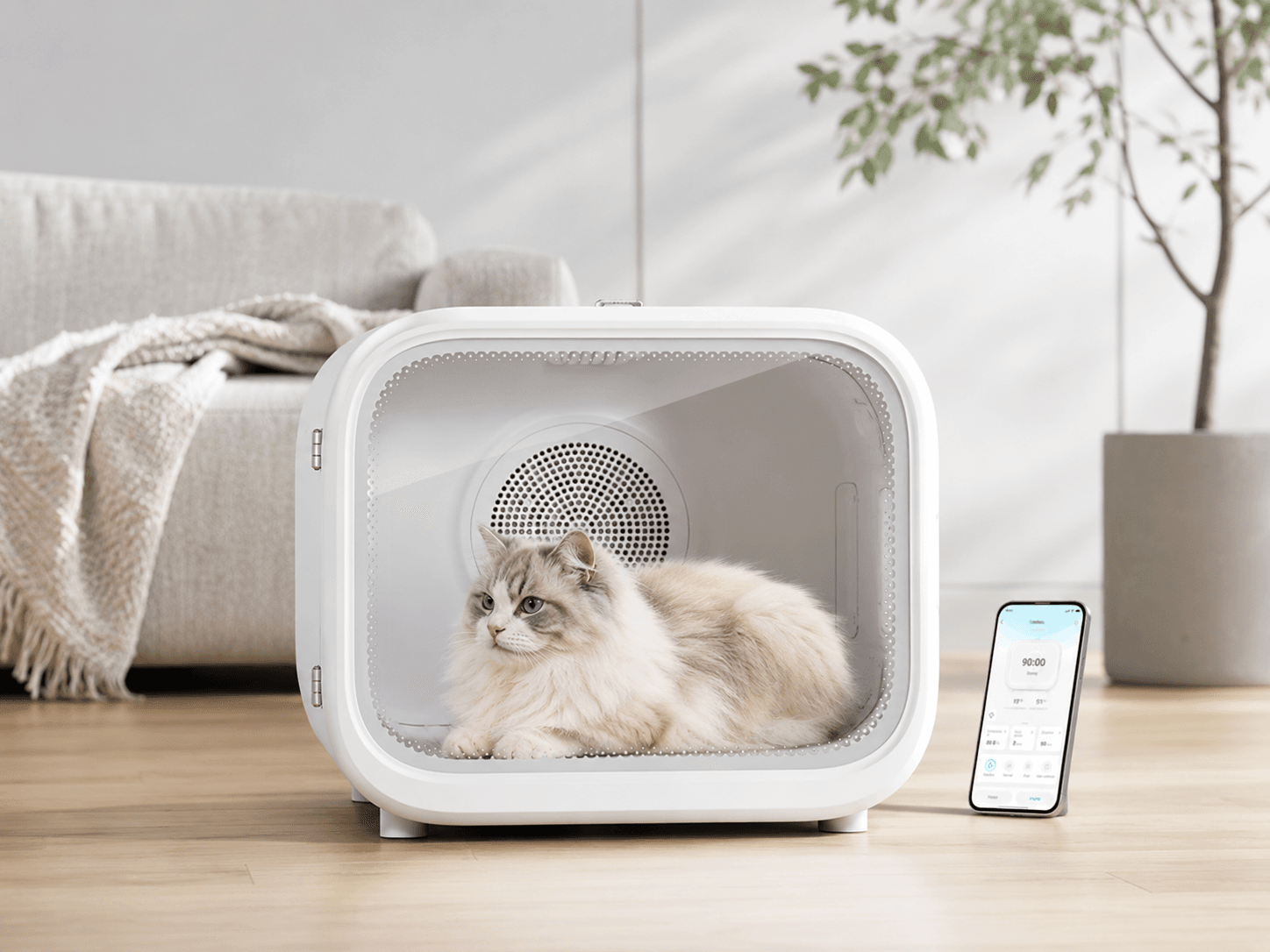
  • Best Smart Air Purifiers for Cat Owners in 2026

    Best Smart Air Purifiers for Cat Owners in 2026

    An air purifier can capture airborne dander, fine litter dust, pollen, and some particles carrying household odors.

    It cannot scoop Baron’s litter box, vacuum his preferred armchair, or negotiate with a waste drawer that should have been emptied yesterday.

    That distinction matters.

    The best smart air purifier for a cat home is not the model with the longest list of app features. It is the one with enough airflow for the actual room, filters you will replace, and controls that reduce friction instead of creating another dashboard to ignore.

    This guide compares four distinct options:

    • LEVOIT Vital 200S-P for the best overall fit in a cat household;
    • LEVOIT Core 400S-P for balanced smart filtration in shared rooms;
    • Blueair Blue Pure 211i Max for large open-plan spaces;
    • Coway Airmega MightyS for compact app-connected filtration.

    Research Note

    This is a research-led roundup based on current manufacturer documentation, official room-coverage data, indoor-air guidance, and product positioning.

    PetTech AI has not conducted long-term hands-on testing of every purifier included.

    Quick Verdict

    Best forModelEditorial judgmentMain trade-off
    Best overall for cat homesLEVOIT Vital 200S-PRecommendedLarger rectangular footprint
    Best balanced smart generalistLEVOIT Core 400S-PRecommendedLess specifically designed around pet fur
    Best for large open-plan roomsBlueair Blue Pure 211i MaxRecommendedLarger unit and potentially higher filter ownership cost
    Best compact app-connected optionCoway Airmega MightySRecommended with ConditionsSmart premium matters only if you will use the app

    PetTech AI may earn a commission from qualifying purchases. As an Amazon Associate I earn from qualifying purchases.

    What an Air Purifier Can—and Cannot—Do in a Cat Home

    A purifier is most useful for the air zone of a cat home.

    That includes airborne dust, dander, fine particles, and some odor-support through activated-carbon filtration. It is not a replacement for source control: removing litter waste, cleaning box surfaces, vacuuming soft furnishings, grooming when appropriate, and improving ventilation remain the foundation of indoor-air management. EPA guidance is clear that source control and ventilation come first, with filtration acting as a useful supplement.

    A smart purifier becomes more valuable when it helps you maintain that support consistently:

    • Auto mode can increase fan speed when particle levels rise.
    • App control can let you schedule quiet operation overnight.
    • Filter tracking prevents you from forgetting replacement intervals.
    • Air-quality history can show when a room gets dustier or more active.

    But smart features should not become another dashboard you ignore after a week.

    The best system is one you will actually leave running, maintain properly, and place in the room where your cat spends the most time.

    How to Choose a Smart Air Purifier for Cats

    A smart air purifier filtering airborne dust and cat dander in a bright living room while a tabby cat rests nearby
    Room coverage and airflow matter more than a long smart-feature list when dander is the real problem.

    1. Match coverage to the room at a realistic air-change rate

    Manufacturers often show one-air-change-per-hour coverage, which can sound impressive but is not the same as fast, recurring filtration. For a cat home, compare the room-size figure associated with a higher air-change rate when it is available, along with CADR. CADR describes how much clean air a purifier can deliver per minute; higher CADR generally supports effective cleaning in larger rooms.

    A purifier that “covers” the entire home once per hour may technically be telling the truth. It is also filtering with the urgency of a municipal permit office.

    That does not necessarily make it the right choice for a fur-heavy living room with a litter box nearby.

    2. Separate particles from odor

    Particle filtration helps with airborne dander, dust, pollen, and fine debris.

    Odor support depends more on activated carbon and on whether you actually clean the odor source. A purifier may reduce the stale background smell in a room, but it cannot compensate for a waste drawer that needs emptying or a litter box that needs washing.

    3. Decide whether app control will change your routine

    Smart functions are worth paying for when they reduce friction:

    • You want the purifier to run harder while you are out.
    • You want a schedule for quiet nighttime operation.
    • You want filter reminders in an app.
    • You have more than one purifier and want to control them together.
    • You care about reviewing air-quality patterns over time.

    They are less important when you plan to turn the purifier on once, leave it in Auto Mode, and rarely think about it again.

    4. Treat replacement filters as part of the purchase

    Before buying, check that genuine replacement filters are easy to find, understand how often they are expected to be replaced, and factor that recurring cost into the decision.

    The app can remind you that the filter needs replacing. It cannot stop you from pressing “remind me later” until the purifier is breathing through a gray sweater.

    A cheaper device with difficult or expensive filter ownership can still become the worse long-term value.

    Best Overall for Cat Homes: LEVOIT Vital 200S-P

    The LEVOIT Vital 200S-P earns the overall recommendation because this guide is about cat households—not generic smart-home filtration.

    Its U-shaped inlet is designed to capture larger airborne particles such as fur and lint more effectively, while Pet Mode, app scheduling, filter tracking, Auto Mode, and a 250 CFM CADR give it a stronger cat-specific argument than the more neutral Core 400S-P.

    LEVOIT rates the Vital 200S-P for 388 square feet at 4.8 air changes per hour, with a CADR of 250 CFM.

    That makes it slightly stronger than the Core 400S-P on high-frequency room coverage, while giving it a more pet-specific physical design.

    The important limitation: airborne fur is not the same as fur on your couch, bed, cat tree, or floor. The Vital 200S-P can support a cleaner air environment, but it does not remove the need for a handheld vacuum, robot vacuum, or fabric-cleaning routine.

    Choose the Vital 200S-P if:

    • You want a pet-focused purifier rather than a general smart model.
    • Airborne fur and dander are a visible concern.
    • You want app control, Auto Mode, schedules, and filter tracking.
    • Your target room is a medium-to-large living room, bedroom, or cat-heavy shared space.
    • You want a purifier that fits naturally into a broader pet-cleaning system.

    It may not be the best fit if:

    • You need coverage for a very large open-plan room.
    • Your main concern is litter odor alone.
    • You want the smallest purifier possible.
    • You expect a purifier to replace vacuuming or upholstery cleaning.

    Verdict: Recommended — the best default choice when airborne fur, dander, room coverage, and smart automation all matter.

    Need the strongest all-round fit for a cat-heavy room? Check LEVOIT Vital 200S-P on Amazon.

    Best Balanced Smart Generalist: LEVOIT Core 400S-P

    The Core 400S-P remains an excellent smart purifier for bedrooms, offices, and shared rooms where particulate monitoring, Auto Mode, scheduling, and a relatively compact cylindrical design matter more than a pet-specific intake.

    It is easier to recommend as the balanced smart-home choice than as the categorical winner for cat households.

    It is not built specifically around pet hair in the way the Vital 200S-P is. Instead, it is the stronger all-rounder for a bedroom, home office, medium living room, or shared main room where you want air-quality monitoring without committing to a very large purifier.

    LEVOIT rates the Core 400S-P for 358 square feet at 4.8 air changes per hour, with a CADR of 231 CFM. It also includes a laser dust sensor, Auto Mode, an activated-carbon filter for household and pet smells, VeSync app control, schedules, filter tracking, and voice-assistant support.

    That combination makes it the most balanced choice for the average cat home.

    You can leave it in Auto Mode during the day, use Sleep Mode overnight, check filter life in the app, and keep it running as a background support system rather than another appliance demanding attention.

    Choose the Core 400S-P if:

    • You need one purifier for a medium or moderately large room.
    • You want real smart features without buying an oversized unit.
    • Your cat spends most of their time in a bedroom, office, or main living room.
    • You care about app schedules, filter tracking, and Auto Mode.
    • You want a strong all-purpose option rather than a pet-hair-specific design.

    It may not be the best fit if:

    • You have a very large open-plan floor plan.
    • Airborne pet fur is your main concern.
    • You want the smallest possible footprint.
    • You do not need or care about app functionality.

    Verdict: Recommended — a strong general-purpose purifier, but Vital 200S-P is the more convincing default when pets are the reason you are shopping.

    Want a balanced smart purifier with a smaller visual footprint? Check LEVOIT Core 400S-P on Amazon.

    Best for Large Open-Plan Rooms: Blueair Blue Pure 211i Max

    A large smart air purifier operating in an open-plan living room with two cats resting nearby
    Large shared rooms need airflow first; an undersized purifier will spend too much time working at maximum speed.

    The Blueair Blue Pure 211i Max is the right choice when the room itself is the problem.

    Open-plan living rooms, large family spaces, lofts, and multi-cat homes often need more airflow than a typical bedroom purifier can provide. This is where the Blueair stands apart.

    Blueair recommends the 211i Max for rooms around 674 square feet at its AHAM-rated performance level. The company states that it can clean 1,618 square feet in 30 minutes and 3,235 square feet in one hour under its stated conditions. It also includes three air-quality sensors, Auto Mode, Wi-Fi, Blueair app controls, filter tracking, and Alexa or Google Home integration.

    The practical benefit is not simply “bigger is better.”

    It is that a large purifier can clean a shared space without needing to run at maximum speed constantly. That matters when several cats share the same living area, when litter tracking and dander are spread across an open floor plan, or when the purifier needs to handle a room where people and pets spend most of the day.

    Its particle-and-carbon filter is designed for airborne particles and light household odors from pets, cooking, and smoke. That wording matters: it is support for the room, not a substitute for cleaning a litter box.

    Choose the Blue Pure 211i Max if:

    • You have a large living room, loft, basement, or open-plan space.
    • You live with multiple cats.
    • You want high airflow without turning several small purifiers into a management project.
    • You value detailed particulate monitoring and app control.
    • You prefer one central purifier for the main shared room.

    It may not be the best fit if:

    • Your main target is a small bedroom.
    • You have limited floor space.
    • You need a low-cost purifier.
    • Your primary issue is fur on sofas and cat trees rather than airborne particles.

    Verdict: Recommended — the correct choice when airflow and room size are the primary constraints, not simply an excuse to buy the physically largest machine.

    Is the main shared room too large for the other models? Check Blueair Blue Pure 211i Max on Amazon.

    Best Compact App-Connected Option: Coway Airmega MightyS

    The Coway Airmega MightyS AP-1512HHS is the best smart value choice for cat owners who want a compact, established purifier with app control but do not need the physical scale of Blueair’s largest model.

    The important detail is the “S.”

    The regular Coway Mighty AP-1512HH is widely respected, but it is not the right fit for a guide focused on smart purifiers because it lacks the Wi-Fi/app layer. The MightyS version adds Coway IoCare+ connectivity, remote control, schedules, filter information, indoor air-quality updates, and voice-control support.

    Coway lists the MightyS at 326 square feet for 4.8 air changes per hour, with a pre-filter, honeycomb activated-carbon filter, HEPA filter, and CADR ratings of 210 smoke, 246 dust, and 221 pollen.

    This makes it a compelling fit for a bedroom, office, nursery, smaller living room, or a room near—but not directly inside—the litter area.

    Choose the Coway MightyS if:

    • You want a smarter version of a well-known purifier platform.
    • Your target room is medium-sized rather than open-plan.
    • You value carbon filtration and a compact footprint.
    • You want app-based scheduling and remote controls.
    • You prefer a purifier that can blend into daily use without dominating the room.

    It may not be the best fit if:

    • You need coverage for a large open-plan living area.
    • You want a pet-hair-focused intake design.
    • You need the strongest possible airflow for a multi-cat shared space.
    • You do not care about app features and would rather save money with a non-smart model.

    Verdict: Recommended with Conditions — a credible compact smart purifier, but the additional connectivity is difficult to justify if the app will never be opened after setup.

    Need smart control in a bedroom or medium-sized room? Check Coway Airmega MightyS on Amazon.

    Core 400S-P vs Vital 200S-P: Which LEVOIT Is Better for Cats?

    This is the most useful direct comparison in the guide.

    Choose the Core 400S-P when you want a balanced smart purifier for a shared room and care most about app features, particulate monitoring, scheduling, and a versatile all-purpose design.

    Choose the Vital 200S-P when your cat household makes the pet angle more relevant: airborne fur, dander, Pet Mode, and a dedicated intake design matter more to you than a smaller cylindrical footprint.

    Neither replaces cleaning.

    The Core is the more neutral smart-home pick.
    The Vital is the more cat-specific smart-home pick.

    Build Your Purifier Setup by Home Type

    One cat in an apartment

    Start with the Coway MightyS or LEVOIT Core 400S-P.

    Choose Coway for a smaller bedroom or office. Choose Core 400S-P for a slightly larger shared room where app features and broader coverage matter.

    Multi-cat home with an open-plan living space

    Choose the Blueair Blue Pure 211i Max.

    A larger room needs airflow first. You can always add a smaller bedroom purifier later, but an undersized model in the main shared space will struggle to keep up.

    Cat hair, dander, and a busy main room

    Choose the LEVOIT Vital 200S-P.

    Its pet-specific intake and Pet Mode make the most sense in the room where cats sleep, play, climb, and spend most of the day.

    Litter-room-adjacent bedroom or office

    Choose the Coway MightyS or Core 400S-P depending on room size.

    Keep the purifier in the same general room zone with adequate clearance for airflow, but do not treat it as permission to neglect litter-box maintenance.

    Smart Setup Tips for Cat Homes

    A smartphone displaying air purifier controls beside a quiet purifier while a cat sleeps in a bedroom
    Smart features earn their place when Auto Mode, schedules, and filter reminders remove routine friction.

    Run Auto Mode as the baseline.

    That is usually the easiest way to let a purifier react to ordinary particle changes from dust, vacuuming, grooming, HVAC cycles, or daily household movement.

    Use schedules only when they solve a real routine problem.

    For example:

    • Quiet Sleep Mode overnight in a bedroom.
    • Higher fan speed before guests arrive.
    • A recurring daytime routine while you are out.
    • A higher setting after vacuuming or cleaning around the litter area.

    Keep the intake and outlet clear.

    Do not hide a purifier behind a sofa, inside a cabinet, or directly against heavy curtains. Follow the placement guidance in the specific product manual and give the unit room to circulate air.

    Replace filters on time.

    A smart app reminder is helpful, but it does not mean the filter is optional maintenance. Filter condition, airflow, and room conditions still matter.

    For the wider home-cleaning routine around litter tracking, upholstery fur, robot vacuums, and odor-source control, see our Best Cat Cleaning Tools for Litter, Fur and Odor guide.

    What Air Purifiers Cannot Solve

    An air purifier cannot fix:

    • A litter box that needs scooping.
    • A waste drawer that needs emptying.
    • Dirty litter mats.
    • Fur embedded in upholstery.
    • A room with poor cleaning habits.
    • Ventilation problems caused by an ongoing source.

    It also should not be replaced with risky shortcuts.

    Do not use ozone generators in occupied cat homes. EPA states that ozone generators have little ability to control indoor contaminants at concentrations that meet public-health standards, while higher ozone levels can create additional indoor-air concerns.

    The better approach is simple:

    1. Remove the source.
    2. Clean the surfaces.
    3. Ventilate when appropriate.
    4. Use filtration as support.

    For litter-box automation and source reduction, see our Best Smart Litter Boxes guide.

    Frequently Asked Questions

    Do air purifiers remove cat odor?

    They can support odor reduction when the filter includes activated carbon, but they do not replace litter maintenance, waste removal, cleaning, or ventilation.

    Do air purifiers remove cat hair?

    They can capture some airborne fur and fine particles, especially pet dander. They do not remove hair already sitting on floors, sofas, cat trees, or bedding.

    Is a smart purifier worth it for cat owners?

    It is worth it when app control, Auto Mode, scheduling, and filter tracking make your routine easier. It is not worth paying extra for features you will never use.

    What size purifier should I buy?

    Choose based on the room where your cat spends the most time, not your entire home’s square footage. Compare high-frequency room coverage and CADR rather than relying only on a one-air-change-per-hour claim.

    Should I place a purifier beside the litter box?

    Keep it in the same room or general area when possible, but do not block airflow or place it where loose litter, moisture, or accidental spills can interfere with the unit. Follow the manufacturer’s clearance guidance.

    Final Verdict

    The best smart air purifier for cat owners depends on the room first, then the feature set.

    Choose the LEVOIT Core 400S-P for the best overall balance of smart controls, room coverage, sensors, and daily usability.

    Choose the Coway Airmega MightyS for compact smart value in bedrooms, offices, and medium rooms.

    Choose the Blueair Blue Pure 211i Max for large open-plan rooms, multi-cat households, and high-airflow needs.

    Choose the LEVOIT Vital 200S-P when you want a smart purifier designed more directly around airborne pet fur, dander, and pet-home routines.

    A purifier should make your cleaning routine more effective—not encourage you to skip it.

    References

    • LEVOIT — Core 400S-P product specifications and VeSync smart-control information
    • Coway — Airmega MightyS AP-1512HHS product specifications and IoCare+ app information
    • Blueair — Blue Pure 211i Max room-coverage, sensor, app, and filter information
    • LEVOIT — Vital 200S-P pet-focused intake, Pet Mode, and room-coverage information
    • U.S. Environmental Protection Agency — indoor-air source control, ventilation, filtration, and ozone guidance

    Image Disclosure

    Some images in this article may be created with AI for illustrative purposes. They do not show the exact products reviewed and should not be used to evaluate product size, fit, design, or features. Always check the current official product listing before purchasing.

    Disclosure

    PetTech AI may earn a commission from qualifying purchases. This does not influence our recommendations, comparisons or editorial judgments.
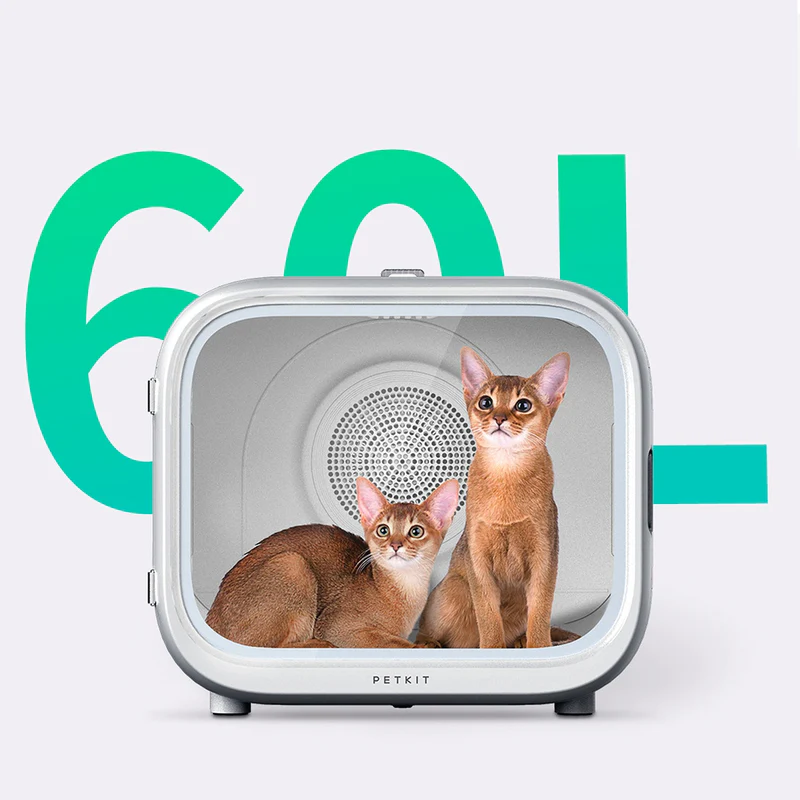
  • Best Smart Cat Window Perches 2025: Give Your Cat the Ultimate View

    Best Smart Cat Window Perches 2025: Give Your Cat the Ultimate View

    Does your indoor cat spend hours staring longingly out the window? Watching the world go by is one of the simplest pleasures for indoor cats. From chirping birds to falling leaves, windows provide endless entertainment and mental stimulation. But not every windowsill is cat-friendly, and not every cat owner wants claw marks on curtains or scratched wood.

    That’s where smart cat window perches 2025 come in. These innovative platforms attach securely to windows or sills, offering your feline a safe, comfortable spot to lounge and watch the world outside. In this guide, we’ll explore the best smart cat window perches of 2025, along with tips on installation, training, and safety.


    Why Window Perches Matter for Indoor Cats

    Indoor cats need more enrichment than their outdoor counterparts. Without access to natural hunting grounds, they risk boredom, obesity, and stress. Window perches provide:

    • Mental stimulation: cats can track birds, squirrels, or even passing cars.
    • A sense of safety: elevated views make cats feel secure.
    • Reduced stress: observing the outdoors helps alleviate anxiety.
    • Health benefits: stretching and jumping onto perches keeps muscles strong.

    Veterinary behaviorists emphasize that providing safe vertical spaces is one of the most effective ways to improve indoor cat welfare.


    What Makes a Window Perch “Smart”?

    “Smart” doesn’t always mean digital. In 2025, the best cat perches incorporate clever features that improve usability for both cats and owners:

    • Ergonomic design: memory foam cushions or breathable fabrics.
    • Safety systems: industrial-strength suction cups or sturdy screw-in mounts.
    • Innovative add-ons: foldable frames, washable covers, or heating pads.
    • Modern aesthetics: stylish enough to blend seamlessly with home décor.

    A truly smart perch is one that your cat loves—and that you don’t mind seeing in your living room.


    Top 3 Smart Cat Window Perches 2025

    🐾 K&H Pet Products EZ Window Mount Cat Bed

    K&H EZ window mount cat perch with cats lounging. One of the best smart cat window perches 2025

    One of the most trusted names in pet furniture, K&H delivers a durable and spacious perch.

    • 🟢 Holds up to 50 lbs, perfect for multi-cat households
    • 🟢 Sturdy steel frame with heavy-duty suction cups
    • 🟢 Washable cover for easy maintenance
    • 🔴 Requires a consistently clean window surface for best adhesion

    Check Price on Amazon


    🐾 PETPAWJOY Foldable Cat Window Perch

    PETPAWJOY foldable cat window perch with fabric surface

    A budget-friendly option that doesn’t sacrifice functionality.

    • 🟢 360° free of dead corner sunbath, foldable
    • 🟢 Breathable fabric surface for all-season comfort
    • 🟢 Easy installation with suction cups
    • 🔴 No heating element, best for temperate climates

    Check Price on Amazon


    🐾 Fukumaru Wooden Window Perch with Cushion

    Fukumaru wooden window cat perch with cushion

    For owners who prefer a permanent, stylish installation.

    • 🟢 Wooden base with modern look, fits minimalist homes
    • 🟢 Includes soft cushion with removable cover
    • 🟢 Mounts to window sills with hardware instead of suction cups
    • 🔴 Requires tools and installation effort

    Check Price on Amazon


    How to Choose the Right Window Perch

    Not all perches are created equal. Here’s what to consider before buying:

    • Weight capacity: always choose a model that supports more than your cat’s weight—especially if you have multiple cats.
    • Mount type: suction cups are removable and renter-friendly, while screw-in mounts are sturdier but permanent.
    • Comfort level: look for padded cushions or heated options if your home gets cold.
    • Space: foldable models are ideal for small apartments.
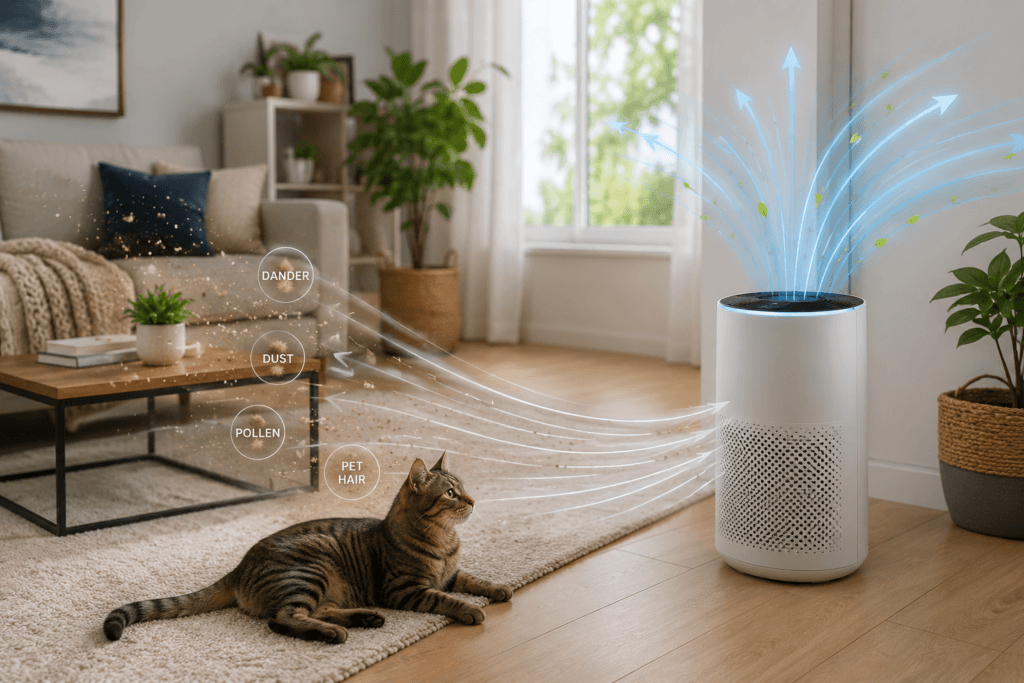
    Matching the perch to your cat’s needs ensures both safety and long-term use.


    How to Introduce a Window Perch to Your Cat

    Cats are naturally curious, but some need encouragement to try new furniture.

    1. Place the perch near your cat’s favorite resting spot.
    2. Add familiar items like a blanket or toy.
    3. Sprinkle catnip or treats on the perch to attract them.
    4. Avoid forcing—let your cat explore at their own pace.

    Patience pays off. Within days, most cats claim the perch as their new favorite throne.


    Maintenance & Safety Tips

    • Inspect suction cups weekly for secure adhesion.
    • Wash covers or cushions at least once a month.
    • Avoid placing perches in direct sunlight if overheating is a concern.
    • Rotate perch positions occasionally to keep your cat engaged.

    A little upkeep ensures safety and maximizes your cat’s enjoyment.


    Further Resources

    For more expert advice on enriching the lives of indoor cats, visit:
    🔗 Cornell Feline Health Center


    Final Thoughts

    Smart cat window perches are more than cozy beds—they’re enrichment tools that improve your cat’s quality of life. By giving your feline a secure spot to observe the outside world, you provide both comfort and mental stimulation.

    👉 Looking for more enrichment ideas? Check out our guides to Best Smart Cat Scratchers 2025 and Best Modern Cat Trees 2025.


    Affiliate Disclaimer

    This article contains affiliate links. If you purchase through these links, we may earn a commission at no extra cost to you.

  • Best Smart Cat Scratchers 2025: Protect Your Furniture with Style and Tech

    Best Smart Cat Scratchers 2025: Protect Your Furniture with Style and Tech

    Is your sofa under attack? Scratching is one of the most common feline behaviors that frustrates cat owners. While it may seem destructive, scratching is a natural and essential activity for cats. They do it to sharpen their claws, stretch their muscles, and mark their territory. The problem arises when your cat chooses your couch, curtains, or even wooden doors instead of an appropriate scratching surface.

    That’s where smart cat scratchers come in. Designed with durable materials, engaging features, and modern aesthetics, these products help redirect scratching behavior while protecting your furniture.

    In this guide, we’ll cover the best smart cat scratchers of 2025, plus tips to get your cat hooked on them.


    Why Cats Need Scratchers

    Scratching is not optional for cats—it’s instinctive. Here’s why providing a dedicated scratcher is so important:

    • Physical health: scratching helps remove the dead outer layer of claws and provides full-body stretching.
    • Mental well-being: it reduces stress and relieves boredom.
    • Territory marking: cats leave both visual and scent marks when scratching.
    • Furniture protection: a scratcher gives your cat a more appealing alternative to your sofa or carpet.

    A good scratcher respects your cat’s instincts while keeping your home intact.


    What Makes a Cat Scratcher “Smart”?

    A scratcher doesn’t need electronics to be considered “smart.” Instead, the term applies to products that combine innovation, design, and multi-functionality:

    • Durable materials: sisal rope, corrugated cardboard with dense layers, or wood.
    • Interactive features: catnip infusion, toys, or rolling balls to attract cats.
    • Multi-use design: scratcher + bed, or scratcher + climbing surface.
    • Modern aesthetics: stylish enough to blend with your home decor.

    These qualities make scratchers more effective at engaging cats and more acceptable to pet parents.
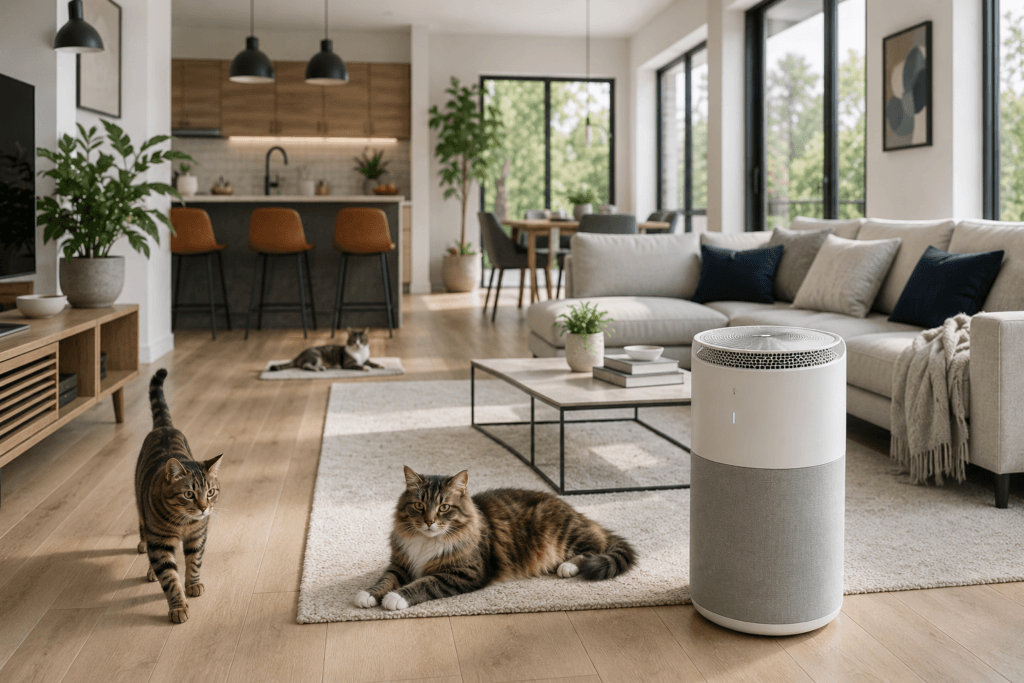

    Top 3 Smart Cat Scratchers 2025

    🐾 PetFusion Ultimate Cat Scratcher Lounge

    PetFusion Ultimate Cat Scratcher Lounge with cat resting

    A best-seller for years, the PetFusion Ultimate remains a top choice in 2025.

    • 🟢 Sleek modern design that doubles as a lounge bed
    • 🟢 Made of recycled, high-density cardboard for durability
    • 🟢 Large enough for multiple cats
    • 🔴 Doesn’t include interactive elements like toys

    Check Price on Amazon


    🐾 SmartyKat Scratch Scroll Cat Scratcher with Toys

    SmartyKat Scratch Scroll with interactive toys for cats

    Perfect for playful cats that love variety.

    • 🟢 Curved design that doubles as a climbing ramp
    • 🟢 Includes rolling balls and infused with catnip
    • 🟢 Lightweight and portable
    • 🔴 Smaller surface area, better for kittens or young cats

    Check Price on Amazon


    🐾 Fukumaru Wall-Mounted Cat Scratcher Board

    Fukumaru wall-mounted cat scratcher board with sisal surface. One of the best smart cat scratchers 2025

    For households that prefer saving floor space.

    • 🟢 Mounts to the wall, encouraging vertical scratching and climbing
    • 🟢 Covered in durable sisal fabric
    • 🟢 Stylish wooden base fits modern interiors
    • 🔴 Requires wall installation with hardware

    Check Price on Amazon


    How to Train Your Cat to Use a Scratcher

    Even the best scratcher won’t work if your cat ignores it. Here’s how to encourage use:

    1. Place it strategically: near areas your cat already scratches.
    2. Use attractants: spray catnip or place toys on the scratcher.
    3. Reward success: praise and give treats when your cat uses it.
    4. Offer variety: some cats prefer vertical surfaces, others horizontal.
    5. Be patient: never punish for scratching furniture—redirect instead.

    With consistency, your cat will naturally gravitate toward the scratcher.


    Maintenance Tips

    • Replace cardboard scratchers when grooves wear out.
    • Vacuum sisal posts to remove fur and dust.
    • Rotate between scratchers to keep your cat interested.
    • Consider having one scratcher per cat, plus one extra, in multi-cat homes.

    Further Resources

    For more insights on feline scratching and behavior, visit the:
    🔗 Cornell Feline Health Center – Feline Behavior Problems


    Final Thoughts

    Smart cat scratchers aren’t just toys—they’re tools that protect your furniture, satisfy your cat’s natural instincts, and contribute to their health and happiness.

    👉 Want more enrichment ideas? Read our guide to Best Modern Cat Trees 2025 for even more climbing and scratching options.


    Affiliate Disclaimer

    This article contains affiliate links. If you purchase through these links, we may earn a commission at no extra cost to you.