Smart litter boxes, cat doors, cameras, and health monitors: discover the top 2025 products to keep your cat safe, your home clean, and your life stress-free.
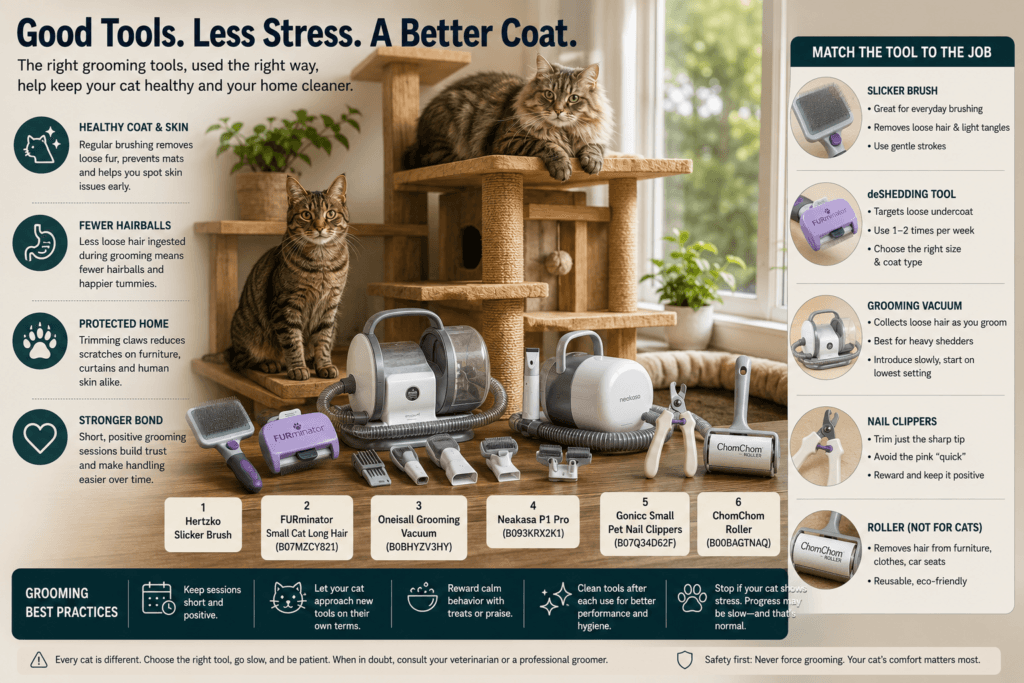
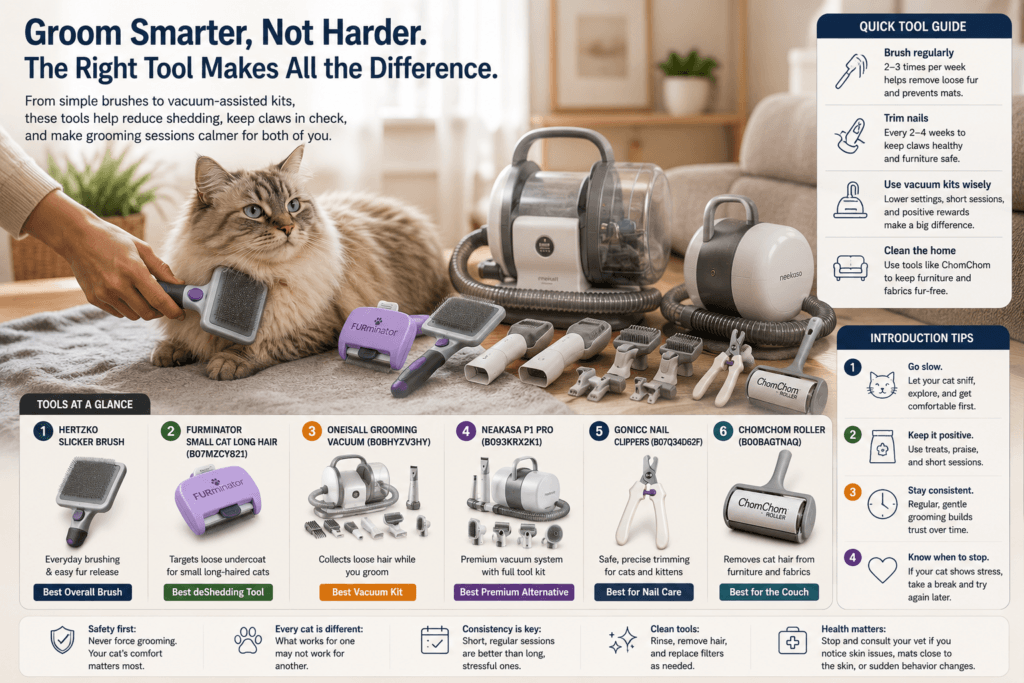
Cats are famous for being fastidious groomers, but that doesn’t mean they don’t need a little help from us. Long-haired cats, older cats, and even short-haired breeds can benefit from regular grooming to keep their coat, nails, and skin in top condition. The challenge? Many cats dislike being brushed or having their claws trimmed. That’s where smart cat grooming tools 2025 come in—innovative devices designed to make grooming safer, easier, and far less stressful for both cats and owners.
In this guide, we’ll explore the best smart cat grooming tools of 2025, along with practical tips for introducing them to your feline friend.
Why Grooming Matters for Cats
Regular grooming is not just about aesthetics. It has direct benefits for your cat’s health and well-being:
Prevents mats and skin irritation: especially in long-haired breeds.
Protects furniture and people: trimmed claws mean fewer scratches.
Strengthens bonding: grooming sessions are opportunities for gentle handling and trust building.
The ASPCA notes that cats who are regularly groomed are less prone to skin conditions and digestive problems caused by excessive self-cleaning.
What Makes a Grooming Tool “Smart”?
Smart grooming tools are designed to go beyond simple brushes or clippers. They often include features that make the process smoother, quicker, and safer:
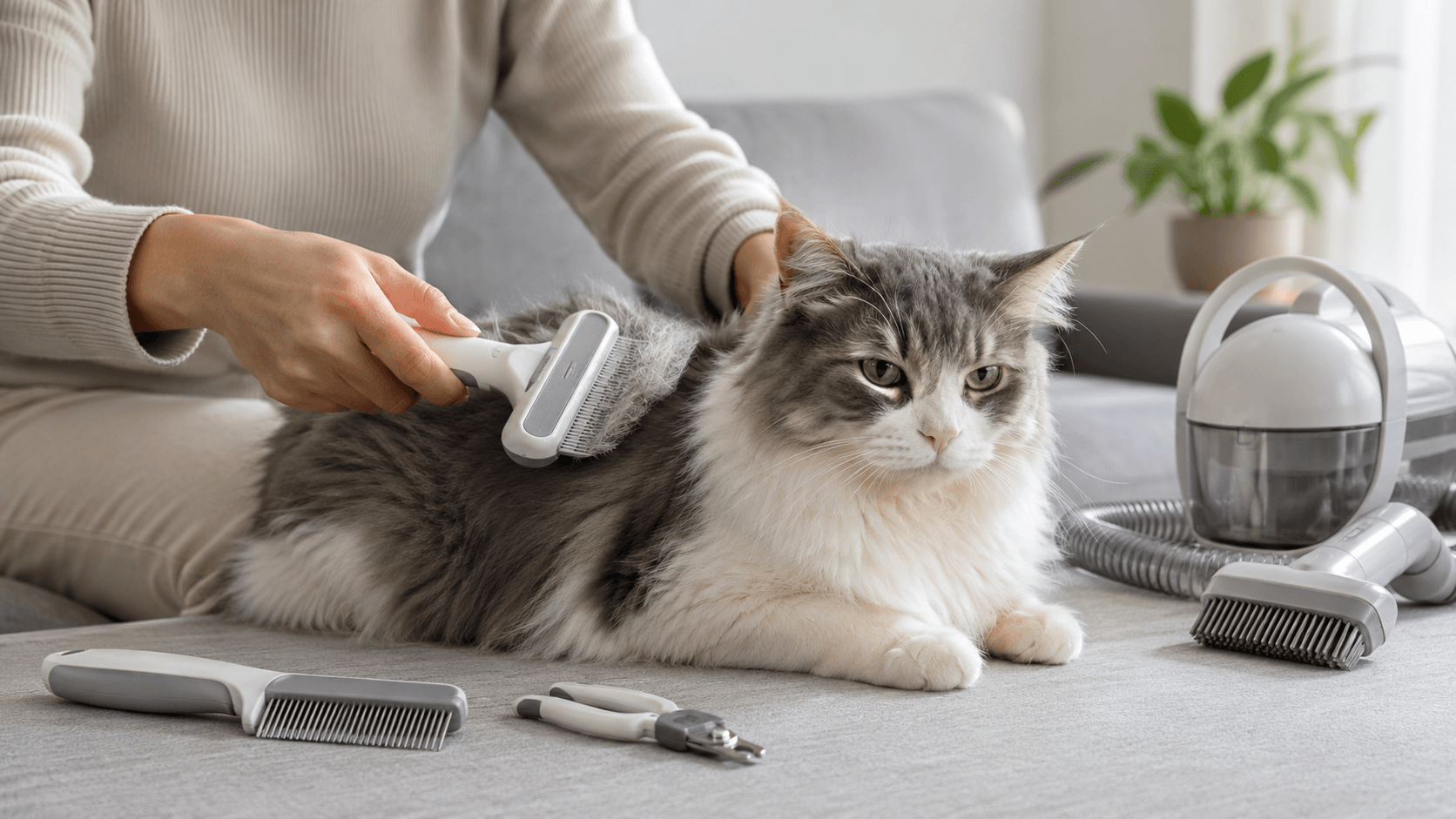
Vacuum-assisted brushes: collect hair as you groom, keeping your home clean.
Quiet nail grinders: reduce noise and vibration to keep cats calm.
Safety sensors: prevent cutting nails too short.
Reusable hair removers: sustainable tools that reduce waste and allergens.
These features turn grooming from a battle into a manageable routine.
Top Smart Cat Grooming Tools 2025
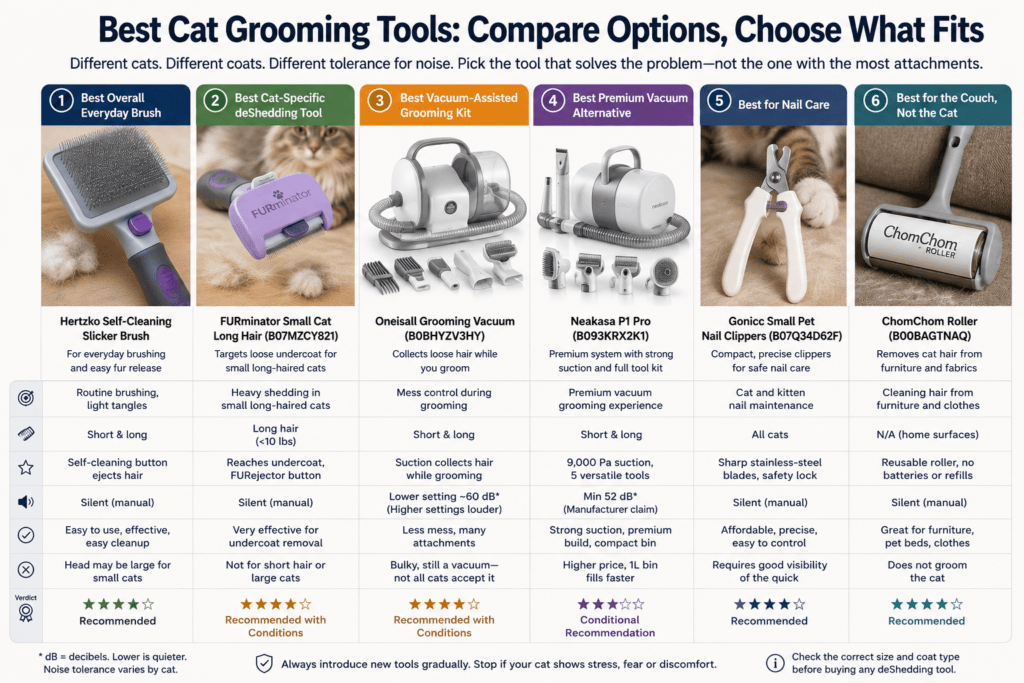
🐾 Neabot P1 Pro Pet Grooming Kit & Vacuum
One of the most popular all-in-one kits for pet parents.
🟢 Built-in vacuum collects 99% of loose hair during brushing
🟢 Includes multiple attachments: de-shedding brush, trimmer, cleaning nozzle
Smart grooming tools don’t just make life easier for cat parents—they improve the quality of life for cats, too. From vacuum-powered brushes to quiet nail grinders, these devices help reduce stress while keeping your feline healthy and comfortable.
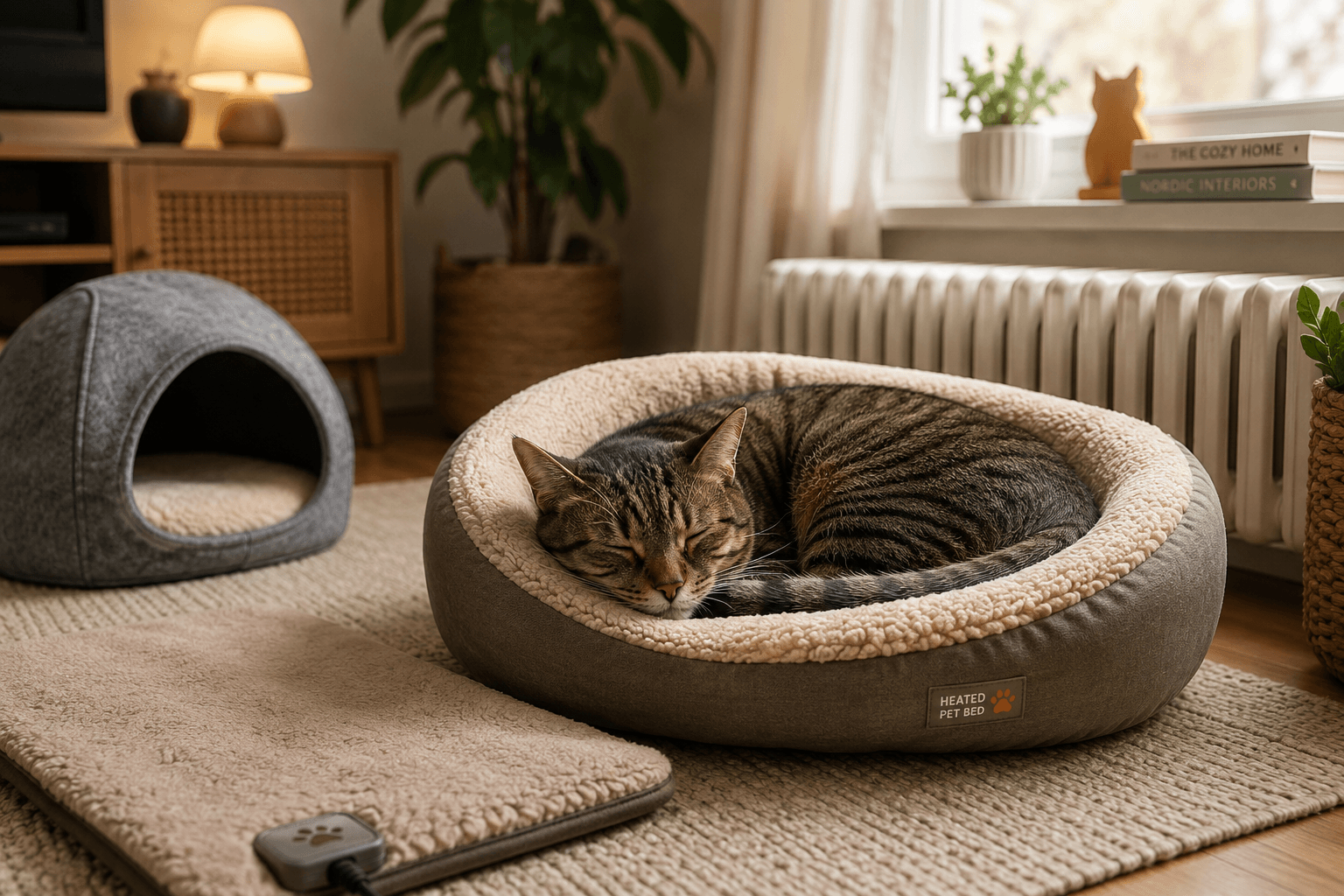
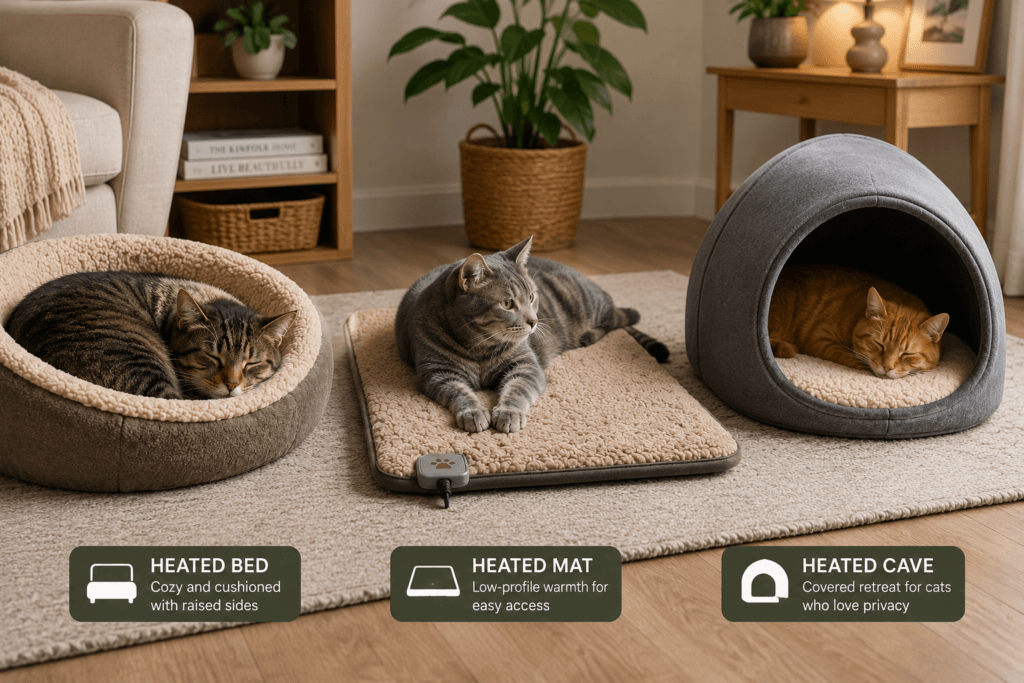
Does your cat sleep more than 12 hours a day? Cats spend most of their lives napping, and their comfort during sleep is essential for both health and happiness. Traditional beds may be cozy, but smart cat beds take feline rest to the next level with features like heating, cooling, and even health monitoring.
In this guide, we review the best smart cat beds of 2025 to help your feline enjoy the ultimate comfort.
Why a Smart Cat Bed?
Smart cat beds are designed to combine comfort, technology, and health benefits. Here’s why they matter:
Temperature control: Heated or cooled options to match seasonal needs.
Health tracking: Some models monitor sleep quality or even vital signs.
Anxiety reduction: Calming designs that make cats feel secure.
Owner peace of mind: Easy cleaning, energy efficiency, and safety certifications.
Investing in a smart bed isn’t just a luxury—it’s a way to improve your cat’s quality of life.
Top Smart Cat Beds for 2025
🐾 K&H Pet Products Thermo-Kitty Heated Cat Bed
A classic choice for cold climates.
🟢 Heated cushion that stays at a cozy 102°F when occupied
🟢 Low energy consumption, removable cover for easy washing
Nothing transforms day-to-day cat care like the right accessories around the litter area. From odor control to entry ramps and automated refills, today’s ecosystem turns a messy chore into a predictable routine. If you’re upgrading this year, smart litter accessories 2025 will help you create a cleaner, healthier, lower-maintenance setup that actually works for your home. This guide to smart litter accessories 2025 explains what matters, which categories deliver the biggest wins, and how to pair accessories with Whisker and PETKIT ecosystems (plus Amazon alternatives) without wasting money.
What Counts as “Smart” (and Why It Matters)
In smart litter accessories 2025, “smart” doesn’t only mean Wi-Fi. It means evidence-based design, automation, sensors, and high-performance materials that reduce odor, mess, and risk. The best add measurable value in at least one of these areas:
Hygiene: better capture of tracked litter, sealed waste, antimicrobial or easy-wash surfaces.
Safety & access: ramps/steps for seniors, secure mats to prevent slips, child/pet gate logic.
Environment: temperature/ventilation awareness and correct placement to avoid heat or humidity spikes.
Bottom line: in smart litter accessories 2025, the right add-ons reduce manual work while improving cat comfort and household air quality.
Buyer’s Framework: Choose Once, Cry Never
Before we dive into products, use this simple framework to evaluate any accessory:
Health impact: Will it reduce ammonia/odor, dust, or tracking that stresses cats and humans?
Fit & compatibility: Confirm model fit (e.g., Litter-Robot 4 vs 3, PETKIT PuraMax vs PuraBot).
Cleanability: Can you wash/replace consumables quickly without special tools?
Durability: Does it rely on replaceable parts (filters/bags) available year-round?
Total cost: Price per month (consumables) + time saved vs DIY solutions.
Feedback/data: Does it provide a signal—visual, tactile, or via app—that improves your routine?
Use this to prioritize the core kit in smart litter accessories 2025 and avoid nice-to-have clutter.
High-Impact Categories (What to Buy First)
1) Tracking-Control Mats (Less Grit, Less Cleaning)
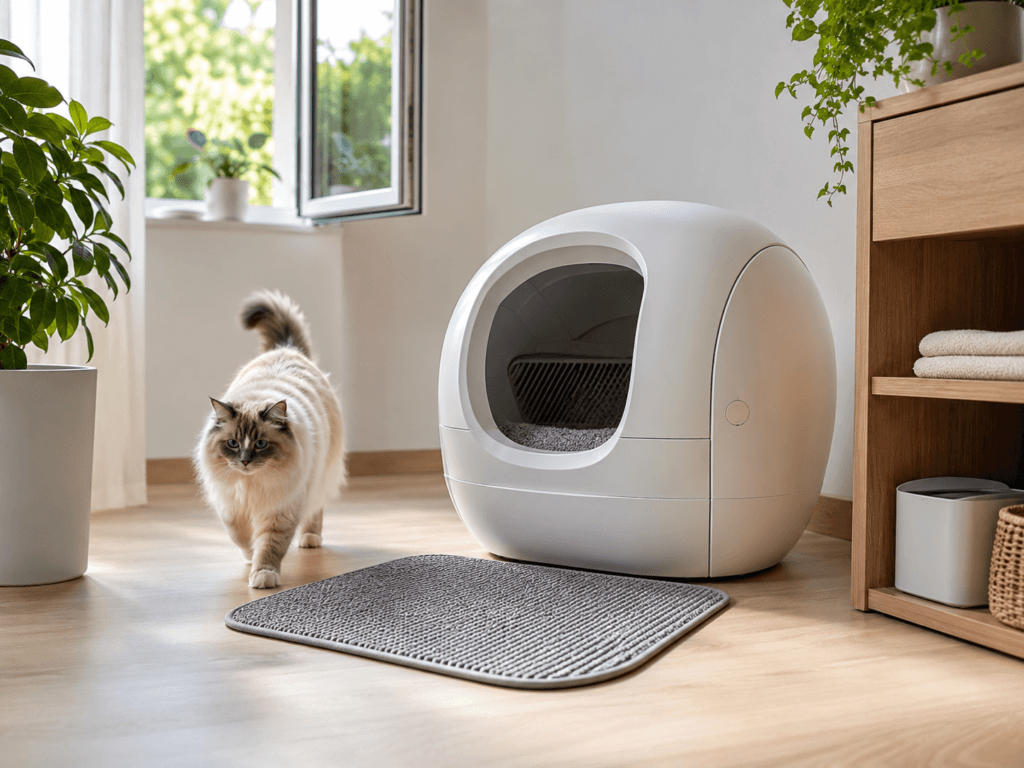
If you only buy one thing from smart litter accessories 2025, make it a high-quality litter mat. Dual-layer honeycomb and raised-ridge designs trap granules before they spread.
What to look for
Dual-layer structure that funnels litter back to the box.
Furniture-style enclosures or side guards keep scatter contained and improve room aesthetics—without restricting ventilation.
What to look for
Open front or generous vents for airflow.
Waterproof tray under the unit; wipe-clean surfaces.
Correct internal clearances to avoid sensor interference.
Examples
Side-shield kits and splash guards for Whisker models.
Waterproof floor trays and minimalist enclosures on Amazon sized for PETKIT units.
Smart containment is where style meets function in smart litter accessories 2025.
7) Sensors, Monitors & “Soft” Tech (Safety by Awareness)
Some accessories are “smart” because they improve your awareness: temperature, humidity, and even simple activity logs near the litter zone.
What to look for
Low-noise devices; no startle risk.
Readouts that lead to real actions (ventilate, relocate, replace filter).
Examples
Mini temp/humidity monitors near the litter area.
Discrete cameras for checking multi-cat dynamics (privacy-aware placement).
Environmental feedback makes your routine resilient—another win for smart litter accessories 2025.
How to Place and Maintain Your Setup (So It Actually Works)
Location & airflow. The best accessory won’t fix poor placement. Choose a quiet, low-traffic area with airflow (not drafty), away from food/water. Avoid tight closets unless well-vented.
Daily 60-second routine. Tap excess litter back into the box from the mat, check liner seal, confirm filter in place. Quick glance at deodorizer timer.
Weekly 10-minute reset. Shake out the mat, wipe the ramp, swap carbon if needed, replace liner, sanitize tray/floor. Capture a before/after nose test—odors should be near zero.
Monthly audit. Review consumable costs and results; retire any accessory that doesn’t change outcomes. In smart litter accessories 2025, your goal is measurable reduction in odor and scatter with minimal effort.
Whisker vs PETKIT vs Amazon: Build the Right Kit
Whisker ecosystem (Litter-Robot 4).
Strengths: tight fit accessories (ramp, mat, filters, liners, LitterHopper), excellent containment and app integration from the box itself.
Where to buy: PETKIT direct for official refills; Amazon for alternatives, trays, mats.
Amazon cross-shop.
Strengths: budget-friendly and quick shipping for mats, generic liners, enclosures, temp/humidity monitors.
Caveat: always check dimensions and user photos to confirm fit.
These mixes are how most readers will assemble smart litter accessories 2025 without overpaying.
Quick-Pick Accessory Sets (Save Time)
Minimalist Starter (single cat, small space)
XL honeycomb mat (Amazon)
Drawer liners (Whisker or PETKIT model-specific)
Carbon filter 2-pack
Optional: mini temp/humidity monitor
Performance Build (multi-cat, odor-sensitive)
Whisker LitterTrap Mat + LR4 Ramp
LitterHopper (auto refill)
PURA Air smart deodorizer (PETKIT area or room)
Waterproof floor tray + side shields
Senior-Friendly Build
Low-slope ramp/step matched to unit
Non-slip mat and wider pathway
Drawer liners for fast, low-effort changes
Gentle deodorizer timing to avoid sudden bursts
Each set maps to the outcomes that matter most in smart litter accessories 2025.
Safety Notes (Backed by Vets)
Ventilation first. Do not over-enclose the litter area; cats need air exchange to avoid ammonia buildup.
Avoid harsh chemicals/ozone. Use pet-safe deodorizers and follow manufacturer guidance.
Behavior watch. Changes in box use (straining, skipping, vocalizing) require a vet check—odor control must never mask medical issues.
Authoritative reads: AVMA on safe home environments and transport; Cornell Feline Health Center on litter box basics, stress, and elimination behavior. These external references anchor the health logic behind smart litter accessories 2025.
Frequently Asked Questions
Do I need brand-specific accessories? Usually yes for liners/filters/ramps; mats and trays can be universal. Check exact dimensions. This is standard practice in smart litter accessories 2025.
Can I add an enclosure for aesthetics? Yes—if it’s ventilated and sized correctly. Watch for heat or odor buildup; your nose should never “sting.”
What’s the fastest upgrade if I’m on a budget? A quality dual-layer mat + correct liners. That pair defines success in smart litter accessories 2025 for most homes.
Start with the essentials—mat + liners + odor control—then add a ramp or refill system for convenience. Compare official parts and bundles from Whisker and PETKIT, and use Amazon for quick consumables and universal mats. Thoughtful choices in smart litter accessories 2025 pay you back every single day with fewer smells, less scatter, and calmer cats.
Compare today:
Whisker official accessories (model-matched)
PETKIT litter refills & PURA Air
Amazon mats, liners, trays, and monitors
Clean box, clean air, calm cat: that’s the promise of smart litter accessories 2025.
Affiliate Disclaimer This guide contains affiliate links. As an Amazon Associate—and partner of Whisker and PETKIT—PetTech AI may earn commissions at no extra cost to you. We only recommend accessories that support cat health, hygiene, and user experience.
Does anyone use the expensive climbing wall you installed?
Did the feeder actually dispense breakfast?
Which cat approached the bowl?
It can also answer questions nobody needed to ask, such as:
“At precisely what angle did Napoleon knock the plant from the shelf?”
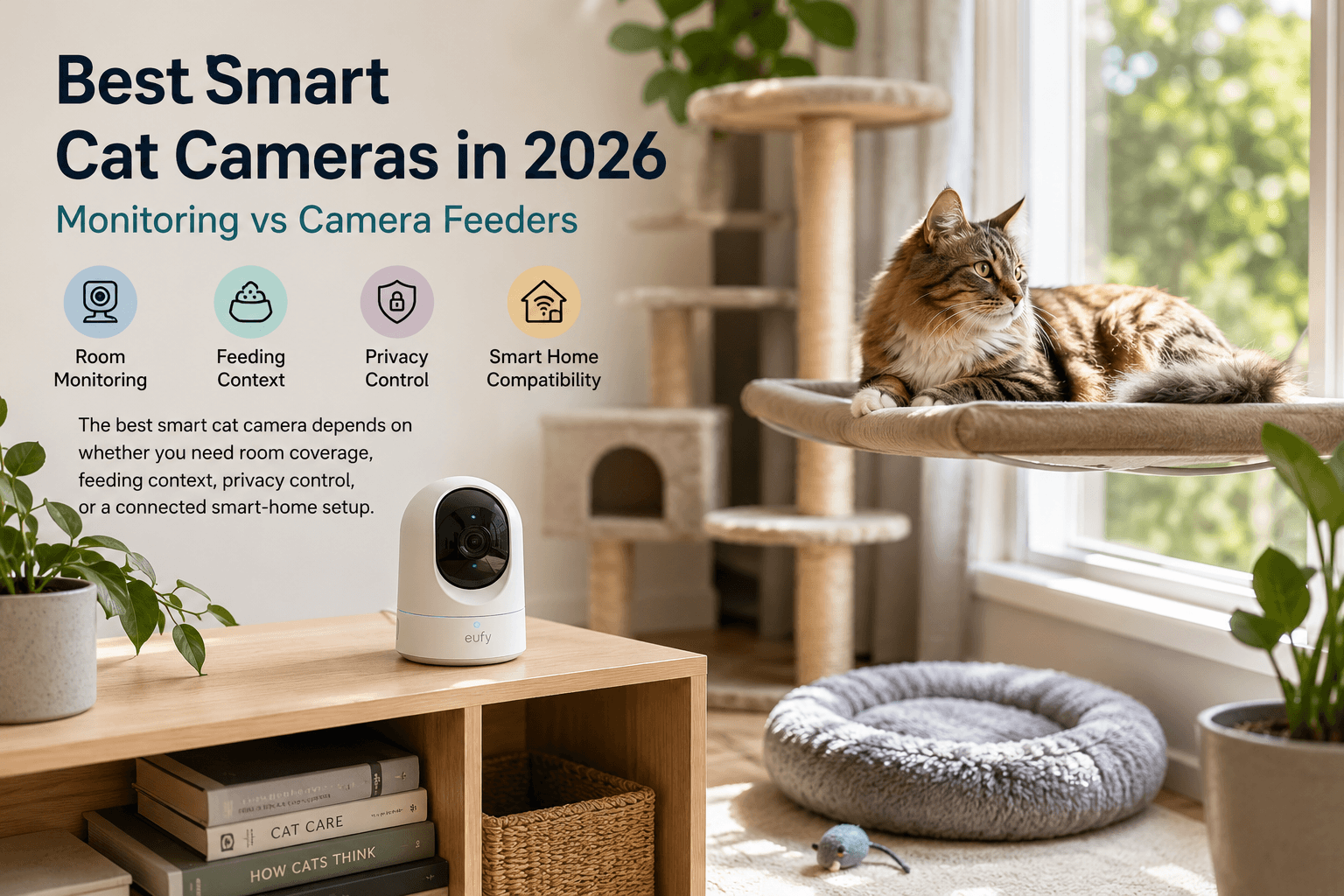
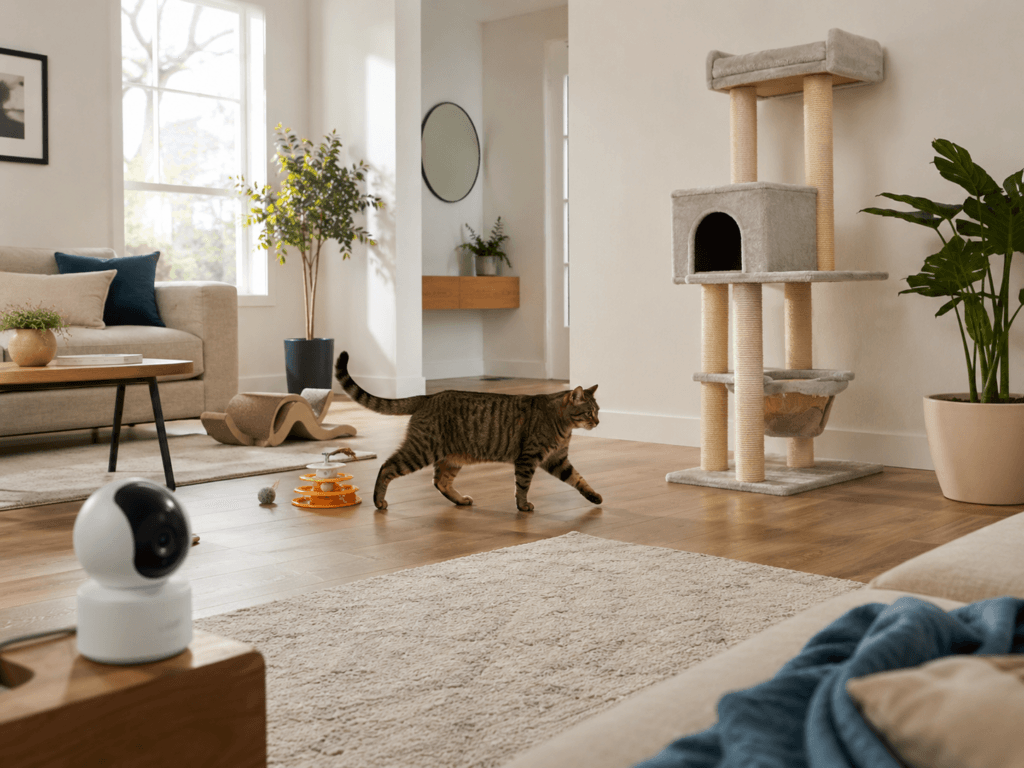
The best smart cat camera is not necessarily the one with the highest resolution or the longest list of AI detections.
It is the one pointed at the problem you actually need to understand.
This guide compares two standalone room cameras and two camera feeders:
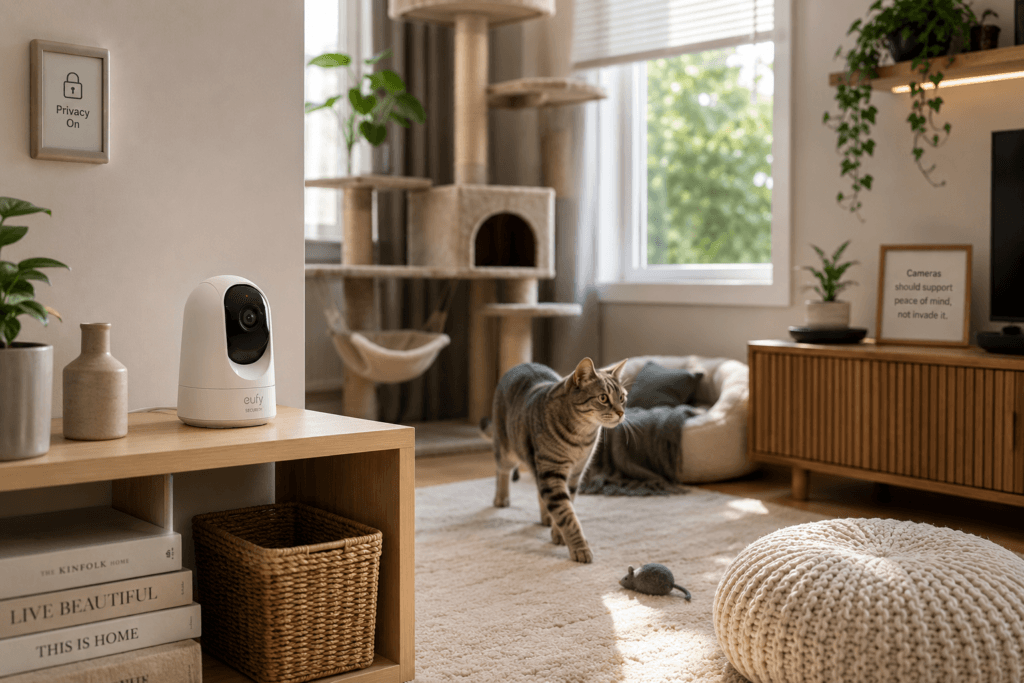
eufy Indoor Cam E30 for flexible full-room coverage;
Ring Indoor Cam 2nd Gen for fixed monitoring in an existing Ring or Alexa home;
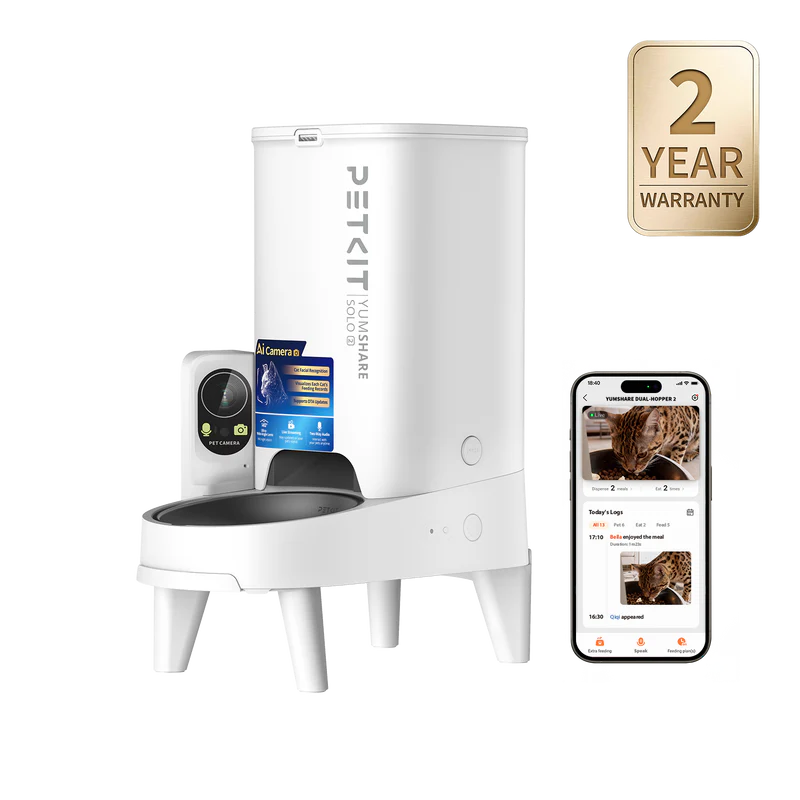
PETKIT YumShare Solo 2 for individual feeding context;
PETLIBRO Granary Camera Feeder for simpler remote mealtime check-ins.
Research note: This is a research-led guide based on official documentation, current product information, public ownership evidence, and PetTech AI’s product-level trust checks. PetTech AI has not conducted long-term hands-on testing of every camera included.
Quick Verdict
What you need to see
Best fit
Recommendation
Activity across an entire room
eufy Indoor Cam E30
Strong recommendation
One fixed area inside a Ring or Alexa home
Ring Indoor Cam 2nd Gen
Strong ecosystem-specific recommendation
Which pet approached a scheduled meal
PETKIT YumShare Solo 2
Promising newer product
Straightforward camera feeding with a mature ownership record
PETLIBRO Granary Camera Feeder
Established recommendation
The short version
Choose eufy E30 if the cat moves around a room and you want the camera to make a reasonable effort to keep up.
Choose Ring Indoor Cam if you already live inside the Ring ecosystem and need one fixed view with a physical privacy cover.
Choose YumShare Solo 2 if the important question is not “Where is the cat?” but “Which cat appeared for dinner?”
Choose Granary if you want a simpler camera feeder and accept a more mixed reliability record.
A camera can document the crime.
It cannot prevent Napoleon from committing it again tomorrow.
Affiliate disclosure: This page contains affiliate links. PetTech AI may earn a commission if you purchase through them, at no additional cost to you. As an Amazon Associate I earn from qualifying purchases.
A standalone camera is most useful when you need to understand activity across a whole room—not only what happens at the food bowl.
The eufy Indoor Cam E30 is the strongest general-purpose camera in this guide.
It offers:
4K video;
360-degree pan-and-tilt coverage;
pet and human detection;
automatic subject tracking;
color night vision;
two-way audio;
privacy mode;
continuous or event recording;
local storage through a microSD card.
The microSD card is sold separately, but local storage means the core recording function does not require a monthly subscription.
Buy it if
your cat uses several parts of one room;
vertical spaces such as shelves and cat trees matter;
automatic tracking is more useful than one fixed angle;
local recording is important;
you want one camera to cover a larger indoor area;
you are willing to configure detection zones and notifications.
Skip it if
feeding is the only routine you care about;
you want individual meal identification;
a fixed view is already enough;
you do not want an indoor security camera in a shared room;
configuring alerts sounds like unpaid employment.
Where it can disappoint
“360-degree coverage” does not mean the camera has achieved omniscience.
A fast cat can leave the frame. Furniture can block the view. Tracking may follow the wrong animal in a multi-pet home. Too-sensitive notifications can make the app announce every tail movement as though the building has been breached.
Placement matters more than 4K.
A well-positioned 1080p camera aimed at the cat tree is more useful than a 4K camera enjoying an unobstructed view of the ceiling.
Use activity zones, reduce unnecessary alerts, and test the night view before relying on it during travel.
Verdict: The best standalone option for understanding activity across a room, particularly when cats move between floor level and elevated spaces.
Ring Indoor Cam 2nd Gen: Best for Existing Ring Homes
Good placement and privacy controls matter more than filling a home with constant alerts.
Ring Indoor Cam is the simpler option.
It provides:
1080p video;
color night vision;
motion alerts;
two-way talk;
a fixed field of view;
Alexa and Ring integration;
a manual privacy cover.
Closing the privacy cover disables the camera and microphone, which is more reassuring than a tiny software icon claiming that privacy mode is probably active.
Buy it if
you already use Ring or Alexa;
you need one stable view;
a hallway, doorway, feeding corner, or office is the target;
physical privacy control matters;
managing another app would cause unnecessary irritation.
Skip it if
one camera must cover a large room;
your cat constantly moves between several zones;
you want pan-and-tilt tracking;
you expect recorded history without considering a subscription;
you prefer local storage.
The subscription question
Without a compatible Ring subscription, you can use Live View and respond to real-time alerts.
Reviewing recorded video requires a subscription. Depending on the plan and device, Ring also offers longer video history and advanced recognition features.
This creates a simple decision:
If you already pay for Ring, the Indoor Cam can be an inexpensive extension of the system.
If this would be your only Ring device, the camera’s modest purchase price should be evaluated together with the ongoing plan.
A cheap camera with a permanent subscription can eventually become an expensive method of watching your cat ignore the sofa you bought for him.
Verdict: The best fixed camera for households already committed to Ring or Alexa—not the strongest independent choice for full-room cat tracking.
PETKIT YumShare Solo 2: Best for Individual Meal Context
PETKIT YumShare Solo 2 combines scheduled dry-food feeding with a built-in camera and app-based meal check-ins.
YumShare Solo 2 is not a room camera with a food container attached.
It is a scheduled dry-food feeder designed around visual mealtime context.
PETKIT includes:
a 3 L hopper;
scheduled portions;
live video;
two-way audio;
night monitoring;
bowl and feeding records;
facial recognition designed for up to 15 animals;
individual eating histories;
offline feeding schedules and battery backup.
PETKIT introduced Solo 2 in 2026, so it still lacks the deeper ownership history of eufy, Ring, or the older Granary feeder.
Buy it if
your cats eat dry food;
you want video connected directly to scheduled meals;
knowing which animal approached would change your routine;
you spend substantial time away;
you already use PETKIT;
one feeding station serves the household.
Skip it if
you need full-room coverage;
you feed mainly wet food;
one cat must be physically prevented from eating another cat’s meal;
you only need a basic timed feeder;
you will stop checking the camera after the opening weekend.
Recognition is not access control
Solo 2 can provide individual context.
It cannot build a physical barrier around the bowl.
If Jonathan’s meal dispenses and Napoleon arrives first, the camera may identify the occupying force with impressive accuracy.
Jonathan remains hungry.
For genuine food separation, compare RFID and microchip systems in our Best Automatic Cat Feeders guide.
Where it can disappoint
The main uncertainty is maturity.
Its early market signal is encouraging, but app stability, recognition accuracy, alerts, camera performance, and dispensing consistency have not yet accumulated years of broad ownership evidence.
Facial recognition may also become less reliable when:
cats look similar;
lighting changes;
several animals crowd the bowl;
faces are partially blocked;
the cat approaches at the exact angle least convenient for artificial intelligence.
Verdict: A promising newer camera feeder for owners who will genuinely use individual mealtime context—not a proven default or a food-security system.
PETLIBRO Granary Camera Feeder: Best Established Camera Feeder
Granary has a more straightforward job:
store dry food;
dispense scheduled portions;
show the bowl;
send alerts;
let the owner check remotely.
It offers:
a 5 L hopper;
1080p video;
a 145-degree downward-facing view;
infrared night vision;
two-way audio;
motion and sound alerts;
low-food and jam notifications;
app scheduling;
local microSD recording;
optional cloud storage.
PETLIBRO supports local event or continuous recording through a microSD card, while cloud history is sold separately.
Buy it if
you want dry-food scheduling and a camera in one product;
a straightforward bowl view is enough;
individual recognition is unnecessary;
local recording appeals to you;
you prefer a larger hopper than YumShare Solo 2.
Skip it if
you need to know which cat ate;
physical food separation matters;
room monitoring is the real goal;
you want the strongest reliability signal in this guide;
recurring app or dispensing friction would drive you insane.
Where it can disappoint
Granary has a long and broadly reassuring ownership record, but combining a feeder, camera, app, and Wi-Fi connection still creates more potential failure points than a basic scheduled dispenser.
The recurring issues worth checking in recent feedback include:
temporary Wi-Fi or app disconnections;
camera or live-view interruptions;
food jams with incompatible kibble;
portion consistency;
notification reliability.
These are legitimate ownership risks, but the overall evidence supports treating Granary as an established recommendation rather than a speculative or unusually risky purchase.
Use compatible kibble, keep backup batteries installed, test several scheduled meals before relying on the feeder while away, and confirm that offline schedules continue working as expected.
A camera failure temporarily leaves you with a feeder.
A dispensing failure leaves you with beautifully recorded evidence that dinner never arrived.
Verdict: The best established camera feeder for owners who want scheduled dry-food meals, remote bowl visibility, local recording, and a mature alternative to newer recognition-led products.
The Napoleon Surveillance Test
Suppose Napoleon has begun stealing Jonathan’s breakfast.
eufy E30
Tracks Napoleon crossing the kitchen, approaching the feeder, and leaving the scene.
Excellent cinematography.
Ring Indoor Cam
Records the relevant corner, provided the crime occurs inside the fixed frame and you have recording history enabled.
YumShare Solo 2
Associates the approach with Napoleon and connects it directly to the meal record.
Useful evidence.
Granary
Shows that a cat approached the bowl.
Identity remains a matter for the investigating officer.
An access-controlled feeder
May actually prevent Napoleon from reaching Jonathan’s food.
Less entertaining.
More effective.
Privacy Is Part of the Product
Indoor cameras may capture:
family members;
conversations;
daily routines;
entrances and exits;
children;
sitters;
private living areas.
Before installing one, decide:
who has account access;
whether recordings remain local or enter the cloud;
how long footage is retained;
whether alerts should be disabled while people are home;
where the camera should never point;
whether guests or sitters need to be informed.
Use two-way audio sparingly.
A familiar voice may help in some situations. Constantly speaking through a plastic device while physically absent can also confuse or stress the cat.
The goal is useful context, not management-by-loudspeaker.
Smart Camera Data Is Not Diagnosis
A camera may reveal that a cat:
stopped approaching food;
sleeps in a different place;
moves less than usual;
hides more;
interacts differently with another cat.
That information can be useful.
The footage cannot determine the cause.
Meaningful or persistent changes require direct observation and, when appropriate, professional veterinary or behavioral assessment.
Receiving too many alerts or expecting tracking to see through furniture
Ring Indoor Cam
Buying one device and then resenting the subscription needed for recordings
YumShare Solo 2
Paying for recognition and meal footage you stop checking
Granary
Discovering that feeding and camera reliability create two separate failure points
Final Verdict
There is no universal best cat camera because watching a room and watching a meal are different jobs.
eufy Indoor Cam E30 is the best overall standalone option. Its pan-and-tilt coverage, pet tracking, 4K video, and local recording make it the most flexible choice for understanding a larger indoor space.
Ring Indoor Cam 2nd Gen is the better fit when the household already uses Ring or Alexa and needs a fixed view with clear physical privacy control.
PETKIT YumShare Solo 2 is the strongest camera feeder when individual meal context is the reason to buy. It is promising, but still too new to treat as a fully mature default.
PETLIBRO Granary Camera Feeder is the best established camera-feeder option. It lacks YumShare Solo 2’s individual facial recognition, but offers a much deeper ownership record, a larger hopper, local recording, and a straightforward view of the feeding station. It is the safer choice when maturity matters more than identity-led meal analytics.
The right camera should answer one recurring question.
It should not transform normal cat behavior into a 24-hour broadcast requiring executive review.
Frequently Asked Questions
What is the best standalone cat camera?
eufy Indoor Cam E30 is the strongest option in this guide for full-room coverage, automatic tracking, and local recording.
Is Ring Indoor Cam useful for cats?
Yes, especially when the household already uses Ring or Alexa and needs a fixed view of one area. It is less flexible than a pan-and-tilt camera.
Is a camera feeder better than a separate camera?
Only when feeding is the main question. A feeder camera provides relevant bowl context but cannot replace full-room monitoring.
Can YumShare Solo 2 stop another cat from stealing food?
No. Recognition and video provide context; they do not physically restrict access.
Does Granary require a cloud subscription?
No. It supports local microSD recording. Optional cloud plans provide remote video history and additional storage features.
Can a camera diagnose a health or behavioral problem?
No. It can document a change, but it cannot establish its cause.
References
eufy Indoor Cam E30 official product and storage documentation
Ring Indoor Cam 2nd Gen official product, privacy, and subscription documentation
PETKIT YumShare Solo 2 official product documentation
PETLIBRO Granary Camera Feeder official product, storage, and support documentation
PetTech AI product-level trust checks
Image Disclosure
Some images in this article may be AI-generated for illustrative purposes. They do not depict the exact products and should not be used to evaluate camera angle, controls, dimensions, or feeder fit.
Disclosure
PetTech AI may earn a commission when readers purchase through affiliate links. Cameras are recommended according to the question they can realistically answer—not according to how many notifications they can produce.
Cats are famously private. They instinctively hide pain, which means health problems often go unnoticed until they’re advanced. A cat that eats a little less, urinates more often, or sleeps longer than usual may already be in trouble. By the time you spot it, treatment can be more difficult—and costly.
That’s why smart health devices for cats are becoming mainstream in 2025. They quietly track daily routines—meals, water intake, litter box visits, weight, and even sleep. When data is logged automatically and visualized in an app, patterns appear that you would otherwise miss. Instead of guessing, you know when something changes.
The Cornell Feline Health Center highlights three pillars of preventive care: monitoring weight, keeping litter boxes clean, and ensuring hydration. Smart devices help with each, giving you tools to protect your cat’s health and peace of mind to act early.
Key Benefits of Smart Health Devices for Cats
Early detection: Spot gradual changes in bathroom frequency, hydration, or appetite.
Better vet visits: Bring data charts, not vague impressions.
Time savings: Automate scooping, portioning, and reminders.
Multi-cat clarity: Devices with microchip or weight recognition separate data by cat.
Peace of mind: Real-time app alerts when trends shift.
Cost savings: Preventive monitoring may reduce emergency bills.
In the U.S., emergency vet visits can cost $1,500–$3,000. A smart feeder or litter box can pay for itself by catching problems sooner.
What it does: This self-cleaning litter box tracks usage and weight while keeping things odor-free. The app logs visits and weight trends, giving you actionable data.
Pros
Tracks bathroom frequency and weight
Multi-cat friendly with protective sensors
Automatic scooping and odor control
Cons
Premium price point
Requires app and Wi-Fi
Best for: Owners who want hygiene and detailed bathroom monitoring.
⭐Grab the official PuraMax 2 from Petkit — currently 33% off, or start from $36.10/month with Shop Pay.
What it does: Opens only for the right cat’s microchip or RFID tag, preventing food theft. Logs when and how much your cat eats. Essential in multi-cat homes.
Pros
Stops food stealing
Protects prescription diets
Logs meal data via app
Cons
Smaller food capacity
Hub required for app integration
Best for: Multi-cat families and cats on special diets.
What it does: Flowing water entices cats to drink more. This smart fountain keeps water clean, reminds you of refills, and promotes hydration for urinary and kidney health.
Pros
Encourages hydration
Quiet, whisker-friendly design
Filter and refill reminders
Cons
Requires filter replacements
Wi-Fi features vary by model
Best for: Cats prone to urinary crystals or low hydration.
What it does: A playful, cat-shaped fountain with app connectivity. Sends reminders for filter changes and water refills, while encouraging steady hydration.
Hydration: PETLIBRO and Catit PIXI fountains encourage drinking.
Activity: Tractive and Pawfit track play, rest, and location.
Start with the area where your cat is most vulnerable, then expand.
Tips for Daily Success
Place devices in low-stress spots your cat already uses.
Transition gradually—don’t remove old bowls or boxes too soon.
Track weekly averages instead of one-off events.
Share app logs with your vet.
Clean devices regularly for consistent performance.
Replace filters and batteries on schedule.
Future Trends in Smart Health Devices for Cats
Smart health devices are evolving fast:
AI-driven insights: Not just logs, but predictive alerts about disease risk.
Smart home integration: Alexa and Google Home reminders for feeding or cleaning.
Vet dashboards: Direct sharing of your cat’s data with clinics.
Insurance tie-ins: Pet insurance companies may offer discounts for tracked data.
Unified ecosystems: Combining food, water, litter, and activity in a single app.
As these tools grow, cat parents gain the same level of proactive health monitoring already common in human fitness tech.
What Experts Say About Monitoring Cat Health
Veterinary researchers agree: small daily changes in a cat’s behavior often reveal health problems long before visible symptoms appear. The Cornell Feline Health Center has published extensive guidance on monitoring weight, food intake, and bathroom habits as pillars of preventive feline care. According to Cornell, “a decrease in appetite, changes in litter box use, or unexpected weight loss are among the most common early signs of illness.” Smart devices give pet parents the ability to capture those subtle shifts automatically.
Other institutions echo this point. The University of California, Davis School of Veterinary Medicine emphasizes hydration as a key factor in preventing urinary tract disease. Their studies note that cats who drink more water have significantly lower risks of crystal formation and kidney stress. Devices like the PETLIBRO or Catit PIXI smart fountains directly support this recommendation by making water more appealing.
Meanwhile, the American Veterinary Medical Association (AVMA) highlights the growing role of technology in veterinary practice. Vets now increasingly encourage clients to bring app logs or device data to checkups, which can shorten diagnostic time and improve accuracy.
How Research Supports Smart Health Devices for Cats
Scientific evidence also suggests that consistent monitoring reduces long-term health costs. A 2023 report from the American Animal Hospital Association (AAHA)noted that early intervention in chronic kidney disease and feline diabetes can save owners thousands of dollars in emergency treatments. Smart litter boxes and feeders provide the real-time insights that make early detection possible.
By aligning daily routines with veterinary advice, smart health devices for cats become more than gadgets—they are tools that strengthen the bond between owners and veterinarians. With continuous tracking, owners can share objective data, improving communication and outcomes.
Adding even one device, such as a smart feeder or litter monitor, transforms vague impressions into solid health information—exactly what institutions like Cornell and AAHA recommend for preventive care.
FAQs About Smart Health Devices for Cats
Are smart health devices safe? Yes. Trusted brands use pet-safe materials and include safety sensors in feeders and litter boxes.
Do these devices replace vets? No. They complement veterinary care by providing logs of meals, bathroom use, hydration, and activity.
Are they helpful for older cats? Absolutely. Seniors often suffer weight loss or kidney problems. Monitoring highlights subtle changes early.
What about multi-cat homes? SureFeed uses microchips, while PuraMax and some trackers use weight or profiles to identify cats individually.
Do I need Wi-Fi? Most devices require Wi-Fi or Bluetooth to sync data and send alerts. Always check compatibility.
How much should I spend? You don’t need every device at once. Start with one—like a litter box or feeder—that addresses your main concern.
What about data privacy? Leading brands encrypt data, but always review app policies. Choose companies with transparent privacy practices.
Don’t wait until your cat shows obvious illness. Add one or two smart health devices for cats to your home today. From litter boxes to feeders and fountains, these tools give you reliable insights and peace of mind—while helping your vet provide the best care possible.
This article contains affiliate links. As an Amazon and Petkit Associate, we may earn a commission if you purchase through our links, at no extra cost to you.
A smart litter box promises to eliminate scooping.
This is technically true in the same way a dishwasher eliminates washing dishes: the machine does the repetitive part, while you remain responsible for emptying, cleaning, refilling, troubleshooting, and wondering how something so expensive became covered in cat litter.
Still, a good automatic litter box can meaningfully improve daily life.
The important question is not which machine has the most sensors, the longest app dashboard, or the greatest number of synonyms for “odor control.”
It is:
Which box will your cat actually use—and which one reduces more work than it creates?
This guide compares three models with different strengths:
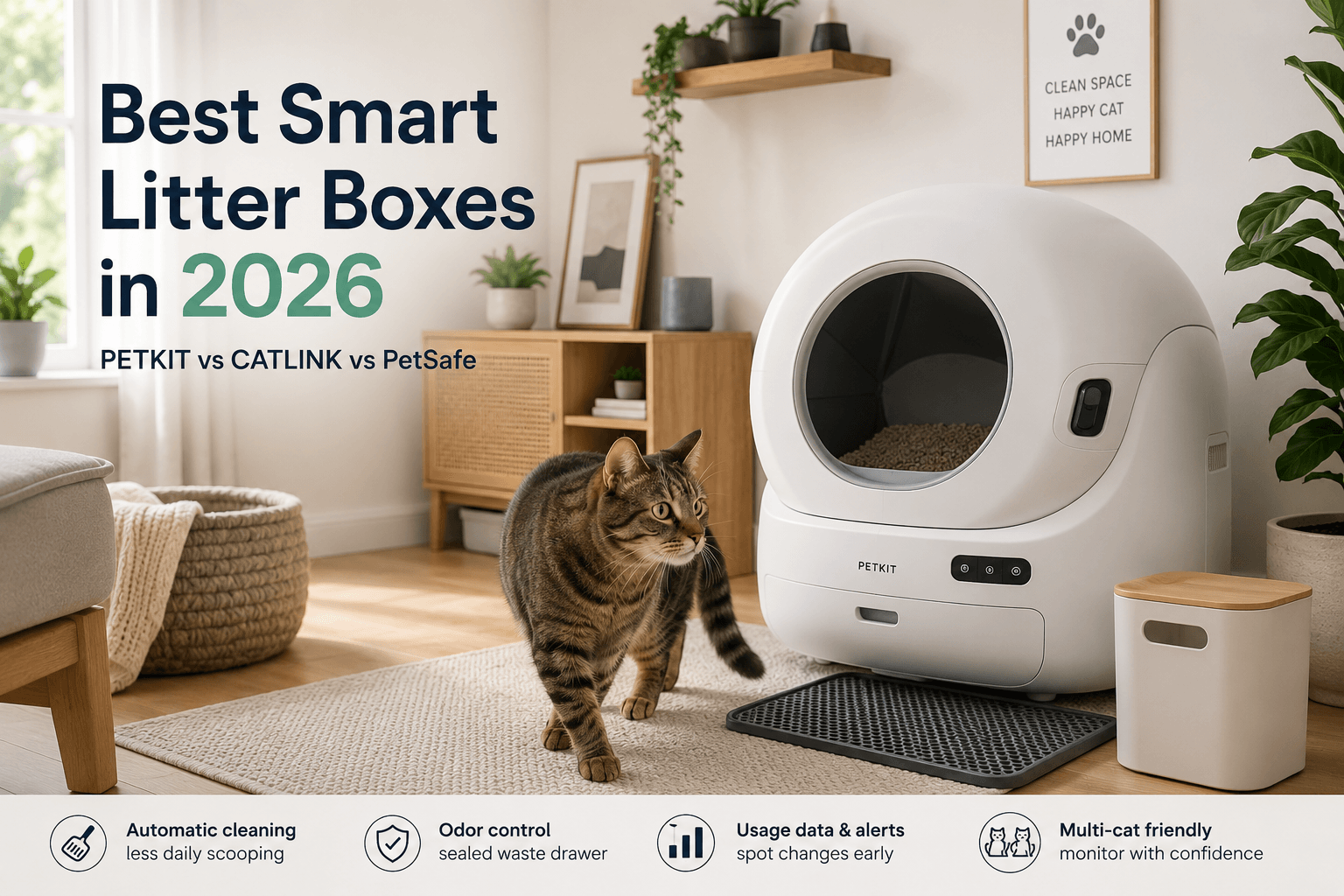
PETKIT PuraMax 2 for the best overall balance;
CATLINK Luxury Pro-X for multi-cat usage data;
PetSafe ScoopFree SmartSpin as a simpler mainstream alternative with a more conditional reliability case.
Research note: This is a research-led guide based on official documentation, current product information, public ownership evidence, and PetTech AI’s product-level trust checks. PetTech AI has not conducted long-term hands-on testing of every litter box included.
Quick Verdict
Your priority
Best fit
Recommendation
Best overall smart litter box
PETKIT PuraMax 2
Strong recommendation
Multi-cat usage and weight trends
CATLINK Luxury Pro-X
Strong specialist recommendation
Simpler mainstream smart alternative
PetSafe ScoopFree SmartSpin
Conditional recommendation
Very large, elderly, or mobility-limited cat
Measure carefully—or keep a conventional box
Physical fit matters more than the app
Cat strongly prefers open boxes
Do not force the upgrade
A rejected smart box is expensive furniture
The short version
Choose PuraMax 2 when you want the strongest all-round combination of automation, odor management, app control, and everyday usability.
Choose Luxury Pro-X when several cats share the litter area and individual usage records are worth checking.
Choose SmartSpin when you want a recognizable mainstream option with simpler app monitoring—but only after reviewing current reliability feedback and return terms.
And remember:
A $500 litter box that the cat refuses to enter is not smart.
The cardboard box it arrived in has won.
Affiliate disclosure: This page contains affiliate links. PetTech AI may earn a commission if you purchase through them, at no additional cost to you. As an Amazon Associate I earn from qualifying purchases.
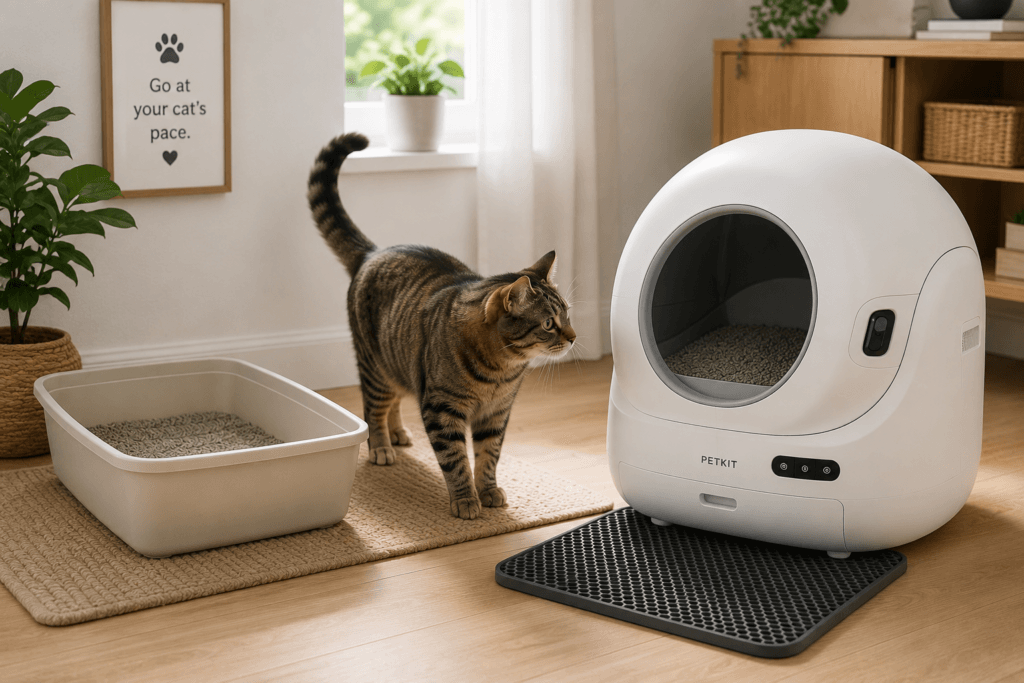
A gradual transition gives cats time to accept a smart litter box without unnecessary stress.
Before comparing apps, sensors, or deodorization cartridges, look at the animal expected to climb inside the machine.
Ask:
Does the cat normally prefer open or covered boxes?
Is the entrance low enough?
Can the cat turn comfortably?
Is the cat unusually large?
Does arthritis or limited mobility make climbing difficult?
Is the litter area quiet enough for a motorized cleaning cycle?
Can the old box remain available during the transition?
Many cats prefer larger, uncovered boxes with easy access. Older cats, kittens, and cats with mobility limitations may need lower sides, while large cats need enough room to enter, turn, dig, and exit comfortably.
No app update can negotiate around a cat that has declared the new machine haunted.
A gradual transition is essential:
Place the smart box near the existing box.
Leave automatic cycles disabled initially.
Add familiar litter.
Let the cat investigate without pressure.
Keep the old box available until use is consistent.
PuraMax 2 is the strongest default recommendation because it does not depend on one specialist feature to justify itself.
It combines:
automatic waste separation;
a relatively low entrance;
app-based usage and weight records;
proximity and weight-based safety systems;
a sealed waste area;
multiple odor-management options;
support for common clumping litter types;
a large enough interior for many adult cats.
This is the machine for the owner who wants the entire litter routine to become easier—not merely more measurable.
Buy it if
reducing daily scooping is the main goal;
odor containment matters;
you want useful alerts without making analytics the entire hobby;
one or more cats will share the machine;
you are willing to perform periodic deep cleaning;
you may later add other PETKIT products.
Skip it if
your cat strongly prefers an open box;
floor space is limited;
the cat is exceptionally large or mobility-limited;
you expect the machine to eliminate all cleaning;
you dislike proprietary deodorizing accessories and app-connected care.
Where it can disappoint
PuraMax 2 is still a rotating plastic chamber containing litter, urine, and ambition.
The automatic cycle removes clumps.
It does not automatically clean:
the internal walls;
seams and edges;
the waste chute;
residue from high-urinating cats;
litter tracked onto the floor;
the machine’s exterior.
PETKIT has improved the cylinder and leak-control design, but buyers should still consider their cat’s posture. A cat that consistently urinates high against internal surfaces can create more manual cleaning than the product photography suggests.
The box also occupies meaningful floor space. Measure the room before discovering that your new litter robot has become the dominant architectural feature of the bathroom.
Verdict: The best overall smart litter box in this guide because its automation, usability, odor management, and app features form a coherent everyday product.
CATLINK Luxury Pro-X: Best for Multi-Cat Usage Data
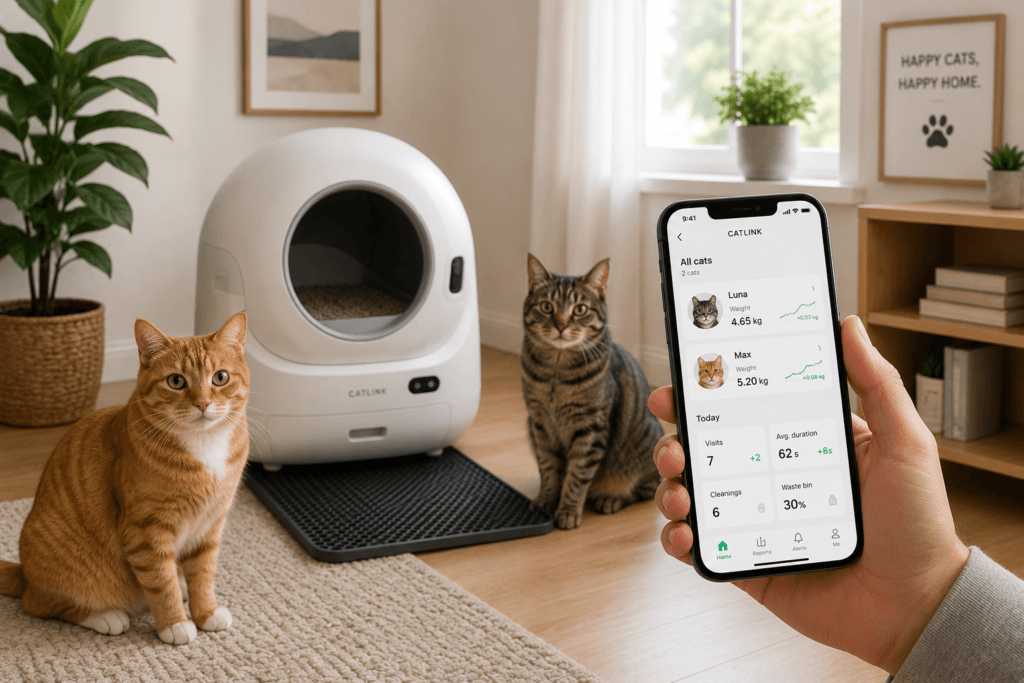
Usage data can be most useful in multi-cat homes, where changes are otherwise harder to notice.
Luxury Pro-X makes its strongest case in a home where several cats share the litter area.
A single-cat household already knows who used the box.
A five-cat household may know only that somebody has been extremely productive.
CATLINK adds:
automatic cleaning;
app control;
weight-based cat identification;
usage histories;
waste-drawer alerts;
odor-management features;
individual profiles and routine trends.
This makes the data layer more useful than it would be in a simple household.
Buy it if
multiple cats use the same litter box;
individual weight and visit trends matter;
you will actually review the app;
a particular CATLINK design fits the room and cats;
litter-box monitoring is the main reason you are considering the CATLINK ecosystem.
Skip it if
you mostly want the easiest default recommendation;
cats have very similar weights;
nobody will check the records;
you are choosing it because “health monitoring” sounds reassuring;
you intend to buy the entire CATLINK ecosystem before evaluating the first product.
Where it can disappoint
Weight-based identification has practical limits.
When cats differ clearly in size, the system has a better chance of associating visits correctly. When two cats weigh almost the same, the app may be less certain than the marketing department.
Usage data can still be valuable, but it must remain evidence rather than diagnosis.
The box may show:
a change in visit frequency;
a weight trend;
shorter or longer visits;
a change in routine.
It cannot reliably explain why that change occurred.
The app records the event.
It has not completed veterinary school.
Luxury Pro-X also requires the same unglamorous ownership work as its competitors: waste removal, interior cleaning, litter management, sensor care, and occasional troubleshooting.
Verdict: A credible specialist choice for multi-cat households that will genuinely use individual litter-box records—not simply admire the dashboard during setup.
PetSafe ScoopFree SmartSpin: Best Mainstream Alternative—with Caveats
SmartSpin offers a simpler proposition:
the cat exits;
the drum rotates;
waste moves into a sealed drawer;
the app records usage and weight;
the owner empties the drawer later.
PetSafe gives it a relatively low-profile entrance, a smooth interior designed to simplify wipe-down cleaning, a 6 L sealed waste drawer, app alerts, and compatibility with clumping litter.
This makes SmartSpin attractive to first-time automatic-litter-box buyers who want something more connected than an old rake system but less ecosystem-heavy than PETKIT or CATLINK.
Buy it if
you want a mainstream pet-care brand;
basic app tracking is enough;
the lower entrance suits your cat;
a sealed drawer is a major part of the appeal;
you have verified favorable return terms;
current reliability feedback is reassuring enough for your risk tolerance.
Skip it if
you want the strongest proven recommendation in the guide;
mechanical reliability is more important than a lower entry price;
mixed ownership experiences make you uncomfortable.
Where it can disappoint
SmartSpin has a less reassuring and more polarized market record than PuraMax 2 and Luxury Pro-X.
The recurring areas worth checking before purchase include:
interrupted cleaning cycles;
sensor behavior;
litter or waste adhering to internal surfaces;
odor containment;
operating noise;
litter tracking;
longer-term mechanical consistency.
That does not mean every SmartSpin is waiting to betray its owner.
It means the product deserves a conditional recommendation rather than being presented beside the stronger picks as though all three have identical evidence.
PetSafe’s smooth interior and simpler cleaning design are meaningful advantages. They matter only while the machine continues performing its main job reliably.
Verdict: A legitimate mainstream alternative for buyers who want app-connected automation and sealed waste handling, but not the safest default pick.
The 3 A.M. Test
A useful smart litter box should remain tolerable when it rotates at 3 a.m.
PuraMax 2
You receive a clean litter bed, an app record, and perhaps a reminder that the waste drawer will eventually require human participation.
Luxury Pro-X
You receive a clean litter bed and a better idea of which cat conducted the overnight operation.
SmartSpin
You receive a clean litter bed—provided the cycle and sensors behave consistently.
A conventional litter box
Nothing rotates.
Nothing sends a notification.
The cat uses it anyway.
This is why the smartest choice is not always the model with the longest specification table.
It is the machine whose extra complexity continues to earn its place.
Buyer Regret in One Table
Product
Most likely regret
PuraMax 2
Expecting automatic scooping to mean automatic deep cleaning
Luxury Pro-X
Paying for data that nobody checks—or cannot cleanly distinguish similar cats
SmartSpin
Choosing the simpler alternative and later encountering reliability friction
Any smart litter box
Discovering the cat prefers the old plastic tray
Any enclosed model
Ignoring physical size, mobility, or open-box preference
Odor Control: What the Marketing Usually Leaves Out
Automatic cleaning helps with odor only when waste removal, litter maintenance, and airflow work together.
A sealed waste drawer helps.
Automatic removal helps.
Deodorizing cartridges may help.
None of them permanently defeats the chemical reality of stored cat waste.
Odor control still depends on:
emptying the drawer before it becomes a biological research project;
cleaning internal surfaces;
using compatible litter;
preventing damp buildup;
cleaning mats and surrounding floors;
maintaining reasonable room ventilation.
The best odor-control system is still removal plus cleaning.
The app cannot push-notify ammonia into another dimension.
One Smart Box May Still Not Be Enough
In multi-cat homes, a single automatic litter box should not automatically replace every other box.
Cats may have:
different location preferences;
territorial conflicts;
different tolerance for enclosed spaces;
mobility differences;
preferences for different litter types.
General feline guidance commonly recommends providing as many litter boxes as cats, plus one, distributed in accessible areas.
Real homes may not always follow that formula perfectly, but the principle matters: one premium machine does not guarantee that several cats suddenly want to share one bathroom.
Keep an additional box when:
introducing the smart model;
cats have a history of conflict;
the home has several floors;
one cat avoids the machine;
reliable access matters during power or mechanical problems.
Which Smart Litter Box Should You Buy?
Choose PuraMax 2 when:
you want the strongest all-round recommendation;
automation and odor management matter most;
you want useful app monitoring without making data the sole purpose;
the cats fit comfortably.
Choose Luxury Pro-X when:
multiple cats share the litter area;
individual usage trends justify the extra monitoring;
CATLINK’s litter-box system wins your product-level comparison;
you will evaluate other CATLINK products separately.
Choose SmartSpin when:
you want the simpler mainstream alternative;
lower entry and smooth cleaning surfaces are appealing;
recent buyer feedback and return protection reduce the risk enough;
you accept a less confident recommendation.
Choose none of them when:
your cat strongly rejects enclosed boxes;
mobility makes entry difficult;
you cannot keep a backup box;
you expect zero maintenance;
the budget would create more stress than daily scooping.
Final Verdict
PETKIT PuraMax 2 is the best smart litter box in this guide for most households.
It offers the most convincing balance of cleaning automation, odor management, app features, safety systems, and everyday usability. It is not maintenance-free, but its main strengths remain useful after the novelty disappears.
CATLINK Luxury Pro-X is the better specialist choice for data-conscious multi-cat homes.
Its usage records and weight-based identification can provide valuable context when several cats share the box. Buy it because that information solves a real uncertainty—not because CATLINK has given the litter drawer a health dashboard.
PetSafe ScoopFree SmartSpin remains a conditional mainstream alternative.
Its sealed drawer, lower profile, app monitoring, and smooth interior are appealing. Its more mixed ownership history means buyers should examine current reliability feedback and return protection before choosing it over the stronger recommendations.
The winner is therefore:
PuraMax 2 — best overall
Luxury Pro-X — best for multi-cat data
SmartSpin — acceptable mainstream alternative with caveats
A smart litter box should reduce the amount of time you spend thinking about cat waste.
When the machine itself becomes the main thing you think about, the automation has lost the argument.
Frequently Asked Questions
Which smart litter box is best overall?
PETKIT PuraMax 2 offers the strongest overall balance for most buyers. Luxury Pro-X becomes more compelling when multi-cat usage data is a central requirement.
Which model is best for multiple cats?
CATLINK Luxury Pro-X is the stronger data-focused option. However, multiple cats may still need additional litter boxes in separate locations.
Is PetSafe SmartSpin worth considering?
Yes, as a conditional alternative. Its design and app features are useful, but buyers should inspect current reliability feedback and return terms before purchasing.
Do automatic litter boxes eliminate cleaning?
No. They reduce daily scooping but still require drawer emptying, litter refilling, interior cleaning, sensor care, and surrounding-floor maintenance.
Can smart litter boxes detect illness?
They may reveal changes in weight or litter-box routine. They cannot diagnose the cause. Meaningful or persistent changes require direct observation and, when appropriate, veterinary evaluation.
What if my cat refuses the smart litter box?
Keep the previous box available, disable automatic movement initially, use familiar litter, and introduce the machine gradually. Do not force the transition by removing every alternative immediately.
References
PETKIT PuraMax 2 official product and support documentation
CATLINK Luxury Pro-X official product and app documentation
PetSafe ScoopFree SmartSpin official product and support documentation
Cornell Feline Health Center litter-box behavior and accessibility guidance
Public ownership evidence reviewed during PetTech AI’s product-level trust checks
Image Disclosure
Some images in this article may be AI-generated for illustrative purposes. They do not depict the exact products and should not be used to evaluate dimensions, entrances, controls, or physical fit.
Disclosure
PetTech AI may earn a commission when readers purchase through affiliate links. Every litter box is evaluated at product level; belonging to a smart ecosystem does not automatically earn a recommendation.