Smart litter boxes, cat doors, cameras, and health monitors: discover the top 2025 products to keep your cat safe, your home clean, and your life stress-free.
Most people searching Litter-Robot 5 vs EVO think they are comparing an older model to a newer one.
That is not the real decision.
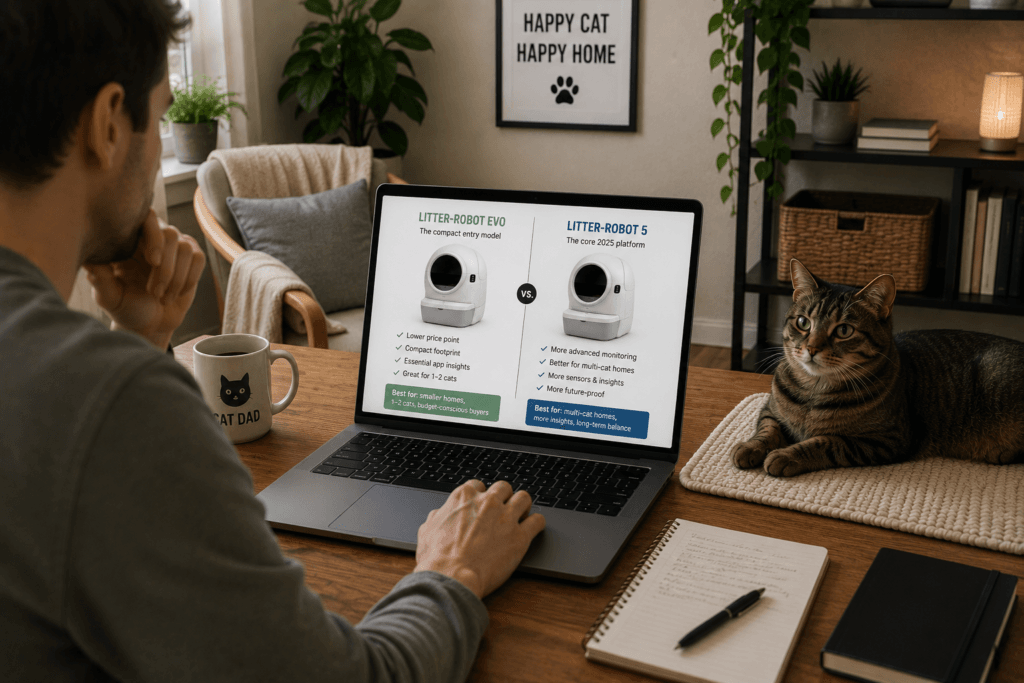
The real decision is whether you need a litter box optimized for small-space efficiency or one optimized for higher-capacity, multi-cat monitoring and headroom. Whisker itself positions Litter-Robot EVO as the most compact automatic litter box, built for smaller spaces and 1–2 cat homes, while Litter-Robot 5 is framed as the latest-generation model for up to 5 cats with WasteID, smart insights, and stronger monitoring depth.
That means this is not really a “better vs worse” choice.
It is a fit vs overkill decision.
If you live in a smaller home and just want the least intrusive self-cleaning litter box that still feels premium, EVO makes sense. If you want more room, more monitoring depth, more drawer capacity, and a platform built more explicitly for multi-cat use, Litter-Robot 5 is the stronger system.
What stays the same
This matters because it stops the comparison from becoming fluff.
Whisker says both Litter-Robot 5 and Litter-Robot EVO are self-cleaning litter boxes that connect to the Whisker app and provide activity tracking, notifications, and cat-weight visibility. Whisker also says both can be used with cats starting at 3 lbs, and both are designed to reduce scooping and odor with the core Litter-Robot cleaning logic.
So if you are expecting:
one of these models to be “manual” while the other is fully smart,
one to be dramatically less automated,
or one to be from a completely different product philosophy,
that is not what this comparison is.
They are part of the same Whisker ecosystem. They just prioritize different things.
The real difference: size class and monitoring depth
Whisker’s own comparison chart is clear enough that most third-party reviews should honestly stop pretending this is a mysterious choice.
Litter-Robot EVO has:
a smaller drawer capacity,
less headroom / interior space,
a lower max cat weight,
indicator lights instead of the larger status display,
and no WasteID.
Litter-Robot 5 has:
a larger drawer capacity,
more headroom,
support for larger cats,
a full robot status display screen,
WasteID,
and premium materials and finishes.
That is the comparison.
Not “which one scoops better.” Not “which one feels more futuristic.” Not “which one is smarter in theory.”
The choice is about whether you value compactness more than capacity and insight.
Why EVO exists — and who should actually buy it
Whisker markets EVO as the most compact automatic litter box and says it is ideal for small apartments, condos, tucked-away corners, and homes with 1–2 cats. It also says EVO offers the same automatic self-cleaning technology in a more compact footprint, with a roomy interior for most cats despite its smaller size.
That makes EVO easier to understand than many people think.
Buy Litter-Robot EVO if your household is defined by:
limited floor space,
one cat or two lighter-use cats,
lower tolerance for bulky hardware,
and a desire to stay inside the Whisker ecosystem without jumping to the largest, most feature-heavy platform.
EVO is also easier to justify when you care more about daily convenience than about deeper analytics. Whisker says EVO still gives you app-based monitoring, real-time notifications, and a 7-day look at visits and individual cat weights, with more advanced data available through Whisker+.
That is enough for many homes.
Why Litter-Robot 5 exists — and who should buy it
Whisker positions Litter-Robot 5 as the latest and greatest design, built for up to 5 cats, with WasteID, real-time updates, weight tracking, and smart insights. Its comparison materials also show larger interior headroom, larger drawer capacity, support for heavier cats, and a fuller status interface than EVO.
That means Litter-Robot 5 is the better buy when your home needs:
more room,
more tolerance for larger cats,
more multi-cat scaling,
deeper routine visibility,
and stronger odor-focused logic through WasteID.
This is the model for buyers who do not want to optimize around space first.
If your question is, “Which one gives me the stronger long-term platform?” the answer is Litter-Robot 5.
If your question is, “Which one gives me enough Whisker without dominating the room?” the answer may be EVO.
The mistake most buyers make
The most common mistake is assuming the bigger, newer system is automatically better for everyone.
That is lazy premium logic.
Whisker’s own positioning makes clear that EVO is not a stripped-down “budget mistake.” It is a more compact system intended for smaller homes and 1–2 cat setups. At the same time, the comparison chart shows Litter-Robot 5 is objectively the more capable platform in terms of space, cat-size tolerance, drawer capacity, and advanced sensing.
So the wrong purchase usually happens in one of two ways:
Mistake 1: buying Litter-Robot 5 when your real problem is footprint
If the litter box has to fit in a tighter living situation and visual bulk matters every day, the extra platform strength of the 5 may not actually improve your life. It may just give you a larger machine than you wanted.
Mistake 2: buying EVO when your real problem is scale
If you have a bigger cat, a heavier-use multi-cat home, or you want the richer monitoring and capacity of the new-generation flagship, EVO can become the box you outgrow faster.
That is the whole decision.
Which one creates less buyer regret?
For small homes, EVO creates less regret.
For larger homes or more demanding households, Litter-Robot 5 creates less regret.
That sounds obvious, but it matters because too many comparisons try to collapse those two realities into a single recommendation.
Whisker itself splits the use case:
EVO for smaller spaces and 1–2 cats,
5 for larger households and a more advanced monitoring-first platform.
So the safer buy is not universal.
The safer buy is the one that matches the constraint you actually live with:
space, or
scale.
Decision matrix
Choose Litter-Robot EVO if:
you live in an apartment, condo, or tighter home layout,
you have 1–2 cats,
you want a more compact footprint,
you do not need the deeper platform of WasteID and larger-capacity hardware.
Choose Litter-Robot 5 if:
you want the latest-generation Whisker platform,
you have more cats or larger cats,
you want more headroom and drawer capacity,
you care about WasteID, expanded sensing, and stronger long-term monitoring value.
Final verdict
Choose Litter-Robot EVO if your home is small, your cat count is low, and your real priority is getting Whisker-level convenience without bringing in a bigger, more dominant machine. Whisker clearly built EVO for this use case, and the official positioning reflects that.
Choose Litter-Robot 5 if you want the stronger platform, not just the smaller one. It has more headroom, more drawer capacity, higher cat-size tolerance, richer sensing, and a more explicit multi-cat and monitoring-first orientation. For bigger or more demanding homes, that matters more than compactness.
Most buyers go wrong when they think this is a simple generation upgrade question.
It is not.
It is a choice between:
the Whisker model that fits your room better,
and the Whisker model that fits your household complexity better.
PetTech AI may earn a commission when readers buy through affiliate links. That does not change how products are framed or compared. Comparisons here are built around household fit, trade-offs, and likely sources of long-term frustration rather than feature inflation or brand loyalty. In premium categories like automatic litter boxes, the wrong purchase usually comes from solving the wrong constraint. That is why this article focuses on space, scale, and monitoring depth instead of generic “best” language. Prices, bundle offers, memberships, and product details can change over time, so always verify the current product page before buying.
Your cat does not know that he belongs to a smart ecosystem.
He believes the litter box cleans itself because civilization has finally reached an acceptable standard. Food appears because that is the natural order of the universe. The water fountain is merely another monument erected in his honor.
You, unfortunately, have to buy, clean, connect, update, and occasionally restart all of it.
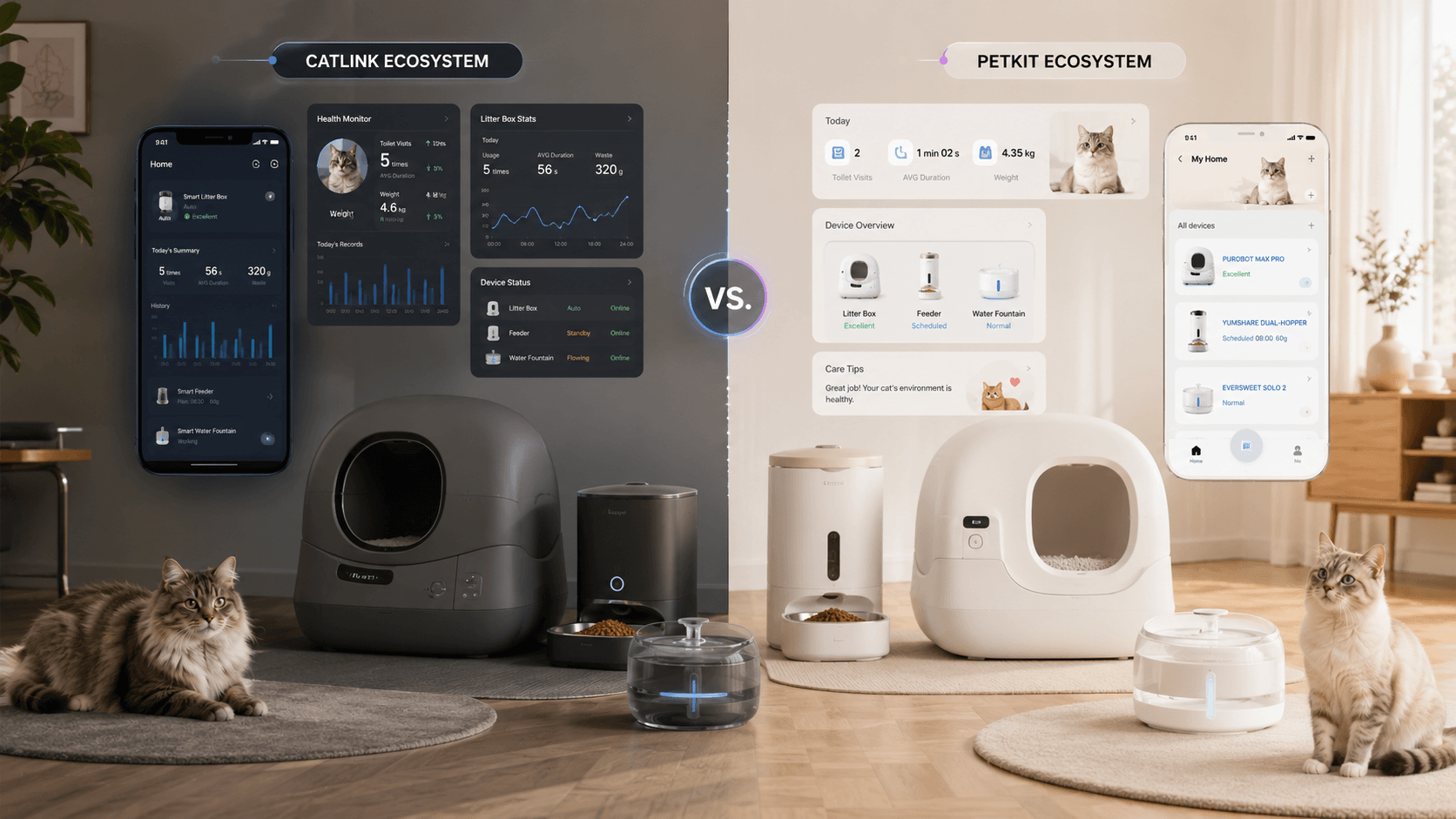
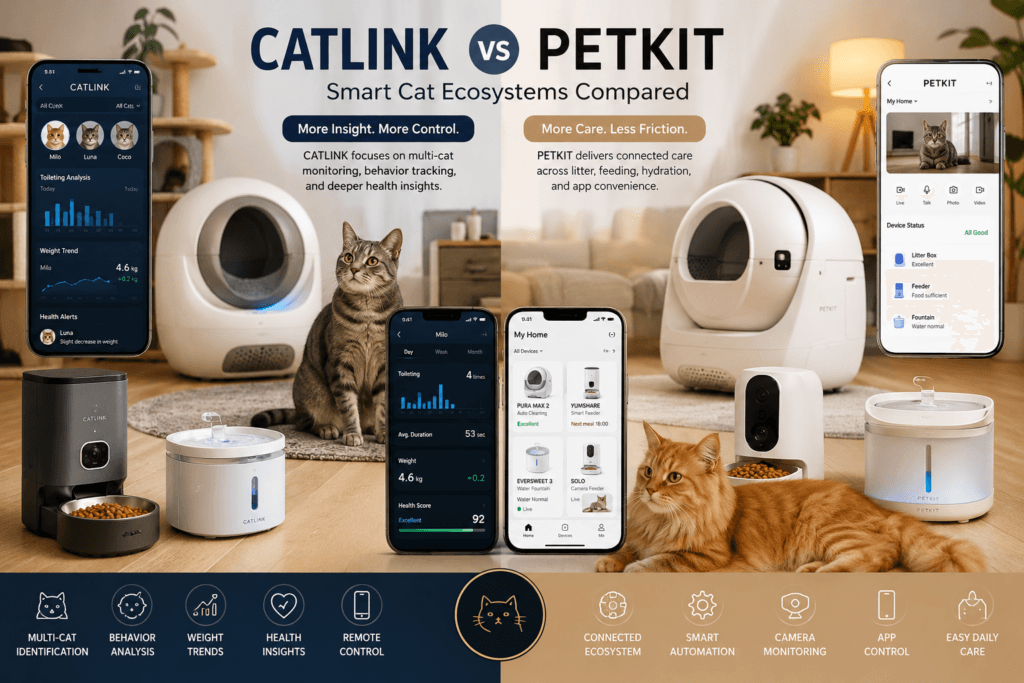
That is why PETKIT vs CATLINK is not really a contest over which brand can fit more “AI-powered health insights” into a product page.
The real question is:
Which ecosystem remains useful after the novelty disappears and the app starts sending notifications during dinner?
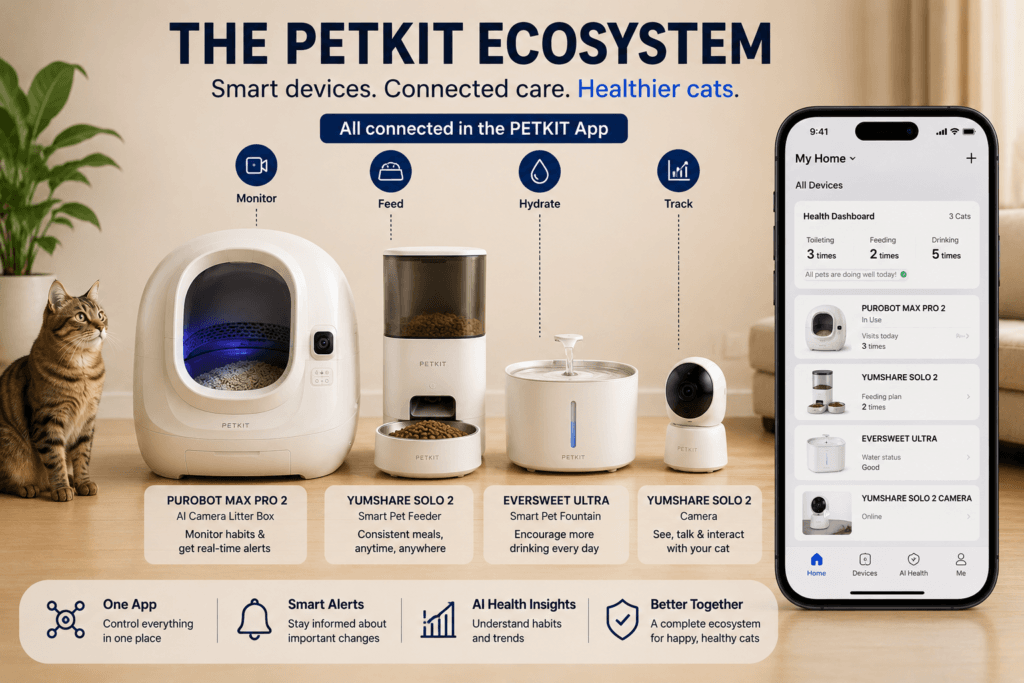
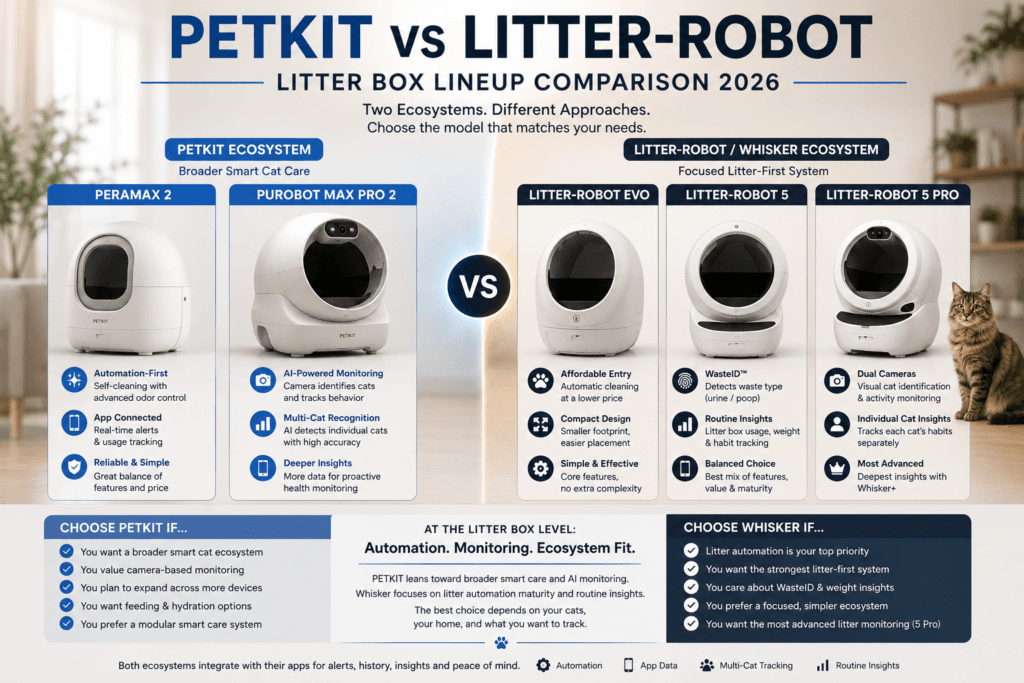
PETKIT currently offers the broader connected-care ecosystem, with strong options across litter boxes, feeders, fountains, cameras, and newer AI-led products.
CATLINK remains most interesting when litter-box monitoring and multi-cat routine data are the reason to buy—but its ecosystem is not equally convincing in every category.
Research note: This is a research-led ecosystem comparison based on official product documentation, current product availability, public ownership evidence, and PetTech AI’s individual product audits. PetTech AI has not conducted a long-term hands-on test of every device discussed.
Quick Verdict
Category
Better fit
Best overall smart cat ecosystem
PETKIT
Broadest product choice
PETKIT
Camera-led feeding and hydration
PETKIT
Litter-box-first multi-cat monitoring
CATLINK
Simpler ecosystem expansion
PETKIT
Strongest reason to choose CATLINK
A specific CATLINK litter box fits your home better
Biggest PETKIT risk
Paying for cameras and AI features you stop using
Biggest CATLINK risk
Letting a strong litter-box concept pull you into weaker product categories
The short version
Choose PETKIT if you want to build across litter care, feeding, and hydration without changing brand every time you add a device.
Choose CATLINK when a particular CATLINK litter box is already your preferred product and cat-by-cat litter data genuinely matters.
Choose neither brand purely because the word “ecosystem” makes three appliances sound as though they have formed an elite medical team.
They have not.
Affiliate disclosure: This page contains affiliate links. PetTech AI may earn a commission if you purchase through them, at no additional cost to you. As an Amazon Associate I earn from qualifying purchases.
The biggest ecosystem mistake happens before the second device is even purchased.
A buyer chooses a brand philosophy, downloads the app, and then starts buying everything carrying the same logo—even when another brand makes the better feeder, fountain, or litter box.
That is backwards.
The first device should earn your trust on its own.
Only then should ecosystem convenience influence the second purchase.
A PETKIT feeder does not become better because you own a PETKIT litter box. It becomes more convenient because both devices share an app.
A CATLINK fountain does not become the right fountain because CATLINK’s litter analytics impressed you.
The ecosystem is a useful tie-breaker.
It is not diplomatic immunity for mediocre hardware.
PETKIT: The Better Ecosystem for Most Buyers
PETKIT makes the strongest case for owners who want litter, feeding, hydration, and camera-led reassurance inside a broader but relatively lighter smart-care setup.
PETKIT currently makes the stronger argument as a complete smart cat ecosystem.
Its range covers:
self-cleaning litter boxes;
camera-equipped litter boxes;
automatic dry-food feeders;
camera feeders;
wet-food automation;
smart and cordless fountains;
camera-based hydration monitoring;
connected accessories and consumables.
The advantage is not simply quantity.
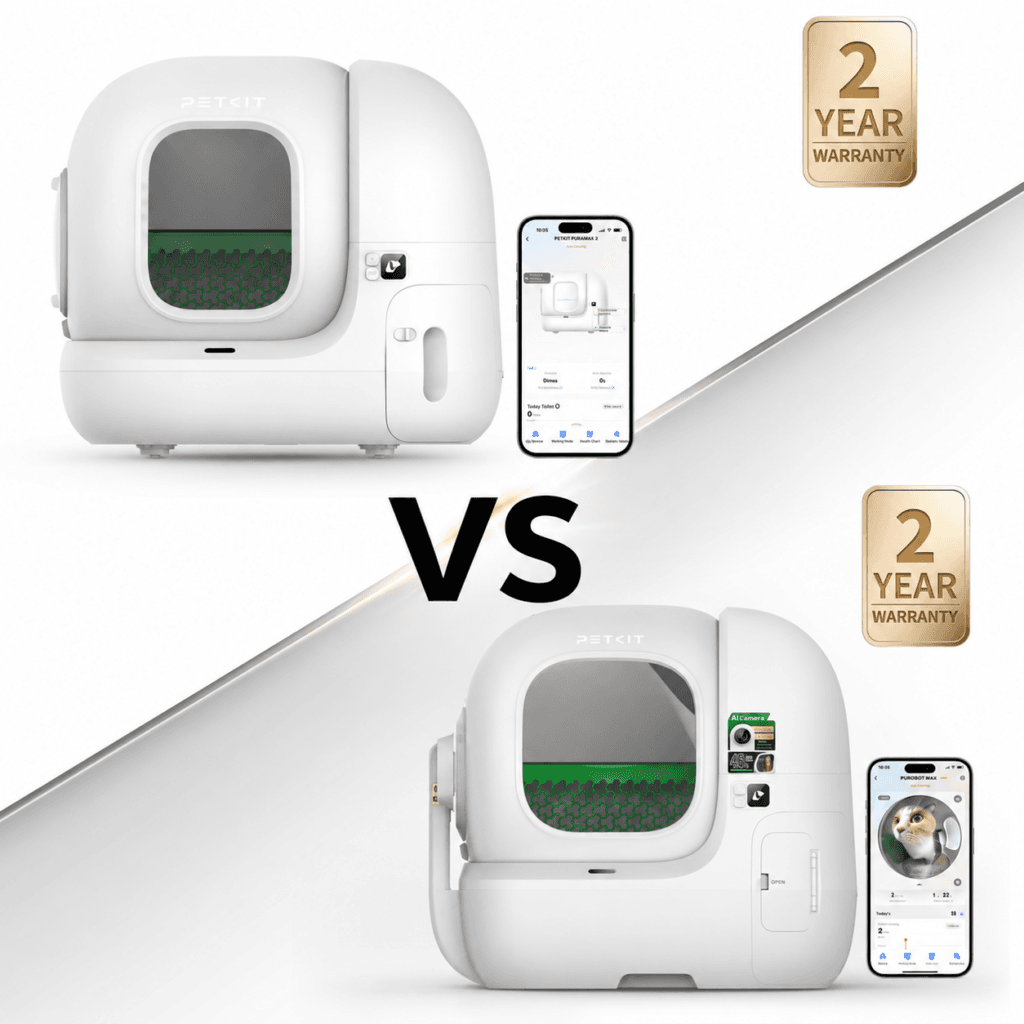
PETKIT offers several levels of complexity inside the same categories. You can choose a relatively straightforward PuraMax 2, a more monitoring-focused Purobot, a normal fountain, or an EverSweet model apparently determined to turn drinking water into a data science project.
That flexibility makes PETKIT easier to expand.
You do not have to decide on day one that your kitchen needs more sensors than a small airport.
PETKIT makes sense when:
you plan to own devices across multiple categories;
camera monitoring matters;
you want more product choice;
feeding and hydration are as important as litter care;
you prefer one app but do not want your first product choice dictated entirely by it;
you are comfortable with newer products having less long-term evidence.
Where PETKIT can disappoint
PETKIT’s newer direction is increasingly AI-heavy.
That means more cameras, more recorded events, more recognition features, and potentially more paid cloud functions depending on the device.
For some buyers, this is useful monitoring.
For others, it is an impressive technological system dedicated to confirming that the cat drank water at 2:43 p.m.
Before paying for the smarter version, ask:
Will this information change anything I do?
If the answer is no, choose the simpler PETKIT product.
Verdict: PETKIT is the stronger ecosystem recommendation, but individual products still have to pass the product-level trust gate.
CATLINK: Strongest When the Litter Box Is the Center
CATLINK becomes more compelling when a home needs stronger multi-cat visibility, usage tracking, and a more control-heavy app experience.
This can be useful in a multi-cat home where a shared litter box hides which cat used it.
CATLINK also sells feeders and fountains that connect to the same app, creating a broader input-and-output monitoring idea:
what went into the cat;
what came out of the cat;
whether the app can turn both events into a graph.
That is a coherent concept.
The problem is that ecosystem coherence does not guarantee equal product quality.
Our current feeder analysis found CATLINK’s feeding options less convincing than its litter-box proposition. Fresh 2 RFID is interesting as a tracking product, but it is not a strong default recommendation for strict food separation. Facelink remains an immature specialist concept rather than a proven mainstream choice.
This creates CATLINK’s central trade-off:
The litter-box ecosystem may be compelling before the rest of the hardware is.
CATLINK makes sense when:
a specific CATLINK litter box already wins your product comparison;
you have multiple cats;
weight-based litter-box recognition is useful;
toileting trends are the main data you care about;
you are comfortable checking current evidence separately for every additional CATLINK device.
Where CATLINK can disappoint
CATLINK’s marketing often presents the ecosystem as a unified health guardian.
That language sounds reassuring.
It does not mean the app has completed veterinary school.
Weight changes, unusual litter-box frequency, missed meals, and drinking changes can all be useful signals. Their value is that they tell you to observe the cat more closely or contact a veterinarian—not that the consumer device has diagnosed the problem.
CATLINK is most credible when it reports what happened.
It becomes less credible when marketing language encourages buyers to imagine that the graph knows why.
Verdict: CATLINK remains a legitimate litter-box-led ecosystem, but not a blanket recommendation across every product category.
Litter Boxes: The Closest Contest
This is where CATLINK can compete most seriously.
Both brands offer self-cleaning litter boxes with app control, multi-cat features, weight tracking, alerts, and different levels of health-oriented monitoring.
PETKIT’s advantage
PETKIT gives buyers more distinct choices:
automation-first models;
camera-equipped monitoring models;
different sizes and entry designs;
a broader path into feeders and hydration.
This makes it easier to choose how much technology you actually want.
CATLINK’s advantage
CATLINK has built more of its identity around litter-box data and multi-cat recognition.
A buyer mainly interested in toileting patterns may prefer the CATLINK philosophy—provided the specific litter box performs well, fits the cats physically, and has reassuring current ownership evidence.
Verdict
PETKIT wins on ecosystem breadth.
CATLINK can still win the individual litter-box decision.
That is why the brand should not be dismissed—but also why one strong CATLINK litter box should not automatically lead to a CATLINK feeder, fountain, and commemorative smart toaster.
PETKIT has a wider and more developed fountain portfolio, ranging from simpler connected fountains to cordless, UVC, and camera-equipped models.
EverSweet Ultra pushes the category furthest by combining camera monitoring with separated clean and wastewater tanks.
Whether anyone truly needs a fountain capable of recognizing the cat’s face is a separate philosophical question.
CATLINK fountains fit coherently into its broader monitoring system, but the brand currently gives buyers fewer compelling reasons to select the entire ecosystem around hydration.
Verdict
Choose the fountain on cleaning, pump design, materials, noise, and reliability first.
Choose the ecosystem second.
Water remains water even after the app produces a chart.
The Health-Monitoring Reality
Both brands now use health-oriented language.
Both can collect useful routine signals:
litter-box visits;
weight changes;
feeding events;
drinking activity;
camera footage;
changes over time.
This information can be valuable because cats often hide discomfort and routine changes may be noticed before obvious symptoms appear.
But there is an important line:
Monitoring records a pattern. It does not explain the pattern.
If Napoleon visits the litter box fourteen times in one evening, the app may help you notice.
It should not respond by awarding itself a degree in feline medicine.
The correct value of smart monitoring is:
notice a meaningful change;
verify that the data appears plausible;
observe the cat directly;
contact a veterinarian when appropriate.
Buy these systems for visibility and routine support—not diagnosis.
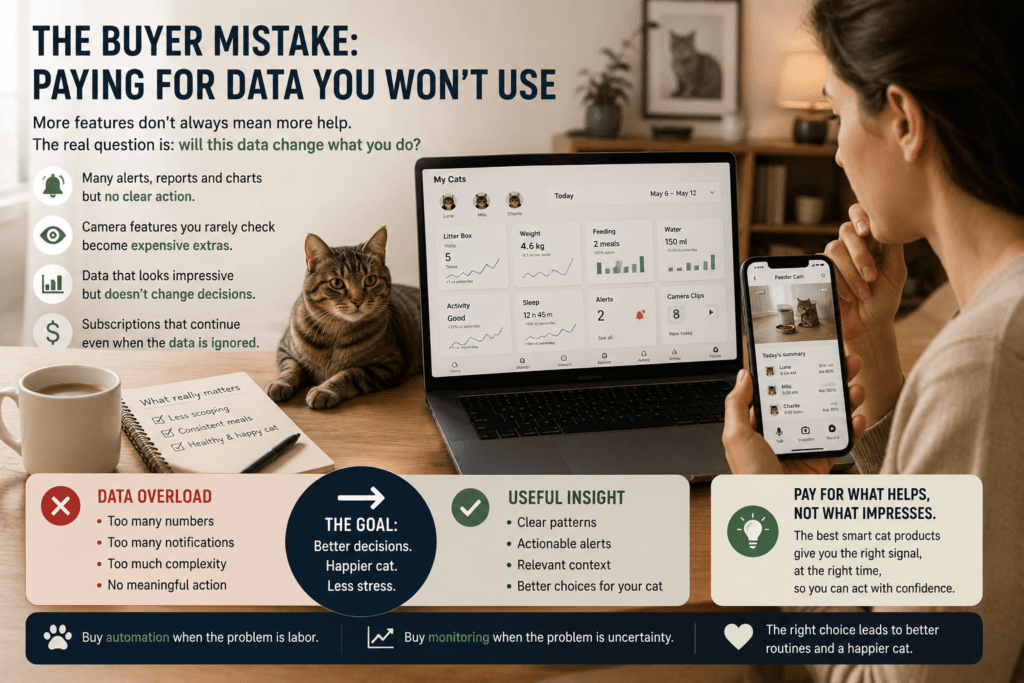
Paying for camera and AI layers that become ignored
CATLINK
Assuming every connected device is as convincing as the litter box
Either brand
Buying a bundle before validating the first product
Either brand
Confusing health data with medical certainty
Either brand
Accepting more maintenance because the app looks impressive
The most dangerous phrase in smart-pet marketing may be:
“Everything works together.”
Three average products can also work together.
That does not make them excellent. It makes them coordinated.
Which Ecosystem Fits Your Home?
The better smart cat ecosystem is not the one with the most features, but the one whose complexity still feels useful after the first week.
Choose PETKIT for a broad connected home
PETKIT is the better fit when:
you intend to add products gradually;
litter, feeding, and hydration all matter;
camera-led monitoring appeals to you;
you want more choice inside each category;
the ecosystem itself is part of the buying decision.
For most households building beyond one device, this is the safer direction.
Choose CATLINK for a litter-box-led multi-cat setup
CATLINK is worth considering when:
its litter box wins your model-level comparison;
multiple cats share the box;
weight and toileting patterns matter;
you value cat-by-cat litter data;
you are willing to judge feeders and fountains separately.
CATLINK should follow a strong product choice.
It should not precede one.
Choose neither ecosystem when one device is enough
Owning one smart litter box does not create an urgent need for a matching feeder and fountain.
Your cat will survive the emotional trauma of using appliances made by different companies.
A mixed setup is often better when:
one brand makes the best litter box for your home;
another makes the better feeder;
a simple offline fountain already works;
you do not care about a single dashboard.
One app is convenient.
Better hardware is usually more convenient.
The Six-Month Test
After six months, which part of the ecosystem will still matter?
Probably not:
the launch animation;
the first week of camera clips;
the novelty of receiving a notification when your cat urinates;
the satisfaction of seeing three matching icons in one app.
What may still matter:
fewer litter chores;
reliable meals;
cleaner water;
useful multi-cat identification;
alerts that occasionally reveal a real change;
replacement parts and support that still exist.
Build the ecosystem around those outcomes.
Not the logo.
Final Verdict
PETKIT is the better smart cat ecosystem for most buyers.
It has the broader and more convincing spread across litter boxes, feeders, fountains, cameras, and different levels of automation. It gives buyers more room to start simple and add monitoring only where it provides real value.
CATLINK remains most credible as a litter-box-led ecosystem.
Its multi-cat and toileting-data philosophy can be useful, and individual CATLINK litter boxes may beat PETKIT for a particular home. But the ecosystem becomes less convincing when buyers assume that every feeder and fountain deserves the same confidence.
The best strategy is therefore not blind brand loyalty.
Start with the strongest individual product.
Let that product earn the second purchase.
And remember: your cat did not request a unified AI care platform. He requested dinner, clean litter, and unrestricted access to whatever object you just placed on the table.
Frequently Asked Questions
Is PETKIT better than CATLINK?
PETKIT is the better overall ecosystem for most buyers because it offers a broader and more convincing range across litter care, feeding, hydration, and camera monitoring. CATLINK may still be better when a specific litter box and multi-cat toileting data are the main priorities.
Is CATLINK better for multiple cats?
CATLINK’s litter-box ecosystem places strong emphasis on weight-based recognition and separate cat profiles. That can make it useful in multi-cat homes, but accuracy and value still depend on the specific device and how distinct the cats’ weights and routines are.
Which brand has better feeders?
PETKIT currently has the stronger feeder lineup. YumShare Solo 2 and Dual-Hopper 2 offer clearer mainstream use cases, while CATLINK’s identity-led feeders require more cautious product-level evaluation.
Which brand has better fountains?
PETKIT offers the broader fountain range, including cordless, UVC, app-connected, and camera-equipped options. The best fountain should still be selected primarily on cleaning, materials, pump reliability, and the cat’s acceptance.
Can PETKIT or CATLINK diagnose health problems?
No. Their products can identify changes in routine and provide useful data, but they cannot determine the medical cause of those changes or replace veterinary assessment.
Should all my smart cat devices use the same app?
Not necessarily. One app is convenient, but it should not outweigh meaningful differences in reliability, cleaning, cat fit, safety, or the quality of the product’s main function.
References
PETKIT official Smart Home and product ecosystem documentation
PETKIT official 2026 AI ecosystem announcements
PETKIT official litter-box, feeder, and fountain product information
CATLINK official app and multi-cat monitoring documentation
CATLINK official ecosystem bundle information
PetTech AI individual product and category audits
Image Disclosure
Some images in this article may be AI-generated for illustrative purposes. They do not depict the exact products and should not be used to evaluate product dimensions, controls, fit, or physical features.
Disclosure
PetTech AI may earn a commission when readers purchase through affiliate links. This comparison does not assume that every product deserves a recommendation simply because it belongs to a connected ecosystem. The app is convenient; the product still has to work.
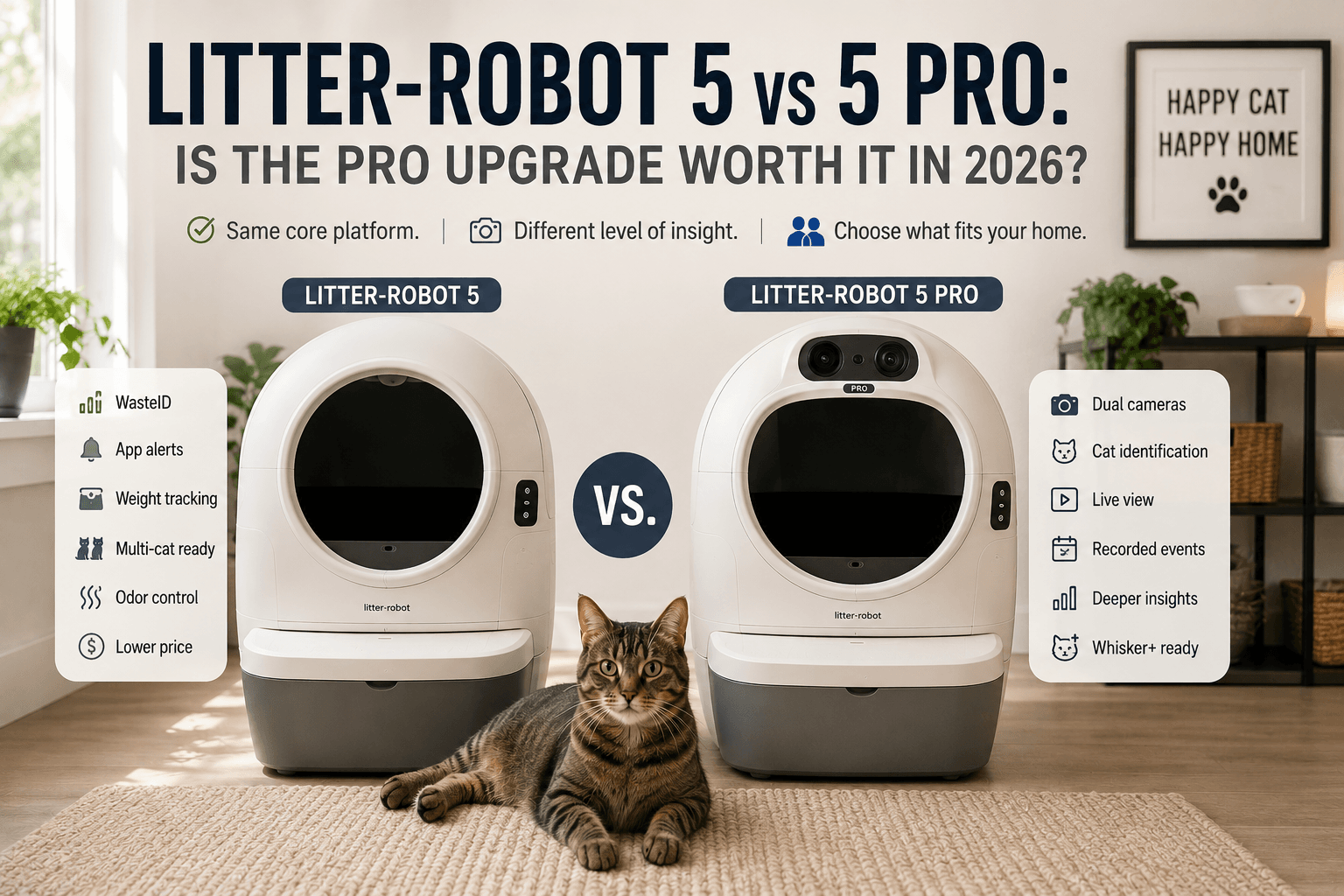
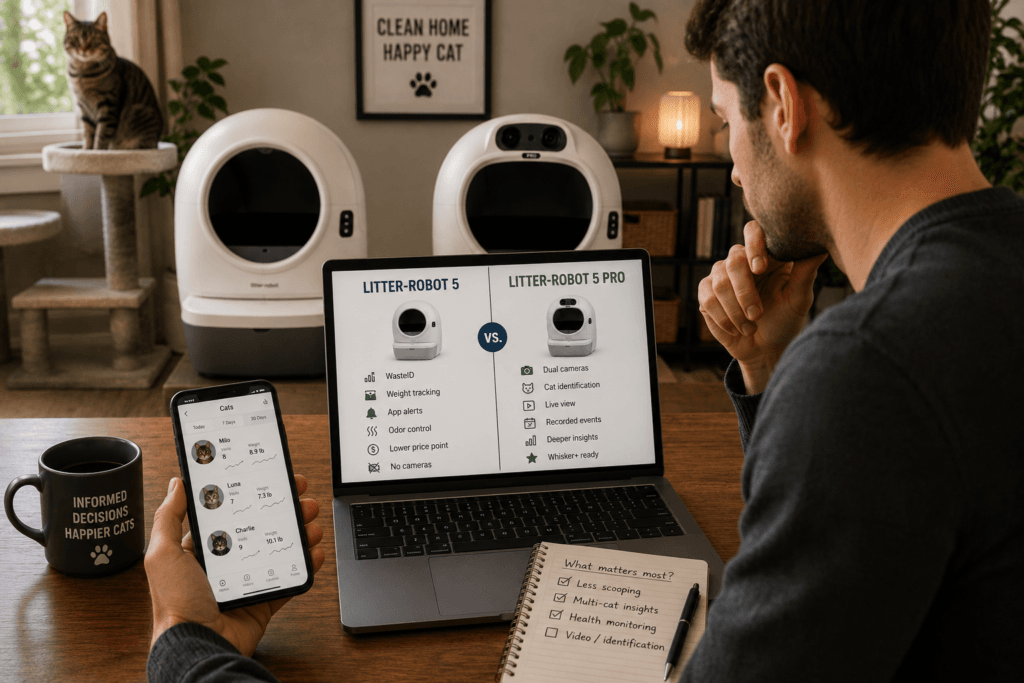
Litter-Robot 5 Pro is not the version that cleans better.
It is the version that watches.
Both models automate the same central chore. They separate waste after use, track litter-box activity, estimate cat weights, connect to the Whisker app, and use WasteID to distinguish urine from solid waste.
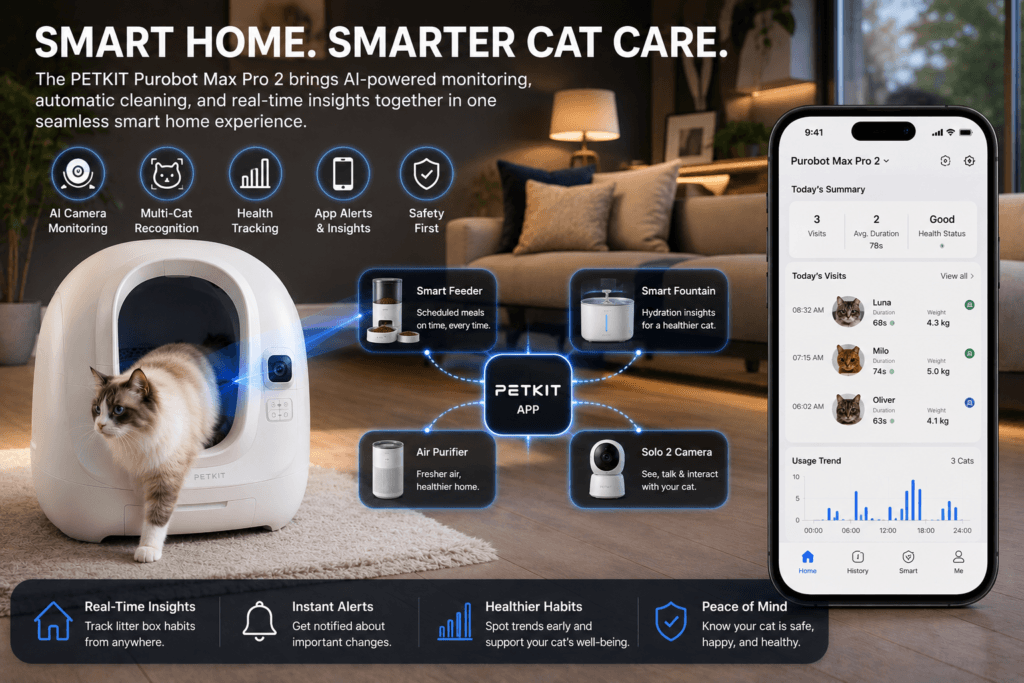
The Pro adds two cameras and a more advanced monitoring path.
That means the decision is not:
Which Litter-Robot is better?
It is:
Will visual identification and recorded litter-box events change anything you do?
For most buyers, Litter-Robot 5 is the better choice.
It delivers the core premium automation without making indoor bathroom surveillance part of the purchase.
Choose Litter-Robot 5 Pro only when the camera system solves a real multi-cat or monitoring problem—and when you accept that its most advanced capabilities depend on Whisker+.
Research note: This is a research-led comparison based on current official documentation, product positioning, software terms, and available ownership evidence. PetTech AI has not conducted a long-term hands-on test of either model.
Quick Verdict
Buyer priority
Better choice
Why
Best for most buyers
Litter-Robot 5
Same core cleaning platform without paying for cameras
Best for one predictable cat
Litter-Robot 5
Weight and visit tracking are usually sufficient
Best value inside the premium lineup
Litter-Robot 5
Pays for automation rather than deeper surveillance
Best for similar-weight cats
Litter-Robot 5 Pro
Visual recognition can resolve weight-based ambiguity
Best for remote visual checks
Litter-Robot 5 Pro
Two integrated cameras provide visit context
Best without an ongoing membership
Litter-Robot 5
Less of its value depends on premium monitoring
Best for monitoring-focused homes
Litter-Robot 5 Pro
Cameras and Whisker+ create the deepest insight layer
Recommendation strength
Litter-Robot 5: Recommended within the current Whisker lineup.
Litter-Robot 5 Pro: Conditional recommendation for monitoring-first households.
Buyer regret in one sentence
Litter-Robot 5: You later discover that weight-based identification cannot reliably separate two very similar cats.
Litter-Robot 5 Pro: You spend more on cameras, watch three litter-box videos, and quietly return to checking only the drawer notification.
Who Should Buy Litter-Robot 5?
Buy Litter-Robot 5 when the real objective is:
reducing scooping;
containing waste;
tracking visits and weights;
receiving drawer and maintenance alerts;
distinguishing urine from solid waste;
managing several cats whose weights are sufficiently different;
avoiding camera-related cost and complexity.
This is the model that solves the physical problem.
It cleans after use and provides enough app data for many households to notice broad changes in litter habits.
The important phrase is enough data.
More information is not automatically more useful.
With one cat, weight-based identification is often adequate because there is only one animal available to generate the event. With several cats at clearly different weights, SmartScale can still help associate visits with individual profiles.
In those homes, the cameras add context rather than solving an unresolved problem.
And context is expensive when nothing depends on it.
Who Should Buy Litter-Robot 5 Pro?
The Pro upgrade is not about a different cleaning routine. It is about cameras, recorded events and deeper cat-level visibility.
Buy Litter-Robot 5 Pro when visual monitoring is central to the purchase.
The Pro adds:
a front-facing camera;
a second camera directed toward the litter bed;
live viewing;
recorded events;
visual identification through the premium software layer;
deeper context around individual visits.
This can matter when:
several cats have similar weights;
weight-based identification is unreliable;
you need to confirm which animal entered;
you want to see what happened during a visit;
you regularly spend time away from home;
visual evidence would improve how you respond to a repeated change;
you already know that you will use the app actively.
The Pro is not overkill in those situations.
It is solving the one problem the standard model cannot fully solve:
A weight sensor can estimate who entered. A camera can look at the cat.
That difference becomes more valuable as the household becomes harder to interpret.
Who Should Skip the Pro?
Skip Litter-Robot 5 Pro when:
you mainly want less scooping;
your cats are easy to distinguish by weight;
you dislike indoor cameras;
you rarely inspect app histories;
recorded events would satisfy curiosity rather than guide action;
you do not want another subscription decision;
the extra monitoring would increase anxiety rather than clarity.
The Pro is the classic premium trap when buyers select it because it is the highest model.
“Pro” is a product tier.
It is not a diagnosis of your household’s technological requirements.
What Actually Stays the Same?
This is the part that should prevent most unnecessary upgrades.
Both models provide the same fundamental ownership experience:
automatic waste separation;
the same general cleaning platform;
app-connected status and controls;
WasteID;
SmartScale weight tracking;
weight-based cat profiles;
drawer notifications;
cycle histories;
multi-cat support;
compatibility with Whisker’s current accessories and software environment.
The Pro does not create cleaner clumps.
It does not make the waste drawer substantially more enthusiastic.
It does not teach the cat to cover what he has done.
The premium primarily purchases cameras and the monitoring system built around them.
If cameras are not important, the standard model already contains the reason most people entered the category.
The Camera Difference
Litter-Robot 5 Pro uses two integrated cameras.
The front-facing camera
The external camera captures the approaching cat and supports visual identification through Whisker’s advanced software.
This can help when:
two cats weigh almost the same;
weight measurements overlap;
one cat’s visit needs visual confirmation;
the app assigns an event incorrectly;
several animals enter in quick succession.
The litter-bed camera
The internal-facing camera adds context around what happens during the visit.
That may help owners observe:
positioning;
visit duration;
repeated entry and exit;
whether a cat appears uncomfortable;
whether the cleaning area contains an obvious issue.
The footage can provide evidence.
It cannot explain the cause.
A video may show that a cat entered repeatedly. It cannot determine whether the reason involves litter preference, stress, constipation, urinary discomfort, social conflict, or something else.
The camera tells you what happened.
It does not graduate from veterinary school during installation.
What Works Without Whisker+?
This is where the buying decision needs precision.
Litter-Robot 5 Pro does not become camera-free without a membership.
Basic camera functionality remains available through the standard Whisker app, including limited live viewing and recorded events under the current service structure.
Whisker+ unlocks the features that make the Pro a deeper individual-monitoring system, including:
unlimited live streaming;
visual cat identification;
a longer video history;
longer activity histories;
daily summaries;
more advanced pattern and behavior insights.
Therefore, the correct question is not:
Does Pro require a subscription?
It is:
How much of the reason I am choosing Pro depends on the subscription?
If you only want occasional visual confirmation, the free camera layer may be enough.
If you are buying the Pro for long-term individual tracking and richer cat-level histories, Whisker+ becomes part of the real ownership cost.
A camera you own and an insight system you rent are not the same purchase.
Litter-Robot 5 for One Cat
Litter-Robot 5 is usually enough for simple one-cat homes, while 5 Pro becomes easier to justify when multi-cat identification matters.
For most one-cat households, choose Litter-Robot 5.
The standard model can already associate weight and activity with the only cat in the home.
You receive:
automatic cleaning;
weight trends;
visit histories;
waste-type information;
app alerts;
drawer status.
The Pro becomes reasonable for one cat only when the owner specifically wants:
remote video;
visual confirmation of behavior;
recorded litter-box events;
more detailed monitoring after a previous concern;
the reassurance of seeing what happened while away.
Those can be legitimate needs.
They are not automatic requirements simply because the cat possesses a urinary system.
Litter-Robot 5 Pro for Multiple Cats
Multi-cat households give the Pro its strongest argument.
Weight-based identification works best when cats occupy clearly different weight ranges.
It becomes less dependable when:
two cats weigh nearly the same;
weights fluctuate;
cats enter close together;
one animal leans into the globe without fully entering;
the system receives an ambiguous measurement.
Visual identification can help resolve those events.
But the value still depends on what happens next.
If you identify the cat and then change resource placement, monitor a repeated pattern, clean the box, add another litter station, or seek appropriate veterinary advice, the information has served a purpose.
If you merely collect increasingly sophisticated evidence that Napoleon uses the box at 3:14 a.m., the monitoring system has become a very expensive biographer.
It becomes bad when the product’s headline advantage feels incomplete without it and the buyer failed to include the recurring cost in the original decision.
Before choosing Pro, ask:
Will I review recorded events?
Do I need visual identification?
Do I care about histories extending beyond the free period?
Would summaries change how I manage several cats?
Am I willing to continue paying after the novelty disappears?
Five honest “yes” answers make the Pro easier to defend.
Five optimistic “probably” answers usually mean Litter-Robot 5 is the safer purchase.
Where Litter-Robot 5 Can Disappoint
Weight-based identification has limits
SmartScale cannot always distinguish cats with similar weights.
The system can also encounter ambiguous measurements when visits are incomplete or several animals interact around the unit.
This is the main reason a complex multi-cat home may outgrow the standard model.
It is still a premium litter box
Choosing the non-Pro model does not make the purchase inexpensive.
The standard model still asks the buyer to pay for:
the newest Whisker platform;
WasteID;
app functions;
weight histories;
accessory compatibility;
the broader Whisker ownership system.
Buy it because those features matter—not merely because it costs less than an even more expensive sibling.
Where Litter-Robot 5 Pro Can Disappoint
Its best feature creates the main privacy trade-off
The cameras observe the front of the machine and the litter bed.
Some owners will consider that useful.
Others will reasonably conclude that the home already contains enough internet-connected lenses.
Privacy controls can reduce exposure.
They do not make the cameras cease to exist.
The software matters almost as much as the hardware
Visual identification and advanced histories depend on software, account access, recognition accuracy, and the current Whisker+ service.
The physical cameras may last for years.
The precise service terms can change.
More monitoring can create more worry
A detailed timeline can help owners notice repeated changes.
It can also encourage constant interpretation of normal variation.
The correct use is:
observe the pattern;
verify it directly;
consider the wider context;
respond when the change is meaningful.
The incorrect use is refreshing the app every time the cat spends eleven seconds longer considering his life choices.
What About Litter-Robot EVO?
EVO is the relevant alternative when your hesitation is not cameras but price, size, or platform depth.
The current lineup can be understood as:
EVO: compact, automation-first entry;
Litter-Robot 5: balanced premium choice;
Litter-Robot 5 Pro: camera-led monitoring choice.
Choose EVO when the main goal is Whisker self-cleaning with fewer premium layers.
Choose Litter-Robot 5 when you want the newer platform and useful data without cameras.
Choose 5 Pro when cameras and individual monitoring are the reason for paying more.
Does Litter-Robot 5 Pro clean better than Litter-Robot 5?
No meaningful cleaning advantage defines the Pro upgrade. The principal difference is its dual-camera monitoring system.
Does Litter-Robot 5 identify individual cats?
It uses weight-based identification. This can work well when cats have different weights but may be less reliable when their weight ranges overlap.
Does Litter-Robot 5 Pro require Whisker+?
Basic camera functions are available without the membership. Visual identification, unlimited streaming, longer histories, and advanced insights depend on Whisker+ under the current service structure.
Is Litter-Robot 5 Pro worth it for one cat?
Usually only when video monitoring or recorded litter-box behavior has a specific purpose. Most predictable one-cat households receive better value from Litter-Robot 5.
Is Litter-Robot 5 Pro better for multiple cats?
It can be, especially when cats have similar weights or individual visual confirmation matters. Simple multi-cat homes may still be well served by the standard model.
Can either model detect health problems?
They can highlight changes in weight, visits, duration, and waste patterns. They cannot diagnose the cause or replace veterinary assessment.
Is EVO a better value than Litter-Robot 5?
EVO can be the better value when compact size and core self-cleaning matter more than the full premium platform. Litter-Robot 5 offers the more balanced feature set.
References
Whisker Litter-Robot 5 product documentation
Whisker Litter-Robot 5 Pro product documentation
Whisker app and Whisker+ documentation
Whisker current model comparison
PetTech AI editorial trust and decision framework
Image Disclosure
Images in this article may be AI-generated editorial illustrations. They do not depict the exact products and should not be used to evaluate dimensions, controls, camera placement, entrance size, or physical features.
Editorial Disclosure
At the time of publication, PetTech AI does not earn a commission from Whisker purchases. This article contains no direct retailer or manufacturer purchase links. Product recommendations are based on buyer fit, feature value, and current available evidence.
EVO automatically rotates after the cat exits, separates clumped waste from clean litter and deposits it into a sealed, carbon-filtered drawer.
Through the Whisker app, owners can monitor device status, receive maintenance alerts, start cycles remotely and review weight and activity information.
Its official specifications include:
support for cats weighing 3–19 lb;
suitability for up to two cats;
a 20.6-by-24.3-inch footprint;
27.6-inch exterior height;
14.85-inch entrance width;
SmartScale weight identification;
standard seven-day activity history;
notification when the waste drawer is full.
That is enough technology to reduce daily litter work without turning the bathroom into a domestic intelligence agency.
EVO still requires compatible litter, drawer liners, filter maintenance, periodic washing and a human willing to empty the drawer.
“Self-cleaning” means the machine handles most scooping.
It does not mean Whisker has accepted full legal responsibility for the bathroom.
When EVO Is the Smart Purchase
EVO works when its missing features are genuinely unnecessary.
A one-cat home may not need support for five cats.
A smaller room may benefit more from a reduced footprint than from Litter-Robot 5’s additional capacity.
An owner who mainly wants to know whether the box is operating and whether the cat is using it may not need WasteID, long-term behavioral histories or cameras recording every visit from two angles.
EVO is therefore strongest for:
one average-sized cat;
two smaller cats with manageable litter traffic;
apartments and compact utility rooms;
first-time automatic-litter-box buyers;
owners prioritizing labor reduction over detailed monitoring.
This is sensible restraint when the household already fits.
It becomes technological poverty only when the buyer pretends obvious limitations will somehow develop new features after delivery.
Cat Size Matters More Than the Published Weight Limit
Whisker supports cats between 3 and 19 lb in automatic mode, but body shape matters as much as weight.
EVO has approximately 14.5 inches of interior headroom, compared with 17.5 inches on Litter-Robot 5. Its entrance is also narrower, although its 5.6-inch step is lower than the step on the larger models.
A tall, broad or long-bodied cat may feel restricted before reaching 19 lb.
The product page can confirm whether Archibald falls inside the published range.
It cannot persuade him that the accommodation is spacious.
Choose Litter-Robot 5 instead when:
the cat already looks large relative to enclosed boxes;
extra interior room reduces acceptance risk;
future weight gain could push the cat near EVO’s ceiling;
you would spend the first month wondering whether the cat appears cramped.
For a rejected product, the lower purchase tier provides extremely poor value.
Two Cats Can Work—But “Up to Two” Is Not a Magic Spell
Whisker positions EVO for as many as two cats.
That does not mean every two-cat household will experience the same ownership routine.
Two cats create:
more frequent cycles;
faster drawer filling;
greater pressure on one shared resource;
more weight-identification ambiguity;
more opportunities for one cat to discourage the other.
EVO works best when both cats:
fit comfortably;
have distinguishable weights;
already share litter resources without tension;
do not overwhelm the medium drawer;
have access to another box when needed.
Whisker estimates that one-cat households may empty EVO’s drawer about once every seven days. Actual frequency will vary with cat size, litter and individual use. Litter-Robot 5 has a larger drawer and is positioned for up to five cats.
An automatic box reduces scooping.
It does not repeal the social politics of a multi-cat household.
Monitoring: Enough for Routine, Not Enough for Forensics
EVO makes the most sense when space matters and the household does not need the most advanced monitoring package.
EVO includes SmartScale weight identification and a standard seven-day activity history.
That can help answer basic questions:
Is the cat using the box?
Has the recorded weight changed?
Did the normal routine shift?
Is the drawer full?
What EVO does not provide is WasteID, which distinguishes urine from solid waste on Litter-Robot 5 and 5 Pro.
Its drawer sensing is also simpler: EVO notifies when the drawer is full, while the more advanced models monitor changing waste levels.
SmartScale identification can also become less reliable when two cats have similar weights or produce incomplete measurements.
EVO therefore offers useful routine visibility.
It is not the right model for owners who already know they need more detailed individual interpretation.
For the broader distinction between removing work and collecting behavioral evidence, read our Smart Cat Monitoring vs Automation guide.
Does EVO Need Whisker+?
No.
Automatic cleaning, standard app controls, SmartScale information and the basic recent history remain available without membership.
Whisker+ adds:
daily activity summaries;
historical visit frequency and duration;
access to as much as two years of activity history;
enhanced reporting across compatible Whisker devices.
The subscription currently costs $7.99 monthly or $79.90 annually after the trial, although service terms can change.
The correct question is not whether longer histories sound responsible.
It is:
Will reviewing them change anything you do?
If persistent patterns would guide environmental changes or an appropriate veterinary conversation, the history can be useful.
If the subscription mainly preserves two years of Napoleon conducting routine business, the free layer will probably survive the loss.
Odor Control and Daily Ownership
EVO reduces daily scooping, but odor control still depends on liners, filters, litter quality, drawer emptying and regular cleaning.
EVO removes waste from the exposed litter bed and stores it in a sealed drawer with a carbon filter.
That can reduce odor compared with a manual box that is not scooped promptly.
It cannot overpower:
a full drawer;
poor clumping litter;
residue inside the globe;
neglected liners;
exhausted filters;
weak room ventilation.
Whisker recommends replacing carbon filters and optional OdorTrap packs approximately every two to four weeks for stronger odor absorption, although real frequency depends on household use.
The carbon filter supports the maintenance routine.
It does not absolve the household from participating in it.
EVO changes frequent scooping into more structured work:
empty the drawer;
inspect the liner;
add litter;
wipe contact areas;
deep-clean the removable components periodically.
For many owners, that is a worthwhile improvement.
It is still ownership—not emancipation.
EVO vs Litter-Robot 5
EVO is the simpler entry model; Litter-Robot 5 is the stronger long-term balance if you want more monitoring and future-proofing.
This is the comparison that should decide the purchase.
Priority
EVO
Litter-Robot 5
Smaller footprint
Better
Larger
Cat capacity
Up to 2
Up to 5
Cat weight
3–19 lb
3–30 lb
Interior headroom
14.5 in
17.5 in
Waste drawer
Medium
Extra large
WasteID
No
Yes
Litter-level sensing
No
Yes
Standard activity history
7 days
7 days
Whisker+ compatible
Yes
Yes
Choose EVO when the smaller platform completely solves the household problem.
Still comparing the wider market rather than only Whisker models? Read our Best Smart Litter Boxes guide for alternatives organized by cat size, household load and monitoring needs.
Considering a lower-cost PETKIT platform against Whisker’s established hardware? Read our PETKIT PuraMax 2 vs Litter-Robot 4 comparison.
Buyer-Regret Risk
EVO regret has one dominant cause:
Buying the lower tier while already knowing the household needs the higher one.
Warning signs include:
the cat is close to the weight ceiling;
the entrance already looks restrictive;
the home has two heavy users;
you care about waste type;
similar weights make identification important;
Litter-Robot 5 keeps returning to the shortlist.
EVO is not a bargain when every decision point ends with:
“It should probably be fine.”
“Probably fine” is how Emperor Maximilian acquires a very expensive object he refuses to enter.
Final Verdict
Litter-Robot EVO earns a Recommended with Conditions verdict.
It is a strong fit for one cat—or two smaller, compatible cats—when space matters and automatic cleaning is the main objective.
Its lower tier is justified because it removes capacity and monitoring features that many simpler households do not need.
Its limitations are also real:
19-lb automatic-mode ceiling;
smaller interior;
medium drawer;
maximum two-cat positioning;
no WasteID;
simpler waste monitoring.
Choose EVO when those limits already fit comfortably.
Skip it when they look like compromises before checkout.
The smartest purchase is not automatically the most advanced Litter-Robot.
It is the least expensive model that solves the entire problem without quietly creating the next one.
Frequently Asked Questions
Is Litter-Robot EVO worth it?
Yes, for one or two appropriately sized cats when compact placement and automatic cleaning matter more than WasteID, larger capacity or cameras.
How many cats can use Litter-Robot EVO?
Whisker positions EVO for up to two cats. Two-cat households should expect more frequent drawer emptying and should still provide enough litter resources.
What cat weights does EVO support?
Automatic mode supports cats weighing between 3 and 19 lb. Long or large-bodied cats may still prefer the larger interior of Litter-Robot 5.
Does EVO require Whisker+?
No. Core operation, standard app controls, alerts and recent activity information remain available without membership.
Does EVO have WasteID?
No. WasteID is available on Litter-Robot 5 and 5 Pro.
References
Whisker — Litter-Robot EVO product documentation
Whisker — Current Litter-Robot comparison chart
Whisker — Whisker app documentation
Whisker — Whisker+ membership information
Image Disclosure
Any AI-generated images are editorial illustrations only. They do not represent exact dimensions, entrance size, internal space or app performance. Always verify current specifications before purchasing.
Editorial Disclosure
PetTech AI may earn a commission from qualifying purchases. This does not influence our recommendations, comparisons or editorial judgments.
He has never looked at three matching app icons and thought:
“At last. A coherent digital-care architecture.”
That part is for humans.
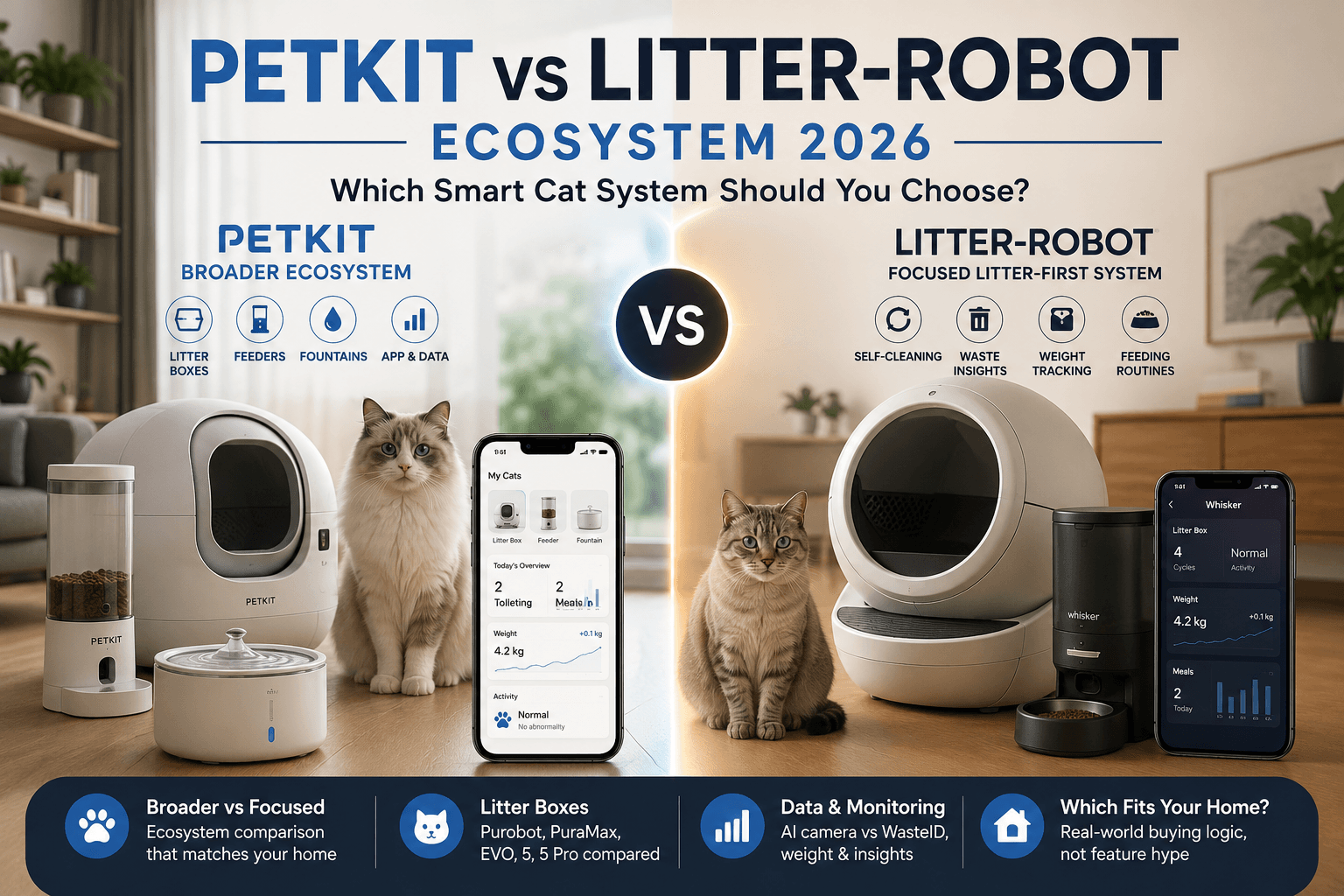
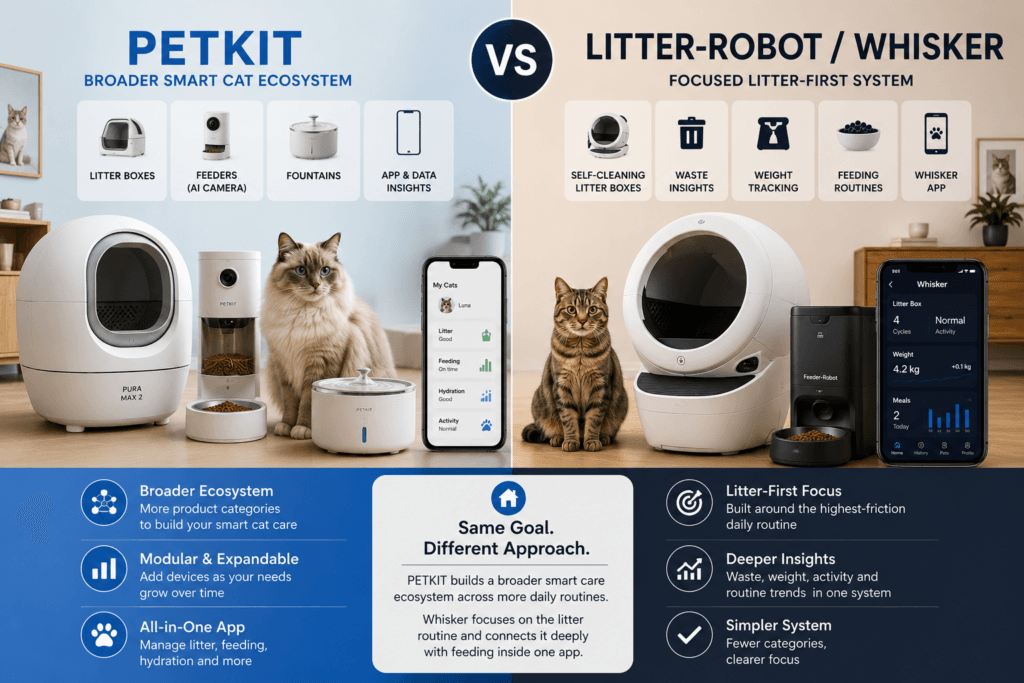
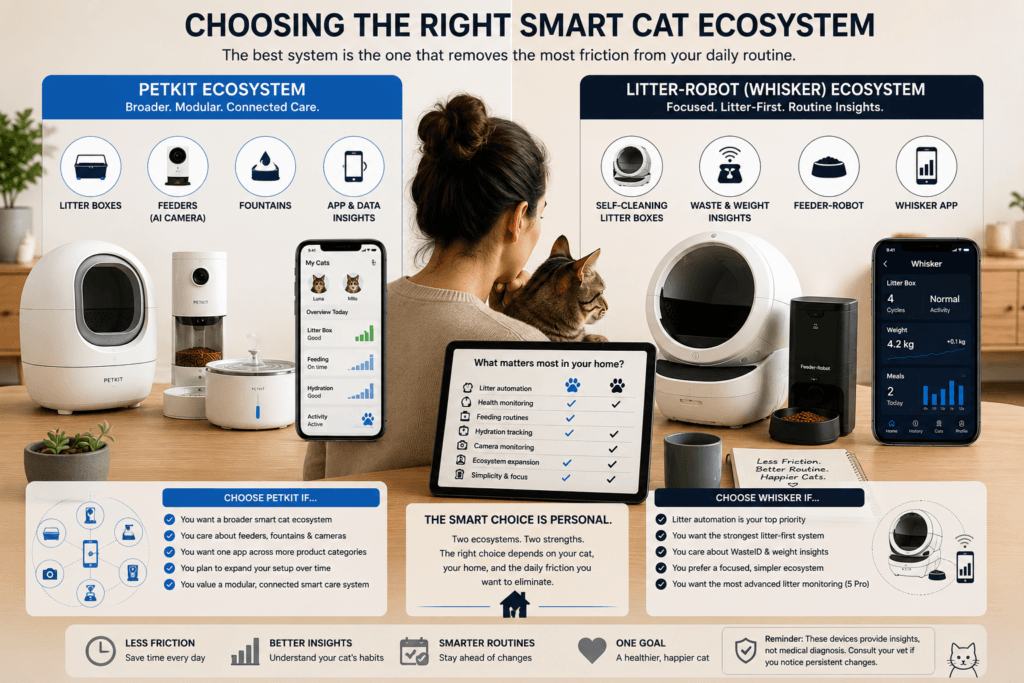
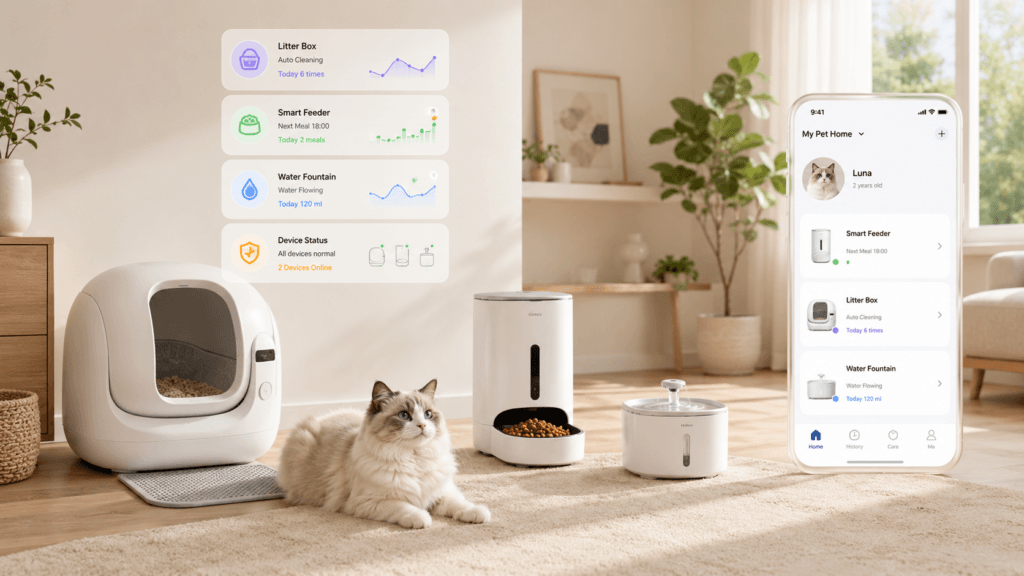
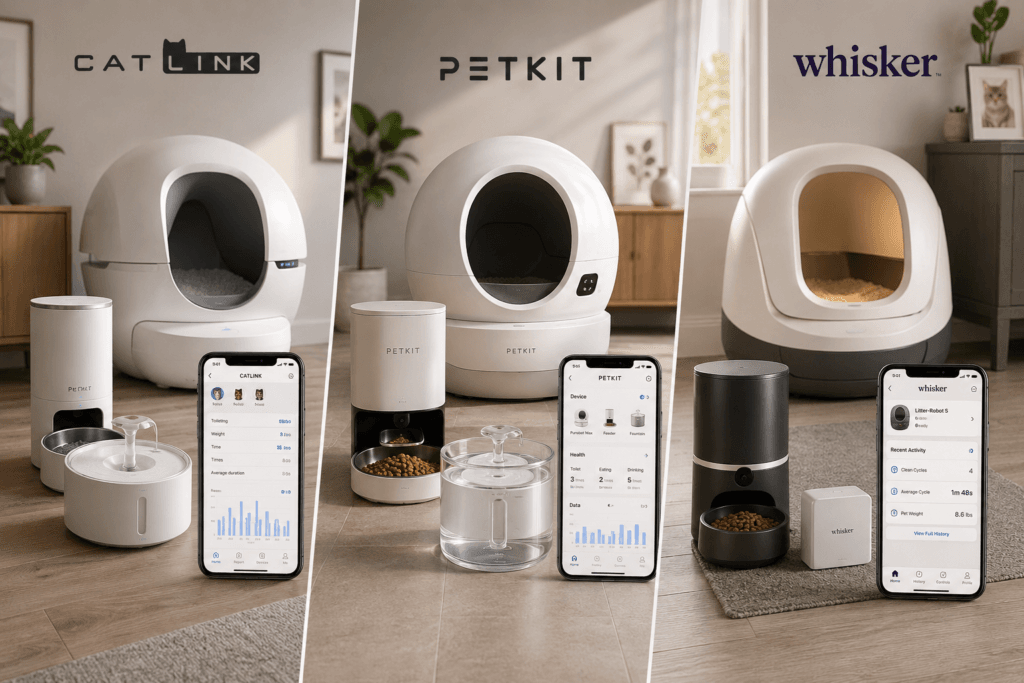
CATLINK, PETKIT and Whisker sell three different versions of the smart cat home:
PETKIT wants to connect litter care, feeding, hydration and camera monitoring.
Whisker wants to dominate the litter room and handle scheduled dry-food feeding.
CATLINK wants to connect what goes into the cat with what eventually comes out.
Kibble enters. Clumps leave. Somewhere, a graph feels important.
The real question is not which company offers the largest catalogue.
It is:
Which ecosystem contains enough strong products to deserve your second purchase after the first device has earned your trust?
Our answer is PETKIT overall, Whisker for litter-first households and CATLINK only when a specific product wins independently.
Quick Verdict
Ecosystem
Best fit
PetTech AI verdict
Main risk
PETKIT
Homes expanding across litter, feeding, hydration and cameras
Recommended — Best Overall Ecosystem
Buying advanced monitoring features you stop using
Whisker
Buyers making litter automation the main priority
Strong Recommendation for Litter-First Homes
Limited expansion outside litter and dry feeding
CATLINK
Buyers choosing a particular CATLINK litter box
Conditional Recommendation
Assuming every matching device is equally proven
Choose PETKIT when you genuinely expect to use several smart-care categories.
Choose Whisker when the litter box is the expensive problem you actually need to solve.
Choose CATLINK when one of its litter boxes defeats the alternatives on its own merits.
Do not choose any ecosystem simply because completing a branded set produces emotional closure.
Research Note
This is a research-led comparison based on current official product documentation, app capabilities, product availability and PetTech AI’s individual product audits.
PetTech AI has not conducted long-term hands-on testing of every device discussed.
PetTech AI may earn a commission from qualifying purchases. As an Amazon Associate I earn from qualifying purchases.
CATLINK leans into multi-cat data, PETKIT builds the broadest smart cat ecosystem, and Whisker focuses on a tighter litter-first workflow.
Before committing to an ecosystem, imagine that every product requires a separate app.
Would you still independently choose:
the litter box;
the feeder;
the fountain?
If the answer is yes three times, the shared app creates genuine convenience.
If the answer is:
“I only wanted the other two because their icons matched,”
you are not building a smart home.
You are collecting branded appliances.
The strongest ecosystem is made from products you would buy even without the ecosystem.
PETKIT: The Best Complete Ecosystem
PETKIT currently covers the widest credible range of smart-cat routines.
Its platform includes automatic litter boxes, dry-food feeders, connected fountains and increasingly camera-led products that monitor feeding, drinking and litter-box activity through the PETKIT app. The company’s current direction extends cameras and individual recognition across all three categories rather than keeping them confined to one flagship device.
That breadth gives owners several possible entry points:
begin with a PuraMax litter box;
add a camera feeder such as YumShare;
introduce connected hydration;
choose monitoring-heavy products only where the data has a purpose.
This flexibility is PETKIT’s strongest advantage.
A household can expand gradually without every product solving the same problem or carrying the same level of complexity.
Why PETKIT wins
PETKIT offers the best current balance of:
category breadth;
credible hardware across several routines;
camera and non-camera choices;
multi-cat monitoring;
one-app expansion;
feeding and hydration options Whisker does not match.
Its ecosystem makes sense for someone who expects to automate more than litter.
New cameras, facial recognition and behavioral insights may appear before a device has accumulated years of public ownership history.
That means the ecosystem can be strong while a specific new product still deserves caution.
The company is also moving aggressively toward AI-generated insights. Some information can reveal useful patterns. Some can become an expensive way to learn that Archibald drank water while you were at the supermarket.
Before buying the advanced version, ask:
What will I do differently because this camera or insight exists?
When the answer is nothing, choose the simpler model.
PETKIT wins the ecosystem comparison.
It does not receive diplomatic immunity from product-level scrutiny.
Whisker: The Best Litter-First Ecosystem
Whisker is much narrower.
Its current ecosystem centers on Litter-Robot models, Feeder-Robot, the Whisker app and the software, accessories and consumables surrounding them. The app combines litter-box activity, weight information and feeding statistics, while newer Litter-Robot models add WasteID and camera-based monitoring.
That focus is not automatically a weakness.
Most owners do not wake up determined to build a technological civilization around the cat.
They want to stop scooping litter.
Whisker starts with that problem and builds outward only modestly.
Why Whisker remains compelling
Its litter-box lineup has a clear structure:
EVO for compact automation;
Litter-Robot 5 as the strongest overall platform;
Litter-Robot 5 Pro for camera-supported identification and monitoring.
Whisker’s deepest expertise, app development and accessory environment remain concentrated around litter automation.
For households where the litter box matters more than fountains, wet-food feeders or a broad device catalogue, that specialization is valuable.
The ecosystem becomes thin once the buyer moves beyond litter care and scheduled dry feeding.
Whisker does not offer PETKIT’s range of fountains, refrigerated feeding concepts or camera feeders.
Litter-Robot 5 Pro also introduces a software-cost decision. Its cameras offer basic functionality without Whisker+, but individual visual identification and deeper histories depend on the membership layer.
Apparently, even remembering who used the litter box can now become a subscription service.
That does not make Whisker+ worthless.
It means the hardware and the long-term software plan must be evaluated together.
Choose Whisker when litter automation is the center of the home.
Do not choose it because you expect a complete smart-cat catalogue to materialize around the litter box.
CATLINK: Buy the Product, Not the Diagram
CATLINK has the most explicit “input-output” ecosystem concept.
The CATLINK app connects litter boxes, feeders and fountains while combining toilet activity, eating behavior, drinking patterns and weight-based multi-cat records. CATLINK also sells complete ecosystem bundles containing a scooper, Fresh 2 feeder and water fountain.
The theory is coherent:
track what the cat eats;
track what the cat drinks;
track what happens in the litter box;
look for meaningful changes.
As an ecosystem diagram, it is excellent.
As a shopping strategy, it needs more restraint.
CATLINK’s strongest argument
CATLINK remains most convincing in automatic litter boxes.
A product such as Luxury Pro-X can deserve consideration for:
multi-cat homes;
weight-based visit identification;
litter-box histories;
households where its dimensions or design fit better;
buyers who prefer CATLINK’s app approach.
This gives CATLINK a legitimate place in the comparison.
For the direct two-brand decision, read our CATLINK vs PETKIT comparison.
Where the CATLINK argument weakens
A credible CATLINK litter box does not automatically validate every feeder and fountain sharing the app.
Our product-level audits have found the wider catalogue less consistently convincing than PETKIT’s. Some devices offer interesting ideas, but ecosystem coherence is not evidence of equal maturity, reliability or household fit.
A shared app is convenient.
It is not a quality-control department.
The correct CATLINK strategy is:
choose the litter box only if it wins independently;
validate whether its data helps;
evaluate every additional device from zero;
ignore the emotional pressure to complete the bundle.
CATLINK is a valid smart-litter brand with a wider ecosystem ambition.
It is not currently an equal all-category alternative to PETKIT.
Still comparing individual litter boxes rather than entire ecosystems? Read our Best Smart Litter Boxes guide for the strongest options organized by household fit, monitoring needs and buyer-regret risk.
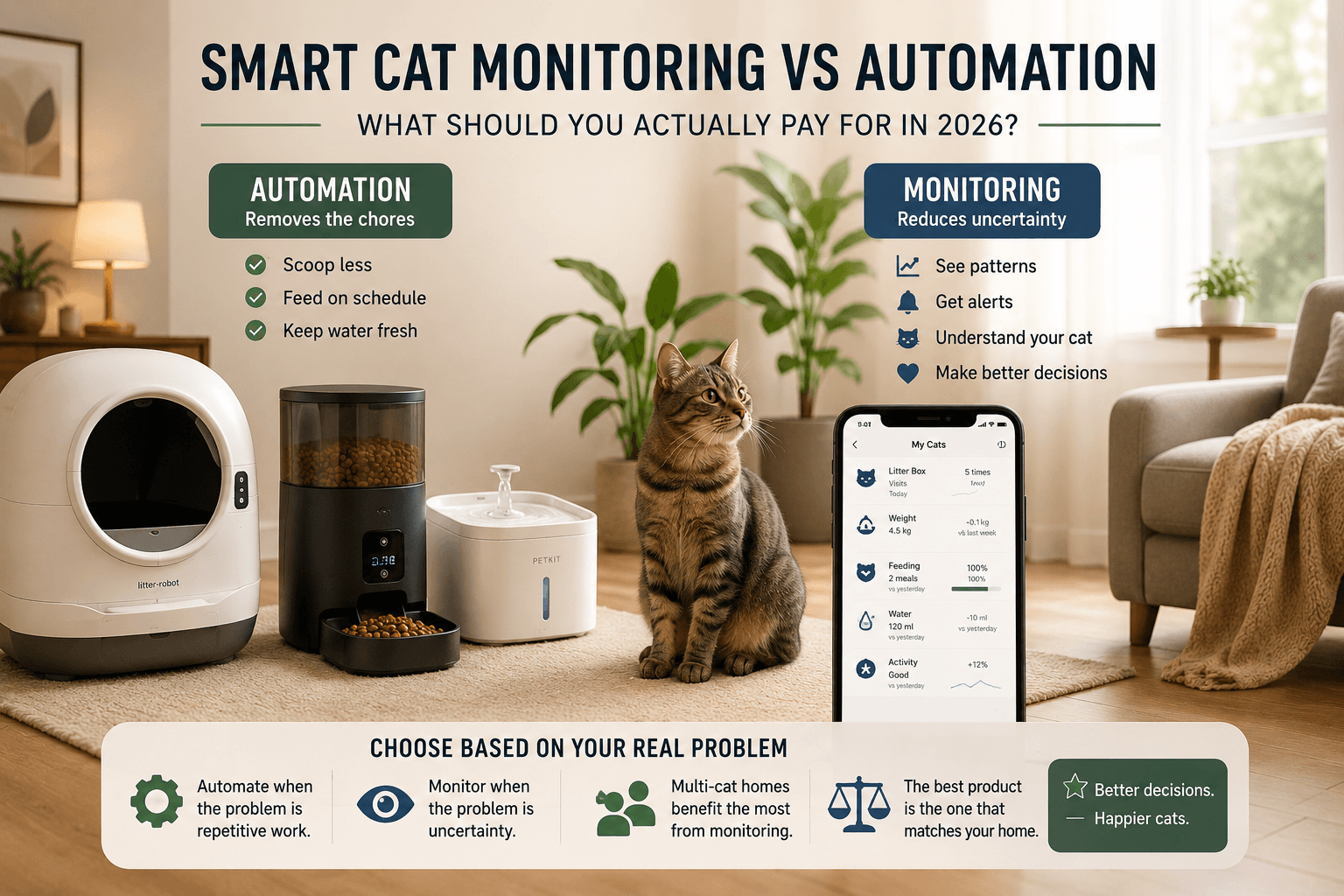
Monitoring Is Not Automation
The best smart cat ecosystem is not the one with the most devices, but the one that fits your home, your cats and the level of data you are willing to manage.
The three ecosystems also differ in what they are trying to improve.
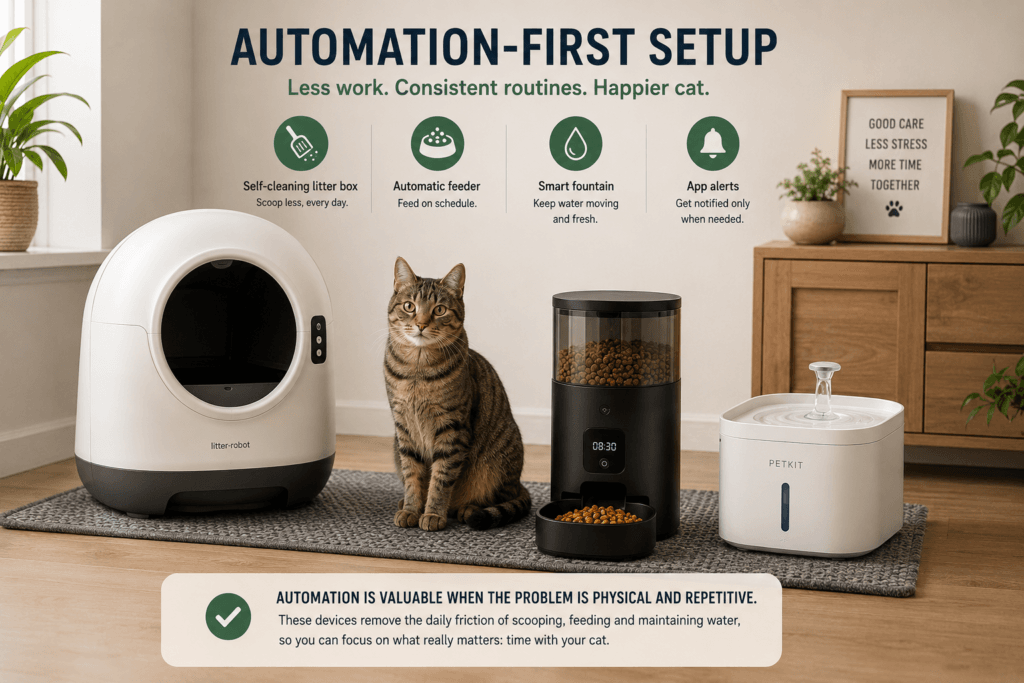
Automation removes repetitive labor.
Examples include:
sifting litter;
dispensing scheduled meals;
circulating water;
sending maintenance alerts.
Monitoring adds context.
Examples include:
which cat used a device;
whether a routine changed;
how weight moved over time;
whether food or water activity declined.
PETKIT leans most heavily into monitoring across categories.
Whisker combines strong litter automation with increasingly deep litter-related data.
CATLINK emphasizes linking multiple routine records inside one dashboard.
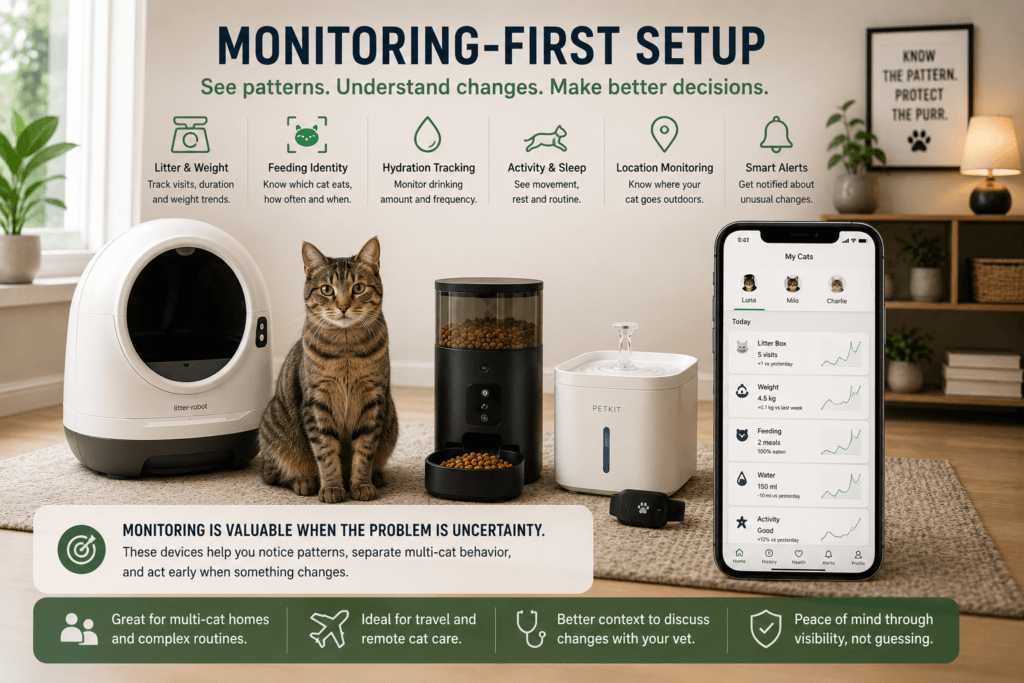
Monitoring is valuable only when the information changes a decision.
A graph that leads you to verify a persistent change or contact a veterinarian has served a purpose.
A graph you admire briefly before closing the app is interface decoration.
PETKIT regret usually means paying for cameras or AI features that become ignored.
Whisker regret means investing heavily in a focused ecosystem and later wanting broader feeding or hydration options.
CATLINK regret means buying the bundle before each product has earned independent confidence.
The universal regret is choosing matching software over better hardware.
Mixing brands may be the correct answer:
a Whisker litter box;
a PETKIT feeder;
a simple fountain that is easy to clean;
no dashboard pretending this arrangement constitutes institutional failure.
Your cat will recover from the trauma of using appliances made by different corporations.
Final Verdict
A smart cat ecosystem can connect feeding, hydration and camera monitoring, but the best choice depends on whether you value data, breadth or litter-first simplicity.
PETKIT is the best overall smart cat ecosystem.
It offers the widest credible combination of litter automation, feeding, hydration and camera-led monitoring. It is the strongest choice for households that genuinely intend to expand across several categories.
Whisker is the best litter-first ecosystem.
Its range is narrower, but its focus is valuable. When the main objective is buying the strongest premium automatic litter box and perhaps adding scheduled dry feeding, Whisker may be the better decision.
CATLINK earns a Conditional Recommendation.
Its litter boxes and multi-cat data can be compelling. Its wider ecosystem should be approached one device at a time rather than purchased as a pre-approved bundle.
The ranking is therefore:
PETKIT — best complete ecosystem
Whisker — best litter-first ecosystem
CATLINK — best evaluated product by product
Choose the first device because it solves a real problem.
Let it earn the second purchase.
Do not give a corporation custody of your entire smart cat home because its app has an attractive dark mode.
Frequently Asked Questions
Is PETKIT better than Whisker?
PETKIT is better for a complete ecosystem covering litter, feeding and hydration. Whisker is better when premium litter automation is the main priority.
Is CATLINK better than PETKIT?
CATLINK can be better when a specific litter-box design or multi-cat feature suits the household. PETKIT remains the stronger overall ecosystem across categories.
Which ecosystem has the best automatic litter boxes?
Whisker has the strongest litter-first positioning. PETKIT offers more variety between automation-led and camera-led systems. CATLINK remains relevant for specific multi-cat designs.
Which ecosystem is best for feeders and fountains?
PETKIT currently offers the broadest combination of camera feeders, alternative feeding formats and connected fountains. Whisker offers Feeder-Robot but no comparable fountain range.
Do all smart cat products need to use the same app?
No. A shared app reduces digital clutter, but it should not outweigh reliability, cleaning, physical fit or the quality of each device’s core function.
Whisker — Litter-Robot, Feeder-Robot and Whisker app documentation
Whisker — Litter-Robot 5 Pro and Whisker+ documentation
CATLINK — Ecosystem bundles and CATLINK app documentation
Image Disclosure
Official manufacturer images are used when depicting exact products.
Any AI-generated images are editorial illustrations only. They do not represent exact dimensions, controls, monitoring accuracy or app performance. Always verify current specifications before purchasing.
Editorial Disclosure
PetTech AI may earn a commission from qualifying purchases. This does not influence our recommendations, comparisons or editorial judgments.
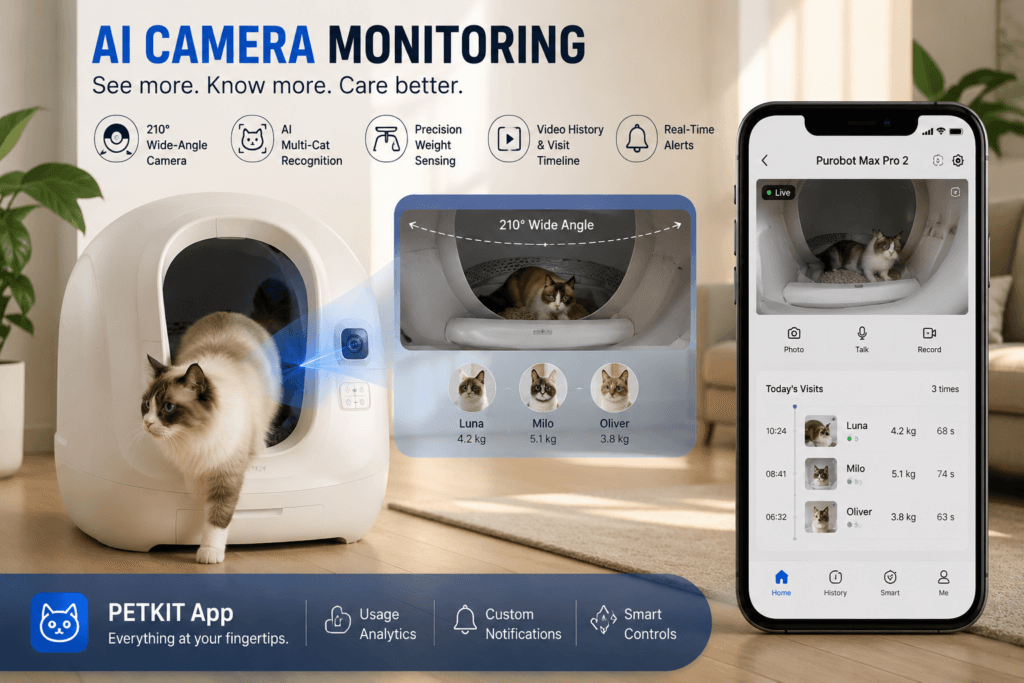
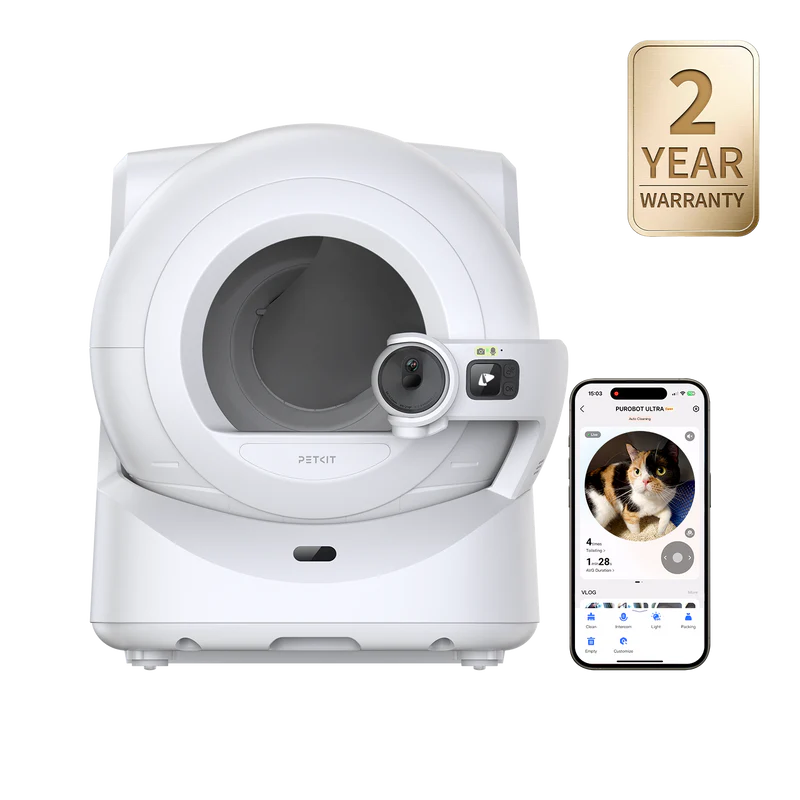
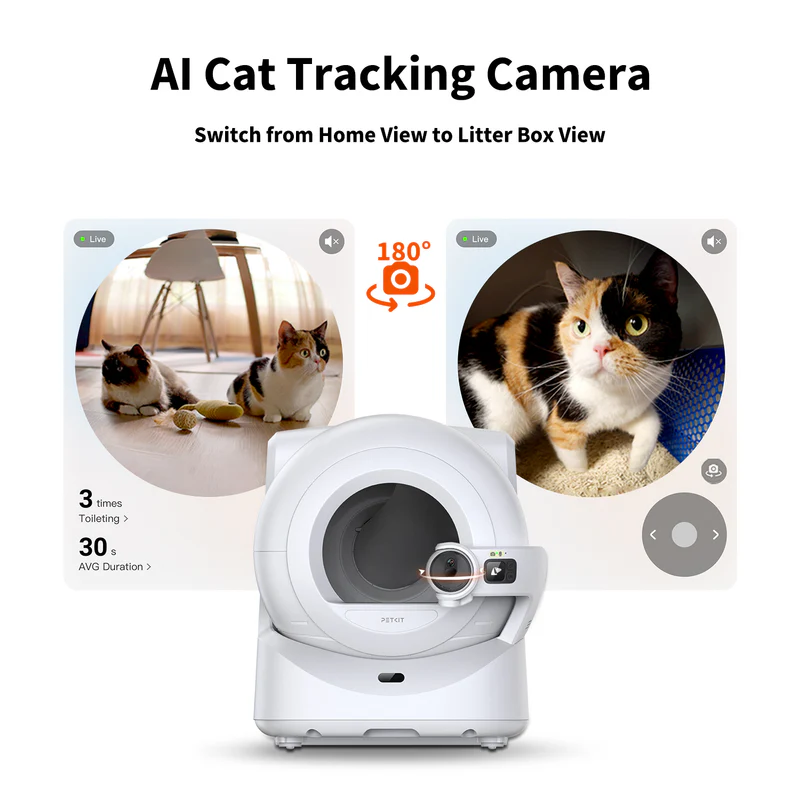
The Purobot Ultra Automatic Cat Litter Box 2025 is PETKIT’s flagship robo-box with a rotating AI camera, multi-cat facial recognition, auto-packing waste bags, and app-based health alerts. In this review, we cover what the Purobot Ultra actually does, how it compares, the real ongoing costs, and whether it fits your home and cats.
At-a-Glance (What’s New in 2025)
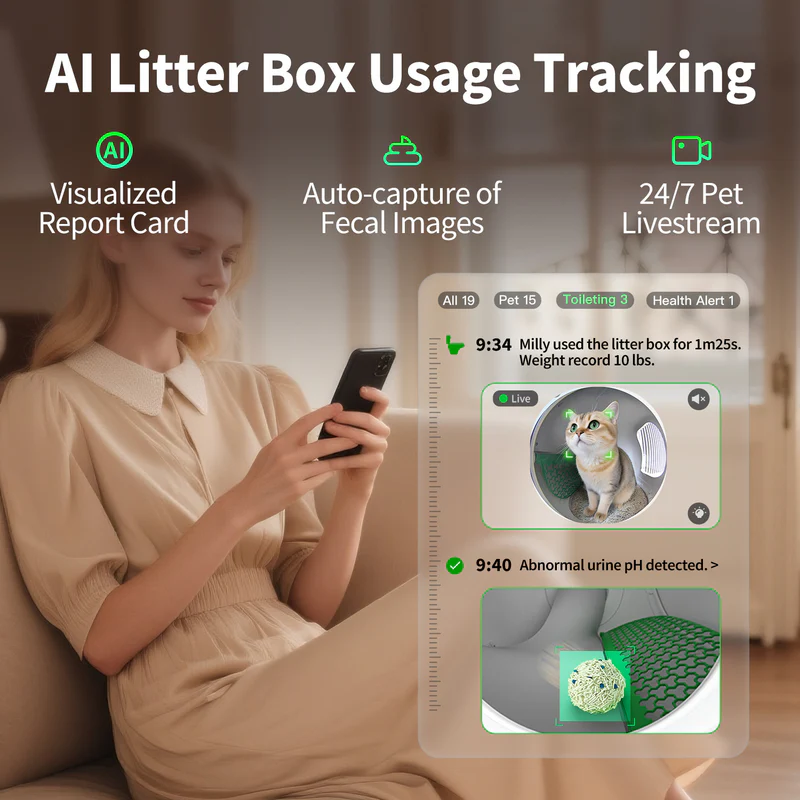
AI camera + facial recognition to identify each cat, log visits, and flag issues (e.g., yowling that may indicate urinary pain). Requires uploading cat photos in the PETKIT app.
Auto-packing waste system that seals the bag for easier, cleaner disposals.
PETKIT app control, usage history, weight/visit tracking, and cloud video features (with optional Care+ subscription after a 30-day free trial; plans noted between roughly $4–$12/month).
Street pricing right now: PETKIT site $899.99 list, $739.99 sale; Amazon $999.99 list, $849.99 current. PetKit / Amazon
Key specs (manufacturer pages): about 20.9″W × 32.2″D × 24.1″H, weight ~14.6 kg (~32 lb); designed for clumping litters; “ultra-quiet” around 35 dB claim (regional page).
Design & Setup
The Purobot Ultra Automatic Cat Litter Box 2025 is large—plan floor space depth first. The rotating arm with a front opening makes entry straightforward for most cats, and the camera sits on a boom that can swivel to see inside or outside the drum. PETKIT’s multi-cat AI asks you to upload face photos of each cat; once trained, the box attributes visits and compiles per-cat timelines. The app also pushes alerts for behaviors that may matter clinically (e.g., yowling in box).
Setup notes: You’ll connect the unit to Wi-Fi, pair in the PETKIT app, add your cats with head-shot photos, and run a few initial cycles so the device calibrates. If you’re upgrading from a standard box, allow a few days of acclimation.
Cleaning Performance
Core cleaning is automatic and consistent: after the cat exits and a short delay, the drum cycles, separating clumps into the waste liner. The auto-packing system gathers and seals the bag so odor stays contained—useful if the bin sits near shared living areas. Reviewers consistently praise odor control; the flip side is that refilling litter is a bit more fiddly than a plain tray.
Noise: PETKIT literature in regional product pages claims ~35 dB “ultra-quiet,” which is library-level. Real-world noise varies by room acoustics and floor resonance.
Health Tracking & AI Camera
This is where the Purobot Ultra Automatic Cat Litter Box 2025 stands out. The AI camera and sensors work together to:
Identify each cat (facial recognition) and log visits.
Track patterns (frequency/duration) and surface alerts when behavior deviates, including yowling detection as a potential urinary pain signal.
Provide video clips of sessions you can review in the app (clips and playback are tied to the PETKIT Care+ subscription after the trial).
A note on accuracy: camera quality is serviceable for monitoring, not cinematic; some reviewers wish the image were sharper. Face ID works best after training photos and with good ambient light.
App, Subscription, and Data
You can use the Purobot Ultra Automatic Cat Litter Box 2025 without paying monthly, but video playback and certain cloud features roll under PETKIT Care+ after a 30-day free trial (tiers reported around $4–$12/month). For many owners, alerts + logs are sufficient; power users who want clip history or multi-device ecosystems may keep Care+.
Dimensions, Placement & Litter Compatibility
Manufacturer specs cite roughly 20.9″W × 32.2″D × 24.1″H and ~32 lb weight (varies by bundle page). Plan a solid, level surface and easy access to an outlet; most clumping litters are supported, with guidance to avoid extra-long pellets.
Real Costs: Purchase Price & Consumables
Box price: PETKIT site list $899.99 ($739.99 sale at the time of writing); Amazon list $999.99 ($849.99 current). Pricing fluctuates with promos. PetKit / Amazon
Refill Ring (3 pcs): about $35.99; PETKIT mixed clumping litter 3-bag bundle $44.99–$49.99. PetKit / Amazon
Budgeting tip: if you already like your current litter brand, start there; switch only if clump integrity or tracking alerts suffer.
Compared to Other Premium Robo-Boxes
Versus PETKIT Pura Max 2: Pura Max 2 is cheaper and tracks weight/visits, but Purobot Ultra Automatic Cat Litter Box 2025 adds the AI camera and face recognition plus auto-packing waste. Choose Ultra if you want camera-based health context; choose Pura Max 2 if you want value with rich app data and no camera. PetKit
Versus Litter-Robot 4: LR4 has a massive user base and strong app analytics; the Purobot Ultra answers with camera-assisted ID, yowling alerts, and auto-sealing. LR4 lacks built-in video but has mature parts/accessories. (General LR4 reference article notes “one of the priciest” class; Ultra sits at the top end as well.)
Pros and Cons
Pros
Multi-cat facial recognition + yowling detection for earlier urinary-type flags.
Auto-packing waste system improves odor control and convenience.
App logs of visits and trends; optional video history via subscription.
Large footprint and heavy; requires thoughtful placement.
Refilling litter can be fiddly; camera image quality is only okay.
Ongoing costs: refill rings, bags, litter, and Care+ if you want clip history.
Who Should Buy the Purobot Ultra Automatic Cat Litter Box 2025?
Choose it if you want the most information from a litter box—especially in multi-cat homes, senior-cat households, or when you’ve had urinary issues before. The Purobot Ultra Automatic Cat Litter Box 2025 is also compelling if you value video context for odd behaviors and you’re okay with a premium price plus some consumables.
Skip it if you have very tight space, you dislike cameras, or you want a lower-maintenance cost structure (in that case, consider PETKIT Pura Max 2 or a smart add-on monitor).
Setup & Best Practices
Train the AI: upload clear face photos; add each cat’s weight. Accuracy improves after a few days.
Stabilize placement: level floor; avoid rocking surfaces for consistent sensors.
Test litter: start with your usual clumping brand; switch only if clumps break mid-cycle.
Watch trends, not blips: sudden vocalization (yowling), frequent tiny visits, or straining are red flags—call your vet.
For medical context on litter-box changes and why they matter, see Cornell’s guidance on house soiling and urinary problems; preventive-care schedules remain essential even with smart boxes.
Verdict
As a premium device, the Purobot Ultra Automatic Cat Litter Box 2025 justifies its price for owners who want multi-cat identification, proactive alerts, and video-level context on top of reliable self-cleaning. It’s big, not cheap, and benefits from PETKIT’s ecosystem—yet for homes where catching problems early matters, it’s among the most feature-complete options available.
FAQs
Does the Purobot Ultra work without a subscription? Yes. Core cleaning and basic logging work. Video playback/cloud features move to PETKIT Care+ after the 30-day trial.
What litter should I use? Clumping litters are supported (avoid extra-long pellets). PETKIT literature references multiple litters and notes general compatibility.
How loud is it? PETKIT cites around 35 dB (very quiet). Perception varies by room and placement.
How big is it? Will my cat fit? Plan roughly 20.9″W × 32.2″D × 24.1″H and ~32 lb weight. Most adult cats fit; give nervous cats a slow intro.
What does it actually cost to run? Expect refill rings ($35.99 / 3 pcs), plus litter ($44.99–$49.99 / 3 bags). Subscription is optional.
AVMA/Preventive Care — why annual wellness exams still matter in the AI era.
Disclaimer
The information in this review is for educational purposes only and does not replace professional veterinary advice. The Purobot Ultra Automatic Cat Litter Box 2025 can surface behavior changes (visit frequency, yowling, unusual patterns) but cannot diagnose disease. If your cat shows painful or frequent urination, blood in urine or stool, vomiting, diarrhea, weight loss, lethargy, or other concerning signs, contact your veterinarian promptly. This article may contain affiliate links. If you purchase through them, PetTech AI may earn a small commission at no extra cost to you, which supports our independent testing and editorial standards.
Smart cat weight scales 2025 aren’t just bathroom scales in pet clothing—they’re the backbone of early health detection. Whether you choose a standalone scale or a litter box with integrated weighing, consistent data lets you flag gradual loss, sudden gain, or subtle changes tied to hydration, GI issues, or endocrine disease. This guide compares the best approaches, what data really matters, and how to use it with your veterinarian.
Why Weight Trends Matter (More Than Single Readings)
Cats hide discomfort. Small, sustained drifts in weight often precede visible illness. Litter-box changes (frequency, straining, painful urination) can also signal medical problems, and cats may avoid the box if they associate it with pain. Cornell summarizes this clearly: medical issues commonly drive litter-box problems, including painful and more frequent urination. vet.cornell.edu Regular checkups remain essential—guidelines indicate at least annual wellness exams, with more frequent visits based on age and risk. avma.org
Key idea: use smart cat weight scales 2025 to establish a baseline and watch the trend, then bring charts to the vet.
The Two Paths: Standalone Scales vs. Built-In Litter-Box Scales
1) Standalone “Platform” Scales (Bluetooth/App)
Standalone pet scales give you deliberate, repeatable weigh-ins you can schedule (e.g., weekly). Models like Healthy Pet Connect’s Smart Pet Body Weight Scale pair via Bluetooth to log readings up to 20 kg with a low, stable platform. You’ll also find “baby/pet” smart scales with companion apps (example: GROWNSY) that track trends across time. amazon.com
Pros
Controlled, repeatable environment; easy to verify accuracy
Works with any litter setup; no ecosystem lock-in
Useful when you need frequent weigh-ins (e.g., diet, recovery)
Cons
Manual routine (you must place the cat)
Some cats resist standing still—use a carrier or weigh-subtract method
Who should start here: owners focused on pure weight accuracy and multi-cat homes that want per-cat logs without changing litter boxes.
2) Built-In Scales Inside Smart Litter Boxes
Modern litter robots weigh the cat every visit and combine that with AI event detection. The Purina Petivity Smart Litter Box Monitor (a scale placed under your existing box) tracks weight plus urination/defecation events and sends AI alerts when patterns deviate (Check on Amazon). The PETKIT Pura Max 2 adds per-cat usage, weight trends, and notifications for potential urinary issues (PETKIT / Amazon) CATLINK’s 2025 Ultra models layer in AI camera features on top of health monitoring and 5 GHz connectivity. (Amazon)
Pros
Automatic, high-frequency data (every litter visit)
Behavior context (frequency, duration, pee/poop classification with some systems)
Great for trend detection across weeks/months
Cons
Ecosystem commitment; features vary by exact SKU
Requires steady placement and calibration discipline
Some cats need acclimation time to enclosed drums
Who should start here: busy households that want passive, high-resolution trends or already shopping for a self-cleaning box.
What to Look For in Smart Cat Weight Scales 2025
Accuracy & Resolution: Aim for ±10–20 g resolution if listed; if not, verify consistency with repeat tests.
Per-Cat Differentiation: Multi-cat homes need profiles; systems like Petivity learn patterns over time.
Health Context: Visit type (urination/defecation), frequency, and time-of-day add meaning to weight trends.
Support & Updates: Check firmware/app cadence, Wi-Fi stability (5 GHz on newer CATLINK), and warranty (PETKIT Pura Max 2 lists a 1-year warranty). Amazon.com
This is where smart cat weight scales 2025 separate into basic “weight-only” devices and full analytics platforms.
How Weight Data Connects to Nutrition and Feeding Habits
Smart cat weight scales 2025 become even more powerful when paired with automated feeders. Small fluctuations often reflect changes in calorie intake or hydration, not just illness. By syncing your scale data with a smart feeder app—like PETKIT or Catlink—you can track how feeding schedules influence weight stability. Gradual weight gain might mean your cat’s portion size is too generous, while steady loss could signal underfeeding or absorption problems. Reviewing these graphs weekly helps you fine-tune nutrition plans and detect imbalances early, long before clinical symptoms appear.
Editor’s Picks (Standalone & Built-In)
Best Overall (Standalone): Healthy Pet Connect Smart Pet Scale
Low deck for feline stability, Bluetooth logging, and app trend graphs up to 20 kg. A pragmatic choice if you want simple, reliable weight data without changing litter habits.
Best Litter-Box Add-On: Purina Petivity Smart Litter Box Monitor
AI classification of weight, urination, defecation, app charts + monthly reports and alerts for deviations. Because it fits under a normal box, you keep your substrate and routine. Amazon
Best Self-Cleaning with Health Trends: PETKIT Pura Max 2
Self-cleaning convenience plus per-cat usage and weight tracking with notifications for abnormal patterns, like potential urinary blockage. PETKIT / Amazon
Most Feature-Rich Ecosystem: CATLINK Ultra (with AI Camera)
Self-cleaning, health monitoring, AI camera clips, 5 GHz Wi-Fi—confirm model to ensure you get the camera/analytics combo. Amazon
If you’re short on time: start with smart cat weight scales 2025 that are automatic (Petivity or a self-cleaning box). You’ll get more data with less effort.
How to Weigh Correctly (and Get Trustworthy Trends)
Fix the schedule. Weigh weekly—same day, same time, ideally before breakfast.
Stabilize the setup. Flat surface; avoid moving platforms or litter robots mid-baseline (they recalibrate).
Use the carrier trick. Weigh the carrier, then the cat + carrier; subtract. This improves compliance.
Baseline first. Give built-in systems 10–14 days to learn patterns per cat.
Track the trend. A single odd reading? Ignore. A 2–3 week drift? Call your vet.
Pair smart cat weight scales 2025 with elimination data: more frequent tiny pees + weight loss = time-sensitive vet consult.
Interpreting Changes (When to Worry)
Slow weight loss (even 5–10% over weeks) can indicate systemic disease—bring logs to the exam.
Frequent, painful, or bloody urination is urgent; male cats can obstruct—seek care immediately.
Senior cats: consider twice-yearly vet checks; bring graphs from your app.
Smart cat weight scales 2025 give you the signal; your veterinarian provides the diagnosis.
Product Snapshots (Specs & Notable Details)
Purina Petivity Smart Litter Box Monitor — AI tracks weight + urination + defecation, app charts, monthly email reports, deviation alerts. Works under a standard litter box for multi-cat homes.
PETKIT Pura Max 2 — Self-cleaning drum; app monitors per-cat visits and weight, with real-time notifications and urinary-health warnings; 1-year warranty listed on retail pages.
CATLINK Ultra (AI Camera variants) — Self-cleaning with health monitoring, AI camera, and 5 GHz Wi-Fi; verify exact model/kit for camera inclusion.
Healthy Pet Connect Smart Pet Scale (Standalone) — Low platform, up to 20 kg, Bluetooth app logging for trend tracking and sharing.
PETKIT “Fresh” Smart Bowl (Built-In Food Scale) — Not a body-weight scale, but useful to control portion size with a built-in digital scale integrated with the PETKIT app—great companion to smart cat weight scales 2025. Amazon
Pros & Cons Summary
Pros
Passive, frequent measurements (built-in) or controlled accuracy (standalone)
App charts, monthly reports, and multi-cat learning (on some systems)
Strong preventive-care value when paired with regular vet checks
Cons
Ecosystem lock-in; features differ by SKU (camera, 5 GHz, etc.)
Some cats resist enclosed drums; allow acclimation time
Standalone scales require a human routine (schedule + handling)
Verdict: Which Path Fits Your Home?
If you want maximum signal with minimum effort, choose a litter-box solution (Petivity add-on or a self-cleaner). If you need deliberate accuracy and direct control, pick a Bluetooth standalone scale. Many households do both: a self-cleaning box for passive data plus a weekly check on a platform scale to confirm trends. Either way, smart cat weight scales 2025 turn vague hunches into actionable charts your vet can use.
FAQs
Do I need both a platform scale and a smart litter box? Not required, but the combo improves confidence: passive daily data + a weekly “gold-standard” weigh-in.
Will a built-in scale work in a multi-cat home? Yes—systems learn patterns and weights over time; create separate profiles to accelerate accuracy.
How often should I weigh a healthy adult cat? Weekly at home is great; at least annual vet exams (twice-yearly for seniors) for physical checks and labs.
Can these devices diagnose disease? No. They flag changes. Diagnosis belongs to your veterinarian.
This article is for educational purposes only and does not replace professional veterinary advice. Smart cat weight scales 2025 can reveal trends in your cat’s weight and litter-box behavior, but they cannot diagnose disease. If you notice persistent weight loss or gain, painful or frequent urination, blood in urine or stool, vomiting, diarrhea, lethargy, or behavior changes, contact your veterinarian promptly. Some links in this post are affiliate links. If you purchase through them, PetTech AI may earn a small commission at no extra cost to you, helping us maintain independent testing and in-depth, unbiased guides.
AI cat health trackers 2025 went from “nice-to-have gadgets” to practical early-warning systems. In 2025, the best tools don’t just count steps—they analyze litter-box patterns, weight trends, sleep/activity changes, and even vital signs to flag subtle shifts you’d likely miss. Below, you’ll find a field-tested guide to the most useful categories, the standout products, what they really measure, and how to turn notifications into better veterinary care.
Why AI Cat Health Trackers 2025 Matters (and What It Can—and Can’t—Do)
Cats are notoriously good at hiding discomfort. Changes in urination/defecation, litter-box avoidance, or frequency/strain can signal urinary, kidney, thyroid, or GI issues—long before obvious symptoms show up. Cornell notes that medical problems commonly drive litter-box changes; increased drinking/urination is associated with kidney or thyroid disease and diabetes, and pain can lead to out-of-box accidents. vet.cornell.edu Likewise, hallmark signs of feline lower urinary tract disease (FLUTD) include painful, frequent urination and crying while urinating—red flags you must not ignore. vet.cornell.edu
AI trackers don’t diagnose; they surface patterns (e.g., weight trending down, nighttime restlessness, more frequent, smaller pees) so you can consult your veterinarian sooner. AVMA-endorsed preventive care guidance is clear: every cat needs regular wellness exams, and many benefit from more frequent visits based on risk. avma.org
Bottom line: AI health data helps you notice change. Your vet still interprets meaning.
These platforms place a smart scale under/inside the box or integrate with a self-cleaning unit, then use algorithms to distinguish events and cats.
Purina Petivity Smart Litter Box Monitor – Uses AI to identify your cat’s weight plus urination and defecation events at each visit, visualizes trends in the app, and sends alerts when behavior deviates from baseline. Amazon
Catlink Scooper/Ultra Series – Catlink’s app tracks per-cat litter-box habits and weight with long-term health insights and instant alerts (select models add 5 GHz Wi-Fi and even an AI camera in the newest “2025 Ultra” SKU). Amazon
What they’re best at: spotting weight drift, constipation/diarrhea patterns, increased frequency/strain, and multi-cat comparisons.
2) Wearable Vital-Sign & Behavior Collars
Collars (or pendants) collect movement, posture, and in advanced cases, vital signs—then apply AI to classify behavior and risk.
PetPace AI Smart Collar (Cats & Dogs) – Tracks temperature, pulse, respiration, posture/behavior, and HRV-based “stress,” with near real-time alerts and telehealth integrations for sharing data with your vet; PetPace announced an AI telehealth/telemedicine platform expansion in 2025. Amazon
What they’re best at: continuous trending of vitals and behavior (lethargy, restlessness, pain-like postures). Requires cat-sized fit and tolerance for collars.
3) GPS Activity Trackers with Health Insights
Not strictly “medical,” but modern GPS tags now layer in AI-driven wellness alerts.
Tractive for Cats – Provides activity/sleep dashboards and sends “Health Alerts” when routine changes are detected over weeks or months (e.g., declining activity, disrupted sleep). Amazon
Fi Mini (2025) – A very small GPS tracker sized for cats and toy breeds; tracks activity/sleep and is rolling out AI behavior detection (barking/scratching first, with broader behavior insights on the roadmap). The Verge Industry note: Tractive acquired Whistle and is shutting down the Whistle platform as of August 31, 2025; migration options exist for former Whistle users. The Verge
What they’re best at: macro trends (more/less active, restless nights), escape alerts, and outdoor cats where location + wellness context matters.
Quick Picks: Best AI Cat Health Trackers by Use-Case
Best for Multi-Cat Litter-Box Insights:Purina Petivity if you want a brand-agnostic scale solution with AI event detection; Catlink Scooper/Ultra if you prefer a self-cleaning ecosystem with per-cat profiles and alerts.
Best for Deep Health/Vitals:PetPace for continuous vitals + posture and vet-shareable analytics.
Best Lightweight GPS + Routines:Tractive Cat for proven sleep/activity & health alerts; Fi Mini if you want a tiny form factor and Apple Watch roadmap.
How to Read the Data (Without Overreacting)
Watch the baseline, not a single spike. Algorithms are most reliable when they compare your cat to your cat over time. A one-day blip is less meaningful than a 7- to 14-day trend.
Prioritize changes tied to vet-relevant systems:
Urination – more frequent, straining, vocalizing, blood → call your vet promptly; FLUTD can be emergent, especially in males. vet.cornell.edu
Defecation – hard stools/constipation or diarrhea trends (frequency/volume) merit attention. vet.cornell.edu
Weight – steady loss (even small) is concerning; trends matter more than single readings. Petivity
Sleep & activity – persistent lethargy or disrupted nights can be early illness signs. Tractive
Always pair data with clinical judgment. AVMA guidelines emphasize routine wellness exams; bring your tracker reports to visits. avma.org
Product Snapshots (Specs & Notable Features)
Purina Petivity Smart Litter Box Monitor
Core: Under-box smart scale detects weight, pee/poop, visit timing; AI classifies events and flags deviations; app charts and monthly reports. Petivity
Good for: Any standard litter box, multi-cat homes (with pattern learning).
Considerations: Requires stable placement and some acclimation; per-cat accuracy improves over time as the model learns your household.
Catlink Scooper/Ultra with Health Insights (select models)
Core: Self-cleaning drum plus weight sensor; app shows per-cat usage and long-term insights; newer “2025 Ultra” mentions AI camera + 5 GHz Wi-Fi (model-specific). CATLINK
Good for: Hands-off waste management + health flags in one unit.
Considerations: Ecosystem lock-in; ensure the exact SKU has the features you expect (app health insights are standard; AI camera varies).
PetPace AI Smart Collar
Core: Tracks pulse, temperature, respiration, posture/behavior, HRV; near real-time alerts; data share + telehealth. PetPace
Good for: Senior cats, chronic conditions, or owners who want continuous vitals.
Core: Live GPS plus activity/sleep insights; “Health Alerts” when routines shift across weeks/months. Tractive
Good for: Outdoor cats or door-dashers; owners who want both safety and trend-level wellness.
Considerations: Requires subscription/cellular coverage; collar/harness fit; alerts are trend-based (not medical diagnostics).
Fi Mini (2025)
Core: Tiny GPS for small pets, activity/sleep, planned AI behavior detection; IP68; up to ~3 weeks battery (longer with base); annual plan. The Verge
Good for: Cats that won’t tolerate larger devices.
Considerations: New product ramp; confirm ship dates and feature rollouts.
Pros and Cons of AI Health Trackers for Cats
Pros
Early detection of meaningful changes (weight, elimination, sleep/activity).
Objective logs you can share with your veterinarian for context during exams.
Multi-cat differentiation (on litter systems) and habit baselining reduce guesswork.
Cons
False positives/notification fatigue if you react to every blip; trends matter.
Hardware acceptance (collars) and fit can be challenging for some cats.
Ecosystem lock-in and subscriptions; feature sets vary by model and SKU.
Set-Up & Best Practices (Retention-Friendly, Real-World Tips)
Baseline first. Give your tracker 10–14 days to learn your cat(s) before you draw conclusions.
Optimize placement. For scales/monitors, keep the box on a flat, stable surface; avoid shifting the unit during calibration.
Label the cats. If your ecosystem supports per-cat IDs, complete profiles with photos/weights to speed up model learning.
Sync with vet cadence. Export monthly charts and bring them to wellness exams (AVMA recommends at least annual visits). avma.org
Know your red flags. Painful/frequent urination, blood, straining, or inability to pass urine is urgent—seek veterinary care immediately. vet.cornell.edu
Verdict: Who Should Buy What in 2025
Apartment or multi-cat households: Start with a litter-box AI system (Petivity or Catlink). You’ll get the highest clinical signal-to-noise for cats, where elimination and weight trends are gold.
Senior cats or chronic conditions: Add PetPace for vitals/behavior and sharable analytics.
Outdoor cats/flight risks: Pair a GPS wellness tracker (Tractive or Fi Mini) with a litter monitor to connect activity and elimination data.
Among all AI cat health trackers 2025, litter-box monitors remain the most actionable tools for daily health tracking.
FAQs
Are AI trackers accurate for multi-cat homes? They improve as the model learns patterns (visit times, body weight). For the cleanest data, keep the setup stable and maintain profiles for each cat.
Do I still need vet visits if I’m tracking data? Yes. Trackers surface changes; veterinarians diagnose and treat. Annual (or more frequent) wellness checks remain essential. avma.org
Which metric matters most? For cats: elimination patterns and weight trends, followed by persistent sleep/activity changes. Painful/frequent urination or straining is urgent. vet.cornell.edu
Are GPS wellness features useful for indoor-only cats? Yes—escape alerts aside, sleep/activity and routine-change alerts still provide value for indoor cats.
The information in this article is for educational purposes only and is not a substitute for professional veterinary diagnosis or treatment. AI cat health trackers can help you recognize patterns and changes in your cat’s routine, but they cannot diagnose disease. If you notice signs of illness—such as painful or frequent urination, blood in urine or stool, lethargy, vomiting, diarrhea, weight loss, or behavior changes—contact your veterinarian promptly. This post may contain affiliate links. If you purchase through these links, PetTech AI may earn a small commission at no extra cost to you, which helps us keep producing in-depth, unbiased reviews.
The real decision is how much monitoring you want: basic automation, useful routine data or camera-supported insights.
Whisker presents EVO, Litter-Robot 5 and 5 Pro as a natural progression.
But you are not buying increasingly better versions of the same thing.
You are making two different upgrades.
EVO to Litter-Robot 5: more machine
Litter-Robot 5 is physically larger than EVO and supports cats from 3 to 30 lb, compared with EVO’s 3-to-19-lb range.
It also supports larger multi-cat households, provides more interior headroom and adds WasteID, which distinguishes urine from solid waste to adjust cycle timing and improve routine data.
These differences affect daily ownership.
They matter when:
the cat is too large for EVO;
more than two cats will share the unit;
the waste drawer will see heavier use;
urine-versus-solid information is useful;
you want more room for future household changes.
This is why Litter-Robot 5 is the best default.
Its premium buys a more capable litter box rather than a specialist feature.
Litter-Robot 5 to 5 Pro: more visibility
Litter-Robot 5 and 5 Pro share the same overall dimensions, entryway, interior headroom, WasteID system and core cleaning platform.
The Pro adds:
a front-facing camera;
a second camera aimed toward the litter bed;
recorded events;
live visual checks;
visual cat identification through Whisker+.
The cameras can solve a real problem when SmartScale struggles to distinguish similar-weight cats.
They do not create a larger drawer, cleaner clumps or more enthusiastic burying behavior.
You are paying to understand the visit—not improve the mechanical cleanup.
When EVO Is the Smart Purchase
EVO is not a stripped-down box with nothing useful inside.
It still provides automatic cleaning, app controls, visit history, drawer alerts and SmartScale weight tracking. It is also the smallest model in the current lineup, with a footprint of approximately 20.6 by 24.3 inches.
That makes it the sensible option for:
apartments and smaller rooms;
one or two cats;
cats comfortably below its 19-lb limit;
buyers who primarily want to stop scooping;
households that do not need WasteID or cameras.
EVO becomes a poor decision when the household already sits near its limits.
A large cat may technically fit through the entrance while still preferring the additional interior space of Litter-Robot 5. Two cats may also fill the smaller drawer faster than the buyer expects.
Do not choose EVO as a temporary compromise while privately wanting the LR5 platform.
A product that predictably forces an upgrade is not a bargain.
It is full price with an unnecessary rehearsal.
For dimensions, household fit and its specific compromises, read our Litter-Robot EVO Review.
Why Litter-Robot 5 Is the Best Overall Choice
Litter-Robot 5 is the strongest recommendation because it improves the parts of the machine most households interact with every day.
It provides:
more interior space than EVO;
support for larger cats;
capacity for up to five cats;
a larger and better-distributed waste drawer;
WasteID;
detailed waste and litter-level monitoring;
compatibility with Whisker’s current accessory ecosystem.
WasteID is the defining upgrade.
Urine clumps benefit from enough time to form before the unit cycles. Solid waste benefits from being contained sooner. Distinguishing between them allows the machine to apply more appropriate timing rather than treating every visit identically.
WasteID can also add useful context to the activity history.
It cannot diagnose urinary or digestive disease.
The machine may tell you that Giuseppe visited more frequently or that the event pattern changed. It cannot determine why he did so after completing veterinary school during a firmware update.
For most buyers, Litter-Robot 5 provides enough useful information without introducing cameras into the decision.
That is not a boring compromise.
It is the model where the additional cost still improves the core job.
When the Pro Is Actually Worth It
The Pro becomes relevant when weight-based identification is not enough.
SmartScale can associate visits with individual profiles when cats occupy clearly different weight ranges. Identification becomes harder when:
two cats weigh almost the same;
weight fluctuates;
a cat only partially enters;
several cats approach together;
a visit produces an ambiguous measurement.
Visual identification can resolve some of that uncertainty.
The front camera helps identify the approaching cat, while the litter-bed camera adds context around the visit. With Whisker+, the system can connect video with individual records and provide longer histories.
That is genuinely useful when:
similar-weight cats share the box;
one cat’s habits require closer observation;
recorded visits would affect your response;
you spend significant time away from home;
video would help explain an unusual pattern to a veterinarian.
The information needs to lead somewhere.
If it helps you verify a repeated change, add another litter station or seek veterinary advice, the cameras have earned their place.
If it merely confirms that Napoleon entered at 3:14 a.m., you have purchased an extremely expensive feline biographer.
Litter-Robot 5 Pro can still provide limited live viewing and recent recorded events without Whisker+.
The subscription unlocks the features that turn the cameras into a deeper individual-monitoring system:
visual cat identification;
unlimited live streaming;
30 days of video history;
extended activity history;
richer cat-level insights.
Whisker+ also adds longer histories and summaries to compatible non-camera models, including EVO and Litter-Robot 5.
The correct question is not:
“Does the Pro work without a subscription?”
It does.
The correct question is:
“How much of the reason I am buying the Pro depends on Whisker+?”
If you only want occasional visual confirmation, the free camera functions may be enough.
If individual visual identification is the reason for the upgrade, Whisker+ becomes part of the real ownership cost.
A camera you own and an insight system you rent are related purchases—not identical ones.
Which Model Fits Your Household?
Buyer regret usually comes from buying the wrong level of complexity: underbuying EVO, overbuying Pro, or misunderstanding what Litter-Robot 5 balances.
One predictable cat
Choose EVO when the cat fits comfortably and compactness matters.
Choose Litter-Robot 5 when the cat is larger, WasteID matters or you want a platform with more long-term flexibility.
The Pro is difficult to justify unless video serves a specific purpose.
One cat does not automatically require dual-camera monitoring merely because it possesses a urinary system.
Several cats with different weights
Choose Litter-Robot 5.
Its capacity and SmartScale records should be enough for many households when the cats are easy to distinguish by weight.
Several cats with similar weights
Consider Litter-Robot 5 Pro.
This is its strongest use case because visual identification addresses uncertainty that the standard model may not resolve.
The deciding variable is not simply cat count.
It is how difficult the cats are to tell apart.
For the broader difference between labor-saving automation and behavioral visibility, read our Smart Cat Monitoring vs Automation guide.
Buyer-Regret Risk
Each model creates a different form of regret.
EVO regret: discovering that the cats or household routine exceed its physical limits.
Litter-Robot 5 regret: realizing later that similar-weight cats required visual identification.
Litter-Robot 5 Pro regret: paying for two cameras and then never opening the video history after the first week.
The safest default is Litter-Robot 5 because it solves the widest set of physical ownership problems without requiring the buyer to justify a monitoring subscription.
Choose EVO deliberately.
Choose the Pro for evidence, not status.
“Pro” is a product tier.
It is not an evaluation of your competence as a cat owner.
What About PETKIT, CATLINK or Litter-Robot 4?
This comparison assumes you already want the current Whisker lineup.
That may not be the correct starting assumption.
Litter-Robot 4 can remain relevant when its established ownership history and current purchase conditions matter more than WasteID.
PETKIT becomes more attractive when feeding, hydration and camera monitoring are part of a broader connected ecosystem.
CATLINK deserves consideration when individual multi-cat data and alternative hardware design are central to the decision.
Choose Litter-Robot EVO when you have one or two smaller cats, limited space and no need for WasteID or visual monitoring.
Choose Litter-Robot 5 when you want the strongest overall balance of capacity, waste information and everyday usefulness.
Choose Litter-Robot 5 Pro when visual identification solves a genuine multi-cat monitoring problem.
For most households, Litter-Robot 5 is the correct purchase.
Its premium over EVO improves the litter box itself.
The Pro’s premium improves visibility around the litter box.
EVO is not too basic when its limits fit the household.
The Pro is not automatically better because it can record Napoleon ignoring the expensive machine purchased in his honor.
The mistake is not choosing the cheaper model.
It is paying more to solve an uncertainty your household never had.
Frequently Asked Questions
Is Litter-Robot 5 worth upgrading to from EVO?
Yes, when you need support for larger or more cats, additional interior space, WasteID or more detailed waste monitoring. EVO remains the better fit when its limits already match the household.
Does EVO identify individual cats?
EVO uses SmartScale weight tracking to associate visits with cat profiles. Identification may become less reliable when cats have very similar weights.
Does Litter-Robot 5 Pro clean better than Litter-Robot 5?
No. The models share the same core litter-box platform. The main Pro upgrade is its dual-camera monitoring system.
Does Litter-Robot 5 Pro require Whisker+?
Basic camera features remain available without Whisker+. Visual cat identification, unlimited streaming and longer video history require the subscription under the current service structure.
Which model is best for multiple cats?
Litter-Robot 5 is the best default for larger multi-cat households. Choose the Pro when similar weights or ambiguous visits make visual identification useful.
References
Whisker — Litter-Robot EVO product documentation
Whisker — Litter-Robot 5 product documentation
Whisker — Litter-Robot 5 Pro product documentation
Whisker — Current Litter-Robot comparison chart
Whisker — Whisker+ membership documentation
Image Disclosure
Official Whisker images are used when depicting the exact products.
Any AI-generated images are editorial illustrations only. They do not represent exact dimensions, camera placement, controls or monitoring accuracy. Always verify current specifications before purchasing.
Editorial Disclosure
PetTech AI may earn a commission from qualifying purchases. This does not influence our recommendations, comparisons or editorial judgments.
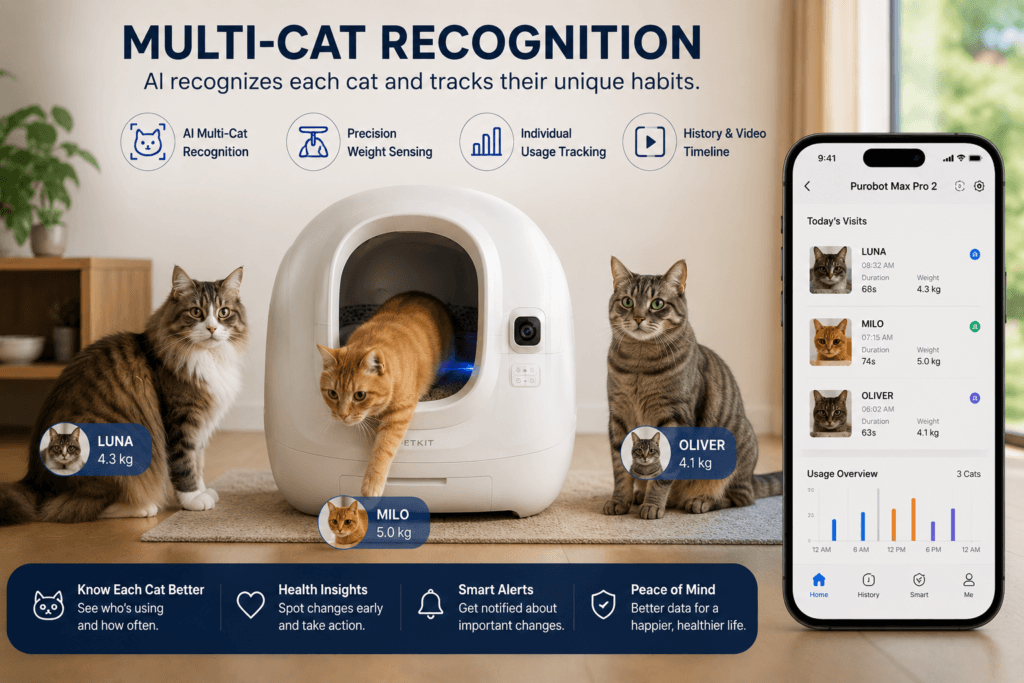
Affiliate Disclaimer: PetTech AI may earn a small commission if you buy through links on this page. We only recommend tech that improves feline comfort, hygiene, and safety.
Bathing a cat used to be chaos: towels everywhere, loud dryers, stressed humans, and a terrified ball of fluff. Smart Cat Bathing 2025 changes the script. With a calm, enclosed dryer, a low-noise grooming station, and clean-air support, you can dry, detangle, and deodorize without turning your home into a fur tornado. In the AirSalon era, safety sensors, 360° airflow, and low-dB motors make the process predictable and kind.
Smart Cat Bathing 2025 isn’t about fancy gadgets just for the sake of tech. It’s about predictable warmth, stable airflow, and less sensory overload. That’s why this guide centers on PETKIT AirSalon Max, Neakasa P2 Pro, and LEVOIT Core P350—a trio that works together and aligns with what veterinarians emphasize: measured heat, low stress, and good air quality.
Why bathing goes wrong—and how smart tech fixes it
Most cats self-groom, but real life intervenes: medicated baths, greasy coats, outdoor grime, or allergens. The Cornell Feline Health Center notes that some long-haired cats benefit from occasional bathing to reduce matting and dandruff, while the AVMA stresses low-stress handling and safe temperatures. The old routine—handheld hair dryer, hot blast, frantic cat—runs counter to both. Smart Cat Bathing 2025 solves the failure points:
Noise: Quieter motors reduce startle responses.
Heat control: Sensors prevent hot spots and overheating.
Airflow: 360° circulation dries evenly instead of blasting one area.
Environment: Purifiers trap dander and odors so the room stays calm.
When you align with Smart Cat Bathing 2025, you’re essentially engineering comfort: safe heat, consistent air, and fewer surprises.
PETKIT AirSalon Max — the calm core of Smart Cat Bathing 2025
Check PETKIT AirSalon Max on the PetKit Store →Shop Now
The AirSalon Max is the centerpiece of Smart Cat Bathing 2025. Instead of chasing your cat with a noisy nozzle, you place them in a transparent, ventilated chamber and let the dryer do the work—quietly, evenly, and with automatic safeguards.
Key capabilities
360° smart airflow for uniform drying—no more damp belly/neck patches.
Sub-~42 dB operation to minimize sound stress.
Touchscreen + app control for temperature, time, and mode.
Negative-ion mode to reduce static and frizz for a soft finish.
Auto-shutoff at ~104°F (40°C) to protect heat-sensitive felines.
Spacious ~60 L chamber suitable for most house cats (up to ~15 lb / 7 kg).
Real-world fit
Short-haired coats often finish in 20–30 minutes.
Dense/long coats may need 30–45+ minutes depending on humidity.
Many cats tolerate the enclosure quickly when introduced in small, positive sessions.
Why it embodies Smart Cat Bathing 2025
Safe, predictable heat aligned with veterinary guidance.
Even airflow means comfort; no frantic repositioning mid-dry.
Quiet profile makes bath day feel like a nap, not a storm.
Pros: calm, hands-off, consistent. Cons: premium price; you’ll want to measure your space.
For Smart Cat Bathing 2025, this is the “anchor” device—what makes the whole routine repeatable.
Neakasa P2 Pro — dry, de-shed, trim, and vacuum in one
Not every session requires a chamber. The Neakasa P2 Pro is a compact grooming station that adds flexibility to Smart Cat Bathing 2025. It dries on low heat, vacuums loose fur as you brush, and handles quick trims without turning the room into a snow globe.
Drying and brushing push dander and odor into the room. The LEVOIT Core P350 cleans the air quietly while your cat decompresses—a simple win for Smart Cat Bathing 2025.
What matters
True HEPA + carbon targets hair, dander, and pet smells.
Sleep Mode 24 dB keeps the room restful.
Covers up to ~219 sq ft, perfect for bathrooms or grooming corners.
Ozone-free filtration—safe for cats and humans.
Why it belongs in Smart Cat Bathing 2025
Reduces lingering humidity odors after the dry cycle.
Keeps particles off surfaces, improving hygiene and comfort.
Low maintenance: replace filters on schedule and forget it.
If your goal with Smart Cat Bathing 2025 is “finish calm, breathe easy,” this is the last puzzle piece.
The 7-step routine (the heart of Smart Cat Bathing 2025)
A good system beats heroic effort. Here’s the predictable flow that makes Smart Cat Bathing 2025 work for real homes.
Acclimate before you bathe. With both devices off, let your cat sniff the AirSalon and P2 Pro daily; pair with lickable treats.
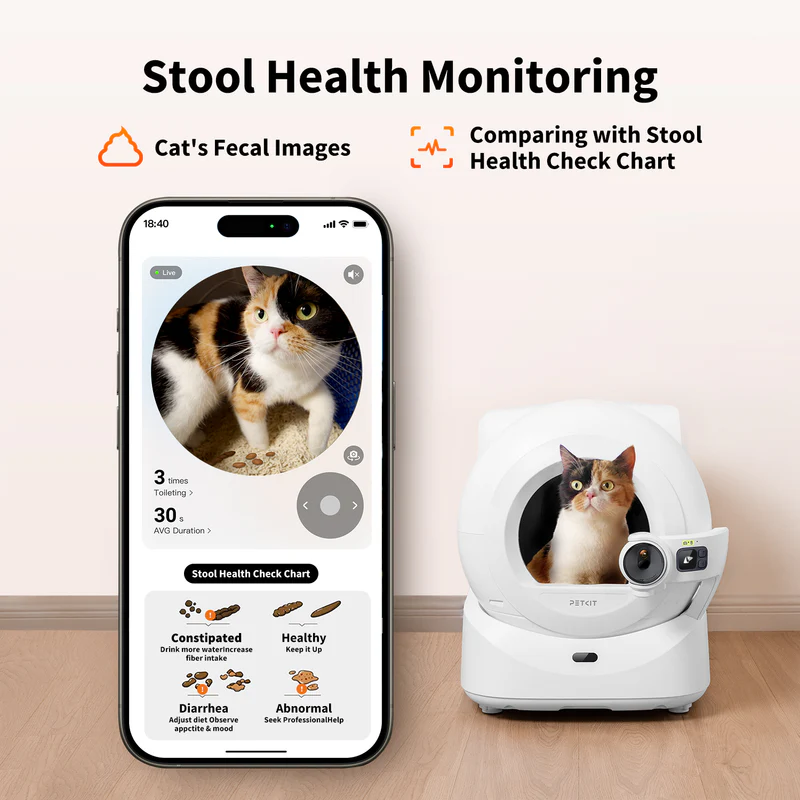
Pre-warm the room (≈72°F / 22°C). A neutral, cozy environment reduces shivering and panic.
Towel-press, don’t rub. Press along coat direction to wick water without creating static.
AirSalon first pass. Start low for 5–10 minutes; gradually increase airflow/heat. Smart Cat Bathing 2025 favors comfort over speed.
Neakasa finish. Use the de-shedder and nozzle to release trapped dampness in the undercoat; vacuum as you go.
Purify the air for 15–30 minutes with LEVOIT. You’ll notice less smell and fewer sneezy particles.
Reward and release. Soft voice, treat, short play—end on a high note so Smart Cat Bathing 2025 feels safe next time.
Repeat this blueprint and your cat learns the order, the sounds, and the timeline—predictability is soothing.
Troubleshooting—quick wins that keep momentum
Still damp belly or chest? Add 5–8 minutes mid-cycle or angle airflow lower. In Smart Cat Bathing 2025, a small extension beats cranking heat.
Static/frizz after drying? Run the AirSalon ion mode, or wipe with a slightly damp microfiber cloth.
Noise sensitivity? Start with 60–90-second empty runs + treats for a week before full sessions.
Humidity stalls drying. Run LEVOIT during the AirSalon cycle; if your climate is humid, a small dehumidifier speeds everything up.
Zoomies post-bath. That’s adrenaline; a 3–5-minute play burst with a wand toy helps discharge energy in a controlled way.
The spirit of Smart Cat Bathing 2025 is “tune, don’t force.” Small tweaks beat big confrontations.
Health & safety—non-negotiables
The AVMA notes a typical feline core temp around 101°F (38.3°C). Smart Cat Bathing 2025 is built around staying below ~104°F (40°C).
If your cat pants, open the door and stop—panting is heat stress.
Never use a human hair dryer; they’re too hot and too loud.
Wipe AirSalon filters weekly; empty and clean the Neakasa canister.
For medicated shampoos or skin conditions, ask your vet; some cats should bathe less or use specific products.
This is where Smart Cat Bathing 2025 earns trust: measured heat, clear signals, and a bias toward safety.
Travel & seasonal angles (bonus value)
Smart Cat Bathing 2025 isn’t just for bath day.
Post-rain cleanup: quick Neakasa passes on paws and pants before jumping into the car.
Allergy mitigation: pair AirSalon + LEVOIT during pollen spikes to keep indoor air comfortable.
The system extends beyond bathing; it’s a year-round hygiene scaffold.
FAQs — rapid answers within Smart Cat Bathing 2025
Do most cats really need baths? Not routinely, but grease, allergens, or medical treatments make occasional baths helpful. Smart Cat Bathing 2025 focuses on ending the process gently.
Dryer box or grooming station first? Do a short AirSalon cycle first to set calm and remove bulk moisture, then Neakasa to tidy undercoat and finish.
How long should a full process take? Short hair: 20–30 minutes total. Long hair/dense coat: 30–45+ minutes. Smart Cat Bathing 2025 values comfort over speed.
What about deodorizing sprays? Sprays mask; LEVOIT removes particles and odors from the air. For Smart Cat Bathing 2025, filtration is the cleaner solution.