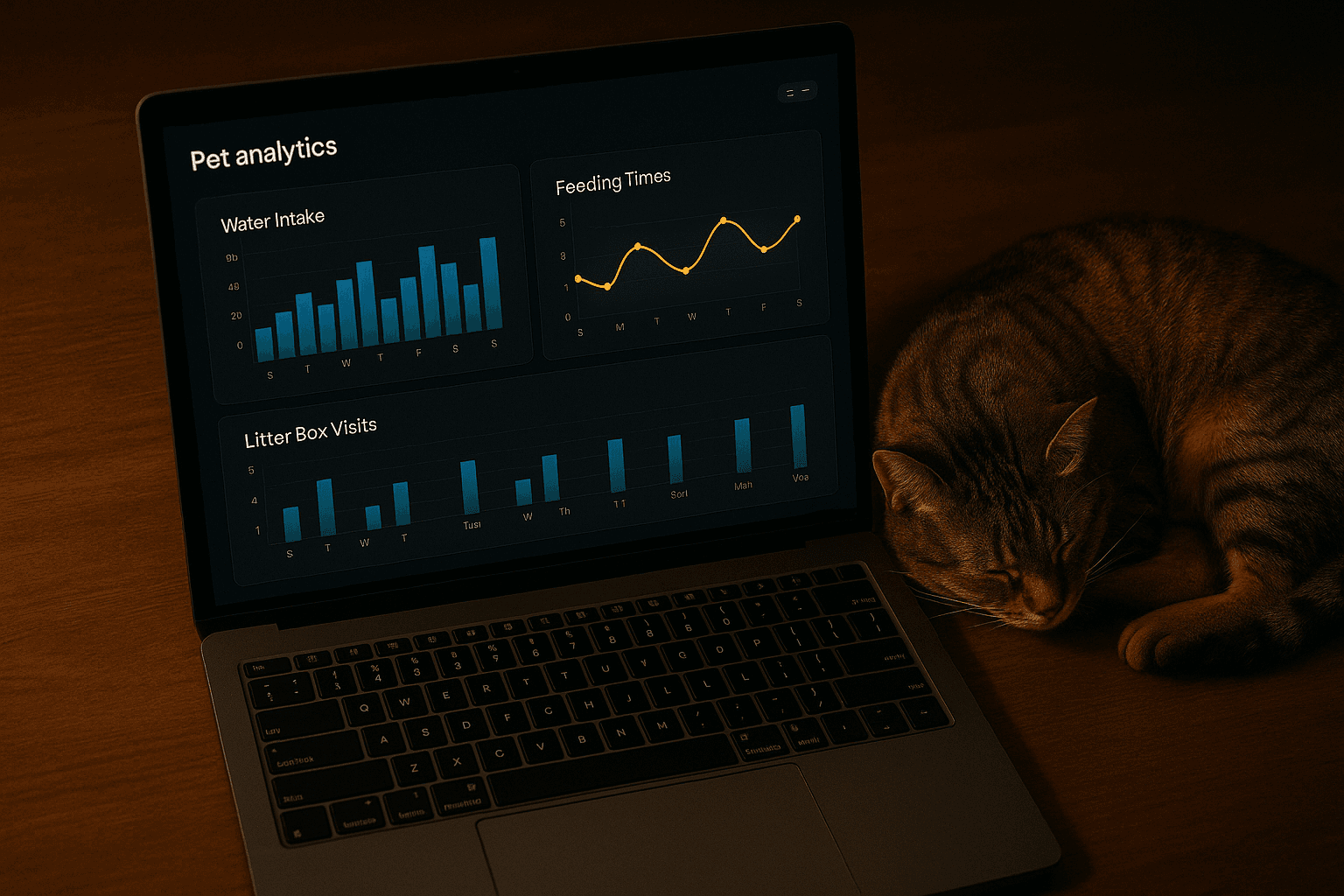
Category: Smart Living

Discover how smart technology is transforming everyday life for cats. From connected feeders to AI-powered health monitors, our Smart Living guides show how to build a safer, happier, and more efficient home for your feline companion.

  • Smart Cat Fountain Integration 2025: What Really Works With Feeders and Litter Boxes?

    Smart Cat Fountain Integration 2025: What Really Works With Feeders and Litter Boxes?

    Smart pet brands love to sell the fantasy: one app, one dashboard, one “health report” that combines your cat’s drinking, eating, and litter box data into a neat little score. In practice, smart cat fountain integration 2025 is rare, ecosystem-locked, and much less advanced than the marketing suggests.

    The idea is powerful, though. Hydration, food intake, and litter box habits are three of the most important behavioral signals for kidney disease, urinary issues, and general wellness. Cornell Feline Health Center notes that cats should consume roughly 4 ounces of water per 5 pounds of body weight per day, and that many drink more from flowing water sources, especially when they eat dry food. vet.cornell.edu In cats with chronic kidney disease, maintaining good hydration is explicitly called out as critical to slowing progression and avoiding crises. vet.cornell.edu

    So yes, integrating a smart fountain, smart feeder, and smart litter box into a single system makes sense. The key question is: who actually does it in 2025, and how well?

    This article answers that directly: which products support real smart cat fountain integration 2025, what “health reports” really are, and where the tech still falls short.


    What “Integration” Really Means in 2025 (Strict Definition)

    Brands throw around words like ecosystem, platform, and connected, but for this guide, smart cat fountain integration 2025 means all three of these are true:

    1. One app controls the fountain, feeder, and litter box
    2. The app shows combined behavioral data – drinking, eating, and litter use on the same timeline
    3. The system offers some kind of trend-based “health insight” or report, even if it’s basic

    Anything less (for example, “works with Alexa” or “supports Bluetooth”) is not real integration. With that definition, only three consumer brands matter in 2025:

    • CATLINK – full tri-device ecosystem + “health report”
    • PETKIT – strong ecosystem, behavior insights, but softer on fountain-specific “health reports”
    • Sure Petcare – solid feeding + hydration integration, no smart litter box

    There is no official cross-brand integration. If you want smart cat fountain integration 2025 today, you choose one ecosystem and live inside it.


    Why Combining Water, Food, and Litter Data Matters

    This is not about gadgets for the sake of it. It’s about catching subtle changes early.

    Vets and feline health centers repeatedly emphasize:

    • Hydration: Cats with kidney disease are prone to dehydration; encouraging water intake and monitoring changes over time is a core part of management. vet.cornell.edu
    • Feeding patterns: Therapeutic diets for CKD and obesity rely on controlled intake; feeding logs help ensure cats actually eat what they’re prescribed. Heartland Veterinary Hospital
    • Litter box behavior: Increasing or decreasing urine output, straining, or avoiding the box can all point to urinary or kidney problems.

    A good smart cat fountain integration 2025 setup can’t diagnose illness, but it can:

    • Flag that your cat is drinking less than usual
    • Show that they’re eating less or more often
    • Reveal changes in litter visits and weight trends at the box

    Used properly, this data gives you and your vet a much clearer picture of what’s going on between annual checkups.


    Brand 1: CATLINK – The Only True Tri-Device Health Ecosystem

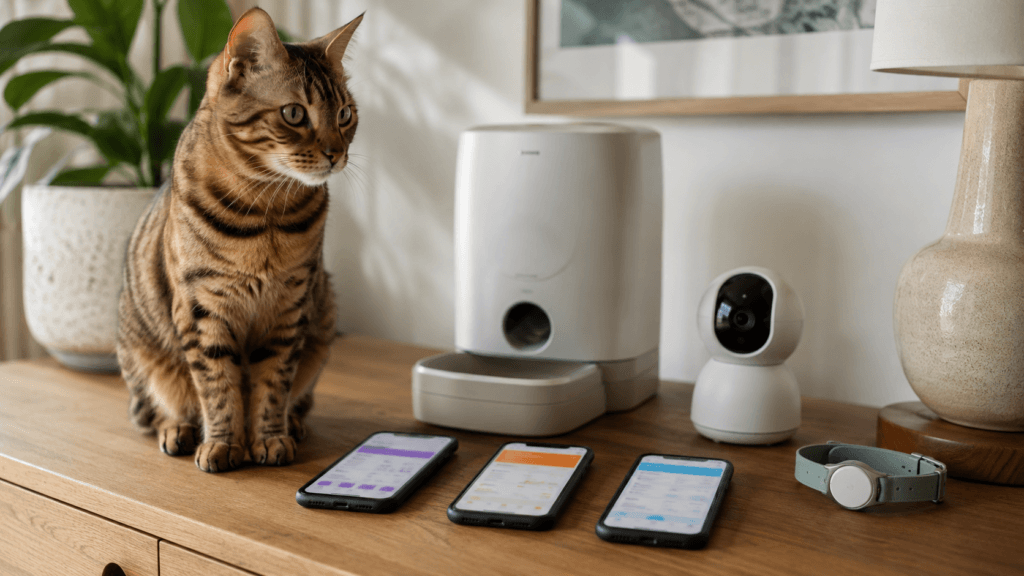
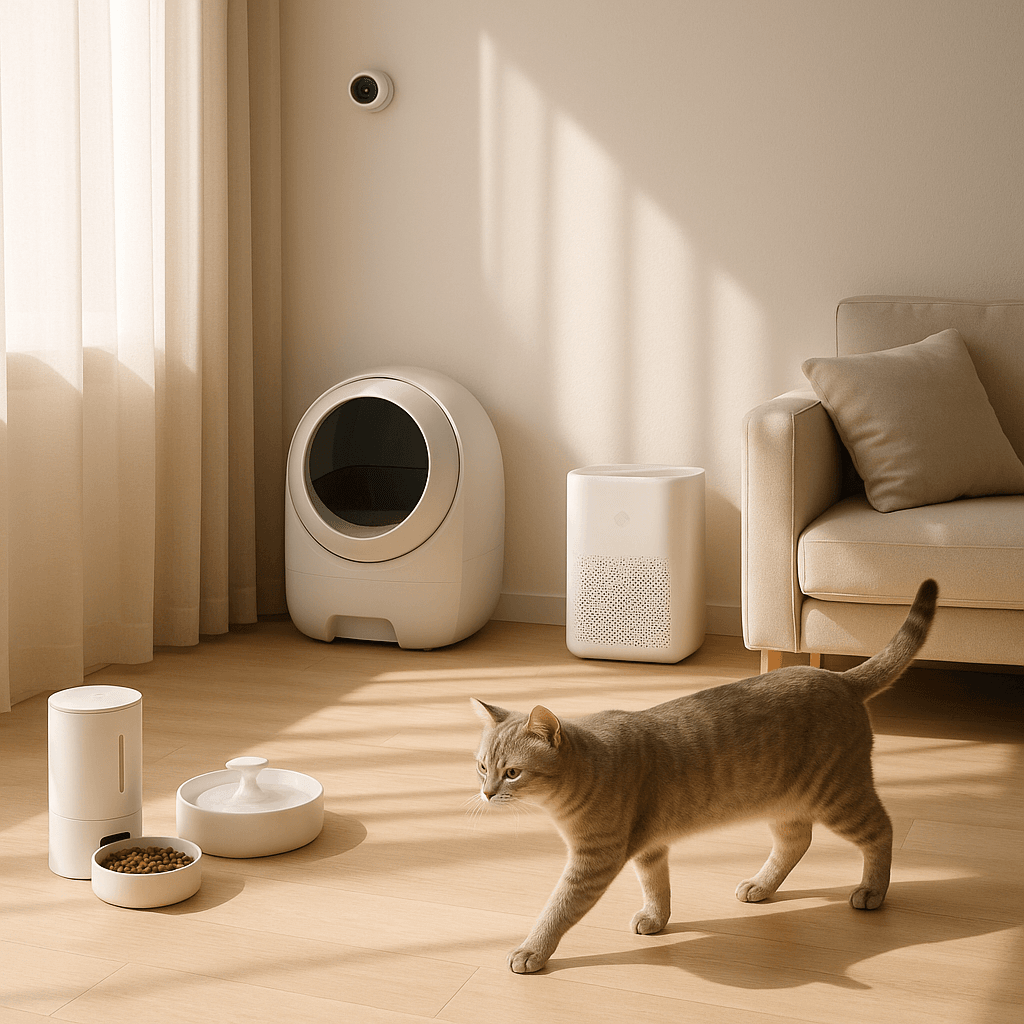
    Cat drinking from smart fountain next to integrated feeder and litter box in a CATLINK-style ecosystem

    If you’re looking for the closest thing to full smart cat fountain integration 2025, CATLINK is the current benchmark.

    What the CATLINK EcoSystem Actually Does

    CATLINK’s EcoSystem bundles combine:

    All three connect to the CATLINK App, which explicitly states that you can monitor your cat’s toilet, eating, and drinking habits from one place. CATLINK

    On top of that, specific fountains such as the CATLINK W03 Wireless Cat Water Fountain are marketed with:

    • App control over modes and status
    • A 5000 mAh battery and 2300 ml capacity
    • A built-in “Health Report” feature that analyzes drinking patterns

    The litter boxes use weight sensors and pattern recognition to track usage per cat and support early detection of changes.

    What “Health Report” Means in Real Life

    In practice, CATLINK’s health report is:

    • A behavioral analytics layer, not labwork
    • Trend-based (more or less drinking, more or fewer bathroom visits, time spent)
    • Designed to highlight outliers so you can act earlier

    It doesn’t tell you creatinine, SDMA, or urine specific gravity – but it does show that over the past week your CKD cat drank 30% less and is visiting the box less often, which is exactly the kind of red flag vets want you to notice sooner rather than later.

    Pros and Cons of CATLINK Integration

    Pros

    • True tri-device smart cat fountain integration 2025 – feeder, fountain, litter box in one app
    • Behavior-focused health reports based on combined data
    • Multi-cat support via weight and behavior profiling
    • EcoSystem bundles simplify “go all-in” purchases

    Cons

    • Full ecosystem is expensive up front
    • Locked into CATLINK’s hardware and app
    • Health reports still require vet interpretation to be meaningful

    Best suited for:
    Multi-cat households, guardians managing urinary or kidney issues, and people who genuinely use data and are willing to share charts with their vet.


    Brand 2: PETKIT – Mature Ecosystem, Cleaner App, Softer Analytics
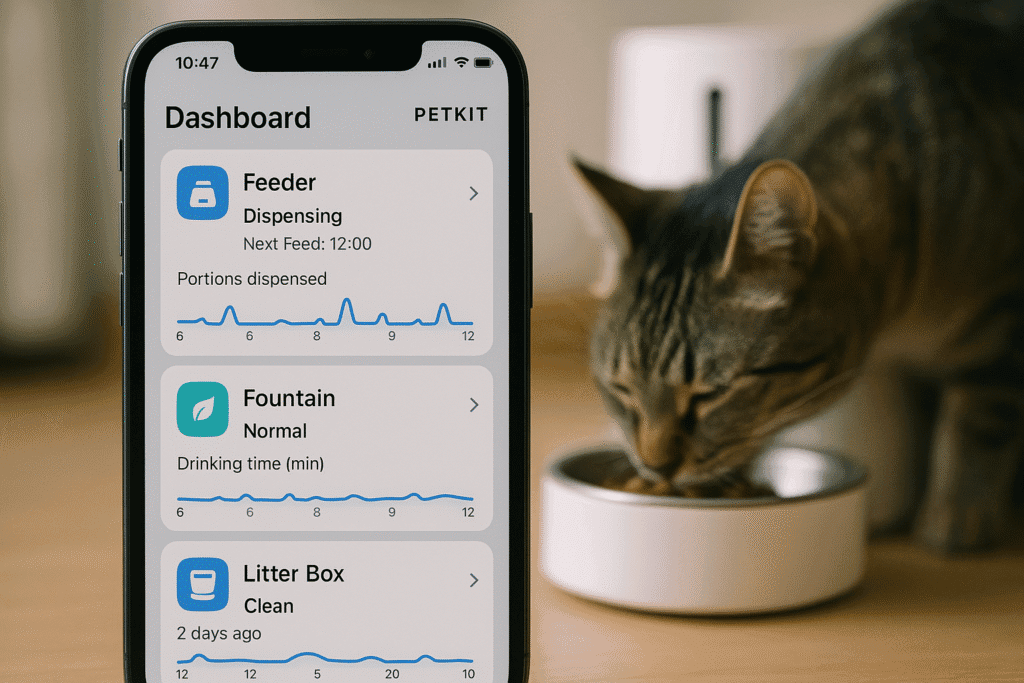
    PETKIT app dashboard controlling a connected cat feeder, fountain, and litter box

    PETKIT is often the first name people encounter when they think of smart feeders and fountains. It also offers an ecosystem that is closer than most to smart cat fountain integration 2025, even if it doesn’t brand the fountain as a “health report” device.

    PETKIT App and Device Integration

    PETKIT’s own materials describe its app as an “all-in-one management” tool that lets you manage all PETKIT devices in a single place and “stay connected to what matters most to your pets.” A 2024 blog post about the PUROBOT litter box series makes it explicit: through the PETKIT App, users can manage feeders, water fountains, and litter boxes in one platform.

    In other words:

    …all sit inside the same app, with unified status, alerts, and history.

    What You Actually Get

    PETKIT focuses on:

    • Device control and automation – feeding schedules, fountain modes, litter cleaning cycles
    • Activity logs – when the litter box cycles, when feeding happens, when the fountain is low
    • AI features in the litter box – weight tracking and usage patterns per cat in some models

    You effectively get a full-stack smart cat fountain integration 2025 experience, but the “health insight” layer is more subtle and less marketed as a fountain health report than CATLINK.

    Pros and Cons of PETKIT Integration

    Pros

    • Polished app with millions of users and proven device support
    • Strong hardware lineup across all three categories (feeders, fountains, litter boxes)
    • Real-world feedback confirms that the system reliably tracks litter box events and distinguishes cats by weight in multi-cat homes

    Cons

    • No explicit “health report” feature on fountains
    • Data is there, but you have to interpret it more manually
    • Same brand lock-in problem as CATLINK

    Best suited for:
    Guardians who want reliable, integrated smart hardware with a cleaner UX, and who don’t need a big “health score” label to look at trends.


    Brand 3: Sure Petcare – Strong Feeding + Hydration, No Litter Box
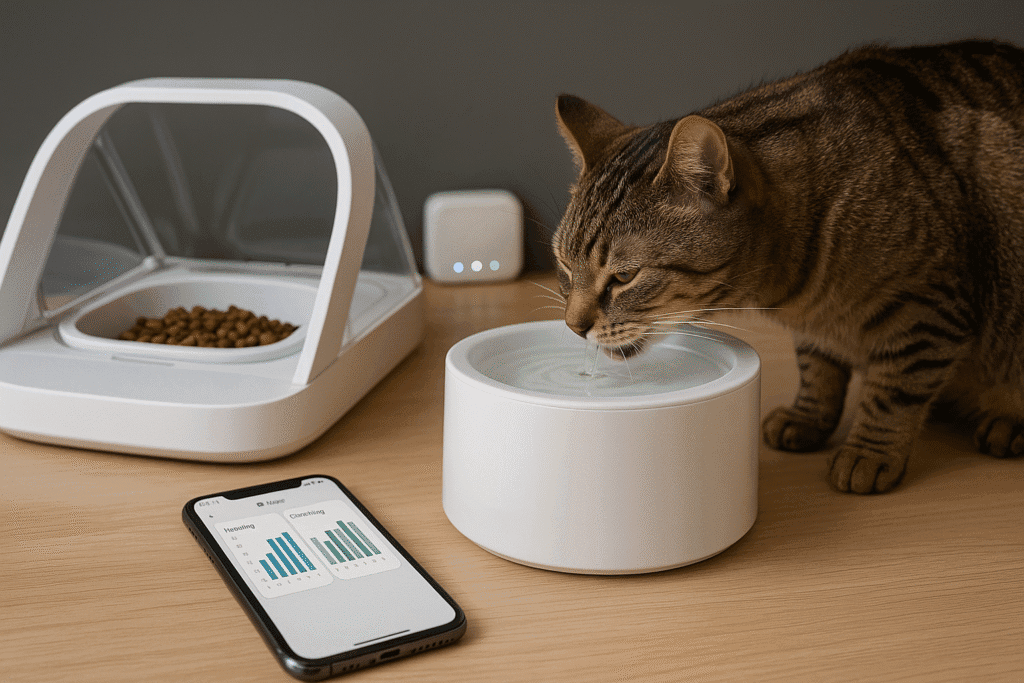
    Sure Petcare microchip feeder and smart fountain connected through a hub for feeding and hydration tracking

    Sure Petcare approaches smart cat fountain integration 2025 from the access-control angle rather than the self-cleaning litter angle.

    How Sure Petcare Connect Works

    The Sure Petcare Hub plugs into your router and connects up to 10 “Connect” devices – including the Felaqua Connect smart fountain and the SureFeed Microchip Pet Feeder Connect – to the Sure Petcare App.

    • Felaqua Connect is a smart drinking solution that logs how often and how much your cat drinks, designed specifically to support hydration monitoring. App Store
    • SureFeed Microchip Feeder Connect uses microchip or tag ID to ensure the right cat gets the right food and builds a detailed record of feeding habits.

    The app then lets you review individual cats’ eating and drinking patterns over time.

    The Limitation: No Smart Litter Box

    Sure Petcare does not currently offer a self-cleaning smart litter box that joins this ecosystem. So you get:

    • Feeding + drinking integration / Check current deal on Amazon
    • Per-cat data via microchip ID
    • Hydration trends that are very relevant for kidney risk

    …but you do not get the full triad of smart cat fountain integration 2025 with litter behavior included.

    Best suited for:
    Households with strict prescription diets, food guarding, or medical hydration concerns where per-cat intake really matters – but that are willing to keep litter box tracking manual for now.


    Cross-Brand Smart Cat Fountain Integration 2025: Does It Exist?

    Short answer: no.

    • CATLINK, PETKIT, and Sure Petcare each run their own cloud, protocols, and apps
    • None provide official APIs designed to merge their data into a competitor’s app
    • There is no vendor-neutral “pet health data hub” for consumer use today

    Tech-savvy users sometimes integrate devices into Home Assistant or other smart home platforms, creating dashboards that show feeding, drinking, and litter events together. But:

    • These setups are unofficial and fragile
    • They require technical skills and time
    • They do not generate medically meaningful health reports by themselves

    For 99% of people genuinely interested in smart cat fountain integration 2025, the realistic path is:

    pick an ecosystem → lean into it → use the data with your vet.


    Who Actually Needs Smart Cat Fountain Integration 2025?

    Not everyone needs to wire their cat’s life into an app. But some situations benefit a lot:

    1. Cats with Kidney Disease or High Renal Risk

    Hydration is central to kidney management; multiple veterinary sources stress that dehydrated CKD cats worsen faster and suffer more.
    A system that shows drinking trends + litter output on the same screen is not a gimmick at that point – it’s a monitoring tool.

    2. Multi-Cat Households with Diet Conflicts

    If one cat needs a prescription diet and the other doesn’t, or one tends to steal food, per-cat feeder and fountain logs help prevent cheating. Sure Petcare shines here; CATLINK and PETKIT also support multi-cat tracking, especially around the litter box.

    3. Guardians Who Travel or Work Long Hours

    When you’re not home to watch behavior directly, a tightly integrated ecosystem lets you:

    • Confirm that water, food, and litter are all in normal usage ranges
    • Catch drops in eating or drinking before your cat crashes
    • Decide whether a pet sitter needs to check in sooner than planned

    4. Data-Driven People Working With a Vet

    If your vet is open to reviewing trend graphs from your apps, smart cat fountain integration 2025 gives them more signal than “he seems thirstier lately.” That doesn’t replace lab work, but it can influence when to run it.


    How to Choose the Right Ecosystem: A Brutal Checklist

    Before you let any marketing copy convince you that a product “integrates,” run through this:

    1. Can one app control fountain, feeder, and litter box?
      • If the answer isn’t a clear “yes,” it’s not real smart cat fountain integration 2025.
    2. Does the system log drinking, feeding, and litter use with time stamps?
      • If it can’t show you a timeline, integration is superficial.
    3. Is there any kind of health insight or report?
      • CATLINK explicitly offers “Health Report” on certain fountains and health-monitoring for litter boxes.
    4. Do you realistically see yourself checking the data?
      • If not, you’re paying for complexity instead of utility.
    5. Is your vet willing to work with this data?
      • A data dump with no interpretation is just noise.

    Verdict: What Works Today, and What’s Still Hype

    If we strip out the fluff and look only at reality:

    • CATLINK is the only ecosystem that currently delivers full smart cat fountain integration 2025 across fountain, feeder, and litter box, with a named “health report” built into the fountain and health-monitoring behavior analytics in the litter box.
    • PETKIT offers one of the most stable and polished ecosystems, with feeders, fountains, and litter boxes all controlled through a single app and AI-assisted monitoring on the litter side, but without an explicit “health report” label for the fountain.
    • Sure Petcare tightly integrates feeding and hydration monitoring (Felaqua Connect + SureFeed Microchip Feeder Connect via Hub), but you’ll need a separate solution for litter behavior.
    • No brand currently offers a cross-vendor health dashboard that merges data from multiple ecosystems.

    For many cats, a single good fountain plus regular vet care is enough. For seniors, CKD patients, multi-cat diet battles, and anxious guardians who will actually use the data, a well-chosen smart cat fountain integration 2025 system can be a rational, evidence-aligned upgrade — as long as you remember it’s a monitoring tool, not a diagnosis engine.


    FAQ

    1. Do any smart cat fountains integrate with third-party feeders and litter boxes?
    No. All current smart cat fountain integration 2025 options are brand-exclusive. CATLINK, PETKIT, and Sure Petcare only integrate with their own hardware.

    2. Are “health reports” from fountains accurate?
    They are behaviorally accurate (when and how often your cat drinks) but medically incomplete. Use them to spot trends and bring those trends to your vet, not to self-diagnose.

    3. Is it overkill to buy a full ecosystem for a healthy young cat?
    Often, yes. You may be better off starting with a single high-quality fountain and solid litter hygiene, then adding more devices only if you have a specific health or behavioral goal.

    4. Does integration reduce vet visits?
    It shouldn’t. The best use of smart cat fountain integration 2025 is to prompt earlier visits, not fewer. Hydration and litter changes are reasons to see a vet, not reasons to delay it.

    5. If I start with one device now, which brand gives me the safest upgrade path later?
    If you want a full tri-device ecosystem with health reports, start with a CATLINK fountain or litter box. If you care more about UX and app maturity, PETKIT is a strong starting point. For per-cat feeding and drinking, Sure Petcare is hard to beat.


    Internal Link (PetTech AI)


    Outbound Authoritative Links

    • Cornell Feline Health Center – Hydration and Chronic Kidney Disease pages, for medical context on why water intake matters. vet.cornell.edu
    • A veterinary resource on managing feline CKD that emphasizes hydration and environmental support. Lewiston Veterinary Clinic

    Disclaimer

    This article is for educational purposes only and is not a substitute for professional veterinary diagnosis or treatment. Always consult your veterinarian if you notice changes in your cat’s drinking, eating, or litter box habits, or before making health decisions based on data from connected devices. Smart feeders, fountains, and litter boxes can help you track trends but do not replace exams, bloodwork, or imaging. PetTech AI participates in affiliate programs such as Amazon Associates and CJ. We may earn a commission if you purchase products through links on our site, at no extra cost to you.

  • Smart Cat Ecosystems 2025: How Connected Feeders, Fountains & Litter Boxes Really Work

    Smart Cat Ecosystems 2025: How Connected Feeders, Fountains & Litter Boxes Really Work

    Indoor cat care in 2025 is starting to look a lot like building a tiny “smart home” just for your cat. Brands now push complete smart cat ecosystems 2025: a feeder, fountain, and litter box that all talk to the same app and generate health reports on eating, drinking, and toilet habits.

    The problem: marketing promises a kind of feline Apple ecosystem. Real life is messier. This guide strips out the hype and looks at what these systems actually do today, where PETKIT and CATLINK are ahead, how cameras like Furbo and Petcube fit in, and when a smart cat ecosystem 2025 makes clinical sense versus being just expensive gadgetry.


    What Is a “Smart Cat Ecosystem 2025” in Practice?

    For this article, a smart cat ecosystem 2025 is not just “owning three gadgets.” It has three key components:

    1. Smart feeder – portion-controlled, app-managed, scheduled feeding.
    2. Smart water fountain – filtered, often battery-backed, with app monitoring of water level and filter status.
    3. Smart litter box – self-cleaning with weight sensors, usage logs, and sometimes health insights.

    The ecosystem part comes from one unified app that:

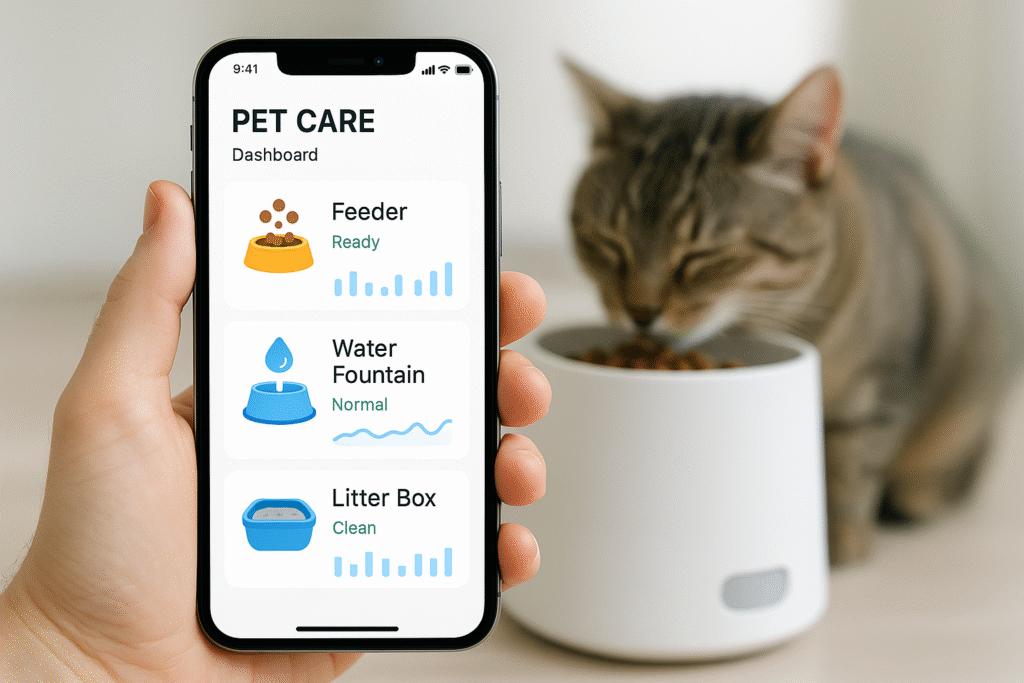
    • Controls all devices from a single dashboard
    • Logs intake (food/water) and output (litter box visits, weight)
    • Sends alerts if something changes (e.g., fewer litter visits, less drinking)

    PETKIT explicitly markets this idea: its app is designed to manage all Petkit devices in one place and “link everything for pet’s life.” Similarly, CATLINK sells complete “EcoSystem” bundles – litter box, feeder, and fountain – designed to work together through the CATLINK app.


    Do Cats Actually Benefit From Smart Ecosystems? (What the Science Says)

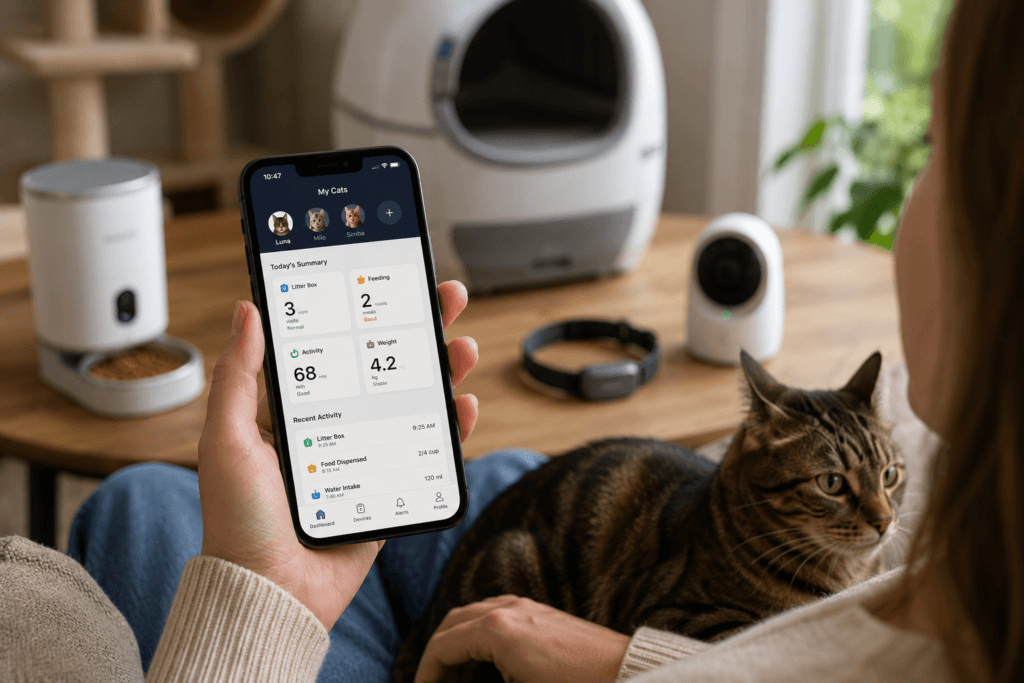
    Smartphone app dashboard showing connected cat feeder, fountain, and litter box data

    The tech exists; the question is whether a smart cat ecosystem 2025 solves real feline problems. Veterinary and behavior research gives you the baseline:

    • Environmental enrichment is critical for indoor cats. Cornell notes that toys and interactive environments reduce obesity, destructive scratching, and inappropriate elimination by allowing natural behaviors like stalking and problem-solving. vet.cornell.edu
    • Consistent feeding routines and portion control help prevent weight gain and obesity-linked disease. Veterinary guidelines emphasize small, predictable meals for many cats rather than free-feeding large amounts.
    • Adequate hydration is a core pillar of urinary and kidney health; fountains with flowing water can increase drinking for some cats, which is why multiple veterinary sources recommend them as part of environmental enhancement. Dr. Judy Morgan’s Naturally Healthy Pets

    A smart cat ecosystem 2025 doesn’t magically make your cat healthier, but it does give you tools to:

    • Keep feeding schedules and portions consistent
    • Encourage more drinking with flowing water
    • Track litter box usage and weight trends

    In other words: it’s not medicine, but it can support earlier detection of problems and reduce some day-to-day risks if you actually look at the data.


    Ecosystem #1 – PETKIT: App-First Feeders, Fountains & Litter Boxes

    PETKIT is one of the few brands already fairly close to a real smart cat ecosystem 2025.

    How PETKIT’s Ecosystem Works

    • PETKIT App – one app manages feeders, fountains, and litter products, with remote control and status monitoring. App Store
    • Smart feeders (e.g., Fresh Element series) – app-scheduled meals, portion control, and remote dispensing. User reviews highlight the ability to set complex feeding plans and trigger extra meals when away. PetKit Store / Amazon
    • Eversweet fountains – monitor filter status, water level, and switch between smart and normal modes via the app. PetKit Store / Amazon
    • Auto litter boxes (Pura series) – self-cleaning units that sync with the app for usage and maintenance alerts (details vary by model, but the pattern is consistent across PETKIT’s litter products). PetKit Store / Amazon

    Together, you get a smart cat ecosystem 2025 that can log how much your cat eats, how often they drink, and how frequently they use the box.

    PETKIT Ecosystem – Pros

    • Single app for feeder, fountain, and litter box (less app clutter).
    • Feeders support fine-grained portion control and scheduled meals, useful for overweight or insulin-timed cats.
    • Fountains offer smart vs normal modes and remote monitoring of water level and filter changes.
    • Ecosystem logic: food, water, and litter behavior all live within the same app view.

    PETKIT Ecosystem – Cons

    • Real “health insight” is limited – you still have to interpret data and bring it to your vet.
    • Setup is more complex than buying a single plug-and-play device.
    • You’re effectively committing to one brand’s ecosystem (lock-in), which matters if you later prefer another feeder or fountain.

    For many readers of PetTech AI, PETKIT is currently one of the most realistic ways to build a smart cat ecosystem 2025 with a coherent app experience.


    Ecosystem #2 – CATLINK EcoSystem: Input/Output Monitoring in One App

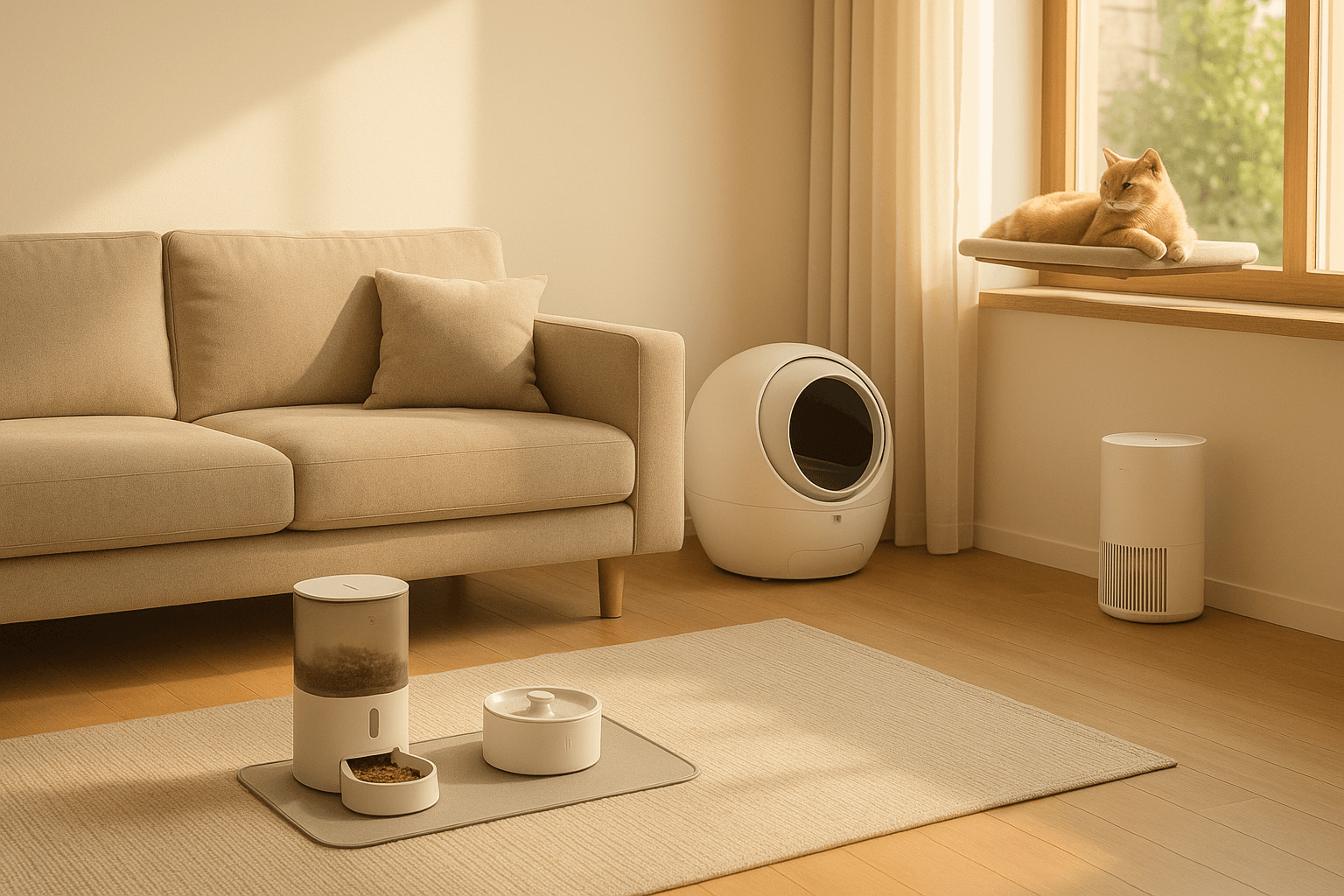
    Smart litter box, feeder, and fountain with overlay showing toilet, feeding, and drinking stats

    CATLINK pushes the ecosystem idea even more explicitly. Their EcoSystem bundles combine a self-cleaning litter box, automatic feeder, and AI water fountain, all linked to the CATLINK app.

    Key Components

    • Self-cleaning litter boxes (Scooper series) – app control, automatic/manual cleaning, litter usage tracking, waste level monitoring, and health insights based on toilet behavior.
    • Automatic feeders – app-controlled, portioned, and scheduled feeding; some models offer multi-cat recognition.
    • AI water fountains – wired or wireless models with app control and monitoring.
    • EcoSystem sets – bundled kits (e.g., EcoSystem Pro or SE) specifically marketed as “connect scooper, feeder, and water fountain to the CATLINK app to monitor toilet, eating, and drinking habits.”

    This is a textbook smart cat ecosystems 2025 pitch: one vendor, three devices, one app, and health monitoring over time.

    CATLINK EcoSystem – Pros

    • App explicitly focuses on health monitoring and insights for cat toilet behavior and overall activity.
    • EcoSystem bundles make it straightforward for someone who wants everything from one brand.
    • Multi-cat features (feeder facial recognition, multi-cat-friendly designs) are built with modern multi-cat households in mind.

    CATLINK EcoSystem – Cons

    • Even more ecosystem lock-in than PETKIT; the whole selling point is staying inside CATLINK.
    • Health metrics are still early-stage analytics; no device can replace a vet exam or lab work.
    • Initial cost of a full CATLINK smart cat ecosystem 2025 bundle is high, especially if you don’t need all three components immediately.

    If you want maximum automation and you’re comfortable with a single-brand setup, CATLINK is one of the clearest implementations of a smart cat ecosystem 2025 currently available.


    Adding Vision: Furbo, Petcube & the “Overwatch” Layer

    Smart litter box, feeder, and fountain with overlay showing toilet, feeding, and drinking stats

    Feeders, fountains, and litter boxes tell you what your cat does with food, water, and waste. Cameras add behavioral context.

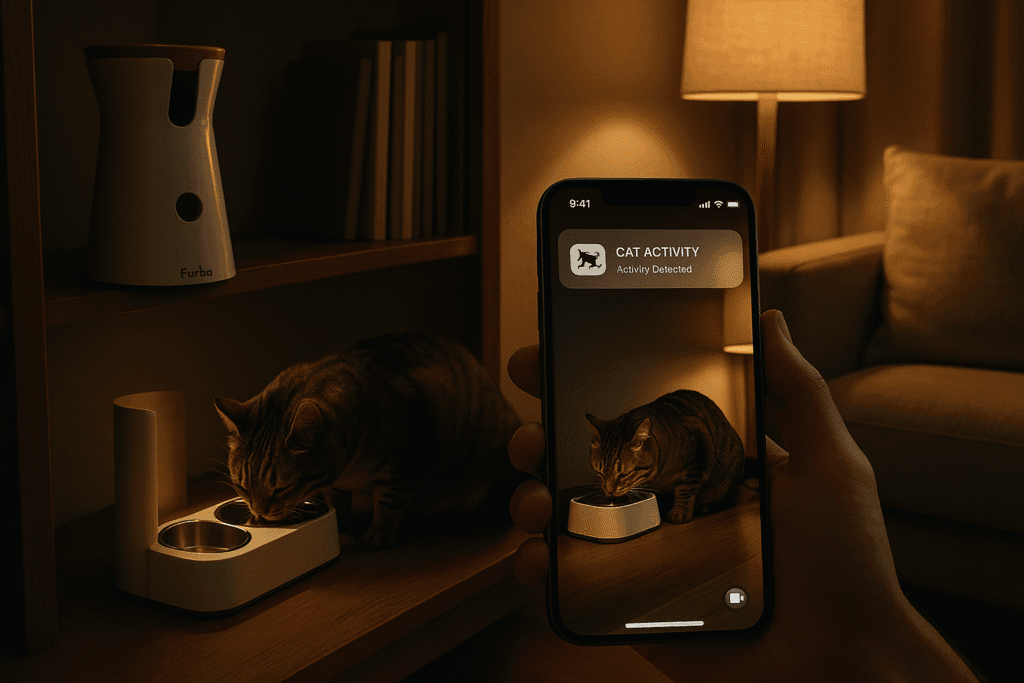
    • Furbo 360° Cat Camera – offers a rotating 360° view, treat tossing, two-way audio, and AI-based smart alerts for meowing, vomiting, or “out of the ordinary” behavior.
    • Furbo Smart Alerts can notify you when your pet is active, when someone is detected, and when the camera captures notable moments. help.furbo.com
    • Petcube cameras integrate with Alexa for hands-free voice control and were early to link pet camera features with smart home platforms. Petcube web-site

    These devices don’t technically make a smart cat ecosystem 2025 on their own, but they give you:

    • Visual confirmation when your litter box data spikes
    • The ability to check if “vomit alert” correlates with actual GI issues
    • Extra enrichment (treat tossing, interactive play) when paired with smart feeders and toys

    For PetTech AI readers, a realistic stack is: PETKIT or CATLINK ecosystem + Furbo or Petcube camera → genuine multi-layer monitoring of your cat’s environment and behavior.


    When a Smart Cat Ecosystem 2025 Makes Sense

    A full smart cat ecosystem 2025 is justified in a few clear scenarios:

    1. Cats with medical risks
      • History of urinary issues, early kidney disease, or obesity
      • You and your vet need accurate logs of food, water, and litter data over time
    2. Multi-cat households
      • Automatic cleaning and usage tracking reduce conflict and guesswork, especially with multi-cat feeders and smart litter boxes.
    3. Owners who travel or work long hours
      • Automatic backup feeding + fountains + litter cycling + camera alerts meaningfully reduce risk when you’re not home.
    4. Data-driven owners working closely with a vet
      • If your vet is willing to look at app logs and correlate them with clinical signs, these ecosystems can contribute to earlier diagnosis.

    In those contexts, investing in a smart cat ecosystem 2025 is not just a toy: it’s a monitoring and management tool.


    When It’s Overkill (or Even Counterproductive)

    There are also cases where you probably don’t need a fully integrated smart cat ecosystem 2025:

    • Healthy, low-risk young cats in small apartments, with owners who are home a lot and already feeding measured meals.
    • Anxious guardians who will obsessively check apps and alerts, potentially increasing their own stress without clear clinical benefit.
    • Situations where household Wi-Fi is unstable or power cuts are frequent; any smart setup must have safe fail-safes.

    The real risk isn’t “too much tech” for your cat; it’s too much tech instead of veterinary care. No ecosystem can replace exams, diagnostics, or treatment.


    How to Build a Smarter Setup Without Going All-In

    You don’t have to buy a bundled smart cat ecosystem 2025 on day one. A more rational approach:

    1. Start with priority #1 – litter or hydration
      • If urinary health is a concern, prioritize a reliable self-cleaning litter box with basic data logging.
      • If your cat drinks poorly, start with a good smart fountain.
    2. Add a smart feeder when you’re ready
      • Choose one with precise portioning, app control, and a reputable brand (PETKIT fits here for most readers).
    3. Layer in a camera
      • A Furbo 360 or Petcube gives context and lets you verify what the devices report.
    4. Keep it brand-agnostic at first
      • You can still get 80% of the benefit of a smart cat ecosystem 2025 by mixing brands, then consolidating later if a single app becomes more important to you.

    This staged approach keeps costs under control while you learn which parts of the ecosystem you actually use.


    Buying Checklist for Any Smart Cat Ecosystem 2025

    Before committing to PETKIT, CATLINK, or a mixed stack, run through this list:

    • App quality & stability – look at recent app store reviews, not just product pages.
    • Fail-safes – dual power (mains + battery), safe behavior on Wi-Fi outages, and manual override for feeding and litter cleaning.
    • Data you actually use – will you look at drinking trends, litter visits, or weight logs, or will they just sit in the app?
    • Noise & footprint – some cats hate loud motors; automatic units also take more space than manual ones.
    • Support & firmware updates – you’re buying an IoT system, not just hardware. Brand support matters.

    If a device fails any of these for your home, it doesn’t matter how nicely it fits into a smart cat ecosystems 2025 marketing diagram.


    Verdict: Is a Smart Cat Ecosystem 2025 Worth It?

    A smart cat ecosystem 2025 can be a serious upgrade if:

    • You want structured data on your cat’s intake and output
    • You’re ready to coordinate that data with your vet
    • You value automation and are comfortable with app-driven devices

    PETKIT is currently one of the cleanest “light ecosystem” choices, with a mature app and feeders/fountains that already work well together. CATLINK goes further with its EcoSystem bundles and health-monitoring focus, especially for multi-cat households that want a single-brand stack.

    If you’re expecting full “Apple-style” plug-and-play medicine for your cat, you’ll be disappointed. But if you treat a smart cat ecosystem 2025 as an early-warning and convenience system wrapped around proper veterinary care, it can be one of the most rational investments you make in your indoor cat’s long-term health.


    FAQ: Smart Cat Ecosystems 2025

    1. Do these ecosystems really integrate, or just share one app?

    Today, most smart cat ecosystems 2025 are more “shared app” than deep cross-device automation. PETKIT and CATLINK let you view and control multiple devices from one app and see a combined history of eating, drinking, and litter use, but direct device-to-device logic (e.g., litter box changing feeder behavior automatically) is limited.

    2. How reliable are the health insights from these apps?

    They’re useful trend trackers, not diagnostic tools. Changes in water intake, litter visits, or feeding patterns can flag issues earlier, but only a vet can interpret these changes in the context of exams, blood work, and imaging. Veterinary enrichment literature supports monitoring and environmental optimization, but no ecosystem replaces clinical medicine. Dr. Judy Morgan’s Naturally Healthy Pets

    3. Can I mix brands and still get value?

    Yes. A mixed stack (e.g., PETKIT feeder, third-party fountain, manual or separate smart litter box, plus a Furbo or Petcube camera) still gives you most of the benefits of a smart cat ecosystem 2025: automation, trend tracking, and remote visibility. You just lose the convenience of a single app dashboard.

    4. Are smart litter boxes safe for kittens and senior cats?

    Most smart litter box manufacturers provide minimum weight guidelines and caution against use in very small kittens or extremely frail seniors without supervision. Always follow the brand’s safety instructions and speak with your vet, especially if your cat has mobility or balance issues.

    5. If I can only afford one device, what should I prioritize?

    For most indoor cats, a high-quality litter box setup or a smart fountain is the best first step: urinary health and hydration are core. For overweight cats, a precise smart feeder may be the logical priority. Cameras, full smart cat ecosystems 2025, and extra gadgets come after those basics.


    Internal Link(PetTech AI)


    Outbound Links (Authoritative)

    • Cornell Feline Health Center – Safe Toys and Gifts (for enrichment context) vet.cornell.edu
    • Indoor cat environmental enrichment. pmc

    Disclosure

    This article is for educational purposes only and does not replace professional veterinary advice, diagnosis, or treatment. Always consult your veterinarian about any changes in your cat’s health, behavior, or routine, and before making decisions based solely on connected device data. PetTech AI participates in affiliate programs such as Amazon Associates and CJ; we may earn a commission if you purchase products through links on our site, at no additional cost to you. These commissions help support our work creating evidence-based guides for cat guardians.

  • Black Friday Pet Tech Deals 2025 — Smart Feeders, Litter Boxes & Cameras (Live Picks + Setup Tips)

    Black Friday Pet Tech Deals 2025 — Smart Feeders, Litter Boxes & Cameras (Live Picks + Setup Tips)

    Black Friday is the best week of the year to upgrade your cat’s tech without draining your wallet. This live guide curates Black Friday pet tech deals 2025 across smart feeders, self-cleaning litter boxes, cameras/treat dispensers, fountains, GPS trackers, and smart cat doors—with direct Amazon links, quick specs that matter, and fast setup tips to avoid buyer’s remorse.

    Bookmark this page: we structured it to maximize retention + affiliate CTR with skimmable tables and “why it matters” bullets for each pick.


    How to use this guide (30s)

    • Scan the category you care about.
    • Tap “Check current deal” to verify today’s price (Amazon changes fast).
    • Use the setup tips to avoid common install mistakes during the busy weekend.
    • Keep treats/fountains/feeders within a calorie/hydration plan (vet-aligned pointers below).

    Top Live Picks (by category)

    Smart treat cameras (bonding + remote rewards)

    Furbo 360 Cat Camera Black Friday deal.
    • Petcube Bites 2 Lite — 1080p cam, 110° view, night vision, 2-way audio, scheduled or manual treat toss.
      👉 Check current deal on Amazon (USA).
      Why buy on BF: solid entry price + app polish; great for engagement sessions when you’re out.
    • Furbo 360° Cat Camera360° rotating view, 1080p, 2-way audio, meowing alerts, treat toss via app.
      👉 Check current deal on Amazon (USA).
      Why buy on BF: rare cat-specific alerts + full-room coverage; often discounted during event windows.

    Setup tip: place 1–2 m from a “calm mat” and only toss when your cat is quiet—reduces learned meowing.


    Smart automatic feeders (portion control + schedules)

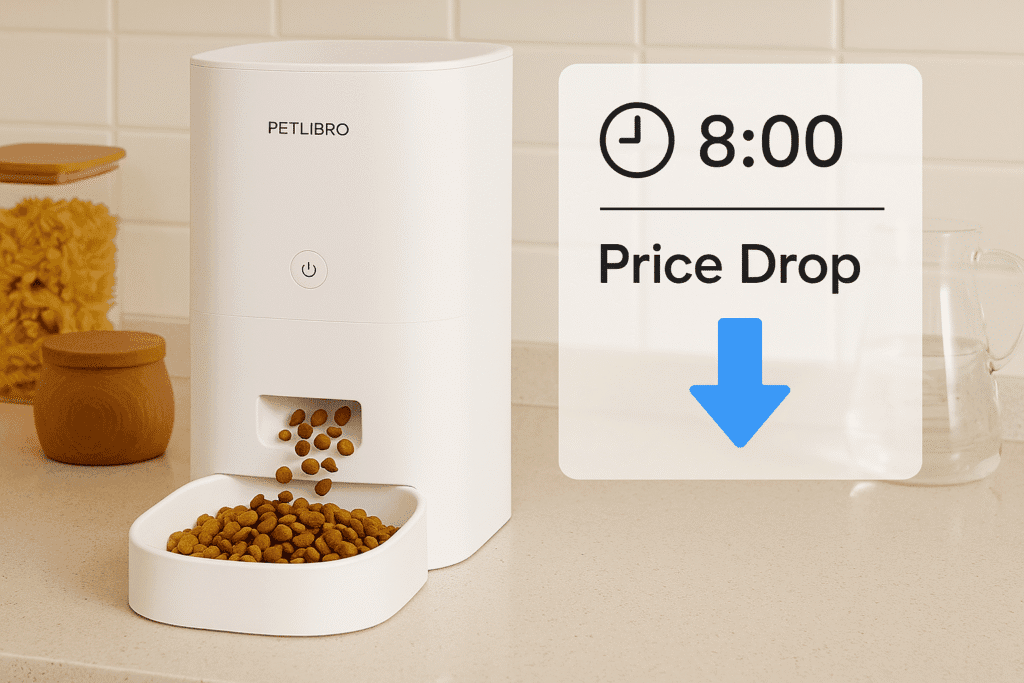
    PETLIBRO smart feeder Black Friday sale.

    Setup tip: test with your actual kibble size (8–12 mm works best); run 10 toss/dispense tests and vacuum crumbs to avoid jams.


    Self-cleaning litter boxes (odors + daily hygiene)

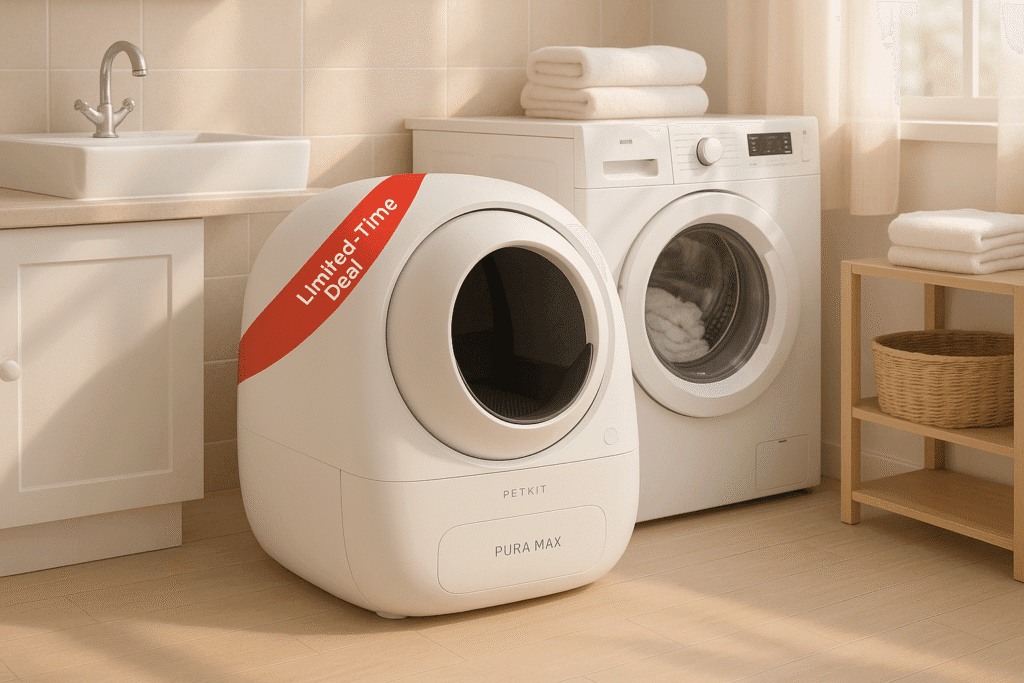
    PETKIT PuraMax 2 Black Friday Pet Tech Deals 2025.

    Setup tip: place on level floor, enable child/pet lock, and keep a manual tray nearby during the first week as your cat adapts.


    Smart water fountains (hydration compliance)

    Setup tip: swap filters per schedule, clean pump impeller monthly; hydration jumps when the spout is at nose level.


    GPS & health trackers (outdoor safety + activity)

    Setup tip: create a “home” virtual fence first, then enable alerts for leaving/entering; snug fit = one finger under collar.


    Smart doors (microchip entry, selective access)

    Setup tip: measure shoulder height + width carefully; add tunnel/adapter for glass or wall installs and seal edges to prevent drafts.


    Smart Cleaning & Air Care Gadgets (home freshness + odor control)

    As cat owners upgrade feeders and litter boxes, smart air purifiers and deodorizers are seeing major Black Friday markdowns. These tools extend hygiene beyond the litter area, automatically neutralizing smells and tracking air quality — essential if you live in apartments or multi-cat homes.

    • PETKIT Smart Spray Odor Remover — releases negative ions; connects via PETKIT app, remote control.
      👉 Check current deal on Amazon
      Why buy now: sensors trigger only when motion or odor spikes occur, saving cartridge life.
    • Levoit Core 300S Smart Air Purifier (for cat dander & litter odors) — Alexa/Google Assistant compatible, PM2.5 detection, 3-stage HEPA filtration.
      👉 Check current deal on Amazon
      Why it’s worth it: strong CADR for medium rooms, quiet night mode (24 dB), real-time app graphs.
    • Petkit AirSalon Max Grooming & Purifying Dryer — doubles as dryer and fur deodorizer; gentle airflow, filter captures dander.
      👉 Check current deal on PetKit
      Tip: ideal for long-haired breeds; pair with the Pura Air for a full fresh-air loop.

    Setup tip: position purifiers opposite the litter zone, ~1 m away, to ensure airflow covers the path from box to rest area. Replace filters every 3–6 months — most apps will notify you automatically.


    Tech Enrichment Toys (AI play & smart engagement)

    Beyond hygiene and feeding, this year’s Black Friday pet tech deals 2025 highlight interactive toys that keep cats active when owners are away. Movement-responsive toys reduce destructive boredom and provide much-needed enrichment.

    • MetaCat Smart Robot Cat – Fully interactive robotic cat with voice-recognition commands (20+ built-in), responsive touch sensors on head/chin/back, and USB-C rechargeable battery lasting up to several days. With motion + sound + expressive eyes, it offers premium “tech pet” feel that appeals during Black Friday because of novelty and high-end build.
      👉 Check current deal on Amazon
      Key specs at glance: Voice recognition (20+ commands), touch sensors, rechargeable via USB-C, realistic movements/expressions, premium materials.
    • Cheerble Wicked Ball SE (Cat Edition) — motion & touch sensors, random roll pattern, USB-rechargeable; app-free simplicity.
      👉 Check current deal on Amazon
      Why it fits Black Friday buyers: affordable, safe materials, usually discounted 15–20%.
    • Pawzone AI Laser Cat Toy (auto tracking) — tracks movement via IR sensor, 3 adjustable speeds, scheduled play cycles.
      👉 Check current deal on Amazon
      Why it’s a hit: simulates hunting, adjustable duration; connects via USB-C or battery pack.

    Setup tip: rotate toys daily to avoid novelty fatigue; record sessions with a camera like the Furbo 360° for cute shareable clips .


    Quick buyer’s checklist (don’t skip)

    • Return windows: Amazon’s BF period is forgiving—still unbox immediately and test motor noise & app pairing.
    • Wi-Fi: feeders/cameras often require 2.4 GHz (some support 5 GHz); check your router before drilling mounts.
    • Noise sensitivity: choose quieter motors for skittish cats (fountains and tossers vary).
    • Ecosystem: fewer apps = fewer missed schedules. If you already use Petcube or PETKIT, stick within the brand where it makes sense.

    Health & nutrition pointers (so deals don’t backfire)

    • Treats ≤10–15% of daily calories for healthy adult cats; if you train more during holidays, minus a bit from dinner to compensate.
    • Annual wellness exams (semiannual for seniors/at-risk): bring your app graphs from feeders/trackers for clearer conversations.

    (Based on standard guidance from Cornell Feline Health Center and AVMA; see outbound links below.)


    Fast setups (category playbooks)

    Treat cameras — Create a “calm mat” zone 1–2 m away, reward quiet sits only, pair the last toss with 3–5 min of wand play; end session with one treat → predicts bedtime calmly.

    Feeders — Start with current daily calories split into 2–3 meals; after a week, let the app suggest micro-adjustments (±5–8%). Keep kibble size small/round to avoid clogs.

    Litter boxes — Keep the old tray available for 3–7 days; sprinkle a cup of used litter inside the new unit; enable child/pet lock and soft start schedules.

    Fountains — Place at chin level, away from food bowls (cats prefer water “elsewhere”); choose spout mode for curious drinkers, gentle flow for anxious cats.

    GPS — Test indoors near windows; charge nightly for the first week while you tune update frequency vs. battery life.

    Smart doors — Program microchips first, then use the curfew timer to avoid night roaming. For multi-cat homes, DualScan rules prevent a “bully” from locking a timid cat outside.


    Pros & cons of shopping pet tech on Black Friday

    Pros

    • Largest price deltas of the year on mid/high-end devices.
    • Easy returns/exchanges if your cat dislikes a device.
    • Great moment to unify your app ecosystem.

    Cons

    • Some listings switch to “Other sellers” or bundles; always verify model + warranty.
    • Subscription features (e.g., some camera alerts) may be paywalled—read the feature grid before purchase.
    • Risk of over-buying: prioritize one upgrade per category you’ll actually use.

    Internal links (PetTech AI)


    Authoritative outbound links


    Disclaimer

    This guide is for educational purposes only and does not replace professional veterinary advice. Always introduce new devices gradually and monitor your cat’s behavior and weight. Treat tossers and fountains are tools for enrichment and hydration—not medical devices. If you notice appetite changes, vomiting, diarrhea, excessive thirst, urinary issues, lethargy, or behavior shifts, contact your veterinarian promptly. Some links in this article are affiliate links to Amazon. If you purchase through them, PetTech AI may earn a commission at no extra cost to you. This helps us maintain independent testing and publish evidence-based recommendations.
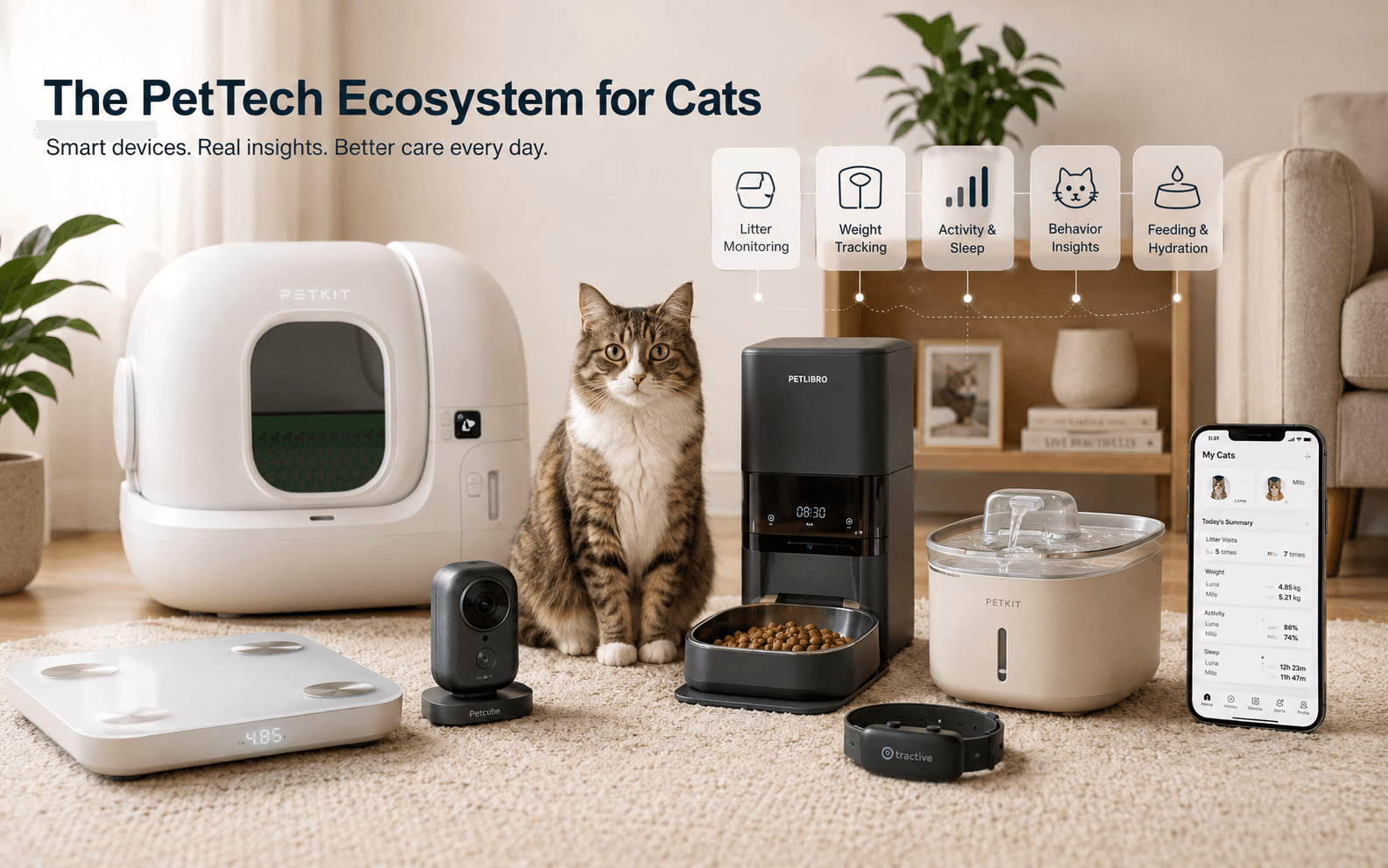
  • PetTech Ecosystem for Cats: Useful Signals or Data Theater?

    PetTech Ecosystem for Cats: Useful Signals or Data Theater?

    A smart litter monitor can record bathroom habits.

    A tracker can record activity and sleep.

    A camera can hear Gerald shouting at 3:12 a.m. because a door has committed the crime of being closed.

    What these devices usually cannot do is combine every signal into one clinically meaningful diagnosis.

    The “ecosystem” often exists less in the cloud than in the owner’s workflow:

    1. establish what is normal;
    2. notice a repeated change;
    3. verify it directly;
    4. contact a veterinarian when appropriate.

    That can be useful.

    Buying five devices and admiring five unrelated graphs is not preventive medicine.

    It is data theater with excellent push notifications.

    Quick Verdict

    Monitoring goalBest starting pointPetTech AI verdictMain limitation
    Track weight and litter habits without replacing the boxPurina PetivityRecommended with ConditionsDoes not work with self-cleaning boxes
    Combine automatic cleaning with visual identificationPETKIT Purobot Max Pro 2Recommended with ConditionsCamera value depends on review habits and software
    Monitor outdoor location, activity and sleepTractive cat trackerConditional RecommendationCollar acceptance, subscription and charging
    Add visual context while awayPetcube Cam 360Conditional RecommendationAlerts and useful history may require Petcube Care
    Verify long-term weight trendsA reliable standalone scaleRecommendedRequires consistent manual weighing
    Build a complete monitoring stackOne primary signal plus one contextual deviceRecommendedMore devices often add noise before they add insight

    For most monitoring-first households, start with litter activity and weight.

    Those are frequent, measurable signals that can establish a useful baseline without requiring the cat to wear anything.

    Add a camera when visual context would answer an unresolved question.

    Add a tracker when the cat spends time outdoors or activity and sleep changes are genuinely relevant.

    Do not build the complete stack because the dashboard looks lonely.

    Still deciding whether you need labor-saving automation or deeper behavioral evidence? Read our Smart Cat Monitoring vs Automation guide before adding another device.

    Research Note

    This is a research-led guide based on current official product documentation, feline veterinary guidance and PetTech AI’s individual product audits.

    PetTech AI has not conducted long-term hands-on testing of every device discussed.

    These tools can reveal observable changes. They cannot diagnose medical conditions or replace veterinary examinations.

    PetTech AI may earn a commission from qualifying purchases. As an Amazon Associate I earn from qualifying purchases.

    Start With a Baseline, Not an Alert

    A device cannot identify a meaningful change until it has some idea of what normal looks like.

    Useful baseline information may include:

    • body weight;
    • litter-box visit frequency;
    • approximate elimination patterns;
    • appetite and meal completion;
    • sleep and activity;
    • normal vocalization and movement.

    The baseline does not need to become a daily research project.

    For many cats, a weekly or monthly review is enough unless a veterinarian has recommended closer monitoring.

    Cornell notes that unintended weight loss can be difficult to notice when owners see their cat every day and recommends regular weighing. FelineVMA recommends full physical examinations at least annually for cats of every life stage, with more frequent examinations for senior cats.

    The device supplies trend data.

    The veterinarian still supplies medicine.

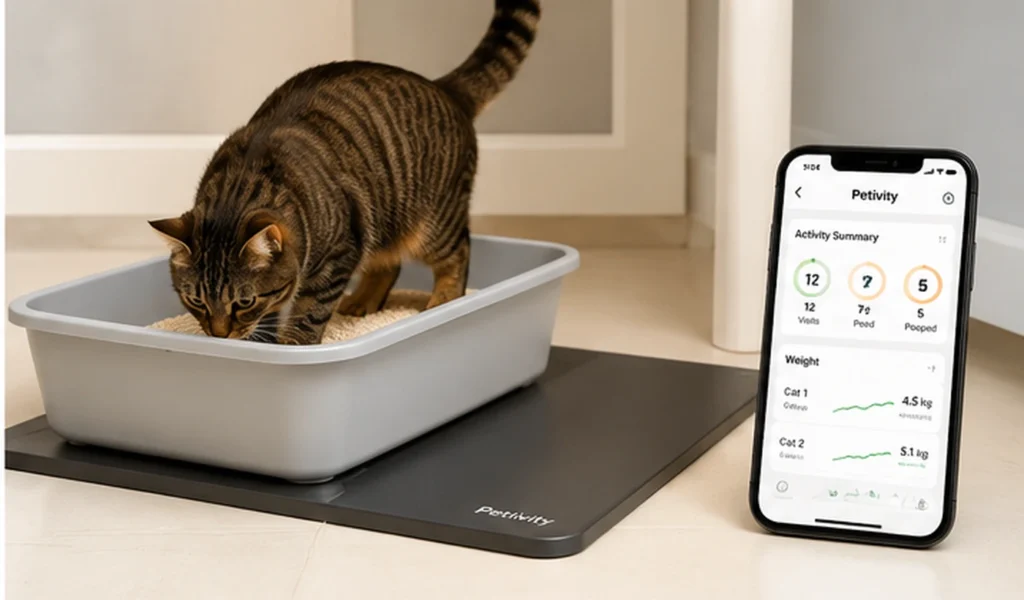
    Best Low-Friction Starting Point: Purina Petivity

    Cat using a conventional litter box placed on a smart under-box monitoring platform
    An under-box monitor can track litter visits and weight without requiring the cat to adopt an automatic litter box. AI-generated editorial illustration.

    Verdict: Recommended with Conditions

    Petivity sits beneath an existing conventional litter box and records weight, visits, urination and defecation events.

    Purina says the system can track as many as five cats and organize their activity inside the Petivity app. It can also alert owners when the recorded baseline changes in a way that may deserve closer attention.

    Its main advantage is that the cat can keep using a familiar litter box.

    That makes Petivity especially relevant when:

    • the cat rejects automatic boxes;
    • manual scooping is acceptable;
    • weight and elimination trends matter more than automation;
    • several cats have distinguishable behavioral or weight profiles;
    • a relatively low-complexity starting point is preferable.

    The conditions are important.

    Petivity does not work with self-cleaning litter boxes and is designed for conventional boxes no larger than approximately 16 by 21 inches. It must also sit on a hard, level surface.

    In homes with several litter locations, incomplete coverage can create incomplete data. Petivity recommends using a monitor beneath every regularly used box when owners want the most complete record.

    That can quickly transform a modest purchase into an infrastructure program.

    Still, Petivity is one of the clearest ways to add useful monitoring without asking the cat to adopt an entirely new toilet.

    Want litter and weight tracking beneath a familiar box? Check Purina Petivity on Amazon.

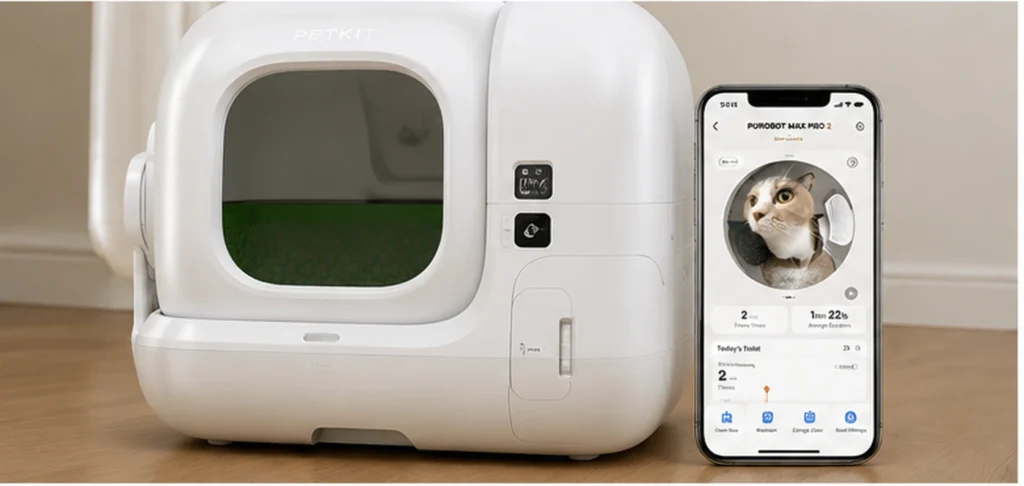
    Best All-in-One Litter Upgrade: PETKIT Purobot Max Pro 2

    Camera-equipped automatic litter box shown beside a smartphone with individual cat visit records
    Camera-assisted litter monitoring can add individual-cat context when weight-only records are difficult to interpret. AI-generated editorial illustration; not an exact product representation.

    Verdict: Recommended with Conditions

    Purobot Max Pro 2 combines automatic waste separation with a camera and weight sensors.

    PETKIT positions the camera as a way to identify individual cats and add visual context to litter-box visits, particularly when several cats share similar weights.

    This provides two different benefits:

    • automation removes routine scooping;
    • monitoring helps establish which cat generated the record.

    The product makes sense when:

    • several cats share the box;
    • weight-only identification is ambiguous;
    • visual context would change how the owner responds;
    • automatic cleaning is already part of the buying decision;
    • the owner will review flagged events.

    It is much harder to justify when one cat uses the box and the only objective is reducing scooping.

    A camera does not improve clump separation.

    It simply ensures the clump has appropriate supporting documentation.

    The deepest video-history features may also involve PETKIT Care+, making the software layer part of the real ownership decision.

    Would visual identification solve an existing multi-cat uncertainty? Check Purobot Max Pro 2 through PETKIT.

    Prefer Amazon checkout? Check Purobot Max Pro 2 availability on Amazon.

    For the complete decision, read our PETKIT Purobot Max Pro 2 Review.

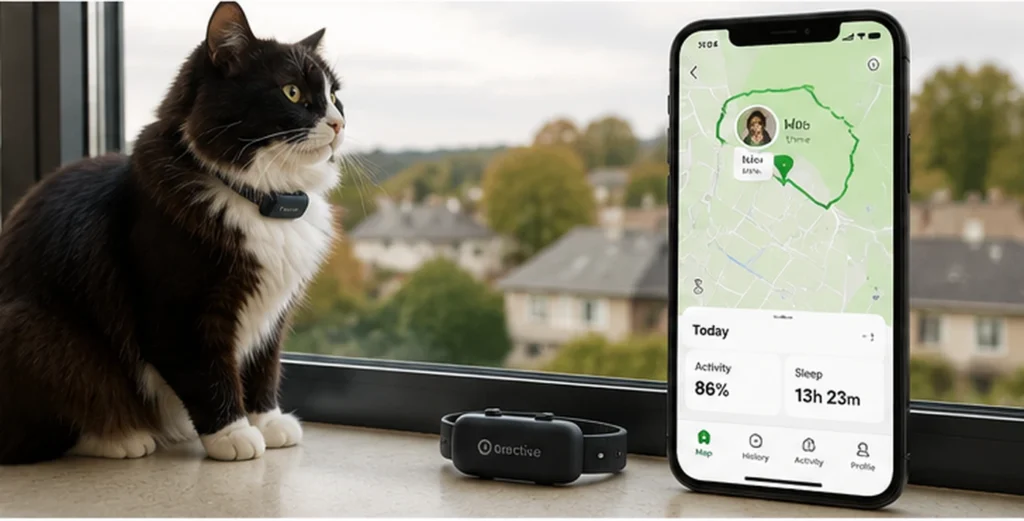
    Activity and Sleep: Add a Tracker Only When It Fits the Cat

    Cat wearing a GPS activity tracker beside a smartphone displaying location and sleep data
    A wearable tracker can add location, activity and sleep context when the cat tolerates the collar and the data changes a real decision. AI-generated editorial illustration.

    A collar tracker can add information that litter devices cannot provide:

    • outdoor location;
    • daily movement;
    • sleep duration;
    • changes in habitual activity;
    • escape alerts.

    Tractive’s current cat tracker records activity and sleep, while supported plans and hardware can add further wellness information. GPS and health functions require an active subscription.

    That can be useful for:

    • outdoor or escape-prone cats;
    • cats whose activity changes are difficult to observe;
    • owners wanting location and routine data from one collar;
    • households prepared to maintain charging and subscription service.

    It is a poor fit when:

    • the cat refuses collars;
    • the device is too large for comfortable wear;
    • the cat remains entirely indoors and activity data would not change anything;
    • charging gaps make the history inconsistent.

    A tracker should first be comfortable and safe.

    The most detailed sleep graph in the world is not useful when Napoleon has removed the collar and hidden it beneath a hedge.

    For product-level options and fit limitations, read our Best Cat GPS Trackers guide.

    Cameras Add Context, Not a Complete Health Record

    Verdict: Conditional Recommendation

    A camera can help answer questions other devices cannot:

    • Did the cat approach the feeder but refuse the meal?
    • Was vocalization associated with pacing or conflict?
    • Is one cat blocking a resource?
    • Did a mobility change become visible while nobody was home?

    Petcube Cam 360 provides pan-and-tilt viewing, night vision and recognition of pets, people, barking and meowing. Several smart alerts and extended cloud-video functions are connected to Petcube Care.

    A camera becomes useful when visual evidence would change the response.

    It becomes decorative surveillance when owners receive twenty motion alerts and eventually train themselves to ignore all twenty.

    Cameras are weakest as primary health monitors because they depend on:

    • placement;
    • field of view;
    • lighting;
    • whether the cat enters the room;
    • whether someone reviews the footage;
    • subscription features.

    Use them to clarify a question created by another signal.

    Do not expect a camera to independently discover a coherent medical pattern while Gerald sleeps behind the sofa.

    Would room-level video clarify feeding, mobility or resource conflict? Check Petcube Cam 360 on Amazon.

    For broader camera choices, read our Best Smart Cat Cameras guide.

    Feeding Data Is Usually Automation Before Monitoring

    Smart feeders are excellent at:

    • maintaining schedules;
    • controlling portions;
    • recording dispensing events;
    • reducing early-morning negotiations.

    They are less reliable at proving exact consumption unless they include a camera, bowl sensor or individual-access system.

    Even then:

    • another cat may steal food;
    • food may remain uneaten;
    • recognition may be imperfect;
    • dispensing is not the same as digestion.

    Do not automatically adjust calories because one device reported a dramatic afternoon.

    Repeated weight change should be confirmed and discussed with a veterinarian before making substantial dietary changes. Cornell warns that sudden or inappropriate calorie restriction can be dangerous for cats.

    For the distinction between scheduled automation, camera monitoring and RFID access, read our Best Automatic Cat Feeders guide.

    The Two-Signal Rule

    A practical monitoring system does not need every available device.

    Use:

    one primary signal and one contextual signal.

    Examples:

    Senior indoor cat

    Primary signal:

    • litter activity and weight through Petivity or a smart litter box.

    Context:

    • regular manual weighing or a room camera when mobility is difficult to observe.

    Multi-cat household

    Primary signal:

    • camera-equipped or reliably identified litter records.

    Context:

    • feeding access data when diet theft is also a concern.

    Outdoor cat

    Primary signal:

    • GPS, activity and sleep tracker.

    Context:

    • monthly weight and direct observation at home.

    Cat with a previous urinary concern

    Primary signal:

    • litter-box frequency and elimination patterns.

    Context:

    • camera evidence only when it helps verify straining, repeated visits or unusual behavior.

    Frequent attempts to urinate, prolonged straining or producing little to no urine can indicate a serious urinary problem and require prompt veterinary attention.

    Do not wait for the dashboard to achieve statistical confidence while the cat is visibly distressed.

    Why One App Is Not Always Better

    A unified app is convenient.

    It does not automatically create better evidence.

    Within one brand, devices may share:

    • profiles;
    • maintenance alerts;
    • routine histories;
    • account access.

    But even then, the app may display several separate timelines rather than clinically interpreting them together.

    Across different brands, the information is usually even more fragmented.

    The owner still needs to notice:

    • weight moved;
    • litter visits increased;
    • appetite changed;
    • activity declined.

    The fact that all four graphs use attractive pastel colors does not make them a medical team.

    Choose one ecosystem when its products independently fit the household.

    Mix brands when a better product solves the problem more directly.

    For the strategic difference, read our PETKIT Ecosystem Review and PETKIT vs Litter-Robot Ecosystem comparison.

    Buyer-Regret Risk

    Monitoring-stack regret usually comes from collecting more information than the owner can interpret or use.

    Common failures include:

    • buying several devices before establishing a baseline;
    • subscribing to histories nobody reviews;
    • mistaking one unusual day for a trend;
    • assuming alerts identify a cause;
    • using a camera when access control was needed;
    • replacing direct observation with notifications.

    The safest question is:

    What decision will this device help me make?

    When the answer is unclear, the device is probably not ready to enter the ecosystem.

    Final Verdict

    A PetTech ecosystem can be useful when it turns a vague concern into a clear, verifiable pattern.

    The strongest starting signals are usually:

    • litter-box activity;
    • body weight;
    • appetite;
    • activity and sleep when relevant.

    Choose Petivity when you want monitoring beneath an existing conventional litter box.

    Choose Purobot Max Pro 2 when automatic cleaning and visual multi-cat identification both matter.

    Add Tractive when outdoor location, activity and sleep genuinely change the care plan.

    Add Petcube Cam 360 when visual context resolves a specific uncertainty.

    Do not build the full stack immediately.

    Start with one signal.

    Learn what normal looks like.

    Add another device only when the first one leaves an important question unanswered.

    The goal is not to know everything Baron did today.

    It is to notice when something meaningful changed—and know what to do next.

    Frequently Asked Questions

    Can smart pet devices diagnose health problems?

    No. They can record changes in weight, activity, appetite or litter-box behavior. A veterinarian must determine the cause.

    Which device should I buy first?

    For many indoor cats, litter and weight monitoring provide the most frequent baseline signals. Choose Petivity when keeping a conventional box or a compatible smart litter box when automation also matters.

    Do all devices need to use one app?

    No. One app reduces digital clutter, but product fit and signal quality matter more than brand consistency.

    How many alerts should trigger concern?

    There is no universal number. Look for repeated changes, multiple related signals or visible symptoms. Straining, painful urination or little to no urine requires prompt veterinary attention.

    Can feeding and weight data automatically control portions?

    Most consumer systems do not safely create a complete automatic nutrition plan. Substantial feeding changes should be based on measured portions and veterinary guidance.

    References

    • Purina Petivity — Smart Litter Box Monitor documentation
    • PETKIT — Purobot Max Pro 2 product documentation
    • Tractive — Cat tracker and health-monitoring documentation
    • Petcube — Cam 360 and Petcube Care documentation
    • Cornell Feline Health Center — Weight, urinary and nutrition guidance
    • Feline Veterinary Medical Association — Life-stage and senior-care guidance

    Image Disclosure

    Official manufacturer images are used when available and authorized.

    AI-generated images may also be used as editorial illustrations. They should not be treated as exact representations of product dimensions, controls or physical features. Always verify current official specifications before purchasing.

    Editorial Disclosure

    PetTech AI may earn a commission from qualifying purchases. This does not influence our recommendations, comparisons or editorial judgments.

  • AI Cat Care 2025: The Future of Everyday Feline Wellness

    AI Cat Care 2025: The Future of Everyday Feline Wellness

    Why this matters now

    If you live with a cat, you already juggle routines: feeding, litter, enrichment, safety checks, vet follow-ups. AI cat care 2025 turns that chaos into a quiet, measurable system. Instead of guessing, you’ll see trends: appetite dips before they’re obvious, litter habits that flag urinary issues early, restless nights that correlate with under-stimulation, GPS routes that reveal risky hotspots outside. Used well, AI doesn’t replace intuition—it turbocharges it.

    Key takeaways:

    • AI cat care 2025 = data-assisted habits: healthier feeding, earlier health signals, safer micro-adventures, calmer behavior.
    • You don’t need to “go all in.” Start with one use-case (e.g., litter/health or feeding) and stack from there.
    • Focus on reliability, noise-free alerts, and exportable data you can share with your vet.

    What “AI” actually does (for cats)

    Most consumer “AI” in pet tech blends three layers:

    1. Sensing: cameras, weight scales (bowls/litter), accelerometers (collars/tags), GPS/BT beacons, environment (temp/air).
    2. Signal processing: filters raw data into events (ate 32 g; used litter twice; active 3 h).
    3. Inference & guidance: turns events into insights (early constipation risk; portion tweak; boredom indicators) and action (auto-portioning, adaptive routines, smarter notifications).

    AI cat care 2025 is less about sci-fi robots and more about pattern recognition that catches subtle changes early and nudges you toward the next best action.


    Core applications that actually move the needle

    1) Health monitoring you’ll actually use

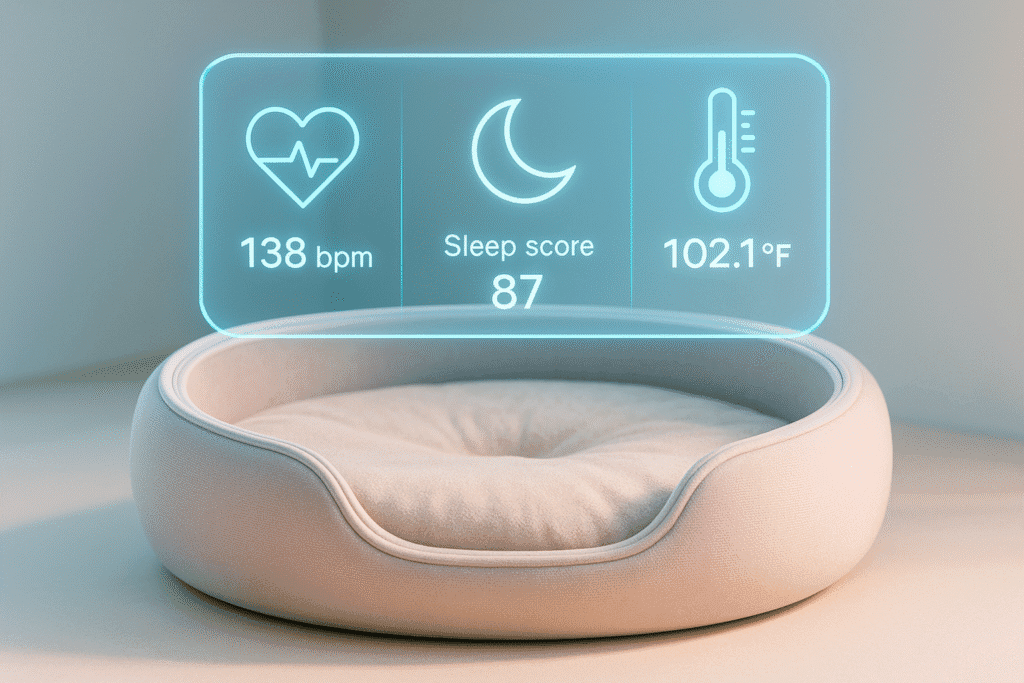
    Close-up of a smart cat bed showing holographic health data like heart rate, sleep score, and temperature, symbolizing AI-driven feline wellness tracking.
    • Litter analytics: Weight sensors and usage detection track frequency, clump weight, and timing. AI highlights deviations from your cat’s baseline (e.g., more frequent, lower-volume pees; long intervals without a bowel movement). In AI cat care 2025, this is the single most valuable early-warning channel for UTI, constipation, or kidney concerns.
    • Weight & appetite: Smart bowls and feeders log grams per meal/day; AI correlates intake with activity and flags gradual loss or gain.
    • Activity & rest: Collars/camera-free room sensors detect sleep fragmentation, nocturnal zoomies, or pacing—often a signal to adjust enrichment or check pain.

    What good looks like: high-precision sensors, sticky yet minimal alerts (no spam), clear trend visualizations, and easy CSV/PDF export for your vet.

    2) Precision feeding without obsession

    • Portion automation: Auto-dispensing adjusts by schedule and goal weight; AI adapts portions after missed meals or unusual activity days.
    • Dual-cat fairness: Photo/microchip access control keeps the “food pirate” out, ensuring the shy eater finishes.
    • Diet transitions: AI stages gradual mix-ins and watches for intake drops or GI upset.

    You’ll see AI cat care 2025 turn feeding into a closed loop: goal → plan → measure → micro-adjust → goal.

    3) Behavior & enrichment that prevents problems

    • Boredom signatures: Under-stimulation shows up as nocturnal restlessness, door scratching, or “cursor hunting.” AI spots the pattern and prescribes targeted play windows (type, length) and puzzle rotations.
    • Stress mapping: Correlates visitors, appliance noise, or construction with hiding, excessive grooming, or litter misses—then suggests mitigation (safe rooms, white noise, scent routines).
    • Training assists: Timed treat cues, clicker-style reinforcement from a dispenser, and session logs keep you consistent.

    In AI cat care 2025, you don’t guess which toy to use—you follow a plan, then adjust based on results.

    4) Safety, travel, and controlled outdoor time

    • Virtual fences: GPS trackers create geofences; AI reduces false alerts by learning the cat’s regular routes and “worry zones.”
    • Travel readiness: Pre-trip routines adjust feeding/box timing, carrier conditioning, and calming protocols based on previous trip data.
    • Home alone mode: Cameras/door sensors escalate from motion → person → “cat on counter” specificity; you only get pings that matter.

    Again, the thread: AI cat care 2025 compresses noise and surfaces signals.

    5) A smarter home, quietly running in the background

    • Automations: Litter cycle after the last morning use, warm a favorite sleeping spot before bedtime zoomies, dim lights to align with play → feed → sleep.
    • Energy & noise: Night vision only when needed, low-noise cycles in sleep windows, quiet air filtration during naps.
    • Household harmony: If you live in an apartment, AI staggers loud cycles, avoids guest hours, and keeps routines kid-proof.

    These micro-touches are where quality of life jumps.


    How vets fit into the loop

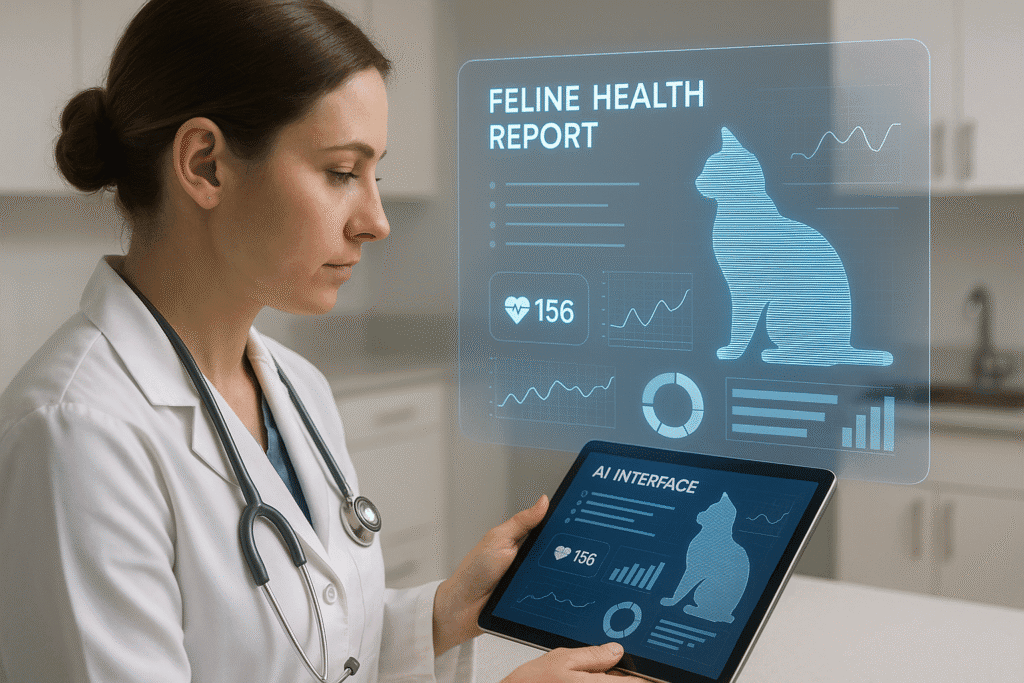
    A veterinarian reviewing an AI-generated cat health report on a tablet, with digital charts showing data-driven insights for feline care.

    Bringing real data changes the appointment:

    • Objective baselines: “Here’s 60 days of litter frequency and clump weight” beats guesswork.
    • Faster differential: Appetite drop + lower activity + smaller clumps = a different workup than “he’s been weird lately.”
    • Post-visit plans: You’ll implement dosing windows or food trials with automations and verify adherence via logs.

    In AI cat care 2025, your vet becomes a data-guided partner, and follow-ups become clearer and shorter.


    Limits, ethics, and privacy (read this)

    • AI ≠ diagnosis. It’s an early-signal assistant; veterinarians diagnose.
    • False positives happen. Prefer systems that learn your cat’s baseline instead of generic thresholds.
    • Privacy: Choose vendors with local processing where possible, end-to-end encryption, and fine-grained sharing controls.
    • Fail-safe design: Devices should degrade gracefully (manual mode for feeders, scoop-ready litter plans), and never block access or create hazards.

    AI cat care 2025 works best when you remain the decision-maker and set conservative guardrails.


    Buyer’s checklist (save this before you shop)

    1. Accuracy over hype: Look for validated sensing (weigh scales that don’t drift, motion detection that handles low light, GPS that holds signal).
    2. Clear, minimal alerts: If you muted notifications in week one, the system failed.
    3. Baseline learning: The cat is the baseline—not a population average.
    4. Multi-cat logic: Identity control (camera, microchip, tag) to separate data and calories.
    5. Interoperability: CSV/PDF export, API/integrations, and routines with your smart home.
    6. Quiet & safe hardware: Rounded edges, safe clearances, low noise, child-safe locks.
    7. Support & warranties: Real chat/email support and visible firmware updates.
    8. Total cost of ownership: Subscriptions, filters/liners, desiccants, batteries.

    Checklist goal: reduce returns and make AI cat care 2025 a step up from day one.


    Your 90-day rollout plan (no overwhelm)

    A cat owner using an AI wellness app on a tablet to monitor her cat’s health and behavior, illustrating modern connected pet care. AI cat care 2025.

    Days 1–7 — Pick one wedge
    Choose the highest-leverage start: litter analytics or precision feeding. Set conservative alerts. Place devices where cats naturally go—don’t force novelty. Mention in your notes that you’re starting AI cat care 2025 with one core routine.

    Weeks 2–4 — Stabilize the baseline
    Do nothing fancy; just collect data. Keep manual notes on appetite, stool quality, play time, and any stressors. Conduct one small experiment (e.g., move play before dinner) and watch what changes.

    Weeks 5–8 — Add the second wedge
    Layer behavior/enrichment coaching or activity tracking. Create two automations:

    • Play → Feed → Sleep evening cadence.
    • Litter cycle timed to avoid the “right after use” frustration.

    Weeks 9–12 — Safety & sharing
    Enable one geofence (or home-alone camera mode) with minimal alerts. Export a 30–60 day report for your vet to review at your next checkup.

    By the end of this window, AI cat care 2025 should feel like fewer pings, better timing, clearer choices—and a calmer home.


    Common mistakes (and easy fixes)

    • Over-alerting. Fix: tighten to behavior-changing events only (appetite −15% week-over-week, >24h no stool, nighttime sorties beyond boundary).
    • Rushing multi-cat setups. Fix: identity first (microchip/camera/tag), then schedules.
    • No manual context. Fix: annotate vet visits, food changes, renovations, visitors. AI learns faster with labels.
    • Ignoring the cat’s agency. Fix: gradual introductions, escape routes, predictable routines.

    FAQ quick hits

    Isn’t this surveillance?
    It’s observation with a purpose: better welfare, earlier care, less stress. Keep cameras out of private rooms, use local processing where possible, and share only what’s useful. This is the humane version of AI cat care 2025, not “always-on” snooping.

    What if the power/internet fails?
    Choose devices with manual overrides, cached schedules, and safe defaults. Part of AI cat care 2025 is resilient design.

    Will AI replace my vet?
    No. It helps you notice early and present clean data. The vet relationship becomes stronger, not weaker.


    Internal interlinks to deepen the journey

    👉 Best Smart Litter Boxes 2025 — Hassle-Free Solutions for Cat Owners
    👉 The Best Automatic Cat Feeders of 2025: Smart Solutions for Every Cat Lover
    👉 Smart Outdoor Safety for Cats: How Tech Makes Every Adventure Safer
    👉 Smart Living: Building a Connected Home for You and Your Cat
    👉 Best Smart Cat Cameras 2025 — Watch, Talk & Train Remotely

    (These guides extend AI cat care 2025 into concrete product choices and setups.)


    Conclusion: Calm, clarity, and kinder care

    The promise of AI cat care 2025 is simple: less guesswork, more confidence. You’ll catch issues earlier, fine-tune meals without micromanaging, prevent problem behaviors by removing their causes, and make outdoor time safer. Start small, measure honestly, and let routines click into place. Your cat gets a quieter, safer life—and you get the peace of mind you’ve been chasing.

    Next step: Pick your first wedge (litter or feeding), set two meaningful alerts, and revisit in two weeks. That’s the most honest way to begin AI cat care 2025.


    Expert-backed insights 🧬

    Both the Cornell Feline Health Center and the American Veterinary Medical Association (AVMA) emphasize the importance of early observation and data-driven prevention in feline care. Cornell researchers highlight how behavioral tracking and subtle pattern changes often reveal health issues weeks before clinical symptoms appear. Meanwhile, the AVMA supports the responsible use of AI and smart monitoring tools, stressing that these technologies—when used ethically—can “enhance welfare by improving decision accuracy and response speed.”
    In short, AI cat care 2025 aligns with the veterinary gold standard: informed, preventive, compassionate care.

    Sources:

    American Veterinary Medical Association – AI and Emerging Technologies

    Cornell Feline Health Center – Behavior and Health Monitoring

  • Best Pet Tech Apps for Cats (2026): Useful Control or Notification Hell?

    Best Pet Tech Apps for Cats (2026): Useful Control or Notification Hell?

    Smart-pet apps promise one calm dashboard for feeding, litter care, cameras and safety.

    In practice, many homes end up with five accounts, three subscriptions and fourteen notifications confirming that Gerald has approached a bowl.

    The best pet tech app is not the one with the most graphs. It is the one that makes compatible hardware easier to control, presents useful information clearly and tells you something you can actually act on.

    This guide compares six major cat-focused platforms by software experience—not by how aggressively each brand has inserted the word “AI” into its marketing.

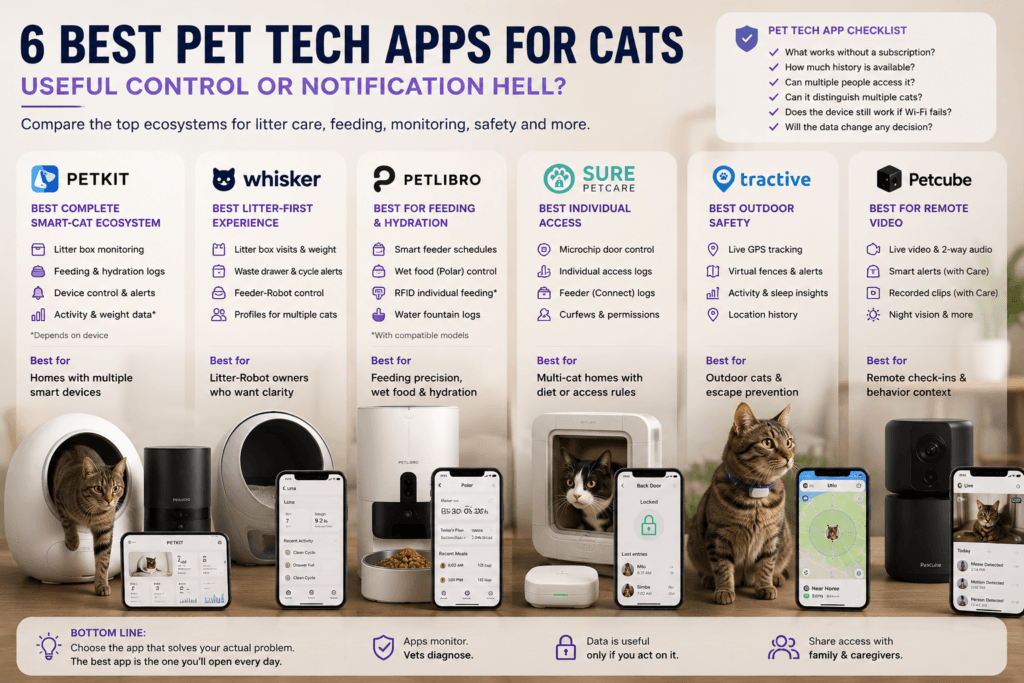
    Quick Verdict

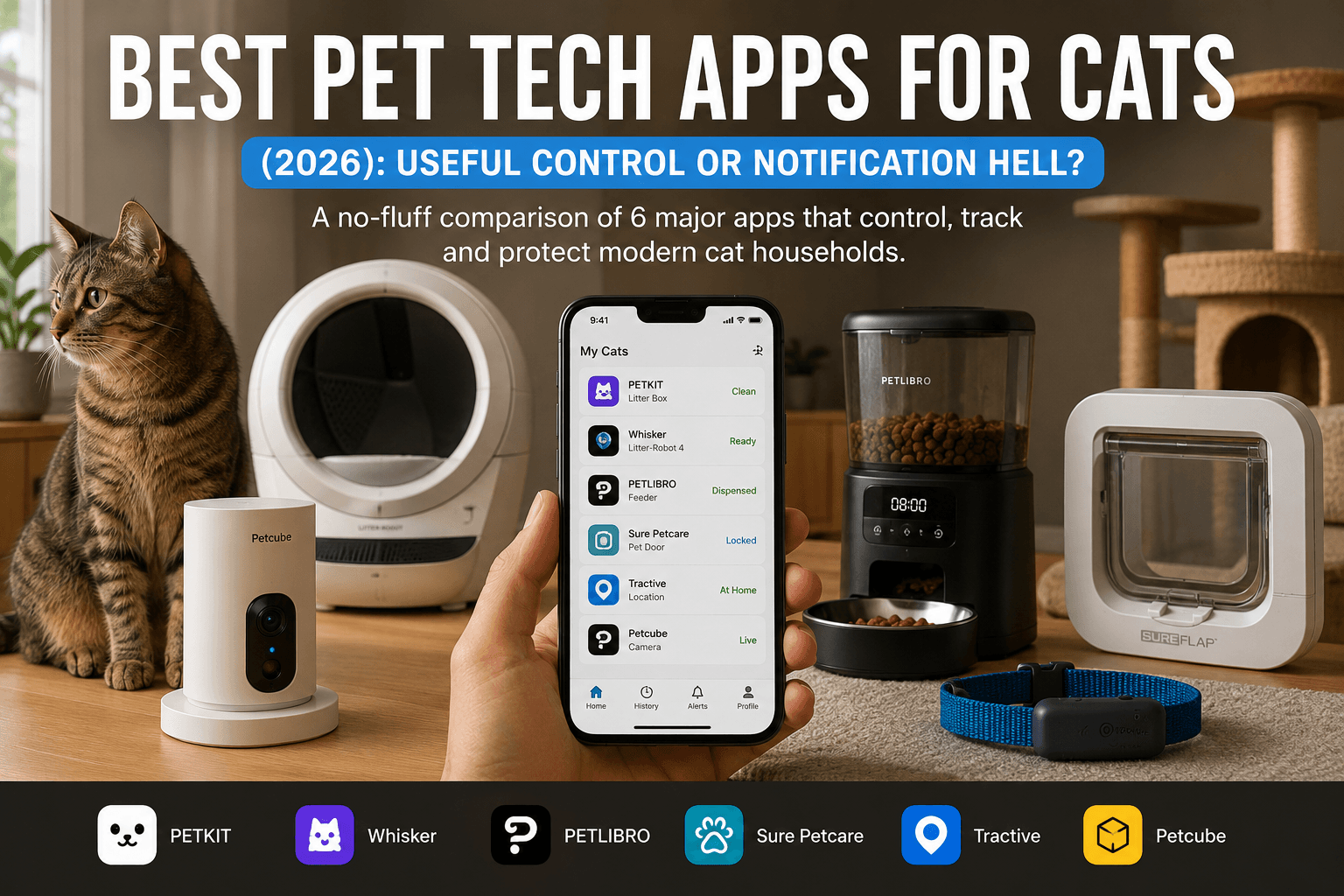
    Comparison of PETKIT, Whisker, PETLIBRO, Sure Petcare, Tractive and Petcube app ecosystems
    The leading pet tech apps solve different problems—from litter automation and feeding to access control, GPS tracking and remote video. AI-generated editorial comparison; verify current app features and compatibility.
    AppBest forPetTech AI verdictMain limitation
    PETKITBroadest smart-cat ecosystemRecommendedStrong ecosystem lock-in
    WhiskerAutomatic litter care and feedingRecommendedNarrower device range
    PETLIBROFeeding and hydrationRecommended with ConditionsCompatibility varies by model and app
    Sure PetcareIndividual access in multi-cat homesRecommended with ConditionsRequires compatible Connect hardware and usually a Hub
    TractiveOutdoor GPS and activity trackingStrong Recommendation with ConditionsMandatory subscription and collar dependence
    PetcubeRemote video monitoringConditional RecommendationSmart alerts and useful history depend heavily on Petcube Care

    Best overall: PETKIT offers the widest cat-specific hardware ecosystem inside one app.

    Best focused experience: Whisker is easier to understand because it concentrates on litter care and scheduled feeding.

    Best app for outdoor cats: Tractive, provided your cat accepts the collar and the recurring subscription makes sense.

    Research Note

    This is a research-led comparison based on current official app listings, manufacturer documentation and PetTech AI’s individual product audits.

    PetTech AI has not conducted identical long-term hands-on testing across every app, device and subscription tier.

    Features can vary by hardware generation, operating system, country and paid membership. Always verify that the exact product you are buying works with the app and functions discussed here.

    PetTech AI may earn a commission from qualifying purchases. As an Amazon Associate I earn from qualifying purchases.

    What Makes a Pet Tech App Actually Useful?

    Cat owner reviewing feeding, litter, activity and weight records on a smartphone while holding a cat
    App records become useful only when owners review meaningful trends and combine them with direct observation—not when notifications simply accumulate. AI-generated editorial illustration.

    A pet app earns its place when it performs at least one of four jobs well:

    • controls a device reliably;
    • presents trends more clearly than raw event logs;
    • sends alerts that deserve attention;
    • reduces routine work without creating a second administrative job.

    It should also make clear what happened.

    “Device event detected” is technically a notification. It is not necessarily information.

    Before choosing an ecosystem, ask:

    1. Which features work without a subscription?
    2. How much history remains available?
    3. Can several people access the household?
    4. Can the app distinguish individual cats?
    5. Does the device continue its core job if Wi-Fi fails?
    6. Will the collected data change any decision?

    No app should diagnose a medical condition. Persistent or concerning changes in appetite, activity, weight or litter-box behavior still need direct observation and veterinary interpretation. Cornell advises veterinary assessment when cats show meaningful acute or gradual behavioral or health changes.

    PETKIT App: Best Complete Smart-Cat Ecosystem

    Verdict: Recommended

    PETKIT has the broadest cat-focused software environment in this comparison.

    Depending on the connected hardware, the app can manage:

    • automatic litter boxes;
    • camera feeders;
    • conventional smart feeders;
    • water fountains;
    • environmental products;
    • feeding, drinking, weight and litter-use records.

    PETKIT’s current app listing presents litter activity, meals, hydration and general activity in one account, although the actual data available depends entirely on the connected device.

    Where PETKIT wins

    PETKIT makes the most sense when you want several categories under one login.

    A household can begin with a PuraMax 2, add a YumShare feeder and later connect an EverSweet fountain without creating an entirely separate software relationship for every appliance.

    That does not mean the devices automatically collaborate.

    The app aggregates several product categories, but it should not be mistaken for a clinical intelligence system that safely converts litter, feeding and hydration records into one medical conclusion.

    Where it disappoints

    Its usefulness creates pressure to remain inside the PETKIT catalog.

    Once several products share profiles, alerts and maintenance records, replacing one category with another brand becomes slightly more annoying. The app is free; the expanding collection of hardware required to make it fascinating is where the economic subplot begins.

    Choose PETKIT when:

    • you expect to own devices in several categories;
    • litter care is the likely starting point;
    • one account matters more than complete brand flexibility;
    • you will review trends without treating them as diagnoses.

    Skip it when you only need one simple device and do not care about ecosystem expansion.

    Does a broad PETKIT setup fit your home? Explore current PETKIT devices.

    Prefer Amazon?

    Read our PETKIT Ecosystem Review before transforming the utility room into a regional branch office.

    Whisker App: Best Litter-First Experience

    Verdict: Recommended

    The Whisker app controls the current Litter-Robot line and Feeder-Robot.

    Depending on the model and membership, it can show:

    • litter-box visits;
    • weight trends;
    • waste-drawer status;
    • cleaning-cycle alerts;
    • remote controls and settings;
    • feeding schedules;
    • high-level feeding trends;
    • personalized cat profiles.

    Whisker states that all its robots can be managed in the same app. It also explicitly notes that the devices do not interact with one another; they simply coexist under the same account and profiles. That is an important distinction between unified control and actual automation.

    Where Whisker wins

    The narrower ecosystem makes the app easier to understand.

    Whisker is not trying to control fountains, doors, trackers, climate pods and whatever Archibald may request during the next fiscal quarter. It focuses on two repetitive jobs:

    • cleaning litter;
    • dispensing dry food.

    That produces a cleaner software proposition for homes already centered on Litter-Robot.

    Where it disappoints

    Some deeper history and individualized insights vary by Litter-Robot model and Whisker+ membership. The most advanced experience therefore belongs to owners who have already purchased premium hardware and may accept another software layer.

    Choose Whisker when:

    • automatic litter care is the main priority;
    • you already own or plan to buy Litter-Robot;
    • weight and bathroom trends matter;
    • a focused app is preferable to a sprawling ecosystem.

    Skip it when you want feeding, hydration, doors and GPS inside one platform.

    For the hardware decision, read Litter-Robot 5 vs 5 Pro vs EVO.

    PETLIBRO App: Best for Feeding and Hydration

    Verdict: Recommended with Conditions

    PETLIBRO’s app focuses primarily on food and water.

    The current app connects with compatible products from lines including Granary, Polar, Dockstream, Space and Air. Depending on the model, owners can manage schedules, review feeding or drinking activity, receive maintenance alerts and remotely control supported functions.

    Where PETLIBRO wins

    The ecosystem remains easier to understand than PETKIT’s.

    It is strongest when the household wants:

    • scheduled dry food;
    • refrigerated wet-food scheduling;
    • individual feeding access;
    • connected water fountains;
    • camera-assisted meal checks.

    PETLIBRO also offers several genuinely different feeding solutions rather than five cosmetic variations of the same hopper.

    Where it disappoints

    Compatibility is fragmented.

    Not every PETLIBRO product is smart, not every connected product offers the same data, and PETLIBRO and PETLIBRO Lite are separate apps for different hardware generations. Check the listing before buying rather than assuming the logo guarantees one software experience.

    Choose PETLIBRO when:

    • feeding is the primary problem;
    • you want wet-food, RFID or camera options;
    • hydration may become a second category;
    • you are willing to verify app compatibility carefully.

    Skip it when litter automation is central or you want one broad whole-home ecosystem.

    Need app-controlled wet-food scheduling? Check PETLIBRO Polar on Amazon.

    Our PETLIBRO Polar Review explains why refrigeration claims still require more nuance than “tiny cat refrigerator.”

    Sure Petcare App: Best for Individual Access

    Verdict: Recommended with Conditions

    Sure Petcare is less about general automation and more about controlling who gets access.

    With compatible Connect products, its app can manage and record functions such as:

    • pet-door locking and curfews;
    • entry and exit events;
    • individual access permissions;
    • food-consumption records on compatible feeders;
    • household sharing.

    The critical word is Connect.

    Standard microchip products may recognize a cat without offering app control. Compatible Connect devices communicate through the Sure Petcare Hub, which links them to the internet and app. The Hub can support multiple connected products in one household.

    Where Sure Petcare wins

    It solves concrete multi-cat problems:

    • one cat steals another’s food;
    • an indoor cat must not use the door;
    • curfews need to change remotely;
    • owners want individual entry or feeding records.

    This is more useful than collecting vague “wellness” scores while Biscuit continues eating everyone’s prescription diet.

    Where it disappoints

    The product naming and additional Hub requirement create friction.

    A buyer can easily purchase a microchip feeder and later discover that the device performs access control perfectly well—but has no intention of reporting lunch to a smartphone.

    Choose Sure Petcare when individual access is the actual problem.

    Skip it when you simply want scheduled feeding or generic activity monitoring.

    Would microchip-controlled access solve food theft or door conflict? Check Sure Petcare Connect products on Amazon.

    Tractive App: Best for Outdoor Safety

    Verdict: Strong Recommendation with Conditions

    Tractive has the clearest app purpose in this roundup:

    find the cat.

    Its current cat trackers support live GPS, virtual fences, location history, activity and sleep monitoring. Some current hardware and plans add further wellness information, but the central value remains location and escape alerts.

    Where Tractive wins

    For an outdoor, traveling or escape-prone cat, location data can answer an urgent question rather than create another lifestyle graph.

    The app can:

    • show live location;
    • alert when the cat crosses a virtual boundary;
    • display previous routes and territory;
    • track activity and sleep;
    • share access with family members on supported plans.

    Where it disappoints

    A subscription is mandatory because the tracker uses cellular networks. Each tracker requires its own plan, and longer commitments reduce the effective monthly cost at the expense of flexibility.

    The cat must also tolerate:

    • a collar;
    • the tracker’s weight;
    • regular charging;
    • a safety-release setup appropriate for outdoor use.

    The most sophisticated GPS app remains useless when Napoleon removes the collar beneath the first available hedge.

    Choose Tractive when location is genuinely important.

    Skip it for a fully indoor cat when activity data alone would not change care.

    Need live location and virtual-fence alerts? Check the current Tractive cat tracker on Amazon.

    See Virtual Fences for Cats for the full outdoor-safety comparison.

    Petcube App: Best for Remote Video

    Verdict: Conditional Recommendation

    Petcube’s app connects supported cameras for live viewing, two-way audio and model-specific interactive functions.

    Its real differentiator is Petcube Care, which adds features such as:

    • smart sound and motion alerts;
    • recognition of pets, people, barking and meowing;
    • automatically recorded clips;
    • cloud history;
    • longer event review.

    Those smarter alerts and extended history are subscription features rather than a universal free layer.

    Where Petcube wins

    A camera can answer questions that feeder and litter logs cannot:

    • Did the cat approach the meal?
    • Is one cat guarding a doorway?
    • Was the nighttime sound a distressed cat or Gerald attacking packaging?
    • Is movement visibly different?

    Where it disappoints

    Without useful event history, a camera depends heavily on someone opening the live feed at the correct moment.

    Petcube Care solves that problem, but turns a hardware purchase into an ongoing software decision. Without the subscription, the camera still sees the cat. It simply becomes considerably less interested in explaining what happened while you were gone.

    Choose Petcube when recorded visual context is worth paying for.

    Skip it when a basic live camera already answers the question.

    Would recorded alerts add useful context while you are away? Check Petcube Cam 360 on Amazon.

    Free Features vs Subscription Creep

    The app itself is usually free.

    The useful experience may not be.

    Usually tied to hardware rather than a mandatory plan

    • basic PETKIT controls and logs;
    • core Whisker controls;
    • PETLIBRO device scheduling;
    • Sure Petcare controls after buying compatible hardware and Hub.

    Requires or strongly benefits from a subscription

    • Tractive: subscription required for cellular tracking;
    • Petcube: Care unlocks smart alerts and useful video history;
    • Whisker: some deeper reports and history depend on model and Whisker+;
    • PETKIT: certain camera histories or premium services may vary by product.

    Never evaluate the device price alone.

    Ask what the app becomes after the introductory period ends. A cheap camera with permanent cloud fees may cost more over time than a better camera with local storage.

    App Lock-In: When Your Phone Becomes a Brand Embassy

    Cat beside three smartphones, an automatic feeder, pet camera and wearable tracker
    Multiple apps can add useful specialist functions, but every extra ecosystem also brings another account, interface and compatibility decision. AI-generated editorial illustration.

    A unified app reduces friction.

    It also makes switching brands harder.

    The lock-in usually develops in three stages:

    1. one useful device;
    2. shared profiles and familiar controls;
    3. mild resentment at installing another app for a better competing product.

    Do not buy weaker hardware solely to preserve dashboard purity.

    Choose one ecosystem when several of its devices independently fit the household. Mix brands when a specialist product solves the problem better.

    One account is convenient.

    Owning the wrong feeder for six years because it matches the litter-box login is dedication to administrative tidiness, not pet care.

    Buyer-Regret Risk

    Pet-app regret usually comes from expecting software to create intelligence that the hardware never measured.

    Common failures include:

    • assuming every product from a brand supports the same app;
    • buying a non-Connect version by mistake;
    • overlooking subscription costs;
    • confusing a dispensing event with confirmed eating;
    • confusing a litter visit with a medical conclusion;
    • enabling so many alerts that all alerts become wallpaper;
    • collecting records without reviewing them;
    • expecting different brands to exchange data automatically.

    Before buying, define one app outcome:

    “I need to know whether Cat A ate.”

    “I need to control the door remotely.”

    “I need to find the cat outdoors.”

    “I need recorded video when nobody is home.”

    That is a purchase criterion.

    “I want a smart ecosystem” is how Emperor Maximilian acquires four incompatible accounts and a folder named Pet Apps.

    Final Verdict

    PETKIT is the best overall pet tech app for cats when you want litter, feeding and hydration devices inside one broad ecosystem.

    Whisker is the best litter-first app, with clear controls and useful routine data across Litter-Robot and Feeder-Robot.

    PETLIBRO is the best feeding-focused option, especially for wet food, RFID access and connected fountains—but compatibility must be checked model by model.

    Sure Petcare is the best access-control platform for multi-cat diets and connected doors.

    Tractive is the strongest outdoor-safety app, provided the subscription and collar requirements fit the cat.

    Petcube is best for recorded visual context, but much of its real value lives inside Petcube Care.

    Choose the app attached to the problem you need to solve.

    Do not choose the problem that best justifies downloading another app.

    Frequently Asked Questions

    Can pet tech apps diagnose illness?

    No. They can record changes in feeding, weight, activity or litter-box behavior. Those records may help a veterinarian understand a pattern, but they cannot identify the medical cause.

    Which app is best for several types of cat technology?

    PETKIT currently covers the broadest range of cat-focused product categories, including litter boxes, feeders and fountains.

    Which cat app works best without a subscription?

    Core PETKIT, Whisker and PETLIBRO controls generally depend on owning compatible hardware rather than maintaining a mandatory cellular plan. Advanced histories and services can still vary.

    Does Tractive work without a subscription?

    No. Its GPS tracker uses cellular connectivity, so an active plan is required.

    Can different pet tech apps share their data?

    Usually not in a meaningful, automatic way. Some may support voice assistants or limited external integrations, but owners should expect separate ecosystems rather than one universal cat-care dashboard.

    References

    • PETKIT — App Service and official app documentation
    • Whisker — Whisker App and Whisker+ documentation
    • PETLIBRO — Official app listings and compatibility documentation
    • Sure Petcare — Connect product and Hub documentation
    • Tractive — Cat tracker and subscription documentation
    • Petcube — Petcube App, Smart Alerts and Petcube Care documentation
    • Cornell Feline Health Center — Feline health and behavioral guidance

    Image Disclosure

    Official manufacturer images are used when available and authorized.

    AI-generated images may also be used as editorial illustrations. They should not be treated as exact representations of product dimensions, materials, controls or physical features. Always verify current official product information before purchasing.

    Editorial Disclosure

    PetTech AI may earn a commission from qualifying purchases. This does not influence our recommendations, comparisons or editorial judgments.

  • 3 Common Mistakes Cat Owners Still Make in 2025 — and How to Fix Them 🐾

    3 Common Mistakes Cat Owners Still Make in 2025 — and How to Fix Them 🐾

    Affiliate Disclaimer: PetTech AI may earn a small commission if you buy through links on this page. We only recommend products that support feline safety, comfort, and long-term wellbeing.

    If you’ve ever googled “why is my cat doing this?” at 2 a.m., you’re not alone. Most cat owner mistakes aren’t about being careless; they’re about missing small, boring details that matter a lot to cats: predictable routines, clean litter, safe space to play and rest, and early detection when something’s off. In 2025, the win is using light automation and better layout to make those basics effortless.

    This guide distills the three cat owner mistakes we still see every day—and the exact, modern fixes (including smart tools) that reduce stress for both of you.

    TL;DR (for busy humans)

    • Mistake #1: Inconsistent routines (meals, litter care, play).
      Fix: Automate the schedule; keep changes gradual and predictable.
    • Mistake #2: “Hidden” environmental stress (box too small, air quality, no vertical choice).
      Fix: Right-size the litter setup, add a purifier, give safe highs and hides.
    • Mistake #3: Ignoring early pattern changes (food, water, litter, sleep).
      Fix: Track lightly with smart devices; call your vet if trends look off for 48–72 hours.

    Along the way, we’ll flag the cat owner mistakes that quietly tank litter habits, hydration, and behavior—plus simple, affordable upgrades that actually work.


    Mistake #1: Inconsistent routines (and “weekend roulette”)

    Smart litter corner with purifier for odor and dust control. Cat owner mistakes.

    Why it’s a problem
    Cats love patterns. When meal times jump around, the litter isn’t cleaned on a cadence, or playtime is skipped for days and then overdone, stress builds. According to the Cornell Feline Health Center and the AVMA, predictable feeding, clean toileting, and daily enrichment are foundational. Breaking those rhythms is among the most common cat owner mistakes—and the easiest to fix.

    What it looks like at home

    • Breakfast sometimes at 6 a.m., sometimes at 10 a.m.
    • Litter scooped “whenever I remember.”
    • Play sessions only on weekends (then too long, too exciting).
    • Treats replacing structured meals (blood sugar roller coaster).

    The smart fix (keep it boring)

    1. Automate meals. Use an automatic feeder (e.g., PETKIT or Whisker Feeder-Robot) to lock timing and portion size. Start by mirroring your current schedule, then adjust slowly.
      Shop top-rated smart feeders → Amazon
    2. Lock hydration. A smart fountain (e.g., PETKIT Eversweet on Amazon) boosts drinking and reminds you about filter changes.
      See best-selling cat fountains → Amazon
    3. Put scooping on rails. Either commit to twice-daily manual scoops or move to a self-cleaning litter box (e.g., Litter-Robot 4) so “clean” is the default.
      Check Litter-Robot 4 availability → Whisker
    4. Schedule play like brushing teeth. Two sessions/day × 10–15 minutes with a wand toy; end with a small snack. Keep it consistent.

    Pro tip
    Set one push alert per day (not ten). Over-notification is one of those sneaky cat owner mistakes that leads to ignoring the app entirely.

    Interlinks


    Mistake #2: Environmental stress you don’t notice (box size, odor, air, space)

    Automatic feeder and smart fountain placed for better hydration.

    Why it’s a problem
    Cats are masters of quiet discomfort. A litter box that’s too small, an ammonia whiff after scooping, no safe vertical rest spot—these are high-impact cat owner mistakes. They don’t scream for attention, but they fuel avoidance, night zoomies, and “mystery” meowing.

    Checklist of hidden stressors

    • Litter box ergonomics: The footprint should be ~1.5× your cat’s body length in width and ~2× in length. If they can’t turn fully, it’s too small.
    • Odor spikes: Even a clean box can smell right after use; lingering odor pushes cats to “cleaner” floors, rugs, or beds.
    • Air quality: Dander and dust build up fastest in small rooms and apartments.
    • No vertical choice: Without perches/shelves, cats feel trapped at ground level.

    The smart fix (design the room, not just the box)

    • Upgrade the litter “zone,” not just the box.
      • Consider a self-cleaning litter box to stabilize cleanliness.
      • Add a slim litter mat and a purifier nearby to flatten odor/dust spikes.
      • Use smart accessories (e.g., PETKIT ramps/fences) to reduce scatter and help seniors.
        Explore smart litter accessories → Amazon
    • Purify the air quietly. A HEPA purifier with pet carbon (e.g., LEVOIT Core series on Amazon) removes fine particles and odor. Sleep Mode keeps it unobtrusive.
      View LEVOIT pet-care purifiers → Amazon
    • Give safe highs and hides. Add one elevated perch and one covered hideaway per cat. This single change solves a shocking number of multi-cat scuffles.

    Behavior science note
    Cats choose the path of least resistance. Reducing odor and giving vertical options resolve more problems than scolding ever will. Not providing these options sits high on the list of cat owner mistakes, even among loving, experienced owners.

    Interlinks


    Mistake #3: Ignoring pattern changes until they’re big

    Play session with indoor camera monitoring.

    Why it’s a problem
    Cats hide discomfort; the earliest signals are boring: a missed micro-meal, an extra litter visit, less time at the fountain, a shorter jump onto the couch. Dismissing these as “cat things” is one of the most costly cat owner mistakes because it delays care.

    What to watch (light-touch, not obsessive)

    • Food intake: sudden drop or unusual grazing.
    • Water intake: less interest in the fountain, or frequent trips without much drinking.
    • Litter patterns: more/less frequent visits, straining, vocalizing, or box avoidance.
    • Rest/activity: decreases in play or unusual nighttime pacing.

    The smart fix (simple data, clear thresholds)

    • Use devices that keep a quiet log:
      • Feeder/fountain apps for intake trends.
      • Self-cleaning litter boxes for visit frequencies/weight changes.
      • Indoor cameras (e.g., Petcube on Amazon) for short check-ins and motion summaries.
        See Petcube indoor cameras → Amazon
    • Set two rules for your household:
      1. We check trends weekly (not hourly).
      2. If a trend looks off for 48–72 hours, we call the vet.
        This avoids two classic cat owner mistakes—panic over blips or ignoring true patterns.

    Vet alignment
    The AVMA and Cornell both emphasize that sustained changes in eating, drinking, toileting, or behavior warrant evaluation. Smart tools help you notice; your vet confirms.

    Interlinks


    Bonus: Three small wins that pay off forever

    These aren’t dramatic, but they quietly undo several cat owner mistakes in one shot:

    1. Separate food and water by 1–2 meters. Many cats drink more when water isn’t next to food.
    2. Two play sessions/day × 10–15 minutes. End with a small snack to complete the “prey sequence.”
    3. One calm wall per room. Keep feeders/fountains and litter/purifier aligned along a wall, center open. Movement feels safer.

    Product quick picks

    • Automatic feeders → schedule control, portion precision PetKit / Whisker / Amazon
    • Smart fountains → cleaner, moving water + filter reminders PetKit / Amazon
    • Self-cleaning litter boxes → odor control + usage logs Whisker / Amazon / PetKit
    • HEPA purifiers → reduce dander/odor (LEVOIT Core series on Amazon).
    • Indoor cameras → short check-ins, motion summaries (Petcube on Amazon).

    These remove friction from routine, the root cause behind many cat owner mistakes.


    The 7-day reset plan (copy this)

    Day 1–2: Mirror your current meal times in a feeder; place fountain 1–2 m away.
    Day 3: Add a litter mat and set a daily scoop time (or initiate self-cleaning).
    Day 4: Two play sessions (10–15 min) and a small post-play snack.
    Day 5: Place purifier near litter zone; enable Sleep Mode at night.
    Day 6: Create one elevated perch + one covered hide.
    Day 7: Review app summaries (food/water/litter). If anything looks off for 48–72 hrs, call your vet.

    This is how you quietly erase the most common cat owner mistakes without overwhelming yourself (or your cat).


    Bonus: The Emotional Side of Cat Ownership 🧠💛

    Behind every one of these cat owner mistakes, there’s usually the same feeling — guilt.
    You come home late, the feeder’s empty, or you forgot to scoop the litter before bed, and suddenly you feel like a bad cat parent. The truth? Perfection doesn’t exist in feline care. What matters is pattern, not panic. Cats thrive when life feels stable, not flawless.

    If you’ve already made one of these cat owner mistakes, the best move isn’t to overcorrect — it’s to return to predictability. Feed at roughly the same times, keep your tone calm, and end each day with one positive interaction (a short play, a treat, a nap near you). Emotional consistency does more for your cat than any gadget ever could.

    Technology helps, but empathy teaches you how to use it:
    a smart feeder means freedom from guilt, a purifier means you can breathe together, and a camera means you’re connected even when apart.
    That’s the real purpose of pet tech — not control, but comfort.


    Final thoughts

    Great cat care is empathy plus design. Lock the routine, right-size the environment, and use smart tools to catch small changes early. Do that, and most cat owner mistakes become non-issues. Your home stays calmer, your cat more confident—and you finally get to enjoy the best part of living with a cat: the soft, predictable, purring kind of normal.

    Authority links

  • Smart Cat Spaces: Designing Rooms That Think for You (2025)

    Smart Cat Spaces: Designing Rooms That Think for You (2025)

    Affiliate Disclaimer: PetTech AI may earn a small commission if you buy through links on this page. We only recommend products that enhance feline safety, comfort, and wellbeing.

    Modern pet tech isn’t about flashy gadgets—it’s about environmental design that reduces stress, simplifies care, and surfaces useful signals. That’s the promise of smart cat spaces: rooms arranged and equipped so your cat’s core needs—eating, drinking, toileting, resting, and playing—happen predictably with minimal friction. When placement, routine, and automation work together, your home starts to “think” for your cat (and for you).

    This guide shows you how to plan, equip, and maintain smart cat spaces room by room. You’ll learn which devices matter, where to place them in apartments and houses, and how to use data lightly—never obsessively—to spot what needs attention early.


    What “smart” actually means for cats (and what it doesn’t)

    A smart setup isn’t a gadget dump. According to the Cornell Feline Health Center and the AVMA, the bedrock of feline health is routine, enrichment, and low-stress hygiene. Tech is valuable when it reinforces those pillars.

    In practice, smart cat spaces do four things:

    1. Lower friction in daily care (scheduled feeds, self-cleaning litter).
    2. Increase consistency (clean water, stable climate, predictable play).
    3. Provide gentle signals (app reminders for filters, litter use, water levels).
    4. Respect feline ergonomics (quiet corners, vertical choices, clear paths).

    They do not replace human attention or veterinary care. Data helps; your relationship and judgment do the rest.


    Core principles that make smart cat spaces work

    • Zones over clutter. Define feeding, litter, rest, and play zones; avoid moving them around. Cats rely on stable maps.
    • One change at a time. Add one new device each week; fast overhauls create anxiety.
    • Quiet by default. Choose low-noise motors and sleep modes; sound consistency reduces arousal.
    • Vertical choice. Perches and shelves provide security and reduce conflict in multi-cat homes.
    • Light-touch data. Review weekly, not hourly. Trends over 48–72 hours matter more than single spikes.

    Design around those rules and your smart cat spaces will feel almost invisible—because they simply work.


    Living room: the hub of observation and bonding

    The living room blends your routines with your cat’s. Keep it calm, visible, and easy to maintain.

    Smart additions

    • Indoor camera with two-way audio & night vision (e.g., Petcube on Amazon): quick check-ins during workdays, smart motion alerts for irregular nighttime activity.
      See Petcube indoor cameras → Amazon
    • HEPA air purifier with pet carbon (e.g., LEVOIT Core series on Amazon): traps dander/litter dust and neutralizes odor, improving comfort for both of you.
      View pet-focused air purifiers → Amazon
    • Vertical highways (shelves/ramps with subtle motion-activated LEDs): safe movement and high resting spots lower territorial tension.

    Placement

    • Camera angle should capture the resting perch and a slice of the play area.
    • Purifier near the high-traffic route, not hidden behind furniture.

    Get these right and your living room anchors your smart cat spaces with comfort and clarity.

    Internal interlink:


    Kitchen & feeding corner: predictability with a purpose

    Smart feeder and fountain placed for routine hydration.

    Meal timing shapes the day. Predictable feeding reduces food-related anxiety and nighttime wake-ups.

    Devices to consider

    • Automatic feeder (e.g., PETKIT or Whisker Feeder-Robot): portion control, schedule consistency, and intake logs—ideal for weight management or multi-cat households.
      Shop top-rated smart feeders → Amazon
    • Smart fountain (e.g., PETKIT Eversweet on Amazon): quiet flow, multi-layer filtration, and reminders to replace filters—hydration is key for urinary health.
      See best-selling cat fountains → Amazon
    • Smart bowl with scale (e.g., PETKIT Fresh Metal Digital Pet Bowl on Amazon): weighs meals, helps transition diets gradually.

    Placement

    • Put fountain 1–2 meters away from the feeder; many cats drink more when water is separate from food.
    • Use a thin silicone mat for splash control and easy wiping.

    Consistent feeding routines turn this corner into one of your most reliable smart cat spaces—and they’re backed by behavioral science.

    Internal interlinks:


    Bathroom or laundry: the hygiene nerve center

    Litter corner with purifier for odor and dust control.

    Nothing affects feline stress like litter quality. Cleanliness, ergonomics, and odor control decide whether the box feels “safe.”

    Devices to consider

    • Self-cleaning litter box (e.g., Whisker Litter-Robot 4): automatic cycling, weight tracking, usage logs, and odor control.
      Check Litter-Robot 4 availability → Whisker
    • Smart accessories (PETKIT ramps/fences/mats; urine-indicator litter): reduce scatter, catch early pH anomalies you can discuss with your vet.
      Explore smart litter accessories → Amazon

    Ergonomics

    • Box footprint ≈ 1.5× your cat’s body length in width and 2× in length; height they can step into without strain.
    • Semi-private but not isolated: cats prefer sightlines and escape routes.

    When the litter zone is stable and data-informed, your smart cat spaces gain the most important ingredient: peace of mind.

    Internal interlinks:


    Bedroom: sanctuary for sleep and recovery

    Cats sleep 12–16 hours daily; make the bedroom a cue for calm.

    Smart comfort

    • Temperature-aware bed/warming mat: helps seniors or short-haired cats maintain comfort in winter.
    • Circadian-friendly lighting (smart bulbs dimmed warm in the evening): lowers arousal before bedtime.
    • Gentle ambient sound (smart speakers with white noise): masks hallway noise in apartments.

    Layout

    • Provide two resting options: one elevated, one hidden. Choice reduces anxiety and improves sleep.
      This quiet sanctuary completes your smart cat spaces by giving your cat a predictable, low-stimulus retreat.

    Entryways & travel staging: movement without chaos

    Doorways, corridors, and carriers are stress points. Plan them to be predictable.

    Tech + design

    • Microchip-access doors for controlled ingress/egress in homes that allow outdoor access.
    • GPS trackers with geofence (e.g., Tractive Cat Mini on Amazon) for balcony/escape risk scenarios.
      See top-rated cat GPS trackers → Amazon
    • Carrier staging area with a soft mat, in view but unobtrusive—let the carrier “live” in the home so it stops being a threat cue.

    Smooth transitions keep smart cat spaces feeling safe even at the edge of your home.

    Internal interlinks:


    Micro-apartments vs. houses: two proven blueprints

    Vertical play shelves with gentle lighting in a smart cat spaces.

    Studio / one-room flow

    • One calm wall: litter + purifier at one end; feeder + fountain on a mat at the other; camera captures both.
    • Center open for movement; window perch on the opposite side.
    • Result: compact smart cat spaces without visual clutter.

    Multi-room home

    • Kitchen edge: feeder/fountain
    • Bathroom/laundry: litter + purifier
    • Living room: vertical play + camera
    • Bedroom: rest sanctuary
    • Result: two to three zones reduce crowding and behavioral spillover.

    The data layer: just enough to notice

    Track only what helps action:

    • Feeding & water (missed meals, low intake)
    • Litter visits & weight (constipation/UTI flags)
    • Activity & rest (recovery, weight management)

    If something looks off for 48–72 hours, call your vet. The AVMA reminds that behavior changes can indicate medical issues; smart cat spaces turn guesswork into trend awareness you can share with your clinic.


    Budget tiers to build at your pace

    Starter (~$150–$250)

    • Smart fountain
    • Interactive toy or puzzle feeder
    • Compact HEPA purifier
      → The fastest, most noticeable upgrade to beginner smart cat spaces.

    Core (~$400–$900)

    • Automatic feeder
    • Smart fountain
    • Self-cleaning litter box or quality manual box + health add-on
    • HEPA purifier
      → Routine, hygiene, and basic data in one balanced setup.

    Complete ($1,200+)

    • Self-cleaning litter box with app
    • Automatic feeder with robust scheduling
    • Smart fountain with filter reminders
    • HEPA purifier + indoor camera
    • Optional GPS tracker
      → Fully realized smart cat spaces with minimal daily friction.

    Quick shop:


    Safety & maintenance: the quiet “must”

    • Keep dryer heat low; stop if your cat pants (heat stress).
    • Cable management for fountains/cameras; pumps must stay submerged.
    • Laser toys only with auto-shutoff; avoid direct eye exposure.
    • Replace filters and pads on schedule.
    • Avoid overcrowding corners; clear escape paths reduce panic.

    Maintenance is what keeps smart cat spaces working month after month.


    Troubleshooting: quick fixes that actually work

    • Ignores the fountain: move it 1–2 meters from food; keep water cool and at max line; replace filters.
    • Scared of the litter robot: disable auto-cycle for 48 hours; turn on once they’re using it comfortably.
    • Night zoomies: evening play (10–15 min) → small snack → warm, dim light in the bedroom.
    • Food guarding: micro-feeds at staggered times; add a second bowl in a different room.

    As routines stabilize, your smart cat spaces will require fewer interventions and deliver more calm.


    Your 7-step setup checklist (printable)

    1. Map zones: food/water, litter, rest, play.
    2. Add one device per week; never overhaul overnight.
    3. Mirror current schedule; shift gradually to ideal times.
    4. Set only essential app alerts; review data weekly.
    5. Play twice daily; end with a small reward.
    6. Replace filters on schedule; wipe mats daily.
    7. Reassess layout every quarter—smart cat spaces evolve with your cat.

    Final take

    When design, routine, and light automation align, smart cat spaces feel humane and low-effort. You get quietly clean air, predictable meals, a litter box that stays fresh, play that happens on time, and gentle signals when something changes. It’s empathy turned into engineering—so your cat can do what cats do best: relax, observe, and thrive.


    Internal interlinks


    Authority links

  • How to Create a Cat-Friendly Smart Apartment: A Calm, Connected Home That Works on Its Own

    How to Create a Cat-Friendly Smart Apartment: A Calm, Connected Home That Works on Its Own

    Affiliate Disclaimer: PetTech AI may earn a small commission if you buy through links on this page. We only feature products that support safety, comfort, and long-term feline wellbeing.

    Designing a smart apartment for cats isn’t about stuffing gadgets into a small space. It’s about building a calm routine where food, water, litter care, air quality, and play happen predictably with minimal friction. When devices are placed thoughtfully and connected through simple apps, your home becomes an easy, low-stress habitat—for both of you.

    This guide shows how to plan zones, choose the right gear, and create a data-lite system you can actually maintain. Whether you’re in a studio or a one-bedroom, a smart apartment for cats can be quiet, elegant, and genuinely helpful.


    The core idea: routine + gentle automation

    A smart apartment for cats supports what science says cats need most: predictable meals, clean litter, safe places to rest, and daily play. The Cornell Feline Health Center and AVMA emphasize routine, low-stress handling, and environmental enrichment as foundations of feline health. Smart devices simply make those foundations easier to keep every day.

    What “smart” means here

    • Consistency: automatic feeding times, constant access to fresh water, and reliably clean litter.
    • Signals: basic app notifications (low water, full bin, unusual litter visits).
    • Comfort: quiet motors, stable temperatures, and good air.
      A smart apartment for cats is successful when it feels almost invisible.

    Step 1 — Map your space into 4 zones

    Space is premium, so planning beats impulse buying. Sketch your floor plan and mark four zones around the perimeter (keep the center open for movement):

    1. Food & Water Zone — kitchen edge or dining nook
    2. Litter Zone — bathroom corner or entry closet with ventilation
    3. Rest & Hide Zone — bedroom corner or sofa-side nook
    4. Play & Observation Zone — window line or hallway track

    A smart apartment for cats works best when each zone is stable. Moving devices weekly confuses patterns and can cause stress or accidents.


    Step 2 — Feeding & hydration: predictability first

    Smart feeder and fountain setup for apartment living.

    What to add

    • Automatic feeder (e.g., PETKIT or Whisker feeder): precise portions on schedule, optional profiles for multiple cats.
      Shop top-rated smart feeders → Amazon
    • Smart fountain (e.g., PETKIT Eversweet on Amazon): quiet pump, multi-layer filtration, filter reminders.
      See best-selling cat fountains → Amazon

    Apartment tips

    • Place feeder and fountain 1–2 meters apart—many cats drink more when water is away from food.
    • Protect floors with a thin silicone mat; wipe daily.
    • Start by mirroring your current routine; shift times gradually over 7–10 days so your smart apartment for cats doesn’t feel like a shock.

    Internal interlinks:


    Step 3 — Litter & hygiene: peace-of-mind automation

    Apartment litter corner with HEPA purifier.

    In small spaces, odor and mess are the enemy. A smart apartment for cats lives or dies by litter quality.

    What to add

    • Self-cleaning litter box (e.g., Whisker Litter-Robot 4 on Amazon): automatic cycling, odor control, usage logs, and weight tracking.
      Check Litter-Robot 4 availability → Whisker (REALSIMPLE50 for a 50$ discount)
    • Smart accessories (PETKIT ramps/fences/mats; pH-indicator litter): reduce tracking, spot early urinary issues.
      Explore smart litter accessories → Amazon

    Apartment tips

    • If possible, use a vented bathroom corner.
    • Add a narrow litter mat; empty daily to keep granules off rugs.
    • For sensitive cats, disable auto-cycle for the first 48 hours; let them adopt it as a “dumb box,” then enable automation.

    A smart apartment for cats with a tidy litter corner prevents most house-soiling problems and keeps the living area truly livable.

    Internal interlinks:


    Step 4 — Air quality & odor control: the invisible upgrade

    Small rooms concentrate smells and dander. A compact purifier changes the entire vibe.

    What to add

    • HEPA purifier with pet carbon (e.g., LEVOIT Core P350 on Amazon) near the litter or grooming corner.
      View LEVOIT pet-care purifiers → Amazon

    Apartment tips

    • Run Sleep Mode for ultra-quiet filtration at night.
    • Replace filters on schedule; the filter is the performance.
      A smart apartment for cats is surprisingly serene when the air is clean.

    Internal interlink:


    Step 5 — Cameras & gentle monitoring: reassurance, not surveillance

    Cameras can help when you work long shifts or are easing separation stress.

    What to add

    • Indoor camera with night vision and two-way audio (e.g., Petcube on Amazon): motion alerts, quick check-ins, no 24/7 obsession.
      See Petcube indoor cameras → Amazon

    Apartment tips

    • Aim one cam to cover feeder + fountain, another (optional) facing the litter area.
    • Keep cams out of bedrooms/bathrooms to respect privacy.
      Used wisely, cams make a smart apartment for cats feel safe for you and routine for your cat.

    Internal interlink:


    Step 6 — Enrichment & play: the stress-relief engine

    Apartment play session with indoor camera view. Smart apartment for cats.

    Tech matters, but play is the heart of behavior health. A smart apartment for cats schedules enrichment like clockwork.

    What to add

    • Interactive toys and puzzle feeders (Amazon): motion or schedule-based toys, low-noise auto-laser with safety cutoff, food puzzles for natural foraging.
      Browse top interactive toys → Amazon

    Routine

    • Two sessions/day × 10–15 minutes; finish with a small snack.
    • Rotate toys weekly to avoid novelty burnout.
    • Add a window perch; sun + view = effortless enrichment in a smart apartment for cats.

    Internal interlink:


    Step 7 — Micro-layouts that actually fit (studio & one-bedroom)

    Studio layout (one wall approach)

    • Left: slim litter corner + purifier
    • Center: sofa and rest/hide nook
    • Right: feeder/fountain on a mat; small cam covers both
      A smart apartment for cats in a studio thrives on one calm wall and an uncluttered center.

    One-bedroom layout (two-zone approach)

    • Kitchen edge: feeder/fountain
    • Bathroom corner: litter + purifier
    • Bedroom: rest/hide + window perch
    • Living room: play zone + cam
      A smart apartment for cats with two zones reduces crowding and confusion.

    The data layer: enough to notice, never to panic

    Track only what helps decisions:

    • Feeding & drinking (missed meals, low-water alerts)
    • Litter visits & weight (UTI/constipation flags)
    • Activity & rest (post-op care, seniors, weight management)

    If trends look off for 48–72 hours, call your vet. The AVMA reminds that behavior changes can indicate medical issues; a smart apartment for cats lets you catch those changes early without obsessing.


    Budget builds (pick your tier)

    Starter (~$150–$250)

    • Smart fountain
    • Interactive toy or puzzle feeder
    • Compact HEPA purifier
      → Low effort, high impact; the fastest way to feel the “smart” difference in a smart apartment for cats.

    Core (~$400–$900)

    • Automatic feeder
    • Smart fountain
    • Self-cleaning litter box or high-quality manual box + health add-on
    • HEPA purifier
      → Big routines handled, clear signals when something changes.

    Complete ($1,200+)

    • Self-cleaning litter box with app
    • Automatic feeder with robust scheduling
    • Smart fountain with filter reminders
    • HEPA purifier + indoor cam
    • Optional GPS tracker for balcony/escape risk
      → Fully featured smart apartment for cats with minimal daily friction.

    Safety & maintenance (non-negotiables)

    • Keep dryer heat low; stop if your cat pants (heat stress).
    • Ensure fountain cables are protected and pumps submerged.
    • Use laser toys with auto-shutoff only.
    • Replace filters (fountain + purifier) on schedule.
      A safe smart apartment for cats is about quiet systems and boringly regular upkeep.

    Troubleshooting quick wins

    • My cat ignores the fountain. Move it 1–2 meters from food; use fresh, cool water; keep level high.
    • Scared of the litter robot. Start manual; enable auto-cycle after 2 days of normal use.
    • Over-snacking from the feeder. Switch to micro-feeds and add puzzle time after play.
    • Night zoomies in a studio. Early-evening play + small feed; black-out the play zone to signal “night.”

    With small, steady tweaks, a smart apartment for cats becomes a stable routine generator.


    7-Step checklist (print this)

    1. Sketch zones (food/water, litter, rest, play).
    2. Add one device at a time.
    3. Mirror old schedule; shift gradually.
    4. Keep apps quiet (only essential alerts).
    5. Play twice daily; end with a snack.
    6. Clean filters on schedule.
    7. Review layout every 3 months.

    This is the minimal, sustainable way to run a smart apartment for cats without tech fatigue.


    Final take

    A smart apartment for cats is empathy turned into design: predictable meals, clean litter, good air, gentle check-ins, and daily play—stitched together by simple apps. Start with one zone, keep changes small, and your tech will quietly do its job while your cat does what cats do best: relax, observe, and thrive.

    Quick shop:


    Internal interlinks


    Authority links

  • Building a Smart Home for Your Cat: The Ultimate 2025 Guide

    Building a Smart Home for Your Cat: The Ultimate 2025 Guide

    Affiliate Disclaimer: PetTech AI may earn a small commission if you buy through links on this page. We only recommend products that support feline safety, comfort, and wellbeing.

    Designing a smart home for cats isn’t about filling your apartment with gadgets. It’s about building a calm, predictable environment where your cat’s routines—eating, drinking, toileting, resting, and playing—are supported by tech that reduces stress for both of you. The right devices automate the boring parts, surface useful health insights, and free your time for the fun stuff: bonding and enrichment.

    This Ultimate 2025 Guide walks you through the essentials, from feeders and fountains to litter automation, air quality, cameras, enrichment, travel safety, and the data layer that ties everything together. By the end, you’ll know exactly how to assemble a smart home for cats that suits your space, budget, and feline personality.


    What “smart” means in feline living (and what it doesn’t)

    A smart home for cats uses connected devices that:

    • Lower friction in daily care (feeders, fountains, litter automation).
    • Increase consistency (timed meals, clean litter, stable climate).
    • Provide signals you can act on (weight, activity, sleep, bathroom trends).
    • Reduce stress through predictability and gentle automation.

    It does not replace you. Cats thrive on human interaction and environmental stability; tech should amplify that, not erase it.

    Authority note: The Cornell Feline Health Center emphasizes routine, enrichment, and clean litter as pillars of behavior health. The AVMA (American Veterinary Medical Association) similarly stresses low-stress handling and safe home environments. A smart home for cats leans into those evidence-based basics—then adds data and automation.


    Pillar 1: Smart feeding & hydration (calm routines, better data)

    Smart feeder dispensing food next to a quiet cat fountain. Smart home for cats.

    Why it matters: Meal timing and water intake are two of the biggest levers for feline wellbeing. Predictable feeding supports digestion and reduces food-related anxiety. Flowing, filtered water boosts hydration—vital for urinary health.

    Core devices for a smart home for cats

    • Automatic feeders (e.g., PETKIT or Feeder-Robot by Whisker on Amazon): schedule precise portions, manage multi-cat conflicts, and log intake.
      Shop top-rated smart feeders → PetKit or Amazon/ Whisker (REALSIMPLE50 for a 50$ discount)/ Others (Amazon)
    • Smart water fountains (e.g., PETKIT Eversweet on Amazon): quiet pumps, multi-layer filtration, low-water and filter alerts, and sometimes TDS sensors.
      See best-selling cat fountains → Petkit or Amazon/ Others (Amazon)

    Pro Tips

    • Start by mirroring your current schedule in the app, then nudge to the ideal routine over a week.
    • For multi-cat homes, create staggered micro-feeds to reduce crowding at the bowl.
    • Replace carbon/foam filters on schedule; it’s the simplest win in any smart home for cats.

    Internal interlinks:


    Pillar 2: Smart litter & hygiene (the peace-of-mind engine)

    A smart home for cats lives or dies by litter box quality. Dirty boxes create the fastest path to anxiety and house-soiling. Automation stabilizes cleanliness and gives you early-warning signals.

    Devices

    Why this belongs in a smart home for cats

    • Cleanliness → compliance. The cleaner and more accessible the box, the more reliably a cat uses it.
    • Data → detection. Subtle changes in box visits or clump size/weight may hint at UTI, constipation, or stress—flags you can discuss with your vet.

    Authority note: The AVMA highlights that sudden changes in litter habits warrant a health review. Automation helps you notice those changes earlier.

    Internal interlinks:


    Pillar 3: Air quality & odor control (your invisible comfort layer)

    Self-cleaning litter box with mat and HEPA purifier in a tidy corner.

    Even a well-maintained box releases dander and odors after scooping or cycling. An air purifier smooths that out and supports both human and feline respiratory comfort—a quiet win for any smart home for cats.

    Device to consider

    • HEPA air purifier with pet-focused carbon (e.g., LEVOIT Core P350 on Amazon): traps dander and neutralizes odors in small rooms or litter areas.
      View LEVOIT pet-care purifiers → Amazon

    Setup

    • Place near the litter zone or grooming corner; run Sleep Mode for quiet filtration.
    • Change filters on schedule; the filter is where the magic happens.

    Internal interlinks:


    Pillar 4: Cameras, activity & behavior (see what matters, skip what doesn’t)

    Cameras and sensors in a smart home for cats aren’t for surveillance—they’re for reassurance and pattern tracking. The best use-cases:

    • Check-ins during long workdays.
    • Separation stress support (watch wake/play cycles).
    • Night motion around the litter area after a food change.
    • Post-op monitoring (jumping, licking, appetite).

    Devices

    • Indoor cameras with two-way audio & night vision (e.g., Petcube on Amazon): smart motion alerts, set-and-forget Live View when you need it.
      See Petcube indoor cameras → Amazon

    Privacy, ethically: Place cams in common areas only; avoid bedrooms and bathrooms. A smart home for cats respects boundaries—for you and your pet.

    Internal interlinks:


    Pillar 5: Enrichment & play (where stress relief actually happens)

    Cat plays with interactive toy while an indoor camera monitors.

    No smart home for cats works without daily play. Interactive toys stimulate their prey sequence (stalk–chase–pounce–capture), which improves sleep and reduces “zoomies” and 3 a.m. yowls.

    Devices

    • Interactive toys & puzzle feeders (e.g., motion toys, auto-laser with safety protocols, smart puzzles that dispense kibble).
      Browse top interactive toys → Amazon

    Routine

    • 2 sessions/day × 10–15 minutes; end with a small food reward.
    • Swap toys weekly to avoid novelty burn-out.

    Internal interlinks:


    Pillar 6: Travel & outdoor safety (extending your smart home for cats beyond the door)

    When you leave home—or bring your cat along—carry the smart home for cats mindset with you.

    Devices

    • Smart carriers & strollers (e.g., PETKIT Breezy Dome on Amazon and PETKIT store; strollers on PETKIT store).
    • GPS trackers & virtual fences (e.g., Tractive Cat Mini on Amazon): geofencing and live tracking for adventure cats.
      See cat travel essentials & GPS trackers → Amazon

    Internal interlinks:


    The data layer: tying your ecosystem together

    A smart home for cats shines when devices talk to you clearly. What to track:

    • Feeding & water trends (missed meals, low intake spikes).
    • Litter visits & weight (constipation, UTI hints).
    • Activity & rest (post-surgery, senior cats, weight management).

    Use it like a journal: If something looks off for 48–72 hours, call your vet. Data should empower—not alarm—you.

    Authority note: Cornell recommends tracking behavior changes to catch health issues early. The right smart home for cats turns guesswork into patterns you can share with your clinic.


    Setups by budget (pick your path)

    Even the smallest kit can deliver a meaningful smart home for cats experience. Build in tiers:

    Starter (~$150–$250)

    • Smart fountain
    • Interactive toy or basic puzzle feeder
    • Compact HEPA purifier
    • (Optional) low-cost indoor cam
      → Predictable hydration, better air, daily enrichment.

    Core (~$400–$900)

    • Automatic feeder
    • Smart fountain
    • Self-cleaning litter box or high-quality manual + health-add-on
    • HEPA purifier
      → Real impact on routines, cleanliness, and data.

    Complete ($1,200+)

    • Self-cleaning litter box with app
    • Automatic feeder with robust scheduling
    • Smart fountain with filter alerts
    • HEPA purifier + indoor cam
    • GPS tracker for adventure cats
      → A fully featured smart home for cats with clear signals and minimal friction.

    Apartment vs. house: placement that actually works

    • Apartments: keep the litter and purifier away from the kitchen; use a low-profile cam that covers both feeding and litter zones.
    • Houses: distribute devices by “activity hubs” (sleeping area, feeding corridor, litter room). A smart home for cats should match your cat’s daily path.
    • Multi-cat homes: stagger feeders; offer multiple litter stations (1 box per cat + 1).

    Safety first (and always)

    A smart home for cats stays safe by design:

    • Never use excessive dryer heat; watch for panting (heat stress).
    • Keep fountain cables tidy and pumps submerged.
    • Avoid laser toys without auto-cutoff; eyes matter.
    • Replace filters and worn accessories on schedule—maintenance is the real “smart.”

    Authority note: The AVMA reminds that “new tech” isn’t a substitute for veterinary care. If data or behavior worries you, call your vet.


    Troubleshooting quick hits

    • My cat ignores the feeder. Start with small, frequent micro-feeds at usual times; add a pinch of their favorite topper.
    • Won’t drink from the fountain. Lower noise, move it away from food by ~1–2 meters, and keep water level high.
    • Scared of the litter robot. Disable auto-cycle for 48 hours; let them use it “as a dumb box,” then activate cycling after they’re comfortable.
    • Camera anxiety. Short check-ins only; cams are for reassurance, not surveillance marathons.

    A calm environment + gradual introductions = a reliable smart home for cats.


    The 7-step roadmap (save this)

    1. Map your cat’s routine (sleep–eat–drink–toilet–play).
    2. Add one device per week; never overhaul all at once.
    3. Keep everything predictable for 14 days.
    4. Use app data as a weekly checkpoint, not a panic button.
    5. Pair play sessions with meal endings.
    6. Maintain filters and parts on schedule.
    7. Reassess layout quarterly—your smart home for cats evolves with your cat.

    Internal Interlinks


    Authority Links

    AVMA — Low-stress handling, safe home care, and behavior red flags

    Cornell Feline Health Center — Grooming, stress, and home environment basics