
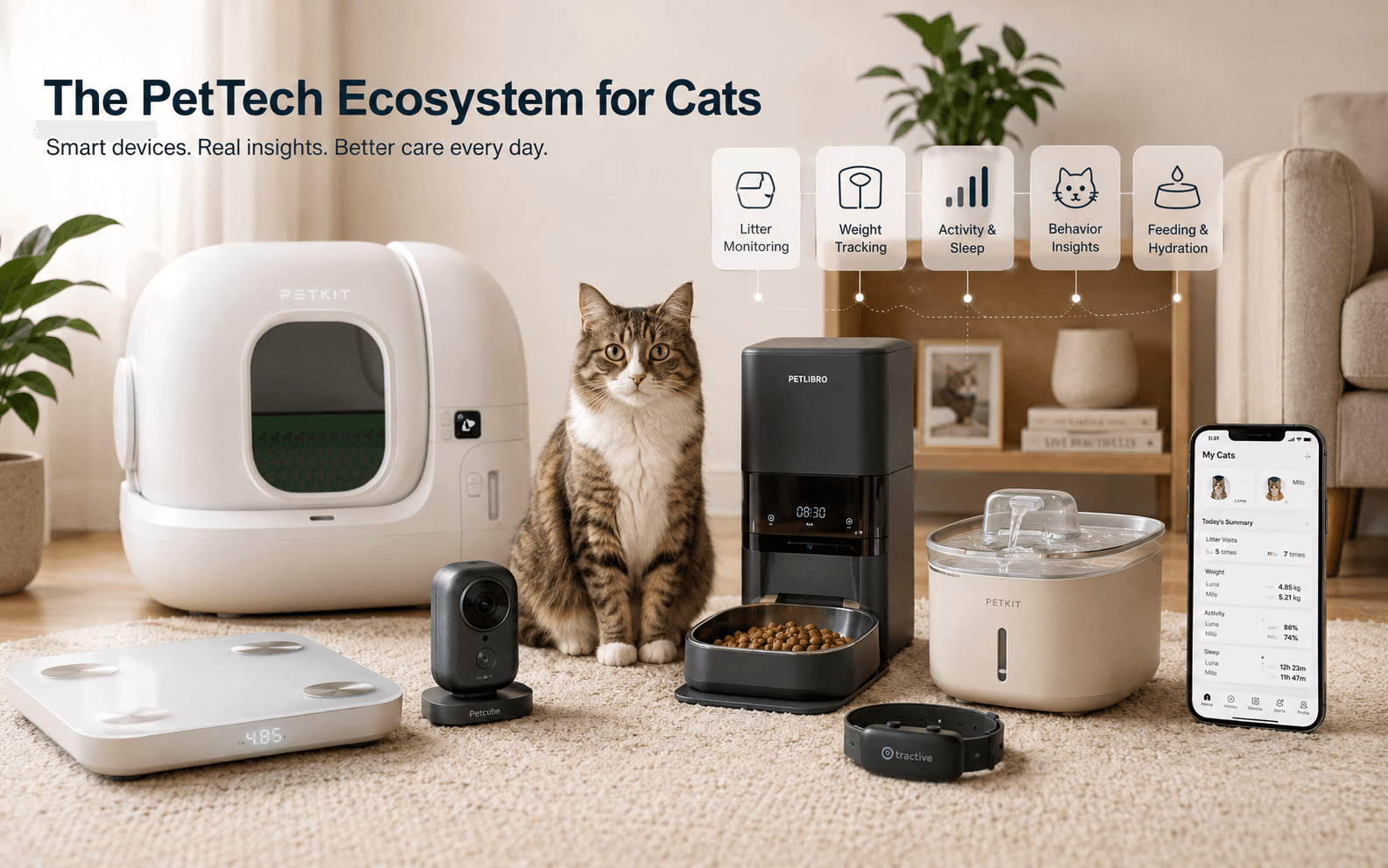
A smart litter monitor can record bathroom habits.
A tracker can record activity and sleep.
A camera can hear Gerald shouting at 3:12 a.m. because a door has committed the crime of being closed.
What these devices usually cannot do is combine every signal into one clinically meaningful diagnosis.
The “ecosystem” often exists less in the cloud than in the owner’s workflow:
- establish what is normal;
- notice a repeated change;
- verify it directly;
- contact a veterinarian when appropriate.
That can be useful.
Buying five devices and admiring five unrelated graphs is not preventive medicine.
It is data theater with excellent push notifications.
Quick Verdict
| Monitoring goal | Best starting point | PetTech AI verdict | Main limitation |
|---|---|---|---|
| Track weight and litter habits without replacing the box | Purina Petivity | Recommended with Conditions | Does not work with self-cleaning boxes |
| Combine automatic cleaning with visual identification | PETKIT Purobot Max Pro 2 | Recommended with Conditions | Camera value depends on review habits and software |
| Monitor outdoor location, activity and sleep | Tractive cat tracker | Conditional Recommendation | Collar acceptance, subscription and charging |
| Add visual context while away | Petcube Cam 360 | Conditional Recommendation | Alerts and useful history may require Petcube Care |
| Verify long-term weight trends | A reliable standalone scale | Recommended | Requires consistent manual weighing |
| Build a complete monitoring stack | One primary signal plus one contextual device | Recommended | More devices often add noise before they add insight |
For most monitoring-first households, start with litter activity and weight.
Those are frequent, measurable signals that can establish a useful baseline without requiring the cat to wear anything.
Add a camera when visual context would answer an unresolved question.
Add a tracker when the cat spends time outdoors or activity and sleep changes are genuinely relevant.
Do not build the complete stack because the dashboard looks lonely.
Still deciding whether you need labor-saving automation or deeper behavioral evidence? Read our Smart Cat Monitoring vs Automation guide before adding another device.
Research Note
This is a research-led guide based on current official product documentation, feline veterinary guidance and PetTech AI’s individual product audits.
PetTech AI has not conducted long-term hands-on testing of every device discussed.
These tools can reveal observable changes. They cannot diagnose medical conditions or replace veterinary examinations.
PetTech AI may earn a commission from qualifying purchases. As an Amazon Associate I earn from qualifying purchases.
Start With a Baseline, Not an Alert
A device cannot identify a meaningful change until it has some idea of what normal looks like.
Useful baseline information may include:
- body weight;
- litter-box visit frequency;
- approximate elimination patterns;
- appetite and meal completion;
- sleep and activity;
- normal vocalization and movement.
The baseline does not need to become a daily research project.
For many cats, a weekly or monthly review is enough unless a veterinarian has recommended closer monitoring.
Cornell notes that unintended weight loss can be difficult to notice when owners see their cat every day and recommends regular weighing. FelineVMA recommends full physical examinations at least annually for cats of every life stage, with more frequent examinations for senior cats.
The device supplies trend data.
The veterinarian still supplies medicine.
Best Low-Friction Starting Point: Purina Petivity
Verdict: Recommended with Conditions
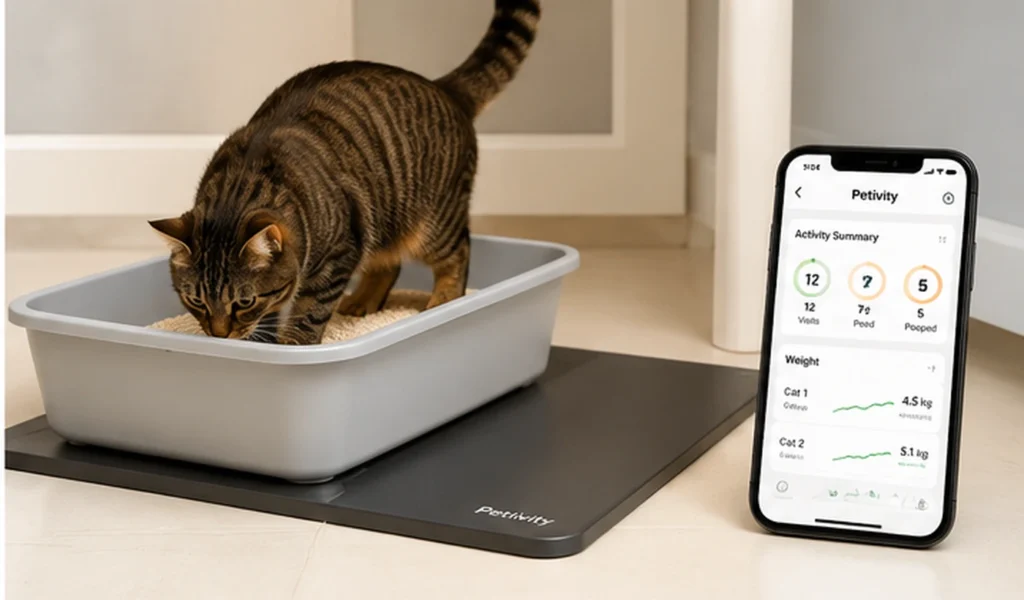
Petivity sits beneath an existing conventional litter box and records weight, visits, urination and defecation events.
Purina says the system can track as many as five cats and organize their activity inside the Petivity app. It can also alert owners when the recorded baseline changes in a way that may deserve closer attention.
Its main advantage is that the cat can keep using a familiar litter box.
That makes Petivity especially relevant when:
- the cat rejects automatic boxes;
- manual scooping is acceptable;
- weight and elimination trends matter more than automation;
- several cats have distinguishable behavioral or weight profiles;
- a relatively low-complexity starting point is preferable.
The conditions are important.
Petivity does not work with self-cleaning litter boxes and is designed for conventional boxes no larger than approximately 16 by 21 inches. It must also sit on a hard, level surface.
In homes with several litter locations, incomplete coverage can create incomplete data. Petivity recommends using a monitor beneath every regularly used box when owners want the most complete record.
That can quickly transform a modest purchase into an infrastructure program.
Still, Petivity is one of the clearest ways to add useful monitoring without asking the cat to adopt an entirely new toilet.
Want litter and weight tracking beneath a familiar box? Check Purina Petivity on Amazon.
Best All-in-One Litter Upgrade: PETKIT Purobot Max Pro 2
Verdict: Recommended with Conditions
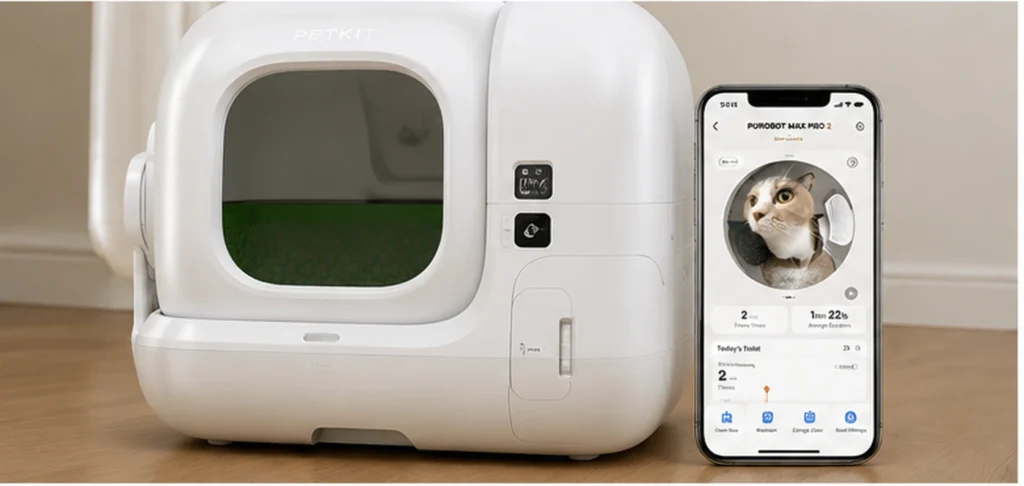
Purobot Max Pro 2 combines automatic waste separation with a camera and weight sensors.
PETKIT positions the camera as a way to identify individual cats and add visual context to litter-box visits, particularly when several cats share similar weights.
This provides two different benefits:
- automation removes routine scooping;
- monitoring helps establish which cat generated the record.
The product makes sense when:
- several cats share the box;
- weight-only identification is ambiguous;
- visual context would change how the owner responds;
- automatic cleaning is already part of the buying decision;
- the owner will review flagged events.
It is much harder to justify when one cat uses the box and the only objective is reducing scooping.
A camera does not improve clump separation.
It simply ensures the clump has appropriate supporting documentation.
The deepest video-history features may also involve PETKIT Care+, making the software layer part of the real ownership decision.
Would visual identification solve an existing multi-cat uncertainty? Check Purobot Max Pro 2 through PETKIT.
Prefer Amazon checkout? Check Purobot Max Pro 2 availability on Amazon.
For the complete decision, read our PETKIT Purobot Max Pro 2 Review.
Activity and Sleep: Add a Tracker Only When It Fits the Cat
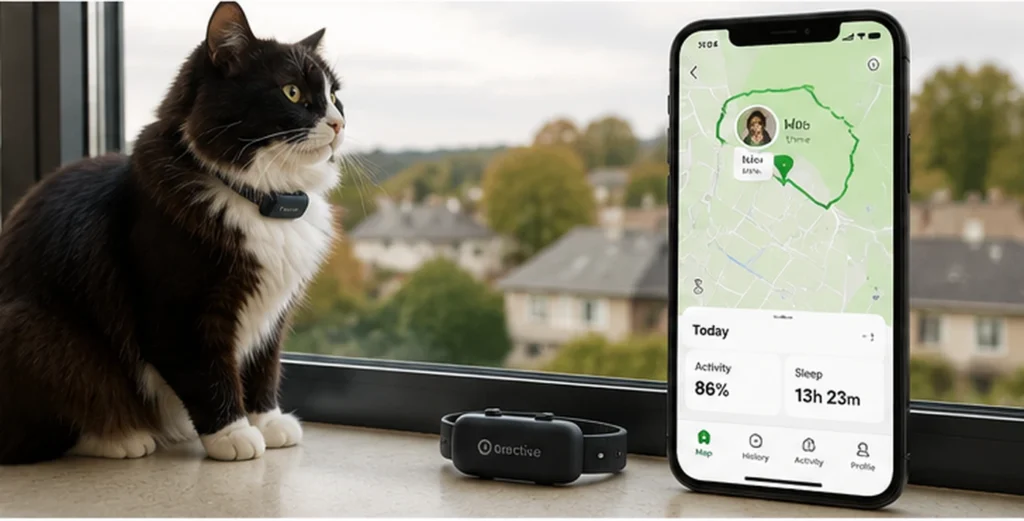
A collar tracker can add information that litter devices cannot provide:
- outdoor location;
- daily movement;
- sleep duration;
- changes in habitual activity;
- escape alerts.
Tractive’s current cat tracker records activity and sleep, while supported plans and hardware can add further wellness information. GPS and health functions require an active subscription.
That can be useful for:
- outdoor or escape-prone cats;
- cats whose activity changes are difficult to observe;
- owners wanting location and routine data from one collar;
- households prepared to maintain charging and subscription service.
It is a poor fit when:
- the cat refuses collars;
- the device is too large for comfortable wear;
- the cat remains entirely indoors and activity data would not change anything;
- charging gaps make the history inconsistent.
A tracker should first be comfortable and safe.
The most detailed sleep graph in the world is not useful when Napoleon has removed the collar and hidden it beneath a hedge.
For product-level options and fit limitations, read our Best Cat GPS Trackers guide.
Cameras Add Context, Not a Complete Health Record
Verdict: Conditional Recommendation
A camera can help answer questions other devices cannot:
- Did the cat approach the feeder but refuse the meal?
- Was vocalization associated with pacing or conflict?
- Is one cat blocking a resource?
- Did a mobility change become visible while nobody was home?
Petcube Cam 360 provides pan-and-tilt viewing, night vision and recognition of pets, people, barking and meowing. Several smart alerts and extended cloud-video functions are connected to Petcube Care.
A camera becomes useful when visual evidence would change the response.
It becomes decorative surveillance when owners receive twenty motion alerts and eventually train themselves to ignore all twenty.
Cameras are weakest as primary health monitors because they depend on:
- placement;
- field of view;
- lighting;
- whether the cat enters the room;
- whether someone reviews the footage;
- subscription features.
Use them to clarify a question created by another signal.
Do not expect a camera to independently discover a coherent medical pattern while Gerald sleeps behind the sofa.
Would room-level video clarify feeding, mobility or resource conflict? Check Petcube Cam 360 on Amazon.
For broader camera choices, read our Best Smart Cat Cameras guide.
Feeding Data Is Usually Automation Before Monitoring
Smart feeders are excellent at:
- maintaining schedules;
- controlling portions;
- recording dispensing events;
- reducing early-morning negotiations.
They are less reliable at proving exact consumption unless they include a camera, bowl sensor or individual-access system.
Even then:
- another cat may steal food;
- food may remain uneaten;
- recognition may be imperfect;
- dispensing is not the same as digestion.
Do not automatically adjust calories because one device reported a dramatic afternoon.
Repeated weight change should be confirmed and discussed with a veterinarian before making substantial dietary changes. Cornell warns that sudden or inappropriate calorie restriction can be dangerous for cats.
For the distinction between scheduled automation, camera monitoring and RFID access, read our Best Automatic Cat Feeders guide.
The Two-Signal Rule
A practical monitoring system does not need every available device.
Use:
one primary signal and one contextual signal.
Examples:
Senior indoor cat
Primary signal:
- litter activity and weight through Petivity or a smart litter box.
Context:
- regular manual weighing or a room camera when mobility is difficult to observe.
Multi-cat household
Primary signal:
- camera-equipped or reliably identified litter records.
Context:
- feeding access data when diet theft is also a concern.
Outdoor cat
Primary signal:
- GPS, activity and sleep tracker.
Context:
- monthly weight and direct observation at home.
Cat with a previous urinary concern
Primary signal:
- litter-box frequency and elimination patterns.
Context:
- camera evidence only when it helps verify straining, repeated visits or unusual behavior.
Frequent attempts to urinate, prolonged straining or producing little to no urine can indicate a serious urinary problem and require prompt veterinary attention.
Do not wait for the dashboard to achieve statistical confidence while the cat is visibly distressed.
Why One App Is Not Always Better
A unified app is convenient.
It does not automatically create better evidence.
Within one brand, devices may share:
- profiles;
- maintenance alerts;
- routine histories;
- account access.
But even then, the app may display several separate timelines rather than clinically interpreting them together.
Across different brands, the information is usually even more fragmented.
The owner still needs to notice:
- weight moved;
- litter visits increased;
- appetite changed;
- activity declined.
The fact that all four graphs use attractive pastel colors does not make them a medical team.
Choose one ecosystem when its products independently fit the household.
Mix brands when a better product solves the problem more directly.
For the strategic difference, read our PETKIT Ecosystem Review and PETKIT vs Litter-Robot Ecosystem comparison.
Buyer-Regret Risk
Monitoring-stack regret usually comes from collecting more information than the owner can interpret or use.
Common failures include:
- buying several devices before establishing a baseline;
- subscribing to histories nobody reviews;
- mistaking one unusual day for a trend;
- assuming alerts identify a cause;
- using a camera when access control was needed;
- replacing direct observation with notifications.
The safest question is:
What decision will this device help me make?
When the answer is unclear, the device is probably not ready to enter the ecosystem.
Final Verdict
A PetTech ecosystem can be useful when it turns a vague concern into a clear, verifiable pattern.
The strongest starting signals are usually:
- litter-box activity;
- body weight;
- appetite;
- activity and sleep when relevant.
Choose Petivity when you want monitoring beneath an existing conventional litter box.
Choose Purobot Max Pro 2 when automatic cleaning and visual multi-cat identification both matter.
Add Tractive when outdoor location, activity and sleep genuinely change the care plan.
Add Petcube Cam 360 when visual context resolves a specific uncertainty.
Do not build the full stack immediately.
Start with one signal.
Learn what normal looks like.
Add another device only when the first one leaves an important question unanswered.
The goal is not to know everything Baron did today.
It is to notice when something meaningful changed—and know what to do next.
Frequently Asked Questions
Can smart pet devices diagnose health problems?
No. They can record changes in weight, activity, appetite or litter-box behavior. A veterinarian must determine the cause.
Which device should I buy first?
For many indoor cats, litter and weight monitoring provide the most frequent baseline signals. Choose Petivity when keeping a conventional box or a compatible smart litter box when automation also matters.
Do all devices need to use one app?
No. One app reduces digital clutter, but product fit and signal quality matter more than brand consistency.
How many alerts should trigger concern?
There is no universal number. Look for repeated changes, multiple related signals or visible symptoms. Straining, painful urination or little to no urine requires prompt veterinary attention.
Can feeding and weight data automatically control portions?
Most consumer systems do not safely create a complete automatic nutrition plan. Substantial feeding changes should be based on measured portions and veterinary guidance.
References
- Purina Petivity — Smart Litter Box Monitor documentation
- PETKIT — Purobot Max Pro 2 product documentation
- Tractive — Cat tracker and health-monitoring documentation
- Petcube — Cam 360 and Petcube Care documentation
- Cornell Feline Health Center — Weight, urinary and nutrition guidance
- Feline Veterinary Medical Association — Life-stage and senior-care guidance
Image Disclosure
Official manufacturer images are used when available and authorized.
AI-generated images may also be used as editorial illustrations. They should not be treated as exact representations of product dimensions, controls or physical features. Always verify current official specifications before purchasing.
Editorial Disclosure
PetTech AI may earn a commission from qualifying purchases. This does not influence our recommendations, comparisons or editorial judgments.