Tag: smart cat technology

  • Automatic Litter Boxes for Large Cats: What Matters Beyond the Weight Limit?

    Automatic Litter Boxes for Large Cats: What Matters Beyond the Weight Limit?

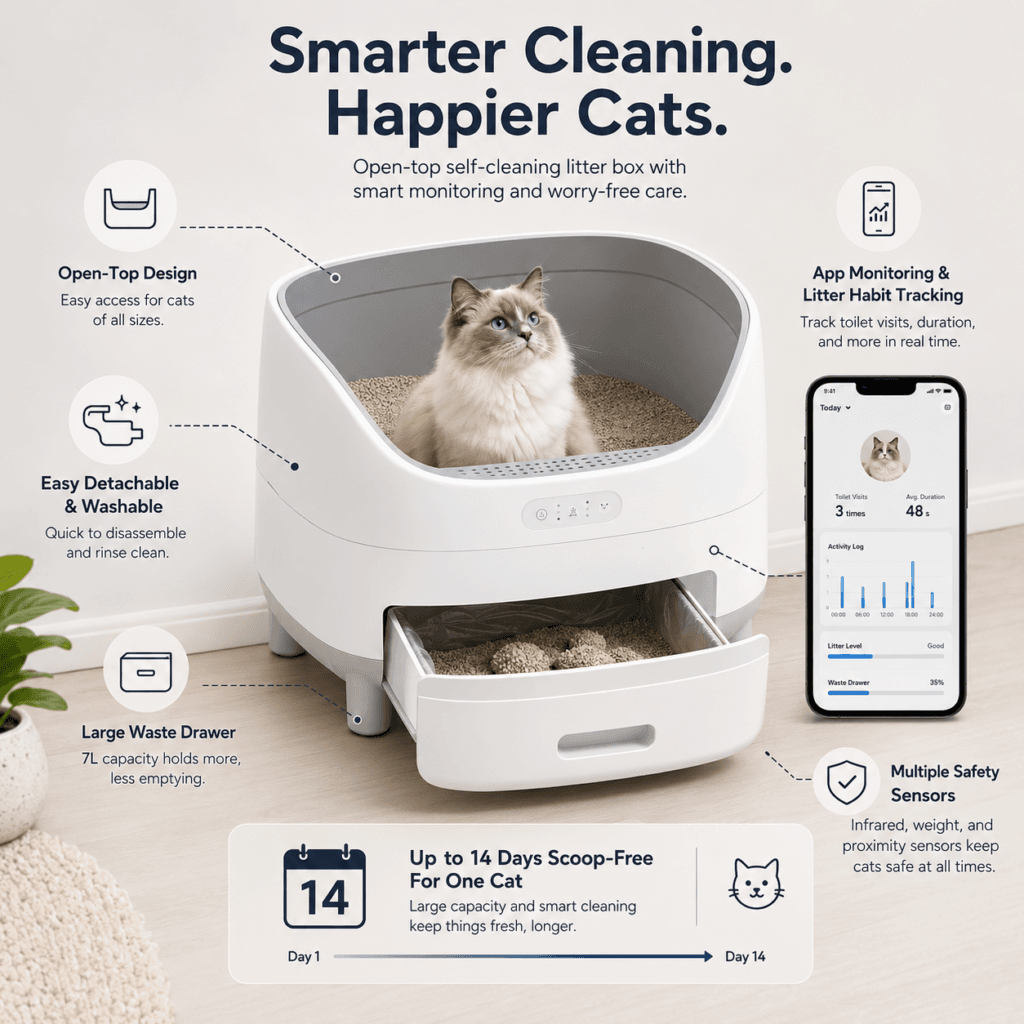
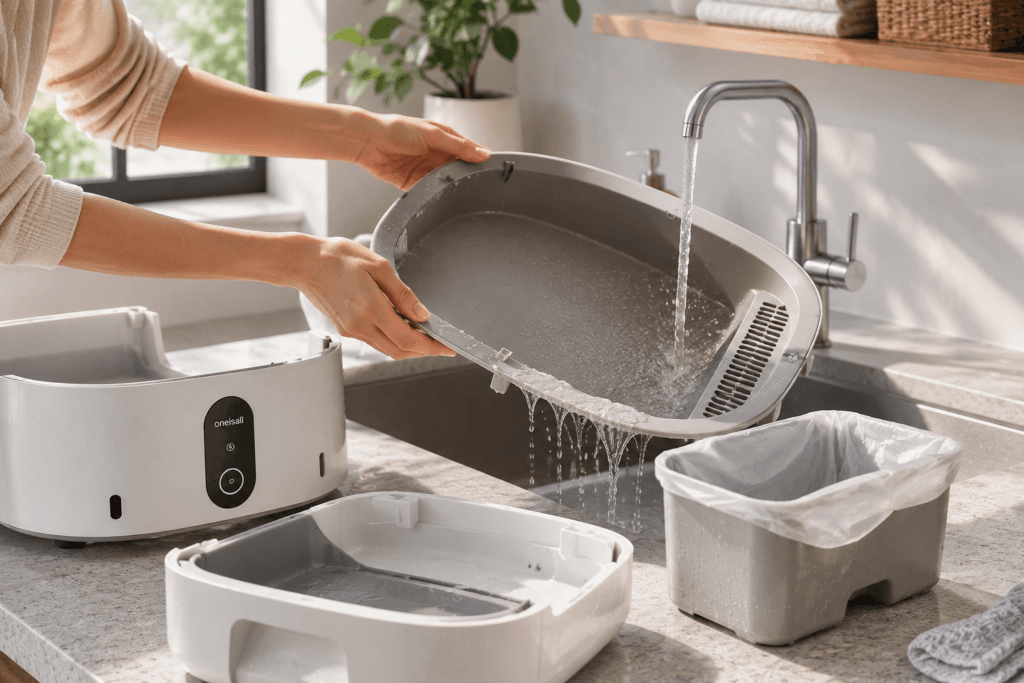
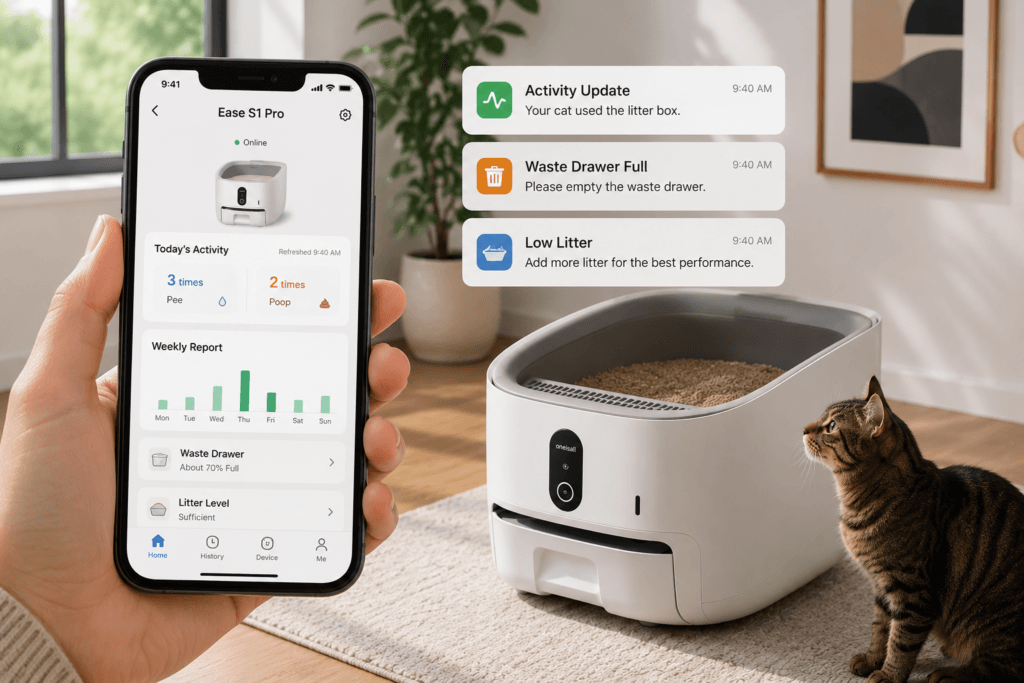
    Visual note: Images in this article are AI-generated editorial illustrations, not official product images. They may not reflect the exact design, dimensions, or features of any specific litter box.

    A large cat can fall below an automatic litter box’s published weight limit and still hate using it.

    That is the problem with shopping by one number alone.

    A listing may say “up to 25 lb” or “up to 30 lb,” but that only tells you the product is intended to support a cat within that range. It does not tell you whether your cat has enough room to turn, dig, squat, cover waste, reposition, and leave comfortably.

    For large cats, long-bodied cats, older cats, and cats with a strong digging routine, usable space matters more than a maximum-weight label.

    The real question is not:

    “Does my cat technically fit within the stated limit?”

    It is:

    “Can my cat use this litter box naturally and consistently without feeling cramped?”

    This guide explains what to check before choosing an automatic litter box for a large cat — beyond the marketing headline and published weight rating.

    Quick Verdict

    For a large cat, prioritize:

    • Enough usable litter area to turn, dig, squat, and cover normally.
    • An entrance that does not require awkward squeezing or ducking.
    • A clear, comfortable exit route.
    • An entry height that suits the cat’s mobility.
    • Stable placement on a level floor.
    • Enough space around the unit to avoid making the cat feel cornered.
    • A transition plan that keeps the old litter tray available at first.

    Do not choose an automatic litter box purely because it says “large cat friendly” or lists a high maximum weight.

    A 19-pound Maine Coon and a 19-pound compact domestic shorthair may have very different body length, turning needs, tail position, mobility, and digging habits. The same applies to large Ragdolls, Norwegian Forest Cats, Siberians, and long-bodied mixed-breed cats.

    Weight limits are useful as an initial filter.

    They are not proof of a comfortable fit.

    This article contains affiliate links. As an Amazon Associate I earn from qualifying purchases.

    Explore the Oneisall Ease S1 Pro on Amazon

    Why Weight Limits Can Be Misleading
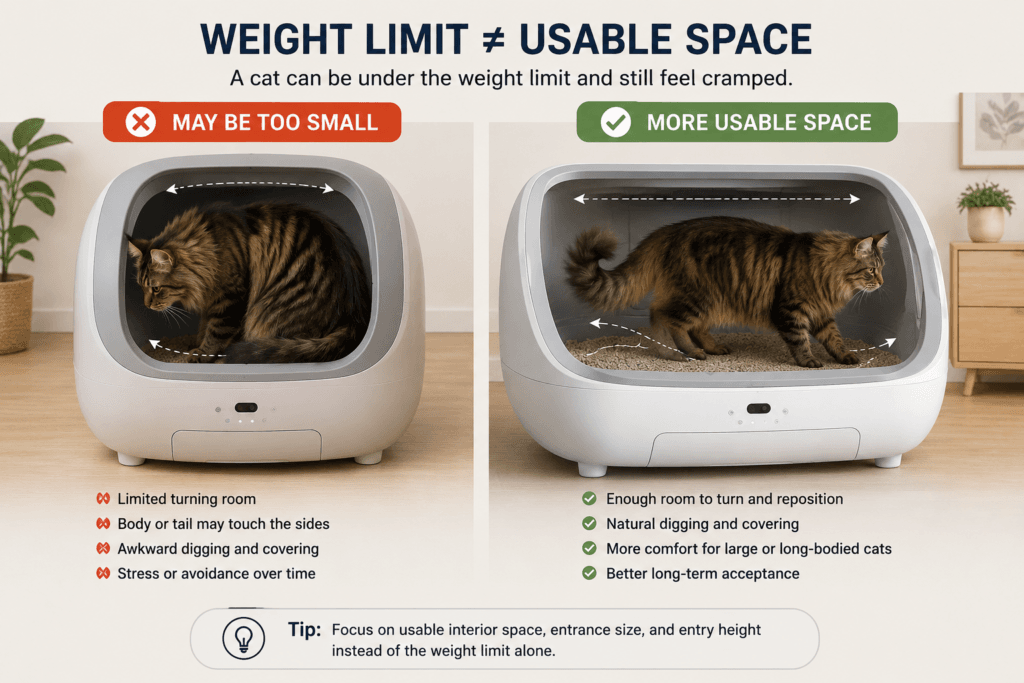
    Comparison of a large cat fitting awkwardly and comfortably in automatic litter boxes
    A published weight limit does not always show whether a cat can turn and position itself comfortably.

    A weight limit usually answers one narrow question:

    Can the product’s sensors and mechanics accommodate a cat of this weight?

    That matters, especially for automatic litter boxes that rely on weight detection, motion sensors, or cleaning-cycle safety systems.

    But a large cat’s daily experience inside the box depends on more than weight.

    Two cats can weigh the same while having very different needs:

    • One may be short and broad.
    • Another may be long-bodied with a large turning radius.
    • One may dig briefly and eliminate quickly.
    • Another may circle, dig deeply, change position several times, and spend longer covering waste.
    • One may be agile and confident.
    • Another may be older, heavier, less flexible, or cautious around narrow entrances.

    A product can technically support a 25-pound cat while still offering an uncomfortable litter area for that cat’s body shape.

    This is why exterior dimensions can also mislead.

    A large automatic litter box may look spacious from the outside but lose usable room because of curved walls, a rotating chamber, internal sensors, high litter walls, waste-routing components, or the shape of the cleaning mechanism.

    The space your cat actually uses is what matters.

    The Four Measurements That Matter More Than a Weight Rating
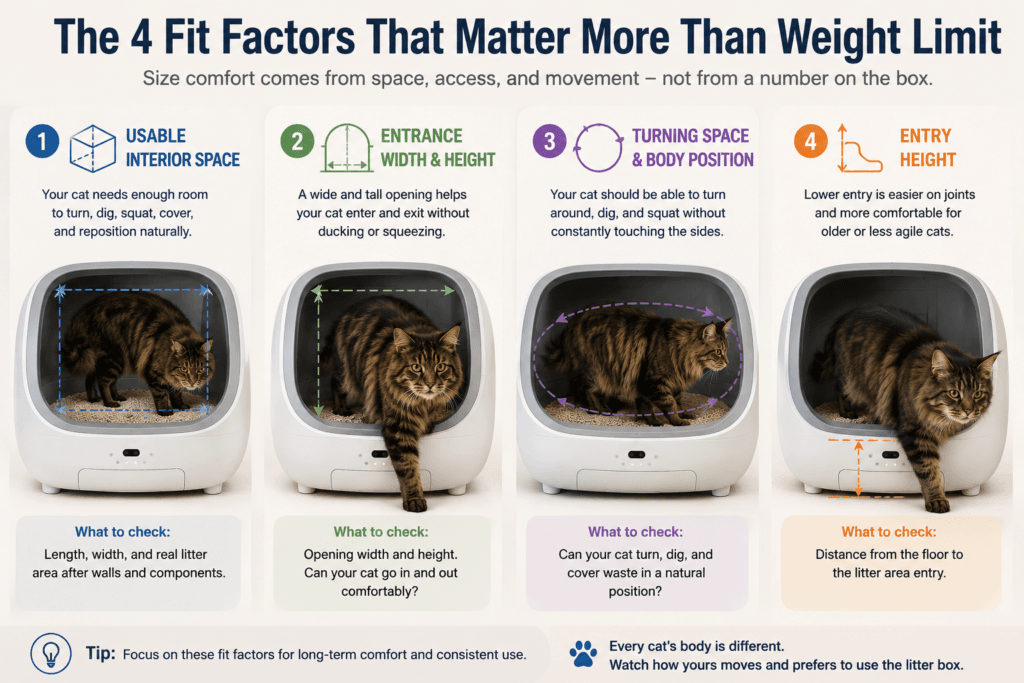
    Four fit factors for an automatic litter box for large cats
    Interior room, entrance size, entry height, and turning space shape daily comfort.

    Before buying, look beyond the maximum-weight specification and focus on these four practical measurements.

    1. Usable Interior Space

    The most important measurement is not the overall size of the machine.

    It is the usable area inside the litter section.

    Ask yourself:

    • Can your cat turn around without constantly touching the sides?
    • Is there enough room to dig and reposition?
    • Can the cat squat without its body hanging over the edge?
    • Can it cover waste naturally?
    • Does the cat have space for its tail and hindquarters?

    For large cats, a generous internal footprint is often more valuable than a premium app, a large waste drawer, or extra monitoring features.

    A cat may tolerate a smaller box temporarily. That does not mean it will use it comfortably every day.

    Look closely at product photos, owner images, demonstration videos, and internal diagrams. Marketing photos often show the exterior dimensions clearly while giving much less attention to the actual litter area.

    2. Entrance Width and Height

    A large cat should not have to squeeze through the entrance or lower its body awkwardly to get inside.

    For enclosed automatic litter boxes, check:

    • Opening width.
    • Opening height.
    • Whether the entrance is positioned in a way that makes turning difficult.
    • Whether the cat can leave comfortably after using the litter.
    • Whether the opening feels like a room entrance or a narrow tunnel.

    For open-top designs, the entrance may be visually simpler, but the side walls can still create a difficult step if they are high or heavily curved.

    A large cat may be physically capable of climbing into a box while still finding the entry annoying enough to avoid it over time.

    That becomes more important with age.

    Cats with reduced flexibility, joint discomfort, or lower confidence may need a more obvious and accessible route in and out.

    Our Purobot Max Pro 2 vs Litter-Robot 4 comparison shows how dramatically entrance geometry can differ even between premium machines.

    3. Turning Room and Natural Body Position

    A cat does not simply walk in, stand still, and leave.

    Most cats perform a sequence of movements: entering, checking the area, turning, digging, positioning, eliminating, covering, and exiting.

    Large cats need room for all of that.

    Pay particular attention to whether the box allows your cat to:

    • Turn without pressing against the walls.
    • Dig without constantly hitting the sides.
    • Shift its stance naturally.
    • Keep its hindquarters inside the litter area.
    • Leave without backing out awkwardly.

    A cat that cannot settle into its normal routine may still use the box, but you may see small signs of discomfort: hesitation, repeated repositioning, shallow digging, elimination near the entrance, or waste landing too close to the edge.

    These signs do not automatically prove that size is the problem.

    But they are worth taking seriously, especially when they appear after changing from a larger traditional tray.

    4. Entry Height

    Entry height is often overlooked because many large cats are strong and athletic.

    But size and agility are not the same thing.

    A young, healthy large cat may manage a taller step without difficulty. An older cat, a heavier cat, or a cat with reduced mobility may find the same entrance tiring or uncomfortable.

    High-sided litter boxes can also create problems for cats that prefer to enter gradually rather than jump directly into a deep tray.

    Before purchasing, think about your cat’s actual movement patterns.

    Does your cat leap confidently onto furniture? Does it hesitate on stairs? Does it avoid high-sided trays? Has it ever struggled with a carrier, covered box, or narrow doorway?

    The best automatic litter box for a large cat is not necessarily the lowest one. It is the one that gives your cat a comfortable, repeatable path in and out.

    Open-Top vs Enclosed Automatic Litter Boxes for Large Cats

    Open-top and enclosed designs can both work for large cats.

    Neither format automatically guarantees more usable room.

    An open-top litter box may be easier for some large cats because the cat can see the surrounding room, assess the exit route, and position its body without feeling closed in. The design can also make it easier for owners to judge whether the litter area looks genuinely spacious.

    An enclosed model can work well too, provided the interior is truly large enough and the entrance does not create a cramped or tunnel-like experience.

    The key distinction is not simply whether there is a roof.

    It is whether the cat has enough usable space to move naturally.

    A spacious enclosed litter box may be more comfortable than a narrow open-top tray. A well-designed open-top box may be easier to enter and leave than an enclosed unit with a restrictive opening.

    Shape matters alongside size.

    Our guide to Open-Top vs Enclosed Automatic Litter Boxes: Which Cats May Adapt More Easily? explains why visibility, exit routes, familiar habits, and gradual introduction can matter just as much as the design category itself.

    Signs an Automatic Litter Box May Be Too Small

    You cannot always know whether a litter box will fit perfectly before it arrives.

    But once your cat starts using it, watch for these practical warning signs:

    • Your cat hesitates before entering.
    • Your cat keeps its front paws outside while using the box.
    • Your cat repeatedly turns or repositions before settling.
    • The tail, back, or hindquarters regularly press against the walls.
    • Your cat eliminates close to the entrance or over the edge.
    • Digging and covering behavior becomes noticeably shorter or more awkward.
    • Your cat uses another available tray whenever possible.
    • Your cat appears to need multiple attempts to find a comfortable position.

    A single awkward visit does not mean the product is unsuitable.

    Look for a pattern.

    A cat may need time to adjust to a new machine, different litter depth, unfamiliar placement, or cleaning-cycle sound. But persistent discomfort should not be dismissed simply because the cat falls under the published weight limit.

    Large Cats Need More Than a Large Interior

    Physical room is essential, but it is not the whole setup.

    A large cat also needs enough environmental room around the litter box.

    Stable placement

    Automatic litter boxes should sit on a flat, stable surface according to the manufacturer’s instructions.

    Avoid placing the unit where it rocks, shifts, or feels unstable under the cat’s weight. A large cat can be more sensitive to movement simply because it creates more force while stepping in, digging, and turning.

    Clear access

    Do not hide the box in a narrow corner where the cat feels trapped between the machine and a wall.

    A large cat needs enough room to approach, enter, and leave without squeezing between furniture or being forced to reverse out of a cramped space.

    A predictable exit route

    This matters especially in multi-cat homes.

    A box may be technically large enough, but the surrounding location can still make it feel unsafe if another cat can stare at, block, or ambush the entrance.

    The environment should support an easy approach and an easy departure.

    Familiar litter and depth

    A new automatic litter box is already a major change. Avoid changing the litter type, scent, texture, and depth at the same time unless there is a specific reason to do so.

    Use the familiar litter whenever possible during the transition.

    Calm exposure to cleaning cycles

    A large cat may need more time to trust a machine that moves after it leaves.

    Let the cat investigate the box while it is quiet. Allow it to observe the cleaning cycle from a distance. Keep the old tray available during the transition.

    A large cat may need more physical room, but it also needs more environmental room: clear access, a predictable exit, and enough space around the box to avoid feeling cornered.

    Is an Automatic Litter Box Safe for Big Cats?

    An automatic litter box should only be considered when the cat fits within the manufacturer’s published size and weight guidance.

    That includes any minimum-weight requirement, not only the maximum.

    Safety systems also need to be kept clean and used according to the product’s instructions. Sensors, moving parts, waste drawers, and litter levels should be checked regularly rather than treated as completely hands-off.

    The better question is not only whether the unit can detect your cat.

    It is whether your cat can use it comfortably.

    Do not choose a product that forces an awkward fit simply because the specification sheet says the cat falls within the supported range.

    Observe your cat during the transition. Watch how it enters, turns, digs, and exits. Keep another suitable litter option available until you are confident the new routine is working.

    A Practical Fit Test Before You Buy
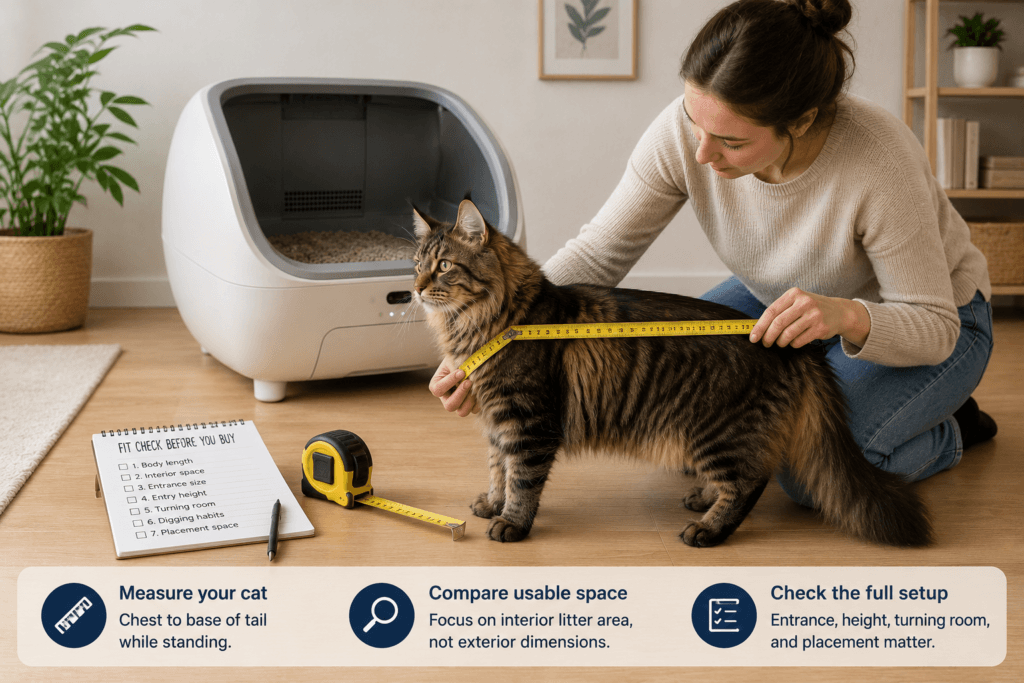
    Owner measuring a large cat near an automatic litter box before purchase
    Compare your cat’s body shape and movement habits with usable interior space, not exterior dimensions alone.

    Use this checklist before committing to an automatic litter box for a large cat.

    1. Measure your cat’s body length

    Measure roughly from the chest area to the hindquarters while your cat is standing naturally.

    This is not about finding a perfect mathematical match. It is about avoiding a situation where the usable litter area is obviously too short for the cat’s normal body position.

    2. Compare the measurement with usable interior room

    Do not compare it only with the product’s outside dimensions.

    Look for the actual litter-area dimensions, interior photos, and videos of cats entering and turning inside the unit.

    3. Check the opening

    Look at both width and height.

    Could your cat enter comfortably without brushing its sides or lowering its body awkwardly?

    4. Consider normal digging behavior

    A cat that digs deeply and turns several times before eliminating may need more room than a cat that uses the tray quickly.

    Your cat’s real habits matter more than generic breed assumptions.

    5. Think about age and mobility

    A large young cat may handle a taller entrance easily. A large senior cat may need something more accessible.

    Choose for the cat you have now, not only the cat you remember from two years ago.

    6. Check the surrounding room

    Measure the placement area too.

    There should be enough clearance for the cat to approach and leave without feeling blocked by furniture, walls, doors, or another pet.

    7. Review return, warranty, and setup guidance

    Fit is not always obvious from a listing page.

    Before buying, understand the return conditions, warranty coverage, and manufacturer recommendations. This gives you a practical fallback if the product turns out to be unsuitable for your cat’s real behavior.

    Where an Open-Top Design Can Make Sense

    For owners of a large cat who value a clear entrance and an open tray-like experience, the Oneisall Ease S1 Pro is one option to examine.

    Its published limit is up to 30 lb. But that is only the starting point.

    The more useful question is whether the open usable area, entry design, placement requirements, and cleaning routine suit your cat’s individual body shape and habits.

    An open-top approach may be especially worth considering when your cat:

    • Has always preferred traditional open trays.
    • Needs a clear visual exit route.
    • Dislikes enclosed litter furniture.
    • Is large, long-bodied, or cautious in tight spaces.
    • Has previously avoided covered boxes.

    For a closer look at its practical trade-offs, read our Oneisall Ease S1 Pro Review.

    Final Verdict

    For large cats, the best automatic litter box is not the one with the highest stated weight limit.

    It is the one that gives the cat enough usable space to move normally, enter comfortably, dig naturally, and leave without hesitation.

    Treat the published weight limit as a starting filter.

    Make the final decision based on interior room, entrance design, entry height, body position, placement, and your cat’s actual behavior.

    A feature-rich machine that feels cramped is not a good fit.

    A simpler design that your cat uses consistently is usually the better investment.

    Read our Oneisall Ease S1 Pro Review

    Frequently Asked Questions

    What size automatic litter box does a Maine Coon need?

    There is no single answer based on breed alone. Look for enough usable interior room for the cat to turn, dig, squat, and leave comfortably. Compare body length and normal movement habits with the actual litter area, not only the listed maximum weight.

    Is a 25 lb weight limit enough for a large cat?

    Possibly, but weight alone does not confirm comfort. A long-bodied or broad cat may still need more interior room, a wider entrance, or an easier exit route.

    Are open-top automatic litter boxes better for large cats?

    Not automatically. Open-top designs can make entry, exit, and body positioning easier for some cats, but an enclosed unit can also work well when the interior is generous and the opening is comfortable.

    Can a large cat use an enclosed automatic litter box?

    Yes, provided the box offers enough usable room and the cat can enter, turn, eliminate, and leave naturally. The enclosure itself is not the deciding factor.

    What are the signs that a litter box is too small for my cat?

    Repeated hesitation, awkward turning, poor digging, eliminating near the entrance, waste over the edge, or choosing another available tray can all be signs worth watching.

    Should I remove the old litter box immediately?

    No. Keep the old tray available while your cat adjusts to the automatic litter box. A gradual transition gives you time to observe whether the new unit is actually a comfortable fit.

    References

    • General feline litter-box guidance on size, entry access, litter depth, placement, and mobility considerations.
    • Oneisall Ease S1 Pro product information and setup guidance.

    Image Credits: AI-generated editorial illustrations for PetTechAI.
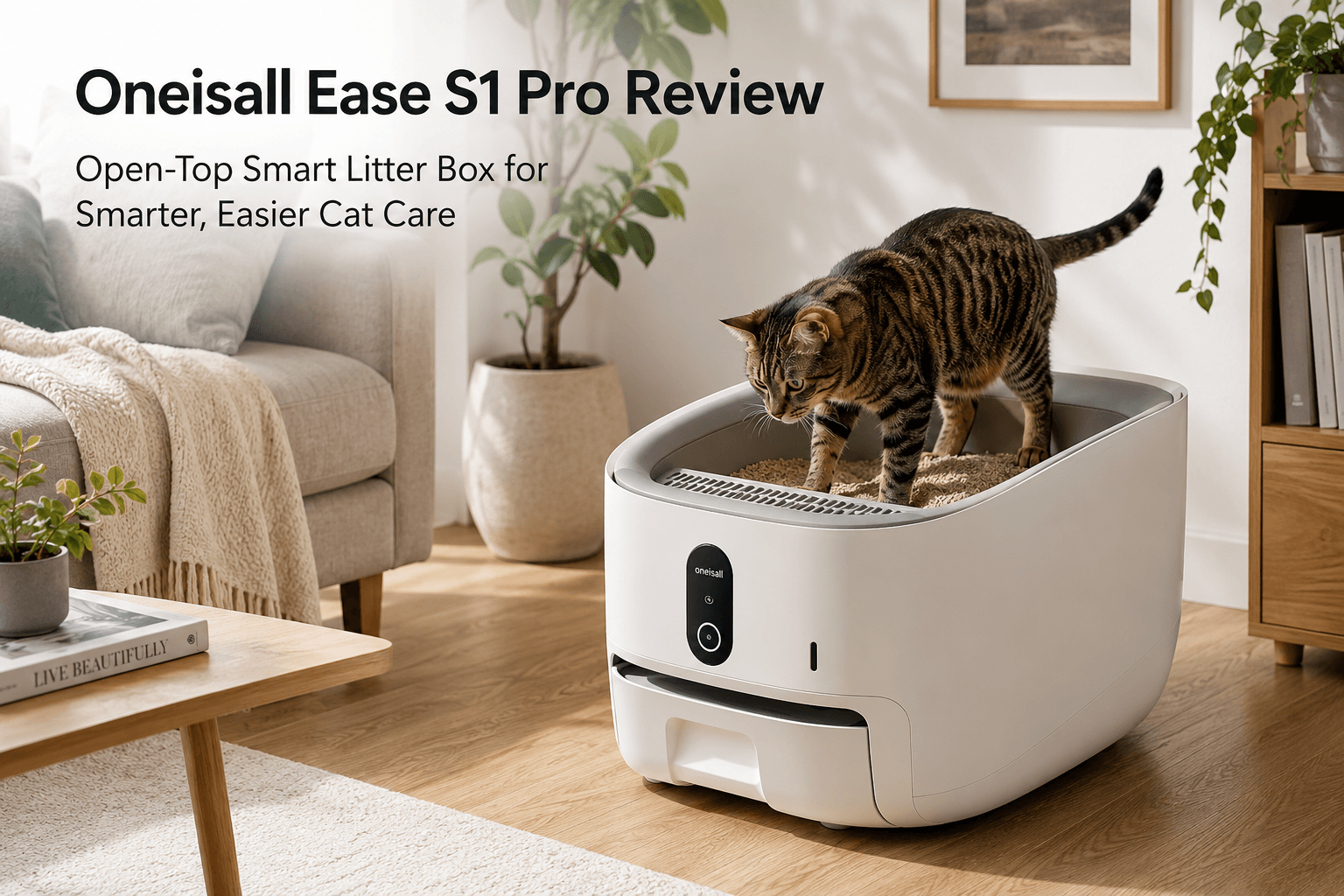
  • Oneisall Ease S1 Pro Review (2026): Is the Open-Top Design Worth the Risk?

    Oneisall Ease S1 Pro Review (2026): Is the Open-Top Design Worth the Risk?

    Automatic litter boxes usually ask the cat to enter a rotating plastic chamber and trust that nothing suspicious will happen afterward.

    Oneisall Ease S1 Pro takes a less theatrical approach.

    It looks more like a large open litter tray, automatically moves waste into a drawer, comes apart for rinsing, and adds app-based activity reports without surrounding the cat inside a globe.

    That is a genuinely attractive concept.

    The problem is not the concept.

    The problem is whether the current product record is strong enough to trust with one of the most important daily resources in the home.

    Right now, it is not.

    Ease S1 Pro has a spacious open-top design, useful cleaning access, a large waste drawer, and a reasonable safety architecture on paper. Its early ownership signal, however, is too mixed for PetTech AI to recommend it to the average buyer.

    Consider it only when the open tray and detachable structure solve a problem that better-established machines do not—and when you are comfortable testing it within a favorable return window.

    Otherwise, choose something with a stronger reliability record.

    Research note: This is a research-led review based on current product documentation, public ownership evidence, and PetTech AI’s product-level trust check. PetTech AI has not conducted a long-term hands-on test of Ease S1 Pro.

    Quick Verdict

    CategoryVerdict
    Best forBuyers who specifically need an open-top automated box
    Main advantageFamiliar tray layout and unusually accessible cleaning structure
    Cat sizeCats over six months and within the supported weight range
    Waste drawer11 L
    AppWi-Fi and Bluetooth controls with activity reports
    Individual identificationLimited; not a mature multi-cat identity system
    Main riskMixed early reliability and software evidence
    Recommendation strengthMention only
    Commercial verdictNot recommended for most buyers

    The short version

    Consider Ease S1 Pro if:

    • your cat strongly prefers uncovered litter trays;
    • enclosed rotating boxes have already failed;
    • easy disassembly is more important than mature software;
    • you are willing to test every cycle carefully;
    • the seller’s return terms protect the experiment.

    Skip it if:

    • you want the safest established purchase;
    • troubleshooting an expensive litter box would ruin your week;
    • individual multi-cat records matter;
    • you expect polished health monitoring;
    • the open-top design is merely interesting rather than necessary.

    Buyer regret in one sentence

    You bought a clever open tray to avoid the risks of complicated litter robots, then discovered that it was still a complicated litter robot.

    Affiliate disclosure: This article contains affiliate links. As an Amazon Associate I earn from qualifying purchases.

    View the current Oneisall Ease S1 Pro listing and read the latest verified buyer feedback on Amazon.

    Who Should Consider Ease S1 Pro?

    Cat approaching an open-top automatic litter box designed like a familiar tray
    A more familiar litter-box layout may make the transition easier for some cats.

    Cats that refuse enclosed litter boxes

    The strongest case for Ease S1 Pro is behavioral familiarity.

    Its open rectangular tray provides:

    • clear visibility;
    • an unobstructed exit;
    • less of a chamber-like feeling;
    • more usable surface than many round automatic systems.

    That may help cats that dislike covered boxes or enclosed rotating drums.

    It does not guarantee acceptance.

    Cats can still object to:

    • movement;
    • motor noise;
    • a different litter depth;
    • a new location;
    • the liner texture;
    • the cleaning cycle.

    Open-top reduces one transition barrier.

    It does not negotiate on behalf of the machine.

    For a broader decision about access, odor containment, and cat acceptance, read Open-Top vs Enclosed Automatic Litter Boxes.

    Owners who hate deep-cleaning enclosed robots

    Ease S1 Pro’s most persuasive feature is its detachable construction.

    The tray liner, litter guard, and main waste-contact components can be removed, exposing areas that would remain difficult to reach inside many rotating systems.

    That matters because self-cleaning does not mean self-washing.

    Automatic boxes are excellent at moving clumps into another compartment. They remain strangely unwilling to wash dried residue from their own plastic.

    A machine that is easier to disassemble may be maintained more consistently.

    That is a meaningful advantage—but currently a promising design advantage rather than a proven years-long ownership advantage.

    Buyers with no better open-top option

    Ease S1 Pro may deserve consideration when the alternatives are:

    • a conventional tray the owner cannot keep up with;
    • an enclosed robot the cat refuses;
    • another new open-top model with equally uncertain support.

    In that narrow situation, the Oneisall design may solve the right problem.

    The decision should still be treated as a controlled trial, not a confident long-term investment.

    Who Should Skip It?

    Buyers prioritizing reliability

    This is the clearest skip group.

    Automatic litter boxes contain:

    • motors;
    • moving waste mechanisms;
    • sensors;
    • liners;
    • software;
    • app connections;
    • drawer detection;
    • litter-level assumptions;
    • several creative ways for damp clay to reach places it was never invited.

    A new product needs a reassuring ownership record to offset that complexity.

    Ease S1 Pro does not yet have one.

    The existing signal is too mixed for us to treat the product as dependable, particularly when established alternatives already exist.

    For stronger current recommendations, read our Best Smart Litter Boxes guide.

    Multi-cat homes that need dependable attribution

    The app reports litter-box activity and attempts to distinguish events such as urination and defecation.

    That is not the same as reliably identifying several cats.

    In a multi-cat home, household-level reports may show that the box was used without confidently explaining who used it.

    If the purpose of buying smart monitoring is to separate Napoleon’s routine from Jonathan’s, “a cat visited” is not a major technological breakthrough.

    Choose an explicitly identity-led system when individual records are the real requirement.

    For the broader distinction between useful monitoring and expensive dashboards, read Smart Cat Monitoring vs Automation.

    Owners of senior or mobility-limited cats without careful measurement

    Open-top does not automatically mean low-entry.

    The standard unit remains elevated and physically large. Oneisall sells a separate step configuration for cats that may need easier access.

    Before buying, consider:

    • entry height;
    • joint mobility;
    • available approach space;
    • whether the cat can exit confidently;
    • whether the optional step becomes another required purchase.

    A visible litter tray is not automatically an accessible litter tray.

    What Problem Does It Actually Solve?

    Ease S1 Pro tries to combine three benefits:

    1. the familiarity of an open litter tray;
    2. automatic removal of clumps;
    3. easier access during deep cleaning.

    That is a sensible product brief.

    The cat gets a wide open area.

    The owner gets fewer daily scooping sessions.

    The machine can be dismantled without conducting exploratory surgery through a small waste opening.

    The app is secondary.

    If Ease S1 Pro eventually earns a stronger recommendation, it will probably do so because the physical design works—not because another pet appliance learned how to generate a weekly report.

    Key Benefits

    The open rectangular tray

    A rectangular tray provides more directly usable litter space than a similarly sized round drum.

    Cats can turn, dig, and position themselves without entering a narrow globe.

    This may be especially valuable for:

    • larger cats;
    • cats accustomed to conventional pans;
    • cats that dislike covered boxes;
    • households transitioning to automation for the first time.

    The product supports a broad cat-weight range, but physical fit should still be judged from the actual tray and entry dimensions rather than the maximum number in the product listing.

    The detachable liner and litter guard

    Detachable automatic litter box parts being rinsed for easy cleaning
    Automation reduces scooping, but easier cleaning still matters over time.

    The removable liner is designed to reduce inaccessible corners and make rinsing easier.

    That can help with:

    • stuck litter;
    • urine residue;
    • odor sources;
    • liner replacement;
    • inspection of the waste path.

    Manufacturer promises of ten-second disassembly and twenty-second deep cleaning should be treated as demonstration conditions.

    A clean showroom machine and a month-old litter box occupied by two enthusiastic excavators are different engineering environments.

    Large waste drawer

    The 11 L drawer can reduce emptying frequency.

    The advertised maximum interval assumes one cat and favorable use conditions.

    Actual frequency depends on:

    • number of cats;
    • stool volume;
    • urine-clump size;
    • litter type;
    • humidity;
    • odor tolerance;
    • how evenly the machine distributes waste.

    Check the drawer regularly even when the app insists that civilization can continue without intervention.

    Multiple safety sensors

    Oneisall describes a combination of:

    • weight sensing;
    • radar;
    • infrared detection;
    • motor monitoring.

    The cleaning mechanism is intended to stop when a cat approaches.

    Multiple detection systems are preferable to one.

    They do not justify careless setup.

    The machine still needs:

    • a flat hard floor;
    • clearance from walls and furniture;
    • several supervised test cycles;
    • manual mode for specific vulnerable situations;
    • continued observation during the transition.

    Safety claims describe intended behavior.

    Owners still need to confirm actual behavior in their home.

    Where Ease S1 Pro Can Disappoint

    The trust signal is weak

    This is not a cosmetic issue.

    A mixed early record means too many buyers are having experiences that prevent a consistently strong recommendation.

    Without a larger, more stable body of evidence, we cannot know whether the dissatisfaction is concentrated around:

    • sensors;
    • app connectivity;
    • waste separation;
    • liners;
    • drawer alerts;
    • litter compatibility;
    • cleaning;
    • customer support;
    • several smaller frustrations occurring together.

    The absence of one obvious catastrophic pattern does not make the overall signal reassuring.

    It simply means the disappointment may be distributed efficiently across several departments.

    The app adds another immature layer

    Smartphone showing cat litter box activity notifications beside an open-top litter box
    Activity tracking can highlight routine changes without functioning as a diagnostic tool.

    The Pro model’s app currently supports functions such as:

    • remote controls;
    • general usage tracking;
    • no-activity alerts;
    • shared access for household members.

    These features may help owners notice whether the box is being used and manage basic settings remotely.

    They do not amount to individual cat identification, medical interpretation, or a mature health-monitoring platform.

    Buy the product for its open tray and cleaning access.

    Treat the app as a secondary convenience feature that still needs to establish its long-term reliability.

    Litter compatibility requires attention

    The included guard is designed for mineral and bentonite litter.

    Tofu and mixed litter require a separate larger-opening guard.

    That means some buyers may need to:

    • change litter;
    • buy another component;
    • retest clumping behavior;
    • retrain the cat;
    • discover that “all litter compatible” was technically achieved through additional shopping.

    Confirm the exact litter setup before purchase.

    Clump size and strength directly affect how well an automatic sifting system works.

    Open-top design does not contain everything

    An open tray may improve access and acceptance.

    It can also provide less physical containment for:

    • kicked litter;
    • high urination;
    • enthusiastic digging;
    • cats that consider the surrounding floor part of the project.

    The included mat may reduce scatter.

    It cannot negotiate with a cat committed to geological excavation.

    The Main Alternative

    The safest alternative is not another unproven open-top machine chosen solely because it looks similar.

    It is one of these:

    • a better-established automatic litter box from our current guide;
    • a conventional open tray paired with a stricter scooping routine;
    • waiting until Ease S1 Pro develops a clearer ownership record.

    That third option deserves more respect than buying early.

    You are not obligated to become unpaid quality assurance for a new litter robot.

    The product will still exist after more owners have tested its sensors, app, liner, drawer, and support.

    Is Ease S1 Pro Worth Buying?

    For most buyers, not yet.

    The open-top format and removable structure are legitimate innovations. They address cat acceptance and deep-cleaning access more directly than many enclosed competitors.

    Those strengths are not enough to override the current trust signal.

    A premium automatic litter box needs to prove:

    • consistent waste separation;
    • predictable sensor behavior;
    • reliable drawer detection;
    • acceptable odor control;
    • stable software;
    • obtainable parts;
    • competent support.

    Ease S1 Pro has not yet accumulated enough positive evidence across those areas.

    Consider it only when:

    • open-top automation is essential;
    • established enclosed models are unsuitable;
    • you understand the litter requirements;
    • the return policy is acceptable;
    • you can supervise the transition;
    • you are prepared to return it quickly if the system misbehaves.

    That is not a normal recommendation.

    It is permission to investigate a niche option with your eyes open.

    Final Verdict

    Oneisall Ease S1 Pro has a better product idea than its current recommendation status suggests.

    Its wide open tray may be more approachable for some cats.

    Its detachable liner and guard could make deep cleaning materially easier.

    Its large drawer and automated sifting may reduce daily labor.

    But PetTech AI does not recommend products for having good intentions.

    The existing ownership evidence is too mixed, the app is too young, and the machine is too mechanically important to receive the benefit of the doubt.

    Recommendation status: Mention only.

    Consider it when the open-top, fully detachable design solves a specific problem no stronger-established alternative solves.

    Skip it when you simply want the most dependable automatic litter box available.

    A generous affiliate commission cannot turn mixed ownership evidence into a dependable recommendation.

    Frequently Asked Questions

    Is Oneisall Ease S1 Pro fully automatic?

    It automatically separates clumps and moves them into the waste drawer. Owners still need to refill litter, replace bags, clean the liner and mechanism, and monitor the cat’s behavior.

    Is the open-top design easier for cats?

    It may be easier for cats accustomed to uncovered trays. Acceptance still depends on sound, movement, location, litter, entry height, and the individual cat.

    Can it identify several cats?

    Its app tracks activity, but it should not be treated as a mature individual-identification system for complex multi-cat monitoring.

    Does it work with tofu litter?

    The standard guard supports mineral and bentonite litter. Tofu or mixed litter requires the optional larger-opening guard.

    How often does the drawer need emptying?

    Oneisall advertises a maximum interval for one cat. Real frequency depends on the cat, litter, waste volume, humidity, and odor preferences.

    Is it safe for kittens?

    Oneisall specifies a minimum age and weight. Follow the current manufacturer instructions and use manual operation where recommended.

    Does it provide health monitoring?

    It provides activity reports and event classifications. These may highlight changes but cannot diagnose medical conditions or replace veterinary assessment.

    Should I buy it because the commission campaign is unusually high?

    No. Affiliate compensation is irrelevant to whether the product passes the recommendation threshold.

    References

    • Oneisall Ease S1 Pro official product and support documentation
    • Oneisall app and connectivity documentation
    • Oneisall return and warranty policies
    • PetTech AI product-level trust check

    Image Disclosure

    Images in this article are AI-generated editorial illustrations, not official Oneisall product images. They may not represent the product’s exact design, dimensions, controls, app interface, or components.

  • PETLIBRO Polar vs Rotating Wet Food Feeders: Is Refrigeration Worth It?

    PETLIBRO Polar vs Rotating Wet Food Feeders: Is Refrigeration Worth It?

    A rotating feeder can reveal wet food later. A refrigerated feeder is designed to keep it usable until later.

    That difference sounds obvious, but it is where many buying decisions go wrong. People often look at a rotating wet food feeder with ice packs and assume they have solved wet-food feeding for days at a time. In reality, they have usually solved a much smaller problem: delaying one or two meals during the same day.

    PETLIBRO Polar sits in a different category. It is not simply a rotating feeder with more technology. Its value is tied to refrigeration, app scheduling, and the ability to keep wet food part of a routine when the owner cannot be home to serve it.

    The question is not whether refrigeration is more advanced. It is whether your cat’s feeding routine actually needs it.

    Quick Verdict

    Choose a rotating wet food feeder if:

    • You only need to delay wet-food meals by a few hours.
    • You are normally home within the same day.
    • You want a lower-cost solution for occasional use.
    • You are happy preparing meals manually and managing ice packs.
    • You do not need app scheduling or remote control.

    Choose PETLIBRO Polar if:

    • Wet food is a reliable part of your cat’s daily diet.
    • You have long workdays, commuting time, shifts, or unpredictable routines.
    • You need a meal to remain refrigerated until its scheduled time.
    • You want to schedule and manage feeding from an app.
    • You are paying for flexibility, not just automation.

    For a closer look at setup, cleaning, capacity, and daily ownership, read our PETLIBRO Polar Wet Food Feeder Review.

    Check the current PETLIBRO Polar price on Amazon

    This article contains affiliate links. As an Amazon Associate I earn from qualifying purchases.

    The Real Difference: Delaying Food vs Preserving Food

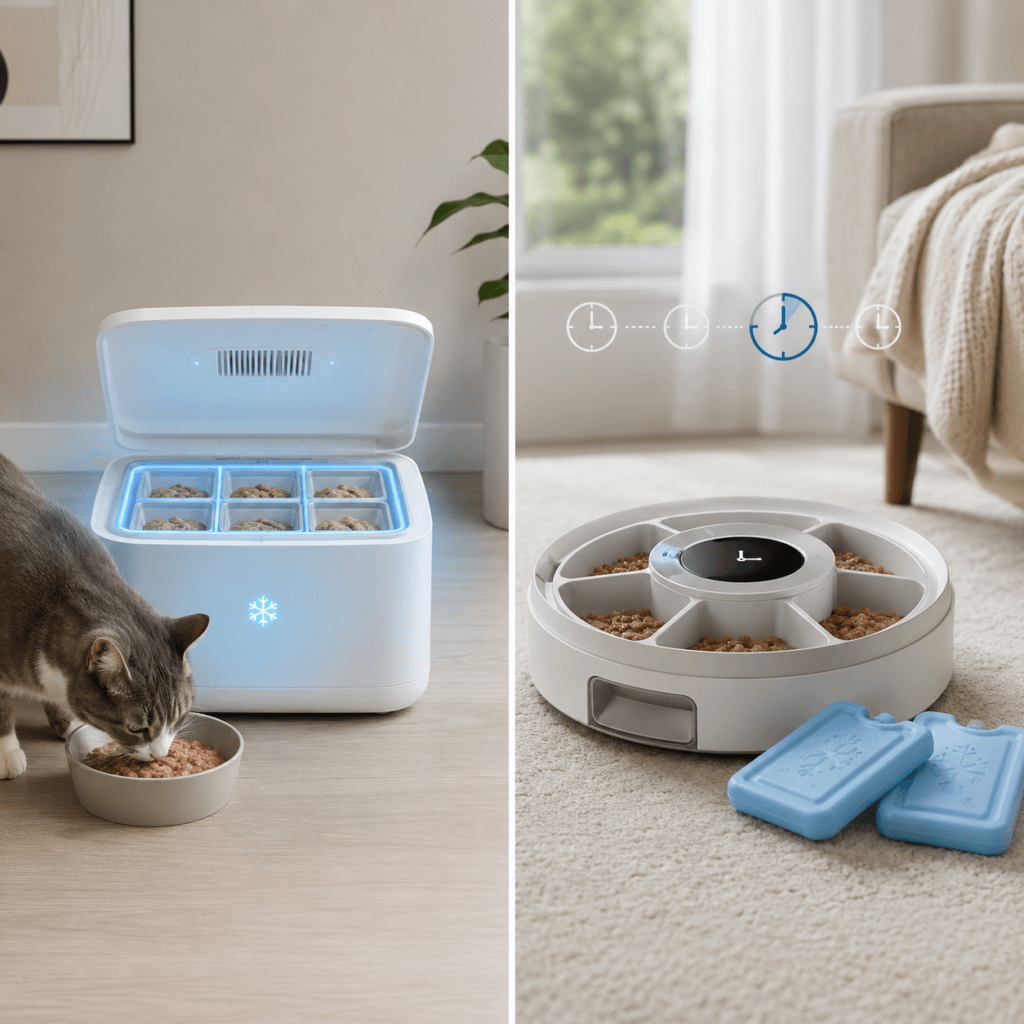
    Comparison between delaying wet food with ice packs and preserving it with refrigeration

    Traditional rotating wet food feeders work through a simple idea. You prepare meals in separate compartments, set a timer, and the tray rotates to reveal the next portion at the scheduled time.

    Some models include ice packs beneath the tray. That can be useful. It can slow down how quickly a prepared meal warms up, especially when the feeder is used for a limited part of the day.

    But an ice pack is not refrigeration.

    A rotating feeder is mainly a meal-timing device. It controls when your cat can access food. Its freshness support is limited and depends on room temperature, how long the meal sits out, the condition of the ice pack, and the food itself.

    PETLIBRO Polar is built around a different job. Its refrigerated compartments are meant to keep wet food chilled until a scheduled feeding window, making it possible to plan meals around a real absence rather than a short delay.

    That does not make a rotating feeder obsolete. It simply means the products solve different problems.

    A cheaper rotating feeder is not an inferior PETLIBRO Polar. It is a simpler answer to a smaller need.

    Rotating Feeders Are Still Useful — Just for a Narrower Routine

    A rotating wet food feeder can be the right choice when feeding automation is mostly about convenience.

    For example, imagine that you leave home at 8 a.m., return at 6 p.m., and want to give your cat a second wet-food meal in the afternoon. A rotating feeder may be enough. You can prepare the meal in advance, keep the unit away from heat and sunlight, and use an ice pack where appropriate.

    That setup makes sense when:

    • your absence is short;
    • the feeder is used occasionally rather than every day;
    • your cat eats wet food once or twice daily;
    • you can refill, clean, and freeze ice packs as part of your normal routine;
    • the lower upfront price matters more than advanced scheduling.

    This category works best for owners who need a timer.

    It works less well for owners who need their routine to keep functioning when they are unavailable for a longer stretch.

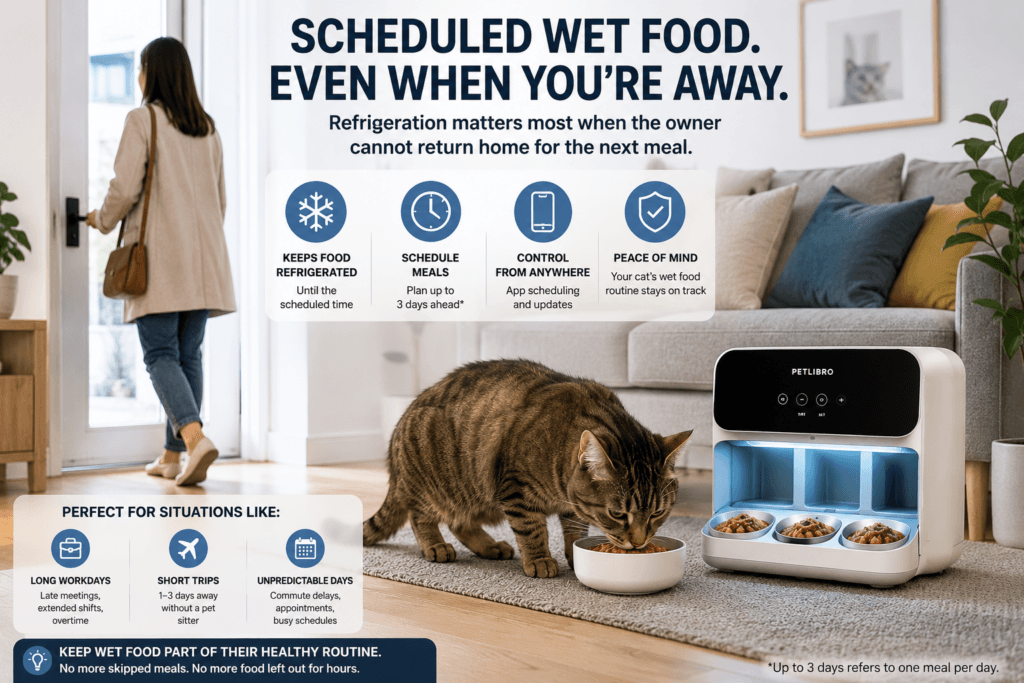
    PETLIBRO Polar Is About Routine Independence

    Cat wet food scheduled in a refrigerated feeder while the owner is away

    The Polar’s premium is not really about dispensing food automatically. Many cheaper feeders can dispense or reveal a meal on a schedule.

    The premium is about reducing the dependency on the owner being physically present at the right moment.

    With PETLIBRO Polar, the logic becomes:

    Prepare refrigerated wet-food meals in advance, schedule them, and let the feeding routine continue even when your day does not go as planned.

    That is useful for people who:

    • commute long distances;
    • work extended or changing shifts;
    • regularly miss a midday feeding window;
    • want to leave home without worrying that wet food will sit out for too long;
    • rely on a predictable feeding schedule for one cat or a small household.

    The app matters here because it adds control rather than novelty. A schedule can be adjusted remotely, and the owner has a clearer system than a basic mechanical timer.

    That does not mean every cat owner needs app control. But for someone whose daily routine is frequently disrupted, it can be the difference between a feeding tool and a feeding system.

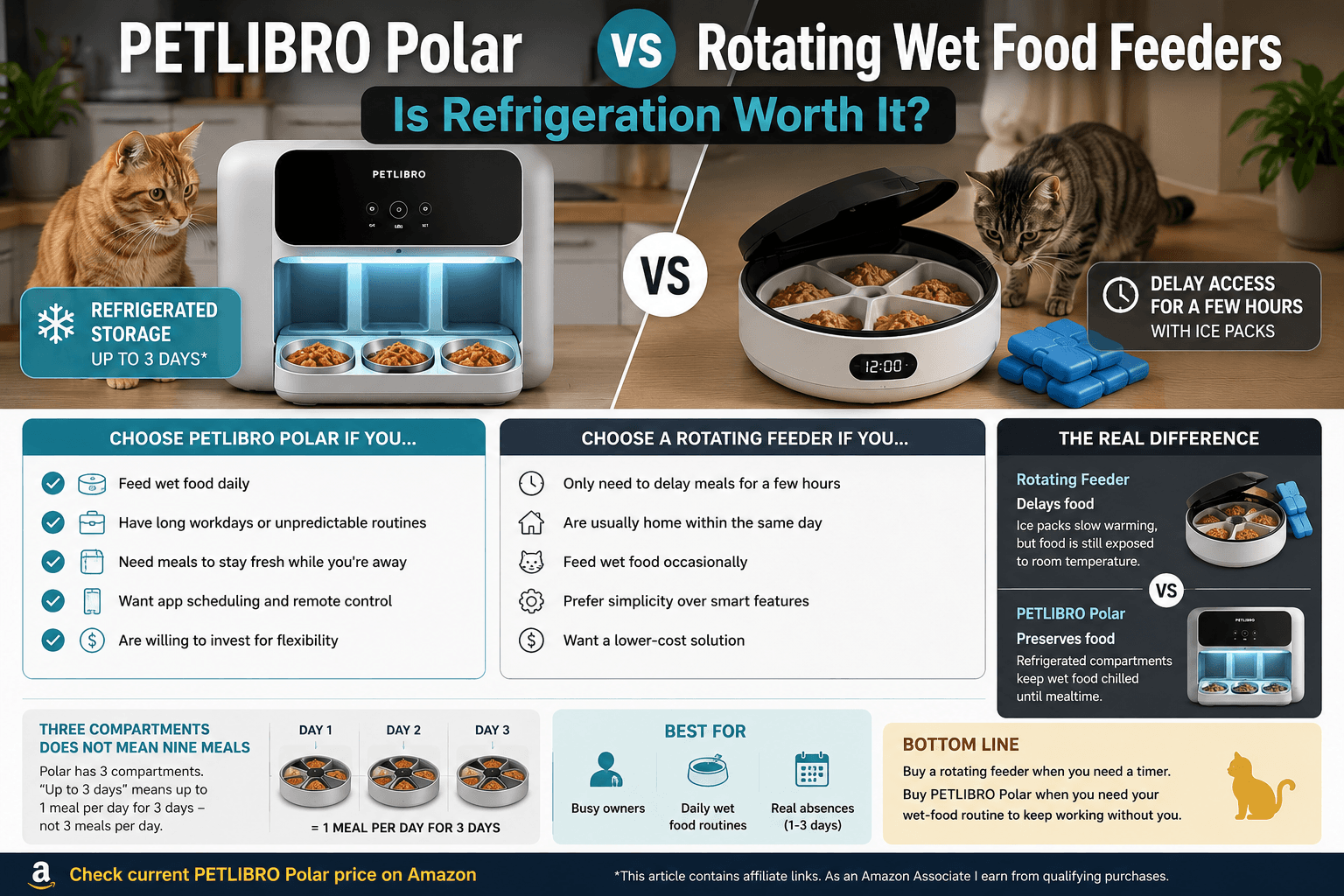
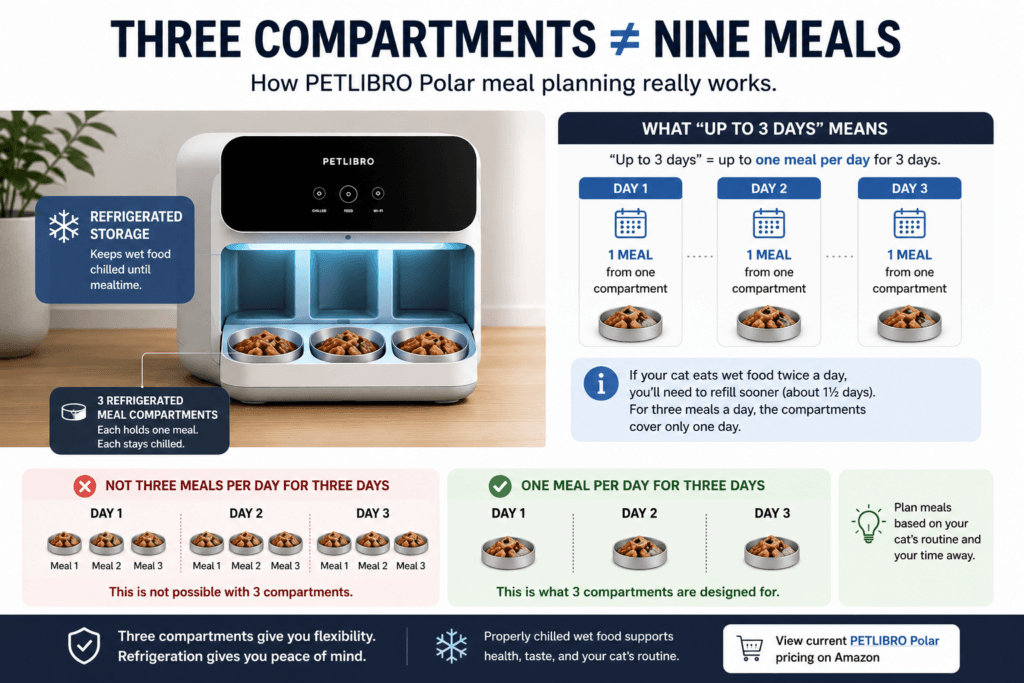
    Three Compartments Does Not Mean Nine Meals

    Three refrigerated wet food compartments showing one meal per day for three days

    This is the most important clarification before buying PETLIBRO Polar.

    The feeder has three physical meal compartments. Its “up to three days” positioning should be understood as up to one refrigerated meal per day across three days.

    It does not mean you can leave three meals per day for three full days.

    If your cat eats wet food twice a day, you would need to refill the feeder much sooner. If your cat eats three wet meals a day, the three compartments can cover only one day of feeding.

    That is not a flaw. It is simply the practical limit of the design.

    Polar is best understood as a way to make a single daily wet-food meal more flexible, or to cover a short period when one meal per day needs to happen without the owner returning home.

    Buy it for that purpose and it makes sense.

    Buy it expecting a fully automated multi-meal wet-food system for several days and you may be disappointed.

    When a Rotating Feeder Is the Better Buy

    A rotating wet food feeder remains the smarter purchase in several situations.

    You only need help for a few hours

    Maybe you have a dinner plan, a late work meeting, or an occasional day out. A rotating feeder can handle that without requiring a premium refrigerated system.

    Wet food is not your cat’s main routine

    If wet food is only an occasional treat or one small meal in an otherwise dry-food diet, Polar may be more capability than you need.

    In that case, a dry-food system with stronger scheduling or camera features may make more sense. Our PETKIT YumShare Solo 2 Camera Review is relevant for owners whose routine is built mainly around kibble, portion control, and remote meal visibility rather than refrigerated food.

    You value simplicity over remote control

    A rotating feeder has fewer components, fewer settings, and fewer moving parts. You prepare food, set the timer, and use it when needed.

    For some owners, that is exactly the appeal.

    Budget is the main constraint

    The price gap between a basic rotating feeder and a refrigerated smart feeder is significant. If the product only solves an occasional inconvenience, the cheaper category may deliver most of the value.

    When PETLIBRO Polar Is Worth the Premium

    Polar becomes easier to justify when wet food is a meaningful part of the cat’s routine and the owner’s schedule is the weak point.

    You regularly miss a feeding window

    This is the clearest case.

    A cat that expects a wet-food meal at noon does not care whether you are stuck in traffic, at work, on a train, or delayed by an appointment. Polar gives you a way to schedule the meal without leaving food exposed for the whole day.

    Your routine changes often

    The feeder makes more sense for people with irregular schedules than for people with a perfectly predictable lifestyle.

    A person who works from home most days may not gain much from it. A person whose hours change weekly may gain a lot.

    You want wet food to remain practical

    Many owners gradually rely more on dry food because wet-food feeding is harder to coordinate. It requires preparation, timing, cleaning, and physical presence.

    Polar does not remove every responsibility, but it reduces one of the biggest constraints: being home at the exact time a fresh meal needs to be served.

    You are buying convenience that affects every week

    The best reason to pay more is not that the machine looks impressive.

    It is that it removes a recurring friction point from your week.

    If you would use it once every few months, a rotating feeder is probably enough.

    If you would use it several times per week, refrigeration can become a practical quality-of-life feature rather than an expensive extra.

    Cleaning and Daily Ownership: More Technology Means More Responsibility

    Neither category is completely “set and forget.”

    A rotating feeder is usually straightforward to clean. You remove the tray, wash the food compartments, clean the ice packs, and prepare the next meals.

    Polar offers more convenience around food storage, but it also needs more thoughtful maintenance.

    Wet food can leave residue quickly. Condensation can occur. Compartments, bowls, and feeding surfaces still need regular cleaning. Refrigeration helps with storage, but it does not eliminate hygiene.

    You should also treat the feeder as a food-management tool, not as permission to ignore your cat’s eating habits for days.

    A smart feeder can schedule a meal. It cannot tell you whether your cat actually ate it, whether a portion was tolerated well, or whether a sudden change in appetite needs attention.

    For that reason, Polar works best as part of a routine that remains attentive, not one that becomes completely hands-off.

    The Real Cost Question: What Are You Paying For?

    With a rotating feeder, you are mostly paying for a timer, compartments, and limited freshness support.

    With PETLIBRO Polar, you are paying for:

    • refrigerated food storage;
    • app-based scheduling;
    • more flexibility around absence;
    • a more structured wet-food routine;
    • reduced pressure to be home for every meal.

    That is why comparing the products only by price misses the point.

    The right question is:

    How much is it worth to keep wet food practical when I cannot be there?

    For some owners, the answer is “not much.” They can prepare a meal, use an ice pack feeder, and return home later that day.

    For others, the answer is “a lot.” Their work pattern, commute, or lifestyle repeatedly turns wet-food feeding into a logistical problem.

    That is the audience Polar is designed for.

    PETLIBRO Polar vs Rotating Wet Food Feeders: Final Verdict

    Buy a rotating feeder when you need a timer.

    Buy PETLIBRO Polar when you need your wet-food routine to continue without you.

    A rotating feeder is the practical, lower-cost solution for delayed meals, short absences, and occasional convenience. It is especially sensible when you are usually home the same day and do not need remote control.

    PETLIBRO Polar is worth paying more for when refrigeration changes what your feeding routine can realistically do. Its value is not “smart technology” in the abstract. Its value is making wet food easier to manage when life does not follow a perfect schedule.

    Choose PETLIBRO Polar if refrigerated meal timing would genuinely make your day easier — not simply because the technology looks impressive.

    View the current PETLIBRO Polar price on Amazon

    This article contains affiliate links. As an Amazon Associate I earn from qualifying purchases.

    Frequently Asked Questions

    Can rotating wet food feeders keep food fresh?

    They can delay access to a prepared meal, and models with ice packs may provide short-term temperature support. They are not the same as a refrigerated storage system, especially for longer absences.

    Is PETLIBRO Polar worth it for one cat?

    It can be. The deciding factor is not the number of cats but whether one cat’s wet-food routine is difficult to maintain around your schedule.

    Can PETLIBRO Polar feed a cat for three days?

    It is designed around three refrigerated compartments and up to three days of storage. In practical terms, that means one meal per day across three days, not three meals per day for three days.

    Does PETLIBRO Polar replace regular meal preparation?

    No. You still need to portion food, refill the compartments, clean the feeder, and pay attention to your cat’s eating habits. It automates timing and refrigerated storage, not overall care.

    Should I choose a refrigerated wet-food feeder or a dry-food smart feeder?

    Choose a refrigerated wet-food feeder when wet food is central to your cat’s routine and timing is the problem. Choose a dry-food smart feeder when portion control, larger capacity, camera features, or multiple daily kibble meals matter more.

    References

    • PETLIBRO Polar product information and user guidance
    • PETLIBRO Polar Amazon listing
    • Rotating wet-food feeder manufacturer instructions and care guidance
  • Smart Cat Monitoring vs Automation (2026): What Are You Actually Paying For?

    Smart Cat Monitoring vs Automation (2026): What Are You Actually Paying For?

    The first generation of smart cat products promised to do chores.

    The litter box cleaned itself.

    The feeder served breakfast.

    The fountain circulated water.

    The app occasionally reminded you that the machine still required human involvement.

    Now the industry wants to sell something more ambitious:

    • facial recognition;
    • camera footage;
    • weight histories;
    • litter-box records;
    • drinking data;
    • feeding identities;
    • activity scores;
    • location tracking;
    • AI-generated insights.

    Some of that information is genuinely useful.

    Some of it is an expensive way to learn that your cat ate breakfast, used the litter box, and then slept for eleven hours.

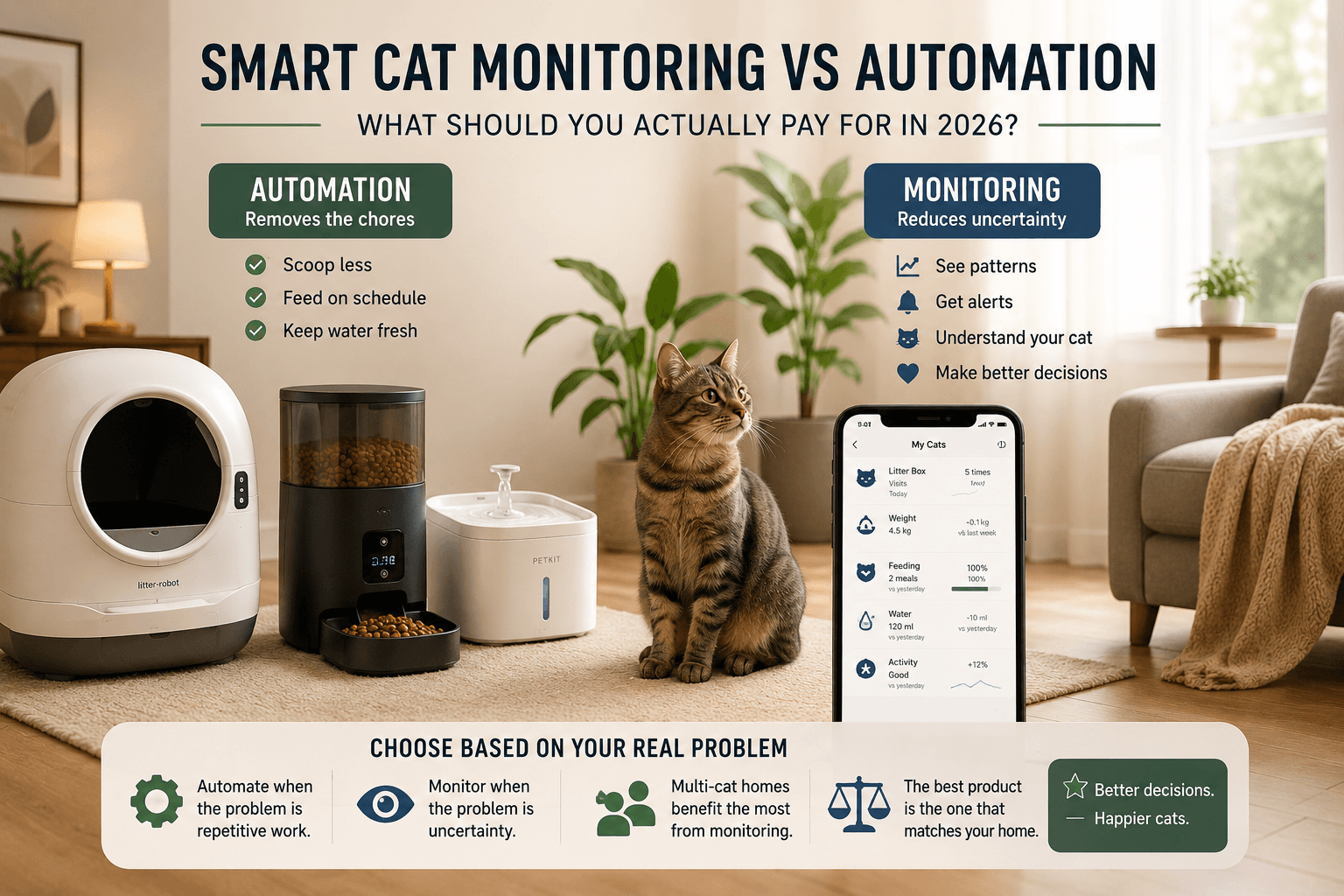
    The decision comes down to one distinction:

    Automation removes work. Monitoring reduces uncertainty.

    Most buyers should solve the work problem first.

    Monitoring deserves the additional cost only when the information would change what they do next.

    Quick Verdict

    Your main problemStart withWhy
    “I am tired of scooping.”AutomationYou need waste removal, not a bathroom dashboard
    “Meals need to happen on schedule.”AutomationReliable dispensing matters more than video
    “I do not know which cat ate.”Monitoring or access controlIdentity is the missing information
    “I want to track weight or litter habits.”MonitoringThe value comes from repeated trends
    “One cat may be drinking less.”Identity-aware monitoringHousehold totals may hide the individual change
    “My outdoor cat disappears for hours.”MonitoringLocation and activity are the actual signals
    “I want every available feature.”Stop and identify the problemFeature collecting is not a care strategy

    The short version

    Choose automation when the problem is labor.

    Choose monitoring when the problem is uncertainty.

    Choose both only when both problems genuinely exist.

    A camera does not improve an unreliable feeder.

    An AI dashboard does not make an uncomfortable litter box acceptable.

    And no number of health-style alerts can rescue a product that fails at its basic job.

    The Product Must Solve the Chore Before It Explains the Chore

    Every smart product has a core physical task.

    A litter box must separate waste safely and reliably.

    A feeder must dispense the correct food at the correct time.

    A fountain must provide clean, accessible water.

    A cat door must control entry and exit.

    Only after that task works does the monitoring layer become relevant.

    This creates a simple buying hierarchy:

    1. Cat acceptance
    2. Core function
    3. Reliability
    4. Maintenance
    5. Monitoring
    6. Interesting app decorations

    Manufacturers frequently present this list in reverse.

    The product page begins with artificial intelligence and ends somewhere near the bottom with the dimensions of the opening your cat must physically enter.

    Do not follow that order.

    What Automation Actually Solves

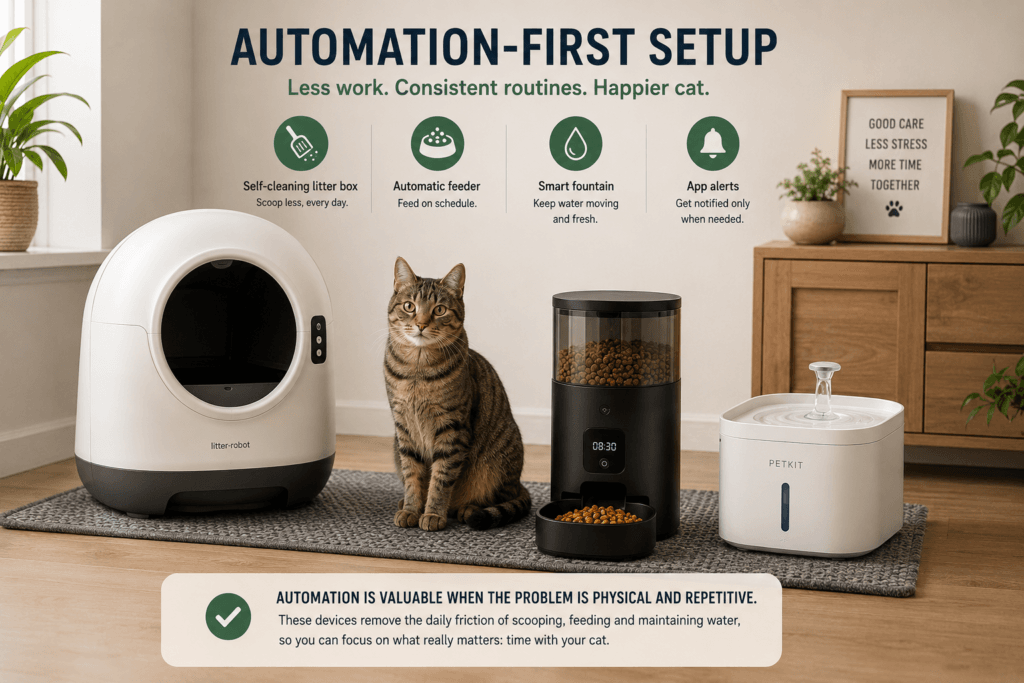
    A clean smart cat care setup with an automatic feeder, smart fountain and self-cleaning litter box focused on reducing daily chores
    Automation-first products are worth paying for when they reduce scooping, feeding stress, water maintenance or other repetitive daily chores.

    Automation is useful when the problem is repetitive, predictable, and physical.

    Litter automation

    A self-cleaning litter box can reduce daily scooping and move waste into a drawer after use.

    It does not eliminate:

    • drawer emptying;
    • litter refilling;
    • deep cleaning;
    • odor-source maintenance;
    • the need for an additional box in some homes.

    But the main benefit remains clear even if you never open the app.

    For the current product choices, read our Best Smart Litter Boxes guide.

    Feeding automation

    A scheduled feeder can deliver measured dry-food portions when nobody is standing beside the bowl.

    A refrigerated feeder can support scheduled wet meals.

    These products create value through timing and consistency.

    A camera may add useful context, but dinner must still arrive.

    For dry, wet, RFID, and microchip systems, read our Best Automatic Cat Feeders guide.

    Water automation

    A fountain circulates water and may provide level, filter, or maintenance reminders.

    It still requires:

    • cleaning;
    • fresh water;
    • filter replacement;
    • pump or tank maintenance.

    The useful automation is easier water access and a more structured maintenance routine—not permanent freedom from washing slime out of a reservoir.

    What Monitoring Actually Solves

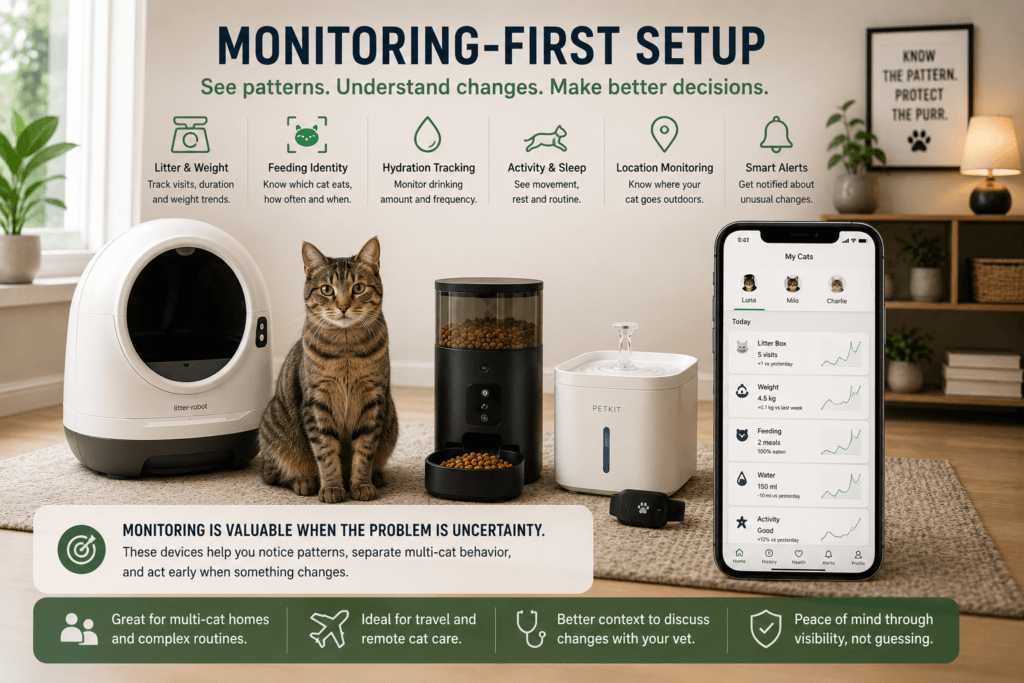
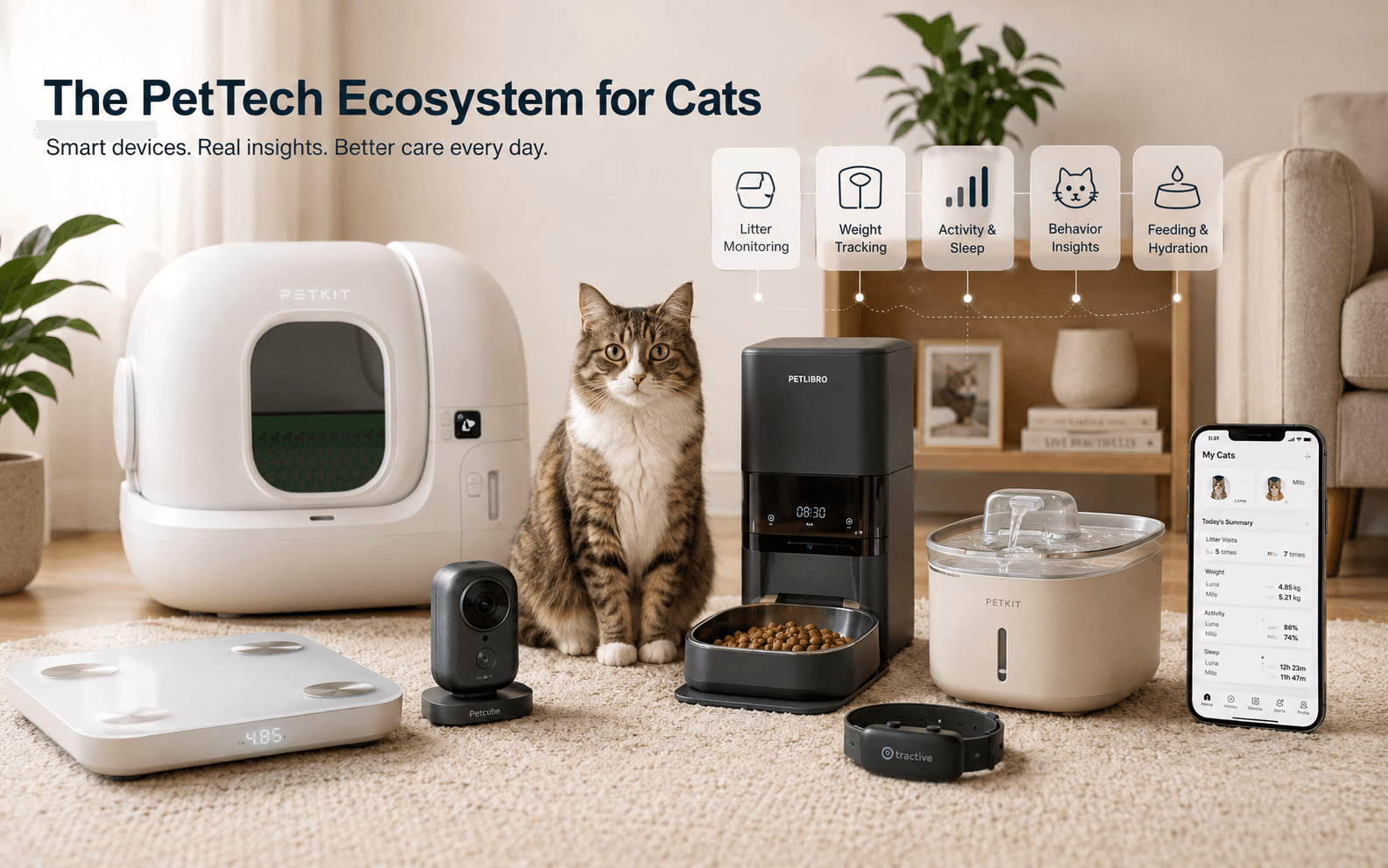
    A phone showing cat routine data beside smart cat products for litter, feeding, hydration and activity monitoring
    Monitoring-first products are useful when the data changes what you do next — especially in multi-cat homes or remote-care situations.

    Monitoring becomes valuable when a household cannot confidently answer a relevant question.

    Examples include:

    • Which cat used the litter box?
    • Has weight changed over several weeks?
    • Did one cat stop appearing at meals?
    • Is one cat drinking less than the others?
    • Has an outdoor cat’s activity pattern changed?
    • What happened around the feeder while nobody was home?

    The device is not valuable merely because it collects the answer.

    The answer must lead to a decision.

    That decision might be:

    • change feeder placement;
    • separate feeding stations;
    • inspect the litter-box setup;
    • confirm a weight trend;
    • adjust notifications;
    • contact a veterinarian about a persistent change;
    • discover that nothing meaningful happened and return to normal life.

    For product-level monitoring options across litter, meals, hydration, activity, and location, read our Best Smart Cat Health Monitors guide.

    The Decision Test: What Would You Do Differently?

    Before paying extra for a monitoring feature, complete this sentence:

    “If the device showed me __________, I would __________.”

    Useful answers include:

    “If one cat repeatedly missed meals, I would change the feeding setup.”

    “If weight declined over several weeks, I would verify the trend and discuss it with my veterinarian.”

    “If one cat stopped using the shared litter box, I would inspect access, cleanliness, conflict, and alternative boxes.”

    “If the outdoor cat left its usual area, I would begin searching immediately.”

    Weak answers include:

    “If the camera showed my cat eating, I would watch my cat eat.”

    That may be enjoyable.

    It is not necessarily worth a $200 feature premium.

    The Multi-Cat Exception

    Monitoring becomes more valuable as the number of cats increases.

    In a one-cat home:

    • the cat near the feeder is probably the cat who ate;
    • the litter-box visit belongs to the only available suspect;
    • the fountain records household drinking that belongs to one animal.

    In a multi-cat home, shared totals can hide individual changes.

    The feeder may dispense correctly while Napoleon eats Jonathan’s portion.

    The litter box may record normal household activity while one cat stops using it.

    The fountain may show stable total consumption while one cat drinks more and another drinks less.

    This is where identity systems can justify their cost:

    • facial recognition;
    • weight-based profiles;
    • RFID collar tags;
    • implanted-microchip access;
    • individual cameras or feeding stations.

    But identity still needs a purpose.

    Knowing which cat committed the food theft is useful.

    Filming the theft every morning without changing the setup is a documentary project.

    PETKIT: Monitoring Across More Routines

    PETKIT currently makes the broadest move from basic automation toward camera-led connected care.

    Its ecosystem includes automatic litter boxes, camera litter boxes, camera feeders, fountains, and other devices managed through the PETKIT app. Its 2026 product direction explicitly emphasizes camera-equipped devices and connected signals across stool, urine, food, and hydration routines.

    That makes PETKIT compelling when visual context matters across several categories.

    Examples include:

    • identifying which cat approached a feeder;
    • reviewing litter-box footage;
    • adding context to hydration activity;
    • keeping several device histories in one app.

    The danger is paying for cameras everywhere merely because PETKIT can put them everywhere.

    A camera fountain is useful when individual drinking behavior is genuinely difficult to understand.

    It is less useful when one healthy cat drinks normally and the owner simply enjoys receiving push notifications from the kitchen.

    PETKIT’s buying rule

    Choose the camera-equipped version only when the footage or identity layer changes the decision.

    Otherwise, choose the simpler automation-first model.

    Whisker: Automation First, Insights on Top

    Whisker remains more focused.

    Its ecosystem centers on Litter-Robot, Feeder-Robot, and the Whisker app. The app tracks litter activity, weight trends, drawer status, feeding schedules, and high-level mealtime behavior across compatible products.

    The current litter-box lineup illustrates the automation-versus-monitoring ladder clearly:

    • Litter-Robot EVO: lower-cost, automation-first entry;
    • Litter-Robot 5: premium core automation with additional routine data;
    • Litter-Robot 5 Pro: dual cameras and deeper individual monitoring.

    Litter-Robot 5 Pro provides two cameras and visual identification, while some extended histories, unlimited live viewing, recorded events, and advanced insights depend on Whisker+. Basic SmartScale identification and weight tracking remain available without the membership on supported models.

    Whisker therefore asks a cleaner question than PETKIT:

    How much insight do you need around the litter routine you are already automating?

    That narrower focus can be an advantage.

    You are less likely to buy a smart fountain merely because its app icon matches the litter box.

    The Litter-Robot 5 Pro review is a useful example of this distinction: the cameras add monitoring context, but they do not improve the underlying cleaning cycle.

    CATLINK: Monitoring Makes the Most Sense in the Litter Room

    CATLINK explicitly sells an ecosystem connecting litter boxes, feeders, and fountains through one app. Its strongest concept is the ability to place toilet, feeding, and drinking activity inside one multi-cat record.

    The logic is attractive:

    • track what goes in;
    • track what comes out;
    • separate records by cat;
    • identify routine changes.

    But an ecosystem concept is not a substitute for product-level quality.

    CATLINK currently makes its strongest case around automatic litter boxes and multi-cat litter data. Its feeders and fountains should still be evaluated independently rather than treated as automatic purchases after the litter box.

    CATLINK’s buying rule

    Choose CATLINK when a specific CATLINK product solves the problem and its multi-cat records add useful visibility.

    Do not buy three devices merely to complete the input-output diagram.

    For the full brand comparison, read CATLINK vs PETKIT vs Whisker.

    Petivity: Monitoring Without Automation

    Petivity is the purest example of the distinction.

    It sits underneath a conventional litter box and tracks weight, urination events, defecation events, and litter-box patterns through its app. It does not clean or replace the box.

    That makes Petivity useful when:

    • the existing litter box already works;
    • changing it could create unnecessary disruption;
    • weight and elimination trends are the missing information;
    • scooping is not the problem.

    Petivity would be a terrible purchase for someone who hates cleaning the litter box.

    It would be a sensible purchase for someone who likes the existing setup but wants a clearer record of changes.

    The product does not fail because it lacks automation.

    It succeeds or fails according to whether monitoring was the actual need.

    For the full analysis, read our Petivity Smart Litter Box Monitor Review.

    What Monitoring Cannot Fix

    Monitoring cannot fix:

    • an uncomfortable litter box;
    • resource conflict between cats;
    • poor feeder placement;
    • a bowl accessible to the wrong animal;
    • dirty water;
    • inadequate litter-box numbers;
    • a cat that rejects the device;
    • unreliable dispensing;
    • bad maintenance habits.

    A camera feeder may prove that one cat steals food.

    The solution may still be a microchip feeder, separate room, different schedule, or human intervention.

    A litter monitor may show reduced visits.

    The solution may involve cleaning, access, conflict, litter preference, observation, or veterinary care.

    The dashboard identifies the question.

    It does not automatically perform the answer.

    Buyer Regret in One Table

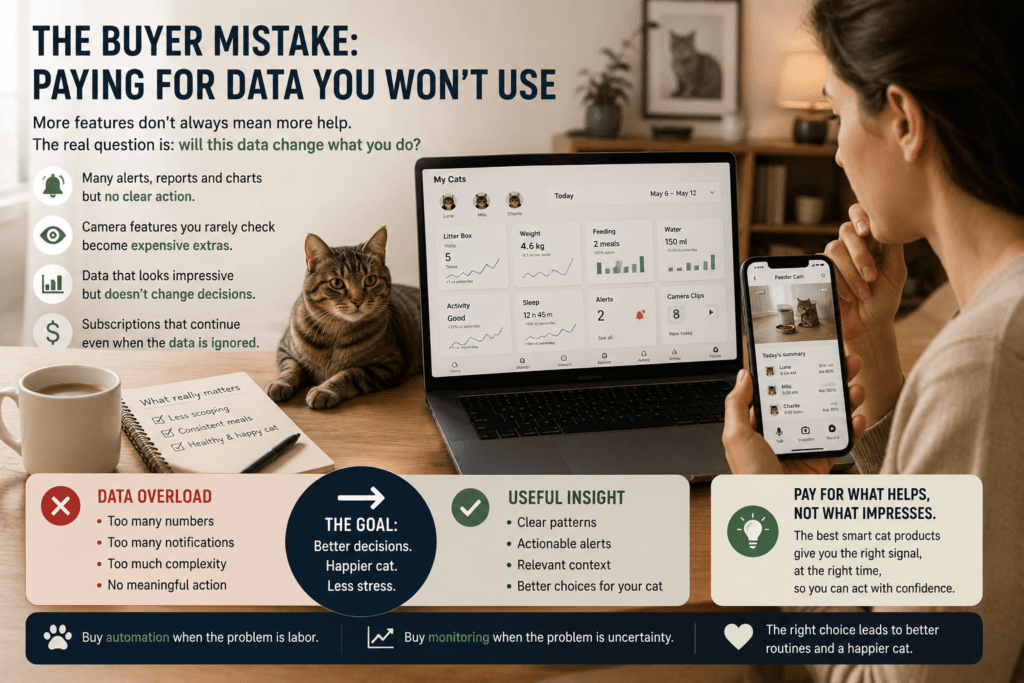
    A cat owner comparing smart cat product data on a laptop while deciding whether monitoring features are actually useful
    The biggest mistake is paying for more data when the data does not change any real decision.
    PurchaseMost likely regret
    Automation without checking cat fitThe machine works; the cat refuses it
    Monitoring without a decision ruleYou collect data and change nothing
    Camera upgradeYou stop watching after one week
    Multi-cat recognitionSimilar cats or shared access make the records less definitive
    Subscription featuresThe useful history costs more than expected
    Full ecosystemYou buy weaker products to keep one app
    No monitoring in a complex homeShared totals hide the individual problem

    The Six-Month Test

    After six months, ask what still creates value.

    Good automation

    • the litter bed is cleaned;
    • meals arrive on schedule;
    • water remains accessible;
    • routine maintenance is easier;
    • the app can be ignored most days.

    Good monitoring

    • trends are clear;
    • unusual changes are easier to verify;
    • individual cats are easier to distinguish;
    • the information occasionally changes a decision;
    • notifications remain selective and useful.

    Bad smart technology

    • the device generates alerts;
    • nobody knows what to do with them;
    • the owner checks compulsively;
    • the cat’s actual routine is no better;
    • the subscription renews successfully.

    Final Verdict

    Most cat owners should start with automation.

    If the problem is scooping, buy a product that reduces scooping.

    If the problem is meal timing, buy a feeder that dispenses reliably.

    If the problem is water access, choose a fountain that is easy to clean and maintain.

    Add monitoring when the missing information has a clear purpose.

    That is especially relevant in:

    • multi-cat homes;
    • senior-cat households;
    • homes managing different diets;
    • outdoor-cat routines;
    • situations involving repeated behavioral changes;
    • households where nobody is present during important routines.

    The framework is simple:

    1. Identify the physical problem.
    2. Solve it with the simplest reliable mechanism.
    3. Identify the remaining uncertainty.
    4. Pay for monitoring only if the answer changes an action.

    Automation saves time.

    Monitoring provides evidence.

    The smartest product is not the one that does both.

    It is the one that does exactly what your household needs—and leaves the rest of the app mercifully quiet.

    Frequently Asked Questions

    What is the difference between automation and monitoring?

    Automation performs or simplifies a task. Monitoring collects information about what happened.

    Should most cat owners choose automation first?

    Usually, yes. Automation creates immediate value when the main problem is repetitive labor. Monitoring should come first when uncertainty—not labor—is the actual problem.

    Is monitoring more useful in multi-cat homes?

    Often. Shared feeders, fountains, and litter boxes can hide individual behavior, making identity and separate records more valuable.

    Are cameras necessary for smart cat care?

    No. Cameras are useful when visual context changes a decision. They are unnecessary when scheduling, access control, weight sensing, or simple alerts already solve the problem.

    Can monitoring detect illness?

    Monitoring can reveal changes in routine. It cannot diagnose the cause. Significant or persistent changes require direct observation and, when appropriate, veterinary assessment.

    Is Petivity automation or monitoring?

    Monitoring. It adds weight and litter-box records underneath an existing box but does not clean it.

    Is Litter-Robot automation or monitoring?

    All current Litter-Robot models automate cleaning. The amount of monitoring increases across the lineup, with Litter-Robot 5 Pro offering the deepest camera-led layer.

    References

    • PETKIT official ecosystem and 2026 product information
    • Whisker app, Litter-Robot, and Whisker+ documentation
    • CATLINK ecosystem and app documentation
    • Petivity Smart Litter Box Monitor documentation
    • PetTech AI product-level trust checks and comparison framework

    Image Disclosure

    Some images in this article may be AI-generated for illustrative purposes. They do not depict exact products and should not be used to evaluate dimensions, fit, controls, or features.

    Disclosure

    PetTech AI may earn a commission when readers purchase through affiliate links. This article is a decision framework rather than a blanket endorsement of any ecosystem. Every product must still earn its recommendation at product level.

  • Indoor Cat Enrichment Science (2026): What Cats Need Before Another Gadget

    Indoor Cat Enrichment Science (2026): What Cats Need Before Another Gadget

    Keeping a cat indoors removes many outdoor risks.

    It does not automatically create a good indoor life.

    A clean apartment, a full bowl and one decorative scratching post abandoned behind the sofa do not constitute environmental enrichment. They constitute housing.

    Indoor cat enrichment means giving cats meaningful opportunities to hide, climb, scratch, hunt, explore, eat, rest and control social contact. Technology can support some of those needs—but only after the home itself stops behaving like a furnished waiting room.

    Quick Verdict

    Feline needStart hereWhere technology can helpWhere it becomes clutter
    Safety and restHiding places and elevated territoryCamera to observe which spaces are actually usedBuying surveillance instead of creating safe retreats
    Resource accessSeparated food, water, litter and resting areasRFID feeder when one cat steals another’s foodMaking every resource app-dependent
    Play and predationWand toys, chase games and toy rotationAutomatic toy for short independent sessionsExpecting a motorized ball to replace human play
    Feeding enrichmentPuzzle feeders and simple foragingSmart feeder for portions and schedulesConfusing food delivery with enrichment
    EliminationAccessible, clean and acceptable litter boxesAutomatic cleaning and usage trendsUsing one smart box as the household’s only toilet
    MonitoringDirect observation and a normal baselineWeight, feeding or litter records when they inform a decisionCollecting five dashboards nobody reviews

    PetTech AI verdict: Recommended framework

    Fix the environment first.

    Then add technology only where it solves an identifiable problem.

    A $250 device is not automatically more enriching than a cardboard box. The cardboard box is understandably smug about this.

    Research Note

    This guide is based on current feline environmental guidance from the Feline Veterinary Medical Association, Cornell Feline Health Center and veterinary behavior resources.

    Environmental changes should be adapted to the cat’s age, health, mobility, temperament and household. Enrichment can support welfare, but it cannot diagnose or treat medical or behavioral disorders.

    What Indoor Cats Actually Need

    The Feline Veterinary Medical Association organizes a healthy feline environment around five broad needs:

    1. a safe place;
    2. multiple and separated key resources;
    3. opportunities for play and predatory behavior;
    4. positive, predictable human interaction;
    5. an environment that respects feline smell and other senses.

    These are not luxury upgrades.

    They are the foundations that allow a cat to choose where to rest, eat, eliminate, observe and retreat.

    The important word is choice.

    A cat may enjoy sleeping beside you and still need somewhere private. It may share a water fountain peacefully while refusing to eat beside another cat. It may climb high when confident and prefer low, enclosed spaces when frightened or arthritic.

    Good enrichment does not force one approved lifestyle on every cat. It creates several acceptable options and lets Florence conduct her own inspection.

    1. Safe Places and Vertical Territory

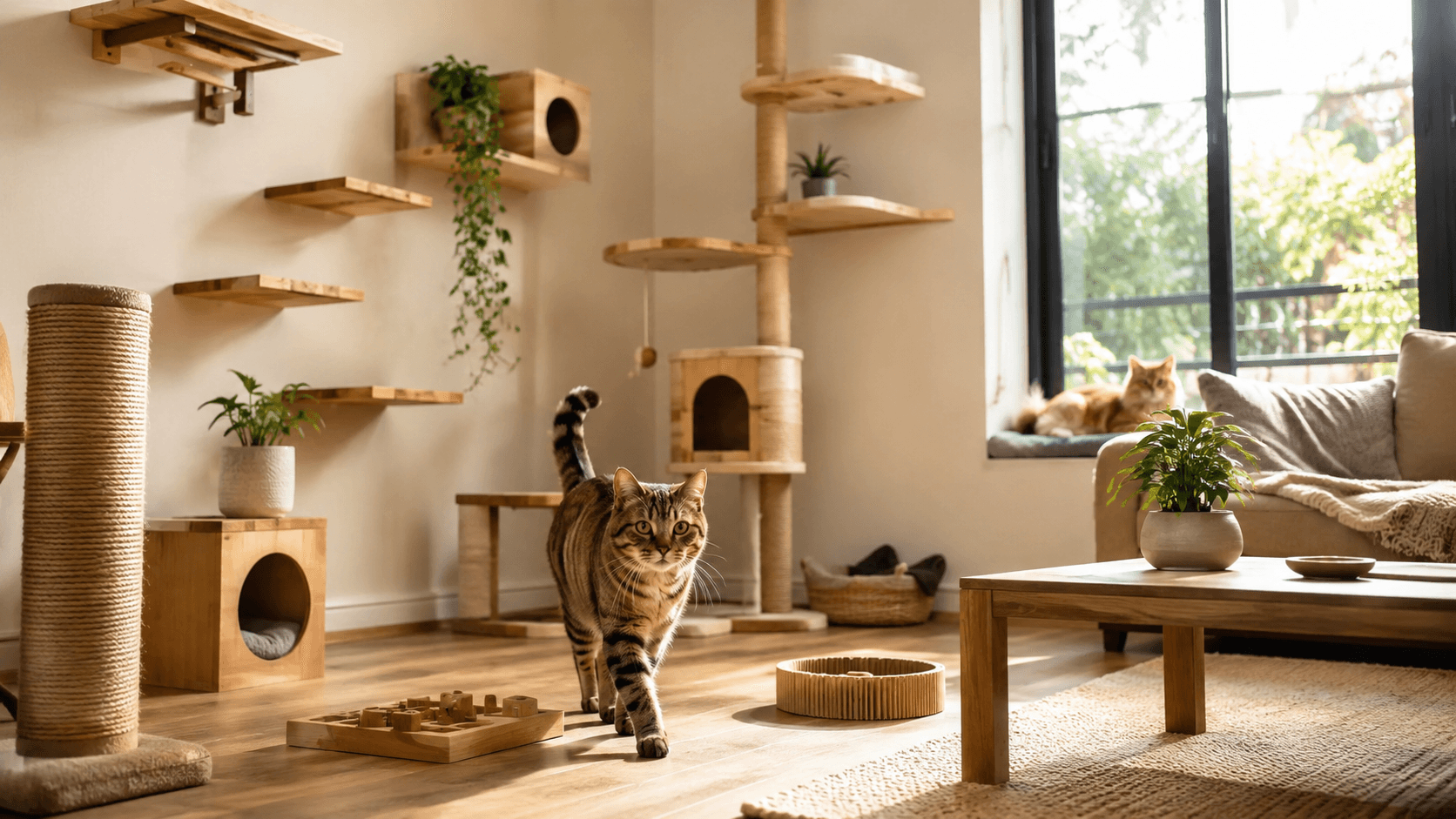
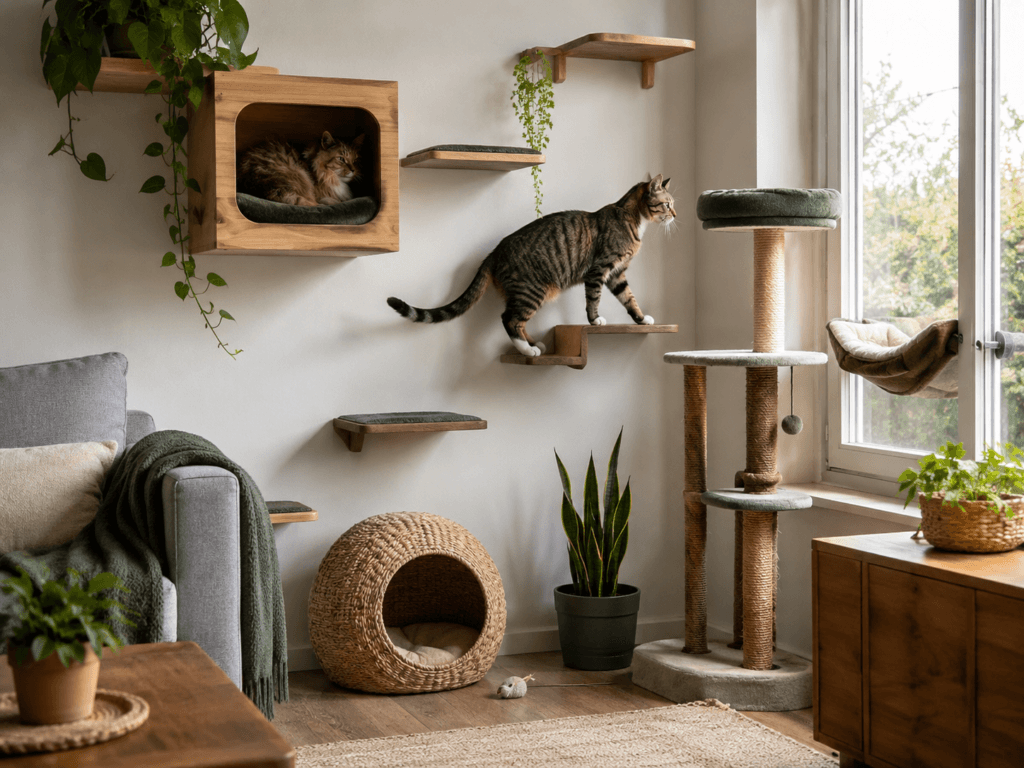
    Two cats using wall-mounted shelves, an enclosed wooden hideaway and a cat tree near a window
    Elevated routes and enclosed resting spaces give cats more control over where they observe, climb and retreat. AI-generated editorial illustration.

    Cats need places where they can rest without being approached, trapped or unexpectedly handled.

    Useful options include:

    • open carriers;
    • covered beds;
    • cardboard boxes;
    • shelves;
    • window perches;
    • stable cat trees;
    • cleared furniture at different heights.

    Vertical space can increase usable territory without requiring a larger home. It is especially valuable in multi-cat households because one floor plan can become several partially separated routes.

    But height is not automatically better.

    Senior cats and cats with limited mobility may need lower platforms, ramps or intermediate steps. A magnificent six-foot cat tree that Biscuit cannot comfortably climb is furniture for humans with ambitious taste.

    Place safe areas where the cat already tries to rest. Do not hide every bed in a remote room and then wonder why the cat continues occupying your keyboard.

    Technology has a limited role here. A camera may reveal which perch, doorway or room is being used while you are away. It cannot compensate for the absence of a safe retreat.

    2. Separate Resources Before Buying Smarter Ones

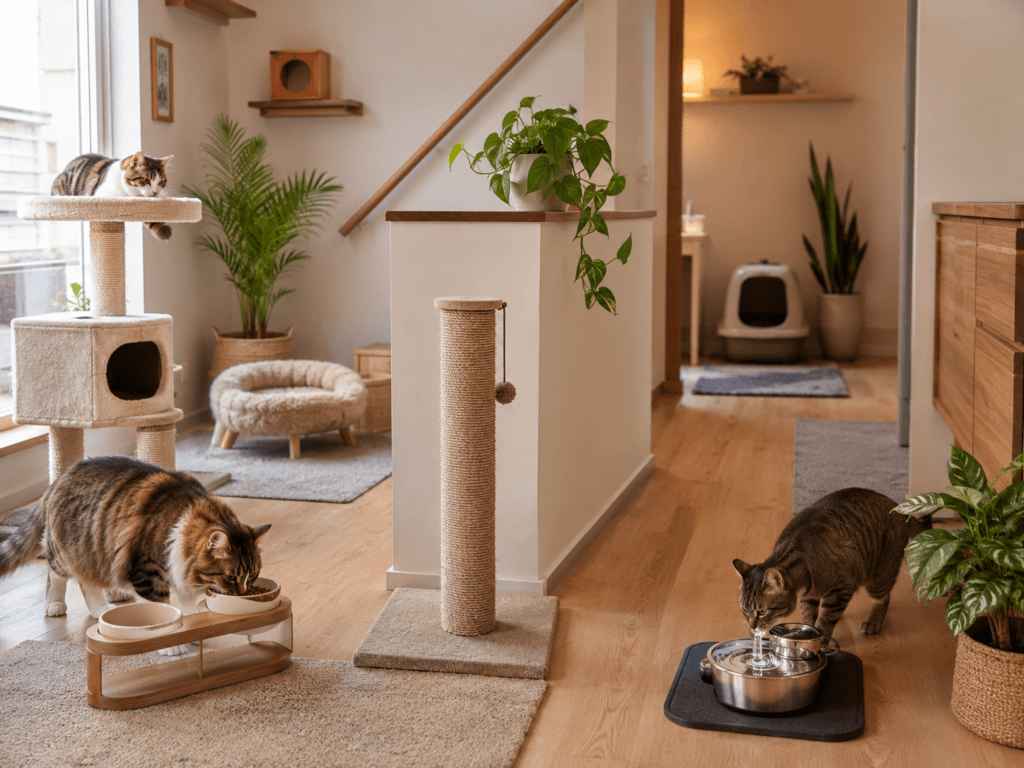
    Three cats using separate feeding, drinking and litter areas in a multi-cat home
    Separating food, water, resting and litter resources can reduce bottlenecks and give each cat more control over access. AI-generated editorial illustration.

    In multi-cat homes, apparent sharing does not always mean comfortable sharing.

    One cat may quietly control:

    • access to a feeder;
    • the route to the litter box;
    • a preferred resting area;
    • the only useful window;
    • the human at particular times.

    FelineVMA guidance emphasizes distributing important resources rather than concentrating everything in one attractive but socially complicated corner. Current intercat-tension guidance likewise recommends dispersed resources and visual separation where needed.

    Start by separating:

    • food from litter;
    • water from high-conflict areas;
    • feeding stations from one another;
    • litter boxes across accessible locations;
    • resting spaces and escape routes.

    This does not mean duplicating every object according to a rigid household equation.

    It means watching how the cats use the home and removing bottlenecks.

    Technology earns its place when access itself is the problem. An RFID feeder, for example, may help when one cat needs a different diet or Napoleon has appointed himself Minister of Everyone Else’s Breakfast.

    For broader solutions, read our Best Multi-Cat Tech Solutions guide.

    3. Play Should Look Like Hunting, Not Random Exercise

    Cats are more likely to engage when play resembles part of a predatory sequence:

    • watching;
    • stalking;
    • chasing;
    • pouncing;
    • catching.

    Cornell recommends toys that encourage movement and problem solving, while VCA highlights chase-based play and puzzle feeding as outlets for natural behavior.

    The best toy depends on the cat.

    Some prefer:

    • feather or fabric wand attachments;
    • small ground-level prey;
    • objects moving beneath cover;
    • kickers;
    • lightweight balls;
    • food puzzles.

    Short, successful sessions are usually more useful than leaving every toy permanently available. Rotate a small selection and retire objects that receive the emotional response normally reserved for tax documents.

    Automatic toys can supplement play when humans are working, but they should offer:

    • predictable movement;
    • supervision during initial use;
    • an easy way for the cat to disengage;
    • no loose strings or swallowable parts.

    They are backups, not outsourced parenting.

    See our Best Interactive Cat Toys and Smart Puzzle Toys for Cats guides for different play styles.

    4. Food Enrichment: Make One Meal Less Boring

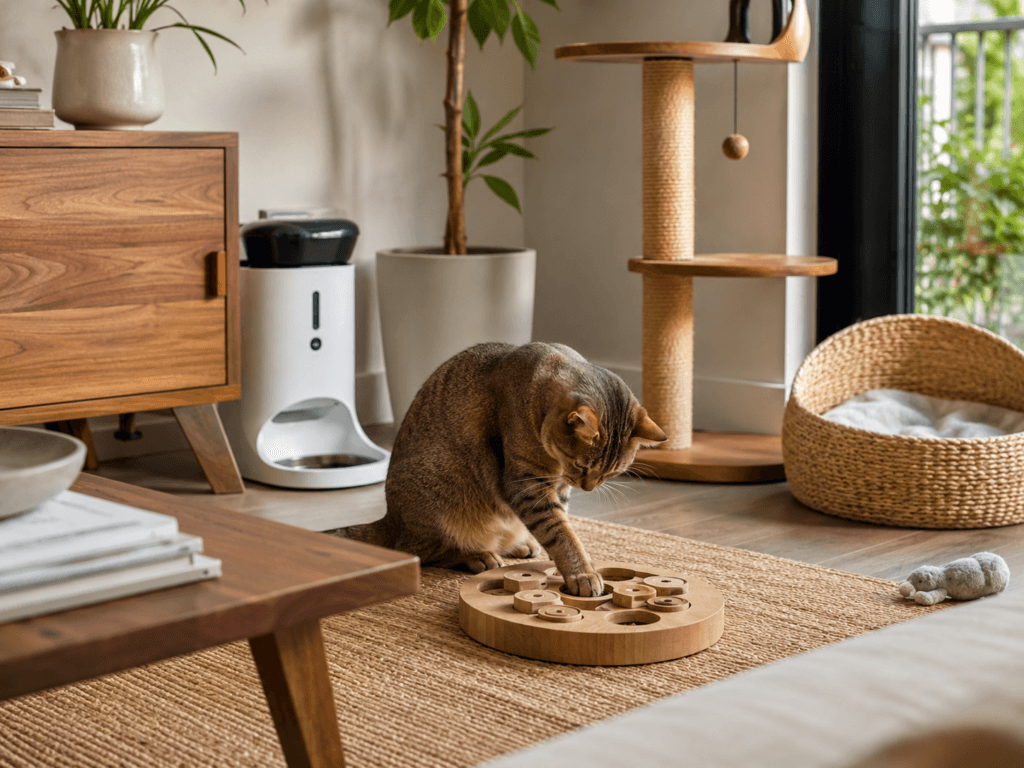
    Cat using a wooden puzzle feeder beside an automatic feeder, cat tree and resting bed
    Puzzle feeding adds searching and problem solving to mealtime, while automation mainly handles portions and schedules. AI-generated editorial illustration.

    A bowl is efficient.

    It is not particularly demanding.

    Food puzzles and simple foraging can encourage manipulation, searching and problem solving. VCA recommends starting with options the cat can successfully operate and ensuring that the full daily food requirement is still consumed.

    Simple options include:

    • an easy puzzle feeder;
    • kibble placed in several small dishes;
    • treats hidden in safe, accessible locations;
    • food moved through a cardboard tube or tray;
    • a slow feeder for cats that eat too rapidly.

    Introduce difficulty gradually. Enrichment should create engagement, not an escape-room franchise between Gerald and his dinner.

    Smart feeders are useful for:

    • portion consistency;
    • scheduled meals;
    • early-morning feeding;
    • separating diets with compatible access control.

    But a feeder dispensing food into the same bowl at the same location remains primarily automation.

    A practical combination is:

    • use automation for schedule and total portions;
    • reserve part of the daily allowance for play, puzzles or foraging.

    Cats that eat poorly, lose weight or have medical dietary needs should not be forced to “work harder” without veterinary guidance.

    Our Best Automatic Cat Feeders guide explains the difference between scheduling, camera monitoring and individual access.

    5. Litter Boxes Are Resources, Not Appliances

    The litter system should be:

    • easy to reach;
    • large enough for comfortable movement;
    • kept acceptably clean;
    • placed away from food and noisy machinery;
    • available without another cat controlling the route.

    A litter box is also a source of behavioral and medical information. Sudden house-soiling, repeated visits, straining or altered elimination should not be dismissed as revenge, stubbornness or artistic criticism of your flooring.

    Smart litter boxes may help by providing:

    • automatic waste separation;
    • visit records;
    • body-weight trends;
    • individual-cat identification on compatible models;
    • additional elimination estimates depending on the system.

    They may harm the setup when:

    • the operating cycle frightens the cat;
    • the entrance is difficult to use;
    • litter compatibility is poor;
    • the unit becomes the only available box;
    • the owner trusts the app more than visible symptoms.

    A smart box should improve an acceptable litter system—not excuse a bad one.

    For model-level decisions, read our Best Smart Litter Boxes guide.

    6. Where Smart Technology Earns Its Place

    Technology is useful when it performs at least one of three jobs:

    It removes repetitive work

    Examples include automatic litter cleaning, scheduled feeding and fountain-maintenance reminders.

    This can indirectly support welfare when reduced workload results in cleaner resources and more consistent routines.

    It controls access

    RFID feeders and selective-entry devices can reduce food theft or protect individual diets.

    This solves a specific household problem rather than merely producing another graph.

    It adds evidence

    Litter visits, body weight, feeding records, location or activity trends can reveal repeated change that might otherwise be difficult to notice.

    The data becomes valuable only when someone reviews it and knows what action it might support.

    Our Smart Cat Monitoring vs Automation guide explains why collecting information and reducing labor are different purchase decisions.

    7. Where Technology Becomes Expensive Clutter

    A device probably does not belong in the home when:

    • it solves no defined problem;
    • the cat avoids it;
    • essential functions depend on unreliable connectivity;
    • maintenance exceeds the work it was meant to remove;
    • several apps duplicate the same vague information;
    • alerts are ignored;
    • the owner expects it to replace observation or interaction.

    The test is simple:

    What will I do differently because this device exists?

    A clear answer may justify the product.

    “No idea, but it has AI” is not a care plan.

    A Seven-Day Indoor Cat Reset

    Day 1: Map the resources

    Locate food, water, litter, scratching, sleeping and hiding areas. Look for narrow routes and heavily contested zones.

    Day 2: Add one safe place

    Use a box, carrier, covered bed or quiet elevated perch where the cat can remain undisturbed.

    Day 3: Separate one bottleneck

    Move one food station, water source or resting space away from a competing resource.

    Day 4: Test one prey-style game

    Try a short wand, ground chase or covered-motion session. Stop while the cat remains interested.

    Day 5: Make part of one meal interactive

    Use an easy puzzle or several small food locations. Confirm that the cat consumes the intended amount.

    Day 6: Observe instead of purchasing

    Watch where the cat rests, hesitates, scratches and changes direction. A household problem often becomes obvious before an app becomes necessary.

    Day 7: Choose one improvement

    Keep the change the cat used. Remove the object everyone ignored. Add technology only when a remaining problem has become specific.

    Warning Signs That Need More Than Enrichment

    Environmental improvement may help with boredom, conflict and routine.

    It should not be used to explain away:

    • sudden litter-box changes;
    • repeated straining or attempts to urinate;
    • appetite loss;
    • unexplained weight change;
    • persistent vomiting or diarrhea;
    • overgrooming or skin injury;
    • new aggression;
    • severe withdrawal;
    • reduced mobility;
    • obvious pain.

    Urinary straining or producing little to no urine can be an emergency, particularly in male cats. Cornell advises prompt veterinary attention for concerning lower urinary tract signs.

    The app may provide useful records.

    It does not get the final vote.

    Final Verdict

    Indoor cat enrichment does not require a fully automated home.

    It requires:

    • safe places;
    • usable territory;
    • separated resources;
    • opportunities to hunt and play;
    • predictable social contact;
    • an acceptable litter setup;
    • observation of the individual cat.

    Technology becomes valuable when it makes one of those systems cleaner, more accessible, more consistent or easier to understand.

    Start with the environment.

    Then buy the device that solves the remaining problem—not the one with the most dramatic product animation.

    Your cat does not need a smart home.

    Your cat needs a home that makes sense.

    Frequently Asked Questions

    How much play does an indoor cat need?

    There is no universal duration. Age, health and play style matter. Several short, successful sessions may work better than one long session the cat abandons.

    Are automatic toys good enrichment?

    They can supplement human-led play, especially during work hours. Choose safe, predictable toys and introduce them gradually.

    Is a smart feeder enrichment?

    Usually it is automation. It becomes more enriching when combined with puzzle feeding, foraging or individual access that solves a genuine problem.

    Does every multi-cat home need duplicate resources?

    Cats should have multiple accessible options, but the exact number and placement depend on household behavior. Focus on reducing competition and blocked access.

    Can enrichment fix inappropriate elimination or aggression?

    Environmental problems can contribute, but sudden or persistent behavior changes may also have medical causes. Veterinary assessment should come before assuming the cat is merely bored.

    References

    • Feline Veterinary Medical Association — Meeting the Physical and Emotional Needs of Indoor Cats
    • AAFP/ISFM — Feline Environmental Needs Guidelines
    • FelineVMA — Intercat Tension Guidelines
    • Cornell Feline Health Center — Safe Toys and Gifts
    • Cornell Feline Health Center — Feline Lower Urinary Tract Disease
    • VCA Animal Hospitals — Enrichment for Indoor Cats
    • VCA Animal Hospitals — Play and Play Toys
    • VCA Animal Hospitals — Working for Food

    Image Disclosure

    Official manufacturer images are used when available and authorized.

    AI-generated images may also be used as editorial illustrations. They should not be treated as exact representations of product dimensions, materials, controls or physical features.

    Editorial Disclosure

    PetTech AI may earn a commission from qualifying purchases. This does not influence our recommendations, comparisons or editorial judgments.

  • PetTech Ecosystem for Cats: Useful Signals or Data Theater?

    PetTech Ecosystem for Cats: Useful Signals or Data Theater?

    A smart litter monitor can record bathroom habits.

    A tracker can record activity and sleep.

    A camera can hear Gerald shouting at 3:12 a.m. because a door has committed the crime of being closed.

    What these devices usually cannot do is combine every signal into one clinically meaningful diagnosis.

    The “ecosystem” often exists less in the cloud than in the owner’s workflow:

    1. establish what is normal;
    2. notice a repeated change;
    3. verify it directly;
    4. contact a veterinarian when appropriate.

    That can be useful.

    Buying five devices and admiring five unrelated graphs is not preventive medicine.

    It is data theater with excellent push notifications.

    Quick Verdict

    Monitoring goalBest starting pointPetTech AI verdictMain limitation
    Track weight and litter habits without replacing the boxPurina PetivityRecommended with ConditionsDoes not work with self-cleaning boxes
    Combine automatic cleaning with visual identificationPETKIT Purobot Max Pro 2Recommended with ConditionsCamera value depends on review habits and software
    Monitor outdoor location, activity and sleepTractive cat trackerConditional RecommendationCollar acceptance, subscription and charging
    Add visual context while awayPetcube Cam 360Conditional RecommendationAlerts and useful history may require Petcube Care
    Verify long-term weight trendsA reliable standalone scaleRecommendedRequires consistent manual weighing
    Build a complete monitoring stackOne primary signal plus one contextual deviceRecommendedMore devices often add noise before they add insight

    For most monitoring-first households, start with litter activity and weight.

    Those are frequent, measurable signals that can establish a useful baseline without requiring the cat to wear anything.

    Add a camera when visual context would answer an unresolved question.

    Add a tracker when the cat spends time outdoors or activity and sleep changes are genuinely relevant.

    Do not build the complete stack because the dashboard looks lonely.

    Still deciding whether you need labor-saving automation or deeper behavioral evidence? Read our Smart Cat Monitoring vs Automation guide before adding another device.

    Research Note

    This is a research-led guide based on current official product documentation, feline veterinary guidance and PetTech AI’s individual product audits.

    PetTech AI has not conducted long-term hands-on testing of every device discussed.

    These tools can reveal observable changes. They cannot diagnose medical conditions or replace veterinary examinations.

    PetTech AI may earn a commission from qualifying purchases. As an Amazon Associate I earn from qualifying purchases.

    Start With a Baseline, Not an Alert

    A device cannot identify a meaningful change until it has some idea of what normal looks like.

    Useful baseline information may include:

    • body weight;
    • litter-box visit frequency;
    • approximate elimination patterns;
    • appetite and meal completion;
    • sleep and activity;
    • normal vocalization and movement.

    The baseline does not need to become a daily research project.

    For many cats, a weekly or monthly review is enough unless a veterinarian has recommended closer monitoring.

    Cornell notes that unintended weight loss can be difficult to notice when owners see their cat every day and recommends regular weighing. FelineVMA recommends full physical examinations at least annually for cats of every life stage, with more frequent examinations for senior cats.

    The device supplies trend data.

    The veterinarian still supplies medicine.

    Best Low-Friction Starting Point: Purina Petivity

    Cat using a conventional litter box placed on a smart under-box monitoring platform
    An under-box monitor can track litter visits and weight without requiring the cat to adopt an automatic litter box. AI-generated editorial illustration.

    Verdict: Recommended with Conditions

    Petivity sits beneath an existing conventional litter box and records weight, visits, urination and defecation events.

    Purina says the system can track as many as five cats and organize their activity inside the Petivity app. It can also alert owners when the recorded baseline changes in a way that may deserve closer attention.

    Its main advantage is that the cat can keep using a familiar litter box.

    That makes Petivity especially relevant when:

    • the cat rejects automatic boxes;
    • manual scooping is acceptable;
    • weight and elimination trends matter more than automation;
    • several cats have distinguishable behavioral or weight profiles;
    • a relatively low-complexity starting point is preferable.

    The conditions are important.

    Petivity does not work with self-cleaning litter boxes and is designed for conventional boxes no larger than approximately 16 by 21 inches. It must also sit on a hard, level surface.

    In homes with several litter locations, incomplete coverage can create incomplete data. Petivity recommends using a monitor beneath every regularly used box when owners want the most complete record.

    That can quickly transform a modest purchase into an infrastructure program.

    Still, Petivity is one of the clearest ways to add useful monitoring without asking the cat to adopt an entirely new toilet.

    Want litter and weight tracking beneath a familiar box? Check Purina Petivity on Amazon.

    Best All-in-One Litter Upgrade: PETKIT Purobot Max Pro 2

    Camera-equipped automatic litter box shown beside a smartphone with individual cat visit records
    Camera-assisted litter monitoring can add individual-cat context when weight-only records are difficult to interpret. AI-generated editorial illustration; not an exact product representation.

    Verdict: Recommended with Conditions

    Purobot Max Pro 2 combines automatic waste separation with a camera and weight sensors.

    PETKIT positions the camera as a way to identify individual cats and add visual context to litter-box visits, particularly when several cats share similar weights.

    This provides two different benefits:

    • automation removes routine scooping;
    • monitoring helps establish which cat generated the record.

    The product makes sense when:

    • several cats share the box;
    • weight-only identification is ambiguous;
    • visual context would change how the owner responds;
    • automatic cleaning is already part of the buying decision;
    • the owner will review flagged events.

    It is much harder to justify when one cat uses the box and the only objective is reducing scooping.

    A camera does not improve clump separation.

    It simply ensures the clump has appropriate supporting documentation.

    The deepest video-history features may also involve PETKIT Care+, making the software layer part of the real ownership decision.

    Would visual identification solve an existing multi-cat uncertainty? Check Purobot Max Pro 2 through PETKIT.

    Prefer Amazon checkout? Check Purobot Max Pro 2 availability on Amazon.

    For the complete decision, read our PETKIT Purobot Max Pro 2 Review.

    Activity and Sleep: Add a Tracker Only When It Fits the Cat

    Cat wearing a GPS activity tracker beside a smartphone displaying location and sleep data
    A wearable tracker can add location, activity and sleep context when the cat tolerates the collar and the data changes a real decision. AI-generated editorial illustration.

    A collar tracker can add information that litter devices cannot provide:

    • outdoor location;
    • daily movement;
    • sleep duration;
    • changes in habitual activity;
    • escape alerts.

    Tractive’s current cat tracker records activity and sleep, while supported plans and hardware can add further wellness information. GPS and health functions require an active subscription.

    That can be useful for:

    • outdoor or escape-prone cats;
    • cats whose activity changes are difficult to observe;
    • owners wanting location and routine data from one collar;
    • households prepared to maintain charging and subscription service.

    It is a poor fit when:

    • the cat refuses collars;
    • the device is too large for comfortable wear;
    • the cat remains entirely indoors and activity data would not change anything;
    • charging gaps make the history inconsistent.

    A tracker should first be comfortable and safe.

    The most detailed sleep graph in the world is not useful when Napoleon has removed the collar and hidden it beneath a hedge.

    For product-level options and fit limitations, read our Best Cat GPS Trackers guide.

    Cameras Add Context, Not a Complete Health Record

    Verdict: Conditional Recommendation

    A camera can help answer questions other devices cannot:

    • Did the cat approach the feeder but refuse the meal?
    • Was vocalization associated with pacing or conflict?
    • Is one cat blocking a resource?
    • Did a mobility change become visible while nobody was home?

    Petcube Cam 360 provides pan-and-tilt viewing, night vision and recognition of pets, people, barking and meowing. Several smart alerts and extended cloud-video functions are connected to Petcube Care.

    A camera becomes useful when visual evidence would change the response.

    It becomes decorative surveillance when owners receive twenty motion alerts and eventually train themselves to ignore all twenty.

    Cameras are weakest as primary health monitors because they depend on:

    • placement;
    • field of view;
    • lighting;
    • whether the cat enters the room;
    • whether someone reviews the footage;
    • subscription features.

    Use them to clarify a question created by another signal.

    Do not expect a camera to independently discover a coherent medical pattern while Gerald sleeps behind the sofa.

    Would room-level video clarify feeding, mobility or resource conflict? Check Petcube Cam 360 on Amazon.

    For broader camera choices, read our Best Smart Cat Cameras guide.

    Feeding Data Is Usually Automation Before Monitoring

    Smart feeders are excellent at:

    • maintaining schedules;
    • controlling portions;
    • recording dispensing events;
    • reducing early-morning negotiations.

    They are less reliable at proving exact consumption unless they include a camera, bowl sensor or individual-access system.

    Even then:

    • another cat may steal food;
    • food may remain uneaten;
    • recognition may be imperfect;
    • dispensing is not the same as digestion.

    Do not automatically adjust calories because one device reported a dramatic afternoon.

    Repeated weight change should be confirmed and discussed with a veterinarian before making substantial dietary changes. Cornell warns that sudden or inappropriate calorie restriction can be dangerous for cats.

    For the distinction between scheduled automation, camera monitoring and RFID access, read our Best Automatic Cat Feeders guide.

    The Two-Signal Rule

    A practical monitoring system does not need every available device.

    Use:

    one primary signal and one contextual signal.

    Examples:

    Senior indoor cat

    Primary signal:

    • litter activity and weight through Petivity or a smart litter box.

    Context:

    • regular manual weighing or a room camera when mobility is difficult to observe.

    Multi-cat household

    Primary signal:

    • camera-equipped or reliably identified litter records.

    Context:

    • feeding access data when diet theft is also a concern.

    Outdoor cat

    Primary signal:

    • GPS, activity and sleep tracker.

    Context:

    • monthly weight and direct observation at home.

    Cat with a previous urinary concern

    Primary signal:

    • litter-box frequency and elimination patterns.

    Context:

    • camera evidence only when it helps verify straining, repeated visits or unusual behavior.

    Frequent attempts to urinate, prolonged straining or producing little to no urine can indicate a serious urinary problem and require prompt veterinary attention.

    Do not wait for the dashboard to achieve statistical confidence while the cat is visibly distressed.

    Why One App Is Not Always Better

    A unified app is convenient.

    It does not automatically create better evidence.

    Within one brand, devices may share:

    • profiles;
    • maintenance alerts;
    • routine histories;
    • account access.

    But even then, the app may display several separate timelines rather than clinically interpreting them together.

    Across different brands, the information is usually even more fragmented.

    The owner still needs to notice:

    • weight moved;
    • litter visits increased;
    • appetite changed;
    • activity declined.

    The fact that all four graphs use attractive pastel colors does not make them a medical team.

    Choose one ecosystem when its products independently fit the household.

    Mix brands when a better product solves the problem more directly.

    For the strategic difference, read our PETKIT Ecosystem Review and PETKIT vs Litter-Robot Ecosystem comparison.

    Buyer-Regret Risk

    Monitoring-stack regret usually comes from collecting more information than the owner can interpret or use.

    Common failures include:

    • buying several devices before establishing a baseline;
    • subscribing to histories nobody reviews;
    • mistaking one unusual day for a trend;
    • assuming alerts identify a cause;
    • using a camera when access control was needed;
    • replacing direct observation with notifications.

    The safest question is:

    What decision will this device help me make?

    When the answer is unclear, the device is probably not ready to enter the ecosystem.

    Final Verdict

    A PetTech ecosystem can be useful when it turns a vague concern into a clear, verifiable pattern.

    The strongest starting signals are usually:

    • litter-box activity;
    • body weight;
    • appetite;
    • activity and sleep when relevant.

    Choose Petivity when you want monitoring beneath an existing conventional litter box.

    Choose Purobot Max Pro 2 when automatic cleaning and visual multi-cat identification both matter.

    Add Tractive when outdoor location, activity and sleep genuinely change the care plan.

    Add Petcube Cam 360 when visual context resolves a specific uncertainty.

    Do not build the full stack immediately.

    Start with one signal.

    Learn what normal looks like.

    Add another device only when the first one leaves an important question unanswered.

    The goal is not to know everything Baron did today.

    It is to notice when something meaningful changed—and know what to do next.

    Frequently Asked Questions

    Can smart pet devices diagnose health problems?

    No. They can record changes in weight, activity, appetite or litter-box behavior. A veterinarian must determine the cause.

    Which device should I buy first?

    For many indoor cats, litter and weight monitoring provide the most frequent baseline signals. Choose Petivity when keeping a conventional box or a compatible smart litter box when automation also matters.

    Do all devices need to use one app?

    No. One app reduces digital clutter, but product fit and signal quality matter more than brand consistency.

    How many alerts should trigger concern?

    There is no universal number. Look for repeated changes, multiple related signals or visible symptoms. Straining, painful urination or little to no urine requires prompt veterinary attention.

    Can feeding and weight data automatically control portions?

    Most consumer systems do not safely create a complete automatic nutrition plan. Substantial feeding changes should be based on measured portions and veterinary guidance.

    References

    • Purina Petivity — Smart Litter Box Monitor documentation
    • PETKIT — Purobot Max Pro 2 product documentation
    • Tractive — Cat tracker and health-monitoring documentation
    • Petcube — Cam 360 and Petcube Care documentation
    • Cornell Feline Health Center — Weight, urinary and nutrition guidance
    • Feline Veterinary Medical Association — Life-stage and senior-care guidance

    Image Disclosure

    Official manufacturer images are used when available and authorized.

    AI-generated images may also be used as editorial illustrations. They should not be treated as exact representations of product dimensions, controls or physical features. Always verify current official specifications before purchasing.

    Editorial Disclosure

    PetTech AI may earn a commission from qualifying purchases. This does not influence our recommendations, comparisons or editorial judgments.

  • Best Pet Tech Apps for Cats (2026): Useful Control or Notification Hell?

    Best Pet Tech Apps for Cats (2026): Useful Control or Notification Hell?

    Smart-pet apps promise one calm dashboard for feeding, litter care, cameras and safety.

    In practice, many homes end up with five accounts, three subscriptions and fourteen notifications confirming that Gerald has approached a bowl.

    The best pet tech app is not the one with the most graphs. It is the one that makes compatible hardware easier to control, presents useful information clearly and tells you something you can actually act on.

    This guide compares six major cat-focused platforms by software experience—not by how aggressively each brand has inserted the word “AI” into its marketing.

    Quick Verdict

    Comparison of PETKIT, Whisker, PETLIBRO, Sure Petcare, Tractive and Petcube app ecosystems
    The leading pet tech apps solve different problems—from litter automation and feeding to access control, GPS tracking and remote video. AI-generated editorial comparison; verify current app features and compatibility.
    AppBest forPetTech AI verdictMain limitation
    PETKITBroadest smart-cat ecosystemRecommendedStrong ecosystem lock-in
    WhiskerAutomatic litter care and feedingRecommendedNarrower device range
    PETLIBROFeeding and hydrationRecommended with ConditionsCompatibility varies by model and app
    Sure PetcareIndividual access in multi-cat homesRecommended with ConditionsRequires compatible Connect hardware and usually a Hub
    TractiveOutdoor GPS and activity trackingStrong Recommendation with ConditionsMandatory subscription and collar dependence
    PetcubeRemote video monitoringConditional RecommendationSmart alerts and useful history depend heavily on Petcube Care

    Best overall: PETKIT offers the widest cat-specific hardware ecosystem inside one app.

    Best focused experience: Whisker is easier to understand because it concentrates on litter care and scheduled feeding.

    Best app for outdoor cats: Tractive, provided your cat accepts the collar and the recurring subscription makes sense.

    Research Note

    This is a research-led comparison based on current official app listings, manufacturer documentation and PetTech AI’s individual product audits.

    PetTech AI has not conducted identical long-term hands-on testing across every app, device and subscription tier.

    Features can vary by hardware generation, operating system, country and paid membership. Always verify that the exact product you are buying works with the app and functions discussed here.

    PetTech AI may earn a commission from qualifying purchases. As an Amazon Associate I earn from qualifying purchases.

    What Makes a Pet Tech App Actually Useful?

    Cat owner reviewing feeding, litter, activity and weight records on a smartphone while holding a cat
    App records become useful only when owners review meaningful trends and combine them with direct observation—not when notifications simply accumulate. AI-generated editorial illustration.

    A pet app earns its place when it performs at least one of four jobs well:

    • controls a device reliably;
    • presents trends more clearly than raw event logs;
    • sends alerts that deserve attention;
    • reduces routine work without creating a second administrative job.

    It should also make clear what happened.

    “Device event detected” is technically a notification. It is not necessarily information.

    Before choosing an ecosystem, ask:

    1. Which features work without a subscription?
    2. How much history remains available?
    3. Can several people access the household?
    4. Can the app distinguish individual cats?
    5. Does the device continue its core job if Wi-Fi fails?
    6. Will the collected data change any decision?

    No app should diagnose a medical condition. Persistent or concerning changes in appetite, activity, weight or litter-box behavior still need direct observation and veterinary interpretation. Cornell advises veterinary assessment when cats show meaningful acute or gradual behavioral or health changes.

    PETKIT App: Best Complete Smart-Cat Ecosystem

    Verdict: Recommended

    PETKIT has the broadest cat-focused software environment in this comparison.

    Depending on the connected hardware, the app can manage:

    • automatic litter boxes;
    • camera feeders;
    • conventional smart feeders;
    • water fountains;
    • environmental products;
    • feeding, drinking, weight and litter-use records.

    PETKIT’s current app listing presents litter activity, meals, hydration and general activity in one account, although the actual data available depends entirely on the connected device.

    Where PETKIT wins

    PETKIT makes the most sense when you want several categories under one login.

    A household can begin with a PuraMax 2, add a YumShare feeder and later connect an EverSweet fountain without creating an entirely separate software relationship for every appliance.

    That does not mean the devices automatically collaborate.

    The app aggregates several product categories, but it should not be mistaken for a clinical intelligence system that safely converts litter, feeding and hydration records into one medical conclusion.

    Where it disappoints

    Its usefulness creates pressure to remain inside the PETKIT catalog.

    Once several products share profiles, alerts and maintenance records, replacing one category with another brand becomes slightly more annoying. The app is free; the expanding collection of hardware required to make it fascinating is where the economic subplot begins.

    Choose PETKIT when:

    • you expect to own devices in several categories;
    • litter care is the likely starting point;
    • one account matters more than complete brand flexibility;
    • you will review trends without treating them as diagnoses.

    Skip it when you only need one simple device and do not care about ecosystem expansion.

    Does a broad PETKIT setup fit your home? Explore current PETKIT devices.

    Prefer Amazon?

    Read our PETKIT Ecosystem Review before transforming the utility room into a regional branch office.

    Whisker App: Best Litter-First Experience

    Verdict: Recommended

    The Whisker app controls the current Litter-Robot line and Feeder-Robot.

    Depending on the model and membership, it can show:

    • litter-box visits;
    • weight trends;
    • waste-drawer status;
    • cleaning-cycle alerts;
    • remote controls and settings;
    • feeding schedules;
    • high-level feeding trends;
    • personalized cat profiles.

    Whisker states that all its robots can be managed in the same app. It also explicitly notes that the devices do not interact with one another; they simply coexist under the same account and profiles. That is an important distinction between unified control and actual automation.

    Where Whisker wins

    The narrower ecosystem makes the app easier to understand.

    Whisker is not trying to control fountains, doors, trackers, climate pods and whatever Archibald may request during the next fiscal quarter. It focuses on two repetitive jobs:

    • cleaning litter;
    • dispensing dry food.

    That produces a cleaner software proposition for homes already centered on Litter-Robot.

    Where it disappoints

    Some deeper history and individualized insights vary by Litter-Robot model and Whisker+ membership. The most advanced experience therefore belongs to owners who have already purchased premium hardware and may accept another software layer.

    Choose Whisker when:

    • automatic litter care is the main priority;
    • you already own or plan to buy Litter-Robot;
    • weight and bathroom trends matter;
    • a focused app is preferable to a sprawling ecosystem.

    Skip it when you want feeding, hydration, doors and GPS inside one platform.

    For the hardware decision, read Litter-Robot 5 vs 5 Pro vs EVO.

    PETLIBRO App: Best for Feeding and Hydration

    Verdict: Recommended with Conditions

    PETLIBRO’s app focuses primarily on food and water.

    The current app connects with compatible products from lines including Granary, Polar, Dockstream, Space and Air. Depending on the model, owners can manage schedules, review feeding or drinking activity, receive maintenance alerts and remotely control supported functions.

    Where PETLIBRO wins

    The ecosystem remains easier to understand than PETKIT’s.

    It is strongest when the household wants:

    • scheduled dry food;
    • refrigerated wet-food scheduling;
    • individual feeding access;
    • connected water fountains;
    • camera-assisted meal checks.

    PETLIBRO also offers several genuinely different feeding solutions rather than five cosmetic variations of the same hopper.

    Where it disappoints

    Compatibility is fragmented.

    Not every PETLIBRO product is smart, not every connected product offers the same data, and PETLIBRO and PETLIBRO Lite are separate apps for different hardware generations. Check the listing before buying rather than assuming the logo guarantees one software experience.

    Choose PETLIBRO when:

    • feeding is the primary problem;
    • you want wet-food, RFID or camera options;
    • hydration may become a second category;
    • you are willing to verify app compatibility carefully.

    Skip it when litter automation is central or you want one broad whole-home ecosystem.

    Need app-controlled wet-food scheduling? Check PETLIBRO Polar on Amazon.

    Our PETLIBRO Polar Review explains why refrigeration claims still require more nuance than “tiny cat refrigerator.”

    Sure Petcare App: Best for Individual Access

    Verdict: Recommended with Conditions

    Sure Petcare is less about general automation and more about controlling who gets access.

    With compatible Connect products, its app can manage and record functions such as:

    • pet-door locking and curfews;
    • entry and exit events;
    • individual access permissions;
    • food-consumption records on compatible feeders;
    • household sharing.

    The critical word is Connect.

    Standard microchip products may recognize a cat without offering app control. Compatible Connect devices communicate through the Sure Petcare Hub, which links them to the internet and app. The Hub can support multiple connected products in one household.

    Where Sure Petcare wins

    It solves concrete multi-cat problems:

    • one cat steals another’s food;
    • an indoor cat must not use the door;
    • curfews need to change remotely;
    • owners want individual entry or feeding records.

    This is more useful than collecting vague “wellness” scores while Biscuit continues eating everyone’s prescription diet.

    Where it disappoints

    The product naming and additional Hub requirement create friction.

    A buyer can easily purchase a microchip feeder and later discover that the device performs access control perfectly well—but has no intention of reporting lunch to a smartphone.

    Choose Sure Petcare when individual access is the actual problem.

    Skip it when you simply want scheduled feeding or generic activity monitoring.

    Would microchip-controlled access solve food theft or door conflict? Check Sure Petcare Connect products on Amazon.

    Tractive App: Best for Outdoor Safety

    Verdict: Strong Recommendation with Conditions

    Tractive has the clearest app purpose in this roundup:

    find the cat.

    Its current cat trackers support live GPS, virtual fences, location history, activity and sleep monitoring. Some current hardware and plans add further wellness information, but the central value remains location and escape alerts.

    Where Tractive wins

    For an outdoor, traveling or escape-prone cat, location data can answer an urgent question rather than create another lifestyle graph.

    The app can:

    • show live location;
    • alert when the cat crosses a virtual boundary;
    • display previous routes and territory;
    • track activity and sleep;
    • share access with family members on supported plans.

    Where it disappoints

    A subscription is mandatory because the tracker uses cellular networks. Each tracker requires its own plan, and longer commitments reduce the effective monthly cost at the expense of flexibility.

    The cat must also tolerate:

    • a collar;
    • the tracker’s weight;
    • regular charging;
    • a safety-release setup appropriate for outdoor use.

    The most sophisticated GPS app remains useless when Napoleon removes the collar beneath the first available hedge.

    Choose Tractive when location is genuinely important.

    Skip it for a fully indoor cat when activity data alone would not change care.

    Need live location and virtual-fence alerts? Check the current Tractive cat tracker on Amazon.

    See Virtual Fences for Cats for the full outdoor-safety comparison.

    Petcube App: Best for Remote Video

    Verdict: Conditional Recommendation

    Petcube’s app connects supported cameras for live viewing, two-way audio and model-specific interactive functions.

    Its real differentiator is Petcube Care, which adds features such as:

    • smart sound and motion alerts;
    • recognition of pets, people, barking and meowing;
    • automatically recorded clips;
    • cloud history;
    • longer event review.

    Those smarter alerts and extended history are subscription features rather than a universal free layer.

    Where Petcube wins

    A camera can answer questions that feeder and litter logs cannot:

    • Did the cat approach the meal?
    • Is one cat guarding a doorway?
    • Was the nighttime sound a distressed cat or Gerald attacking packaging?
    • Is movement visibly different?

    Where it disappoints

    Without useful event history, a camera depends heavily on someone opening the live feed at the correct moment.

    Petcube Care solves that problem, but turns a hardware purchase into an ongoing software decision. Without the subscription, the camera still sees the cat. It simply becomes considerably less interested in explaining what happened while you were gone.

    Choose Petcube when recorded visual context is worth paying for.

    Skip it when a basic live camera already answers the question.

    Would recorded alerts add useful context while you are away? Check Petcube Cam 360 on Amazon.

    Free Features vs Subscription Creep

    The app itself is usually free.

    The useful experience may not be.

    Usually tied to hardware rather than a mandatory plan

    • basic PETKIT controls and logs;
    • core Whisker controls;
    • PETLIBRO device scheduling;
    • Sure Petcare controls after buying compatible hardware and Hub.

    Requires or strongly benefits from a subscription

    • Tractive: subscription required for cellular tracking;
    • Petcube: Care unlocks smart alerts and useful video history;
    • Whisker: some deeper reports and history depend on model and Whisker+;
    • PETKIT: certain camera histories or premium services may vary by product.

    Never evaluate the device price alone.

    Ask what the app becomes after the introductory period ends. A cheap camera with permanent cloud fees may cost more over time than a better camera with local storage.

    App Lock-In: When Your Phone Becomes a Brand Embassy

    Cat beside three smartphones, an automatic feeder, pet camera and wearable tracker
    Multiple apps can add useful specialist functions, but every extra ecosystem also brings another account, interface and compatibility decision. AI-generated editorial illustration.

    A unified app reduces friction.

    It also makes switching brands harder.

    The lock-in usually develops in three stages:

    1. one useful device;
    2. shared profiles and familiar controls;
    3. mild resentment at installing another app for a better competing product.

    Do not buy weaker hardware solely to preserve dashboard purity.

    Choose one ecosystem when several of its devices independently fit the household. Mix brands when a specialist product solves the problem better.

    One account is convenient.

    Owning the wrong feeder for six years because it matches the litter-box login is dedication to administrative tidiness, not pet care.

    Buyer-Regret Risk

    Pet-app regret usually comes from expecting software to create intelligence that the hardware never measured.

    Common failures include:

    • assuming every product from a brand supports the same app;
    • buying a non-Connect version by mistake;
    • overlooking subscription costs;
    • confusing a dispensing event with confirmed eating;
    • confusing a litter visit with a medical conclusion;
    • enabling so many alerts that all alerts become wallpaper;
    • collecting records without reviewing them;
    • expecting different brands to exchange data automatically.

    Before buying, define one app outcome:

    “I need to know whether Cat A ate.”

    “I need to control the door remotely.”

    “I need to find the cat outdoors.”

    “I need recorded video when nobody is home.”

    That is a purchase criterion.

    “I want a smart ecosystem” is how Emperor Maximilian acquires four incompatible accounts and a folder named Pet Apps.

    Final Verdict

    PETKIT is the best overall pet tech app for cats when you want litter, feeding and hydration devices inside one broad ecosystem.

    Whisker is the best litter-first app, with clear controls and useful routine data across Litter-Robot and Feeder-Robot.

    PETLIBRO is the best feeding-focused option, especially for wet food, RFID access and connected fountains—but compatibility must be checked model by model.

    Sure Petcare is the best access-control platform for multi-cat diets and connected doors.

    Tractive is the strongest outdoor-safety app, provided the subscription and collar requirements fit the cat.

    Petcube is best for recorded visual context, but much of its real value lives inside Petcube Care.

    Choose the app attached to the problem you need to solve.

    Do not choose the problem that best justifies downloading another app.

    Frequently Asked Questions

    Can pet tech apps diagnose illness?

    No. They can record changes in feeding, weight, activity or litter-box behavior. Those records may help a veterinarian understand a pattern, but they cannot identify the medical cause.

    Which app is best for several types of cat technology?

    PETKIT currently covers the broadest range of cat-focused product categories, including litter boxes, feeders and fountains.

    Which cat app works best without a subscription?

    Core PETKIT, Whisker and PETLIBRO controls generally depend on owning compatible hardware rather than maintaining a mandatory cellular plan. Advanced histories and services can still vary.

    Does Tractive work without a subscription?

    No. Its GPS tracker uses cellular connectivity, so an active plan is required.

    Can different pet tech apps share their data?

    Usually not in a meaningful, automatic way. Some may support voice assistants or limited external integrations, but owners should expect separate ecosystems rather than one universal cat-care dashboard.

    References

    • PETKIT — App Service and official app documentation
    • Whisker — Whisker App and Whisker+ documentation
    • PETLIBRO — Official app listings and compatibility documentation
    • Sure Petcare — Connect product and Hub documentation
    • Tractive — Cat tracker and subscription documentation
    • Petcube — Petcube App, Smart Alerts and Petcube Care documentation
    • Cornell Feline Health Center — Feline health and behavioral guidance

    Image Disclosure

    Official manufacturer images are used when available and authorized.

    AI-generated images may also be used as editorial illustrations. They should not be treated as exact representations of product dimensions, materials, controls or physical features. Always verify current official product information before purchasing.

    Editorial Disclosure

    PetTech AI may earn a commission from qualifying purchases. This does not influence our recommendations, comparisons or editorial judgments.